mirror of
https://github.com/paperclipai/paperclip.git
synced 2026-10-31 06:04:11 +01:00
692e3ee02c0a60a7bd0bfa589504e9bd58edc4bc
16
Commits
| Author | SHA1 | Message | Date | |
|---|---|---|---|---|
 DottaandPaperclip |
a7dd5284b5 |
feat: add company fast-response acknowledgements (#15748)
## Thinking Path > - Paperclip is the open source app people use to manage AI agents for work. > - Human messages start agent work through task, chat, and external-channel intake. > - Agent startup can delay the first visible response. > - A small direct model call can acknowledge the request while normal work starts. > - This response must remain separate from evidence that the agent answered or completed work. > - This pull request adds optional company-wide fast responses with durable receipts, access checks, and cost accounting. > - Users receive prompt acknowledgement without changing the agent execution path. ## Linked Issues or Issue Description **Subsystem affected** Cross-cutting: database, shared contracts, server orchestration, connections, and UI. **Problem or motivation** Users can wait for an agent to start before they receive a contextual response. Generic progress messages do not confirm what the user asked. An acknowledgement must not falsely complete work or satisfy an unanswered turn. **Proposed solution** Add a disabled-by-default experimental fast-response model using an existing shared API connection. Generate one short acknowledgement for each accepted human turn. Use the existing agent identity and external publication outboxes. Retain platform provenance and account for the inference independently. **Alternatives considered** Running the acknowledgement through the agent runtime adds startup latency. Restricting implementation to OpenRouter leaves other existing API connections unsupported. This change supports all existing API connections and uses OpenRouter for live verification. **Roadmap alignment** This extends existing agent communication and connection settings. ROADMAP.md and open pull requests were checked. No duplicate fast-response implementation was found. The maintainer supplied the feature plan directly. ## What Changed - Add Experimental fast responses to instance settings. Keep the feature off by default. Enforce the flag at intake, dispatch, and publication. - Move Decision model and Fast response setup to company Settings → Connections when the experiment is enabled. Place Connections below Environments. Separate the model sections with clear headings and a divider. Keep Decision model in General when the experiment is off. Route Costs setup links to the available settings page. - Make the acknowledgement prompt a multiline template string. Ask for a brief, positive response in the user’s language. - Add settings, connection/model selection, sponsorship, fixed-sample testing, and Costs history. - Add a Vercel AI SDK text service for existing native, routed, Bedrock, and local API connections. - Add durable per-turn requests, a bounded worker, a three-second admission deadline, and one inference attempt. - Integrate task creation, task and agent chat, steering, queued follow-ups, experimental board chat, shared chat intake, and email. - Preserve receipt provenance and exclude receipts from completion, recovery, interaction resolution, and agent wakeups. - Recheck authorization, source validity, real replies, budgets, and destination binding before publication. Preserve accounting for suppressed or uncertain outcomes. - Add provider contracts, database race tests, channel outbox tests, UI tests, Stories, and documentation. Keep decision-model execution unchanged. ## Verification - Local `pnpm -r typecheck`, `pnpm build`, and UI token gates pass after rebase. The UI typecheck and build also pass after the final navigation fixes. All 37 focused navigation tests pass. The first full local `pnpm test:run` invocation reported seven chat failures. All seven passed in isolated reruns after fixture updates and host cleanup. This invocation was stopped after the full final-head CI suite passed. - Initial local database tests hit macOS shared-memory exhaustion. A diagnostic confirmed `shmget: No space left on device` with the system limit of 32 IDs. Three abandoned, unattached PostgreSQL IPC headers were reclaimed. The isolated rerun passed all 31 fast-response and channel tests. The two additional Slack regression cases also passed in a separate rerun. No active database was stopped. - UI token gates pass. Provider contract tests cover all supported API connection types. Fast-response tests cover uniqueness, authorization, budgets, expiry, cancellation, restart, real-reply races, and the experimental flag. - The test drive verified that disabling the experiment hides Connections and redirects its direct URL. Enabling it restores the saved OpenRouter setup. After restart on the final commit, the OpenRouter settings sample returned “Sure, I’ll take care of fixing the border around the settings panel.” in 428 ms. It used 260 input and 31 output tokens and recorded $0.0000576 in reported cost. - Earlier live OpenRouter verification produced a receipt in 1.013 seconds for a new task. The real agent then supplied its substantive answer. A separate settings test took 1.34 seconds, used 246 input and 23 output tokens, and recorded $0.0000361. - Live Slack verification on final commit `24016fa525961ebc7a4acffdc5019ce123970549` passed for a fresh initial task and a follow-up in a disposable bot DM. The initial acknowledgement appeared 2.405 seconds after the Slack message and 1.413 seconds after durable acceptance; the follow-up appeared in 2.322 seconds and 1.160 seconds respectively. The recorded generation/settlement durations were 898 ms and 697 ms. The initial call used 291 input / 39 output tokens and cost $0.00006705; the follow-up used 281 / 47 and cost $0.00007035. - The Slack acknowledgements retained the assigned agent identity and `origin: fast_response`, source-turn references, and no fabricated run ID. A status snapshot after the initial receipt showed the task still `in_progress` with its real execution run. The agent then read the CSV fixture and correctly reported two ready items, two blockers, and their owners. Both replies stayed in the originating DM, and no duplicate generic working message followed the delivered contextual acknowledgements. The `new` command started a fresh conversation session without generating a fast response. - An earlier eligible Slack turn generated a response but suppressed publication. Its reported cost was retained, generic progress remained, and the real agent completed the requested result. This is recorded separately from the two delivered acknowledgements; the history did not expose a precise suppression reason. - Slack verification used real signed provider events, the existing intake/publication paths, and a user-approved temporary webhook-only HTTPS tunnel. Subscriptions were limited to direct-message events. The test bot was paused and the tunnel stopped afterward. Live channel/group-thread and GitHub journeys remain unverified; their mocked tests cover intake, destination binding, publication, and continued underlying work. - Greptile reviewed final commit `24016fa525961ebc7a4acffdc5019ce123970549` at 5/5. Both new review findings are fixed and all threads are resolved. [Final-head CI run](https://github.com/paperclipai/paperclip/actions/runs/38060015730) passed. This includes grouped server/chat/workspace tests, serialized suites, runner checks, browser journeys, typecheck, build, release registry, policy, and the canary dry run. - Manual check: enable Experimental fast responses. Open company Settings → Connections. Select a shared API connection and model. Save and use Test response. Submit a task message and confirm that its receipt does not complete the task. ## Risks - The migration adds receipt and configuration tables plus accounting references. It uses idempotent statements and follows the current migration sequence. - A slow provider, authorization change, or real-agent reply can suppress an acknowledgement. Existing progress feedback remains available. - Unknown provider billing retains a reservation until reconciliation. External deliveries with uncertain outcomes must not be blindly repeated. - Live Slack initial-task and follow-up DM journeys pass. Live Slack channel/group-thread and GitHub journeys remain unverified. The PR remains a draft and records these gaps. Final-head repository CI and automated review pass. ## Model Used OpenAI Codex, based on GPT-6, with reasoning, repository tools, code execution, and browser interaction. The runtime does not expose an exact model snapshot ID or context-window size; these are not asserted. ## Checklist - [x] I have included a thinking path that traces from project context to this change - [x] I have specified the model used (with version and capability details) - [x] I have checked ROADMAP.md and confirmed this PR does not duplicate planned core work - [x] I have searched GitHub for duplicate or related PRs and linked them above - [x] I have either (a) linked existing issues with `Fixes: #` / `Closes #` / `Refs #` OR (b) described the issue in-PR following the relevant issue template - [x] I have not referenced internal/instance-local Paperclip issues or links (only public GitHub `#NNN` / `github.com/paperclipai/paperclip` URLs) - [x] My branch name describes the change (e.g. `docs/...`, `fix/...`) and contains no internal Paperclip ticket id or instance-derived details - [x] I have run tests locally and they pass - [x] I have added or updated tests where applicable - [x] I have updated relevant documentation to reflect my changes - [x] I have considered and documented any risks above - [x] All Paperclip CI gates are green - [x] Greptile is 5/5 with no open P2s, recommendations, or follow-ups - [x] I will address all Greptile and reviewer comments before requesting merge --------- Co-authored-by: Paperclip <noreply@paperclip.ing> |
||
|
DottaandPaperclip
|
26d71d8def |
Fix human author identity and viewer-relative alignment in task chat (#15494)
Preserve human author identity in task chat and align only the current viewer on the right. Show other humans and agents on the left with their own identity. Include mixed-author Storybook journeys and regression coverage. Co-Authored-By: Paperclip <noreply@paperclip.ing> |
||
|
|
1ef3b08714 |
feat(ui): integrate agent personas across the app (#13171)
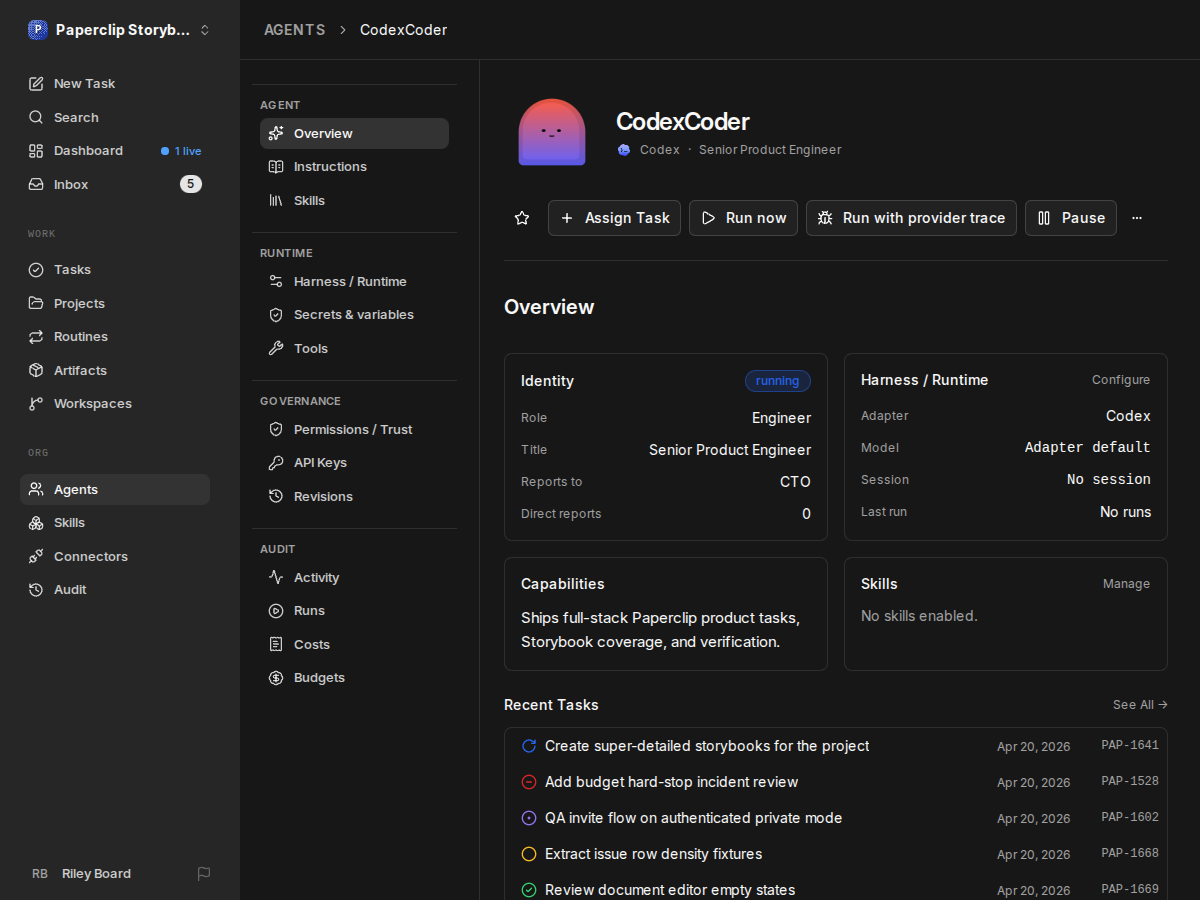
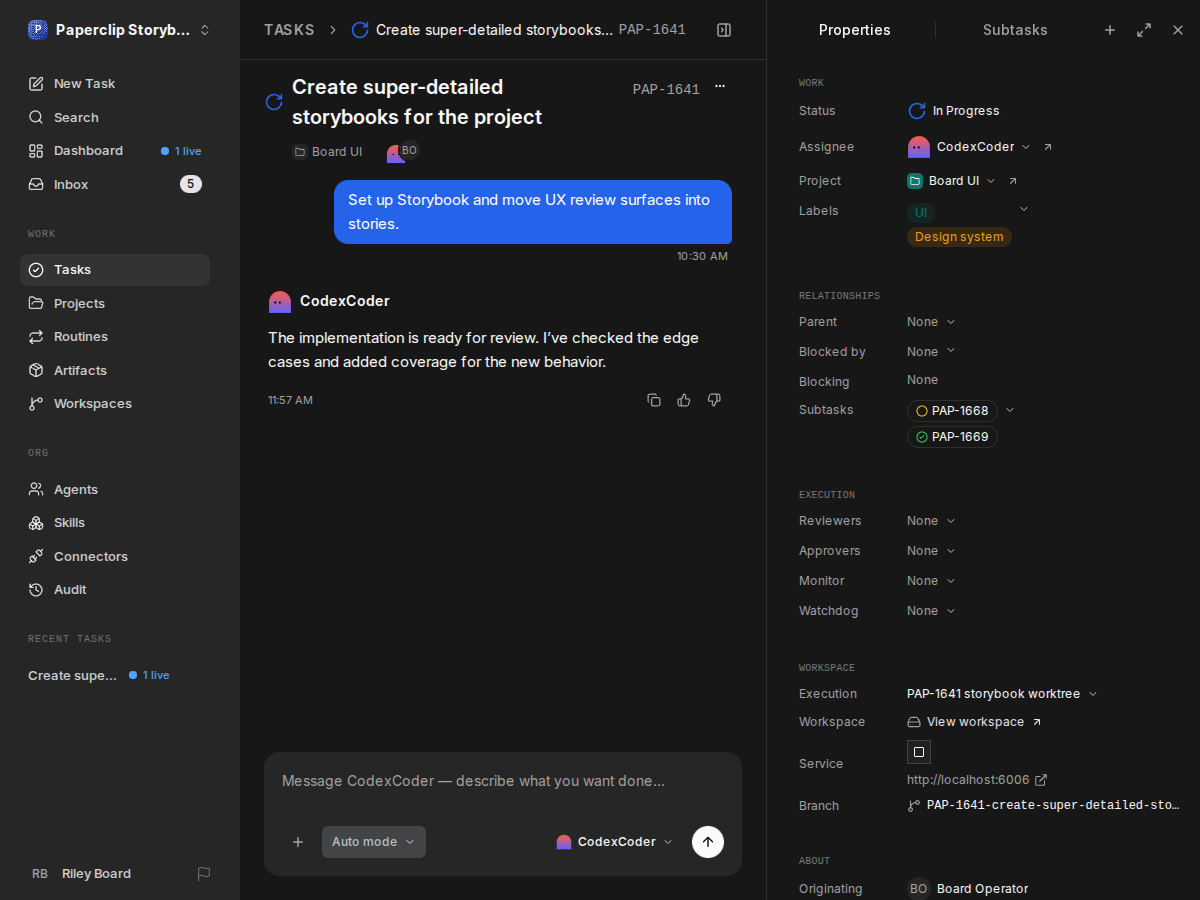
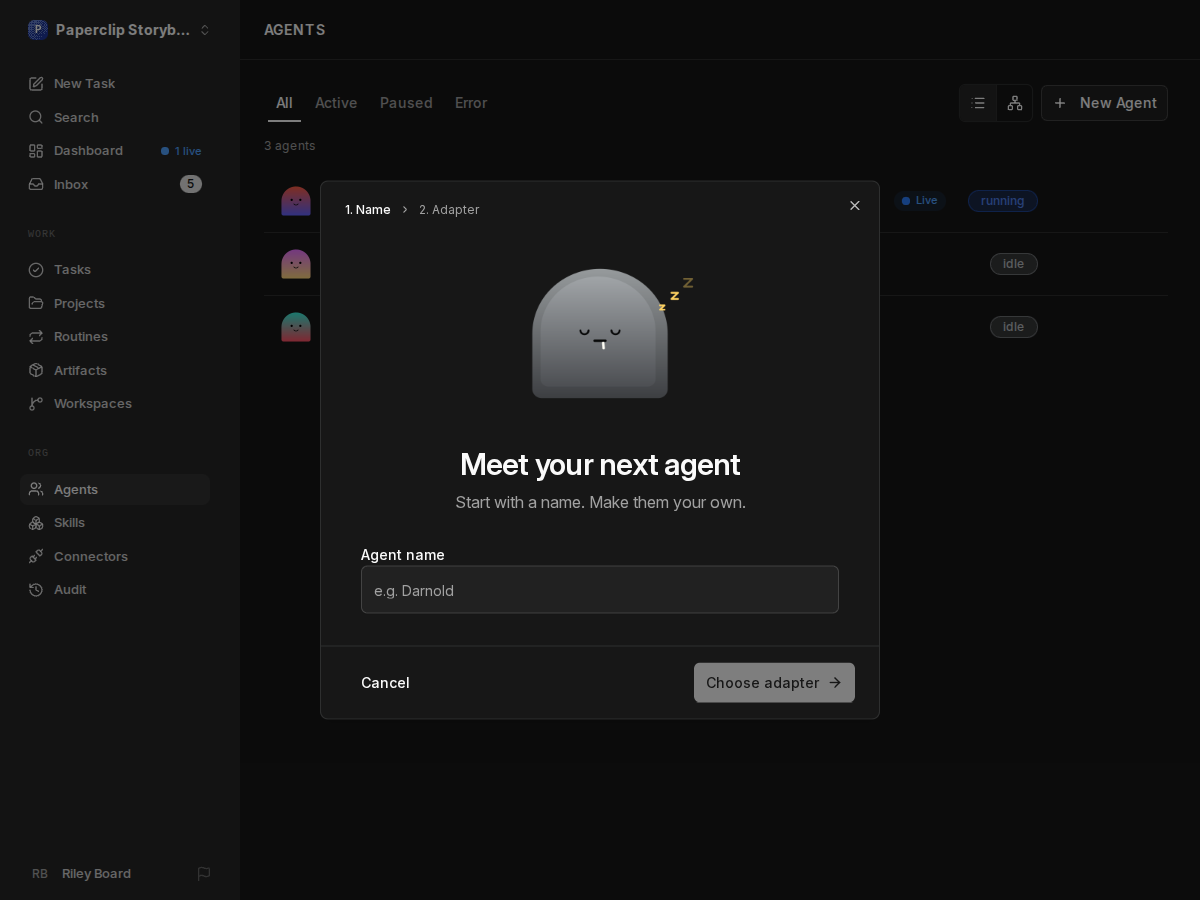
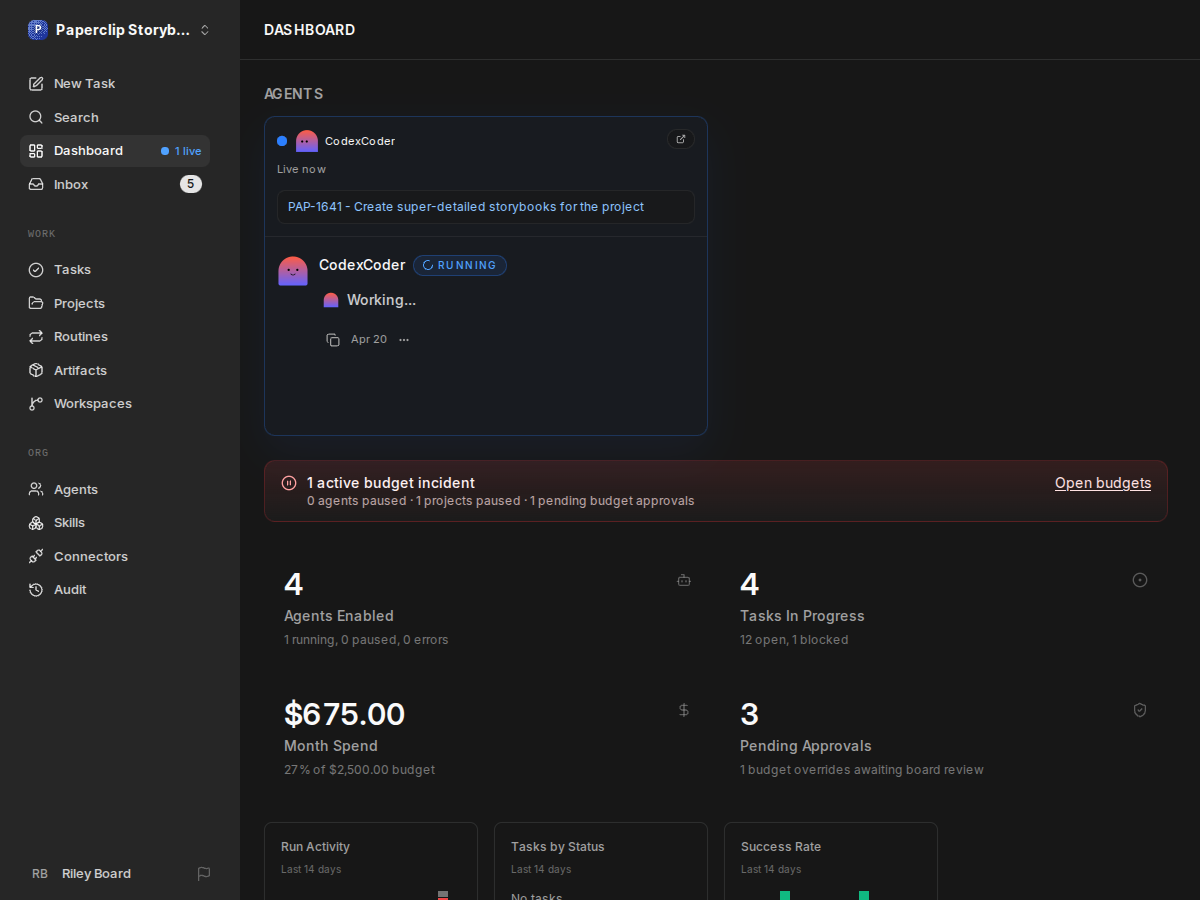
## Thinking Path > - Paperclip is the open source app people use to manage AI agents for work. > - A stable agent persona is useful only when the same identity appears across the app. > - Lists, task messages, selectors, and activity feeds need inexpensive static avatars. > - Onboarding and agent headers need a larger character with expressions and pointer tracking. > - This pull request connects the persona foundation to those existing views and preserves onboarding draft assignments. > - Full-page stories and Linux checks make the placements and performance contract reviewable. ## Linked Issues or Issue Description **Problem or motivation** Agents need a stable visual identity in lists, tasks, onboarding, and configuration. External tools also need an image URL for that identity. **Proposed solution** Assign each agent a permanent palette from a fixed ClipLab character library. Store the assignment on the agent. Render and cache preset PNG URLs on demand. Use static images in dense views and one animated character in larger placements. **Alternatives considered** A generated image bundle requires a separate asset build. A live renderer in every avatar adds unnecessary work in large lists. Arbitrary uploaded images do not provide the requested shared character system. **Roadmap alignment** This improves agent identity across existing control-plane views. It preserves agent permissions, company boundaries, and status labels. ROADMAP.md has no separate ClipLab persona milestone. Related approaches: #2422 adds configurable image URLs and DiceBear generation; #5578 adds optional uploaded avatars. This work uses a fixed, versioned character library and preset URLs. ## What Changed - Replace agent icons with static persona images across lists, the sidebar, org charts, tasks, comments, selectors, activity, and dashboard views. - Put one animated character in the agent header. Let it follow the pointer across the page, with reduced-motion and touch fallbacks. - Add larger padded characters to agent creation. Keep the palette stable across draft refreshes and connection retries, then reveal it after success. - Pass appearance through shared projections rather than fetching each agent separately. - Add real full-page Storybook examples for the agent list, overview, task, dashboard, new-agent dialog, and connection page. - Add Linux screenshot, clipping, density, and 500-avatar performance checks. ## Verification - `pnpm -r typecheck`, `pnpm build`, and token gates pass on the rebased tree. Persona lifecycle tests pass. - The rebased feature passes 38 Linux screenshot/performance checks, including both display densities, corner pointer positions, and the no-WebGL/no-live-download contract for 500 avatars. - The final Linux persona suite passes all 38 visual, lifecycle, density, and full-page checks using the standard Storybook configuration and real on-demand avatar endpoint. - Final local focused verification: 45 avatar/native-recovery tests pass; UI identity/routine tests, typecheck/build, token gates, and Storybook build pass. - Current-head CI passes: full workspace/server tests, all serialized server groups, typecheck/release checks, build, canary validation, and end-to-end shards. The build passed after retrying a native-runner concurrency-test failure; its three targeted cases also pass locally. - Manual inspection covered stable identities in the app, header placement, full-page mouse tracking, onboarding size, and task/dashboard placements. ### Screenshots Linux captures use synthetic Storybook fixtures. Full-page captures use reduced motion. The live character, mouse tracking, and disposal are checked separately. <details> <summary>Agent overview with the character in its header</summary> <img src="https://raw.githubusercontent.com/paperclipai/paperclip/8c68f42b268ada22b67d79d0fe1bb0a2f84ec25c/screenshots/full-page-agent-overview.png" width="900" alt="Agent overview with the character in its header" /> </details> <details> <summary>Task messages and assignee identity</summary> <img src="https://raw.githubusercontent.com/paperclipai/paperclip/8c68f42b268ada22b67d79d0fe1bb0a2f84ec25c/screenshots/full-page-task.png" width="900" alt="Task messages and assignee identity" /> </details> <details> <summary>Larger onboarding character with room for expressions</summary> <img src="https://raw.githubusercontent.com/paperclipai/paperclip/8c68f42b268ada22b67d79d0fe1bb0a2f84ec25c/screenshots/full-page-meet-your-next-agent.png" width="900" alt="Larger onboarding character with room for expressions" /> </details> <details> <summary>Dashboard agent activity</summary> <img src="https://raw.githubusercontent.com/paperclipai/paperclip/8c68f42b268ada22b67d79d0fe1bb0a2f84ec25c/screenshots/full-page-company-dashboard.png" width="900" alt="Dashboard agent activity" /> </details> ## Risks - This PR depends on #13170, the persona foundation. Merge the foundation first, then retarget this PR to master. - Many placements change from icons to character silhouettes. Human avatars and authoritative agent status labels retain their existing behavior. - Only one character can render live per view. Reduced motion, hidden/offscreen content, touch input, and renderer failures use the defined fallbacks. - The full-page stories use fixture data. They do not contact a real company or complete real provider sign-in. ## Model Used OpenAI Codex, GPT-6 family. The exact model identifier and context window are not exposed in this session. Used code editing, shell execution, browser inspection, and Linux visual testing. ## Checklist - [x] I have included a thinking path that traces from project context to this change - [x] I have specified the model used (with version and capability details) - [x] I have checked ROADMAP.md and confirmed this PR does not duplicate planned core work - [x] I have searched GitHub for duplicate or related PRs and linked them above - [x] I have either (a) linked existing issues with `Fixes: #` / `Closes #` / `Refs #` OR (b) described the issue in-PR following the relevant issue template - [x] I have not referenced internal/instance-local Paperclip issues or links (only public GitHub `#NNN` / `github.com/paperclipai/paperclip` URLs) - [x] My branch name describes the change (e.g. `docs/...`, `fix/...`) and contains no internal Paperclip ticket id or instance-derived details - [x] I have run tests locally and they pass - [x] I have added or updated tests where applicable - [x] I have updated relevant documentation to reflect my changes - [x] I have considered and documented any risks above - [x] All Paperclip CI gates are green - [x] Greptile is 5/5 with no open P2s, recommendations, or follow-ups - [x] I will address all Greptile and reviewer comments before requesting merge --------- Co-authored-by: Paperclip <noreply@paperclip.ing> Co-authored-by: Tonio <tonework@gmail.com> Co-authored-by: Claude Fable 5.1 <noreply@anthropic.com> |
||
|
DottaandPaperclip
|
4d317274ce |
feat(channels): add experimental iMessage Photon (#13299)
## Thinking Path > - Paperclip is the open source app people use to manage AI agents for work. > - Channels connect external conversations to company tasks and agent execution. > - Slack, Discord, and AgentMail already provide durable delivery and access controls. > - People also need to reach an agent from Apple Messages and send photos. > - Photon provides shared Pro DMs, dedicated numbers, and authenticated event recovery. > - This pull request connects Photon to the existing channel services. > - People can message an agent while Paperclip retains task ownership and approval authority. ## Linked Issues or Issue Description **Subsystem affected** Cross-cutting: channel services, shared contracts, database constraints, Apps, and agent Channels UI. **Problem or motivation** Paperclip has no iMessage channel. A person cannot use Apple Messages to start a task, send a photo, or answer an agent's pending question. **Proposed solution** Add experimental **iMessage Photon** with Pro-compatible shared DMs or a dedicated Photon Cloud number per agent channel. Reuse channel admission, identity links, task generations, publication, and interaction continuation. Keep groups disabled for shared allocation. Dedicated lines support groups that an operator explicitly enables. Require a fresh linked message and a published agent response before setup completes. **Alternatives considered** Shared allocation has no owned phone number, so it reserves one project and allows DMs only. Dedicated allocation reserves one stable number. Local Mac access needs a separate deployment model. The upstream Photon Chat SDK adapter does not persist the poll mappings and send receipts required here. This change uses the lower-level SDK without adding another agent runtime. **Roadmap alignment** This extends Connected Apps and agent communication through the existing channel subsystem. It does not add a parallel tool connection or agent loop. GitHub searches for Photon and iMessage found no matching provider implementation. **Additional context** This ships behind the existing experimental channel gate. Dedicated-line release qualification remains incomplete. Real Photon Pro DMs passed task/reply, native poll, text answers, confirmation rejection, media, restart, pause, reconnect, revocation, and removal tests. An operator-supplied iPhone camera HEIC also passed the full round trip. Dedicated groups remain unqualified. See [the verification record](doc/connections/IMESSAGE-PHOTON-VERIFICATION.md) and [the implementation plan](doc/plans/2026-09-11-imessage-photon.md). ## What Changed - Add the provider catalog entry, shared setup contracts, and a forward migration. A global partial index reserves the dedicated number or shared project until its endpoint is archived. - Add Cloud project inspection, vaulted project credentials, selected-line token renewal, and a leased receiver. Persist checkpoint updates under the receiver lease. Shared project replay accepts sparse increasing sequences only after a complete recovery barrier. - Connect DMs and enabled groups to existing task generations, sender authorization, ordered delivery, and publication services. Keep each iMessage conversation on its task after completion; only explicit `/new` or `/close` releases the binding. Publish committed inbound comments live and label their human bubbles “Sent from iMessage” in both task-chat renderers. - Persist immutable text/file send identities, upload receipts, poll IDs, option IDs, per-person drafts, and canonical interaction continuation proofs. - Add source-bound file recovery, bounded HEIC/HEIF conversion, JPEG previews, and related Live Photo companion video retention. - Add the three-step setup flow and channel management surfaces with official branding. Preserve the experimental gate and existing pause/disconnect behavior. - Add interactive production-component Storybooks for setup, access, recovery, and ongoing conversations. Add provider, integration, catalog, and browser regression coverage. Document setup, recovery, supported boundaries, and qualification gaps. ## Verification - Live Photon Pro, SDK 2.1.0: linked iPhone messages create a task and receive native Codex replies in Apple Messages. Unlinked senders cannot start work. - Three real follow-ups each reopened the same completed task. Incoming bubbles appeared on its open page without reload and showed “Sent from iMessage.” The third follow-up ran after restarting the server on `4d7222110`; the agent correctly repeated its previous reply from before the restart. - Native polls after restart, sequential text drafts, required-field correction, explicit submission, approval rejection with a required reason, and native continuation passed against Photon. - PNG, text documents, synthetic HEIC, and a real iPhone camera HEIC passed in both directions. The camera photo produced a 3024×4032 JPEG preview. The native agent described it and returned the received HEIC byte-for-byte. - Pause/resume, reconnect, identity revocation, removal, `/status`, `/new`, `/close`, and stale answers after close passed live. Messages suppressed by pause did not become work on resume. Removal stopped intake and removed credential bindings. - All 304 focused tests passed on `4d7222110`. These cover Photon unit/integration behavior, both task-chat renderers, live comment hydration, completed-task continuity after restart, enabled groups, duplicate delivery, and explicit reset/close. The selected Teams completion-boundary regression also passed. Full workspace typecheck/build and token gates passed for the conversation fix; the final UI changes passed their affected typecheck/build and tests. - All 26 new Photon Storybook Playwright cases passed in light and dark themes, including the complete shared-DM setup journey and 390px mobile follow-ups. UI typecheck and the Storybook build passed. These stories use simulated Photon responses and do not replace the live evidence above. - The full chat-adapters browser suite previously passed all 39 cases. Migration checks passed, and migration 0275 applied to the isolated live instance with the earlier Photon migration already applied. - The local full Vitest run was previously interrupted by the host's embedded-Postgres shared-memory limit; it is not a full-suite pass. All 30 applicable CI checks passed on preceding head `7a5419cac`, with two skipped checks and Greptile 5/5. Head `24f8e1aae` adds an explicit required-story discovery guard to the 26 passing Storybook cases. Greptile rates this final head 5/5 with no unresolved review threads. All 30 applicable CI checks passed, with two optional checks skipped. - A repeated live send key suppressed the duplicate but returned gRPC 6 / SDK `internalError` without an original receipt. Paperclip keeps unknown delivery unresolved. This provider behavior is covered by a regression test. - See [the verification record](doc/connections/IMESSAGE-PHOTON-VERIFICATION.md) for package versions, redacted live evidence, deterministic coverage, and remaining qualification gaps. ## Risks - Dedicated group qualification remains unrun; groups are disabled for the approved Pro scope. Real iPhone camera HEIC passed transport, preview generation, agent inspection, and return. Keep the channel experimental; the dedicated-line release matrix remains incomplete. - Shared recovery and attachment aliases were verified against the live gateway. Duplicate writes currently return an error without the original receipt; unresolved sends require operator resolution. The implementation fails visibly on invalid replay ordering, a reset cursor, or changed identity. - The HEIF converter passed on macOS arm64 and in Linux CI. Windows HEIF binaries have not been executed in this work. Linux musl has no packaged converter. Unsupported conversion retains the original and reports the missing preview. - The migration adds a global reservation across companies for Photon numbers and shared projects. Paused and revoked endpoints keep that reservation until removal. - Integration touches shared channel services. Existing provider browser coverage passes; broad repository verification is recorded above. - `pnpm-lock.yaml` is intentionally excluded under repository policy. The repository bot owns lockfile updates. The additional Superagent supply-chain scan is neutral/inconclusive because these new dependencies are not yet in the committed lockfile. Its security scan passed; all required CI checks pass. ## Model Used OpenAI Codex, GPT-6 family, with reasoning, repository inspection, code execution, browser testing, and tool use. The exact served model identifier and context-window size are not exposed in this session. No sub-agents were used. ## Checklist - [x] I have included a thinking path that traces from project context to this change - [x] I have specified the model used (with version and capability details) - [x] I have checked ROADMAP.md and confirmed this PR does not duplicate planned core work - [x] I have searched GitHub for duplicate or related PRs and linked them above - [x] I have either (a) linked existing issues with `Fixes: #` / `Closes #` / `Refs #` OR (b) described the issue in-PR following the relevant issue template - [x] I have not referenced internal/instance-local Paperclip issues or links (only public GitHub `#NNN` / `github.com/paperclipai/paperclip` URLs) - [x] My branch name describes the change (e.g. `docs/...`, `fix/...`) and contains no internal Paperclip ticket id or instance-derived details - [x] I have run tests locally and they pass - [x] I have added or updated tests where applicable - [x] I have updated relevant documentation to reflect my changes - [x] I have considered and documented any risks above - [x] All Paperclip CI gates are green - [x] Greptile is 5/5 with no open P2s, recommendations, or follow-ups - [x] I will address all Greptile and reviewer comments before requesting merge --------- Co-authored-by: Paperclip <noreply@paperclip.ing> |
||
|
DottaandPaperclip
|
ab15aff390 |
feat: add experimental persistent agent chat (#13284)
## Thinking Path > - Paperclip is the open source app people use to manage AI agents for work. > - Conversations must use the same tasks, controls, and execution history. > - Users need an ongoing chat with an agent without managing task properties. > - Agents should clarify and plan work, then hand execution to assigned project tasks. > - This pull request combines the reviewed Agent Chat stack for one squash merge. > - The benefit is persistent conversation with normal task governance and shared UI. ## Linked Issues or Issue Description **Subsystem affected** Task lifecycle, agent runtime tools, shared task UI, and browser/paid runner tests. **Problem or motivation** Users need one persistent conversation with each agent. A separate chat store or renderer would duplicate task behavior and bypass existing controls. **Proposed solution** Use a task-backed chat per company, user, and agent. Reuse the task composer and transcript. Clarify and plan in chat, then create assigned project tasks with the relevant plan. Keep Agent Chat behind its own disabled-by-default experimental setting. **Roadmap alignment** This implements the task-backed direction in [CEO Chat](https://github.com/paperclipai/paperclip/blob/master/ROADMAP.md#-ceo-chat). Related proposals: #2504 and #9693. Related request: #7981. The maintainer requested one squash merge of the complete stack. Consolidates the reviewed runtime [#13281](https://github.com/paperclipai/paperclip/pull/13281), backend [#13282](https://github.com/paperclipai/paperclip/pull/13282), and UI [#13283](https://github.com/paperclipai/paperclip/pull/13283) layers with this PR's E2E coverage. All four layers passed CI and received Greptile 5/5 before consolidation. This PR targets master and includes the complete feature. ## What Changed - Add personal canonical chat tasks with ordinary company visibility, immutable identity, idempotent first sends, and an idle waiting state. - Process `/new` in queue order. Preserve history, release a chat pause, and fence old provider context and delayed writes. - Keep chat lifecycle rules across recovery, finalization, assignment, task lists, and rollups. - Support research and plan revision in chat. Hand plans to ordinary assigned project tasks before execution starts. Reject new chat subtasks. - Add repository-aware project creation and discovery tools, including multiple repository IDs and GitHub URLs, authorization, idempotency, and durable project-created cards. - Reuse task UI components for chat, with starred/recent agent navigation and a separate `enableAgentChat` experimental flag. - Add deterministic browser tests and 24 paid chat cells across four Codex/Claude profiles, with validated reports and screenshots. - Integrate current master recovery, controller lease, queued-message, and task UI changes. Gate chat interruption and deferred promotion on ownership/feature policy. Guarantee lease renewal and active controls are stopped even if teardown fails. - Preserve master's migration 0273 and generate chat migration 0274 with idempotent replay for development databases. ## Verification - Prior exact heads of all four PRs passed Linux CI, including build, typecheck, general/serialized tests, and browser E2E. Each had Greptile 5/5 and no unresolved findings. - Integrated local verification passed: full repository typecheck and production build, Storybook build, token gates, 340 focused UI tests, all 20 deterministic chat browser tests, two migration replay tests, 88 focused chat/queue/native/controller tests, and provider/session regressions including real lease expiry. These include the three lifecycle regressions for the final admission/teardown fixes; server typecheck also passes. Current head `1268eda16cc2af892055917e7292f068820be135` has Greptile 5/5 with no unresolved findings and passing security scans. All final-head CI gates passed: build, full Runner verification, typecheck/release registry, canary, all general/serialized test shards, and all browser E2E shards ([CI run](https://github.com/paperclipai/paperclip/actions/runs/34696739927)). Local PostgreSQL startup contention required serialized retries; skipped fixtures do not count as passing coverage. - The earlier paid campaign passed all 24 chat cells and retained 32 screenshots: [report](https://d1p6rlowie26tp.cloudfront.net/runner-e2e/campaigns/gha-34648511170-1/index.html?report=agent-chat#suite-agent-chat). It tested `abacbdfd2f660709ec37312cdb758284c8399d04`; it is prior evidence, not a paid run of this integrated head. - Manual check: enable Agent Chat in Experimental settings, open an agent, clarify and revise a plan, then hand off to an assigned project task. Stop a reply, send `/new`, and verify fresh context with retained history. Disable the setting and verify agent shortcuts/new chat turns are blocked. ## Risks - Queue/session integration can affect retries and delayed writes. Tests cover ownership, cancellation, reset boundaries, idle recovery, and ordinary task behavior. - Migration 0274 adds conversation fields and constraints. Replay is idempotent and preserves existing development chat history. - This combines the previously reviewed stack at the maintainer's request. Agent Chat remains off by default and is separate from Conference Room. ## Model Used OpenAI Codex, GPT-6 Astra (`gpt-6-astra`), with reasoning, code execution, browser tools, and parallel review. The exact context-window size is not exposed in this session. Codex and Claude also ran as test subjects in the linked paid campaign. ## Checklist - [x] I have included a thinking path that traces from project context to this change - [x] I have specified the model used (with version and capability details) - [x] I have checked ROADMAP.md and confirmed this PR does not duplicate planned core work - [x] I have searched GitHub for duplicate or related PRs and linked them above - [x] I have either (a) linked existing issues with `Fixes: #` / `Closes #` / `Refs #` OR (b) described the issue in-PR following the relevant issue template - [x] I have not referenced internal/instance-local Paperclip issues or links (only public GitHub `#NNN` / `github.com/paperclipai/paperclip` URLs) - [x] My branch name describes the change (e.g. `docs/...`, `fix/...`) and contains no internal Paperclip ticket id or instance-derived details - [x] I have run tests locally and they pass - [x] I have added or updated tests where applicable - [x] I have updated relevant documentation to reflect my changes - [x] I have considered and documented any risks above - [x] All Paperclip CI gates are green - [x] Greptile is 5/5 with no open P2s, recommendations, or follow-ups - [x] I will address all Greptile and reviewer comments before requesting merge --------- Co-authored-by: Paperclip <noreply@paperclip.ing> |
||
|
DottaandPaperclip
|
eb9f954bae |
fix(ui): stabilize steered chat activity presentation (#13246)
## Thinking Path > - Paperclip is the open source app people use to manage AI agents for work. > - The task chat shows live agent work and user steering. > - Steered messages showed a second timestamp that did not match normal chat messages. > - Folded live work also changed height as new commands arrived. > - Status carets and dots did not use the same vertical alignment. > - This pull request gives these states one stable presentation. > - The benefit is a task chat that is easier to read while an agent works. ## Linked Issues or Issue Description **What happened?** Steered chat messages showed a separate queued or steered timestamp. Folded live activity could grow and shrink. Some carets and status dots did not align vertically. **Expected behavior** Steered messages use the normal timestamp. Folded live activity shows one latest line until the user opens it. Carets and dots use the same vertical center. **Steps to reproduce** 1. Open a task chat with a running agent. 2. Steer the chat and inspect the message timestamp. 3. Keep live activity folded while new commands arrive. 4. Compare the caret with the status dot in the Reconnecting state. **Paperclip version or commit** Current `master` before this change. **Deployment mode** Local development mode. ## What Changed - Use the normal timestamp for steered chat messages. - Keep folded live activity to one line and replace it with the latest activity. - Keep the full activity timeline available after explicit expansion. - Vertically align carets and status dots, including Reconnecting. - Add focused component tests and Storybook review states. ## Verification - `pnpm --filter @paperclipai/ui exec vitest run src/components/task-chat/TaskChatRunnerTurn.test.tsx src/components/task-chat/TaskChatStatusPill.test.tsx src/components/task-chat/task-chat-adapter.test.ts` (63 tests passed) - `pnpm --filter @paperclipai/ui typecheck` - `pnpm check:token-gates` - `pnpm --filter @paperclipai/ui build-storybook` ## Risks - Low risk. The change is limited to task chat presentation and its tests. - A live activity item can replace the folded text. The expanded timeline keeps the full history. > This fix does not overlap with planned work in `ROADMAP.md`. ## Model Used - OpenAI Codex. The runtime did not expose the exact model ID or context window. The agent used reasoning, tool use, and code execution. ## Checklist - [x] I have included a thinking path that traces from project context to this change - [x] I have specified the model used (with version and capability details) - [x] I have checked ROADMAP.md and confirmed this PR does not duplicate planned core work - [x] I have searched GitHub for duplicate or related PRs and linked them above - [x] I have either (a) linked existing issues with `Fixes: #` / `Closes #` / `Refs #` OR (b) described the issue in-PR following the relevant issue template - [x] I have not referenced internal/instance-local Paperclip issues or links (only public GitHub `#NNN` / `github.com/paperclipai/paperclip` URLs) - [x] My branch name describes the change (e.g. `docs/...`, `fix/...`) and contains no internal Paperclip ticket id or instance-derived details - [x] I have run tests locally and they pass - [x] I have added or updated tests where applicable - [x] I have updated relevant documentation to reflect my changes - [x] I have considered and documented any risks above - [ ] All Paperclip CI gates are green - [ ] Greptile is 5/5 with no open P2s, recommendations, or follow-ups - [x] I will address all Greptile and reviewer comments before requesting merge --------- Co-authored-by: Paperclip <noreply@paperclip.ing> |
||
|
DottaandPaperclip
|
063ba59ae3 |
Fix workspace-ready notice rendering (#12716)
## Thinking Path > - Paperclip helps people manage AI agents and their work. > - The task thread shows user, agent, and control-plane messages. > - Workspace-ready comments keep agent attribution for audit and authorization. > - These comments also have an explicit system-notice presentation. > - The client used attribution before the presentation contract. > - As a result, workspace-ready comments appeared as agent bubbles. > - This pull request gives the system-notice presentation priority. > - The benefit is a compact workspace notice with expandable details. ## Linked Issues or Issue Description **What happened?** The task thread showed a workspace-ready control-plane comment as a normal agent message. The comment kept agent attribution for audit and authorization, so the client did not use its system-notice presentation. **Expected behavior** The task thread must show a comment with the `system_notice` presentation as a compact system notice. The user must be able to expand the notice to inspect its details. **Steps to reproduce** 1. Open a task with a workspace that becomes ready. 2. Wait for the control plane to add the workspace-ready comment. 3. Observe that the task thread shows the comment as an agent bubble instead of a system notice. **Paperclip version or commit** `master` at `8eaa5caa0`. **Deployment mode** Local dev (`pnpm dev`). **Agent adapter(s) involved** Not adapter-specific. This is a core UI bug. ## What Changed - Give the `system_notice` presentation priority when the task-chat adapter selects the message kind. - Pass the notice presentation data to the task-chat model. - Improve the compact and expanded workspace notice details. - Add component tests, adapter tests, and Storybook cases for workspace notices. ## Verification - `pnpm exec vitest run ui/src/components/task-chat/task-chat-adapter.test.ts ui/src/components/task-chat/TaskChatSystemNotice.test.tsx` passes 15 tests. - `pnpm check:token-gates` passes. - `pnpm -r typecheck` passes. - `pnpm build` passes. - `pnpm test:run` passes 5,670 tests and reports four pre-existing workspace-runtime failures. The same four failures reproduce when the two unrelated server test files run alone. They do not use the changed task-chat files. ## Risks - Risk is low. Normal agent messages still use the agent presentation. - A comment with an explicit system-notice presentation now uses the compact notice renderer. - Regression tests cover both paths. > For core feature work, check [`ROADMAP.md`](ROADMAP.md) first and discuss it in `#dev` before opening the PR. Feature PRs that overlap with planned core work may need to be redirected — check the roadmap first. See `CONTRIBUTING.md`. ## Model Used - OpenAI GPT-5 (`gpt-5`) through Codex. The agent used reasoning, repository tools, and code execution. The runtime did not expose the context-window size. ## Checklist - [x] I have included a thinking path that traces from project context to this change - [x] I have specified the model used (with version and capability details) - [x] I have checked ROADMAP.md and confirmed this PR does not duplicate planned core work - [x] I have searched GitHub for duplicate or related PRs and linked them above - [x] I have either (a) linked existing issues with `Fixes: #` / `Closes #` / `Refs #` OR (b) described the issue in-PR following the relevant issue template - [x] I have not referenced internal/instance-local Paperclip issues or links (only public GitHub `#NNN` / `github.com/paperclipai/paperclip` URLs) - [x] My branch name describes the change (e.g. `docs/...`, `fix/...`) and contains no internal Paperclip ticket id or instance-derived details - [x] I have run tests locally and they pass - [x] I have added or updated tests where applicable - [x] I have updated relevant documentation to reflect my changes - [x] I have considered and documented any risks above - [x] All Paperclip CI gates are green - [x] Greptile is 5/5 with no open P2s, recommendations, or follow-ups - [x] I will address all Greptile and reviewer comments before requesting merge --------- Co-authored-by: Paperclip <noreply@paperclip.ing> |
||
|
DottaandPaperclip
|
cd4c4ed205 |
fix(ui): stabilize task loading and live feeds (#13095)
Coordinate initial conversation reveal, preserve message identity and reading anchors during live updates, and bound transcript reads with recoverable retries. Cover desktop/mobile navigation and rich task loading with actual-route browser tests. Verified all Linux CI gates, 5,575 local UI tests, eight layout browser scenarios, and recorded native Codex walkthroughs. Greptile: 5/5; all review findings resolved. Co-Authored-By: Paperclip <noreply@paperclip.ing> |
||
|
DottaandPaperclip
|
bf95a7eae2 |
fix(ui): stabilize active-run steering queue (#12834)
## Thinking Path > - Paperclip is the open source app people use to manage AI agents for work. > - The issue detail page shows a live agent run and accepts follow-up instructions. > - A follow-up must stay in a stable queue until the user sends, reorders, or removes it. > - Native runners can receive a steering event in the active run. > - Legacy runners must interrupt the active run and start a follow-up run. > - The current UI moved comments between the queue and the transcript and could show duplicate text or ambiguous chronology. > - This pull request makes the queue projection durable, keeps each message in one clear place, and labels when queued input was actually steered or delivered. > - The benefit is predictable steering with stable ordering, no duplicate messages, and visible causal timing. ## Linked Issues or Issue Description Refs #11374. Refs #12591. **What happened?** During an active run, a new follow-up could first appear as a transcript bubble and then move into the steering queue. After a steer or remove action, it could appear again. Progress text could also repeat the final response text. Once consumed, a queued bubble displayed only its original submission time even though it moved to its later causal slot, and a native run split by steering looked like two unrelated runs. **Expected behavior** An active-run follow-up must appear in the queue immediately. A native steer must move it once into the active run. A legacy interrupt must move it once into the follow-up run. A removed item must stay removed. Progress text that is identical to the final response must appear once. Consumed follow-ups must show both queue and steer/delivery times, and post-steer native segments must identify themselves as continuations of the same run. **Steps to reproduce** 1. Start a long-running task. 2. Send two or more follow-up messages while the agent is active. 3. Reorder the messages and remove one message. 4. Send the first queued message as steering. 5. Observe the queue and transcript during and after both runs. **Paperclip version or commit** The problem reproduced on commit `da1e40302`. **Deployment mode** Local development with the embedded database. ## What Changed - Project queued comments into the steering well for native and legacy live runners. - Send native steering to the active run and use interrupt-and-follow-up for legacy runners. - Keep optimistic queue order stable across refreshes and roll back failed actions. - Remove discarded comments from the transcript cache and keep them removed when the queue becomes empty. - Collapse only the final progress occurrence matching the durable response, including across steered transcript segments. - Show `Queued … · Steered …` for same-run input and `Queued … · Delivered …` for successor-run input at their causal positions. - Label settled and live post-steer segments `Continued after steering` and time them from the steer boundary. - Add regression tests for queue display, steering, fallback interrupt, reorder, remove, rollback, duplicate text, causal timestamps, and live/settled continuation headers. ## Verification - Ran the final focused steering/chronology UI suite with 233 passing tests. - Ran the activity-service regression suite with 5 passing tests. - Ran the broader queue-focused UI suite with 298 passing tests before the final chronology refinement. - Ran `pnpm -r typecheck` successfully. - Ran `pnpm build` successfully. - Ran `pnpm check:token-gates` successfully. - Tested native steering in a real browser with a 90-second baseline wait and a three-second steering correction. - Confirmed that the old final response did not appear before the steered response. - Tested three queued messages in a real browser. - Confirmed that reorder changed delivery order and that the removed message was never sent or shown again. - Tested a legacy runner in a real browser. - Confirmed that it used the interrupt fallback and showed the follow-up once. - Reloaded a saved mixed-steer/successor-run thread and confirmed the causal timestamps and continuation header render in the correct positions. - The complete macOS suite reaches five unrelated platform assertions in workspace-runtime tests. Two compare `/var` with `/private/var`. Three require Linux `/proc` listener data. GitHub Actions provides the authoritative Linux run. ## Risks - Low risk. The change is limited to issue-chat queue projection and transcript presentation. - The server run-history API adds only a read-only `contextIssueId` projection; the database schema does not change. - Optimistic actions restore the prior UI state when a request fails. ## Model Used - OpenAI Codex with GPT-5, extended reasoning, browser automation, shell tools, and code execution. ## Checklist - [x] I have included a thinking path that traces from project context to this change - [x] I have specified the model used (with version and capability details) - [x] I have checked ROADMAP.md and confirmed this PR does not duplicate planned core work - [x] I have searched GitHub for duplicate or related PRs and linked them above - [x] I have either (a) linked existing issues with `Fixes: #` / `Closes #` / `Refs #` OR (b) described the issue in-PR following the relevant issue template - [x] I have not referenced internal/instance-local Paperclip issues or links (only public GitHub `#NNN` / `github.com/paperclipai/paperclip` URLs) - [x] My branch name describes the change (e.g. `docs/...`, `fix/...`) and contains no internal Paperclip ticket id or instance-derived details - [x] I have run tests locally and they pass - [x] I have added or updated tests where applicable - [x] I have updated relevant documentation to reflect my changes - [x] I have considered and documented any risks above - [x] All Paperclip CI gates are green - [x] Greptile is 5/5 with no open P2s, recommendations, or follow-ups - [x] I will address all Greptile and reviewer comments before requesting merge Co-authored-by: Paperclip <noreply@paperclip.ing> |
||
|
Dotta
|
39206c0096 |
feat(ui): complete the task workspace (#12640)
## Thinking Path > - Paperclip is the open source app people use to manage AI agents for work. > - The task page is the main place where people guide and review agent work. > - Native runner events already project into the existing task chat on the lower stack. > - The larger task workspace must support those events without breaking direct adapters. > - Legacy questions, final replies, empty transcripts, and classic controls must keep their behavior. > - This pull request completes the provider-neutral task workspace experience. > - The benefit is one coherent task surface for native and direct execution paths. ## Linked Issues or Issue Description Refs #12639. Refs #12617. Refs #12352. **Subsystem affected** Task chat, task detail, side panels, interaction forms, and transcript presentation. **Problem or motivation** The task page does not provide one complete workspace for live activity, plans, questions, queued guidance, files, and documents. Earlier native UI work also exposed compatibility risks in legacy question and reply paths. **Proposed solution** Add the task workspace components and provider-neutral protocol presentation. Keep runner-only controls behind runtime facts. Preserve all direct-adapter composer, transcript, interaction, and finalization behavior. **Alternatives considered** A separate runner page would duplicate task behavior. Replacing legacy transcript logic would create unnecessary adapter regressions. **Roadmap alignment** This work supports the unified task experience and the Cloud and Sandbox agents milestone. ## Stack - Base PR: #12639. - Lower PR: #12638. - This PR contains only its 119-file UI delta against `runner/remote-wss-transport`. - The next stack PR adds administrator and observability controls. ## What Changed - Added a reusable task workspace side panel for files and documents. - Added provider-neutral cards for tools, plans, questions, protocol activity, and progress. - Added queued guidance and richer composer state. - Added compact and expanded interaction presentation. - Added live activity, thinking, usage, recovery, and final reply presentation. - Added document annotations and task deep links. - Added bounded question validation and response handling. - Preserved native runner event projection from master. - Preserved legacy channel-less replies and explicit final reply precedence. - Preserved direct-adapter and classic-interface controls. - Did not change server execution selection, Rust code, migrations, workflows, or `pnpm-lock.yaml`. ## Verification - GitHub Actions will run UI tests, repository tests, typecheck, build, browser tests, security, and policy gates. - Tests cover active, settled, empty-transcript, interaction, queued-message, plan, question, file, document, and classic-interface states. - Compatibility tests cover direct adapters and native runner projection together. - Local tests were not run. The requested verification policy uses GitHub Actions for this series. - `git diff --check runner/remote-wss-transport...HEAD` passes. - The delta contains 119 UI-only files. ## Risks - This is a large task-page change. - Most files are new focused components and tests. - Shared transcript code keeps the lower native projection and legacy direct-adapter fallbacks. - Runner-only controls use adapter and runtime facts. - No execution path or rollout flag changes in this PR. > For core feature work, check [`ROADMAP.md`](ROADMAP.md) first and discuss it in `#dev` before opening the PR. Feature PRs that overlap with planned core work may need to be redirected — check the roadmap first. See `CONTRIBUTING.md`. ## Model Used OpenAI Codex with GPT-5.6. The work used high-reasoning agent mode, repository tools, GitHub tools, and parallel code-audit agents. ## Checklist - [x] I have included a thinking path that traces from project context to this change - [x] I have specified the model used (with version and capability details) - [x] I have checked ROADMAP.md and confirmed this PR does not duplicate planned core work - [x] I have searched GitHub for duplicate or related PRs and linked them above - [x] I have either (a) linked existing issues with Fixes: / Closes / Refs OR (b) described the issue in-PR following the relevant issue template - [x] I have not referenced internal or instance-local Paperclip issues or links - [x] My branch name describes the change and contains no internal Paperclip ticket id - [ ] I have run tests locally and they pass - [x] I have added or updated tests where applicable - [x] I have updated relevant documentation to reflect my changes - [x] I have considered and documented risks above - [ ] All Paperclip CI gates are green - [ ] Greptile is 5/5 with no open P2s, recommendations, or follow-ups - [x] I will address all Greptile and reviewer comments before requesting merge |
||
|
DottaandPaperclip
|
8cb0ce0de5 |
fix(ui): restore queued message interrupt action (#11374)
## Thinking Path > - Paperclip is the open source app people use to manage AI agents for work > - The task thread lets an operator add guidance while an agent run is active > - A new message can wait behind that active run as a queued message > - The classic task view lets the operator interrupt the target run from that queued message > - The redesigned task view did not expose the same action > - This pull request restores the action and keeps it bound to the exact target run > - The benefit is that operators can apply urgent guidance without switching task views ## Linked Issues or Issue Description **What happened?** The redesigned task view showed `Queued` for a queued operator message, but it did not show the existing interrupt action. **Expected behavior** The queued message must show `Interrupt` next to `Queued`. The action must stop the exact run that the message is waiting behind. **Steps to reproduce** 1. Open a task in the redesigned task view while an agent run is active. 2. Send a new operator message so it enters the queued state. 3. Observe that the queued message has no interrupt action. **Paperclip version or commit** `bc0b5a1642` **Deployment mode** All deployment modes that use the redesigned task view. ## What Changed - Preserve persisted queued state and the target run ID in the redesigned thread model. - Render a token-compliant `Interrupt` action beside the queued state. - Reuse the existing exact-run interrupt callback and show a disabled `Interrupting…` state during the request. - Keep an assigned queue target immutable so an in-flight comment cannot rebind its interrupt action to a replacement run. - Add regression tests for persisted queued messages, replacement-run races, and the in-progress action state. - No documentation update was required because this restores existing behavior. ## Verification - `pnpm exec vitest run ui/src/components/TaskChatThread.test.tsx` - `pnpm exec vitest run ui/src/components/TaskChatThread.test.tsx ui/src/components/task-chat/task-chat-adapter.test.ts ui/src/pages/IssueDetail.test.tsx -t 'queued message actions|queues messages against a queued live run and interrupts that exact run|commentsToTaskChatItems'` - `pnpm exec vitest run ui/src/pages/IssueDetail.test.tsx -t 'queued message|queues messages'` - `pnpm exec vitest run ui/src/pages/IssueDetail.test.tsx` (52 passed) - `pnpm -r typecheck` - `pnpm test:run` (all server and UI groups passed; the CLI group passed after inherited static AWS credential variables were omitted) - `env -u AWS_ACCESS_KEY_ID -u AWS_SECRET_ACCESS_KEY pnpm exec vitest run cli/src/__tests__/secrets.test.ts` - `pnpm build` - `pnpm check:token-gates` ## Risks Low risk. The change only adds an action to queued messages that have a target run and an interrupt callback. Messages without both values keep the current rendering. > For core feature work, check [`ROADMAP.md`](ROADMAP.md) first and discuss it in `#dev` before opening the PR. Feature PRs that overlap with planned core work may need to be redirected — check the roadmap first. See `CONTRIBUTING.md`. ## Model Used OpenAI Codex with GPT-5. The runtime does not expose a more specific deployment ID or context-window size. The model used reasoning, repository tools, code execution, and test execution. ## Checklist - [x] I have included a thinking path that traces from project context to this change - [x] I have specified the model used (with version and capability details) - [x] I have checked ROADMAP.md and confirmed this PR does not duplicate planned core work - [x] I have searched GitHub for duplicate or related PRs and linked them above - [x] I have either (a) linked existing issues with `Fixes: #` / `Closes #` / `Refs #` OR (b) described the issue in-PR following the relevant issue template - [x] I have not referenced internal/instance-local Paperclip issues or links (only public GitHub `#NNN` / `github.com/paperclipai/paperclip` URLs) - [x] My branch name describes the change (e.g. `docs/...`, `fix/...`) and contains no internal Paperclip ticket id or instance-derived details - [x] I have run tests locally and they pass - [x] I have added or updated tests where applicable - [x] I have updated relevant documentation to reflect my changes - [x] I have considered and documented any risks above - [x] All Paperclip CI gates are green - [x] Greptile is 5/5 with no open P2s, recommendations, or follow-ups - [x] I will address all Greptile and reviewer comments before requesting merge --------- Co-authored-by: Paperclip <noreply@paperclip.ing> |
||
|
|
0ee0543e5b |
feat(ui): refine the chat-style task workflow (#11263)
## Thinking Path > - Paperclip is the open source app people use to manage AI agents for work. > - The issue detail view is the main place where people read work and guide agents. > - The chat-style task view needs clear messages, controls, properties, and document feedback. > - Dense metadata and disconnected controls make active work harder to scan. > - This pull request refines the existing chat-style task workflow across desktop and mobile layouts. > - The benefit is a clearer issue thread with faster access to the controls that guide work. ## Linked Issues or Issue Description **What existing behavior does this improve?** The change improves the chat-style issue detail view that was introduced in [#10606](https://github.com/paperclipai/paperclip/pull/10606) and expanded in [#10707](https://github.com/paperclipai/paperclip/pull/10707). **Current behavior** The issue thread spreads task controls across the page. Agent-turn metadata competes with the message content. Document annotation comments use inline placement that limits the document reading area. The mobile composer can overlap the bottom navigation. **Proposed behavior** The issue view keeps the thread focused on message content. It moves supporting controls into the properties area, adds searchable assignment, restores the sub-task tree, docks document comments in a side gutter, and keeps the mobile composer clear of navigation. **Reason and benefit** People can scan active work faster and find task controls without leaving the issue. The layout also gives documents and mobile conversations more usable space. **Breaking changes** None. The change updates presentation and interaction behavior in the existing issue UI. ## What Changed - Refined task-chat message spacing, metadata, agent bubbles, and composer alignment. - Added searchable assignment and restored sub-task navigation in the properties pane. - Moved document annotation comments into a right-side gutter. - Kept the mobile composer above the auto-hiding bottom navigation. - Added and updated focused component tests for the changed interactions. ## Verification - `pnpm check:token-gates` - `TZ=UTC pnpm --filter @paperclipai/ui exec vitest run src/components/InlineEntitySelector.test.tsx src/components/IssueDocumentAnnotations.test.tsx src/components/IssueProperties.test.tsx src/components/TaskChatThread.test.tsx src/pages/IssueDetail.test.tsx` - The token gates report 3/3 clean. - The focused test run passes 124 tests in 5 files. - Visual snapshot baselines were not updated. This follows the `doc/design/DECISION-SHEET.md` entry "Per-change snapshot verification demoted to dormant (Jul 13 2026)." ## Risks - The changes affect several related issue-detail layouts. A browser review should cover desktop and mobile widths before merge. - The monitor-row test formats time in the host timezone. The verification command sets `TZ=UTC` to match CI. > For core feature work, check [`ROADMAP.md`](ROADMAP.md) first and discuss it in `#dev` before opening the PR. Feature PRs that overlap with planned core work may need to be redirected — check the roadmap first. See `CONTRIBUTING.md`. ## Model Used - OpenAI Codex with GPT-5. The context-window size is not exposed in this environment. The model used reasoning, repository tools, code execution, and GitHub tools. ## Checklist - [x] I have included a thinking path that traces from project context to this change - [x] I have specified the model used (with version and capability details) - [x] I have checked ROADMAP.md and confirmed this PR does not duplicate planned core work - [x] I have searched GitHub for duplicate or related PRs and linked them above - [x] I have either (a) linked existing issues with `Fixes: #` / `Closes #` / `Refs #` OR (b) described the issue in-PR following the relevant issue template - [x] I have not referenced internal/instance-local Paperclip issues or links (only public GitHub `#NNN` / `github.com/paperclipai/paperclip` URLs) - [x] My branch name describes the change (e.g. `docs/...`, `fix/...`) and contains no internal Paperclip ticket id or instance-derived details - [x] I have run tests locally and they pass - [x] I have added or updated tests where applicable - [x] I have updated relevant documentation to reflect my changes - [x] I have considered and documented any risks above - [ ] All Paperclip CI gates are green - [ ] Greptile is 5/5 with no open P2s, recommendations, or follow-ups - [x] I will address all Greptile and reviewer comments before requesting merge --------- Co-authored-by: Claude Opus 4.8 <noreply@anthropic.com> Co-authored-by: Paperclip <noreply@paperclip.ing> |
||
|
scotttongandPaperclip
|
cc35c3c395 |
feat: structure and humanize recovery notices (#11075)
## Thinking Path > - Paperclip is the open source app people use to manage AI agents for work > - Paperclip posts system comments when automatic run recovery cannot continue > - These comments currently mix the main event with recovery identifiers and routing details > - The task chat shell also renders these comments as large raw text blocks > - Operators need a short explanation first and inspectable evidence on demand > - This pull request emits structured recovery notices and renders them as compact humanized rows > - The benefit is a quieter task thread that keeps the full recovery evidence available ## Linked Issues or Issue Description Related prior extraction source: #11070. This pull request replaces only its structured recovery notice slice with a focused branch based on current master. **What existing behavior does this improve?** Paperclip recovery escalations and the experimental task chat system-comment renderer. **Current behavior** Recovery escalation comments put action identifiers, owner details, run details, and failure codes into the visible markdown body. The task chat shell renders the complete system comment as a large text block. **Proposed behavior** The server emits a short system notice with typed metadata sections. The task chat shell classifies known recovery families and renders one compact row. An operator can expand the row to inspect the full body and metadata. **Reason and benefit** The main thread stays readable during repeated recovery activity. Typed links and evidence remain available without exposing raw failure text in the default view. **Breaking changes** The visible recovery comment body is shorter. Recovery action deduplication now reads the structured metadata and still recognizes legacy body markers. No API schema or database migration changes. ## What Changed - Emit stranded recovery escalations with `system_notice` presentation and typed recovery, owner, run, and failure-code metadata. - Share bounded metadata row builders across recovery notice producers and preserve legacy deduplication compatibility. - Humanize known recovery notice families and render compact expandable task-chat rows. - Route system-authored comments ahead of derived agent authorship so recovery notices do not appear as agent bubbles. - Add focused server and UI regression coverage. ## Verification - `pnpm check:token-gates` — 3/3 clean. - `pnpm --filter @paperclipai/server typecheck` — passed. - `pnpm --filter @paperclipai/ui typecheck` — passed. - `pnpm --filter @paperclipai/shared typecheck` — passed. - `pnpm --filter @paperclipai/shared exec vitest run src/validators/issue.test.ts` — 32 tests passed. - `pnpm --filter @paperclipai/server exec vitest run src/services/recovery/stranded-notice.test.ts src/__tests__/issue-recovery-actions.test.ts` — 57 tests passed. - `pnpm --filter @paperclipai/server exec vitest run src/services/recovery/successful-run-handoff.test.ts src/services/recovery/stranded-notice.test.ts` — 39 tests passed. - `pnpm --filter @paperclipai/server exec vitest run src/__tests__/heartbeat-process-recovery.test.ts -t 'escalates an exhausted failed successful-run handoff without using generic continuation recovery first|escalates an exhausted successful handoff run that still leaves no disposition'` — 2 tests passed. - `pnpm --filter @paperclipai/server exec vitest run src/__tests__/heartbeat-process-recovery.test.ts -t 'blocks assigned todo work after the one automatic dispatch recovery was already used'` — passed. - `pnpm --filter @paperclipai/ui exec vitest run src/lib/system-notice-humanizer.test.ts src/components/task-chat/TaskChatSystemNotice.test.tsx src/components/task-chat/task-chat-adapter.test.ts` — 15 tests passed. - Storybook visual baselines were not updated because this chat-shell path has no affected snapshot baseline. Focused rendering tests and token gates cover this change. ## Risks - Consumers that parse recovery action identifiers from comment markdown must move to structured metadata. Server deduplication remains backward compatible with legacy comments. - The humanizer uses stable recovery-family phrases. Unknown notices use a generic truncated first-sentence fallback. - The UI changes only the experimental task chat presentation. The stored comment body and expanded metadata remain available. > For core feature work, check [`ROADMAP.md`](ROADMAP.md) first and discuss it in `#dev` before opening the PR. Feature PRs that overlap with planned core work may need to be redirected — check the roadmap first. See `CONTRIBUTING.md`. ## Model Used - OpenAI Codex with GPT-5, reasoning mode, repository tools, shell execution, and GitHub integration. The runtime did not expose a context-window size. ## Checklist - [x] I have included a thinking path that traces from project context to this change - [x] I have specified the model used (with version and capability details) - [x] I have checked ROADMAP.md and confirmed this PR does not duplicate planned core work - [x] I have searched GitHub for duplicate or related PRs and linked them above - [x] I have either (a) linked existing issues with `Fixes: #` / `Closes #` / `Refs #` OR (b) described the issue in-PR following the relevant issue template - [x] I have not referenced internal/instance-local Paperclip issues or links (only public GitHub `#NNN` / `github.com/paperclipai/paperclip` URLs) - [x] My branch name describes the change (e.g. `docs/...`, `fix/...`) and contains no internal Paperclip ticket id or instance-derived details - [x] I have run tests locally and they pass - [x] I have added or updated tests where applicable - [x] I have updated relevant documentation to reflect my changes - [x] I have considered and documented any risks above - [x] All Paperclip CI gates are green - [x] Greptile is 5/5 with no open P2s, recommendations, or follow-ups - [x] I will address all Greptile and reviewer comments before requesting merge --------- Co-authored-by: Paperclip <noreply@paperclip.ing> |
||
|
DottaandClaude Opus 5
|
e8ae5286eb |
feat(issues): explain cross-task agent writes with attribution, audit receipts, and actionable denials (#10843)
## Thinking Path

> - Paperclip is the open source app people use to manage AI agents for
work
> - Agents write to tasks they do not own. They comment, they change
fields, and the control plane now permits this by default for
standard-trust agents on any task they can read
> - This makes a task thread ambiguous. A reader sees a comment from an
agent that is not the assignee, but no surface says whose authority that
write rode
> - The same gap applies to field edits. The activity stream named the
verb, but it did not show the before value, the after value, or the
reason the write was permitted
> - The remaining refusals are also opaque. An agent that hits a wall
receives a 403 with no boundary name, no actor who can act, and no
sanctioned path. One real incident spent a full detour to find the
workaround
> - This pull request adds the three surfaces that make open cross-task
writes legible: an attribution chip, a field-level audit receipt, and an
actionable denial contract shared by the API and the UI
> - The benefit is that a reader can answer "who did this, on whose
authority, and was it allowed?" on the task itself, and a blocked writer
is told what to do next

## Linked Issues or Issue Description

No public issue exists for this work, so the enhancement is described
here.

**What existing behavior does this improve?**

Cross-task agent writes are permitted, but they are not explained. A
task thread can hold comments from agents that are not the assignee, and
the activity stream can hold field changes made by those agents. Neither
surface names the responsible user behind the write. When a write is
refused, the error text does not name the boundary or the way forward.

**Subsystem affected**

Issue detail UI (comment thread and activity stream), the issue write
authorization responses in the server, and the shared copy contract that
both consume.

**Current behavior**

- An agent comment on a task the agent does not own looks the same as an
assignee comment.
- An `issue.updated` activity row states the verb only. It does not show
the field-level before and after values, the responsible user, or the
authorization reason.
- A refused write returns a short message such as an ownership error.
The message does not state which rule fired, who is able to perform the
action, or which alternative path is sanctioned.

**Proposed behavior**

- An agent comment on a task the agent does not own carries a chip that
reads "for {user}". The chip names the responsible user. Its tooltip
states that the author is not the assignee and cannot exceed that user's
permissions.
- Each `issue.updated` row shows a receipt: the changed fields with
before and after values, the responsible user, and the authorization
reason. This applies to board edits as well as agent edits.
- Each refusal states three things: the boundary that fired, who is able
to act, and the sanctioned path. The API error body and the in-app
notice use the same words, because both read one shared contract.

Related pull requests, found by searching this repository:

- Refs #10837 — merged. It added the default-open cross-task write rule,
the comment attribution data, and the per-run containment cap that this
pull request makes visible.
- Refs #10114 — open. It proposes a narrower authorization change in the
same area.
- Refs #7998 — open. It proposes append-only cross-assignee comments as
an alternative to opening writes.

## What Changed

- Adds `packages/shared/src/issue-write-denial.ts`. This is one copy
contract for eight ways an issue write can be refused: not visible,
responsible-user ceiling, responsible user unavailable, excluded actor
class, assignee run lock, per-run cross-task cap, missing run context,
and rejected attribution. Each entry names the boundary, who can act,
and the sanctioned path.
- Maps server authorization decisions onto that contract in
`server/src/routes/issues.ts` and
`server/src/services/cross-issue-influence-limit.ts`. The flattened
`error` string carries all three obligations, and `details.code` lets
the UI render the same words. The two cap codes keep the names they
already ship under.
- Adds `CommentAttributionChip`. It renders "for {user}" beside the
author name on agent comments where the author is not the assignee. It
renders nothing when no responsible user is recorded, so older rows stay
clean. It is wired into both `IssueChatThread` and the flagged
`TaskChatThread` redesign.
- Adds `IssueFieldChangeReceipt`. It renders the change receipt under
`issue.updated` rows in the activity stream. Ids resolve to agent and
user names where the directory is loaded. Server-truncated text is
labelled as a preview, so the receipt never implies that it shows a
whole value.
- Adds `IssueWriteDenialNotice`. It renders the shared copy in the app,
keyed off the denial events the server logs on a task.
- Adds a public `/ux-lab/cross-issue-collaboration` page. It renders all
three surfaces and their edge cases for review without a seeded thread.
This follows the existing `ux-lab` pages.

## Verification

Automated, all green:

```
pnpm --filter @paperclipai/shared exec vitest run src/issue-write-denial.test.ts        # 17 tests
pnpm --filter @paperclipai/ui exec vitest run src/components/IssueWriteDenialNotice.test.tsx \
  src/components/IssueFieldChangeReceipt.test.tsx src/components/CommentAttributionChip.test.tsx \
  src/lib/issue-change-receipt.test.ts src/lib/comment-attribution.test.ts                # 46 tests
pnpm --filter @paperclipai/server exec vitest run src/__tests__/cross-issue-influence-limit.test.ts \
  src/__tests__/issue-comment-attribution-audit-routes.test.ts \
  src/__tests__/issue-agent-mutation-ownership-routes.test.ts \
  src/__tests__/low-trust-red-team-routes.test.ts                                        # 98 tests
```

`tsc --noEmit` passes for the shared, ui, and server packages.

Manual, in a browser:

1. Start the UI only: `pnpm --filter @paperclipai/ui exec vite`.
2. Open `/ux-lab/cross-issue-collaboration`. No session is needed,
because `ux-lab` routes are public.
3. All three surfaces were captured at 1440x900 in light mode and dark
mode, and at 390x844. The page reported no errors.
4. The chip tooltip was opened by a hover and by a keyboard focus.

Rendering the page found defects that the tests had missed. Three copy
and contrast defects were fixed, and two of them are now pinned by a
test. A design review then found three layout defects, which are also
fixed: the denial notice orphaned its label when a value wrapped, the
receipt icon wrapped onto its own line at narrow widths, and the chip
tooltip was reachable by hover only.

## Risks

Low risk, and additive.

- Every new surface renders nothing when its data is absent. Comments
without a recorded responsible user show no chip, and activity events
without a receipt show no receipt, so existing rows do not change.
- No migration is included. The data these surfaces read already ships.
- The wire values of the two per-run cap denial codes are unchanged.
Only the human-readable text changes, plus six codes that had no
`details.code` before.
- The denial copy is read by agents as well as people. If wording must
change later, one shared module is the only place to change it.
- Roadmap check: this extends the completed "Activity log & action
attribution" area rather than duplicating planned core work.

## Model Used

Claude Opus 5 (Anthropic), model id `claude-opus-5[1m]`, 1M context
window, extended thinking, with tool use and code execution. It ran as
an agent in Claude Code and drove a real browser to capture the review
screenshots.

## Checklist

- [x] I have included a thinking path that traces from project context
to this change
- [x] I have specified the model used (with version and capability
details)
- [x] I have checked ROADMAP.md and confirmed this PR does not duplicate
planned core work
- [x] I have searched GitHub for duplicate or related PRs and linked
them above
- [x] I have either (a) linked existing issues with `Fixes: #` / `Closes
#` / `Refs #` OR (b) described the issue in-PR following the relevant
issue template
- [x] I have not referenced internal/instance-local Paperclip issues or
links (only public GitHub `#NNN` / `github.com/paperclipai/paperclip`
URLs)
- [x] My branch name describes the change (e.g. `docs/...`, `fix/...`)
and contains no internal Paperclip ticket id or instance-derived details
- [x] I have run tests locally and they pass
- [x] I have added or updated tests where applicable
- [x] I have updated relevant documentation to reflect my changes
- [x] I have considered and documented any risks above
- [ ] All Paperclip CI gates are green
- [ ] Greptile is 5/5 with no open P2s, recommendations, or follow-ups
- [x] I will address all Greptile and reviewer comments before
requesting merge

---------

Co-authored-by: Claude Opus 5 (1M context) <noreply@anthropic.com>
|
||
|
|
9b9631b724 |
feat(ui): chat-style tasks polish — rich-text composer, attachment chips, live-turn interstitials, mobile layout (#10707)
## Thinking Path > - Paperclip is the open source app people use to manage AI agents for work. > - Operators talk to their agents on the issue detail page. An experimental "Chat-Style Tasks" view (#10606) makes that page read as a conversation instead of a ticket form. > - The first release of that view shipped with a plain-text composer, no visible narration while an agent works, and a desktop-only layout. > - Users write formatted replies, paste screenshots, and follow long agent runs from their phones. The experimental view should support all of that before it can graduate. > - This pull request is the next iteration of the same experiment: a rich-text composer with attachments, live-turn narration on the status line, cleaner settled-turn history, and a mobile layout. > - The benefit is a chat view that feels alive while the agent works and stays readable after it finishes, on desktop and mobile, still fully behind the existing opt-in flag. ## Linked Issues or Issue Description Refs #49 (chat with agents is a much-wanted feature). Refs #10606 (the merged first release of the experimental chat-style task view; this PR iterates on it). Related PRs found in the dedup search: - #8228 — open PR that polishes the classic issue chat composer. It targets the flag-off legacy path; this PR only changes the flag-on experimental view. - #10466 — merged blockquote-recovery fix in the shared MarkdownEditor. This PR now reuses that editor inside the chat composer. **What existing behavior does this improve?** The experimental "Chat-Style Tasks" view on the issue detail page (Settings → Experimental, `enableTaskChatRedesign`, default off). **Subsystem affected** UI (issue detail page, chat-style task view). **Current behavior** With the experiment enabled, the composer is a plain textarea with no formatting, no attachment preview, and no mention support. While an agent runs, the status line shows only a static label, and the agent's narration text is hidden. Finished runs render one settled row per turn, so a run with many short turns produces a long list of near-duplicate "Worked" rows, and turns without a comment append at the bottom out of order. On mobile, the desktop bounded-height thread makes the page scroll poorly. **Proposed behavior** The composer uses the shared MarkdownEditor: markdown formatting, mentions, image paste with thumbnail previews, and non-image attachment chips. Sending posts on Cmd/Ctrl+Enter. While an agent runs, the status line rotates playful status words and surfaces the agent's own narration as short interstitial updates: each update holds for a minimum dwell, is replaced only when superseded, and slides through a one-line viewport with tokenized motion. Back-to-back settled turns coalesce into one "Worked" row with summed durations and re-derived tool counts, and comment-less settled turns insert chronologically at their run's start time. On mobile, the thread renders in the document flow with window auto-follow and a sticky safe-area composer; the desktop layout is unchanged. **Reason and benefit** The chat view is only convincing if it feels like a conversation with a working agent. Rich text and screenshots are table stakes for chat input. Live narration gives moment-to-moment feedback without opening transcripts. Coalesced history keeps long-running tasks readable. Mobile support lets operators follow runs away from their desks. **Breaking changes** None. Every change is gated behind the existing `enableTaskChatRedesign` flag, which is off by default. The flag-off page is unchanged. ## What Changed - `TaskChatComposer` swaps its textarea for the shared `MarkdownEditor`: markdown formatting, mentions, image paste with object-URL thumbnail previews (revoked on clear and unmount), and posting on Cmd/Ctrl+Enter. - Non-image attachments render as chips on a new shared `ui/attachment.tsx` primitive (adds the `@base-ui/react` dependency it builds on). - New `status-whimsy.ts`: deterministic rotation of playful status words on the live status line. - Live interstitial narration: the transcript adapter tags agent self-talk, and the live status line shows it as ephemeral one-line updates with a ~4s minimum dwell, hold-until-superseded replacement, and a slide transition driven by new `--motion-line-scroll` tokens (cataloged in `motion-tokens.ts`, which a test keeps 1:1 with `index.css`). Hover affordance applies only to the status line, with no leading icon. - Settled-turn history: `coalesceSettledTurns` merges back-to-back settled agent turns into one "Worked" row (summed per-run durations, tool counts re-derived from the merged turn); `assembleThreadItems` inserts comment-less settled turns chronologically at run start instead of appending them at the bottom; settled turns render tool rows only (the separate thinking block component is removed). - The "Worked" summary attaches to the reply timestamp row, and thread timestamps are always visible. - Mobile layout: the thread renders with `scroll={false}` in the page scroll, a new `useWindowAutoFollow` hook keeps the window pinned to new content, the composer is sticky with safe-area padding, and the editor uses 16px text so iOS does not zoom on focus. The desktop bounded chain is untouched. - New `TaskChatDescriptionBubble` renders the issue description as the first chat bubble, and `McpIcon` gives MCP tools a distinct icon. - `IssueDetail.test.tsx` stubs `TaskChatThread`: the composer's `@mdxeditor` dependency cannot load under jsdom's CSSOM, and the suite exercises the flag-off path. ## Verification - `pnpm check:token-gates` — 3/3 CLEAN. - `node scripts/check-task-chat-motion.mjs` — OK (30 files scanned, seams present). - `cd ui && npx tsc -b` — clean. - `cd ui && pnpm vitest run` — 3,482 of 3,483 tests pass locally. The one failure is the `IssueProperties.test.tsx` monitor-row time-formatting test, which is timezone-sensitive: it fails identically on unmodified `origin/master` in a non-UTC timezone and passes with `TZ=UTC`. It is not related to this change. - Manual: enable "Chat-Style Tasks" in Settings → Experimental and open an issue with an assigned agent. Comment to start a run: the status line rotates status words and shows the agent's narration as short held updates. After the run, consecutive turns fold into one "Worked" row under the reply timestamp. Paste an image into the composer to see a thumbnail chip; attach a non-image file to see a file chip; send with Cmd+Enter. Open the same issue in a narrow viewport to see the document-flow layout with the sticky composer. - Visual snapshot baselines are intentionally not updated: per `doc/design/DECISION-SHEET.md`, "Per-change snapshot verification demoted to dormant (Jul 13 2026)". ## Risks - The composer now loads the shared MarkdownEditor inside the chat view. The editor is already used across the app (issue descriptions, comments), so its behavior is well exercised; composer-specific handling (paste, attachments, submit keys) is covered by new tests. - The transcript adapter changes how live narration and settled turns are derived from run logs. Malformed or legacy logs degrade to generic rows rather than crashing, and the adapter suites cover the merge and ordering rules. - Object URLs for paste previews are revoked on send-clear and unmount to avoid leaks; jsdom environments without `URL.createObjectURL` are guarded. - All changes are behind the default-off `enableTaskChatRedesign` flag. Overall risk with the flag off is low. ## Model Used - Claude (Anthropic), model id `claude-fable-5` (Claude Fable 5), extended thinking enabled, agentic tool use (file editing, shell, test execution) via Claude Code / Claude Agent SDK. ## Checklist - [x] I have included a thinking path that traces from project context to this change - [x] I have specified the model used (with version and capability details) - [x] I have checked ROADMAP.md and confirmed this PR does not duplicate planned core work - [x] I have searched GitHub for duplicate or related PRs and linked them above - [x] I have either (a) linked existing issues with `Fixes: #` / `Closes #` / `Refs #` OR (b) described the issue in-PR following the relevant issue template - [x] I have not referenced internal/instance-local Paperclip issues or links (only public GitHub `#NNN` / `github.com/paperclipai/paperclip` URLs) - [x] My branch name describes the change (e.g. `docs/...`, `fix/...`) and contains no internal Paperclip ticket id or instance-derived details - [x] I have run tests locally and they pass - [x] I have added or updated tests where applicable - [x] I have updated relevant documentation to reflect my changes - [x] I have considered and documented any risks above - [x] All Paperclip CI gates are green - [x] Greptile is 5/5 with no open P2s, recommendations, or follow-ups - [x] I will address all Greptile and reviewer comments before requesting merge --------- Co-authored-by: Paperclip <noreply@paperclip.ing> Co-authored-by: Claude Fable 5 <noreply@anthropic.com> |
||
|
scotttongandClaude Fable 5
|
c185e64b77 |
feat(ui): chat-style task view behind an experimental flag (#10606)
## Thinking Path > - Paperclip is the open source app people use to manage AI agents for work. > - Operators spend most of their time on the issue detail page. They talk to the assigned agent there through comments. > - The current page reads as a ticket form. The thread sits below properties, the composer sits mid-page, and live agent activity renders as dense transcript logs. > - Talking to an agent is a conversation. A chat-first layout matches that mental model better than a ticket form. > - A layout change this large must not disrupt current users. It needs a safe opt-in path and full parity with the existing thread features. > - This pull request adds a chat-style task view behind a new "Chat-Style Tasks" experiment toggle. The flag is off by default and the existing page is unchanged when it is off. > - The benefit is a focused, readable conversation with the agent: live tool activity folds into compact summaries, the composer stays at the bottom, and properties, plan, and artifacts move into header tabs. ## Linked Issues or Issue Description Refs #49 (chat with agents is a much-wanted feature). Related PRs found in the dedup search: - #4489 — an earlier, closed attempt to promote the conversation to the primary surface on issue detail. This PR is a fresh, flag-gated take on the same goal. - #8837 — an open PR that proposes a two-column task layout. It restructures the same page but keeps the ticket paradigm; this PR is orthogonal because it is opt-in and chat-first. **Subsystem affected** UI (issue detail page). **Problem or motivation** The issue detail page presents agent conversations as a ticket: properties first, thread below, composer in the middle of the page, and raw transcript noise during live runs. Users who mainly converse with their agents must scroll past chrome to follow the conversation, and live activity is hard to read. **Proposed solution** An opt-in chat-style view of the issue detail page, gated by a new "Chat-Style Tasks" experiment toggle in Settings → Experimental. With the flag on, the thread fills the center pane, the composer docks to the bottom of the viewport, Properties / Plan / Artifacts become header tabs, live turns show a status pill with the current tool action and elapsed time, and settled turns collapse to a "Worked · N tools" summary that expands into per-tool rows. With the flag off, nothing changes. **Alternatives considered** Restyling the existing layout in place (rejected: too disruptive without an opt-out), and a separate chat page beside the issue page (rejected: splits the task's single source of truth). A per-request lab page (`/task-chat-lab`, dev-only) was kept for design iteration instead. **Roadmap alignment** ROADMAP.md "CEO Chat" wants lighter conversations that still resolve to real work objects. This PR keeps the core task-and-comments model — it only changes presentation, opt-in — so it does not duplicate that planned work. ## What Changed - New `enableTaskChatRedesign` instance setting, exposed as a "Chat-Style Tasks" experiment card in Settings → Experimental (shared feature catalog, validators, server instance-settings service, and UI settings page). - New `ui/src/components/task-chat/` component family: chat thread with turn grouping, agent reply bubbles, live status pill, collapsible turn summaries with per-tool rows, plan tab with a sticky CTA action bar, inline interaction cards, per-request mode chips, and a bottom-docked composer. - A shared tool taxonomy (`tool-taxonomy.ts`) maps tool names to verbs and icons; the status pill, tool rows, and the classic transcript view all use it. - A transcript adapter converts stored run logs into chat turns; it dedupes tool-call updates by `toolUseId` so tool counts match the expanded rows, and it keeps a tool row's first real name when later generic updates arrive. - Composer: posts on Cmd/Ctrl+Enter, supports image paste with object-URL thumbnail previews (revoked on clear/unmount), and uploads through the issue attachments route. - `IssueDetail.tsx`: with the flag on, pane tabs move to the header bar, the header is not sticky, and the chat fills the center; with the flag off, the previous layout renders unchanged. - Motion tokens for the new animations live in `ui/src/index.css` with a `motion-tokens.ts` catalog and a test that keeps the two in sync (the catalog now also covers the shared enter/exit/swap tokens that the decision/quicklook block declares). - A dev-only `/task-chat-lab` page with fixtures and a tweak panel for motion tuning. ## Verification - `pnpm typecheck` — clean across the workspace. - `pnpm check:token-gates` — 3/3 CLEAN. - `cd ui && pnpm vitest run` — 3,344 of 3,345 tests pass locally. The one failure is `IssueProperties.test.tsx` monitor-row time formatting, which is timezone-sensitive: it also fails on unmodified `origin/master` in a non-UTC timezone and passes with `TZ=UTC`. It is not related to this change. - `cd server && pnpm vitest run src/__tests__/instance-settings-service.test.ts` — 21/21 pass (covers the new setting). - Manual: start the dev server, open Settings → Experimental, enable "Chat-Style Tasks", and open any issue. The thread fills the page, the composer docks to the bottom, and Properties / Plan / Artifacts appear as header tabs. Assign an agent and comment to watch a live run: the status pill shows the current tool action with elapsed time, and the finished turn folds into a "Worked · N tools" summary. Disable the toggle and confirm the classic page is unchanged. - Visual snapshot baselines are intentionally not updated: per `doc/design/DECISION-SHEET.md`, "Per-change snapshot verification demoted to dormant (Jul 13 2026)". ## Risks - The flag-off path goes through the same `IssueDetail.tsx` file, so a regression there would affect current users. Mitigation: the classic markup renders through the same components as before behind explicit flag conditionals, and the full UI suite passes. - The transcript adapter interprets stored run-log formats, including legacy entries without `toolUseId`. Malformed logs degrade to generic tool rows rather than crashing. - The new view changes no server behavior other than one additive instance setting; it is additive and default-off. Overall risk with the flag off is low. ## Model Used - Claude (Anthropic), model id `claude-fable-5` (Claude Fable 5), extended thinking enabled, agentic tool use (file editing, shell, test execution) via Claude Code / Claude Agent SDK. ## Checklist - [x] I have included a thinking path that traces from project context to this change - [x] I have specified the model used (with version and capability details) - [x] I have checked ROADMAP.md and confirmed this PR does not duplicate planned core work - [x] I have searched GitHub for duplicate or related PRs and linked them above - [x] I have either (a) linked existing issues with `Fixes: #` / `Closes #` / `Refs #` OR (b) described the issue in-PR following the relevant issue template - [x] I have not referenced internal/instance-local Paperclip issues or links (only public GitHub `#NNN` / `github.com/paperclipai/paperclip` URLs) - [x] My branch name describes the change (e.g. `docs/...`, `fix/...`) and contains no internal Paperclip ticket id or instance-derived details - [x] I have run tests locally and they pass - [x] I have added or updated tests where applicable - [x] I have updated relevant documentation to reflect my changes - [x] I have considered and documented any risks above - [ ] All Paperclip CI gates are green - [ ] Greptile is 5/5 with no open P2s, recommendations, or follow-ups - [x] I will address all Greptile and reviewer comments before requesting merge 🤖 Generated with [Claude Code](https://claude.com/claude-code) --------- Co-authored-by: Claude Fable 5 <noreply@anthropic.com> |