mirror of
https://github.com/paperclipai/paperclip.git
synced 2026-10-24 01:41:42 +02:00
5fdbdb9fbdf9ff87f7ad68c803aed654e2d0cffa
122
Commits
| Author | SHA1 | Message | Date | |
|---|---|---|---|---|
 DottaandPaperclip |
9f7057e122 |
feat(connections): configure custom model providers across agent harnesses (#14970)
## Thinking Path > - Paperclip is the open source app people use to manage AI agents for work. > - Agents use a harness, a model, and a credential to run tasks. > - Connections already store credentials and control who can use them. > - Custom providers also need an endpoint and a supported API format. > - A per-agent endpoint would duplicate credentials and access rules. > - This pull request stores routing on the connection and projects it into the harness. > - Isolated credentials and protocol checks keep the selected connection authoritative. ## Linked Issues or Issue Description Refs #37, #13083, #14104, #14565, #12692. #14016 is a reference only. This PR has its own schema, vault persistence, routing validation, runtime projection, and tests. None of the five commits in #14016 is an ancestor of this branch. We do not depend on or plan to merge it. #14967 addresses task-pinned account pools. #14422 addresses another provider integration. This is the first of two linked PRs. Merge this connection change before #15341, which refines agent setup and adds the qualification harness. The split keeps each review below 100 changed files. Provider catalog entries have usable setup forms in this PR. Local browser subscription sign-in is included. ## What Changed - Store non-secret routing metadata on AI connections. Vault provider API keys, including Bedrock bearer API keys. Reject general AWS access keys. - Enforce company, owner, human audience, agent access, connection status, and protocol checks before resolving credentials. Keep reconnect destinations immutable and retain connection identity during key rotation. - Project OpenRouter and compatible custom endpoints into Codex, Claude, OpenCode, and local Hermes. Carry these settings through both legacy and native runner transports. Clear conflicting host credentials and redact keys from diagnostics. - Preserve older OpenRouter accounts and native personal defaults. Add Google API-key accounts and migration `0306` for the two provider-default constraints. - Run local Claude and Codex subscription sign-in behind the existing browser sign-in card. Use private attempt homes and owner-bound completion instead of a copied terminal command. - Seed isolated Gemini authentication and preserve OpenCode workspace permissions. Keep the selected connection authoritative. The independent Gemini and Grok workflow fixes are in #15341. - Keep native OpenCode custom gateway keys in a runner-owned selected-model proxy; the harness config contains only a session-scoped capability. Honor runtime outgoing proxy and certificate settings. Preserve streamed responses and revoke the proxy on close or startup failure. - Allow ordinary members to connect native personal accounts before an agent exists. - Repair routed accounts from task cards using the saved provider destination, protocol, model aliases, and connection identity. - Add provider catalog definitions, model discovery, pinned logos, and complete native and routed setup forms. Allow a personal routed connection before a new agent exists. Keep endpoint authentication keys out of Hermes terminal children. - Recover cancelled or restarted browser sign-in with a clear restart action. Support no-auth endpoints without a vault credential. Add isolation and recovery regressions and runtime documentation. ## Verification - Updated with `origin/master` at `22a3ea341`. Migration `0306` follows the new master migration and passes migration and snapshot checks. - The integrated connection regressions passed 152 tests and 50 native OpenCode driver tests, including key-free child-shell configuration reads, authenticated/no-auth forwarding, streaming, model/path restrictions, cancellation, outgoing proxy routing, and NO_PROXY bypass. Provider setup has 14 passing tests. The pinned real OpenCode 1.18.34 executable also completed a turn through the proxy against a local synthetic provider; the reusable key was absent from its config. A second real-executable smoke passed with an HTTPS CONNECT proxy and runtime-specific synthetic certificate trust. Certificate-file and certificate-directory regressions pass. - Task-card repair passed 48 tests, including OpenRouter, Bedrock, and custom gateway reconnect cases. UI typecheck and token gates passed. - The prior core regression set passed 133 tests across new-agent setup, provider forms, browser sign-in, routing projection, and connection authorization. Token gates and UI typecheck passed. - Full workspace typecheck and production build passed again after the latest integration and credential-proxy fix. The merged deterministic runner E2E suite passed 1,400 Vitest tests and 128 Node tests. - Full workspace typecheck passed on the prior linked combined implementation. Production build, Storybook build, 1,316 browser-harness Vitest tests, and 128 Node tests passed. Head `9d964c8d9` includes the latest master integration and regenerated migration. This exact head passed 54 remote checks with four expected skips and Greptile 5/5; no review threads remain open. An unchanged server fixture had a random six-character issue-prefix collision on its first attempt. All 245 tests passed locally and the single CI retry passed. - A provider-free terminal check used the cited supported Hermes source and dummy keys. Gateway and OpenRouter terminal children could not read the selected key. - The broad local Vitest attempt passed 15,442 tests but was not green. It had an embedded-Postgres startup failure, an HTTP logger timeout, an origin socket error, and a browser cancellation wait timeout. The cancellation wait was corrected. The relevant connection tests and the full origin test file passed separately. Latest-head CI must pass before merge. - Prior credential-backed acceptance exercised task creation, tool use, artifact delivery, completion, and context-dependent follow-up. Claude legacy and native runners passed Bedrock with `us-east-1` and `us.anthropic.claude-sonnet-4-6`. - Historical local qualification retained 43 passing API/gateway cells out of 46. Those attempts span earlier builds. They do not qualify this exact commit or staging. All subscription combinations and staging remain unqualified. - Verify native subscription and API-key setup. Connect a regular provider catalog row. Verify an incompatible harness and a changed reconnect URL are rejected. Use #15341 for the complete browser campaign. ## Risks - Migration `0306` changes two check constraints. It preserves rows and is safe to reapply. It takes normal constraint-change locks. - Credential projection touches several harnesses. CLI upgrades can change provider configuration and session behavior. - The native OpenCode proxy adds a loopback hop, pins requests to the selected model, limits request bodies to 16 MiB, rejects redirects, and expires at session close. It prevents reusable keys in the child configuration; it is not an OS isolation boundary against a process debugger running as the same user. - Custom endpoints must be reachable from the agent environment. Saving a connection does not prove connectivity. Bedrock keys require rotation before expiry. - Gemini CLI 0.58.0 has an upstream ACP new-file error conversion defect. Provider overloads and an unresolved follow-up timeout also affect live Gemini qualification. We have not patched the installed CLI or marked those cases as passing. - OpenClaw Gateway, Hermes Gateway, Claude Managed, AWS AgentCore, Process, HTTP, and legacy ACPX local are excluded. Vertex, ambient AWS identity, arbitrary auth headers, and custom routing for other harnesses are excluded. - These PRs do not establish production or staging qualification for every provider and login method. ## Model Used OpenAI GPT-6 through Codex, with reasoning, repository tools, code execution, and browser testing. The exact deployment model ID and context window size were not exposed in this session. ## Checklist - [x] I have included a thinking path that traces from project context to this change - [x] I have specified the model used (with version and capability details) - [x] I have checked ROADMAP.md and confirmed this PR does not duplicate planned core work - [x] I have searched GitHub for duplicate or related PRs and linked them above - [x] I have either (a) linked existing issues with `Fixes: #` / `Closes #` / `Refs #` OR (b) described the issue in-PR following the relevant issue template - [x] I have not referenced internal/instance-local Paperclip issues or links (only public GitHub `#NNN` / `github.com/paperclipai/paperclip` URLs) - [x] My branch name describes the change (e.g. `docs/...`, `fix/...`) and contains no internal Paperclip ticket id or instance-derived details - [x] I have run tests locally and they pass - [x] I have added or updated tests where applicable - [x] I have updated relevant documentation to reflect my changes - [x] I have considered and documented any risks above - [x] All Paperclip CI gates are green - [x] Greptile is 5/5 with no open P2s, recommendations, or follow-ups - [x] I will address all Greptile and reviewer comments before requesting merge --------- Co-authored-by: Paperclip <noreply@paperclip.ing> |
||
|
|
86b7ee992c |
feat(onboarding): ClipLab sleepy-to-wake hero and step hand-offs (#13629)
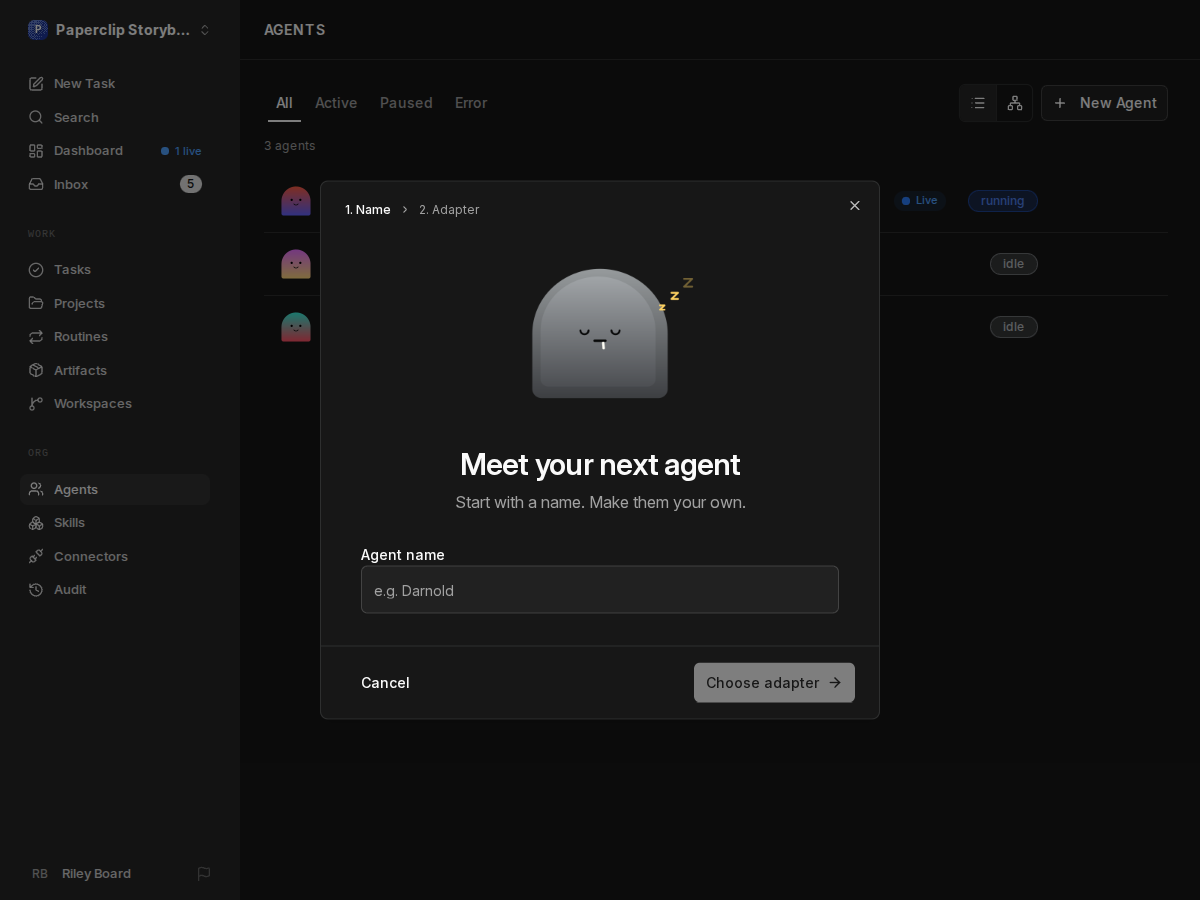
## Thinking Path > - Paperclip is the open source app people use to manage AI agents for work. > - Agents have a persistent visual identity (#13171): a ClipLab character in one of 17 palettes, rendered as cached PNGs in lists and as a live character in larger placements. > - The onboarding wizard is where a person meets that identity first, and it showed a stock ClipLab expression on the previous engine while the rest of the app would show a different character on a newer one. > - The wizard's steps also cut from one screen to the next, so the arc read as separate pages rather than one walk. > - This pull request puts one character on one engine everywhere, gives the wizard's hero the studio's sleepy → wink → idle sequence on Review, and hands the steps over inside one presence. > - The benefit is that what wakes on Review is exactly what the agent looks like on the dashboard afterwards, and the walk to it reads as one screen changing. ## Linked Issues or Issue Description Refs #13171, now merged into master. This PR contains the onboarding and ClipLab update on top of that foundation. Original feature work by @tonio-alucema; merge preparation preserves the original commits. **Problem or motivation** The onboarding hero and the app's avatars were two different characters on two different ClipLab engines. Steps 1 → 4 of the wizard cut between screens, and the wizard mounted cold when a cloud-managed workspace arrived from Cloud's naming screen. **Proposed solution** Vendor ClipLab v0.2.0 as the shared engine and render one studio-exported character from it in every palette, for every pose and size. Play the export's one-shot wake on Review with the palette fading in over the gray dormant loop. Hand steps over inside one presence so the footer slides instead of jumping, and play the arrival half of that hand-off when the wizard opens directly on the agent step. **Alternatives considered** Exporting mp4/webm loops per size: no cursor following, no clean alpha, and the palette "colour in" is a runtime blend. Minting a `cap-v2` character version: nothing had shipped `cap-v1`, so the artwork is regenerated in place instead of migrated. Keeping the separately vendored runtime bundle for the hero: two engines and two characters in one app. ## What Changed - `packages/shared/src/cliplab`: re-vendored from ClipLab v0.2.0 (`987b6db0`) with the Paperclip adaptations replayed (optional graphics backend for the Node SVG snapshot path, supersampled live textures, character framing, deterministic SVG id prefixes); new upstream `particles.ts`. - `packages/shared/src/cliplab/character.ts`: the studio export, mirrored from `ui/src/assets/cliplab/onboarding.character.json` by `scripts/sync-cliplab-character.mjs` (drift caught by `check:token-gates`). `characterDefinition` builds every palette from it; the resting portrait is its idle beat. - `OnboardingCharacter`: gray `sleepy` loop through the agent and connect steps; on Review the one-shot sleepy → wink → idle plays on two lock-step canvases while the palette fades in, then the `idle` loop. Body-follows the pointer, page-scoped. 160px in the wizard. - `OnboardingWizard`: steps 1 → 2 → 3 → 4 hand over inside one `AnimatePresence` (departing content fades and gives its room back; arriving content opens its room then fills); the hero has a room that opens on the walk into the agent step; opening directly on the agent step plays the arrival half; the self-hosted naming step uses the arc's label and field. - Motion vocabulary in `onboarding-motion.ts` (`stepContentMotion`, `ledeMotion`, `heroRoomMotion`, `heroRoomArrival`, `titleSwapMotion`). - Storybook: `Onboarding / Character` (Wake Up), `Onboarding / Agent arc` walkable from the naming step plus `Arrive From Cloud`; the companies fixture answers the wizard's create call with a company. - Uses the shared runtime for onboarding; `doc/agent-personas.md` documents the shared character. - Releases both onboarding canvases after partial startup or transition failure. Registers each canvas before seeking so synchronous render errors can release it. Six component tests cover these failures and palette changes before or during wake. - Refreshes both sleeping canvases when the palette changes, including a palette change in the same render as wake. - Moves choreography values into the CSS token layer and preserves the shared motion catalog drift check across the imported stylesheet. - Repairs the static Storybook avatar route and uses accessible heading names/current button labels in the wizard play functions. - Closes the lazy avatar worker pool during application shutdown. ## Verification - Merge-preparation checks: `pnpm -r typecheck`, `pnpm build`, `pnpm build-storybook`, and `pnpm check:token-gates` pass. The final UI typecheck and 123 focused onboarding, lifecycle, and token catalog tests pass. All 55 checks on final head `b4f5e201a1564083d163abc6f93f5b3da06ccefd` pass, including the full sharded test suite, runner verification, and all eight browser shards ([CI run](https://github.com/paperclipai/paperclip/actions/runs/35445430535)). The duplicate monolithic local `pnpm test:run` was stopped after CI completed; it is not claimed as a separate completed local run. - Chromium walkthrough: palette change, wake, return to sleep, WebGL failure fallback, Review step hand-offs and cloud arrival pass with normal and reduced motion; no browser errors. The signoff happy-path browser test also passes against a disposable instance. - The final CI run confirms the catalog fix and a passing signoff browser shard. The earlier signoff failure was a heartbeat-run availability timeout; the focused local reproduction and final CI passed without signoff code changes. - Original author verification: - `pnpm check:token-gates` (includes the new character sync check); shared, server avatar/persona (17) and UI onboarding/persona (137) suites pass; `pnpm build-storybook` packages all 3,564 avatar PNGs through the worker pipeline. - Storybook: `Agents / Personas` Sizes, Expressions and Palettes render the studio character at every size and pose; `Onboarding / Character → Wake Up` plays the wake on the shared engine; `Onboarding / Agent arc` walks 1 → 4 with the hand-offs, and `Arrive From Cloud` plays the arrival (measured: content room 6 → 65px over 320ms, fade to 1.0 by ~560ms, footer travel continuous). - The original author walked the agent → connect → review flow and wake after a real sign-in on staging. - Not done here: the Linux Storybook visual baselines (`tests/storybook-visual/agent-personas.spec.ts`) need re-baselining for the new engine, hero size and naming-step changes. ## Risks - Every avatar's pixels change (new engine, new character) under the unchanged `cap-v1` name. Stacks that rendered avatars on the previous engine keep those PNGs in their cache (`generated-agent-avatars/cap-v1/...`, served immutable) until cleared; only the two pinned staging stacks ever did. - The one-shot handoff to the idle loop is timed from the sequence's authored duration (the engine reports completion by continuing into idle itself); presentation only, nothing in the wizard's state waits on it. - Reduced motion skips the wake and the hand-offs; jsdom is treated the same way, so the wizard tests see the next step's content immediately. - The committed export differs from the studio by one animation (Loop off, leading idle step removed); a re-export without that fix would play a 5.6s idle before the wake. ## Model Used Original feature: Anthropic Claude Fable 5.1 (`claude-fable-5-1`) in Claude Code, with shell, browser, and file tools. The original context window was not recorded. Merge preparation and lifecycle regression fixes: OpenAI GPT-6 in Codex, with reasoning, shell execution, file editing, GitHub CLI, and automated tests. The session does not expose an exact runtime model ID or context-window size. ## Checklist - [x] I have included a thinking path that traces from project context to this change - [x] I have specified the model used (with version and capability details) - [x] I have checked ROADMAP.md and confirmed this PR does not duplicate planned core work - [x] I have searched GitHub for duplicate or related PRs and linked them above - [x] I have either (a) linked existing issues with `Fixes: #` / `Closes #` / `Refs #` OR (b) described the issue in-PR following the relevant issue template - [x] I have not referenced internal/instance-local Paperclip issues or links (only public GitHub `#NNN` / `github.com/paperclipai/paperclip` URLs) - [x] My branch name describes the change (e.g. `docs/...`, `fix/...`) and contains no internal Paperclip ticket id or instance-derived details - [x] I have run tests locally and they pass - [x] I have added or updated tests where applicable - [x] I have updated relevant documentation to reflect my changes - [x] I have considered and documented any risks above - [x] All Paperclip CI gates are green - [x] Greptile is 5/5 with no open P2s, recommendations, or follow-ups - [x] I will address all Greptile and reviewer comments before requesting merge 🤖 Generated with [Claude Code](https://claude.com/claude-code) --------- Co-authored-by: Dotta <bippadotta@protonmail.com> Co-authored-by: Paperclip <noreply@paperclip.ing> Co-authored-by: Claude Fable 5.1 <noreply@anthropic.com> |
||
|
|
1ef3b08714 |
feat(ui): integrate agent personas across the app (#13171)
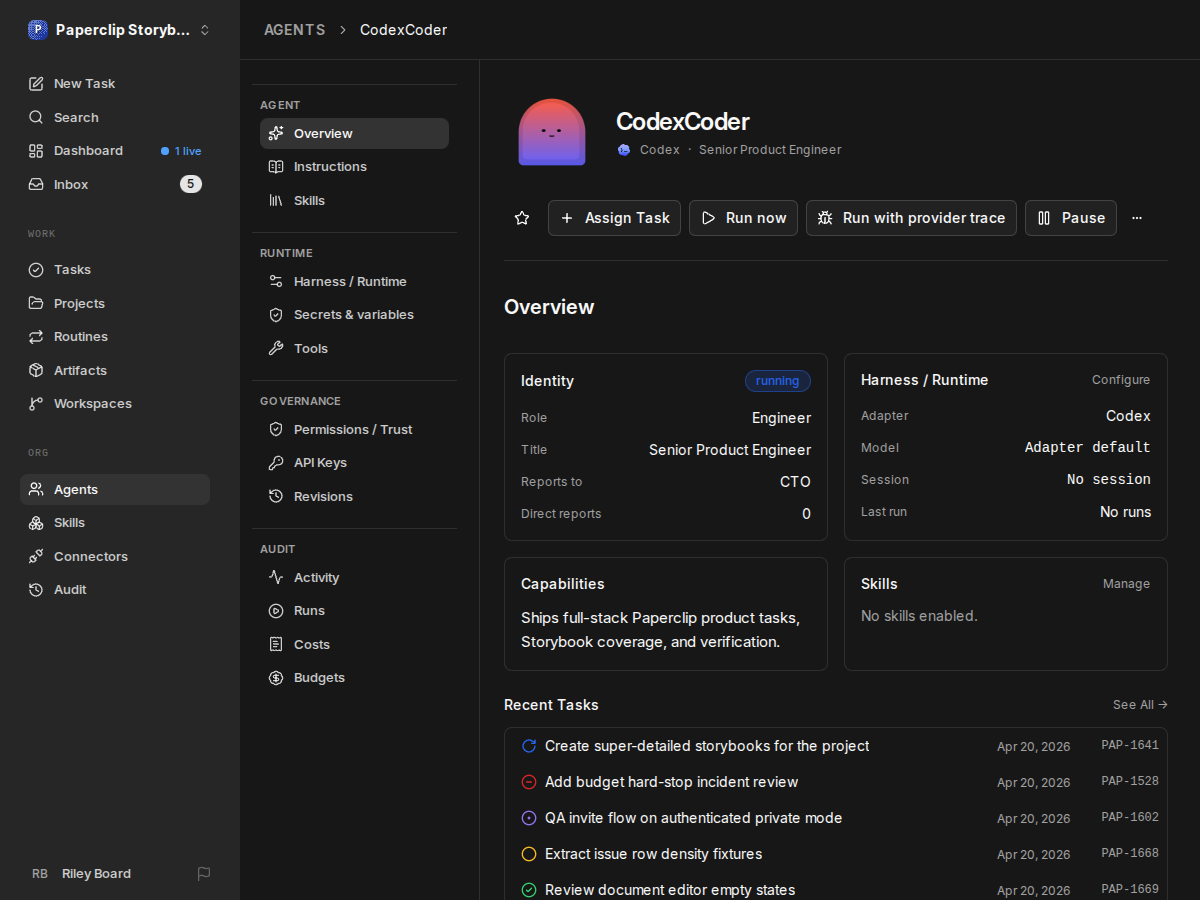
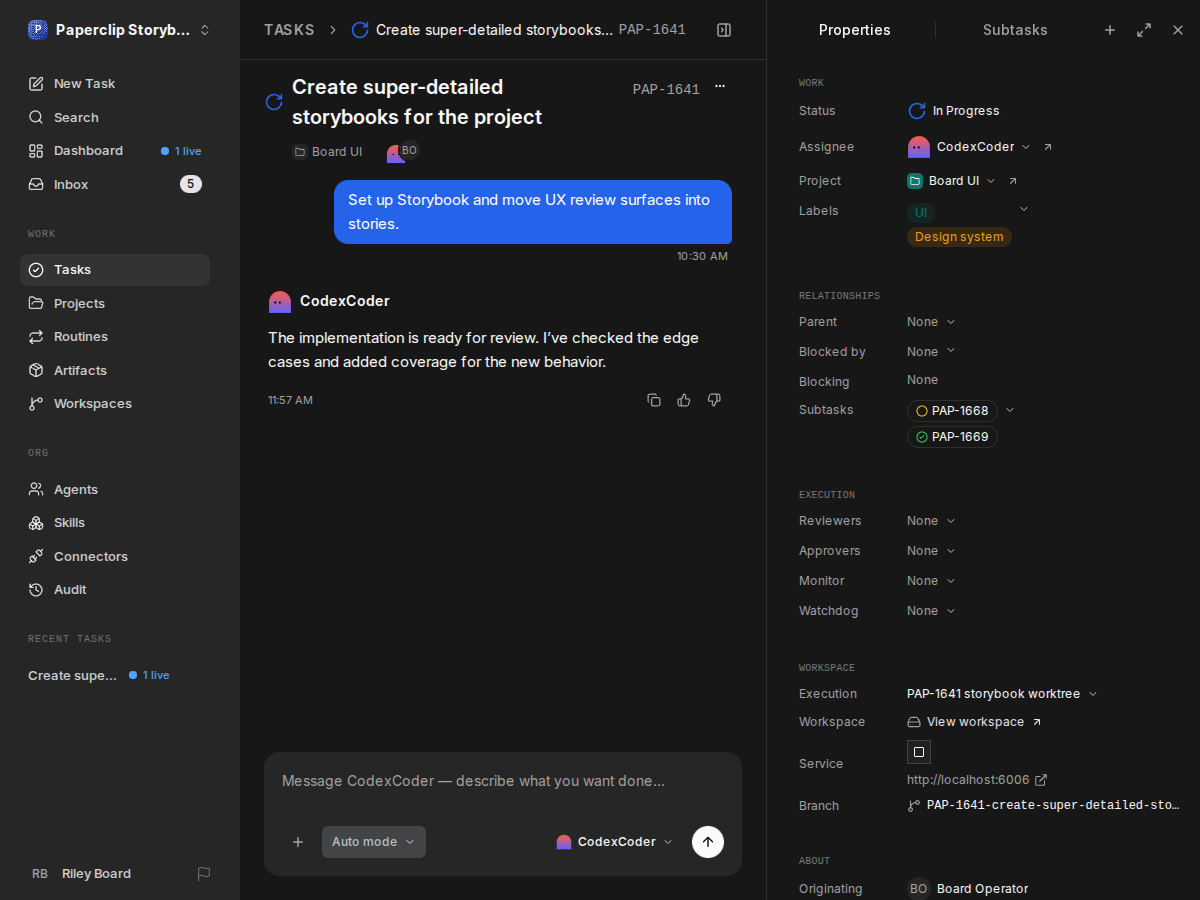
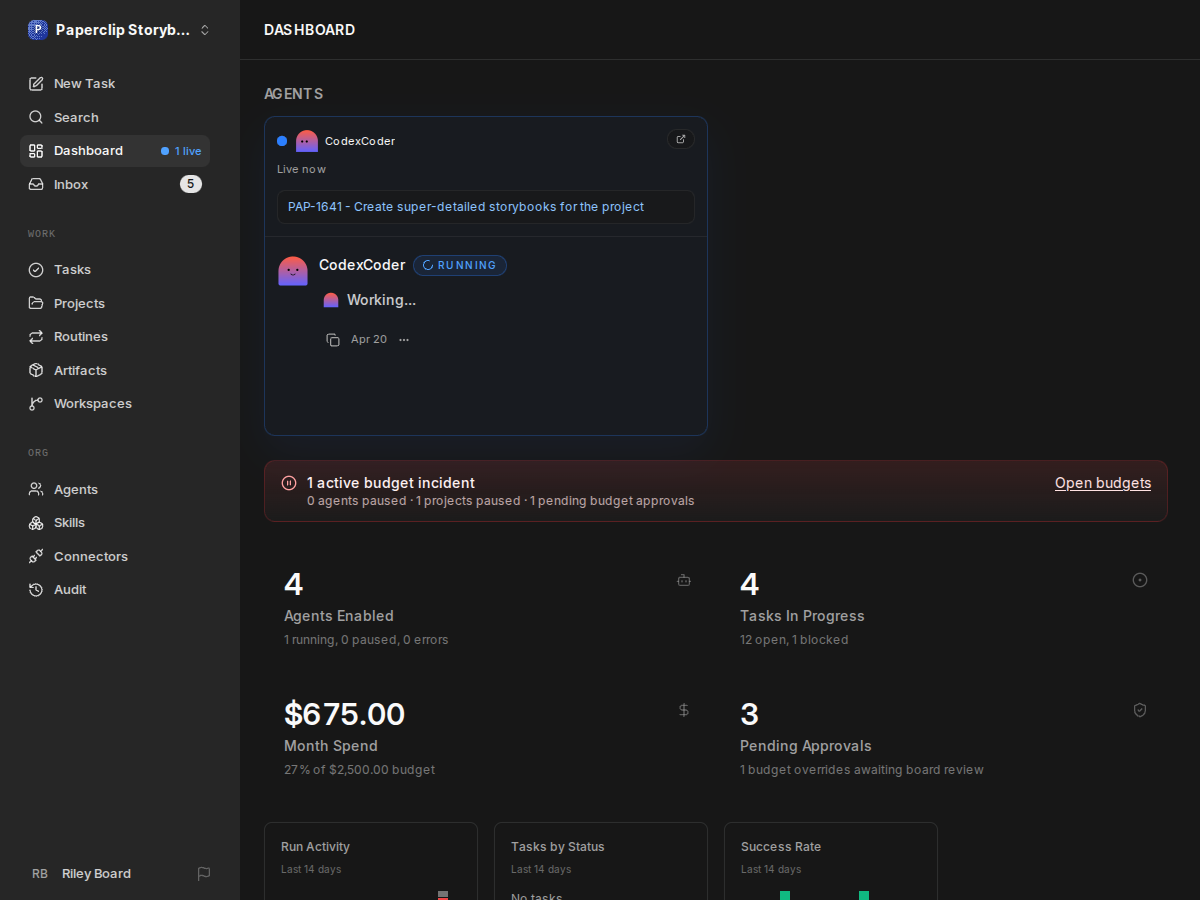
## Thinking Path > - Paperclip is the open source app people use to manage AI agents for work. > - A stable agent persona is useful only when the same identity appears across the app. > - Lists, task messages, selectors, and activity feeds need inexpensive static avatars. > - Onboarding and agent headers need a larger character with expressions and pointer tracking. > - This pull request connects the persona foundation to those existing views and preserves onboarding draft assignments. > - Full-page stories and Linux checks make the placements and performance contract reviewable. ## Linked Issues or Issue Description **Problem or motivation** Agents need a stable visual identity in lists, tasks, onboarding, and configuration. External tools also need an image URL for that identity. **Proposed solution** Assign each agent a permanent palette from a fixed ClipLab character library. Store the assignment on the agent. Render and cache preset PNG URLs on demand. Use static images in dense views and one animated character in larger placements. **Alternatives considered** A generated image bundle requires a separate asset build. A live renderer in every avatar adds unnecessary work in large lists. Arbitrary uploaded images do not provide the requested shared character system. **Roadmap alignment** This improves agent identity across existing control-plane views. It preserves agent permissions, company boundaries, and status labels. ROADMAP.md has no separate ClipLab persona milestone. Related approaches: #2422 adds configurable image URLs and DiceBear generation; #5578 adds optional uploaded avatars. This work uses a fixed, versioned character library and preset URLs. ## What Changed - Replace agent icons with static persona images across lists, the sidebar, org charts, tasks, comments, selectors, activity, and dashboard views. - Put one animated character in the agent header. Let it follow the pointer across the page, with reduced-motion and touch fallbacks. - Add larger padded characters to agent creation. Keep the palette stable across draft refreshes and connection retries, then reveal it after success. - Pass appearance through shared projections rather than fetching each agent separately. - Add real full-page Storybook examples for the agent list, overview, task, dashboard, new-agent dialog, and connection page. - Add Linux screenshot, clipping, density, and 500-avatar performance checks. ## Verification - `pnpm -r typecheck`, `pnpm build`, and token gates pass on the rebased tree. Persona lifecycle tests pass. - The rebased feature passes 38 Linux screenshot/performance checks, including both display densities, corner pointer positions, and the no-WebGL/no-live-download contract for 500 avatars. - The final Linux persona suite passes all 38 visual, lifecycle, density, and full-page checks using the standard Storybook configuration and real on-demand avatar endpoint. - Final local focused verification: 45 avatar/native-recovery tests pass; UI identity/routine tests, typecheck/build, token gates, and Storybook build pass. - Current-head CI passes: full workspace/server tests, all serialized server groups, typecheck/release checks, build, canary validation, and end-to-end shards. The build passed after retrying a native-runner concurrency-test failure; its three targeted cases also pass locally. - Manual inspection covered stable identities in the app, header placement, full-page mouse tracking, onboarding size, and task/dashboard placements. ### Screenshots Linux captures use synthetic Storybook fixtures. Full-page captures use reduced motion. The live character, mouse tracking, and disposal are checked separately. <details> <summary>Agent overview with the character in its header</summary> <img src="https://raw.githubusercontent.com/paperclipai/paperclip/8c68f42b268ada22b67d79d0fe1bb0a2f84ec25c/screenshots/full-page-agent-overview.png" width="900" alt="Agent overview with the character in its header" /> </details> <details> <summary>Task messages and assignee identity</summary> <img src="https://raw.githubusercontent.com/paperclipai/paperclip/8c68f42b268ada22b67d79d0fe1bb0a2f84ec25c/screenshots/full-page-task.png" width="900" alt="Task messages and assignee identity" /> </details> <details> <summary>Larger onboarding character with room for expressions</summary> <img src="https://raw.githubusercontent.com/paperclipai/paperclip/8c68f42b268ada22b67d79d0fe1bb0a2f84ec25c/screenshots/full-page-meet-your-next-agent.png" width="900" alt="Larger onboarding character with room for expressions" /> </details> <details> <summary>Dashboard agent activity</summary> <img src="https://raw.githubusercontent.com/paperclipai/paperclip/8c68f42b268ada22b67d79d0fe1bb0a2f84ec25c/screenshots/full-page-company-dashboard.png" width="900" alt="Dashboard agent activity" /> </details> ## Risks - This PR depends on #13170, the persona foundation. Merge the foundation first, then retarget this PR to master. - Many placements change from icons to character silhouettes. Human avatars and authoritative agent status labels retain their existing behavior. - Only one character can render live per view. Reduced motion, hidden/offscreen content, touch input, and renderer failures use the defined fallbacks. - The full-page stories use fixture data. They do not contact a real company or complete real provider sign-in. ## Model Used OpenAI Codex, GPT-6 family. The exact model identifier and context window are not exposed in this session. Used code editing, shell execution, browser inspection, and Linux visual testing. ## Checklist - [x] I have included a thinking path that traces from project context to this change - [x] I have specified the model used (with version and capability details) - [x] I have checked ROADMAP.md and confirmed this PR does not duplicate planned core work - [x] I have searched GitHub for duplicate or related PRs and linked them above - [x] I have either (a) linked existing issues with `Fixes: #` / `Closes #` / `Refs #` OR (b) described the issue in-PR following the relevant issue template - [x] I have not referenced internal/instance-local Paperclip issues or links (only public GitHub `#NNN` / `github.com/paperclipai/paperclip` URLs) - [x] My branch name describes the change (e.g. `docs/...`, `fix/...`) and contains no internal Paperclip ticket id or instance-derived details - [x] I have run tests locally and they pass - [x] I have added or updated tests where applicable - [x] I have updated relevant documentation to reflect my changes - [x] I have considered and documented any risks above - [x] All Paperclip CI gates are green - [x] Greptile is 5/5 with no open P2s, recommendations, or follow-ups - [x] I will address all Greptile and reviewer comments before requesting merge --------- Co-authored-by: Paperclip <noreply@paperclip.ing> Co-authored-by: Tonio <tonework@gmail.com> Co-authored-by: Claude Fable 5.1 <noreply@anthropic.com> |
||
|
DottaandPaperclip
|
669bd0e7a9 |
fix(ui): show progress and verify subscriptions during onboarding (#13499)
Automatically verify detected Claude and Codex subscriptions during initial onboarding. Show connection progress, support retries, and ignore stale results after navigation. Prefer the personal default subscription while preserving the later create-agent chooser. Allow Enter to advance from the agent name field. Add regression tests and production-component Storybook coverage. Co-Authored-By: Paperclip <noreply@paperclip.ing> |
||
|
DottaandPaperclip
|
e704e1c9ae |
fix: keep AI subscription locks safe through transaction pooling (#13347)
## Thinking Path > - Paperclip manages AI agents and their credentials. > - AI Connections must preserve account ownership from login through execution. > - A subscription environment check can pass and leave a session advisory lock on a pooled database backend. > - The next execution then reports that the subscription is busy. > - Onboarding can also lose its completion callback when the connection list refreshes before the login poll. > - This change keeps each credential lease in one transaction and keeps the login controller mounted until completion. ## Linked Issues or Issue Description Refs: #13247, #13248, #13344. **What happened?** A real hosted subscription login saved successfully and passed its environment check. The first task then failed with an AI connection busy error. A connection-list update could also leave onboarding on Connecting. **Expected behavior** A completed environment check releases its credential lease. A saved login completes onboarding without another sign-in. **Steps to reproduce** 1. Run Paperclip with a transaction-pooling PostgreSQL proxy. 2. Connect a Claude subscription through onboarding and reuse it for an agent. 3. Start a task after its environment check succeeds. 4. For the UI race, refresh the managed connection list before the login completion poll. ## What Changed - Hold the grant lock inside one transaction. Roll back on cleanup or failed acquisition. - Disable the lease transaction's idle timeout so long provider executions retain the lock. - Keep the onboarding login controller mounted while its authorization URL is active; restore saved-account retry if later agent creation fails. - Add lock-lifetime and Claude/Codex completion-order regressions. - Document the pooling requirement. ## Verification - 104 focused connection and onboarding tests passed. - Workspace typecheck, production build, Storybook build, and token gates passed. - All 34 latest-head checks are terminal: 32 passed and two Storybook workflows skipped by their normal filters. CI covers all server/workspace/serialized test shards, browser tests, typecheck, build, runner verification, and canary packaging. The additional local full-suite run is still in progress. - Real browser sign-ins saved Claude and OpenAI subscriptions on both new and existing staging stacks. On the patched new stack, both providers completed tasks and immediate repeat executions with the same saved accounts. Read-only database inspection confirmed live transaction-scoped locks and no remaining locks after completion. On the final deployed head, both shared accounts on the existing stack also completed actual tasks. Both personal accounts passed a fresh environment check followed immediately by execution after a deployment restart. ## Risks - Each active subscription reserves one database connection and holds an otherwise idle transaction until cleanup. This is required to pin the backend through a transaction pool. - Old session locks from earlier versions may need operator cleanup after active runs drain. This change does not bypass existing locks. - No database migration, credential routing, or legacy authentication change. ## Model Used OpenAI GPT-6 in Codex, with code execution and browser tools. The exact deployment model ID and context-window size are not exposed to this task. ## Checklist - [x] I have included a thinking path that traces from project context to this change - [x] I have specified the model used (with version and capability details) - [x] I have checked ROADMAP.md and confirmed this PR does not duplicate planned core work - [x] I have searched GitHub for duplicate or related PRs and linked them above - [x] I have either (a) linked existing issues with `Fixes: #` / `Closes #` / `Refs #` OR (b) described the issue in-PR following the relevant issue template - [x] I have not referenced internal/instance-local Paperclip issues or links (only public GitHub `#NNN` / `github.com/paperclipai/paperclip` URLs) - [x] My branch name describes the change (e.g. `docs/...`, `fix/...`) and contains no internal Paperclip ticket id or instance-derived details - [x] I have run tests locally and they pass - [x] I have added or updated tests where applicable - [x] I have updated relevant documentation to reflect my changes - [x] I have considered and documented any risks above - [x] All Paperclip CI gates are green - [x] Greptile is 5/5 with no open P2s, recommendations, or follow-ups - [x] I will address all Greptile and reviewer comments before requesting merge --------- Co-authored-by: Paperclip <noreply@paperclip.ing> |
||
|
DottaandPaperclip
|
b2acc674be |
fix: enable isolated subscription login on authenticated self-hosted instances (#13344)
## Thinking Path > - Paperclip is the open source app people use to manage AI agents for work. > - AI Connections store reusable provider credentials with company and owner boundaries. > - Self-hosted instances can require board authentication while running agents on the local server. > - The login UI treated those instances as unsupported and displayed instructions without a command. > - Removing that restriction must not expose the server operator's existing CLI account. > - This pull request enables owner-scoped login attempts and reuses the existing login UI. > - Users can connect Codex and Claude subscriptions on an authenticated self-hosted instance. ## Linked Issues or Issue Description **What happened?** On an authenticated self-hosted instance, OpenAI subscription setup displayed terminal instructions with no command and a disabled Connect button. Claude also could not complete the local connection flow. **Expected behavior** An authorized board user can prepare an isolated sign-in attempt, sign in on the server, and save the verified account as a Connection. This must not import another user's or the operator's ambient credentials. **Steps to reproduce** Run Paperclip in authenticated mode with a local environment. Open Connections, choose OpenAI or Anthropic, and select Subscription. The previous UI never enabled local login preparation. Related: #13247, #13248, and #10751. This fix preserves the restriction on remote access to the operator's ambient Claude login. ## What Changed - Allow company-authorized users to create, check, cancel, and complete their own isolated local login attempts. - Keep ambient Claude credential import restricted to the local operator. - Support isolated Claude credential files without falling back to the host account or mutating process-wide environment variables. - Use Codex device authorization so sign-in does not depend on a browser callback to the remote server's localhost. - Gate server-host login on authenticated public deployments unless a trusted runtime host is configured. Publish the capability through health so setup shows supported alternatives. - Read isolated Claude credential files through bounded, descriptor-bound opens with ownership, permission, and symlink checks. Try the alternate filename after malformed JSON. - Reuse shared login instructions and lifecycle hooks in onboarding, agent setup, and Connections. Show health-query failures explicitly. - Document authenticated self-hosted behavior and add authorization, isolation, lifecycle, and UI regression tests. ## Verification - Passed 71 focused tests across connection routes, credential isolation, legacy compatibility, the shared login hook, and agent setup. - Passed 89 onboarding regression tests. - Passed `pnpm -r typecheck`, `pnpm build`, Storybook build, and `pnpm check:token-gates`. - Completed real Codex device authorization and Claude browser authorization on an authenticated Linux self-hosted instance. Both accounts were detected automatically and saved as Connected. Both completed attempt directories were removed. - These live checks cover login, credential validation, and connection creation. They do not establish a new model execution or long-running refresh result. - Review follow-up: 68 focused checks passed after rerunning one route socket error; the full route/health rerun passed all 49 tests. The 70-test onboarding suite also passed. Final workspace typecheck, production build, and Storybook build passed again. - The broad local run exposed an instance-name assumption in two new assertions. The fixture now uses an explicit non-default instance, and all 32 connection tests passed with a different inherited instance name. The superseded broad run was stopped; this is not a claim that the full local suite completed. Full CI results will be recorded before merge. ## Risks - The server must have the provider CLI installed. Users still run the displayed command on the server that hosts Paperclip. - Authorization checks must keep login attempts scoped to the company, owner, provider, and reconnect target. Regression tests cover cross-user and cross-company access. - Existing local-trusted Claude behavior stays available. Authenticated remote users cannot use its ambient import path. - No database migration, dependency change, agent binding change, or provider routing change is included. ## Model Used OpenAI GPT-6 through Codex, with reasoning, code execution, and browser tools. The runtime does not expose a more specific model version or context-window size. ## Checklist - [x] I have included a thinking path that traces from project context to this change - [x] I have specified the model used (with version and capability details) - [x] I have checked ROADMAP.md and confirmed this PR does not duplicate planned core work - [x] I have searched GitHub for duplicate or related PRs and linked them above - [x] I have either (a) linked existing issues with `Fixes: #` / `Closes #` / `Refs #` OR (b) described the issue in-PR following the relevant issue template - [x] I have not referenced internal/instance-local Paperclip issues or links (only public GitHub `#NNN` / `github.com/paperclipai/paperclip` URLs) - [x] My branch name describes the change (e.g. `docs/...`, `fix/...`) and contains no internal Paperclip ticket id or instance-derived details - [x] I have run tests locally and they pass - [x] I have added or updated tests where applicable - [x] I have updated relevant documentation to reflect my changes - [x] I have considered and documented any risks above - [ ] All Paperclip CI gates are green - [x] Greptile is 5/5 with no open P2s, recommendations, or follow-ups - [x] I will address all Greptile and reviewer comments before requesting merge --------- Co-authored-by: Paperclip <noreply@paperclip.ing> |
||
|
DottaandPaperclip
|
8d6232e7b0 |
feat: reuse provider sign-in across AI connection workflows (#13248)
## Thinking Path > - Paperclip is the open source app people use to manage AI agents for work. > - Users connect provider accounts during onboarding and agent setup. > - They should reuse and manage those accounts through the existing Connectors interface. > - A second login wizard would diverge from the established provider workflows. > - This pull request composes the existing sign-in components into Connections and agent configuration. > - Users can select accounts without changing their agent's harness or model. ## Linked Issues or Issue Description **Problem or motivation** AI credentials are configured separately from Connections. Agents cannot consistently reuse a responsible user's account or a permitted shared account. **Proposed solution** Manage AI accounts with the existing Connections grants and permissions. Keep model and harness selection independent from credential selection. Preserve legacy authentication until validated adoption. **Alternatives considered** A separate credential registry would duplicate ownership and access policy. Automatic fallback would risk using the wrong account. **Roadmap alignment** This extends the shipped Apps, multi-user, secrets, and agent-runtime capabilities. The maintainer requested the feature and reviewed the UI. Related groundwork: #11899 (connection permissions), #10910 (connection wizard), #11692 (Claude subscription profiles), and #11854 (Codex account rotation). ## What Changed - Add compact AI-account management to the existing Connectors pages. - Reuse AgentProviderConnection, AdapterLoginPanel, AdapterLoginChrome, and authentication controllers. - Add the shared connection picker to agent setup/settings and task requests. - Preserve onboarding's sequence and reuse existing accounts. - Add local-login recovery, retry, cancellation, and React StrictMode handling. - Add interactive Storybook scenarios, design-guide examples, and app acceptance checks. This is part 2 of the AI Connections change. The runtime foundation in #13247 is merged. This PR now targets master. ## Verification - Updated against master `47ded8bf9`, including the landed runtime foundation and upstream task-search changes. - Full workspace typecheck, production build, Storybook build, and token gates passed on the integrated branch. Final local-login changes passed 59 focused tests; new-agent and inbox regression suites passed 63 tests. - Browser checks verified automatic local Claude account detection, resumable Codex login commands, retry, focus restoration, and desktop/phone layouts. Commands create their isolated directory before invoking the CLI. - All CI test, browser, build, packaging, and runner jobs passed on final head `dd17d3211931dd70aaa6ea619d83a7f9966dd18e`. The fresh Greptile review is 5/5, the security scan passed, and there are no unresolved review threads. The final CI aggregate gates passed. - Local general-server coverage passed 11,804 tests; three port-collision failures passed in an isolated 25-test rerun. All 6,111 UI tests passed. CLI coverage passed 484 tests; its remaining doctor test requires port 3199, which is occupied by an unrelated report server on this Mac. The complete CLI suite passed in CI. - Live browser testing verified Codex API-key reconnect inside a task card on desktop and phone. Real provider runs resumed and completed with unchanged connection/grant identity and agent routing. - Tested opening, cancelling, reopening, and completing connection creation. A regression confirms Connect another account cannot submit the new-agent form or copy provider keys into agent settings. - Added shared inline repair, automatic local sign-in checks, and responsive connection dialogs. Standalone Daytona installation ignores workspace configuration and suppresses dependency scripts. Its standalone build also passed with CI's exact pnpm 9.15.4. - Destructive live tests are excluded by default. Explicit opt-in, local deployment checks, and matching disposable fixture identities are required before any mutation. ## Risks - Local Codex/Grok creation requires the connection-specific terminal login command. - Browser sign-in uses the existing supported-environment controllers. - This update verifies live local Claude detection and Codex API-key task repair. New subscription authorization/refresh and independent-human/native-runner isolation were not reverified in this update. - No agent automatically adopts managed Connections. ## Model Used OpenAI GPT-6 through Codex, with reasoning, repository tools, code execution, and browser testing. The exact runtime model identifier and context-window size are not exposed in this session. ## Checklist - [x] I have included a thinking path that traces from project context to this change - [x] I have specified the model used (with version and capability details) - [x] I have checked ROADMAP.md and confirmed this PR does not duplicate planned core work - [x] I have searched GitHub for duplicate or related PRs and linked them above - [x] I have either (a) linked existing issues with `Fixes: #` / `Closes #` / `Refs #` OR (b) described the issue in-PR following the relevant issue template - [x] I have not referenced internal/instance-local Paperclip issues or links (only public GitHub `#NNN` / `github.com/paperclipai/paperclip` URLs) - [x] My branch name describes the change (e.g. `docs/...`, `fix/...`) and contains no internal Paperclip ticket id or instance-derived details - [x] I have run tests locally and they pass - [x] I have added or updated tests where applicable - [x] I have updated relevant documentation to reflect my changes - [x] I have considered and documented any risks above - [x] All Paperclip CI gates are green - [x] Greptile is 5/5 with no open P2s, recommendations, or follow-ups - [x] I will address all Greptile and reviewer comments before requesting merge --------- Co-authored-by: Paperclip <noreply@paperclip.ing> |
||
|
Tonio
|
f70accd3a4 |
fix(onboarding): answer the Claude paste at once, and show the code as dots (#13193)
The Claude card's button only moved to Connecting once the login was stored - a submit, a status poll and a completion read after the paste - so for about a second the customer had done their part and the button still read Waiting for code. The panel now reports the submit as it starts (onCodeSubmitted) and the step shows Connecting from that moment. That could not simply move the phase earlier: the two-second hold started when Connecting did, so it would have hired whether or not a credential existed. The hire now waits for both the stored login and two seconds of Connecting counted from the paste. onSubmitFailed gives the button back when a submitted code does not become a stored login, the field locks while a code is out, and Cmd+Enter no longer hires mid-connect. Reports that land after Back are ignored. The panel stays mounted through Back's exit, so a late failure reopened the card being left, and a late success hired a customer who had backed away. The second predates this change; its test fails the same way against master. The authorization code shows as dots. The OpenAI card is untouched. |
||
|
DottaandPaperclip
|
e9828f8bf4 |
fix: reuse saved model connections during agent setup (#13161)
## Thinking Path > - Paperclip is the open source app people use to manage AI agents for work. > - Agent setup connects each agent to a model provider. > - The organization can already hold subscription logins and API keys. > - The simplified setup flow did not consistently offer those saved credentials. > - This pull request restores reuse and selects a saved connection by default. > - Agents keep secret references, so reuse does not copy or rotate credentials. ## Linked Issues or Issue Description Related change: #13011. Searched public issues and PRs; no duplicate fix found. **What happened?** Onboarding and new-agent setup could ask for a new API key or sign-in despite an existing saved connection. A general environment auth signal could also be mistaken for the owner's saved Claude subscription. **Expected behavior** Offer saved credentials from the selected organization. Default to a saved subscription when one exists. Otherwise select a saved API key. Keep the option to enter a new key or sign in to another account. **Steps to reproduce** 1. Save a Claude or OpenAI API key, or complete a supported subscription login. 2. Add another agent with the same provider. 3. Open the provider connection step. 4. Check whether the saved credential is available and selected. **Paperclip version or commit** Reproduced on |
||
|
|
5acf56658b |
feat(onboarding): first task opens as a chat with a chief of staff (#13068)
## Thinking Path > - Paperclip is the open source app people use to manage AI agents for work > - Onboarding ends by handing a new user to their first agent on a seeded first task > - Today the wizard asks for a mission up front, the UI composes what the agent is told, and the agent starts running before the user says anything > - New users get a cold, ticket-shaped start, and nobody can edit the agent's brief or persona without a code change > - This pull request makes the first task a short chat: a four-step wizard, a chief-of-staff persona, a greeting plus a two-option opening card, server-owned markdown texts, and no run until the user answers > - It also gives question cards one consistent action row (Cancel / Skip / Next), makes agent hires idempotent within a run, and turns the Paperclip Runner flag on by default for self-hosted instances > - The benefit is a first run the user steers, with texts a board operator can edit as markdown ## Linked Issues or Issue Description No public GitHub issue exists for this change. The feature request fields follow. Related PRs and issues: - Refs #11043 — an earlier draft of the first-task onboarding experience. This PR supersedes it. - Refs #11280 — a report about the onboarding first-task route test. This PR extends that test file. ### Subsystem affected Onboarding wizard, the seeded first task and its texts, task-chat question cards, agent hiring, and the instance experimental settings. ### Problem or motivation The onboarding wizard collects a mission through two extra steps and a questionnaire. The UI then composes the first agent's instructions and the first task description from those answers. The first task wakes the agent at once, so the agent runs and posts before the user types a word. Board operators cannot change the greeting, the brief, or the persona without editing TypeScript. Question cards in chat behave differently per adapter, and a single-select pick submits on click. A misread hire response could create a duplicate agent that the creating agent cannot remove. ### Proposed solution Reduce the wizard to four steps and stop the UI from authoring agent texts. Move the greeting, the brief, the chief-of-staff persona, and the opening question into markdown and JSON files that the server loads at runtime. Seed the persona onto the first agent through an explicit hire marker. Do not wake the first task until the user answers the opening card or types. Give every question card the same Cancel / Skip / Next actions. Add an experimental toggle that switches the single-task proposal between one confirmation card and a plan document with a checkbox card. Make agent hires idempotent within a run. ### Alternatives considered - Keep the mission questionnaire and feed it into the brief. Rejected: the agent asks better questions in chat, and the wizard gets shorter. - Keep the first task open-ended with a plain composer. Rejected: a two-option card gives the user a clear first move. - Derive the plan-document behaviour from the user's intent only. Rejected in favour of an explicit experimental toggle so operators can choose. - Key the "pick does not submit" behaviour off the presence of a submit label. Rejected: several adapters set a submit label on single-select cards, and their cards would change behaviour. ### Roadmap alignment `ROADMAP.md` lists no planned core work on onboarding or the first task. This change refines the existing flow and does not duplicate planned work. ## What Changed - Wizard: four steps (Name your organization, Create your first agent, Connect a model, Review). The front door and both mission steps are removed with their state and saved-progress keys. The UI no longer composes the first agent's instructions or the first task description. - Server-owned texts: the greeting, the brief with two proposal variants, the chief-of-staff persona, the opening question, and a README live in `server/src/onboarding-assets/first-task/` and load at runtime. The create route stores the assembled brief and ignores any client description. - Persona seed: an `onboardingFirstAgent` marker on the hire lets the server seed the chief-of-staff persona over the first agent's entry file. Board-authored hires only. The persona tells the agent the hire response shape and to list agents before it acts on an unclear result. - No auto-run: the first task does not queue an assignment wake. The stranded-assignment reconciler leaves it idle until a user comment or an answered card exists. - Opening card: the server seeds an `ask_user_questions` card right after the greeting with two options: "Interview me and propose a plan and an agent team to execute it." and "I have a task in mind" with free text. Answering wakes the agent. - Experimental toggle `enableFirstTaskPlanProposal` (default off): the single-task proposal is one confirmation card, or a plan document plus a checkbox card when on. - Question cards: every `ask_user_questions` card renders Cancel, Skip, and Next (the submit label on the last question). Skip hides on required questions. Picking an option no longer advances or submits by itself. - Wizard guards: the dashboard's agentless offer ignores a cached empty agent list while a refetch is in flight. The hire step adopts an agent that already carries the typed name instead of hiring "Name 2". - Agent hires are idempotent within a run: a retry of the identical request under the same run id returns the existing agent with `200` and `idempotent: true`. The fingerprint covers the whole validated request, so a corrected payload is a new hire. Lookup, create, and activity record run under one lock per company and run, so overlapping retries cannot both create. - The Paperclip Runner experimental flag defaults to on for self-hosted instances. Cloud keeps its declared default: a managed instance whose tenant row and managed overlay omit the flag resolves it to off. - Question cards: a send that finds an earlier required answer missing returns to that question with a message instead of failing silently. - The two onboarding e2e specs follow the new wizard: the front door and growth intake shots are gone, and the planning-mode spec dismisses the opening card before it reads the composer. - Docs: `docs/board-operator/editing-first-task-texts.md` explains how to edit the texts and the toggle. ## Verification Commands, run from the repo root: ``` pnpm -r --filter './packages/*' --filter '!@paperclipai/paperclip-runner' build pnpm --filter ./packages/shared typecheck pnpm --filter ./ui typecheck pnpm --filter ./server exec tsc --noEmit pnpm check:token-gates pnpm --filter ./ui exec vitest run OnboardingWizard onboarding QuestionForm InteractionCard ProtocolCard TaskChatComposer Dashboard feature PAPERCLIP_IN_WORKTREE=false pnpm --filter ./server exec vitest run onboarding-first-task heartbeat-process-recovery agent-hire-idempotency instance-settings agent-skills-routes issue-onboarding onboarding-greeting --testTimeout=90000 ``` Results on this branch: - Typecheck is clean for shared, ui, and server. - Token gates: 4 of 4 clean. - UI: 344 tests pass across 23 files. - Server: all suites pass. The first test in `agent-skills-routes` has its own 10 s cap and needs about 15 s on my laptop for the app cold start. It passes with a longer cap. This PR does not change that cap. Manual steps on a dev instance: 1. Open `/onboarding`. Confirm four steps: Name your organization, Create your first agent, Connect a model, Review. 2. Finish the wizard. Confirm the first task shows the chief-of-staff greeting and the opening card with two options. Confirm no run starts. 3. Pick "Interview me…". Confirm no run starts. Press Continue. Confirm a run starts and an interview card of 3–4 questions arrives. 4. On a fresh organization, pick "I have a task in mind", type a task, and press Continue. Confirm a proposal arrives as one confirmation card. 5. Turn on Settings → Experimental → "First task: propose with a plan document" and repeat step 4. Confirm a plan document and a checkbox card arrive. 6. Visit the dashboard after the hire. Confirm the wizard does not reopen and one agent exists. 7. Open any question card. Confirm Cancel returns the plain composer with the card still pending, Skip advances an optional question, and Next moves to the next question. Design reference with flow diagrams, chat mock-ups, and live captures: https://pages.paperclip.ing/first-task-flow/proposed/ ## Risks - `pnpm dev` now builds the runner daemon because the Paperclip Runner flag is on by default. Developers without a Rust toolchain must set `PAPERCLIP_RUNNER_BINARY` or turn the flag off. Self-hosted instances that never set the flag now let qualified agents use the runner. - The wizard drops the mission steps and their saved-progress keys. A user who is mid-wizard on an older build restarts at step 1 after an upgrade. Existing organizations are not touched. - The first task no longer runs on its own. A user who neither answers the card nor types sees no agent activity. This is intended. - The persona seed applies only to hires that carry the marker from the wizard. API hires are unchanged. - Hire idempotency is scoped to one run id and to the exact request. Retries across runs, or with a changed payload, still create a second agent. The lock is per server process, which matches how an instance serves its API. - Single-select question cards no longer submit on pick. Users of adapters that relied on that behaviour now press Next. - No database migrations. > For core feature work, check [`ROADMAP.md`](ROADMAP.md) first and discuss it in `#dev` before opening the PR. Feature PRs that overlap with planned core work may need to be redirected — check the roadmap first. See `CONTRIBUTING.md`. ## Model Used - Claude (Anthropic) through Claude Code. `claude-fable-5-1` with extended thinking, tool use, and code execution wrote most commits. `claude-opus-4-8` wrote the toggle, texts, wizard, and idempotency commits, as the `Co-Authored-By` trailers show. ## Checklist - [x] I have included a thinking path that traces from project context to this change - [x] I have specified the model used (with version and capability details) - [x] I have checked ROADMAP.md and confirmed this PR does not duplicate planned core work - [x] I have searched GitHub for duplicate or related PRs and linked them above - [x] I have either (a) linked existing issues with `Fixes: #` / `Closes #` / `Refs #` OR (b) described the issue in-PR following the relevant issue template - [x] I have not referenced internal/instance-local Paperclip issues or links (only public GitHub `#NNN` / `github.com/paperclipai/paperclip` URLs) - [x] My branch name describes the change (e.g. `docs/...`, `fix/...`) and contains no internal Paperclip ticket id or instance-derived details - [x] I have run tests locally and they pass - [x] I have added or updated tests where applicable - [x] I have updated relevant documentation to reflect my changes - [x] I have considered and documented any risks above - [x] All Paperclip CI gates are green - [x] Greptile is 5/5 with no open P2s, recommendations, or follow-ups - [x] I will address all Greptile and reviewer comments before requesting merge --------- Co-authored-by: Paperclip <noreply@paperclip.ing> Co-authored-by: Claude Opus 4.8 <noreply@anthropic.com> |
||
|
Tonio
|
ae03465ad4 |
fix(onboarding): drop the sign-in card's Cancel, and resume after Back (#12958)
The card carried a Cancel beside its instruction, directly above the step's own Back. Two ways out of one screen is one too many. Removing it was only safe if returning genuinely resumed the running session, and writing the test for that disproved the premise: coming back started a second login rather than adopting the first, which the server's per-owner lease rejects. Cancel was not duplicative — it was the only way out of a login the customer could no longer reach. The cause was the cache. The active-session read is a useQuery with no staleTime, so on the second mount it answered instantly from the first mount's cached null: isFetched was true, the resume effect concluded there was nothing to adopt, and autoStart began a new login while the refetch was still in flight. Both panels did it, and it was pre-existing on master. Both reads now refuse the cache, so the resume works and the removal is safe because of it. Removing the button also stranded the chain behind it: handleCancel in both panels, the onCancel prop on AdapterLoginPanel, and the wizard's wiring. The panel chrome's own Cancel is untouched. An abandoned login is collected on a five-minute timer (DEVICE_LOGIN_TIMEOUT_MS) with the reaper as the restart-safe backstop, and the lease is keyed on adapterType, so a source switch does not contend. Both covered by tests. |
||
|
Tonio
|
be407f3456 |
fix(onboarding): hide the probe's diagnostics while the hire is in flight (#12902)
After a successful sign-in, a block of amber diagnostics flashed up and vanished as the step advanced. They are the identity and target INFO checks every environment test reports: they make the result a warn without blocking anything, and the step rendered any non-pass result, so they owned the screen for the window between the probe returning and setStep(5). Gated on loading rather than the connect phase. A blocking result stops the hire and handleGiveHeartbeat clears loading in the finally after its early return, so a genuine block still shows its checks while a hire in flight shows none. The button needed no change: step 4 forces the footer's loading to false and takes its label from connectCta, which reads Connecting for that whole window. |
||
|
Nicky LeachandPaperclip
|
60469a08e0 |
feat(agent-login): resume an active login session and permit concurrent login terminals (#12861)
## Thinking Path > - Paperclip is the open source app people use to manage AI agents for work. > - Agent authentication uses server sessions, plugin workers, and browser login panels. > - A page reload loses an active login session, and one worker permits only one login terminal. > - These limits cause lost work and prevent two owners from logging in through one worker. > - This pull request lets the browser resume active sessions and lets workers serve concurrent login terminals. > - The benefit is reliable login recovery with a bounded process-wide route limit. ## Linked Issues or Issue Description **What existing behavior does this improve?** It improves agent credential login recovery and concurrent login terminal handling. **Subsystem affected** Cross-cutting (multiple of the above). **Current behavior** A page reload loses the active login session. A shared plugin worker rejects a second login terminal. **Proposed behavior** The browser reads and resumes the owner's active session. A worker supports multiple login terminal routes under a process-wide ceiling. **Reason and benefit** Owners keep login progress after a reload. Two owners can log in through one worker without removing the route limit. **Breaking changes** None. The change adds owner-scoped read routes and changes login terminal concurrency. ## What Changed - Replace the single worker login route with maps keyed by host route and worker session identifiers. - Add a process-wide login route ceiling and release each reserved slot on every exit path. - Add owner-scoped active-session reads with consistent negative responses and private cache control. - Keep the device-login prompt while the session has an active public status. - Add a durable setup-token cancel fallback for a lost in-memory session. - Resume active sessions when the agent configuration or onboarding panel mounts. - Remove routine unmount cancellation and keep explicit Cancel behavior. ## Verification - `pnpm --filter @paperclip/server test` — server route, service, and plugin-worker-manager suites. - `pnpm --filter @paperclip/plugin-sdk test` — worker RPC host suite. - `cd ui && npx vitest run src/components/AgentConfigForm.render.test.tsx src/components/OnboardingWizard.test.tsx`. - `cd ui && npx tsc -b`. - `tests/e2e/onboarding.spec.ts` — reload during login. - CI must pass on this pull request. ## Risks The change affects agent authentication and the sandbox-to-host boundary. Route cleanup must release every reserved slot. Owner checks must prevent cross-owner session access. Tests cover route cleanup, owner scope, reload recovery, and concurrent worker routes. ## Model Used Codex, OpenAI GPT-5, tool use and code review support. The implementation author owns the exact model details for the code changes. ## Checklist - [x] I have included a thinking path that traces from project context to this change - [x] I have specified the model used (with version and capability details) - [x] I have checked ROADMAP.md and confirmed this PR does not duplicate planned core work - [x] I have searched GitHub for duplicate or related PRs and linked them above - [x] I have described the issue in-PR with the relevant issue-template fields - [x] I have not referenced internal/instance-local Paperclip issues or links - [x] My branch name describes the change and contains no internal Paperclip ticket id - [x] I have run tests locally and they pass - [x] I have added or updated tests where applicable - [x] I have updated relevant documentation to reflect my changes - [x] I have considered and documented risks above - [x] All Paperclip CI gates are green - [x] Greptile is 5/5 with no open P2s, recommendations, or follow-ups - [x] I will address all Greptile and reviewer comments before requesting merge --------- Co-authored-by: Paperclip <noreply@paperclip.ing> |
||
|
Tonio
|
a7ed22e3dd |
refactor(onboarding): reconcile the arc column's width comment with its width (#12875)
The shell carried two comments arguing opposite things: the older made the case for a 64px inset and said 40px was too wide, the newer made the case for the 40px the code uses. The older one had also drifted from the code independently - it described 68px sides and a 424px column while the file used --sz-64px, a 432px column. One comment now: 40px sides, a 480px column, the measure the connect sequence is drawn to and which the arc shares. The earlier objection is kept and marked untested, with a note that if step 1 or step 3 reads loose the fix belongs in those steps' content rather than the shared shell. Comment-only; no behaviour change. |
||
|
Tonio
|
f2349990cc |
feat(onboarding): the connect step's sign-in as one continuous sequence (#12863)
Picking a source starts the sign-in: the row collapses to the answer, the card opens where the credential link was, and the footer button walks Sign in -> Waiting for code -> Connecting before the step advances. Back unwinds it a beat at a time. Nothing mounts to change layout - the card and the link are always rendered and their heights animate, with inert holding the a11y line - because a mount changes the page in one frame and no easing can smooth a step already taken. Review fixes in the same branch: the displayed-code panel now reports its prompt upward (the OpenAI path could not leave the loading beat without it), the two-second hold is a cancellable beat rather than a dropped timer, unwinding a sequence that never opened a card no longer starts a login to cancel it, and the key field regains focus-on-open. |
||
|
Tonio
|
1a74719309 |
feat(onboarding): the connect step signs in from its own button (#12801)
Connect starts the sign-in; the card that appears is the sign-in rather than an offer of one; success advances to Review rather than reporting itself. The two logins end in different places and the button says which: Claude submits a code back here, so it spins on "Connecting"; OpenAI finishes in another tab, so it stays a still, disabled Next until the poll lands. AdapterLoginPanel grows autoStart / onCancel / onConnected / chrome rather than a second implementation — the session start, both polls, the server deadline, the one-shot completion read and the unmount release are the parts onboarding needs unchanged. Every prop is off by default, so the agent form and the new-agent page render what they did before. Claude's code auto-submits on the paste, not on every change: isValidBrowserCode accepts any printable ASCII from one character up, so a value-driven submit fired on the first keystroke of anyone who typed. Also orders the OpenAI card and the settings displayed-code panel code-above-link, with the instruction worded to match, and releases the displayed-code session on unmount so an abandoned login stops holding the one-per-owner reservation. |
||
|
Tonio
|
9ef3b087c1 |
feat(onboarding): round-4 corrections to the connect and agent steps (#12796)
Reads the connect and agent steps from the design's own values through the Figma MCP rather than measuring an export, which corrected the arc column inset (433px content, 64px inset — `--sz-68px` goes with the mismeasurement it was minted for) and restored the selected tile's border alongside its fill. Round-4 items: sources named for the provider you sign in with, OpenAI's mark inlined so it can take `currentColor` on a light tile, monochrome autofill via `box-shadow` (Chrome ignores `background-color`), and the agent step's placeholder. Also wires `MODEL_SOURCE_NAMES`, which was added for the rename and never read — the tiles kept passing the display registry's label, so the step still showed "Claude Code" and "Codex" under a heading asking which provider you are signing in to. Covered by a test that fails on the unwired version. |
||
|
DottaandPaperclip
|
8c89340444 |
fix(onboarding): preserve draft through company refetch (#12735)
## Thinking Path > - Paperclip is the open source app people use to manage AI agents for work. > - Onboarding creates an organization in the browser. > - The browser keeps onboarding drafts for the same origin. > - A new data directory does not clear that browser data. > - The organization create request refreshes the company list. > - The old gate unmounted the live wizard during that refresh. > - This pull request keeps the wizard mounted after its first draft check. > - The customer can continue to the agent step after the organization is created. ## Linked Issues or Issue Description No matching public issue was found. Related earlier fix: Refs #12667. **What happened?** A local canary install could create an organization through the API and then return the browser to an empty organization-name screen. **Expected behavior** The wizard must continue to the agent step after it creates the organization. **Steps to reproduce** 1. Keep a Paperclip onboarding draft in the browser. 2. Run npx paperclipai@canary onboard with a new data directory. 3. Open /onboarding. 4. Enter an organization name and select Continue. **Paperclip version or commit** 2026.902.0-canary.7. The fix is based on current master. **Deployment mode** Local trusted mode through the Paperclip CLI. **Install method** npx package install. **Agent adapter(s) involved** Not adapter-specific. **Database mode** Embedded PostgreSQL. ## What Changed - Keep the onboarding wizard mounted after its first successful draft ownership check. - Keep a failed ownership check retryable, so a later verified fetch restores the saved draft. - Add component, source E2E, and published-canary coverage for the retained-draft refetch case. ## Verification - Confirmed that the new canary scenario fails against 2026.902.0-canary.7 before this fix. - pnpm exec vitest run ui/src/components/OnboardingWizard.test.tsx - PAPERCLIP_E2E_PORT=3245 pnpm exec playwright test --config tests/e2e/playwright.config.ts tests/e2e/onboarding.spec.ts --reporter=line - pnpm --filter @paperclipai/ui typecheck - pnpm check:token-gates ## Risks Low risk. The initial ownership check still waits for a fresh company list. A later successful retry can restore a retained draft. Later background refetches preserve live wizard state. ## Model Used OpenAI Codex, GPT-5. Reasoning, tool use, code editing, terminal execution, and browser testing were used. The execution environment does not expose a context-window size. ## Checklist - [x] I have included a thinking path that traces from project context to this change - [x] I have specified the model used with version and capability details - [x] I have checked ROADMAP.md and confirmed this PR does not duplicate planned core work - [x] I have searched GitHub for duplicate or related PRs and linked them above - [x] I have described the issue in-PR following the bug issue template - [x] I have not referenced internal or instance-local Paperclip issues or links - [x] My branch name describes the change and contains no internal Paperclip ticket id or instance-derived details - [x] I have run tests locally and they pass - [x] I have added or updated tests where applicable - [x] I have updated relevant documentation to reflect my changes - [x] I have considered and documented any risks above - [x] All Paperclip CI gates are green - [x] Greptile is 5/5 with no open P2s, recommendations, or follow-ups - [x] I will address all Greptile and reviewer comments before requesting merge --------- Co-authored-by: Paperclip <noreply@paperclip.ing> |
||
|
TonioandClaude Fable 5
|
141c5b1340 |
feat(onboarding): Figma pass over the tenant arc (#12726)
Takes the four tenant onboarding steps to the design, and makes the model choice explicit. **Nothing is preselected on the connect step.** It arrived with a source already chosen, which made the row read as a confirmation rather than a question and let a customer pass the step having touched none of it. The step now opens unanswered and cannot advance until a source is selected in the visible row. Two defects fell out of that, both found by Greptile in review: - A saved draft can name an adapter the row does not show — one the registry dropped, or one in the advanced list. The gate asked `sourcePicked`, which only means "a draft named something", so Next stayed live on a step that had visibly asked nothing and would hire against the hidden name. It now asks `sourceSelected`, read off the visible row, and the snap that replaces an unofferable adapter clears the pick rather than presenting its replacement as chosen. - Cmd+Enter bypassed that gate entirely, because the condition was written out twice and drifted. Both paths now ask one predicate. Also: selection is a fill rather than a border; the input canvas opens only for a chosen source; the close control is gone from every step (nothing downstream of the connect step works until a model is connected); the arc draws to the design's 424px column with a filled 44px name field; the CTA reads "Next" through the arc and "Get started" at the end; the login spinner reads "Preparing..."; the OAuth panels number their fields and show the URL above the code. Storybook: the arc stories waited for a button named "Connect" and had been silently rendering the wrong step since the CTA was renamed. They now wait on the destination heading. Three e2e specs had the same fault and now select a source before advancing. One test was removed rather than replaced — `hydrates again when the same company comes back through onboarding` drove the close control, and three substitutes each passed against a wizard with the behaviour deleted. The reason is recorded where it stood. Known and not fixed here: SidebarCompanyMenu opens the wizard at step 1 for "create a new organization", and with no exit an existing user who changes their mind is trapped. Co-Authored-By: Claude Fable 5 <noreply@anthropic.com> |
||
|
TonioandClaude Fable 5
|
889f5853f9 |
Onboarding: count the whole walk on a cloud tenant (#12706)
## Thinking Path > - Paperclip is the open source app people use to manage AI agents for work > - A cloud customer meets it as one walk that crosses two applications: Cloud names the organization, then hands off to the tenant for the agent, the model and the review > - The tenant's progress strip counted only its own three steps, so the count restarted at the crossing — four dots on the naming screen, then three beginning again at one > - The strip that spans the whole walk already existed and simply was not chosen on that path, which made the walk read as two products rather than one > - This pull request picks the four-step strip when the run came from Cloud, so the count runs 1, 2, 3, 4 straight through > - The benefit is that the hand-off stops announcing itself ## Linked Issues or Issue Description **What existing behavior does this improve?** The onboarding progress strip on a cloud tenant. It restarted its count at the hand-off from Cloud, so a customer went from "1 of 4" to "1 of 3" mid-walk. **Subsystem affected** Tenant onboarding wizard — `ui/src/components/OnboardingWizard.tsx`. **Current behavior** `showsAgentArcStepper` is `isAgentArcStep && entryStep >= 3`. Every run entering on the agent step gets the three-step strip, including a cloud tenant whose organization was named one screen earlier in Cloud. **Proposed behavior** A cloud tenant gets the four-step strip, positioned 2, 3 and 4. A self-hosted run entering on the same step keeps three. **Reason and benefit** The count describes the walk the customer is on rather than the half of it this application happens to render. **Breaking changes** None. No API or schema change; the self-hosted path is unchanged. ## What Changed - Adds `enteredFromCloud`, read from `enableManagedSandboxOnly` — the cloud-tenant shape the connect step already resolves its login environment through. - Excludes that case from `showsAgentArcStepper`, so it falls to the existing four-step strip. `ONBOARDING_STEP_LABELS` and `onboardingStepPositionFor` already produce 2, 3 and 4; neither needed changing. - Widens the experimental-settings query from step 4 to steps 3–5, so the strip can read it on every step of the arc. - Adds tests for both strip lengths. ## Verification - `pnpm vitest run src/components src/adapters storybook` in `ui/` — 2309 tests pass. - `pnpm typecheck` in `ui/` — clean. - Storybook, `Onboarding/Agent arc`: its fixture is cloud-shaped, so the three steps now announce "Step 2 of 4", "Step 3 of 4" and "Step 4 of 4" with four dots. - The two new tests fail without the change — the cloud case reports `expected 'Step 1 of 3' to be 'Step 2 of 4'`. ## Risks - **The two runs entering on the agent step are genuinely different, and only one signal separates them.** A cloud tenant walked a naming screen in Cloud; a self-hosted company with no agents walked nothing before this. Getting it backwards would either restart the count or credit a step nobody walked. Both directions are now tested, which they were not before — the suite covered `agentArcStepFor` but nothing asserted which strip renders. - `enableManagedSandboxOnly` is being read as a proxy for "came from Cloud". It is the same signal the connect step already trusts for its environment, so this does not introduce a new dependency, but it is inference rather than a fact passed at the hand-off. If the step count ever needs to vary, Cloud should seed the position explicitly instead. - The widened query means the value can be unresolved on first paint, and the strip briefly renders three dots before settling to four. The query key is shared and usually already cached, so this is rare rather than routine — worth watching on staging, and the fix if it shows is to hold the strip until the value resolves. - Cosmetic only. Nothing here changes which steps run, what they collect, or where the walk goes. ## Model Used Claude Opus 5 (`claude-opus-5`), via Claude Code with extended thinking, tool use, and browser-driven verification of the rendered strip. ## Checklist - [x] I have included a thinking path that traces from project context to this change - [x] I have specified the model used (with version and capability details) - [x] I have checked ROADMAP.md and confirmed this PR does not duplicate planned core work - [x] I have searched GitHub for duplicate or related PRs and linked them above - [x] I have either (a) linked existing issues with `Fixes: #` / `Closes #` / `Refs #` OR (b) described the issue in-PR following the relevant issue template - [x] I have not referenced internal/instance-local Paperclip issues or links (only public GitHub `#NNN` / `github.com/paperclipai/paperclip` URLs) - [x] My branch name describes the change (e.g. `docs/...`, `fix/...`) and contains no internal Paperclip ticket id or instance-derived details - [x] I have run tests locally and they pass - [x] I have added or updated tests where applicable - [x] I have updated relevant documentation to reflect my changes - [x] I have considered and documented any risks above - [ ] All Paperclip CI gates are green - [ ] Greptile is 5/5 with no open P2s, recommendations, or follow-ups - [ ] I will address all Greptile and reviewer comments before requesting merge 🤖 Generated with [Claude Code](https://claude.com/claude-code) Co-authored-by: Claude Fable 5 <noreply@anthropic.com> |
||
|
TonioandClaude Opus 5
|
42c6f8a424 |
Onboarding: model source tiles, one input canvas, and Storybook coverage for the agent arc (#12613)
## Thinking Path

> - Paperclip is the open source app people use to manage AI agents for
work
> - New customers meet it through onboarding, whose last three steps run
inside the tenant: create an agent, connect a model, review
> - The connect step is the one that decides whether the agent can run
at all, and it had drifted — three contributors changed it in parallel,
and its visual language no longer matched the rest of the flow
> - It also could not be looked at without a provisioned stack, so
defects in it were only found by walking a real signup, and the review
step behind it could not be reached at all when it failed
> - This pull request brings the visual work onto the sign-in behaviour
that already shipped, and adds Storybook coverage for all three steps
> - The benefit is that the step is easier to read, and that it can now
be inspected and driven before it ships rather than after

## Linked Issues or Issue Description

**What existing behavior does this improve?**
The onboarding connect-a-model step. It presented the model choice as a
dropdown plus an "Advanced settings" disclosure, and put each credential
type in a different place, so the controls below moved whenever the
choice changed.

**Subsystem affected**
Tenant onboarding wizard (`ui/src/components/OnboardingWizard.tsx`) and
its Storybook coverage.

**Current behavior**
The step offered every registered adapter through a disclosure.
Credential entry appeared in a different shape per source. None of the
three agent-arc steps could be rendered outside a provisioned cloud
stack, so the sign-in panel and the review step were only reachable by
walking a real signup.

**Proposed behavior**
Two brand tiles for the recommended sources, a link that switches
between subscription and API-key credentials, and one canvas that holds
whichever input the current choice needs. Storybook stories mount the
real wizard against fixtures and walk it forward, so every step and its
states can be inspected locally.

**Reason and benefit**
The step reads as one decision rather than three scattered ones, and its
furniture stays still while the choice changes. The stories mean a
regression in it is visible before release instead of during a signup.

**Breaking changes**
No API or schema change. One behavioural narrowing, described under
Risks.

## What Changed

- Replaces the adapter dropdown and "Advanced settings" disclosure with
`ModelSourceTiles` — brand tiles for Claude Code and Codex.
- Adds `CredentialModeLink`, a text toggle between subscription sign-in
and API keys, replacing the disclosure.
- Adds `ConnectInputCanvas`: one surface that holds the sign-in panel or
the API-key field and resizes between them, so the Connect button below
does not move.
- Keeps the existing sign-in behaviour unchanged. `AgentConfigForm`
changes are presentation only — the provider name in the title, the CTA
wording, and `space-y` to `gap`. No change to the login mutations,
queries, or session handling.
- Restores the sleep marks on the dormant agent for the two steps before
the hire.
- Adds Storybook stories for all three agent-arc steps, with fixtures
for the environments, auth signal, both adapters' login flows, and the
hire.
- Copy: names the provider being signed in to ("Sign in to
Anthropic"/"Sign in to OpenAI"), and drops "Clippy" from the agent-name
helper text.

## Verification

- `pnpm vitest run src/components storybook` in `ui/` — 139 tests over
the touched suites, 1986 across `src/components`.
- `pnpm typecheck` in `ui/` — clean.
- Storybook, `Onboarding/Agent arc`: walk each story. Step 1 has no Back
button, steps 2 and 3 do.
- The sign-in gate: on `Connect a model`, press Connect without signing
in. It holds on step 2 and reports "No working authentication was
found." On `Review`, which fixtures an authenticated signal, Connect
reaches the review step.
- Both providers' login flows: press Sign in on the Claude tile for the
authorization URL and browser-code field, and on the Codex tile for the
device URL and code.
- The Claude sign-in was also walked end to end on a staging tenant,
including the OAuth redirect and pasting the code back.

## Risks

- **Onboarding now offers two model sources instead of every registered
adapter.** `ModelSourceTiles` is fed the `recommended` set, which is
`claude_local` and `codex_local`; Gemini, Cursor, Grok, Kimi, OpenCode
and Paperclip Runner are no longer selectable *during onboarding*. This
is deliberate. The full list is unchanged in agent settings, which is
where an adapter can still be switched after the agent exists, and
adding a source back is one `recommended: true` in
`adapter-display-registry.ts`. Flagging it because it is the one
behavioural narrowing here and it is not visible from the diffstat.
- The API key entered on this step is held in component state and
deliberately never written to the onboarding draft, because that draft
is `localStorage`. A customer who leaves mid-step re-enters the key;
that is the intended trade.
- Storybook-only risk: the fixtures now answer the environment test from
the story's auth state. If a future change moves the hire's gate off the
`adapter_auth_missing` check code, the stories would keep passing while
the product regressed. The gate is asserted in the adapter packages' own
tests, not here.
- Motion changes are low risk and reversible: the input canvas animates
its contents only, and its container was deliberately left unanimated
after an animated wrapper clipped the sign-in panel.

## Model Used

Claude Opus 5 (`claude-opus-5`), via Claude Code with extended thinking,
tool use, and browser-driven verification of the Storybook stories.

## Checklist

- [x] I have included a thinking path that traces from project context
to this change
- [x] I have specified the model used (with version and capability
details)
- [x] I have checked ROADMAP.md and confirmed this PR does not duplicate
planned core work
- [x] I have searched GitHub for duplicate or related PRs and linked
them above
- [x] I have either (a) linked existing issues with `Fixes: #` / `Closes
#` / `Refs #` OR (b) described the issue in-PR following the relevant
issue template
- [x] I have not referenced internal/instance-local Paperclip issues or
links (only public GitHub `#NNN` / `github.com/paperclipai/paperclip`
URLs)
- [x] My branch name describes the change (e.g. `docs/...`, `fix/...`)
and contains no internal Paperclip ticket id or instance-derived details
- [x] I have run tests locally and they pass
- [x] I have added or updated tests where applicable
- [x] I have updated relevant documentation to reflect my changes
- [x] I have considered and documented any risks above
- [ ] All Paperclip CI gates are green
- [ ] Greptile is 5/5 with no open P2s, recommendations, or follow-ups
- [ ] I will address all Greptile and reviewer comments before
requesting merge

🤖 Generated with [Claude Code](https://claude.com/claude-code)

---------

Co-authored-by: Claude Opus 5 <noreply@anthropic.com>
|
||
|
DottaandPaperclip
|
dda4dff645 |
fix(onboarding): restore browser launch and gate canaries (#12667)
## Thinking Path > - Paperclip is the open source app people use to manage AI agents for work. > - The onboarding command starts the local server and opens the first-run wizard. > - Interactive onboarding stopped opening the browser by default. > - Organization creation could also succeed in the API while the wizard stayed on the name step. > - The npm canary workflow did not prove that the published package could complete this path. > - This pull request repairs the startup and organization transitions and adds an exact-version canary smoke gate. > - The benefit is a quickstart that works for users and is tested after each canary publish. ## Linked Issues or Issue Description Related: #12557 covers a separate final-route onboarding handoff. **What happened?** Interactive `paperclipai onboard` runs did not open the onboarding page. The organization API request could succeed while a same-company context update caused the wizard to stay on the organization step. The canary release lane did not test the exact published npm package through this path. **Expected behavior** Interactive onboarding must open the browser once. A successful organization request must advance to the first-agent step when the surrounding context adopts the same organization. Each published canary must install in a clean environment and reach the model connection step. **Steps to reproduce** 1. Run `npx paperclipai@canary onboard --data-dir "$(mktemp -d /tmp/paperclip-canary.XXXXXX)"` in an interactive terminal. 2. Enter an organization name while the company context refreshes from the create response. 3. Observe that the browser does not open or that the wizard can remain on the organization step after the API creates it. 4. Inspect the canary release lane and observe that no post-publish onboarding test runs against the exact npm version. **Paperclip version or commit** The issue reproduced with `2026.901.0-canary.8` and the source state before this pull request. **Deployment mode** Local trusted quickstart with embedded PostgreSQL. The install source can be npm or a source checkout. ## What Changed - Open the browser once for interactive foreground onboarding. - Preserve explicit browser opt-outs and restore the prior environment value after startup. - Accept a same-company context update after organization creation and reject a different-company takeover with an explicit error. - Export the exact canary version from the publish job. - Install and test that exact npm version in a clean Playwright smoke job through the "Connect a model" step. - Upload server logs, traces, screenshots, and the Playwright report when the canary smoke fails. - Document the interactive default and headless opt-outs. ## Verification - `pnpm exec vitest run cli/src/__tests__/onboard.test.ts ui/src/components/OnboardingWizard.step.test.tsx --reporter=dot` passes with 37 tests. - `node --test scripts/__tests__/release-verify-workflow.test.mjs` passes with 9 tests. - `pnpm exec playwright test --config tests/e2e/playwright.config.ts tests/e2e/onboarding.spec.ts` passes with 2 tests. - `PAPERCLIPAI_VERSION=2026.901.0-canary.8 pnpm run test:canary-onboarding-smoke` passes against the published npm package. - `pnpm check:token-gates` passes. - `pnpm -r typecheck` passes. - `pnpm build` passes. - A fresh interactive source run opens the browser and reaches "Connect a model" after organization and agent naming. ## Risks - Low risk. Automatic browser opening only applies to interactive foreground onboarding. - `PAPERCLIP_NO_BROWSER=1` and `PAPERCLIP_OPEN_ON_LISTEN=false` keep headless runs silent. - A different organization context still blocks the pending create transition. - The canary package is immutable before the smoke runs. A smoke failure leaves the package published but makes the release workflow red. - This change does not modify REST APIs, database schemas, or shared data types. > For core feature work, check [`ROADMAP.md`](ROADMAP.md) first and discuss it in `#dev` before opening the PR. Feature PRs that overlap with planned core work may need to be redirected — check the roadmap first. See `CONTRIBUTING.md`. ## Model Used - OpenAI Codex based on GPT-5. The runtime does not expose the exact deployment snapshot or context-window size. The model used reasoning, browser automation, repository tools, shell commands, code editing, and test execution. ## Checklist - [x] I have included a thinking path that traces from project context to this change - [x] I have specified the model used (with version and capability details) - [x] I have checked ROADMAP.md and confirmed this PR does not duplicate planned core work - [x] I have searched GitHub for duplicate or related PRs and linked them above - [x] I have either (a) linked existing issues with `Fixes: #` / `Closes #` / `Refs #` OR (b) described the issue in-PR following the relevant issue template - [x] I have not referenced internal/instance-local Paperclip issues or links (only public GitHub `#NNN` / `github.com/paperclipai/paperclip` URLs) - [x] My branch name describes the change (e.g. `docs/...`, `fix/...`) and contains no internal Paperclip ticket id or instance-derived details - [x] I have run tests locally and they pass - [x] I have added or updated tests where applicable - [x] I have updated relevant documentation to reflect my changes - [x] I have considered and documented any risks above - [x] All Paperclip CI gates are green - [x] Greptile is 5/5 with no open P2s, recommendations, or follow-ups - [x] I will address all Greptile and reviewer comments before requesting merge --------- Co-authored-by: Paperclip <noreply@paperclip.ing> |
||
|
Dotta
|
1955b0e2d8 |
Gate Paperclip Runner setup behind an experimental flag (#12656)
## Thinking Path > - Paperclip is the open source app people use to manage AI agents for work. > - Agent adapters control how Paperclip starts and resumes an agent runtime. > - Paperclip Runner is an experimental Rust runtime and must stay opt-in. > - The server already rejected new runner selections when the flag was off. > - Some setup and onboarding views did not enforce the same boundary. > - This pull request exposes the existing flag and applies it to every new setup path. > - The benefit is a safe rollout with unchanged legacy onboarding and recoverable existing native runs. ## Linked Issues or Issue Description **What existing behavior does this improve?** This improves experimental adapter selection in Settings, onboarding, new-agent setup, invite setup, and company import. **Subsystem affected** Cross-cutting: the React UI and the server onboarding seed service. **Current behavior** The server defaulted Paperclip Runner to off, but Settings did not expose the flag. First-run onboarding could show the runner after opt-in. A direct new-agent URL and some setup pickers could also reveal native runner configuration before the availability check completed. **Proposed behavior** Settings has a default-off Paperclip Runner toggle. Explicit agent configuration shows the runner only after the server reports that the flag is enabled. First-run and invite onboarding always use legacy adapters. Existing native agents and runs remain readable and recoverable. **Reason and benefit** This keeps the experimental runtime out of normal onboarding. It also gives administrators one clear opt-in before users can create a native runner agent. **Breaking changes** None. Legacy adapter selection and execution stay unchanged. Existing native records remain available. ## What Changed - Added the Paperclip Runner opt-in to Experimental Settings. - Refreshed adapter availability after the setting changes. - Kept UI and server-seeded onboarding on legacy adapters. - Made native runner choices fail closed in new-agent, invite, and import setup. - Preserved edit and recovery behavior for existing native agents and runs. - Added focused regression tests for flag-off and flag-on behavior. ## Verification - GitHub Actions will run the repository test, typecheck, build, and policy gates. - Focused tests cover Settings, onboarding, agent creation, invite setup, import setup, and server-seeded onboarding. - No local test suite was run, per the maintainer request to use GitHub Actions for verification. - `git diff --check` passes. ## Risks Low risk. The change narrows new adapter selection only. The server remains the final enforcement point. Existing native records do not depend on the current flag value for read or recovery behavior. > For core feature work, check [`ROADMAP.md`](ROADMAP.md) first and discuss it in `#dev` before opening the PR. Feature PRs that overlap with planned core work may need to be redirected — check the roadmap first. See `CONTRIBUTING.md`. ## Model Used OpenAI Codex, GPT-5, with reasoning, tool use, and code execution. ## Checklist - [x] I have included a thinking path that traces from project context to this change - [x] I have specified the model used (with version and capability details) - [x] I have checked ROADMAP.md and confirmed this PR does not duplicate planned core work - [x] I have searched GitHub for duplicate or related PRs and linked them above - [x] I have either (a) linked existing issues with `Fixes: #` / `Closes #` / `Refs #` OR (b) described the issue in-PR following the relevant issue template - [x] I have not referenced internal/instance-local Paperclip issues or links (only public GitHub `#NNN` / `github.com/paperclipai/paperclip` URLs) - [x] My branch name describes the change (e.g. `docs/...`, `fix/...`) and contains no internal Paperclip ticket id or instance-derived details - [ ] I have run tests locally and they pass - [x] I have added or updated tests where applicable - [x] I have updated relevant documentation to reflect my changes - [x] I have considered and documented any risks above - [x] All Paperclip CI gates are green - [ ] Greptile is 5/5 with no open P2s, recommendations, or follow-ups - [x] I will address all Greptile and reviewer comments before requesting merge |
||
|
DottaandPaperclip
|
fcb2e99e8f |
feat(apps): expand the self-serve connection catalog (#12344)
## Thinking Path > - Paperclip is the open source app people use to manage AI agents for work. > - A useful app store needs accurate and selectable provider definitions. > - Local brand assets now cover the expanded provider set. > - Provider methods differ in transport, authentication, ownership, and required scope. > - This pull request expands the catalog and encodes those provider contracts. > - The benefit is a larger self-serve store with explicit setup choices. ## Linked Issues or Issue Description Refs #11965 This is stack 6 of 11. It depends on stack 5 and replaces another reviewable part of #11965. ## What Changed - Add and update provider definitions for the self-serve catalog. - Add Google Workspace connection methods and capability profiles. - Add catalog generation, ingestion, URL matching, and contract tests. - Update legacy key tests to use a provider that still uses header credentials. ## Verification - `pnpm --filter @paperclipai/server typecheck` - `pnpm --filter @paperclipai/server exec vitest run src/__tests__/tool-access-service.test.ts` - Result: 164 tests passed. - `pnpm build` ## Risks - An incorrect provider definition can offer the wrong setup method. - Contract tests verify transport, authentication, and provider URL behavior. - The change does not add a database migration. > I checked `ROADMAP.md`. This stack continues the existing app connection work from #11965 and does not duplicate another planned item. ## Model Used OpenAI Codex, GPT-5. The runtime model ID and context window were not exposed. The model used reasoning, tool use, and code execution. ## Checklist - [x] I have included a thinking path that traces from project context to this change - [x] I have specified the model used (with version and capability details) - [x] I have checked ROADMAP.md and confirmed this PR does not duplicate planned core work - [x] I have searched GitHub for duplicate or related PRs and linked them above - [x] I have either (a) linked existing issues with `Refs #` or (b) described the issue in this pull request - [x] I have not referenced internal or instance-local Paperclip issues or links - [x] My branch name describes the change and contains no internal Paperclip ticket id or instance-derived details - [x] I have run tests locally and they pass - [x] I have added or updated tests where applicable - [x] I have updated relevant documentation to reflect my changes - [x] I have considered and documented any risks above - [x] All Paperclip CI gates are green - [x] Greptile is 5/5 with no open P2s, recommendations, or follow-ups - [x] I will address all Greptile and reviewer comments before requesting merge --------- Co-authored-by: Paperclip <noreply@paperclip.ing> |
||
|
Nicky LeachandPaperclip
|
d9449e636e |
feat(onboarding): sign in to an agent provider during onboarding (#12440)
## Thinking Path > - Paperclip is the open source app people use to manage AI agents for work > - New organizations create their first agent through the onboarding wizard > - The wizard does not show provider sign-in when a host credential is absent or unknown > - The create step also gives unclear feedback when the provider needs authentication > - This pull request adds a safe auth signal and a provider sign-in step for sandbox drivers > - The benefit is a clearer onboarding path with no token or account data in the signal ## Linked Issues or Issue Description **Subsystem affected** Cross-cutting (server API, shared types, and UI) **Problem or motivation** The onboarding wizard can fail when the selected provider needs authentication. It does not tell the person how to complete sign-in. **Proposed solution** Add a status-only provider auth signal. Show the sign-in panel for sandbox drivers when the signal says `absent` or `unknown`. Apply a stored Claude login to the new agent and block creation when the adapter test reports missing authentication. **Alternatives considered** The wizard could hide the sign-in panel when the signal read fails. This would hide a needed action, so this pull request shows the panel when the signal is unknown. **Roadmap alignment** The change supports the roadmap goal for scoped and audited credential bindings. **Additional context** The auth signal returns only `present`, `absent`, or `unknown`. It never returns a token, identifier, or account name. ## What Changed - Add `GET /api/companies/:companyId/adapters/:type/auth-signal` with company and permission checks. - Add shared auth-signal types and the UI query path. - Apply a stored Claude login by reference without reading its token. - Show the provider sign-in panel only for sandbox drivers with interactive terminal support. - Block agent creation when the provider test reports missing authentication. - Add route, wizard, and end-to-end test coverage. ## Verification - `pnpm --filter @paperclipai/server test adapter-auth-signal-routes` passes 50 tests. - `pnpm --filter @paperclipai/ui test OnboardingWizard` passes 69 tests. - `pnpm --filter @paperclipai/ui exec tsc --noEmit` exits with code 0. - The `e2e_shards` lane runs `tests/e2e/onboarding.spec.ts`. ## Risks The route reads a host-local readiness signal. It returns `unknown` on read errors and never exposes credential data. The UI may add a sign-in step when the signal is unavailable. ## Model Used OpenAI Codex, GPT-5, extended reasoning, tool use, and code execution. The exact context window was not provided. ## Checklist - [x] I have included a thinking path that traces from project context to this change - [x] I have specified the model used (with version and capability details) - [x] I have checked ROADMAP.md and confirmed this PR does not duplicate planned core work - [x] I have searched GitHub for duplicate or related PRs and linked them above - [x] I have either (a) linked existing issues with `Fixes: #` / `Closes: #` / `Refs: #` OR (b) described the issue in-PR following the relevant issue template - [x] I have not referenced internal/instance-local Paperclip issues or links (only public GitHub `#NNN` / `github.com/paperclipai/paperclip` URLs) - [x] My branch name describes the change (e.g. `docs/...`, `fix/...`) and contains no internal Paperclip ticket id or instance-derived details - [x] I have run tests locally and they pass - [x] I have added or updated tests where applicable - [x] I have updated relevant documentation to reflect my changes - [x] I have considered and documented any risks above - [x] All Paperclip CI gates are green - [x] Greptile is 5/5 with no open P2s, recommendations, or follow-ups - [x] I will address all Greptile and reviewer comments before requesting merge --------- Co-authored-by: Paperclip <noreply@paperclip.ing> |
||
|
scotttong
|
4d82f5eaea | copy: unify user-facing "company" wording to "organization" (#12243) | ||
|
TonioandClaude Opus 5
|
eb86fcd498 |
The agent, drawn as itself (#12274)
## Thinking Path > - Paperclip is the open source app people use to manage AI agents for work > - A new customer's first session ends in the tenant's agent arc: create an agent, connect a model, review > - Walking it turned up questions the arc had no business asking — a role picker using a vocabulary the customer has not been given, a model picker asking them to judge models they have not met — and chrome restating what they had just watched happen > - Each one costs a first-session customer attention at the exact moment they are deciding what this product is > - This pull request cuts the arc to what it must ask, and draws the agent as itself so the arc has a visible subject > - The benefit is three steps that each ask one thing, ending on an agent that is visibly ready ## Linked Issues or Issue Description No public issue exists. The changes come from walking the sign-up arc end to end. **What happened:** The agent step asks for a role from a fixed enum before asking for a name. The model step shows two "Recommended" badges (on both options), an "Adapter type" eyebrow, and a model picker. The review step lists a three-row checklist of work the customer just performed. The progress strip is a full-width segmented bar. **Expected behavior:** The agent step asks for a name. The model step offers the two harnesses and hides the rest behind advanced settings. The review step says the agent is ready. The strip counts three discrete steps. **Steps to reproduce:** 1. Sign up and enter the tenant wizard on the agent arc. 2. Observe the role select above the optional name field. 3. Continue to the model step: both options carry a "Recommended" badge, and a model picker sits below. 4. Continue to review: a checklist restates the organization name, agent, and model. **Additional context:** The brand pill assets (`pill-1-dormant.svg`, `pill-1-alive.svg`) are transcribed verbatim into a component rather than approximated. The role removal exposed a latent silent-failure path — see Risks. ## What Changed - `PillGuy` renders the brand pill in two states; the arc holds one instance, dormant through create and connect, alive on review. - The agent step asks for a name only. The name is required; the role picker is gone. - `DEFAULT_AGENT_ROLE` (`general`) backs every onboarding hire, and `agentRole` now defaults to it rather than empty. - The model step drops both "Recommended" badges, the "Adapter type" eyebrow, and the model picker; "More Agent Adapter Types" becomes "Advanced settings"; the sub-line becomes "Paperclip works with your existing subscription or API keys." - The review step drops its checklist; the heading becomes "Let's get started..." with "[name] is ready to work!". - The progress strip renders three left-aligned dots at the previous gap. - Five e2e specs and both wizard unit suites migrate off `#onboarding-agent-role`. ## Verification Run the tenant suite: ``` cd ui && npx vitest run ``` - 4398 tests pass across 474 files; `npx tsc --noEmit` clean. - Walked live in a local instance: agent step (dots, dormant pill, name placeholder), model step (no badges/eyebrow/picker, "Advanced settings"), review (pill alive, new copy, no checklist). - The retargeted role test asserts the hire payload carries `role: "general"` and the typed name — it is the test that catches the silent failure below. ## Risks - **A latent silent failure, now closed.** `handleGiveHeartbeat` returns early when `agentRole` is empty. With the picker removed and no default, Connect would have hired nobody and shown no error. The default closes it; the guard stays for any future path that clears the role. - **Behavioral change:** every onboarding hire is filed as `general` rather than a chosen role. The role remains editable in the app. - **Behavioral change:** the model is no longer chosen during onboarding. Every adapter offered here resolves its own default in `buildAdapterConfig`, and the model is changeable later. - **Assets:** the pill carries its own gradient fills and does not follow the theme. That is deliberate — the agent looks like itself on either ground. ## Model Used Claude Opus 5 (`claude-opus-5`) via Claude Code, with tool use and code execution. ## Checklist - [x] I have included a thinking path that traces from project context to this change - [x] I have specified the model used (with version and capability details) - [x] I have checked ROADMAP.md and confirmed this PR does not duplicate planned core work - [x] I have searched GitHub for duplicate or related PRs and linked them above - [x] I have either (a) linked existing issues with `Fixes: #` / `Closes #` / `Refs #` OR (b) described the issue in-PR following the relevant issue template - [x] I have not referenced internal/instance-local Paperclip issues or links - [x] My branch name describes the change and contains no internal Paperclip ticket id - [x] I have run tests locally and they pass - [x] I have added or updated tests where applicable - [ ] I have updated relevant documentation to reflect my changes - [x] I have considered and documented any risks above - [ ] All Paperclip CI gates are green - [ ] Greptile is 5/5 with no open P2s, recommendations, or follow-ups - [x] I will address all Greptile and reviewer comments before requesting merge --------- Co-authored-by: Claude Opus 5 <noreply@anthropic.com> |
||
|
TonioandClaude Opus 5
|
88a0f885e8 |
Brand lockup, no idle env-check card, no Mission row (#12074)
## Thinking Path > - Paperclip is the open source app people use to manage AI agents for work > - New customers meet the product through an onboarding arc that ends in the tenant wizard > - A staging walk of that arc found three rough edges: an ad-hoc icon standing in for the brand, an environment-check card that narrates a probe the flow already runs on its own, and a review checklist that still lists a Mission the arc stopped asking for > - Each one makes the product look less finished than it is at the exact moment a customer decides what it is > - This pull request renders the brand lockup, hides the idle environment-check card while keeping the probe and its failure surface, and drops the Mission row > - The benefit is a first-session arc that reads as one product, with no controls for questions nobody was asked ## Linked Issues or Issue Description No public issue exists. The changes come from walking the sign-up arc on a staging fleet. **What happened:** The model step shows an "Adapter environment check" card with a "Test now" button even though pressing Connect runs the same probe and blocks a failing hire. The review step lists "Mission" in its checklist although onboarding no longer asks for one. The auth page renders a sparkles icon beside the word "Paperclip" instead of the brand lockup. **Expected behavior:** The model step shows the check only when a probe has found something to fix. The review checklist lists only what onboarding set up. The brand renders as the lockup asset used across surfaces. **Actual behavior:** An idle card narrates a probe that runs regardless. A permanent unchecked row marks a question nobody was asked. The brand is a generic icon plus text. **Steps to reproduce:** 1. Sign up on a staging fleet and enter the tenant wizard. 2. On "Create your first agent", choose a role and press Next: the model step shows the "Adapter environment check" card before anything has been probed. 3. Continue to Review: the checklist lists "Mission" as a permanently unchecked row. **Additional context:** The Mission row outlived the removal of the mission step (#11935). The environment probe itself still runs on Connect and blocks a failing hire; only its idle card is at issue. The brand lockup lands across all three surfaces in the same round — paperclip-cloud#270 and paperclip-id#58 carry the other halves. ## What Changed - `PaperclipLockup` renders the brand asset (mark + wordmark, one geometry, `fill="currentColor"`); the auth page uses it in place of the sparkles icon. - The adapter environment check's idle card (explainer + "Test now") no longer renders. The probe still runs on Connect and still blocks a failing hire. - The check's failure content still renders when a probe has found something — the blocking error points the customer at "the reported checks", so they stay visible. - Connect retries a cached failed probe instead of reusing it. With "Test now" gone, Connect is the only retry, and a stale fail would lock out a machine the customer has since fixed. - The review checklist drops its "Mission" row. ## Verification Run the tenant suite: ``` cd ui && npx vitest run ``` - 4365 tests pass across 471 files; `npx tsc --noEmit` is clean. - New test drives the wizard to the model step and asserts the environment-check card is absent, anchored on "Connect a model" so an unrendered step cannot pass as an absence. - The review assertions anchor on the remaining rows ("Organization name", "Agent created", "Model connected"). ## Risks - **Behavioral change:** a cached *failed* probe is re-run on Connect instead of reused. Pass and warn results are still cached. This only affects the retry path that "Test now" used to serve. - **Hidden, not removed:** the environment check machinery is intact; only the idle card is gone. A failing probe still blocks the hire and still shows its checks. - **Brand:** the wordmark now ships inside an SVG; its accessible name carries the text. Screen readers announce "Paperclip" as before. ## Model Used Claude Fable 5 (`claude-fable-5`) via Claude Code, with tool use and code execution; earlier rounds on this branch's predecessor used Claude Opus 5 (`claude-opus-5`). ## Checklist - [x] I have included a thinking path that traces from project context to this change - [x] I have specified the model used (with version and capability details) - [x] I have checked ROADMAP.md and confirmed this PR does not duplicate planned core work - [x] I have searched GitHub for duplicate or related PRs and linked them above - [x] I have either (a) linked existing issues with `Fixes: #` / `Closes #` / `Refs #` OR (b) described the issue in-PR following the relevant issue template - [x] I have not referenced internal/instance-local Paperclip issues or links - [x] My branch name describes the change and contains no internal Paperclip ticket id - [x] I have run tests locally and they pass - [x] I have added or updated tests where applicable - [ ] I have updated relevant documentation to reflect my changes - [x] I have considered and documented any risks above - [ ] All Paperclip CI gates are green - [ ] Greptile is 5/5 with no open P2s, recommendations, or follow-ups - [x] I will address all Greptile and reviewer comments before requesting merge --------- Co-authored-by: Claude Opus 5 <noreply@anthropic.com> |
||
|
TonioandClaude Opus 5
|
3ff636bc48 |
Drop the mission step from the wizard arc (#11935)
## Thinking Path > - Paperclip is the open source app people use to manage AI agents for work > - New customers arrive through an onboarding arc that spans Paperclip Cloud and the tenant app > - Cloud's naming screen stopped asking for the company mission, but the tenant wizard still decided its first step by asking whether the company had one > - Every Cloud-created company therefore looked mission-less on arrival, so every walk detoured through a "Define your mission" screen the design had already removed > - This pull request removes that step from the arc, and makes step 1 create the company itself > - The benefit is a shorter arc that matches the design, and a three-step progress strip that now counts the steps that exist ## Linked Issues or Issue Description No public issue exists. The problem was found by walking staging end to end. **What happened:** A new customer signs in, names their organization, and waits for it to build. The tenant wizard then asks "Define your mission" before it asks for the first agent. Cloud no longer collects a mission, so this screen appears for every new customer. **Expected behavior:** The wizard asks for the first agent, the model, and a review. The progress strip counts three steps. **Actual behavior:** The wizard asks for the mission first. The progress strip counts five segments, because the run does not enter on the agent arc. **Additional context:** Three merged pull requests built the mission-based step choice this change removes: #11352, #11416 and #11429. The mission is now collected later, inside the tenant app, so onboarding does not ask for it at all. ## What Changed - `onboardingStepForCompany` always returns the agent step. The `companyHasMission` parameter is removed, because it cannot change the answer. - `resolveRouteOnboardingOptions` no longer accepts `companyHasMission`. - The dashboard no longer waits for the goal lookup before it opens the wizard. That wait only chose a step, and the step is now fixed. - Step 1 creates the company in a new `handleCreateCompany`. Company creation used to sit at the end of `handleConfirmMission`. - No company goal is written during onboarding. - The three-step strip now shows on the agent, model and review steps, because every Cloud-first run enters on the arc. - The full-length bar drops its second segment. No run can fill it. - The grow path keeps its step 2 questionnaire. Only the create path skips ahead. - Back from the agent step goes to the screen the run came from. - Four end-to-end specs no longer drive the wizard through the mission step. ## Verification Run the tenant test suite: ``` cd ui && npx vitest run ``` - 4356 tests pass. 471 files pass. - `npx tsc --noEmit` reports no errors. - Fault injection: forcing `skipsMissionStep` to `true` fails the grow questionnaire test. Removing the Back rule fails the Back test. Both tests fail on the exact defect they guard. - The three-step strip is asserted by an existing test. It checks `Step 1 of 3` and `aria-label="Create your first agent"`. Manual check on staging after the paired Cloud change: 1. Open a new incognito window. 2. Sign in with a new account. 3. Name the organization. 4. Confirm the wizard shows "Create your first agent" and "Step 1 of 3". ## Risks - **Behavioral change.** Onboarding no longer writes a company goal. An agent hired during onboarding starts without a seeded mission. This is intended. The mission moves to the tenant app. - **Dead code.** `ONBOARDING_MISSION_STEP` and the mission screen stay in the codebase, but nothing in the app opens them. They wait for the surface that collects the mission later. - **Grow path.** The grow path is unchanged, but it shares step 2 with the removed screen. New tests cover it. - **Superseded work.** #11352, #11416 and #11429 tuned the mission-based step choice. This change removes the branch they tuned. ## Model Used Claude Opus 5 (`claude-opus-5`), extended thinking, with tool use and code execution through Claude Code. ## Checklist - [x] I have included a thinking path that traces from project context to this change - [x] I have specified the model used (with version and capability details) - [x] I have checked ROADMAP.md and confirmed this PR does not duplicate planned core work - [x] I have searched GitHub for duplicate or related PRs and linked them above - [x] I have either (a) linked existing issues with `Fixes: #` / `Closes #` / `Refs #` OR (b) described the issue in-PR following the relevant issue template - [x] I have not referenced internal/instance-local Paperclip issues or links - [x] My branch name describes the change and contains no internal Paperclip ticket id - [x] I have run tests locally and they pass - [x] I have added or updated tests where applicable - [ ] I have updated relevant documentation to reflect my changes - [x] I have considered and documented any risks above - [ ] All Paperclip CI gates are green - [ ] Greptile is 5/5 with no open P2s, recommendations, or follow-ups - [x] I will address all Greptile and reviewer comments before requesting merge --------- Co-authored-by: Claude Opus 5 <noreply@anthropic.com> |
||
|
TonioandClaude Opus 5
|
3d366ba15f |
Rebuild the onboarding agent arc on the prototype's step design (#11905)
## Thinking Path > - Paperclip is the open source app people use to manage AI agents for work > - The onboarding wizard in `ui/` hires that first agent. It runs three steps: create the agent, connect a model, and review > - A standalone prototype holds the agreed design for these steps. #10786 ported that prototype, but #11067 reverted it in full because the port deleted `OnboardingWizard.tsx` while four pull requests were editing that file > - Those four pull requests have since merged. The revert said the port can "re-land incrementally", and this is that re-land > - This pull request takes the presentational layer from the prototype only. It keeps master's wizard as the source of behaviour, so the eight onboarding fixes merged since the revert stay in place > - The benefit is that the three agent steps match the agreed design, and no merged fix is lost to get there ## Linked Issues or Issue Description Refs #10786 — the first attempt to land this design. Refs #11067 — the revert that asked for it to re-land in smaller steps. No public issue exists for the re-land. The problem is described below. **Subsystem affected** The `ui` package. The change touches the onboarding wizard, the agent capsule, and one Storybook story. It adds four small presentational components under `ui/src/components/onboarding/`. **Current behavior** The wizard's agent steps do not match the prototype. Each step shows a small heading beside an icon, above a form. The agent capsule sits below that heading and does not animate. The agent gets a name but no role, so every first agent is created as `ceo`. The wizard also shows a five-segment progress bar on these steps. A walker who enters on the agent step cannot reach the first two segments, so two of the five can never be filled. **Proposed behavior** The three steps use the prototype's card, its centred display heading, and its footer. One capsule sits above the heading and stays mounted across all three steps, so it reads as one object being built rather than three screens that each show their own. A three-segment strip counts these steps for a walker who enters on them. The full-length bar stays for a walker who starts at step one, so that count never restarts partway. The agent step gains a role. The options come from the agent role enum, not from the prototype's mock list. **Reason and benefit** The design is agreed and already built once. Re-landing it presentation-first keeps the behaviour that master gained after the revert. Sourcing roles from the enum matters. The prototype offers "Coder", which is not a valid role — the enum uses `engineer` — so a walker who picked it would fail validation at hire time. **Breaking changes** None. The wizard keeps its routes, its draft format, and its hire call. The draft gains one optional field, `agentRole`. A draft saved before this change loads without it and falls back to the default. ## What Changed - Add `ui/src/components/onboarding/`: `Stepper`, `OnboardingCard`, `OnboardingHeading`, `FooterNav`, `AgentPreview`, and shared motion constants - Rebuild wizard steps 3–5 on those parts: one card, the capsule above a centred heading, and one footer - Hold one `AgentCapsule` across the three steps. It springs in once, then morphs from dashed slot to traced outline to filled - Add `strokeDraw` to `AgentCapsule`. It traces the outline instead of cross-fading it. The dashed layer holds until the trace ends - Add a role select to the agent step. Choosing a role fills the name, unless the walker typed one - Show one progress indicator per run, not two - Label strip segments by destination, not by number - Add `motion` to the `ui` package - Add a Storybook story for the strip and the capsule states ## Verification Run the tests: ``` pnpm --filter @paperclipai/ui exec vitest run pnpm --filter @paperclipai/ui exec tsc -p tsconfig.json --noEmit ``` 4235 tests pass. The typecheck is clean. To see the steps, start the app and open `/<PREFIX>/onboarding` for a company that has a company-level goal. The wizard opens on the agent step. Step three requires a hire. Three absence assertions were checked by fault injection. Each one fails when the old behaviour returns: - put the step counter back, and the "shows no step counter" test fails - default `strokeDraw` to true, and the cross-fade test fails - restore the timer gate on the strip, and the indicator test fails ## Risks Low to medium. `motion` is one new dependency in `ui`. #11067 gave dependency weight as one of three reasons to revert #10786, so this branch carries the smallest set that works. `motion` drives the step transitions and the capsule choreography, and three files import it. An earlier revision of this branch also added `three` and `@types/three`. Both are removed. They existed for the 3D backdrop, which belongs to the auth and welcome screens rather than to these three steps, so nothing on this branch imported them. The role select changes what the wizard sends. Before this change every first agent was hired as `ceo`. Now the walker chooses. The values come from the enum, so the server accepts all of them. Steps 1 and 2 keep the older design. They do not run on the Cloud-first path, where the company already exists. ## Model Used Claude Opus 5 (`claude-opus-5`), with extended thinking, tool use, and code execution. Used for the code, the tests, and this description. ## Checklist - [x] I have included a thinking path that traces from project context to this change - [x] I have specified the model used (with version and capability details) - [x] I have checked ROADMAP.md and confirmed this PR does not duplicate planned core work - [x] I have searched GitHub for duplicate or related PRs and linked them above - [x] I have either (a) linked existing issues with `Fixes: #` / `Closes #` / `Refs #` OR (b) described the issue in-PR following the relevant issue template - [x] I have not referenced internal/instance-local Paperclip issues or links (only public GitHub `#NNN` / `github.com/paperclipai/paperclip` URLs) - [x] My branch name describes the change (e.g. `docs/...`, `fix/...`) and contains no internal Paperclip ticket id or instance-derived details - [x] I have run tests locally and they pass - [x] I have added or updated tests where applicable - [x] I have updated relevant documentation to reflect my changes - [x] I have considered and documented any risks above - [x] All Paperclip CI gates are green - [x] Greptile is 5/5 with no open P2s, recommendations, or follow-ups - [x] I will address all Greptile and reviewer comments before requesting merge --------- Co-authored-by: Claude Opus 5 <noreply@anthropic.com> |
||
|
Nicky LeachandPaperclip
|
5bc6031f79 |
fix(server,ui,claude-local): verify auth on the adapter Test lane and enforce managed-sandbox tenant binding (#11810)
## Thinking Path > - Paperclip is the open source app people use to manage AI agents for work > - Adapter Test checks whether an agent adapter can run with its configured environment, and every local-driver adapter (Claude, Codex, Gemini, OpenCode, Pi, Cursor, etc.) shares this Test route and its UI resolution logic > - The Claude ACP Test lane could report pass without checking local or remote authentication, and the shared Test route and UI had gaps in environment binding, probe safety, and managed-sandbox resolution that affect every adapter that uses the Test button, not only Claude > - This pull request verifies authentication on every Claude ACP target, and closes the shared Test-route/UI gaps: tenant-binding on the route, a managed-sandbox-only redirect that matches the real run path, and a three-tier environment resolution in the UI > - The benefit is a truthful Test result with safer probe execution and tenant isolation, for Claude specifically and for every other local adapter that shares this Test surface ## Linked Issues or Issue Description **What happened?** The Claude ACP Test lane returned `status: "pass"` without checking authentication for some local and non-sandbox targets. Separately, the shared `/companies/:companyId/adapters/:type/test-environment` route — used by every local-driver adapter, not only Claude — accepted a foreign environment id, and its UI resolution did not mirror the server's managed-sandbox-only redirect. **Expected behavior** The Test lane checks the resolved credential and hello probe for every Claude ACP target. The shared adapter Test route rejects a foreign environment before it reveals environment details or starts a lease, for any adapter type. The Test's environment resolution (UI and server) matches the real run's three-tier resolution, including the managed-sandbox-only redirect. **Steps to reproduce** 1. Run the Claude ACP Test lane against a local target without a valid credential. 2. Run the adapter Test route with an environment id from another company (any adapter type). 3. Observe the pass result on step 1, or the missing tenant-binding rejection on step 2. **Paperclip version or commit** `933749e01f74e82ce5d315c071be534d04e01158` **Deployment mode** Local dev (`pnpm dev`) and server route tests. **Agent adapter(s) involved** Claude Code directly (the ACP auth-verification work). The tenant-binding guard, managed-sandbox-only redirect, and UI three-tier resolution apply to the shared adapter Test route and affect every local-driver adapter (Codex, Gemini, OpenCode, Pi, Cursor, etc.), not only Claude — see "What Changed" below for the split between Claude-only and shared changes. **Database mode** Not database-related. **Access context** Both board and agent paths use the affected Test surface, for every local-driver adapter. **Additional context** Two commits that were previously bundled into this PR — a `plugin-worker-manager` duplex-channel frame-bound fix and a `workspace-runtime` exit-persist crash fix — are unrelated to the adapter Test lane and have been split out into their own PRs: #11860 and #11861. ## What Changed Claude-only (`packages/adapters/claude-local`): - Verify `CLAUDE_CODE_OAUTH_TOKEN` and run the hello probe for every Claude ACP target. - Keep `adapter_auth_missing` sandbox-only and report missing non-sandbox credentials as a warning. - Add a deny-by-default probe environment builder for the ACP and CLI local probes. - Log only fixed probe context and allowlisted classifications. - Seed the host OAuth token into the hello probe environment. Shared, cross-adapter (`server/src/routes/agents.ts`, `ui/src/lib/adapter-test-environment.ts`, `ui/src/components/AgentConfigForm.tsx`, `ui/src/components/OnboardingWizard.tsx`): - Add a company-binding guard and a binding assertion for the generic `/companies/:companyId/adapters/:type/test-environment` route, so a foreign-company environment id is rejected before any secret resolution or sandbox lease, for every adapter type. - Resolve all three server environment tiers (agent default, instance default, local default) in the UI, and add the managed-sandbox-only redirect so the Test probes the same target a real run would use. - Enforce onboarding Test results: block hire on a failed environment test. - Add regression tests for authentication, tenant binding, probe safety, diagnostics, and UI resolution. ## Verification - Adapter suites pass for the Claude local server probe, remote, ACP, auth, probe environment, and config paths. - Server route tests pass, including the five tenant-binding cases. - UI adapter Test environment resolver tests pass for all three resolution tiers. - Adapter package `tsc --noEmit` exits 0. - Full CI must pass on this pull request. ## Risks The probe environment now denies caller variables by default. A required variable that is not on the allowlist could stop a probe from starting. The route now rejects foreign environment ids with a fixed 403 response. The managed-sandbox-only redirect changes where the Test (and the login affordance) probes for every local-driver adapter under that policy, not only Claude — operators running other local adapters under managed-sandbox-only will see their Test target move from local to the managed sandbox, matching what real runs already do. The change limits secret and diagnostic exposure. ## Model Used Original implementation: OpenAI Codex, GPT-5; exact context window not exposed in that run; tool use and code execution. This revision (commit split and title/description correction): Claude, Sonnet 5 (claude-sonnet-5). The original title and description described this PR as Claude-only; review found it also changes the shared adapter Test route and UI resolution used by every local-driver adapter, and carried two unrelated server fixes. Claude split those two commits into #11860 and #11861 via `git rebase --onto` (verified byte-identical to the original tree minus those commits) and rewrote this description to reflect the actual scope. No functional code in this PR was authored by Claude. ## Checklist - [x] I have included a thinking path that traces from project context to this change - [x] I have specified the model used (with version and capability details) - [x] I have checked ROADMAP.md and confirmed this PR does not duplicate planned core work - [x] I have searched GitHub for duplicate or related PRs and linked them above - [x] I have either (a) linked existing issues with `Fixes: #` / `Closes #` / `Refs #` OR (b) described the issue in-PR following the relevant issue template - [x] I have not referenced internal/instance-local Paperclip issues or links (only public GitHub `#NNN` / `github.com/paperclipai/paperclip` URLs) - [x] My branch name describes the change (e.g. `docs/...`, `fix/...`) and contains no internal Paperclip ticket id or instance-derived details - [x] I have run tests locally and they pass - [x] I have added or updated tests where applicable - [x] I have updated relevant documentation to reflect my changes - [x] I have considered and documented any risks above - [x] All Paperclip CI gates are green - [x] Greptile is 5/5 with no open P2s, recommendations, or follow-ups - [x] I will address all Greptile and reviewer comments before requesting merge --------- Co-authored-by: Paperclip <noreply@paperclip.ing> |
||
|
|
233c12f029 |
feat: add kimi-local adapter for Kimi Code CLI (CLI + ACP engines) (#9967)
## Thinking Path > - Paperclip is the open source app people use to manage AI agents for work > - Local agent adapters (`claude_local`, `gemini_local`, `grok_local`, …) are the integration surface that lets Paperclip run coding CLIs on the host machine > - The Kimi Code CLI (`kimi`, Moonshot AI) has a documented non-interactive mode, `kimi -p --output-format stream-json` with session resume via `kimi -r`, but Paperclip has no built-in adapter for it > - So Kimi users (especially Kimi membership / OAuth subscribers) cannot onboard their CLI to Paperclip agent teams > - This pull request adds a complete built-in `kimi_local` adapter (both execution engines, session management, instructions + skills delivery, thinking-effort control, environment test, UI and CLI modules, docs) following the established `gemini_local`/`grok_local` package pattern > - Kimi Code ships an ACP server (`kimi acp`), so the adapter runs on Paperclip's shared acpx engine by default (streaming transcript with live tool status, like `claude_local`/`gemini_local`) and falls back to a headless CLI lane (`kimi -p --output-format stream-json`) when ACP prerequisites are unavailable > - The benefit is that Kimi Code becomes a first-class Paperclip agent lane: selectable in the UI, resumable across heartbeats, with the same operating context (instruction bundle, skills, effort) and streaming transcript the other local adapters get ## Linked Issues or Issue Description - Supersedes #9880 (same branch; expanded from the CLI-only lane into a complete adapter with the default ACP engine lane, control-plane skill install, and live transcript wiring) - Refs #9879 (adapter request for Kimi Code CLI, filed with this PR) - Refs #163 (original Kimi support request) Duplicate/related prior PRs, per the dedup search (both appear stale: no updates or maintainer review since May 2026, and both target an older Kimi CLI interface; calling them out for reviewer context per CONTRIBUTING.md): - Refs #6276 (`feat: add kimi-local adapter`): targets an older array-based content format (`{type: think}`/`{type: text}` blocks), not the current documented stream-json schema - Refs #5202 (`feat(adapter): add Kimi CLI local adapter with Wire protocol support`): builds on a `--wire` JSON-RPC interface that current Kimi Code CLI (0.27.0) no longer documents; the current documented headless interface is `-p --output-format stream-json` This PR is a fresh implementation against current master and the currently documented/verified Kimi CLI behavior (see Verification). Happy to fold in anything useful from the earlier attempts if a reviewer prefers. ## What Changed - **New adapter package** `packages/adapters/kimi-local` (`@paperclipai/adapter-kimi-local`), modeled on `gemini-local`/`grok-local`: - `src/server/execute.ts`: spawns `kimi -p <prompt> --output-format stream-json` (argv array, no shell), `-m <model>` only when configured, `-r <sessionId>` when the stored session cwd matches the run cwd, automatic fresh-session retry on unrecoverable-session errors, headless-safe env (`CI=1`, `NO_COLOR=1`, `KIMI_CODE_NO_AUTO_UPDATE=1`, `TERM=dumb`; user-configured values win), full remote (ssh/sandbox) execution lane with runtime install via `@moonshot-ai/kimi-code` - **Instruction bundle delivery**: the prompt path directive now names the sibling instruction files (`./HEARTBEAT.md`, `./SOUL.md`, `./TOOLS.md`) alongside the prepended entry file, and local runs pass `--add-dir <instructions-dir>` so Kimi can actually open them (matching `claude_local`). Without this, only the entry file reached Kimi and agents improvised the operating workflow that `HEARTBEAT.md` documents - **Thinking effort**: a configured `effort` is forwarded as the `KIMI_MODEL_THINKING_EFFORT` operational override (Kimi has no per-invocation effort flag). It is only sent for models that advertise `support_efforts` (currently `kimi-code/k3`) to avoid provider rejections, and `medium` maps to `high` since Kimi has no medium tier (`low`/`high`/`max` pass through) - **Skills delivery**: desired Paperclip skills are delivered via Kimi's `--skills-dir` flag from a dedicated per-run directory (a local snapshot, or the synced snapshot on remote targets), so skills load reliably and in isolation. Paperclip never overwrites the shared `$KIMI_CODE_HOME/skills` home, so skills installed by the operator or other agents are left intact. `--skills-dir` is only passed when at least one skill is desired, so unconfigured agents keep Kimi's default skill discovery - **Live run status**: the adapter now forwards each streamed stream-json line to `onEvent` (assistant `content` as an assistant snippet, `tool_calls` as tool-name events), which drives the issue-thread activity indicator (`currentToolName` / `lastAssistantSnippet` / `lastEventAt`). Previously the adapter only wrote the raw run log, so the issue thread showed a stale "no output for N s" line with no tool or reasoning context while Kimi worked. Tool results are omitted so the last meaningful "Using X" / snippet is not overwritten by a generic label - `src/server/parse.ts`: parses the verified Kimi stream-json event shapes (`assistant` text, `assistant.tool_calls` with JSON-string arguments, `tool` results, trailing `meta.session.resume_hint` for session-id capture) plus failure classifiers (`kimi_auth_required`, transient network, unrecoverable session). A signaled exit (null exit code, not a timeout) is now reported as a failure rather than coalesced to success, and the error message names the terminating signal - `src/server/skills.ts`: lists/syncs Paperclip skills for the adapter's skill-management surface - `src/server/test.ts`: environment test covering CLI resolution + `kimi --version`, cwd check, auth detection (OAuth credential dirs, keyed `[providers.*]` in config.toml, or the `KIMI_MODEL_NAME` + `KIMI_MODEL_API_KEY` env pair), and a live hello probe - `src/ui/` (stdout-line parser for transcripts, config builder) and `src/cli/` (stream event formatter) modules - Root metadata: three managed model aliases (`kimi-code/kimi-for-coding`, `kimi-code/kimi-for-coding-highspeed`, `kimi-code/k3`), effort-capable-model metadata (`EFFORT_CAPABLE_MODELS`, effort mapping helpers), `agentConfigurationDoc` - Tests: 101 tests across parse, execute (args building, resume gating, retry, auth error code, timeout, signaled-exit failure, effort forwarding/gating/mapping, `--add-dir` instructions directive, `--skills-dir` gating, `onEvent` runtime-event forwarding), ACP engine (engine resolution, acpx config build, node-version gate), ACP transcript delegation, environment test, UI parse/build-config - **ACP engine lane (default)** (`src/server/acp.ts` + shared `adapter-utils/acpx-engine`): Kimi Code ships an ACP server (`kimi acp`), so `kimi_local` now runs on Paperclip's shared acpx engine by default, matching `claude_local`/`codex_local`/`gemini_local`. The issue-thread transcript streams live (assistant text deltas, tool calls with a `pending`->`completed` status lifecycle) instead of the CLI lane's bursty complete-message output. Registered `kimi_local -> "kimi"` in `ACPX_ADAPTER_AGENT_IDS` and resolved the built-in agent command to `kimi acp`; `execute.ts` dispatches to the ACP executor first with an automatic CLI fallback when ACP prerequisites fail (`engine=acp` requires ACP, `engine=cli` pins the headless lane); `index.ts` falls back to the shared acpx session codec; the UI/CLI delegate `acpx.*` events to the shared acpx transcript parser and event formatter. The headless CLI lane (above) remains as the fallback - **Registration** (one entry each, mirroring existing adapters): server adapter registry + `BUILTIN_ADAPTER_TYPES`, `AGENT_ADAPTER_TYPES` (shared), UI adapter registry + display registry (`Kimi Code`, Moon icon) + capabilities defaults, CLI adapter registry, `Dockerfile` (package copy + `npm install --global @moonshot-ai/kimi-code@latest`), `vitest.config.ts` workspace, `scripts/release-package-manifest.json` - **Behavioral sets** mirroring `gemini_local` (Kimi resumes sessions the same way): `GIT_SENSITIVE_LOCAL_ADAPTER_TYPES`, `SESSIONED_LOCAL_ADAPTERS` (heartbeat + recovery), `REMOTE_MANAGED_ADAPTERS`, ssh/sandbox execution-target allow-lists, `ADAPTER_DEFAULT_RULES_BY_TYPE` (`timeoutSec: 0`, `graceSec: 15`), and `LEGACY_SESSIONED_ADAPTER_TYPES` + `ADAPTER_SESSION_MANAGEMENT` in adapter-utils - **UI touch-points**: New Agent default-model branch, AgentConfigForm command map (`kimi_local: "kimi"`) + model defaults + a Kimi-specific thinking-effort option list (`Low`/`High`/`Max`, reflecting Kimi's tiers rather than borrowing Claude's), OnboardingWizard (command map, model default, `kimi login` / `KIMI_MODEL_NAME + KIMI_MODEL_API_KEY` auth hints, manual-debug command line), InviteLanding enabled adapters - **Control-plane skill install** (`cli/src/commands/client/agent.ts`): `paperclipai agent local-cli` seeded the Paperclip control-plane skills into `~/.codex/skills` and `~/.claude/skills` so Codex/Claude agents auto-discover the API reference every run. Kimi had no equivalent target, so `kimi_local` agents began each session without the control-plane skill and rediscovered routes (e.g. the company-scoped `POST /api/companies/{companyId}/issues`) by trial and error. Added `~/.kimi-code/skills` (honoring `KIMI_CODE_HOME`) as a third install target for parity. Independent of the per-run `--skills-dir` delivery, which only applies to explicitly configured skills. - **Docs**: `docs/adapters/kimi-local.md` (prerequisites, auth options, config fields including `effort`, session resume, instruction bundle, skills delivery, control-plane skill install) + a row in `docs/adapters/overview.md` Out of scope (deliberately): model profiles, built-in agent `allowedAdapterTypes` additions. ## Verification\n\nCurrent-master rebase verification (OpenAI Codex, 2026-08-03): 13 focused files / 231 tests pass; adapter-utils, server, UI, CLI, and Kimi adapter typechecks pass; full repository build and UI token gates pass. The branch is conflict-free against master at head `1249df117c5e12e5771b9a570a6340866450619e`.\n\nAutomated (all from repo root, pnpm 9.15.4, Node 22): - `vitest run packages/adapters/kimi-local`: 89/89 pass (includes coverage for the instruction `--add-dir` directive, effort forwarding/gating/mapping, `--skills-dir` gating, the signaled-exit failure path, and `onEvent` runtime-event forwarding with cross-chunk line buffering) - `vitest run server/src/__tests__/adapter-registry.test.ts server/src/__tests__/adapter-routes.test.ts server/src/services/heartbeat-stop-metadata.test.ts ui/src/adapters/adapter-display-registry.test.ts`: 37/37 pass - `vitest run cli/src/__tests__/skills.test.ts`: 13/13 pass (the control-plane skill install target follows the existing Codex/Claude install path, whose symlink logic is unchanged) - `vitest run packages/shared`: 307/307 pass; `vitest run packages/adapter-utils`: pass except one pre-existing, unrelated failure (`mcp-isolation.integration.test.ts` requires Claude CLI ≥ 2.1.207; host has 2.1.185, fails identically on unmodified master) - `pnpm --filter @paperclipai/adapter-kimi-local typecheck|build`, plus typecheck of `server`, `ui`, `cli`, `adapter-utils`: all clean - `pnpm install --frozen-lockfile`: passes (the PR diff itself contains no lockfile changes, per repo policy; verified against a locally regenerated lockfile) - `node scripts/check-no-git-push.mjs` and `node scripts/check-forbidden-tokens.mjs`: pass - CI note: the `policy` job's release-bootstrap step is expected to stay red until a maintainer bootstraps the first npm publish of `@paperclipai/adapter-kimi-local`; see the CI Note for Maintainers comment. All other contributor-actionable checks are green. Manual end-to-end (real Kimi CLI 0.27.0, OAuth login, dev server on an isolated instance): 1. Server `GET /api/adapters` lists `kimi_local` as builtin with correct capability flags; models endpoint returns the three Kimi models 2. `POST .../adapters/kimi_local/test-environment`: all checks pass, including a live `kimi -p` hello probe 3. Created a `kimi_local` agent and invoked two heartbeats: run 1 spawned `kimi -p ... --output-format stream-json`, Kimi used its `Read` tool, produced the expected answer, and the session id was captured from the `session.resume_hint` meta event; run 2 resumed the **same** Kimi session (`sessionIdBefore == sessionIdAfter`) via `-r` 4. UI: adapter appears in the New Agent dropdown; selecting it shows the Kimi command placeholder, the three models, and the Kimi config fields; the run transcript renders Kimi tool calls via the adapter's stdout parser The instruction-bundle, thinking-effort, and `--skills-dir` changes landed after the manual run above. They are covered by the unit tests listed under Automated, and the Kimi CLI flags they rely on (`--add-dir`, `--skills-dir`, `KIMI_MODEL_THINKING_EFFORT`) were confirmed against the installed Kimi Code CLI 0.27.0 (`kimi --help`, config-file thinking-effort docs). Screenshots (assets branch on the fork, not part of the diff): 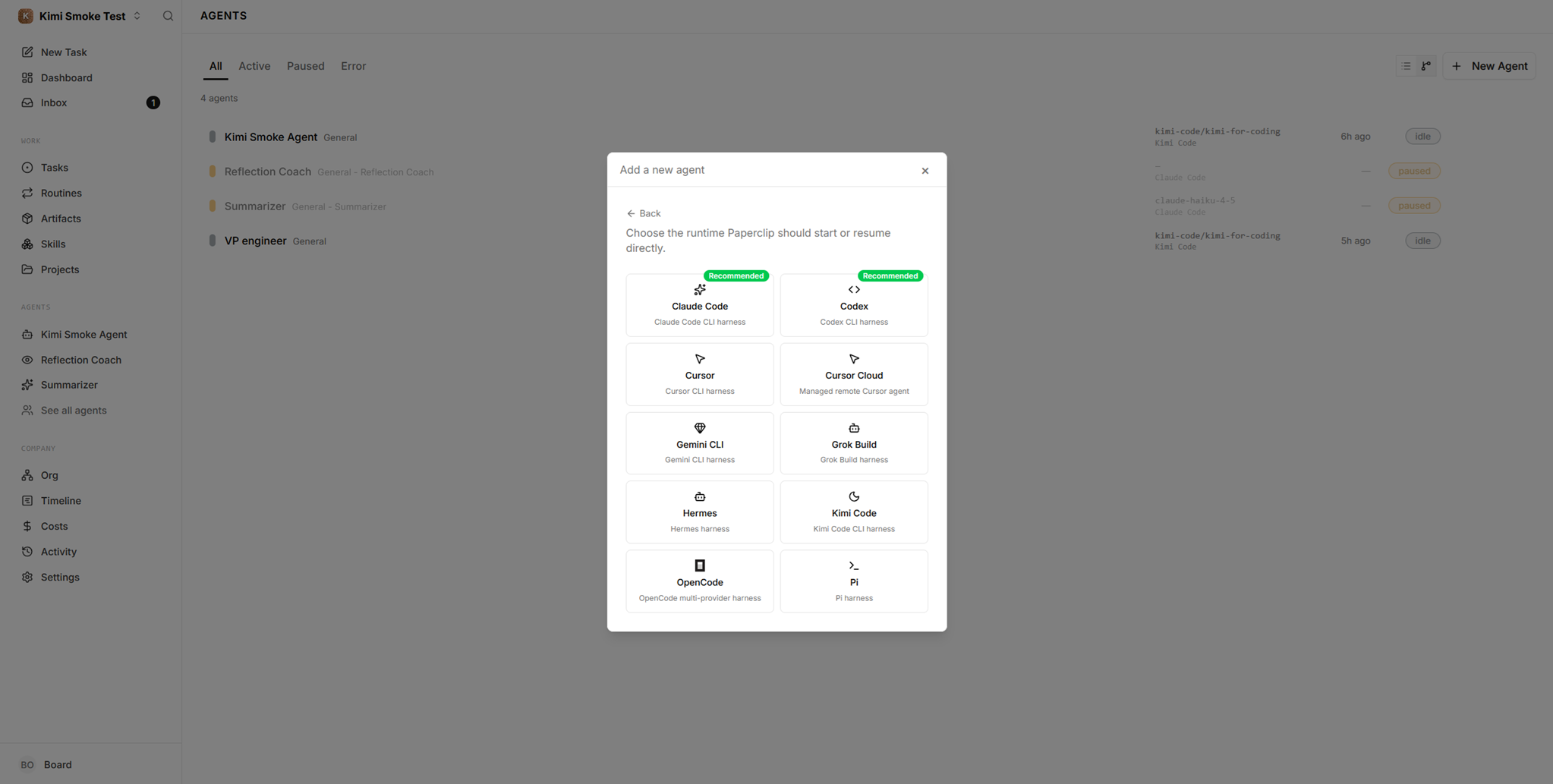 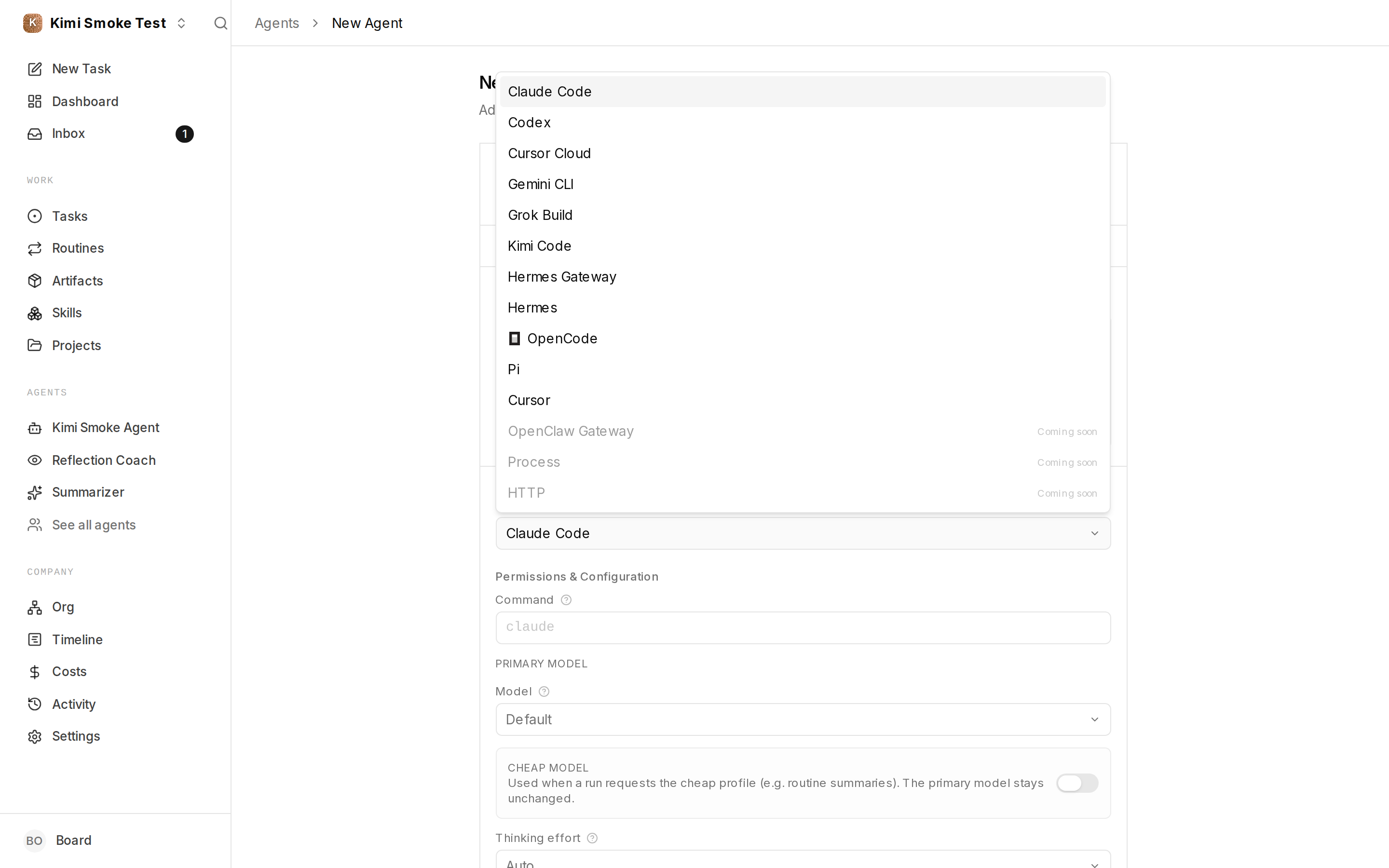 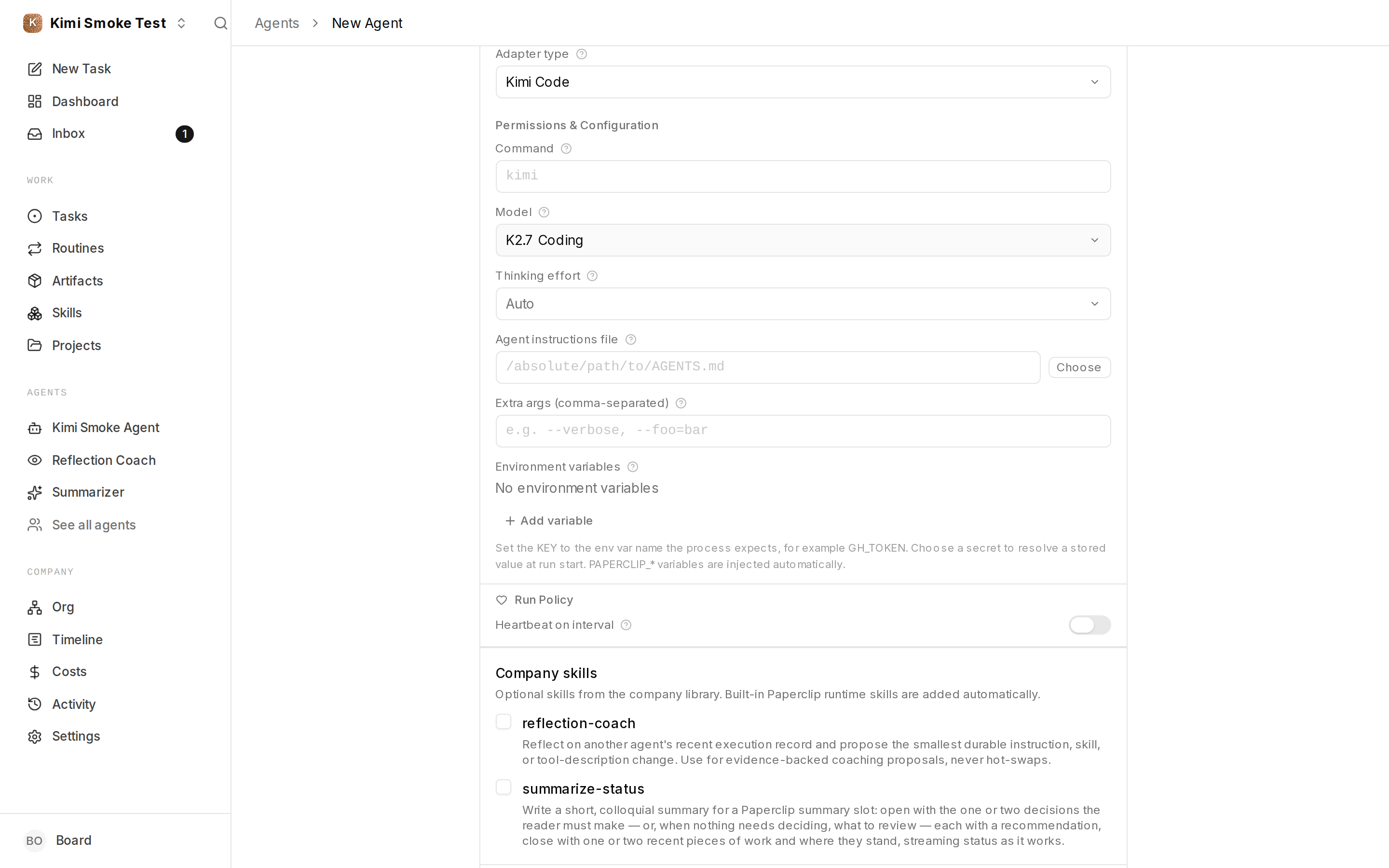 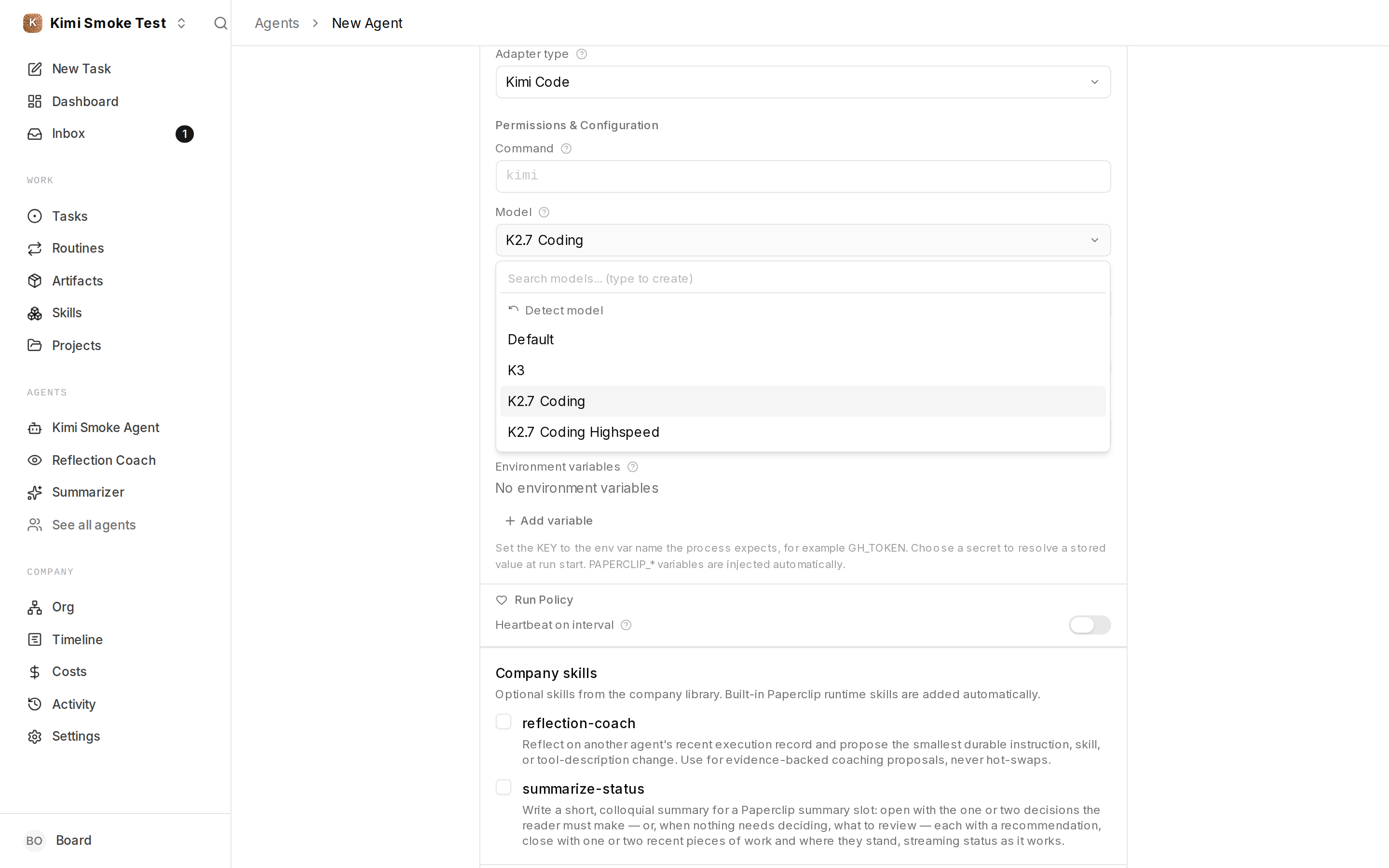 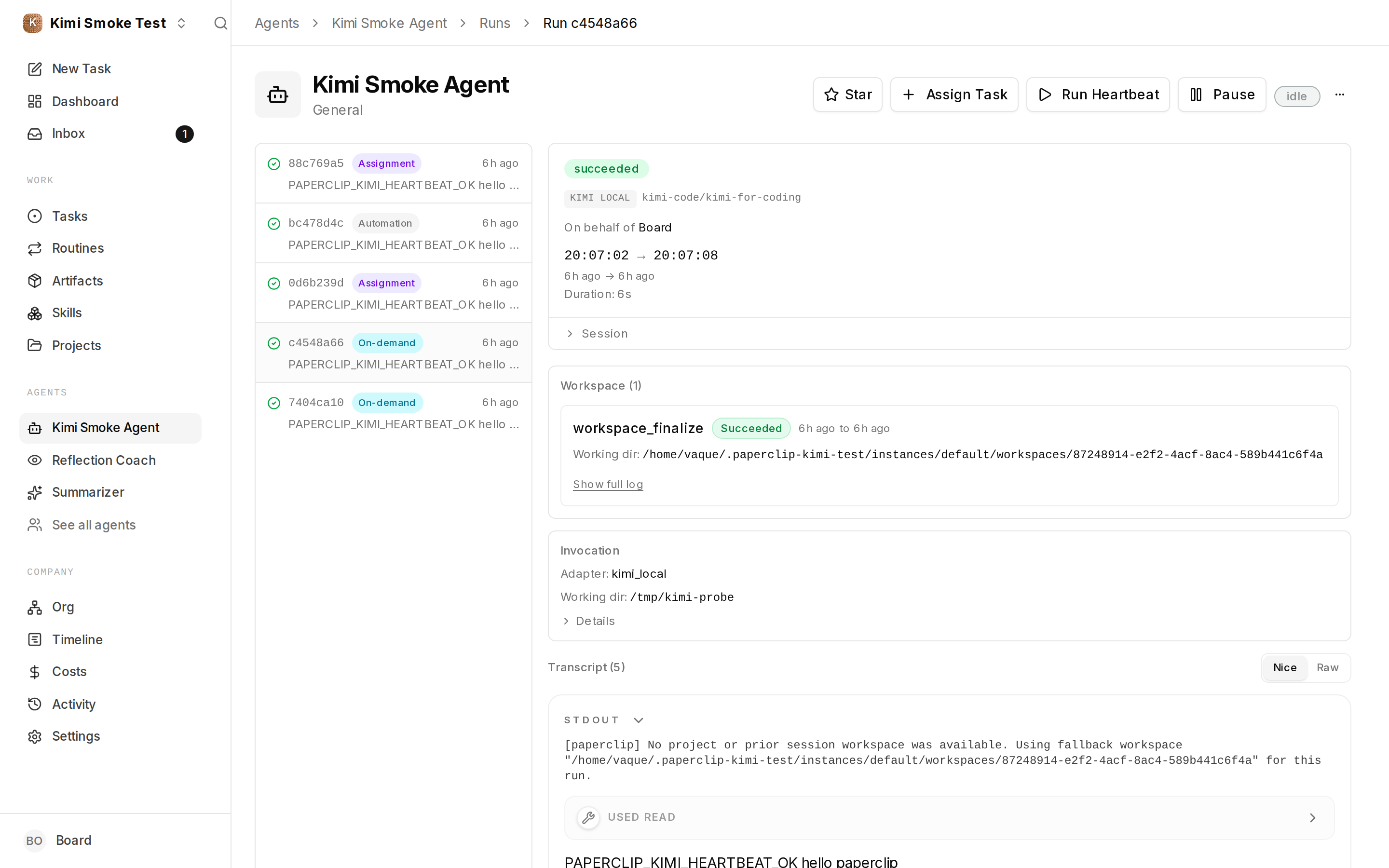  ## Risks - Low risk to existing behavior: the change is additive, one new workspace package plus single-entry registrations alongside existing adapters; no existing adapter code paths are modified. - The adapter invokes the locally installed `kimi` CLI; like other local adapters, run behavior depends on the host's Kimi version. The parser is written against the documented/verified 0.27.0 stream-json schema and degrades gracefully (malformed lines are skipped, failures surface as run errors). - `--skills-dir` overrides Kimi's auto-discovery of user and project skills for the run. This is intentional (paperclip-managed agents get a reproducible, isolated skill set), and it is only passed when at least one Paperclip skill is desired, so unconfigured agents keep default discovery. - Thinking effort is only forwarded to models that advertise `support_efforts` (currently `kimi-code/k3`); `EFFORT_CAPABLE_MODELS` must be extended when more Kimi models gain support, otherwise a configured effort is silently ignored for them. - `Dockerfile` now installs `@moonshot-ai/kimi-code@latest` globally alongside the other agent CLIs, so image size increases slightly. - Maintainer action needed for the npm bootstrap gate: the `policy` job's release-bootstrap step fails until the first npm publish of `@paperclipai/adapter-kimi-local` (the gate from #5146 that every new adapter package has passed through). Enrollment with `publishFromCi: true` is required by the manifest validator (dropping the entry, `false`, or `private` are all rejected), so this is intentionally left to a maintainer. Remaining CI lanes are expected to run once it is done. ## Model Used\n\n- **Current-master rebase, conflict adaptation, and registry-parity coverage:** OpenAI, **GPT-5 Codex** (Codex agent; exact serving model ID and context-window size were not exposed to the runtime), with repository, shell, Git, and GitHub tooling. It preserved Hawik’s commit authorship, reconciled ACPX and environment-capability changes, added current registry tests, and ran the verification above.\n- **Adapter implementation and initial review:** Moonshot AI, **Kimi K3 Coding** (latest), via **Kimi Code CLI v0.27.0** (`kimi-code/k3` alias, 1M-token context window, thinking mode, agentic tool use). The CLI agent explored the repo, wrote the adapter implementation (delegated to a coder sub-agent of the same model), ran tests, and drafted the first version of this PR body. A second model-driven review pass (read-only, same model) audited the diff for security/correctness before submission; its findings (shell-quoting hardening, auth-detection false positive, session-compaction registration, test gaps) were fixed and are included. - **Harness-context fixes and review responses:** Anthropic, **Claude Opus 4.8** (`claude-opus-4-8`) via Claude Code. Diagnosed from run logs that Kimi received only the entry instructions file (not the `HEARTBEAT.md`/`SOUL.md`/`TOOLS.md` bundle) and that `effort` was never wired, then implemented the instruction `--add-dir` delivery, `KIMI_MODEL_THINKING_EFFORT` forwarding, and `--skills-dir` skill delivery, added the accompanying tests and docs, and addressed the automated review comments (preserving external skills on remote sync, treating a signaled exit as a failure). Also extended the `paperclipai agent local-cli` installer to seed the control-plane skills into `~/.kimi-code/skills` for Codex/Claude parity, wired `onEvent` runtime events so the issue-thread activity indicator reflects Kimi's tool and reasoning output live, and built the ACP engine lane (`kimi acp` via the shared acpx engine, default) so the transcript streams with live tool status like the other ACP adapters. The Kimi CLI flags, subcommand, and env var relied on here were verified against the installed Kimi Code CLI 0.27.0. - All CLI behaviors claimed here (`-p`, `--output-format stream-json`, `-r` resume, event shapes, `--add-dir`, `--skills-dir`, `KIMI_MODEL_THINKING_EFFORT`) were verified empirically against the installed Kimi CLI, not assumed. ## Checklist - [x] I have included a thinking path that traces from project context to this change - [x] I have specified the model used (with version and capability details) - [x] I have checked ROADMAP.md and confirmed this PR does not duplicate planned core work - [x] I have searched GitHub for duplicate or related PRs and linked them above - [x] I have either (a) linked existing issues with `Fixes: #` / `Closes #` / `Refs #` OR (b) described the issue in-PR following the relevant issue template - [x] I have not referenced internal/instance-local Paperclip issues or links (only public GitHub `#NNN` / `github.com/paperclipai/paperclip` URLs) - [x] My branch name describes the change (e.g. `docs/...`, `fix/...`) and contains no internal Paperclip ticket id or instance-derived details - [x] I have run tests locally and they pass - [x] I have added or updated tests where applicable - [x] I have updated relevant documentation to reflect my changes - [x] I have considered and documented any risks above - [x] All Paperclip CI gates are green *(only the release-bootstrap step remains red, pending the maintainer npm publish described in Risks)* - [x] Greptile is 5/5 with no open P2s, recommendations, or follow-ups *(will address all Greptile comments as they arrive)* - [x] I will address all Greptile and reviewer comments before requesting merge --- ## Maintainer Addendum (2026-08-20) The shared acpx-engine and issue-chat changes (run-summary segmentation, placeholder tool-event coalescing, `ISSUE_CHAT_TRANSCRIPT_MAX_VISIBLE_ENTRIES` 30 → 400, live-reasoning UI) have been **extracted to #11761** so the cross-adapter behavior changes review and revert independently — both commits there preserve @hawikk's authorship. This PR is now the kimi-specific adapter only (60 files, +3,793/−8, essentially pure addition); the only shared-engine touch left is the `kimi acp` command resolution. `publishFromCi` is `true` — the package name is bootstrapped on npm. --------- Co-authored-by: Claude Opus 4.8 <noreply@anthropic.com> Co-authored-by: Paperclip <noreply@paperclip.ing> Co-authored-by: Dotta <bippadotta@protonmail.com> Co-authored-by: Devin Foley <devin@paperclip.ing> |
||
|
TonioandClaude Opus 5
|
6d0adbfb5d |
refactor(ui): retire the shared-cache reasoning the account key made obsolete (#11507)
## Thinking Path > - Paperclip is the open source app people use to manage AI agents for work > - Three places in the UI turn the company list into an authorization verdict: the invite landing page, the onboarding draft gate, and company auto-selection > - Each grew a defense when one `["companies"]` cache entry answered for every account, and each documented that hazard at length > - #11488 keyed the entry by account, so the hazard those comments describe can no longer happen > - The comments stayed, and a comment that describes a trap that no longer exists is how the next reader removes a mechanism that is still holding something up > - This pull request replaces that reasoning with what the mechanisms actually do now, and removes the one condition that genuinely went dead > - The benefit is that the next person to simplify these gates has accurate reasons to work from ## Linked Issues or Issue Description No public issue exists. Follow-up to #11488, #11430 and #11417. The problem follows. **What happened?** The three gates were written against a shared, account-less company cache. #11488 keyed that entry by account, which made the documented hazard impossible — but the documentation stayed. Each gate now carries a long explanation of a cross-account leak that the key prevents, while the mechanism it explains is in fact still required for a different and unrelated reason. That is a maintenance hazard in a specific direction: a reader who checks the comment against the code concludes the mechanism is obsolete, removes it, and reintroduces a failure the comment never mentioned. **Expected behavior** The reasoning next to each gate describes why the gate is there now. **Steps to reproduce** Read the comment above `ownershipDecidable` in `OnboardingWizard.tsx` against `master`. It justifies `isSuccess` on the grounds that "after an account switch the retained value is the previous account's list", which the account-keyed entry makes impossible. **Paperclip version or commit** `master` at `0817fbad9`. ## What Changed - `ui/src/pages/InviteLanding.tsx` — dropped the `Boolean(sessionQuery.data)` conjunct from `membershipListIsCurrent`; rewrote the comment. - `ui/src/components/OnboardingWizard.tsx` — replaced the shared-cache explanation above the ownership gate with the reason the gate still exists. - `ui/src/hooks/useSignOut.ts` — corrected the sweep's rationale, which cited the company list as its example of data the next account could read. ### The one dead condition `membershipListIsCurrent` tested `Boolean(sessionQuery.data) && companiesQuery.isFetchedAfterMount`. The first term cannot be false when the second is true: the query is `enabled` only while a session exists, so the flag cannot be set without one. The lapsed-session case it looked like it covered is covered by the keying instead — the observer re-keys to the anonymous entry and holds no data to leak. Tests pass with it removed, but that only shows no test distinguishes it, which is why the reasoning above is recorded in the code rather than left for the next reader to redo. ### What is deliberately kept Each gate turned out to be load-bearing for a reason that has nothing to do with accounts: - **InviteLanding** still waits for a list fetched this mount. A pending query reads as an empty list, which reads as "not a member", which auto-accepts an invite the customer may already hold. - **OnboardingWizard** still forces a fetch with `staleTime: 0`. A cached list is the right account's but can be thirty seconds old, so a company created moments ago in another tab is missing from it — and missing reads as "you do not own this", which *deletes* the draft rather than withholding it. - **CompanyProvider** still clears the live selection on an account change. That is component state and does not change key with the query. Removing them as redundant is the mistake the stale comments invited; this change is what makes that argument harder to make by accident. ## Verification - `pnpm tsc -b` in `ui`: clean. - `InviteLanding.test.tsx`, `OnboardingWizard.test.tsx`, `CompanyContext.test.tsx`, `useSignOut.test.tsx`, `companies-query.test.ts`: **67 passed**, run twice. No behaviour change is claimed and none is intended: the only non-comment edit is the removal of a condition that cannot alter the expression's value. **Not done:** no browser run. Nothing here is observable at runtime. ## Risks Low. Comments, plus one condition shown to be unreachable-false. The risk that remains is a documentation risk in the other direction: if the keying is ever reverted or bypassed, these comments will understate what the gates protect against. They name #11488 so that connection is findable. **This does not close the class.** Account-scoped entries other than the list — `["companies", id]`, stats, and the rest — still survive an account change that skips the sign-out button. That is unclaimed work, and larger than this. ## Model Used Claude Opus 5 (`claude-opus-5`), through Claude Code. Extended thinking enabled. Tool use enabled: file read and edit, shell for typecheck and test runs. ## Checklist - [x] I have included a thinking path that traces from project context to this change - [x] I have specified the model used (with version and capability details) - [x] I have checked ROADMAP.md and confirmed this PR does not duplicate planned core work - [x] I have searched GitHub for duplicate or related PRs and linked them above - [x] I have either (a) linked existing issues with `Fixes: #` / `Closes #` / `Refs #` OR (b) described the issue in-PR following the relevant issue template - [x] I have not referenced internal/instance-local Paperclip issues or links (only public GitHub `#NNN` / `github.com/paperclipai/paperclip` URLs) - [x] My branch name describes the change and contains no internal Paperclip ticket id or instance-derived details - [x] I have run tests locally and they pass - [x] I have added or updated tests where applicable - [x] I have updated relevant documentation to reflect my changes - [x] I have considered and documented any risks above - [ ] All Paperclip CI gates are green - [ ] Greptile is 5/5 with no open P2s, recommendations, or follow-ups - [x] I will address all Greptile and reviewer comments before requesting merge 🤖 Generated with [Claude Code](https://claude.com/claude-code) Co-authored-by: Claude Opus 5 <noreply@anthropic.com> |
||
|
TonioandClaude Opus 5
|
327f59cac2 |
refactor(ui): key the company list by account (#11488)
## Thinking Path > - Paperclip is the open source app people use to manage AI agents for work > - Which companies a person belongs to is an authorization fact the server owns, and the UI caches the answer for speed > - It cached that answer under one `["companies"]` key with no account attached, while `main.tsx` sets `staleTime: 30_000` for every query > - So for thirty seconds after an account change, one person's list answered questions asked about another, arriving with no loading state and no error > - Three separate consumers each grew their own defense against this, and each was a place to forget one > - This pull request keys the entry by account, so a list belonging to someone else is not distrusted but unreachable > - The benefit is that the protection stops depending on every future consumer remembering to defend itself ## Linked Issues or Issue Description No public issue exists. Refs #11380, #11382, #11417, #11430. The problem follows. **What happened?** The company list lived in a single cache entry, `["companies"]`, carrying no record of which account it was fetched for. Combined with the app-wide 30s `staleTime`, any read within that window after an account change returned the previous account's list — from cache, with no request, no loading state and no error. Every consumer that treats the list as an authorization fact had to know this and defend itself: - `InviteLanding` reads it to decide whether you already belong to the inviting company (#11417). - `OnboardingWizard` reads it to decide whether a saved draft belongs to you (#11382, merged). - `CompanyProvider` reads it to pick and persist your active company (#11430). All three defenses are correct. The problem is structural: the fourth consumer has to invent a fourth one. **Expected behavior** A cached company list can only answer questions about the account it was fetched for. **Steps to reproduce** 1. On a self-hosted instance in `authenticated` mode, sign in as account A, which belongs to company X. 2. Within thirty seconds, have account B become the session in that tab — a second tab signing in, or A's session lapsing server-side. 3. Any consumer reading the company list receives A's list, and nothing in the query result indicates it is not B's. **Paperclip version or commit** `master` at `ac91b7f3b`, which includes #11430. ## What Changed - `ui/src/lib/queryKeys.ts` — `companies.list(userId)` replaces `companies.all` as the list's entry. `companies.all` remains the prefix, so it still matches for invalidation. - `ui/src/api/companies-query.ts` — `companyListQueryOptions(userId)` builds the keyed options; `useCompanyListQuery()` is the only observer entry point and holds until the session settles, because the key cannot be built before then; `fetchCompanyListForCurrentAccount(queryClient)` covers imperative paths; `useAccountIdentity()` exposes the session identity the key is built from. - `ui/src/api/companies-query.ts` — the `/companies` detach moved into the query function. - `ui/src/context/CompanyContext.tsx` — drops the session-watching refetch machinery the key now makes unnecessary (`removeQueries`, the explicit replacement fetch, the awaiting gate). It still clears the live selection on an account change, because that is component state and does not change key with the query. - `ui/src/pages/InviteLanding.tsx`, `ui/src/components/OnboardingWizard.tsx` — read through the account-aware API. - Tests — the account-keyed guarantee, prefix invalidation still reaching the list, the detach inside the query function, and updates where suites seeded the old shared key. ### The existing defenses are deliberately left in place The per-consumer gates in #11382, #11417 and #11430 are now belt and braces. They are also what will catch this refactor if it is wrong somewhere, so removing them in the same change that moves the foundation would be the wrong order. Simplifying them is a follow-up, once this has proven itself. ### Why `retry: 1` appears in CompanyProvider An earlier measurement on #11430 found a retry on the replacement fetch changed no outcome, because `removeQueries` made the observer rebind and issue a second request for free. Keying by account removes that mechanism and the free attempt with it. The retry now carries the property the incidental refetch used to — a single blip during an account change should not leave the customer with no companies until they find "Try again". #11430's test for that property is unchanged and still passes, which is how the gap was caught. ### A regression this went through, kept for the record Gating the query on the session settling meant that while the account was unknown the query was *disabled*, and a disabled query reports `isLoading: false` with no data — which the provider defaults to an empty list and reads as "asked, and owns nothing". That is the destructive branch #11477 had just fixed, reached through a different door: it would have cleared the customer's stored company on every cold boot. #11477's test caught it during the rebase. `useCompanyListQuery` now reports the wait for the account as part of the wait for the list. ### What this does not do It does not scope the rest of the per-account cache. `["companies", id]`, stats, and every other account-scoped entry still survive an account change; that is the cache-lifetime work in #11380. ## Verification - `pnpm vitest run` in `ui`: **4018 passed, 1 failed**. - `pnpm tsc -b` in `ui`: clean. - `companies-query.test.ts`: 6 passed. `CompanyContext.test.tsx`: 17 passed. `OnboardingWizard.test.tsx`: 13 passed. `InviteLanding.test.tsx`: 13 passed. The failure is the pre-existing timezone-dependent `IssueProperties.test.tsx`, fixed by #11478. Two behaviours are asserted rather than assumed, because the refactor is only safe if they hold: that invalidating the `companies` prefix still marks the account-keyed list stale (19 call sites depend on it), and that the query function detaches the in-flight `/companies` request before fetching. **Not done:** no manual two-account run in a browser. The path needs two accounts on an `authenticated` instance, which a local dev instance cannot exercise. ## Risks Moderate, and worth reading before approving. **It touches `InviteLanding.tsx`, which #11417 also modifies**, so one of the two will need a rebase — the conflict is mechanical (both change how the same query is read). This was #11481, which GitHub closed automatically when its base branch (#11430's) was deleted on merge; reopening a pull request whose base branch is gone is not permitted, so it continues here against `master` with the same head and the same review already recorded on #11481. **The list now waits for the session query.** The key cannot be built before the account is known. In the app the session is already fetched at boot by many components, so this is a dependency rather than an extra request, but it does serialize: on a cold boot the list waits for the session to land. Every test that renders a company-list consumer now needs a session in the cache, which is why several suites gained a seed. **A missing mock surfaces as a passing gate rather than an error.** The detach inside the query function meant suites whose `companiesApi` mock lacked `detachInflightList` had their query function throw, which read as "decided" in the onboarding gate and mounted the wizard early. Fixed in the affected suites; worth knowing as a failure mode. ## Model Used Claude Opus 5 (`claude-opus-5`), through Claude Code. Extended thinking enabled. Tool use enabled: file read and edit, shell for typecheck and test runs. ## Checklist - [x] I have included a thinking path that traces from project context to this change - [x] I have specified the model used (with version and capability details) - [x] I have checked ROADMAP.md and confirmed this PR does not duplicate planned core work - [x] I have searched GitHub for duplicate or related PRs and linked them above - [x] I have either (a) linked existing issues with `Fixes: #` / `Closes #` / `Refs #` OR (b) described the issue in-PR following the relevant issue template - [x] I have not referenced internal/instance-local Paperclip issues or links (only public GitHub `#NNN` / `github.com/paperclipai/paperclip` URLs) - [x] My branch name describes the change and contains no internal Paperclip ticket id or instance-derived details - [x] I have run tests locally and they pass - [x] I have added or updated tests where applicable - [x] I have updated relevant documentation to reflect my changes - [x] I have considered and documented any risks above - [ ] All Paperclip CI gates are green - [ ] Greptile is 5/5 with no open P2s, recommendations, or follow-ups - [x] I will address all Greptile and reviewer comments before requesting merge 🤖 Generated with [Claude Code](https://claude.com/claude-code) --------- Co-authored-by: Claude Opus 5 <noreply@anthropic.com> |
||
|
TonioandClaude Opus 5
|
38752c4e5e |
fix(ui): clear account-scoped query caches on sign-out (#11380)
Sign-out invalidated two query keys - the auth session and health - and left everything else in the cache. `invalidateQueries` also keeps serving the old data while it refetches, so it was insufficient even for the two it did touch. The company list was never touched at all, which is how one account's companies could still be in hand when the next account signed in. The self-hosted path now resets every account-scoped entry. Scoping is an allowlist of instance-scoped roots rather than a list of things to clear, so a query key added later is account-scoped unless someone deliberately says otherwise - forgetting this file fails closed. `health` is the only exemption. It carries deployment mode, bootstrap state and Cloud metadata, nothing account-scoped, and `useCloudInstance` observes it with `enabled: false` and leaves the fetch to CloudAccessGate. Dropping the entry would strand every such observer on `null` until the gate happened to refetch, flipping Cloud instances into their self-hosted rendering mid sign-out. It is refreshed in place instead. `resetQueries` rather than `removeQueries`: removal empties the cache without notifying the observers already subscribed, so a mounted `useQuery` keeps returning its last result until an unrelated re-render rebuilds it. CompanyProvider sits above the router and stays mounted across the whole sign-out and sign-in cycle, so that is the common case here rather than a corner one. Reset notifies them, so the old data leaves the cache and everything reading it. The cloud path is untouched: it is a top-level navigation, and the document reload builds a new QueryClient with nothing left to clear. This is the root cause behind the onboarding draft-ownership gate added in #11382. That gate stays, and its comment now says why: this fix covers the sign-out button, not the question. An account can change without it - a session lapsing server-side, a second account signing in on a warm tab, a caller supplying the company context from somewhere else - so the gate stays independent rather than deferring to this. ui typecheck clean; full ui suite 4014 pass, with only the timezone-dependent IssueProperties failure already present on master. Co-Authored-By: Claude Opus 5 <noreply@anthropic.com> |
||
|
|
6542ad1f4d |
fix(onboarding): carry an existing company's mission into the wizard (#11416)
Ports the substance of #11259, which predated the recent onboarding work and was still open. One of the parts it solves is a regression #11352 introduced. A company that already has its mission opens on the agent step, which is the point of #11352. What that missed is that the mission field is filled only by the step being skipped, and that the field is not decoration: `composeCeoInstructions` seeds the lead agent's instructions from it, and the Review checklist reads it. So every Cloud-seeded company hired its lead agent with no Mission line at all, having been routed there precisely *because* it had a mission. Before #11352 those companies dead-ended on the mission step; a dead end became a quiet data loss, which is worse, because it completes. `selectExistingCompanyMission` reads the company's own goal back into the shape the mission field holds, and the wizard hydrates from it - only when the field is empty, so a customer editing their mission is never overwritten by the stored copy. The marker recording that hydration travels with the field it describes, cleared wherever `companyGoal` is. `isExistingCompanyMissionUnresolved` holds the hire while that read is outstanding, counting an in-flight refetch over cached goals as unresolved. That is the rule #11382 settled on a day earlier for a different consumer - `isFetching`, not `isLoading`, because retained data is not an answer to the question being asked now. #11259 had it first, on 11 August. `canGoBackFromOnboardingStep` and `canJumpToOnboardingStep` bound how far back a run can walk by the step it entered on. The Back button already applied that rule inline; the progress bar applied only the "already completed" half, so a run holding a company could still jump to step 1 - the step whose job is to create one. The entry step is captured once, when the wizard opens, for the same reason the step itself is. `planMissionPersistence` came with them and turned out to be required rather than tidying. Hydration sets `createdCompanyGoalId` from the company's existing goal, and confirming the mission read that id as "already written" and skipped the write, discarding the customer's edit. That skip was safe only while the id could arrive one way - by writing. A goal in hand now means update it. Each piece was checked by removing it and confirming a specific case fails. The hydration case asserts on `saveInstructionsFile`'s content, the actual consumer, rather than on the mission textarea, because the entry path never renders that field and the navigation bound now prevents reaching it. One caveat recorded rather than smoothed over: the reopen case fails only when both marker-clears are removed, since `reset()` also clears the company id and the next introduction routes through `clearCompanyScopedState`. They are kept as one invariant rather than one guard plus a coincidence. ui typecheck clean; full ui suite 4004 pass. Two failures remain, in IssueProperties and StatusCards/format; both are date-dependent, both reproduce on master with these changes stashed, and neither file is touched here. Co-Authored-By: Jannes Stubbemann <stubbi@users.noreply.github.com> Co-Authored-By: Claude Opus 5 <noreply@anthropic.com> |
||
|
TonioandClaude Opus 5
|
484b1f626c |
fix(onboarding): verify draft ownership against a list fetched this session (#11382)
#11370 stopped onboarding restoring a saved draft when the company list had *errored*. It still trusted the list when the list looked healthy — and the wider door was exactly that. `main.tsx` sets `staleTime: 30_000` app-wide and `Auth.tsx` invalidates rather than resets on sign-in, so `invalidateQueries` keeps serving the previous account's companies with `isLoading` false and no error at all. On a self-hosted instance, where sign-out does not reload the page, signing in as a second account in the same warm tab could restore the first account's draft. No request had to fail. The wizard now judges ownership against a list it fetched for the current session: its own `useQuery` on the shared key with `staleTime: 0`, gated so it runs only when a parseable draft exists and adds no request otherwise. Every clause of that gate earns its place, and each was verified by removing it and watching a specific case fail: - `isSuccess` ties the answer to this session. React Query retains the last good `data` when a refetch fails, so after an account switch the retained value is the previous account's list; a failed refetch flips status to error and this rejects it. - The `unauthorized` check catches the opposite error. `companiesListQueryOptions` folds 401 and 403 into `{ companies: [], unauthorized: true }` rather than throwing, so an auth blip arrives as a *successful* empty list and would otherwise read as "this account owns nothing" and delete the draft. - The mount gate keys on `isFetching`, not `isLoading`. `isLoading` is false whenever retained data exists, so a refetch over a warm cache mounted the wizard undecided — and with the wizard open, the persist effect overwrote the customer's own draft with defaults before the answer arrived. It still releases on failure, so the "Get Started" dead end stays fixed. - An unreadable draft is judged, and cleared, before any of the above, and does not enable the query at all. `isFetchedAfterMount` was in an earlier revision and is deliberately not here: it is true after a failed refetch too, so it rejects nothing `isSuccess` has not, and no test could distinguish it. Worth recording how the first defect survived a check. I fault-injected it, saw a test fail, and concluded the guard worked. It was failing for an unrelated reason — the inner wizard mounted during the fetch and locked its state initializers to defaults, so the draft could not appear whatever the gate decided. Fixing the mount gate exposed the real behaviour. An injection is only evidence if the failure it produces is the one being claimed. This narrows onboarding only. The general fault is that a sign-out leaves account-scoped caches in place, and account changes that skip the button — a session lapsing server-side, a second account in a warm tab — reach the same stale list. Tracked separately; this defence should not be removed as redundant when that lands. ui typecheck clean; full ui suite 3963 pass, with only the timezone-dependent IssueProperties failure already present on master. Co-Authored-By: Claude Opus 5 <noreply@anthropic.com> |
||
|
TonioandClaude Opus 5
|
35a9b98733 |
fix(ui): theme the onboarding wizard decorative panel instead of hardcoding dark (#11379)
The onboarding wizard's decorative right-hand panel, which holds the ASCII paperclip illustration, hardcoded a near-black surface. `ThemeContext` supports light and dark and follows `prefers-color-scheme`, so in light mode a new customer met the product as a pale form beside a solid black rectangle — on the one screen meant to introduce it. The glyphs inside already used `text-muted-foreground`, so the panel was the only part ignoring the theme. It now uses the paired `bg-muted` surface, which is defined in both themes (`oklch(0.97 0 0)` light, `oklch(0.269 0 0)` dark), so the illustration reads as ink on a surface either way and follows any future theme without another fix. The guard for it asserts the complete set of `bg-` classes on the panel is `["bg-muted"]`, anchored to the `<AsciiArtAnimation />` wrapper rather than scanning the file. Forbidding specific spellings is what failed here originally: the first version checked `bg-[#rrggbb]` and silently stopped guarding anything once master migrated the class to `bg-(--hex-1d1d1d)`. Naming what is allowed cannot decay that way, and it catches named colours like `bg-black` that no spelling list covered. Lands the work from #8982 by @stubbi, whose two commits are included unchanged with their authorship. The rebase and the guard are mine. Tested: ui typecheck clean; both theme cases fail against four spellings of the regression — `bg-(--hex-1d1d1d)`, `bg-[#1d1d1d]`, `bg-black`, `bg-zinc-900` — where the original caught only one and my first widening caught two. Full ui suite 3958 pass, with one timezone-dependent IssueProperties failure present on master. All CI gates green; Greptile 5/5. Co-Authored-By: Claude Opus 5 <noreply@anthropic.com> |
||
|
TonioandClaude Opus 5
|
66515582e4 |
fix(onboarding): do not restore wizard state for a company the user does not own (#11370)
Onboarding persists a draft to `localStorage`, including `createdCompanyId`. That key is scoped per browser origin, not per account, so a browser that has already run onboarding hands the stored company id to the next session on the same origin — whoever is signed in. Every downstream call then targets a company that account may not own: goals, agents and issues are created there, and requests fail with authorization errors. `restoreOnboardingState` now returns a saved draft only when the signed-in account owns the company it names. Otherwise the draft is discarded and the stale blob removed. The wizard splits into a gate and an inner component because the inner one has ~20 `useState(saved?.x ?? default)` initializers, and an initializer runs only on the first render. Mounting before the restored draft is final locks every field to its default with no way back, so the gate waits for the company list while it is loading. Ownership is judged only against a list that actually answered. Any company query error makes it undecidable, whatever the list contains — the companies cache is not account-scoped and survives sign-out, so a failed refetch after an account switch can leave the previous account's companies in hand, and trusting a non-empty list there would hand one account's draft to the next. Nothing is restored and nothing is deleted in that state; the next successful load decides. Judging the draft and mounting the wizard are separate questions. The gate withholds the wizard only while the list is *loading*, never on error: the companies query sets `retry: false`, and with no companies the dashboard offers a "Get Started" button wired to onboarding, so blocking there would make that button do nothing at all. Mounting costs the draft nothing, because the persist effect is itself gated on the wizard being open. All four draft-storage call sites — read, write, cleanup, reset — go through one guarded helper. Storage access throws outright where a browser denies it, and each site sits in a render, an effect or a close handler, so an escaping exception took down something the customer was using. Lands the work from #9900 by @stubbi, whose two commits are included unchanged with their authorship. The rebase, the error-path handling and the storage guards are mine. Follow-up filed separately: sign-out should remove account-scoped cached data rather than invalidating two keys. This change is defensive and protects onboarding only. Tested: ui typecheck clean; 73 pass across the seven onboarding suites; full ui suite 3952 pass, with one timezone-dependent IssueProperties failure present on master in a file this does not touch. All CI gates green; Greptile 5/5. Co-Authored-By: Claude Opus 5 <noreply@anthropic.com> |
||
|
TonioandClaude Opus 5
|
bc0b5a1642 |
fix(ui): onboarding wizard keeps an invisible disabled adapter selected (#11371)
The wizard defaults `adapterType` to `claude_local`, and a saved draft can name any adapter. The grid only renders adapters the server has enabled, so on an instance where the held adapter is disabled nothing appears selected while the wizard still holds it — and the first agent is hired on an adapter the deployer turned off, which can never acquire a lease. The selection now snaps to the first enabled, non-coming-soon adapter whenever the held one is not visible, and adapter-specific model defaults follow it. The snap waits for the adapter registry to load. External adapter types are registered into the UI registry only once the adapters query resolves, so before that a saved external adapter is indistinguishable from a disabled one — snapping on that transient list would replace the customer's choice with a built-in and the persist effect would write it down. This gate fails closed, unlike the fail-open gates in onboarding, because the directions of harm are opposite: acting early silently rewrites a saved answer, while waiting merely leaves the selection alone, which is the behaviour that existed before the snap did. The test file is named `OnboardingWizard.adapters.test.tsx` rather than `OnboardingWizard.test.tsx`, which is the name #11370 uses for its restore gate. Both merged cleanly onto master alone but collided with each other on add/add, and nothing in either status showed it. Lands the work from #9900's sibling, #9501, by @stubbi, whose commit is included unchanged with their authorship. The rename and the registry gate are mine. Tested: ui typecheck clean; 51 pass across the adapter, hook, dialog, config-form and wizard-step suites, including the other callers of the adapter hook since that module changed. All CI gates green; Greptile 5/5. Co-Authored-By: Claude Opus 5 <noreply@anthropic.com> |
||
|
TonioandClaude Opus 5
|
d95340b0b8 |
feat(ui): send a company with no agent into onboarding, at the right step (#11352)
A company with no agent cannot do anything: no runs, no tasks, nothing to show. The dashboard says so in a banner with a link, which asks the customer to notice a problem the product can fix for them. It is worse for a company created by Paperclip Cloud: Cloud creates the company before the tenant boots, so the companyless redirect never runs, and the customer arrives on an empty dashboard straight out of a signup flow that already asked for a mission. The dashboard now opens onboarding when the agent list has loaded and is empty, and onboarding opens on the agent step when the company already has its mission — read from the company-level goal the seed writes, under the query key the launch path already uses, so it shares a cache entry rather than adding a fetch. The step is decided once. `initialStep` is derived from the company list and the goal list, so it changes on any retry, refetch or cache invalidation. An effect that took it as a dependency called `setStep` on every one of those and moved a customer who was already mid-flow. Gating the input only narrowed that window; it could not close it. The step now belongs to the request that opened the wizard: the effect reads it through a ref and is keyed on the wizard opening or the company changing. `createdCompanyIdRef` beside it already used this pattern for the same reason. That exposed a path nothing had ever taken. A company reached the mission step only by creating itself on step 1, so opening an existing company there found code that had never run: `companyName` is only typed on step 1, and both ways forward require it, so the step could not be completed at all; and confirming advanced without writing anything, so the mission the customer typed was discarded. Both fixed, and the write now reconciles against the goal list rather than adding a second company goal, since the mission lookup fails open and can send a company that has one back to that step. Company-scoped state now stays with its company. `clearCompanyScopedState` runs when the route replaces a company and when it withdraws one — the same event, and clearing half of it left a goal id that made the next company skip a mission it had never given. `stillTheSameCompany` guards all five async writes, after the server work rather than before it, so a company switch mid-flight cannot hand the new company the old one's goal, project, issue or agent, and cannot leave a hired agent without its instructions file. The keyboard path honours `loading` like every button already did. `claimOnboardingOffer` makes onboarding an offer that stays declined for the visit. Route ownership is now recorded whenever the route names a company, including one the wizard already holds. This changes a documented rule deliberately: without it a self-created company was never withdrawn, so `/onboarding` would show "create a company" while still holding the previous one and write the customer's new mission into it. Tested at the seam, because every defect on this branch lived between a value and its consumer and the predicate tests passed at every stage. `OnboardingWizard.step.test.tsx` renders the real wizard against the real resolver and the real mission hook across 18 cases, and each was fault-injected against the code it replaces rather than trusted on a green run. That caught a case that passed against the broken code, and a race in one of the guards. ui typecheck clean; full ui suite 3923 pass, with one timezone-dependent IssueProperties failure present on this branch's base in a file this change does not touch. All CI gates green; Greptile 5/5. Co-Authored-By: Claude Opus 5 <noreply@anthropic.com> |
||
|
|
aac6ce82e1 |
fix(ui): read the onboarding company prefix from the path, not the route match (#11351)
## Thinking Path

> - Paperclip is the open source app people use to manage AI agents for
work
> - New users meet the product through an onboarding wizard that creates
their company, their first agent, and a starter task
> - The wizard also serves an existing company, at
`/{PREFIX}/onboarding`, to add another agent to it
> - On that route the wizard ignores the company in the URL and opens at
"create a company" instead
> - It reads the prefix with `useParams()`, but it renders beside
`<Routes>` rather than inside it, so there is no route match to read
> - This pull request reads the prefix from the pathname, which is
available without a match
> - The benefit is that the URL a user follows decides what the wizard
asks them

## Linked Issues or Issue Description

No public issue exists for this. The problem follows.

**What happened?**

Open `/{PREFIX}/onboarding` for a company that already exists. The
wizard opens at step 1 and asks the user to create a company. The
company named in the URL is ignored.

**Expected behavior**

The wizard recognises the company in the URL and opens at step 2, so the
user adds an agent to that company instead of creating a second one.

**Steps to reproduce**

1. Create a company, so it has an issue prefix.
2. Go to `/{PREFIX}/onboarding`.
3. Read the first screen. It asks for a company name.

**Paperclip version or commit**

`master` at `5ca7b4c1f`.

**Deployment mode**

Any. This is client-side routing and does not depend on the server.

## What Changed

- `ui/src/lib/onboarding-route.ts` — adds
`companyPrefixFromOnboardingPath()`, which reads the prefix from the
pathname.
- `ui/src/components/OnboardingWizard.tsx` — uses that value when the
route match supplies none. One line, plus the import.
- `ui/src/lib/onboarding-route.test.ts` — six cases for the new
function.

`OnboardingWizard` renders beside `<Routes>` in `App.tsx`, so
`useParams()` returns nothing and `companyPrefix` was always
`undefined`. `resolveRouteOnboardingOptions` then took its no-prefix
branch every time. `useLocation()` needs only the router, not a match,
and the wizard already calls it.

The route match is still read first. If the wizard later moves inside
the route tree, this code does not need to change.

The new parser accepts the same shape as `isOnboardingPath()`: the
prefix is the first of exactly two segments. One test asserts the two
agree, because a disagreement would either open the wizard where no
company resolves, or resolve a company where onboarding is not served.

### Why the change is this small

Three pull requests are open against `OnboardingWizard.tsx` — #9900,
#9501 and #8982. A larger change there would collide with all three.
Almost all of this lands in `onboarding-route.ts`, a small file of pure
functions with existing tests.

## Verification

- `npx tsc --noEmit -p ui/tsconfig.json` — clean.
- `npx vitest run ui/src/lib/onboarding-route.test.ts` — 18 pass.
- `npx vitest run ui/src` — 3883 pass, 445 files.

One test shows the defect and the fix together. With `companyPrefix:
undefined`, which is what the wizard supplied before,
`resolveRouteOnboardingOptions` returns `{ initialStep: 1 }`. With the
parsed prefix it returns `{ initialStep: 2, companyId: "c1" }`.

**Pre-existing failures, unrelated:** `IssueProperties.test.tsx` and
`StatusCards/format.test.ts` fail on clean `origin/master` with these
changes stashed. Both look date-dependent.

**Not done:** no manual browser check. The behaviour is covered by unit
tests at the function boundary, and the wizard's own suite passes.

## Risks

Low. The route match is still preferred, so behaviour changes only where
`useParams()` gave nothing — which today is every render of this
component.

The parser returns a prefix only for a two-segment path ending in
`onboarding`, so no other route can start matching. An unknown prefix
already falls back to step 1 in `resolveRouteOnboardingOptions`, and
that path is unchanged.

To revert, remove the fallback in the wizard. The new function has no
other caller.

## Model Used

Claude Opus 5 (`claude-opus-5`), through Claude Code. Extended thinking
enabled. Tool use enabled: file read and edit, shell command execution
for typecheck and the test runs, and the GitHub CLI.

## Checklist

- [x] I have included a thinking path that traces from project context
to this change
- [x] I have specified the model used (with version and capability
details)
- [x] I have checked ROADMAP.md and confirmed this PR does not duplicate
planned core work
- [x] I have searched GitHub for duplicate or related PRs and linked
them above
- [x] I have either (a) linked existing issues with `Fixes: #` / `Closes
#` / `Refs #` OR (b) described the issue in-PR following the relevant
issue template
- [x] I have not referenced internal/instance-local Paperclip issues or
links (only public GitHub `#NNN` / `github.com/paperclipai/paperclip`
URLs)
- [x] My branch name describes the change (e.g. `docs/...`, `fix/...`)
and contains no internal Paperclip ticket id or instance-derived details
- [x] I have run tests locally and they pass
- [x] I have added or updated tests where applicable
- [x] I have updated relevant documentation to reflect my changes
- [x] I have considered and documented any risks above
- [x] All Paperclip CI gates are green
- [ ] Greptile is 5/5 with no open P2s, recommendations, or follow-ups
- [x] I will address all Greptile and reviewer comments before
requesting merge

---------

Co-authored-by: Claude Opus 5 <noreply@anthropic.com>
Co-authored-by: Paperclip <noreply@paperclip.ing>
|
||
|
scotttong
|
815e49bb7c | feat: make chat-style tasks the default experience (#11101) | ||
|
TonioandPaperclip
|
384e5f6178 |
revert(ui): back out onboarding port (#10786) (#11067)
This reverts commit |
||
|
TonioandClaude Opus 5
|
11e56654f8 |
feat(ui): port onboarding flow from prototype; add cloud + local variants (#10786)
## Thinking Path

> - Paperclip is the open source app people use to manage AI agents for
work
> - First-run onboarding is the subsystem that turns a brand-new install
into a working company: it creates the company, its goal, a lead agent,
and that agent's first task
> - The existing `OnboardingWizard` carried all of that wiring
correctly, but its UI had drifted from the current design direction, and
a separate design prototype (`paperclip-onboard`) existed as a
standalone visual mock with no backend
> - Porting the prototype's *logic* would have thrown away working,
well-tested backend orchestration; leaving the two apart meant the
design never shipped
> - Separately, cloud and local (self-hosted) installs need meaningfully
different first runs — local has no sign-in and must let the user pick a
locally-installed CLI adapter — so a single linear wizard could not
serve both
> - This pull request rebuilds the presentational layer from the
prototype on top of the existing backend orchestration, and splits it
into two thin flow containers over a shared core
> - The benefit is that the shipped onboarding matches the intended
design, cloud and local can diverge without duplicating logic, and each
can later ship to a different app version while sharing one set of step
components

## Linked Issues or Issue Description

No existing issue — describing inline (feature request).

**What problem does this solve?**
Onboarding is the first thing a new user sees, and the shipped wizard
had drifted from the current design. In parallel, cloud and local
installs need different first-run paths: local has no hosted sign-in,
and its agent runs on a CLI adapter installed on the user's machine,
which the cloud path never has to ask about. There was no way to express
that difference without either forking the whole wizard or bolting
conditionals onto a single linear flow.

**Proposed solution**
Extract the onboarding step views and shell into a shared core, then
compose two thin flow containers (cloud and local) over it. Keep all
backend orchestration in the existing `useOnboardingFlow` hook so no
working logic is rewritten.

**Alternatives considered**
- *Single flow with a `variant` prop* — most DRY, but the two flows are
intended to ship on different app versions, and a shared file would have
to be split later anyway.
- *Two fully independent copies* — simplest per-flow, but every shared
refinement (spacing, motion, copy) would have to be made twice and would
drift.

## What Changed

- **Shared core** under `ui/src/components/onboarding/`:
`OnboardingScaffold` owns the full-screen shell and the single
`AnimatePresence` step crossfade, so both flows transition identically;
step views (Start / Company / Agent / Task), `FooterNav`, `AgentPreview`
and the motion constants are extracted for reuse.
- **`CloudOnboardingFlow`** — `start → company → agent → task`; mounted
in the real app via `OnboardingWizardVariant`. Behaviour matches the
retired wizard, including `previewMock` and the existing-company ("add
an agent") entry point.
- **`LocalOnboardingFlow`** — skips sign-in and adds an optional email
ask (with a privacy assurance), a local model/adapter step that hires
with `requireEnvProbe: true`, and a "star us on GitHub" interstitial
before completing. **Harness-only for now** — the real app still mounts
the cloud flow.
- **Deleted `OnboardingWizard.tsx`** (1,786 lines); updated its
Storybook stories and the `OnboardingWizardVariant` test to the new
components.
- **Orbiting 3D paperclip backdrop** behind the auth and welcome screens
(`three`), code-split so it only downloads on those screens; honours
`prefers-reduced-motion` and disposes its GL context on unmount.
- **`motion`** added for step transitions and the agent-capsule
choreography.
- Visual values routed through design tokens per `DESIGN.md`; `Stepper`
generalized to take a step total (backward compatible); `/design-guide`
page and the component index updated.
- **Standalone preview harness** (`ui/onboarding-preview.html`) with
`?flow=` and `?step=` for backend-free review, wired as a second Vite
rollup input.
- **Adapter env probe bound to the adapter it ran against.**
`hireLeadAgent` reused `adapterEnvResult` for any adapter, so when a
hire failed and the user picked a *different* local adapter and retried,
the previous adapter's verdict satisfied the `requireEnvProbe` guard
while the hire posted the new adapter's config — hiring it unprobed. The
cache is now keyed on the adapter type plus the exact config posted to
the test endpoint, the config is built once and shared by probe and
hire, a failed probe clears the cache, and `clearAdapterEnvResult()`
(called on adapter change) stops the step displaying a stale verdict.
Cloud is unaffected — it hires with `requireEnvProbe: false`. Reported
by Greptile.
- **E2E specs re-pointed at the new flow.** Four specs still drove the
deleted wizard (`onboarding`, `conference-room-typing-intro`,
`planning-mode-visual-verification`, `nux-phase4-screenshots`) and
failed with `element(s) not found` on `"Name your company"` /
`input[placeholder="Acme Corp"]`. Rather than repeat the new drive
sequence four times, `tests/e2e/onboarding-flow.ts` adds one driver per
step (`startCloudOnboarding`, `completeCompanyStep`,
`completeAgentStep`, `completeTaskStep`, `completeCloudOnboarding`) and
the specs import it, so the next flow change touches a single file. Two
now-dead `**/test-environment` route stubs went with it — the cloud flow
hires with `requireEnvProbe: false`, so that probe never fires.

## Verification

- `pnpm --filter @paperclipai/ui typecheck` — clean.
- `npx vitest run` over the onboarding suites
(`OnboardingWizardVariant`, `AgentCapsule`, `onboarding-launch`,
`onboarding-goal`, `onboarding-route`, `onboarding-adapter-config`) — 33
tests pass.
- `pnpm --filter @paperclipai/ui build` — succeeds; the three.js chunk
splits out separately (522 kB raw / 133 kB gzip) rather than entering
the main bundle.
- Both flows driven end-to-end in the preview harness in `previewMock`
(no database writes), plus the cloud flow rendered in the real
authenticated app at `/onboarding` to confirm the mount swap.
- The four re-pointed e2e specs pass locally against the new flow.
- New `ui/src/hooks/useOnboardingFlow.test.tsx` — 4 cases pinning the
adapter-probe cache (switch-adapter retry, cold path, explicit clear,
and the cloud flow's `requireEnvProbe: false`). Verified non-vacuous:
the switch-adapter case fails against the pre-fix code.
- Rebased onto current `master`; `pnpm-lock.yaml` is deliberately
**not** committed — `.github/workflows/pr.yml` regenerates it when a
manifest changes and shares it with downstream jobs as the `pr-lockfile`
artifact.

## Risks

- **Deleting `OnboardingWizard.tsx` is the one change that alters
existing app behaviour.** The cloud flow is intended to be
behaviour-equivalent, and its entry points are covered by the updated
`OnboardingWizardVariant` test, but this is the area to review most
closely.
- **Conflict risk with open PRs that touch the old wizard**: #9900,
#9501, #8982 and #6636 all modify
`ui/src/components/OnboardingWizard.tsx`, which this PR removes.
Whichever lands second will need its change re-applied to the new step
components. Flagging so ordering can be decided deliberately.
- **New dependencies**: `motion` and `three` (+ `@types/three`). `three`
is large, so it is lazily imported and code-split — it does not affect
the main bundle. Both are MIT.
- The **local flow is not reachable in the app** yet (harness/canary
only), so it carries no runtime risk today; wiring it up is a follow-up.
- The auth screens remain **presentational only** — they are not wired
to real auth, unchanged from before this PR.
- **Pre-existing, not introduced here:** `OnboardingWizardVariant`
renders outside `<Routes>` in `App.tsx`, so its `useParams()` never
resolves `:companyPrefix` and `/{prefix}/onboarding` opens the welcome
screen instead of jumping to the agent step. `master` has the identical
structure, so this PR faithfully ports existing behaviour; the working
"add an agent" entry is the launcher card behind the overlay, which is
what the screenshot spec drives. Worth a separate fix.

## Model Used

Claude Opus 5 (`claude-opus-5`) via Claude Code, with extended thinking
and tool use (repo search/edit, local test + build execution, and
browser-driven visual verification of the rendered flows). Portions of
the session also ran on `claude-opus-4-8` and `claude-fable-5`.

## Checklist

- [x] I have included a thinking path that traces from project context
to this change
- [x] I have specified the model used (with version and capability
details)
- [x] I have checked ROADMAP.md and confirmed this PR does not duplicate
planned core work
- [x] I have searched GitHub for duplicate or related PRs and linked
them above
- [x] I have either (a) linked existing issues with `Fixes: #` / `Closes
#` / `Refs #` OR (b) described the issue in-PR following the relevant
issue template
- [x] I have not referenced internal/instance-local Paperclip issues or
links (only public GitHub `#NNN` / `github.com/paperclipai/paperclip`
URLs)
- [x] My branch name describes the change (e.g. `docs/...`, `fix/...`)
and contains no internal Paperclip ticket id or instance-derived details
- [x] I have run tests locally and they pass
- [x] I have added or updated tests where applicable
- [x] I have updated relevant documentation to reflect my changes
- [x] I have considered and documented any risks above
- [ ] All Paperclip CI gates are green
- [ ] Greptile is 5/5 with no open P2s, recommendations, or follow-ups
- [ ] I will address all Greptile and reviewer comments before
requesting merge

🤖 Generated with [Claude Code](https://claude.com/claude-code)

---------

Co-authored-by: Claude Opus 5 <noreply@anthropic.com>
|
||
|
DottaandPaperclip
|
a116713b9a |
feat(mcp) [split 6/8]: add Tools and Profiles UI foundation (#9561)
## Thinking Path > - Paperclip is the open source app people use to manage AI agents for work > - Governed MCP access spans contracts, runtime enforcement, adapters, UI surfaces, and operator verification > - The parity reference PR #9534 is too large for effective automated or human review > - The feature therefore needs a linear stack whose individual diffs stay below the 100-file review limit > - This pull request is split 6/8 and focuses on UI API, shared components, and Tools/Profile surfaces > - The benefit is a standalone, testable review boundary while preserving byte-for-byte parity at the top of the stack ## Linked Issues or Issue Description - Related parity reference: #9534 - Problem: Operators need typed clients and administration surfaces that compile independently before navigation exposes them. - Proposed solution: Adds UI APIs, hooks, libraries, shared components, Tools/Profiles pages, and the plugin settings consumer required by the new company-scoped API. - Alternatives considered: keeping #9534 as one 403-file review, or rewriting the feature to manufacture seams; both were rejected in favor of path extraction plus compile-driven boundary moves. - Roadmap alignment: this advances the existing governed MCP/tool-access work already represented by #9534; it does not introduce a separate roadmap initiative. - Stack position: base branch is `pap10341-split/05-runtime-integration`. - Merge policy: merge bottom-up, in order, only after the complete eight-PR stack has been reviewed and the top-of-stack parity gate remains empty. - Requested review: UXDesigner sanity pass on Tools/Profile surfaces; Greptile on every PR. ## What Changed - Adds UI APIs, hooks, libraries, shared components, Tools/Profiles pages, and the plugin settings consumer required by the new company-scoped API. - Keeps this PR below 100 changed files and independently typecheckable. - Preserves the final tree from #9534 when combined with the other seven stack levels. ## Verification - `pnpm typecheck` - `pnpm check:token-gates` — all gates clean - Focused UI Vitest run with `NODE_ENV=test` — 28 files, 183 tests passed ## Risks - Large dead-code UI additions can drift from activation routes; PR 7 supplies the registration layer and top-level parity catches omissions. - Stack risk: merging out of order can expose incomplete layers; mitigate by following the documented bottom-up merge policy. - Parity risk: later edits to an intermediate branch can drift from #9534; mitigate by re-running the empty top-of-stack diff before merge. > For core feature work, check [`ROADMAP.md`](ROADMAP.md) first and discuss it in `#dev` before opening the PR. Feature PRs that overlap with planned core work may need to be redirected — check the roadmap first. See `CONTRIBUTING.md`. ## Model Used - OpenAI Codex, exact model ID `gpt-5.4`; runtime-managed context window; medium reasoning with repository, shell, Git, GitHub CLI, and code-execution tools enabled. ## Checklist - [x] I have included a thinking path that traces from project context to this change - [x] I have specified the model used (with version and capability details) - [x] I have checked ROADMAP.md and confirmed this PR does not duplicate planned core work - [x] I have searched GitHub for duplicate or related PRs and linked them above - [x] I have either (a) linked existing issues with `Fixes: #` / `Closes #` / `Refs #` OR (b) described the issue in-PR following the relevant issue template - [x] Internal references are omitted except the execution-plan link explicitly required for this coordinated split stack - [x] My branch name describes the change and contains no internal Paperclip ticket id or instance-derived details - [x] I have run tests locally and they pass - [x] I have added or updated tests where applicable - [x] I have updated relevant documentation to reflect my changes - [x] I have considered and documented any risks above - [ ] All Paperclip CI gates are green - [ ] Greptile is 5/5 with no open P2s, recommendations, or follow-ups - [x] I will address all Greptile and reviewer comments before requesting merge ## Stack Coordination - Internal execution plan: [PAP-13874](/PAP/issues/PAP-13874#document-plan) - Parity reference: #9534 - Stack: #9556 → #9557 → #9558 → #9559 → #9560 → #9561 → #9562 → #9563 - Merge bottom-up only after full-stack review and an empty parity diff at #9563. ## UI Evidence QA captured these from the live Garden MCP split stack at 1440px and verified clean rendering: 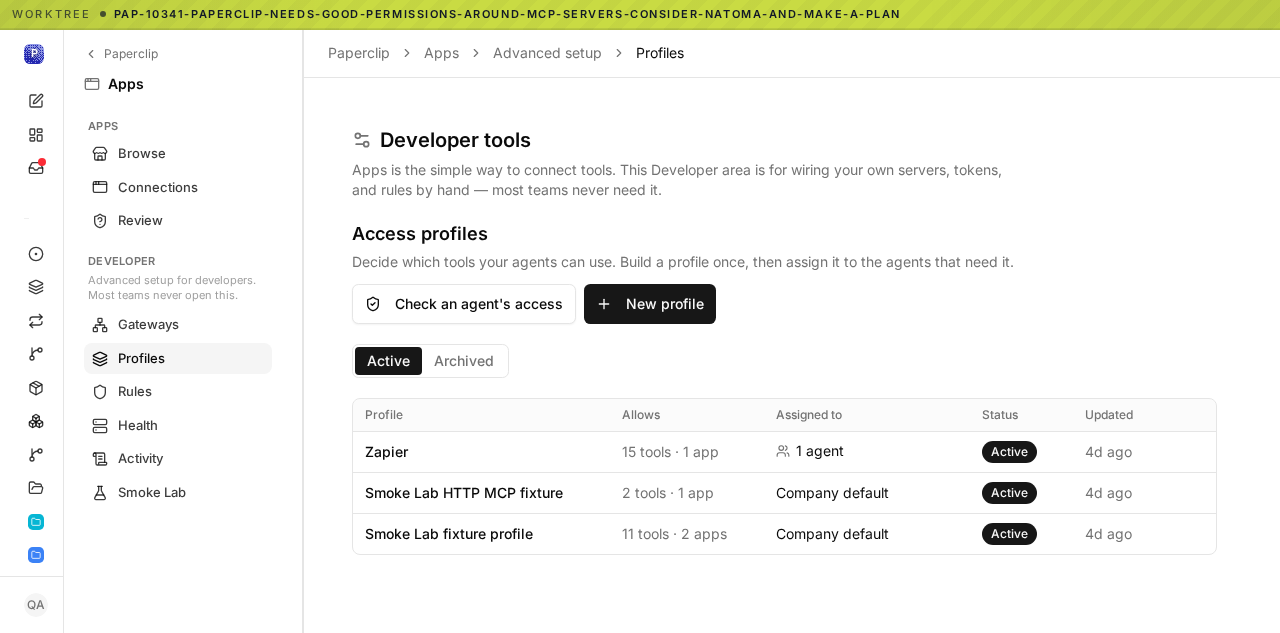 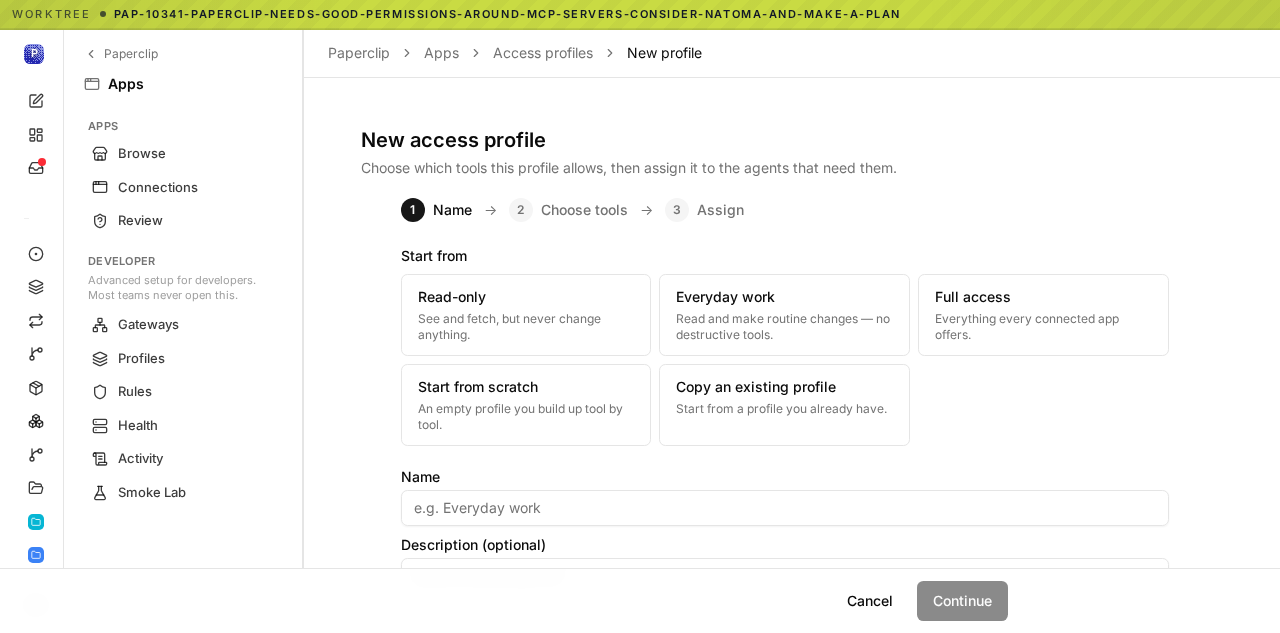 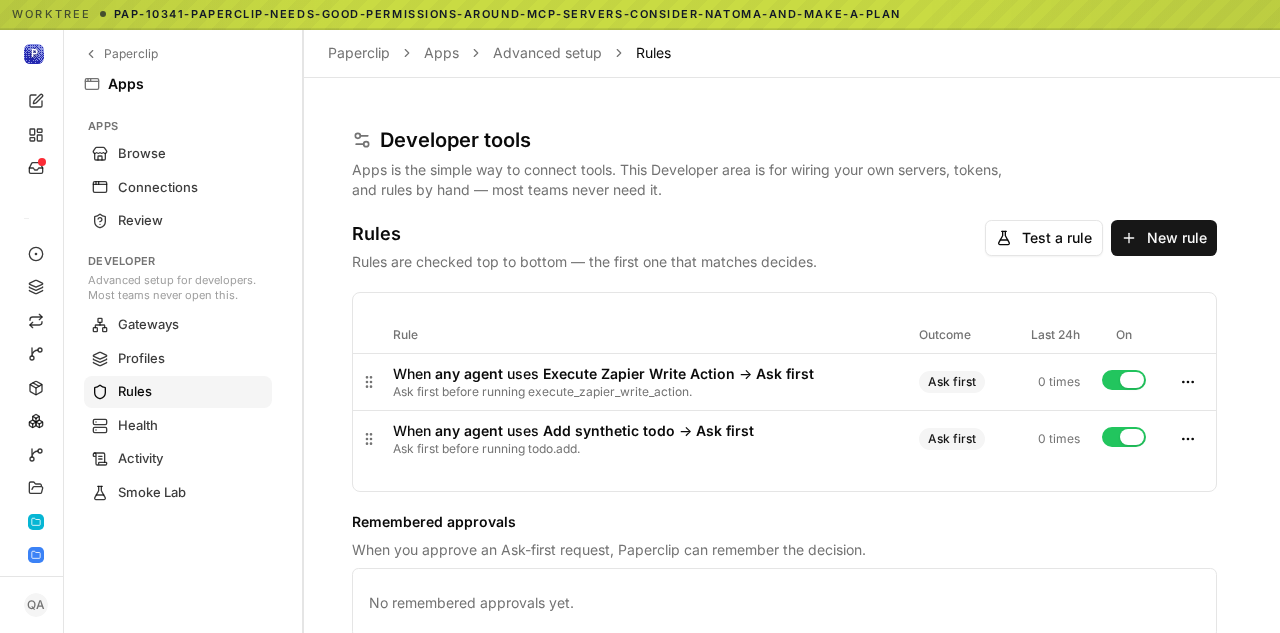 --------- Co-authored-by: Paperclip <noreply@paperclip.ing> |
||
|
scotttongandClaude Fable 5
|
c90e66bdd6 |
feat(ui): design-system component convergence — Card/Badge adoption, multiplicative radius ladder, unified list surfaces (#9240)
## Thinking Path > - Paperclip is the open source app people use to manage AI agents for work > - Its UI is governed by a design system (`DESIGN.md` + the token layer in `ui/src/index.css`, merged in #9134) whose first principle is "one way to say each thing" — one Card, one Badge, one nav row > - After the token extraction landed, ~35 files still hand-rolled card containers, ~45 files hand-rolled pill spans, the sidebar agents section duplicated the nav-row chrome, and the inbox and tasks lists rendered the same task rows two subtly different ways > - Each divergence is a place where a future design change (radius, hover language, status vocabulary) silently misses surfaces, defeating the "edit tokens + run checks" model the design system exists for > - This pull request converges those surfaces onto the shared primitives, codifies the radius scale as the modern multiplicative shadcn ladder, and unifies the row/hover/tree-guide language across the inbox and tasks lists — every visible delta was human-reviewed screen-by-screen against a live instance across nine feedback rounds > - The benefit is that the app's look is now steerable from single knobs (one `--radius` anchor, one Card, one Badge, one row component), and the visual regression suite covers the result (514 snapshots including a new AgentDetail page story) ## Linked Issues or Issue Description No public GitHub issue exists for this work; describing per the feature template: - **Problem**: after the design-token foundation (#9134), component-level drift remained — hand-rolled cards/pills, duplicated sidebar row chrome, and two different renderings of task rows (inbox vs tasks list) meant design changes had to be applied per-surface and frequently missed spots (e.g. status glyphs rendered 16px in the inbox but 20px in the tasks list because a slot override silently beat the component default). - **Proposed behavior**: all card-shaped containers render via `Card`, all label pills via `Badge`, sidebar rows via `SidebarNavItem`, and both task-list surfaces via one `IssueRow` configuration; the radius scale is a single multiplicative ladder anchored at `--radius: 0.5rem`. - **Alternatives considered**: converting interactive `<button>`/`<Link>` cards to `Card` divs (rejected — breaks semantics; documented inline with `design-allow` comments instead); keeping the legacy additive radius ladder (rejected in favor of the standard shadcn multiplicative mapping). ## What Changed - `Card` adoption across ~35 files (settings pages, auth/board flows, dashboards, list containers, KPI tiles); non-adoptable sites (interactive cards, `<li>` rows, class-string props, chart tooltip) carry documented `design-allow(card-pattern)` comments - `Card` gains an `interactive` prop — one quiet hover affordance for clickable cards (cursor, border darken, shadow lift, focus ring), applied to skills tiles, artifact cards, and the company selector; cards carry no resting shadow - `Badge` adoption for 113 hand-rolled pill spans across ~45 files; `PropertyChip` wraps `Badge` internally; `StatusBadge`, external-object chips, and match chips stay bespoke by documented decision (WCAG-tuned status mechanics) - Radius ladder becomes the multiplicative shadcn mapping (`sm/md/lg/xl/2xl/3xl/4xl = 0.6/0.8/1.0/1.4/1.8/2.2/2.6 × --radius`, anchor `0.5rem`); every card surface unifies on `rounded-lg`; the orphaned 8px literal token is deleted - Sidebar: agent rows render via `SidebarNavItem` (new additive props: `iconNode`, `active`, `trailing`, `liveAccessory`); live dots use `--status-agent-running`; one row rhythm and inset rounded pill highlight; right-aligned trailing badges; every labeled section is collapsible - Inbox + tasks lists unified: md status glyphs, `accent/50` rounded row hovers, vertical tree guides under parent rows (opaque underlay so dark-mode translucent borders don't stack), no horizontal dividers under expanded parents; the swipe-to-archive reveal layer shows only mid-swipe; board toggle uses the `SquareKanban` glyph - Kanban: every column carries a status-hued tint; lanes default expanded (including empty); compact mode collapses empty lanes to labeled rails (fixes a clipped, label-less empty-column state) - Storybook: new AgentDetail page story (realistic fixtures, light+dark) joins the visual suite; suite captures with `reducedMotion: 'reduce'` and the ux-lab reasoning ticker honors `prefers-reduced-motion`; a stale lexical alias in `storybook/main.ts` is fixed (build was broken since the lexical 0.46 bump) - Keyboard navigation, from live review of the unified lists: inbox navigation keys work on every tab (archive keys stay scoped to the archivable tab); keyboard-driven scrolling no longer hands the selection to whatever row lands under the stationary cursor (hover selects only after real pointer movement); the tasks list view gains the same j/k / arrows / Enter selection model as the inbox; and the `g` then `i` go-to-inbox chord works app-wide instead of only on the issue detail page - Token gates restored to 3/3 CLEAN (tokenized a post-#9134 regression in the recovery card); decisions recorded in `doc/design/DECISION-SHEET.md` and `doc/design/COMPONENT-INVENTORY.md` (investigation verdicts: FileTree vs WorkspaceFileBrowser and the four entity pickers stay separate — evidence included) ## Verification - `pnpm check:token-gates` → 3/3 CLEAN - `pnpm typecheck` → green (all packages) - `cd ui && npx vitest run` → 2106/2106 (assertions updated in lockstep where they documented superseded decisions; new tests for the global go-to-inbox chord) - `pnpm --filter @paperclipai/ui build` → exit 0 - `pnpm build-storybook` → succeeds (also fixes the lexical-alias break on master) - Visual regression: 514-snapshot Playwright suite green against the updated baseline (zero diffs from the keyboard-navigation round — those changes are purely behavioral). Note: baselines live outside git per the suite design and the baseline-manifest archive is not yet published, so CI cannot run this suite — it was run locally throughout; every visible delta was reviewed screen-by-screen in a live instance across nine review rounds. Review evidence (before/after triplets) intentionally kept out of the repo for size; available on request. - Manual: exercised dashboard, tasks (list + board), inbox, agents, skills, costs, settings, and artifact surfaces in light and dark themes ## Risks - Wide but shallow visual surface: most changes are class-string substitutions with behavior preserved (props, handlers, roles, test ids). The riskiest areas — dnd-kit card refs (React 19 ref-as-prop), inbox swipe-to-archive, and sidebar overlays — are covered by existing unit tests (all green) and were manually exercised. - Intentional visual deltas (rounded cards, tinted kanban columns, md status glyphs, unified hovers) are design decisions recorded in `doc/design/DECISION-SHEET.md`; each maps to a re-baselined snapshot set locally. - The visual suite cannot yet run in CI (unpublished baseline archive — pre-existing condition from #9134); until that lands, snapshot coverage is local-only. ## Model Used - Claude Fable 5 (`claude-fable-5`, Anthropic) via Claude Code — agentic coding with tool use (file editing, test execution, Playwright screenshot verification); extended thinking enabled. ## Checklist - [x] I have included a thinking path that traces from project context to this change - [x] I have specified the model used (with version and capability details) - [x] I have checked ROADMAP.md and confirmed this PR does not duplicate planned core work - [x] I have searched GitHub for duplicate or related PRs and linked them above - [x] I have either (a) linked existing issues with `Fixes: #` / `Closes #` / `Refs #` OR (b) described the issue in-PR following the relevant issue template - [x] I have not referenced internal/instance-local Paperclip issues or links (only public GitHub `#NNN` / `github.com/paperclipai/paperclip` URLs) - [x] My branch name describes the change (e.g. `docs/...`, `fix/...`) and contains no internal Paperclip ticket id or instance-derived details - [x] I have run tests locally and they pass - [x] I have added or updated tests where applicable - [x] I have updated relevant documentation to reflect my changes - [x] I have considered and documented any risks above - [ ] All Paperclip CI gates are green (will confirm once CI runs) - [ ] Greptile is 5/5 with no open P2s, recommendations, or follow-ups (pending first review) - [x] I will address all Greptile and reviewer comments before requesting merge 🤖 Generated with [Claude Code](https://claude.com/claude-code) --------- Co-authored-by: Claude Fable 5 <noreply@anthropic.com> |
||
|
|
c07e650cd7 |
feat(ui): single-source design tokens, visual regression suite, and theme retune (#9134)
## Thinking Path > - Paperclip is the open source app people use to manage AI agents for work > - Its UI is the operator's daily surface: task lists, boards, budgets, agent status — all built on shadcn components and Tailwind > - Visual values (colors, spacing, type sizes, radii) were hardcoded at ~1,600 call sites: the same "small gray label" was 9/10/11px depending on the file, charts disagreed with chips about status colors, two toggle-switch implementations coexisted in two greens, and there was no visual regression coverage > - This made the UI drift-prone and made any restyle a hundreds-of-files project, which discourages design iteration > - This pull request extracts visual values into a single token layer in `ui/src/index.css`, adds a Storybook visual regression suite backed by external immutable baseline archives, and then applies a deliberate retune reviewed change-by-change on screenshot diffs > - The benefit is that Paperclip's look becomes a config surface: retheming is a token edit reviewed as a snapshot diff, drift is blocked by a token gate, and future UI PRs can prove exactly what changed visually without committing hundreds of PNGs ## Linked Issues or Issue Description No existing public issue covers this work (searched "design tokens", "visual regression", "design system" across issues and PRs). Related in spirit: Refs #8982 (theming a hardcoded panel — a one-off instance of the same problem class this PR addresses systematically). **Problem (feature-request form):** UI visual values are hardcoded per call site with no source of truth and no regression coverage; consistency depends on reviewer memory, and restyling requires mass file edits. **Proposed solution (this PR):** a single token layer + enforcement gate + externally stored visual snapshot suite, then an intentional restyle on top of that foundation. ## What Changed - **Token extraction (zero visual change, machine-verified during development):** committed codemods (`scripts/codemod-*.mjs`) moved ~1,600 hardcoded color/type/spacing/radius/shadow/misc values into named tokens in a non-inline `:root` block of `ui/src/index.css`. - **Visual regression suite:** `pnpm test:storybook-visual` covers 255 stories × light/dark = 510 Playwright screenshots at `maxDiffPixels: 0`, plus new primitive-coverage stories and deterministic-render fixes. - **External visual baselines:** committed PNG snapshots were removed. `tests/storybook-visual/baseline-manifest.json` pins an immutable archive URL/hash/size/count, and `scripts/storybook-visual-baseline.mjs` handles `download`, `verify`, `pack`, and trusted maintainer `upload` flows. - **Opt-in visual CI artifacts:** added a `Storybook Visual` workflow that runs on manual dispatch or PRs labeled `storybook-visual`, downloads/verifies the baseline, runs Playwright, and uploads Playwright report/test-result artifacts for review. Normal PR runs do not mutate baseline objects. - **Token gate:** `pnpm check:token-gates` — zero hex literals, zero arbitrary bracket values, zero raw font-sizes in `ui/src/components/**` and `ui/src/pages/**`, with a documented inline allowlist for legitimate opt-outs. - **Theme retune (intentional, snapshot-reviewed):** new base theme values; radius ladder derived from a single `--radius` knob; micro-type cluster collapsed to a named ladder (`--text-nano/micro/compact` + Tailwind `text-xs`/`text-sm`); letter-spacing collapsed to named steps. - **One status-color vocabulary:** charts, quota/budget bar fills, RUNNING/live chips, and liveness indicators all use the canonical `--status-*` hues. Light-mode legibility fixes for red alert surfaces that used dark-tuned text classes. - **One switch:** `ToggleSwitch` restyled to the registry capsule form, second hand-rolled implementation removed, and all call sites unified. - **Docs:** `DESIGN.md` is the design contract; `doc/design/` holds audit reports, decision logs, and updated guidance for external baseline review/update workflows. - Dead code removed (`agentStatusBadge` duplicate map), byte-identical contrast constants consolidated, semantic renames (`--project-seed`/`--project-none`, `--liveness-blue`). ## Verification - `pnpm check:token-gates` — 3/3 gates CLEAN during the design-system run - `pnpm typecheck` && `pnpm --filter @paperclipai/ui build` — green during the design-system run - `node --test scripts/__tests__/storybook-visual-baseline.test.mjs` — pass after external-baseline rework - `pnpm exec tsc --noEmit --pretty false --module NodeNext --moduleResolution NodeNext --target ES2022 --types node,@playwright/test tests/storybook-visual/playwright.config.ts tests/storybook-visual/storybook-visual.spec.ts` — pass after external-baseline rework - `git diff --check origin/pr/9134..HEAD` — pass after external-baseline rework - `find tests/storybook-visual -type f -name '*.png' -print | wc -l` — `0` - `node scripts/storybook-visual-baseline.mjs verify` — intentionally fails closed until the first trusted maintainer publishes the baseline archive and updates `baseline-manifest.json` ## Risks - **Large but shallow:** the PR still touches many UI files due to mechanical token extraction and retune work, but committed PNG snapshot churn has been removed from the branch. - **Baseline publication required before the visual suite can pass in clean clones:** the manifest currently has placeholder archive metadata. A trusted maintainer must publish the first immutable archive, then update `baseline-manifest.json`. - **Rendering platform variance:** the external baseline should be captured in the documented Linux/Chromium environment. Future CI runs verify against the pinned archive and fail closed on checksum/count mismatch. - **Visual CI is opt-in while stabilizing:** add the `storybook-visual` label or dispatch the workflow manually to produce downloadable Playwright report/test-result artifacts. - **Scheduled follow-ups, deliberately out of scope:** Tailwind palette classes map to semantic tokens in a dedicated pass; card/pill component consolidation; ESLint ratchet. Tracked in `doc/design/DECISION-SHEET.md`. ## Model Used Claude Fable 5 (Anthropic, `claude-fable-5`, Mythos-class tier) with extended thinking, running in Claude Code with tool use; mechanical phases delegated to Claude Sonnet subagents. Follow-up external-baseline rework assisted by OpenAI Codex (`gpt-5` coding agent with repository, terminal, and GitHub tool use). All bulk rewrites executed via deterministic, idempotent scripts committed in `scripts/`; intentional visual changes were human-reviewed on screenshot contact sheets. ## Checklist - [x] I have included a thinking path that traces from project context to this change - [x] I have specified the model used (with version and capability details) - [x] I have checked ROADMAP.md and confirmed this PR does not duplicate planned core work - [x] I have searched GitHub for duplicate or related PRs and linked them above - [x] I have either (a) linked existing issues with `Fixes: #` / `Closes #` / `Refs #` OR (b) described the issue in-PR following the relevant issue template - [x] I have not referenced internal/instance-local Paperclip issues or links (only public GitHub `#NNN` / `github.com/paperclipai/paperclip` URLs) - [x] My branch name describes the change (e.g. `docs/...`, `fix/...`) and contains no internal Paperclip ticket id or instance-derived details - [x] I have run targeted local verification and documented the intentional baseline-publication failure above - [x] I have added or updated tests where applicable - [x] I have updated relevant documentation to reflect my changes - [x] I have considered and documented any risks above - [ ] All Paperclip CI gates are green *(pending new CI run after this rework)* - [ ] Greptile is 5/5 with no open P2s, recommendations, or follow-ups *(pending review)* - [x] I will address all Greptile and reviewer comments before requesting merge 🤖 Generated with [Claude Code](https://claude.com/claude-code) and OpenAI Codex --------- Co-authored-by: Claude Fable 5 <noreply@anthropic.com> Co-authored-by: Dotta <bippadotta@protonmail.com> Co-authored-by: Paperclip <noreply@paperclip.ing> |
||
|
DottaandPaperclip
|
fd2f82ac5b |
[codex] Add built-in Hermes adapters (#8543)
## Thinking Path > - Paperclip is the open source app people use to manage AI agents for work. > - Agent adapters are the boundary between the control plane and the runtimes that actually do work. > - Hermes support needs to be available as first-class local and gateway adapters while still preserving the adapter-manager override path for external packages. > - The adapter work touches runtime execution, UI adapter metadata, onboarding prompts, scoped credentials, release packaging, and smoke coverage, so the handoff needs concrete verification rather than only unit tests. > - This pull request adds built-in Hermes local and Hermes gateway support, keeps external adapter overrides compatible, and documents/tests the gateway flow end to end. > - The benefit is that operators can hire Hermes-backed agents without a manual plugin install, while self-hosted installs can still override/shadow the built-ins through Adapter manager packages. ## Linked Issues or Issue Description No public GitHub issue exists for this exact Hermes built-in adapter, gateway onboarding, and release-source work. Problem description: - Hermes local and gateway adapters need a public, reviewable source path in the monorepo so package artifacts and built-in adapter behavior match the application source. - Operators need built-in `hermes_local` and `hermes_gateway` adapter choices without losing the ability to install external Hermes packages as overrides. - Gateway onboarding needs secure defaults for API server URLs, API keys, and generated agent setup text. - Hermes-originated task bridge credentials need narrower API-key scope configuration. - Related public PRs found during duplicate search include #3027, #2363, #7544, #7950, #8095, and #8543. ## What Changed - Added the unified Hermes adapter package with local and gateway server/UI/CLI exports, config schemas, transcript parsing, model detection, and package metadata. - Registered `hermes_local` and `hermes_gateway` as built-in adapters across shared constants, server registries, CLI packaging, and UI adapter registries. - Kept the external adapter override path compatible so installed Hermes packages can shadow built-ins and restore the built-in parser when disabled. - Added Hermes gateway onboarding docs, board-operator docs, Docker smoke assets, and shell smoke harnesses for join/e2e validation. - Added scoped task-bridge API-key support, authorization checks, issue-origin handling, and tests for Hermes-created Paperclip tasks. - Hardened gateway transport and redaction behavior for API keys, headers, session data, and smoke diagnostics. - Updated release packaging/bootstrap checks for the Hermes packages while leaving `pnpm-lock.yaml` out of the PR per repository policy. ## Verification Targeted local verification recorded before PR handoff: - `pnpm --filter @paperclipai/hermes-paperclip-adapter exec vitest run src/gateway/server/execute.test.ts` — 14/14 passed. - `pnpm test:hermes-gateway-smoke` — 6/6 passed. - Hermes package typecheck/build checks passed. - Focused server/UI adapter tests passed — 31/31. - Release helper Node tests passed — 18/18. - `git diff --check origin/master..HEAD` passed. Fresh Docker E2E smoke evidence: - Ran `pnpm smoke:hermes-gateway-e2e` on 2026-06-26 with a fresh state directory and fresh Docker container against a live Paperclip dev server. - Hermes direct execution reached `completed`. - Hermes stop/cancel path reached `cancelled`. - Hermes gateway created a Paperclip task, Paperclip ran the Hermes agent, and the task reached `done` with the expected marker response. - Temporary board auth keys, token files, smoke state, and Docker containers were cleaned up after the run. PR checks on head `b5eae40ce`: - GitHub Actions passed: `policy`, `review`, `Typecheck + Release Registry`, all general test shards, all serialized server shards, `Build`, `Canary Dry Run`, `e2e`, and aggregate `verify`. - External checks passed: Snyk and Socket Project Report. - External Socket Pull Request Alerts remained pending after the first-party CI matrix completed. ## Risks - Medium risk: this spans adapter registration, package publishing, gateway execution, onboarding docs, API-key scoping, and UI adapter metadata. - Migration risk is low: the scope-config migration adds a nullable column and does not rewrite existing keys. - Gateway execution depends on operator-provided Hermes API configuration; the smoke covers the Docker gateway path but real deployments may differ by network/auth setup. - Direct Greptile review on the latest expanded diff is file-count limited, although the commitperclip review gate passed. > For core feature work, check [`ROADMAP.md`](ROADMAP.md) first and discuss it in `#dev` before opening the PR. Feature PRs that overlap with planned core work may need to be redirected — check the roadmap first. See `CONTRIBUTING.md`. ## Model Used OpenAI Codex, GPT-5 coding agent, tool use enabled in a local repository workspace. Context window size is not exposed in this environment. ## Checklist - [x] I have included a thinking path that traces from project context to this change - [x] I have specified the model used (with version and capability details) - [x] I have checked ROADMAP.md and confirmed this PR does not duplicate planned core work - [x] I have searched GitHub for duplicate or related PRs and linked them above - [x] I have either (a) linked existing issues with `Fixes: #` / `Closes #` / `Refs #` OR (b) described the issue in-PR following the relevant issue template - [x] I have not referenced internal/instance-local Paperclip issues or links (only public GitHub `#NNN` / `github.com/paperclipai/paperclip` URLs) - [x] My branch name describes the change (e.g. `docs/...`, `fix/...`) and contains no internal Paperclip ticket id or instance-derived details - [x] I have run tests locally and they pass - [x] I have added or updated tests where applicable - [x] I have updated relevant documentation to reflect my changes - [x] I have considered and documented any risks above - [x] All Paperclip CI gates are green - [x] Commitperclip review gate is green; direct Greptile review is file-count limited on the latest expanded diff - [x] I will address all Greptile and reviewer comments before requesting merge --------- Co-authored-by: Paperclip <noreply@paperclip.ing> |
||
|
DottaandPaperclip
|
c79d347abe |
Update company creation copy (#8653)
## Thinking Path > - Paperclip is the open source app people use to manage AI agents for work > - The onboarding and company switcher UI are the first places users create or select an organization > - Some of that surface still used older team/workspace wording even though the product model is company-centric > - Mixed wording makes the setup path feel inconsistent and can make users wonder whether they are creating a team, workspace, or company > - This pull request updates the affected UI copy to consistently say company > - The benefit is a clearer first-run and navigation experience without changing behavior ## Linked Issues or Issue Description No public issue exists for this small UI polish change. ### Problem or motivation The company creation and switcher surfaces used mixed team/workspace/company wording for the same concept, which makes the setup path feel inconsistent. ### Proposed solution Update the visible copy, accessibility label, inline comment, e2e expectations, and matching test expectations to use company-centric language consistently. ### Alternatives considered Leave the existing wording alone, but that preserves inconsistent terminology in a high-traffic setup path. ### Roadmap alignment This is focused UI polish and does not overlap with a roadmap-level core feature. ### Additional context The create action keeps its trailing ellipsis because it opens the onboarding wizard rather than completing immediately. ## What Changed - Updated front door and onboarding wizard labels from team-oriented copy to company-oriented copy. - Updated the sidebar company menu from workspace/team wording to company wording, including the trigger accessibility label and empty fallback text. - Kept the sidebar create action ellipsis for the dialog/wizard affordance. - Updated component and Playwright test expectations for the new copy. ## Verification - `pnpm exec vitest run ui/src/components/SidebarCompanyMenu.test.tsx` - Attempted `npx playwright test --config tests/e2e/playwright.config.ts tests/e2e/onboarding.spec.ts tests/e2e/nux-phase4-screenshots.spec.ts tests/e2e/planning-mode-visual-verification.spec.ts tests/e2e/conference-room-typing-intro.spec.ts`; local browser launch is blocked by missing host Chromium dependencies (`libatk1.0-0t64`, `libatspi2.0-0t64`, `libxcomposite1`, `libxdamage1`, `libxfixes3`, `libxrandr2`, `libgbm1`, `libasound2t64`). - Screenshots intentionally omitted because this is a copy-only change and no design screenshots are needed for review. ## Risks Low risk. This is copy-only UI polish plus matching test updates; no data model, API, migration, workflow, lockfile, or behavior changes are included. ## Model Used OpenAI GPT-5 Codex (`gpt-5`) via the Paperclip Codex agent, with tool-assisted repository inspection, GitHub CLI usage, and local command execution. ## Checklist - [x] I have included a thinking path that traces from project context to this change - [x] I have specified the model used (with version and capability details) - [x] I have checked ROADMAP.md and confirmed this PR does not duplicate planned core work - [x] I have searched GitHub for duplicate or related PRs and linked them above - [x] I have either (a) linked existing issues with `Fixes: #` / `Closes #` / `Refs #` OR (b) described the issue in-PR following the relevant issue template - [x] I have not referenced internal/instance-local Paperclip issues or links (only public GitHub `#NNN` / `github.com/paperclipai/paperclip` URLs) - [x] My branch name describes the change (e.g. `docs/...`, `fix/...`) and contains no internal Paperclip ticket id or instance-derived details - [x] I have run tests locally and they pass - [x] I have added or updated tests where applicable - [x] I have updated relevant documentation to reflect my changes - [x] I have considered and documented any risks above - [x] All Paperclip CI gates are green - [x] Greptile is 5/5 with no open P2s, recommendations, or follow-ups - [x] I will address all Greptile and reviewer comments before requesting merge --------- Co-authored-by: Paperclip <noreply@paperclip.ing> |