mirror of
https://github.com/paperclipai/paperclip.git
synced 2026-10-21 16:27:18 +02:00
5ea3f905cf04b291571129b1754323105221f007
24
Commits
| Author | SHA1 | Message | Date | |
|---|---|---|---|---|
 Devin Foley |
db4defdfbf |
feat: operator-configurable settings visibility via PAPERCLIP_HIDDEN_SETTINGS (#11823)
## Thinking Path

> - Paperclip is the open source app people use to manage AI agents for
work
> - The instance settings surface (Access, Plugins, Adapters, General,
Experimental) assumes the person at the keyboard operates the whole
instance
> - Operators who host Paperclip for others — a managed cloud or an
internal shared server — expose settings pages and toggles that do not
apply to their deployment, and the related mutation APIs stay open
> - A hosted tenant can open Plugins or Adapters, try an action, and hit
a confusing failure, because only a few hardcoded platform floors exist
> - This pull request adds a generic, operator-configured visibility
mechanism: one env var hides declared settings surfaces in the UI and
floors their mutation routes with a stable 403 code
> - The benefit is a clean hosted-tenant settings surface for any
operator, with zero behavior change for normal self-hosted instances

## Linked Issues or Issue Description

**Subsystem affected**

Instance settings (server routes and UI), the shared settings registry
in `packages/shared`, and the `/api/health` bootstrap payload.

**Problem or motivation**

An operator who hosts Paperclip for other people cannot hide settings
surfaces that the platform manages. Tenants see Access, Plugins, and
Adapters pages, backup retention, and host-level experimental toggles
that do nothing useful for them. The mutation APIs behind these surfaces
also stay open, so a tenant admin can attempt actions the platform must
control. ROADMAP.md names a cleaner shared deployment story as a goal
("Teams should be able to run the same product in hosted or semi-hosted
environments without changing the mental model").

**Proposed solution**

Add a declarative registry of hideable settings surfaces and one env
var, `PAPERCLIP_HIDDEN_SETTINGS`. The server parses the list at boot,
reports it on `/api/health`, and rejects value-changing writes to hidden
surfaces with a stable `settings_operator_managed` 403 code. The UI
reads the list from the health payload and removes the hidden pages,
sections, and toggles from navigation, routes, and page content. Unknown
keys warn and are ignored, so one list can roll across a fleet with
mixed app versions. With the variable unset, behavior is byte-identical
to today.

**Alternatives considered**

- Hardcode the hidden set for cloud instances in this repo: rejected,
because each hosting operator needs a different policy, and policy does
not belong in shared code.
- Deliver the hidden set through the managed-config document: rejected,
because that channel is cloud-specific and fail-closed on unknown
fields; a plain env var works for any operator, including self-hosted
shared servers.
- Lock the controls with a badge instead of hiding them: rejected for
these surfaces, because they are meaningless to tenants, not merely
platform-controlled; the existing managed-overlay lock stays the right
tool for controlled flags.

**Roadmap alignment**

Supports the "shared deployment story" item in ROADMAP.md: hosted and
semi-hosted deployments keep the same product with a settings surface
that matches what the tenant can actually do.

## What Changed

- New `packages/shared/src/settings-visibility.ts`: registry of hideable
surfaces (every instance settings page — profile, environments, access,
heartbeats, experimental, plugins, adapters; every Instance → General
section; every experimental flag as `instance.experimental.<key>`), the
`PAPERCLIP_HIDDEN_SETTINGS` parser, and the `settings_operator_managed`
error code. The General page stays visible as the settings root and
redirect target.
- New `server/src/services/settings-visibility.ts`: parse-once accessor;
unknown keys log one warning and are ignored.
- `/api/health` reports `hiddenSettings` on every response shape; the
field is omitted when nothing is hidden.
- Server floors on hidden surfaces, with same-value echo tolerance (the
`executionMode` precedent): field-backed general sections and
experimental keys reject value-changing PATCHes, and hiding the whole
Experimental page floors every toggle; plugin lifecycle and config
writes, adapter management writes, and the Access admin routes (reads
included) return 403 `settings_operator_managed`. Reads the app itself
needs (plugin `ui-contributions`, adapter metadata, plugin job trigger)
stay open. Pages without instance-scoped mutation routes are hidden in
the UI only.
- UI: new `useHiddenSettings` hook and `HiddenSettingsPageGate` route
gate (hidden pages redirect to the settings root); the settings sidebar
and tab bar drop hidden entries; remembered settings paths remap to the
default page; `InstanceGeneralSettings` skips hidden sections; every
`ExperimentalToggleCard` now carries its flag key and renders nothing
when hidden.
- Removed the dead `InstanceSidebar` component (referenced only by its
own test).
- Docs: `docs/deploy/environment-variables.md` documents the variable
and the key registry.

## Verification

- `pnpm vitest run` over the new and extended suites: shared registry
and parser, representative floor tests per route class (changed-value
403, same-value echo 200, unset env 200, page-level Experimental
hiding), the health field, the route gate, nav filtering, and
section/card hiding with one hidden example per surface kind — 168 tests
pass.
- Full root `pnpm typecheck` passes.
- Manual: booted a server with the variable set. `/api/health` lists the
keys; an unknown key logs one warning and the server boots; hidden pages
redirect; hidden sections and cards do not render; hidden-field PATCH
returns 403 with `details.code = "settings_operator_managed"`; a
same-value echo returns 200. Unset the variable: the full settings
surface returns and responses are byte-identical to master.

## Risks

- Low risk for self-hosted instances: with the variable unset, the
hidden set is empty, the health field is omitted, and no floor
activates.
- Flooring plugin config writes assumes hosted deployments configure
plugins through the platform. If a future bundled plugin needs
tenant-entered config, the floor needs a narrow carve-out.
- Hidden-key floors tolerate same-value echoes, so API clients that
round-trip full GET responses keep working.
- Hiding a toggle does not change its value; operators pair hiding with
the desired default where the value matters.

## Model Used

Claude Fable 5 (Anthropic, `claude-fable-5`) with extended thinking and
agentic tool use, driven through the Claude Code CLI (file edits, test
execution, and live-server verification loops).

## Checklist

- [x] I have included a thinking path that traces from project context
to this change
- [x] I have specified the model used (with version and capability
details)
- [x] I have checked ROADMAP.md and confirmed this PR does not duplicate
planned core work
- [x] I have searched GitHub for duplicate or related PRs and linked
them above
- [x] I have either (a) linked existing issues with `Fixes: #` / `Closes
#` / `Refs #` OR (b) described the issue in-PR following the relevant
issue template
- [x] I have not referenced internal/instance-local Paperclip issues or
links (only public GitHub `#NNN` / `github.com/paperclipai/paperclip`
URLs)
- [x] My branch name describes the change (e.g. `docs/...`, `fix/...`)
and contains no internal Paperclip ticket id or instance-derived details
- [x] I have run tests locally and they pass
- [x] I have added or updated tests where applicable
- [x] I have updated relevant documentation to reflect my changes
- [x] I have considered and documented any risks above
- [ ] All Paperclip CI gates are green
- [ ] Greptile is 5/5 with no open P2s, recommendations, or follow-ups
- [x] I will address all Greptile and reviewer comments before
requesting merge
|
||
|
DottaandPaperclip
|
5858ccb981 |
feat: make in-app features cloud-aware (#10850)
## Thinking Path > - Paperclip is the open source app people use to manage AI agents for work. > - Operators use the same board application in self-hosted and Paperclip Cloud deployments. > - A Cloud tenant contains one company, so an in-app company switch does not change the active Cloud stack. > - Cloud operators need the sidebar and company surfaces to use the signed-in user's stack portfolio. > - The server must derive Cloud identity and links from trusted instance context instead of client input. > - This pull request adds canonical Cloud context, a trusted stack portfolio proxy, and Cloud-aware navigation. > - The benefit is consistent stack switching on Cloud while self-hosted company behavior stays unchanged. ## Linked Issues or Issue Description **Subsystem affected** Cross-cutting: server REST routes and the React board UI. **Problem or motivation** A Cloud-managed instance contains one company. The existing company switcher could only switch records inside that tenant. It could not move the operator to another Cloud stack. The existing header also gave long organization names too little width. **Proposed solution** Expose a canonical public Cloud context in health data. Add a trusted server proxy for the current user's stack portfolio. Use that data in the board UI to switch stacks with top-level navigation. Keep the existing company behavior on self-hosted instances. Move search into the navigation and keep long organization names inside the sidebar panel. **Alternatives considered** An in-app `/stacks` route was rejected because Cloud tenant hosts reserve that path and stack selection must wake or authenticate another tenant. Client-supplied user identity was rejected because the server can derive the trusted Cloud actor. **Roadmap alignment** This change advances the Cloud deployments milestone. It keeps the product local-first and Cloud-ready without changing the self-hosted mental model. ## What Changed - Added canonical Cloud instance context and public health metadata. - Added a Cloud-only stack portfolio proxy with trusted actor forwarding and per-user caching. - Prevented normal company creation on Cloud-managed instances. - Switched the sidebar and Companies page from company actions to stack actions on Cloud. - Added full-page stack navigation and Cloud create-stack links. - Moved search into the sidebar navigation so the organization name keeps more width. - Added truncation and hover recovery for long organization and stack names. - Added server and UI regression coverage for Cloud and self-hosted behavior. - Updated the implementation specification for the Cloud contracts. ## Verification - `node scripts/check-token-gates.mjs` passed. All three token gates are clean. - `pnpm --dir server exec vitest run src/__tests__/health.test.ts src/__tests__/cloud-instance.test.ts src/__tests__/cloud-routes.test.ts src/__tests__/company-cloud-floor.test.ts src/__tests__/company-portability-routes.test.ts` passed: 5 files and 66 tests. - `pnpm --dir ui exec vitest run src/components/SidebarCompanyMenu.test.tsx` passed: 1 file and 11 tests. - Pre-PR QA report `7da87ca7` passed all 8 acceptance criteria with real HTTP route factories and real Chromium screenshots in Cloud and self-hosted modes. - Security reviews passed for the canonical Cloud context and stack portfolio proxy. ## Risks - Cloud stack switching depends on the configured Cloud application and tenant portfolio URLs. - The new health `cloud` block is public by design, but it contains only canonical public instance metadata. - The stack proxy fails closed on self-hosted instances and derives the user identity from the trusted actor. - Self-hosted navigation and company creation retain their existing paths and behavior. > For core feature work, check [`ROADMAP.md`](ROADMAP.md) first and discuss it in `#dev` before opening the PR. Feature PRs that overlap with planned core work may need to be redirected — check the roadmap first. See `CONTRIBUTING.md`. ## Model Used - OpenAI Codex, model `gpt-5`. The run used reasoning, repository tools, shell execution, and GitHub integration. The deployment did not expose its context-window size. ## Checklist - [x] I have included a thinking path that traces from project context to this change - [x] I have specified the model used (with version and capability details) - [x] I have checked ROADMAP.md and confirmed this PR does not duplicate planned core work - [x] I have searched GitHub for duplicate or related PRs and linked them above - [x] I have either (a) linked existing issues with `Fixes: #` / `Closes #` / `Refs #` OR (b) described the issue in-PR following the relevant issue template - [x] I have not referenced internal/instance-local Paperclip issues or links (only public GitHub `#NNN` / `github.com/paperclipai/paperclip` URLs) - [x] My branch name describes the change (e.g. `docs/...`, `fix/...`) and contains no internal Paperclip ticket id or instance-derived details - [x] I have run tests locally and they pass - [x] I have added or updated tests where applicable - [x] I have updated relevant documentation to reflect my changes - [x] I have considered and documented any risks above - [x] All Paperclip CI gates are green - [x] Greptile is 5/5 with no open P2s, recommendations, or follow-ups - [x] I will address all Greptile and reviewer comments before requesting merge --------- Co-authored-by: Paperclip <noreply@paperclip.ing> |
||
|
Michael NguyenandPaperclip
|
3093c5e694 |
fix(plugin-worker): resolve a company scope for proactive worker→host calls (#10103)
Host authorizes the plugin's configured companies as the worker's proactive scopes, set by the loader right after the #10092 config-delivery step and refreshed on operator config-save. At the single worker→host chokepoint, a no-invocation call (notifier drain, decision reconcile, mirror drain, digest, aging, liveness beat) that references a configured company resolves to that company's scope, so the #9557 governed-access gate admits it. One change covers the full proactive surface (state.*, issues.*, approvals.*, config.get, secrets.resolve, etc.). Safety: never widens beyond configured companies (any other company stays denied); in-invocation calls keep #9557's strict single-company match untouched. Fixes the Slack gateway DM round-trip for LOOA-629. Security review PASS (LOOA-693); non-blocking LOW follow-up tracked in LOOA-694. Co-Authored-By: Paperclip <noreply@paperclip.ing> |
||
|
Devin FoleyandPaperclip
|
0ef3b320c7 |
Harden POST /plugins/install: canonicalize localPath for all instances; bundled-only floor for managed instances (#10067)
**Builds on** #10058 — managed detection keys off the *presence* of the `PAPERCLIP_MANAGED_CONFIG` env var that PR introduces, deliberately never its parsed body. **Summary.** Two layered hardenings of the plugin install route. (1) For **all** instances: `localPath` installs previously skipped the package-name validation entirely; the path is now null-byte-checked, resolved absolute, `realpath`'d (collapsing `..` traversal and symlinks), and required to be an existing directory before the loader ever sees it. (2) For instances running under a managed hosting control plane (detected by the *presence* of `PAPERCLIP_MANAGED_CONFIG` — deliberately never its body, so a corrupted document cannot widen the surface): registry/npm installs return 403, and `localPath` installs must canonicalize to inside the bundled plugin catalog root (`packages/plugins`) — a positive allowlist enforced in code at the route, independent of any flag value. Self-hosted behavior is otherwise unchanged. ## Thinking Path > - Paperclip is the open source app people use to manage AI agents for work > - The plugin system lets instance admins install plugins from a registry or from a local filesystem path, and plugin installation is code execution on the host > - The `localPath` branch of `POST /plugins/install` skips the validation applied to registry installs; the raw path reaches the plugin loader without canonicalization > - Separately, instances operated by a managed hosting control plane must constrain installs to the bundled plugin catalog, because there the host belongs to the operator, not the tenant > - This pull request canonicalizes and validates `localPath` for all instances, and adds a bundled-only install floor for managed instances > - The benefit is a smaller install-route attack surface everywhere, and a positive code-enforced allowlist where the operator owns the machine ## Linked Issues or Issue Description No public issue exists; `bug_report` template fields for the validation gap this PR fixes: - **What happened:** `POST /plugins/install` with `localPath` set bypasses the package-name validation entirely; the un-canonicalized path (relative segments, symlinks, no existence check) is handed straight to the plugin loader. - **Expected behavior:** path installs are validated like registry installs — null-byte-checked, resolved absolute, `realpath`'d, and required to be an existing directory before the loader sees them. - **Steps to reproduce:** as an instance admin, call `POST /plugins/install` with a `localPath` containing `..` traversal or a symlink pointing outside any plugin directory; observe the loader receives the raw path. Exploitability is bounded (the route already requires instance admin), so this is hardening of an admin-only surface rather than an open exploit. - **Version:** current `master`. The managed-instance bundled-only floor layered on top is new behavior (motivation: on managed hosting, arbitrary plugin install is arbitrary code execution on operator infrastructure), aligned with the in-progress "Cloud deployments" milestone in `ROADMAP.md`. ## What Changed - New `server/src/services/plugin-install-guard.ts` — three pure primitives: managed detection (presence-based), path canonicalization (null-byte check → absolute resolve → `realpath` → must be an existing directory), and segment-based containment in the bundled plugin catalog root. - Route enforcement in `server/src/routes/plugins.ts`: npm/registry installs return 403 on managed instances; `localPath` installs are canonicalized on every instance and, on managed instances, must land inside the bundled catalog root. - The plugin loader now receives the canonical path instead of the raw request string. ## Verification - 15 guard unit tests (`server/src/__tests__/plugin-install-guard.test.ts`): traversal, symlink escape, null byte, file-vs-directory, string-prefix sibling root. - 13 route security tests (`server/src/__tests__/plugin-install-route-security.test.ts`): 403 matrix on managed instances + self-hosted happy paths. - 36 existing plugin route authz tests green (`server/src/__tests__/plugin-routes-authz.test.ts`). - Server `tsc --noEmit` clean. ```bash cd server pnpm vitest run src/__tests__/plugin-install-guard.test.ts src/__tests__/plugin-install-route-security.test.ts src/__tests__/plugin-routes-authz.test.ts pnpm exec tsc --noEmit ``` ## Risks - Managed instances: npm/registry installs and out-of-catalog `localPath` installs now return 403 — intended new behavior, enforced in code rather than configuration. - All instances: `localPath` installs that previously pointed at nonexistent paths or non-directories now fail with 400 before reaching the loader (previously the loader failed later, less safely). Symlinked deployment layouts are handled by canonicalizing both sides of the containment check. - Self-hosted npm install path is unchanged. Low residual risk. ## Model Used Claude Fable 5 (`claude-fable-5`), extended thinking, agentic tool use; independently peer-reviewed by a second AI agent before push. ## Checklist - [x] I have included a thinking path that traces from project context to this change - [x] I have specified the model used (with version and capability details) - [x] I have checked ROADMAP.md and confirmed this PR does not duplicate planned core work - [x] I have searched GitHub for duplicate or related PRs and linked them above - [x] I have either (a) linked existing issues with `Fixes: #` / `Closes #` / `Refs #` OR (b) described the issue in-PR following the relevant issue template - [x] I have not referenced internal/instance-local Paperclip issues or links (only public GitHub `#NNN` / `github.com/paperclipai/paperclip` URLs) - [x] My branch name describes the change (e.g. `docs/...`, `fix/...`) and contains no internal Paperclip ticket id or instance-derived details - [x] I have run tests locally and they pass - [x] I have added or updated tests where applicable - [x] I have updated relevant documentation to reflect my changes - [x] I have considered and documented any risks above - [ ] All Paperclip CI gates are green - [ ] Greptile is 5/5 with no open P2s, recommendations, or follow-ups - [x] I will address all Greptile and reviewer comments before requesting merge Co-authored-by: Paperclip <noreply@paperclip.ing> |
||
|
DottaandPaperclip
|
b07b2994cc |
feat: stamp responsible users on activity logs (#9731)
## Thinking Path > - Paperclip is the control plane people use to manage AI-agent companies and their work > - The activity log is the generic audit spine for mutations across the control plane > - Activity rows identify agents and runs, but they do not persist the responsible human upstream > - Relying only on run joins loses attribution after run pruning and misses agent API-key actions outside a run > - This pull request resolves responsible-user attribution when each activity row is written and stores it directly > - The benefit is durable, queryable agent audit feeds without rewriting historical provenance ## Linked Issues or Issue Description ### Problem or motivation Agent activity records do not persist the responsible user, so attribution can disappear when runs are pruned and no-run API-key mutations cannot be attributed correctly. ### Proposed solution Resolve attribution for each new activity row from the run, related issue, active agent API key, or company default, in that order, and persist the result directly. ### Alternatives considered Read-time joins alone were rejected because pruned runs lose durable attribution and out-of-run agent-key actions have no run to join. Historical backfill was rejected because it would invent provenance. ### Roadmap alignment This strengthens the durable audit-trail direction described in `ROADMAP.md` without adding a new product surface. ## What Changed - Added nullable `activity_log.responsible_user_id` plus company/agent/time and company/responsible-user/time indexes. - Added an idempotent forward-only migration with no historical backfill. - Added centralized write-time resolution: heartbeat run → issue attribution → active agent API key → company default. - Propagated authenticated API-key IDs through existing request-backed `logActivity()` calls. - Added unit coverage for every fallback and an embedded-Postgres assertion for the no-run API-key stamping path. ## Verification - `pnpm --filter @paperclipai/db typecheck` - `pnpm --filter @paperclipai/server typecheck` - `pnpm --filter @paperclipai/server exec vitest run src/__tests__/activity-log-responsible-user.test.ts src/__tests__/authz-company-access.test.ts` - Initial focused verification: 25 tests passed; migration safety passed. - Follow-up regression verification: 54 focused attribution/company-skill/environment/issue-tree/tool-gateway tests passed; server typecheck passed. - GitHub: full build, typecheck, server shards, serialized suites, e2e, security, and policy checks passed. ## Risks - Adding two indexes to an existing large table can hold a write lock while the transactional migration runs. The migration safety suppressions document why `CONCURRENTLY` is unavailable under the current Drizzle migration runner. - Historical rows remain nullable by design; this avoids inventing provenance and keeps the migration forward-only. - API-key attribution requires request-backed activity call sites to pass the authenticated key ID; this PR mechanically updates the existing actor-based activity calls and covers the no-run path with integration testing. > For core feature work, check [`ROADMAP.md`](ROADMAP.md) first and discuss it in `#dev` before opening the PR. Feature PRs that overlap with planned core work may need to be redirected — check the roadmap first. See `CONTRIBUTING.md`. ## Model Used - OpenAI Codex, `gpt-5.4`; context-window size was not exposed by the runtime. Medium reasoning with repository editing, terminal execution, and test execution capabilities was used. ## Checklist - [x] I have included a thinking path that traces from project context to this change - [x] I have specified the model used (with version and capability details) - [x] I have checked ROADMAP.md and confirmed this PR does not duplicate planned core work - [x] I have searched GitHub for duplicate or related PRs and linked them above - [x] I have either (a) linked existing issues with `Fixes: #` / `Closes #` / `Refs #` OR (b) described the issue in-PR following the relevant issue template - [x] I have not referenced internal/instance-local Paperclip issues or links (only public GitHub `#NNN` / `github.com/paperclipai/paperclip` URLs) - [x] My branch name describes the change (e.g. `docs/...`, `fix/...`) and contains no internal Paperclip ticket id or instance-derived details - [x] I have run tests locally and they pass - [x] I have added or updated tests where applicable - [x] I have updated relevant documentation to reflect my changes - [x] I have considered and documented any risks above - [x] All Paperclip CI gates are green - [x] Greptile is 5/5 with no open P2s, recommendations, or follow-ups - [x] I will address all Greptile and reviewer comments before requesting merge --------- Co-authored-by: Paperclip <noreply@paperclip.ing> |
||
|
DottaandPaperclip
|
931eec3fbf |
feat(mcp) [split 4/8]: wire gateway runtime and Smoke Lab (#9559)
## Thinking Path > - Paperclip is the open source app people use to manage AI agents for work > - Governed MCP access spans contracts, runtime enforcement, adapters, UI surfaces, and operator verification > - The parity reference PR #9534 is too large for effective automated or human review > - The feature therefore needs a linear stack whose individual diffs stay below the 100-file review limit > - This pull request is split 4/8 and focuses on gateway runtime, Smoke Lab, plugins, and server wiring > - The benefit is a standalone, testable review boundary while preserving byte-for-byte parity at the top of the stack ## Linked Issues or Issue Description - Related parity reference: #9534 - Problem: The policy core needs runtime execution, endpoint guards, route registration, heartbeat integration, and adapter MCP injection to become operational. - Proposed solution: Adds the remaining server routes/wiring/consumers, runtime tests, adapter-utils MCP contracts, and Claude/Codex injection implementations required by the server layer. - Alternatives considered: keeping #9534 as one 403-file review, or rewriting the feature to manufacture seams; both were rejected in favor of path extraction plus compile-driven boundary moves. - Roadmap alignment: this advances the existing governed MCP/tool-access work already represented by #9534; it does not introduce a separate roadmap initiative. - Stack position: base branch is `pap10341-split/03-server-tool-access`. - Merge policy: merge bottom-up, in order, only after the complete eight-PR stack has been reviewed and the top-of-stack parity gate remains empty. - Requested review: SecurityEngineer for gateway, endpoint guard, token issuance, and runtime wiring; Greptile on every PR. ## What Changed - Adds the remaining server routes/wiring/consumers, runtime tests, adapter-utils MCP contracts, and Claude/Codex injection implementations required by the server layer. - Keeps this PR below 100 changed files and independently typecheckable. - Preserves the final tree from #9534 when combined with the other seven stack levels. ## Verification - `pnpm typecheck` - Changed server test set — 26 files, 382 tests passed - Affected server adapter tests — 38 tests passed after concrete adapter boundary move - Adapter-utils and Codex focused tests — 76 tests passed ## Risks - Remote endpoint validation, token handling, and runtime supervision are security-sensitive and can fail closed or deny legitimate access if misconfigured. - Stack risk: merging out of order can expose incomplete layers; mitigate by following the documented bottom-up merge policy. - Parity risk: later edits to an intermediate branch can drift from #9534; mitigate by re-running the empty top-of-stack diff before merge. > For core feature work, check [`ROADMAP.md`](ROADMAP.md) first and discuss it in `#dev` before opening the PR. Feature PRs that overlap with planned core work may need to be redirected — check the roadmap first. See `CONTRIBUTING.md`. ## Model Used - OpenAI Codex, exact model ID `gpt-5.4`; runtime-managed context window; medium reasoning with repository, shell, Git, GitHub CLI, and code-execution tools enabled. ## Checklist - [x] I have included a thinking path that traces from project context to this change - [x] I have specified the model used (with version and capability details) - [x] I have checked ROADMAP.md and confirmed this PR does not duplicate planned core work - [x] I have searched GitHub for duplicate or related PRs and linked them above - [x] I have either (a) linked existing issues with `Fixes: #` / `Closes #` / `Refs #` OR (b) described the issue in-PR following the relevant issue template - [x] Internal references are omitted except the execution-plan link explicitly required for this coordinated split stack - [x] My branch name describes the change and contains no internal Paperclip ticket id or instance-derived details - [x] I have run tests locally and they pass - [x] I have added or updated tests where applicable - [x] I have updated relevant documentation to reflect my changes - [x] I have considered and documented any risks above - [ ] All Paperclip CI gates are green - [ ] Greptile is 5/5 with no open P2s, recommendations, or follow-ups - [x] I will address all Greptile and reviewer comments before requesting merge ## Stack Coordination - Internal execution plan: [PAP-13874](/PAP/issues/PAP-13874#document-plan) - Parity reference: #9534 - Stack: #9556 → #9557 → #9558 → #9559 → #9560 → #9561 → #9562 → #9563 - Merge bottom-up only after full-stack review and an empty parity diff at #9563. --------- Co-authored-by: Paperclip <noreply@paperclip.ing> |
||
|
DottaandPaperclip
|
1de0a3bb1e |
feat(mcp) [split 2/8]: add governed access contracts (#9557)
## Thinking Path > - Paperclip is the open source app people use to manage AI agents for work > - Governed MCP access spans contracts, runtime enforcement, adapters, UI surfaces, and operator verification > - The parity reference PR #9534 is too large for effective automated or human review > - The feature therefore needs a linear stack whose individual diffs stay below the 100-file review limit > - This pull request is split 2/8 and focuses on database schema and shared governance contracts > - The benefit is a standalone, testable review boundary while preserving byte-for-byte parity at the top of the stack ## Linked Issues or Issue Description - Related parity reference: #9534 - Problem: The governed access model needs additive persistence and synchronized shared types before server enforcement can compile. - Proposed solution: Adds migrations 0148–0169, tool-access and Smoke Lab schema, shared types/validators/gallery helpers, and the minimal compile-required contract consumers identified by boundary testing. - Alternatives considered: keeping #9534 as one 403-file review, or rewriting the feature to manufacture seams; both were rejected in favor of path extraction plus compile-driven boundary moves. - Roadmap alignment: this advances the existing governed MCP/tool-access work already represented by #9534; it does not introduce a separate roadmap initiative. - Stack position: base branch is `pap10341-split/01-demo-servers`. - Merge policy: merge bottom-up, in order, only after the complete eight-PR stack has been reviewed and the top-of-stack parity gate remains empty. - Requested review: QA for migrations/validators; Greptile on every PR. ## What Changed - Adds migrations 0148–0169, tool-access and Smoke Lab schema, shared types/validators/gallery helpers, and the minimal compile-required contract consumers identified by boundary testing. - Keeps this PR below 100 changed files and independently typecheckable. - Preserves the final tree from #9534 when combined with the other seven stack levels. ## Verification - `pnpm typecheck` — passed, including migration numbering and safety checks - `pnpm --filter @paperclipai/db test` — passed - `pnpm --filter @paperclipai/shared test` — passed ## Risks - Migration or contract mistakes could affect every upper layer; all migrations are additive/idempotent and compile consumers are included in this boundary. - Stack risk: merging out of order can expose incomplete layers; mitigate by following the documented bottom-up merge policy. - Parity risk: later edits to an intermediate branch can drift from #9534; mitigate by re-running the empty top-of-stack diff before merge. > For core feature work, check [`ROADMAP.md`](ROADMAP.md) first and discuss it in `#dev` before opening the PR. Feature PRs that overlap with planned core work may need to be redirected — check the roadmap first. See `CONTRIBUTING.md`. ## Model Used - OpenAI Codex, exact model ID `gpt-5.4`; runtime-managed context window; medium reasoning with repository, shell, Git, GitHub CLI, and code-execution tools enabled. ## Checklist - [x] I have included a thinking path that traces from project context to this change - [x] I have specified the model used (with version and capability details) - [x] I have checked ROADMAP.md and confirmed this PR does not duplicate planned core work - [x] I have searched GitHub for duplicate or related PRs and linked them above - [x] I have either (a) linked existing issues with `Fixes: #` / `Closes #` / `Refs #` OR (b) described the issue in-PR following the relevant issue template - [x] Internal references are omitted except the execution-plan link explicitly required for this coordinated split stack - [x] My branch name describes the change and contains no internal Paperclip ticket id or instance-derived details - [x] I have run tests locally and they pass - [x] I have added or updated tests where applicable - [x] I have updated relevant documentation to reflect my changes - [x] I have considered and documented any risks above - [ ] All Paperclip CI gates are green - [ ] Greptile is 5/5 with no open P2s, recommendations, or follow-ups - [x] I will address all Greptile and reviewer comments before requesting merge ## Stack Coordination - Internal execution plan: [PAP-13874](/PAP/issues/PAP-13874#document-plan) - Parity reference: #9534 - Stack: #9556 → #9557 → #9558 → #9559 → #9560 → #9561 → #9562 → #9563 - Merge bottom-up only after full-stack review and an empty parity diff at #9563. --------- Co-authored-by: Paperclip <noreply@paperclip.ing> |
||
|
Devin FoleyandPaperclip
|
d47b4da655 |
Auto-build bundled plugins on install (#8254)
## Thinking Path > - Paperclip is the open source app people use to manage AI agents for work > - Plugins extend the server with worker/UI surfaces, and bundled local plugins under `packages/plugins/**` ship as TS source — their compiled `dist/` is not checked in > - On a fresh checkout, installing a bundled local plugin via the in-app **Install** button failed because `paperclipPlugin.manifest` points at `./dist/manifest.js`, which does not exist until the package is built > - The error surfaces as `Package … does not appear to be a Paperclip plugin (no manifest found)`, which is misleading — the manifest is real, the dist is just missing — and forces every contributor to run `pnpm --filter … build` by hand before the bundled-plugin installer works at all > - This pull request teaches the install path to detect that case and run the package's build (plus standalone runtime bootstrap for plugins outside the root workspace) before manifest resolution, gated by a kill switch and a bounded timeout > - The benefit is bundled plugins like `@paperclipai/plugin-workspace-diff` install in one click on a fresh checkout, with a clear error message and manual fallback when the autobuild itself fails ## Linked Issues or Issue Description No existing GitHub issue. Underlying bug, following the bug-report template: **What happened?** Installing a bundled local plugin from a fresh checkout fails with `Package @paperclipai/plugin-workspace-diff at packages/plugins/plugin-workspace-diff does not appear to be a Paperclip plugin (no manifest found)`. The manifest is declared in `package.json` (`paperclipPlugin.manifest = ./dist/manifest.js`) but `dist/` is not built/committed, so the loader cannot find it. **Expected behavior** Clicking **Install** on a bundled plugin builds it if needed and registers it, without a manual build step. **Steps to reproduce** 1. Fresh checkout of `master` 2. Start the server, open Plugin Manager 3. Click **Install** next to `@paperclipai/plugin-workspace-diff` 4. Observe the "no manifest found" failure **Scope** Same failure mode affects every bundled plugin without a checked-in `dist/` (`plugin-llm-wiki`, examples, sandbox-provider plugins, etc.). ## What Changed - `server/src/services/plugin-loader.ts`: added `ensureLocalPluginBuilt(packageRoot, pkgJson)` — when the package lives under `packages/plugins/**` and its declared paperclipPlugin entrypoints (`manifest`, `worker`, `ui`) are missing, run `pnpm --filter <name> build` (and a standalone runtime-deps bootstrap for plugins outside the root pnpm workspace) before manifest resolution - `server/src/routes/plugins.ts`: invoke the autobuild from the local-path install path; surface a `hasBuiltEntrypoints` boolean on the `AvailableBundledPlugin` listing; invalidate the bundled-plugins cache after a successful install so a freshly built plugin no longer reports `hasBuiltEntrypoints: false` - `ui/src/api/plugins.ts` + `ui/src/pages/PluginManager.tsx`: type and consume `hasBuiltEntrypoints` so the installer can show that an autobuild will run on install - `server/src/__tests__/plugin-install-autobuild.test.ts`: new suite — 9 tests covering success, kill-switch, build failure, timeout, manifest still missing after build, standalone variant, and the existing `plugin-routes-authz` listing assertion - `doc/plugins/LOCAL_PLUGIN_DEVELOPMENT.md`: documents the autobuild, the `PAPERCLIP_DISABLE_PLUGIN_AUTOBUILD=1` kill switch, and the manual fallback command - Detect the autobuild timeout via the child-process `killed` flag rather than string-matching the error message, so the "after timing out" context is actually emitted Knobs: - `PAPERCLIP_DISABLE_PLUGIN_AUTOBUILD=1` — skip autobuild entirely; restore prior behavior - Build timeout: 120s, with a clear error that points at the manual `pnpm --filter <name> build` recovery command ## Verification - `cd server && pnpm vitest run src/__tests__/plugin-install-autobuild.test.ts src/__tests__/plugin-routes-authz.test.ts` → 44/44 pass - End-to-end on a clean checkout: `rm -rf packages/plugins/plugin-workspace-diff/dist`, invoke `ensureLocalPluginBuilt()` against the real package, all declared entrypoints (`dist/manifest.js`, `dist/worker.js`, `dist/ui/index.js`) regenerated. The original `no manifest found` symptom no longer reproduces. ## Risks Low. The autobuild only fires when (a) the package sits under `packages/plugins/**`, (b) at least one declared entrypoint is missing, and (c) the kill switch is not set. In a packaged production server the `packages/plugins/**` path does not exist on disk, so the helper short-circuits and never shells out to `pnpm`. Failures from the spawned build are surfaced as an install error with the exact manual command to retry, so the worst-case is the same UX as before plus a clearer message. ## Model Used Claude Opus 4.7 (claude-opus-4-7), extended thinking enabled, tool use (filesystem + bash). ## Checklist - [x] I have included a thinking path that traces from project context to this change - [x] I have specified the model used (with version and capability details) - [x] I have checked ROADMAP.md and confirmed this PR does not duplicate planned core work - [x] I have searched GitHub for duplicate or related PRs and linked them above - [x] I have either (a) linked existing issues with `Fixes: #` / `Closes #` / `Refs #` OR (b) described the issue in-PR following the relevant issue template - [x] I have run tests locally and they pass - [x] I have added or updated tests where applicable - [ ] If this change affects the UI, I have included before/after screenshots - [x] I have updated relevant documentation to reflect my changes - [x] I have considered and documented any risks above - [ ] All Paperclip CI gates are green - [ ] Greptile is 5/5 with no open P2s, recommendations, or follow-ups - [x] I will address all Greptile and reviewer comments before requesting merge Co-authored-by: Paperclip <noreply@paperclip.ing> |
||
|
|
244a5b8002 |
fix(plugins): allow agent JWTs to access plugin tool endpoints (supersedes #3272, with regression tests from #5549) (#7480)
## Thinking Path > - Paperclip orchestrates AI agents for zero-human companies > - Plugin tools are how agents call into plugin-contributed capabilities (`GET /api/plugins/tools`, `POST /api/plugins/tools/execute`) > - Those two routes previously required board-level authentication, so agent-issued JWTs were rejected — agents couldn't actually use the very tools the plugin system was built to expose to them > - Two community PRs (#3272 by @nullEFFORT and #5549 by @aperim-agent) independently fixed this, but both went stale against master and neither could be merged as-is > - This pull request lands #3272's authz-helper approach (`assertBoardOrAgent`) rebased on current master, and adds the regression test suite from #5549 adapted to #3272's symbol names > - The benefit is agents can finally call plugin tools while preserving the existing board-scoped checks for the rest of the plugin admin surface ## What Changed - Adds `assertBoardOrAgent(req)` helper in `server/src/routes/authz.ts` — accepts either a board user or an agent JWT - Applies `assertBoardOrAgent` (in place of `assertBoard`) on `GET /api/plugins/tools` and `POST /api/plugins/tools/execute` so agent-issued tokens can list and execute plugin tools - Updates the file-level doc comment on `server/src/routes/plugins.ts` to note the agent-accessible routes - Adds `server/src/__tests__/plugin-routes-authz.test.ts` (118 lines, 34 cases) covering: agent JWT can list tools, agent JWT can execute within its company scope, agent JWT is rejected when `runContext.companyId` is outside its authenticated scope, agent JWT is rejected when `runContext.agentId` does not belong to `runContext.companyId`, plus the existing board/admin paths ## Verification - \`pnpm vitest run server/src/__tests__/plugin-routes-authz.test.ts\` → **34/34 passing** locally - Diff vs master is exactly 3 files: \`authz.ts\` (+6), \`plugins.ts\` (+5/-3), \`plugin-routes-authz.test.ts\` (+118). No other surfaces touched. ## Risks Low risk. - Authorization is being *widened* on two specific routes (board → board or agent), not narrowed elsewhere. Every other plugin admin route still uses \`assertBoard\` / \`assertInstanceAdmin\` / \`assertBoardOrgAccess\`. - Agent JWTs already encode \`companyId\` and \`agentId\`; the existing \`validateToolRunContextScope\` queue still enforces that an agent cannot execute a tool against a different company or impersonate another agent. Regression coverage for both is included. - No schema, migration, or wire-protocol changes. ## Model Used - Claude (Anthropic), \`claude-opus-4-7\` via Claude Code, extended thinking enabled, tool use enabled. ## Checklist - [x] I have included a thinking path that traces from project context to this change - [x] I have specified the model used (with version and capability details) - [x] I have checked ROADMAP.md and confirmed this PR does not duplicate planned core work - [x] I have run tests locally and they pass - [x] I have added or updated tests where applicable - [ ] If this change affects the UI, I have included before/after screenshots — N/A, server-only change - [x] I have updated relevant documentation to reflect my changes (file-level doc comment on \`plugins.ts\`) - [x] I have considered and documented any risks above - [x] I will address all Greptile and reviewer comments before requesting merge ## Provenance / credit This PR supersedes two community PRs that addressed the same agent-JWT plugin-tools authz gap: - **#3272 by @nullEFFORT** — original \`assertBoardOrAgent\` helper and the two route changes. \`fix: allow agent JWTs to access plugin tool endpoints\` (commit \`6991380\`) is cherry-picked here with author attribution preserved. - **#5549 by @aperim-agent** — regression test suite. Adapted to #3272's symbol names (\`assertBoardOrAgent\`, three-row \`validateToolRunContextScope\` queue) and included here. Both originals went stale against master and could not be force-pushed to the contributor forks from our OAuth-app-scoped tooling (workflow files in our \`master\` introduce a \`workflow\` scope requirement on pushes to those forks). This PR ships the same fix from our own branch so we can land it without that blocker. --------- Co-authored-by: Chad <chad@nulleffort.com> Co-authored-by: Claude Opus 4.6 (1M context) <noreply@anthropic.com> Co-authored-by: Paperclip <noreply@paperclip.ing> |
||
|
DottaandPaperclip
|
f0ddd24d61 |
[codex] Show bundled plugins in plugin manager (#6734)
## Thinking Path > - Paperclip orchestrates AI agents for zero-human companies. > - The plugin system is how Paperclip exposes optional capabilities and integrations without bloating the control plane. > - Operators need the Instance Settings plugin manager to show both installed external plugins and bundled built-in plugins. > - Bundled plugins were available in the server/UI surface but were not represented consistently in the plugin manager list. > - Workspace runtime reuse also needed to stay pinned to the current branch/base so the plugin manager can be validated from the intended checkout. > - This pull request shows bundled plugins in the manager, marks experimental bundled plugins clearly, and tightens runtime/worktree reuse guards. > - The benefit is that operators can discover bundled plugins from the same management screen as installed plugins without stale workspace sessions hiding the latest branch state. ## What Changed - Lists bundled monorepo plugin packages through the plugin routes API, including plugin status and install metadata needed by the UI. - Updates the plugin manager UI/API client to render bundled plugins and display experimental badges based on installed plugin records. - Adds server authorization coverage around plugin routes so board and agent access stay company-scoped. - Guards execution workspace/runtime reuse against stale base refs and defaults new worktrees to the fetched target base. - Expands workspace runtime tests for service reuse, stale workspace prevention, and controlled runtime stops. - Addressed Greptile feedback by respecting `origin/HEAD`, using async cached bundled-plugin discovery, and avoiding duplicated UI experimental plugin lists. ## Verification - `pnpm exec vitest run server/src/__tests__/plugin-routes-authz.test.ts server/src/__tests__/workspace-runtime.test.ts server/src/__tests__/heartbeat-workspace-session.test.ts` - `pnpm --filter @paperclipai/ui typecheck` - `pnpm --filter @paperclipai/plugin-sdk build && pnpm --filter @paperclipai/server typecheck` - `pnpm --filter @paperclipai/server typecheck` - `gh pr checks 6734 --repo paperclipai/paperclip` reports all checks passing on `10e1ba9e0f505637cd913713fb28c2c99ae92011`. - Greptile Review reports 5/5 on `10e1ba9e0f505637cd913713fb28c2c99ae92011`. - Confirmed the branch is rebased onto `public-gh/master` and the PR diff does not include `pnpm-lock.yaml` or `.github/workflows` changes. - UI screenshots were not captured in this PR-creation pass because the available local board runtime is authenticated; the visible UI path is covered by the plugin manager code changes and server/API tests above. ## Risks - Medium risk: this touches shared plugin listing behavior and workspace runtime reuse, so regressions could affect plugin manager visibility or service reuse across execution workspaces. - No database migrations. - No lockfile or GitHub workflow changes. > For core feature work, check [`ROADMAP.md`](ROADMAP.md) first and discuss it in `#dev` before opening the PR. Feature PRs that overlap with planned core work may need to be redirected — check the roadmap first. See `CONTRIBUTING.md`. ## Model Used - OpenAI GPT-5 Codex, coding-agent workflow with shell/tool use in a local Paperclip worktree. Context window not surfaced by the runtime; reasoning mode not externally reported. ## Checklist - [x] I have included a thinking path that traces from project context to this change - [x] I have specified the model used (with version and capability details) - [x] I have checked ROADMAP.md and confirmed this PR does not duplicate planned core work - [x] I have run tests locally and they pass - [x] I have added or updated tests where applicable - [ ] If this change affects the UI, I have included before/after screenshots - [x] I have updated relevant documentation to reflect my changes - [x] I have considered and documented any risks above - [x] I will address all Greptile and reviewer comments before requesting merge --------- Co-authored-by: Paperclip <noreply@paperclip.ing> |
||
|
Dotta
|
a1835cfa5e |
[codex] Harden plugin runtime invocation scope (#6547)
## Thinking Path > - Paperclip orchestrates AI-agent companies through a company-scoped control plane. > - Plugins extend that control plane, but plugin workers still call back into host APIs. > - Those worker-to-host calls need the same company boundary guarantees as normal API routes. > - Plugin action handlers also need authenticated actor context from the host instead of trusting caller-supplied params. > - This pull request hardens plugin bridge/action scope and keeps plugin operation issues out of normal issue surfaces. > - The benefit is safer plugin execution with clearer authorization boundaries and better test coverage. ## What Changed - Added host-owned invocation context plumbing for nested plugin worker calls. - Added actor context to plugin `performAction` calls and test harness helpers. - Enforced company invocation scope on worker-to-host calls and filtered company lists to the active invocation scope. - Extended plugin action route tests for board and agent actor context, spoofed company params, and cross-company rejection. - Extended plugin worker manager coverage for invocation-scope propagation. - Filtered typed and legacy plugin operation issue origins from default issue/inbox lists. ## Verification - `pnpm --filter @paperclipai/plugin-sdk build` - `NODE_ENV=test pnpm exec vitest run packages/plugins/sdk/tests/host-client-factory.test.ts packages/plugins/sdk/tests/testing-actions.test.ts server/src/__tests__/plugin-routes-authz.test.ts server/src/__tests__/plugin-worker-manager.test.ts server/src/__tests__/issues-service.test.ts` Note: embedded Postgres issue-service tests reported host-level Postgres init skip for 47 tests; the non-embedded targeted tests passed. ## Risks - Medium: plugin host authorization paths are sensitive, and external plugins may rely on previously loose company params. - Mitigation: the change only tightens calls when the host attached a company invocation scope and includes explicit tests for board, agent, and nested worker calls. > For core feature work, check [`ROADMAP.md`](ROADMAP.md) first and discuss it in `#dev` before opening the PR. Feature PRs that overlap with planned core work may need to be redirected — check the roadmap first. See `CONTRIBUTING.md`. ## Model Used - OpenAI GPT-5 Codex via `codex_local`, tool-enabled coding session; exact context window not exposed by this runtime. ## Checklist - [x] I have included a thinking path that traces from project context to this change - [x] I have specified the model used (with version and capability details) - [x] I have checked ROADMAP.md and confirmed this PR does not duplicate planned core work - [x] I have run tests locally and they pass - [x] I have added or updated tests where applicable - [x] If this change affects the UI, I have included before/after screenshots - [x] I have updated relevant documentation to reflect my changes - [x] I have considered and documented any risks above - [x] I will address all Greptile and reviewer comments before requesting merge |
||
|
DottaandPaperclip
|
38c185fb8b |
[codex] Add agent permissions and controls plan (#6386)
## Thinking Path > - Paperclip orchestrates AI agents for zero-human companies by keeping task ownership, approvals, and operator control inside one control plane. > - Agent permissions and plugin-hosted company settings sit on the boundary between autonomy and governance. > - V1 needs scoped task assignment rules, plugin extension points, and clearer company access surfaces without weakening company boundaries. > - The branch builds the core authorization service, plugin SDK/host APIs, and UI simplifications needed to support those controls. > - Paperclip EE plugin surfaces were intentionally moved out of this core PR per review direction, so this PR now carries only the public core/plugin infrastructure work. > - The latest updates preserve the PAP-9937 branch changes that belong in this PR, remove the `design/` artifacts, and exclude the experimental `plugin-briefs` package. > - Greptile feedback was applied through the authorization/audit paths and the final cleanup commit was re-reviewed at 5/5 with no unresolved Greptile threads. > - The benefit is safer assignment control with extension hooks for richer permission products while preserving simple defaults for normal operators. ## What Changed - Added scoped task-assignment authorization decisions and routed issue/agent assignment mutations through the authorization service. - Added plugin SDK and host APIs for company settings slots, authorization policy/grant management, assignment previews, and bridge invocation scope propagation. - Simplified core company access UI and moved advanced controls behind plugin-provided settings surfaces. - Added retry-now affordances for blocked issue next-step notices. - Added protected-assignment enforcement for persisted agent/project/issue policies, including explicit-grant fallback behavior. - Added incremental principal-access compatibility backfill for active agent memberships and role-default human permission grants. - Added the Markdown code block wrap action fix from the latest branch changes. - Removed `design/` artifacts from the PR and removed `packages/plugins/plugin-briefs` from the final diff. - Addressed Greptile feedback for plugin actor sanitization, legacy membership handling, audit pagination, unknown grant-scope metadata, and startup test mocks. ## Verification - `pnpm exec vitest run server/src/__tests__/access-service.test.ts server/src/__tests__/company-portability.test.ts` -> 2 files passed, 54 tests passed. - `pnpm exec vitest run server/src/__tests__/server-startup-feedback-export.test.ts server/src/__tests__/access-service.test.ts server/src/__tests__/company-portability.test.ts` -> 3 files passed, 62 tests passed. - `pnpm exec vitest run server/src/__tests__/authorization-service.test.ts server/src/__tests__/plugin-access-authorization-host-services.test.ts server/src/__tests__/server-startup-feedback-export.test.ts` -> 3 files passed, 28 tests passed. - `pnpm --filter @paperclipai/server typecheck` -> passed. - `git diff --check` -> passed. - `node ./scripts/check-docker-deps-stage.mjs` -> passed. - `CI=true pnpm install --frozen-lockfile --ignore-scripts` -> passed with no lockfile update. - `pnpm exec vitest run ui/src/components/MarkdownBody.interaction.test.tsx` -> 1 test passed. - `git ls-files design packages/plugins/plugin-briefs | wc -l` -> 0. - GitHub CI on `40cd83b53` -> all checks passed, merge state `CLEAN`. - Greptile on `40cd83b53` -> 5/5, 102 files reviewed, 0 comments/annotations added, 0 unresolved review threads. - Confirmed the PR diff contains no `design/`, `packages/plugins/plugin-briefs`, `pnpm-lock.yaml`, or `.github/workflows` changes. ## Risks - Medium: task assignment authorization paths are behaviorally stricter for protected/private policy data, so existing plugin-authored policies may block assignment until explicit grants or approval flows are configured. - Medium: plugin-host authorization APIs expand the surface area available to trusted plugins and need careful review for company scoping. - Low: startup now performs a principal-access compatibility backfill, but the migration and runtime backfill use conflict-tolerant inserts. > For core feature work, check [`ROADMAP.md`](ROADMAP.md) first and discuss it in `#dev` before opening the PR. Feature PRs that overlap with planned core work may need to be redirected — check the roadmap first. See `CONTRIBUTING.md`. ## Model Used - OpenAI Codex, GPT-5 coding agent, tool-enabled workflow with shell, git, and GitHub CLI access. ## Checklist - [x] I have included a thinking path that traces from project context to this change - [x] I have specified the model used (with version and capability details) - [x] I have checked ROADMAP.md and confirmed this PR does not duplicate planned core work - [x] I have run tests locally and they pass - [x] I have added or updated tests where applicable - [x] If this change affects the UI, I have included before/after screenshots - [x] I have updated relevant documentation to reflect my changes - [x] I have considered and documented any risks above - [x] I will address all Greptile and reviewer comments before requesting merge --------- Co-authored-by: Paperclip <noreply@paperclip.ing> |
||
|
DottaandPaperclip
|
f257530537 |
[codex] UI and dev ops quality-of-life (#6384)
## Thinking Path > - Paperclip operators spend most of their time scanning the board, inbox, sidebar, and local dev status surfaces > - Small UI and dev-ops frictions make repeated operator workflows feel slower than they need to be > - The working branch contained several independent quality-of-life improvements mixed with larger cloud work > - Grouping these smaller UI/dev-ops changes together keeps review overhead reasonable without merging them into feature PRs > - This pull request collects the operator-facing QoL polish into one standalone branch > - The benefit is a cleaner board navigation and local dev recovery experience without depending on cloud upstream sync ## What Changed - Relaxed forced 44px touch targets for small inline widgets. - Fixed mobile mention menu scrolling and sidebar spacing on touch/mobile layouts. - Synced inbox hover state with j/k selection. - Moved plugin sidebar entries into the Work section. - Added manual dev-server restart action/banner behavior. - Logged plugin bridge 502 causes for better diagnosis. ## Verification - `pnpm install --frozen-lockfile --ignore-scripts` - `pnpm --filter @paperclipai/plugin-sdk build` - `pnpm exec vitest run ui/src/components/MarkdownEditor.test.tsx ui/src/components/Sidebar.test.tsx ui/src/components/SidebarProjects.test.tsx ui/src/pages/Inbox.test.tsx ui/src/components/DevRestartBanner.test.tsx server/src/__tests__/dev-server-status.test.ts server/src/__tests__/health-dev-server-token.test.ts server/src/__tests__/plugin-routes-authz.test.ts` initially failed only because plugin SDK `dist` was not built in the fresh worktree. - Rerun after build: `pnpm exec vitest run server/src/__tests__/plugin-routes-authz.test.ts` passed. - The remaining targeted UI/dev-server tests passed on the first post-install run. ## Visual Evidence - Sidebar layout and plugin Work section:  - Inbox/task row selection and hover-state surface:  - Dev restart banner desktop: 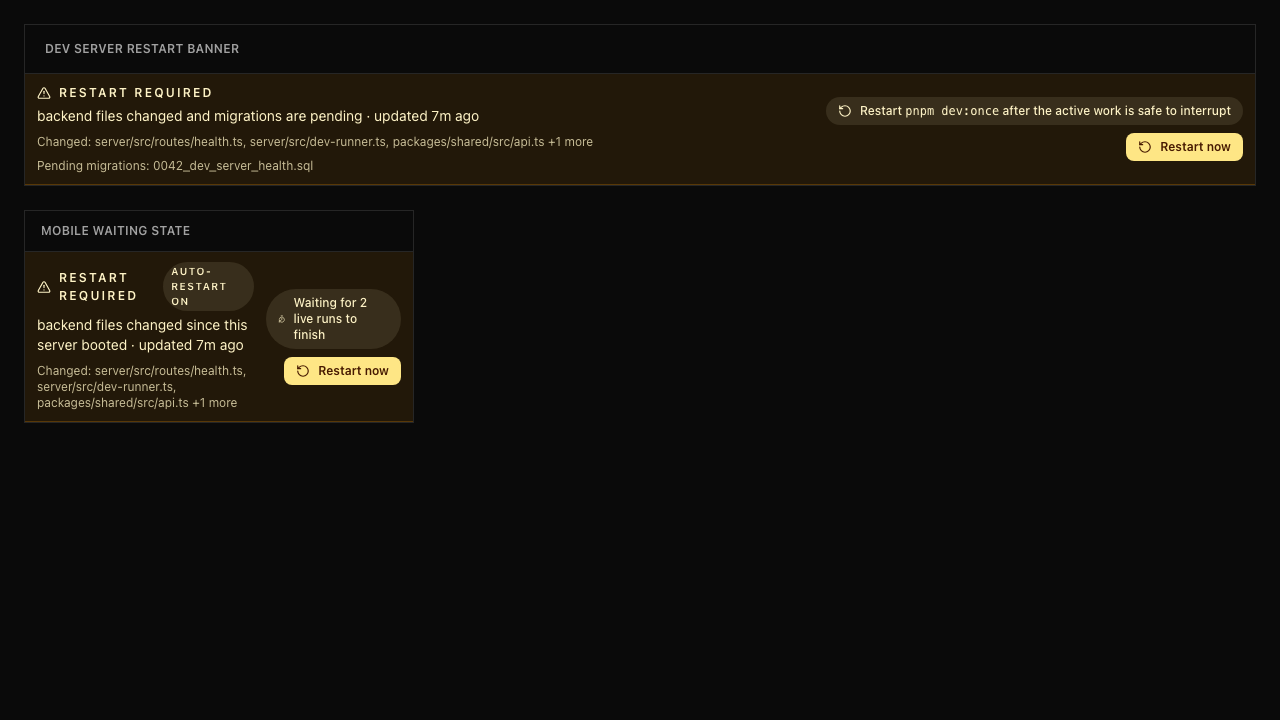 - Dev restart banner mobile: 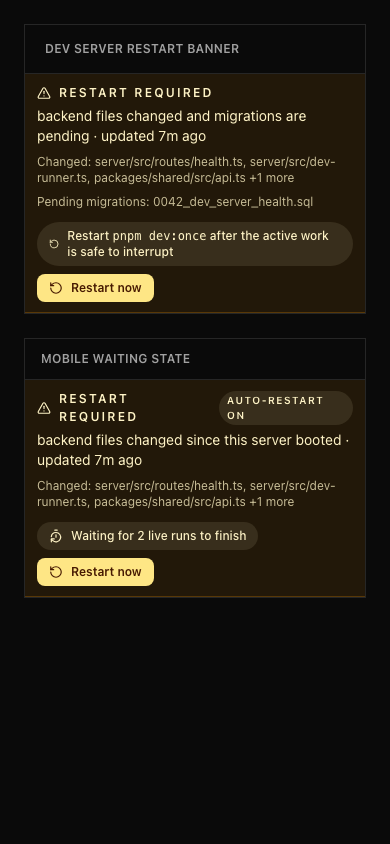 ## Risks - Mostly UI/dev ergonomics with low data risk. - Sidebar and inbox changes touch frequently used navigation surfaces, so visual review on desktop/mobile is still useful. > For core feature work, check [`ROADMAP.md`](ROADMAP.md) first and discuss it in `#dev` before opening the PR. Feature PRs that overlap with planned core work may need to be redirected — check the roadmap first. See `CONTRIBUTING.md`. ## Model Used - OpenAI Codex, GPT-5-based coding agent with local shell/git/tool use. Exact hosted model ID and context-window size are not exposed by the local Paperclip adapter runtime. ## Checklist - [x] I have included a thinking path that traces from project context to this change - [x] I have specified the model used (with version and capability details) - [x] I have checked ROADMAP.md and confirmed this PR does not duplicate planned core work - [x] I have run tests locally and they pass - [x] I have added or updated tests where applicable - [x] If this change affects the UI, I have included before/after screenshots - [x] I have updated relevant documentation to reflect my changes - [x] I have considered and documented any risks above - [x] I will address all Greptile and reviewer comments before requesting merge --------- Co-authored-by: Paperclip <noreply@paperclip.ing> |
||
|
DottaandPaperclip
|
5071c4c776 |
[codex] Add workspace diff viewer plugin (#6071)
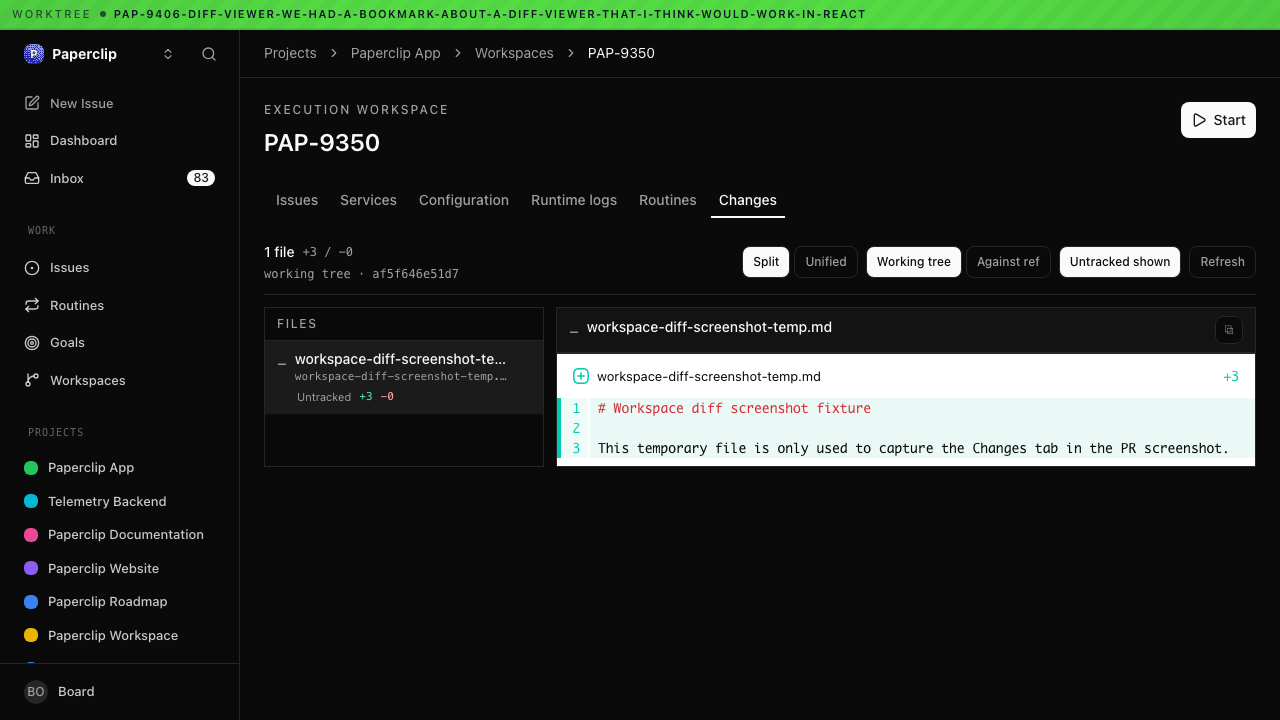
## Thinking Path > - Paperclip orchestrates AI agents for zero-human companies. > - Operators need to inspect what agents changed inside execution and project workspaces. > - The existing workspace detail views did not provide a first-party rich diff surface for staged, unstaged, head, renamed, binary, oversized, and untracked changes. > - The plugin system is the intended extension point for optional rich UI surfaces. > - This pull request adds a workspace diff plugin plus host services and shared contracts so Changes tabs can render workspace diffs through plugin slots. > - The diff-renderer dependency should stay owned by the plugin package rather than the core UI app. > - The dependency surface must stay aligned with repository PR policy, including intentionally omitting `pnpm-lock.yaml` from the PR. > - The benefit is a more reviewable workspace surface without hard-coding the renderer into every page. ## What Changed - Added `@paperclipai/plugin-workspace-diff`, including diff normalization, plugin manifest/worker/UI entrypoints, and focused plugin tests. - Kept `@pierre/diffs` scoped to `@paperclipai/plugin-workspace-diff`; removed the core UI lab diff-renderer surface and direct UI package dependency. - Added shared workspace diff types and validators, plus plugin SDK surface for workspace diff host services. - Added server workspace diff service support and route coverage for execution/project workspace diff flows. - Wired Execution Workspace and Project Workspace Changes tabs to load the diff plugin, including loading/error fallback behavior. - Added UI tests and fixtures for the Changes tabs and plugin bridge behavior. - Added the new plugin package manifest to the Docker deps stage so PR policy can validate dependency coverage. - Addressed review hardening around empty untracked patches, workspace path exposure, project workspace read capability checks, and default base refs. ## Verification - `pnpm --filter @paperclipai/plugin-workspace-diff test` - `pnpm exec vitest run packages/shared/src/validators/workspace-diff.test.ts server/src/__tests__/workspace-diff-service.test.ts ui/src/pages/ProjectWorkspaceDetail.test.tsx ui/src/pages/ExecutionWorkspaceDetail.test.tsx` - `pnpm exec vitest run ui/src/plugins/bridge.test.ts server/src/__tests__/workspace-runtime-routes-authz.test.ts` - `pnpm --filter @paperclipai/shared typecheck` - `pnpm --filter @paperclipai/plugin-workspace-diff typecheck` - `pnpm --filter @paperclipai/server typecheck` - `pnpm --filter @paperclipai/ui typecheck` - `node ./scripts/check-docker-deps-stage.mjs` - Browser screenshot captured from the local worktree dev server: https://files.catbox.moe/ofdpsp.png - Confirmed branch is rebased onto `public-gh/master`, `.github/workflows/pr.yml` is not included in the PR diff, `ui/package.json` is not included in the PR diff, and `pnpm-lock.yaml` is not included in the PR diff. ## Risks - Medium UI integration risk: the Changes tab depends on the plugin slot and host diff service path. - Medium dependency risk: this adds `@pierre/diffs` in the plugin package, but `pnpm-lock.yaml` is intentionally omitted per packaging instructions because repository automation manages lockfile updates. - Current CI blocker: downstream frozen installs fail until the repository policy path for new plugin package dependencies is chosen. - Diff rendering edge cases are covered for common working-tree and head diff states, but very large repositories may still expose performance limits. - No migrations are included. > For core feature work, check [`ROADMAP.md`](ROADMAP.md) first and discuss it in `#dev` before opening the PR. Feature PRs that overlap with planned core work may need to be redirected — check the roadmap first. See `CONTRIBUTING.md`. ## Model Used - OpenAI Codex, GPT-5 class coding model, tool-enabled local execution environment. Exact context window was not exposed by the runtime. ## Checklist - [x] I have included a thinking path that traces from project context to this change - [x] I have specified the model used (with version and capability details) - [x] I have checked ROADMAP.md and confirmed this PR does not duplicate planned core work - [x] I have run tests locally and they pass - [x] I have added or updated tests where applicable - [x] If this change affects the UI, I have included before/after screenshots - [x] I have updated relevant documentation to reflect my changes - [x] I have considered and documented any risks above - [x] I will address all Greptile and reviewer comments before requesting merge --------- Co-authored-by: Paperclip <noreply@paperclip.ing> |
||
|
DottaandPaperclip
|
b947a7d76c |
[codex] Improve local plugin development workflow (#5821)
## Thinking Path > - Paperclip is the control plane for autonomous AI-agent companies. > - Plugins are the extension point for adding capabilities without expanding the core product surface. > - Local plugin development needed a tighter CLI-first loop so plugin authors can scaffold, run, install, inspect, and reload plugins without reaching into internal package paths. > - The server plugin install path also needed local-path handling that keeps plugin identity, dashboard routes, and development watchers coherent. > - This pull request adds the CLI scaffold/install workflow, fixes the server and SDK edge cases that blocked that loop, and updates the agent-facing plugin creation skill and docs. > - The benefit is that contributors can develop plugins from local folders with a documented, repeatable happy path. ## What Changed - Added `paperclipai plugin init` coverage and CLI wiring for local plugin scaffolding. - Improved local plugin install handling, plugin key route resolution, dashboard capability behavior, and dev watcher startup/reload behavior. - Fixed plugin SDK worker entrypoint validation for symlinked package layouts. - Added targeted tests for plugin init, server plugin authz/watcher behavior, SDK worker host validation, and the authoring smoke example. - Added a short local plugin development guide and refreshed the plugin authoring guide plus `paperclip-create-plugin` skill instructions. ## Verification - `pnpm run preflight:workspace-links && pnpm --filter @paperclipai/plugin-sdk build && pnpm --filter @paperclipai/create-paperclip-plugin typecheck && pnpm --filter paperclipai typecheck && pnpm --filter @paperclipai/plugin-sdk typecheck && pnpm --filter @paperclipai/server typecheck` - `pnpm exec vitest run --project paperclipai cli/src/__tests__/plugin-init.test.ts` - `pnpm exec vitest run --project @paperclipai/plugin-sdk packages/plugins/sdk/tests/worker-rpc-host.test.ts` - `pnpm exec vitest run --project @paperclipai/server server/src/__tests__/plugin-dev-watcher.test.ts --pool=forks --poolOptions.forks.isolate=true` - `pnpm exec vitest run --project @paperclipai/server server/src/__tests__/plugin-routes-authz.test.ts --pool=forks --poolOptions.forks.isolate=true` - `pnpm --dir packages/plugins/examples/plugin-authoring-smoke-example test` - Confirmed `pnpm-lock.yaml` is not included in the PR diff. ## Risks - Medium risk: this touches plugin install routing, CLI command behavior, and the local development watcher. - Local path plugin installs execute trusted local code by design; the new docs call out that trust boundary. - No database migrations are included. > For core feature work, check [`ROADMAP.md`](ROADMAP.md) first and discuss it in `#dev` before opening the PR. Feature PRs that overlap with planned core work may need to be redirected — check the roadmap first. See `CONTRIBUTING.md`. ## Model Used - OpenAI Codex, GPT-5 coding agent, tool-enabled local shell and git workflow, medium reasoning effort. Context window details were not exposed in this runtime. ## Checklist - [x] I have included a thinking path that traces from project context to this change - [x] I have specified the model used (with version and capability details) - [x] I have checked ROADMAP.md and confirmed this PR does not duplicate planned core work - [x] I have run tests locally and they pass - [x] I have added or updated tests where applicable - [x] If this change affects the UI, I have included before/after screenshots - [x] I have updated relevant documentation to reflect my changes - [x] I have considered and documented any risks above - [x] I will address all Greptile and reviewer comments before requesting merge UI screenshots: not applicable; this PR changes CLI/server/plugin docs and tests, not board UI rendering. --------- Co-authored-by: Paperclip <noreply@paperclip.ing> |
||
|
|
778e775c35 |
Add secrets provider vaults and remote import (#5429)
## Thinking Path > - Paperclip orchestrates AI-agent companies and needs secrets handling to work across local development, hosted operators, and governed agent execution. > - The affected subsystem is the company-scoped secrets control plane: database schema, server services/routes, CLI workflows, and the Secrets settings UI. > - The gap was that secrets were local-only and operators could not manage provider vaults or import existing remote references without exposing plaintext. > - This branch adds provider vault configuration plus an AWS Secrets Manager remote-import path while preserving company boundaries, binding context, and audit trails. > - I kept the PR to a single branch PR, removed unrelated lockfile/package drift, rebased the full branch onto the current `public-gh/master`, and addressed fresh Greptile findings. > - The benefit is a reviewable implementation of provider-backed secrets with focused tests covering provider selection, import conflicts, deleted secret reuse, rotation guards, and AWS signing behavior. ## What Changed - Added provider vault support for company secrets, including provider config storage, default vault handling, health checks, binding usage, access events, and remote import preview/commit. - Added an AWS Secrets Manager provider using SigV4 request signing, bounded request timeouts, namespace guardrails, cached runtime credential resolution, and external-reference linking without plaintext reads. - Added Secrets UI surfaces for vault management and remote import, plus CLI/API documentation for setup and operations. - Stabilized routine webhook secret binding paths and SSH environment-driver fixture bindings discovered during verification. - Addressed Greptile and CI findings: no lockfile/package drift, monotonic migration metadata, disabled-vault default races, soft-deleted secret hiding/recreate behavior, remove behavior with disabled vaults, soft-deleted external-reference re-import, non-active rotation guards, managed-secret soft deletion through PATCH, and per-call AWS SDK credential client churn. - Rebased this branch onto `public-gh/master` at `0e1a5828` and force-pushed with lease to keep this as the single PR for the branch. ## Verification - `git fetch public-gh master` - `git rebase public-gh/master` - `git diff --name-only public-gh/master...HEAD | grep '^pnpm-lock\.yaml$' || true` confirmed `pnpm-lock.yaml` is not in the PR diff. - Confirmed migration ordering: master ends at `0081_optimal_dormammu`; this PR adds `0082_dry_vision` and `0083_company_secret_provider_configs`. - Inspected migrations for repeat safety: new tables/indexes use `IF NOT EXISTS`; foreign keys are guarded by `DO $$ ... IF NOT EXISTS`; column additions use `ADD COLUMN IF NOT EXISTS`. - `pnpm -r typecheck` passed before the Greptile follow-up commits. - `pnpm test:run` ran the full stable Vitest path before the Greptile follow-up commits; it completed with 3 timing-related failures under parallel load: `codex-local-execute.test.ts`, `cursor-local-execute.test.ts`, and `environment-service.test.ts`. - `pnpm --filter @paperclipai/server exec vitest run src/__tests__/codex-local-execute.test.ts src/__tests__/cursor-local-execute.test.ts src/__tests__/environment-service.test.ts` passed on targeted rerun (`24/24`). - `pnpm build` passed before the Greptile follow-up commits. Vite reported existing chunk-size/dynamic-import warnings. - After Greptile follow-up commits: `pnpm --filter @paperclipai/server exec vitest run src/__tests__/secrets-service.test.ts` passed (`26/26`). - After Greptile follow-up commits: `pnpm --filter @paperclipai/server exec vitest run src/__tests__/aws-secrets-manager-provider.test.ts src/__tests__/secrets-service.test.ts` passed (`39/39`). - After Greptile follow-up commits: `pnpm --filter @paperclipai/server typecheck` passed. - Captured Storybook screenshots from `ui/storybook-static` for visual review. - Latest PR checks on `5ca3a5cf`: `policy`, serialized server suites 1/4-4/4, `Canary Dry Run`, `e2e`, `security/snyk`, and `Greptile Review` pass; aggregate `verify` is still registering the completed child checks. - Greptile review loop continued through the latest requested pass; all Greptile review threads are resolved and the latest `Greptile Review` check on `5ca3a5cf` passed with 0 comments added. ## Screenshots Before: the provider-vault and remote-import surfaces did not exist on `master`; these are after-state screenshots from the Storybook fixtures. 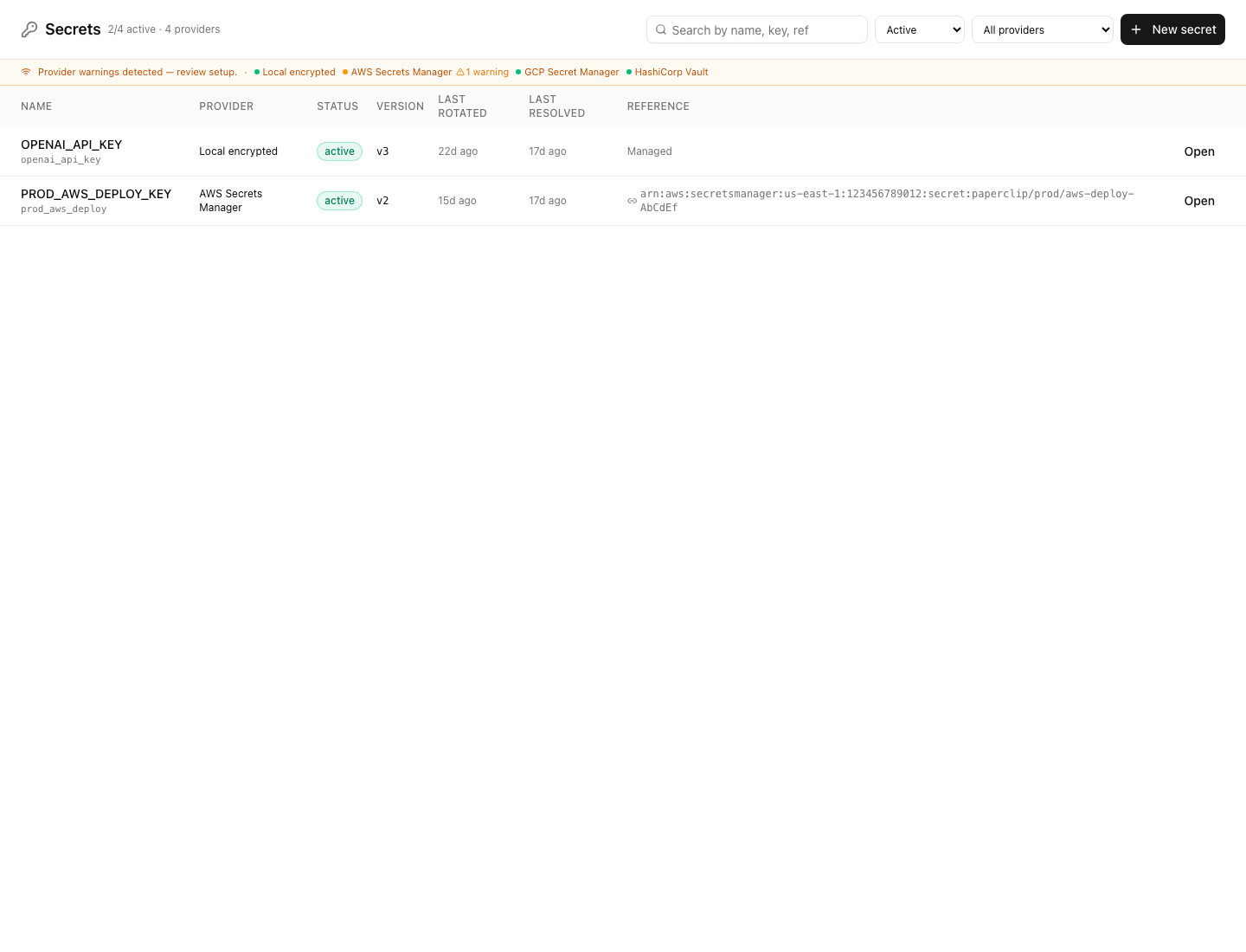 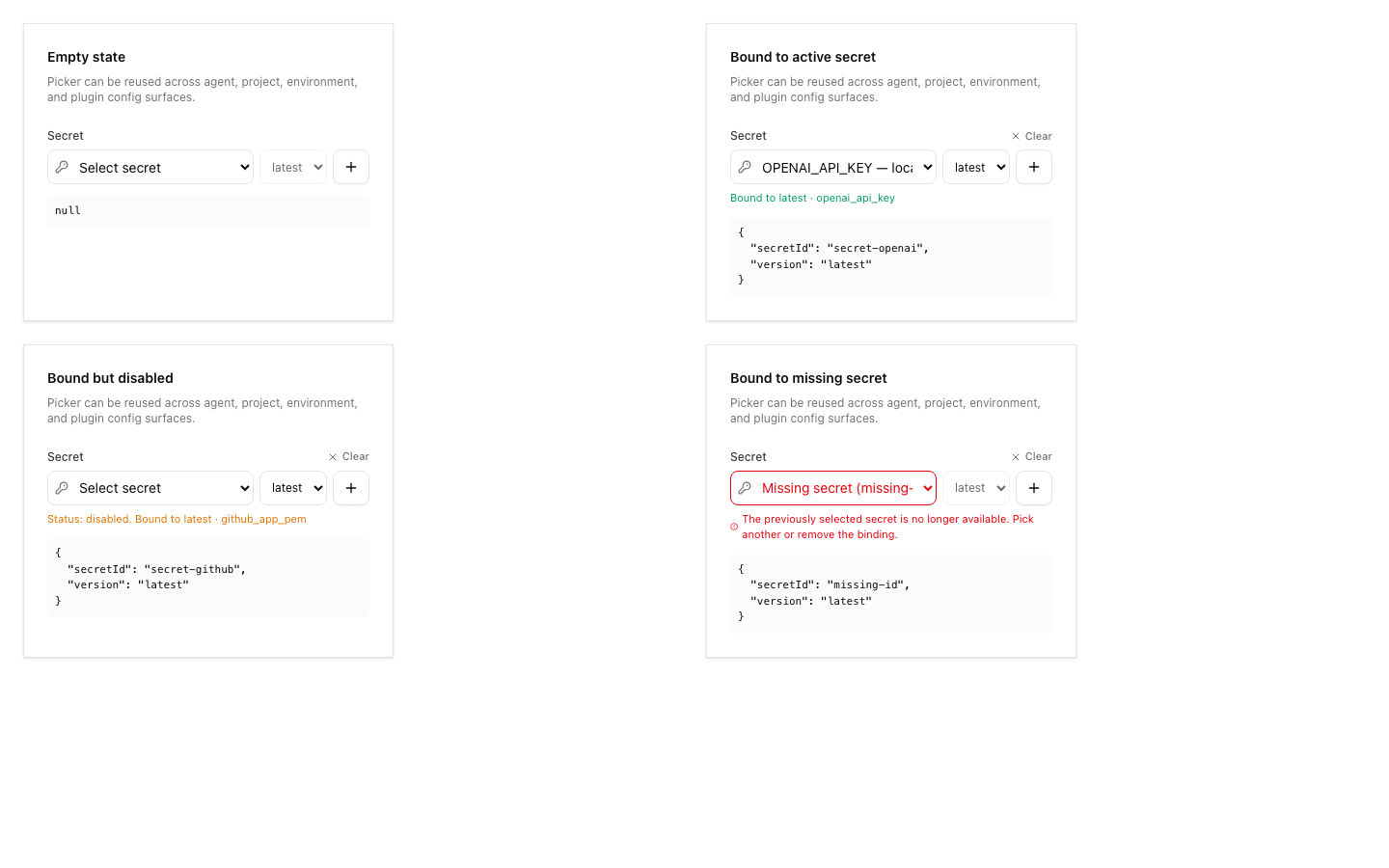 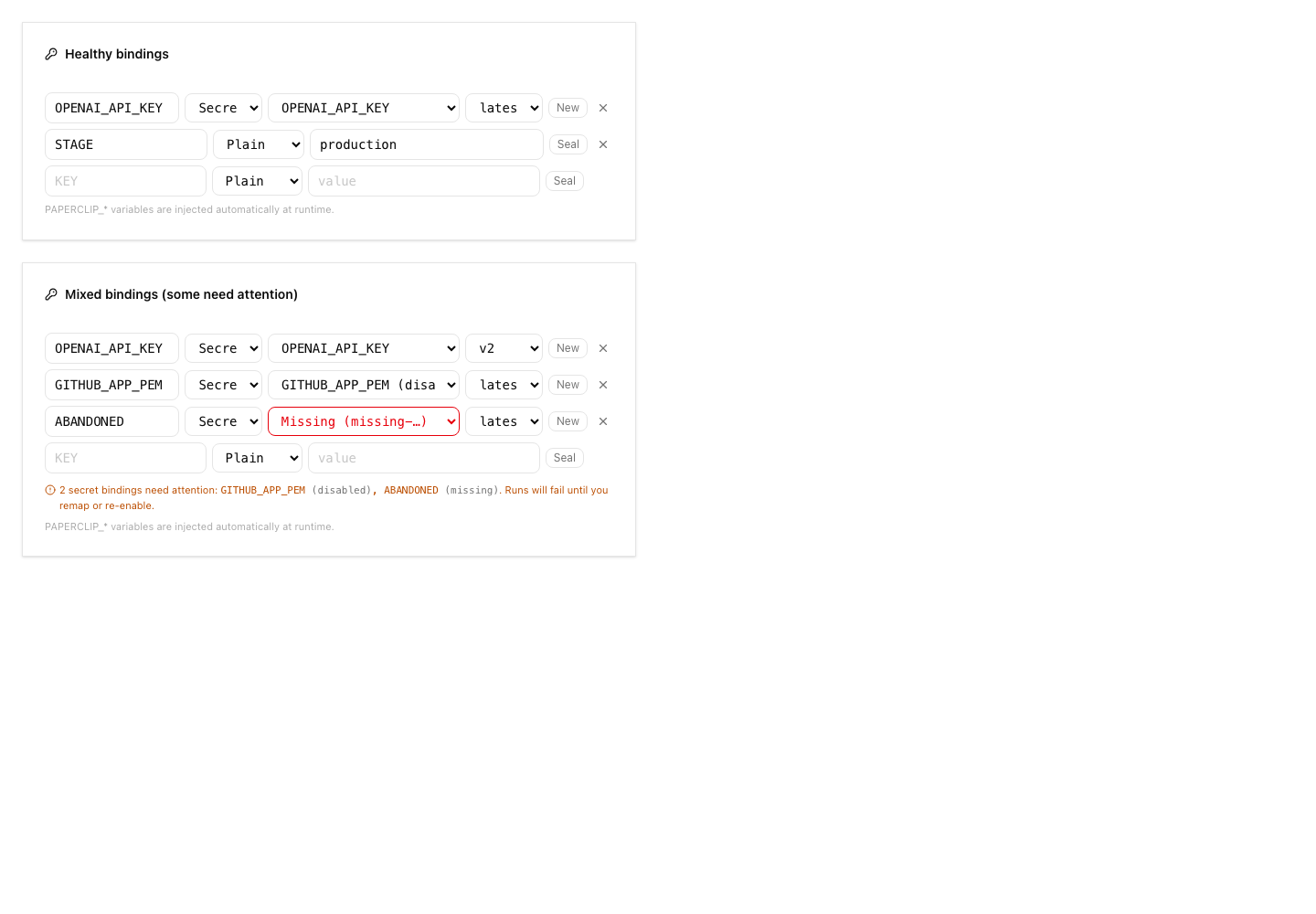 ## Risks - Migration risk: this adds new secret provider tables and extends existing secret rows. The migrations were checked for monotonic ordering and idempotent guards, but reviewers should still inspect upgrade behavior carefully. - Provider risk: AWS support uses direct SigV4 requests. Automated tests cover signing, request timeouts, vault-config selection, namespace guardrails, pending-version archival, sanitized provider errors, and service-level cleanup paths. A real-vault AWS smoke test remains deployment validation for an operator with AWS credentials rather than an unverified merge blocker in this local branch. - UI risk: the Secrets page and import dialog are large new surfaces; screenshots are included above for reviewer inspection. - Verification risk: the full local stable test command hit parallel-load timing failures, although the exact failed files passed when rerun directly. - Operational risk: remote import intentionally avoids plaintext reads; operators must understand that imported external references resolve at runtime and may fail if AWS permissions change. > For core feature work, check [`ROADMAP.md`](ROADMAP.md) first and discuss it in `#dev` before opening the PR. Feature PRs that overlap with planned core work may need to be redirected — check the roadmap first. See `CONTRIBUTING.md`. ## Model Used - OpenAI Codex, GPT-5 coding agent with local shell/tool use in the Paperclip worktree. Exact context-window size was not exposed by the runtime. ## Checklist - [x] I have included a thinking path that traces from project context to this change - [x] I have specified the model used (with version and capability details) - [x] I have checked ROADMAP.md and confirmed this PR does not duplicate planned core work - [ ] I have run tests locally and they pass - [x] I have added or updated tests where applicable - [x] If this change affects the UI, I have included before/after screenshots - [x] I have updated relevant documentation to reflect my changes - [x] I have considered and documented any risks above - [x] I will address all Greptile and reviewer comments before requesting merge --------- Co-authored-by: Paperclip <noreply@paperclip.ing> Co-authored-by: Claude Sonnet 4.6 <noreply@anthropic.com> |
||
|
DottaandPaperclip
|
3c73ed26b5 |
Expand plugin host surface (#5205)
## Thinking Path > - Paperclip orchestrates AI agents for zero-human companies > - The plugin system is the extension boundary for optional product capabilities > - Rich plugins need more than a worker entrypoint: they need scoped database storage, local project folders, managed agents/routines, host navigation, and reusable UI components > - The LLM Wiki work exposed those missing host surfaces while keeping plugin code outside the core control plane > - This pull request expands the core plugin host, SDK, server APIs, and UI bridge so plugins can declare and use those surfaces > - The benefit is that future plugins can integrate with Paperclip through documented, validated contracts instead of bespoke server or UI imports ## What Changed - Added plugin-managed database namespaces and migration tracking, including Drizzle schema/migration files and SQL validation for namespace isolation. - Added server support for plugin local folders, managed agents, managed routines, scoped plugin APIs, and plugin operation visibility. - Expanded shared plugin manifest/types/validators and SDK host/testing/UI exports for richer plugin surfaces. - Added reusable UI pieces for file trees, managed routines, resizable sidebars, route sidebars, and plugin bridge initialization. - Updated plugin docs and example plugins to use the expanded host and SDK surface. ## Verification - `pnpm install --frozen-lockfile` - `pnpm run preflight:workspace-links && pnpm exec vitest run packages/shared/src/validators/plugin.test.ts server/src/__tests__/plugin-database.test.ts server/src/__tests__/plugin-local-folders.test.ts server/src/__tests__/plugin-managed-agents.test.ts server/src/__tests__/plugin-managed-routines.test.ts server/src/__tests__/plugin-orchestration-apis.test.ts ui/src/api/plugins.test.ts ui/src/components/FileTree.test.tsx ui/src/components/ResizableSidebarPane.test.tsx ui/src/pages/PluginPage.test.tsx ui/src/plugins/bridge.test.ts` passed: 11 files, 67 tests. - Confirmed this PR changes 89 files and does not include `pnpm-lock.yaml` or `.github/workflows/*`. ## Risks - Medium: this expands plugin host contracts across db/shared/server/ui and includes a new core migration (`0076_useful_elektra.sql`). - The plugin database namespace validator is intentionally restrictive; plugin authors may need follow-up affordances for SQL patterns that remain blocked. - Merge this before the LLM Wiki plugin PR so the plugin can resolve the new SDK and host APIs. > For core feature work, check [`ROADMAP.md`](ROADMAP.md) first and discuss it in `#dev` before opening the PR. Feature PRs that overlap with planned core work may need to be redirected — check the roadmap first. See `CONTRIBUTING.md`. ## Model Used - OpenAI Codex, GPT-5 coding agent, tool-enabled shell/git/GitHub workflow. Context window size was not exposed by the runtime. ## Checklist - [x] I have included a thinking path that traces from project context to this change - [x] I have specified the model used (with version and capability details) - [x] I have checked ROADMAP.md and confirmed this PR does not duplicate planned core work - [x] I have run tests locally and they pass - [x] I have added or updated tests where applicable - [x] If this change affects the UI, I have included before/after screenshots - [x] I have updated relevant documentation to reflect my changes - [x] I have considered and documented any risks above - [x] I will address all Greptile and reviewer comments before requesting merge --------- Co-authored-by: Paperclip <noreply@paperclip.ing> |
||
|
DottaandPaperclip
|
7a329fb8bb |
Harden API route authorization boundaries (#4122)
## Thinking Path > - Paperclip orchestrates AI agents for zero-human companies. > - The REST API is the control-plane boundary for companies, agents, plugins, adapters, costs, invites, and issue mutations. > - Several routes still relied on broad board or company access checks without consistently enforcing the narrower actor, company, and active-checkout boundaries those operations require. > - That can allow agents or non-admin users to mutate sensitive resources outside the intended governance path. > - This pull request hardens the route authorization layer and adds regression coverage for the audited API surfaces. > - The benefit is tighter multi-company isolation, safer plugin and adapter administration, and stronger enforcement of active issue ownership. ## What Changed - Added route-level authorization checks for budgets, plugin administration/scoped routes, adapter management, company import/export, direct agent creation, invite test resolution, and issue mutation/write surfaces. - Enforced active checkout ownership for agent-authenticated issue mutations, while preserving explicit management overrides for permitted managers. - Restricted sensitive adapter and plugin management operations to instance-admin or properly scoped actors. - Tightened company portability and invite probing routes so agents cannot cross company boundaries. - Updated access constants and the Company Access UI copy for the new active-checkout management grant. - Added focused regression tests covering cross-company denial, agent self-mutation denial, admin-only operations, and active checkout ownership. - Rebased the branch onto `public-gh/master` and fixed validation fallout from the rebase: heartbeat-context route ordering and a company import/export e2e fixture that now opts out of direct-hire approval before using direct agent creation. - Updated onboarding and signoff e2e setup to create seed agents through `/agent-hires` plus board approval, so they remain compatible with the approval-gated new-agent default. - Addressed Greptile feedback by removing a duplicate company export API alias, avoiding N+1 reporting-chain lookups in active-checkout override checks, allowing agent mutations on unassigned `in_progress` issues, and blocking NAT64 invite-probe targets. ## Verification - `pnpm exec vitest run server/src/__tests__/issues-goal-context-routes.test.ts cli/src/__tests__/company-import-export-e2e.test.ts` - `pnpm exec vitest run server/src/__tests__/plugin-routes-authz.test.ts server/src/__tests__/adapter-routes-authz.test.ts server/src/__tests__/agent-permissions-routes.test.ts server/src/__tests__/company-portability-routes.test.ts server/src/__tests__/costs-service.test.ts server/src/__tests__/invite-test-resolution-route.test.ts server/src/__tests__/issue-agent-mutation-ownership-routes.test.ts server/src/__tests__/agent-adapter-validation-routes.test.ts` - `pnpm exec vitest run server/src/__tests__/issue-agent-mutation-ownership-routes.test.ts` - `pnpm exec vitest run server/src/__tests__/invite-test-resolution-route.test.ts` - `pnpm -r typecheck` - `pnpm --filter server typecheck` - `pnpm --filter ui typecheck` - `pnpm build` - `pnpm test:e2e -- tests/e2e/onboarding.spec.ts tests/e2e/signoff-policy.spec.ts` - `pnpm test:e2e -- tests/e2e/signoff-policy.spec.ts` - `pnpm test:run` was also run. It failed under default full-suite parallelism with two order-dependent failures in `plugin-routes-authz.test.ts` and `routines-e2e.test.ts`; both files passed when rerun directly together with `pnpm exec vitest run server/src/__tests__/plugin-routes-authz.test.ts server/src/__tests__/routines-e2e.test.ts`. ## Risks - Medium risk: this changes authorization behavior across multiple sensitive API surfaces, so callers that depended on broad board/company access may now receive `403` or `409` until they use the correct governance path. - Direct agent creation now respects the company-level board-approval requirement; integrations that need pending hires should use `/api/companies/:companyId/agent-hires`. - Active in-progress issue mutations now require checkout ownership or an explicit management override, which may reveal workflow assumptions in older automation. > For core feature work, check [`ROADMAP.md`](ROADMAP.md) first and discuss it in `#dev` before opening the PR. Feature PRs that overlap with planned core work may need to be redirected — check the roadmap first. See `CONTRIBUTING.md`. ## Model Used OpenAI Codex, GPT-5 coding agent, tool-using workflow with local shell, Git, GitHub CLI, and repository tests. ## Checklist - [x] I have included a thinking path that traces from project context to this change - [x] I have specified the model used (with version and capability details) - [x] I have checked ROADMAP.md and confirmed this PR does not duplicate planned core work - [ ] I have run tests locally and they pass - [x] I have added or updated tests where applicable - [x] If this change affects the UI, I have included before/after screenshots - [x] I have updated relevant documentation to reflect my changes - [x] I have considered and documented any risks above - [x] I will address all Greptile and reviewer comments before requesting merge --------- Co-authored-by: Paperclip <noreply@paperclip.ing> |
||
|
DottaandPaperclip
|
9c6f551595 |
[codex] Add plugin orchestration host APIs (#4114)
## Thinking Path > - Paperclip orchestrates AI agents for zero-human companies. > - The plugin system is the extension path for optional capabilities that should not require core product changes for every integration. > - Plugins need scoped host APIs for issue orchestration, documents, wakeups, summaries, activity attribution, and isolated database state. > - Without those host APIs, richer plugins either cannot coordinate Paperclip work safely or need privileged core-side special cases. > - This pull request adds the plugin orchestration host surface, scoped route dispatch, a database namespace layer, and a smoke plugin that exercises the contract. > - The benefit is a broader plugin API that remains company-scoped, auditable, and covered by tests. ## What Changed - Added plugin orchestration host APIs for issue creation, document access, wakeups, summaries, plugin-origin activity, and scoped API route dispatch. - Added plugin database namespace tables, schema exports, migration checks, and idempotent replay coverage under migration `0059_plugin_database_namespaces`. - Added shared plugin route/API types and validators used by server and SDK boundaries. - Expanded plugin SDK types, protocol helpers, worker RPC host behavior, and testing utilities for orchestration flows. - Added the `plugin-orchestration-smoke-example` package to exercise scoped routes, restricted database namespaces, issue orchestration, documents, wakeups, summaries, and UI status surfaces. - Kept the new orchestration smoke fixture out of the root pnpm workspace importer so this PR preserves the repository policy of not committing `pnpm-lock.yaml`. - Updated plugin docs and database docs for the new orchestration and database namespace surfaces. - Rebased the branch onto `public-gh/master`, resolved conflicts, and removed `pnpm-lock.yaml` from the final PR diff. ## Verification - `pnpm install --frozen-lockfile` - `pnpm --filter @paperclipai/db typecheck` - `pnpm exec vitest run packages/db/src/client.test.ts` - `pnpm exec vitest run server/src/__tests__/plugin-database.test.ts server/src/__tests__/plugin-orchestration-apis.test.ts server/src/__tests__/plugin-routes-authz.test.ts server/src/__tests__/plugin-scoped-api-routes.test.ts server/src/__tests__/plugin-sdk-orchestration-contract.test.ts` - From `packages/plugins/examples/plugin-orchestration-smoke-example`: `pnpm exec vitest run --config ./vitest.config.ts` - `pnpm --dir packages/plugins/examples/plugin-orchestration-smoke-example run typecheck` - `pnpm --filter @paperclipai/server typecheck` - PR CI on latest head `293fc67c`: `policy`, `verify`, `e2e`, and `security/snyk` all passed. ## Risks - Medium risk: this expands plugin host authority, so route auth, company scoping, and plugin-origin activity attribution need careful review. - Medium risk: database namespace migration behavior must remain idempotent for environments that may have seen earlier branch versions. - Medium risk: the orchestration smoke fixture is intentionally excluded from the root workspace importer to avoid a `pnpm-lock.yaml` PR diff; direct fixture verification remains listed above. - Low operational risk from the PR setup itself: the branch is rebased onto current `master`, the migration is ordered after upstream `0057`/`0058`, and `pnpm-lock.yaml` is not in the final diff. > For core feature work, check [`ROADMAP.md`](ROADMAP.md) first and discuss it in `#dev` before opening the PR. Feature PRs that overlap with planned core work may need to be redirected — check the roadmap first. See `CONTRIBUTING.md`. Roadmap checked: this work aligns with the completed Plugin system milestone and extends the plugin surface rather than duplicating an unrelated planned core feature. ## Model Used - OpenAI Codex, GPT-5-based coding agent in a tool-enabled CLI environment. Exact hosted model build and context-window size are not exposed by the runtime; reasoning/tool use were enabled for repository inspection, editing, testing, git operations, and PR creation. ## Checklist - [x] I have included a thinking path that traces from project context to this change - [x] I have specified the model used (with version and capability details) - [x] I have checked ROADMAP.md and confirmed this PR does not duplicate planned core work - [x] I have run tests locally and they pass - [x] I have added or updated tests where applicable - [x] If this change affects the UI, I have included before/after screenshots (N/A: no core UI screen change; example plugin UI contract is covered by tests) - [x] I have updated relevant documentation to reflect my changes - [x] I have considered and documented any risks above - [x] I will address all Greptile and reviewer comments before requesting merge --------- Co-authored-by: Paperclip <noreply@paperclip.ing> |
||
|
|
b9a80dcf22 |
feat: implement multi-user access and invite flows (#3784)
## Thinking Path > - Paperclip is the control plane for autonomous AI companies. > - V1 needs to stay local-first while also supporting shared, authenticated deployments. > - Human operators need real identities, company membership, invite flows, profile surfaces, and company-scoped access controls. > - Agents and operators also need the existing issue, inbox, workspace, approval, and plugin flows to keep working under those authenticated boundaries. > - This branch accumulated the multi-user implementation, follow-up QA fixes, workspace/runtime refinements, invite UX improvements, release-branch conflict resolution, and review hardening. > - This pull request consolidates that branch onto the current `master` branch as a single reviewable PR. > - The benefit is a complete multi-user implementation path with tests and docs carried forward without dropping existing branch work. ## What Changed - Added authenticated human-user access surfaces: auth/session routes, company user directory, profile settings, company access/member management, join requests, and invite management. - Added invite creation, invite landing, onboarding, logo/branding, invite grants, deduped join requests, and authenticated multi-user E2E coverage. - Tightened company-scoped and instance-admin authorization across board, plugin, adapter, access, issue, and workspace routes. - Added profile-image URL validation hardening, avatar preservation on name-only profile updates, and join-request uniqueness migration cleanup for pending human requests. - Added an atomic member role/status/grants update path so Company Access saves no longer leave partially updated permissions. - Improved issue chat, inbox, assignee identity rendering, sidebar/account/company navigation, workspace routing, and execution workspace reuse behavior for multi-user operation. - Added and updated server/UI tests covering auth, invites, membership, issue workspace inheritance, plugin authz, inbox/chat behavior, and multi-user flows. - Merged current `public-gh/master` into this branch, resolved all conflicts, and verified no `pnpm-lock.yaml` change is included in this PR diff. ## Verification - `pnpm exec vitest run server/src/__tests__/issues-service.test.ts ui/src/components/IssueChatThread.test.tsx ui/src/pages/Inbox.test.tsx` - `pnpm run preflight:workspace-links && pnpm exec vitest run server/src/__tests__/plugin-routes-authz.test.ts` - `pnpm exec vitest run server/src/__tests__/plugin-routes-authz.test.ts server/src/__tests__/workspace-runtime-service-authz.test.ts server/src/__tests__/access-validators.test.ts` - `pnpm exec vitest run server/src/__tests__/authz-company-access.test.ts server/src/__tests__/routines-routes.test.ts server/src/__tests__/sidebar-preferences-routes.test.ts server/src/__tests__/approval-routes-idempotency.test.ts server/src/__tests__/openclaw-invite-prompt-route.test.ts server/src/__tests__/agent-cross-tenant-authz-routes.test.ts server/src/__tests__/routines-e2e.test.ts` - `pnpm exec vitest run server/src/__tests__/auth-routes.test.ts ui/src/pages/CompanyAccess.test.tsx` - `pnpm --filter @paperclipai/shared typecheck && pnpm --filter @paperclipai/db typecheck && pnpm --filter @paperclipai/server typecheck` - `pnpm --filter @paperclipai/shared typecheck && pnpm --filter @paperclipai/server typecheck` - `pnpm --filter @paperclipai/ui typecheck` - `pnpm db:generate` - `npx playwright test --config tests/e2e/playwright.config.ts --list` - Confirmed branch has no uncommitted changes and is `0` commits behind `public-gh/master` before PR creation. - Confirmed no `pnpm-lock.yaml` change is staged or present in the PR diff. ## Risks - High review surface area: this PR contains the accumulated multi-user branch plus follow-up fixes, so reviewers should focus especially on company-boundary enforcement and authenticated-vs-local deployment behavior. - UI behavior changed across invites, inbox, issue chat, access settings, and sidebar navigation; no browser screenshots are included in this branch-consolidation PR. - Plugin install, upgrade, and lifecycle/config mutations now require instance-admin access, which is intentional but may change expectations for non-admin board users. - A join-request dedupe migration rejects duplicate pending human requests before creating unique indexes; deployments with unusual historical duplicates should review the migration behavior. - Company member role/status/grant saves now use a new combined endpoint; older separate endpoints remain for compatibility. - Full production build was not run locally in this heartbeat; CI should cover the full matrix. ## Model Used - OpenAI Codex coding agent, GPT-5-based model, CLI/tool-use environment. Exact deployed model identifier and context window were not exposed by the runtime. ## Checklist - [x] I have included a thinking path that traces from project context to this change - [x] I have specified the model used (with version and capability details) - [x] I have run tests locally and they pass - [x] I have added or updated tests where applicable - [x] If this change affects the UI, I have included before/after screenshots - [x] I have updated relevant documentation to reflect my changes - [x] I have considered and documented any risks above - [x] I will address all Greptile and reviewer comments before requesting merge Note on screenshots: this is a branch-consolidation PR for an already-developed multi-user branch, and no browser screenshots were captured during this heartbeat. --------- Co-authored-by: dotta <dotta@example.com> Co-authored-by: Paperclip <noreply@paperclip.ing> Co-authored-by: Claude Opus 4.6 <noreply@anthropic.com> |
||
|
DottaandPaperclip
|
32a9165ddf |
[codex] harden authenticated routes and issue editor reliability (#3741)
## Thinking Path > - Paperclip orchestrates AI agents for zero-human companies > - The control plane depends on authenticated routes enforcing company boundaries and role permissions correctly > - This branch also touches the issue detail and markdown editing flows operators use while handling advisory and triage work > - Partial issue cache seeds and fragile rich-editor parsing could leave important issue content missing or blank at the moment an operator needed it > - Blocked issues becoming actionable again should wake their assignee automatically instead of silently staying idle > - This pull request rebases the advisory follow-up branch onto current `master`, hardens authenticated route authorization, and carries the issue-detail/editor reliability fixes forward with regression tests > - The benefit is tighter authz on sensitive routes plus more reliable issue/advisory editing and wakeup behavior on top of the latest base ## What Changed - Hardened authenticated route authorization across agent, activity, approval, access, project, plugin, health, execution-workspace, portability, and related server paths, with new cross-tenant and runtime-authz regression coverage. - Switched issue detail queries from `initialData` to placeholder-based hydration so list/quicklook seeds still refetch full issue bodies. - Normalized advisory-style HTML images before mounting the markdown editor and strengthened fallback behavior when the rich editor silently fails or rejects the content. - Woke assigned agents when blocked issues move back to `todo`, with route coverage for reopen and unblock transitions. - Rebasing note: this branch now sits cleanly on top of the latest `master` tip used for the PR base. ## Verification - `pnpm exec vitest run ui/src/lib/issueDetailQuery.test.tsx ui/src/components/MarkdownEditor.test.tsx server/src/__tests__/issue-comment-reopen-routes.test.ts server/src/__tests__/activity-routes.test.ts server/src/__tests__/agent-cross-tenant-authz-routes.test.ts` - Confirmed `pnpm-lock.yaml` is not part of the PR diff. - Rebased the branch onto current `public-gh/master` before publishing. ## Risks - Broad authz tightening may expose existing flows that were relying on permissive board or agent access and now need explicit grants. - Markdown editor fallback changes could affect focus or rendering in edge-case content that mixes HTML-like advisory markup with normal markdown. - This verification was intentionally scoped to touched regressions and did not run the full repository suite. ## Model Used - OpenAI Codex, GPT-5-based coding agent in the Codex CLI environment with tool use for terminal, git, and GitHub operations. The exact runtime model identifier is not exposed inside this session. ## Checklist - [x] I have included a thinking path that traces from project context to this change - [x] I have specified the model used (with version and capability details) - [x] I have run tests locally and they pass - [x] I have added or updated tests where applicable - [x] If this change affects the UI, it is behavior-only and does not need before/after screenshots - [x] I have updated relevant documentation to reflect my changes, or no documentation changes were needed for these internal fixes - [x] I have considered and documented any risks above - [x] I will address all Greptile and reviewer comments before requesting merge --------- Co-authored-by: Paperclip <noreply@paperclip.ing> |
||
|
Dotta
|
6fa1dd2197 | Add kitchen sink plugin example | ||
|
Dotta
|
12ccfc2c9a | Simplify plugin runtime and cleanup lifecycle | ||
|
Dotta
|
80cdbdbd47 | Add plugin framework and settings UI |