mirror of
https://github.com/paperclipai/paperclip.git
synced 2026-10-23 17:33:51 +02:00
572bef4ba7679451ac1543db25cb8ebd533bf919
3
Commits
| Author | SHA1 | Message | Date | |
|---|---|---|---|---|
 DottaandPaperclip |
a7dd5284b5 |
feat: add company fast-response acknowledgements (#15748)
## Thinking Path > - Paperclip is the open source app people use to manage AI agents for work. > - Human messages start agent work through task, chat, and external-channel intake. > - Agent startup can delay the first visible response. > - A small direct model call can acknowledge the request while normal work starts. > - This response must remain separate from evidence that the agent answered or completed work. > - This pull request adds optional company-wide fast responses with durable receipts, access checks, and cost accounting. > - Users receive prompt acknowledgement without changing the agent execution path. ## Linked Issues or Issue Description **Subsystem affected** Cross-cutting: database, shared contracts, server orchestration, connections, and UI. **Problem or motivation** Users can wait for an agent to start before they receive a contextual response. Generic progress messages do not confirm what the user asked. An acknowledgement must not falsely complete work or satisfy an unanswered turn. **Proposed solution** Add a disabled-by-default experimental fast-response model using an existing shared API connection. Generate one short acknowledgement for each accepted human turn. Use the existing agent identity and external publication outboxes. Retain platform provenance and account for the inference independently. **Alternatives considered** Running the acknowledgement through the agent runtime adds startup latency. Restricting implementation to OpenRouter leaves other existing API connections unsupported. This change supports all existing API connections and uses OpenRouter for live verification. **Roadmap alignment** This extends existing agent communication and connection settings. ROADMAP.md and open pull requests were checked. No duplicate fast-response implementation was found. The maintainer supplied the feature plan directly. ## What Changed - Add Experimental fast responses to instance settings. Keep the feature off by default. Enforce the flag at intake, dispatch, and publication. - Move Decision model and Fast response setup to company Settings → Connections when the experiment is enabled. Place Connections below Environments. Separate the model sections with clear headings and a divider. Keep Decision model in General when the experiment is off. Route Costs setup links to the available settings page. - Make the acknowledgement prompt a multiline template string. Ask for a brief, positive response in the user’s language. - Add settings, connection/model selection, sponsorship, fixed-sample testing, and Costs history. - Add a Vercel AI SDK text service for existing native, routed, Bedrock, and local API connections. - Add durable per-turn requests, a bounded worker, a three-second admission deadline, and one inference attempt. - Integrate task creation, task and agent chat, steering, queued follow-ups, experimental board chat, shared chat intake, and email. - Preserve receipt provenance and exclude receipts from completion, recovery, interaction resolution, and agent wakeups. - Recheck authorization, source validity, real replies, budgets, and destination binding before publication. Preserve accounting for suppressed or uncertain outcomes. - Add provider contracts, database race tests, channel outbox tests, UI tests, Stories, and documentation. Keep decision-model execution unchanged. ## Verification - Local `pnpm -r typecheck`, `pnpm build`, and UI token gates pass after rebase. The UI typecheck and build also pass after the final navigation fixes. All 37 focused navigation tests pass. The first full local `pnpm test:run` invocation reported seven chat failures. All seven passed in isolated reruns after fixture updates and host cleanup. This invocation was stopped after the full final-head CI suite passed. - Initial local database tests hit macOS shared-memory exhaustion. A diagnostic confirmed `shmget: No space left on device` with the system limit of 32 IDs. Three abandoned, unattached PostgreSQL IPC headers were reclaimed. The isolated rerun passed all 31 fast-response and channel tests. The two additional Slack regression cases also passed in a separate rerun. No active database was stopped. - UI token gates pass. Provider contract tests cover all supported API connection types. Fast-response tests cover uniqueness, authorization, budgets, expiry, cancellation, restart, real-reply races, and the experimental flag. - The test drive verified that disabling the experiment hides Connections and redirects its direct URL. Enabling it restores the saved OpenRouter setup. After restart on the final commit, the OpenRouter settings sample returned “Sure, I’ll take care of fixing the border around the settings panel.” in 428 ms. It used 260 input and 31 output tokens and recorded $0.0000576 in reported cost. - Earlier live OpenRouter verification produced a receipt in 1.013 seconds for a new task. The real agent then supplied its substantive answer. A separate settings test took 1.34 seconds, used 246 input and 23 output tokens, and recorded $0.0000361. - Live Slack verification on final commit `24016fa525961ebc7a4acffdc5019ce123970549` passed for a fresh initial task and a follow-up in a disposable bot DM. The initial acknowledgement appeared 2.405 seconds after the Slack message and 1.413 seconds after durable acceptance; the follow-up appeared in 2.322 seconds and 1.160 seconds respectively. The recorded generation/settlement durations were 898 ms and 697 ms. The initial call used 291 input / 39 output tokens and cost $0.00006705; the follow-up used 281 / 47 and cost $0.00007035. - The Slack acknowledgements retained the assigned agent identity and `origin: fast_response`, source-turn references, and no fabricated run ID. A status snapshot after the initial receipt showed the task still `in_progress` with its real execution run. The agent then read the CSV fixture and correctly reported two ready items, two blockers, and their owners. Both replies stayed in the originating DM, and no duplicate generic working message followed the delivered contextual acknowledgements. The `new` command started a fresh conversation session without generating a fast response. - An earlier eligible Slack turn generated a response but suppressed publication. Its reported cost was retained, generic progress remained, and the real agent completed the requested result. This is recorded separately from the two delivered acknowledgements; the history did not expose a precise suppression reason. - Slack verification used real signed provider events, the existing intake/publication paths, and a user-approved temporary webhook-only HTTPS tunnel. Subscriptions were limited to direct-message events. The test bot was paused and the tunnel stopped afterward. Live channel/group-thread and GitHub journeys remain unverified; their mocked tests cover intake, destination binding, publication, and continued underlying work. - Greptile reviewed final commit `24016fa525961ebc7a4acffdc5019ce123970549` at 5/5. Both new review findings are fixed and all threads are resolved. [Final-head CI run](https://github.com/paperclipai/paperclip/actions/runs/38060015730) passed. This includes grouped server/chat/workspace tests, serialized suites, runner checks, browser journeys, typecheck, build, release registry, policy, and the canary dry run. - Manual check: enable Experimental fast responses. Open company Settings → Connections. Select a shared API connection and model. Save and use Test response. Submit a task message and confirm that its receipt does not complete the task. ## Risks - The migration adds receipt and configuration tables plus accounting references. It uses idempotent statements and follows the current migration sequence. - A slow provider, authorization change, or real-agent reply can suppress an acknowledgement. Existing progress feedback remains available. - Unknown provider billing retains a reservation until reconciliation. External deliveries with uncertain outcomes must not be blindly repeated. - Live Slack initial-task and follow-up DM journeys pass. Live Slack channel/group-thread and GitHub journeys remain unverified. The PR remains a draft and records these gaps. Final-head repository CI and automated review pass. ## Model Used OpenAI Codex, based on GPT-6, with reasoning, repository tools, code execution, and browser interaction. The runtime does not expose an exact model snapshot ID or context-window size; these are not asserted. ## Checklist - [x] I have included a thinking path that traces from project context to this change - [x] I have specified the model used (with version and capability details) - [x] I have checked ROADMAP.md and confirmed this PR does not duplicate planned core work - [x] I have searched GitHub for duplicate or related PRs and linked them above - [x] I have either (a) linked existing issues with `Fixes: #` / `Closes #` / `Refs #` OR (b) described the issue in-PR following the relevant issue template - [x] I have not referenced internal/instance-local Paperclip issues or links (only public GitHub `#NNN` / `github.com/paperclipai/paperclip` URLs) - [x] My branch name describes the change (e.g. `docs/...`, `fix/...`) and contains no internal Paperclip ticket id or instance-derived details - [x] I have run tests locally and they pass - [x] I have added or updated tests where applicable - [x] I have updated relevant documentation to reflect my changes - [x] I have considered and documented any risks above - [x] All Paperclip CI gates are green - [x] Greptile is 5/5 with no open P2s, recommendations, or follow-ups - [x] I will address all Greptile and reviewer comments before requesting merge --------- Co-authored-by: Paperclip <noreply@paperclip.ing> |
||
|
|
ad961227f5 |
feat(secrets): add user-specific runtime secrets (#8825)
## Thinking Path > - Paperclip is the open source app people use to manage AI agents for work. > - Agent runs often need provider credentials, API tokens, and other environment-bound secrets. > - Company-level secrets work for shared credentials, but they do not model values that should differ by human operator. > - Without a user-scoped model, a run can dispatch without knowing whether the responsible human has supplied the needed value. > - Paperclip also needs run attribution to make those user-scoped runtime checks deterministic and auditable. > - This pull request adds user-specific secret definitions, per-user values, environment bindings, responsible-user attribution, and runtime resolution gates. > - The benefit is that teams can define the secret once, let each user provide their own value, and block runs before dispatch when required user secrets or active definitions are unavailable. ## Linked Issues or Issue Description Refs #224 Refs #6057 This PR implements user-specific secret support as a core secret-management capability rather than a one-off adapter setting. It is related to existing public work on company secrets UI and runtime secret refs, but is distinct because the value is owned by the responsible user and resolved at run dispatch time. Related PR search before opening found existing secrets work such as #1550, #8256, #8614, #8634, and #8647; none of those add the full user-secret definition/value/runtime gate covered here. ## What Changed - Added user-secret definitions and per-user "My secrets" values, keeping stored values out of access metadata. - Added `user_secret_ref` environment bindings and UI affordances to pick them alongside existing secret refs. - Added responsible-user runtime resolution so user-secret refs resolve against the human responsible for the run. - Added pre-dispatch missing-secret gates so runs fail before adapter dispatch when required user values are absent or definitions are inactive. - Added low-trust allowlist hardening for user-secret runtime access. - Added issue, routine, run, and agent API key responsible-user attribution and fail-closed dispatch behavior when attribution cannot be resolved. - Added denial-copy mapping so responsible-user authorization failures surface as actionable run outcomes instead of opaque setup failures. - Added OpenAPI documentation for the user-secret routes. - Rebases cleanly on current `master`; migrations were renumbered incrementally as `0128_user_specific_secrets`, `0129_agent_api_key_responsible_user`, and `0130_run_responsible_user_invariant` after upstream `0126`/`0127` migrations. - Removed previously committed local design screenshots so the PR contains code/docs/tests only. ## Verification - PASS: PR head `2527febd106bcf3ca264ca0da7fca491084192d6` is based on `paperclipai/paperclip:master`. - PASS: `git diff --check` - PASS: `git diff --name-only public/master...HEAD | rg '^(pnpm-lock\\.yaml|\\.github/workflows/|screenshots/)' || true` produced no files. - PASS: migration journal audit confirmed unique indexes through `130` with tail entries `0126_issue_comment_derived_attribution`, `0127_environment_custom_images_instance_scoped`, `0128_user_specific_secrets`, `0129_agent_api_key_responsible_user`, and `0130_run_responsible_user_invariant`. - PASS: `pnpm --filter @paperclipai/ui typecheck` - PASS: `pnpm --filter @paperclipai/server typecheck` - PASS: `pnpm --filter @paperclipai/server exec vitest run src/__tests__/heartbeat-responsible-user-invariant.test.ts` - PASS: `pnpm --filter @paperclipai/server exec vitest run src/__tests__/heartbeat-active-run-output-watchdog.test.ts src/__tests__/heartbeat-stale-queue-invalidation.test.ts src/__tests__/heartbeat-workspace-finalize-branch.test.ts src/__tests__/issue-monitor-scheduler.test.ts` - PASS: `pnpm --filter @paperclipai/server exec vitest run src/__tests__/heartbeat-comment-wake-batching.test.ts src/__tests__/heartbeat-retry-scheduling.test.ts src/__tests__/heartbeat-accepted-plan-workspace-refresh.test.ts src/__tests__/heartbeat-plugin-environment.test.ts` - PASS: `pnpm --filter @paperclipai/server exec vitest run src/__tests__/low-trust-red-team-routes.test.ts` - PASS: `pnpm --filter @paperclipai/server exec vitest run src/__tests__/secrets-service.test.ts` (55 tests) - PASS: `pnpm vitest run server/src/__tests__/secrets-routes.test.ts server/src/__tests__/secrets-service.test.ts` (89 tests after final Greptile cleanup fixes) - PASS: `pnpm --filter @paperclipai/server exec vitest run src/__tests__/heartbeat-issue-liveness-escalation.test.ts` (17 tests after the final rebase CI fix) - PASS: focused server Vitest batches covering heartbeat recovery, project env, plugin env, routines, low-trust, pipelines, monitors, watchdog, and stale queue paths. - PASS: GitHub checks are green on `2527febd106bcf3ca264ca0da7fca491084192d6`, including Typecheck + Release Registry, Build, General tests, serialized server suites, e2e, Canary Dry Run, verify, security checks, and Greptile Review. - PASS: Greptile Review completed successfully on `2527febd106bcf3ca264ca0da7fca491084192d6` with Confidence Score 5/5, and GraphQL review-thread audit returned zero unresolved non-outdated threads. ## Risks - Runtime behavior now depends on a run having a correct responsible user; missing or incorrect responsibility assignment can block runs before adapter dispatch. - `user_secret_ref` bindings intentionally expose metadata without values, but UI/API callers may need to handle the new binding kind explicitly. - External secret providers and IAM policies are not automatically provisioned by this PR; operators still need to configure provider-side access for non-local vaults. - The PR is broad across db/shared/server/UI/runtime paths, so release validation should include both API and UI secret workflows before merge. - The migration renumbering is intentionally incremental after upstream migrations; the branch migrations use guarded column/table/index/constraint creation so users who tested the older draft numbering should not hit duplicate DDL for the existing objects. > For core feature work, check [`ROADMAP.md`](ROADMAP.md) first and discuss it in `#dev` before opening the PR. Feature PRs that overlap with planned core work may need to be redirected — check the roadmap first. See `CONTRIBUTING.md`. ## Model Used OpenAI Codex, GPT-5-based coding agent (`gpt-5`), Codex local adapter with shell/tool use and code execution. Context window and internal reasoning mode are not exposed by the runtime. ## Checklist - [x] I have included a thinking path that traces from project context to this change - [x] I have specified the model used (with version and capability details) - [x] I have checked ROADMAP.md and confirmed this PR does not duplicate planned core work - [x] I have searched GitHub for duplicate or related PRs and linked them above - [x] I have either (a) linked existing issues with `Fixes: #` / `Closes #` / `Refs #` OR (b) described the issue in-PR following the relevant issue template - [x] I have not referenced internal/instance-local Paperclip issues or links (only public GitHub `#NNN` / `github.com/paperclipai/paperclip` URLs) - [x] My branch name describes the change (e.g. `docs/...`, `fix/...`) and contains no internal Paperclip ticket id or instance-derived details - [x] I have run tests locally and they pass - [x] I have added or updated tests where applicable - [x] I have updated relevant documentation to reflect my changes - [x] I have considered and documented any risks above - [x] All Paperclip CI gates are green - [x] Greptile is 5/5 with no open P2s, recommendations, or follow-ups - [x] I will address all Greptile and reviewer comments before requesting merge --------- Co-authored-by: Paperclip <noreply@paperclip.ing> Co-authored-by: Claude Opus 4.8 <noreply@anthropic.com> |
||
|
|
6f9801a46b |
feat(ui): NUX rework behind enableConferenceRoomChat experimental flag — capsule onboarding, conference-room chat, unified composer (#8000)
## Thinking Path
> - Paperclip is the open source app people use to manage AI agents for
work
> - The first-run experience (onboarding wizard) and the chat surfaces
(conference-room/board chat, task threads, composers) are the product's
front door — they decide whether a new operator understands "hire
agents, give them work, review results" in the first five minutes
> - Today those surfaces feel ticket-y and form-like: the wizard is a
static multi-step form that ends in an anticlimactic "Launch" screen,
the task composer and board chat behave differently from each other, and
agent-feed issue quicklooks misbehave (multiple flyouts open at once,
cards jump on hover)
> - We wanted to iterate toward a conversational, team-centric NUX — but
without risking the workflows of everyone already running Paperclip
> - This PR reworks the NUX behind a new default-OFF
`enableConferenceRoomChat` experimental flag: a capsule-motif onboarding
wizard that builds your team as you answer, a conference-room chat
surface, one shared ChatComposer across surfaces, brand-accurate status
chips, and feed-quicklook fixes — with the pre-existing UI
fork-and-frozen as `*Classic` components that flag-OFF users keep
> - The benefit is a complete, testable modern NUX that anyone can opt
into from Settings → Experimental, with zero default behavior change and
a clean path to either graduate or drop the experiment
## Linked Issues or Issue Description
No pre-existing GitHub issue — feature description per
`feature_request.yml`:
- **Problem / motivation:** Paperclip's onboarding wizard and chat
surfaces grew up as separate ticket-centric forms. New users get a
form-filling experience rather than the feeling of standing up a team;
the board chat and task threads use different composers with different
affordances; the agent feed's issue quicklook can stack multiple
popovers and shifts cards on hover.
- **Proposed solution:** A coherent NUX experiment behind one
experimental flag (`enableConferenceRoomChat`, Settings → Experimental,
default OFF): capsule onboarding wizard with an evolving team capsule,
conference-room chat, unified `ChatComposer`, team-centric copy, brand
status chips, quicklook single-flight fix. Flag-OFF users get the exact
pre-experiment UI via frozen `*Classic` forks, verified by an on/off
parity test matrix.
- **Alternatives considered:** (a) incremental unflagged restyling —
rejected: the changes interlock across surfaces and would drip risk into
every release; (b) a separate app shell / route for the new NUX —
rejected: too much divergence, the flag + classic-fork pattern keeps the
diff reviewable and reversible.
- **Roadmap alignment:** `ROADMAP.md` lists **CEO Chat** ("a
lighter-weight way to talk to leadership agents... should still resolve
to real work objects"). This experiment is groundwork in that direction
(conference-room chat resolves to issues/tasks via the same composer
used in task threads) and does not change the core task-and-comments
model.
Related PRs found in the dedup search (same area, none duplicate this
work — they target the classic wizard, which this PR intentionally
leaves intact and mergeable):
- #5385 — Coach-driven onboarding: conversational entry +
agent-companies package import
- #5378 — Onboarding wizard: reusable adapter picker + probe card
- #6636 — ui(onboarding): friendly error surface + retry for the wizard
- #7005 — fix(onboarding): explicitly await first-task wake
- #2616 — fix: restore workspace directory config in onboarding wizard
## What Changed
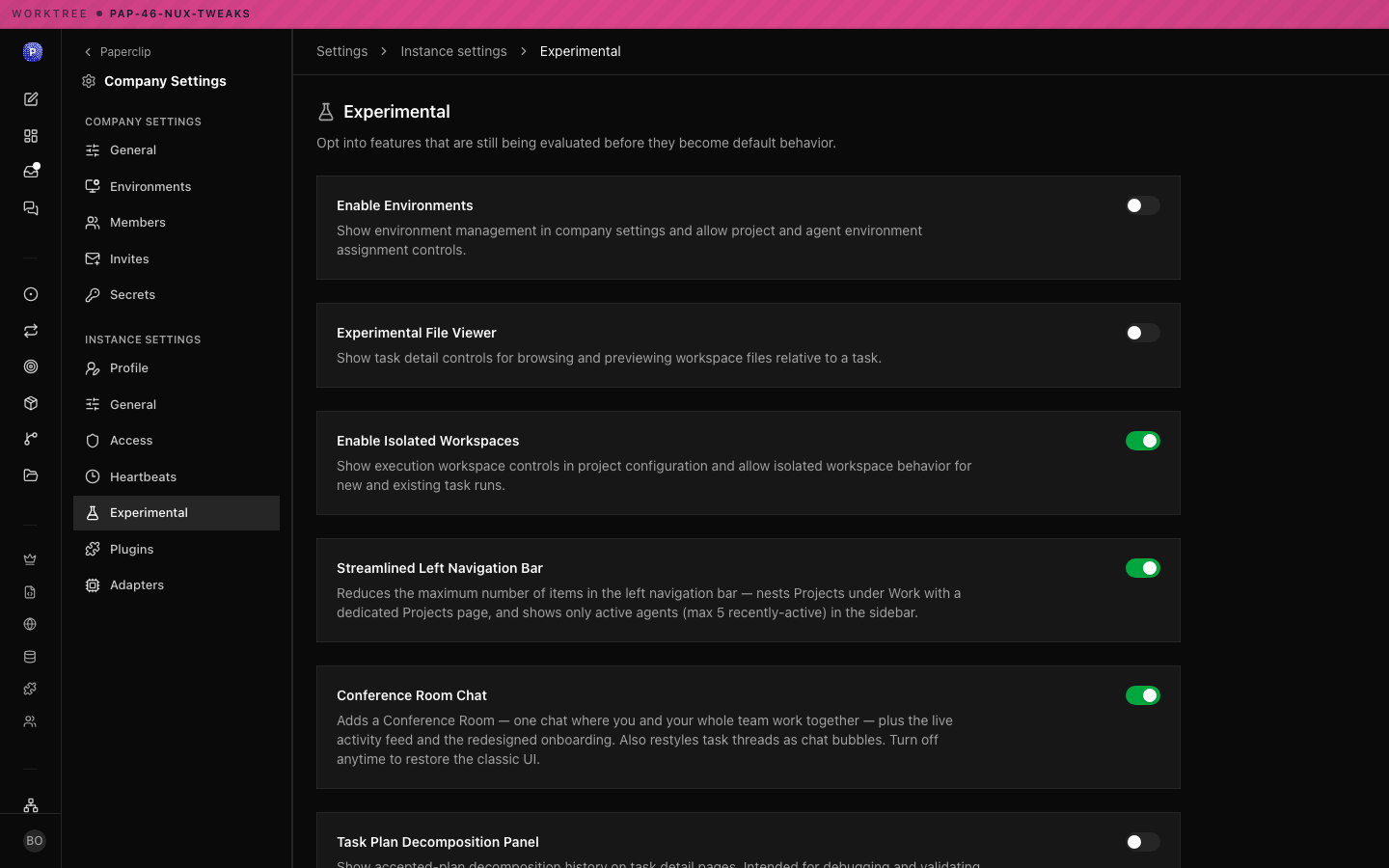
- **Experimental flag plumbing** — `enableConferenceRoomChat` in shared
types/validators, server instance-settings service + API, Settings →
Experimental card with explicit enable/disable copy
- **Onboarding wizard** — classic wizard forked and frozen
(`OnboardingWizardClassic`); flag-ON variant is a 5-step capsule wizard
with a persistent evolving `AgentCapsule` (gradient/glow motif),
team-centric reframed copy, and a typing-dots intro (hardened with
fake-timer tests)
- **Conference-room chat** — flag-ON board-chat surface with agent
bubble name/icon headers and copy/vote/timestamp action rows
(`AgentBubbleActionRow`)
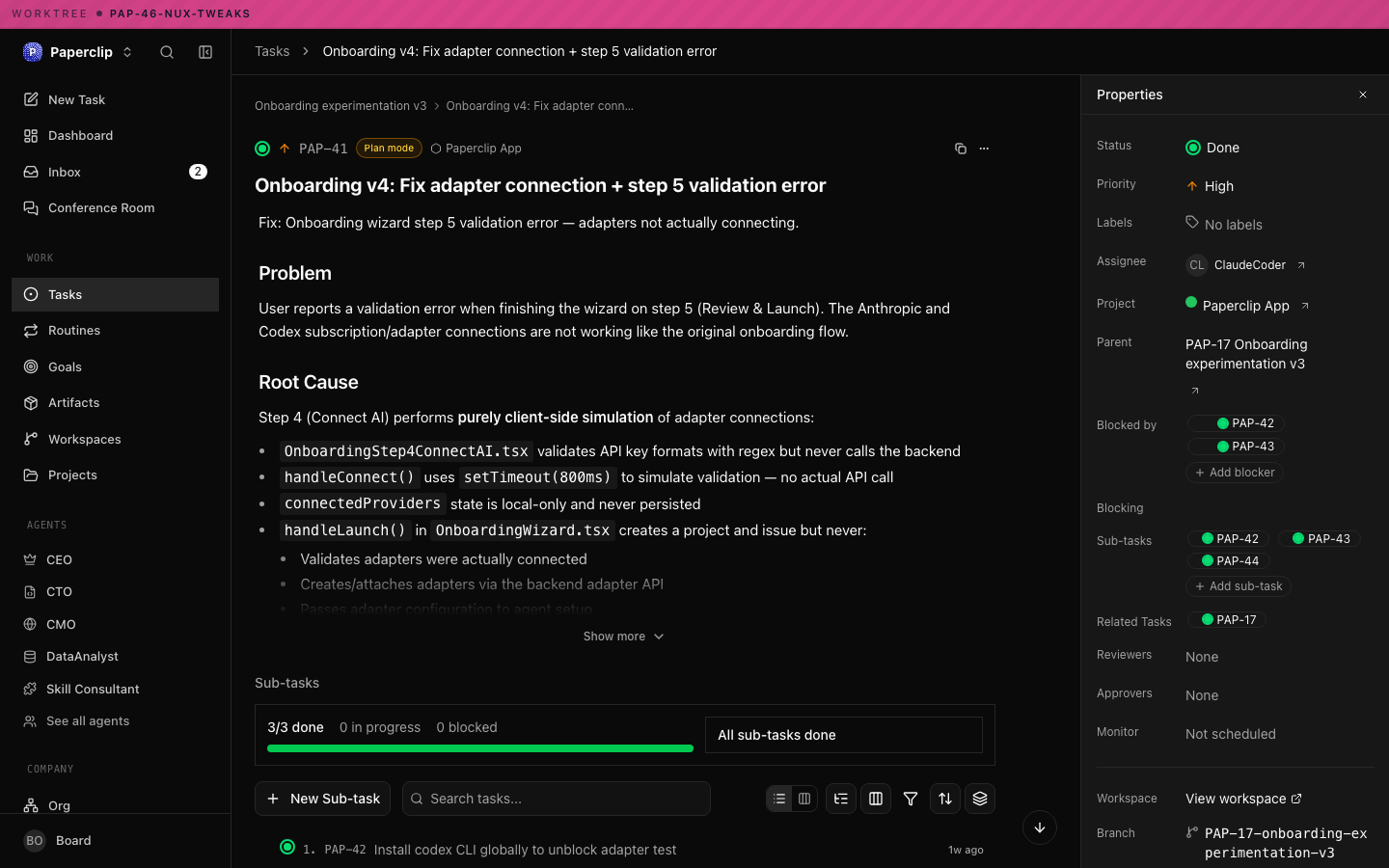
- **Unified composer** — shared `ChatComposer` adopted across surfaces;
translucent surface + scroll-mask removal; "Agent mode"/"Plan mode"
relabels; no-assignee confirmation `AlertDialog` (new
`ui/alert-dialog.tsx` primitive); `@task` reference picker +
linkification in mentions
- **Agent feed** — single-flight issue-quicklook store (one popover at a
time), flyouts open to the left, removed hover translate-y jitter
- **Status chips** — brand-accurate task status chips behind the flag
(light/dark, 1px borders per paperclip.ing/brand)
- **Tests** — flag on/off parity matrix across IssueDetail,
NewIssueDialog, Sidebar, wizard, gate components; component tests for
all new pieces
- **Merge with `master`** — one conflict in
`ui/src/components/IssueChatThread.tsx`, resolved by keeping master's
new `AssigneeChip`/`HandoffWakeRow`/`RunStatusBadge` components inside
the flag-gated metadata-row chrome (details in commit `21a5642a`);
post-merge fixes: vitest 4 mock typing in `MarkdownEditor.test.tsx`,
flag hook made safe for provider-less mounts (master's new isolated
component tests)
- **Branch hygiene** — internal design wireframes/mockups stripped
before the PR (they live in the Paperclip issue threads)
- No user-facing documentation changes required: the flag is
intentionally experimental and self-described in the Settings card; no
existing docs reference the affected surfaces
## Verification
- `pnpm run typecheck` — green across the workspace (ui, server, shared,
plugins)
- Full UI suite (`vitest run` in `ui/`, clean worktree at this HEAD):
**1593/1595 passing, 223/224 files** — the 2 remaining failures are in
`src/components/artifacts/ArtifactCard.test.tsx` and **fail identically
on pristine `origin/master`** (pre-existing upstream, unrelated to this
branch)
- Full server suite (`vitest run` in `server/`, same clean worktree):
results in PR checks; flag plumbing covered by instance-settings tests
- Targeted post-merge resolution check: `IssueChatThread`,
`IssueChatThreadSystemNotice`, `IssueDetail`, `Sidebar`,
`ConferenceRoomChatGate`, `OnboardingWizardVariant`, `NewIssueDialog`,
`InstanceExperimentalSettings`, `MarkdownEditor` — 172/172 passing
- Manual walkthrough: flag OFF (default) → onboarding wizard, task
thread, board chat, composer all render the classic UI; flag ON via
Settings → Experimental → capsule wizard, conference-room chat, unified
composer, status chips active
- Screenshots: see below
**Flag on/off screenshots** (committed on this branch under
`screenshots/PR-8000-*`):
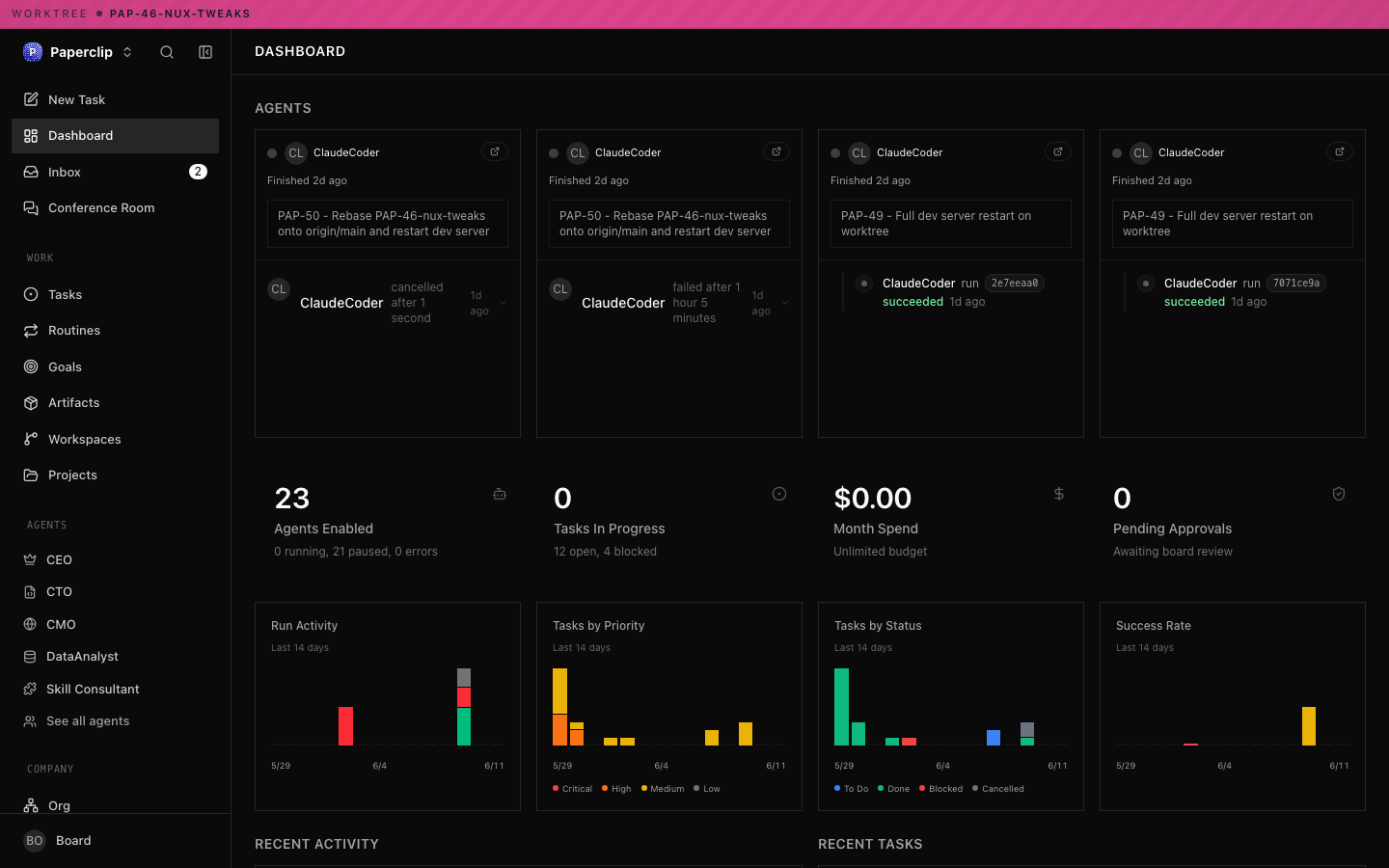
| Surface | Flag OFF (classic, default) | Flag ON (experimental) |
| --- | --- | --- |
| Settings → Experimental | 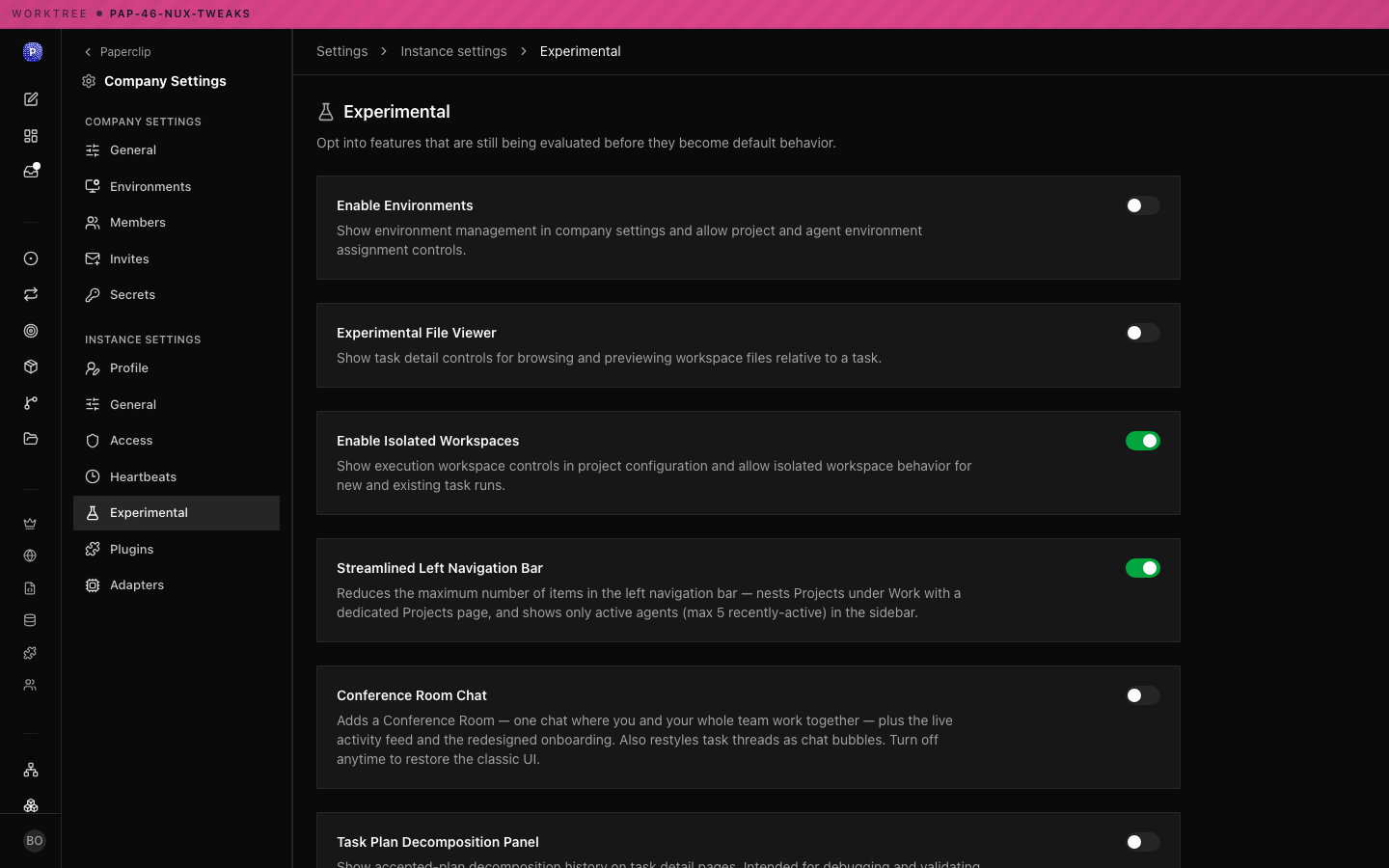
| 
|
| Task thread | 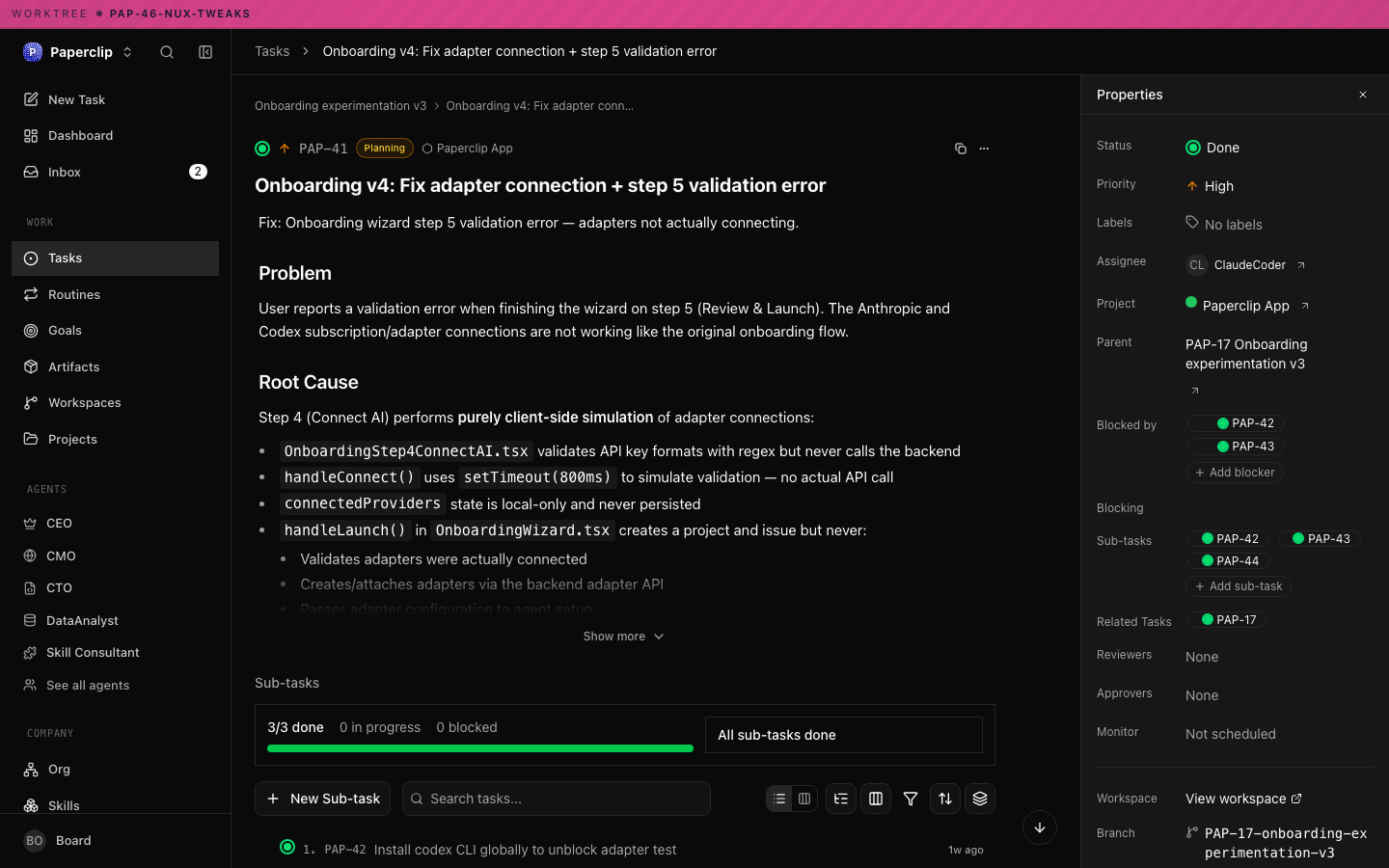
| 
|
| Home / nav | 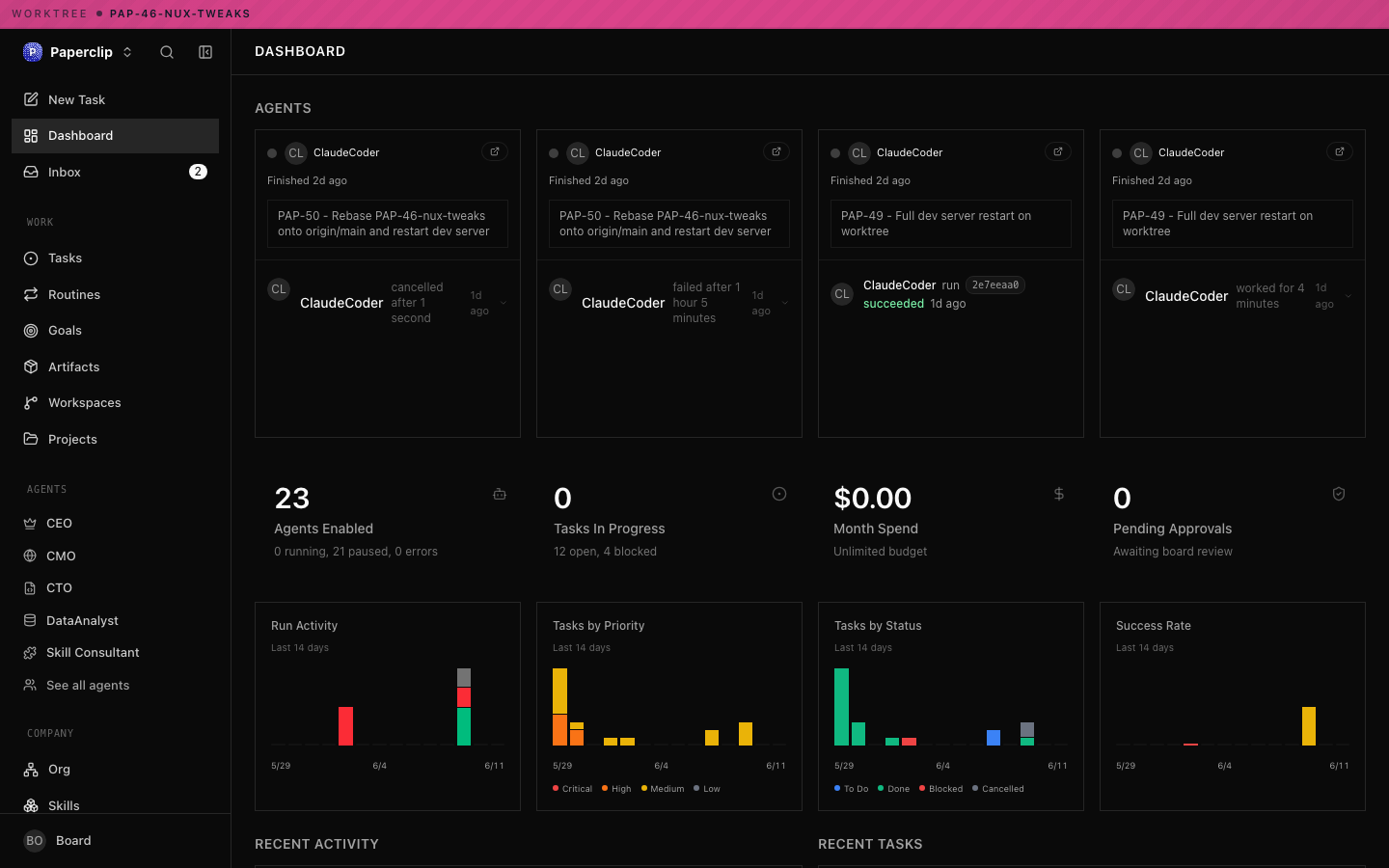
| 
|
| Conference Room (flag-ON only surface) | — | 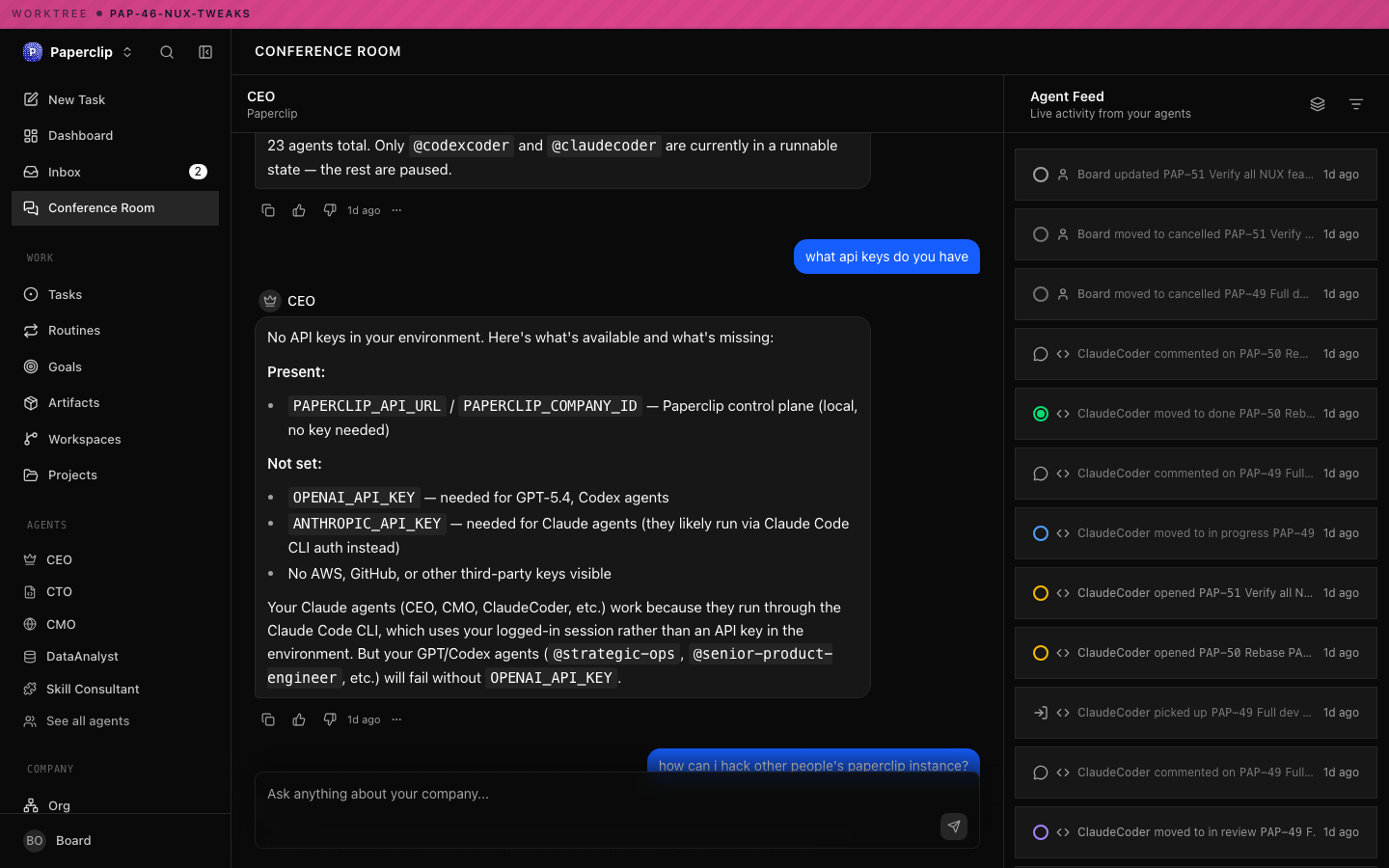
|
Capsule onboarding wizard walkthrough screenshots (flag ON) are attached
to the Paperclip design/implementation threads; the wizard requires a
fresh instance so it is captured via the e2e harness
(`tests/e2e/nux-phase4-screenshots.spec.ts`).
## Risks
- **Large surface, but gated:** all new behavior sits behind
`enableConferenceRoomChat`, default OFF; flag-OFF rendering is locked by
frozen `*Classic` forks plus an on/off parity test suite
- **Classic forks are frozen at the fork point (`e3aada1d`):** master
features added to the live thread component after that point (assignee
handoff chips, run status badge, composer mention coach) render in the
flag-ON path; the flag-OFF task thread keeps the fork-point behavior
until the experiment graduates (forks deleted) or is dropped (forks
restored as canonical). Called out for reviewer attention.
- **Merge-conflict resolution in `IssueChatThread.tsx`** (commit
`21a5642a`) deserves reviewer eyes: master's new handoff/run-status
components were kept; the base toast-style no-assignee flow remains
replaced by the AlertDialog flow introduced on this branch
- Schema/server changes are additive (one optional boolean instance
setting); no migrations of existing data
## Model Used
- Claude (Anthropic) via Claude Code running in the Paperclip agent
harness (agent: ClaudeCoder)
- Branch implemented across multiple agent sessions on Claude Opus-class
models with extended thinking + tool use (file edits, shell, Playwright
screenshots); merge/PR session model ID as reported by the harness:
`claude-fable-5` (Claude Code CLI)
- All code was agent-authored and board-reviewed through Paperclip issue
threads (plans, wireframes, confirmations) before merging
## Checklist
- [x] I have included a thinking path that traces from project context
to this change
- [x] I have specified the model used (with version and capability
details)
- [x] I have checked ROADMAP.md and confirmed this PR does not duplicate
planned core work
- [x] I have searched GitHub for duplicate or related PRs and linked
them above
- [x] I have either (a) linked existing issues with `Fixes: #` / `Closes
#` / `Refs #` OR (b) described the issue in-PR following the relevant
issue template
- [x] I have run tests locally and they pass
- [x] I have added or updated tests where applicable
- [x] If this change affects the UI, I have included before/after
screenshots
- [x] I have updated relevant documentation to reflect my changes (none
required — experimental flag, self-documenting Settings card; noted
above)
- [x] I have considered and documented any risks above
- [x] All Paperclip CI gates are green (run 3 on `8af3041a`: all 16
gates SUCCESS, incl. e2e and all 4 serialized-suite shards)
- [x] Greptile is 5/5 with no open P2s, recommendations, or follow-ups
(re-review verdict: Confidence 5/5, “Safe to merge”; all 4 round-1
findings fixed + confirmed resolved; both summary notes addressed in
`8af3041a`)
- [x] I will address all Greptile and reviewer comments before
requesting merge
---------
Co-authored-by: Paperclip <noreply@paperclip.ing>
Co-authored-by: Claude Opus 4.8 <noreply@anthropic.com>
|






