mirror of
https://github.com/paperclipai/paperclip.git
synced 2026-10-23 17:33:51 +02:00
564d4e1bce10b4e18f6daff09ebd4690e686872d
4
Commits
| Author | SHA1 | Message | Date | |
|---|---|---|---|---|
 DottaandPaperclip |
2b4a1d7073 |
feat(dot): add guided invitations and persistent agent connections (#15581)
Add guided external-agent invitations with live Dot connection checks and ongoing access until revoked. Keep expired credentials invalid and enforce permissions for private avatar uploads. Preserve Runner recovery and remote launch boundaries. Co-Authored-By: Paperclip <noreply@paperclip.ing> |
||
|
DottaandPaperclip
|
d66acb7ac1 |
feat: automate Slack bot app setup and installation (#15413)
## Thinking Path > - Paperclip is the open source app people use to manage AI agents for work. > - Chat connectors give each agent a customer-owned bot and task-backed conversations. > - Manual Slack setup requires app creation and copying durable credentials. > - Operators need a shorter setup that an assisting agent can use safely. > - This pull request creates the app through Slack's Manifest API and installs it through OAuth. > - Durable registration state supports recovery without creating another app. > - A four-screen wizard, automatic avatar upload, and OAuth account linking reduce setup work. > - Connector settings and per-turn tool guidance support daily use after installation. ## Linked Issues or Issue Description **Subsystem affected** Native Slack bot setup, company secret storage, chat connector management, and agent tool guidance. **Problem or motivation** New Slack bots require manual app creation and copying a signing secret and bot token. Interrupted setup can create duplicate apps. The setup and management screens contain unnecessary controls. Agents also need guidance for native questions, files, thread replies, and governed Slack actions. **Proposed solution** Use a temporary app-configuration access token to create a customer-owned app. Save durable secrets in the vault. Bind OAuth to the initiating actor, company, endpoint, registration revision, scopes, and configured origins. Preserve manual and existing-app recovery. Link the installing user's account, send a welcome DM, and advance from saved server evidence. Keep request-URL recovery instructions available if automatic connection detection waits. **Alternatives considered** The Slack CLI adds installation requirements. Socket Mode changes transport. A shared Paperclip-owned app changes app ownership. These alternatives are outside this change. **Roadmap alignment** This extends existing chat connectors and secrets capabilities. Related public work: #14037 and #13954 cover Slack MCP prerequisites and user OAuth. No duplicate bot-registration PR was found. ## What Changed - Share one reviewed manifest builder between automatic registration and manual setup. - Add replay-safe migration 0318 and company-bound registration state with vault references and uncertain-creation recovery. - Add registration, installation, callback, and resume APIs with short-lived, single-use OAuth state. - Save installation credentials before downstream checks and preserve bot identity constraints. - Reduce automatic setup to four screens. Keep advanced app details, manual recovery, and existing-app setup. - Upload the agent avatar with the Paperclip dark background. Link the OAuth installer's account and send setup DMs. - Show agent and connector-owner avatars. Simplify settings, access, and conversation screens. - Discover joined Slack channels and enable them by default. Start a task from a bare mention and admit same-thread follow-ups. - Refresh Slack tool guidance each turn. Add native-form, file, approval, and delivery regressions plus manual model probe definitions and sanitized acceptance records. - Update deployment/database docs, OpenAPI, redaction, removal cleanup, production Storybook stories, and provider browser tests. - Merge current master and move the registration migration after its latest migration without rewriting published commits. The completed Slack success view intentionally has a single centered **Done** action and no **Save & exit**, as explicitly requested by the product owner. `DESIGN.md` records this exception; unfinished setup steps retain the aligned wizard footer. ## Verification - Passed after the master merge: repository typecheck, full build, Storybook build, design-token gates, module-boundary gates, and migration generation. - Passed: all 352 focused Slack deterministic tests and all 14 affected provider browser tests. Browser tests use controlled provider fixtures and a separate throwaway instance. - Passed on current head `c5d01e0e2`: the complete GitHub test matrix (general server, chat, all workspaces, serialized server, and Runner), all eight browser shards, typecheck/release registry, build, canary dry run, security checks, and policy gates. There are 52 passing checks and no pending or failing checks. - Greptile completed on the exact current head with 5/5 and no actionable findings or open review threads. - Local repair verification passed 93 focused tests, including same-app reinstall after revocation and rejection of consent started before revocation, the AgentMail browser journey, and repository typecheck. Local build and Storybook build also passed. The redundant local full-suite rerun was stopped after the complete current-head CI matrix passed. - Real Slack setup and agent replies were exercised in the authorized isolated test drive during the setup iteration. - The ten additional model probes were attempted with legacy `codex_local`, `gpt-5.6-sol`: five passed, two failed, and three were partly verified. Native runtime is not qualified. See `server/src/services/connectors/slack/evals/2026-10-08-acceptance.md` for evidence and limits. - Passing model probes cover native forms, downloaded file bytes, bare mentions with thread replies, explicit posts/reactions, and saved approval denial. - The controlled uncertain-write probe found wrong delivery-check IDs. The canvas fallback attempt used an invented tool name. Search pagination/native search, a private-source denied-tool receipt, and distinct board/webhook origins remain unqualified. Reviewer path: enable Chat connectors, start Slack chat setup, select an agent, enter an app-configuration access token, and approve Slack installation. Send a message to the bot and confirm that setup advances to success. Inspect settings and allowed channels. See `doc/connections/SLACK-AUTOMATIC-SETUP.md` for deployment and recovery. ## Risks - Slack app creation has no provider idempotency guarantee. A timeout after dispatch stays uncertain until the operator checks Slack. - OAuth needs a stable public HTTPS board origin. Webhook ingress may use a separate configured HTTPS origin. Workspace policy can delay installation. - Migration 0318 can replay safely on instances that applied the earlier development migration. - OAuth installation now links the installer to the initiating Paperclip user. Identity checks and company access rules still apply. - Joined channels now enable bot responses by default. Linked-user authorization and per-action approval rules still apply. - Model behavior has the documented delivery-check and canvas fallback failures. A passing CI run does not establish that every model probe passed. - Removing the connection does not delete the customer's Slack app. No new first-party telemetry is added. ## Model Used OpenAI Codex, GPT-6 family, with reasoning, repository tools, code execution, and browser verification. The runtime does not expose a more specific authoring model ID or context-window size. The live bot probes used OpenAI `gpt-5.6-sol` through `codex_local` in legacy mode. ## Checklist - [x] I have included a thinking path that traces from project context to this change - [x] I have specified the model used (with version and capability details) - [x] I have checked ROADMAP.md and confirmed this PR does not duplicate planned core work - [x] I have searched GitHub for duplicate or related PRs and linked them above - [x] I have either (a) linked existing issues with `Fixes: #` / `Closes #` / `Refs #` OR (b) described the issue in-PR following the relevant issue template - [x] I have not referenced internal/instance-local Paperclip issues or links (only public GitHub `#NNN` / `github.com/paperclipai/paperclip` URLs) - [x] My branch name describes the change (e.g. `docs/...`, `fix/...`) and contains no internal Paperclip ticket id or instance-derived details - [x] I have run tests locally and they pass - [x] I have added or updated tests where applicable - [x] I have updated relevant documentation to reflect my changes - [x] I have considered and documented any risks above - [x] All Paperclip CI gates are green - [x] Greptile is 5/5 with no open P2s, recommendations, or follow-ups - [x] I will address all Greptile and reviewer comments before requesting merge --------- Co-authored-by: Paperclip <noreply@paperclip.ing> |
||
|
|
86b7ee992c |
feat(onboarding): ClipLab sleepy-to-wake hero and step hand-offs (#13629)
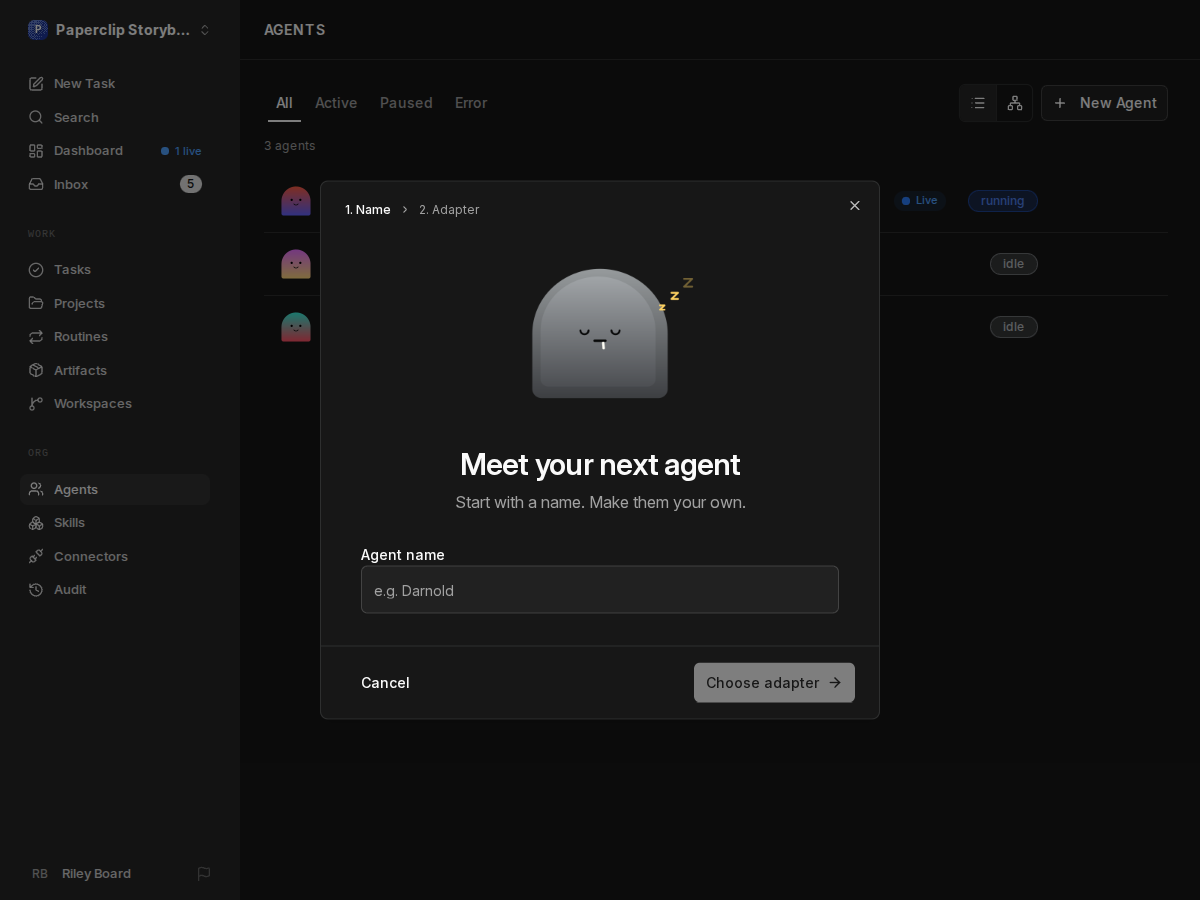
## Thinking Path > - Paperclip is the open source app people use to manage AI agents for work. > - Agents have a persistent visual identity (#13171): a ClipLab character in one of 17 palettes, rendered as cached PNGs in lists and as a live character in larger placements. > - The onboarding wizard is where a person meets that identity first, and it showed a stock ClipLab expression on the previous engine while the rest of the app would show a different character on a newer one. > - The wizard's steps also cut from one screen to the next, so the arc read as separate pages rather than one walk. > - This pull request puts one character on one engine everywhere, gives the wizard's hero the studio's sleepy → wink → idle sequence on Review, and hands the steps over inside one presence. > - The benefit is that what wakes on Review is exactly what the agent looks like on the dashboard afterwards, and the walk to it reads as one screen changing. ## Linked Issues or Issue Description Refs #13171, now merged into master. This PR contains the onboarding and ClipLab update on top of that foundation. Original feature work by @tonio-alucema; merge preparation preserves the original commits. **Problem or motivation** The onboarding hero and the app's avatars were two different characters on two different ClipLab engines. Steps 1 → 4 of the wizard cut between screens, and the wizard mounted cold when a cloud-managed workspace arrived from Cloud's naming screen. **Proposed solution** Vendor ClipLab v0.2.0 as the shared engine and render one studio-exported character from it in every palette, for every pose and size. Play the export's one-shot wake on Review with the palette fading in over the gray dormant loop. Hand steps over inside one presence so the footer slides instead of jumping, and play the arrival half of that hand-off when the wizard opens directly on the agent step. **Alternatives considered** Exporting mp4/webm loops per size: no cursor following, no clean alpha, and the palette "colour in" is a runtime blend. Minting a `cap-v2` character version: nothing had shipped `cap-v1`, so the artwork is regenerated in place instead of migrated. Keeping the separately vendored runtime bundle for the hero: two engines and two characters in one app. ## What Changed - `packages/shared/src/cliplab`: re-vendored from ClipLab v0.2.0 (`987b6db0`) with the Paperclip adaptations replayed (optional graphics backend for the Node SVG snapshot path, supersampled live textures, character framing, deterministic SVG id prefixes); new upstream `particles.ts`. - `packages/shared/src/cliplab/character.ts`: the studio export, mirrored from `ui/src/assets/cliplab/onboarding.character.json` by `scripts/sync-cliplab-character.mjs` (drift caught by `check:token-gates`). `characterDefinition` builds every palette from it; the resting portrait is its idle beat. - `OnboardingCharacter`: gray `sleepy` loop through the agent and connect steps; on Review the one-shot sleepy → wink → idle plays on two lock-step canvases while the palette fades in, then the `idle` loop. Body-follows the pointer, page-scoped. 160px in the wizard. - `OnboardingWizard`: steps 1 → 2 → 3 → 4 hand over inside one `AnimatePresence` (departing content fades and gives its room back; arriving content opens its room then fills); the hero has a room that opens on the walk into the agent step; opening directly on the agent step plays the arrival half; the self-hosted naming step uses the arc's label and field. - Motion vocabulary in `onboarding-motion.ts` (`stepContentMotion`, `ledeMotion`, `heroRoomMotion`, `heroRoomArrival`, `titleSwapMotion`). - Storybook: `Onboarding / Character` (Wake Up), `Onboarding / Agent arc` walkable from the naming step plus `Arrive From Cloud`; the companies fixture answers the wizard's create call with a company. - Uses the shared runtime for onboarding; `doc/agent-personas.md` documents the shared character. - Releases both onboarding canvases after partial startup or transition failure. Registers each canvas before seeking so synchronous render errors can release it. Six component tests cover these failures and palette changes before or during wake. - Refreshes both sleeping canvases when the palette changes, including a palette change in the same render as wake. - Moves choreography values into the CSS token layer and preserves the shared motion catalog drift check across the imported stylesheet. - Repairs the static Storybook avatar route and uses accessible heading names/current button labels in the wizard play functions. - Closes the lazy avatar worker pool during application shutdown. ## Verification - Merge-preparation checks: `pnpm -r typecheck`, `pnpm build`, `pnpm build-storybook`, and `pnpm check:token-gates` pass. The final UI typecheck and 123 focused onboarding, lifecycle, and token catalog tests pass. All 55 checks on final head `b4f5e201a1564083d163abc6f93f5b3da06ccefd` pass, including the full sharded test suite, runner verification, and all eight browser shards ([CI run](https://github.com/paperclipai/paperclip/actions/runs/35445430535)). The duplicate monolithic local `pnpm test:run` was stopped after CI completed; it is not claimed as a separate completed local run. - Chromium walkthrough: palette change, wake, return to sleep, WebGL failure fallback, Review step hand-offs and cloud arrival pass with normal and reduced motion; no browser errors. The signoff happy-path browser test also passes against a disposable instance. - The final CI run confirms the catalog fix and a passing signoff browser shard. The earlier signoff failure was a heartbeat-run availability timeout; the focused local reproduction and final CI passed without signoff code changes. - Original author verification: - `pnpm check:token-gates` (includes the new character sync check); shared, server avatar/persona (17) and UI onboarding/persona (137) suites pass; `pnpm build-storybook` packages all 3,564 avatar PNGs through the worker pipeline. - Storybook: `Agents / Personas` Sizes, Expressions and Palettes render the studio character at every size and pose; `Onboarding / Character → Wake Up` plays the wake on the shared engine; `Onboarding / Agent arc` walks 1 → 4 with the hand-offs, and `Arrive From Cloud` plays the arrival (measured: content room 6 → 65px over 320ms, fade to 1.0 by ~560ms, footer travel continuous). - The original author walked the agent → connect → review flow and wake after a real sign-in on staging. - Not done here: the Linux Storybook visual baselines (`tests/storybook-visual/agent-personas.spec.ts`) need re-baselining for the new engine, hero size and naming-step changes. ## Risks - Every avatar's pixels change (new engine, new character) under the unchanged `cap-v1` name. Stacks that rendered avatars on the previous engine keep those PNGs in their cache (`generated-agent-avatars/cap-v1/...`, served immutable) until cleared; only the two pinned staging stacks ever did. - The one-shot handoff to the idle loop is timed from the sequence's authored duration (the engine reports completion by continuing into idle itself); presentation only, nothing in the wizard's state waits on it. - Reduced motion skips the wake and the hand-offs; jsdom is treated the same way, so the wizard tests see the next step's content immediately. - The committed export differs from the studio by one animation (Loop off, leading idle step removed); a re-export without that fix would play a 5.6s idle before the wake. ## Model Used Original feature: Anthropic Claude Fable 5.1 (`claude-fable-5-1`) in Claude Code, with shell, browser, and file tools. The original context window was not recorded. Merge preparation and lifecycle regression fixes: OpenAI GPT-6 in Codex, with reasoning, shell execution, file editing, GitHub CLI, and automated tests. The session does not expose an exact runtime model ID or context-window size. ## Checklist - [x] I have included a thinking path that traces from project context to this change - [x] I have specified the model used (with version and capability details) - [x] I have checked ROADMAP.md and confirmed this PR does not duplicate planned core work - [x] I have searched GitHub for duplicate or related PRs and linked them above - [x] I have either (a) linked existing issues with `Fixes: #` / `Closes #` / `Refs #` OR (b) described the issue in-PR following the relevant issue template - [x] I have not referenced internal/instance-local Paperclip issues or links (only public GitHub `#NNN` / `github.com/paperclipai/paperclip` URLs) - [x] My branch name describes the change (e.g. `docs/...`, `fix/...`) and contains no internal Paperclip ticket id or instance-derived details - [x] I have run tests locally and they pass - [x] I have added or updated tests where applicable - [x] I have updated relevant documentation to reflect my changes - [x] I have considered and documented any risks above - [x] All Paperclip CI gates are green - [x] Greptile is 5/5 with no open P2s, recommendations, or follow-ups - [x] I will address all Greptile and reviewer comments before requesting merge 🤖 Generated with [Claude Code](https://claude.com/claude-code) --------- Co-authored-by: Dotta <bippadotta@protonmail.com> Co-authored-by: Paperclip <noreply@paperclip.ing> Co-authored-by: Claude Fable 5.1 <noreply@anthropic.com> |
||
|
|
1ef3b08714 |
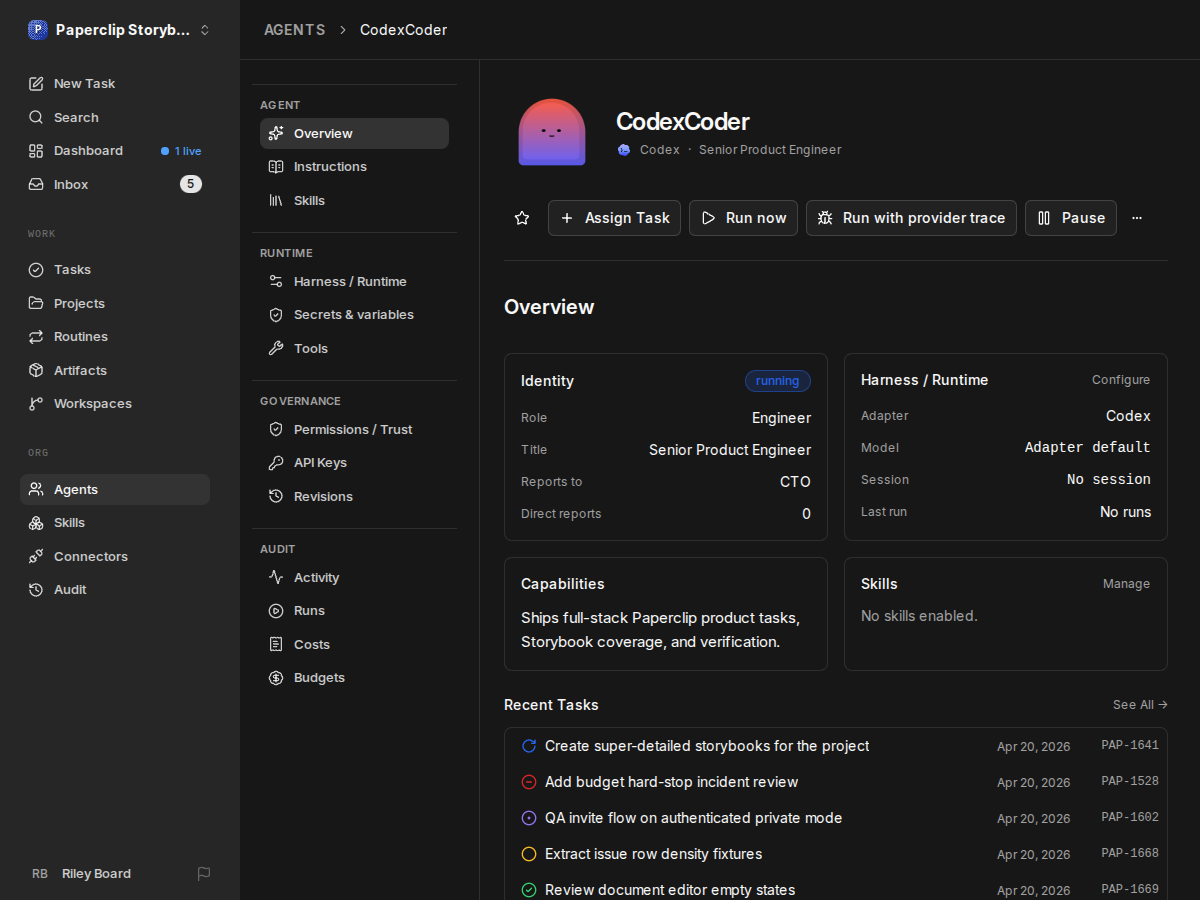
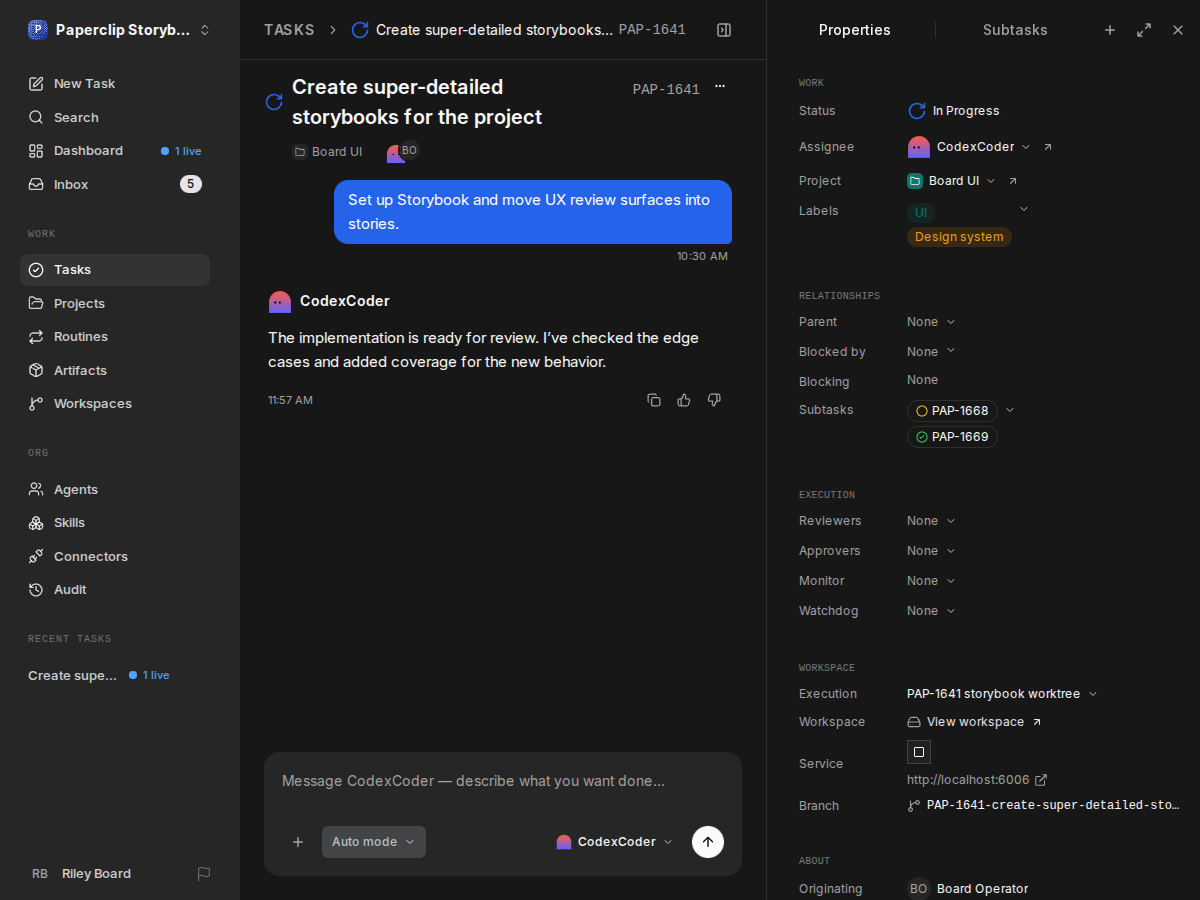
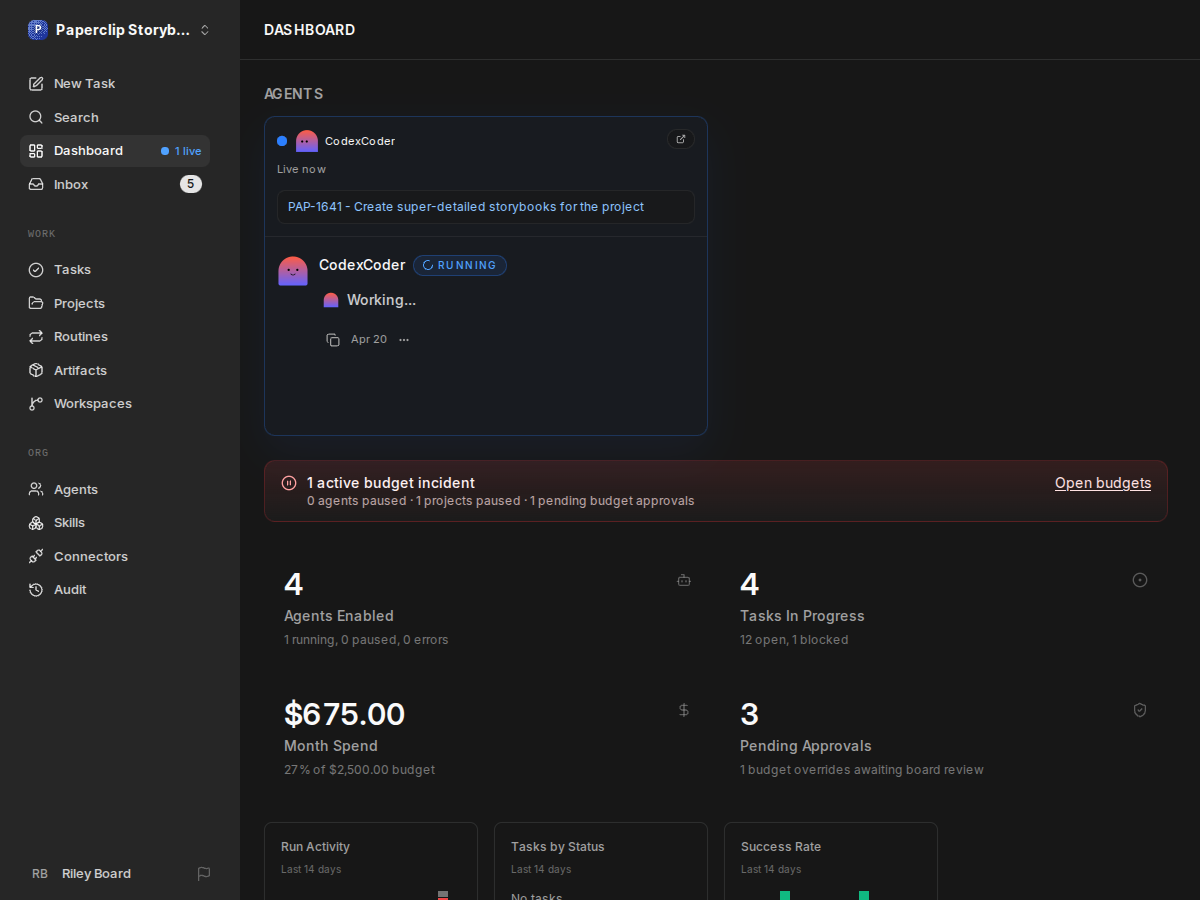
feat(ui): integrate agent personas across the app (#13171)
## Thinking Path > - Paperclip is the open source app people use to manage AI agents for work. > - A stable agent persona is useful only when the same identity appears across the app. > - Lists, task messages, selectors, and activity feeds need inexpensive static avatars. > - Onboarding and agent headers need a larger character with expressions and pointer tracking. > - This pull request connects the persona foundation to those existing views and preserves onboarding draft assignments. > - Full-page stories and Linux checks make the placements and performance contract reviewable. ## Linked Issues or Issue Description **Problem or motivation** Agents need a stable visual identity in lists, tasks, onboarding, and configuration. External tools also need an image URL for that identity. **Proposed solution** Assign each agent a permanent palette from a fixed ClipLab character library. Store the assignment on the agent. Render and cache preset PNG URLs on demand. Use static images in dense views and one animated character in larger placements. **Alternatives considered** A generated image bundle requires a separate asset build. A live renderer in every avatar adds unnecessary work in large lists. Arbitrary uploaded images do not provide the requested shared character system. **Roadmap alignment** This improves agent identity across existing control-plane views. It preserves agent permissions, company boundaries, and status labels. ROADMAP.md has no separate ClipLab persona milestone. Related approaches: #2422 adds configurable image URLs and DiceBear generation; #5578 adds optional uploaded avatars. This work uses a fixed, versioned character library and preset URLs. ## What Changed - Replace agent icons with static persona images across lists, the sidebar, org charts, tasks, comments, selectors, activity, and dashboard views. - Put one animated character in the agent header. Let it follow the pointer across the page, with reduced-motion and touch fallbacks. - Add larger padded characters to agent creation. Keep the palette stable across draft refreshes and connection retries, then reveal it after success. - Pass appearance through shared projections rather than fetching each agent separately. - Add real full-page Storybook examples for the agent list, overview, task, dashboard, new-agent dialog, and connection page. - Add Linux screenshot, clipping, density, and 500-avatar performance checks. ## Verification - `pnpm -r typecheck`, `pnpm build`, and token gates pass on the rebased tree. Persona lifecycle tests pass. - The rebased feature passes 38 Linux screenshot/performance checks, including both display densities, corner pointer positions, and the no-WebGL/no-live-download contract for 500 avatars. - The final Linux persona suite passes all 38 visual, lifecycle, density, and full-page checks using the standard Storybook configuration and real on-demand avatar endpoint. - Final local focused verification: 45 avatar/native-recovery tests pass; UI identity/routine tests, typecheck/build, token gates, and Storybook build pass. - Current-head CI passes: full workspace/server tests, all serialized server groups, typecheck/release checks, build, canary validation, and end-to-end shards. The build passed after retrying a native-runner concurrency-test failure; its three targeted cases also pass locally. - Manual inspection covered stable identities in the app, header placement, full-page mouse tracking, onboarding size, and task/dashboard placements. ### Screenshots Linux captures use synthetic Storybook fixtures. Full-page captures use reduced motion. The live character, mouse tracking, and disposal are checked separately. <details> <summary>Agent overview with the character in its header</summary> <img src="https://raw.githubusercontent.com/paperclipai/paperclip/8c68f42b268ada22b67d79d0fe1bb0a2f84ec25c/screenshots/full-page-agent-overview.png" width="900" alt="Agent overview with the character in its header" /> </details> <details> <summary>Task messages and assignee identity</summary> <img src="https://raw.githubusercontent.com/paperclipai/paperclip/8c68f42b268ada22b67d79d0fe1bb0a2f84ec25c/screenshots/full-page-task.png" width="900" alt="Task messages and assignee identity" /> </details> <details> <summary>Larger onboarding character with room for expressions</summary> <img src="https://raw.githubusercontent.com/paperclipai/paperclip/8c68f42b268ada22b67d79d0fe1bb0a2f84ec25c/screenshots/full-page-meet-your-next-agent.png" width="900" alt="Larger onboarding character with room for expressions" /> </details> <details> <summary>Dashboard agent activity</summary> <img src="https://raw.githubusercontent.com/paperclipai/paperclip/8c68f42b268ada22b67d79d0fe1bb0a2f84ec25c/screenshots/full-page-company-dashboard.png" width="900" alt="Dashboard agent activity" /> </details> ## Risks - This PR depends on #13170, the persona foundation. Merge the foundation first, then retarget this PR to master. - Many placements change from icons to character silhouettes. Human avatars and authoritative agent status labels retain their existing behavior. - Only one character can render live per view. Reduced motion, hidden/offscreen content, touch input, and renderer failures use the defined fallbacks. - The full-page stories use fixture data. They do not contact a real company or complete real provider sign-in. ## Model Used OpenAI Codex, GPT-6 family. The exact model identifier and context window are not exposed in this session. Used code editing, shell execution, browser inspection, and Linux visual testing. ## Checklist - [x] I have included a thinking path that traces from project context to this change - [x] I have specified the model used (with version and capability details) - [x] I have checked ROADMAP.md and confirmed this PR does not duplicate planned core work - [x] I have searched GitHub for duplicate or related PRs and linked them above - [x] I have either (a) linked existing issues with `Fixes: #` / `Closes #` / `Refs #` OR (b) described the issue in-PR following the relevant issue template - [x] I have not referenced internal/instance-local Paperclip issues or links (only public GitHub `#NNN` / `github.com/paperclipai/paperclip` URLs) - [x] My branch name describes the change (e.g. `docs/...`, `fix/...`) and contains no internal Paperclip ticket id or instance-derived details - [x] I have run tests locally and they pass - [x] I have added or updated tests where applicable - [x] I have updated relevant documentation to reflect my changes - [x] I have considered and documented any risks above - [x] All Paperclip CI gates are green - [x] Greptile is 5/5 with no open P2s, recommendations, or follow-ups - [x] I will address all Greptile and reviewer comments before requesting merge --------- Co-authored-by: Paperclip <noreply@paperclip.ing> Co-authored-by: Tonio <tonework@gmail.com> Co-authored-by: Claude Fable 5.1 <noreply@anthropic.com> |