mirror of
https://github.com/paperclipai/paperclip.git
synced 2026-10-29 12:59:13 +01:00
54d91c685ac6728cb17e20fd971d5afdb57dac2e
6
Commits
| Author | SHA1 | Message | Date | |
|---|---|---|---|---|
 Devin FoleyandPaperclip |
06484b3c41 |
fix: preserve conversation retries through execution cleanup (#15463)
## Thinking Path > - Paperclip is the open source app people use to manage AI agents for work. > - Recovery schedules bounded retries after a provider disconnects. > - A stopped run can still hold its environment lease while cleanup runs. > - Retrying before that lease is released cancels the new run before it starts and spends another retry. > - Restoring the task can also send the worker repair instructions from an already resolved recovery action. > - This pull request preserves the waiting retry and removes settled recovery instructions from later wakes. > - The task can continue after cleanup without an operator repairing the same incident again. ## Linked Issues or Issue Description **What happened?** A legacy conversation run disconnected while it was doing ordinary work. Its environment cleanup took longer than the retry delay. Two retries were cancelled before dispatch with `execution_reconciliation_required`. Those cancellations exhausted the failure budget. After an operator restored the task, the wake still told the original worker to repair the runtime and hand the task back to itself. **Expected behavior** Cleanup waits preserve the pending attempt. The same retry can continue after ownership is released, subject to all current gates. Once a recovery action is resolved or cancelled, subsequent task wakes omit its repair instructions. **Steps to reproduce** 1. Fail a legacy conversation run while its environment lease remains in `pending_cleanup`. 2. Schedule a bounded retry and run promotion before cleanup releases that lease. 3. Repeat the scheduler sweep. Before this fix, retries promote and then cancel without starting. 4. Resolve a stranded-task recovery action and build the restored task wake with that action ID. Before this fix, the wake still includes the settled repair instructions. **Paperclip version or commit** Reproduced with database regressions against `ceabc3bc880` on master. Related: #15019 restores a skipped assignment handoff after lease release. #15235 filters stale handoff evidence in the recovery sweep. This change preserves an existing scheduled conversation retry and corrects restored wake content. It does not create a new handoff wake. ## What Changed - Keep an unstarted legacy conversation retry on the same durable row while prior execution ownership remains active. Recheck after 30 seconds without increasing retry accounting. - Return a queued retry to scheduled state if it encounters that hold at the claim gate. Retain its issue claim and publish the status change. - Record one local lifecycle diagnostic per blocking run. Remove that wait marker on promotion. - Include recovery action metadata only while the referenced action is active or escalated. - Return an explicit `waiting` response and the saved schedule when Retry now meets cleanup. Show the wait inline without a false success or disabled button. - Add database, rendered-prompt, route, and UI regressions. Document the execution and run-log contracts. ## Verification - Five cleanup and restored-wake regressions fail against the original production code. The Retry now route and UI regressions also fail before their correction. - Related retry, dispatch, stale-queue, and recovery suites: 321 tests pass across seven files. All ten focused cleanup/restored-wake cases pass after rebase. The final dispatch adjustment passes all 46 adapter tests. - Retry now routes and affected UI suites: all 46 tests pass. The tests cover repeated clicks, the saved schedule, unchanged accounting, promotion after release, and no false success or error state. - `pnpm -r typecheck`, `pnpm build`, `pnpm build-storybook`, and `pnpm check:token-gates` pass. - Full local `pnpm test:run` was started and then stopped after the final commit passed all GitHub CI test shards. No complete local full-suite result is claimed; CI supplies the complete test result for the final commit. - Final head `6f1058a332c039e33c4f002b296d20a5554e760e`: all 55 GitHub checks are green or intentionally skipped. Apex review is 5/5 after two reviews, with no unresolved threads. The PR has no merge conflicts. ## Risks The wait applies only to unstarted legacy conversation retries. Native runs and non-conversation execution keep their existing recovery rules. Cleanup must actually release ownership before execution can resume. The wait does not fix a cleanup service that never finishes. Promotion and dispatch still enforce cancellation, reassignment, pause, budget, and reconciliation gates. No schema change is required. The Retry now response adds a `waiting` outcome; the shared contract and all three UI controls handle it. ## Model Used OpenAI Codex based on GPT-6, with repository analysis, tool use, and local code execution. The runtime does not expose the precise serving model ID or context window. ## Checklist - [x] I have included a thinking path that traces from project context to this change - [x] I have specified the model used (with version and capability details) - [x] I have checked ROADMAP.md and confirmed this PR does not duplicate planned core work - [x] I have searched GitHub for duplicate or related PRs and linked them above - [x] I have either (a) linked existing issues with `Fixes: #` / `Closes #` / `Refs #` OR (b) described the issue in-PR following the relevant issue template - [x] I have not referenced internal/instance-local Paperclip issues or links (only public GitHub `#NNN` / `github.com/paperclipai/paperclip` URLs) - [x] My branch name describes the change (e.g. `docs/...`, `fix/...`) and contains no internal Paperclip ticket id or instance-derived details - [x] I have run tests locally and they pass (focused suites; complete final-head test coverage in CI) - [x] I have added or updated tests where applicable - [x] I have updated relevant documentation to reflect my changes - [x] I have considered and documented any risks above - [x] All Paperclip CI gates are green - [x] Greptile is 5/5 with no open P2s, recommendations, or follow-ups - [x] I will address all Greptile and reviewer comments before requesting merge --------- Co-authored-by: Paperclip <noreply@paperclip.ing> |
||
|
DottaandPaperclip
|
f2715e02bb |
fix(native): surface model capacity errors and retry automatically (#15347)
## Thinking Path > - Paperclip is the open source app people use to manage AI agents for work. > - Native runs preserve provider events and results, then decide task state. > - Codex can fail a turn because the selected model is temporarily at capacity. > - Paperclip displayed a generic native-session failure and left the task in recovery. > - A known capacity failure needs a clear message and a durable delayed retry. > - This pull request uses committed terminal evidence, the status-effect ledger, and existing dispatch gates. > - The task can continue automatically without an unbounded retry loop or a model switch. ## Linked Issues or Issue Description Related: #13993 adds launcher capacity deferrals before provider startup. This change handles a committed native Codex `serverOverloaded` terminal after provider work has started. **What happened?** A native Codex turn ended with `codexErrorInfo: serverOverloaded` and “Selected model is at capacity. Please try a different model.” Paperclip saved the result, showed a generic failure, and required recovery instead of waiting and retrying. **Expected behavior** Show the capacity error directly. Schedule bounded retries after a short delay. Preserve saved work and honor current execution gates. **Steps to reproduce** 1. Run a native Codex task. 2. Commit a `turn.failed` event with `serverOverloaded`, then accept a failed result for the same turn. 3. Inspect the task error and its recovery state. The regression test reproduces this without a paid provider call. **Paperclip version or commit** Reproduced against master `16b7db35ffa0f9a95913c8cbdeea3d595435691f`. ## What Changed - Classify capacity failures from committed runner events and the pinned execution identity. Preserve accepted results and display the specific capacity error. - Atomically persist one scheduled successor with the status decision. Retry after one minute, then two minutes. Share the existing failure budget and stop after two automatic retries. - Reuse dispatch gates for ownership, task holds, dependencies, budget, and locks. Wait for predecessor execution, finalization, and cleanup before claiming a retry. - Preserve pending reviewer authority and suppress retries after reassignment or a successor claim. - Consume the failed run's resume receipt and delivered wake input. Rebuild ordinary continuation from the failed run so explicitly resumed tasks can retry without borrowing one-run authorization. - Label scheduled retries “Model at capacity.” Add a Storybook example and avoid duplicate punctuation in the existing retry card. - Add regression coverage and document the runtime contract. ## Verification - Targeted recovery and UI suites: 125 tests passed. Additional final cleanup and lock regressions passed. - Latest-head continuation and authorization regressions: 57 tests passed, including all four capacity integration tests against an isolated PostgreSQL database. - Rechecked all four capacity integration tests with the full runner's isolated `PAPERCLIP_HOME`, config, temporary directory, and serial fork settings: passed. - `pnpm -r typecheck`: passed. Final server typecheck passed. - `pnpm build`: passed. - `pnpm check:token-gates`: passed. - Browser: checked the real Storybook card. It shows the capacity message, automatic retry time, and existing Retry now action. - `pnpm test:run`: attempted and restarted after an interruption. The resumed run started before the final review correction and was stopped after recorded workspace/native test failures and the five-minute Git streaming timeout already documented on master. Exit 130; no complete local full-suite pass is claimed. Current-head isolated capacity tests and the complete CI suite pass. - A combined local recovery-suite attempt also hit PostgreSQL initialization failures at this macOS host's global shared-memory limit (32 slots). The focused recovery suites passed separately; final-head capacity tests also pass with the full runner's isolated environment settings. - Latest-head GitHub checks: all 56 checks green, including general and serialized test shards, browser E2E, typecheck, build, Runner verification, and canary dry run. No merge conflicts. - Greptile: 5/5 on `813a470b8c18c05aeb7e31e63e573c3a3a2f5cac`, with zero unresolved findings after fixing the resumed-task continuation issue. ## Risks - Capacity retries can repeat a task turn after partial work. They start a fresh provider session with task history and wait for predecessor cleanup. They do not resume the failed turn. - Retries retain the configured model unless an operator changes configuration. Persistent overload consumes the existing failure budget and then needs an explicit retry or model change. - Only run-bound native Codex `serverOverloaded` failures qualify. Usage-limit exhaustion, model/account incompatibility, unbound text, and unknown provider failures retain their current recovery behavior. - No schema migration is required. ## Model Used - OpenAI GPT-6 through Codex. The exact model ID and context-window size are not exposed to this session. Used reasoning, repository tools, code execution, and browser verification. No subagents. ## Checklist - [x] I have included a thinking path that traces from project context to this change - [x] I have specified the model used (with version and capability details) - [x] I have checked ROADMAP.md and confirmed this PR does not duplicate planned core work - [x] I have searched GitHub for duplicate or related PRs and linked them above - [x] I have either (a) linked existing issues with `Fixes: #` / `Closes #` / `Refs #` OR (b) described the issue in-PR following the relevant issue template - [x] I have not referenced internal/instance-local Paperclip issues or links (only public GitHub `#NNN` / `github.com/paperclipai/paperclip` URLs) - [x] My branch name describes the change (e.g. `docs/...`, `fix/...`) and contains no internal Paperclip ticket id or instance-derived details - [ ] I have run tests locally and they pass - [x] I have added or updated tests where applicable - [x] I have updated relevant documentation to reflect my changes - [x] I have considered and documented any risks above - [x] All Paperclip CI gates are green - [x] Greptile is 5/5 with no open P2s, recommendations, or follow-ups - [x] I will address all Greptile and reviewer comments before requesting merge --------- Co-authored-by: Paperclip <noreply@paperclip.ing> |
||
|
DottaandPaperclip
|
422287eecd |
fix: preserve runner recovery, warm sessions, and task outcomes (#13338)
## Thinking Path > - Paperclip is the open source app people use to manage AI agents for work. > - The native runner connects task messages, provider execution, and task outcomes. > - First-time user tests exposed gaps in recovery, completion permissions, message delivery, and Stop behavior. > - These gaps left usable output hidden, completed work waiting for bookkeeping, or safe work unable to continue. > - This pull request fixes the shared lifecycle and receipt paths while preserving process ownership and action checks. > - Users can continue work with accurate task state and durable messages. ## Linked Issues or Issue Description **What happened?** A stopped local Codex execution could remain blocked even after its processes had stopped and its complete transcript proved that no external action needed replay. Claude under Conservative permissions could fail to call task completion tools. Recovery could reuse an assistant item ID and overwrite prior output. A delivered comment could remain marked uncertain after navigation. Stop could look like Pause or a new recovery incident. Workspace contention could look like cancellation. A direct reply reopening Done could enter a clarification loop. **Expected behavior** Recover automatically only with verified termination and complete action receipts. Preserve answers and messages. Keep task completion available under Conservative permissions without broad tool access. Show crashes as Blocked, actual human decisions as In Review, and ordinary workspace contention as waiting. Stop the current response and allow a new direction. **Steps to reproduce** 1. Create ordinary response tasks with local Codex and Claude Code, then send follow-up messages through the task composer. 2. Interrupt a disposable local Codex runner during text-only work. Verify automatic continuation and retained output. 3. Stop a response, send a new request, answer a clarification, and reopen completed work with another message. 4. Navigate or reload while a comment submission is pending. Confirm the exact persisted request receipt settles it without removing newer draft text. 5. Run two tasks in a shared Daytona workspace. Confirm waiting does not appear as failure. **Paperclip version or commit** Initial acceptance baseline: `c9021c6721f91e2c74bd9fee9d3fd41c999d17b7`. Current integration base: `6cef9743c`. Both operator-interruption and workspace-waiting guards are preserved; native restart and legacy permission rules remain documented. **Deployment mode** An isolated source-built test-drive instance, with real local Codex and Claude Code providers and disposable Daytona environments. Related work: #13314, #13316, #13327, #13344, #13239, #13254, #13163. This PR addresses additional failures from ordinary task journeys, including controller restart handoff and repeated warm sandbox setup. Historical task status reconciliation is excluded. ## What Changed - Persist runner ownership immediately at spawn and resume an explicitly adopted runner even when the controller crashed before the first driver checkpoint. Detach the controller safely across graceful restarts, including session startup. Prevent an old finalizer from suspending or signaling an adopted runner. Checkpoint idle warm sessions before shutdown. Preserve the same run and queued follow-up messages. - Scope saved legacy queue successor checks to the queue owner while preserving ordinary task locks, operator identity, assignment gates, and exactly-once delivery. - Preserve managed Codex credential files when an old session is detached for restart; normal owned cleanup still copies refreshed auth back and removes the scoped copy. - Reuse the bound warm shared sandbox and fully verify an existing staged provider pack before using it. This avoids repeated uploads when the pack is already valid. - Add a narrow local Codex replacement path with stopped-process proof, a closed transcript inventory, exact completion receipts, and fresh-session lineage. Preserve no-replay holds when evidence is incomplete. Recovery may clear only the same run's recorded Blocked status version; manual re-blocking and dependency changes invalidate that receipt, while queued comments do not. Later blocks stop scheduled, queued, and final dispatch; queued/final checks re-read dependencies even when the task status stays In Progress. - Permit only task delivery and human-input tools through the isolated Claude runner's exact task bridge. - Scope assistant item identity to the provider turn and ignore only authority-free Codex skill-change notifications during startup. - Reconcile composer submissions by client request ID across response loss, navigation, and reload. Retain text typed during delivery. - Keep acknowledged run-only Stop neutral and show workspace contention as waiting. Project exhausted native failures as Blocked. - Restore the guarded task-page retry action for failed legacy runs, including the server-supported explicit new-attempt path for stopped conversation adapters. Preserve native/process recovery holds and avoid promising Retry while a decision or execution gate hides it. - Refresh delivered artifacts and handle direct user replies that reopen completed work without a clarification loop. - Check the embedded PostgreSQL PID, data directory, and actual port before connecting or migrating. - Document accepted behavior and add focused regressions at lifecycle, route, transcript, and UI boundaries. ## Verification - Final head `fece606ac2` passes the complete GitHub CI matrix: **34 green checks, two expected Storybook skips, no failures or pending checks**, including `ci / verify`, `ci / e2e`, full runner verification, typecheck, build, every server/workspace shard, and all browser shards. [CI run](https://github.com/paperclipai/paperclip/actions/runs/34727183287). Greptile is **5/5 with no open findings**. The final two commits only refine test fixtures; both affected suites pass 24/24 locally and in CI, with server typecheck green. - Complete local Vitest coverage uses the canonical groups/shards: all 635 general server suites, all 145 serialized suites, and all workspace packages. The aggregate began on `0a8001c18` while the final queue fix arrived: 23,903 passed, five failed, 87 skipped. The five port/socket/timing failures passed unchanged in follow-ups (60 tests in the exposure/file suites and 412 tests covering the serialized failures and unrun tails). The final queue/operator-identity suites separately passed 52/52. This is aggregate coverage plus explicit reruns, not a pristine single-command final-head run. - After integration with current master, queue/operator-identity/continuation suites passed 162/162 and affected UI suites passed 140/140. ACP Stop/continuation and legacy task/Inbox/message browser suites passed 9/9, including both task recovery Retry and thread Try again, automatic saved-message delivery, exactly one new run, Done, and retained output after reload. The default process Stop/Pause/Resume browser case passed (the native-provider case is opt-in and skipped by default). The complete Board attachment/receipt browser suite passed 11/11 on a disposable instance, covering both composers, exact receipts after lost responses, no replay, bound attachments, and newer drafts after reload. - Blocking-intent regressions cover pre-existing Blocked, a mismatched run/cause, an explicit manual re-block, changed dependencies, a queued comment after failure, and a block arriving between scheduling and provider dispatch. The negative cases reproduced before the fix. All 478 affected executor/recovery/dispatch tests passed; both database suites ran separately after availability-probe skips in the first combined command. The final late-dependency check passed all 143 affected recovery/dispatch tests (zero skips) after two new negative cases reproduced the bug. - Focused runtime regressions cover awaited runner ownership publication, authenticated adoption before the first checkpoint, old-finalizer detachment, idle and busy warm-session shutdown, rejected checkpoint propagation, provider-pack verification, and managed-Codex credential preservation. Four managed credential detachment cases reproduced the bug before the fix; normal owned cleanup still succeeds exactly once. - Live local Claude: SIGKILL 2.6 seconds into startup recovered the same run automatically in 53 seconds, then a normal follow-up completed in 24 seconds. SIGTERM 2.5 seconds into startup preserved the same run (54 seconds) and its queued follow-up (21 seconds). Answers remained visible and the task reached Done. - Live Claude Daytona: a warm follow-up retained its sandbox and fell from 121 seconds to 44 seconds. A separate cold turn took 127 seconds; after controller shutdown and checkpointing, its follow-up completed in 33 seconds with the same sandbox, workspace, native session, and runner. Both answers remained visible and the task was Done. - Other live journeys covered task completion and follow-up with local and Daytona Codex, local Codex crash recovery, Stop then new direction, clarification response, live artifact refresh, and shared-workspace waiting. - Validation limits: the opt-in native composer Stop/Pause→subtree Resume fixture exposes terminal/result ordering and subtree-cancellation attribution bugs that can leave a child task blocked; that new finding is assigned to a separate follow-up and is not claimed fixed here. Default CI skips this optional native-provider fixture. Managed-Codex credential handoff and the queue-agent integration use automated regression evidence. Cold custom provider-pack uploads still add startup latency. ## Risks - Automatic replacement remains deliberately narrow: local Codex, verified stopped identities, unchanged retained state, and a complete text/completion-only turn. Unknown actions, partial history, or changed ownership remain blocked. - Claude completion permission handling changes an upstream package patch. The exact isolated task bridge must remain pinned; unrelated tools keep their existing permissions. - New task failure projection changes user-visible status. No historical status backfill or database migration is included. - This is a broad lifecycle fix across server and UI. Live proof covers graceful local Claude restart during startup and idle Claude Daytona session recovery across controller shutdown. Live abrupt SIGKILL during local Claude startup also recovered the same run. Unknown ownership or missing action evidence still blocks reuse. Cold custom provider-pack uploads still add startup latency; this change avoids unnecessary repeat uploads. ## Model Used OpenAI GPT-6 (Codex), with reasoning, code execution, browser automation, and tool use. The exact hosted model ID and context window are not exposed in this task. ## Checklist - [x] I have included a thinking path that traces from project context to this change - [x] I have specified the model used (with version and capability details) - [x] I have checked ROADMAP.md and confirmed this PR does not duplicate planned core work - [x] I have searched GitHub for duplicate or related PRs and linked them above - [x] I have either (a) linked existing issues with `Fixes: #` / `Closes #` / `Refs #` OR (b) described the issue in-PR following the relevant issue template - [x] I have not referenced internal/instance-local Paperclip issues or links (only public GitHub `#NNN` / `github.com/paperclipai/paperclip` URLs) - [x] My branch name describes the change (e.g. `docs/...`, `fix/...`) and contains no internal Paperclip ticket id or instance-derived details - [x] I have run tests locally and they pass - [x] I have added or updated tests where applicable - [x] I have updated relevant documentation to reflect my changes - [x] I have considered and documented any risks above - [x] All Paperclip CI gates are green - [x] Greptile is 5/5 with no open P2s, recommendations, or follow-ups - [x] I will address all Greptile and reviewer comments before requesting merge --------- Co-authored-by: Paperclip <noreply@paperclip.ing> |
||
|
|
778e775c35 |
Add secrets provider vaults and remote import (#5429)
## Thinking Path > - Paperclip orchestrates AI-agent companies and needs secrets handling to work across local development, hosted operators, and governed agent execution. > - The affected subsystem is the company-scoped secrets control plane: database schema, server services/routes, CLI workflows, and the Secrets settings UI. > - The gap was that secrets were local-only and operators could not manage provider vaults or import existing remote references without exposing plaintext. > - This branch adds provider vault configuration plus an AWS Secrets Manager remote-import path while preserving company boundaries, binding context, and audit trails. > - I kept the PR to a single branch PR, removed unrelated lockfile/package drift, rebased the full branch onto the current `public-gh/master`, and addressed fresh Greptile findings. > - The benefit is a reviewable implementation of provider-backed secrets with focused tests covering provider selection, import conflicts, deleted secret reuse, rotation guards, and AWS signing behavior. ## What Changed - Added provider vault support for company secrets, including provider config storage, default vault handling, health checks, binding usage, access events, and remote import preview/commit. - Added an AWS Secrets Manager provider using SigV4 request signing, bounded request timeouts, namespace guardrails, cached runtime credential resolution, and external-reference linking without plaintext reads. - Added Secrets UI surfaces for vault management and remote import, plus CLI/API documentation for setup and operations. - Stabilized routine webhook secret binding paths and SSH environment-driver fixture bindings discovered during verification. - Addressed Greptile and CI findings: no lockfile/package drift, monotonic migration metadata, disabled-vault default races, soft-deleted secret hiding/recreate behavior, remove behavior with disabled vaults, soft-deleted external-reference re-import, non-active rotation guards, managed-secret soft deletion through PATCH, and per-call AWS SDK credential client churn. - Rebased this branch onto `public-gh/master` at `0e1a5828` and force-pushed with lease to keep this as the single PR for the branch. ## Verification - `git fetch public-gh master` - `git rebase public-gh/master` - `git diff --name-only public-gh/master...HEAD | grep '^pnpm-lock\.yaml$' || true` confirmed `pnpm-lock.yaml` is not in the PR diff. - Confirmed migration ordering: master ends at `0081_optimal_dormammu`; this PR adds `0082_dry_vision` and `0083_company_secret_provider_configs`. - Inspected migrations for repeat safety: new tables/indexes use `IF NOT EXISTS`; foreign keys are guarded by `DO $$ ... IF NOT EXISTS`; column additions use `ADD COLUMN IF NOT EXISTS`. - `pnpm -r typecheck` passed before the Greptile follow-up commits. - `pnpm test:run` ran the full stable Vitest path before the Greptile follow-up commits; it completed with 3 timing-related failures under parallel load: `codex-local-execute.test.ts`, `cursor-local-execute.test.ts`, and `environment-service.test.ts`. - `pnpm --filter @paperclipai/server exec vitest run src/__tests__/codex-local-execute.test.ts src/__tests__/cursor-local-execute.test.ts src/__tests__/environment-service.test.ts` passed on targeted rerun (`24/24`). - `pnpm build` passed before the Greptile follow-up commits. Vite reported existing chunk-size/dynamic-import warnings. - After Greptile follow-up commits: `pnpm --filter @paperclipai/server exec vitest run src/__tests__/secrets-service.test.ts` passed (`26/26`). - After Greptile follow-up commits: `pnpm --filter @paperclipai/server exec vitest run src/__tests__/aws-secrets-manager-provider.test.ts src/__tests__/secrets-service.test.ts` passed (`39/39`). - After Greptile follow-up commits: `pnpm --filter @paperclipai/server typecheck` passed. - Captured Storybook screenshots from `ui/storybook-static` for visual review. - Latest PR checks on `5ca3a5cf`: `policy`, serialized server suites 1/4-4/4, `Canary Dry Run`, `e2e`, `security/snyk`, and `Greptile Review` pass; aggregate `verify` is still registering the completed child checks. - Greptile review loop continued through the latest requested pass; all Greptile review threads are resolved and the latest `Greptile Review` check on `5ca3a5cf` passed with 0 comments added. ## Screenshots Before: the provider-vault and remote-import surfaces did not exist on `master`; these are after-state screenshots from the Storybook fixtures. 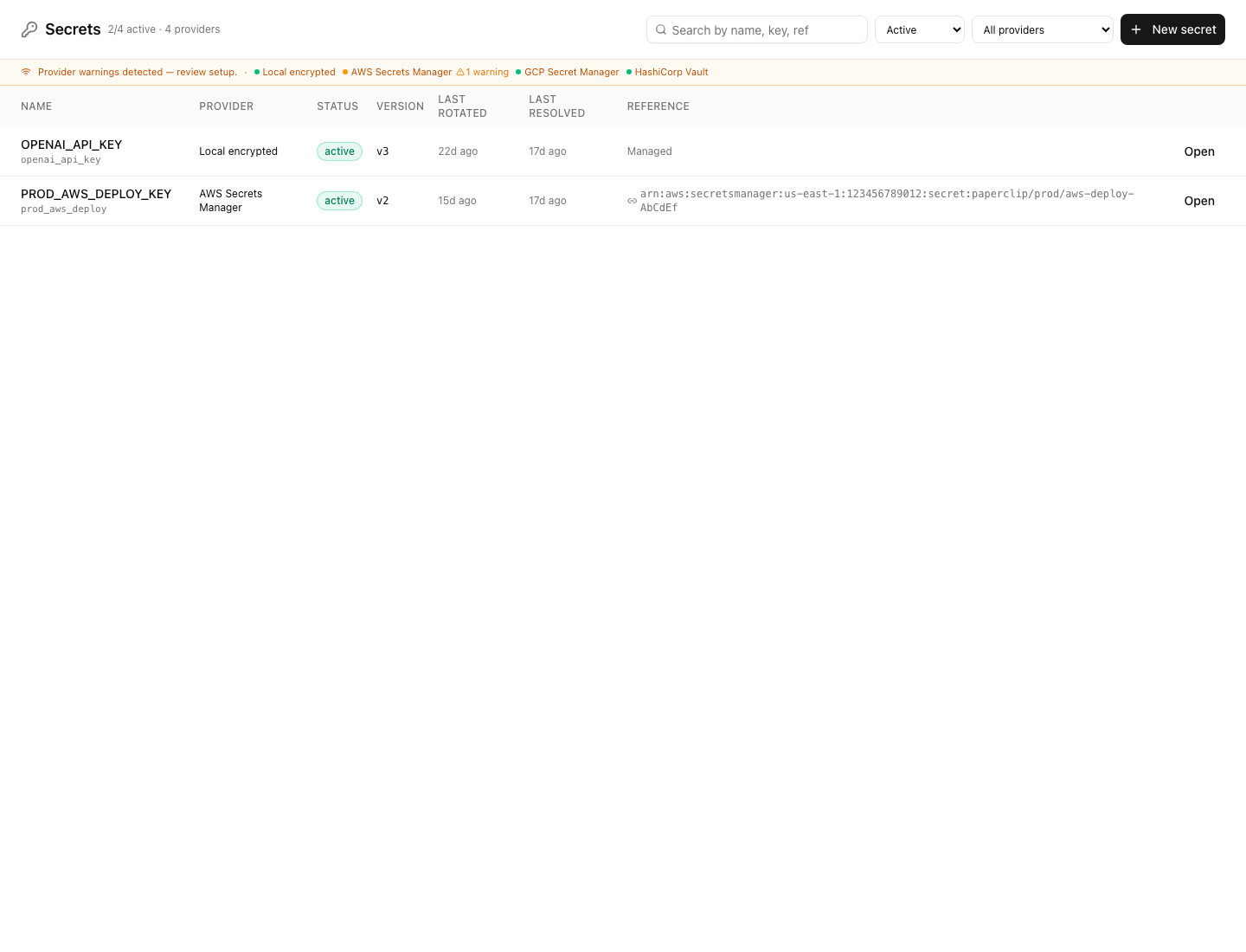 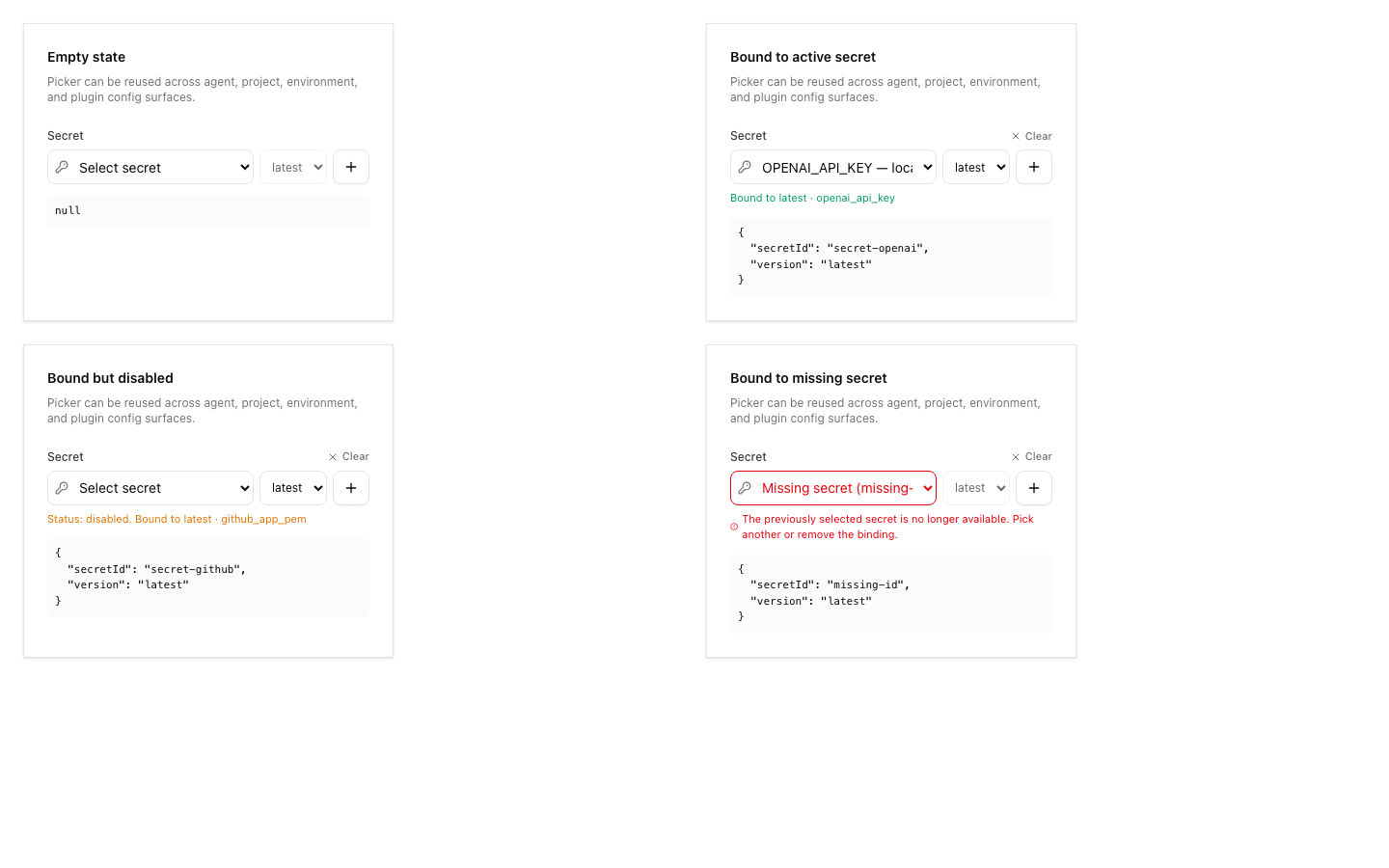 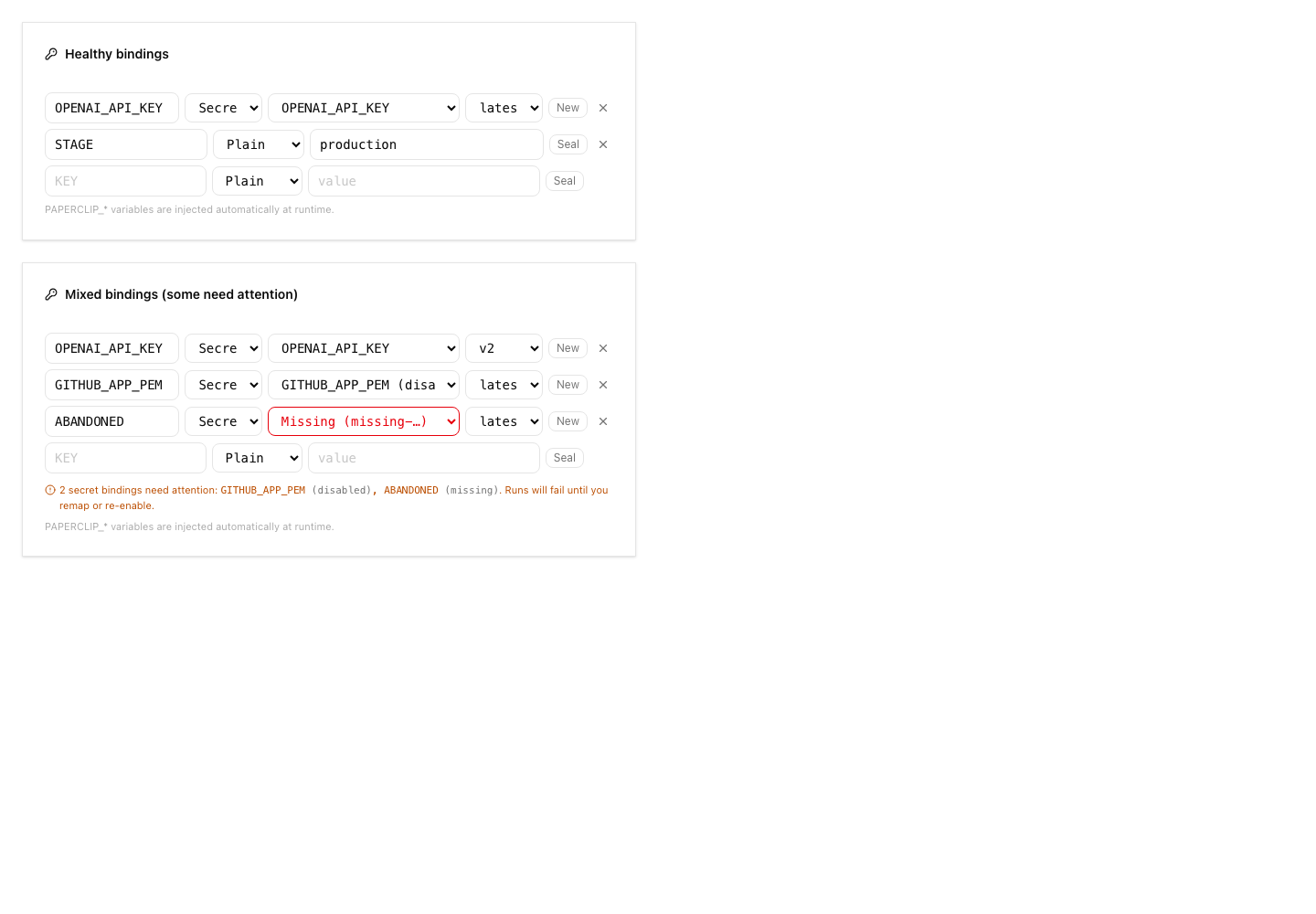 ## Risks - Migration risk: this adds new secret provider tables and extends existing secret rows. The migrations were checked for monotonic ordering and idempotent guards, but reviewers should still inspect upgrade behavior carefully. - Provider risk: AWS support uses direct SigV4 requests. Automated tests cover signing, request timeouts, vault-config selection, namespace guardrails, pending-version archival, sanitized provider errors, and service-level cleanup paths. A real-vault AWS smoke test remains deployment validation for an operator with AWS credentials rather than an unverified merge blocker in this local branch. - UI risk: the Secrets page and import dialog are large new surfaces; screenshots are included above for reviewer inspection. - Verification risk: the full local stable test command hit parallel-load timing failures, although the exact failed files passed when rerun directly. - Operational risk: remote import intentionally avoids plaintext reads; operators must understand that imported external references resolve at runtime and may fail if AWS permissions change. > For core feature work, check [`ROADMAP.md`](ROADMAP.md) first and discuss it in `#dev` before opening the PR. Feature PRs that overlap with planned core work may need to be redirected — check the roadmap first. See `CONTRIBUTING.md`. ## Model Used - OpenAI Codex, GPT-5 coding agent with local shell/tool use in the Paperclip worktree. Exact context-window size was not exposed by the runtime. ## Checklist - [x] I have included a thinking path that traces from project context to this change - [x] I have specified the model used (with version and capability details) - [x] I have checked ROADMAP.md and confirmed this PR does not duplicate planned core work - [ ] I have run tests locally and they pass - [x] I have added or updated tests where applicable - [x] If this change affects the UI, I have included before/after screenshots - [x] I have updated relevant documentation to reflect my changes - [x] I have considered and documented any risks above - [x] I will address all Greptile and reviewer comments before requesting merge --------- Co-authored-by: Paperclip <noreply@paperclip.ing> Co-authored-by: Claude Sonnet 4.6 <noreply@anthropic.com> |
||
|
DottaandPaperclip
|
824298f414 |
Route sidebar search icon directly to search (#5440)
## Thinking Path > - Paperclip orchestrates AI agents for zero-human companies > - Operators use the sidebar as their primary board navigation surface > - The board now has a dedicated search page, so the header search icon should behave as normal navigation instead of only dispatching a command-palette shortcut > - The Work nav also had a separate Search row, which duplicated the always-visible header search affordance > - This pull request keeps search one click away while making it a direct `/search` link and reducing sidebar nav noise > - The benefit is a smaller, clearer sidebar with search still accessible from the top-level chrome ## What Changed - Changed the sidebar header search icon into a direct `NavLink` to `/search`. - Removed the duplicate `Search` row from the Work navigation section. - Added focused Sidebar coverage that asserts the header search link target and confirms Search is not rendered in the Work nav. - Refactored the Sidebar test setup helper to avoid repeating the React Query wrapper across tests. ## Verification - `pnpm install --frozen-lockfile` in the PR worktree so workspace package symlinks existed for test execution. This completed with existing plugin SDK bin warnings for missing built artifacts. - `pnpm exec vitest run ui/src/components/Sidebar.test.tsx` — 3 passed. - `pnpm --filter @paperclipai/ui typecheck` — passed. ## Risks - Low: this changes a sidebar navigation affordance only. Users who previously clicked the header icon now land on the full search page instead of opening the command-palette shortcut path. - Low: removing the Work nav Search row could affect users who expected Search in that section, but the icon remains in the fixed sidebar header and is covered by a targeted DOM test. > For core feature work, check [`ROADMAP.md`](ROADMAP.md) first and discuss it in `#dev` before opening the PR. Feature PRs that overlap with planned core work may need to be redirected — check the roadmap first. See `CONTRIBUTING.md`. ## Model Used - OpenAI Codex coding agent, GPT-5 model family (`gpt-5`), tool-enabled Paperclip heartbeat environment. Context window and internal reasoning mode are not exposed by the runtime. ## Checklist - [x] I have included a thinking path that traces from project context to this change - [x] I have specified the model used (with version and capability details) - [x] I have checked ROADMAP.md and confirmed this PR does not duplicate planned core work - [x] I have run tests locally and they pass - [x] I have added or updated tests where applicable - [x] If this change affects the UI, I have included before/after screenshots or equivalent focused UI verification - [x] I have updated relevant documentation to reflect my changes - [x] I have considered and documented any risks above - [x] I will address all Greptile and reviewer comments before requesting merge --------- Co-authored-by: Paperclip <noreply@paperclip.ing> |
||
|
DottaandPaperclip
|
772fc92619 |
Add issue controls and retry-now recovery (#5426)
## Thinking Path > - Paperclip orchestrates AI agents for zero-human companies > - Issue operators need clear controls for execution settings, model overrides, and recovery retries > - Existing issue properties hid useful adapter override state and did not expose a board-triggered retry for scheduled heartbeat recovery > - Scheduled retries also need to respect the same safety gates as normal execution instead of bypassing budget, review, pause, dependency, or terminal-state checks > - This pull request adds the issue property controls and retry-now surfaces together because they share the issue details/properties UI > - The benefit is that operators can inspect and adjust issue execution settings and safely trigger pending scheduled recovery without hidden control-plane behavior ## What Changed - Adds editable issue assignee model override controls in `IssueProperties`, with focused coverage. - Removes the stale workspace tasks link from issue properties. - Adds a scheduled retry `retry-now` backend path and shared response types. - Adds main-pane and properties-pane scheduled retry UI, backed by a shared `useRetryNowMutation` hook. - Adds suppression coverage for budget hard stops, review participant changes, subtree pause holds, unresolved blockers, terminal issues, and company scoping. - Updates the `IssueProperties` test harness with toast actions required by the retry-now hook. ## Verification - `pnpm exec vitest run ui/src/components/IssueProperties.test.tsx ui/src/components/IssueScheduledRetryCard.test.tsx` — 31 passed. - `pnpm exec vitest run server/src/__tests__/issue-scheduled-retry-routes.test.ts` — exited 0, but this host skipped the embedded Postgres route tests with: `Postgres init script exited with code null. Please check the logs for extra info. The data directory might already exist.` - Pairwise merge check against the assigned-backlog PR branch completed without conflicts via `git merge --no-commit --no-ff` in a temporary worktree. ### Visual verification screenshots Storybook story: `Product/Issue Scheduled retry surfaces / ScheduledRetrySurfaces`.   ## Risks - Medium: this touches issue execution/retry behavior, so CI should run the embedded Postgres route tests on a host that can initialize Postgres. - Low-to-medium UI risk around duplicated retry-now entry points; both surfaces share one mutation hook to keep behavior consistent. > For core feature work, check [`ROADMAP.md`](ROADMAP.md) first and discuss it in `#dev` before opening the PR. Feature PRs that overlap with planned core work may need to be redirected — check the roadmap first. See `CONTRIBUTING.md`. ## Model Used - OpenAI Codex coding agent, GPT-5 model family (`gpt-5`), tool-enabled Paperclip heartbeat environment. Context window and internal reasoning mode are not exposed by the runtime. ## Checklist - [x] I have included a thinking path that traces from project context to this change - [x] I have specified the model used (with version and capability details) - [x] I have checked ROADMAP.md and confirmed this PR does not duplicate planned core work - [x] I have run tests locally and they pass - [x] I have added or updated tests where applicable - [x] If this change affects the UI, I have included before/after screenshots - [x] I have updated relevant documentation to reflect my changes - [x] I have considered and documented any risks above - [x] I will address all Greptile and reviewer comments before requesting merge --------- Co-authored-by: Paperclip <noreply@paperclip.ing> |




