mirror of
https://github.com/paperclipai/paperclip.git
synced 2026-10-28 04:02:18 +01:00
50b5a08af36d2c3ee1b14f595e3387cd65ca865c
13
Commits
| Author | SHA1 | Message | Date | |
|---|---|---|---|---|
 Nicky LeachandPaperclip |
50b5a08af3 |
Keep draft computer preparation behind hire approval
Companies that require hire approval must not allocate agent-owned resources from an unapproved setup draft. Save the selected account with a pending verification warning and let the approved hire prepare and verify its computer. Other companies retain background wizard preparation. Verified 123 lifecycle, policy, lease, and API tests; 112 wizard/helper tests; server/UI typechecks; map and token checks. Co-Authored-By: Paperclip <noreply@paperclip.ing> |
||
|
Nicky LeachandPaperclip
|
6df06c6c1c |
Recover setup after environment and policy changes
Resume preparation after a stop completes or a policy hold clears. Keep probes blocked when the selected environment could not be saved, preserve the account, and offer a save retry. Verified 64 lifecycle/policy tests, the focused policy recovery case, 110 wizard/helper tests, and server/UI TypeScript checks. Co-Authored-By: Paperclip <noreply@paperclip.ing> |
||
|
Nicky LeachandPaperclip
|
3a1d545884 |
Prepare agent-owned environments during hiring
Save environment changes without discarding the selected account. Prepare agent-dependent drafts through lifecycle hooks, keep setup probes bound to the saved agent, and leave the worker idle until setup finishes. Ordinary execution remains held. Verified server and UI typechecks, token gates, 109 wizard/helper tests, 93 lifecycle/task tests, and the shared manifest validation suite. Co-Authored-By: Paperclip <noreply@paperclip.ing> |
||
|
DottaandPaperclip
|
9bf7dc0c8f |
feat(agents): bulk edit connections and default models (#17215)
Add harness-scoped bulk connection and default-model edits to the agent roster, with compatible choices, change previews, per-agent save results, and retries. Use an icon-based harness filter, keep agent rows readable, remove the status selector and selection hint, and redirect legacy status URLs to the full roster. Preserve authorization, audit history, unrelated settings, and optimistic concurrency checks through the existing agent update route. Co-Authored-By: Paperclip <noreply@paperclip.ing> |
||
|
DottaandPaperclip
|
30b753f614 |
perf(budgets): scope accounting and deliver enforcement asynchronously (#17046)
## Thinking Path > - Paperclip manages AI agents and their paid work. > - Budgets must prevent new work and stop reported overruns. > - Cost settlement also ran serial lifecycle reconciliation for every eligible company agent. > - That made request latency grow with unrelated idle agents and delayed results on stop delivery. > - This change separates atomic admission and accounting from durable asynchronous enforcement. > - Scoped live usage detects overruns without writing provisional ledger charges. > - The result is constant query scope for ordinary settlement and recoverable stop delivery. ## Linked Issues or Issue Description **What happened?** Settlement and budget checks entered company-wide lifecycle reconciliation. A company with 1,000 unrelated idle agents performed 1,001 accounting transactions for one ordinary cost evaluation. User requests could also wait for provider termination. Running usage checkpoints did not enforce reported monetary exposure. **Expected behavior** Keep the final reservation gate authoritative. Commit charges, scope blocks, and enforcement intent before returning. Deliver stop requests after commit. Read only applicable policies and execution scopes for ordinary charges. Stop long-running work when supported reported or priced usage establishes an overrun. **Steps to reproduce** 1. Create a disposable company with one company budget and idle agents. 2. Evaluate a charge below the budget with 0, 17, and 1,000 unrelated idle agents. 3. Compare query counts, company accounting transactions, and duration. 4. Use the controlled partial-usage and delayed-stop fixtures to check enforcement and request responsiveness. **Paperclip version or commit** The measured baseline is `6c9b87d0922f1ebfc43e8b0c36889ac5ba7b9837` from `master`. Related public work: Refs #16976, #2006, #3539, #13763, #14296, #16853, #13075. These cover the affected service charge, cancellation, and accounting paths. This change removes their shared reconciliation overhead. ## What Changed - Batch applicable policy exposure under the existing company accounting lock. Preserve exact fractional money and zero-reservation dispatch fences. - Commit a durable final budget dispatch claim before provider I/O. Retain a separate final issue/run ownership transaction through synchronous handoff, without holding the company accounting lock or awaiting provider work. Preserve native recovery lease checks and duplicate handoff fencing. Browser handoff rechecks current policy; it reuses a consumed rate slot only for the identical policy generation. - Separate ledger spend, live observed spend, and effective held capacity. Use the maximum of reservation and live observation for each unfinished operation. - Deliver budget cancellation through the existing coordinator. Revalidate generations and persist queued/running stop fences before external termination. Bound stop concurrency to four. - Apply agent holds only to the affected agent. Project budgets leave other projects running. Project real company transitions in bounded lifecycle batches. - Replace periodic broad reconciliation with durable pending work, startup repair, receipt replay, and concrete retry/window deadlines. Retain drain and idle-safety checks. - Enforce accepted cumulative usage checkpoints without provisional charges. Final accounting atomically replaces live exposure and settles reservations. - Add operator-gated budget spans, regression coverage, map updates, and a real-PostgreSQL comparison harness. No schema or first-party telemetry change. ## Verification - Full workspace `pnpm -r typecheck` passes on the final ownership fix, rebased onto `bbcf5dfe98`. Production `pnpm build` passes on final head `4c5f4de8b1`. Map, module-boundary, token, and Storybook catalog checks pass. - Focused real-PostgreSQL coverage includes the 292-case rebased accounting/dispatch run, 63 browser cases, 52 run-control/cancellation cases, 42 policy-generation cases, 77 lifecycle/commentary cases, and the exact Muse confirmation regression. Native executor unit coverage passes all 768 cases. Final ownership coverage passes: 74 adapter/use-case cases, nine public regression cases, and the additional deleted-project race. These exercise competing ownership, budget changes and charges between phases, zero/nonzero duplicate claims, rollback, recovery contention, read-only capacity rechecks, and controlled HTTP startup after commit. Another 74 pure/startup/tracing cases pass. The complete CI matrix and both 5/5 reviews passed on `1ac9b58`; its external security scan identified a stale-owner handoff race. The final fix restores synchronous issue/run ownership fencing after the accounting transaction commits. Final head `8e84f55ce8` has fresh Greptile 5/5 with zero new comments, Paperclip review 5/5, and a passing security scan. The complete latest-head [CI matrix](https://github.com/paperclipai/paperclip/actions/runs/39535189808) passes, including budget, browser, Runner, build, and canary jobs. The unchanged Runner close fixture passed on its sole same-head job retry. - Broad local `pnpm test:run` invocations were stopped before required source updates (rebase and review fixes). They are not claimed as full passes. Final full-suite coverage comes from the complete latest-head CI matrix; local focused coverage and the incomplete broad invocations are reported separately. - Reproduce performance with `pnpm --filter @paperclipai/server exec tsx ../scripts/benchmark-budget-enforcement.ts --baseline-ref=6c9b87d0922f1ebfc43e8b0c36889ac5ba7b9837`; repeat with `--reverse`. The harness uses disposable real PostgreSQL, 20 warm samples per variant/count, and records raw timings, SQL/lock counts, agent reads, unchanged agent state, and query plans. Final production-source measurement revision: `eff713a4f72c7f4b7a4002a701cb481d4bfccd95`; the extended harness is committed in `4c5f4de8b1`. | Unrelated idle agents | Baseline median / p95 | New median / p95 | Baseline SQL / locks | New SQL / locks | New agent reads | | --- | ---: | ---: | ---: | ---: | ---: | | 0 | 1.80 / 2.33 ms | 2.99 / 3.88 ms | 5 / 1 | 7 / 1 | 0 | | 17 | 15.53 / 19.55 ms | 2.24 / 2.60 ms | 90 / 18 | 7 / 1 | 0 | | 1,000 | 978.35 / 1,790.43 ms | 2.16 / 2.52 ms | 5,005 / 1,001 | 7 / 1 | 0 | - These measurements use local PostgreSQL 18.1 and Node 26.4.0 arm64. They isolate the cost-evaluation core and complete admission path, without hosted-region or provider latency. Prior-revision reversed-order controls also preserved the constant query counts; the final measurements above use the final production source. - Complete reserve → final ownership gate → immediate offline provider result is measured separately, with one responsible agent and one active operation at each unrelated-agent count. Admission p95 baseline/new: 0 agents **11.54 / 29.77 ms**; 17 agents **9.31 / 27.62 ms**; 1,000 agents **24.51 / 74.05 ms**. Baseline admission was already scoped; the stronger final fence adds bounded overhead. New counts stay constant at 53 Drizzle statements, three transactions, two company-accounting locks, and five agent-reading statements bound to the responsible agent. Zero unrelated-agent reads, exactly one provider callback per sample, and no leftover runs or holds. All admission scenarios stay below 250 ms. No external provider calls are included. - The partial-usage/delayed-termination fixture passed 20/20: receipt persistence p95 13 ms, receipt return to observed durable Stop fence p95 28 ms, complete receipt-start-to-fence p95 50 ms, unrelated database request p95 1 ms while termination was blocked. After releasing the controlled termination fixture, acknowledgement p95 was 14 ms. These are separately measured phases; fixture acknowledgement is not live-provider termination latency. - Models and provider deadlines are unchanged. No deployment, live inference, or staging acceptance is claimed. A quiet 30-minute follow-up waits for the merged revision on staging, then repeats classifier and controlled budget-stop acceptance in staging, recording hosted bookkeeping, queue delay, and actual provider acknowledgement separately. - Development failures retained: finalizer notification regressions (fixed; 27/27 affected cases passed), invalid browser admission fixture assumptions (fixed; browser coverage now passes 63/63), and first-head lifecycle/dispatch CI regressions (reproduced and repaired). A prior-head Cases E2E test hit its unchanged announcement-dismiss handler race while opening a filter; the same journey passed on `1ac9b58`. The external security review then found a stale-owner race between accounting commit and provider entry; final verification covers a competing run in that gap while retaining provider I/O outside the accounting lock. Early PostgreSQL startup attempts hit local semaphore pressure; serial reruns succeeded. The final-head Runner lane had one failure among 1,823 tests: the unchanged `timeout-attachment` fixture failed at its first process close after 6.28 seconds. The sole same-head job retry passed all 1,819 active tests (four skipped), including that fixture in 1.85 seconds. Three isolated local probes could not run correctly because the Rust fake-provider fixture binary was absent; cleanup masked the original startup failure. CI builds that fixture through its normal lane. These probes are inconclusive and are not counted as passes. ## Risks - This changes accounting, lifecycle, and cancellation ordering. Durable generations, source/sequence checks, ownership leases, and company locking remain required for correctness. - Provider stop acknowledgement can be slow or fail. Stop intent remains pending until existing termination proof succeeds; cancelled row status alone does not acknowledge delivery. - Mid-run limits depend on provider usage reports or supported price calculations. Providers that report only at completion cannot provide exact mid-call detection. - Signals are process-local wake hints for the supported single-active-writer model. Durable state and startup recovery remain authoritative. - There are no migrations, new queue tables, or cached balances. Repeat the classifier and controlled budget-stop acceptance after normal rollout. ## Model Used OpenAI Codex, based on GPT-6, with reasoning, tool use, code execution, and parallel coding agents. The host does not expose the exact backend model revision or context-window size, so those values are not asserted. ## Checklist - [x] I have included a thinking path that traces from project context to this change - [x] I have specified the model used (with version and capability details) - [x] I have checked ROADMAP.md and confirmed this PR does not duplicate planned core work - [x] I have searched GitHub for duplicate or related PRs and linked them above - [x] I have either (a) linked existing issues with `Fixes: #` / `Closes #` / `Refs #` OR (b) described the issue in-PR following the relevant issue template - [x] I have not referenced internal/instance-local Paperclip issues or links (only public GitHub `#NNN` / `github.com/paperclipai/paperclip` URLs) - [x] My branch name describes the change (e.g. `docs/...`, `fix/...`) and contains no internal Paperclip ticket id or instance-derived details - [x] I have run tests locally and they pass - [x] I have added or updated tests where applicable - [x] I have updated relevant documentation to reflect my changes - [x] I have considered and documented any risks above - [x] All Paperclip CI gates are green - [x] Greptile is 5/5 with no open P2s, recommendations, or follow-ups - [x] I will address all Greptile and reviewer comments before requesting merge --------- Co-authored-by: Paperclip <noreply@paperclip.ing> |
||
|
Nicky LeachandPaperclip
|
79b2bf78dd |
Create agent records when onboarding names are submitted (#17005)
## Thinking Path > - Paperclip is the open source app people use to manage AI agents for work. > - Core onboarding selects an agent and connects its provider account. > - The current flow creates the agent record after authentication. > - Setup needs a stable agent identity as soon as the user submits its name. > - This PR saves a paused setup record on name submission and finishes the hire on that same record. > - The existing sandbox authentication and approval paths continue to apply. ## Linked Issues or Issue Description **Subsystem affected** Core agent lifecycle, shared validators, and onboarding UI. **Current behavior** Onboarding creates the database record at the final hire step. Earlier authentication and saved setup have no agent record. **Proposed behavior** Create a paused agent with a setup hold when the user submits its name. Do this before adapter selection or authentication. Update that same record after adapter selection. Reuse its ID on retries and saved setup. Finish that record through the existing hire path. **Reason and benefit** Give setup a stable identity without coupling this refactor to computer provisioning or a new execution backend. **Breaking changes** Incomplete setup now leaves an inactive agent record. Existing clients can still create and hire agents without the new optional fields. The sandbox authentication flow and API key support remain in place. **Additional context** Requested Core-only refactor. Related work: #15422 changes runner defaults. This PR preserves those choices. No duplicate early-record refactor was found in the issue and PR search. ## What Changed - Save the agent when the user submits its name in both onboarding entry points. Use a provisional adapter until the user chooses one. Reopen name-only drafts at adapter selection. - Add retry-safe setup creation and same-record hire completion. Keep approval checks at final hire. - Save and restore setup configuration in both onboarding entry points. Show Finish setup for paused setup agents. - Restrict setup changes to authorized board users. Block generic resume until setup finishes. - Add lifecycle, authorization, connection, and UI coverage. Update the specification and feature maps. ## Verification - Latest focused server run: 126 lifecycle and AI-connection tests passed after the Apex fixes. An earlier broader run passed 301 lifecycle, instruction, adapter-validation, and AI-connection tests. Earlier authentication, retry, cross-company, and direct-create regressions also passed. - Name-save verification: 336 tests across the wizard, naming dialog, New agent, action-button, and wizard-step suites passed. Coverage includes retry identity, repeated submission, closing during a save, saved-model restoration, and a disabled process adapter. - Shared, server, and UI TypeScript checks passed. The latest UI package check and direct server TypeScript check passed. The server package preparation command could not finish locally because Cargo is unavailable; full build preparation runs in CI. Map checks, token gates, and `git diff --check` passed; each pushed diff was scanned for credentials and PII. - All six onboarding browser tests passed together with installed Chrome against a fresh throwaway instance after the Apex fixes. They include numbered duplicate names, first-time Copilot without a connected account, and Grok’s saved model. They verify early persistence in both entry points, closing and reopening a name-only draft, same-record adapter selection, sandbox sign-in, login reload, and failed-connection gating. Provider responses are simulated; Core persistence is real. - Regression coverage includes incomplete Copilot creation versus final validation, Kimi settings through redacted responses, stale local drafts, company switches during creation, saved environments, and provider changes with personal/shared old bindings. - Apex found five name-only setup gaps: numbered names, early Copilot account validation, the Grok model default, same-name draft ownership, and provisional runner restoration. The fixes preserve server names, defer implicit account binding until hire, set Grok’s model, avoid name-based reuse of unfinished records, and restore Auto for pending adapter choices. UI, database, and browser regressions cover these cases. - Standard Greptile found a Grok provider mismatch in the new adapter save. The save now uses ACPX with the Grok profile. Both the 129-test dialog/setup run and a real-API browser regression passed after the fix. The first browser attempt stopped on an ambiguous empty-roster button selector; it now scopes the click to the toolbar. - Moving the save point exposed a saved-model reset and timing assumptions in the same-name and portal fixtures. The source choice now preserves the restored model, and tests cover same-name recovery without a second hire. - Initial CI exposed direct-create compatibility, concurrent setup effects, fixture assumptions, and a missing-fields assumption in the provider-validation guard. These were fixed and verified locally. Review findings were addressed with authorization, recovery, credential-persistence, and restored-configuration regressions. - The final desktop capture passed after host resource cleanup. A repeat first failed before Core started because macOS had exhausted shared-memory IDs. Standalone PostgreSQL initialization reproduced the same error. Releasing only unattached control segments from this task’s stopped test databases allowed the unchanged revision to pass. No Core or system setting changed. - Local database tests required port access outside the sandbox. Missing declared development dependencies were supplied outside the branch. No live provider sign-in was tested locally. - [Full monorepo CI](https://github.com/paperclipai/paperclip/actions/runs/39522434236) is green on `82b82fec189a172a885d4dd565ae2f4a18c73efc`. Standard Greptile scored 5/5 with zero new comments (check `118969424903`). The subsequent Apex review also scored 5/5 with zero new comments (check `118972866331`) on that same commit. All review threads are resolved. - The separate Superagent Security scan returned neutral/inconclusive because its pinned merge-base checkout failed or timed out. GitHub returned 404 for check and suite rerun requests. This is not a successful security scan; the CI workflow and other security checks passed. ## Risks - Users can leave inactive setup records behind, including after name submission alone. These records cannot run until hire completes. - Setup completion touches hiring and approval boundaries. Tests cover retries, company isolation, creator permissions, and approval snapshots. - An uncertain credential-save result retains its new secret reference for retry. A confirmed client rejection removes only credentials staged by that attempt. - No schema migration or VM provisioning change is required. Agent-computer integration is out of scope. ## Model Used OpenAI Codex, based on GPT-6, with repository search, code editing, and tool execution. The exact deployment ID and context window are not exposed in this session. ## Checklist - [x] I have included a thinking path that traces from project context to this change - [x] I have specified the model used (with version and capability details) - [x] I have checked ROADMAP.md and confirmed this PR does not duplicate planned core work - [x] I have searched GitHub for duplicate or related PRs and linked them above - [x] I have either (a) linked existing issues with `Fixes: #` / `Closes #` / `Refs #` OR (b) described the issue in-PR following the relevant issue template - [x] I have not referenced internal/instance-local Paperclip issues or links (only public GitHub `#NNN` / `github.com/paperclipai/paperclip` URLs) - [x] My branch name describes the change (e.g. `docs/...`, `fix/...`) and contains no internal Paperclip ticket id or instance-derived details - [x] I have run tests locally and they pass - [x] I have added or updated tests where applicable - [x] I have updated relevant documentation to reflect my changes - [x] I have considered and documented any risks above - [x] All Paperclip CI gates are green - [x] Greptile is 5/5 with no open P2s, recommendations, or follow-ups - [x] Apex Greptile is also 5/5 on the same commit as standard review and green CI - [x] I will address all Greptile and reviewer comments before requesting merge --------- Co-authored-by: Paperclip <noreply@paperclip.ing> |
||
|
DottaandPaperclip
|
45b67f1d93 |
feat: default new Apple Silicon Claude agents to Paperclip Runner (#15993)
## Thinking Path > - Paperclip lets users choose an agent harness and account. > - The server resolves the runner for new agents. > - Claude still needs the same ordinary native-default journey as Codex. > - Existing agents must retain their runner, model and account. > - This PR defaults new Apple Silicon Claude agents to Paperclip Runner with Opus 5.5. > - Users can connect and work without a runner override. ## Linked Issues or Issue Description Refs #15683. This PR depends on #15994 and precedes #15997. Related scope: #15422, #13978 and #15224. ## What Changed - Resolve new Apple Silicon Claude agents to `paperclip_runner`, `provider: acpx`, `acpxAgent: claude`. Keep explicit Legacy, models, provider routing and saved execution. - Use `claude-opus-5-5` for ordinary Claude defaults and retain explicit overrides. - Reuse existing API-key/subscription connections, credential storage and checks. Generalize the shared Advanced runner control with Claude branding. - Carry configured effort into the shared v9 contract. Preserve compatible permissions, instructions, skills, timeouts and session behavior. Require Legacy for unsupported settings. - Qualify a new immutable managed Claude target at explicit Connect through the existing permission-gated probe. Use fresh scoped discovery for test and hire. Discard stale results and require an explicit Connect after settings change. - Retain merged Codex onboarding recovery, auth preparation, import/effort corrections and Grok Bot gates. - Check the Claude first-task wizard's saved default directly. Update configuration/runtime documentation and exact Opus 5.5 accounting. - Align hire fixtures with the merged host-environment restriction. Native agent-authenticated hires cannot inject host env settings; both creation endpoints verify that no extra agent is saved. ## Verification - Updated onto master `9179d8dcc3e908c217fde4f63c9d08ccf8132eeb` through #15994. Native input v9 carries effort while preserving v7 home modes and v8 Muse. Codex defaults remain unchanged. - Focused local verification passed 285 server tests, 323 UI tests, 124 setup/registry tests, and two v9 permission-pin transport cases. Direct server/UI TypeScript checks passed. An initial 30-second hook timeout was resolved by serial verification with a longer hook budget: all 122 credential/permission cases and 232 snapshot/environment cases pass. Direct server TypeScript checking also passes. - Ordinary web creation with the experiment disabled saved native Claude, Opus 5.5 and High effort without runner/model overrides. The actual product task and follow-up both succeeded on integrated source `b2c9fe43f9cd3bc5dd9d22552da0148845ba71a4` with the cloud-built daemon from `04e0202ca81387b17cbe7fd094a8338648356fe9`. The final master reconciliation also changes shared runtime source. Historical proof retains its source identity; a final-source cloud qualification is running before refreshing the preview daemon. - Both actual browser downloads were checked: v1 has three sections/six checkboxes (451 bytes); v2 preserves the original body and adds two Rollback checks (612 bytes). The original attachment stayed byte-identical. The follow-up records session resume and the same provider session. Total estimated API usage: $0.518432800, with no pending/unpriced usage in the successful fixture. - Fixed the live-discovered setup incompatibility: native API-key validation no longer depends on the global Legacy Claude CLI. The existing provider endpoint verifies the key without a paid prompt; subscription/custom routing probes remain intact. - Fixed security review's native-hire credential redirection: agent-supplied URLs, proxy/launch settings and other host environment controls are rejected before inheritance. Native credential references remain supported and partial edits use the saved harness. Added create/hire/update regression coverage. - Current-head cloud CI is green. All three stack PRs have fresh Greptile 5/5 reviews and zero unresolved review threads. Required typecheck, test and build gates ran in cloud CI; Docker work stayed remote. Earlier failed checks remain in their original runs. - Docker and native release builds ran in cloud infrastructure. An inadvertent local Rust prerequisite was stopped; no local Docker build was run. - The final master merge preserves task-loading, permission, skill-retention and OpenRouter changes. Pi uses a fresh combined profile 27, preserving both historical profile-24 declarations; Copilot remains profile 22. Focused protocol checks passed 155 cases (one skipped), the updated Pi attestation check passed 18 (one skipped), and 91 evaluation/catalog checks passed. - Latest-application manual continuation passed in 37.942 seconds on `695e5c005a85bddc8711d3fcddcaf6b7e1fb64d0`, with High effort, native Opus 5.5, Anthropic API attribution, the same resumed Claude session, an independently checked 635-byte file and persisted Done status. It uses the earlier verified Mac daemon; the preceding-source package qualification passed at `dca62c7aeb4b45f0dd91a8e18d386a16a2658ef8`. That package run predates the small TypeScript startup fix and is not relabeled as qualification for it. - Upgrade limitation: changed compiled sidecar identity rejected old durable launch state and recovery hit session-open bounds before eventually resuming. That attempt was operator-cancelled and retained; the successful manual continuation does not qualify seamless upgrades. - Local latency profile, Opus 5.5/High unchanged: three alternating real-ACP loopback samples per variant reduce median provider-ready time from 5.081s to 4.034s. The matched real API task startup improves from 5.533s to 4.348s, but total reply time changes from 17.933s to 20.221s because agent work varies. This establishes a startup saving of about one second, not a consistent total-reply speedup. A real candidate follow-up passed in 20.146s and resumed the same saved session. The loopback fixture makes no external model requests; failed initial probes remain retained. - The startup change passes 107 focused runtime/effort/lease tests, 53 profile checks (one skipped), TypeScript checking and the TypeScript-only runtime build. Native hire fixture checks pass 70 tests; their first local run retained a socket-hangup failure and stale OpenCode expectation, both accounted for before the passing rerun. Broader required checks run in cloud CI. ## Risks - Missing packages, authentication rejection, unsupported settings and unavailable models must fail explicitly. Existing agents retain saved execution; explicit runner changes use existing revision/session invalidation. - Subscription follow-up remains unverified; remaining live acceptance uses API keys per human steering. Historical accounting holds and the separate $50 ceiling remain intact. - The subscription acceptance limit remains explicit for review. No Claude database migration is introduced. ## Model Used OpenAI Codex, GPT-6 family, with reasoning, repository tools, code execution and browser testing. The exact serving model ID and context-window size are not exposed in this session. ## Checklist - [x] I have included a thinking path that traces from project context to this change - [x] I have specified the model used (with version and capability details) - [x] I have checked ROADMAP.md and confirmed this PR does not duplicate planned core work - [x] I have searched GitHub for duplicate or related PRs and linked them above - [x] I have either (a) linked existing issues with `Fixes: #` / `Closes #` / `Refs #` OR (b) described the issue in-PR following the relevant issue template - [x] I have not referenced internal/instance-local Paperclip issues or links (only public GitHub `#NNN` / `github.com/paperclipai/paperclip` URLs) - [x] My branch name describes the change (e.g. `docs/...`, `fix/...`) and contains no internal Paperclip ticket id or instance-derived details - [ ] Focused local tests and final cloud verification pass - [x] I have added or updated tests where applicable - [x] I have updated relevant documentation to reflect my changes - [x] I have considered and documented any risks above - [x] All Paperclip CI gates are green - [x] Greptile is 5/5 with no open P2s, recommendations, or follow-ups - [x] I will address all Greptile and reviewer comments before requesting merge --------- Co-authored-by: Paperclip <noreply@paperclip.ing> |
||
|
DottaandPaperclip
|
250429942e |
fix(agents): report actionable lifecycle failure steps (#16418)
## Thinking Path > - Paperclip helps people manage AI agents for work. > - New agents must pass setup and execution checks before they can run. > - The lifecycle worker saved the same retry message for every failure. > - Users could not identify the failed step or correct its configuration. > - The UI also described failed work as work still in progress. > - This pull request names the failed step and gives a safe corrective action. > - Users can identify configuration problems and understand automatic retries. ## Linked Issues or Issue Description **What happened?** A new hire showed a paused status and “The lifecycle step failed. Retry the operation.” Repeated retries did not explain the failure. A successful retry cleared the original error. This change cannot recover an error that an older server already cleared. **Expected behavior** Name the failed setup step. Give a useful action for known execution test failures. Explain automatic retry. Keep provider output and credentials out of lifecycle errors. **Steps to reproduce** 1. Create a disposable agent with an unavailable model or invalid execution command. 2. Open its profile while verification fails. 3. Inspect the error, correct the configuration, and select Retry now. 4. Confirm that the failure disappears after the agent becomes ready. Related change: https://github.com/paperclipai/paperclip/pull/16155 shows pending setup progress in creation and assignment. This change improves the cause and action shown when setup fails. ## What Changed - Save the failed lifecycle phase and step in the existing lifecycle error field. - Classify authentication, model, command, directory, timeout, and response failures from execution test check codes. - Use fixed error messages. Do not retain raw provider messages, check details, or credentials. - Share the allowed failure codes with the lifecycle log. - Show failed-state labels and automatic retry guidance. Rename Retry to Retry now. - Extend worker, database, and UI regression coverage. Update the agent verification maps. ## Verification - Passed 105 focused tests across lifecycle diagnostics, database lifecycle commands, saved harness verification, and AgentLifecycleStatus. - Passed server TypeScript compilation with `pnpm --filter @paperclipai/server exec tsc --noEmit`. - Passed UI typecheck and production build. - Passed module boundary checks, token gates, character sync, map validation, and `git diff --check`. - Used Playwright to inspect the production component with a simulated model failure. Confirmed the failure text, retry guidance, retry callback, and recovered state. Captured a screenshot. This component check does not prove a live provider run. - Attempted `pnpm -r typecheck` and `pnpm build`. Both require Rust cargo, which is not installed in the local execution environment. - Started `pnpm test:run` locally. No final local suite result was recorded before handoff. The complete PR CI workflow passed. - Passed all latest-commit CI gates, including typecheck, build, general and serialized tests, Rust checks, and all eight browser test shards: https://github.com/paperclipai/paperclip/actions/runs/38726198774 - Greptile scored the latest commit 5/5 with no findings. There are no review threads to resolve. ## Risks - Failure classification depends on existing adapter check codes. Unknown codes use a safe fallback message. - A known code can describe only the checks reported by the adapter. - No database migration is required. The error field remains a string. - Retry schedules, leases, readiness, approvals, and budget controls keep their current behavior. - Full build verification requires a runner with Rust cargo. ## Model Used - OpenAI GPT-6 through Codex. Used reasoning, code editing, browser checks, and tool execution. The runtime does not expose the exact deployment ID or context window. ## Checklist - [x] I have included a thinking path that traces from project context to this change - [x] I have specified the model used (with version and capability details) - [x] I have checked ROADMAP.md and confirmed this PR does not duplicate planned core work - [x] I have searched GitHub for duplicate or related PRs and linked them above - [x] I have either (a) linked existing issues with `Fixes: #` / `Closes #` / `Refs #` OR (b) described the issue in-PR following the relevant issue template - [x] I have not referenced internal/instance-local Paperclip issues or links (only public GitHub `#NNN` / `github.com/paperclipai/paperclip` URLs) - [x] My branch name describes the change (e.g. `docs/...`, `fix/...`) and contains no internal Paperclip ticket id or instance-derived details - [x] I have run tests locally and they pass - [x] I have added or updated tests where applicable - [x] I have updated relevant documentation to reflect my changes - [x] I have considered and documented any risks above - [x] All Paperclip CI gates are green - [x] Greptile is 5/5 with no open P2s, recommendations, or follow-ups - [x] I will address all Greptile and reviewer comments before requesting merge Co-authored-by: Paperclip <noreply@paperclip.ing> |
||
|
|
ba4fac585d |
feat(agents): show who created an agent in shared companies (#16055)
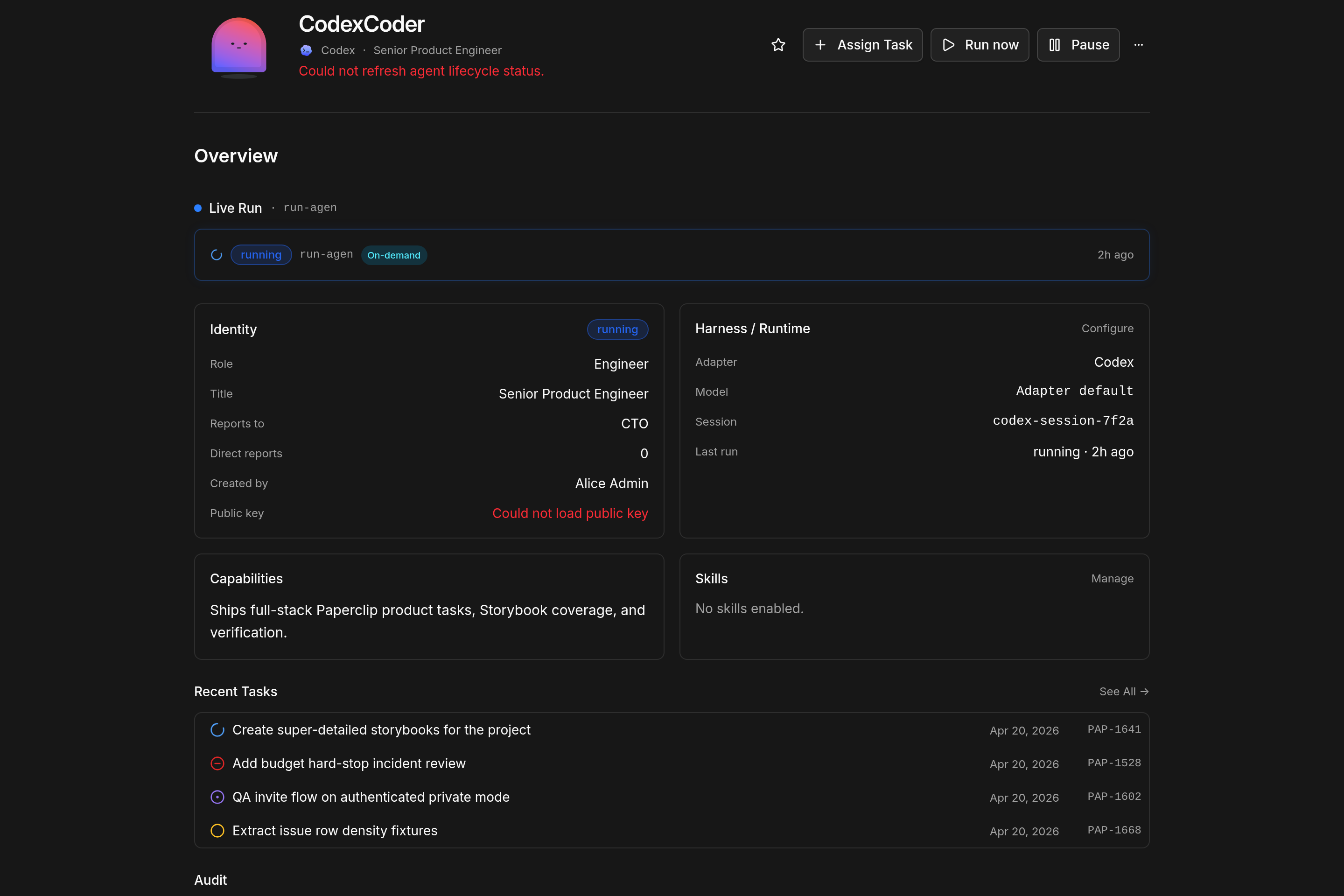
## Thinking Path > - Paperclip is the open source app people use to manage AI agents for work > - A company in Paperclip can have more than one human member, and each member can create agents > - The app does not record which person created an agent > - When two or more people share a company, members cannot see who added an agent or who to ask about it > - This pull request records the creator of each agent and shows the creator on the agent Overview tab > - The benefit is clear ownership of agents in shared companies, with no change for single-user companies ## Linked Issues or Issue Description No public issue exists. This description follows `feature_request.yml`. **Subsystem affected** Agents: the agent data model, the agent create path on the server, and the agent Overview tab in the board UI. **Problem or motivation** Paperclip does not record which human user created an agent. When more than one human user works in a company, the agent page does not tell members who created the agent. **Proposed solution** Record the user ID of the creator when a human creates an agent. Show "Created by <name>" on the Identity card of the agent Overview tab. Show this row only when the company has two or more human members. Do not count the synthetic local Board principal as a human member. Do not show the local Board as a creator. **Alternatives considered** Count human users across the full instance. We did not do this. An instance-wide count tells a member of one company that other companies have users. The creator is always a member of the agent's company, so the company count is sufficient. **Roadmap alignment** `ROADMAP.md` has no item for agent ownership. This change is small and additive. ## What Changed - Add the nullable column `agents.created_by_user_id` (`packages/db/src/schema/agents.ts`, migration `0343_new_mentor.sql`). - Set the column in the single agent insert path (`server/src/modules/agent-lifecycle/adapters/records.ts`). The value comes from the authenticated user actor. The server ignores a creator value in the request body. Agents that agents or the system create keep `null`. - Backfill existing agents in the migration. The backfill uses the earliest `agent.created` or `agent.hire_created` activity row that a user actor wrote in the same company. - Add `createdByUserId` to the shared `Agent` type (`packages/shared/src/types/agent.ts`). - Add `ui/src/lib/agent-creator.ts`. It decides if the UI shows the creator row and it resolves the creator name. If the creator left the company, the row shows "Former member". - Add the "Created by" row to the Identity card in `ui/src/pages/AgentDetail.tsx`. If the company user directory request fails, the row shows "Could not load creator". The row does not disappear silently. - Add the Storybook story `Pages/Agent Detail → Shared Company Shows Creator`. - Document the column in `doc/SPEC-implementation.md` §7.2. ## Verification - `pnpm --filter @paperclipai/db typecheck` passes. This includes the migration numbering and migration safety checks. - `pnpm --filter @paperclipai/shared typecheck` passes. - `ui`: `tsc --noEmit` passes. - `server`: `vitest run src/modules/agent-lifecycle/__tests__/lifecycle.test.ts` passes (49/49). Two new tests: - The server records the creator from the actor and ignores a creator value in the request body. - The backfill takes the earliest user activity row. It skips agent actors and rows from other companies. - `server`: `vitest run src/__tests__/built-in-agents.test.ts` passes (40/40). A new test checks that a built-in agent enabled by a human records that human, and that automatic provisioning stays unattributed. The gated (pending-approval) provisioning test also asserts the creator. `src/__tests__/built-in-agent-routes.test.ts` also passes. - `ui`: `vitest run src/lib/agent-creator.test.ts src/pages/AgentOverview.test.tsx` passes (10/10). The tests cover these cases: the row shows with two or more humans, the row stays hidden with one human plus the Board, the UI never shows the Board as the creator, the row shows an error when the directory request fails, and the row stays hidden (no error) for agents with no creator or the Board as creator. The last case fails without the fix. - The current Storybook catalog uses source annotations and generated indexes. `node scripts/storybook-catalog.mjs --check` passes (264 story files, 2,514 stories). The merge keeps the authored catalog deletion from master. - `pnpm check:token-gates` is clean. - Screenshots from the Storybook story (fake data: two human members, Alice Admin and Bob Builder, plus the local Board). The red "Could not load public key" text is a Storybook artifact: the story has no fixture for the public key request. The existing `Dashboard` story shows the same text. **Two or more human members: the Identity card shows "Created by".** 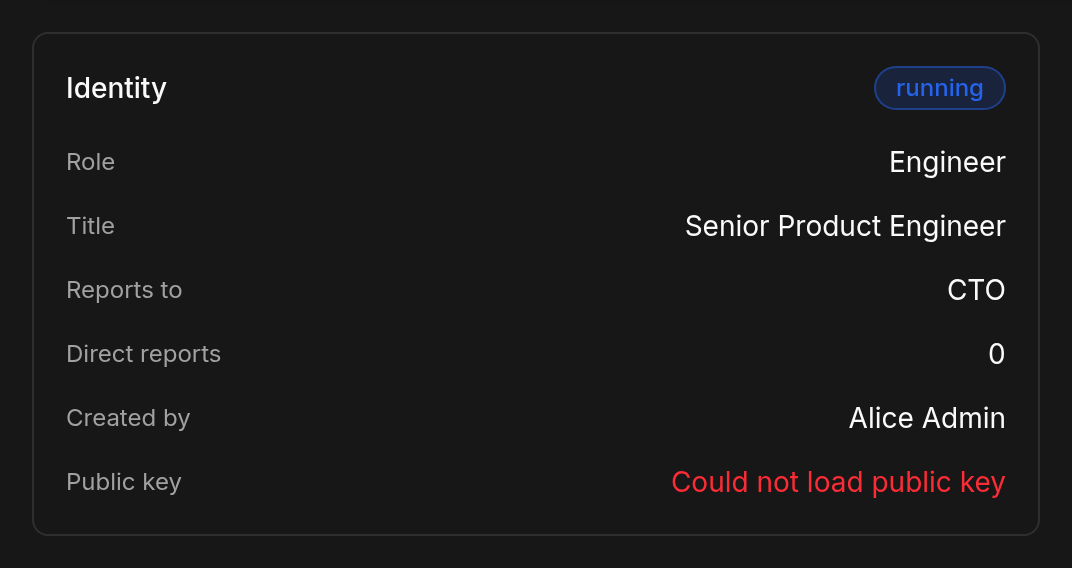 **One human member plus the local Board: the row stays hidden.** 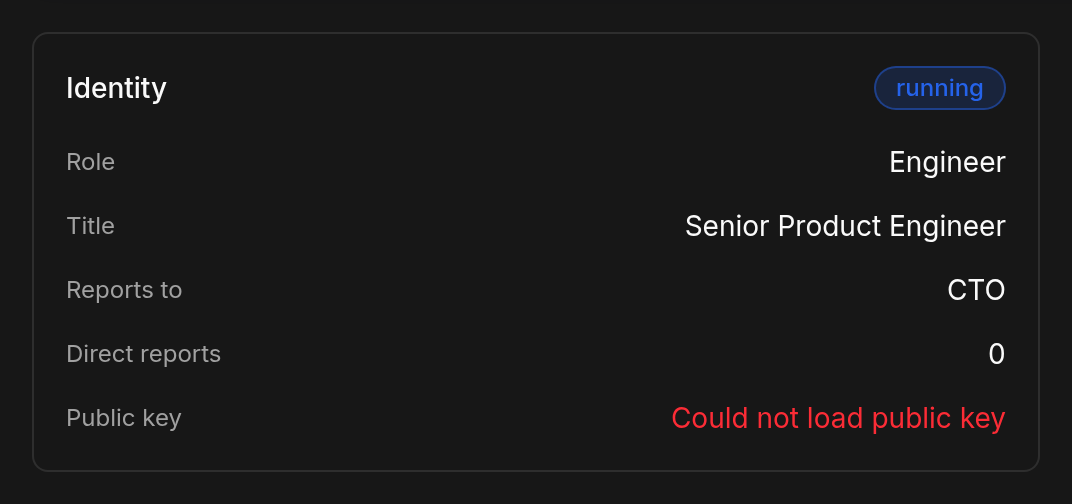 Full Overview tab: [overview-created-by.png](https://raw.githubusercontent.com/paperclipai/paperclip/9b62bd2ea6cf984ce6745f08cc45f44ddf00fb51/pr-16055/overview-created-by.png). The images are on the separate branch `pr-assets/agent-created-by`. They are not in this PR and do not go to `master`. - Manual check: open Storybook at `Pages/Agent Detail → Shared Company Shows Creator`. The Identity card shows "Created by Alice Admin". The `Dashboard` story has one human, so it does not show the row. - Final focused verification on `5a02350cf16050a3cf3cb3f8dc061fe61758c60d`: all 99 tests pass across the two UI suites, built-in-agent suite, and lifecycle suite. The backfill test applies the complete migration twice. The migration uses `ADD COLUMN IF NOT EXISTS` and preserves the company-scoped backfill. Migration numbering and token checks pass. - Full repository typecheck, build, and Storybook build pass. The generated creator story ID is present. A Chromium check renders the production agent page fixture and verifies the creator row and Alice Admin name. Map checks and their 21 tests pass. A fresh Apex review is 5/5 on the current head with no unresolved findings. All 54 successful CI checks pass on this head, with two intentional skips, including all general and serialized test shards, E2E, typecheck, and build. The workspaces-b job passed after rerunning a runner shutdown; no source change was needed. The separate, unsharded local `pnpm test:run` invocation has not completed; complete suite verification comes from CI. ## Risks - Migration: the migration adds one nullable column and runs one `UPDATE` on `agents` with a correlated subquery on `activity_log`. On an instance with a very large activity log, the backfill can take some time. The migration does not lock other tables and does not delete data. - Backfill accuracy: agents with no user-authored create activity row keep `null`. The UI then does not show a creator. This is the same as the current behavior. - Privacy: the row shows only names from the company user directory, and only to users who can already see that directory. - Low risk for single-user companies: the UI does not change for them. > For core feature work, check [`ROADMAP.md`](ROADMAP.md) first and discuss it in `#dev` before opening the PR. Feature PRs that overlap with planned core work may need to be redirected — check the roadmap first. See `CONTRIBUTING.md`. ## Model Used - Provider: Anthropic, Claude Opus 5.5 (model ID `claude-opus-5-5`), run as a coding agent through Claude Code with tool use (shell, file edit, and test execution), standard context window. OpenAI GPT-6 (`gpt-6`) through Codex assisted conflict resolution, regression tests, and repository verification. This session does not expose an exact context-window size. ## Checklist - [x] I have included a thinking path that traces from project context to this change - [x] I have specified the model used (with version and capability details) - [x] I have checked ROADMAP.md and confirmed this PR does not duplicate planned core work - [x] I have searched GitHub for duplicate or related PRs and linked them above - [x] I have either (a) linked existing issues with `Fixes: #` / `Closes #` / `Refs #` OR (b) described the issue in-PR following the relevant issue template - [x] I have not referenced internal/instance-local Paperclip issues or links (only public GitHub `#NNN` / `github.com/paperclipai/paperclip` URLs) - [x] My branch name describes the change (e.g. `docs/...`, `fix/...`) and contains no internal Paperclip ticket id or instance-derived details - [x] I have run tests locally and they pass - [x] I have added or updated tests where applicable - [x] I have updated relevant documentation to reflect my changes - [x] I have considered and documented any risks above - [x] All Paperclip CI gates are green - [x] Greptile is 5/5 with no open P2s, recommendations, or follow-ups - [x] I will address all Greptile and reviewer comments before requesting merge 🤖 Generated with [Claude Code](https://claude.com/claude-code) --------- Co-authored-by: Amy (Opus) <noreply@anthropic.com> Co-authored-by: Paperclip <noreply@paperclip.ing> Co-authored-by: devinfoley <139239+devinfoley@users.noreply.github.com> |
||
|
Nicky LeachandPaperclip
|
da9af67415 |
Persist agent-owned instance secrets through lifecycle results (#16191)
## Thinking Path > - Paperclip coordinates agents and controls when they can run. > - Lifecycle plugins prepare and remove resources for each agent. > - Those resources can require private connection credentials. > - The current SDK can resolve configured secrets but cannot save these credentials securely. > - Ordinary company secrets can be bound to agents and do not provide the required server-only boundary. > - This change saves agent-owned instance secrets through the existing local lifecycle result and native secret service. > - The tenant can retain runtime credentials through restarts without a separate encryption system or remote API. ## Linked Issues or Issue Description **Subsystem affected** Agent lifecycle, plugin contract, and native secret storage. **Problem or motivation** Lifecycle plugins need to save private runtime connection details for the owning agent. Worker memory loses these details on restart. Plugin state and company secrets do not provide a private runtime-only boundary. **Proposed solution** Add optional instance-secret changes to lifecycle results. Save them through the existing secret service and local encrypted provider before accepting the result. Require company, agent, plugin, phase, operation, revision, and current unexpired attempt ownership. Supply saved values through the existing local preparation/resume request. **Alternatives considered** A separate encrypted store duplicates the native secret system. Generic plugin company-secret writes proposed by #5007 do not supply agent ownership or a server-only secret scope. This change does not add that general write API. **Roadmap alignment** Extends the existing lifecycle contract from #15631. It does not add a resource provider or select an execution backend. ## What Changed - Add an instance scope to native secrets with mandatory agent/plugin ownership, a company-qualified agent foreign key, and key uniqueness per owner. Existing company and user scopes retain their constraints. - Reuse native creation, rotation, deletion, secret versions, access audit, and the local encrypted provider. Keep values out of company catalogs, normal bindings, agent access, and public agent records. - Accept local secret patches only after locking and checking the current lifecycle operation and required plugin selection. Storage failure or a stale reply cannot complete setup. Expired or replaced attempt owners cannot overwrite a successor's credentials. - Keep vault-import conflicts company-scoped. Protect instance-owned account-home paths during failed device-login cleanup with a private, fail-closed scan. - Skip decryption on stop and cleanup so a lost key cannot block removal. Cascade secret records when their agent or plugin is deleted. - Log fixed provider diagnostics without raw errors that can contain credentials. Document the local contract, runtime resolver, and access-map exclusions. Retain the five latest migration snapshots through the normal generator pruning. ## Verification - 239 focused tests passed across agent-instance-secrets, lifecycle, secrets-service, secrets-routes, plugin-secrets-handler, and agent-device-login-routes. Used disposable PostgreSQL 18 clusters through the existing test constructor seam because the bundled binary cannot start on this macOS host. The temporary harness is outside git. - Regression tests reproduced the vault-import conflict and missed cleanup claimant before the fixes; both pass after the fixes. - New coverage includes encrypted native versions, rotation, restart recovery, company/agent/plugin isolation, ordinary-read and binding denial, stale replies, storage failure, safe logging, cleanup without the master key, and same-name secret isolation, native account-home mutation guards, lease takeover/expiry, and live agent/plugin deletion cascades. - Direct server TypeScript check, DB/shared typechecks, migration numbering/safety checks, module boundaries, and git diff check passed. - Full workspace typecheck and build were attempted; both stop at the missing local cargo toolchain. The full test command was started and stopped after failures in unchanged native-runtime/workspace suites plus bundled-PostgreSQL skips; it did not complete. CI must verify the full toolchain paths. - Current head `c0f8bfd12477ad509252ecd40e168a6c84dbeb36`: all 55 CI checks passed, including the previously canceled e2e shard. Greptile Apex reviewed this exact head at 5/5 with no unresolved threads. GitHub reports the branch mergeable and clean. - No live provider probe, production data access, or deployment. Reviewed the diff for credentials, private references, and run artifacts. ## Risks Apply migration 0339_luxuriant_iron_monger.sql before deploying tenant code. It adds nullable ownership columns, a partial unique index, foreign keys, and a stricter scope constraint. Existing rows remain valid. Keep the schema on application rollback. Preserve the existing secrets master key through deployments and backup restoration. The lifecycle request/result now has a sensitive, server-only field. Plugins must never log it or return it to an agent or browser. Values stay in the tenant database through the existing encryption provider. Trusted runtime consumers must apply normal execution admission before resolving them. Older hosts omit instanceSecrets; plugins that require durable storage must reject those hosts. ## Model Used OpenAI GPT-6 via Codex, with reasoning, repository inspection, code editing, and local test execution. The exact serving model identifier and context window are not exposed in this session. ## Checklist - [x] I have included a thinking path that traces from project context to this change - [x] I have specified the model used (with version and capability details) - [x] I have checked ROADMAP.md and confirmed this PR does not duplicate planned core work - [x] I have searched GitHub for duplicate or related PRs and linked them above - [x] I have either (a) linked existing issues with `Fixes: #` / `Closes #` / `Refs #` OR (b) described the issue in-PR following the relevant issue template - [x] I have not referenced internal/instance-local Paperclip issues or links (only public GitHub `#NNN` / `github.com/paperclipai/paperclip` URLs) - [x] My branch name describes the change (e.g. `docs/...`, `fix/...`) and contains no internal Paperclip ticket id or instance-derived details - [x] I have run tests locally and they pass - [x] I have added or updated tests where applicable - [x] I have updated relevant documentation to reflect my changes - [x] I have considered and documented any risks above - [x] All Paperclip CI gates are green - [x] Greptile is 5/5 with no open P2s, recommendations, or follow-ups - [x] I will address all Greptile and reviewer comments before requesting merge --------- Co-authored-by: Paperclip <noreply@paperclip.ing> |
||
|
DottaandPaperclip
|
d6e6d1c78a |
Stream OpenCode immediately, scope reasoning to turns, and deduplicate instructions (#15708)
## Thinking Path
> - Paperclip helps people manage AI agents and observe their work.
> - The native runner carries provider output into the task transcript.
> - OpenCode sends incremental text in `message.part.delta` events.
> - The driver ignored those events and waited for a full part snapshot.
Accepted chats also waited after lifecycle verification was complete.
> - This pull request forwards each valid chunk as it arrives and
removes unnecessary isolated startup work.
> - Valid chunks reach Paperclip sooner without changing completion or
permission rules. The matched browser experiment below does not
establish a reliable end-to-end latency improvement.
## Linked Issues or Issue Description
**What happened?**
The native OpenCode driver withheld text until OpenCode sent a full
snapshot. A local delayed-provider probe with the pinned OpenCode
1.18.34 runtime showed a 1,496 ms gap between the first native text
delta and the first Paperclip text delta (1,510 ms from provider text).
**Expected behavior**
Forward valid assistant text and reasoning deltas immediately. Preserve
repeated identical tokens, message roles, turn ownership, and final
response selection.
**Steps to reproduce**
Send an empty text part, then text deltas, and withhold the final full
snapshot. The new fixture requires the consumer to acknowledge its first
text delta before releasing the snapshot. The previous driver cannot
pass this handshake.
**Paperclip version or commit**
Baseline: `011e5669bad61c435a4745fb10812bef70376841`. The patch is
rebased onto current master.
**Deployment mode**
Local native OpenCode 1.18.34 on macOS arm64. Live diagnostics use
`openrouter/deepseek/deepseek-v4-flash-0731`. These are narrow
diagnostics, not full Product E2E qualification.
## What Changed
- Keep the macOS verified OpenCode launch pathname until child exit,
with guarded reuse and cleanup on failed launches. This fixes a
reproduced asynchronous executable-lifetime failure.
- Dispatch accepted queued chats immediately after lifecycle readiness
commits, through normal scheduler admission. Preserve ready state if
dispatch fails.
- Validate native OpenCode model access with the real hello probe
without a redundant catalog scan. Keep legacy adapter discovery
unchanged and isolate unspecified native probe directories.
- Map incremental text and reasoning to the existing canonical event
path, using observed part and message identities.
- Keep additive chunks without IDs distinct. Preserve ID-based event
deduplication.
- Clear current streaming part metadata when a new turn starts. Reject
mismatched session/message identities and unknown parts or fields.
- Disable automatic updates, remote model refreshes, and default plugins
in each isolated OpenCode process. Keep assigned MCP tools and default
model reasoning intact.
- Retain the latest cumulative text/reasoning part while its message
role is unknown, including completion metadata after more than 100
chunks.
- Expose `startTurn({ message, reasoningMode: "disabled" })` for one
OpenCode/OpenRouter turn. Carry the selection in the durable command
through Rust and the proxy. An omitted/default option restores provider
defaults on the next turn, including warm and recovered sessions. There
is no environment-level setting or automatic selection policy.
- Group optional Rust turn inputs in `CodexTurnOptions` and dispatch
through `start_turn_with_options`; retain `start_turn` for defaults.
Future turn settings can be added without another feature-specific
method.
- Expose a native-session capability for per-turn reasoning and reject
explicit unsupported selections before dispatch, including direct ACPX
and Codex backends. Runnerd checks the durable selected model as well as
the provider.
- Remove duplicate agent instructions from the shared OpenCode proxy
task envelope for all users. Send one system copy on every turn,
including prepared and resumed turns, because OpenCode reads the latest
user message’s system field. Preserve task constraints and completion
contracts.
- Document startup and streaming behavior. Add regression coverage for
role ordering, repeated chunks, final snapshot deduplication, and stale
turns.
## Verification
### Lower-load browser retry — 2026-10-10
**All 8/8 trials succeeded. In this batch, median Send → first visible
reply fell from 30.586 s to 12.476 s (59.2% lower).** Four fresh-agent
trials per variant, phase order before/after/after/before with two
trials per phase. Every adjacent-phase pair favored the candidate,
although one difference was only 0.301 s. This is evidence for the
readiness/probe changes on this host, not a production percentile or a
guarantee across providers.
| Phase/trial | Variant | Send → reply (s) | Observed ready → run (s) |
Session open → turn start (s) | Model requests |
|---|---|---:|---:|---:|---:|
| 0/0 | before | 45.042 | 25.337 | 3.629 | 2 |
| 0/1 | before | 13.689 | 0.000 | 2.443 | 2 |
| 1/0 | after | 14.696 | 0.000 | 2.526 | 1 |
| 1/1 | after | 13.389 | 0.000 | 2.470 | 2 |
| 2/0 | after | 10.871 | 0.000 | 2.706 | 2 |
| 2/1 | after | 11.564 | 0.004 | 2.443 | 2 |
| 3/0 | before | 41.582 | 21.518 | 2.376 | 2 |
| 3/1 | before | 19.589 | 9.753 | 2.707 | 1 |
Observed ready-to-run median: **15.636 s → 0 s**; zero means execution
began by the first ready observation, not literally zero latency.
Polling interval is nominally 250 ms plus HTTP time.
Session-open-to-turn-start includes controller handling, not just child
startup. All eight ran within the existing startup timeouts; no timeout
or reasoning policy was changed. Host load at fixture creation stayed
**5.47–8.73 on 18 CPUs**, versus 68.9–100.8 in the prior campaign. No
builds/tests ran concurrently with measurement.
Same merged source **b0a0158729a7913882a0e756fe7e27228d72bf53**, release
runner, rebuilt static UI, OpenCode **1.18.34**, model
**openrouter/deepseek/deepseek-v4-flash-0731**, provider-default
reasoning, and empty isolated workspaces in both variants. Only the
readiness worker and explicit-model verification source were toggled;
the launch-lifetime fix and all proxy streaming changes were held
constant. Thus this does not separately measure the original streaming
changes. One browser per phase, two fresh companies/agents/chats per
phase. Measurement begins at capture-phase Send click and ends on
visible Hi text plus two animation frames. Status/thinking is excluded;
emoji can arrive just after the first text. Successful screenshots
inspected. Each variant had three two-request turns using
`paperclip_finish` and one one-request turn; no status lookup was
observed. Reported usage includes settlement after the first visible
reply.
Runner SHA-256
`57f658c220eecd2370ffd3333cd7e5d06d16bb2798af0cf43c84e01c8207c1c3`;
proxy
`bcc02fda2bf35b38a116cd880841aa6c534f6e0b497a96d97369a1e06dcc72ac`;
rebuilt UI tree
`eee238f2eda628c4e8c3660707986da4f8dd9100c814e26938fce3756df2eae4`
(sorted relative path, NUL, binary per-file SHA-256). Worker/probe
variant source hashes are unchanged from the preserved comparison below.
Measured turn cost **$0.00612574**, plus verification probes not
included in that figure. All eight attempts retained; all source/proxy
files restored and test supervisors exited.
Current commit validation: **53 successful CI checks, 4 skipped, zero
failing; Greptile 5/5 on
|
||
|
Nicky LeachandPaperclip
|
5badea4798 |
Use the agent lifecycle contract for plugin setup and status (#15391)
## Thinking Path > - Paperclip is the open source app people use to manage AI agents for work. > - Some plugins must prepare resources before an agent can work. > - Those resources must stop or be removed when the agent pauses or terminates. > - The agent lifecycle module now owns these steps and their durable completion. > - Plugins use its required callback contract instead of a separate readiness query. > - This PR documents that contract and shows its progress and retry action on the agent page. ## Linked Issues or Issue Description Refs: #15631 **Subsystem affected** Required plugin lifecycle work and the agent detail page. **Problem or motivation** The lifecycle module exposes `onAgentLifecycle` and `agents.lifecycle.manage`, but the plugin authoring guide does not explain their use. The agent page displays legacy status. Setup therefore looks paused and offers Resume. Termination leaves the page before resource cleanup completes. **Proposed solution** Use the callback, admission guards, persisted state, and retry route supplied by the lifecycle module. Show pending phases and fixed host errors. Keep the detail page open during incomplete termination. Use lifecycle state for pause and resume controls. **Alternatives considered** A separate plugin readiness query would duplicate the module's state and admission rules. The final diff contains no readiness API, database commit hooks, or second admission check. ## What Changed - Document the manifest declaration, callback results, phase ordering, capability scope, retry behavior, and provider revision requirements. - Correct SDK comments for lifecycle, routing, and external object callbacks. - Show preparation, verification, pause, resume, termination, and cleanup progress from the existing agent fields. - Refresh pending steps every two seconds and other states every thirty seconds. Keep these reads separate from the agent record used by editable forms. Use the existing authorized retry route for failed steps. - Offer Pause during setup. Disable pause and resume while stop or cleanup is incomplete. Keep cleanup failures reachable on the detail page. Disable new work after termination starts. - Test required resource work across setup, pause, resume, and confirmed deletion. Test every worker callback phase, missing handlers, retry authorization, and UI behavior. ## Verification - Focused UI tests: 139 passed across lifecycle status, action buttons, API tests, and the configuration form. A regression preserves unsaved edits during an in-flight lifecycle refresh and a failed refresh. - Focused host and shared tests: 113 passed across lifecycle integration, retry authorization, plugin RPC, and manifest validation. The database suite used isolated local PostgreSQL 18 through a temporary loader outside the repository. - Module boundary tests: 11 passed. Module import/write checks and UI token gates passed. - Plugin SDK build, server direct TypeScript check, and UI TypeScript check passed. - `git diff --check` and an added-line secrets/private-reference scan passed. Fixtures use synthetic identities. - Full `pnpm -r typecheck` and `pnpm build` passed using the existing local Rust toolchain. - Visually checked all six progress phases with the application components and styles. Captured preparation and cleanup failure screenshots from the production UI build with synthetic API data; artifacts are kept outside git. - Full local `pnpm test:run` was attempted and stopped after a native-runner failure reproduced in isolation: `native-session-resume.test.ts` / `archives a damaged prior epoch before completing guarded same-task replacement with real runnerd` returns a failed Codex fixture result instead of success. The native-runtime and runner trees are unchanged from the base. No full local test pass is claimed. - All latest-head CI checks passed, including test shards, verification, E2E, and the canary packaging check. Greptile reviewed commit `96473e03a` at 5/5 with no unresolved comments. ## Risks - Selected required plugins remain a dependency for lifecycle completion. The lifecycle module retains their requirements when a plugin is disabled or removed. - Plugins must make repeated provider operations safe and fence older revisions. Host revision checks do not cancel external requests. - Polling adds one agent-detail read every two seconds during pending work and every thirty seconds otherwise. - No schema change, private VM provider implementation, resource backfill, or deployment is included. No live provider test was run. ## Model Used OpenAI GPT-6 through Codex, with reasoning, repository inspection, code editing, and command execution. The exact model revision and context window were not reported by the runtime. ## Checklist - [x] I have included a thinking path that traces from project context to this change - [x] I have specified the model used (with version and capability details) - [x] I have checked ROADMAP.md and confirmed this PR does not duplicate planned core work - [x] I have searched GitHub for duplicate or related PRs and linked them above - [x] I have either linked existing issues or described the issue in-PR - [x] I have not referenced internal or instance-local Paperclip issues or links - [x] My branch name describes the change and contains no internal ticket id - [x] I have run focused tests locally and they pass - [x] I have added or updated tests where applicable - [x] I have updated relevant documentation to reflect my changes - [x] I have considered and documented risks - [x] All Paperclip CI gates are green - [x] Greptile is 5/5 with no unresolved comments - [x] I will address all Greptile and reviewer comments before requesting merge --------- Co-authored-by: Paperclip <noreply@paperclip.ing> |
||
|
Nicky LeachandPaperclip
|
2dd9811e8b |
Own agent hiring and termination in a lifecycle module (#15631)
## Thinking Path > - Paperclip manages AI agents and their work. > - Agent creation, approval, pause, and termination change whether an agent can work. > - These changes currently use separate service and database paths. > - Some agents need setup after their record exists and before their harness can run. > - This PR adds one module that owns those state changes and their transactions. > - The module records progress and retries incomplete work after a server restart. ## Linked Issues or Issue Description **Problem or motivation** A hire can become active before its execution environment is ready. Direct agent state writes also bypass one common lifecycle boundary. Termination does not have a durable step for resource cleanup. **Proposed solution** Use agent lifecycle commands for hiring, approval, pause, resume, and termination. Keep proposed hires pending until approval. Prepare each approved hire, test its saved harness configuration, and then permit work. Wait for required plugin work before completing a step. **Alternatives considered** A general database commit hook would expose transaction details to callers. A timer alone would delay each new hire. This module owns each command transaction and starts its worker after commit. A periodic scan recovers work after a process stops. **Roadmap alignment** This change adds the lifecycle boundary for the existing agent and plugin systems. It does not add a user interface or a provider implementation. It replaces the lifecycle delivery approach in #15391. Related proposals include #11475 and #13099; this change does not add their external executor protocols. ## What Changed - Add durable approval, preparation, verification, pause, resume, stop, and cleanup states. - Keep agent creation, lifecycle state, configuration writes, and agent record deletion behind `modules/agent-lifecycle`. Keep validation, credential rules, reads, onboarding, invitations, general approvals, and company data deletion in their services. - Commit a hire before the remaining onboarding or invitation work. Serialize requests with the existing dedicated database connection helper. Reuse the hire after a failed attempt. - Keep accepted work in the run queue during setup. Require execution and cleanup evidence before completing pause or termination. - Retain the original credential owner when approving migrated hires. - Start lifecycle work after each command commits. Use database leases and revision checks for retries and late results. - Add a generic required plugin method and capability. Store the required plugin IDs for each agent. Track host and plugin completion separately. - Keep harness verification and credential rules in services. Supply their results to lifecycle through explicit ports. Reject failed logins and incomplete probes. - Remove reverse imports from lifecycle adapters into services. Share record queries and validation below both layers. - Use one hire decision path for agent IDs and approval IDs. Resolve the approval and agent change in one transaction. Expose policy reconciliation on the command object. - Save configuration and verification invalidation through one module operation. Ordinary commands own their transaction. Restrict the shared transaction integration to its listed callers. Reject identity, company, accounting, timestamp, and unknown fields. - Require completed termination before deleting agent records. The company deletion service calls the module through a separate deletion interface. - Save an approved secret before applying its agent binding. A failed binding leaves the secret approved. A retry reuses it. - Remove old permission and metadata export files. Move hire configuration rules out of lifecycle persistence. - Report failed worker steps and scans with operation context and known error codes. Omit provider messages, stacks, and configuration values. Document ordinary application use and extension rules. - Recover expired native owners only after execution stops. Retry cleanup of failed retained leases. Wait for setup in the live smoke script. - Keep manual, budget, and company pause reasons separate. Guard execution status writes with the ready state. - Add a migration, boundary checks, regression tests, and a lifecycle guide. Keep the current UI. - Limit periodic policy checks to 100 eligible agents per minute. Continue from the last agent ID. Exclude pending hires and agents in termination or a final state. Keep explicit company and budget updates immediate. ## Verification - Latest head `ccc3c86b0` aligns the shared status update schema with the PATCH route. All 15 shared tests, 104 server route/OpenAPI tests, 2 CLI tests, and shared/server/CLI TypeScript checks pass. The Greptile comment is fixed. CI is running; no new Apex review was requested for this small fix. - Rebase `75708ac94` rebases onto master at `2eb5187e4`. The backup test uses the shared 90-second timeout from master; the older timeout commit was removed. The affected backup test passes. - Agent budget edits now pass the target agent ID through enforcement. All 50 affected tests, server TypeScript, and 11 boundary tests pass. Both configuration update paths have regression coverage. CI is running on the latest head. No new Apex review was requested for these small fixes. - Rebase `9b568666a` preserves the run-control extraction and delivery-work startup changes from master. All 559 affected tests, server TypeScript, and 11 boundary tests pass. CI and Apex review are running on the final head. - The policy scan fix passes 56 lifecycle and diagnostic tests, 24 policy and caller tests, and 11 boundary tests. A regression test checks the page limit, interval, excluded states, and cursor wraparound. - Rebase `fd4698750` passes all 611 tests in eight affected lifecycle, route, and heartbeat suites. Server TypeScript and all 11 module boundary tests pass. The company deletion rollback and concurrent hire tests are included. - Follow-up `00aac7646` fixes the failed decision deletion test and the public update schema. All 126 affected server tests, 8 shared tests, 2 CLI tests, and 11 boundary tests pass. Shared, server, CLI, and UI TypeScript checks pass. - Server TypeScript passes: `pnpm --filter @paperclipai/server exec tsc --noEmit`. - All 11 boundary tests pass: `node --test scripts/check-module-boundaries.test.mjs`. The repository boundary scan also passes. - All 68 lifecycle, failure diagnostic, and harness verification tests pass. Tests reject forbidden fields through the root command, combined transition command, and restricted transaction integration. They also check invalid fields returned by configuration preparation. - Failure tests cover host work, plugin work, claims, renewals, deferrals, and scans. Log tests check known error codes and exclusion of private error contents. - All 355 tests in 10 existing caller suites pass. These tests cover secret approval, pairing, pending hires, credentials, company import, built-in agents, managed agents, instructions, and skills. - The branch is rebased onto `origin/master` at `2eb5187e4`. The queue guards and cancellation lock fix use the extracted heartbeat queue. Agent cancellation uses the extracted run-control file. The source diff scan found no secrets or private URLs. - Earlier checks cover approval retries, rollback, late verification results, policy holds, deletion rollback, concurrent company deletion, and queue admission during setup. - Before the rebase, CI passed on `00aac7646` and Greptile Apex rated it 5/5 with no open comments. CI and a new Apex review are pending for the rebased commit. The branch has no merge conflicts. - The full local build and native Dot suite were not run. The host has no Cargo. No live provider test was run. ## Risks - Background policy recovery takes more than one minute when more than 100 agents are eligible. Explicit company and budget updates still reconcile immediately. - The restricted configuration integration keeps an agent reference and its dependent records in one transaction. It cannot change a budget or invoke a lifecycle transition. A periodic scan starts pending setup after that transaction commits. - Secret approval and binding use separate transactions. A failed binding can leave an approved secret with no agent binding. - New approved hires remain unavailable until setup and verification complete. Existing clients see `paused` during these steps. This PR does not change the UI. - Migration `0320_daily_onslaught.sql` maps existing statuses and pause reasons. It does not create external resources or claim that an existing harness passed verification. - Use a coordinated server update for this migration. Older server versions can write legacy status without the new lifecycle checks. - A failed onboarding or invitation request can leave a committed hire. A retry reuses that hire and completes the remaining records. - Deletion requires completed termination. Company deletion can require another request while cleanup is pending. - Required plugins must make repeated calls safe and reject older revisions. A disabled or removed required plugin blocks completion until it is restored. - A new hire can run a second harness test after the existing UI test. Some adapters can charge for this test. - No live provider test was run. Provider implementation and resource backfill remain separate work. ## Model Used OpenAI GPT-6 through Codex, with reasoning, code tools, and local test execution. ## Checklist - [x] I have included a thinking path that traces from project context to this change - [x] I have specified the model used (with version and capability details) - [x] I have checked ROADMAP.md and confirmed this PR does not duplicate planned core work - [x] I have searched GitHub for duplicate or related PRs and linked them above - [x] I have described the issue in this PR with the feature request field labels - [x] I have not referenced internal or instance-local issues or links - [x] My branch name describes the change - [x] I have added or updated tests where applicable - [x] I have updated relevant documentation - [x] I have considered and documented risks - [x] Targeted local tests pass - [x] All Paperclip CI gates are green on the new commit - [x] Greptile Apex is 5/5 with no open comments on the new commit - [x] I will address review comments before requesting merge --------- Co-authored-by: Paperclip <noreply@paperclip.ing> |