mirror of
https://github.com/paperclipai/paperclip.git
synced 2026-10-09 16:35:27 +02:00
4f6cf5b3ffda14ff8922f2cddeceb52d2bd545b7
181
Commits
| Author | SHA1 | Message | Date | |
|---|---|---|---|---|
 DottaandPaperclip DottaandPaperclip
|
aa8fc86331 |
feat(connections): prefer native apps and ask users to choose external providers (#13941)
## Thinking Path > - Paperclip is the open source app people use to manage AI agents for work. > - Connections give agents governed access to external services. > - Native connections should remain the first choice for a supported app. > - Other apps may be available through an external MCP provider. > - The user must know which external provider handles the connection and choose it before setup. > - This pull request adds ranked alternatives and server-authored instructions to connection search. > - Agents can follow the returned instructions while Paperclip validates saved choices and access. ## Linked Issues or Issue Description Related: #13879, which fixed inline MCP provider setup. This PR adds discovery and provider selection on top of that work. **Subsystem affected** Cross-cutting: shared connection contracts, server search and intent services, native runtime, CLI, inline setup UI, and evals. **Problem or motivation** An agent cannot offer a clear external-provider choice when Paperclip has no native connection for an app. Adding provider-specific branches to the core prompt would make those instructions harder to maintain. **Proposed solution** Prefer a native connection. Otherwise return verified alternatives in Composio, Arcade, Executor, Zapier order. Include an external-service disclosure, a question with None, and the next instruction in the search result. Validate the saved human choice before creating a selected fallback setup card. Reuse existing provider accounts and verify underlying app access separately. **Alternatives considered** Do not silently choose a provider. Do not claim that broad execution tools prove support for every app. Reuse existing questions and connection intents rather than add another connection model. **Roadmap alignment** Extends the existing MCP Tool Gateway & Apps and Agent evals & feedback capabilities. The MCP aggregators experiment remains the gate. No duplicate provider-routing PR was found in the public search. ## What Changed - Add a dated support index and authorized cached-tool evidence for external routes. - Return provider questions and next-step instructions from `connections_search`. - Preserve pending choices and declines across continuation. Validate company, task, agent, human, app, and current route eligibility. - Carry the selected app into new setup and account reuse, validate explicit provider requests against persisted human messages, and distinguish provider readiness from app authorization. - Sync native, MCP, REST, and CLI contracts. Keep core agent instructions provider-neutral. - Add production-component Storybooks, focused database tests, and three real-agent browser eval cases. - Record the plan, observed failures, fixes, passing evidence, and acceptance limits. ## Verification - Latest head `586f0e6cd`: 54 checks passed, 2 skipped; Greptile 5/5 and all review threads resolved. - After rebasing on master `18dac1e1e`: 64 focused shared, validator, route-contract, and database tests passed; server typecheck passed. - Embedded-browser test drive on the rebased head: native Jira card, HubSpot external-provider question, Arcade account reuse, one actual MCP read against a local synthetic fixture, reload persistence, and None preventing further calls. A real OpenAI-backed agent performed discovery and continuation. - UX observation: the agent initially combined mutually exclusive request fields; the server rejected it and the agent recovered without changing access. This extra retry remains visible in the transcript. - After rebase: 23 focused eval grader/catalog tests, affected TypeScript checks, token gates, production UI build, and Storybook build passed. Full local tests are intentionally excluded at the maintainer's request. - Before rebase: four browser/real-agent attempts passed: native Jira, None, and reuse of the second provider on two Codex profiles. - Browser evals used an isolated deterministic MCP fixture through the real Paperclip gateway. They do not prove production compatibility with all four providers. - Review `Apps / Connections / Provider choice` in Storybook. Choose Arcade, continue through Access, and verify the app name, external-service disclosure, and URL configuration. - The detailed verification report is `doc/connections/2026-09-23-aggregator-routing-verification.md`. ## Risks - The public support index is finite and can age. Account capability and app authorization still require verification after selection. - Existing installed-tool permissions remain in effect. Provider choice is not a new execution permission boundary. An early Mini attempt skipped search; clearer provider-neutral instructions made the targeted rerun pass. This is not a measured reliability rate. - Explicit requests skip provider confirmation only when a clear persisted human message or saved provider choice supports them. Other phrasing falls back to confirmation; the agent query alone is not consent. These routes do not add tool permissions. - No database migration or legacy Composio broker is added. Real-provider acceptance remains separate from fixture proof. ## Model Used OpenAI GPT-6 through Codex, with reasoning, repository tools, code execution, and browser tools. The exact deployment variant and context-window size are not exposed in this session. Product evals separately used the repository's primary Codex and Codex Mini profiles; those agents supplied test behavior, not independent provider compatibility proof. ## Checklist - [x] I have included a thinking path that traces from project context to this change - [x] I have specified the model used (with version and capability details) - [x] I have checked ROADMAP.md and confirmed this PR does not duplicate planned core work - [x] I have searched GitHub for duplicate or related PRs and linked them above - [x] I have either (a) linked existing issues with `Fixes: #` / `Closes #` / `Refs #` OR (b) described the issue in-PR following the relevant issue template - [x] I have not referenced internal/instance-local Paperclip issues or links (only public GitHub `#NNN` / `github.com/paperclipai/paperclip` URLs) - [x] My branch name describes the change (e.g. `docs/...`, `fix/...`) and contains no internal Paperclip ticket id or instance-derived details - [x] I have run tests locally and they pass - [x] I have added or updated tests where applicable - [x] I have updated relevant documentation to reflect my changes - [x] I have considered and documented any risks above - [x] All Paperclip CI gates are green - [x] Greptile is 5/5 with no open P2s, recommendations, or follow-ups - [x] I will address all Greptile and reviewer comments before requesting merge --------- Co-authored-by: Paperclip <noreply@paperclip.ing> |
||
|
DottaandPaperclip
|
2083bf6f9a |
feat(connections): add AgentMail inboxes and email tasks (#13256)
## Thinking Path > - Paperclip is the open source app people use to manage AI agents for work. > - Connections give agents controlled access to external services. > - Experimental channels already map conversations to tasks and durable work queues. > - Email needs inbox ownership, recipient envelopes, delivery records, and explicit sends. > - This pull request adds AgentMail to that infrastructure and keeps the provider key in the server vault. > - Agents can receive and send email from local or sandbox execution while the board follows each conversation in its task. ## Linked Issues or Issue Description **Problem or motivation** Agents need dedicated email addresses. Incoming email should become assigned work. Internal task comments and progress must never become outgoing email by accident. **Proposed solution** Add experimental AgentMail connections, an inbox assignment wizard, durable email intake and publication, task email cards, and authenticated API, CLI, and native runtime actions. Agents use Paperclip credentials to request sends. Paperclip owns the provider key and enforces access and task authority. **Alternatives considered** A general mailbox MCP connector does not provide durable task binding or publication boundaries. A separate mailbox application duplicates task collaboration. The board instead directs the agent through the normal task conversation. **Roadmap alignment** This extends the existing experimental connections and task infrastructure. Product scope and interaction design were reviewed with the maintainer. Related connection authority work: #11831 and #11818. The duplicate search found no competing task-based AgentMail integration. ## What Changed - Add AgentMail catalog data, shared contracts, company-scoped email records, and an additive migration. - Add vaulted setup, inbox assignment, access grants, trust guidance, and provider-side allowlist guidance. - Support WebSocket and signed-webhook intake through a shared durable pipeline, deduplication, catch-up, and task wakeups. - Queue explicit new conversations and replies with immutable send intents, idempotency, delivery state, and uncertain-send resolution. - Show inbound and outbound email cards in normal task conversations. Keep internal messages internal. - Add task-scoped CLI actions and the sandbox callback routes required for Daytona execution. - Provide a dedicated AgentMail skill automatically only to agents with active authorized inbox assignments. Keep email instructions out of the universal Paperclip skill. - Advertise connector-owned `agentmail_inboxes`, `agentmail_read_thread`, `agentmail_send`, and `agentmail_delivery` tools only in eligible native sessions. Recheck live authority on execution. - Isolate Codex CLI connector skills by agent and skill revision. Deliver the assigned skill in the run prompt for adapters that use shared skill directories, including resumed turns. Keep automatic skills out of manual persistent sync. Show them as read-only and document the pattern in the connector playbook. - Fix AgentMail health checks that entered local-stdio validation and optional missing Codex credential cleanup in sandboxes. - Add API, pipeline, authorization, sandbox, browser, and Storybook coverage. ## Verification - Live AgentMail testing covered WebSocket intake, signed webhooks, restart catch-up, and a full receive → task → Daytona Codex CLI → explicit reply → Delivered round trip. The reply was verified in the other inbox. The normal task composer also initiated an outgoing email child task. - The connector-skill change was verified in the browser: AgentMail appears once as an automatic, read-only skill with its assigned address. Disabling experimental chat connections removes it; re-enabling restores it. A regression test covers assignment data arriving after library data. - Connector regression coverage passed 178 runtime utility, email integration, skill-route, and heartbeat tests. All 17 Codex execution tests passed, including per-agent skill isolation, model identity, revision changes, removal, and prompt delivery without shared skill files. - After rebasing onto master, all 44 focused email, heartbeat, and native-authority tests passed. All 313 native-session executor tests passed. The UI regression suite passed all 3 tests. These test sets overlap earlier focused runs. - Full workspace typecheck and build passed after the rebase. Token gates passed. Earlier focused Playwright task/setup coverage and the Storybook build also passed. - Native connector tool execution uses deterministic integration tests. Live Daytona qualification used the Codex CLI adapter; the new shared-home prompt fallback has deterministic coverage. - The full repository suite is run by CI. The earlier unsharded local full-suite attempt was stopped after the equivalent CI suites passed and is not reported as a completed local run. Greptile reviewed `7e57dc267a8446d3c906e3cc5b8abc94fb8860eb` at 5/5 with no unresolved threads. All server, workspace, serialized server, and browser suites passed in CI. The build job hit a five-second timeout in a runner transport test; both variants and the full 80-test file passed locally with unchanged timeouts. The build passed on retry on the same commit without code or timeout changes. All required CI gates, including the final `ci / verify` and `ci / e2e` summaries, are green on `7e57dc267a8446d3c906e3cc5b8abc94fb8860eb`. ## Risks - Email from external senders can start normal agent work. Setup recommends a low-trust agent and AgentMail sender controls. Sender addresses never grant board membership. - Provider timeouts can leave uncertain sends. Retries retain their idempotency key; expired windows require reconciliation or operator resolution. - Connector skills and native tools are assignment-dependent and require current access. Revocation denies retained calls; assignment changes select a new runtime context. - Activation remains behind the experimental-channel setting. The native runner path has deterministic coverage; live Daytona qualification used the Codex CLI adapter. - Schema changes are additive. Inbox ownership is unique across companies. Disconnect preserves provider inboxes and task history. ## Model Used OpenAI GPT-6 (Codex). Used reasoning, repository tools, code execution, and browser testing. The exact deployment model ID and context-window size were not exposed in this session. ## Checklist - [x] I have included a thinking path that traces from project context to this change - [x] I have specified the model used (with version and capability details) - [x] I have checked ROADMAP.md and confirmed this PR does not duplicate planned core work - [x] I have searched GitHub for duplicate or related PRs and linked them above - [x] I have either (a) linked existing issues with `Fixes: #` / `Closes #` / `Refs #` OR (b) described the issue in-PR following the relevant issue template - [x] I have not referenced internal/instance-local Paperclip issues or links (only public GitHub `#NNN` / `github.com/paperclipai/paperclip` URLs) - [x] My branch name describes the change (e.g. `docs/...`, `fix/...`) and contains no internal Paperclip ticket id or instance-derived details - [x] I have run tests locally and they pass - [x] I have added or updated tests where applicable - [x] I have updated relevant documentation to reflect my changes - [x] I have considered and documented any risks above - [x] All Paperclip CI gates are green - [x] Greptile is 5/5 with no open P2s, recommendations, or follow-ups - [x] I will address all Greptile and reviewer comments before requesting merge --------- Co-authored-by: Paperclip <noreply@paperclip.ing> |
||
|
DottaandPaperclip
|
889947c238 |
feat: add experimental native chat connectors (#13038)
## Thinking Path > - Paperclip is the open source app people use to manage AI agents for work. > - People also ask agents for work in their existing chat tools. > - Each external conversation needs one task and a current authorized source. > - Retries, Stop, and provider failures must not duplicate work or expose private data. > - The first chat PR establishes the opt-in provider and data contracts. > - This PR adds experimental channel integration and its durable control plane. > - Users can request work from connected channels and inspect delivery in Paperclip. ## Linked Issues or Issue Description Refs #13100 and #13092. This is the second of exactly two chat PRs. Foundation #13100 is merged and changed 143 files. Runner prerequisite #13092 is also merged. This PR changes 400 files against master, below the 500-file review limit. It contains no wireframe images or HTML galleries. ## What Changed - Add native Slack, GitHub, Microsoft Teams, Telegram, and Discord chat connections. Keep chat disabled unless the operator enables experimental chat connectors. Preserve the production GitHub tool connection and its normal setup path. - Bind each provider bot identity to one immutable Paperclip agent. Bind each admitted external conversation to one task. Paperclip owns tasks, runs, permissions, and audit records. - Add durable admission, per-conversation queues, questions, task controls, progress, final replies, images, files, and delivery receipts. Board comments remain internal unless explicitly sent to the channel. - Check current identity, provider reach, resource access, credentials, runtime generation, and exact source before provider effects. Keep private responses private. Never send raw reasoning, private logs, credentials, or tool arguments. - Hold uncertain sends for explicit audited resolution. Make Board Send-to-channel atomic and idempotent. Keep reconnect and setup credentials in Paperclip secret storage. - Preserve current native-runner authority across retries, lost acknowledgements, and recovery. Keep immutable input and completion contracts separate from newer user input. Receipt reconciliation cannot launch a provider. - Reconcile chat close/new ordering and provider-effect lock order. Audit resource access changes in the same transaction. Submit only the selected resource from each UI toggle so stale pages cannot undo unrelated access changes. - Drain Codex stdout before certifying process exit. Bound the drain with the existing shutdown grace. Preserve observed terminal authority without treating an undrained process as successful or reusable. - Incorporate master `018ca5da` with its ACP Stop, mobile task layout, runner packaging, and official lock changes. Preserve dedicated chat-answer continuations in both directions when ordinary queued comments are adopted after Stop. - Fence late adapter readiness behind an earlier Stop for the same run. Preserve verified cleanup for registered adapters. Handle single Stop, agent pause, duplicate Stops, and failure release without creating a false cancellation receipt. - Incorporate master's `6dd48cad4` wake-queue extraction. Preserve exact failed-chat retry authorization and lineage, retired question-source suppression, and the block on generic recovery that would discard the admitted source. Fresh deferred input retains its separate promotion path. - Incorporate master `2a05b5ed3` and its queue-admission extraction, simplified transaction ports, and separate runner CI job. Preserve exact durable receipts, actor separation, and dedicated-answer isolation through the new module. A failed receipt insert rolls back the accompanying deferred-wake merge. ## Verification Current head: `afe19299d06253cb628eb398e91d1200ea9f412a`, incorporating master `2a05b5ed3457ea33efd6895520447d1d97fe98d8`. The conflicts are resolved. This successor fixes two test-harness boundaries exposed by CI: per-case route-module preparation and actual durable-save completion before intentional runner termination. Production code and all existing test/turn deadlines are unchanged. [Exact-head Greptile review](https://github.com/paperclipai/paperclip/pull/13038#issuecomment-5587250594) is **5/5**, completed September 10 at 13:20:55 UTC, with no actionable findings or open review threads. [Fresh exact-head CI](https://github.com/paperclipai/paperclip/actions/runs/34481724341) passes **all 24 jobs**, including Build and both required aggregates. Normal exact-head guarded merge was attempted and rejected by the remaining branch approval policy: CODEOWNER review is required and no human approval is present. Normal **squash auto-merge is enabled** as of September 10 at 13:36:26 UTC. Requested CODEOWNERS have been notified; no approval bypass or self-approval was used. Earlier-head results below remain historical evidence, not qualification of this successor. - Final exact-head Linux evidence: 995/995 chat integration cases; 36/36 agent-skills routes; 35/35 runner live-session cases, including real process kill/resume; 1948 runner Vitest cases with three existing benchmark/platform guards; 870/870 API-authority cases; and 104 browser cases with four existing optional skips. Rust, conformance/replay, full repository build, typecheck, canary, all server/workspace shards, and both required aggregates pass with normal CI concurrency. Earlier failed attempts remain recorded below. - Latest test-only qualification: 141/141 route/permissions/authentication cases pass in separate cold forks, with plain server types and independent review clear. The real-runner suite passes 35/35, with plain runner types and independent review clear. A controlled premature-save acknowledgement fails as expected; matching ownership/effect/process evidence, rejected saves, real turn outcome, test abort, and pre-kill liveness are covered. No local reproduction of the original CI scheduling failure is claimed. The preceding [CI run](https://github.com/paperclipai/paperclip/actions/runs/34479680858) passes 21/24 jobs, including all 995 Linux chat cases and browser aggregate (104 passed, four existing optional skips); only Build, the skills serialized shard, and the required verification aggregate fail. Its exact-head Greptile review was 5/5. Both failed job logs are retained. - Final fixture qualification: all eight focused Discord cases and all 995 chat integration cases pass. The exact modal statement/PID is observed before taking the real connection lock; the test then proves its actual blocking relationship before mutation. Original SQL execution, provider behavior, negative assertions, and 1s/15s timeouts remain unchanged. Independent review is clear and test/production hashes remain frozen. The preceding [CI attempt](https://github.com/paperclipai/paperclip/actions/runs/34477184777) passed 22 jobs, including Build/runner, typecheck, canary, all other test shards, and browser aggregate (104 passed, four existing optional skips); the two fixture failures and failed verification aggregate remain recorded, not relabeled as a pass. - Current queue-module composition: 308/308 recovery/batching/queue/Stop tests; 995/995 full chat integration; 89/89 module tests, including real PostgreSQL receipt-insert rollback; 24/24 workflow/module-boundary tests; plain server and UI types. All four actual local process/ACP browser paths pass in 1.4 minutes. Fresh databases, no skips or retries, stable reviewed source hashes. The initial boundary failure is retained; its no-op service wrapper was removed without changing recovery context or weakening the check. An exploratory standalone test-directory typecheck fails because its new upstream transformation config is not a standalone typechecking project; standard CI/build does not invoke it, and no configuration was weakened to suppress those diagnostics. - The preceding head `e02a63d462ce5d47433b0aeb632bb6fd20aab1ba` passed [all 24 CI jobs](https://github.com/paperclipai/paperclip/actions/runs/34436462958) and exact-head Greptile review at 5/5. Required CODEOWNER review prevented its normal merge before master advanced again. - Final extracted-module composition: 307/307 recovery, batching, queue and Stop-control tests; 995/995 full chat integration; 49/49 module tests including eight PostgreSQL adapter cases; and 19/19 issue-update tests. Plain server types pass. All four actual local process/ACP browser paths pass in 1.3 minutes. Fresh databases, no skips or retries in these cohorts, frozen source hashes, and independent review clear. - The preceding head `3e4e1c1c` passes [all PR CI jobs](https://github.com/paperclipai/paperclip/actions/runs/34415826820), including Build and required `ci / verify` and `ci / e2e`. Both the original Rust failure and the previously load-sensitive lineage fixture pass with unchanged Linux concurrency. Master advanced afterward and required this reconciliation. - Final master composition: 448/448 focused UI tests, 186/186 adapter tests, 24/24 queue/control tests, and 11/11 packaging tests. Plain UI, server, shared, and adapter types pass. Token gates and diff checks pass. Independent server and UI reviews are clear. - Stop-registration regression: both real-service cases fail against exact `a95` source and pass with the fix. The full corrected recovery/control suite passes 265/265. Duplicate-owner and failed-Stop controls also pass. Plain server types pass. The readiness barrier prevents provider startup without adding an acknowledgment to an already terminal run. - Final qualification strengthens terminal-field equality and repeats both affected cases successfully on a fresh database. All four actual local process/ACP browser paths pass again in 1.3 minutes, without skips or retries. The final screenshot shows Cancelled, a paused subtree, retained input, and no error toast. - Two new actual-service regressions fail before the merge fix. They prove that queued-comment adoption could consume a dedicated chat answer or add unrelated input to that answer. The fixed four-case cohort passes, including ordinary upstream continuation and adapter Stop controls. Full recovery passes 257/257. All four actual local process/ACP Stop browser flows pass in 1.4 minutes, without skips or retries, on a fresh database. - The unchanged runner artifact was qualified with 171/171 transport tests, 870/870 API-authority tests, conformance 1/1, and replay 11/11. Six controlled reader tests prove the exit/drain repair. Its local serial Rust workspace passed 546 top-level cases plus two invoked helpers; the later passing Linux CI supplies default-concurrency evidence. - Prior exact-source full chat integration passes 995/995. Settings regressions cover concurrent stale pages, 501 destinations, pending state, rejected updates, and explicit retry. These deterministic tests do not prove live provider behavior. - Retained failed attempts and their causes are in the [qualification log](https://github.com/paperclipai/paperclip/blob/afe19299d06253cb628eb398e91d1200ea9f412a/doc/plans/chat-adapters/2026-09-08-chat-queue-and-webhook-repair.md). The first merge adapter run timed out while macOS slept for 290 seconds. Its unchanged repeat passed with a temporary sleep guard. No assertion, deadline, or CI gate was weakened. Review commands include `pnpm --filter @paperclipai/server exec vitest run src/__tests__/heartbeat-process-recovery.test.ts src/__tests__/issue-queued-comments-routes.test.ts` and `pnpm exec playwright test --config tests/e2e/playwright.config.ts tests/e2e/acp-stop-continuation.spec.ts`. Database suites require fresh disposable databases. See the [browser runbook](https://github.com/paperclipai/paperclip/blob/afe19299d06253cb628eb398e91d1200ea9f412a/doc/plans/chat-adapters/2026-09-04-chat-adapters-browser-e2e-runbook.md) for provider setup and separate live acceptance steps. ## Risks - This remains experimental. Deterministic tests and bounded live evidence do not establish every provider feature, tenant, permission layout, or media shape. Teams work-tenant qualification is still open. - Failed and uncertain provider effects remain visible and can require operator action. A transport receipt does not prove recipient visibility. - Native controller and runner artifacts must remain compatible. Preserve lease ownership, terminal authority, source binding, and quarantine during future changes. - Access and audit rows commit together, but activity notifications remain best-effort. This is not a new durable event outbox. - The PR operation does not deploy a live server, replace its runner, or change provider permissions. Remaining live qualification is documented in the [temporary handoff](https://github.com/paperclipai/paperclip/blob/afe19299d06253cb628eb398e91d1200ea9f412a/doc/plans/chat-adapters/2026-09-08-open-qualification-followups.md). ## Model Used OpenAI Codex assisted with implementation, tool execution, testing, and review. The work records `gpt-6-astra` assistance. The environment does not report a context-window size. No private reasoning traces are included. ## Checklist - [x] I have included a thinking path that traces from project context to this change - [x] I have specified the model used (with version and capability details) - [x] I have checked ROADMAP.md and confirmed this PR does not duplicate planned core work - [x] I have searched GitHub for duplicate or related PRs and linked them above - [x] I have either (a) linked existing issues with `Fixes: #` / `Closes #` / `Refs #` OR (b) described the issue in-PR following the relevant issue template - [x] I have not referenced internal/instance-local Paperclip issues or links (only public GitHub `#NNN` / `github.com/paperclipai/paperclip` URLs) - [x] My branch name describes the change (e.g. `docs/...`, `fix/...`) and contains no internal Paperclip ticket id or instance-derived details - [x] I have run tests locally and they pass - [x] I have added or updated tests where applicable - [x] I have updated relevant documentation to reflect my changes - [x] I have considered and documented any risks above - [x] All Paperclip CI gates are green - [x] Greptile is 5/5 with no open P2s, recommendations, or follow-ups - [x] I will address all Greptile and reviewer comments before requesting merge --------- Co-authored-by: Paperclip <noreply@paperclip.ing> |
||
|
DottaandPaperclip
|
2991a59b17 |
fix(adapters): prevent engine fallback and preserve usable runtime defaults (#13105)
## Thinking Path > - Paperclip manages agents that must write work and report task outcomes through its API. > - Local adapters select an execution engine and its permission settings. > - A higher ACP Node requirement can make an unchanged installation lose access to its default engine. > - The adapter then silently selects CLI, which can change permissions and block API access. > - This pull request keeps the engine choice fixed and reports missing prerequisites before work starts. > - It also gives explicit Codex CLI runs usable defaults and keeps managed services on a supported Node runtime. ## Linked Issues or Issue Description Refs #12215. Related changes: #11792 raised the Node requirement; #13094 addressed separate runner networking behavior. This change fixes the engine-selection and managed-launcher paths. **What happened?** An unchanged agent could switch from ACP to CLI after an upgrade. Codex CLI then used read-only permissions with networking disabled. The run could finish without updating its task. Repeated recovery attempts used the same unavailable setup. Managed updates also skipped the Node check and did not refresh old launchers. **Expected behavior** An unavailable engine must fail with a clear setup error. It must not silently select another engine. Explicit CLI runs must be able to write workspace files and call the API unless the operator configures stricter settings. Managed updates must validate Node and keep child tools on that runtime. **Steps to reproduce** 1. Run an ACP-default agent under Node 22 after the ACP minimum rises to 24.11. 2. Leave the engine unset and disable the approval/sandbox bypass. 3. Observe the old adapter select CLI and fail to write task disposition through the API. 4. Start a managed service with an old launcher and a supervisor PATH that selects a different Node for child tools. ## What Changed - Remove automatic engine fallback for Codex, Claude, Gemini, and Kimi. Check prerequisites for default and explicit ACP selections. - Return a configuration error with proof that provider work did not start. Stop automatic continuation retries for this error. - Enable Codex ACP workspace networking at the actual turn boundary. Upstream mode presets otherwise force it off even when config.toml enables it. Preserve explicit network denial and read-only mode. - Set workspace-write and network access defaults for explicit Codex CLI runs. Preserve explicit sandbox modes, profiles, and network restrictions. - Pin the validated Node directory in managed launcher PATH. Refresh legacy launchers during installs and npm/Git updates. - Reject updates on unsupported Node. Keep update checks, dry runs, and rollback available. - Synchronize the qualified Codex ACP executable identity across server, TypeScript runner, Rust runner, and provider-pack launch paths. - Add regression tests and update engine and installation documentation. ## Verification - [Full CI passed on the final head](https://github.com/paperclipai/paperclip/actions/runs/34387099695): typecheck, build/native runner verification, all general and serialized test shards, all browser shards, release registry, canary dry run, and policy checks. - Greptile: 5/5 on `2c1d6e2815830a5cd39e36c8a082cc0c4441b6c0`, with no unresolved review findings. Security gates are green. - Full workspace typecheck and build also passed locally. The final deployed Linux build passed. - Full Codex, Claude, Gemini, and Kimi source test suites: 804 passed, 2 skipped. Installer, updater, and launcher tests: 47 passed. Installed ACP turn-boundary tests: 3 passed. ACP packaging tests: 14 passed. Focused recovery classification tests also passed. - Real Linux Codex CLI runs, both fresh and resumed, wrote a workspace file and reached the control-plane health API with the new defaults. - Explicit read-only and network-disabled control probes retained those restrictions. - A real ACP run on the final deployed Linux build wrote a file and reached the control-plane API with HTTP 200, without engine fallback. The same probe failed DNS before the turn-policy patch. - Executable-identity and installed-policy contracts: 12 passed. Affected native server tests: 197 passed. Runner factory tests: 21 passed. Rust qualification and native provider integration tests: 11 passed. - Deployed the production changes to a Linux service on Node 24.20 after a verified database backup. Health, bootstrap readiness, static UI, executable/cwd identity, and guarded restart checks passed. The restart lost no runs. - Corrected stale Kimi skill-default and Gemini remote-archive fixtures; both suites pass. ## Risks - Default or legacy auto engine settings now fail when ACP is unavailable. Operators who intend to use CLI must select it explicitly. - Codex CLI now permits workspace writes and networking by default, and ACP workspace-write turns permit networking by default. Explicit operator sandbox settings remain authoritative. - Old managed launchers keep their pinned Node until they are reinstalled under a supported runtime. An old updater cannot repair itself; the documentation gives the current installer command. - Custom service wrappers and global/source installations must configure their runtime PATH. No database migration is required. ## Model Used OpenAI Codex, based on GPT-6, with reasoning, repository inspection, shell execution, and test tools. The exact serving model identifier and context-window size are not exposed in this session. ## Checklist - [x] I have included a thinking path that traces from project context to this change - [x] I have specified the model used (with version and capability details) - [x] I have checked ROADMAP.md and confirmed this PR does not duplicate planned core work - [x] I have searched GitHub for duplicate or related PRs and linked them above - [x] I have either (a) linked existing issues with `Fixes: #` / `Closes #` / `Refs #` OR (b) described the issue in-PR following the relevant issue template - [x] I have not referenced internal/instance-local Paperclip issues or links (only public GitHub `#NNN` / `github.com/paperclipai/paperclip` URLs) - [x] My branch name describes the change (e.g. `docs/...`, `fix/...`) and contains no internal Paperclip ticket id or instance-derived details - [x] I have run tests locally and they pass - [x] I have added or updated tests where applicable - [x] I have updated relevant documentation to reflect my changes - [x] I have considered and documented any risks above - [x] All Paperclip CI gates are green - [x] Greptile is 5/5 with no open P2s, recommendations, or follow-ups - [x] I will address all Greptile and reviewer comments before requesting merge --------- Co-authored-by: Paperclip <noreply@paperclip.ing> |
||
|
DottaandPaperclip
|
3da58b185e |
fix(cli): restore test-drive credential inputs (#12898)
## Thinking Path > - Paperclip is the open source app people use to manage AI agents for work. > - The CLI provides a test-drive command for a ready local test instance. > - That command must accept a provider credential before it creates the first agent. > - The command did not accept a literal key and could lose an exported key during server startup. > - This pull request accepts both credential paths and captures the CLI environment before startup. > - The benefit is a reliable one-command test drive from an existing shell. ## Linked Issues or Issue Description Refs #12894 **What happened?** `paperclipai test-drive --api-key <value>` failed because the option did not exist. An exported canonical provider variable could also become unavailable before the post-listen bootstrap read it. **Expected behavior** The command must accept a literal key when the operator requests it. The command must also use a provider variable that was present when the CLI started. **Steps to reproduce** 1. Export `ANTHROPIC_API_KEY` in the shell. 2. Run `pnpm paperclipai test-drive`. 3. Observe that bootstrap can report that no credential exists. 4. Run `pnpm paperclipai test-drive --api-key test-value`. 5. Observe that Commander reports an unknown option on the prior implementation. **Paperclip version or commit** The problem exists on `master` after #12894. **Deployment mode** Local development with `pnpm` and the embedded database. ## What Changed - Add the `--api-key <value>` test-drive option. - Keep `--api-key` and `--api-key-env` mutually exclusive. - Capture provider variables before in-process server startup changes the process environment. - Redact literal and environment-backed credentials from Paperclip errors, including custom environment-variable names with surrounding whitespace. - Scrub split and joined literal-key forms from the JavaScript `process.argv` view before telemetry, diagnostics, API work, or server startup. - Warn about process argument and shell history exposure without printing the key. - Add tests for literal keys, option conflicts, environment snapshots, argv handling, and error redaction. - Update the CLI and development documentation, including the remaining external argv exposure tradeoff. ## Verification - `pnpm exec vitest run cli/src/__tests__/test-drive.test.ts` passed 32 tests. - `pnpm -r typecheck` passed. - `pnpm build` passed. - A live literal-key smoke test created one company and one CEO agent without a provider call. - A live exported-variable smoke test created the same clean instance without credential flags. - `pnpm test:run` completed locally with 5,870 passing tests and 19 host-dependent failures in six unrelated suites. The failures came from macOS `/tmp` aliases, exhausted test ports, and existing workspace-runtime fixture assumptions. - GitHub CI passed the full build, typecheck, canary dry run, general tests, serialized server tests, and e2e matrix on clean Linux runners. - Greptile rated the exact latest head 5/5, Superagent passed, and all review threads are resolved. ## Risks - A raw value passed through `--api-key` can appear in operating-system process listings, shell history, or parent-wrapper output before Paperclip can scrub its own JavaScript argv view. The command warns about this risk and Paperclip does not print the value. - The environment snapshot contains the process environment only in memory for the life of the foreground command. - This change adds no schema migration and no REST endpoint. > For core feature work, check [`ROADMAP.md`](ROADMAP.md) first and discuss it in `#dev` before opening the PR. Feature PRs that overlap with planned core work may need to be redirected — check the roadmap first. See `CONTRIBUTING.md`. ## Model Used OpenAI Codex with GPT-5. The exact deployment version and context window are not exposed to the agent. Extended reasoning, tool use, code execution, and GitHub access were enabled. ## Checklist - [x] I have included a thinking path that traces from project context to this change - [x] I have specified the model used (with version and capability details) - [x] I have checked ROADMAP.md and confirmed this PR does not duplicate planned core work - [x] I have searched GitHub for duplicate or related PRs and linked them above - [x] I have either (a) linked existing issues with `Fixes: #` / `Closes #` / `Refs #` OR (b) described the issue in-PR following the relevant issue template - [x] I have not referenced internal/instance-local Paperclip issues or links (only public GitHub `#NNN` / `github.com/paperclipai/paperclip` URLs) - [x] My branch name describes the change (e.g. `docs/...`, `fix/...`) and contains no internal Paperclip ticket id or instance-derived details - [x] I have run tests locally and they pass - [x] I have added or updated tests where applicable - [x] I have updated relevant documentation to reflect my changes - [x] I have considered and documented any risks above - [x] All Paperclip CI gates are green - [x] Greptile is 5/5 with no open P2s, recommendations, or follow-ups - [x] I will address all Greptile and reviewer comments before requesting merge --------- Co-authored-by: Paperclip <noreply@paperclip.ing> |
||
|
DottaandPaperclip
|
8f0c1d4548 |
feat(cli): add isolated test-drive command (#12894)
Add a foreground-only test-drive workflow with isolated data, provider-backed CEO bootstrap, OpenCode/OpenRouter support, worktree execution setup, reuse safeguards, and delayed browser opening. Co-Authored-By: Paperclip <noreply@paperclip.ing> |
||
|
Dotta
|
fdf8c8464d |
feat(runner): add managed provider backends (#12699)
## Thinking Path > - Paperclip is the open source app people use to manage AI agents for work. > - The Paperclip Runner provides durable, provider-neutral agent execution. > - The current stack supports qualified local providers but omits the managed provider paths from the integration branch. > - Claude Managed Agents and AWS AgentCore need explicit profile qualification, durable recovery, usage accounting, and cleanup controls. > - This pull request adds those managed backends as the third part of the Runner parity stack. > - The benefit is managed execution without weakening the default-off Runner rollout gate. ## Linked Issues or Issue Description **Subsystem affected** Cross-cutting: Runner, server orchestration, database profiles, CLI, and adapter configuration UI. **Problem or motivation** The current Runner stack cannot select or execute the managed Claude Agents API or AWS Bedrock AgentCore Harness backends. It also lacks qualified profile storage and recovery checks for those remote resources. **Proposed solution** Add qualified managed and remote profiles, API and CLI management, exact provider selection, durable lifecycle handling, cumulative usage accounting, bounded cleanup, and retention acknowledgement. Keep `enableNativeRunner` default-off. **Alternatives considered** A direct copy of the old integration branch was rejected because its provider contracts, model values, credential flow, and migration history no longer match the current base. A single large parity pull request was also rejected because stacked review keeps each subsystem bounded. **Roadmap alignment** This continues the existing Runner architecture and rollout work. It does not introduce a separate execution system. **Additional context** This pull request is based on the merged #12691 and #12685 stack. It also closes the delayed security-review findings reported on #12691 by binding qualified ACPX and OpenCode launch artifacts to the bytes actually executed. A GitHub search for managed agent, AgentCore, and Claude managed work found no duplicate public issue or pull request. ## What Changed - Add Claude Managed Agents and AWS AgentCore provider executors to runnerd. - Add qualified managed and remote profile storage, routes, OpenAPI contracts, CLI commands, and migration 0237. - Validate profile ownership, enabled state, exact qualified revision, model, agent version, and secret binding before persistence and recovery. - Persist durable provider session and owned skill state for restart-safe cleanup. - Reconcile uncertain create responses and delete remote sessions before owned skills. - Track cumulative provider usage and enforce positive session spend caps. - Recover interrupted AgentCore usage at the next turn boundary by charging the prior invocation ceiling exactly once; keep the session gated until an explicit monotonic budget raise. - Isolate AgentCore AWS configuration from host profiles and credential-process/SSO configuration while preserving workload identity. - Require OpenCode 1.18.17 and fixed build-owned provider-pack artifact paths; remove the ambient executable override. - Snapshot and content-verify ACPX and OpenCode commands, scripts, and provider executables before launch. Linux executes sealed inherited descriptors; macOS uses authenticated private snapshots with retry-safe rematerialization at the spawn boundary. - Persist canonical ACPX and OpenCode launch-profile digests, reject drift across fresh recovery, and make recovery failures sticky. - Close and journal unsafe ACPX active-turn recovery before any provider bootstrap or reconnect. - Add managed provider fields to the Runner configuration UI and permission projection. - Preserve the default-off `enableNativeRunner` experimental flag. ## Verification - `pnpm -r typecheck` - `pnpm build` - Focused managed server, database, CLI, Runner TypeScript, Rust, Claude, AgentCore, ACPX, OpenCode, process-supervisor, and durable-recovery tests passed. - `cargo test -p paperclip-runner-core --lib --locked` (160 tests) - `cargo check --workspace --all-targets --locked` - Native Codex integration tests passed (60 tests); native provider tests passed (7 tests); server native-runtime tests passed (87 tests). - Verified-launch replacement, nested-spawn retry, exact-version, profile-drift, sticky-failure, and no-bootstrap active-recovery tests passed. - `git diff --check` - The PR changes 91 files. `pnpm-lock.yaml` is unchanged. The Rust workspace lockfile adds the approved `rustix` dependency used for safe descriptor handling while `#![forbid(unsafe_code)]` remains enabled. ## Risks - The provider APIs can change while they are in beta. Exact qualification and fail-closed recovery checks limit drift. - Remote cleanup can fail after a partial create. Durable ownership inventories and retry-safe deletion preserve recovery state. - Migration 0237 adds profile tables. The generated migration and snapshot pass the repository migration checks. - Managed execution can incur provider cost. Positive default spend caps and explicit retention acknowledgement limit accidental use. - An interrupted AgentCore invocation without final metadata is conservatively charged to its active session ceiling. This can overstate cost, but cannot undercount it; later work requires an explicit budget increase. - Linux qualified launches use sealed memory descriptors. macOS lacks executable-descriptor APIs, so the runner uses owner-only private snapshots and minimizes linked-path lifetime; hostile same-UID processes remain outside the documented local-host trust boundary. - The global Runner feature remains default-off. > For core feature work, check [`ROADMAP.md`](ROADMAP.md) first and discuss it in `#dev` before opening the PR. Feature PRs that overlap with planned core work may need to be redirected — check the roadmap first. See `CONTRIBUTING.md`. ## Model Used OpenAI Codex, GPT-5, with tool use, code execution, and subagent review. ## Checklist - [x] I have included a thinking path that traces from project context to this change - [x] I have specified the model used (with version and capability details) - [x] I have checked ROADMAP.md and confirmed this PR does not duplicate planned core work - [x] I have searched GitHub for duplicate or related PRs and linked them above - [x] I have either (a) linked existing issues with `Fixes: #` / `Closes #` / `Refs #` OR (b) described the issue in-PR following the relevant issue template - [x] I have not referenced internal/instance-local Paperclip issues or links (only public GitHub `#NNN` / `github.com/paperclipai/paperclip` URLs) - [x] My branch name describes the change and contains no internal Paperclip ticket id or instance-derived details - [x] I have run tests locally and they pass - [x] I have added or updated tests where applicable - [x] I have updated relevant documentation to reflect my changes - [x] I have considered and documented any risks above - [x] All Paperclip CI gates are green - [x] Greptile is 5/5 with no open P2s, recommendations, or follow-ups - [x] I will address all Greptile and reviewer comments before requesting merge |
||
|
DottaandPaperclip
|
4b6de5327e |
Remove cheap model profiles (#12683)
## Thinking Path > - Paperclip manages agents that use different model providers and adapters. > - Paperclip must keep agent execution rules clear and predictable. > - The cheap-model profile added a second execution mode across adapters, task recovery, APIs, and the UI. > - That mode increased configuration and recovery complexity. > - This pull request removes the cheap-model profile as a product feature. > - The benefit is one model-selection path for normal work and recovery work. ## Linked Issues or Issue Description **What existing behavior does this improve?** This change simplifies model selection across agent configuration, task execution, recovery, and adapter capabilities. **Current behavior** Paperclip exposes cheap-model profiles in adapter metadata, agent runtime configuration, task overrides, recovery rules, APIs, and the board UI. Recovery work can select a different model profile from the agent's configured model. **Proposed behavior** Paperclip uses the agent's configured model for normal work and recovery work. Status-only recovery stays limited to coordination work. The API rejects legacy model-profile configuration. A migration removes stored model-profile values from existing agent, issue, and historical revision records. **Reason and benefit** One model path reduces configuration, API, UI, and recovery complexity. It also prevents status recovery from becoming a separate product-level model-routing feature. **Breaking changes** This change removes model-profile fields and adapter capability metadata. Existing stored model-profile values are removed by an idempotent migration. The validators reject new legacy profile values with clear errors. ## What Changed - Removed model-profile types, adapter capabilities, API fields, and model selection logic. - Removed cheap-model controls from agent and task UI surfaces. - Kept status-only recovery limited to coordination context while normal continuations use the configured agent model. - Added an idempotent migration that removes stored model-profile values from agents, issues, and configuration revisions without changing issue update timestamps. - Updated tests and product documentation for the single-model behavior. ## Verification - `pnpm check:token-gates` passes. - `pnpm -r typecheck` passes. - `pnpm build` passes. - `pnpm test:run` completed with 5,607 passing tests and 8 environment-sensitive failures in unrelated fixed-port and database-deadlock suites. The same failures repeated in an isolated rerun. CI is the final clean-room result. ## Risks - This is an intentional breaking change for clients that send model-profile fields. - The migration changes legacy agent, issue, and configuration-revision JSON. It is idempotent and preserves unrelated fields and issue update timestamps. - The change is cross-cutting because the removed feature existed in adapters, shared contracts, the server, plugins, and the UI. > For core feature work, check [`ROADMAP.md`](ROADMAP.md) first and discuss it in `#dev` before opening the PR. Feature PRs that overlap with planned core work may need to be redirected — check the roadmap first. See `CONTRIBUTING.md`. ## Model Used - OpenAI Codex with `gpt-5`. Reasoning and tool use were enabled. The runtime did not expose the context-window size. ## Checklist - [x] I have included a thinking path that traces from project context to this change - [x] I have specified the model used (with version and capability details) - [x] I have checked ROADMAP.md and confirmed this PR does not duplicate planned core work - [x] I have searched GitHub for duplicate or related PRs and linked them above - [x] I have either (a) linked existing issues with `Fixes: #` / `Closes #` / `Refs #` OR (b) described the issue in-PR following the relevant issue template - [x] I have not referenced internal/instance-local Paperclip issues or links (only public GitHub `#NNN` / `github.com/paperclipai/paperclip` URLs) - [ ] My branch name describes the change (e.g. `docs/...`, `fix/...`) and contains no internal Paperclip ticket id or instance-derived details - [ ] I have run tests locally and they pass - [x] I have added or updated tests where applicable - [x] I have updated relevant documentation to reflect my changes - [x] I have considered and documented any risks above - [x] All Paperclip CI gates are green - [x] Greptile is 5/5 with no open P2s, recommendations, or follow-ups - [x] I will address all Greptile and reviewer comments before requesting merge --------- Co-authored-by: Paperclip <noreply@paperclip.ing> |
||
|
Dotta
|
1ab159d3a7 |
feat(apps): consolidate connector management (#12684)
Completes the post-managed-OAuth connector lifecycle, Paperclip Cloud provisioning defaults, governed test flows, and consolidated Apps UI.\n\nCo-Authored-By: Paperclip <noreply@paperclip.ing> |
||
|
DottaandPaperclip
|
dda4dff645 |
fix(onboarding): restore browser launch and gate canaries (#12667)
## Thinking Path > - Paperclip is the open source app people use to manage AI agents for work. > - The onboarding command starts the local server and opens the first-run wizard. > - Interactive onboarding stopped opening the browser by default. > - Organization creation could also succeed in the API while the wizard stayed on the name step. > - The npm canary workflow did not prove that the published package could complete this path. > - This pull request repairs the startup and organization transitions and adds an exact-version canary smoke gate. > - The benefit is a quickstart that works for users and is tested after each canary publish. ## Linked Issues or Issue Description Related: #12557 covers a separate final-route onboarding handoff. **What happened?** Interactive `paperclipai onboard` runs did not open the onboarding page. The organization API request could succeed while a same-company context update caused the wizard to stay on the organization step. The canary release lane did not test the exact published npm package through this path. **Expected behavior** Interactive onboarding must open the browser once. A successful organization request must advance to the first-agent step when the surrounding context adopts the same organization. Each published canary must install in a clean environment and reach the model connection step. **Steps to reproduce** 1. Run `npx paperclipai@canary onboard --data-dir "$(mktemp -d /tmp/paperclip-canary.XXXXXX)"` in an interactive terminal. 2. Enter an organization name while the company context refreshes from the create response. 3. Observe that the browser does not open or that the wizard can remain on the organization step after the API creates it. 4. Inspect the canary release lane and observe that no post-publish onboarding test runs against the exact npm version. **Paperclip version or commit** The issue reproduced with `2026.901.0-canary.8` and the source state before this pull request. **Deployment mode** Local trusted quickstart with embedded PostgreSQL. The install source can be npm or a source checkout. ## What Changed - Open the browser once for interactive foreground onboarding. - Preserve explicit browser opt-outs and restore the prior environment value after startup. - Accept a same-company context update after organization creation and reject a different-company takeover with an explicit error. - Export the exact canary version from the publish job. - Install and test that exact npm version in a clean Playwright smoke job through the "Connect a model" step. - Upload server logs, traces, screenshots, and the Playwright report when the canary smoke fails. - Document the interactive default and headless opt-outs. ## Verification - `pnpm exec vitest run cli/src/__tests__/onboard.test.ts ui/src/components/OnboardingWizard.step.test.tsx --reporter=dot` passes with 37 tests. - `node --test scripts/__tests__/release-verify-workflow.test.mjs` passes with 9 tests. - `pnpm exec playwright test --config tests/e2e/playwright.config.ts tests/e2e/onboarding.spec.ts` passes with 2 tests. - `PAPERCLIPAI_VERSION=2026.901.0-canary.8 pnpm run test:canary-onboarding-smoke` passes against the published npm package. - `pnpm check:token-gates` passes. - `pnpm -r typecheck` passes. - `pnpm build` passes. - A fresh interactive source run opens the browser and reaches "Connect a model" after organization and agent naming. ## Risks - Low risk. Automatic browser opening only applies to interactive foreground onboarding. - `PAPERCLIP_NO_BROWSER=1` and `PAPERCLIP_OPEN_ON_LISTEN=false` keep headless runs silent. - A different organization context still blocks the pending create transition. - The canary package is immutable before the smoke runs. A smoke failure leaves the package published but makes the release workflow red. - This change does not modify REST APIs, database schemas, or shared data types. > For core feature work, check [`ROADMAP.md`](ROADMAP.md) first and discuss it in `#dev` before opening the PR. Feature PRs that overlap with planned core work may need to be redirected — check the roadmap first. See `CONTRIBUTING.md`. ## Model Used - OpenAI Codex based on GPT-5. The runtime does not expose the exact deployment snapshot or context-window size. The model used reasoning, browser automation, repository tools, shell commands, code editing, and test execution. ## Checklist - [x] I have included a thinking path that traces from project context to this change - [x] I have specified the model used (with version and capability details) - [x] I have checked ROADMAP.md and confirmed this PR does not duplicate planned core work - [x] I have searched GitHub for duplicate or related PRs and linked them above - [x] I have either (a) linked existing issues with `Fixes: #` / `Closes #` / `Refs #` OR (b) described the issue in-PR following the relevant issue template - [x] I have not referenced internal/instance-local Paperclip issues or links (only public GitHub `#NNN` / `github.com/paperclipai/paperclip` URLs) - [x] My branch name describes the change (e.g. `docs/...`, `fix/...`) and contains no internal Paperclip ticket id or instance-derived details - [x] I have run tests locally and they pass - [x] I have added or updated tests where applicable - [x] I have updated relevant documentation to reflect my changes - [x] I have considered and documented any risks above - [x] All Paperclip CI gates are green - [x] Greptile is 5/5 with no open P2s, recommendations, or follow-ups - [x] I will address all Greptile and reviewer comments before requesting merge --------- Co-authored-by: Paperclip <noreply@paperclip.ing> |
||
|
Dotta
|
e3eed3a3ae |
Keep browser startup explicitly opt-in (#12435)
## Thinking Path > - Paperclip is the open source app people use to manage AI agents for work. > - The CLI can save a configuration and start the local server in one command. > - The onboarding path set a browser-open environment variable without an explicit user request. > - Headless test servers use the same onboarding path. > - Each server restart could therefore open a system browser. > - This pull request removes the implicit browser-open request and fixes test servers to disable it explicitly. > - The benefit is predictable foreground and test startup without unsolicited browser windows. ## Linked Issues or Issue Description This is stack 11 of 11. It depends on stack 10. **What happened?** `paperclipai onboard --yes --run` set `PAPERCLIP_OPEN_ON_LISTEN=true`. Headless server users, including browser test runners, opened the system browser on each server restart. **Expected behavior** Server startup must not open a browser unless the caller explicitly sets `PAPERCLIP_OPEN_ON_LISTEN=true`. **Steps to reproduce** 1. Run `paperclipai onboard --yes --run` from a clean source checkout. 2. Wait for the server to listen. 3. Observe that the default system browser opens. **Paperclip version or commit** Reproduced on `dbf052577` plus the dependent stack. **Deployment mode** Local dev from source. ## What Changed - Stop onboarding from setting `PAPERCLIP_OPEN_ON_LISTEN=true` for foreground startup. - Set `PAPERCLIP_OPEN_ON_LISTEN=false` in E2E and issue-detail performance test servers as defense in depth. - Preserve the existing explicit environment opt-in in the server. ## Verification - `pnpm exec vitest run cli/src/__tests__/onboard.test.ts` — 10 tests passed. - `pnpm --filter paperclipai typecheck` — passed. - `pnpm -r typecheck` — passed on the stacked head. - `pnpm build` — passed on the stacked head. - Playwright was not run locally by request. ## Risks - Low risk. The only behavior change removes an unsolicited side effect. - A caller that wants browser startup can still set `PAPERCLIP_OPEN_ON_LISTEN=true` explicitly. - No database or migration change exists in this layer. > For core feature work, check [`ROADMAP.md`](ROADMAP.md) first and discuss it in `#dev` before opening the PR. Feature PRs that overlap with planned core work may need to be redirected — check the roadmap first. See `CONTRIBUTING.md`. ## Model Used - OpenAI Codex, GPT-5. The exact deployment suffix and context window are not exposed. The model used reasoning, repository tools, code execution, Git, and GitHub API access. ## Checklist - [x] I have included a thinking path that traces from project context to this change - [x] I have specified the model used (with version and capability details) - [x] I have checked ROADMAP.md and confirmed this PR does not duplicate planned core work - [x] I have searched GitHub for duplicate or related PRs and linked them above - [x] I have either (a) linked existing issues with `Fixes: #` / `Closes #` / `Refs #` OR (b) described the issue in-PR following the relevant issue template - [x] I have not referenced internal/instance-local Paperclip issues or links (only public GitHub `#NNN` / `github.com/paperclipai/paperclip` URLs) - [x] My branch name describes the change (e.g. `docs/...`, `fix/...`) and contains no internal Paperclip ticket id or instance-derived details - [x] I have run tests locally and they pass - [x] I have added or updated tests where applicable - [x] I have updated relevant documentation to reflect my changes - [x] I have considered and documented any risks above - [x] All Paperclip CI gates are green - [x] Greptile is 5/5 with no open P2s, recommendations, or follow-ups - [x] I will address all Greptile and reviewer comments before requesting merge |
||
|
DottaandPaperclip
|
b3343dbd64 |
feat(connections): add self-serve intent runtime (#12345)
## Thinking Path > - Paperclip is the open source app people use to manage AI agents for work. > - Agents need a governed way to request app connections during issue work. > - The catalog now describes the available providers and setup methods. > - A request must become a durable, company-scoped intent before an operator acts on it. > - This pull request adds that intent runtime across server, agent, CLI, and shared contracts. > - The benefit is a safe bridge from agent need to operator-approved setup. ## Linked Issues or Issue Description Refs #11965 This is stack 7 of 11. It depends on stack 6 and replaces another reviewable part of #11965. ## What Changed - Add connection intent types, validation, service logic, and routes. - Add agent runtime tools and CLI support for connection requests. - Add issue-thread interaction support for connection intents. - Add runtime, route, adapter, and contract tests. - Hold the final resolved-continuation row lock through asynchronous adapter preparation until an actual process spawn, so parking or reassignment cannot cross that boundary. - Report Hermes Gateway's first remote run request through the shared dispatch hook so the resolved-intent lock is released at the true dispatch boundary. - Revalidate the addressed user's live non-viewer membership and connection-management authority for every intent mutation, including OAuth completion. ## Verification - `pnpm --filter @paperclipai/server typecheck` - `pnpm --filter @paperclipai/server exec vitest run src/__tests__/tool-access-service.test.ts` - Result: 176 tests passed. - `pnpm build` - `pnpm --filter @paperclipai/server exec vitest run src/__tests__/heartbeat-stale-queue-invalidation.test.ts` (32 passed; includes non-process dispatch lock-release coverage) - `pnpm exec vitest run --project @paperclipai/server server/src/__tests__/connection-intents-service.test.ts -t "addressed-user mutation"` (1 passed) - `pnpm exec vitest run --project @paperclipai/server server/src/__tests__/tool-access-service.test.ts -t "binds OAuth callback completion to the initiating board session"` (1 passed) - `pnpm --filter @paperclipai/hermes-paperclip-adapter test -- src/gateway/server/execute.test.ts` (23 passed; includes dispatch-hook ordering and exactly-once coverage) - `pnpm --filter @paperclipai/hermes-paperclip-adapter typecheck` ## Risks - A malformed intent could create an unusable operator request. - Validators and company checks reject invalid or cross-company requests. - The final continuation gate holds the issue row lock through adapter preparation until process or remote dispatch; later operator changes use the normal active-run interruption path. - The change does not add a database migration. > I checked `ROADMAP.md`. This stack continues the existing app connection work from #11965 and does not duplicate another planned item. ## Model Used OpenAI Codex, GPT-5. The runtime model ID and context window were not exposed. The model used reasoning, tool use, and code execution. ## Checklist - [x] I have included a thinking path that traces from project context to this change - [x] I have specified the model used (with version and capability details) - [x] I have checked ROADMAP.md and confirmed this PR does not duplicate planned core work - [x] I have searched GitHub for duplicate or related PRs and linked them above - [x] I have linked the public source pull request with `Refs #` - [x] I have not referenced internal or instance-local Paperclip issues or links - [x] My branch name describes the change and contains no internal Paperclip ticket id or instance-derived details - [x] I have run tests locally and they pass - [x] I have added or updated tests where applicable - [x] I have updated relevant documentation to reflect my changes - [x] I have considered and documented any risks above - [x] All Paperclip CI gates are green - [x] Greptile is 5/5 with no open P2s, recommendations, or follow-ups - [x] I will address all Greptile and reviewer comments before requesting merge --------- Co-authored-by: Paperclip <noreply@paperclip.ing> |
||
|
Devin Foley
|
fcb84d472d |
feat: already-imported transfer error names the landed company (#12144)
## Thinking Path

> - Paperclip is the open source app people use to manage AI agents for
work
> - Chunked company-import transfers are deduplicated by content: a
byte-identical zip that already finished an apply is rejected
> - The rejection said only "this exact package was already imported by
a completed transfer" without saying where that import went
> - Users who could not find the earlier import read the rejection as
data loss and kept retrying, or exported again and created duplicate
companies
> - This pull request makes the declaration response carry the company
the completed apply created, and both clients name it in the error
> - The benefit is that the dedupe rejection now points at the existing
import instead of implying it vanished

## Linked Issues or Issue Description

**What existing behavior does this improve?**

The `alreadyCompleted` rejection when re-declaring a chunked
company-import transfer.

**Subsystem affected**

Shared transfer contract
(`packages/shared/src/company-import-transfer.ts`), transfer declaration
route (`server/src/routes/companies.ts`), web import page, CLI import
command.

**Current behavior**

`POST /api/companies/import/transfers` returns `alreadyCompleted: true`
with no pointer to the earlier import. Web and CLI raise "This exact
package was already imported by a completed transfer. Re-export the
package to import it again."

**Proposed behavior**

The response includes an optional `company` field (`{id, name,
issuePrefix} | null`) resolved from the completed run's company link.
Web and CLI raise a shared message: `… It created the company
"Paperclip" (PAPA) — open it from the company switcher. Re-export the
package to import it again.` A company that was deleted since (or a link
that was never written) degrades to `null` and the original message.

**Breaking changes**

None. The new response field is optional; old clients ignore it.

## What Changed

- `CompanyImportTransferCreated` gains optional `company`, plus a shared
`buildAlreadyImportedMessage` used by both clients.
- The declaration route's `alreadyCompleted` branch resolves the landed
company null-safely via `companyService.getById`.
- Web (`ui/src/pages/CompanyImport.tsx`) and CLI
(`cli/src/commands/client/company.ts`) raise the shared message.

## Verification

- `cd packages/shared && npx vitest run
src/company-import-transfer.test.ts` — 3 tests (named company, id
fallback, no-company original message).
- `cd server && npx vitest run
src/__tests__/company-import-transfer-routes.test.ts` — 24 tests; the
re-declaration test now asserts the company payload and the
deleted-company null path.
- `cd cli && npx vitest run
src/__tests__/company-import-transfer.test.ts` — 17 tests; new test pins
the named-company message.
- `cd ui && npx vitest run src/pages/CompanyImport.test.tsx` — 23 tests.
- `pnpm run typecheck` clean in shared, server, ui, cli.

## Risks

- Low risk. The lookup runs only on the `alreadyCompleted` branch and is
null-safe; the transfer run is already scoped to the requesting actor
(user + instance context in the actor key), so the response never names
a company the caller did not import.

## Model Used

- Claude Fable 5 (`claude-fable-5`, Anthropic) with extended thinking
and tool use, via Claude Code.

## Checklist

- [x] I have included a thinking path that traces from project context
to this change
- [x] I have specified the model used (with version and capability
details)
- [x] I have checked ROADMAP.md and confirmed this PR does not duplicate
planned core work
- [x] I have searched GitHub for duplicate or related PRs and linked
them above
- [x] I have either (a) linked existing issues with `Fixes: #` / `Closes
#` / `Refs #` OR (b) described the issue in-PR following the relevant
issue template
- [x] I have not referenced internal/instance-local Paperclip issues or
links (only public GitHub `#NNN` / `github.com/paperclipai/paperclip`
URLs)
- [x] My branch name describes the change (e.g. `docs/...`, `fix/...`)
and contains no internal Paperclip ticket id or instance-derived details
- [x] I have run tests locally and they pass
- [x] I have added or updated tests where applicable
- [x] I have updated relevant documentation to reflect my changes
- [x] I have considered and documented any risks above
- [ ] All Paperclip CI gates are green
- [ ] Greptile is 5/5 with no open P2s, recommendations, or follow-ups
- [x] I will address all Greptile and reviewer comments before
requesting merge
|
||
|
DottaandPaperclip
|
0f0e544317 |
fix(cli): open dashboard after onboarding service starts (#12164)
## Thinking Path > - Paperclip is the open source app people use to manage AI agents for work. > - The CLI can install and start Paperclip as a managed user service during onboarding. > - Recent fixes now install the service shim and remove the redundant foreground start prompt. > - The service path still ends without a dashboard URL or an open browser. > - The server can also move to a free port when the configured port is busy. > - This pull request adds a health-aware handoff to the managed service's actual endpoint. > - The benefit is that new users can reach Paperclip without starting a second process. ## Linked Issues or Issue Description **What happened?** After interactive onboarding installs and starts the managed service, the command ends without printing the dashboard URL or opening the browser. If the configured port is busy, the service can use a fallback port that the onboarding process does not know. **Expected behavior** Onboarding must print the dashboard URL that belongs to the managed service. An interactive terminal should open the URL after the local health check succeeds. A non-interactive terminal should only print the URL. **Steps to reproduce** 1. Start from a host without an installed Paperclip service. 2. Run another process on the configured Paperclip port. 3. Run `npx paperclipai@<version> onboard` in an interactive terminal. 4. Accept the managed service installation. 5. Observe that the service starts on a fallback port, but onboarding does not provide or open that dashboard URL. **Paperclip version or commit** `b6854e61c` on `master`, after #12148, #12151, and #12153. **Deployment mode** Local managed user service on macOS or Linux. **Installation method** `npx paperclipai@<version> onboard`. The same onboarding path can also run after `install.sh`. Related public pull requests: #12148, #12151, and #12153. ## What Changed - Record each running CLI server's PID, selected port, and dashboard URL in atomic per-instance runtime metadata. - Accept runtime metadata only when its PID matches the active managed service. - Wait for the selected runtime endpoint to report healthy before printing its URL. - Open the URL in interactive terminals and keep headless runs browser-free. - Keep the printed configured URL as a fallback when runtime discovery fails. - Use browser-launch wording that only claims the URL was sent to the opener. - Add runtime metadata, fallback-port, health handoff, headless, and failure-path tests. - Document the managed service dashboard handoff. ## Verification - `pnpm exec vitest run cli/src/__tests__/onboard-service.test.ts cli/src/__tests__/runtime-info.test.ts cli/src/__tests__/onboard.test.ts cli/src/__tests__/open-url.test.ts cli/src/__tests__/service-health-check.test.ts` — 44 tests passed. - `node --test scripts/service-onboard-smoke.test.mjs` — 4 tests passed. - `pnpm -r typecheck` — passed on head `82920596a`. - `pnpm build` — passed on head `82920596a`. - `pnpm test:run` — 4,685 tests passed. The command also reported 31 failures in nine server test files outside this change. This machine generated invalid test ports above 65,535, and some project-skill fixtures resolved outside the worktree. ## Risks - Risk is low because the new handoff runs only after a successful service installation. - Onboarding can wait up to 60 seconds when runtime metadata or the health check does not become ready. - Runtime metadata is matched to the supervisor PID, so stale or foreground-process metadata is ignored. - A non-interactive terminal does not open a browser. - A failed health check or browser launch does not fail onboarding. The CLI keeps a manual URL visible. > For core feature work, check [`ROADMAP.md`](ROADMAP.md) first and discuss it in `#dev` before opening the PR. Feature PRs that overlap with planned core work may need to be redirected — check the roadmap first. See `CONTRIBUTING.md`. ## Model Used OpenAI Codex, GPT-5 family. The runtime did not expose the exact model ID or context window. The model used reasoning, repository tools, GitHub access, and code execution. ## Checklist - [x] I have included a thinking path that traces from project context to this change - [x] I have specified the model used (with version and capability details) - [x] I have checked ROADMAP.md and confirmed this PR does not duplicate planned core work - [x] I have searched GitHub for duplicate or related PRs and linked them above - [x] I have either (a) linked existing issues with `Fixes: #` / `Closes #` / `Refs #` OR (b) described the issue in-PR following the relevant issue template - [x] I have not referenced internal/instance-local Paperclip issues or links (only public GitHub `#NNN` / `github.com/paperclipai/paperclip` URLs) - [x] My branch name describes the change (e.g. `docs/...`, `fix/...`) and contains no internal Paperclip ticket id or instance-derived details - [x] I have run tests locally and they pass - [x] I have added or updated tests where applicable - [x] I have updated relevant documentation to reflect my changes - [x] I have considered and documented any risks above - [x] All Paperclip CI gates are green - [x] Greptile is 5/5 with no open P2s, recommendations, or follow-ups - [x] I will address all Greptile and reviewer comments before requesting merge --------- Co-authored-by: Paperclip <noreply@paperclip.ing> |
||
|
Devin Foley
|
8d714c2d84 |
fix(cli): skip the foreground-start prompt after the service starts (#12153)
## Thinking Path > - Paperclip is the open source app people use to manage AI agents for work > - The CLI onboarding wizard can install Paperclip as a background service, and it offers a foreground start when nothing else will serve > - After #12148, an interactive onboard installs and starts the service, then still asks "Start Paperclip now?" > - Answering yes runs the foreground start into the already-running instance guard, so a fully successful onboard ends with an error message > - This pull request excludes the just-installed-service case from the foreground-start prompt > - The benefit is that an interactive onboard that installs the service ends cleanly instead of steering the user into a guard refusal ## Linked Issues or Issue Description Refs #12148 — found while verifying that fix interactively. The `shouldRunNow` flag already accounts for `serviceInstalled`, but the interactive TTY fallback prompt did not, so only real interactive runs hit it: `--yes` runs, CI, and container smokes all skip the prompt branch. **What happened?** Interactive `onboard`, accept the background-service prompt. Output ends with: service installed and started, then "Start Paperclip now?" → yes → "Paperclip instance 'default' is already running as ing.paperclip.paperclipai. Use 'paperclipai service status --instance default' or pass --force to bypass this safety check." **What did you expect to happen?** Onboarding ends cleanly after "Installed and started …" — there is nothing left to start, so no prompt. **Steps to reproduce** Run `npx paperclipai@2026.825.0-nightly.1 onboard --data-dir "$(mktemp -d)"` in a terminal, accept the service prompt, then accept "Start Paperclip now?". ## What Changed - New `shouldOfferForegroundStart` predicate in `cli/src/onboard-service.ts`: the foreground-start prompt is offered only when the start was not already decided by flags, the service was not just installed, onboarding was not invoked by `run`, and the terminal is interactive. - Both onboarding call sites in `cli/src/commands/onboard.ts` use the predicate instead of the inline condition that ignored `serviceInstalled`. - Unit tests cover the predicate matrix in `cli/src/__tests__/onboard-service.test.ts`. ## Verification - `npx vitest run src/__tests__/onboard-service.test.ts` in `cli/`: 12 passed (5 new). - `tsc --noEmit` reports no errors in the changed files (remaining errors are pre-existing in `server/`). - Manual reproduction of the defect on macOS with `2026.825.0-nightly.1` before the fix: service installed, started, and healthy, then the prompt steered into the guard refusal. ## Risks - Low risk. The prompt still appears in every case it did before except when the service was just installed and is already serving. - No behavior change for `--yes`, `--run`, `--install-service` in non-interactive runs: those paths never reached the prompt. ## Model Used - Claude Fable 5 (Anthropic, model ID `claude-fable-5`), extended thinking, agentic tool use via Claude Code. ## Checklist - [x] I have included a thinking path that traces from project context to this change - [x] I have specified the model used (with version and capability details) - [x] I have checked ROADMAP.md and confirmed this PR does not duplicate planned core work - [x] I have searched GitHub for duplicate or related PRs and linked them above - [x] I have either (a) linked existing issues with `Fixes: #` / `Closes #` / `Refs #` OR (b) described the issue in-PR following the relevant issue template - [x] I have not referenced internal/instance-local Paperclip issues or links (only public GitHub `#NNN` / `github.com/paperclipai/paperclip` URLs) - [x] My branch name describes the change (e.g. `docs/...`, `fix/...`) and contains no internal Paperclip ticket id or instance-derived details - [x] I have run tests locally and they pass - [x] I have added or updated tests where applicable - [x] I have updated relevant documentation to reflect my changes - [x] I have considered and documented any risks above - [ ] All Paperclip CI gates are green - [ ] Greptile is 5/5 with no open P2s, recommendations, or follow-ups - [x] I will address all Greptile and reviewer comments before requesting merge |
||
|
Nicky LeachandPaperclip
|
38d8f37172 |
fix(build): enforce Node 24 across Paperclip (#11792)
## Thinking Path > - Paperclip is the open source app people use to manage AI agents for work. > - Paperclip runs across the CLI, server, adapters, plugins, CI, and container images. > - These surfaces declared different Node.js versions from 20 through 24. > - A newer `@types/node` major can expose APIs that the supported runtime does not provide. > - Node.js 20 is no longer a suitable project baseline, and Node.js 24 is the current LTS line. > - This pull request sets Node.js 24.11.0 as one repository-wide baseline, adds a drift check, and gives users actionable startup guidance when their runtime is too old. > - The benefit is one clear runtime contract for development, release, installation, and published packages. ## Linked Issues or Issue Description Refs #2734 Refs #11727 Refs #739 ## What Changed - Require Node.js 24.11.0 or newer in all 42 package manifests and runtime checks. - Use Node.js 24 in GitHub Actions, Docker images, smoke images, sandbox setup, portable installs, and esbuild targets. - Align every direct `@types/node` declaration on `^24.0.0`. - Prevent Dependabot from opening major `@types/node` upgrades without a matching runtime decision. - Add `.nvmrc` and a CI policy check for Node version drift. - Update ACP version gates, tests, and user documentation for the new minimum. - Print a non-blocking warning on CLI and server startup when Node is unsupported, with remediation through a version manager or the documented downloaded `install.sh` workflow. - Deduplicate that warning when `paperclipai run` boots the CLI and server in the same process. ## Verification - `node scripts/check-node-version-policy.mjs` - `node --check scripts/check-node-version-policy.mjs` - `node --check cli/esbuild.config.mjs` - `node --check scripts/generate-npm-package-json.mjs` - `bash -n scripts/install.sh scripts/test-install-sh-docker.sh scripts/e2e-install-lifecycle.sh` - Parsed all 42 package manifests and confirmed `engines.node` is `>=24.11.0`. - `git diff --check` - `vitest run packages/adapter-utils/src/sandbox-install-command.test.ts` passed with 3 tests. - `vitest run cli/src/node-version.test.ts` passed with 4 tests. - Directly exercised the shared warning helper for unsupported-version messaging and same-process deduplication. - The focused exe.dev suite could not resolve the locally unbuilt plugin SDK from this isolated worktree. A full offline workspace install was also blocked because the package-manager signature verifier requires registry access. The full suite was not run locally; draft CI performs a clean install and evaluates the wider impact. ## Risks - This is a breaking runtime change for users, plugins, and deployments that still use Node.js 20 or 22. - Published workspace packages will now produce an engine warning or failure in strict package managers on older Node.js releases. - Node.js 24 can reveal dependency, native module, Playwright, or agent CLI compatibility issues in CI. - The bootstrap installer now installs Node.js 24 when the current runtime is older than 24.11.0. - The portable sandbox fallback is pinned to Node.js 24.11.0 and depends on that upstream tarball remaining available. - Unsupported runtimes continue booting after a warning, so a later incompatibility can still fail at its point of use. - The CLI and server share the warning policy through the published `@paperclipai/shared` package; packaging checks must keep that subpath export available. - This PR does not commit `pnpm-lock.yaml` because repository policy assigns lockfile generation to CI. > For core feature work, check [`ROADMAP.md`](ROADMAP.md) first and discuss it in `#dev` before opening the PR. Feature PRs that overlap with planned core work may need to be redirected — check the roadmap first. See `CONTRIBUTING.md`. ## Model Used - OpenAI Codex based on GPT-5. The exact deployment ID and context window are not exposed in this session. Reasoning, repository tools, shell execution, and GitHub tools were enabled. ## Checklist - [x] I have included a thinking path that traces from project context to this change - [x] I have specified the model used (with version and capability details) - [x] I have checked ROADMAP.md and confirmed this PR does not duplicate planned core work - [x] I have searched GitHub for duplicate or related PRs and linked them above - [x] I have either (a) linked existing issues with `Fixes: #` / `Closes #` / `Refs #` OR (b) described the issue in-PR following the relevant issue template - [x] I have not referenced internal/instance-local Paperclip issues or links (only public GitHub `#NNN` / `github.com/paperclipai/paperclip` URLs) - [x] My branch name describes the change (e.g. `docs/...`, `fix/...`) and contains no internal Paperclip ticket id or instance-derived details - [x] I have run tests locally and they pass - [x] I have added or updated tests where applicable - [x] I have updated relevant documentation to reflect my changes - [x] I have considered and documented any risks above - [x] All Paperclip CI gates are green - [x] Greptile is 5/5 with no open P2s, recommendations, or follow-ups - [x] I will address all Greptile and reviewer comments before requesting merge --------- Co-authored-by: Paperclip <noreply@paperclip.ing> |
||
|
|
233c12f029 |
feat: add kimi-local adapter for Kimi Code CLI (CLI + ACP engines) (#9967)
## Thinking Path > - Paperclip is the open source app people use to manage AI agents for work > - Local agent adapters (`claude_local`, `gemini_local`, `grok_local`, …) are the integration surface that lets Paperclip run coding CLIs on the host machine > - The Kimi Code CLI (`kimi`, Moonshot AI) has a documented non-interactive mode, `kimi -p --output-format stream-json` with session resume via `kimi -r`, but Paperclip has no built-in adapter for it > - So Kimi users (especially Kimi membership / OAuth subscribers) cannot onboard their CLI to Paperclip agent teams > - This pull request adds a complete built-in `kimi_local` adapter (both execution engines, session management, instructions + skills delivery, thinking-effort control, environment test, UI and CLI modules, docs) following the established `gemini_local`/`grok_local` package pattern > - Kimi Code ships an ACP server (`kimi acp`), so the adapter runs on Paperclip's shared acpx engine by default (streaming transcript with live tool status, like `claude_local`/`gemini_local`) and falls back to a headless CLI lane (`kimi -p --output-format stream-json`) when ACP prerequisites are unavailable > - The benefit is that Kimi Code becomes a first-class Paperclip agent lane: selectable in the UI, resumable across heartbeats, with the same operating context (instruction bundle, skills, effort) and streaming transcript the other local adapters get ## Linked Issues or Issue Description - Supersedes #9880 (same branch; expanded from the CLI-only lane into a complete adapter with the default ACP engine lane, control-plane skill install, and live transcript wiring) - Refs #9879 (adapter request for Kimi Code CLI, filed with this PR) - Refs #163 (original Kimi support request) Duplicate/related prior PRs, per the dedup search (both appear stale: no updates or maintainer review since May 2026, and both target an older Kimi CLI interface; calling them out for reviewer context per CONTRIBUTING.md): - Refs #6276 (`feat: add kimi-local adapter`): targets an older array-based content format (`{type: think}`/`{type: text}` blocks), not the current documented stream-json schema - Refs #5202 (`feat(adapter): add Kimi CLI local adapter with Wire protocol support`): builds on a `--wire` JSON-RPC interface that current Kimi Code CLI (0.27.0) no longer documents; the current documented headless interface is `-p --output-format stream-json` This PR is a fresh implementation against current master and the currently documented/verified Kimi CLI behavior (see Verification). Happy to fold in anything useful from the earlier attempts if a reviewer prefers. ## What Changed - **New adapter package** `packages/adapters/kimi-local` (`@paperclipai/adapter-kimi-local`), modeled on `gemini-local`/`grok-local`: - `src/server/execute.ts`: spawns `kimi -p <prompt> --output-format stream-json` (argv array, no shell), `-m <model>` only when configured, `-r <sessionId>` when the stored session cwd matches the run cwd, automatic fresh-session retry on unrecoverable-session errors, headless-safe env (`CI=1`, `NO_COLOR=1`, `KIMI_CODE_NO_AUTO_UPDATE=1`, `TERM=dumb`; user-configured values win), full remote (ssh/sandbox) execution lane with runtime install via `@moonshot-ai/kimi-code` - **Instruction bundle delivery**: the prompt path directive now names the sibling instruction files (`./HEARTBEAT.md`, `./SOUL.md`, `./TOOLS.md`) alongside the prepended entry file, and local runs pass `--add-dir <instructions-dir>` so Kimi can actually open them (matching `claude_local`). Without this, only the entry file reached Kimi and agents improvised the operating workflow that `HEARTBEAT.md` documents - **Thinking effort**: a configured `effort` is forwarded as the `KIMI_MODEL_THINKING_EFFORT` operational override (Kimi has no per-invocation effort flag). It is only sent for models that advertise `support_efforts` (currently `kimi-code/k3`) to avoid provider rejections, and `medium` maps to `high` since Kimi has no medium tier (`low`/`high`/`max` pass through) - **Skills delivery**: desired Paperclip skills are delivered via Kimi's `--skills-dir` flag from a dedicated per-run directory (a local snapshot, or the synced snapshot on remote targets), so skills load reliably and in isolation. Paperclip never overwrites the shared `$KIMI_CODE_HOME/skills` home, so skills installed by the operator or other agents are left intact. `--skills-dir` is only passed when at least one skill is desired, so unconfigured agents keep Kimi's default skill discovery - **Live run status**: the adapter now forwards each streamed stream-json line to `onEvent` (assistant `content` as an assistant snippet, `tool_calls` as tool-name events), which drives the issue-thread activity indicator (`currentToolName` / `lastAssistantSnippet` / `lastEventAt`). Previously the adapter only wrote the raw run log, so the issue thread showed a stale "no output for N s" line with no tool or reasoning context while Kimi worked. Tool results are omitted so the last meaningful "Using X" / snippet is not overwritten by a generic label - `src/server/parse.ts`: parses the verified Kimi stream-json event shapes (`assistant` text, `assistant.tool_calls` with JSON-string arguments, `tool` results, trailing `meta.session.resume_hint` for session-id capture) plus failure classifiers (`kimi_auth_required`, transient network, unrecoverable session). A signaled exit (null exit code, not a timeout) is now reported as a failure rather than coalesced to success, and the error message names the terminating signal - `src/server/skills.ts`: lists/syncs Paperclip skills for the adapter's skill-management surface - `src/server/test.ts`: environment test covering CLI resolution + `kimi --version`, cwd check, auth detection (OAuth credential dirs, keyed `[providers.*]` in config.toml, or the `KIMI_MODEL_NAME` + `KIMI_MODEL_API_KEY` env pair), and a live hello probe - `src/ui/` (stdout-line parser for transcripts, config builder) and `src/cli/` (stream event formatter) modules - Root metadata: three managed model aliases (`kimi-code/kimi-for-coding`, `kimi-code/kimi-for-coding-highspeed`, `kimi-code/k3`), effort-capable-model metadata (`EFFORT_CAPABLE_MODELS`, effort mapping helpers), `agentConfigurationDoc` - Tests: 101 tests across parse, execute (args building, resume gating, retry, auth error code, timeout, signaled-exit failure, effort forwarding/gating/mapping, `--add-dir` instructions directive, `--skills-dir` gating, `onEvent` runtime-event forwarding), ACP engine (engine resolution, acpx config build, node-version gate), ACP transcript delegation, environment test, UI parse/build-config - **ACP engine lane (default)** (`src/server/acp.ts` + shared `adapter-utils/acpx-engine`): Kimi Code ships an ACP server (`kimi acp`), so `kimi_local` now runs on Paperclip's shared acpx engine by default, matching `claude_local`/`codex_local`/`gemini_local`. The issue-thread transcript streams live (assistant text deltas, tool calls with a `pending`->`completed` status lifecycle) instead of the CLI lane's bursty complete-message output. Registered `kimi_local -> "kimi"` in `ACPX_ADAPTER_AGENT_IDS` and resolved the built-in agent command to `kimi acp`; `execute.ts` dispatches to the ACP executor first with an automatic CLI fallback when ACP prerequisites fail (`engine=acp` requires ACP, `engine=cli` pins the headless lane); `index.ts` falls back to the shared acpx session codec; the UI/CLI delegate `acpx.*` events to the shared acpx transcript parser and event formatter. The headless CLI lane (above) remains as the fallback - **Registration** (one entry each, mirroring existing adapters): server adapter registry + `BUILTIN_ADAPTER_TYPES`, `AGENT_ADAPTER_TYPES` (shared), UI adapter registry + display registry (`Kimi Code`, Moon icon) + capabilities defaults, CLI adapter registry, `Dockerfile` (package copy + `npm install --global @moonshot-ai/kimi-code@latest`), `vitest.config.ts` workspace, `scripts/release-package-manifest.json` - **Behavioral sets** mirroring `gemini_local` (Kimi resumes sessions the same way): `GIT_SENSITIVE_LOCAL_ADAPTER_TYPES`, `SESSIONED_LOCAL_ADAPTERS` (heartbeat + recovery), `REMOTE_MANAGED_ADAPTERS`, ssh/sandbox execution-target allow-lists, `ADAPTER_DEFAULT_RULES_BY_TYPE` (`timeoutSec: 0`, `graceSec: 15`), and `LEGACY_SESSIONED_ADAPTER_TYPES` + `ADAPTER_SESSION_MANAGEMENT` in adapter-utils - **UI touch-points**: New Agent default-model branch, AgentConfigForm command map (`kimi_local: "kimi"`) + model defaults + a Kimi-specific thinking-effort option list (`Low`/`High`/`Max`, reflecting Kimi's tiers rather than borrowing Claude's), OnboardingWizard (command map, model default, `kimi login` / `KIMI_MODEL_NAME + KIMI_MODEL_API_KEY` auth hints, manual-debug command line), InviteLanding enabled adapters - **Control-plane skill install** (`cli/src/commands/client/agent.ts`): `paperclipai agent local-cli` seeded the Paperclip control-plane skills into `~/.codex/skills` and `~/.claude/skills` so Codex/Claude agents auto-discover the API reference every run. Kimi had no equivalent target, so `kimi_local` agents began each session without the control-plane skill and rediscovered routes (e.g. the company-scoped `POST /api/companies/{companyId}/issues`) by trial and error. Added `~/.kimi-code/skills` (honoring `KIMI_CODE_HOME`) as a third install target for parity. Independent of the per-run `--skills-dir` delivery, which only applies to explicitly configured skills. - **Docs**: `docs/adapters/kimi-local.md` (prerequisites, auth options, config fields including `effort`, session resume, instruction bundle, skills delivery, control-plane skill install) + a row in `docs/adapters/overview.md` Out of scope (deliberately): model profiles, built-in agent `allowedAdapterTypes` additions. ## Verification\n\nCurrent-master rebase verification (OpenAI Codex, 2026-08-03): 13 focused files / 231 tests pass; adapter-utils, server, UI, CLI, and Kimi adapter typechecks pass; full repository build and UI token gates pass. The branch is conflict-free against master at head `1249df117c5e12e5771b9a570a6340866450619e`.\n\nAutomated (all from repo root, pnpm 9.15.4, Node 22): - `vitest run packages/adapters/kimi-local`: 89/89 pass (includes coverage for the instruction `--add-dir` directive, effort forwarding/gating/mapping, `--skills-dir` gating, the signaled-exit failure path, and `onEvent` runtime-event forwarding with cross-chunk line buffering) - `vitest run server/src/__tests__/adapter-registry.test.ts server/src/__tests__/adapter-routes.test.ts server/src/services/heartbeat-stop-metadata.test.ts ui/src/adapters/adapter-display-registry.test.ts`: 37/37 pass - `vitest run cli/src/__tests__/skills.test.ts`: 13/13 pass (the control-plane skill install target follows the existing Codex/Claude install path, whose symlink logic is unchanged) - `vitest run packages/shared`: 307/307 pass; `vitest run packages/adapter-utils`: pass except one pre-existing, unrelated failure (`mcp-isolation.integration.test.ts` requires Claude CLI ≥ 2.1.207; host has 2.1.185, fails identically on unmodified master) - `pnpm --filter @paperclipai/adapter-kimi-local typecheck|build`, plus typecheck of `server`, `ui`, `cli`, `adapter-utils`: all clean - `pnpm install --frozen-lockfile`: passes (the PR diff itself contains no lockfile changes, per repo policy; verified against a locally regenerated lockfile) - `node scripts/check-no-git-push.mjs` and `node scripts/check-forbidden-tokens.mjs`: pass - CI note: the `policy` job's release-bootstrap step is expected to stay red until a maintainer bootstraps the first npm publish of `@paperclipai/adapter-kimi-local`; see the CI Note for Maintainers comment. All other contributor-actionable checks are green. Manual end-to-end (real Kimi CLI 0.27.0, OAuth login, dev server on an isolated instance): 1. Server `GET /api/adapters` lists `kimi_local` as builtin with correct capability flags; models endpoint returns the three Kimi models 2. `POST .../adapters/kimi_local/test-environment`: all checks pass, including a live `kimi -p` hello probe 3. Created a `kimi_local` agent and invoked two heartbeats: run 1 spawned `kimi -p ... --output-format stream-json`, Kimi used its `Read` tool, produced the expected answer, and the session id was captured from the `session.resume_hint` meta event; run 2 resumed the **same** Kimi session (`sessionIdBefore == sessionIdAfter`) via `-r` 4. UI: adapter appears in the New Agent dropdown; selecting it shows the Kimi command placeholder, the three models, and the Kimi config fields; the run transcript renders Kimi tool calls via the adapter's stdout parser The instruction-bundle, thinking-effort, and `--skills-dir` changes landed after the manual run above. They are covered by the unit tests listed under Automated, and the Kimi CLI flags they rely on (`--add-dir`, `--skills-dir`, `KIMI_MODEL_THINKING_EFFORT`) were confirmed against the installed Kimi Code CLI 0.27.0 (`kimi --help`, config-file thinking-effort docs). Screenshots (assets branch on the fork, not part of the diff):     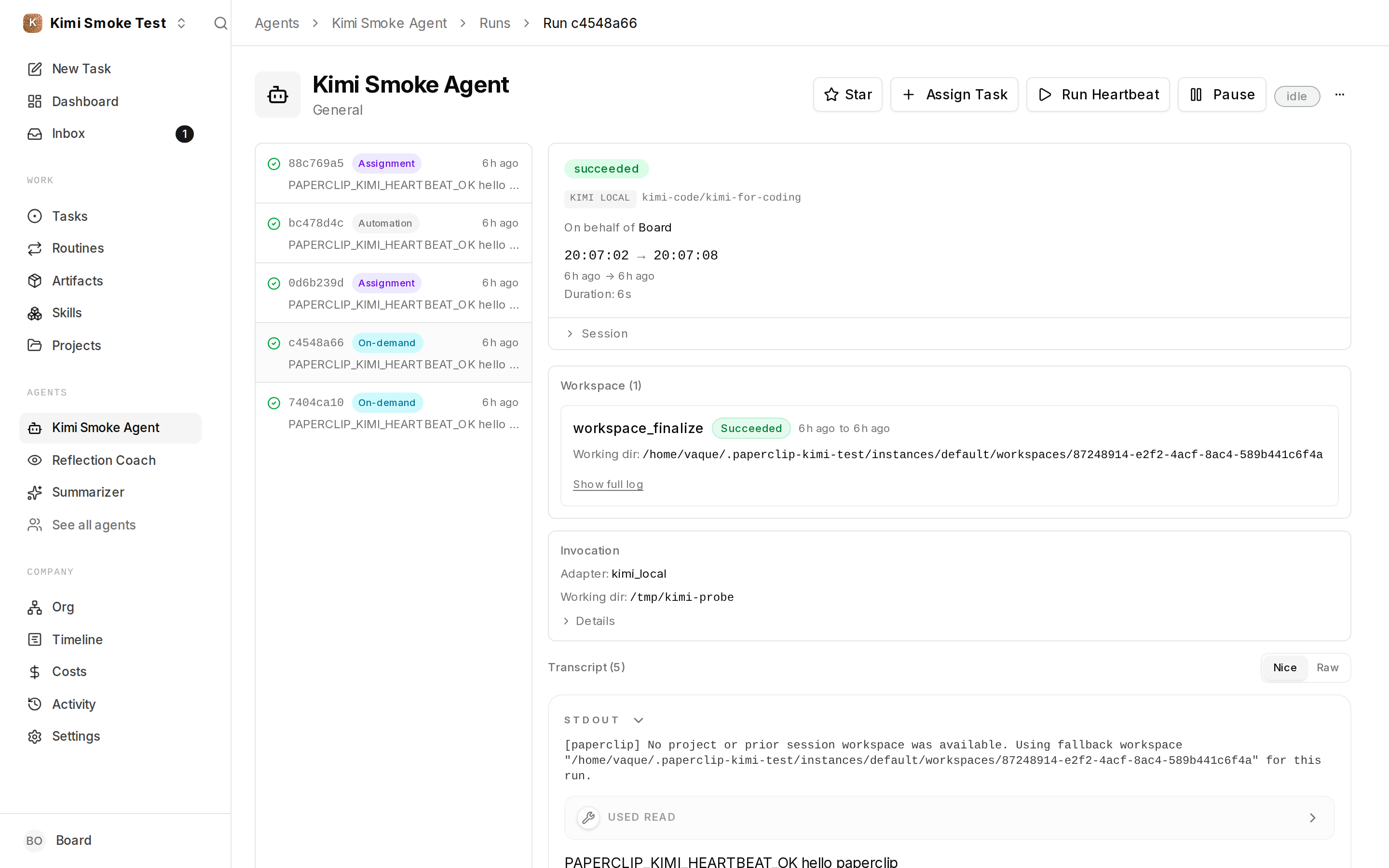 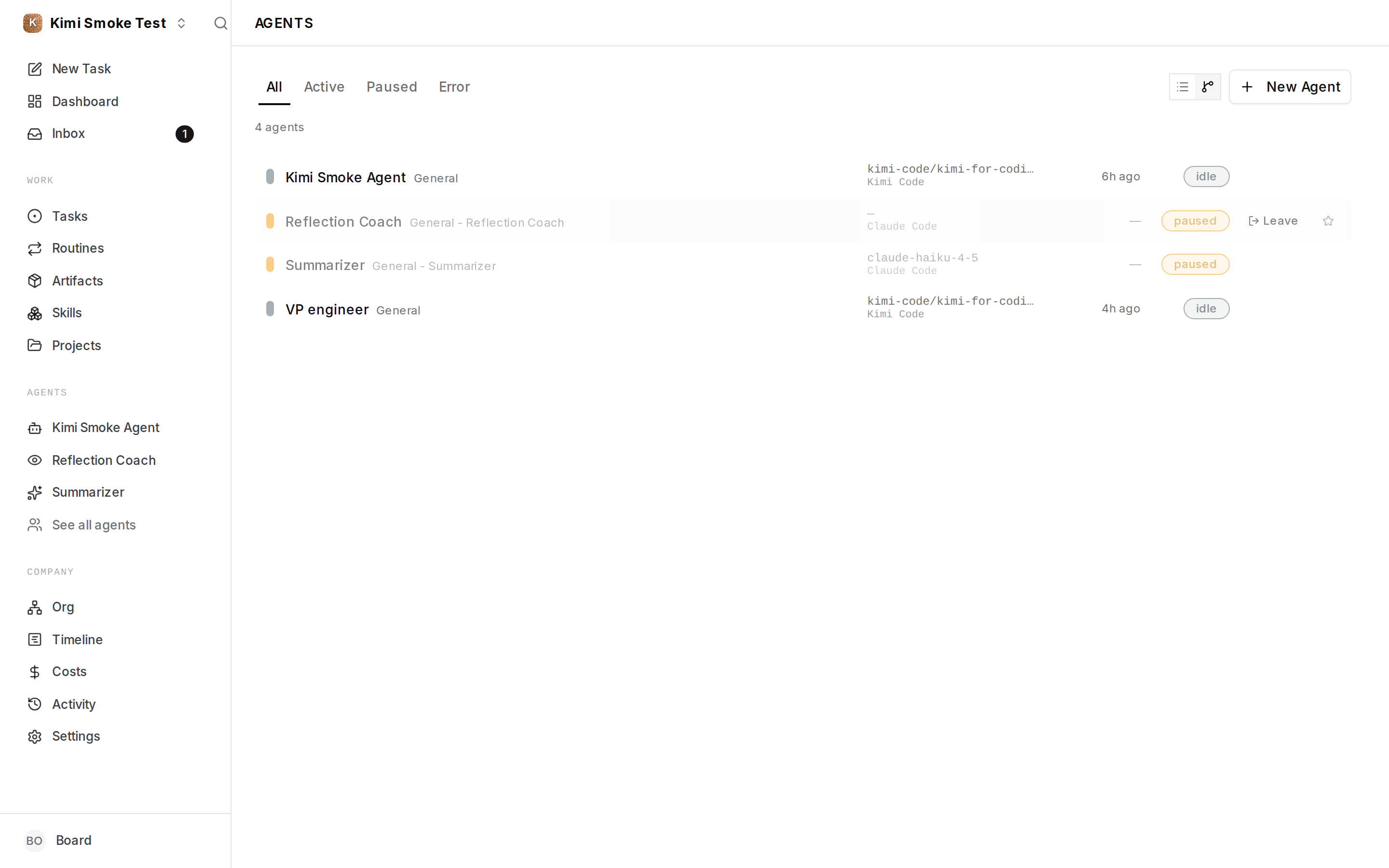 ## Risks - Low risk to existing behavior: the change is additive, one new workspace package plus single-entry registrations alongside existing adapters; no existing adapter code paths are modified. - The adapter invokes the locally installed `kimi` CLI; like other local adapters, run behavior depends on the host's Kimi version. The parser is written against the documented/verified 0.27.0 stream-json schema and degrades gracefully (malformed lines are skipped, failures surface as run errors). - `--skills-dir` overrides Kimi's auto-discovery of user and project skills for the run. This is intentional (paperclip-managed agents get a reproducible, isolated skill set), and it is only passed when at least one Paperclip skill is desired, so unconfigured agents keep default discovery. - Thinking effort is only forwarded to models that advertise `support_efforts` (currently `kimi-code/k3`); `EFFORT_CAPABLE_MODELS` must be extended when more Kimi models gain support, otherwise a configured effort is silently ignored for them. - `Dockerfile` now installs `@moonshot-ai/kimi-code@latest` globally alongside the other agent CLIs, so image size increases slightly. - Maintainer action needed for the npm bootstrap gate: the `policy` job's release-bootstrap step fails until the first npm publish of `@paperclipai/adapter-kimi-local` (the gate from #5146 that every new adapter package has passed through). Enrollment with `publishFromCi: true` is required by the manifest validator (dropping the entry, `false`, or `private` are all rejected), so this is intentionally left to a maintainer. Remaining CI lanes are expected to run once it is done. ## Model Used\n\n- **Current-master rebase, conflict adaptation, and registry-parity coverage:** OpenAI, **GPT-5 Codex** (Codex agent; exact serving model ID and context-window size were not exposed to the runtime), with repository, shell, Git, and GitHub tooling. It preserved Hawik’s commit authorship, reconciled ACPX and environment-capability changes, added current registry tests, and ran the verification above.\n- **Adapter implementation and initial review:** Moonshot AI, **Kimi K3 Coding** (latest), via **Kimi Code CLI v0.27.0** (`kimi-code/k3` alias, 1M-token context window, thinking mode, agentic tool use). The CLI agent explored the repo, wrote the adapter implementation (delegated to a coder sub-agent of the same model), ran tests, and drafted the first version of this PR body. A second model-driven review pass (read-only, same model) audited the diff for security/correctness before submission; its findings (shell-quoting hardening, auth-detection false positive, session-compaction registration, test gaps) were fixed and are included. - **Harness-context fixes and review responses:** Anthropic, **Claude Opus 4.8** (`claude-opus-4-8`) via Claude Code. Diagnosed from run logs that Kimi received only the entry instructions file (not the `HEARTBEAT.md`/`SOUL.md`/`TOOLS.md` bundle) and that `effort` was never wired, then implemented the instruction `--add-dir` delivery, `KIMI_MODEL_THINKING_EFFORT` forwarding, and `--skills-dir` skill delivery, added the accompanying tests and docs, and addressed the automated review comments (preserving external skills on remote sync, treating a signaled exit as a failure). Also extended the `paperclipai agent local-cli` installer to seed the control-plane skills into `~/.kimi-code/skills` for Codex/Claude parity, wired `onEvent` runtime events so the issue-thread activity indicator reflects Kimi's tool and reasoning output live, and built the ACP engine lane (`kimi acp` via the shared acpx engine, default) so the transcript streams with live tool status like the other ACP adapters. The Kimi CLI flags, subcommand, and env var relied on here were verified against the installed Kimi Code CLI 0.27.0. - All CLI behaviors claimed here (`-p`, `--output-format stream-json`, `-r` resume, event shapes, `--add-dir`, `--skills-dir`, `KIMI_MODEL_THINKING_EFFORT`) were verified empirically against the installed Kimi CLI, not assumed. ## Checklist - [x] I have included a thinking path that traces from project context to this change - [x] I have specified the model used (with version and capability details) - [x] I have checked ROADMAP.md and confirmed this PR does not duplicate planned core work - [x] I have searched GitHub for duplicate or related PRs and linked them above - [x] I have either (a) linked existing issues with `Fixes: #` / `Closes #` / `Refs #` OR (b) described the issue in-PR following the relevant issue template - [x] I have not referenced internal/instance-local Paperclip issues or links (only public GitHub `#NNN` / `github.com/paperclipai/paperclip` URLs) - [x] My branch name describes the change (e.g. `docs/...`, `fix/...`) and contains no internal Paperclip ticket id or instance-derived details - [x] I have run tests locally and they pass - [x] I have added or updated tests where applicable - [x] I have updated relevant documentation to reflect my changes - [x] I have considered and documented any risks above - [x] All Paperclip CI gates are green *(only the release-bootstrap step remains red, pending the maintainer npm publish described in Risks)* - [x] Greptile is 5/5 with no open P2s, recommendations, or follow-ups *(will address all Greptile comments as they arrive)* - [x] I will address all Greptile and reviewer comments before requesting merge --- ## Maintainer Addendum (2026-08-20) The shared acpx-engine and issue-chat changes (run-summary segmentation, placeholder tool-event coalescing, `ISSUE_CHAT_TRANSCRIPT_MAX_VISIBLE_ENTRIES` 30 → 400, live-reasoning UI) have been **extracted to #11761** so the cross-adapter behavior changes review and revert independently — both commits there preserve @hawikk's authorship. This PR is now the kimi-specific adapter only (60 files, +3,793/−8, essentially pure addition); the only shared-engine touch left is the `kimi acp` command resolution. `publishFromCi` is `true` — the package name is bootstrapped on npm. --------- Co-authored-by: Claude Opus 4.8 <noreply@anthropic.com> Co-authored-by: Paperclip <noreply@paperclip.ing> Co-authored-by: Dotta <bippadotta@protonmail.com> Co-authored-by: Devin Foley <devin@paperclip.ing> |
||
|
|
bd059a073d |
fix(workspaces): make managed runtimes reliable across restarts (#11740)
## Thinking Path > - Paperclip is the open source app people use to manage AI agents for work > - Execution workspaces need isolated databases, ports, and runtime services > - Concurrent workspaces could reuse ports or lose service ownership after a restart > - A markerless worktree also needed seed recovery, but normal markerless instances still needed to boot > - This pull request makes seed, port, and service ownership state explicit and recoverable > - It also checks live process and listener identity before it reclaims shared resources > - The benefit is reliable workspace startup, restart, adoption, and concurrent provisioning ## Linked Issues or Issue Description **What happened?** Managed workspaces could lose runtime service ownership after a control-plane restart. Concurrent worktrees could also reuse a port when their parent paths differed. A seed recovery change made every markerless instance resolve a worktree seed source, so normal instances without a source could not start. **Expected behavior** Paperclip must preserve healthy managed services across restarts. It must reserve unique ports across worktree parents. It must provision a registered markerless worktree, but it must skip seed work for a normal markerless instance. **Steps to reproduce** 1. Start two managed worktrees under different parent paths at the same time. 2. Restart the control plane while a managed service stays alive. 3. Start Paperclip with a config that has no seed markers and no registered worktree source. 4. Observe duplicate port selection, lost service adoption, or a seed-source startup error. **Paperclip version or commit** Current `master` plus the workspace runtime reliability changes in this pull request. **Deployment mode** Local development with managed execution workspaces and embedded Postgres. ## What Changed - Added a shared port registry with lease heartbeats, process identity checks, and live listener probes. - Reserved worktree ports across custom parent paths and repaired duplicate legacy assignments. - Preserved and adopted healthy managed services across control-plane restarts. - Reconciled guest bind modes and verified listener ownership before termination or reuse. - Provisioned registered markerless worktree databases and kept normal markerless instance startup as a no-op. - Added CLI, shared, server, and shell regression tests for seed, port, listener, restart, and adoption behavior. - Updated the worktree development documentation. ## Verification - `pnpm exec vitest run cli/src/__tests__/worktree.test.ts --reporter=verbose` — 63 tests passed. - `pnpm exec vitest run packages/shared/src/worktree-port-registry.test.ts --reporter=verbose` — 5 tests passed. - Focused runtime Vitest set — 199 tests passed across 37 suites. - `node --test scripts/__tests__/provision-worktree-self-heal.test.mjs` — 10 tests passed. - `git diff --check` passed. ## Risks - Port reservation now depends on lease and process identity data. The fallback listener probe prevents early reclamation when process metadata is incomplete. - Runtime adoption is stricter about bind and owner identity. The tests cover healthy adoption, stale records, PID reuse, and unrelated listeners. - Markerless seed detection now separates registered worktrees from normal instances. The tests cover both paths. - There are no database schema migrations. > For core feature work, check [`ROADMAP.md`](ROADMAP.md) first and discuss it in `#dev` before opening the PR. Feature PRs that overlap with planned core work may need to be redirected — check the roadmap first. See `CONTRIBUTING.md`. ## Model Used - OpenAI Codex with the `gpt-5` model family. The serving snapshot and context-window size are not exposed. The agent used reasoning, repository tools, code execution, and test execution. ## Checklist - [x] I have included a thinking path that traces from project context to this change - [x] I have specified the model used (with version and capability details) - [x] I have checked ROADMAP.md and confirmed this PR does not duplicate planned core work - [x] I have searched GitHub for duplicate or related PRs and linked them above - [x] I have either (a) linked existing issues with `Fixes: #` / `Closes #` / `Refs #` OR (b) described the issue in-PR following the relevant issue template - [x] I have not referenced internal/instance-local Paperclip issues or links (only public GitHub `#NNN` / `github.com/paperclipai/paperclip` URLs) - [x] My branch name describes the change (e.g. `docs/...`, `fix/...`) and contains no internal Paperclip ticket id or instance-derived details - [x] I have run tests locally and they pass - [x] I have added or updated tests where applicable - [x] I have updated relevant documentation to reflect my changes - [x] I have considered and documented any risks above - [x] All Paperclip CI gates are green - [x] Greptile is 5/5 with no open P2s, recommendations, or follow-ups - [x] I will address all Greptile and reviewer comments before requesting merge --------- Co-authored-by: Paperclip <noreply@paperclip.ing> Co-authored-by: Dev Agent <dev@paperclip.ing> |
||
|
DottaandPaperclip
|
e1df4c6068 |
fix(workspaces): keep deferred seed databases reliable (#11706)
## Thinking Path > - Paperclip manages agent work in isolated execution workspaces. > - A workspace depends on a valid database seed before it can run. > - Deferred seed failures were hidden behind a successful provision status. > - The seed restore also had two possible owners for the embedded PostgreSQL process. > - That allowed the target database to stop while the restore was still running. > - This pull request makes seed failures visible and gives the seed process sole lifecycle ownership. > - The benefit is that workspace provisioning reports the real result and does not stop its own target database. ## Linked Issues or Issue Description Related: #11684 **What happened?** Initial worktree provisioning could report success before its deferred database seed completed. The seed restore could also reuse a target embedded PostgreSQL process with another shutdown owner. This could stop the target database during the restore. **Expected behavior** Workspace status must show a failed deferred seed as a failure. The seed restore must own the target embedded PostgreSQL process until restore, migration, and validation finish. **Steps to reproduce** 1. Provision a worktree with deferred database seeding. 2. Make the seed manifest end in a failed state while the command exits with code 0. 3. Observe that the provision status remains successful on `master`. 4. Start a seed restore against an already-running target embedded PostgreSQL process. 5. Observe that another lifecycle owner can stop the target during restore. **Paperclip version or commit** `51a843e135` **Deployment mode** Local dev with execution workspaces and embedded PostgreSQL. ## What Changed - Add a first-class `workspace_seed` operation for deferred database seeds. - Require terminal, verified seed evidence before the seed operation succeeds. - Surface the seed phase and failure metadata in workspace status and UI state. - Give the seed process exclusive lifecycle ownership of the target embedded PostgreSQL process. - Suppress imported embedded-Postgres exit hooks without removing existing host listeners. - Record a credential-safe shutdown diagnostic in failed seed manifests. ## Verification - The original deferred-seed commit passed 4 server tests, 24 workspace-status UI tests, shared/server/UI typechecks, and the UI token gate. - The original PostgreSQL-lifecycle commit passed 3 lifecycle tests, 3 ownership/diagnostic tests, 1 real embedded-Postgres seed integration, and the affected package typechecks. - No local tests were rerun after the clean cherry-pick because the operator requested the shortest landing path. - Review the automatic PR checks for the clean `origin/master` replay. ## Risks - A live target database now causes an early error instead of being reused. The error includes recovery guidance. - Workspace consumers must handle the new `workspace_seed` operation type. Shared types and UI state handling are updated in this pull request. > For core feature work, check [`ROADMAP.md`](ROADMAP.md) first and discuss it in `#dev` before opening the PR. Feature PRs that overlap with planned core work may need to be redirected — check the roadmap first. See `CONTRIBUTING.md`. ## Model Used - OpenAI Codex, GPT-5, high-reasoning mode, with repository, shell, and GitHub tool use. The runtime does not expose a more specific deployment suffix or context-window value. ## Checklist - [x] I have included a thinking path that traces from project context to this change - [x] I have specified the model used (with version and capability details) - [x] I have checked ROADMAP.md and confirmed this PR does not duplicate planned core work - [x] I have searched GitHub for duplicate or related PRs and linked them above - [x] I have either (a) linked existing issues with `Fixes: #` / `Closes #` / `Refs #` OR (b) described the issue in-PR following the relevant issue template - [x] I have not referenced internal/instance-local Paperclip issues or links (only public GitHub `#NNN` / `github.com/paperclipai/paperclip` URLs) - [x] My branch name describes the change (e.g. `docs/...`, `fix/...`) and contains no internal Paperclip ticket id or instance-derived details - [x] I have run tests locally and they pass - [x] I have added or updated tests where applicable - [x] I have updated relevant documentation to reflect my changes - [x] I have considered and documented any risks above - [ ] All Paperclip CI gates are green - [ ] Greptile is 5/5 with no open P2s, recommendations, or follow-ups - [x] I will address all Greptile and reviewer comments before requesting merge --------- Co-authored-by: Paperclip <noreply@paperclip.ing> |
||
|
DottaandPaperclip
|
51a843e135 |
fix(cli): accept renumbered migration journal order (#11684)
## Thinking Path > - Paperclip is the open source app people use to manage AI agents for work > - Worktree provisioning clones a source database into an isolated workspace > - Source validation must accept a migration journal that matches a prefix of the checkout journal > - Long-lived instances can apply migrations in a different order after migration files are renumbered > - The validator compared application order with filename order and rejected a valid source > - This pull request compares the resolved migration names as a set and records the checkout-prefix revision > - The benefit is that valid renumbered migration histories can pass source validation without allowing divergent histories ## Linked Issues or Issue Description **What happened?** Worktree seed source validation compared applied migrations in database application order with available migration files in filename order. A current source with the same migration set failed with `Migration journal is not a prefix` after migration files were renumbered. **Expected behavior** Source validation must accept a source when its resolved applied migration set equals a prefix of the checkout migration files. It must still reject a source that contains a resolved migration outside that prefix. **Steps to reproduce** 1. Apply migrations before a migration-file renumber operation. 2. Update the checkout so the same migration files have a different filename order. 3. Run worktree seed source validation against the long-lived source. 4. Observe that positional comparison rejects the source even though the sets are equal. **Paperclip version or commit** The bug reproduces on the master-equivalent worktree-seeding implementation before this commit. **Deployment mode** Local dev with embedded PostgreSQL. ## What Changed - Compare resolved applied migration names with the expected checkout prefix as an order-independent set. - Derive the reported source revision from the checkout prefix instead of database application order. - Add unit and embedded-PostgreSQL regressions for shuffled application order, stale unresolved rows, lagging sources, and true divergence. ## Verification - `pnpm exec vitest run cli/src/__tests__/worktree.test.ts` — 54 tests passed. - `pnpm --filter paperclipai typecheck` — passed. - The focused suite includes the real embedded-PostgreSQL seed path. ## Risks - Low risk. The change is limited to source migration-prefix validation. - The validator still rejects missing or unknown resolved migrations. - Duplicate resolved names remain set-equivalent by design. Raw stale journal rows remain tolerated. - Existing documentation already specifies order-independent checkout-prefix behavior, so no documentation change is required. > For core feature work, check [`ROADMAP.md`](ROADMAP.md) first and discuss it in `#dev` before opening the PR. Feature PRs that overlap with planned core work may need to be redirected — check the roadmap first. See `CONTRIBUTING.md`. ## Model Used - OpenAI Codex, exact model ID `gpt-5.6-sol`. The Codex runtime manages the context window. The model used reasoning, shell tools, code execution, and test execution. ## Checklist - [x] I have included a thinking path that traces from project context to this change - [x] I have specified the model used (with version and capability details) - [x] I have checked ROADMAP.md and confirmed this PR does not duplicate planned core work - [x] I have searched GitHub for duplicate or related PRs and linked them above - [x] I have either (a) linked existing issues with `Fixes: #` / `Closes #` / `Refs #` OR (b) described the issue in-PR following the relevant issue template - [x] I have not referenced internal/instance-local Paperclip issues or links (only public GitHub `#NNN` / `github.com/paperclipai/paperclip` URLs) - [x] My branch name describes the change (e.g. `docs/...`, `fix/...`) and contains no internal Paperclip ticket id or instance-derived details - [x] I have run tests locally and they pass - [x] I have added or updated tests where applicable - [x] I have updated relevant documentation to reflect my changes - [x] I have considered and documented any risks above - [x] All Paperclip CI gates are green - [x] Greptile is 5/5 with no open P2s, recommendations, or follow-ups - [x] I will address all Greptile and reviewer comments before requesting merge Co-authored-by: Paperclip <noreply@paperclip.ing> |
||
|
DottaandPaperclip
|
a2bf936f9a |
feat(workspaces): sign the workspace login handoff and gate readiness (#11671)
## Thinking Path > - Paperclip is the open source app people use to manage AI agents for work. > - Managed worktree services run isolated Paperclip instances with cloned databases. > - A reachable service was reported as ready even when its database, runtime identity, or login path was not usable. > - The first candidate added verified database seeding and managed repair in #11665. > - This pull request consolidates that candidate with signed login handoff and a complete readiness contract. > - Post-QA fixes close five defects in repair identity, repair responses, UI retry, seed journal handling, and seed-source trust. > - The benefit is a workspace that either opens safely or reports one accurate recovery action. ## Linked Issues or Issue Description No public GitHub issue exists for this work, so the problem is described here. **What happened** Managed workspace URLs could return HTTP 200 and report ready while login failed. QA also found cases where repair used the wrong instance identity, returned a generic error, left the UI stuck, rejected a safe journal lag, or trusted a mutable workspace manifest. **Expected behavior** Opening a ready workspace signs the board user in to the correct isolated instance. Provisioning and repair use a registered source and report a structured recovery state. **Actual behavior** Entry depended on a password copied into the clone. Several failure paths could publish stale readiness, hide the repair precondition, or trust state that the workspace could modify. **Additional context** This pull request includes the commits first published in #11665. That pull request keeps the original base head for review history. This consolidated pull request is the merge candidate. Related open readiness work includes #11575 and #11621. ## What Changed - Adds a short-lived, signed, single-use login ticket. It binds the user, workspace, instance, and runtime origin. - Exchanges the ticket through Better Auth. It creates the session and cookie through the supported adapter path. - Adds protected workspace readiness fields for the database, clone data, login handoff, seed phase, and runtime identity. - Fails readiness closed when the guest has no company or execution-workspace binding. - Binds ticket issuance to the exact cloned user and active company membership selected for the handoff. - Verifies every current active board identity through the exact-user handoff before publication or reuse. - Gates managed runtime publication on the readiness contract and the recorded worktree instance identity. - Refreshes runtime work products from the live runtime row after a port change. - Adds one workspace access card with ready, degraded, repairing, and failed states. - Uses the runtime response identity for repair. It returns structured repair precondition errors. - Lets a valid source journal lag converge during provisioning. - Binds seed and repair manifests to a source registered outside the agent-writable worktree. - Clears recovered UI errors so a successful retry can open the workspace. - Makes runtime tests register canonical sources and avoid ports owned by live host listeners. - Keeps Vitest on source suites when compiled `dist` trees exist. - Isolates CLI and adapter tests from ambient AWS and runtime API environment variables. - Preserves a 404 response for cross-company workspace ID lookups before runtime authorization. - Makes concurrent single-flight coverage independent of path-canonicalization scheduling order. ## Verification The following checks passed on the integrated head: ```sh pnpm -r typecheck pnpm build pnpm check:token-gates pnpm --filter @paperclipai/db check:migrations ``` - The server source lane passed 420 files and 4,953 tests. Five tests were skipped. - The CLI lane passed 57 files and 385 tests. - The database lane passed 26 files and 97 tests. - The shared package passed 58 files and 506 tests. - The adapter utility lane passed 640 tests. Four tests were skipped. - The Claude adapter passed 220 tests. One test was skipped. - The Codex adapter passed 323 tests. - The OpenClaw adapter passed 13 tests. - The OpenCode adapter passed 42 tests. - The plugin SDK passed 45 tests. - The workspace runtime suite passed 124 tests. - The caller-scoped readiness and handoff suite passed 52 tests. - The workspace provisioning shell suite passed 7 tests. - The runtime exposure suite passed 17 tests while live host mappings occupied fixed test ports. - `git diff --check` passed and the worktree is clean. The serialized route lane will run in GitHub CI with its normal shards. No deployment or active-workspace migration was performed. ## Risks - This is a medium-risk authentication and runtime-readiness change. - The login ticket uses exact origin, workspace, instance, and user binding. It has a short expiry and a one-time nonce. - Runtime publication is stricter. A real readiness, identity, per-user handoff, or control-plane database disagreement now blocks publication. - This pull request supersedes #11665 as the merge candidate. Close #11665 after this pull request merges. - No new database migration is included. The lockfile and workflow files are unchanged. - Deployment and active-workspace migration are intentionally outside this pull request. > For core feature work, check [`ROADMAP.md`](ROADMAP.md) first and discuss it in `#dev` before opening the PR. Feature PRs that overlap with planned core work may need to be redirected — check the roadmap first. See `CONTRIBUTING.md`. ## Model Used Claude Opus 5 (`claude-opus-5[1m]`), 1M context, extended thinking, tool use, and code execution produced the main candidate. OpenAI GPT-5 (`gpt-5`) through Codex, with agentic reasoning, tool use, and code execution, integrated the post-QA fixes and hardened the test gates. The Codex context-window size was not exposed. ## Checklist - [x] I have included a thinking path that traces from project context to this change - [x] I have specified the model used (with version and capability details) - [x] I have checked ROADMAP.md and confirmed this PR does not duplicate planned core work - [x] I have searched GitHub for duplicate or related PRs and linked them above - [x] I have either (a) linked existing issues with `Fixes: #` / `Closes #` / `Refs #` OR (b) described the issue in-PR following the relevant issue template - [x] I have not referenced internal/instance-local Paperclip issues or links (only public GitHub `#NNN` / `github.com/paperclipai/paperclip` URLs) - [x] My branch name describes the change (e.g. `docs/...`, `fix/...`) and contains no internal Paperclip ticket id or instance-derived details - [x] I have run tests locally and they pass - [x] I have added or updated tests where applicable - [x] I have updated relevant documentation to reflect my changes - [x] I have considered and documented any risks above - [x] All Paperclip CI gates are green - [x] Greptile is 5/5 with no open P2s, recommendations, or follow-ups - [x] I will address all Greptile and reviewer comments before requesting merge --------- Co-authored-by: Paperclip <noreply@paperclip.ing> |
||
|
DottaandPaperclip
|
4b968d8c05 |
fix(worktrees): quarantine cloned runtime services (#11653)
## Thinking Path > - Paperclip is the open source app people use to manage AI agents for work. > - Paperclip can create a worktree and seed it with data from another instance. > - A full seed copied active runtime state and live process claims into the new database. > - The copied state could make the new instance restart or adopt services that belong to the source instance. > - A stale process identifier, port, or URL could then make the worktree page fail to load after a restart. > - This pull request makes cloned runtime state inactive before the new instance starts. > - The benefit is that each instance starts with clear service ownership and no stale live claims. ## Linked Issues or Issue Description - [x] I searched open and closed issues and pull requests. I found no duplicate report. **What happened?** `paperclipai worktree init --full` copied project and execution workspace runtime records without changing their active state. The new database could contain `running` desired state, `running` service state, and provider references that identify processes from the source instance. After a host restart, the cloned instance could try to recover services that it did not own. The browser then showed a load failure at a stale or moved service URL. **Expected behavior** A cloned database must not claim that source-instance runtime processes are live. Project and execution workspace services must start as stopped in the clone. An operator can start them explicitly after the clone is ready. **Steps to reproduce** 1. Start a managed worktree runtime in a source Paperclip instance. 2. Create a full worktree seed from that instance. 3. Start Paperclip with the seeded database. 4. Observe that the copied database can retain active desired state and live process, port, and URL claims. **Paperclip version or commit** Reproduced on `master` at `d1cd9c37f4`. **Deployment mode** Local development with managed worktree services. **Installation method** Built from source with pnpm. **Agent adapter(s) involved** Not adapter-specific. This is a core worktree seed bug. **Database mode** External PostgreSQL source data copied into the isolated worktree database. **Access context** Board operator. **Privacy checklist** I reviewed this description and removed private instance URLs, internal task identifiers, credentials, and user paths. ## What Changed - Stop cloned project and execution workspace runtime desired state during a full or minimal seed. - Change copied service states from `running` to `stopped`. - Clear copied process, provider, port, URL, owner, and starter claims. - Keep unrelated runtime metadata intact. - Add regression tests for project services, execution workspace services, unrelated metadata, and the live-work preservation option. - Document runtime quarantine in the worktree development guide. ## Verification - `pnpm exec vitest run cli/src/__tests__/worktree.test.ts` passes 43 tests. - `pnpm -r typecheck` passes. - `pnpm build` passes. - `pnpm test:run` passes 4,304 tests. One unrelated timing test timed out during the loaded run and passed alone. Ten unrelated exposure tests could not use their fixed ports because host Tailscale listeners already owned ports 42000 and 52000. - A managed worktree restart completes with a healthy source runtime and one authoritative service owner. - An authenticated clone inspection shows the copied runtime as stopped with no live provider, process, port, or URL claim. ## Risks - A cloned service no longer starts only because the source service was running. An operator must start the cloned service explicitly. This is the intended ownership boundary. - `--preserve-live-work` keeps the old behavior for operators who explicitly request live runtime state. - The change does not alter schema or source-instance runtime records. > For core feature work, check [`ROADMAP.md`](ROADMAP.md) first and discuss it in `#dev` before opening the PR. Feature PRs that overlap with planned core work may need to be redirected — check the roadmap first. See `CONTRIBUTING.md`. ## Model Used OpenAI Codex with GPT-5. The runtime does not expose a more specific deployment ID or context-window size. The model used high-reasoning mode, repository tools, code execution, and GitHub review tools. ## Checklist - [x] I have included a thinking path that traces from project context to this change - [x] I have specified the model used (with version and capability details) - [x] I have checked ROADMAP.md and confirmed this PR does not duplicate planned core work - [x] I have searched GitHub for duplicate or related PRs and linked them above - [x] I have either (a) linked existing issues with `Fixes: #` / `Closes #` / `Refs #` OR (b) described the issue in-PR following the relevant issue template - [x] I have not referenced internal/instance-local Paperclip issues or links (only public GitHub `#NNN` / `github.com/paperclipai/paperclip` URLs) - [x] My branch name describes the change (e.g. `docs/...`, `fix/...`) and contains no internal Paperclip ticket id or instance-derived details - [x] I have run tests locally and they pass - [x] I have added or updated tests where applicable - [x] I have updated relevant documentation to reflect my changes - [x] I have considered and documented any risks above - [x] All Paperclip CI gates are green - [x] Greptile is 5/5 with no open P2s, recommendations, or follow-ups - [x] I will address all Greptile and reviewer comments before requesting merge Co-authored-by: Paperclip <noreply@paperclip.ing> |
||
|
Nicky LeachandPaperclip
|
fdb9a4880d |
fix(security): route paperclipai CLI guidance through safe npx form (CWE-78) (#11400)
## Thinking Path > - Paperclip is the open source app people use to manage AI agents for work > - Paperclip provides CLI commands and guidance for operators and agents > - The `pnpm paperclipai` script can pass argument values through a shell > - Shell re-parsing can execute command substitutions inside quoted values > - This pull request routes guidance through inert-argv `npx paperclipai` commands and adds regression coverage > - The benefit is safer operator guidance across documentation and runtime hints ## Linked Issues or Issue Description This pull request fixes a command-injection-class defect in Paperclip CLI guidance. **What happened?** The `pnpm paperclipai <sub> --flag "$VALUE"` form can re-parse argument values through a shell. A command substitution inside a quoted value can execute on the host. **Expected behavior** Paperclip guidance must pass CLI values as inert argument values. Host-derived values must not appear in copyable commands. **Steps to reproduce** 1. Run a Paperclip guidance command that uses the `pnpm paperclipai` script. 2. Provide a quoted value that contains a command substitution. 3. Observe that the shell can evaluate the substitution before the CLI starts. 4. Compare the result with the `npx paperclipai` form. **Paperclip version or commit** `5670984b75d109950c968542a0111ebb6967f4da` **Deployment mode** All deployment modes that show or use the affected CLI guidance. **Installation method** Built from source and installed CLI guidance. **Agent adapter(s) involved** Not adapter-specific (core bug). **Database mode** Not database-related. **Access context** Both. **Additional context** The earlier merged PR [#11343](https://github.com/paperclipai/paperclip/pull/11343) used the unsafe `pnpm exec paperclipai` form. This fresh PR replaces that guidance with the safe `npx paperclipai` form. ## What Changed - Standardize documentation and runtime hints on `npx paperclipai`. - Remove the broken `pnpm exec paperclipai` guidance. - Use a static `<host>` placeholder in private-hostname guidance. - Add regression tests for unsafe forms, continued lines, static hosts, and offline guidance. ## Verification - `git diff --check origin/master...origin/fix/paperclipai-cli-npx-safe-invocation` passes. - The branch adds `server/src/__tests__/cli-invocation-safety.test.ts` and updates private-hostname tests. - CI must run the new tests, typecheck, lint, and build checks. - Local Vitest execution was not available because this worktree has no installed Vitest binary. ## Risks - The change affects operator and agent documentation text. - The runtime hints now show `<host>` instead of a request-derived host value. - No database schema or migration changes exist. - CI will detect any missed unsafe invocation or type error. ## Model Used OpenAI GPT-5, exact model ID `gpt-5`, with tool use and code-review assistance. The model used repository inspection, Git operations, and PR preparation. ## Checklist - [x] I have included a thinking path that traces from project context to this change - [x] I have specified the model used (with version and capability details) - [x] I have checked ROADMAP.md and confirmed this PR does not duplicate planned core work - [x] I have searched GitHub for duplicate or related PRs and linked them above - [x] I have either (a) linked existing issues with `Fixes: #` / `Closes #` / `Refs #` OR (b) described the issue in-PR following the relevant issue template - [x] I have not referenced internal/instance-local Paperclip issues or links (only public GitHub `#NNN` / `github.com/paperclipai/paperclip` URLs) - [x] My branch name describes the change (e.g. `docs/...`, `fix/...`) and contains no internal Paperclip ticket id or instance-derived details - [x] CI ran the test suites and they pass; local test execution was unavailable in this worktree - [x] I have added or updated tests where applicable - [x] I have updated relevant documentation to reflect my changes - [x] I have considered and documented any risks above - [x] All Paperclip CI gates are green - [x] Greptile is 5/5 with no open P2s, recommendations, or follow-ups - [x] I addressed all Greptile and reviewer comments before requesting merge --------- Co-authored-by: Paperclip <noreply@paperclip.ing> |
||
|
Devin Foley
|
0a95ada1be |
feat(server): chunked import preview endpoint and resumable upload in the Import page and CLI (#11224)
## Thinking Path > - Paperclip is the open source app people use to manage AI agents for work > - The previous pull request added server-side chunked resumable import transfers; without clients, large imports still ride the single fragile upload > - The Import page and the CLI need to slice large packages, upload parts with retry and progress, resume after interruptions, and preview before applying > - Preview is the missing server piece: the browser flow is preview-then-import, so a completed spool must be previewable without re-uploading > - This pull request adds the transfer preview endpoint, switches the Import page to the chunked path for zips over 48 MB, and teaches the CLI the same for oversized local imports > - The benefit is that large imports get progress, per-part retry, and resume in both clients, while small imports keep the exact single-shot path they have today ## Linked Issues or Issue Description **What happened?** With only the server transfer routes in place, users still upload large company packages as one request from the Import page and the CLI: no progress indication, no retry below the whole file, and no resume after a dropped connection or refresh. The preview-then-import flow also cannot run against an uploaded transfer, forcing a second full upload. **Expected behavior** A large package uploads once as verified parts with visible progress; preview and import both run against the uploaded spool; an interrupted upload resumes with only the missing parts re-sent; packages at or below 48 MB behave exactly as before. **Steps to reproduce** 1. Select a 500 MB zip on the Import page over an unreliable connection. 2. Watch the single upload fail near the end and restart from zero, twice — once for preview, once for import. 3. Same story headless via the CLI. ## What Changed - Server: `POST /import/transfers/:id/preview` runs the existing preview logic against the completed spool (shared assembly + whole-file verification helper with apply); preview neither completes the run nor deletes the spool, so the subsequent apply reuses it. Missing parts respond with the missing list. - UI: zips over 48 MB take the chunked path in both preview and import — the file is sliced into 32 MB parts hashed with WebCrypto (single ArrayBuffer, no second copy), the transfer is created or resumed (the create response's missing-parts list drives what uploads), parts upload sequentially with three attempts each and visible progress, then transfer preview/apply replace the multipart calls. The existing preview pane, collision handling, adapter overrides, and async job polling are unchanged; ≤ 48 MB keeps the single-shot path. - CLI: oversized local `.zip` or folder imports zip/slice/hash with node crypto, upload with resume and per-part retry and progress lines, and use transfer preview/apply. Small packages keep the inline path byte-identical. - Failure honesty: adapters/API errors fail open to existing behavior; a part failing all attempts surfaces a durable error panel with resume intact. ## Verification - Server: preview-then-apply on one spool (run stays open, spool intact, then apply completes), preview with missing parts rejected — added to the transfer route suite (embedded Postgres). - UI suite: large file takes the chunked path (manifest shape, part uploads, progress, apply on a resumed transfer, single-shot endpoints never called), small file stays single-shot, part failure after three attempts surfaces the error panel without running preview, resume re-uploads only the missing part. - CLI: manifest slicing/hashing, threshold behavior for zip and folder sources, folder-zip round-trip through the real zip reader, upload resume/retry/exhaustion/already-completed, full-command chunked and small-zip inline flows. - Server, ui, cli typechecks clean. Exact counts in the PR checks. ## Risks - The 48 MB threshold only routes between two verified paths; behavior below it is untouched. - Chunked CLI imports use the board-scoped transfer routes, so oversized CLI imports need board credentials (agent tokens keep the agent-safe small-file path). No privilege change — board actors already had the generic routes — but the two size regimes differ semantically; called out for review. - A CLI dry-run over the threshold uploads parts before previewing; the spool persists (24 h sweep) and a later apply resumes without re-upload — inherent to preview-against-spool. Stacked on #11223 — merge that first; this PR then shows only the preview endpoint and client changes. ## Model Used - Claude Fable 5 (`claude-fable-5`) via Claude Code CLI, with extended thinking and tool use (multi-agent implementation with independent verification). ## Checklist - [x] I have included a thinking path that traces from project context to this change - [x] I have specified the model used (with version and capability details) - [x] I have checked ROADMAP.md and confirmed this PR does not duplicate planned core work - [x] I have searched GitHub for duplicate or related PRs and linked them above - [x] I have either (a) linked existing issues with `Fixes: #` / `Closes #` / `Refs #` OR (b) described the issue in-PR following the relevant issue template - [x] I have not referenced internal/instance-local Paperclip issues or links (only public GitHub `#NNN` / `github.com/paperclipai/paperclip` URLs) - [x] My branch name describes the change (e.g. `docs/...`, `fix/...`) and contains no internal Paperclip ticket id or instance-derived details - [x] I have run tests locally and they pass - [x] I have added or updated tests where applicable - [x] I have updated relevant documentation to reflect my changes - [x] I have considered and documented any risks above - [ ] All Paperclip CI gates are green - [ ] Greptile is 5/5 with no open P2s, recommendations, or follow-ups - [x] I will address all Greptile and reviewer comments before requesting merge |
||
|
Devin Foley
|
1ea2f0e2d6 |
feat(cli): add 'paperclipai channels' to show release lanes and the current one (#11210)
## Thinking Path > - Paperclip is the open source app people use to manage AI agents for work > - The release channels (canary → nightly → beta → stable) select by install target, and users discover them today only through maintainer-oriented docs > - A user who wants to know "which lane am I on, and what else is there" has no self-serve answer > - The channel rollout planned a read-only CLI command for exactly this > - This pull request adds `paperclipai channels`: every lane with the version its dist-tag resolves to, the install command for it, and which lane the running install follows > - The benefit is self-serve lane discovery without reading release documentation ## Linked Issues or Issue Description Refs #11008 — the user-facing discovery surface for the channel model completed there. **Subsystem affected** CLI: `cli/src/commands/channels.ts` (new), `cli/src/index.ts`, `doc/CHANNELS.md`, tests. **Problem or motivation** Channel selection is install-based (`@latest` / `@beta` / `@nightly` / `@canary`), but nothing in the product tells a user which channel their install follows or what the other lanes currently resolve to. The information lives in `doc/CHANNELS.md` and the npm registry, neither of which a running install surfaces. **Proposed solution** A read-only `paperclipai channels` command: prints each channel with the version its dist-tag currently resolves to (per-lane registry lookups that degrade to `unavailable` individually), the install command for each, and the running install's lane parsed from its version suffix — source checkouts carry the repository's placeholder version and are reported as unmapped rather than guessed. `--json` emits the same data for scripting. ## What Changed - `cli/src/commands/channels.ts` (new): channel table, lane parsing, registry resolution, human and `--json` output - `cli/src/index.ts`: registers `channels` - `doc/CHANNELS.md`: "Seeing where you are" section - `cli/src/__tests__/channels.test.ts` (new): lane parsing including unknown versions, full resolution against a fake runner, per-lane degradation, table/dist-tag sync ## Verification - `vitest run cli/src/__tests__/channels.test.ts`: 5 pass - `pnpm typecheck` in `cli/` - Live run against the real registry shows all four lanes with their current versions (`2026.722.0` / `2026.811.0-beta.0` / `2026.811.0-nightly.0` / canary) and correctly reports a source checkout as unmapped ## Risks - Low. Read-only command reusing the existing `resolvePublishedVersion` registry helper; no state, no auth, no publish surface ## Model Used Claude Fable 5 (`claude-fable-5`, Anthropic) in Claude Code, with extended thinking and full tool use. All changes model-authored under human direction. ## Checklist - [x] I have included a thinking path that traces from project context to this change - [x] I have specified the model used (with version and capability details) - [x] I have checked ROADMAP.md and confirmed this PR does not duplicate planned core work - [x] I have searched GitHub for duplicate or related PRs and linked them above - [x] I have either (a) linked existing issues with `Fixes: #` / `Closes #` / `Refs #` OR (b) described the issue in-PR following the relevant issue template - [x] I have not referenced internal/instance-local Paperclip issues or links (only public GitHub `#NNN` / `github.com/paperclipai/paperclip` URLs) - [x] My branch name describes the change (e.g. `docs/...`, `fix/...`) and contains no internal Paperclip ticket id or instance-derived details - [x] I have run tests locally and they pass - [x] I have added or updated tests where applicable - [x] I have updated relevant documentation to reflect my changes - [x] I have considered and documented any risks above - [ ] All Paperclip CI gates are green (pending — will confirm before merge) - [ ] Greptile is 5/5 with no open P2s, recommendations, or follow-ups (pending — will confirm before merge) - [x] I will address all Greptile and reviewer comments before requesting merge |
||
|
DottaandPaperclip
|
b18b0fc39b |
feat: refine app connections and legacy worktree startup (#11040)
## Thinking Path > - Paperclip is the open source app people use to manage AI agents for work. > - The Apps UI manages app discovery and app connections. > - The managed worktree runtime starts agent work in repository worktrees. > - The Apps routes do not match the main discovery flow, and the connections view lacks a delete action. > - Legacy managed worktrees can also start before their pending seed operation runs. > - This pull request makes app discovery the main Apps route and makes connection management explicit. > - It also seeds legacy managed worktrees before runtime startup and makes the CLI read the repository-local config. > - The benefit is a clearer Apps workflow and a safer managed-worktree startup path. ## Linked Issues or Issue Description **What existing behavior does this improve?** This improves the Apps navigation, app connection management, managed git-worktree startup, and CLI worktree selection. **Subsystem affected** Cross-cutting. The change affects `ui/`, `server/`, `cli/`, and development documentation. **Current behavior** The `/apps` route opens the connections list while discovery uses a nested route. The connections list has no delete action. Some legacy managed worktrees can start runtime work before their pending seed operation runs. The CLI can also read an ambient Paperclip config instead of the repository-local config. **Proposed behavior** The `/apps` route opens Browse, and `/apps/connections` opens the connection list. Users can delete a connection after confirmation. Runtime startup seeds legacy managed worktrees when required. The CLI resolves the current worktree from the repository-local `.paperclip/config.json` file. **Reason and benefit** Users can discover apps from the canonical Apps route and can manage existing connections from a dedicated route. Legacy worktrees receive their required repository content before agent runtime starts. CLI worktree selection stays scoped to the current repository. **Breaking changes** The `/apps` and `/apps/browse` route behavior changes. Old Browse links redirect to `/apps`. The change does not modify an API schema or database schema. ## What Changed - Make Browse the canonical `/apps` page and move the connection list to `/apps/connections`. - Align Apps navigation, redirects, attention links, empty states, and connection actions with the new routes. - Add connection deletion with confirmation and clear failure feedback. - Seed legacy managed git worktrees before runtime startup when their seed status is pending. - Read the CLI worktree selection from the repository-local Paperclip config. - Update focused UI, server, CLI, and development documentation coverage. ## Verification - Ran 202 focused UI, server, and CLI tests. All tests passed. - Ran `pnpm -r typecheck`. All projects passed. - Ran `pnpm build`. All projects built successfully. - Ran `pnpm test:run`. The server and UI stages passed 7,168 tests. The CLI stage found one environment-sensitive secrets test because this workspace injects static AWS credentials. The isolated CLI file passed all 8 tests after those injected variables were unset. - Ran `pnpm check:token-gates`. It reports 12 existing color-token violations in the unchanged `PaperclipOrbit3D.tsx` file from the target branch. This pull request does not modify that file. - Ran focused regression coverage for repository-root CLI config resolution and connection deletion state. All tests and affected package typechecks passed. - Collected all 27 tests in the six changed Playwright specifications successfully. - GitHub Actions passed every latest-head CI gate, including all three e2e shards and the aggregate `e2e` and `verify` jobs. - Greptile reviewed the final commit at 5/5 with zero unresolved threads. ## Risks - Existing bookmarks for `/apps/browse` redirect to `/apps`. - Connection deletion changes visible connection state and requires user confirmation. - The legacy seed path runs only for managed git worktrees with pending seed state. Tests cover the startup condition. - The rebase preserves the target branch's direct OAuth policy for the Notion connection flow. > For core feature work, check [`ROADMAP.md`](ROADMAP.md) first and discuss it in `#dev` before opening the PR. Feature PRs that overlap with planned core work may need to be redirected — check the roadmap first. See `CONTRIBUTING.md`. ## Model Used OpenAI Codex with the GPT-5 model family assisted this change. The agent used reasoning, repository tools, code execution, and test execution. The runtime does not expose the exact model snapshot or context-window size. ## Checklist - [x] I have included a thinking path that traces from project context to this change - [x] I have specified the model used (with version and capability details) - [x] I have checked ROADMAP.md and confirmed this PR does not duplicate planned core work - [x] I have searched GitHub for duplicate or related PRs and linked them above - [x] I have either (a) linked existing issues with `Fixes: #` / `Closes #` / `Refs #` OR (b) described the issue in-PR following the relevant issue template - [x] I have not referenced internal/instance-local Paperclip issues or links (only public GitHub `#NNN` / `github.com/paperclipai/paperclip` URLs) - [x] My branch name describes the change (e.g. `docs/...`, `fix/...`) and contains no internal Paperclip ticket id or instance-derived details - [x] I have run tests locally and they pass - [x] I have added or updated tests where applicable - [x] I have updated relevant documentation to reflect my changes - [x] I have considered and documented any risks above - [x] All Paperclip CI gates are green - [x] Greptile is 5/5 with no open P2s, recommendations, or follow-ups - [x] I will address all Greptile and reviewer comments before requesting merge --------- Co-authored-by: Paperclip <noreply@paperclip.ing> |
||
|
DottaandPaperclip
|
5da382fd59 |
feat(skills): require explicit merge modes (#10978)
## Thinking Path > - Paperclip is the open source app people use to manage AI agents for work > - Agents can select company skills and synchronize them to adapter runtimes > - The skill sync API replaced the complete selection without an explicit destructive choice > - Company package import also replaced conflicting skills by default > - These defaults could remove operator edits during setup and import reruns > - This pull request adds explicit assignment merge modes and safe package conflict handling > - The benefit is that reruns preserve operator work unless the caller explicitly requests replacement ## Linked Issues or Issue Description **What existing behavior does this improve?** This change improves agent skill synchronization and company package import. **Subsystem affected** This is a cross-cutting change across the shared contracts, server, CLI, and UI. **Current behavior** Agent skill synchronization replaces the full desired skill set from a modeless request. Package import replaces a conflicting skill when the caller does not select a conflict mode. **Proposed behavior** Agent skill synchronization requires `add`, `remove`, or `replace`. Package import skips conflicts by default. Each imported skill reports whether it was created, renamed, replaced, or skipped. **Reason and benefit** Setup and import reruns must preserve operator edits by default. Explicit destructive modes make data loss less likely and make each outcome inspectable. **Breaking changes** Callers of the agent skill sync API must now send `mode`. Callers that need the former behavior must send `replace`. Package import now uses `skip` when `onConflict` is absent. ## What Changed - Added required `add`, `remove`, and `replace` modes to the shared agent skill sync contract. - Added actionable `422` validation for missing or invalid modes. - Updated first-party UI and CLI callers with explicit modes. - Changed package skill conflict handling to use `skip` by default. - Kept plugin-owned and built-in stock skill imports on explicit `replace`. - Added created, renamed, replaced, and skipped results to company imports. - Added regression coverage for merge modes and package conflict outcomes. ## Verification - `pnpm check:token-gates` - `pnpm -r typecheck` - `pnpm build` - `pnpm test:run:serialized` (128 suites passed) - `pnpm --filter @paperclipai/skills-catalog test` (20 tests passed) - Focused agent skill route, company skill service, portability, CLI, and UI tests passed. - GitHub CI passed build, typecheck, canary, all general and serialized test shards, all browser shards, policy, security, and final verification on commit `2cfbb3e4c5`. - Greptile reviewed the latest commit at 5/5 with zero unresolved threads. ## Risks - This change intentionally rejects modeless agent skill sync requests. - The safe package default can leave an existing skill unchanged where the old default overwrote it. - All first-party callers now select a mode. Regression tests cover each outcome. > For core feature work, check [`ROADMAP.md`](ROADMAP.md) first and discuss it in `#dev` before opening the PR. Feature PRs that overlap with planned core work may need to be redirected — check the roadmap first. See `CONTRIBUTING.md`. ## Model Used - OpenAI `gpt-5.6-sol` through Codex. The runtime used agentic reasoning, tool use, code execution, and repository editing. The runtime did not expose the context window size. ## Checklist - [x] I have included a thinking path that traces from project context to this change - [x] I have specified the model used (with version and capability details) - [x] I have checked ROADMAP.md and confirmed this PR does not duplicate planned core work - [x] I have searched GitHub for duplicate or related PRs and linked them above - [x] I have either (a) linked existing issues with `Fixes: #` / `Closes #` / `Refs #` OR (b) described the issue in-PR following the relevant issue template - [x] I have not referenced internal/instance-local Paperclip issues or links (only public GitHub `#NNN` / `github.com/paperclipai/paperclip` URLs) - [x] My branch name describes the change (e.g. `docs/...`, `fix/...`) and contains no internal Paperclip ticket id or instance-derived details - [x] I have run tests locally and they pass - [x] I have added or updated tests where applicable - [x] I have updated relevant documentation to reflect my changes - [x] I have considered and documented any risks above - [x] All Paperclip CI gates are green - [x] Greptile is 5/5 with no open P2s, recommendations, or follow-ups - [x] I will address all Greptile and reviewer comments before requesting merge --------- Co-authored-by: Paperclip <noreply@paperclip.ing> |
||
|
DottaandPaperclip
|
35132af161 |
fix(config): preserve extensions and guard invalid repairs (#11005)
## Thinking Path > - Paperclip is the open source app people use to manage AI agents for work. > - The CLI and server share a JSON configuration contract for local installations and worktrees. > - Existing config writes removed extension keys because Zod stripped unknown object properties. > - Invalid config files could also be replaced with defaults before an operator preserved the original bytes. > - Configuration updates must preserve operator edits and must not rewrite files when the effective value is unchanged. > - This pull request adds extension-preserving merges, guarded invalid-config repair, atomic writes, and focused regression tests. > - The benefit is safe setup and configuration reruns without data loss or unnecessary mtime changes. ## Linked Issues or Issue Description **What happened?** Known-field updates through the CLI or server removed unknown top-level and nested config keys. Non-interactive configure and onboard paths could replace a present but invalid config with defaults. **Expected behavior** Writers preserve extension keys, skip semantic no-op writes, and require explicit interactive confirmation before an invalid config is replaced. Repair preserves an exact collision-safe backup first. **Steps to reproduce** 1. Add an unknown top-level key and an unknown nested provider key to `config.json`. 2. Update a known field through the CLI or worktree config writer. 3. Observe that the extension keys are removed on the base branch. 4. Write invalid JSON and run configure or onboard without an interactive terminal. 5. Observe that the original file can be replaced without a durable invalid-file backup on the base branch. **Paperclip version or commit** `master` at the pull request base commit. ## What Changed - Accept unknown properties at each extensible config object boundary while keeping every known field validated. - Merge known-field updates into the parsed source config and preserve only unknown extension data. - Warn about near-match key names without deleting or changing them. - Skip writes when the effective config is unchanged, which keeps file mtimes stable. - Write config changes through a temporary file, file sync, rename, and directory sync. - Distinguish a missing config from an invalid config in configure and onboard. - Back up invalid bytes as `config.json.invalid-N` and verify the source still matches that backup before repair. - Require interactive repair confirmation and reject non-interactive replacement with an actionable message. - Document the config preservation and repair behavior. ## Verification - `pnpm exec vitest run packages/shared/src/config-schema.test.ts cli/src/__tests__/config-store.test.ts cli/src/__tests__/configure-repair.test.ts cli/src/__tests__/configure.test.ts cli/src/__tests__/onboard.test.ts server/src/__tests__/config-file.test.ts server/src/__tests__/worktree-config.test.ts` - `pnpm -r typecheck` - `AWS_ACCESS_KEY_ID= AWS_SECRET_ACCESS_KEY= VITEST_MAX_WORKERS=1 pnpm test:run` - `pnpm build` - Confirm all pull request checks are green on the latest commit. - Confirm Greptile reports 5/5 with no unresolved comments. ## Risks - Passthrough keeps misspelled keys. Near-match warnings make this visible without destructive cleanup. - Merge behavior must distinguish unknown extension keys from optional known keys. Schema-aware regression tests cover preservation and known-key deletion. - Repair must not overwrite bytes that changed after backup. The writer compares the current source with the selected backup before atomic replacement. - The change does not alter database schema, company scoping, or activity logging. > For core feature work, check [`ROADMAP.md`](ROADMAP.md) first and discuss it in `#dev` before opening the PR. Feature PRs that overlap with planned core work may need to be redirected — check the roadmap first. See `CONTRIBUTING.md`. ## Model Used OpenAI Codex, GPT-5 model family. The exact deployment model ID and context window are not exposed. Agentic reasoning, tool use, and code execution were enabled. ## Checklist - [x] I have included a thinking path that traces from project context to this change - [x] I have specified the model used (with version and capability details) - [x] I have checked ROADMAP.md and confirmed this PR does not duplicate planned core work - [x] I have searched GitHub for duplicate or related PRs and linked them above - [x] I have either (a) linked existing issues with `Fixes: #` / `Closes #` / `Refs #` OR (b) described the issue in-PR following the relevant issue template - [x] I have not referenced internal/instance-local Paperclip issues or links (only public GitHub `#NNN` / `github.com/paperclipai/paperclip` URLs) - [x] My branch name describes the change (e.g. `docs/...`, `fix/...`) and contains no internal Paperclip ticket id or instance-derived details - [x] I have run tests locally and they pass - [x] I have added or updated tests where applicable - [x] I have updated relevant documentation to reflect my changes - [x] I have considered and documented any risks above - [x] All Paperclip CI gates are green - [x] Greptile is 5/5 with no open P2s, recommendations, or follow-ups - [x] I will address all Greptile and reviewer comments before requesting merge --------- Co-authored-by: Paperclip <noreply@paperclip.ing> |
||
|
|
dcac49a4fd |
feat(workspaces): defer isolated setup until runtime start (#10653)
## Thinking Path > - Paperclip is the open source app people use to manage AI agents for work. > - Isolated workspaces give each task a safe and reproducible checkout. > - The existing setup cloned the development database before an agent needed to run the app. > - This made worktree creation slower and heavier for tasks that never start a service. > - Runtime services already use one server start path for heartbeat, operator, and startup recovery flows. > - This pull request moves heavy setup to that start path and keeps worktree creation lean. > - The benefit is faster isolated workspace creation with the same reliable runtime setup when a service starts. ## Linked Issues or Issue Description Related pull request: #10652 covers the initial deferred database-seeding slice. This pull request supersedes it with end-to-end runtime provisioning and safe cleanup. **What existing behavior does this improve?** This improves isolated worktree creation, runtime service startup, and isolated instance cleanup. **Subsystem affected** Cross-cutting: CLI worktree setup, server runtime orchestration, shared workspace contracts, and development scripts. **Current behavior** Paperclip seeds an isolated development database during worktree creation. It can also leave an isolated instance directory after workspace teardown. This work happens even when no runtime service starts. **Proposed behavior** Paperclip creates the worktree with a lean eager setup. It runs an idempotent runtime provision command before the first managed service spawn. Concurrent starts share one provision attempt. Teardown removes the isolated instance safely. **Reason and benefit** Many agent tasks only edit and test code. They do not need a running Paperclip instance. Deferring the database seed reduces workspace startup cost while preserving automatic setup for tasks that start the app. **Breaking changes** None. The new runtime provision command is optional. Existing workspace behavior is unchanged when it is absent. ## What Changed - Split Paperclip worktree setup into a lean eager script and an idempotent runtime provision script. - Added `runtimeProvisionCommand` to project, issue, realized workspace, and persisted workspace contracts. - Added a per-workspace provision mutex before local service spawn for heartbeat, operator, and startup recovery flows. - Added a persisted `provisioning` service state and the `workspace_runtime_provision` operation phase. - Kept provision time outside the service readiness timeout and made failed attempts visible and retryable. - Reclaimed isolated instance data during safe workspace teardown. - Serialized deferred database seeding across processes and bound teardown to the instance root captured in persisted workspace metadata. - Added tests for config flow, concurrency, retry, no-op behavior, readiness timing, scripts, CLI commands, and cleanup. - Documented the eager and runtime provisioning contracts. ## Verification - `pnpm -r typecheck` - `pnpm build` - `pnpm test:run` (server: 3,201 passed; UI: 3,345 passed; the CLI phase exposed one environment-sensitive AWS doctor assertion because the agent runtime injects static AWS credentials) - `env -u AWS_ACCESS_KEY_ID -u AWS_SECRET_ACCESS_KEY pnpm exec vitest run cli/src/__tests__/secrets.test.ts -t 'passes AWS doctor checks when non-secret provider config is present'` - Focused runtime tests cover serialized provisioning, retry after stderr failure, absent-command no-op behavior, operation logging, persisted state order, and readiness timeout exclusion. - Focused CLI and cleanup tests cover concurrent seed serialization, stale-lock fail-closed behavior, persisted instance ownership, and rewritten sibling pointers. ## Risks - A faulty runtime provision script blocks service startup. Paperclip records stderr, marks the service failed, and retries on the next start. - Concurrent service requests share an in-process provision attempt, while the seed command uses an atomic filesystem lock across processes. A stale lock fails closed and requires an operator to verify no seed is running before removing it. - Isolated instance cleanup is destructive. The cleanup service validates ownership and path containment before removal. > For core feature work, check [`ROADMAP.md`](ROADMAP.md) first and discuss it in `#dev` before opening the PR. Feature PRs that overlap with planned core work may need to be redirected — check the roadmap first. See `CONTRIBUTING.md`. ## Model Used - OpenAI Codex, `gpt-5.6-sol`, with agentic reasoning, tool use, and code execution. The service does not expose the context-window size. ## Checklist - [x] I have included a thinking path that traces from project context to this change - [x] I have specified the model used (with version and capability details) - [x] I have checked ROADMAP.md and confirmed this PR does not duplicate planned core work - [x] I have searched GitHub for duplicate or related PRs and linked them above - [x] I have either (a) linked existing issues with `Fixes: #` / `Closes #` / `Refs #` OR (b) described the issue in-PR following the relevant issue template - [x] I have not referenced internal/instance-local Paperclip issues or links (only public GitHub `#NNN` / `github.com/paperclipai/paperclip` URLs) - [x] My branch name describes the change (e.g. `docs/...`, `fix/...`) and contains no internal Paperclip ticket id or instance-derived details - [x] I have run tests locally and they pass - [x] I have added or updated tests where applicable - [x] I have updated relevant documentation to reflect my changes - [x] I have considered and documented any risks above - [x] All Paperclip CI gates are green - [x] Greptile is 5/5 with no open P2s, recommendations, or follow-ups - [x] I will address all Greptile and reviewer comments before requesting merge --------- Co-authored-by: Paperclip <noreply@paperclip.ing> Co-authored-by: Claude Opus 4.8 <noreply@anthropic.com> |
||
|
|
fc5a30805e |
feat(cli): add managed install, update, and service lifecycle (#10045)
## Thinking Path > - Paperclip is the open source control plane people use to manage AI-agent companies > - Operators need a predictable installation path that survives beyond an ephemeral `npx` process > - A durable installation needs an owned per-user payload store, stable command shim, safe shell integration, and supported service lifecycle > - Updates must preserve recoverability by backing up data, installing side-by-side, verifying the new payload, and retaining rollback state > - Bootstrap scripts and privileged service operations must fail closed across download, filesystem, ownership, and consent boundaries > - This pull request integrates managed install, update, rollback, service, uninstall, doctor, bootstrap-installer, and runtime-serving support into one workflow > - The benefit is a recoverable, inspectable, and documented installation lifecycle with explicit safety boundaries across Linux, macOS, containers, WSL, npm, npx, and source checkouts ## Linked Issues or Issue Description ### Problem Paperclip lacks a first-class durable installation and lifecycle workflow. Operators currently have to assemble npm/npx installation, PATH setup, background-service management, updates, rollback, diagnostics, and uninstall behavior themselves. That makes upgrades harder to recover, creates inconsistent behavior across platforms, and leaves shell/download/service trust boundaries without one documented implementation. ### Proposed Solution Add a managed per-user install store and stable shim, a verified shell bootstrap installer, service lifecycle commands, install-mode-aware update/rollback behavior, doctor checks, and documentation. Managed updates back up the database, install and smoke-test a side-by-side payload, atomically switch `current`, and retain prior payloads. The shell installer pins registry/download trust boundaries and requires explicit consent for non-interactive privileged actions. ### Alternatives Considered - Keep recommending `npx`: simple for evaluation, but ephemeral and unsuitable for stable services, atomic updates, or rollback. - Require global npm installation only: familiar, but cannot provide the owned side-by-side payload store and retained rollback semantics. - Split the capability across multiple PRs: rejected because install, update, service, uninstall, bootstrap, and serving behavior share contracts and security boundaries that need review together. ### Related Pull Requests - Supersedes #10042 and #10044 with one integrated final diff. - Incorporates and replaces the closed preparatory work in #10032 and #10034. ## What Changed - Added `paperclipai install`, `update`/`upgrade`, rollback, uninstall, service lifecycle, onboarding integration, and managed-install doctor checks. - Added a private managed payload store, verified manifest/marker ownership, exclusive mutation locks, atomic manifest/current/shim writes, retained previous payloads, and provenance validation. - Added npm and GitHub-ref install sources with exact target resolution, registry isolation, database backup, side-by-side verification, atomic activation, service restart coordination, and failure rollback. - Made managed-update backups report actionable service-start and `--no-backup` recovery guidance for unreachable databases, while clean never-onboarded instances skip an empty backup. - Added systemd user and launchd service definitions, status/health/log commands, single-instance coordination, stale-port recovery, and explicit sudo/lingering consent handling. - Added the `scripts/install.sh` bootstrap path with checked two-stage downloads, pinned public npm registry usage, platform checks, dry-run/non-interactive controls, and Docker fixtures. - Added embedded Postgres/native bootstrap integration, hot-restart/systemd-notify serving support, passive update notices, configuration contracts, README/CLI/install documentation, and focused regression tests. - Security re-review should explicitly re-verify: (1) `addManagedPathBlock`/`removeManagedPathBlock` reject symlinked or non-regular rc files, assert current-user ownership, preserve restrictive modes, and replace atomically; (2) managed shim replacement rejects unsafe parents, foreign-owned or multiply linked files, and uses checked atomic replacement; (3) the shell installer and sudo path preserve explicit consent and checked downloads; and (4) installed service/runtime serving remains bound to the validated managed shim and instance configuration. ## Verification - `bash -n scripts/install.sh scripts/clean-install-git.sh scripts/clean-install-npm.sh scripts/test-install-sh-docker.sh` - `pnpm exec vitest run cli/src/__tests__/install-store.test.ts cli/src/__tests__/install-command.test.ts cli/src/__tests__/managed-install-check.test.ts cli/src/__tests__/onboard-service.test.ts cli/src/__tests__/service-health-check.test.ts cli/src/__tests__/service-manager.test.ts cli/src/__tests__/update-command.test.ts cli/src/__tests__/update-notice.test.ts packages/db/src/embedded-postgres-native.test.ts` — 9 files, 66 tests passed - `pnpm --dir cli typecheck` - `pnpm --dir cli build` - Follow-up verification: `pnpm exec vitest run cli/src/__tests__/update-command.test.ts` (14/14), `pnpm --dir cli typecheck`, `pnpm --dir cli build`, and `pnpm --filter @paperclipai/server typecheck`. - `pnpm -r typecheck` - `pnpm build` - Full `pnpm test:run` exercised all suites; an injected static AWS credential changed one unrelated doctor expectation, which passed when those credentials were removed. A second run cleared that case and exposed stale pre-existing adapter-utils `dist` output; rebuilding `@paperclipai/adapter-utils` made the isolated test pass. The updated PR CI is the authoritative clean-workspace full-suite run. ## Risks - Installer/update code writes executable shims, symlinks, shell rc blocks, service definitions, and managed payloads; ownership, regular-file, symlink, hard-link, marker, and path-containment checks fail closed before destructive changes. - The bootstrap installer executes downloaded tooling; downloads are staged and checked before execution, npm traffic is pinned to the public registry, and non-interactive privileged behavior requires explicit consent. - Linux lingering may invoke `sudo`; the command is surfaced and confirmed before execution, and unsupported service managers fall back to foreground-run guidance. - Database migrations remain forward-only; payload rollback does not reverse migrations, so managed updates create a backup before activation unless explicitly disabled. - Service restart and runtime serving touch process/port ownership; lifecycle locks, health/version checks, and stable-shim service definitions reduce split-brain and stale-process risk. > For core feature work, check [`ROADMAP.md`](ROADMAP.md) first and discuss it in `#dev` before opening the PR. Feature PRs that overlap with planned core work may need to be redirected — check the roadmap first. See `CONTRIBUTING.md`. ## Model Used - OpenAI Codex coding agents using GPT-5.5 and GPT-5.6-sol, with reasoning, repository/API access, shell execution, and test tooling. The runtime did not expose a reliable context-window size. ## Checklist - [x] I have included a thinking path that traces from project context to this change - [x] I have specified the model used (with version and capability details) - [x] I have checked ROADMAP.md and confirmed this PR does not duplicate planned core work - [x] I have searched GitHub for duplicate or related PRs and linked them above - [x] I have either (a) linked existing issues with `Fixes: #` / `Closes #` / `Refs #` OR (b) described the issue in-PR following the relevant issue template - [x] I have not referenced internal/instance-local Paperclip issues or links (only public GitHub `#NNN` / `github.com/paperclipai/paperclip` URLs) - [x] My branch name describes the change (e.g. `docs/...`, `fix/...`) and contains no internal Paperclip ticket id or instance-derived details - [x] I have run tests locally and they pass - [x] I have added or updated tests where applicable - [x] I have updated relevant documentation to reflect my changes - [x] I have considered and documented any risks above - [x] All Paperclip CI gates are green - [x] Greptile is 5/5 with no open P2s, recommendations, or follow-ups - [x] I will address all Greptile and reviewer comments before requesting merge --------- Co-authored-by: Paperclip <noreply@paperclip.ing> Co-authored-by: Claude Fable 5 <noreply@anthropic.com> |
||
|
Devin Foley
|
5ec7ce76e5 |
Upload company import packages as compressed zip uploads (fix large-company imports through Cloud) (#10531)
## Thinking Path > - Paperclip is the open source app people use to manage AI agents for work > - Company Import (#10507, hardened in #10523) lets a user upload a company package on the Import page > - The page expanded the user's `.zip` into a files map and POSTed it as ONE inline JSON body — ~40MB for a real company because attachment blobs get base64-inflated > - On Paperclip Cloud that body travels browser → harness proxy → tenant, where it truncated in transit → body-parser 400 → the browser saw "Failed to fetch", and nothing imported > - Two compounding causes: the giant inline body itself, and the board async opt-in riding an `x-paperclip-cloud-*` header that the Cloud harness strips as anti-spoofing (so async never engaged and the import held one fragile synchronous connection) > - This pull request uploads the raw compressed `.zip` as a multipart request (about a third the size, already compressed) parsed server-side into the same bundle the importer consumes, and moves the async opt-in to a proxy-safe `?async=1` > - The benefit is that a large-company import actually completes through Cloud: a small compressed upload, a real async job that survives dropped connections ## Linked Issues or Issue Description - Refs #10507 / #10523 (Import/Export and its hardening). No open issue; problem described above (large-company browser import through a proxy: inline JSON body truncates → 400 → "Failed to fetch"; async opt-in header stripped by the front door → async never engages). ## What Changed - **Multipart zip transport.** The Import page uploads the raw `File` as `multipart/form-data` (field `package`, import options in a JSON `meta` field); the server unzips it into `{ rootPath, files }` and runs the exact existing preview/import logic. The `application/json` inline path is byte-identical for CLI/programmatic callers. Bare `application/zip` (meta via `?meta=`) is also accepted for programmatic use. - **Shared node zip reader.** `packages/shared/src/portability-zip.ts` (node-only subpath, not re-exported to the browser bundle — same pattern as `portability-hash.ts`); the CLI's `zip.ts` becomes a thin re-export. Identical codec (STORE + DEFLATE via `inflateRawSync`, rejects data descriptors/zip64). - **Proxy-safe async signal.** `wantsAsyncImport` = `?async=1` (board browsers, survives the harness) OR the existing `x-paperclip-cloud-async-import` header (cloud tenants, set server-side). The UI async client now uses `?async=1`. Backward compatible. - **Size + preflight.** New `PORTABLE_ZIP_UPLOAD_LIMIT_BYTES = 128MB`; the inline 56MB preflight no longer gates the zip path (it shows the compressed size instead). Async submit/poll/resume, the duplicate-guard fingerprint (now over the resolved bundle), pause-on-import, progress/error panels, and activation all apply to the multipart path. - OpenAPI documents json + multipart + zip bodies and the `async` query param. ## Verification - Full typecheck chain (shared, server, ui, cli) clean. - 152 tests across 8 files: new `portability-zip.test.ts` (STORE/DEFLATE/base64-blob byte-exact round-trip, truncation throws, data-descriptor rejection); `company-portability-routes.test.ts` +7 (multipart import+preview equals the inline bundle; async multipart 202→poll→success; board async via `?async=1` with no cloud header; cloud-tenant async via header; sync fallback with neither; truncated-zip 400, nothing imported); `CompanyImport.test.tsx` asserts the local zip sends the raw File and the inline preflight no longer blocks; `openapi-routes.test.ts` green. - NOT yet measured: the end-to-end browser upload through the live Cloud harness — verified on staging after deploy before closing out. ## Risks - Import semantics unchanged — only transport changed; the JSON inline path is byte-identical, the cloud-tenant header async path untouched. Multipart parsing is server-side (memory-bound: a ~13MB zip → ~30MB files map, fine on the server). - The bare `application/zip` path is programmatic-only and covered by content-type dispatch but not a dedicated route test (the multipart path is). ## Model Used - Claude Fable 5 (`claude-fable-5`, Anthropic), Claude Code CLI, extended thinking + tool use; root-caused against live logs/DB and the harness proxy source. ## Checklist - [x] I have included a thinking path that traces from project context to this change - [x] I have specified the model used (with version and capability details) - [x] I have checked ROADMAP.md and confirmed this PR does not duplicate planned core work - [x] I have searched GitHub for duplicate or related PRs and linked them above - [x] I have either (a) linked existing issues with `Fixes: #` / `Closes #` / `Refs #` OR (b) described the issue in-PR following the relevant issue template - [x] I have not referenced internal/instance-local Paperclip issues or links (only public GitHub `#NNN` / `github.com/paperclipai/paperclip` URLs) - [x] My branch name describes the change and contains no internal Paperclip ticket id or instance-derived details - [x] I have run tests locally and they pass - [x] I have added or updated tests where applicable - [x] I have updated relevant documentation to reflect my changes - [x] I have considered and documented any risks above - [ ] All Paperclip CI gates are green - [ ] Greptile is 5/5 with no open P2s, recommendations, or follow-ups - [x] I will address all Greptile and reviewer comments before requesting merge |
||
|
DottaandPaperclip
|
7cfb655f60 |
fix(worktree): disable automatic database backups (#10520)
## Thinking Path > - Paperclip is the open source app people use to manage AI agents for work > - Paperclip creates isolated instances for linked git worktrees so development does not affect the primary instance > - Those instances inherited the source instance's automatic database-backup setting and also repaired older configs without overriding it > - As worktrees accumulated, each isolated instance could schedule its own backup stream, producing redundant backup churn for disposable database clones > - This pull request makes backup disablement an invariant of worktree config creation and repair > - The benefit is that automatic backups remain focused on the durable primary instance while isolated development instances stop accumulating redundant backup files ## Linked Issues or Issue Description No public GitHub issue exists for this bug, so the report is included here. The closest related open change is Refs #10266, which hardens where worktree config repair may write; this PR changes the backup policy applied by that repair and by worktree initialization. ### What happened? Isolated worktree instances copied `database.backup.enabled` from their source config. When the source instance enabled automatic backups (the normal default), every linked worktree also enabled a scheduled backup stream. Existing worktree configs kept that state during startup repair, so the redundant backups continued after the policy changed. ### Expected behavior Automatic database backups are disabled for isolated worktree instances created by `paperclipai worktree init` or `paperclipai worktree:make`, and legacy worktree configs are migrated to that policy during normal startup repair. The durable primary/default instance keeps its existing backup behavior. ### Steps to reproduce 1. Start from a Paperclip instance whose database backup setting is enabled. 2. Create or initialize a linked worktree with `paperclipai worktree init`. 3. Inspect the generated worktree config and environment. 4. Before this change, the config retained `database.backup.enabled: true` and the environment had no disabling override; after this change, the config is false and `PAPERCLIP_DB_BACKUP_ENABLED=false` is persisted. ### Paperclip version, deployment mode, and environment - Reproduced against `master` before commit `ea5e0a0269`. - Deployment mode: local trusted development with linked git worktrees and embedded PostgreSQL. - Environment: Node.js 22, pnpm workspace install. ## What Changed - Always generate isolated worktree configs with automatic backups disabled. - Persist `PAPERCLIP_DB_BACKUP_ENABLED=false` in generated worktree environments. - Repair existing isolated worktree configs and environments that still enable backups. - Add CLI and server regression coverage for creation and legacy repair paths. - Document the worktree-specific backup policy and primary-instance exception. ## Verification - `pnpm exec vitest run cli/src/__tests__/worktree.test.ts server/src/__tests__/worktree-config.test.ts` — 52 tests passed. - `pnpm -r typecheck` — passed. - `pnpm build` — passed. - All repository commands above were run with inherited worktree runtime identity variables removed. ## Risks - Low operational risk: the change is limited to explicitly isolated worktree instances. - Operators who intentionally relied on automatic backups of disposable worktree databases will now need to run a manual backup or explicitly manage those files outside the scheduled worktree runtime. - No schema, migration, API, UI, lockfile, or workflow changes. > For core feature work, check [`ROADMAP.md`](ROADMAP.md) first and discuss it in `#dev` before opening the PR. Feature PRs that overlap with planned core work may need to be redirected — check the roadmap first. See `CONTRIBUTING.md`. ## Model Used - OpenAI Codex based on GPT-5 (the runtime does not expose a more specific snapshot ID or context-window value), using reasoning, tool use, local code execution, and GitHub CLI integration. ## Checklist - [x] I have included a thinking path that traces from project context to this change - [x] I have specified the model used (with version and capability details) - [x] I have checked ROADMAP.md and confirmed this PR does not duplicate planned core work - [x] I have searched GitHub for duplicate or related PRs and linked them above - [x] I have either (a) linked existing issues with `Fixes: #` / `Closes #` / `Refs #` OR (b) described the issue in-PR following the relevant issue template - [x] I have not referenced internal/instance-local Paperclip issues or links (only public GitHub `#NNN` / `github.com/paperclipai/paperclip` URLs) - [x] My branch name describes the change (e.g. `docs/...`, `fix/...`) and contains no internal Paperclip ticket id or instance-derived details - [x] I have run tests locally and they pass - [x] I have added or updated tests where applicable - [x] I have updated relevant documentation to reflect my changes - [x] I have considered and documented any risks above - [x] All Paperclip CI gates are green - [x] Greptile is 5/5 with no open P2s, recommendations, or follow-ups - [x] I will address all Greptile and reviewer comments before requesting merge --------- Co-authored-by: Paperclip <noreply@paperclip.ing> |
||
|
Devin Foley
|
916c13501f |
Replace host-to-host Cloud Sync with full-fidelity company Import/Export (#10507)
## Thinking Path > - Paperclip is the open source app people use to manage AI agents for work > - A company accumulates real state — issues, labels, blockers, documents, work products, monitors, attachments, agents, routines — and people need to move that state between instances: self-hosted to cloud, cloud back to self-hosted, or plain backups > - The experimental, flag-gated Cloud Sync transport (#6548) tried to solve this host-to-host: the source pushed into a receiver over HTTPS with a cross-instance consent/token handshake, which required the destination to be publicly reachable and broke for common self-hosted topologies (plain-HTTP LAN/VPN origins); the receiver half never landed upstream at all > - Meanwhile the portability bundle and the existing export/import pages already move companies offline with none of those networking constraints — but silently dropped labels, blockers, issue documents, work products, monitors, and every attachment > - This pull request removes the host-to-host transport and makes Import/Export the single data-movement path: the pages become first-class company-settings destinations, exports declare exactly what they do not carry, and bundle schemaVersion 6 now carries all of the above, with attachments as content-addressed sha256 blobs verified before a single row is written > - The benefit is a migration and backup flow that works between any two instances with no reachability requirements, no cross-instance auth, and no silent data loss ## Linked Issues or Issue Description - Refs #6548 — the original Cloud Sync sender this PR supersedes and removes. - Related, not duplicates: #1697 (goals in the portability manifest — orthogonal field addition), #954 (an earlier import/export + skill-visibility proposal predating the current portability bundle). - No open issue describes this directly, so in brief (feature-request shape): **Problem** — moving a company between instances silently lost labels (imports with label references actually hard-failed), blocker relations, issue documents, work products, monitor state, and all attachments, and the alternative Cloud Sync transport required the destination to be publicly reachable over HTTPS plus a consent handshake, which failed for typical self-hosted setups. **Desired behavior** — one Import/Export flow in company settings that produces a portable bundle carrying all of that data, tells the operator up front what it cannot carry, imports with automations paused, and offers real one-click activation afterwards. ## What Changed - New export fidelity report (`GET /api/companies/:companyId/export/fidelity`) + an "Export fidelity" panel on the Export page listing anything a bundle will not include (now only: approvals, cost history, activity history) - Imports accept `pauseAutomations`; imported agents and routines land paused, the import result reports created routines, and the Import page ends in an activation panel that actually resumes selected agents/activates routines - Export and Import pages promoted into the company-settings nav; the Cloud Upstream wizard, ux-lab page, and API client removed; the old settings route redirects to Export - Host-to-host transport removed: upstream-sync/receiver-client routes and services, CLI `cloud connect`/`cloud push` + keypair store, the shared upstream transfer contract, and the `enableCloudSync` flag; migration `0196` drops the two experimental `cloud_upstream_*` sender tables - Bundle schemaVersion 6: labels (definitions + per-task names, remapped by name on import), blocker relations (`blockedBy` slugs, cycle-tolerant), issue documents (`tasks/<slug>/documents/<key>.md`), work products (system refs nulled), monitors (notes/scheduledBy restored, imported un-armed) - Attachments travel as content-addressed `blobs/<sha256>` entries (deduped; comment-scoped attachments re-link via comment index); every blob is hash-verified **before any write**, so a corrupted bundle cannot leave a partially imported company; both zip codecs now round-trip extensionless/binary entries byte-exactly; the Import page preflights the inline body limit and offers continue-without-attachments - v5 (and older) bundles still import, with an informational warning; bundles newer than v6 are rejected cleanly - Docs: board-operator import/export guide, CLI README, README/ROADMAP updated ## Verification - `pnpm -r` typechecks (shared, db incl. migration numbering/safety checks, server, ui, cli) and `pnpm check:token-gates` — clean - Vitest: full server + shared sweep 4,888 passed / 1 skipped, with the only 3 failures being pre-existing on `master` (2× heartbeat-workspace-branch-containment, 1× workspace-runtime auto-port; reproduced identically with this change stashed); ui + cli suites green; the embedded-Postgres export-fidelity suite applies the full migration chain including the new `0196` against a fresh database - Live end-to-end on a scratch instance: seeded a company with labels, a blocker pair, an issue document, a work product, a monitor, an agent, a routine, and two binary attachments (one comment-scoped) → export → import into a fresh company → labels remapped to new ids, blocker edge and document restored, monitor un-armed with notes intact, attachments byte-identical (sha256-compared through the API), agents/routines paused → activation panel resumed them; a v5-shaped bundle imported with only the info warning; flipping one byte in a blob made the import 422 with **zero** rows created - Reviewer repro: create a company with a labeled issue + attachment → Settings → Export → download → Settings → Import on another company/instance → watch the preview, apply with "start paused", then activate ## Risks - Migration `0196` drops `cloud_upstream_connections`/`cloud_upstream_runs` — experimental tables behind a default-off flag; their connection/run history is intentionally discarded - Breaking removals are all of experimental, flag-gated surface: `/api/upstream-sync/*` + `/api/cloud-upstreams/*` routes, `paperclipai cloud connect|push`, and the `enableCloudSync` flag (stale keys in stored instance settings parse harmlessly) - Import remains non-atomic on mid-apply errors generally (pre-existing behavior); the new blob verification specifically moved ahead of all writes so tampered bundles cannot create partial state - GitHub-sourced imports do not fetch `blobs/*` and skip attachments with a warning ## Model Used - Claude Fable 5 (`claude-fable-5`, Anthropic), via Claude Code CLI with extended thinking, tool use, and subagent orchestration; implementation and review split across Fable 5 subagents, with live end-to-end verification against a running instance ## Checklist - [x] I have included a thinking path that traces from project context to this change - [x] I have specified the model used (with version and capability details) - [x] I have checked ROADMAP.md and confirmed this PR does not duplicate planned core work - [x] I have searched GitHub for duplicate or related PRs and linked them above - [x] I have either (a) linked existing issues with `Fixes: #` / `Closes #` / `Refs #` OR (b) described the issue in-PR following the relevant issue template - [x] I have not referenced internal/instance-local Paperclip issues or links (only public GitHub `#NNN` / `github.com/paperclipai/paperclip` URLs) - [x] My branch name describes the change (e.g. `docs/...`, `fix/...`) and contains no internal Paperclip ticket id or instance-derived details - [x] I have run tests locally and they pass - [x] I have added or updated tests where applicable - [x] I have updated relevant documentation to reflect my changes - [x] I have considered and documented any risks above - [ ] All Paperclip CI gates are green - [ ] Greptile is 5/5 with no open P2s, recommendations, or follow-ups - [x] I will address all Greptile and reviewer comments before requesting merge |
||
|
|
1b8738da5c |
feat(cli): add --force to company export for non-interactive runs (#10054)
## Thinking Path

- `company export` writes into a target directory but aborts
non-interactively when that directory is non-empty ("already contains
files. Re-run interactively or choose an empty directory"), and there is
no override flag. Any automated caller that exports into a pre-existing
directory (for example a git clone used as a backup target) is therefore
stuck.
- The interactive confirmation is the right default for humans, but
automation needs an explicit opt-out rather than being forced to export
into a throwaway empty directory and copy the tree afterward.
- A `--force` flag that skips only the non-empty-directory confirmation
is the minimal change: it does not alter what gets written (existing
files are overwritten in place, nothing is bulk-deleted), so callers
keep full control over cleanup via their own VCS.

## What Changed

- Added a `--force` option to `company export` that skips the non-empty
output-directory confirmation for non-interactive/automated runs.
- Threaded the flag into `confirmOverwriteExportDirectory(outDir, {
force })`; behavior is unchanged when the flag is absent.
- Updated the non-interactive error message to also mention `--force`.
- Added focused unit tests covering: missing dir (resolves), empty dir
(resolves), non-empty dir without force (throws), non-empty dir with
force (resolves), and a path that exists but is a file (throws).

## Verification

- `pnpm --filter @paperclipai/cli exec vitest run
src/__tests__/company-export-force.test.ts` → 5/5 pass.
- `tsc --noEmit` over the CLI sources: no new type errors (the only
errors are pre-existing `@paperclipai/plugin-sdk` module-not-found in
`server/` from an unbuilt plugin sdk in the sandbox, unrelated to this
change).
- End-to-end against a local server: exporting into a non-empty
directory fails without `--force` and succeeds with it; a `.git`
directory and a sentinel file in the target were preserved; 128 files
written.

## Risks

- Low. The flag is opt-in and defaults to false; interactive and
empty-directory behavior is untouched. `--force` overwrites matching
files in place but never deletes unrelated files, so it cannot silently
wipe a directory.

## Model Used

Claude Opus 4.8 (claude-opus-4-8)

---

**Problem or motivation**
`company export` aborts when the `--out` directory is non-empty and
stdin/stdout are not a TTY, and there is no override flag. This makes it
impossible to run `company export` unattended into a pre-existing
directory such as a git clone.

**Proposed solution**
Add a `--force` flag that skips the non-empty-directory confirmation for
non-interactive callers. Files are still written on top of existing
content with no bulk delete, so unrelated files such as `.git` are
preserved.

**Alternatives considered**
Exporting into a fresh temp directory and copying the tree into the real
target afterward works but is clumsy and error-prone for automation;
broadening or removing the guard entirely would remove a useful safety
net for interactive users.

**Roadmap alignment**
Hardens the automated/unattended export path used by scheduled
company-backup routines.

---

- [x] I searched the repository and open pull requests for similar or
duplicate PRs and found none.

Co-authored-by: anicca <annica@MichaelacStudio.localdomain>
Co-authored-by: Paperclip <noreply@paperclip.ing>
|
||
|
Kevin Manase
|
f4b65c122a |
fix(cli): preserve extension file when import selections are cleared (#2379)
## Summary - always include the extension file in interactive import selection when it exists - add a regression test for the all-deselected case ## Why In the interactive company import flow, clearing every entity selection also drops `.paperclip.yaml`, which makes configuration-only imports impossible even when the extension file is present. ## Testing - pnpm test:run cli/src/__tests__/company.test.ts |
||
|
DottaandPaperclip
|
9c8adee48b |
feat(mcp) [split 5/8]: integrate adapters and deployment runtime (#9560)
## Thinking Path > - Paperclip is the open source app people use to manage AI agents for work > - Governed MCP access spans contracts, runtime enforcement, adapters, UI surfaces, and operator verification > - The parity reference PR #9534 is too large for effective automated or human review > - The feature therefore needs a linear stack whose individual diffs stay below the 100-file review limit > - This pull request is split 5/8 and focuses on remaining adapters, CLI, plugin examples, and deployment packaging > - The benefit is a standalone, testable review boundary while preserving byte-for-byte parity at the top of the stack ## Linked Issues or Issue Description - Related parity reference: #9534 - Problem: The backend runtime needs packaging, CLI propagation, worktree provisioning, release manifests, and remaining adapter/plugin consumers. - Proposed solution: Adds the remaining runtime/deployment integration after compile-required contracts and concrete MCP injection moved into lower server levels. - Alternatives considered: keeping #9534 as one 403-file review, or rewriting the feature to manufacture seams; both were rejected in favor of path extraction plus compile-driven boundary moves. - Roadmap alignment: this advances the existing governed MCP/tool-access work already represented by #9534; it does not introduce a separate roadmap initiative. - Stack position: base branch is `pap10341-split/04-server-runtime-wiring`. - Merge policy: merge bottom-up, in order, only after the complete eight-PR stack has been reviewed and the top-of-stack parity gate remains empty. - Requested review: QA for CLI, packaging, and worktree behavior; Greptile on every PR. ## What Changed - Adds the remaining runtime/deployment integration after compile-required contracts and concrete MCP injection moved into lower server levels. - Keeps this PR below 100 changed files and independently typecheckable. - Preserves the final tree from #9534 when combined with the other seven stack levels. ## Verification - `pnpm typecheck` - Focused CLI Vitest run — 4 files, 49 tests passed ## Risks - Packaging omissions could make the feature work in source but fail in Docker, worktrees, or release assembly. - Stack risk: merging out of order can expose incomplete layers; mitigate by following the documented bottom-up merge policy. - Parity risk: later edits to an intermediate branch can drift from #9534; mitigate by re-running the empty top-of-stack diff before merge. > For core feature work, check [`ROADMAP.md`](ROADMAP.md) first and discuss it in `#dev` before opening the PR. Feature PRs that overlap with planned core work may need to be redirected — check the roadmap first. See `CONTRIBUTING.md`. ## Model Used - OpenAI Codex, exact model ID `gpt-5.4`; runtime-managed context window; medium reasoning with repository, shell, Git, GitHub CLI, and code-execution tools enabled. ## Checklist - [x] I have included a thinking path that traces from project context to this change - [x] I have specified the model used (with version and capability details) - [x] I have checked ROADMAP.md and confirmed this PR does not duplicate planned core work - [x] I have searched GitHub for duplicate or related PRs and linked them above - [x] I have either (a) linked existing issues with `Fixes: #` / `Closes #` / `Refs #` OR (b) described the issue in-PR following the relevant issue template - [x] Internal references are omitted except the execution-plan link explicitly required for this coordinated split stack - [x] My branch name describes the change and contains no internal Paperclip ticket id or instance-derived details - [x] I have run tests locally and they pass - [x] I have added or updated tests where applicable - [x] I have updated relevant documentation to reflect my changes - [x] I have considered and documented any risks above - [ ] All Paperclip CI gates are green - [ ] Greptile is 5/5 with no open P2s, recommendations, or follow-ups - [x] I will address all Greptile and reviewer comments before requesting merge ## Stack Coordination - Internal execution plan: [PAP-13874](/PAP/issues/PAP-13874#document-plan) - Parity reference: #9534 - Stack: #9556 → #9557 → #9558 → #9559 → #9560 → #9561 → #9562 → #9563 - Merge bottom-up only after full-stack review and an empty parity diff at #9563. --------- Co-authored-by: Paperclip <noreply@paperclip.ing> |
||
|
DottaandPaperclip
|
43b005b704 |
Add pipeline workflow primitives and operator UI (#7903)
## Thinking Path > - Paperclip is the open source app people use to manage AI agents for work. > - The pipeline subsystem models repeatable work as items moving through stages, with agent automation, review gates, blockers, drift notices, and linked work. > - Operators need this to be usable as one coherent workflow surface, not just as backend primitives or disconnected route experiments. > - The branch now carries the pipeline data model, service/routes, CLI/tutorial path, aggregation feeds, operator UI, stage automation controls, liveness/retry handling, and follow-up polish that make the primitive reviewable end to end. > - This pull request is the single review target for that pipeline workflow primitive stack. > - The benefit is that reviewers can evaluate the full operator experience and server contract together against `master`. ## Linked Issues or Issue Description No public GitHub issue exists for this work. The underlying feature request is described inline. ### Problem or motivation Paperclip needs a first-class way to model multi-stage agent/company workflows where upstream items can spawn downstream work, request review, carry fields across pipelines, surface drift, retry automation, and show operators where work is blocked or active. Without a unified pipeline primitive, these workflows spread across ad hoc issues, routines, and comments, making the state hard to inspect or operate. ### Proposed solution Add the pipeline workflow primitive stack: database schema and migrations, shared validators/types, server services and REST routes, aggregation and liveness helpers, CLI/tutorial smoke support, and the React operator UI for pipeline lists, boards, item detail, review/learnings views, settings, stage automation, secrets, carry-over fields, and retry/recovery flows. ### Alternatives considered - Keep workflows as loosely linked issues and routines: rejected because operators need a single board/detail/settings surface for repeated workflow patterns. - Ship backend primitives first and defer UI: rejected for this branch because the operator experience is the main way to validate the primitive. - Add a narrower one-off content workflow: rejected because the same primitives are useful across future company processes. ## What Changed - Added and evolved pipeline schema, migrations, shared contracts, server services, REST routes, route tests, and CLI/tutorial smoke support. - Added pipeline aggregation, health/liveness, drift acknowledgment, blocker/carry-over, automation retry, stage automation environment, and permission recovery behavior. - Added the operator UI for pipeline index/board/item detail/settings/review/learnings flows, including stage secrets, automation controls, markdown/item descriptions, linked issue assets, liveness banners, and source automation metadata. - Refactored issue document frame rendering through the shared `DocumentFrameHeader` component to keep document controls consistent with the pipeline document surfaces. - Kept this PR as the single base-branch review target for the current pipeline branch. ## Verification Current branch refresh: - `pnpm vitest run server/src/__tests__/pipelines-service.test.ts` — 31 passed - `pnpm vitest run server/src/__tests__/pipelines-routes.test.ts` — 19 passed - `pnpm --filter ./server typecheck` — passed - `pnpm --filter ./ui typecheck` — passed - Verified Pipelines remains gated by `enablePipelines === true`: sidebar item is hidden unless the flag is enabled, direct pipeline routes redirect to `/dashboard` when disabled, and the Experimental settings UI still has no Pipelines toggle. - GitHub status checks on `df071c710646de625131064c3fb6588b5e97964a` — all complete with no failing conclusions, including Actions, Socket, Superagent/Security, and Greptile Review - Greptile summary on `df071c710646de625131064c3fb6588b5e97964a` — Confidence Score 5/5 - GitHub review-thread sweep — 0 unresolved Greptile threads Previously recorded during branch development: - Server pipeline service/route and aggregation tests - Shared validator tests - UI pipeline page/settings/item-detail/learnings/liveness tests - Pipeline tutorial smoke path ## Risks - High review surface: this is a large feature branch spanning database, shared contracts, server behavior, CLI/docs, and UI. - Migration ordering and schema compatibility need reviewer attention because this branch has been kept current across multiple `master` syncs. - GitHub still reports merge state `BLOCKED` because the PR is awaiting normal human review/branch-protection completion; all current status checks are green. - Branch-name checklist exception: this PR uses the pre-existing requested branch name, which predates the current public-branch naming rule. The PR title/body avoid internal issue references. > For core feature work, check [`ROADMAP.md`](ROADMAP.md) first and discuss it in `#dev` before opening the PR. Feature PRs that overlap with planned core work may need to be redirected — check the roadmap first. See `CONTRIBUTING.md`. ## Model Used OpenAI Codex coding agent based on GPT-5, with repository tool use, shell execution, git/GitHub CLI operations, and local verification commands. Earlier commits in this branch were assisted by Paperclip agents and other AI coding agents as recorded in commit authorship. ## Checklist - [x] I have included a thinking path that traces from project context to this change - [x] I have specified the model used (with version and capability details) - [x] I have checked ROADMAP.md and confirmed this PR does not duplicate planned core work - [x] I have searched GitHub for duplicate or related PRs and linked them above - [x] I have either (a) linked existing issues with `Fixes: #` / `Closes #` / `Refs #` OR (b) described the issue in-PR following the relevant issue template - [x] I have not referenced internal/instance-local Paperclip issues or links (only public GitHub `#NNN` / `github.com/paperclipai/paperclip` URLs) - [ ] My branch name describes the change (e.g. `docs/...`, `fix/...`) and contains no internal Paperclip ticket id or instance-derived details - [x] I have run tests locally and they pass - [x] I have added or updated tests where applicable - [x] I have updated relevant documentation to reflect my changes - [x] I have considered and documented any risks above - [x] All Paperclip CI gates are green - [x] Greptile is 5/5 with no open P2s, recommendations, or follow-ups - [x] I will address all Greptile and reviewer comments before requesting merge --------- Co-authored-by: Paperclip <noreply@paperclip.ing> |
||
|
Devin Foley
|
1951c80237 |
feat(cli): surface plugin install target host + add plugin target (#8575)
## Thinking Path > - Paperclip is the open source app people use to manage AI agents for work > - The CLI (`paperclipai plugin ...`) installs and manages plugins against a Paperclip server resolved from `--api-base` / `PAPERCLIP_API_URL` / the active profile / an inferred default > - During local plugin development you can have more than one Paperclip running (a released host plus a branch build on another port), and nothing told you *which* instance a command actually talked to > - So a plugin that depends on a route or response field only present on a feature branch could be silently installed/tested against a stale host, returning `API route not found`, and look broken when the real problem was the test target > - This pull request makes the install target explicit: it probes `GET /api/health` and prints the resolved API URL + server status/version/mode/exposure before installing, and adds a `plugin target` command plus docs for running and verifying against a branch service > - The benefit is that local plugin authors can confirm they are exercising the runtime they intend to, instead of debugging phantom plugin bugs caused by hitting the wrong server ## Linked Issues or Issue Description No public GitHub issue exists, so the underlying problem is described inline following the feature-request template. **Problem or motivation** Local plugin development assumes a single Paperclip on `http://127.0.0.1:3100`. When a plugin depends on server code that only exists on a feature branch (a new scoped route, a new response field, a new managed-resource capability), installing it into a long-lived host still on older code makes the route/field missing there. The plugin falls back or errors and *looks* broken, when the real cause is that it was tested against the wrong runtime. The CLI already let you point at any server, but it never surfaced which server you ended up on — so the mistake was invisible. **Proposed solution** Make the install target explicit. Before `plugin install` runs, probe `GET /api/health` and print the resolved API URL plus server status/version/deploymentMode/exposure, so the developer can confirm which Paperclip they are installing into. Add a standalone `plugin target` command to inspect the target without installing, a `--no-verify-target` escape hatch, and docs covering how to run a branch service on its own port and verify a branch route end-to-end. **Alternatives considered** - Do nothing and rely on the existing `--api-base` / `PAPERCLIP_API_URL` resolution — rejected because the gap was never the inability to point at a branch server, it was the lack of feedback about which server was actually hit. - Fail the install when the target looks stale — rejected as too aggressive; the probe is advisory and degrades gracefully when health details are not exposed or the server is unreachable. ## Dedup Search - [x] I searched the open and recently closed GitHub PRs for similar or duplicate PRs — this is not a duplicate ## What Changed - Add `probeTargetDiagnostics` / `formatTargetDiagnostics` helpers (`cli/src/commands/client/plugin.ts`) that read `GET /api/health` and report the resolved API URL plus server `status` / `version` / `deploymentMode` / `deploymentExposure`. - `plugin install` now prints these target diagnostics before installing, so you can confirm which instance you are installing into. Skippable with `--no-verify-target`. - `plugin install --json` keeps its original flat `PluginRecord` shape (top-level `id` / `pluginKey` / `version` / `status` are unchanged); when the target was probed it gains an additional top-level `target` field. Existing automation that reads the plugin fields keeps working. - Add a standalone `paperclipai plugin target` command to inspect the install target without installing anything. - Update `doc/plugins/LOCAL_PLUGIN_DEVELOPMENT.md`: how the CLI resolves its target, how to run a branch service on its own port and point the CLI at it explicitly, an end-to-end check that the branch route is actually served, and a troubleshooting entry for the stale-target symptom. - Unit tests for the diagnostics helpers (reachable + unreachable probe, and both render paths). ## Verification - `npx vitest run cli/src/__tests__/plugin-init.test.ts` — 10/10 pass (covers `probeTargetDiagnostics` success/failure and `formatTargetDiagnostics` rendering). - CLI typecheck (`tsc --noEmit` in `cli/`) — clean. - Manual: with a server running, `paperclipai plugin target` prints `Target Paperclip: <url>` and the health line; `plugin install` prints the same block before installing and `--no-verify-target` skips it. ## Risks Low risk. The probe is read-only (`GET /api/health`) and runs before install; if the server does not expose details it degrades to `ok (no details exposed)`, and an unreachable target prints a remediation hint rather than failing the command. The `--json` output keeps its original flat shape, so existing scripts are unaffected. No server or schema changes. ## Model Used Claude Opus 4.7 (`claude-opus-4-7`), extended thinking + tool use, via Claude Code. |
||
|
Devin FoleyandPaperclip
|
33353ce62b |
feat(skills): remove bundled paperclip-dev skill and retire required skill attribute (#7029)
## Thinking Path > - Paperclip is the open source app people use to manage AI agents for work > - Local adapters (Claude, Codex, Cursor, Gemini, Grok, OpenCode, Pi, ACPX) ship bundled "skills" — opinionated Markdown prompt bundles materialized into the agent's runtime > - One of those bundled skills, `paperclip-dev`, existed to let agents develop Paperclip itself; it has now moved to its own external repo and no longer belongs in the core tree > - The adapter skill model also carried a `required` / `requiredReason` attribute plus a `paperclip_required` `AdapterSkillOrigin` variant, all of which only existed to mark bundled skills as non-optional in the UI and adapter sync logic > - With `paperclip-dev` gone, no bundled skill is "required" anymore, and the type / runtime surface for `required` is dead weight — but it is computed at request time and never persisted, so a clean removal is safe (no compatibility shim needed) > - This pull request deletes `skills/paperclip-dev/` and removes every trace of the `required` / `requiredReason` field and the `paperclip_required` origin across shared types, validators, adapter-utils, all eight local adapters, server routes, the company-skills service, the UI, the storybook fixtures, and the test suite > - The benefit is a smaller, simpler adapter-skill surface: one origin (`company_managed`) for managed bundled skills, `resolvePaperclipDesiredSkillNames` collapses to "just the configured desired set", and the AgentDetail skills tab no longer renders a "Required by Paperclip" section that no longer applies ## Linked Issues or Issue Description <!-- No existing public GitHub issue; describing the underlying work inline (feature_request template fields). --> **Summary** Remove the bundled `paperclip-dev` skill (now maintained in its own external repo) and retire the `required` / `requiredReason` skill attribute and the `paperclip_required` skill origin, which only existed to support it. **Problem or motivation** `paperclip-dev` is the only bundled skill that was ever marked "required". Now that it lives in a separate repository, shipping it inside the core tree is wrong, and the entire `required` surface (a type field, a validator field, a synthesized `paperclip_required` origin, UI "Required by Paperclip" section, and required-skill merging in the desired-skills calculation) becomes dead weight. The `required` value is computed at request time and never persisted, so it can be removed cleanly without a migration or compatibility shim. **Proposed solution** Delete `skills/paperclip-dev/`, drop the `required` / `requiredReason` fields and `paperclip_required` origin everywhere they are produced or consumed, collapse managed-skill origin to a single `company_managed` value, and simplify `resolvePaperclipDesiredSkillNames` to return only the configured desired set. **Alternatives considered** Keeping the `required` attribute as a no-op for forward compatibility — rejected because it is request-time only (nothing persists it), so leaving it in place is pure dead surface area with no callers. **Roadmap alignment** Internal cleanup / dead-code removal that simplifies the adapter-skill surface; it does not introduce or duplicate any planned core feature in ROADMAP.md. ## What Changed - Deleted bundled `skills/paperclip-dev/` (moved to a separate repo). - Dropped `required`, `requiredReason`, and the `paperclip_required` origin from `packages/shared/src/types/adapter-skills.ts`, `packages/shared/src/validators/adapter-skills.ts`, and `packages/adapter-utils/src/types.ts`. - In `packages/adapter-utils/src/server-utils.ts`: removed `readSkillRequired()`; dropped `required`/`requiredReason` from `listPaperclipSkillEntries()`, `normalizeConfiguredPaperclipRuntimeSkills()`, `buildPersistentSkillSnapshot()`, and `PaperclipSkillEntry`; collapsed `buildManagedSkillOrigin()` to always return `company_managed`; simplified `resolvePaperclipDesiredSkillNames()` to return only the configured desired set (signature preserved so adapter call sites are untouched). - Walked all eight local adapters (`acpx-local`, `claude-local`, `codex-local`, `cursor-local`, `gemini-local`, `grok-local`, `opencode-local`, `pi-local`) and removed every remaining `requiredReason` / `paperclip_required` reference. - `server/src/services/company-skills.ts`: dropped the `required = sourceKind === "paperclip_bundled"` synthesis when listing runtime skill entries. - `server/src/routes/agents.ts`: removed required-skill merging from the desired-skills calculation in the persist-config path and the unsupported-snapshot path (keeping the current version-aware `desiredSkillEntries` structure). - `ui/src/pages/AgentDetail.tsx`: dropped required-based filters, the required tooltip, and the entire "Required by Paperclip" section from the agent skills tab; storybook fixtures in `ui/storybook/stories/acpx-local.stories.tsx` cleaned up to match. - Tests: deleted the `required: false` case in `paperclip-skill-utils.test.ts` and the "keeps required bundled skills installed" case in every `*-local-skill-sync.test.ts`; `acpx-local-execute.test.ts`, `cursor-local-execute.test.ts`, `cursor-local-skill-sync.test.ts`, `agent-skills-routes.test.ts`, and `packages/adapter-utils/src/server-utils.test.ts` were updated to drop removed fields and map `origin: "paperclip_required"` → `"company_managed"`. - `server/src/adapters/registry.ts`: two `as unknown as ServerAdapterModule["..."]` casts on `hermesListSkills` / `hermesSyncSkills` (matching the existing `executeHermesLocal` pattern). `hermes-paperclip-adapter@0.2.0` still depends on the published `@paperclipai/adapter-utils` which keeps the retired `paperclip_required` variant; the cast bridges the workspace-vs-published type mismatch at the registry seam and can drop once hermes upgrades. ## Verification Run from the workspace root: ```sh grep -rn "skills/paperclip-dev" . grep -rn "paperclip_required" --include="*.ts" --include="*.tsx" . grep -rn "requiredReason" --include="*.ts" --include="*.tsx" . pnpm -w typecheck pnpm --filter @paperclipai/server exec vitest run paperclip-skill-utils pnpm --filter @paperclipai/server exec vitest run skill-sync ``` The first three greps return only the explanatory comment in `server/src/adapters/registry.ts` (no live `paperclip_required` / `requiredReason` usage) and zero `skills/paperclip-dev` source hits. Locally: - `pnpm -w typecheck` → all packages this PR touches pass (adapter-utils, shared, server, ui, cli, and the cursor/gemini/opencode/pi adapters). - Affected vitest suites pass: `paperclip-skill-utils`, `server-utils`, all eight `*-local-skill-sync`, `agent-skills-routes`, and the `acpx`/`cursor`/`pi` execute suites. ## Risks - Behavioral shift in the agent skills UI: the "Required by Paperclip" section disappears. No bundled skill is required anymore, so this only affects environments that previously surfaced `paperclip-dev` as a forced-on row; those installs will see the skill move into the regular "company-managed" list (and be uninstalled on next sync unless explicitly listed as desired). - Existing agents may still have the string `"paperclip-dev"` in their persisted `desiredSkills`. That entry is inert (no source for it to install from); a one-time DB cleanup is out of scope. Low risk. - Hermes adapter type bridge: two casts in `registry.ts` paper over a type-only divergence between the workspace `@paperclipai/adapter-utils` and the published version still pinned by `hermes-paperclip-adapter@0.2.0`. Runtime behavior is unaffected because the retired `paperclip_required` value is no longer produced by anything in this tree. The casts can be removed once hermes upgrades its dependency. ## Model Used - Provider: Anthropic - Model: Claude Opus 4.7 (`claude-opus-4-7`) - Capability: agent tool use via Paperclip's `claude_local` adapter ## Checklist - [x] I have included a thinking path that traces from project context to this change - [x] I have specified the model used (with version and capability details) - [x] I have checked ROADMAP.md and confirmed this PR does not duplicate planned core work - [x] I have searched GitHub for duplicate or related PRs and linked them above - [x] I have either (a) linked existing issues with `Fixes: #` / `Closes #` / `Refs #` OR (b) described the issue in-PR following the relevant issue template - [x] I have not referenced internal/instance-local Paperclip issues or links (only public GitHub `#NNN` / `github.com/paperclipai/paperclip` URLs) - [ ] My branch name describes the change (e.g. `docs/...`, `fix/...`) and contains no internal Paperclip ticket id or instance-derived details - [x] I have run tests locally and they pass - [x] I have added or updated tests where applicable - [x] I have updated relevant documentation to reflect my changes - [x] I have considered and documented any risks above - [ ] All Paperclip CI gates are green - [ ] Greptile is 5/5 with no open P2s, recommendations, or follow-ups - [x] I will address all Greptile and reviewer comments before requesting merge Co-authored-by: Paperclip <noreply@paperclip.ing> |
||
|
ashColdandPaperclip
|
9cd62cf3bb |
fix(cli): handle headless browser-open failure in board auth (#8328)
## Thinking Path > - Paperclip is the open-source app for managing AI agents, very commonly self-hosted as a headless Docker container. > - Its CLI authorizes board/admin actions through an interactive browser-approval flow (`auth login`, and the auto-recover path behind commands like `run list`). > - That flow calls `openUrl()`, which `spawn`s the OS browser opener (`xdg-open` on Linux). > - In a headless container there is no `xdg-open`; `spawn` reports the missing binary asynchronously via an `'error'` event, which the surrounding `try/catch` cannot catch, so Node aborts the process before the approval can be polled. > - This makes CLI board auth impossible in the most common self-hosted deployment shape. > - This PR makes `openUrl` error-handled, async, and truthful, and adds headless affordances. > - The benefit is that board-authenticated CLI commands degrade gracefully and work headless instead of crashing. ## Linked Issues or Issue Description Closes #7941 ## What Changed - `openUrl` (`cli/src/client/board-auth.ts`) is now async and attaches an `'error'` listener to the spawned opener: resolves `false` on async spawn failure (missing binary) or sync throw, and `true` only on a successful `'spawn'`. Fixes the unhandled-`'error'` crash and makes the return value honest. - `loginBoardCli` prints an accurate "couldn't open a browser" message, supports `--no-browser` / `PAPERCLIP_NO_BROWSER` to skip the open attempt, and renders the approval URL from `PAPERCLIP_PUBLIC_URL` (or `publicBaseUrl`) so it's reachable from a remote operator's browser. - Updated the three other `openUrl` call sites (`cloud.ts` ×2, `company.ts`) to `await` it. - Added the `auth login --no-browser` flag. - Tests: new `open-url.test.ts` (launch → true, async ENOENT → false, sync throw → false); extended auth-command-registration test for `--no-browser`. ## Verification - `pnpm --filter paperclipai typecheck` — clean. - `pnpm exec vitest run cli/src/__tests__/open-url.test.ts cli/src/__tests__/auth-command-registration.test.ts` — pass. - Manual, in a headless container with no `xdg-open`: `pnpm paperclipai auth login -C <company-id>` now prints the approval URL and waits (previously crashed with `spawn xdg-open ENOENT`); `--no-browser` skips the open attempt; `PAPERCLIP_PUBLIC_URL=...` renders a reachable approval URL; completing approval in a browser stores the credential and `run list` works. ## Risks Low. `openUrl` became async; all four call sites updated to `await`. Desktop behavior is unchanged (successful spawn still resolves true and opens the browser). No API, schema, or migration changes. ## Model Used Claude Opus 4.8 (`claude-opus-4-8`) via Claude Code, with extended thinking and tool use, used to diagnose the bug and draft the fix and tests. Human-reviewed and tested on a live headless deployment. ## Checklist - [x] I have included a thinking path that traces from project context to this change - [x] I have specified the model used (with version and capability details) - [x] I have checked ROADMAP.md and confirmed this PR does not duplicate planned core work - [x] I have searched GitHub for duplicate or related PRs and linked them above - [x] I have either (a) linked existing issues with `Fixes: #` / `Closes #` / `Refs #` OR (b) described the issue in-PR - [x] I have not referenced internal/instance-local Paperclip issues or links - [x] I have run tests locally and they pass - [x] I have added or updated tests where applicable - [ ] If this change affects the UI, I have included before/after screenshots (N/A — CLI only) - [ ] I have updated relevant documentation to reflect my changes - [x] I have considered and documented any risks above - [ ] All Paperclip CI gates are green - [ ] Greptile is 5/5 with no open P2s, recommendations, or follow-ups - [ ] I will address all Greptile and reviewer comments before requesting merge Co-authored-by: Paperclip <noreply@paperclip.ing> |
||
|
Aron PrinsandClaude Opus 4.8
|
8b85fdfa3c |
fix(cli): send X-Paperclip-Run-Id so agents can mutate their issues via the CLI (#7642)
## Thinking Path > - Paperclip is the open source app people use to manage AI agents for work. > - Agents act on issues through the `paperclipai` CLI as well as the HTTP API; the server gates agent-authenticated **mutations** of an in-progress issue (checkout, release, interactions, PATCH, attachment upload) behind the `X-Paperclip-Run-Id` header (`requireAgentRunId` / `assertAgentIssueMutationAllowed`). > - The CLI's HTTP client (`client/http.ts`) already supports sending that header, but `resolveCommandContext` never populated `runId`, so there was no way to provide it — every agent-authenticated mutation via the CLI failed with `401 Agent run id required`. > - Separately, `issue attachment:upload` hand-rolls its own multipart `fetch` (bypassing the JSON client), so it never forwarded the run-id at all, and its `inferContentTypeFromPath` couldn't produce `text/html` and appended `; charset=utf-8` to `md`/`txt` — which fails the server's exact-match content-type allowlist (`422 Unsupported attachment content type`). > - This PR lets the CLI send `X-Paperclip-Run-Id` from a new global `--run-id` flag (falling back to `$PAPERCLIP_RUN_ID`), and fixes `attachment:upload` to forward the run-id and emit server-allowed bare MIME types. > - The benefit is that an embodied agent can drive the full issue lifecycle (checkout → work → disposition → upload deliverable) entirely through the official CLI, instead of dropping to raw HTTP. ## Linked Issues or Issue Description No issue exactly covers the CLI **send** side, so describing it here (bug path). Related: - `Refs #2063` — "Sub-agents cannot post comments on subtickets — Agent run id required" (same error string; that report focuses on the server gate, this PR fixes the CLI not sending the header for agent mutations). - `Refs #1199` — injects `X-Paperclip-Run-Id` on the **http adapter's** outbound request (server side). This PR is the complementary **CLI client** side. **Bug (per `bug_report.yml`):** - **What happened:** Running agent-authenticated CLI mutations (`issue checkout` / `issue update` on an in-progress issue / `issue attachment:upload`) returns `401 Agent run id required`, even with `--run-id`/`$PAPERCLIP_RUN_ID` set; `attachment:upload` of an HTML/markdown deliverable additionally returns `422 Unsupported attachment content type`. - **Expected:** The CLI forwards the agent run-id so the server authorizes the mutation, and uploads use a content-type the server accepts. - **Steps to reproduce:** As an agent token, `paperclipai issue checkout <id> --agent-id <id>` then `paperclipai issue update <id> --status done` (→ 401); `paperclipai issue attachment:upload <id> ./report.html` (→ 401, then 422 once run-id is wired). - **Deployment mode:** local_trusted (applies to all modes — server-side gate is mode-independent). ## What Changed - `cli/src/commands/client/common.ts`: resolve `runId` in `resolveCommandContext` from a new global `--run-id` flag, falling back to `$PAPERCLIP_RUN_ID`, so the existing HTTP client sends `X-Paperclip-Run-Id`; thread `runId` into the attachment-upload path; align `inferContentTypeFromPath` with the server's `DEFAULT_ALLOWED_TYPES` (add `html`/`htm`/`csv`/`zip`/`mp4`/`m4v`/`webm`/`mov`/`qt`, drop the `; charset` suffix). - `cli/src/commands/client/issue.ts`: pass `ctx.api.runId` into `uploadAttachment` and send the `X-Paperclip-Run-Id` header on the hand-rolled multipart request (matching what the JSON client injects automatically). - Tests: CLI asserts `attachment:upload` forwards `x-paperclip-run-id` + the inferred bare MIME type, and that `inferContentTypeFromPath` covers the allowed types; a server test locks the contract that an in-progress checkout owner without a run-id is rejected `401` on attachment upload. ## Verification ```bash # CLI tests (no DB) node_modules/.bin/vitest run \ cli/src/__tests__/common.test.ts \ cli/src/__tests__/issue-subresources.test.ts # → 2 files, 13 tests passed # Server contract test (embedded postgres) node_modules/.bin/vitest run \ server/src/__tests__/issue-agent-mutation-ownership-routes.test.ts # → 37 tests passed ``` Manual: with an agent token and a valid `$PAPERCLIP_RUN_ID`, `issue checkout` / `issue update --status done` / `issue attachment:upload ./report.html` now succeed where they previously returned 401/422. ## Risks Low. Additive only: - `--run-id` is a new optional flag; behavior is unchanged when it (and `$PAPERCLIP_RUN_ID`) are unset — the header is simply omitted as before. - The content-type map only **widens** the allowed set to match the server's existing allowlist and removes a suffix the server already rejected, so no previously-accepted upload changes type. - No schema/migration changes; no server behavior changes (the server test only documents the existing gate). ## Model Used Claude Opus 4.8 (1M context window), via Claude Code (tool use / agentic file edits + local test execution). Extended reasoning enabled. ## Checklist - [x] I have included a thinking path that traces from project context to this change - [x] I have specified the model used (with version and capability details) - [x] I have checked ROADMAP.md and confirmed this PR does not duplicate planned core work - [x] I have searched GitHub for duplicate or related PRs and linked them above - [x] I have either (a) linked existing issues with `Fixes: #` / `Closes #` / `Refs #` OR (b) described the issue in-PR following the relevant issue template - [x] I have run tests locally and they pass - [x] I have added or updated tests where applicable - [x] If this change affects the UI, I have included before/after screenshots — N/A (CLI-only) - [x] I have considered and documented any risks above - [x] All Paperclip CI gates are green — pending CI run on this PR - [x] Greptile is 5/5 with no open P2s, recommendations, or follow-ups — pending review - [x] I will address all Greptile and reviewer comments before requesting merge --------- Co-authored-by: Claude Opus 4.8 (1M context) <noreply@anthropic.com> |
||
|
DottaandPaperclip
|
4d5322c821 |
[codex] Add checkbox confirmation issue interactions (#7649)
## Thinking Path > - Paperclip is the open source app people use to manage AI agents for work. > - Agent work is coordinated through issues, comments, interactions, and approval-style handoffs. > - Existing issue-thread interactions could ask questions, suggest tasks, and request confirmation, but they did not support a structured checkbox confirmation payload for choosing one or more options. > - That gap made board/user confirmations harder to validate consistently across API callers, plugin helpers, CLI tooling, and the UI. > - This pull request adds the shared checkbox confirmation contract, server handling, client helpers, and issue-thread UI needed to render and submit structured selections. > - The benefit is that agents can request bounded multi-select confirmations in the same audited issue-thread flow as other Paperclip interactions. ## Linked Issues or Issue Description - No public GitHub issue found for this exact branch. Internal Paperclip issue: PAP-10415 / PAP-10441 requested creating this PR for the checkbox confirmation issue-thread UI component work. - GitHub duplicate search performed for checkbox confirmation / issue-thread interaction PRs; no matching open PR was found. - Related issue search result `#7497` was unrelated company file cleanup work, so it is not linked as a related issue. ## What Changed - Added shared types, validators, constants, and tests for `request_checkbox_confirmation` interactions. - Extended server issue-thread interaction service and routes for checkbox confirmation creation, validation, expiration, and response handling. - Added CLI, MCP, and plugin SDK helper coverage so external callers can create the new interaction shape consistently. - Updated the issue-thread interaction UI to render checkbox confirmations with min/max bounds, selection summaries, stale-target states, and accept/decline flows. - Documented the checkbox confirmation interaction contract in the Paperclip skill/API reference. ## Verification - Rebased cleanly on `paperclipai/paperclip` `master` fetched into `public-gh/master` at `a4fa0eaf5`. - Confirmed the PR diff does not include `pnpm-lock.yaml` or `.github/workflows` changes. - Ran focused tests with `NODE_ENV=test`: ```sh NODE_ENV=test pnpm run preflight:workspace-links NODE_ENV=test pnpm exec vitest run packages/shared/src/issue-thread-interactions.test.ts server/src/__tests__/issue-thread-interaction-routes.test.ts server/src/__tests__/issue-thread-interactions-service.test.ts ui/src/components/IssueThreadInteractionCard.test.tsx ui/src/lib/issue-thread-interactions.test.ts cli/src/__tests__/issue-subresources.test.ts cli/src/__tests__/project-goal.test.ts packages/mcp-server/src/tools.test.ts packages/plugins/sdk/tests/testing-actions.test.ts ``` Result: 8 test files passed, 78 tests passed. - CI on latest head `63b9e55` is green. - Greptile Review passed on latest head; GraphQL review-thread check shows all Greptile threads resolved. ## Risks - Medium surface area because the interaction contract touches shared validators, server routes/services, UI rendering, CLI, MCP, plugin SDK helpers, and docs. - No database migrations are included. - `pnpm-lock.yaml` is intentionally excluded per repository lockfile policy. - UI screenshots are not attached because the task explicitly requested not to add design screenshots or images unless they were part of the work; component tests cover the new rendering and interaction states. > For core feature work, check [`ROADMAP.md`](ROADMAP.md) first and discuss it in `#dev` before opening the PR. Feature PRs that overlap with planned core work may need to be redirected — check the roadmap first. See `CONTRIBUTING.md`. ## Model Used - OpenAI Codex coding agent based on GPT-5, with repository file access, shell command execution, git/GitHub CLI tooling, and Paperclip control-plane API access. Exact hosted model ID/context-window metadata is not exposed inside this runtime. ## Checklist - [x] I have included a thinking path that traces from project context to this change - [x] I have specified the model used (with version and capability details) - [x] I have checked ROADMAP.md and confirmed this PR does not duplicate planned core work - [x] I have searched GitHub for duplicate or related PRs and linked them above - [x] I have either (a) linked existing issues with `Fixes: #` / `Closes #` / `Refs #` OR (b) described the issue in-PR following the relevant issue template - [x] I have run tests locally and they pass - [x] I have added or updated tests where applicable - [ ] If this change affects the UI, I have included before/after screenshots - [x] I have updated relevant documentation to reflect my changes - [x] I have considered and documented any risks above - [x] All Paperclip CI gates are green - [x] Greptile is 5/5 with no open P2s, recommendations, or follow-ups - [x] I will address all Greptile and reviewer comments before requesting merge --------- Co-authored-by: Paperclip <noreply@paperclip.ing> |
||
|
|
fff3832a01 |
[codex] Add teams catalog extraction (#7550)
Fixes #7551 ## Thinking Path > - Paperclip is the control plane for AI-agent companies, and reusable company/team setup is part of making those companies faster to launch. > - The teams catalog work introduces app-shipped team templates that can be browsed, previewed, and installed into a company. > - Catalog installation crosses several contracts: bundled package contents, shared API types, server import/install behavior, CLI workflows, and the board UI. > - Agents also need a safe path through catalog installs: scoped company selection, explicit source policy, approval fallback for agent creation, and preserved catalog provenance. > - This pull request extracts the completed teams catalog branch into one reviewable PR on top of `public-gh/master`. > - The benefit is a reusable teams catalog foundation with server, CLI, package, docs, and hidden UI surfaces kept in sync. ## What Changed - Added the `@paperclipai/teams-catalog` package with bundled/optional team definitions, generated manifest, validators, catalog builder tests, and migration notes. - Added shared teams catalog types/validators plus server routes and services for listing, previewing, and installing catalog teams. - Integrated catalog install with company portability, skill/source policy checks, provenance metadata, origin hashes, target-manager reparenting, and installed/out-of-date detection. - Added CLI `teams` commands and agent-safe company selection behavior, including `company current` and approval fallback for forbidden agent-run installs. - Added hidden Team Catalog UI/API/query surfaces, Storybook fixtures, and targeted UI tests while keeping the UI route out of primary navigation. - Added docs for CLI/company/teams catalog behavior and removed generated screenshot artifacts from the PR diff. ## Verification - `pnpm exec vitest run cli/src/__tests__/company.test.ts cli/src/__tests__/teams.test.ts packages/teams-catalog/src/catalog-builder.test.ts packages/teams-catalog/src/shipped-catalog.test.ts server/src/__tests__/agent-permissions-service.test.ts server/src/__tests__/company-portability.test.ts server/src/__tests__/company-skills-service.test.ts server/src/__tests__/teams-catalog-routes.test.ts server/src/__tests__/teams-catalog-service.test.ts server/src/__tests__/teams-catalog-install-no-overrides.test.ts ui/src/lib/company-routes.test.ts ui/src/pages/TeamCard.test.tsx ui/src/pages/TeamCatalog.test.tsx ui/src/pages/useInstallTeamCatalogEntry.test.tsx` - `pnpm --filter @paperclipai/shared typecheck && pnpm --filter @paperclipai/teams-catalog typecheck && pnpm --filter paperclipai typecheck && pnpm --filter @paperclipai/server typecheck && pnpm --filter @paperclipai/ui typecheck` - Confirmed branch is rebased onto `public-gh/master` (`78dc3625a`) and `public-gh/master` is an ancestor of `HEAD`. - Confirmed PR diff excludes `pnpm-lock.yaml`, `.github/workflows/*`, generated screenshot images, and screenshot helper scripts. ## Risks - Medium review surface: this crosses package generation, shared contracts, server install behavior, CLI, docs, and hidden UI code. - Catalog install behavior creates agents/projects/tasks/skills and must keep company scoping, permissions, source policy, and provenance checks strict. - `pnpm-lock.yaml` is intentionally excluded per repo policy; CI/default-branch automation owns lockfile refresh. - The Team Catalog UI is included but hidden from primary navigation, so future enablement should re-check visual QA before exposure. > For core feature work, check [`ROADMAP.md`](ROADMAP.md) first and discuss it in `#dev` before opening the PR. Feature PRs that overlap with planned core work may need to be redirected — check the roadmap first. See `CONTRIBUTING.md`. > > ROADMAP checked: this aligns with reusable companies/templates and plugin-adjacent onboarding work. This PR packages work already developed on the Paperclip task branch for review. ## Model Used - OpenAI Codex, GPT-5 series coding agent in this Paperclip session; exact runtime context window was not exposed. Used shell, git, `gh`, and local test/typecheck tooling. ## Checklist - [x] I have included a thinking path that traces from project context to this change - [x] I have specified the model used (with version and capability details) - [x] I have checked ROADMAP.md and confirmed this PR does not duplicate planned core work - [x] I have run tests locally and they pass - [x] I have added or updated tests where applicable - [x] If this change affects the UI, I have included before/after screenshots, or documented why screenshots are intentionally omitted - [x] I have updated relevant documentation to reflect my changes - [x] I have considered and documented any risks above - [x] I will address all Greptile and reviewer comments before requesting merge --------- Co-authored-by: Paperclip <noreply@paperclip.ing> Co-authored-by: Claude Opus 4.8 <noreply@anthropic.com> |
||
|
Aron PrinsandDevin Foley
|
70b1a9109d |
Improve CLI API parity coverage (#6626)
## Thinking Path > - Paperclip is a control plane for AI-agent companies, with the CLI acting as a scriptable operator and agent interface to that control plane. > - The REST API surface has grown across companies, agents, issues, routines, plugins, auth, workspaces, secrets, and operational inspection commands. > - The CLI had drifted from that API surface: some commands were missing, some command shapes differed from docs/reference material, and several edge cases only failed during end-to-end local-source testing. > - The local development runbook requires these tests to be disposable and isolated from a real `~/.paperclip`, `~/.codex`, or `~/.claude` installation. > - This pull request adds broad CLI/API parity coverage, fixes the actionable bugs found during that pass, and records the reproducible test log under `doc/logs`. > - The benefit is a more complete, scriptable CLI surface with regression coverage for the command families exercised by the parity run. ## What Changed - Added or expanded CLI command coverage for access/auth, companies, agents, projects, goals, issues and subresources, routines, plugins, workspaces, activity/run/cost/dashboard inspection, assets, skills, secrets, tokens, prompt/wake flows, and local setup helpers. - Fixed CLI/API parity bugs found during the run, including context profile patching, issue interaction optional payloads, malformed tree-hold errors, environment duplicate handling, configure invalid-section exit codes, worktree pnpm invocation, token agent ID resolution, plugin tool worker lookup, and routine webhook secret cleanup. - Added missing CLI wrappers and route coverage for health/access, invite resolution URL forwarding, join status normalization, secret lifecycle commands, LLM docs routes, available-skill isolation, positive board-claim coverage, and interactive `connect` prompt-flow tests. - Added a schema-backed `/api/openapi.json` route sufficient for CLI parity and `paperclipai openapi --json` smoke coverage. - Added `doc/logs/2026-05-24-cli-api-parity-e2e-log.md` with the detailed living test/bug log and renamed the log directory from `doc/bugs` to `doc/logs`. - Added `doc/plans/2026-05-23-cli-api-parity.md` and the OpenAPI parity reference used during the pass. OpenAPI note: this PR intentionally does not try to subsume `feature/openapi-spec`. The OpenAPI implementation here is schema-backed and better than the earlier route-inventory stub, but `feature/openapi-spec` is the fuller/better OpenAPI branch because it includes exact mounted-route coverage tests and additional current route coverage. That branch should stay as its own PR and can supersede this OpenAPI route implementation. ## Verification Targeted automated checks run: - `pnpm exec vitest run server/src/__tests__/openapi-routes.test.ts` - `pnpm exec vitest run server/src/__tests__/board-claim.test.ts` - `pnpm exec vitest run cli/src/__tests__/connect.test.ts` - `pnpm exec vitest run cli/src/__tests__/agent-lifecycle.test.ts` - `pnpm exec vitest run server/src/__tests__/plugin-database.test.ts` - `pnpm exec vitest run server/src/__tests__/routines-service.test.ts` - `pnpm --dir cli typecheck` - `pnpm --dir server typecheck` Manual/local E2E verification: - Ran the full disposable local-source CLI/API parity pass with isolated `PAPERCLIP_HOME`, `PAPERCLIP_CONFIG`, `PAPERCLIP_CONTEXT`, `PAPERCLIP_AUTH_STORE`, `CODEX_HOME`, and `CLAUDE_HOME` under `tmp/cli-api-parity`. - Verified `DATABASE_URL` and `DATABASE_MIGRATION_URL` stayed unset for the scratch server. - Verified live health and schema-backed OpenAPI responses on non-default port `3197`. - Revoked created board/agent tokens and cleaned up temporary plugins, secrets, non-default environments, and project workspaces. - See `doc/logs/2026-05-24-cli-api-parity-e2e-log.md` for the full command-by-command reproduction log. Not run: - Full `pnpm test`, `pnpm test:run`, or `pnpm build` were not run after the entire branch because the branch is broad and the parity pass used focused test/typecheck verification plus live isolated CLI reruns. ## Risks - This is a broad PR and touches many CLI command modules, so review surface is high. The changes are grouped around one theme, but a split may be easier if maintainers prefer narrower PRs. - The OpenAPI route in this PR is not the final/best OpenAPI implementation. `feature/openapi-spec` has stronger exact-route coverage and should remain the source for the dedicated OpenAPI PR. - The living log is intentionally detailed and large. It is useful for reproducibility but adds documentation weight. - No UI changes are intended; screenshots are not applicable. > For core feature work, check [`ROADMAP.md`](ROADMAP.md) first and discuss it in `#dev` before opening the PR. Feature PRs that overlap with planned core work may need to be redirected — check the roadmap first. See `CONTRIBUTING.md`. ## Model Used - OpenAI Codex, GPT-5-based coding agent in Codex desktop. Exact served model/context-window identifier was not exposed in the local app. Work used shell/Git/GitHub CLI tooling, local source inspection, targeted test execution, and live isolated Paperclip CLI/API smoke testing. ## Checklist - [x] I have included a thinking path that traces from project context to this change - [x] I have specified the model used (with version and capability details) - [x] I have checked ROADMAP.md and confirmed this PR does not duplicate planned core work - [x] I have run tests locally and they pass - [x] I have added or updated tests where applicable - [x] If this change affects the UI, I have included before/after screenshots - [x] I have updated relevant documentation to reflect my changes - [x] I have considered and documented any risks above - [x] I will address all Greptile and reviewer comments before requesting merge --------- Co-authored-by: Devin Foley <devin@devinfoley.com> |
||
|
DottaandPaperclip
|
9eac727cf1 |
[codex] Add skills CLI and catalog management (#6782)
## Thinking Path > - Paperclip orchestrates AI agents for zero-human companies through company-scoped control-plane workflows. > - Agents need reusable, inspectable skills that can be installed, reset, audited, exported, and assigned without bespoke local setup. > - The existing skill truth model needed cleanup so bundled skills, optional catalog skills, runtime skills, and adapter-provided skills have clear provenance. > - Operators also need a practical CLI and board UI for discovering and managing company skills. > - This pull request adds the skills CLI, packaged skills catalog, company skills APIs, and catalog-aware board UI. > - The benefit is a more reusable Paperclip company setup where skills are portable, auditable, and easier for operators and agents to manage. ## What Changed - Added `paperclipai skills` CLI commands and coverage for catalog listing, installing, resetting, and inspecting company skills. - Added a packaged `@paperclipai/skills-catalog` workspace with bundled and optional skill content plus validation/build tests. - Added shared company-skill types and validators used across CLI, server, and UI contracts. - Added server catalog APIs/services for company skill catalog operations, reset semantics, audit behavior, and portability provenance. - Updated adapter skill handling so runtime/catalog provenance remains explicit across local adapters. - Added board UI support for browsing and managing catalog-backed company skills. - Updated docs for the skills CLI/catalog flow and the company skills Paperclip skill reference. - Rebased the branch onto current `paperclipai/paperclip:master`; no `pnpm-lock.yaml`, `.github/workflows`, or migration files are included in the final PR diff. ## Verification - Passed: `pnpm run preflight:workspace-links && pnpm exec vitest run cli/src/__tests__/skills.test.ts packages/skills-catalog/src/catalog-builder.test.ts packages/skills-catalog/src/shipped-catalog.test.ts packages/shared/src/validators/company-skill.test.ts packages/adapter-utils/src/server-utils.test.ts packages/plugins/create-paperclip-plugin/src/entrypoints.test.ts server/src/__tests__/company-skills-catalog-service.test.ts server/src/__tests__/company-skills-routes.test.ts server/src/__tests__/company-portability.test.ts`. - Passed: `pnpm exec vitest run server/src/__tests__/workspace-runtime.test.ts -t "default branch|origin/master|symbolic-ref"`. - Attempted: full `server/src/__tests__/workspace-runtime.test.ts`. Four provisioning tests failed while seeding an isolated worktree database from the local Paperclip instance because the local plugin schema dump contains a duplicate-column foreign key (`plugin_content_machine_18a7bc327b.content_case_signals`). The default-branch tests touched by the rebase conflict passed in the focused run above. - Checked final diff: no `pnpm-lock.yaml`, no `.github/workflows`, and no migration-file changes relative to `master`. ## Risks - Medium: this is a broad skills/catalog change touching CLI, server APIs, shared contracts, adapter skill sync, and UI. - Catalog validation and reset semantics need careful reviewer attention because they affect reusable company setup and portability. - No database migrations are included in this PR, so there is no migration ordering/idempotency risk in the final diff. - No lockfile is included by design; dependency resolution will be handled by the repository lockfile workflow. ## Model Used - OpenAI Codex coding agent based on GPT-5, running in Paperclip via the `codex_local` adapter with shell, git, GitHub CLI, and code-editing tool access. Exact hosted model build/context-window metadata is not exposed in this runtime. ## Checklist - [x] I have included a thinking path that traces from project context to this change - [x] I have specified the model used (with version and capability details) - [x] I have checked ROADMAP.md and confirmed this PR does not duplicate planned core work - [x] I have run targeted tests locally and documented the local workspace-runtime seed failure above - [x] I have added or updated tests where applicable - [x] If this change affects the UI, screenshots were intentionally omitted per PAP-10124 instructions; UI behavior is covered by tests and reviewer inspection - [x] I have updated relevant documentation to reflect my changes - [x] I have considered and documented any risks above - [x] I will address all Greptile and reviewer comments before requesting merge --------- Co-authored-by: Paperclip <noreply@paperclip.ing> |
||
|
Dotta
|
ad6effa65c |
[codex] Improve runtime and import reliability (#6549)
## Thinking Path > - Paperclip coordinates autonomous company work through local and hosted runtime surfaces. > - Local embedded Postgres and tenant import/export paths are foundational reliability pieces. > - A runtime failure in either path can stop agents or imports before useful work begins. > - The branch included remaining fixes for embedded native library bootstrap and async tenant import handling. > - This pull request groups those runtime/import reliability changes into one standalone PR. > - The benefit is a more robust local runtime and safer cloud tenant import behavior. ## What Changed - Prepared embedded Postgres native runtime before startup in CLI/server/test entrypoints. - Added embedded Postgres native bootstrap coverage. - Added async tenant import job handling and deferred validation coverage. - Kept the runtime/import changes based directly on current `origin/master` after related upstream PRs had already merged. ## Verification - `pnpm --filter @paperclipai/plugin-sdk build` - `NODE_ENV=test pnpm exec vitest run packages/db/src/embedded-postgres-native.test.ts server/src/__tests__/company-portability-routes.test.ts` ## Risks - Medium-low: this touches startup/import paths, but the branch is small and covered by targeted tests. - The embedded Postgres change depends on platform-specific native-library behavior, so CI and follow-up checks should still verify supported runners. > For core feature work, check [`ROADMAP.md`](ROADMAP.md) first and discuss it in `#dev` before opening the PR. Feature PRs that overlap with planned core work may need to be redirected — check the roadmap first. See `CONTRIBUTING.md`. ## Model Used - OpenAI GPT-5 Codex via `codex_local`, tool-enabled coding session; exact context window not exposed by this runtime. ## Checklist - [x] I have included a thinking path that traces from project context to this change - [x] I have specified the model used (with version and capability details) - [x] I have checked ROADMAP.md and confirmed this PR does not duplicate planned core work - [x] I have run tests locally and they pass - [x] I have added or updated tests where applicable - [x] If this change affects the UI, I have included before/after screenshots - [x] I have updated relevant documentation to reflect my changes - [x] I have considered and documented any risks above - [x] I will address all Greptile and reviewer comments before requesting merge |
||
|
Dotta
|
e43b392a79 |
[codex] Add local Cloud Upstream sync (#6548)
## Thinking Path > - Paperclip is the control plane for AI-agent companies. > - Operators need a path to move local company state toward Paperclip Cloud without losing local-first control. > - The Cloud Upstream flow needs API, persistence, CLI, and board UI surfaces that agree on the same manifest/run model. > - The existing branch had the feature work plus UX and error-handling follow-ups. > - This pull request packages the remaining Cloud Upstream sync work into one standalone branch. > - The benefit is an inspectable local-to-cloud sync workflow with preview, conflicts, activation, and captured UX review states. ## What Changed - Added Cloud Upstream shared types, server routes/services, and persisted run schema/migration. - Added Paperclip Cloud CLI sync helpers and local connection storage. - Added the Cloud Upstream board UI, settings entry points, query keys, and UX lab page. - Added preview/activation checklist behavior, redirect handling, manifest-only preview support, friendly errors, in-flight hints, and entity count summaries. ## Verification - `pnpm --filter @paperclipai/plugin-sdk build` - `NODE_ENV=test pnpm exec vitest run cli/src/__tests__/cloud.test.ts server/src/__tests__/instance-settings-routes.test.ts server/src/__tests__/instance-settings-service.test.ts ui/src/pages/CloudUpstream.test.tsx ui/src/components/CompanySettingsSidebar.test.tsx` - `NODE_ENV=test pnpm exec vitest run server/src/__tests__/cloud-upstreams.test.ts` Worktree setup note: the isolated worktree install skipped native sqlite build scripts, so I copied the already-built local sqlite binding from the main checkout before running `server/src/__tests__/cloud-upstreams.test.ts`. The test then passed. ## Risks - Medium: this adds a database migration and a broad feature path across CLI/server/UI. - Merge order: this is the only PR in this split with a DB migration; merge it before any future Cloud Upstream migration follow-up. - Mitigation: the PR is based directly on current `origin/master`, has targeted route/service/UI tests, and keeps the feature behind existing experimental Cloud Sync settings. > For core feature work, check [`ROADMAP.md`](ROADMAP.md) first and discuss it in `#dev` before opening the PR. Feature PRs that overlap with planned core work may need to be redirected — check the roadmap first. See `CONTRIBUTING.md`. ## Model Used - OpenAI GPT-5 Codex via `codex_local`, tool-enabled coding session; exact context window not exposed by this runtime. ## Checklist - [x] I have included a thinking path that traces from project context to this change - [x] I have specified the model used (with version and capability details) - [x] I have checked ROADMAP.md and confirmed this PR does not duplicate planned core work - [x] I have run tests locally and they pass - [x] I have added or updated tests where applicable - [x] If this change affects the UI, screenshot artifacts are intentionally omitted per reviewer request - [x] I have updated relevant documentation to reflect my changes - [x] I have considered and documented any risks above - [x] I will address all Greptile and reviewer comments before requesting merge |
||
|
Devin FoleyandPaperclip
|
242a2c2f2b |
fix(cli): stop worktree init --force from wiping repo worktrees/ (#6240)
## Thinking Path

> - Paperclip orchestrates AI agents for zero-human companies
> - Each working tree gets an isolated Paperclip instance; the CLI's
`paperclip worktree init` is what bootstraps that instance and writes
`<repo>/.paperclip/config.json` + `.env`
> - When `--force` was passed, the init path tried to "start clean" by
recursively removing the entire `<repo>/.paperclip/` directory before
rewriting those two files
> - But `<repo>/.paperclip/` also holds `worktrees/`, which contains
every repo-managed worktree checkout (70+ on this machine). The
recursive rm silently nuked all of them.
> - This PR narrows the `--force` reset so it only deletes the two files
it's about to rewrite (`config.json`, `.env`), instead of wiping the
whole `repoConfigDir`
> - It also adds a regression test that drops a sentinel file into
`<repoConfigDir>/worktrees/` and asserts it survives a `--force` init
> - The benefit is that `worktree init --force` becomes safe to run from
inside the main repo without destroying every sibling worktree checkout

## What Changed

- `cli/src/commands/worktree.ts`: in the `--force` branch of
`runWorktreeInit`, replace `rmSync(paths.repoConfigDir, { recursive:
true, force: true })` with targeted removals of `paths.configPath` and
`paths.envPath`. `paths.instanceRoot` removal is unchanged — that path
is per-instance and safe to wipe.
- `cli/src/__tests__/worktree.test.ts`: new regression test that seeds a
fake `worktrees/<name>/` checkout inside the repo's `.paperclip/` and
verifies `runWorktreeInit({ force: true, ... })` does not delete it.

## Verification

- `pnpm --filter @paperclip/cli test -- worktree` — the new regression
test fails on the old code and passes on the fix
- Manual: from a repo checkout, `npx paperclipai worktree init --force
…` no longer removes `<repo>/.paperclip/worktrees/`; only `config.json`
and `.env` are rewritten

## Risks

- Low. The change strictly narrows what `--force` removes. Any caller
that depended on `--force` also wiping unrelated files under
`<repo>/.paperclip/` (there shouldn't be any — it's documented as just
config + env) would see those files persist. `instanceRoot` cleanup is
unchanged.

## Model Used

- Claude (Anthropic), model `claude-opus-4-7`, ~200K context,
extended-thinking + tool-use enabled, run via the Paperclip
`claude_local` adapter.

## Checklist

- [x] I have included a thinking path that traces from project context
to this change
- [x] I have specified the model used (with version and capability
details)
- [x] I have checked ROADMAP.md and confirmed this PR does not duplicate
planned core work
- [x] I have run tests locally and they pass
- [x] I have added or updated tests where applicable
- [ ] If this change affects the UI, I have included before/after
screenshots (N/A — CLI-only fix)
- [x] I have updated relevant documentation to reflect my changes (no
doc surface affected)
- [x] I have considered and documented any risks above
- [x] I will address all Greptile and reviewer comments before
requesting merge

Co-authored-by: Paperclip <noreply@paperclip.ing>
|
||
|
DottaandPaperclip
|
b947a7d76c |
[codex] Improve local plugin development workflow (#5821)
## Thinking Path > - Paperclip is the control plane for autonomous AI-agent companies. > - Plugins are the extension point for adding capabilities without expanding the core product surface. > - Local plugin development needed a tighter CLI-first loop so plugin authors can scaffold, run, install, inspect, and reload plugins without reaching into internal package paths. > - The server plugin install path also needed local-path handling that keeps plugin identity, dashboard routes, and development watchers coherent. > - This pull request adds the CLI scaffold/install workflow, fixes the server and SDK edge cases that blocked that loop, and updates the agent-facing plugin creation skill and docs. > - The benefit is that contributors can develop plugins from local folders with a documented, repeatable happy path. ## What Changed - Added `paperclipai plugin init` coverage and CLI wiring for local plugin scaffolding. - Improved local plugin install handling, plugin key route resolution, dashboard capability behavior, and dev watcher startup/reload behavior. - Fixed plugin SDK worker entrypoint validation for symlinked package layouts. - Added targeted tests for plugin init, server plugin authz/watcher behavior, SDK worker host validation, and the authoring smoke example. - Added a short local plugin development guide and refreshed the plugin authoring guide plus `paperclip-create-plugin` skill instructions. ## Verification - `pnpm run preflight:workspace-links && pnpm --filter @paperclipai/plugin-sdk build && pnpm --filter @paperclipai/create-paperclip-plugin typecheck && pnpm --filter paperclipai typecheck && pnpm --filter @paperclipai/plugin-sdk typecheck && pnpm --filter @paperclipai/server typecheck` - `pnpm exec vitest run --project paperclipai cli/src/__tests__/plugin-init.test.ts` - `pnpm exec vitest run --project @paperclipai/plugin-sdk packages/plugins/sdk/tests/worker-rpc-host.test.ts` - `pnpm exec vitest run --project @paperclipai/server server/src/__tests__/plugin-dev-watcher.test.ts --pool=forks --poolOptions.forks.isolate=true` - `pnpm exec vitest run --project @paperclipai/server server/src/__tests__/plugin-routes-authz.test.ts --pool=forks --poolOptions.forks.isolate=true` - `pnpm --dir packages/plugins/examples/plugin-authoring-smoke-example test` - Confirmed `pnpm-lock.yaml` is not included in the PR diff. ## Risks - Medium risk: this touches plugin install routing, CLI command behavior, and the local development watcher. - Local path plugin installs execute trusted local code by design; the new docs call out that trust boundary. - No database migrations are included. > For core feature work, check [`ROADMAP.md`](ROADMAP.md) first and discuss it in `#dev` before opening the PR. Feature PRs that overlap with planned core work may need to be redirected — check the roadmap first. See `CONTRIBUTING.md`. ## Model Used - OpenAI Codex, GPT-5 coding agent, tool-enabled local shell and git workflow, medium reasoning effort. Context window details were not exposed in this runtime. ## Checklist - [x] I have included a thinking path that traces from project context to this change - [x] I have specified the model used (with version and capability details) - [x] I have checked ROADMAP.md and confirmed this PR does not duplicate planned core work - [x] I have run tests locally and they pass - [x] I have added or updated tests where applicable - [x] If this change affects the UI, I have included before/after screenshots - [x] I have updated relevant documentation to reflect my changes - [x] I have considered and documented any risks above - [x] I will address all Greptile and reviewer comments before requesting merge UI screenshots: not applicable; this PR changes CLI/server/plugin docs and tests, not board UI rendering. --------- Co-authored-by: Paperclip <noreply@paperclip.ing> |
||
|
|
778e775c35 |
Add secrets provider vaults and remote import (#5429)
## Thinking Path > - Paperclip orchestrates AI-agent companies and needs secrets handling to work across local development, hosted operators, and governed agent execution. > - The affected subsystem is the company-scoped secrets control plane: database schema, server services/routes, CLI workflows, and the Secrets settings UI. > - The gap was that secrets were local-only and operators could not manage provider vaults or import existing remote references without exposing plaintext. > - This branch adds provider vault configuration plus an AWS Secrets Manager remote-import path while preserving company boundaries, binding context, and audit trails. > - I kept the PR to a single branch PR, removed unrelated lockfile/package drift, rebased the full branch onto the current `public-gh/master`, and addressed fresh Greptile findings. > - The benefit is a reviewable implementation of provider-backed secrets with focused tests covering provider selection, import conflicts, deleted secret reuse, rotation guards, and AWS signing behavior. ## What Changed - Added provider vault support for company secrets, including provider config storage, default vault handling, health checks, binding usage, access events, and remote import preview/commit. - Added an AWS Secrets Manager provider using SigV4 request signing, bounded request timeouts, namespace guardrails, cached runtime credential resolution, and external-reference linking without plaintext reads. - Added Secrets UI surfaces for vault management and remote import, plus CLI/API documentation for setup and operations. - Stabilized routine webhook secret binding paths and SSH environment-driver fixture bindings discovered during verification. - Addressed Greptile and CI findings: no lockfile/package drift, monotonic migration metadata, disabled-vault default races, soft-deleted secret hiding/recreate behavior, remove behavior with disabled vaults, soft-deleted external-reference re-import, non-active rotation guards, managed-secret soft deletion through PATCH, and per-call AWS SDK credential client churn. - Rebased this branch onto `public-gh/master` at `0e1a5828` and force-pushed with lease to keep this as the single PR for the branch. ## Verification - `git fetch public-gh master` - `git rebase public-gh/master` - `git diff --name-only public-gh/master...HEAD | grep '^pnpm-lock\.yaml$' || true` confirmed `pnpm-lock.yaml` is not in the PR diff. - Confirmed migration ordering: master ends at `0081_optimal_dormammu`; this PR adds `0082_dry_vision` and `0083_company_secret_provider_configs`. - Inspected migrations for repeat safety: new tables/indexes use `IF NOT EXISTS`; foreign keys are guarded by `DO $$ ... IF NOT EXISTS`; column additions use `ADD COLUMN IF NOT EXISTS`. - `pnpm -r typecheck` passed before the Greptile follow-up commits. - `pnpm test:run` ran the full stable Vitest path before the Greptile follow-up commits; it completed with 3 timing-related failures under parallel load: `codex-local-execute.test.ts`, `cursor-local-execute.test.ts`, and `environment-service.test.ts`. - `pnpm --filter @paperclipai/server exec vitest run src/__tests__/codex-local-execute.test.ts src/__tests__/cursor-local-execute.test.ts src/__tests__/environment-service.test.ts` passed on targeted rerun (`24/24`). - `pnpm build` passed before the Greptile follow-up commits. Vite reported existing chunk-size/dynamic-import warnings. - After Greptile follow-up commits: `pnpm --filter @paperclipai/server exec vitest run src/__tests__/secrets-service.test.ts` passed (`26/26`). - After Greptile follow-up commits: `pnpm --filter @paperclipai/server exec vitest run src/__tests__/aws-secrets-manager-provider.test.ts src/__tests__/secrets-service.test.ts` passed (`39/39`). - After Greptile follow-up commits: `pnpm --filter @paperclipai/server typecheck` passed. - Captured Storybook screenshots from `ui/storybook-static` for visual review. - Latest PR checks on `5ca3a5cf`: `policy`, serialized server suites 1/4-4/4, `Canary Dry Run`, `e2e`, `security/snyk`, and `Greptile Review` pass; aggregate `verify` is still registering the completed child checks. - Greptile review loop continued through the latest requested pass; all Greptile review threads are resolved and the latest `Greptile Review` check on `5ca3a5cf` passed with 0 comments added. ## Screenshots Before: the provider-vault and remote-import surfaces did not exist on `master`; these are after-state screenshots from the Storybook fixtures. 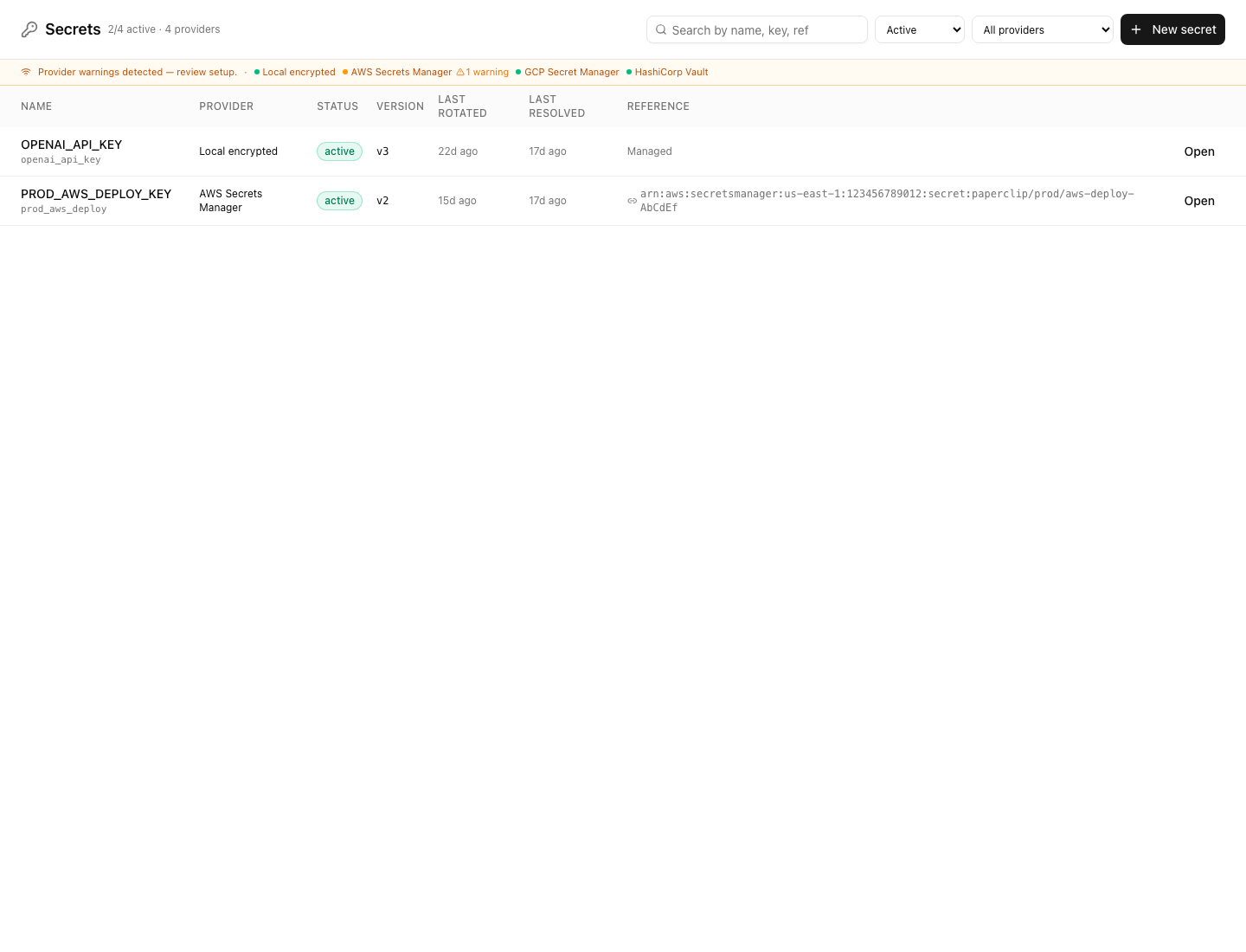 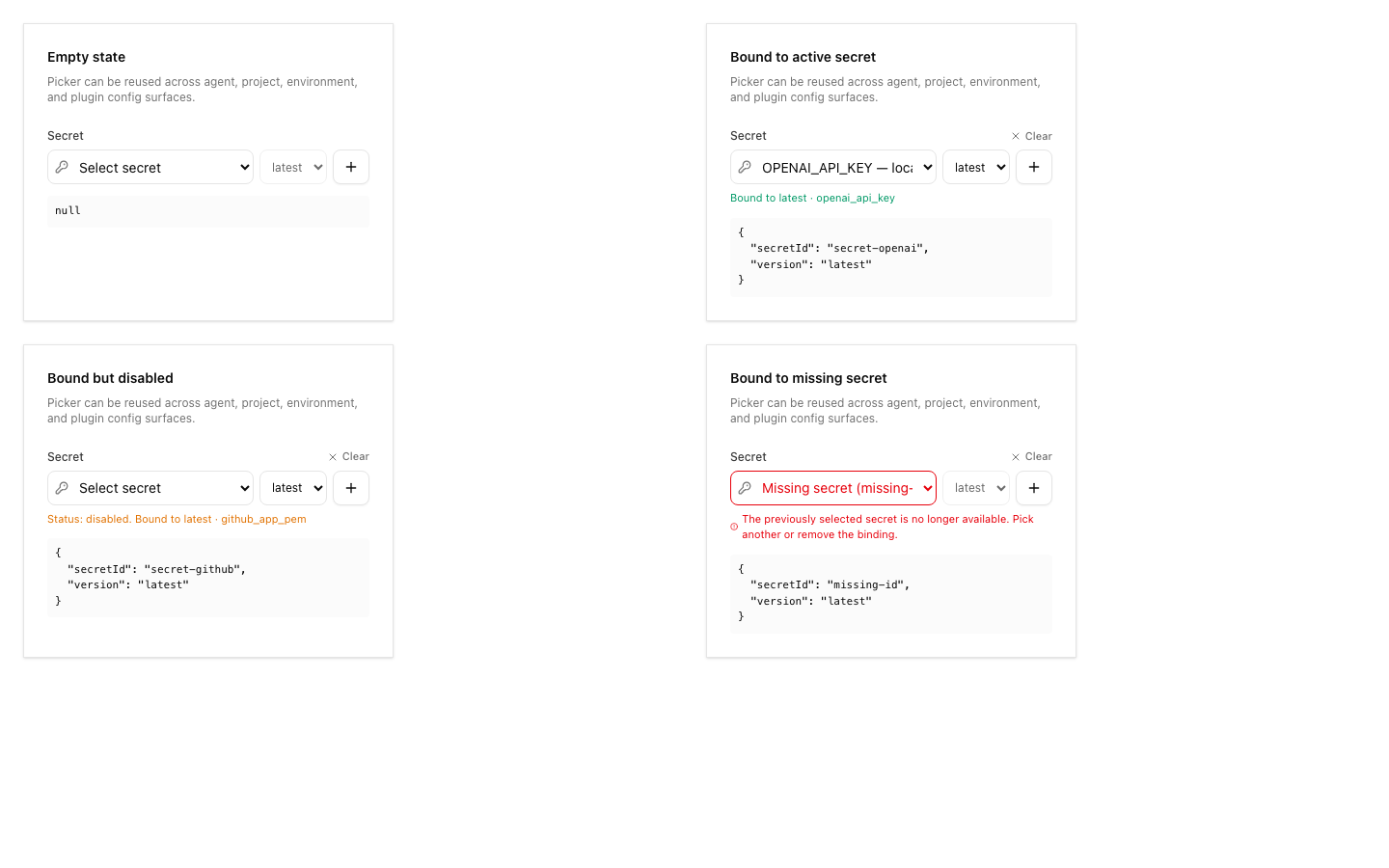 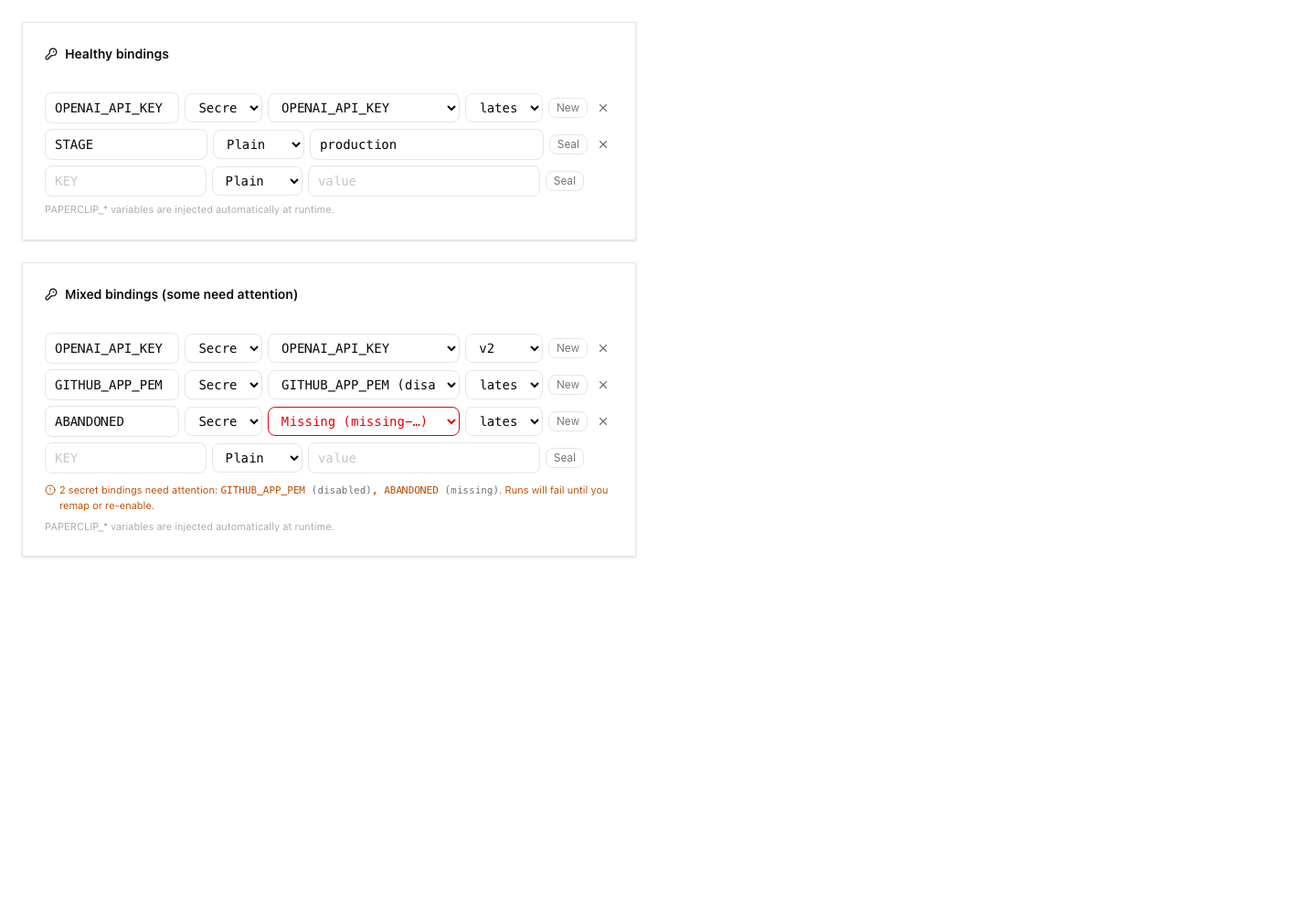 ## Risks - Migration risk: this adds new secret provider tables and extends existing secret rows. The migrations were checked for monotonic ordering and idempotent guards, but reviewers should still inspect upgrade behavior carefully. - Provider risk: AWS support uses direct SigV4 requests. Automated tests cover signing, request timeouts, vault-config selection, namespace guardrails, pending-version archival, sanitized provider errors, and service-level cleanup paths. A real-vault AWS smoke test remains deployment validation for an operator with AWS credentials rather than an unverified merge blocker in this local branch. - UI risk: the Secrets page and import dialog are large new surfaces; screenshots are included above for reviewer inspection. - Verification risk: the full local stable test command hit parallel-load timing failures, although the exact failed files passed when rerun directly. - Operational risk: remote import intentionally avoids plaintext reads; operators must understand that imported external references resolve at runtime and may fail if AWS permissions change. > For core feature work, check [`ROADMAP.md`](ROADMAP.md) first and discuss it in `#dev` before opening the PR. Feature PRs that overlap with planned core work may need to be redirected — check the roadmap first. See `CONTRIBUTING.md`. ## Model Used - OpenAI Codex, GPT-5 coding agent with local shell/tool use in the Paperclip worktree. Exact context-window size was not exposed by the runtime. ## Checklist - [x] I have included a thinking path that traces from project context to this change - [x] I have specified the model used (with version and capability details) - [x] I have checked ROADMAP.md and confirmed this PR does not duplicate planned core work - [ ] I have run tests locally and they pass - [x] I have added or updated tests where applicable - [x] If this change affects the UI, I have included before/after screenshots - [x] I have updated relevant documentation to reflect my changes - [x] I have considered and documented any risks above - [x] I will address all Greptile and reviewer comments before requesting merge --------- Co-authored-by: Paperclip <noreply@paperclip.ing> Co-authored-by: Claude Sonnet 4.6 <noreply@anthropic.com> |








