mirror of
https://github.com/paperclipai/paperclip.git
synced 2026-11-03 09:37:19 +01:00
4e97daafa06a54f02027335437c4f48e50b84236
6
Commits
| Author | SHA1 | Message | Date | |
|---|---|---|---|---|
 Nicky LeachandPaperclip |
dc30dc4f34 |
fix(setup-token): pin the start guard to the served adapter (#12179)
## Thinking Path > - Paperclip is the open source app people use to manage AI agents for work > - Sandbox agents use adapter login routes to start authenticated sessions > - The setup-token start route accepted adapter types that later routes and cleanup did not serve > - This mismatch could create sessions that no route or reaper could reach > - The OpenAPI body schema and synchronous login capability defaults also differed from the enforced behavior > - This pull request pins the start guard to the served adapter, shares the adapter constant, aligns the schema, and exposes login capabilities early > - The benefit is consistent session access, cleanup, API documentation, and login UI behavior ## Linked Issues or Issue Description Refs: #11730 Refs: #11286 **Subsystem affected** Cross-cutting server and UI login behavior. **Problem or motivation** The setup-token start route accepted a non-served adapter type. Follow-up routes and the reaper only handled the served adapter. This could create an unreachable session that held its slot. The OpenAPI schema and early capability defaults also did not match the route behavior. **Proposed solution** Pin the start guard, follow-up key, and reaper filter to one exported served-adapter constant. Derive the OpenAPI body from the strict shared schema. Add the login capability projection to synchronous defaults. **Alternatives considered** Keep separate adapter constants and add another guard at each follow-up route. This would preserve duplicate sources of truth and leave future drift possible. **Roadmap alignment** This change supports the Cloud / Sandbox agents milestone in `ROADMAP.md`. ## What Changed - Reject a setup-token start request when its adapter type is not the served adapter. - Reuse one exported adapter constant for the start guard, follow-up key, and reaper filter. - Derive the company adapter login-sessions start body from the strict shared schema. - Add the `login` capability projection to the synchronous Claude and Codex adapter defaults. - Add regression coverage for the rejected non-served adapter request. ## Verification - The setup-token route suite passes, including the non-served adapter regression test. - The setup-token session-service suite passes. - The setup-token reaper suite passes. - The OpenAPI suite passes. - The server TypeScript check passes. - The UI TypeScript check passes. - GitHub Actions must confirm all required checks after pull request creation. ## Risks The start route now rejects adapter types that follow-up routes cannot serve. No database migration exists. Revert the one commit to roll back the change. ## Model Used OpenAI Codex, GPT-5, exact runtime model ID not exposed, large context window, reasoning, tool use, and code execution. The implementing engineer used AI assistance. ## Checklist - [x] I have included a thinking path that traces from project context to this change - [x] I have specified the model used (with version and capability details) - [x] I have checked ROADMAP.md and confirmed this PR does not duplicate planned core work - [x] I have searched GitHub for duplicate or related PRs and linked them above - [x] I have either (a) linked existing issues with `Fixes: #` / `Closes: #` / `Refs: #` OR (b) described the issue in-PR following the relevant issue template - [x] I have not referenced internal/instance-local Paperclip issues or links (only public GitHub `#NNN` / `github.com/paperclipai/paperclip` URLs) - [x] My branch name describes the change (e.g. `docs/...`, `fix/...`) and contains no internal Paperclip ticket id or instance-derived details - [x] I have run tests locally and they pass - [x] I have added or updated tests where applicable - [x] I have updated relevant documentation to reflect my changes - [x] I have considered and documented any risks above - [x] All Paperclip CI gates are green - [x] Greptile is 5/5 with no open P2s, recommendations, or follow-ups - [x] I will address all Greptile and reviewer comments before requesting merge --------- Co-authored-by: Paperclip <noreply@paperclip.ing> |
||
|
DottaandPaperclip
|
931eec3fbf |
feat(mcp) [split 4/8]: wire gateway runtime and Smoke Lab (#9559)
## Thinking Path > - Paperclip is the open source app people use to manage AI agents for work > - Governed MCP access spans contracts, runtime enforcement, adapters, UI surfaces, and operator verification > - The parity reference PR #9534 is too large for effective automated or human review > - The feature therefore needs a linear stack whose individual diffs stay below the 100-file review limit > - This pull request is split 4/8 and focuses on gateway runtime, Smoke Lab, plugins, and server wiring > - The benefit is a standalone, testable review boundary while preserving byte-for-byte parity at the top of the stack ## Linked Issues or Issue Description - Related parity reference: #9534 - Problem: The policy core needs runtime execution, endpoint guards, route registration, heartbeat integration, and adapter MCP injection to become operational. - Proposed solution: Adds the remaining server routes/wiring/consumers, runtime tests, adapter-utils MCP contracts, and Claude/Codex injection implementations required by the server layer. - Alternatives considered: keeping #9534 as one 403-file review, or rewriting the feature to manufacture seams; both were rejected in favor of path extraction plus compile-driven boundary moves. - Roadmap alignment: this advances the existing governed MCP/tool-access work already represented by #9534; it does not introduce a separate roadmap initiative. - Stack position: base branch is `pap10341-split/03-server-tool-access`. - Merge policy: merge bottom-up, in order, only after the complete eight-PR stack has been reviewed and the top-of-stack parity gate remains empty. - Requested review: SecurityEngineer for gateway, endpoint guard, token issuance, and runtime wiring; Greptile on every PR. ## What Changed - Adds the remaining server routes/wiring/consumers, runtime tests, adapter-utils MCP contracts, and Claude/Codex injection implementations required by the server layer. - Keeps this PR below 100 changed files and independently typecheckable. - Preserves the final tree from #9534 when combined with the other seven stack levels. ## Verification - `pnpm typecheck` - Changed server test set — 26 files, 382 tests passed - Affected server adapter tests — 38 tests passed after concrete adapter boundary move - Adapter-utils and Codex focused tests — 76 tests passed ## Risks - Remote endpoint validation, token handling, and runtime supervision are security-sensitive and can fail closed or deny legitimate access if misconfigured. - Stack risk: merging out of order can expose incomplete layers; mitigate by following the documented bottom-up merge policy. - Parity risk: later edits to an intermediate branch can drift from #9534; mitigate by re-running the empty top-of-stack diff before merge. > For core feature work, check [`ROADMAP.md`](ROADMAP.md) first and discuss it in `#dev` before opening the PR. Feature PRs that overlap with planned core work may need to be redirected — check the roadmap first. See `CONTRIBUTING.md`. ## Model Used - OpenAI Codex, exact model ID `gpt-5.4`; runtime-managed context window; medium reasoning with repository, shell, Git, GitHub CLI, and code-execution tools enabled. ## Checklist - [x] I have included a thinking path that traces from project context to this change - [x] I have specified the model used (with version and capability details) - [x] I have checked ROADMAP.md and confirmed this PR does not duplicate planned core work - [x] I have searched GitHub for duplicate or related PRs and linked them above - [x] I have either (a) linked existing issues with `Fixes: #` / `Closes #` / `Refs #` OR (b) described the issue in-PR following the relevant issue template - [x] Internal references are omitted except the execution-plan link explicitly required for this coordinated split stack - [x] My branch name describes the change and contains no internal Paperclip ticket id or instance-derived details - [x] I have run tests locally and they pass - [x] I have added or updated tests where applicable - [x] I have updated relevant documentation to reflect my changes - [x] I have considered and documented any risks above - [ ] All Paperclip CI gates are green - [ ] Greptile is 5/5 with no open P2s, recommendations, or follow-ups - [x] I will address all Greptile and reviewer comments before requesting merge ## Stack Coordination - Internal execution plan: [PAP-13874](/PAP/issues/PAP-13874#document-plan) - Parity reference: #9534 - Stack: #9556 → #9557 → #9558 → #9559 → #9560 → #9561 → #9562 → #9563 - Merge bottom-up only after full-stack review and an empty parity diff at #9563. --------- Co-authored-by: Paperclip <noreply@paperclip.ing> |
||
|
|
ad961227f5 |
feat(secrets): add user-specific runtime secrets (#8825)
## Thinking Path > - Paperclip is the open source app people use to manage AI agents for work. > - Agent runs often need provider credentials, API tokens, and other environment-bound secrets. > - Company-level secrets work for shared credentials, but they do not model values that should differ by human operator. > - Without a user-scoped model, a run can dispatch without knowing whether the responsible human has supplied the needed value. > - Paperclip also needs run attribution to make those user-scoped runtime checks deterministic and auditable. > - This pull request adds user-specific secret definitions, per-user values, environment bindings, responsible-user attribution, and runtime resolution gates. > - The benefit is that teams can define the secret once, let each user provide their own value, and block runs before dispatch when required user secrets or active definitions are unavailable. ## Linked Issues or Issue Description Refs #224 Refs #6057 This PR implements user-specific secret support as a core secret-management capability rather than a one-off adapter setting. It is related to existing public work on company secrets UI and runtime secret refs, but is distinct because the value is owned by the responsible user and resolved at run dispatch time. Related PR search before opening found existing secrets work such as #1550, #8256, #8614, #8634, and #8647; none of those add the full user-secret definition/value/runtime gate covered here. ## What Changed - Added user-secret definitions and per-user "My secrets" values, keeping stored values out of access metadata. - Added `user_secret_ref` environment bindings and UI affordances to pick them alongside existing secret refs. - Added responsible-user runtime resolution so user-secret refs resolve against the human responsible for the run. - Added pre-dispatch missing-secret gates so runs fail before adapter dispatch when required user values are absent or definitions are inactive. - Added low-trust allowlist hardening for user-secret runtime access. - Added issue, routine, run, and agent API key responsible-user attribution and fail-closed dispatch behavior when attribution cannot be resolved. - Added denial-copy mapping so responsible-user authorization failures surface as actionable run outcomes instead of opaque setup failures. - Added OpenAPI documentation for the user-secret routes. - Rebases cleanly on current `master`; migrations were renumbered incrementally as `0128_user_specific_secrets`, `0129_agent_api_key_responsible_user`, and `0130_run_responsible_user_invariant` after upstream `0126`/`0127` migrations. - Removed previously committed local design screenshots so the PR contains code/docs/tests only. ## Verification - PASS: PR head `2527febd106bcf3ca264ca0da7fca491084192d6` is based on `paperclipai/paperclip:master`. - PASS: `git diff --check` - PASS: `git diff --name-only public/master...HEAD | rg '^(pnpm-lock\\.yaml|\\.github/workflows/|screenshots/)' || true` produced no files. - PASS: migration journal audit confirmed unique indexes through `130` with tail entries `0126_issue_comment_derived_attribution`, `0127_environment_custom_images_instance_scoped`, `0128_user_specific_secrets`, `0129_agent_api_key_responsible_user`, and `0130_run_responsible_user_invariant`. - PASS: `pnpm --filter @paperclipai/ui typecheck` - PASS: `pnpm --filter @paperclipai/server typecheck` - PASS: `pnpm --filter @paperclipai/server exec vitest run src/__tests__/heartbeat-responsible-user-invariant.test.ts` - PASS: `pnpm --filter @paperclipai/server exec vitest run src/__tests__/heartbeat-active-run-output-watchdog.test.ts src/__tests__/heartbeat-stale-queue-invalidation.test.ts src/__tests__/heartbeat-workspace-finalize-branch.test.ts src/__tests__/issue-monitor-scheduler.test.ts` - PASS: `pnpm --filter @paperclipai/server exec vitest run src/__tests__/heartbeat-comment-wake-batching.test.ts src/__tests__/heartbeat-retry-scheduling.test.ts src/__tests__/heartbeat-accepted-plan-workspace-refresh.test.ts src/__tests__/heartbeat-plugin-environment.test.ts` - PASS: `pnpm --filter @paperclipai/server exec vitest run src/__tests__/low-trust-red-team-routes.test.ts` - PASS: `pnpm --filter @paperclipai/server exec vitest run src/__tests__/secrets-service.test.ts` (55 tests) - PASS: `pnpm vitest run server/src/__tests__/secrets-routes.test.ts server/src/__tests__/secrets-service.test.ts` (89 tests after final Greptile cleanup fixes) - PASS: `pnpm --filter @paperclipai/server exec vitest run src/__tests__/heartbeat-issue-liveness-escalation.test.ts` (17 tests after the final rebase CI fix) - PASS: focused server Vitest batches covering heartbeat recovery, project env, plugin env, routines, low-trust, pipelines, monitors, watchdog, and stale queue paths. - PASS: GitHub checks are green on `2527febd106bcf3ca264ca0da7fca491084192d6`, including Typecheck + Release Registry, Build, General tests, serialized server suites, e2e, Canary Dry Run, verify, security checks, and Greptile Review. - PASS: Greptile Review completed successfully on `2527febd106bcf3ca264ca0da7fca491084192d6` with Confidence Score 5/5, and GraphQL review-thread audit returned zero unresolved non-outdated threads. ## Risks - Runtime behavior now depends on a run having a correct responsible user; missing or incorrect responsibility assignment can block runs before adapter dispatch. - `user_secret_ref` bindings intentionally expose metadata without values, but UI/API callers may need to handle the new binding kind explicitly. - External secret providers and IAM policies are not automatically provisioned by this PR; operators still need to configure provider-side access for non-local vaults. - The PR is broad across db/shared/server/UI/runtime paths, so release validation should include both API and UI secret workflows before merge. - The migration renumbering is intentionally incremental after upstream migrations; the branch migrations use guarded column/table/index/constraint creation so users who tested the older draft numbering should not hit duplicate DDL for the existing objects. > For core feature work, check [`ROADMAP.md`](ROADMAP.md) first and discuss it in `#dev` before opening the PR. Feature PRs that overlap with planned core work may need to be redirected — check the roadmap first. See `CONTRIBUTING.md`. ## Model Used OpenAI Codex, GPT-5-based coding agent (`gpt-5`), Codex local adapter with shell/tool use and code execution. Context window and internal reasoning mode are not exposed by the runtime. ## Checklist - [x] I have included a thinking path that traces from project context to this change - [x] I have specified the model used (with version and capability details) - [x] I have checked ROADMAP.md and confirmed this PR does not duplicate planned core work - [x] I have searched GitHub for duplicate or related PRs and linked them above - [x] I have either (a) linked existing issues with `Fixes: #` / `Closes #` / `Refs #` OR (b) described the issue in-PR following the relevant issue template - [x] I have not referenced internal/instance-local Paperclip issues or links (only public GitHub `#NNN` / `github.com/paperclipai/paperclip` URLs) - [x] My branch name describes the change (e.g. `docs/...`, `fix/...`) and contains no internal Paperclip ticket id or instance-derived details - [x] I have run tests locally and they pass - [x] I have added or updated tests where applicable - [x] I have updated relevant documentation to reflect my changes - [x] I have considered and documented any risks above - [x] All Paperclip CI gates are green - [x] Greptile is 5/5 with no open P2s, recommendations, or follow-ups - [x] I will address all Greptile and reviewer comments before requesting merge --------- Co-authored-by: Paperclip <noreply@paperclip.ing> Co-authored-by: Claude Opus 4.8 <noreply@anthropic.com> |
||
|
Devin Foley
|
547463d3a2 |
refactor(environments): make execution environments instance-scoped (#8375)
## Thinking Path > - Paperclip is the control plane for AI-agent companies, so execution environment selection has to stay inspectable and predictable across companies, agents, and runs. > - The environment subsystem decides where an agent heartbeat actually runs and how remote sandbox state is realized and restored. > - That subsystem previously mixed company-scoped environment catalogs with issue-level environment stamping, so a reassigned issue could keep executing in the previous assignee's sandbox. > - That behavior breaks the control-plane contract: changing the assignee should change the executing agent/environment path unless there is an explicit current override. > - Fixing it cleanly required more than a narrow patch; the environment model had to move to instance scope with a single inherited default and per-agent override semantics. > - This pull request rewires the schema, server/API surface, runtime resolution, and UI around that model, then adds regression coverage for cross-company inheritance and per-agent isolation. > - The benefit is that environment choice now follows the approved instance/agent configuration path instead of stale issue state, while shared environments only need to be configured once per instance. ## Linked Issues or Issue Description - No directly matching public GitHub issue or PR was found while searching for this refactor. ### What happened? Reassigning work between agents with different execution environments could keep running in the previous sandbox because environment choice was stamped onto the issue and outranked the current assignee. The same subsystem also forced environment catalogs to be duplicated per company even though the underlying execution environments were instance-wide resources. ### Expected behavior Execution should resolve through the current instance and agent configuration path, with one instance-scoped environment catalog, one instance default, optional per-agent override, and no stale issue-level environment authority surviving reassignment. ### Steps to reproduce 1. Configure two agents to use different execution environments. 2. Assign an issue to the first agent so the issue records execution state in that environment. 3. Reassign the same issue to the second agent and run another heartbeat. 4. Observe that the pre-fix runtime can still sync or execute in the original sandbox instead of the second agent's environment. ### Paperclip version or commit Current `master` before this PR. ### Deployment mode Self-hosted server. ### Installation method Built from source (`pnpm dev` / `pnpm build`). ### Agent adapter(s) involved - Claude Code - Not adapter-specific (core bug in environment authority / resolution) ### Database mode External Postgres. ### Access context Both board reassignment and agent heartbeats were involved. ## What Changed - Moved environments and their default selection contract to instance scope in DB/shared types, including the migration that dedupes legacy per-company environments and seeds the instance local default. - Reworked environment CRUD/auth flows to use instance-scoped APIs and added route/service coverage for instance-level environment management. - Changed runtime resolution to prefer `agent default -> instance default -> built-in local`, removed issue-level environment stamping from the active execution path, and isolated sandbox/plugin leases by `(executionWorkspaceId, agentId)`. - Added environment env-var runtime precedence so environment-provided values act as the baseline for agent execution. - Moved the environment UI into instance settings and updated agent configuration surfaces to reflect inherit/override behavior. - Added regression coverage for instance-default inheritance across companies and for the new runtime resolution behavior. - Fixed a rebase-only duplicate `enableTaskWatchdogs` flag regression in instance settings types/validators/services so the branch typechecks cleanly on current `master`. - Updated stale server tests so CI matches the shipped instance-scoped environment contract. ## Verification - `git diff --check` - `pnpm --filter @paperclipai/shared typecheck` - `pnpm --filter @paperclipai/db typecheck` - `pnpm exec vitest run server/src/__tests__/environment-runtime-driver-contract.test.ts server/src/__tests__/agent-permissions-routes.test.ts server/src/__tests__/environment-routes.test.ts server/src/__tests__/environment-instance-routes.test.ts server/src/__tests__/execution-workspace-policy.test.ts server/src/__tests__/heartbeat-plugin-environment.test.ts server/src/__tests__/instance-settings-routes.test.ts` ## Risks - The migration changes environment scope and dedupes existing rows, so installs with unusual legacy environment combinations should be reviewed carefully during upgrade. - Remote execution behavior now depends on instance-default inheritance semantics instead of issue-level stamping, so any remaining code paths that still assume issue-scoped environment authority would surface as follow-up bugs. - This PR includes both server/runtime behavior and UI relocation, so reviewers should watch for authorization edge cases around instance settings and environment management. > I checked [`ROADMAP.md`](ROADMAP.md). This work fits the existing Cloud / Sandbox agents direction as a bug-fix/refactor to current behavior, not a new parallel product surface. ## Model Used - OpenAI Codex coding agent in this Paperclip/Codex session; GPT-5-class tool-using model with code execution and shell access. The exact backend model ID is not exposed to the session runtime. ## Checklist - [x] I have included a thinking path that traces from project context to this change - [x] I have specified the model used (with version and capability details) - [x] I have checked ROADMAP.md and confirmed this PR does not duplicate planned core work - [x] I have searched GitHub for duplicate or related PRs and linked them above - [x] I have either (a) linked existing issues with `Fixes: #` / `Closes #` / `Refs #` OR (b) described the issue in-PR following the relevant issue template - [x] I have not referenced internal/instance-local Paperclip issues or links (only public GitHub `#NNN` / `github.com/paperclipai/paperclip` URLs) - [x] My branch name describes the change (e.g. `docs/...`, `fix/...`) and contains no internal Paperclip ticket id or instance-derived details - [x] I have run tests locally and they pass - [x] I have added or updated tests where applicable - [ ] If this change affects the UI, I have included before/after screenshots - [x] I have updated relevant documentation to reflect my changes - [x] I have considered and documented any risks above - [ ] All Paperclip CI gates are green - [ ] Greptile is 5/5 with no open P2s, recommendations, or follow-ups - [x] I will address all Greptile and reviewer comments before requesting merge |
||
|
Aron Prins
|
897cc322c7 |
Improve external agent invite flow (#6183)
## Thinking Path > - Paperclip orchestrates AI agents for zero-human companies. > - Agent creation can happen through local runtimes, managed runtimes, and external agents that onboard through invites. > - The old OpenClaw-oriented invite UX lived under company settings/invites and made a gateway-specific path look like a company access setting. > - That hid the broader bring-your-own-agent flow and forced operators to leave the add-agent modal when adding an external agent. > - This pull request moves external agent invite generation into the add-agent modal and makes the copy agent-oriented instead of OpenClaw-only. > - The benefit is a clearer agent-first onboarding path while company invites stay focused on human access. ## What Changed - Added an external-agent invite branch to the add-agent modal, including a dedicated prompt result view with Back navigation. - Added a shared agent onboarding prompt builder and focused modal coverage for prompt replacement/back navigation. - Removed the agent invite prompt UI from Company Settings and Company Invites, leaving Company Invites focused on human access links and invite history. - Updated the hidden OpenClaw Gateway runtime hint to direct operators to the add-agent invite flow instead of presenting it as a blocked runtime card. - Updated invite/onboarding docs, storybook coverage, and server-side onboarding copy toward generic agent language while preserving existing gateway compatibility. ## Verification - `pnpm -r typecheck` - `pnpm build` - `FAKE_BIN="$(mktemp -d)/bin"; mkdir -p "$FAKE_BIN"; printf '#!/bin/sh\nexit 1\n' > "$FAKE_BIN/tailscale"; chmod +x "$FAKE_BIN/tailscale"; PATH="$FAKE_BIN:$PATH" pnpm test:run` - `pnpm test:run` without the fake `tailscale` shim was also attempted; it failed only in two pre-existing CLI tailnet fallback tests because this host has a real Tailscale address (`100.125.202.3`) where those tests expect no Tailscale. - Focused confirmation for that host-env issue: `FAKE_BIN=... PATH="$FAKE_BIN:$PATH" pnpm exec vitest run --project paperclipai cli/src/__tests__/network-bind.test.ts cli/src/__tests__/onboard.test.ts` - Manual UI verification: served UI locally in light mode, opened add-agent modal, generated external agent prompt, verified the generated prompt replaces the form and Back returns to the form. ### Screenshots 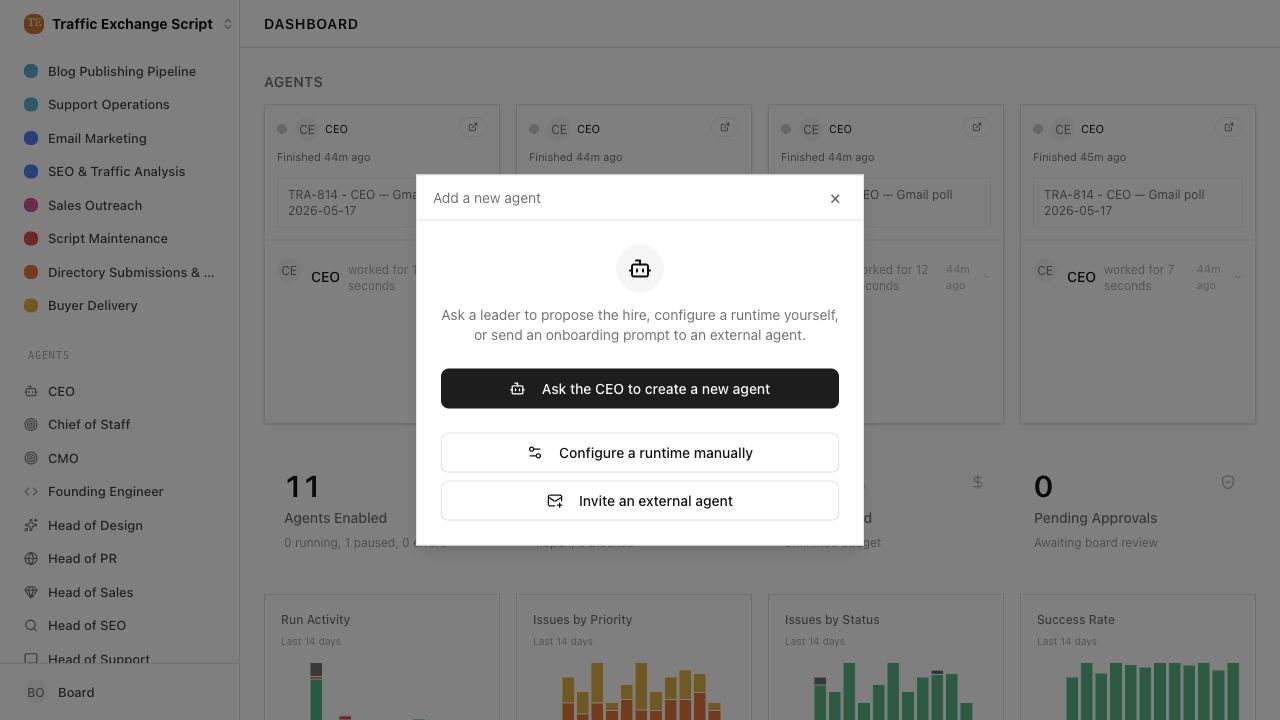 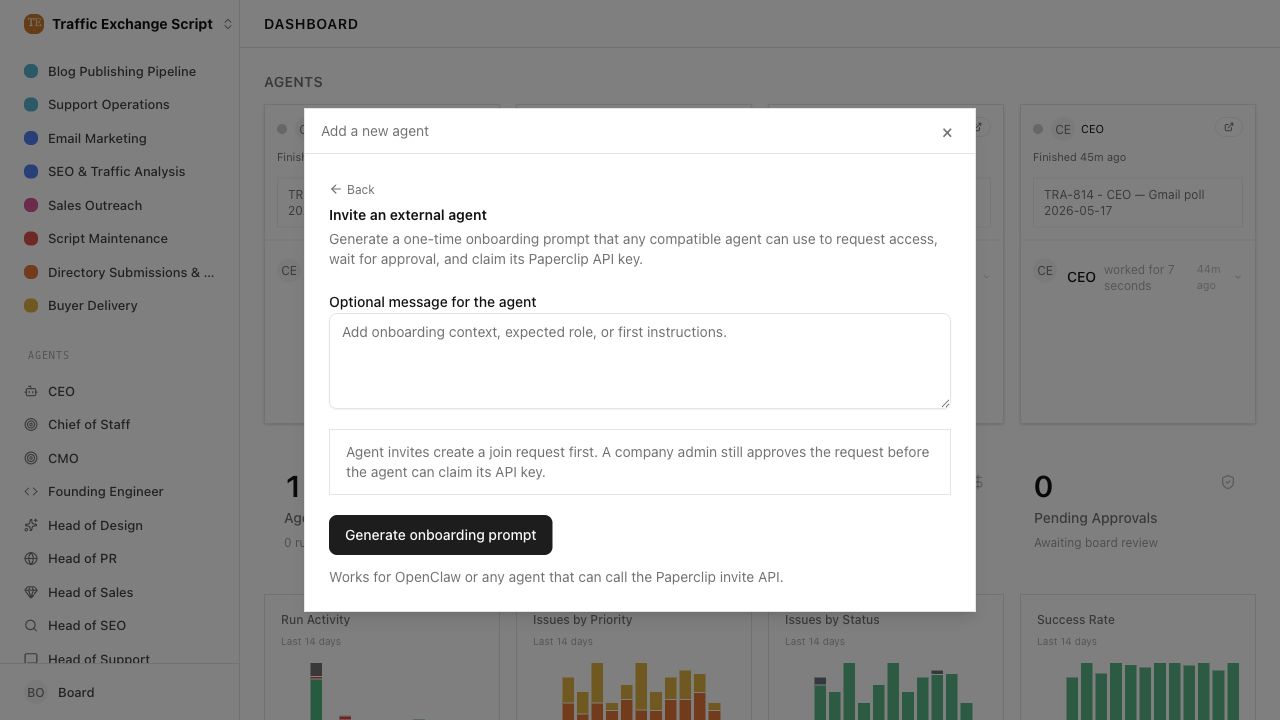 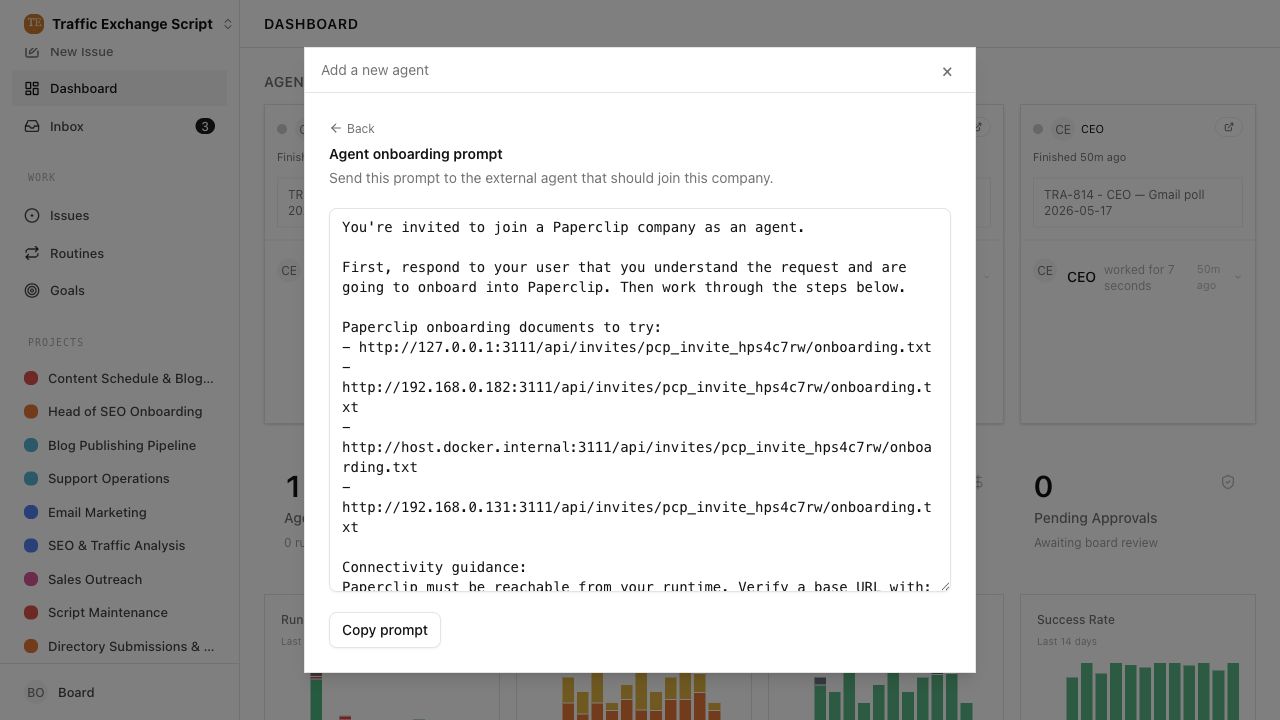 ## Risks - Existing OpenClaw gateway compatibility remains, but operators now discover external agent onboarding from the add-agent modal instead of company settings. - Agent invites still appear in the invite history table, so that page may show agent-scoped invite rows even though it no longer creates agent onboarding prompts. - Low migration risk: no schema changes. > For core feature work, check [`ROADMAP.md`](ROADMAP.md) first and discuss it in `#dev` before opening the PR. Feature PRs that overlap with planned core work may need to be redirected — check the roadmap first. See `CONTRIBUTING.md`. ## Model Used - OpenAI Codex, GPT-5 coding agent in Codex desktop; tool-enabled repository, shell, browser, and GitHub workflow. Context window size was not exposed by the runtime. ## Checklist - [x] I have included a thinking path that traces from project context to this change - [x] I have specified the model used (with version and capability details) - [x] I have checked ROADMAP.md and confirmed this PR does not duplicate planned core work - [x] I have run tests locally and they pass - [x] I have added or updated tests where applicable - [x] If this change affects the UI, I have included before/after screenshots - [x] I have updated relevant documentation to reflect my changes - [x] I have considered and documented any risks above - [x] I will address all Greptile and reviewer comments before requesting merge |
||
|
Devin Foley
|
13551b2bac |
Add local environment lifecycle (#4297)
## Thinking Path > - Paperclip orchestrates AI agents for zero-human companies. > - Every heartbeat run needs a concrete place where the agent's adapter process executes. > - Today that execution location is implicitly the local machine, which makes it hard to track, audit, and manage as a first-class runtime concern. > - The first step is to represent the current local execution path explicitly without changing how users experience agent runs. > - This pull request adds core Environment and Environment Lease records, then routes existing local heartbeat execution through a default `Local` environment. > - The benefit is that local runs remain behavior-preserving while the system now has durable environment identity, lease lifecycle tracking, and activity records for execution placement. ## What Changed - Added `environments` and `environment_leases` database tables, schema exports, and migration `0065_environments.sql`. - Added shared environment constants, TypeScript types, and validators for environment drivers, statuses, lease policies, lease statuses, and cleanup states. - Added `environmentService` for listing, reading, creating, updating, and ensuring company-scoped environments. - Added environment lease lifecycle operations for acquire, metadata update, single-lease release, and run-wide release. - Updated heartbeat execution to lazily ensure a company-scoped default `Local` environment before adapter execution. - Updated heartbeat execution to acquire an ephemeral local environment lease, write `paperclipEnvironment` into the run context snapshot, and release active leases during run finalization. - Added activity log events for environment lease acquisition and release. - Added tests for environment service behavior and the local heartbeat environment lifecycle. - Added a CI-follow-up heartbeat guard so deferred issue comment wakes are promoted before automatic missing-comment retries, with focused batching test coverage. ## Verification Local verification run for this branch: - `pnpm -r typecheck` - `pnpm build` - `pnpm exec vitest run server/src/__tests__/environment-service.test.ts server/src/__tests__/heartbeat-local-environment.test.ts --pool=forks` Additional reviewer/CI verification: - Confirm `pnpm-lock.yaml` is not modified. - Confirm `pnpm test:run` passes in CI. - Confirm `PAPERCLIP_E2E_SKIP_LLM=true pnpm run test:e2e` passes in CI. - Confirm a local heartbeat run creates one active `Local` environment when needed, records one lease for the run, releases the lease when the run finishes, and includes `paperclipEnvironment` in the run context snapshot. Screenshots: not applicable; this PR has no UI changes. ## Risks - Migration risk: introduces two new tables and a new migration journal entry. Review should verify company scoping, indexes, foreign keys, and enum defaults are correct. - Lifecycle risk: heartbeat finalization now releases environment leases in addition to existing runtime cleanup. A finalization bug could leave stale active leases or mark a failed run's lease incorrectly. - Behavior-preservation risk: local adapter execution should remain unchanged apart from environment bookkeeping. Review should pay attention to the heartbeat path around context snapshot updates and final cleanup ordering. - Activity volume risk: each heartbeat run now logs lease acquisition and release events, increasing activity log volume by two records per run. ## Model Used OpenAI GPT-5.4 via Codex CLI. Capabilities used: repository inspection, TypeScript implementation review, local test/build execution, and PR-description drafting. ## Checklist - [x] I have included a thinking path that traces from project context to this change - [x] I have run tests locally and they pass - [x] I have added or updated tests where applicable - [x] If this change affects the UI, I have included before/after screenshots (N/A: no UI changes) - [x] I have updated relevant documentation to reflect my changes (N/A: no user-facing docs or commands changed) - [x] I have considered and documented any risks above - [x] I will address all Greptile and reviewer comments before requesting merge |


