mirror of
https://github.com/paperclipai/paperclip.git
synced 2026-11-02 08:28:48 +01:00
499afce285c429f814f5cd22fd437bafabf530e7
13
Commits
| Author | SHA1 | Message | Date | |
|---|---|---|---|---|
 DottaandPaperclip |
198218bf55 |
fix(config): require shared storage for managed cloud (#18350)
## Thinking Path > - Paperclip is the open source app people use to manage AI agents for work. > - Managed Cloud instances must retain shared objects and secrets across server replacement. > - Implicit storage defaults can select local disk or an unintended bucket. > - Cloud runtime settings now come from a canonical database snapshot. > - This pull request validates bootstrap prerequisites before database setup and effective S3 settings after snapshot resolution. > - The benefit is an actionable refusal before local signing state or HTTP setup, while valid canonical Cloud settings work. ## Linked Issues or Issue Description **What happened?** A managed Cloud instance could start with local disk storage, an implicit bucket, or a local key file. After canonical Cloud configuration landed, checking only environment or file values would also reject a valid database bucket. Shared schema defaults could make an omitted raw bucket appear explicit. **Expected behavior** Managed Cloud requires external PostgreSQL, a stable environment master key, and effective S3 settings with a nonblank bucket. The canonical snapshot remains the configuration authority. Invalid configuration refuses startup before signing or HTTP effects. Self-hosted defaults remain compatible. **Steps to reproduce** 1. Select managed Cloud with its tenant token or managed configuration document. 2. Leave storage as local disk, or omit the S3 bucket from a raw canonical snapshot. 3. Start the server. Startup must refuse. An explicit valid bucket in the canonical snapshot must work without a file or environment bucket. **Paperclip version or commit** Current base: `4edd10804e2b42941aa2038e90c362c13a0b98dc`. **Deployment mode** Managed Cloud. Ordinary self-hosted defaults remain unchanged. Related PRs: #18335 owns canonical Cloud runtime configuration. #18327 owns S3 run logs. #18352 owns credential persistence. #18347 owns cutover checks. This PR adds configuration prerequisites to those existing boundaries. ## What Changed - Validate external PostgreSQL and a stable environment master key at the Cloud bootstrap boundary, before database setup. - Validate effective S3 settings after canonical snapshot publication and before Cloud signing, runtime consumers, or HTTP setup. - Require a nonblank bucket in the Cloud snapshot schema. Reject omitted or blank buckets in every legacy Cloud file before one-time import normalization, even when an environment bucket is supplied. Keep shared self-hosted schema defaults. - Preserve typed bucket provenance at the existing file-read boundary. Accept explicit canonical bucket names, including `paperclip`, and environment settings when the snapshot is null. - Validate effective legacy storage with the existing resolver before seeding. A rejected candidate leaves no canonical rows, so a corrected source file can be imported on retry. Environment overlays are checked but never persisted. - Add real PostgreSQL snapshot and migration-retry tests, startup refusal tests, and environment/file compatibility controls. Document that Cloud always requires its stable environment key, even with an external default secrets provider. ## Verification - Latest focused acceptance passed 199/199 in six files (54.29 seconds), using the command below plus `server/src/__tests__/cloud-configuration-migration-postgres.test.ts`. Real PostgreSQL proves rejected storage leaves all three migration authority rows absent, then a corrected legacy file imports on retry. An external-default-secrets control proves the deliberate unconditional Cloud master-key contract. - Before the peer correction, the frozen product diff passed 178 tests in five files: managed-cloud-prerequisites, cloud-runtime-config, server-startup-feedback-export, config-file, and cloud-configuration-readers. Command: `pnpm exec vitest run server/src/__tests__/{managed-cloud-prerequisites,cloud-runtime-config,server-startup-feedback-export,config-file,cloud-configuration-readers}.test.ts --maxWorkers=1 --no-file-parallelism`. Real PostgreSQL used a qualified POSIX test-only PG18.6 override because the host cannot supply the stock runtime's SysV semaphore allocation. - Coverage includes raw database and legacy omitted/blank bucket rejection, valid database and environment buckets, null snapshots, explicit default-named buckets, self-hosted compatibility, and refusal before local signing mutation. - The real AWS SDK configured-provider control uses a simulated loopback S3 service. It writes, reads from a fresh provider, and deletes an object. It also reads an encrypted credential with the stable environment key. This does not qualify production cloud permissions. - `git diff --check` passed. Final merges add unrelated master changes from #18241, #18363, and #18370; the focused storage product diff is unchanged. - Peer review reproduced a fresh legacy local-disk import that gained the default bucket before an S3 environment overlay. The importer now requires a raw explicit bucket for every legacy Cloud file. Six controls cover omission/blank values with and without an environment bucket; the full focused rerun passed 184/184 across all five files in 194.89 seconds. - Initial revised startup testing passed 167/168: one fixture omitted the database URL and failed before its intended key assertion. The corrected final run passed 178/178. An initial direct server typecheck failed because Runner declarations were not built; this is a setup failure, not a compile pass. Integration verification rebuilds dependencies before full checks. - Prior head `fae1e4aa` passed complete CI with 53 successes, two intended skips, and Greptile 5/5. `de71345f379cecb71dbfb219f35e14f942c10a3f` then passed complete CI (55 successes, three workflow skips, and a neutral external review), with Greptile 5/5 and zero unresolved threads. The external review identified the preseed rejection problem; its correction is committed at `75e04d0d77e19dcef0a8cb070b6b518f0f173b14`. The final merge head is `19b809ea2823a6a4e5ceb48ef2c2bac4721733d6`; [Fresh complete CI](https://github.com/paperclipai/paperclip/actions/runs/41127309762) passed on that head: 55 successful checks, three workflow skips, and one neutral external review. Greptile reviewed this exact head at 5/5 with no actionable issues. Both earlier external review threads are resolved with the tested fixes. Earlier infrastructure retries remain documented in [the first diagnosis](https://github.com/paperclipai/paperclip/pull/18350#issuecomment-6529964690) and [the runner shutdown evidence](https://github.com/paperclipai/paperclip/pull/18350#issuecomment-6530364769). Earlier missing SDK build and fixture metadata failures were repaired before those passes. - Current frozen-head CI first attempt failed one unchanged Antigravity authentication success case in Runner Vitest 1/2 (`outcome=failure`, 1994 tests passed). The same file passed 11/11 locally in 2.33 seconds, and identical Runner source passed the prior complete CI run. Attempt 2 retried only failed jobs (the Runner shard and dependent aggregate). Both passed without a source change. No second retry was used. The exact timing cause is not established. [Failed job](https://github.com/paperclipai/paperclip/actions/runs/41127309762/job/124309181778). - No production data, buckets, or live credentials were used. Complete local repository suites are not duplicated in this worktree; current-head required CI supplies the full suite gate. ## Risks - Managed deployments with local disk, omitted buckets, file-only keys, or missing external database URLs now refuse startup. Operators must supply valid prerequisites before rollout. - Required deployment environment overlays must remain stable across replacements. For example, a saved local-disk provider with an explicit bucket can use an environment S3 provider; removing that required overlay correctly refuses startup until the environment or canonical configuration is corrected. Environment settings are never silently copied into the canonical row. - Effective legacy storage must also pass before first seeding. A bad candidate does not create authority rows. Existing saved rows remain authoritative and can require environment overrides or a canonical configuration change if they are invalid. - A present legacy Cloud file needs an explicit raw bucket even if its saved provider is local disk or its environment supplies a bucket. Correct the file before one-time import, or use the existing absent-file/null-snapshot environment-only setup. Environment overlays are not persisted as operator choices. - A previously stored canonical nonblank `paperclip` bucket is authoritative. Prior normalization erased whether that value was originally explicit. This change cannot recover that provenance and does not reject existing nonblank canonical values. - Validation proves configuration shape, not cloud permissions, database reachability, or key compatibility with existing encrypted data. Keep the master key stable across replacements. - Cloud snapshot JSON parsing is stricter; omitted or blank raw S3 bucket values need correction. No database migration or provider operation changes are added. These prerequisites do not prove that every server persistence path is disposable. > For core feature work, check [`ROADMAP.md`](ROADMAP.md) first and discuss it in `#dev` before opening the PR. Feature PRs that overlap with planned core work may need to be redirected — check the roadmap first. See `CONTRIBUTING.md`. ## Model Used OpenAI Codex, exact model ID `gpt-6.1-sol`. Context window: unknown. The model used reasoning, repository tools, code execution, and test execution. ## Checklist - [x] I have included a thinking path that traces from project context to this change - [x] I have specified the model used (with version and capability details) - [x] I have checked ROADMAP.md and confirmed this PR does not duplicate planned core work - [x] I have searched GitHub for duplicate or related PRs and linked them above - [x] I have either (a) linked existing issues with `Fixes: #` / `Closes #` / `Refs #` OR (b) described the issue in-PR following the relevant issue template - [x] I have not referenced internal/instance-local Paperclip issues or links (only public GitHub `#NNN` / `github.com/paperclipai/paperclip` URLs) - [x] My branch name describes the change (e.g. `docs/...`, `fix/...`) and contains no internal Paperclip ticket id or instance-derived details - [x] I have run tests locally and they pass - [x] I have added or updated tests where applicable - [x] I have updated relevant documentation to reflect my changes - [x] I have considered and documented any risks above - [x] All Paperclip CI gates are green - [x] Greptile is 5/5 with no open P2s, recommendations, or follow-ups - [x] I will address all Greptile and reviewer comments before requesting merge --------- Co-authored-by: Paperclip <noreply@paperclip.ing> |
||
|
DottaandPaperclip
|
dbff3747b8 |
feat(server): persist run logs and provider traces in S3 (#18327)
## Thinking Path > - Paperclip is the open source app people use to manage AI agents for work. > - Operators use run logs and restricted provider traces to inspect agent work. > - Local log and trace files depend on the web server's persistent volume. > - That dependency prevents overlapping volume-backed Railway deployments. > - This PR reuses the instance S3 store for batched log and trace payloads with conditional publication. > - Existing Postgres rows retain their contracts; native export recovery reuses events already committed before Runner acknowledgement. > - S3-configured servers automatically copy and verify retained history before a later deployment cutover. ## Linked Issues or Issue Description **Subsystem affected** Server run logs, restricted provider traces, storage providers, and migration tooling. **Problem or motivation** Replacing the web server and its disk must preserve committed log output and retained traces. The current S3 mirror can repeatedly upload a growing file. Moving those payloads into Postgres would add database writes, WAL, replication, and backup work. **Proposed solution** Reuse the existing instance storage configuration, S3-compatible provider and credential chain. Store new run logs under run-logs/ and opted-in raw traces under provider-traces/, below the existing prefix. Cloud keeps its existing bucket and bucket-scoped credentials per stack. Add no new configuration switches. Store immutable payload segments and bounded binary range indexes directly in S3. Publish each batch with an ETag-conditional head. Keep existing database ownership and lifecycle records. Recover canonical native exports from their existing validated control event source, checkpointing export progress in S3. Add no new payload writes to Postgres. Preserve local defaults and migrate settled history with verified byte counts and digests. **Alternatives considered** Postgres payload chunks add control-plane load. Repeated whole-file mirrors amplify transfer work. The first index prototype left superseded index nodes; the final binary index keeps all normally published nodes reachable. **Roadmap alignment** This is a storage prerequisite for replacing the main web/API server. It does not enable deployment overlap, detach a volume, or change native Runner protocol acknowledgements. The maintainer approved this implementation scope. ROADMAP.md has no duplicate implementation item. Related PR: #16770 improves the existing in-flight mirror. This PR preserves that legacy backend and uses the existing instance S3 profile for new journals. ## What Changed - Automatically select S3 segments for new logs and opted-in traces when instance file storage uses S3. Reuse bucket, endpoint, region, prefix, path style and credentials. Remove separate backend switches. Keep local-disk instances local. - Share the existing storage configuration resolver with product files. Preserve config-file settings, environment precedence and the existing root prefix. Keep pre-existing run-log mirror settings for legacy history. - Add bounded buffering, conditional ownership fencing, immutable range reads, stable byte offsets, and completion hashing. - Dispatch all existing log consumers through the recorded backend. Coalesce output progress writes and publish live log messages after storage receipts. - Recover interrupted canonical native exports from their existing durable source. Exclude separate credential, cleanup, and reprojection records. Replay missing callback ranges and deduplicate late delivery. Repair settled archives after controller lease expiry. Bound shared repair work and stop it when all readers cancel. Serve the published prefix when best-effort repair fails. - Add encrypted optional trace channels, replacement reads, durable deletion tombstones, and deadline-driven local/external expiry cleanup independently of heartbeat scheduling. Stream historical source and remote verification. Propagate worker cancellation through trace open, conditional-write probing, upload, restore and reads. Fence deletion even before the first object head exists; abort and drain owned captures. - Retry transient storage errors, distinguish 409 from failed preconditions, and backpressure bounded log admission. Track interrupted trace imports explicitly so ordinary local deletion stays independent of S3. - Automatically migrate retained history through the existing delivery coordinator. Process one log and one trace per batch. Retry unresolved history with backoff and stop scans after completion. Keep the inventory/import command as optional diagnosis and repair. Verify source and remote bytes before switching references. Verify finalized native size and digest before setting its export cursor. Require ordered source coverage when completeness metadata is missing. Preserve original trace expiry. Block active, missing, corrupt, and unproven sources. - Preserve identity and run-secret redaction in live and recovered native logs. Register runtime log redaction secrets once through the existing encrypted registry. Keep agent private keys in their existing owner. - Add storage, migration, retention, UTF-8, and route-privacy coverage, plus operating documentation and qualification tooling. - Add no schema, payload table, per-record SQL, production dependency, or lockfile change. ## Verification - Final fixes at `b3a44c898e` passed all 116 selected startup, retention, attribution and cancellation controls. The disabled-scheduler cleanup and concurrent-repair defects reproduced red before the fixes. A timed-out repair still prevents later storage reads. - The merged source passed 124 storage and real-Postgres Cloud configuration tests. These include automatic history migration, existing environment/file vault keys, source-directory removal, five real-SDK stalled-request cancellation cases, shared capability-probe cancellation and multi-chunk trace ordering. Saved Cloud S3 settings work after the legacy config file is gone. - Workspace typecheck and full build passed at the merged parent `19f702d780`. Server typecheck and build passed again at `b3a44c898e`. - Actual app acceptance: finish a process-agent run through the normal API, stage its retained local-file input, then restart. Automatic migration reports one migrated item and zero blockers. Remove the original web home and restart at `b3a44c898e` with an empty home, the existing S3 profile and the existing vault key file. The normal log API preserves all five producer lines and exactly 788 bytes, with SHA-256 `74d9ae469da28bfe89b9b50a0e132aec24fe9e6d686496ed5e4ffa6167151036`. No log-specific storage settings are present. - Actual expiry acceptance: with heartbeat scheduling disabled, a trace remains unexpired after startup and later reaches its fixture deadline. The worker marks the row deleted and tombstones both S3 channel heads. The retained run log stays byte-identical. The process fixture emits no provider protocol frames, so nonempty encrypted payloads are qualified separately through the real SDK round trips. - Isolation tests use identical run identities in two stack buckets. Cleanup in one existing prefix leaves another prefix, another company and product files intact. Read-only Cloud source inspection confirms a bucket and bucket-scoped credentials per stack. Four existing Cloud storage environment-contract tests passed. No Cloud provisioning changed and no new live vendor permission probe was performed. - Earlier qualification passed 1,014 affected storage/native tests and 27 privacy-route tests with isolated Docker Postgres. An abrupt process test commits 1,000 records, receives receipts, dies by SIGKILL and loses its directory; another process reads every byte and continues. The real Rust Runner experiment acknowledges 32 records while the export cursor is zero, then continues the same Runner PID after controller loss. All 64 records export once with exactly 64 existing control rows. Repeated snapshot/Stop commands completed in 162/81 ms. - Emulator workload: 1,000 burst records used two batch PUTs. Eight steady streams produced 240 records with 104 conditional PUTs and 72 GETs over 6.9 seconds. These are synthetic operation counts, not fleet sizing or provider prices. - Failure evidence is retained. Compact native events over 64 KiB, missing file-key support, disabled-scheduler retention and repair failure handling all reproduced before their fixes. Fixture repairs addressed cold module setup, localhost/IPC permissions, the S3 bucket-name limit and a mode-0700 crash-test directory. Full local `pnpm test:run` was stopped after host PostgreSQL semaphore exhaustion; affected suites used isolated Docker databases instead. Native package library symlinks were restored with the package's standard hydration helper. - The `19f702d780` browser session-recovery case timed out while saving a task title. All eight browser shards passed on `b3a44c898e`, including that case, with no UI behavior or assertion change. Fresh-head CI passed at `b3a44c898e`: 55 successful checks, three skipped checks and one neutral check. The branch is conflict-free. - Map and module-boundary checks passed. Current-head Greptile is 5/5 with zero unresolved review threads. Reproduce the opt-in storage suites with `PAPERCLIP_LOG_TEST_S3_ENDPOINT` and a dedicated `PAPERCLIP_RUN_EVIDENCE_MIGRATION_DATABASE_URL` ending in `_test`. See `doc/run-evidence-storage.md` for operating limits, automatic migration, optional diagnostics and rollout qualification. ## Risks - Keep the existing per-stack bucket, prefix and vault key stable across replacements. Relocating that storage is a separate whole-instance operation. - This release automatically changes new log storage for existing S3-configured instances. Local-disk instances remain local. Canonical native source replay is qualified with a deterministic real Runner; actual remote execution and production-provider qualification remain rollout gates. Generic server-only diagnostics and optional raw trace tails without a surviving source can be incomplete after a crash. This does not establish full zero-downtime deployment. - Before deploying this release, qualify the actual S3 provider. It must enforce conditional writes and pass read, version, deletion, workload, and latency qualification. A capability probe rejects providers which ignore preconditions. Moto is emulator evidence only. - Dirty output is bounded and unconfirmed until S3 publication. Storage failure leaves persistence incomplete while task results and usage can settle. - Trace expiry is not yet represented by Cloud's external wake contract. Outstanding trace deadlines conservatively block sleep. - Automatic history copying requires the original source volume. Keep it until all retained resources pass verified import and clean-filesystem reads. Stop old binaries from creating new local-file runs. Missing or corrupt history remains blocked and visible in server logs. Rollback requires a compatible reader against the same external state. Ordinary object deletion does not erase retained historical object versions or backups. ## Model Used OpenAI Codex, `gpt-6.1-sol`, with reasoning, tool use, code execution, and browser verification. The runtime did not expose a context-window size. ## Checklist - [x] I have included a thinking path that traces from project context to this change - [x] I have specified the model used (with version and capability details) - [x] I have checked ROADMAP.md and confirmed this PR does not duplicate planned core work - [x] I have searched GitHub for duplicate or related PRs and linked them above - [x] I have either (a) linked existing issues with `Fixes: #` / `Closes #` / `Refs #` OR (b) described the issue in-PR following the relevant issue template - [x] I have not referenced internal/instance-local Paperclip issues or links (only public GitHub `#NNN` / `github.com/paperclipai/paperclip` URLs) - [x] My branch name describes the change (e.g. `docs/...`, `fix/...`) and contains no internal Paperclip ticket id or instance-derived details - [x] I have run tests locally and they pass - [x] I have added or updated tests where applicable - [x] I have updated relevant documentation to reflect my changes - [x] I have considered and documented any risks above - [x] All Paperclip CI gates are green - [x] Greptile is 5/5 with no open P2s, recommendations, or follow-ups - [x] I will address all Greptile and reviewer comments before requesting merge --------- Co-authored-by: Paperclip <noreply@paperclip.ing> |
||
|
DottaandPaperclip
|
09ad9adce2 |
feat(server): adopt running remote agents through durable controller checkpoints (#17439)
## Thinking Path > - Paperclip must keep admitted remote work alive while its main server is replaced. > - Runner owns recovery mechanics and exposes opaque checkpoints through #17097. > - The server owns company scope, encryption, Stop, tool authority and execution ownership. > - A successor must prove current ownership before it adopts the original execution. > - Checkpoint bursts must also leave capacity for normal requests and lease renewal. > - This PR persists and adopts that authority through the existing runtime boundaries. ## Linked Issues or Issue Description **What existing behavior does this improve?** Remote agents retain the original execution during a bounded main-server outage. **Current behavior** A server restart can lose the controller's local state and connection. An unsafe replacement could repeat a turn or an uncertain mutation. Checkpoint writes in the request pool can also delay ordinary requests during an aligned burst. **Proposed behavior** Restore encrypted control records from Postgres and adopt the original runner under a fenced lease. Recover known tool receipts through current tool authority. Give control checkpoints a shared pool capped at two connections per database owner. Depends on #17097. Successors are #17455 and #17456. Qualification and presentation remain separate review slices. ## What Changed - Add company/run-bound encrypted checkpoint records and migration 0394. Keep the SQL idempotent after renumbering against current master. - Recover startup and expired ownership through native runtime and heartbeat. Preserve the sandbox lease, admitted runner artifact, harness configuration, native session and active turn. - Keep Stop, finalization, preparation ownership and stale-writer fencing transactional. Preserve graceful detach and natural crash takeover. - Recover committed tool receipts through the existing authority. Reauthorize reads and hold uncertain mutations. - Bound startup retention with the existing coordinator and preserve zero idle scans. - Share at most two checkpoint connections per database client. Keep application and liveness capacity separate. Close the checkpoint pool during shutdown; late writes cannot reopen it. - Count SQL across both application and checkpoint clients. Prove request/liveness progress, command recovery and failure after pool shutdown with real Postgres. ## Verification Project creation recovery now uses the existing project activity receipt owner. It retains authenticated input normalization, fingerprint checks and current run authority after the receipt lock. An absent receipt returns no result before mutation. The new lost-HTTP-response and no-effect regression uses real API routes and Postgres. The seven transport cases pass locally. This Mac skips all 20 database cases. On current source `5de803c2cd`, Linux [job 122593415890](https://github.com/paperclipai/paperclip/actions/runs/40620576702/job/122593415890) executes all 20 project-tool cases successfully (9.480 seconds), including the committed-project lost-response regression. Its shard passes 1,627 cases with three unrelated skips. Server typecheck passes. The transport regression initially has two failures; a subsequent incorrect expectation about schema defaults was corrected before the final pass. Ordinary execution adds no checkpoint writes or recurring work. Current candidate `5de803c2cd` includes the project-creation receipt recovery fix and master `2cd747d1b6`. Migration 0394 retains the prior idempotent checkpoint DDL. Every master SQL file and journal entry is preserved. Snapshots 0390–0394, migration checks and server typecheck pass. The ordinary warm-turn regression fails on its second turn before `a219ab51ad`. After correction, three completed warm turns select the correct prior checkpoint and preserve the original session. All 288 provider-wiring cases pass. The control plane, external persistence callback, identity rotation and filesystem are real; the backend and database-load seam are scripted. The 13 warm admission/configuration variants also pass after final master integration. This does not qualify an underlying harness. At current source `5de803c2cd`, Linux [job 122593415907](https://github.com/paperclipai/paperclip/actions/runs/40620576702/job/122593415907) passes all 940 native-session-executor cases (61.431 seconds), including the warm external-checkpoint behavior; the shard passes 2,358 cases with one skip. Current [Runner job 122593415475](https://github.com/paperclipai/paperclip/actions/runs/40620576702/job/122593415475) passes the native recovery lane: 115 passes and five container-only skips, including the encrypted restore guard, fresh preparation (63.189 seconds), blocked claim lock (1.226 seconds) and recovery beyond 101 blocked owners (3.897 seconds). The first lane passes 2,215 cases with one skip. The SQL cost test reports zero idle and streaming SQL for both output volumes; this is component evidence, not a production capacity claim. At prior candidate `1ff7bb44f4`, Linux job 122549307215 passes all 938 native-executor cases, including the three-turn external-checkpoint regression. Job 122549306469 passes the native recovery lane with 115 passes and five container-only skips, including the encrypted-restore session guard, fresh preparation (63.664 seconds), claim-lock contention (3.961 seconds), and 101-owner recovery (3.824 seconds). This Mac skips the real-Postgres suite. The earlier full local executor attempt has 921 passes and 16 failures during embedded-Postgres initialization before assertions. The original fixture collisions and their corrections remain recorded. At earlier candidate `8fbe62b41d`, server shard job 122535673841 has 3,876 passes, one failure and one skip in an unchanged expiry-worker retry/drain timing test. The same server/database tree on qualification source `b64cac6951` passes all 20 expiry cases and all 3,877 shard cases. The single diagnostic retry, job 122541891915, passes all 20 expiry cases and all 3,877 shard cases (one skip). No assertion was weakened. The original failure remains recorded and its exact timing race is not proven. All Actions checks and legacy status passed on `8fbe62b41d`, with completed Greptile 5/5 and no open feedback. The next candidate `1ff7bb44f4` also passed all Actions checks and Greptile 5/5. Its Paperclip Review remained queued before the new master conflict required integration. The new candidate needs fresh exact-head CI and reviews; old checks do not qualify it. Migration generation is checkpoint-only, all master SQL and journal entries remain unchanged, and migration checks, server typecheck and all 13 warm-owner variants pass after integration. The first migration check was blocked by TSX sandbox IPC; its permitted repeat passes. The first warm-test command used an incorrect path and ran no tests; the corrected command supplies the 13-case receipt. All 16 database pool-lifetime/options/teardown cases pass after granting loopback permission; the first batch had two EPERM failures and 14 passes. Earlier semantic-tool/HTTP recovery, adoption, encryption-batch, zero-streaming-write and idle-SQL receipts remain source-attributed in the [qualification record](https://github.com/paperclipai/paperclip/blob/2ff66f57da0da35bac1c19a2366ea4b84d87a986/doc/plans/2026-10-22-hot-upgrade-qualification.md). That record retains earlier assertion, setup and cleanup failures and their corrections. No failed gate is waived. The historical 300-session component campaign passes four after phases: steady read p99 is 107–108 ms at 500 reads/s and 100 writes/s; aligned-burst read p99 is 103–105 ms after the bounded pool, versus 584–689 ms before. This comparison isolates the persistence corrections. It does not measure the final stack's hosted active-agent capacity. The hosted zero-agent API pair leaves SQL and CPU essentially unchanged, but both arms fail absolute latency gates and candidate peak cgroup memory fails its gate. The active-agent/viewer matrix, different-artifact upgrade and rollback remain open. Run `PAPERCLIP_TEST_DATABASE_URL=<owned-disposable-postgres> pnpm --filter @paperclipai/server exec vitest run src/services/native-runtime/native-runner-restart-recovery.integration.test.ts`. Previous head `f2db8a6568` had one failed workspace setup gate: [job 122555672441](https://github.com/paperclipai/paperclip/actions/runs/40608984238/job/122555672441) passes all 4,169 UI tests and 285 CLI cases (one skip), but the company import/export suite reaches its 30-second health deadline during doctor startup. Its output does not reach the server-start step. The CLI, server, database, shared, adapter and plugin trees are identical on qualification source `a866619d7b`, whose [job 122555886663](https://github.com/paperclipai/paperclip/actions/runs/40609057937/job/122555886663) passes that fixture and all 286 CLI cases. The one diagnostic retry, [job 122561057225](https://github.com/paperclipai/paperclip/actions/runs/40608984238/job/122561057225), passes the formerly failing fixture and all 286 CLI cases. All Actions checks and legacy status on `f2db8a6568` pass. Its exact-head Greptile completed at 5/5 with no open feedback. The current integrated head requires fresh checks and a completed Paperclip Review before merge. The original failure remains recorded; its exact timing cause is unproven. A repeated failure requires investigation and repair rather than another retry. All current-head CI, legacy status, exact-head completed Greptile 5/5, resolved feedback and ordinary GitHub merge eligibility remain required before merge. The latest integration preserves master’s published Copilot v70 profiles and every published migration. Checkpoint migration `0394_conscious_whizzer.sql` was generated with `pnpm db:generate` and retains the prior idempotent DDL. The Runner vendor rebuild and replay parity checks pass. Server typecheck and all 13 warm-owner variants pass after that rebuild. The imported report-lock patch is byte-identical to master; its intentional patch-context whitespace is retained, and the feature delta passes whitespace checks. No hosted experiment was run. ## Risks The pool adds up to two active connections per instance, shared across agents. Checkpoint delivery can wait behind that bound; it still requires its commit. Steady component-test Postgres CPU rises by about 1.7 percentage points of a two-CPU allocation. These corrections do not remove the stack's control and renewal writes. The migration and key must survive replacement. Fresh-database tests and local load do not establish different-artifact hosted upgrade or rollback continuity. ## Model Used OpenAI GPT-6 through Codex, with reasoning, repository tools and code execution. The runtime does not expose a more specific model ID or context-window size. ## Checklist - [x] I have included a thinking path that traces from project context to this change - [x] I have specified the model used (with version and capability details) - [x] I have checked ROADMAP.md and confirmed this PR does not duplicate planned core work - [x] I have searched GitHub for duplicate or related PRs and linked them above - [x] I have either (a) linked existing issues with `Fixes: #` / `Closes #` / `Refs #` OR (b) described the issue in-PR following the relevant issue template - [x] I have not referenced internal/instance-local Paperclip issues or links (only public GitHub `#NNN` / `github.com/paperclipai/paperclip` URLs) - [x] My branch name describes the change (e.g. `docs/...`, `fix/...`) and contains no internal Paperclip ticket id or instance-derived details - [ ] I have run tests locally and they pass - [x] I have added or updated tests where applicable - [x] I have updated relevant documentation to reflect my changes - [x] I have considered and documented any risks above - [ ] All Paperclip CI gates are green - [ ] Greptile is 5/5 with no open P2s, recommendations, or follow-ups - [x] I will address all Greptile and reviewer comments before requesting merge --------- Co-authored-by: Paperclip <noreply@paperclip.ing> |
||
|
|
585d37d4f2 |
[codex] Preserve AWS secret provider error classification (#10946)
## Thinking Path > - Paperclip is the open source control plane operators use to manage AI-agent companies. > - Operators can store managed secret values in AWS Secrets Manager provider vaults. > - The AWS JSON gateway already classifies safe provider failures such as access denial, expired credentials, throttling, and invalid requests. > - The outer provider wrapper was re-normalizing those typed failures, which collapsed an AWS access denial into a generic provider error before the service could produce actionable guidance. > - Missing runtime credentials also need to be recognized as an access problem so operators receive the correct recovery path. > - This pull request preserves typed provider errors, expands credential-related classification, and clarifies the safe credential/IAM remediation text. > - The benefit is that failed AWS secret creation tells operators whether to restore runtime credentials or grant the required capability without exposing AWS account or principal details. ## Linked Issues or Issue Description No public issue was found for this exact remaining server-side classification gap. Bug report: - What happened: an AWS Secrets Manager access-denied response could be classified correctly by the JSON gateway and then collapsed to `provider_error` by the outer provider wrapper; missing runtime credentials were also reported generically. - Expected behavior: safe typed AWS failures should retain their classification, and credential resolution failures should surface as access-denied guidance. - Steps to reproduce: configure an AWS provider vault with invalid or missing runtime credentials, or without `secretsmanager:CreateSecret`, then create a Paperclip-managed secret. - Paperclip version/commit: current `master` before this PR. - Deployment mode: Paperclip server with an AWS Secrets Manager provider vault. Related prior work: - Refs #9161 - Refs #9645 ## What Changed - Preserve `SecretProviderClientError` instances returned by the AWS JSON gateway instead of wrapping them as generic provider failures. - Classify missing, expired, invalid, or incorrectly signed AWS runtime credentials as access-denied failures. - Clarify sanitized remediation guidance to cover both credential resolution and `secretsmanager:CreateSecret` authorization. - Add regression coverage for gateway access-denied responses, missing runtime credentials, and the service-level actionable message. ## Verification - `pnpm exec vitest run server/src/__tests__/aws-secrets-manager-provider.test.ts server/src/__tests__/secrets-service.test.ts` — changed provider tests passed; the service file was skipped in the first no-DB focused run. - `pnpm --filter @paperclipai/server typecheck` — passed. - `pnpm -r typecheck` — passed after a frozen-lockfile dependency refresh. - `pnpm build` — passed. - `pnpm test:run` — 314 files / 3,443 tests passed; one unrelated existing test failed in `plugin-orchestration-apis.test.ts` because it observed `heartbeat.scheduling_suppressed` instead of `issue_commented`. The same failure reproduced in isolation and none of this PR's four changed files participate in that test. - `git diff --check public-gh/master...HEAD` — passed. ## Risks Low risk. The change affects only error classification and sanitized failure guidance for AWS Secrets Manager operations. Successful secret writes, schemas, migrations, API shapes, and stored secret material are unchanged. The regression tests assert safe classifications while keeping raw AWS account and principal details out of service responses. > For core feature work, check [`ROADMAP.md`](ROADMAP.md) first and discuss it in `#dev` before opening the PR. Feature PRs that overlap with planned core work may need to be redirected — check the roadmap first. See `CONTRIBUTING.md`. ## Model Used OpenAI Codex, GPT-5 family (exact runtime build and context-window size were not exposed), with reasoning, repository editing, shell execution, Git, GitHub, and test execution enabled. ## Checklist - [x] I have included a thinking path that traces from project context to this change - [x] I have specified the model used (with version and capability details) - [x] I have checked ROADMAP.md and confirmed this PR does not duplicate planned core work - [x] I have searched GitHub for duplicate or related PRs and linked them above - [x] I have either (a) linked existing issues with `Fixes: #` / `Closes #` / `Refs #` OR (b) described the issue in-PR following the relevant issue template - [x] I have not referenced internal/instance-local Paperclip issues or links (only public GitHub `#NNN` / `github.com/paperclipai/paperclip` URLs) - [x] My branch name describes the change (e.g. `docs/...`, `fix/...`) and contains no internal Paperclip ticket id or instance-derived details - [x] I have run tests locally and they pass - [x] I have added or updated tests where applicable - [x] I have updated relevant documentation to reflect my changes (not applicable: no documented contract changed) - [x] I have considered and documented any risks above - [x] All Paperclip CI gates are green - [x] Greptile is 5/5 with no open P2s, recommendations, or follow-ups - [x] I will address all Greptile and reviewer comments before requesting merge Co-authored-by: Paperclip <noreply@paperclip.ing> Co-authored-by: commitperclip[bot] <284812584+commitperclip[bot]@users.noreply.github.com> |
||
|
DottaandPaperclip
|
9c442cf48e |
feat(connections): deploy and configure Supabase and Vercel (#17217)
Add governed Supabase and Vercel deployment/configuration connectors with vaulted credentials, agent access policies, approvals, audit, and bounded provider operations. Deliver reviewed REST actions to native agents and guard Vercel preview intent on empty projects. Preserve secret-safe request identity and durable retry behavior. Verified by current-head CI, fresh Greptile 5/5 review, and real-agent deployment/configuration walkthroughs on disposable provider resources. Test resources and temporary provider tokens were removed after verification. Co-Authored-By: Paperclip <noreply@paperclip.ing> |
||
|
DottaandPaperclip
|
2c96f76780 |
feat(connections): add model-backed prompt injection prevention
Add opt-in OpenRouter checks at existing tool-result boundaries with regex fallback, service accounting, and settings on Connections. Make migration 0362 safe to replay over existing or partially applied schema state. Co-Authored-By: Paperclip <noreply@paperclip.ing> |
||
|
DottaandPaperclip
|
a590ab769d |
Give managed agents persistent cryptographic identities (#15352)
Give agents persistent Ed25519 identities encrypted with the existing instance master key. Create keys transactionally for new agents and lazily before supported managed runs, expose public identities in the API and agent UI, and protect private material during runtime delivery and output persistence. Preserve identities in recovery backups while giving imported and development-cloned agents fresh keys. Co-Authored-By: Paperclip <noreply@paperclip.ing> |
||
|
|
0cf64d36a5 |
feat(secrets): write through external values and deep-link details (#10196)
## Thinking Path > - Paperclip is the open source control plane people use to manage AI-agent companies. > - Its secrets subsystem can resolve external references such as AWS Secrets Manager values without copying those values into Paperclip custody. > - Operators also need to rotate a referenced secret's value while preserving the same provider reference for consumers inside and outside Paperclip. > - Previously, external-reference rotation could only retarget metadata, and secret detail sheets were driven by local component state rather than shareable navigation state. > - This pull request adds an optional provider write capability, implements AWS Secrets Manager write-through rotation, and exposes capability-aware rotate modes in the UI. > - It also makes secret and each-user definition detail sheets URL-driven and adds a copy-link action. > - The benefit is that operators can update the canonical external value safely while keeping AWS rotation tracking intact, and they can share or navigate directly to secret details. ## Linked Issues or Issue Description ### Subsystem affected Cross-cutting (`server/`, `ui/`, and `packages/shared`). ### Problem or motivation External-reference secrets can follow a provider-managed value, but Paperclip could not write a replacement value back to providers that support it. Operators had to leave Paperclip, update the value separately, and then return without an auditable Paperclip rotation record. Secret detail sheets also could not be shared or restored through browser history because their selection lived only in component state. ### Proposed solution Add an optional `updateExternalSecretValue` provider capability and surface it as `supportsExternalValueWrites`. Implement AWS writes with `PutSecretValue` while leaving the resolution `versionId` unset so future reads continue following `AWSCURRENT`. Add write-value and retarget modes to the rotate dialog for capable providers. Drive secret detail selection from `?secret=` / `?definition=` query parameters and provide a copy-link action. ### Alternatives considered Converting an external reference into a Paperclip-managed secret would break consumers that depend on the existing provider reference. Pinning reads to the newly written AWS version would prevent later out-of-band rotations from flowing through. Keeping sheet selection only in React state would not support browser Back or shareable links. ### Roadmap alignment This extends the completed “Secrets Manager with per-agent access” roadmap capability; it does not duplicate a separate planned roadmap item. Public GitHub searches found no duplicate or closely related issue or PR. ### Additional context The PR includes focused provider, service, and UI render coverage. Cutter also generated previews for the deep-linked detail sheet and capability-aware rotate modes. ## What Changed - Added optional external-value write support to the secret provider contract and provider descriptors. - Implemented AWS Secrets Manager write-through with `PutSecretValue`, audit material, and compensation when persistence fails after the provider write. - Allowed `secretService.rotate()` value updates for external references while rejecting ambiguous value-plus-retarget combinations and unsupported providers. - Added capability-aware “Write new value” and “Change reference” rotate modes with updated custody and action copy. - Made secret and each-user definition detail sheets source their selection from URL query parameters, compose with folder paths, close through browser history, and expose a copy-link action. - Added provider, service, and UI render coverage for write-through, rollback, capability messaging, dialog modes, and deep links. ## Verification - `pnpm vitest run server/src/__tests__/aws-secrets-manager-provider.test.ts` — 18 passed. - `pnpm vitest run server/src/__tests__/secrets-service.test.ts` — 75 passed. - `pnpm vitest run ui/src/pages/Secrets.render.test.tsx` — 31 passed. - `pnpm --filter @paperclipai/shared typecheck` — passed. - `pnpm --filter @paperclipai/server typecheck` — passed. - `pnpm --filter @paperclipai/ui typecheck` — passed. - `pnpm check:token-gates` — passed with all gates clean. ## Risks - External value writes affect the canonical provider secret and therefore all consumers of that AWS secret; the UI explicitly labels this custody behavior. - A provider write can succeed before Paperclip persistence fails. The service records the written version and AWS support includes compensation coverage to restore the prior value where possible; unrecoverable failures return explicit audit-safe error details. - URL-driven sheet state changes navigation behavior; render tests cover deep links, Back/close behavior, and composition with folder query state. - No database migration or breaking API requirement is introduced; providers without the optional capability retain reference-only behavior. > For core feature work, check [`ROADMAP.md`](ROADMAP.md) first and discuss it in `#dev` before opening the PR. Feature PRs that overlap with planned core work may need to be redirected — check the roadmap first. See `CONTRIBUTING.md`. ## Model Used - OpenAI Codex using exact model ID `gpt-5.6-sol`, high reasoning mode, Codex CLI `0.142.5`, with repository, shell, Git, GitHub CLI, and code-execution tools. The runtime did not expose a context-window size. - Earlier implementation commits were assisted by Anthropic `Claude Fable 5` as recorded in their commit trailers; the exact backend model ID and context-window size were not preserved in the workspace metadata. ## Checklist - [x] I have included a thinking path that traces from project context to this change - [x] I have specified the model used (with version and capability details) - [x] I have checked ROADMAP.md and confirmed this PR does not duplicate planned core work - [x] I have searched GitHub for duplicate or related PRs and linked them above - [x] I have either (a) linked existing issues with `Fixes: #` / `Closes #` / `Refs #` OR (b) described the issue in-PR following the relevant issue template - [x] I have not referenced internal/instance-local Paperclip issues or links (only public GitHub `#NNN` / `github.com/paperclipai/paperclip` URLs) - [x] My branch name describes the change and contains no internal Paperclip ticket id or instance-derived details - [x] I have run tests locally and they pass - [x] I have added or updated tests where applicable - [x] I have updated relevant documentation to reflect my changes, or confirmed no documentation change is required - [x] I have considered and documented any risks above - [x] All Paperclip CI gates are green - [x] Greptile is 5/5 with no open P2s, recommendations, or follow-ups - [x] I will address all Greptile and reviewer comments before requesting merge --------- Co-authored-by: Claude Fable 5 <noreply@anthropic.com> Co-authored-by: Paperclip <noreply@paperclip.ing> |
||
|
|
0713dfa41f |
fix: validate session ID as UUID before --resume + error diagnostics (DLD-889) (#1742)
## Thinking Path > - Paperclip orchestrates AI agents for zero-human companies. > - The Claude-local adapter uses `claude --resume <session-id>` to continue prior sessions; the `--resume` value MUST be a UUID per Claude's CLI contract. > - Paperclip internally uses session IDs prefixed with `ses_` (not UUIDs); these get passed straight through to `--resume` and crash the run. > - On top of the crash, when the underlying error path triggers a secret-decryption failure or heartbeat setup failure, the diagnostics are too thin to tell key-mismatch from other failures, and the heartbeat error code is mis-classified as `adapter_failed` instead of `setup_failed`. > - This PR validates `runtimeSessionId` against a UUID regex before letting `canResumeSession` become true, adds `not a valid UUID` to Claude's own retry-error regex, improves AES-256-GCM decryption diagnostics in the local encrypted provider, and re-classifies pre-adapter setup failures. > - The benefit is that Paperclip session IDs are detected and skipped gracefully (logged, no crash), legitimate Claude UUID-rejection errors are treated as retriable, and operators can diagnose decryption/setup failures from the run log. ## Linked Issues or Issue Description **What happened?** The `claude-local` adapter passes Paperclip's internal session identifiers (e.g. `ses_…`) straight to `claude --resume <session-id>`. Because Claude's CLI requires the `--resume` argument to be a UUID, the run crashes with a `not a valid UUID` error. When the surrounding code path also hits a secret-decryption failure, the heartbeat reports it as `adapter_failed`, hiding the real `setup_failed` cause and making diagnosis hard. **Expected behavior** Non-UUID session IDs should be detected before `--resume` is called, the run should fall back to a fresh session with a clear log line, and any decryption / setup failure should be reported with enough detail (and the correct error code) for an operator to tell what failed. **Steps to reproduce** 1. Have a persisted task session whose ID is not a UUID (Paperclip-issued `ses_…` form). 2. Trigger a heartbeat that resumes that session via the `claude-local` adapter. 3. Observe: the adapter crashes with a UUID-validation error; if the path also involves a decryption failure, the heartbeat surfaces `adapter_failed` instead of `setup_failed`. ## What Changed - `packages/adapters/claude-local/src/server/execute.ts`: Validates `runtimeSessionId` against a UUID regex before setting `canResumeSession`; non-UUID IDs are logged and skipped gracefully. Guards the cwd-mismatch log block on `isValidUuid` so it does not fire for non-UUID session IDs. - `packages/adapters/claude-local/src/server/parse.ts`: Adds `not a valid UUID` to the session-error retry regex so Claude's own UUID rejection is treated as a retriable error. - `server/src/services/secrets/local-encrypted-provider.ts`: Wraps AES-256-GCM decryption in try/catch and re-throws with a key fingerprint hint to aid key-mismatch diagnosis. - `server/src/services/heartbeat.ts`: Corrects the outer-catch `errorCode` from `adapter_failed` to `setup_failed` for pre-adapter setup failures. - `AGENTS.md`: Adds task/PR/CI governance sections (10–13) and expands the Definition of Done. ## Verification - `pnpm --filter @paperclipai/adapter-claude-local test` covers UUID validation and the parse retry regex. - `pnpm --filter @paperclipai/server test src/services/secrets` covers decryption diagnostics. - `pnpm --filter @paperclipai/server typecheck` ## Risks Low. UUID validation is strictly additive (non-UUIDs that previously crashed now log and skip). Decryption diagnostics only fire on failure paths. The `setup_failed` error code change is a clearer classification, not a behavior change. ## Model Used Claude (Opus 4.6) — used to identify the UUID-validation root cause, mirror existing parse patterns, and re-classify the heartbeat setup error code. ## Checklist - [x] I have included a thinking path that traces from project context to this change - [x] I have specified the model used (with version and capability details) - [x] I have checked ROADMAP.md and confirmed this PR does not duplicate planned core work - [x] I have searched GitHub for duplicate or related PRs and linked them above - [x] I have either (a) linked existing issues with `Fixes: #` / `Closes #` / `Refs #` OR (b) described the issue in-PR following the relevant issue template - [x] I have run tests locally and they pass - [x] I have added or updated tests where applicable - [x] If this change affects the UI, I have included before/after screenshots (N/A — no UI changes) - [x] I have updated relevant documentation to reflect my changes - [x] I have considered and documented any risks above - [ ] All Paperclip CI gates are green (in progress) - [ ] Greptile is 5/5 with no open P2s, recommendations, or follow-ups - [x] I will address all Greptile and reviewer comments before requesting merge --------- Co-authored-by: CTO Agent <cto@paperclip.ing> Co-authored-by: Paperclip <noreply@paperclip.ing> Co-authored-by: Claude Opus 4.6 (1M context) <noreply@anthropic.com> Co-authored-by: Devin Foley <devin@paperclip.ing> |
||
|
DottaandPaperclip
|
d67347be77 |
[codex] Provider vault secrets UX (#6381)
## Thinking Path > - Paperclip orchestrates AI agents that need scoped, auditable access to secrets > - Hosted and external deployments need provider vault configuration without exposing secret values in Paperclip metadata > - AWS Secrets Manager vault setup previously required too much manual operator knowledge > - Provider vault discovery and removal belong together as an independent secrets-management improvement > - This pull request adds AWS provider vault discovery/prefill plus vault removal flows > - The benefit is a safer operator path for configuring external secret storage before higher-level cloud workflows depend on it ## What Changed - Added shared validators/types for AWS provider vault discovery payloads and safe provider metadata. - Implemented AWS provider vault discovery preview on the server. - Added provider vault removal service/route behavior. - Added Secrets page UI for discovery prefill, removal messaging, and related rendering coverage. - Added Storybook provider-vault fixtures and captured screenshots for the new UX states. ## Verification - `pnpm install --frozen-lockfile --ignore-scripts` - `pnpm exec vitest run packages/shared/src/validators/secret.test.ts server/src/__tests__/aws-secrets-manager-provider.test.ts server/src/__tests__/secrets-routes.test.ts server/src/__tests__/secrets-service.test.ts ui/src/pages/Secrets.render.test.tsx` - Result: 4 files passed, 1 embedded Postgres-backed file skipped on this host because local Postgres init was unavailable. - `pnpm --filter @paperclipai/ui exec vitest run src/pages/Secrets.render.test.tsx` - `pnpm --filter @paperclipai/ui typecheck` - Storybook screenshot capture against `Product/Secrets` on `http://127.0.0.1:60381/iframe.html?id=product-secrets--secrets-inventory&viewMode=story&globals=theme:dark` ## Screenshots Provider vaults tab after this change: 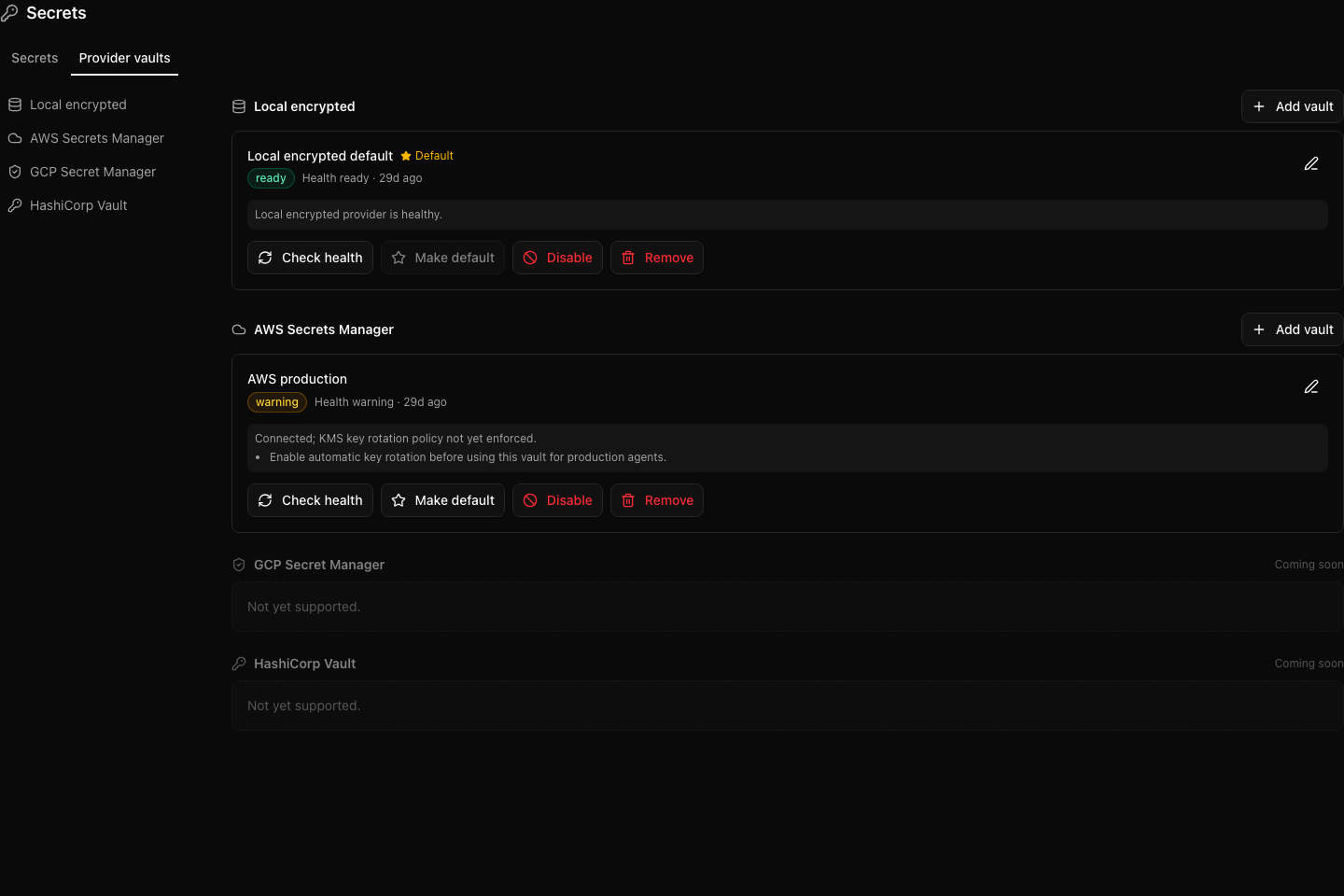 AWS discovery candidate flow: 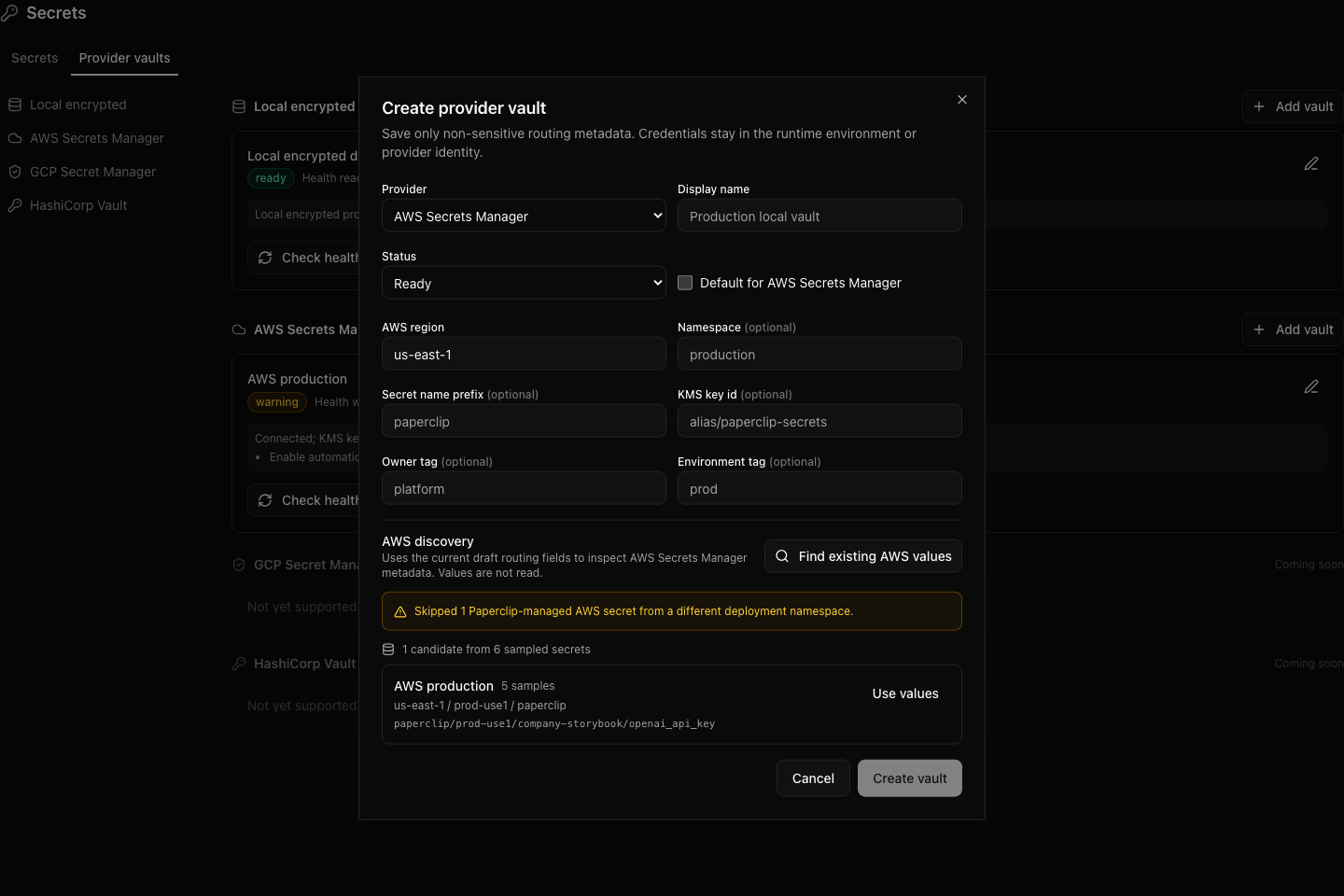 Provider vault removal confirmation: 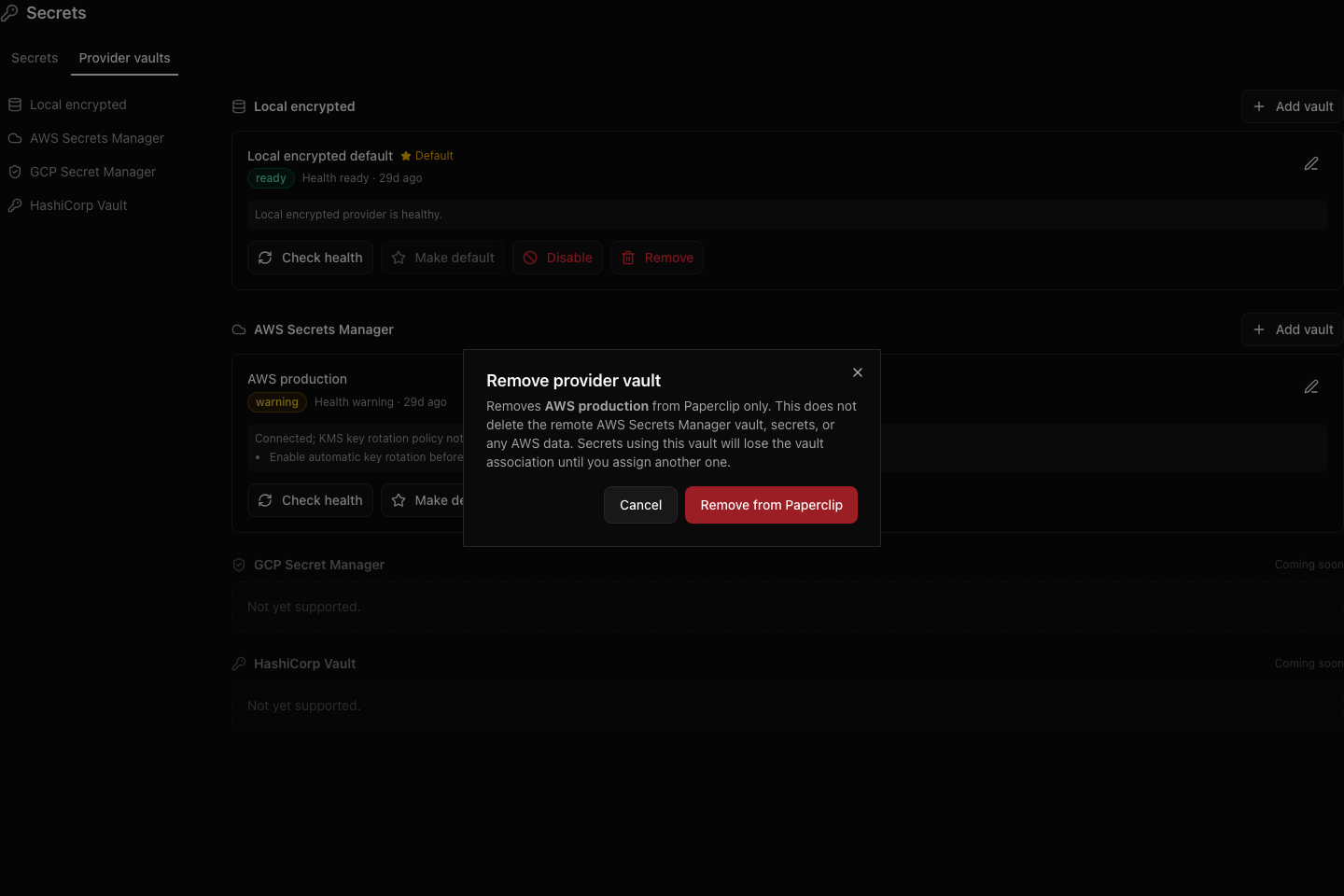 ## Risks - Secret provider metadata handling must remain non-sensitive; validators reject credential-bearing Vault URLs and sensitive AWS discovery keys. - AWS discovery depends on deployment credentials being configured correctly outside Paperclip-managed company secrets. > For core feature work, check [`ROADMAP.md`](ROADMAP.md) first and discuss it in `#dev` before opening the PR. Feature PRs that overlap with planned core work may need to be redirected — check the roadmap first. See `CONTRIBUTING.md`. ## Model Used - OpenAI Codex, GPT-5-based coding agent with local shell/git/tool use. Exact hosted model ID and context-window size are not exposed by the local Paperclip adapter runtime. ## Checklist - [x] I have included a thinking path that traces from project context to this change - [x] I have specified the model used (with version and capability details) - [x] I have checked ROADMAP.md and confirmed this PR does not duplicate planned core work - [x] I have run tests locally and they pass - [x] I have added or updated tests where applicable - [x] If this change affects the UI, I have included before/after screenshots - [x] I have updated relevant documentation to reflect my changes - [x] I have considered and documented any risks above - [x] I will address all Greptile and reviewer comments before requesting merge --------- Co-authored-by: Paperclip <noreply@paperclip.ing> |
||
|
|
778e775c35 |
Add secrets provider vaults and remote import (#5429)
## Thinking Path > - Paperclip orchestrates AI-agent companies and needs secrets handling to work across local development, hosted operators, and governed agent execution. > - The affected subsystem is the company-scoped secrets control plane: database schema, server services/routes, CLI workflows, and the Secrets settings UI. > - The gap was that secrets were local-only and operators could not manage provider vaults or import existing remote references without exposing plaintext. > - This branch adds provider vault configuration plus an AWS Secrets Manager remote-import path while preserving company boundaries, binding context, and audit trails. > - I kept the PR to a single branch PR, removed unrelated lockfile/package drift, rebased the full branch onto the current `public-gh/master`, and addressed fresh Greptile findings. > - The benefit is a reviewable implementation of provider-backed secrets with focused tests covering provider selection, import conflicts, deleted secret reuse, rotation guards, and AWS signing behavior. ## What Changed - Added provider vault support for company secrets, including provider config storage, default vault handling, health checks, binding usage, access events, and remote import preview/commit. - Added an AWS Secrets Manager provider using SigV4 request signing, bounded request timeouts, namespace guardrails, cached runtime credential resolution, and external-reference linking without plaintext reads. - Added Secrets UI surfaces for vault management and remote import, plus CLI/API documentation for setup and operations. - Stabilized routine webhook secret binding paths and SSH environment-driver fixture bindings discovered during verification. - Addressed Greptile and CI findings: no lockfile/package drift, monotonic migration metadata, disabled-vault default races, soft-deleted secret hiding/recreate behavior, remove behavior with disabled vaults, soft-deleted external-reference re-import, non-active rotation guards, managed-secret soft deletion through PATCH, and per-call AWS SDK credential client churn. - Rebased this branch onto `public-gh/master` at `0e1a5828` and force-pushed with lease to keep this as the single PR for the branch. ## Verification - `git fetch public-gh master` - `git rebase public-gh/master` - `git diff --name-only public-gh/master...HEAD | grep '^pnpm-lock\.yaml$' || true` confirmed `pnpm-lock.yaml` is not in the PR diff. - Confirmed migration ordering: master ends at `0081_optimal_dormammu`; this PR adds `0082_dry_vision` and `0083_company_secret_provider_configs`. - Inspected migrations for repeat safety: new tables/indexes use `IF NOT EXISTS`; foreign keys are guarded by `DO $$ ... IF NOT EXISTS`; column additions use `ADD COLUMN IF NOT EXISTS`. - `pnpm -r typecheck` passed before the Greptile follow-up commits. - `pnpm test:run` ran the full stable Vitest path before the Greptile follow-up commits; it completed with 3 timing-related failures under parallel load: `codex-local-execute.test.ts`, `cursor-local-execute.test.ts`, and `environment-service.test.ts`. - `pnpm --filter @paperclipai/server exec vitest run src/__tests__/codex-local-execute.test.ts src/__tests__/cursor-local-execute.test.ts src/__tests__/environment-service.test.ts` passed on targeted rerun (`24/24`). - `pnpm build` passed before the Greptile follow-up commits. Vite reported existing chunk-size/dynamic-import warnings. - After Greptile follow-up commits: `pnpm --filter @paperclipai/server exec vitest run src/__tests__/secrets-service.test.ts` passed (`26/26`). - After Greptile follow-up commits: `pnpm --filter @paperclipai/server exec vitest run src/__tests__/aws-secrets-manager-provider.test.ts src/__tests__/secrets-service.test.ts` passed (`39/39`). - After Greptile follow-up commits: `pnpm --filter @paperclipai/server typecheck` passed. - Captured Storybook screenshots from `ui/storybook-static` for visual review. - Latest PR checks on `5ca3a5cf`: `policy`, serialized server suites 1/4-4/4, `Canary Dry Run`, `e2e`, `security/snyk`, and `Greptile Review` pass; aggregate `verify` is still registering the completed child checks. - Greptile review loop continued through the latest requested pass; all Greptile review threads are resolved and the latest `Greptile Review` check on `5ca3a5cf` passed with 0 comments added. ## Screenshots Before: the provider-vault and remote-import surfaces did not exist on `master`; these are after-state screenshots from the Storybook fixtures.  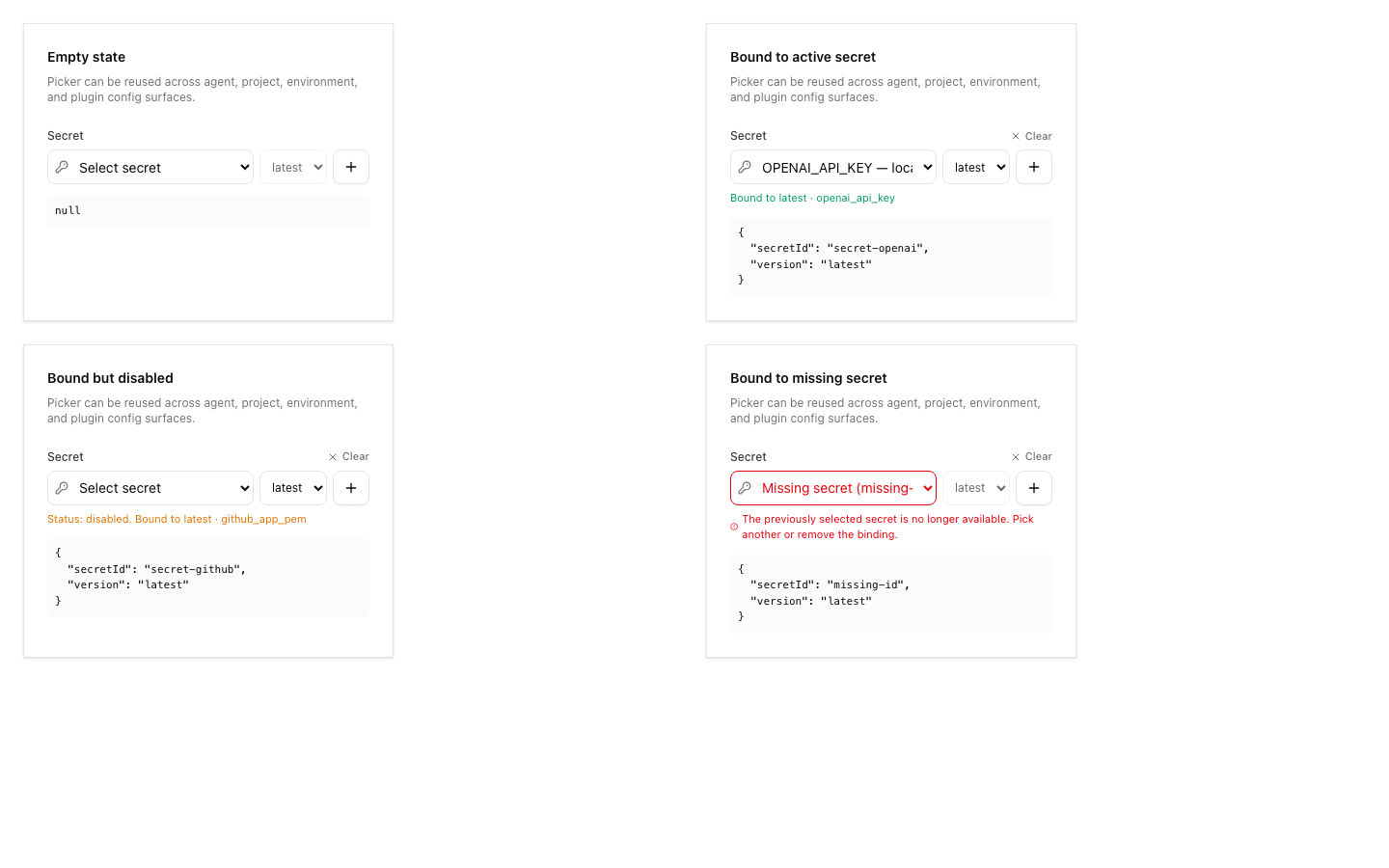 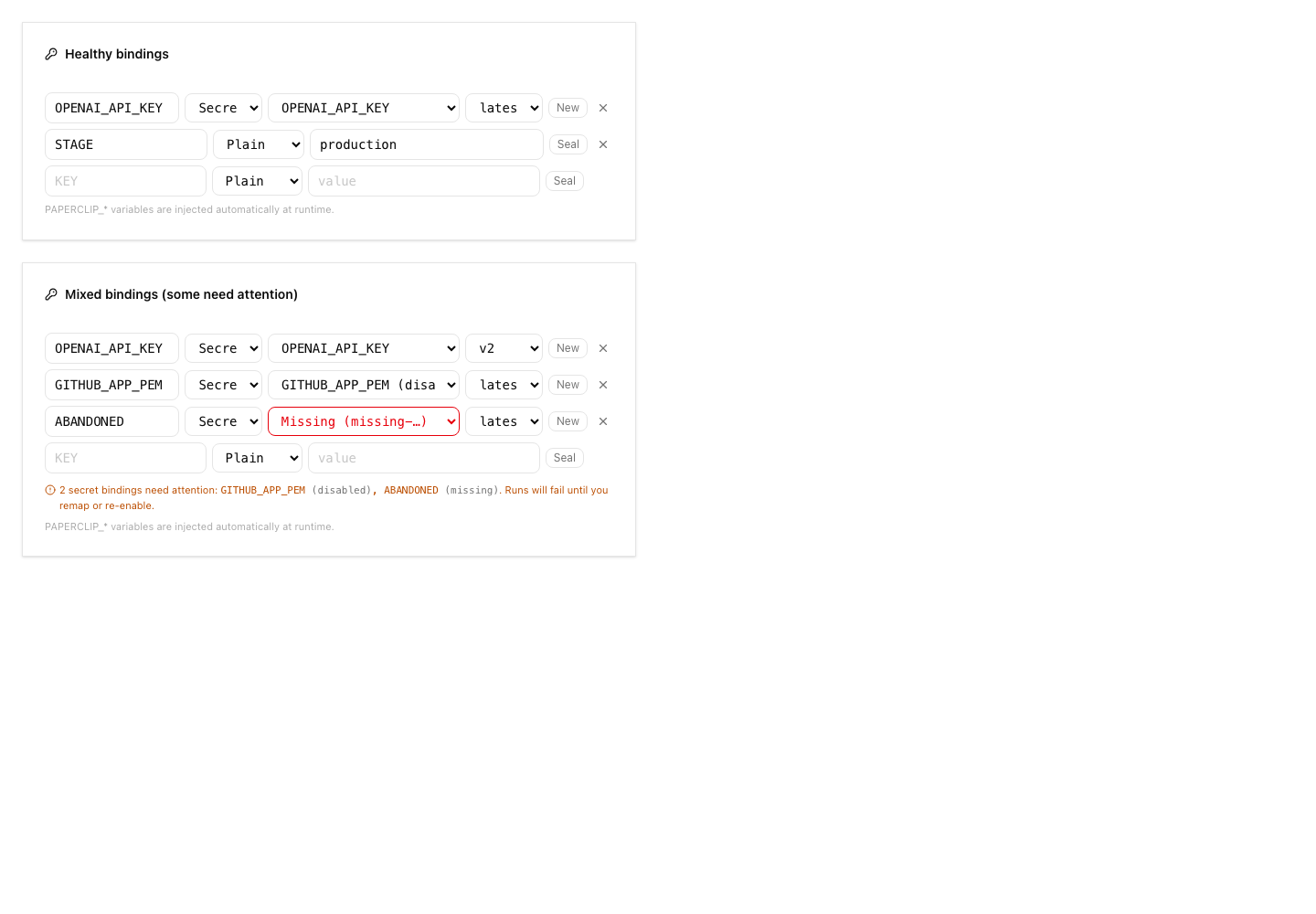 ## Risks - Migration risk: this adds new secret provider tables and extends existing secret rows. The migrations were checked for monotonic ordering and idempotent guards, but reviewers should still inspect upgrade behavior carefully. - Provider risk: AWS support uses direct SigV4 requests. Automated tests cover signing, request timeouts, vault-config selection, namespace guardrails, pending-version archival, sanitized provider errors, and service-level cleanup paths. A real-vault AWS smoke test remains deployment validation for an operator with AWS credentials rather than an unverified merge blocker in this local branch. - UI risk: the Secrets page and import dialog are large new surfaces; screenshots are included above for reviewer inspection. - Verification risk: the full local stable test command hit parallel-load timing failures, although the exact failed files passed when rerun directly. - Operational risk: remote import intentionally avoids plaintext reads; operators must understand that imported external references resolve at runtime and may fail if AWS permissions change. > For core feature work, check [`ROADMAP.md`](ROADMAP.md) first and discuss it in `#dev` before opening the PR. Feature PRs that overlap with planned core work may need to be redirected — check the roadmap first. See `CONTRIBUTING.md`. ## Model Used - OpenAI Codex, GPT-5 coding agent with local shell/tool use in the Paperclip worktree. Exact context-window size was not exposed by the runtime. ## Checklist - [x] I have included a thinking path that traces from project context to this change - [x] I have specified the model used (with version and capability details) - [x] I have checked ROADMAP.md and confirmed this PR does not duplicate planned core work - [ ] I have run tests locally and they pass - [x] I have added or updated tests where applicable - [x] If this change affects the UI, I have included before/after screenshots - [x] I have updated relevant documentation to reflect my changes - [x] I have considered and documented any risks above - [x] I will address all Greptile and reviewer comments before requesting merge --------- Co-authored-by: Paperclip <noreply@paperclip.ing> Co-authored-by: Claude Sonnet 4.6 <noreply@anthropic.com> |
||
|
DottaandClaude Opus 4.6
|
f60c1001ec |
refactor: rename packages to @paperclipai and CLI binary to paperclipai
Rename all workspace packages from @paperclip/* to @paperclipai/* and the CLI binary from `paperclip` to `paperclipai` in preparation for npm publishing. Bump CLI version to 0.1.0 and add package metadata (description, keywords, license, repository, files). Update all imports, documentation, user-facing messages, and tests accordingly. Co-Authored-By: Claude Opus 4.6 <noreply@anthropic.com> |
||
|
ForgottenandClaude Opus 4.6
|
11901ae5d8 |
Implement secrets service with local encryption, redaction, and runtime resolution
Add AES-256-GCM local encrypted secrets provider with auto-generated master key, stub providers for AWS/GCP/Vault, and a secrets service that normalizes adapter configs (converting sensitive inline values to secret refs in strict mode) and resolves secret refs back to plain values at runtime. Extract redaction utilities from agent routes into shared module. Redact sensitive values in activity logs, config revisions, and approval payloads. Block rollback of revisions containing redacted secrets. Filter hidden issues from list queries. Co-Authored-By: Claude Opus 4.6 <noreply@anthropic.com> |





