mirror of
https://github.com/paperclipai/paperclip.git
synced 2026-11-06 05:56:19 +01:00
48ffca94389ec0ce6a61baa7bb06dce4ed72d7a2
20
Commits
| Author | SHA1 | Message | Date | |
|---|---|---|---|---|
 DottaandPaperclip |
1e0cfcb4fc |
test: retire redundant suites and consolidate owner coverage (#15978)
Retire duplicate ACPX and Codex proof after migrating unique assertions to their behavioral owners. Consolidate repeated fixtures and exact case matrices while preserving lifecycle, protocol, company, credential, approval, and ordering contracts. Remove the unused runtime-controls compatibility path and document test ownership and preservation evidence. Co-Authored-By: Paperclip <noreply@paperclip.ing> |
||
|
DottaandPaperclip
|
57e977be72 |
feat: integrate Pi 1.0 into the experimental Runner (#14921)
## Thinking Path > - Paperclip manages AI agents and their work. > - The experimental Runner owns provider processes and durable sessions. > - Pi needs working task execution and human controls. > - The five-PR stack must preserve changes already on master. > - Each layer now carries the complete integrated source for a safe sequential fallback. > - This PR belongs to native GitHub stack #15602, ending at #14956. ## Linked Issues or Issue Description Refs #14436, #14631, #14743 and #14956. Ship Pi 1.0 through the experimental Paperclip Runner. The five PRs are #14921, #14922, #14923, #14924 and #14956. The user authorized the complete merge after checks pass. Existing `pi_local` execution is unchanged. Accounting and wider provider/platform qualification remain deferred. ## What Changed - Recover missing final replies after workspace finalization changes owners, using accepted-turn evidence without rerunning work or granting external-chat publication. - Preserve the admitted Pi instruction root across warm runs, while retaining changed-root rejection. - Give Pi a bounded 15-second default shutdown grace so stop, drain acknowledgement and durable suspension can complete. Explicit deadlines and other providers retain their existing behavior. - Integrate the Pi 1.0 runtime and master contracts. - Use Pi profile 22. Preserve explicit caller-selected models and exact native thinking levels. Keep Pi's wrapper, helper, extension and question/control behavior unchanged from the qualified profile-19 runtime. - Preserve master's Dot lifecycle and consent fields, configured task environment, status guards and current Codex/Claude dependency versions. Cursor stays qualified. Copilot stays pending; profile 17 binds the changed shared protocol validation sources. - Exclude general AWS IAM credentials from Pi static/custom provider bindings and selected task projections; preserve the provider-scoped Bedrock bearer key. Profile 21 is retained as historical provenance. Rust and cloud install probes use the current declaration. - Patch bundled brace-expansion 5.0.9 to the exact official 5.0.12 payload. Pin the patch and complete runtime closures. Include the patch in normal installed setup tooling. Keep the upstream Pi shrinkwrap as provenance and permit only this exact security correction. - Include current attestation files in the Docker build context. Keep the repository lockfile unchanged from master. CI and private image builds resolve manifest changes before their frozen installation. ## Verification - Full local `pnpm -r typecheck` passes, including Runner Rust, server and UI. Focused integration checks pass: 194 Runner admission/environment tests, 63 profile/credential tests with one expected skip, 152 Dot/UI configuration tests, and Pi transcript/notice tests. - Full local `pnpm build` passes on the final source. - Fresh final-source checks pass: all 698 Rust workspace tests (32 binaries), 156 credential/profile/controller tests with one expected skip, Runner TypeScript typecheck, and 20 package/setup/sandbox tests. - The profile-21 Pi materializer passes on the native host with the official pinned Node 24.21.0 and its npm. It verifies all 150 locked packages, the patched dependency and the exact closure. Setup/package bundle tests and UI token gates pass. - The old hashes were reproduced for all three supported targets before calculating the patched graph. New closure hashes are darwin-arm64 `282022db10150c6632b3444df421342e7d534bdf5d5fb1097a2e79d0625a2bcf`, darwin-x64 `64e251e19009f755c0b04f73ce2138246faab71a961b0f13d75ebfcc34bef12e`, and linux-x64 `713b1fdff42fb56a1518bdc084f181d70bee8ebadc3e4b1d76321ed9108c8410`. Independent native platform execution is separate from graph identity reproduction. - Historical cloud qualification remains unchanged: all seven core cases pass on shipping source `10dc43c9ec65d88c2f782d62afb296d09494f215`, harness `1a4408a48cfb5a1f094a311141c257c92cd7a893`, image `sha256:5b3a775b383591bda1b0c1889e509acc70ce7f37c53f09733c81d59037f02280`, and accepted Sonnet 4.6/low fixture. All 215 canonical files and all seven cleanup checks pass independent verification. These are profile-19 results and are not relabeled as fresh profile-22 runs. - Current Pi digest: `sha256:e92078bee3c23bec4100aa589013a44613d054cd686826534025d8019e9f39a9`. [The readiness plan](https://github.com/paperclipai/paperclip/blob/codex/pi-production-readiness/doc/plans/2026-10-02-pi-production-readiness.md) preserves campaign and failed-attempt provenance. - Merge only after every PR's current-head CI and fresh review pass. Linux CI covers the full suites, build and browser tests. The local embedded Postgres API-authority suite cannot start on this macOS/Node 26 host, so Linux CI must confirm that suite. ### Fresh profile-22 core qualification — 2026-10-08 All seven accepted core cases pass canonically on Pi profile 22, with `openrouter/anthropic/claude-sonnet-4.6` and native-confirmed low thinking. This model is a fixture; production accepts the caller's explicit Pi provider/model. Runtime/install source: `3241a992f2a7703e59e97ed0fd3e5d6405de4401`. Frozen accepted harness: `1a4408a48cfb5a1f094a311141c257c92cd7a893`. Immutable cloud image: `ghcr.io/paperclipai/paperclip-daytona-runner@sha256:506f22db7edd78f37c0c40bec1cc084af1850455026dbf467194bfbb8fcef141`. Pi digest: `sha256:e92078bee3c23bec4100aa589013a44613d054cd686826534025d8019e9f39a9`. [Hosted Linux image and clean-install verification](https://github.com/paperclipai/paperclip/actions/runs/37868328023) passes, including all 20 source-bound archives, normal CLI/Pi setup, companion import and the production pack reader. This exact installation source includes the latest master integration and the corrected Pi warm instruction-root fence. Full local typecheck/build and current-head hosted CI verify the final stack. All 13 focused real-root regressions pass. The full local executor suite passed 662 tests; 15 database tests could not start the Mac embedded PostgreSQL service. Hosted Linux CI passes the full required verification and E2E checks. These fresh results keep their own source identity; profile-19 results remain historical. | Core path | Canonical campaign | Retained archive SHA-256 | | --- | --- | --- | | File edit, validation, download and Done | `pi-core22-replyfix-0-1791511228` | 23 files; `a473e8603a3dd4737863291f8d3d1e392391f0b16d433c3e0e0e9d8baf7a97b0` | | Pending question and controller restart | `pi-core22-replyfix-1-1791511376` | 33 files; `6b829c4eb74e1f32a89c692a4ae7130dbfc1c6d3cf13915effe2103d9e242c8e` | | Three-turn session/process/workspace continuity | `pi-core22-replyfix-2-1791511587` | 23 files; `7a87021f8f9a3fdd3c58bb4467f8d82c635e3ea4795d6e75f144d9aa14818df8` | | Four typed questions and browser reconnects | `pi-core22-replyfix-3-1791511881` | 42 files; `9e31755252be1f4f9cb0626c984c142d4d1ae5f5bee3a7af08444db8d12c280a` | | Plan approval and completion | `pi-core22-replyfix-4-1791512031` | 22 files; `a0383ce1aab38e7b5a25ce0e9dd3bebea5c037ebd96ae6b29dae19015da2ae2c` | | Same-turn steering and permission denial | `pi-core22-replyfix-5-1791512261` | 39 files; `c929b8c7070f0b66aedc17e65ca46e6beab1e363926ac9f7e2a75fb250f05949` | | Stop during pending permission | `pi-core22-replyfix-6-1791512390` | 33 files; `7f0a58ae0f4d5bfc76149435f4e322537089c5bd16e7ffe9b5ad71f10a621a07` | All 215 canonical files (28714587 bytes) are independently hash-verified. All seven cleanup grades pass, with no owned runtime process or temporary root after each case. Automatic retries are zero. The owned cloud host stopped normally after retention. The prior profile-22 warm attempt remains failed and separately retained: archive SHA-256 `1e54eba5ec72b50cee1534b23d1d1d4f21a090006b8a64501ba70db972abfde5`. Its original canonical classification is preserved. Diagnosis reproduced a product bug comparing an agent-files root against an unset checkpoint-only field. The fix stores the admitted physical root separately from the adopted per-run collection capability. The real-root regression fails before the fix and passes afterward, including rejection of a changed physical root. Fixture, grader, model and all seven accepted case IDs are unchanged; this fresh campaign tests final-reply publication after file registration first. The intermediate restart attempt also remains failed and retained: archive SHA-256 `5dcaefdf1d17cf4cd54fd4cf810f45e736667392339b8ce7caf08bb4e225277f`. Its original canonical classification is preserved. Pi resumed, wrote the verified answer and completed its task; exact runner suspension was proven, but idle stop consumed about 5.2s and left under 3s for the drain acknowledgement. The Pi-only default shutdown grace is now 15s, preserving a full 5s drain round trip and a finite suspension reserve. Explicit caller deadlines, other provider defaults, literal drain receipts and exact suspension identity checks remain unchanged. The timing regression fails before this correction and passes afterward; all 18 focused settlement tests and Runner typecheck pass. The final-source file attempt is also preserved as failed (`candidate_failure`), archive SHA-256 `db6767b6773ea618997927ac77bdb005a5ac81492c7b9c0ffbc900449f829bc9`. Native edit, validation, exact downloadable artifact and Done/succeeded all passed, and the exact final reply was durably recorded. A workspace recovery owner completed before the live heartbeat reached presentation, leaving that reply absent from task chat. Recovery now materializes only a completed final reply from the accepted turn of an ordinary internal Done task, preserving issue/run/contract binding, suppression, external-chat authorization and same-run deduplication. The database regression covers the generated file-preparation receipt, suppression, unapproved external continuation and replay. Server typecheck and all 49 response-selection tests pass; hosted Linux verifies the database regression because embedded PostgreSQL cannot start on this Mac. The delayed-final-answer database regression passes on [the final root-source Linux server shard](https://github.com/paperclipai/paperclip/actions/runs/37868262553/job/113628594152), alongside 1,108 passing tests. The first root Runner shard had one unchanged durable-resume test exceed its 5-second timeout; the identical top-source shard and the isolated exact test passed. One rerun of that failed job and its required aggregate passed without source or test changes. The original failed job log and the single-rerun receipt remain retained. ### October 9 merge verification Current merge head: `5a8fe63512a7166aaef5cf50065a25008aa8b44b`. All current-head checks pass, including `ci / verify` and `ci / e2e`; exact-head Greptile review is 5/5 with no unresolved threads. Current master conflicts are resolved. The user authorized the maintainer override of the code-owner review gate after these checks. The seven retained live core cases remain bound to source `3241a992f2a7703e59e97ed0fd3e5d6405de4401` and its recorded cloud image. ## Risks - The security correction changes the dependency closure and profile identity. Old sessions must reopen on the new profile. Exact identities and credential bindings fail closed. - The runner remains experimental and requires explicit selection. Legacy Pi Local is unchanged. Caller model IDs pass through; the E2E model is a fixture. - Accounting and the broad platform/provider matrix remain deferred. This merge does not publish a release or deploy a service. ## Model Used OpenAI GPT-6 through Codex assisted with reasoning, repository inspection, editing and tool use. The exact serving ID and context window are not exposed in this session. Final live qualification uses Pi 1.0.0 with `openrouter/anthropic/claude-sonnet-4.6` and native-confirmed low thinking. ## Checklist - [x] I have included a thinking path that traces from project context to this change - [x] I have specified the model used (with version and capability details) - [x] I have checked ROADMAP.md and confirmed this PR does not duplicate planned core work - [x] I have searched GitHub for duplicate or related PRs and linked them above - [x] I have either (a) linked existing issues with `Fixes: #` / `Closes #` OR (b) described the issue in-PR following the relevant issue template - [x] I have not referenced internal/instance-local Paperclip issues or links (only public GitHub `#NNN` / `github.com/paperclipai/paperclip` URLs) - [x] My branch name describes the change (e.g. `docs/...`, `fix/...`) and contains no internal Paperclip ticket id or instance-derived details - [x] I have run tests locally and they pass - [x] I have added or updated tests where applicable - [x] I have updated relevant documentation to reflect my changes - [x] I have considered and documented any risks above - [x] All Paperclip CI gates are green - [x] Greptile is 5/5 with no open P2s, recommendations, or follow-ups - [x] I will address all Greptile and reviewer comments before requesting merge --------- Co-authored-by: Paperclip <noreply@paperclip.ing> |
||
|
Devin Foley
|
c62bb4b16b |
feat: environment delete with agent reassignment and consented sandbox destroy (#12053)
## Thinking Path > - Paperclip is the open source app people use to manage AI agents for work > - Environments define where agent runs execute: local, SSH, or provider sandboxes > - Operators can create and edit environments, but the UI has no way to delete one > - The server already exposes `DELETE /environments/:id` and a delete-blast-radius preflight, but no UI consumes them, and a delete blocked by reusable sandbox leases gives the operator no path forward > - This pull request adds the delete flow to the environment configuration page: a preflight-driven modal that reassigns dependent agents, names the workspaces that hold blocking sandbox leases, and can destroy those sandboxes with explicit consent > - The benefit is that operators can retire stale environments from the UI without database surgery, and dependent agents move to a chosen replacement instead of silently falling back ## Linked Issues or Issue Description Refs #8554 Refs #11124 **Subsystem affected** Environments (server routes, environment runtime service, and the environment settings UI). **Problem or motivation** The environment configuration page has no delete control. The server delete endpoint exists, but nothing in the UI calls it. When reusable sandbox leases block a delete, the 409 error names no owner, so the operator cannot find the blocking workspace. Agents that use the environment as their default lose it silently through the FK `on delete set null`. **Proposed solution** Add a delete button with a confirmation modal on the environment edit page. The modal reads the delete-blast-radius preflight. It offers a dropdown to reassign dependent agents to another environment before the delete. It lists each workspace that holds a blocking reusable sandbox lease, with a link. When those leases are the only blocker, the confirm button destroys the sandboxes inline (`?destroyReusableSandboxLeases=true`) and then deletes. A failed teardown falls back to `pending_cleanup` for the sweep, so no sandbox is orphaned. ## What Changed - `ui/src/pages/CompanyEnvironments.tsx`: delete button on the edit page header, confirmation modal with agent reassignment select, lease-holder list, impact notes, and a consent-labeled destroy-and-delete action - `ui/src/api/environments.ts`: `deleteBlastRadius` and `remove` client methods; `remove` takes an optional `destroyReusableSandboxLeases` flag - `server/src/routes/environments.ts`: `DELETE /environments/:id` accepts `?destroyReusableSandboxLeases=true`; it destroys the environment's reusable sandbox leases first, but only when those leases are the sole delete blocker, then re-checks the blast radius before it deletes - `server/src/services/environment-runtime.ts`: new `destroyReusableSandboxLeasesForEnvironment` — destroys every reusable sandbox lease an environment still owns while the environment config (provider credentials) is still available - `server/src/services/environments.ts`: the delete blast radius now returns `reusableSandboxLeaseHolders` (lease id, workspace, issue) so clients can name what blocks a delete - `packages/shared/src/types/environment.ts`: `EnvironmentDeleteReusableLeaseHolder` type on the blast radius - Tests: route gating for the consent flag (destroy runs, mixed-blocker rejection, surviving-lease rejection), runtime destroy scoped to an environment, blast-radius holder join, and UI tests for the reassignment flow, holder links, and the consent button ## Verification - `npx vitest run server/src/__tests__/environment-routes.test.ts server/src/__tests__/environment-service.test.ts server/src/__tests__/environment-runtime.test.ts ui/src/pages/CompanyEnvironments.test.tsx` - Manual: open Settings → Environments → edit an environment. The trash icon opens the modal. With agents on the environment, pick a reassignment target and confirm; agents move and the environment deletes. With reusable sandbox leases, the modal names the holding workspaces and the confirm button reads "Destroy N sandboxes and delete". ## Risks - The consented path destroys provider sandboxes. It runs only when reusable leases are the sole blocker, so a delete that would still be rejected never destroys anything. A failed teardown routes to `pending_cleanup` and the delete stays blocked until the sweep resolves it. - Agent reassignment issues one PATCH per agent from the client. A mid-sequence failure leaves some agents reassigned; the reassignments are valid on their own and the UI refreshes to the actual state. - Hard blockers (managed local, instance default, pending cleanup) keep the existing 409 behavior and disable the confirm button. ## Model Used - Claude (Anthropic) — Fable 5, model id `claude-fable-5`, extended thinking, agentic tool use via Claude Code CLI. ## Checklist - [x] I have included a thinking path that traces from project context to this change - [x] I have specified the model used (with version and capability details) - [x] I have checked ROADMAP.md and confirmed this PR does not duplicate planned core work - [x] I have searched GitHub for duplicate or related PRs and linked them above - [x] I have either (a) linked existing issues with `Fixes: #` / `Closes #` / `Refs #` OR (b) described the issue in-PR following the relevant issue template - [x] I have not referenced internal/instance-local Paperclip issues or links (only public GitHub `#NNN` / `github.com/paperclipai/paperclip` URLs) - [x] My branch name describes the change (e.g. `docs/...`, `fix/...`) and contains no internal Paperclip ticket id or instance-derived details - [x] I have run tests locally and they pass - [x] I have added or updated tests where applicable - [ ] I have updated relevant documentation to reflect my changes - [x] I have considered and documented any risks above - [ ] All Paperclip CI gates are green - [ ] Greptile is 5/5 with no open P2s, recommendations, or follow-ups - [x] I will address all Greptile and reviewer comments before requesting merge |
||
|
Nicky LeachandPaperclip
|
10d2781a29 |
feat(sandbox): add the duplex bridge broker, gated transport selection, and fixed observability (#11769)
## Thinking Path > - Paperclip is the open source app people use to manage AI agents for work. > - Sandbox adapters provide controlled execution for untrusted provider environments. > - The sandbox channel needs one persistent duplex transport with strict host control. > - The transport must remain off unless the instance setting and provider capability both allow it. > - The host must detect loss, bound resource use, and expose only safe telemetry. > - This pull request adds the broker, gated selection, kill-switch wiring, fixed observability, and real-process proof. > - The benefit is safer sandbox execution with bounded failure behavior and inspectable transport results. ## Linked Issues or Issue Description No public issue exists for this change. The related pull requests are #11738 and #11750. **Problem or motivation** The sandbox duplex channel needs a host-controlled broker, strict transport gates, bounded provider input, and safe loss telemetry. Without these controls, a provider can cause replay, resource growth, unsafe endpoint selection, or data exposure through telemetry. **Proposed solution** Add a host broker with nested time limits, request limits, one-shot loss, and per-id deduplication. Select duplex transport only when the instance setting and provider capability both equal true. Assign the endpoint and nonce on the host. Reject invalid readiness data and use the file bridge on failure. Add fixed redacted telemetry and a real-process end-to-end test harness. **Alternatives considered** Keep the file bridge as the only transport. This avoids new channel behavior but does not provide persistent duplex operation for supported sandbox providers. **Roadmap alignment** This change supports the Cloud / Sandbox agents section in ROADMAP.md. ## What Changed - Add the duplex bridge broker with bounded forward, response, and gateway wait budgets. - Bound concurrent requests, lifetime requests, and request-id bytes before retention or forwarding. - Select duplex transport only when both required gates are true. - Assign the loopback port and nonce on the host and enforce a liveness-only READY frame. - Fall back to the file bridge after invalid readiness, contamination, bind failure, or timeout. - Carry the kill switch through the server, acpx engine, and six local adapters. - Add fixed, redacted duplex telemetry with a provider allowlist. - Add a real-process end-to-end harness for readiness, round trips, loss, and teardown. - Add regression coverage for limits, loss, UTF-8 splits, concurrency, and telemetry dimensions. ## Verification - Adapter-utils, server, and Daytona typechecks pass locally. - Adapter-utils tests pass, including the codec, broker, execution-target sandbox, and real-process harness. - Server kill-switch tests pass. - Live Daytona tests pass with the required provider key and skip without that key. - The root pnpm-lock.yaml file has no diff. - The branch contains ten commits after origin/master. ## Risks - Duplex transport remains disabled unless both gates equal true. - A provider remains an untrusted boundary and needs least-privilege credentials and quotas. - The server telemetry recorder stays deferred; the default recorder does nothing. - A provider that pre-binds the host port causes a fail-closed fallback to the file bridge. - The change adds no database migration and changes no root lockfile. ## Model Used OpenAI GPT-5, exact model family GPT-5, large context window, reasoning, and tool use. The model assisted with Git handoff validation and PR preparation. The implementation commits came from the engineering worktree. ## Checklist - [x] I have included a thinking path that traces from project context to this change - [x] I have specified the model used (with version and capability details) - [x] I have checked ROADMAP.md and confirmed this PR does not duplicate planned core work - [x] I have searched GitHub for duplicate or related PRs and linked them above - [x] I have either (a) linked existing issues with Fixes: # / Closes # / Refs # OR (b) described the issue in-PR following the relevant issue template - [x] I have not referenced internal/instance-local Paperclip issues or links (only public GitHub #NNN / github.com/paperclipai/paperclip URLs) - [x] My branch name describes the change (e.g. docs/... or fix/...) and contains no internal Paperclip ticket id or instance-derived details - [x] I have run tests locally and they pass - [x] I have added or updated tests where applicable - [x] I have updated relevant documentation to reflect my changes - [x] I have considered and documented any risks above - [x] All Paperclip CI gates are green - [x] Greptile is 5/5 with no open P2s, recommendations, or follow-ups - [x] I will address all Greptile and reviewer comments before requesting merge - [x] I searched the GitHub PR list for similar PRs and confirmed this is not a duplicate --------- Co-authored-by: Paperclip <noreply@paperclip.ing> |
||
|
DottaandPaperclip
|
e826188e82 |
refactor(settings): unify settings and speed up exports (#11789)
## Thinking Path > - Paperclip is the open source app that people use to manage AI agents for work. > - Operators use the settings area to control a company and its Paperclip instance. > - The current navigation separates related settings and uses duplicate instance pages. > - Company exports also do independent reads in sequence and do extra work for previews. > - Hardened workspace commands can differ from their saved command after loopback binding. > - This pull request makes these related operator workflows consistent and faster. > - The benefit is one clear settings area, faster exports, and stable runtime command matching. ## Linked Issues or Issue Description Refs #338 Related: #9834 **What existing behavior does this improve?** This improves the company settings UI, company export preparation, and workspace runtime command matching. **Current behavior** Company and instance settings use separate navigation and duplicate pages. Export preparation reads many independent records in sequence. Preview generation can also build an unused organization image. A command with a forced loopback bind can fail to match its saved runtime command. **Proposed behavior** Use one settings navigation and put general instance controls on the company General page. Load independent export data with bounded concurrency, skip unused preview image work, and load the export page only when it is needed. Treat the loopback-bound form of a command as the same runtime command. **Reason and benefit** Operators get one clear settings area. Large company exports need fewer serialized reads. Export previews and initial UI loads do less work. Hardened runtime services remain linked to their saved command definitions. **Breaking changes** The obsolete instance General URL redirects to the unified settings page. Access and Heartbeats remain available, and legacy bookmarks keep their destinations. No API response shape or database schema changes. ## What Changed - Unified company and instance settings navigation and removed duplicate instance settings pages. - Embedded general instance controls in the company General page and kept access-sensitive navigation behavior. - Preserved instance Access and Heartbeats controls in the unified navigation and normalized old bookmarks to those destinations. - Improved environment and access-state handling when workspace seed requests overlap. - Added bounded export reads, a lighter preview path, deferred export preparation, and lazy export-page loading. - Matched loopback-bound runtime commands to their saved command definitions. - Added focused shared, server, and UI regression tests. ## Verification - `pnpm exec vitest run <18 changed test files>`: 18 files and 256 tests passed. - `pnpm check:token-gates`: passed all four token gates. - `pnpm -r typecheck`: passed for all workspace projects. - `pnpm build`: passed for all workspace projects. - `pnpm test:run`: tests ran without a reported failure, but the runner did not close after the server handoff tests. The process closed with status 0 after an interrupt. - Focused latest-head route tests: 2 files and 4 tests passed. - GitHub latest-head checks: all completed without failure. - Greptile: 5/5 with no unresolved review threads. ## Risks - Medium risk: settings routes and navigation changed across several operator roles. - Medium risk: bounded export concurrency increases simultaneous database reads. The limits stay below the normal pool size. - Low risk: runtime command matching accepts only the known Tailscale HTTPS loopback transformation. - No migrations are included. > For core feature work, check [`ROADMAP.md`](ROADMAP.md) first and discuss it in `#dev` before opening the PR. Feature PRs that overlap with planned core work may need to be redirected — check the roadmap first. See `CONTRIBUTING.md`. ## Model Used - OpenAI Codex with a GPT-5-family coding model. The runtime does not expose the exact deployed model ID or context-window size. Reasoning, tool use, and local code execution were enabled. ## Checklist - [x] I have included a thinking path that traces from project context to this change - [x] I have specified the model used (with version and capability details) - [x] I have checked ROADMAP.md and confirmed this PR does not duplicate planned core work - [x] I have searched GitHub for duplicate or related PRs and linked them above - [x] I have either (a) linked existing issues with `Fixes: #` / `Closes #` / `Refs #` OR (b) described the issue in-PR following the relevant issue template - [x] I have not referenced internal/instance-local Paperclip issues or links (only public GitHub `#NNN` / `github.com/paperclipai/paperclip` URLs) - [ ] My branch name describes the change (e.g. `docs/...`, `fix/...`) and contains no internal Paperclip ticket id or instance-derived details Exception: This task requires the existing execution branch. The harness does not permit a branch rename. - [x] I have run tests locally and they pass - [x] I have added or updated tests where applicable - [x] I have updated relevant documentation to reflect my changes - [x] I have considered and documented any risks above - [x] All Paperclip CI gates are green - [x] Greptile is 5/5 with no open P2s, recommendations, or follow-ups - [x] I will address all Greptile and reviewer comments before requesting merge --------- Co-authored-by: Paperclip <noreply@paperclip.ing> |
||
|
Nicky LeachandPaperclip
|
b8a76081ec |
feat(environments): expose boot-relevant drift attribution in the custom-image overview (#11751)
## Thinking Path > - Paperclip is the open source app people use to manage AI agents for work > - Paperclip lets operators prepare and use custom images for sandbox environments > - The custom-image overview detected drift but did not show which boot source changed > - Operators need the changed field and values to understand why a template no longer matches > - This pull request adds safe drift attribution to the overview API and the out-of-sync banner > - The benefit is faster diagnosis without exposing secrets or internal snapshot data ## Linked Issues or Issue Description **Subsystem affected** Cross-cutting (server and UI). **Problem or motivation** The custom-image overview reported drift without identifying the changed boot source. Operators had to inspect other data to find the cause. **Proposed solution** Return a classified drift summary with changed paths and their prior and current values. Show the boot-source field in the UI banner. Keep legacy templates and unclassified drift on the generic message. **Alternatives considered** The change does not expose the full snapshot or fingerprint. This keeps the overview contract small and avoids secret disclosure. **Roadmap alignment** The change supports the existing custom-image environment workflow and does not duplicate a roadmap item. ## What Changed - Add `activeTemplateDrift` to the custom-image overview response. - Classify drift as `boot_source_drift`, `knob_only`, or `unclassified`. - Return drifted paths with safe `from` and `to` values. - Show the changed boot-source field and values in the out-of-sync banner. - Keep legacy templates fail-closed and exclude secrets, fingerprints, and raw snapshots. - Add server and UI tests for the new behavior. ## Verification - `npx vitest run server/src/__tests__/environment-custom-images-service.test.ts` passes with 27 tests. - `npx vitest run ui/src/pages/CompanyEnvironments.test.tsx` passes with 27 tests. - `pnpm --filter @paperclipai/ui exec tsc --noEmit` passes. - Review the overview response and banner cases for boot-source, knob-only, and legacy drift. ## Risks The overview response gains one optional field. Legacy templates remain compatible because they return `unclassified` and keep the generic banner. The service excludes secret values, fingerprints, and raw snapshots. ## Model Used OpenAI Codex, GPT-5, tool use and code execution enabled. The model reviewed the handoff and managed the pull request. ## Checklist - [x] I have included a thinking path that traces from project context to this change - [x] I have specified the model used (with version and capability details) - [x] I have checked ROADMAP.md and confirmed this PR does not duplicate planned core work - [x] I have searched GitHub for duplicate or related PRs and linked them above - [x] I have either (a) linked existing issues with `Fixes: #` / `Closes: #` / `Refs: #` OR (b) described the issue in-PR following the relevant issue template - [x] I have not referenced internal/instance-local Paperclip issues or links (only public GitHub `#NNN` / `github.com/paperclipai/paperclip` URLs) - [x] My branch name describes the change (e.g. `docs/...`, `fix/...`) and contains no internal Paperclip ticket id or instance-derived details - [x] I have run tests locally and they pass - [x] I have added or updated tests where applicable - [x] I have updated relevant documentation to reflect my changes - [x] All Paperclip CI gates are green - [x] Greptile is 5/5 with no open P2s, recommendations, or follow-ups - [ ] I will address all Greptile and reviewer comments before requesting merge Co-authored-by: Paperclip <noreply@paperclip.ing> |
||
|
Nicky LeachandPaperclip
|
120ae5428f |
feat(server): add a one-click relink action for detached custom-image templates (#11641)
## Thinking Path > - Paperclip is the open source app people use to manage AI agents for work > - Paperclip environments can use captured custom images for agent runs > - A configuration fingerprint change can detach a valid custom-image template > - Operators need a safe way to confirm that the image still matches the boot source > - This pull request adds a guarded relink action with drift classification and audit logging > - The benefit is a deliberate relink without a new sandbox boot or provider snapshot ## Linked Issues or Issue Description **Subsystem affected** Cross-cutting environment, server, and UI behavior. **Problem or motivation** A custom-image template detaches when the environment configuration fingerprint changes. The runtime then uses the base image, even when the boot source did not change. The only prior remedy required a full re-capture. **Proposed solution** Add an operator-triggered relink action. Classify configuration drift from a server-owned boot-relevant snapshot. Relink knob-only drift without confirmation. Require explicit confirmation for boot-source or unclassified drift. Guard the route for instance administrators and record a safe activity event. **Alternatives considered** Keep requiring a full re-capture. This adds a sandbox boot and provider snapshot for cases where the image remains correct. **Roadmap alignment** The roadmap has no matching custom-image relink item. This change addresses an environment operation gap. **Additional context** The relink response exposes raw drift values only in the transient 409 response to the instance administrator. The service never persists or logs fingerprints or configuration values. Reserved identity-path segments fail closed. ## What Changed - Add `relinkActiveTemplate` with drift classification and conditional fingerprint update. - Persist a server-owned boot-relevant configuration snapshot during capture. - Add the guarded relink route with strict request validation and activity logging. - Add the relink action and confirmation flow to the environment page. - Add service, route, UI, and OpenAPI coverage. ## Verification - Run the focused service suite: `pnpm vitest run server/src/services/environment-custom-images-service.test.ts`. - Run the focused route suite: `pnpm vitest run server/src/routes/environment-custom-image-routes.test.ts`. - Run the focused UI suite: `pnpm vitest run ui/src/pages/CompanyEnvironments.test.tsx`. - Run server and UI TypeScript checks. - Confirm the OpenAPI snapshot matches the new route. - Confirm all required GitHub checks pass on commit `e46fdcfe94a719be854adf8849d30714e5b70b93`. - Confirm Greptile reports 5/5 with no unresolved review threads. ## Risks The relink action can keep an image after configuration drift. The service requires explicit confirmation for boot-source or unclassified drift. Reserved path segments produce a safe unresolved marker and never enter stored values. ## Model Used OpenAI GPT-5 Codex. The model used repository inspection, GitHub operations, and PR preparation with tool use and code execution. The runtime did not expose a context-window value or a separate reasoning-mode value. ## Checklist - [x] I have included a thinking path that traces from project context to this change - [x] I have specified the model used (with version and capability details) - [x] I have checked ROADMAP.md and confirmed this PR does not duplicate planned core work - [x] I have searched GitHub for duplicate or related PRs and linked them above - [x] I have either (a) linked existing issues with `Fixes: #` / `Closes #` / `Refs #` OR (b) described the issue in-PR following the relevant issue template - [x] I have not referenced internal/instance-local Paperclip issues or links (only public GitHub `#NNN` / `github.com/paperclipai/paperclip` URLs) - [x] My branch name describes the change (e.g. `docs/...`, `fix/...`) and contains no internal Paperclip ticket id or instance-derived details - [x] I have run tests locally and they pass - [x] I have added or updated tests where applicable - [x] I have updated relevant documentation to reflect my changes - [x] I have considered and documented any risks above - [x] All Paperclip CI gates are green - [x] Greptile is 5/5 with no open P2s, recommendations, or follow-ups - [x] I will address all Greptile and reviewer comments before requesting merge --------- Co-authored-by: Paperclip <noreply@paperclip.ing> |
||
|
Devin Foley
|
ff5fd62d07 |
Resolve the environment secret companyId context on first save (#11291)
## Thinking Path > - Paperclip is the open source app people use to manage AI agents for work > - Environments give agent runs an execution target, and their env vars can carry secrets, so writes need a company scope for secret bindings > - `PATCH /environments/:id` resolves that scope from a query param, existing bindings, or a single-membership actor — and fails closed otherwise > - A fresh environment has no bindings yet, so an admin whose memberships cannot pin one company gets a 422 on the very first env var save and can never create the first binding > - #11200 made this reachable from the UI: it opened the envVars-only edit on the managed sandbox row, but the UI never sends the company it already knows > - This pull request sends the page's selected company on environment updates and adds a server fallback to the instance's only company > - The benefit is that the first env var save works on fresh environments, while multi-company ambiguity still fails closed ## Linked Issues or Issue Description Refs #11200 **What happened?** On a fresh platform-managed sandbox environment, the first "Save environment variables" in the UI fails with HTTP 422: "Environment secret management requires a companyId context during the instance-scoped transition." The same failure hits any environment update that touches `envVars` or `config` when the environment has no secret bindings yet and the actor's memberships do not name exactly one company (for example an instance admin provisioned without a membership row, or a user in two companies). **Expected behavior** The save succeeds. The client tells the server which company scopes the secret bindings, and on a single-company instance the server can resolve the only possible scope by itself. **Steps to reproduce** 1. Provision a platform-managed sandbox environment (managed-config `environments` entry) so the row exists with no secret bindings. 2. Sign in as an instance admin whose memberships do not resolve to exactly one company. 3. Open Environments, edit the managed row, add an env var, and save. 4. The PATCH returns 422 with the companyId-context error. ## What Changed - `ui/src/api/environments.ts`: `environmentsApi.update` accepts an optional `companyId` and sends it as the `companyId` query param the server already reads. Renamed the `customImageCompanyQuery` helper to `companyIdQuery` since it now serves plain updates and probes too. - `ui/src/pages/CompanyEnvironments.tsx`: both the managed envVars-only save and the general environment save pass `selectedCompanyId`. - `server/src/routes/environments.ts`: `resolveEnvironmentSecretContextCompanyId` falls back to the instance's only company when exactly one exists, mirroring the existing fallback in `resolveCustomImageCompanyId`. Multi-company instances still fail closed. - Tests: three new route tests (explicit query context for a multi-company actor, single-company-instance fallback for a membership-less admin, fail-closed regression on a multi-company instance), and updated the SSH-probe and probe-ambiguity tests for the new fallback. ## Verification - `cd server && pnpm vitest run src/__tests__/environment-routes.test.ts` — 78 pass. - `cd ui && pnpm vitest run src/pages/CompanyEnvironments.test.tsx` — 22 pass. - Full `server` and `ui` vitest suites and `tsc --noEmit` on both packages pass locally. - Manual: on a managed instance, edit the managed sandbox environment, add an env var, save. Before: 422. After: the save persists and the PATCH carries `?companyId=`. ## Risks - Low risk. The explicit query param path already existed on the server; the UI now uses it. - Behavioral shift: on single-company instances, environment secret-context resolution (including `POST /environments/:id/probe`) now resolves the only company instead of returning no context. That lets probes resolve secret-backed config where they previously returned a 422 asking for an explicit companyId. Multi-company instances keep the fail-closed behavior, covered by a regression test. - Self-hosted single-company instances gain the same first-save fix; no schema or config changes. ## Model Used Claude Fable 5 (`claude-fable-5`, Anthropic) via Claude Code — extended thinking, agentic tool use. ## Checklist - [x] I have included a thinking path that traces from project context to this change - [x] I have specified the model used (with version and capability details) - [x] I have checked ROADMAP.md and confirmed this PR does not duplicate planned core work - [x] I have searched GitHub for duplicate or related PRs and linked them above - [x] I have either (a) linked existing issues with `Fixes: #` / `Closes #` / `Refs #` OR (b) described the issue in-PR following the relevant issue template - [x] I have not referenced internal/instance-local Paperclip issues or links (only public GitHub `#NNN` / `github.com/paperclipai/paperclip` URLs) - [x] My branch name describes the change (e.g. `docs/...`, `fix/...`) and contains no internal Paperclip ticket id or instance-derived details - [x] I have run tests locally and they pass - [x] I have added or updated tests where applicable - [x] I have updated relevant documentation to reflect my changes - [x] I have considered and documented any risks above - [ ] All Paperclip CI gates are green - [ ] Greptile is 5/5 with no open P2s, recommendations, or follow-ups - [x] I will address all Greptile and reviewer comments before requesting merge |
||
|
Devin Foley
|
d5bb396518 |
fix: pass sandbox provider credential env vars to plugin workers; hide Local default under managed-sandbox-only (#11244)
<!-- Write all pull request text in Simplified Technical English (ASD-STE100): short sentences, one instruction per sentence, simple approved vocabulary, and the active voice. --> ## Thinking Path > - Paperclip is the open source app people use to manage AI agents for work > - Environments give each agent run an execution target, and sandbox providers (Daytona, E2B, Novita, exe.dev) run as plugin workers > - A managed deployment provisions one platform-managed sandbox row with no credential in config; the provider is documented to fall back to its process env var (for example `DAYTONA_API_KEY`) > - Plugin workers spawn with a scrubbed environment, so that fallback never sees the host env var — probe and lease acquisition fail with "require an API key in config or DAYTONA_API_KEY" even when the deployment sets the var > - Separately, the managed-sandbox-only mode hides local rows from every list, but the instance Default picker renders a hardcoded synthetic "Local" option that no filter touches > - This pull request forwards each bundled provider's documented credential env var to its own plugin worker, and gates the synthetic Local option on the flag > - The benefit is that the documented host-env credential fallback works for plugin-backed providers, and managed-sandbox-only instances no longer offer Local anywhere ## Linked Issues or Issue Description **Subsystem affected** Plugin worker environment construction (`server/src/services/plugin-loader.ts`) and the environments UI (instance Default picker, agent form inherited-environment label). **Problem or motivation** Two follow-ups to the managed-sandbox-only mode (#11200), both found on a live managed deployment: 1. The deployment sets `DAYTONA_API_KEY` as a server env var and the managed sandbox row omits `config.apiKey` by contract. "Test Connection" fails with `Sandbox environment probe failed for provider "daytona". Daytona sandbox environments require an API key in config or DAYTONA_API_KEY.` A real agent run fails the same way at lease acquisition. The cause: sandbox providers run as plugin workers, and `buildPluginWorkerEnv` passes only model-provider keys and in-cluster Kubernetes vars. The provider's own documented credential env var never reaches the worker, so the in-plugin `process.env` fallback reads nothing. The self-hosted path has the same gap: the Daytona plugin README documents `DAYTONA_API_KEY` as a host-level fallback, and it does not work today. 2. With `enableManagedSandboxOnly` on, the instance Default environment picker still shows "Local". The server filters local *rows* out of the list, and the client filter mirrors that for cached lists, but this option is a hardcoded `<option value="">Local</option>` — not a list row — so no filter removes it. Selecting it writes a null default, which run selection then rejects fail-closed. **Proposed solution** Forward each bundled sandbox provider's documented credential env var into its plugin worker, keyed by the manifest's declared `environmentDrivers[].driverKey` so a worker only receives its own provider's credential (daytona → `DAYTONA_API_KEY`, e2b → `E2B_API_KEY`, exe-dev → `EXE_API_KEY`, novita → `NOVITA_API_KEY`). Keep the existing gate: only plugins that declare `environment.drivers.register` receive any passthrough. In the UI, render the synthetic Local option only when managed-sandbox-only is off; under the flag show a disabled "Select environment" placeholder only while no default is stamped yet, and stop the agent form's inherited label from reading "Local". **Alternatives considered** Adding `DAYTONA_API_KEY` to the existing `ADAPTER_ENV_PASSTHROUGH` list was rejected: that list goes to every environment-driver plugin, so each provider would receive every other provider's credential. A manifest schema field for declared credential env vars was rejected as heavier than needed: the bundled providers are known, and the mapping lives next to the two existing passthrough lists. ## What Changed - `server/src/services/plugin-loader.ts`: new `SANDBOX_PROVIDER_CREDENTIAL_ENV_PASSTHROUGH` map (driverKey → documented credential env vars). `buildPluginWorkerEnv` reads the manifest's `environmentDrivers` and forwards only the matching vars, after the existing `environment.drivers.register` gate. Blank values stay excluded. - `server/src/__tests__/plugin-database.test.ts`: the daytona worker receives `DAYTONA_API_KEY` and not another provider's key; a plugin whose drivers have no mapping (kubernetes) receives no credential var. - `ui/src/pages/CompanyEnvironments.tsx`: the Default picker's synthetic Local option renders only when managed-sandbox-only is off. Under the flag, a disabled "Select environment" placeholder renders only while the default is unset. - `ui/src/pages/CompanyEnvironments.test.tsx`: the Local option is present by default and absent under the flag; saved non-local environments stay selectable. - `ui/src/components/AgentConfigForm.tsx`: the inherited-environment label falls back to "Managed sandbox" instead of "Local" under the flag. ## Verification - `server`: `npx vitest run src/__tests__/plugin-database.test.ts -t buildPluginWorkerEnv` — 5 passed (3 existing, 2 new). - `ui`: `npx vitest run src/pages/CompanyEnvironments.test.tsx` — 22 passed (2 new); `npx vitest run src/components/AgentConfigForm.render.test.tsx` — 10 passed. - `tsc --noEmit` clean in `server` and `ui`. - Live managed deployment: confirmed the tenant service env carries `DAYTONA_API_KEY` while the probe fails with the exact message above, which pins the root cause to the worker env, not delivery. ## Risks - The worker env grows by exactly one var per matching bundled provider, only when the deployment sets it and only for plugins that declare a matching environment driver. Plugins without a mapping see no change. - Self-hosted behavioral shift is the fix itself: a host-level `DAYTONA_API_KEY` (or E2B/EXE/NOVITA equivalent) now reaches the provider as its README documents. Deployments that set the var but expected it to stay inert had no working configuration to preserve — the provider errored on every keyless probe and run. - UI change is inert unless `enableManagedSandboxOnly` is on (default false everywhere). ## Model Used Claude Fable 5 (`claude-fable-5`) via Claude Code — extended thinking, tool use, parallel read-only subagents for the two root-cause traces. ## Checklist - [x] I have included a thinking path that traces from project context to this change - [x] I have specified the model used (with version and capability details) - [x] I have checked ROADMAP.md and confirmed this PR does not duplicate planned core work - [x] I have searched GitHub for duplicate or related PRs and linked them above - [x] I have either (a) linked existing issues with `Fixes: #` / `Closes #` / `Refs #` OR (b) described the issue in-PR following the relevant issue template - [x] I have not referenced internal/instance-local Paperclip issues or links (only public GitHub `#NNN` / `github.com/paperclipai/paperclip` URLs) - [x] My branch name describes the change (e.g. `docs/...`, `fix/...`) and contains no internal Paperclip ticket id or instance-derived details - [x] I have run tests locally and they pass - [x] I have added or updated tests where applicable - [x] I have updated relevant documentation to reflect my changes - [x] I have considered and documented any risks above - [x] All Paperclip CI gates are green - [x] Greptile is 5/5 with no open P2s, recommendations, or follow-ups - [x] I will address all Greptile and reviewer comments before requesting merge |
||
|
Devin Foley
|
90ead239a8 |
feat(ui/server): name cross-company environment secret refs instead of calling them missing (#10577)
## Thinking Path > - Paperclip is the open source app people use to manage AI agents for work > - Environment configs (sandbox providers, SSH) can bind stored company secrets through `format: "secret-ref"` fields, picked in the environment editor's secret picker > - Environments are instance-scoped and shared by every company on an instance, but the picker lists only the current company's secrets, so a ref pointing at another company's secret renders as "Missing secret (…)" in destructive styling > - That state is indistinguishable from a genuinely deleted secret, so operators "fix" a healthy binding by creating a duplicate secret in their own company — the exact sequence that used to corrupt bindings before #10576 > - This pull request adds an instance-gated metadata endpoint for an environment's secret refs and teaches the picker to name a cross-company secret and its owner honestly > - The benefit is that operators can tell a healthy cross-company binding from a broken one, and stop creating duplicate secrets ## Linked Issues or Issue Description **Is your feature request related to a problem? Please describe.** In the environment editor, a secret-ref field that points at a secret owned by a different company shows "Missing secret (22095402…)" in red, with "The previously selected secret is no longer available. Pick another or remove the binding." The binding is actually healthy — the current company's picker just cannot list the other company's secrets. Operators react by creating a duplicate secret and re-pointing the field. **Describe the solution you'd like** The editor should know the referenced secret's name, status, and owning company (metadata only, never the value) and present a cross-company ref neutrally, a deleted secret as deleted, and only an unknown id as missing. Related: #10576 (fixes the binding corruption this UI state used to trigger). ## What Changed - New `GET /environments/:id/secret-refs` returns `{ refs: [{ configPath, secretId, name, status, companyId, companyName }] }` for the environment's config-derived secret refs. Values are never returned. The route sits behind `assertCanAccessInstanceEnvironments`, the same gate as environment editing. - New `secretService.describeSecretRefs` loads that metadata across companies; unknown ids are omitted. - `SecretBindingPicker` reads an optional `SecretRefHintsContext` (keyed by secret id). With a hint, a ref the company list cannot show renders as `NAME — Owning Company` with neutral styling and the note "Owned by the … company. The binding keeps working; selecting a secret from this list re-points it here." A hint with `status: "deleted"` reports the secret as deleted. Without hints, behavior is byte-identical to before — agent editors and other picker users are unaffected. - `CompanyEnvironments` fetches descriptors for the environment being edited and provides them through the context. ## Verification - `cd server && pnpm vitest run src/__tests__/environment-routes.test.ts src/__tests__/secrets-service.test.ts` — new endpoint happy path, agent 403 (descriptors never computed), and embedded-Postgres coverage proving cross-company names resolve and unknown ids drop out. - `cd ui && pnpm vitest run src/components/SecretBindingPicker.test.tsx src/components/JsonSchemaForm.test.tsx src/pages/CompanyEnvironments.test.tsx` — hinted cross-company rendering, hinted deleted secret, and unchanged no-hint fallback. - `pnpm run typecheck` in `server` and `ui`. - Manual: edit an environment whose secret-ref field references another company's secret; the field names the secret and its owning company instead of "Missing secret". ## Risks - The endpoint exposes secret names and company names across companies to instance-level environment editors. Those actors already manage instance-shared environments (and instance admins are implicit members of every company), so this reveals no secret material and no new reach; the service method documents that callers must sit behind an instance-level gate. - UI change is additive and context-gated; pickers without a provider render exactly as before. ## Model Used Claude Fable 5 (`claude-fable-5`, Anthropic) via Claude Code — extended thinking, agentic tool use (file edits, vitest/tsc runs). No other models involved. ## Checklist - [x] I have included a thinking path that traces from project context to this change - [x] I have specified the model used (with version and capability details) - [x] I have checked ROADMAP.md and confirmed this PR does not duplicate planned core work - [x] I have searched GitHub for duplicate or related PRs and linked them above - [x] I have either (a) linked existing issues with `Fixes: #` / `Closes #` / `Refs #` OR (b) described the issue in-PR following the relevant issue template - [x] I have not referenced internal/instance-local Paperclip issues or links (only public GitHub `#NNN` / `github.com/paperclipai/paperclip` URLs) - [x] My branch name describes the change (e.g. `docs/...`, `fix/...`) and contains no internal Paperclip ticket id or instance-derived details - [x] I have run tests locally and they pass - [x] I have added or updated tests where applicable - [x] I have updated relevant documentation to reflect my changes - [x] I have considered and documented any risks above - [ ] All Paperclip CI gates are green - [ ] Greptile is 5/5 with no open P2s, recommendations, or follow-ups - [x] I will address all Greptile and reviewer comments before requesting merge |
||
|
Devin Foley
|
49d1abc458 |
fix(ui): detail the env unsaved-changes banner and guard against draft loss (#9391)
## Thinking Path > - Paperclip is the open source app people use to manage AI agents for work > - Instance settings include an Environments section where operators configure execution environments, each with an environment-variables editor for run-time bindings > - The editor showed a bare "Unsaved changes" banner that never said which variables changed, sometimes appeared the moment a saved config was opened (a lossy round-trip through the editor's emit rules made clean values look dirty), and the environment form let you navigate away without any confirmation, silently dropping the draft > - Operators could not tell what was unsaved, distrusted the phantom banner, and lost half-finished environment edits to a stray click — the agent configuration page already confirms before discarding, so environments behaved inconsistently > - This pull request lists the new/edited/removed variable names under the banner, normalizes both sides of the dirty comparison so saved values no longer look dirty on open, and confirms before cancel, in-app navigation, or tab unload while the form has unsaved changes > - The benefit is that the banner is trustworthy and specific, and unsaved environment edits can no longer be lost without an explicit confirmation ## Linked Issues or Issue Description Related (not fixed by this PR): #8930 introduced the current environment-variables editor and its unsaved-changes banner; #9386 moved environment create/edit from a modal to routed pages, which this PR's navigation guard builds on. No existing public issue for the defects themselves; described per the bug report template: **What happened?** The environment-variables editor in Environments settings showed a bare "Unsaved changes" banner with no indication of which variables changed. For some saved configurations (names with surrounding whitespace, incomplete secret references, duplicate names differing only by whitespace) the banner appeared immediately on opening the edit form, before any user input. Navigating away from the environment form — cancel, an in-app link, or closing the tab — silently discarded the draft with no confirmation. **Expected behavior** The banner should say which variables are new, edited, or removed; a freshly opened saved configuration should show no banner; and leaving the form with unsaved changes should require an explicit confirmation, consistent with the agent configuration page. **Steps to reproduce** 1. Open Settings → Instance settings → Environments and edit an environment whose saved config round-trips lossily (e.g. an env var name stored with trailing whitespace) — the "Unsaved changes" banner appears with no user edits. 2. Add or edit a variable — the banner gives no hint of what is unsaved. 3. With a dirty draft, click any in-app link or Cancel — the draft is dropped with no confirmation. **Deployment mode** Self-hosted (local development instance), reproducible on `master`. ## What Changed - The unsaved-changes banner in `EnvironmentVariablesEditor` now renders a change summary line — `New: … · Edited: … · Removed: …` — showing up to three names per group with a `+N more` overflow and the full list in a `title` tooltip. A rename shows as one addition plus one removal. - Dirty detection normalizes both the committed value and the draft through the same rules the editor uses when emitting values (trimmed names, incomplete secret refs dropped, last-writer-wins on trimmed duplicates), so a saved config that round-trips lossily no longer shows a phantom banner on first open. - The editor exposes an `onDirtyChange` callback and warns via `beforeunload` while its local draft is dirty. - The environment create/edit page (`CompanyEnvironments`) tracks a payload-level baseline fingerprint of the form as initialized and treats the page as having unsaved changes when the current form differs from it or the editor draft is dirty. While dirty it confirms ("Discard unsaved environment changes?") on Cancel, intercepts same-origin in-app link clicks, and warns on tab unload. ## Verification - `node_modules/.bin/vitest run ui/src/pages/CompanyEnvironments.test.tsx ui/src/components/environment-variables-editor/EnvironmentVariablesEditor.test.tsx` — 48 tests pass, including new coverage for: the change-summary banner text, no phantom banner for lossy round-trip values, beforeunload only while dirty, cancel confirmation on the edit page, and unload/link-click warnings after edits are staged into the form. - `tsc -b` in `ui/` passes. - Manual: edit an environment, add/edit/remove variables, observe the summary line; click Cancel or an in-app link and observe the confirmation; save and observe navigation proceeds without prompting. ## Risks - Low risk, UI-only. The click interceptor is scoped to same-origin anchor navigation while the environment form page has unsaved changes and is removed on cleanup; modified-key/middle-button clicks and external links are left alone. - The dirty-normalization intentionally ignores differences the editor could never persist (incomplete secret refs, untrimmed duplicate names); those were previously reported as unsaved changes that could not be saved away. ## Model Used - Claude Fable 5 (`claude-fable-5`, Anthropic) via Claude Code, with extended thinking and tool use (code editing, test execution). ## Checklist - [x] I have included a thinking path that traces from project context to this change - [x] I have specified the model used (with version and capability details) - [x] I have checked ROADMAP.md and confirmed this PR does not duplicate planned core work - [x] I have searched GitHub for duplicate or related PRs and linked them above - [x] I have either (a) linked existing issues with `Fixes: #` / `Closes #` / `Refs #` OR (b) described the issue in-PR following the relevant issue template - [x] I have not referenced internal/instance-local Paperclip issues or links (only public GitHub `#NNN` / `github.com/paperclipai/paperclip` URLs) - [x] My branch name describes the change (e.g. `docs/...`, `fix/...`) and contains no internal Paperclip ticket id or instance-derived details - [x] I have run tests locally and they pass - [x] I have added or updated tests where applicable - [x] I have updated relevant documentation to reflect my changes - [x] I have considered and documented any risks above - [ ] All Paperclip CI gates are green - [ ] Greptile is 5/5 with no open P2s, recommendations, or follow-ups - [x] I will address all Greptile and reviewer comments before requesting merge |
||
|
|
0f9b1d399c |
fix(ui): make environment edit a routed page (#9386)
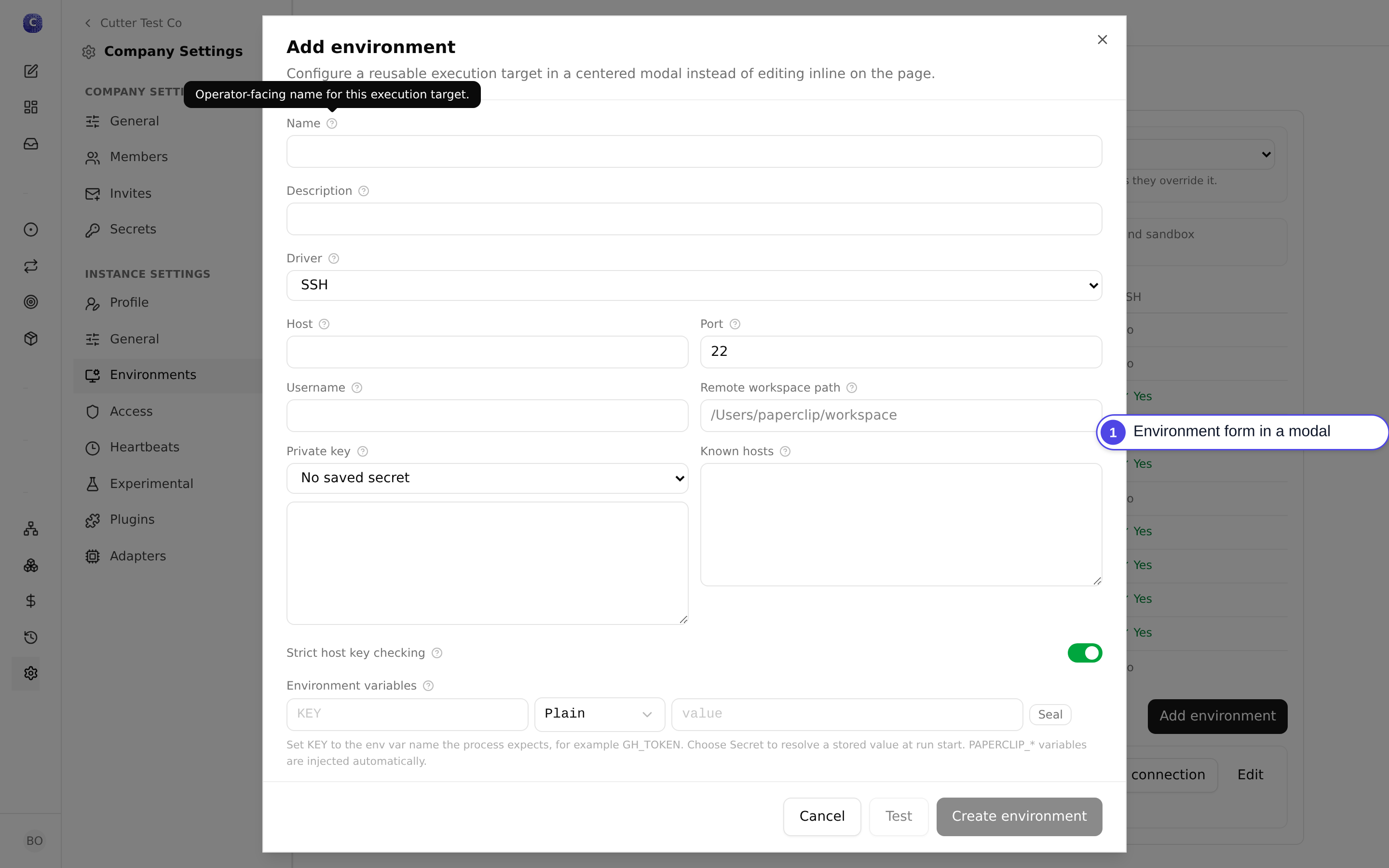
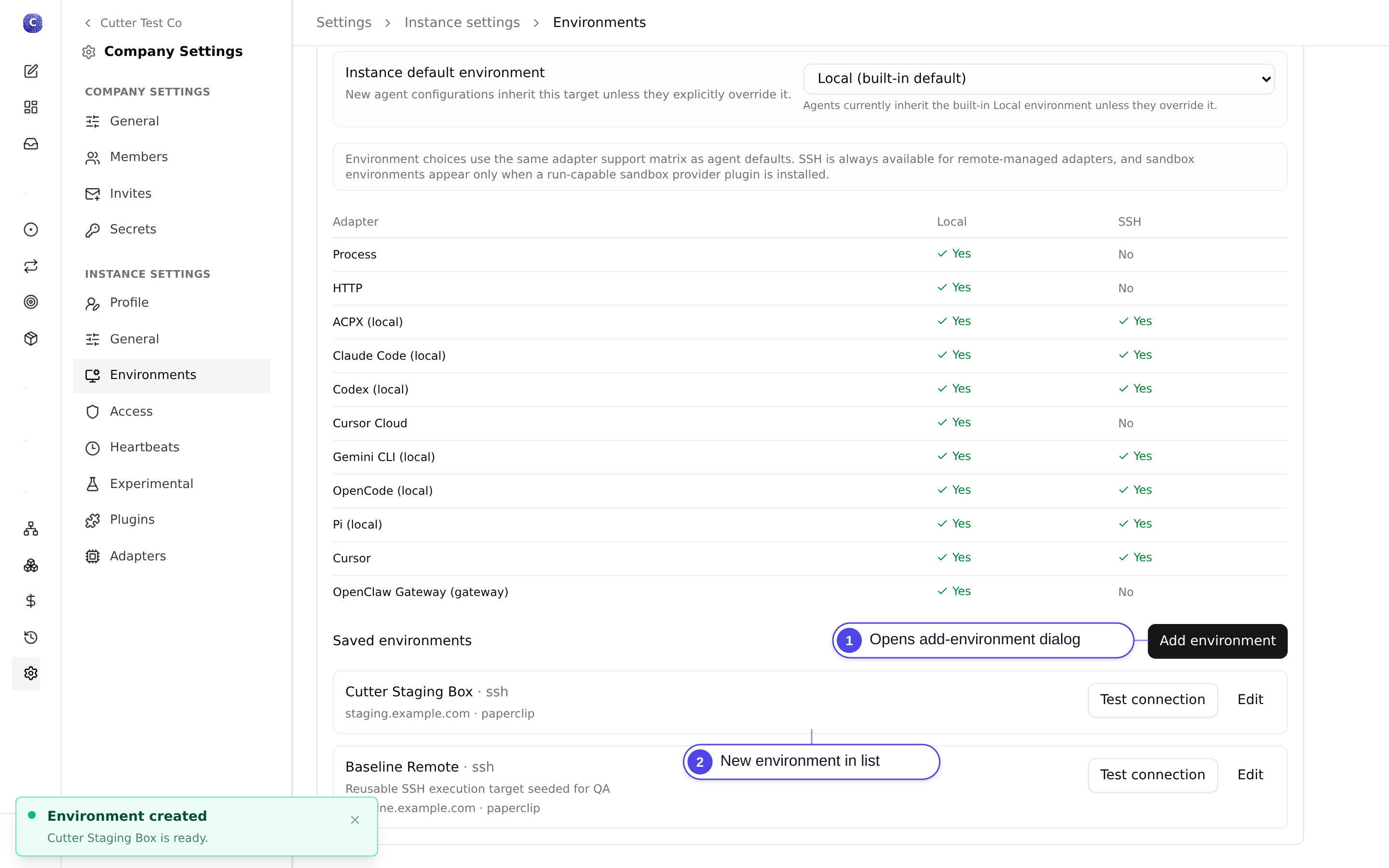
## Thinking Path > - Paperclip is the open source app people use to manage AI agents for work > - Instance settings include an Environments section where operators configure sandbox/SSH/local execution environments, including interactive custom-image setup sessions with a browser terminal > - The environment create/edit form was rendered inside a modal dialog, so pressing Escape anywhere — including inside the embedded SSH terminal while capturing a snapshot — closed the whole modal and destroyed the in-progress session > - Environment editing is a heavyweight, long-lived flow; losing it to a reflexive Escape keypress is destructive and surprising > - This pull request converts environment create/edit from a modal into routed standalone pages, so Escape no longer dismisses the form > - The benefit is that terminal sessions and half-completed edits survive Escape, and the flow gets shareable URLs and normal back/forward navigation ## Linked Issues or Issue Description No existing public issue; described per the bug report template: **What happened?** While editing an environment's sandbox snapshot in the embedded SSH terminal, pressing Escape (e.g. to exit a mode inside the terminal) closed the entire environment edit modal, discarding the setup session and any unsaved form state. **Expected behavior** Escape inside the terminal or form should not dismiss the environment editor. A heavyweight flow like environment configuration should be a standalone page where Escape behaves as expected within the focused widget. **Steps to reproduce** 1. Open Instance settings → Environments and edit a sandbox environment 2. Start a custom image setup session and focus the browser terminal 3. Press Escape 4. The modal closes and the session context is lost ## What Changed - Converted the environment create/edit dialog in `CompanyEnvironments.tsx` into routed pages at `/company/settings/instance/environments/new` and `/company/settings/instance/environments/:environmentId/edit` - Registered the new routes in `App.tsx` and wired breadcrumbs for the list/create/edit states - Form state now initializes from the route (create vs edit) instead of dialog open/close state, and successful saves navigate back to the environments list - Updated `CompanyEnvironments.test.tsx` and `CompanySettings.test.tsx` to render through a router with the new routes and assert against the routed form page instead of a dialog ## Verification - `pnpm vitest run ui/src/pages/CompanyEnvironments.test.tsx ui/src/pages/CompanySettings.test.tsx` — 22/22 passing - `tsc --noEmit` on the `ui` package — clean - Behavioral coverage: the updated tests exercise the routed create/edit pages end to end (open edit via the list, interact with the setup-session controls on the form page, save navigates back to the list); with the form no longer in a dialog there is no Escape-close handler to trigger ## Risks - Low risk; UI-only routing change. Deep links into the old modal state do not exist (the modal had no URL), so no redirects are needed - The edit page resolves the environment from the route param; a stale/unknown id falls back to the environments list ## Model Used - Claude (Anthropic), model ID `claude-fable-5` (Fable 5), extended thinking enabled, agentic tool use via Claude Code ## Checklist - [x] I have included a thinking path that traces from project context to this change - [x] I have specified the model used (with version and capability details) - [x] I have checked ROADMAP.md and confirmed this PR does not duplicate planned core work - [x] I have searched GitHub for duplicate or related PRs and linked them above - [x] I have either (a) linked existing issues with `Fixes: #` / `Closes #` / `Refs #` OR (b) described the issue in-PR following the relevant issue template - [x] I have not referenced internal/instance-local Paperclip issues or links (only public GitHub `#NNN` / `github.com/paperclipai/paperclip` URLs) - [x] My branch name describes the change (e.g. `docs/...`, `fix/...`) and contains no internal Paperclip ticket id or instance-derived details - [x] I have run tests locally and they pass - [x] I have added or updated tests where applicable - [x] I have updated relevant documentation to reflect my changes - [x] I have considered and documented any risks above - [ ] All Paperclip CI gates are green - [ ] Greptile is 5/5 with no open P2s, recommendations, or follow-ups - [x] I will address all Greptile and reviewer comments before requesting merge Co-authored-by: Cody <cody@paperclip.ing> Co-authored-by: Paperclip <noreply@paperclip.ing> |
||
|
Devin Foley
|
17dde9d3f2 |
fix(sandbox): keep custom-image snapshots applied to config tests, probes, and saves (#9385)
## Thinking Path > - Paperclip is the open source app people use to manage AI agents for work > - Sandbox environments can capture reusable custom images (provider snapshots) so agents boot with pre-installed tools and CLI logins > - The custom-image runtime fingerprint check included provider secret-ref paths (e.g. the Daytona `apiKey`), while capture-time fingerprinting excluded them, so any config carrying a credential never matched its captured snapshot > - As a result, agent config tests and environment probes silently booted the provider base image instead of the snapshot, test sandboxes were deleted before operators could inspect them, and any environment save orphaned the snapshot without warning > - The UI compounded the confusion by displaying an internal template id that matches nothing in the provider dashboard > - This pull request aligns runtime fingerprints with capture-time exclusions, re-stamps fingerprints on saves that cannot affect the snapshot (warning when they can), archives test/probe sandboxes instead of deleting them, and surfaces the provider snapshot ref in the UI > - The benefit is that custom images actually apply to config tests and probes, survive unrelated config edits, and are debuggable against the provider dashboard ## Linked Issues or Issue Description No public GitHub issue exists for this; describing it in-PR per the bug template. Related: Refs #9329 (saved-environment probe company context — this branch carries an equivalent fix), Refs #8794 (introduced reusable sandbox custom images). **What happened?** With a Daytona environment whose provider config stores the API key as a secret reference and an active captured custom-image snapshot: - Agent config tests and environment probes booted the provider base image (`daytonaio/sandbox:0.8.0`) instead of the captured snapshot, so CLI upgrades/logins baked into the snapshot were missing and the probe reported "login required" and an outdated CLI. - The environment card showed an internal template id (e.g. `b5be03e1-ca5…`) that does not correspond to any snapshot name in the provider dashboard, making the active image impossible to correlate. - Test/probe sandboxes were deleted immediately after the run, so the sandbox a test used could not be inspected afterwards. - Saving the environment config (even fields unrelated to the image) changed the stored fingerprint, silently detaching the snapshot with no warning. **Expected behavior** Config tests and probes boot the captured snapshot when one is active; the UI shows the provider-facing snapshot/template ref; test sandboxes stay inspectable for a short window; unrelated config edits keep the snapshot linked, and edits that genuinely invalidate it produce an explicit warning. **Steps to reproduce** 1. Configure a sandbox environment on Daytona with the API key stored as a company secret reference. 2. Capture a custom image snapshot from the environment page and mark it active (e.g. after installing/logging into a CLI in the setup sandbox). 3. Run the agent config test or an environment probe: the sandbox boots the base image, not the snapshot, and the sandbox is deleted immediately after the test. 4. Save the environment config with an unrelated field change: the snapshot silently stops applying. **Paperclip version or commit** `master` at the merge-base of this branch. **Deployment mode** Self-hosted local instance (macOS, pnpm dev server) with the Daytona sandbox provider plugin. ## What Changed - Runtime custom-image fingerprint checks now exclude provider secret-ref paths, matching capture-time exclusions, so configs carrying credentials match their captured snapshots (`environment-custom-image-runtime.ts`). - Agent config tests and saved-environment probes force fresh, non-reused sandboxes and pass company context so lease-backed probes can resolve company secrets and boot the real snapshot (`environment-probe.ts`, `routes/agents.ts`, `routes/environments.ts`). - Test/probe sandboxes are released by archiving (stop + 60-minute provider-side auto-delete) instead of immediate deletion, so operators can inspect the exact sandbox a test used (Daytona plugin). - On environment PATCH save, changes that cannot affect the captured snapshot re-stamp the template's source fingerprint so the snapshot stays linked; boot-source or provider-identity changes (new manifest field `templateIdentityPaths`) mark the template detached and the save response reports it (`environment-custom-images.ts`, shared plugin types/validators). - The custom-image overview exposes `activeTemplateMatchesConfig`; the environments UI shows the provider snapshot/template ref (internal id moved to a tooltip), warns via toast when a save detaches the snapshot, and shows a persistent "Not in use" warning when the active template no longer matches the saved config (`CompanyEnvironments.tsx`, `api/environments.ts`). ## Verification - `pnpm vitest run server/src/__tests__/environment-custom-images-service.test.ts server/src/__tests__/environment-probe.test.ts server/src/__tests__/environment-routes.test.ts server/src/__tests__/agent-test-environment-routes.test.ts` — server coverage for fingerprint exclusions, re-stamp/detach on save, probe company context, and fresh-sandbox test behavior. - `pnpm vitest run packages/plugins/sandbox-providers/daytona/src/plugin.test.ts` — archive-on-release and snapshot ref handling. - `pnpm vitest run ui/src/pages/CompanyEnvironments.test.tsx` — snapshot ref display, detach toast, and "Not in use" warning. - Manually verified end-to-end on a live self-hosted instance against real Daytona: config test boots the captured snapshot (CLI login and version persist), the test sandbox remains visible in the provider dashboard as archived, and saving unrelated fields keeps the snapshot applied. ## Risks - Fingerprint exclusion widening: a provider credential rotation alone no longer detaches a captured snapshot; that is the intended behavior (the snapshot content does not depend on the credential), and provider-identity fields (e.g. Daytona `apiUrl`) still detach via `templateIdentityPaths`. - Archived test sandboxes consume provider-side resources for up to their auto-delete window instead of being freed immediately; bounded (60 minutes) and only for test/probe sandboxes. - New optional manifest field `templateIdentityPaths` is backward-compatible; providers that omit it keep current matching behavior. ## Model Used - Claude Fable 5 (`claude-fable-5`), extended thinking, agentic tool use via Claude Code / Claude Agent SDK. ## Checklist - [x] I have included a thinking path that traces from project context to this change - [x] I have specified the model used (with version and capability details) - [x] I have checked ROADMAP.md and confirmed this PR does not duplicate planned core work - [x] I have searched GitHub for duplicate or related PRs and linked them above - [x] I have either (a) linked existing issues with `Fixes: #` / `Closes #` / `Refs #` OR (b) described the issue in-PR following the relevant issue template - [x] I have not referenced internal/instance-local Paperclip issues or links (only public GitHub `#NNN` / `github.com/paperclipai/paperclip` URLs) - [x] My branch name describes the change (e.g. `docs/...`, `fix/...`) and contains no internal Paperclip ticket id or instance-derived details - [x] I have run tests locally and they pass - [x] I have added or updated tests where applicable - [x] I have updated relevant documentation to reflect my changes - [x] I have considered and documented any risks above - [x] All Paperclip CI gates are green - [x] Greptile is 5/5 with no open P2s, recommendations, or follow-ups - [x] I will address all Greptile and reviewer comments before requesting merge |
||
|
Devin FoleyandPaperclip
|
bdffd26ad3 |
fix(ui): pass company context to custom image setup (#9028)
## Thinking Path > - Paperclip is the open source app people use to manage AI agents for work > - Environment settings let board users configure sandbox execution targets for agent runs > - Sandbox custom-image setup is company-scoped because the backend resolves provider secrets and access through company context > - The browser UI already knows the selected company, but the custom-image setup calls were not passing it to routes whose OpenAPI contract includes `companyId` > - In multi-company authenticated deployments, the backend cannot safely infer company context and returns a `companyId query parameter is required` error > - This pull request passes the selected company id through the custom-image overview, setup, rollback, and disable UI paths > - The benefit is that custom-image setup works consistently in multi-company instances while preserving backend company-boundary checks ## Linked Issues or Issue Description - No public issue is filed for this regression. - Related prior work: #8911 - Bug summary: after the browser SSH terminal custom-image setup flow shipped, opening custom-image setup in an authenticated multi-company instance could show `companyId query parameter is required for environment customImage setup` instead of starting the setup session. - Expected behavior: the environment settings UI should send the selected company context to company-scoped custom-image endpoints. - Reproduction shape: run Paperclip in authenticated/private mode with more than one company, open a sandbox environment's edit dialog, and use the custom-image setup controls. ## What Changed - Added company-id query construction for custom-image overview, setup, rollback, and disable calls in the UI environment API wrapper. - Passed the selected company id into the custom-image panel used by the environment edit dialog. - Updated the environment page tests so the regression fails if company context is dropped again. ## Verification - `pnpm exec vitest run ui/src/pages/CompanyEnvironments.test.tsx` - `pnpm --filter @paperclipai/ui typecheck` - `git diff --check` - Also applied the same patch to a local dev checkout serving port 3100 and confirmed `/api/health` still returns `ok` after the dev watcher reload. ## Risks - Low risk: this only adds the selected company id to UI calls for endpoints that already declare or require company context. - If the selected company id is stale or invalid, the existing server-side company access checks still reject the request. ## Model Used - OpenAI Codex CLI using GPT-5, with tool-enabled repository inspection, editing, shell command execution, and local test execution. Context window size is not exposed in this environment. ## Checklist - [x] I have included a thinking path that traces from project context to this change - [x] I have specified the model used (with version and capability details) - [x] I have checked ROADMAP.md and confirmed this PR does not duplicate planned core work - [x] I have searched GitHub for duplicate or related PRs and linked them above - [x] I have either (a) linked existing issues with `Fixes: #` / `Closes #` / `Refs #` OR (b) described the issue in-PR following the relevant issue template - [x] I have not referenced internal/instance-local Paperclip issues or links (only public GitHub `#NNN` / `github.com/paperclipai/paperclip` URLs) - [x] My branch name describes the change (e.g. `docs/...`, `fix/...`) and contains no internal Paperclip ticket id or instance-derived details - [x] I have run tests locally and they pass - [x] I have added or updated tests where applicable - [x] I have updated relevant documentation to reflect my changes - [x] I have considered and documented any risks above - [x] All Paperclip CI gates are green - [x] Greptile is 5/5 with no open P2s, recommendations, or follow-ups - [x] I will address all Greptile and reviewer comments before requesting merge --------- Co-authored-by: Paperclip <noreply@paperclip.ing> |
||
|
Devin FoleyandPaperclip
|
bcac517f3b |
Add browser SSH terminal for custom image setup (#8911)
## Thinking Path > - Paperclip is the open source app people use to manage AI agents for work. > - Environment sandboxes already support custom image creation and refresh through a temporary SSH setup session. > - The existing workflow makes operators copy an SSH command into an external terminal before they can install packages or make image changes. > - That extra context switch is slower, easier to get wrong, and less integrated with the setup session Paperclip already tracks. > - This pull request adds an embedded browser SSH terminal for custom image setup, so operators can start working in the target sandbox directly from the environment configuration flow. > - The implementation uses short-lived websocket attachment tokens, session-lifetime SSH host-key pinning, and server-managed terminal cleanup so the feature fits the existing setup-session boundary. > - The benefit is a smoother custom image creation and refresh experience without asking users to leave Paperclip for routine sandbox setup work. ## Linked Issues or Issue Description No public GitHub issue exists. ### Subsystem affected Cross-cutting: `server/` custom image setup APIs and websocket handling, `ui/` environment configuration UI, and shared custom image contracts. ### Problem or motivation Custom image creation and refresh require an operator to open a separate SSH client, paste the command shown by Paperclip, perform setup work, then return to the browser to finish the image flow. This is functional but awkward for a setup process that already starts and tracks a temporary sandbox session. ### Proposed solution Embed an SSH terminal in the custom image setup UI. When a setup session exposes an SSH payload, Paperclip should open a browser terminal backed by a server-side websocket session, let the operator run setup commands in-place, and then close the terminal when setup is finished, cancelled, expired, or disconnected. ### Alternatives considered - Keep the existing copy/paste SSH command workflow. This remains a fallback, but it does not streamline the common path. - Put SSH credentials directly into websocket URLs. This was avoided so terminal authentication can happen in an explicit first websocket auth frame rather than in logged URLs. - Trust the SSH host blindly for every reconnect. This PR instead pins the observed host-key fingerprint for the setup-session lifetime. ### Roadmap alignment This fits the roadmap theme of making agent workspaces usable in more remote and sandboxed environments while preserving Paperclip's control-plane model. ### Additional context Public GitHub search did not find a duplicate issue or PR for `custom image terminal ssh` in `paperclipai/paperclip`. ## What Changed - Added server-side terminal session tracking for custom image setup sessions, including connect-token issuance, websocket attachment, expiry, resize, input, and shutdown handling. - Added an embedded browser terminal to the custom image creation and refresh flow when a setup session provides SSH connection details. - Moved terminal token authentication out of the websocket URL and into the first websocket JSON auth frame. - Added SSH host-key SHA-256 pinning for each terminal session and documented the provider convention for username-embedded SSH credentials. - Updated the custom image environment API and UI so the setup terminal can open, reconnect, show status, authenticate, resize, and remain active for the setup-session lifetime once attached. - Kept custom image setup routes company-scoped and closed active terminal sessions on setup finish/cancel. - Added focused unit/integration/UI coverage for token expiry, setup-session expiry, websocket close paths, host-key pinning, and terminal session lifecycle behavior. - Removed the generated lockfile delta from the PR; CI owns temporary lockfile regeneration for manifest-changing PRs. ## Verification - `pnpm exec vitest run server/src/__tests__/server-startup-feedback-export.test.ts server/src/__tests__/environment-custom-image-terminal-ws.test.ts server/src/services/environment-custom-image-terminal-sessions.test.ts server/src/__tests__/environment-custom-image-routes.test.ts packages/shared/src/environment-custom-images.test.ts ui/src/pages/CompanyEnvironments.test.tsx` - 6 test files passed - 58 tests passed - `pnpm --filter @paperclipai/server typecheck` - `pnpm --filter @paperclipai/ui typecheck` - `pnpm --filter @paperclipai/server build` - `pnpm --filter @paperclipai/ui build` - `pnpm run typecheck:build-gaps` - `git diff --check` - Local sensitive-content scan over the PR diff using patterns for API keys, private keys, private hostnames, local paths, token fields, and credential-like strings. - Findings were limited to removed URL-token code and synthetic test placeholders such as `ssh-token-secret` and `terminal-token-terminal-token-123456`. - No real credentials, private hostnames, local filesystem paths, or instance-local links were found. - Remote PR checks were green after the implementation commit, including Build, Typecheck + Release Registry, General tests, serialized server suites, e2e, verify, Socket, Snyk, Superagent, and Greptile 5/5. - Post-merge PR hardening on July 3, 2026: merged `origin/master` at `47448721e` into the branch, resolved the `CompanyEnvironments.tsx` import conflict, reran focused tests, server/UI typechecks, server/UI builds, `pnpm run typecheck:build-gaps`, and `git diff --check`, scanned the final diff for sensitive content, pushed `4b43558cc`, and confirmed all remote checks plus Greptile 5/5 were green. - PR metadata correction on July 3, 2026: changed the title/body framing from bug-fix language to feature-request language. No source files changed for this metadata-only update. ## Risks - Moderate surface area because this adds websocket routing, setup-session runtime state, package dependencies, and a new custom image UI path. - New websocket attachments still require valid short-lived tokens; established terminal sessions remain bounded by setup-session expiry, explicit finish/cancel, client close, or server shutdown. - The terminal-session store is in-memory, so active terminal websocket tokens and host-key pins do not survive server restarts. - SSH host-key verification uses session-lifetime TOFU pinning because the current provider payload does not expose a trusted host-key fingerprint. - The external SSH command remains important as a fallback if a browser, proxy, or network environment cannot sustain the websocket terminal. > For core feature work, check [`ROADMAP.md`](ROADMAP.md) first and discuss it in `#dev` before opening the PR. Feature PRs that overlap with planned core work may need to be redirected — check the roadmap first. See `CONTRIBUTING.md`. ## Model Used OpenAI Codex, GPT-5 coding agent with shell/tool execution. Context window size was not exposed in this runtime. ## Checklist - [x] I have included a thinking path that traces from project context to this change - [x] I have specified the model used (with version and capability details) - [x] I have checked ROADMAP.md and confirmed this PR does not duplicate planned core work - [x] I have searched GitHub for duplicate or related PRs and linked them above - [x] I have either (a) linked existing issues with `Fixes: #` / `Closes #` / `Refs #` OR (b) described the issue in-PR following the relevant issue template - [x] I have not referenced internal/instance-local Paperclip issues or links (only public GitHub `#NNN` / `github.com/paperclipai/paperclip` URLs) - [x] My branch name describes the change (e.g. `docs/...`, `fix/...`) and contains no internal Paperclip ticket id or instance-derived details - [x] I have run tests locally and they pass - [x] I have added or updated tests where applicable - [x] I have updated relevant documentation to reflect my changes - [x] I have considered and documented any risks above - [x] All Paperclip CI gates are green - [x] Greptile is 5/5 with no open P2s, recommendations, or follow-ups - [x] I will address all Greptile and reviewer comments before requesting merge --------- Co-authored-by: Paperclip <noreply@paperclip.ing> |
||
|
|
b5c914126e |
Redesign environment variables editor (#8930)
## Thinking Path > - Paperclip is the open source control plane people use to manage AI agents for work. > - Environment variables and secrets sit in the configuration surfaces that let agents, projects, routines, and company environments run with the right runtime inputs. > - The previous editor was a single legacy component with cramped row behavior, weak secret conversion affordances, and duplicated handling across several call sites. > - Operators need a clearer editor that handles text values, secret references, draft rows, and sensitive-value warnings consistently wherever environment variables are configured. > - This pull request replaces the legacy editor with a reusable environment variables editor and migrates the existing configuration surfaces to it. > - The benefit is a more reliable editing workflow with targeted test coverage around row state, dotenv parsing, secret selection, and affected page integrations. ## Linked Issues or Issue Description No public GitHub issue exists, so this PR describes the issue inline following the feature request template. ### Subsystem affected ui/ — React + Vite board UI ### Problem or motivation Environment variables are edited in several Paperclip configuration surfaces, including agent config, project properties, stage secrets, routine sections, company environments, and company settings. The legacy editor made common operator work difficult: rows could feel cramped, secret conversion was inconsistent, draft rows and imported dotenv data were easy to mishandle, and sensitive-value warnings did not have a consistent place in the workflow. ### Proposed solution Introduce a reusable environment variables editor component that consistently supports text values, secret references, draft rows, dotenv import parsing, sensitive-value hints, secret picking, secret creation, and conversion to stored secrets. Migrate the existing environment-variable call sites to the shared editor so behavior and tests live in one component family. ### Alternatives considered Keeping the existing `EnvVarEditor` and patching individual call sites would preserve duplication and leave each surface responsible for its own row and secret handling. This PR instead centralizes the behavior so future fixes cover all migrated surfaces. ### Roadmap alignment Checked `ROADMAP.md`; this does not duplicate a named roadmap item. It supports the existing local-first and deployment-oriented product direction by improving the UI where operators configure runtime environment values. ### Additional context The PR includes targeted tests for the editor model, dotenv parsing, sensitive-value detection, component behavior, affected page integrations, and Greptile review regressions around external saves and bulk import immutability. ## What Changed - Replaced the legacy `EnvVarEditor` with a reusable `environment-variables-editor` component family. - Added editor model helpers for draft rows, dotenv parsing, sensitive-value detection, secret picking, secret creation, and conversion to secret references. - Migrated agent config, project properties, stage secrets, routine editable sections, company environments, company settings, design guide examples, and Storybook stories to the new editor. - Added targeted tests for the editor model, parsing, sensitive-value detection, component behavior, and affected company environment/settings integrations. - Fixed the company settings test harness to use the repo’s `flushSync`-based React test helper pattern under the current React build. - Addressed Greptile feedback by flushing pending editor drafts before enclosing form submits or external save-button clicks, cloning bulk-import rows before mutation, and deferring the overflow store-as-secret popover open path. ## Verification - `pnpm exec vitest run ui/src/components/environment-variables-editor/EnvironmentVariablesEditor.test.tsx ui/src/pages/CompanyEnvironments.test.tsx ui/src/components/AgentConfigForm.render.test.tsx` — passed, 3 files / 40 tests. - Earlier focused Vitest coverage for model, dotenv parsing, sensitive detection, company environments, and company settings passed, 6 files / 78 tests. - `pnpm --filter @paperclipai/ui typecheck` — passed. - GitHub PR checks on head `0aa49c6f8afed1f62d9e26da07fc466fbf299850` — passed; CI checks green, security review neutral, Greptile check success. - Greptile review — 5/5 confidence on head `0aa49c6f8afed1f62d9e26da07fc466fbf299850`; 0 unresolved review threads. ## Risks - Medium UI risk: several environment-variable entry surfaces now share the new editor, so regressions could affect multiple configuration workflows at once. - Secret conversion, draft-row behavior, external save flushing, and bulk import behavior are covered by targeted tests, but reviewer attention should still focus on manual editing flows, focus retention, and save/cancel affordances. - No database or API contract changes. > For core feature work, check [`ROADMAP.md`](ROADMAP.md) first and discuss it in `#dev` before opening the PR. Feature PRs that overlap with planned core work may need to be redirected — check the roadmap first. See `CONTRIBUTING.md`. ## Model Used - OpenAI Codex, GPT-5-based coding agent with tool use and local command execution; medium reasoning mode. Exact context-window metadata is not exposed in this runtime. ## Checklist - [x] I have included a thinking path that traces from project context to this change - [x] I have specified the model used (with version and capability details) - [x] I have checked ROADMAP.md and confirmed this PR does not duplicate planned core work - [x] I have searched GitHub for duplicate or related PRs and linked them above - [x] I have either (a) linked existing issues with `Fixes: #` / `Closes #` / `Refs #` OR (b) described the issue in-PR following the relevant issue template - [x] I have not referenced internal/instance-local Paperclip issues or links (only public GitHub `#NNN` / `github.com/paperclipai/paperclip` URLs) - [x] My branch name describes the change (e.g. `docs/...`, `fix/...`) and contains no internal Paperclip ticket id or instance-derived details - [x] I have run tests locally and they pass - [x] I have added or updated tests where applicable - [x] I have updated relevant documentation to reflect my changes - [x] I have considered and documented any risks above - [x] All Paperclip CI gates are green - [x] Greptile is 5/5 with no open P2s, recommendations, or follow-ups - [x] I will address all Greptile and reviewer comments before requesting merge --------- Co-authored-by: Claude Opus 4.8 <noreply@anthropic.com> Co-authored-by: Paperclip <noreply@paperclip.ing> |
||
|
Devin FoleyandPaperclip
|
b4815bf964 |
Scope environment custom images to instance environments (#8850)
## Thinking Path > - Paperclip is the open source app people use to manage AI agents for work > - Environments are now managed as instance-level runtime resources rather than per-company rows > - The custom environment image setup tables were introduced with their own `company_id` columns and route query parameters > - That split made one saved environment image state depend on an extra company context even though the environment itself is the durable owner > - It also made saved-environment probes harder because applying the active custom image template could require a company context when no secret-backed config needed one > - This pull request scopes custom image templates and setup sessions directly to the saved environment > - The benefit is that reusable environment images follow the same instance-scoped model as environments while secret resolution still uses company context only when secrets require it ## Linked Issues or Issue Description No matching public GitHub issue was found. Bug report: ### What happened? saved environment custom-image routes and persistence required a `companyId` even though environments are instance-scoped, and saved sandbox probes did not opt into active custom-image template application unless a company context was present. ### Expected behavior custom-image templates and setup sessions should be owned by the saved environment, and saved sandbox probes should apply the active template while still requiring a company context only for secret-backed runtime config. ### Steps to reproduce 1. Configure an instance-scoped sandbox environment with custom-image setup support. 2. Start or inspect a custom-image session or template for that saved environment. 3. Probe the saved environment without a custom-image-specific `companyId` query parameter. ### Paperclip version or commit current `master` after the environment custom-image template migration. ### Deployment mode Local dev (pnpm dev) or authenticated local Paperclip instance. ### Installation method Built from source (pnpm dev / pnpm build). ### Agent adapter(s) involved Not adapter-specific (core bug). ### Database mode Embedded PGlite/Postgres dev database. ### Access context Board human operator. ### Privacy checklist No logs, secrets, tokens, private URLs, or local machine paths are included. Duplicate search performed: - `gh search prs "environment custom image companyId repo:paperclipai/paperclip" --state open --limit 20` - `gh search prs "custom image environment scoped repo:paperclipai/paperclip" --state open --limit 20` - `gh search issues "environment custom image repo:paperclipai/paperclip" --state open --limit 20` The returned results were unrelated adapter, Docker, auth, or stale-workspace items. ## What Changed - Removed redundant `company_id` columns from environment custom-image templates and setup sessions. - Added migration `0127_environment_custom_images_instance_scoped` to collapse duplicate active rows per environment before dropping the old company-scoped indexes/columns. - Updated custom-image services, route handlers, shared validators, and UI API/query keys to use environment-scoped custom-image state. - Kept runtime secret resolution company-aware only when secret refs or bindings require a company context. - Made saved sandbox environment probes opt into active custom-image template application. - Updated DB, shared, server, and UI tests for the new environment-scoped contract. ## Verification - `pnpm --filter @paperclipai/db run check:migrations` - `pnpm exec vitest run packages/db/src/environment-custom-images-schema.test.ts packages/shared/src/environment-custom-images.test.ts server/src/__tests__/environment-custom-image-routes.test.ts server/src/__tests__/environment-custom-images-service.test.ts server/src/__tests__/environment-routes.test.ts ui/src/pages/CompanyEnvironments.test.tsx` - `pnpm -r typecheck` - `pnpm test:run` before rebasing onto latest `master`; after the rebase only the migration number changed, and the migration check plus focused suite, typecheck, and build were rerun. - `pnpm build` ## Risks - Migration safety: the migration supersedes duplicate active templates per environment and fails duplicate active setup sessions before adding environment-only unique indexes. Operators with duplicate historical active rows should review which active template is kept. - Behavior shift: plugin custom-image setup calls now receive `companyId: "instance"` when no secret binding determines a concrete company context. - Secret-backed configs still require an explicit or uniquely inferable company context; environments with secret bindings spread across multiple companies continue to fail fast. > For core feature work, check [`ROADMAP.md`](ROADMAP.md) first and discuss it in `#dev` before opening the PR. Feature PRs that overlap with planned core work may need to be redirected — check the roadmap first. See `CONTRIBUTING.md`. ## Model Used OpenAI Codex via the `codex_local` adapter, GPT-5-based coding model with tool-enabled repository inspection, editing, testing, git, and GitHub CLI access. Exact context-window metadata was not exposed by the runtime. ## Checklist - [x] I have included a thinking path that traces from project context to this change - [x] I have specified the model used (with version and capability details) - [x] I have checked ROADMAP.md and confirmed this PR does not duplicate planned core work - [x] I have searched GitHub for duplicate or related PRs and linked them above - [x] I have either (a) linked existing issues with `Fixes: #` / `Closes #` / `Refs #` OR (b) described the issue in-PR following the relevant issue template - [x] I have not referenced internal/instance-local Paperclip issues or links (only public GitHub `#NNN` / `github.com/paperclipai/paperclip` URLs) - [x] My branch name describes the change (e.g. `docs/...`, `fix/...`) and contains no internal Paperclip ticket id or instance-derived details - [x] I have run tests locally and they pass - [x] I have added or updated tests where applicable - [x] I have updated relevant documentation to reflect my changes - [x] I have considered and documented any risks above - [ ] All Paperclip CI gates are green - [ ] Greptile is 5/5 with no open P2s, recommendations, or follow-ups - [x] I will address all Greptile and reviewer comments before requesting merge --------- Co-authored-by: Paperclip <noreply@paperclip.ing> |
||
|
Devin FoleyandPaperclip
|
8d9f9fd240 |
Add reusable sandbox custom images (#8794)
## Thinking Path > - Paperclip is the open source app people use to manage AI agents for work. > - A growing part of that work runs in sandboxed environments rather than on the operator's local machine. > - Today sandbox providers can start fresh workspaces and run probes, but they do not have a shared contract for capturing and reusing prepared sandbox state. > - Operators need a way to set up tools, credentials, and project dependencies once, then reuse that prepared image for later agent runs. > - This pull request adds reusable sandbox custom images across the provider contract, server runtime, and board UI. > - It also keeps probes and sandbox copy flows aligned with pre-authenticated/custom-image environments. > - The benefit is faster, more reliable sandbox runs without repeatedly rebuilding the same environment setup. ## Linked Issues or Issue Description No public GitHub issue was found for this change. Inline feature request follows. ### Problem or motivation Sandboxed agents need reusable prepared runtime state so repeated runs do not require manual setup every time. Operators often need system packages, CLIs, SDKs, dependency caches, credentials, and project tooling available before an agent can work productively. ### Proposed solution Add a provider-level custom-image capability, server-side setup/capture lifecycle, Daytona/fake provider support, and board UI controls for creating, testing, selecting, and deleting custom images. ### Alternatives considered Leaving this as provider-specific setup outside Paperclip would keep the control plane blind to image state and would not give agents consistent environment metadata. Re-running setup commands for every lease is simpler, but slower and less reliable for interactive or credentialed setup. ### Roadmap alignment Checked `ROADMAP.md`; this aligns with the Cloud / Sandbox agents roadmap area and does not duplicate any related public issue or PR found by search. Additional context: - Subsystem affected: cross-cutting (`packages/db`, `packages/shared`, `packages/plugins`, `server`, `ui`). - Duplicate search: searched GitHub for `sandbox custom image` and `sandbox template environment`; no related public issues or PRs were found. ## What Changed - Added custom-image shared types, validators, constants, API paths, and database schema/migration. - Added server services/routes for custom-image templates and setup sessions, including runtime cleanup and provider metadata handling. - Extended plugin/sandbox provider capabilities for interactive setup, template capture, and template deletion. - Implemented custom-image support in the fake sandbox provider and Daytona provider. - Updated environment runtime/config handling so active custom images flow into leases, probes, and agent execution. - Added board UI controls and API client support for custom-image setup, capture, selection, status, and error states. - Hardened sandbox copy/probe behavior for insecure clipboard contexts and pre-authenticated sandbox images. - Added targeted coverage across shared validators, DB schema, server routes/services, provider plugins, adapter probes, and UI flows. ## Verification - `pnpm install --frozen-lockfile --ignore-scripts` - `pnpm vitest run packages/adapters/claude-local/src/server/test.probe.test.ts packages/adapters/claude-local/src/server/test.ts packages/adapters/codex-local/src/server/test.remote.test.ts packages/adapters/codex-local/src/server/test.ts` - `pnpm --filter @paperclipai/adapter-claude-local typecheck` - `pnpm --filter @paperclipai/adapter-codex-local typecheck` - `pnpm vitest run packages/db/src/environment-custom-images-schema.test.ts packages/shared/src/environment-custom-images.test.ts packages/shared/src/validators/plugin.test.ts server/src/__tests__/environment-custom-images-service.test.ts server/src/__tests__/workspace-runtime.test.ts packages/plugins/sandbox-providers/daytona/src/plugin.test.ts ui/src/pages/CompanyEnvironments.test.tsx ui/src/pages/CompanySettings.test.tsx` - `pnpm -r typecheck` - `pnpm build` - `rm -rf packages/db/dist && pnpm test:run` - Public-safety scan of the final diff found no internal Paperclip issue links, private instance URLs, or real secret patterns. ## Risks - Adds a database migration and new environment runtime tables, so migration ordering and rollback need care. - Provider implementations may differ in how reliably they can capture/delete images; unsupported providers surface capability-gated UI states. - Custom-image state can contain operator-prepared tooling and credentials inside the provider image, so providers must enforce their own access controls and cleanup semantics. - Broad surface area across shared contracts, server runtime, plugins, adapters, and UI means CI and Greptile review should be watched closely. > For core feature work, check [`ROADMAP.md`](ROADMAP.md) first and discuss it in `#dev` before opening the PR. Feature PRs that overlap with planned core work may need to be redirected — check the roadmap first. See `CONTRIBUTING.md`. ## Model Used OpenAI GPT-5 (`gpt-5`) via Codex CLI with tool use and code execution. Assisted with branch cleanup, conflict resolution, local verification, and PR preparation. Earlier branch implementation work was assisted by Paperclip-managed Claude/Codex agents. ## Checklist - [x] I have included a thinking path that traces from project context to this change - [x] I have specified the model used (with version and capability details) - [x] I have checked ROADMAP.md and confirmed this PR does not duplicate planned core work - [x] I have searched GitHub for duplicate or related PRs and linked them above - [x] I have either (a) linked existing issues with `Fixes: #` / `Closes #` / `Refs #` OR (b) described the issue in-PR following the relevant issue template - [x] I have not referenced internal/instance-local Paperclip issues or links (only public GitHub `#NNN` / `github.com/paperclipai/paperclip` URLs) - [x] My branch name describes the change (e.g. `docs/...`, `fix/...`) and contains no internal Paperclip ticket id or instance-derived details - [x] I have run tests locally and they pass - [x] I have added or updated tests where applicable - [x] I have updated relevant documentation to reflect my changes - [x] I have considered and documented any risks above - [ ] All Paperclip CI gates are green - [ ] Greptile is 5/5 with no open P2s, recommendations, or follow-ups - [x] I will address all Greptile and reviewer comments before requesting merge --------- Co-authored-by: Paperclip <noreply@paperclip.ing> |
||
|
Devin FoleyandPaperclip
|
e9931f116a |
fix(ui): move environment create/edit into a dialog (#8391)
## Thinking Path > - Paperclip is the open source control plane people use to manage AI agents and the work they do. > - This change lives in the board UI, specifically the instance environments settings page where operators define reusable execution targets. > - That page currently rendered the create/edit environment form inline near the bottom of the screen. > - Because the form appeared away from the action that triggered it, it was easy to miss and felt inconsistent with the rest of the UI. > - This pull request moves environment creation and editing into a proper centered dialog with the existing form behavior preserved. > - The benefit is a more obvious, consistent, and easier-to-complete settings flow for environment management. ## Linked Issues or Issue Description No public GitHub issue matched this exact UI problem when I searched related issues and PRs. ### Pre-submission checklist - [x] I have searched existing open and closed issues and this is not a duplicate. - [x] I am on the latest released version of Paperclip (or can reproduce on `master`). - [x] I have confirmed the issue originates in Paperclip itself, not adapter or local configuration. ### What happened? On `Settings -> Instance settings -> Environments`, clicking create or edit revealed the environment form inline near the bottom of the page. Because the form appeared away from the action that triggered it, it was easy to miss. ### Expected behavior Create and edit should open a centered modal dialog with a dimmed backdrop and the same form controls. ### Steps to reproduce 1. Open `Settings -> Instance settings -> Environments`. 2. Click the create or edit action for an environment. 3. Observe that the form expands inline on the page instead of opening in a modal. ### Paperclip version or commit Observed on current `master` before this PR, for example [`e93d78b46`](https://github.com/paperclipai/paperclip/commit/e93d78b46). ### Deployment mode Local dev (`pnpm dev`). ### Installation method Built from source (`pnpm dev` / `pnpm build`). ### Agent adapter(s) involved - [x] Not adapter-specific (core bug) ### Database mode Embedded PGlite (default, `DATABASE_URL` unset). ### Access context Board (human operator). ### Node.js version Node.js 25.6.1 in the local contributor environment. ### Operating system macOS local development environment. ### Relevant logs or output None. This was a visible UI behavior issue rather than a logged server/runtime error. ### Relevant config (if applicable) Not config-related. ### Additional context Related PR/search context checked before opening this fix. UI preview screenshots are attached below. ### Privacy checklist - [x] I have reviewed all pasted output for PII and redacted where necessary. ## What Changed - Moved the environment create/edit form in `ui/src/pages/CompanyEnvironments.tsx` into a shared dialog. - Added an explicit `Add environment` action near the saved environments list and wired row edit actions to open the same dialog in prefilled mode. - Preserved existing save/test behavior while resetting dialog-local mutation state when the modal opens or closes. - Extended `ui/src/pages/CompanyEnvironments.test.tsx` to cover add-open/cancel and edit-open/save dialog flows. - Updated `ui/src/pages/CompanySettings.test.tsx` so the existing environments coverage opens and inspects the dialog through the Radix portal. ## Verification - `node node_modules/vitest/vitest.mjs run ui/src/pages/CompanyEnvironments.test.tsx` - `node node_modules/vitest/vitest.mjs run ui/src/pages/CompanySettings.test.tsx` - Manual review: - Open `Settings -> Instance settings -> Environments` - Click `Add environment` and confirm the form opens in a centered dialog - Click `Edit` on an existing environment and confirm the dialog opens with existing values - Confirm `Cancel`, `Test`, and save actions still behave as expected - Before/after screenshots: - [Cancel environment creation/edit](https://artifacts.cutter.sh/8391/run-1175b5c-2026-06-20T18-47-11/preview/clip-01.mp4) - [Add a new environment](https://artifacts.cutter.sh/8391/run-1175b5c-2026-06-20T18-47-11/preview/change-02.png) - [Save an environment](https://artifacts.cutter.sh/8391/run-1175b5c-2026-06-20T18-47-11/preview/change-03.png) ## Risks - Low risk overall because the change is contained to the environments page and keeps the existing form fields and mutations. - The main behavior change is modal layout, so the biggest risk is regressions in tall-form scrolling or smaller-screen dialog ergonomics. > I checked [`ROADMAP.md`](ROADMAP.md). This is a tightly scoped UI polish fix, not duplicate roadmap-level core feature work. ## Model Used - OpenAI GPT-5.4 via the `codex_local` Paperclip adapter - High reasoning mode with tool use, shell execution, git operations, and targeted test execution - Model-assisted authoring and verification of the UI and test changes ## Checklist - [x] I have included a thinking path that traces from project context to this change - [x] I have specified the model used (with version and capability details) - [x] I have checked ROADMAP.md and confirmed this PR does not duplicate planned core work - [x] I have searched GitHub for duplicate or related PRs and linked them above - [x] I have either (a) linked existing issues with `Fixes: #` / `Closes #` / `Refs #` OR (b) described the issue in-PR following the relevant issue template - [x] I have not referenced internal/instance-local Paperclip issues or links (only public GitHub `#NNN` / `github.com/paperclipai/paperclip` URLs) - [x] My branch name describes the change (e.g. `docs/...`, `fix/...`) and contains no internal Paperclip ticket id or instance-derived details - [x] I have run tests locally and they pass - [x] I have added or updated tests where applicable - [x] If this change affects the UI, I have included before/after screenshots - [ ] I have updated relevant documentation to reflect my changes - [x] I have considered and documented any risks above - [ ] All Paperclip CI gates are green - [ ] Greptile is 5/5 with no open P2s, recommendations, or follow-ups - [x] I will address all Greptile and reviewer comments before requesting merge --------- Co-authored-by: Paperclip <noreply@paperclip.ing> |
||
|
Devin Foley
|
950484d204 |
fix: scope environments "Test provider" button to clicked row (#8380)
## Thinking Path > - Paperclip is the open source app people use to manage AI agents for work > - Agents run inside environments, and the Environments settings page lets users configure each environment and verify it with a "Test provider" / "Test connection" button per row > - When a user clicked one environment's test button, every environment row's button switched to the disabled "Testing..." state at the same time, then all flipped back together > - That happened because all rows read the same shared `environmentProbeMutation.isPending` flag, so a single in-flight probe disabled and relabeled every button > - This is confusing: it looks like every environment is being tested, and it blocks interacting with other rows while one probe runs > - This pull request tracks the specific environment id being probed in dedicated state and scopes the disabled/label logic to that id > - The benefit is that only the button the user actually clicked shows "Testing..." and is disabled, while the other rows stay interactive ## Linked Issues or Issue Description No public GitHub issue exists, so the bug is described inline below following the bug report template. ### What happened? On the Environments settings page, clicking "Test provider" on one environment caused the test button on *every* environment row to change to "Testing..." and become disabled at the same time, then all reverted together when the probe finished. ### Expected behavior Only the button for the environment the user clicked should show "Testing..." and be disabled while its probe runs. Every other row's button should stay enabled and unchanged. ### Steps to reproduce 1. Open instance settings → Environments with two or more configured environments. 2. Click "Test provider" / "Test connection" on a single row. 3. Observe that all rows' buttons enter the "Testing..." disabled state simultaneously instead of just the clicked one. ### Paperclip version or commit `master` at commit a10f17800 (branch `fix/environments-test-provider-button-scope`). ### Deployment mode Local dev (`pnpm dev`). UI-only; reproduces independent of backend. ## What Changed - Added a dedicated `testingEnvironmentId` state in `ui/src/pages/CompanyEnvironments.tsx` to track which environment is currently being probed. - Set it in the probe mutation's `onMutate` and clear it in `onSettled`, and reset it when the selected company changes. - Scoped the test button's `disabled` state and `"Testing..."` label to `testingEnvironmentId === environment.id` instead of the shared `environmentProbeMutation.isPending` flag. - Added `ui/src/pages/CompanyEnvironments.test.tsx` verifying that clicking one environment's test button puts only that row into the "Testing..." disabled state while other rows stay enabled. ## Verification - `pnpm typecheck` (UI) passes clean. - `vitest run src/pages/CompanyEnvironments.test.tsx` passes (new test fails against the old shared-`isPending` behavior, confirming it guards the fix). - Manual: on the Environments page with multiple environments, click one row's test button and confirm only that button shows "Testing..." / is disabled while the others remain enabled, then it reverts on completion. ## Risks - Low risk. Single-file UI change scoped to per-row button state; no API, schema, or behavior changes to the probe itself. The probe mutation still runs identically — only which buttons reflect the pending state changed. ## Model Used - Claude Opus 4.8 (Anthropic), `claude-opus-4-8`, with extended reasoning and tool use, via Claude Code. ## Checklist - [x] I have included a thinking path that traces from project context to this change - [x] I have specified the model used (with version and capability details) - [x] I have checked ROADMAP.md and confirmed this PR does not duplicate planned core work - [x] I have searched GitHub for duplicate or related PRs and linked them above - [x] I have either (a) linked existing issues with `Fixes: #` / `Closes #` / `Refs #` OR (b) described the issue in-PR following the relevant issue template - [x] I have not referenced internal/instance-local Paperclip issues or links (only public GitHub `#NNN` / `github.com/paperclipai/paperclip` URLs) - [x] My branch name describes the change and contains no internal Paperclip ticket id or instance-derived details - [x] I have run tests locally and they pass - [x] I have added or updated tests where applicable - [ ] If this change affects the UI, I have included before/after screenshots - [x] All Paperclip CI gates are green - [x] Greptile is 5/5 with no open P2s, recommendations, or follow-ups - [x] I will address all Greptile and reviewer comments before requesting merge |