mirror of
https://github.com/paperclipai/paperclip.git
synced 2026-10-27 11:20:42 +01:00
436ae2cf6fbff81ccf5c4915323b4e08e27dcf15
9
Commits
| Author | SHA1 | Message | Date | |
|---|---|---|---|---|
 DottaandPaperclip |
2b4a1d7073 |
feat(dot): add guided invitations and persistent agent connections (#15581)
Add guided external-agent invitations with live Dot connection checks and ongoing access until revoked. Keep expired credentials invalid and enforce permissions for private avatar uploads. Preserve Runner recovery and remote launch boundaries. Co-Authored-By: Paperclip <noreply@paperclip.ing> |
||
|
DottaandPaperclip
|
dd777f4b73 |
feat(dot): complete onboarding and expand governed Runner capabilities (#15414)
## Thinking Path
> - Paperclip manages AI agents, their work, and their permissions.
> - Paperclip Runner supplies the same admitted tool authority to each
provider.
> - The Dot provider in #15402 needs reliable onboarding and useful
agent capabilities.
> - An idle Dot could not start work, assign a human, read skills, or
produce a workspace artifact.
> - Pairing also relied on a second configuration save before ordinary
admission could work.
> - This pull request adds governed idle admission and shared Runner
tools, and completes pairing atomically.
> - Operators can test Dot with fresh data while keeping normal company,
approval, budget, and run ownership checks.
## Linked Issues or Issue Description
**Subsystem affected**
Paperclip Runner, dedicated Dot MCP access, OAuth onboarding,
experimental settings, and empty worktree startup. This PR builds on
merged provider PR #15402. It reuses the merged MCP gateway from #14846
and assistant connection work from #14933 and #15380.
**Problem or motivation**
An idle Dot could see assignments but could not act on a conversation
request until someone created a task first. Its Runner catalog could not
assign tasks to humans or read pinned skills and workspace files.
First-time OAuth discovery and pairing also needed browser fixes, and a
completed pairing did not persist its binding reference on the agent.
**Proposed solution**
Keep Dot within the existing Runner. Admit a visible agent-authored
intake task for idle requests. Add people, human assignment, cross-task,
skill, and optional sandbox workspace tools through shared authority.
Relay assigned app calls through the configured MCP gateway. Add lease
renewal and follow-up references. Save pairing and its configuration
revision atomically. Show prerequisites and provide a complete copy
prompt.
**Roadmap alignment**
This extends the experimental provider in #15402. It uses the existing
governed gateway, task model, skills, artifact path, and native Runner.
It adds no separate execution subsystem.
## What Changed
- Add a standalone OpenAI Dot agent choice with an independent
experimental opt-in. It works with the general Runner option off.
Require Assistant connections (MCP), authenticated sign-in, and public
HTTPS for pairing.
- Use Dot’s own option for company package import. Allow an unpaired Dot
configuration to save after external billing acknowledgement; task
admission still requires pairing. Prepare the shared dev binary for
Dot-only opt-in.
- Label saved Dot agents as OpenAI Dot. Use prerequisite-check copy in
setup and runtime configuration.
- Route Dot creation directly to pairing after explicit external billing
acknowledgement. Hide local CLI, model, and harness setup for Dot.
Preserve the shared Runner implementation and canonical API type. Other
Runner providers still require their general opt-in.
- Add an empty worktree option with fresh signing keys and no production
data copy.
- Fix public-client OAuth negotiation, discovery compatibility, and
optional separate browser authorization origin.
- Add one-use pairing consent preview, clear copied setup instructions,
and atomic binding persistence and cleanup.
- Add idle request admission with stable request IDs and normal
scheduling, permissions, budgets, and task ownership.
- Add identity and people discovery, human task assignment and
reassignment, and authorized cross-task comments and documents.
- Read assigned skill files from pinned manifests. Relay assigned app
calls through the merged gateway without exposing credentials.
- Add an off-by-default workspace bridge. Constrain paths and writes.
Run commands in a deny-by-default OS sandbox with no network or injected
credentials. Reserve mutations before effects and never blindly repeat
uncertain work.
- Add rolling lease renewal, task pagination, bounded operation limits,
and deduplicated follow-up references without comment bodies in
webhooks.
- Add an off-by-default attachment reading setting. Restrict reads to
files on the current assigned task. Verify size and hash, cache bounded
verified copies per run, paginate text or binary bytes, and recheck live
authority before returning.
- Keep file grants operator-owned. Reject agent self-grants across
configuration routes. Preserve attachment consent in create/import
forms. Close generic API file bypasses while retaining current-run
response snapshots and permitted uploads.
- Keep provider limits explicit. Do not inherit a Dot binding,
attachment permission, or workspace permission when hiring another
agent.
- Include the required Markdown format in cross-task document writes and
validate the API title limit. Verify real creation and revision
persistence.
- Restrict command execution to Linux bubblewrap with descendant
containment. macOS retains workspace file tools and artifact publishing,
while refusing command calls. Explain the platform limit in setup.
- Exclude Paperclip instance state from workspace files, uploads,
artifact publication, and sandbox commands. Protect nested directories
and case variants. Fail closed when the directory protection scan
exceeds 4,096 directories.
- Add static UI compression for slow public tunnels. Document setup, the
complete tool inventory, and qualification limits.
## Verification
- Merge preparation on `00ca2c75b` integrates merged base #15402 and
master `fc6304dfe`. The ancestry commit preserves the reviewed follow-up
source tree. The subsequent security fix excludes instance state from
file tools, uploads, artifact publication, and sandbox commands. It
preserves private task authorization and task monitors. It regenerates
the combined tool catalog, seeded catalog digest, and protocol manifest.
Workspace typecheck, full build, and UI token gates pass. All sixteen
real Dot broker cases and 93 company import cases pass after the review
fixes and creator-attribution test correction. The exported
human-assignment catalog and Unicode page boundaries are also fixed. All
ten catalog tests and nine workspace/skill bridge tests pass. All 35
workspace bridge and authority tests passed after the instance-state
fix, including real macOS commands in that intermediate version. The
subsequent document and descendant-containment fixes pass 44 focused
tests across bridge, authority, and setup UI, with six Linux command
cases skipped on macOS. Real cross-task documents pass the route
validator and persist two revisions. macOS refuses command execution and
does not advertise the tool. Full workspace typecheck and build, changed
server/UI typechecks, and token gates pass again on the final commit.
Greptile rates final head
|
||
|
DottaandPaperclip
|
527e146980 |
feat(ui): share animated agent setup prompts (#14862)
Use the shared animated prompt-copy control across setup, invitations, webhooks, and task handoffs. Preserve first-click copying, clipboard recovery, and logo continuity. Add Storybook coverage and restore mention icon masks for the current Lucide data shape. Co-Authored-By: Paperclip <noreply@paperclip.ing> |
||
|
DottaandPaperclip
|
18e8c121d9 |
fix(runner): include Grok support in public installs with sandbox prerequisites (#14024)
## Thinking Path > - Paperclip manages agents through a shared native runner. > - Built-in harness support should ship with Paperclip's public distribution. > - Grok already speaks ACP; it does not require a new public bridge package. > - Sandbox provisioning owns the native executable and its pinned version. > - The runner must verify that prerequisite without downloading it during npm installation. > - This change separates built-in launcher identity from external runtime identity. > - Clean npm installation and live staging checks verify the distribution boundary. ## Linked Issues or Issue Description Refs #13882, #13973, #13977, #13979. This follow-up now targets master after #13882 was squash-merged. It replaces the private `@paperclipai/grok-acp` workspace package with runner-owned assets. Current master is included so the branch also contains the merged scheduler, complete-event capture, and durable cleanup fixes. ## What Changed - Ship Grok launcher and qualification metadata inside the runner's compiled output and the public server's vendored runner tree. - Remove the separate Grok npm package and all package-manager install hooks for this runtime. - Require the checksum-verified Grok Build 1.0.13 binary at `/opt/paperclip/providers/grok/1.0.13/grok` in the selected execution environment. Provision it explicitly in the Daytona image and CI setup. - Keep native binaries outside the provider pack. Bind the built-in launcher into the pack manifest. - Preserve executable leases, descriptor-backed startup, credential fences, permissions, and exact ACP model admission. - Use `builtin:grok-acp` and `native:grok` as profile identities. Historical package-profile sessions fail closed on resume rather than being silently reinterpreted. - Resolve built-in assets from the authenticated sidecar location, including public server npm layouts. Keep the controller path out of provider environments. - Add clean npm tarball installation verification to the existing trusted canary CI job and the admitted manual EC2 verification path. It stages a unified release version and runs npm lifecycle scripts, then verifies missing-prerequisite rejection and admission after separate provisioning without credentials or inference. - Include the controller-owned provider pack in stamped Cloud images. Unstamped local images omit the pack and remain usable; remote ACPX requires full source provenance. - Correct CLI approval-page metadata for an already authenticated Cloud board user; approval authorization remains unchanged. - Honor explicit native-runner enablement in the Cloud agent picker and direct setup page, keeping the flag disabled by default. - Allow selecting the execution environment before connecting credentials. Include Grok in the existing authenticated hello-probe flow, targeting its pinned native prerequisite for runner setup. - Recover an existing subscription sign-in conflict through an explicit cancel-and-retry action, serialized after cancellation succeeds. - Preserve the selected ACPX harness before normalizing config fields, so new Grok agents use the Grok default model. - Keep the credential-free Cloud provider pack root-owned and readable after runtime UID remapping; verify manifest and referenced asset access under an unrelated unprivileged UID during image builds. - Archive prior failover backups alongside explicitly replaced harness state, preserving evidence while preventing stale backups from blocking a fresh replacement. - Update Daytona image content inputs and contract tests for the built-in assets and explicit provisioner. - Document and regression-test the shared `approve-all` default for Grok setup, saved configuration, and native execution. Explicitly saved restrictions remain unchanged. ## Verification Current merge-repair head `df09eb3e1a619430ad8419a0ee9aedd486689b05` incorporates master `f1a394bd30cb56fb9e479f98b9f50176fe921858` after the base PR was squash-merged. All 12 conflicts came from incoming files identical to the tested pre-squash base. The final tree exactly matches a three-way merge using that original base, preserving built-in Grok distribution and removal of the obsolete private package. All 252 focused runner/UI tests, six npm-isolation tests, and token gates pass. Fresh exact-head Greptile review is 5/5 with no outstanding findings; security scans and EC2 native compilation pass. All current-head CI is green: 56 successful checks/statuses and four intentional skips ([run 36468768035](https://github.com/paperclipai/paperclip/actions/runs/36468768035)). The repository owner explicitly authorized bypassing code-owner approval after all checks passed; no CI checks or repository protection settings are bypassed or changed. The only remaining PR was removed from the completed stack metadata to permit native auto-merge. Earlier integration head `78cb306ecc41b5c96577c26c1d89153b0ef865a1` includes master `3447609d2247e75e55d91493dda91a608364f672` (2026-09-28). Two master advances during verification overlapped the eval catalog; the final merge preserves Grok qualification, completion updates, and bounded API-response reading in all 348 cells. All 77 focused catalog/eval/workflow tests pass. Both native stack layers (#14397) are mergeable, and both exact-head Greptile reviews are 5/5 with successful security scans and no unresolved review threads. All current-head CI is green: 56 successful checks/statuses and four intentional skips ([CI attempts](https://github.com/paperclipai/paperclip/actions/runs/36447124691)). The initial attempt lost two EC2 runners to shutdown signals and stalled a third shard during dependency preparation; all three passed the same-commit failed-job-only retry. Trunk code-owner requirements remain enforced. The review summary’s non-blocking saved-asset offset classification note concerns code already merged in #14301; those runtime files are identical to master and outside this stack’s diff. Historical live evidence below retains its original source revisions. [Final public npm verification](https://github.com/paperclipai/paperclip/actions/runs/36445542764) passed on `76ea70cd4d13786a042af9df82f0fd7a8c85ae30`: 17 public packages, an executed offline lifecycle sentinel, unchanged consumer lock, built-in launcher, missing-prerequisite rejection, and verified separately provisioned binary/command lease. Provisioning and cleanup require no host privilege elevation; only the positive probe mounts the temporary native binary read-only. The verifier is unchanged by the final master merge. All six isolation tests and an offline npm smoke test pass. The prior head had 56 green CI checks and a 5/5 review after two unchanged tests timed out and passed a failed-job-only retry ([CI attempts](https://github.com/paperclipai/paperclip/actions/runs/36444597313)). All 56 recovery-display/lineage tests pass; re-review cleared the already-covered missed-retry concern. Earlier EC2 failures remain retained: [npm lockfile rejection](https://github.com/paperclipai/paperclip/actions/runs/36436311203), [missing compiler in the slim image](https://github.com/paperclipai/paperclip/actions/runs/36440210984), and the aggregate 15-minute test timeouts in those broad runs. Both broad attempts passed typecheck, token gates, Product E2E type/unit checks and build. The focused EC2 lane preserves the existing trusted-actor and immutable-source gates. Earlier documentation/test checkpoint `ff244c4fd78a7ede5a3e00efe09f475f133ef33e` leaves runtime behavior unchanged. 154 focused tests pass across configuration building, native provider resolution, permission policy, credentials, UI configuration, and new-agent setup (including both Grok auth modes); token gates pass. All fresh CI is green for this head: 56 successful checks/statuses and two intentional skips ([run 36367065119](https://github.com/paperclipai/paperclip/actions/runs/36367065119)). Greptile is 5/5 with no new findings. Grok already inherits the shared `approve-all` default, so unattended setup requires no manual permission change. Runtime head `bb5a9307991f1ac567b781970ef11b39d518e19b` fixes a final staging continuation failure before provider startup: explicit replacement archived the old harness but left its failover backups active, which caused `runner_harness_state_mismatch`. The regression fails before the fix and passes after it; all eight adjacent recovery-safety cases also pass. Old backups remain inspectable inside the continuity archive. All fresh CI is green at this head ([run 36360839248](https://github.com/paperclipai/paperclip/actions/runs/36360839248)), with a 5/5 review. One unrelated Cursor test timed out in the initial server shard; the same-commit failed-job rerun passed, and both attempts are retained. Staging deployment is confirmed healthy on this revision. The controller image is `ghcr.io/paperclipai/paperclip@sha256:6ad91c487910ccd2596ff7aed0a3a3ea5233d12b51b83cd6e1402237749b9673`. The final browser-created staging task passed on this exact revision with API authentication: context read → structured human question → controller restart → answer submission → same native provider session resumed → document saved → task Done. The two turns took approximately 119s and 77s. The actual write receipt was applied, and the saved document has exactly one revision containing the selected answer and requested marker. Usage and cost were not reported. [Controller image build](https://github.com/paperclipai/paperclip/actions/runs/36360889243). - Previous integration head `a44f7dbb6b6f77cd9ed893756ca453307f281e5f`: all CI green (53 successful checks/statuses, two intentional skips), including repository typecheck/build/tests, native Runner tests, browser shards, and canary installation checks. [CI run 36358672529](https://github.com/paperclipai/paperclip/actions/runs/36358672529). Greptile is 5/5 with no unresolved findings. - Focused checks cover Grok credentials, executable admission, launcher assets, provider-pack paths/permissions, workflow contracts, setup defaults, CLI authorization, and subscription conflict recovery. All 39 protocol definitions validate. Final integration checks pass 124 catalog/evidence/cache tests and nine project-form tests; token gates pass. Some local dependency checks could not load the stale installed dependency tree; the corresponding fresh EC2 checks pass. - Clean public npm installation passed on EC2 at `8b172ebcf8e02e30662d830c00f3961e3bd459ec` ([run 36164964900](https://github.com/paperclipai/paperclip/actions/runs/36164964900)): 17 unified-version packages, lifecycle scripts enabled, built-in launcher present, no separate Grok package or npm-downloaded binary, missing prerequisite rejected, separately provisioned native executable and command lease verified. No credentials or inference were used. Subsequent changes preserve this npm asset layout. - The immutable Daytona prerequisite image is `ghcr.io/paperclipai/paperclip-daytona-runner@sha256:98957d5be0ac774d086b6402b5849e8e6356fec70fb8c09fca6eb4ed6de918e0`, built from `5a2db471f3ddabe77f9f80e76ed27f996cb97fba`. The previous Cloud controller image was `ghcr.io/paperclipai/paperclip@sha256:fd914e1ab1e45f741e8e078ff452d16f082d7ac05f9b4b3506d3a3c64150d204`, built from `a44f7dbb6b6f77cd9ed893756ca453307f281e5f`; it is superseded by the latest image above. Its EC2 build verified provider-pack access under an unrelated unprivileged UID. - Browser staging at `40f898bc4cba73c1dff4e6344a3983ba0fb247ef` passed full Grok onboarding with the correct `grok-4.7` model, saved credential delivery, and pinned Daytona execution. A browser-created task read context and asked the structured human question. After a controller restart, answering the persisted question resumed the same native provider session, saved the requested document, and completed the task. Actual tool outcomes and durable state agree: one question and one document revision. The two successful turns took 42.7s and 63.1s; usage and cost were not reported. - Restricted policy returned the expected `approval_required` outcome. Functional staging tests explicitly selected `approve-all`; controller authorization and governed approvals remain enforced. Temporary board CLI access was revoked and verified rejected (HTTP 401), and the disposable onboarding agent was paused. Failures remain retained: the pre-fix continuation failure (its task remains blocked; the passing final task is fresh), the original Cloud provider-pack permission failure, the expected restricted-policy denial, the superseded npm staging failure, and an earlier monolithic CI infrastructure timeout. Browser CI exposed a project alias/form race; the final stack uses master's stronger draft-preservation fix and all browser shards pass. Historical full subscription/API protocol and Product rosters retain their original source revisions and do not qualify this packaging revision. No local Docker or Rust build was used. ## Risks The branch includes master’s draft-preservation fix for project URL aliases. It keeps the same project’s edit form mounted and clears prior data when the project or company changes. Custom sandboxes and local execution hosts must provision the pinned binary before Grok starts. Missing, changed, unsupported-platform, and symlinked executables fail admission. The new builtin profile cannot resume sessions created with the former private-package profile. Existing Claude/Codex npm bridge profiles retain their package pins. Grok restricted modes preserve the selected policy but cannot automatically admit Paperclip calls: ACP permission metadata does not independently bind tool authority, so those calls stop with `approval_required`. New Grok configurations default to `approve-all`, including API configurations that omit the mode. Existing explicitly restricted configurations remain restricted; controller authorization and governed approvals remain enforced. ## Model Used OpenAI GPT-6 through Codex, with tool use and code execution. The exact serving model identifier and context-window size are not exposed in this session. ## Checklist - [x] I have included a thinking path that traces from project context to this change - [x] I have specified the model used (with version and capability details) - [x] I have checked ROADMAP.md and confirmed this PR does not duplicate planned core work - [x] I have searched GitHub for duplicate or related PRs and linked them above - [x] I have either (a) linked existing issues with `Fixes: #` / `Closes #` / `Refs #` OR (b) described the issue in-PR following the relevant issue template - [x] I have not referenced internal/instance-local Paperclip issues or links (only public GitHub `#NNN` / `github.com/paperclipai/paperclip` URLs) - [x] My branch name describes the change (e.g. `docs/...`, `fix/...`) and contains no internal Paperclip ticket id or instance-derived details - [x] I have run tests locally and they pass - [x] I have added or updated tests where applicable - [x] I have updated relevant documentation to reflect my changes - [x] I have considered and documented any risks above - [x] All Paperclip CI gates are green - [x] Greptile is 5/5 with no open P2s, recommendations, or follow-ups - [x] I will address all Greptile and reviewer comments before requesting merge --------- Co-authored-by: Paperclip <noreply@paperclip.ing> |
||
|
Devin FoleyandPaperclip
|
83abfa46f6 |
feat(ui): enable Grok in Cloud agent setup (#13791)
## Thinking Path > - Paperclip manages AI agents and their execution settings. > - The new-agent flow selects an adapter before configuring credentials and a model. > - Cloud uses one adapter policy for the picker and direct setup links. > - That policy excludes Grok despite its existing adapter and xAI connection support. > - This change adds Grok to the Cloud policy. > - Cloud users can configure Grok with the existing subscription or API-key flow. ## Linked Issues or Issue Description **What existing behavior does this improve?** Agent creation on Cloud. **Current behavior** The Cloud picker offers Claude, Codex, and OpenCode. Direct Grok setup links also fail the shared adapter check. **Proposed behavior** Offer Grok alongside the existing choices. Use the existing xAI connection and managed sandbox setup. **Reason and benefit** Users can select an already-supported adapter through the Cloud creation flow. **Breaking changes** None. Loaded and enabled checks still apply. Other excluded adapters remain excluded. ## What Changed - Add `grok_local` to the shared Cloud creation policy. - Display four adapter choices in a 2×2 grid on desktop and mobile, and reuse the theme-aware provider mark on the connection step so Grok is visible in dark mode. - Verify picker navigation and both Grok authentication methods through sandbox setup, model testing, and agent creation. - Verify that probe and hire payloads carry the xAI connection binding without the entered API key. - Update the agent configuration specification. ## Verification - `cd ui && pnpm exec vitest run src/components/NewAgentDialog.test.tsx src/pages/NewAgent.test.tsx src/components/new-agent/AgentProviderConnection.test.tsx` — 69 tests passed. - Chromium checks against the production components and built stylesheet — four cards occupy two rows and two columns at 1280px and 390px; the connection step loads and displays the white Grok logo in dark mode and the black logo in light mode. - `pnpm --filter @paperclipai/ui typecheck` — passed. - `pnpm --filter @paperclipai/ui build` — passed. - `pnpm check:token-gates` — passed. - `git diff origin/master...HEAD | gitleaks stdin --redact --no-banner` — no leaks found; manual diff review found no private identifiers or user data. - `pnpm -r typecheck` and `pnpm build` — blocked at the existing runner package because `cargo` is not installed locally. - `pnpm test:run` — started locally, then stopped after the equivalent CI suites passed. - Initial [PR CI](https://github.com/paperclipai/paperclip/actions/runs/35681351752) passed, including full typecheck/build, general and serialized tests, Rust checks, and all eight browser-test shards. One unchanged Cursor test timed out on the first attempt; its five-test file passed locally and the failed CI shard passed on retry. - The [latest CI run](https://github.com/paperclipai/paperclip/actions/runs/35683642812) passed build, typecheck, all general and serialized tests, Rust checks, and all eight browser-test shards. One unchanged local-service-supervisor test failed its HTTP readiness check on the first attempt; its six-test file passed locally, and the failed server shard passed on retry. - Live xAI login and model execution were not run; the setup tests mock provider calls. ## Risks Small UI policy change. The existing Grok adapter, authentication, and secret storage paths remain in use. No schema or control-plane change is required. Cloud must deploy a tenant-app release containing this change. Revert the policy entry to hide Grok from new-agent setup again. ## Model Used - OpenAI GPT-6 (Codex), with repository inspection, code editing, and shell-based verification. ## Checklist - [x] I have included a thinking path that traces from project context to this change - [x] I have specified the model used (with version and capability details) - [x] I have checked ROADMAP.md and confirmed this PR does not duplicate planned core work - [x] I have searched GitHub for duplicate or related PRs and linked them above - [x] I have either (a) linked existing issues with `Fixes: #` / `Closes #` / `Refs #` OR (b) described the issue in-PR following the relevant issue template - [x] I have not referenced internal/instance-local Paperclip issues or links (only public GitHub `#NNN` / `github.com/paperclipai/paperclip` URLs) - [x] My branch name describes the change (e.g. `docs/...`, `fix/...`) and contains no internal Paperclip ticket id or instance-derived details - [x] I have run tests locally and they pass - [x] I have added or updated tests where applicable - [x] I have updated relevant documentation to reflect my changes - [x] I have considered and documented any risks above - [x] All Paperclip CI gates are green - [x] Greptile is 5/5 with no open P2s, recommendations, or follow-ups - [x] I will address all Greptile and reviewer comments before requesting merge --------- Co-authored-by: Paperclip <noreply@paperclip.ing> |
||
|
DottaandPaperclip
|
ebaeba40ee |
feat: simplify agent onboarding and configuration (#13011)
## Thinking Path > - Paperclip is the open source app people use to manage AI agents for work. > - Operators create agents and configure their runtimes in the board UI. > - The old creation flow presents several choices and a large form before an agent can start. > - The existing onboarding controls already provide clear provider connection steps. > - This pull request uses those controls in a new-agent wizard and organizes the full configuration pages. > - Operators can connect, test, save, and assign a first task while keeping the existing configuration tools. ## Linked Issues or Issue Description Related: #10974. That earlier open PR also reorganizes agent configuration. This PR follows the reviewed Storybook designs for agent creation and the current configuration tabs. **What existing behavior does this improve?** Agent creation, provider connection, runtime tests, and full agent configuration. **Current behavior** The creation dialog leads to a large manual configuration form. Provider login controls differ from onboarding. Environment variables and secret access appear in separate places. **Proposed behavior** Choose a name and adapter. Connect Claude or Codex through the existing onboarding controls. Configure and test the runtime, save the agent, and open a task dialog with that agent assigned. Use the same design on the existing configuration tabs. **Reason and benefit** The first setup asks for fewer decisions. The full editor keeps instructions, skills, runtime controls, secret access, permissions, keys, and revisions available in clear sections. **Breaking changes** The board creation and configuration layouts change. The test-environment API adds an optional, allowlisted `testCredentials` field for one-shot probes. Database contracts stay the same. Native ACPX tests now reject unsupported local platforms before a CLI login can mask the runtime restriction. ## What Changed - Added a new-agent wizard with numbered steps, adapter branding, provider connections, editable model choices, runtime tests, and confirmation. - Added Codex app-server, Claude ACPX, and OpenCode runner choices. - Stored API credentials through existing secret APIs and persisted references in agent configuration. New setup keys are isolated from credentials used by existing agents. - Preserved external-agent invitations beside the wizard, including optional messages, one-time prompts, and clipboard fallback. - Added OpenRouter provider and secret bindings for Pi and OpenCode. - Added adapter-specific prerequisite fields for Cursor, Gemini, Kimi, and Hermes. Cursor Cloud keys are saved as new organization secrets. - Fixed Cursor Cloud repository field mapping, omitted empty remote environment values, and added useful model and repository error messages. - Preserved complete MCP assignments when multiple valid profiles contain more than 250 tools in total. Generated profiles retain exact tool selectors. - Added service branding and deployment-aware adapter choices. Cloud setup offers Claude, Codex, and OpenCode; local native runners require the experimental setting. - Made the agent list responsive at intermediate widths. - Applied the reviewed design to the real agent configuration pages. Kept the instruction editor, skills, and existing mutations. - Combined secret access and environment variables under one Save and Discard action. - Added interactive Storybook screens for setup, configuration, confirmation, authentication, and test results. - Fixed Pi provider-error parsing and thinking-effort persistence. Native ACPX validates Linux x64 on the actual local, SSH, or sandbox target. - Redacted the complete transient probe-credential field from HTTP error logs, including rejected provider names. ## Verification - Current head `df0292fe6` has a fresh Greptile 5/5 review with no unresolved findings. All 31 executed CI checks passed, including the aggregate verification gate and all browser E2E shards. Storybook visual regression is skipped by its workflow; the local Storybook build passed. - Browser tests completed real assigned tasks with direct Codex, Claude, OpenCode, Pi, and native Codex. - Verified external-agent invitation generation and automatic prompt copying in the live browser. - Pi and OpenCode used an existing OpenRouter secret. Browser checks covered save and reload, instruction edits, skill selection, environment-variable Save and Discard, and assigned task creation. - Invalid Claude API credentials remained on the connection step with an error. A live Pi/OpenRouter invalid-key probe returned a provider failure and left the user-secret inventory unchanged (zero entries before and after). - Full workspace typecheck and build passed after rebasing onto current master. After review fixes, server and UI typechecks, token gates, and the full build passed again. Storybook built successfully. - All 5,542 local UI tests passed. The Cursor Cloud and Pi adapter regressions passed all 24 tests. Review regressions passed 69 server tests and all 18 agent-list tests. - The local full test command ran 6,971 general server tests successfully. Editing review fixes during that long run caused nine tests to use stale modules; fresh isolated runs passed. An unrelated embedded-Postgres fixture hit the host shared-memory limit; its 15 affected tests passed when the fixture groups ran separately. - Local workspace groups passed after rerunning 18 CLI tests sequentially to avoid host database limits and parallel-load timeouts. The local full command stopped at the general server phase, so serialized server verification comes from the five passing CI shards. - Browser testing at 390px confirmed that the agent action menu opens and the page has no horizontal overflow. CI browser E2E shards passed. - Review the `Onboarding / New agent` and `Agents / Configuration refresh` Storybook groups. In the real app, create an agent, run its connection test, save it, assign a task, and reload its configuration. ## Risks - This changes the main agent setup and configuration UI. Regression tests cover routing, persistence, secret bindings, and form actions. - Native Claude ACPX requires Linux x64. Direct Claude works on macOS. Remote checks execute a bounded platform probe and reject unsupported or unverified targets. - A native OpenCode task reached the provider context limit because of its tool payload. Its provider connection test passed. Direct OpenCode completed a task. This existing native execution limit is not fixed here. - Claude and Codex connection keys use the existing user-secret store. Other runtime setup keys use distinct organization secrets. Existing credentials are never rotated. Probes do not store entered keys. Failed agent creation removes newly staged credentials. - Cursor Cloud has not completed a live task. Its authenticated account still needs GitHub repository access. The live run passed MCP provisioning, remote environment validation, and explicit Auto model selection before the repository prerequisite blocked execution. - Generated runtime MCP profiles can exceed the public profile-edit request limit. They still contain exact catalog selectors and preserve permission boundaries. - No database migration, dependency, lockfile, or workflow changes are included. ## Model Used OpenAI Codex, based on GPT-6, with reasoning, repository tools, shell execution, and browser automation. The runtime did not expose the exact model ID or context window size. ## Checklist - [x] I have included a thinking path that traces from project context to this change - [x] I have specified the model used (with version and capability details) - [x] I have checked ROADMAP.md and confirmed this PR does not duplicate planned core work - [x] I have searched GitHub for duplicate or related PRs and linked them above - [x] I have either (a) linked existing issues with `Fixes: #` / `Closes #` / `Refs #` OR (b) described the issue in-PR following the relevant issue template - [x] I have not referenced internal/instance-local Paperclip issues or links (only public GitHub `#NNN` / `github.com/paperclipai/paperclip` URLs) - [x] My branch name describes the change (e.g. `docs/...`, `fix/...`) and contains no internal Paperclip ticket id or instance-derived details - [x] I have run tests locally and they pass - [x] I have added or updated tests where applicable - [x] I have updated relevant documentation to reflect my changes - [x] I have considered and documented any risks above - [x] All Paperclip CI gates are green - [x] Greptile is 5/5 with no open P2s, recommendations, or follow-ups - [x] I will address all Greptile and reviewer comments before requesting merge --------- Co-authored-by: Paperclip <noreply@paperclip.ing> |
||
|
Dotta
|
1955b0e2d8 |
Gate Paperclip Runner setup behind an experimental flag (#12656)
## Thinking Path > - Paperclip is the open source app people use to manage AI agents for work. > - Agent adapters control how Paperclip starts and resumes an agent runtime. > - Paperclip Runner is an experimental Rust runtime and must stay opt-in. > - The server already rejected new runner selections when the flag was off. > - Some setup and onboarding views did not enforce the same boundary. > - This pull request exposes the existing flag and applies it to every new setup path. > - The benefit is a safe rollout with unchanged legacy onboarding and recoverable existing native runs. ## Linked Issues or Issue Description **What existing behavior does this improve?** This improves experimental adapter selection in Settings, onboarding, new-agent setup, invite setup, and company import. **Subsystem affected** Cross-cutting: the React UI and the server onboarding seed service. **Current behavior** The server defaulted Paperclip Runner to off, but Settings did not expose the flag. First-run onboarding could show the runner after opt-in. A direct new-agent URL and some setup pickers could also reveal native runner configuration before the availability check completed. **Proposed behavior** Settings has a default-off Paperclip Runner toggle. Explicit agent configuration shows the runner only after the server reports that the flag is enabled. First-run and invite onboarding always use legacy adapters. Existing native agents and runs remain readable and recoverable. **Reason and benefit** This keeps the experimental runtime out of normal onboarding. It also gives administrators one clear opt-in before users can create a native runner agent. **Breaking changes** None. Legacy adapter selection and execution stay unchanged. Existing native records remain available. ## What Changed - Added the Paperclip Runner opt-in to Experimental Settings. - Refreshed adapter availability after the setting changes. - Kept UI and server-seeded onboarding on legacy adapters. - Made native runner choices fail closed in new-agent, invite, and import setup. - Preserved edit and recovery behavior for existing native agents and runs. - Added focused regression tests for flag-off and flag-on behavior. ## Verification - GitHub Actions will run the repository test, typecheck, build, and policy gates. - Focused tests cover Settings, onboarding, agent creation, invite setup, import setup, and server-seeded onboarding. - No local test suite was run, per the maintainer request to use GitHub Actions for verification. - `git diff --check` passes. ## Risks Low risk. The change narrows new adapter selection only. The server remains the final enforcement point. Existing native records do not depend on the current flag value for read or recovery behavior. > For core feature work, check [`ROADMAP.md`](ROADMAP.md) first and discuss it in `#dev` before opening the PR. Feature PRs that overlap with planned core work may need to be redirected — check the roadmap first. See `CONTRIBUTING.md`. ## Model Used OpenAI Codex, GPT-5, with reasoning, tool use, and code execution. ## Checklist - [x] I have included a thinking path that traces from project context to this change - [x] I have specified the model used (with version and capability details) - [x] I have checked ROADMAP.md and confirmed this PR does not duplicate planned core work - [x] I have searched GitHub for duplicate or related PRs and linked them above - [x] I have either (a) linked existing issues with `Fixes: #` / `Closes #` / `Refs #` OR (b) described the issue in-PR following the relevant issue template - [x] I have not referenced internal/instance-local Paperclip issues or links (only public GitHub `#NNN` / `github.com/paperclipai/paperclip` URLs) - [x] My branch name describes the change (e.g. `docs/...`, `fix/...`) and contains no internal Paperclip ticket id or instance-derived details - [ ] I have run tests locally and they pass - [x] I have added or updated tests where applicable - [x] I have updated relevant documentation to reflect my changes - [x] I have considered and documented any risks above - [x] All Paperclip CI gates are green - [ ] Greptile is 5/5 with no open P2s, recommendations, or follow-ups - [x] I will address all Greptile and reviewer comments before requesting merge |
||
|
scotttong
|
4d82f5eaea | copy: unify user-facing "company" wording to "organization" (#12243) | ||
|
Aron Prins
|
897cc322c7 |
Improve external agent invite flow (#6183)
## Thinking Path > - Paperclip orchestrates AI agents for zero-human companies. > - Agent creation can happen through local runtimes, managed runtimes, and external agents that onboard through invites. > - The old OpenClaw-oriented invite UX lived under company settings/invites and made a gateway-specific path look like a company access setting. > - That hid the broader bring-your-own-agent flow and forced operators to leave the add-agent modal when adding an external agent. > - This pull request moves external agent invite generation into the add-agent modal and makes the copy agent-oriented instead of OpenClaw-only. > - The benefit is a clearer agent-first onboarding path while company invites stay focused on human access. ## What Changed - Added an external-agent invite branch to the add-agent modal, including a dedicated prompt result view with Back navigation. - Added a shared agent onboarding prompt builder and focused modal coverage for prompt replacement/back navigation. - Removed the agent invite prompt UI from Company Settings and Company Invites, leaving Company Invites focused on human access links and invite history. - Updated the hidden OpenClaw Gateway runtime hint to direct operators to the add-agent invite flow instead of presenting it as a blocked runtime card. - Updated invite/onboarding docs, storybook coverage, and server-side onboarding copy toward generic agent language while preserving existing gateway compatibility. ## Verification - `pnpm -r typecheck` - `pnpm build` - `FAKE_BIN="$(mktemp -d)/bin"; mkdir -p "$FAKE_BIN"; printf '#!/bin/sh\nexit 1\n' > "$FAKE_BIN/tailscale"; chmod +x "$FAKE_BIN/tailscale"; PATH="$FAKE_BIN:$PATH" pnpm test:run` - `pnpm test:run` without the fake `tailscale` shim was also attempted; it failed only in two pre-existing CLI tailnet fallback tests because this host has a real Tailscale address (`100.125.202.3`) where those tests expect no Tailscale. - Focused confirmation for that host-env issue: `FAKE_BIN=... PATH="$FAKE_BIN:$PATH" pnpm exec vitest run --project paperclipai cli/src/__tests__/network-bind.test.ts cli/src/__tests__/onboard.test.ts` - Manual UI verification: served UI locally in light mode, opened add-agent modal, generated external agent prompt, verified the generated prompt replaces the form and Back returns to the form. ### Screenshots 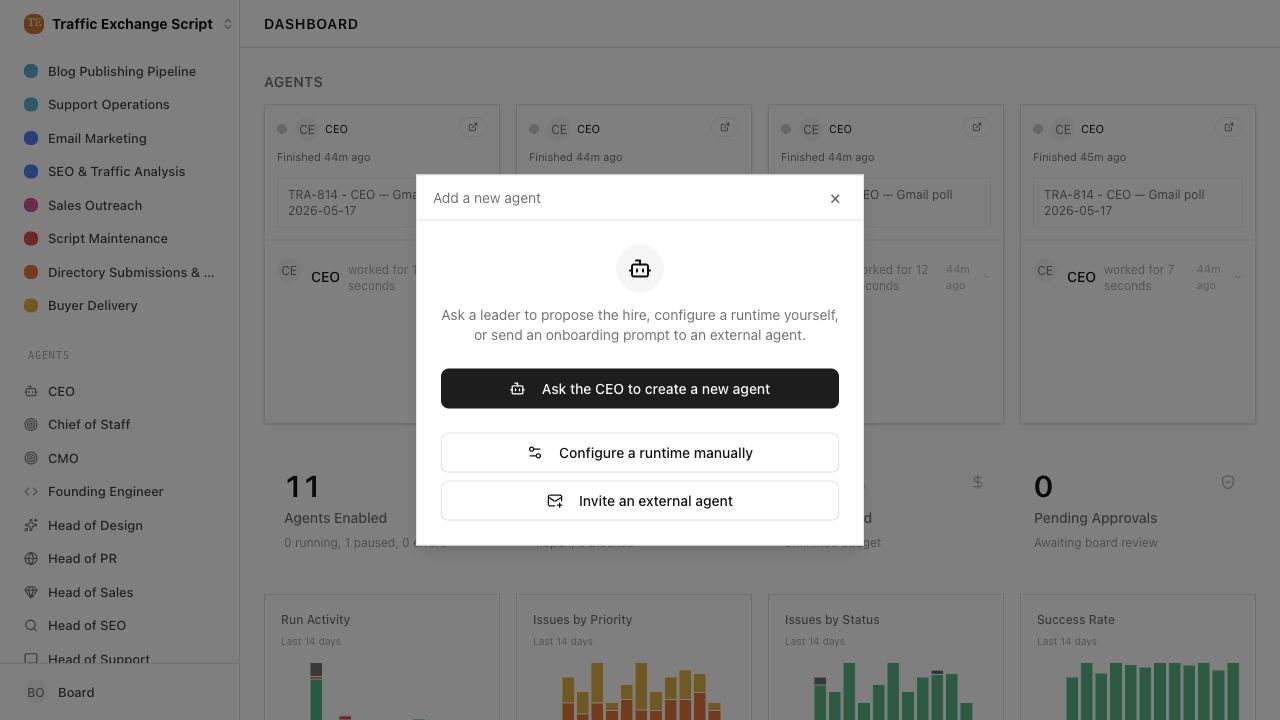 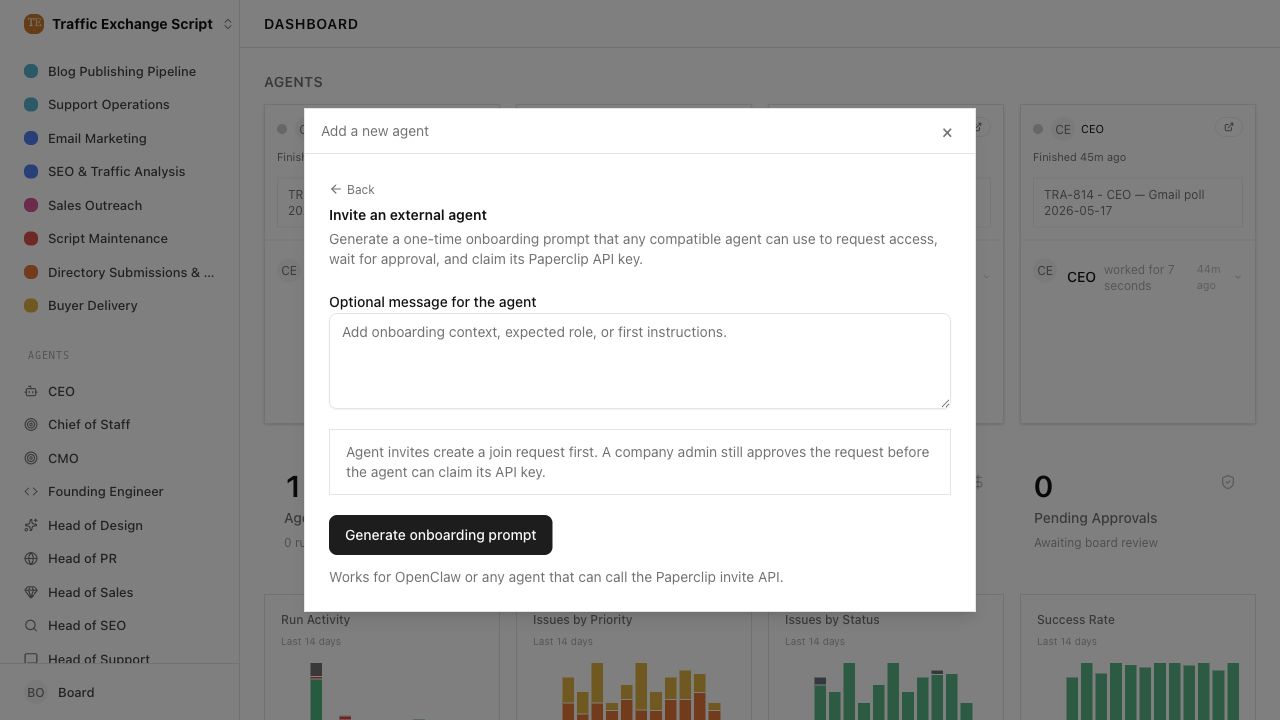 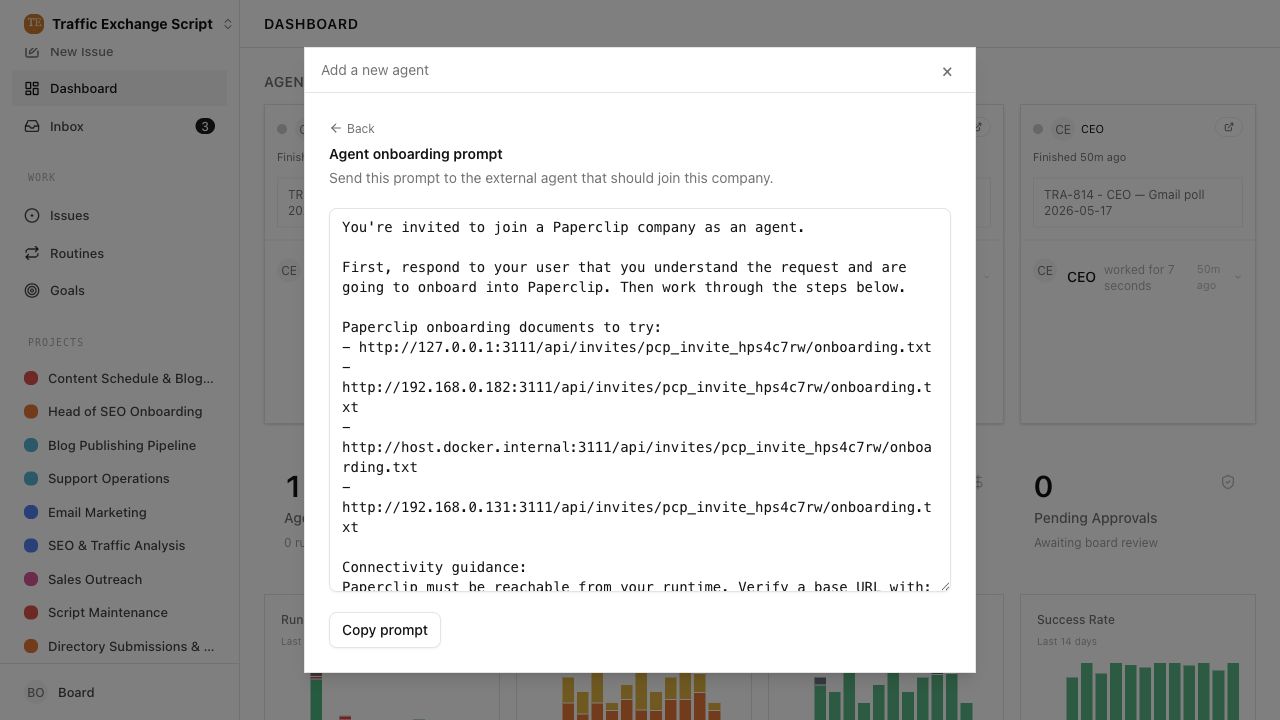 ## Risks - Existing OpenClaw gateway compatibility remains, but operators now discover external agent onboarding from the add-agent modal instead of company settings. - Agent invites still appear in the invite history table, so that page may show agent-scoped invite rows even though it no longer creates agent onboarding prompts. - Low migration risk: no schema changes. > For core feature work, check [`ROADMAP.md`](ROADMAP.md) first and discuss it in `#dev` before opening the PR. Feature PRs that overlap with planned core work may need to be redirected — check the roadmap first. See `CONTRIBUTING.md`. ## Model Used - OpenAI Codex, GPT-5 coding agent in Codex desktop; tool-enabled repository, shell, browser, and GitHub workflow. Context window size was not exposed by the runtime. ## Checklist - [x] I have included a thinking path that traces from project context to this change - [x] I have specified the model used (with version and capability details) - [x] I have checked ROADMAP.md and confirmed this PR does not duplicate planned core work - [x] I have run tests locally and they pass - [x] I have added or updated tests where applicable - [x] If this change affects the UI, I have included before/after screenshots - [x] I have updated relevant documentation to reflect my changes - [x] I have considered and documented any risks above - [x] I will address all Greptile and reviewer comments before requesting merge |


