mirror of
https://github.com/paperclipai/paperclip.git
synced 2026-11-12 06:10:44 +01:00
42bc238aa5a1208cabecba76773e0500fcd33959
36
Commits
| Author | SHA1 | Message | Date | |
|---|---|---|---|---|
 TonioandPaperclip |
56517dda6c |
fix(ui): bundle connector, toolbar, empty-state and agent roster fixes (#18716)
## Thinking Path > - Paperclip is the open source app people use to manage AI agents for work. > - Operators use connector setup, collection headers, empty states, and agent lists to manage that work. > - Provider redirects replace the setup page, and collection controls use different sizes. > - Agent selection inserts a bar above the list. The row link highlights only part of the row. > - This pull request keeps sign-in in a separate window and applies the Tasks control sizes to collection and audit headers. > - It also reuses artifact artwork for empty collections and gives agent selection a fixed action card. > - These changes preserve the operator's place and keep controls and rows stable. ## Linked Issues or Issue Description **What happened?** Connector sign-in replaced the current page. Inline collection controls had different heights. Projects and Artifacts used small placeholder empty states. Agent selection moved the list, hover covered only the identity cell, and chat/status shared that cell without matching headings. **Expected behavior** Provider sign-in opens in a new tab or window. Collection controls match Tasks. Empty collections use the large artifact graphics. Agent actions float above the page while rows remain aligned. **Steps to reproduce** Start connector sign-in from a page or dialog. Compare collection and Audit headers. Open an empty Projects or Artifacts collection. Select an agent, then hover across its row. Related public work: #13584 covers an earlier connector new-tab implementation, including same-page fallbacks that this bundle does not use. #8528 covers Tasks toggle sizing. #17742 covers scoped agent Audit sections. This bundle does not change server callback or audit authorization contracts. ## What Changed - Reserve a separate authorization window during the click. Use validated sign-in URLs, retain a new-tab fallback, and close blank windows after failed requests. Store Cloud reauthentication state in the destination window. - Use the Tasks 44px control foundation for shared collection headers and Audit, Costs, Timeline, Secrets, Teams, Gateways, and agent skill controls. - Use a large artifact stack with an off-white Paperclip image with a dark icon for Projects and artifact Tasks empty states. Use one matching artifact for other types. Set 20px gaps and use the label “Create project”. Action hover and keyboard focus animate the artwork. - Portal agent bulk actions to a fixed card 48px above the bottom safe area. Use quintic entry/exit motion and respect reduced motion. Retain card contents during exit. - Give chat and status separate cells, add a Status heading, use the MessagesSquare chat action with a hover tooltip, and highlight the entire row. - Add linked agent chips and a manager picker to the agent profile. Block self and descendant manager choices. Keep the name crown and custom title inline during edits. - Update design guidance, the connection maps, regression tests, and empty-state Storybook fixtures. ## Verification - Final commit `a41a6c6494a839deaaec1ef7cc50c90078ab6381`: all 55 checks passed, three skipped. [Canonical CI run](https://github.com/paperclipai/paperclip/actions/runs/41999792769) includes all eight browser shards and all server/runner/workspace groups. Greptile: 5/5, zero unresolved review findings. - Workspace typecheck/build passed. Local UI suite passed 11,006 tests in 880 files, plus 542 CLI tests. Subsequent connector callback changes passed all 245 AppsConnect tests, UI typecheck, token gates, and query-error policy checks. Manager cache/error regressions passed four tests. Map checks passed. - Local connector browser suite: 20 passed. All six chat integration shards: 1,931 passed. Workspace B groups passed; database tests passed 313 cases across 72 files with one worker. - Browser preview verified agent manager changes, overview links, inline name/title geometry, empty-state colors, row actions and the chat tooltip. Live provider consent and post-deployment feature verification remain separate from these fixtures. - Preserved failures: ten bulk-roster tests initially missed the portaled action card; their selectors were fixed and all twelve roster tests passed. A nested fixture selected pnpm 11 and removed local dependencies; the local shim now pins pnpm 9. Embedded PostgreSQL native links were restored. A Python 3.9 fixture failure passed all 19 tests with the current runtime. Concurrent local database startup failures passed on the one-worker rerun. - The broad local serialized server run passed 3,791 tests with one scheduling assertion failure, which passed in isolation. The local general-server run reproduced a native recovery provider/model fixture failure and has not completed. These server sources are unchanged by this bundle; all final canonical CI server shards passed. This is not a claim that every broad local run passed. - [Earlier CI run](https://github.com/paperclipai/paperclip/actions/runs/41995119880) failed a browser test during cleanup when heartbeat-run cancellation hit a PostgreSQL lock timeout. All final browser shards passed without weakening that test. - Review follow-ups cover Slack popup/fallback recovery, a single artwork hover transform, shared manager error rendering, detached standalone OAuth windows, and verified task-bound callbacks in both hosts. ## Risks - Browser popup policy and provider callback behavior can affect sign-in completion. The original setup page stays open; blocked windows have an explicit recovery path. - Shared toolbar styles affect several surfaces. Menu content remains in its existing portals; canonical label tabs and search clear buttons retain their own geometry. - No schema, server, API authorization, or migration change. - Required CI and review are complete. Deployment provenance and hosted feature verification are checked separately after merge. ## Model Used OpenAI Codex, GPT-6 family, with reasoning, repository tools, test execution, and browser inspection. The exact model ID and context-window size were not exposed in this session. ## Checklist - [x] I have included a thinking path that traces from project context to this change - [x] I have specified the model used (with version and capability details) - [x] I have checked ROADMAP.md and confirmed this PR does not duplicate planned core work - [x] I have searched GitHub for duplicate or related PRs and linked them above - [x] I have either (a) linked existing issues with `Fixes: #` / `Closes #` / `Refs #` OR (b) described the issue in-PR following the relevant issue template - [x] I have not referenced internal/instance-local Paperclip issues or links (only public GitHub `#NNN` / `github.com/paperclipai/paperclip` URLs) - [x] My branch name describes the change (e.g. `docs/...`, `fix/...`) and contains no internal Paperclip ticket id or instance-derived details - [x] I have run relevant tests locally and they pass (broader local exceptions are recorded above) - [x] I have added or updated tests where applicable - [x] I have updated relevant documentation to reflect my changes - [x] I have considered and documented any risks above - [x] All Paperclip CI gates are green - [x] Greptile is 5/5 with no open P2s, recommendations, or follow-ups - [x] I will address all Greptile and reviewer comments before requesting merge --------- Co-authored-by: Paperclip <noreply@paperclip.ing> |
||
|
DottaandPaperclip
|
896f3c7f3b |
Add personal Muse operator setup and composer controls (#16450)
Add Muse invitation, connection readiness and scoped operator controls.
Keep connection state tied to the current company, person, agent and binding. Surface failed reads and invalidate stale cleanup observations; require current authority and exact readback. Preserve Dot/Grok setup, source-trust limits and existing design tokens.
Carry actual merged backend
|
||
|
|
2a56e5c734 |
fix(ui): show soft budget incidents as warnings, not hard stops (#16201)
## Thinking Path > - Paperclip is the open source app people use to manage AI agents for work. > - Budget policies limit what an agent, a project, or the organization can spend. > - At the warning threshold (80% by default), the server opens a soft incident. It does not pause the scope. At 100%, it opens a hard incident and pauses the scope. > - The budget incident card always shows the hard-stop design. A soft incident shows "agent hard stop", "This scope is paused", and a "Keep paused" button. > - Operators read this as a paused agent. The policy card and the "Paused agents" counter for the same agent say something different. > - This pull request shows soft incidents as warnings. Hard stops do not change. > - The benefit is that the Costs and Budgets pages give one consistent and correct state. ## Linked Issues or Issue Description I searched open and closed issues and pull requests for "budget incident", "hard stop", "soft incident", and "BudgetIncidentCard". I found no issue for this bug. Refs #14306: that open PR also changes `BudgetIncidentCard`, for failed-action feedback. It does not change the soft and hard labels. The two PRs can conflict in this file. **What happened?** An agent budget policy reached its warning threshold. The Audit → Budgets page and the Audit → Costs overview showed the soft incident as "AGENT HARD STOP" with the banner "This scope is paused. New heartbeats will not start until you resolve the budget incident." The card showed "Raise budget & resume" and "Keep paused". The agent was not paused. Its policy card showed "Warning", and the "Paused agents" counter did not count it. **Expected behavior** A soft incident looks like a warning. It says that work continues. Its actions are "Raise budget" and "Dismiss warning". A hard incident keeps the current design and actions. **Steps to reproduce** 1. Create an agent budget policy with a $1,000 monthly limit and the default 80% warning threshold. 2. Record $800 of cost for that agent. 3. Open Audit → Budgets. 4. Look at the active incident for that agent. It says "agent hard stop" and "This scope is paused". **Paperclip version or commit** Seen on v2026.1012.0 (`bba6a45`). The same code is on `master` at `721e87ac0`. **Deployment mode** local_trusted (not deployment-specific). ## What Changed - `BudgetIncidentCard` reads `incident.thresholdType`. A `soft` incident shows: - The heading "<scope> budget warning", with amber styling and a warning icon. - The banner "Spending crossed the warning threshold. This warning does not pause work." - The actions "Raise budget" and "Dismiss warning". They call the same handlers as before (`raise_budget_and_resume` and `keep_paused`). For a soft incident, the server dismisses the incident for `keep_paused`, and the resume step has no effect because the scope is not paused. - A new-budget prefill of the current limit plus $10. Before, the prefill was equal to the current limit, so "Raise budget" did not change the limit. - A `hard` incident does not change: the same heading, banner, styling, prefill, and actions. - The "Active incidents" description on the Costs page now covers warnings and hard stops. - New tests in `BudgetIncidentCard.test.tsx` cover a hard stop, a soft warning, and a project hard stop. ## Verification - `cd ui && npx vitest run src/components/BudgetIncidentCard.test.tsx`: 3 tests pass. Before the fix, the soft-warning test failed with `expected 'agent hard stopOpen…' to contain 'agent budget warning'`. - `cd ui && npx vitest run src/pages/Costs src/components/Budget`: 31 tests pass. - Manual check in a running instance (v2026.1012.0 with this patch, seeded with an agent at 100% and an agent at 80% of a $1,000 budget), in light and dark themes: - The 100% agent shows the red "Agent hard stop", "This scope is paused", "Raise budget & resume", and "Keep paused". - The 80% agent shows the amber "Agent budget warning", the warning banner, a $1,010.00 prefill, "Raise budget", and "Dismiss warning". - "Paused agents: 1" agrees with the cards. - `ui` typecheck: no errors in the changed files. The local run had unrelated errors in `PluginOrganizationSwitcher` because the plugin SDK was not built. ## Risks - Low risk. The change is UI-only. Hard-stop rendering and behavior do not change. No API, server, or data changes. - The soft card now prefills a value above the current limit. Before, it prefilled the current limit. - PR #14306 changes the same component. One of the two PRs can need a small rebase. ## Model Used - Claude Opus 5.5 (`claude-opus-5-5`), Anthropic, through Claude Code with tool use (shell, file edits, test runs, Playwright screenshot capture). A human requested and reviewed the change. ## Checklist - [x] I have included a thinking path that traces from project context to this change - [x] I have specified the model used (with version and capability details) - [x] I have checked ROADMAP.md and confirmed this PR does not duplicate planned core work - [x] I have searched GitHub for duplicate or related PRs and linked them above - [x] I have either (a) linked existing issues with `Fixes: #` / `Closes #` / `Refs #` OR (b) described the issue in-PR following the relevant issue template - [x] I have not referenced internal/instance-local Paperclip issues or links (only public GitHub `#NNN` / `github.com/paperclipai/paperclip` URLs) - [x] My branch name describes the change (e.g. `docs/...`, `fix/...`) and contains no internal Paperclip ticket id or instance-derived details - [x] I have run tests locally and they pass - [x] I have added or updated tests where applicable - [x] I have updated relevant documentation to reflect my changes (no `doc/` page describes this card, so no change was needed) - [x] I have considered and documented any risks above - [ ] All Paperclip CI gates are green - [ ] Greptile is 5/5 with no open P2s, recommendations, or follow-ups - [x] I will address all Greptile and reviewer comments before requesting merge 🤖 Generated with [Claude Code](https://claude.com/claude-code) --------- Co-authored-by: Aron Prins <aronprins@icloud.com> Co-authored-by: Claude Opus 5.5 <noreply@anthropic.com> |
||
|
|
1b4c803816 |
fix(costs): preserve usage attribution and explain unavailable run costs (#15948)
## Thinking Path > - Paperclip is the open source app people use to manage AI agents for work. > - The cost ledger records usage and controls agent budgets. > - Some runs lose the selected model or API billing category before their usage reaches the ledger. > - The dashboard reports missing costs but does not identify the affected runs or the available actions. > - This pull request preserves usage attribution and adds a compact view of cost gaps grouped by agent. > - Operators can inspect runs, open agent settings, and record saved costs without starting new agent work. ## Linked Issues or Issue Description Refs #15634, #11938, #15879. This follows the merged subscription reporting in #15634. The older proposal in #11938 addresses part of ACP model attribution. This change also rejects conflicting models across a turn, fixes credential-backed billing capture, and explains cost gaps in the existing dashboard. The Pi receipt recovery work in #15879 covers a separate adapter recovery path. This PR preserves unresolved receipts and does not recover provider usage or reprice past entries. **What happened?** ACP results use the requested model even when the runtime selects a model. Native and OpenCode API runs can report unknown billing despite a matching API credential. The dashboard shows notices without links to the affected runs. These gaps make API and subscription totals harder to interpret. **Expected behavior** Record the model selected by the runtime. Identify API billing only from a matching credential. Keep costs unresolved when reliable usage or pricing is absent. Show the affected agents and runs. Offer an accounting retry only when saved evidence is ready. **Steps to reproduce** 1. Run an ACP agent with its model left unset, or use a matching API credential with a native or OpenCode agent. 2. Inspect the recorded model and billing category for the run. 3. Open Costs Overview for a period with unpriced usage or terminal runs awaiting receipts. 4. Inspect the notice and try to find the affected run or the relevant agent settings. **Paperclip version or commit** Current master at `657e71584a0`. The patch is rebased on that commit. **Deployment mode** Self-hosted server and local development. The cost detail tests use a disposable PostgreSQL database. ## What Changed - Preserve the runtime-selected ACP model in checkpoints and final results. Conflicting models across one turn remain unpriced. - Share credential-backed API billing checks across native and OpenCode results. Keep unknown billing when the provider and credential do not match. - Add company-scoped cost detail and accounting retry endpoints. Board viewers can read details but cannot retry. Agents and foreign companies are denied. - Limit each detail category to 25 entries. Use one consistent database snapshot and sparse indexes matching the filters and sort order. Add the unknown-billing count to the existing summary query. - Replace the notice with an expandable count line. Group entries alphabetically by agent. Show the saved blob icon, link each name to configuration, and put run and retry links beside the date. - Preserve estimate and unavailable-price labels on Providers and Billers; keep retry confirmation after the resolved notice disappears. - Fetch details only while expanded. Retain the last loaded details after a refresh error. Retry saved accounting only; do not rerun the agent. - Add capture, database, authorization, UI, and Storybook coverage. Update the implementation contract and cost reporting guide. ## Verification - `pnpm -r typecheck` passed after rebase. - `pnpm build` and `pnpm build-storybook` passed after rebase. - `pnpm check:token-gates` and `git diff --check` passed. - 1,086 focused tests passed across 17 files. These cover ACP, native and OpenCode capture, PostgreSQL reports, route authorization, OpenAPI, Costs UI, and existing accounting regressions. - Desktop and mobile browser checks passed during UI review. They cover lazy expansion, alphabetical groups, loaded blob icons, configuration and run links, keyboard retry, and layout overflow. - `pnpm test:run` was attempted with command-scoped `init.defaultBranch=master` for Git fixtures. It was stopped after a native session recovery failure reproduced on unchanged base `657e71584a0` (`archives a damaged prior epoch before completing guarded same-task replacement with real runnerd`). An MCP upload case failed in the broad run but passed in isolation on both the base and PR branch. These local limitations do not affect the 1,086 passing focused tests. - Current-head CI is green, including all unit test lanes, serialized server suites, runner checks, typecheck, build, policy, and eight browser shards. Apex re-review is 5/5 on `56de60effdb`; all four original findings are addressed and every review thread is resolved. - PostgreSQL applies migration `0333` in the integration fixtures. EXPLAIN ANALYZE on the production detail statements uses the new sparse indexes behind 5,000 healthy records in each table. - Ten provider/biller card cases cover missing and estimated prices; the retry test covers row removal and notice unmount. A live Storybook browser check verifies the confirmation and updated count. - Run `pnpm storybook`. Open **Costs / Subscriptions / Cost Data Quality Details** to inspect the production page with representative fixtures. ## Risks - Model and billing metadata change for future runs. Estimates still require complete usage and a supported price. No past cost amount is rewritten. - A missing final receipt remains unresolved for budget checks. The display changes after fifteen minutes; that time limit never authorizes settlement. - Accounting retry is a write action. It retains the existing company checks, receipt fences, idempotency, and audit logging. - Detail reads are bounded and run only after expansion. They poll every 30 seconds while open. No provider probe or new summary query is added. - Migration `0333` adds two partial indexes; it changes no stored cost amounts or table columns. Index creation scans the existing tables and may briefly block writes during deployment. No lockfile or workflow change is included. ## Model Used OpenAI Codex, based on GPT-6, with repository inspection, code editing, browser checks, and test execution. The exact serving model ID, reasoning setting, and context window were not exposed to this session. ## Checklist - [x] I have included a thinking path that traces from project context to this change - [x] I have specified the model used (with version and capability details) - [x] I have checked ROADMAP.md and confirmed this PR does not duplicate planned core work - [x] I have searched GitHub for duplicate or related PRs and linked them above - [x] I have either (a) linked existing issues with `Fixes: #` / `Closes #` / `Refs #` OR (b) described the issue in-PR following the relevant issue template - [x] I have not referenced internal/instance-local Paperclip issues or links (only public GitHub `#NNN` / `github.com/paperclipai/paperclip` URLs) - [x] My branch name describes the change (e.g. `docs/...`, `fix/...`) and contains no internal Paperclip ticket id or instance-derived details - [x] I have run tests locally and they pass - [x] I have added or updated tests where applicable - [x] I have updated relevant documentation to reflect my changes - [x] I have considered and documented any risks above - [x] All Paperclip CI gates are green - [x] Greptile is 5/5 with no open P2s, recommendations, or follow-ups - [x] I will address all Greptile and reviewer comments before requesting merge --------- Co-authored-by: Codex <noreply@openai.com> Co-authored-by: Paperclip <noreply@paperclip.ing> |
||
|
DottaandPaperclip
|
a7dd5284b5 |
feat: add company fast-response acknowledgements (#15748)
## Thinking Path > - Paperclip is the open source app people use to manage AI agents for work. > - Human messages start agent work through task, chat, and external-channel intake. > - Agent startup can delay the first visible response. > - A small direct model call can acknowledge the request while normal work starts. > - This response must remain separate from evidence that the agent answered or completed work. > - This pull request adds optional company-wide fast responses with durable receipts, access checks, and cost accounting. > - Users receive prompt acknowledgement without changing the agent execution path. ## Linked Issues or Issue Description **Subsystem affected** Cross-cutting: database, shared contracts, server orchestration, connections, and UI. **Problem or motivation** Users can wait for an agent to start before they receive a contextual response. Generic progress messages do not confirm what the user asked. An acknowledgement must not falsely complete work or satisfy an unanswered turn. **Proposed solution** Add a disabled-by-default experimental fast-response model using an existing shared API connection. Generate one short acknowledgement for each accepted human turn. Use the existing agent identity and external publication outboxes. Retain platform provenance and account for the inference independently. **Alternatives considered** Running the acknowledgement through the agent runtime adds startup latency. Restricting implementation to OpenRouter leaves other existing API connections unsupported. This change supports all existing API connections and uses OpenRouter for live verification. **Roadmap alignment** This extends existing agent communication and connection settings. ROADMAP.md and open pull requests were checked. No duplicate fast-response implementation was found. The maintainer supplied the feature plan directly. ## What Changed - Add Experimental fast responses to instance settings. Keep the feature off by default. Enforce the flag at intake, dispatch, and publication. - Move Decision model and Fast response setup to company Settings → Connections when the experiment is enabled. Place Connections below Environments. Separate the model sections with clear headings and a divider. Keep Decision model in General when the experiment is off. Route Costs setup links to the available settings page. - Make the acknowledgement prompt a multiline template string. Ask for a brief, positive response in the user’s language. - Add settings, connection/model selection, sponsorship, fixed-sample testing, and Costs history. - Add a Vercel AI SDK text service for existing native, routed, Bedrock, and local API connections. - Add durable per-turn requests, a bounded worker, a three-second admission deadline, and one inference attempt. - Integrate task creation, task and agent chat, steering, queued follow-ups, experimental board chat, shared chat intake, and email. - Preserve receipt provenance and exclude receipts from completion, recovery, interaction resolution, and agent wakeups. - Recheck authorization, source validity, real replies, budgets, and destination binding before publication. Preserve accounting for suppressed or uncertain outcomes. - Add provider contracts, database race tests, channel outbox tests, UI tests, Stories, and documentation. Keep decision-model execution unchanged. ## Verification - Local `pnpm -r typecheck`, `pnpm build`, and UI token gates pass after rebase. The UI typecheck and build also pass after the final navigation fixes. All 37 focused navigation tests pass. The first full local `pnpm test:run` invocation reported seven chat failures. All seven passed in isolated reruns after fixture updates and host cleanup. This invocation was stopped after the full final-head CI suite passed. - Initial local database tests hit macOS shared-memory exhaustion. A diagnostic confirmed `shmget: No space left on device` with the system limit of 32 IDs. Three abandoned, unattached PostgreSQL IPC headers were reclaimed. The isolated rerun passed all 31 fast-response and channel tests. The two additional Slack regression cases also passed in a separate rerun. No active database was stopped. - UI token gates pass. Provider contract tests cover all supported API connection types. Fast-response tests cover uniqueness, authorization, budgets, expiry, cancellation, restart, real-reply races, and the experimental flag. - The test drive verified that disabling the experiment hides Connections and redirects its direct URL. Enabling it restores the saved OpenRouter setup. After restart on the final commit, the OpenRouter settings sample returned “Sure, I’ll take care of fixing the border around the settings panel.” in 428 ms. It used 260 input and 31 output tokens and recorded $0.0000576 in reported cost. - Earlier live OpenRouter verification produced a receipt in 1.013 seconds for a new task. The real agent then supplied its substantive answer. A separate settings test took 1.34 seconds, used 246 input and 23 output tokens, and recorded $0.0000361. - Live Slack verification on final commit `24016fa525961ebc7a4acffdc5019ce123970549` passed for a fresh initial task and a follow-up in a disposable bot DM. The initial acknowledgement appeared 2.405 seconds after the Slack message and 1.413 seconds after durable acceptance; the follow-up appeared in 2.322 seconds and 1.160 seconds respectively. The recorded generation/settlement durations were 898 ms and 697 ms. The initial call used 291 input / 39 output tokens and cost $0.00006705; the follow-up used 281 / 47 and cost $0.00007035. - The Slack acknowledgements retained the assigned agent identity and `origin: fast_response`, source-turn references, and no fabricated run ID. A status snapshot after the initial receipt showed the task still `in_progress` with its real execution run. The agent then read the CSV fixture and correctly reported two ready items, two blockers, and their owners. Both replies stayed in the originating DM, and no duplicate generic working message followed the delivered contextual acknowledgements. The `new` command started a fresh conversation session without generating a fast response. - An earlier eligible Slack turn generated a response but suppressed publication. Its reported cost was retained, generic progress remained, and the real agent completed the requested result. This is recorded separately from the two delivered acknowledgements; the history did not expose a precise suppression reason. - Slack verification used real signed provider events, the existing intake/publication paths, and a user-approved temporary webhook-only HTTPS tunnel. Subscriptions were limited to direct-message events. The test bot was paused and the tunnel stopped afterward. Live channel/group-thread and GitHub journeys remain unverified; their mocked tests cover intake, destination binding, publication, and continued underlying work. - Greptile reviewed final commit `24016fa525961ebc7a4acffdc5019ce123970549` at 5/5. Both new review findings are fixed and all threads are resolved. [Final-head CI run](https://github.com/paperclipai/paperclip/actions/runs/38060015730) passed. This includes grouped server/chat/workspace tests, serialized suites, runner checks, browser journeys, typecheck, build, release registry, policy, and the canary dry run. - Manual check: enable Experimental fast responses. Open company Settings → Connections. Select a shared API connection and model. Save and use Test response. Submit a task message and confirm that its receipt does not complete the task. ## Risks - The migration adds receipt and configuration tables plus accounting references. It uses idempotent statements and follows the current migration sequence. - A slow provider, authorization change, or real-agent reply can suppress an acknowledgement. Existing progress feedback remains available. - Unknown provider billing retains a reservation until reconciliation. External deliveries with uncertain outcomes must not be blindly repeated. - Live Slack initial-task and follow-up DM journeys pass. Live Slack channel/group-thread and GitHub journeys remain unverified. The PR remains a draft and records these gaps. Final-head repository CI and automated review pass. ## Model Used OpenAI Codex, based on GPT-6, with reasoning, repository tools, code execution, and browser interaction. The runtime does not expose an exact model snapshot ID or context-window size; these are not asserted. ## Checklist - [x] I have included a thinking path that traces from project context to this change - [x] I have specified the model used (with version and capability details) - [x] I have checked ROADMAP.md and confirmed this PR does not duplicate planned core work - [x] I have searched GitHub for duplicate or related PRs and linked them above - [x] I have either (a) linked existing issues with `Fixes: #` / `Closes #` / `Refs #` OR (b) described the issue in-PR following the relevant issue template - [x] I have not referenced internal/instance-local Paperclip issues or links (only public GitHub `#NNN` / `github.com/paperclipai/paperclip` URLs) - [x] My branch name describes the change (e.g. `docs/...`, `fix/...`) and contains no internal Paperclip ticket id or instance-derived details - [x] I have run tests locally and they pass - [x] I have added or updated tests where applicable - [x] I have updated relevant documentation to reflect my changes - [x] I have considered and documented any risks above - [x] All Paperclip CI gates are green - [x] Greptile is 5/5 with no open P2s, recommendations, or follow-ups - [x] I will address all Greptile and reviewer comments before requesting merge --------- Co-authored-by: Paperclip <noreply@paperclip.ing> |
||
|
Devin FoleyandPaperclip
|
98e3cec78e |
feat(costs): report monthly subscriptions beside API spend (#15634)
## Thinking Path > - Paperclip is the open source app people use to manage AI agents for work. > - Its Costs page reports API charges and subscription token usage. > - Subscription runs do not show the recurring fee paid for the account. > - Several agents can share one paid seat, so a fee per agent would overstate cost. > - This pull request identifies connected subscription accounts and reports each monthly fee once. > - Users can compare API spend and subscription costs, see uncertainty, and enter their actual price. ## Linked Issues or Issue Description Refs #498 and #3406 for related subscription reporting needs. This change does not add subscription budget enforcement or automatic optimization. Related prior approaches: #10544 and #11104 proposed API-equivalent token costs for subscription work. This PR reports recurring account fees separately from usage charges and budgets. A search found no open PR for monthly account fee reporting. **Subsystem affected** Costs, managed AI connections, shared contracts, database schema, and board UI. **Problem or motivation** An organization can pay for subscriptions even when included runs record no additional dollar charge. The Costs page cannot show that monthly commitment or distinguish a shared paid seat from several separate seats. **Proposed solution** Discover account identity from the managed connection selected for a run. Use exact known plans for labeled monthly list-price estimates. Keep ambiguous plans and unconfirmed identities unpriced until the user supplies a price. Sum current monthly fees separately from date-filtered API charges and token usage. **Alternatives considered** A fee per agent double-counts shared accounts. Token-based API price estimates do not measure the recurring subscription fee. Provider invoices would be more exact but are not available through these account credentials. **Roadmap alignment** Extends the shipped Better Budgeting and Personal & Shared AI Accounts capabilities. The feature and UI were reviewed with the maintainer before this PR. ## What Changed - Add company-scoped subscription accounts, connection bindings, and immutable price revisions in replay-safe migration 0322. - Identify OpenAI workspace/seat and Claude organization/account pairs only after provider authentication. Keep provisional records grant-scoped; unchecked ID-token claims cannot combine accounts or grant billing editors. Keep credentials and raw provider identities out of reports. - Attach the selected subscription to new run receipts. Resolve duplicate aliases without rewriting old monetary receipts. - Add cached background discovery with four provider checks and twenty discovery requests at a time. Accepted requests wait for capacity; excess requests receive HTTP 429 and a UI retry action. Preserve saved prices and observations when a provider check fails. Dashboard polls load current prices only; audit revisions stay in the database. - Support owner-controlled monthly or annual prices, fractional-cent precision, separate currency totals, tracking status, and duplicate linking. Preserve both personal owners and shared-account managers when discovery finds the same paid seat. - Show API spend beside monthly subscription commitment, with separate token totals and clear estimate labels. Account details and fee totals follow billing-owner/shared-audience visibility; company-wide token totals remain available to cost readers. - Use consistent amount and estimate badge formatting for agent, user, project, and model rows. - Add real PostgreSQL tests, route authorization tests, UI tests, interactive Storybook fixtures, and operator documentation. ## Verification - Current head `d7b5c78dadf5033a3c447d83434676ac94687e77` passed all 53 checks, with two checks skipped. This includes the full test matrix, browser tests, build, typecheck, migration policy, canary packaging, and security checks. - Greptile Apex reviewed that exact head at 5/5 with no unresolved findings. - Local `pnpm -r typecheck`, `pnpm build`, `pnpm check:token-gates`, migration safety checks, and `git diff --check` passed. - All 238 focused tests passed across accounting, subscription persistence, authorization, UI, migration replay, and snapshot drift. - The expanded local chat suite passed 1,149 tests. Two cases failed because this workspace found an unrelated ancestor skill directory; both passed unchanged in an isolated checkout. The full local Vitest command was not repeated after the rebase because of this environment issue. CI covered the complete test matrix on the final head. - Migration `0322_reflective_kree.sql` follows master's `0321_acoustic_human_fly.sql`. Its snapshot and journal were regenerated. Master's migration and snapshot are unchanged. The subscription SQL retains its original content and hash. - Disposable PostgreSQL upgrade fixtures applied master's added lifecycle and Slack migrations without changing saved subscription prices or cost receipts. The renamed subscription migration was recognized by hash, retained one history row, and a second migration run was a no-op. - Regression tests cover provider capacity, fractional-cent edits, billing visibility after grant revocation, and fixed-price/credit/unknown usage. The new UI billing-label tests fail against the old wording and pass with the fix. - Browser checks passed for desktop and mobile layouts, shared-account totals, annual price edits, unknown prices, and stale provider data. - A live OpenAI account probe returned HTTP 200 and a verified Pro account identity. The generic Pro plan correctly remains unpriced. - Live Claude discovery identified Max 20x and a $200/month estimate. Two real Claude agent runs were attributed to that same account, with two usage receipts, two agents, one monthly fee, and zero additional usage charges. Two OpenAI connections also deduplicated to one account. - Live Codex execution is not verified: both Paperclip's managed hello test and a direct host `codex exec` fail with a workspace-routing authentication error. The current credential passes the usage API probe. This is separate from the successful account-discovery check. - A local performance fixture with 50,000 usage events and 5,001 saved price revisions produced a 1,589-byte report in 11.5 ms median / 12.2 ms maximum over ten warmed runs. PostgreSQL used the subscription/revision index to read one current price row. These are local measurements, not a production latency guarantee. - [Desktop, account details, and mobile screenshots](https://pages.paperclip.ing/pr-15634-subscription-costs-d5d285e2/) show the production Costs page with synthetic Storybook fixtures. - To inspect the UI, run `pnpm storybook` and open **Costs / Subscriptions**. Edits there change fixture data only. ## Risks - Provider plan identifiers can change. Unknown plans remain unpriced. Automatic prices are estimates before tax; discounts and negotiated prices require a user-supplied amount. - Subscription fees describe the current monthly commitment. They do not follow the selected usage date range and do not consume agent budgets or create finance events. - Monthly fees cover only accounts visible to the viewer; company-wide token totals retain their existing scope. - Legacy or unmanaged usage can remain unattributed. Unconfirmed identities require manual prices and may need explicit duplicate linking after credential changes. - Disconnecting a connection does not prove provider billing stopped. Users must end or exclude tracking explicitly. - Migration 0322 adds tables, a nullable cost-event column, and an index. It is replay-safe, but normal migration locks still apply. ## Model Used OpenAI Codex, based on GPT-6. This session did not expose a more specific backend model ID or context-window size. Capabilities used: code editing, shell execution, database tests, and browser verification. ## Checklist - [x] I have included a thinking path that traces from project context to this change - [x] I have specified the model used (with version and capability details) - [x] I have checked ROADMAP.md and confirmed this PR does not duplicate planned core work - [x] I have searched GitHub for duplicate or related PRs and linked them above - [x] I have either (a) linked existing issues with `Fixes: #` / `Closes #` / `Refs #` OR (b) described the issue in-PR following the relevant issue template - [x] I have not referenced internal/instance-local Paperclip issues or links (only public GitHub `#NNN` / `github.com/paperclipai/paperclip` URLs) - [x] My branch name describes the change (e.g. `docs/...`, `fix/...`) and contains no internal Paperclip ticket id or instance-derived details - [x] I have run tests locally and they pass - [x] I have added or updated tests where applicable - [x] I have updated relevant documentation to reflect my changes - [x] I have considered and documented any risks above - [x] All Paperclip CI gates are green - [x] Greptile is 5/5 with no open P2s, recommendations, or follow-ups - [x] I will address all Greptile and reviewer comments before requesting merge --------- Co-authored-by: Paperclip <noreply@paperclip.ing> |
||
|
DottaandPaperclip
|
a7a244ab33 |
feat: add company decision models with permission and cost controls (#15473)
## Thinking Path > - Paperclip is the open source app people use to manage AI agents for work. > - Optional product features need small, typed model decisions. > - Each company needs to choose which shared API connection pays for those decisions. > - Calls must retain user and task permissions, budget limits, and cost attribution. > - This pull request adds a managed decision service, setup UI, and request history. > - Features can check availability cheaply and keep their existing behavior when decisions are unavailable. ## Linked Issues or Issue Description **Subsystem affected** Server services, shared contracts, database accounting, Company Settings, and Costs. **Problem or motivation** Paperclip has no common decision-model service. Adding provider calls within each feature would duplicate credential access, permission checks, and billing rules. **Proposed solution** Let a connection manager configure one company decision model. Support OpenAI Decisions and Jev through OpenRouter. Provide a fixed setup test and metadata-only history. Default company-sponsored background decisions to on during setup, and preserve a saved off setting. **Alternatives considered** Per-feature credentials would duplicate existing connection management. Personal overrides and provider fallback chains add permission and billing complexity; they remain deferred. **Roadmap alignment** Reviewed ROADMAP.md and searched open PRs. This extends existing connection access and budget accounting. Product features that call the service remain outside this change. No matching decision-model service PR was found. ## What Changed - Add company settings, an internal `decisionModelService`, local availability checks, and trusted human, agent/run, and system contexts. - Pin Vercel AI SDK provider dependencies and adapt boolean, choice, and ordered-score decisions for both providers. Bound requests and time; disable paid retries. - Add durable invocation metadata and agentless decision ledger charges. Preserve fractional cents, pricing evidence, dispatch identity, and unresolved billing holds. - Share the company accounting lock and apply company, agent, and project budgets. Settle charges once, retain unknown holds, and recover interrupted calls without resubmission. - Reuse connection setup and management UI. Add a Decisions view under Costs, production-component Storybook coverage, database migration, and service documentation. ## Verification - Passed 166 current-code tests covering the decision service/provider, setup component, Costs, OpenAPI, and every failure from the earlier broad run. Coverage includes native SDK wire formats, refusals, billed malformed responses, permission and secret-rotation races, identity changes, concurrent budget admission, unresolved holds, agent/task deletion, and stale setup feedback. - Passed 170 existing connection, cost, budget, heartbeat-accounting, and profile regression tests. - Passed repository typecheck, production build, and design token gates after integrating master. Verified the generated migration on a fresh test database and upgraded the populated preview database from the branch's earlier migration without losing settings or usage. - Ran the required full `pnpm test:run`: its general phase completed with 16,354 passed and 10 failures across five files while this branch was still being updated. Every reported failure passes in the current-code rerun; the serialized phase did not run after that failure. The full GitHub CI suite passed on `b1b856a88`: general and serialized tests, browser shards, runner checks, typecheck, production build, packaging/canary, and policy gates. [CI evidence](https://github.com/paperclipai/paperclip/actions/runs/37673106360). - Passed the full-shell Storybook setup-to-history interaction test again after integrating master. Greptile rates the final revision 5/5 with zero unresolved threads. - Walked through the running app: empty setup, add each provider, save, reload, run all three sample questions, inspect fractional charges in history, switch provider while sponsorship is off, disable, and reconnect. Checked mobile settings. These tests used the actual UI, vault, server, SDKs, and database with simulated upstream responses. - Live paid setup tests remain unverified: this environment has no authorized OpenAI/OpenRouter credentials available. No mocked test is presented as live provider evidence. Reviewer journey: Company Settings → General → Decision model. Add/select a shared API connection, save, run the billed sample, open View usage, then disable decisions and verify Run test is disabled after reload. ## Risks - The SDK decision interface is experimental. Pinned versions and wire-format tests limit upgrade drift. - The migration allows agentless service charges and reservations. Existing agent cost-reporting APIs still require an agent, and decision receipts stay separate from run reconciliation. - Timeouts can have unknown provider charges. Holds remain until an audited accounting correction resolves them. - OpenAI prices use a versioned Decisions rate snapshot; OpenRouter costs use provider receipts. Unknown pricing is retained as unknown. - A configured company authorizes background spending by default. Setup explains this, and managers can turn it off. - Live provider account/model availability still needs the two credentialed acceptance checks. ## Model Used OpenAI GPT-6 through Codex, with reasoning, repository inspection, code execution, and browser tools. The exact serving revision and context-window size are not exposed in this session. ## Checklist - [x] I have included a thinking path that traces from project context to this change - [x] I have specified the model used (with version and capability details) - [x] I have checked ROADMAP.md and confirmed this PR does not duplicate planned core work - [x] I have searched GitHub for duplicate or related PRs and linked them above - [x] I have either (a) linked existing issues with `Fixes: #` / `Closes #` / `Refs #` OR (b) described the issue in-PR following the relevant issue template - [x] I have not referenced internal/instance-local Paperclip issues or links (only public GitHub `#NNN` / `github.com/paperclipai/paperclip` URLs) - [x] My branch name describes the change (e.g. `docs/...`, `fix/...`) and contains no internal Paperclip ticket id or instance-derived details - [x] I have run tests locally and they pass - [x] I have added or updated tests where applicable - [x] I have updated relevant documentation to reflect my changes - [x] I have considered and documented any risks above - [x] All Paperclip CI gates are green - [x] Greptile is 5/5 with no open P2s, recommendations, or follow-ups - [x] I will address all Greptile and reviewer comments before requesting merge --------- Co-authored-by: Paperclip <noreply@paperclip.ing> |
||
|
Devin FoleyandPaperclip
|
572cec0344 |
fix(ui): present missing costs as an informational notice (#15459)
## Thinking Path > - Paperclip is the open source app people use to manage AI agents for work. > - The Costs dashboard shows spending and gaps in cost data. > - Historical usage can have token counts without a recorded price. > - The red notice implies that the user must fix those records. > - This pull request shows the missing costs as a neutral note below the totals. > - Users can see the limit of the totals without a false call to action. ## Linked Issues or Issue Description Refs #14997. **What happened?** The Costs dashboard shows a red notice when a selected period contains usage without prices. It also shows “0 runs await accounting” when no runs are pending. Historical pricing gaps can therefore look like current errors that need cleanup. **Expected behavior** Show a neutral explanation below the totals. State that totals include only known costs. Show pending runs separately and only when the count is positive. **Steps to reproduce** 1. Open Costs for a period with unpriced usage and no pending runs. 2. Observe the red notice above the totals. 3. Apply this change. Confirm that the notice is muted and below the totals, with no zero-count pending message. **Paperclip version or commit** Reproduced on master after #14997. **Deployment mode** Board UI in both the embedded Activity page and the standalone Costs page. ## What Changed - Move the cost-data notice below the summary tiles and use the muted text token. - Explain unavailable prices with “Totals include known costs only.” - Separate pending runs from missing prices. Omit zero counts and use singular or plural copy as needed. - Update the existing UI tests for both page variants, including missing-only, pending-only, and fully accounted states after refresh. ## Verification - `pnpm --dir ui exec vitest run src/pages/Costs.test.tsx`: 21 tests passed on the final commit. Both page variants cover mixed, missing-only, pending-only, and fully accounted states. - `pnpm check:token-gates`: passed on the final commit. - `pnpm build`: passed locally. - `pnpm -r typecheck`: passed locally. - Full Linux CI passed on `0c23544c0f17e6641cc0c8de6ed498a731748bde`, including browser tests, server tests, shared-package tests, build, and typecheck. [CI run](https://github.com/paperclipai/paperclip/actions/runs/37661883464). - Greptile Apex: 5/5 on the final commit, with no unresolved review threads. - Local full-suite limit: `pnpm test:run` first failed because the fresh checkout lacked embedded PostgreSQL library links. A runtime-skill fixture also selected an unrelated parent directory, and a load test timed out. After setup repair, the database suite (70 tests), skill suite (3 tests), email suite (39 tests), and load suite (4 tests) passed individually. The subsequent full local rerun was stopped after the complete Linux CI run passed. This is not a claim that a full local test invocation passed. ## Risks Low risk. This changes presentation only. The note remains visible and retains its accessible status role. Cost calculations, stored records, and budget enforcement do not change. The copy does not assume that all missing prices are historical. No schema migration or operator documentation change is needed. ## Model Used OpenAI Codex, based on GPT-6, with reasoning, repository inspection, code editing, and test execution. The exact served model identifier and context-window size are not exposed in this session. ## Checklist - [x] I have included a thinking path that traces from project context to this change - [x] I have specified the model used (with version and capability details) - [x] I have checked ROADMAP.md and confirmed this PR does not duplicate planned core work - [x] I have searched GitHub for duplicate or related PRs and linked them above - [x] I have either (a) linked existing issues with `Fixes: #` / `Closes #` / `Refs #` OR (b) described the issue in-PR following the relevant issue template - [x] I have not referenced internal/instance-local Paperclip issues or links (only public GitHub `#NNN` / `github.com/paperclipai/paperclip` URLs) - [x] My branch name describes the change (e.g. `docs/...`, `fix/...`) and contains no internal Paperclip ticket id or instance-derived details - [x] I have run tests locally and they pass - [x] I have added or updated tests where applicable - [x] I have updated relevant documentation to reflect my changes - [x] I have considered and documented any risks above - [x] All Paperclip CI gates are green - [x] Greptile is 5/5 with no open P2s, recommendations, or follow-ups - [x] I will address all Greptile and reviewer comments before requesting merge --------- Co-authored-by: Paperclip <noreply@paperclip.ing> |
||
|
Devin FoleyandPaperclip
|
799e4d556f |
fix: make accounting durable and synchronize cost reporting (#14997)
Co-Authored-By: Paperclip <noreply@paperclip.ing> |
||
|
|
1ef3b08714 |
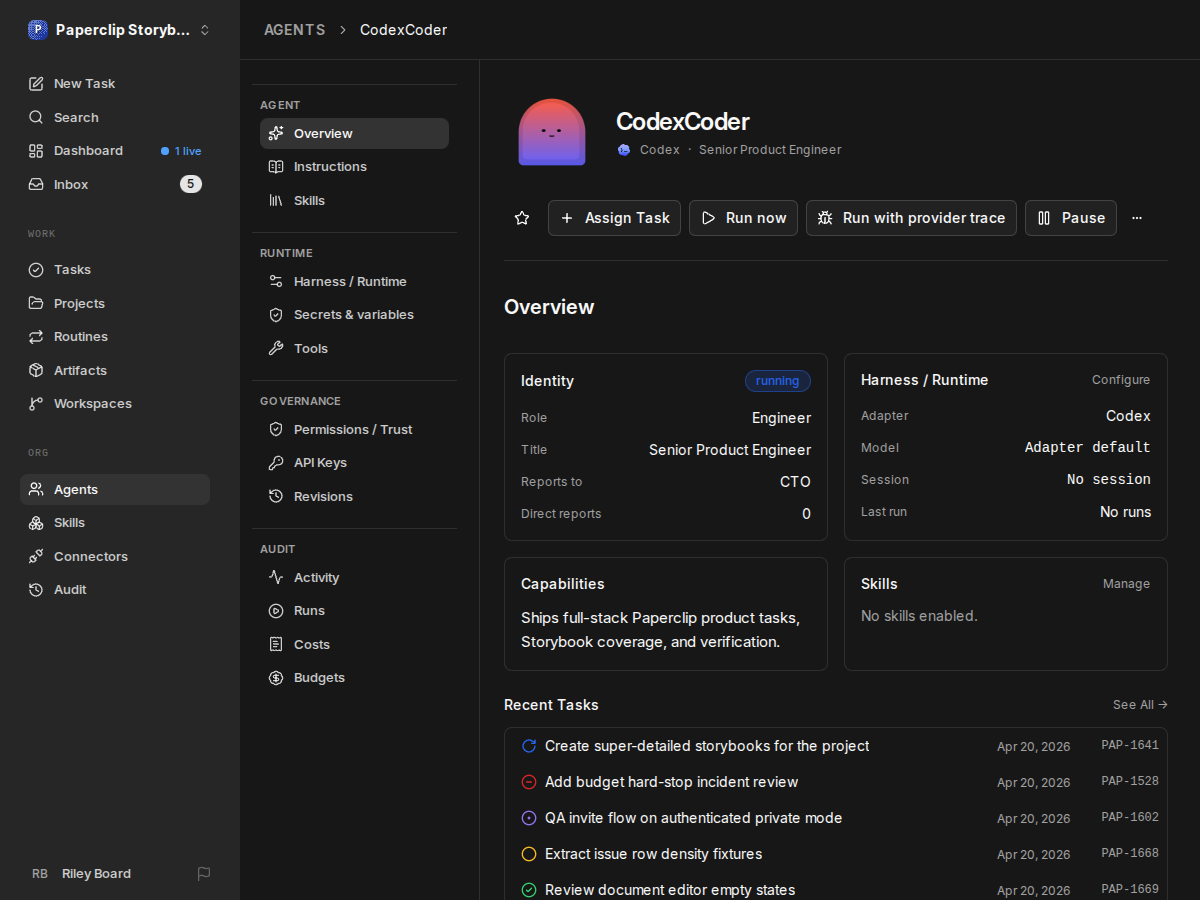
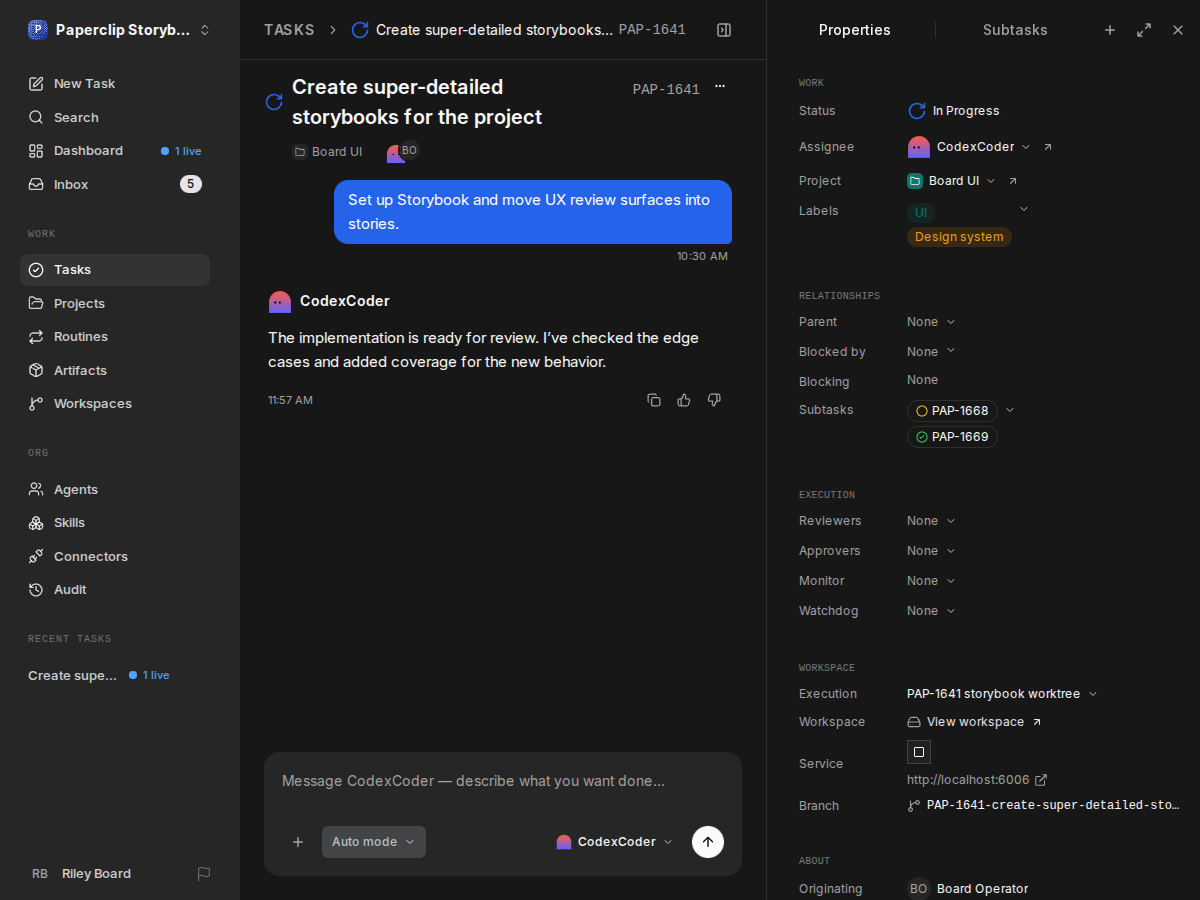
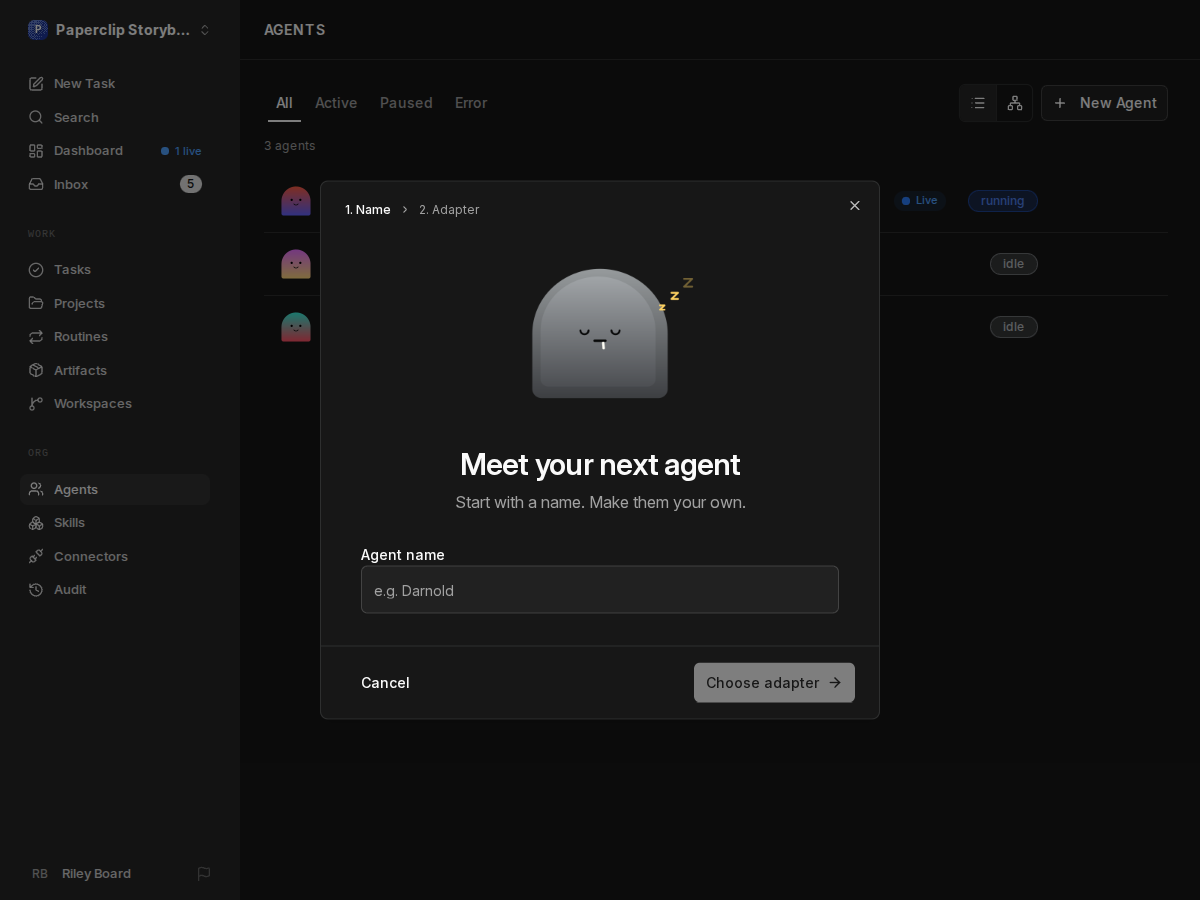
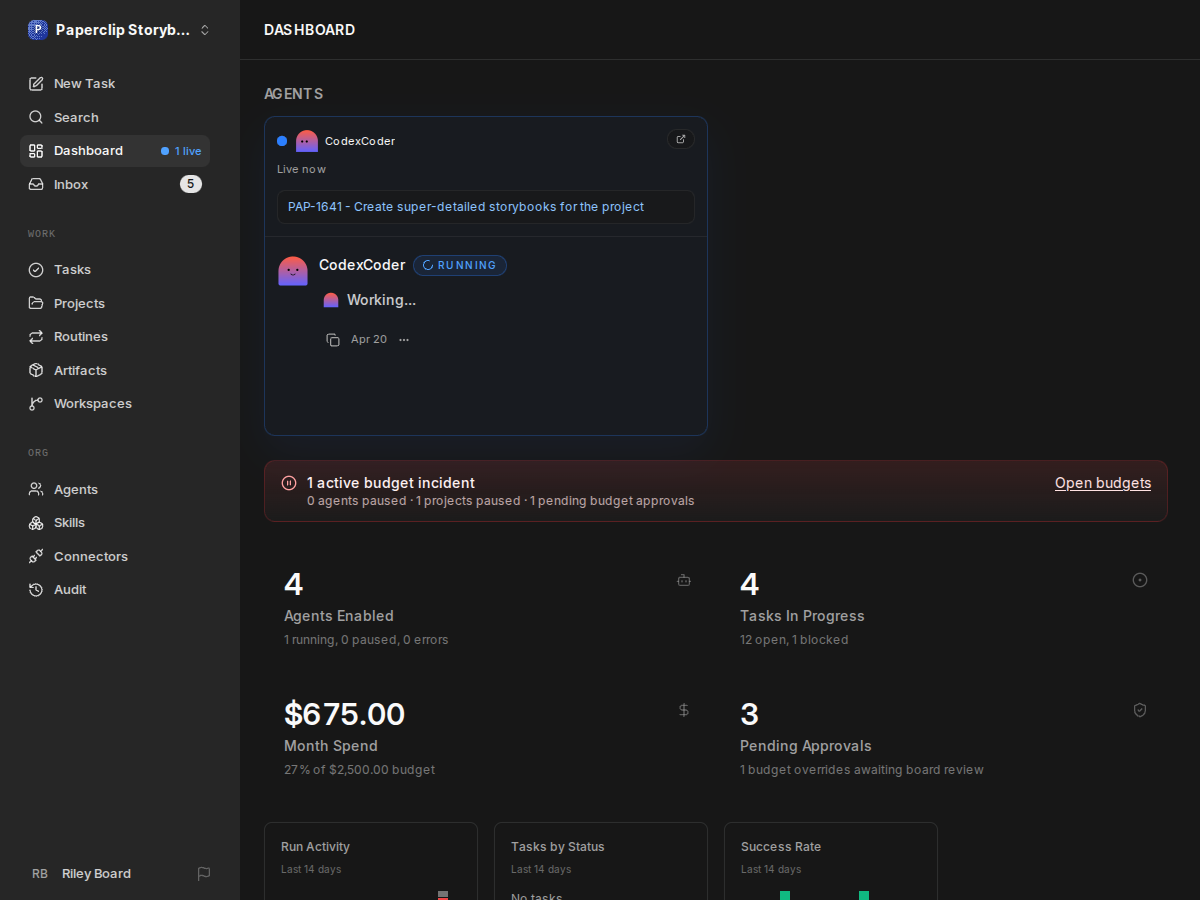
feat(ui): integrate agent personas across the app (#13171)
## Thinking Path > - Paperclip is the open source app people use to manage AI agents for work. > - A stable agent persona is useful only when the same identity appears across the app. > - Lists, task messages, selectors, and activity feeds need inexpensive static avatars. > - Onboarding and agent headers need a larger character with expressions and pointer tracking. > - This pull request connects the persona foundation to those existing views and preserves onboarding draft assignments. > - Full-page stories and Linux checks make the placements and performance contract reviewable. ## Linked Issues or Issue Description **Problem or motivation** Agents need a stable visual identity in lists, tasks, onboarding, and configuration. External tools also need an image URL for that identity. **Proposed solution** Assign each agent a permanent palette from a fixed ClipLab character library. Store the assignment on the agent. Render and cache preset PNG URLs on demand. Use static images in dense views and one animated character in larger placements. **Alternatives considered** A generated image bundle requires a separate asset build. A live renderer in every avatar adds unnecessary work in large lists. Arbitrary uploaded images do not provide the requested shared character system. **Roadmap alignment** This improves agent identity across existing control-plane views. It preserves agent permissions, company boundaries, and status labels. ROADMAP.md has no separate ClipLab persona milestone. Related approaches: #2422 adds configurable image URLs and DiceBear generation; #5578 adds optional uploaded avatars. This work uses a fixed, versioned character library and preset URLs. ## What Changed - Replace agent icons with static persona images across lists, the sidebar, org charts, tasks, comments, selectors, activity, and dashboard views. - Put one animated character in the agent header. Let it follow the pointer across the page, with reduced-motion and touch fallbacks. - Add larger padded characters to agent creation. Keep the palette stable across draft refreshes and connection retries, then reveal it after success. - Pass appearance through shared projections rather than fetching each agent separately. - Add real full-page Storybook examples for the agent list, overview, task, dashboard, new-agent dialog, and connection page. - Add Linux screenshot, clipping, density, and 500-avatar performance checks. ## Verification - `pnpm -r typecheck`, `pnpm build`, and token gates pass on the rebased tree. Persona lifecycle tests pass. - The rebased feature passes 38 Linux screenshot/performance checks, including both display densities, corner pointer positions, and the no-WebGL/no-live-download contract for 500 avatars. - The final Linux persona suite passes all 38 visual, lifecycle, density, and full-page checks using the standard Storybook configuration and real on-demand avatar endpoint. - Final local focused verification: 45 avatar/native-recovery tests pass; UI identity/routine tests, typecheck/build, token gates, and Storybook build pass. - Current-head CI passes: full workspace/server tests, all serialized server groups, typecheck/release checks, build, canary validation, and end-to-end shards. The build passed after retrying a native-runner concurrency-test failure; its three targeted cases also pass locally. - Manual inspection covered stable identities in the app, header placement, full-page mouse tracking, onboarding size, and task/dashboard placements. ### Screenshots Linux captures use synthetic Storybook fixtures. Full-page captures use reduced motion. The live character, mouse tracking, and disposal are checked separately. <details> <summary>Agent overview with the character in its header</summary> <img src="https://raw.githubusercontent.com/paperclipai/paperclip/8c68f42b268ada22b67d79d0fe1bb0a2f84ec25c/screenshots/full-page-agent-overview.png" width="900" alt="Agent overview with the character in its header" /> </details> <details> <summary>Task messages and assignee identity</summary> <img src="https://raw.githubusercontent.com/paperclipai/paperclip/8c68f42b268ada22b67d79d0fe1bb0a2f84ec25c/screenshots/full-page-task.png" width="900" alt="Task messages and assignee identity" /> </details> <details> <summary>Larger onboarding character with room for expressions</summary> <img src="https://raw.githubusercontent.com/paperclipai/paperclip/8c68f42b268ada22b67d79d0fe1bb0a2f84ec25c/screenshots/full-page-meet-your-next-agent.png" width="900" alt="Larger onboarding character with room for expressions" /> </details> <details> <summary>Dashboard agent activity</summary> <img src="https://raw.githubusercontent.com/paperclipai/paperclip/8c68f42b268ada22b67d79d0fe1bb0a2f84ec25c/screenshots/full-page-company-dashboard.png" width="900" alt="Dashboard agent activity" /> </details> ## Risks - This PR depends on #13170, the persona foundation. Merge the foundation first, then retarget this PR to master. - Many placements change from icons to character silhouettes. Human avatars and authoritative agent status labels retain their existing behavior. - Only one character can render live per view. Reduced motion, hidden/offscreen content, touch input, and renderer failures use the defined fallbacks. - The full-page stories use fixture data. They do not contact a real company or complete real provider sign-in. ## Model Used OpenAI Codex, GPT-6 family. The exact model identifier and context window are not exposed in this session. Used code editing, shell execution, browser inspection, and Linux visual testing. ## Checklist - [x] I have included a thinking path that traces from project context to this change - [x] I have specified the model used (with version and capability details) - [x] I have checked ROADMAP.md and confirmed this PR does not duplicate planned core work - [x] I have searched GitHub for duplicate or related PRs and linked them above - [x] I have either (a) linked existing issues with `Fixes: #` / `Closes #` / `Refs #` OR (b) described the issue in-PR following the relevant issue template - [x] I have not referenced internal/instance-local Paperclip issues or links (only public GitHub `#NNN` / `github.com/paperclipai/paperclip` URLs) - [x] My branch name describes the change (e.g. `docs/...`, `fix/...`) and contains no internal Paperclip ticket id or instance-derived details - [x] I have run tests locally and they pass - [x] I have added or updated tests where applicable - [x] I have updated relevant documentation to reflect my changes - [x] I have considered and documented any risks above - [x] All Paperclip CI gates are green - [x] Greptile is 5/5 with no open P2s, recommendations, or follow-ups - [x] I will address all Greptile and reviewer comments before requesting merge --------- Co-authored-by: Paperclip <noreply@paperclip.ing> Co-authored-by: Tonio <tonework@gmail.com> Co-authored-by: Claude Fable 5.1 <noreply@anthropic.com> |
||
|
scotttong
|
b1f4910ee5 | feat(ui): refine streamlined workspace surfaces (#12747) | ||
|
scotttong
|
4d82f5eaea | copy: unify user-facing "company" wording to "organization" (#12243) | ||
|
Nicky Leach
|
564870020b | Exclude archived projects from the default project list route (#10146) | ||
|
scotttongandClaude Fable 5
|
c90e66bdd6 |
feat(ui): design-system component convergence — Card/Badge adoption, multiplicative radius ladder, unified list surfaces (#9240)
## Thinking Path > - Paperclip is the open source app people use to manage AI agents for work > - Its UI is governed by a design system (`DESIGN.md` + the token layer in `ui/src/index.css`, merged in #9134) whose first principle is "one way to say each thing" — one Card, one Badge, one nav row > - After the token extraction landed, ~35 files still hand-rolled card containers, ~45 files hand-rolled pill spans, the sidebar agents section duplicated the nav-row chrome, and the inbox and tasks lists rendered the same task rows two subtly different ways > - Each divergence is a place where a future design change (radius, hover language, status vocabulary) silently misses surfaces, defeating the "edit tokens + run checks" model the design system exists for > - This pull request converges those surfaces onto the shared primitives, codifies the radius scale as the modern multiplicative shadcn ladder, and unifies the row/hover/tree-guide language across the inbox and tasks lists — every visible delta was human-reviewed screen-by-screen against a live instance across nine feedback rounds > - The benefit is that the app's look is now steerable from single knobs (one `--radius` anchor, one Card, one Badge, one row component), and the visual regression suite covers the result (514 snapshots including a new AgentDetail page story) ## Linked Issues or Issue Description No public GitHub issue exists for this work; describing per the feature template: - **Problem**: after the design-token foundation (#9134), component-level drift remained — hand-rolled cards/pills, duplicated sidebar row chrome, and two different renderings of task rows (inbox vs tasks list) meant design changes had to be applied per-surface and frequently missed spots (e.g. status glyphs rendered 16px in the inbox but 20px in the tasks list because a slot override silently beat the component default). - **Proposed behavior**: all card-shaped containers render via `Card`, all label pills via `Badge`, sidebar rows via `SidebarNavItem`, and both task-list surfaces via one `IssueRow` configuration; the radius scale is a single multiplicative ladder anchored at `--radius: 0.5rem`. - **Alternatives considered**: converting interactive `<button>`/`<Link>` cards to `Card` divs (rejected — breaks semantics; documented inline with `design-allow` comments instead); keeping the legacy additive radius ladder (rejected in favor of the standard shadcn multiplicative mapping). ## What Changed - `Card` adoption across ~35 files (settings pages, auth/board flows, dashboards, list containers, KPI tiles); non-adoptable sites (interactive cards, `<li>` rows, class-string props, chart tooltip) carry documented `design-allow(card-pattern)` comments - `Card` gains an `interactive` prop — one quiet hover affordance for clickable cards (cursor, border darken, shadow lift, focus ring), applied to skills tiles, artifact cards, and the company selector; cards carry no resting shadow - `Badge` adoption for 113 hand-rolled pill spans across ~45 files; `PropertyChip` wraps `Badge` internally; `StatusBadge`, external-object chips, and match chips stay bespoke by documented decision (WCAG-tuned status mechanics) - Radius ladder becomes the multiplicative shadcn mapping (`sm/md/lg/xl/2xl/3xl/4xl = 0.6/0.8/1.0/1.4/1.8/2.2/2.6 × --radius`, anchor `0.5rem`); every card surface unifies on `rounded-lg`; the orphaned 8px literal token is deleted - Sidebar: agent rows render via `SidebarNavItem` (new additive props: `iconNode`, `active`, `trailing`, `liveAccessory`); live dots use `--status-agent-running`; one row rhythm and inset rounded pill highlight; right-aligned trailing badges; every labeled section is collapsible - Inbox + tasks lists unified: md status glyphs, `accent/50` rounded row hovers, vertical tree guides under parent rows (opaque underlay so dark-mode translucent borders don't stack), no horizontal dividers under expanded parents; the swipe-to-archive reveal layer shows only mid-swipe; board toggle uses the `SquareKanban` glyph - Kanban: every column carries a status-hued tint; lanes default expanded (including empty); compact mode collapses empty lanes to labeled rails (fixes a clipped, label-less empty-column state) - Storybook: new AgentDetail page story (realistic fixtures, light+dark) joins the visual suite; suite captures with `reducedMotion: 'reduce'` and the ux-lab reasoning ticker honors `prefers-reduced-motion`; a stale lexical alias in `storybook/main.ts` is fixed (build was broken since the lexical 0.46 bump) - Keyboard navigation, from live review of the unified lists: inbox navigation keys work on every tab (archive keys stay scoped to the archivable tab); keyboard-driven scrolling no longer hands the selection to whatever row lands under the stationary cursor (hover selects only after real pointer movement); the tasks list view gains the same j/k / arrows / Enter selection model as the inbox; and the `g` then `i` go-to-inbox chord works app-wide instead of only on the issue detail page - Token gates restored to 3/3 CLEAN (tokenized a post-#9134 regression in the recovery card); decisions recorded in `doc/design/DECISION-SHEET.md` and `doc/design/COMPONENT-INVENTORY.md` (investigation verdicts: FileTree vs WorkspaceFileBrowser and the four entity pickers stay separate — evidence included) ## Verification - `pnpm check:token-gates` → 3/3 CLEAN - `pnpm typecheck` → green (all packages) - `cd ui && npx vitest run` → 2106/2106 (assertions updated in lockstep where they documented superseded decisions; new tests for the global go-to-inbox chord) - `pnpm --filter @paperclipai/ui build` → exit 0 - `pnpm build-storybook` → succeeds (also fixes the lexical-alias break on master) - Visual regression: 514-snapshot Playwright suite green against the updated baseline (zero diffs from the keyboard-navigation round — those changes are purely behavioral). Note: baselines live outside git per the suite design and the baseline-manifest archive is not yet published, so CI cannot run this suite — it was run locally throughout; every visible delta was reviewed screen-by-screen in a live instance across nine review rounds. Review evidence (before/after triplets) intentionally kept out of the repo for size; available on request. - Manual: exercised dashboard, tasks (list + board), inbox, agents, skills, costs, settings, and artifact surfaces in light and dark themes ## Risks - Wide but shallow visual surface: most changes are class-string substitutions with behavior preserved (props, handlers, roles, test ids). The riskiest areas — dnd-kit card refs (React 19 ref-as-prop), inbox swipe-to-archive, and sidebar overlays — are covered by existing unit tests (all green) and were manually exercised. - Intentional visual deltas (rounded cards, tinted kanban columns, md status glyphs, unified hovers) are design decisions recorded in `doc/design/DECISION-SHEET.md`; each maps to a re-baselined snapshot set locally. - The visual suite cannot yet run in CI (unpublished baseline archive — pre-existing condition from #9134); until that lands, snapshot coverage is local-only. ## Model Used - Claude Fable 5 (`claude-fable-5`, Anthropic) via Claude Code — agentic coding with tool use (file editing, test execution, Playwright screenshot verification); extended thinking enabled. ## Checklist - [x] I have included a thinking path that traces from project context to this change - [x] I have specified the model used (with version and capability details) - [x] I have checked ROADMAP.md and confirmed this PR does not duplicate planned core work - [x] I have searched GitHub for duplicate or related PRs and linked them above - [x] I have either (a) linked existing issues with `Fixes: #` / `Closes #` / `Refs #` OR (b) described the issue in-PR following the relevant issue template - [x] I have not referenced internal/instance-local Paperclip issues or links (only public GitHub `#NNN` / `github.com/paperclipai/paperclip` URLs) - [x] My branch name describes the change (e.g. `docs/...`, `fix/...`) and contains no internal Paperclip ticket id or instance-derived details - [x] I have run tests locally and they pass - [x] I have added or updated tests where applicable - [x] I have updated relevant documentation to reflect my changes - [x] I have considered and documented any risks above - [ ] All Paperclip CI gates are green (will confirm once CI runs) - [ ] Greptile is 5/5 with no open P2s, recommendations, or follow-ups (pending first review) - [x] I will address all Greptile and reviewer comments before requesting merge 🤖 Generated with [Claude Code](https://claude.com/claude-code) --------- Co-authored-by: Claude Fable 5 <noreply@anthropic.com> |
||
|
|
c07e650cd7 |
feat(ui): single-source design tokens, visual regression suite, and theme retune (#9134)
## Thinking Path > - Paperclip is the open source app people use to manage AI agents for work > - Its UI is the operator's daily surface: task lists, boards, budgets, agent status — all built on shadcn components and Tailwind > - Visual values (colors, spacing, type sizes, radii) were hardcoded at ~1,600 call sites: the same "small gray label" was 9/10/11px depending on the file, charts disagreed with chips about status colors, two toggle-switch implementations coexisted in two greens, and there was no visual regression coverage > - This made the UI drift-prone and made any restyle a hundreds-of-files project, which discourages design iteration > - This pull request extracts visual values into a single token layer in `ui/src/index.css`, adds a Storybook visual regression suite backed by external immutable baseline archives, and then applies a deliberate retune reviewed change-by-change on screenshot diffs > - The benefit is that Paperclip's look becomes a config surface: retheming is a token edit reviewed as a snapshot diff, drift is blocked by a token gate, and future UI PRs can prove exactly what changed visually without committing hundreds of PNGs ## Linked Issues or Issue Description No existing public issue covers this work (searched "design tokens", "visual regression", "design system" across issues and PRs). Related in spirit: Refs #8982 (theming a hardcoded panel — a one-off instance of the same problem class this PR addresses systematically). **Problem (feature-request form):** UI visual values are hardcoded per call site with no source of truth and no regression coverage; consistency depends on reviewer memory, and restyling requires mass file edits. **Proposed solution (this PR):** a single token layer + enforcement gate + externally stored visual snapshot suite, then an intentional restyle on top of that foundation. ## What Changed - **Token extraction (zero visual change, machine-verified during development):** committed codemods (`scripts/codemod-*.mjs`) moved ~1,600 hardcoded color/type/spacing/radius/shadow/misc values into named tokens in a non-inline `:root` block of `ui/src/index.css`. - **Visual regression suite:** `pnpm test:storybook-visual` covers 255 stories × light/dark = 510 Playwright screenshots at `maxDiffPixels: 0`, plus new primitive-coverage stories and deterministic-render fixes. - **External visual baselines:** committed PNG snapshots were removed. `tests/storybook-visual/baseline-manifest.json` pins an immutable archive URL/hash/size/count, and `scripts/storybook-visual-baseline.mjs` handles `download`, `verify`, `pack`, and trusted maintainer `upload` flows. - **Opt-in visual CI artifacts:** added a `Storybook Visual` workflow that runs on manual dispatch or PRs labeled `storybook-visual`, downloads/verifies the baseline, runs Playwright, and uploads Playwright report/test-result artifacts for review. Normal PR runs do not mutate baseline objects. - **Token gate:** `pnpm check:token-gates` — zero hex literals, zero arbitrary bracket values, zero raw font-sizes in `ui/src/components/**` and `ui/src/pages/**`, with a documented inline allowlist for legitimate opt-outs. - **Theme retune (intentional, snapshot-reviewed):** new base theme values; radius ladder derived from a single `--radius` knob; micro-type cluster collapsed to a named ladder (`--text-nano/micro/compact` + Tailwind `text-xs`/`text-sm`); letter-spacing collapsed to named steps. - **One status-color vocabulary:** charts, quota/budget bar fills, RUNNING/live chips, and liveness indicators all use the canonical `--status-*` hues. Light-mode legibility fixes for red alert surfaces that used dark-tuned text classes. - **One switch:** `ToggleSwitch` restyled to the registry capsule form, second hand-rolled implementation removed, and all call sites unified. - **Docs:** `DESIGN.md` is the design contract; `doc/design/` holds audit reports, decision logs, and updated guidance for external baseline review/update workflows. - Dead code removed (`agentStatusBadge` duplicate map), byte-identical contrast constants consolidated, semantic renames (`--project-seed`/`--project-none`, `--liveness-blue`). ## Verification - `pnpm check:token-gates` — 3/3 gates CLEAN during the design-system run - `pnpm typecheck` && `pnpm --filter @paperclipai/ui build` — green during the design-system run - `node --test scripts/__tests__/storybook-visual-baseline.test.mjs` — pass after external-baseline rework - `pnpm exec tsc --noEmit --pretty false --module NodeNext --moduleResolution NodeNext --target ES2022 --types node,@playwright/test tests/storybook-visual/playwright.config.ts tests/storybook-visual/storybook-visual.spec.ts` — pass after external-baseline rework - `git diff --check origin/pr/9134..HEAD` — pass after external-baseline rework - `find tests/storybook-visual -type f -name '*.png' -print | wc -l` — `0` - `node scripts/storybook-visual-baseline.mjs verify` — intentionally fails closed until the first trusted maintainer publishes the baseline archive and updates `baseline-manifest.json` ## Risks - **Large but shallow:** the PR still touches many UI files due to mechanical token extraction and retune work, but committed PNG snapshot churn has been removed from the branch. - **Baseline publication required before the visual suite can pass in clean clones:** the manifest currently has placeholder archive metadata. A trusted maintainer must publish the first immutable archive, then update `baseline-manifest.json`. - **Rendering platform variance:** the external baseline should be captured in the documented Linux/Chromium environment. Future CI runs verify against the pinned archive and fail closed on checksum/count mismatch. - **Visual CI is opt-in while stabilizing:** add the `storybook-visual` label or dispatch the workflow manually to produce downloadable Playwright report/test-result artifacts. - **Scheduled follow-ups, deliberately out of scope:** Tailwind palette classes map to semantic tokens in a dedicated pass; card/pill component consolidation; ESLint ratchet. Tracked in `doc/design/DECISION-SHEET.md`. ## Model Used Claude Fable 5 (Anthropic, `claude-fable-5`, Mythos-class tier) with extended thinking, running in Claude Code with tool use; mechanical phases delegated to Claude Sonnet subagents. Follow-up external-baseline rework assisted by OpenAI Codex (`gpt-5` coding agent with repository, terminal, and GitHub tool use). All bulk rewrites executed via deterministic, idempotent scripts committed in `scripts/`; intentional visual changes were human-reviewed on screenshot contact sheets. ## Checklist - [x] I have included a thinking path that traces from project context to this change - [x] I have specified the model used (with version and capability details) - [x] I have checked ROADMAP.md and confirmed this PR does not duplicate planned core work - [x] I have searched GitHub for duplicate or related PRs and linked them above - [x] I have either (a) linked existing issues with `Fixes: #` / `Closes #` / `Refs #` OR (b) described the issue in-PR following the relevant issue template - [x] I have not referenced internal/instance-local Paperclip issues or links (only public GitHub `#NNN` / `github.com/paperclipai/paperclip` URLs) - [x] My branch name describes the change (e.g. `docs/...`, `fix/...`) and contains no internal Paperclip ticket id or instance-derived details - [x] I have run targeted local verification and documented the intentional baseline-publication failure above - [x] I have added or updated tests where applicable - [x] I have updated relevant documentation to reflect my changes - [x] I have considered and documented any risks above - [ ] All Paperclip CI gates are green *(pending new CI run after this rework)* - [ ] Greptile is 5/5 with no open P2s, recommendations, or follow-ups *(pending review)* - [x] I will address all Greptile and reviewer comments before requesting merge 🤖 Generated with [Claude Code](https://claude.com/claude-code) and OpenAI Codex --------- Co-authored-by: Claude Fable 5 <noreply@anthropic.com> Co-authored-by: Dotta <bippadotta@protonmail.com> Co-authored-by: Paperclip <noreply@paperclip.ing> |
||
|
Evyatar Bluzer
|
be8ae528c4 |
fix(a11y): add aria-pressed to date preset and day-of-week toggle buttons (#1913)
## Thinking Path

> - Paperclip orchestrates ai-agents for zero-human companies
> - But humans want to watch the agents and oversee their work
> - Human users interact with the dashboard UI to monitor costs,
schedules, and agent behavior
> - The UI has toggle button groups where you click one option and other
become unselected (like date range presets, day-of-week selectors)
> - Visually the active button look different (filled vs outlined), but
screen reader users hear no difference - all buttons sound same
> - The `aria-pressed` attribute is what screen readers need to announce
which toggle is active and which is not
> - I searched entire UI codebase for `aria-pressed` and found zero
usage anywhere
> - This pull request adds `aria-pressed={isActive}` to two toggle
button groups: date range presets in Costs page and day-of-week selector
in ScheduleEditor
> - Now screen reader users can tell which button is currently selected
without relying on visual styling only

## Problem

The app has button groups that work like toggles - you click one button
to select it and the others become unselected. Visually this work fine
because the active button change to a different variant (filled vs
outlined). But for screen reader users, ALL buttons sound exactly the
same - just "button, 7 days", "button, 30 days", etc with no way to tell
which one is currently active.

I searched the entire UI codebase for `aria-pressed` and found zero
results. This attribute is what screen readers need to announce "7 days,
pressed" vs "30 days, not pressed" for toggle button groups.

## What I changed

Added `aria-pressed={isActive}` to two toggle button groups:

1. **Costs.tsx** - Date range preset buttons (7d, 30d, 90d, Custom).
Screen reader now announce which date range is selected.

2. **ScheduleEditor.tsx** - Day of week selector (Mon, Tue, Wed...).
Screen reader now announce which day is selected for weekly schedule.

## How to test

1. Go to Costs page, use VoiceOver (Cmd+F5 on Mac)
2. Tab through the date preset buttons
3. Active button should announce "pressed", others "not pressed"
4. Same for ScheduleEditor - create/edit trigger with weekly preset, tab
through day buttons

2 files, 2 lines added.
|
||
|
|
2e74d32871 |
PAP-10430: split Issue-to-Task copy migration (#7651)
## Thinking Path > - Paperclip is the open source app people use to manage AI agents for work. > - The board UI is the operator surface where users create, assign, monitor, and review work items. > - The product language is moving toward "tasks" for user-facing work items while the internal API and database still use "issues". > - PR #7543 bundled this copy migration with broader information-architecture work, which made the branch too large for Greptile review. > - This pull request peels the Issue-to-Task copy migration into a smaller, independently reviewable change. > - The benefit is clearer user-facing terminology, less agent confusion via the Paperclip skill note, and a smaller PR that Greptile can review. ## Linked Issues or Issue Description Refs #7645 Refs #7543 Refs PAP-10430 This PR was split out of #7543 so the Issue-to-Task copy migration can be reviewed separately and the remaining IA PR can fall under Greptile's file limit. ## What Changed - Preserves Scott Tong's original `PAP-57` copy-only commit, with author and co-author credit intact, to rename user-facing "Issues" copy to "Tasks" across the UI while keeping routes/API/internal symbols as `issue`. - Updates onboarding and release-smoke browser selectors from `Create & Open Issue` to `Create & Open Task`. - Adds a terminology note to `skills/paperclip/SKILL.md` clarifying that task and issue refer to the same Paperclip work item. - Resolves the only cherry-pick conflict by keeping current search artifacts support and changing visible search copy to "tasks". ## Verification - `pnpm --filter @paperclipai/ui build` passed. - `NODE_ENV=test pnpm exec vitest run ui/src/components/IssuesList.test.tsx ui/src/components/Sidebar.test.tsx ui/src/components/NewIssueDialog.test.tsx ui/src/pages/IssueDetail.test.tsx` passed: 4 files, 66 tests. - `git diff --check origin/master...HEAD` passed. - Diff is 80 files, below Greptile's 100-file limit. - Before/after UI copy examples: "Issues" -> "Tasks", "New Issue" -> "New Task", "Create & Open Issue" -> "Create & Open Task". ## Risks - Medium copy-risk: this intentionally changes user-facing terminology broadly while keeping internal issue identifiers and routes unchanged. - Some docs and APIs still say `issue`; the skill note clarifies this so agents do not treat task and issue as separate entities. - Browser-level visual validation is expected from CI because this local container is missing usable browser dependencies. > For core feature work, check [`ROADMAP.md`](ROADMAP.md) first and discuss it in `#dev` before opening the PR. Feature PRs that overlap with planned core work may need to be redirected — check the roadmap first. See `CONTRIBUTING.md`. ## Model Used Scott Tong authored the original `PAP-57` copy migration, assisted by Claude Opus 4.8 and Paperclip agents per the preserved commit metadata. Codex / GPT-5-class coding agent with shell, GitHub CLI, and repository access performed the PR split, conflict resolution, skill note, and verification. ## Checklist - [x] I have included a thinking path that traces from project context to this change - [x] I have specified the model used (with version and capability details) - [x] I have checked ROADMAP.md and confirmed this PR does not duplicate planned core work - [x] I have searched GitHub for duplicate or related PRs and linked them above - [x] I have either (a) linked existing issues with `Fixes: #` / `Closes #` / `Refs #` OR (b) described the issue in-PR following the relevant issue template - [x] I have run tests locally and they pass - [x] I have added or updated tests where applicable - [x] If this change affects the UI, I have included before/after screenshots - [x] I have updated relevant documentation to reflect my changes - [x] I have considered and documented any risks above - [x] All Paperclip CI gates are green - [x] Greptile is 5/5 with no open P2s, recommendations, or follow-ups - [x] I will address all Greptile and reviewer comments before requesting merge --------- Co-authored-by: scotttong <scott.tong@gmail.com> Co-authored-by: Claude Opus 4.8 <noreply@anthropic.com> Co-authored-by: Paperclip <noreply@paperclip.ing> |
||
|
Dotta
|
76e6cc08a6 | feat(costs): add billing, quota, and budget control plane | ||
|
Sai Shankar
|
f383a37b01 | fix(costs): replace non-null map assertions with nullish coalescing, clarify weekData guard | ||
|
Sai Shankar
|
3529ccfa85 | fix(costs): guard byProject against duplicate null keys, memoize ProviderQuotaCard row aggregations | ||
|
Sai Shankar
|
7db3446a09 | fix(costs): align byAgent run filter to startedAt, tighten providerTabItems memo deps, stabilize byProject row keys | ||
|
Sai Shankar
|
9d21380699 |
feat(costs): add agent model breakdown, harden date validation, sync CostByProject type, fix quota threshold and tab-gated queries
- add byAgentModel endpoint and expandable per-agent model sub-rows in the spend tab - validate date range inputs with isNaN + badRequest to return HTTP 400 on bad input - move CostByProject from a local api/costs.ts definition into packages/shared types - gate providerData query on mainTab === providers, consistent with weekData/windowData/quotaData - fix byProject range filter from finishedAt to startedAt, consistent with byProvider runs query - fix WHAM used_percent threshold from <= 1 to < 1 to avoid misclassifying 1% usage as 100% - replace inline opacity style with tailwind bg-primary/85 class in ProviderQuotaCard - reset expandedAgents set when company or date range changes - sort agent model sub-rows by cost descending in ui memo |
||
|
Sai Shankar
|
db20f4f46e |
fix(costs): harden company auth check, fix frozen date memo, hide empty quota rows
- add company existence check on quota-windows route to guard against sentinel and forged company IDs (was a no-op assertCompanyAccess) - fix useDateRange minuteTick memo frozen at mount; realign interval to next calendar minute boundary via setTimeout + intervalRef pattern - fix midnight timer in Costs.tsx to use stable [] dep and self-scheduling todayTimerRef to avoid StrictMode double-invoke - return null for rolling window rows with no DB data instead of rendering $0.00 / 0 tok false zeros - fix secondsToWindowLabel to handle windows >168h with actual day count instead of silently falling back to 7d - fix byProvider.get(p) non-null assertion to use ?? [] fallback |
||
|
Sai Shankar
|
bc991a96b4 |
fix(costs): guard routes, fix DST ranges, sync provider state, wire live updates
- add companyAccess guard to costs route - fix effectiveProvider/activeProvider desync via sync-back useEffect - move ROLLING_WINDOWS to module level; replace IIFE with useMemo in ProviderQuotaCard - add NO_COMPANY sentinel to eliminate non-null assertions before enabled guard - fix DST-unsafe 7d/30d ranges in useDateRange (use Date constructor) - remove providerData from providerTabItems memo deps (use byProvider) - normalize used_percent 0-1 vs 0-100 ambiguity in quota-windows service - rename secondsToWindowLabel index param to fallback; pass explicit labels - add 4.33 magic number comment; fix quota window key collision - remove rounded-md from date inputs (violates --radius: 0 theme) - wire cost_event invalidation in LiveUpdatesProvider |
||
|
Sai Shankar
|
56c9d95daa |
feat(costs): consolidate /usage into /costs with Spend + Providers tabs
merge Usage page into Costs as two tabs ('Spend' and 'Providers'),
extract shared date-range logic to useDateRange() hook, delete /usage
route and sidebar entry, fix quota-windows bugs from prior review
|
||
|
Sai Shankar
|
94018e0239 |
feat(ui): add resource and usage dashboard (/usage route)
adds a new /usage page that lets board operators see how much each ai provider is consuming across any date window, with per-model breakdowns, rolling 5h/24h/7d burn windows, weekly budget bars, and a deficit notch when projected spend is on track to exceed the monthly budget. - new GET /companies/:id/costs/by-provider endpoint aggregates cost events by provider + model with pro-rated billing type splits from heartbeat runs - new GET /companies/:id/costs/window-spend endpoint returns rolling window spend (5h, 24h, 7d) per provider with no schema changes - QuotaBar: reusable boxed-border progress bar with green/yellow/red threshold fill colors and optional deficit notch - ProviderQuotaCard: per-provider card showing budget allocation bars, rolling windows, subscription usage, and model breakdown with token/cost share overlays - Usage page: date preset toggles (mtd, 7d, 30d, ytd, all, custom), provider tabs, 30s polling plus ws invalidation on cost_event - custom date range blocks queries until both dates are selected and treats boundaries as local-time (not utc midnight) so full days are included regardless of timezone - query key to timestamp is floored to the nearest minute to prevent cache churn on every 30s refetch tick |
||
|
DottaandClaude Opus 4.6
|
57dcdb51af |
ui: apply interface polish from design article review
- Add global font smoothing (antialiased) to body - Add tabular-nums to all numeric displays: MetricCard values, Costs page, AgentDetail token/cost grids and tables, IssueDetail cost summary, Companies page budget display - Replace markdown image hard border with subtle inset box-shadow overlay - Replace all animate-ping status dots with calmer animate-pulse across AgentDetail, IssueDetail, Agents, sidebar, kanban, issues list, and active agents panel Co-Authored-By: Claude Opus 4.6 <noreply@anthropic.com> |
||
|
Dotta
|
8ee063c4e5 | feat(ui): reconcile backup UI changes with current routing and interaction features | ||
|
ForgottenandClaude Opus 4.6
|
33d549db13 |
feat(ui): mobile UX improvements, comment attachments, and cost breakdown
Add PWA meta tags for iOS home screen. Fix mobile properties drawer with safe area insets. Add image attachment button to comment thread. Improve sidebar with collapsible sections, project grouping, and mobile bottom nav. Show token and billing type breakdown on costs page. Fix inbox loading state to show content progressively. Various mobile overflow and layout fixes. Co-Authored-By: Claude Opus 4.6 <noreply@anthropic.com> |
||
|
ForgottenandClaude Opus 4.6
|
b459668009 |
fix: derive costs by-project from run usage instead of cost events
Joins heartbeat runs to issues via activity log to attribute costs to projects. Shows project names instead of raw IDs in the UI. Co-Authored-By: Claude Opus 4.6 <noreply@anthropic.com> |
||
|
ForgottenandClaude Opus 4.6
|
b49fc7451a |
fix: show "Unlimited budget" when budget is $0
When budgetCents is 0 (no budget set), the UI now shows "Unlimited budget" instead of misleading "0% of $0.00 budget" throughout: - Dashboard: metric card shows "Unlimited budget" instead of percentage - Companies: shows "Unlimited budget" label instead of "/ $0.00" - Costs: hides utilization percent and progress bar, shows "Unlimited budget" - Inbox: suppresses budget utilization alert when no budget is set Co-Authored-By: Claude Opus 4.6 <noreply@anthropic.com> |
||
|
ForgottenandClaude Opus 4.6
|
176d279403 |
UI: approval detail page, agent hiring UX, costs breakdown, sidebar badges, and dashboard improvements
Add ApprovalDetail page with comment thread, revision request/resubmit flow, and ApprovalPayload component for structured payload display. Extend AgentDetail with permissions management, config revision history, and duplicate action. Add agent hire dialog with permission-gated access. Rework Costs page with per-agent breakdown table and period filtering. Add sidebar badge counts for pending approvals and inbox items. Enhance Dashboard with live metrics and sparkline trends. Extend Agents list with pending_approval status and bulk actions. Update IssueDetail with approval linking. Various component improvements to MetricCard, InlineEditor, CommentThread, and StatusBadge. Co-Authored-By: Claude Opus 4.6 <noreply@anthropic.com> |
||
|
ForgottenandClaude Opus 4.6
|
0d436911cd |
Polish UI components and rework AgentConfigForm
Major AgentConfigForm rework with improved adapter configuration fields and layout. Refine sidebar, breadcrumbs, and card/tab components for visual consistency. Clean up page layouts across Activity, Agents, Approvals, Costs, Dashboard, Goals, Inbox, Issues, Org, and Projects pages. Minor heartbeat-run CLI fix. Co-Authored-By: Claude Opus 4.6 <noreply@anthropic.com> |
||
|
ForgottenandClaude Opus 4.6
|
3dc3813266 |
Adopt React Query and live updates across all UI pages
Replace custom useApi/useAgents hooks with @tanstack/react-query. Add LiveUpdatesProvider for WebSocket-driven cache invalidation. Add queryKeys module for centralized cache key management. Rework all pages and dialogs to use React Query mutations and queries. Improve CompanyContext with query-based data fetching. Co-Authored-By: Claude Opus 4.6 <noreply@anthropic.com> |
||
|
ForgottenandClaude Opus 4.6
|
f4339668f3 |
Add detail pages, property panels, and restyle list pages
New pages: AgentDetail, GoalDetail, IssueDetail, ProjectDetail, Inbox, MyIssues. New feature components: AgentProperties, GoalProperties, IssueProperties, ProjectProperties, GoalTree, NewIssueDialog. Add heartbeats API client. Restyle all list pages (Agents, Issues, Goals, Projects, Dashboard, Costs, Activity, Org) with EntityRow, FilterBar, and improved layouts. Add routing for detail views. Co-Authored-By: Claude Opus 4.6 <noreply@anthropic.com> |
||
|
ForgottenandClaude Opus 4.6
|
22e7930d0b |
Overhaul UI with shadcn components and new pages
Add shadcn/ui components (badge, button, card, input, select, separator). Add company context provider. New pages: Activity, Approvals, Companies, Costs, Org chart. Restyle existing pages (Dashboard, Agents, Issues, Goals, Projects) with shadcn components and dark theme. Update layout, sidebar navigation, and routing. Co-Authored-By: Claude Opus 4.6 <noreply@anthropic.com> |