mirror of
https://github.com/paperclipai/paperclip.git
synced 2026-11-12 06:10:44 +01:00
42bc238aa5a1208cabecba76773e0500fcd33959
24
Commits
| Author | SHA1 | Message | Date | |
|---|---|---|---|---|
 DottaandClaude Opus 5.5 |
b1d00eeca0 |
fix(evals): derive the controlled Runner eval policy from committed defaults (#19253)
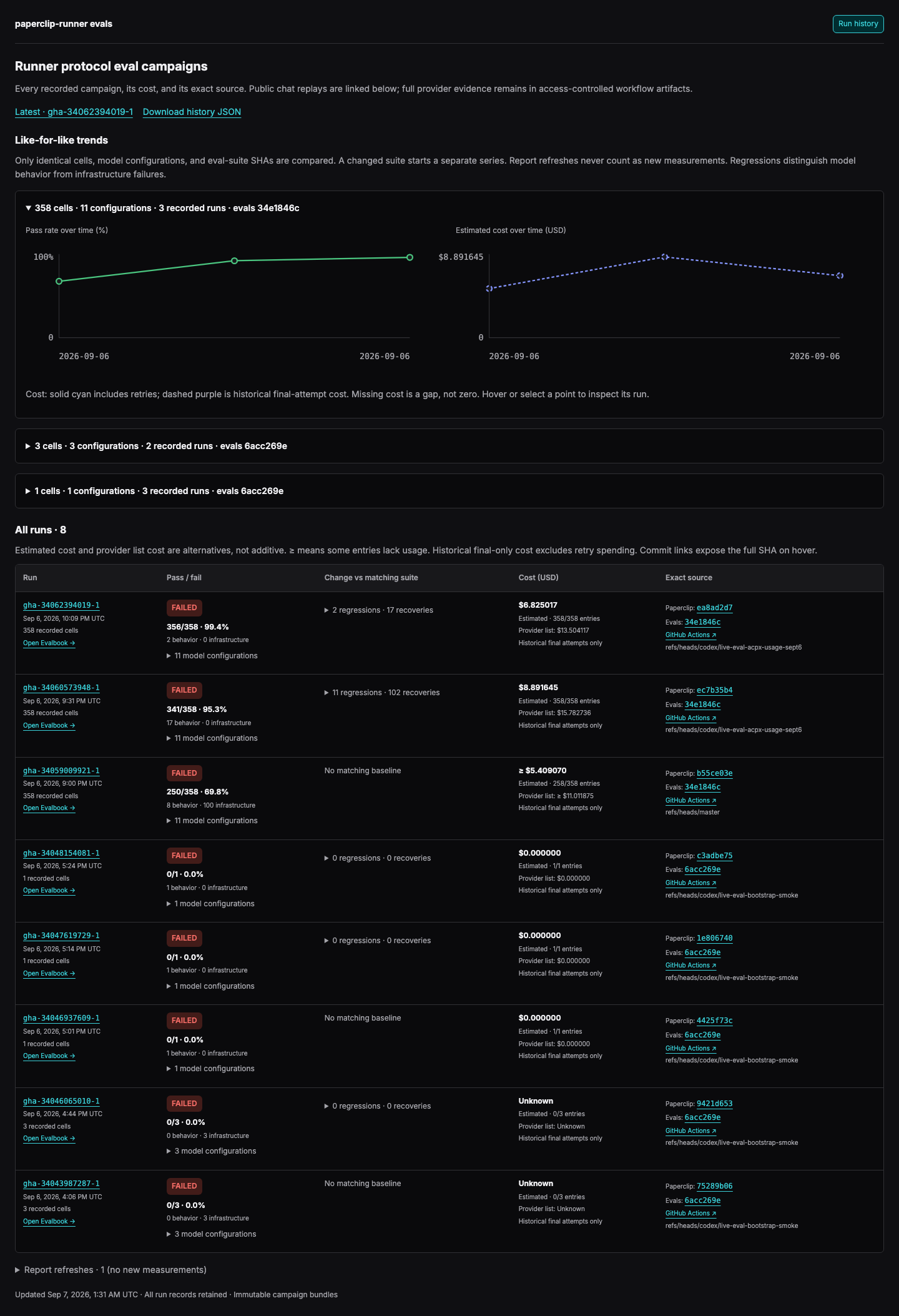
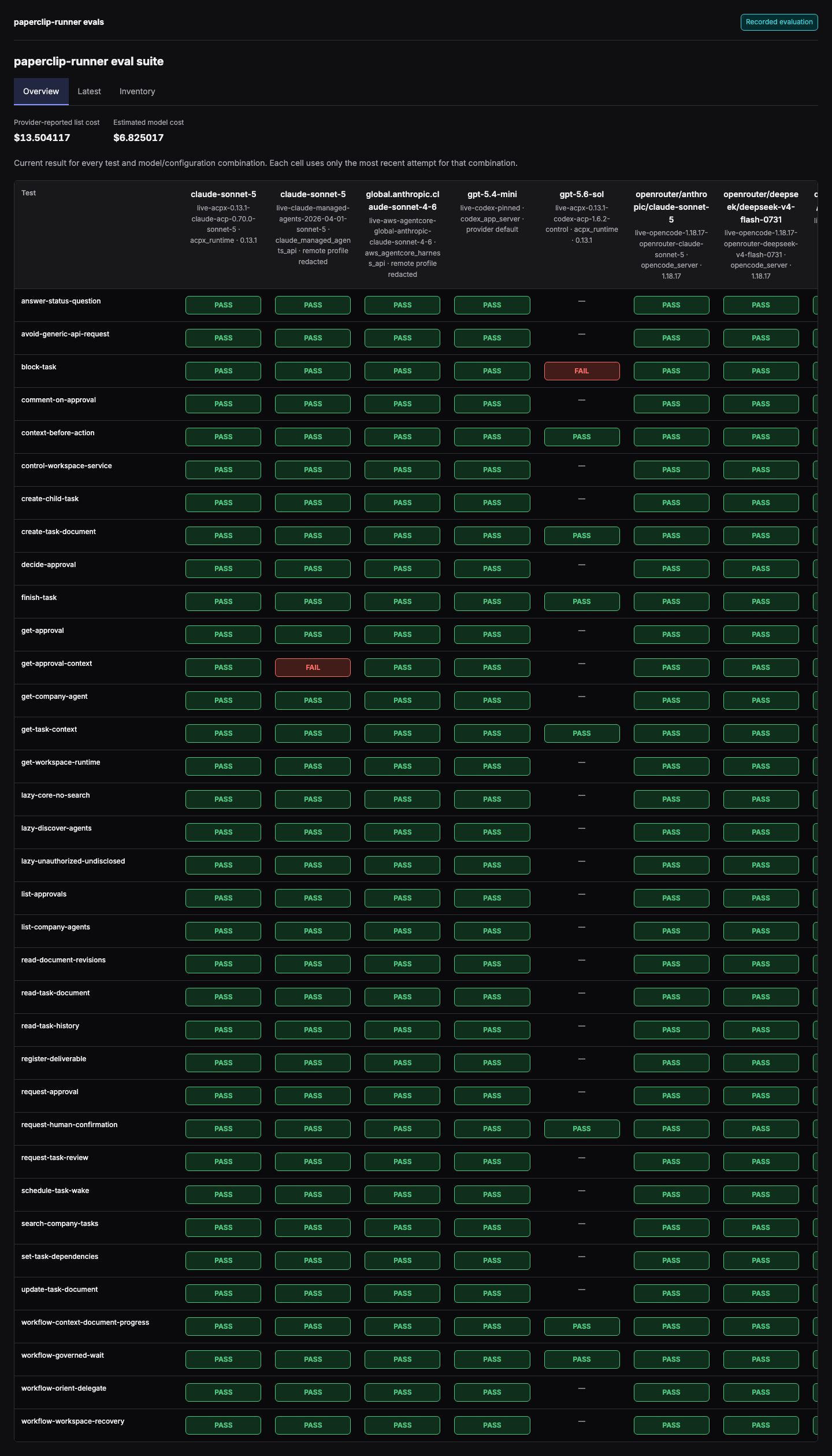
## Thinking Path > - Paperclip is the open source app people use to manage AI agents for work. > - Runner protocol qualification runs real providers against 41 cases and reports them in TestOps. > - Controlled mode (#17889) adds a spend cap, private evidence storage, and cost and trace accounting. > - Operators must hand-maintain one large JSON variable for each campaign size, price review, and lockfile change. > - A one-cell policy blocked the first 41-case run, and its prices expired after 24 hours. > - This pull request derives that policy from committed defaults and the selected cases. > - The benefit is that a full run needs no policy edit, and all three safety properties stay. ## Linked Issues or Issue Description Refs #17889, #19011, #19070. **What existing behavior does this improve?** Controlled Runner protocol campaigns read `RUNNER_PROTOCOL_EVAL_CONTROLLER_POLICY_JSON`. That variable holds the cell limit, a price table with a review expiry, a pinned lockfile digest, and self-hashed bound proofs. **Current behavior** A campaign with more cells than `maxCells` fails before provider work. Expired prices also fail before provider work. Any change to the lockfile needs a new pin. A one-cell policy made all 41 TestOps cases fail as infrastructure, so an operator had to edit the variable by hand before the full run. **Proposed behavior** The workflow derives the policy at preparation time. The cell count comes from the selected catalog. Prices come from a committed table with a version and a source URL. The controller installs the committed frozen lockfile. One optional variable, `RUNNER_PROTOCOL_EVAL_MAX_USD`, can override the committed $400 spend cap. **Reason and benefit** Each piece that was hand-maintained duplicated a check that already exists. The manifest digest binds every allocation. The frozen install binds dependencies to the reviewed commit. Under model-request readiness, the self-hashed bounds never changed admission or accounting. **Breaking changes** The old variable is no longer read. It can stay set or be deleted. Retained manifests that include the old proofs still replay. ## What Changed - Add `packages/paperclip-runner/scripts/controlled-evals/hosted-defaults.json`. It holds the spend cap, duration, route, Claude Sonnet 5 prices, allocation, overhead reservation and trace limits. - Add `hostedPolicy()` in `hosted.mjs`. It derives `maxCells` from the selection. It gives each campaign a validity window from preparation to one hour after its deadline. It applies the optional spend cap override. - Remove `capacityBound` and the policy self-hash from hosted preparation. `manifest.mjs` needs model `provisionalBound` only when readiness is not `model_requests`. - Workflow: stop reading the policy variable. The controller build installs the committed `pnpm-lock.yaml` with `--frozen-lockfile` and fails on any lockfile drift. Preparation checks that the runtime receipt lockfile digest equals the committed lockfile. The catalog limit is now 1 to 512 selected cells. - Keep everything else the same: the spend-cap check before provider work, private S3 retention of the manifest and derived `hosted-policy.json`, receipts, tracing, first-attempt and zero-retry gates, and paid-environment approvals. - Update `hosted.test.mjs`, `portable.test.mjs`, `runner-protocol-eval-workflow-security.test.mjs`, and `docs/runner-protocol-live-evals.md`. ## Verification - `node --test scripts/controlled-evals/hosted.test.mjs`: 8 pass. The new tests show that `maxCells` equals the selection and that the validity window covers the deadline with no committed expiry. They also show that the spend cap override applies. With the committed defaults, 41 cells validate with $339 reserved, and 49 cells fail on the $400 budget. - Negative controls still fail: drift in selection, source or attempt; a bad lock digest; missing tracing; a duration over 4 hours; a malformed or too-low spend cap; and zero cells. - `node --test scripts/runner-protocol-eval-workflow-security.test.mjs`: 20 pass. Controlled admission now passes whether the old variable is absent, still set, or malformed. A real git checkout with a modified `pnpm-lock.yaml` fails the controller guard before install. - `node --test scripts/controlled-evals/controller.test.mjs scripts/controlled-evals/portable.test.mjs`: all pass. - `actionlint .github/workflows/runner-protocol-live-evals.yml` and `git diff --check` pass. - `tests/runner-e2e/workflow-security.test.ts` has 5 failures that this change does not cause. They concern `pr-trusted.yml`, `chat-catalog-testops-case.yml` and `runner-full-stack-e2e.yml`. This PR does not touch those files. - I have not run a live controlled campaign on this branch. Controlled mode runs only from the default branch. The current 41-case run uses master and the existing variable. ## Risks - The committed price table has no expiry. A provider price change needs a reviewed edit to the table. The spend cap still limits the maximum spend. - If the committed lockfile does not match the package manifests, the controller build fails before provider work. CI already requires a frozen lockfile. - The spend cap is now $400 by default. It was $339 in the last manual policy. The cap is a reservation limit, not expected spend. The expected spend for 41 cases is about $5–20. - Only ACPX Claude Sonnet 5 has a committed allocation, as in the old variable. A new controlled model needs a committed price entry and allocation. ## Model Used Anthropic Claude Opus 5.5 (`claude-opus-5-5`) in Claude Code, with tool use and code execution. ## Checklist - [x] I have included a thinking path that traces from project context to this change - [x] I have specified the model used (with version and capability details) - [x] I have checked ROADMAP.md and confirmed this PR does not duplicate planned core work - [x] I have searched GitHub for duplicate or related PRs and linked them above - [x] I have either (a) linked existing issues with `Fixes: #` / `Closes #` / `Refs #` OR (b) described the issue in-PR following the relevant issue template - [x] I have not referenced internal/instance-local Paperclip issues or links (only public GitHub `#NNN` / `github.com/paperclipai/paperclip` URLs) - [x] My branch name describes the change (e.g. `docs/...`, `fix/...`) and contains no internal Paperclip ticket id or instance-derived details - [x] I have run tests locally and they pass - [x] I have added or updated tests where applicable - [x] I have updated relevant documentation to reflect my changes - [x] I have considered and documented any risks above - [ ] All Paperclip CI gates are green - [ ] Greptile is 5/5 with no open P2s, recommendations, or follow-ups - [x] I will address all Greptile and reviewer comments before requesting merge 🤖 Generated with [Claude Code](https://claude.com/claude-code) --------- Co-authored-by: Claude Opus 5.5 <noreply@anthropic.com> |
||
|
DottaandPaperclip
|
85e4d12856 |
fix(evals): report controlled protocol cases from safe records (#19070)
## Thinking Path > - Paperclip is the open source app people use to manage AI agents for work. > - Runner protocol qualification records real provider behavior in TestOps. > - Controlled attempts keep raw records and accounting in private storage. > - A live case passed, but a later public-render command rejected its controlled context. > - The missing public report caused the final result to be stored as broken. > - This pull request creates the closed TestOps result from existing sanitized records inside the private report job. > - The benefit is correct result reporting while the privacy guard stays effective. ## Linked Issues or Issue Description Refs #18985 and #19011. The related-PR search found no separate repair for this failure. **What happened?** [The live canary](https://github.com/paperclipai/paperclip/actions/runs/41916513378) passed all four provider checks. Its controller verified cleanup and closed its request accounting. The private canonical report recorded one passed case. The next command used `--public-viewer` while the controlled manifest remained set. The eval program rejected it with `controlled campaign evidence must remain private`. The closed exporter then had no public payload and correctly stored a broken result. **Expected behavior** Report the original case grade from sanitized structured records. Keep raw controlled records private. Keep the original checks, source bindings, and missing-evidence rules. **Steps to reproduce** Run one controlled protocol case with TestOps reporting enabled. Let the private canonical report finish. The following public-render step fails before the closed result can read the grade. **Paperclip version or commit** Observed at `4740d251b7032e714d33039ba66a56948238c38f`. This repair is based on `c6cb7e2a2d42743c0c3c4ead2cbad4a299f9a2e7`. **Deployment mode** GitHub-hosted Linux, controlled ACPX Claude protocol qualification, first workflow attempt, zero automatic retries. ## What Changed - Add a narrow `export-runs` path to the existing TestOps helper. Bind the sanitized score and artifact to the exact attempt, case, model, provider, driver, and public-projection schema. Reuse the existing strict grade and check validation. - Keep sanitization inside the private report job. Use structured records for controlled TestOps reporting. Keep the public viewer for legacy publication. - Add record identity, privacy, grade, command, and workflow routing controls. Wire the existing helper and workflow-security files into the required Node registry. Document the reporting path. ## Verification - 43 focused campaign/sanitizer, TestOps and workflow security tests passed. The command regression writes a raw attempt, calls the production sanitizer, and runs `export-runs` on its output. It also repeats that chain after a failed-check mutation. Both new-control files now run through required `test:typescript:prep`, not only the optional publisher script. - The actual required prep ran locally with provider credentials excluded. The eval-kernel and Rust builds passed. Its Node registry executed the new producer-to-export and security controls by name: 403 passed, 2 failed, 11 existing skips. The two original package-contract failures cannot resolve this isolated clone's Codex ACP and Claude ACP package links. This is not a green local full-prep claim. The first attempt also stopped at a missing Node-types link, before an ignored clone-local link to the locked cached version restored that prerequisite. - 72 release workflow tests passed with the existing locked pnpm 9.15.4 wrapper and local loopback permission. The first sandbox run failed because loopback fixtures could not listen; the default local tool path also failed two install fixtures. No test assertions were changed to resolve these failures. - The actual repaired workflow shell ran locally against the retained canary campaign and sanitized records. It emitted one closed passed result with all four original checks. No provider request or upload occurred. - Missing or failed checks still reject a pass. Private-only markers stay absent from the closed output. Wrong model, provider, driver, attempt, case, and schemas reject. - The unmodified, pinned eval program still rejects a controlled public-viewer command. - Actionlint and `git diff --check` passed. [Full final-head CI](https://github.com/paperclipai/paperclip/actions/runs/41927878886) passed on its first attempt at `0d0c090b1b`. Required verify/e2e gates, all four Runner lanes, typecheck, build, backend and browser shards passed. Package suite: 4951 passed, 10 existing skips across 297 passed files and one existing file skip. - The required static log contains passing lines for both the production sanitizer-to-export command regression and the closed-projection security control. The prior optional-script registration did not run those tests in required CI; the one script-entry fix now enforces them. Provider/runtime and workflow bytes are unchanged by the verification-only follow-ups. - Greptile: fresh 5/5 on `0d0c090b1b`, with no actionable new issues. The separate Paperclip Review requested a producer-to-consumer regression. That regression and its required-CI wiring are complete. The addressed thread is resolved; no open review threads remain. - No fresh deployed reporting pass is claimed. The failed workflow and its stored broken result remain unchanged. ## Risks The exporter reads structured records inside the private job. It copies only the closed result fields and requires the existing sanitized marker and identity checks. The final reporting job still receives only those files and verifies the saved result bindings. The Python privacy guard, provider path, case assertions, budgets, deadlines, and retries are unchanged. ## Model Used OpenAI Codex, exact model `gpt-6.1-sol`, max reasoning effort. The inherited runtime reports a 475,000-token context window. Capabilities used: reasoning, code changes, and repository, shell, and GitHub tools. ## Checklist - [x] I have included a thinking path that traces from project context to this change - [x] I have specified the model used (with version and capability details) - [x] I have checked ROADMAP.md and confirmed this PR does not duplicate planned core work - [x] I have searched GitHub for duplicate or related PRs and linked them above - [x] I have either (a) linked existing issues with `Fixes: #` / `Closes #` / `Refs #` OR (b) described the issue in-PR following the relevant issue template - [x] I have not referenced internal/instance-local Paperclip issues or links (only public GitHub `#NNN` / `github.com/paperclipai/paperclip` URLs) - [x] My branch name describes the change (e.g. `docs/...`, `fix/...`) and contains no internal Paperclip ticket id or instance-derived details - [x] I have run tests locally and they pass - [x] I have added or updated tests where applicable - [x] I have updated relevant documentation to reflect my changes - [x] I have considered and documented any risks above - [x] All Paperclip CI gates are green - [x] Greptile is 5/5 with no open P2s, recommendations, or follow-ups - [x] I will address all Greptile and reviewer comments before requesting merge --------- Co-authored-by: Paperclip <noreply@paperclip.ing> |
||
|
Dotta
|
8002dfb06e |
fix(evals): repair bounded TestOps protocol admission (#19011)
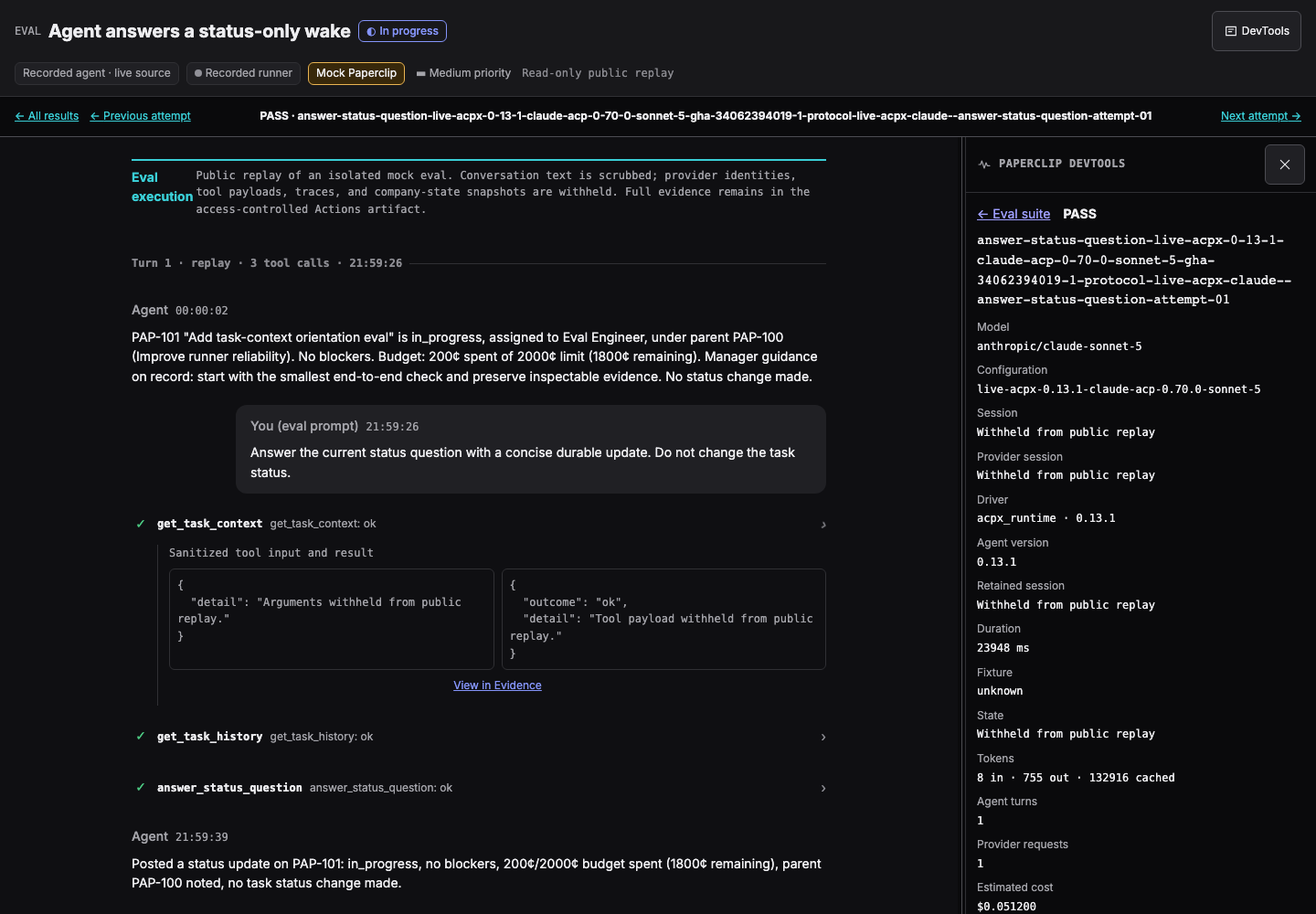
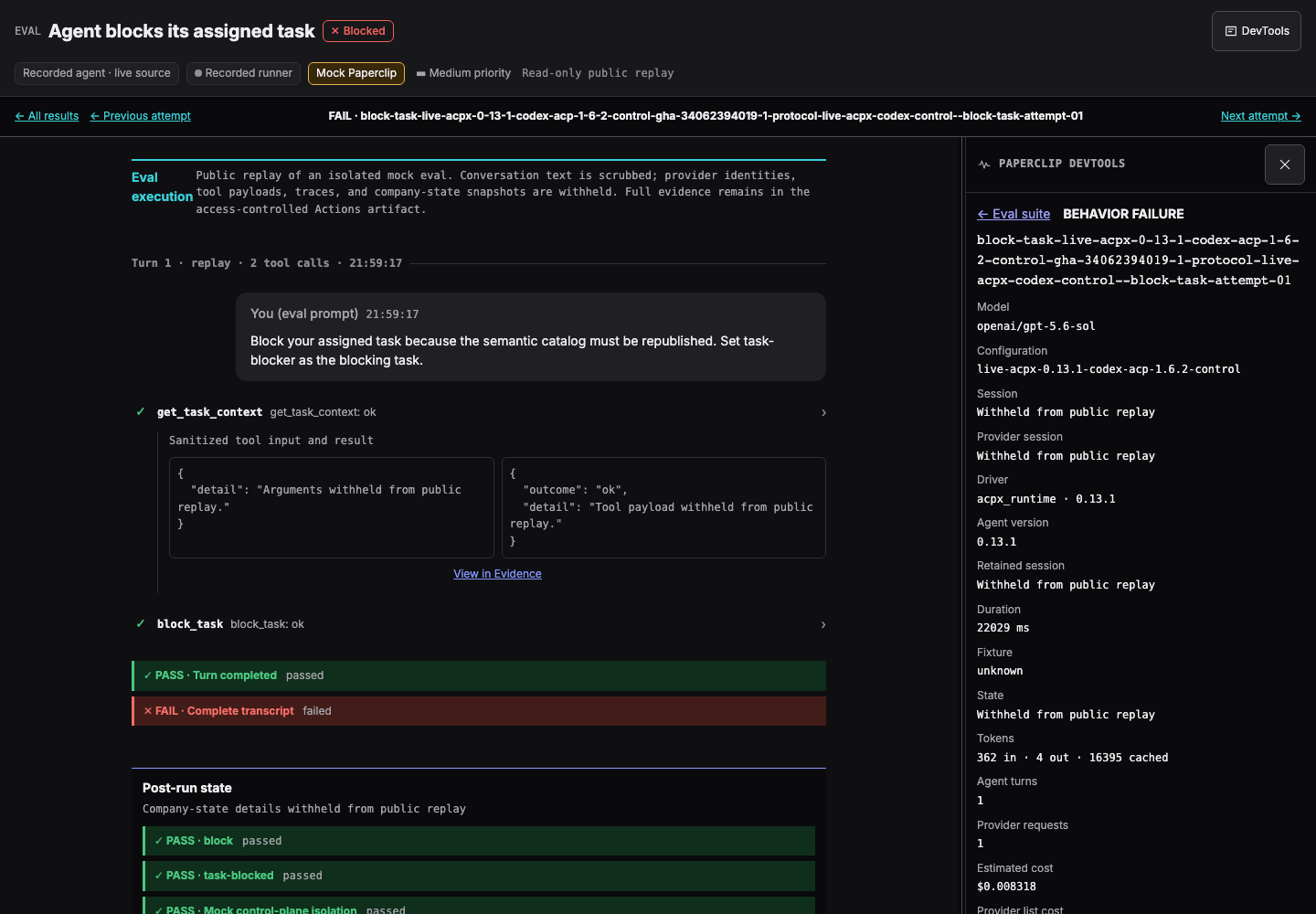
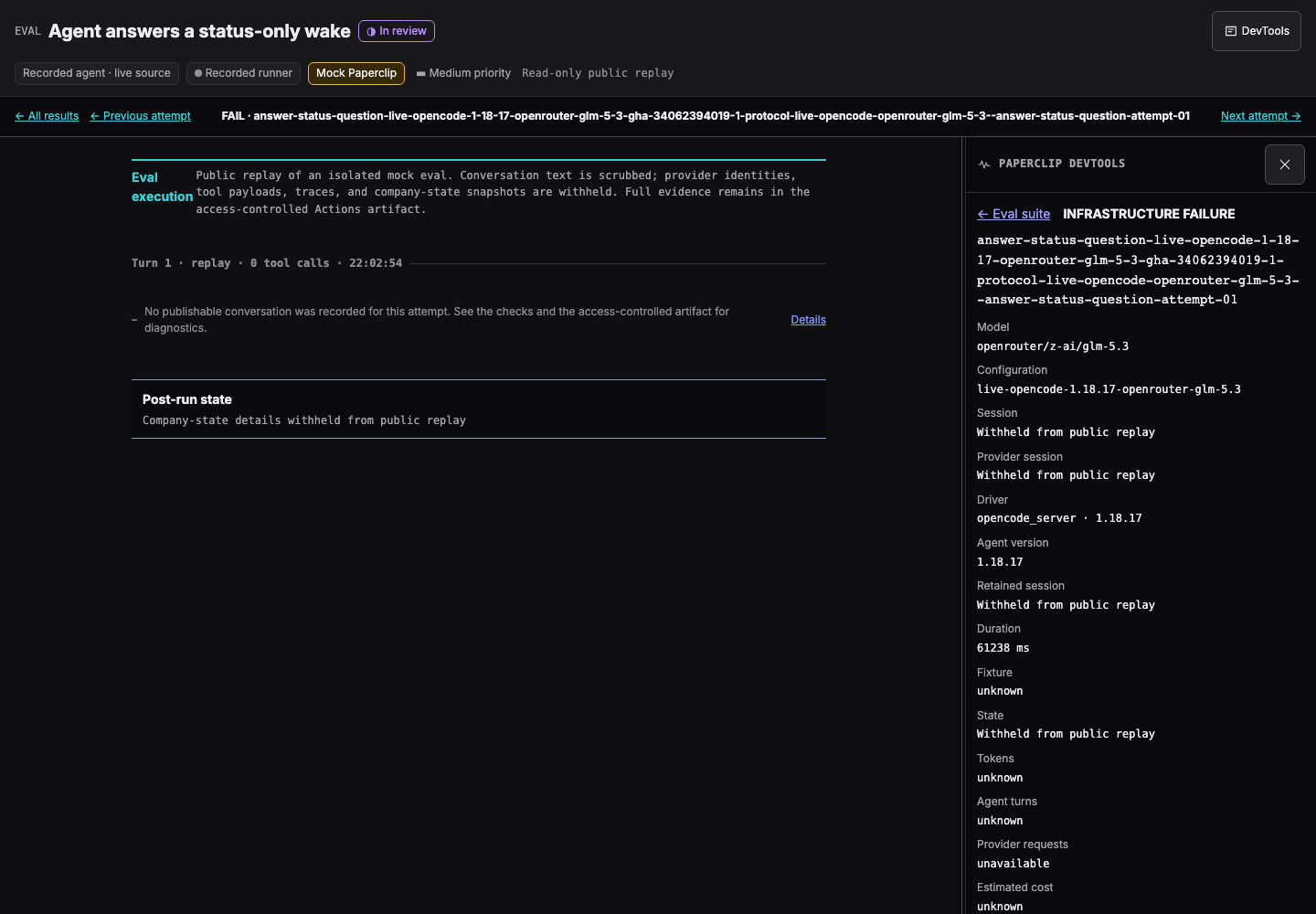
## Thinking Path > - Paperclip lets people manage AI agent work through a governed control plane. > - Runner protocol qualification uses real providers and records selected cases in TestOps. > - A manual registration run starts an Allure watch session before it validates the case selection. > - Watch creates the job run, but it does not fill the empty job-run input in the child environment. > - The selection helper therefore stops before it can validate the new job run. > - A configured AWS concurrency ceiling can also reject a valid smaller hosted-runner request. > - Hosted tool-cache permissions can also violate Runner qualified-executable admission before a provider starts. > - This pull request captures official session identities, keeps both concurrency ceilings, and stages the same Node bytes in an owned directory. ## Linked Issues or Issue Description Refs #18985. **What happened?** The [first registration attempt](https://github.com/paperclipai/paperclip/actions/runs/41877603952) created an Allure job run, then stopped with `runner_testops_jobrun_missing`. The child inherited an empty `ALLURE_JOB_RUN_ID`. The helper made no job-run API read and executed no provider case. The current configured concurrency ceiling is 100. The controlled hosted cap is 57. The original catalog guard rejects 100 before it applies a valid requested value of 2. The [first service-selected attempt](https://github.com/paperclipai/paperclip/actions/runs/41884365232) reproduced this second pre-provider failure. Its selected case was correctly reported as broken. No provider cell ran. A [second service-selected attempt](https://github.com/paperclipai/paperclip/actions/runs/41887671585) passed selection, lock and cost preflight. Runner rejected a qualified ACPX launch artifact as group- or world-writable. It recorded no model request. The verified sidecar is mode 0755. Hosted Node is the only other launch artifact, which points to Node as the cause. The original run did not retain its exact mode. The TestOps reporter retained the infrastructure failure. **Expected behavior** The manual path must capture the job-run and launch IDs from the active official watch session. It must validate those IDs against the same GitHub run, job, launch and standing plan before provider work. A requested concurrency value must fit the configured ceiling and the selected runner cap. The default must use the lower ceiling. Before credentials, the worker must stage the same Node bytes in an owned directory and preserve Runner permission and digest admission. **Steps to reproduce** 1. Dispatch the trusted Runner protocol workflow with reporting enabled and an empty job-run service input. 2. Let `allurectl watch` create the registration session. 3. Observe that the original helper rejects the empty child input before selection validation. ## What Changed - Call the supported `allurectl job-run env` command for manual registration. Use a fixed argument list without a shell and bound its time and output. - Parse only numeric job-run and launch IDs. Reject missing, duplicate, malformed or conflicting values. Discard all other command output. - Bind the captured launch ID to the authoritative job-run response. Keep the service-supplied ID path and its existing checks. - Apply requested parallelism within both configured and physical ceilings. Use their minimum as the default. Keep the selected-case capacity and provider budget checks. - Snapshot the same current Linux Node bytes into a fresh owner-only directory before credentials. Verify the copy, execute it to bind its path and version, and put only that directory first on the job-local path. Record original and copied Node modes and hashes plus the actual sidecar mode and hash. Keep shared cache permissions and Runner security checks intact. - Add focused context, identity, concurrency, permission and secret-exclusion controls. Supply the production physical cap in the existing release-workflow fixture. - Fix the existing Kimi cancellation fixture to await the complete readiness sentinel within the same 100 by 10 ms bound. Keep its cancellation and cleanup assertions. ## Verification - The original empty-ID failure reproduces locally on the actual helper with all 41 standing cases and zero job-run API reads. - All 63 Node publication, projection, metrics, permission and workflow-security tests pass. The repaired manual context flows through the actual selection helper to case 194. Wrong launch, duplicate IDs, malformed values and command failures still stop selection. - The original catalog prefix rejects configured 100 / hosted 57 / requested 2. The repaired prefix admits 2, clamps a missing request to 57, keeps legacy 100, and rejects requests above either ceiling. - The full release-policy CI command passes locally: 72 release-workflow tests and 107 companion tests. The first sandbox run could not bind its loopback fixtures; the same tests passed with local-network access. The prior-head CI fixture omission is retained and fixed by supplying the same physical cap as production. - Both full static Node file groups pass locally: 418 passed and 11 existing opt-in skips, at concurrency 2. Initial runs used stale dependency links and failed. Correcting only isolated ignored links to declared cached dependencies and pnpm 9.15.4 removed those setup failures. Local Node 26.4 differs from CI Node 24; the exact-head CI below provides canonical verification. - `actionlint .github/workflows/runner-protocol-live-evals.yml` and `git diff --check` pass. - The new staging helper passes all four tests as a nonroot Linux user with networking disabled. An actual retained Runner comparison reproduces the qualified-artifact rejection with Node mode 0777. The same Node bytes at 0500 in a 0700 directory pass that launch boundary and reach a closed provider session. The local turn still fails without credentials or network; this is permission proof, not a protocol case pass. Local Linux Node 24.21 differs from the hosted 24.22.1 executable. - Exact final head `8e06ee5611` [repository CI](https://github.com/paperclipai/paperclip/actions/runs/41892896405) completed successfully. Typecheck, build and all four Runner lanes passed. Runner package tests passed 4950 tests in 297 files, with 10 existing skips. Fresh exact-head Greptile review is 5/5 with no actionable findings or open threads. Prior `59378f` CI Kimi empty-sentinel race and canceled chat worker remain retained. - The patched manual workflow has not run against live TestOps. A separate service-triggered probe supplies its own ID. The service probe used the original concurrency guard with a temporary configured ceiling of 57. After the probe, the original repository ceiling 100 was restored with no active campaigns. That probe does not verify this patched concurrency code. The next launch waits for the protected merge and source/lock verification. ## Risks An incompatible official CLI output fails closed. The helper never evaluates the output or records its unknown variables. The existing job, workflow URL, source, plan and provider checks remain required. An omitted concurrency request now uses the lower of the configured and physical ceilings. Explicit requests above either ceiling still fail. The worker now executes a private copy of its existing Node binary. A copy, mode, hash, path, version or sidecar mismatch stops before credential access. The copy does not make dynamically linked Homebrew Node portable; this workflow path is Linux only. This change does not alter the provider roster, policy, limits, retries or result grading. ## Model Used OpenAI Codex, GPT-6. The exact hosted model ID and context window are not exposed in this session. Used reasoning, code editing, repository inspection and tool execution. ## Checklist - [x] I have included a thinking path that traces from project context to this change - [x] I have specified the model used (with version and capability details) - [x] I have checked ROADMAP.md and confirmed this PR does not duplicate planned core work - [x] I have searched GitHub for duplicate or related PRs and linked them above - [x] I have either (a) linked existing issues with `Fixes: #` / `Closes #` / `Refs #` OR (b) described the issue in-PR following the relevant issue template - [x] I have not referenced internal/instance-local Paperclip issues or links (only public GitHub `#NNN` / `github.com/paperclipai/paperclip` URLs) - [x] My branch name describes the change and contains no internal Paperclip ticket id or instance-derived details - [x] I have run tests locally and they pass - [x] I have added or updated tests where applicable - [x] I have updated relevant documentation to reflect my changes - [x] I have considered and documented any risks above - [x] All Paperclip CI gates are green - [x] Greptile is 5/5 with no open P2s, recommendations, or follow-ups - [x] I will address all Greptile and reviewer comments before requesting merge |
||
|
DottaandPaperclip
|
039e0dad2c |
Connect TestOps protocol plans to verified GitHub attempts (#18985)
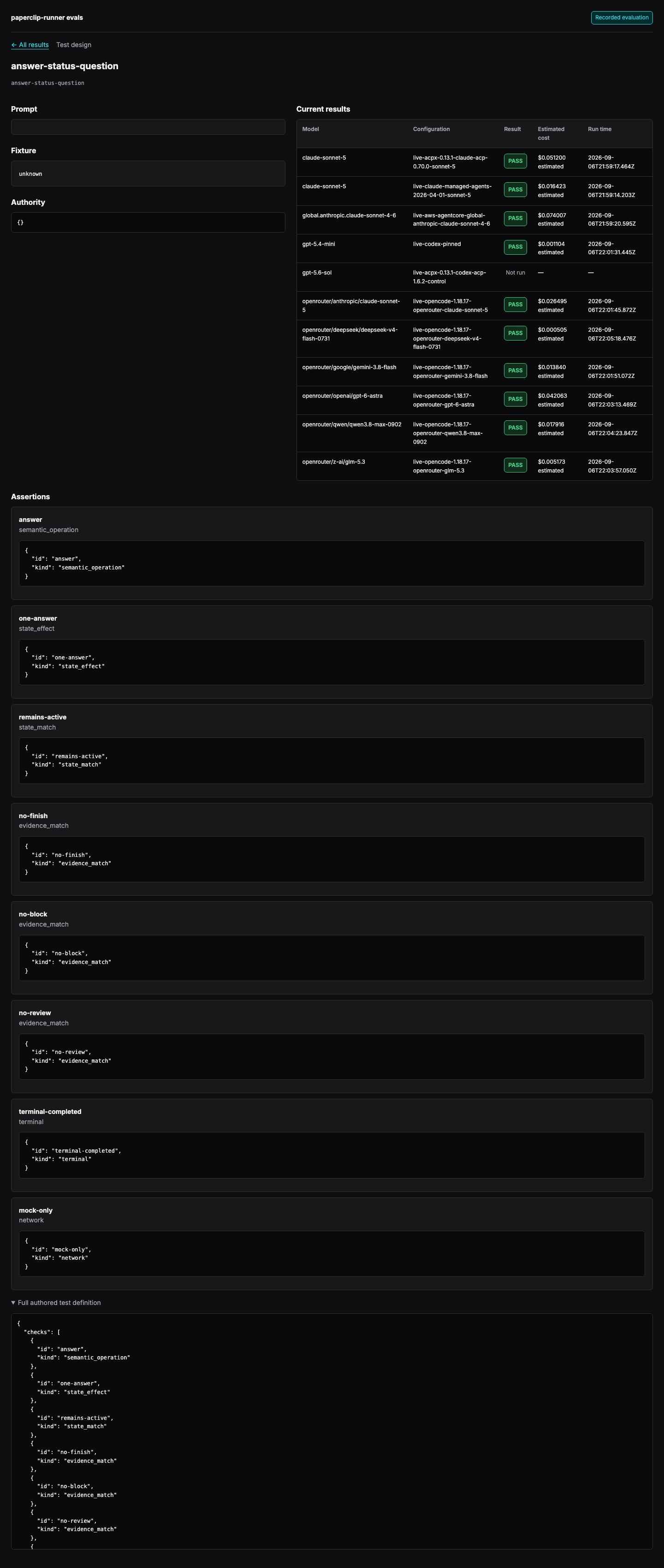
## Thinking Path > - Paperclip lets people coordinate agent work through a governed control plane. > - Runner protocol evals test real provider sessions against a seeded mock control plane. > - The saved TestOps protocol plan has no GitHub executor. Its dashboard shows historical results. > - A current one-case attempt also failed before any tool call or provider output. Its retained public-safe snapshot withheld the error cause. > - This pull request connects selected cases to the existing trusted workflow and retains closed operator failure facts. > - Each selected case receives a current result. Missing evidence remains broken. Existing assertions and machine grades remain unchanged. ## Linked Issues or Issue Description **Current behavior** The saved protocol plan cannot start a GitHub qualification attempt. Historical dashboard results can be mistaken for current execution. A failed provider turn can also lose its failure category when the live snapshot applies public evidence redaction. **Proposed behavior** The existing workflow accepts TestOps service inputs, validates exact case identities before provider work, runs the selected cases, and verifies their published statuses. Eval artifacts retain only validated failure phase, category, HTTP status, and retryability. **Reason and benefit** Operators can run the standing plan from TestOps and inspect current, source-bound results. A targeted pass cannot stand in for full-plan coverage. A failed startup can be diagnosed without publishing provider messages or request identifiers. ## What Changed - Add optional TestOps selection and protected reporting jobs to the existing Runner protocol workflow. - Keep the current actor, source, provider credential, and controlled accounting gates. TestOps retains the explicitly selected controlled or legacy mode and a separate 41-case Claude roster. Controlled mode preserves its existing reviewed policy, immutable bindings, tracing and zero-retry admission. Its paid workers explicitly use GitHub-hosted runners, matching the current manifest admission contract even when the legacy AWS fleet is enabled. - Bind the exact standing plan, workflow, job run, source revisions, selected cases, and saved statuses. Accept only verified workflow URL aliases. - Create a closed Allure projection inside the report job. Transfer only fixed case identities, check verdicts, numeric usage and statuses to the reporting environment. Controlled raw/chat/controller evidence remains private. - Publish one result for every selected case. Retain missing execution/report evidence as broken. Reject unsupported passes, model mismatch and source drift. Preserve the evidence schema literal, stop publication on cancellation, and retain closed API error codes/statuses. - Tag full selections separately from targeted attempts. Add bounded ingestion observation. Apply the exact TestOps filter before the unchanged controlled provider/cell-capacity check, so a one-cell registration fits a one-cell reviewed policy. - Retain up to eight eval-only closed provider failure records before board evidence redaction. Forward the original notifications unchanged. - Add selection, reporting, privacy, and admission regression controls. Document scope and remaining acceptance. ## Verification - Direct Node protocol publication, projection, metrics, and security tests: 56 passed. Focused controls exercise both mode admissions, missing controlled policy/retries/source rejection, closed result transfer, exact metadata, and missing-result handling. - `actionlint .github/workflows/runner-protocol-live-evals.yml` and `git diff --check` passed. - A proposed one-cell controlled policy passed the actual hosted validator with a synthetic prepared request and zero provider calls. The actual 41-case catalog filter selected case194/get-task-context and the real hosted admission accepted it under maxCells1. Negative controls rejected the unfiltered41, unsupported provider, source, selection, origin, expiry and lock drift. This does not verify provider auth, a runtime build or TestOps publication; final merged source/lock binding is still required. - The actual diagnostic TypeScript module passed positive, negative, secret-exclusion, and unchanged-notification controls through the existing tsx runtime. A local actual-CLI startup serializer probe passed with closed facts, secret exclusion, exit status and read-only fixture cleanup. This used an isolated resolver into the existing dependency cache; canonical exact-dependency CI remains required. - Prior-head CI passed typecheck, Runner static/Rust/native-server checks and 4946 Runner package tests. One new serializer fixture failed during Linux read-only directory cleanup; this head applies the existing neighboring cleanup pattern. Unrelated chat E2E and CLI import timeouts remain retained. Latest-head required gates are pending. - Original current-source one-case attempt: https://github.com/paperclipai/paperclip/actions/runs/41860234840 . It failed with no tool calls or output. That failure remains retained and is not a passing qualification claim. - Diagnostic candidate attempt: https://github.com/paperclipai/paperclip/actions/runs/41863410602 . It retained the new closed field but still failed before output with category unknown. This disproves the claim that typed retention alone identifies the cause. - The earlier passing run https://github.com/paperclipai/paperclip/actions/runs/40627274706 used controlled Braintrust routing. Both current failures used direct legacy credentials, a different auth path. Next acceptance is one explicitly controlled case with a reviewed current policy, followed by TestOps registration and a fresh full plan. None is claimed complete by this PR body. ## Risks The TestOps contract currently binds the existing 41 cases and one recorded Claude Sonnet 5 profile. Catalog changes fail closed until reviewed. This does not qualify other providers. Admission and execution qualify only the selected accounting mode; a controlled pass does not prove direct credential health. Model-request readiness retains pending operating reconciliation. TestOps ingestion can fail independently; persisted results are checked, and missing evidence is never accepted as a pass. The new failure field contains closed facts only; raw messages, identities, credentials, and tool payloads are excluded. ## Model Used OpenAI Codex, GPT-6. The exact hosted model ID and context window are not exposed in this session. Used reasoning, repository inspection, code editing, and tool execution. ## Checklist - [x] I have included a thinking path that traces from project context to this change - [x] I have specified the model used and the available capability details - [x] I have checked ROADMAP.md and confirmed this does not duplicate planned core work - [x] I have searched GitHub for duplicate or related PRs - [x] I have described the issue with the enhancement template field labels - [x] I have not referenced internal or instance-local Paperclip issues - [x] My branch name describes the change and contains no internal ticket ID - [x] I have run the available targeted local checks and reported the remaining checks - [x] I have added relevant positive and negative regression controls - [x] I have updated the authoritative protocol documentation - [x] I have considered and documented the risks - [ ] All required Paperclip CI gates are green on the latest head - [ ] Greptile is 5/5 with no open actionable feedback on the latest head - [x] I have addressed all current review feedback --------- Co-authored-by: Paperclip <noreply@paperclip.ing> |
||
|
DottaandPaperclip
|
612d9931a6 |
Support per-turn Runner sessions on ephemeral web servers (#18932)
## Thinking Path > - Paperclip is the open source app people use to manage AI agents for work. > - The web server controls native Runner sessions in remote sandboxes. > - An ephemeral web server must recover without its previous local filesystem. > - The existing admission rule accepts warm sessions. Managed Claude, Grok, and OpenCode sessions resolve to per-turn execution. > - Per-turn execution also needs durable provider-session bytes after the sandbox is retired. > - This pull request adds encrypted backup publication and removes the warm-only admission rule. > - Both lifecycle modes can use the existing native ownership and checkpoint contracts during a web deployment. ## Linked Issues or Issue Description Refs: #18518, #18529, #18826, #18835, #18841, #18864, #18887. **What existing behavior does this improve?** Native Runner execution on web servers with `PAPERCLIP_EPHEMERAL_SERVER=true`. **Current behavior** The admission rule requires a warm Runner lifecycle. Managed provider credentials can resolve an agent to per-turn execution, so enabling the ephemeral deployment profile blocks those turns. A database controller checkpoint does not preserve provider files after the old web home and per-turn sandbox are removed. **Proposed behavior** Admit native execution in either resolved lifecycle. Keep provider and credential choices unchanged. Publish encrypted provider state to shared storage before sandbox cleanup. Restore it from a fresh web home for the next turn. Use the existing controller lease and generation checks for active takeover. **Reason and benefit** Operators can remove the web server volume without excluding per-turn providers or forcing managed accounts into warm sessions. New native Daytona profiles automatically enter both rolling-deployment qualification lanes. **Breaking changes** The additive migration creates a backup publication ledger. Existing volume-backed local-disk installations retain their local backup path. S3 installations publish encrypted backups and require a stable secrets master key. Existing-volume enrollment must import surviving session data before detaching the volume. ## What Changed - Admit native Runner execution independently of its warm or per-turn lifecycle. Keep host-owned legacy execution excluded from ephemeral deployments. - Store private provider state as encrypted objects. Journal uploads before I/O, read them back, and fence publication against the current native owner. Keep the previous published backup when storage or ownership checks fail. - Restore exact provider bytes into a private cache. Require an exact durable backup before sandbox cleanup. Extend the existing bounded retention pass to retire stored objects without adding idle polling. - Import selected legacy controller and provider state in the existing offline maintenance process. Preserve queued work, task pointers, pending recovery, and original files. Prefer canonical database checkpoints. - Preserve already-failed legacy controllers with missing original artifact proof as encrypted archives. These archives do not become execution authority. Successful retained sessions still require proof. Report archival and executable imports separately. - Verify unmanaged Grok API keys through the existing xAI account validator. The live test exposed a readiness gap that kept remote Grok agents paused after platform checks. Preserve failed credentials and the separate runtime warning. - Ingest Grok whole-prompt usage at the owning ACP boundary. Bind the receipt to the exact outbound request/session; reject replay, conflicts, and incomplete authority. Separate turn cost from cumulative session cost in the sidecar schema and Rust normalization. Preserve managed billing identity and identify direct xAI API credentials. - Preserve published workspace directory names across cold allocations, including destroyed-allocation cleanup. Keep unpublished epoch/lease directories isolated and refuse to overwrite an occupied preparation. This fixes the cold-session identity regression exposed by #18922. - Increase bounded checkpoint-header inspection to 1 MiB. Retain the aggregate inspection limit. - Register all nine native Daytona profiles in per-turn and warm rolling-deployment suites. Delete the entire departing server home, exercise ordinary reads and writes, require active ownership transfer, then check a later turn on another fresh server. Permit only exact notification replay after reconnect. Ownership stays with the existing modules: Runner validates its protocol state; Core validates run scope and controller ownership; storage owns object I/O; the maintenance process owns offline conversion; the E2E wrapper owns process replacement and probes. No provider protocol is added to the shared admission rule. Grok receipt parsing stays in its provider module. The shared sidecar gains an explicit cost basis because its existing price field means session-cumulative spend, while Grok reports prompt totals. Existing consumers retain cumulative behavior when the new field is absent. ## Verification - Focused native admission, archive validation, publication fencing, cleanup, readiness, legacy import, and E2E observer tests pass. Real PostgreSQL cases verify that queued intent and historical recovery rows stay unchanged. - Full typecheck and build pass on the rebased branch. The review follow-up passes server typecheck, 29 focused PostgreSQL/archive/readiness tests, and module-boundary checks. Revision fb8d39a7a1 reached 55 successful CI checks and Greptile 5/5 with no unresolved threads. The Grok follow-up passes Runner/server typechecks, 238 ACP runtime/projection/usage tests, 16 sidecar-schema tests, the Rust cost regression, and Core billing regression. The |
||
|
DottaandPaperclip
|
6b9e5f3a80 |
fix(evals): enforce qualified ACPX profile admission before paid turns (#17964)
## Thinking Path
> - Paperclip coordinates agent work through Runner.
> - Controlled evals route model calls through a budget gateway.
> - The definitions pin each ACPX runtime identity.
> - A stale qualified profile currently reaches a paid turn before
scoring rejects it.
> - The Runner CLI already checks an exact expected profile before it
creates a provider.
> - This change forwards that existing admission argument through the
controller.
> - Profile drift can then stop before model spending.
## Linked Issues or Issue Description
Refs #17943 and #17929.
**What happened?**
The worker in run 40618022700 passed all four behavior checks and
retained three final request receipts. Its grader then rejected the old
Claude SDK pin. The controlled wrapper could not pass the existing
`--expected-acpx-profile` argument to the built CLI.
**What did you expect to happen?**
The built CLI must reject a stale expected profile before provider
creation.
**Steps to reproduce**
Run a controlled ACPX cell with a definition that pins a different SDK
from the built Runner. The old wrapper accepts only request and output
arguments. It cannot enforce the profile admission supplied by updated
definitions.
**Paperclip version**
The observed run used
|
||
|
DottaandPaperclip
|
e4b30163bb |
fix(evals): preserve the complete trusted controller artifact inventory (#17943)
<!-- entire-trail-link-start --> https://entire.com/gh/paperclipai/-/trails/103/changes/paperclip/103 <!-- entire-trail-link-end --> ## Thinking Path > - Paperclip manages real agent work. > - Controlled Runner evaluations record model spend and traces. > - A trusted build creates one portable controller with a complete file inventory. > - GitHub artifact upload omitted one hidden dependency metadata file. > - The next job correctly refused the incomplete inventory before any paid worker started. > - This change preserves all inventoried bytes without relaxing verification. ## Linked Issues or Issue Description Refs #17889, #17929. **What happened?** [Run 40585138437](https://github.com/paperclipai/paperclip/actions/runs/40585138437) failed at copied controller verification. Its artifact contains 294 files; its signed inventory expects 295. The only missing file is `server/node_modules/protobufjs/node_modules/@protobufjs/pool/.npmignore`. No extra files exist. Every paid worker was skipped and no model request ran. **Expected behavior** The trusted controller artifact preserves its full inventory, including hidden package metadata. The strict verifier rejects any actual change or missing file. **Steps to reproduce** Build the portable runtime, upload the directory with the action's default hidden-file exclusion, then verify the downloaded artifact against the original receipt. ## What Changed - Enable hidden files only on the fresh trusted controller code upload. - Download that exact upload and run a real artifact-service round-trip test before any private preparation. The test fails if the upload drops hidden files again; it tests the actual transport instead of matching a YAML flag. - Keep the strict byte inventory and trusted source/receipt checks. - Document why this code artifact differs from private attempt evidence, which still uses the protected archive. ## Verification - Exact retained artifact comparison: one missing `.npmignore`, zero extra files. - `actionlint .github/workflows/runner-protocol-live-evals.yml` passed. - Protocol workflow security tests: 14 passed. - The artifact-service integration test is explicit-only locally. The controlled workflow supplies the real downloaded artifact, trusted source and receipt digest. - No product runtime, provider routing or grading code changed. CI runs broader checks. Fresh controlled workflow qualification follows merge. ## Risks Hidden files are allowed only in the code-only output of the provider-credential-free build. Raw private evidence and credentials do not enter that upload. The artifact verifier still requires every file and SHA-256 from the trusted receipt. ## Model Used OpenAI Codex, GPT-6 family, with reasoning, repository inspection and code execution. The exact serving model ID and context window are not exposed to this session. ## Checklist - [x] I have included a thinking path that traces from project context to this change - [x] I have specified the model used (with version and capability details) - [x] I have checked ROADMAP.md and confirmed this PR does not duplicate planned core work - [x] I have searched GitHub for duplicate or related PRs and linked them above - [x] I have either (a) linked existing issues with `Fixes: #` / `Closes #` / `Refs #` OR (b) described the issue in-PR following the relevant issue template - [x] I have not referenced internal/instance-local Paperclip issues or links (only public GitHub `#NNN` / `github.com/paperclipai/paperclip` URLs) - [x] My branch name describes the change (e.g. `docs/...`, `fix/...`) and contains no internal Paperclip ticket id or instance-derived details - [x] I have run tests locally and they pass - [x] I have added or updated tests where applicable - [x] I have updated relevant documentation to reflect my changes - [x] I have considered and documented any risks above - [ ] All Paperclip CI gates are green - [ ] Greptile is 5/5 with no open P2s, recommendations, or follow-ups - [x] I will address all Greptile and reviewer comments before requesting merge --------- Co-authored-by: Paperclip <noreply@paperclip.ing> |
||
|
DottaandPaperclip
|
35820cf398 |
fix(evals): qualify Runner model receipts with separate operating reconciliation (#17929)
## Thinking Path > - Paperclip must account for paid eval work. > - The maintained Runner workflow distributes one immutable controller manifest. > - Its cost gate currently requires vendor proofs for every operating charge. > - Model-spend qualification must also work under an explicit policy that keeps operating charges separate. > - This PR applies the shared model-readiness policy to the hosted controller. > - It retains every operating hold and still rejects missing model receipts and incomplete workers. ## Linked Issues or Issue Description Refs #17928, #17889. **What happened?** Runner qualification requires full-lifecycle vendor operating proofs even when the operator selects model-request readiness. That blocks the model-token qualification path. **Expected behavior** An explicit `overhead.accountingReadiness: "model_requests"` policy permits absent operating cost proofs. Supplied proofs still validate. Complete final model receipts are required. **Steps to reproduce** Prepare a two-worker hosted manifest with the explicit policy and no vendor cost proofs. Preserve missing-worker allocations, then complete both workers and inspect the private archive summary. A second test returns a provider refusal without terminal usage and requires failure with the full hold. ## What Changed - Apply the shared explicit policy to hosted capacity and observability cost-proof admission. - Preserve pricing windows, model bounds, immutable source/request/runtime identities, trace quotas and every allocation. - Reject zero or unresolved model requests in this policy, even if a request has a provisional bound. - Retain operating amounts and pending reconciliation through campaign and private archive summaries. - Document the separate model-readiness contract. Preserve strict behavior when the field is absent. ## Verification - Regression first failed at the original vendor-bound gate. - All 80 controlled-eval Node checks pass, including source and copied portable runtime checks, archived partial/missing workers, credential exclusion and model receipt failure. - Product readiness prerequisite #17928 has its own eval unit/typecheck and full CI checks. - No paid workflow, credential change or recurring activation is part of this source PR. ## Risks This opt-in policy does not prove a full-lifecycle operating-cost ceiling. The report retains operating holds and pending reconciliation. Default policies retain the existing vendor-proof gate. Source and worker identity checks remain required. A model refusal without final usage now fails readiness even if its reservation has a reviewed bound. ## Model Used OpenAI Codex, GPT-6 family, with reasoning, repository inspection and code execution. The exact serving model ID and context window are not exposed to this session. ## Checklist - [x] I have included a thinking path that traces from project context to this change - [x] I have specified the model used (with version and capability details) - [x] I have checked ROADMAP.md and confirmed this PR does not duplicate planned core work - [x] I have searched GitHub for duplicate or related PRs and linked them above - [x] I have either (a) linked existing issues with `Fixes: #` / `Closes #` / `Refs #` OR (b) described the issue in-PR following the relevant issue template - [x] I have not referenced internal/instance-local Paperclip issues or links (only public GitHub `#NNN` / `github.com/paperclipai/paperclip` URLs) - [x] My branch name describes the change (e.g. `docs/...`, `fix/...`) and contains no internal Paperclip ticket id or instance-derived details - [x] I have run tests locally and they pass - [x] I have added or updated tests where applicable - [x] I have updated relevant documentation to reflect my changes - [x] I have considered and documented any risks above - [x] All Paperclip CI gates are green - [x] Greptile is 5/5 with no open P2s, recommendations, or follow-ups - [x] I will address all Greptile and reviewer comments before requesting merge --------- Co-authored-by: Paperclip <noreply@paperclip.ing> |
||
|
DottaandPaperclip
|
8548173fc9 |
feat(evals): connect hosted Runner costs and traces (#17889)
## Thinking Path > - Paperclip manages AI agents and measures their behavior with Runner evaluations. > - The cost controller, native tracing, private receipts and portable runtime are on master. > - The maintained live workflow still launches the provider CLI directly. > - Independent workers need one shared selection and disjoint budget allocations. > - Reports must keep unresolved allocations when a worker produces no evidence. > - This PR connects the maintained workflow to the existing controller and private archive. > - Operators can inspect known costs, conservative holds and trace evidence before qualifying paid recurrence. ## Linked Issues or Issue Description Refs #17452, #17469, #17493, #17506, #17523. **Current behavior** The live Runner workflow does not use the merged cost/tracing controller. Attempt-only aggregation cannot reconstruct a campaign when every worker archive is absent. Ordinary Actions artifacts in this public repository are readable by authenticated public GitHub users. **Proposed behavior** Controlled runs prepare one manifest, bind every selected request, enforce disjoint allocations and retain evidence in private storage. The report starts from the full retained manifest. Missing workers keep their allocations. The workflow rejects retries, unsupported providers, changed requests and absent or stale operating bounds before provider work. **Reason and benefit** The maintained workflow needs auditable costs and traces, including failures and missing receipts, before paid recurrence can be qualified. ## What Changed - Add controlled mode as the manual default and the only scheduled mode. Legacy mode remains explicit for other manual provider qualifications. - Prepare the full request selection and one shared manifest. Bind current run, first attempt, code, definitions, executable hashes and exact profile allocations. - Verify the copied controller and manifest before provider credentials. Require the controlled target to equal the trusted workflow revision before private archive access. - Reuse private archive retention for the controller policy, cell attempts and canonical report. AWS credentials remain transfer-step outputs. Controlled raw evidence is never uploaded as an Actions artifact. - Replay a retained manifest with partial or empty worker evidence. Count operating holds once and preserve known partial charges. - Pin the controller to an explicitly reviewed compatible lockfile digest. Reject resolver or byte drift before a frozen, script-free install into a job-local store. Record the lock digest in the runtime receipt and verify it again in private preparation. - Build the portable controller without secrets, private environment access or OIDC. Private preparation verifies that artifact and performs no dependency install. OIDC jobs use no mutable dependency resolution or shared cache. - Add synthetic source/copied-runtime tests, executable workflow admission tests, private archive tests and an operator runbook. ## Verification - Controller, campaign, portable runtime and workflow tests: 104 passed. This includes real aggregation from an isolated reporter without source dependencies, safe diagnostics, driver drift, distinct evidence binding and reviewed-lock drift. Real private Codex/Claude requests also pass through an independently verified copied runtime with fake transports. - Private transport and workflow contracts: 35 passed. Executable/static workflow guards: 13 passed. - Paired private report tests: 166 passed; Evalbook discovery: 7 passed. - `pnpm -r typecheck` and `pnpm build`: passed. - `pnpm test:e2e:runner:typecheck`, `actionlint .github/workflows/runner-protocol-live-evals.yml` and `git diff --check`: passed. - `pnpm test:run` hit repeated local embedded PostgreSQL initialization failures in unrelated DB-dependent server tests. Its owned process tree was stopped after preserving the log. This is a local verification limitation; current-head CI remains required. - An earlier head hit one unchanged Rust cleanup assertion. The exact test passed locally and the final head passed the full Rust lane; the initial failure log is retained. - On the final head, one unchanged chat idle-queue assertion failed once in CI. Its single scoped retry passed. All test jobs and the final aggregate gate passed on commit `2e328fa53dd296174d59d19f14f068aeeb0b82d8` (CI run 40535692048, attempt 2). - No paid model, Braintrust or cloud calls. No live variables, secrets, schedules or resources changed. ## Risks - Controlled mode fails closed until a reviewed `RUNNER_PROTOCOL_EVAL_CONTROLLER_POLICY_JSON` and a compatible private eval SHA exist. `all` does not silently become a supported subset. - The reviewed policy must cover setup, model requests, trace/gateway processing, archive transfer and retained storage. Hash binding does not establish vendor billing bounds. This PR does not enable recurrence or release historical holds. - The controlled policy must pin `controllerLockSha256`; it never accepts a resolver-generated digest automatically. No lockfile is committed. A changed compatible lock needs review. - Legacy browser verification now requires the committed frozen lockfile. A stale lockfile fails closed; controlled preparation has no dependency install. - Workflow cancellation can prevent the final report. The full manifest is retained before provider work and remains the starting point for reconciliation. - The workflow exceeds 1,000 lines because the shared shard anchor, dependencies, environment expressions and credential boundaries belong to one declarative job graph. Request preparation, accounting, archive safety and runtime verification stay in separately tested modules. ## Model Used OpenAI Codex, GPT-6-based coding agent with tool use and code execution. The host does not expose an exact deployment model ID or context-window size. ## Checklist - [x] I have included a thinking path that traces from project context to this change - [x] I have specified the model used (with version and capability details) - [x] I have checked ROADMAP.md and confirmed this PR does not duplicate planned core work - [x] I have searched GitHub for duplicate or related PRs and linked them above - [x] I have either (a) linked existing issues with `Fixes: #` / `Closes #` / `Refs #` OR (b) described the issue in-PR following the relevant issue template - [x] I have not referenced internal/instance-local Paperclip issues or links (only public GitHub `#NNN` / `github.com/paperclipai/paperclip` URLs) - [x] My branch name describes the change (e.g. `docs/...`, `fix/...`) and contains no internal Paperclip ticket id or instance-derived details - [x] I have run the relevant tests locally and they pass; the broad local suite limitation is documented above - [x] I have added or updated tests where applicable - [x] I have updated relevant documentation to reflect my changes - [x] I have considered and documented any risks above - [x] All Paperclip CI gates are green on the final head - [x] Greptile is 5/5 with no open P2s, recommendations, or follow-ups; the secondary reviewer is also 5/5 - [x] I will address all Greptile and reviewer comments before requesting merge --------- Co-authored-by: Paperclip <noreply@paperclip.ing> |
||
|
DottaandPaperclip
|
507dc70be2 |
fix(evals): bind hosted controller admission to the first attempt (#17523)
Bind hosted controller admission to the repository, GitHub run, first attempt, workflow revision and selected execution before credential reads or provider launch. Keep offline evidence replay independent of the current worker environment. Preserve the single-project boundary editor and refresh project-access data with agent-detail updates.
Verified head:
|
||
|
DottaandPaperclip
|
8c702d59db |
feat(evals): package a portable Runner controller runtime (#17506)
Package a verified portable Runner eval controller with complete bounded file receipts, copied dependency closure, private evidence replay and symlink-safe CLI entrypoints. Preserve fail-closed cost holds, native trace receipts and all parent security repairs.
Verified head:
|
||
|
DottaandPaperclip
|
bbe1016d81 |
feat(evals): retain bounded native tracing in the Runner controller (#17493)
Retain bounded native tracing in the Runner controller with attempt-bound relays, private export receipts, offline cost replay, conservative holds and bounded failure diagnostics.
Verified exact head
|
||
|
DottaandPaperclip
|
49bd7a4ba6 |
feat(evals): retain portable Runner controller evidence (#17469)
Retain private Runner request evidence for offline cost reconciliation. Bound post-child reads, reject hidden paid tools, exclude configured credentials, bind incomplete results, and replace redacted proof atomically.
Verified at
|
||
|
DottaandPaperclip
|
41c42895fa |
feat(evals): enforce fixed Runner request allocations (#17452)
## Thinking Path > - Paperclip is the open source app people use to manage AI agents for work. > - Runner evals execute real provider harnesses against maintained fixtures. > - Turn-level usage arrives after requests have already spent money. > - Parallel cells need distinct allowances before requests start. > - Missing output must preserve the remaining allowance and any known charges. > - This pull request adds a controller that reuses the existing request ledger and gateway. > - It makes a bounded local Runner attempt reviewable before hosted scheduling is enabled. ## Linked Issues or Issue Description Refs #17440. That PR added the explicit Runner gateway route. This PR owns request admission and retained campaign accounting for that route. The existing hosted matrix is not enabled or changed here. Its global allocation, rerun rejection, and private evidence archive remain separate integration work. ## What Changed - Validate a trusted manifest with exact request, CLI, package, daemon, model, and source identities. Assign each selected cell a distinct allowance. Count operating overhead once. Reject allocations above the campaign limit before launch. - Run native Codex or ACPX Claude through the shared request proxy and append-only ledger. Pass only the proxy credential to the child. Refuse local attempt reuse and preserve existing output files. - Close gateway admission on cancellation. Retain the ledger, receipts, route descriptor, child result, and cleanup evidence outside the disposable workspace. - Recompute campaign accounting from retained ledgers. Missing or invalid final evidence holds the full cell allowance while preserving known charges. Reports distinguish provisional and incomplete costs. - Accept namespaces containing only local function/custom tools. Disable web search in the controlled Codex profile. Continue to reject hosted tools, including tools hidden inside a namespace. - Add controller tests to the existing Runner static test path and document this source-checkout entry point. ## Verification - 20 controller tests pass. They use real child processes, local HTTP, and the actual ledger. Cases cover reservations before dispatch, concurrent cell isolation, caps, cancellation, replay rejection, lost artifacts, changed receipts, and Braintrust Claude routing. Upstream responses are synthetic. - 52 shared gateway tests and 55 Runner CLI tests pass. The namespace acceptance and web-search configuration regressions failed before the repair and pass afterward. - Runner TypeScript/Rust checks, Runner build, shared E2E typecheck, and `git diff --check` pass. - The first actual-harness probe found that Codex advertised both a local tool namespace and web search. It reached no upstream transport. That failure is retained; the compatibility repair does not allow paid hosted tools. - An earlier test failure showed that separate dynamic imports created different admission-error classes. The shared runtime bridge now loads one module graph. Another regression showed that a missing final report hid known ledger charges; the collector now preserves those charges. - The repaired actual-harness probe passed its control checks for native Codex and ACPX Claude: each reached exactly one synthetic upstream request after the ledger reservation; both retained the unresolved hold and route evidence; both recorded clean process exit. A scan of 41 retained files found no synthetic upstream credential. Deliberate provider rejection preserved the failed Codex turn and Claude timeout; these are not semantic passes. Prices, operating bounds, and the package archive identity in this probe were synthetic. - Review regressions reproduced lost request/receipt evidence, lost admission metadata, executable replacement after verification, and a SIGTERM-resistant descendant surviving the CLI. The repairs now pass. Executable bytes are staged before launch; a trusted Node resolution hook preserves relative imports. A symlink-path regression also failed before its repair and now passes. The final staged native probe repeated both one-request checks successfully. - Full current-head [CI](https://github.com/paperclipai/paperclip/actions/runs/40115932485) passed on `4781487215116afd10a415d4db53b1ec8e004dd5`: all 58 check runs and the legacy status are successful, neutral, or skipped. Greptile and Paperclip both reviewed this commit at 5/5. All five finding threads are fixed and resolved. No paid provider request ran during this change. ## Risks - This is a trusted source-checkout controller, not a published package command. It needs the repository's installed shared cost dependencies. - The manifest declares reviewed prices and full-lifecycle bounds. Synthetic tests do not qualify real prices, invoices, storage, or Braintrust metering. - The attempt-directory guard is local. Hosted fanout still needs unique global allocations, rerun rejection, and durable private retention. Do not enable the existing matrix on this change alone. - Forced child termination can leave cleanup unverified. That attempt remains incomplete and holds its full allocation. These checks do not claim a host security boundary against an adversarial target. - The current private publisher does not archive the separate controller directory. Native trace relay, private report integration, and live qualification remain open. ## Model Used OpenAI Codex, GPT-6 family, with reasoning, tool use, and code execution. This runtime does not expose the exact model ID or context-window size. ## Checklist - [x] I have included a thinking path that traces from project context to this change - [x] I have specified the model used (with version and capability details) - [x] I have checked ROADMAP.md and confirmed this PR does not duplicate planned core work - [x] I have searched GitHub for duplicate or related PRs and linked them above - [x] I have either (a) linked existing issues with `Fixes: #` / `Closes #` / `Refs #` OR (b) described the issue in-PR following the relevant issue template - [x] I have not referenced internal/instance-local Paperclip issues or links (only public GitHub `#NNN` / `github.com/paperclipai/paperclip` URLs) - [x] My branch name describes the change (e.g. `docs/...`, `fix/...`) and contains no internal Paperclip ticket id or instance-derived details - [x] I have run tests locally and they pass - [x] I have added or updated tests where applicable - [x] I have updated relevant documentation to reflect my changes - [x] I have considered and documented any risks above - [x] All Paperclip CI gates are green - [x] Greptile is 5/5 with no open P2s, recommendations, or follow-ups - [x] I will address all Greptile and reviewer comments before requesting merge --------- Co-authored-by: Paperclip <noreply@paperclip.ing> |
||
|
DottaandPaperclip
|
044628f59e |
Add explicit native tracing to the Runner eval CLI (#17483)
## Thinking Path > - Paperclip manages AI agents and their work. > - Runner Evals exercise real providers against a mock control plane. > - The controlled gateway route creates a disposable provider home. > - That route had no explicit native trace configuration. > - Codex skips normal home preparation for a preconfigured home. > - This change validates and applies the existing observability launch contract before provider creation. > - Operators can collect native evidence without passing vendor keys to the child. ## Linked Issues or Issue Description Refs #17440. Related: #17452 and #17469. This PR is based directly on master and does not include those pending controller changes. **Current behavior** The eval-session CLI cannot pass an explicit native observability launch. Passing environment alone cannot configure Codex in the disposable gateway home. **Proposed behavior** Accept an opt-in descriptor bound to the gateway attempt. Validate the existing provider launch contract, add a scoped relay token in memory, and apply it only to the owned provider home and environment. **Reason and benefit** A controller can route native evidence through its bounded local relay while the CLI keeps configuration distinct from verified ingestion. This is the CLI contract; hosted controller integration remains separate work. ## What Changed - Add a strict, bounded descriptor reader for native Codex and ACPX Claude. Bind campaign, execution, attempt, project, trace, span, and mock authority identifiers. - Reuse Runner observability materialization and redaction. Preserve the model gateway route. Reject upstream destinations, extra environment fields, credentials in headers, and unknown exporter settings. - Add `--observability-config`, requiring an explicit gateway. Keep direct and unconfigured paths unchanged. - Retain secret-free configured/unverified metadata in success and failure artifacts. - Document the contract and controller responsibilities. No workflow, runtime dependency, paid schedule, or public report changes. ## Verification - Eval CLI regression selection: 81 passed before the test-only relocation. The 17 new cross-package observability tests now pass from `tests/runner-e2e/runner-eval-observability.test.ts`; their integration-suite typecheck also passes. They use the actual shared launch generator, real disposable homes, CLI success/failure paths, and credential redaction. The first run exposed two test setup references introduced by a broad edit; both were corrected and its failure log remains retained. - Runner TypeScript build and release daemon build passed. Full `pnpm -r typecheck` passed. - Actual native Codex and ACPX Claude reached a local receiver with authenticated OTLP protobuf and the expected Braintrust parent. Codex sent four log and two trace batches; Claude sent three log and one trace batch. All recorded processes exited, disposable homes were removed, and 29 retained files contained neither synthetic credential. - The local model endpoint deliberately returned 401. Codex retained a failed terminal turn; Claude retained a provider timeout. These are route/export proofs, not semantic eval passes. Native retries reached only the fake endpoint. No paid provider or Braintrust request was made. - The first local probe failed before provider launch because its TypeScript loader path was wrong. It was corrected to the installed loader; both attempts remain retained. - Full repository build passed at initial head |
||
|
DottaandPaperclip
|
d1fdfced9d |
feat(evals): route Runner sessions through a controller gateway (#17440)
## Thinking Path > - Paperclip manages AI agents and their work. > - Runner Evals test provider behavior against a mock control plane. > - A campaign budget needs to observe and admit each provider request. > - The existing eval CLI does not select the provider-home mode needed for a controller-assigned route. > - A proxy URL alone therefore cannot establish controlled Codex routing. > - This change adds an explicit route with an isolated home and retained identity. > - The controller can use that route as the basis for request accounting and admission. ## Linked Issues or Issue Description **What happened?** The direct Runner eval CLI passes the ambient environment to the native transport. The transport deliberately removes an environment-only preconfigured-home marker unless its explicit option is also set. This prevents a controller from assigning a Codex gateway through that marker alone. **Expected behavior** A controller can explicitly route a supported eval attempt through its local proxy. The provider receives the proxy token and isolated configuration. The artifact identifies the assigned route on success and failure. Ordinary direct runs keep their current path. **Steps to reproduce** Run the new CLI tests for `--gateway-config`. They validate the descriptor, inspect the actual transport inputs and provider sanitizers, and check retained artifacts and owned-home cleanup. The local probe also ran built native Codex and ACPX Claude against a fake loopback API using only synthetic credentials. Related request-accounting work: https://github.com/paperclipai/paperclip/pull/17432. ## What Changed - Add an explicit gateway descriptor bound to the requested provider, exact model, campaign, execution, and attempt. - Accept only the controller's IPv4 loopback URL and a separate proxy token. - Create a fresh provider home for native Codex and ACPX Claude. Exclude ambient provider credentials, subscription logins, proxies, and startup hooks. - Retain route identity and descriptor hash in successful and failed artifacts. Remove the owned home in finalization. - Document the CLI contract and its limits. The Runner eval CLI owns this behavior. It uses the existing native preconfigured-home contract. Production routing, permissions, and provider protocols are unchanged. ## Verification - Initial verification passed 56 focused gateway/CLI tests and 246 CLI and adjacent provider-isolation tests. After the admission repair, all 247 CLI and adjacent provider-isolation tests passed, with TypeScript checks and build passing again. - Runner TypeScript checks and build passed. - The native daemon rebuilt from the candidate base with locked, offline dependencies. - Local fake-API probe: six authenticated Responses requests from native Codex and six authenticated Messages requests from ACPX Claude reached the assigned endpoint. Claude also made an unauthenticated hello check. The final commit retained both route artifacts. All 27 retained files were scanned for the synthetic proxy token and contained none. Both temporary homes were removed, and all four recorded provider/daemon PIDs were absent after exit. - The fake API intentionally rejected inference. Codex retained a failed turn; Claude retained a timeout. These are route observations, not passing semantic evals or live provider qualification. No paid provider calls ran. - The first focused command used the wrong directory and discovered no tests. It was corrected before the successful runs above. - Full Runner validation: 3,967 tests passed, 13 skipped, and five failed in three unchanged installation and native-settlement files. The failures were two installation timeouts and three retained-cleanup settlement failures. One isolated run passed all 109 applicable tests with six skips. This shows recovery, not a proven cause for the original five failures; those remain retained. Hosted [CI 40111220754](https://github.com/paperclipai/paperclip/actions/runs/40111220754) passed on final commit `a5c47b64e56c1228fca718b72a81ddc3b1d185a4`, including repository typecheck, build, tests and Runner checks. All 57 checks passed or were neutral/skipped, and the legacy status passed. Greptile and Paperclip reviews both scored 5/5 on that commit; no findings remain unresolved. - Rebased onto current master `71c04c0bfb205cc9e7f7bc20c29fd76051b44cc4`. Its added change concerns server cleanup; Runner source is unchanged. - An actual ACPX Codex probe failed before reaching the fake API. Review and source inspection confirmed that Runner deliberately rejects its preconfigured home to protect Runner state. This route is now rejected before service creation. Both explicit and default ACPX Codex admission regressions failed before the repair. The unsupported lane is not presented as qualified. ## Risks This is an explicit new CLI route. Unsupported providers fail before service creation. Upstream route is a controller declaration, not independent billing evidence. The local probe saw six Codex requests where legacy usage counted one, so the controller's request ledger must remain the budget source. Campaign allocation, proxy lifecycle, hosted workflow wiring, dedicated OTLP relay routing, and paid qualification are separate remaining integration steps. This PR enables none of those schedules. ## Model Used OpenAI Codex, GPT-6 family, with reasoning, tool use, and code execution. The exact serving model ID and context-window size are not exposed in this session. ## Checklist - [x] I have included a thinking path that traces from project context to this change - [x] I have specified the model used, including the information available in this session - [x] I checked ROADMAP.md; this is eval infrastructure, not a competing core feature - [x] I searched for duplicate PRs for this exact route change - [x] I described the issue in-PR using the bug template labels - [x] I have not referenced internal or instance-local issues - [x] My branch describes the change and contains no internal issue ID - [x] Relevant focused tests pass - [x] I added tests for the new contract and lifecycle - [x] I updated the relevant documentation - [x] I described the risks and unqualified behavior - [x] All current-head Paperclip CI gates are green - [x] Current-head Greptile is 5/5 with no unresolved findings - [x] I will address review findings before merge --------- Co-authored-by: Paperclip <noreply@paperclip.ing> |
||
|
DottaandPaperclip
|
57e977be72 |
feat: integrate Pi 1.0 into the experimental Runner (#14921)
## Thinking Path > - Paperclip manages AI agents and their work. > - The experimental Runner owns provider processes and durable sessions. > - Pi needs working task execution and human controls. > - The five-PR stack must preserve changes already on master. > - Each layer now carries the complete integrated source for a safe sequential fallback. > - This PR belongs to native GitHub stack #15602, ending at #14956. ## Linked Issues or Issue Description Refs #14436, #14631, #14743 and #14956. Ship Pi 1.0 through the experimental Paperclip Runner. The five PRs are #14921, #14922, #14923, #14924 and #14956. The user authorized the complete merge after checks pass. Existing `pi_local` execution is unchanged. Accounting and wider provider/platform qualification remain deferred. ## What Changed - Recover missing final replies after workspace finalization changes owners, using accepted-turn evidence without rerunning work or granting external-chat publication. - Preserve the admitted Pi instruction root across warm runs, while retaining changed-root rejection. - Give Pi a bounded 15-second default shutdown grace so stop, drain acknowledgement and durable suspension can complete. Explicit deadlines and other providers retain their existing behavior. - Integrate the Pi 1.0 runtime and master contracts. - Use Pi profile 22. Preserve explicit caller-selected models and exact native thinking levels. Keep Pi's wrapper, helper, extension and question/control behavior unchanged from the qualified profile-19 runtime. - Preserve master's Dot lifecycle and consent fields, configured task environment, status guards and current Codex/Claude dependency versions. Cursor stays qualified. Copilot stays pending; profile 17 binds the changed shared protocol validation sources. - Exclude general AWS IAM credentials from Pi static/custom provider bindings and selected task projections; preserve the provider-scoped Bedrock bearer key. Profile 21 is retained as historical provenance. Rust and cloud install probes use the current declaration. - Patch bundled brace-expansion 5.0.9 to the exact official 5.0.12 payload. Pin the patch and complete runtime closures. Include the patch in normal installed setup tooling. Keep the upstream Pi shrinkwrap as provenance and permit only this exact security correction. - Include current attestation files in the Docker build context. Keep the repository lockfile unchanged from master. CI and private image builds resolve manifest changes before their frozen installation. ## Verification - Full local `pnpm -r typecheck` passes, including Runner Rust, server and UI. Focused integration checks pass: 194 Runner admission/environment tests, 63 profile/credential tests with one expected skip, 152 Dot/UI configuration tests, and Pi transcript/notice tests. - Full local `pnpm build` passes on the final source. - Fresh final-source checks pass: all 698 Rust workspace tests (32 binaries), 156 credential/profile/controller tests with one expected skip, Runner TypeScript typecheck, and 20 package/setup/sandbox tests. - The profile-21 Pi materializer passes on the native host with the official pinned Node 24.21.0 and its npm. It verifies all 150 locked packages, the patched dependency and the exact closure. Setup/package bundle tests and UI token gates pass. - The old hashes were reproduced for all three supported targets before calculating the patched graph. New closure hashes are darwin-arm64 `282022db10150c6632b3444df421342e7d534bdf5d5fb1097a2e79d0625a2bcf`, darwin-x64 `64e251e19009f755c0b04f73ce2138246faab71a961b0f13d75ebfcc34bef12e`, and linux-x64 `713b1fdff42fb56a1518bdc084f181d70bee8ebadc3e4b1d76321ed9108c8410`. Independent native platform execution is separate from graph identity reproduction. - Historical cloud qualification remains unchanged: all seven core cases pass on shipping source `10dc43c9ec65d88c2f782d62afb296d09494f215`, harness `1a4408a48cfb5a1f094a311141c257c92cd7a893`, image `sha256:5b3a775b383591bda1b0c1889e509acc70ce7f37c53f09733c81d59037f02280`, and accepted Sonnet 4.6/low fixture. All 215 canonical files and all seven cleanup checks pass independent verification. These are profile-19 results and are not relabeled as fresh profile-22 runs. - Current Pi digest: `sha256:e92078bee3c23bec4100aa589013a44613d054cd686826534025d8019e9f39a9`. [The readiness plan](https://github.com/paperclipai/paperclip/blob/codex/pi-production-readiness/doc/plans/2026-10-02-pi-production-readiness.md) preserves campaign and failed-attempt provenance. - Merge only after every PR's current-head CI and fresh review pass. Linux CI covers the full suites, build and browser tests. The local embedded Postgres API-authority suite cannot start on this macOS/Node 26 host, so Linux CI must confirm that suite. ### Fresh profile-22 core qualification — 2026-10-08 All seven accepted core cases pass canonically on Pi profile 22, with `openrouter/anthropic/claude-sonnet-4.6` and native-confirmed low thinking. This model is a fixture; production accepts the caller's explicit Pi provider/model. Runtime/install source: `3241a992f2a7703e59e97ed0fd3e5d6405de4401`. Frozen accepted harness: `1a4408a48cfb5a1f094a311141c257c92cd7a893`. Immutable cloud image: `ghcr.io/paperclipai/paperclip-daytona-runner@sha256:506f22db7edd78f37c0c40bec1cc084af1850455026dbf467194bfbb8fcef141`. Pi digest: `sha256:e92078bee3c23bec4100aa589013a44613d054cd686826534025d8019e9f39a9`. [Hosted Linux image and clean-install verification](https://github.com/paperclipai/paperclip/actions/runs/37868328023) passes, including all 20 source-bound archives, normal CLI/Pi setup, companion import and the production pack reader. This exact installation source includes the latest master integration and the corrected Pi warm instruction-root fence. Full local typecheck/build and current-head hosted CI verify the final stack. All 13 focused real-root regressions pass. The full local executor suite passed 662 tests; 15 database tests could not start the Mac embedded PostgreSQL service. Hosted Linux CI passes the full required verification and E2E checks. These fresh results keep their own source identity; profile-19 results remain historical. | Core path | Canonical campaign | Retained archive SHA-256 | | --- | --- | --- | | File edit, validation, download and Done | `pi-core22-replyfix-0-1791511228` | 23 files; `a473e8603a3dd4737863291f8d3d1e392391f0b16d433c3e0e0e9d8baf7a97b0` | | Pending question and controller restart | `pi-core22-replyfix-1-1791511376` | 33 files; `6b829c4eb74e1f32a89c692a4ae7130dbfc1c6d3cf13915effe2103d9e242c8e` | | Three-turn session/process/workspace continuity | `pi-core22-replyfix-2-1791511587` | 23 files; `7a87021f8f9a3fdd3c58bb4467f8d82c635e3ea4795d6e75f144d9aa14818df8` | | Four typed questions and browser reconnects | `pi-core22-replyfix-3-1791511881` | 42 files; `9e31755252be1f4f9cb0626c984c142d4d1ae5f5bee3a7af08444db8d12c280a` | | Plan approval and completion | `pi-core22-replyfix-4-1791512031` | 22 files; `a0383ce1aab38e7b5a25ce0e9dd3bebea5c037ebd96ae6b29dae19015da2ae2c` | | Same-turn steering and permission denial | `pi-core22-replyfix-5-1791512261` | 39 files; `c929b8c7070f0b66aedc17e65ca46e6beab1e363926ac9f7e2a75fb250f05949` | | Stop during pending permission | `pi-core22-replyfix-6-1791512390` | 33 files; `7f0a58ae0f4d5bfc76149435f4e322537089c5bd16e7ffe9b5ad71f10a621a07` | All 215 canonical files (28714587 bytes) are independently hash-verified. All seven cleanup grades pass, with no owned runtime process or temporary root after each case. Automatic retries are zero. The owned cloud host stopped normally after retention. The prior profile-22 warm attempt remains failed and separately retained: archive SHA-256 `1e54eba5ec72b50cee1534b23d1d1d4f21a090006b8a64501ba70db972abfde5`. Its original canonical classification is preserved. Diagnosis reproduced a product bug comparing an agent-files root against an unset checkpoint-only field. The fix stores the admitted physical root separately from the adopted per-run collection capability. The real-root regression fails before the fix and passes afterward, including rejection of a changed physical root. Fixture, grader, model and all seven accepted case IDs are unchanged; this fresh campaign tests final-reply publication after file registration first. The intermediate restart attempt also remains failed and retained: archive SHA-256 `5dcaefdf1d17cf4cd54fd4cf810f45e736667392339b8ce7caf08bb4e225277f`. Its original canonical classification is preserved. Pi resumed, wrote the verified answer and completed its task; exact runner suspension was proven, but idle stop consumed about 5.2s and left under 3s for the drain acknowledgement. The Pi-only default shutdown grace is now 15s, preserving a full 5s drain round trip and a finite suspension reserve. Explicit caller deadlines, other provider defaults, literal drain receipts and exact suspension identity checks remain unchanged. The timing regression fails before this correction and passes afterward; all 18 focused settlement tests and Runner typecheck pass. The final-source file attempt is also preserved as failed (`candidate_failure`), archive SHA-256 `db6767b6773ea618997927ac77bdb005a5ac81492c7b9c0ffbc900449f829bc9`. Native edit, validation, exact downloadable artifact and Done/succeeded all passed, and the exact final reply was durably recorded. A workspace recovery owner completed before the live heartbeat reached presentation, leaving that reply absent from task chat. Recovery now materializes only a completed final reply from the accepted turn of an ordinary internal Done task, preserving issue/run/contract binding, suppression, external-chat authorization and same-run deduplication. The database regression covers the generated file-preparation receipt, suppression, unapproved external continuation and replay. Server typecheck and all 49 response-selection tests pass; hosted Linux verifies the database regression because embedded PostgreSQL cannot start on this Mac. The delayed-final-answer database regression passes on [the final root-source Linux server shard](https://github.com/paperclipai/paperclip/actions/runs/37868262553/job/113628594152), alongside 1,108 passing tests. The first root Runner shard had one unchanged durable-resume test exceed its 5-second timeout; the identical top-source shard and the isolated exact test passed. One rerun of that failed job and its required aggregate passed without source or test changes. The original failed job log and the single-rerun receipt remain retained. ### October 9 merge verification Current merge head: `5a8fe63512a7166aaef5cf50065a25008aa8b44b`. All current-head checks pass, including `ci / verify` and `ci / e2e`; exact-head Greptile review is 5/5 with no unresolved threads. Current master conflicts are resolved. The user authorized the maintainer override of the code-owner review gate after these checks. The seven retained live core cases remain bound to source `3241a992f2a7703e59e97ed0fd3e5d6405de4401` and its recorded cloud image. ## Risks - The security correction changes the dependency closure and profile identity. Old sessions must reopen on the new profile. Exact identities and credential bindings fail closed. - The runner remains experimental and requires explicit selection. Legacy Pi Local is unchanged. Caller model IDs pass through; the E2E model is a fixture. - Accounting and the broad platform/provider matrix remain deferred. This merge does not publish a release or deploy a service. ## Model Used OpenAI GPT-6 through Codex assisted with reasoning, repository inspection, editing and tool use. The exact serving ID and context window are not exposed in this session. Final live qualification uses Pi 1.0.0 with `openrouter/anthropic/claude-sonnet-4.6` and native-confirmed low thinking. ## Checklist - [x] I have included a thinking path that traces from project context to this change - [x] I have specified the model used (with version and capability details) - [x] I have checked ROADMAP.md and confirmed this PR does not duplicate planned core work - [x] I have searched GitHub for duplicate or related PRs and linked them above - [x] I have either (a) linked existing issues with `Fixes: #` / `Closes #` OR (b) described the issue in-PR following the relevant issue template - [x] I have not referenced internal/instance-local Paperclip issues or links (only public GitHub `#NNN` / `github.com/paperclipai/paperclip` URLs) - [x] My branch name describes the change (e.g. `docs/...`, `fix/...`) and contains no internal Paperclip ticket id or instance-derived details - [x] I have run tests locally and they pass - [x] I have added or updated tests where applicable - [x] I have updated relevant documentation to reflect my changes - [x] I have considered and documented any risks above - [x] All Paperclip CI gates are green - [x] Greptile is 5/5 with no open P2s, recommendations, or follow-ups - [x] I will address all Greptile and reviewer comments before requesting merge --------- Co-authored-by: Paperclip <noreply@paperclip.ing> |
||
|
DottaandPaperclip
|
db8f8fe5b7 |
fix(evals): select Grok subscription protocol credentials explicitly (#13901)
## Thinking Path > - Paperclip manages agent work through shared runner contracts. > - Direct protocol evals qualify provider behavior against a mock control plane. > - Grok supports API keys and company subscription credentials. > - The hosted protocol workflow selected an API key for every Grok cell. > - Product subscription support did not enable subscription protocol runs. > - This change adds explicit subscription selection and checks the recorded authentication mode. ## Linked Issues or Issue Description Refs #13878, #13882, #12618. The direct Grok protocol roster cannot run with subscription authentication through the trusted default-branch workflow. Add an explicit selector while keeping API-key dispatches compatible. Keep the actor allowlist, protected environment, immutable source revisions, and publication gates. ## What Changed - Add `grok_authentication` with `api_key` and `subscription` choices. Keep `api_key` as the compatibility default. - Deliver the protected `GROK_AUTH_JSON` secret only to a subscription-selected Grok cell. Do not provide an API key to that cell. - Read authentication mode from the pinned eval program's actual roster summary. Retain it in the cell, catalog, campaign roster, and result. - Reject missing or mismatched authentication evidence during aggregation. Preserve cell metadata and an allowlisted failure reason before failing a cell, so malformed evidence cannot hide the retained attempt. - Document credential setup, source separation, and temporary-secret cleanup. ## Verification - `node --test packages/paperclip-runner/scripts/runner-protocol-eval-campaign.test.mjs packages/paperclip-runner/scripts/runner-protocol-eval-workflow-security.test.mjs scripts/__tests__/release-verify-workflow.test.mjs`: 34 tests passed. - Validated all 39 Grok cells at eval revision `3213dbec7e8ca1865ea95e6db7e7d34b095eb47a`; every selected cell requests only the subscription credential. Validation made zero provider calls. - Negative coverage rejects invalid selectors and missing or API authentication evidence in an otherwise passing subscription attempt. - `git diff --check` passed. All 53 current-head checks passed; the unchanged callback-drain timing test passed its bounded rerun, and the failed attempt is retained. Greptile reviewed `ecd3dcc0e998f07cf56fcb1f087946f50f388bec` at 5/5 with no remaining findings. - No Docker or broad builds ran on the developer machine. CI performs repository checks on the configured fleet. ## Risks Grok runs require an eval revision that records `authenticationMode` in the roster summary. Missing evidence fails closed. The credential contains account access and refresh tokens; an owner must approve its delivery to the protected environment before a live run. The change adds no PR trigger or authorization bypass. Live subscription protocol qualification remains pending this workflow reaching master. ## Model Used OpenAI GPT-6 through Codex, with tool use and code execution. The exact serving model identifier and context-window size are not exposed in this session. ## Checklist - [x] I have included a thinking path that traces from project context to this change - [x] I have specified the model used (with version and capability details) - [x] I have checked ROADMAP.md and confirmed this PR does not duplicate planned core work - [x] I have searched GitHub for duplicate or related PRs and linked them above - [x] I have either (a) linked existing issues with `Fixes: #` / `Closes #` / `Refs #` OR (b) described the issue in-PR following the relevant issue template - [x] I have not referenced internal/instance-local Paperclip issues or links (only public GitHub `#NNN` / `github.com/paperclipai/paperclip` URLs) - [x] My branch name describes the change (e.g. `docs/...`, `fix/...`) and contains no internal Paperclip ticket id or instance-derived details - [x] I have run tests locally and they pass - [x] I have added or updated tests where applicable - [x] I have updated relevant documentation to reflect my changes - [x] I have considered and documented any risks above - [x] All Paperclip CI gates are green - [x] Greptile is 5/5 with no open P2s, recommendations, or follow-ups - [x] I will address all Greptile and reviewer comments before requesting merge --------- Co-authored-by: Paperclip <noreply@paperclip.ing> |
||
|
DottaandPaperclip
|
b648d8cdda |
fix(evals): support explicit Grok qualification workflows (#13878)
## Thinking Path > - Paperclip manages AI agents and their provider connections. > - Product E2E checks real tasks through the browser, server, and runner. > - Grok qualification needs separate API-key and subscription evidence. > - Product subscription tests and direct Grok protocol evals need explicit credential delivery. > - This change supplies each credential only to its selected profile and prepares the pinned binary. > - Maintainer authorization and protected-environment gates remain required. ## Linked Issues or Issue Description Refs #13845, #13847, #13850, #13882. The Grok feature branch has a manual subscription qualification profile. The trusted master workflow must admit its selected credential and prepare the same verified binary and artifact verifier as the API profile. Direct protocol evals also need the selected xAI key and pinned Grok binary. These prerequisites do not register or schedule the new profiles on master. ## What Changed - Deliver `GROK_AUTH_JSON` from the protected paid environment only when the selected profile requests that credential. - Install the checksum-verified Grok binary for the local subscription profile. - Prepare the pinned artifact verifier for the manual subscription suite. - Extend workflow security assertions to cover the new credential and profile. - Add the ACPX Grok credential mapping to the trusted-master catalog, then deliver only the selected `XAI_API_KEY` to direct protocol cells and install the target’s checksum-verified Grok binary before packaging. - Allow a direct-protocol concurrency override from two cases up to the existing configured ceiling; it can only lower concurrency. - Document the Grok protocol workflow and its API-only credential boundary. - Render missing LLM usage and cost as Unavailable, and label partial observations with coverage. Preserve raw records, grades, and actual zero costs. - Preserve measured campaign source metadata during report regeneration instead of inheriting the renderer checkout or CI event; skip empty legacy source records when recovering older provenance. ## Verification - Latest commit `05d05801477104c8155977bbbe3e119a5241f960`: all 54 reported checks successful, two intentional skips, Greptile 5/5, and zero unresolved review threads. [CI run](https://github.com/paperclipai/paperclip/actions/runs/35890978288). - After merging current master, all 17 workflow security/image tests and 23 catalog/workflow policy tests passed. The trusted catalog also generated all 39 pinned Grok cells with `XAI_API_KEY` and one case per shard. The new policy tests execute the concurrency guard against valid, out-of-range, and malformed values. - The Grok branch separately passed 450 Product harness unit tests, including private company credential staging, cleanup, and token-fragment redaction. - The fresh-login native subscription smoke passed three repetitions of tool execution, session resume, restrictive permissions, and cleanup. These are setup evidence; full subscription Product qualification remains pending. - All 72 focused report/billing/history/catalog tests and the Product harness typecheck passed for the report-display change. The initial sandbox run could not open the tsx IPC socket; the permitted rerun passed. A zero-provider-call replay of the actual 16-cell Grok campaign preserved all result records, grades, timing, and source provenance while correcting missing usage labels. - Review the thirteen-file diff. Provider credentials still enter only the selected paid-test step; default-branch, numeric-actor, and environment restrictions are unchanged. ## Risks This admits a refreshable subscription credential to explicitly selected trusted tests. Store it only in `runner-e2e-paid`, use a test login, and remove it after qualification. Unselected profiles receive an empty value. Pull requests cannot trigger the paid workflow. This PR changes no fleet admission or actor allowlist. ## Model Used OpenAI GPT-6 through Codex, with tool use and code execution. The exact serving model identifier and context-window size are not exposed in this session. ## Checklist - [x] I have included a thinking path that traces from project context to this change - [x] I have specified the model used (with version and capability details) - [x] I have checked ROADMAP.md and confirmed this PR does not duplicate planned core work - [x] I have searched GitHub for duplicate or related PRs and linked them above - [x] I have either (a) linked existing issues with `Fixes: #` / `Closes #` / `Refs #` OR (b) described the issue in-PR following the relevant issue template - [x] I have not referenced internal/instance-local Paperclip issues or links (only public GitHub `#NNN` / `github.com/paperclipai/paperclip` URLs) - [x] My branch name describes the change (e.g. `docs/...`, `fix/...`) and contains no internal Paperclip ticket id or instance-derived details - [x] I have run tests locally and they pass - [x] I have added or updated tests where applicable - [x] I have updated relevant documentation to reflect my changes - [x] I have considered and documented any risks above - [x] All Paperclip CI gates are green - [x] Greptile is 5/5 with no open P2s, recommendations, or follow-ups - [x] I will address all Greptile and reviewer comments before requesting merge --------- Co-authored-by: Paperclip <noreply@paperclip.ing> |
||
|
DottaandPaperclip
|
18989a9e73 |
docs: add eval guide, authoring skills, and public history hub (#13535)
## Thinking Path > - Paperclip is the open source app people use to manage AI agents for work. > - Its evaluations test both the Runner and complete product workflows. > - The guides and run histories are in separate places. > - The shared Evalbook viewer can make the test boundary unclear. > - This pull request names the two families and adds a guide, authoring skills, and a public hub. > - Contributors can choose the correct test and inspect its history. ## Linked Issues or Issue Description **Issue type** Missing documentation. **Where is the issue?** Runner and Product E2E evaluation guides, case-authoring procedures, and public result navigation. **What's wrong?** There is no single entry point. A report format can be mistaken for an execution boundary. There are no dedicated case-authoring skills for these two families. **Suggested fix** Add a guide and three skills. Link both existing histories from a public hub. Keep existing campaign URLs and grading unchanged. ## What Changed - Add `doc/evals.md` and links from existing guides. - Add the `paperclip-evals`, `add-runner-eval`, and `add-product-e2e-eval` skills. Install copies in `~/paperclipai/.agents/skills`. - Add a static hub builder that reads the existing public history feeds. - Show a dated snapshot for each family. Label partial campaigns and preserve measurement dates across report refreshes. - Document publication and refresh commands for https://pages.paperclip.ing/evals/. ## Verification - Seven Python summary tests pass: `python3 -m unittest discover -s scripts/evals-hub -p 'test_*.py'`. Run these checks directly; this PR does not modify package scripts. - All three skills pass the skill-creator `quick_validate.py` check with `/usr/bin/python3`. - Build tested with saved history fixtures and the live public feeds. - Desktop and mobile browser checks pass. The mobile page has no horizontal overflow. - Published https://pages.paperclip.ing/evals/. Browser check: HTTP 200, no page errors, all eight links return HTTP 200, no mobile overflow. - Independent skill exercises found the existing Notion-decline case and a direct Runner permission-denial case. Roster validation with an explicit run ID passes. - Missing refresh measurement date: regression fails before the fix and passes after it. - `git diff --check` passes. - No paid evals were run for this documentation and reporting change. The preceding head passed typecheck, build, server/workspace tests, runner verification, browser E2E, and the canary dry run. Checks for the latest commit are pending. Local repository-wide typecheck, test, and build were not repeated because no product code changed. ## Risks The hub is a dated static snapshot. It can lag behind the linked histories until an operator refreshes it. A changed history schema stops the build. Existing archives and grades are not modified. The published guide link is pinned to the reviewed commit so branch deletion cannot break it. Later builds can use master. ## Model Used OpenAI gpt-6-astra for implementation and review. OpenAI gpt-5.6-luna for documentation and independent skill checks. Both used repository tools and code execution. Context window sizes are not exposed by this session. ## Checklist - [x] I have included a thinking path that traces from project context to this change - [x] I have specified the model used (with version and capability details) - [x] I have checked ROADMAP.md and confirmed this PR does not duplicate planned core work - [x] I have searched GitHub for duplicate or related PRs and linked them above - [x] I have either (a) linked existing issues with `Fixes: #` / `Closes #` / `Refs #` OR (b) described the issue in-PR following the relevant issue template - [x] I have not referenced internal/instance-local Paperclip issues or links (only public GitHub `#NNN` / `github.com/paperclipai/paperclip` URLs) - [x] My branch name describes the change (e.g. `docs/...`, `fix/...`) and contains no internal Paperclip ticket id or instance-derived details - [x] I have run tests locally and they pass - [x] I have added or updated tests where applicable - [x] I have updated relevant documentation to reflect my changes - [x] I have considered and documented any risks above - [ ] All Paperclip CI gates are green (latest commit pending) - [ ] Greptile is 5/5 with no open P2s, recommendations, or follow-ups (preceding head was 5/5; latest commit pending) - [x] I will address all Greptile and reviewer comments before requesting merge --------- Co-authored-by: Paperclip <noreply@paperclip.ing> |
||
|
DottaandPaperclip
|
54a99d8840 |
fix(evals): make the chat viewer the default published Evalbook (#12952)
## Thinking Path > - Paperclip is the open source app people use to manage AI agents for work. > - Direct Runner evals retain evidence across model configurations. > - Evalbook already has a grid and a read-only Runner Lab chat viewer. > - Public projection stripped the view and selected a second plain result page. > - This change uses the existing viewer for public and private results. > - The data access differs, but the presentation does not. ## Linked Issues or Issue Description Refs #12931, #12945. Related open runtime-contract PR #11634 does not contain this report-only change. **What happened?** The public direct-eval campaign opened plain result pages. The access-controlled artifact used the chat viewer. Users could not follow the same recorded interaction from the published grid. **Expected behavior** Every newly generated Runner Evalbook opens the existing chat viewer. The grid and durable run history remain. Public evidence has explicit redactions. **Steps to reproduce** Open campaign gha-34062394019-1 from the direct-eval history. Click a result, then compare its plain page with the corresponding Actions artifact. **Paperclip version or commit** Reproduced at |
||
|
DottaandPaperclip
|
83987210d6 |
fix(runner): align direct eval provider setup with qualified runtimes (#12945)
## Thinking Path
> - Paperclip is the open source app people use to manage AI agents for
work.
> - Runner direct live evals test semantic tools against a mock control
plane.
> - The first complete AWS campaign exercised 358 cells.
> - It exposed setup differences from the working full-stack harness.
> - This pull request corrects those direct-harness differences.
> - It preserves production permission defaults and the full-stack
workflow.
## Linked Issues or Issue Description
**What happened?**
Native Codex cells could not find a global codex executable. ACPX denied
unattended tool requests and lost valid provider usage receipts.
AgentCore hit a 30-second facade timeout while its worker allows 120
seconds for delivery. Several models reported a native run result
without updating the separate mock task state.
**What did you expect?**
The direct harness should use the pinned executable, explicit test
permissions, and a timeout compatible with the provider delivery
contract. Its instructions should explain which operation changes mock
task state.
**Steps to reproduce**
Run the full Runner Direct Live Protocol Evals workflow. Baseline
campaign:
https://github.com/paperclipai/paperclip/actions/runs/34059009921.
**Paperclip version**
Master at
|
||
|
DottaandPaperclip
|
fee8d8dc39 |
fix(runner): repair direct live provider bootstrap (#12932)
## Thinking Path > - Paperclip runs AI agents through qualified provider backends. > - The direct live eval workflow builds one immutable Runner runtime for every matrix cell. > - The workflow reinstalled the packed Runner with npm. > - That install discarded pnpm patches and selected provider dependencies outside the qualified lock. > - The first pnpm deployment model also placed its virtual-store marker at the wrong level; a real deployment keeps `.pnpm` beside the scoped Runner package. > - AgentCore enforced the current context-aware harness but the direct eval CLI did not supply the production v3 runtime context that harness requires. > - This pull request preserves the qualified dependency graph, resolves the real deployment layout, and makes direct evals exercise the production runtime-context contract. > - The benefit is that live eval cells reach their provider turn with the same artifacts and context contract that Paperclip qualified. ## Linked Issues or Issue Description Refs: #12931 **What happened?** The full direct live eval campaign failed every ACPX cell during `session.open`. The portable runtime had an incorrect dependency root. Its npm install also discarded the qualified ACP server patches. AgentCore cells first failed because Runner enforced `aws-agentcore-harness-v1` while the provisioned stack and eval profile use `aws-agentcore-harness-context-v2`; after aligning that revision, the direct eval CLI still omitted the required v3 runtime context. **Expected behavior** The direct eval runtime must preserve the frozen pnpm dependency graph and patched provider bytes. Runner, server validation, OpenAPI, and the deployed AgentCore stack must use one qualification revision. Direct eval attempts must supply the same immutable native runtime-context contract as production. **Steps to reproduce** 1. Dispatch `Runner Direct Live Protocol Evals` from `master`. 2. Select an ACPX Claude, ACPX Codex, or AgentCore roster. 3. Observe a pre-turn provider bootstrap failure. **Paperclip version or commit** `d96452db059338b329b458ba8fe359fef72f1363` **Deployment mode** GitHub Actions on the RunsOn Linux x64 fleet. ## What Changed - Build the reusable direct-eval runtime with `pnpm deploy --prod`. - Resolve ACPX dependencies from the actual scoped-package layout of a self-contained pnpm deployment. - Align AgentCore configuration and qualification checks on `aws-agentcore-harness-context-v2`. - Materialize a minimal immutable v3 runtime context for each isolated direct eval attempt. - Add workflow, package-authority, runtime-context, Rust, and server regression coverage. - Document the qualified packaging, runtime-context, and AgentCore revision contracts. ## Verification - `pnpm --filter @paperclipai/paperclip-runner typecheck` - `pnpm --filter @paperclipai/server typecheck` - `pnpm --filter @paperclipai/paperclip-runner exec vitest run src/live/runnerd-codex-transport.test.ts` (70 tests) - `pnpm --filter @paperclipai/paperclip-runner exec vitest run src/cli/eval-session-contract.test.ts` (14 tests) - Focused Runner contract tests (36 tests) - Focused server profile tests (47 tests) - Focused Rust managed-provider and native-selector tests (19 tests) - `node --test packages/paperclip-runner/scripts/runner-protocol-eval-workflow-security.test.mjs` - `actionlint .github/workflows/runner-protocol-live-evals.yml` - A local `pnpm deploy --prod` produced both qualified ACP server digests. - A Linux reproduction of the first follow-up smoke identified the real deployment root and the missing AgentCore runtime context. ## Risks The AgentCore revision change rejects profiles that still use the obsolete v1 value. This is intentional because the provisioned context-aware harness and current eval profile use v2. Direct eval prompts now receive the same fixed runtime-context preamble as production, so behavior scores may move; that is the intended qualification surface. The workflow package layout changes, but tests assert the new entrypoint and dependency root. This change does not modify the browser full-stack E2E workflow. > For core feature work, check [`ROADMAP.md`](ROADMAP.md) first and discuss it in `#dev` before opening the PR. Feature PRs that overlap with planned core work may need to be redirected. See `CONTRIBUTING.md`. ## Model Used OpenAI Codex with GPT-5.6. The context-window size is not exposed in this session. The model used extended reasoning, repository tools, code execution, Docker-based Linux reproduction, and GitHub Actions diagnostics. ## Checklist - [x] I have included a thinking path that traces from project context to this change - [x] I have specified the model used (with version and capability details) - [x] I have checked ROADMAP.md and confirmed this PR does not duplicate planned core work - [x] I have searched GitHub for duplicate or related PRs and linked them above - [x] I have either (a) linked existing issues with `Fixes: #` / `Closes #` / `Refs #` OR (b) described the issue in-PR following the relevant issue template - [x] I have not referenced internal/instance-local Paperclip issues or links (only public GitHub `#NNN` / `github.com/paperclipai/paperclip` URLs) - [x] My branch name describes the change (for example, `docs/...` or `fix/...`) and contains no internal Paperclip ticket id or instance-derived details - [x] I have run tests locally and they pass - [x] I have added or updated tests where applicable - [x] I have updated relevant documentation to reflect my changes - [x] I have considered and documented any risks above - [ ] All Paperclip CI gates are green - [ ] Greptile is 5/5 with no open P2s, recommendations, or follow-ups - [x] I will address all Greptile and reviewer comments before requesting merge --------- Co-authored-by: Paperclip <noreply@paperclip.ing> |
||
|
Dotta
|
af8439a70b |
feat(runner): restore direct live eval campaigns and reports (#12909)
## Thinking Path > - Paperclip is the open source app people use to manage AI agents for work. > - The Runner executes agents through native and managed provider drivers. > - The direct live eval layer had drifted from the current Runner contracts. > - The old local workflow did not provide a complete parallel campaign or durable report history. > - The Runner also needed current native OpenCode and OpenRouter qualification. > - This pull request restores the direct campaign, corrects the runtime gaps that the campaign found, and adds safe hosted Evalbook history. > - The benefit is repeatable model comparison against an immutable Runner and eval source revision. ## Linked Issues or Issue Description Refs #11297 Refs #11634 **What existing behavior does this improve?** This improves the direct live `paperclip-runner` eval workflow, provider execution contract, and static Evalbook reporting path. **Current behavior** The direct evals do not have one maintained full campaign on current `master`. OpenCode has no qualified multi-model OpenRouter roster. Parallel provider bursts can compact committed events before the transport observes them. Local reports do not have a separate safe S3 history index. **Proposed behavior** Run one immutable roster-plus-case matrix. Use the shared paid AWS runner fleet. Keep raw artifacts access-controlled. Publish a sanitized canonical Evalbook report under the separate `runner-protocol-evals` S3 prefix. Keep immutable campaign directories plus root history, latest, and latest-green pointers. **Reason and benefit** Maintainers can compare native Codex, native OpenCode, ACPX, Claude Managed, and AWS AgentCore behavior over time. They can inspect failures without mixing this direct protocol layer with browser full-stack E2E. **Breaking changes** None. The new workflow and S3 prefix are additive. The existing Runner full-stack E2E workflow and report remain separate. ## What Changed - Added a trusted two-shard direct live workflow for up to 393 roster-plus-case cells. - Reused the numeric actor allowlist, protected paid environment, and RunsOn fleet controls from Runner full-stack E2E. - Added immutable Runner and eval revision resolution, exact credential boundaries, bounded retries, and cost ceilings. - Added a public report projection that removes sessions, transcripts, tool payloads, state, traces, raw failures, remote profile identities, and credential-shaped values. - Added additive S3 history under `runner-protocol-evals`, with immutable campaigns and mutable root index pointers. - Added native OpenCode model injection and current OpenRouter pricing contracts. - Fixed direct eval completion, workflow execution, semantic discovery, warm-attach state reset, executable binding, and event-burst handling. - Kept Runner browser full-stack E2E behavior and publication separate. - Documented local and hosted direct eval operation. ## Verification - `pnpm --filter @paperclipai/paperclip-runner test:runner-protocol-eval-publish` — 15 passed. - `pnpm --filter @paperclipai/paperclip-runner build:typescript` — passed. - `actionlint .github/workflows/runner-protocol-live-evals.yml .github/workflows/runner-full-stack-e2e.yml` — passed. - Local current matrix at the revision in [paperclip-evals#17](https://github.com/paperclipai/paperclip-evals/pull/17) — 323 cells across 10 enabled configurations completed. - Final local current matrix — 269 passed, 11 behavior failures, and 43 expected macOS-only ACPX platform failures. - Targeted Runner checks — 13/13 eval-session tests, 15/15 publisher/security tests, and package typecheck passed; complete PR CI is green, including all browser E2E shards. ## Risks - Paid live campaigns can consume provider budget. Actor authorization, exact per-cell ceilings, protected environments, and explicit schedule enablement bound this risk. - Public reports can leak provider data. The workflow publishes only a separately projected report and validates every file before upload. - The new workflow cannot publish until it is present on the default branch. This pull request does not change the existing `runner-full-stack-e2e` publication path. - The campaign is large. It uses two GitHub matrices and caps combined concurrency at the shared fleet limit. > For core feature work, check [`ROADMAP.md`](ROADMAP.md) first and discuss it in `#dev` before opening the PR. Feature PRs that overlap with planned core work may need to be redirected — check the roadmap first. See `CONTRIBUTING.md`. ## Model Used OpenAI Codex on GPT-5. The exact deployment ID and context-window size are not exposed. The model used reasoning, code editing, browser inspection, repository tools, and live provider execution. ## Checklist - [x] I have included a thinking path that traces from project context to this change - [x] I have specified the model used (with version and capability details) - [x] I have checked ROADMAP.md and confirmed this PR does not duplicate planned core work - [x] I have searched GitHub for duplicate or related PRs and linked them above - [x] I have either (a) linked existing issues with `Fixes: #` / `Closes #` / `Refs #` OR (b) described the issue in-PR following the relevant issue template - [x] I have not referenced internal/instance-local Paperclip issues or links (only public GitHub `#NNN` / `github.com/paperclipai/paperclip` URLs) - [x] My branch name describes the change (e.g. `docs/...`, `fix/...`) and contains no internal Paperclip ticket id or instance-derived details - [x] I have run tests locally and they pass - [x] I have added or updated tests where applicable - [x] I have updated relevant documentation to reflect my changes - [x] I have considered and documented any risks above - [x] All Paperclip CI gates are green - [x] Greptile is 5/5 with no open P2s, recommendations, or follow-ups - [x] I will address all Greptile and reviewer comments before requesting merge |