mirror of
https://github.com/paperclipai/paperclip.git
synced 2026-10-13 23:39:21 +02:00
3c2bc4f5464856837ed3a5ee627c5c1cd511bb97
21
Commits
| Author | SHA1 | Message | Date | |
|---|---|---|---|---|
 Devin FoleyandPaperclip Devin FoleyandPaperclip
|
b70641f23f |
feat(plugins): support image catalogs and persistent application overlays (#13646)
## Thinking Path
> - Paperclip is the open source app people use to manage AI agents for
work.
> - Plugins extend the application without adding each integration to
Core.
> - A downstream image needs a way to supply prebuilt plugins.
> - Some plugin UI must stay mounted as users move between pages.
> - This change adds an image catalog and a persistent application slot.
> - Operators can upgrade or remove these plugins through their image
and configuration.
## Linked Issues or Issue Description
**Subsystem affected**
Plugin packaging, activation and application UI.
**Problem or motivation**
The built-in plugin catalog is fixed in Core source. Downstream images
cannot add entries through an explicit catalog. Existing page slots also
cannot preserve a small application overlay across route changes.
**Proposed solution**
Read a bounded catalog of prebuilt plugins from the image. Verify its
files before importing manifests. Use the existing managed selection and
plugin lifecycle. Add an `appShellOverlay` slot with account and company
cleanup.
**Alternatives considered**
A downstream fork adds merge work. Script injection provides no plugin
lifecycle. A separate runtime download system adds a second distribution
channel.
**Roadmap alignment**
This extends the existing plugin system. Related PR #9006 covers runtime
install replication; this change covers immutable image contents. PR
#12555 covers CLI scaffolding. Neither provides this catalog or
application slot. The maintainer requested this work directly.
## What Changed
- Validate catalog identities, confined paths, package versions and
bundle hashes before importing code.
- Apply image selection to persisted plugin installs, including removal
and rollback. Adopt the verified image path from existing npm/local
installs and bind runtime worker/UI entrypoints to verified package
declarations.
- Mount application overlays in both UI shells. Preserve route state and
clear it on account, company and onboarding changes.
- Restrict service-worker offline storage/fallback to hashed public
assets in a separate cache namespace; exclude application HTML and
extension/API data, including after worker restart.
- Document the packaging contract, trust model and rollback
requirements.
## Verification
- Passed `pnpm -r typecheck`, `pnpm build`, and `pnpm
check:token-gates`. Affected server/UI typechecks and builds, plus token
gates, passed again after rebasing onto current master; the 124 focused
tests also passed after rebase.
- Latest focused verification: 124 tests in nine files passed for
catalog/reconciliation/loader, overlay lifecycle, Layout and
service-worker policy. The broader UI/shared/SDK run passed 7,204 tests
in 690 files with canonical `TMPDIR`.
- Real disposable Core/PostgreSQL: catalog install, selection removal,
0.1.0→0.1.1→0.1.0, same-version npm/legacy-path adoption, and
preservation of disabled status passed. Added permissions entered
`upgrade_pending`, withheld UI across restart, and activated only after
explicit operator enable.
- Real Chromium: desktop/mobile layout, route draft retention and
Escape/focus passed with mocked extension responses. A persistent
browser restart retained public hashed-asset offline fallback while
refusing seeded legacy/current private entries and legacy HTML.
- Full `pnpm test:run`: 12,539 passed; 17 failed across six existing
files, stopping later phases. macOS read-only directory renames fail in
runtime-skill-cache and company-skills-service; email tests require an
absent local AgentMail fixture. Native runner/comment-redaction passed
in isolation after temporary Rust setup; agent-conversations also passed
in isolation. No unrelated source was changed to hide failures.
- After rebase, two unchanged chat timing tests failed in CI and passed
locally in isolation. Their CI shard passed on its single retry. All
other current-head CI jobs passed on the initial run; review is 5/5 with
no unresolved threads.
- No live deployment or external plugin service was used.
## Risks
- Plugins are trusted code. The catalog detects packaging errors; it
does not authenticate an untrusted image builder.
- Invalid catalogs fail startup. Images must contain the catalog and
bundles together, with stable directories.
- A host older than this contract lacks the activation guard. Disable
added plugins and remove their configuration keys before reverting to
it.
- Offline navigation now returns 503 instead of replaying cached
application HTML. Only public build assets have offline fallback.
- Rolling back an unapproved permission change retains the approval
gate; review the current manifest and explicitly enable it. A reduced
permission set cannot establish prior approval or prior enabled status.
- Plugin data migrations need their own rollback policy. This change
retains installed records and does not reverse migrations.
## Model Used
- OpenAI GPT-6 (Codex), model ID `gpt-6`, with repository inspection,
code execution and browser verification. The runtime does not expose an
exact context-window size.
## Checklist
- [x] I have included a thinking path that traces from project context
to this change
- [x] I have specified the model used (with version and capability
details)
- [x] I have checked ROADMAP.md and confirmed this PR does not duplicate
planned core work
- [x] I have searched GitHub for duplicate or related PRs and linked
them above
- [x] I have either (a) linked existing issues with `Fixes: #` / `Closes
#` / `Refs #` OR (b) described the issue in-PR following the relevant
issue template
- [x] I have not referenced internal/instance-local Paperclip issues or
links (only public GitHub `#NNN` / `github.com/paperclipai/paperclip`
URLs)
- [x] My branch name describes the change (e.g. `docs/...`, `fix/...`)
and contains no internal Paperclip ticket id or instance-derived details
- [x] I have run tests locally and they pass (relevant suites; broad
macOS server-run exceptions are documented above)
- [x] I have added or updated tests where applicable
- [x] I have updated relevant documentation to reflect my changes
- [x] I have considered and documented any risks above
- [x] All Paperclip CI gates are green (fresh run on 488b3754ae; chat
shard passed its single retry)
- [x] Greptile is 5/5 with no open P2s, recommendations, or follow-ups
(fresh review on
|
||
|
|
a8d32e5e61 |
feat(sandbox-providers): add CreateOS sandbox provider (#13434)
## Thinking Path > - Paperclip is the open source app people use to manage AI agents for work > - Agent work runs in sandboxes that provider plugins supply > - Operators can choose a provider to run agent work > - CreateOS adds another provider with workspace-preserving pause and resume > - This pull request adds a CreateOS provider plugin > - The benefit is that operators can preserve a workspace between runs without keeping its compute active ## Linked Issues or Issue Description Refs #13203 and the earlier closed #13096. This continues the CreateOS contribution from @bhautikchudasama and @ashwaq06. The branch preserves the original implementation commit. Thank you to both contributors. When squash-merging, preserve the original author's credit in the squash commit body: ```text Co-Authored-By: bhautikchudasama <BhautikChudasama@users.noreply.github.com> ``` The original fork rejects maintainer pushes. This branch includes the merge-conflict resolution and review fixes. The request is described below using `adapter_request.yml`. **Agent or provider** CreateOS sandbox API (https://api.sb.createos.sh). **Why this adapter is useful** CreateOS can pause a sandbox and resume it by ID. The workspace survives the pause. This adds a reusable-lease option to the existing sandbox provider system. **How the agent is invoked** Build and install the local plugin as described in its README. Open Instance Settings, then Environments. Select the `createos` driver. Supply an API key and shape. The driver then supplies sandbox leases for agent runs. **Are you willing to implement it?** Yes. This pull request is the implementation. ## What Changed - Adds the `createos` sandbox provider under `packages/plugins/sandbox-providers/createos`. - Calls the CreateOS HTTP API directly. The package adds no vendor SDK. - Implements the environment lifecycle hooks, incremental process output, and binary workspace sync. - Registers the optional bundled provider and its trusted host credential fallback. The fallback is limited to the official API origin; custom endpoints require an explicit key. - Lists the package in the release manifest with `publishFromCi: false` until its first npm publish is bootstrapped. - Waits through delayed pause/resume state updates without duplicate action requests. - Cancels queued API requests promptly while preserving request spacing. - Uses direct CLI invocation in the setup guide so paths and IDs are passed without an extra shell expansion. - Includes current master and retains its existing Git-subfolder containment fix. ## Demo Fresh setup and a run against a CreateOS sandbox. https://github.com/user-attachments/assets/e71b9e06-c006-4fb9-b847-52dfd68f6110 https://github.com/user-attachments/assets/43b5ac75-66bd-4f76-8563-67e4c7759084 ## Verification All 25 jobs in [CI run 34884260542](https://github.com/paperclipai/paperclip/actions/runs/34884260542) passed at commit `f8d0997677024b784fdadf9d44a84c01cb4e813c`, including typecheck, build, native runner verification, server and workspace tests, browser tests, and the canary release dry run. Greptile reviewed the same commit at 5/5 with no unresolved review threads. GitHub reports no merge conflicts. The remaining merge gate is code-owner approval for the new `package.json`, as required by `.github/CODEOWNERS` and the `master` ruleset. Reviewers have been requested automatically. Local checks passed: - Provider: `pnpm typecheck`, `pnpm test` (52 passed, one live smoke skipped), and `pnpm build`. - Host: focused credential and bundled-plugin tests (17 passed), plus CLI invocation safety (39 passed). - Release: package manifest check and release policy tests (18 passed). The full local `pnpm test:run` attempt caught the README command issue; its focused rerun now passes. The full local run stopped after its general-server group: 7,804 tests passed, with unrelated embedded PostgreSQL startup failures and 10 failures in unchanged runtime-skill-cache tests (`EACCES` on directory rename on macOS). It did not reach the later test groups. Local `pnpm -r typecheck` and `pnpm build` reach the runner package and stop because this machine has no Rust/Cargo installation. The corresponding CI checks passed on provisioned runners, as linked above. The live CreateOS smoke requires explicit provider credentials and was not run during this review. It is available with `CREATEOS_LIVE_TEST=1 pnpm test` in the provider directory. The author supplied the demo links above. ## Risks The provider is opt-in and is not installed by default. It is available through a local-path install or explicit image inclusion. npm publication remains disabled until a maintainer bootstraps the package and enables publishing. Sandbox creation has no idempotency key. An ambiguous create response can leave a resource that requires provider-account inspection. Process tracking is in memory; durable lease recovery belongs to the host. The provider does not advertise guaranteed expiry, interactive login, snapshots, duplex channels, or ingress. Live native-runner qualification remains outside this PR's tested claims. ## Model Used Original provider implementation: human-authored by @bhautikchudasama, as reported in #13203. The original description reports Claude Opus 5 assistance. Review and follow-up fixes: OpenAI GPT-6 via Codex, with code review, editing, and tool execution. The precise runtime model variant and context-window size are not exposed in this session. ## Checklist - [x] I have included a thinking path that traces from project context to this change - [x] I have specified the model used (with version and capability details) - [x] I have checked ROADMAP.md and confirmed this PR does not duplicate planned core work - [x] I have searched GitHub for duplicate or related PRs and linked them above - [x] I have either (a) linked existing issues with `Fixes: #` / `Closes #` / `Refs #` OR (b) described the issue in-PR following the relevant issue template - [x] I have not referenced internal/instance-local Paperclip issues or links (only public GitHub `#NNN` / `github.com/paperclipai/paperclip` URLs) - [x] My branch name describes the change (e.g. `docs/...`, `fix/...`) and contains no internal Paperclip ticket id or instance-derived details - [x] I have run tests locally and they pass (focused checks; full-suite environment limits documented above) - [x] I have added or updated tests where applicable - [x] I have updated relevant documentation to reflect my changes - [x] I have considered and documented any risks above - [x] All Paperclip CI gates are green - [x] Greptile is 5/5 with no open P2s, recommendations, or follow-ups - [x] I will address all Greptile and reviewer comments before requesting merge --------- Co-authored-by: bhautikchudasama <bhautikrchudasama@gmail.com> Co-authored-by: Paperclip <noreply@paperclip.ing> |
||
|
DottaandPaperclip
|
8d6232e7b0 |
feat: reuse provider sign-in across AI connection workflows (#13248)
## Thinking Path > - Paperclip is the open source app people use to manage AI agents for work. > - Users connect provider accounts during onboarding and agent setup. > - They should reuse and manage those accounts through the existing Connectors interface. > - A second login wizard would diverge from the established provider workflows. > - This pull request composes the existing sign-in components into Connections and agent configuration. > - Users can select accounts without changing their agent's harness or model. ## Linked Issues or Issue Description **Problem or motivation** AI credentials are configured separately from Connections. Agents cannot consistently reuse a responsible user's account or a permitted shared account. **Proposed solution** Manage AI accounts with the existing Connections grants and permissions. Keep model and harness selection independent from credential selection. Preserve legacy authentication until validated adoption. **Alternatives considered** A separate credential registry would duplicate ownership and access policy. Automatic fallback would risk using the wrong account. **Roadmap alignment** This extends the shipped Apps, multi-user, secrets, and agent-runtime capabilities. The maintainer requested the feature and reviewed the UI. Related groundwork: #11899 (connection permissions), #10910 (connection wizard), #11692 (Claude subscription profiles), and #11854 (Codex account rotation). ## What Changed - Add compact AI-account management to the existing Connectors pages. - Reuse AgentProviderConnection, AdapterLoginPanel, AdapterLoginChrome, and authentication controllers. - Add the shared connection picker to agent setup/settings and task requests. - Preserve onboarding's sequence and reuse existing accounts. - Add local-login recovery, retry, cancellation, and React StrictMode handling. - Add interactive Storybook scenarios, design-guide examples, and app acceptance checks. This is part 2 of the AI Connections change. The runtime foundation in #13247 is merged. This PR now targets master. ## Verification - Updated against master `47ded8bf9`, including the landed runtime foundation and upstream task-search changes. - Full workspace typecheck, production build, Storybook build, and token gates passed on the integrated branch. Final local-login changes passed 59 focused tests; new-agent and inbox regression suites passed 63 tests. - Browser checks verified automatic local Claude account detection, resumable Codex login commands, retry, focus restoration, and desktop/phone layouts. Commands create their isolated directory before invoking the CLI. - All CI test, browser, build, packaging, and runner jobs passed on final head `dd17d3211931dd70aaa6ea619d83a7f9966dd18e`. The fresh Greptile review is 5/5, the security scan passed, and there are no unresolved review threads. The final CI aggregate gates passed. - Local general-server coverage passed 11,804 tests; three port-collision failures passed in an isolated 25-test rerun. All 6,111 UI tests passed. CLI coverage passed 484 tests; its remaining doctor test requires port 3199, which is occupied by an unrelated report server on this Mac. The complete CLI suite passed in CI. - Live browser testing verified Codex API-key reconnect inside a task card on desktop and phone. Real provider runs resumed and completed with unchanged connection/grant identity and agent routing. - Tested opening, cancelling, reopening, and completing connection creation. A regression confirms Connect another account cannot submit the new-agent form or copy provider keys into agent settings. - Added shared inline repair, automatic local sign-in checks, and responsive connection dialogs. Standalone Daytona installation ignores workspace configuration and suppresses dependency scripts. Its standalone build also passed with CI's exact pnpm 9.15.4. - Destructive live tests are excluded by default. Explicit opt-in, local deployment checks, and matching disposable fixture identities are required before any mutation. ## Risks - Local Codex/Grok creation requires the connection-specific terminal login command. - Browser sign-in uses the existing supported-environment controllers. - This update verifies live local Claude detection and Codex API-key task repair. New subscription authorization/refresh and independent-human/native-runner isolation were not reverified in this update. - No agent automatically adopts managed Connections. ## Model Used OpenAI GPT-6 through Codex, with reasoning, repository tools, code execution, and browser testing. The exact runtime model identifier and context-window size are not exposed in this session. ## Checklist - [x] I have included a thinking path that traces from project context to this change - [x] I have specified the model used (with version and capability details) - [x] I have checked ROADMAP.md and confirmed this PR does not duplicate planned core work - [x] I have searched GitHub for duplicate or related PRs and linked them above - [x] I have either (a) linked existing issues with `Fixes: #` / `Closes #` / `Refs #` OR (b) described the issue in-PR following the relevant issue template - [x] I have not referenced internal/instance-local Paperclip issues or links (only public GitHub `#NNN` / `github.com/paperclipai/paperclip` URLs) - [x] My branch name describes the change (e.g. `docs/...`, `fix/...`) and contains no internal Paperclip ticket id or instance-derived details - [x] I have run tests locally and they pass - [x] I have added or updated tests where applicable - [x] I have updated relevant documentation to reflect my changes - [x] I have considered and documented any risks above - [x] All Paperclip CI gates are green - [x] Greptile is 5/5 with no open P2s, recommendations, or follow-ups - [x] I will address all Greptile and reviewer comments before requesting merge --------- Co-authored-by: Paperclip <noreply@paperclip.ing> |
||
|
Devin Foley
|
627eef7cbd |
fix(plugins): retry errored plugins at boot instead of leaving them dead (#12054)
## Thinking Path > - Paperclip is the open source app people use to manage AI agents for work > - Plugins extend the server with sandbox providers, tools, and jobs; a loader activates them at boot > - When activation fails, the loader marks the plugin `error` and skips it on every later boot > - Activation failures are often environmental — missing package dependencies, a stale build output, a module that moved under a pull — and the fix lands on disk without any write to the plugin row > - The plugin therefore stays dead forever, and every feature behind it (sandbox destroys, cleanup sweeps, probes) silently stops working until an operator flips the row by hand > - This pull request makes `loadAll` retry errored plugins once per boot: flip to `ready`, attempt activation, and re-record the error if the attempt fails > - The benefit is that a plugin recovers on the next boot after its environment is fixed, with no manual database or lifecycle intervention ## Linked Issues or Issue Description **What happened?** Several sandbox-provider plugins sat in `error` status for weeks after a transient activation failure (a module resolution error from an older checkout state). The boot loader only loads plugins in `ready` status, so it never retried them. Environments backed by those providers lost sandbox destroys, cleanup sweeps, and probes with no visible signal other than the stale `last_error`. **Expected behavior** A plugin whose activation failure has been fixed on disk recovers on the next server boot. A plugin that still fails stays in `error` with a fresh error message. **Steps to reproduce** 1. Install a plugin whose worker cannot start (for example, delete one of its dependencies), then boot the server. The plugin lands in `error` status. 2. Restore the dependency. 3. Restart the server. Before this change, the plugin stays in `error` forever. After this change, the boot retries it and the plugin activates. ## What Changed - `server/src/services/plugin-loader.ts`: `loadAll` also fetches plugins in `error` status, flips each to `ready`, and activates it with the normal batch. The flip runs before activation because the `error` status only legally transitions to `ready` or `uninstalled`; a retry that failed while still in `error` could not re-mark itself. A failed flip logs a warning and never aborts the boot load. The stale comment at the `markError` site now describes the retry. - `server/src/__tests__/plugin-loader-error-retry.test.ts`: covers the flip-then-retry flow, the failed-flip isolation, and the empty case. ## Verification - `npx vitest run server/src/__tests__/plugin-loader-error-retry.test.ts server/src/__tests__/bundled-plugins.test.ts server/src/__tests__/plugin-lifecycle-restart.test.ts server/src/__tests__/cloud-image-bundled-plugins.test.ts` - Manual: mark an installed plugin's status to `error`, restart the server, and observe the loader log line `retrying plugins that failed activation on a previous boot` followed by a successful activation (or a fresh `last_error` if the plugin is genuinely broken). ## Risks - A genuinely broken plugin now costs one bounded activation attempt per boot (the attempts run in parallel with the ready batch under `Promise.allSettled`). It cannot crash-loop within a running process, and it returns to `error` with a fresh message. - The flip clears `last_error` before the attempt. If the process dies between the flip and the activation, the row is `ready` with no error text; the next boot simply loads it as a ready plugin. - Operators who relied on `error` as a manual "keep this off" latch should use the `disabled` status, which this change does not touch. ## Model Used - Claude (Anthropic) — Fable 5, model id `claude-fable-5`, extended thinking, agentic tool use via Claude Code CLI. ## Checklist - [x] I have included a thinking path that traces from project context to this change - [x] I have specified the model used (with version and capability details) - [x] I have checked ROADMAP.md and confirmed this PR does not duplicate planned core work - [x] I have searched GitHub for duplicate or related PRs and linked them above - [x] I have either (a) linked existing issues with `Fixes: #` / `Closes #` / `Refs #` OR (b) described the issue in-PR following the relevant issue template - [x] I have not referenced internal/instance-local Paperclip issues or links (only public GitHub `#NNN` / `github.com/paperclipai/paperclip` URLs) - [x] My branch name describes the change (e.g. `docs/...`, `fix/...`) and contains no internal Paperclip ticket id or instance-derived details - [x] I have run tests locally and they pass - [x] I have added or updated tests where applicable - [ ] I have updated relevant documentation to reflect my changes - [x] I have considered and documented any risks above - [ ] All Paperclip CI gates are green - [ ] Greptile is 5/5 with no open P2s, recommendations, or follow-ups - [x] I will address all Greptile and reviewer comments before requesting merge |
||
|
Devin Foley
|
d5bb396518 |
fix: pass sandbox provider credential env vars to plugin workers; hide Local default under managed-sandbox-only (#11244)
<!-- Write all pull request text in Simplified Technical English (ASD-STE100): short sentences, one instruction per sentence, simple approved vocabulary, and the active voice. --> ## Thinking Path > - Paperclip is the open source app people use to manage AI agents for work > - Environments give each agent run an execution target, and sandbox providers (Daytona, E2B, Novita, exe.dev) run as plugin workers > - A managed deployment provisions one platform-managed sandbox row with no credential in config; the provider is documented to fall back to its process env var (for example `DAYTONA_API_KEY`) > - Plugin workers spawn with a scrubbed environment, so that fallback never sees the host env var — probe and lease acquisition fail with "require an API key in config or DAYTONA_API_KEY" even when the deployment sets the var > - Separately, the managed-sandbox-only mode hides local rows from every list, but the instance Default picker renders a hardcoded synthetic "Local" option that no filter touches > - This pull request forwards each bundled provider's documented credential env var to its own plugin worker, and gates the synthetic Local option on the flag > - The benefit is that the documented host-env credential fallback works for plugin-backed providers, and managed-sandbox-only instances no longer offer Local anywhere ## Linked Issues or Issue Description **Subsystem affected** Plugin worker environment construction (`server/src/services/plugin-loader.ts`) and the environments UI (instance Default picker, agent form inherited-environment label). **Problem or motivation** Two follow-ups to the managed-sandbox-only mode (#11200), both found on a live managed deployment: 1. The deployment sets `DAYTONA_API_KEY` as a server env var and the managed sandbox row omits `config.apiKey` by contract. "Test Connection" fails with `Sandbox environment probe failed for provider "daytona". Daytona sandbox environments require an API key in config or DAYTONA_API_KEY.` A real agent run fails the same way at lease acquisition. The cause: sandbox providers run as plugin workers, and `buildPluginWorkerEnv` passes only model-provider keys and in-cluster Kubernetes vars. The provider's own documented credential env var never reaches the worker, so the in-plugin `process.env` fallback reads nothing. The self-hosted path has the same gap: the Daytona plugin README documents `DAYTONA_API_KEY` as a host-level fallback, and it does not work today. 2. With `enableManagedSandboxOnly` on, the instance Default environment picker still shows "Local". The server filters local *rows* out of the list, and the client filter mirrors that for cached lists, but this option is a hardcoded `<option value="">Local</option>` — not a list row — so no filter removes it. Selecting it writes a null default, which run selection then rejects fail-closed. **Proposed solution** Forward each bundled sandbox provider's documented credential env var into its plugin worker, keyed by the manifest's declared `environmentDrivers[].driverKey` so a worker only receives its own provider's credential (daytona → `DAYTONA_API_KEY`, e2b → `E2B_API_KEY`, exe-dev → `EXE_API_KEY`, novita → `NOVITA_API_KEY`). Keep the existing gate: only plugins that declare `environment.drivers.register` receive any passthrough. In the UI, render the synthetic Local option only when managed-sandbox-only is off; under the flag show a disabled "Select environment" placeholder only while no default is stamped yet, and stop the agent form's inherited label from reading "Local". **Alternatives considered** Adding `DAYTONA_API_KEY` to the existing `ADAPTER_ENV_PASSTHROUGH` list was rejected: that list goes to every environment-driver plugin, so each provider would receive every other provider's credential. A manifest schema field for declared credential env vars was rejected as heavier than needed: the bundled providers are known, and the mapping lives next to the two existing passthrough lists. ## What Changed - `server/src/services/plugin-loader.ts`: new `SANDBOX_PROVIDER_CREDENTIAL_ENV_PASSTHROUGH` map (driverKey → documented credential env vars). `buildPluginWorkerEnv` reads the manifest's `environmentDrivers` and forwards only the matching vars, after the existing `environment.drivers.register` gate. Blank values stay excluded. - `server/src/__tests__/plugin-database.test.ts`: the daytona worker receives `DAYTONA_API_KEY` and not another provider's key; a plugin whose drivers have no mapping (kubernetes) receives no credential var. - `ui/src/pages/CompanyEnvironments.tsx`: the Default picker's synthetic Local option renders only when managed-sandbox-only is off. Under the flag, a disabled "Select environment" placeholder renders only while the default is unset. - `ui/src/pages/CompanyEnvironments.test.tsx`: the Local option is present by default and absent under the flag; saved non-local environments stay selectable. - `ui/src/components/AgentConfigForm.tsx`: the inherited-environment label falls back to "Managed sandbox" instead of "Local" under the flag. ## Verification - `server`: `npx vitest run src/__tests__/plugin-database.test.ts -t buildPluginWorkerEnv` — 5 passed (3 existing, 2 new). - `ui`: `npx vitest run src/pages/CompanyEnvironments.test.tsx` — 22 passed (2 new); `npx vitest run src/components/AgentConfigForm.render.test.tsx` — 10 passed. - `tsc --noEmit` clean in `server` and `ui`. - Live managed deployment: confirmed the tenant service env carries `DAYTONA_API_KEY` while the probe fails with the exact message above, which pins the root cause to the worker env, not delivery. ## Risks - The worker env grows by exactly one var per matching bundled provider, only when the deployment sets it and only for plugins that declare a matching environment driver. Plugins without a mapping see no change. - Self-hosted behavioral shift is the fix itself: a host-level `DAYTONA_API_KEY` (or E2B/EXE/NOVITA equivalent) now reaches the provider as its README documents. Deployments that set the var but expected it to stay inert had no working configuration to preserve — the provider errored on every keyless probe and run. - UI change is inert unless `enableManagedSandboxOnly` is on (default false everywhere). ## Model Used Claude Fable 5 (`claude-fable-5`) via Claude Code — extended thinking, tool use, parallel read-only subagents for the two root-cause traces. ## Checklist - [x] I have included a thinking path that traces from project context to this change - [x] I have specified the model used (with version and capability details) - [x] I have checked ROADMAP.md and confirmed this PR does not duplicate planned core work - [x] I have searched GitHub for duplicate or related PRs and linked them above - [x] I have either (a) linked existing issues with `Fixes: #` / `Closes #` / `Refs #` OR (b) described the issue in-PR following the relevant issue template - [x] I have not referenced internal/instance-local Paperclip issues or links (only public GitHub `#NNN` / `github.com/paperclipai/paperclip` URLs) - [x] My branch name describes the change (e.g. `docs/...`, `fix/...`) and contains no internal Paperclip ticket id or instance-derived details - [x] I have run tests locally and they pass - [x] I have added or updated tests where applicable - [x] I have updated relevant documentation to reflect my changes - [x] I have considered and documented any risks above - [x] All Paperclip CI gates are green - [x] Greptile is 5/5 with no open P2s, recommendations, or follow-ups - [x] I will address all Greptile and reviewer comments before requesting merge |
||
|
Devin FoleyandPaperclip
|
78f8c6c3d4 |
Recover managed bundled plugin workers on demand (#10429)
## Thinking Path > - Paperclip is the open source app people use to manage AI agents for work > - Managed deployments can auto-provision bundled sandbox-provider plugins so cloud or remote execution environments appear in the board UI > - In a multi-service deployment, several server processes can share one database and boot concurrently > - A sibling process can create a bundled plugin row while the web process sees it before it reaches `ready` > - The web process correctly avoids clobbering the existing row, but its startup `loadAll()` can miss the plugin and never start that worker locally > - The environments capabilities route then filters out the sandbox provider because the plugin is ready in the database but not running in the web process > - This pull request adds a narrow managed-bundle recovery path that lazily starts the missing worker when the capabilities route sees a ready managed bundled plugin > - The benefit is that the sandbox provider becomes visible after the install finishes, without requiring a web-process restart ## Linked Issues or Issue Description - No public GitHub issue found for this exact deployment race. - Related broad plugin runtime context: Refs #432. Bug description: - What happened: in a managed multi-service deployment with shared database state and bundled plugin auto-install enabled, the API-serving process can skip a plugin row while it is still `installed`, run startup plugin loading before that row becomes `ready`, and then permanently omit the sandbox provider from environment capabilities. - Expected behavior: once the managed bundled plugin row reaches `ready`, the API-serving process should be able to start the plugin worker and include its sandbox provider without a restart. - Steps to reproduce: boot a web process and a sibling worker process concurrently; have the sibling create the bundled plugin row and transition it to `ready` after the web process has already skipped auto-install and run `loadAll()`. - Deployment mode: managed multi-service deployment with shared database state and `plugins.autoInstall` configured. ## What Changed - Added a managed bundled plugin worker recovery helper that single-flights lazy `loadSingle()` starts and only allows configured managed bundled plugin keys. - Passed the managed recovery hook into the environments capabilities route. - Updated `listReadyPluginEnvironmentDrivers()` to attempt bounded recovery for ready managed bundled plugins whose worker is missing in the current process, and only for plugins that actually declare a `sandbox_provider` environment driver. - Made request-time recovery use `loadSingle(id, { markErrorOnFailure: false })` so a local activation failure in one process never transitions the shared plugin row to `error` (a sibling process may be running the plugin successfully). - When error writes are suppressed and activation fails after the worker was spawned, the loader now tears down the partially-registered local runtime (scheduler registration, event subscriptions, agent tools, worker process) instead of leaving a half-activated worker lingering; the teardown steps are factored out of `unloadSingle()` into a shared helper. - A failed recovery attempt now discards the crashed/stopped handle it left registered in the worker manager (a worker that dies during initialize is killed without a scheduled restart), so later capability requests can retry recovery instead of being blocked by the handle-presence gate until a process restart. Handles in starting/running/backoff states are left to the worker manager's own lifecycle; recovery only ever starts when no handle existed, so no pre-existing worker can be affected. - Added a regression test suite covering the installed-to-ready race, allowlist behavior, the driver-kind gate, existing worker handles, concurrent single-flight recovery, bounded slow recovery attempts, suppressed shared error-state writes, partial-runtime teardown on late activation failure, and retry after a dead handle is discarded. ## Verification - `pnpm vitest run src/__tests__/plugin-environment-driver-ready-recovery.test.ts` (in `server/`) passed: 10 tests. - `pnpm --filter @paperclipai/server typecheck` passed. ## Risks - Low risk for self-hosted single-process deployments because lazy recovery is only wired when managed plugin auto-install config is present; with no managed config the capabilities route takes the exact pre-change code path. - The capabilities route can wait briefly while attempting recovery; the attempt is bounded and defaults to 2 seconds. - Failed recovery keeps the prior behavior of omitting the provider until a later successful worker start, and now also cleans up any partially-started local worker so retries begin from a clean slate. ## Model Used - Initial implementation: OpenAI GPT-5 via Codex local coding agent, with repository tool use and command execution. - Review-feedback follow-ups (driver-kind gate, partial-runtime teardown, expanded regression tests): Claude Fable 5 (claude-fable-5) via Claude Code, with repository tool use and command execution. ## Checklist - [x] I have included a thinking path that traces from project context to this change - [x] I have specified the model used (with version and capability details) - [x] I have checked ROADMAP.md and confirmed this PR does not duplicate planned core work - [x] I have searched GitHub for duplicate or related PRs and linked them above - [x] I have either (a) linked existing issues with `Fixes: #` / `Closes #` / `Refs #` OR (b) described the issue in-PR following the relevant issue template - [x] I have not referenced internal/instance-local Paperclip issues or links (only public GitHub `#NNN` / `github.com/paperclipai/paperclip` URLs) - [x] My branch name describes the change (e.g. `docs/...`, `fix/...`) and contains no internal Paperclip ticket id or instance-derived details - [x] I have run tests locally and they pass - [x] I have added or updated tests where applicable - [x] I have updated relevant documentation to reflect my changes - [x] I have considered and documented any risks above - [x] All Paperclip CI gates are green - [x] Greptile is 5/5 with no open P2s, recommendations, or follow-ups - [x] I will address all Greptile and reviewer comments before requesting merge --------- Co-authored-by: Paperclip <noreply@paperclip.ing> |
||
|
Michael NguyenandClaude Opus 4.8
|
f2f168f6a1 |
fix(plugins): seed proactive company scopes before worker setup() + events.subscribe resolver parity (LOOA-695) (#10113)
- [x] I searched the GitHub PR list for similar PRs (dedup search). No open PR touches the proactive `events.subscribe` ordering path; #10103 (merged) is the predecessor whose ordering bug this fixes. ## Thinking Path The gateway worker's outbound push path is permanently dead (`eventSubscriptions: 0`, `notifier.received: 0`, `decisions.delivered: 0`). The plugin loader authorizes the worker's **proactive company scopes only AFTER `startWorker` resolves**, but a proactive plugin issues its one-shot `events.subscribe` calls from `setup()` — which runs *while `startWorker` is still awaiting the worker's initialize response*. So at subscribe time `proactiveCompanyScopes` is still empty → `contextForWorkerMessage` resolves no scope → the governed-access gate rejects every subscribe with `company context is required`. The gateway subscribes once and never retries, so `eventSubscriptions` stays 0 for the worker's life. This is an **ordering bug in the #10103 fix**, not a new method — same #9557 governed-access class as `config.get` (#10092) and `state.get` (#10103). Confirmed live at the 18:21:21Z worker respawn on `3093c5e` (host log), and again at the 19:01:04Z restart (still `events.subscribe: company context is required`, `eventSubscriptions:0`). ## What Changed 1. **Loader ordering** (`plugin-loader.ts`): load `registry.listConfigs(pluginId)` in a new step 4b **before** `startWorker`, and thread the configured company set into `WorkerStartOptions.proactiveCompanyScopes` so the worker handle is authorized *before the child process issues any host call*. The same rows are reused for startup config delivery (step 5b) — no second `listConfigs` round-trip. The runtime config-change path (`routes/plugins.ts`) still refreshes scopes via `setProactiveCompanyScopes` (unchanged). 2. **Handle seed** (`plugin-worker-manager.ts`): `createPluginWorkerHandle` seeds its `proactiveCompanyScopes` set from options at creation, before spawn. 3. **Resolver/gate parity** (`plugin-worker-manager.ts`): `referencedCompanyId(method, params)` now mirrors the SDK gate `requestedCompanyScope` exactly in the functional direction — adds `events.subscribe → params.filter.companyId` (how `ctx.events.on(name, { companyId }, fn)` issues its subscribe), and declines the gate's wildcard cases (`companies.list`, `scopeKind:"company"` without `scopeId`) so proactive access only ever grants a **single explicit configured company, never "all"**. Answers LOOA-693 AC#4 (host/gate extraction parity) in the functional direction. ## Tests New `plugin-worker-manager.test.ts` cases (drive a real worker): - a `setup()`-time `events.subscribe({ filter: { companyId } })` for an options-seeded company is **admitted** (fails on prior code — no options seed, no filter parity); - an unconfigured company stays **denied**; - an unseeded worker stays **denied**. Full `plugin-worker-manager.test.ts` suite: **21 passed**. Server `tsc --noEmit`: clean. All PR CI green (typecheck, server/workspace suites, e2e, build, security scans). ## Risks - **Scope-widening risk (primary).** The change grants proactive host access keyed off configured company rows. Mitigated by: the authorized set is exactly `registry.listConfigs(pluginId).map(companyId)`; wildcard cases (`companies.list`, company-scoped key without `scopeId`) resolve to `null`, never `{ kind: all }`; empty/whitespace ids dropped; an empty config set grants zero proactive access. This is the surface SecurityEngineer must sign off (see Security gate). - **In-invocation path unchanged.** Calls carrying a host-issued `paperclipInvocationId` keep the existing strict single-company match; the proactive branch only applies when there is no invocation id — so no regression to the enforced request path. - **Blast radius.** Loader step 4b is best-effort: a `listConfigs` failure logs and proceeds with an empty seed (fails closed — no push, not a crash), matching today's behavior. ## Model Used Claude Opus 4.8 (`claude-opus-4-8`) via Claude Code (agent: CTO). ## Security gate Touches the company-scope resolution path (same surface as #10103). Routed through **SecurityEngineer review before merge** (tracked on LOOA-696) — must not widen beyond configured companies; in-invocation strict single-company match untouched; wildcard cases deliberately declined in the proactive direction. ## Verification once live - Host log clean of `events.subscribe: company context is required` at worker start - loader logs `eventSubscriptions: N>0` - beat `notifier.received` / `decisions.delivered` move on real issue/approval activity Parent: LOOA-629 (outbound push half of "gateway active"). LOOA-695. 🤖 Generated with [Claude Code](https://claude.com/claude-code) Co-authored-by: Claude Opus 4.8 <noreply@anthropic.com> |
||
|
Michael NguyenandPaperclip
|
3093c5e694 |
fix(plugin-worker): resolve a company scope for proactive worker→host calls (#10103)
Host authorizes the plugin's configured companies as the worker's proactive scopes, set by the loader right after the #10092 config-delivery step and refreshed on operator config-save. At the single worker→host chokepoint, a no-invocation call (notifier drain, decision reconcile, mirror drain, digest, aging, liveness beat) that references a configured company resolves to that company's scope, so the #9557 governed-access gate admits it. One change covers the full proactive surface (state.*, issues.*, approvals.*, config.get, secrets.resolve, etc.). Safety: never widens beyond configured companies (any other company stays denied); in-invocation calls keep #9557's strict single-company match untouched. Fixes the Slack gateway DM round-trip for LOOA-629. Security review PASS (LOOA-693); non-blocking LOW follow-up tracked in LOOA-694. Co-Authored-By: Paperclip <noreply@paperclip.ing> |
||
|
|
a7186dce4b |
fix(plugin-sdk): thread companyId through configChanged + fail-closed cross-tenant guard (LOOA-687) (#10096)
## Thinking Path

> - Paperclip is the open source app people use to manage AI agents for
work.
> - First-party **plugins** run as isolated workers spawned by the host
`plugin-loader`, reading company-scoped config through a governed
`ctx.config.get(companyId)` channel.
> - The host→worker `configChanged` RPC carries `{ config, companyId }`,
but the SDK dispatch dropped the scope — `onConfigChanged(newConfig)`
was companyId-blind by design — so a **proactive** worker kept a single
worker-global config.
> - #10092 added a startup replay that fans out **every** stored
company's config through `configChanged`. With no deterministic
ordering, a plugin configured for more than one distinct company ends up
running as whichever DB row was delivered last.
> - That is a latent cross-tenant identity/secret confusion bug: one
company's bot token could be applied to another company's traffic.
> - This pull request threads `companyId` through `onConfigChanged` and
adds a fail-closed cross-tenant guard at the SDK layer, so a
single-tenant worker can never silently collapse to a second company's
config.
> - The benefit is that the config-delivery class is fixed at the SDK
boundary — before any genuinely multi-company proactive plugin ships —
without changing today's single-tenant behavior.

## Linked Issues or Issue Description

No public GitHub issue — describing in-PR (hardening / latent security):

**Latent cross-tenant config collapse.** The worker-side `configChanged`
dispatch forwarded only `config` and dropped `companyId`, so a proactive
plugin kept a single worker-global config. #10092's startup replay
delivers every configured company's config sequentially with no `ORDER
BY`, so a plugin with configs for more than one distinct company would
apply a nondeterministic last-write-wins global config (one tenant's
credential applied to another's traffic).

- Builds on and must merge after #10092.
- Not exploitable today: the only proactive consumer (the chat gateway)
has single-tenant config rows, so last-write-wins is a no-op. This is a
hardening pre-condition before any multi-company proactive plugin ships.

## What Changed

- **Thread scope through:** `onConfigChanged(newConfig, context)` with a
new exported `PluginConfigChangeContext { companyId }`. Backward
compatible — the second arg is optional; existing single-arg
implementations are unaffected.
- **Fail-closed cross-tenant guard** (`worker-rpc-host.ts`): a
single-tenant plugin that receives `configChanged` for a second,
distinct company with a *different* config is rejected with the new
`PLUGIN_RPC_ERROR_CODES.CROSS_TENANT_CONFIG` instead of silently
overwriting the applied tenant's config. Idempotent replays of the
*same* config under a different scope row remain allowed.
- **Opt-in `multiCompanyConfig: true`** on the plugin definition for
plugins that genuinely serve multiple companies from one worker (keying
per-company state on `context.companyId`); the guard is bypassed for
those.
- **Deterministic `ORDER BY companyId`** on `registry.listConfigs`, so
the startup replay binds a single-tenant worker to a stable company
across restarts.
- **Loader visibility:** a `CROSS_TENANT_CONFIG` rejection is logged at
`warn` (was best-effort `debug`) so the misconfiguration is surfaced.
- **Regression test**
(`packages/plugins/sdk/tests/worker-rpc-host.test.ts`): two distinct
companies delivered via the startup-replay path fail closed and stay
bound to the first company; an idempotent same-config replay under a
different scope row is allowed; a `multiCompanyConfig` plugin receives
per-company config with the correct `context.companyId`.

## Verification

- SDK `tsc --noEmit`: clean.
- SDK vitest `worker-rpc-host.test.ts`: 7/7 pass (incl. 3 new). The
two-distinct-company case **fails against pre-fix code** and passes
after the fix.
- #10092 embedded-postgres `plugin-config-startup-delivery.test.ts`: 3/3
pass (unaffected by the new `ORDER BY`).
- Full server `tsc --noEmit` against this SDK: clean.

## Risks

- **Low functional risk.** The second `onConfigChanged` arg is optional
and existing implementations are unchanged. Today's single-tenant
gateway keeps working — idempotent same-config replays are explicitly
allowed, so the go-live is preserved.
- **Behavioral shift on misconfig:** a genuinely multi-company plugin
that has NOT opted into `multiCompanyConfig` now fails closed
(`CROSS_TENANT_CONFIG`) rather than silently collapsing to one tenant.
This is the intended safer default; opt in with `multiCompanyConfig:
true` to serve multiple companies from one worker.
- **Not in scope (residual).** Per-company workers/connections for a
genuinely multi-company gateway increase resource use and are tracked
separately (ties into the #10092 fan-out/timeout follow-up). This PR
fixes the class and fails closed; it does not build multi-tenant
connection management.

## Model Used

Claude — Anthropic `claude-opus-4-8` (Opus 4.8), extended thinking, with
tool use / code execution via Claude Code.

## Checklist

- [x] I have included a thinking path that traces from project context
to this change
- [x] I have specified the model used (with version and capability
details)
- [x] I have checked ROADMAP.md and confirmed this PR does not duplicate
planned core work
- [x] I have searched GitHub for duplicate or related PRs and linked
them above
- [x] I have either (a) linked existing issues with `Fixes:` / `Closes`
/ `Refs` OR (b) described the issue in-PR following the relevant issue
template
- [x] I have not referenced internal/instance-local Paperclip issues or
links (only public GitHub `#NNN` / `github.com/paperclipai/paperclip`
URLs)
- [ ] My branch name describes the change and contains no internal
Paperclip ticket id — branch predates this rule; not renaming an open PR
mid-review
- [x] I have run tests locally and they pass
- [x] I have added or updated tests where applicable
- [ ] I have updated relevant documentation to reflect my changes — no
doc surface; internal SDK/host behavior only
- [x] I have considered and documented any risks above
- [x] All Paperclip CI gates are green
- [x] I will address all Greptile and reviewer comments before
requesting merge

🤖 Generated with [Claude Code](https://claude.com/claude-code)

Co-authored-by: anicca <annica@Michaels-Mac-Studio.local>
Co-authored-by: Paperclip <noreply@paperclip.ing>
|
||
|
Michael NguyenandPaperclip
|
1ebf5254b6 |
fix(plugin-loader): deliver stored config to freshly-started plugin workers (#10092)
## Thinking Path > - Paperclip is the open source app people use to manage AI agents for work. > - One capability is first-party **plugins** that run as isolated workers spawned by the host `plugin-loader`, reading company-scoped config through a governed `ctx.config.get(companyId)` channel. > - A **proactive** plugin (e.g. a chat gateway that opens a Slack Socket Mode connection at startup) does its company work from `setup()`, where there is **no company-scoped invocation** — so `ctx.config.get()` is rejected with `company context is required`. > - The worker swallows that error and falls back to its default (feature-off) config, so the plugin comes up **inert** even though correct config exists in the database. > - This is a regression from #9557 ("governed access contracts"), which changed `plugin-loader.ts` `activatePlugin` from loading stored config into the worker bootstrap to `const config = {}`. > - This pull request replays each configured company's stored config to the freshly-started worker over the **same `configChanged` host→worker path an operator config-save already uses**. > - The benefit is that proactive plugins receive their config on worker start (both server boot and operator enable) without weakening the governed-access surface. ## Linked Issues or Issue Description No public GitHub issue — describing in-PR (bug): **Bug.** After a proactive plugin's worker spawns, it never receives its stored config. Governed access (`packages/plugins/sdk/src/host-client-factory.ts`) only resolves `config.get` inside a company-scoped invocation (event/action/tool, or explicit `params.companyId`). Proactive plugins operate from `setup()` where no such scope exists, so `config.get()` fails with `company context is required`, the worker falls back to defaults, and the feature stays disabled despite valid DB config. - Regression introduced by #9557. - Related follow-up (latent multi-company hardening): #10096. ## What Changed - `plugin-registry.ts`: add read-only `listConfigs(pluginId)` returning all stored company config rows for a plugin (scoped `where eq(pluginConfig.pluginId, pluginId)`). - `plugin-loader.ts`: after the worker starts in `activatePlugin`, replay each company's stored config through the existing `configChanged` host→worker RPC — one `{ config, companyId }` per row, the same payload shape as the operator config-save path in `routes/plugins.ts`. Best-effort and idempotent; covers both server-boot `loadAll` and operator enable. - test: DB-backed `plugin-config-startup-delivery.test.ts` covering `registry.listConfigs` completeness and cross-plugin isolation. ## Verification - `tsc --noEmit` on `@paperclipai/server` — clean. - New `plugin-config-startup-delivery.test.ts` (embedded-postgres, 3 cases) — pass. - Full PR CI green: typecheck, all server/e2e/serialized test shards, build, canary dry-run, verify, and the security scanners (Snyk, Socket, Superagent, Greptile). ## Risks - **Low functional risk.** Adds an outbound host→worker push that mirrors the already-shipped operator-save path. A worker without an `onConfigChanged` handler (or momentarily unavailable) simply keeps the runtime `ctx.config.get(companyId)` model. - **Startup fan-out.** One `configChanged` per configured company at activation (sequential, default RPC timeout). `plugin_config` rows are writable only by instance-admins, so fan-out size is operator-controlled — not a remote surface. - **No secret-handling change.** `configJson` is delivered as-is, exactly as `config.get`/operator-save already deliver it. No new secret sink; catch-blocks log only ids + `err.message` at debug, never `configJson`. - **Latent multi-company behavior (pre-existing, not introduced here).** The worker-side `configChanged` dispatch forwards only `config` (drops `companyId`), and `listConfigs` has no `ORDER BY`, so a plugin configured for **more than one** company would apply a nondeterministic last-write-wins global config. This is existing SDK behavior — operator-save already pushes into the same handler — and is **not reachable by the single-company consumer this fix targets**. Greptile flagged this shape (4/5). It is tracked and fixed as a separate, non-blocking hardening PR (#10096): thread `companyId` through `onConfigChanged`, deterministic ordering, bounded fan-out. ## Model Used Claude — Anthropic `claude-opus-4-8` (Opus 4.8), extended thinking, with tool use / code execution via Claude Code. ## Checklist - [x] I have included a thinking path that traces from project context to this change - [x] I have specified the model used (with version and capability details) - [x] I have checked ROADMAP.md and confirmed this PR does not duplicate planned core work - [x] I have searched GitHub for duplicate or related PRs and linked them above - [x] I have either (a) linked existing issues with `Fixes:` / `Closes` / `Refs` OR (b) described the issue in-PR following the relevant issue template - [x] I have not referenced internal/instance-local Paperclip issues or links (only public GitHub `#NNN` / `github.com/paperclipai/paperclip` URLs) - [ ] My branch name describes the change and contains no internal Paperclip ticket id — branch predates this rule; not renaming an open PR mid-review - [x] I have run tests locally and they pass - [x] I have added or updated tests where applicable - [ ] I have updated relevant documentation to reflect my changes — no doc surface; internal SDK/host behavior only - [x] I have considered and documented any risks above - [x] All Paperclip CI gates are green - [ ] Greptile is 5/5 with no open P2s, recommendations, or follow-ups — 4/5; two latent multi-company items triaged as non-blocking and fixed in follow-up #10096 (see Risks) - [x] I will address all Greptile and reviewer comments before requesting merge — addressed: triaged as non-blocking follow-up in #10096 🤖 Generated with [Claude Code](https://claude.com/claude-code) Co-Authored-By: Paperclip <noreply@paperclip.ing> |
||
|
DottaandPaperclip
|
1de0a3bb1e |
feat(mcp) [split 2/8]: add governed access contracts (#9557)
## Thinking Path > - Paperclip is the open source app people use to manage AI agents for work > - Governed MCP access spans contracts, runtime enforcement, adapters, UI surfaces, and operator verification > - The parity reference PR #9534 is too large for effective automated or human review > - The feature therefore needs a linear stack whose individual diffs stay below the 100-file review limit > - This pull request is split 2/8 and focuses on database schema and shared governance contracts > - The benefit is a standalone, testable review boundary while preserving byte-for-byte parity at the top of the stack ## Linked Issues or Issue Description - Related parity reference: #9534 - Problem: The governed access model needs additive persistence and synchronized shared types before server enforcement can compile. - Proposed solution: Adds migrations 0148–0169, tool-access and Smoke Lab schema, shared types/validators/gallery helpers, and the minimal compile-required contract consumers identified by boundary testing. - Alternatives considered: keeping #9534 as one 403-file review, or rewriting the feature to manufacture seams; both were rejected in favor of path extraction plus compile-driven boundary moves. - Roadmap alignment: this advances the existing governed MCP/tool-access work already represented by #9534; it does not introduce a separate roadmap initiative. - Stack position: base branch is `pap10341-split/01-demo-servers`. - Merge policy: merge bottom-up, in order, only after the complete eight-PR stack has been reviewed and the top-of-stack parity gate remains empty. - Requested review: QA for migrations/validators; Greptile on every PR. ## What Changed - Adds migrations 0148–0169, tool-access and Smoke Lab schema, shared types/validators/gallery helpers, and the minimal compile-required contract consumers identified by boundary testing. - Keeps this PR below 100 changed files and independently typecheckable. - Preserves the final tree from #9534 when combined with the other seven stack levels. ## Verification - `pnpm typecheck` — passed, including migration numbering and safety checks - `pnpm --filter @paperclipai/db test` — passed - `pnpm --filter @paperclipai/shared test` — passed ## Risks - Migration or contract mistakes could affect every upper layer; all migrations are additive/idempotent and compile consumers are included in this boundary. - Stack risk: merging out of order can expose incomplete layers; mitigate by following the documented bottom-up merge policy. - Parity risk: later edits to an intermediate branch can drift from #9534; mitigate by re-running the empty top-of-stack diff before merge. > For core feature work, check [`ROADMAP.md`](ROADMAP.md) first and discuss it in `#dev` before opening the PR. Feature PRs that overlap with planned core work may need to be redirected — check the roadmap first. See `CONTRIBUTING.md`. ## Model Used - OpenAI Codex, exact model ID `gpt-5.4`; runtime-managed context window; medium reasoning with repository, shell, Git, GitHub CLI, and code-execution tools enabled. ## Checklist - [x] I have included a thinking path that traces from project context to this change - [x] I have specified the model used (with version and capability details) - [x] I have checked ROADMAP.md and confirmed this PR does not duplicate planned core work - [x] I have searched GitHub for duplicate or related PRs and linked them above - [x] I have either (a) linked existing issues with `Fixes: #` / `Closes #` / `Refs #` OR (b) described the issue in-PR following the relevant issue template - [x] Internal references are omitted except the execution-plan link explicitly required for this coordinated split stack - [x] My branch name describes the change and contains no internal Paperclip ticket id or instance-derived details - [x] I have run tests locally and they pass - [x] I have added or updated tests where applicable - [x] I have updated relevant documentation to reflect my changes - [x] I have considered and documented any risks above - [ ] All Paperclip CI gates are green - [ ] Greptile is 5/5 with no open P2s, recommendations, or follow-ups - [x] I will address all Greptile and reviewer comments before requesting merge ## Stack Coordination - Internal execution plan: [PAP-13874](/PAP/issues/PAP-13874#document-plan) - Parity reference: #9534 - Stack: #9556 → #9557 → #9558 → #9559 → #9560 → #9561 → #9562 → #9563 - Merge bottom-up only after full-stack review and an empty parity diff at #9563. --------- Co-authored-by: Paperclip <noreply@paperclip.ing> |
||
|
Devin FoleyandPaperclip
|
d47b4da655 |
Auto-build bundled plugins on install (#8254)
## Thinking Path > - Paperclip is the open source app people use to manage AI agents for work > - Plugins extend the server with worker/UI surfaces, and bundled local plugins under `packages/plugins/**` ship as TS source — their compiled `dist/` is not checked in > - On a fresh checkout, installing a bundled local plugin via the in-app **Install** button failed because `paperclipPlugin.manifest` points at `./dist/manifest.js`, which does not exist until the package is built > - The error surfaces as `Package … does not appear to be a Paperclip plugin (no manifest found)`, which is misleading — the manifest is real, the dist is just missing — and forces every contributor to run `pnpm --filter … build` by hand before the bundled-plugin installer works at all > - This pull request teaches the install path to detect that case and run the package's build (plus standalone runtime bootstrap for plugins outside the root workspace) before manifest resolution, gated by a kill switch and a bounded timeout > - The benefit is bundled plugins like `@paperclipai/plugin-workspace-diff` install in one click on a fresh checkout, with a clear error message and manual fallback when the autobuild itself fails ## Linked Issues or Issue Description No existing GitHub issue. Underlying bug, following the bug-report template: **What happened?** Installing a bundled local plugin from a fresh checkout fails with `Package @paperclipai/plugin-workspace-diff at packages/plugins/plugin-workspace-diff does not appear to be a Paperclip plugin (no manifest found)`. The manifest is declared in `package.json` (`paperclipPlugin.manifest = ./dist/manifest.js`) but `dist/` is not built/committed, so the loader cannot find it. **Expected behavior** Clicking **Install** on a bundled plugin builds it if needed and registers it, without a manual build step. **Steps to reproduce** 1. Fresh checkout of `master` 2. Start the server, open Plugin Manager 3. Click **Install** next to `@paperclipai/plugin-workspace-diff` 4. Observe the "no manifest found" failure **Scope** Same failure mode affects every bundled plugin without a checked-in `dist/` (`plugin-llm-wiki`, examples, sandbox-provider plugins, etc.). ## What Changed - `server/src/services/plugin-loader.ts`: added `ensureLocalPluginBuilt(packageRoot, pkgJson)` — when the package lives under `packages/plugins/**` and its declared paperclipPlugin entrypoints (`manifest`, `worker`, `ui`) are missing, run `pnpm --filter <name> build` (and a standalone runtime-deps bootstrap for plugins outside the root pnpm workspace) before manifest resolution - `server/src/routes/plugins.ts`: invoke the autobuild from the local-path install path; surface a `hasBuiltEntrypoints` boolean on the `AvailableBundledPlugin` listing; invalidate the bundled-plugins cache after a successful install so a freshly built plugin no longer reports `hasBuiltEntrypoints: false` - `ui/src/api/plugins.ts` + `ui/src/pages/PluginManager.tsx`: type and consume `hasBuiltEntrypoints` so the installer can show that an autobuild will run on install - `server/src/__tests__/plugin-install-autobuild.test.ts`: new suite — 9 tests covering success, kill-switch, build failure, timeout, manifest still missing after build, standalone variant, and the existing `plugin-routes-authz` listing assertion - `doc/plugins/LOCAL_PLUGIN_DEVELOPMENT.md`: documents the autobuild, the `PAPERCLIP_DISABLE_PLUGIN_AUTOBUILD=1` kill switch, and the manual fallback command - Detect the autobuild timeout via the child-process `killed` flag rather than string-matching the error message, so the "after timing out" context is actually emitted Knobs: - `PAPERCLIP_DISABLE_PLUGIN_AUTOBUILD=1` — skip autobuild entirely; restore prior behavior - Build timeout: 120s, with a clear error that points at the manual `pnpm --filter <name> build` recovery command ## Verification - `cd server && pnpm vitest run src/__tests__/plugin-install-autobuild.test.ts src/__tests__/plugin-routes-authz.test.ts` → 44/44 pass - End-to-end on a clean checkout: `rm -rf packages/plugins/plugin-workspace-diff/dist`, invoke `ensureLocalPluginBuilt()` against the real package, all declared entrypoints (`dist/manifest.js`, `dist/worker.js`, `dist/ui/index.js`) regenerated. The original `no manifest found` symptom no longer reproduces. ## Risks Low. The autobuild only fires when (a) the package sits under `packages/plugins/**`, (b) at least one declared entrypoint is missing, and (c) the kill switch is not set. In a packaged production server the `packages/plugins/**` path does not exist on disk, so the helper short-circuits and never shells out to `pnpm`. Failures from the spawned build are surfaced as an install error with the exact manual command to retry, so the worst-case is the same UX as before plus a clearer message. ## Model Used Claude Opus 4.7 (claude-opus-4-7), extended thinking enabled, tool use (filesystem + bash). ## Checklist - [x] I have included a thinking path that traces from project context to this change - [x] I have specified the model used (with version and capability details) - [x] I have checked ROADMAP.md and confirmed this PR does not duplicate planned core work - [x] I have searched GitHub for duplicate or related PRs and linked them above - [x] I have either (a) linked existing issues with `Fixes: #` / `Closes #` / `Refs #` OR (b) described the issue in-PR following the relevant issue template - [x] I have run tests locally and they pass - [x] I have added or updated tests where applicable - [ ] If this change affects the UI, I have included before/after screenshots - [x] I have updated relevant documentation to reflect my changes - [x] I have considered and documented any risks above - [ ] All Paperclip CI gates are green - [ ] Greptile is 5/5 with no open P2s, recommendations, or follow-ups - [x] I will address all Greptile and reviewer comments before requesting merge Co-authored-by: Paperclip <noreply@paperclip.ing> |
||
|
Jannes StubbemannandClaude Opus 4.8
|
4ad94d0bde |
feat(server): kubernetes execution integration for sandbox-provider plugins (stage 2/3) (#7938)
## Thinking Path > - Paperclip is the open source app people use to manage AI agents for work > - The execution subsystem runs those agents in environments (local, ssh, sandbox), and sandbox-provider plugins let an environment materialize per-run sandboxes > - Stage 1 (#5790) contributed a first-party Kubernetes sandbox-provider plugin, but the server core has no way to adopt it operationally: no per-run adapter selection, no way to force an instance onto sandboxed execution, no declarative adapter/model configuration, and the plugin must be installed by hand > - Without this, a multi-tenant or security-conscious deployment cannot guarantee that agent runs never execute on the host, and a single environment cannot serve agents with different harnesses > - This pull request adds the server + SDK integration: per-run adapterType on the lease protocol, an env-gated forced-Kubernetes execution policy with provisioning and a per-run allowlist guard, a declarative adapter registry and model list, in-cluster env passthrough for sandbox plugin workers, fail-safe auto-install of the bundled plugin, and the matching UI affordance > - The benefit is that sandbox-provider plugins become fully usable for Kubernetes execution: operators configure everything via environment variables and GitOps, while self-hosters who set none of the variables see exactly the behavior they have today ## Linked Issues or Issue Description Refs #5790 (stage 1 of 3: the Kubernetes sandbox-provider plugin package). No existing issue. Feature description: the server core lacks the integration seams to operate a sandbox-provider plugin as the mandatory execution path of an instance. This PR is stage 2 of 3 of the staged Kubernetes contribution; stage 3 will contribute the agent runtime images and their build pipeline. ## What Changed One line per piece: - `packages/plugins/sdk/protocol.ts`: optional `adapterType` on `PluginEnvironmentAcquireLeaseParams` so a provider can select the runtime image per run; existing providers simply ignore it - `server/services/environment-runtime.ts` + `environment-run-orchestrator.ts`: thread the agent's adapter type into both lease-acquiring drivers, including the heartbeat path (the two call sites have historically drifted, hence the pinned test) - `server/services/environments.ts`: `ensureKubernetesEnvironment` / `findKubernetesEnvironment`, an idempotent managed Kubernetes environment per company, identified by a metadata marker and refreshed (not recreated) on config change; `timeoutMs` rides on the config for slow cold-start leases - `server/services/execution-allowlist.ts`: pure (driver, provider, policy) -> allow/deny guard; `executionMode=kubernetes` only allows the kubernetes sandbox provider - `server/services/execution-policy-bootstrap.ts` + startup hook in `server/index.ts`: parse `PAPERCLIP_EXECUTION_MODE` / `PAPERCLIP_K8S_*`, persist `executionMode` into instance general settings, and provision the managed environment for every company; fails loud on misconfiguration - `server/services/heartbeat.ts`: when the policy forces Kubernetes, pin run selection to the managed environment (also overriding any persisted workspace environment id), refuse to fall back to local, and re-check the actually acquired environment against the allowlist as defense in depth - `server/services/adapter-registry-bootstrap.ts` + shared `AdapterRegistryEntry` type/validator: declarative `PAPERCLIP_ADAPTERS` registry (inline JSON or file) that reconciles adapter availability at startup and rides on the Kubernetes environment config - `server/services/adapter-models-env.ts` + `adapters/registry.ts`: `PAPERCLIP_ADAPTER_MODELS` lets an operator declare picker model lists the server cannot CLI-discover - `server/services/plugin-loader.ts`: pass `KUBERNETES_SERVICE_HOST/PORT(_HTTPS)` through to plugin workers that register environment drivers, so in-cluster API clients can be constructed; all other host env stays stripped - `server/app.ts`: fail-safe auto-install of the bundled kubernetes plugin at boot; no-ops when the bundle is absent and never blocks startup on error - `packages/shared` types/validators: `InstanceExecutionMode` on general settings (optional, strict schema) - `ui/lib/forced-kubernetes-environment.ts` + `AgentConfigForm`: when the policy is active, show a read-only Kubernetes environment instead of the environment picker and default new agents onto the managed environment - Tests for every new module plus the adapterType pin in `heartbeat-plugin-environment` and the managed-environment lifecycle in `environment-service` Everything is gated: with `PAPERCLIP_EXECUTION_MODE`, `PAPERCLIP_ADAPTERS`, and `PAPERCLIP_ADAPTER_MODELS` unset (and no bundled plugin present), every code path reduces to current behavior. The per-run `adapterType` is an optional SDK parameter that existing providers ignore. ## Verification - `cd server && npx tsc --noEmit`: clean (0 errors); `ui` typecheck also clean - Targeted suites all green (11 files, 90 tests): `npx vitest run server/src/__tests__/heartbeat-plugin-environment.test.ts server/src/__tests__/environment-service.test.ts server/src/__tests__/environment-runtime.test.ts server/src/__tests__/environment-run-orchestrator.test.ts server/src/__tests__/plugin-database.test.ts server/src/services/execution-policy-bootstrap.test.ts server/src/services/execution-allowlist.test.ts server/src/services/adapter-registry-bootstrap.test.ts server/src/services/adapter-registry-bootstrap.reconcile.test.ts server/src/services/adapter-models-env.test.ts packages/shared/src/validators/adapter-registry.test.ts` - `npx vitest run ui/src/components/AgentConfigForm.test.ts`: green (6 tests) - Full `npx vitest run server/src/__tests__`: 2323 passed, 1 skipped; the only failures (heartbeat-process-recovery pid-retry, workspace-runtime symbolic-ref/git tests) reproduce identically on pristine `master` in the same environment, so they are machine-environment issues unrelated to this change; `server-startup-feedback-export` needed its `services/index.js` mock extended with the new export and is green - This integration has been running in production on a hosted multi-tenant deployment, where it executes agent runs across five different harnesses through the stage 1 plugin ## Risks - Low for existing deployments: every behavior is env-gated and the defaults preserve current semantics; the auto-install block is wrapped fail-safe and skips silently when the plugin bundle is absent - `executionMode` is a new optional field on a strict zod schema; absent input normalizes exactly as before - The forced policy intentionally fails runs loudly (rather than falling back to local) when no managed Kubernetes environment exists; this only affects instances that explicitly set `PAPERCLIP_EXECUTION_MODE=kubernetes` ## Model Used Claude Opus 4.8 (claude-opus-4-8, 1M context), extended thinking, agentic tool use via Claude Code. ## UI screenshots The UI change is a new read-only "Execution" section in `AgentConfigForm`, shown only when the instance execution policy forces Kubernetes (`executionMode=kubernetes`); there is no "before" state for it (the section did not exist, and instances without the forced policy render the existing picker unchanged). Captured from the new Storybook stories added in this PR (`Product/Agent Management`): Managed Kubernetes environment present (read-only display, no local/SSH picker): 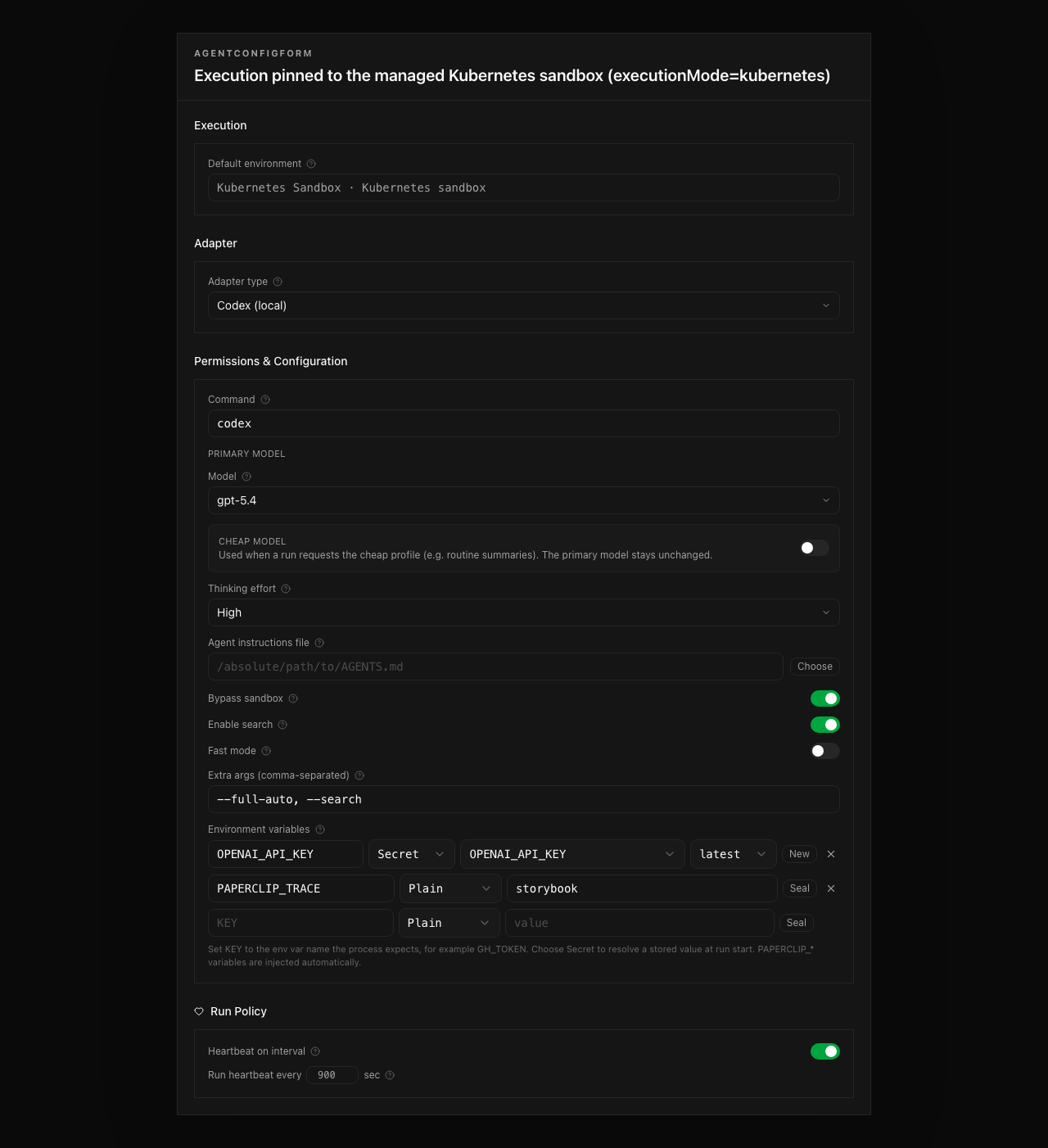 No managed environment available yet (warning notice, no silent local fallback): 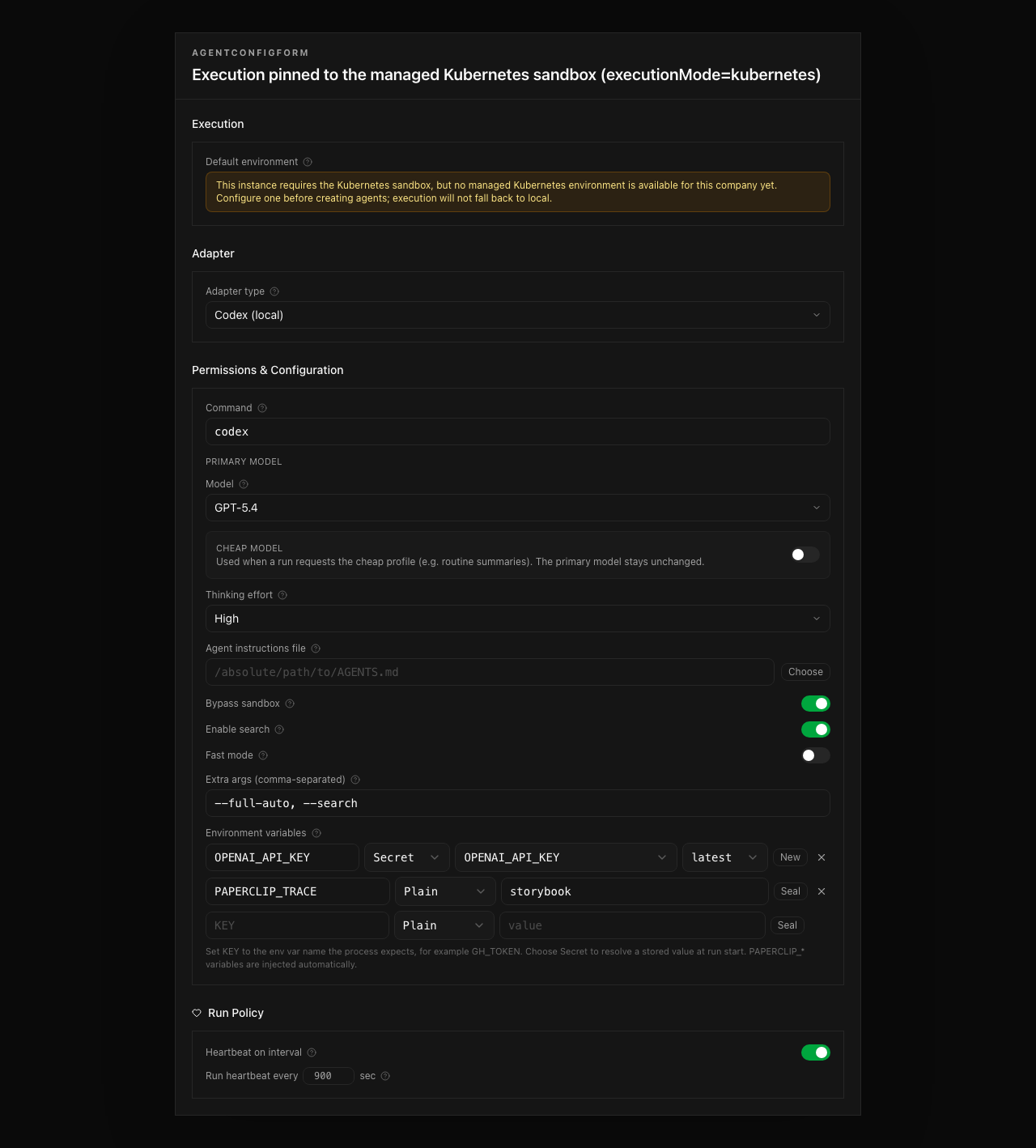 ## Checklist - [x] I have included a thinking path that traces from project context to this change - [x] I have specified the model used (with version and capability details) - [x] I have checked ROADMAP.md and confirmed this PR does not duplicate planned core work - [x] I have searched GitHub for duplicate or related PRs and linked them above - [x] I have either (a) linked existing issues with `Fixes: #` / `Closes #` / `Refs #` OR (b) described the issue in-PR following the relevant issue template - [x] I have run tests locally and they pass - [x] I have added or updated tests where applicable - [x] If this change affects the UI, I have included before/after screenshots - [x] I have updated relevant documentation to reflect my changes - [x] I have considered and documented any risks above - [ ] All Paperclip CI gates are green - [ ] Greptile is 5/5 with no open P2s, recommendations, or follow-ups - [x] I will address all Greptile and reviewer comments before requesting merge 🤖 Generated with [Claude Code](https://claude.com/claude-code) --------- Co-authored-by: Claude Opus 4.8 (1M context) <noreply@anthropic.com> |
||
|
Aron PrinsandDevin Foley
|
70b1a9109d |
Improve CLI API parity coverage (#6626)
## Thinking Path > - Paperclip is a control plane for AI-agent companies, with the CLI acting as a scriptable operator and agent interface to that control plane. > - The REST API surface has grown across companies, agents, issues, routines, plugins, auth, workspaces, secrets, and operational inspection commands. > - The CLI had drifted from that API surface: some commands were missing, some command shapes differed from docs/reference material, and several edge cases only failed during end-to-end local-source testing. > - The local development runbook requires these tests to be disposable and isolated from a real `~/.paperclip`, `~/.codex`, or `~/.claude` installation. > - This pull request adds broad CLI/API parity coverage, fixes the actionable bugs found during that pass, and records the reproducible test log under `doc/logs`. > - The benefit is a more complete, scriptable CLI surface with regression coverage for the command families exercised by the parity run. ## What Changed - Added or expanded CLI command coverage for access/auth, companies, agents, projects, goals, issues and subresources, routines, plugins, workspaces, activity/run/cost/dashboard inspection, assets, skills, secrets, tokens, prompt/wake flows, and local setup helpers. - Fixed CLI/API parity bugs found during the run, including context profile patching, issue interaction optional payloads, malformed tree-hold errors, environment duplicate handling, configure invalid-section exit codes, worktree pnpm invocation, token agent ID resolution, plugin tool worker lookup, and routine webhook secret cleanup. - Added missing CLI wrappers and route coverage for health/access, invite resolution URL forwarding, join status normalization, secret lifecycle commands, LLM docs routes, available-skill isolation, positive board-claim coverage, and interactive `connect` prompt-flow tests. - Added a schema-backed `/api/openapi.json` route sufficient for CLI parity and `paperclipai openapi --json` smoke coverage. - Added `doc/logs/2026-05-24-cli-api-parity-e2e-log.md` with the detailed living test/bug log and renamed the log directory from `doc/bugs` to `doc/logs`. - Added `doc/plans/2026-05-23-cli-api-parity.md` and the OpenAPI parity reference used during the pass. OpenAPI note: this PR intentionally does not try to subsume `feature/openapi-spec`. The OpenAPI implementation here is schema-backed and better than the earlier route-inventory stub, but `feature/openapi-spec` is the fuller/better OpenAPI branch because it includes exact mounted-route coverage tests and additional current route coverage. That branch should stay as its own PR and can supersede this OpenAPI route implementation. ## Verification Targeted automated checks run: - `pnpm exec vitest run server/src/__tests__/openapi-routes.test.ts` - `pnpm exec vitest run server/src/__tests__/board-claim.test.ts` - `pnpm exec vitest run cli/src/__tests__/connect.test.ts` - `pnpm exec vitest run cli/src/__tests__/agent-lifecycle.test.ts` - `pnpm exec vitest run server/src/__tests__/plugin-database.test.ts` - `pnpm exec vitest run server/src/__tests__/routines-service.test.ts` - `pnpm --dir cli typecheck` - `pnpm --dir server typecheck` Manual/local E2E verification: - Ran the full disposable local-source CLI/API parity pass with isolated `PAPERCLIP_HOME`, `PAPERCLIP_CONFIG`, `PAPERCLIP_CONTEXT`, `PAPERCLIP_AUTH_STORE`, `CODEX_HOME`, and `CLAUDE_HOME` under `tmp/cli-api-parity`. - Verified `DATABASE_URL` and `DATABASE_MIGRATION_URL` stayed unset for the scratch server. - Verified live health and schema-backed OpenAPI responses on non-default port `3197`. - Revoked created board/agent tokens and cleaned up temporary plugins, secrets, non-default environments, and project workspaces. - See `doc/logs/2026-05-24-cli-api-parity-e2e-log.md` for the full command-by-command reproduction log. Not run: - Full `pnpm test`, `pnpm test:run`, or `pnpm build` were not run after the entire branch because the branch is broad and the parity pass used focused test/typecheck verification plus live isolated CLI reruns. ## Risks - This is a broad PR and touches many CLI command modules, so review surface is high. The changes are grouped around one theme, but a split may be easier if maintainers prefer narrower PRs. - The OpenAPI route in this PR is not the final/best OpenAPI implementation. `feature/openapi-spec` has stronger exact-route coverage and should remain the source for the dedicated OpenAPI PR. - The living log is intentionally detailed and large. It is useful for reproducibility but adds documentation weight. - No UI changes are intended; screenshots are not applicable. > For core feature work, check [`ROADMAP.md`](ROADMAP.md) first and discuss it in `#dev` before opening the PR. Feature PRs that overlap with planned core work may need to be redirected — check the roadmap first. See `CONTRIBUTING.md`. ## Model Used - OpenAI Codex, GPT-5-based coding agent in Codex desktop. Exact served model/context-window identifier was not exposed in the local app. Work used shell/Git/GitHub CLI tooling, local source inspection, targeted test execution, and live isolated Paperclip CLI/API smoke testing. ## Checklist - [x] I have included a thinking path that traces from project context to this change - [x] I have specified the model used (with version and capability details) - [x] I have checked ROADMAP.md and confirmed this PR does not duplicate planned core work - [x] I have run tests locally and they pass - [x] I have added or updated tests where applicable - [x] If this change affects the UI, I have included before/after screenshots - [x] I have updated relevant documentation to reflect my changes - [x] I have considered and documented any risks above - [x] I will address all Greptile and reviewer comments before requesting merge --------- Co-authored-by: Devin Foley <devin@devinfoley.com> |
||
|
DottaandPaperclip
|
d1a8c873b2 |
fix(remote-sandbox): harden host workspace resumes (#5922)
## Thinking Path > - Paperclip orchestrates AI agents through a control plane while adapters execute work in local, remote, or sandboxed runtimes. > - Remote sandbox execution depends on a strict host-versus-remote workspace boundary: the host prepares/restores files, while the adapter command runs inside the sandbox cwd. > - Jannes' PR #5823 identified host-side failure modes that were not covered by replacement PR #5822. > - Persisting a remote pod cwd in session params could poison the next host heartbeat resume and make Paperclip inspect or upload system temp roots. > - Plugin sandbox providers also need a narrow way to receive model-provider API keys without exposing the full server environment to every plugin worker. > - This pull request ports the host-side fixes from #5823 in the current codebase style, with focused regression coverage. > - The benefit is safer remote sandbox resumes and plugin worker environment handling without broadening core plugin privileges. ## What Changed - Persist host workspace cwd, not remote sandbox cwd, in `claude_local` session params while retaining remote execution identity metadata. - Reject saved session cwds that point at system roots before heartbeat falls back to agent home workspace. - Skip sockets, FIFOs, devices, and other non-file entries during workspace restore snapshot capture/comparison. - Pass a small model-provider API-key allowlist only to plugins declaring `environment.drivers.register`. - Added focused regression tests for remote Claude session params, unsafe session cwd detection, plugin worker env filtering, and non-file snapshot entries. Credits: ports host-side fixes from Jannes' #5823. ## Verification - `pnpm vitest run packages/adapter-utils/src/workspace-restore-merge.test.ts server/src/services/session-workspace-cwd.test.ts server/src/__tests__/claude-local-execute.test.ts server/src/__tests__/plugin-database.test.ts` (25 passed, 7 skipped by existing embedded-Postgres host guard) - `pnpm --filter @paperclipai/adapter-utils typecheck` - `pnpm --filter @paperclipai/adapter-claude-local typecheck` - `pnpm --filter @paperclipai/server typecheck` ## Risks - Low risk: changes are scoped to remote sandbox/session metadata, workspace snapshot filtering, and plugin worker env setup. - Sandbox-provider plugins now receive only the explicit model-provider key allowlist; any provider needing another key name will need a deliberate allowlist update. > For core feature work, check [`ROADMAP.md`](ROADMAP.md) first and discuss it in `#dev` before opening the PR. Feature PRs that overlap with planned core work may need to be redirected — check the roadmap first. See `CONTRIBUTING.md`. ## Model Used - OpenAI Codex, GPT-5-based coding agent, tool-enabled local code execution and repository editing. ## Checklist - [x] I have included a thinking path that traces from project context to this change - [x] I have specified the model used (with version and capability details) - [x] I have checked ROADMAP.md and confirmed this PR does not duplicate planned core work - [x] I have run tests locally and they pass - [x] I have added or updated tests where applicable - [x] If this change affects the UI, I have included before/after screenshots - [x] I have updated relevant documentation to reflect my changes - [x] I have considered and documented any risks above - [x] I will address all Greptile and reviewer comments before requesting merge --------- Co-authored-by: Paperclip <noreply@paperclip.ing> |
||
|
DottaandPaperclip
|
3c73ed26b5 |
Expand plugin host surface (#5205)
## Thinking Path > - Paperclip orchestrates AI agents for zero-human companies > - The plugin system is the extension boundary for optional product capabilities > - Rich plugins need more than a worker entrypoint: they need scoped database storage, local project folders, managed agents/routines, host navigation, and reusable UI components > - The LLM Wiki work exposed those missing host surfaces while keeping plugin code outside the core control plane > - This pull request expands the core plugin host, SDK, server APIs, and UI bridge so plugins can declare and use those surfaces > - The benefit is that future plugins can integrate with Paperclip through documented, validated contracts instead of bespoke server or UI imports ## What Changed - Added plugin-managed database namespaces and migration tracking, including Drizzle schema/migration files and SQL validation for namespace isolation. - Added server support for plugin local folders, managed agents, managed routines, scoped plugin APIs, and plugin operation visibility. - Expanded shared plugin manifest/types/validators and SDK host/testing/UI exports for richer plugin surfaces. - Added reusable UI pieces for file trees, managed routines, resizable sidebars, route sidebars, and plugin bridge initialization. - Updated plugin docs and example plugins to use the expanded host and SDK surface. ## Verification - `pnpm install --frozen-lockfile` - `pnpm run preflight:workspace-links && pnpm exec vitest run packages/shared/src/validators/plugin.test.ts server/src/__tests__/plugin-database.test.ts server/src/__tests__/plugin-local-folders.test.ts server/src/__tests__/plugin-managed-agents.test.ts server/src/__tests__/plugin-managed-routines.test.ts server/src/__tests__/plugin-orchestration-apis.test.ts ui/src/api/plugins.test.ts ui/src/components/FileTree.test.tsx ui/src/components/ResizableSidebarPane.test.tsx ui/src/pages/PluginPage.test.tsx ui/src/plugins/bridge.test.ts` passed: 11 files, 67 tests. - Confirmed this PR changes 89 files and does not include `pnpm-lock.yaml` or `.github/workflows/*`. ## Risks - Medium: this expands plugin host contracts across db/shared/server/ui and includes a new core migration (`0076_useful_elektra.sql`). - The plugin database namespace validator is intentionally restrictive; plugin authors may need follow-up affordances for SQL patterns that remain blocked. - Merge this before the LLM Wiki plugin PR so the plugin can resolve the new SDK and host APIs. > For core feature work, check [`ROADMAP.md`](ROADMAP.md) first and discuss it in `#dev` before opening the PR. Feature PRs that overlap with planned core work may need to be redirected — check the roadmap first. See `CONTRIBUTING.md`. ## Model Used - OpenAI Codex, GPT-5 coding agent, tool-enabled shell/git/GitHub workflow. Context window size was not exposed by the runtime. ## Checklist - [x] I have included a thinking path that traces from project context to this change - [x] I have specified the model used (with version and capability details) - [x] I have checked ROADMAP.md and confirmed this PR does not duplicate planned core work - [x] I have run tests locally and they pass - [x] I have added or updated tests where applicable - [x] If this change affects the UI, I have included before/after screenshots - [x] I have updated relevant documentation to reflect my changes - [x] I have considered and documented any risks above - [x] I will address all Greptile and reviewer comments before requesting merge --------- Co-authored-by: Paperclip <noreply@paperclip.ing> |
||
|
DottaandPaperclip
|
9c6f551595 |
[codex] Add plugin orchestration host APIs (#4114)
## Thinking Path > - Paperclip orchestrates AI agents for zero-human companies. > - The plugin system is the extension path for optional capabilities that should not require core product changes for every integration. > - Plugins need scoped host APIs for issue orchestration, documents, wakeups, summaries, activity attribution, and isolated database state. > - Without those host APIs, richer plugins either cannot coordinate Paperclip work safely or need privileged core-side special cases. > - This pull request adds the plugin orchestration host surface, scoped route dispatch, a database namespace layer, and a smoke plugin that exercises the contract. > - The benefit is a broader plugin API that remains company-scoped, auditable, and covered by tests. ## What Changed - Added plugin orchestration host APIs for issue creation, document access, wakeups, summaries, plugin-origin activity, and scoped API route dispatch. - Added plugin database namespace tables, schema exports, migration checks, and idempotent replay coverage under migration `0059_plugin_database_namespaces`. - Added shared plugin route/API types and validators used by server and SDK boundaries. - Expanded plugin SDK types, protocol helpers, worker RPC host behavior, and testing utilities for orchestration flows. - Added the `plugin-orchestration-smoke-example` package to exercise scoped routes, restricted database namespaces, issue orchestration, documents, wakeups, summaries, and UI status surfaces. - Kept the new orchestration smoke fixture out of the root pnpm workspace importer so this PR preserves the repository policy of not committing `pnpm-lock.yaml`. - Updated plugin docs and database docs for the new orchestration and database namespace surfaces. - Rebased the branch onto `public-gh/master`, resolved conflicts, and removed `pnpm-lock.yaml` from the final PR diff. ## Verification - `pnpm install --frozen-lockfile` - `pnpm --filter @paperclipai/db typecheck` - `pnpm exec vitest run packages/db/src/client.test.ts` - `pnpm exec vitest run server/src/__tests__/plugin-database.test.ts server/src/__tests__/plugin-orchestration-apis.test.ts server/src/__tests__/plugin-routes-authz.test.ts server/src/__tests__/plugin-scoped-api-routes.test.ts server/src/__tests__/plugin-sdk-orchestration-contract.test.ts` - From `packages/plugins/examples/plugin-orchestration-smoke-example`: `pnpm exec vitest run --config ./vitest.config.ts` - `pnpm --dir packages/plugins/examples/plugin-orchestration-smoke-example run typecheck` - `pnpm --filter @paperclipai/server typecheck` - PR CI on latest head `293fc67c`: `policy`, `verify`, `e2e`, and `security/snyk` all passed. ## Risks - Medium risk: this expands plugin host authority, so route auth, company scoping, and plugin-origin activity attribution need careful review. - Medium risk: database namespace migration behavior must remain idempotent for environments that may have seen earlier branch versions. - Medium risk: the orchestration smoke fixture is intentionally excluded from the root workspace importer to avoid a `pnpm-lock.yaml` PR diff; direct fixture verification remains listed above. - Low operational risk from the PR setup itself: the branch is rebased onto current `master`, the migration is ordered after upstream `0057`/`0058`, and `pnpm-lock.yaml` is not in the final diff. > For core feature work, check [`ROADMAP.md`](ROADMAP.md) first and discuss it in `#dev` before opening the PR. Feature PRs that overlap with planned core work may need to be redirected — check the roadmap first. See `CONTRIBUTING.md`. Roadmap checked: this work aligns with the completed Plugin system milestone and extends the plugin surface rather than duplicating an unrelated planned core feature. ## Model Used - OpenAI Codex, GPT-5-based coding agent in a tool-enabled CLI environment. Exact hosted model build and context-window size are not exposed by the runtime; reasoning/tool use were enabled for repository inspection, editing, testing, git operations, and PR creation. ## Checklist - [x] I have included a thinking path that traces from project context to this change - [x] I have specified the model used (with version and capability details) - [x] I have checked ROADMAP.md and confirmed this PR does not duplicate planned core work - [x] I have run tests locally and they pass - [x] I have added or updated tests where applicable - [x] If this change affects the UI, I have included before/after screenshots (N/A: no core UI screen change; example plugin UI contract is covered by tests) - [x] I have updated relevant documentation to reflect my changes - [x] I have considered and documented any risks above - [x] I will address all Greptile and reviewer comments before requesting merge --------- Co-authored-by: Paperclip <noreply@paperclip.ing> |
||
|
gsxdsm
|
ec261e9c7c |
Enhance plugin loading and toolbar integration
- Added packagePath to plugin loader for improved manifest handling. - Refactored GlobalToolbarPlugins for better slot and launcher management in BreadcrumbBar. - Updated launcher trigger styles for globalToolbarButton. |
||
|
Dotta
|
cb5d7e76fb | Expand kitchen sink plugin demos | ||
|
Dotta
|
12ccfc2c9a | Simplify plugin runtime and cleanup lifecycle | ||
|
Dotta
|
80cdbdbd47 | Add plugin framework and settings UI |

