mirror of
https://github.com/paperclipai/paperclip.git
synced 2026-10-24 18:19:05 +02:00
390627b46eb333309d357004384b220ecf8a65af
26
Commits
| Author | SHA1 | Message | Date | |
|---|---|---|---|---|

|
5163208c3c |
Add workspace branch ancestry diagnostics (#9117)
## Thinking Path > - Paperclip is the open source app people use to manage AI agents for work > - Agents run in git worktrees tied to a workspace branch; when the actual branch diverges from the expected one (e.g. a parent feature branch was renamed), Paperclip currently has no structured field to report *why* the branch is incoherent or whether it can be auto-reconciled > - The workspace-incoherence fingerprint already captures SHA mismatches, but there is no evidence field distinguishing "actual branch is a descendant of expected" (safe to fast-forward) from "branches have diverged" (needs human review) or "SHAs are unavailable" (unknown) > - Operators and future recovery flows need a typed verdict to make decisions without re-running git commands themselves > - This pull request adds `ancestryVerdict` and `plainLanguageReason` evidence fields computed via `git merge-base --is-ancestor`, and scaffolds the off-by-default `enableWorkspaceBranchReconcileForward` instance setting with no runtime behavior yet > - The benefit is that future recovery logic can branch on a typed verdict rather than parsing prose, while the fingerprint v1 payload stays stable ## Linked Issues or Issue Description No public GitHub issue pre-exists for this diagnostic addition. **Problem or motivation** When Paperclip detects that an agent's actual workspace branch differs from the recorded expected branch, the current fingerprint carries only raw SHAs. There is no typed field indicating whether the actual branch is a descendant of the expected one (safe reconcile path) vs. a true divergence (requires human intervention) vs. an indeterminate state (missing SHAs or git errors). Downstream recovery logic cannot branch safely without re-running git. **Proposed solution** Add `ancestryVerdict` and `plainLanguageReason` to the workspace incoherence evidence type; compute via `git merge-base --is-ancestor`; scaffold a feature-flag for future forward-reconcile behavior (`enableWorkspaceBranchReconcileForward`, off by default, not yet read by any runtime path). **Alternatives considered** Encoding the verdict in the existing fingerprint string was rejected because the fingerprint is a stable identity hash, not a mutable evidence bag. Changing it would break monitors keyed on the string. **Roadmap alignment** Supports future workspace auto-reconcile work; ROADMAP.md has no conflicting entry for this diagnostic layer. ## What Changed - `packages/shared/src/types/heartbeat.ts` adds `ancestryVerdict` and `plainLanguageReason` fields to `WorkspaceIncoherenceEvidence` - `packages/shared/src/types/instance.ts` adds `enableWorkspaceBranchReconcileForward` boolean (off by default) - `packages/shared/src/validators/instance.ts` exports the new flag from the settings validator - `server/src/services/workspace-runtime.ts` computes `ancestryVerdict` via `git merge-base --is-ancestor`; falls back to `unknown` on missing SHAs or command errors; excludes verdict fields from fingerprint v1 computation - `server/src/services/instance-settings.ts` wires the new setting through to the settings service - Tests updated in `workspace-runtime.test.ts`, `instance-settings-service.test.ts`, `instance-settings-routes.test.ts`, and `instance.test.ts` (104 tests total) ## Verification ```bash pnpm exec vitest run \ server/src/__tests__/workspace-runtime.test.ts \ server/src/__tests__/instance-settings-service.test.ts \ server/src/__tests__/instance-settings-routes.test.ts \ packages/shared/src/validators/instance.test.ts # 104 tests pass pnpm --filter @paperclipai/shared typecheck pnpm --filter @paperclipai/server typecheck # both exit 0 ``` Manual: trigger a workspace incoherence event and confirm the evidence object carries `ancestryVerdict` and `plainLanguageReason`; confirm the fingerprint string stays `workspace_incoherence:v1:sha256:...`. ## Risks **Low risk.** Purely additive. Fingerprint v1 payload is unchanged. The new flag has no runtime effect in this PR. `git merge-base --is-ancestor` exits non-zero for both "not an ancestor" and "command error"; both are handled and collapsed to typed values with a prose reason. ## Model Used Provider: Anthropic, model: Claude Sonnet 4.6 (`claude-sonnet-4-6`), 200k context, tool use enabled. ## Checklist - [x] I have included a thinking path that traces from project context to this change - [x] I have specified the model used (with version and capability details) - [x] I have checked ROADMAP.md and confirmed this PR does not duplicate planned core work - [x] I have searched GitHub for duplicate or related PRs and linked them above - [x] I have either (a) linked existing issues with `Fixes: #` / `Closes #` / `Refs #` OR (b) described the issue in-PR following the relevant issue template - [x] I have not referenced internal/instance-local Paperclip issues or links (only public GitHub `#NNN` / `github.com/paperclipai/paperclip` URLs) - [x] My branch name describes the change (e.g. `docs/...`, `fix/...`) and contains no internal Paperclip ticket id or instance-derived details - [x] I have run tests locally and they pass - [x] I have added or updated tests where applicable - [ ] I have updated relevant documentation to reflect my changes - [x] I have considered and documented any risks above - [ ] All Paperclip CI gates are green - [ ] Greptile is 5/5 with no open P2s, recommendations, or follow-ups - [ ] I will address all Greptile and reviewer comments before requesting merge --------- Co-authored-by: Paperclip <noreply@paperclip.ing> Co-authored-by: Claude Sonnet 4.6 <noreply@anthropic.com> |
||
|
Devin Foley
|
765a75207a |
Add experimental server info debug view (#8676)
## Thinking Path

> - Paperclip is the open source app people use to manage AI agents for
work
> - The dev/server UI exposes a `/api/health` endpoint and a lower-left
account drawer, but nothing surfaces *which* build the running instance
is on or when it last restarted
> - When iterating on a local dev instance it is hard to tell whether
the server you're looking at has actually restarted onto your latest
commit, or how stale the running process is
> - Developers need a lightweight, opt-in way to confirm the running
instance's identity without digging through logs or shelling into the
host
> - This pull request adds an experimental "Server Info Debug View"
setting that surfaces the running instance's last-restart time and
current commit as read-only rows in the account drawer
> - The benefit is a quick, in-UI sanity check of what the live server
is actually running, behind an experimental flag so it ships zero cost
to users who don't opt in

## Linked Issues or Issue Description

No public GitHub issue exists. Describing the underlying request inline
following the feature request template:

**Problem or motivation:**

When working against a local Paperclip dev instance there is no in-UI
way to confirm what the running server is — its current commit or when
it last restarted. You have to check logs or the host shell to know
whether the process picked up your latest build.

**Proposed solution:**

An opt-in experimental setting ("Server Info Debug View") that, once
enabled, renders a small read-only "Server" section at the bottom of the
lower-left account drawer showing **Last restarted** (the server process
start time) and **Running commit** (the current git HEAD short SHA +
subject).

**Alternatives considered:**

A separate top-right pill/overlay (like the work-life-balance plugin).
The account drawer was chosen to reuse existing menu-row styling and
avoid adding new always-present chrome.

**Roadmap alignment:**

Small, self-contained developer-experience aid gated behind an
experimental flag; does not overlap planned core roadmap work.

## What Changed

- Added `server/src/server-info.ts`: captures a `serverInfo` snapshot
once at boot — process start time and current git commit (SHA +
subject). Git is read via `execFileSync` with SHA validation and a
timeout.
- `/api/health` exposes the `serverInfo` snapshot, but only on
full-details health responses (board/agent in authenticated mode, or
local-trusted dev).
- Gated the UI surface behind a new `enableServerInfoDebugView`
experimental setting, wired through the shared instance type, validator,
settings normalizer, and OpenAPI schema.
- UI: added `SidebarServerInfo` rendering the read-only rows in the
account drawer (`BreadcrumbBar` / `SidebarAccountMenu`), plus the
experimental settings toggle and a typed `health` API client.
- Moved `ServerGitInfo` / `ServerInfoSnapshot` into
`@paperclipai/shared` so the server and UI share one definition instead
of duplicating it.
- Added unit tests for the server-info snapshot, health route exposure,
validator/normalizer, settings routes, the experimental settings page,
and the sidebar component.

## Verification

- `pnpm --filter @paperclipai/server exec vitest run
src/__tests__/health.test.ts src/__tests__/server-info.test.ts
src/__tests__/instance-settings-service.test.ts
src/__tests__/instance-settings-routes.test.ts` — 32 passed
- `pnpm --filter @paperclipai/ui exec vitest run
src/components/SidebarServerInfo.test.tsx
src/pages/InstanceExperimentalSettings.test.tsx` — 9 passed
- `tsc --noEmit` on both `@paperclipai/server` and `@paperclipai/ui` —
clean
- Manual: enable **Settings → Experimental → Server Info Debug View**,
refresh the UI, open the lower-left account drawer — a "Server" section
shows Last restarted and Running commit.

## Risks

- Low risk. The UI surface is fully opt-in via an experimental flag and
defaults off.
- The `serverInfo` field on `/api/health` is access-controlled to
full-details responses only (board/agent in authenticated mode, or
local-trusted dev) — never anonymous authenticated callers — so the git
SHA is not broadly exposed.
- The only new server work is a one-time git read at boot, guarded with
SHA validation and a timeout; failures degrade gracefully (the git block
reports `available: false` rather than throwing).

## Model Used

Claude — `claude-opus-4` (Anthropic), extended thinking with tool use,
via Claude Code.

## Checklist

- [x] I have included a thinking path that traces from project context
to this change
- [x] I have specified the model used (with version and capability
details)
- [x] I have checked ROADMAP.md and confirmed this PR does not duplicate
planned core work
- [x] I have searched GitHub for duplicate or related PRs and linked
them above
- [x] I have either (a) linked existing issues with `Fixes: #` / `Closes
#` / `Refs #` OR (b) described the issue in-PR following the relevant
issue template
- [x] I have not referenced internal/instance-local Paperclip issues or
links (only public GitHub `#NNN` / `github.com/paperclipai/paperclip`
URLs)
- [x] My branch name describes the change and contains no
instance-derived details
- [x] I have run tests locally and they pass
- [x] I have added or updated tests where applicable
- [x] I have updated relevant documentation to reflect my changes
- [x] I have considered and documented any risks above
- [x] All Paperclip CI gates are green
- [x] Greptile is 5/5 with no open P2s, recommendations, or follow-ups
- [x] I will address all Greptile and reviewer comments before
requesting merge
|
||
|
DottaandPaperclip
|
43b005b704 |
Add pipeline workflow primitives and operator UI (#7903)
## Thinking Path > - Paperclip is the open source app people use to manage AI agents for work. > - The pipeline subsystem models repeatable work as items moving through stages, with agent automation, review gates, blockers, drift notices, and linked work. > - Operators need this to be usable as one coherent workflow surface, not just as backend primitives or disconnected route experiments. > - The branch now carries the pipeline data model, service/routes, CLI/tutorial path, aggregation feeds, operator UI, stage automation controls, liveness/retry handling, and follow-up polish that make the primitive reviewable end to end. > - This pull request is the single review target for that pipeline workflow primitive stack. > - The benefit is that reviewers can evaluate the full operator experience and server contract together against `master`. ## Linked Issues or Issue Description No public GitHub issue exists for this work. The underlying feature request is described inline. ### Problem or motivation Paperclip needs a first-class way to model multi-stage agent/company workflows where upstream items can spawn downstream work, request review, carry fields across pipelines, surface drift, retry automation, and show operators where work is blocked or active. Without a unified pipeline primitive, these workflows spread across ad hoc issues, routines, and comments, making the state hard to inspect or operate. ### Proposed solution Add the pipeline workflow primitive stack: database schema and migrations, shared validators/types, server services and REST routes, aggregation and liveness helpers, CLI/tutorial smoke support, and the React operator UI for pipeline lists, boards, item detail, review/learnings views, settings, stage automation, secrets, carry-over fields, and retry/recovery flows. ### Alternatives considered - Keep workflows as loosely linked issues and routines: rejected because operators need a single board/detail/settings surface for repeated workflow patterns. - Ship backend primitives first and defer UI: rejected for this branch because the operator experience is the main way to validate the primitive. - Add a narrower one-off content workflow: rejected because the same primitives are useful across future company processes. ## What Changed - Added and evolved pipeline schema, migrations, shared contracts, server services, REST routes, route tests, and CLI/tutorial smoke support. - Added pipeline aggregation, health/liveness, drift acknowledgment, blocker/carry-over, automation retry, stage automation environment, and permission recovery behavior. - Added the operator UI for pipeline index/board/item detail/settings/review/learnings flows, including stage secrets, automation controls, markdown/item descriptions, linked issue assets, liveness banners, and source automation metadata. - Refactored issue document frame rendering through the shared `DocumentFrameHeader` component to keep document controls consistent with the pipeline document surfaces. - Kept this PR as the single base-branch review target for the current pipeline branch. ## Verification Current branch refresh: - `pnpm vitest run server/src/__tests__/pipelines-service.test.ts` — 31 passed - `pnpm vitest run server/src/__tests__/pipelines-routes.test.ts` — 19 passed - `pnpm --filter ./server typecheck` — passed - `pnpm --filter ./ui typecheck` — passed - Verified Pipelines remains gated by `enablePipelines === true`: sidebar item is hidden unless the flag is enabled, direct pipeline routes redirect to `/dashboard` when disabled, and the Experimental settings UI still has no Pipelines toggle. - GitHub status checks on `df071c710646de625131064c3fb6588b5e97964a` — all complete with no failing conclusions, including Actions, Socket, Superagent/Security, and Greptile Review - Greptile summary on `df071c710646de625131064c3fb6588b5e97964a` — Confidence Score 5/5 - GitHub review-thread sweep — 0 unresolved Greptile threads Previously recorded during branch development: - Server pipeline service/route and aggregation tests - Shared validator tests - UI pipeline page/settings/item-detail/learnings/liveness tests - Pipeline tutorial smoke path ## Risks - High review surface: this is a large feature branch spanning database, shared contracts, server behavior, CLI/docs, and UI. - Migration ordering and schema compatibility need reviewer attention because this branch has been kept current across multiple `master` syncs. - GitHub still reports merge state `BLOCKED` because the PR is awaiting normal human review/branch-protection completion; all current status checks are green. - Branch-name checklist exception: this PR uses the pre-existing requested branch name, which predates the current public-branch naming rule. The PR title/body avoid internal issue references. > For core feature work, check [`ROADMAP.md`](ROADMAP.md) first and discuss it in `#dev` before opening the PR. Feature PRs that overlap with planned core work may need to be redirected — check the roadmap first. See `CONTRIBUTING.md`. ## Model Used OpenAI Codex coding agent based on GPT-5, with repository tool use, shell execution, git/GitHub CLI operations, and local verification commands. Earlier commits in this branch were assisted by Paperclip agents and other AI coding agents as recorded in commit authorship. ## Checklist - [x] I have included a thinking path that traces from project context to this change - [x] I have specified the model used (with version and capability details) - [x] I have checked ROADMAP.md and confirmed this PR does not duplicate planned core work - [x] I have searched GitHub for duplicate or related PRs and linked them above - [x] I have either (a) linked existing issues with `Fixes: #` / `Closes #` / `Refs #` OR (b) described the issue in-PR following the relevant issue template - [x] I have not referenced internal/instance-local Paperclip issues or links (only public GitHub `#NNN` / `github.com/paperclipai/paperclip` URLs) - [ ] My branch name describes the change (e.g. `docs/...`, `fix/...`) and contains no internal Paperclip ticket id or instance-derived details - [x] I have run tests locally and they pass - [x] I have added or updated tests where applicable - [x] I have updated relevant documentation to reflect my changes - [x] I have considered and documented any risks above - [x] All Paperclip CI gates are green - [x] Greptile is 5/5 with no open P2s, recommendations, or follow-ups - [x] I will address all Greptile and reviewer comments before requesting merge --------- Co-authored-by: Paperclip <noreply@paperclip.ing> |
||
|
DottaandPaperclip
|
2dbaf4a7fa |
External object references across issue surfaces (#8512)
## Thinking Path > - Paperclip is the open source control plane people use to coordinate AI agents, issues, approvals, comments, and work products. > - The involved subsystem is issue context: markdown links, issue properties, related work, lists, filters, inbox/sidebar status, and plugin-provided external context. > - The gap is that URLs to external systems currently remain mostly plain links, so humans and agents must manually open them to understand status, identity, and liveness. > - This matters because external work objects such as GitHub issues and pull requests are part of the operational state of a Paperclip company. > - The implementation keeps core provider-neutral: shared contracts, storage, sync, routes, and UI surfaces live in core while providers can contribute detection and status resolution. > - This pull request adds the external object reference foundation, GitHub provider support, issue-surface rendering, filters, sidebar/list/inbox signals, and test/story coverage. > - The benefit is that linked external work becomes inspectable Paperclip context without hardcoding every provider directly into the UI. ## Linked Issues or Issue Description No public GitHub issue exists for this work. Feature request: - Problem: URLs in Paperclip issues, comments, documents, and related surfaces do not expose provider status or object identity inline. - Proposed behavior: detect supported external object URLs, persist normalized references, refresh provider status, and render concise status-aware links across issue surfaces. - Users affected: board users, agents, and maintainers who triage issues containing external work links. - Acceptance: external object references are company-scoped, provider-extensible, visible in key issue surfaces, filterable where relevant, and covered by focused shared/server/UI tests. Related PR search: - No open duplicate PRs found for `external object references`. - Closed related prior attempt: #4556. ## What Changed - Added shared external-object contracts, validators, status/liveness helpers, and plugin protocol declarations. - Added database schema and additive migrations for external objects, source mentions, and display metadata. - Added server services/routes for detecting, syncing, summarizing, refreshing, and resolving external objects across issues, documents, comments, projects, and plugins. - Added a GitHub external-object provider plus plugin SDK authoring docs. - Wired UI presentation across markdown links, comments, issue chat, documents, properties, related work, issue rows, filters, inbox/sidebar badges, and Storybook stories. - Rebasing cleanup: moved the branch onto current `master`, repaired stale worktree provision config, hardened environment-sensitive tests/mocks, and removed committed screenshot artifacts from the PR branch to keep the reviewable file set below tool limits. ## Verification - `pnpm exec vitest run packages/shared/src/external-objects.test.ts server/src/__tests__/external-object-routes.test.ts server/src/__tests__/external-objects-service.test.ts ui/src/components/ExternalObjectPill.test.tsx ui/src/lib/external-objects.test.ts` passed after rebasing: 5 files, 56 tests. - Historical branch verification before this PR creation included `pnpm test:run`, `pnpm -r typecheck`, and `pnpm build`; this PR body does not claim those were rerun after the final rebase. ## Risks - Medium: this adds a new cross-surface sync path on issue/document/comment writes. The implementation uses safe sync wrappers so external-object failures warn instead of blocking core mutations. - Medium: the migrations introduce new tables and indexes. They are additive and company-scoped. - Medium: provider-specific URL parsing can miss or misclassify edge cases. Shared canonicalization tests and provider tests cover current GitHub shapes. - Low: UI badge/filter behavior could add visual noise for object-heavy issues; component tests and Storybook stories cover the intended surfaces. > Roadmap checked: `ROADMAP.md` references the plugin system as the current extension path and does not list a duplicate core feature. Related long-range docs discuss external references, work products, preview URLs, and plugin extension points; this PR implements the scoped external-object reference foundation. ## Model Used OpenAI Codex, GPT-5 coding-agent runtime, with shell and GitHub CLI tool use. Reasoning mode: medium. Exact deployed runtime model ID and context window were not exposed in the environment. ## Checklist - [x] I have included a thinking path that traces from project context to this change - [x] I have specified the model used (with version and capability details) - [x] I have checked ROADMAP.md and confirmed this PR does not duplicate planned core work - [x] I have searched GitHub for duplicate or related PRs and linked them above - [x] I have either (a) linked existing issues with `Fixes: #` / `Closes #` / `Refs #` OR (b) described the issue in-PR following the relevant issue template - [x] I have not referenced internal/instance-local Paperclip issues or links (only public GitHub `#NNN` / `github.com/paperclipai/paperclip` URLs) - [x] My branch name describes the change (e.g. `docs/...`, `fix/...`) and contains no internal Paperclip ticket id or instance-derived details - [x] I have run tests locally and they pass - [x] I have added or updated tests where applicable - [x] I have updated relevant documentation to reflect my changes - [x] I have considered and documented any risks above - [x] All Paperclip CI gates are green - [x] Greptile is 5/5 with no open P2s, recommendations, or follow-ups - [x] I will address all Greptile and reviewer comments before requesting merge --------- Co-authored-by: Paperclip <noreply@paperclip.ing> |
||
|
Devin FoleyandPaperclip
|
0b945f449b |
Make streamlined sidebar default to on (#8496)
## Thinking Path > - Paperclip is the open source app people use to manage AI agents for work. > - The board UI has an experimental streamlined left navigation mode that changes how projects and agents appear in the sidebar. > - Today that mode is opt-in, so users keep seeing the classic navigation unless they find and enable the experiment. > - The requested product behavior is to make streamlined navigation the default experience while keeping an explicit experiments opt-out. > - This pull request flips the shared/server default, updates UI consumers to treat only explicit `false` as classic mode, and covers both the default-on path and opt-out behavior in tests. > - The benefit is that new and legacy settings get the streamlined sidebar by default without removing the classic-sidebar escape hatch. ## Linked Issues or Issue Description Refs #7645 Related: #8430 takes the broader route of removing the classic sidebar. This PR intentionally keeps the opt-out path. ## What Changed - Default `enableStreamlinedLeftNavigation` to `true` in shared validation and server-side normalization. - Preserve explicit stored `false` as the experiments opt-out for the classic sidebar. - Render the sidebar and experimental settings toggle as streamlined-on unless the setting is explicitly `false`. - Add regression coverage for loading/default streamlined sidebar behavior and the opt-out patch from the experiments page. - Remove internal issue identifiers from newly touched source comments before publishing. ## Verification - `git diff --check origin/master...HEAD` — passed. - `pnpm -r typecheck` — passed. - `pnpm exec vitest run server/src/__tests__/instance-settings-service.test.ts ui/src/components/Sidebar.test.tsx ui/src/pages/InstanceExperimentalSettings.test.tsx` — passed, 3 files / 27 tests. - `pnpm build` — passed, with existing Vite/CSS/chunk-size warnings. - `pnpm test:run` — failed in unrelated `server/src/__tests__/workspace-runtime.test.ts`: the test `auto-detects the default branch via symbolic-ref when origin/HEAD is set` creates a temp repo on `main` then runs `git push -u origin main master`; `master` does not exist in that temp repo. Summary: 1 failed, 214 passed, 1780 tests passed, 1 skipped. ## Risks Low-to-medium behavioral risk: the default sidebar changes for users who never explicitly set the experiment. Explicit `false` remains respected, so users can still opt out via experimental settings. > For core feature work, check [`ROADMAP.md`](ROADMAP.md) first and discuss it in `#dev` before opening the PR. Feature PRs that overlap with planned core work may need to be redirected — check the roadmap first. See `CONTRIBUTING.md`. ## Model Used OpenAI GPT-5 via Codex local adapter, with tool use and code execution. Exact context window was not surfaced in the runtime. ## Checklist - [x] I have included a thinking path that traces from project context to this change - [x] I have specified the model used (with version and capability details) - [x] I have checked ROADMAP.md and confirmed this PR does not duplicate planned core work - [x] I have searched GitHub for duplicate or related PRs and linked them above - [x] I have either (a) linked existing issues with `Fixes: #` / `Closes #` / `Refs #` OR (b) described the issue in-PR following the relevant issue template - [x] I have not referenced internal/instance-local Paperclip issues or links (only public GitHub `#NNN` / `github.com/paperclipai/paperclip` URLs) - [x] My branch name describes the change (e.g. `docs/...`, `fix/...`) and contains no internal Paperclip ticket id or instance-derived details - [x] I have run tests locally and they pass - [x] I have added or updated tests where applicable - [x] I have updated relevant documentation to reflect my changes - [x] I have considered and documented any risks above - [x] All Paperclip CI gates are green - [x] Greptile is 5/5 with no open P2s, recommendations, or follow-ups - [x] I will address all Greptile and reviewer comments before requesting merge --------- Co-authored-by: Paperclip <noreply@paperclip.ing> |
||
|
Devin Foley
|
547463d3a2 |
refactor(environments): make execution environments instance-scoped (#8375)
## Thinking Path > - Paperclip is the control plane for AI-agent companies, so execution environment selection has to stay inspectable and predictable across companies, agents, and runs. > - The environment subsystem decides where an agent heartbeat actually runs and how remote sandbox state is realized and restored. > - That subsystem previously mixed company-scoped environment catalogs with issue-level environment stamping, so a reassigned issue could keep executing in the previous assignee's sandbox. > - That behavior breaks the control-plane contract: changing the assignee should change the executing agent/environment path unless there is an explicit current override. > - Fixing it cleanly required more than a narrow patch; the environment model had to move to instance scope with a single inherited default and per-agent override semantics. > - This pull request rewires the schema, server/API surface, runtime resolution, and UI around that model, then adds regression coverage for cross-company inheritance and per-agent isolation. > - The benefit is that environment choice now follows the approved instance/agent configuration path instead of stale issue state, while shared environments only need to be configured once per instance. ## Linked Issues or Issue Description - No directly matching public GitHub issue or PR was found while searching for this refactor. ### What happened? Reassigning work between agents with different execution environments could keep running in the previous sandbox because environment choice was stamped onto the issue and outranked the current assignee. The same subsystem also forced environment catalogs to be duplicated per company even though the underlying execution environments were instance-wide resources. ### Expected behavior Execution should resolve through the current instance and agent configuration path, with one instance-scoped environment catalog, one instance default, optional per-agent override, and no stale issue-level environment authority surviving reassignment. ### Steps to reproduce 1. Configure two agents to use different execution environments. 2. Assign an issue to the first agent so the issue records execution state in that environment. 3. Reassign the same issue to the second agent and run another heartbeat. 4. Observe that the pre-fix runtime can still sync or execute in the original sandbox instead of the second agent's environment. ### Paperclip version or commit Current `master` before this PR. ### Deployment mode Self-hosted server. ### Installation method Built from source (`pnpm dev` / `pnpm build`). ### Agent adapter(s) involved - Claude Code - Not adapter-specific (core bug in environment authority / resolution) ### Database mode External Postgres. ### Access context Both board reassignment and agent heartbeats were involved. ## What Changed - Moved environments and their default selection contract to instance scope in DB/shared types, including the migration that dedupes legacy per-company environments and seeds the instance local default. - Reworked environment CRUD/auth flows to use instance-scoped APIs and added route/service coverage for instance-level environment management. - Changed runtime resolution to prefer `agent default -> instance default -> built-in local`, removed issue-level environment stamping from the active execution path, and isolated sandbox/plugin leases by `(executionWorkspaceId, agentId)`. - Added environment env-var runtime precedence so environment-provided values act as the baseline for agent execution. - Moved the environment UI into instance settings and updated agent configuration surfaces to reflect inherit/override behavior. - Added regression coverage for instance-default inheritance across companies and for the new runtime resolution behavior. - Fixed a rebase-only duplicate `enableTaskWatchdogs` flag regression in instance settings types/validators/services so the branch typechecks cleanly on current `master`. - Updated stale server tests so CI matches the shipped instance-scoped environment contract. ## Verification - `git diff --check` - `pnpm --filter @paperclipai/shared typecheck` - `pnpm --filter @paperclipai/db typecheck` - `pnpm exec vitest run server/src/__tests__/environment-runtime-driver-contract.test.ts server/src/__tests__/agent-permissions-routes.test.ts server/src/__tests__/environment-routes.test.ts server/src/__tests__/environment-instance-routes.test.ts server/src/__tests__/execution-workspace-policy.test.ts server/src/__tests__/heartbeat-plugin-environment.test.ts server/src/__tests__/instance-settings-routes.test.ts` ## Risks - The migration changes environment scope and dedupes existing rows, so installs with unusual legacy environment combinations should be reviewed carefully during upgrade. - Remote execution behavior now depends on instance-default inheritance semantics instead of issue-level stamping, so any remaining code paths that still assume issue-scoped environment authority would surface as follow-up bugs. - This PR includes both server/runtime behavior and UI relocation, so reviewers should watch for authorization edge cases around instance settings and environment management. > I checked [`ROADMAP.md`](ROADMAP.md). This work fits the existing Cloud / Sandbox agents direction as a bug-fix/refactor to current behavior, not a new parallel product surface. ## Model Used - OpenAI Codex coding agent in this Paperclip/Codex session; GPT-5-class tool-using model with code execution and shell access. The exact backend model ID is not exposed to the session runtime. ## Checklist - [x] I have included a thinking path that traces from project context to this change - [x] I have specified the model used (with version and capability details) - [x] I have checked ROADMAP.md and confirmed this PR does not duplicate planned core work - [x] I have searched GitHub for duplicate or related PRs and linked them above - [x] I have either (a) linked existing issues with `Fixes: #` / `Closes #` / `Refs #` OR (b) described the issue in-PR following the relevant issue template - [x] I have not referenced internal/instance-local Paperclip issues or links (only public GitHub `#NNN` / `github.com/paperclipai/paperclip` URLs) - [x] My branch name describes the change (e.g. `docs/...`, `fix/...`) and contains no internal Paperclip ticket id or instance-derived details - [x] I have run tests locally and they pass - [x] I have added or updated tests where applicable - [ ] If this change affects the UI, I have included before/after screenshots - [x] I have updated relevant documentation to reflect my changes - [x] I have considered and documented any risks above - [ ] All Paperclip CI gates are green - [ ] Greptile is 5/5 with no open P2s, recommendations, or follow-ups - [x] I will address all Greptile and reviewer comments before requesting merge |
||
|
|
a71c4b6782 |
[codex] feat(watchdog): add task watchdog control plane (#8339)
## Thinking Path > - Paperclip is the open source app people use to manage AI agents for work. > - The task lifecycle and recovery subsystems decide when agent work is still productive, stalled, or ready for review. > - Existing recovery paths can observe stopped or incomplete work, but there was no first-class per-task watchdog model with scoped review permissions. > - Watchdog follow-ups also need strict boundaries so recovery/status-only runs cannot mutate approvals or perform deliverable work. > - This pull request adds the task watchdog data model, API/service layer, scheduler/review flow, adapter wake context, UI configuration surfaces, and docs. > - The branch has been rebased onto current `paperclipai/paperclip` `master`; the watchdog migration is now ordered after master's latest migrations as `0104_issue_watchdogs`. > - The benefit is a more explicit task-review loop that preserves Paperclip's single-assignee and governance invariants while making stalled work easier to route. ## Linked Issues or Issue Description No linked GitHub issue. Paperclip task: [PAP-11275](/PAP/issues/PAP-11275). ## Problem or motivation Task recovery needs a first-class watchdog path that can inspect stopped work and create scoped follow-ups without bypassing normal task ownership. Board/UI users need a way to configure watchdogs on tasks and see watchdog-related live work. Recovery/status-only runs must remain limited to status reporting and must not create approvals, link approvals, or submit approval comments. ## Proposed solution Add a task-watchdog data model, scheduler/classifier, scoped mutation guard, adapter wake context, API/UI configuration surfaces, and documentation so watchdog agents can review stopped task subtrees under explicit boundaries. ## Alternatives considered Reuse the existing recovery-action flow only. That would keep stopped-work detection implicit, make per-task watchdog assignment harder to expose in the UI, and would not provide a durable scoped-review issue for stalled task trees. ## Roadmap alignment This is Paperclip control-plane lifecycle infrastructure for task execution and recovery. I checked `ROADMAP.md`; this PR does not duplicate an existing planned core item. ## What Changed - Added issue watchdog schema, migration, shared contracts, validators, CRUD API, and service support. - Added task watchdog scheduler/classifier behavior, scoped mutation enforcement, adapter wake context, and default watchdog mandate guidance. - Added UI surfaces for configuring watchdogs on new/existing tasks, viewing watchdog activity, and exposing the experimental setting. - Added docs for the user-facing task watchdog workflow and implementation semantics. - Gated new-task watchdog setup behind `enableTaskWatchdogs` and blocked cheap status-only recovery runs from approval mutations. - Rebased onto current `master` and renumbered the idempotent watchdog migration from the branch-local `0102_issue_watchdogs` slot to `0104_issue_watchdogs`. - Addressed Greptile feedback by loading watchdog classifier input with a recursive subtree query and centralizing the watchdog origin-kind constant. - Added and updated focused server/UI tests for watchdog routes, scheduler/classifier behavior, scope boundaries, live task visibility, settings, and new issue dialog behavior. ## Verification - `pnpm vitest run server/src/__tests__/task-watchdogs-scheduler.test.ts server/src/__tests__/task-watchdogs-classifier.test.ts` - `pnpm vitest run server/src/__tests__/approval-routes-idempotency.test.ts server/src/__tests__/issue-agent-mutation-ownership-routes.test.ts` - `pnpm vitest run ui/src/components/NewIssueDialog.test.tsx` - `pnpm --filter @paperclipai/server typecheck` - `git diff --check` - Verified the PR diff does not include `pnpm-lock.yaml` or `.github/workflows`. ## Risks - Medium risk: this introduces a new task lifecycle surface touching DB schema, server routes/services, adapter wake context, and UI task configuration. - Watchdog scheduling behavior depends on the new experimental setting and runtime context checks behaving consistently across local and production agents. - The watchdog migration is idempotent (`IF NOT EXISTS` / duplicate-object guards) so users who tried the previous branch-local migration number should not get duplicate-object failures. - CI and the second Greptile pass are pending after the latest review-fix push. > For core feature work, check [`ROADMAP.md`](ROADMAP.md) first and discuss it in `#dev` before opening the PR. Feature PRs that overlap with planned core work may need to be redirected — check the roadmap first. See `CONTRIBUTING.md`. ## Model Used OpenAI Codex, GPT-5-class coding agent in the Paperclip workspace. Exact runtime model id and context window were not exposed to the agent; tool use and local command execution were enabled. ## Checklist - [x] I have included a thinking path that traces from project context to this change - [x] I have specified the model used (with version and capability details) - [x] I have checked ROADMAP.md and confirmed this PR does not duplicate planned core work - [x] I have searched GitHub for duplicate or related PRs and linked them above - [x] I have either (a) linked existing issues with `Fixes: #` / `Closes #` / `Refs #` OR (b) described the issue in-PR following the relevant issue template - [x] I have run tests locally and they pass - [x] I have added or updated tests where applicable - [x] If this change affects the UI, I have included before/after screenshots — N/A per Paperclip task instruction: do not add screenshots/images to this PR unless they are specifically part of the work. - [x] I have updated relevant documentation to reflect my changes - [x] I have considered and documented any risks above - [ ] All Paperclip CI gates are green - [ ] Greptile is 5/5 with no open P2s, recommendations, or follow-ups - [x] I will address all Greptile and reviewer comments before requesting merge --------- Co-authored-by: Paperclip <noreply@paperclip.ing> Co-authored-by: Claude Opus 4.8 <noreply@anthropic.com> |
||
|
|
6f9801a46b |
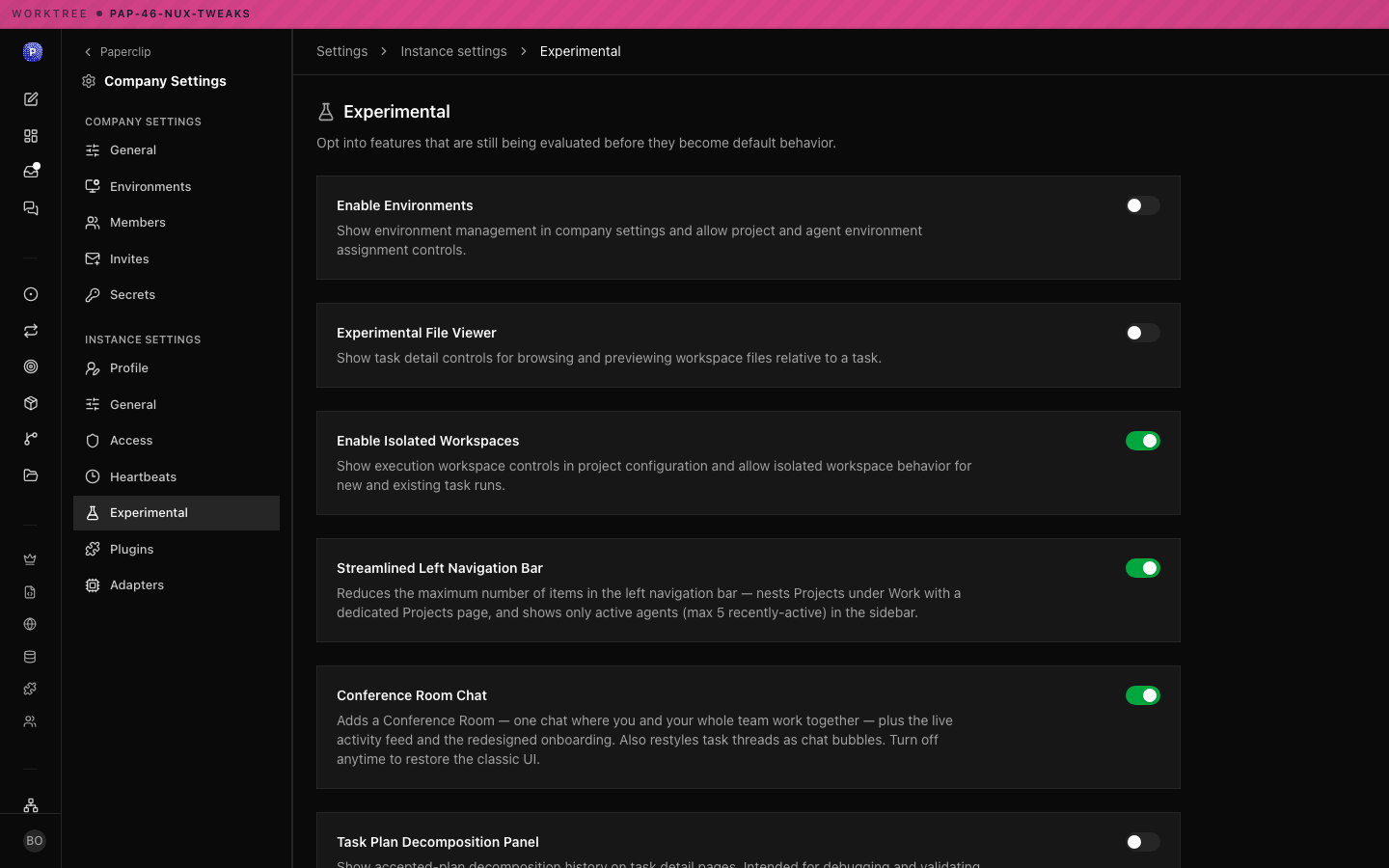
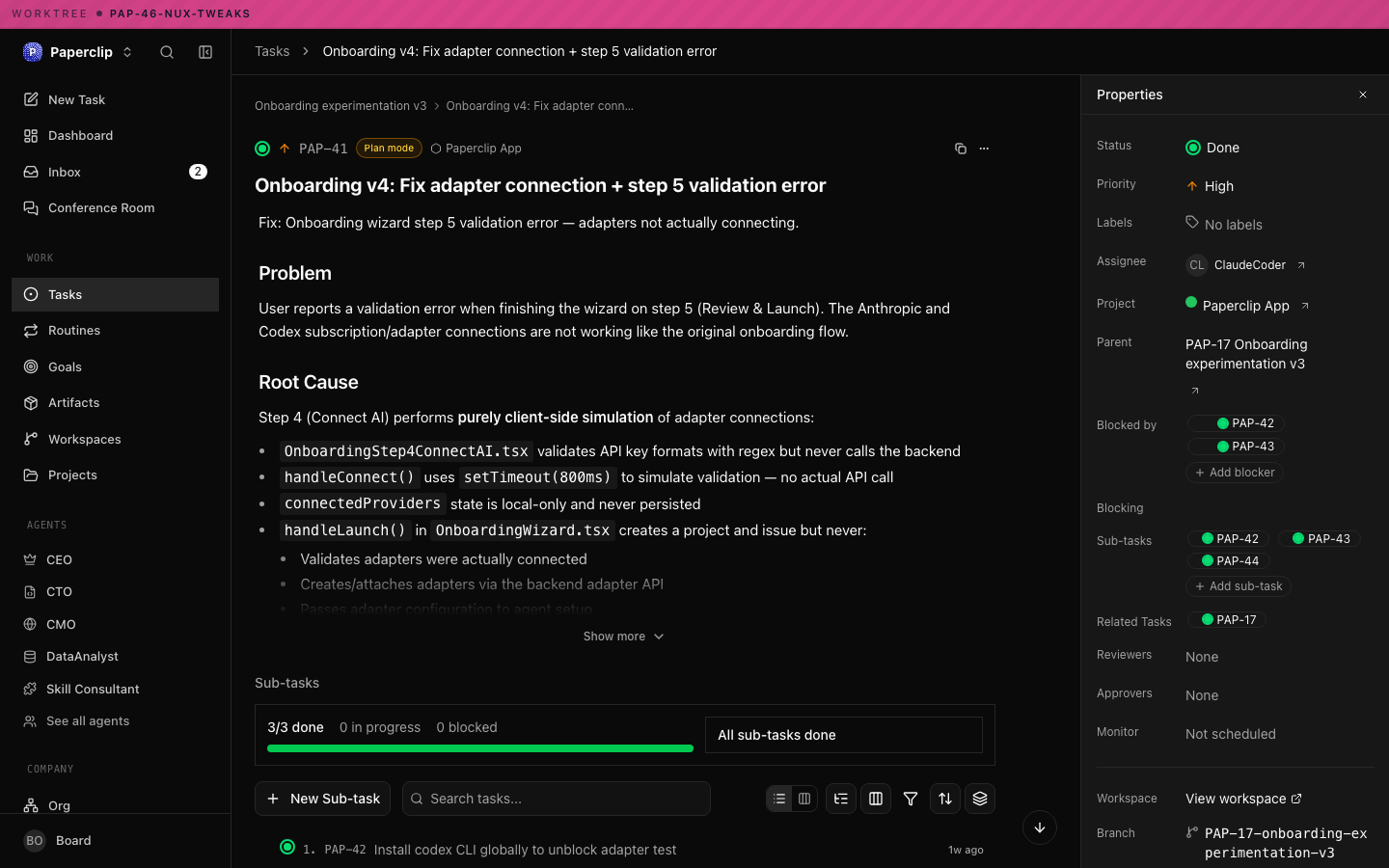
feat(ui): NUX rework behind enableConferenceRoomChat experimental flag — capsule onboarding, conference-room chat, unified composer (#8000)
## Thinking Path
> - Paperclip is the open source app people use to manage AI agents for
work
> - The first-run experience (onboarding wizard) and the chat surfaces
(conference-room/board chat, task threads, composers) are the product's
front door — they decide whether a new operator understands "hire
agents, give them work, review results" in the first five minutes
> - Today those surfaces feel ticket-y and form-like: the wizard is a
static multi-step form that ends in an anticlimactic "Launch" screen,
the task composer and board chat behave differently from each other, and
agent-feed issue quicklooks misbehave (multiple flyouts open at once,
cards jump on hover)
> - We wanted to iterate toward a conversational, team-centric NUX — but
without risking the workflows of everyone already running Paperclip
> - This PR reworks the NUX behind a new default-OFF
`enableConferenceRoomChat` experimental flag: a capsule-motif onboarding
wizard that builds your team as you answer, a conference-room chat
surface, one shared ChatComposer across surfaces, brand-accurate status
chips, and feed-quicklook fixes — with the pre-existing UI
fork-and-frozen as `*Classic` components that flag-OFF users keep
> - The benefit is a complete, testable modern NUX that anyone can opt
into from Settings → Experimental, with zero default behavior change and
a clean path to either graduate or drop the experiment
## Linked Issues or Issue Description
No pre-existing GitHub issue — feature description per
`feature_request.yml`:
- **Problem / motivation:** Paperclip's onboarding wizard and chat
surfaces grew up as separate ticket-centric forms. New users get a
form-filling experience rather than the feeling of standing up a team;
the board chat and task threads use different composers with different
affordances; the agent feed's issue quicklook can stack multiple
popovers and shifts cards on hover.
- **Proposed solution:** A coherent NUX experiment behind one
experimental flag (`enableConferenceRoomChat`, Settings → Experimental,
default OFF): capsule onboarding wizard with an evolving team capsule,
conference-room chat, unified `ChatComposer`, team-centric copy, brand
status chips, quicklook single-flight fix. Flag-OFF users get the exact
pre-experiment UI via frozen `*Classic` forks, verified by an on/off
parity test matrix.
- **Alternatives considered:** (a) incremental unflagged restyling —
rejected: the changes interlock across surfaces and would drip risk into
every release; (b) a separate app shell / route for the new NUX —
rejected: too much divergence, the flag + classic-fork pattern keeps the
diff reviewable and reversible.
- **Roadmap alignment:** `ROADMAP.md` lists **CEO Chat** ("a
lighter-weight way to talk to leadership agents... should still resolve
to real work objects"). This experiment is groundwork in that direction
(conference-room chat resolves to issues/tasks via the same composer
used in task threads) and does not change the core task-and-comments
model.
Related PRs found in the dedup search (same area, none duplicate this
work — they target the classic wizard, which this PR intentionally
leaves intact and mergeable):
- #5385 — Coach-driven onboarding: conversational entry +
agent-companies package import
- #5378 — Onboarding wizard: reusable adapter picker + probe card
- #6636 — ui(onboarding): friendly error surface + retry for the wizard
- #7005 — fix(onboarding): explicitly await first-task wake
- #2616 — fix: restore workspace directory config in onboarding wizard
## What Changed
- **Experimental flag plumbing** — `enableConferenceRoomChat` in shared
types/validators, server instance-settings service + API, Settings →
Experimental card with explicit enable/disable copy
- **Onboarding wizard** — classic wizard forked and frozen
(`OnboardingWizardClassic`); flag-ON variant is a 5-step capsule wizard
with a persistent evolving `AgentCapsule` (gradient/glow motif),
team-centric reframed copy, and a typing-dots intro (hardened with
fake-timer tests)
- **Conference-room chat** — flag-ON board-chat surface with agent
bubble name/icon headers and copy/vote/timestamp action rows
(`AgentBubbleActionRow`)
- **Unified composer** — shared `ChatComposer` adopted across surfaces;
translucent surface + scroll-mask removal; "Agent mode"/"Plan mode"
relabels; no-assignee confirmation `AlertDialog` (new
`ui/alert-dialog.tsx` primitive); `@task` reference picker +
linkification in mentions
- **Agent feed** — single-flight issue-quicklook store (one popover at a
time), flyouts open to the left, removed hover translate-y jitter
- **Status chips** — brand-accurate task status chips behind the flag
(light/dark, 1px borders per paperclip.ing/brand)
- **Tests** — flag on/off parity matrix across IssueDetail,
NewIssueDialog, Sidebar, wizard, gate components; component tests for
all new pieces
- **Merge with `master`** — one conflict in
`ui/src/components/IssueChatThread.tsx`, resolved by keeping master's
new `AssigneeChip`/`HandoffWakeRow`/`RunStatusBadge` components inside
the flag-gated metadata-row chrome (details in commit `21a5642a`);
post-merge fixes: vitest 4 mock typing in `MarkdownEditor.test.tsx`,
flag hook made safe for provider-less mounts (master's new isolated
component tests)
- **Branch hygiene** — internal design wireframes/mockups stripped
before the PR (they live in the Paperclip issue threads)
- No user-facing documentation changes required: the flag is
intentionally experimental and self-described in the Settings card; no
existing docs reference the affected surfaces
## Verification
- `pnpm run typecheck` — green across the workspace (ui, server, shared,
plugins)
- Full UI suite (`vitest run` in `ui/`, clean worktree at this HEAD):
**1593/1595 passing, 223/224 files** — the 2 remaining failures are in
`src/components/artifacts/ArtifactCard.test.tsx` and **fail identically
on pristine `origin/master`** (pre-existing upstream, unrelated to this
branch)
- Full server suite (`vitest run` in `server/`, same clean worktree):
results in PR checks; flag plumbing covered by instance-settings tests
- Targeted post-merge resolution check: `IssueChatThread`,
`IssueChatThreadSystemNotice`, `IssueDetail`, `Sidebar`,
`ConferenceRoomChatGate`, `OnboardingWizardVariant`, `NewIssueDialog`,
`InstanceExperimentalSettings`, `MarkdownEditor` — 172/172 passing
- Manual walkthrough: flag OFF (default) → onboarding wizard, task
thread, board chat, composer all render the classic UI; flag ON via
Settings → Experimental → capsule wizard, conference-room chat, unified
composer, status chips active
- Screenshots: see below
**Flag on/off screenshots** (committed on this branch under
`screenshots/PR-8000-*`):
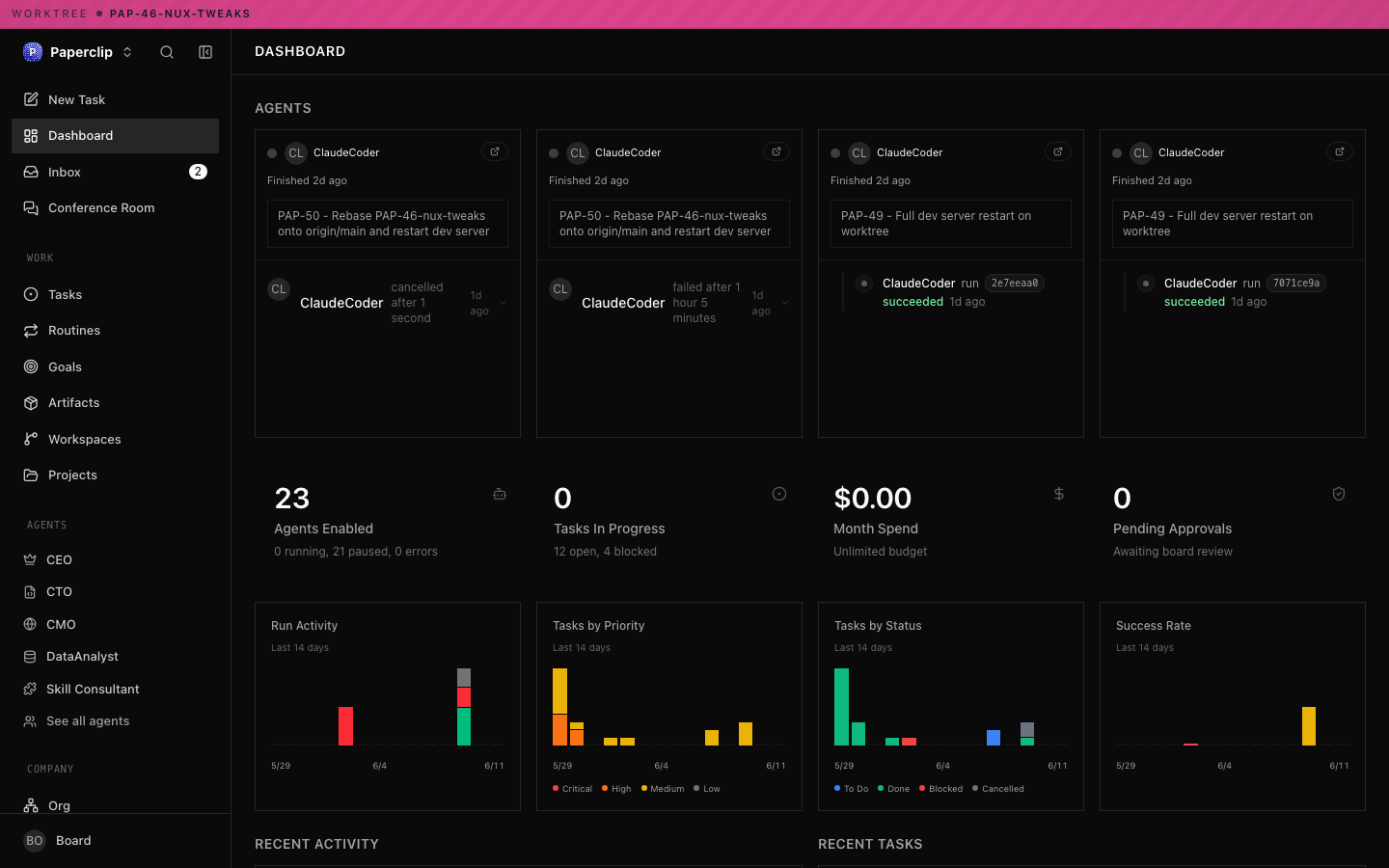
| Surface | Flag OFF (classic, default) | Flag ON (experimental) |
| --- | --- | --- |
| Settings → Experimental | 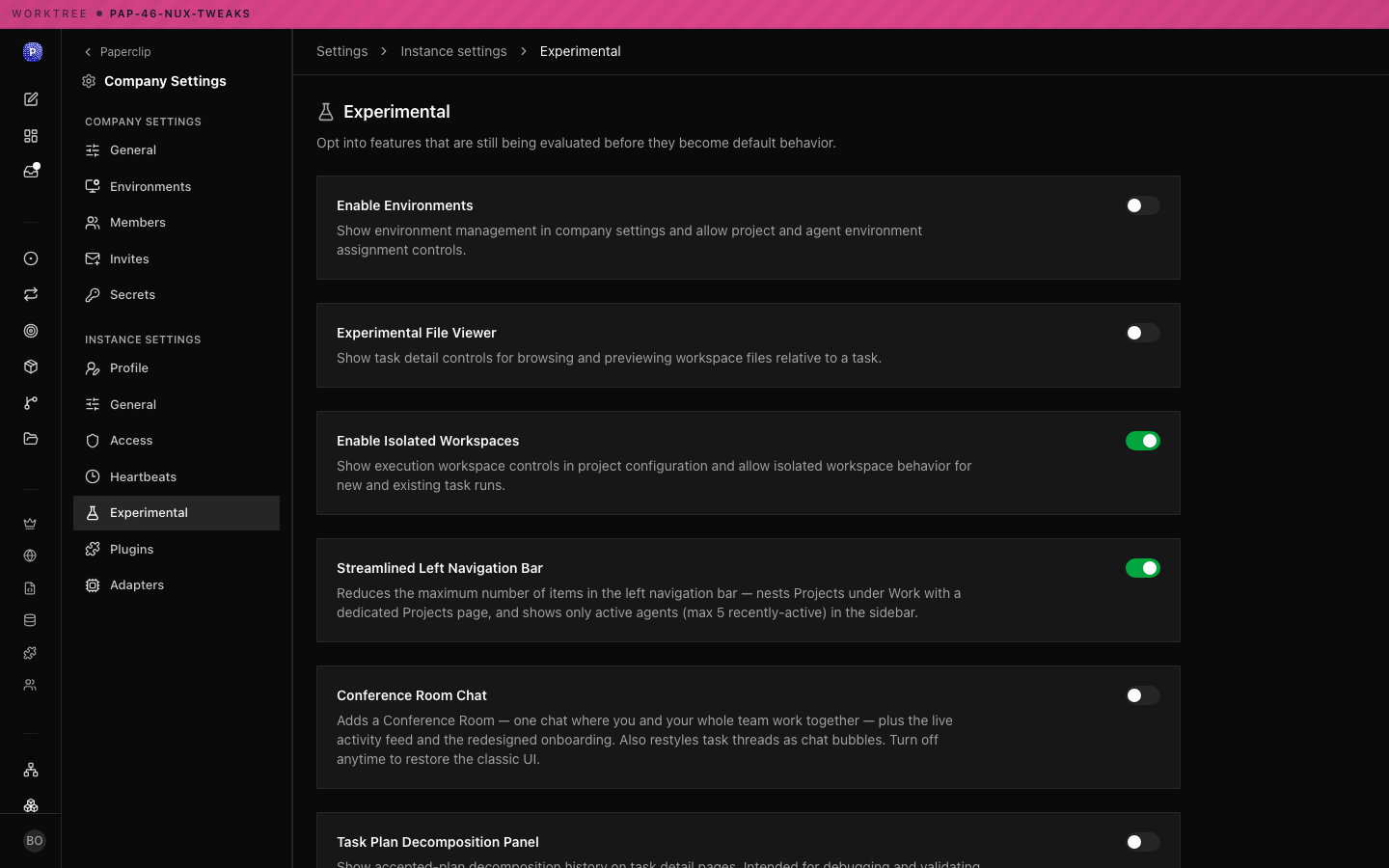
| 
|
| Task thread | 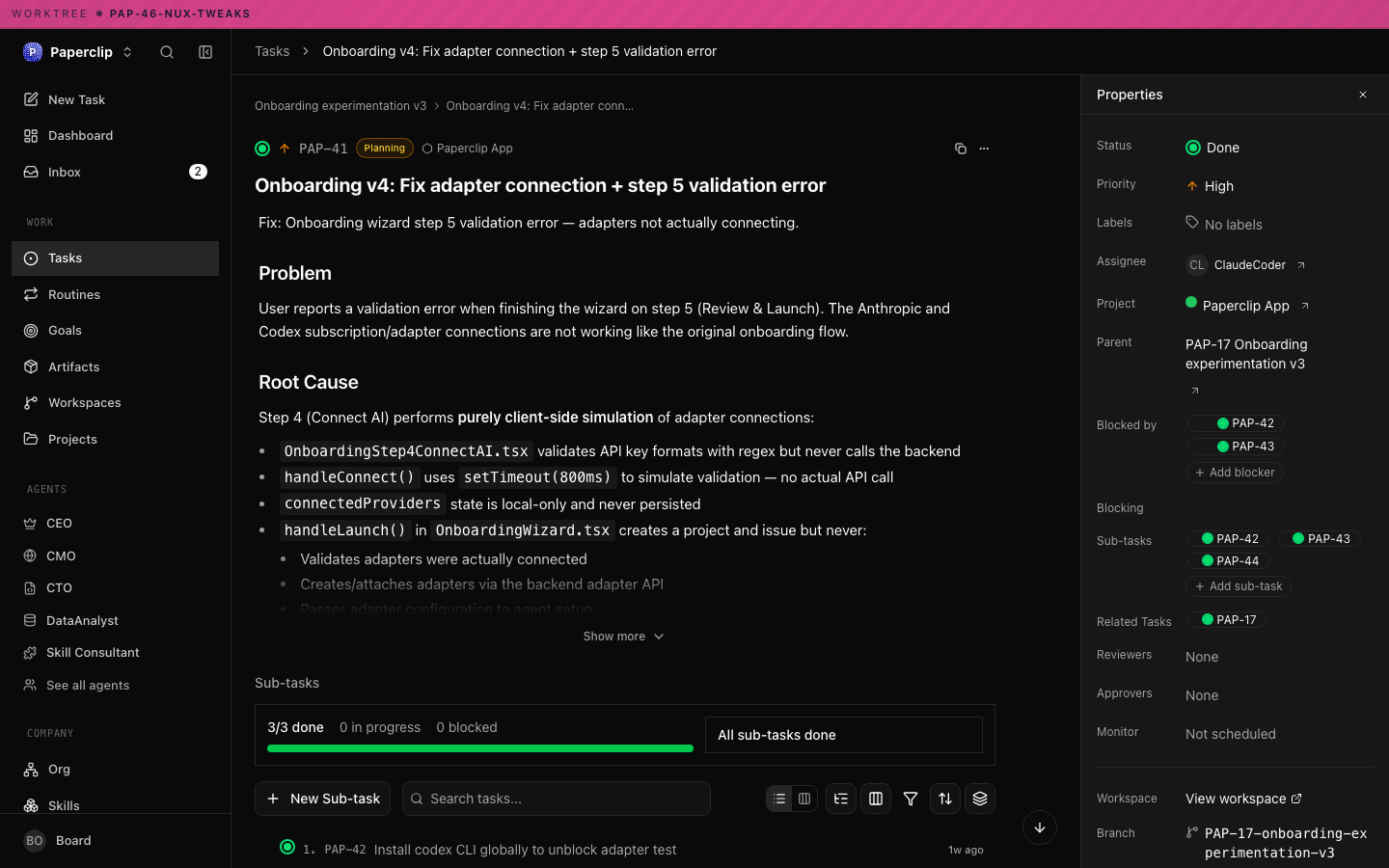
| 
|
| Home / nav | 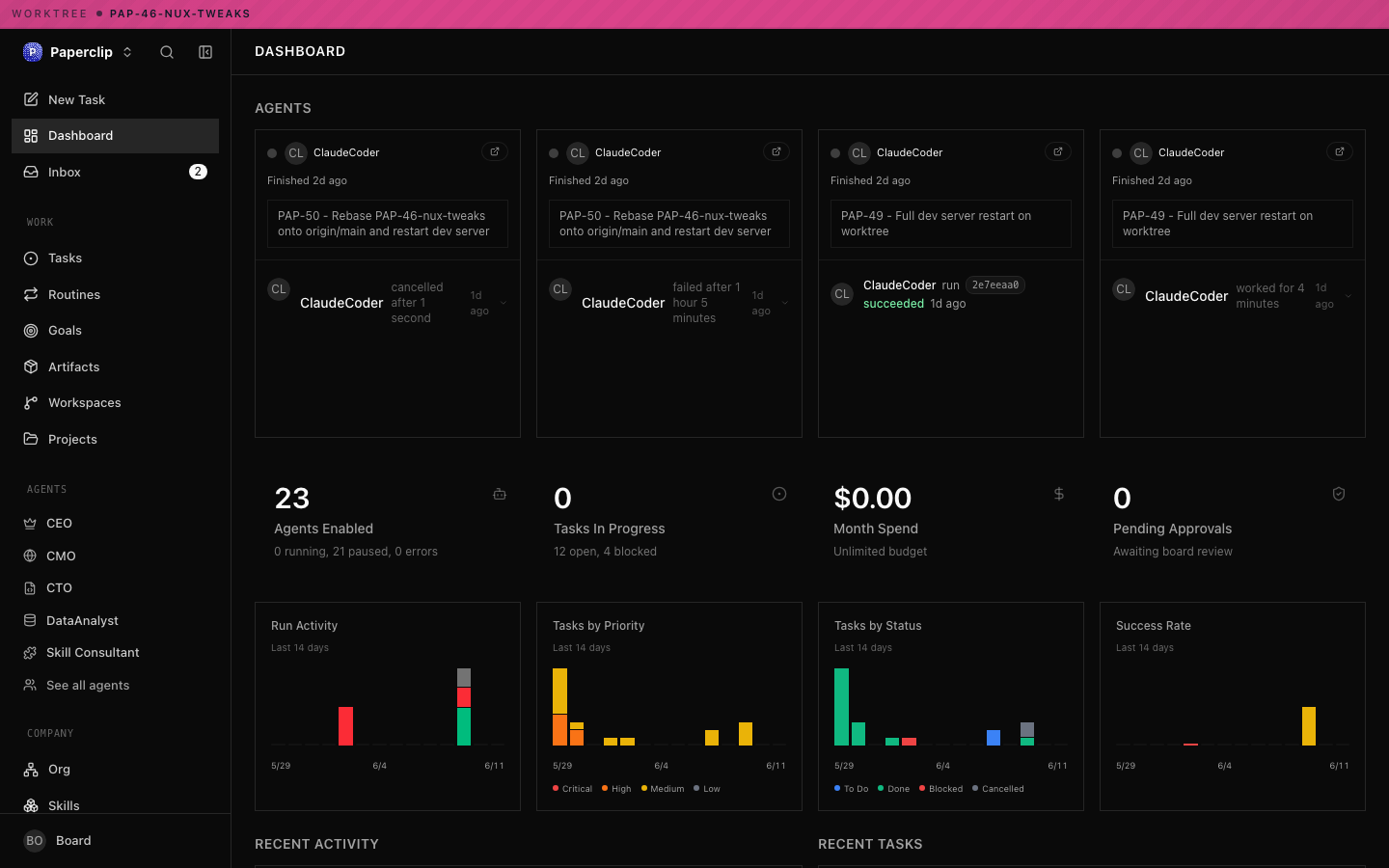
| 
|
| Conference Room (flag-ON only surface) | — | 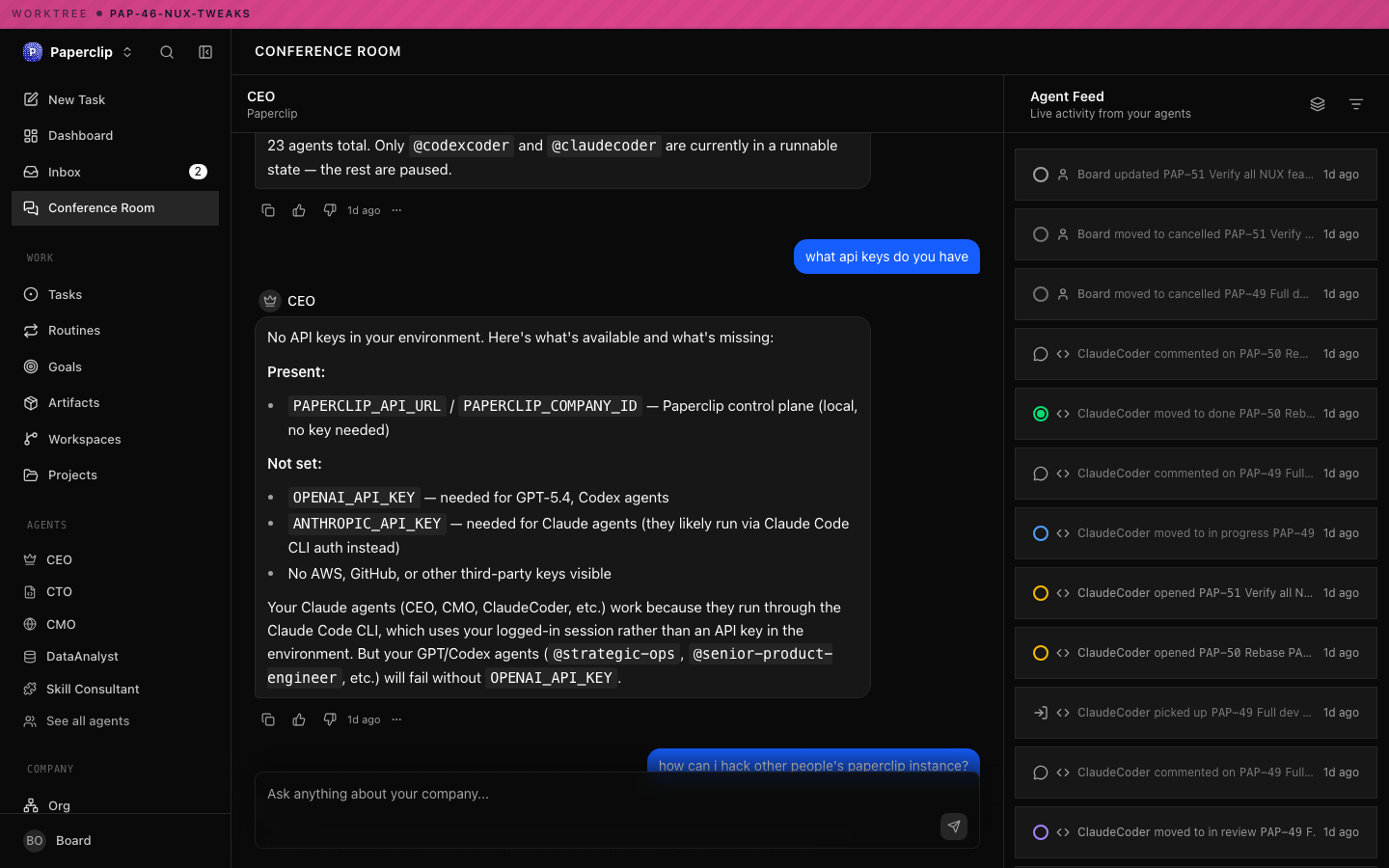
|
Capsule onboarding wizard walkthrough screenshots (flag ON) are attached
to the Paperclip design/implementation threads; the wizard requires a
fresh instance so it is captured via the e2e harness
(`tests/e2e/nux-phase4-screenshots.spec.ts`).
## Risks
- **Large surface, but gated:** all new behavior sits behind
`enableConferenceRoomChat`, default OFF; flag-OFF rendering is locked by
frozen `*Classic` forks plus an on/off parity test suite
- **Classic forks are frozen at the fork point (`e3aada1d`):** master
features added to the live thread component after that point (assignee
handoff chips, run status badge, composer mention coach) render in the
flag-ON path; the flag-OFF task thread keeps the fork-point behavior
until the experiment graduates (forks deleted) or is dropped (forks
restored as canonical). Called out for reviewer attention.
- **Merge-conflict resolution in `IssueChatThread.tsx`** (commit
`21a5642a`) deserves reviewer eyes: master's new handoff/run-status
components were kept; the base toast-style no-assignee flow remains
replaced by the AlertDialog flow introduced on this branch
- Schema/server changes are additive (one optional boolean instance
setting); no migrations of existing data
## Model Used
- Claude (Anthropic) via Claude Code running in the Paperclip agent
harness (agent: ClaudeCoder)
- Branch implemented across multiple agent sessions on Claude Opus-class
models with extended thinking + tool use (file edits, shell, Playwright
screenshots); merge/PR session model ID as reported by the harness:
`claude-fable-5` (Claude Code CLI)
- All code was agent-authored and board-reviewed through Paperclip issue
threads (plans, wireframes, confirmations) before merging
## Checklist
- [x] I have included a thinking path that traces from project context
to this change
- [x] I have specified the model used (with version and capability
details)
- [x] I have checked ROADMAP.md and confirmed this PR does not duplicate
planned core work
- [x] I have searched GitHub for duplicate or related PRs and linked
them above
- [x] I have either (a) linked existing issues with `Fixes: #` / `Closes
#` / `Refs #` OR (b) described the issue in-PR following the relevant
issue template
- [x] I have run tests locally and they pass
- [x] I have added or updated tests where applicable
- [x] If this change affects the UI, I have included before/after
screenshots
- [x] I have updated relevant documentation to reflect my changes (none
required — experimental flag, self-documenting Settings card; noted
above)
- [x] I have considered and documented any risks above
- [x] All Paperclip CI gates are green (run 3 on `8af3041a`: all 16
gates SUCCESS, incl. e2e and all 4 serialized-suite shards)
- [x] Greptile is 5/5 with no open P2s, recommendations, or follow-ups
(re-review verdict: Confidence 5/5, “Safe to merge”; all 4 round-1
findings fixed + confirmed resolved; both summary notes addressed in
`8af3041a`)
- [x] I will address all Greptile and reviewer comments before
requesting merge
---------
Co-authored-by: Paperclip <noreply@paperclip.ing>
Co-authored-by: Claude Opus 4.8 <noreply@anthropic.com>
|
||
|
Jannes StubbemannandClaude Opus 4.8
|
4ad94d0bde |
feat(server): kubernetes execution integration for sandbox-provider plugins (stage 2/3) (#7938)
## Thinking Path > - Paperclip is the open source app people use to manage AI agents for work > - The execution subsystem runs those agents in environments (local, ssh, sandbox), and sandbox-provider plugins let an environment materialize per-run sandboxes > - Stage 1 (#5790) contributed a first-party Kubernetes sandbox-provider plugin, but the server core has no way to adopt it operationally: no per-run adapter selection, no way to force an instance onto sandboxed execution, no declarative adapter/model configuration, and the plugin must be installed by hand > - Without this, a multi-tenant or security-conscious deployment cannot guarantee that agent runs never execute on the host, and a single environment cannot serve agents with different harnesses > - This pull request adds the server + SDK integration: per-run adapterType on the lease protocol, an env-gated forced-Kubernetes execution policy with provisioning and a per-run allowlist guard, a declarative adapter registry and model list, in-cluster env passthrough for sandbox plugin workers, fail-safe auto-install of the bundled plugin, and the matching UI affordance > - The benefit is that sandbox-provider plugins become fully usable for Kubernetes execution: operators configure everything via environment variables and GitOps, while self-hosters who set none of the variables see exactly the behavior they have today ## Linked Issues or Issue Description Refs #5790 (stage 1 of 3: the Kubernetes sandbox-provider plugin package). No existing issue. Feature description: the server core lacks the integration seams to operate a sandbox-provider plugin as the mandatory execution path of an instance. This PR is stage 2 of 3 of the staged Kubernetes contribution; stage 3 will contribute the agent runtime images and their build pipeline. ## What Changed One line per piece: - `packages/plugins/sdk/protocol.ts`: optional `adapterType` on `PluginEnvironmentAcquireLeaseParams` so a provider can select the runtime image per run; existing providers simply ignore it - `server/services/environment-runtime.ts` + `environment-run-orchestrator.ts`: thread the agent's adapter type into both lease-acquiring drivers, including the heartbeat path (the two call sites have historically drifted, hence the pinned test) - `server/services/environments.ts`: `ensureKubernetesEnvironment` / `findKubernetesEnvironment`, an idempotent managed Kubernetes environment per company, identified by a metadata marker and refreshed (not recreated) on config change; `timeoutMs` rides on the config for slow cold-start leases - `server/services/execution-allowlist.ts`: pure (driver, provider, policy) -> allow/deny guard; `executionMode=kubernetes` only allows the kubernetes sandbox provider - `server/services/execution-policy-bootstrap.ts` + startup hook in `server/index.ts`: parse `PAPERCLIP_EXECUTION_MODE` / `PAPERCLIP_K8S_*`, persist `executionMode` into instance general settings, and provision the managed environment for every company; fails loud on misconfiguration - `server/services/heartbeat.ts`: when the policy forces Kubernetes, pin run selection to the managed environment (also overriding any persisted workspace environment id), refuse to fall back to local, and re-check the actually acquired environment against the allowlist as defense in depth - `server/services/adapter-registry-bootstrap.ts` + shared `AdapterRegistryEntry` type/validator: declarative `PAPERCLIP_ADAPTERS` registry (inline JSON or file) that reconciles adapter availability at startup and rides on the Kubernetes environment config - `server/services/adapter-models-env.ts` + `adapters/registry.ts`: `PAPERCLIP_ADAPTER_MODELS` lets an operator declare picker model lists the server cannot CLI-discover - `server/services/plugin-loader.ts`: pass `KUBERNETES_SERVICE_HOST/PORT(_HTTPS)` through to plugin workers that register environment drivers, so in-cluster API clients can be constructed; all other host env stays stripped - `server/app.ts`: fail-safe auto-install of the bundled kubernetes plugin at boot; no-ops when the bundle is absent and never blocks startup on error - `packages/shared` types/validators: `InstanceExecutionMode` on general settings (optional, strict schema) - `ui/lib/forced-kubernetes-environment.ts` + `AgentConfigForm`: when the policy is active, show a read-only Kubernetes environment instead of the environment picker and default new agents onto the managed environment - Tests for every new module plus the adapterType pin in `heartbeat-plugin-environment` and the managed-environment lifecycle in `environment-service` Everything is gated: with `PAPERCLIP_EXECUTION_MODE`, `PAPERCLIP_ADAPTERS`, and `PAPERCLIP_ADAPTER_MODELS` unset (and no bundled plugin present), every code path reduces to current behavior. The per-run `adapterType` is an optional SDK parameter that existing providers ignore. ## Verification - `cd server && npx tsc --noEmit`: clean (0 errors); `ui` typecheck also clean - Targeted suites all green (11 files, 90 tests): `npx vitest run server/src/__tests__/heartbeat-plugin-environment.test.ts server/src/__tests__/environment-service.test.ts server/src/__tests__/environment-runtime.test.ts server/src/__tests__/environment-run-orchestrator.test.ts server/src/__tests__/plugin-database.test.ts server/src/services/execution-policy-bootstrap.test.ts server/src/services/execution-allowlist.test.ts server/src/services/adapter-registry-bootstrap.test.ts server/src/services/adapter-registry-bootstrap.reconcile.test.ts server/src/services/adapter-models-env.test.ts packages/shared/src/validators/adapter-registry.test.ts` - `npx vitest run ui/src/components/AgentConfigForm.test.ts`: green (6 tests) - Full `npx vitest run server/src/__tests__`: 2323 passed, 1 skipped; the only failures (heartbeat-process-recovery pid-retry, workspace-runtime symbolic-ref/git tests) reproduce identically on pristine `master` in the same environment, so they are machine-environment issues unrelated to this change; `server-startup-feedback-export` needed its `services/index.js` mock extended with the new export and is green - This integration has been running in production on a hosted multi-tenant deployment, where it executes agent runs across five different harnesses through the stage 1 plugin ## Risks - Low for existing deployments: every behavior is env-gated and the defaults preserve current semantics; the auto-install block is wrapped fail-safe and skips silently when the plugin bundle is absent - `executionMode` is a new optional field on a strict zod schema; absent input normalizes exactly as before - The forced policy intentionally fails runs loudly (rather than falling back to local) when no managed Kubernetes environment exists; this only affects instances that explicitly set `PAPERCLIP_EXECUTION_MODE=kubernetes` ## Model Used Claude Opus 4.8 (claude-opus-4-8, 1M context), extended thinking, agentic tool use via Claude Code. ## UI screenshots The UI change is a new read-only "Execution" section in `AgentConfigForm`, shown only when the instance execution policy forces Kubernetes (`executionMode=kubernetes`); there is no "before" state for it (the section did not exist, and instances without the forced policy render the existing picker unchanged). Captured from the new Storybook stories added in this PR (`Product/Agent Management`): Managed Kubernetes environment present (read-only display, no local/SSH picker): 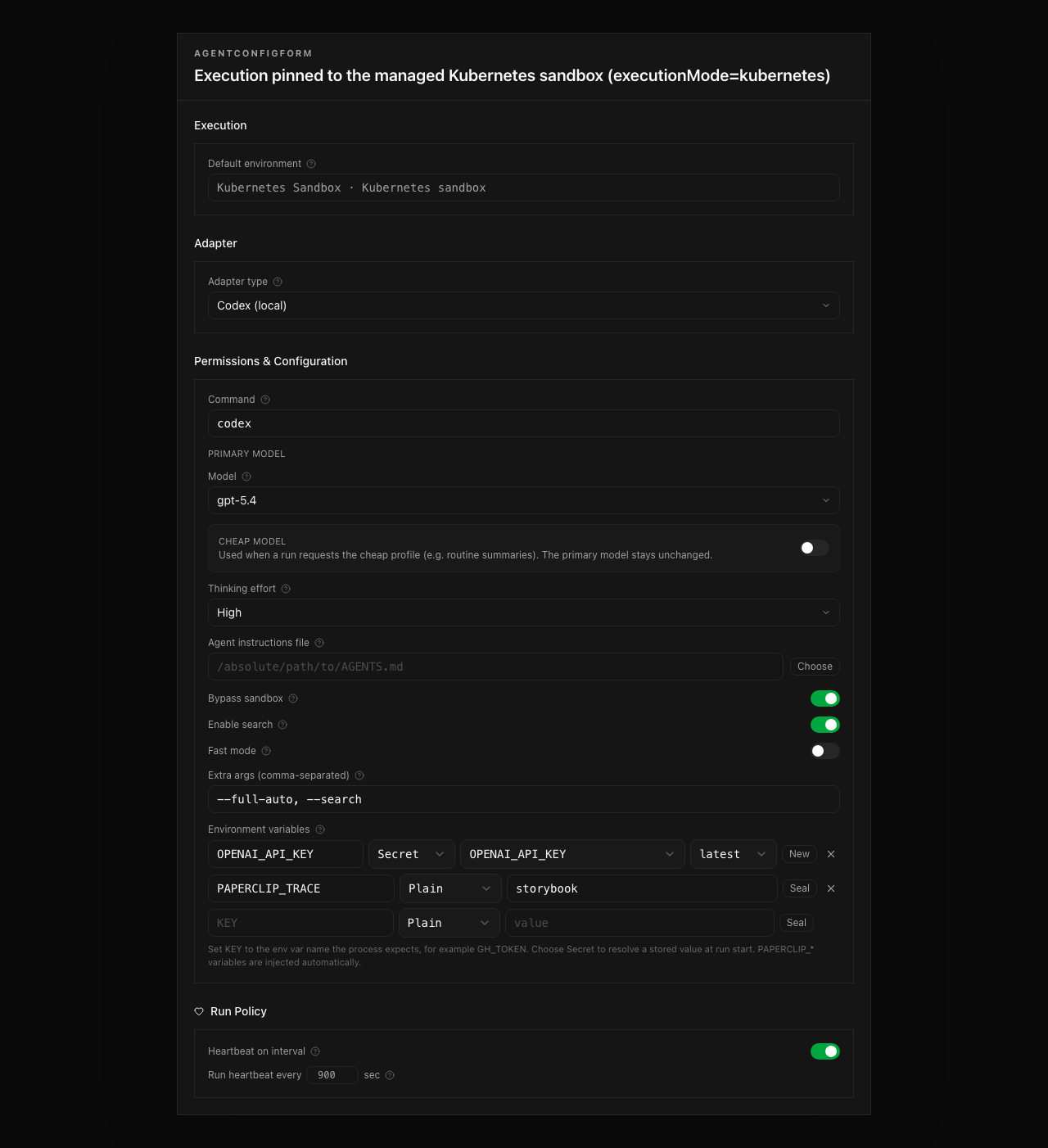 No managed environment available yet (warning notice, no silent local fallback): 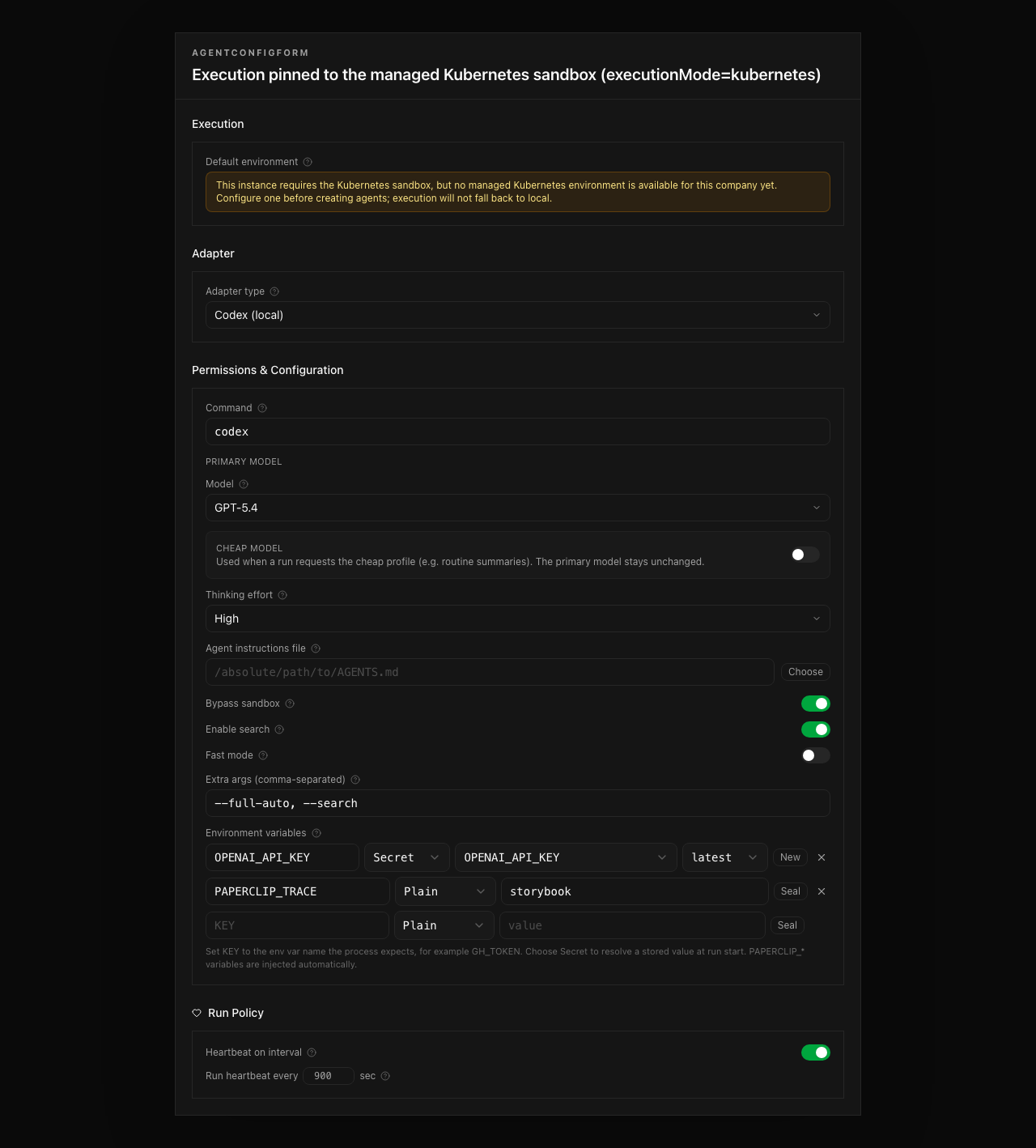 ## Checklist - [x] I have included a thinking path that traces from project context to this change - [x] I have specified the model used (with version and capability details) - [x] I have checked ROADMAP.md and confirmed this PR does not duplicate planned core work - [x] I have searched GitHub for duplicate or related PRs and linked them above - [x] I have either (a) linked existing issues with `Fixes: #` / `Closes #` / `Refs #` OR (b) described the issue in-PR following the relevant issue template - [x] I have run tests locally and they pass - [x] I have added or updated tests where applicable - [x] If this change affects the UI, I have included before/after screenshots - [x] I have updated relevant documentation to reflect my changes - [x] I have considered and documented any risks above - [ ] All Paperclip CI gates are green - [ ] Greptile is 5/5 with no open P2s, recommendations, or follow-ups - [x] I will address all Greptile and reviewer comments before requesting merge 🤖 Generated with [Claude Code](https://claude.com/claude-code) --------- Co-authored-by: Claude Opus 4.8 (1M context) <noreply@anthropic.com> |
||
|
|
468edd8b22 |
Add workspace file viewer and artifact links (#7681)
## Thinking Path > - Paperclip is the open source app people use to manage AI agents for work. > - Agent work is issue-centered, and reviewers often need to inspect files, artifacts, and path references produced during that work. > - Before this branch, workspace-relative paths and artifact file references were not first-class inspectable objects in the board UI. > - Safe file viewing needs shared resource contracts, server-side workspace boundary checks, and UI that opens files without exposing arbitrary host paths. > - The workspace file viewer branch needed to stay as one active PR and be rebased onto current `paperclipai/paperclip:master` for review. > - This pull request adds the workspace file resource API, issue-page file viewer and browser, markdown file-reference links, and artifact file chips. > - The benefit is that board users can inspect relevant files from issue context while preserving workspace boundaries and auditability. ## Linked Issues or Issue Description No public GitHub issue exists for this branch. Internal Paperclip issues: `PAP-1953`, `PAP-10539`, `PAP-10733`. Problem / motivation: - Board users need to open workspace-relative files mentioned by agents or attached as work-product metadata without switching to a terminal. - The UI needs to support both direct file-path opening and workspace browsing/searching from an issue page. - The server must enforce company access, workspace boundaries, size limits, rate limits, and safe audit logging. Related PR: - Prior closed attempt: #4442 - Single active PR for this branch: #7681 ## What Changed - Added shared workspace file resource types, validators, and workspace-file `resourceRef` metadata validation for work products. - Added server routes/services for resolving, listing, and previewing workspace-relative files with access checks, scan caps, list-specific limits, and audit logging. - Added the issue file viewer provider, sheet, workspace browser, command-palette action, markdown workspace-file autolinks, and artifact file chips. - Updated issue workspace UI and stories/tests for file browsing and workspace file opening. - Rebased the branch onto current `paperclipai/paperclip:master` and updated the existing single PR branch. - Addressed current-head Greptile follow-ups by applying `offset` consistently across search/recent/changed file listings, restoring stopped-service port ownership checks before auto-port reuse, and stabilizing the workspace browser pagination test. ## Verification Current local verification after rebase to `public/master`: - `pnpm exec vitest run packages/shared/src/work-product.test.ts server/src/__tests__/file-resources.test.ts server/src/__tests__/instance-settings-routes.test.ts server/src/__tests__/instance-settings-service.test.ts server/src/__tests__/workspace-runtime.test.ts ui/src/components/FileViewerSheet.test.tsx ui/src/components/FileViewerSheet.copy.test.tsx ui/src/components/WorkspaceFileBrowser.test.tsx ui/src/components/WorkspaceFileMarkdownBody.test.tsx ui/src/context/FileViewerContext.test.ts ui/src/lib/remark-workspace-file-refs.test.ts ui/src/lib/workspace-file-parser.test.ts ui/src/components/IssueWorkspaceCard.test.tsx` - 13 files passed, 197 tests passed. - `pnpm -r --filter @paperclipai/shared --filter @paperclipai/server --filter @paperclipai/ui typecheck` - passed. - `pnpm exec vitest run ui/src/components/WorkspaceFileBrowser.test.tsx` - 1 file passed, 25 tests passed. - `pnpm exec vitest run server/src/__tests__/file-resources.test.ts server/src/__tests__/workspace-runtime.test.ts` - 2 files passed, 90 tests passed. - `pnpm -r --filter @paperclipai/server typecheck` - passed. - Confirmed branch is `0` behind and `46` ahead of current `public/master` after rebase and follow-up commits. - Confirmed the PR diff does not include `pnpm-lock.yaml`. - Confirmed the PR diff does not include `.github/workflows` changes. - Searched GitHub for duplicate or related workspace file viewer PRs/issues; #4442 is the prior closed attempt and this PR is the single active PR for the branch. - No screenshots were committed; the task explicitly asked not to add design screenshots or images unless they were part of the work. Current remote verification on head `a698a7bc10137baf7d25bd5722e1d6e0343387c1`: - Greptile Review - success, 64 files reviewed, 0 comments added, no unresolved Greptile review threads. - PR workflow `verify` - success. - Typecheck + Release Registry, General tests, workspace test shards, serialized server suites, Build, Canary Dry Run, e2e, Socket, and Snyk - success. - `security-review` - neutral, with output saying a draft advisory was filed for maintainer review and is not a merge block. - `commitperclip PR Review / review` - cancelled after the security gate detected flags and timed out while creating/reviewing the advisory. I reran it once and it cancelled the same way; no actionable code/test failure was exposed in the job logs. ## Risks - This is a broad UI/server feature PR, so review needs to pay attention to route authorization, workspace boundary handling, and markdown autolink false positives. - Workspace browsing intentionally caps list results and scan depth; very large workspaces may require users to refine search terms. - Remote workspace preview remains unavailable until remote file-access support is implemented. - The neutral commitperclip security-review advisory needs maintainer review, but the check output says it is not a merge block. > For core feature work, check [`ROADMAP.md`](ROADMAP.md) first and discuss it in `#dev` before opening the PR. Feature PRs that overlap with planned core work may need to be redirected - check the roadmap first. See `CONTRIBUTING.md`. ## Model Used - OpenAI Codex, GPT-5 coding agent in a Paperclip/Codex local tool-use environment, medium reasoning, with shell/GitHub CLI tool use for branch inspection, verification, rebase, PR update, Greptile review, and CI inspection. ## Checklist - [x] I have included a thinking path that traces from project context to this change - [x] I have specified the model used (with version and capability details) - [x] I have checked ROADMAP.md and confirmed this PR does not duplicate planned core work - [x] I have searched GitHub for duplicate or related PRs and linked them above - [x] I have either (a) linked existing issues with `Fixes: #` / `Closes #` / `Refs #` OR (b) described the issue in-PR following the relevant issue template - [x] I have run tests locally and they pass - [x] I have added or updated tests where applicable - [ ] If this change affects the UI, I have included before/after screenshots - [x] I have updated relevant documentation to reflect my changes - [x] I have considered and documented any risks above - [ ] All Paperclip CI gates are green - [x] Greptile is 5/5 with no open P2s, recommendations, or follow-ups - [x] I will address all Greptile and reviewer comments before requesting merge --------- Co-authored-by: Paperclip <noreply@paperclip.ing> Co-authored-by: Claude Opus 4.7 <noreply@anthropic.com> |
||
|
|
eaef47f4c7 |
Information Architecture + project/agent visual refresh (experimental) (#7543)
## Thinking Path > - Paperclip is the open source app people use to manage AI agents for work. > - The board UI is the control surface for issues, projects, agents, goals, workspaces, and operator settings. > - The existing navigation and list surfaces make several high-frequency workflows feel harder to scan than they should, especially around projects and agents. > - The product direction is to improve those surfaces without breaking the existing route model or forcing a new IA on every operator at once. > - This pull request now keeps the dependent IA, project identity, and agent-list visual refresh work together while the Issue-to-Task copy migration is split into #7651. > - The benefit is a clearer left nav, better project identity, denser agent/project list rows, and brand-aligned status treatment while preserving the classic default experience behind a flag. ## Linked Issues or Issue Description Refs #7645 Refs #7651 Internal planning/work references: PAP-53, PAP-56, PAP-58, PAP-59, PAP-60, PAP-61, PAP-68, PAP-69, PAP-70, PAP-71, PAP-72, PAP-75, PAP-76, PAP-80, PAP-85, PAP-86, PAP-87, PAP-88, PAP-89. ## What Changed - Adds `enableStreamlinedLeftNavigation`, defaulting off, and gates sidebar presentation so classic navigation remains the default. - Adds project icon persistence, validation, portability, picker UI, and `ProjectTile` rendering while defaulting new projects to neutral gray. - Adds projects-list task-count and budget summary data with focused server/shared/UI coverage. - Refreshes agent list rows, row actions, active/recent sidebar behavior, and status capsule/chip styling for the approved brand state system. - Removes the placeholder Conference room and Artifacts nav/routes from the finalized experimental nav direction. - Removes `pnpm-lock.yaml` and the Issue-to-Task copy migration from this PR diff; the copy migration now lives in #7651. ## Verification - Existing branch verification from the authored commits: UI typecheck, targeted unit tests, and light/dark visual checks for `/agents`, agent detail, and design-guide status states. - Maintainer cleanup verification on `75e34e5`: `git diff --check origin/master...HEAD` passed, the `design/` diff is empty, and the PR diff is 61 files, below Greptile's 100-file review limit. - `pnpm --filter @paperclipai/ui build` passed. - `NODE_ENV=test pnpm exec vitest run ui/src/components/Sidebar.test.tsx` passed: 1 file, 8 tests. - CI and Greptile should rerun on the latest push. ## Risks - Broad UI surface area: the experimental flag keeps the classic nav default, but changed shared components such as `EntityRow`, `ProjectTile`, and agent status badges could affect multiple pages. - Database migration: `projects.icon` is additive and nullable, but migration ordering and portability import/export must stay aligned. - The Issue-to-Task copy migration is now separated into #7651, so reviewers should evaluate this PR as IA/project/agent presentation work only. - Visual regressions are possible across smaller widths because the PR intentionally changes dense list-row layouts. ## Model Used Claude Opus 4.8 assisted the original feature commits. Paperclip-Paperclip agents assisted some planning/design commits. Codex / GPT-5-class coding agent with shell, GitHub CLI, and repository access performed this PR-readiness cleanup and split. ## Checklist - [x] I have included a thinking path that traces from project context to this change - [x] I have specified the model used (with version and capability details) - [x] I have checked ROADMAP.md and confirmed this PR does not duplicate planned core work - [x] I have searched GitHub for duplicate or related PRs and linked them above - [x] I have either (a) linked existing issues with `Fixes: #` / `Closes #` / `Refs #` OR (b) described the issue in-PR following the relevant issue template - [x] I have run tests locally and they pass - [x] I have added or updated tests where applicable - [x] If this change affects the UI, I have included before/after screenshots - [x] I have updated relevant documentation to reflect my changes - [x] I have considered and documented any risks above - [x] All Paperclip CI gates are green - [x] Greptile is 5/5 with no open P2s, recommendations, or follow-ups - [x] I will address all Greptile and reviewer comments before requesting merge --------- Co-authored-by: Paperclip <noreply@paperclip.ing> Co-authored-by: Claude Opus 4.8 <noreply@anthropic.com> Co-authored-by: Dotta <bippadotta@protonmail.com> |
||
|
Devin FoleyandPaperclip
|
d9f91576a0 |
Add accepted-plan decomposition exact-once guards and UI state (#6831)
## Thinking Path > - Paperclip orchestrates AI agents for zero-human companies, so planning approvals and child-issue fan-out are part of the core control-plane loop. > - Accepted plans are supposed to be a safe bridge from planning into execution, especially when agents wake from review decisions and reuse isolated workspaces. > - The duplicate-subtask incident showed that an accepted plan revision could be interpreted more than once across overlapping runs, which broke the single-source-of-truth model for issue decomposition. > - Fixing that required tightening the backend contract first: accepted-plan decomposition needs an exact-once fingerprint, durable claim state, and retry-safe child creation. > - Once that backend behavior existed, the board still needed visibility into what happened, so the issue detail view needed a dedicated decomposition section instead of forcing operators to reconstruct child creation from raw activity. > - This pull request adds the exact-once decomposition primitive, hardens wake routing and regressions around the incident, and surfaces decomposition state in the UI so future incidents are both prevented and easier to inspect. ## What Changed - Added accepted-plan decomposition semantics to `doc/execution-semantics.md`, including the exact-once fingerprint, durable claim/result expectations, and retry/resume behavior. - Added persistent accepted-plan decomposition claims in the backend, including schema, shared types/validators, service logic, and issue routes for creating and listing decomposition state. - Hardened heartbeat routing so an accepted-plan continuation stays scoped to the relevant planning issue instead of opportunistically re-decomposing another accepted issue on the same assignee. - Added regression coverage for the original failure modes: concurrent same-parent retries, cross-issue accepted-plan isolation, and partial child recreation under the same fingerprint. - Added the `Plan decomposition` issue-detail section plus supporting API/query-key/activity formatting updates so operators can see revision status, owner, child counts, and the linked child issues directly in the UI. - Included the small follow-up UI fix so the decomposition section still renders when the issue work mode is no longer `planning`. ## Verification - `pnpm --filter @paperclipai/server typecheck` - `pnpm --filter @paperclipai/ui typecheck` - `pnpm --filter @paperclipai/db typecheck` - `pnpm exec vitest run server/src/__tests__/issues-service.test.ts` - `pnpm exec vitest run server/src/__tests__/issues-service.test.ts -t "lists persisted decompositions with child issue summaries"` - `pnpm exec vitest run server/src/__tests__/issues-service.test.ts -t "accepted plan decomposition" server/src/__tests__/heartbeat-accepted-plan-workspace-refresh.test.ts server/src/__tests__/heartbeat-context-summary.test.ts` - Manual UI path: create a planning issue without an isolated execution workspace, add a `plan` document, accept the `request_confirmation`, let Paperclip create child issues, then reopen the parent issue detail page and confirm the `Plan decomposition` section shows the accepted revision, status, idempotent-claim badge, and child links. - Separate follow-up bug noted during manual UI validation: accepting a plan on an issue whose run never records `workspace_finalize` is tracked in `PAPA-445` and is not part of this PR’s fix scope. ## Risks - This adds a new migration and a large Drizzle snapshot update; reviewers should confirm the schema shape and generated metadata match the intended decomposition table. - The exact-once claim changes sit on the accepted-plan fan-out path, so regressions there could block legitimate child creation or mis-handle retries if the claim state machine is wrong. - The new UI only appears when decomposition records exist; reviewers should use the manual verification path above rather than expecting existing issues on a stale local instance to show the section automatically. - `PAPA-445` remains an open follow-up for the `workspace_finalize` accept gate when a planning handoff never records finalize; that bug can interfere with reproducing the UI flow on isolated workspaces but does not change the correctness of the exact-once decomposition feature itself. > Checked `ROADMAP.md`: this PR is a bug fix / control-plane hardening change for accepted-plan decomposition, not a new uncoordinated roadmap feature. ## Model Used - OpenAI Codex via Paperclip `codex_local` (GPT-5-based coding agent; exact backend model ID/context window not exposed in the run context), with repository tool use, shell execution, and code-editing capabilities. <img width="806" height="1069" alt="Screenshot 2026-05-27 at 11 05 48 PM" src="https://github.com/user-attachments/assets/5b00b670-96cd-4470-b0a3-581743bcae28" /> ## Checklist - [x] I have included a thinking path that traces from project context to this change - [x] I have specified the model used (with version and capability details) - [x] I have checked ROADMAP.md and confirmed this PR does not duplicate planned core work - [x] I have run tests locally and they pass - [x] I have added or updated tests where applicable - [x] If this change affects the UI, I have included before/after screenshots - [x] I have updated relevant documentation to reflect my changes - [x] I have considered and documented any risks above - [x] I will address all Greptile and reviewer comments before requesting merge --------- Co-authored-by: Paperclip <noreply@paperclip.ing> |
||
|
Dotta
|
e43b392a79 |
[codex] Add local Cloud Upstream sync (#6548)
## Thinking Path > - Paperclip is the control plane for AI-agent companies. > - Operators need a path to move local company state toward Paperclip Cloud without losing local-first control. > - The Cloud Upstream flow needs API, persistence, CLI, and board UI surfaces that agree on the same manifest/run model. > - The existing branch had the feature work plus UX and error-handling follow-ups. > - This pull request packages the remaining Cloud Upstream sync work into one standalone branch. > - The benefit is an inspectable local-to-cloud sync workflow with preview, conflicts, activation, and captured UX review states. ## What Changed - Added Cloud Upstream shared types, server routes/services, and persisted run schema/migration. - Added Paperclip Cloud CLI sync helpers and local connection storage. - Added the Cloud Upstream board UI, settings entry points, query keys, and UX lab page. - Added preview/activation checklist behavior, redirect handling, manifest-only preview support, friendly errors, in-flight hints, and entity count summaries. ## Verification - `pnpm --filter @paperclipai/plugin-sdk build` - `NODE_ENV=test pnpm exec vitest run cli/src/__tests__/cloud.test.ts server/src/__tests__/instance-settings-routes.test.ts server/src/__tests__/instance-settings-service.test.ts ui/src/pages/CloudUpstream.test.tsx ui/src/components/CompanySettingsSidebar.test.tsx` - `NODE_ENV=test pnpm exec vitest run server/src/__tests__/cloud-upstreams.test.ts` Worktree setup note: the isolated worktree install skipped native sqlite build scripts, so I copied the already-built local sqlite binding from the main checkout before running `server/src/__tests__/cloud-upstreams.test.ts`. The test then passed. ## Risks - Medium: this adds a database migration and a broad feature path across CLI/server/UI. - Merge order: this is the only PR in this split with a DB migration; merge it before any future Cloud Upstream migration follow-up. - Mitigation: the PR is based directly on current `origin/master`, has targeted route/service/UI tests, and keeps the feature behind existing experimental Cloud Sync settings. > For core feature work, check [`ROADMAP.md`](ROADMAP.md) first and discuss it in `#dev` before opening the PR. Feature PRs that overlap with planned core work may need to be redirected — check the roadmap first. See `CONTRIBUTING.md`. ## Model Used - OpenAI GPT-5 Codex via `codex_local`, tool-enabled coding session; exact context window not exposed by this runtime. ## Checklist - [x] I have included a thinking path that traces from project context to this change - [x] I have specified the model used (with version and capability details) - [x] I have checked ROADMAP.md and confirmed this PR does not duplicate planned core work - [x] I have run tests locally and they pass - [x] I have added or updated tests where applicable - [x] If this change affects the UI, screenshot artifacts are intentionally omitted per reviewer request - [x] I have updated relevant documentation to reflect my changes - [x] I have considered and documented any risks above - [x] I will address all Greptile and reviewer comments before requesting merge |
||
|
Devin Foley
|
0e1a582831 |
Revert "Add experimental newest-first issue thread" (#5460)
This is actually bad. Glad it was under experiments. |
||
|
Devin Foley
|
a904effb96 |
Add experimental newest-first issue thread (#5455)
## Thinking Path > - Paperclip orchestrates AI agents for zero-human companies, so issue threads are a core operator surface for reviewing work. > - The issue detail page is the place where humans read agent messages, user comments, and execution context together. > - That thread originally rendered oldest-first, which made recent activity harder to see during active review. > - Reversing the thread order changes navigation expectations, timestamp placement, and the "Jump to latest" affordance, so the UI behavior needed to move as a coherent set. > - Because this is a visible core-product behavior shift, it also needed a safe rollout path instead of becoming the default immediately. > - This pull request adds the newest-first issue thread behavior behind an Experimental setting, updates the thread UI to match that mode, and keeps the legacy oldest-first experience unchanged by default. > - The benefit is that reviewers can opt into a more recent-first issue workflow without forcing a global behavior change on every Paperclip instance. ## What Changed - Reversed issue thread rendering so the newest comments and messages appear first when the experiment is enabled. - Moved the plain comment timestamp into the card header in newest-first mode and kept the legacy timestamp placement for oldest-first mode. - Moved the `Jump to latest` control to the bottom of the thread in newest-first mode while leaving the existing top placement for the legacy mode. - Added the `Enable Newest-First Issue Thread` experimental instance setting and wired issue detail to read that toggle. - Added regression coverage for thread order, timestamp placement, jump-button placement, and the issue-detail experiment toggle behavior. ## Verification - `pnpm -r typecheck` - `pnpm test:run` - `pnpm build` - Focused checks that also passed during issue review: - `pnpm vitest run src/components/IssueChatThread.test.tsx src/pages/IssueDetail.test.tsx` in `ui/` - `pnpm vitest run src/__tests__/instance-settings-routes.test.ts` in `server/` - Manual review path: - Enable `Instance Settings > Experimental > Enable Newest-First Issue Thread` - Open an issue with comments/messages and confirm newest activity renders first, timestamps move into the header, and `Jump to latest` sits below the thread - Disable the experiment and confirm the legacy oldest-first behavior returns ## Risks - Low risk: the behavioral change is gated behind an instance-level experimental toggle and defaults off. - The main regression risk is thread navigation drift between the two modes, especially around anchor scrolling and the `Jump to latest` affordance. - There is some UI coupling between issue-detail query state and experimental settings fetches, so future changes in that area should keep both modes covered. - Screenshots are not attached in this PR body; verification is described with automated coverage and manual steps instead. > I checked [`ROADMAP.md`](ROADMAP.md). This is a scoped issue-thread UX improvement and rollout gate, not a duplicate of a roadmap-level planned core feature. ## Model Used - OpenAI Codex via the local `codex_local` Paperclip adapter, GPT-5-based coding agent with terminal tool use and local code execution in this repository worktree. ## Checklist - [x] I have included a thinking path that traces from project context to this change - [x] I have specified the model used (with version and capability details) - [x] I have checked ROADMAP.md and confirmed this PR does not duplicate planned core work - [x] I have run tests locally and they pass - [x] I have added or updated tests where applicable - [ ] If this change affects the UI, I have included before/after screenshots - [ ] I have updated relevant documentation to reflect my changes - [x] I have considered and documented any risks above - [x] I will address all Greptile and reviewer comments before requesting merge |
||
|
DottaandPaperclip
|
fda296ee4f |
[codex] Add configurable liveness auto-recovery controls (#4587)
## Thinking Path > - Paperclip orchestrates AI agents for zero-human companies. > - Heartbeat liveness recovery decides when stalled issue trees need manager-visible follow-up. > - Automatic recovery issue creation is useful, but operators need instance-level controls for how aggressive it is. > - Without controls, recovery behavior is harder to tune for local development, production operations, and noisy edge cases. > - This pull request adds configurable liveness auto-recovery settings across shared contracts, API routes, services, and the instance experimental settings UI. > - The benefit is that operators can keep liveness findings advisory or enable bounded recovery automation with explicit intervals and lookback windows. ## What Changed - Added shared types and validators for liveness auto-recovery settings. - Extended instance settings routes and services to persist and validate the new controls. - Wired heartbeat/recovery services to honor enablement, minimum interval, and lookback settings. - Added UI controls for liveness recovery under instance experimental settings. - Covered the new server behavior with instance settings and liveness escalation tests. ## Verification - `pnpm exec vitest run --project @paperclipai/server server/src/__tests__/heartbeat-issue-liveness-escalation.test.ts server/src/__tests__/instance-settings-routes.test.ts --pool=forks --poolOptions.forks.isolate=true` - `pnpm --filter @paperclipai/shared typecheck` - `pnpm --filter @paperclipai/server typecheck` - `pnpm --filter @paperclipai/ui typecheck` ## Risks - Moderate behavioral risk because recovery automation timing changes when enabled; defaults keep existing advisory behavior unless the setting is turned on. - No database migration in this PR; settings are stored through the existing instance settings path. > For core feature work, check [`ROADMAP.md`](ROADMAP.md) first and discuss it in `#dev` before opening the PR. Feature PRs that overlap with planned core work may need to be redirected — check the roadmap first. See `CONTRIBUTING.md`. ## Model Used - OpenAI Codex, `gpt-5`, coding model with tool use and local command execution; context window not exposed by the runtime. ## Checklist - [x] I have included a thinking path that traces from project context to this change - [x] I have specified the model used (with version and capability details) - [x] I have checked ROADMAP.md and confirmed this PR does not duplicate planned core work - [x] I have run tests locally and they pass - [x] I have added or updated tests where applicable - [ ] If this change affects the UI, I have included before/after screenshots - [x] I have updated relevant documentation to reflect my changes - [x] I have considered and documented any risks above - [x] I will address all Greptile and reviewer comments before requesting merge --------- Co-authored-by: Paperclip <noreply@paperclip.ing> |
||
|
Dotta
|
5a0c1979cf | [codex] Add runtime lifecycle recovery and live issue visibility (#4419) | ||
|
Devin Foley
|
e4995bbb1c |
Add SSH environment support (#4358)
## Thinking Path > - Paperclip orchestrates AI agents for zero-human companies > - The environments subsystem already models execution environments, but before this branch there was no end-to-end SSH-backed runtime path for agents to actually run work against a remote box > - That meant agents could be configured around environment concepts without a reliable way to execute adapter sessions remotely, sync workspace state, and preserve run context across supported adapters > - We also need environment selection to participate in normal Paperclip control-plane behavior: agent defaults, project/issue selection, route validation, and environment probing > - Because this capability is still experimental, the UI surface should be easy to hide and easy to remove later without undoing the underlying implementation > - This pull request adds SSH environment execution support across the runtime, adapters, routes, schema, and tests, then puts the visible environment-management UI behind an experimental flag > - The benefit is that we can validate real SSH-backed agent execution now while keeping the user-facing controls safely gated until the feature is ready to come out of experimentation ## What Changed - Added SSH-backed execution target support in the shared adapter runtime, including remote workspace preparation, skill/runtime asset sync, remote session handling, and workspace restore behavior after runs. - Added SSH execution coverage for supported local adapters, plus remote execution tests across Claude, Codex, Cursor, Gemini, OpenCode, and Pi. - Added environment selection and environment-management backend support needed for SSH execution, including route/service work, validation, probing, and agent default environment persistence. - Added CLI support for SSH environment lab verification and updated related docs/tests. - Added the `enableEnvironments` experimental flag and gated the environment UI behind it on company settings, agent configuration, and project configuration surfaces. ## Verification - `pnpm exec vitest run packages/adapters/claude-local/src/server/execute.remote.test.ts packages/adapters/cursor-local/src/server/execute.remote.test.ts packages/adapters/gemini-local/src/server/execute.remote.test.ts packages/adapters/opencode-local/src/server/execute.remote.test.ts packages/adapters/pi-local/src/server/execute.remote.test.ts` - `pnpm exec vitest run server/src/__tests__/environment-routes.test.ts` - `pnpm exec vitest run server/src/__tests__/instance-settings-routes.test.ts` - `pnpm exec vitest run ui/src/lib/new-agent-hire-payload.test.ts ui/src/lib/new-agent-runtime-config.test.ts` - `pnpm -r typecheck` - `pnpm build` - Manual verification on a branch-local dev server: - enabled the experimental flag - created an SSH environment - created a Linux Claude agent using that environment - confirmed a run executed on the Linux box and synced workspace changes back ## Risks - Medium: this touches runtime execution flow across multiple adapters, so regressions would likely show up in remote session setup, workspace sync, or environment selection precedence. - The UI flag reduces exposure, but the underlying runtime and route changes are still substantial and rely on migration correctness. - The change set is broad across adapters, control-plane services, migrations, and UI gating, so review should pay close attention to environment-selection precedence and remote workspace lifecycle behavior. ## Model Used - OpenAI Codex via Paperclip's local Codex adapter, GPT-5-class coding model with tool use and code execution in the local repo workspace. The local adapter does not surface a more specific public model version string in this branch workflow. ## Checklist - [x] I have included a thinking path that traces from project context to this change - [x] I have specified the model used (with version and capability details) - [x] I have checked ROADMAP.md and confirmed this PR does not duplicate planned core work - [x] I have run tests locally and they pass - [x] I have added or updated tests where applicable - [ ] If this change affects the UI, I have included before/after screenshots - [x] I have updated relevant documentation to reflect my changes - [x] I have considered and documented any risks above - [x] I will address all Greptile and reviewer comments before requesting merge |
||
|
DottaandPaperclip
|
16b2b84d84 |
[codex] Improve agent runtime recovery and governance (#4086)
## Thinking Path > - Paperclip orchestrates AI agents for zero-human companies. > - The heartbeat runtime, agent import path, and agent configuration defaults determine whether work is dispatched safely and predictably. > - Several accumulated fixes all touched agent execution recovery, wake routing, import behavior, and runtime concurrency defaults. > - Those changes need to land together so the heartbeat service and agent creation defaults stay internally consistent. > - This pull request groups the runtime/governance changes from the split branch into one standalone branch. > - The benefit is safer recovery for stranded runs, bounded high-volume reads, imported-agent approval correctness, skill-template support, and a clearer default concurrency policy. ## What Changed - Fixed stranded continuation recovery so successful automatic retries are requeued instead of incorrectly blocking the issue. - Bounded high-volume issue/log reads across issue, heartbeat, agent, project, and workspace paths. - Fixed imported-agent approval and instruction-path permission handling. - Quarantined seeded worktree execution state during worktree provisioning. - Queued approval follow-up wakes and hardened SQL_ASCII heartbeat output handling. - Added reusable agent instruction templates for hiring flows. - Set the default max concurrent agent runs to five and updated related UI/tests/docs. ## Verification - `pnpm install --frozen-lockfile` - `pnpm exec vitest run server/src/__tests__/company-portability.test.ts server/src/__tests__/heartbeat-process-recovery.test.ts server/src/__tests__/heartbeat-comment-wake-batching.test.ts server/src/__tests__/heartbeat-list.test.ts server/src/__tests__/issues-service.test.ts server/src/__tests__/agent-permissions-routes.test.ts packages/adapter-utils/src/server-utils.test.ts ui/src/lib/new-agent-runtime-config.test.ts` - Split integration check: merged this branch first, followed by the other [PAP-1614](/PAP/issues/PAP-1614) branches, with no merge conflicts. - Confirmed this branch does not include `pnpm-lock.yaml`. ## Risks - Medium risk: touches heartbeat recovery, queueing, and issue list bounds in central runtime paths. - Imported-agent and concurrency default behavior changes may affect existing automation that assumes one-at-a-time default runs. - No database migrations are included. > For core feature work, check [`ROADMAP.md`](ROADMAP.md) first and discuss it in `#dev` before opening the PR. Feature PRs that overlap with planned core work may need to be redirected — check the roadmap first. See `CONTRIBUTING.md`. ## Model Used - OpenAI Codex, GPT-5.4 tool-enabled coding model, agentic code-editing/runtime with local shell and GitHub CLI access; exact context window and reasoning mode are not exposed by the Paperclip harness. ## Checklist - [x] I have included a thinking path that traces from project context to this change - [x] I have specified the model used (with version and capability details) - [x] I have checked ROADMAP.md and confirmed this PR does not duplicate planned core work - [x] I have run tests locally and they pass - [x] I have added or updated tests where applicable - [x] If this change affects the UI, I have included before/after screenshots - [x] I have updated relevant documentation to reflect my changes - [x] I have considered and documented any risks above - [x] I will address all Greptile and reviewer comments before requesting merge --------- Co-authored-by: Paperclip <noreply@paperclip.ing> |
||
|
Aron Prins
|
fcbae62baf |
feat(backups): tiered daily/weekly/monthly retention with UI controls
Replace single retentionDays with a three-tier BackupRetentionPolicy: - Daily: keep all backups (presets: 3, 7, 14 days; default 7) - Weekly: keep one per calendar week (presets: 1, 2, 4 weeks; default 4) - Monthly: keep one per calendar month (presets: 1, 3, 6 months; default 1) Pruning sorts backups newest-first and applies each tier's cutoff, keeping only the newest entry per ISO week/month bucket. The Instance Settings General page now shows three preset selectors (no icon, matches existing page design). Remove Database icon import. |
||
|
Aron Prins
|
cc44d309c0 |
feat(backups): gzip compress backups and add retention config to Instance Settings
Compress database backups with gzip (.sql.gz), reducing file size ~83%. Add backup retention configuration to Instance Settings UI with preset options (7 days, 2 weeks, 1 month). The backup scheduler now reads retention from the database on each tick so changes take effect without restart. Default retention changed from 30 to 7 days. |
||
|
dottaandPaperclip
|
3ab7d52f00 |
feat(inbox): add operator search and keyboard controls
Co-Authored-By: Paperclip <noreply@paperclip.ing> |
||
|
dottaandPaperclip
|
c0d0d03bce |
Add feedback voting and thumbs capture flow
Co-Authored-By: Paperclip <noreply@paperclip.ing> |
||
|
dottaandPaperclip
|
8fc399f511 |
Add guarded dev restart handling
Co-Authored-By: Paperclip <noreply@paperclip.ing> |
||
|
dottaandPaperclip
|
39878fcdfe |
Add username log censor setting
Co-Authored-By: Paperclip <noreply@paperclip.ing> |
||
|
DottaandPaperclip
|
e39ae5a400 |
Add instance experimental setting for isolated workspaces
Introduce a singleton instance_settings store and experimental settings API, add the Experimental instance settings page, and gate execution workspace behavior behind the new enableIsolatedWorkspaces flag. Co-Authored-By: Paperclip <noreply@paperclip.ing> |








