mirror of
https://github.com/paperclipai/paperclip.git
synced 2026-11-23 21:24:45 +01:00
37de2b72597b25ac3baebe252595172ea4e77565
26
Commits
| Author | SHA1 | Message | Date | |
|---|---|---|---|---|
 Nicky LeachandPaperclip |
f05b90508a |
refactor(core): remove retired compatibility paths (#22055)
## Thinking Path > - Paperclip is the open source app people use to manage AI agents for work. > - Core manages chat authorization, AI connection defaults, navigation, and the plugin host. > - Core still writes old default rows and checks an Agent Chat flag that always reads true. > - It also carries a desktop rail that cannot open and private aliases with canonical equivalents. > - This pull request removes those paths and moves their tests onto the paths Core uses. > - The result is fewer Core database operations and less code to maintain. ## Linked Issues or Issue Description **What existing behavior does this improve?** Core AI default writes, Agent Chat execution and delivery, private plugin host and Runner setup, and board navigation. **Subsystem affected** Cross-cutting. Core server, board UI, private Runner helpers, and a repository guard script. **Current behavior** The server writes provider-scoped and per-method AI defaults, then reads only the provider-scoped rows. It reads settings to decide whether to block Agent Chat, although every settings view enables it. The desktop sidebar renders expanded while still tracking requests to open and close a retired icon rail. The agent client retries conflicts that the server already resolves when there is exactly one active match. **Proposed behavior** Write provider-scoped defaults directly. Use the existing Agent Chat authorization and retry checks without the redundant settings reads. Render the current sidebar directly and let the API report true agent reference conflicts. **Reason and benefit** A personal non-custom connection save or explicit default selection sends one fewer SQL statement. It also avoids the provider-default write that the legacy trigger performed when the old statement inserted or updated a row. A successful task-to-chat send or receipt replay avoids two transaction settings SELECTs when the singleton row already exists. Conversation comment, wake release, and retry paths also avoid a transaction settings read when they previously entered the gate. Savings in other settings paths depend on cache hits. Core-to-plugin RPC and plugin-to-Launcher HTTP traffic stay the same. **Breaking changes** The public plugin SDK, host navigation, and organization-switcher fields retain their existing interfaces and behavior. The settings API still accepts and reports the Agent Chat compatibility key. This change needs no schema migration or rollout ordering. **Additional context** Refs #10610 for prior reporting on the retired sidebar rail. Refs #21756 for adjacent Coordinator plugin slots, which remain a separate change. ## What Changed - Stop writing per-method AI defaults. Preserve the provider-scope upsert and first-account behavior. Keep the existing tables and migration trigger. - Remove Agent Chat checks that read a constant true value. Keep conversation ownership, task scope, session, and request-retry checks. - Remove unused lock-owner fields and private plugin lifecycle, secret extraction, Gmail connector, PRP setup, heartbeat resolver, and ACPX aliases. - Use a single API request for agent references. Remove retired sidebar rail state, hooks, and branches across the active and production snapshot layouts. Preserve desktop resizing, mobile drawer controls, contextual navigation, and public plugin slot inputs. - Remove unused FeedCard and AgentDetail inputs and the test-only Git push matcher alias. - Keep the cleanup that erases historical plaintext chat retries from browser storage. Production source in the touched files is 106,800 → 105,633 nonblank lines, down 1,167. The production Git diff adds 251 physical lines and removes 1,480, down 1,229. Those figures exclude tests, fixtures, docs, and Storybook. The entire Git diff adds 482 physical lines and removes 2,325, down 1,843. ## Verification - Merged master at `b56f240f45` into the PR branch as `f73fea4009`. The five sidebar files retain the expanded navigation cleanup and master’s explicit session-replay masking contract. The merge also preserves master’s account-repair recovery guard and GitHub star-prompt behavior. - Focused UI Vitest run passed 361 tests across 11 files. This covers analytics privacy and replay masking, sidebar and layout, GitHub star prompt, and agent detail. - Focused server Vitest run passed 45 tests across three files. This covers restored configuration handling, conversation recovery, and Agent Chat authority and receipt replay. - `pnpm --filter @paperclipai/ui typecheck`, the Git push guard and its 14 tests, and `git diff --check origin/master...HEAD` passed. - `pnpm verify --base origin/master` classified the Git-push guard as a global CI input and returned exit 2. GitHub CI supplied the broader coverage. - GitHub CI and Runner image checks passed on `f73fea4009`. Both required checks, `ci / verify` and `ci / e2e`, passed. [CI workflow](https://github.com/paperclipai/paperclip/actions/runs/44181261752) · [Runner image workflow](https://github.com/paperclipai/paperclip/actions/runs/44181261413) - Standard Greptile reported 5/5 with no actionable findings or open review threads. [Greptile review](https://github.com/paperclipai/paperclip/pull/22055#issuecomment-6959078925) - The optional Superagent Security Scan finished neutral with an inconclusive workflow result and zero annotations. The final rollup had 61 successes, five skips, and one neutral, with no failed or pending checks. [PR checks](https://github.com/paperclipai/paperclip/pull/22055/checks) ## Risks Agent Chat authorization and retry are sensitive to small query changes. The final diff keeps the conversation agent field and all existing authorization and idempotency checks. The tests cover revoked defaults, legacy migration reads, bound-listener authority, and mobile and desktop navigation. Installations that still run software old enough to read the per-method AI table will no longer see new defaults in that table. Current Core reads the provider-scoped table. ## Model Used OpenAI Codex, GPT-6.1 Sol (`gpt-6.1-sol`), with source inspection and shell-based tests. ## Checklist - [x] I have included a thinking path that traces from project context to this change - [x] I have specified the model used (with version and capability details) - [x] I have checked ROADMAP.md and confirmed this PR does not duplicate planned core work - [x] I have searched GitHub for duplicate or related PRs and linked them above - [x] I have either (a) linked existing issues with `Fixes: #` / `Closes #` / `Refs #` OR (b) described the issue in-PR following the relevant issue template - [x] I have not referenced internal/instance-local Paperclip issues or links (only public GitHub `#NNN` / `github.com/paperclipai/paperclip` URLs) - [x] My branch name describes the change (e.g. `docs/...`, `fix/...`) and contains no internal Paperclip ticket id or instance-derived details - [x] I have run tests locally and they pass - [x] I have added or updated tests where applicable - [x] I have updated relevant documentation to reflect my changes - [x] I have considered and documented any risks above - [x] All Paperclip CI gates are green - [x] Greptile is 5/5 with no open P2s, recommendations, or follow-ups - [x] I will address all Greptile and reviewer comments before requesting merge --------- Co-authored-by: Paperclip <noreply@paperclip.ing> |
||
|
DottaandClaude Opus 5.5
|
b56f240f45 |
feat(analytics): show session replay text by default, mask only customer content (#22057)
## Thinking Path > - Paperclip is the open source app people use to manage AI agents for work > - Hosted Paperclip Cloud records browser sessions with PostHog session replay > - Replay masked all text and showed only an allowlist of chrome, so most replays showed only stars > - The team cannot see how people use the board, and the allowlist needed a review for each new label > - The owner decided to show text by default and mask only marked customer content, the way PostHog normally works > - This pull request flips the default, removes the allowlist, and marks every surface that can show connected-account content > - The benefit is readable replays, while Google user data and Slack data stay masked ## Linked Issues or Issue Description **Subsystem affected** Hosted Cloud browser analytics: PostHog session replay in the board UI (`ui/src/lib/analytics/`). **Problem or motivation** Replay masked every text node. Only sidebar items and opt-in components showed text. Replays were almost unreadable. Each new label needed an `analyticsChrome` opt-in and an allowlist review. **Proposed solution** Record text as it is. Mask text only inside `ph-mask` (customer content), `ph-no-capture` (secrets, blocked) and editable content. Add `ANALYTICS_MASK_CLASS` to every surface that can show connected-account content (Gmail, Calendar, Drive and Docs, Slack) or other free-form text from agents or customers. **Alternatives considered** Keep "mask all" and grow the allowlist. This needs a review for each label and still hides most of the board. ## What Changed - `privacy.ts`: `ANALYTICS_MASK_TEXT_SELECTOR` is now `.ph-mask, .ph-no-capture, [contenteditable]:not([contenteditable="false"])`. rrweb masks a text node only when its parent or an ancestor matches the selector. Removed `maskReplayText`, `isReplayTextRevealed`, `ANALYTICS_UNMASK_ATTRIBUTE` and `ANALYTICS_UNMASK_PROPS`. - `product-analytics.ts`: removed `maskTextFn`, so rrweb uses its default star masking. `maskAllInputs`, `blockClass`, `maskAttributeFn`, `mask_all_text` and `mask_all_element_attributes` do not change. - Removed the `analyticsChrome` prop from `Button`, `Label`, `TabsTrigger`, `EmptyState` and `SidebarNavItem`, and from all sidebar call sites. - Added `ANALYTICS_MASK_CLASS` to the content element (not the chrome) of these surfaces: - Link preview cards, task quicklook description, external object pills and rows, related-work titles. - Email message cards and email send intents. - Connected account names and email addresses (Browse, Connections, app detail headers, app sidebar, connection choice list, connection access and repair cards), GitHub login and repositories, Slack workspace names, chat channel and linked user labels. - Inbox and decision rows (subject and detail), obligation evidence, Needs You notes and receipts, decision options and result summaries, and the interaction card roots (questions, options, answers, tool action requests, suggested tasks). - Approval payloads, action card input and reason, recovery card headline, evidence and options, run ledger retry detail, interrupt handoff previews. - Run transcripts, run failure details and run events on the agent page. - Search result snippets, toast bodies, voice and call transcripts, case summary, files and fields, attachment previews, artifact previews (text, tables, patches and documents). - Replaced `unmask-allowlist.test.ts` with `replay-masking.test.tsx`. It checks that unmarked chrome records as it is, that each marker masks, that a rendered voice transcript and run transcript mask, that each surface above has the class, and that autocapture records no element text. Updated `privacy.test.ts`, `shared-chrome.test.tsx` and `product-analytics.test.ts`. - Updated `doc/cloud-browser-analytics.md`: new default, marker classes, masked surfaces, and residual risk. ## Verification - `pnpm exec vitest run src/lib/analytics` in `ui/`: 83 tests pass. - Vitest for the 48 test files next to the changed components: 994 tests pass. - `tsc --noEmit -p ui/tsconfig.json`: no new errors (only the existing generated Storybook catalog errors). - `pnpm verify` exits 2 because a doc is a global CI input. Required CI supplies the broad coverage. - Manual: I ran an isolated local instance with a Cloud-like browser analytics config. `PAPERCLIP_POSTHOG_HOST` pointed to a local capture server, not PostHog. I opened a task page in headless Chromium, hovered a GitHub pull request link, and decoded the captured `/s/` replay payloads: - Clear text: sidebar (`New task`, `Chat`, `Tasks`, `Inbox`, `More`), breadcrumb, task title `Quarterly launch checklist`, `REP-1`, the Connectors promo heading and button. - Masked (stars only): the markdown task body, the chat comment, the link preview card (pull request title, author, URL, status), and the company menu. - Marker strings in the body, comment and preview never appeared in clear text in any payload. - The page `<title>` (task title and company name) is in the replay head. This is accepted residual risk. ## Risks - Text that is not marked is now recorded. Task titles, agent names, project names, company names, routine names, artifact and document titles, and activity rows are visible in replays. The owner accepted this. An agent can copy email or Slack text into a task title. - A new surface that shows connected-account content without `ANALYTICS_MASK_CLASS` is recorded until somebody marks it. `replay-masking.test.tsx` and the doc list the marked surfaces. - The masking options in `posthog.init` take precedence over the PostHog project masking settings (posthog-js 1.450), so a dashboard change cannot unmask content. Keep the project settings empty to avoid a console warning. - Some masked areas also mask nearby fixed labels (for example the interaction card buttons). This is safe. - Analytics is off on self-hosted and local installs, so they see no change. > For core feature work, check [`ROADMAP.md`](ROADMAP.md) first and discuss it in `#dev` before opening the PR. Feature PRs that overlap with planned core work may need to be redirected — check the roadmap first. See `CONTRIBUTING.md`. ## Model Used - Claude Opus 5.5 (claude-opus-5-5), Anthropic, with tool use and code execution in Claude Code. ## Checklist - [x] I have included a thinking path that traces from project context to this change - [x] I have specified the model used (with version and capability details) - [x] I have checked ROADMAP.md and confirmed this PR does not duplicate planned core work - [x] I have searched GitHub for duplicate or related PRs and linked them above - [x] I have either (a) linked existing issues with `Fixes: #` / `Closes #` / `Refs #` OR (b) described the issue in-PR following the relevant issue template - [x] I have not referenced internal/instance-local Paperclip issues or links (only public GitHub `#NNN` / `github.com/paperclipai/paperclip` URLs) - [x] My branch name describes the change (e.g. `docs/...`, `fix/...`) and contains no internal Paperclip ticket id or instance-derived details - [x] I have run tests locally and they pass - [x] I have added or updated tests where applicable - [x] I have updated relevant documentation to reflect my changes - [x] I have considered and documented any risks above - [ ] All Paperclip CI gates are green - [ ] Greptile is 5/5 with no open P2s, recommendations, or follow-ups - [x] I will address all Greptile and reviewer comments before requesting merge 🤖 Generated with [Claude Code](https://claude.com/claude-code) --------- Co-authored-by: Claude Opus 5.5 <noreply@anthropic.com> |
||
|
DottaandClaude Opus 5.5
|
8172d27089 |
feat(cloud): browser product analytics through a same-origin PostHog proxy (#22012)
## Thinking Path > - Paperclip is the open source app people use to manage AI agents for work. > - Paperclip Cloud runs the same app for hosted customers, and the same UI ships in the npm package. > - The PostHog project for Cloud gets only server events today. It has no page views, sessions, replays or people. > - So the Product and Web analytics pages are empty, and we cannot see how Cloud users move through the board. > - This pull request adds browser analytics for Cloud only. It is off until an operator sets two switches on a Cloud stack. > - Self-hosted installs do not change: they never download posthog-js and never serve the PostHog proxy. > - The benefit is real page views, sessions, heatmaps, Web Vitals and masked session replays for Cloud, linked to the user and the workspace. ## Linked Issues or Issue Description **Subsystem affected** Board UI (analytics bootstrap and privacy markers), server session payload and a new same-origin proxy route, shared validators. **Problem or motivation** Cloud sends only server events to PostHog. There is no browser SDK, so PostHog has no page views, sessions, replays or identified people for Cloud. We cannot see where Cloud users get stuck. **Proposed solution** The signed-in session gives the UI a PostHog config only on a Cloud-managed stack with `PAPERCLIP_POSTHOG_PROJECT_TOKEN` and `PAPERCLIP_POSTHOG_BROWSER_ENABLED=1`. The UI loads posthog-js after the page settles. Events go through a strict same-origin proxy at `/_ph`, so ad blockers do not drop them. Replay masks all text and all inputs by default. **Alternatives considered** Bake a key into the UI build: refused, because the same build ships to self-hosted users. A generic reverse proxy: refused, because it would forward any path. Mask only content areas: refused, because a missed surface would leak; masking is deny by default. **Additional context** This is the browser part of the Cloud direct PostHog plan. The server direct sender is already on master (#22006). Fleet configuration is a separate change. PostHog person deletion on account deletion is a follow-up. ## What Changed - Uses the shared Cloud PostHog config (`resolveCloudPostHogConfig` in `server/src/services/cloud-posthog-config.ts`, already on master from the server direct-sending change). This PR does not change it. - `server/src/services/cloud-posthog-browser.ts`: `resolveBrowserAnalyticsConfig` returns `{ token, apiHost: "/_ph", uiHost, environment, stackId, replayEnabled }` only when `PAPERCLIP_POSTHOG_BROWSER_ENABLED=1`. `environment` is always set: the explicit variable, else `staging` for a `*.staging.paperclip.app` host, else `production`. - `GET /api/auth/get-session` carries the new optional `browserAnalytics` field (the existing signed-in bootstrap request, so no new request on the cold path). `packages/shared` has `browserAnalyticsConfigSchema` and the session schema field. - `server/src/routes/posthog-proxy.ts`: a strict proxy, mounted before the body parsers and only when browser analytics is on. It forwards only these requests and answers 404 to all others without contacting PostHog: - `POST /e/`, `/i/v0/e/`, `/batch/`, `/s/`, `/flags/`, `/decide/` to the ingest host. - `GET /array/<token>/config(.js)` and `GET /static/[<version>/]<name>.js` to the assets host (derived from the ingest host). - `stream.pipeline` joins the streams, so an error on either side (PostHog closes the connection partway through a response, or the browser goes away) closes both and never goes unhandled. It builds a new header set from an allowlist plus `X-Forwarded-For`. It never forwards the inbound Host, Cookie or Authorization headers. It drops `Set-Cookie` from responses. Bodies stream; nothing is buffered. It refuses bodies over 64 MiB (413, also for chunked bodies that grow past the limit) and limits requests in flight to 16 per client address and 256 in total (429). - `ui/src/lib/analytics/product-analytics.ts` (the only module that talks to posthog-js) and `ui/src/components/ProductAnalyticsGate.tsx`: - posthog-js loads after the page settles (or at a 15 s deadline), only when the session has a config. It loads as PostHog's browser script `/_ph/static/array.js` through the proxy, the same way posthog-js itself loads its extensions (recorder, web vitals). It is not an npm dependency and is in no bundle chunk. - Init: page views on history change, page leave, autocapture, Web Vitals, heatmaps, `person_profiles: "identified_only"`, `tracing_headers` for our own host only, replay only when `replayEnabled`. Surveys, product tours, web experiments and conversations are off. - Super properties on every event: `deployment_source: "cloud"` and `environment`. - After sign-in: `identify(session.userId, { email, name })` (person properties only). `session.userId` is the authenticated actor's user id verbatim (for example `paperclip-id:...`): `GET /api/auth/get-session` copies `req.actor.userId` into it, and server events use that same actor id as `distinct_id`, so browser and server events land on one person. Tests: `auth-routes.test.ts` (the session returns the actor id verbatim) and `ProductAnalyticsGate.test.tsx` (identify uses it) and `group("workspace", stackId)`. On sign-out: `reset()`, then the super properties again. `useSignOut` calls it before it leaves the page, because Cloud sign-out navigates away while the session query is still populated. - Privacy (`ui/src/lib/analytics/privacy.ts`), deny by default: - Replay masks every text node (`maskTextSelector: "*"` with `maskTextFn`) and every input value (`maskAllInputs`). - Only elements with `ANALYTICS_UNMASK_PROPS` show their text: sidebar items whose label is a fixed string (`analyticsChrome`, added at the 99 call sites with literal labels), and a shared `Button`, `Label`, `TabsTrigger` or `EmptyState` only when its caller passes `analyticsChrome`. None of them opts in by default, because they also render customer text (agent names, document titles). Sidebar items with dynamic labels (recent tasks, agents, projects) stay masked. - Replay masks attribute values too (`maskAttributeFn`, deny by default). Only layout attributes (`class`, `style`, `role`, `data-state`, SVG geometry), rrweb metadata and stylesheet links keep their values. `title`, `aria-label`, `alt`, `placeholder`, `src`, `href`, `data-*` and element references (`id`, `for`, `aria-labelledby`, `aria-describedby`, `aria-controls`, which often embed names or slugs) are always masked, even on unmasked chrome. So the organization switcher's `aria-label`, task titles in `title` attributes, image sources and download links with file paths never reach a replay. - `before_send` (`scrubCapturedEvent`) drops the `title` property from every event, because posthog-js copies `document.title` (task and organization names) into page views. Every URL string in every event, including replay meta events, keeps only its origin and path: query and hash values never leave (they can hold tokens, `code`/`state`, file paths or search text), and the token segment of `/board-claim/<token>` and `/invite/<token>` is redacted. It recurses only into plain objects and arrays, so the `Date` timestamp stays intact. - `ANALYTICS_MASK_CLASS` keeps customer content masked even inside unmasked chrome: `MarkdownBody` (task and issue bodies, comments, chat messages, documents and artifact markdown), `MarkdownEditor`, the task chat thread, the issue chat thread, the comment timeline, the file viewer (source, markdown and CSV views) and the organization name in the organization switcher. Text in any `contenteditable` editor is always masked. - `ANALYTICS_NO_CAPTURE_CLASS` (`ph-no-capture`, a blank box in replay) on every password-type `Input` (about 40 secret, token and API key fields), environment variable values and new secret values. - Autocapture never records element text or attribute values (`mask_all_text`, `mask_all_element_attributes`). - Connected-account content (Google user data and Slack data: email bodies, calendar events, Slack messages in tasks, chat, tool results, previews) never appears unmasked in a replay. Replay masks all text by default; nothing that renders connected-account content is in the unmask allowlist; autocapture records no element text anywhere (`mask_all_text`). `ui/src/lib/analytics/unmask-allowlist.test.ts` pins the allowlist: only 7 files may spread the unmask attribute, sidebar opt-ins need a literal label, and any `analyticsChrome` opt-in on `Button`/`Label`/`TabsTrigger`/`EmptyState` fails until it is added to a reviewed list (empty today). The same test renders Gmail, Calendar and Slack-style tool results next to unmasked navigation and checks they are masked. - Guard test: UI code must never call `capture()` with a `PAPERCLIP_EVENTS` name, so each event has one sender. - Docs: `doc/cloud-browser-analytics.md` (switches, per-stack opt-out, proxy allowlist, identity, privacy) and a link from `doc/observability.md`. - No new npm dependency and no lockfile change: posthog-js comes from PostHog through the proxy at run time. (An earlier revision added `posthog-js` to `ui/package.json`; the Runner support suite requires every `ui` dependency in the reviewed lockfile, which a pull request cannot update, so the script approach replaced it.) ## Verification - `pnpm verify`: see the result below. - Focused tests: - `server/src/__tests__/cloud-posthog-browser.test.ts`: exposure matrix (self-hosted with every switch set, Cloud without token, without stack ID, without the browser switch, switch not `1`, enabled, replay off), environment fallback, proxy mount only when enabled, allowed routes, 404 for disallowed methods and paths (including `//host` and `..` paths) with no upstream contact, Host/Cookie/Authorization stripped, `Set-Cookie` dropped, 502 when PostHog is down, and no unhandled error when PostHog closes a response partway (red on the old `pipe()` code, green now). - `server/src/__tests__/auth-routes.test.ts`: the session carries `browserAnalytics` only on Cloud with the token and the switch. - `ui/src/lib/analytics/*.test.ts`, `ui/src/components/ProductAnalyticsGate.test.tsx`: no import of posthog-js without a config or when signed out; load after the page settles, once; identify, group, reset with a mocked posthog; email and name never become event properties; deny-by-default replay masking; guard test. - Real run (local, headless Chromium, production UI build, never the real PostHog project): - Self-hosted server, no env: 0 requests for PostHog's script and 0 requests to `/_ph` in 9 cold loads and in a 40 s session with navigation. `browserAnalytics` is `null`. `/_ph/e/` falls through to the UI. - Cloud config: a full Cloud boot needs S3, a managed database and the control plane. So a small local stand-in served the same production UI build, mounted the real proxy from `server/src/routes/posthog-proxy.ts`, added the real `resolveBrowserAnalyticsConfig()` output to the session, and forwarded other API calls to the local server. `PAPERCLIP_POSTHOG_HOST` pointed at a local capture server. - Captured through `/_ph` only (0 requests to any posthog.com host): `$pageview` on each client navigation (5), `$identify` with `$set: { email, name }`, `$groupidentify`, `$groups: { workspace: <stack id> }` on events, `environment` and `deployment_source` on every event, `$web_vitals`, `$autocapture` with no `$el_text`, `$$heatmap`, and 10 `$snapshot` replay events. A search of every decoded `/e/` and `/s/` payload (events, replay text and replay attributes) found the email only in `$identify`'s `$set`, and found none of: the task body, the typed comment, the task title, the organization name. No Cookie header reached the capture server. 96 of 113 API requests carried `X-POSTHOG-SESSION-ID` (the others ran before posthog-js loaded). - Client-side visits to `/invite/INVITESECRET123` and `/cli-auth/abc?token=CLISECRET456` reached PostHog as `/invite/REDACTED` and `/cli-auth/abc` (no query); neither secret was in any payload. - Disallowed proxy requests (`PUT /_ph/e/`, `GET /_ph/api/projects/`, `POST /_ph/static/x.js`) answered 404. - Sample replay payload (decoded rrweb text nodes from a captured `/s/` request). The task body, the typed comment, the task title, the organization name and the email were not in any replay payload: ```json {"text_nodes": [ {"parentTag": "title", "textContent": "****** ** * *********"}, {"parentTag": "a", "textContent": "**** ** **** *******"}, {"parentTag": "span", "textContent": "****** **"}, {"parentTag": "span", "textContent": "*** ****"}, {"parentTag": "span", "textContent": "Tasks"}, {"parentTag": "span", "textContent": "Inbox"}, {"parentTag": "h2", "textContent": "******* *******"}, {"parentTag": "p", "textContent": "****** *** * ******* ** ******"} ]} ``` - Cold load, 9 fresh-profile loads each, median, same stand-in with analytics off and on: | | DOMContentLoaded | Board content visible | | --- | --- | --- | | Analytics off | 128 ms | 336 ms | | Analytics on | 126 ms | 334 ms | Final head. The difference is inside run-to-run noise (earlier pairs: 332/335 ms and 335/348 ms). PostHog's script loads only after the content is visible. ## Risks - Inert by default. Without a Cloud-managed stack, a project token, a stack ID and `PAPERCLIP_POSTHOG_BROWSER_ENABLED=1`, the session field is `null`, the proxy is not mounted and no analytics code runs. The OSS package does not change behavior. - Per-stack opt-out: `PAPERCLIP_POSTHOG_REPLAY_ENABLED=0` turns replay off; unsetting `PAPERCLIP_POSTHOG_BROWSER_ENABLED` turns all browser analytics off. Both apply on the next restart. - Replay text shown in the clear comes only from fixed sidebar labels and from shared components whose caller opts in. Today no `Button`, `Label`, `TabsTrigger` or `EmptyState` call site opts in, so replays show layout, clicks and navigation with most copy masked. Opting in fixed-label call sites is a follow-up. Review sample replays on staging before production. - Image `src` values are masked, so images record as empty boxes. Sandboxed iframes (HTML artifacts, MCP apps) also record as empty boxes. Replays therefore show layout and product copy, not customer media. - PostHog's script is not version-pinned: the assets host serves its current browser build, as for any PostHog snippet install, and posthog-js already loads its extensions from that host at run time. It runs only on Cloud stacks with the browser switch on. - The proxy needs no sign-in, like PostHog's documented proxies: posthog-js sends some events while a page unloads, and the proxy can only reach the two PostHog hosts, on the listed paths, with the public project token. Body size and in-flight limits bound the load one client can add. - posthog-js rejects bots (including headless browsers) on its own, which is the wanted production behavior. - `SidebarNavItem.production.tsx`, `Sidebar*.tsx` and the shared `ui/*` components changed by one attribute each; no visual change. ## Model Used - Claude Opus 5.5 (`claude-opus-5-5`), Anthropic, used through Claude Code with tool use (shell, file edits, headless browser runs). ## Checklist - [x] I have included a thinking path that traces from project context to this change - [x] I have specified the model used (with version and capability details) - [x] I have checked ROADMAP.md and confirmed this PR does not duplicate planned core work - [x] I have searched GitHub for duplicate or related PRs and linked them above - [x] I have either (a) linked existing issues with `Fixes: #` / `Closes #` / `Refs #` OR (b) described the issue in-PR following the relevant issue template - [x] I have not referenced internal/instance-local Paperclip issues or links (only public GitHub `#NNN` / `github.com/paperclipai/paperclip` URLs) - [x] My branch name describes the change (e.g. `docs/...`, `fix/...`) and contains no internal Paperclip ticket id or instance-derived details - [x] I have run tests locally and they pass - [x] I have added or updated tests where applicable - [x] I have updated relevant documentation to reflect my changes - [x] I have considered and documented any risks above - [ ] All Paperclip CI gates are green - [ ] Greptile is 5/5 with no open P2s, recommendations, or follow-ups - [x] I will address all Greptile and reviewer comments before requesting merge 🤖 Generated with [Claude Code](https://claude.com/claude-code) --------- Co-authored-by: Claude Opus 5.5 <noreply@anthropic.com> |
||
|
|
5e2243f081 |
fix(ui): align sidebar avatars and navigation icons (#20926)
## Thinking Path > - Paperclip is the open source app people use to manage AI agents for work. > - The left navigation mixes agent avatars, task status icons, and page icons. > - Agent avatars used 20px boxes. Task and page icons used 16px boxes. > - The different widths moved agent labels 4px to the right of other labels. > - This pull request gives these icons the same 16px square slot. > - Shared label positions make pinned and recent items easier to scan. ## Linked Issues or Issue Description Refs #19685, which added mixed agent and page pins. No duplicate alignment PR was found. **What happened?** Agent avatars in pinned and recent navigation were wider than task and page icons. Their labels started 4px farther to the right. Inline icon layout also produced different box heights. **Expected behavior** Use the existing 16px task and page icon size for all leading navigation icons. Center each icon in a square slot. Start the labels at the same horizontal position. **Steps to reproduce** 1. Pin an agent conversation and a page such as Routines. 2. Open agent conversations and tasks so both appear in Recents. 3. Compare the icon boxes and label positions across the rows. **Paperclip version or commit** Base commit: `c5e6ab5ca813`. **Deployment mode** Local source checkout. This is a client layout issue. ## What Changed - Use 16px agent avatars for pinned and recent conversation rows. - Give `SidebarNavItem` a fixed 16px square icon slot with centered contents and left-aligned text. The existing token scale supplies the size. - Add light and dark Storybook examples with mixed icons and long labels. The browser assertions compare slot sizes, label positions, and glyph bounds. - Add a production `CoordinatorSidebar` regression test that compares pinned and recent avatar dimensions with a task status icon. ## Verification - `pnpm exec vitest run ui/src/components/SidebarNavItem.test.tsx ui/src/components/CoordinatorSidebar.test.tsx ui/src/components/SidebarAgents.test.tsx` passes: 59 tests across three files. - Regression proof: the new production-avatar test fails with the original 20px avatars (`expected 20 to be 16`) and passes with 16px avatars. This addresses the initial review's test coverage gap. - `pnpm check:token-gates` passes. - `pnpm --filter @paperclipai/ui typecheck` passes. - `pnpm --filter @paperclipai/ui build` passes on the final source tree. - `pnpm verify --base origin/master` returns exit 2 because the new Storybook file needs broad CI coverage. The focused local tests run separately. CI must supply the remaining coverage. - Browser inspection on macOS checked all 13 mixed rows in light and dark themes. Every icon slot measured 16 by 16 CSS pixels. Every label started at the same position. Before and after captures use production components with fixture data; they do not prove server persistence or permissions. - Review `sidebar-icon-alignment--dark` and `sidebar-icon-alignment--light` in Storybook to inspect the mixed rows and run their layout assertions. - [Greptile review](https://github.com/paperclipai/paperclip/pull/20926#issuecomment-6806138954): 5/5 on `e779f4707e7826d577b23a2991f3f36755e954be`. The initial 4/5 review requested production Recents coverage. The added regression test addresses that finding; the thread is resolved. - CI queue recovery: the superseded first run was canceled. The next run stalled before runner assignment; GitHub accepted force-cancel but left it queued and refused the rerun request. The final empty commit requests fresh CI without changing the source tree. Required CI is tracked in [run 43095809539](https://github.com/paperclipai/paperclip/actions/runs/43095809539). Its jobs are still queued; CI completion is not yet claimed. - External blocker: after more than 15 minutes, the fresh run still has zero jobs. Other repository PR runs are also queued. A repository Actions or runner administrator must restore dispatch before the required typecheck, test, build, and E2E gates can report results. The root cause of the dispatch delay is not established. ## Risks - Low risk. The shared icon slot also affects other navigation rows. Existing badge, rail, and expanded-state tests cover the shared component. - Agent avatars become smaller in pinned and recent navigation, as requested. No data or API contracts change. > For core feature work, check [`ROADMAP.md`](ROADMAP.md) first and discuss it in `#dev` before opening the PR. Feature PRs that overlap with planned core work may need to be redirected. This change is a scoped UI bug fix. ## Model Used - OpenAI GPT-6 via Codex. The host does not expose the exact served model snapshot or context window size. Used reasoning, code editing, shell execution, and browser inspection. ## Checklist - [x] I have included a thinking path that traces from project context to this change - [x] I have specified the model used (with version and capability details) - [x] I have checked ROADMAP.md and confirmed this PR does not duplicate planned core work - [x] I have searched GitHub for duplicate or related PRs and linked them above - [x] I have either (a) linked existing issues with `Fixes: #` / `Closes #` / `Refs #` OR (b) described the issue in-PR following the relevant issue template - [x] I have not referenced internal/instance-local Paperclip issues or links (only public GitHub `#NNN` / `github.com/paperclipai/paperclip` URLs) - [x] My branch name describes the change (e.g. `docs/...`, `fix/...`) and contains no internal Paperclip ticket id or instance-derived details - [x] I have run tests locally and they pass - [x] I have added or updated tests where applicable - [x] I have updated relevant documentation to reflect my changes - [x] I have considered and documented any risks above - [ ] All Paperclip CI gates are green - [x] Greptile is 5/5 with no open P2s, recommendations, or follow-ups - [x] I will address all Greptile and reviewer comments before requesting merge --------- Co-authored-by: Scott Tong <scott@scottsmbpm5max.lan> Co-authored-by: Paperclip <noreply@paperclip.ing> |
||
|
DottaandClaude Opus 5.5
|
7329eaf353 |
perf(ui): open sidebar Recents tasks from cache (#20450)
## Thinking Path
> - Paperclip is the open source app people use to manage AI agents for
work
> - The board UI sidebar has a Recents list of the tasks a person opened
last
> - The Recents list renders from a local snapshot, but its links had no
warm-up. A click waited for the task-detail code and about nine
first-frame reads
> - Task lists (Inbox, Tasks) already warm a task on hover, press and
click, and #20355 added a batched `chat-bootstrap` read that had no UI
consumer
> - The hosted database is CPU-bound, so a fix must add at most one read
per page load and must not compete with the page's own reads
> - This pull request gives Recents the same open-intent prefetch as
task lists, warms the task-detail code, and preloads the top ten recent
tasks with one `chat-bootstrap` request after the page is idle
> - The benefit is that a click on a recent task shows its chat from
cache, without a wait for the API
## Linked Issues or Issue Description
Refs #20355 (server read this PR consumes). Builds on #20389, #20398 and
#20419.
**Is your feature request related to a problem?**
Opening a task from the sidebar's Recents was slower than opening it
from a task list. The Recents links had no prefetch. The task page
waited for its first-frame reads after the click.
**Describe the solution you'd like**
Recents links use the task lists' open-intent prefetch. When the page is
idle, one batched request loads the first frame of the most recent tasks
into the task page's caches.
**Describe alternatives you've considered**
Per-task prefetch of every recent task. That makes up to ten times nine
requests per page load, which the hosted database cannot afford.
**Additional context**
I searched open PRs and remote branches for "chat-bootstrap" and
"instant task opens". The only related work is the server-side branches
that merged as #20355. There is no other in-flight UI consumer of
`chat-bootstrap`.
## What Changed
- `ui/src/hooks/useIssueNavigationPrefetch.ts`: the open-intent handlers
from `IssueLinkQuicklook` move into one hook (light warm on pass-over;
`history: true` on a resting hover or focus, a mouse or pen press, and a
click). `IssueLinkQuicklook` now uses the hook. Its behavior does not
change.
- `ui/src/components/RecentTaskNavItem.tsx`: one Recents link wrapper
that applies the hook. The classic list (`SidebarRecentTasks`), the
Coordinator task rows and `DesignSidebar` use it. `SidebarNavItem`
accepts the handlers through a new optional `linkHandlers` prop.
- Classic Recents links now open `/issues/<identifier>` (Coordinator
already did). The old UUID link remounted the task page after a redirect
to the identifier route.
- `ui/src/hooks/useRecentTaskOpenWarmup.ts`: when Recents shows a task,
it fires the task-detail code warm-up (`useWarmTaskDetailCode`). After
two frames, a visible tab, no fetching queries and an idle callback, it
sends one `issues/chat-bootstrap?ids=` request for the ten most recent
tasks. It skips tasks whose first frame is cached and fresh. It sends no
request for an empty list or a hidden tab. It sends at most one request
per account per page load. Unmount or an account change aborts the
request.
- `ui/src/lib/issueChatBootstrapCache.ts`: `seedIssueChatBootstrap`
writes each field under the keys the task page reads, for the requested
ref, the id and the identifier: core issue, recent comments, comment
input facts (one batch, through the new `seedIssueIdBatch`), recent
activity, the recent run window (through the new shared
`buildRecentIssueRunWindow`), interactions, attachments, live runs and
active run. An explicit `null` active run is stored. A missing field is
not stored. It does not replace data that is as new or newer, data with
a read in flight, or data with a pending invalidation. Keys whose page
merges observed history (comments, activity, runs, input facts) are
filled only when empty. Items for another company are ignored.
- The seed fills the `?view=core` key, not the full detail key.
`seedIssueDetailCache` is not used: the core payload cannot stand in for
the detail read's related data, and seeding it there would suppress that
read.
- `issuesApi.chatBootstrap` client method.
- `tests/perf/collections/recent-task-open.spec.ts` and its README
section.
## Verification
Local disposable instance (`local_trusted`, production UI build,
embedded PostgreSQL, collection fixture plus 12 comments on each of 8
recent tasks, streamlined UI with the Coordinator sidebar). Journey:
open Projects with 8 Recents, wait for network idle plus 3 s, click a
recent task, measure until its latest comment is on screen. Each run
uses a fresh browser context (empty HTTP cache and storage apart from
Recents). Median of 5 runs, same server and fixture for both arms:
| Arm | Click to first chat frame | Idle page API requests |
| --- | --- | --- |
| `master` (
|
||
|
DottaandPaperclip
|
8ff812cdde |
feat(chat): deliver proactive task messages to agent chats (#18374)
## Thinking Path

> - Paperclip is the open source app people use to manage AI agents for
work.
> - Agent Chat gives each person a persistent conversation with each
agent.
> - Tasks and routines produce results outside that conversation.
> - Those runs need a safe way to bring a requested result back to the
person.
> - The server must select the agent's own chat and check the source
task's access rules.
> - This pull request adds proactive chat messages and unread
indicators.
> - People can see the result, open its source task, and reply in the
same chat.

## Linked Issues or Issue Description

**Subsystem affected**

Server, native runner tools, shared contracts, database, and UI.

**Problem or motivation**

An agent can report progress on a task or comment on an authorized task.
It cannot send a routine result to its own standing chat with the
responsible person. A morning review routine therefore cannot leave a
visible digest in that person's chat.

**Proposed solution**

Add `send_chat_message({body, idempotencyKey})` and `POST
/api/agents/me/chat/messages`. The server selects the company, agent,
and responsible person from the active run. It saves an attributed
comment and audit record in one transaction. The chat shows a
source-task link and per-person unread state.

**Alternatives considered**

A destination parameter on a generic comment tool would expose
unnecessary routing authority. A new delivery worker would add another
durable delivery path. This change uses a dedicated tool and the
existing comment and live-event paths.

**Roadmap alignment**

This extends the experimental Agent Chat capability in `ROADMAP.md`. The
existing `enableAgentChat` setting controls it. Related public work:
Refs #13282, Refs #13283, and Refs #14408. Searches for proactive chat
and unread chat found no duplicate PR.

## What Changed

- Add a focused messaging service shared by the native tool and HTTP
route. It checks current run ownership, execution mode, recipient
membership, task access, and task privacy.
- Reuse the canonical company/agent/person conversation. Save the
comment and audit record together. Keep task completion and chat
execution separate from delivery.
- Add source-task provenance and source-scoped retry keys. Identical
retries return the saved receipt. Changed content returns a conflict.
- Enforce the conversation's fixed agent at the shared comment-write
boundary. Keep normal reply cancellation and session checks.
- Add chat unread state, accessible agent dots, aggregate Chat
indicators, and visible-message read cutoffs. Refresh through existing
live events.
- Add the request-key constraint, native tool contracts, documentation,
capability maps, stories, and regression coverage.

## Verification

- Local delivery/security proof: all 38 proactive-message cases pass.
Eight credential-scope regressions and four quota regressions fail
against the prior source. The repaired delivery and canonical
cross-issue cap suites pass all 49 cases; all 31 OpenAPI tests, server
typecheck, and capability-map checks pass. The shared per-run cap covers
native and HTTP sends, mixed ordinary mutations, concurrent last-slot
contention, and retry/recovery without double charging.
- Credential tests preserve the authenticated person and authorizer;
reject bridge/test credentials and persisted skill-test runs after
task-mode changes; and recheck API-key revocation, scope, and
responsible person after destination locking. The earlier
delivery/native-authority suites passed all 74 cases before the four
quota additions.
- Four PostgreSQL contention cases cover native and HTTP sends plus
retries during a native chat mutation. All four deadlock against the
earlier source and pass with destination-before-source/run locking.
Recovery and human-reply delivery enqueue only the human comment; a
proactive digest never wakes the chat agent.
- Passed 108 companion conversation, native-authority, and OpenAPI
tests; 112 runner catalog/workflow-report tests; 47 completion-delivery
tests; and 25 project-handoff tests. Focused runner tests cover native
tool availability without generic API tools.
- All 327 affected UI tests, UI typecheck, token gates, and catalog
checks pass. The read hook retries at most three times, respects server
retry delay, coalesces only seen cutoffs, recovers on reconnect, and
cancels on scope changes.
- Real browser journeys with a deterministic process agent verify
routine-to-chat delivery, first-chat creation, unread state across
reload, the source link, secondary chat navigation, and a follow-up
reply referring to the digest. This does not qualify live GitHub
retrieval or model output quality.
- The Storybook showcase uses production components with deterministic
network fixtures. Rendered interactions pass for the landing, ordinary
read success, transient read recovery, and persistent failure after
bounded retries. Both Chat navigation variants update from two unread
chats to one while only Kodi's dot clears. Mobile and light variants
were reviewed. The existing Coordinator Recents label contrast finding
is unchanged; no Linux visual baseline archive exists.
- Current master's independent sandbox migration retains 0418.
Regenerated the feature migration as 0419 from the combined schema and
retained exactly the newest five snapshots; numbering/safety, replay,
and schema-drift checks pass.
- Workspace typecheck and build passed before PR preparation; canonical
server/UI typechecks passed again on the combined tree. Migration
`0419_slippery_impossible_man.sql` passes safety and schema drift checks
on disposable PostgreSQL, including interrupted index repair, concurrent
migrators, one-time owner read-state backfill, preserved receipts, and
two SQL replays. A default five-second local snapshot comparison timed
out; a diagnostic 30-second run passed without drift.
- Earlier failures are retained in the record: full local `pnpm
test:run` and broad shards encountered embedded-PostgreSQL startup,
timing, and provider-recovery failures. Thirteen selected
external-channel cases pass in isolation on the original and changed
sources; an unordered comment-row assertion now explicitly orders both
reads. The earlier route registry, native tool count, runner catalog,
and accessible Chat badge-name failures were fixed and passed full
remote CI on `920b3bb7db`.
- Repeated managed-skill server8 failures came from CI's newer synthetic
merge: its Cloud guard correctly rejected the old local-disk fixture.
Master independently repaired the fixture in #18385; this branch keeps
that repair unchanged. All 57 managed-skill and Cloud prerequisite cases
pass on the combined tree, and that fixture has no remaining PR diff.
- Current reviewed head `dc16f314739a6d977bed21cb1446d0e80a541578`:
Greptile 5/5 with no findings, Superagent security assessment passed,
advisory Paperclip Review 5/5 with no findings, and zero open review
threads. All 55 current-head check runs pass, with five expected skips
and the advisory review neutral at 5/5; Snyk also passes. No checks are
pending or failing. Protected squash auto-merge is enabled and is
waiting for required code-owner approval. A normal exact-head merge was
refused by the base-branch policy; no admin bypass was used. The
previous head's Superagent quota finding is fixed and covered above.

## Risks

- Chat remains company-visible. Delivery rejects a source task with
private-task, project, or ancestor restrictions.
- Read state uses a comment timestamp cutoff. The server retains
database precision and never moves a read receipt backward.
- The new unique constraint changes comment query planning. An existing
regression now uses an explicit row order. The migration builds the
unique index concurrently, then takes a brief table lock to attach it.
It uses the existing top-level migration and interrupted-index recovery
path.
- The upgrade backfills missing chat-owner read-state rows at the latest
existing agent comment. Existing read receipts remain intact. New chats
can still be unread before the human participates.
- Quota observation commits atomically with delivery. A rejected send
rolls back its attempted denial audit row and any first-chat creation;
the canonical warning remains in server logs, and previously spent quota
remains enforced. Identical/conflicting retries and receipt recovery
spend no extra slot.
- This version delivers in-app only. It adds no external-channel, push,
or email delivery.
- Local full-suite acceptance remains limited by the failures recorded
above. The feature stays behind `enableAgentChat`.

## Model Used

OpenAI Codex. PR preparation and CI work used `gpt-6.1-sol` with tool
use and code execution. The earlier implementation also used Codex, but
its exact model ID was not recorded in the visible session. The
context-window size was not provided.

## Checklist

- [x] I have included a thinking path that traces from project context
to this change
- [x] I have specified the model used (with version and capability
details)
- [x] I have checked ROADMAP.md and confirmed this PR does not duplicate
planned core work
- [x] I have searched GitHub for duplicate or related PRs and linked
them above
- [x] I have either (a) linked existing issues with `Fixes: #` / `Closes
#` / `Refs #` OR (b) described the issue in-PR following the relevant
issue template
- [x] I have not referenced internal/instance-local Paperclip issues or
links (only public GitHub `#NNN` / `github.com/paperclipai/paperclip`
URLs)
- [x] My branch name describes the change (e.g. `docs/...`, `fix/...`)
and contains no internal Paperclip ticket id or instance-derived details
- [x] I have run focused tests locally and they pass; the broad local
failures are recorded above
- [x] I have added or updated tests where applicable
- [x] I have updated relevant documentation to reflect my changes
- [x] I have considered and documented any risks above
- [x] All Paperclip CI gates are green
- [x] Greptile is 5/5 with no open P2s, recommendations, or follow-ups
- [x] I will address all Greptile and reviewer comments before
requesting merge

---------

Co-authored-by: Paperclip <noreply@paperclip.ing>
|
||
|
|
7b9334cd10 |
Draft: Build agent-ready design proposal system (#16875)
## Thinking Path > - Paperclip helps people manage AI agents and their work. > - People need consistent UI patterns to review and control that work. > - The current board uses related layouts and controls with different spacing, type, and behavior. > - That drift makes it hard for a designer or an agent to build a new page from a reliable reference. > - Storybook can show the shared patterns and the states they need to support. > - This pull request adds design proposals, a local sandbox, and reusable UI controls so people can compare the patterns in context. > - The benefit is a clearer design system that agents can use to build consistent UI. ## Linked Issues or Issue Description **Subsystem affected** `ui/` — React board UI and Storybook. **Problem or motivation** Board pages repeat visual and interaction decisions. Storybook did not provide a complete reference for task views, conversation states, typography, toolbars, tabs, and light/dark colors. People could not compare a proposed pattern with the running board in one place. **Proposed solution** Add a staged Design Proposals catalog with foundations, components, layouts, and page specimens. Add an opt-in sandbox. Reuse production components where possible. Include synthetic conversation states and shared controls so reviewers can compare and refine them. **Alternatives considered** Separate static mockups would not show keyboard behavior, responsive layout, or real component states. Rebuilding each page only in Storybook would allow the reference to drift from the board. **Roadmap alignment** This improves existing board UI and Skills Manager surfaces. It does not add a new control-plane capability. ## What Changed - Added dark and light color references, typography and conversation specimens, and component stories for buttons, tabs, toolbars, sidebar, popovers, activity, and task lists. - Added a local design sandbox with synthetic task conversation playback and representative states. - Shared collection toolbars and navigation patterns across task, agent, project, routine, skill, connector, and artifact pages. - Added the streamlined Skills tabs and a My Skills collection that uses the shared skill cards. - Restored saved-thread access during synthetic playback, kept connector searchbox semantics, and updated reproduction checks after moving trial stories. - Documented the proposed patterns and added focused UI, catalog, and browser checks. ## Verification - `pnpm check:token-gates`, `node scripts/check-maps.mjs`, and `node scripts/storybook-catalog.mjs --check` passed. - Full workspace `pnpm -r typecheck` and `pnpm build` passed after merging master. After the review fixes, focused UI typecheck, `pnpm build-storybook`, 23 Skills Sources tests, and all 15 Storybook typography browser tests passed. - Focused task-thread and system-notice suites passed: 251 tests. Connector Browse passed 84 tests; the connector, attachment, recovery, and Storybook flyout browser journeys passed locally. - A local full Vitest run hit one intermittent chat-channels integration failure; that test passed in isolation. GitHub CI [39347996059](https://github.com/paperclipai/paperclip/actions/runs/39347996059) passed on the exact latest commit: 55 successful checks and two skipped draft-only Storybook jobs. - Greptile reviewed the exact latest commit at 5/5 with no new comments or open review threads. GitHub reports the branch as cleanly mergeable. ## Risks - This PR changes 206 files and exceeds the repository's 100-file review target. Review by commit and consider a scoped split before merge. - Design Proposals are staged references. Fixture interactions do not prove API behavior, permissions, or provider execution. - UI changes to shared controls may affect pages outside the proposal sandbox. Focused browser checks and the full CI matrix passed. ## Model Used - OpenAI Codex, GPT-6 family. The exact runtime model ID and context window are not exposed in this session. The model used reasoning, code execution, browser inspection, and local tests. Earlier branch commits were also AI-assisted in this Codex conversation. ## Checklist - [x] I have included a thinking path that traces from project context to this change - [x] I have specified the model used (with version and capability details available in this session) - [x] I have checked ROADMAP.md and confirmed this PR does not duplicate planned core work - [x] I have searched GitHub for duplicate or related PRs and linked them above where applicable - [x] I have either linked existing issues or described the issue in-PR following the relevant issue template - [x] I have not referenced internal or instance-local Paperclip issues or links - [x] My branch name describes the change and contains no internal ticket id - [x] I have run focused tests locally and they pass - [x] I have added or updated tests where applicable - [x] I have updated relevant documentation to reflect my changes - [x] I have considered and documented risks above - [x] All Paperclip CI gates are green - [x] Greptile is 5/5 with no open P2s, recommendations, or follow-ups - [x] I will address all Greptile and reviewer comments before requesting merge --------- Co-authored-by: Scott Tong <scott@scotts-mbp-m5-max.local> Co-authored-by: Paperclip <noreply@paperclip.ing> |
||
|
|
9b7bd41833 |
feat(ui): refine dashboard cards, charts, and recent lists (#13269)
## Thinking Path > - Paperclip is the open source app people use to manage AI agents for work. > - Operators use the dashboard and Live runs page to inspect current and recent runs. > - Large transcript cards take space and make it hard to compare run states. > - A compact card must show the agent, linked task, and time, with access to run details. > - This pull request applies the supplied card design to both views. > - Operators can scan more runs and open a run or task for details. ## Linked Issues or Issue Description **What existing behavior does this improve?** The agent run cards on the dashboard and Live runs page, plus dashboard charts and recent lists. **Subsystem affected** `ui/` — React board UI. **Current behavior** Both views show large cards with embedded transcripts. Queued and running cards share a live treatment. The dashboard chart grid leaves an empty column, recent lists use different row sizes, and some activity labels expose raw event names. **Proposed behavior** Both views use the same compact grid. Each card shows the existing initials avatar, the agent name, one linked task row, and a right-aligned timestamp. There is no status chip next to the agent name. The timestamp uses small Inter text and the same muted gray as dashboard metric descriptions. Recovery details remain in the task view. Run status remains in the header tooltip and accessible label, and run transcripts remain in the run detail view. The shared in-progress task icon is now an animated circular spinner across the app. **Reason and benefit** Operators can scan task states without scrolling through embedded output. The in-progress spinner keeps the shared task icon sizes, circular shape, and stroke width. It honors reduced-motion preferences. **Breaking changes** The dashboard and Live runs page no longer show transcripts inside cards. Open the agent header to inspect a run. There are no API or database changes. **Additional context** Related public work found during the duplicate search: - Refs #4317 — related run-state display concerns. This change does not change server state reconciliation. - Refs #11394 — related live-run cache updates. This change retains the existing data flow. - Refs #2118 — related navigation from agent cards. The card header here opens the specific run. ## What Changed - Apply compact cards to the dashboard and Live runs page, with status icons and theme tokens. - Use 16 × 16px status icons in the shared cards, including the missing-task clock. - Keep the existing circular initials avatar. Remove the status chip beside the agent name while preserving the run label for tooltips and accessibility. - Replace the shared in-progress task glyph with an animated open circle. Use the same 10-unit radius and 2-unit stroke as the other task glyphs, with a reduced-motion guard across all task status surfaces. This is the requested workflow-status indicator across the app, including between runs; live indicators separately report active execution. - Use the same Tailwind blue tokens as nav dots and Live labels for the progress icon: blue-400 in dark mode and blue-600 in light mode. Covered-blocked icons follow the same blue token. - Match the Tasks by Status chart's In Progress bar and legend to the spinner's theme-aware color token. - Distribute the three visible dashboard charts across equal-width desktop columns, preserving existing gaps, card padding, and page margins. Retain four columns when the optional priority chart is enabled. - Use the done task icon's `--status-task-icon-done` token for green bars in Run Activity, Tasks by Status, and Success Rate, including their legends. - Use the blocked task icon's `--status-task-icon-blocked` token for red bars and legends in Run Activity, Tasks by Status, Success Rate, and priority charts. - Align Recent Tasks live counts to the sidebar's right edge. Reveal the ellipsis over a fading row surface on hover, keyboard focus, and while its menu is open, without moving the label or count. - Keep the ellipsis backdrop synchronized with the row background during fade-out, using the actual sidebar surface in both themes to prevent a darker flash. - On coarse-pointer devices, reserve space for the always-visible ellipsis and disable its fade so the live count remains readable beside it. - Order desktop dashboard Recent Tasks as status icon, task title, agent avatar/name, 11px monospace task ID, then timestamp. In narrow cards, keep the ID right-aligned beside the truncated title and place the agent and timestamp on the second line. - Give both dashboard lists the same 48px desktop rows, 24px leading slots, 80px desktop task ID columns, and 64px right-aligned timestamp columns. Use an 8px icon-to-content gap matching the task detail heading. Narrow layouts use matching 76px rows with intrinsic-width IDs on the title line; activity timestamps stay below. - Order dashboard Recent Activity as actor avatar, actor name, verb, task title, 11px monospace task ID, then timestamp. Use direct verbs such as “Board read …” instead of “issue read marked”. Truncate titles to preserve IDs and timestamps; keep full names and titles in tooltips. - Use 12px task status icons in the top breadcrumb and Properties status row. Keep the main task title icon at 20px. - Reduce monospace task IDs to the 11px micro type token in breadcrumbs and shared run cards, aligning them to the adjacent task titles' text baseline while keeping status icons centered. - Show the task title and identifier in one bordered row. Keep missing-task links usable and show lookup failures. - Remove the recovery chip and place the timestamp below the task row. - Keep the link to all runs available when the dashboard has four or fewer runs. - Avoid transcript polling for compact cards. - Fix bundled Inter font URLs and update the design guide and Storybook fixtures. - Cover run navigation, task status, failed lookups, shared icon sizes and stroke, and reduced-motion-safe animation in tests. ## Verification - Latest review fixes: targeted SidebarRecentTasks, SidebarNavItem, StatusGlyph, StatusIcon, ActiveAgentsPanel, activity-format, ui-font-assets, and Dashboard suites — 65 tests pass, including read/unread verbs and reduced-motion-safe task animation. - `pnpm --filter @paperclipai/ui typecheck` — passes. - `pnpm check:token-gates` — all gates pass. - `git diff --check` — passes. - Related component suites passed during development: run cards, status glyphs, breadcrumbs, issue properties, charts, sidebar navigation, recent-task actions, and settings sidebar. - Full repository `pnpm -r typecheck` and `pnpm build` pass on the final commit using the temporary Rust toolchain. Storybook build passed earlier in preparation. - All CI gates pass on `c85e949b12b471d425d216caa609aee41dc58bde`: all general/workspace and serialized server test shards, all three browser shards, build/runner verification, typecheck/release registry, canary dry run, policy, and security checks. The duplicate local `pnpm test:run` was stopped after CI completed the same test suites; it is not claimed as a completed local pass. The two Storybook jobs are skipped by the configured draft-PR workflow. - Greptile reviewed the final commit at 5/5 with no actionable findings and zero unresolved review threads. - Browser measurements at 1654px, 860px, and 390px confirm matching 48px desktop and 76px narrow rows (plus 1px dividers), right-aligned IDs on the title line, 64px timestamp slots, and no horizontal overflow. Narrow Recent Tasks rows retain readable agent names below the title. Activity reads as actor, verb, title, ID, time. Additional reference details can expand an activity row. - Verified three equal-width desktop charts with 16px gaps and aligned outer edges. Chart blues, greens, and reds resolve to the matching task-icon tokens. - Verified real queued, running, succeeded, failed, cancelled, and timed-out runs in the dev dashboard. Checked compact cards, task/run links, timestamps, light/dark themes, and narrow layout. - To inspect: open Dashboard, then Live runs. Both pages use the same small cards. Open an agent header for run output, or the task row for task details. - Verified the updated spinner on the real dashboard cards, Recent tasks, and task list. Checked actual SVG circle radius, rendered size, and stroke width. Confirmed the spinner, nav dots, and Live labels resolve to the identical blue-400 color in the dark-mode preview; light mode uses their shared blue-600 token. - Verified 12px computed width and height in the task breadcrumb and Properties pane, the restored 20px main task icon, and 11px task IDs with baseline alignment in the breadcrumb and shared dashboard/Live runs cards. - Verified the chart bar and legend resolve to the spinner color; Recent Tasks counts align with Dashboard's count. Checked the fading ellipsis overlay with keyboard focus and its open-menu state, then dismissed the menu. ## Risks - Operators must open run details to read output that was previously embedded. - Run outcomes are available in the header tooltip and run details instead of a visible status chip. An in-progress task icon reflects task status, independently of an individual run's outcome. - Long names and task titles truncate within the compact layout. Full labels remain available through links and tooltips. - Font loading changes affect all UI text that uses the bundled Inter font. The files remain served from the existing public fonts directory. - No schema, API, adapter, or execution-policy changes. ## Model Used OpenAI Codex, GPT-6 Astra (`gpt-6-astra`), with extended reasoning, repository tools, code execution, and browser verification. The session does not expose the context-window size. ## Checklist - [x] I have included a thinking path that traces from project context to this change - [x] I have specified the model used (with version and capability details) - [x] I have checked ROADMAP.md and confirmed this PR does not duplicate planned core work - [x] I have searched GitHub for duplicate or related PRs and linked them above - [x] I have either (a) linked existing issues with `Fixes: #` / `Closes #` / `Refs #` OR (b) described the issue in-PR following the relevant issue template - [x] I have not referenced internal/instance-local Paperclip issues or links (only public GitHub `#NNN` / `github.com/paperclipai/paperclip` URLs) - [x] My branch name describes the change (e.g. `docs/...`, `fix/...`) and contains no internal Paperclip ticket id or instance-derived details - [x] I have run tests locally and they pass - [x] I have added or updated tests where applicable - [x] I have updated relevant documentation to reflect my changes - [x] I have considered and documented any risks above - [x] All Paperclip CI gates are green - [x] Greptile is 5/5 with no open P2s, recommendations, or follow-ups - [x] I will address all Greptile and reviewer comments before requesting merge --------- Co-authored-by: Scott Tong <scott@scotts-mbp-m5-max.local> Co-authored-by: Paperclip <noreply@paperclip.ing> |
||
|
|
5b56d430e9 |
feat(ui): refine core navigation and task detail (#12854)
## Thinking Path > - Paperclip is the open source app people use to manage AI agents for work. > - The main navigation and task detail view are core operator surfaces. > - Several controls used different hover states, popover layouts, and spacing rules. > - Recent task actions also needed a compact menu and correct inbox archive behavior. > - These differences made the interface feel inconsistent and caused some content to look crowded or clipped. > - This pull request aligns these surfaces with the Paperclip design tokens and current interaction patterns. > - The benefit is a simpler and more consistent operator experience in light and dark modes. ## Linked Issues or Issue Description **What happened?** Profile and organization popovers used inconsistent layouts. Navigation controls used different hover and selected backgrounds. Task warnings and the composer could crowd nearby content. Archiving a recent task could also remove it from more than the inbox. **Expected behavior** Popover menus should use the same compact visual language. Navigation controls should share readable hover and selected tokens. Task detail content should keep consistent spacing. Archiving should hide a task from the inbox while keeping it in the task list. **Steps to reproduce** 1. Open the main sidebar in light or dark mode. 2. Open the profile and organization menus. 3. Hover navigation items, the organization trigger, the profile trigger, and the feedback flag. 4. Open a task with a warning banner and a long thread. 5. Use the recent task overflow menu and archive a task. **Paperclip version or commit** Reproduced on `master` before this branch. **Deployment mode** Local dev (`pnpm dev`). ## What Changed - Rebuilt the profile and organization popovers with compact token-based layouts. - Matched organization popover width and alignment to the profile popover. - Unified sidebar hover and selected states in light and dark modes. - Added a recent task overflow menu with rename, archive, and pause or restart actions. - Kept archived tasks in the task list while removing them from the inbox. - Improved warning banner and composer spacing in task detail views. - Added and updated focused UI tests for the changed behavior. ## Verification - `pnpm check:token-gates` passed. - `pnpm --filter @paperclipai/ui typecheck` passed. - The seven affected UI test files passed with 216 tests. - `pnpm --filter @paperclipai/ui build` passed. - GitHub CI passed the full build, typecheck and release registry, general test, serialized server, canary dry-run, and end-to-end matrices. - Greptile reviewed commit `6e296be85` at 5/5 with no outstanding actionable findings. ## Risks - Risk is limited to sidebar presentation, recent task actions, and task detail layout. - The recent task archive action now follows inbox-only archive semantics. - No database schema or public API contract changed. > I checked [`ROADMAP.md`](ROADMAP.md). This pull request does not duplicate planned core work. ## Model Used - OpenAI Codex, GPT-5.6. The model used high reasoning, tool use, and code execution. The context window size was not exposed. ## Checklist - [x] I have included a thinking path that traces from project context to this change - [x] I have specified the model used (with version and capability details) - [x] I have checked ROADMAP.md and confirmed this PR does not duplicate planned core work - [x] I have searched GitHub for duplicate or related PRs and linked them above - [x] I have either (a) linked existing issues with `Fixes: #` / `Closes #` / `Refs #` OR (b) described the issue in-PR following the relevant issue template - [x] I have not referenced internal/instance-local Paperclip issues or links (only public GitHub `#NNN` / `github.com/paperclipai/paperclip` URLs) - [x] My branch name describes the change (e.g. `docs/...`, `fix/...`) and contains no internal Paperclip ticket id or instance-derived details - [x] I have run tests locally and they pass - [x] I have added or updated tests where applicable - [x] I have updated relevant documentation to reflect my changes - [x] I have considered and documented any risks above - [x] All Paperclip CI gates are green - [x] Greptile is 5/5 with no open P2s, recommendations, or follow-ups - [x] I will address all Greptile and reviewer comments before requesting merge --------- Co-authored-by: Scott Tong <scott@scottsmbpm5max.lan> Co-authored-by: Paperclip <noreply@paperclip.ing> |
||
|
scotttong
|
597fd63b61 | feat(ui): add streamlined navigation foundation (#12746) | ||
|
DottaandPaperclip
|
f712cedbc2 |
feat(mcp) [split 7/8]: activate Apps and gateway UI (#9562)
## Thinking Path > - Paperclip is the open source app people use to manage AI agents for work > - Governed MCP access spans contracts, runtime enforcement, adapters, UI surfaces, and operator verification > - The parity reference PR #9534 is too large for effective automated or human review > - The feature therefore needs a linear stack whose individual diffs stay below the 100-file review limit > - This pull request is split 7/8 and focuses on Apps/Gateways UI and feature-flagged activation > - The benefit is a standalone, testable review boundary while preserving byte-for-byte parity at the top of the stack ## Linked Issues or Issue Description - Related parity reference: #9534 - Problem: The standalone UI foundation needs feature-flagged routes, navigation, app detail flows, gateways, Storybook scenarios, and QA configuration. - Proposed solution: Adds Apps/Gateways pages and components, navigation/route activation, remaining page integrations, Storybook stories, and QA Vite configuration. - Alternatives considered: keeping #9534 as one 403-file review, or rewriting the feature to manufacture seams; both were rejected in favor of path extraction plus compile-driven boundary moves. - Roadmap alignment: this advances the existing governed MCP/tool-access work already represented by #9534; it does not introduce a separate roadmap initiative. - Stack position: base branch is `pap10341-split/06-ui-tools-foundation`. - Merge policy: merge bottom-up, in order, only after the complete eight-PR stack has been reviewed and the top-of-stack parity gate remains empty. - Requested review: UXDesigner sanity pass on Apps/Gateways flows and flag-off behavior; Greptile on every PR. ## What Changed - Adds Apps/Gateways pages and components, navigation/route activation, remaining page integrations, Storybook stories, and QA Vite configuration. - Keeps this PR below 100 changed files and independently typecheckable. - Preserves the final tree from #9534 when combined with the other seven stack levels. ## Verification - `pnpm typecheck` - `pnpm check:token-gates` — all gates clean - Focused UI Vitest run with `NODE_ENV=test` — 17 files, 147 tests passed ## Risks - Navigation or flag regressions could expose incomplete experiences; activation remains controlled by existing experimental settings. - Stack risk: merging out of order can expose incomplete layers; mitigate by following the documented bottom-up merge policy. - Parity risk: later edits to an intermediate branch can drift from #9534; mitigate by re-running the empty top-of-stack diff before merge. > For core feature work, check [`ROADMAP.md`](ROADMAP.md) first and discuss it in `#dev` before opening the PR. Feature PRs that overlap with planned core work may need to be redirected — check the roadmap first. See `CONTRIBUTING.md`. ## Model Used - OpenAI Codex, exact model ID `gpt-5.4`; runtime-managed context window; medium reasoning with repository, shell, Git, GitHub CLI, and code-execution tools enabled. ## Checklist - [x] I have included a thinking path that traces from project context to this change - [x] I have specified the model used (with version and capability details) - [x] I have checked ROADMAP.md and confirmed this PR does not duplicate planned core work - [x] I have searched GitHub for duplicate or related PRs and linked them above - [x] I have either (a) linked existing issues with `Fixes: #` / `Closes #` / `Refs #` OR (b) described the issue in-PR following the relevant issue template - [x] Internal references are omitted except the execution-plan link explicitly required for this coordinated split stack - [x] My branch name describes the change and contains no internal Paperclip ticket id or instance-derived details - [x] I have run tests locally and they pass - [x] I have added or updated tests where applicable - [x] I have updated relevant documentation to reflect my changes - [x] I have considered and documented any risks above - [ ] All Paperclip CI gates are green - [ ] Greptile is 5/5 with no open P2s, recommendations, or follow-ups - [x] I will address all Greptile and reviewer comments before requesting merge ## Stack Coordination - Internal execution plan: [PAP-13874](/PAP/issues/PAP-13874#document-plan) - Parity reference: #9534 - Stack: #9556 → #9557 → #9558 → #9559 → #9560 → #9561 → #9562 → #9563 - Merge bottom-up only after full-stack review and an empty parity diff at #9563. ## UI Evidence QA captured these from the live Garden MCP split stack at 1440px and verified clean rendering: 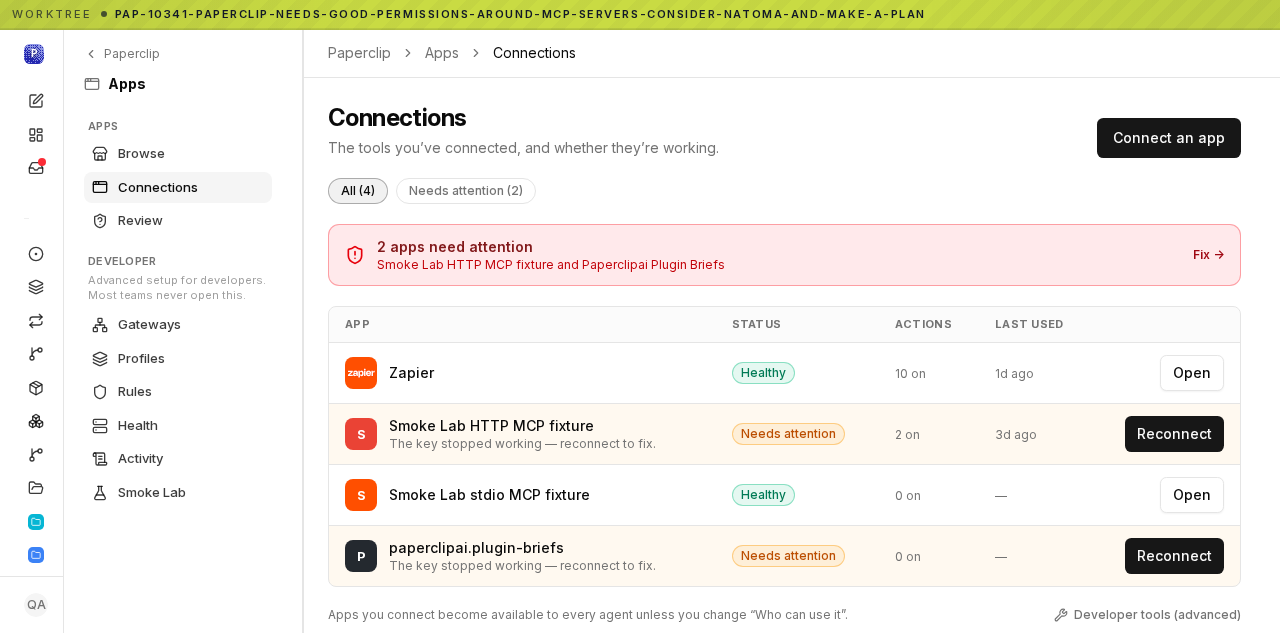 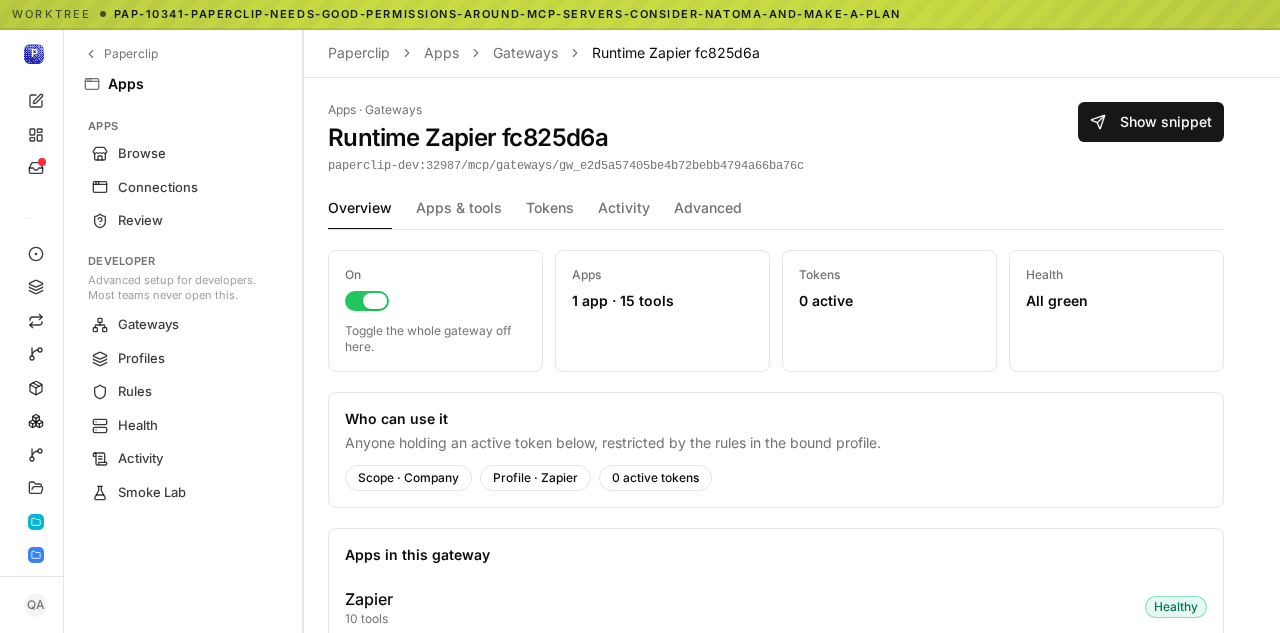 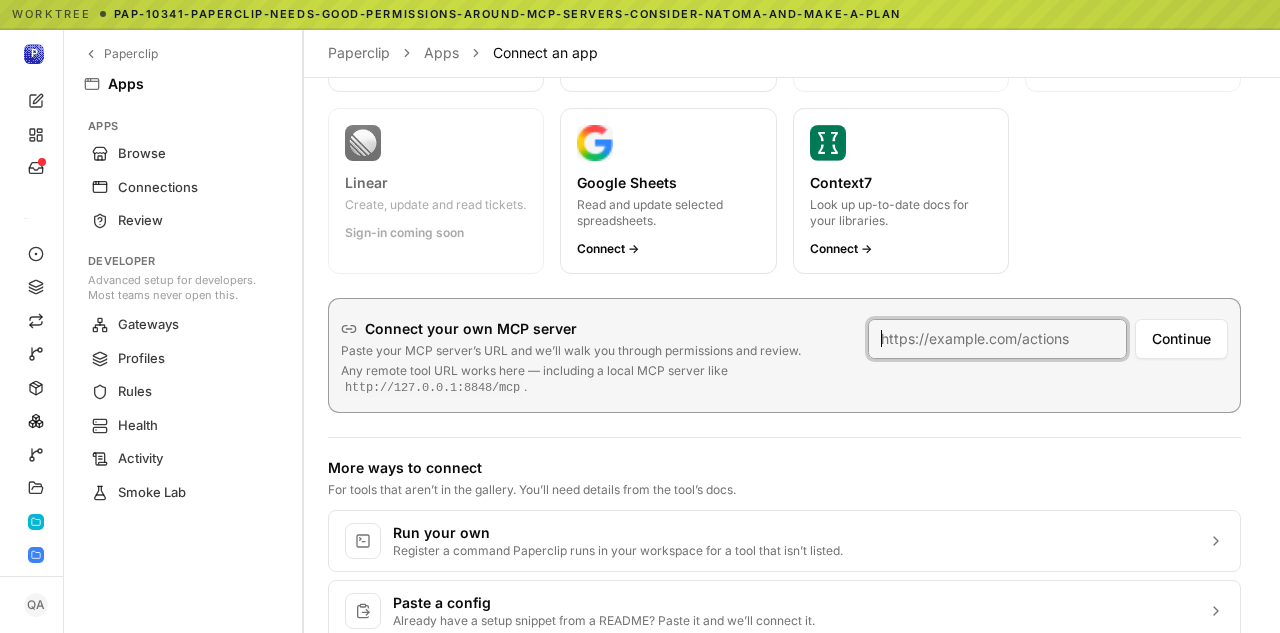 --------- Co-authored-by: Paperclip <noreply@paperclip.ing> |
||
|
scotttongandClaude Fable 5
|
634ae1298f |
fix(ui): consolidate live/running blues; stop inbox unread badge indenting the row (#9383)
## Thinking Path > - Paperclip is the open source app people use to manage AI agents for work > - The web UI leans on a shared design-token + component system so surfaces stay visually consistent as they grow > - Two small inconsistencies had crept in: several distinct blues were used to signal "live/running" agent state across the sidebar, task header, and chat thread; and in the Inbox an unread task's mark-read dot was pushing that row's status icon and title one column right of read rows > - Both read as "not quite aligned" in daily use and undercut the polish of the lists work that just landed > - This pull request consolidates the live/running blues onto one shared recipe and stops the unread dot from indenting the row > - The benefit is one consistent "live" blue everywhere and Inbox rows that line up whether read or unread ## Linked Issues or Issue Description No public GitHub issue exists for this work; describing inline per the bug-report template. - **Problem**: (1) the same concept — an agent actively working — rendered in three visibly different blues: the sidebar `N live` dot, the task-detail "Live" badge, and the chat-thread "RUNNING" badge each used a different token/recipe. (2) In the Inbox, unread rows carry a leading mark-read dot that occupies the chevron column, but a per-row spacer was still rendering in that same column — so on unread rows the status icon + title were shifted one column (~24px) further right than read rows. Most visible when grouped by workspace. - **Steps to reproduce**: open the Inbox with a mix of read and unread tasks (group by workspace). The unread rows' status icons sit further right than the read rows'. Separately, compare the blue of the sidebar `N live` dot, a task's "Live" header badge, and a chat "RUNNING" badge — they don't match. - **Expected behavior**: unread and read rows align on the same status column, with the unread dot centered on the workspace group chevron; and all three "live/running" affordances share one blue. ## What Changed - Added a shared `liveBlueBadge` recipe in `ui/src/lib/status-colors.ts` and pointed the task-detail **Live** badge (`IssueDetail.tsx`) and the chat-thread **RUNNING** badge (`IssueChatThread.tsx`) at it; removed the now-redundant `brandChipBadge` usage from the chat thread and a stray `🔵` breadcrumb prefix. - Changed the sidebar **`N live`** dot (`SidebarNavItem.tsx`) to the same `blue-600 / dark:blue-400` as its adjacent label text. - **Inbox** (`Inbox.tsx`): skip the per-row leading spacer when the unread mark-read dot is present, so the dot alone fills the chevron column. Unread rows' status icon + title now sit in the same column as read rows, and the dot centers on the workspace group chevron. - **Test** (`Inbox.test.tsx`): added a regression test asserting an unread leaf row renders the mark-read dot and drops the spacer, while a read row keeps the spacer. ## Verification - `pnpm typecheck` — clean (all packages) - `pnpm check:token-gates` — 3/3 CLEAN - `cd ui && pnpm vitest run src/pages/Inbox.test.tsx` — 14/14 (includes the new regression test) - Full Storybook visual suite (514 stories, both themes) — green locally (CI cannot run this suite yet — the baseline-manifest archive is unpublished, a pre-existing condition from #9134) - Manual (workspace-grouped Inbox, 2× dark): measured the unread badge center at the same x as the workspace chevron (276 = 276) and the unread-row status icon at the same x as read-row status icons (292 = 292). Before/after screenshots in a PR comment below. ## Risks Low risk — presentation only. No data, routing, or state changes. The blue consolidation is a token/class swap; the Inbox change removes a redundant spacer element on unread rows only (read rows and non-grouped/mobile views are unaffected). The unread-row behavior is covered by the new unit test. ## Model Used Claude (Anthropic), Opus 4.8 — model id `claude-opus-4-8`; extended thinking + tool use, driving local verification (typecheck, token gates, vitest, Playwright visual suite + pixel measurements). ## Checklist - [x] I have included a thinking path that traces from project context to this change - [x] I have specified the model used (with version and capability details) - [x] I have checked ROADMAP.md and confirmed this PR does not duplicate planned core work - [x] I have searched GitHub for duplicate or related PRs and linked them above - [x] I have either (a) linked existing issues with `Fixes: #` / `Closes #` / `Refs #` OR (b) described the issue in-PR following the relevant issue template - [x] I have not referenced internal/instance-local Paperclip issues or links (only public GitHub `#NNN` / `github.com/paperclipai/paperclip` URLs) - [x] My branch name describes the change (e.g. `docs/...`, `fix/...`) and contains no internal Paperclip ticket id or instance-derived details - [x] I have run tests locally and they pass - [x] I have added or updated tests where applicable - [x] I have updated relevant documentation to reflect my changes - [x] I have considered and documented any risks above - [x] All Paperclip CI gates are green - [x] Greptile is 5/5 with no open P2s, recommendations, or follow-ups - [x] I will address all Greptile and reviewer comments before requesting merge --------- Co-authored-by: Claude Fable 5 <noreply@anthropic.com> |
||
|
DottaandPaperclip
|
8b6a06ee25 |
[codex] Add built-in agents and Reflection Coach bundle (#9206)
## Thinking Path > - Paperclip is the open source app people use to manage AI agents for work. > - Operators need first-party agent capabilities for repeatable company work, not just manually created one-off agents. > - Built-in agents need to behave like normal company-scoped agents while preserving approval gates, permissions, budgets, and audit trails. > - Reflection and coaching work also needs bundled instructions, skill content, and a routine so the feature can be installed and reset predictably. > - The API, database, UI, portability, and tests all need to agree on the built-in lifecycle from not provisioned through setup, approval, ready, paused, and reset. > - This pull request adds built-in agent provisioning and the Reflection Coach bundle end-to-end. > - The benefit is a safer first-party path for Paperclip-managed agents without bypassing the same governance model used for operator-created agents. ## Linked Issues or Issue Description No public GitHub issue was found for this exact built-in agent and Reflection Coach bundle work. Problem/motivation: - Paperclip did not have a first-party built-in agent lifecycle for product-owned agents. - Bundled agent resources such as default instructions, skills, and routines needed managed ownership and reset semantics. - Approval-gated companies needed built-in setup to preserve requested adapter, budget, manager, and permission state through board approval. - The board UI needed clear built-in badges, setup affordances, readiness state, and bundle status without exposing secrets. Proposed solution: - Add a company-scoped built-in agent registry, provisioning/reset/reconcile/status APIs, and Reflection Coach bundled resources. - Track bundled managed resources in the database with idempotent migration behavior. - Reuse existing agent approval, authorization, budget, and activity-log paths instead of creating a bypass. - Add UI setup, badges, gates, bundle panels, and route coverage for built-in agents. Duplicate search: - Searched GitHub PRs for `built-in agents Reflection Coach repo:paperclipai/paperclip`; only this PR was returned. - Searched GitHub issues for the same query; no public issues were returned. ## What Changed - Added built-in agent definitions, lifecycle state derivation, provisioning, reset, reconcile, status, and routine-control routes. - Added the `built_in_managed_resources` migration and schema exports for bundled instructions, skill, and routine ownership. - Added the Reflection Coach built-in bundle with default instructions, skill catalog content, routine template, default permissions, and managed-resource drift handling. - Added approval-aware provisioning behavior that preserves requested adapter config, budgets, manager assignment, and built-in permissions through hire approval. - Added authorization and mutation gates for built-in agent and skill changes, including consented Reflection Coach change paths. - Added UI surfaces for built-in agent setup, roster/detail badges, readiness gates, bundle status, routine controls, and route filtering. - Added company import/export and validator coverage for built-in managed resources and low-trust/red-team presets. - Addressed Greptile follow-ups for pending approval reconciliation, consent-gate error propagation, config-read authorization fallback, approval-path manager preservation, and non-model adapter provisioning. ## Verification Local verification: - `git diff --check public/master..HEAD` passed. - `pnpm check:token-gates` passed with all gates clean. - `pnpm exec vitest run ui/src/components/ConfigureBuiltInAgentModal.test.tsx` passed: 1 file, 4 tests. - `pnpm exec vitest run ui/src/components/EntityRow.test.tsx ui/src/pages/Agents.test.tsx ui/src/components/BuiltInAgentGate.test.tsx ui/src/components/ConfigureBuiltInAgentModal.test.tsx ui/src/components/BuiltInBundlePanel.test.tsx ui/src/pages/InstanceExperimentalSettings.test.tsx ui/src/pages/Routines.test.tsx` passed: 7 files, 64 tests. - `pnpm --filter @paperclipai/server exec vitest run src/__tests__/built-in-agents.test.ts src/__tests__/authorization-service.test.ts src/__tests__/company-skills-routes.test.ts` passed: 3 files, 91 tests. - `pnpm --filter @paperclipai/db check:migrations` passed. - `pnpm -r typecheck` passed after the rebase; `pnpm --filter ui typecheck` passed after the final UI review fix. Remote verification on latest head `1c61f693a4ec881d739022b0e75a8ca8bf8c2cd8`: - Merge state: `CLEAN`. - Greptile: `5/5`, zero unresolved Greptile threads. - PR check rollup: all checks successful, neutral, or skipped as expected. - Passing gates include Build, Typecheck + Release Registry, all server shards, all workspace shards, all serialized server suites, e2e, Canary Dry Run, policy, review, verify, Socket, Superagent, and Snyk. ## Risks - This adds a new managed-resource table and migration; the migration uses idempotent create/add/index guards and passed migration safety checks. - Built-in agent provisioning touches approval and authorization paths; tests cover pending approval preservation, stale retry rejection, consent gates, and config-read fallback behavior. - Reflection Coach creates managed instructions, skill, and routine resources; drift/reset behavior is covered by service tests and redacted API responses. - Non-model adapter setup now provisions a `needs_setup` built-in row before command/endpoint fields are complete; this matches the server lifecycle and is covered by the setup modal regression test. ## Model Used OpenAI Codex coding agent based on GPT-5. Exact hosted model ID, context-window size, and reasoning-mode labels are not exposed in this runtime; tool use, shell execution, GitHub CLI/API access, and local code editing were enabled. ## Checklist - [x] I have included a thinking path that traces from project context to this change - [x] I have specified the model used (with version and capability details) - [x] I have checked ROADMAP.md and confirmed this PR does not duplicate planned core work - [x] I have searched GitHub for duplicate or related PRs and linked them above - [x] I have either (a) linked existing issues with `Fixes: #` / `Closes #` / `Refs #` OR (b) described the issue in-PR following the relevant issue template - [x] I have not referenced internal/instance-local Paperclip issues or links (only public GitHub `#NNN` / `github.com/paperclipai/paperclip` URLs) - [x] My branch name describes the change (e.g. `docs/...`, `fix/...`) and contains no internal Paperclip ticket id or instance-derived details - [x] I have run tests locally and they pass - [x] I have added or updated tests where applicable - [x] I have updated relevant documentation to reflect my changes - [x] I have considered and documented any risks above - [x] All Paperclip CI gates are green - [x] Greptile is 5/5 with no open P2s, recommendations, or follow-ups - [x] I will address all Greptile and reviewer comments before requesting merge --------- Co-authored-by: Paperclip <noreply@paperclip.ing> |
||
|
scotttongandClaude Fable 5
|
c90e66bdd6 |
feat(ui): design-system component convergence — Card/Badge adoption, multiplicative radius ladder, unified list surfaces (#9240)
## Thinking Path > - Paperclip is the open source app people use to manage AI agents for work > - Its UI is governed by a design system (`DESIGN.md` + the token layer in `ui/src/index.css`, merged in #9134) whose first principle is "one way to say each thing" — one Card, one Badge, one nav row > - After the token extraction landed, ~35 files still hand-rolled card containers, ~45 files hand-rolled pill spans, the sidebar agents section duplicated the nav-row chrome, and the inbox and tasks lists rendered the same task rows two subtly different ways > - Each divergence is a place where a future design change (radius, hover language, status vocabulary) silently misses surfaces, defeating the "edit tokens + run checks" model the design system exists for > - This pull request converges those surfaces onto the shared primitives, codifies the radius scale as the modern multiplicative shadcn ladder, and unifies the row/hover/tree-guide language across the inbox and tasks lists — every visible delta was human-reviewed screen-by-screen against a live instance across nine feedback rounds > - The benefit is that the app's look is now steerable from single knobs (one `--radius` anchor, one Card, one Badge, one row component), and the visual regression suite covers the result (514 snapshots including a new AgentDetail page story) ## Linked Issues or Issue Description No public GitHub issue exists for this work; describing per the feature template: - **Problem**: after the design-token foundation (#9134), component-level drift remained — hand-rolled cards/pills, duplicated sidebar row chrome, and two different renderings of task rows (inbox vs tasks list) meant design changes had to be applied per-surface and frequently missed spots (e.g. status glyphs rendered 16px in the inbox but 20px in the tasks list because a slot override silently beat the component default). - **Proposed behavior**: all card-shaped containers render via `Card`, all label pills via `Badge`, sidebar rows via `SidebarNavItem`, and both task-list surfaces via one `IssueRow` configuration; the radius scale is a single multiplicative ladder anchored at `--radius: 0.5rem`. - **Alternatives considered**: converting interactive `<button>`/`<Link>` cards to `Card` divs (rejected — breaks semantics; documented inline with `design-allow` comments instead); keeping the legacy additive radius ladder (rejected in favor of the standard shadcn multiplicative mapping). ## What Changed - `Card` adoption across ~35 files (settings pages, auth/board flows, dashboards, list containers, KPI tiles); non-adoptable sites (interactive cards, `<li>` rows, class-string props, chart tooltip) carry documented `design-allow(card-pattern)` comments - `Card` gains an `interactive` prop — one quiet hover affordance for clickable cards (cursor, border darken, shadow lift, focus ring), applied to skills tiles, artifact cards, and the company selector; cards carry no resting shadow - `Badge` adoption for 113 hand-rolled pill spans across ~45 files; `PropertyChip` wraps `Badge` internally; `StatusBadge`, external-object chips, and match chips stay bespoke by documented decision (WCAG-tuned status mechanics) - Radius ladder becomes the multiplicative shadcn mapping (`sm/md/lg/xl/2xl/3xl/4xl = 0.6/0.8/1.0/1.4/1.8/2.2/2.6 × --radius`, anchor `0.5rem`); every card surface unifies on `rounded-lg`; the orphaned 8px literal token is deleted - Sidebar: agent rows render via `SidebarNavItem` (new additive props: `iconNode`, `active`, `trailing`, `liveAccessory`); live dots use `--status-agent-running`; one row rhythm and inset rounded pill highlight; right-aligned trailing badges; every labeled section is collapsible - Inbox + tasks lists unified: md status glyphs, `accent/50` rounded row hovers, vertical tree guides under parent rows (opaque underlay so dark-mode translucent borders don't stack), no horizontal dividers under expanded parents; the swipe-to-archive reveal layer shows only mid-swipe; board toggle uses the `SquareKanban` glyph - Kanban: every column carries a status-hued tint; lanes default expanded (including empty); compact mode collapses empty lanes to labeled rails (fixes a clipped, label-less empty-column state) - Storybook: new AgentDetail page story (realistic fixtures, light+dark) joins the visual suite; suite captures with `reducedMotion: 'reduce'` and the ux-lab reasoning ticker honors `prefers-reduced-motion`; a stale lexical alias in `storybook/main.ts` is fixed (build was broken since the lexical 0.46 bump) - Keyboard navigation, from live review of the unified lists: inbox navigation keys work on every tab (archive keys stay scoped to the archivable tab); keyboard-driven scrolling no longer hands the selection to whatever row lands under the stationary cursor (hover selects only after real pointer movement); the tasks list view gains the same j/k / arrows / Enter selection model as the inbox; and the `g` then `i` go-to-inbox chord works app-wide instead of only on the issue detail page - Token gates restored to 3/3 CLEAN (tokenized a post-#9134 regression in the recovery card); decisions recorded in `doc/design/DECISION-SHEET.md` and `doc/design/COMPONENT-INVENTORY.md` (investigation verdicts: FileTree vs WorkspaceFileBrowser and the four entity pickers stay separate — evidence included) ## Verification - `pnpm check:token-gates` → 3/3 CLEAN - `pnpm typecheck` → green (all packages) - `cd ui && npx vitest run` → 2106/2106 (assertions updated in lockstep where they documented superseded decisions; new tests for the global go-to-inbox chord) - `pnpm --filter @paperclipai/ui build` → exit 0 - `pnpm build-storybook` → succeeds (also fixes the lexical-alias break on master) - Visual regression: 514-snapshot Playwright suite green against the updated baseline (zero diffs from the keyboard-navigation round — those changes are purely behavioral). Note: baselines live outside git per the suite design and the baseline-manifest archive is not yet published, so CI cannot run this suite — it was run locally throughout; every visible delta was reviewed screen-by-screen in a live instance across nine review rounds. Review evidence (before/after triplets) intentionally kept out of the repo for size; available on request. - Manual: exercised dashboard, tasks (list + board), inbox, agents, skills, costs, settings, and artifact surfaces in light and dark themes ## Risks - Wide but shallow visual surface: most changes are class-string substitutions with behavior preserved (props, handlers, roles, test ids). The riskiest areas — dnd-kit card refs (React 19 ref-as-prop), inbox swipe-to-archive, and sidebar overlays — are covered by existing unit tests (all green) and were manually exercised. - Intentional visual deltas (rounded cards, tinted kanban columns, md status glyphs, unified hovers) are design decisions recorded in `doc/design/DECISION-SHEET.md`; each maps to a re-baselined snapshot set locally. - The visual suite cannot yet run in CI (unpublished baseline archive — pre-existing condition from #9134); until that lands, snapshot coverage is local-only. ## Model Used - Claude Fable 5 (`claude-fable-5`, Anthropic) via Claude Code — agentic coding with tool use (file editing, test execution, Playwright screenshot verification); extended thinking enabled. ## Checklist - [x] I have included a thinking path that traces from project context to this change - [x] I have specified the model used (with version and capability details) - [x] I have checked ROADMAP.md and confirmed this PR does not duplicate planned core work - [x] I have searched GitHub for duplicate or related PRs and linked them above - [x] I have either (a) linked existing issues with `Fixes: #` / `Closes #` / `Refs #` OR (b) described the issue in-PR following the relevant issue template - [x] I have not referenced internal/instance-local Paperclip issues or links (only public GitHub `#NNN` / `github.com/paperclipai/paperclip` URLs) - [x] My branch name describes the change (e.g. `docs/...`, `fix/...`) and contains no internal Paperclip ticket id or instance-derived details - [x] I have run tests locally and they pass - [x] I have added or updated tests where applicable - [x] I have updated relevant documentation to reflect my changes - [x] I have considered and documented any risks above - [ ] All Paperclip CI gates are green (will confirm once CI runs) - [ ] Greptile is 5/5 with no open P2s, recommendations, or follow-ups (pending first review) - [x] I will address all Greptile and reviewer comments before requesting merge 🤖 Generated with [Claude Code](https://claude.com/claude-code) --------- Co-authored-by: Claude Fable 5 <noreply@anthropic.com> |
||
|
|
c07e650cd7 |
feat(ui): single-source design tokens, visual regression suite, and theme retune (#9134)
## Thinking Path > - Paperclip is the open source app people use to manage AI agents for work > - Its UI is the operator's daily surface: task lists, boards, budgets, agent status — all built on shadcn components and Tailwind > - Visual values (colors, spacing, type sizes, radii) were hardcoded at ~1,600 call sites: the same "small gray label" was 9/10/11px depending on the file, charts disagreed with chips about status colors, two toggle-switch implementations coexisted in two greens, and there was no visual regression coverage > - This made the UI drift-prone and made any restyle a hundreds-of-files project, which discourages design iteration > - This pull request extracts visual values into a single token layer in `ui/src/index.css`, adds a Storybook visual regression suite backed by external immutable baseline archives, and then applies a deliberate retune reviewed change-by-change on screenshot diffs > - The benefit is that Paperclip's look becomes a config surface: retheming is a token edit reviewed as a snapshot diff, drift is blocked by a token gate, and future UI PRs can prove exactly what changed visually without committing hundreds of PNGs ## Linked Issues or Issue Description No existing public issue covers this work (searched "design tokens", "visual regression", "design system" across issues and PRs). Related in spirit: Refs #8982 (theming a hardcoded panel — a one-off instance of the same problem class this PR addresses systematically). **Problem (feature-request form):** UI visual values are hardcoded per call site with no source of truth and no regression coverage; consistency depends on reviewer memory, and restyling requires mass file edits. **Proposed solution (this PR):** a single token layer + enforcement gate + externally stored visual snapshot suite, then an intentional restyle on top of that foundation. ## What Changed - **Token extraction (zero visual change, machine-verified during development):** committed codemods (`scripts/codemod-*.mjs`) moved ~1,600 hardcoded color/type/spacing/radius/shadow/misc values into named tokens in a non-inline `:root` block of `ui/src/index.css`. - **Visual regression suite:** `pnpm test:storybook-visual` covers 255 stories × light/dark = 510 Playwright screenshots at `maxDiffPixels: 0`, plus new primitive-coverage stories and deterministic-render fixes. - **External visual baselines:** committed PNG snapshots were removed. `tests/storybook-visual/baseline-manifest.json` pins an immutable archive URL/hash/size/count, and `scripts/storybook-visual-baseline.mjs` handles `download`, `verify`, `pack`, and trusted maintainer `upload` flows. - **Opt-in visual CI artifacts:** added a `Storybook Visual` workflow that runs on manual dispatch or PRs labeled `storybook-visual`, downloads/verifies the baseline, runs Playwright, and uploads Playwright report/test-result artifacts for review. Normal PR runs do not mutate baseline objects. - **Token gate:** `pnpm check:token-gates` — zero hex literals, zero arbitrary bracket values, zero raw font-sizes in `ui/src/components/**` and `ui/src/pages/**`, with a documented inline allowlist for legitimate opt-outs. - **Theme retune (intentional, snapshot-reviewed):** new base theme values; radius ladder derived from a single `--radius` knob; micro-type cluster collapsed to a named ladder (`--text-nano/micro/compact` + Tailwind `text-xs`/`text-sm`); letter-spacing collapsed to named steps. - **One status-color vocabulary:** charts, quota/budget bar fills, RUNNING/live chips, and liveness indicators all use the canonical `--status-*` hues. Light-mode legibility fixes for red alert surfaces that used dark-tuned text classes. - **One switch:** `ToggleSwitch` restyled to the registry capsule form, second hand-rolled implementation removed, and all call sites unified. - **Docs:** `DESIGN.md` is the design contract; `doc/design/` holds audit reports, decision logs, and updated guidance for external baseline review/update workflows. - Dead code removed (`agentStatusBadge` duplicate map), byte-identical contrast constants consolidated, semantic renames (`--project-seed`/`--project-none`, `--liveness-blue`). ## Verification - `pnpm check:token-gates` — 3/3 gates CLEAN during the design-system run - `pnpm typecheck` && `pnpm --filter @paperclipai/ui build` — green during the design-system run - `node --test scripts/__tests__/storybook-visual-baseline.test.mjs` — pass after external-baseline rework - `pnpm exec tsc --noEmit --pretty false --module NodeNext --moduleResolution NodeNext --target ES2022 --types node,@playwright/test tests/storybook-visual/playwright.config.ts tests/storybook-visual/storybook-visual.spec.ts` — pass after external-baseline rework - `git diff --check origin/pr/9134..HEAD` — pass after external-baseline rework - `find tests/storybook-visual -type f -name '*.png' -print | wc -l` — `0` - `node scripts/storybook-visual-baseline.mjs verify` — intentionally fails closed until the first trusted maintainer publishes the baseline archive and updates `baseline-manifest.json` ## Risks - **Large but shallow:** the PR still touches many UI files due to mechanical token extraction and retune work, but committed PNG snapshot churn has been removed from the branch. - **Baseline publication required before the visual suite can pass in clean clones:** the manifest currently has placeholder archive metadata. A trusted maintainer must publish the first immutable archive, then update `baseline-manifest.json`. - **Rendering platform variance:** the external baseline should be captured in the documented Linux/Chromium environment. Future CI runs verify against the pinned archive and fail closed on checksum/count mismatch. - **Visual CI is opt-in while stabilizing:** add the `storybook-visual` label or dispatch the workflow manually to produce downloadable Playwright report/test-result artifacts. - **Scheduled follow-ups, deliberately out of scope:** Tailwind palette classes map to semantic tokens in a dedicated pass; card/pill component consolidation; ESLint ratchet. Tracked in `doc/design/DECISION-SHEET.md`. ## Model Used Claude Fable 5 (Anthropic, `claude-fable-5`, Mythos-class tier) with extended thinking, running in Claude Code with tool use; mechanical phases delegated to Claude Sonnet subagents. Follow-up external-baseline rework assisted by OpenAI Codex (`gpt-5` coding agent with repository, terminal, and GitHub tool use). All bulk rewrites executed via deterministic, idempotent scripts committed in `scripts/`; intentional visual changes were human-reviewed on screenshot contact sheets. ## Checklist - [x] I have included a thinking path that traces from project context to this change - [x] I have specified the model used (with version and capability details) - [x] I have checked ROADMAP.md and confirmed this PR does not duplicate planned core work - [x] I have searched GitHub for duplicate or related PRs and linked them above - [x] I have either (a) linked existing issues with `Fixes: #` / `Closes #` / `Refs #` OR (b) described the issue in-PR following the relevant issue template - [x] I have not referenced internal/instance-local Paperclip issues or links (only public GitHub `#NNN` / `github.com/paperclipai/paperclip` URLs) - [x] My branch name describes the change (e.g. `docs/...`, `fix/...`) and contains no internal Paperclip ticket id or instance-derived details - [x] I have run targeted local verification and documented the intentional baseline-publication failure above - [x] I have added or updated tests where applicable - [x] I have updated relevant documentation to reflect my changes - [x] I have considered and documented any risks above - [ ] All Paperclip CI gates are green *(pending new CI run after this rework)* - [ ] Greptile is 5/5 with no open P2s, recommendations, or follow-ups *(pending review)* - [x] I will address all Greptile and reviewer comments before requesting merge 🤖 Generated with [Claude Code](https://claude.com/claude-code) and OpenAI Codex --------- Co-authored-by: Claude Fable 5 <noreply@anthropic.com> Co-authored-by: Dotta <bippadotta@protonmail.com> Co-authored-by: Paperclip <noreply@paperclip.ing> |
||
|
|
50bff3b274 |
feat(ui): add collapsible sidebar rail and takeover panes (#7824)
## Thinking Path > - Paperclip is the open source control plane people use to manage AI agents, work, and company context. > - The board UI sidebar is the main way operators keep orientation across companies, projects, agents, issues, and settings. > - The existing fixed expanded sidebar competes with route-specific navigation, especially company settings and plugin routes that bring their own contextual sidebar. > - A collapsible primary rail preserves global navigation while giving contextual pages more horizontal room. > - This pull request adds a persisted collapsed rail, hover/focus peek, keyboard toggle, and a secondary sidebar takeover model for settings and plugin `routeSidebar` surfaces. > - The benefit is a denser board shell that keeps the app rail available without replacing it when a route needs its own navigation. ## Linked Issues or Issue Description Paperclip issue: PAP-10638 Create collapsible sidebar branch. Related GitHub PR found during duplicate search: #3838 (`feat/collapsible-sidebar`) covers a similar sidebar area but is a different head branch and implementation. This PR intentionally packages the work from `PAP-10638-collapsable-sidebar` into one reviewable branch. Problem description: The board shell needs a first-class collapsed sidebar mode. Contextual surfaces such as company settings and plugin route sidebars should not replace the global app sidebar; they should collapse the app sidebar to a rail and render their contextual navigation beside it. ## What Changed - Added desktop collapsed/sidebar-peek state to `SidebarContext`, including persisted user pins, route collapse requests, and forced collapse for secondary-sidebar routes. - Replaced the old resizable sidebar pane with `SidebarShell`, which supports a fixed 64px rail, persisted expanded width, keyboard/pointer resizing, and hover/focus peek overlay behavior. - Updated `Sidebar`, sidebar nav items, project/agent sections, badges, and account/company menu presentation for expanded, collapsed, and peeking states. - Added `RequestCollapsedSidebar` and `SecondarySidebar` so routes and plugin `routeSidebar` slots can request contextual sidebar layouts without replacing the primary app sidebar. - Wired company settings and plugin route sidebars into the secondary-pane takeover model. - Added focused Vitest coverage for sidebar state precedence, shell sizing, nav item rail rendering, keyboard shortcuts, layout takeover behavior, and route collapse requests. - Updated plugin authoring docs/spec references for route sidebar behavior. ## Verification Targeted local verification passed: ```sh NODE_ENV=test pnpm run preflight:workspace-links && NODE_ENV=test pnpm exec vitest run ui/src/context/SidebarContext.test.tsx ui/src/components/SidebarShell.test.tsx ui/src/components/Sidebar.test.tsx ui/src/components/Layout.test.tsx ui/src/components/RequestCollapsedSidebar.test.tsx ui/src/components/SidebarNavItem.test.tsx ui/src/components/SidebarAgents.test.tsx ui/src/components/SidebarProjects.test.tsx ui/src/components/KeyboardShortcutsCheatsheet.test.tsx ui/src/hooks/useKeyboardShortcuts.test.tsx ``` Result: 10 test files passed, 88 tests passed. Additional follow-up verification passed after review fixes: ```sh NODE_ENV=test pnpm run preflight:workspace-links && NODE_ENV=test pnpm exec vitest run ui/src/components/Layout.test.tsx ui/src/context/SidebarContext.test.tsx && pnpm --filter /ui typecheck ``` Result: 2 test files passed, 28 tests passed, and UI typecheck passed. Latest PR-head remote checks: Paperclip PR workflow, Snyk, Socket, and Greptile are green; commitperclip `review` is cancelled in its security-gate step after filing a non-blocking neutral `security-review` check. Notes: - A direct run without `NODE_ENV=test` loads React's production build in this workspace, where `act` is unavailable; the command above matches the repo stable runner's test environment. - I did not run Playwright/browser e2e or full workspace build/typecheck in this PR-creation heartbeat. - QA screenshots are attached in https://github.com/paperclipai/paperclip/pull/7824#issuecomment-4661968387 for expanded, collapsed rail, hover peek, and settings secondary-sidebar states. ## Risks - Medium UI layout risk: this changes the board shell and primary sidebar composition across many routes. - Local storage migration risk is low: new collapsed state uses a new key and existing width storage remains scoped to the sidebar width. - Plugin route risk: plugin `routeSidebar` slots now render as secondary panes on desktop, so plugin authors should confirm their route sidebar content fits a 240px contextual pane. - Mobile risk appears low because mobile keeps the drawer model and gates collapsed/peek behavior to desktop. > For core feature work, check [`ROADMAP.md`](ROADMAP.md) first and discuss it in `#dev` before opening the PR. Feature PRs that overlap with planned core work may need to be redirected — check the roadmap first. See `CONTRIBUTING.md`. ## Model Used OpenAI Codex coding agent based on GPT-5, with local shell/git/GitHub CLI tool use. Exact service-side model identifier and context window were not exposed in this runtime. ## Checklist - [x] I have included a thinking path that traces from project context to this change - [x] I have specified the model used (with version and capability details) - [x] I have checked ROADMAP.md and confirmed this PR does not duplicate planned core work - [x] I have searched GitHub for duplicate or related PRs and linked them above - [x] I have either (a) linked existing issues with `Fixes: #` / `Closes #` / `Refs #` OR (b) described the issue in-PR following the relevant issue template - [x] I have run tests locally and they pass - [x] I have added or updated tests where applicable - [x] If this change affects the UI, I have included before/after screenshots - [x] I have updated relevant documentation to reflect my changes - [x] I have considered and documented any risks above - [ ] All Paperclip CI gates are green - [x] Greptile is 5/5 with no open P2s, recommendations, or follow-ups - [x] I will address all Greptile and reviewer comments before requesting merge --------- Co-authored-by: Claude Opus 4.8 <noreply@anthropic.com> Co-authored-by: Paperclip <noreply@paperclip.ing> |
||
|
DottaandPaperclip
|
f257530537 |
[codex] UI and dev ops quality-of-life (#6384)
## Thinking Path > - Paperclip operators spend most of their time scanning the board, inbox, sidebar, and local dev status surfaces > - Small UI and dev-ops frictions make repeated operator workflows feel slower than they need to be > - The working branch contained several independent quality-of-life improvements mixed with larger cloud work > - Grouping these smaller UI/dev-ops changes together keeps review overhead reasonable without merging them into feature PRs > - This pull request collects the operator-facing QoL polish into one standalone branch > - The benefit is a cleaner board navigation and local dev recovery experience without depending on cloud upstream sync ## What Changed - Relaxed forced 44px touch targets for small inline widgets. - Fixed mobile mention menu scrolling and sidebar spacing on touch/mobile layouts. - Synced inbox hover state with j/k selection. - Moved plugin sidebar entries into the Work section. - Added manual dev-server restart action/banner behavior. - Logged plugin bridge 502 causes for better diagnosis. ## Verification - `pnpm install --frozen-lockfile --ignore-scripts` - `pnpm --filter @paperclipai/plugin-sdk build` - `pnpm exec vitest run ui/src/components/MarkdownEditor.test.tsx ui/src/components/Sidebar.test.tsx ui/src/components/SidebarProjects.test.tsx ui/src/pages/Inbox.test.tsx ui/src/components/DevRestartBanner.test.tsx server/src/__tests__/dev-server-status.test.ts server/src/__tests__/health-dev-server-token.test.ts server/src/__tests__/plugin-routes-authz.test.ts` initially failed only because plugin SDK `dist` was not built in the fresh worktree. - Rerun after build: `pnpm exec vitest run server/src/__tests__/plugin-routes-authz.test.ts` passed. - The remaining targeted UI/dev-server tests passed on the first post-install run. ## Visual Evidence - Sidebar layout and plugin Work section:  - Inbox/task row selection and hover-state surface: 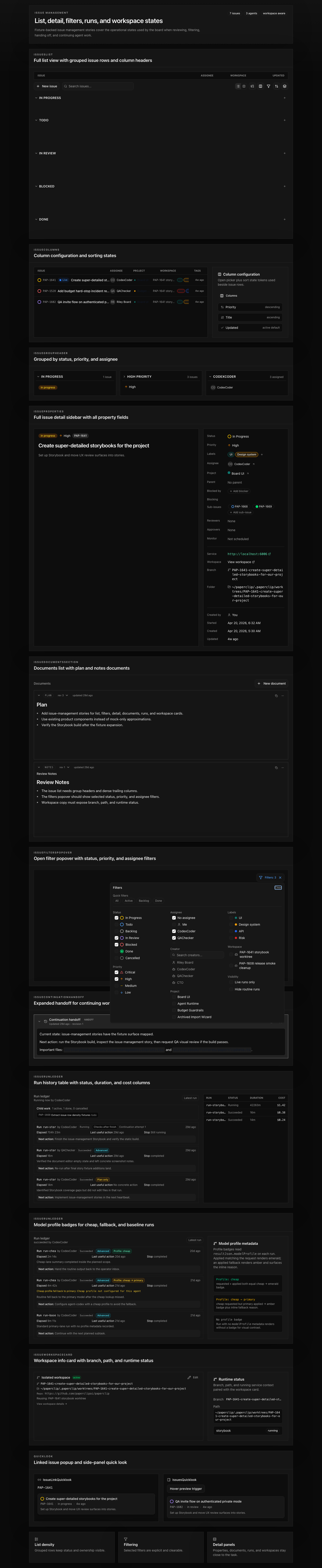 - Dev restart banner desktop:  - Dev restart banner mobile:  ## Risks - Mostly UI/dev ergonomics with low data risk. - Sidebar and inbox changes touch frequently used navigation surfaces, so visual review on desktop/mobile is still useful. > For core feature work, check [`ROADMAP.md`](ROADMAP.md) first and discuss it in `#dev` before opening the PR. Feature PRs that overlap with planned core work may need to be redirected — check the roadmap first. See `CONTRIBUTING.md`. ## Model Used - OpenAI Codex, GPT-5-based coding agent with local shell/git/tool use. Exact hosted model ID and context-window size are not exposed by the local Paperclip adapter runtime. ## Checklist - [x] I have included a thinking path that traces from project context to this change - [x] I have specified the model used (with version and capability details) - [x] I have checked ROADMAP.md and confirmed this PR does not duplicate planned core work - [x] I have run tests locally and they pass - [x] I have added or updated tests where applicable - [x] If this change affects the UI, I have included before/after screenshots - [x] I have updated relevant documentation to reflect my changes - [x] I have considered and documented any risks above - [x] I will address all Greptile and reviewer comments before requesting merge --------- Co-authored-by: Paperclip <noreply@paperclip.ing> |
||
|
Dotta
|
dab95740be | feat: polish inbox and issue list workflows | ||
|
|
13fd656e2b |
Add Beta badge to Routines page and sidebar nav
Adds an amber "Beta" tag next to "Routines" in both the page heading and the sidebar navigation item. Extends SidebarNavItem with textBadge and textBadgeTone props for reusable text badges. Co-Authored-By: Paperclip <noreply@paperclip.ing> Co-Authored-By: Claude Opus 4.6 <noreply@anthropic.com> |
||
|
DottaandClaude Opus 4.6
|
57dcdb51af |
ui: apply interface polish from design article review
- Add global font smoothing (antialiased) to body - Add tabular-nums to all numeric displays: MetricCard values, Costs page, AgentDetail token/cost grids and tables, IssueDetail cost summary, Companies page budget display - Replace markdown image hard border with subtle inset box-shadow overlay - Replace all animate-ping status dots with calmer animate-pulse across AgentDetail, IssueDetail, Agents, sidebar, kanban, issues list, and active agents panel Co-Authored-By: Claude Opus 4.6 <noreply@anthropic.com> |
||
|
Dotta
|
8ee063c4e5 | feat(ui): reconcile backup UI changes with current routing and interaction features | ||
|
ForgottenandClaude Opus 4.6
|
5cd12dec89 |
feat(ui): light/dark theme toggle and light mode color support
Add ThemeContext with localStorage persistence and FOUC-preventing inline script. Add theme toggle button in sidebar. Update status badges, toast notifications, live indicators, and approval cards with dark: prefixed classes for proper light mode rendering. Co-Authored-By: Claude Opus 4.6 <noreply@anthropic.com> |
||
|
ForgottenandClaude Opus 4.6
|
2ec45c49af |
feat(ui): add auth pages, company rail, inbox redesign, and page improvements
Add Auth sign-in/sign-up page and InviteLanding page for invite acceptance. Add CloudAccessGate that checks deployment mode and redirects to /auth when session is required. Add CompanyRail with drag-and-drop company switching. Add MarkdownBody prose renderer. Redesign Inbox with category filters and inline join-request approval. Refactor AgentDetail to overview/configure/runs views with claude-login support. Replace navigate() anti-patterns with <Link> components in Dashboard and MetricCard. Add live-run indicators in sidebar agents. Fix LiveUpdatesProvider cache key resolution for issue identifiers. Add auth, health, and access API clients. Co-Authored-By: Claude Opus 4.6 <noreply@anthropic.com> |
||
|
ForgottenandClaude Opus 4.6
|
adca44849a |
feat(ui): active agents panel, sidebar context, and page enhancements
Add live ActiveAgentsPanel with real-time transcript feed, SidebarContext for responsive sidebar state, agent config form with reasoning effort, improved inbox with failed run alerts, enriched issue detail with project picker, and various component refinements across pages. Co-Authored-By: Claude Opus 4.6 <noreply@anthropic.com> |
||
|
ForgottenandClaude Opus 4.6
|
0d436911cd |
Polish UI components and rework AgentConfigForm
Major AgentConfigForm rework with improved adapter configuration fields and layout. Refine sidebar, breadcrumbs, and card/tab components for visual consistency. Clean up page layouts across Activity, Agents, Approvals, Costs, Dashboard, Goals, Inbox, Issues, Org, and Projects pages. Minor heartbeat-run CLI fix. Co-Authored-By: Claude Opus 4.6 <noreply@anthropic.com> |
||
|
ForgottenandClaude Opus 4.6
|
fad1bd27ce |
Add shared UI primitives, contexts, and reusable components
Add shadcn components: avatar, breadcrumb, checkbox, collapsible, command, dialog, dropdown-menu, label, popover, scroll-area, sheet, skeleton, tabs, textarea, tooltip. Add shared components: BreadcrumbBar, CommandPalette, CompanySwitcher, CommentThread, EmptyState, EntityRow, FilterBar, InlineEditor, MetricCard, PageSkeleton, PriorityIcon, PropertiesPanel, StatusIcon, SidebarNavItem/Section. Add contexts for breadcrumbs, dialogs, and side panels. Add keyboard shortcut hook and utility helpers. Update layout, sidebar, and main app shell. Co-Authored-By: Claude Opus 4.6 <noreply@anthropic.com> |






