mirror of
https://github.com/paperclipai/paperclip.git
synced 2026-10-21 08:22:20 +02:00
35c75b56d461ce4e65a35e82f1b6c288b0ea5252
48
Commits
| Author | SHA1 | Message | Date | |
|---|---|---|---|---|
 DottaandPaperclip |
adb69e8f09 |
feat: default new Codex agents to Paperclip Runner on Linux and macOS (#15683)
## Thinking Path > - Paperclip is the open source control plane for agent companies. > - People choose a harness when creating an agent. > - The server should resolve that harness to a qualified runner. > - Codex is the first harness in the staged default rollout. > - Saved agents must retain their execution choices. > - New Codex agents therefore use Paperclip Runner on qualified macOS/Linux targets, with an explicit Legacy override. ## Linked Issues or Issue Description Refs #16028, #15555, #15673, #15422, #15631, #15926, #15932, #16149. The runtime/install prerequisite and release repair are merged. This slice owns Codex creation, setup, configuration and preservation. Other harness defaults remain unchanged. It adds no database migration; incoming master migrations, required maps and regression coverage are retained. ## What Changed - Resolve `runner: auto | paperclip | legacy` at the common creation boundary across onboarding, API/CLI, hires, built-ins, plugins and imports. Freeze pending hires and export resolved execution choices. - Preserve existing runners on upgrades, unrelated edits and import updates, including compatible accounts, workspace settings, Codex effort and intentional clears. - Use the underlying harness picker and branding; put the runner override in Advanced. Use the shared dropdown and update production-component stories and creation contracts. - Support qualified Apple Silicon, Intel Mac, Linux x64 and Linux ARM64. Linux requires GNU libc 2.39+. Disabled, external, unsupported and unqualified combinations retain their applicable Legacy execution. - Test the selected runtime/account/model/environment. Ordinary Connect probes eligible immutable managed targets and refreshes scoped discovery. Creation/discovery do not provision. Auth, dependency, incompatible-setting and cleanup failures remain actionable without changing runners. - Keep setup probes read-only, preserve local/SSH isolation and resolve packaged assets before staging credentials. Bound cleanup reads by the remaining absolute deadline; physically close every owned ingress socket before endpoint release. Unconfirmed cleanup retains recovery state. - Preserve validated completed-onboarding callbacks through startup recovery. First file-producing work belongs to the child task and uses the existing dependency/block handoff and task-scoped registration. - Reuse existing E2E fixtures, artifact checks, reporting and controls. Keep Docker/Cargo/native compilation remote. Paperclip tarballs contain no Codex payloads; official optional npm platform dependencies remain. ## Verification Current tested head: `1c03a8815672d82c264a9b08d4ea1984e8fae107`. **Merge-ready: required CI, fresh review, package qualification, Mac core acceptance and Test task/follow-up acceptance pass.** The existing attachment and native-continuity oracles independently verify both Test downloads, run attribution and unchanged native/provider/workspace identities. The maintainer authorized a code-owner-review exception for this PR only. The first Test setup failure and normal Board completion-review friction are retained below. Actual post-merge packages and private Cloud distribution remain separate qualification gates. - [Current CI](https://github.com/paperclipai/paperclip/actions/runs/38564241625): all 48 ordinary jobs and required verify/E2E pass. Attempt 1 retained six simultaneous host-shutdown cancellations. One failed-only retry passes those six lanes and two aggregates, preserving 40 successes. Actual integration checkout `53104c1` combines this head with master `c80`; it is not relabeled as the branch tree. Fresh exact-head Greptile 5/5, 30 resolved threads, no actionable findings. - [Exact-source package qualification](https://github.com/paperclipai/paperclip/actions/runs/38565287239): nine applicable jobs pass, nine conditional jobs skip. Four remote native producers; Linux x64 clean install; Intel Mac, Apple Silicon and Linux ARM64 native startup/physical cleanup controls. All 18 tarballs/four daemon source/hash/manifest bindings and 343 migrations through 0344 verify. No Codex payload is packed. These hosted tarballs are not a published npm canary. - Normal Apple Silicon installation and credential-free native startup/cleanup pass using the packaged daemon, with no source build or provider turn. Fresh installed DB initialization passes. Upgrade 651a→1c03 preserves all three complete execution configs, accounts, ten recorded run profiles, paused budgets, active incidents, cost summaries and two historical unpriced events. Historical recovery state is retained. - Cleanup regressions: four delayed-read baseline failures become 15 passing deadline/authority controls. No-acknowledgement and prior-error socket ownership regressions become 12 passing controls. Direct runtime/server types, maps: 35 areas / 176 IDs, diff checks and independent reviews pass. Permission/auth/reconnect policy and the 10-second setup budget remain intact. - Existing source coverage includes creation/selection/imports, pending approvals, recovery, account/lifecycle handling, mounted forms, dropdowns and E2E support. Full typechecks/tests/build/token and applicable Storybook checks pass in the recorded current CI; no duplicate suite or weakened grader. - Literal 9546 live Mac proof: ordinary Auto Codex onboarding, useful document, real completed-child callback/reply, seven successful native runs, manual follow-up and independently downloaded1,101-byte child file. Existing Legacy title edit/reload preserves execution; two real Legacy runs produce independently checked15/34-byte files. These remain historical source records. - Current literal 1c03 Mac core acceptance passes independent checks: ordinary Auto native Codex onboarding without runner override; only timeout 180 seconds/concurrency 1 saved; six successful native runs and six serialized turns (maximum overlap 1); both same-task continuity checks and five mechanical callback checks; actual rendered parent reply and exact child downloads. The useful handoff advances from revision 1 to 2. Both files are 48 bytes, SHA-256 `8b742bd4e8123a7c078f0a8d9f3449fbfa8a320d7d90be641a2818db3c53d92c` and `f42db9774fa06e804ab7d596fc8b922a2b638921c418b87d0111151d290a6afe`; exactly one byte changes and old history remains. The agent is paused with zero active runs/errors. Both artifact work products have `isPrimary=false`, and descriptive titles fail a stricter title-helper assumption; these retained results are scoped editorial follow-up, not new merge gates. Six source-bound screenshots are uploaded and verified in the private primary QA report. - [Literal 9546 managed proof](https://d1p6rlowie26tp.cloudfront.net/runner-e2e/campaigns/gha-38485488621-1/index.html): original 19 assertions and completed judge pass, four native turns, child-bound240-byte file and session/workspace continuity. Checkout reports a verified generated target-lock mutation; full final porcelain was not retained. Signed execution-image identity remains separate from Core source. - Actual 651a Test deployment succeeds on one owned/pinned target. One ordinary Auto API-key Connect then fails native cleanup before hire. Controller turn/drain/suspend completion and service-recorded environment cleanup are observed; they do not certify physical deletion or native authority retirement. Failure/recovery/unknown holds are retained. No Legacy switch or unchanged paid retry. The two source repairs above require actual treatment. - [Current immutable Core preview](https://github.com/paperclipai/paperclip/actions/runs/38570365725) and matching DB/shared artifacts pass. One owned, pinned Test target serves exact `1c03`; identical migration history correctly skips the migrator. Ordinary Auto Codex Connect succeeds and hires native; saved native selection and QA bounds survive reload. The initial child preparation attempt fails before provider work, with actual stdout identifying `renewal_deadline`; its trigger remains unknown and the failure is retained. Normal Board **Try again** and **Resume** recover the child to Done, producing a browser-verified 44-byte file, SHA-256 `0a8458b1efcc2d7a0d815689458c4caab039a46c7c7a3e5805de6bc8b1a96ecc`. The actual parent callback reports the completed child document/file. The existing validator requires a parent-owned attachment, so recovery enters normal Review; after byte checking, normal **Approve completion** reaches parent Done. No forced status or duplicate parent file is used. The validator is unchanged from integrated and current master. Autonomous initial callback-to-Done is not proven. The same-child follow-up completes document revision 2 and publishes a second independently downloaded 44-byte file, SHA-256 `22022257300fae762784632d08d3bbe0bab61e2ce81f91864a14dcd7aa464591`; only the revision digit changes. The unchanged existing native-continuity and attachment oracles pass. All ten recorded runs are terminal: nine native successes and the retained pre-provider setup failure. The QA agent is paused with zero active runs. The pre-existing parent evidence scope mismatch is a separate follow-up, with ordinary completion review exercised rather than a forced status or relaxed validation. This unsigned Core preview remains distinct from post-merge private Cloud composition. ## Risks - Saved agents are not migrated. Explicit runner changes use normal configuration/session rules; historical runs retain their recorded execution. - Native readiness depends on verified assets and server-owned target qualification. A Legacy probe, HTTP200 or successful account save cannot prove native readiness. - Recovery exceptions remain restricted to validated completed-onboarding reports; process-loss, ownership and terminal-state safeguards remain active. Unexecuted live journeys stay open. - Linux ARM paid tasks, Windows, Alpine and 32-bit ARM remain deferred. Cold Cargo cache misses are recorded; no warm-cache speedup is claimed. - Historical invoices/physical cleanup remain unconfirmed and held. After merge, exact published npm canary, signed standard image/migrator, private composition and serving/live acceptance still require qualification. Production deployment/default promotion is not authorized. ## Model Used OpenAI Codex, GPT-6 family, with reasoning, tools, code execution and parallel agents. Exact serving snapshot and context-window size are not exposed. ## Checklist - [x] I have included a thinking path that traces from project context to this change - [x] I have specified the model used with available version and capability details - [x] I have checked ROADMAP.md and confirmed this PR does not duplicate planned core work - [x] I have searched GitHub for duplicate or related PRs and linked them above - [x] I have linked public issues or PRs above - [x] I have not referenced internal/instance-local Paperclip issues or links - [x] My branch name describes the change and contains no internal ticket id - [x] I have run the stated focused tests locally and they pass - [x] I have added or updated tests where applicable - [x] I have updated relevant documentation - [x] I have considered and documented risks - [x] All Paperclip CI gates are green on the current candidate - [x] Greptile is 5/5 with no open findings on the current candidate - [x] I will address all reviewer comments before requesting merge --------- Co-authored-by: Paperclip <noreply@paperclip.ing> |
||
|
Nicky LeachandPaperclip
|
2dd9811e8b |
Own agent hiring and termination in a lifecycle module (#15631)
## Thinking Path > - Paperclip manages AI agents and their work. > - Agent creation, approval, pause, and termination change whether an agent can work. > - These changes currently use separate service and database paths. > - Some agents need setup after their record exists and before their harness can run. > - This PR adds one module that owns those state changes and their transactions. > - The module records progress and retries incomplete work after a server restart. ## Linked Issues or Issue Description **Problem or motivation** A hire can become active before its execution environment is ready. Direct agent state writes also bypass one common lifecycle boundary. Termination does not have a durable step for resource cleanup. **Proposed solution** Use agent lifecycle commands for hiring, approval, pause, resume, and termination. Keep proposed hires pending until approval. Prepare each approved hire, test its saved harness configuration, and then permit work. Wait for required plugin work before completing a step. **Alternatives considered** A general database commit hook would expose transaction details to callers. A timer alone would delay each new hire. This module owns each command transaction and starts its worker after commit. A periodic scan recovers work after a process stops. **Roadmap alignment** This change adds the lifecycle boundary for the existing agent and plugin systems. It does not add a user interface or a provider implementation. It replaces the lifecycle delivery approach in #15391. Related proposals include #11475 and #13099; this change does not add their external executor protocols. ## What Changed - Add durable approval, preparation, verification, pause, resume, stop, and cleanup states. - Keep agent creation, lifecycle state, configuration writes, and agent record deletion behind `modules/agent-lifecycle`. Keep validation, credential rules, reads, onboarding, invitations, general approvals, and company data deletion in their services. - Commit a hire before the remaining onboarding or invitation work. Serialize requests with the existing dedicated database connection helper. Reuse the hire after a failed attempt. - Keep accepted work in the run queue during setup. Require execution and cleanup evidence before completing pause or termination. - Retain the original credential owner when approving migrated hires. - Start lifecycle work after each command commits. Use database leases and revision checks for retries and late results. - Add a generic required plugin method and capability. Store the required plugin IDs for each agent. Track host and plugin completion separately. - Keep harness verification and credential rules in services. Supply their results to lifecycle through explicit ports. Reject failed logins and incomplete probes. - Remove reverse imports from lifecycle adapters into services. Share record queries and validation below both layers. - Use one hire decision path for agent IDs and approval IDs. Resolve the approval and agent change in one transaction. Expose policy reconciliation on the command object. - Save configuration and verification invalidation through one module operation. Ordinary commands own their transaction. Restrict the shared transaction integration to its listed callers. Reject identity, company, accounting, timestamp, and unknown fields. - Require completed termination before deleting agent records. The company deletion service calls the module through a separate deletion interface. - Save an approved secret before applying its agent binding. A failed binding leaves the secret approved. A retry reuses it. - Remove old permission and metadata export files. Move hire configuration rules out of lifecycle persistence. - Report failed worker steps and scans with operation context and known error codes. Omit provider messages, stacks, and configuration values. Document ordinary application use and extension rules. - Recover expired native owners only after execution stops. Retry cleanup of failed retained leases. Wait for setup in the live smoke script. - Keep manual, budget, and company pause reasons separate. Guard execution status writes with the ready state. - Add a migration, boundary checks, regression tests, and a lifecycle guide. Keep the current UI. - Limit periodic policy checks to 100 eligible agents per minute. Continue from the last agent ID. Exclude pending hires and agents in termination or a final state. Keep explicit company and budget updates immediate. ## Verification - Latest head `ccc3c86b0` aligns the shared status update schema with the PATCH route. All 15 shared tests, 104 server route/OpenAPI tests, 2 CLI tests, and shared/server/CLI TypeScript checks pass. The Greptile comment is fixed. CI is running; no new Apex review was requested for this small fix. - Rebase `75708ac94` rebases onto master at `2eb5187e4`. The backup test uses the shared 90-second timeout from master; the older timeout commit was removed. The affected backup test passes. - Agent budget edits now pass the target agent ID through enforcement. All 50 affected tests, server TypeScript, and 11 boundary tests pass. Both configuration update paths have regression coverage. CI is running on the latest head. No new Apex review was requested for these small fixes. - Rebase `9b568666a` preserves the run-control extraction and delivery-work startup changes from master. All 559 affected tests, server TypeScript, and 11 boundary tests pass. CI and Apex review are running on the final head. - The policy scan fix passes 56 lifecycle and diagnostic tests, 24 policy and caller tests, and 11 boundary tests. A regression test checks the page limit, interval, excluded states, and cursor wraparound. - Rebase `fd4698750` passes all 611 tests in eight affected lifecycle, route, and heartbeat suites. Server TypeScript and all 11 module boundary tests pass. The company deletion rollback and concurrent hire tests are included. - Follow-up `00aac7646` fixes the failed decision deletion test and the public update schema. All 126 affected server tests, 8 shared tests, 2 CLI tests, and 11 boundary tests pass. Shared, server, CLI, and UI TypeScript checks pass. - Server TypeScript passes: `pnpm --filter @paperclipai/server exec tsc --noEmit`. - All 11 boundary tests pass: `node --test scripts/check-module-boundaries.test.mjs`. The repository boundary scan also passes. - All 68 lifecycle, failure diagnostic, and harness verification tests pass. Tests reject forbidden fields through the root command, combined transition command, and restricted transaction integration. They also check invalid fields returned by configuration preparation. - Failure tests cover host work, plugin work, claims, renewals, deferrals, and scans. Log tests check known error codes and exclusion of private error contents. - All 355 tests in 10 existing caller suites pass. These tests cover secret approval, pairing, pending hires, credentials, company import, built-in agents, managed agents, instructions, and skills. - The branch is rebased onto `origin/master` at `2eb5187e4`. The queue guards and cancellation lock fix use the extracted heartbeat queue. Agent cancellation uses the extracted run-control file. The source diff scan found no secrets or private URLs. - Earlier checks cover approval retries, rollback, late verification results, policy holds, deletion rollback, concurrent company deletion, and queue admission during setup. - Before the rebase, CI passed on `00aac7646` and Greptile Apex rated it 5/5 with no open comments. CI and a new Apex review are pending for the rebased commit. The branch has no merge conflicts. - The full local build and native Dot suite were not run. The host has no Cargo. No live provider test was run. ## Risks - Background policy recovery takes more than one minute when more than 100 agents are eligible. Explicit company and budget updates still reconcile immediately. - The restricted configuration integration keeps an agent reference and its dependent records in one transaction. It cannot change a budget or invoke a lifecycle transition. A periodic scan starts pending setup after that transaction commits. - Secret approval and binding use separate transactions. A failed binding can leave an approved secret with no agent binding. - New approved hires remain unavailable until setup and verification complete. Existing clients see `paused` during these steps. This PR does not change the UI. - Migration `0320_daily_onslaught.sql` maps existing statuses and pause reasons. It does not create external resources or claim that an existing harness passed verification. - Use a coordinated server update for this migration. Older server versions can write legacy status without the new lifecycle checks. - A failed onboarding or invitation request can leave a committed hire. A retry reuses that hire and completes the remaining records. - Deletion requires completed termination. Company deletion can require another request while cleanup is pending. - Required plugins must make repeated calls safe and reject older revisions. A disabled or removed required plugin blocks completion until it is restored. - A new hire can run a second harness test after the existing UI test. Some adapters can charge for this test. - No live provider test was run. Provider implementation and resource backfill remain separate work. ## Model Used OpenAI GPT-6 through Codex, with reasoning, code tools, and local test execution. ## Checklist - [x] I have included a thinking path that traces from project context to this change - [x] I have specified the model used (with version and capability details) - [x] I have checked ROADMAP.md and confirmed this PR does not duplicate planned core work - [x] I have searched GitHub for duplicate or related PRs and linked them above - [x] I have described the issue in this PR with the feature request field labels - [x] I have not referenced internal or instance-local issues or links - [x] My branch name describes the change - [x] I have added or updated tests where applicable - [x] I have updated relevant documentation - [x] I have considered and documented risks - [x] Targeted local tests pass - [x] All Paperclip CI gates are green on the new commit - [x] Greptile Apex is 5/5 with no open comments on the new commit - [x] I will address review comments before requesting merge --------- Co-authored-by: Paperclip <noreply@paperclip.ing> |
||
|
DottaandPaperclip
|
0e0b63e5a5 |
feat(connections): add experimental task-pinned AI routing (#14967)
## Thinking Path > - Paperclip manages AI agents and their work. > - AI Connections separate account access from models and harnesses. > - A pool must act as one connection while retaining each task’s account. > - Core must enforce member access and preserve session and recovery rules. > - A plugin supplies rotation policy without receiving credentials. > - This change adds durable routing and native connector setup and management. ## Linked Issues or Issue Description **Subsystem affected** AI Connections, Connectors, plugins, run dispatch, and session compatibility. **Problem or motivation** Operators need to rotate new tasks across saved accounts while each task keeps its account and session. Pool setup must fit the existing connector catalog and account workflow. **Proposed solution** Add an experimental router binding, a capability-gated plugin hook, and transactional task pins. Plugins declare native pooled connectors through `aiConnectionRouter`. Core hosts the existing-account picker, ordering step, and account settings. Related usage contract: #14936. Companion private plugin: https://github.com/paperclipai/paperclip-cloud/pull/643. **Roadmap alignment** This extends Apps and AI Connections. Core supplies generic enforcement and native connector UI; the private plugin owns rotation and quota policy. The prior duplicate search found no matching router implementation. ## What Changed - Add a router binding without changing existing concrete bindings. Keep the instance flag and new pools disabled by default. Require manual operator configuration. Show no routing toggle in Experimental settings on either open-source or Cloud installs, even after routing is enabled. - Persist company-scoped pools, one shared cursor per pool, and pins keyed by company, pool, agent, and task. Commit pins and cursor advances together with revision checks and bounded retries. Persist run-ID affinity before allocation. - Pass only authorized metadata and normalized usage to plugins. Core retains credential handling, member access checks, runtime qualification, and recovery evidence. Probe outside locks with a shared 15-second budget and freshness cache. - Resolve routing before credential preparation and backend selection. Preserve pins through turns, session resets, removed members, and quota waits. Retain admitted recovery after disable or uninstall. - Separate credential session epochs from token generations. Verified refresh preserves the epoch; reconnect and manual replacement change it. Include the credential slot ID in session and usage-cache identity, so reconnecting an indexed legacy account invalidates its old session even when both epochs are zero. - Validate pool member installations before accepting saved-agent bindings and recheck compatibility when the harness changes. Install only authorized members in the new-agent transaction and record their IDs in local activity. Pool membership cannot install a restricted shared connection. - Preserve pool bindings when agents hire teammates through either creation API or native caller runtime inheritance. Block stale manager credential references; retain explicit child authentication precedence and reject incompatible inherited pools. - Add native connector registration through plugin metadata. Reuse the Connectors catalog, setup header, account header, sidebar, dialogs, and usage display. Setup selects and orders saved connections. Advanced settings hold usage rules and member runtime defaults. New-account setup opens in another tab. - Use revision-checked pool archival from the Connectors catalog and account page. Keep task pins, cursors, recovery evidence, and underlying connections. Reject ordinary connection updates or removals that bypass pool revisions. - Add pool selectors, composer models, override notes, quota status, run details, activity records, and local run-log records. Keep session-adoption copy minimal. - Show **Used by** below the pool connections. List current company agents with shared avatars and profile links. Include paused agents; exclude terminated agents and agents using another pool. - Add Core stories for the generic connector workflow and runtime surfaces. Cloud stories reuse these production routes and tokens through a preview-only alias. ## Verification - Final head `73cb953bca30ed83e4505dd820edd9b5edffd28b`: full workspace `pnpm -r typecheck`, `pnpm build`, and `pnpm check:token-gates` pass locally. - All 422 focused connector/settings/shared-contract/migration tests and all 156 database-backed AI connection, hiring, reconnect, and durable-routing cases pass (69 hiring cases rerun after the final auth-precedence fix). The merged shared contract retains connection instructions and pool metadata. The pool migration is generated at sequence 0299 after the latest upstream migrations; this PR makes no lockfile changes. - All four full-app Playwright tests pass on the final head after a cold restart and migration, against the installed private plugin and isolated database, with no route or pool-API mocks. They cover hidden routing controls after manual opt-in, native pool creation, ordering, membership edits, rename, paused defaults, enabling/save/refresh persistence, stale edits, cancellation/removal, preserved underlying accounts, unavailable routers, and Used by avatars and profile links. Exact command: `PAPERCLIP_CONNECTION_POOL_E2E=1 AI_CONNECTIONS_TEST_COMPANY_ID=a37b9625-5ecf-4e29-8081-04df3d6e7d6f AI_CONNECTIONS_TEST_URL=http://127.0.0.1:3108 pnpm exec playwright test --config tests/ai-connections-app/playwright.config.ts connection-pools.spec.ts`. - [Native setup, ordering, and management screenshots](https://github.com/paperclipai/paperclip/pull/14967#issuecomment-6006976278) address the review follow-up. [Earlier selector, quota, and run-detail screenshots](https://github.com/paperclipai/paperclip/pull/14967#issuecomment-5971537316) show the runtime surfaces. Core previews: `pnpm --filter @paperclipai/ui storybook`, then **Connectors / Pool host** or **AI Connections / Connection pools**. Cloud owns its host-backed plugin stories; both repositories’ Operator Setup Required story assertions pass. - Live acceptance used OpenAI/Codex and Anthropic/Claude ACPX, resumed both exact sessions after restart, preserved pinned accounts through explicit reset and controlled quota deferral/recovery, and committed only two allocations across fourteen runs. A later UI-created task test again rotated OpenAI then Anthropic and resumed OpenAI through follow-up/restart/quota recovery. That later Anthropic execution was blocked by its saved OAuth token expiring (provider 401). No live usage probes ran. - The full local `pnpm test:run` was attempted earlier and did not complete because of macOS embedded PostgreSQL bootstrap/shared-memory failures and the 40,000-file Git fixture timeout. The focused database suites above now pass; full-suite verification is provided by the split CI lanes. The preceding CI run had one runtime readiness timeout; it passes locally both alone and inside the larger runtime suite. That larger local suite also encountered an embedded PostgreSQL setup failure and two macOS temporary-path alias assertions; those two assertions pass with canonical TMPDIR=/private/tmp. All final-head CI checks are terminal green, including full general/serialized server suites, Runner checks, browser E2E shards, canary verification, build, and typecheck. Greptile is 5/5 on that exact head with no unresolved threads. ## Risks - The migration adds routing tables and a credential epoch column. Install the private plugin only with the compatible Core contract. - Routing and each pool require opt-in. Production distribution and fleet defaults remain unchanged. - Unknown usage stays eligible. Known pinned exhaustion waits; revoked access requires operator repair. - Legacy adapters require compatible members. Runner model and effort overrides remain limited by qualified backend support. ## Model Used OpenAI GPT-6 through Codex, with reasoning, repository editing, code execution, and browser testing. The exact deployment model ID and context window are not exposed in this session. ## Checklist - [x] I have included a thinking path that traces from project context to this change - [x] I have specified the model used (with version and capability details) - [x] I have checked ROADMAP.md and confirmed this PR does not duplicate planned core work - [x] I have searched GitHub for duplicate or related PRs and linked them above - [x] I have either (a) linked existing issues with `Fixes:` / `Closes:` / `Refs:` OR (b) described the issue in-PR following the relevant issue template - [x] I have not referenced internal/instance-local Paperclip issues or links - [x] My branch name describes the change and contains no internal Paperclip ticket id or instance-derived details - [x] I have run tests locally and they pass (targeted suites; full-suite limitations are reported above) - [x] I have added or updated tests where applicable - [x] I have updated relevant documentation to reflect my changes - [x] I have considered and documented any risks above - [x] All Paperclip CI gates are green - [x] Greptile is 5/5 with no open P2s, recommendations, or follow-ups - [x] I will address all Greptile and reviewer comments before requesting merge --------- Co-authored-by: Paperclip <noreply@paperclip.ing> |
||
|
DottaandFry
|
3ca196b0a6 |
feat(agents): persist agent files across tasks without revision history (#14420)
## Thinking Path > - Paperclip is the open source app people use to manage AI agents for work. > - An agent needs personal files across tasks and sessions. > - AGENTS.md is one file in that directory. Supporting files need the same persistence. > - The Instructions Editor and agent runs must share one current directory. > - Concurrent runs should apply only the files they change. The last sync of the same file wins. > - This pull request uses existing file transport and removes temporary copies after sync. > - Old instruction-only sessions keep their restore contract. New saves do not create revision history. ## Linked Issues or Issue Description Refs #14325. This replaces its revision-oriented design with persistent agent files. Keep #14325 unmerged. Transport prerequisite #14416 merged first at `d172197117a14b80a1eb2d2835a0e7cce2679656`. This PR now targets master and remains below 100 changed files. Related work: #4513 and #8798 cover instruction tooling. This change handles run synchronization, cross-task personal files, browser editing, and old-session restoration. ## What Changed - Keep one current directory per company and agent. Point AGENT_HOME at a temporary working copy for each active run. Keep task files and provider HOME separate. - Restore text, binary files, and nested folders through workspace transport. Exclude remote agent files from task Git snapshots with a self-ignoring file inside the reserved runtime directory; never write through repository-controlled Git metadata. - Collect after the provider and child processes have stopped. Keep resumable conversation state. - Apply changed and deleted files under the agent lock. The last sync wins for the same file. Unrelated concurrent changes survive. - Remove temporary copies after successful sync, rejected sync, and staging failure. Register ownership before copying so restart recovery can remove interrupted preparation. Retry transient synchronization up to three times. Preserve the original remote lease reference until deletion succeeds; restart cleanup never acquires a replacement sandbox. Do not create captured directories or a conflict-review queue for new runs. - Keep browser editing, stale-draft protection, and streaming binary downloads. Keep the instruction entry and text editor limited to 1 MiB. - Keep historical agent-folder sync failures on their affected runs instead of repeating them above current saved instructions. Preserve legacy candidate review and current browser-save errors. Avoid duplicate quota warnings while retaining separate sync failures when they describe a different problem. - Require target-scoped caller grants for peer instruction access, while preserving self edits, responsible-user checks, and protected-change consent. - Treat full storage as a nonblocking run warning, never an agent pause or run-admission failure. Restore already-over-quota saved folders so ordinary agent cleanup can recover; warn on each run until cleanup. The run detail view shows the warning. - Allow 256 MiB per file, 2 GiB per directory, and 100,000 entries. Hash large files as streams. Check editor-save quotas with metadata instead of hashing unrelated files. - Preserve old native inputs, instruction-only copies, paths, digests, and pending legacy candidates. Adopt old revision heads once. New writes do not append history rows. - Add idempotent migration 0287 and verify upgrades from the preview tables and receipts. - Add nine interactive stories under **Agents / Persistent files**, including automatic incoming edits, stale browser drafts, and storage-limit diagnostics. ## Verification - Merge candidate: `4f5390107ec6ffd80a76d1d2e85530e66f21d079`, after merging current master and the landed transport prerequisite. Integration required no manual conflict resolution; the feature remains 99 changed files. Full workspace typecheck, production build, token gates, and 715 focused tests passed on this merge candidate. Fresh Greptile review is 5/5 with no unresolved findings. All 55 checks passed, with four conditional skips, including the build, typecheck, browser E2E, and canary dry run. A single retry recovered four jobs interrupted by runner shutdowns; no source changes were required. - Historical-warning UI fix: all 6,834 UI tests across 640 files passed, including regression coverage for three old failures, legacy preserved edits, and warnings scoped to the affected run. Full workspace typecheck, production build, Storybook build, and token gates passed. Browser-verified Storybook playtests passed for Historical Failures After Successful Save, Storage Limit, and Full Storage Run Warning. - Review follow-ups at `4e20c9fb2`: all 18 focused tests passed, including external Git directories, linked worktrees, symlinks, hardlinks, and distinct I/O failures alongside storage warnings. Server and UI typechecks, token gates, and the production build passed. - Storage warning regressions at `0724f3012`: all 33 directory tests and all five heartbeat-list tests passed, with no skips in their successful runs. They cover repeated runs while full, an already-over-quota saved folder, cleanup, warnings retained after unrelated save failures, and bounded warnings in large result JSON. Server typecheck passed after the final warning fixes. - Full workspace typecheck, production build, and token gates passed during this follow-up. Product E2E harness: 631 tests passed across 52 files; harness typecheck passed. Earlier native session/context and directory/legacy collection suites passed 537 tests; Runner unit/transport suites passed 329 tests. - **Real E2E at `0724f3012` (before this follow-up):** legacy local Codex and native Daytona Codex each passed six tasks, one server restart, seven independent assertions, and cleanup verification. Both prove browser-to-agent edits, agent-to-browser edits, nested/binary restoration, per-file last-sync-wins, a successful run after an oversized save rejection, and cleanup clearing the warning. - Native local Codex also passed the six-task quota flow before the final warning-retention fixes. That pass began at `918d1ed02` while the bounded-result warning fix was being edited, so it is not claimed as exact-final-head evidence. Its final-head rerun failed during embedded PostgreSQL bootstrap before any provider run: the macOS host had 87,365 of 87,381 SysV semaphores occupied. No unrelated services or kernel limits were changed. - The final-source report intentionally records **2/3 cells passed**, preserving the blocked native-local attempt: `tests/runner-e2e/results/agent-files-quota-final-20260928-report/`. Earlier failed attempts and provenance notes remain under `tests/runner-e2e/results/agent-files-quota-final-20260928-input/` and the original campaign directories. - Daytona used immutable image `ghcr.io/paperclipai/paperclip-daytona-runner@sha256:5643f0d801417cae3581833a1a3bc6715b325e028602738d2652c44cac5dc6bf` and its exact Linux runner binary. Controller source is `0724f3012`; image source is recorded separately. - Legacy-session compatibility and all three ACP Stop/resume browser regressions passed on the prior validated feature head `169fab46d5af21caa2269b4c1b29b69c933a6951`. They assert the same provider session is retained and interrupted writes are not replayed. Migration upgrade tests also passed earlier. - Nine interactive stories are under **Agents / Persistent files**, including **Full Storage Run Warning**. Its playtest and visual browser inspection passed; the warning states that runs continue and the editor remains available. - Prior-head checks on `4e20c9fb2`: 55 passed, two conditional jobs skipped, no failures or pending checks. All eight browser E2E shards and their aggregate passed. Fresh Greptile review is 5/5 with no findings; all review threads are resolved, the security scan passed, and GitHub reports no merge conflicts. - The broad local follow-up test run was interrupted after host semaphore exhaustion affected isolated PostgreSQL instances. It also encountered the existing macOS long-path fixture failure and two timeout failures. This is not a claim that the full local suite passed. Logs are retained; focused storage/warning tests passed. ## Risks - A later sync can overwrite an earlier edit to the same file, including a saved browser edit. There is no text merge or retained version. This is the intended last-sync-wins policy. - A save that exceeds a storage limit is rejected and its temporary copy is discarded. The run itself continues normally, and later runs restore the last saved files with a warning until cleanup. Transient sync failures get bounded retries. An I/O failure partway through a sync can leave some files updated; a failed receipt does not claim whole-folder success. - Larger folders increase copy time, network traffic, and temporary disk usage. Active runs still need working copies. Terminal runs do not accumulate archives. Operators must provision disk for agents and configured concurrency; these limits are not company-wide quotas. - A restored old native session remains instruction-only until a fresh session starts. Its original conflict fence and existing pending candidates remain compatible. - Provider processes close at the collection boundary. Conversation resume remains available, but warm process reuse is lost. - Backups must include the instance filesystem and database. External bundles keep their existing behavior until explicitly moved to managed storage. ## Model Used OpenAI Codex, GPT-6 family. The session does not expose a more specific model ID or context-window size. Reasoning, code execution, and browser tools assisted this change. Real provider E2E uses `gpt-5.6-sol`. ## Checklist - [x] I have included a thinking path that traces from project context to this change - [x] I have specified the model used (with version and capability details) - [x] I have checked ROADMAP.md and confirmed this PR does not duplicate planned core work - [x] I have searched GitHub for duplicate or related PRs and linked them above - [x] I have either (a) linked existing issues with `Fixes: #` / `Closes #` / `Refs #` OR (b) described the issue in-PR following the relevant issue template - [x] I have not referenced internal/instance-local Paperclip issues or links (only public GitHub `#NNN` / `github.com/paperclipai/paperclip` URLs) - [x] My branch name describes the change (e.g. `docs/...`, `fix/...`) and contains no internal Paperclip ticket id or instance-derived details - [x] I have run tests locally and they pass - [x] I have added or updated tests where applicable - [x] I have updated relevant documentation to reflect my changes - [x] I have considered and documented any risks above - [x] All Paperclip CI gates are green - [x] Greptile is 5/5 with no open P2s, recommendations, or follow-ups - [x] I will address all Greptile and reviewer comments before requesting merge --------- Co-authored-by: Fry (Paperclip) <noreply@paperclip.ing> |
||
|
DottaandPaperclip
|
7944ed3d97 |
fix(runner): preserve hire runtime safety and first-activity timing (#13852)
## Thinking Path > - Paperclip is the open source control plane for companies of AI agents. > - Native runner agents need governed tools, durable runtime state, and useful execution evidence. > - A first activity trace waited 53.467 seconds even though tool activity took 6.274 seconds; provider input arrived before the server API call executed. > - Native agents also need a safe way to hire teammates without asking the model to rebuild runtime configuration. > - This pull request separates the observed ACP input-stream window from the actual server `tool.execute` span and adds a server-owned native hire contract. > - The benefit is clearer latency evidence and safer native teammates with existing approval, auth, and company boundaries preserved. ## Linked Issues or Issue Description Related Daytona provenance work is in [#13814](https://github.com/paperclipai/paperclip/pull/13814). No duplicate public PR was found for this combined timing and native-hire change. **What existing behavior does this improve?** Native runner agents can use governed tools and request hires. The server did not expose a safe native hire operation that reused the caller's validated runtime settings. First-activity traces also mixed provider input timing with server tool execution timing. **Current behavior** A native hire must construct a separate runner configuration. Full configuration copying could expose paths, instructions, secrets, or sessions. Timing evidence could make a provider or MCP identity join appear proven when the trace did not contain that join. **Proposed behavior** The native `hire_agent` operation accepts identity and persona inputs. The server sends `adapterType: "paperclip_runner"` with `inheritRuntimeFrom: "caller"`, then copies only validated provider, model, permission, lifecycle, and bounded execution settings. It inherits and validates the default environment, derives the managed AI binding through existing normalization, preserves approval and permissions, and creates fresh child instructions. Caller secrets, paths, prompts, and sessions are excluded. Provider events now include the optional boolean `inputUpdated`, with Rust forwarding support. Timing evidence separately records the ACP input-stream window and the actual server `tool.execute` activity. It does not claim a provider or MCP join without matching evidence. **Reason and benefit** Native agents can hire teammates that start with the caller's approved execution policy. Operators retain company boundaries, auth rules, approval gates, and requalification. Reviewers can distinguish provider streaming time from server API execution time when diagnosing first-activity delays. **Breaking changes** None for existing hires or tool calls. `inheritRuntimeFrom` is optional and only applies to same-company native agent callers. Conflicting explicit runtime settings are rejected. The provider event field is optional for existing producers. ## What Changed - Added the native `hire_agent` protocol action, catalog entry, API contract, and runner authority checks. - Added `inheritRuntimeFrom: "caller"` validation and a closed native runtime inheritance allowlist. - Preserved managed AI binding normalization, default-environment validation, approval snapshots, permissions, requalification, and fresh child instructions. - Added provider `inputUpdated` schema support and Rust forwarding. - Added first-activity and server tool timing evidence with conservative identity-join handling. - Added route, authority, provider-event, sidecar, API, catalog, and Rust-focused tests. - Kept private Honeycomb links, raw traces, and local result paths out of this description. ## Verification Focused checks passed: - 458 timing/session checks. - 61 native hire inheritance checks. - 20 hire authority checks. - 1,741 API checks. - 106 catalog checks. - 54 provider sidecar checks. - 12 Rust provider checks. Live R2 and R3 each passed 45 checks across 6 runs (361,135 ms for R2). R1 stopped at missing Docker image setup. The final trace is available at https://ui.honeycomb.io/paperclip/environments/test/datasets/paperclip/result/BiMypLNvmiB?tab=traces. Latest-head CI passed all required build, typecheck, Rust, static, Vitest, serialized-server, workspace, chat, and E2E jobs. The focused local checks listed above passed; the broad local suite was not run before the live evaluation, while CI provides the full repository verification. ## Risks - Timing fields describe separate observed windows. They do not prove a provider or MCP owner without a valid trace join. - The inheritance allowlist must stay synchronized with native runner configuration fields. - Approval snapshots include resolved safe inherited settings and should be reviewed when native configuration fields change. - The focused local suite is narrower than the full repository suite; latest-head CI covers the broader repository checks. > Roadmap review: `ROADMAP.md` places this work within Paperclip's bring-your-own-agent direction. It extends existing native runner hiring and observability behavior. ## Model Used OpenAI GPT-6 (exact serving model ID is not exposed), with extended reasoning and repository tool use; GPT-5.6 Luna assisted with focused implementation and verification work. ## Checklist - [x] I have included a thinking path that traces from project context to this change - [x] I have specified the model used (with version and capability details) - [x] I have checked ROADMAP.md and confirmed this PR does not duplicate planned core work - [x] I have searched GitHub for duplicate or related PRs and linked them above - [x] I have either (a) linked existing issues with `Fixes: #` / `Closes #` / `Refs #` OR (b) described the issue in-PR following the relevant issue template - [x] I have not referenced internal/instance-local Paperclip issues or links (only public GitHub `#NNN` / `github.com/paperclipai/paperclip` URLs) - [x] My branch name describes the change and contains no internal Paperclip ticket id or instance-derived details - [x] I have run tests locally and they pass - [x] I have added or updated tests where applicable - [x] I have updated relevant documentation to reflect my changes - [x] I have considered and documented any risks above - [x] All Paperclip CI gates are green - [x] Greptile is 5/5 with no open P2s, recommendations, or follow-ups - [x] I will address all Greptile and reviewer comments before requesting merge --------- Co-authored-by: Paperclip <noreply@paperclip.ing> |
||
|
|
1ef3b08714 |
feat(ui): integrate agent personas across the app (#13171)
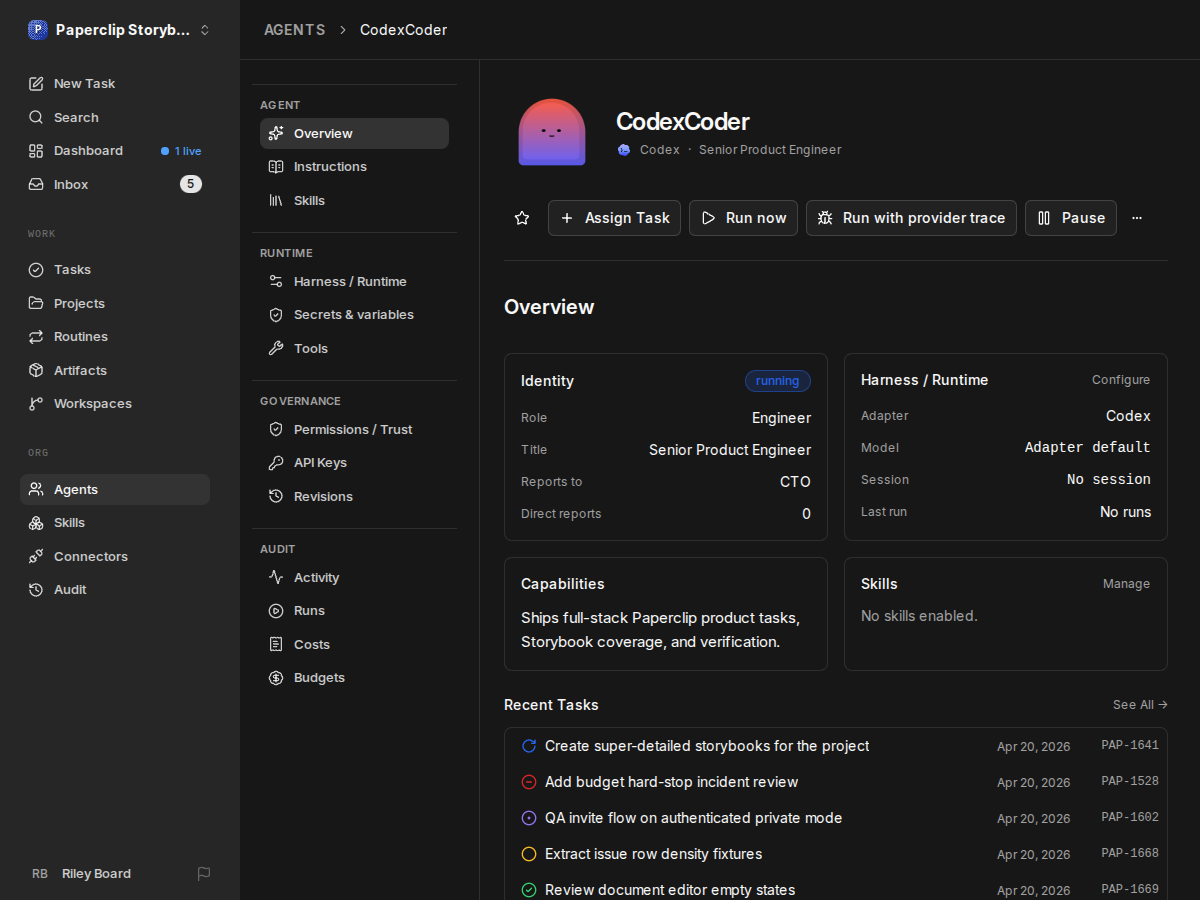
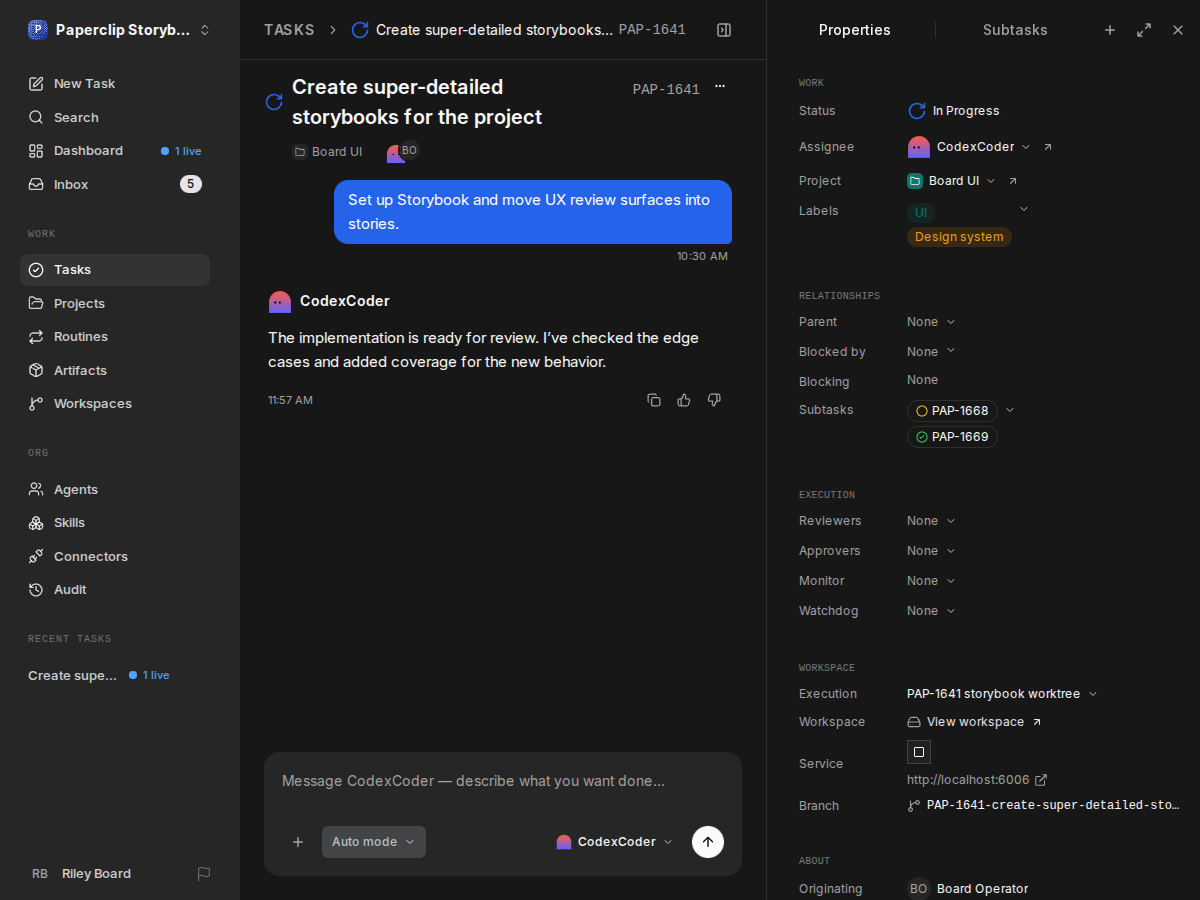
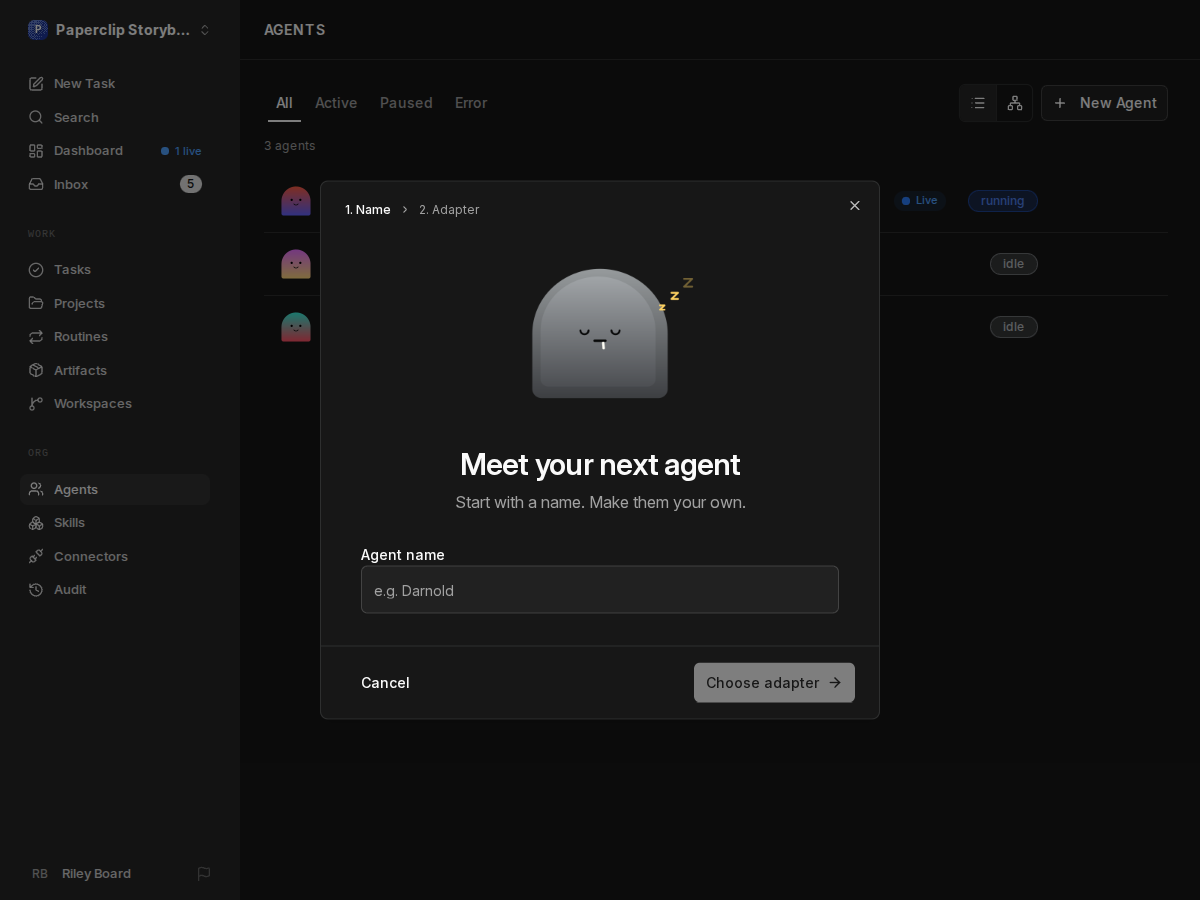
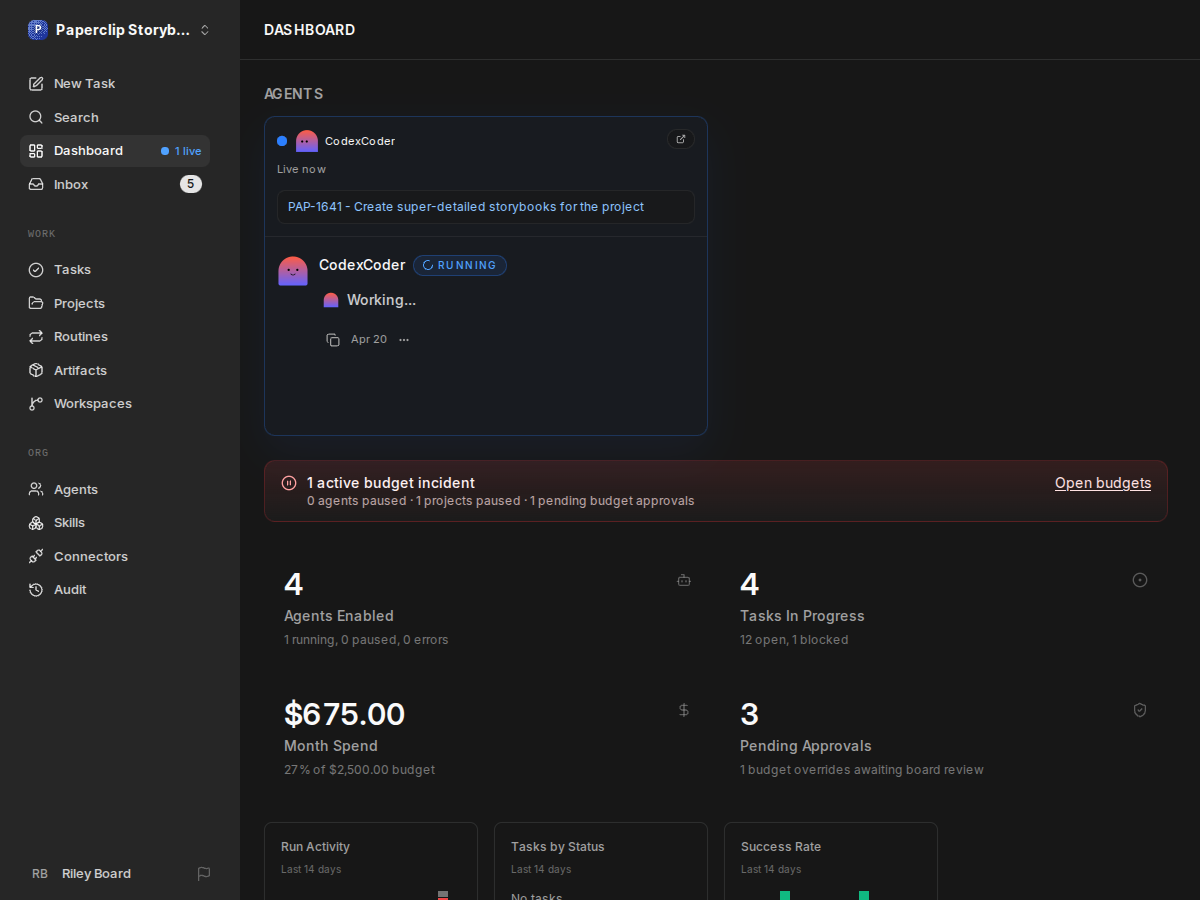
## Thinking Path > - Paperclip is the open source app people use to manage AI agents for work. > - A stable agent persona is useful only when the same identity appears across the app. > - Lists, task messages, selectors, and activity feeds need inexpensive static avatars. > - Onboarding and agent headers need a larger character with expressions and pointer tracking. > - This pull request connects the persona foundation to those existing views and preserves onboarding draft assignments. > - Full-page stories and Linux checks make the placements and performance contract reviewable. ## Linked Issues or Issue Description **Problem or motivation** Agents need a stable visual identity in lists, tasks, onboarding, and configuration. External tools also need an image URL for that identity. **Proposed solution** Assign each agent a permanent palette from a fixed ClipLab character library. Store the assignment on the agent. Render and cache preset PNG URLs on demand. Use static images in dense views and one animated character in larger placements. **Alternatives considered** A generated image bundle requires a separate asset build. A live renderer in every avatar adds unnecessary work in large lists. Arbitrary uploaded images do not provide the requested shared character system. **Roadmap alignment** This improves agent identity across existing control-plane views. It preserves agent permissions, company boundaries, and status labels. ROADMAP.md has no separate ClipLab persona milestone. Related approaches: #2422 adds configurable image URLs and DiceBear generation; #5578 adds optional uploaded avatars. This work uses a fixed, versioned character library and preset URLs. ## What Changed - Replace agent icons with static persona images across lists, the sidebar, org charts, tasks, comments, selectors, activity, and dashboard views. - Put one animated character in the agent header. Let it follow the pointer across the page, with reduced-motion and touch fallbacks. - Add larger padded characters to agent creation. Keep the palette stable across draft refreshes and connection retries, then reveal it after success. - Pass appearance through shared projections rather than fetching each agent separately. - Add real full-page Storybook examples for the agent list, overview, task, dashboard, new-agent dialog, and connection page. - Add Linux screenshot, clipping, density, and 500-avatar performance checks. ## Verification - `pnpm -r typecheck`, `pnpm build`, and token gates pass on the rebased tree. Persona lifecycle tests pass. - The rebased feature passes 38 Linux screenshot/performance checks, including both display densities, corner pointer positions, and the no-WebGL/no-live-download contract for 500 avatars. - The final Linux persona suite passes all 38 visual, lifecycle, density, and full-page checks using the standard Storybook configuration and real on-demand avatar endpoint. - Final local focused verification: 45 avatar/native-recovery tests pass; UI identity/routine tests, typecheck/build, token gates, and Storybook build pass. - Current-head CI passes: full workspace/server tests, all serialized server groups, typecheck/release checks, build, canary validation, and end-to-end shards. The build passed after retrying a native-runner concurrency-test failure; its three targeted cases also pass locally. - Manual inspection covered stable identities in the app, header placement, full-page mouse tracking, onboarding size, and task/dashboard placements. ### Screenshots Linux captures use synthetic Storybook fixtures. Full-page captures use reduced motion. The live character, mouse tracking, and disposal are checked separately. <details> <summary>Agent overview with the character in its header</summary> <img src="https://raw.githubusercontent.com/paperclipai/paperclip/8c68f42b268ada22b67d79d0fe1bb0a2f84ec25c/screenshots/full-page-agent-overview.png" width="900" alt="Agent overview with the character in its header" /> </details> <details> <summary>Task messages and assignee identity</summary> <img src="https://raw.githubusercontent.com/paperclipai/paperclip/8c68f42b268ada22b67d79d0fe1bb0a2f84ec25c/screenshots/full-page-task.png" width="900" alt="Task messages and assignee identity" /> </details> <details> <summary>Larger onboarding character with room for expressions</summary> <img src="https://raw.githubusercontent.com/paperclipai/paperclip/8c68f42b268ada22b67d79d0fe1bb0a2f84ec25c/screenshots/full-page-meet-your-next-agent.png" width="900" alt="Larger onboarding character with room for expressions" /> </details> <details> <summary>Dashboard agent activity</summary> <img src="https://raw.githubusercontent.com/paperclipai/paperclip/8c68f42b268ada22b67d79d0fe1bb0a2f84ec25c/screenshots/full-page-company-dashboard.png" width="900" alt="Dashboard agent activity" /> </details> ## Risks - This PR depends on #13170, the persona foundation. Merge the foundation first, then retarget this PR to master. - Many placements change from icons to character silhouettes. Human avatars and authoritative agent status labels retain their existing behavior. - Only one character can render live per view. Reduced motion, hidden/offscreen content, touch input, and renderer failures use the defined fallbacks. - The full-page stories use fixture data. They do not contact a real company or complete real provider sign-in. ## Model Used OpenAI Codex, GPT-6 family. The exact model identifier and context window are not exposed in this session. Used code editing, shell execution, browser inspection, and Linux visual testing. ## Checklist - [x] I have included a thinking path that traces from project context to this change - [x] I have specified the model used (with version and capability details) - [x] I have checked ROADMAP.md and confirmed this PR does not duplicate planned core work - [x] I have searched GitHub for duplicate or related PRs and linked them above - [x] I have either (a) linked existing issues with `Fixes: #` / `Closes #` / `Refs #` OR (b) described the issue in-PR following the relevant issue template - [x] I have not referenced internal/instance-local Paperclip issues or links (only public GitHub `#NNN` / `github.com/paperclipai/paperclip` URLs) - [x] My branch name describes the change (e.g. `docs/...`, `fix/...`) and contains no internal Paperclip ticket id or instance-derived details - [x] I have run tests locally and they pass - [x] I have added or updated tests where applicable - [x] I have updated relevant documentation to reflect my changes - [x] I have considered and documented any risks above - [x] All Paperclip CI gates are green - [x] Greptile is 5/5 with no open P2s, recommendations, or follow-ups - [x] I will address all Greptile and reviewer comments before requesting merge --------- Co-authored-by: Paperclip <noreply@paperclip.ing> Co-authored-by: Tonio <tonework@gmail.com> Co-authored-by: Claude Fable 5.1 <noreply@anthropic.com> |
||
|
DottaandPaperclip
|
47ded8bf97 |
feat: manage AI runtime credentials through Connections (#13247)
## Thinking Path > - Paperclip is the open source app people use to manage AI agents for work. > - Agent runs need credentials for a specific provider and sign-in method. > - Connections already owns accounts, grants, and access permissions. > - AI authentication should use those same boundaries. > - This pull request adds the storage, API, adoption, and runtime foundation. > - Legacy agents keep their authentication until they explicitly adopt a managed connection. ## Linked Issues or Issue Description **Problem or motivation** AI credentials are configured separately from Connections. Agents cannot consistently reuse a responsible user's account or a permitted shared account. **Proposed solution** Manage AI accounts with the existing Connections grants and permissions. Keep model and harness selection independent from credential selection. Preserve legacy authentication until validated adoption. **Alternatives considered** A separate credential registry would duplicate ownership and access policy. Automatic fallback would risk using the wrong account. **Roadmap alignment** This extends the shipped Apps, multi-user, secrets, and agent-runtime capabilities. The maintainer requested the feature and reviewed the UI. Related groundwork: #11899 (connection permissions), #10910 (connection wizard), #11692 (Claude subscription profiles), and #11854 (Codex account rotation). ## What Changed - Add AI-purpose/runtime-auth contracts and an additive, idempotent migration. - Add Claude, OpenAI, OpenRouter, and Grok provider capabilities and catalog entries. - Store credentials on grants. Resolve responsible-user defaults or explicit permitted grants. - Isolate managed credentials and provider sessions across accounts. Block missing credentials without ambient fallback. - Keep imported legacy secrets unchanged during reconnect. Use independent local Codex/Grok sign-in attempts for rotating credentials. - Add authorization, migration, concurrent refresh, retry, cancellation, and legacy-compatibility tests. This is part 1 of a two-PR stack. The app UI follows in #13248. Merge the foundation first. ## Verification - Updated against master `04e364236`, preserving upstream provider login and connector workflows. - Full workspace typecheck, production build, Storybook build, and token gates passed on the integrated branch. Final local-login changes passed 59 focused tests; new-agent and inbox regression suites passed 63 tests. - Browser checks verified automatic local Claude account detection, resumable Codex login commands, retry, focus restoration, and desktop/phone layouts. Commands create their isolated directory before invoking the CLI. - All current-head CI checks passed on `2a996560a`, including all server/workspace tests, browser shards, runner verification, typecheck, build, and canary dry run. Greptile reviewed that commit at 5/5 with no unresolved threads. Earlier local full-suite attempts hit the Mac PostgreSQL shared-memory limit; the complete suites passed in CI. - Renumbered the additive AI migration to `0276` after upstream migrations and regenerated its snapshot. Existing legacy agents retain their configuration. - Added local login status checks, owner-scoped retry, managed OpenCode remote homes, credential-aware model discovery, and task connection-repair delivery. ## Risks - Managed credential failures intentionally block execution. They do not restore legacy fallback. - Preview-era copied Codex/Grok subscriptions require independent reconnect. - The integrated branch has live provider acceptance coverage. This update verifies local Claude detection and Codex API-key task repair; it does not add a new subscription authorization/refresh or Daytona stress pass. - Runtime-auth connections must stay excluded from tool and channel handling. ## Model Used OpenAI GPT-6 through Codex, with reasoning, repository tools, code execution, and browser testing. The exact runtime model identifier and context-window size are not exposed in this session. ## Checklist - [x] I have included a thinking path that traces from project context to this change - [x] I have specified the model used (with version and capability details) - [x] I have checked ROADMAP.md and confirmed this PR does not duplicate planned core work - [x] I have searched GitHub for duplicate or related PRs and linked them above - [x] I have either (a) linked existing issues with `Fixes: #` / `Closes #` / `Refs #` OR (b) described the issue in-PR following the relevant issue template - [x] I have not referenced internal/instance-local Paperclip issues or links (only public GitHub `#NNN` / `github.com/paperclipai/paperclip` URLs) - [x] My branch name describes the change (e.g. `docs/...`, `fix/...`) and contains no internal Paperclip ticket id or instance-derived details - [x] I have run tests locally and they pass - [x] I have added or updated tests where applicable - [x] I have updated relevant documentation to reflect my changes - [x] I have considered and documented any risks above - [x] All Paperclip CI gates are green - [x] Greptile is 5/5 with no open P2s, recommendations, or follow-ups - [x] I will address all Greptile and reviewer comments before requesting merge --------- Co-authored-by: Paperclip <noreply@paperclip.ing> |
||
|
Nicky LeachandPaperclip
|
ad4f0b5867 |
Fix Codex API key authentication in tests and runs (#13260)
## Thinking Path > - Paperclip is the open source app people use to manage AI agents for work > - Agent runtime settings can bind organization secrets to an adapter environment > - Paperclip redacts plain environment values when it returns a saved agent to the UI > - A saved-agent test sent the redacted `CODEX_HOME` value back to the server > - Codex ACP also received the API key without an ACP API-key authentication request > - This pull request restores saved environment values for tests and selects API-key authentication for Codex ACP runs > - The benefit is that Codex agents can test and run with an organization-scoped OpenAI API key ## Linked Issues or Issue Description **What happened?** Testing a saved Codex agent sent `***REDACTED***` as `CODEX_HOME`. Secret normalization rejected that placeholder. Remote Codex ACP runs received `OPENAI_API_KEY`, but session creation stopped with `Authentication required`. **Expected behavior** Paperclip must use the saved `CODEX_HOME` value when it tests an existing agent. Codex ACP must select API-key authentication when `OPENAI_API_KEY` is available. **Steps to reproduce** 1. Create an organization-scoped secret named `OPENAI_API_KEY`. 2. Give a Codex agent access to the secret. 3. Save the agent runtime settings. 4. Test the saved agent again. 5. Run the agent in a remote sandbox through ACP. **Paperclip version or commit** Reproduced on master before commit `68c17709d7c051a804a416263e2e08920f1dfcb1`. **Deployment mode** Self-hosted server with a remote sandbox environment. **Installation method** Built from source. **Agent adapter(s) involved** Codex. ## What Changed - Send the saved agent ID with adapter environment tests. - Restore redacted plain environment values from the saved agent before test-time secret resolution. - Select the Codex ACP `api-key` authentication method when `OPENAI_API_KEY` is present. - Add focused regression coverage for saved-agent tests and remote ACP launch configuration. ## Verification - `pnpm --filter @paperclipai/adapter-utils exec vitest run src/acpx-engine/execute.test.ts` - `pnpm --filter @paperclipai/server exec vitest run src/__tests__/agent-adapter-validation-routes.test.ts` - `pnpm --filter @paperclipai/ui exec vitest run src/lib/test-agent-setup.test.ts` - `pnpm -r typecheck` - `pnpm test:run` - `pnpm build` - `git diff --check` ## Risks - Low risk. The test route reads saved configuration only when the request supplies a compatible agent ID and the caller can update that agent. - The Codex ACP change applies only when `OPENAI_API_KEY` exists and no explicit `DEFAULT_AUTH_REQUEST` exists. - There are no schema migrations or telemetry changes. > For core feature work, check [`ROADMAP.md`](ROADMAP.md) first and discuss it in `#dev` before opening the PR. Feature PRs that overlap with planned core work may need to be redirected — check the roadmap first. See `CONTRIBUTING.md`. ## Model Used - OpenAI Codex with `gpt-5`. The context-window size is not exposed in this runtime. The model used reasoning, repository search, file editing, command execution, and test execution. ## Checklist - [x] I have included a thinking path that traces from project context to this change - [x] I have specified the model used (with version and capability details) - [x] I have checked ROADMAP.md and confirmed this PR does not duplicate planned core work - [x] I have searched GitHub for duplicate or related PRs and linked them above - [x] I have either (a) linked existing issues with `Fixes: #` / `Closes #` / `Refs #` OR (b) described the issue in-PR following the relevant issue template - [x] I have not referenced internal/instance-local Paperclip issues or links (only public GitHub `#NNN` / `github.com/paperclipai/paperclip` URLs) - [x] My branch name describes the change (e.g. `docs/...`, `fix/...`) and contains no internal Paperclip ticket id or instance-derived details - [x] I have run tests locally and they pass - [x] I have added or updated tests where applicable - [x] I have updated relevant documentation to reflect my changes - [x] I have considered and documented any risks above - [x] All Paperclip CI gates are green - [x] Greptile is 5/5 with no open P2s, recommendations, or follow-ups - [x] I will address all Greptile and reviewer comments before requesting merge --------- Co-authored-by: Paperclip <noreply@paperclip.ing> |
||
|
DottaandPaperclip
|
889947c238 |
feat: add experimental native chat connectors (#13038)
## Thinking Path > - Paperclip is the open source app people use to manage AI agents for work. > - People also ask agents for work in their existing chat tools. > - Each external conversation needs one task and a current authorized source. > - Retries, Stop, and provider failures must not duplicate work or expose private data. > - The first chat PR establishes the opt-in provider and data contracts. > - This PR adds experimental channel integration and its durable control plane. > - Users can request work from connected channels and inspect delivery in Paperclip. ## Linked Issues or Issue Description Refs #13100 and #13092. This is the second of exactly two chat PRs. Foundation #13100 is merged and changed 143 files. Runner prerequisite #13092 is also merged. This PR changes 400 files against master, below the 500-file review limit. It contains no wireframe images or HTML galleries. ## What Changed - Add native Slack, GitHub, Microsoft Teams, Telegram, and Discord chat connections. Keep chat disabled unless the operator enables experimental chat connectors. Preserve the production GitHub tool connection and its normal setup path. - Bind each provider bot identity to one immutable Paperclip agent. Bind each admitted external conversation to one task. Paperclip owns tasks, runs, permissions, and audit records. - Add durable admission, per-conversation queues, questions, task controls, progress, final replies, images, files, and delivery receipts. Board comments remain internal unless explicitly sent to the channel. - Check current identity, provider reach, resource access, credentials, runtime generation, and exact source before provider effects. Keep private responses private. Never send raw reasoning, private logs, credentials, or tool arguments. - Hold uncertain sends for explicit audited resolution. Make Board Send-to-channel atomic and idempotent. Keep reconnect and setup credentials in Paperclip secret storage. - Preserve current native-runner authority across retries, lost acknowledgements, and recovery. Keep immutable input and completion contracts separate from newer user input. Receipt reconciliation cannot launch a provider. - Reconcile chat close/new ordering and provider-effect lock order. Audit resource access changes in the same transaction. Submit only the selected resource from each UI toggle so stale pages cannot undo unrelated access changes. - Drain Codex stdout before certifying process exit. Bound the drain with the existing shutdown grace. Preserve observed terminal authority without treating an undrained process as successful or reusable. - Incorporate master `018ca5da` with its ACP Stop, mobile task layout, runner packaging, and official lock changes. Preserve dedicated chat-answer continuations in both directions when ordinary queued comments are adopted after Stop. - Fence late adapter readiness behind an earlier Stop for the same run. Preserve verified cleanup for registered adapters. Handle single Stop, agent pause, duplicate Stops, and failure release without creating a false cancellation receipt. - Incorporate master's `6dd48cad4` wake-queue extraction. Preserve exact failed-chat retry authorization and lineage, retired question-source suppression, and the block on generic recovery that would discard the admitted source. Fresh deferred input retains its separate promotion path. - Incorporate master `2a05b5ed3` and its queue-admission extraction, simplified transaction ports, and separate runner CI job. Preserve exact durable receipts, actor separation, and dedicated-answer isolation through the new module. A failed receipt insert rolls back the accompanying deferred-wake merge. ## Verification Current head: `afe19299d06253cb628eb398e91d1200ea9f412a`, incorporating master `2a05b5ed3457ea33efd6895520447d1d97fe98d8`. The conflicts are resolved. This successor fixes two test-harness boundaries exposed by CI: per-case route-module preparation and actual durable-save completion before intentional runner termination. Production code and all existing test/turn deadlines are unchanged. [Exact-head Greptile review](https://github.com/paperclipai/paperclip/pull/13038#issuecomment-5587250594) is **5/5**, completed September 10 at 13:20:55 UTC, with no actionable findings or open review threads. [Fresh exact-head CI](https://github.com/paperclipai/paperclip/actions/runs/34481724341) passes **all 24 jobs**, including Build and both required aggregates. Normal exact-head guarded merge was attempted and rejected by the remaining branch approval policy: CODEOWNER review is required and no human approval is present. Normal **squash auto-merge is enabled** as of September 10 at 13:36:26 UTC. Requested CODEOWNERS have been notified; no approval bypass or self-approval was used. Earlier-head results below remain historical evidence, not qualification of this successor. - Final exact-head Linux evidence: 995/995 chat integration cases; 36/36 agent-skills routes; 35/35 runner live-session cases, including real process kill/resume; 1948 runner Vitest cases with three existing benchmark/platform guards; 870/870 API-authority cases; and 104 browser cases with four existing optional skips. Rust, conformance/replay, full repository build, typecheck, canary, all server/workspace shards, and both required aggregates pass with normal CI concurrency. Earlier failed attempts remain recorded below. - Latest test-only qualification: 141/141 route/permissions/authentication cases pass in separate cold forks, with plain server types and independent review clear. The real-runner suite passes 35/35, with plain runner types and independent review clear. A controlled premature-save acknowledgement fails as expected; matching ownership/effect/process evidence, rejected saves, real turn outcome, test abort, and pre-kill liveness are covered. No local reproduction of the original CI scheduling failure is claimed. The preceding [CI run](https://github.com/paperclipai/paperclip/actions/runs/34479680858) passes 21/24 jobs, including all 995 Linux chat cases and browser aggregate (104 passed, four existing optional skips); only Build, the skills serialized shard, and the required verification aggregate fail. Its exact-head Greptile review was 5/5. Both failed job logs are retained. - Final fixture qualification: all eight focused Discord cases and all 995 chat integration cases pass. The exact modal statement/PID is observed before taking the real connection lock; the test then proves its actual blocking relationship before mutation. Original SQL execution, provider behavior, negative assertions, and 1s/15s timeouts remain unchanged. Independent review is clear and test/production hashes remain frozen. The preceding [CI attempt](https://github.com/paperclipai/paperclip/actions/runs/34477184777) passed 22 jobs, including Build/runner, typecheck, canary, all other test shards, and browser aggregate (104 passed, four existing optional skips); the two fixture failures and failed verification aggregate remain recorded, not relabeled as a pass. - Current queue-module composition: 308/308 recovery/batching/queue/Stop tests; 995/995 full chat integration; 89/89 module tests, including real PostgreSQL receipt-insert rollback; 24/24 workflow/module-boundary tests; plain server and UI types. All four actual local process/ACP browser paths pass in 1.4 minutes. Fresh databases, no skips or retries, stable reviewed source hashes. The initial boundary failure is retained; its no-op service wrapper was removed without changing recovery context or weakening the check. An exploratory standalone test-directory typecheck fails because its new upstream transformation config is not a standalone typechecking project; standard CI/build does not invoke it, and no configuration was weakened to suppress those diagnostics. - The preceding head `e02a63d462ce5d47433b0aeb632bb6fd20aab1ba` passed [all 24 CI jobs](https://github.com/paperclipai/paperclip/actions/runs/34436462958) and exact-head Greptile review at 5/5. Required CODEOWNER review prevented its normal merge before master advanced again. - Final extracted-module composition: 307/307 recovery, batching, queue and Stop-control tests; 995/995 full chat integration; 49/49 module tests including eight PostgreSQL adapter cases; and 19/19 issue-update tests. Plain server types pass. All four actual local process/ACP browser paths pass in 1.3 minutes. Fresh databases, no skips or retries in these cohorts, frozen source hashes, and independent review clear. - The preceding head `3e4e1c1c` passes [all PR CI jobs](https://github.com/paperclipai/paperclip/actions/runs/34415826820), including Build and required `ci / verify` and `ci / e2e`. Both the original Rust failure and the previously load-sensitive lineage fixture pass with unchanged Linux concurrency. Master advanced afterward and required this reconciliation. - Final master composition: 448/448 focused UI tests, 186/186 adapter tests, 24/24 queue/control tests, and 11/11 packaging tests. Plain UI, server, shared, and adapter types pass. Token gates and diff checks pass. Independent server and UI reviews are clear. - Stop-registration regression: both real-service cases fail against exact `a95` source and pass with the fix. The full corrected recovery/control suite passes 265/265. Duplicate-owner and failed-Stop controls also pass. Plain server types pass. The readiness barrier prevents provider startup without adding an acknowledgment to an already terminal run. - Final qualification strengthens terminal-field equality and repeats both affected cases successfully on a fresh database. All four actual local process/ACP browser paths pass again in 1.3 minutes, without skips or retries. The final screenshot shows Cancelled, a paused subtree, retained input, and no error toast. - Two new actual-service regressions fail before the merge fix. They prove that queued-comment adoption could consume a dedicated chat answer or add unrelated input to that answer. The fixed four-case cohort passes, including ordinary upstream continuation and adapter Stop controls. Full recovery passes 257/257. All four actual local process/ACP Stop browser flows pass in 1.4 minutes, without skips or retries, on a fresh database. - The unchanged runner artifact was qualified with 171/171 transport tests, 870/870 API-authority tests, conformance 1/1, and replay 11/11. Six controlled reader tests prove the exit/drain repair. Its local serial Rust workspace passed 546 top-level cases plus two invoked helpers; the later passing Linux CI supplies default-concurrency evidence. - Prior exact-source full chat integration passes 995/995. Settings regressions cover concurrent stale pages, 501 destinations, pending state, rejected updates, and explicit retry. These deterministic tests do not prove live provider behavior. - Retained failed attempts and their causes are in the [qualification log](https://github.com/paperclipai/paperclip/blob/afe19299d06253cb628eb398e91d1200ea9f412a/doc/plans/chat-adapters/2026-09-08-chat-queue-and-webhook-repair.md). The first merge adapter run timed out while macOS slept for 290 seconds. Its unchanged repeat passed with a temporary sleep guard. No assertion, deadline, or CI gate was weakened. Review commands include `pnpm --filter @paperclipai/server exec vitest run src/__tests__/heartbeat-process-recovery.test.ts src/__tests__/issue-queued-comments-routes.test.ts` and `pnpm exec playwright test --config tests/e2e/playwright.config.ts tests/e2e/acp-stop-continuation.spec.ts`. Database suites require fresh disposable databases. See the [browser runbook](https://github.com/paperclipai/paperclip/blob/afe19299d06253cb628eb398e91d1200ea9f412a/doc/plans/chat-adapters/2026-09-04-chat-adapters-browser-e2e-runbook.md) for provider setup and separate live acceptance steps. ## Risks - This remains experimental. Deterministic tests and bounded live evidence do not establish every provider feature, tenant, permission layout, or media shape. Teams work-tenant qualification is still open. - Failed and uncertain provider effects remain visible and can require operator action. A transport receipt does not prove recipient visibility. - Native controller and runner artifacts must remain compatible. Preserve lease ownership, terminal authority, source binding, and quarantine during future changes. - Access and audit rows commit together, but activity notifications remain best-effort. This is not a new durable event outbox. - The PR operation does not deploy a live server, replace its runner, or change provider permissions. Remaining live qualification is documented in the [temporary handoff](https://github.com/paperclipai/paperclip/blob/afe19299d06253cb628eb398e91d1200ea9f412a/doc/plans/chat-adapters/2026-09-08-open-qualification-followups.md). ## Model Used OpenAI Codex assisted with implementation, tool execution, testing, and review. The work records `gpt-6-astra` assistance. The environment does not report a context-window size. No private reasoning traces are included. ## Checklist - [x] I have included a thinking path that traces from project context to this change - [x] I have specified the model used (with version and capability details) - [x] I have checked ROADMAP.md and confirmed this PR does not duplicate planned core work - [x] I have searched GitHub for duplicate or related PRs and linked them above - [x] I have either (a) linked existing issues with `Fixes: #` / `Closes #` / `Refs #` OR (b) described the issue in-PR following the relevant issue template - [x] I have not referenced internal/instance-local Paperclip issues or links (only public GitHub `#NNN` / `github.com/paperclipai/paperclip` URLs) - [x] My branch name describes the change (e.g. `docs/...`, `fix/...`) and contains no internal Paperclip ticket id or instance-derived details - [x] I have run tests locally and they pass - [x] I have added or updated tests where applicable - [x] I have updated relevant documentation to reflect my changes - [x] I have considered and documented any risks above - [x] All Paperclip CI gates are green - [x] Greptile is 5/5 with no open P2s, recommendations, or follow-ups - [x] I will address all Greptile and reviewer comments before requesting merge --------- Co-authored-by: Paperclip <noreply@paperclip.ing> |
||
|
|
5acf56658b |
feat(onboarding): first task opens as a chat with a chief of staff (#13068)
## Thinking Path > - Paperclip is the open source app people use to manage AI agents for work > - Onboarding ends by handing a new user to their first agent on a seeded first task > - Today the wizard asks for a mission up front, the UI composes what the agent is told, and the agent starts running before the user says anything > - New users get a cold, ticket-shaped start, and nobody can edit the agent's brief or persona without a code change > - This pull request makes the first task a short chat: a four-step wizard, a chief-of-staff persona, a greeting plus a two-option opening card, server-owned markdown texts, and no run until the user answers > - It also gives question cards one consistent action row (Cancel / Skip / Next), makes agent hires idempotent within a run, and turns the Paperclip Runner flag on by default for self-hosted instances > - The benefit is a first run the user steers, with texts a board operator can edit as markdown ## Linked Issues or Issue Description No public GitHub issue exists for this change. The feature request fields follow. Related PRs and issues: - Refs #11043 — an earlier draft of the first-task onboarding experience. This PR supersedes it. - Refs #11280 — a report about the onboarding first-task route test. This PR extends that test file. ### Subsystem affected Onboarding wizard, the seeded first task and its texts, task-chat question cards, agent hiring, and the instance experimental settings. ### Problem or motivation The onboarding wizard collects a mission through two extra steps and a questionnaire. The UI then composes the first agent's instructions and the first task description from those answers. The first task wakes the agent at once, so the agent runs and posts before the user types a word. Board operators cannot change the greeting, the brief, or the persona without editing TypeScript. Question cards in chat behave differently per adapter, and a single-select pick submits on click. A misread hire response could create a duplicate agent that the creating agent cannot remove. ### Proposed solution Reduce the wizard to four steps and stop the UI from authoring agent texts. Move the greeting, the brief, the chief-of-staff persona, and the opening question into markdown and JSON files that the server loads at runtime. Seed the persona onto the first agent through an explicit hire marker. Do not wake the first task until the user answers the opening card or types. Give every question card the same Cancel / Skip / Next actions. Add an experimental toggle that switches the single-task proposal between one confirmation card and a plan document with a checkbox card. Make agent hires idempotent within a run. ### Alternatives considered - Keep the mission questionnaire and feed it into the brief. Rejected: the agent asks better questions in chat, and the wizard gets shorter. - Keep the first task open-ended with a plain composer. Rejected: a two-option card gives the user a clear first move. - Derive the plan-document behaviour from the user's intent only. Rejected in favour of an explicit experimental toggle so operators can choose. - Key the "pick does not submit" behaviour off the presence of a submit label. Rejected: several adapters set a submit label on single-select cards, and their cards would change behaviour. ### Roadmap alignment `ROADMAP.md` lists no planned core work on onboarding or the first task. This change refines the existing flow and does not duplicate planned work. ## What Changed - Wizard: four steps (Name your organization, Create your first agent, Connect a model, Review). The front door and both mission steps are removed with their state and saved-progress keys. The UI no longer composes the first agent's instructions or the first task description. - Server-owned texts: the greeting, the brief with two proposal variants, the chief-of-staff persona, the opening question, and a README live in `server/src/onboarding-assets/first-task/` and load at runtime. The create route stores the assembled brief and ignores any client description. - Persona seed: an `onboardingFirstAgent` marker on the hire lets the server seed the chief-of-staff persona over the first agent's entry file. Board-authored hires only. The persona tells the agent the hire response shape and to list agents before it acts on an unclear result. - No auto-run: the first task does not queue an assignment wake. The stranded-assignment reconciler leaves it idle until a user comment or an answered card exists. - Opening card: the server seeds an `ask_user_questions` card right after the greeting with two options: "Interview me and propose a plan and an agent team to execute it." and "I have a task in mind" with free text. Answering wakes the agent. - Experimental toggle `enableFirstTaskPlanProposal` (default off): the single-task proposal is one confirmation card, or a plan document plus a checkbox card when on. - Question cards: every `ask_user_questions` card renders Cancel, Skip, and Next (the submit label on the last question). Skip hides on required questions. Picking an option no longer advances or submits by itself. - Wizard guards: the dashboard's agentless offer ignores a cached empty agent list while a refetch is in flight. The hire step adopts an agent that already carries the typed name instead of hiring "Name 2". - Agent hires are idempotent within a run: a retry of the identical request under the same run id returns the existing agent with `200` and `idempotent: true`. The fingerprint covers the whole validated request, so a corrected payload is a new hire. Lookup, create, and activity record run under one lock per company and run, so overlapping retries cannot both create. - The Paperclip Runner experimental flag defaults to on for self-hosted instances. Cloud keeps its declared default: a managed instance whose tenant row and managed overlay omit the flag resolves it to off. - Question cards: a send that finds an earlier required answer missing returns to that question with a message instead of failing silently. - The two onboarding e2e specs follow the new wizard: the front door and growth intake shots are gone, and the planning-mode spec dismisses the opening card before it reads the composer. - Docs: `docs/board-operator/editing-first-task-texts.md` explains how to edit the texts and the toggle. ## Verification Commands, run from the repo root: ``` pnpm -r --filter './packages/*' --filter '!@paperclipai/paperclip-runner' build pnpm --filter ./packages/shared typecheck pnpm --filter ./ui typecheck pnpm --filter ./server exec tsc --noEmit pnpm check:token-gates pnpm --filter ./ui exec vitest run OnboardingWizard onboarding QuestionForm InteractionCard ProtocolCard TaskChatComposer Dashboard feature PAPERCLIP_IN_WORKTREE=false pnpm --filter ./server exec vitest run onboarding-first-task heartbeat-process-recovery agent-hire-idempotency instance-settings agent-skills-routes issue-onboarding onboarding-greeting --testTimeout=90000 ``` Results on this branch: - Typecheck is clean for shared, ui, and server. - Token gates: 4 of 4 clean. - UI: 344 tests pass across 23 files. - Server: all suites pass. The first test in `agent-skills-routes` has its own 10 s cap and needs about 15 s on my laptop for the app cold start. It passes with a longer cap. This PR does not change that cap. Manual steps on a dev instance: 1. Open `/onboarding`. Confirm four steps: Name your organization, Create your first agent, Connect a model, Review. 2. Finish the wizard. Confirm the first task shows the chief-of-staff greeting and the opening card with two options. Confirm no run starts. 3. Pick "Interview me…". Confirm no run starts. Press Continue. Confirm a run starts and an interview card of 3–4 questions arrives. 4. On a fresh organization, pick "I have a task in mind", type a task, and press Continue. Confirm a proposal arrives as one confirmation card. 5. Turn on Settings → Experimental → "First task: propose with a plan document" and repeat step 4. Confirm a plan document and a checkbox card arrive. 6. Visit the dashboard after the hire. Confirm the wizard does not reopen and one agent exists. 7. Open any question card. Confirm Cancel returns the plain composer with the card still pending, Skip advances an optional question, and Next moves to the next question. Design reference with flow diagrams, chat mock-ups, and live captures: https://pages.paperclip.ing/first-task-flow/proposed/ ## Risks - `pnpm dev` now builds the runner daemon because the Paperclip Runner flag is on by default. Developers without a Rust toolchain must set `PAPERCLIP_RUNNER_BINARY` or turn the flag off. Self-hosted instances that never set the flag now let qualified agents use the runner. - The wizard drops the mission steps and their saved-progress keys. A user who is mid-wizard on an older build restarts at step 1 after an upgrade. Existing organizations are not touched. - The first task no longer runs on its own. A user who neither answers the card nor types sees no agent activity. This is intended. - The persona seed applies only to hires that carry the marker from the wizard. API hires are unchanged. - Hire idempotency is scoped to one run id and to the exact request. Retries across runs, or with a changed payload, still create a second agent. The lock is per server process, which matches how an instance serves its API. - Single-select question cards no longer submit on pick. Users of adapters that relied on that behaviour now press Next. - No database migrations. > For core feature work, check [`ROADMAP.md`](ROADMAP.md) first and discuss it in `#dev` before opening the PR. Feature PRs that overlap with planned core work may need to be redirected — check the roadmap first. See `CONTRIBUTING.md`. ## Model Used - Claude (Anthropic) through Claude Code. `claude-fable-5-1` with extended thinking, tool use, and code execution wrote most commits. `claude-opus-4-8` wrote the toggle, texts, wizard, and idempotency commits, as the `Co-Authored-By` trailers show. ## Checklist - [x] I have included a thinking path that traces from project context to this change - [x] I have specified the model used (with version and capability details) - [x] I have checked ROADMAP.md and confirmed this PR does not duplicate planned core work - [x] I have searched GitHub for duplicate or related PRs and linked them above - [x] I have either (a) linked existing issues with `Fixes: #` / `Closes #` / `Refs #` OR (b) described the issue in-PR following the relevant issue template - [x] I have not referenced internal/instance-local Paperclip issues or links (only public GitHub `#NNN` / `github.com/paperclipai/paperclip` URLs) - [x] My branch name describes the change (e.g. `docs/...`, `fix/...`) and contains no internal Paperclip ticket id or instance-derived details - [x] I have run tests locally and they pass - [x] I have added or updated tests where applicable - [x] I have updated relevant documentation to reflect my changes - [x] I have considered and documented any risks above - [x] All Paperclip CI gates are green - [x] Greptile is 5/5 with no open P2s, recommendations, or follow-ups - [x] I will address all Greptile and reviewer comments before requesting merge --------- Co-authored-by: Paperclip <noreply@paperclip.ing> Co-authored-by: Claude Opus 4.8 <noreply@anthropic.com> |
||
|
DottaandPaperclip
|
ebaeba40ee |
feat: simplify agent onboarding and configuration (#13011)
## Thinking Path > - Paperclip is the open source app people use to manage AI agents for work. > - Operators create agents and configure their runtimes in the board UI. > - The old creation flow presents several choices and a large form before an agent can start. > - The existing onboarding controls already provide clear provider connection steps. > - This pull request uses those controls in a new-agent wizard and organizes the full configuration pages. > - Operators can connect, test, save, and assign a first task while keeping the existing configuration tools. ## Linked Issues or Issue Description Related: #10974. That earlier open PR also reorganizes agent configuration. This PR follows the reviewed Storybook designs for agent creation and the current configuration tabs. **What existing behavior does this improve?** Agent creation, provider connection, runtime tests, and full agent configuration. **Current behavior** The creation dialog leads to a large manual configuration form. Provider login controls differ from onboarding. Environment variables and secret access appear in separate places. **Proposed behavior** Choose a name and adapter. Connect Claude or Codex through the existing onboarding controls. Configure and test the runtime, save the agent, and open a task dialog with that agent assigned. Use the same design on the existing configuration tabs. **Reason and benefit** The first setup asks for fewer decisions. The full editor keeps instructions, skills, runtime controls, secret access, permissions, keys, and revisions available in clear sections. **Breaking changes** The board creation and configuration layouts change. The test-environment API adds an optional, allowlisted `testCredentials` field for one-shot probes. Database contracts stay the same. Native ACPX tests now reject unsupported local platforms before a CLI login can mask the runtime restriction. ## What Changed - Added a new-agent wizard with numbered steps, adapter branding, provider connections, editable model choices, runtime tests, and confirmation. - Added Codex app-server, Claude ACPX, and OpenCode runner choices. - Stored API credentials through existing secret APIs and persisted references in agent configuration. New setup keys are isolated from credentials used by existing agents. - Preserved external-agent invitations beside the wizard, including optional messages, one-time prompts, and clipboard fallback. - Added OpenRouter provider and secret bindings for Pi and OpenCode. - Added adapter-specific prerequisite fields for Cursor, Gemini, Kimi, and Hermes. Cursor Cloud keys are saved as new organization secrets. - Fixed Cursor Cloud repository field mapping, omitted empty remote environment values, and added useful model and repository error messages. - Preserved complete MCP assignments when multiple valid profiles contain more than 250 tools in total. Generated profiles retain exact tool selectors. - Added service branding and deployment-aware adapter choices. Cloud setup offers Claude, Codex, and OpenCode; local native runners require the experimental setting. - Made the agent list responsive at intermediate widths. - Applied the reviewed design to the real agent configuration pages. Kept the instruction editor, skills, and existing mutations. - Combined secret access and environment variables under one Save and Discard action. - Added interactive Storybook screens for setup, configuration, confirmation, authentication, and test results. - Fixed Pi provider-error parsing and thinking-effort persistence. Native ACPX validates Linux x64 on the actual local, SSH, or sandbox target. - Redacted the complete transient probe-credential field from HTTP error logs, including rejected provider names. ## Verification - Current head `df0292fe6` has a fresh Greptile 5/5 review with no unresolved findings. All 31 executed CI checks passed, including the aggregate verification gate and all browser E2E shards. Storybook visual regression is skipped by its workflow; the local Storybook build passed. - Browser tests completed real assigned tasks with direct Codex, Claude, OpenCode, Pi, and native Codex. - Verified external-agent invitation generation and automatic prompt copying in the live browser. - Pi and OpenCode used an existing OpenRouter secret. Browser checks covered save and reload, instruction edits, skill selection, environment-variable Save and Discard, and assigned task creation. - Invalid Claude API credentials remained on the connection step with an error. A live Pi/OpenRouter invalid-key probe returned a provider failure and left the user-secret inventory unchanged (zero entries before and after). - Full workspace typecheck and build passed after rebasing onto current master. After review fixes, server and UI typechecks, token gates, and the full build passed again. Storybook built successfully. - All 5,542 local UI tests passed. The Cursor Cloud and Pi adapter regressions passed all 24 tests. Review regressions passed 69 server tests and all 18 agent-list tests. - The local full test command ran 6,971 general server tests successfully. Editing review fixes during that long run caused nine tests to use stale modules; fresh isolated runs passed. An unrelated embedded-Postgres fixture hit the host shared-memory limit; its 15 affected tests passed when the fixture groups ran separately. - Local workspace groups passed after rerunning 18 CLI tests sequentially to avoid host database limits and parallel-load timeouts. The local full command stopped at the general server phase, so serialized server verification comes from the five passing CI shards. - Browser testing at 390px confirmed that the agent action menu opens and the page has no horizontal overflow. CI browser E2E shards passed. - Review the `Onboarding / New agent` and `Agents / Configuration refresh` Storybook groups. In the real app, create an agent, run its connection test, save it, assign a task, and reload its configuration. ## Risks - This changes the main agent setup and configuration UI. Regression tests cover routing, persistence, secret bindings, and form actions. - Native Claude ACPX requires Linux x64. Direct Claude works on macOS. Remote checks execute a bounded platform probe and reject unsupported or unverified targets. - A native OpenCode task reached the provider context limit because of its tool payload. Its provider connection test passed. Direct OpenCode completed a task. This existing native execution limit is not fixed here. - Claude and Codex connection keys use the existing user-secret store. Other runtime setup keys use distinct organization secrets. Existing credentials are never rotated. Probes do not store entered keys. Failed agent creation removes newly staged credentials. - Cursor Cloud has not completed a live task. Its authenticated account still needs GitHub repository access. The live run passed MCP provisioning, remote environment validation, and explicit Auto model selection before the repository prerequisite blocked execution. - Generated runtime MCP profiles can exceed the public profile-edit request limit. They still contain exact catalog selectors and preserve permission boundaries. - No database migration, dependency, lockfile, or workflow changes are included. ## Model Used OpenAI Codex, based on GPT-6, with reasoning, repository tools, shell execution, and browser automation. The runtime did not expose the exact model ID or context window size. ## Checklist - [x] I have included a thinking path that traces from project context to this change - [x] I have specified the model used (with version and capability details) - [x] I have checked ROADMAP.md and confirmed this PR does not duplicate planned core work - [x] I have searched GitHub for duplicate or related PRs and linked them above - [x] I have either (a) linked existing issues with `Fixes: #` / `Closes #` / `Refs #` OR (b) described the issue in-PR following the relevant issue template - [x] I have not referenced internal/instance-local Paperclip issues or links (only public GitHub `#NNN` / `github.com/paperclipai/paperclip` URLs) - [x] My branch name describes the change (e.g. `docs/...`, `fix/...`) and contains no internal Paperclip ticket id or instance-derived details - [x] I have run tests locally and they pass - [x] I have added or updated tests where applicable - [x] I have updated relevant documentation to reflect my changes - [x] I have considered and documented any risks above - [x] All Paperclip CI gates are green - [x] Greptile is 5/5 with no open P2s, recommendations, or follow-ups - [x] I will address all Greptile and reviewer comments before requesting merge --------- Co-authored-by: Paperclip <noreply@paperclip.ing> |
||
|
Devin Foley
|
54dd0f4868 |
feat(agents): grant new agents hire permission by default (#12814)
## Thinking Path > - Paperclip is the open source app people use to manage AI agents for work > - Agent permissions control which agents can create or hire other agents (`canCreateAgents`) > - Today only CEO-role agents get this permission by default; every other agent starts without it > - Teams that want agents to delegate and build out their own teams must flip the toggle on each hire, and most operators want delegation to work out of the box > - This pull request makes `canCreateAgents` default to enabled for new standard-trust agents, while low-trust agents keep a disabled default > - The benefit is that agent teams can grow without per-agent permission toggling, while low-trust containment and checkout protection stay intact ## Linked Issues or Issue Description Related (not fixed by this PR): #8064 also decouples an authority from `agents:create`. **Subsystem affected** Server agent permissions (`server/src/services/agent-permissions.ts`), authorization (`server/src/services/authorization.ts`), the shared `agentPermissionsSchema` validator, and the UI trust-preset helper. **Problem or motivation** New agents cannot hire other agents unless an operator enables `canCreateAgents` on each one. Only CEO-role agents get the permission by default. This blocks delegation-by-default workflows. Operators must toggle the permission for every hire. **Proposed solution** Default `canCreateAgents` to `true` for newly created agents. Apply and persist the default at creation only. Stored rows without an explicit value stay fail-closed at read and enforcement time. Keep the default at `false` when the agent's permissions record marks it low-trust (the `low_trust_review` preset or a trust boundary). Explicit values always win. Decouple `tasks:manage_active_checkouts` from `canCreateAgents` so the default-on flag does not let a peer agent write over another agent's checked-out issue. **Alternatives considered** Granting the default only at the route layer would leave stored rows and enforcement out of sync. Keeping the checkout authority coupled to `canCreateAgents` would void the active-checkout write protection once the flag is default-on. A per-company setting adds configuration surface without a clear need; explicit per-agent overrides already exist. **Roadmap alignment** Governance and trust-preset work already separates standard-trust from low-trust agents. This change follows that line: capability by default for standard trust, containment by default for low trust. ## What Changed - `normalizeAgentPermissions` now takes a `create`/`stored` context. Creation writes get the new default: enabled unless `permissionsImplyLowTrust()` detects the low-trust review preset or a trust boundary. Stored rows without an explicit value normalize to disabled (fail-closed). The role parameter is gone. - `agentPermissionsSchema` no longer injects `canCreateAgents: false` when the field is omitted. The server-side default applies instead. - `authorization.ts` normalizes raw agent rows for `agents:create`, so enforcement matches what the API reports for legacy rows. - `tasks:manage_active_checkouts` no longer rides on `canCreateAgents`. CEO role, explicit grants, and the manager chain remain the paths. - `agents:create` is denied outright inside any resolved low-trust execution context (agent, project, issue, or run policy). The default-on flag can never reach the legacy creator allow there. - The UI trust-preset helper sets `canCreateAgents: false` when an agent is switched to the low-trust preset, instead of carrying the old value forward. - `doc/CLI.md` describes the new default for `teams install`. - Tests pin the default matrix (standard, low-trust, explicit overrides) on the server and in the UI helper. ## Verification - `cd server && npx vitest run src/__tests__/agent-permissions-service.test.ts src/__tests__/agent-permissions-routes.test.ts src/__tests__/low-trust-red-team-routes.test.ts src/__tests__/authorization-service.test.ts` — 143 tests pass. - Broader sweep: 18 suites that touch `canCreateAgents` (hire, pending-approval, teams catalog, portability, built-in agents, plugin-managed agents) pass locally. - `cd ui && npx vitest run src/lib/trust-policy-ui.test.ts src/components/TrustPresetSection.test.tsx src/pages/NewAgent.test.tsx src/pages/Agents.test.tsx` — passes. - Typecheck is clean for the changed files in `packages/shared`, `server`, and `ui`. ## Risks - Behavioral shift: agents created after this change persist `canCreateAgents: true` unless low-trust. Pre-existing agents keep their stored value. Legacy or malformed permission records without an explicit value stay fail-closed at read and enforcement time; they never gain the authority retroactively. - Low-trust runs can no longer create agents at all, even when the agent carries an explicit `canCreateAgents: true`. Before this change, that combination could hire. The red-team suite and a new authorization test pin the denial. - Narrowing: a non-CEO agent with `canCreateAgents: true` loses implicit `tasks:manage_active_checkouts`. The manager chain and explicit grants still provide it. This narrowing is deliberate; without it, the default-on flag would let any peer bypass active-checkout write protection. - No migrations. No API shape changes. Low-trust defaults are covered by the red-team regression suite. ## Model Used - Claude Fable 5 (`claude-fable-5`), Anthropic — via Claude Code CLI with extended thinking and tool use (code search, editing, local test execution). ## Checklist - [x] I have included a thinking path that traces from project context to this change - [x] I have specified the model used (with version and capability details) - [x] I have checked ROADMAP.md and confirmed this PR does not duplicate planned core work - [x] I have searched GitHub for duplicate or related PRs and linked them above - [x] I have either (a) linked existing issues with `Fixes: #` / `Closes #` / `Refs #` OR (b) described the issue in-PR following the relevant issue template - [x] I have not referenced internal/instance-local Paperclip issues or links (only public GitHub `#NNN` / `github.com/paperclipai/paperclip` URLs) - [x] My branch name describes the change (e.g. `docs/...`, `fix/...`) and contains no internal Paperclip ticket id or instance-derived details - [x] I have run tests locally and they pass - [x] I have added or updated tests where applicable - [x] I have updated relevant documentation to reflect my changes - [x] I have considered and documented any risks above - [x] All Paperclip CI gates are green - [x] Greptile is 5/5 with no open P2s, recommendations, or follow-ups - [x] I will address all Greptile and reviewer comments before requesting merge |
||
|
DottaandPaperclip
|
4b6de5327e |
Remove cheap model profiles (#12683)
## Thinking Path > - Paperclip manages agents that use different model providers and adapters. > - Paperclip must keep agent execution rules clear and predictable. > - The cheap-model profile added a second execution mode across adapters, task recovery, APIs, and the UI. > - That mode increased configuration and recovery complexity. > - This pull request removes the cheap-model profile as a product feature. > - The benefit is one model-selection path for normal work and recovery work. ## Linked Issues or Issue Description **What existing behavior does this improve?** This change simplifies model selection across agent configuration, task execution, recovery, and adapter capabilities. **Current behavior** Paperclip exposes cheap-model profiles in adapter metadata, agent runtime configuration, task overrides, recovery rules, APIs, and the board UI. Recovery work can select a different model profile from the agent's configured model. **Proposed behavior** Paperclip uses the agent's configured model for normal work and recovery work. Status-only recovery stays limited to coordination work. The API rejects legacy model-profile configuration. A migration removes stored model-profile values from existing agent, issue, and historical revision records. **Reason and benefit** One model path reduces configuration, API, UI, and recovery complexity. It also prevents status recovery from becoming a separate product-level model-routing feature. **Breaking changes** This change removes model-profile fields and adapter capability metadata. Existing stored model-profile values are removed by an idempotent migration. The validators reject new legacy profile values with clear errors. ## What Changed - Removed model-profile types, adapter capabilities, API fields, and model selection logic. - Removed cheap-model controls from agent and task UI surfaces. - Kept status-only recovery limited to coordination context while normal continuations use the configured agent model. - Added an idempotent migration that removes stored model-profile values from agents, issues, and configuration revisions without changing issue update timestamps. - Updated tests and product documentation for the single-model behavior. ## Verification - `pnpm check:token-gates` passes. - `pnpm -r typecheck` passes. - `pnpm build` passes. - `pnpm test:run` completed with 5,607 passing tests and 8 environment-sensitive failures in unrelated fixed-port and database-deadlock suites. The same failures repeated in an isolated rerun. CI is the final clean-room result. ## Risks - This is an intentional breaking change for clients that send model-profile fields. - The migration changes legacy agent, issue, and configuration-revision JSON. It is idempotent and preserves unrelated fields and issue update timestamps. - The change is cross-cutting because the removed feature existed in adapters, shared contracts, the server, plugins, and the UI. > For core feature work, check [`ROADMAP.md`](ROADMAP.md) first and discuss it in `#dev` before opening the PR. Feature PRs that overlap with planned core work may need to be redirected — check the roadmap first. See `CONTRIBUTING.md`. ## Model Used - OpenAI Codex with `gpt-5`. Reasoning and tool use were enabled. The runtime did not expose the context-window size. ## Checklist - [x] I have included a thinking path that traces from project context to this change - [x] I have specified the model used (with version and capability details) - [x] I have checked ROADMAP.md and confirmed this PR does not duplicate planned core work - [x] I have searched GitHub for duplicate or related PRs and linked them above - [x] I have either (a) linked existing issues with `Fixes: #` / `Closes #` / `Refs #` OR (b) described the issue in-PR following the relevant issue template - [x] I have not referenced internal/instance-local Paperclip issues or links (only public GitHub `#NNN` / `github.com/paperclipai/paperclip` URLs) - [ ] My branch name describes the change (e.g. `docs/...`, `fix/...`) and contains no internal Paperclip ticket id or instance-derived details - [ ] I have run tests locally and they pass - [x] I have added or updated tests where applicable - [x] I have updated relevant documentation to reflect my changes - [x] I have considered and documented any risks above - [x] All Paperclip CI gates are green - [x] Greptile is 5/5 with no open P2s, recommendations, or follow-ups - [x] I will address all Greptile and reviewer comments before requesting merge --------- Co-authored-by: Paperclip <noreply@paperclip.ing> |
||
|
DottaandDev Agent
|
25cf079ec5 |
feat(runner): add Codex-native application integration (#12591)
## Thinking Path > - Paperclip is the open source app people use to manage AI agents for work. > - The runner package is useful only when the application can start, observe, and recover a native Codex run safely. > - Existing direct adapters must keep their current execution and finalization paths. > - The application boundary therefore needs additive persistence, authorization, coordination, and recovery behind an explicit experimental adapter. > - This pull request adds that Codex-only boundary without activating generalized providers, remote environments, or the later task/SDK surfaces. ## Linked Issues or Issue Description **Subsystem affected** Shared contracts, database persistence, adapter utilities, server native-runtime services, and the experimental Paperclip Runner adapter. **Problem or motivation** The already-landed runner package has a qualified Codex path, but the application needs durable native-run state, guarded runtime selection, authenticated coordination, tool security, finalization, and recovery before the experimental adapter can be exercised safely. **Proposed solution** Add a Codex-only `paperclip_runner` application path behind the existing default-off native-runner setting. Bind native state and coordination to company/run identity, preserve persisted-run recovery, and leave every direct adapter on its existing legacy execution path. **Alternatives considered** The earlier stack boundary introduced a generalized executor and remote-environment lifecycle here. That made this PR depend on implementations in higher PRs and changed reusable sandbox behavior globally. Those pieces are now deferred together to #12592. **Roadmap alignment** ROADMAP.md does not list a conflicting native-runner integration project. This change adds the application boundary for the existing Runner architecture. ## What Changed - Added native run/result/finalization/provider-trace persistence, shared validators, and idempotent migration/replay coverage. - Added guarded Codex-only runtime selection, authenticated PRP coordination, recovery, finalization, and interaction services. - Added run/company-bound tool-gateway authorization, credential redaction, SSRF protections, and replay-safe behavior. - Added the explicit `paperclip_runner` adapter behind the default-off rollout setting. - Preserved legacy answered-question wake projection and direct-adapter execution/finalization paths. - Hardened cancellation so only owned in-memory child processes are signaled; persisted recycled PIDs/process groups are never trusted. - Retained the narrow Claude ACPX isolated-context security follow-up discovered after #12590. - Deferred the generalized executor, provider ingress, remote lifecycle, SDK/lab/eval work, release-process changes, and lockfile. ## Verification - Changed-file delta against `master`: 133 files. - GitHub Actions is the authoritative verification environment for this PR. - Full CI, security, and Greptile review will run on this lowest unmerged stack PR. - Local tests/build/typecheck were not run because this checkout is resource constrained. - Static diff/reference checks pass, and `pnpm-lock.yaml` is unchanged. ## Risks - This touches central heartbeat and agent-route code, so legacy compatibility is the primary risk. - Runtime selection remains Codex-only and explicit; direct Codex, Claude, OpenCode, process, HTTP, and plugin adapters remain on their existing paths. - Fresh native starts fail closed while the rollout flag is off; persisted native records remain readable and recoverable. - Cancellation, company/run binding, tool calls, status decisions, and completion writes are guarded or replay-safe. > For core feature work, check [ROADMAP.md](ROADMAP.md) first and discuss it in #dev before opening the PR. Feature PRs that overlap with planned core work may need to be redirected. ## Model Used OpenAI Codex, GPT-5.6, with repository tools, code execution, and parallel agent review. ## Checklist - [x] I have included a thinking path that traces from project context to this change - [x] I have specified the model used (with version and capability details) - [x] I have checked ROADMAP.md and confirmed this PR does not duplicate planned core work - [x] I have searched GitHub for duplicate or related PRs and linked them above - [x] I have either linked existing issues or described the issue in-PR following the relevant issue template - [x] I have not referenced internal or instance-local Paperclip issues or links - [x] My branch name describes the change and contains no internal Paperclip ticket id - [ ] I have run tests locally and they pass — GitHub Actions is authoritative for this resource-constrained checkout - [x] I have added or updated tests where applicable - [x] I have updated relevant documentation to reflect my changes - [x] I have considered and documented risks above - [ ] All Paperclip CI and security gates are green - [ ] Greptile is 5/5 with no open actionable findings - [x] I will address all Greptile and reviewer comments before merge ## Stack - Position: 3 of 5 overall; lowest of 3 currently unmerged - Base: `master` - Previous: [#12590](https://github.com/paperclipai/paperclip/pull/12590), qualified Claude ACPX runtime — merged - Next: [#12592](https://github.com/paperclipai/paperclip/pull/12592), generalized Codex executor, task experience, and developer SDKs --------- Co-authored-by: Dev Agent <dev@paperclip.ing> |
||
|
|
3abe9e2134 |
build(deps): bump zod from 3.25.76 to 4.4.3 (#11719)
Bumps [zod](https://github.com/colinhacks/zod) from 3.25.76 to 4.4.3. <details> <summary>Release notes</summary> <p><em>Sourced from <a href="https://github.com/colinhacks/zod/releases">zod's releases</a>.</em></p> <blockquote> <h2>v4.4.3</h2> <h2>Commits:</h2> <ul> <li>4c2fa95ce3f3390fbc522324e406b4e9e89b88f9 docs: use Zernio primary wordmark for gold sponsor logo</li> <li>2aeec83eb135e3a83756e973ef44845fc5a455d2 docs: prune lapsed gold sponsors and rebalance logo sizing</li> <li>7391be88ac1ee5cd02057f5ccc012a1f5df4efd0 docs: prune lapsed silver/bronze sponsors and add active ones</li> <li>2c703322a21b4e2b12f33f49ea8430c451a68b4f docs: normalize bronze sponsor logos to github avatar pattern</li> <li>9195250cab0e7950efe39c3926d6c203b4b0a170 docs: remove Mintlify from bronze sponsors (churned)</li> <li>b8dffe9e62f17e6571e6249d05cc5102b54d94e4 docs: remove Numeric and Speakeasy (2+ missed monthly cycles)</li> <li>1cab69383fcdeae2a366d5e2a2fc4d8fc765d168 fix(v4): restore catch handling for absent object keys (<a href="https://redirect.github.com/colinhacks/zod/issues/5937">#5937</a>) (<a href="https://redirect.github.com/colinhacks/zod/issues/5939">#5939</a>)</li> <li>c2be4f819064eed62c7c350a2d399b5faecd15f8 fix(v4): generalize optin/fallback to transform; restore preprocess on absent keys (<a href="https://redirect.github.com/colinhacks/zod/issues/5941">#5941</a>)</li> <li>f3c9ec03ba7a28ae72d25cc295f38674bee0f559 4.4.3</li> <li>1fb56a5c18c27102dbc92260a4007c7732a0ccca docs: document release procedure in AGENTS.md</li> </ul> <h2>v4.4.2</h2> <h2>Commits:</h2> <ul> <li>0c62df0ea19fd05abdf90473e9eef7eea530fab2 Clean up docs navigation and stale labels (<a href="https://redirect.github.com/colinhacks/zod/issues/5901">#5901</a>)</li> <li>20cc794895cc8604fe0c87d83a5d1c3f89fad0ac chore: add security policy and refresh tooling deps</li> <li>6fbe07b0177efdd1bf1c0b05160e70d7a0702337 fix(docs): heading anchor links now include the hash so it doesnt scoll all the way up, follows navbar logic (<a href="https://redirect.github.com/colinhacks/zod/issues/5791">#5791</a>)</li> <li>4bbed1b1c73eca4ce9e59b1189ed236aa6c8b5bd Tighten discriminated union option typing</li> <li>bbac3e567e7fccfaaf7cdc97f1ce30c295e2c908 Update PR guidance for agents</li> <li>cf0dc942a32805c292fff59ade20a7ace980735a Merge remote-tracking branch 'origin/main' into fix-discriminated-union-key-constraint</li> <li>292c894a5fd2aa42e527900b83d8d7a3009a709c docs: add Zernio gold sponsor</li> <li>1fc9f311c28dcf80d0bb5a36b177086cbc3d8eca docs: document codec inversion</li> <li>1373c85da9aeff704a9762d27bc58699618aefb7 docs: remove AI disclosure guidance</li> <li>e20d02b473c08e3a4e557bc610b1b5fac079b649 chore: ignore triage notes</li> <li>e58ea4d91b1dfe8194b73508203213cbc7e9c936 docs: test Zod Mini tab code heights</li> <li>905761a5d127e8d5dd2ebb3bc88c75cb0b8149ff docs: document preprocess input type narrowing</li> <li>bf64bac850d4dee2b7dde7e64909d5d796d32043 chore: tighten test guidance in AGENTS.md</li> <li>8ec4e73f4c4693b6361ad591be40fb41eb8a9f95 chore: update play.ts scratch</li> <li>02c2baf7d0d615872fa4528a8020603b71211702 Make z.preprocess defer optionality to inner schema (<a href="https://redirect.github.com/colinhacks/zod/issues/5929">#5929</a>)</li> <li>88015df8e25c44fb5385eb3ef28935119cd5edea fix(docs): drop deprecated <code>baseUrl</code> from tsconfig</li> <li>c59d4474e3b4cad1b323462186cf607178ce8267 4.4.2</li> </ul> <h2>v4.4.1</h2> <h2>Commits:</h2> <ul> <li>481f7be4238c83ed58183f921b2646f340a91c6a ci: gate release publishing on full test workflow</li> <li>95ccab423aec720b2523c3a64cdc7e3204537cc7 test(v3): restore optional undefined expectations</li> <li>cede2c63739a5823d6aa5093d291e9a111da943d fix(v4): reject tuple holes before required defaults (<a href="https://redirect.github.com/colinhacks/zod/issues/5900">#5900</a>)</li> <li>edd0bf0f5ada4a8dc581c259407d7bbad0a71ea7 release: 4.4.1</li> <li>180d83d1dbe6a59260710cc8637a3dea2281ee56 docs: remove Jazz featured sponsor</li> </ul> <h2>v4.4.0</h2> <h2>4.4.0</h2> <p>This is a minor release with a wide set of correctness and soundness fixes. Some fixes intentionally make Zod stricter, so code that depended on previously accepted invalid or ambiguous inputs may need small updates.</p> <h2>Potentially breaking bug fixes</h2> <!-- raw HTML omitted --> </blockquote> <p>... (truncated)</p> </details> <details> <summary>Commits</summary> <ul> <li><a href="https://github.com/colinhacks/zod/commit/1fb56a5c18c27102dbc92260a4007c7732a0ccca"><code>1fb56a5</code></a> docs: document release procedure in AGENTS.md</li> <li><a href="https://github.com/colinhacks/zod/commit/f3c9ec03ba7a28ae72d25cc295f38674bee0f559"><code>f3c9ec0</code></a> 4.4.3</li> <li><a href="https://github.com/colinhacks/zod/commit/c2be4f819064eed62c7c350a2d399b5faecd15f8"><code>c2be4f8</code></a> fix(v4): generalize optin/fallback to transform; restore preprocess on absent...</li> <li><a href="https://github.com/colinhacks/zod/commit/1cab69383fcdeae2a366d5e2a2fc4d8fc765d168"><code>1cab693</code></a> fix(v4): restore catch handling for absent object keys (<a href="https://redirect.github.com/colinhacks/zod/issues/5937">#5937</a>) (<a href="https://redirect.github.com/colinhacks/zod/issues/5939">#5939</a>)</li> <li><a href="https://github.com/colinhacks/zod/commit/b8dffe9e62f17e6571e6249d05cc5102b54d94e4"><code>b8dffe9</code></a> docs: remove Numeric and Speakeasy (2+ missed monthly cycles)</li> <li><a href="https://github.com/colinhacks/zod/commit/9195250cab0e7950efe39c3926d6c203b4b0a170"><code>9195250</code></a> docs: remove Mintlify from bronze sponsors (churned)</li> <li><a href="https://github.com/colinhacks/zod/commit/2c703322a21b4e2b12f33f49ea8430c451a68b4f"><code>2c70332</code></a> docs: normalize bronze sponsor logos to github avatar pattern</li> <li><a href="https://github.com/colinhacks/zod/commit/7391be88ac1ee5cd02057f5ccc012a1f5df4efd0"><code>7391be8</code></a> docs: prune lapsed silver/bronze sponsors and add active ones</li> <li><a href="https://github.com/colinhacks/zod/commit/2aeec83eb135e3a83756e973ef44845fc5a455d2"><code>2aeec83</code></a> docs: prune lapsed gold sponsors and rebalance logo sizing</li> <li><a href="https://github.com/colinhacks/zod/commit/4c2fa95ce3f3390fbc522324e406b4e9e89b88f9"><code>4c2fa95</code></a> docs: use Zernio primary wordmark for gold sponsor logo</li> <li>Additional commits viewable in <a href="https://github.com/colinhacks/zod/compare/v3.25.76...v4.4.3">compare view</a></li> </ul> </details> <details> <summary>Maintainer changes</summary> <p>This version was pushed to npm by <a href="https://www.npmjs.com/~GitHub%20Actions">GitHub Actions</a>, a new releaser for zod since your current version.</p> </details> <br /> --------- Signed-off-by: dependabot[bot] <support@github.com> Co-authored-by: dependabot[bot] <49699333+dependabot[bot]@users.noreply.github.com> Co-authored-by: Priya Raman <priya@paperclip.ing> Co-authored-by: Paperclip <noreply@paperclip.ing> |
||
|
Nicky LeachandPaperclip
|
c1c46f1e4e |
feat: Claude login on the new-agent page before agent creation (#11347)
## Thinking Path > - Paperclip is the open source app people use to manage AI agents for work > - The Claude local adapter supports subscription login through a sandbox > - The new-agent page must show login before the user creates an agent > - Test results must not expose raw sandbox diagnostics or secret values > - This pull request adds the login UI to both Test lanes and closes the diagnostic boundary > - The branch also adds durable cleanup recovery for failed sandbox teardown > - Reusable sandboxes must retain both their recorded teardown configuration and a valid lifecycle path until destruction succeeds > - The benefit is a usable login flow with fixed public checks, redacted server logs, and recoverable sandbox cleanup ## Linked Issues or Issue Description Related public work: [#9488](https://github.com/paperclipai/paperclip/pull/9488) adds first-class recognition for `CLAUDE_CODE_OAUTH_TOKEN` in headless and remote runs. Related public issue: [#2681](https://github.com/paperclipai/paperclip/issues/2681) requests Claude Code subscription support. This pull request adds the login transport and new-agent UI flow that those changes do not provide. **Subsystem affected:** Claude local adapter, server login probes, sandbox provider setup, cleanup recovery, and the new-agent UI. **Problem or motivation:** The Test lanes did not show the sandbox login panel in all supported cases. Test results also exposed raw probe diagnostics, and JSON escapes could end secret redaction early. **Proposed solution:** Surface the login capability through the bundled provider manifest. Prepare the same probe runtime in the ACP lane. Send diagnostics only to redacted server logs. Keep Test checks on fixed public messages. Normalize login URL hints to allowlisted HTTPS Claude and Anthropic hosts. Consume JSON escapes during redaction. Preserve failed sandbox cleanup state across retries and restarts, and prevent deletion from severing the lifecycle context of a live reusable sandbox. **Alternatives considered:** Keep raw diagnostics in Test checks or trust login URL text from the sandbox. Both choices increase information exposure. Keep separate probe behavior in the ACP lane. That choice would leave the two Test lanes inconsistent. ## What Changed - Surface the sandbox login panel on both Test lanes. - Reconcile the bundled Daytona plugin manifest so `supportsSetupTokenLogin` reaches the UI capability gate. - Prepare the ACP Test lane with the same probe runtime as the CLI Test lane. - Add the `claude_acp_login_probe_unavailable` warning when the ACP probe cannot run. - Send raw sandbox diagnostics only to redacted server logs. - Keep Test checks on fixed public messages in the ACP, managed-config, and CLI paths. - Normalize login URL hints to allowlisted HTTPS Claude and Anthropic hosts. - Redact JSON and escaped-JSON secret values, including escaped quotes and backslashes. - Preserve orphan cleanup records across provider failures, restarts, and unavailable plugins. - Atomically block environment deletion while a live reusable sandbox lease still depends on it. - Verify pending cleanup destroys plugin sandboxes with the provider configuration recorded on the lease, even after the current environment configuration changes. ## Verification - Head under review: `506b7fa2d83c36bfa5fd722ee9d95b0c7431c241`. - Focused environment route/service/runtime coverage passes: 196 tests across 3 files. - `pnpm -r typecheck` passes. - `pnpm build` passes. - The full Vitest run completed with 4,754 passing and 28 failing tests. All 23 source-test failures reproduce unchanged on parent head `58cfe61a33191ce03d965d65085d26064b4888ba`; the other 5 are duplicate executions from stale `server/dist` output. The failures are unrelated macOS path/listener and scheduler-fixture failures, so there is no new bad commit for bisect to localize. - All required CI checks pass for the current head, including build, typecheck/release registry, all server and workspace shards, serialized server suites, canary, and e2e. - A fresh Greptile review for `506b7fa2d83c36bfa5fd722ee9d95b0c7431c241` reports 5/5, “safe to merge,” with no blocking failure remaining. ## Risks - A probe or redaction change could hide useful server diagnostics. - An allowlist change could reject a valid Claude login URL. - Cleanup recovery changes could affect provider teardown ordering. - An environment with a live reusable sandbox can no longer be deleted until the owning issue or execution workspace completes teardown. - The implementation keeps public Test messages fixed and sends detail to redacted server logs. ## Model Used OpenAI GPT-5 via Codex — exact model ID: GPT-5; tool use and code execution enabled; extended reasoning enabled. The implementation author used AI-assisted development. ## Checklist - [x] I have included a thinking path that traces from project context to this change - [x] I have specified the model used (with version and capability details) - [x] I have checked ROADMAP.md and confirmed this PR does not duplicate planned core work - [x] I have searched GitHub for duplicate or related PRs and linked them above - [x] I have either (a) linked existing issues with `Fixes: #` / `Closes: #` / `Refs: #` OR (b) described the issue in-PR following the relevant issue template - [x] I have not referenced internal/instance-local Paperclip issues or links (only public GitHub `#NNN` / `github.com/paperclipai/paperclip` URLs) - [x] My branch name describes the change (e.g. `docs/...`, `fix/...`) and contains no internal Paperclip ticket id or instance-derived details - [x] I have run tests locally and documented the result - [x] I have added or updated tests where applicable - [x] I have updated relevant documentation or confirmed no separate documentation change is needed - [x] I have considered and documented any risks above - [x] All Paperclip CI gates are green - [x] Greptile is 5/5 with no open P2s, recommendations, or follow-ups - [x] I will address all Greptile and reviewer comments before requesting merge --------- Co-authored-by: Paperclip <noreply@paperclip.ing> |
||
|
DottaandPaperclip
|
8b6a06ee25 |
[codex] Add built-in agents and Reflection Coach bundle (#9206)
## Thinking Path > - Paperclip is the open source app people use to manage AI agents for work. > - Operators need first-party agent capabilities for repeatable company work, not just manually created one-off agents. > - Built-in agents need to behave like normal company-scoped agents while preserving approval gates, permissions, budgets, and audit trails. > - Reflection and coaching work also needs bundled instructions, skill content, and a routine so the feature can be installed and reset predictably. > - The API, database, UI, portability, and tests all need to agree on the built-in lifecycle from not provisioned through setup, approval, ready, paused, and reset. > - This pull request adds built-in agent provisioning and the Reflection Coach bundle end-to-end. > - The benefit is a safer first-party path for Paperclip-managed agents without bypassing the same governance model used for operator-created agents. ## Linked Issues or Issue Description No public GitHub issue was found for this exact built-in agent and Reflection Coach bundle work. Problem/motivation: - Paperclip did not have a first-party built-in agent lifecycle for product-owned agents. - Bundled agent resources such as default instructions, skills, and routines needed managed ownership and reset semantics. - Approval-gated companies needed built-in setup to preserve requested adapter, budget, manager, and permission state through board approval. - The board UI needed clear built-in badges, setup affordances, readiness state, and bundle status without exposing secrets. Proposed solution: - Add a company-scoped built-in agent registry, provisioning/reset/reconcile/status APIs, and Reflection Coach bundled resources. - Track bundled managed resources in the database with idempotent migration behavior. - Reuse existing agent approval, authorization, budget, and activity-log paths instead of creating a bypass. - Add UI setup, badges, gates, bundle panels, and route coverage for built-in agents. Duplicate search: - Searched GitHub PRs for `built-in agents Reflection Coach repo:paperclipai/paperclip`; only this PR was returned. - Searched GitHub issues for the same query; no public issues were returned. ## What Changed - Added built-in agent definitions, lifecycle state derivation, provisioning, reset, reconcile, status, and routine-control routes. - Added the `built_in_managed_resources` migration and schema exports for bundled instructions, skill, and routine ownership. - Added the Reflection Coach built-in bundle with default instructions, skill catalog content, routine template, default permissions, and managed-resource drift handling. - Added approval-aware provisioning behavior that preserves requested adapter config, budgets, manager assignment, and built-in permissions through hire approval. - Added authorization and mutation gates for built-in agent and skill changes, including consented Reflection Coach change paths. - Added UI surfaces for built-in agent setup, roster/detail badges, readiness gates, bundle status, routine controls, and route filtering. - Added company import/export and validator coverage for built-in managed resources and low-trust/red-team presets. - Addressed Greptile follow-ups for pending approval reconciliation, consent-gate error propagation, config-read authorization fallback, approval-path manager preservation, and non-model adapter provisioning. ## Verification Local verification: - `git diff --check public/master..HEAD` passed. - `pnpm check:token-gates` passed with all gates clean. - `pnpm exec vitest run ui/src/components/ConfigureBuiltInAgentModal.test.tsx` passed: 1 file, 4 tests. - `pnpm exec vitest run ui/src/components/EntityRow.test.tsx ui/src/pages/Agents.test.tsx ui/src/components/BuiltInAgentGate.test.tsx ui/src/components/ConfigureBuiltInAgentModal.test.tsx ui/src/components/BuiltInBundlePanel.test.tsx ui/src/pages/InstanceExperimentalSettings.test.tsx ui/src/pages/Routines.test.tsx` passed: 7 files, 64 tests. - `pnpm --filter @paperclipai/server exec vitest run src/__tests__/built-in-agents.test.ts src/__tests__/authorization-service.test.ts src/__tests__/company-skills-routes.test.ts` passed: 3 files, 91 tests. - `pnpm --filter @paperclipai/db check:migrations` passed. - `pnpm -r typecheck` passed after the rebase; `pnpm --filter ui typecheck` passed after the final UI review fix. Remote verification on latest head `1c61f693a4ec881d739022b0e75a8ca8bf8c2cd8`: - Merge state: `CLEAN`. - Greptile: `5/5`, zero unresolved Greptile threads. - PR check rollup: all checks successful, neutral, or skipped as expected. - Passing gates include Build, Typecheck + Release Registry, all server shards, all workspace shards, all serialized server suites, e2e, Canary Dry Run, policy, review, verify, Socket, Superagent, and Snyk. ## Risks - This adds a new managed-resource table and migration; the migration uses idempotent create/add/index guards and passed migration safety checks. - Built-in agent provisioning touches approval and authorization paths; tests cover pending approval preservation, stale retry rejection, consent gates, and config-read fallback behavior. - Reflection Coach creates managed instructions, skill, and routine resources; drift/reset behavior is covered by service tests and redacted API responses. - Non-model adapter setup now provisions a `needs_setup` built-in row before command/endpoint fields are complete; this matches the server lifecycle and is covered by the setup modal regression test. ## Model Used OpenAI Codex coding agent based on GPT-5. Exact hosted model ID, context-window size, and reasoning-mode labels are not exposed in this runtime; tool use, shell execution, GitHub CLI/API access, and local code editing were enabled. ## Checklist - [x] I have included a thinking path that traces from project context to this change - [x] I have specified the model used (with version and capability details) - [x] I have checked ROADMAP.md and confirmed this PR does not duplicate planned core work - [x] I have searched GitHub for duplicate or related PRs and linked them above - [x] I have either (a) linked existing issues with `Fixes: #` / `Closes #` / `Refs #` OR (b) described the issue in-PR following the relevant issue template - [x] I have not referenced internal/instance-local Paperclip issues or links (only public GitHub `#NNN` / `github.com/paperclipai/paperclip` URLs) - [x] My branch name describes the change (e.g. `docs/...`, `fix/...`) and contains no internal Paperclip ticket id or instance-derived details - [x] I have run tests locally and they pass - [x] I have added or updated tests where applicable - [x] I have updated relevant documentation to reflect my changes - [x] I have considered and documented any risks above - [x] All Paperclip CI gates are green - [x] Greptile is 5/5 with no open P2s, recommendations, or follow-ups - [x] I will address all Greptile and reviewer comments before requesting merge --------- Co-authored-by: Paperclip <noreply@paperclip.ing> |
||
|
|
b13eb5b2b5 |
Skill Studio: three-pane skill IDE with sandboxed test runs (#9241)
## Thinking Path > - Paperclip is the open source app people use to manage AI agents for work. > - The Skills Manager gives operators a reusable skill layer, but iteration still required manual edits, ad hoc prompts, and indirect run inspection. > - Skill authors need a focused workflow for editing skill files, saving representative test inputs, and running those inputs through an agent without exposing harness tasks as normal company work. > - The backend therefore needs durable test inputs, reusable run templates, hidden harness issues, scoped run execution, retention metadata, and read-containment rules around hidden work. > - The frontend needs a three-pane Studio that keeps skill files, saved inputs/templates, and run output/history visible together while preserving the existing design system and token rules. > - This pull request ships that Skill Studio surface end to end: database migrations, shared contracts, server APIs/services, hidden harness execution behavior, UI routes/components, and focused tests. > - The benefit is faster and safer skill iteration, with inspectable outputs and fewer ways for internal harness work to leak into normal task lists, costs, or adjacent read APIs. ## Linked Issues or Issue Description No public GitHub issue exists for this feature. Feature request summary: - Problem: Skill authors need to edit and test company skills in one place instead of switching between the skill detail page, task creation, run output, and manual prompt history. - Proposed solution: Add a Skill Studio workbench with saved inputs, reusable templates, hidden sandboxed test runs, live run status, output inspection, run history, rerun/delete controls, and frontmatter-aware editing. - Expected users: Paperclip operators and agent-company maintainers who create, fork, import, and tune skills. - Related public PRs: Supersedes #9205, which was replaced so the public PR branch name follows contributor policy. - Duplicate search: searched public GitHub issues and PRs for "Skill Studio"; no other active public issue or PR directly covers this feature. ## What Changed - Added database migrations for Skill Studio test inputs, test runs, test run retention, and reusable run templates. - Added shared Skill Studio types, validators, route helpers, frontmatter utilities, and status handling. - Added server services and routes for saved inputs, test runs, templates, reruns, terminal-run deletion, hidden harness issue execution, and run-detail hydration. - Strengthened hidden-issue read containment across issue-adjacent routes and cost rollups used by skill test harness work. - Added the Skill Studio UI with skill file editing, frontmatter editing, saved inputs, templates, run creation/cancel/rerun/delete flows, output rendering, history, route support, and responsive pane behavior. - Added focused backend, shared, and UI tests for the new APIs, routing logic, editor/run behavior, hidden-issue containment, and migration safety. - Rebased onto current `master`, removed the generated lockfile diff from the PR, and verified no workflow files are changed. ## Verification - [x] `pnpm --filter @paperclipai/db check:migrations` - [x] `pnpm check:token-gates` - [x] `pnpm exec vitest run server/src/__tests__/company-skills-service.test.ts server/src/__tests__/company-skills-routes.test.ts server/src/__tests__/company-skill-test-runs-service.test.ts ui/src/lib/skill-studio.test.ts ui/src/pages/SkillStudio.test.tsx` — 5 files, 132 tests passed - [x] Greptile review on the latest PR head - [x] GitHub PR checks on the latest PR head ## Risks - Medium risk because this is a broad feature touching database schema, server orchestration, issue visibility, and a large UI surface. - Hidden harness issue containment is security-sensitive; this PR includes regression coverage for adjacent read paths and cost rollups. - The new migrations are additive and use idempotent guards where applicable, but deployed databases that previously tested draft migration numbers should still be checked carefully. - The UI depends on a new resizable panels package in `ui/package.json`; the lockfile is intentionally left to repository automation. > For core feature work, check [`ROADMAP.md`](ROADMAP.md) first and discuss it in `#dev` before opening the PR. Feature PRs that overlap with planned core work may need to be redirected — check the roadmap first. See `CONTRIBUTING.md`. ## Model Used OpenAI Codex, GPT-5 coding agent with shell, git, and GitHub CLI tool use. Earlier feature commits include assistance from other Paperclip coding agents; this PR preparation, rebase, cleanup commit, and PR body were completed by OpenAI Codex in a Paperclip worktree. ## Checklist - [x] I have included a thinking path that traces from project context to this change - [x] I have specified the model used (with version and capability details) - [x] I have checked ROADMAP.md and confirmed this PR does not duplicate planned core work - [x] I have searched GitHub for duplicate or related PRs and linked them above - [x] I have either (a) linked existing issues with `Fixes: #` / `Closes #` / `Refs #` OR (b) described the issue in-PR following the relevant issue template - [x] I have not referenced internal/instance-local Paperclip issues or links (only public GitHub `#NNN` / `github.com/paperclipai/paperclip` URLs) - [x] My branch name describes the change (e.g. `docs/...`, `fix/...`) and contains no internal Paperclip ticket id or instance-derived details - [x] I have run tests locally and they pass - [x] I have added or updated tests where applicable - [x] I have updated relevant documentation to reflect my changes - [x] I have considered and documented any risks above - [x] All Paperclip CI gates are green - [x] Greptile is 5/5 with no open P2s, recommendations, or follow-ups - [x] I will address all Greptile and reviewer comments before requesting merge --------- Co-authored-by: Paperclip <noreply@paperclip.ing> Co-authored-by: Claude Opus 4.8 <noreply@anthropic.com> |
||
|
DottaandPaperclip
|
fd2f82ac5b |
[codex] Add built-in Hermes adapters (#8543)
## Thinking Path > - Paperclip is the open source app people use to manage AI agents for work. > - Agent adapters are the boundary between the control plane and the runtimes that actually do work. > - Hermes support needs to be available as first-class local and gateway adapters while still preserving the adapter-manager override path for external packages. > - The adapter work touches runtime execution, UI adapter metadata, onboarding prompts, scoped credentials, release packaging, and smoke coverage, so the handoff needs concrete verification rather than only unit tests. > - This pull request adds built-in Hermes local and Hermes gateway support, keeps external adapter overrides compatible, and documents/tests the gateway flow end to end. > - The benefit is that operators can hire Hermes-backed agents without a manual plugin install, while self-hosted installs can still override/shadow the built-ins through Adapter manager packages. ## Linked Issues or Issue Description No public GitHub issue exists for this exact Hermes built-in adapter, gateway onboarding, and release-source work. Problem description: - Hermes local and gateway adapters need a public, reviewable source path in the monorepo so package artifacts and built-in adapter behavior match the application source. - Operators need built-in `hermes_local` and `hermes_gateway` adapter choices without losing the ability to install external Hermes packages as overrides. - Gateway onboarding needs secure defaults for API server URLs, API keys, and generated agent setup text. - Hermes-originated task bridge credentials need narrower API-key scope configuration. - Related public PRs found during duplicate search include #3027, #2363, #7544, #7950, #8095, and #8543. ## What Changed - Added the unified Hermes adapter package with local and gateway server/UI/CLI exports, config schemas, transcript parsing, model detection, and package metadata. - Registered `hermes_local` and `hermes_gateway` as built-in adapters across shared constants, server registries, CLI packaging, and UI adapter registries. - Kept the external adapter override path compatible so installed Hermes packages can shadow built-ins and restore the built-in parser when disabled. - Added Hermes gateway onboarding docs, board-operator docs, Docker smoke assets, and shell smoke harnesses for join/e2e validation. - Added scoped task-bridge API-key support, authorization checks, issue-origin handling, and tests for Hermes-created Paperclip tasks. - Hardened gateway transport and redaction behavior for API keys, headers, session data, and smoke diagnostics. - Updated release packaging/bootstrap checks for the Hermes packages while leaving `pnpm-lock.yaml` out of the PR per repository policy. ## Verification Targeted local verification recorded before PR handoff: - `pnpm --filter @paperclipai/hermes-paperclip-adapter exec vitest run src/gateway/server/execute.test.ts` — 14/14 passed. - `pnpm test:hermes-gateway-smoke` — 6/6 passed. - Hermes package typecheck/build checks passed. - Focused server/UI adapter tests passed — 31/31. - Release helper Node tests passed — 18/18. - `git diff --check origin/master..HEAD` passed. Fresh Docker E2E smoke evidence: - Ran `pnpm smoke:hermes-gateway-e2e` on 2026-06-26 with a fresh state directory and fresh Docker container against a live Paperclip dev server. - Hermes direct execution reached `completed`. - Hermes stop/cancel path reached `cancelled`. - Hermes gateway created a Paperclip task, Paperclip ran the Hermes agent, and the task reached `done` with the expected marker response. - Temporary board auth keys, token files, smoke state, and Docker containers were cleaned up after the run. PR checks on head `b5eae40ce`: - GitHub Actions passed: `policy`, `review`, `Typecheck + Release Registry`, all general test shards, all serialized server shards, `Build`, `Canary Dry Run`, `e2e`, and aggregate `verify`. - External checks passed: Snyk and Socket Project Report. - External Socket Pull Request Alerts remained pending after the first-party CI matrix completed. ## Risks - Medium risk: this spans adapter registration, package publishing, gateway execution, onboarding docs, API-key scoping, and UI adapter metadata. - Migration risk is low: the scope-config migration adds a nullable column and does not rewrite existing keys. - Gateway execution depends on operator-provided Hermes API configuration; the smoke covers the Docker gateway path but real deployments may differ by network/auth setup. - Direct Greptile review on the latest expanded diff is file-count limited, although the commitperclip review gate passed. > For core feature work, check [`ROADMAP.md`](ROADMAP.md) first and discuss it in `#dev` before opening the PR. Feature PRs that overlap with planned core work may need to be redirected — check the roadmap first. See `CONTRIBUTING.md`. ## Model Used OpenAI Codex, GPT-5 coding agent, tool use enabled in a local repository workspace. Context window size is not exposed in this environment. ## Checklist - [x] I have included a thinking path that traces from project context to this change - [x] I have specified the model used (with version and capability details) - [x] I have checked ROADMAP.md and confirmed this PR does not duplicate planned core work - [x] I have searched GitHub for duplicate or related PRs and linked them above - [x] I have either (a) linked existing issues with `Fixes: #` / `Closes #` / `Refs #` OR (b) described the issue in-PR following the relevant issue template - [x] I have not referenced internal/instance-local Paperclip issues or links (only public GitHub `#NNN` / `github.com/paperclipai/paperclip` URLs) - [x] My branch name describes the change (e.g. `docs/...`, `fix/...`) and contains no internal Paperclip ticket id or instance-derived details - [x] I have run tests locally and they pass - [x] I have added or updated tests where applicable - [x] I have updated relevant documentation to reflect my changes - [x] I have considered and documented any risks above - [x] All Paperclip CI gates are green - [x] Commitperclip review gate is green; direct Greptile review is file-count limited on the latest expanded diff - [x] I will address all Greptile and reviewer comments before requesting merge --------- Co-authored-by: Paperclip <noreply@paperclip.ing> |
||
|
DottaandPaperclip
|
ed65d08d57 |
[codex] Gate skill mutations with skills:create permission (#8616)
## Thinking Path > - Paperclip is the open source app people use to manage AI agents for work > - Agents and board users operate inside a company-scoped control plane where permissions decide which mutating actions they can perform > - Company skills are part of the reusable agent-company setup surface, but skill mutation had been coupled to broader agent-creation authority > - That coupling meant importing or managing skills required a permission that also implies hiring power, which is broader than the operation needs > - Paperclip already has a grant-based permission vocabulary, so skill mutation should be authorized through a dedicated `skills:create` capability while preserving existing default behavior for trusted agents > - This pull request adds the skill creation permission contract, enforces it on company skill mutations, exposes it in agent permission management, and documents the changed CLI/API expectations > - The benefit is a narrower, auditable permission path for skill import/create/update/delete flows without forcing agents to receive broader agent-creation authority ## Linked Issues or Issue Description No public issue is linked. Problem: company skill mutation APIs were effectively tied to broader agent creation authority. This PR splits skill mutation authorization onto the public `skills:create` permission while keeping existing default skill creation behavior for agents unless explicitly disabled. Related public PR found during duplicate search: #5330. That PR uses an older `canManageSkills` shape; this PR implements the `skills:create` grant path instead. ## What Changed - Added `skills:create` to shared permission constants and agent permission types/validators as `canCreateSkills`. - Backfilled default human/member role grants for `skills:create`. - Updated company skill mutation routes to require board/user or agent access to `skills:create`, while preserving legacy/default agent behavior through `canCreateSkills` unless explicitly disabled. - Updated agent permission update handling, UI permission controls, duplicate-agent payloads, plugin SDK fixtures, and agent detail API surfaces for `canCreateSkills`. - Added regression coverage for skill route authorization, permission schema/default behavior, invite grants, omitted permission updates, and duplicate-agent payloads. - Updated CLI and Paperclip skill documentation for the new skill creation permission. ## Verification - `pnpm exec vitest run server/src/__tests__/agent-permissions-service.test.ts server/src/__tests__/agent-permissions-routes.test.ts server/src/__tests__/company-skills-routes.test.ts server/src/__tests__/invite-join-grants.test.ts ui/src/lib/duplicate-agent-payload.test.ts` — 5 files, 90 tests passed. - `pnpm --filter @paperclipai/shared typecheck && pnpm --filter @paperclipai/server typecheck && pnpm --filter @paperclipai/ui typecheck` — passed. - `pnpm test:run ...changed files...` was attempted first, but the stable wrapper rejects explicit file arguments; direct Vitest was used for the same targeted files. ## Risks - Moderate authorization risk: this changes the gate for company skill mutations, so the tests cover board grant checks, agent explicit grant checks, legacy default allowance, and explicit denial. - Migration/backfill risk is low: the migration only grants `skills:create` to existing human roles that already need broad management capability. - UI/API compatibility risk is low: `canCreateSkills` remains default-on for full agent permissions, and the update validator preserves omitted values so unrelated permission edits do not re-enable disabled skill creation. > For core feature work, check [`ROADMAP.md`](ROADMAP.md) first and discuss it in `#dev` before opening the PR. Feature PRs that overlap with planned core work may need to be redirected — check the roadmap first. See `CONTRIBUTING.md`. ## Model Used OpenAI Codex, GPT-5 coding agent with terminal/tool use enabled. ## Checklist - [x] I have included a thinking path that traces from project context to this change - [x] I have specified the model used (with version and capability details) - [x] I have checked ROADMAP.md and confirmed this PR does not duplicate planned core work - [x] I have searched GitHub for duplicate or related PRs and linked them above - [x] I have either (a) linked existing issues with `Fixes: #` / `Closes #` / `Refs #` OR (b) described the issue in-PR following the relevant issue template - [x] I have not referenced internal/instance-local Paperclip issues or links (only public GitHub `#NNN` / `github.com/paperclipai/paperclip` URLs) - [x] My branch name describes the change (e.g. `docs/...`, `fix/...`) and contains no internal Paperclip ticket id or instance-derived details - [x] I have run tests locally and they pass - [x] I have added or updated tests where applicable - [x] I have updated relevant documentation to reflect my changes - [x] I have considered and documented any risks above - [x] All Paperclip CI gates are green - [x] Greptile is 5/5 with no open P2s, recommendations, or follow-ups - [x] I will address all Greptile and reviewer comments before requesting merge --------- Co-authored-by: Paperclip <noreply@paperclip.ing> |
||
|
|
1413729a06 |
Build the Skills Store (#7990)
## Thinking Path > - Paperclip is the open source app people use to manage AI agents for work. > - Agents increasingly depend on reusable skills, so the control plane needs a first-class way to browse, inspect, install, version, and attach those skills. > - The old skills surface was mostly operational plumbing; it did not give operators a store-like discovery flow, canonical detail URLs, rich source/version context, or creation paths. > - The backend also needed stronger contracts around company skill metadata, versions, install counts, runtime materialization, and adapter skill preferences. > - This pull request builds the Skills Store foundation across DB, shared contracts, server routes/services, UI, and Storybook. > - The benefit is a more inspectable, operator-friendly skill workflow that still preserves company-scoped control-plane boundaries and agent runtime behavior. ## Linked Issues or Issue Description No GitHub issue exists for this Paperclip work item. Paperclip task refs: PAP-10846 and PAP-10921. Feature request: Paperclip operators need a single Skills Store experience where company skills can be discovered, inspected, created, versioned, installed, and attached to agents without relying on scattered operational screens or implicit runtime state. Related PR search: - Searched GitHub for `Skills Store`, `company skills`, and `skill detail`. - Found several open skills-related PRs such as #7809 and #4409, but no duplicate PR for this end-to-end Skills Store branch. ## What Changed - Added the Skills Store backend foundation: company skill schema fields, migrations, shared types/validators, and expanded server skill routes/services. - Added skill discovery, category navigation, canonical skill detail routes, tabs, source attribution, version snapshots/diffs, install count backfill, and creation flows. - Updated agent skill preference handling so version selections survive runtime mention injection and runtime skill materialization honors pinned versions. - Preserved unversioned skill assignments as live/current selections instead of silently pinning them to the current version at assignment time. - Added focused regression coverage for company skill routes/services, route helpers, UI behavior, skill version diffs, and runtime skill version pins. - Added Storybook coverage for Skills Store discovery/detail states and updated the main layout navigation. - Addressed Greptile findings around version creation races, soft-deleted comments, fork metadata scoping, GitHub skill directory fallback, runtime snapshot materialization, shared runtime skill-selection helpers, and version-assignment semantics. ## Verification - `pnpm exec vitest run server/src/__tests__/heartbeat-project-env.test.ts server/src/__tests__/heartbeat-runtime-skills.test.ts` - `pnpm exec vitest run packages/shared/src/validators/company-skill.test.ts` - `pnpm exec vitest run server/src/__tests__/company-portability.test.ts server/src/__tests__/company-skills-service.test.ts` - `pnpm exec vitest run cli/src/__tests__/company-import-export-e2e.test.ts` - `pnpm exec vitest run server/src/__tests__/agent-skills-routes.test.ts` - `pnpm exec vitest run server/src/__tests__/openapi-routes.test.ts` - `pnpm exec vitest run server/src/__tests__/company-skills-service.test.ts server/src/__tests__/company-skills-routes.test.ts server/src/__tests__/heartbeat-runtime-skills.test.ts` - `pnpm exec vitest run server/src/__tests__/company-skills-service.test.ts` - `pnpm exec vitest run ui/src/components/IssueProperties.test.tsx -t "edits existing custom assignee model options from the properties pane"` - `pnpm --filter @paperclipai/server typecheck` - GitHub checks are green on `0823957a2`: Build, Canary Dry Run, General tests, Typecheck + Release Registry, serialized server suites, e2e, policy/review, Socket, Snyk, and aggregate `verify`. - Greptile Review succeeded on `0823957a2` with `40 files reviewed, 0 comments added`; GitHub unresolved review threads: 0. Not run in this heartbeat: - Browser screenshot capture for the UI changes. This PR intentionally omits screenshots per the Paperclip task direction not to add design screenshots/images. ## Risks - Broad feature branch touching DB, shared contracts, server, and UI; reviewers should still scan merge conflicts carefully if `master` moves again before landing. - Skill version/runtime behavior is sensitive: pinned skill versions must stay pinned while default selections should continue following the current version. - UI polish should get normal reviewer/browser attention before merge because this PR includes a large Skills Store surface and screenshots were intentionally omitted. > For core feature work, check [`ROADMAP.md`](ROADMAP.md) first and discuss it in `#dev` before opening the PR. Feature PRs that overlap with planned core work may need to be redirected — check the roadmap first. See `CONTRIBUTING.md`. ## Model Used OpenAI Codex, GPT-5-based coding agent with tool use and local command execution. ## Checklist - [x] I have included a thinking path that traces from project context to this change - [x] I have specified the model used (with version and capability details) - [x] I have checked ROADMAP.md and confirmed this PR does not duplicate planned core work - [x] I have searched GitHub for duplicate or related PRs and linked them above - [x] I have either (a) linked existing issues with `Fixes: #` / `Closes #` / `Refs #` OR (b) described the issue in-PR following the relevant issue template - [x] I have run tests locally and they pass - [x] I have added or updated tests where applicable - [ ] If this change affects the UI, I have included before/after screenshots (intentionally omitted per PAP-10921 direction) - [ ] I have updated relevant documentation to reflect my changes - [x] I have considered and documented any risks above - [x] All Paperclip CI gates are green - [x] Greptile is 5/5 with no open P2s, recommendations, or follow-ups - [x] I will address all Greptile and reviewer comments before requesting merge --------- Co-authored-by: Paperclip <noreply@paperclip.ing> Co-authored-by: Claude Opus 4.8 <noreply@anthropic.com> |
||
|
DottaandPaperclip
|
dbebf30c89 |
Add low-trust review containment (#7530)
## Thinking Path > - Paperclip is a control plane for AI-agent companies, so execution policy and trust boundaries are part of the product's safety contract. > - Low-trust review work needs narrower authority than normal same-company agents because hostile PRs, comments, attachments, and generated output can carry prompt-injection payloads. > - The current V1 shape gives trusted workers broad company context, which is useful for normal execution but too permissive for a reviewer assigned to hostile content. > - This branch adds a `low_trust_review` preset, source-trust tagging, route-level containment, and quarantine handling so low-trust output does not automatically flow into higher-trust wake context. > - The branch has been rebased onto current `origin/master`, and the low-trust migration was renumbered to `0097_low_trust_source_trust.sql` to avoid collisions with existing `0091` through `0096` migrations. > - Greptile feedback was addressed by tightening low-trust detection, preserving project-level trust policy checks, fixing issue-kind promotion lookup, removing duplicate post-lease isolation assertion, documenting fail-closed source-trust behavior, bounding ancestry checks, enforcing runtime issue context for CEOs, awaiting accepted-plan monitor authorization, and making low-trust issue source-trust tagging atomic. > - The benefit is a first production slice of deny-by-default review containment with regression coverage for the main control-plane pivot surfaces. Fixes #7531. ## What Changed - Added shared trust-policy types and validators, plus database/source-trust fields for issues, comments, documents, and work products. - Implemented server enforcement for low-trust issue scope, agent self-view redaction, secret/plugin/runtime denial paths, promotion checks, and quarantined continuation/wake context. - Added focused low-trust regression tests for resolver behavior, source trust, route authorization, heartbeat preflight ordering, runtime containment, and quarantine redaction. - Added board UI affordances for selecting/reviewing the low-trust preset and surfacing source-trust badges in relevant issue views. - Added `doc/LOW-TRUST-PRESETS.md`, updated `doc/SPEC-implementation.md`, and committed the low-trust review contract plan under `doc/plans/`. - Rebasing note: the original `0097_low_trust_source_trust.sql` migration was renamed to `0097_low_trust_source_trust.sql`; the SQL uses `ADD COLUMN IF NOT EXISTS` so users who already applied the old-numbered migration are not broken by the renumbered migration. ## Verification - Rebased branch onto current `origin/master` and force-pushed with lease to `origin/PAP-10211-low-trust-agent` at head `2719f31e3`. - Confirmed the PR diff does not include `pnpm-lock.yaml` or `.github/workflows` changes. - Resolved upstream UI/comment conflicts by preserving deleted-comment tombstone behavior and low-trust source-trust badges/metadata. - Renumbered the low-trust source-trust migration to `0097_low_trust_source_trust.sql`; the SQL uses `ADD COLUMN IF NOT EXISTS` so users who already applied an old-numbered copy are not broken. - `pnpm exec vitest run ui/src/lib/issue-chat-messages.test.ts server/src/__tests__/heartbeat-workspace-session.test.ts` - `pnpm exec vitest run server/src/__tests__/source-trust.test.ts server/src/__tests__/workspace-runtime-service-authz.test.ts ui/src/lib/trust-policy-ui.test.ts ui/src/components/TrustPresetSection.test.tsx` - `pnpm run typecheck:build-gaps` - `git diff --check` - GitHub checks pass on head `2719f31e3`: build, typecheck/release registry, general tests, serialized server suites, e2e, canary, verify, policy/review, Socket, and Snyk. - Greptile Review passes with Confidence Score 5/5 and zero unresolved Greptile review threads. - No design screenshots/images were added because the task explicitly says not to add them unless they are specifically part of the work. ## Risks - Medium risk: this touches shared trust-policy contracts, server authorization paths, heartbeat context generation, migration metadata, and UI preset controls. - Low-trust containment is intentionally deny-by-default; legitimate future review workflows may need explicit allowlisted exceptions. - Plugin/runtime/security surfaces are broad, so regression tests cover the current known routes but future integrations must route through the same containment layer. - The PR is ready for review; GitHub checks are green and Greptile is 5/5. > For core feature work, check [`ROADMAP.md`](ROADMAP.md) first and discuss it in `#dev` before opening the PR. Feature PRs that overlap with planned core work may need to be redirected — check the roadmap first. See `CONTRIBUTING.md`. ## Model Used - OpenAI Codex, GPT-5 coding agent, tool-enabled shell and GitHub CLI workflow. ## Checklist - [x] I have included a thinking path that traces from project context to this change - [x] I have specified the model used (with version and capability details) - [x] I have checked ROADMAP.md and confirmed this PR does not duplicate planned core work - [x] I have run tests locally and they pass - [x] I have added or updated tests where applicable - [x] UI changes are covered by focused tests; no screenshots were added per task instruction not to add design images unless specifically required - [x] I have updated relevant documentation to reflect my changes - [x] I have considered and documented any risks above - [x] I will address all Greptile and reviewer comments before requesting merge --------- Co-authored-by: Paperclip <noreply@paperclip.ing> |
||
|
DottaandPaperclip
|
d734bd43d1 |
[codex] Roll up May 17 branch changes (#6210)
## Thinking Path > - Paperclip is the control plane for autonomous AI companies, so agent work needs visible ownership, recovery, and operator controls. > - This local branch had accumulated several related control-plane reliability and operator-experience fixes across recovery actions, watchdog folding, model-profile defaults, mentions, markdown editing, plugin launchers, and small UI polish. > - The branch needed to be converted into a PR against the current `origin/master` without losing dirty work or including lockfile/workflow churn. > - The safest standalone shape is a single rollup PR because the recovery/server/UI files overlap heavily across the local commits and splitting would create avoidable conflicts. > - This pull request replays the local branch onto latest `origin/master`, preserves the uncommitted work as logical commits, and adds a Zod 4 validator compatibility fix found during verification. > - The benefit is that the May 17 local branch can be reviewed and merged as one coherent, conflict-free branch under the 100-file Greptile limit. ## What Changed - Rebased the local May 17 branch work onto current `origin/master` in a dedicated worktree. - Preserved and committed previously dirty changes for recovery retry handling, plugin/sidebar launcher polish, and `.herenow` ignores. - Added recovery-action behavior for returning source issues to `todo` when retrying source-scoped recovery. - Included the existing local recovery/liveness/watchdog fold, Codex cheap-profile, markdown/mention, duplicate-agent, and UI polish commits from the branch. - Normalized shared validator `z.record(...)` schemas to explicit string-key records for Zod 4 compatibility. - Confirmed the PR has no `pnpm-lock.yaml` or `.github/workflows/*` changes and stays below the 100-file Greptile limit. ## Verification - `pnpm install --frozen-lockfile --ignore-scripts` - `npm run install` in `node_modules/.pnpm/sqlite3@5.1.7/node_modules/sqlite3` to build the local native sqlite3 binding after installing with scripts disabled - `pnpm exec vitest run packages/shared/src/validators/issue.test.ts packages/shared/src/project-mentions.test.ts packages/adapter-utils/src/server-utils.test.ts server/src/__tests__/heartbeat-model-profile.test.ts server/src/__tests__/issue-recovery-actions.test.ts server/src/__tests__/issue-agent-mutation-ownership-routes.test.ts server/src/__tests__/heartbeat-active-run-output-watchdog.test.ts server/src/__tests__/plugin-local-folders.test.ts ui/src/components/IssueRecoveryActionCard.test.tsx ui/src/components/Sidebar.test.tsx ui/src/components/SidebarAccountMenu.test.tsx ui/src/components/IssueProperties.test.tsx ui/src/components/MarkdownEditor.test.tsx ui/src/components/MarkdownBody.test.tsx ui/src/lib/duplicate-agent-payload.test.ts ui/src/pages/Routines.test.tsx` - First pass: 13 files passed with 201 passing tests; 3 server files failed before sqlite3 native binding was built. - After rebuilding sqlite3: `server/src/__tests__/heartbeat-model-profile.test.ts`, `server/src/__tests__/issue-recovery-actions.test.ts`, and `server/src/__tests__/heartbeat-active-run-output-watchdog.test.ts` passed/loaded; embedded Postgres tests were skipped by the local host guard. - `pnpm --filter @paperclipai/shared typecheck` - `pnpm --filter @paperclipai/adapter-utils typecheck` - `pnpm --filter @paperclipai/server typecheck` - `pnpm --filter @paperclipai/ui typecheck` ## Risks - Medium risk: this is a broad rollup PR across recovery semantics, server tests, shared validators, and UI surfaces. - Some embedded Postgres tests skipped locally due the host guard, so CI should provide the stronger database-backed signal. - UI changes were covered by component tests, but no browser screenshot was captured in this PR creation pass. - This branch may overlap with existing recovery/liveness PR work; merge this PR independently or restack/close overlapping branches rather than merging duplicate implementations together. > For core feature work, check [`ROADMAP.md`](ROADMAP.md) first and discuss it in `#dev` before opening the PR. Feature PRs that overlap with planned core work may need to be redirected — check the roadmap first. See `CONTRIBUTING.md`. ## Model Used - OpenAI Codex, GPT-5-based coding agent, tool-enabled local repository and GitHub workflow, medium reasoning effort. ## Checklist - [x] I have included a thinking path that traces from project context to this change - [x] I have specified the model used (with version and capability details) - [x] I have checked ROADMAP.md and confirmed this PR does not duplicate planned core work - [x] I have run tests locally and they pass - [x] I have added or updated tests where applicable - [ ] If this change affects the UI, I have included before/after screenshots - [x] I have updated relevant documentation to reflect my changes - [x] I have considered and documented any risks above - [x] I will address all Greptile and reviewer comments before requesting merge --------- Co-authored-by: Paperclip <noreply@paperclip.ing> |
||
|
|
a3de1d764d |
Add cheap model profiles for local adapters (#4881)
## Thinking Path > - Paperclip is a control plane for autonomous AI companies, where adapters are the boundary between the board, agents, and execution runtimes. > - Local adapters currently expose a primary runtime configuration, but operators often need a cheaper model lane for routine or low-risk work. > - That cheap lane has to stay adapter-owned: runtime profile settings should not mutate the primary adapter config or bypass existing auth/secret mediation. > - Issue creation also needs an ergonomic way to request primary, cheap, or custom model behavior for a selected assignee. > - This pull request adds a first-class `cheap` model profile contract across adapter capabilities, heartbeat config resolution, agent configuration, and issue creation. > - The benefit is cheaper task execution can be configured and requested explicitly while preserving adapter boundaries, secret handling, and audit visibility. ## What Changed - Added adapter model-profile capability metadata and a `cheap` profile contract for supported local adapters. - Applied `runtimeConfig.modelProfiles.cheap.adapterConfig` during heartbeat config resolution, including requested/applied/fallback run metadata. - Added agent configuration UI for cheap model profile settings without writing those settings into primary `adapterConfig`. - Added New Issue assignee model lane controls for Primary / Cheap / Custom and request payload handling. - Added run ledger profile badges and Storybook stories for the new cheap-lane UI states. - Added tests for validators, heartbeat model profile application, permission/secret mediation, UI payload helpers, and run ledger rendering. - Added committed UI verification screenshots under `docs/pr-screenshots/pap-2837/`. - Addressed Greptile review feedback around cheap-profile defaults, shared profile types, and fallback test data. ## Verification Local: - `pnpm exec vitest run packages/shared/src/validators/issue.test.ts server/src/__tests__/adapter-registry.test.ts server/src/__tests__/agent-permissions-routes.test.ts server/src/__tests__/heartbeat-model-profile.test.ts ui/src/components/IssueRunLedger.test.tsx ui/src/lib/agent-config-patch.test.ts ui/src/lib/issue-assignee-overrides.test.ts ui/src/lib/new-agent-runtime-config.test.ts` — passed, 8 files / 103 tests. - `pnpm exec vitest run ui/src/lib/new-agent-runtime-config.test.ts ui/src/components/IssueRunLedger.test.tsx` — passed after Greptile/rebase follow-up, 2 files / 17 tests. - `pnpm --filter @paperclipai/ui typecheck` — passed after Greptile/rebase follow-up. - `pnpm -r typecheck` — passed. - `pnpm build` — passed. - `pnpm test:run` — did not complete successfully in this local worktree: it stopped in pre-existing `@paperclipai/adapter-utils` sandbox/SSH fixture suites outside this PR diff. Failures were 5s local timeouts plus `git init -b` unsupported by this machine's Git 2.21.0. The branch-specific targeted suites above passed. - Branch was fetched/rebased onto `public-gh/master`; `git rev-list --left-right --count public-gh/master...HEAD` reports `0 9`. Remote PR checks on latest head `e30bf399146451c86cee98ed528d51d33fa5af5a`: - `policy` — passed. - `verify` — passed. - `e2e` — passed. - `Greptile Review` — passed, confidence score 5/5; Greptile review threads resolved. - `security/snyk (cryppadotta)` — passed. Screenshots: - [New issue cheap lane desktop](https://github.com/paperclipai/paperclip/blob/PAP-2837-plan-cheap-model-for-adapters-that-can-support-it/docs/pr-screenshots/pap-2837/newissue-cheap-desktop.png) - [New issue custom lane desktop](https://github.com/paperclipai/paperclip/blob/PAP-2837-plan-cheap-model-for-adapters-that-can-support-it/docs/pr-screenshots/pap-2837/newissue-custom-desktop.png) - [New issue unsupported adapter desktop](https://github.com/paperclipai/paperclip/blob/PAP-2837-plan-cheap-model-for-adapters-that-can-support-it/docs/pr-screenshots/pap-2837/newissue-unsupported-desktop.png) - [Run ledger model profile badges desktop](https://github.com/paperclipai/paperclip/blob/PAP-2837-plan-cheap-model-for-adapters-that-can-support-it/docs/pr-screenshots/pap-2837/runledger-profile-badges-desktop.png) - Mobile variants are also in `docs/pr-screenshots/pap-2837/`. ## Risks - Medium: heartbeat config mediation now merges runtime model profiles into adapter configs, so adapter secret normalization and host-command restrictions must keep covering nested config paths. - Medium: the UI adds another issue creation choice; unsupported adapters must keep hiding the cheap lane and preserve primary behavior. - Low migration risk: no database migration is included. > For core feature work, check [`ROADMAP.md`](ROADMAP.md) first and discuss it in `#dev` before opening the PR. Feature PRs that overlap with planned core work may need to be redirected — check the roadmap first. See `CONTRIBUTING.md`. ## Model Used OpenAI Codex coding agent using GPT-5-class reasoning with repo tool use and command execution. Exact served model/context window was not exposed by the runtime. ## Checklist - [x] I have included a thinking path that traces from project context to this change - [x] I have specified the model used (with version and capability details) - [x] I have checked ROADMAP.md and confirmed this PR does not duplicate planned core work - [ ] I have run tests locally and they pass - [x] I have added or updated tests where applicable - [x] If this change affects the UI, I have included before/after screenshots - [x] I have updated relevant documentation to reflect my changes - [x] I have considered and documented any risks above - [x] I will address all Greptile and reviewer comments before requesting merge --------- Co-authored-by: Paperclip <noreply@paperclip.ing> Co-authored-by: Claude Opus 4.7 <noreply@anthropic.com> |
||
|
Devin Foley
|
9b99d30330 |
Add dedicated environment settings page and test-in-environment (#4798)
## Thinking Path > - Paperclip orchestrates AI agents for zero-human companies > - Agents run inside environments (local, SSH, E2B sandbox) > - Operators need to configure and manage these environments > - But environment settings were buried inside the general company settings page, making them hard to find > - Additionally, when testing an agent from the configuration form, the test always ran locally regardless of which environment was selected > - This PR moves environments into a dedicated top-level company settings section and wires the "Test Environment" button to run inside the selected environment > - The benefit is operators can find and manage environments more easily, and the test button now validates the actual environment the agent will use ## What Changed - Added a dedicated `CompanyEnvironments` settings page with its own route and sidebar entry - Updated `CompanySettingsSidebar` and `CompanySettingsNav` to include the new environments section - Modified the agent test route (`POST /agents/:id/test`) to accept an optional `environmentId` parameter - Updated all adapter `test.ts` handlers to resolve and use the specified execution target environment - Added `resolveTestExecutionTarget` to `execution-target.ts` for remote environment test resolution with cwd fallback - Moved the "Test Environment" button and its feedback display into the `NewAgent` page footer for better UX flow ## Verification - `pnpm test` — all existing and new tests pass - `pnpm typecheck` — clean - Manual: navigate to Company Settings, confirm "Environments" appears as a top-level section - Manual: configure an agent with a non-local environment, click "Test Environment", confirm the test runs inside that environment ## Risks - Low risk. UI-only routing change for the settings page. The test-in-environment change adds an optional parameter with a local fallback, so existing behavior is preserved when no environment is specified. ## Model Used Codex GPT 5.4 high via Paperclip. ## Checklist - [x] I have included a thinking path that traces from project context to this change - [x] I have specified the model used (with version and capability details) - [x] I have checked ROADMAP.md and confirmed this PR does not duplicate planned core work - [x] I have run tests locally and they pass - [x] I have added or updated tests where applicable - [x] If this change affects the UI, I have included before/after screenshots - [x] I have updated relevant documentation to reflect my changes - [x] I have considered and documented any risks above - [x] I will address all Greptile and reviewer comments before requesting merge |
||
|
DottaandPaperclip
|
1991ec9d6f |
[codex] Split backend control-plane QoL slice (#4700)
## Thinking Path > - Paperclip is the control plane for autonomous AI companies, so backend task ownership, recovery, review visibility, and company-scoped limits need to stay enforceable without UI-only coupling. > - Closed PR #4692 bundled those backend changes with UI workflow, docs, skills, workflow, and lockfile churn. > - PAP-2694 asks for a clean backend/control-plane slice from that closed branch. > - This branch starts from current `master` and mines only the `cli`, `packages/db`, `packages/shared`, and `server` contracts/tests needed for the backend behavior. > - It explicitly excludes UI workflow/performance work, `.github/workflows/pr.yml`, `pnpm-lock.yaml`, docs, skills, package-script, adapter UI build-config, and perf fixture script changes; the only UI files are fixture/test updates required by the tightened shared `Company` contract. > - The benefit is a smaller reviewable PR that preserves the control-plane fixes while staying under Greptile s 100-file review limit. ## What Changed - Added company-scoped attachment-size limits through DB schema/migrations, shared company portability contracts, CLI import/export coverage, and server attachment upload enforcement. - Added productivity review service/API behavior for no-comment streak, long-active, and high-churn review issues, including request-depth clamping and issue summary exposure. - Hardened issue ownership and recovery/control-plane paths: peer-agent mutation denial, issue tree pause/resume behavior, stranded recovery origins, and related activity/test coverage. - Preserved related backend contract updates for routine timestamp variables and managed agent instruction bundles because they live in shared/server contracts from the source branch. - Addressed Greptile feedback by making `Company.attachmentMaxBytes` non-optional, simplifying review request-depth clamping, fixing the migration final newline, and enforcing the process-level attachment cap as the final ceiling for uploads. - Added minimal company fixtures needed for repo-wide typecheck/build and kept the PR to 66 changed files with forbidden/non-slice paths excluded. ## Verification - `pnpm install --frozen-lockfile` - `git diff --check origin/master..HEAD` - `git diff --name-only origin/master..HEAD | wc -l` -> 66 files - `git diff --name-only origin/master..HEAD -- .github/workflows/pr.yml pnpm-lock.yaml package.json doc skills .agents scripts packages/adapters` -> no output - `pnpm exec vitest run --config vitest.config.ts packages/shared/src/validators/issue.test.ts packages/shared/src/routine-variables.test.ts packages/shared/src/adapter-types.test.ts cli/src/__tests__/company-import-export-e2e.test.ts cli/src/__tests__/company.test.ts server/src/__tests__/productivity-review-service.test.ts server/src/__tests__/issue-tree-control-service.test.ts server/src/__tests__/issue-tree-control-routes.test.ts server/src/__tests__/issue-agent-mutation-ownership-routes.test.ts server/src/__tests__/issue-attachment-routes.test.ts server/src/__tests__/heartbeat-process-recovery.test.ts server/src/__tests__/issues-service.test.ts` -> 12 files, 147 tests passed - `pnpm exec vitest run --config vitest.config.ts cli/src/__tests__/company-delete.test.ts cli/src/__tests__/company-import-export-e2e.test.ts server/src/__tests__/productivity-review-service.test.ts` -> 3 files, 18 tests passed - `pnpm exec vitest run --config vitest.config.ts server/src/__tests__/issue-attachment-routes.test.ts` -> 1 file, 6 tests passed - `pnpm --filter @paperclipai/db typecheck && pnpm --filter @paperclipai/shared typecheck && pnpm --filter @paperclipai/server typecheck && pnpm --filter paperclipai typecheck` - `pnpm --filter @paperclipai/server typecheck` - `pnpm --filter @paperclipai/ui typecheck && pnpm --filter @paperclipai/ui build` ## Risks - Includes migrations `0073_shiny_salo.sql` and `0074_striped_genesis.sql`; merge ordering matters if another PR adds migrations first. - This is intentionally backend-only apart from fixture/test updates forced by shared type correctness; UI affordances from PR #4692 are not present here and should land in separate UI slices. - The worktree install emitted plugin SDK bin-link warnings for unbuilt plugin packages, but the targeted tests and package typechecks completed successfully. > For core feature work, check [`ROADMAP.md`](ROADMAP.md) first and discuss it in `#dev` before opening the PR. Feature PRs that overlap with planned core work may need to be redirected; check the roadmap first. See `CONTRIBUTING.md`. ## Model Used - OpenAI Codex, GPT-5 coding agent, tool-enabled terminal/GitHub workflow. Exact runtime context window was not exposed by the harness. ## Checklist - [x] I have included a thinking path that traces from project context to this change - [x] I have specified the model used (with version and capability details) - [x] I have checked ROADMAP.md and confirmed this PR does not duplicate planned core work - [x] I have run tests locally and they pass - [x] I have added or updated tests where applicable - [x] If this change affects the UI, I have included before/after screenshots - [x] I have updated relevant documentation to reflect my changes - [x] I have considered and documented any risks above - [x] I will address all Greptile and reviewer comments before requesting merge --------- Co-authored-by: Paperclip <noreply@paperclip.ing> |
||
|
Devin Foley
|
e4995bbb1c |
Add SSH environment support (#4358)
## Thinking Path > - Paperclip orchestrates AI agents for zero-human companies > - The environments subsystem already models execution environments, but before this branch there was no end-to-end SSH-backed runtime path for agents to actually run work against a remote box > - That meant agents could be configured around environment concepts without a reliable way to execute adapter sessions remotely, sync workspace state, and preserve run context across supported adapters > - We also need environment selection to participate in normal Paperclip control-plane behavior: agent defaults, project/issue selection, route validation, and environment probing > - Because this capability is still experimental, the UI surface should be easy to hide and easy to remove later without undoing the underlying implementation > - This pull request adds SSH environment execution support across the runtime, adapters, routes, schema, and tests, then puts the visible environment-management UI behind an experimental flag > - The benefit is that we can validate real SSH-backed agent execution now while keeping the user-facing controls safely gated until the feature is ready to come out of experimentation ## What Changed - Added SSH-backed execution target support in the shared adapter runtime, including remote workspace preparation, skill/runtime asset sync, remote session handling, and workspace restore behavior after runs. - Added SSH execution coverage for supported local adapters, plus remote execution tests across Claude, Codex, Cursor, Gemini, OpenCode, and Pi. - Added environment selection and environment-management backend support needed for SSH execution, including route/service work, validation, probing, and agent default environment persistence. - Added CLI support for SSH environment lab verification and updated related docs/tests. - Added the `enableEnvironments` experimental flag and gated the environment UI behind it on company settings, agent configuration, and project configuration surfaces. ## Verification - `pnpm exec vitest run packages/adapters/claude-local/src/server/execute.remote.test.ts packages/adapters/cursor-local/src/server/execute.remote.test.ts packages/adapters/gemini-local/src/server/execute.remote.test.ts packages/adapters/opencode-local/src/server/execute.remote.test.ts packages/adapters/pi-local/src/server/execute.remote.test.ts` - `pnpm exec vitest run server/src/__tests__/environment-routes.test.ts` - `pnpm exec vitest run server/src/__tests__/instance-settings-routes.test.ts` - `pnpm exec vitest run ui/src/lib/new-agent-hire-payload.test.ts ui/src/lib/new-agent-runtime-config.test.ts` - `pnpm -r typecheck` - `pnpm build` - Manual verification on a branch-local dev server: - enabled the experimental flag - created an SSH environment - created a Linux Claude agent using that environment - confirmed a run executed on the Linux box and synced workspace changes back ## Risks - Medium: this touches runtime execution flow across multiple adapters, so regressions would likely show up in remote session setup, workspace sync, or environment selection precedence. - The UI flag reduces exposure, but the underlying runtime and route changes are still substantial and rely on migration correctness. - The change set is broad across adapters, control-plane services, migrations, and UI gating, so review should pay close attention to environment-selection precedence and remote workspace lifecycle behavior. ## Model Used - OpenAI Codex via Paperclip's local Codex adapter, GPT-5-class coding model with tool use and code execution in the local repo workspace. The local adapter does not surface a more specific public model version string in this branch workflow. ## Checklist - [x] I have included a thinking path that traces from project context to this change - [x] I have specified the model used (with version and capability details) - [x] I have checked ROADMAP.md and confirmed this PR does not duplicate planned core work - [x] I have run tests locally and they pass - [x] I have added or updated tests where applicable - [ ] If this change affects the UI, I have included before/after screenshots - [x] I have updated relevant documentation to reflect my changes - [x] I have considered and documented any risks above - [x] I will address all Greptile and reviewer comments before requesting merge |
||
|
HenkDz
|
14d59da316 |
feat(adapters): external adapter plugin system with dynamic UI parser
- Plugin loader: install/reload/remove/reinstall external adapters from npm packages or local directories - Plugin store persisted at ~/.paperclip/adapter-plugins.json - Self-healing UI parser resolution with version caching - UI: Adapter Manager page, dynamic loader, display registry with humanized names for unknown adapter types - Dev watch: exclude adapter-plugins dir from tsx watcher to prevent mid-request server restarts during reinstall - All consumer fallbacks use getAdapterLabel() for consistent display - AdapterTypeDropdown uses controlled open state for proper close behavior - Remove hermes-local from built-in UI (externalized to plugin) - Add docs for external adapters and UI parser contract |
||
|
dottaandPaperclip
|
ce4536d1fa |
Add agent Mine inbox API surface
Co-Authored-By: Paperclip <noreply@paperclip.ing> |
||
|
dotta
|
c8f8f6752f | fix: address latest Greptile runtime review | ||
|
dotta
|
d07d86f778 | Merge public-gh/master into paperclip-company-import-export | ||
|
dottaandPaperclip
|
f9d685344d |
Expose agent task assignment permissions
Co-Authored-By: Paperclip <noreply@paperclip.ing> |
||
|
dottaandPaperclip
|
480174367d |
Add company skill assignment to agent create and hire flows
Co-Authored-By: Paperclip <noreply@paperclip.ing> |
||
|
DottaandPaperclip
|
e980c2ef64 |
Add agent instructions bundle editing
Expose first-class instructions bundle APIs, preserve agent prompt bundles in portability flows, and replace the Agent Detail prompts tab with file-backed bundle editing while retiring bootstrap prompt UI. Co-Authored-By: Paperclip <noreply@paperclip.ing> |
||
|
DottaandPaperclip
|
a393db78b4 |
fix: address greptile follow-up
Co-Authored-By: Paperclip <noreply@paperclip.ing> |
||
|
DottaandPaperclip
|
7d1748b3a7 |
feat: optimize heartbeat token usage
Co-Authored-By: Paperclip <noreply@paperclip.ing> |
||
|
DottaandClaude Opus 4.6
|
bcc64f6533 |
feat: agent instructions path API with chain-of-command authz
Add PATCH /agents/:id/instructions-path endpoint for setting or clearing an agent's instructions file path. Supports relative path resolution against adapterConfig.cwd. Enforce chain-of-command authorization — only the agent itself, board members, or ancestor managers can update. Guard instructions path keys in the general agent update endpoint too. Co-Authored-By: Claude Opus 4.6 <noreply@anthropic.com> |
||
|
ForgottenandClaude Opus 4.6
|
1c2873d22a |
feat: enforce agent icon enum and expose via LLM endpoint
Move icon name list to shared constants with strict enum validation. Add /llms/agent-icons.txt endpoint, pass icon through hire flow, and update skills to reference icon discovery step. Co-Authored-By: Claude Opus 4.6 <noreply@anthropic.com> |
||
|
ForgottenandClaude Opus 4.6
|
cf237d2e7f |
feat: add agent icons with picker and collapsible sidebar section
- Add `icon` text column to agents DB schema with migration - Add icon field to shared Agent type and validators - Create AgentIconPicker component with 40+ curated lucide icons and search - Show clickable icon next to agent name on detail page header - Replace static Agents nav item with collapsible AGENTS section in sidebar - Each agent shows its icon (defaulting to Bot) with truncated name Co-Authored-By: Claude Opus 4.6 <noreply@anthropic.com> |
||
|
ForgottenandClaude Opus 4.6
|
f80a802592 |
Add adapter environment testing infrastructure
Introduce testEnvironment() on ServerAdapterModule with structured pass/warn/fail diagnostics for all four adapter types (claude_local, codex_local, process, http). Adds POST test-environment endpoint, shared types/validators, adapter test implementations, and UI API client. Includes asset type foundations used by related features. Co-Authored-By: Claude Opus 4.6 <noreply@anthropic.com> |
||
|
ForgottenandClaude Opus 4.6
|
d26b67ebc3 |
Add secrets infrastructure: DB tables, shared types, env binding model, and migration improvements
Introduce company_secrets and company_secret_versions tables for encrypted secret storage. Add EnvBinding discriminated union (plain vs secret_ref) to replace raw string env values in adapter configs. Add hiddenAt column to issues for soft-hiding. Improve migration system with journal-ordered application and manual fallback when Drizzle migrator can't reconcile history. Co-Authored-By: Claude Opus 4.6 <noreply@anthropic.com> |
||
|
ForgottenandClaude Opus 4.6
|
4e3da49116 |
Add agent task sessions table, session types, and programmatic DB backup
Add agent_task_sessions table for per-task session state keyed by (agent, adapter, taskKey). Add AgentTaskSession type, resetAgentSessionSchema validator, and sessionDisplayId/sessionParamsJson to AgentRuntimeState. Rework migration hash-resolution fallback ordering to prefer hash-based matching over timestamp-based journal matching. Move backup-db.sh logic into packages/db/src/backup.ts for programmatic use and simplify the shell script to call the TypeScript implementation. Co-Authored-By: Claude Opus 4.6 <noreply@anthropic.com> |
||
|
ForgottenandClaude Opus 4.6
|
db0b19bf9d |
Add shared types for agent hiring, config revisions, costs breakdown, and sidebar badges
Add AgentConfigRevision, CostByAgent, SidebarBadges types. Add createAgentHireSchema with source issue linking and linkIssueApprovalSchema. Extend approval validator with issueIds. Update cost summary to generic period naming. Add sidebar badges API path. Co-Authored-By: Claude Opus 4.6 <noreply@anthropic.com> |
||
|
ForgottenandClaude Opus 4.6
|
e0a878f4eb |
Scaffold agent permissions, approval comments, and hiring governance types
Add pending_approval agent status, permissions jsonb column, and AgentPermissions type with canCreateAgents flag. Add approval_comments table and ApprovalComment type. Extend approval statuses with revision_requested. Add validators for permission updates, approval revision requests, resubmission, and approval comments. Add requireBoardApprovalForNewAgents to company update schema. Co-Authored-By: Claude Opus 4.6 <noreply@anthropic.com> |
||
|
ForgottenandClaude Opus 4.6
|
8c2bf0a2e6 |
Remove contextMode, consolidate wake policies, and default serveUi to true
Drop the unused contextMode field from the agent schema, shared types, validators, and all UI references. Merge wakeOnOnDemand and wakeOnAutomation into a single wakeOnDemand toggle. Default serveUi to true and remove the onboarding prompt for it. Co-Authored-By: Claude Opus 4.6 <noreply@anthropic.com> |
||
|
ForgottenandClaude Opus 4.6
|
2583bf4c43 |
Add agent runtime DB schemas and expand shared types
New schemas: agent_runtime_state, agent_wakeup_requests, heartbeat_run_events. New migrations for runtime tables. Expand heartbeat types with run events, wakeup reasons, and adapter state. Add live event types. Update agent schema and shared constants. Co-Authored-By: Claude Opus 4.6 <noreply@anthropic.com> |
||
|
ForgottenandClaude Opus 4.6
|
8c830eae70 |
Expand data model with companies, approvals, costs, and heartbeats
Add new DB schemas: companies, agent_api_keys, approvals, cost_events, heartbeat_runs, issue_comments. Add corresponding shared types and validators. Update existing schemas (agents, goals, issues, projects) with new fields for company association, budgets, and richer metadata. Generate initial Drizzle migration. Update seed data. Co-Authored-By: Claude Opus 4.6 <noreply@anthropic.com> |
||
|
ForgottenandClaude Opus 4.6
|
b62fa4ad64 |
Add shared types package
Shared TypeScript types, Zod validators, API contract definitions, and constants used by both server and UI. Covers agents, goals, issues, projects, and activity entities. Co-Authored-By: Claude Opus 4.6 <noreply@anthropic.com> |