mirror of
https://github.com/paperclipai/paperclip.git
synced 2026-11-16 11:59:26 +01:00
3244780bd03294c860e8cedea3bf8ea29e03cd1f
12
Commits
| Author | SHA1 | Message | Date | |
|---|---|---|---|---|
 Nicky LeachandClaude Opus 5.5 |
6d8ebc4a85 |
fix(secrets): mask secret-bound environment values in run output (#21341)
## Thinking Path > - Paperclip is the open source app people use to manage AI agents for work > - A person can bind a company secret to an environment variable for an agent, an environment, a project, or a routine > - Core resolves these values for each run and gives them to the agent process or to the Runner > - Core stores the run output: the run log, the run excerpts, adapter events, and native (Runner protocol) transcript events > - The run-output redactor did not know the resolved secret values. Only failure diagnostics and the `meta.env` keys of `adapter.invoke` were masked > - So when an agent ran `env` or `echo $STRIPE_KEY`, Core stored the secret in plaintext, and every person who can view the run could read it > - This pull request gives the resolved values of secret-bound keys to the run-output redactor and to the native control-plane port > - The benefit is that an accidental print of a secret does not put the secret into stored run output, for local and native runs ## Linked Issues or Issue Description **What happened?** An agent printed a secret-bound environment variable during a run (for example with `env` or `echo $STRIPE_KEY`). Core stored the value in plaintext in the run log, in `stdoutExcerpt` and `stderrExcerpt`, and in the transcript events. Anyone who can view the run can read the value. **Expected behavior** Core masks the value of each secret-bound environment variable before it stores run output. Core does not mask plain (non-secret) configured values. **Steps to reproduce** 1. Create a company secret and bind it to an agent environment variable with `secret_ref`. 2. Configure the agent so that its command prints the variable. 3. Run the agent and open the run log. The value shows in plaintext. **Related** Refs #21330. That PR keeps configured secrets out of OpenCode's own storage and model requests inside the Runner. This PR is the Core side: it masks secrets in the run output that Core stores, for every run type. The two changes are independent. ## What Changed - `secretEnvironmentValues(env, secretKeys)` in `agent-identity-redaction.ts` selects the raw values of keys in `secretKeys` (the keys that came from `secret_ref` or `user_secret_ref` bindings). `secretOutputForms` derives the forms to mask: the full value, the value without outer whitespace, the JSON-escaped form, and each line of a multi-line value (PEM armor lines are not added). It skips a form that has fewer than 8 characters after trimming. This is the same 8-character limit that diagnostic redaction uses for unknown values. - The output redactor keeps these secrets in a separate set, beside the existing agent private-key values. The private-key values are masked everywhere, as before. Environment secrets are masked only in output text. They are not masked in protocol fields: `schema`, `type`, `kind`, `status`, `state`, `outcome`, `stream`, `channel`, `role`, `level`, ids, refs, codes, revisions, versions, digests, timestamps, and names that end in these words (for example `eventType`, `turnTerminalState`, `reportedWorkDisposition`). So a secret that equals a protocol word (for example `completed`) cannot change an event type or a terminal state. - The streaming match now scans left to right. At each position it tries the longest value first. If a longer value could still start at that position, it holds the text until the next chunk, also when a shorter value already matches there. So the tail of a longer secret cannot leak when a shorter secret is its prefix. - `prepareHeartbeatExecutionConfiguration` adds the resolved secrets to the run's output redactor immediately after it resolves them. This one redactor already masks the local adapter log stream, the excerpts, live log events, adapter events, `adapter.invoke` metadata, the adapter result, and the canonical native log export. - For a native run, `executeHeartbeatRuntime` stores the delivered secrets (only values that have a form to mask) encrypted under a new context key, `paperclipOutputSecretRedactions`, in one transaction. It then adds all stored values of the run to the redactor. A run that reconnects to a live Runner after a `"latest"` secret rotation then masks the value that the Runner holds and the new value. This store reuses the encryption and fingerprint logic of the run redaction registry, but it is separate: API read redaction does not apply its values, so a secret cannot change ids, event names or terminal states in API responses. API reads hide the new key like the existing registry key. - `executeHeartbeatRuntime` gives the native executor the run's secrets and the observability credentials (`observabilitySecretValues`). - The native executor gives the secrets to its failure-diagnostic redactor and to `PaperclipControlPlanePort` (`secrets`). The port masks them in each PRP event before it persists the event, with the existing delta-aware handling for values that are split across `item.delta` events. This covers native runs on the local Runner and on plugin-hosted agent computers. - After a controller restart, a new control-plane port cannot know the text that the old port held back, because that text is never stored. On the first delta of each stream it has not seen, the port masks leading text that matches the tail of a secret (4 or more characters). It skips text that can start a secret, and it keeps checking the stream while a delta falls entirely inside such a tail. - The native executor classifies failures from the original error. It masks only the agent private key in place, as before. It masks environment secrets in a separate redactor that it uses only for text that it writes or logs (`failureDetail`, failure messages, stderr diagnostics). Core masks the rethrown error before it stores it. - `coalesceIntoActiveExecutionRun` (wake queue) writes the merged context with `withRunRedactionHistory`, which takes `paperclipSecretRedactions` and `paperclipOutputSecretRedactions` from the locked current row. Before, a coalesced wake built from an older context could delete either key. This also protects the existing registry. This is a change outside the secrets module, in the one place that replaces a running run's context concurrently. - When an adapter or native run fails, the heartbeat keeps the original error for retry decisions and rethrows it. The copies that it saves in `workspace_finalize` metadata (`errorMessage`) and in a failed session goal action go through the run's output redactor first. - `docs/deploy/secrets.md` describes the mask and its limits. ## Verification - `server/src/__tests__/run-output-secret-env-redaction.test.ts` (new, embedded Postgres): a real `process` adapter run with a `secret_ref` bound to `"latest"`. The agent prints the secret split across two writes, in JSON, and on stderr. The stored log, run row, and run events do not contain the value. The plain value and a 5-character secret are not masked. The test then rotates the secret and runs again. The second run masks the rotated value, and a SHA-256 digest in the output proves the run received the rotated value. Red-green: it fails without the new line in `execution-configuration.ts`. - `server/src/services/native-runtime/paperclip-control-plane-port.test.ts`: the port masks a secret in a persisted tool event and in a value split across two `item.delta` events; plain and short values stay (red-green: fails without the port change). A new test binds secrets equal to `interrupted`, `completed`, `succeeded` and `satisfied`, then appends a `turn.interrupted` event, checkpoints, and completes the run. The event type, payload status, terminal states and criterion status stay unchanged and the result is saved (red-green: fails when protocol fields are masked). - `server/src/services/heartbeat/runtime-execution.test.ts`: a value stored by an earlier attempt, the current value, and an observability header value all reach native dispatch and the heartbeat redactor. Short values are not stored. The shared run redaction registry stays empty, and an API read hides the new key (red-green: fails without the store read). - `server/src/services/native-runtime/native-session-executor.test.ts`: a native failure that contains the secret is masked in failure writes, logs and the rethrown error, and the executor gives the secrets to the control-plane port. - `server/src/services/agent-identity-redaction.test.ts` (new): value selection, the minimum length, multi-line and JSON-escaped forms, nested values, every split point of a streamed value, overlapping secrets (`abcdefgh` and `abcdefgh1234567890`) split at the shorter value, protocol fields in events, terminal states and deltas, and secrets added by a later attempt. - Restart, retry and coalescing (each fails without its fix): a port test restarts between two deltas of a secret and stores `echo ` and `***REDACTED*** done`; an executor test binds `timed out` and keeps `provider_session_open_timeout`; a wake-queue adapter test keeps both redaction keys when a coalesced wake replaces the context. - `server/src/services/heartbeat/run-output.test.ts`: the local output path masks the log, excerpt, live event, adapter event, and adapter metadata. - `pnpm --filter @paperclipai/server typecheck` passes. The changed test files and the other users of the redactor (`agent-identity`, `run-log`, `heartbeat-case-handoff`, `native-run-log-export.integration`) pass in full locally: 1986 passed, 7 skipped; the 6 run-redaction-registry test files also pass (231 tests) (macOS, embedded Postgres). `pnpm verify` exits 2 (broader verification required) because `docs/deploy/secrets.md` is a global CI input, so required CI supplies broad coverage. ## Risks - This is a guard against accidental leaks. It is not a security boundary. An agent can change a value before it prints it (for example, encode it in base64 or print one character at a time), and Core cannot detect that. - Core does not mask a secret value or line that has fewer than 8 characters. This prevents a short value from erasing ordinary output. A secret that short is not masked in run output. - Core does not mask environment secrets in protocol fields (see What Changed). If a secret appears in such a field, it stays. These fields hold protocol words and generated identifiers, not agent output. - If a value is common text of 8 or more characters, Core masks that text wherever it occurs in that run's output text. This only affects runs that bind that secret. - If a key is secret-bound in one source and a later source sets the same key to a plain value, `secretKeys` still includes the key, so Core masks the plain value. This is the existing meaning of `secretKeys`. - For native runs, Core now stores the delivered secrets encrypted in `contextSnapshot` under `paperclipOutputSecretRedactions`, with the same local encryption as the existing run redaction registry. It adds one transaction per native run that has secrets. API reads do not apply these values and hide the key. - After a controller restart in the middle of a secret, a tail shorter than 4 characters can still be stored. A new stream that starts with the tail of a secret (4 or more characters) is masked at its start even without a restart. This is a small amount of extra masking. - Core masks values at write time. Run output that Core stored before this change is not changed. - No schema change and no migration. The new fields are optional and in-process only. ## Model Used - Claude Opus 5.5 (Anthropic), model ID `claude-opus-5-5`, used through Claude Code with tool use and code execution. ## Checklist - [x] I have included a thinking path that traces from project context to this change - [x] I have specified the model used (with version and capability details) - [x] I have checked ROADMAP.md and confirmed this PR does not duplicate planned core work - [x] I have searched GitHub for duplicate or related PRs and linked them above - [x] I have either (a) linked existing issues with `Fixes: #` / `Closes #` / `Refs #` OR (b) described the issue in-PR following the relevant issue template - [x] I have not referenced internal/instance-local Paperclip issues or links (only public GitHub `#NNN` / `github.com/paperclipai/paperclip` URLs) - [x] My branch name describes the change (e.g. `docs/...`, `fix/...`) and contains no internal Paperclip ticket id or instance-derived details - [x] I have run tests locally and they pass - [x] I have added or updated tests where applicable - [x] I have updated relevant documentation to reflect my changes - [x] I have considered and documented any risks above - [x] All Paperclip CI gates are green - [x] Greptile is 5/5 with no open P2s, recommendations, or follow-ups - [x] I will address all Greptile and reviewer comments before requesting merge 🤖 Generated with [Claude Code](https://claude.com/claude-code) --------- Co-authored-by: Claude Opus 5.5 <noreply@anthropic.com> |
||
|
scotttong
|
4d82f5eaea | copy: unify user-facing "company" wording to "organization" (#12243) | ||
|
Nicky LeachandPaperclip
|
fdb9a4880d |
fix(security): route paperclipai CLI guidance through safe npx form (CWE-78) (#11400)
## Thinking Path > - Paperclip is the open source app people use to manage AI agents for work > - Paperclip provides CLI commands and guidance for operators and agents > - The `pnpm paperclipai` script can pass argument values through a shell > - Shell re-parsing can execute command substitutions inside quoted values > - This pull request routes guidance through inert-argv `npx paperclipai` commands and adds regression coverage > - The benefit is safer operator guidance across documentation and runtime hints ## Linked Issues or Issue Description This pull request fixes a command-injection-class defect in Paperclip CLI guidance. **What happened?** The `pnpm paperclipai <sub> --flag "$VALUE"` form can re-parse argument values through a shell. A command substitution inside a quoted value can execute on the host. **Expected behavior** Paperclip guidance must pass CLI values as inert argument values. Host-derived values must not appear in copyable commands. **Steps to reproduce** 1. Run a Paperclip guidance command that uses the `pnpm paperclipai` script. 2. Provide a quoted value that contains a command substitution. 3. Observe that the shell can evaluate the substitution before the CLI starts. 4. Compare the result with the `npx paperclipai` form. **Paperclip version or commit** `5670984b75d109950c968542a0111ebb6967f4da` **Deployment mode** All deployment modes that show or use the affected CLI guidance. **Installation method** Built from source and installed CLI guidance. **Agent adapter(s) involved** Not adapter-specific (core bug). **Database mode** Not database-related. **Access context** Both. **Additional context** The earlier merged PR [#11343](https://github.com/paperclipai/paperclip/pull/11343) used the unsafe `pnpm exec paperclipai` form. This fresh PR replaces that guidance with the safe `npx paperclipai` form. ## What Changed - Standardize documentation and runtime hints on `npx paperclipai`. - Remove the broken `pnpm exec paperclipai` guidance. - Use a static `<host>` placeholder in private-hostname guidance. - Add regression tests for unsafe forms, continued lines, static hosts, and offline guidance. ## Verification - `git diff --check origin/master...origin/fix/paperclipai-cli-npx-safe-invocation` passes. - The branch adds `server/src/__tests__/cli-invocation-safety.test.ts` and updates private-hostname tests. - CI must run the new tests, typecheck, lint, and build checks. - Local Vitest execution was not available because this worktree has no installed Vitest binary. ## Risks - The change affects operator and agent documentation text. - The runtime hints now show `<host>` instead of a request-derived host value. - No database schema or migration changes exist. - CI will detect any missed unsafe invocation or type error. ## Model Used OpenAI GPT-5, exact model ID `gpt-5`, with tool use and code-review assistance. The model used repository inspection, Git operations, and PR preparation. ## Checklist - [x] I have included a thinking path that traces from project context to this change - [x] I have specified the model used (with version and capability details) - [x] I have checked ROADMAP.md and confirmed this PR does not duplicate planned core work - [x] I have searched GitHub for duplicate or related PRs and linked them above - [x] I have either (a) linked existing issues with `Fixes: #` / `Closes #` / `Refs #` OR (b) described the issue in-PR following the relevant issue template - [x] I have not referenced internal/instance-local Paperclip issues or links (only public GitHub `#NNN` / `github.com/paperclipai/paperclip` URLs) - [x] My branch name describes the change (e.g. `docs/...`, `fix/...`) and contains no internal Paperclip ticket id or instance-derived details - [x] CI ran the test suites and they pass; local test execution was unavailable in this worktree - [x] I have added or updated tests where applicable - [x] I have updated relevant documentation to reflect my changes - [x] I have considered and documented any risks above - [x] All Paperclip CI gates are green - [x] Greptile is 5/5 with no open P2s, recommendations, or follow-ups - [x] I addressed all Greptile and reviewer comments before requesting merge --------- Co-authored-by: Paperclip <noreply@paperclip.ing> |
||
|
Nicky LeachandPaperclip
|
5ca7b4c1fe |
fix(security): standardize paperclipai CLI guidance on safe npx path (#11343)
## Thinking Path > - Paperclip is the open source app people use to manage AI agents for work. > - Paperclip provides CLI guidance to agents and operators through documentation and runtime messages. > - Content-bearing `pnpm paperclipai` examples send arguments through a shell. > - Shell evaluation can execute command substitutions in untrusted argument content. > - Runtime hostname guidance can also place request-derived content inside a shell command. > - This pull request uses `npx paperclipai` for content-bearing guidance and uses a static hostname placeholder. > - The benefit is safer copy-paste guidance for agents and operators. ## Linked Issues or Issue Description **Issue type** Incorrect information **Where is the issue?** CLI guidance in `doc/CLI.md`, `skills/paperclip/SKILL.md`, documentation, and runtime-generated hints. **What's wrong?** Content-bearing `pnpm paperclipai` commands can pass argument text through `/bin/sh`. Shell command substitution in an argument can execute before the CLI receives the value. **Suggested fix** Use `npx paperclipai` for content-bearing commands. Use a static `<host>` placeholder when runtime guidance displays the allowed-hostname command. ## What Changed - Replace content-bearing `pnpm paperclipai` examples with `npx paperclipai` across the documentation and agent-facing guidance. - Update runtime-generated CLI hints to use a static `<host>` placeholder. - Add safety notes to `doc/CLI.md` and `skills/paperclip/SKILL.md`. - Add scans and regression tests for unsafe invocation and hostile hostname headers. - Keep fixed lifecycle commands and `pnpm --filter @paperclipai/*` build commands unchanged. ## Verification - Run `tsc --noEmit` for the changed server files. - Run `cli-invocation-safety.test.ts`. - Run `private-hostname-guard.test.ts`. - Confirm that hostile hostname headers do not enter shown shell commands. - Confirm that the three commits contain the required Paperclip co-author trailer. ## Risks - This change updates documentation and diagnostic text across many surfaces. - Fixed lifecycle and setup commands remain unchanged. - The tests fail if content-bearing `pnpm paperclipai` guidance returns. - The change does not alter the CLI argument parser. ## Model Used OpenAI Codex, GPT-5, tool use, code execution, and repository review assistance. ## Checklist - [x] I have included a thinking path that traces from project context to this change - [x] I have specified the model used (with version and capability details) - [x] I have checked ROADMAP.md and confirmed this PR does not duplicate planned core work - [x] I have searched GitHub for duplicate or related PRs and linked them above - [x] I have either (a) linked existing issues with `Fixes: #` / `Closes #` / `Refs #` OR (b) described the issue in-PR following the relevant issue template - [x] I have not referenced internal/instance-local Paperclip issues or links (only public GitHub `#NNN` / `github.com/paperclipai/paperclip` URLs) - [x] My branch name describes the change (e.g. `docs/...`, `fix/...`) and contains no internal Paperclip ticket id or instance-derived details - [x] I have run tests locally and they pass - [x] I have added or updated tests where applicable - [x] I have updated relevant documentation to reflect my changes - [x] I have considered and documented any risks above - [x] All Paperclip CI gates are green - [x] Greptile is 5/5 with no open P2s, recommendations, or follow-ups - [x] I will address all Greptile and reviewer comments before requesting merge --------- Co-authored-by: Paperclip <noreply@paperclip.ing> |
||
|
Devin Foley
|
e0c2448267 |
feat(server): authenticate server-side git clone and fetch with a company-secret GitHub token (#10720)
## Thinking Path > - Paperclip is the open source app people use to manage AI agents for work > - Repo-only project workspaces are materialized by a server-side `git clone`, and isolated `git_worktree` runs refresh their base ref with server-side `git fetch` > - Both operations run outside the agent process with no credentials, so private GitHub repositories can never be cloned or refreshed — agent-scoped credential env bindings do not reach them > - The company secret store already has a well-known GitHub token convention (`GITHUB_TOKEN` / `GH_TOKEN` / `PAPERCLIP_GITHUB_TOKEN`, consumed by the external-object provider for API reads), but nothing server-side consults it for git > - This pull request resolves that token per run and authenticates the managed clone and every base-ref refresh with it through an ephemeral credential helper > - The benefit is that isolated workspaces work on private repositories with one company secret, while public repositories and self-hosted ambient git configuration keep working unchanged ## Linked Issues or Issue Description **Subsystem affected** Server workspace materialization (`server/src/services/heartbeat.ts`) and execution-workspace realization (`server/src/services/workspace-runtime.ts`). **Problem or motivation** A project workspace configured with only a private GitHub `repoUrl` cannot be used for isolated `git_worktree` runs: the managed `git clone` runs with a sanitized, credential-less environment, and plain git cannot consume a bare token env variable without a credential helper. There is no way to give the server a git credential — storing a `GH_TOKEN` company secret has no effect on server-side git, and a credential-less private clone hangs on a terminal prompt until the ten-minute clone timeout. Base-ref refreshes (`git fetch`) during worktree realization have the same gap. **Proposed solution** A `git-credentials` module resolves a token per run — company secret by well-known name (`GITHUB_TOKEN`, `GH_TOKEN`, `PAPERCLIP_GITHUB_TOKEN`), then `GITHUB_TOKEN`/`GH_TOKEN` in the server process environment for self-hosted deployments, then none — and builds a git invocation that authenticates via an inline credential helper. The token travels in an env variable; it never appears in argv, URLs, or on disk. Only `https://github.com` remotes are authenticated; everything else keeps ambient behavior. The provider is a single factory seam so a future brokered credential source can replace it without touching call sites. **Alternatives considered** - A GitHub OAuth "connect your account" flow: heavier product surface, needs app registration and callback custody; out of scope for a server credential and better served by a dedicated connector later. The provider seam keeps that path open. - `gh auth setup-git`: writes helper configuration to disk and requires a global token env; rejected in favor of per-invocation config with no persistent state. - Embedding the token in the clone URL: leaks into argv, error messages, and `.git/config`; rejected. ## What Changed - New `server/src/services/git-credentials.ts`: `createGitRemoteAuthProvider` (memoized per run, one secret resolution and one audit event), `buildGitAuthInvocation` (helper-reset + inline helper, `x-access-token` username, `GIT_TERMINAL_PROMPT=0`), `isGitHubHttpsRemoteUrl` host gating (rejects ssh/GHES/http/other hosts/userinfo URLs), `describeGitAuthFailure`, and the canonical `scrubGitCredentialText`. Secret resolutions pass a `system` consumer access context so they are recorded as secret access events. - `ensureManagedProjectWorkspace` (now exported) accepts an optional auth provider; the clone env spreads the token after `sanitizeRuntimeServiceBaseEnv` (which strips `PAPERCLIP_*`), always sets `GIT_TERMINAL_PROMPT=0`, distinguishes "credential rejected" from "no credential configured — add a GITHUB_TOKEN or GH_TOKEN company secret" in the error, and removes the partially created directory on clone failure so a timeout-killed clone cannot be adopted as a broken checkout by the next run. - `refreshRemoteTrackingBaseRef` (now exported) captures the remote URL it already looked up, asks the provider for an invocation, and attributes failed authenticated fetches to the credential in a scrubbed warning. The optional provider threads through `detectDefaultBranch`, `resolveAuthoritativeBaseRef`, `inspectExecutionWorkspaceBaseDrift`, `realizeExecutionWorkspace`, and `ensurePersistedExecutionWorkspaceAvailable`; heartbeat builds one provider per run for both the anchor-resolution clone path and workspace realization/restore. - `github-external-object-provider.ts` imports the shared secret-name list; `isGitHubDotCom` is exported from `github-fetch.ts`. - Docs: "Private repositories and repo-only project workspaces" section in the execution-workspaces guide, cross-linked from the secrets deploy doc. ## Verification - `cd server && npx vitest run src/__tests__/git-credentials.test.ts` — resolution chain order and precedence, env fallback, memoization, audited access context, host-gating matrix, invocation shape (token absent from argv), scrubber, failure descriptions, and a real-git `git credential fill` round trip that proves the helper executes and answers with the env-carried token (no network). - `cd server && npx vitest run src/__tests__/heartbeat-managed-clone-credentials.test.ts` — clones behave byte-identically with no provider or a null-returning provider (local repos, no network), authenticated-failure errors name the credential, non-auth failures do not mention credentials, partial clone directories are removed, pre-existing non-git directories keep the "Using it as-is" path, and the sanitizer spread order keeps the token env alive. - `cd server && npx vitest run src/__tests__/workspace-runtime.test.ts` — new `refreshRemoteTrackingBaseRef` cases: provider offered the remote URL and null keeps behavior identical; failed authenticated fetch warning names the credential; unauthenticated failure warning stays credential-free. - `pnpm --filter @paperclipai/server typecheck` is clean. - Manual (optional, networked): store a `GH_TOKEN` company secret, configure a repo-only project workspace pointing at a private GitHub repository, run an isolated-workspace issue — the managed clone succeeds and the worktree run proceeds. ## Risks - Every new parameter is optional; with no provider the git invocations are byte-identical to before. Public repos and ambient credential helpers keep working whenever no token resolves. - Precedence change when a token exists: a stored company secret now wins over ambient helpers for `https://github.com` remotes (the helper list is reset for that invocation). The rejected-credential error names the secret so an operator can fix or remove it. - `GIT_TERMINAL_PROMPT=0` on the managed clone is the one always-on change: a credential-less private clone now fails fast with a clear message instead of hanging until the ten-minute timeout (it could only ever "succeed" interactively on a TTY dev server). - The token is scoped to the git process env for one invocation; it is never written to agent env, run context, disk, or logs, and error text is scrubbed of URL userinfo. - No migrations, no image changes (git ships in the image). ## Model Used Claude Fable 5 (`claude-fable-5`, extended thinking, agentic tool use via Claude Code CLI). ## Checklist - [x] I have included a thinking path that traces from project context to this change - [x] I have specified the model used (with version and capability details) - [x] I have checked ROADMAP.md and confirmed this PR does not duplicate planned core work - [x] I have searched GitHub for duplicate or related PRs and linked them above - [x] I have either (a) linked existing issues with `Fixes: #` / `Closes #` / `Refs #` OR (b) described the issue in-PR following the relevant issue template - [x] I have not referenced internal/instance-local Paperclip issues or links (only public GitHub `#NNN` / `github.com/paperclipai/paperclip` URLs) - [x] My branch name describes the change (e.g. `docs/...`, `fix/...`) and contains no internal Paperclip ticket id or instance-derived details - [x] I have run tests locally and they pass - [x] I have added or updated tests where applicable - [x] I have updated relevant documentation to reflect my changes - [x] I have considered and documented any risks above - [ ] All Paperclip CI gates are green - [ ] Greptile is 5/5 with no open P2s, recommendations, or follow-ups - [x] I will address all Greptile and reviewer comments before requesting merge |
||
|
|
ad961227f5 |
feat(secrets): add user-specific runtime secrets (#8825)
## Thinking Path > - Paperclip is the open source app people use to manage AI agents for work. > - Agent runs often need provider credentials, API tokens, and other environment-bound secrets. > - Company-level secrets work for shared credentials, but they do not model values that should differ by human operator. > - Without a user-scoped model, a run can dispatch without knowing whether the responsible human has supplied the needed value. > - Paperclip also needs run attribution to make those user-scoped runtime checks deterministic and auditable. > - This pull request adds user-specific secret definitions, per-user values, environment bindings, responsible-user attribution, and runtime resolution gates. > - The benefit is that teams can define the secret once, let each user provide their own value, and block runs before dispatch when required user secrets or active definitions are unavailable. ## Linked Issues or Issue Description Refs #224 Refs #6057 This PR implements user-specific secret support as a core secret-management capability rather than a one-off adapter setting. It is related to existing public work on company secrets UI and runtime secret refs, but is distinct because the value is owned by the responsible user and resolved at run dispatch time. Related PR search before opening found existing secrets work such as #1550, #8256, #8614, #8634, and #8647; none of those add the full user-secret definition/value/runtime gate covered here. ## What Changed - Added user-secret definitions and per-user "My secrets" values, keeping stored values out of access metadata. - Added `user_secret_ref` environment bindings and UI affordances to pick them alongside existing secret refs. - Added responsible-user runtime resolution so user-secret refs resolve against the human responsible for the run. - Added pre-dispatch missing-secret gates so runs fail before adapter dispatch when required user values are absent or definitions are inactive. - Added low-trust allowlist hardening for user-secret runtime access. - Added issue, routine, run, and agent API key responsible-user attribution and fail-closed dispatch behavior when attribution cannot be resolved. - Added denial-copy mapping so responsible-user authorization failures surface as actionable run outcomes instead of opaque setup failures. - Added OpenAPI documentation for the user-secret routes. - Rebases cleanly on current `master`; migrations were renumbered incrementally as `0128_user_specific_secrets`, `0129_agent_api_key_responsible_user`, and `0130_run_responsible_user_invariant` after upstream `0126`/`0127` migrations. - Removed previously committed local design screenshots so the PR contains code/docs/tests only. ## Verification - PASS: PR head `2527febd106bcf3ca264ca0da7fca491084192d6` is based on `paperclipai/paperclip:master`. - PASS: `git diff --check` - PASS: `git diff --name-only public/master...HEAD | rg '^(pnpm-lock\\.yaml|\\.github/workflows/|screenshots/)' || true` produced no files. - PASS: migration journal audit confirmed unique indexes through `130` with tail entries `0126_issue_comment_derived_attribution`, `0127_environment_custom_images_instance_scoped`, `0128_user_specific_secrets`, `0129_agent_api_key_responsible_user`, and `0130_run_responsible_user_invariant`. - PASS: `pnpm --filter @paperclipai/ui typecheck` - PASS: `pnpm --filter @paperclipai/server typecheck` - PASS: `pnpm --filter @paperclipai/server exec vitest run src/__tests__/heartbeat-responsible-user-invariant.test.ts` - PASS: `pnpm --filter @paperclipai/server exec vitest run src/__tests__/heartbeat-active-run-output-watchdog.test.ts src/__tests__/heartbeat-stale-queue-invalidation.test.ts src/__tests__/heartbeat-workspace-finalize-branch.test.ts src/__tests__/issue-monitor-scheduler.test.ts` - PASS: `pnpm --filter @paperclipai/server exec vitest run src/__tests__/heartbeat-comment-wake-batching.test.ts src/__tests__/heartbeat-retry-scheduling.test.ts src/__tests__/heartbeat-accepted-plan-workspace-refresh.test.ts src/__tests__/heartbeat-plugin-environment.test.ts` - PASS: `pnpm --filter @paperclipai/server exec vitest run src/__tests__/low-trust-red-team-routes.test.ts` - PASS: `pnpm --filter @paperclipai/server exec vitest run src/__tests__/secrets-service.test.ts` (55 tests) - PASS: `pnpm vitest run server/src/__tests__/secrets-routes.test.ts server/src/__tests__/secrets-service.test.ts` (89 tests after final Greptile cleanup fixes) - PASS: `pnpm --filter @paperclipai/server exec vitest run src/__tests__/heartbeat-issue-liveness-escalation.test.ts` (17 tests after the final rebase CI fix) - PASS: focused server Vitest batches covering heartbeat recovery, project env, plugin env, routines, low-trust, pipelines, monitors, watchdog, and stale queue paths. - PASS: GitHub checks are green on `2527febd106bcf3ca264ca0da7fca491084192d6`, including Typecheck + Release Registry, Build, General tests, serialized server suites, e2e, Canary Dry Run, verify, security checks, and Greptile Review. - PASS: Greptile Review completed successfully on `2527febd106bcf3ca264ca0da7fca491084192d6` with Confidence Score 5/5, and GraphQL review-thread audit returned zero unresolved non-outdated threads. ## Risks - Runtime behavior now depends on a run having a correct responsible user; missing or incorrect responsibility assignment can block runs before adapter dispatch. - `user_secret_ref` bindings intentionally expose metadata without values, but UI/API callers may need to handle the new binding kind explicitly. - External secret providers and IAM policies are not automatically provisioned by this PR; operators still need to configure provider-side access for non-local vaults. - The PR is broad across db/shared/server/UI/runtime paths, so release validation should include both API and UI secret workflows before merge. - The migration renumbering is intentionally incremental after upstream migrations; the branch migrations use guarded column/table/index/constraint creation so users who tested the older draft numbering should not hit duplicate DDL for the existing objects. > For core feature work, check [`ROADMAP.md`](ROADMAP.md) first and discuss it in `#dev` before opening the PR. Feature PRs that overlap with planned core work may need to be redirected — check the roadmap first. See `CONTRIBUTING.md`. ## Model Used OpenAI Codex, GPT-5-based coding agent (`gpt-5`), Codex local adapter with shell/tool use and code execution. Context window and internal reasoning mode are not exposed by the runtime. ## Checklist - [x] I have included a thinking path that traces from project context to this change - [x] I have specified the model used (with version and capability details) - [x] I have checked ROADMAP.md and confirmed this PR does not duplicate planned core work - [x] I have searched GitHub for duplicate or related PRs and linked them above - [x] I have either (a) linked existing issues with `Fixes: #` / `Closes #` / `Refs #` OR (b) described the issue in-PR following the relevant issue template - [x] I have not referenced internal/instance-local Paperclip issues or links (only public GitHub `#NNN` / `github.com/paperclipai/paperclip` URLs) - [x] My branch name describes the change (e.g. `docs/...`, `fix/...`) and contains no internal Paperclip ticket id or instance-derived details - [x] I have run tests locally and they pass - [x] I have added or updated tests where applicable - [x] I have updated relevant documentation to reflect my changes - [x] I have considered and documented any risks above - [x] All Paperclip CI gates are green - [x] Greptile is 5/5 with no open P2s, recommendations, or follow-ups - [x] I will address all Greptile and reviewer comments before requesting merge --------- Co-authored-by: Paperclip <noreply@paperclip.ing> Co-authored-by: Claude Opus 4.8 <noreply@anthropic.com> |
||
|
|
778e775c35 |
Add secrets provider vaults and remote import (#5429)
## Thinking Path > - Paperclip orchestrates AI-agent companies and needs secrets handling to work across local development, hosted operators, and governed agent execution. > - The affected subsystem is the company-scoped secrets control plane: database schema, server services/routes, CLI workflows, and the Secrets settings UI. > - The gap was that secrets were local-only and operators could not manage provider vaults or import existing remote references without exposing plaintext. > - This branch adds provider vault configuration plus an AWS Secrets Manager remote-import path while preserving company boundaries, binding context, and audit trails. > - I kept the PR to a single branch PR, removed unrelated lockfile/package drift, rebased the full branch onto the current `public-gh/master`, and addressed fresh Greptile findings. > - The benefit is a reviewable implementation of provider-backed secrets with focused tests covering provider selection, import conflicts, deleted secret reuse, rotation guards, and AWS signing behavior. ## What Changed - Added provider vault support for company secrets, including provider config storage, default vault handling, health checks, binding usage, access events, and remote import preview/commit. - Added an AWS Secrets Manager provider using SigV4 request signing, bounded request timeouts, namespace guardrails, cached runtime credential resolution, and external-reference linking without plaintext reads. - Added Secrets UI surfaces for vault management and remote import, plus CLI/API documentation for setup and operations. - Stabilized routine webhook secret binding paths and SSH environment-driver fixture bindings discovered during verification. - Addressed Greptile and CI findings: no lockfile/package drift, monotonic migration metadata, disabled-vault default races, soft-deleted secret hiding/recreate behavior, remove behavior with disabled vaults, soft-deleted external-reference re-import, non-active rotation guards, managed-secret soft deletion through PATCH, and per-call AWS SDK credential client churn. - Rebased this branch onto `public-gh/master` at `0e1a5828` and force-pushed with lease to keep this as the single PR for the branch. ## Verification - `git fetch public-gh master` - `git rebase public-gh/master` - `git diff --name-only public-gh/master...HEAD | grep '^pnpm-lock\.yaml$' || true` confirmed `pnpm-lock.yaml` is not in the PR diff. - Confirmed migration ordering: master ends at `0081_optimal_dormammu`; this PR adds `0082_dry_vision` and `0083_company_secret_provider_configs`. - Inspected migrations for repeat safety: new tables/indexes use `IF NOT EXISTS`; foreign keys are guarded by `DO $$ ... IF NOT EXISTS`; column additions use `ADD COLUMN IF NOT EXISTS`. - `pnpm -r typecheck` passed before the Greptile follow-up commits. - `pnpm test:run` ran the full stable Vitest path before the Greptile follow-up commits; it completed with 3 timing-related failures under parallel load: `codex-local-execute.test.ts`, `cursor-local-execute.test.ts`, and `environment-service.test.ts`. - `pnpm --filter @paperclipai/server exec vitest run src/__tests__/codex-local-execute.test.ts src/__tests__/cursor-local-execute.test.ts src/__tests__/environment-service.test.ts` passed on targeted rerun (`24/24`). - `pnpm build` passed before the Greptile follow-up commits. Vite reported existing chunk-size/dynamic-import warnings. - After Greptile follow-up commits: `pnpm --filter @paperclipai/server exec vitest run src/__tests__/secrets-service.test.ts` passed (`26/26`). - After Greptile follow-up commits: `pnpm --filter @paperclipai/server exec vitest run src/__tests__/aws-secrets-manager-provider.test.ts src/__tests__/secrets-service.test.ts` passed (`39/39`). - After Greptile follow-up commits: `pnpm --filter @paperclipai/server typecheck` passed. - Captured Storybook screenshots from `ui/storybook-static` for visual review. - Latest PR checks on `5ca3a5cf`: `policy`, serialized server suites 1/4-4/4, `Canary Dry Run`, `e2e`, `security/snyk`, and `Greptile Review` pass; aggregate `verify` is still registering the completed child checks. - Greptile review loop continued through the latest requested pass; all Greptile review threads are resolved and the latest `Greptile Review` check on `5ca3a5cf` passed with 0 comments added. ## Screenshots Before: the provider-vault and remote-import surfaces did not exist on `master`; these are after-state screenshots from the Storybook fixtures.  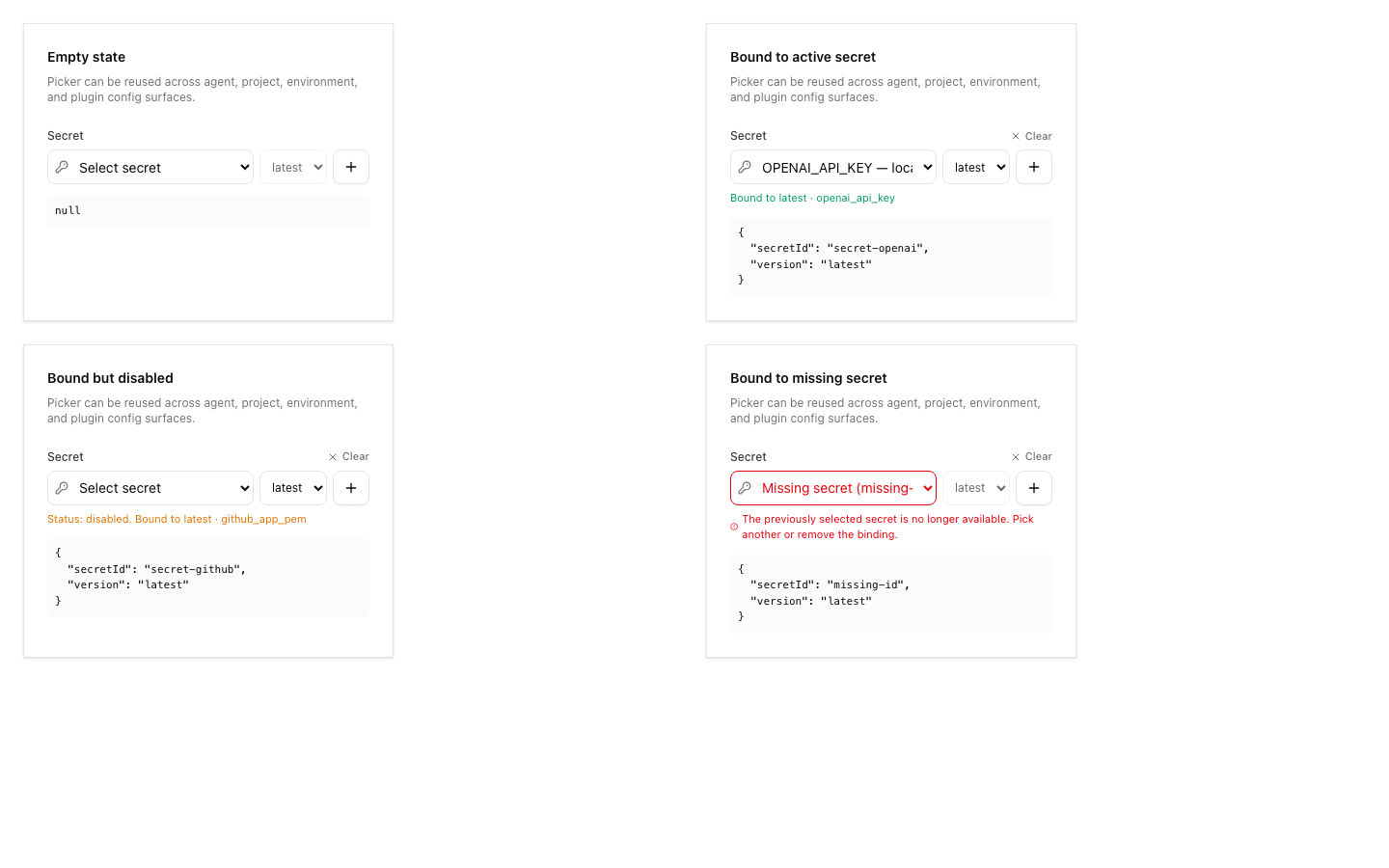 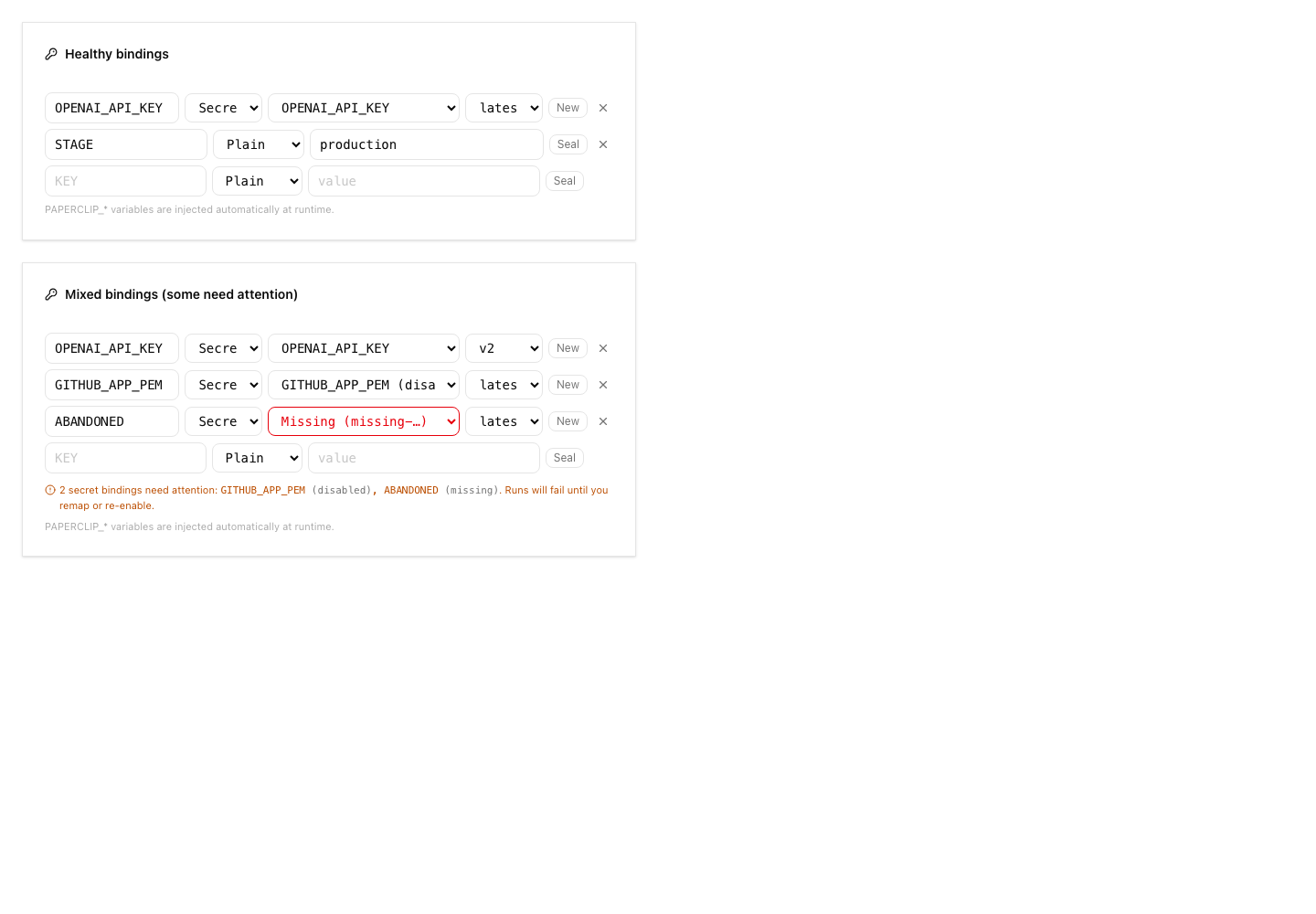 ## Risks - Migration risk: this adds new secret provider tables and extends existing secret rows. The migrations were checked for monotonic ordering and idempotent guards, but reviewers should still inspect upgrade behavior carefully. - Provider risk: AWS support uses direct SigV4 requests. Automated tests cover signing, request timeouts, vault-config selection, namespace guardrails, pending-version archival, sanitized provider errors, and service-level cleanup paths. A real-vault AWS smoke test remains deployment validation for an operator with AWS credentials rather than an unverified merge blocker in this local branch. - UI risk: the Secrets page and import dialog are large new surfaces; screenshots are included above for reviewer inspection. - Verification risk: the full local stable test command hit parallel-load timing failures, although the exact failed files passed when rerun directly. - Operational risk: remote import intentionally avoids plaintext reads; operators must understand that imported external references resolve at runtime and may fail if AWS permissions change. > For core feature work, check [`ROADMAP.md`](ROADMAP.md) first and discuss it in `#dev` before opening the PR. Feature PRs that overlap with planned core work may need to be redirected — check the roadmap first. See `CONTRIBUTING.md`. ## Model Used - OpenAI Codex, GPT-5 coding agent with local shell/tool use in the Paperclip worktree. Exact context-window size was not exposed by the runtime. ## Checklist - [x] I have included a thinking path that traces from project context to this change - [x] I have specified the model used (with version and capability details) - [x] I have checked ROADMAP.md and confirmed this PR does not duplicate planned core work - [ ] I have run tests locally and they pass - [x] I have added or updated tests where applicable - [x] If this change affects the UI, I have included before/after screenshots - [x] I have updated relevant documentation to reflect my changes - [x] I have considered and documented any risks above - [x] I will address all Greptile and reviewer comments before requesting merge --------- Co-authored-by: Paperclip <noreply@paperclip.ing> Co-authored-by: Claude Sonnet 4.6 <noreply@anthropic.com> |
||
|
DottaandClaude Opus 4.6
|
09d2ef1a37 |
fix: restore docs deleted in v0.2.3 release, add Paperclip branding
- Restored docs/ directory that was accidentally deleted by `git add -A` in the v0.2.3 release script - Replaced generic "P" favicon with actual paperclip icon using brand primary color (#2563EB) - Added light/dark logo SVGs for Mintlify navbar (paperclip icon + wordmark) - Updated docs.json with logo configuration for dark/light mode - Fixed release.sh to stage only release-related files instead of `git add -A` to prevent sweeping unrelated changes into release commits Co-Authored-By: Claude Opus 4.6 <noreply@anthropic.com> |
||
|
Dotta
|
28bf5e9e9b | chore: release v0.2.3 | ||
|
DottaandClaude Opus 4.6
|
f60c1001ec |
refactor: rename packages to @paperclipai and CLI binary to paperclipai
Rename all workspace packages from @paperclip/* to @paperclipai/* and the CLI binary from `paperclip` to `paperclipai` in preparation for npm publishing. Bump CLI version to 0.1.0 and add package metadata (description, keywords, license, repository, files). Update all imports, documentation, user-facing messages, and tests accordingly. Co-Authored-By: Claude Opus 4.6 <noreply@anthropic.com> |
||
|
Dotta
|
cabd16bc70 | docs: sync docs and skills updates from backup branch | ||
|
ForgottenandClaude Opus 4.6
|
02dc46e782 |
docs: add external documentation site content
Add structured documentation covering quickstart, architecture, core concepts, API reference, adapter guides, CLI commands, deployment options, and operator/developer guides. Co-Authored-By: Claude Opus 4.6 <noreply@anthropic.com> |


