mirror of
https://github.com/paperclipai/paperclip.git
synced 2026-11-14 00:26:28 +01:00
30d99f4e324beba200f121319247fb0bc201185e
21
Commits
| Author | SHA1 | Message | Date | |
|---|---|---|---|---|
 DottaandPaperclip |
a0ac81e114 |
fix(ui): show task image results in compact thumbnail grids (#19626)
## Thinking Path > - Paperclip is the open source app people use to manage AI agents for work. > - Task feeds show agent messages, documents, and files in time order. > - Each image currently uses a full feed card. > - A turn with seven screenshots makes the conversation hard to scan. > - This pull request groups adjacent images from the same run in a compact grid. > - Users can scan the results and open each image in the existing gallery. ## Linked Issues or Issue Description **What existing behavior does this improve?** Image results in task history and the live task feed. **Current behavior** Each image uses a separate full-width card. Native image upload receipt messages can also separate related screenshots. **Proposed behavior** Adjacent images from one run share a wrapping thumbnail grid. New image results join the grid. Documents, video, and authored messages keep their positions. The grid opens the existing gallery. **Reason and benefit** Users can see a batch of screenshots without scrolling past one large card for each file. **Breaking changes** The feed layout changes. The stored comments, files, APIs, and permissions do not change. Related public work: Refs #17228. Refs #8785. Refs #7667. These changes supplied the artifact cards and media gallery that this pull request reuses. ## What Changed - Add one image grouping function for settled history, turn history, and live results. Group only images with the same known run. Keep the first row key and each image key when results arrive. - Add a token-based grid that reuses the media artifact cards and image gallery. - Add an optional typed attachment-preparation marker to file registration and chat-file reuse. Preserve the marker through comment normalization. Use it with matching image, author, and run links to hide generated receipts. Keep the exact historical sentence as a fallback for old receipts. - Add nine production component stories with seven sample-account screenshots. Cover mobile, Classic, mixed results, single images, missing images, streaming, gallery navigation, and the complete feed projection. - Add grouping and production-feed regressions. Add 18 browser cases across light and dark themes. - Improve contrast for the shared fallback label and gallery counter after the accessibility checks found low contrast. - Match alternate original-image paths when opening the gallery. Keep a separate Open original link beside Download in the gallery. - Record the feed layout in DESIGN.md. ## Verification - Final qualification at `09b12381ce85bee6593050bd8a2fa18cbe2c45a6`: [required CI passed](https://github.com/paperclipai/paperclip/actions/runs/42317080212/job/128237094513), including typecheck, build, all test lanes, E2E, and verify. The snapshot has 58 successful check runs, three conditional skips, one neutral advisory job, and a successful legacy Snyk status. No pending or failed checks remain. Greptile and Paperclip Review both score this exact head 5/5; all review threads are resolved. - Current-head local checks: 544 focused UI tests passed across 11 files, with one existing skip. UI/shared typechecks and token gates pass. All 18 focused Storybook browser cases passed after the CSS merge, with retries disabled. - Two database integration cases verify file registration and chat-file reuse receipt markers. All 52 issue-validator tests and six upstream default-model tests passed. - Regressions failed before the fixes for unknown-run grouping, receipt wording, and authored progress text with an image. The repair uses a typed receipt marker and requires matching author, attachment, image, and run links before hiding a generated receipt. All five review findings are resolved. - Browser checks cover loaded images, wrapping columns, overflow, missing-image fallback, streaming stability, keyboard gallery navigation, original-file links, and downloads. Fixtures use production renderers. These checks do not prove deployed persistence or provider behavior and do not compare visual baselines. - Local limits: the preflight helper could not finish because Cargo was absent. The earlier low-memory server typecheck and dependency-free selector did not replace final-head CI. The now-passing final CI supplies broad typecheck, build, server, Runner, and E2E coverage. - Prior independent CI failures remain recorded: one Slack timer case passed a single diagnosed rerun; its exact timer cause was not proved. A later chat shard lost its self-hosted runner without a test assertion failure. The current revision passes that shard and all applicable gates. Master conflict resolution retained both image-grid and patch CSS rules. ## Risks - Images without a run ID remain separate. Messages and other resource types end each batch. - Receipt suppression requires a matching preparation marker or the exact legacy sentence, plus matching attachment, image work product, run, and author. Tests preserve human messages and native progress text with attachments. The optional marker uses existing JSON metadata and needs no database migration. - Shared gallery and fallback text now have stronger contrast. ## Model Used OpenAI GPT-6, through Codex. The agent used reasoning, repository tools, code execution, and browser tests. The runtime did not expose a more specific model ID or context window size. ## Checklist - [x] I have included a thinking path that traces from project context to this change - [x] I have specified the model used (with version and capability details) - [x] I have checked ROADMAP.md and confirmed this PR does not duplicate planned core work - [x] I have searched GitHub for duplicate or related PRs and linked them above - [x] I have either (a) linked existing issues with `Fixes: #` / `Closes #` / `Refs #` OR (b) described the issue in-PR following the relevant issue template - [x] I have not referenced internal/instance-local Paperclip issues or links (only public GitHub `#NNN` / `github.com/paperclipai/paperclip` URLs) - [x] My branch name describes the change (e.g. `docs/...`, `fix/...`) and contains no internal Paperclip ticket id or instance-derived details - [x] I have run tests locally and they pass - [x] I have added or updated tests where applicable - [x] I have updated relevant documentation to reflect my changes - [x] I have considered and documented any risks above - [x] All Paperclip CI gates are green - [x] Greptile is 5/5 with no open P2s, recommendations, or follow-ups - [x] I will address all Greptile and reviewer comments before requesting merge --------- Co-authored-by: Paperclip <noreply@paperclip.ing> |
||
|
DottaandClaude Opus 5.5
|
bf10bc695a |
feat(task): show the agent's context window in task properties (#19273)
## Thinking Path > - Paperclip is the open source app people use to manage AI agents for work > - Agents run through a harness (Codex app-server, or Claude through ACPX), and the runner turns harness events into Paperclip events > - Both harnesses report how full the model's context window is. Codex sends `modelContextWindow` with its token usage. Claude sends `used` and `size` in ACP `usage_update` > - Paperclip dropped both values. The task view could not show how close an agent is to compaction, and a compaction left no visible mark in the task chat > - This pull request carries the context-window occupancy through the runner, stores it with the existing usage events, and shows it as a "Context" row in the task Properties panel > - It also shows a "Context compacted · 230k → 38k tokens" divider in the task chat when the agent compacts its context > - The benefit is that operators can see when a long task is near its context limit and when the agent lost detail to a compaction ## Linked Issues or Issue Description Refs #19252 (same pattern: a canonical harness event turned into task-chat UI). Refs #19267 (status notices; it turns Claude's compaction banner into a notice, and this PR reads that notice too). **What existing behavior does this improve?** The task view shows no context-window information, and a compaction is invisible in the task chat. **Subsystem affected** Runner usage normalization (Rust and TypeScript transport), the PRP usage schema, a read-only issue API, the task Properties panel and the task-chat transcript. **Current behavior** Codex `modelContextWindow` and ACP `used`/`size` are dropped in the runner. `context.compacted` always has null sizes, Claude compactions emit no `context.compacted` event at all, and the live runner turn hides every marker except "interrupted". **Proposed behavior** `usage.reported` carries an optional `context {usedTokens, windowTokens}`. The task Properties panel shows a Context row ("10% of 258k") with a hover breakdown (tokens used, input and cached input, output, cost, compactions). The transcript shows a compaction divider, with sizes from the usage before and after the compaction. **Reason and benefit** Operators can see when a long task is close to its context limit, and they can see where the agent's earlier context was summarized. **Breaking changes** None. The new schema field is optional, and the new endpoint is read-only. ## What Changed - PRP `usage.schema.json`: add an optional `context {usedTokens, windowTokens}` object. Regenerate the schema bundle and the protocol manifest. - Rust `provider_events.rs`: add `codex_context_usage` (last request `totalTokens` and `modelContextWindow`) and `acpx_context_usage` (ACP `used`/`size`). ACPX `usage_update` now sets `context`. - Rust `provider_backend.rs`: Codex `thread/tokenUsage/updated` sets `context` on live (non-historical) usage. - Rust `provider_events.rs`: emit `context.compacted` for the completed `context_compaction` provider notice that #19267 produces from Claude's compaction banner. Only this path marks a Claude compaction, so the server counts each compaction once. - `runnerd-codex-transport.ts`: `rehydrateRunnerdUsageNotification` keeps a valid `context` on `tokenUsage`, so it reaches the stored `item.completed` usage item. - Server: new `GET /api/issues/:id/context-usage` (issue read access is required) and `issueContextUsage` service. It reads only the assignee's current session (the session of its newest usage report), and returns that session's latest context reading, non-zero totals, cost, and the count of compactions across all of the session's runs. Added to OpenAPI. Shared type `IssueContextUsage`. - DB: migration 0432 adds two partial indexes on `heartbeat_run_events`, built concurrently. One indexes usage items by run and time. The other indexes `context.compacted` events by company and session. `EXPLAIN` shows that both lookups use them. - UI: new `ContextUsageMeter` (bar, percentage, hover card) and `IssueContextUsageRow` in the Execution section of Properties. The row refreshes every 8 s while a run is active, and once more when the run ends. - UI transcript: `native-run-events.ts` maps `context.compacted` to a `context` activity entry with pre/post sizes from neighbouring usage items. `transcript-adapter.ts` turns it into a new `context_compacted` marker variant. The live runner turn keeps that marker as its own timeline row. - Storybook: `task-context-window.stories.tsx` (Properties panel in a task, all states, hover breakdowns, divider). ## Verification - `cargo test -p paperclip-runner-core --lib provider_events` (new tests: ACPX context, Codex context, banner compaction, notice compaction) - `pnpm --filter @paperclipai/paperclip-runner exec vitest run src/live/runnerd-codex-transport.test.ts` - `cd ui && npx vitest run src/components/ContextUsageMeter.test.tsx src/components/transcript src/components/task-chat src/components/issue-properties` - `cd server && npx vitest run src/__tests__/issue-context-usage.test.ts` (embedded Postgres) - `node scripts/typecheck-low-memory.mjs`, `pnpm check:token-gates`, `pnpm --filter @paperclipai/paperclip-runner run check:protocol-types` - Live check on a local worktree instance through the runnerd path: - A Codex `gpt-5.5` task showed "10% of 258k" (27k of 258k, input 77k with 49k cached, output 1.1k). - A Claude Sonnet 4.6 task showed "17% of 200k" (34k of 200k). - Storybook: Tasks and conversations / … / Task chat / Context window. - Not verified live: a real compaction. The divider is covered by unit tests through the same projector path the task chat uses. ## Risks - The schema field is optional, and older runners omit it. The UI renders nothing until a harness reports a window. - Migration 0432 builds two partial indexes concurrently on `heartbeat_run_events`, which is a large table. The indexes cover only usage items and compaction events, so they stay small. They add a little write overhead to those events. - Claude in-progress usage rows still record zero tokens with `requests: 1`. The final turn usage is correct. This PR does not change accounting. - A "Compact now" action is out of scope. It needs a compaction-only run that does not produce a run result. It will come in a follow-up. ## Model Used - Claude Opus 5.5 (`claude-opus-5-5`), Anthropic, used through Claude Code with tool use (shell, file edits, in-app browser for Storybook and the live instance). ## Checklist - [x] I have included a thinking path that traces from project context to this change - [x] I have specified the model used (with version and capability details) - [x] I have checked ROADMAP.md and confirmed this PR does not duplicate planned core work - [x] I have searched GitHub for duplicate or related PRs and linked them above - [x] I have either (a) linked existing issues with `Fixes: #` / `Closes #` / `Refs #` OR (b) described the issue in-PR following the relevant issue template - [x] I have not referenced internal/instance-local Paperclip issues or links (only public GitHub `#NNN` / `github.com/paperclipai/paperclip` URLs) - [x] My branch name describes the change (e.g. `docs/...`, `fix/...`) and contains no internal Paperclip ticket id or instance-derived details - [x] I have run tests locally and they pass - [x] I have added or updated tests where applicable - [x] I have updated relevant documentation to reflect my changes - [x] I have considered and documented any risks above - [ ] All Paperclip CI gates are green - [ ] Greptile is 5/5 with no open P2s, recommendations, or follow-ups - [x] I will address all Greptile and reviewer comments before requesting merge 🤖 Generated with [Claude Code](https://claude.com/claude-code) --------- Co-authored-by: Claude Opus 5.5 <noreply@anthropic.com> |
||
|
DottaandClaude Opus 5.5
|
cad3f8ae09 |
fix(task-chat): keep a yielded turn's streamed reply visible (#19324)
## Thinking Path > - Paperclip is the open source app people use to manage AI agents for work. > - The task chat shows each native runner turn while it streams, while it settles, and after it settles. > - During the onboarding interview, the agent streams a reply, posts a question card, and ends its turn as `yielded`. > - The live tail hides that reply when the card's pending interaction arrives. The settled turn also hides it, because a yielded turn never fills the final-response slot. > - The user sees the reply appear and then disappear. The reply is still in run history, so this is a rendering regression, not data loss. > - This pull request hides only the control-plane wait stub of a yielded turn. It keeps prose that the agent wrote for the user. > - The benefit is a stable conversation while responses stream and finish. ## Linked Issues or Issue Description **Bug description** During a hands-on onboarding test on staging, interview messages in the first-task chat appeared and then disappeared. **Steps to reproduce** 1. Start onboarding and pick "Interview me and propose a plan". 2. Watch the agent's turn. It streams a reply that describes the question card, for example "I've posted a question card on this task that asks four things...". 3. The question card appears. The reply disappears and does not come back after the run settles or after a reload. **Expected behavior** The conversation stays stable while responses stream and finish. **Related** Refs #18977. That PR changes server-side final-response selection for native standing conversations and leaves yielded waits and cards in control. This PR changes only how the task chat renders a yielded turn's authored reply. The two PRs do not overlap. **Evidence and root cause** - Persisted history is complete. The run's events contain the `agentMessage` `item.completed` with `channel: "final"` and the full reply text. The `run.result.accepted` result has `reportedWorkDisposition: "yielded"` with a `response_wake` continuation. Its summary is different from the reply. - The rendered thread does not contain that reply, also after "More messages" expands the history. - Classification: rendering/replacement, not persistence. Three gates drop the reply. `TaskChatThread` sets `suppressFinal` on the live tail when a pending interaction for that run exists. `TaskChatRunnerTurn` then clears the latched final. `paperclipRunnerFinalResponse` and the settled-turn path (`!sourceYielded`) return no final response for yielded turns. - Those gates were added on purpose so the mechanical "Waiting for <card>." prose that some providers echo does not show as an answer. This change keeps that behavior. ## What Changed - `transcript-adapter.ts`: add `isYieldedWaitStub`. A wait stub is text that echoes the yielded result summary, or a single-line "Waiting for ..." text. For a yielded turn, `paperclipRunnerFinalResponse` now returns the last authored final-channel message. It still returns nothing for a wait stub. New `yielded` and `waitSummary` options let callers state the yield from run metadata. - `TaskChatRunnerTurn.tsx`: `suppressFinal` hides only a wait stub. It no longer hides the agent's authored reply. A new `waitSummary` prop carries the accepted summary. - `TaskChatThread.tsx`: a settled yielded turn renders the authored reply once, in the last populated segment. The reply also counts as a native response for the "no user-facing response" marker and for progress de-duplication. The live tail passes the accepted summary to the runner turn. - Review round 1 (commit |
||
|
DottaandClaude Opus 5.5
|
1eff07f29e |
feat(task-chat): show Claude subagents as a collapsible tree in the runner turn (#19264)
## Thinking Path > - Paperclip is the open source app people use to manage AI agents for work. > - The task chat shows what an agent does in a run. The Paperclip Runner sends this activity as canonical provider events. > - Claude runs subagents through its Agent (Task) tool. A run that delegates showed a confusing burst of unrelated tool calls. > - The subagent data was already sent, but it was lost: ACPX dropped `_meta`, the hardened sidecar dropped `rawInput`, and async subagents report "launched" as the tool result. > - This pull request maps each Agent call to a canonical `delegation` event, links each child tool to its subagent, and shows subagents as a collapsible card or tree. > - The benefit is that operators can see what each subagent was asked, what it is doing now, which tools it used, and what it returned. ## Linked Issues or Issue Description Refs #19252 (the docked plan card used the same canonical-event pattern) Refs #19259 (ACPX `_meta` passthrough, merged). This PR builds on it. **What happened?** When a Claude agent used its Agent tool, the task chat showed one generic "Task" row and then the subagents' tool calls as flat rows in the parent turn. The subagent type, prompt, progress and result were not visible. **Expected behavior** Each subagent shows as its own card with its type, description, prompt, live progress summary, nested tool rows and result. Subagents that start together show as one tree with status dots. **Steps to reproduce** 1. Assign a Claude (Paperclip Runner, ACPX) agent a task that asks it to launch three Explore subagents in parallel. 2. Open the task while the run is live. 3. Before this change, the subagents' tool calls appear flat in the parent turn. ## What Changed - **claude-agent-acp patch:** Under the isolated runner context, the patch turns on the SDK option `agentProgressSummaries`. It forwards each subagent's `task_progress` summary and its terminal state and summary onto the spawning tool call as `_meta.claudeCode.subagentProgress` and `subagentState`. Native subagent sessions stay off, because ACPX cannot follow child ACP sessions. - **Runner:** The new file `claude-subagent-lineage.ts` tracks each Agent/Task call across ACP update deltas. It maps the call to `delegation.started|updated|completed` events and stamps child tools with `parentItemId`. An async subagent stays running after its "Async agent launched" result until its own state settles. - **Sidecar path:** `acpx-runtime-sidecar.ts` reads the lineage before it drops `_meta` and `rawInput`. Delegations go out as schema-checked rich events. Child tools carry `parentToolCallId`, which Rust (`acpx_event_payload.rs`, `provider_events.rs`) maps to `parentItemId`. - **Contracts:** The provider-event schema adds optional `prompt` and `result` to delegation children and optional `parentItemId` to tool executions. The protocol modules are regenerated. ACPX Claude now advertises the `delegation` event family. - **UI:** `native-run-events.ts` keeps delegation payloads and the tool parent link. `buildTurnTimelineRows` groups adjacent delegations into a new `subagent_group` row, nests child tool rows (plain and provider-activity shapes), and hides the spawning call's own tool row. The new `TaskChatSubagentCard.tsx` renders the card and tree. A new size token caps the result height. - **Storybook:** The new story `Tasks and conversations/…/Task chat/Subagents` has 7 states. ## Verification - `pnpm --filter @paperclipai/paperclip-runner exec vitest run src/cli src/drivers/acpx src/provider-events.test.ts src/claude-subagent-lineage.test.ts src/protocol` (2069 passed) - `cargo test --release --locked -p paperclip-runner-core --lib` in `packages/paperclip-runner/runner` (488 passed, including the new parent-link test) - `node --test test/protocol-contract.test.mjs test/acpx-sidecar-contract.test.mjs test/acpx-codex-package-contract.test.mjs test/acpx-rich-extensions-package-contract.test.mjs` (48 passed) - `pnpm --filter @paperclipai/ui exec vitest run src/components/task-chat src/components/transcript`, including the new `subagent-timeline.test.ts` - `check:protocol-types`, `check:protocol-manifest`, `check:acpx-profiles` and `pnpm check:token-gates` pass. - **Live test:** A local test-drive instance ran a Claude Opus 5.5 agent on the Paperclip Runner (hardened sidecar path). The agent ran real tasks that launched three parallel Explore subagents. The live view showed "Running 3 subagents · 2 done" with a progress summary. The settled view showed "Ran 3 subagents", each with its prompt, nested tools and its own result text. ## Risks - `agentProgressSummaries` makes Claude Code generate a short progress summary for each running subagent about every 30 seconds. This adds a small model cost to runs that delegate. - The adapter patch reads `task_notification` and terminal `task_updated` messages. A future claude-agent-acp version can change these. The patch hunks then fail to apply, and the dependency bump must update them. - If a delegation event is lost, child tools stay at the top level as before. Nothing is hidden without a matching delegation. - Codex is not changed. Codex subagents need `multi_agent`, which Paperclip keeps off on purpose. Changing that is a separate policy decision. ## Model Used - Claude Opus 5.5 (`claude-opus-5-5`) in Claude Code, with tool use (shell, file edits, browser automation). It did the investigation, implementation, tests and live test. ## Checklist - [x] I have included a thinking path that traces from project context to this change - [x] I have specified the model used (with version and capability details) - [x] I have checked ROADMAP.md and confirmed this PR does not duplicate planned core work - [x] I have searched GitHub for duplicate or related PRs and linked them above - [x] I have either (a) linked existing issues with `Fixes: #` / `Closes #` / `Refs #` OR (b) described the issue in-PR following the relevant issue template - [x] I have not referenced internal/instance-local Paperclip issues or links (only public GitHub `#NNN` / `github.com/paperclipai/paperclip` URLs) - [x] My branch name describes the change (e.g. `docs/...`, `fix/...`) and contains no internal Paperclip ticket id or instance-derived details - [x] I have run tests locally and they pass - [x] I have added or updated tests where applicable - [x] I have updated relevant documentation to reflect my changes - [x] I have considered and documented any risks above - [ ] All Paperclip CI gates are green - [ ] Greptile is 5/5 with no open P2s, recommendations, or follow-ups - [x] I will address all Greptile and reviewer comments before requesting merge 🤖 Generated with [Claude Code](https://claude.com/claude-code) --------- Co-authored-by: Claude Opus 5.5 <noreply@anthropic.com> |
||
|
DottaandClaude Opus 5.5
|
cb0b7525e0 |
feat(task-chat): warn at the top of a run when an MCP server failed to start (#19289)
## Thinking Path > - Paperclip is the open source app people use to manage AI agents for work. > - Each agent run shows its activity in the task chat. The Paperclip runner turns harness events into that activity. > - Codex reports `mcpServer/startupStatus/updated` when an MCP server fails to start. The runner dropped this event at the notification allowlist and in the Rust normalizer. > - When an MCP server fails, the agent runs without its tools. The agent then says "I could not reach the server", and the user cannot see why. > - This pull request maps a failed MCP start to a user-facing provider notice and shows it as one warning line at the top of the run. > - The benefit is that the cause of a "cannot reach my tools" answer is visible next to that answer. ## Linked Issues or Issue Description Refs #19252 (the plan card, which set the pattern for promoting a dropped harness signal to a dedicated task-chat surface). **Problem description** Codex sends `mcpServer/startupStatus/updated` (`name`, `status`, `error`, `failureReason`) during `thread/start`. The TypeScript allowlist (`codex-thread-normalization.ts`) and the Rust normalizer (`runner-core/src/provider_events.rs`) both dropped it. A run with a broken MCP server showed no sign of the failure. The agent only said that it could not reach the tools. **Proposed solution** Map `status: "failed"` to `provider.notice.recorded` with `category: "mcp_server_startup_failed"`, `severity: "warning"`, `scope: "session"` and `userActionable: true`. Show these notices as one run-health line under the runner header: "github MCP server failed to start: No such file or directory (os error 2)". **Alternatives considered** An inline notice row in the timeline. It scrolls away and sits among tool rows. A run-level line next to the header is easier to connect to the agent's answer. ## What Changed - Runner (Rust, production Codex path): `normalize_codex_notification` maps a failed `mcpServer/startupStatus/updated` to a `provider.notice.recorded` notice. `starting`, `ready` and `cancelled` stay out of the transcript. The new helper removes the Codex wrapper text ("MCP client for \`x\` failed to start: MCP startup failed:") so that the line shows the real reason. `reauthenticationRequired` becomes "needs re-authentication". - Runner (TypeScript): the same mapping in `canonicalProviderEventsFromCodex`, and the method is added to `isSupportedCodexNotificationMethod`. - Server: the `view=conversation` run-event query keeps `mcp_server_startup_failed` notices. A settled run can then still show the warning. Other notices stay out of that view. - UI: new `TaskChatRunHealthBanner`. `partitionRunHealthItems` takes MCP failures out of the run's items, with one line per server where the latest report wins. `TaskChatRunnerTurn` (live runs) and `TaskChatTurn` (settled, historical and merged turns) show it under the header. `coalesceSettledTurns` merges the failures when it merges turns. - Storybook: `Tasks and conversations/…/Task chat/Run health` shows one failure, several failures, a finished run and a healthy run, all through the production runner turn. ## Verification - `pnpm --filter @paperclipai/paperclip-runner exec vitest run src/provider-events.test.ts src/drivers/codex src/protocol`: 508 tests pass. - `cargo test --release -p paperclip-runner-core --lib -- provider_events`: 20 tests pass. - `pnpm --filter @paperclipai/ui exec vitest run src/components/task-chat src/components/transcript src/components/TaskChatThread.test.tsx`: 1340 tests pass, including the new `TaskChatRunHealthBanner.test.tsx` (persisted event to rendered banner, deduplication, settled historical turn, merged turns). - `pnpm --filter @paperclipai/server exec vitest run src/__tests__/task-cold-open.test.ts`: the conversation view keeps the MCP notice and still excludes other notices. - `pnpm check:token-gates` is clean. `node scripts/typecheck-low-memory.mjs` passes. - Live test on a local instance with Codex 0.160: a Codex agent with a preconfigured Codex home whose `config.toml` has `[mcp_servers.github] command = "github-mcp-server-not-installed"`. Codex reported the failure during `thread/start`. The persisted event had the summary "github MCP server failed to start: No such file or directory (os error 2)". The banner showed while the run was live. It also showed on the settled turn after "More run output", above the agent's answer that it could not reach the GitHub MCP server. ## Risks - Low risk. The change adds one notice category. It does not change how existing notices map or render. - A settled run whose transcript is deferred on a cold open (a successful run with a posted agent comment) shows the warning only after "More run output". This is the same as all other run activity under the current compact history. - Claude does not report MCP startup failures over ACP. `claude-agent-acp` reads MCP status only for OAuth. This change is therefore Codex-only. - Provisional task titles from provider session names are not part of this change. Codex app-server does not generate thread names (only its TUI does). Claude generates its title after the turn ends, and ACPX drops the title text. > For core feature work, check [`ROADMAP.md`](ROADMAP.md) first and discuss it in `#dev` before opening the PR. Feature PRs that overlap with planned core work may need to be redirected — check the roadmap first. See `CONTRIBUTING.md`. ## Model Used - Claude Opus 5.5 (`claude-opus-5-5`), through Claude Code with tool use (shell, file edits, browser automation for Storybook and the live test). ## Checklist - [x] I have included a thinking path that traces from project context to this change - [x] I have specified the model used (with version and capability details) - [x] I have checked ROADMAP.md and confirmed this PR does not duplicate planned core work - [x] I have searched GitHub for duplicate or related PRs and linked them above - [x] I have either (a) linked existing issues with `Fixes: #` / `Closes #` / `Refs #` OR (b) described the issue in-PR following the relevant issue template - [x] I have not referenced internal/instance-local Paperclip issues or links (only public GitHub `#NNN` / `github.com/paperclipai/paperclip` URLs) - [x] My branch name describes the change (e.g. `docs/...`, `fix/...`) and contains no internal Paperclip ticket id or instance-derived details - [x] I have run tests locally and they pass - [x] I have added or updated tests where applicable - [x] I have updated relevant documentation to reflect my changes - [x] I have considered and documented any risks above - [ ] All Paperclip CI gates are green - [x] Greptile is 5/5 with no open P2s, recommendations, or follow-ups - [x] I will address all Greptile and reviewer comments before requesting merge 🤖 Generated with [Claude Code](https://claude.com/claude-code) --------- Co-authored-by: Claude Opus 5.5 <noreply@anthropic.com> |
||
|
DottaandPaperclip
|
5a7a6b32ba |
fix(ui): restore compact Coordinator task loading and responder continuity (#18312)
## Thinking Path > - Paperclip is the open source app people use to manage AI agents for work. > - People open tasks from their personal workspace and send replies to agents. > - Cold task opens should load recent conversation before older history. > - Classic settings could expand history before the Coordinator preference arrived. > - Coordinator lists also read full tasks, and response startup used the previous assignee. > - This pull request restores compact reads and keeps the selected responder visible through runtime discovery. > - People can read and reply without waiting for unrelated history or losing response feedback. ## Linked Issues or Issue Description Related: #17593, #17751, #17756, #17885, #17983, and #18092. **What happened?** A cold task could select Classic full history while its personal workspace preference was pending. The full-history choice stayed cached after Coordinator became active. Coordinator Tasks used full task reads. Needs attention fetched one enriched task per pending task. Sending to a newly selected agent could show no responder, show the previous assignee, or clear feedback when assignment changed. Legacy runtime discovery then replaced the startup identity with a generic activity line. **Expected behavior** Wait for the workspace preference before selecting Classic history. Show the task instruction and recent conversation with **More messages** for older content. Read collection indexes and fetch diagnostics for visible rows. Keep the selected responder mounted from Send through saved input and runtime startup. **Steps to reproduce** 1. Enable Classic task UI and Coordinator. Delay the personal workspace preference on a cold task open. 2. Open Coordinator Tasks or its Needs attention view with many pending tasks. 3. Open a task assigned to a person. Select another agent in the composer and send a message. 4. Let the message save before runtime reads return. Then allow a legacy run to appear. ## What Changed - Wait for task interface settings before persisting Classic history expansion. - Use lightweight indexes for Coordinator Tasks. Resolve pending task IDs in batches of at most 100. Keep search and participant filters on the server. Enrich at most 50 visible rows through the existing hook without replacing list membership or order. - Preserve an error when a pending task cannot load, instead of showing a false all-clear. - Register board cards for row enrichment. Observe newly mounted cards after column expansion or pagination, and track visibility by element so hidden list rows cannot clear visible board cards with the same task ID. - Track the recipient of each submitted message through reassignment. A later draft's recipient does not change the response already starting. - Share a stable response header across startup, native runtime, and legacy runtime rendering. Keep the existing transcript renderers. - Add regression tests, production-browser checks, design guidance, and feature-map notes. ## Verification - Red/green: delayed Coordinator preference started a full comments read before the fix. It now retains compact history and still expands on request. - Red/green: sends from human or other-agent assignment showed no identity or the wrong identity. Both now retain the selected responder through assignment, acknowledgement, later draft selection, and native/legacy startup. - In a 105-task Needs attention fixture, the previous code made 105 enriched detail requests. The fixed code makes two bounded index requests. - All 659 final affected tests pass across task detail, thread, runner turn, history window, Inbox, board, row enrichment, and Coordinator collection suites. - Review follow-up: the production board lost its next-step badge before card registration. The regression now passes, along with column pagination. The focused 82-test enrichment run and 371-test header/thread run also pass. - All 12 compact-startup browser checks pass against the production UI and an isolated PostgreSQL container. They cover delayed preferences, list navigation, saved-card geometry, document/comment anchors, history expansion, draft retention, retry, and actual legacy process startup. The final deterministic process case recorded 118 frames with zero missing or replaced responder identities. It does not call a model provider. - Full workspace build and typecheck pass. Final UI build and typecheck pass after the shared-header change. Token gates, map checks, module boundaries, and diff checks pass. - The full UI rerun before the board review follow-up passed all 10,034 tests across 844 files. The 659 affected tests pass after that follow-up. The first full UI run passed 10,030 tests and timed out in one unchanged IssuesList large-tree test. Its two variants pass in an isolated rerun and in the full rerun. Those later passes establish recovery; the earlier timeout's cause remains unproven. - The full `pnpm test:run` attempt was stopped after repeated embedded PostgreSQL initialization failures in server fixtures. No complete local server-suite pass is claimed. Browser verification recovered with a disposable container database. - A later avatar browser rerun reused the previous same-title task and its cancelled run through the existing 48-hour title deduplication. That fixture never reached fresh runtime startup. The test now uses a unique title and checks its initial assignment/status; a full 12-case rerun and a second avatar run on the same instance pass. The failed trace is retained locally. - Final commit `7a18372da3` has 55 successful checks, two intentionally skipped Storybook checks, and one neutral Paperclip Review. All required verification gates are green. Greptile is 5/5 with no actionable findings or open review threads. The advisory Paperclip review paused without a complete assessment; no passing Paperclip assessment is claimed. - These checks establish bounded reads and stable rendering. No reliable staging latency benchmark or staging deployment is claimed. ## Risks - Collection projections omit task bodies. Detail navigation must retain its normal core/full task reads. Search remains server-side. - Startup feedback must end on rejection, unavailable agents, terminal outcomes, or a visible run. Existing cases cover those transitions. - The shared header changes the legacy live-turn layout to retain identity beside its existing status line. - No migration, mutation permission, provider protocol, or execution authority change. ## Model Used OpenAI Codex, GPT-6 family. The exact serving deployment ID and context-window size are not exposed in this session. The model used reasoning, code editing, shell tools, automated Chromium checks, and manual browser inspection. ## Checklist - [x] I have included a thinking path that traces from project context to this change - [x] I have specified the model used (with version and capability details) - [x] I have checked ROADMAP.md and confirmed this PR does not duplicate planned core work - [x] I have searched GitHub for duplicate or related PRs and linked them above - [x] I have either (a) linked existing issues with `Fixes: #` / `Closes #` / `Refs #` OR (b) described the issue in-PR following the relevant issue template - [x] I have not referenced internal/instance-local Paperclip issues or links (only public GitHub `#NNN` / `github.com/paperclipai/paperclip` URLs) - [x] My branch name describes the change (e.g. `docs/...`, `fix/...`) and contains no internal Paperclip ticket id or instance-derived details - [x] I have run tests locally and they pass (focused suites and browser checks; full-suite limitations are recorded above) - [x] I have added or updated tests where applicable - [x] I have updated relevant documentation to reflect my changes - [x] I have considered and documented any risks above - [x] All Paperclip CI gates are green - [x] Greptile is 5/5 with no open P2s, recommendations, or follow-ups - [x] I will address all Greptile and reviewer comments before requesting merge --------- Co-authored-by: Paperclip <noreply@paperclip.ing> |
||
|
DottaandPaperclip
|
f52da40f08 |
fix: resume queued turns after maintenance (#17967)
Keep an accepted turn's starting input in task history, show its admission wait, and resume existing queued runs promptly when maintenance ends or expires. Verified with behavioral red/green regressions, real PostgreSQL and process execution, browser/native Runner acceptance with a deterministic provider, workspace typecheck, production build, and current-head CI/review. Co-Authored-By: Paperclip <noreply@paperclip.ing> |
||
|
DottaandPaperclip
|
d33b40a5c3 |
fix: recover saved work and provide reliable task Retry (#16965)
## Thinking Path > - Paperclip is the open source app people use to manage AI agents for work. > - The control plane must retain work when an execution or workspace export fails. > - Retained-workspace holds can leave saved input waiting with no usable Retry action. > - Users cannot verify process ownership or repair provider allocations. > - This pull request gives system recovery a durable budget and gives each deliberate Retry a durable intent. > - Safe recovery can preserve files, settle an accepted result, or prepare an independent workspace. > - One task state keeps infrastructure diagnostics out of the ordinary conversation while preserving real permission and approval gates. ## Linked Issues or Issue Description **What happened?** A task with a retained workspace can show recovery, failed-run and saved-message warnings at the same time. Historical runs without native workspace descriptors cannot use the native restore path. Old recovery metadata can prevent a new attempt even when an independent workspace would be safe. **Expected behavior** Paperclip owns bounded infrastructure retries and file preservation. A user can request another attempt with ordinary Retry. Thinking appears immediately. The service preserves completed effects and current user controls. It does not claim that starting fresh recovered the old files. **Steps to reproduce** 1. Retain a failed run and its workspace after export or process-stop failure. 2. Save a follow-up while the recovery hold is active. 3. Open the task and try to continue without infrastructure credentials or operator certification. Refs #16906, #16835, #16883. This extends their recovery and receipt contracts. Related work: #16962 and #16963. ## What Changed - Add task-level Retry with company-scoped authorization, all-status idempotency and durable admission before physical work. Keep exact-run Retry compatible. - Add typed recovery phases, finite persisted backoff, historical adoption and durable local failure diagnostics. - Preserve native workspaces or verified historical snapshots. Admit an independent fresh workspace only after execution containment. Keep old-source preservation and cleanup obligations separate. - Carry completed publication and API receipts forward. Fence uncertain mutation retries across replacement runs. Preserve connected-chat identity and authorization. - Re-enter normal dispatch for saved input. Reuse accepted results through the existing finalizer. - Use one task interruption projection across the thread, composer and task list. Show optimistic Thinking, ordinary Retry and genuine user gates. - Add PostgreSQL, filesystem, API, browser-fixture and controlled provider coverage. Document the behavior and update the feature/access maps. ## Verification - All GitHub Actions CI jobs pass on `6d8c6d27d50586d8548b31d03b47f6d73a0ee11d`: typecheck, all server/chat/workspace and serialized suites, Runner checks, eight browser shards, canary and build. The required merge gate passes. - Greptile reviewed the final commit at 5/5, with no actionable findings or unresolved review threads. Its two earlier P1 findings are fixed. - Full recursive typecheck and build pass locally on the final commit. All 16 task Retry cases pass against isolated real PostgreSQL. The unrelated-success case and both stale Retry cases fail on the previous code and pass after the fix. - The corrected gateway fixture passes its uncertain-mutation and independent-read case. Four real HTTP API cases pass for definite 403/422 rejection, completed-effect reuse, and uncertain-effect fences across deliberate and automatic retries. These focused gateway/API checks used a temporary database lifecycle harness on an existing healthy local PostgreSQL process. The standard repository helper is unchanged. - Earlier qualification covers 291 task UI cases, saved-file copyback and ancestry, current Agent Chat ownership races, nine chat Retry API browser cases, and six assembled browser recovery fixtures. A real API/PostgreSQL/native-runner journey showed Thinking in 25 ms despite a delayed response, admitted one successor in a separate workspace, retained original files, and survived reload. - The controlled Daytona test interrupts export, joins the controller, restarts it in a separate process, and verifies one agent start, one external sentinel operation, retained file contents and no premature cleanup. It does not establish abrupt-kill or live LLM/GitHub acceptance. - The full local `pnpm test:run` was attempted and was not green: an OAuth row-lock timing assertion failed, and a later suite exhausted macOS PostgreSQL semaphores. The ten OAuth timing cases passed on rerun against a separate database. Later embedded database initialization failures remain recorded; the final CI matrix passes. - Security scanning passed on production-code commit `63953edf069b111c6becc3144dffa6deb52f68b5`. Its only successor changes one test-fixture identity line. The final scan is neutral/inconclusive because its pinned merge-base checkout failed or timed out. Both rerun API requests returned 404, so no fresh successful scan is claimed. Socket and Snyk checks pass on the final head. - The optional Paperclip Review remains queued behind an earlier run in workspace finalization. Its prior completed assessment was incomplete because a comparison tool was blocked by the platform filter. It is not counted as a completed code review. GitHub does not require this check for merge. - Hosted acceptance remains pending deployment. Local and CI results do not establish recovery of a hosted task or its retained files. ## Risks - Recovery changes span admission, physical ownership and dispatch. Incorrect evidence could permit overlapping work. Existing physical locks and authoritative stop requirements remain in place. - The migration adds concurrent indexes. It requires the existing top-level migration runner and retries incomplete index creation safely. - A fresh attempt can complete while old-source preservation remains unresolved. The service retains that obligation and does not report those files as recovered. - Unknown tool mutations remain blocked until their authoritative receipt owner resolves them. Generic upstream tools have no universal result-query protocol. - Recovery and diagnostics stay inside the stack. No Cloud incident endpoint, notification worker or new outbound reporting channel is included. ## Model Used OpenAI Codex, GPT-6 family. The runtime does not expose a more specific model version or context-window size. The model used reasoning, shell execution, source editing and browser tools. No model subagents were used for this implementation. ## Checklist - [x] I have included a thinking path that traces from project context to this change - [x] I have specified the model used (with version and capability details) - [x] I have checked ROADMAP.md and confirmed this PR does not duplicate planned core work - [x] I have searched GitHub for duplicate or related PRs and linked them above - [x] I have either (a) linked existing issues with `Fixes: #` / `Closes #` / `Refs #` OR (b) described the issue in-PR following the relevant issue template - [x] I have not referenced internal/instance-local Paperclip issues or links (only public GitHub `#NNN` / `github.com/paperclipai/paperclip` URLs) - [x] My branch name describes the change (e.g. `docs/...`, `fix/...`) and contains no internal Paperclip ticket id or instance-derived details - [x] I have run tests locally and they pass (focused suites; the full local run limitation is documented above) - [x] I have added or updated tests where applicable - [x] I have updated relevant documentation to reflect my changes - [x] I have considered and documented any risks above - [x] All Paperclip CI gates are green - [x] Greptile is 5/5 with no open P2s, recommendations, or follow-ups - [x] I will address all Greptile and reviewer comments before requesting merge --------- Co-authored-by: Paperclip <noreply@paperclip.ing> |
||
|
DottaandPaperclip
|
8ee851a0d8 |
fix(ui): keep runner turns stable through startup and completion (#16989)
## Thinking Path > - Paperclip is the open source app people use to manage AI agents for work. > - Task chat shows each agent turn from message submission through completion. > - Run admission can publish adapter metadata before native runtime metadata. > - The UI changed layouts during that gap and removed the agent identity. > - Completion reports can also arrive before the provider writes its final reply. > - The event reader treated those reports as final replies and then replaced them. > - This pull request keeps the runner layout stable and delays report fallbacks until the final history fetch completes. > - Readers see one provider reply, while report-only runs keep a useful answer. ## Linked Issues or Issue Description **What happened?** Sending a task message briefly replaced the runner avatar, name, and Thinking row with a generic Working row. At completion, a full report summary appeared as the answer. A shorter provider reply then replaced it while streaming. **Expected behavior** Keep the runner identity and header spacing stable during admission. Stream the provider's final reply once. Use a report summary as a fallback only after the run ends and its final history fetch completes without a provider reply. **Steps to reproduce** 1. Send a message to a native Paperclip Runner agent. 2. Observe the initial run record before native runtime metadata arrives. 3. Let the agent call its completion tool before writing its final response. 4. Observe the report summary, final response stream, and saved reply handoff. **Paperclip version or commit** Reproduced from source at `6b804bfeba`. The event-reader behavior was also present in earlier revisions. **Deployment mode** Self-hosted server. Local component tests and browser fixtures reproduce the UI transitions. Related work: Refs #12617, which added native runner turns to task chat. The duplicate search found no open PR for this specific defect. ## What Changed - Keep Paperclip Runner turns in the runner layout while runtime metadata resolves. Use the same header spacing for queued and running states. - Keep structured reports as report entries. Do not create synthetic provider final messages from them. - Track successful event fetches for each run status. Permit a terminal report fallback after the final fetch, or when the transcript contains its terminal receipt. - Preserve report-only answers and saved reply deduplication. - Add desktop and mobile regressions for streamed replies, late final events, report-only runs, pagination, and fetch failures. Delay missing-answer notices until terminal history is ready. Document the presentation rules in `DESIGN.md`. ## Verification - Passed all 8,750 UI tests across 769 files. This includes 456 focused tests for the thread, runner turn, native projection, native transcript hook, transcript adapter, and boundary fixtures. - The six completion regressions fail against the old native event reader and pass with the fix. Three empty-history regressions fail before the review fix and pass afterward. The startup regressions also fail against the old layout condition. - Passed UI TypeScript checking with `node node_modules/typescript/bin/tsc -b ui/tsconfig.json`. - Passed the UI production build with `cd ui && node node_modules/vite/bin/vite.js build`. - Passed `pnpm check:token-gates`, `git diff --check`, and the Storybook catalog generator. - Browser check: mounted the production turn with native event snapshots at desktop and 390-pixel mobile widths. The report stayed hidden while running. The actual reply stayed unchanged at completion. The report-only fallback appeared after completion. The identity row kept the same position and size. No browser errors or horizontal overflow occurred. The temporary fixture was removed. - Passed `pnpm -r typecheck` and `pnpm build`. Initial attempts failed with `COPILOT_INSTALLATION_INVALID`. Reinstalling the generated Copilot assets resolved that local packaging failure without source changes. - The full repository test run was attempted locally and stopped after repeated embedded PostgreSQL bootstrap failures in server suites. The complete UI suite passes independently. In CI, serialized shard 5/9 had one 15-second timeout in the unchanged `agent-live-run-routes.test.ts` history-limit case; its other 387 tests passed. All five history-limit variants pass locally. The single CI job retry passed. The original timeout cause is not established. ## Risks - Report-only answers appear later because the UI waits for terminal history. Failed event fetches keep that fallback pending until a retry succeeds; provider replies remain visible. - Historical replies and accepted response-wake behavior retain their existing resolution rules. The focused tests cover these paths. - The change does not alter provider execution, completion authority, database schema, or run timing. ## Model Used OpenAI GPT-6 through Codex. The exact serving model ID and context window are not exposed in this session. Used reasoning, code execution, and browser inspection. ## Checklist - [x] I have included a thinking path that traces from project context to this change - [x] I have specified the model used (with version and capability details) - [x] I have checked ROADMAP.md and confirmed this PR does not duplicate planned core work - [x] I have searched GitHub for duplicate or related PRs and linked them above - [x] I have either (a) linked existing issues with `Fixes: #` / `Closes #` / `Refs #` OR (b) described the issue in-PR following the relevant issue template - [x] I have not referenced internal/instance-local Paperclip issues or links (only public GitHub `#NNN` / `github.com/paperclipai/paperclip` URLs) - [x] My branch name describes the change (e.g. `docs/...`, `fix/...`) and contains no internal Paperclip ticket id or instance-derived details - [x] I have run tests locally and they pass - [x] I have added or updated tests where applicable - [x] I have updated relevant documentation to reflect my changes - [x] I have considered and documented any risks above - [x] All Paperclip CI gates are green - [x] Greptile is 5/5 with no open P2s, recommendations, or follow-ups - [x] I will address all Greptile and reviewer comments before requesting merge --------- Co-authored-by: Paperclip <noreply@paperclip.ing> |
||
|
|
7b9334cd10 |
Draft: Build agent-ready design proposal system (#16875)
## Thinking Path > - Paperclip helps people manage AI agents and their work. > - People need consistent UI patterns to review and control that work. > - The current board uses related layouts and controls with different spacing, type, and behavior. > - That drift makes it hard for a designer or an agent to build a new page from a reliable reference. > - Storybook can show the shared patterns and the states they need to support. > - This pull request adds design proposals, a local sandbox, and reusable UI controls so people can compare the patterns in context. > - The benefit is a clearer design system that agents can use to build consistent UI. ## Linked Issues or Issue Description **Subsystem affected** `ui/` — React board UI and Storybook. **Problem or motivation** Board pages repeat visual and interaction decisions. Storybook did not provide a complete reference for task views, conversation states, typography, toolbars, tabs, and light/dark colors. People could not compare a proposed pattern with the running board in one place. **Proposed solution** Add a staged Design Proposals catalog with foundations, components, layouts, and page specimens. Add an opt-in sandbox. Reuse production components where possible. Include synthetic conversation states and shared controls so reviewers can compare and refine them. **Alternatives considered** Separate static mockups would not show keyboard behavior, responsive layout, or real component states. Rebuilding each page only in Storybook would allow the reference to drift from the board. **Roadmap alignment** This improves existing board UI and Skills Manager surfaces. It does not add a new control-plane capability. ## What Changed - Added dark and light color references, typography and conversation specimens, and component stories for buttons, tabs, toolbars, sidebar, popovers, activity, and task lists. - Added a local design sandbox with synthetic task conversation playback and representative states. - Shared collection toolbars and navigation patterns across task, agent, project, routine, skill, connector, and artifact pages. - Added the streamlined Skills tabs and a My Skills collection that uses the shared skill cards. - Restored saved-thread access during synthetic playback, kept connector searchbox semantics, and updated reproduction checks after moving trial stories. - Documented the proposed patterns and added focused UI, catalog, and browser checks. ## Verification - `pnpm check:token-gates`, `node scripts/check-maps.mjs`, and `node scripts/storybook-catalog.mjs --check` passed. - Full workspace `pnpm -r typecheck` and `pnpm build` passed after merging master. After the review fixes, focused UI typecheck, `pnpm build-storybook`, 23 Skills Sources tests, and all 15 Storybook typography browser tests passed. - Focused task-thread and system-notice suites passed: 251 tests. Connector Browse passed 84 tests; the connector, attachment, recovery, and Storybook flyout browser journeys passed locally. - A local full Vitest run hit one intermittent chat-channels integration failure; that test passed in isolation. GitHub CI [39347996059](https://github.com/paperclipai/paperclip/actions/runs/39347996059) passed on the exact latest commit: 55 successful checks and two skipped draft-only Storybook jobs. - Greptile reviewed the exact latest commit at 5/5 with no new comments or open review threads. GitHub reports the branch as cleanly mergeable. ## Risks - This PR changes 206 files and exceeds the repository's 100-file review target. Review by commit and consider a scoped split before merge. - Design Proposals are staged references. Fixture interactions do not prove API behavior, permissions, or provider execution. - UI changes to shared controls may affect pages outside the proposal sandbox. Focused browser checks and the full CI matrix passed. ## Model Used - OpenAI Codex, GPT-6 family. The exact runtime model ID and context window are not exposed in this session. The model used reasoning, code execution, browser inspection, and local tests. Earlier branch commits were also AI-assisted in this Codex conversation. ## Checklist - [x] I have included a thinking path that traces from project context to this change - [x] I have specified the model used (with version and capability details available in this session) - [x] I have checked ROADMAP.md and confirmed this PR does not duplicate planned core work - [x] I have searched GitHub for duplicate or related PRs and linked them above where applicable - [x] I have either linked existing issues or described the issue in-PR following the relevant issue template - [x] I have not referenced internal or instance-local Paperclip issues or links - [x] My branch name describes the change and contains no internal ticket id - [x] I have run focused tests locally and they pass - [x] I have added or updated tests where applicable - [x] I have updated relevant documentation to reflect my changes - [x] I have considered and documented risks above - [x] All Paperclip CI gates are green - [x] Greptile is 5/5 with no open P2s, recommendations, or follow-ups - [x] I will address all Greptile and reviewer comments before requesting merge --------- Co-authored-by: Scott Tong <scott@scotts-mbp-m5-max.local> Co-authored-by: Paperclip <noreply@paperclip.ing> |
||
|
DottaandPaperclip
|
896f3c7f3b |
Add personal Muse operator setup and composer controls (#16450)
Add Muse invitation, connection readiness and scoped operator controls.
Keep connection state tied to the current company, person, agent and binding. Surface failed reads and invalidate stale cleanup observations; require current authority and exact readback. Preserve Dot/Grok setup, source-trust limits and existing design tokens.
Carry actual merged backend
|
||
|
|
1ef3b08714 |
feat(ui): integrate agent personas across the app (#13171)
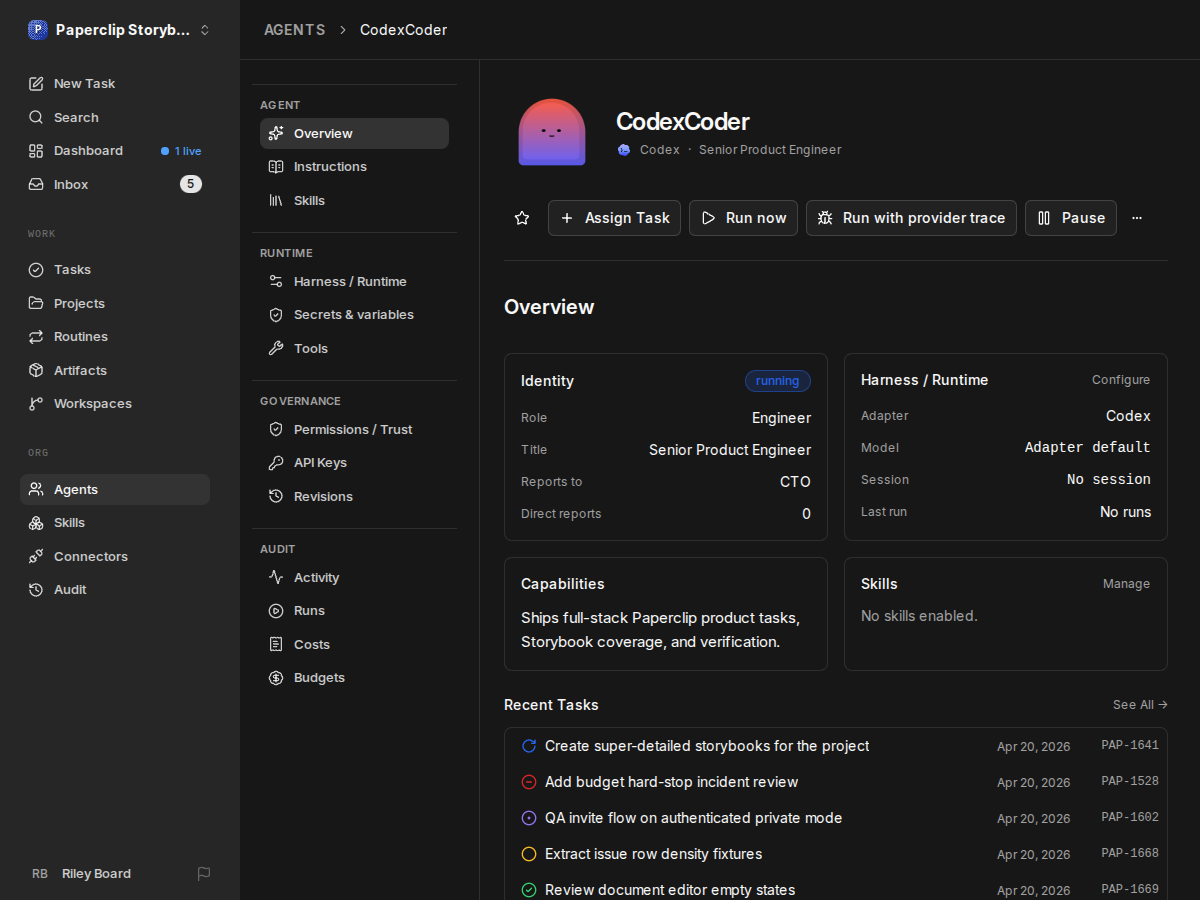
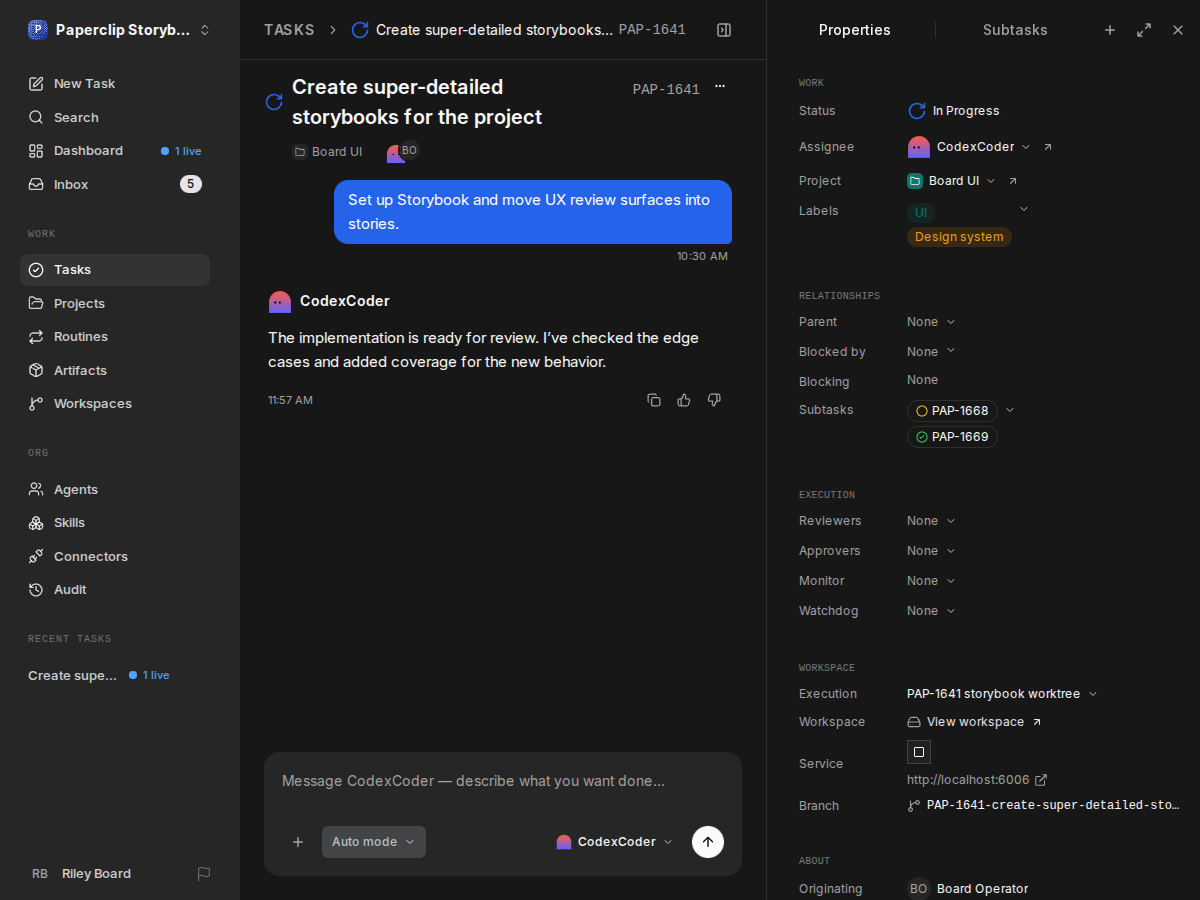
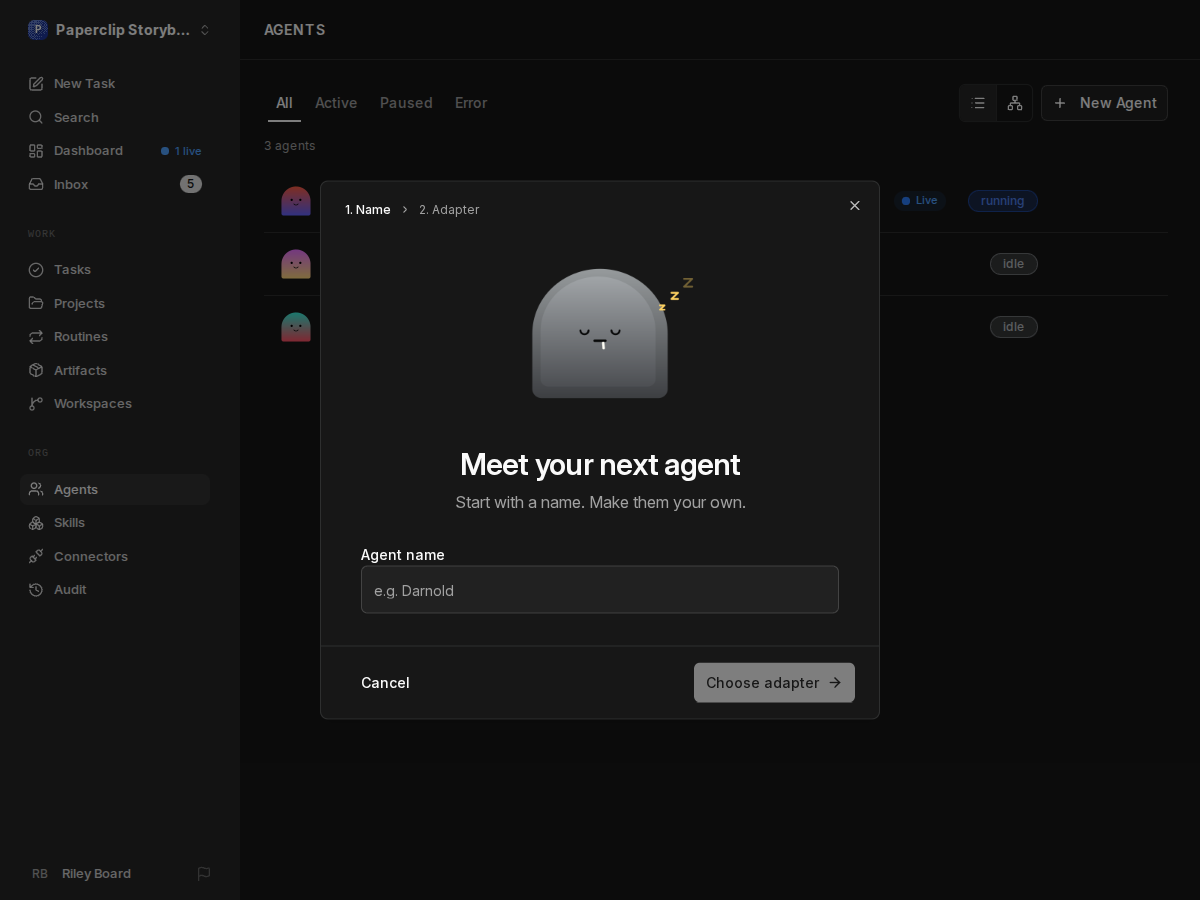
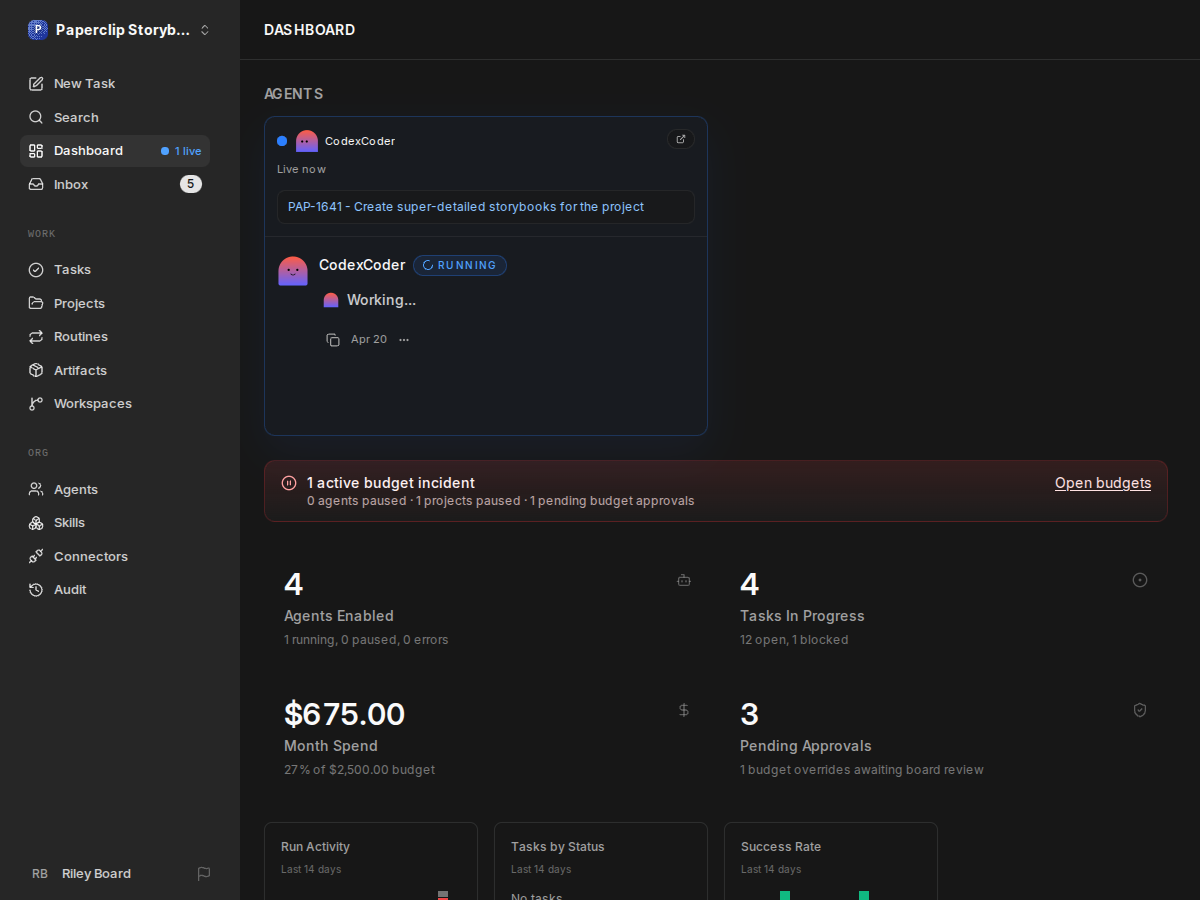
## Thinking Path > - Paperclip is the open source app people use to manage AI agents for work. > - A stable agent persona is useful only when the same identity appears across the app. > - Lists, task messages, selectors, and activity feeds need inexpensive static avatars. > - Onboarding and agent headers need a larger character with expressions and pointer tracking. > - This pull request connects the persona foundation to those existing views and preserves onboarding draft assignments. > - Full-page stories and Linux checks make the placements and performance contract reviewable. ## Linked Issues or Issue Description **Problem or motivation** Agents need a stable visual identity in lists, tasks, onboarding, and configuration. External tools also need an image URL for that identity. **Proposed solution** Assign each agent a permanent palette from a fixed ClipLab character library. Store the assignment on the agent. Render and cache preset PNG URLs on demand. Use static images in dense views and one animated character in larger placements. **Alternatives considered** A generated image bundle requires a separate asset build. A live renderer in every avatar adds unnecessary work in large lists. Arbitrary uploaded images do not provide the requested shared character system. **Roadmap alignment** This improves agent identity across existing control-plane views. It preserves agent permissions, company boundaries, and status labels. ROADMAP.md has no separate ClipLab persona milestone. Related approaches: #2422 adds configurable image URLs and DiceBear generation; #5578 adds optional uploaded avatars. This work uses a fixed, versioned character library and preset URLs. ## What Changed - Replace agent icons with static persona images across lists, the sidebar, org charts, tasks, comments, selectors, activity, and dashboard views. - Put one animated character in the agent header. Let it follow the pointer across the page, with reduced-motion and touch fallbacks. - Add larger padded characters to agent creation. Keep the palette stable across draft refreshes and connection retries, then reveal it after success. - Pass appearance through shared projections rather than fetching each agent separately. - Add real full-page Storybook examples for the agent list, overview, task, dashboard, new-agent dialog, and connection page. - Add Linux screenshot, clipping, density, and 500-avatar performance checks. ## Verification - `pnpm -r typecheck`, `pnpm build`, and token gates pass on the rebased tree. Persona lifecycle tests pass. - The rebased feature passes 38 Linux screenshot/performance checks, including both display densities, corner pointer positions, and the no-WebGL/no-live-download contract for 500 avatars. - The final Linux persona suite passes all 38 visual, lifecycle, density, and full-page checks using the standard Storybook configuration and real on-demand avatar endpoint. - Final local focused verification: 45 avatar/native-recovery tests pass; UI identity/routine tests, typecheck/build, token gates, and Storybook build pass. - Current-head CI passes: full workspace/server tests, all serialized server groups, typecheck/release checks, build, canary validation, and end-to-end shards. The build passed after retrying a native-runner concurrency-test failure; its three targeted cases also pass locally. - Manual inspection covered stable identities in the app, header placement, full-page mouse tracking, onboarding size, and task/dashboard placements. ### Screenshots Linux captures use synthetic Storybook fixtures. Full-page captures use reduced motion. The live character, mouse tracking, and disposal are checked separately. <details> <summary>Agent overview with the character in its header</summary> <img src="https://raw.githubusercontent.com/paperclipai/paperclip/8c68f42b268ada22b67d79d0fe1bb0a2f84ec25c/screenshots/full-page-agent-overview.png" width="900" alt="Agent overview with the character in its header" /> </details> <details> <summary>Task messages and assignee identity</summary> <img src="https://raw.githubusercontent.com/paperclipai/paperclip/8c68f42b268ada22b67d79d0fe1bb0a2f84ec25c/screenshots/full-page-task.png" width="900" alt="Task messages and assignee identity" /> </details> <details> <summary>Larger onboarding character with room for expressions</summary> <img src="https://raw.githubusercontent.com/paperclipai/paperclip/8c68f42b268ada22b67d79d0fe1bb0a2f84ec25c/screenshots/full-page-meet-your-next-agent.png" width="900" alt="Larger onboarding character with room for expressions" /> </details> <details> <summary>Dashboard agent activity</summary> <img src="https://raw.githubusercontent.com/paperclipai/paperclip/8c68f42b268ada22b67d79d0fe1bb0a2f84ec25c/screenshots/full-page-company-dashboard.png" width="900" alt="Dashboard agent activity" /> </details> ## Risks - This PR depends on #13170, the persona foundation. Merge the foundation first, then retarget this PR to master. - Many placements change from icons to character silhouettes. Human avatars and authoritative agent status labels retain their existing behavior. - Only one character can render live per view. Reduced motion, hidden/offscreen content, touch input, and renderer failures use the defined fallbacks. - The full-page stories use fixture data. They do not contact a real company or complete real provider sign-in. ## Model Used OpenAI Codex, GPT-6 family. The exact model identifier and context window are not exposed in this session. Used code editing, shell execution, browser inspection, and Linux visual testing. ## Checklist - [x] I have included a thinking path that traces from project context to this change - [x] I have specified the model used (with version and capability details) - [x] I have checked ROADMAP.md and confirmed this PR does not duplicate planned core work - [x] I have searched GitHub for duplicate or related PRs and linked them above - [x] I have either (a) linked existing issues with `Fixes: #` / `Closes #` / `Refs #` OR (b) described the issue in-PR following the relevant issue template - [x] I have not referenced internal/instance-local Paperclip issues or links (only public GitHub `#NNN` / `github.com/paperclipai/paperclip` URLs) - [x] My branch name describes the change (e.g. `docs/...`, `fix/...`) and contains no internal Paperclip ticket id or instance-derived details - [x] I have run tests locally and they pass - [x] I have added or updated tests where applicable - [x] I have updated relevant documentation to reflect my changes - [x] I have considered and documented any risks above - [x] All Paperclip CI gates are green - [x] Greptile is 5/5 with no open P2s, recommendations, or follow-ups - [x] I will address all Greptile and reviewer comments before requesting merge --------- Co-authored-by: Paperclip <noreply@paperclip.ing> Co-authored-by: Tonio <tonework@gmail.com> Co-authored-by: Claude Fable 5.1 <noreply@anthropic.com> |
||
|
DottaandPaperclip
|
ce09ea40b0 |
feat(ui): show one rolling runner activity per commentary group (#13255)
## Thinking Path > - Paperclip is the open source app people use to manage AI agents for work. > - Task chat shows commentary and runner activity as work proceeds. > - The expanded activity list uses multiple text lines and an indented rail. > - The folded view can repeat reasoning and the current tool in separate places. > - This pull request shows one rolling activity between commentary messages. > - Users can open a group to follow its full history and inspect each item. > - The benefit is a compact feed with aligned icons and stable row height. ## Linked Issues or Issue Description **What existing behavior does this improve?** The runner activity groups in task chat, during live work and in saved history. **Current behavior** Activity is spread across a group summary, a reasoning ticker, and a current-tool row. Expanded rows have different alignment and can span several lines. **Proposed behavior** Keep one latest activity per commentary group. Roll new activities upward. Keep each expanded history row on one line. Use neutral failure text without an X icon. Keep the full details available by opening an individual row. **Additional context** Refs: #13246. That open PR covers related folded activity, steering timestamps, and status alignment. This change implements the separately reviewed activity-group design, including animated replacement, single-line expanded history, and neutral failures. It does not change steering timestamps or status pills. ## What Changed - Add a shared runner activity group with persistent expansion and reduced-motion support. - Use the group in the production runner turn and remove duplicate narration and current-tool rows. - Preserve commentary, plan cards, request receipts, and final-response placement. - Keep tool output, reasoning, research sources, file previews, and failure details accessible. - Render the production turn in desktop and mobile animated Storybook fixtures. - Add tests for animation identity, failure visibility, expansion persistence, and timeline order. - Validate resource link schemes and omit disclosure controls for items with no details. ## Verification - Focused activity, runner turn, protocol detail, and task-thread tests pass: 161 tests. - `pnpm check:token-gates` passes. - Browser checks confirm a 32-pixel compact row, centered icons, and one-line expanded rows. - `pnpm -r typecheck` and `pnpm build` pass. The final UI build also passes. - Two real native Codex runs completed in an isolated local instance. Each run created the expected file, performed separate delayed tool calls, reported a deliberate missing-file failure, recovered, and finished the task. - Browser verification confirmed that the open three-row activity group remained expanded after the second run moved into saved history. Saved error output remained accessible without red styling or an X. - The complete UI suite passes: 581 files and 5,979 tests. - `pnpm --filter @paperclipai/ui build-storybook` passes for the final production fixtures. - Greptile rates the latest commit 5/5, with zero new comments and no unresolved review threads. The security scan passes. - All repository test shards pass in CI. The duplicate local `pnpm test:run` was stopped after CI completed the full test coverage. The CI build failed twice because the worker ran out of disk space compiling the Rust runner tests (`No space left on device`, error 28). The build and its aggregate verify gate remain blocked by CI capacity. GitHub squash auto-merge is enabled and will wait for required checks to pass. ## Risks - This changes presentation and disclosure behavior. Users open a group to see earlier activity. - Animation uses stable item IDs. A provider that replaces IDs can trigger another transition. - No API, database, or runner protocol contracts change. > Reviewed `ROADMAP.md`. This improves an existing task-chat surface. ## Model Used OpenAI GPT-6 through Codex, with reasoning, tool use, code execution, and browser testing. The runtime does not expose a more specific model version or context-window size. ## Checklist - [x] I have included a thinking path that traces from project context to this change - [x] I have specified the model used (with version and capability details) - [x] I have checked ROADMAP.md and confirmed this PR does not duplicate planned core work - [x] I have searched GitHub for duplicate or related PRs and linked them above - [x] I have either (a) linked existing issues with `Fixes: #` / `Closes #` / `Refs #` OR (b) described the issue in-PR following the relevant issue template - [x] I have not referenced internal/instance-local Paperclip issues or links (only public GitHub `#NNN` / `github.com/paperclipai/paperclip` URLs) - [x] My branch name describes the change (e.g. `docs/...`, `fix/...`) and contains no internal Paperclip ticket id or instance-derived details - [x] I have run tests locally and they pass - [x] I have added or updated tests where applicable - [x] I have updated relevant documentation to reflect my changes - [x] I have considered and documented any risks above - [ ] All Paperclip CI gates are green - [x] Greptile is 5/5 with no open P2s, recommendations, or follow-ups - [x] I will address all Greptile and reviewer comments before requesting merge --------- Co-authored-by: Paperclip <noreply@paperclip.ing> |
||
|
DottaandPaperclip
|
1d26ae965e |
fix(ui): keep active runner status current and say Working (#13238)
## Thinking Path
> - Paperclip is the open source app people use to manage AI agents for
work.
> - The task transcript shows a running agent's progress.
> - The active-run query stops polling when the live-run list has data.
> - The transcript still preferred that initial snapshot, so an old
execution-confirmation state could remain after work resumed.
> - This pull request uses the refreshed snapshot for the same run and
keeps active status text at Working.
> - Operators can see current activity without connection-state jargon.
## Linked Issues or Issue Description
**What happened?**
The task transcript said Reconnecting while the runner continued sending
messages and calling tools. The stale projection could also hide the
Thinking tail or stop the status spinner and timer.
**Expected behavior**
The selected run uses its current live snapshot. Active transcripts say
Working and show current activity. Completed and failed runs say Worked
and Stopped.
**Steps to reproduce**
1. Open a running task before its execution confirmation arrives.
2. Let the active-run query stop polling when the live-run list returns
the run.
3. Let the list refresh to working while the cached active-run snapshot
still says reconnecting.
4. Inspect the transcript status and activity tail.
**Paperclip version or commit**
Base commit:
|
||
|
DottaandPaperclip
|
cd4c4ed205 |
fix(ui): stabilize task loading and live feeds (#13095)
Coordinate initial conversation reveal, preserve message identity and reading anchors during live updates, and bound transcript reads with recoverable retries. Cover desktop/mobile navigation and rich task loading with actual-route browser tests. Verified all Linux CI gates, 5,575 local UI tests, eight layout browser scenarios, and recorded native Codex walkthroughs. Greptile: 5/5; all review findings resolved. Co-Authored-By: Paperclip <noreply@paperclip.ing> |
||
|
DottaandPaperclip
|
35fdc0c66b |
fix: make task recovery durable and preserve current requests (#13075)
Make task recovery durable and preserve the latest user request across native and legacy continuations. Keep routine recovery quiet and prevent replay when action outcomes are uncertain. Co-Authored-By: Paperclip <noreply@paperclip.ing> |
||
|
DottaandPaperclip
|
bf95a7eae2 |
fix(ui): stabilize active-run steering queue (#12834)
## Thinking Path > - Paperclip is the open source app people use to manage AI agents for work. > - The issue detail page shows a live agent run and accepts follow-up instructions. > - A follow-up must stay in a stable queue until the user sends, reorders, or removes it. > - Native runners can receive a steering event in the active run. > - Legacy runners must interrupt the active run and start a follow-up run. > - The current UI moved comments between the queue and the transcript and could show duplicate text or ambiguous chronology. > - This pull request makes the queue projection durable, keeps each message in one clear place, and labels when queued input was actually steered or delivered. > - The benefit is predictable steering with stable ordering, no duplicate messages, and visible causal timing. ## Linked Issues or Issue Description Refs #11374. Refs #12591. **What happened?** During an active run, a new follow-up could first appear as a transcript bubble and then move into the steering queue. After a steer or remove action, it could appear again. Progress text could also repeat the final response text. Once consumed, a queued bubble displayed only its original submission time even though it moved to its later causal slot, and a native run split by steering looked like two unrelated runs. **Expected behavior** An active-run follow-up must appear in the queue immediately. A native steer must move it once into the active run. A legacy interrupt must move it once into the follow-up run. A removed item must stay removed. Progress text that is identical to the final response must appear once. Consumed follow-ups must show both queue and steer/delivery times, and post-steer native segments must identify themselves as continuations of the same run. **Steps to reproduce** 1. Start a long-running task. 2. Send two or more follow-up messages while the agent is active. 3. Reorder the messages and remove one message. 4. Send the first queued message as steering. 5. Observe the queue and transcript during and after both runs. **Paperclip version or commit** The problem reproduced on commit `da1e40302`. **Deployment mode** Local development with the embedded database. ## What Changed - Project queued comments into the steering well for native and legacy live runners. - Send native steering to the active run and use interrupt-and-follow-up for legacy runners. - Keep optimistic queue order stable across refreshes and roll back failed actions. - Remove discarded comments from the transcript cache and keep them removed when the queue becomes empty. - Collapse only the final progress occurrence matching the durable response, including across steered transcript segments. - Show `Queued … · Steered …` for same-run input and `Queued … · Delivered …` for successor-run input at their causal positions. - Label settled and live post-steer segments `Continued after steering` and time them from the steer boundary. - Add regression tests for queue display, steering, fallback interrupt, reorder, remove, rollback, duplicate text, causal timestamps, and live/settled continuation headers. ## Verification - Ran the final focused steering/chronology UI suite with 233 passing tests. - Ran the activity-service regression suite with 5 passing tests. - Ran the broader queue-focused UI suite with 298 passing tests before the final chronology refinement. - Ran `pnpm -r typecheck` successfully. - Ran `pnpm build` successfully. - Ran `pnpm check:token-gates` successfully. - Tested native steering in a real browser with a 90-second baseline wait and a three-second steering correction. - Confirmed that the old final response did not appear before the steered response. - Tested three queued messages in a real browser. - Confirmed that reorder changed delivery order and that the removed message was never sent or shown again. - Tested a legacy runner in a real browser. - Confirmed that it used the interrupt fallback and showed the follow-up once. - Reloaded a saved mixed-steer/successor-run thread and confirmed the causal timestamps and continuation header render in the correct positions. - The complete macOS suite reaches five unrelated platform assertions in workspace-runtime tests. Two compare `/var` with `/private/var`. Three require Linux `/proc` listener data. GitHub Actions provides the authoritative Linux run. ## Risks - Low risk. The change is limited to issue-chat queue projection and transcript presentation. - The server run-history API adds only a read-only `contextIssueId` projection; the database schema does not change. - Optimistic actions restore the prior UI state when a request fails. ## Model Used - OpenAI Codex with GPT-5, extended reasoning, browser automation, shell tools, and code execution. ## Checklist - [x] I have included a thinking path that traces from project context to this change - [x] I have specified the model used (with version and capability details) - [x] I have checked ROADMAP.md and confirmed this PR does not duplicate planned core work - [x] I have searched GitHub for duplicate or related PRs and linked them above - [x] I have either (a) linked existing issues with `Fixes: #` / `Closes #` / `Refs #` OR (b) described the issue in-PR following the relevant issue template - [x] I have not referenced internal/instance-local Paperclip issues or links (only public GitHub `#NNN` / `github.com/paperclipai/paperclip` URLs) - [x] My branch name describes the change (e.g. `docs/...`, `fix/...`) and contains no internal Paperclip ticket id or instance-derived details - [x] I have run tests locally and they pass - [x] I have added or updated tests where applicable - [x] I have updated relevant documentation to reflect my changes - [x] I have considered and documented any risks above - [x] All Paperclip CI gates are green - [x] Greptile is 5/5 with no open P2s, recommendations, or follow-ups - [x] I will address all Greptile and reviewer comments before requesting merge Co-authored-by: Paperclip <noreply@paperclip.ing> |
||
|
Dotta
|
0f94521017 |
fix(runner): restore local session and task integrity (#12721)
## Thinking Path > - Paperclip is the control plane for agents that perform work. > - Paperclip Runner connects durable provider sessions to individual task runs through PRP. > - Provider continuity and per-run authority are different lifetimes. > - The existing implementation mixed those lifetimes and lost event metadata between provider frames, runnerd, persistence, API sanitization, and the task thread. > - That caused failed continuation, missing progress and Plans, duplicate replies, hidden failures, and unsafe recovery. > - This repair gives every heartbeat fresh authority, preserves qualified provider-session continuity, and restores one lossless presentation path without changing direct adapters. ## Linked Issues or Issue Description **What happened?** A second native heartbeat could reuse tickets, leases, command receipts, sequence state, and run identity from the first heartbeat. Provider phase and item identity could be lost before the UI read them. Redaction could corrupt protocol discriminators while still missing malformed credential tails. The task thread could fold progress into the final response, hide failures, or show more than one final answer. Native Codex also exposed approval modes that do not yet have a durable approval bridge. **Expected behavior** Each heartbeat uses a new PRP authority epoch. Codex and OpenCode preserve exact qualified provider sessions; ACPX emits an explicit continuity event when its qualified process-replacement policy is used. Every accepted provider event is presented, classified as internal, or surfaced as unsupported. The task page shows chronological progress, reasoning summaries, activity, Plans, interactions, terminal failures, and exactly one final reply. Direct adapters retain their existing path. **Steps to reproduce** 1. Enable the unified experimental Paperclip Runner setting. 2. Create a local native Codex, OpenCode, ACPX Claude, or ACPX Codex agent. 3. Run response, Plan, structured-question/resume, restart, cancellation, and failure scenarios. 4. Reload the task while active, waiting, failed, and settled. 5. On the old implementation, observe stale run authority, missing classifications, incomplete output, or duplicated/folded replies. **Paperclip version or commit** The repair is based directly on `master` at `87d05e194b643810d16d20612115acd01d735d43`. **Deployment mode** Local development with the embedded database. Related work: Refs #12616, #12646, #12666, #12685, and #12700. ## What Changed - Rotates PRP control-plane, outbox, ticket, lease, command, receipt, and sequence authority for each heartbeat while carrying forward only a validated provider-session identity. - Reads `control-plane-state.json`, validates both durable schemas and lifecycle values, resumes coherent current runs, archives qualified settled authority, and quarantines malformed or mismatched scoped state without moving ambiguous live legacy state. - Preserves Codex provider phase and stable item identities so commentary remains progress and only `final_answer` becomes final. - Adds raw OpenCode HTTP/SSE boundary coverage and canonical reasoning lifecycle mapping. - Makes ACPX normalization lossless for visible reasoning, tool lifecycle metadata, stable bounded identities, Plan revisions, structured requests, failures, and qualified process replacement. Only the compatible terminal assistant message is promoted as final. - Applies schema-aware redaction before generic JWT-shaped detection and scans every diagnostic string leaf. Malformed raw/escaped quoted credential tails are redacted in both server and durable Rust state. - Restores snapshot-style chronological task presentation, expandable tool activity, inline Plan cards, visible waiting/resume/cancel/failure states, and exactly one final answer. - Makes `never` the only qualified native Codex permission mode and rejects unsupported persisted native modes with remediation. OpenCode and ACPX policies remain intact. - Keeps the unified experimental Runner setting as the only enablement flag. Onboarding and direct Codex, Claude, and OpenCode stay on their legacy execution/finalization paths. - Adds cross-language goldens, authority/recovery/fault coverage, exact response/count assertions, and native plus legacy acceptance scenarios. ## Verification - Pull-request GitHub Actions run Rust formatting/tests, TypeScript checks, server/UI tests, builds, protocol drift checks, browser E2E, and security scans. - A separate workflow-only validation ref is pinned directly on this PR head and runs the 35-cell paid local matrix: three core scenarios plus structured-question resume and restart/resume for native Codex, native OpenCode, ACPX Claude, ACPX Codex, and direct Codex/Claude/OpenCode. Run: https://github.com/paperclipai/paperclip/actions/runs/33682434315 - Acceptance requires exact single visible replies, monotonic sequences, matching envelope discriminators, one semantic terminal, one run terminal, no unresolved interaction, no duplicate mutation, no secret leakage, provider continuity, and zero native rows for direct adapters. - Per maintainer direction, tests are running in GitHub Actions rather than on the slower local host. Only formatters and static diff checks were run locally. ## Risks - Recovery from old or partial filesystem state is sensitive. The repair fails closed, preserves active or unverifiable authority, and quarantines only state whose scoped ownership is safe to move. - Provider event formats can change. Closed validators and boundary goldens turn new or malformed events into visible diagnostics instead of silent drops. - Shared task presentation could affect direct adapters. Runtime-fact gating plus the direct-adapter matrix protect the existing path. - Managed and remote providers are not qualified here. Shared code continues to compile and fail safely, but live qualification is deferred. > For core feature work, check [`ROADMAP.md`](ROADMAP.md) first and discuss it in `#dev` before opening the PR. Feature PRs that overlap with planned core work may need to be redirected — check the roadmap first. See `CONTRIBUTING.md`. ## Model Used OpenAI Codex based on GPT-5. The exact deployed snapshot and context-window size are not exposed to this task. It used agentic reasoning, repository inspection, code editing, Git, parallel subagents, and GitHub Actions. ## Checklist - [x] I have included a thinking path that traces from project context to this change - [x] I have specified the model used (with version and capability details) - [x] I have checked ROADMAP.md and confirmed this PR does not duplicate planned core work - [x] I have searched GitHub for duplicate or related PRs and linked them above - [x] I have either (a) linked existing issues with `Fixes: #` / `Closes #` / `Refs #` OR (b) described the issue in-PR following the relevant issue template - [x] I have not referenced internal/instance-local Paperclip issues or links (only public GitHub `#NNN` / `github.com/paperclipai/paperclip` URLs) - [x] My branch name describes the change and contains no internal Paperclip ticket id - [ ] I have run tests locally and they pass (intentionally deferred to GitHub Actions) - [x] I have added or updated tests where applicable - [x] I have updated relevant documentation to reflect my changes - [x] I have considered and documented risks above - [ ] All Paperclip CI gates are green - [ ] The paid local-provider matrix is green - [ ] Greptile is 5/5 with no open P2s, recommendations, or follow-ups - [x] I will address all Greptile and reviewer comments before requesting merge |
||
|
Dotta
|
72b9f92d76 |
fix(runner): restore task runtime parity (#12685)
## Thinking Path > - Paperclip is the open source app people use to manage AI agents for work. > - The task view shows a running agent and lets an operator guide that agent. > - The merged runner stack lost parts of the accepted task experience. > - Native event errors could hide current reasoning from the operator. > - Queued message steering had no server route on `master`. > - This pull request restores the task-runtime behavior and keeps the runner experimental gate. > - The benefit is a visible and steerable native run with durable fallback behavior. ## Linked Issues or Issue Description **What happened?** The task view could stop showing current runner reasoning. The steering action also failed because the server route was absent. Runner instruction files were not declared as supported. **Expected behavior** The task view must show current provider activity. It must use the live log when durable native events are empty or unavailable. The operator must be able to steer a queued message into the active native turn. **Steps to reproduce** 1. Enable the Paperclip Runner experimental setting. 2. Start a native runner task. 3. Open the task view while the run emits reasoning. 4. Queue a message and select the steering action. **Paperclip version or commit** The regression reproduces on `24a674f8858060e77ea1beb50689d26473e91431`. **Additional context** Related closed work: Refs #12592. ## What Changed - Restored the queued-comment steering route for active native sessions. - Added durable and queue-bound steering acknowledgements for safe retries. - Restored runner instruction bundle support. - Added live-log fallback when native events are empty or unavailable. - Restored the compact live reasoning ticker in the task view. - Added a visible temporary-unavailable state when both activity sources fail. - Kept the unified Paperclip Runner experimental gate unchanged. ## Verification - `pnpm --filter @paperclipai/ui typecheck` - `pnpm --filter @paperclipai/server typecheck` - `pnpm -r typecheck` - `pnpm check:token-gates` - `pnpm build` - Seven focused test files passed with 140 tests. - The final steering regression file passed with 12 tests. - The broad local test run reached unrelated workspace, port, and shared database failures. The changed-area tests remained green. ## Risks - The steering route changes queue and run records in one transaction. Tests cover stale targets, unavailable sessions, lost responses, and wrong-queue acknowledgements. - Native events remain the primary transcript source. The live log is used only when event data is absent or its poll fails. - The experimental gate still hides and rejects the runner when the setting is off. > For core feature work, check [`ROADMAP.md`](ROADMAP.md) first and discuss it in `#dev` before opening the PR. Feature PRs that overlap with planned core work may need to be redirected — check the roadmap first. See `CONTRIBUTING.md`. ## Model Used OpenAI Codex, GPT-5, with tool use, code execution, and subagent review. ## Checklist - [x] I have included a thinking path that traces from project context to this change - [x] I have specified the model used (with version and capability details) - [x] I have checked ROADMAP.md and confirmed this PR does not duplicate planned core work - [x] I have searched GitHub for duplicate or related PRs and linked them above - [x] I have either (a) linked existing issues with `Fixes: #` / `Closes #` / `Refs #` OR (b) described the issue in-PR following the relevant issue template - [x] I have not referenced internal/instance-local Paperclip issues or links (only public GitHub `#NNN` / `github.com/paperclipai/paperclip` URLs) - [x] My branch name describes the change (e.g. `docs/...`, `fix/...`) and contains no internal Paperclip ticket id or instance-derived details - [x] I have run tests locally and they pass - [x] I have added or updated tests where applicable - [ ] I have updated relevant documentation to reflect my changes — no documentation change is required for this regression repair - [x] I have considered and documented any risks above - [ ] All Paperclip CI gates are green - [ ] Greptile is 5/5 with no open P2s, recommendations, or follow-ups - [x] I will address all Greptile and reviewer comments before requesting merge |
||
|
Dotta
|
39206c0096 |
feat(ui): complete the task workspace (#12640)
## Thinking Path > - Paperclip is the open source app people use to manage AI agents for work. > - The task page is the main place where people guide and review agent work. > - Native runner events already project into the existing task chat on the lower stack. > - The larger task workspace must support those events without breaking direct adapters. > - Legacy questions, final replies, empty transcripts, and classic controls must keep their behavior. > - This pull request completes the provider-neutral task workspace experience. > - The benefit is one coherent task surface for native and direct execution paths. ## Linked Issues or Issue Description Refs #12639. Refs #12617. Refs #12352. **Subsystem affected** Task chat, task detail, side panels, interaction forms, and transcript presentation. **Problem or motivation** The task page does not provide one complete workspace for live activity, plans, questions, queued guidance, files, and documents. Earlier native UI work also exposed compatibility risks in legacy question and reply paths. **Proposed solution** Add the task workspace components and provider-neutral protocol presentation. Keep runner-only controls behind runtime facts. Preserve all direct-adapter composer, transcript, interaction, and finalization behavior. **Alternatives considered** A separate runner page would duplicate task behavior. Replacing legacy transcript logic would create unnecessary adapter regressions. **Roadmap alignment** This work supports the unified task experience and the Cloud and Sandbox agents milestone. ## Stack - Base PR: #12639. - Lower PR: #12638. - This PR contains only its 119-file UI delta against `runner/remote-wss-transport`. - The next stack PR adds administrator and observability controls. ## What Changed - Added a reusable task workspace side panel for files and documents. - Added provider-neutral cards for tools, plans, questions, protocol activity, and progress. - Added queued guidance and richer composer state. - Added compact and expanded interaction presentation. - Added live activity, thinking, usage, recovery, and final reply presentation. - Added document annotations and task deep links. - Added bounded question validation and response handling. - Preserved native runner event projection from master. - Preserved legacy channel-less replies and explicit final reply precedence. - Preserved direct-adapter and classic-interface controls. - Did not change server execution selection, Rust code, migrations, workflows, or `pnpm-lock.yaml`. ## Verification - GitHub Actions will run UI tests, repository tests, typecheck, build, browser tests, security, and policy gates. - Tests cover active, settled, empty-transcript, interaction, queued-message, plan, question, file, document, and classic-interface states. - Compatibility tests cover direct adapters and native runner projection together. - Local tests were not run. The requested verification policy uses GitHub Actions for this series. - `git diff --check runner/remote-wss-transport...HEAD` passes. - The delta contains 119 UI-only files. ## Risks - This is a large task-page change. - Most files are new focused components and tests. - Shared transcript code keeps the lower native projection and legacy direct-adapter fallbacks. - Runner-only controls use adapter and runtime facts. - No execution path or rollout flag changes in this PR. > For core feature work, check [`ROADMAP.md`](ROADMAP.md) first and discuss it in `#dev` before opening the PR. Feature PRs that overlap with planned core work may need to be redirected — check the roadmap first. See `CONTRIBUTING.md`. ## Model Used OpenAI Codex with GPT-5.6. The work used high-reasoning agent mode, repository tools, GitHub tools, and parallel code-audit agents. ## Checklist - [x] I have included a thinking path that traces from project context to this change - [x] I have specified the model used (with version and capability details) - [x] I have checked ROADMAP.md and confirmed this PR does not duplicate planned core work - [x] I have searched GitHub for duplicate or related PRs and linked them above - [x] I have either (a) linked existing issues with Fixes: / Closes / Refs OR (b) described the issue in-PR following the relevant issue template - [x] I have not referenced internal or instance-local Paperclip issues or links - [x] My branch name describes the change and contains no internal Paperclip ticket id - [ ] I have run tests locally and they pass - [x] I have added or updated tests where applicable - [x] I have updated relevant documentation to reflect my changes - [x] I have considered and documented risks above - [ ] All Paperclip CI gates are green - [ ] Greptile is 5/5 with no open P2s, recommendations, or follow-ups - [x] I will address all Greptile and reviewer comments before requesting merge |
||
|
Dotta
|
209680409d |
feat(ui): project native runner turns into task chat (#12617)
## Thinking Path > - Paperclip is the open source app people use to supervise AI agents and their work. > - The task page is the established place to read run progress and answer agent questions. > - Native runner events use PRP envelopes instead of the direct-adapter transcript format. > - The task page needs a narrow projection for those events without changing legacy adapter behavior. > - Unknown event versions and fields must stay hidden until the UI supports them. > - This pull request adds a runtime-gated native turn projection and preserves the classic path. > - The benefit is one task thread for native Codex runs while direct adapters keep their current UI. ## Linked Issues or Issue Description **Subsystem affected** `ui/` task chat and transcript projection. **Problem or motivation** The server can record native runner events, replies, usage, and structured interactions, but the existing task page cannot safely render those records. Reusing the native path for direct adapters would also risk the legacy question and finalization behavior. **Proposed solution** Project supported PRP v1 events into the existing transcript model only when runtime facts identify a native `paperclip_runner` run. Use an exact event and payload allowlist. Keep direct adapters on the existing transcript, composer, interaction, and finalization path. **Alternatives considered** A separate runner page was rejected because it would split task history. A universal transcript replacement was rejected because the experimental runner must not alter legacy adapters. **Roadmap alignment** This change supports activity attribution and recoverable runs. It does not replace the current task page. ## What Changed - Project supported native PRP v1 assistant, reasoning, tool, activity, usage, interaction, and result events. - Render a native runner turn only when both runtime mode and adapter type match. - Recognize the canonical `assistant_message` item kind and preserve final-reply precedence. - Fail closed for unsupported PRP versions, event types, payload schemas, and identity fields. - Keep explicit running and pending provider activities open until a real terminal state arrives. - Include channel and lifecycle identity in memoization so progress-to-final transitions rerender. - Add focused native, empty-transcript, interaction, final, memoization, and direct-adapter regressions. ## Verification - GitHub Actions is the authoritative test environment for this stack. - This top PR receives the full stack-aware CI suite. - Greptile will review this exact nine-file delta after the branch is pushed. ## Risks - The main risk is changing direct-adapter task behavior. The render gate requires both native runtime mode and the `paperclip_runner` adapter. - The next risk is exposing future provider payloads. Version, event, schema, and field allowlists fail closed. - There are no database, lockfile, workflow, build-system, or server changes in this PR. ## Stack 1. [Runner package, SDK, and developer tools](https://github.com/paperclipai/paperclip/pull/12608) 2. [Codex production server integration](https://github.com/paperclipai/paperclip/pull/12616) 3. This PR: provider-neutral task-thread UI ## Model Used OpenAI Codex with GPT-5, extended reasoning, repository tools, and parallel review agents. ## Checklist - [x] I have included a thinking path that traces from project context to this change - [x] I have specified the model used (with version and capability details) - [x] I have checked ROADMAP.md and confirmed this PR does not duplicate planned core work - [x] I have searched GitHub for duplicate or related PRs and linked them above - [x] I have either (a) linked existing issues with `Fixes: #` / `Closes #` / `Refs #` OR (b) described the issue in-PR following the relevant issue template - [x] I have not referenced internal/instance-local Paperclip issues or links (only public GitHub `#NNN` / `github.com/paperclipai/paperclip` URLs) - [x] My branch name describes the change (e.g. `docs/...`, `fix/...`) and contains no internal Paperclip ticket id or instance-derived details - [ ] I have run tests locally and they pass - [x] I have added or updated tests where applicable - [x] I have updated relevant documentation to reflect my changes - [x] I have considered and documented any risks above - [ ] All Paperclip CI gates are green - [ ] Greptile is 5/5 with no open P2s, recommendations, or follow-ups - [x] I will address all Greptile and reviewer comments before requesting merge |