mirror of
https://github.com/paperclipai/paperclip.git
synced 2026-11-02 08:28:48 +01:00
2bdda5dcf2bd5bd332de4fc43cffdee1ffe3dbdf
12
Commits
| Author | SHA1 | Message | Date | |
|---|---|---|---|---|
 DottaandPaperclip |
61bd4ac691 |
feat(agents): set up Antigravity with saved Google subscriptions (#18189)
## Thinking Path > - Paperclip manages agents and their work. > - Users choose providers and managed accounts while adding agents. > - Antigravity was missing from the ordinary additional-agent picker and its saved Google path did not complete native readiness. > - A user needs a successful Test, an enabled task action, and a stable account binding. > - This pull request connects the ordinary setup flow to the native candidate. > - It also preserves retired credential refreshes across database failures and server restarts. ## Linked Issues or Issue Description Built on merged #18188 and #18187. Refs: #12503, #14938 for related legacy CLI proposals. **Agent or provider** Google Antigravity ACP 1.4.3. **Why this adapter is useful** Users need to set up an Antigravity agent and run real work through their managed Google subscription. **How the agent is invoked** Native Paperclip Runner uses the pinned Antigravity ACP runtime. Exact operator admission remains required; the local candidate result does not enable general release. ## What Changed - Show Google Antigravity in the ordinary adapter grid and preserve the draft choice when setup resumes. - Reuse the same user’s saved personal default Google subscription and discover the exact low model through the native account. - Run a prompt-free native Test and wait for authoritative readiness before enabling task assignment. - Carry the managed account through native runs and recover retired refreshes through the existing encrypted, fsynced journal with exact generation checks. - Retain the latest rotated credential through verification, storage, and partial home-removal failures. Retry the exact account’s retained cleanup before another provider use. - Reconcile cleanup before taking the credential mutation lock, fence owners arriving during lock acquisition, and support nested lock holders without a join cycle. - Bound sign-in retirement outside database transactions and preserve claims for the existing cleanup owner; one pending sign-in does not block unrelated accounts. - Cover Gemini and Pi API-key recovery, keep API-key bulk manual-model editing usable, and keep adapter discovery available after candidate expiry. - Skip taskless native timer work before run or credential admission. Preserve current master monitor and deadline scheduling. ## Verification - The registered local saved-Google-subscription journey passed all 16 matchers in 196,520 ms using eval source `12aba` against actual serving source `4a37ee7c`. Both turns stayed in one conversation, produced exact downloaded files of 61 and 119 bytes after reload, and used distinct native primary processes. All observed owners retired, leases released, and credential fences settled. Independent readback confirmed Done work, no active owned runs, a connected saved account, and the retained agent paused for inspection. - The measured runtime is production-equivalent to pre-restack `65ef31dc` except its test-only transport fixture correction. Current-master head `ff7c9249` preserves all 99 product paths: 98 exact blobs and only eight inherited plugin-panel lines in `agents.ts`. Its native binary was rebuilt for inherited Codex-only diagnostic changes; the changed Rust behavior is outside Antigravity's ACPX execution path. Shared native/UI changes have focused regression coverage. The recorded live result is not represented as a measured replay of `ff7c9249`. - Full workspace build and typecheck passed on `ff7c9249`. All 376 focused tests in 14 files passed, covering Google credential/retirement controls and the inherited native-tool, redaction, route, and UI recovery changes. Token gates, maps, and diff checks passed. The required-close fixture was separately demonstrated red, then passed all 317 selected provider-wiring cases. - [Current-head CI](https://github.com/paperclipai/paperclip/actions/runs/40959387972) is green: 55 successful checks, two skipped workflow checks, and an optional neutral review check. Required `ci / verify` and `ci / e2e` passed. Greptile and Paperclip Review both report 5/5 on exact `ff7c9249`, with zero unresolved review threads. - This qualifies the selected operator-authorized local saved-subscription candidate. The original exploratory journey remains historical evidence; the repeatable fixed-driver eval is in the next PR. ## Risks - Google refresh recovery must preserve the exact grant, account, and credential generation. An uncertain native owner or failed encrypted handoff retains the private home and blocks cleanup. - A successful local saved-subscription candidate does not qualify fresh OAuth, API keys, Cloud, Linux, other models, or general release. - Timer filtering changes only taskless native Runner admissions. Existing task-bound monitors and legacy adapters retain their owners. ## Model Used OpenAI Codex (GPT-6). The host did not expose the exact model revision or context limit. The model used tools for code edits, tests, and review. ## Checklist - [x] I have included a thinking path that traces from project context to this change - [x] I have specified the model used (with version and capability details) - [x] I have checked ROADMAP.md and confirmed this PR does not duplicate planned core work - [x] I have searched GitHub for duplicate or related PRs and linked them above - [x] I have either (a) linked existing issues with `Fixes: #` / `Closes #` / `Refs #` OR (b) described the issue in-PR following the relevant issue template - [x] I have not referenced internal/instance-local Paperclip issues or links (only public GitHub `#NNN` / `github.com/paperclipai/paperclip` URLs) - [x] My branch name describes the change (e.g. `docs/...`, `fix/...`) and contains no internal Paperclip ticket id or instance-derived details - [x] I have run tests locally and they pass - [x] I have added or updated tests where applicable - [x] I have updated relevant documentation to reflect my changes - [x] I have considered and documented any risks above - [x] All Paperclip CI gates are green - [x] Greptile is 5/5 with no open P2s, recommendations, or follow-ups - [x] I will address all Greptile and reviewer comments before requesting merge --------- Co-authored-by: Paperclip <noreply@paperclip.ing> |
||
|
Nicky LeachandPaperclip
|
79b2bf78dd |
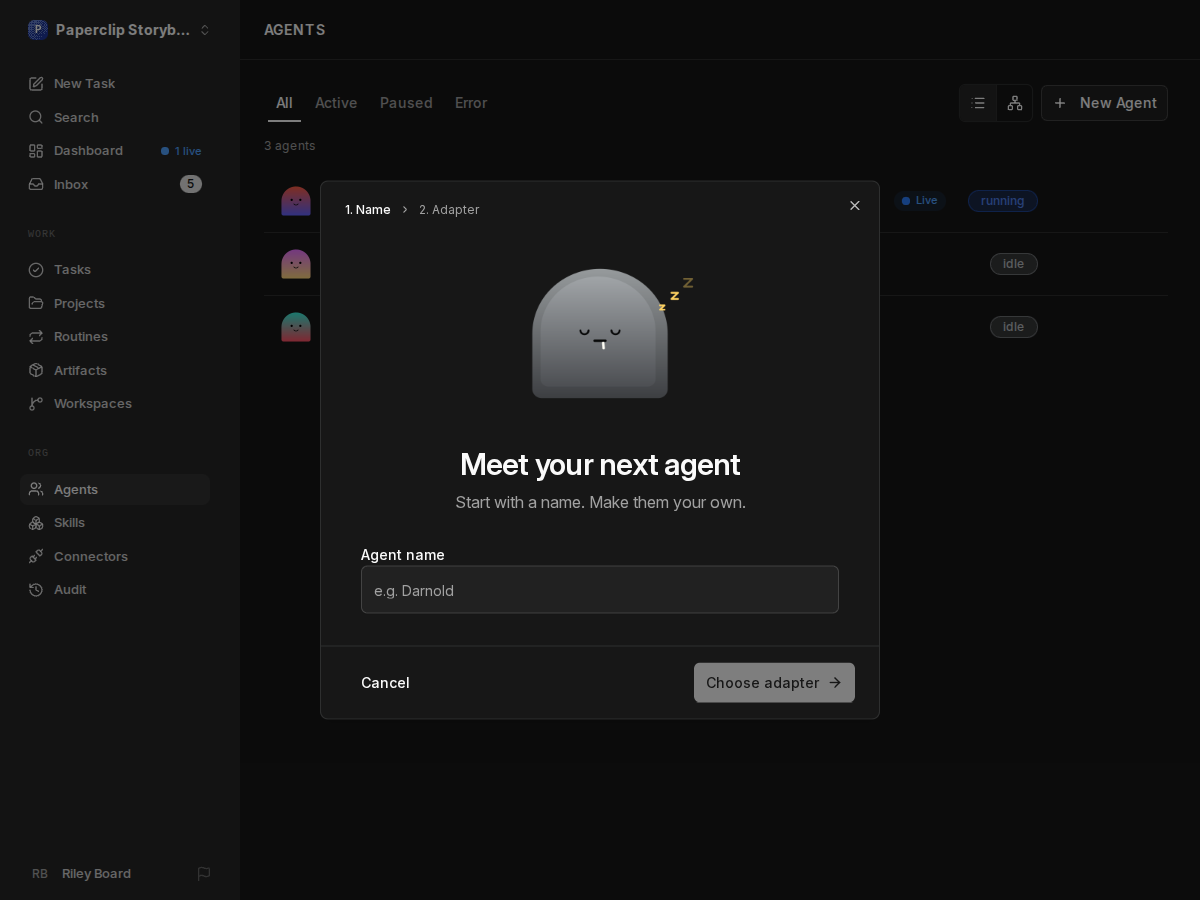
Create agent records when onboarding names are submitted (#17005)
## Thinking Path > - Paperclip is the open source app people use to manage AI agents for work. > - Core onboarding selects an agent and connects its provider account. > - The current flow creates the agent record after authentication. > - Setup needs a stable agent identity as soon as the user submits its name. > - This PR saves a paused setup record on name submission and finishes the hire on that same record. > - The existing sandbox authentication and approval paths continue to apply. ## Linked Issues or Issue Description **Subsystem affected** Core agent lifecycle, shared validators, and onboarding UI. **Current behavior** Onboarding creates the database record at the final hire step. Earlier authentication and saved setup have no agent record. **Proposed behavior** Create a paused agent with a setup hold when the user submits its name. Do this before adapter selection or authentication. Update that same record after adapter selection. Reuse its ID on retries and saved setup. Finish that record through the existing hire path. **Reason and benefit** Give setup a stable identity without coupling this refactor to computer provisioning or a new execution backend. **Breaking changes** Incomplete setup now leaves an inactive agent record. Existing clients can still create and hire agents without the new optional fields. The sandbox authentication flow and API key support remain in place. **Additional context** Requested Core-only refactor. Related work: #15422 changes runner defaults. This PR preserves those choices. No duplicate early-record refactor was found in the issue and PR search. ## What Changed - Save the agent when the user submits its name in both onboarding entry points. Use a provisional adapter until the user chooses one. Reopen name-only drafts at adapter selection. - Add retry-safe setup creation and same-record hire completion. Keep approval checks at final hire. - Save and restore setup configuration in both onboarding entry points. Show Finish setup for paused setup agents. - Restrict setup changes to authorized board users. Block generic resume until setup finishes. - Add lifecycle, authorization, connection, and UI coverage. Update the specification and feature maps. ## Verification - Latest focused server run: 126 lifecycle and AI-connection tests passed after the Apex fixes. An earlier broader run passed 301 lifecycle, instruction, adapter-validation, and AI-connection tests. Earlier authentication, retry, cross-company, and direct-create regressions also passed. - Name-save verification: 336 tests across the wizard, naming dialog, New agent, action-button, and wizard-step suites passed. Coverage includes retry identity, repeated submission, closing during a save, saved-model restoration, and a disabled process adapter. - Shared, server, and UI TypeScript checks passed. The latest UI package check and direct server TypeScript check passed. The server package preparation command could not finish locally because Cargo is unavailable; full build preparation runs in CI. Map checks, token gates, and `git diff --check` passed; each pushed diff was scanned for credentials and PII. - All six onboarding browser tests passed together with installed Chrome against a fresh throwaway instance after the Apex fixes. They include numbered duplicate names, first-time Copilot without a connected account, and Grok’s saved model. They verify early persistence in both entry points, closing and reopening a name-only draft, same-record adapter selection, sandbox sign-in, login reload, and failed-connection gating. Provider responses are simulated; Core persistence is real. - Regression coverage includes incomplete Copilot creation versus final validation, Kimi settings through redacted responses, stale local drafts, company switches during creation, saved environments, and provider changes with personal/shared old bindings. - Apex found five name-only setup gaps: numbered names, early Copilot account validation, the Grok model default, same-name draft ownership, and provisional runner restoration. The fixes preserve server names, defer implicit account binding until hire, set Grok’s model, avoid name-based reuse of unfinished records, and restore Auto for pending adapter choices. UI, database, and browser regressions cover these cases. - Standard Greptile found a Grok provider mismatch in the new adapter save. The save now uses ACPX with the Grok profile. Both the 129-test dialog/setup run and a real-API browser regression passed after the fix. The first browser attempt stopped on an ambiguous empty-roster button selector; it now scopes the click to the toolbar. - Moving the save point exposed a saved-model reset and timing assumptions in the same-name and portal fixtures. The source choice now preserves the restored model, and tests cover same-name recovery without a second hire. - Initial CI exposed direct-create compatibility, concurrent setup effects, fixture assumptions, and a missing-fields assumption in the provider-validation guard. These were fixed and verified locally. Review findings were addressed with authorization, recovery, credential-persistence, and restored-configuration regressions. - The final desktop capture passed after host resource cleanup. A repeat first failed before Core started because macOS had exhausted shared-memory IDs. Standalone PostgreSQL initialization reproduced the same error. Releasing only unattached control segments from this task’s stopped test databases allowed the unchanged revision to pass. No Core or system setting changed. - Local database tests required port access outside the sandbox. Missing declared development dependencies were supplied outside the branch. No live provider sign-in was tested locally. - [Full monorepo CI](https://github.com/paperclipai/paperclip/actions/runs/39522434236) is green on `82b82fec189a172a885d4dd565ae2f4a18c73efc`. Standard Greptile scored 5/5 with zero new comments (check `118969424903`). The subsequent Apex review also scored 5/5 with zero new comments (check `118972866331`) on that same commit. All review threads are resolved. - The separate Superagent Security scan returned neutral/inconclusive because its pinned merge-base checkout failed or timed out. GitHub returned 404 for check and suite rerun requests. This is not a successful security scan; the CI workflow and other security checks passed. ## Risks - Users can leave inactive setup records behind, including after name submission alone. These records cannot run until hire completes. - Setup completion touches hiring and approval boundaries. Tests cover retries, company isolation, creator permissions, and approval snapshots. - An uncertain credential-save result retains its new secret reference for retry. A confirmed client rejection removes only credentials staged by that attempt. - No schema migration or VM provisioning change is required. Agent-computer integration is out of scope. ## Model Used OpenAI Codex, based on GPT-6, with repository search, code editing, and tool execution. The exact deployment ID and context window are not exposed in this session. ## Checklist - [x] I have included a thinking path that traces from project context to this change - [x] I have specified the model used (with version and capability details) - [x] I have checked ROADMAP.md and confirmed this PR does not duplicate planned core work - [x] I have searched GitHub for duplicate or related PRs and linked them above - [x] I have either (a) linked existing issues with `Fixes: #` / `Closes #` / `Refs #` OR (b) described the issue in-PR following the relevant issue template - [x] I have not referenced internal/instance-local Paperclip issues or links (only public GitHub `#NNN` / `github.com/paperclipai/paperclip` URLs) - [x] My branch name describes the change (e.g. `docs/...`, `fix/...`) and contains no internal Paperclip ticket id or instance-derived details - [x] I have run tests locally and they pass - [x] I have added or updated tests where applicable - [x] I have updated relevant documentation to reflect my changes - [x] I have considered and documented any risks above - [x] All Paperclip CI gates are green - [x] Greptile is 5/5 with no open P2s, recommendations, or follow-ups - [x] Apex Greptile is also 5/5 on the same commit as standard review and green CI - [x] I will address all Greptile and reviewer comments before requesting merge --------- Co-authored-by: Paperclip <noreply@paperclip.ing> |
||
|
DottaandPaperclip
|
92b238137b |
Connect and configure GitHub Copilot through Apps (#15705)
## Thinking Path > - Paperclip is the open source app people use to manage AI agents for work. > - Apps and AI Connections store credentials and govern access to agent runtimes. > - Users need a supported saved-token connection and config values that survive save and reopen. > - The release must preserve saved-token access and task lifecycle guarantees. > - This pull request will connect Copilot through the normal Apps and AI Connections path. > - The benefit is a reviewable part of the Copilot production release. ## Linked Issues or Issue Description Refs #15701 and #15703. Supersedes setup work in #15562. Base: #15703. Next: #15706. ## What Changed - Require configuration update authority before Copilot credential-bearing model discovery; default to the saved environment and preserve explicit selection for editors. - Keep Copilot discovery passive during reconnect reconciliation; refresh on explicit opening, account/environment changes and reconnect. - Add GitHub AI token connections with encrypted storage, ownership, grants and audit logging. - Keep repository access separate from Copilot runtime authentication. - Probe the selected environment without sending a model prompt and preserve authenticated model selection through save/reopen. - Keep fresh execution admission consistent with normal Copilot setup; persist task model choices without changing provider or permission policy. - Refresh authenticated models after reconnecting the same saved Copilot account, including recovery from a previous authentication error. - Apply the additive provider-default constraint migration through the normal generated migration workflow. ## Verification Runtime #15701 is merged at `d855e550ad8d2a267312983f26457aabf5393c3a`. History #15703 is merged at `df80616d98119cbf5abd40549794d9980a5fabf6`. Remaining source [`42bcbd61299655f7e37aabe6bb5f19bba770ad1d`](https://github.com/paperclipai/paperclip/commit/42bcbd61299655f7e37aabe6bb5f19bba770ad1d) contains the four-file authorization repair. The remaining PR trees preserve six nonoverlapping files from the newer public mainline managed-settings fix and the CI-owned lockfile. No unrelated provider is enabled. The security finding is repaired: existing-agent discovery requires `agent_config:update` before connection selection or token resolution. The saved environment is the default. Authorized editors can select a prospective environment. Both denied board-viewer and agent-reader regressions fail on the original source. All49 route tests and server typecheck pass with the fix. Denied requests perform no connection selection, credential resolution or probe. Current-head security scans pass on both remaining PRs; the repaired thread is resolved. Copilot CLI1.0.88 and profile47 retain digest `sha256:55044aa235e88b3fe36ec8a556ee1e3382590870aab907e4462ef7d64af49cea`. The [qualification record](https://github.com/paperclipai/paperclip/blob/42bcbd61299655f7e37aabe6bb5f19bba770ad1d/doc/plans/2026-10-20-copilot-qualification-v47.json) reports20/20 Product cells,154 assertions and7/7 protocol cases,46 assertions against frozen normal installed source `c2616370800f5f6df45246b0890ba35a7cd2faab`. The exact qualification model is `gpt-5.6-luna`. Every passing Product case confirms cleanup. Original failures remain recorded; automatic behavior retries are disabled. The route-only authorization repair changes no bound runtime/profile bytes and does not relabel the frozen campaign. The ordinary installed remote journey passed saved-token selection, model discovery, normal UI save/reopen, metadata-only Test, completed task, accepted receipt and exact19-byte browser download. An open model catalog caused no additional discovery requests during117seconds. Actual installed runtime smokes passed on macOS ARM64, macOS x64 under Rosetta and native Linux x64 on Daytona. Raw token browser entry was not exercised; encrypted connection creation used the normal API. The first Daytona file attempt timed out during delayed semantic dispatch; its precise stalled layer remains unresolved. Independent ordinary remote delivery and the other19 Product cells passed before one instrumented recheck passed8/8 with unchanged source,prompt,assertions and deadlines. No causal latency repair is claimed. Before the authorization repair, all four final PR heads passed required verify/E2E and fresh Greptile5/5 reviews with zero unresolved threads. Current-head CI/review is running for the two repaired heads. Local focused checks retain129 connection,59 runner,72 shared-eval and88 recovery/workspace passes, plus migration safety and token gates. The additive Copilot migration is361; released master history is preserved. [Cloud normal-package run39414239704](https://github.com/paperclipai/paperclip/actions/runs/39414239704) builds the pre-security source4f3f. All four native producers and Linux package assembly pass; the final clean installed consumers are finishing. All18 retained archives match their hashes;37,863 regular files contain zero selected credentials. That package does not contain the later route repair. The actual final published package must include it and pass the local/Daytona live canaries. The frozen Daytona image remains published and independently verified. No separate full-image scan is claimed. Docker builds run in the cloud. **Remaining:** current-head CI/review, setup and qualification merges, final publication, and ordinary local/Daytona canaries against the actual shipped package. The user explicitly authorizes the maintainer review override; CI remains a merge gate. No production deployment is claimed. Provider USD remains unknown and GitHub-attributed. ## Risks Bad credentials, missing entitlement, runtime installation and unavailable models must remain distinct failures. A connection must not adopt ambient credentials. The constraint migration changes accepted provider values, with no credential-storage migration. Current-master NewAgent fixture extraction is retained. Copilot cases use that shared support and test both passive discovery and explicit reconnect under the same setup lifecycle. The onboarding retry regression shares the component suite’s saved-connection, authenticated-model, draft, agent-list, hire and render lifecycle fixtures. Keeping it beside the existing onboarding failures makes adoption versus duplicate hire observable under the same lifecycle; this is the concrete cohesion reason for the existing large test file. ## Model Used OpenAI Codex, based on GPT-6. The exact serving model ID and context window are not exposed in this task. Used for code changes, review and tool-assisted verification. ## Checklist - [x] I have included a thinking path that traces from project context to this change - [x] I have specified the model used (with version and capability details) - [x] I have checked ROADMAP.md and confirmed this PR does not duplicate planned core work - [x] I have searched GitHub for duplicate or related PRs and linked them above - [x] I have either (a) linked existing issues with `Fixes: #` / `Closes #` / `Refs #` OR (b) described the issue in-PR following the relevant issue template - [x] I have not referenced internal/instance-local Paperclip issues or links (only public GitHub `#NNN` / `github.com/paperclipai/paperclip` URLs) - [x] My branch name describes the change (e.g. `docs/...`, `fix/...`) and contains no internal Paperclip ticket id or instance-derived details - [x] I have run tests locally and they pass - [x] I have added or updated tests where applicable - [x] I have updated relevant documentation to reflect my changes - [x] I have considered and documented any risks above - [ ] All Paperclip CI gates are green - [ ] Greptile is 5/5 with no open P2s, recommendations, or follow-ups - [x] I will address all Greptile and reviewer comments before requesting merge --------- Co-authored-by: Paperclip <noreply@paperclip.ing> |
||
|
DottaandPaperclip
|
45b67f1d93 |
feat: default new Apple Silicon Claude agents to Paperclip Runner (#15993)
## Thinking Path > - Paperclip lets users choose an agent harness and account. > - The server resolves the runner for new agents. > - Claude still needs the same ordinary native-default journey as Codex. > - Existing agents must retain their runner, model and account. > - This PR defaults new Apple Silicon Claude agents to Paperclip Runner with Opus 5.5. > - Users can connect and work without a runner override. ## Linked Issues or Issue Description Refs #15683. This PR depends on #15994 and precedes #15997. Related scope: #15422, #13978 and #15224. ## What Changed - Resolve new Apple Silicon Claude agents to `paperclip_runner`, `provider: acpx`, `acpxAgent: claude`. Keep explicit Legacy, models, provider routing and saved execution. - Use `claude-opus-5-5` for ordinary Claude defaults and retain explicit overrides. - Reuse existing API-key/subscription connections, credential storage and checks. Generalize the shared Advanced runner control with Claude branding. - Carry configured effort into the shared v9 contract. Preserve compatible permissions, instructions, skills, timeouts and session behavior. Require Legacy for unsupported settings. - Qualify a new immutable managed Claude target at explicit Connect through the existing permission-gated probe. Use fresh scoped discovery for test and hire. Discard stale results and require an explicit Connect after settings change. - Retain merged Codex onboarding recovery, auth preparation, import/effort corrections and Grok Bot gates. - Check the Claude first-task wizard's saved default directly. Update configuration/runtime documentation and exact Opus 5.5 accounting. - Align hire fixtures with the merged host-environment restriction. Native agent-authenticated hires cannot inject host env settings; both creation endpoints verify that no extra agent is saved. ## Verification - Updated onto master `9179d8dcc3e908c217fde4f63c9d08ccf8132eeb` through #15994. Native input v9 carries effort while preserving v7 home modes and v8 Muse. Codex defaults remain unchanged. - Focused local verification passed 285 server tests, 323 UI tests, 124 setup/registry tests, and two v9 permission-pin transport cases. Direct server/UI TypeScript checks passed. An initial 30-second hook timeout was resolved by serial verification with a longer hook budget: all 122 credential/permission cases and 232 snapshot/environment cases pass. Direct server TypeScript checking also passes. - Ordinary web creation with the experiment disabled saved native Claude, Opus 5.5 and High effort without runner/model overrides. The actual product task and follow-up both succeeded on integrated source `b2c9fe43f9cd3bc5dd9d22552da0148845ba71a4` with the cloud-built daemon from `04e0202ca81387b17cbe7fd094a8338648356fe9`. The final master reconciliation also changes shared runtime source. Historical proof retains its source identity; a final-source cloud qualification is running before refreshing the preview daemon. - Both actual browser downloads were checked: v1 has three sections/six checkboxes (451 bytes); v2 preserves the original body and adds two Rollback checks (612 bytes). The original attachment stayed byte-identical. The follow-up records session resume and the same provider session. Total estimated API usage: $0.518432800, with no pending/unpriced usage in the successful fixture. - Fixed the live-discovered setup incompatibility: native API-key validation no longer depends on the global Legacy Claude CLI. The existing provider endpoint verifies the key without a paid prompt; subscription/custom routing probes remain intact. - Fixed security review's native-hire credential redirection: agent-supplied URLs, proxy/launch settings and other host environment controls are rejected before inheritance. Native credential references remain supported and partial edits use the saved harness. Added create/hire/update regression coverage. - Current-head cloud CI is green. All three stack PRs have fresh Greptile 5/5 reviews and zero unresolved review threads. Required typecheck, test and build gates ran in cloud CI; Docker work stayed remote. Earlier failed checks remain in their original runs. - Docker and native release builds ran in cloud infrastructure. An inadvertent local Rust prerequisite was stopped; no local Docker build was run. - The final master merge preserves task-loading, permission, skill-retention and OpenRouter changes. Pi uses a fresh combined profile 27, preserving both historical profile-24 declarations; Copilot remains profile 22. Focused protocol checks passed 155 cases (one skipped), the updated Pi attestation check passed 18 (one skipped), and 91 evaluation/catalog checks passed. - Latest-application manual continuation passed in 37.942 seconds on `695e5c005a85bddc8711d3fcddcaf6b7e1fb64d0`, with High effort, native Opus 5.5, Anthropic API attribution, the same resumed Claude session, an independently checked 635-byte file and persisted Done status. It uses the earlier verified Mac daemon; the preceding-source package qualification passed at `dca62c7aeb4b45f0dd91a8e18d386a16a2658ef8`. That package run predates the small TypeScript startup fix and is not relabeled as qualification for it. - Upgrade limitation: changed compiled sidecar identity rejected old durable launch state and recovery hit session-open bounds before eventually resuming. That attempt was operator-cancelled and retained; the successful manual continuation does not qualify seamless upgrades. - Local latency profile, Opus 5.5/High unchanged: three alternating real-ACP loopback samples per variant reduce median provider-ready time from 5.081s to 4.034s. The matched real API task startup improves from 5.533s to 4.348s, but total reply time changes from 17.933s to 20.221s because agent work varies. This establishes a startup saving of about one second, not a consistent total-reply speedup. A real candidate follow-up passed in 20.146s and resumed the same saved session. The loopback fixture makes no external model requests; failed initial probes remain retained. - The startup change passes 107 focused runtime/effort/lease tests, 53 profile checks (one skipped), TypeScript checking and the TypeScript-only runtime build. Native hire fixture checks pass 70 tests; their first local run retained a socket-hangup failure and stale OpenCode expectation, both accounted for before the passing rerun. Broader required checks run in cloud CI. ## Risks - Missing packages, authentication rejection, unsupported settings and unavailable models must fail explicitly. Existing agents retain saved execution; explicit runner changes use existing revision/session invalidation. - Subscription follow-up remains unverified; remaining live acceptance uses API keys per human steering. Historical accounting holds and the separate $50 ceiling remain intact. - The subscription acceptance limit remains explicit for review. No Claude database migration is introduced. ## Model Used OpenAI Codex, GPT-6 family, with reasoning, repository tools, code execution and browser testing. The exact serving model ID and context-window size are not exposed in this session. ## Checklist - [x] I have included a thinking path that traces from project context to this change - [x] I have specified the model used (with version and capability details) - [x] I have checked ROADMAP.md and confirmed this PR does not duplicate planned core work - [x] I have searched GitHub for duplicate or related PRs and linked them above - [x] I have either (a) linked existing issues with `Fixes: #` / `Closes #` / `Refs #` OR (b) described the issue in-PR following the relevant issue template - [x] I have not referenced internal/instance-local Paperclip issues or links (only public GitHub `#NNN` / `github.com/paperclipai/paperclip` URLs) - [x] My branch name describes the change (e.g. `docs/...`, `fix/...`) and contains no internal Paperclip ticket id or instance-derived details - [ ] Focused local tests and final cloud verification pass - [x] I have added or updated tests where applicable - [x] I have updated relevant documentation to reflect my changes - [x] I have considered and documented any risks above - [x] All Paperclip CI gates are green - [x] Greptile is 5/5 with no open P2s, recommendations, or follow-ups - [x] I will address all Greptile and reviewer comments before requesting merge --------- Co-authored-by: Paperclip <noreply@paperclip.ing> |
||
|
DottaandPaperclip
|
adb69e8f09 |
feat: default new Codex agents to Paperclip Runner on Linux and macOS (#15683)
## Thinking Path > - Paperclip is the open source control plane for agent companies. > - People choose a harness when creating an agent. > - The server should resolve that harness to a qualified runner. > - Codex is the first harness in the staged default rollout. > - Saved agents must retain their execution choices. > - New Codex agents therefore use Paperclip Runner on qualified macOS/Linux targets, with an explicit Legacy override. ## Linked Issues or Issue Description Refs #16028, #15555, #15673, #15422, #15631, #15926, #15932, #16149. The runtime/install prerequisite and release repair are merged. This slice owns Codex creation, setup, configuration and preservation. Other harness defaults remain unchanged. It adds no database migration; incoming master migrations, required maps and regression coverage are retained. ## What Changed - Resolve `runner: auto | paperclip | legacy` at the common creation boundary across onboarding, API/CLI, hires, built-ins, plugins and imports. Freeze pending hires and export resolved execution choices. - Preserve existing runners on upgrades, unrelated edits and import updates, including compatible accounts, workspace settings, Codex effort and intentional clears. - Use the underlying harness picker and branding; put the runner override in Advanced. Use the shared dropdown and update production-component stories and creation contracts. - Support qualified Apple Silicon, Intel Mac, Linux x64 and Linux ARM64. Linux requires GNU libc 2.39+. Disabled, external, unsupported and unqualified combinations retain their applicable Legacy execution. - Test the selected runtime/account/model/environment. Ordinary Connect probes eligible immutable managed targets and refreshes scoped discovery. Creation/discovery do not provision. Auth, dependency, incompatible-setting and cleanup failures remain actionable without changing runners. - Keep setup probes read-only, preserve local/SSH isolation and resolve packaged assets before staging credentials. Bound cleanup reads by the remaining absolute deadline; physically close every owned ingress socket before endpoint release. Unconfirmed cleanup retains recovery state. - Preserve validated completed-onboarding callbacks through startup recovery. First file-producing work belongs to the child task and uses the existing dependency/block handoff and task-scoped registration. - Reuse existing E2E fixtures, artifact checks, reporting and controls. Keep Docker/Cargo/native compilation remote. Paperclip tarballs contain no Codex payloads; official optional npm platform dependencies remain. ## Verification Current tested head: `1c03a8815672d82c264a9b08d4ea1984e8fae107`. **Merge-ready: required CI, fresh review, package qualification, Mac core acceptance and Test task/follow-up acceptance pass.** The existing attachment and native-continuity oracles independently verify both Test downloads, run attribution and unchanged native/provider/workspace identities. The maintainer authorized a code-owner-review exception for this PR only. The first Test setup failure and normal Board completion-review friction are retained below. Actual post-merge packages and private Cloud distribution remain separate qualification gates. - [Current CI](https://github.com/paperclipai/paperclip/actions/runs/38564241625): all 48 ordinary jobs and required verify/E2E pass. Attempt 1 retained six simultaneous host-shutdown cancellations. One failed-only retry passes those six lanes and two aggregates, preserving 40 successes. Actual integration checkout `53104c1` combines this head with master `c80`; it is not relabeled as the branch tree. Fresh exact-head Greptile 5/5, 30 resolved threads, no actionable findings. - [Exact-source package qualification](https://github.com/paperclipai/paperclip/actions/runs/38565287239): nine applicable jobs pass, nine conditional jobs skip. Four remote native producers; Linux x64 clean install; Intel Mac, Apple Silicon and Linux ARM64 native startup/physical cleanup controls. All 18 tarballs/four daemon source/hash/manifest bindings and 343 migrations through 0344 verify. No Codex payload is packed. These hosted tarballs are not a published npm canary. - Normal Apple Silicon installation and credential-free native startup/cleanup pass using the packaged daemon, with no source build or provider turn. Fresh installed DB initialization passes. Upgrade 651a→1c03 preserves all three complete execution configs, accounts, ten recorded run profiles, paused budgets, active incidents, cost summaries and two historical unpriced events. Historical recovery state is retained. - Cleanup regressions: four delayed-read baseline failures become 15 passing deadline/authority controls. No-acknowledgement and prior-error socket ownership regressions become 12 passing controls. Direct runtime/server types, maps: 35 areas / 176 IDs, diff checks and independent reviews pass. Permission/auth/reconnect policy and the 10-second setup budget remain intact. - Existing source coverage includes creation/selection/imports, pending approvals, recovery, account/lifecycle handling, mounted forms, dropdowns and E2E support. Full typechecks/tests/build/token and applicable Storybook checks pass in the recorded current CI; no duplicate suite or weakened grader. - Literal 9546 live Mac proof: ordinary Auto Codex onboarding, useful document, real completed-child callback/reply, seven successful native runs, manual follow-up and independently downloaded1,101-byte child file. Existing Legacy title edit/reload preserves execution; two real Legacy runs produce independently checked15/34-byte files. These remain historical source records. - Current literal 1c03 Mac core acceptance passes independent checks: ordinary Auto native Codex onboarding without runner override; only timeout 180 seconds/concurrency 1 saved; six successful native runs and six serialized turns (maximum overlap 1); both same-task continuity checks and five mechanical callback checks; actual rendered parent reply and exact child downloads. The useful handoff advances from revision 1 to 2. Both files are 48 bytes, SHA-256 `8b742bd4e8123a7c078f0a8d9f3449fbfa8a320d7d90be641a2818db3c53d92c` and `f42db9774fa06e804ab7d596fc8b922a2b638921c418b87d0111151d290a6afe`; exactly one byte changes and old history remains. The agent is paused with zero active runs/errors. Both artifact work products have `isPrimary=false`, and descriptive titles fail a stricter title-helper assumption; these retained results are scoped editorial follow-up, not new merge gates. Six source-bound screenshots are uploaded and verified in the private primary QA report. - [Literal 9546 managed proof](https://d1p6rlowie26tp.cloudfront.net/runner-e2e/campaigns/gha-38485488621-1/index.html): original 19 assertions and completed judge pass, four native turns, child-bound240-byte file and session/workspace continuity. Checkout reports a verified generated target-lock mutation; full final porcelain was not retained. Signed execution-image identity remains separate from Core source. - Actual 651a Test deployment succeeds on one owned/pinned target. One ordinary Auto API-key Connect then fails native cleanup before hire. Controller turn/drain/suspend completion and service-recorded environment cleanup are observed; they do not certify physical deletion or native authority retirement. Failure/recovery/unknown holds are retained. No Legacy switch or unchanged paid retry. The two source repairs above require actual treatment. - [Current immutable Core preview](https://github.com/paperclipai/paperclip/actions/runs/38570365725) and matching DB/shared artifacts pass. One owned, pinned Test target serves exact `1c03`; identical migration history correctly skips the migrator. Ordinary Auto Codex Connect succeeds and hires native; saved native selection and QA bounds survive reload. The initial child preparation attempt fails before provider work, with actual stdout identifying `renewal_deadline`; its trigger remains unknown and the failure is retained. Normal Board **Try again** and **Resume** recover the child to Done, producing a browser-verified 44-byte file, SHA-256 `0a8458b1efcc2d7a0d815689458c4caab039a46c7c7a3e5805de6bc8b1a96ecc`. The actual parent callback reports the completed child document/file. The existing validator requires a parent-owned attachment, so recovery enters normal Review; after byte checking, normal **Approve completion** reaches parent Done. No forced status or duplicate parent file is used. The validator is unchanged from integrated and current master. Autonomous initial callback-to-Done is not proven. The same-child follow-up completes document revision 2 and publishes a second independently downloaded 44-byte file, SHA-256 `22022257300fae762784632d08d3bbe0bab61e2ce81f91864a14dcd7aa464591`; only the revision digit changes. The unchanged existing native-continuity and attachment oracles pass. All ten recorded runs are terminal: nine native successes and the retained pre-provider setup failure. The QA agent is paused with zero active runs. The pre-existing parent evidence scope mismatch is a separate follow-up, with ordinary completion review exercised rather than a forced status or relaxed validation. This unsigned Core preview remains distinct from post-merge private Cloud composition. ## Risks - Saved agents are not migrated. Explicit runner changes use normal configuration/session rules; historical runs retain their recorded execution. - Native readiness depends on verified assets and server-owned target qualification. A Legacy probe, HTTP200 or successful account save cannot prove native readiness. - Recovery exceptions remain restricted to validated completed-onboarding reports; process-loss, ownership and terminal-state safeguards remain active. Unexecuted live journeys stay open. - Linux ARM paid tasks, Windows, Alpine and 32-bit ARM remain deferred. Cold Cargo cache misses are recorded; no warm-cache speedup is claimed. - Historical invoices/physical cleanup remain unconfirmed and held. After merge, exact published npm canary, signed standard image/migrator, private composition and serving/live acceptance still require qualification. Production deployment/default promotion is not authorized. ## Model Used OpenAI Codex, GPT-6 family, with reasoning, tools, code execution and parallel agents. Exact serving snapshot and context-window size are not exposed. ## Checklist - [x] I have included a thinking path that traces from project context to this change - [x] I have specified the model used with available version and capability details - [x] I have checked ROADMAP.md and confirmed this PR does not duplicate planned core work - [x] I have searched GitHub for duplicate or related PRs and linked them above - [x] I have linked public issues or PRs above - [x] I have not referenced internal/instance-local Paperclip issues or links - [x] My branch name describes the change and contains no internal ticket id - [x] I have run the stated focused tests locally and they pass - [x] I have added or updated tests where applicable - [x] I have updated relevant documentation - [x] I have considered and documented risks - [x] All Paperclip CI gates are green on the current candidate - [x] Greptile is 5/5 with no open findings on the current candidate - [x] I will address all reviewer comments before requesting merge --------- Co-authored-by: Paperclip <noreply@paperclip.ing> |
||
|
DottaandPaperclip
|
2b4a1d7073 |
feat(dot): add guided invitations and persistent agent connections (#15581)
Add guided external-agent invitations with live Dot connection checks and ongoing access until revoked. Keep expired credentials invalid and enforce permissions for private avatar uploads. Preserve Runner recovery and remote launch boundaries. Co-Authored-By: Paperclip <noreply@paperclip.ing> |
||
|
DottaandPaperclip
|
dd777f4b73 |
feat(dot): complete onboarding and expand governed Runner capabilities (#15414)
## Thinking Path
> - Paperclip manages AI agents, their work, and their permissions.
> - Paperclip Runner supplies the same admitted tool authority to each
provider.
> - The Dot provider in #15402 needs reliable onboarding and useful
agent capabilities.
> - An idle Dot could not start work, assign a human, read skills, or
produce a workspace artifact.
> - Pairing also relied on a second configuration save before ordinary
admission could work.
> - This pull request adds governed idle admission and shared Runner
tools, and completes pairing atomically.
> - Operators can test Dot with fresh data while keeping normal company,
approval, budget, and run ownership checks.
## Linked Issues or Issue Description
**Subsystem affected**
Paperclip Runner, dedicated Dot MCP access, OAuth onboarding,
experimental settings, and empty worktree startup. This PR builds on
merged provider PR #15402. It reuses the merged MCP gateway from #14846
and assistant connection work from #14933 and #15380.
**Problem or motivation**
An idle Dot could see assignments but could not act on a conversation
request until someone created a task first. Its Runner catalog could not
assign tasks to humans or read pinned skills and workspace files.
First-time OAuth discovery and pairing also needed browser fixes, and a
completed pairing did not persist its binding reference on the agent.
**Proposed solution**
Keep Dot within the existing Runner. Admit a visible agent-authored
intake task for idle requests. Add people, human assignment, cross-task,
skill, and optional sandbox workspace tools through shared authority.
Relay assigned app calls through the configured MCP gateway. Add lease
renewal and follow-up references. Save pairing and its configuration
revision atomically. Show prerequisites and provide a complete copy
prompt.
**Roadmap alignment**
This extends the experimental provider in #15402. It uses the existing
governed gateway, task model, skills, artifact path, and native Runner.
It adds no separate execution subsystem.
## What Changed
- Add a standalone OpenAI Dot agent choice with an independent
experimental opt-in. It works with the general Runner option off.
Require Assistant connections (MCP), authenticated sign-in, and public
HTTPS for pairing.
- Use Dot’s own option for company package import. Allow an unpaired Dot
configuration to save after external billing acknowledgement; task
admission still requires pairing. Prepare the shared dev binary for
Dot-only opt-in.
- Label saved Dot agents as OpenAI Dot. Use prerequisite-check copy in
setup and runtime configuration.
- Route Dot creation directly to pairing after explicit external billing
acknowledgement. Hide local CLI, model, and harness setup for Dot.
Preserve the shared Runner implementation and canonical API type. Other
Runner providers still require their general opt-in.
- Add an empty worktree option with fresh signing keys and no production
data copy.
- Fix public-client OAuth negotiation, discovery compatibility, and
optional separate browser authorization origin.
- Add one-use pairing consent preview, clear copied setup instructions,
and atomic binding persistence and cleanup.
- Add idle request admission with stable request IDs and normal
scheduling, permissions, budgets, and task ownership.
- Add identity and people discovery, human task assignment and
reassignment, and authorized cross-task comments and documents.
- Read assigned skill files from pinned manifests. Relay assigned app
calls through the merged gateway without exposing credentials.
- Add an off-by-default workspace bridge. Constrain paths and writes.
Run commands in a deny-by-default OS sandbox with no network or injected
credentials. Reserve mutations before effects and never blindly repeat
uncertain work.
- Add rolling lease renewal, task pagination, bounded operation limits,
and deduplicated follow-up references without comment bodies in
webhooks.
- Add an off-by-default attachment reading setting. Restrict reads to
files on the current assigned task. Verify size and hash, cache bounded
verified copies per run, paginate text or binary bytes, and recheck live
authority before returning.
- Keep file grants operator-owned. Reject agent self-grants across
configuration routes. Preserve attachment consent in create/import
forms. Close generic API file bypasses while retaining current-run
response snapshots and permitted uploads.
- Keep provider limits explicit. Do not inherit a Dot binding,
attachment permission, or workspace permission when hiring another
agent.
- Include the required Markdown format in cross-task document writes and
validate the API title limit. Verify real creation and revision
persistence.
- Restrict command execution to Linux bubblewrap with descendant
containment. macOS retains workspace file tools and artifact publishing,
while refusing command calls. Explain the platform limit in setup.
- Exclude Paperclip instance state from workspace files, uploads,
artifact publication, and sandbox commands. Protect nested directories
and case variants. Fail closed when the directory protection scan
exceeds 4,096 directories.
- Add static UI compression for slow public tunnels. Document setup, the
complete tool inventory, and qualification limits.
## Verification
- Merge preparation on `00ca2c75b` integrates merged base #15402 and
master `fc6304dfe`. The ancestry commit preserves the reviewed follow-up
source tree. The subsequent security fix excludes instance state from
file tools, uploads, artifact publication, and sandbox commands. It
preserves private task authorization and task monitors. It regenerates
the combined tool catalog, seeded catalog digest, and protocol manifest.
Workspace typecheck, full build, and UI token gates pass. All sixteen
real Dot broker cases and 93 company import cases pass after the review
fixes and creator-attribution test correction. The exported
human-assignment catalog and Unicode page boundaries are also fixed. All
ten catalog tests and nine workspace/skill bridge tests pass. All 35
workspace bridge and authority tests passed after the instance-state
fix, including real macOS commands in that intermediate version. The
subsequent document and descendant-containment fixes pass 44 focused
tests across bridge, authority, and setup UI, with six Linux command
cases skipped on macOS. Real cross-task documents pass the route
validator and persist two revisions. macOS refuses command execution and
does not advertise the tool. Full workspace typecheck and build, changed
server/UI typechecks, and token gates pass again on the final commit.
Greptile rates final head
|
||
|
DottaandPaperclip
|
e38d6d16b6 |
feat(connections): add advanced provider setup and live browser qualification (#15341)
## Thinking Path > - Paperclip is the open source app people use to manage AI agents for work. > - Users connect accounts and choose an agent harness and model. > - The runtime change in #14970 supports custom providers on those connections. > - Normal setup must stay simple while advanced users can choose a compatible gateway. > - Shared connector rows and access controls keep these choices consistent. > - This pull request refines the agent setup UI and adds review stories and repeatable browser qualification. > - The qualification checks real tools and downloaded outputs, not only a successful run status. ## Linked Issues or Issue Description Refs #14970, #37, #13083, #14104, #14565, #12692. The core implementation in #14970 is merged. This branch incorporates its squash commit and targets `master`. Both PRs contain our implementation. #14016 is a reference only and is not a dependency. This PR has 96 changed files. ## What Changed - Complete model-provider connector presentation beside other connectors. Each row uses the existing Connect action and connection list. Tags are stored without category UI. The base PR includes the provider forms and routes. - Show persistent Subscription, API Key, and Advanced choices. Label Advanced as Custom Gateway. Reuse provider logos, connection lists, and permissions controls. Default access to the organization and all agents when permitted; keep narrowing controls under Advanced. - Keep Configure reachable before subscription sign-in, so users can select a supported environment when the default cannot sign in. Testing and saving still require a connection. Show the execution environment in Configure. Preserve the confirmed Connect choice. Editing a method, credential, saved account, or advanced choice requires that current choice to connect before testing or saving. Use matching model and thinking-effort dropdowns and retain connection icons in selected values. - Preserve the new harness model default when switching an existing OpenCode agent to Codex or Claude, and resolve user-selected model names with the effective harness. - Load popular OpenRouter models through the shared connection-model discovery path. Keep explicit model lists and manual model entry available. - Group onboarding, connection setup, agent runtime, management, recovery, and production-component stories under AI Connections / Provider routing. - Add an explicit-only provider-connections browser suite for managed local or existing local/staging targets. Use private browser profiles and credential handoffs. Support human-assisted subscription sign-in without sharing passwords or tokens in reports. - Verify persisted connection identity, runtime probes, tool execution, exact artifact bytes, completion, and context-dependent follow-up. Retain source/model provenance, cost bounds, closed error diagnostics, original failures, and cleanup evidence. - Add Gemini startup-model and skill-root fixes, Grok private-history detection, ACP filesystem regression fixtures, selected-workspace handling for local Hermes, and artifact-helper workspace fallback. - Keep managed Grok runtime homes disposable. Remove host-side transcript retention/restoration because private file modes do not isolate same-user agent processes. Ignore earlier development archives and use a fresh task handoff when history is unavailable. Verify the absence of restored transcripts with a separate same-user process. - Capture stopped-run diagnostics before deleting an attached-company fixture agent. Track creation and owned sign-in receipts; revoke only this attempt's accounts and never adopt a concurrent campaign's newly created account. Preserve failure signals and final status through cleanup. - Require the requested environment in the saved agent and every run, including follow-ups. Reject a forced incompatible target. Keep one cancellation state through startup, every cell, reporting, and teardown for SIGINT, SIGTERM, and SIGHUP. Stop further paid cells after interruption. Document qualification limits. ## Verification - Current head `b3bb3e94d577d43d9965a6b9daba039f599b2e49` includes master `d9f600043`. The security fix in `a758fde31` passes full workspace typecheck, production build, and 119 connection/Grok regressions. The unchanged UI passes all 126 configuration/model-discovery tests and token gates. The final published-guide correction passes Grok adapter typecheck. Earlier head `eebd8225c` passed the complete deterministic runner suite (1,404 Vitest tests and 128 Node tests) and all CI jobs. Current-head CI run `37520147514` passed all 47 jobs, including the full sharded Vitest and browser matrix, production build, and canary dry run. All 55 checks completed: 53 successes and two expected skips. The current-head security scan passed, Greptile is 5/5, and no review threads remain open. - A separate same-user process reproduced reading a restored Grok transcript before the security fix. The regression now finds no transcript. Existing fresh-session fallback and ordinary session metadata behavior pass. - The final account-choice and cleanup fixes pass 85 setup tests and 26 qualification-harness tests. Regressions verify that editing a connection invalidates confirmation, Configure remains reachable before sign-in, diagnostics are captured before fixture deletion, and concurrent campaigns cannot adopt or revoke each other's accounts. UI and E2E typechecks pass. - The Storybook build and actual Chromium production-component stories passed during this change. Review the neighboring AI Connections / Provider routing stories, regular connector rows, three connection modes, model discovery, and the single execution-environment control in Configure. - Cancellation smoke verified authenticated cleanup before browser close for SIGINT, SIGTERM, and SIGHUP. Regressions cover interruption during startup and reporting, missing-file ACP resource errors, and preserved permission denials. Both ACP runtime versions and 54 ACPX/Grok regressions passed. The deterministic connection-intent browser suite passed two tests. - Historical local qualification retained 43 passing API/gateway cells out of 46, with downloaded outputs and follow-up receipts. These attempts span earlier builds; they do not qualify this exact commit or staging. Subscription combinations, Gemini overloads, and the unresolved follow-up failure remain recorded rather than counted as passing. - Use `pnpm test:e2e:runner -- --list --suite provider-connections` to inspect the matrix. Follow `tests/runner-e2e/PROVIDER-CONNECTIONS.md` for credentials, target URL, sign-in assistance, budget, evidence, and cleanup. Paid live tests remain opt-in. ## Risks - The core implementation in #14970 is merged. This PR adds no database migration of its own. - Subscription login needs an interactive provider session. Dedicated accounts and staging qualification remain follow-up work; this PR does not certify every login combination for production. - Managed Grok transcript resume is deferred until provider history has an OS isolation or authorized broker solution. Follow-ups start fresh with Paperclip task context; earlier live Grok results do not qualify this behavior. - Gemini CLI 0.58.0 has an upstream ACP new-file error conversion defect. Live overloads and one unresolved follow-up timeout remain recorded. The stock CLI is unchanged, and those cases are not marked as passing. - Real-provider tests spend credits and use private credential/evidence directories. The launcher requires explicit selection and checks target ownership. It must not attach to a developer's database by accident. - OpenClaw Gateway, Hermes Gateway, Claude Managed, AWS AgentCore, Process, HTTP, and legacy ACPX local remain outside custom provider setup. ## Model Used OpenAI GPT-6 through Codex, with reasoning, repository tools, code execution, and browser testing. The exact deployment model ID and context window size were not exposed in this session. ## Checklist - [x] I have included a thinking path that traces from project context to this change - [x] I have specified the model used (with version and capability details) - [x] I have checked ROADMAP.md and confirmed this PR does not duplicate planned core work - [x] I have searched GitHub for duplicate or related PRs and linked them above - [x] I have either (a) linked existing issues with `Fixes: #` / `Closes #` / `Refs #` OR (b) described the issue in-PR following the relevant issue template - [x] I have not referenced internal/instance-local Paperclip issues or links (only public GitHub `#NNN` / `github.com/paperclipai/paperclip` URLs) - [x] My branch name describes the change (e.g. `docs/...`, `fix/...`) and contains no internal Paperclip ticket id or instance-derived details - [x] I have run tests locally and they pass - [x] I have added or updated tests where applicable - [x] I have updated relevant documentation to reflect my changes - [x] I have considered and documented any risks above - [x] All Paperclip CI gates are green - [x] Greptile is 5/5 with no open P2s, recommendations, or follow-ups - [x] I will address all Greptile and reviewer comments before requesting merge --------- Co-authored-by: Paperclip <noreply@paperclip.ing> |
||
|
DottaandPaperclip
|
f1a394bd30 |
feat(runner): add Grok Build through native ACP (#13882)
## Thinking Path > - Paperclip manages AI agents and governs their work. > - Its native runner uses structured provider protocols for sessions and tools. > - Grok Build supports ACP over stdio, but the runner did not expose it. > - Native execution requires company-scoped credentials, verified identities, and permission gates. > - This change adds Grok through ACPX for local and Daytona execution. > - Subscription login and explicit API-key execution have separate credential paths. > - Qualification grades real tool outcomes, durable state, and browser workflows. ## Linked Issues or Issue Description Refs #13845, #13847, #13850, #13878, #13901, #13973, #13977, #13979. Add **Grok Build** to `paperclip_runner` with `provider: "acpx"`, `acpxAgent: "grok"`, and model `grok-4.7`. Existing legacy Grok agents keep their adapter. Merge the three companion fixes (#13973, #13977, #13979) before treating the integrated Product qualification as deployed behavior. ## What Changed - Synchronize shared, TypeScript, Rust, server, validation, and UI provider contracts. - Run Grok native ACP stdio through ACPX and the authenticated Paperclip MCP bridge. Verify the pinned executable and exact ACP model identity. - Prefer company subscription login. Support an explicit company-secret API key without automatic paid fallback. Fence refresh and copyback to the same account and remove private runtime credentials after containment. - Preserve selected permissions, cancellation, durable session identity, resume, and restart recovery. Keep unsupported steering and goals unavailable. Preserve missing usage and cost as unknown. - Package checksum-verified Grok Build 1.0.13 for Daytona with an immutable, signed image built on EC2. - Add deterministic admission, protocol, permissions, identity, credential, failure, and cleanup checks. Add the maintained 39-case protocol roster and separate subscription/API Product profiles. - Fix live-test findings in reasoning events, reloads, idle-owner retirement, credential-home cleanup, expired-login model discovery, launcher pinning, and rerun evidence selection. - Align control-plane state readers with the transport's 64 MiB bound while retaining identity, ownership, lifecycle, and size rejection checks. - Stabilize two asynchronous CI assertions while retaining actual outcome and filesystem-evidence checks. ## Verification Current integration head `f114948376056fe0b6b34c1496ae8667b59daa63` includes master `3447609d2247e75e55d91493dda91a608364f672` (2026-09-28). Two master advances during verification overlapped the eval catalog; the final merge preserves Grok qualification, completion updates, and bounded API-response reading in all 348 cells. All 77 focused catalog/eval/workflow tests pass. Both native stack layers (#14397) are mergeable, and both exact-head Greptile reviews are 5/5 with successful security scans and no unresolved review threads. All current-head CI is green: 56 successful checks/statuses and four intentional skips ([CI run](https://github.com/paperclipai/paperclip/actions/runs/36447097232)). Trunk code-owner requirements remain enforced. The review summary’s non-blocking saved-asset offset classification note concerns code already merged in #14301; those runtime files are identical to master and outside this stack’s diff. Historical live evidence below retains its original source revisions. Earlier integration checkpoint: `24fc9b94ca0afb21ccdc8d26dbb2e4b258ad72cb`. Refreshed against master `0f14d2612`, preserving Grok qualification alongside the new accounting and lifecycle suites. All 124 focused catalog, evidence, and service-worker checks pass. The current base workflow includes the explicitly selected public-install verification lane; follow-up #14024 supplies its verifier script. CI at that earlier checkpoint was green (56 successful checks/statuses, four intentional skips), and the review is 5/5 with no unresolved findings. Prior feature CI at `fd73f0a9b1ecdf4094685054028df71739ddc3e1` passed ([run 36148259902](https://github.com/paperclipai/paperclip/actions/runs/36148259902)); that is historical evidence, not a current-head result. Paid Product measurements use frozen integrated source `2d939a92b21dcaf5c77c88b54d96784d2ddd0699`, which combines the feature with #13973, #13977, and #13979. That source passed all 52 CI checks and clean 5/5 review. Later master syncs incorporate upstream changes. Their checks remain separate from these pinned live measurements. | Check | Result and source-pinned report | | --- | --- | | Subscription protocol roster | [39/39 first attempts; 206 assertions](https://d1p6rlowie26tp.cloudfront.net/runner-protocol-evals/campaigns/gha-36046839612-1/index.html), runtime `bc6833f7`, evals `92bb4b8c` | | API protocol roster | [39/39 first attempts; 206 assertions](https://d1p6rlowie26tp.cloudfront.net/runner-protocol-evals/campaigns/gha-35926577007-1/index.html), runtime `4a1061c8`, evals `3213dbec` | | Subscription full Product matrix | [16/16 first attempts; 144 assertions; cleanup passed](https://d1p6rlowie26tp.cloudfront.net/runner-e2e/campaigns/gha-36096908572-1/index.html), source `2d939a92` | | Subscription core repetitions | 18/18: tool use, planning approval, and Stop/resume each passed three times in local and Daytona profiles. The full matrix contains repetition one; [repeat two](https://d1p6rlowie26tp.cloudfront.net/runner-e2e/campaigns/gha-36104551060-1/index.html) and [repeat three](https://d1p6rlowie26tp.cloudfront.net/runner-e2e/campaigns/gha-36108100404-1/index.html) each passed 6/6. Total: 28 unique subscription attempts at `2d939a92`. | | API smoke and question continuation | [4/4 first attempts; cleanup passed](https://d1p6rlowie26tp.cloudfront.net/runner-e2e/campaigns/gha-36147315401-1/index.html), both environments at `2d939a92` | | Historical API Product coverage | [16/16 full matrix](https://d1p6rlowie26tp.cloudfront.net/runner-e2e/campaigns/gha-35875144860-1/index.html) and 18/18 core repetitions at `4a1061c8`; retained as measurements of that revision | | Native Daytona proof | Three subscription and three API MCP/permissions/resume runs passed at `bc6833f7`. Three expired-login admission and fenced refresh checks passed without inference. All test sandboxes were removed. | | Inspectable artifacts and UI | Current-source screenshots verify planning approval, direct Ask completion, question continuation after controller restart, and two downloadable project revisions. The project downloads pass 12 and 18 tests; all 40 independent artifact oracle checks pass. | | Provider-free checks | 116 eval-validator tests, 39 Grok definitions, and 359 enabled/external campaign cells pass. Continuation regressions above 2 MiB and 16 MiB failed before their fixes; 32 focused recovery/ownership/size checks pass. | The 32 unique current-source Product attempts have no failures, retries, or skipped cells, and all cleanup checks pass. Whole-workflow timing, model identity, image and provider-pack provenance, attempts, and accounting coverage are retained in the canonical reports. The report publisher's conservative `complete=false` flag is preserved; independent audits verify the exact selected source catalog and immutable result rows. Pins: Grok Build `1.0.13 (5e9a58528b76)`, ACPX `0.13.1`, ACP model `grok-4.7`. Linux binary SHA-256: `edf79521581bb5e6b95abef848491a6a742e860da3e237ebe86a280d30dce4c1`. Launcher SHA-256: `f0b698395a3704ed2ffaf84ea19bdb20c36c8a0a70b7c629c7b6ffe144e59e55`. Image: `ghcr.io/paperclipai/paperclip-daytona-runner@sha256:76b24edfd850219e949418b19e4ceba690e84d51d199ade426e484953329b5e9`. Image build source is `4196a4cd`, recorded separately from application source `2d939a92`; each campaign verifies the image signature and provider pack. Original failed campaigns remain available: [continuation bound](https://github.com/paperclipai/paperclip/actions/runs/36057718059), [scheduler/event capture](https://github.com/paperclipai/paperclip/actions/runs/36071063537), and [startup cleanup plus EC2 interruption](https://github.com/paperclipai/paperclip/actions/runs/36080870743). They retain their original grades. No Docker or Rust builds ran on the developer laptop for these follow-ups. ## Risks Merge packaging follow-up #14024 with this base before public release. The follow-up replaces the private Grok bridge package with a built-in launcher and makes the native binary an explicit sandbox prerequisite. Three separate, reviewed fixes are part of the tested integrated behavior: #13973 serializes task-run admission; #13977 captures complete event evidence; #13979 durably reconciles failed Daytona creation. Each has green CI and clean 5/5 review. Failed-create recovery has 277 plugin tests, 92 SDK tests, host-runtime recovery tests, and a real Daytona lost-deletion-receipt proof. The live proof uses a private file for journal persistence; database durability is covered by host tests. Worker death before delivery of a failure envelope remains outside that recovery mechanism. Subscription fixtures stage an authorized company login; interactive browser sign-in is not qualified. Local Product profiles ran on EC2 Linux. The temporary subscription credential was removed from the protected GitHub environment after all subscription audits, with absence verified. Runtime homes and refresh copyback remain ownership-fenced. Protocol results remain pinned to their original revisions; they are not relabeled as tests of the latest feature commit. New binary/model versions require qualification. Missing token usage and model cost remain unknown; runtime estimates do not establish a full bill. Automatic paid Grok scheduling remains disabled pending separate reviewed enablement. The 64 MiB bound can increase memory use for verbose sessions, and larger files still fail closed. No automatic legacy-agent migration occurs. ## Model Used OpenAI GPT-6 through Codex, with tool use and code execution. The exact serving model identifier and context-window size are not exposed in this session. ## Checklist - [x] I have included a thinking path that traces from project context to this change - [x] I have specified the model used (with version and capability details) - [x] I have checked ROADMAP.md and confirmed this PR does not duplicate planned core work - [x] I have searched GitHub for duplicate or related PRs and linked them above - [x] I have either (a) linked existing issues with `Fixes: #` / `Closes #` / `Refs #` OR (b) described the issue in-PR following the relevant issue template - [x] I have not referenced internal/instance-local Paperclip issues or links (only public GitHub `#NNN` / `github.com/paperclipai/paperclip` URLs) - [x] My branch name describes the change (e.g. `docs/...`, `fix/...`) and contains no internal Paperclip ticket id or instance-derived details - [x] I have run tests locally and they pass - [x] I have added or updated tests where applicable - [x] I have updated relevant documentation to reflect my changes - [x] I have considered and documented any risks above - [x] All Paperclip CI gates are green - [x] Greptile is 5/5 with no open P2s, recommendations, or follow-ups - [x] I will address all Greptile and reviewer comments before requesting merge --------- Co-authored-by: Paperclip <noreply@paperclip.ing> |
||
|
Devin FoleyandPaperclip
|
83abfa46f6 |
feat(ui): enable Grok in Cloud agent setup (#13791)
## Thinking Path > - Paperclip manages AI agents and their execution settings. > - The new-agent flow selects an adapter before configuring credentials and a model. > - Cloud uses one adapter policy for the picker and direct setup links. > - That policy excludes Grok despite its existing adapter and xAI connection support. > - This change adds Grok to the Cloud policy. > - Cloud users can configure Grok with the existing subscription or API-key flow. ## Linked Issues or Issue Description **What existing behavior does this improve?** Agent creation on Cloud. **Current behavior** The Cloud picker offers Claude, Codex, and OpenCode. Direct Grok setup links also fail the shared adapter check. **Proposed behavior** Offer Grok alongside the existing choices. Use the existing xAI connection and managed sandbox setup. **Reason and benefit** Users can select an already-supported adapter through the Cloud creation flow. **Breaking changes** None. Loaded and enabled checks still apply. Other excluded adapters remain excluded. ## What Changed - Add `grok_local` to the shared Cloud creation policy. - Display four adapter choices in a 2×2 grid on desktop and mobile, and reuse the theme-aware provider mark on the connection step so Grok is visible in dark mode. - Verify picker navigation and both Grok authentication methods through sandbox setup, model testing, and agent creation. - Verify that probe and hire payloads carry the xAI connection binding without the entered API key. - Update the agent configuration specification. ## Verification - `cd ui && pnpm exec vitest run src/components/NewAgentDialog.test.tsx src/pages/NewAgent.test.tsx src/components/new-agent/AgentProviderConnection.test.tsx` — 69 tests passed. - Chromium checks against the production components and built stylesheet — four cards occupy two rows and two columns at 1280px and 390px; the connection step loads and displays the white Grok logo in dark mode and the black logo in light mode. - `pnpm --filter @paperclipai/ui typecheck` — passed. - `pnpm --filter @paperclipai/ui build` — passed. - `pnpm check:token-gates` — passed. - `git diff origin/master...HEAD | gitleaks stdin --redact --no-banner` — no leaks found; manual diff review found no private identifiers or user data. - `pnpm -r typecheck` and `pnpm build` — blocked at the existing runner package because `cargo` is not installed locally. - `pnpm test:run` — started locally, then stopped after the equivalent CI suites passed. - Initial [PR CI](https://github.com/paperclipai/paperclip/actions/runs/35681351752) passed, including full typecheck/build, general and serialized tests, Rust checks, and all eight browser-test shards. One unchanged Cursor test timed out on the first attempt; its five-test file passed locally and the failed CI shard passed on retry. - The [latest CI run](https://github.com/paperclipai/paperclip/actions/runs/35683642812) passed build, typecheck, all general and serialized tests, Rust checks, and all eight browser-test shards. One unchanged local-service-supervisor test failed its HTTP readiness check on the first attempt; its six-test file passed locally, and the failed server shard passed on retry. - Live xAI login and model execution were not run; the setup tests mock provider calls. ## Risks Small UI policy change. The existing Grok adapter, authentication, and secret storage paths remain in use. No schema or control-plane change is required. Cloud must deploy a tenant-app release containing this change. Revert the policy entry to hide Grok from new-agent setup again. ## Model Used - OpenAI GPT-6 (Codex), with repository inspection, code editing, and shell-based verification. ## Checklist - [x] I have included a thinking path that traces from project context to this change - [x] I have specified the model used (with version and capability details) - [x] I have checked ROADMAP.md and confirmed this PR does not duplicate planned core work - [x] I have searched GitHub for duplicate or related PRs and linked them above - [x] I have either (a) linked existing issues with `Fixes: #` / `Closes #` / `Refs #` OR (b) described the issue in-PR following the relevant issue template - [x] I have not referenced internal/instance-local Paperclip issues or links (only public GitHub `#NNN` / `github.com/paperclipai/paperclip` URLs) - [x] My branch name describes the change (e.g. `docs/...`, `fix/...`) and contains no internal Paperclip ticket id or instance-derived details - [x] I have run tests locally and they pass - [x] I have added or updated tests where applicable - [x] I have updated relevant documentation to reflect my changes - [x] I have considered and documented any risks above - [x] All Paperclip CI gates are green - [x] Greptile is 5/5 with no open P2s, recommendations, or follow-ups - [x] I will address all Greptile and reviewer comments before requesting merge --------- Co-authored-by: Paperclip <noreply@paperclip.ing> |
||
|
|
1ef3b08714 |
feat(ui): integrate agent personas across the app (#13171)
## Thinking Path > - Paperclip is the open source app people use to manage AI agents for work. > - A stable agent persona is useful only when the same identity appears across the app. > - Lists, task messages, selectors, and activity feeds need inexpensive static avatars. > - Onboarding and agent headers need a larger character with expressions and pointer tracking. > - This pull request connects the persona foundation to those existing views and preserves onboarding draft assignments. > - Full-page stories and Linux checks make the placements and performance contract reviewable. ## Linked Issues or Issue Description **Problem or motivation** Agents need a stable visual identity in lists, tasks, onboarding, and configuration. External tools also need an image URL for that identity. **Proposed solution** Assign each agent a permanent palette from a fixed ClipLab character library. Store the assignment on the agent. Render and cache preset PNG URLs on demand. Use static images in dense views and one animated character in larger placements. **Alternatives considered** A generated image bundle requires a separate asset build. A live renderer in every avatar adds unnecessary work in large lists. Arbitrary uploaded images do not provide the requested shared character system. **Roadmap alignment** This improves agent identity across existing control-plane views. It preserves agent permissions, company boundaries, and status labels. ROADMAP.md has no separate ClipLab persona milestone. Related approaches: #2422 adds configurable image URLs and DiceBear generation; #5578 adds optional uploaded avatars. This work uses a fixed, versioned character library and preset URLs. ## What Changed - Replace agent icons with static persona images across lists, the sidebar, org charts, tasks, comments, selectors, activity, and dashboard views. - Put one animated character in the agent header. Let it follow the pointer across the page, with reduced-motion and touch fallbacks. - Add larger padded characters to agent creation. Keep the palette stable across draft refreshes and connection retries, then reveal it after success. - Pass appearance through shared projections rather than fetching each agent separately. - Add real full-page Storybook examples for the agent list, overview, task, dashboard, new-agent dialog, and connection page. - Add Linux screenshot, clipping, density, and 500-avatar performance checks. ## Verification - `pnpm -r typecheck`, `pnpm build`, and token gates pass on the rebased tree. Persona lifecycle tests pass. - The rebased feature passes 38 Linux screenshot/performance checks, including both display densities, corner pointer positions, and the no-WebGL/no-live-download contract for 500 avatars. - The final Linux persona suite passes all 38 visual, lifecycle, density, and full-page checks using the standard Storybook configuration and real on-demand avatar endpoint. - Final local focused verification: 45 avatar/native-recovery tests pass; UI identity/routine tests, typecheck/build, token gates, and Storybook build pass. - Current-head CI passes: full workspace/server tests, all serialized server groups, typecheck/release checks, build, canary validation, and end-to-end shards. The build passed after retrying a native-runner concurrency-test failure; its three targeted cases also pass locally. - Manual inspection covered stable identities in the app, header placement, full-page mouse tracking, onboarding size, and task/dashboard placements. ### Screenshots Linux captures use synthetic Storybook fixtures. Full-page captures use reduced motion. The live character, mouse tracking, and disposal are checked separately. <details> <summary>Agent overview with the character in its header</summary> <img src="https://raw.githubusercontent.com/paperclipai/paperclip/8c68f42b268ada22b67d79d0fe1bb0a2f84ec25c/screenshots/full-page-agent-overview.png" width="900" alt="Agent overview with the character in its header" /> </details> <details> <summary>Task messages and assignee identity</summary> <img src="https://raw.githubusercontent.com/paperclipai/paperclip/8c68f42b268ada22b67d79d0fe1bb0a2f84ec25c/screenshots/full-page-task.png" width="900" alt="Task messages and assignee identity" /> </details> <details> <summary>Larger onboarding character with room for expressions</summary> <img src="https://raw.githubusercontent.com/paperclipai/paperclip/8c68f42b268ada22b67d79d0fe1bb0a2f84ec25c/screenshots/full-page-meet-your-next-agent.png" width="900" alt="Larger onboarding character with room for expressions" /> </details> <details> <summary>Dashboard agent activity</summary> <img src="https://raw.githubusercontent.com/paperclipai/paperclip/8c68f42b268ada22b67d79d0fe1bb0a2f84ec25c/screenshots/full-page-company-dashboard.png" width="900" alt="Dashboard agent activity" /> </details> ## Risks - This PR depends on #13170, the persona foundation. Merge the foundation first, then retarget this PR to master. - Many placements change from icons to character silhouettes. Human avatars and authoritative agent status labels retain their existing behavior. - Only one character can render live per view. Reduced motion, hidden/offscreen content, touch input, and renderer failures use the defined fallbacks. - The full-page stories use fixture data. They do not contact a real company or complete real provider sign-in. ## Model Used OpenAI Codex, GPT-6 family. The exact model identifier and context window are not exposed in this session. Used code editing, shell execution, browser inspection, and Linux visual testing. ## Checklist - [x] I have included a thinking path that traces from project context to this change - [x] I have specified the model used (with version and capability details) - [x] I have checked ROADMAP.md and confirmed this PR does not duplicate planned core work - [x] I have searched GitHub for duplicate or related PRs and linked them above - [x] I have either (a) linked existing issues with `Fixes: #` / `Closes #` / `Refs #` OR (b) described the issue in-PR following the relevant issue template - [x] I have not referenced internal/instance-local Paperclip issues or links (only public GitHub `#NNN` / `github.com/paperclipai/paperclip` URLs) - [x] My branch name describes the change (e.g. `docs/...`, `fix/...`) and contains no internal Paperclip ticket id or instance-derived details - [x] I have run tests locally and they pass - [x] I have added or updated tests where applicable - [x] I have updated relevant documentation to reflect my changes - [x] I have considered and documented any risks above - [x] All Paperclip CI gates are green - [x] Greptile is 5/5 with no open P2s, recommendations, or follow-ups - [x] I will address all Greptile and reviewer comments before requesting merge --------- Co-authored-by: Paperclip <noreply@paperclip.ing> Co-authored-by: Tonio <tonework@gmail.com> Co-authored-by: Claude Fable 5.1 <noreply@anthropic.com> |
||
|
DottaandPaperclip
|
ebaeba40ee |
feat: simplify agent onboarding and configuration (#13011)
## Thinking Path > - Paperclip is the open source app people use to manage AI agents for work. > - Operators create agents and configure their runtimes in the board UI. > - The old creation flow presents several choices and a large form before an agent can start. > - The existing onboarding controls already provide clear provider connection steps. > - This pull request uses those controls in a new-agent wizard and organizes the full configuration pages. > - Operators can connect, test, save, and assign a first task while keeping the existing configuration tools. ## Linked Issues or Issue Description Related: #10974. That earlier open PR also reorganizes agent configuration. This PR follows the reviewed Storybook designs for agent creation and the current configuration tabs. **What existing behavior does this improve?** Agent creation, provider connection, runtime tests, and full agent configuration. **Current behavior** The creation dialog leads to a large manual configuration form. Provider login controls differ from onboarding. Environment variables and secret access appear in separate places. **Proposed behavior** Choose a name and adapter. Connect Claude or Codex through the existing onboarding controls. Configure and test the runtime, save the agent, and open a task dialog with that agent assigned. Use the same design on the existing configuration tabs. **Reason and benefit** The first setup asks for fewer decisions. The full editor keeps instructions, skills, runtime controls, secret access, permissions, keys, and revisions available in clear sections. **Breaking changes** The board creation and configuration layouts change. The test-environment API adds an optional, allowlisted `testCredentials` field for one-shot probes. Database contracts stay the same. Native ACPX tests now reject unsupported local platforms before a CLI login can mask the runtime restriction. ## What Changed - Added a new-agent wizard with numbered steps, adapter branding, provider connections, editable model choices, runtime tests, and confirmation. - Added Codex app-server, Claude ACPX, and OpenCode runner choices. - Stored API credentials through existing secret APIs and persisted references in agent configuration. New setup keys are isolated from credentials used by existing agents. - Preserved external-agent invitations beside the wizard, including optional messages, one-time prompts, and clipboard fallback. - Added OpenRouter provider and secret bindings for Pi and OpenCode. - Added adapter-specific prerequisite fields for Cursor, Gemini, Kimi, and Hermes. Cursor Cloud keys are saved as new organization secrets. - Fixed Cursor Cloud repository field mapping, omitted empty remote environment values, and added useful model and repository error messages. - Preserved complete MCP assignments when multiple valid profiles contain more than 250 tools in total. Generated profiles retain exact tool selectors. - Added service branding and deployment-aware adapter choices. Cloud setup offers Claude, Codex, and OpenCode; local native runners require the experimental setting. - Made the agent list responsive at intermediate widths. - Applied the reviewed design to the real agent configuration pages. Kept the instruction editor, skills, and existing mutations. - Combined secret access and environment variables under one Save and Discard action. - Added interactive Storybook screens for setup, configuration, confirmation, authentication, and test results. - Fixed Pi provider-error parsing and thinking-effort persistence. Native ACPX validates Linux x64 on the actual local, SSH, or sandbox target. - Redacted the complete transient probe-credential field from HTTP error logs, including rejected provider names. ## Verification - Current head `df0292fe6` has a fresh Greptile 5/5 review with no unresolved findings. All 31 executed CI checks passed, including the aggregate verification gate and all browser E2E shards. Storybook visual regression is skipped by its workflow; the local Storybook build passed. - Browser tests completed real assigned tasks with direct Codex, Claude, OpenCode, Pi, and native Codex. - Verified external-agent invitation generation and automatic prompt copying in the live browser. - Pi and OpenCode used an existing OpenRouter secret. Browser checks covered save and reload, instruction edits, skill selection, environment-variable Save and Discard, and assigned task creation. - Invalid Claude API credentials remained on the connection step with an error. A live Pi/OpenRouter invalid-key probe returned a provider failure and left the user-secret inventory unchanged (zero entries before and after). - Full workspace typecheck and build passed after rebasing onto current master. After review fixes, server and UI typechecks, token gates, and the full build passed again. Storybook built successfully. - All 5,542 local UI tests passed. The Cursor Cloud and Pi adapter regressions passed all 24 tests. Review regressions passed 69 server tests and all 18 agent-list tests. - The local full test command ran 6,971 general server tests successfully. Editing review fixes during that long run caused nine tests to use stale modules; fresh isolated runs passed. An unrelated embedded-Postgres fixture hit the host shared-memory limit; its 15 affected tests passed when the fixture groups ran separately. - Local workspace groups passed after rerunning 18 CLI tests sequentially to avoid host database limits and parallel-load timeouts. The local full command stopped at the general server phase, so serialized server verification comes from the five passing CI shards. - Browser testing at 390px confirmed that the agent action menu opens and the page has no horizontal overflow. CI browser E2E shards passed. - Review the `Onboarding / New agent` and `Agents / Configuration refresh` Storybook groups. In the real app, create an agent, run its connection test, save it, assign a task, and reload its configuration. ## Risks - This changes the main agent setup and configuration UI. Regression tests cover routing, persistence, secret bindings, and form actions. - Native Claude ACPX requires Linux x64. Direct Claude works on macOS. Remote checks execute a bounded platform probe and reject unsupported or unverified targets. - A native OpenCode task reached the provider context limit because of its tool payload. Its provider connection test passed. Direct OpenCode completed a task. This existing native execution limit is not fixed here. - Claude and Codex connection keys use the existing user-secret store. Other runtime setup keys use distinct organization secrets. Existing credentials are never rotated. Probes do not store entered keys. Failed agent creation removes newly staged credentials. - Cursor Cloud has not completed a live task. Its authenticated account still needs GitHub repository access. The live run passed MCP provisioning, remote environment validation, and explicit Auto model selection before the repository prerequisite blocked execution. - Generated runtime MCP profiles can exceed the public profile-edit request limit. They still contain exact catalog selectors and preserve permission boundaries. - No database migration, dependency, lockfile, or workflow changes are included. ## Model Used OpenAI Codex, based on GPT-6, with reasoning, repository tools, shell execution, and browser automation. The runtime did not expose the exact model ID or context window size. ## Checklist - [x] I have included a thinking path that traces from project context to this change - [x] I have specified the model used (with version and capability details) - [x] I have checked ROADMAP.md and confirmed this PR does not duplicate planned core work - [x] I have searched GitHub for duplicate or related PRs and linked them above - [x] I have either (a) linked existing issues with `Fixes: #` / `Closes #` / `Refs #` OR (b) described the issue in-PR following the relevant issue template - [x] I have not referenced internal/instance-local Paperclip issues or links (only public GitHub `#NNN` / `github.com/paperclipai/paperclip` URLs) - [x] My branch name describes the change (e.g. `docs/...`, `fix/...`) and contains no internal Paperclip ticket id or instance-derived details - [x] I have run tests locally and they pass - [x] I have added or updated tests where applicable - [x] I have updated relevant documentation to reflect my changes - [x] I have considered and documented any risks above - [x] All Paperclip CI gates are green - [x] Greptile is 5/5 with no open P2s, recommendations, or follow-ups - [x] I will address all Greptile and reviewer comments before requesting merge --------- Co-authored-by: Paperclip <noreply@paperclip.ing> |