mirror of
https://github.com/paperclipai/paperclip.git
synced 2026-11-07 16:35:48 +01:00
28ea563d71bf4434110fa53a0cce0db9d38c6c21
16
Commits
| Author | SHA1 | Message | Date | |
|---|---|---|---|---|
 DottaandPaperclip |
45a3a92e6d |
fix(environments): persist sandbox ownership before creation (#18357)
## Thinking Path > - Paperclip manages companies and the agents that do their work. > - Remote execution creates provider resources that need a durable owner. > - The server could create a sandbox before it saved its lease. > - A failed lease write could leave cleanup data only on the old web server disk. > - This change saves a company-scoped operation before creation and transfers ownership atomically. > - Recovery finds the original Daytona resource or records an explicit manual reconciliation outcome. ## Linked Issues or Issue Description **What happened?** A sandbox could exist without a lease after a database failure or company rebind. Failed cleanup recording could then create a local fallback file. Replacing that web server could lose the cleanup reference. **Expected behavior** A failed admission write makes no provider call. An interrupted creation retains a committed operation. Recovery must not create a second sandbox or destroy an attached lease. **Steps to reproduce** 1. Run the disposable PostgreSQL cases in `server/src/__tests__/sandbox-creation-operations.test.ts`. 2. Reject the lease insert after the controlled provider creates its resource. 3. Start a new receiver process with a different empty web disk. It must find the same resource and create one cleanup owner. Related ownership report: Refs #14672. This change addresses new allocations before lease persistence. It does not replace existing lease recovery. ## What Changed - Add an idempotent migration and a small creation-operation table. Retain original company, environment and run identities across deletion. - Commit creation intent before run, ad-hoc lease, and plugin task replacement calls. Fence duplicate requests and ambiguous lease commits. - Retain a known returned task resource ID in the existing operation before attachment. Preserve manual reconciliation and never delete an ambiguously attached resource. - Keep company and run authority checks and atomic lease transfer with the lease owner. - Reuse Daytona names, labels, read-only inspection and claimed cleanup. Keep provider payload handling in the provider. - Retain nonsecret credential identity hashes. Refuse recovery lookup under a changed credential value. - Record manual reconciliation for missing/deleted or explicitly inactive saved credentials, versions, and provider vaults. Keep temporary resolution failures retryable. Never reactivate a disabled credential. - Use transaction signals and concrete deadlines. Failed records back off independently. Manual reconciliation stays durable and quiet. - Remove new orphan-file fallback writes from the covered paths. Keep legacy file replay and its tests for cutover. - Replace obsolete fallback-producer assertions with normal-entrypoint durability tests. Keep cleanup, diagnostics and warm handoff coverage. ## Verification - [Independent current-head verification](https://github.com/paperclipai/paperclip/pull/18357#issuecomment-6534744320) passed 190/190 combined tests, 40/40 incoming TestOps tests, full workspace typecheck, and build. PR head `958af986130f25e136065ad30d1fdd843c46255c` has tree `e6c3e5b02182d5941a70ccf5bf55638df3c2e28d`, identical to tested combined commit `b9d7a9c2e9b30f0153685fb24a5f70b56132201f`. Real PostgreSQL, compiled Rust Runner and controlled object providers were used; external-S3 integration remains outside this local proof. - Current head `958af986130f25e136065ad30d1fdd843c46255c` normally merges master `8595efc20bda3ce20a9fbbf34a5d156a6fcf6d57`. The sole conflict was the maintenance test: a parameterized case now preserves both legacy-local `local_storage` and valid shared-S3 `provider_mismatch` checks, including the parent local receipt, exact version identity, missing-snapshot/no-seed refusal, and unchanged persisted row. The three master TestOps files remain intact. No production, schema, migration, or package changes were made after the fully qualified prior head `0b4d05505e`. Independent review approved the resolution; the full managed-skill-content file and Cloud guard controls pass 58/58 (105.11 seconds). [Required PR CI passed on this exact merge head, first attempt](https://github.com/paperclipai/paperclip/actions/runs/41136987412): 54 successful checks and three intended skips. The additional Paperclip review is neutral at 4/5; two external Superagent checks (Contributor trust and Security Scan) remain in progress with zero annotations and no assessment, so they are not passing scan evidence. Greptile reviewed exact head `958af986130f25e136065ad30d1fdd843c46255c` at 5/5; the final thread audit has zero unresolved threads. All completed evidence below retains its recorded revision scope. The additional Paperclip Review on `958af98613` is neutral at 4/5 with a Ship verdict and no must-fix or should-fix item. Its optional observation is that a generic create rejection remains pending/manual even when an operator believes allocation did not occur. This change preserves uncertainty because the generic create-error contract does not prove provider absence; no new error classification or provider-specific compensation was added. - [Independent final-source verification](https://github.com/paperclipai/paperclip/pull/18357#issuecomment-6534328247) passed all 189 real-PostgreSQL/Runner and controlled-fixture cases, full workspace typecheck, and build. The integration commit `c8411a8528386f4824b340ec5fdaaed1efb9ea69` has the same source tree as final PR head `0b4d05505e` (tree `bda65efc14b4c904d0f589154db77bb160641c8c`). Controlled object-provider coverage passed; the separately guarded external-S3 suite was not run because the bounded local MinIO pull was unavailable. This includes the two final compatibility fixes. - The first final-head CI attempt exposed one E2E timing failure in `disconnect-write-recovery.spec.ts:181`: the title stayed unchanged through the 15-second session-recovery poll. The same original case passed in 13.8 seconds on immediately prior head `7ec06f77b7`, and all UI/session/E2E source is identical across those heads. The failure log and CI artifacts are retained; no cause is claimed. One failed-job-only retry is authorized on this evidence, without changing a timeout, assertion, or production behavior. [The single failed-job retry completed successfully](https://github.com/paperclipai/paperclip/actions/runs/41133619710/attempts/2): all 35 E2E shard cases passed (6.6 minutes), including the original session-recovery case in 14.0 seconds. The initial failure remains disclosed and its cause remains unproven. - Final head `0b4d05505ee0aa72f2981cdff74761406960ec73` adds two independently reviewed integration fixes after the complete 7ec CI matrix exposed two deterministic failures. Server 9/12 failed legacy local-storage maintenance because the CLI reached the new Cloud server startup guard; server 5/12 found the Daytona package version did not match its bumped manifest. The failed run is retained at https://github.com/paperclipai/paperclip/actions/runs/41131204203. It is not passing evidence and was not blindly retried. - Maintenance now constructs the existing explicit storage dependency after loading the required persisted Cloud snapshot, and passes it to both maintenance owners. It can verify legacy local storage before provider cutover while normal Cloud server startup remains guarded. The original case reproduced red locally, then the complete managed-skill-content and managed-cloud-prerequisites files passed 57/57 (32.05 seconds), including missing-snapshot refusal, unchanged stored configuration, and existing server guard controls. Daytona package version now matches manifest 0.1.10; the complete bundled package identity file passed 14/14 (3.98 seconds), and explicit manifest/lifecycle controls passed 2/2 (328 intentionally filtered; 3.42 seconds). An initial workspace-filter command matched no project and is not counted as pass evidence. The final diff changes no sandbox runtime or schema behavior. [Full CI is green on this exact final head](https://github.com/paperclipai/paperclip/actions/runs/41133619710/attempts/2): 56 successful checks, three intended skips, one additional incomplete/neutral Paperclip Review, and no pending or failed checks. The neutral review is not a passing assessment. [Greptile reviewed the exact final head at 5/5](https://github.com/paperclipai/paperclip/pull/18357#issuecomment-6529396969), with no new actionable issues and all review threads resolved. - Final combined head `7ec06f77b7c14a745c569d18401f16df3d26b626` includes master managed-skills migration 0417 and shared-storage prerequisites from `198218bf55` through normal merges. Sandbox creation moves to generated `0418_curved_lady_mastermind.sql`; its idempotent SQL is byte-for-byte unchanged. The regenerated 0418 snapshot contains both sandbox creation operations and the master skill mutation receipts, and points to the master 0417 snapshot. Master SQL and journal history remain intact. Exactly five snapshots remain, 0414 through 0418. The only sandbox-specific changes since the approved credential policy are migration metadata/number and the matching test/document references; the sandbox runtime files are unchanged. - [Independent final combined verification](https://github.com/paperclipai/paperclip/pull/18357#issuecomment-6533960026) passed on integration revision `e6f05b4cf0cd`, containing final sandbox head `7ec06f77b7` and actual master `198218bf55`: migration/declaration checks, all 158 real-PostgreSQL/Runner and controlled-fixture cases (251 seconds), full workspace typecheck (81 seconds), and build (35 seconds). - Final combined migration proof: fresh real PostgreSQL has both tables. A separate original-0417 sandbox table with a retained pending row survives two applications of the renamed 0418 SQL unchanged, with the expected primary/index and foreign-key structure. Migration numbering/safety checks pass. The normal runtime migration reapply case passes 1/1 (20 intentionally filtered cases; 46.69 seconds). The first temporary qualification harness stopped before any database assertion because its external `.ts` file selected CommonJS; the `.mts` harness corrected that setup and passed. Independent review approved the exact metadata and reference diff. Earlier full suite and live-provider results below retain their stated revision scope. - Credential-policy head `c606d473b03709f27577a55a1dfc0b0d3b4359fd` handles the remaining inactive-credential review warning. The existing boundary accepts only concrete secret-owner 422 codes and exact no-details disabled/coming-soon vault messages. Unknown 422, authorization errors, provider wrappers, and temporary database/provider failures still propagate. Independent source review approved this three-file correction. No generic resolver, schema, provider protocol, retry cap, or activation behavior changed. - Creation/cleanup qualification at `c606d473b0`: all 39 cases pass against real PostgreSQL (81.27 seconds). The new cases use actual disabled/archived saved secrets, a valid disabled version, and provider vaults created ready before normal API updates disable them or mark them coming soon. Each remains manual through restart/repeated scans, with zero provider lookup and no retry deadline. The independent plugin idle blocker remains intact. The temporary 503 control retains retry ownership and later recovers one cleanup owner. Before this correction, all five inactive-state cases remained pending; that failed evidence is retained. The prior 18-case known-ID task proof below belongs to `237144fcf6`, whose helper and task path are unchanged by this correction. - Known-ID head `237144fcf69a249c0e0310563428c0f55ed6d55c` also addresses the independent task-replacement reliability warning. The existing creation operation now saves only the known nonsecret returned resource ID before expiry validation and attachment. The write is scoped to operation/company/original environment and allows only a missing or matching ID. It changes no ownership state and copies no resolved configuration, credentials, or provider payload. Independent source review approved this four-file fix. - The complete real-PostgreSQL task suite passes 18/18 (9.52 seconds). Rejected attachments retain the ID through manual reconciliation and repeated scans. A real committed attachment followed by an injected lost response retains the same active lease and attached operation, with no release or second create. Same-ID retries work; conflicting IDs and foreign companies cannot change it. The initial three regression cases failed because the ID was absent, before the fix. - The shipped Daytona manifest does not declare task support, so it cannot enter this generic replacement path. The dispatcher requires both declared task support and an environmentTask worker method. Generic drivers without creation lookup still use manual reconciliation, with a known returned ID retained when the database write can commit. No automatic lookup capability or unconditional compensation was added. - Previous boundary-fix head `8ba77def151ea85eeae2db7693254db7f87673b0` fixes the fresh review finding about missing credentials. Only known secret-owner 404 results at the recovery secret-resolution boundary select the existing manual outcome. Provider inspection and transient database/provider errors remain retryable. Independent source review approved this change. - Secret-boundary focused acceptance at `8ba77def15`: all 34 cases pass against isolated real PostgreSQL. The complete creation suite passes 16/16 (100.75 seconds); the complete cleanup coordinator suite passes 18/18 (99.83 seconds). The new cases use normal saved-secret creation and deletion, confirm zero provider lookup, restart/repeated scans, no automatic deadline, preserved independent plugin idle blocking, and no additional idle blocker after the controlled worker supplies its quiet proof. A temporary 503 resolution failure preserves pending ownership and later recovers one cleanup owner. No additional live provider resource was created. - Failed attempts remain part of the evidence. The initial red run reproduced the pending-operation bug and also exposed a numeric-deadline test harness mistake, which was corrected. A later combined run reported an existing replacement-receiver failure and a new idle-fixture assertion failure; it was interrupted while the next test file remained in imports. An isolated diagnostic confirmed that the manual state was correct but the installed fixture plugin correctly blocked sleep without its independent quiet proof. The corrected test retains that blocker assertion before supplying the controlled worker witness. The unchanged replacement-receiver case passes in the final complete 16-case run; its earlier failure is not counted as a pass or assigned a proven cause. No timeout or production idle guard was relaxed. - Greptile reviewed previous combined head `7ec06f77b7c14a745c569d18401f16df3d26b626` at 5/5, with no unresolved review threads. Its CI produced the two concrete integration failures addressed above. The earlier CI and live evidence below remain historical evidence, not a claim that the current full gates have completed. - Master integration update: merged `dbff3747b8` and then latest master `76fde891cc` without rewriting branch history. Only `doc/DATABASE.md` conflicted; the sandbox ownership, object-backed run evidence, and cloud configuration sections all remain. The master merges changed no sandbox implementation, migration, or provider code. Migration numbering/safety checks pass and exactly five schema snapshots remain. At merge head `f5d23d4a59828835d01c150f83fa2645fb2d3bec`, the two focused creation/coordinator suites pass all 32 cases against isolated real PostgreSQL (64.57 seconds). Those merge-head checks precede the missing-credential fix below. The earlier live Daytona proof still covers the unchanged normal creation/lookup/teardown path; the new missing-credential branch is qualified with real PostgreSQL and controlled provider hooks. The optional Superagent Security Scan was inconclusive on prior head `7ec06f77b7`: its pinned PR merge-base checkout failed or timed out, with a neutral conclusion and zero annotations. An earlier scan could not start within 120 seconds; a bounded rerun request returned HTTP 404. These scanner failures are not passing security-scan evidence. On final head `0b4d05505e`, the additional Paperclip Review check is neutral: its assigned review execution did not complete and produced no validated assessment. Fresh Greptile 5/5 and independent source review are separate evidence. Previous-head required CI, independent review, and the live Daytona qualification below passed. - [Complete previous-head CI](https://github.com/paperclipai/paperclip/actions/runs/41105726052) passed at `0b5cbb763ab8faa25aa0ff1d8a405cdc0d3db409`: 53 successful checks and three intended skips, including typecheck, full tests, build and E2E. Greptile is 5/5 on this head and both original findings are resolved. - Initial head: 200 PostgreSQL runtime, creation and coordinator tests passed. The corrected head also passes all 32 creation and coordinator tests, including deletion before/during lookup, a failed lookup after deletion, restart, settled polling and actual idle-safety checks. Cases cover failed admission, failed lease writes, concurrent recovery, lost provider replies, ambiguous transfer retries, company rebind, environment deletion, stopped runs, lookup backoff, restart, drain and settled SQL quiet. - Separate receiver processes: passed. A controlled HTTP provider retains the resource while three independent receiver processes use two empty web disks. Recovery creates one cleanup owner and never repeats creation. - Fresh PostgreSQL migration and two additional applications: passed. The pending creation row survives unchanged. - Server TypeScript and SDK/shared build checks pass after the corrections. Migration numbering/safety checks passed. Exactly five schema snapshots remain. - Daytona adapter: all 330 tests passed, including stable-name lookup, ownership checks, deletion and the updated manifest version. An earlier run exposed the version expectation and it was corrected. Previous-head CI passed. - Live Daytona acceptance passed on `0b5cbb763a`: isolated real PostgreSQL, normal runtime acquisition through independent receiver processes, actual Daytona plugin/SDK 0.203.0, one disposable Ubuntu 24.04 sandbox (1 CPU / 1 GiB RAM / 1 GiB disk). A forced lease insert failure retained the committed operation; a fresh receiver with empty disk found the same sandbox, repeated recovery retained one cleanup owner, and the actual claimed cleanup sweep expired the lease and resolved the operation. Independent SDK lookup returned typed not-found; ordinary recorded-ID inspection returned destroyed. This successful attempt made one create, one recovery lookup, and one teardown. Two earlier failed harness/provider-confirmation attempts are disclosed in the [live acceptance record](https://github.com/paperclipai/paperclip/pull/18357#issuecomment-6530313054). The coordinator independently queried all three exact resource IDs through the SDK and confirmed typed not-found for each. - Complete CI-affected heartbeat/plugin warm-task suites passed 21/21 after test corrections. An unchanged workspace exposure case passed in isolation after the prior CI shard reported an unhandled readiness rejection. Complete previous-head CI and refreshed review passed. ## Risks - Deleted companies retain an explicit manual reconciliation outcome. Recovery does not retry missing credentials or insert a lease for a deleted company. - Only Daytona declares automatic creation lookup. Other uncertain providers retain `needs_reconciliation`. A missing creation name alone cannot prove that a late allocation will never appear. - Pending operations use the existing process-local signal and startup recovery model. This does not add cross-replica wake delivery or prove deployed sleep. - Legacy direct provider probes and custom-image setup use separate lifecycles. They are outside this replacement of the run-lease orphan-file fallback. The normal Test path that acquires a runtime lease is covered. - Existing orphan files still require the separate cutover inventory and settlement. This change does not delete them. - The schema change is additive. The new SQL can be reapplied. Historical SQL and journal entries are preserved; only the oldest generated snapshot is pruned. ## Model Used OpenAI `gpt-6.1-sol`, with tool use, code execution and repository review. The harness did not report the context-window size. ## Checklist - [x] I have included a thinking path that traces from project context to this change - [x] I have specified the model used (with version and capability details) - [x] I have checked ROADMAP.md and confirmed this PR does not duplicate planned core work - [x] I have searched GitHub for duplicate or related PRs and linked them above - [x] I have either (a) linked existing issues with `Fixes: #` / `Closes #` / `Refs #` OR (b) described the issue in-PR following the relevant issue template - [x] I have not referenced internal/instance-local Paperclip issues or links (only public GitHub `#NNN` / `github.com/paperclipai/paperclip` URLs) - [x] My branch name describes the change (e.g. `docs/...`, `fix/...`) and contains no internal Paperclip ticket id or instance-derived details - [x] I have run tests locally and they pass - [x] I have added or updated tests where applicable - [x] I have updated relevant documentation to reflect my changes - [x] I have considered and documented any risks above - [x] All Paperclip CI gates are green - [x] Greptile is 5/5 with no open P2s, recommendations, or follow-ups - [x] I will address all Greptile and reviewer comments before requesting merge The required branch status checks (`ci / verify`, `ci / e2e`) and all test/build jobs passed on this head. The non-required Superagent Contributor trust and Security Scan checks are still running without findings; they are not claimed as passes. No required check or branch rule is overridden. --------- Co-authored-by: Paperclip <noreply@paperclip.ing> |
||
|
Nicky Leach
|
ea727dc3c2 | Preserve plugin session continuity through warm execution and checkpoint recovery (#17820) | ||
|
Nicky LeachandPaperclip
|
00331e0254 |
Connect native Runner admission to plugin-owned workspaces (#16978)
## Thinking Path > - Paperclip manages work for AI agents. > - A plugin can own an execution environment and its files. > - #17029 supplies the task driver and bounded setup verification. > - Heartbeat still prepares workspace files on Core and expects a shell transport. > - This PR gives the selected plugin ownership of workspace preparation and native task execution. > - Core keeps admission, tool authority, and recovery checks. ## Linked Issues or Issue Description **Subsystem affected** Heartbeat workspace admission and native Runner execution. **Problem or motivation** A task-only plugin cannot run through Core filesystem staging or shell execution. Native admission and recovery must use the same lease and workspace ownership. **Proposed solution** Use the task driver from #17029. Resolve workspace and project identities without Core file operations. Connect native dispatch and restart recovery to that driver. **Alternatives considered** Keep workspace admission and dispatch in one change. A workspace change alone would leave dispatch on the previous transport. An execution change alone would leave Core staging files for the wrong host. ## What Changed - Enable plugin environment selection for native workspace sessions. - Resolve workspace metadata and authorized project references without Core checkout, copy, or provision operations. - Preserve agent-default and primary workspace policies. Use the pinned workspace provider for plugin-backed project storage. Reject unsupported Core service commands and cross-owner reuse. - Connect native execution to the prepared task driver. Keep assigned MCP authority on Core. - Save exact checkpoint identity, transfer selected account refreshes, and require termination proof before replacement or cleanup. - Complete managed plugin workspaces through their storage provider. Use the same check after a restart. Keep branch validation and leave task-owned files on the plugin. - Include default instruction content in runtime synchronization when no instruction directory exists. - Defer new-agent Copilot verification until the saved-agent lifecycle can acquire the agent-owned computer. ## Verification - Rebased onto `origin/master` at `898144f4b3`. Master advanced once during verification. Both manual conflicts joined import blocks: one in `native-session-executor.ts`, and one in `heartbeat/runtime-execution.ts`. The seven patches retain their logic. The first rebased head passed repository typecheck, build, all 862 focused execution/finalizer cases, and all CI gates. The latest head `93e5a72892` passes server typecheck and all 880 focused execution, finalization, and execution-control notification tests. All 54 CI/review checks pass, with two expected skips. Greptile ran automatically and scored this head 5/5 with no unresolved findings. No new review or Apex request was made for these import-only resolutions. - The successful CI workflow initially left three stale job-check reports. Targeted policy and summary reruns cleared the reports. No source change or test fix was needed. - Repository typecheck and build pass: `pnpm -r typecheck` and `pnpm build`. - Focused native execution and restart tests pass: 795 cases. The account and harness suites pass: 159 cases. Workspace admission passes: 48 cases. The SDK task lifecycle, workspace API, runtime-hook, and instruction checks also pass. - The heartbeat integration case uses the merged workspace provider contract and reaches native dispatch with no project files on Core. The new-agent case confirms that creation leaves the agent in `preparing` until lifecycle verification. - Map validation and the Copilot source-identity check pass. No Runner implementation or source-identity bump is in this PR. - The first rebased workspace run found two stale path assertions and a recovery guard that did not recognize task-owned targets. These are fixed. The storage integration fixture also needed its persisted source binding; the production authorization check stays in place. - Two prior review findings required rejection of Core service startup and cross-owner workspace reuse. The existing admission fixtures now check both failures. The installed-account authentication finding was fixed in merged #17029. - Tests reuse the current fixtures. No new provider test matrix or live Runner process is added for these fixes. - The prior head `2db273ec12` passed CI on its first attempt and reached standard Greptile 5/5. Apex scored 4/5 and found local-folder checks during plugin completion and recovery. - The completion fix reproduces both failures. It passes all 110 cases in the runtime execution, workspace finalizer, and workspace provider integration suites. Server typecheck and map checks pass. CI passed on `62d8335b4e` on its first attempt, and standard Greptile scored 5/5. The next Apex review scored 4/5. It found that a failed plugin inspection could abort restart recovery. - The restart fix records a failed workspace receipt and uses the current run retry policy. A regression first reproduced the aborted pass. It now checks retry state, retained results, and completion of another workspace in the same pass. All 68 finalizer cases and server typecheck pass. CI passed on `7d4016323b` on its first attempt. Standard Greptile and Apex both scored 5/5. Apex left one P2 about lost failure codes. - The diagnostic fix keeps the known branch and owner mismatch codes in receipts and run recovery state. It gives repair guidance for those codes and keeps unknown plugin errors generic. All 96 affected finalizer cases and server typecheck pass. Before the rebase, required CI passed on `c2fa61c6c8` on its first attempt. Standard Greptile and Apex both scored 5/5 on that head, with no unresolved findings. The new head retains these reviewed patches. - The earlier Superagent scan on `c2fa61c6c8` was inconclusive after a pinned merge-base checkout failed or timed out. The current scan on `93e5a72892` passes. - The exact rebased head passes all 48 workspace cases and server typecheck. The first local test launch could not bind PostgreSQL inside the sandbox. The authorized local-server run passed. - The prior head reached standard Greptile 5/5. Its first CI run hit an unchanged Runner cleanup timeout and an external build-runner shutdown. Both jobs passed on the single retry. The timeout cause is not established. - A local regression check found that a retained Core workspace could also enter a plugin task without file transfer. Core now rejects this move before provider work. The existing ledger test covers both directions and confirms that the source files stay intact. - The first active standard review scored 4/5. It found that a fresh plugin retry could enter Core Git preparation. This mode now uses the existing unsupported-storage error before workspace resolution or acquisition. Both unsupported-mode cases pass, and server typecheck passes. - No live Cloud or provider validation was run. ## Risks - The prerequisite #17029 is merged. This PR targets master. - Native plugin tasks support per-turn workspace sessions. Core service commands and fresh retries that import retained files remain unsupported. A workspace storage plugin can use the modes and strategies it declares. - Core-managed credentials support Codex and direct Claude accounts. Other managed credential routes fail closed. Other harnesses can use an installed account. - A provider must preserve its prepared configuration and report process termination correctly. Uncertain termination keeps the task pending cleanup. - Cloud deployment and live provider validation remain separate. ## Model Used OpenAI Codex, GPT-6. The exact model ID and context window are not exposed in this session. Tool use includes code editing, local tests, and the GitHub CLI. ## Checklist - [x] I have included a thinking path that traces from project context to this change - [x] I have specified the model used (with version and capability details) - [x] I have checked ROADMAP.md and confirmed this PR does not duplicate planned core work - [x] I have searched GitHub for duplicate or related PRs and linked them above - [x] I have described the issue in-PR following the relevant issue template - [x] I have not referenced internal/instance-local Paperclip issues or links - [x] My branch name describes the change and contains no internal issue details - [x] I have run focused tests locally and they pass - [x] I have added or updated tests where applicable - [x] I have updated relevant documentation to reflect my changes - [x] I have considered and documented any risks above - [x] All Paperclip CI gates are green - [x] Greptile is 5/5 with no open P2s, recommendations, or follow-ups - [x] I will address all Greptile and reviewer comments before requesting merge --------- Co-authored-by: Paperclip <noreply@paperclip.ing> |
||
|
DottaandPaperclip
|
f329b24ee1 |
feat: give tasks durable project-optional workspaces (#15749)
Give tasks durable company-scoped workspace bindings independent of project assignment, channel defaults and authorized repository preparation. Reuse verified input seeds and sparse output recovery while preserving trust, privacy and controller provisioning boundaries.
Full CI and E2E, Superagent, legacy checks and Greptile Apex 5/5 passed on reviewed head
|
||
|
DottaandPaperclip
|
30e338fba6 |
refactor(heartbeat): extract environment selection (#15825)
## Thinking Path > - Paperclip is the open source app people use to manage AI agents for work. > - Heartbeat execution selects an environment before it prepares a workspace and starts an agent. > - Workspace preparation now has its own module, but its selection policy still occupies the executor. > - Environment defaults, recovery bindings, chat isolation, and workspace contention must retain their order. > - This pull request moves that selection phase behind one typed function. > - The executor keeps dispatch gates and lease cleanup. Tests cover the public path and the new boundary. ## Linked Issues or Issue Description Refs #15807. This continues the heartbeat extraction series after workspace preparation. **Current behavior** The 5,599-line heartbeat service contains a 301-line environment selection phase inside run execution. **Proposed behavior** Move that phase to `heartbeat/environment-selection.ts`. Keep the same policy, statement order, errors, and public exports. **Reason and benefit** Readers can find selection policy in one module and follow the executor's phases without reading each policy branch. ## What Changed - Add `selectHeartbeatEnvironment` with typed run, task, policy, configuration, and service inputs. Return the values needed by configuration and workspace preparation. - Preserve native recovery bindings, environment precedence, managed sandbox enforcement, Kubernetes provisioning, native chat isolation, and shared workspace contention. - Reduce `heartbeat.ts` from 5,599 lines / 234,599 bytes to 5,314 lines / 220,784 bytes. The new module is 402 lines / 18,215 bytes. - Add six public-path characterization cases before moving production code and six boundary cases. Repair plugin-test teardown to drain active execution and call the database cleanup helper. - Assert the selected local environment in the browser fixture's real worker and document the new boundary. ## Verification - Before the move: 71 tests passed, including all six new public-path cases. Three plugin tests skipped when the host could not start their database probe. - After the move: all 112 focused tests passed across eight files, with no skips. These cover environment policy, local and plugin execution, contention, recovery bindings, workspace preparation, chat isolation, and low-trust directories. - Passed `pnpm -r typecheck` and `pnpm build`. - A normalized TypeScript AST comparison confirms the 301 moved lines and remaining executor statements are unchanged, apart from the new call and imports. - Browser acceptance: the task UI recovered automatically and the worker verified its selected local environment, preserved uncommitted files, and completed the task. The persistent-failure case passed in isolation: three total runs, then a blocked task that remained blocked after reload. - The first persistent-failure browser attempt missed the retry banner within five seconds, despite a persisted scheduled retry. Its unchanged isolated rerun passed. The trace is retained; the intermittent UI failure is not yet attributed to a root cause. No assertion or timeout was relaxed. - Greptile reviewed `20953dd164decb565bc8d85081aad31a23fd33e5`: 5/5, no actionable findings. - Hosted CI passed on `20953dd164decb565bc8d85081aad31a23fd33e5`: 52 successful checks and two intentionally skipped Storybook checks, with no pending or failing checks. This includes all general and serialized test groups, Runner verification, eight browser shards, typecheck, and build. - The duplicate local `pnpm test:run` was interrupted after hosted CI completed. It is not reported as a local full-suite pass. Local completed checks are the 112 focused tests, typecheck, build, and browser cases described above. ## Risks - This selection phase enforces execution restrictions. A wrong input or import could select the wrong environment or change retry behavior. Public-path tests cover refusal, redirect, contention, and dispatch; boundary tests cover recovery and isolation. - The helper can provision a managed environment row and add concurrency notes to the supplied task context. It acquires no execution lease. The executor retains its catch/finally boundaries and resource ownership. - Kubernetes selection is tested with real database state and bootstrap settings. These checks do not claim execution against a live Kubernetes cluster or hosted sandbox provider. - No schema, migration, API contract, or intended behavior change. ## Model Used OpenAI Codex (GPT-6), with repository inspection, code editing, compiler checks, database integration tests, and browser automation. The exact serving model ID and context-window size are not exposed in this session. ## Checklist - [x] I have included a thinking path that traces from project context to this change - [x] I have specified the model used (with version and capability details) - [x] I have checked ROADMAP.md and confirmed this PR does not duplicate planned core work - [x] I have searched GitHub for duplicate or related PRs and linked them above - [x] I have either (a) linked existing issues with `Fixes: #` / `Closes #` / `Refs #` OR (b) described the issue in-PR following the relevant issue template - [x] I have not referenced internal/instance-local Paperclip issues or links (only public GitHub `#NNN` / `github.com/paperclipai/paperclip` URLs) - [x] My branch name describes the change (e.g. `docs/...`, `fix/...`) and contains no internal Paperclip ticket id or instance-derived details - [x] I have run tests locally and they pass - [x] I have added or updated tests where applicable - [x] I have updated relevant documentation to reflect my changes - [x] I have considered and documented any risks above - [x] All Paperclip CI gates are green - [x] Greptile is 5/5 with no open P2s, recommendations, or follow-ups - [x] I will address all Greptile and reviewer comments before requesting merge Co-authored-by: Paperclip <noreply@paperclip.ing> |
||
|
DottaandPaperclip
|
4b6de5327e |
Remove cheap model profiles (#12683)
## Thinking Path > - Paperclip manages agents that use different model providers and adapters. > - Paperclip must keep agent execution rules clear and predictable. > - The cheap-model profile added a second execution mode across adapters, task recovery, APIs, and the UI. > - That mode increased configuration and recovery complexity. > - This pull request removes the cheap-model profile as a product feature. > - The benefit is one model-selection path for normal work and recovery work. ## Linked Issues or Issue Description **What existing behavior does this improve?** This change simplifies model selection across agent configuration, task execution, recovery, and adapter capabilities. **Current behavior** Paperclip exposes cheap-model profiles in adapter metadata, agent runtime configuration, task overrides, recovery rules, APIs, and the board UI. Recovery work can select a different model profile from the agent's configured model. **Proposed behavior** Paperclip uses the agent's configured model for normal work and recovery work. Status-only recovery stays limited to coordination work. The API rejects legacy model-profile configuration. A migration removes stored model-profile values from existing agent, issue, and historical revision records. **Reason and benefit** One model path reduces configuration, API, UI, and recovery complexity. It also prevents status recovery from becoming a separate product-level model-routing feature. **Breaking changes** This change removes model-profile fields and adapter capability metadata. Existing stored model-profile values are removed by an idempotent migration. The validators reject new legacy profile values with clear errors. ## What Changed - Removed model-profile types, adapter capabilities, API fields, and model selection logic. - Removed cheap-model controls from agent and task UI surfaces. - Kept status-only recovery limited to coordination context while normal continuations use the configured agent model. - Added an idempotent migration that removes stored model-profile values from agents, issues, and configuration revisions without changing issue update timestamps. - Updated tests and product documentation for the single-model behavior. ## Verification - `pnpm check:token-gates` passes. - `pnpm -r typecheck` passes. - `pnpm build` passes. - `pnpm test:run` completed with 5,607 passing tests and 8 environment-sensitive failures in unrelated fixed-port and database-deadlock suites. The same failures repeated in an isolated rerun. CI is the final clean-room result. ## Risks - This is an intentional breaking change for clients that send model-profile fields. - The migration changes legacy agent, issue, and configuration-revision JSON. It is idempotent and preserves unrelated fields and issue update timestamps. - The change is cross-cutting because the removed feature existed in adapters, shared contracts, the server, plugins, and the UI. > For core feature work, check [`ROADMAP.md`](ROADMAP.md) first and discuss it in `#dev` before opening the PR. Feature PRs that overlap with planned core work may need to be redirected — check the roadmap first. See `CONTRIBUTING.md`. ## Model Used - OpenAI Codex with `gpt-5`. Reasoning and tool use were enabled. The runtime did not expose the context-window size. ## Checklist - [x] I have included a thinking path that traces from project context to this change - [x] I have specified the model used (with version and capability details) - [x] I have checked ROADMAP.md and confirmed this PR does not duplicate planned core work - [x] I have searched GitHub for duplicate or related PRs and linked them above - [x] I have either (a) linked existing issues with `Fixes: #` / `Closes #` / `Refs #` OR (b) described the issue in-PR following the relevant issue template - [x] I have not referenced internal/instance-local Paperclip issues or links (only public GitHub `#NNN` / `github.com/paperclipai/paperclip` URLs) - [ ] My branch name describes the change (e.g. `docs/...`, `fix/...`) and contains no internal Paperclip ticket id or instance-derived details - [ ] I have run tests locally and they pass - [x] I have added or updated tests where applicable - [x] I have updated relevant documentation to reflect my changes - [x] I have considered and documented any risks above - [x] All Paperclip CI gates are green - [x] Greptile is 5/5 with no open P2s, recommendations, or follow-ups - [x] I will address all Greptile and reviewer comments before requesting merge --------- Co-authored-by: Paperclip <noreply@paperclip.ing> |
||
|
DottaandPaperclip
|
7f766526a6 |
feat(sandbox): add task-scoped egress grants (#10155)
## Thinking Path > - Paperclip is the open source app people use to manage AI agents for work > - Confinement providers protect agent runs with default-deny network policies > - Kubernetes environments currently apply only provider-level, namespace-wide egress allowances > - Tasks that legitimately need GitHub or package registries therefore cannot request narrow access, while network failures do not explain the governing policy or how to request a grant > - This pull request adds issue-scoped egress grants that become workload-owned, run-label-selected policies and carries the effective grant through lease audit metadata > - The benefit is that internet-dependent work can run without enabling broad egress for every concurrent task, and denied requests point operators to the exact grant path ## Linked Issues or Issue Description No public issue exists. Related but distinct: Refs #9944, which adds a provider-wide open-internet posture; this PR keeps provider defaults narrow and adds per-task grants. **Problem / motivation** Kubernetes sandbox egress is configured at the provider/tenant level. A task that needs to clone from GitHub or install from PyPI cannot request those destinations without changing the policy for every run in the tenant namespace. DNS/connectivity failures also surface as generic tool errors with no policy name or remediation path. **Proposed solution** Accept `executionWorkspaceSettings.networkEgress.allowFqdns` and `allowCidrs`, forward the setting through heartbeat environment acquisition, and create a workload-owned NetworkPolicy or CiliumNetworkPolicy selected by `paperclip.io/run-id`. Record the effective grant in lease activity/metadata, expose policy context through `PAPERCLIP_NETWORK_EGRESS_*`, and append the grant path to likely policy-related stderr failures. **Alternatives considered** A provider-wide open-internet switch is broader than required and is already covered by #9944. Mutating the existing namespace policy would leak each task's destinations to other concurrent runs. Standard Kubernetes NetworkPolicy cannot enforce FQDNs exactly, so standard mode uses the existing hardened public-IPv4 TCP 80/443 fallback only for the selected run; Cilium mode remains exact. **Roadmap alignment** This extends the existing cloud/sandbox agent roadmap capability with task-level control-plane policy and does not duplicate a planned roadmap item. ## What Changed - Added validated `networkEgress` grants to issue execution workspace settings and forwarded them through environment lease acquisition. - Added workload-owned, run-label-scoped NetworkPolicy/CiliumNetworkPolicy resources for task FQDN/CIDR grants. - Added lease audit metadata, sandbox policy environment variables, and actionable network-denial stderr guidance. - Added focused parser, manifest, policy creation, and denial-message tests plus Kubernetes provider documentation. ## Verification - `pnpm -C packages/shared exec vitest run src/validators/issue.test.ts` — 27 passed. - `pnpm -C packages/plugins/sandbox-providers/kubernetes test -- --run test/unit/network-policy.test.ts test/unit/cilium-network-policy.test.ts test/unit/scoped-network-egress.test.ts` — 21 passed. - `pnpm -C server exec vitest run src/__tests__/execution-workspace-policy.test.ts` — 15 passed. - `pnpm exec vitest run server/src/__tests__/heartbeat-plugin-environment.test.ts server/src/__tests__/environment-runtime.test.ts` — 26 passed. - `pnpm --dir packages/db build && pnpm --dir packages/shared build && pnpm --dir packages/plugins/sdk build` — passed, including migration safety checks. - `pnpm --dir packages/plugins/sandbox-providers/kubernetes typecheck && pnpm --dir server typecheck` — passed after refreshing the worktree's frozen offline dependencies. - End-to-end cluster validation of the `build-cython-ext` benchmark remains for CI/maintainer Kubernetes infrastructure; the focused tests assert `github.com` and `pypi.org` produce a policy selected only by the granted run. ## Risks - Standard NetworkPolicy cannot express FQDNs, so an FQDN grant allows hardened public IPv4 TCP 80/443 for that run; use Cilium mode for exact hostname enforcement. - The new field is additive and absent by default, so existing runs keep the current provider-level policy. - Workload owner references garbage-collect scoped policies with the Job/Sandbox; a cluster/controller that ignores owner references could temporarily strand a policy that still selects no future run ID. > For core feature work, check [`ROADMAP.md`](ROADMAP.md) first and discuss it in `#dev` before opening the PR. Feature PRs that overlap with planned core work may need to be redirected — check the roadmap first. See `CONTRIBUTING.md`. ## Model Used OpenAI Codex, exact model ID `gpt-5.6-sol`, high reasoning mode, tool use and code execution. The runtime did not expose a context-window size. ## Checklist - [x] I have included a thinking path that traces from project context to this change - [x] I have specified the model used (with version and capability details) - [x] I have checked ROADMAP.md and confirmed this PR does not duplicate planned core work - [x] I have searched GitHub for duplicate or related PRs and linked them above - [x] I have either (a) linked existing issues with `Fixes: #` / `Closes #` / `Refs #` OR (b) described the issue in-PR following the relevant issue template - [x] I have not referenced internal/instance-local Paperclip issues or links (only public GitHub `#NNN` / `github.com/paperclipai/paperclip` URLs) - [x] My branch name describes the change (e.g. `docs/...`, `fix/...`) and contains no internal Paperclip ticket id or instance-derived details - [x] I have run tests locally and they pass - [x] I have added or updated tests where applicable - [x] I have updated relevant documentation to reflect my changes - [x] I have considered and documented any risks above - [x] All Paperclip CI gates are green - [x] Greptile is 5/5 with no open P2s, recommendations, or follow-ups - [x] I will address all Greptile and reviewer comments before requesting merge --------- Co-authored-by: Paperclip <noreply@paperclip.ing> |
||
|
Nicky LeachandPaperclip
|
f17202b571 |
Add execution workspace branch reconciliation route (#9170)
## Thinking Path > - Paperclip is an open-source app that lets teams run AI agents for work tasks; each agent session uses an execution workspace — a git checkout — to track the agent's active code state. > - Every execution workspace has an expected target branch (`PAPERCLIP_WORKSPACE_BRANCH`). The workspace git HEAD should always point to that branch so agents commit in the right place. > - When workspace git HEAD diverges from the expected branch — for example after a harness branch-name fix or an accidental `checkout -b` during a CI-retrigger — the discrepancy must be corrected before agents can continue safely. > - Operators (board users) need a controlled, audited path to reconcile a workspace's live branch back to the expected target, with an override escape-hatch for cases where the normal forward path is blocked. > - This pull request adds a board-only `POST /api/execution-workspaces/:id/reconcile-branch` service operation and route that validates safety preconditions, resolves matching recovery-action fingerprints, posts source-issue audit comments, and records the reconciliation outcome. > - The benefit is that operators can correct branch divergence through the API with a full audit trail, instead of via raw database edits. ## Linked Issues or Issue Description No public GitHub issue exists for this change. Context below follows the feature-request template format. **Subsystem affected** server/ — REST API & orchestration services; packages/shared — request validation. **Problem or motivation** Execution workspaces have an expected branch record that must match the checked-out worktree branch. When the live git branch and stored branch record drift apart, operators currently lack a first-class, audited API to reconcile the record. The fallback is manual database repair or workspace replacement, both of which are risky and hard to audit. **Proposed solution** Add a board-only execution workspace branch reconciliation operation. `forward` mode re-inspects the server-side git state and only updates the branch record when the stored branch is an ancestor of the checked-out branch. `override` mode is a break-glass path that requires board access and an operator reason. Both modes require a clean, idle workspace, write audit details, post a source-issue audit comment, and resolve the matching workspace-validation recovery action. **Alternatives considered** Manual database edit (no durable audit trail and easy to mistype), recreating the workspace (heavier operational disruption), or trusting client-supplied ancestry evidence (unsafe because the server must verify the git state itself). **Roadmap alignment** This is incremental hardening for execution-workspace recovery and operator controls. It does not duplicate a public roadmap item. **Additional context** The endpoint is intended for operator recovery, not normal agent control flow, so the generated OpenAPI metadata and runtime route both classify it as board-only. ## What Changed - Added `reconcileExecutionWorkspaceBranchSchema` discriminated-union validator (`forward` with optional reason, `override` requiring a non-empty reason string) to `packages/shared/src/validators/execution-workspace.ts` - Exported `ReconcileExecutionWorkspaceBranch` type and the new schema from the shared package index - Added board-only reconcile-branch service operation in the execution workspaces service: safety checks, recovery-action fingerprint resolution, source-issue audit comment, and outcome recording - Added clean-worktree and stopped-runtime-service preconditions before branch-record mutation. - Marked the reconcile route as board-only in OpenAPI generated auth metadata. - Added `POST /api/execution-workspaces/:id/reconcile-branch` route wired to the new service operation with board-permission gate - Extended `execution-workspaces-routes.test.ts` and `execution-workspaces-service.test.ts` to cover: safety-check rejection, override-reason validation, audit-comment posting, and recovery-action fingerprint resolution (2 files / 19 tests) ## Verification ```sh pnpm --filter @paperclipai/shared typecheck pnpm --filter @paperclipai/server typecheck pnpm exec vitest run server/src/__tests__/execution-workspaces-routes.test.ts server/src/__tests__/execution-workspaces-service.test.ts pnpm exec vitest run server/src/__tests__/execution-workspaces-service.test.ts server/src/__tests__/openapi-routes.test.ts ``` ## Risks - **Board-only gate:** the operation is gated behind the board permission; no agent can trigger it without operator authorization. - **Override requires reason:** the `override` mode requires a non-empty reason string so every bypass is audited. - **Idempotent recovery-action resolution:** re-running with the same fingerprint is safe; duplicate resolution is a no-op. - **No execution-state mutation:** the route records a reconciliation intent and updates the branch record; it does not restart the workspace or modify running agent state. - Overall risk: **low**. ## Model Used - Provider: Anthropic - Model ID: `claude-sonnet-4-6` (Claude Sonnet 4.6) - Context window: 200 K tokens - Capabilities: tool use, code execution, multi-turn context Follow-up safety commit: - Provider: OpenAI - Model ID: `codex` / GPT-5 with tool use and code execution ## Checklist - [x] I have included a thinking path that traces from project context to this change - [x] I have specified the model used (with version and capability details) - [x] I have checked ROADMAP.md and confirmed this PR does not duplicate planned core work - [x] I have searched GitHub for duplicate or related PRs and linked them above - [x] I have either (a) linked existing issues with `Fixes: #` / `Closes: #` / `Refs: #` OR (b) described the issue in-PR following the relevant issue template - [x] I have not referenced internal/instance-local Paperclip issues or links (only public GitHub `#NNN` / `github.com/paperclipai/paperclip` URLs) - [x] My branch name describes the change (`feat/execution-workspace-branch-reconciliation-route`) and contains no internal Paperclip ticket id or instance-derived details - [x] I have run tests locally and they pass - [x] I have added or updated tests where applicable - [x] I have updated relevant documentation to reflect my changes - [x] I have considered and documented any risks above - [x] All Paperclip CI gates are green - [x] Greptile is 5/5 with no open P2s, recommendations, or follow-ups - [x] I will address all Greptile and reviewer comments before requesting merge --------- Co-authored-by: Paperclip <noreply@paperclip.ing> |
||
|
|
ad961227f5 |
feat(secrets): add user-specific runtime secrets (#8825)
## Thinking Path > - Paperclip is the open source app people use to manage AI agents for work. > - Agent runs often need provider credentials, API tokens, and other environment-bound secrets. > - Company-level secrets work for shared credentials, but they do not model values that should differ by human operator. > - Without a user-scoped model, a run can dispatch without knowing whether the responsible human has supplied the needed value. > - Paperclip also needs run attribution to make those user-scoped runtime checks deterministic and auditable. > - This pull request adds user-specific secret definitions, per-user values, environment bindings, responsible-user attribution, and runtime resolution gates. > - The benefit is that teams can define the secret once, let each user provide their own value, and block runs before dispatch when required user secrets or active definitions are unavailable. ## Linked Issues or Issue Description Refs #224 Refs #6057 This PR implements user-specific secret support as a core secret-management capability rather than a one-off adapter setting. It is related to existing public work on company secrets UI and runtime secret refs, but is distinct because the value is owned by the responsible user and resolved at run dispatch time. Related PR search before opening found existing secrets work such as #1550, #8256, #8614, #8634, and #8647; none of those add the full user-secret definition/value/runtime gate covered here. ## What Changed - Added user-secret definitions and per-user "My secrets" values, keeping stored values out of access metadata. - Added `user_secret_ref` environment bindings and UI affordances to pick them alongside existing secret refs. - Added responsible-user runtime resolution so user-secret refs resolve against the human responsible for the run. - Added pre-dispatch missing-secret gates so runs fail before adapter dispatch when required user values are absent or definitions are inactive. - Added low-trust allowlist hardening for user-secret runtime access. - Added issue, routine, run, and agent API key responsible-user attribution and fail-closed dispatch behavior when attribution cannot be resolved. - Added denial-copy mapping so responsible-user authorization failures surface as actionable run outcomes instead of opaque setup failures. - Added OpenAPI documentation for the user-secret routes. - Rebases cleanly on current `master`; migrations were renumbered incrementally as `0128_user_specific_secrets`, `0129_agent_api_key_responsible_user`, and `0130_run_responsible_user_invariant` after upstream `0126`/`0127` migrations. - Removed previously committed local design screenshots so the PR contains code/docs/tests only. ## Verification - PASS: PR head `2527febd106bcf3ca264ca0da7fca491084192d6` is based on `paperclipai/paperclip:master`. - PASS: `git diff --check` - PASS: `git diff --name-only public/master...HEAD | rg '^(pnpm-lock\\.yaml|\\.github/workflows/|screenshots/)' || true` produced no files. - PASS: migration journal audit confirmed unique indexes through `130` with tail entries `0126_issue_comment_derived_attribution`, `0127_environment_custom_images_instance_scoped`, `0128_user_specific_secrets`, `0129_agent_api_key_responsible_user`, and `0130_run_responsible_user_invariant`. - PASS: `pnpm --filter @paperclipai/ui typecheck` - PASS: `pnpm --filter @paperclipai/server typecheck` - PASS: `pnpm --filter @paperclipai/server exec vitest run src/__tests__/heartbeat-responsible-user-invariant.test.ts` - PASS: `pnpm --filter @paperclipai/server exec vitest run src/__tests__/heartbeat-active-run-output-watchdog.test.ts src/__tests__/heartbeat-stale-queue-invalidation.test.ts src/__tests__/heartbeat-workspace-finalize-branch.test.ts src/__tests__/issue-monitor-scheduler.test.ts` - PASS: `pnpm --filter @paperclipai/server exec vitest run src/__tests__/heartbeat-comment-wake-batching.test.ts src/__tests__/heartbeat-retry-scheduling.test.ts src/__tests__/heartbeat-accepted-plan-workspace-refresh.test.ts src/__tests__/heartbeat-plugin-environment.test.ts` - PASS: `pnpm --filter @paperclipai/server exec vitest run src/__tests__/low-trust-red-team-routes.test.ts` - PASS: `pnpm --filter @paperclipai/server exec vitest run src/__tests__/secrets-service.test.ts` (55 tests) - PASS: `pnpm vitest run server/src/__tests__/secrets-routes.test.ts server/src/__tests__/secrets-service.test.ts` (89 tests after final Greptile cleanup fixes) - PASS: `pnpm --filter @paperclipai/server exec vitest run src/__tests__/heartbeat-issue-liveness-escalation.test.ts` (17 tests after the final rebase CI fix) - PASS: focused server Vitest batches covering heartbeat recovery, project env, plugin env, routines, low-trust, pipelines, monitors, watchdog, and stale queue paths. - PASS: GitHub checks are green on `2527febd106bcf3ca264ca0da7fca491084192d6`, including Typecheck + Release Registry, Build, General tests, serialized server suites, e2e, Canary Dry Run, verify, security checks, and Greptile Review. - PASS: Greptile Review completed successfully on `2527febd106bcf3ca264ca0da7fca491084192d6` with Confidence Score 5/5, and GraphQL review-thread audit returned zero unresolved non-outdated threads. ## Risks - Runtime behavior now depends on a run having a correct responsible user; missing or incorrect responsibility assignment can block runs before adapter dispatch. - `user_secret_ref` bindings intentionally expose metadata without values, but UI/API callers may need to handle the new binding kind explicitly. - External secret providers and IAM policies are not automatically provisioned by this PR; operators still need to configure provider-side access for non-local vaults. - The PR is broad across db/shared/server/UI/runtime paths, so release validation should include both API and UI secret workflows before merge. - The migration renumbering is intentionally incremental after upstream migrations; the branch migrations use guarded column/table/index/constraint creation so users who tested the older draft numbering should not hit duplicate DDL for the existing objects. > For core feature work, check [`ROADMAP.md`](ROADMAP.md) first and discuss it in `#dev` before opening the PR. Feature PRs that overlap with planned core work may need to be redirected — check the roadmap first. See `CONTRIBUTING.md`. ## Model Used OpenAI Codex, GPT-5-based coding agent (`gpt-5`), Codex local adapter with shell/tool use and code execution. Context window and internal reasoning mode are not exposed by the runtime. ## Checklist - [x] I have included a thinking path that traces from project context to this change - [x] I have specified the model used (with version and capability details) - [x] I have checked ROADMAP.md and confirmed this PR does not duplicate planned core work - [x] I have searched GitHub for duplicate or related PRs and linked them above - [x] I have either (a) linked existing issues with `Fixes: #` / `Closes #` / `Refs #` OR (b) described the issue in-PR following the relevant issue template - [x] I have not referenced internal/instance-local Paperclip issues or links (only public GitHub `#NNN` / `github.com/paperclipai/paperclip` URLs) - [x] My branch name describes the change (e.g. `docs/...`, `fix/...`) and contains no internal Paperclip ticket id or instance-derived details - [x] I have run tests locally and they pass - [x] I have added or updated tests where applicable - [x] I have updated relevant documentation to reflect my changes - [x] I have considered and documented any risks above - [x] All Paperclip CI gates are green - [x] Greptile is 5/5 with no open P2s, recommendations, or follow-ups - [x] I will address all Greptile and reviewer comments before requesting merge --------- Co-authored-by: Paperclip <noreply@paperclip.ing> Co-authored-by: Claude Opus 4.8 <noreply@anthropic.com> |
||
|
DottaandPaperclip
|
fd2f82ac5b |
[codex] Add built-in Hermes adapters (#8543)
## Thinking Path > - Paperclip is the open source app people use to manage AI agents for work. > - Agent adapters are the boundary between the control plane and the runtimes that actually do work. > - Hermes support needs to be available as first-class local and gateway adapters while still preserving the adapter-manager override path for external packages. > - The adapter work touches runtime execution, UI adapter metadata, onboarding prompts, scoped credentials, release packaging, and smoke coverage, so the handoff needs concrete verification rather than only unit tests. > - This pull request adds built-in Hermes local and Hermes gateway support, keeps external adapter overrides compatible, and documents/tests the gateway flow end to end. > - The benefit is that operators can hire Hermes-backed agents without a manual plugin install, while self-hosted installs can still override/shadow the built-ins through Adapter manager packages. ## Linked Issues or Issue Description No public GitHub issue exists for this exact Hermes built-in adapter, gateway onboarding, and release-source work. Problem description: - Hermes local and gateway adapters need a public, reviewable source path in the monorepo so package artifacts and built-in adapter behavior match the application source. - Operators need built-in `hermes_local` and `hermes_gateway` adapter choices without losing the ability to install external Hermes packages as overrides. - Gateway onboarding needs secure defaults for API server URLs, API keys, and generated agent setup text. - Hermes-originated task bridge credentials need narrower API-key scope configuration. - Related public PRs found during duplicate search include #3027, #2363, #7544, #7950, #8095, and #8543. ## What Changed - Added the unified Hermes adapter package with local and gateway server/UI/CLI exports, config schemas, transcript parsing, model detection, and package metadata. - Registered `hermes_local` and `hermes_gateway` as built-in adapters across shared constants, server registries, CLI packaging, and UI adapter registries. - Kept the external adapter override path compatible so installed Hermes packages can shadow built-ins and restore the built-in parser when disabled. - Added Hermes gateway onboarding docs, board-operator docs, Docker smoke assets, and shell smoke harnesses for join/e2e validation. - Added scoped task-bridge API-key support, authorization checks, issue-origin handling, and tests for Hermes-created Paperclip tasks. - Hardened gateway transport and redaction behavior for API keys, headers, session data, and smoke diagnostics. - Updated release packaging/bootstrap checks for the Hermes packages while leaving `pnpm-lock.yaml` out of the PR per repository policy. ## Verification Targeted local verification recorded before PR handoff: - `pnpm --filter @paperclipai/hermes-paperclip-adapter exec vitest run src/gateway/server/execute.test.ts` — 14/14 passed. - `pnpm test:hermes-gateway-smoke` — 6/6 passed. - Hermes package typecheck/build checks passed. - Focused server/UI adapter tests passed — 31/31. - Release helper Node tests passed — 18/18. - `git diff --check origin/master..HEAD` passed. Fresh Docker E2E smoke evidence: - Ran `pnpm smoke:hermes-gateway-e2e` on 2026-06-26 with a fresh state directory and fresh Docker container against a live Paperclip dev server. - Hermes direct execution reached `completed`. - Hermes stop/cancel path reached `cancelled`. - Hermes gateway created a Paperclip task, Paperclip ran the Hermes agent, and the task reached `done` with the expected marker response. - Temporary board auth keys, token files, smoke state, and Docker containers were cleaned up after the run. PR checks on head `b5eae40ce`: - GitHub Actions passed: `policy`, `review`, `Typecheck + Release Registry`, all general test shards, all serialized server shards, `Build`, `Canary Dry Run`, `e2e`, and aggregate `verify`. - External checks passed: Snyk and Socket Project Report. - External Socket Pull Request Alerts remained pending after the first-party CI matrix completed. ## Risks - Medium risk: this spans adapter registration, package publishing, gateway execution, onboarding docs, API-key scoping, and UI adapter metadata. - Migration risk is low: the scope-config migration adds a nullable column and does not rewrite existing keys. - Gateway execution depends on operator-provided Hermes API configuration; the smoke covers the Docker gateway path but real deployments may differ by network/auth setup. - Direct Greptile review on the latest expanded diff is file-count limited, although the commitperclip review gate passed. > For core feature work, check [`ROADMAP.md`](ROADMAP.md) first and discuss it in `#dev` before opening the PR. Feature PRs that overlap with planned core work may need to be redirected — check the roadmap first. See `CONTRIBUTING.md`. ## Model Used OpenAI Codex, GPT-5 coding agent, tool use enabled in a local repository workspace. Context window size is not exposed in this environment. ## Checklist - [x] I have included a thinking path that traces from project context to this change - [x] I have specified the model used (with version and capability details) - [x] I have checked ROADMAP.md and confirmed this PR does not duplicate planned core work - [x] I have searched GitHub for duplicate or related PRs and linked them above - [x] I have either (a) linked existing issues with `Fixes: #` / `Closes #` / `Refs #` OR (b) described the issue in-PR following the relevant issue template - [x] I have not referenced internal/instance-local Paperclip issues or links (only public GitHub `#NNN` / `github.com/paperclipai/paperclip` URLs) - [x] My branch name describes the change (e.g. `docs/...`, `fix/...`) and contains no internal Paperclip ticket id or instance-derived details - [x] I have run tests locally and they pass - [x] I have added or updated tests where applicable - [x] I have updated relevant documentation to reflect my changes - [x] I have considered and documented any risks above - [x] All Paperclip CI gates are green - [x] Commitperclip review gate is green; direct Greptile review is file-count limited on the latest expanded diff - [x] I will address all Greptile and reviewer comments before requesting merge --------- Co-authored-by: Paperclip <noreply@paperclip.ing> |
||
|
Devin Foley
|
547463d3a2 |
refactor(environments): make execution environments instance-scoped (#8375)
## Thinking Path > - Paperclip is the control plane for AI-agent companies, so execution environment selection has to stay inspectable and predictable across companies, agents, and runs. > - The environment subsystem decides where an agent heartbeat actually runs and how remote sandbox state is realized and restored. > - That subsystem previously mixed company-scoped environment catalogs with issue-level environment stamping, so a reassigned issue could keep executing in the previous assignee's sandbox. > - That behavior breaks the control-plane contract: changing the assignee should change the executing agent/environment path unless there is an explicit current override. > - Fixing it cleanly required more than a narrow patch; the environment model had to move to instance scope with a single inherited default and per-agent override semantics. > - This pull request rewires the schema, server/API surface, runtime resolution, and UI around that model, then adds regression coverage for cross-company inheritance and per-agent isolation. > - The benefit is that environment choice now follows the approved instance/agent configuration path instead of stale issue state, while shared environments only need to be configured once per instance. ## Linked Issues or Issue Description - No directly matching public GitHub issue or PR was found while searching for this refactor. ### What happened? Reassigning work between agents with different execution environments could keep running in the previous sandbox because environment choice was stamped onto the issue and outranked the current assignee. The same subsystem also forced environment catalogs to be duplicated per company even though the underlying execution environments were instance-wide resources. ### Expected behavior Execution should resolve through the current instance and agent configuration path, with one instance-scoped environment catalog, one instance default, optional per-agent override, and no stale issue-level environment authority surviving reassignment. ### Steps to reproduce 1. Configure two agents to use different execution environments. 2. Assign an issue to the first agent so the issue records execution state in that environment. 3. Reassign the same issue to the second agent and run another heartbeat. 4. Observe that the pre-fix runtime can still sync or execute in the original sandbox instead of the second agent's environment. ### Paperclip version or commit Current `master` before this PR. ### Deployment mode Self-hosted server. ### Installation method Built from source (`pnpm dev` / `pnpm build`). ### Agent adapter(s) involved - Claude Code - Not adapter-specific (core bug in environment authority / resolution) ### Database mode External Postgres. ### Access context Both board reassignment and agent heartbeats were involved. ## What Changed - Moved environments and their default selection contract to instance scope in DB/shared types, including the migration that dedupes legacy per-company environments and seeds the instance local default. - Reworked environment CRUD/auth flows to use instance-scoped APIs and added route/service coverage for instance-level environment management. - Changed runtime resolution to prefer `agent default -> instance default -> built-in local`, removed issue-level environment stamping from the active execution path, and isolated sandbox/plugin leases by `(executionWorkspaceId, agentId)`. - Added environment env-var runtime precedence so environment-provided values act as the baseline for agent execution. - Moved the environment UI into instance settings and updated agent configuration surfaces to reflect inherit/override behavior. - Added regression coverage for instance-default inheritance across companies and for the new runtime resolution behavior. - Fixed a rebase-only duplicate `enableTaskWatchdogs` flag regression in instance settings types/validators/services so the branch typechecks cleanly on current `master`. - Updated stale server tests so CI matches the shipped instance-scoped environment contract. ## Verification - `git diff --check` - `pnpm --filter @paperclipai/shared typecheck` - `pnpm --filter @paperclipai/db typecheck` - `pnpm exec vitest run server/src/__tests__/environment-runtime-driver-contract.test.ts server/src/__tests__/agent-permissions-routes.test.ts server/src/__tests__/environment-routes.test.ts server/src/__tests__/environment-instance-routes.test.ts server/src/__tests__/execution-workspace-policy.test.ts server/src/__tests__/heartbeat-plugin-environment.test.ts server/src/__tests__/instance-settings-routes.test.ts` ## Risks - The migration changes environment scope and dedupes existing rows, so installs with unusual legacy environment combinations should be reviewed carefully during upgrade. - Remote execution behavior now depends on instance-default inheritance semantics instead of issue-level stamping, so any remaining code paths that still assume issue-scoped environment authority would surface as follow-up bugs. - This PR includes both server/runtime behavior and UI relocation, so reviewers should watch for authorization edge cases around instance settings and environment management. > I checked [`ROADMAP.md`](ROADMAP.md). This work fits the existing Cloud / Sandbox agents direction as a bug-fix/refactor to current behavior, not a new parallel product surface. ## Model Used - OpenAI Codex coding agent in this Paperclip/Codex session; GPT-5-class tool-using model with code execution and shell access. The exact backend model ID is not exposed to the session runtime. ## Checklist - [x] I have included a thinking path that traces from project context to this change - [x] I have specified the model used (with version and capability details) - [x] I have checked ROADMAP.md and confirmed this PR does not duplicate planned core work - [x] I have searched GitHub for duplicate or related PRs and linked them above - [x] I have either (a) linked existing issues with `Fixes: #` / `Closes #` / `Refs #` OR (b) described the issue in-PR following the relevant issue template - [x] I have not referenced internal/instance-local Paperclip issues or links (only public GitHub `#NNN` / `github.com/paperclipai/paperclip` URLs) - [x] My branch name describes the change (e.g. `docs/...`, `fix/...`) and contains no internal Paperclip ticket id or instance-derived details - [x] I have run tests locally and they pass - [x] I have added or updated tests where applicable - [ ] If this change affects the UI, I have included before/after screenshots - [x] I have updated relevant documentation to reflect my changes - [x] I have considered and documented any risks above - [ ] All Paperclip CI gates are green - [ ] Greptile is 5/5 with no open P2s, recommendations, or follow-ups - [x] I will address all Greptile and reviewer comments before requesting merge |
||
|
Jannes StubbemannandClaude Opus 4.8
|
4ad94d0bde |
feat(server): kubernetes execution integration for sandbox-provider plugins (stage 2/3) (#7938)
## Thinking Path > - Paperclip is the open source app people use to manage AI agents for work > - The execution subsystem runs those agents in environments (local, ssh, sandbox), and sandbox-provider plugins let an environment materialize per-run sandboxes > - Stage 1 (#5790) contributed a first-party Kubernetes sandbox-provider plugin, but the server core has no way to adopt it operationally: no per-run adapter selection, no way to force an instance onto sandboxed execution, no declarative adapter/model configuration, and the plugin must be installed by hand > - Without this, a multi-tenant or security-conscious deployment cannot guarantee that agent runs never execute on the host, and a single environment cannot serve agents with different harnesses > - This pull request adds the server + SDK integration: per-run adapterType on the lease protocol, an env-gated forced-Kubernetes execution policy with provisioning and a per-run allowlist guard, a declarative adapter registry and model list, in-cluster env passthrough for sandbox plugin workers, fail-safe auto-install of the bundled plugin, and the matching UI affordance > - The benefit is that sandbox-provider plugins become fully usable for Kubernetes execution: operators configure everything via environment variables and GitOps, while self-hosters who set none of the variables see exactly the behavior they have today ## Linked Issues or Issue Description Refs #5790 (stage 1 of 3: the Kubernetes sandbox-provider plugin package). No existing issue. Feature description: the server core lacks the integration seams to operate a sandbox-provider plugin as the mandatory execution path of an instance. This PR is stage 2 of 3 of the staged Kubernetes contribution; stage 3 will contribute the agent runtime images and their build pipeline. ## What Changed One line per piece: - `packages/plugins/sdk/protocol.ts`: optional `adapterType` on `PluginEnvironmentAcquireLeaseParams` so a provider can select the runtime image per run; existing providers simply ignore it - `server/services/environment-runtime.ts` + `environment-run-orchestrator.ts`: thread the agent's adapter type into both lease-acquiring drivers, including the heartbeat path (the two call sites have historically drifted, hence the pinned test) - `server/services/environments.ts`: `ensureKubernetesEnvironment` / `findKubernetesEnvironment`, an idempotent managed Kubernetes environment per company, identified by a metadata marker and refreshed (not recreated) on config change; `timeoutMs` rides on the config for slow cold-start leases - `server/services/execution-allowlist.ts`: pure (driver, provider, policy) -> allow/deny guard; `executionMode=kubernetes` only allows the kubernetes sandbox provider - `server/services/execution-policy-bootstrap.ts` + startup hook in `server/index.ts`: parse `PAPERCLIP_EXECUTION_MODE` / `PAPERCLIP_K8S_*`, persist `executionMode` into instance general settings, and provision the managed environment for every company; fails loud on misconfiguration - `server/services/heartbeat.ts`: when the policy forces Kubernetes, pin run selection to the managed environment (also overriding any persisted workspace environment id), refuse to fall back to local, and re-check the actually acquired environment against the allowlist as defense in depth - `server/services/adapter-registry-bootstrap.ts` + shared `AdapterRegistryEntry` type/validator: declarative `PAPERCLIP_ADAPTERS` registry (inline JSON or file) that reconciles adapter availability at startup and rides on the Kubernetes environment config - `server/services/adapter-models-env.ts` + `adapters/registry.ts`: `PAPERCLIP_ADAPTER_MODELS` lets an operator declare picker model lists the server cannot CLI-discover - `server/services/plugin-loader.ts`: pass `KUBERNETES_SERVICE_HOST/PORT(_HTTPS)` through to plugin workers that register environment drivers, so in-cluster API clients can be constructed; all other host env stays stripped - `server/app.ts`: fail-safe auto-install of the bundled kubernetes plugin at boot; no-ops when the bundle is absent and never blocks startup on error - `packages/shared` types/validators: `InstanceExecutionMode` on general settings (optional, strict schema) - `ui/lib/forced-kubernetes-environment.ts` + `AgentConfigForm`: when the policy is active, show a read-only Kubernetes environment instead of the environment picker and default new agents onto the managed environment - Tests for every new module plus the adapterType pin in `heartbeat-plugin-environment` and the managed-environment lifecycle in `environment-service` Everything is gated: with `PAPERCLIP_EXECUTION_MODE`, `PAPERCLIP_ADAPTERS`, and `PAPERCLIP_ADAPTER_MODELS` unset (and no bundled plugin present), every code path reduces to current behavior. The per-run `adapterType` is an optional SDK parameter that existing providers ignore. ## Verification - `cd server && npx tsc --noEmit`: clean (0 errors); `ui` typecheck also clean - Targeted suites all green (11 files, 90 tests): `npx vitest run server/src/__tests__/heartbeat-plugin-environment.test.ts server/src/__tests__/environment-service.test.ts server/src/__tests__/environment-runtime.test.ts server/src/__tests__/environment-run-orchestrator.test.ts server/src/__tests__/plugin-database.test.ts server/src/services/execution-policy-bootstrap.test.ts server/src/services/execution-allowlist.test.ts server/src/services/adapter-registry-bootstrap.test.ts server/src/services/adapter-registry-bootstrap.reconcile.test.ts server/src/services/adapter-models-env.test.ts packages/shared/src/validators/adapter-registry.test.ts` - `npx vitest run ui/src/components/AgentConfigForm.test.ts`: green (6 tests) - Full `npx vitest run server/src/__tests__`: 2323 passed, 1 skipped; the only failures (heartbeat-process-recovery pid-retry, workspace-runtime symbolic-ref/git tests) reproduce identically on pristine `master` in the same environment, so they are machine-environment issues unrelated to this change; `server-startup-feedback-export` needed its `services/index.js` mock extended with the new export and is green - This integration has been running in production on a hosted multi-tenant deployment, where it executes agent runs across five different harnesses through the stage 1 plugin ## Risks - Low for existing deployments: every behavior is env-gated and the defaults preserve current semantics; the auto-install block is wrapped fail-safe and skips silently when the plugin bundle is absent - `executionMode` is a new optional field on a strict zod schema; absent input normalizes exactly as before - The forced policy intentionally fails runs loudly (rather than falling back to local) when no managed Kubernetes environment exists; this only affects instances that explicitly set `PAPERCLIP_EXECUTION_MODE=kubernetes` ## Model Used Claude Opus 4.8 (claude-opus-4-8, 1M context), extended thinking, agentic tool use via Claude Code. ## UI screenshots The UI change is a new read-only "Execution" section in `AgentConfigForm`, shown only when the instance execution policy forces Kubernetes (`executionMode=kubernetes`); there is no "before" state for it (the section did not exist, and instances without the forced policy render the existing picker unchanged). Captured from the new Storybook stories added in this PR (`Product/Agent Management`): Managed Kubernetes environment present (read-only display, no local/SSH picker): 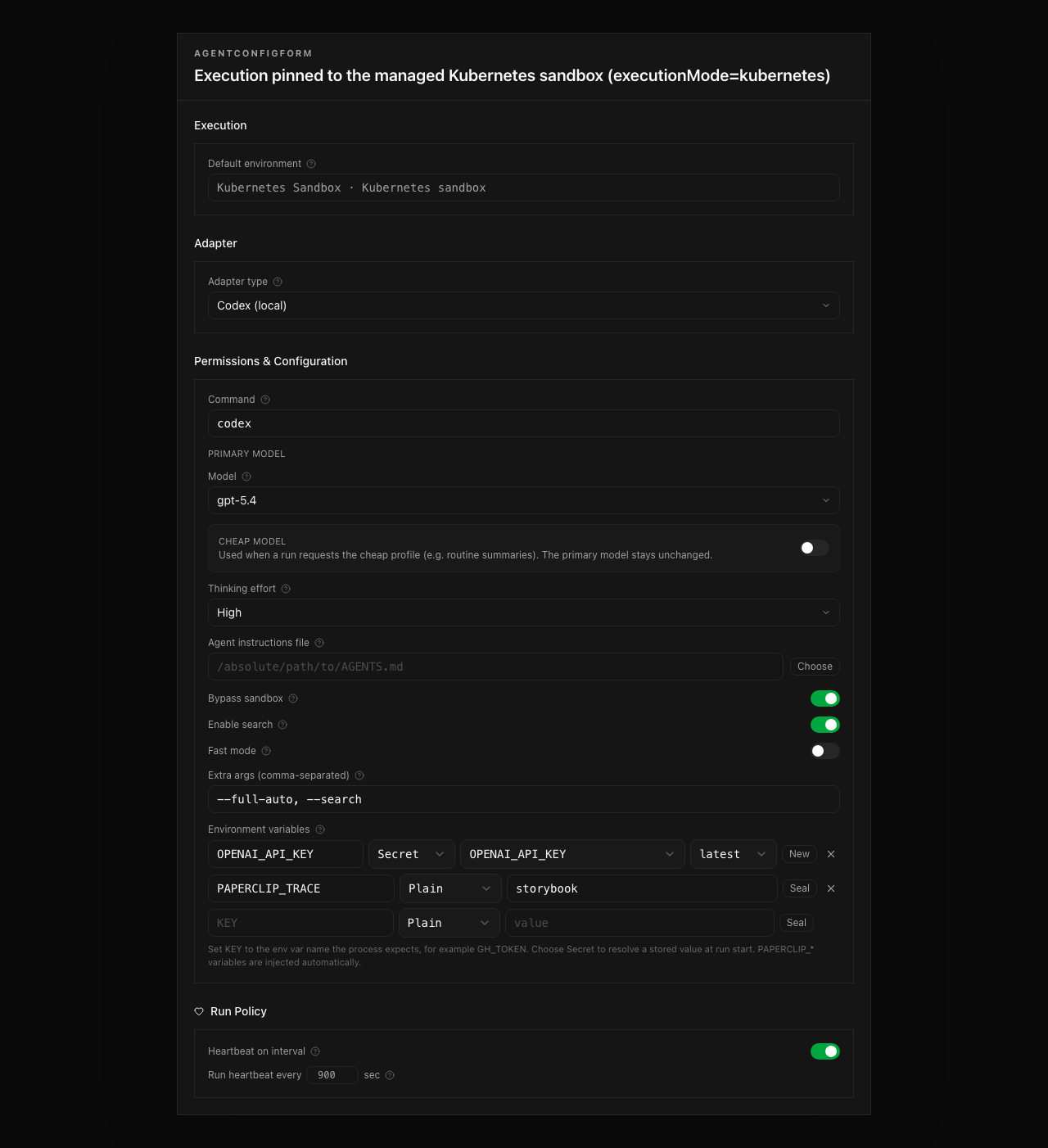 No managed environment available yet (warning notice, no silent local fallback): 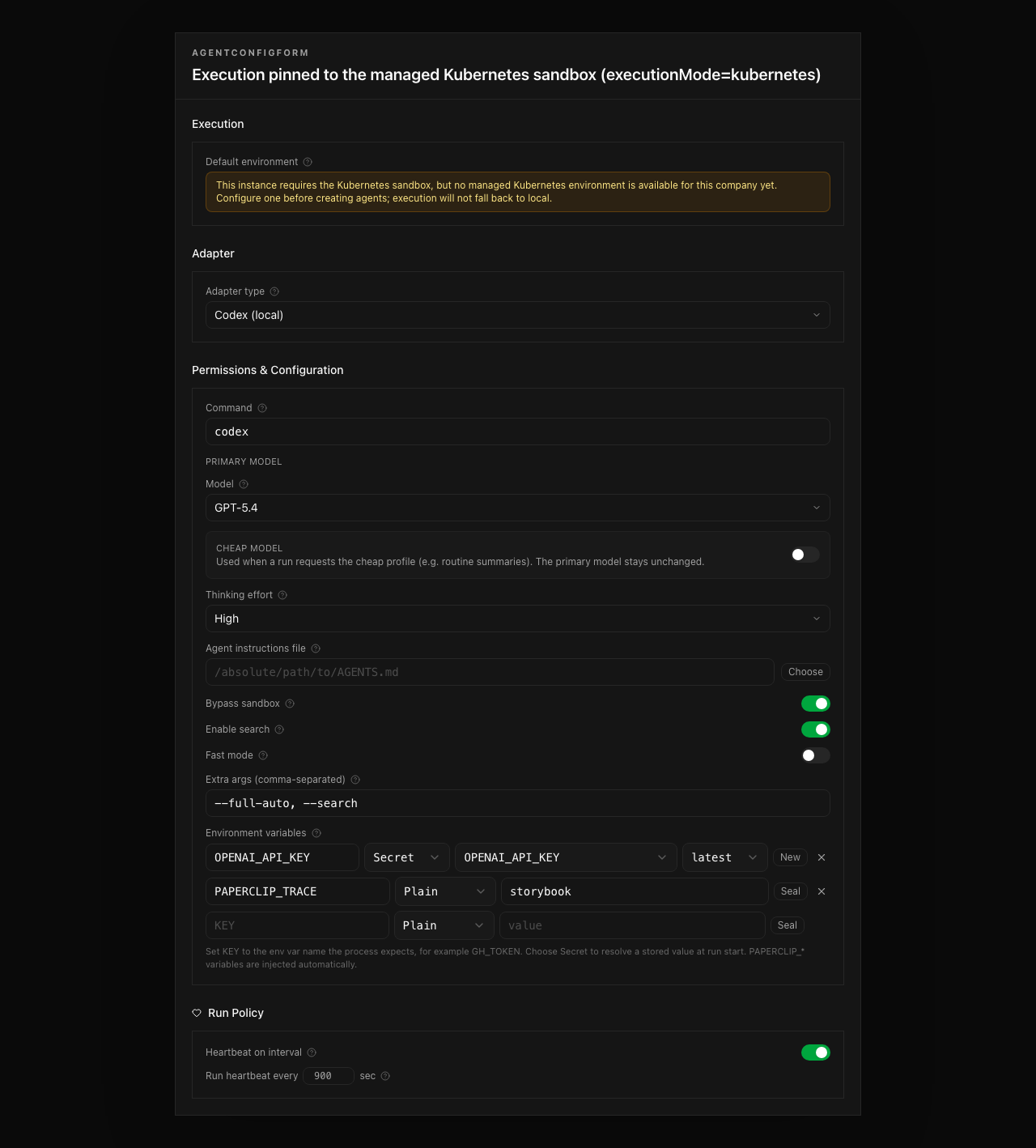 ## Checklist - [x] I have included a thinking path that traces from project context to this change - [x] I have specified the model used (with version and capability details) - [x] I have checked ROADMAP.md and confirmed this PR does not duplicate planned core work - [x] I have searched GitHub for duplicate or related PRs and linked them above - [x] I have either (a) linked existing issues with `Fixes: #` / `Closes #` / `Refs #` OR (b) described the issue in-PR following the relevant issue template - [x] I have run tests locally and they pass - [x] I have added or updated tests where applicable - [x] If this change affects the UI, I have included before/after screenshots - [x] I have updated relevant documentation to reflect my changes - [x] I have considered and documented any risks above - [ ] All Paperclip CI gates are green - [ ] Greptile is 5/5 with no open P2s, recommendations, or follow-ups - [x] I will address all Greptile and reviewer comments before requesting merge 🤖 Generated with [Claude Code](https://claude.com/claude-code) --------- Co-authored-by: Claude Opus 4.8 (1M context) <noreply@anthropic.com> |
||
|
Devin FoleyandPaperclip
|
486fb88a15 |
Add Cloudflare sandbox provider plugin (#5687)
> _Stacked on top of #5685 → #5686. Diff against master includes commits from earlier PRs in the stack — review focuses on the two new commits (`Extend sandbox callback bridge for Worker-hosted plugins` + `Add Cloudflare sandbox provider plugin`)._ ## Thinking Path > - Paperclip orchestrates AI agents for zero-human companies > - Each agent runs in a sandbox environment, and operators choose which provider backs that sandbox — today E2B and Daytona are bundled with the platform > - Cloudflare Workers + Durable Objects + the Sandbox SDK offer a credible new option: globally distributed, cheap idle, and operator-deployable as a single Worker > - To plug it in, Paperclip needs (a) a provider plugin that speaks the `PaperclipPluginManifestV1` lifecycle and (b) a small operator-deployed Worker — the **bridge** — that adapts Paperclip's runtime RPCs to the Cloudflare Sandbox SDK > - The plugin extends the existing sandbox-callback-bridge with a `bridge.transport: "worker"` discriminator so the platform routes runtime RPCs through the Worker bridge instead of the in-process runner > - This pull request adds the plugin, the bridge Worker template, and the supporting adapter-utils + server hooks the new transport needs > - The benefit is that operators can run sandboxes on Cloudflare's edge with no new platform code beyond installing the plugin and deploying the Worker ## What Changed **Shared support (`Extend sandbox callback bridge for Worker-hosted plugins`):** - `packages/adapter-utils/src/sandbox-callback-bridge.{ts,test.ts}`: expose `expectedHostHeader` so plugin-side bridge clients can verify the canonical request envelope before forwarding. - `packages/adapter-utils/src/command-managed-runtime.{ts,test.ts}`: relax the always-fresh runner construction so callers can re-use a runner across exec calls (Worker-hosted bridges hold the runner inside a Durable Object). - `server/src/services/environment-runtime.ts` + `environment-runtime.test.ts`: route Worker-hosted bridges through the same env-shaping path as E2B and pin the `requestEnv` contract. - `server/src/services/plugin-environment-driver.ts`: thread an optional `issueId` through the runtime descriptor so bridges can scope leases to the originating issue (used by Cloudflare to map a sandbox to the issue/workflow for billing and audit). - `packages/plugins/sdk/src/protocol.ts`: add `issueId?` to `PluginEnvironmentDriverBaseParams` and the new `bridge.transport: "worker"` discriminator that the new plugin declares. - `server/__tests__/heartbeat-plugin-environment.test.ts`: pin the heartbeat path against the new runtime descriptor. **The Cloudflare plugin itself (`Add Cloudflare sandbox provider plugin`):** - `packages/plugins/sandbox-providers/cloudflare/`: plugin entry, manifest, plugin runtime (lifecycle + bridge client), config parsing, and Vitest coverage. Manifest declares `bridge.transport: "worker"` so the platform routes runtime RPCs through the bridge client. - `bridge-template/`: a Worker template the operator deploys with `wrangler`. Owns Durable Object-backed sessions (`sessions.ts`), exec/stream routes (`exec.ts`, `routes.ts`), and an HMAC auth layer (`auth.ts`) that pins the `Host` header surface. Includes the SDK-contract-correct exec implementation, lease recovery, and chunked stdout/stderr streaming. - Tests cover lease/session handoff (`bridge-template/src/exec.test.ts`, `routes.test.ts`), bridge client request shaping (`src/bridge-client.test.ts`), and end-to-end plugin behavior (`src/plugin.test.ts`) including streamed exec output. 27 tests in total. - `README.md` walks the operator through deploying the bridge Worker, registering the plugin, and configuring the runtime. ## Verification - `pnpm typecheck` - `pnpm exec vitest run --no-coverage packages/adapter-utils/src/sandbox-callback-bridge.test.ts packages/adapter-utils/src/command-managed-runtime.test.ts server/src/__tests__/environment-runtime.test.ts server/src/__tests__/heartbeat-plugin-environment.test.ts` - `(cd packages/plugins/sandbox-providers/cloudflare && pnpm test)` — 27 passing For an operator-side smoke test: 1. Deploy the bridge: `cd packages/plugins/sandbox-providers/cloudflare/bridge-template && wrangler deploy` 2. Register the plugin in your Paperclip instance, point its bridge URL at the deployed Worker, set the HMAC shared secret. 3. Create a sandbox environment whose provider is `cloudflare`, then run a Codex or Claude job against it. ## Risks - Adds a new `bridge.transport: "worker"` code path, but the existing E2B / Daytona transports go through the same shaped helpers and have explicit test coverage that pins their behavior unchanged. - The Worker bridge stores session state in a Durable Object; operator instances must be aware of the corresponding Cloudflare costs (DO requests, storage). Documented in the README. - The `issueId` plumbing is optional throughout — existing plugins that don't supply it continue to work. ## Model Used - Provider: Anthropic - Model: Claude Opus 4.7 (1M context) - Capabilities used: extended reasoning, tool use (Read/Edit/Bash/Grep) ## Checklist - [x] I have included a thinking path that traces from project context to this change - [x] I have specified the model used (with version and capability details) - [x] I have checked ROADMAP.md and confirmed this PR does not duplicate planned core work - [x] I have run tests locally and they pass - [x] I have added or updated tests where applicable - [ ] If this change affects the UI, I have included before/after screenshots — N/A, no UI change - [x] I have updated relevant documentation to reflect my changes (plugin README, bridge-template README) - [x] I have considered and documented any risks above - [x] I will address all Greptile and reviewer comments before requesting merge --------- Co-authored-by: Paperclip <noreply@paperclip.ing> |
||
|
Devin Foley
|
29401b231b |
fix(ci): gate new release packages on npm bootstrap (#5146)
## Thinking Path > - Paperclip is a control plane for autonomous agent companies, so its release automation is part of the core operator trust boundary. > - The affected subsystem is npm/GitHub Actions release publishing for the public monorepo packages. > - The concrete failure was that a newly added package reached `master`, the canary workflow attempted its first publish, and npm trusted publishing was not yet bootstrapped for that package. > - That means the problem is not just one broken run; it is a missing pre-merge guard that lets release-ineligible packages land and only fail once `publish_canary` runs. > - This pull request makes release enrollment explicit, validates that enrollment in CI, and adds a PR-time bootstrap check against npm for changed release-enabled package manifests. > - The result is that we keep trusted publishing, avoid teaching CI to `npm adduser`, and move this class of failure from post-merge canary time to pre-merge review time. ## What Changed - Added `scripts/release-package-manifest.json` so release-managed public packages are explicitly enrolled instead of being inferred from every non-private workspace package. - Hardened `scripts/release-package-map.mjs` to validate the manifest before release workflows rewrite versions or assemble publish payloads. - Added `scripts/check-release-package-bootstrap.mjs` and wired it into `.github/workflows/pr.yml` so PRs that change a release-enabled package manifest fail if that package does not already exist on npm. - Added release-package manifest coverage tests to `scripts/release-package-map.test.mjs` and included them in `pnpm run test:release-registry`. - Wired manifest validation into `.github/workflows/release.yml` and documented the first-publish bootstrap policy in `doc/PUBLISHING.md` and `doc/RELEASE-AUTOMATION-SETUP.md`. ## Verification - `pnpm run test:release-registry` - `./scripts/release.sh canary --skip-verify --dry-run` - Confirmed the committed diff contains no obvious PII/secrets via targeted pattern scan before pushing. ## Risks - Low risk overall: this is CI/release-policy code, not product runtime logic. - The new PR bootstrap check depends on npm metadata availability, so a transient npm outage could block a PR that changes a release-enabled package manifest. - The manifest introduces a new source of truth that must stay aligned with public package additions, but that is intentional and now enforced. ## Model Used - OpenAI Codex via the `codex_local` Paperclip adapter; GPT-5-based coding agent with tool use, terminal execution, git, and GitHub CLI. Exact served model ID/context window are not exposed by the local runtime. ## Checklist - [x] I have included a thinking path that traces from project context to this change - [x] I have specified the model used (with version and capability details) - [x] I have checked ROADMAP.md and confirmed this PR does not duplicate planned core work - [x] I have run tests locally and they pass - [x] I have added or updated tests where applicable - [x] If this change affects the UI, I have included before/after screenshots - [x] I have updated relevant documentation to reflect my changes - [x] I have considered and documented any risks above - [x] I will address all Greptile and reviewer comments before requesting merge |
||
|
Devin Foley
|
0e51fa2b0d |
Honor reuse-existing preference and assignee default environment in issue runs (#5139)
## Thinking Path > - Paperclip orchestrates AI agents for zero-human companies > - Agents run inside execution workspaces (a per-issue cwd + env), and an issue > can prefer to reuse an existing workspace or get a fresh one each time > - The heartbeat service was reading the existing workspace's config to derive > environment selection regardless of whether the issue actually wanted to reuse > it. So fresh-run issues were inheriting stale config from a workspace that was > about to be discarded > - Separately, when an issue is assigned to an agent, the issue's execution > workspace settings weren't picking up the agent's `defaultEnvironmentId`, > even though the agent's choice is the natural default for that issue > - This PR makes both selection paths honor the obvious source of truth: > workspace config flows only when the issue actually wants `reuse_existing`, > and the assignee agent's default environment is applied at assignment time if > nothing else is set on the issue > - The benefit is that re-running a flaky issue picks up the right environment > instead of inheriting the previous run's config, and assigning an agent to an > issue does the obvious thing without operator intervention ## What Changed - `server/src/services/heartbeat.ts`: introduce `reusableExecutionWorkspaceConfig` that is non-null only when `shouldReuseExisting` is true. Both `resolveExecutionWorkspaceEnvironmentId(...)` and `applyPersistedExecutionWorkspaceConfig(...)` now read from it instead of unconditionally consulting `existingExecutionWorkspace?.config`. Fresh-run issues no longer inherit stale environment config from an in-flight workspace about to be discarded. - `server/src/services/issues.ts`: when an issue update sets a new `assigneeAgentId` and isolated workspaces are enabled, populate `executionWorkspaceSettings.environmentId` from the assignee agent's `defaultEnvironmentId` if the issue doesn't have an explicit `environmentId` set yet. - Tests added in `heartbeat-plugin-environment.test.ts` (~216 lines) and `issues-service.test.ts` (~85 lines) covering both paths. ## Verification - `pnpm --filter @paperclipai/server test -- heartbeat-plugin-environment issues-service` - Manual QA: assign an issue to an agent that has a non-default `defaultEnvironmentId`, confirm the issue's workspace settings now include that environment id without operator intervention. Trigger a rerun on an issue whose existing workspace points at a stale environment, confirm the rerun uses the freshly-resolved environment. ## Risks - Behavioural shift on assignment: previously assigning an agent didn't propagate the agent's default environment to the issue. Now it does. Callers that explicitly want the issue to keep its existing/null environment must set `executionWorkspaceSettings.environmentId` themselves; the new logic only fires when no explicit value is set. - Behavioural shift on rerun: stale workspace config is no longer applied to fresh runs. Operators who relied on this implicit inheritance may see different environment selection on the first rerun after deploy. Mitigation: the explicit isssue settings and project policy are still honored as before. ## Model Used - OpenAI GPT-5.4 (reasoning effort: high) via Codex CLI - Provider: OpenAI - Used to author the code changes in this PR ## Checklist - [x] I have included a thinking path that traces from project context to this change - [x] I have specified the model used (with version and capability details) - [x] I have checked ROADMAP.md and confirmed this PR does not duplicate planned core work - [x] I have run tests locally and they pass - [x] I have added or updated tests where applicable - [ ] If this change affects the UI, I have included before/after screenshots — N/A (no UI changes) - [ ] I have updated relevant documentation to reflect my changes — N/A - [x] I have considered and documented any risks above - [x] I will address all Greptile and reviewer comments before requesting merge |
||
|
Devin Foley
|
70679a3321 |
Add sandbox environment support (#4415)
## Thinking Path > - Paperclip orchestrates AI agents for zero-human companies. > - The environment/runtime layer decides where agent work executes and how the control plane reaches those runtimes. > - Today Paperclip can run locally and over SSH, but sandboxed execution needs a first-class environment model instead of one-off adapter behavior. > - We also want sandbox providers to be pluggable so the core does not hardcode every provider implementation. > - This branch adds the Sandbox environment path, the provider contract, and a deterministic fake provider plugin. > - That required synchronized changes across shared contracts, plugin SDK surfaces, server runtime orchestration, and the UI environment/workspace flows. > - The result is that sandbox execution becomes a core control-plane capability while keeping provider implementations extensible and testable. ## What Changed - Added sandbox runtime support to the environment execution path, including runtime URL discovery, sandbox execution targeting, orchestration, and heartbeat integration. - Added plugin-provider support for sandbox environments so providers can be supplied via plugins instead of hardcoded server logic. - Added the fake sandbox provider plugin with deterministic behavior suitable for local and automated testing. - Updated shared types, validators, plugin protocol definitions, and SDK helpers to carry sandbox provider and workspace-runtime contracts across package boundaries. - Updated server routes and services so companies can create sandbox environments, select them for work, and execute work through the sandbox runtime path. - Updated the UI environment and workspace surfaces to expose sandbox environment configuration and selection. - Added test coverage for sandbox runtime behavior, provider seams, environment route guards, orchestration, and the fake provider plugin. ## Verification - Ran locally before the final fixture-only scrub: - `pnpm -r typecheck` - `pnpm test:run` - `pnpm build` - Ran locally after the final scrub amend: - `pnpm vitest run server/src/__tests__/runtime-api.test.ts` - Reviewer spot checks: - create a sandbox environment backed by the fake provider plugin - run work through that environment - confirm sandbox provider execution does not inherit host secrets implicitly ## Risks - This touches shared contracts, plugin SDK plumbing, server runtime orchestration, and UI environment/workspace flows, so regressions would likely show up as cross-layer mismatches rather than isolated type errors. - Runtime URL discovery and sandbox callback selection are sensitive to host/bind configuration; if that logic is wrong, sandbox-backed callbacks may fail even when execution succeeds. - The fake provider plugin is intentionally deterministic and test-oriented; future providers may expose capability gaps that this branch does not yet cover. ## Model Used - OpenAI Codex coding agent on a GPT-5-class backend in the Paperclip/Codex harness. Exact backend model ID is not exposed in-session. Tool-assisted workflow with shell execution, file editing, git history inspection, and local test execution. ## Checklist - [x] I have included a thinking path that traces from project context to this change - [x] I have specified the model used (with version and capability details) - [x] I have checked ROADMAP.md and confirmed this PR does not duplicate planned core work - [x] I have run tests locally and they pass - [x] I have added or updated tests where applicable - [ ] If this change affects the UI, I have included before/after screenshots - [x] I have updated relevant documentation to reflect my changes - [x] I have considered and documented any risks above - [x] I will address all Greptile and reviewer comments before requesting merge |

