mirror of
https://github.com/paperclipai/paperclip.git
synced 2026-10-29 21:07:40 +01:00
24a7ab22f6fa7d162da55bbbb912f33a8a73c1d2
4
Commits
| Author | SHA1 | Message | Date | |
|---|---|---|---|---|
 DottaandPaperclip |
ebaeba40ee |
feat: simplify agent onboarding and configuration (#13011)
## Thinking Path > - Paperclip is the open source app people use to manage AI agents for work. > - Operators create agents and configure their runtimes in the board UI. > - The old creation flow presents several choices and a large form before an agent can start. > - The existing onboarding controls already provide clear provider connection steps. > - This pull request uses those controls in a new-agent wizard and organizes the full configuration pages. > - Operators can connect, test, save, and assign a first task while keeping the existing configuration tools. ## Linked Issues or Issue Description Related: #10974. That earlier open PR also reorganizes agent configuration. This PR follows the reviewed Storybook designs for agent creation and the current configuration tabs. **What existing behavior does this improve?** Agent creation, provider connection, runtime tests, and full agent configuration. **Current behavior** The creation dialog leads to a large manual configuration form. Provider login controls differ from onboarding. Environment variables and secret access appear in separate places. **Proposed behavior** Choose a name and adapter. Connect Claude or Codex through the existing onboarding controls. Configure and test the runtime, save the agent, and open a task dialog with that agent assigned. Use the same design on the existing configuration tabs. **Reason and benefit** The first setup asks for fewer decisions. The full editor keeps instructions, skills, runtime controls, secret access, permissions, keys, and revisions available in clear sections. **Breaking changes** The board creation and configuration layouts change. The test-environment API adds an optional, allowlisted `testCredentials` field for one-shot probes. Database contracts stay the same. Native ACPX tests now reject unsupported local platforms before a CLI login can mask the runtime restriction. ## What Changed - Added a new-agent wizard with numbered steps, adapter branding, provider connections, editable model choices, runtime tests, and confirmation. - Added Codex app-server, Claude ACPX, and OpenCode runner choices. - Stored API credentials through existing secret APIs and persisted references in agent configuration. New setup keys are isolated from credentials used by existing agents. - Preserved external-agent invitations beside the wizard, including optional messages, one-time prompts, and clipboard fallback. - Added OpenRouter provider and secret bindings for Pi and OpenCode. - Added adapter-specific prerequisite fields for Cursor, Gemini, Kimi, and Hermes. Cursor Cloud keys are saved as new organization secrets. - Fixed Cursor Cloud repository field mapping, omitted empty remote environment values, and added useful model and repository error messages. - Preserved complete MCP assignments when multiple valid profiles contain more than 250 tools in total. Generated profiles retain exact tool selectors. - Added service branding and deployment-aware adapter choices. Cloud setup offers Claude, Codex, and OpenCode; local native runners require the experimental setting. - Made the agent list responsive at intermediate widths. - Applied the reviewed design to the real agent configuration pages. Kept the instruction editor, skills, and existing mutations. - Combined secret access and environment variables under one Save and Discard action. - Added interactive Storybook screens for setup, configuration, confirmation, authentication, and test results. - Fixed Pi provider-error parsing and thinking-effort persistence. Native ACPX validates Linux x64 on the actual local, SSH, or sandbox target. - Redacted the complete transient probe-credential field from HTTP error logs, including rejected provider names. ## Verification - Current head `df0292fe6` has a fresh Greptile 5/5 review with no unresolved findings. All 31 executed CI checks passed, including the aggregate verification gate and all browser E2E shards. Storybook visual regression is skipped by its workflow; the local Storybook build passed. - Browser tests completed real assigned tasks with direct Codex, Claude, OpenCode, Pi, and native Codex. - Verified external-agent invitation generation and automatic prompt copying in the live browser. - Pi and OpenCode used an existing OpenRouter secret. Browser checks covered save and reload, instruction edits, skill selection, environment-variable Save and Discard, and assigned task creation. - Invalid Claude API credentials remained on the connection step with an error. A live Pi/OpenRouter invalid-key probe returned a provider failure and left the user-secret inventory unchanged (zero entries before and after). - Full workspace typecheck and build passed after rebasing onto current master. After review fixes, server and UI typechecks, token gates, and the full build passed again. Storybook built successfully. - All 5,542 local UI tests passed. The Cursor Cloud and Pi adapter regressions passed all 24 tests. Review regressions passed 69 server tests and all 18 agent-list tests. - The local full test command ran 6,971 general server tests successfully. Editing review fixes during that long run caused nine tests to use stale modules; fresh isolated runs passed. An unrelated embedded-Postgres fixture hit the host shared-memory limit; its 15 affected tests passed when the fixture groups ran separately. - Local workspace groups passed after rerunning 18 CLI tests sequentially to avoid host database limits and parallel-load timeouts. The local full command stopped at the general server phase, so serialized server verification comes from the five passing CI shards. - Browser testing at 390px confirmed that the agent action menu opens and the page has no horizontal overflow. CI browser E2E shards passed. - Review the `Onboarding / New agent` and `Agents / Configuration refresh` Storybook groups. In the real app, create an agent, run its connection test, save it, assign a task, and reload its configuration. ## Risks - This changes the main agent setup and configuration UI. Regression tests cover routing, persistence, secret bindings, and form actions. - Native Claude ACPX requires Linux x64. Direct Claude works on macOS. Remote checks execute a bounded platform probe and reject unsupported or unverified targets. - A native OpenCode task reached the provider context limit because of its tool payload. Its provider connection test passed. Direct OpenCode completed a task. This existing native execution limit is not fixed here. - Claude and Codex connection keys use the existing user-secret store. Other runtime setup keys use distinct organization secrets. Existing credentials are never rotated. Probes do not store entered keys. Failed agent creation removes newly staged credentials. - Cursor Cloud has not completed a live task. Its authenticated account still needs GitHub repository access. The live run passed MCP provisioning, remote environment validation, and explicit Auto model selection before the repository prerequisite blocked execution. - Generated runtime MCP profiles can exceed the public profile-edit request limit. They still contain exact catalog selectors and preserve permission boundaries. - No database migration, dependency, lockfile, or workflow changes are included. ## Model Used OpenAI Codex, based on GPT-6, with reasoning, repository tools, shell execution, and browser automation. The runtime did not expose the exact model ID or context window size. ## Checklist - [x] I have included a thinking path that traces from project context to this change - [x] I have specified the model used (with version and capability details) - [x] I have checked ROADMAP.md and confirmed this PR does not duplicate planned core work - [x] I have searched GitHub for duplicate or related PRs and linked them above - [x] I have either (a) linked existing issues with `Fixes: #` / `Closes #` / `Refs #` OR (b) described the issue in-PR following the relevant issue template - [x] I have not referenced internal/instance-local Paperclip issues or links (only public GitHub `#NNN` / `github.com/paperclipai/paperclip` URLs) - [x] My branch name describes the change (e.g. `docs/...`, `fix/...`) and contains no internal Paperclip ticket id or instance-derived details - [x] I have run tests locally and they pass - [x] I have added or updated tests where applicable - [x] I have updated relevant documentation to reflect my changes - [x] I have considered and documented any risks above - [x] All Paperclip CI gates are green - [x] Greptile is 5/5 with no open P2s, recommendations, or follow-ups - [x] I will address all Greptile and reviewer comments before requesting merge --------- Co-authored-by: Paperclip <noreply@paperclip.ing> |
||
|
Dotta
|
1955b0e2d8 |
Gate Paperclip Runner setup behind an experimental flag (#12656)
## Thinking Path > - Paperclip is the open source app people use to manage AI agents for work. > - Agent adapters control how Paperclip starts and resumes an agent runtime. > - Paperclip Runner is an experimental Rust runtime and must stay opt-in. > - The server already rejected new runner selections when the flag was off. > - Some setup and onboarding views did not enforce the same boundary. > - This pull request exposes the existing flag and applies it to every new setup path. > - The benefit is a safe rollout with unchanged legacy onboarding and recoverable existing native runs. ## Linked Issues or Issue Description **What existing behavior does this improve?** This improves experimental adapter selection in Settings, onboarding, new-agent setup, invite setup, and company import. **Subsystem affected** Cross-cutting: the React UI and the server onboarding seed service. **Current behavior** The server defaulted Paperclip Runner to off, but Settings did not expose the flag. First-run onboarding could show the runner after opt-in. A direct new-agent URL and some setup pickers could also reveal native runner configuration before the availability check completed. **Proposed behavior** Settings has a default-off Paperclip Runner toggle. Explicit agent configuration shows the runner only after the server reports that the flag is enabled. First-run and invite onboarding always use legacy adapters. Existing native agents and runs remain readable and recoverable. **Reason and benefit** This keeps the experimental runtime out of normal onboarding. It also gives administrators one clear opt-in before users can create a native runner agent. **Breaking changes** None. Legacy adapter selection and execution stay unchanged. Existing native records remain available. ## What Changed - Added the Paperclip Runner opt-in to Experimental Settings. - Refreshed adapter availability after the setting changes. - Kept UI and server-seeded onboarding on legacy adapters. - Made native runner choices fail closed in new-agent, invite, and import setup. - Preserved edit and recovery behavior for existing native agents and runs. - Added focused regression tests for flag-off and flag-on behavior. ## Verification - GitHub Actions will run the repository test, typecheck, build, and policy gates. - Focused tests cover Settings, onboarding, agent creation, invite setup, import setup, and server-seeded onboarding. - No local test suite was run, per the maintainer request to use GitHub Actions for verification. - `git diff --check` passes. ## Risks Low risk. The change narrows new adapter selection only. The server remains the final enforcement point. Existing native records do not depend on the current flag value for read or recovery behavior. > For core feature work, check [`ROADMAP.md`](ROADMAP.md) first and discuss it in `#dev` before opening the PR. Feature PRs that overlap with planned core work may need to be redirected — check the roadmap first. See `CONTRIBUTING.md`. ## Model Used OpenAI Codex, GPT-5, with reasoning, tool use, and code execution. ## Checklist - [x] I have included a thinking path that traces from project context to this change - [x] I have specified the model used (with version and capability details) - [x] I have checked ROADMAP.md and confirmed this PR does not duplicate planned core work - [x] I have searched GitHub for duplicate or related PRs and linked them above - [x] I have either (a) linked existing issues with `Fixes: #` / `Closes #` / `Refs #` OR (b) described the issue in-PR following the relevant issue template - [x] I have not referenced internal/instance-local Paperclip issues or links (only public GitHub `#NNN` / `github.com/paperclipai/paperclip` URLs) - [x] My branch name describes the change (e.g. `docs/...`, `fix/...`) and contains no internal Paperclip ticket id or instance-derived details - [ ] I have run tests locally and they pass - [x] I have added or updated tests where applicable - [x] I have updated relevant documentation to reflect my changes - [x] I have considered and documented any risks above - [x] All Paperclip CI gates are green - [ ] Greptile is 5/5 with no open P2s, recommendations, or follow-ups - [x] I will address all Greptile and reviewer comments before requesting merge |
||
|
scotttong
|
4d82f5eaea | copy: unify user-facing "company" wording to "organization" (#12243) | ||
|
Aron Prins
|
897cc322c7 |
Improve external agent invite flow (#6183)
## Thinking Path > - Paperclip orchestrates AI agents for zero-human companies. > - Agent creation can happen through local runtimes, managed runtimes, and external agents that onboard through invites. > - The old OpenClaw-oriented invite UX lived under company settings/invites and made a gateway-specific path look like a company access setting. > - That hid the broader bring-your-own-agent flow and forced operators to leave the add-agent modal when adding an external agent. > - This pull request moves external agent invite generation into the add-agent modal and makes the copy agent-oriented instead of OpenClaw-only. > - The benefit is a clearer agent-first onboarding path while company invites stay focused on human access. ## What Changed - Added an external-agent invite branch to the add-agent modal, including a dedicated prompt result view with Back navigation. - Added a shared agent onboarding prompt builder and focused modal coverage for prompt replacement/back navigation. - Removed the agent invite prompt UI from Company Settings and Company Invites, leaving Company Invites focused on human access links and invite history. - Updated the hidden OpenClaw Gateway runtime hint to direct operators to the add-agent invite flow instead of presenting it as a blocked runtime card. - Updated invite/onboarding docs, storybook coverage, and server-side onboarding copy toward generic agent language while preserving existing gateway compatibility. ## Verification - `pnpm -r typecheck` - `pnpm build` - `FAKE_BIN="$(mktemp -d)/bin"; mkdir -p "$FAKE_BIN"; printf '#!/bin/sh\nexit 1\n' > "$FAKE_BIN/tailscale"; chmod +x "$FAKE_BIN/tailscale"; PATH="$FAKE_BIN:$PATH" pnpm test:run` - `pnpm test:run` without the fake `tailscale` shim was also attempted; it failed only in two pre-existing CLI tailnet fallback tests because this host has a real Tailscale address (`100.125.202.3`) where those tests expect no Tailscale. - Focused confirmation for that host-env issue: `FAKE_BIN=... PATH="$FAKE_BIN:$PATH" pnpm exec vitest run --project paperclipai cli/src/__tests__/network-bind.test.ts cli/src/__tests__/onboard.test.ts` - Manual UI verification: served UI locally in light mode, opened add-agent modal, generated external agent prompt, verified the generated prompt replaces the form and Back returns to the form. ### Screenshots 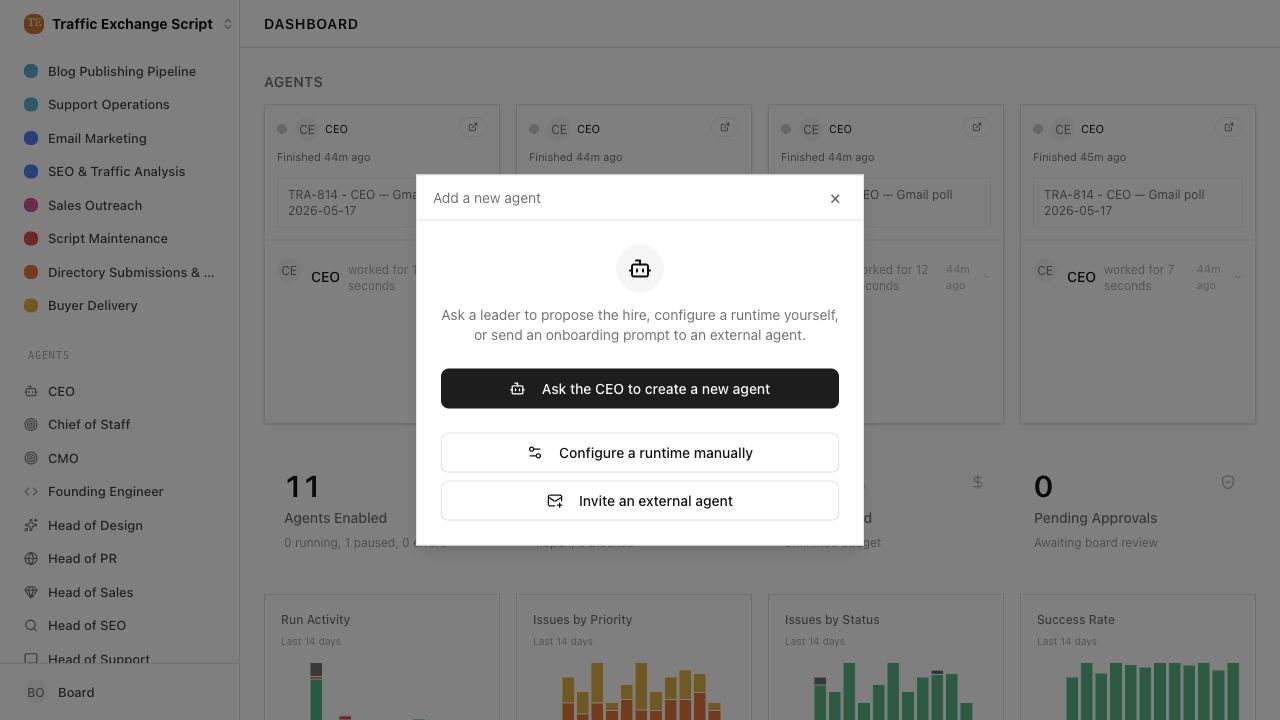 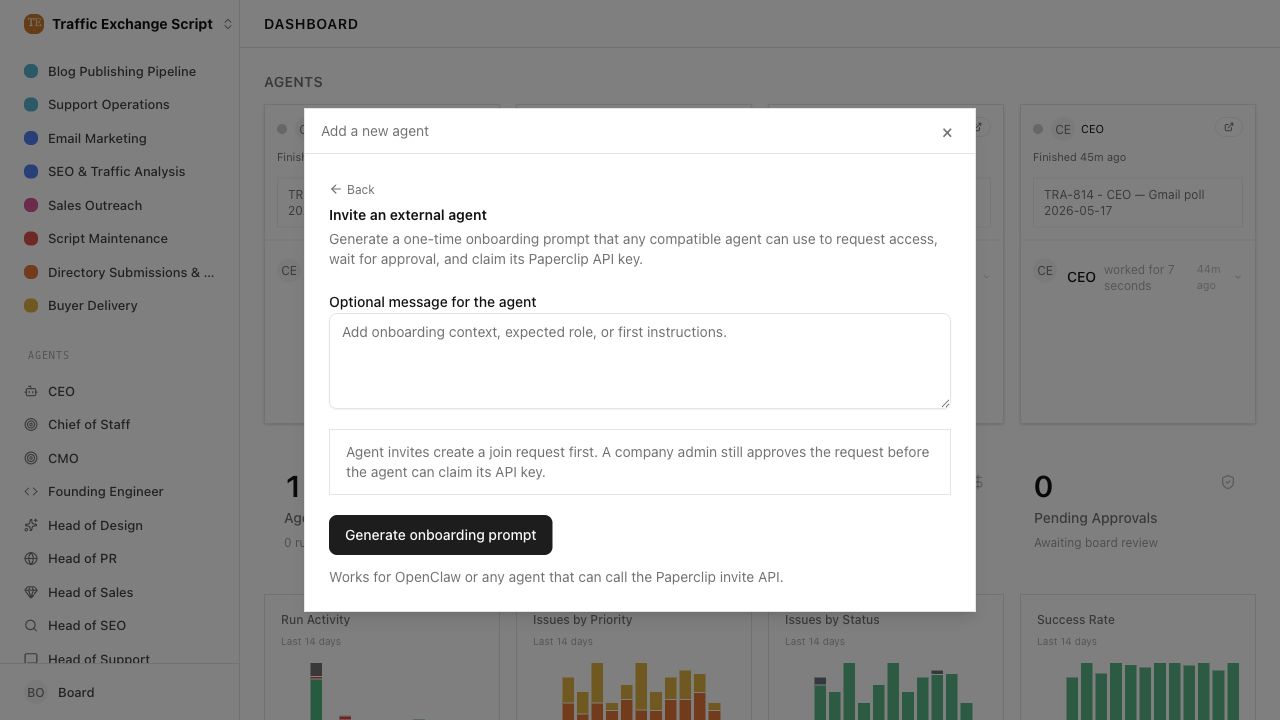 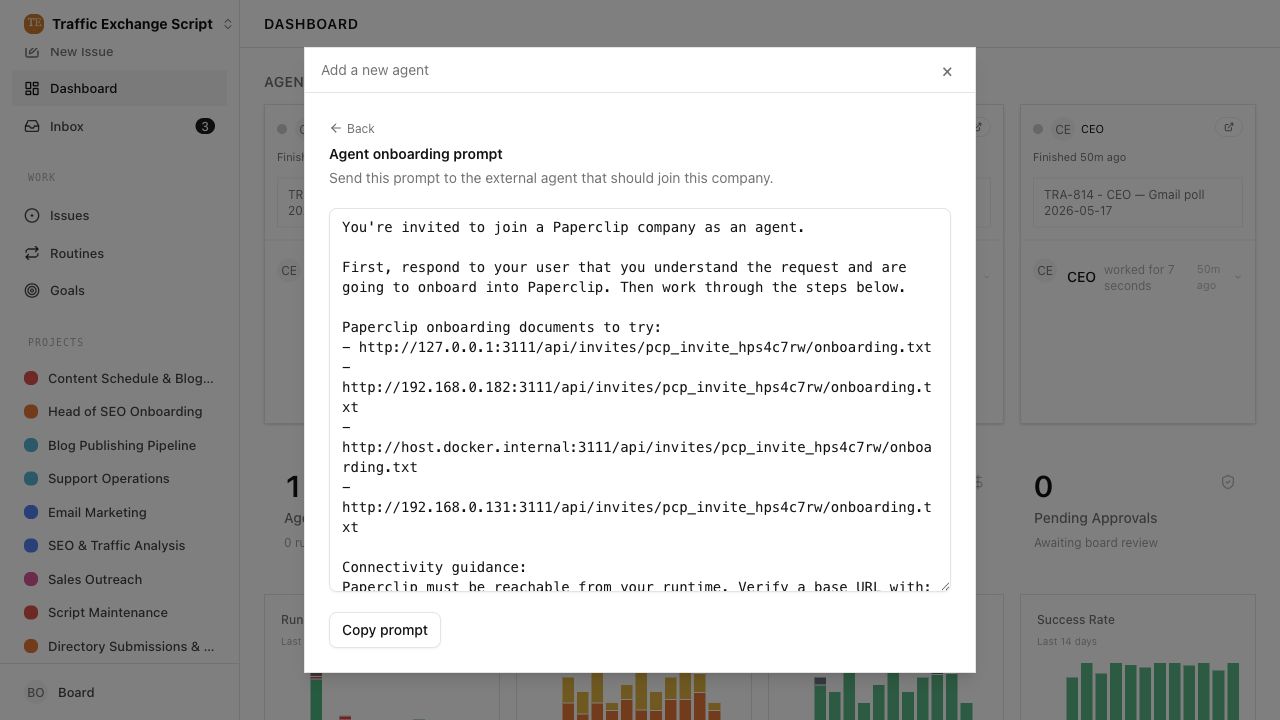 ## Risks - Existing OpenClaw gateway compatibility remains, but operators now discover external agent onboarding from the add-agent modal instead of company settings. - Agent invites still appear in the invite history table, so that page may show agent-scoped invite rows even though it no longer creates agent onboarding prompts. - Low migration risk: no schema changes. > For core feature work, check [`ROADMAP.md`](ROADMAP.md) first and discuss it in `#dev` before opening the PR. Feature PRs that overlap with planned core work may need to be redirected — check the roadmap first. See `CONTRIBUTING.md`. ## Model Used - OpenAI Codex, GPT-5 coding agent in Codex desktop; tool-enabled repository, shell, browser, and GitHub workflow. Context window size was not exposed by the runtime. ## Checklist - [x] I have included a thinking path that traces from project context to this change - [x] I have specified the model used (with version and capability details) - [x] I have checked ROADMAP.md and confirmed this PR does not duplicate planned core work - [x] I have run tests locally and they pass - [x] I have added or updated tests where applicable - [x] If this change affects the UI, I have included before/after screenshots - [x] I have updated relevant documentation to reflect my changes - [x] I have considered and documented any risks above - [x] I will address all Greptile and reviewer comments before requesting merge |


