mirror of
https://github.com/paperclipai/paperclip.git
synced 2026-10-13 13:38:01 +02:00
1ead554bd18a46cb4635583f61aa53b6ee83a9c0
15
Commits
| Author | SHA1 | Message | Date | |
|---|---|---|---|---|
 DottaandPaperclip DottaandPaperclip
|
24429024e7 |
feat: add Fireflies connector and summary-ready routines (#13890)
## Thinking Path > - Paperclip is the open source app people use to manage AI agents for work. > - Apps gives agents governed access to external tools through stored credentials. > - Routines start work when an external service sends an event. > - Fireflies provides meeting transcripts and summaries through an official hosted MCP server. > - This PR adds that connection and accepts signed meeting events through the shared app webhook flow. > - Agents can review completed meetings with the same permissions and audit records as other work. ## Linked Issues or Issue Description **Problem or motivation** Operators need agents to read Fireflies meetings and start follow-up work when a summary is ready. The Apps catalog lacks Fireflies. The shared app webhook flow needs to accept its signed deliveries. **Proposed solution** Use the official Fireflies MCP endpoint with OAuth or a vaulted bearer API key. Extend the existing Another app or script flow with signed webhook support. Verify the raw-body signature and pass the JSON payload as external data. Select Meeting Summarized in Fireflies. Deduplicate identical signed deliveries, including setup deliveries. **Alternatives considered** A separate REST connector would duplicate the governed MCP path. Polling, legacy V1 payloads, and automatic provider-side webhook registration are outside this change. **Roadmap alignment** This extends the existing MCP Tool Gateway & Apps and Scheduled Routines surfaces. It adds a provider to those systems. It does not introduce a second integration framework. **Additional context** A GitHub search found no existing Fireflies issues or PRs. Provider references and verification limits are in `doc/connections/FIREFLIES.md`. ## What Changed - Add the official Fireflies catalog definition, generated registry, provider evidence, and branded artwork. - Reuse Access → Connect, dynamic discovery, Permissions, vault storage, policy, and audit behavior. - Classify Fireflies sharing, movement, and access revocation as writes. - Preserve Off and Ask first restrictions during OAuth reauthorization and API-key replacement. New actions retain normal defaults. - Add `app_webhook` authentication to the shared Another app or script flow. Accept bearer tokens or raw-body HMAC-SHA256. Preserve earlier `fireflies_hmac` triggers and revision snapshots for compatibility. Existing text columns need no migration. - Verify `X-Hub-Signature` or `X-Hub-Signature-256` against the exact request body. Preserve generic event payloads and deduplicate identical signed requests. - Keep the routine wizard generic. Show one webhook URL and secret in Another app or script. Keep all new app webhook event names provider-neutral. Keep provider setup instructions in the connector documentation. - Pass generic webhook JSON to the task in an explicit external-data block, capped at 16,384 characters. Keep strict meeting validation for existing legacy Fireflies triggers. ## Verification - Feature implementation commit `0882dc8a1`: all 54 CI checks passed; two conditional Storybook checks skipped. This includes full tests, typecheck, build, browser E2E, canary dry run, and security checks. Greptile rated this commit 5/5; all review threads are resolved. - Full local `pnpm -r typecheck`, `pnpm build`, and token gates passed on the final code. Targeted connector, gateway, webhook, revision, and UI suites passed during implementation. After the provider-neutral follow-up, all 84 app-webhook and routine-service tests passed; the final payload-to-task assertion also passed in the 72-test routine suite and a clean-config rerun. - The long local `pnpm test:run` invocation started before the final edits and was stopped after the final-commit CI suites passed. It reported one generic webhook test failure while those files were changing; that test and the entire routine suite passed on the final source, including a clean-config reproduction. The interrupted local run is not counted as a full-suite pass. - In the embedded browser, completed official OAuth consent and discovered 20 live actions. Real meeting listing, transcript retrieval, and summary/action-item retrieval succeeded as the selected agent. Turning a live read Off blocked its test; catalog refresh preserved the restriction. - Embedded-browser Another app or script setup, back/save/resume, narrow layout, and a signed synthetic Fireflies delivery succeeded. The UI reported authentication passed without creating a task. Fixtures cover signature tampering, malformed requests, ordinary app event names, duplicate/setup deliveries, rotation, revisions, pause/archive, and company isolation. - Existing MCP browser suite: 8 passed and 2 provider-dependent cases skipped. Branding checks passed; connector artwork and webhook setup were checked at desktop/mobile widths and in light/dark modes. - An unauthenticated POST to a correctly formatted public webhook URL reached the staging tenant verifier through the existing Cloud gateway. - A real Fireflies webhook delivery remains unverified. A staging callback is available for the operator walkthrough. Live API-key authorization, credential expiry, and a new meeting's summary completion were not tested against the provider. Fixtures cover these protocol and lifecycle paths where applicable. - Storybook follow-up `c54174faa`: 27 production-component stories cover every UI change, with a source-to-story map in the connector documentation. Static Storybook build, UI typecheck, token gates, and Playwright checks for all stories and the mobile footer pass. All PR checks passed for this Storybook follow-up; Greptile reviewed `c54174faa` at 5/5. ## Risks - Fireflies may change its hosted MCP tools or OAuth behavior. Tool discovery stays dynamic. Experimental search/fetch tools are not required. - Public webhook setup requires HTTPS and a separate signing secret. Fireflies normally emits events for meetings owned by the configuring account. - Reauthorization touches shared MCP permission code. Regression tests cover existing restrictions, new actions, connection removal, and other gateway callers. - Webhook receipt grants no tool access. The routine agent still needs an authorized Fireflies connection. - New generic triggers rely on provider event subscriptions. Without a sender-supplied idempotency key, changed request bytes count as a new event. Existing legacy Fireflies triggers retain summary-only filtering and per-meeting deduplication. ## Model Used OpenAI Codex, model `gpt-6-astra`. Used reasoning, repository editing, code execution, and embedded-browser testing. The runtime did not expose a context-window size. ## Checklist - [x] I have included a thinking path that traces from project context to this change - [x] I have specified the model used (with version and capability details) - [x] I have checked ROADMAP.md and confirmed this PR does not duplicate planned core work - [x] I have searched GitHub for duplicate or related PRs and linked them above - [x] I have either (a) linked existing issues with `Fixes: #` / `Closes #` / `Refs #` OR (b) described the issue in-PR following the relevant issue template - [x] I have not referenced internal/instance-local Paperclip issues or links (only public GitHub `#NNN` / `github.com/paperclipai/paperclip` URLs) - [x] My branch name describes the change (e.g. `docs/...`, `fix/...`) and contains no internal Paperclip ticket id or instance-derived details - [x] I have run tests locally and they pass - [x] I have added or updated tests where applicable - [x] I have updated relevant documentation to reflect my changes - [x] I have considered and documented any risks above - [x] All Paperclip CI gates are green - [x] Greptile is 5/5 with no open P2s, recommendations, or follow-ups - [x] I will address all Greptile and reviewer comments before requesting merge --------- Co-authored-by: Paperclip <noreply@paperclip.ing> |
||
|
DottaandPaperclip
|
da257c3069 |
Warn when routine webhook URLs may not be publicly reachable (#13684)
## Thinking Path > - Paperclip helps people manage AI agents and their work. > - Routines can start that work when another app sends a webhook. > - Local and private URLs often cannot receive events from public services. > - HTTPS alone does not make a Tailscale address public. > - This pull request explains these limits during setup and editing. > - Users can still finish setup for senders on their own network. ## Linked Issues or Issue Description Refs #13637. Webhook setup needs a clear warning when the generated URL appears local, private, or unencrypted. The warning must explain how to make the endpoint reachable without blocking private-network use. ## What Changed - Add a shared warning banner to the Connect, Check connection, and Edit webhook views. - Distinguish localhost, private network addresses and domains, HTTP, and Tailscale hostnames. - Explain the difference between Tailscale Serve and Funnel. Link to the Paperclip HTTPS guide. - Add five full-page Storybook examples, design guide examples, and documentation. - Add URL classification tests and a regression test that finishes setup despite the warning. ## Verification - Passed 41 focused URL and trigger-flow tests. - Passed workspace typecheck, workspace build, token gates, and Storybook build. - Browser-tested the Tailscale story through Check connection, Finish setup, and Edit webhook. The warning stays visible and does not block setup. - Open Product / Routines / Webhooks stories 11–15 to review the warning states. - All 54 PR checks passed, including the full test matrix and eight browser shards; two optional Storybook jobs were skipped by workflow policy. - The server supervisor readiness test timed out once in CI, then passed on rerun and locally (6 tests). - The duplicate local full-suite run was stopped after the complete CI matrix passed. - Greptile: 5/5 on the current commit, with no unresolved review comments. ## Risks - URL checks are hints. They do not test DNS, firewall rules, or actual reachability. - A Tailscale hostname can serve either private Serve traffic or public Funnel traffic. The warning explains this uncertainty and permits both. - No API, schema, authentication, or webhook delivery behavior changes. ## Model Used OpenAI Codex, based on GPT-6, with reasoning, repository tools, shell execution, and browser testing. The exact deployment model ID and context window size are not exposed in this session. ## Checklist - [x] I have included a thinking path that traces from project context to this change - [x] I have specified the model used (with version and capability details) - [x] I have checked ROADMAP.md and confirmed this PR does not duplicate planned core work - [x] I have searched GitHub for duplicate or related PRs and linked them above - [x] I have either (a) linked existing issues with `Fixes: #` / `Closes #` / `Refs #` OR (b) described the issue in-PR following the relevant issue template - [x] I have not referenced internal/instance-local Paperclip issues or links (only public GitHub `#NNN` / `github.com/paperclipai/paperclip` URLs) - [x] My branch name describes the change (e.g. `docs/...`, `fix/...`) and contains no internal Paperclip ticket id or instance-derived details - [x] I have run tests locally and they pass - [x] I have added or updated tests where applicable - [x] I have updated relevant documentation to reflect my changes - [x] I have considered and documented any risks above - [x] All Paperclip CI gates are green - [x] Greptile is 5/5 with no open P2s, recommendations, or follow-ups - [x] I will address all Greptile and reviewer comments before requesting merge Co-authored-by: Paperclip <noreply@paperclip.ing> |
||
|
DottaandPaperclip
|
f589660ec0 |
feat(routines): add safe webhook setup and in-routine run management (#13637)
## Thinking Path > - Paperclip is the open source app people use to manage AI agents for work. > - Routines turn scheduled work and external events into tasks for an assigned agent. > - Webhook setup was disabled, and actor authentication rejected valid webhook bearer keys. > - Operators need to connect and test a sending app before events can start work. > - This pull request adds a guided setup with durable connection tests that cannot dispatch a task. > - It keeps trigger management, execution tasks, and activity within the routine. > - The benefit is a webhook that can be configured, verified, and operated from one place. ## Linked Issues or Issue Description Fixes #11937. Related: #13216 adds provider-specific Sentry support. This PR addresses general routine setup and ingress. #6841 addresses legacy secret bindings; this PR retains the existing secret service. **Current behavior** Webhook creation is disabled. Bearer deliveries can fail in agent authentication before the routine checks its key. Setup has no safe connection test. Runs and Activity send the operator away from the routine. **Proposed behavior** Choose a schedule or a webhook. Follow the setup steps, copy credentials or complete agent instructions, and test delivery without creating work. Finish setup to allow future events to start tasks. Edit or remove compact trigger cards, undo removal, and inspect tasks and activity inside the routine. **Reason and benefit** An operator can verify credentials and delivery before enabling automatic work. Durable setup state survives refreshes and restarts. Retry receipts prevent an old test event from starting work after activation. ## What Changed - Add a production trigger wizard using reusable Slack setup navigation and footer components. - Add schedule and webhook choices, one-time credentials, agent instructions, and live connection feedback. - Persist pending setup, test delivery receipts, connection status, and reversible trigger removal. - Keep setup checks free of routine runs, tasks, and agent wakeups. Preserve delivery idempotency after activation. - Add compact trigger cards, inline editing, key rotation, pause controls, removal, and Undo. - Keep Runs and Activity in the routine. Use the shared task list and compact activity rows. - Permit only exact public delivery POSTs through actor authentication. Retain webhook authentication, JSON-object validation, and log redaction. - Add production-backed Storybook states and focused server, database, and UI coverage. - Document signing modes, setup checks, retries, rotation, HTTPS ingress, and navigation. ## Verification - Full workspace typecheck, build, and token gates passed on the rebased branch. Storybook also builds. - Focused routine, middleware, logging, shared wizard, and UI coverage passes on the rebased branch: 195 tests across 14 files. The migration passed on a fresh PostgreSQL database and on two repeated applications. - Browser testing used the real app, database, and a deterministic process worker through Tailscale HTTPS and the current Cloud proxy code. - Verified rejected keys, safe setup deliveries, persisted state after restart, activation, retry deduplication, key rotation, schedule editing, removal, and Undo. - Fresh bearer and GitHub-signed deliveries created tasks that the worker checked out and completed. Runs and Activity stayed within the routine. - Current Cloud ingress tests passed. Public delivery POSTs passed through without a browser session; management routes remained gated. - All 54 current-head PR checks pass, including general and serialized tests, all eight browser E2E shards, typecheck, build, runner checks, security checks, and the canary dry run. Two optional Storybook jobs are skipped by workflow conditions. - Greptile is 5/5 on commit `7ea63a61e`, with no unresolved review threads. The stale connection-status finding is fixed and covered by a regression test. - No production deployment was performed. ## Risks - Migration 0281 adds three trigger columns and a test-receipt table. It is additive and safe to reapply. Apply it before running the new server. Existing triggers remain live by default. - Requests without delivery IDs are new events after activation. Senders must reuse an event's delivery ID for retries. - Completed webhooks keep normal dispatch behavior. Their management connection check can start work; the UI states this. - Removing a trigger archives it. Undo restores the URL and credentials. Permanent deletion remains available through the existing API. - Public ingress must remain restricted to the delivery POST route. The tenant verifies credentials. Cloud sleeping-stack behavior is unchanged. - Shared setup components also serve Slack. Existing setup contracts and navigation tests cover that integration. - Senders must use application/json with an object. Other media types receive 415. ## Model Used OpenAI Codex, based on GPT-6, with reasoning, repository tools, shell execution, and browser testing. The exact deployment model ID and context-window size are not exposed in this session. ## Checklist - [x] I have included a thinking path that traces from project context to this change - [x] I have specified the model used (with version and capability details) - [x] I have checked ROADMAP.md and confirmed this PR does not duplicate planned core work - [x] I have searched GitHub for duplicate or related PRs and linked them above - [x] I have either (a) linked existing issues with `Fixes: #` / `Closes #` / `Refs #` OR (b) described the issue in-PR following the relevant issue template - [x] I have not referenced internal/instance-local Paperclip issues or links (only public GitHub `#NNN` / `github.com/paperclipai/paperclip` URLs) - [x] My branch name describes the change (e.g. `docs/...`, `fix/...`) and contains no internal Paperclip ticket id or instance-derived details - [x] I have run tests locally and they pass - [x] I have added or updated tests where applicable - [x] I have updated relevant documentation to reflect my changes - [x] I have considered and documented any risks above - [x] All Paperclip CI gates are green - [x] Greptile is 5/5 with no open P2s, recommendations, or follow-ups - [x] I will address all Greptile and reviewer comments before requesting merge --------- Co-authored-by: Paperclip <noreply@paperclip.ing> |
||
|
|
1ef3b08714 |
feat(ui): integrate agent personas across the app (#13171)
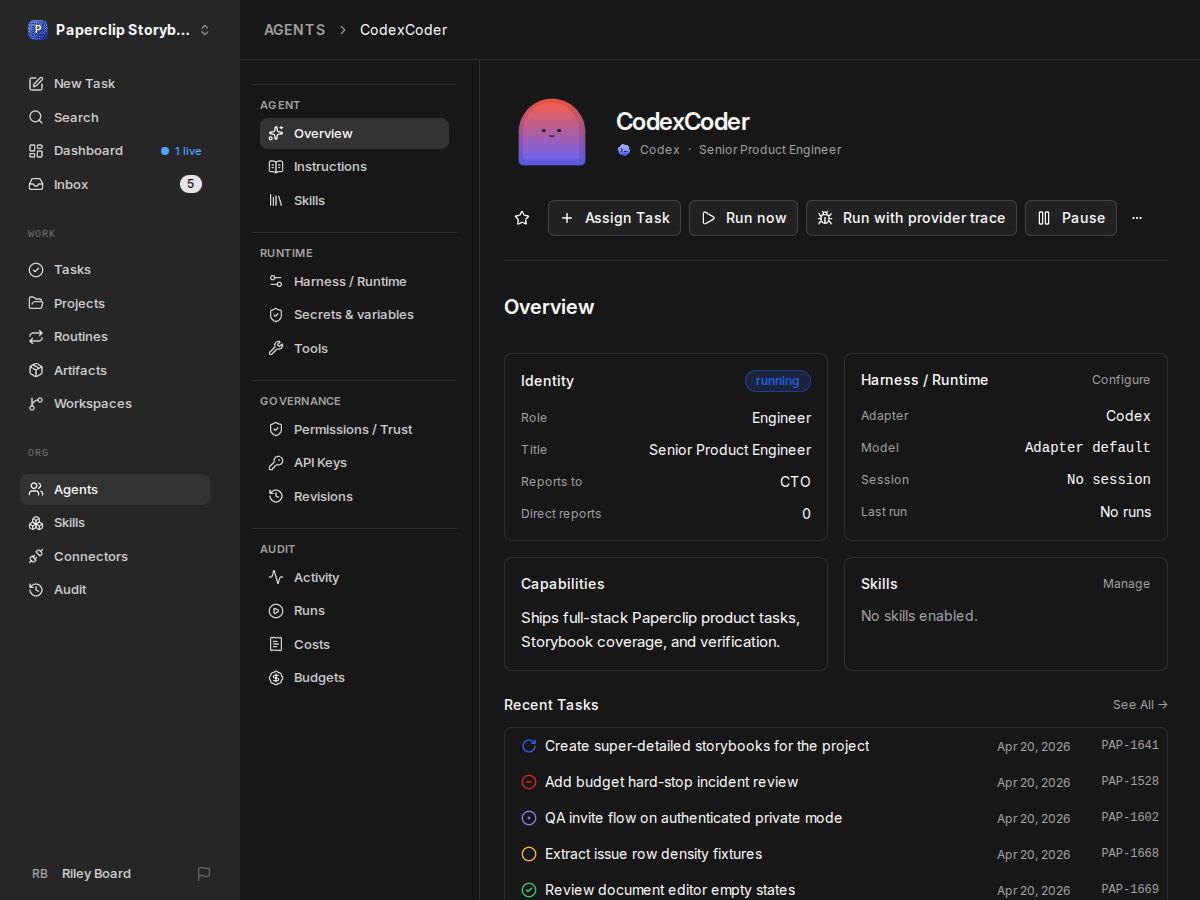
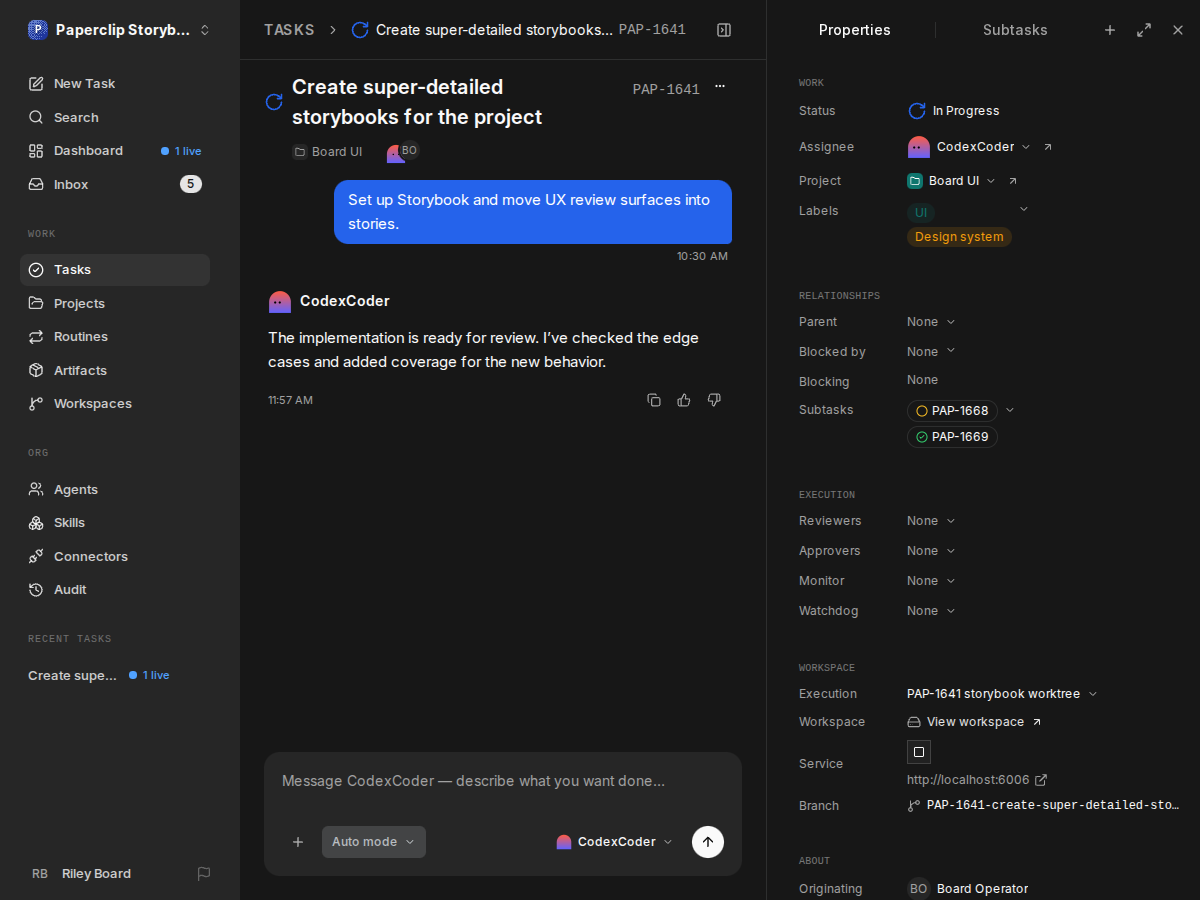
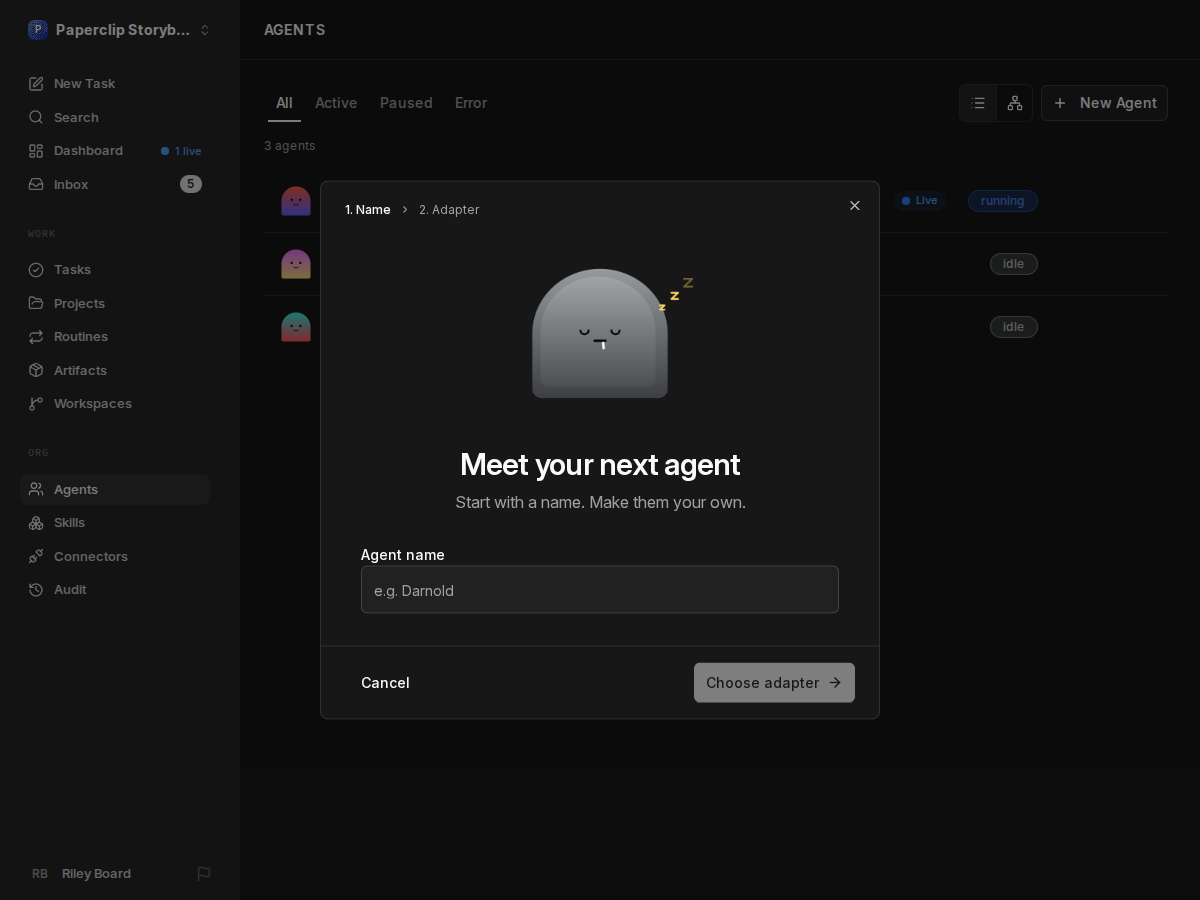
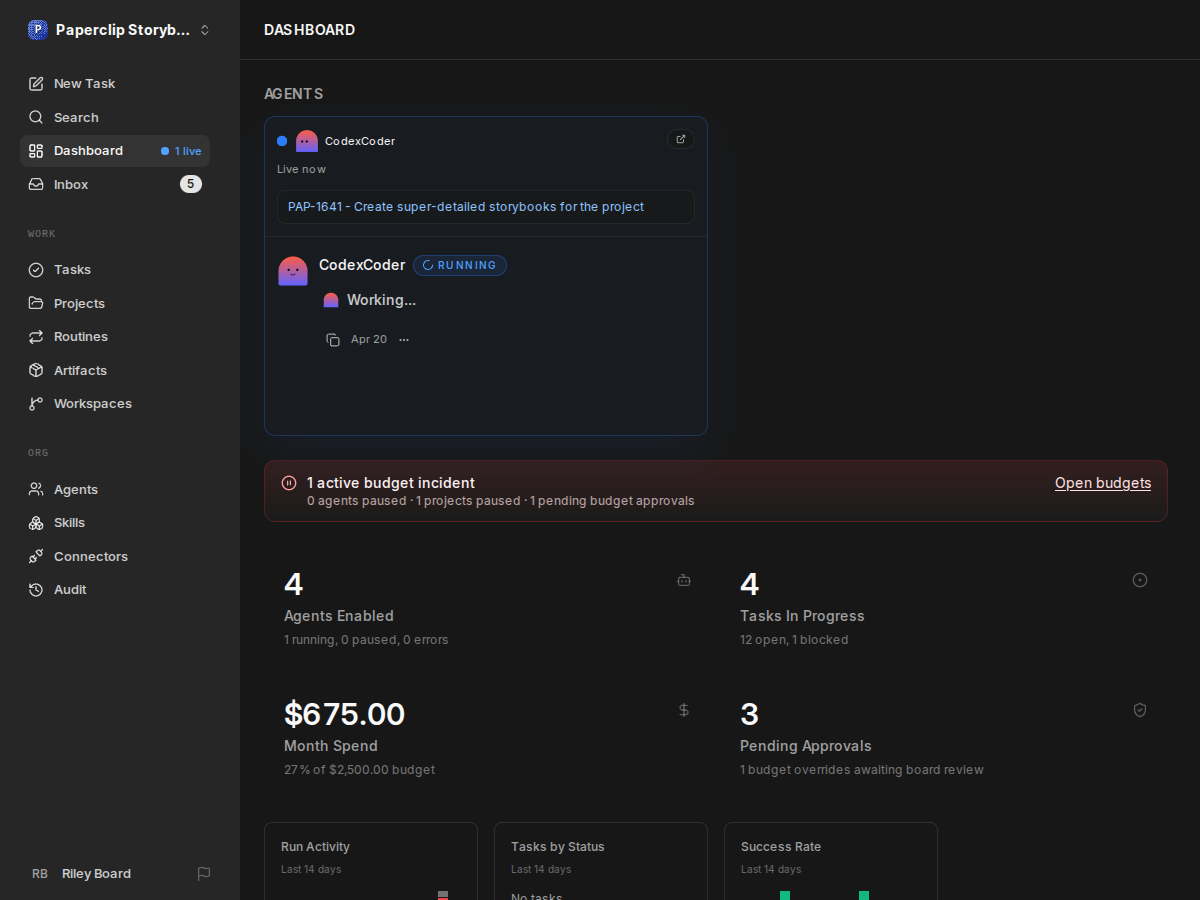
## Thinking Path > - Paperclip is the open source app people use to manage AI agents for work. > - A stable agent persona is useful only when the same identity appears across the app. > - Lists, task messages, selectors, and activity feeds need inexpensive static avatars. > - Onboarding and agent headers need a larger character with expressions and pointer tracking. > - This pull request connects the persona foundation to those existing views and preserves onboarding draft assignments. > - Full-page stories and Linux checks make the placements and performance contract reviewable. ## Linked Issues or Issue Description **Problem or motivation** Agents need a stable visual identity in lists, tasks, onboarding, and configuration. External tools also need an image URL for that identity. **Proposed solution** Assign each agent a permanent palette from a fixed ClipLab character library. Store the assignment on the agent. Render and cache preset PNG URLs on demand. Use static images in dense views and one animated character in larger placements. **Alternatives considered** A generated image bundle requires a separate asset build. A live renderer in every avatar adds unnecessary work in large lists. Arbitrary uploaded images do not provide the requested shared character system. **Roadmap alignment** This improves agent identity across existing control-plane views. It preserves agent permissions, company boundaries, and status labels. ROADMAP.md has no separate ClipLab persona milestone. Related approaches: #2422 adds configurable image URLs and DiceBear generation; #5578 adds optional uploaded avatars. This work uses a fixed, versioned character library and preset URLs. ## What Changed - Replace agent icons with static persona images across lists, the sidebar, org charts, tasks, comments, selectors, activity, and dashboard views. - Put one animated character in the agent header. Let it follow the pointer across the page, with reduced-motion and touch fallbacks. - Add larger padded characters to agent creation. Keep the palette stable across draft refreshes and connection retries, then reveal it after success. - Pass appearance through shared projections rather than fetching each agent separately. - Add real full-page Storybook examples for the agent list, overview, task, dashboard, new-agent dialog, and connection page. - Add Linux screenshot, clipping, density, and 500-avatar performance checks. ## Verification - `pnpm -r typecheck`, `pnpm build`, and token gates pass on the rebased tree. Persona lifecycle tests pass. - The rebased feature passes 38 Linux screenshot/performance checks, including both display densities, corner pointer positions, and the no-WebGL/no-live-download contract for 500 avatars. - The final Linux persona suite passes all 38 visual, lifecycle, density, and full-page checks using the standard Storybook configuration and real on-demand avatar endpoint. - Final local focused verification: 45 avatar/native-recovery tests pass; UI identity/routine tests, typecheck/build, token gates, and Storybook build pass. - Current-head CI passes: full workspace/server tests, all serialized server groups, typecheck/release checks, build, canary validation, and end-to-end shards. The build passed after retrying a native-runner concurrency-test failure; its three targeted cases also pass locally. - Manual inspection covered stable identities in the app, header placement, full-page mouse tracking, onboarding size, and task/dashboard placements. ### Screenshots Linux captures use synthetic Storybook fixtures. Full-page captures use reduced motion. The live character, mouse tracking, and disposal are checked separately. <details> <summary>Agent overview with the character in its header</summary> <img src="https://raw.githubusercontent.com/paperclipai/paperclip/8c68f42b268ada22b67d79d0fe1bb0a2f84ec25c/screenshots/full-page-agent-overview.png" width="900" alt="Agent overview with the character in its header" /> </details> <details> <summary>Task messages and assignee identity</summary> <img src="https://raw.githubusercontent.com/paperclipai/paperclip/8c68f42b268ada22b67d79d0fe1bb0a2f84ec25c/screenshots/full-page-task.png" width="900" alt="Task messages and assignee identity" /> </details> <details> <summary>Larger onboarding character with room for expressions</summary> <img src="https://raw.githubusercontent.com/paperclipai/paperclip/8c68f42b268ada22b67d79d0fe1bb0a2f84ec25c/screenshots/full-page-meet-your-next-agent.png" width="900" alt="Larger onboarding character with room for expressions" /> </details> <details> <summary>Dashboard agent activity</summary> <img src="https://raw.githubusercontent.com/paperclipai/paperclip/8c68f42b268ada22b67d79d0fe1bb0a2f84ec25c/screenshots/full-page-company-dashboard.png" width="900" alt="Dashboard agent activity" /> </details> ## Risks - This PR depends on #13170, the persona foundation. Merge the foundation first, then retarget this PR to master. - Many placements change from icons to character silhouettes. Human avatars and authoritative agent status labels retain their existing behavior. - Only one character can render live per view. Reduced motion, hidden/offscreen content, touch input, and renderer failures use the defined fallbacks. - The full-page stories use fixture data. They do not contact a real company or complete real provider sign-in. ## Model Used OpenAI Codex, GPT-6 family. The exact model identifier and context window are not exposed in this session. Used code editing, shell execution, browser inspection, and Linux visual testing. ## Checklist - [x] I have included a thinking path that traces from project context to this change - [x] I have specified the model used (with version and capability details) - [x] I have checked ROADMAP.md and confirmed this PR does not duplicate planned core work - [x] I have searched GitHub for duplicate or related PRs and linked them above - [x] I have either (a) linked existing issues with `Fixes: #` / `Closes #` / `Refs #` OR (b) described the issue in-PR following the relevant issue template - [x] I have not referenced internal/instance-local Paperclip issues or links (only public GitHub `#NNN` / `github.com/paperclipai/paperclip` URLs) - [x] My branch name describes the change (e.g. `docs/...`, `fix/...`) and contains no internal Paperclip ticket id or instance-derived details - [x] I have run tests locally and they pass - [x] I have added or updated tests where applicable - [x] I have updated relevant documentation to reflect my changes - [x] I have considered and documented any risks above - [x] All Paperclip CI gates are green - [x] Greptile is 5/5 with no open P2s, recommendations, or follow-ups - [x] I will address all Greptile and reviewer comments before requesting merge --------- Co-authored-by: Paperclip <noreply@paperclip.ing> Co-authored-by: Tonio <tonework@gmail.com> Co-authored-by: Claude Fable 5.1 <noreply@anthropic.com> |
||
|
scotttong
|
b1f4910ee5 | feat(ui): refine streamlined workspace surfaces (#12747) | ||
|
scotttong
|
4d82f5eaea | copy: unify user-facing "company" wording to "organization" (#12243) | ||
|
DottaandPaperclip
|
ab2bdfeebb |
feat(routines): activity-gated advanced run policy (editor + run rows) (#10225)
## Thinking Path > - Paperclip is the open source app people use to manage AI agents for work. > - Scheduled routines provide recurring control-plane work without manual intervention. > - The activity gate (`activity_gate_policy` / `activity_gate_scope`) lets a scheduled routine skip a tick when nothing has happened since its last run, so watcher-style routines stay asleep while the system is settled instead of burning tokens every tick. > - The scheduler, database columns, and the create/update API for those fields already landed (see #9438), but there was no way for an operator to actually set the policy from the routine editor, and the runs list rendered gated skips as bare "skipped" rows with no "why". > - This pull request adds the editor control and the run-row labels: the Delivery section gets an "Advanced run policy" picker plus a scope selector, and skipped runs explain why they were skipped. > - The benefit is that the activity gate becomes discoverable and usable end-to-end from the UI, closing the loop on the feature the API already supports. ## Linked Issues or Issue Description - Refs #8534 — activity gate for scheduled routines. - Builds on #9438 (merged) which exposed the activity-gate create/update API and the `Routine` response fields this UI reads and writes. This PR is the editor/UI companion to that API work. ## What Changed - **Routine editor — Advanced run policy control** (`ui/src/components/routine-sections/editable-sections.tsx`): the Delivery section gains a `RadioCardGroup` to choose between *Run on every scheduled tick* (default) and *Skip when there's been no activity since the last run*. When gating is enabled, a second scope picker (*Company-wide* / *This project*) appears. The control is **disabled with an explanatory hint** — rather than hidden — when the routine has no schedule trigger, since the gate only affects scheduled ticks (webhook/manual/API fires are themselves activity and always run). This keeps the capability discoverable. - **Edit-draft plumbing** (`ui/src/components/routine-sections/context.tsx`, `ui/src/pages/RoutineDetail.tsx`): `activityGatePolicy` / `activityGateScope` flow through the edit draft, the delivery section's dirty-field detection, the save payload, and revision restore, matching how `concurrencyPolicy` / `catchUpPolicy` are handled. - **Run-history skip reasons** (`ui/src/lib/routine-run-display.ts`): skipped run rows now render a human-readable "why" — `no_external_activity` → "Skipped — no activity since last run", plus labels for `paused` and `worktree_execution_cutoff` — instead of a bare status. - Storybook fixture updates for the new routine fields, plus focused run-display coverage for the skipped-run labels. ## Verification - `pnpm exec vitest run ui/src/lib/routine-run-display.test.ts` — 11 tests passing. - `pnpm --filter @paperclipai/ui typecheck` — clean. - `pnpm check:token-gates` — all token gates clean. - `pnpm --filter @paperclipai/ui build` — production build succeeds. - Current-head GitHub CI for `9f9af8ecccfadcdc4a3afab313aafad81cbd1112` — all checks pass (Storybook visual check skipped by workflow policy). ## Risks - **Low risk.** UI-only change; no schema/migration and no server changes (the API and columns already shipped in #9438). Fields are optional and default to the pre-feature behavior (`always` / `company`), so existing routines are unaffected. The scope picker only renders when gating is turned on, and the whole control is inert without a schedule trigger. ## Model Used - Claude Opus 4.8 (`claude-opus-4-8`, 1M context), extended thinking, with tool use (repo edit + shell verification). ## Checklist - [x] I have included a thinking path that traces from project context to this change - [x] I have specified the model used (with version and capability details) - [x] I have checked ROADMAP.md and confirmed this PR does not duplicate planned core work - [x] I have searched GitHub for duplicate or related PRs and linked them above - [x] I have either (a) linked existing issues with `Fixes: #` / `Closes #` / `Refs #` OR (b) described the issue in-PR following the relevant issue template - [x] I have not referenced internal/instance-local Paperclip issues or links (only public GitHub `#NNN` / `github.com/paperclipai/paperclip` URLs) - [x] My branch name describes the change (e.g. `docs/...`, `fix/...`) and contains no internal Paperclip ticket id or instance-derived details - [x] I have run tests locally and they pass - [x] I have added or updated tests where applicable - [x] I have updated relevant documentation to reflect my changes - [x] I have considered and documented any risks above - [x] All Paperclip CI gates are green - [x] Greptile is 5/5 with no open P2s, recommendations, or follow-ups - [x] I will address all Greptile and reviewer comments before requesting merge --------- Co-authored-by: Paperclip <noreply@paperclip.ing> |
||
|
DottaandPaperclip
|
8368fb30b0 |
fix(routines): coalesce sub-hourly catch-up runs (#9649)
## Thinking Path > - Paperclip is the open source control plane people use to run AI-agent companies. > - Scheduled routines support catch-up policies when the server resumes after missed cron ticks. > - The existing capped replay policy dispatched once per missed tick, which can flood the board after downtime for frequent schedules. > - Sub-hourly routines usually need one prompt catch-up execution rather than historical per-tick replay, while hourly-or-slower schedules may rely on the existing behavior. > - This pull request coalesces missed sub-hourly ticks into one execution and keeps the slower-schedule behavior unchanged. > - The benefit is bounded recovery work without changing the semantics of lower-frequency scheduled routines. ## Linked Issues or Issue Description ### What happened? When a scheduled routine using `enqueue_missed_with_cap` resumes after several missed sub-hourly cron ticks, Paperclip dispatches one catch-up execution for every missed tick. Those executions arrive in a same-second burst and can flood the board with duplicate-looking work. ### Expected behavior Sub-hourly schedules should advance past all missed ticks but dispatch exactly one catch-up execution. Hourly-or-slower schedules should retain capped per-tick replay. ### Steps to reproduce 1. Build Paperclip from `master` and create a routine with a sub-hourly cron schedule and `catchUpPolicy: enqueue_missed_with_cap`. 2. Set its persisted `nextRunAt` far enough in the past to cover several scheduled occurrences. 3. Run routine catch-up processing. 4. Observe multiple catch-up dispatches instead of one coalesced execution. ### Paperclip version or commit Reproduced on `master` before this PR. ### Deployment mode Built from source in local development with embedded PGlite. ## What Changed - Classify sub-hourly cadence from timezone-aware scheduled occurrences, avoiding daily multi-minute false positives while supporting schedules restricted to active days. - Coalesce all missed sub-hourly ticks into one catch-up dispatch while advancing `nextRunAt` to the next future occurrence. - Preserve capped per-tick replay for hourly-or-slower schedules. - Clarify the catch-up policy labels in both routine editing surfaces. - Add regression coverage for both the coalesced and preserved behaviors. ## Verification - `pnpm exec vitest run server/src/__tests__/routines-service.test.ts --testNamePattern='coalesces multiple missed sub-hourly ticks|continues replaying each missed hourly tick|continues replaying missed ticks for daily schedules with multiple minute values|coalesces sub-hourly schedules restricted to weekdays'` — 4 passed. - `pnpm check:token-gates` — all gates clean. - `git diff --check origin/master...HEAD` — clean. ## Risks - Low-to-moderate behavioral risk: sub-hourly routines using `enqueue_missed_with_cap` now intentionally receive one recovery execution instead of one per missed tick. - Hourly-or-slower schedules retain their previous capped replay behavior, limiting the compatibility surface. - No schema, migration, workflow, or lockfile changes. > For core feature work, check [`ROADMAP.md`](ROADMAP.md) first and discuss it in `#dev` before opening the PR. Feature PRs that overlap with planned core work may need to be redirected — check the roadmap first. See `CONTRIBUTING.md`. ## Model Used - OpenAI Codex CLI with GPT-5.5, medium reasoning, code execution and repository tool use; the runtime did not expose a context-window size. ## Checklist - [x] I have included a thinking path that traces from project context to this change - [x] I have specified the model used (with version and capability details) - [x] I have checked ROADMAP.md and confirmed this PR does not duplicate planned core work - [x] I have searched GitHub for duplicate or related PRs and linked them above - [x] I have either (a) linked existing issues with `Fixes: #` / `Closes #` / `Refs #` OR (b) described the issue in-PR following the relevant issue template - [x] I have not referenced internal/instance-local Paperclip issues or links (only public GitHub `#NNN` / `github.com/paperclipai/paperclip` URLs) - [x] My branch name describes the change (e.g. `docs/...`, `fix/...`) and contains no internal Paperclip ticket id or instance-derived details - [x] I have run tests locally and they pass - [x] I have added or updated tests where applicable - [x] I have updated relevant documentation to reflect my changes - [x] I have considered and documented any risks above - [x] All Paperclip CI gates are green - [x] Greptile is 5/5 with no open P2s, recommendations, or follow-ups - [x] I will address all Greptile and reviewer comments before requesting merge --------- Co-authored-by: Paperclip <noreply@paperclip.ing> |
||
|
|
c07e650cd7 |
feat(ui): single-source design tokens, visual regression suite, and theme retune (#9134)
## Thinking Path > - Paperclip is the open source app people use to manage AI agents for work > - Its UI is the operator's daily surface: task lists, boards, budgets, agent status — all built on shadcn components and Tailwind > - Visual values (colors, spacing, type sizes, radii) were hardcoded at ~1,600 call sites: the same "small gray label" was 9/10/11px depending on the file, charts disagreed with chips about status colors, two toggle-switch implementations coexisted in two greens, and there was no visual regression coverage > - This made the UI drift-prone and made any restyle a hundreds-of-files project, which discourages design iteration > - This pull request extracts visual values into a single token layer in `ui/src/index.css`, adds a Storybook visual regression suite backed by external immutable baseline archives, and then applies a deliberate retune reviewed change-by-change on screenshot diffs > - The benefit is that Paperclip's look becomes a config surface: retheming is a token edit reviewed as a snapshot diff, drift is blocked by a token gate, and future UI PRs can prove exactly what changed visually without committing hundreds of PNGs ## Linked Issues or Issue Description No existing public issue covers this work (searched "design tokens", "visual regression", "design system" across issues and PRs). Related in spirit: Refs #8982 (theming a hardcoded panel — a one-off instance of the same problem class this PR addresses systematically). **Problem (feature-request form):** UI visual values are hardcoded per call site with no source of truth and no regression coverage; consistency depends on reviewer memory, and restyling requires mass file edits. **Proposed solution (this PR):** a single token layer + enforcement gate + externally stored visual snapshot suite, then an intentional restyle on top of that foundation. ## What Changed - **Token extraction (zero visual change, machine-verified during development):** committed codemods (`scripts/codemod-*.mjs`) moved ~1,600 hardcoded color/type/spacing/radius/shadow/misc values into named tokens in a non-inline `:root` block of `ui/src/index.css`. - **Visual regression suite:** `pnpm test:storybook-visual` covers 255 stories × light/dark = 510 Playwright screenshots at `maxDiffPixels: 0`, plus new primitive-coverage stories and deterministic-render fixes. - **External visual baselines:** committed PNG snapshots were removed. `tests/storybook-visual/baseline-manifest.json` pins an immutable archive URL/hash/size/count, and `scripts/storybook-visual-baseline.mjs` handles `download`, `verify`, `pack`, and trusted maintainer `upload` flows. - **Opt-in visual CI artifacts:** added a `Storybook Visual` workflow that runs on manual dispatch or PRs labeled `storybook-visual`, downloads/verifies the baseline, runs Playwright, and uploads Playwright report/test-result artifacts for review. Normal PR runs do not mutate baseline objects. - **Token gate:** `pnpm check:token-gates` — zero hex literals, zero arbitrary bracket values, zero raw font-sizes in `ui/src/components/**` and `ui/src/pages/**`, with a documented inline allowlist for legitimate opt-outs. - **Theme retune (intentional, snapshot-reviewed):** new base theme values; radius ladder derived from a single `--radius` knob; micro-type cluster collapsed to a named ladder (`--text-nano/micro/compact` + Tailwind `text-xs`/`text-sm`); letter-spacing collapsed to named steps. - **One status-color vocabulary:** charts, quota/budget bar fills, RUNNING/live chips, and liveness indicators all use the canonical `--status-*` hues. Light-mode legibility fixes for red alert surfaces that used dark-tuned text classes. - **One switch:** `ToggleSwitch` restyled to the registry capsule form, second hand-rolled implementation removed, and all call sites unified. - **Docs:** `DESIGN.md` is the design contract; `doc/design/` holds audit reports, decision logs, and updated guidance for external baseline review/update workflows. - Dead code removed (`agentStatusBadge` duplicate map), byte-identical contrast constants consolidated, semantic renames (`--project-seed`/`--project-none`, `--liveness-blue`). ## Verification - `pnpm check:token-gates` — 3/3 gates CLEAN during the design-system run - `pnpm typecheck` && `pnpm --filter @paperclipai/ui build` — green during the design-system run - `node --test scripts/__tests__/storybook-visual-baseline.test.mjs` — pass after external-baseline rework - `pnpm exec tsc --noEmit --pretty false --module NodeNext --moduleResolution NodeNext --target ES2022 --types node,@playwright/test tests/storybook-visual/playwright.config.ts tests/storybook-visual/storybook-visual.spec.ts` — pass after external-baseline rework - `git diff --check origin/pr/9134..HEAD` — pass after external-baseline rework - `find tests/storybook-visual -type f -name '*.png' -print | wc -l` — `0` - `node scripts/storybook-visual-baseline.mjs verify` — intentionally fails closed until the first trusted maintainer publishes the baseline archive and updates `baseline-manifest.json` ## Risks - **Large but shallow:** the PR still touches many UI files due to mechanical token extraction and retune work, but committed PNG snapshot churn has been removed from the branch. - **Baseline publication required before the visual suite can pass in clean clones:** the manifest currently has placeholder archive metadata. A trusted maintainer must publish the first immutable archive, then update `baseline-manifest.json`. - **Rendering platform variance:** the external baseline should be captured in the documented Linux/Chromium environment. Future CI runs verify against the pinned archive and fail closed on checksum/count mismatch. - **Visual CI is opt-in while stabilizing:** add the `storybook-visual` label or dispatch the workflow manually to produce downloadable Playwright report/test-result artifacts. - **Scheduled follow-ups, deliberately out of scope:** Tailwind palette classes map to semantic tokens in a dedicated pass; card/pill component consolidation; ESLint ratchet. Tracked in `doc/design/DECISION-SHEET.md`. ## Model Used Claude Fable 5 (Anthropic, `claude-fable-5`, Mythos-class tier) with extended thinking, running in Claude Code with tool use; mechanical phases delegated to Claude Sonnet subagents. Follow-up external-baseline rework assisted by OpenAI Codex (`gpt-5` coding agent with repository, terminal, and GitHub tool use). All bulk rewrites executed via deterministic, idempotent scripts committed in `scripts/`; intentional visual changes were human-reviewed on screenshot contact sheets. ## Checklist - [x] I have included a thinking path that traces from project context to this change - [x] I have specified the model used (with version and capability details) - [x] I have checked ROADMAP.md and confirmed this PR does not duplicate planned core work - [x] I have searched GitHub for duplicate or related PRs and linked them above - [x] I have either (a) linked existing issues with `Fixes: #` / `Closes #` / `Refs #` OR (b) described the issue in-PR following the relevant issue template - [x] I have not referenced internal/instance-local Paperclip issues or links (only public GitHub `#NNN` / `github.com/paperclipai/paperclip` URLs) - [x] My branch name describes the change (e.g. `docs/...`, `fix/...`) and contains no internal Paperclip ticket id or instance-derived details - [x] I have run targeted local verification and documented the intentional baseline-publication failure above - [x] I have added or updated tests where applicable - [x] I have updated relevant documentation to reflect my changes - [x] I have considered and documented any risks above - [ ] All Paperclip CI gates are green *(pending new CI run after this rework)* - [ ] Greptile is 5/5 with no open P2s, recommendations, or follow-ups *(pending review)* - [x] I will address all Greptile and reviewer comments before requesting merge 🤖 Generated with [Claude Code](https://claude.com/claude-code) and OpenAI Codex --------- Co-authored-by: Claude Fable 5 <noreply@anthropic.com> Co-authored-by: Dotta <bippadotta@protonmail.com> Co-authored-by: Paperclip <noreply@paperclip.ing> |
||
|
|
ad961227f5 |
feat(secrets): add user-specific runtime secrets (#8825)
## Thinking Path > - Paperclip is the open source app people use to manage AI agents for work. > - Agent runs often need provider credentials, API tokens, and other environment-bound secrets. > - Company-level secrets work for shared credentials, but they do not model values that should differ by human operator. > - Without a user-scoped model, a run can dispatch without knowing whether the responsible human has supplied the needed value. > - Paperclip also needs run attribution to make those user-scoped runtime checks deterministic and auditable. > - This pull request adds user-specific secret definitions, per-user values, environment bindings, responsible-user attribution, and runtime resolution gates. > - The benefit is that teams can define the secret once, let each user provide their own value, and block runs before dispatch when required user secrets or active definitions are unavailable. ## Linked Issues or Issue Description Refs #224 Refs #6057 This PR implements user-specific secret support as a core secret-management capability rather than a one-off adapter setting. It is related to existing public work on company secrets UI and runtime secret refs, but is distinct because the value is owned by the responsible user and resolved at run dispatch time. Related PR search before opening found existing secrets work such as #1550, #8256, #8614, #8634, and #8647; none of those add the full user-secret definition/value/runtime gate covered here. ## What Changed - Added user-secret definitions and per-user "My secrets" values, keeping stored values out of access metadata. - Added `user_secret_ref` environment bindings and UI affordances to pick them alongside existing secret refs. - Added responsible-user runtime resolution so user-secret refs resolve against the human responsible for the run. - Added pre-dispatch missing-secret gates so runs fail before adapter dispatch when required user values are absent or definitions are inactive. - Added low-trust allowlist hardening for user-secret runtime access. - Added issue, routine, run, and agent API key responsible-user attribution and fail-closed dispatch behavior when attribution cannot be resolved. - Added denial-copy mapping so responsible-user authorization failures surface as actionable run outcomes instead of opaque setup failures. - Added OpenAPI documentation for the user-secret routes. - Rebases cleanly on current `master`; migrations were renumbered incrementally as `0128_user_specific_secrets`, `0129_agent_api_key_responsible_user`, and `0130_run_responsible_user_invariant` after upstream `0126`/`0127` migrations. - Removed previously committed local design screenshots so the PR contains code/docs/tests only. ## Verification - PASS: PR head `2527febd106bcf3ca264ca0da7fca491084192d6` is based on `paperclipai/paperclip:master`. - PASS: `git diff --check` - PASS: `git diff --name-only public/master...HEAD | rg '^(pnpm-lock\\.yaml|\\.github/workflows/|screenshots/)' || true` produced no files. - PASS: migration journal audit confirmed unique indexes through `130` with tail entries `0126_issue_comment_derived_attribution`, `0127_environment_custom_images_instance_scoped`, `0128_user_specific_secrets`, `0129_agent_api_key_responsible_user`, and `0130_run_responsible_user_invariant`. - PASS: `pnpm --filter @paperclipai/ui typecheck` - PASS: `pnpm --filter @paperclipai/server typecheck` - PASS: `pnpm --filter @paperclipai/server exec vitest run src/__tests__/heartbeat-responsible-user-invariant.test.ts` - PASS: `pnpm --filter @paperclipai/server exec vitest run src/__tests__/heartbeat-active-run-output-watchdog.test.ts src/__tests__/heartbeat-stale-queue-invalidation.test.ts src/__tests__/heartbeat-workspace-finalize-branch.test.ts src/__tests__/issue-monitor-scheduler.test.ts` - PASS: `pnpm --filter @paperclipai/server exec vitest run src/__tests__/heartbeat-comment-wake-batching.test.ts src/__tests__/heartbeat-retry-scheduling.test.ts src/__tests__/heartbeat-accepted-plan-workspace-refresh.test.ts src/__tests__/heartbeat-plugin-environment.test.ts` - PASS: `pnpm --filter @paperclipai/server exec vitest run src/__tests__/low-trust-red-team-routes.test.ts` - PASS: `pnpm --filter @paperclipai/server exec vitest run src/__tests__/secrets-service.test.ts` (55 tests) - PASS: `pnpm vitest run server/src/__tests__/secrets-routes.test.ts server/src/__tests__/secrets-service.test.ts` (89 tests after final Greptile cleanup fixes) - PASS: `pnpm --filter @paperclipai/server exec vitest run src/__tests__/heartbeat-issue-liveness-escalation.test.ts` (17 tests after the final rebase CI fix) - PASS: focused server Vitest batches covering heartbeat recovery, project env, plugin env, routines, low-trust, pipelines, monitors, watchdog, and stale queue paths. - PASS: GitHub checks are green on `2527febd106bcf3ca264ca0da7fca491084192d6`, including Typecheck + Release Registry, Build, General tests, serialized server suites, e2e, Canary Dry Run, verify, security checks, and Greptile Review. - PASS: Greptile Review completed successfully on `2527febd106bcf3ca264ca0da7fca491084192d6` with Confidence Score 5/5, and GraphQL review-thread audit returned zero unresolved non-outdated threads. ## Risks - Runtime behavior now depends on a run having a correct responsible user; missing or incorrect responsibility assignment can block runs before adapter dispatch. - `user_secret_ref` bindings intentionally expose metadata without values, but UI/API callers may need to handle the new binding kind explicitly. - External secret providers and IAM policies are not automatically provisioned by this PR; operators still need to configure provider-side access for non-local vaults. - The PR is broad across db/shared/server/UI/runtime paths, so release validation should include both API and UI secret workflows before merge. - The migration renumbering is intentionally incremental after upstream migrations; the branch migrations use guarded column/table/index/constraint creation so users who tested the older draft numbering should not hit duplicate DDL for the existing objects. > For core feature work, check [`ROADMAP.md`](ROADMAP.md) first and discuss it in `#dev` before opening the PR. Feature PRs that overlap with planned core work may need to be redirected — check the roadmap first. See `CONTRIBUTING.md`. ## Model Used OpenAI Codex, GPT-5-based coding agent (`gpt-5`), Codex local adapter with shell/tool use and code execution. Context window and internal reasoning mode are not exposed by the runtime. ## Checklist - [x] I have included a thinking path that traces from project context to this change - [x] I have specified the model used (with version and capability details) - [x] I have checked ROADMAP.md and confirmed this PR does not duplicate planned core work - [x] I have searched GitHub for duplicate or related PRs and linked them above - [x] I have either (a) linked existing issues with `Fixes: #` / `Closes #` / `Refs #` OR (b) described the issue in-PR following the relevant issue template - [x] I have not referenced internal/instance-local Paperclip issues or links (only public GitHub `#NNN` / `github.com/paperclipai/paperclip` URLs) - [x] My branch name describes the change (e.g. `docs/...`, `fix/...`) and contains no internal Paperclip ticket id or instance-derived details - [x] I have run tests locally and they pass - [x] I have added or updated tests where applicable - [x] I have updated relevant documentation to reflect my changes - [x] I have considered and documented any risks above - [x] All Paperclip CI gates are green - [x] Greptile is 5/5 with no open P2s, recommendations, or follow-ups - [x] I will address all Greptile and reviewer comments before requesting merge --------- Co-authored-by: Paperclip <noreply@paperclip.ing> Co-authored-by: Claude Opus 4.8 <noreply@anthropic.com> |
||
|
|
b5c914126e |
Redesign environment variables editor (#8930)
## Thinking Path > - Paperclip is the open source control plane people use to manage AI agents for work. > - Environment variables and secrets sit in the configuration surfaces that let agents, projects, routines, and company environments run with the right runtime inputs. > - The previous editor was a single legacy component with cramped row behavior, weak secret conversion affordances, and duplicated handling across several call sites. > - Operators need a clearer editor that handles text values, secret references, draft rows, and sensitive-value warnings consistently wherever environment variables are configured. > - This pull request replaces the legacy editor with a reusable environment variables editor and migrates the existing configuration surfaces to it. > - The benefit is a more reliable editing workflow with targeted test coverage around row state, dotenv parsing, secret selection, and affected page integrations. ## Linked Issues or Issue Description No public GitHub issue exists, so this PR describes the issue inline following the feature request template. ### Subsystem affected ui/ — React + Vite board UI ### Problem or motivation Environment variables are edited in several Paperclip configuration surfaces, including agent config, project properties, stage secrets, routine sections, company environments, and company settings. The legacy editor made common operator work difficult: rows could feel cramped, secret conversion was inconsistent, draft rows and imported dotenv data were easy to mishandle, and sensitive-value warnings did not have a consistent place in the workflow. ### Proposed solution Introduce a reusable environment variables editor component that consistently supports text values, secret references, draft rows, dotenv import parsing, sensitive-value hints, secret picking, secret creation, and conversion to stored secrets. Migrate the existing environment-variable call sites to the shared editor so behavior and tests live in one component family. ### Alternatives considered Keeping the existing `EnvVarEditor` and patching individual call sites would preserve duplication and leave each surface responsible for its own row and secret handling. This PR instead centralizes the behavior so future fixes cover all migrated surfaces. ### Roadmap alignment Checked `ROADMAP.md`; this does not duplicate a named roadmap item. It supports the existing local-first and deployment-oriented product direction by improving the UI where operators configure runtime environment values. ### Additional context The PR includes targeted tests for the editor model, dotenv parsing, sensitive-value detection, component behavior, affected page integrations, and Greptile review regressions around external saves and bulk import immutability. ## What Changed - Replaced the legacy `EnvVarEditor` with a reusable `environment-variables-editor` component family. - Added editor model helpers for draft rows, dotenv parsing, sensitive-value detection, secret picking, secret creation, and conversion to secret references. - Migrated agent config, project properties, stage secrets, routine editable sections, company environments, company settings, design guide examples, and Storybook stories to the new editor. - Added targeted tests for the editor model, parsing, sensitive-value detection, component behavior, and affected company environment/settings integrations. - Fixed the company settings test harness to use the repo’s `flushSync`-based React test helper pattern under the current React build. - Addressed Greptile feedback by flushing pending editor drafts before enclosing form submits or external save-button clicks, cloning bulk-import rows before mutation, and deferring the overflow store-as-secret popover open path. ## Verification - `pnpm exec vitest run ui/src/components/environment-variables-editor/EnvironmentVariablesEditor.test.tsx ui/src/pages/CompanyEnvironments.test.tsx ui/src/components/AgentConfigForm.render.test.tsx` — passed, 3 files / 40 tests. - Earlier focused Vitest coverage for model, dotenv parsing, sensitive detection, company environments, and company settings passed, 6 files / 78 tests. - `pnpm --filter @paperclipai/ui typecheck` — passed. - GitHub PR checks on head `0aa49c6f8afed1f62d9e26da07fc466fbf299850` — passed; CI checks green, security review neutral, Greptile check success. - Greptile review — 5/5 confidence on head `0aa49c6f8afed1f62d9e26da07fc466fbf299850`; 0 unresolved review threads. ## Risks - Medium UI risk: several environment-variable entry surfaces now share the new editor, so regressions could affect multiple configuration workflows at once. - Secret conversion, draft-row behavior, external save flushing, and bulk import behavior are covered by targeted tests, but reviewer attention should still focus on manual editing flows, focus retention, and save/cancel affordances. - No database or API contract changes. > For core feature work, check [`ROADMAP.md`](ROADMAP.md) first and discuss it in `#dev` before opening the PR. Feature PRs that overlap with planned core work may need to be redirected — check the roadmap first. See `CONTRIBUTING.md`. ## Model Used - OpenAI Codex, GPT-5-based coding agent with tool use and local command execution; medium reasoning mode. Exact context-window metadata is not exposed in this runtime. ## Checklist - [x] I have included a thinking path that traces from project context to this change - [x] I have specified the model used (with version and capability details) - [x] I have checked ROADMAP.md and confirmed this PR does not duplicate planned core work - [x] I have searched GitHub for duplicate or related PRs and linked them above - [x] I have either (a) linked existing issues with `Fixes: #` / `Closes #` / `Refs #` OR (b) described the issue in-PR following the relevant issue template - [x] I have not referenced internal/instance-local Paperclip issues or links (only public GitHub `#NNN` / `github.com/paperclipai/paperclip` URLs) - [x] My branch name describes the change (e.g. `docs/...`, `fix/...`) and contains no internal Paperclip ticket id or instance-derived details - [x] I have run tests locally and they pass - [x] I have added or updated tests where applicable - [x] I have updated relevant documentation to reflect my changes - [x] I have considered and documented any risks above - [x] All Paperclip CI gates are green - [x] Greptile is 5/5 with no open P2s, recommendations, or follow-ups - [x] I will address all Greptile and reviewer comments before requesting merge --------- Co-authored-by: Claude Opus 4.8 <noreply@anthropic.com> Co-authored-by: Paperclip <noreply@paperclip.ing> |
||
|
DottaandPaperclip
|
e68188c438 |
fix: upstream deployed document-comment, routine-annotation, workspace & board-polling fixes (#8536)
## Thinking Path > - Paperclip is the open source app people use to manage AI agents for work > - This change touches several already-shipped subsystems — document-comment annotations, the selected-agent Conference Room chat surface, routine description annotations, workspace-operation tracking, and the board polling/inbox UI > - A batch of incremental fixes and two small backend additions had accumulated on a local mainline and were deployed to a live instance, but never landed upstream — so each `origin/master` sync kept re-diverging > - Leaving them un-upstreamed means the same delta has to be re-merged on every sync and risks being lost or silently reverted > - This pull request rebases that delta cleanly on top of current `origin/master` (preserving recent upstream work such as reusable sandbox leases and the relation-list collapse controls) and brings it up for review > - The benefit is that mainline and the deployed instance converge, and these fixes/additions get normal review + CI + Greptile coverage ## Linked Issues or Issue Description No single GitHub issue tracks this; it is a bundle of bug fixes and two small feature additions. Following the issue-template fields: **Bug fixes (what was wrong → what this does):** - Document comments rendered out of document order, didn't live-update across clients, swallowed save failures, and lost the markdown text selection on re-render. Now: doc-order sort, live updates, surfaced save-failure state, stable selection across re-renders. - The board polling hot path returned oversized payloads on every poll. Now: an opt-in `summary` projection trims the heartbeat-run list payload. - Assorted UI fixes: sidebar nav peek/streamlining edge cases, markdown file-viewer re-mount/line-height issues on iOS Safari, inbox badge/skill deep-link tab selection, and `⌘.` work-mode cycling on iOS. **Feature additions:** - `workspace_operations.issue_id` — associate a workspace operation with the issue that triggered it (new migration `0106`, schema, service, shared type). - Routine **description annotations** — comment threads on a routine's description document, mirroring issue document annotations (new migration `0107`, `routine_documents` schema, routes/service, editable-sections UI). - Selected-agent **Conference Room chat** surface wiring and live issue-thread updates. **Related PR:** #8229 (`feat(control-plane): add annotation and workspace controls`, draft) covers overlapping annotation/workspace-control territory — flagging it so a reviewer can reconcile the two rather than double-merging. ## What Changed - `feat(workspace)`: `workspace_operations.issue_id` migration + schema/service/type; issue workspace property controls reconciled with upstream's evolved "Service" row. - `feat(routines)`: routine description annotations — `routine_documents` schema, migration `0107`, routes/service, `editable-sections` UI. - `fix(document-comments)`: doc-order sort, live updates, save-failure surfacing, stable markdown selection (+ storybook story, rerender test). - `feat(chat)`: selected-agent Conference Room chat surface and live issue-thread updates (`LiveUpdatesProvider`, `issue-chat-messages`, interactions service). - `perf(board)`: opt-in `summary` projection for the board polling/heartbeat-run list payload, plus assorted sidebar / file-viewer / inbox / IssueProperties UI fixes. Organized into 5 logical commits. Migrations are numbered incrementally after upstream's latest (`0105`) — `0106` then `0107`, no journal collision. ## Verification - Built by 3-way merging the deployed delta onto current `origin/master`; the only merge conflict (`IssueProperties.test.tsx`, two adjacent test blocks) was resolved in favor of upstream's evolved "green service link above the workspace row" layout, which matches the merged component's rendered output. - Confirmed recent upstream work is preserved post-merge: reusable sandbox lease teardown (`#8513`), the IssueProperties relation-list collapse controls, and the sidebar streamlined-nav default. - Confirmed the net diff vs `origin/master` is exactly the intended feature delta (65 files) and that overlapping server files (`issues.ts`, `agents.ts`, `heartbeat.ts`) only add feature code without disturbing upstream logic. - This delta is already running on a live deployed instance. - Full typecheck/test suite + Greptile to run in CI (see checklist). ## Risks - Two new migrations (`0106`, `0107`). Both are additive (new table / new nullable column) and ordered after upstream's `0105`; no data backfill, low risk. If another migration-bearing PR merges first, renumber before merge. - Largest blast radius is in the merged overlapping UI/service files; covered by the existing test suites for those files plus CI. - Overlaps thematically with draft PR #8229 — reviewers should reconcile rather than merge both blindly. ## Model Used Claude Opus 4.8 (`claude-opus-4-8`), extended thinking, with tool use (git, shell). Agentic coding workflow. ## Checklist - [x] I have included a thinking path that traces from project context to this change - [x] I have specified the model used (with version and capability details) - [x] I have checked ROADMAP.md and confirmed this PR does not duplicate planned core work - [x] I have searched GitHub for duplicate or related PRs and linked them above - [x] I have either (a) linked existing issues with `Fixes: #` / `Closes #` / `Refs #` OR (b) described the issue in-PR following the relevant issue template - [x] I have not referenced internal/instance-local Paperclip issues or links (only public GitHub `#NNN` / `github.com/paperclipai/paperclip` URLs) - [ ] I have run tests locally and they pass - [x] I have added or updated tests where applicable - [x] I have updated relevant documentation to reflect my changes - [x] I have considered and documented any risks above - [ ] All Paperclip CI gates are green - [ ] Greptile is 5/5 with no open P2s, recommendations, or follow-ups - [ ] I will address all Greptile and reviewer comments before requesting merge --------- Co-authored-by: Paperclip <noreply@paperclip.ing> |
||
|
DottaandPaperclip
|
aeea5f9195 |
fix(ui): stabilize routine schedule editor and interrupted run labels (#8333)
## Thinking Path > - Paperclip is the open source control plane people use to manage AI agents for work. > - This change touches the board UI surfaces for issue run timelines and routine schedule editing. > - Operators need cancelled runs to distinguish ordinary cancellation from human interruption, otherwise the run history reads as more severe than it is. > - Routine schedule editing also needs to preserve user-entered cron values while rendering common schedules in a stable, understandable editor. > - This pull request keeps the editor state tied to explicit schedule values, adds coverage for routine editable sections, and makes interrupted run copy more precise. > - The benefit is less surprising routine editing and clearer issue run history for operators. ## Linked Issues or Issue Description No public GitHub issue is filed for this exact branch. Related public PRs: - Refs #3581, which addresses a narrower schedule reset case. - Refs #1803, which is another open schedule editor UI improvement. Problem description: Routine trigger schedules can be edited through the board UI, but the previous schedule editor path could normalize or reset cron state in ways that made unsaved edits fragile. Issue run history also labeled operator-interrupted cancelled runs like ordinary cancellations. Reviewers should treat this PR as a combined UI stabilization pass for those two visible operator workflows. ## What Changed - Added a more stable routine schedule editor flow that preserves explicit cron values and handles custom/common schedule transitions. - Wired routine editable-section state so schedule drafts do not get overwritten by unrelated section refreshes. - Added tests for schedule editor behavior, routine editable sections, and routine service schedule preservation. - Updated issue run timeline copy so operator-interrupted cancelled runs display as interrupted, while ordinary cancelled runs remain cancelled. - Kept the classic issue thread run label behavior aligned with the current issue thread surface. ## Verification - `NODE_ENV=development pnpm run preflight:workspace-links && NODE_ENV=development pnpm exec vitest run server/src/__tests__/routines-service.test.ts ui/src/components/IssueChatThread.test.tsx ui/src/components/ScheduleEditor.test.tsx ui/src/components/routine-sections/editable-sections.test.tsx` — 103 tests passed. Note: direct `pnpm exec vitest ...` without `NODE_ENV=development` loaded a React build where `React.act` is undefined in this workspace. The same targeted tests pass under the development React build. ## Risks Low to medium risk. The changes are UI-focused but touch routine schedule editing, which is a high-frequency operator workflow. The main risk is that an uncommon cron expression could render as custom when a user expected a preset; the added tests cover preservation and explicit custom handling. > For core feature work, check [`ROADMAP.md`](ROADMAP.md) first and discuss it in `#dev` before opening the PR. Feature PRs that overlap with planned core work may need to be redirected — check the roadmap first. See `CONTRIBUTING.md`. ## Model Used OpenAI Codex, GPT-5-class coding agent. Exact hosted runtime model ID and context window were not exposed in this session. Tool use and local command execution were used for inspection, verification, GitHub PR creation, and Paperclip issue updates. ## Checklist - [x] I have included a thinking path that traces from project context to this change - [x] I have specified the model used (with version and capability details) - [x] I have checked ROADMAP.md and confirmed this PR does not duplicate planned core work - [x] I have searched GitHub for duplicate or related PRs and linked them above - [x] I have either (a) linked existing issues with `Fixes: #` / `Closes #` / `Refs #` OR (b) described the issue in-PR following the relevant issue template - [x] I have not referenced internal/instance-local Paperclip issues or links (only public GitHub `#NNN` / `github.com/paperclipai/paperclip` URLs) - [x] I have run tests locally and they pass - [x] I have added or updated tests where applicable - [ ] If this change affects the UI, I have included before/after screenshots - [x] I have updated relevant documentation to reflect my changes - [x] I have considered and documented any risks above - [ ] All Paperclip CI gates are green - [ ] Greptile is 5/5 with no open P2s, recommendations, or follow-ups - [x] I will address all Greptile and reviewer comments before requesting merge --------- Co-authored-by: Paperclip <noreply@paperclip.ing> |
||
|
DottaandClaude Opus 4.8
|
fae7e920a9 |
[codex] Polish routine layout follow-ups (#7858)
## Thinking Path > - Paperclip is the open source app people use to manage AI agents for work > - Routines are the recurring-work surface that lets a company keep operating without a human manually kicking off every task > - The base routine detail Variation C shell already landed in #7848, but the follow-up branch still had polish work for scheduling, section ergonomics, and the list layout > - Operators need routine edit screens to explain trigger behavior clearly, keep long detail pages usable on mobile/touch devices, and make grouped routine lists easier to scan > - This pull request rebases the remaining branch work onto current `master`, drops the duplicate commits already merged through #7848, and keeps only the new routine UI follow-ups > - The benefit is a cleaner routines workflow without reopening the already-merged shell work or carrying unrelated lockfile, workflow, or screenshot changes ## Linked Issues or Issue Description Refs #7848 Feature follow-up: polish the routines UI after the Variation C routine-detail shell landed. Problem / motivation: - Routine trigger configuration needs clearer previews for manual, schedule, API, and webhook execution modes. - Routine detail sections need better responsive spacing and touch ergonomics. - The routines list grouping should scan like grouped records instead of a table with heavy row dividers. - The routine tests need a React 19-compatible render helper so the focused routine suite can run in this workspace. Proposed solution: - Add cron-fire preview helpers and routine-run display helpers with focused tests. - Expand the routine editable and operate sections with richer trigger, variable, run, activity, and history presentation. - Adjust the routine detail shell and sub-sidebar spacing for mobile/touch layout. - Update grouped routine list presentation to use bordered group headers with borderless rows. - Switch affected routine tests to the repo's `flushSync` render-helper pattern. Alternatives considered: - Leaving the duplicate pre-#7848 commits in the branch would recreate conflicts and make the PR review much larger than the remaining change. - Keeping grouped routine rows inside one bordered table was simpler, but made the grouping hierarchy less legible. Roadmap alignment: - ROADMAP.md lists Scheduled Routines as a core shipped capability and Output/Enforced Outcomes as ongoing priorities. This is polish on that existing routines capability, not a new roadmap-level feature. ## What Changed - Added routine scheduling preview helpers and tests for cron/manual/API/webhook fire-policy display. - Added routine run display helpers and tests for deduped trigger labels and run-row subtitles. - Polished routine detail sections, including trigger summaries, operate views, and env/variable editing ergonomics. - Adjusted routine detail page and sub-sidebar spacing so the title/header area is less pinned and touch layouts center better. - Reworked the routines list grouped layout so group headers are bordered cards and routine rows are borderless inside each group. - Added Storybook coverage for the routines list grouped layout and updated the existing routine detail story. - Repaired routine tests to use `flushSync` helpers compatible with the installed React 19 runtime. ## Verification - `pnpm exec vitest run ui/src/lib/cron-fires.test.ts ui/src/lib/routine-run-display.test.ts ui/src/pages/Routines.test.tsx ui/src/components/RoutineSubSidebar.test.tsx ui/src/components/RoutineSaveBar.test.tsx` - Result: 5 test files passed, 37 tests passed. - Confirmed the rebased PR diff does not include `pnpm-lock.yaml`, `.github/workflows/*`, or committed screenshots. - Confirmed `origin/master` is an ancestor of the pushed branch head after rebase. ## Risks - Medium UI risk: this touches the routine detail and routine list surfaces, so visual regressions are possible in edge cases not covered by the focused tests. - Low data risk: no schema, migration, server API, or lockfile changes are included. - Review note: the branch intentionally force-pushed after rebasing because the original first three commits were already merged through #7848. > For core feature work, check [`ROADMAP.md`](ROADMAP.md) first and discuss it in `#dev` before opening the PR. Feature PRs that overlap with planned core work may need to be redirected — check the roadmap first. See `CONTRIBUTING.md`. ## Model Used OpenAI Codex, GPT-5-based coding agent runtime, with repository shell/tool access. Exact hosted runtime model identifier and context-window size were not exposed in the execution environment. ## Checklist - [x] I have included a thinking path that traces from project context to this change - [x] I have specified the model used (with version and capability details) - [x] I have checked ROADMAP.md and confirmed this PR does not duplicate planned core work - [x] I have searched GitHub for duplicate or related PRs and linked them above - [x] I have either (a) linked existing issues with `Fixes: #` / `Closes #` / `Refs #` OR (b) described the issue in-PR following the relevant issue template - [x] I have run tests locally and they pass - [x] I have added or updated tests where applicable - [ ] If this change affects the UI, I have included before/after screenshots - [x] I have updated relevant documentation to reflect my changes - [x] I have considered and documented any risks above - [x] All Paperclip CI gates are green - [x] Greptile is 5/5 with no open P2s, recommendations, or follow-ups - [x] I will address all Greptile and reviewer comments before requesting merge --------- Co-authored-by: Claude Opus 4.8 <noreply@anthropic.com> |
||
|
DottaandPaperclip
|
bf62e3fbf1 |
feat(ui): routine detail page — variation C sub-sidebar layout (PAP-10732) (#7848)
## Summary Rebuilds the routine detail page as **variation C** — a sub-sidebar shell that splits the page into **ROUTINE** (Overview · Triggers · Variables · Secrets · Delivery) and **OPERATE** (Runs · Activity · History), per the engineering spec on PAP-10730. Replaces the previous 5-tab `?tab=…` layout in `ui/src/pages/RoutineDetail.tsx`. Implements PAP-10732. Design source of truth: PAP-10730 `spec` document; approved direction PAP-10709. ## What changed - **Routing** (`ui/src/App.tsx`): real sub-routes under `routines/:routineId/:section`. Bare `/routines/:id` redirects to the last-viewed section (`localStorage`) or `overview`; old `?tab=…` URLs redirect to the matching section for back-compat. Every section URL is bookmarkable. - **Shell** (`RoutineDetail.tsx`): slim 56px sticky header (title + managed-by-plugin chip + Run / Active toggle), page-local sub-sidebar, full-canvas section body, per-section sticky save bar. All routine state/mutations stay in the shell and flow to sections via a `RoutineDetailContext`. - **New components**: `RoutineSubSidebar` (+ mobile `<Select>` picker, roving keyboard nav), `RoutineSaveBar` (scoped dirty count, ⌘/Ctrl+S save, Esc-discard confirm, 409 conflict recovery with Reload / Overwrite), `RadioCard` primitive (Delivery), `RoutineTriggerCard` (extracted from the inline editor, with human-readable cron), `RoutineActivityRow` (expandable JSON), `lib/cron-readable`, and the per-section components. - **Reuse**: History mounts the existing `RoutineHistoryTab`; Variables mounts `RoutineVariablesEditor` with a provenance banner; Secrets reuses `EnvVarEditor` + the one-time reveal banner. No backend or schema changes. - **States**: per-section loading/empty/error/save-conflict and read-only strip scaffolding (§1.6). ## Testing - New unit tests: sub-sidebar navigation/active/dirty markers, save-bar dirty + ⌘S + conflict recovery, cron helper. - Existing routine tests still pass: `Routines.test.tsx`, `RoutineHistoryTab.test.tsx`, `RoutineRunVariablesDialog.test.tsx`. - `vitest run` (routine scope): **36 passed**. Production `vite build`: **green**. - Screenshots at 1440×900 + 390×844 attached to [PAP-10732](https://example.invalid) (rendered via a new Storybook story with fixture data). ## Out of scope (per spec) - `/routines` list-page redo (follow-up). - Non-owner secret-value visibility (Open Q6 — CEO escalation; built with the spec default). --------- Co-authored-by: Paperclip <noreply@paperclip.ing> |