mirror of
https://github.com/paperclipai/paperclip.git
synced 2026-10-21 00:05:49 +02:00
0cedb45df3ed830baf5293cabe59ff03bb6091b2
608
Commits
| Author | SHA1 | Message | Date | |
|---|---|---|---|---|
 Dotta |
397de98193 |
feat(runner): add flagged Codex execution adapter (#12188)
## Thinking Path > - Paperclip is the open source app people use to manage AI agents for work. > - The Paperclip Runner now has protocol, provider, tool, package, persistence, and hidden server boundaries. > - The server still cannot select that path for a real agent heartbeat. > - A new runtime must not change any existing direct adapter. > - An experimental runtime must fail closed when its rollout flag is off. > - This pull request adds one guarded Codex vertical slice through runnerd. > - The benefit is a production-built runner path that users cannot start by default. ## Linked Issues or Issue Description Refs #11962 Refs #12111 Refs #12169 Refs #12176 **Subsystem affected** Cross-cutting. The change affects the runner package, server orchestration, shared settings, and adapter configuration UI. **Problem or motivation** The hidden PRP coordinator cannot execute a real heartbeat. The application also needs an explicit rollout boundary before it can expose the experimental runner. Existing direct adapters must keep their current execution and finalization behavior. **Proposed solution** Add `paperclip_runner` as a Codex-only adapter behind the default-off `enableNativeRunner` instance flag. Select the native runtime only for that adapter. Persist the run binding before runnerd starts. Wait for the durable PRP result and terminal event. Resume the real Codex provider thread on later heartbeats. Keep persisted native runs readable and recoverable after the flag changes. **Alternatives considered** The server could route `codex_local` through runnerd. That option would change an existing adapter and weaken rollback safety. The server could expose all providers now. That option would add unreviewed provider behavior. The build could depend on a prebuilt runner binary. That option would make source builds architecture-dependent and difficult to verify. **Roadmap alignment** This work supports the shipped enforced-outcomes, governed-tool, and self-healing-run milestones. It does not add a new roadmap surface. It is the guarded execution step after the merged hidden runner boundaries. **Additional context** This is the next replacement for the closed large runner pull request. Task-thread presentation remains a separate follow-up so this change can preserve the current direct-adapter UI. ## What Changed - Add `paperclip_runner` as an explicit Codex-only adapter. - Add the default-off `enableNativeRunner` instance flag. - Reject fresh create, hire, import, switch, and execution requests while the flag is off. - Allow edits to persisted runner agents while the flag is off. - Recover an already persisted native run even after the flag is disabled. - Keep every built-in direct adapter on its existing runtime path. - Persist an immutable native run binding and revisioned completion contract before runnerd starts. - Execute server to PRP to runnerd to Codex to server through the hidden coordinator. - Validate the durable result against the terminal event and exact completion criteria before finalization. - Preserve the Codex provider thread ID and use `thread/resume` on the next heartbeat. - Strip unsupported Codex configuration fields from the experimental adapter. - Build a target-native release runner binary from source and vendor it into the server distribution. - Install Rust only in the Docker build stage. Do not add a workflow or lockfile change. - Stop the runner process group on completion, cancellation, and forced shutdown. ## Verification - Run `pnpm --filter @paperclipai/paperclip-runner check:all`. All 69 TypeScript tests and 58 Rust tests pass. Protocol, conformance, replay, formatting, and generated-file checks pass. - Run the 12 focused adapter, settings, runtime-selection, coordinator, direct-isolation, and real Codex integration test files. All 186 tests pass. - The real integration test uses PostgreSQL, HTTP, WebSocket, runnerd, and a fake Codex app server. It proves one `thread/start` followed by one `thread/resume`. - Run `pnpm -r typecheck`. - Run `pnpm build`. - Run `pnpm check:token-gates`. - Build the Docker `build` target from a clean context. Confirm that the server distribution contains an executable `paperclip-runnerd` built with Debian Rust 1.85. - Start the server through the source-mode tsx entry point with the package `dist` directory absent. Confirm the vendor shim resolves source exports and the server boots. - Run `pnpm test:run` twice. On this macOS host, 405 files pass and 1 file skips. Eight untouched workspace and loopback tests fail because macOS resolves `/tmp` and `/var` through `/private` and because PID-derived test ports exceed 65535. Linux CI must pass the full suite. - Confirm that the diff contains 52 files. Confirm that it contains no `.github` or `pnpm-lock.yaml` change. ## Risks - The feature flag is off by default. A fresh native start fails with a stable error while the flag is off. - A persisted native run remains recoverable after the flag changes. This prevents rollout changes from corrupting recorded work. - Only local Codex execution is accepted. Other providers and remote work modes fail closed. - Existing direct adapters do not start runnerd, create native rows, use native status arbitration, or enter native finalization. - The runner receives its one-use bootstrap ticket through the child environment. The server does not put the ticket in command arguments or logs. - The server validates the company, task, agent, run, runner, session, completion contract, result, and terminal binding before it accepts completion. - The build compiles a target-native Rust binary. Cross-platform release packaging remains a later concern. Source builds and Docker builds compile for their current target. - Docker needs enough build memory for the existing server TypeScript compile. The Docker build stage sets a 4 GB V8 heap limit. > For core feature work, check [`ROADMAP.md`](ROADMAP.md) first and discuss it in `#dev` before opening the PR. Feature PRs that overlap with planned core work may need to be redirected — check the roadmap first. See `CONTRIBUTING.md`. ## Model Used - OpenAI Codex with GPT-5. The exact deployment ID and context-window size are not exposed. The model used agentic reasoning, repository tools, code execution, and test execution. ## Checklist - [x] I have included a thinking path that traces from project context to this change - [x] I have specified the model used (with version and capability details) - [x] I have checked ROADMAP.md and confirmed this PR does not duplicate planned core work - [x] I have searched GitHub for duplicate or related PRs and linked them above - [x] I have either (a) linked existing issues with `Fixes: #` / `Closes #` / `Refs #` OR (b) described the issue in-PR following the relevant issue template - [x] I have not referenced internal/instance-local Paperclip issues or links (only public GitHub `#NNN` / `github.com/paperclipai/paperclip` URLs) - [x] My branch name describes the change (e.g. `docs/...`, `fix/...`) and contains no internal Paperclip ticket id or instance-derived details - [x] I have run tests locally and applicable tests pass - [x] I have added or updated tests where applicable - [x] I have updated relevant documentation to reflect my changes - [x] I have considered and documented any risks above - [x] All Paperclip CI gates are green - [x] Greptile is 5/5 with no open P2s, recommendations, or follow-ups - [x] I will address all Greptile and reviewer comments before requesting merge |
||
|
Devin Foley
|
fcb84d472d |
feat: already-imported transfer error names the landed company (#12144)
## Thinking Path

> - Paperclip is the open source app people use to manage AI agents for
work
> - Chunked company-import transfers are deduplicated by content: a
byte-identical zip that already finished an apply is rejected
> - The rejection said only "this exact package was already imported by
a completed transfer" without saying where that import went
> - Users who could not find the earlier import read the rejection as
data loss and kept retrying, or exported again and created duplicate
companies
> - This pull request makes the declaration response carry the company
the completed apply created, and both clients name it in the error
> - The benefit is that the dedupe rejection now points at the existing
import instead of implying it vanished

## Linked Issues or Issue Description

**What existing behavior does this improve?**

The `alreadyCompleted` rejection when re-declaring a chunked
company-import transfer.

**Subsystem affected**

Shared transfer contract
(`packages/shared/src/company-import-transfer.ts`), transfer declaration
route (`server/src/routes/companies.ts`), web import page, CLI import
command.

**Current behavior**

`POST /api/companies/import/transfers` returns `alreadyCompleted: true`
with no pointer to the earlier import. Web and CLI raise "This exact
package was already imported by a completed transfer. Re-export the
package to import it again."

**Proposed behavior**

The response includes an optional `company` field (`{id, name,
issuePrefix} | null`) resolved from the completed run's company link.
Web and CLI raise a shared message: `… It created the company
"Paperclip" (PAPA) — open it from the company switcher. Re-export the
package to import it again.` A company that was deleted since (or a link
that was never written) degrades to `null` and the original message.

**Breaking changes**

None. The new response field is optional; old clients ignore it.

## What Changed

- `CompanyImportTransferCreated` gains optional `company`, plus a shared
`buildAlreadyImportedMessage` used by both clients.
- The declaration route's `alreadyCompleted` branch resolves the landed
company null-safely via `companyService.getById`.
- Web (`ui/src/pages/CompanyImport.tsx`) and CLI
(`cli/src/commands/client/company.ts`) raise the shared message.

## Verification

- `cd packages/shared && npx vitest run
src/company-import-transfer.test.ts` — 3 tests (named company, id
fallback, no-company original message).
- `cd server && npx vitest run
src/__tests__/company-import-transfer-routes.test.ts` — 24 tests; the
re-declaration test now asserts the company payload and the
deleted-company null path.
- `cd cli && npx vitest run
src/__tests__/company-import-transfer.test.ts` — 17 tests; new test pins
the named-company message.
- `cd ui && npx vitest run src/pages/CompanyImport.test.tsx` — 23 tests.
- `pnpm run typecheck` clean in shared, server, ui, cli.

## Risks

- Low risk. The lookup runs only on the `alreadyCompleted` branch and is
null-safe; the transfer run is already scoped to the requesting actor
(user + instance context in the actor key), so the response never names
a company the caller did not import.

## Model Used

- Claude Fable 5 (`claude-fable-5`, Anthropic) with extended thinking
and tool use, via Claude Code.

## Checklist

- [x] I have included a thinking path that traces from project context
to this change
- [x] I have specified the model used (with version and capability
details)
- [x] I have checked ROADMAP.md and confirmed this PR does not duplicate
planned core work
- [x] I have searched GitHub for duplicate or related PRs and linked
them above
- [x] I have either (a) linked existing issues with `Fixes: #` / `Closes
#` / `Refs #` OR (b) described the issue in-PR following the relevant
issue template
- [x] I have not referenced internal/instance-local Paperclip issues or
links (only public GitHub `#NNN` / `github.com/paperclipai/paperclip`
URLs)
- [x] My branch name describes the change (e.g. `docs/...`, `fix/...`)
and contains no internal Paperclip ticket id or instance-derived details
- [x] I have run tests locally and they pass
- [x] I have added or updated tests where applicable
- [x] I have updated relevant documentation to reflect my changes
- [x] I have considered and documented any risks above
- [ ] All Paperclip CI gates are green
- [ ] Greptile is 5/5 with no open P2s, recommendations, or follow-ups
- [x] I will address all Greptile and reviewer comments before
requesting merge
|
||
|
Devin Foley
|
5af49cb477 |
feat(server): CEO agents get the core paperclip skills by default (#12138)
## Thinking Path

> - Paperclip is the open source app people use to manage AI agents for
work
> - Each agent's runtime only receives skills listed in its own
desired-skill set; the company library alone does nothing for an agent
> - Every CEO creation path (first-run wizard hire, New Agent
first-agent flow, cloud onboarding seed) creates the CEO with an empty
desired-skill set
> - The default CEO instructions tell the agent to use the core
paperclip skills, so a fresh CEO contradicts its own instructions and
reports its toolkit as "not installed"
> - This pull request unions the core skill keys into every
skills-capable CEO hire/create and into the onboarding-seeded CEO's
adapter config
> - The benefit is that a new CEO can actually do what its instructions
describe, and stops telling users that installed skills do not exist

## Linked Issues or Issue Description

**What existing behavior does this improve?**

Creating the first lead agent (role `ceo`) via hire, create, or the
cloud onboarding seed.

**Subsystem affected**

Server — agent hire/create routes (`server/src/routes/agents.ts`),
onboarding seed (`server/src/services/onboarding-seed.ts`), company
skills service constant (`server/src/services/company-skills.ts`).

**Current behavior**

A CEO created by the wizard, the New Agent page, or the onboarding seed
has no `paperclipSkillSync` block. Its runtime mounts zero skills. Its
default instructions (`server/src/onboarding-assets/ceo/AGENTS.md`,
`HEARTBEAT.md`) tell it to use `paperclip-create-agent`,
`para-memory-files`, and the paperclip coordination skill. The agent
then reports these skills as not installed.

**Proposed behavior**

When the new agent's role is `ceo` and its adapter supports skill sync,
the hire and create routes union the five bundled
`paperclipai/paperclip/*` skill keys into the requested desired-skill
set. The onboarding seed writes the same preference into the seeded
CEO's adapter config. Explicit requests win over defaults for the same
key. Non-CEO agents are unchanged. Any default stays removable through
`POST /agents/:id/skills/sync`.

**Breaking changes**

None. The default is additive, applies only to role `ceo` on
skills-capable adapters, and the bundled skills are guaranteed present
in every company library by `ensureSkillInventoryCurrent`.

## What Changed

- New exported constant `PAPERCLIP_CORE_SKILL_KEYS` in
`server/src/services/company-skills.ts` (the five bundled
`paperclipai/paperclip/*` keys).
- `defaultRoleSkillSelections` + `withDefaultRoleSkillSelections`
helpers in `server/src/routes/agents.ts`, applied in both the hire and
create routes before `resolveDesiredSkillAssignment(..., "add")`.
- `server/src/services/onboarding-seed.ts` builds the seeded CEO's
adapter config with `writePaperclipSkillSyncPreference` instead of `{}`
when the seeded adapter supports skills.

## Verification

- `cd server && npx vitest run
src/__tests__/agent-skills-routes.test.ts` — 32 tests pass (three new:
CEO default set, union with a requested skill, non-CEO untouched).
- `cd server && npx vitest run
src/__tests__/onboarding-seed-route.test.ts` — 14 tests pass (seeded CEO
adapter config assertion added).
- `cd server && npx vitest run
src/__tests__/agent-permissions-routes.test.ts` — 54 tests pass.
- `cd server && pnpm run typecheck` — clean.

## Risks

- Existing CEOs are not modified; only newly created ones get the
defaults. An operator who wants a minimal CEO can remove the skills
after creation with the skills sync (mode `remove`), and that removal
sticks. Adapters without skill support are skipped, so the change is
inert there.

## Model Used

- Claude Fable 5 (`claude-fable-5`, Anthropic) with extended thinking
and tool use, via Claude Code.

## Checklist

- [x] I have included a thinking path that traces from project context
to this change
- [x] I have specified the model used (with version and capability
details)
- [x] I have checked ROADMAP.md and confirmed this PR does not duplicate
planned core work
- [x] I have searched GitHub for duplicate or related PRs and linked
them above
- [x] I have either (a) linked existing issues with `Fixes: #` / `Closes
#` / `Refs #` OR (b) described the issue in-PR following the relevant
issue template
- [x] I have not referenced internal/instance-local Paperclip issues or
links (only public GitHub `#NNN` / `github.com/paperclipai/paperclip`
URLs)
- [x] My branch name describes the change (e.g. `docs/...`, `fix/...`)
and contains no internal Paperclip ticket id or instance-derived details
- [x] I have run tests locally and they pass
- [x] I have added or updated tests where applicable
- [x] I have updated relevant documentation to reflect my changes
- [x] I have considered and documented any risks above
- [ ] All Paperclip CI gates are green
- [ ] Greptile is 5/5 with no open P2s, recommendations, or follow-ups
- [x] I will address all Greptile and reviewer comments before
requesting merge
|
||
|
Devin Foley
|
c62bb4b16b |
feat: environment delete with agent reassignment and consented sandbox destroy (#12053)
## Thinking Path > - Paperclip is the open source app people use to manage AI agents for work > - Environments define where agent runs execute: local, SSH, or provider sandboxes > - Operators can create and edit environments, but the UI has no way to delete one > - The server already exposes `DELETE /environments/:id` and a delete-blast-radius preflight, but no UI consumes them, and a delete blocked by reusable sandbox leases gives the operator no path forward > - This pull request adds the delete flow to the environment configuration page: a preflight-driven modal that reassigns dependent agents, names the workspaces that hold blocking sandbox leases, and can destroy those sandboxes with explicit consent > - The benefit is that operators can retire stale environments from the UI without database surgery, and dependent agents move to a chosen replacement instead of silently falling back ## Linked Issues or Issue Description Refs #8554 Refs #11124 **Subsystem affected** Environments (server routes, environment runtime service, and the environment settings UI). **Problem or motivation** The environment configuration page has no delete control. The server delete endpoint exists, but nothing in the UI calls it. When reusable sandbox leases block a delete, the 409 error names no owner, so the operator cannot find the blocking workspace. Agents that use the environment as their default lose it silently through the FK `on delete set null`. **Proposed solution** Add a delete button with a confirmation modal on the environment edit page. The modal reads the delete-blast-radius preflight. It offers a dropdown to reassign dependent agents to another environment before the delete. It lists each workspace that holds a blocking reusable sandbox lease, with a link. When those leases are the only blocker, the confirm button destroys the sandboxes inline (`?destroyReusableSandboxLeases=true`) and then deletes. A failed teardown falls back to `pending_cleanup` for the sweep, so no sandbox is orphaned. ## What Changed - `ui/src/pages/CompanyEnvironments.tsx`: delete button on the edit page header, confirmation modal with agent reassignment select, lease-holder list, impact notes, and a consent-labeled destroy-and-delete action - `ui/src/api/environments.ts`: `deleteBlastRadius` and `remove` client methods; `remove` takes an optional `destroyReusableSandboxLeases` flag - `server/src/routes/environments.ts`: `DELETE /environments/:id` accepts `?destroyReusableSandboxLeases=true`; it destroys the environment's reusable sandbox leases first, but only when those leases are the sole delete blocker, then re-checks the blast radius before it deletes - `server/src/services/environment-runtime.ts`: new `destroyReusableSandboxLeasesForEnvironment` — destroys every reusable sandbox lease an environment still owns while the environment config (provider credentials) is still available - `server/src/services/environments.ts`: the delete blast radius now returns `reusableSandboxLeaseHolders` (lease id, workspace, issue) so clients can name what blocks a delete - `packages/shared/src/types/environment.ts`: `EnvironmentDeleteReusableLeaseHolder` type on the blast radius - Tests: route gating for the consent flag (destroy runs, mixed-blocker rejection, surviving-lease rejection), runtime destroy scoped to an environment, blast-radius holder join, and UI tests for the reassignment flow, holder links, and the consent button ## Verification - `npx vitest run server/src/__tests__/environment-routes.test.ts server/src/__tests__/environment-service.test.ts server/src/__tests__/environment-runtime.test.ts ui/src/pages/CompanyEnvironments.test.tsx` - Manual: open Settings → Environments → edit an environment. The trash icon opens the modal. With agents on the environment, pick a reassignment target and confirm; agents move and the environment deletes. With reusable sandbox leases, the modal names the holding workspaces and the confirm button reads "Destroy N sandboxes and delete". ## Risks - The consented path destroys provider sandboxes. It runs only when reusable leases are the sole blocker, so a delete that would still be rejected never destroys anything. A failed teardown routes to `pending_cleanup` and the delete stays blocked until the sweep resolves it. - Agent reassignment issues one PATCH per agent from the client. A mid-sequence failure leaves some agents reassigned; the reassignments are valid on their own and the UI refreshes to the actual state. - Hard blockers (managed local, instance default, pending cleanup) keep the existing 409 behavior and disable the confirm button. ## Model Used - Claude (Anthropic) — Fable 5, model id `claude-fable-5`, extended thinking, agentic tool use via Claude Code CLI. ## Checklist - [x] I have included a thinking path that traces from project context to this change - [x] I have specified the model used (with version and capability details) - [x] I have checked ROADMAP.md and confirmed this PR does not duplicate planned core work - [x] I have searched GitHub for duplicate or related PRs and linked them above - [x] I have either (a) linked existing issues with `Fixes: #` / `Closes #` / `Refs #` OR (b) described the issue in-PR following the relevant issue template - [x] I have not referenced internal/instance-local Paperclip issues or links (only public GitHub `#NNN` / `github.com/paperclipai/paperclip` URLs) - [x] My branch name describes the change (e.g. `docs/...`, `fix/...`) and contains no internal Paperclip ticket id or instance-derived details - [x] I have run tests locally and they pass - [x] I have added or updated tests where applicable - [ ] I have updated relevant documentation to reflect my changes - [x] I have considered and documented any risks above - [ ] All Paperclip CI gates are green - [ ] Greptile is 5/5 with no open P2s, recommendations, or follow-ups - [x] I will address all Greptile and reviewer comments before requesting merge |
||
|
DottaandPaperclip
|
ae6761e2b0 |
fix(server): authorize agent resume through direct grants (#12047)
## Thinking Path > - Paperclip is the open source app people use to manage AI agents for work > - Paperclip keeps agent lifecycle changes behind control-plane authorization > - Plugins can create agents in a paused state until an operator activates them > - An agent with a direct configuration grant could not resume these agents > - A paused plugin-managed agent also had no stable provenance in its pause reason > - This pull request adds one protected resume path and preserves every other lifecycle gate > - The benefit is safe recovery from plugin provisioning without a broad permission change ## Linked Issues or Issue Description Refs #8168. That pull request uses a role capability and also opens clear-error. This change uses the current grant system and keeps clear-error closed. **What happened?** A plugin can create a paused managed agent. An agent actor cannot resume that agent, even when the actor has a direct `agents:configure` grant. The paused agent can also have a null pause reason. **Expected behavior** An agent with a direct `agents:configure` grant can resume an accessible paused agent. An agent without that grant cannot resume it. Plugin-managed paused agents show stable plugin provenance. A completed resume stays in effect after reconcile. **Steps to reproduce** 1. Install a plugin that declares a managed agent with `status: paused`. 2. Give a same-company agent a direct `agents:configure` grant. 3. Call `POST /api/agents/{id}/resume` with the granted agent key. 4. On the base revision, observe a board-only authorization error. **Paperclip version or commit** `master` at `63df7ad2b3`. **Deployment mode** All deployment modes. This is a server authorization and reconcile behavior. ## What Changed - The resume route now uses the protected `agent_config:update` decision with `requiresChangeGrant: true` for agent actors. - The route keeps board access, tenant non-disclosure, and invalid organization-chain protection. - Resume activity now records the real user or agent actor, run, and API key. - Plugin-managed paused agents now receive a stable provenance reason and pause time at creation. - Reconcile backfills only a null reason on an agent that is still declared and stored as paused. - Reconcile preserves manual, budget, system, and other pause reasons. It does not pause a resumed agent again. - The implementation specification now records the narrow resume exception. ## Verification - `pnpm exec vitest run server/src/__tests__/agent-cross-tenant-authz-routes.test.ts server/src/__tests__/plugin-managed-agents.test.ts` passed: 2 files and 26 tests. - `pnpm --filter @paperclipai/server typecheck` passed. - `pnpm -r typecheck` passed. - `pnpm build` passed. - GitHub CI passed all policy, typecheck, build, test, e2e, canary, and security gates on commit `306edf469c`. - Greptile reviewed all 5 changed files. Its check passed with 0 comments and 0 unresolved threads. - The host uses Node 22.22.2. The repository requests Node 24.11 or newer, so pnpm printed engine warnings. - A broad `pnpm test:run` attempt did not complete its general-server group. Runtime port fixtures failed because host port `52000` was already bound. The isolated failing fixture reproduced the same port conflict. The focused feature tests passed before and after the final commit. ## Risks The main risk is an unintended lifecycle permission increase. The change limits agent access to resume only. It requires a protected direct-change decision. It does not open pause, clear-error, terminate, approval, or key-management routes. Tests cover denial, self-denial, tenant isolation, organization-chain checks, and activity attribution. There is no database migration. > This change fixes a narrow gap in the completed plugin, approval, and activity-log roadmap areas. It does not add a new roadmap feature. ## Model Used OpenAI Codex `gpt-5.6-sol`, with xhigh reasoning, tool use, and code execution. The runtime did not expose its context-window size. ## Checklist - [x] I have included a thinking path that traces from project context to this change - [x] I have specified the model used (with version and capability details) - [x] I have checked ROADMAP.md and confirmed this PR does not duplicate planned core work - [x] I have searched GitHub for duplicate or related PRs and linked them above - [x] I have either (a) linked existing issues with `Fixes: #` / `Closes #` / `Refs #` OR (b) described the issue in-PR following the relevant issue template - [x] I have not referenced internal/instance-local Paperclip issues or links (only public GitHub `#NNN` / `github.com/paperclipai/paperclip` URLs) - [x] My branch name describes the change (e.g. `docs/...`, `fix/...`) and contains no internal Paperclip ticket id or instance-derived details - [x] I have run tests locally and they pass - [x] I have added or updated tests where applicable - [x] I have updated relevant documentation to reflect my changes - [x] I have considered and documented any risks above - [x] All Paperclip CI gates are green - [x] Greptile is 5/5 with no open P2s, recommendations, or follow-ups - [x] I will address all Greptile and reviewer comments before requesting merge Co-authored-by: Paperclip <noreply@paperclip.ing> |
||
|
Nicky LeachandPaperclip
|
63df7ad2b3 |
feat(login): use the login pseudo-terminal for Codex device login and de-Claude the shared channel (#12020)
## Thinking Path > - Paperclip is the open source app people use to manage AI agents for work > - Agent adapters use provider-specific login flows > - Codex device login needs a live pseudo-terminal (PTY), while the shared channel still uses Claude-specific names > - The old streamed-exec path does not provide the prompt transport that Codex needs > - This pull request moves Codex device login to the shared login PTY and removes the dead streamed-exec path > - The benefit is one controlled login transport with fail-closed capability checks and safer credential reads ## Linked Issues or Issue Description **Problem or motivation** Codex device login used a streamed-exec path that did not provide the required prompt transport. The shared login channel also exposed Claude-specific names outside Claude code. **Expected behavior** The host selects a fixed login command from trusted adapter data. Codex login uses the provider login PTY. Providers without that capability fail closed. **Proposed solution** Use a server-controlled session home, create and validate it as a fresh 0700 directory, read credentials from one validated descriptor, and rename shared channel names to the neutral login PTY family. **Alternatives considered** Keep the shared login PTY as the single transport. Do not keep the removed streamed-exec path because it cannot provide the required prompt transport. **Roadmap alignment** This change supports the planned login transport work. It does not add a separate roadmap item. ## What Changed - Route Codex device login through the shared login PTY transport. - Select the login command from a closed internal command key. - Carry a server-controlled session home through the launch contract. - Create and validate the session home as a fresh 0700 directory owned by the login user. - Read the credential file with descriptor-relative, no-follow path walking and final descriptor checks. - Gate the login route and run lease on the provider login PTY capability. - Rename shared channel names to the neutral login PTY family. - Remove the streamed-exec transport value, selector field, driver branch, and related tests. - Hide Codex login in the user interface when the provider lacks the login PTY capability. ## Verification - Server unit suites pass: 89/89. - Adapter-utils suites pass: 262/262. - Codex-local suites pass: 326/326. - Credential-read reader suite passes: 20/20. - Daytona login PTY suite passes: 30/30. - Device-login suites pass: 56/56. - TypeScript checks pass for server, adapter-utils, and UI. - GitHub Actions must pass after pull request creation. - Greptile review must reach 5/5 with no open P2 findings, recommendations, or follow-ups. ## Risks - Providers without a login PTY capability lose Codex login support by design. - The credential read rejects invalid ownership, mode, type, path, and size. - The launch-time sandbox directory race remains outside the threat model because the login runs inside the sandbox and a hostile sandbox already controls its credential. ## Model Used OpenAI Codex, GPT-5, tool use and code review assistance. The exact context window and reasoning mode are not exposed by the runtime. ## Checklist - [x] I have included a thinking path that traces from project context to this change - [x] I have specified the model used (with version and capability details) - [x] I have checked ROADMAP.md and confirmed this PR does not duplicate planned core work - [x] I have searched GitHub for duplicate or related PRs and linked them above - [x] I have either (a) linked existing issues with `Fixes: #` / `Closes #` / `Refs #` OR (b) described the issue in-PR following the relevant issue template - [x] I have not referenced internal/instance-local Paperclip issues or links (only public GitHub `#NNN` / `github.com/paperclipai/paperclip` URLs) - [x] My branch name describes the change (e.g. `docs/...`, `fix/...`) and contains no internal Paperclip ticket id or instance-derived details - [x] I have run tests locally and they pass - [x] I have added or updated tests where applicable - [x] I have updated relevant documentation to reflect my changes - [x] I have considered and documented any risks above - [x] All Paperclip CI gates are green - [x] Greptile is 5/5 with no open P2s, recommendations, or follow-ups - [x] I will address all Greptile and reviewer comments before requesting merge --------- Co-authored-by: Paperclip <noreply@paperclip.ing> |
||
|
zach-hermesandPaperclip
|
8db826d18a |
fix(issues): cycle-aware issue_blockers_resolved after terminal reset (#11979)
## Thinking Path > - Paperclip is the open source app people use to manage AI agents for work > - Agents resume blocked work through the `issue_blockers_resolved` wake when every durable blocker is `done` > - That wake is level-triggered: one ready state produces one wake, shared by the issue update route, workspace-finalize backstop, and periodic liveness backstop > - The ready-state key hashed only the dependent id and blocker set, so it ignored a later reset from a terminal status back into `blocked` > - After that reset, completing the same blockers found the previous cycle's completed wake and suppressed the new continuation > - This pull request folds the dependent's `blockedTransitionAt` into the ready-state key, with compatibility for old no-cycle keys > - The benefit is that a reset blocked issue receives exactly one new wake without watchdog status repair or a change to blocker edges ## Linked Issues or Issue Description Refs: https://github.com/paperclipai/paperclip/issues/5985 Refs: https://github.com/paperclipai/paperclip/issues/6555 Related: https://github.com/paperclipai/paperclip/pull/8009 Related: https://github.com/paperclipai/paperclip/pull/11570 This change does not auto-flip `blocked` to `todo`. The wake is the continuation. It also does not treat cancelled blockers as resolved. **What happened?** A blocked assigned issue that was previously `done` or `cancelled`, then reset to `blocked` on the same blocker set, did not receive `issue_blockers_resolved` when those blockers later returned to `done`. A completed wake from the previous cycle reused the same level-triggered state key and suppressed the new wake. Route-time emit, workspace-finalize backstop, and periodic liveness backstop all used that helper. **Expected behavior** When every durable blocker is `done`, a currently `blocked` assigned issue must receive exactly one valid `issue_blockers_resolved` continuation for the current blocked cycle. A completed wake from an earlier cycle must not suppress it. Watchdog `blocked` → `todo` repair must not be required. **Steps to reproduce** 1. Assign issue B, block it on issue A, mark A `done`, and let B receive `issue_blockers_resolved`. 2. Mark B `done`. 3. Reset A to `todo` and reset B from `done` to `blocked` on the same A id. This refreshes `blockedTransitionAt`. 4. Mark A `done` again. 5. Observe that B stays `blocked` with no new `issue_blockers_resolved` wake. **Paperclip version or commit** `master` at `cc42a67e7e9e8eb183097afc8ff4ebfa694fb3e0` **Deployment mode** Self-hosted server ## What Changed - Extend `buildIssueBlockersResolvedWakeStateKey` so the digest includes the dependent's `blockedTransitionAt` as UTC ISO-8601, or `none` - Thread `blockedTransitionAt` through `listWakeableBlockedDependents`, both route emit sites, and both backstop candidate selects - Keep compatibility: new cycle-aware keys suppress in idempotent statuses; old no-cycle state keys suppress when in-flight, or when completed and `requestedAt >= blockedTransitionAt` (or the cycle is null); legacy per-edge keys stay in-flight-only - Do not rewrite `blockedByIssueIds`, auto-flip `blocked` → `todo`, or delete historical wake rows - Add helper, route, restore, chained dependent, and backstop tests for the reset cycle ## Verification ``` pnpm --filter @paperclipai/server exec vitest run \ src/__tests__/issue-dependency-wakeups-routes.test.ts \ src/__tests__/heartbeat-issue-liveness-escalation.test.ts \ src/services/issue-dependency-wakeups.ts \ src/services/issue-dependency-wakeups.test.ts ``` Local result: all named tests passed (helper 9, routes 8, liveness 26). ## Risks - Deploy overlap: in-flight and same-cycle completed wakes still exist under the old no-cycle key. The lookup keeps those as suppressors so this change does not enqueue a duplicate in the current cycle. - A completed old-key wake from before the current `blockedTransitionAt` no longer suppresses. That is the intended fix. - No schema migration. Rollback is revert of this PR. - This does not change cancelled-blocker semantics or watchdog `blocked` → `todo` repair. > For core feature work, check [`ROADMAP.md`](ROADMAP.md) first and discuss it in `#dev` before opening the PR. Feature PRs that overlap with planned core work may need to be redirected — check the roadmap first. See `CONTRIBUTING.md`. ## Model Used - Provider: xAI - Model: Grok 4.6 - Tool use and code execution: yes - Human-authored: no ## Checklist - [x] I have included a thinking path that traces from project context to this change - [x] I have specified the model used (with version and capability details) - [x] I have checked ROADMAP.md and confirmed this PR does not duplicate planned core work - [x] I have searched GitHub for duplicate or related PRs and linked them above - [x] I have either (a) linked existing issues with `Fixes: #` / `Closes: #` / `Refs: #` OR (b) described the issue in-PR following the relevant issue template - [x] I have not referenced internal/instance-local Paperclip issues or links (only public GitHub `#NNN` / `github.com/paperclipai/paperclip` URLs) - [x] My branch name describes the change (e.g. `docs/...`, `fix/...`) and contains no internal Paperclip ticket id or instance-derived details - [x] I have run tests locally and they pass - [x] I have added or updated tests where applicable - [x] I have updated relevant documentation to reflect my changes - [x] I have considered and documented any risks above - [x] All Paperclip CI gates are green - [x] Greptile is 5/5 with no open P2s, recommendations, or follow-ups - [x] I will address all Greptile and reviewer comments before requesting merge --------- Co-authored-by: Paperclip <noreply@paperclip.ing> |
||
|
|
417336f8be |
fix(workspaces): attach PR preparation to existing branches (#11703)
<!-- Write all pull request text in Simplified Technical English (ASD-STE100): short sentences, one instruction per sentence, simple approved vocabulary, and the active voice. --> ## Thinking Path > - Paperclip is the open source app people use to manage AI agents for work. > - Execution workspaces isolate an agent task from the primary checkout. > - Pull request preparation can need a branch that already contains completed work. > - The workspace policy could not require an exact existing branch. > - Workspace cleanup also treated worktree creation as branch ownership. > - This pull request adds an exact existing-branch policy and separate branch ownership metadata. > - The benefit is safe pull request preparation that preserves every existing commit and operator-owned branch. ## Linked Issues or Issue Description **What happened?** A pull request preparation run could not pin its execution workspace to an exact existing branch. Workspace reuse and cleanup could also confuse worktree creation with branch ownership. **Expected behavior** The run must attach only to the requested branch in an isolated Git worktree. It must fail if the branch is missing, busy, or inconsistent. Cleanup must not delete a branch that Paperclip does not own. **Steps to reproduce** 1. Create a branch that contains completed work. 2. Configure a pull request preparation task to use that branch. 3. Start the task and observe that the prior policy cannot require the exact branch. **Paperclip version or commit** This behavior reproduces on the base revision before this pull request. **Deployment mode** Local development with isolated Git worktrees. ## What Changed - Add `existingBranch` to the execution workspace policy and shared validation contracts. - Require `existingBranch` to use an isolated Git worktree and reject conflicting branch templates. - Attach to the exact branch without creating, renaming, resetting, or deleting it. - Track branch ownership separately from worktree creation and use that ownership during cleanup. - Return HTTP 422 for invalid existing-branch settings on every issue-producing route. - Add a bounded repair script for existing pull request preparation tasks. - Add focused policy, route, heartbeat, runtime, and ready-comment tests. - Document the exact-branch behavior and safety rules. ## Verification - `pnpm exec vitest run server/src/__tests__/execution-workspace-policy.test.ts server/src/__tests__/heartbeat-workspace-session.test.ts server/src/__tests__/issue-existing-branch-validation-status.test.ts server/src/__tests__/workspace-runtime.test.ts server/src/services/workspace-runtime-exposure.test.ts server/src/services/workspace-runtime-ready-comment.test.ts` passed 335 tests. - `pnpm -r typecheck` passed for all workspace projects. - `pnpm test:run` passed 4,431 tests. Two unrelated embedded-Postgres setup hooks timed out under aggregate load. Their isolated rerun passed 74 tests. - `pnpm build` passed for all workspace projects. - The two review regressions passed with 139 unrelated tests skipped. - All latest-head CI gates passed after one unrelated timing-sensitive test passed on rerun. - Greptile scored the latest head 5/5 with no unresolved review threads. ## Risks - Invalid workspace settings now return HTTP 422 instead of a generic validation response. - The exact branch must already exist and must not be checked out by another worktree. - The new policy fails closed when it cannot prove branch identity or ownership. - This change has no database migration. > For core feature work, check [`ROADMAP.md`](ROADMAP.md) first and discuss it in `#dev` before opening the PR. Feature PRs that overlap with planned core work may need to be redirected — check the roadmap first. See `CONTRIBUTING.md`. ## Model Used OpenAI Codex from the GPT-5 family assisted with this change. The runtime did not expose its exact deployment ID or context window. The agent used high-reasoning mode, repository tools, shell execution, and code execution. ## Checklist - [x] I have included a thinking path that traces from project context to this change - [x] I have specified the model used (with version and capability details) - [x] I have checked ROADMAP.md and confirmed this PR does not duplicate planned core work - [x] I have searched GitHub for duplicate or related PRs and linked them above - [x] I have either (a) linked existing issues with `Fixes: #` / `Closes #` / `Refs #` OR (b) described the issue in-PR following the relevant issue template - [x] I have not referenced internal/instance-local Paperclip issues or links (only public GitHub `#NNN` / `github.com/paperclipai/paperclip` URLs) - [x] My branch name describes the change (e.g. `docs/...`, `fix/...`) and contains no internal Paperclip ticket id or instance-derived details - [x] I have run tests locally and they pass - [x] I have added or updated tests where applicable - [x] I have updated relevant documentation to reflect my changes - [x] I have considered and documented any risks above - [x] All Paperclip CI gates are green - [x] Greptile is 5/5 with no open P2s, recommendations, or follow-ups - [x] I will address all Greptile and reviewer comments before requesting merge --------- Co-authored-by: Paperclip <noreply@paperclip.ing> Co-authored-by: Claude Fable 5 <noreply@anthropic.com> |
||
|
Devin Foley
|
adfbe2d4b9 |
feat(environments): refer to the managed default environment by name, not the sandbox driver key (#11838)
## Thinking Path

> - Paperclip is the open source app people use to manage AI agents for
work
> - Managed deployments provision a platform-managed default environment
for agent runs; the UI shows this environment in selectors, the agent
form, run details, and the environments page
> - Those surfaces append the raw driver key to the environment name, so
users see labels like "Paperclip Computer (sandbox)", "Paperclip
Computer · sandbox", and fallback copy such as "Managed sandbox" and
"The sandbox has no ready authentication"
> - "sandbox" is infrastructure vocabulary, not the product name of the
environment; showing it next to the managed environment's name is
confusing and off-brand
> - This pull request renders platform-managed environments by name
alone and rewords the sandbox-phrased copy, while user-created
environments keep the driver suffix so mixed lists stay distinguishable
> - The benefit is that the default environment reads as one clear
product name everywhere, and self-hosted users lose nothing: their own
environments still show the driver

## Linked Issues or Issue Description

**What existing behavior does this improve?**

Display of the platform-managed default environment across the UI.

**Subsystem affected**

UI (environment selectors, agent config form, environments page, agents
page, run details) and the claude-local/codex-local adapter auth checks.

**Current behavior**

The agent form labels the inherited default environment as "Name
(sandbox)". Environment selectors and the environments list render "Name
· sandbox". The agents page describes the environment as "<provider>
sandbox provider". The agent form's fallback label is "Managed sandbox".
Adapter auth checks say "The sandbox has no ready authentication for
this adapter."

**Proposed behavior**

Platform-managed environment rows (`metadata.managedByPaperclip`) render
their name alone. The fallback label is "Paperclip Computer". The agents
page describes managed environments as "Managed by Paperclip". Run
details omit the driver suffix for sandbox-driver environments (the
adjacent Provider entry already identifies the mechanism). Adapter auth
checks say "This environment has no ready authentication for this
adapter."

**Reason and benefit**

The managed environment carries a product name. Appending the raw driver
key ("sandbox") to it is noise and contradicts the product naming.
User-created environments keep the driver suffix, so mixed lists stay
distinguishable.

**Breaking changes**

None. Message text of the auth check is not read programmatically; the
UI keys off `ADAPTER_AUTH_MISSING_CHECK_CODE`. Rows without the managed
marker render exactly as before.

## What Changed

- New `environmentDisplayLabel` helper in
`ui/src/lib/managed-sandbox-environment.ts`: managed rows → name alone;
other rows → "Name · driver".
- `AgentConfigForm`: inherited-default label uses the helper; fallback
copy "Managed sandbox" → "Paperclip Computer"; environment options use
the helper.
- `ProjectProperties`, `CompanyEnvironments`: environment selector
options use the helper; the environments-list row hides the driver
suffix on managed rows; the managed detail page's fallback description
no longer says "sandbox".
- `Agents` page: managed environments are described as "Managed by
Paperclip" instead of "<provider> sandbox provider".
- `CommentThread` run details: the driver suffix is omitted for
sandbox-driver environments.
- claude-local and codex-local adapters: auth-missing check message/hint
reworded from "sandbox" to "environment" (ACP and environment-test
paths); claude-local probe/effort/login hints reworded the same way.
- Run status lines: "Syncing workspace to sandbox", "Exporting git
changes from sandbox", "Starting adapter in sandbox", and friends now
say "environment"; "Finalizing sandbox workspace" → "Finalizing
workspace". Templated transfer-progress lines map the `sandbox`
transport key to "environment" for display (`runtime-progress.ts`).
- Agent form sign-in panel: "Sign in to the sandbox" → "Sign in to the
environment"; "Authenticated. The sandbox has credentials now." → "…The
environment has credentials now."
- Feature catalog + instance settings card: "Managed Sandbox Only" →
"Managed Environment Only" (setting key unchanged; the card keeps its
alphabetical slot).
- Server agents routes: execution-target failure and test-identity copy
no longer say "sandbox"; workspace-mode label "Cloud sandbox" → "Cloud
environment".
- Tests: new `environmentDisplayLabel` unit cases; new `AgentConfigForm`
render case asserting the managed default renders without "(sandbox)" or
"· sandbox"; status-line assertions updated across adapter-utils, server
heartbeat/live-run, and UI chat suites.

## Verification

- `pnpm --filter @paperclipai/ui typecheck` — clean.
- `pnpm --filter @paperclipai/adapter-claude-local typecheck` and
`--filter @paperclipai/adapter-codex-local typecheck` — clean.
- `vitest run` for `managed-sandbox-environment.test.ts`,
`AgentConfigForm.render.test.tsx`, `CompanyEnvironments.test.tsx`,
`Agents.test.tsx`, `CommentThread.test.tsx`, `NewAgent.test.tsx` — all
green (118 tests across the two runs).

## Risks

Low risk. Cosmetic label changes only; no data or API changes. Rows
without `metadata.managedByPaperclip` render exactly as before, so
self-hosted deployments with their own environments see no change. The
only self-hosted-visible wording changes are the adapter auth-check
message and the driver suffix omission on sandbox-driver rows in run
details.

## Model Used

- Claude (Anthropic) — claude-fable-5 (Claude Fable 5), Claude Code CLI,
extended thinking, tool use.

## Checklist

- [x] I have included a thinking path that traces from project context
to this change
- [x] I have specified the model used (with version and capability
details)
- [x] I have checked ROADMAP.md and confirmed this PR does not duplicate
planned core work
- [x] I have searched GitHub for duplicate or related PRs and linked
them above
- [x] I have either (a) linked existing issues with `Fixes: #` / `Closes
#` / `Refs #` OR (b) described the issue in-PR following the relevant
issue template
- [x] I have not referenced internal/instance-local Paperclip issues or
links (only public GitHub `#NNN` / `github.com/paperclipai/paperclip`
URLs)
- [x] My branch name describes the change (e.g. `docs/...`, `fix/...`)
and contains no internal Paperclip ticket id or instance-derived details
- [x] I have run tests locally and they pass
- [x] I have added or updated tests where applicable
- [x] I have updated relevant documentation to reflect my changes (no
docs reference these labels)
- [x] I have considered and documented any risks above
- [ ] All Paperclip CI gates are green
- [ ] Greptile is 5/5 with no open P2s, recommendations, or follow-ups
- [x] I will address all Greptile and reviewer comments before
requesting merge
|
||
|
Nicky LeachandPaperclip
|
5bc6031f79 |
fix(server,ui,claude-local): verify auth on the adapter Test lane and enforce managed-sandbox tenant binding (#11810)
## Thinking Path > - Paperclip is the open source app people use to manage AI agents for work > - Adapter Test checks whether an agent adapter can run with its configured environment, and every local-driver adapter (Claude, Codex, Gemini, OpenCode, Pi, Cursor, etc.) shares this Test route and its UI resolution logic > - The Claude ACP Test lane could report pass without checking local or remote authentication, and the shared Test route and UI had gaps in environment binding, probe safety, and managed-sandbox resolution that affect every adapter that uses the Test button, not only Claude > - This pull request verifies authentication on every Claude ACP target, and closes the shared Test-route/UI gaps: tenant-binding on the route, a managed-sandbox-only redirect that matches the real run path, and a three-tier environment resolution in the UI > - The benefit is a truthful Test result with safer probe execution and tenant isolation, for Claude specifically and for every other local adapter that shares this Test surface ## Linked Issues or Issue Description **What happened?** The Claude ACP Test lane returned `status: "pass"` without checking authentication for some local and non-sandbox targets. Separately, the shared `/companies/:companyId/adapters/:type/test-environment` route — used by every local-driver adapter, not only Claude — accepted a foreign environment id, and its UI resolution did not mirror the server's managed-sandbox-only redirect. **Expected behavior** The Test lane checks the resolved credential and hello probe for every Claude ACP target. The shared adapter Test route rejects a foreign environment before it reveals environment details or starts a lease, for any adapter type. The Test's environment resolution (UI and server) matches the real run's three-tier resolution, including the managed-sandbox-only redirect. **Steps to reproduce** 1. Run the Claude ACP Test lane against a local target without a valid credential. 2. Run the adapter Test route with an environment id from another company (any adapter type). 3. Observe the pass result on step 1, or the missing tenant-binding rejection on step 2. **Paperclip version or commit** `933749e01f74e82ce5d315c071be534d04e01158` **Deployment mode** Local dev (`pnpm dev`) and server route tests. **Agent adapter(s) involved** Claude Code directly (the ACP auth-verification work). The tenant-binding guard, managed-sandbox-only redirect, and UI three-tier resolution apply to the shared adapter Test route and affect every local-driver adapter (Codex, Gemini, OpenCode, Pi, Cursor, etc.), not only Claude — see "What Changed" below for the split between Claude-only and shared changes. **Database mode** Not database-related. **Access context** Both board and agent paths use the affected Test surface, for every local-driver adapter. **Additional context** Two commits that were previously bundled into this PR — a `plugin-worker-manager` duplex-channel frame-bound fix and a `workspace-runtime` exit-persist crash fix — are unrelated to the adapter Test lane and have been split out into their own PRs: #11860 and #11861. ## What Changed Claude-only (`packages/adapters/claude-local`): - Verify `CLAUDE_CODE_OAUTH_TOKEN` and run the hello probe for every Claude ACP target. - Keep `adapter_auth_missing` sandbox-only and report missing non-sandbox credentials as a warning. - Add a deny-by-default probe environment builder for the ACP and CLI local probes. - Log only fixed probe context and allowlisted classifications. - Seed the host OAuth token into the hello probe environment. Shared, cross-adapter (`server/src/routes/agents.ts`, `ui/src/lib/adapter-test-environment.ts`, `ui/src/components/AgentConfigForm.tsx`, `ui/src/components/OnboardingWizard.tsx`): - Add a company-binding guard and a binding assertion for the generic `/companies/:companyId/adapters/:type/test-environment` route, so a foreign-company environment id is rejected before any secret resolution or sandbox lease, for every adapter type. - Resolve all three server environment tiers (agent default, instance default, local default) in the UI, and add the managed-sandbox-only redirect so the Test probes the same target a real run would use. - Enforce onboarding Test results: block hire on a failed environment test. - Add regression tests for authentication, tenant binding, probe safety, diagnostics, and UI resolution. ## Verification - Adapter suites pass for the Claude local server probe, remote, ACP, auth, probe environment, and config paths. - Server route tests pass, including the five tenant-binding cases. - UI adapter Test environment resolver tests pass for all three resolution tiers. - Adapter package `tsc --noEmit` exits 0. - Full CI must pass on this pull request. ## Risks The probe environment now denies caller variables by default. A required variable that is not on the allowlist could stop a probe from starting. The route now rejects foreign environment ids with a fixed 403 response. The managed-sandbox-only redirect changes where the Test (and the login affordance) probes for every local-driver adapter under that policy, not only Claude — operators running other local adapters under managed-sandbox-only will see their Test target move from local to the managed sandbox, matching what real runs already do. The change limits secret and diagnostic exposure. ## Model Used Original implementation: OpenAI Codex, GPT-5; exact context window not exposed in that run; tool use and code execution. This revision (commit split and title/description correction): Claude, Sonnet 5 (claude-sonnet-5). The original title and description described this PR as Claude-only; review found it also changes the shared adapter Test route and UI resolution used by every local-driver adapter, and carried two unrelated server fixes. Claude split those two commits into #11860 and #11861 via `git rebase --onto` (verified byte-identical to the original tree minus those commits) and rewrote this description to reflect the actual scope. No functional code in this PR was authored by Claude. ## Checklist - [x] I have included a thinking path that traces from project context to this change - [x] I have specified the model used (with version and capability details) - [x] I have checked ROADMAP.md and confirmed this PR does not duplicate planned core work - [x] I have searched GitHub for duplicate or related PRs and linked them above - [x] I have either (a) linked existing issues with `Fixes: #` / `Closes #` / `Refs #` OR (b) described the issue in-PR following the relevant issue template - [x] I have not referenced internal/instance-local Paperclip issues or links (only public GitHub `#NNN` / `github.com/paperclipai/paperclip` URLs) - [x] My branch name describes the change (e.g. `docs/...`, `fix/...`) and contains no internal Paperclip ticket id or instance-derived details - [x] I have run tests locally and they pass - [x] I have added or updated tests where applicable - [x] I have updated relevant documentation to reflect my changes - [x] I have considered and documented any risks above - [x] All Paperclip CI gates are green - [x] Greptile is 5/5 with no open P2s, recommendations, or follow-ups - [x] I will address all Greptile and reviewer comments before requesting merge --------- Co-authored-by: Paperclip <noreply@paperclip.ing> |
||
|
|
3abe9e2134 |
build(deps): bump zod from 3.25.76 to 4.4.3 (#11719)
Bumps [zod](https://github.com/colinhacks/zod) from 3.25.76 to 4.4.3. <details> <summary>Release notes</summary> <p><em>Sourced from <a href="https://github.com/colinhacks/zod/releases">zod's releases</a>.</em></p> <blockquote> <h2>v4.4.3</h2> <h2>Commits:</h2> <ul> <li>4c2fa95ce3f3390fbc522324e406b4e9e89b88f9 docs: use Zernio primary wordmark for gold sponsor logo</li> <li>2aeec83eb135e3a83756e973ef44845fc5a455d2 docs: prune lapsed gold sponsors and rebalance logo sizing</li> <li>7391be88ac1ee5cd02057f5ccc012a1f5df4efd0 docs: prune lapsed silver/bronze sponsors and add active ones</li> <li>2c703322a21b4e2b12f33f49ea8430c451a68b4f docs: normalize bronze sponsor logos to github avatar pattern</li> <li>9195250cab0e7950efe39c3926d6c203b4b0a170 docs: remove Mintlify from bronze sponsors (churned)</li> <li>b8dffe9e62f17e6571e6249d05cc5102b54d94e4 docs: remove Numeric and Speakeasy (2+ missed monthly cycles)</li> <li>1cab69383fcdeae2a366d5e2a2fc4d8fc765d168 fix(v4): restore catch handling for absent object keys (<a href="https://redirect.github.com/colinhacks/zod/issues/5937">#5937</a>) (<a href="https://redirect.github.com/colinhacks/zod/issues/5939">#5939</a>)</li> <li>c2be4f819064eed62c7c350a2d399b5faecd15f8 fix(v4): generalize optin/fallback to transform; restore preprocess on absent keys (<a href="https://redirect.github.com/colinhacks/zod/issues/5941">#5941</a>)</li> <li>f3c9ec03ba7a28ae72d25cc295f38674bee0f559 4.4.3</li> <li>1fb56a5c18c27102dbc92260a4007c7732a0ccca docs: document release procedure in AGENTS.md</li> </ul> <h2>v4.4.2</h2> <h2>Commits:</h2> <ul> <li>0c62df0ea19fd05abdf90473e9eef7eea530fab2 Clean up docs navigation and stale labels (<a href="https://redirect.github.com/colinhacks/zod/issues/5901">#5901</a>)</li> <li>20cc794895cc8604fe0c87d83a5d1c3f89fad0ac chore: add security policy and refresh tooling deps</li> <li>6fbe07b0177efdd1bf1c0b05160e70d7a0702337 fix(docs): heading anchor links now include the hash so it doesnt scoll all the way up, follows navbar logic (<a href="https://redirect.github.com/colinhacks/zod/issues/5791">#5791</a>)</li> <li>4bbed1b1c73eca4ce9e59b1189ed236aa6c8b5bd Tighten discriminated union option typing</li> <li>bbac3e567e7fccfaaf7cdc97f1ce30c295e2c908 Update PR guidance for agents</li> <li>cf0dc942a32805c292fff59ade20a7ace980735a Merge remote-tracking branch 'origin/main' into fix-discriminated-union-key-constraint</li> <li>292c894a5fd2aa42e527900b83d8d7a3009a709c docs: add Zernio gold sponsor</li> <li>1fc9f311c28dcf80d0bb5a36b177086cbc3d8eca docs: document codec inversion</li> <li>1373c85da9aeff704a9762d27bc58699618aefb7 docs: remove AI disclosure guidance</li> <li>e20d02b473c08e3a4e557bc610b1b5fac079b649 chore: ignore triage notes</li> <li>e58ea4d91b1dfe8194b73508203213cbc7e9c936 docs: test Zod Mini tab code heights</li> <li>905761a5d127e8d5dd2ebb3bc88c75cb0b8149ff docs: document preprocess input type narrowing</li> <li>bf64bac850d4dee2b7dde7e64909d5d796d32043 chore: tighten test guidance in AGENTS.md</li> <li>8ec4e73f4c4693b6361ad591be40fb41eb8a9f95 chore: update play.ts scratch</li> <li>02c2baf7d0d615872fa4528a8020603b71211702 Make z.preprocess defer optionality to inner schema (<a href="https://redirect.github.com/colinhacks/zod/issues/5929">#5929</a>)</li> <li>88015df8e25c44fb5385eb3ef28935119cd5edea fix(docs): drop deprecated <code>baseUrl</code> from tsconfig</li> <li>c59d4474e3b4cad1b323462186cf607178ce8267 4.4.2</li> </ul> <h2>v4.4.1</h2> <h2>Commits:</h2> <ul> <li>481f7be4238c83ed58183f921b2646f340a91c6a ci: gate release publishing on full test workflow</li> <li>95ccab423aec720b2523c3a64cdc7e3204537cc7 test(v3): restore optional undefined expectations</li> <li>cede2c63739a5823d6aa5093d291e9a111da943d fix(v4): reject tuple holes before required defaults (<a href="https://redirect.github.com/colinhacks/zod/issues/5900">#5900</a>)</li> <li>edd0bf0f5ada4a8dc581c259407d7bbad0a71ea7 release: 4.4.1</li> <li>180d83d1dbe6a59260710cc8637a3dea2281ee56 docs: remove Jazz featured sponsor</li> </ul> <h2>v4.4.0</h2> <h2>4.4.0</h2> <p>This is a minor release with a wide set of correctness and soundness fixes. Some fixes intentionally make Zod stricter, so code that depended on previously accepted invalid or ambiguous inputs may need small updates.</p> <h2>Potentially breaking bug fixes</h2> <!-- raw HTML omitted --> </blockquote> <p>... (truncated)</p> </details> <details> <summary>Commits</summary> <ul> <li><a href="https://github.com/colinhacks/zod/commit/1fb56a5c18c27102dbc92260a4007c7732a0ccca"><code>1fb56a5</code></a> docs: document release procedure in AGENTS.md</li> <li><a href="https://github.com/colinhacks/zod/commit/f3c9ec03ba7a28ae72d25cc295f38674bee0f559"><code>f3c9ec0</code></a> 4.4.3</li> <li><a href="https://github.com/colinhacks/zod/commit/c2be4f819064eed62c7c350a2d399b5faecd15f8"><code>c2be4f8</code></a> fix(v4): generalize optin/fallback to transform; restore preprocess on absent...</li> <li><a href="https://github.com/colinhacks/zod/commit/1cab69383fcdeae2a366d5e2a2fc4d8fc765d168"><code>1cab693</code></a> fix(v4): restore catch handling for absent object keys (<a href="https://redirect.github.com/colinhacks/zod/issues/5937">#5937</a>) (<a href="https://redirect.github.com/colinhacks/zod/issues/5939">#5939</a>)</li> <li><a href="https://github.com/colinhacks/zod/commit/b8dffe9e62f17e6571e6249d05cc5102b54d94e4"><code>b8dffe9</code></a> docs: remove Numeric and Speakeasy (2+ missed monthly cycles)</li> <li><a href="https://github.com/colinhacks/zod/commit/9195250cab0e7950efe39c3926d6c203b4b0a170"><code>9195250</code></a> docs: remove Mintlify from bronze sponsors (churned)</li> <li><a href="https://github.com/colinhacks/zod/commit/2c703322a21b4e2b12f33f49ea8430c451a68b4f"><code>2c70332</code></a> docs: normalize bronze sponsor logos to github avatar pattern</li> <li><a href="https://github.com/colinhacks/zod/commit/7391be88ac1ee5cd02057f5ccc012a1f5df4efd0"><code>7391be8</code></a> docs: prune lapsed silver/bronze sponsors and add active ones</li> <li><a href="https://github.com/colinhacks/zod/commit/2aeec83eb135e3a83756e973ef44845fc5a455d2"><code>2aeec83</code></a> docs: prune lapsed gold sponsors and rebalance logo sizing</li> <li><a href="https://github.com/colinhacks/zod/commit/4c2fa95ce3f3390fbc522324e406b4e9e89b88f9"><code>4c2fa95</code></a> docs: use Zernio primary wordmark for gold sponsor logo</li> <li>Additional commits viewable in <a href="https://github.com/colinhacks/zod/compare/v3.25.76...v4.4.3">compare view</a></li> </ul> </details> <details> <summary>Maintainer changes</summary> <p>This version was pushed to npm by <a href="https://www.npmjs.com/~GitHub%20Actions">GitHub Actions</a>, a new releaser for zod since your current version.</p> </details> <br /> --------- Signed-off-by: dependabot[bot] <support@github.com> Co-authored-by: dependabot[bot] <49699333+dependabot[bot]@users.noreply.github.com> Co-authored-by: Priya Raman <priya@paperclip.ing> Co-authored-by: Paperclip <noreply@paperclip.ing> |
||
|
Devin Foley
|
db4defdfbf |
feat: operator-configurable settings visibility via PAPERCLIP_HIDDEN_SETTINGS (#11823)
## Thinking Path

> - Paperclip is the open source app people use to manage AI agents for
work
> - The instance settings surface (Access, Plugins, Adapters, General,
Experimental) assumes the person at the keyboard operates the whole
instance
> - Operators who host Paperclip for others — a managed cloud or an
internal shared server — expose settings pages and toggles that do not
apply to their deployment, and the related mutation APIs stay open
> - A hosted tenant can open Plugins or Adapters, try an action, and hit
a confusing failure, because only a few hardcoded platform floors exist
> - This pull request adds a generic, operator-configured visibility
mechanism: one env var hides declared settings surfaces in the UI and
floors their mutation routes with a stable 403 code
> - The benefit is a clean hosted-tenant settings surface for any
operator, with zero behavior change for normal self-hosted instances

## Linked Issues or Issue Description

**Subsystem affected**

Instance settings (server routes and UI), the shared settings registry
in `packages/shared`, and the `/api/health` bootstrap payload.

**Problem or motivation**

An operator who hosts Paperclip for other people cannot hide settings
surfaces that the platform manages. Tenants see Access, Plugins, and
Adapters pages, backup retention, and host-level experimental toggles
that do nothing useful for them. The mutation APIs behind these surfaces
also stay open, so a tenant admin can attempt actions the platform must
control. ROADMAP.md names a cleaner shared deployment story as a goal
("Teams should be able to run the same product in hosted or semi-hosted
environments without changing the mental model").

**Proposed solution**

Add a declarative registry of hideable settings surfaces and one env
var, `PAPERCLIP_HIDDEN_SETTINGS`. The server parses the list at boot,
reports it on `/api/health`, and rejects value-changing writes to hidden
surfaces with a stable `settings_operator_managed` 403 code. The UI
reads the list from the health payload and removes the hidden pages,
sections, and toggles from navigation, routes, and page content. Unknown
keys warn and are ignored, so one list can roll across a fleet with
mixed app versions. With the variable unset, behavior is byte-identical
to today.

**Alternatives considered**

- Hardcode the hidden set for cloud instances in this repo: rejected,
because each hosting operator needs a different policy, and policy does
not belong in shared code.
- Deliver the hidden set through the managed-config document: rejected,
because that channel is cloud-specific and fail-closed on unknown
fields; a plain env var works for any operator, including self-hosted
shared servers.
- Lock the controls with a badge instead of hiding them: rejected for
these surfaces, because they are meaningless to tenants, not merely
platform-controlled; the existing managed-overlay lock stays the right
tool for controlled flags.

**Roadmap alignment**

Supports the "shared deployment story" item in ROADMAP.md: hosted and
semi-hosted deployments keep the same product with a settings surface
that matches what the tenant can actually do.

## What Changed

- New `packages/shared/src/settings-visibility.ts`: registry of hideable
surfaces (every instance settings page — profile, environments, access,
heartbeats, experimental, plugins, adapters; every Instance → General
section; every experimental flag as `instance.experimental.<key>`), the
`PAPERCLIP_HIDDEN_SETTINGS` parser, and the `settings_operator_managed`
error code. The General page stays visible as the settings root and
redirect target.
- New `server/src/services/settings-visibility.ts`: parse-once accessor;
unknown keys log one warning and are ignored.
- `/api/health` reports `hiddenSettings` on every response shape; the
field is omitted when nothing is hidden.
- Server floors on hidden surfaces, with same-value echo tolerance (the
`executionMode` precedent): field-backed general sections and
experimental keys reject value-changing PATCHes, and hiding the whole
Experimental page floors every toggle; plugin lifecycle and config
writes, adapter management writes, and the Access admin routes (reads
included) return 403 `settings_operator_managed`. Reads the app itself
needs (plugin `ui-contributions`, adapter metadata, plugin job trigger)
stay open. Pages without instance-scoped mutation routes are hidden in
the UI only.
- UI: new `useHiddenSettings` hook and `HiddenSettingsPageGate` route
gate (hidden pages redirect to the settings root); the settings sidebar
and tab bar drop hidden entries; remembered settings paths remap to the
default page; `InstanceGeneralSettings` skips hidden sections; every
`ExperimentalToggleCard` now carries its flag key and renders nothing
when hidden.
- Removed the dead `InstanceSidebar` component (referenced only by its
own test).
- Docs: `docs/deploy/environment-variables.md` documents the variable
and the key registry.

## Verification

- `pnpm vitest run` over the new and extended suites: shared registry
and parser, representative floor tests per route class (changed-value
403, same-value echo 200, unset env 200, page-level Experimental
hiding), the health field, the route gate, nav filtering, and
section/card hiding with one hidden example per surface kind — 168 tests
pass.
- Full root `pnpm typecheck` passes.
- Manual: booted a server with the variable set. `/api/health` lists the
keys; an unknown key logs one warning and the server boots; hidden pages
redirect; hidden sections and cards do not render; hidden-field PATCH
returns 403 with `details.code = "settings_operator_managed"`; a
same-value echo returns 200. Unset the variable: the full settings
surface returns and responses are byte-identical to master.

## Risks

- Low risk for self-hosted instances: with the variable unset, the
hidden set is empty, the health field is omitted, and no floor
activates.
- Flooring plugin config writes assumes hosted deployments configure
plugins through the platform. If a future bundled plugin needs
tenant-entered config, the floor needs a narrow carve-out.
- Hidden-key floors tolerate same-value echoes, so API clients that
round-trip full GET responses keep working.
- Hiding a toggle does not change its value; operators pair hiding with
the desired default where the value matters.

## Model Used

Claude Fable 5 (Anthropic, `claude-fable-5`) with extended thinking and
agentic tool use, driven through the Claude Code CLI (file edits, test
execution, and live-server verification loops).

## Checklist

- [x] I have included a thinking path that traces from project context
to this change
- [x] I have specified the model used (with version and capability
details)
- [x] I have checked ROADMAP.md and confirmed this PR does not duplicate
planned core work
- [x] I have searched GitHub for duplicate or related PRs and linked
them above
- [x] I have either (a) linked existing issues with `Fixes: #` / `Closes
#` / `Refs #` OR (b) described the issue in-PR following the relevant
issue template
- [x] I have not referenced internal/instance-local Paperclip issues or
links (only public GitHub `#NNN` / `github.com/paperclipai/paperclip`
URLs)
- [x] My branch name describes the change (e.g. `docs/...`, `fix/...`)
and contains no internal Paperclip ticket id or instance-derived details
- [x] I have run tests locally and they pass
- [x] I have added or updated tests where applicable
- [x] I have updated relevant documentation to reflect my changes
- [x] I have considered and documented any risks above
- [ ] All Paperclip CI gates are green
- [ ] Greptile is 5/5 with no open P2s, recommendations, or follow-ups
- [x] I will address all Greptile and reviewer comments before
requesting merge
|
||
|
Michael Nguyen
|
0fa318b8da | feat(artifacts): bridge Markdown work products into the document review surface (#11822) | ||
|
|
cb0009b097 |
fix: preserve recovery retries across restarts (#11817)
## Thinking Path > - Paperclip is the open source app people use to manage AI agents for work. > - The control plane must keep each active issue on a clear execution or recovery path. > - A missing issue disposition can require more than one bounded repair attempt. > - A server restart could lose that repair path or move source ownership to the recovery owner. > - A parked or expired retry could also make the user interface show a false healthy state. > - Concurrent recovery loops must not schedule the same repair attempt twice. > - This pull request keeps retry state durable, makes scheduling atomic, and keeps source ownership stable. > - The benefit is that recovery continues after a restart and operators see the correct state. ## Linked Issues or Issue Description **What happened?** A run that ended without a valid issue disposition could lose its repair path after a server restart. Manager recovery could also change the source owner. In addition, a parked or expired retry could make the issue look healthy when no active work existed. Concurrent reconciliation could also schedule the same repair attempt twice. **Expected behavior** Paperclip must keep bounded source and manager repair attempts across restarts. Recovery ownership must stay separate from source issue ownership. The server and user interface must report only a live retry as active work. Each repair attempt must be scheduled at most once per company. **Steps to reproduce** 1. Start an agent run on an issue. 2. End the run without a valid issue disposition. 3. Let the first repair attempt schedule a retry. 4. Restart the server, let the retry time pass without a live run, or start two reconciliation loops together. 5. Observe that the repair path can stop, the issue can show a false healthy state, or duplicate retries can be created. **Paperclip version or commit** The problem existed on `master` before candidate head `d8e620fe86bade7df18decac332007f5821ae04f`. **Deployment mode** The problem affects self-hosted servers and local builds that use automatic recovery. ## What Changed - Persist bounded source-owner and manager repair lineages with stable fingerprints and retry limits. - Resume incomplete disposition repairs after a server restart. - Keep recovery ownership separate from source issue ownership and enforce source mutation authority. - Project live retry evidence into issue and blocker summaries. - Show recovery owner, return owner, attempt count, and retry state in the board user interface. - Treat expired or parked retries as attention states unless a queued or running attempt exists. - Atomically deduplicate disposition-repair wake requests with a company-scoped partial unique index. - Reuse the winning run when concurrent reconciliation loses the uniqueness race, without duplicate scheduling activity. - Honor disabled on-demand wake policy before recovery scheduling and again before delayed retry promotion. - Keep the new index migration safe for lagging seeded databases that already contain the index. - Add server and user interface tests for recovery, restart, ownership, retry, concurrency, and blocker states. - Update the implementation and execution semantics documents. ## Verification - Focused server recovery and ownership suites: 282 tests passed on the repaired base candidate. - Focused user interface recovery suites: 128 tests passed on the repaired base candidate. - Atomic-deduplication schema and recovery suites: 111 tests passed on the first Greptile repair. - Recovery and scheduled-retry wake-policy suites: 126 tests passed at `d8e620fe86bade7df18decac332007f5821ae04f`. - The exact lagging-source migration-order test passed after the index migration became idempotent: 1 test passed and 62 unrelated tests were skipped. - `@paperclipai/db` and `@paperclipai/server` typechecks passed at the current head. - Migration generation and migration safety checks passed for migration `0226_tan_colossus.sql`. - `pnpm check:token-gates` passed on the repaired base candidate. - `pnpm -r typecheck` passed on the repaired base candidate. - `pnpm build` passed on the repaired base candidate. - `pnpm test:run` passed 4,540 tests on the repaired base candidate. Four fixed-port cases met listeners that already existed on the host. - The two unchanged fixed-port files passed in an isolated network namespace: 129 tests passed and 27 tests were skipped. - Independent Security and QA reviews approved `63c0423aab54c66f2293a20b0fb3f3b013ee3ba8`; exact-head re-review is required after automated checks settle on `d8e620fe86bade7df18decac332007f5821ae04f`. ## Risks - Recovery orchestration affects issue liveness and ownership. The new paths use bounded attempts, stable fingerprints, row locks, authority checks, and database uniqueness. - A conservative attention state can show more warnings when a scheduled retry has no queued or running attempt. It does not hide stopped work. - Migration `0226_tan_colossus.sql` creates a partial unique index on a known-large table. Migrations run transactionally, so `CONCURRENTLY` is unavailable. The matching disposition-repair key namespace is introduced by this release, so deployed databases have no matching rows before the index is added. > For core feature work, check [`ROADMAP.md`](ROADMAP.md) first and discuss it in `#dev` before opening the PR. Feature PRs that overlap with planned core work may need to be redirected — check the roadmap first. See `CONTRIBUTING.md`. ## Model Used - OpenAI Codex from the GPT-5 model family used agentic reasoning, tool use, and code execution. The runtime did not expose the exact model ID or context window. - Anthropic Claude Opus 5 used a 1M context window, tool use, and code execution for part of the user interface repair, as recorded in the commit history. ## Checklist - [x] I have included a thinking path that traces from project context to this change - [x] I have specified the model used (with version and capability details) - [x] I have checked ROADMAP.md and confirmed this PR does not duplicate planned core work - [x] I have searched GitHub for duplicate or related PRs and linked them above - [x] I have either (a) linked existing issues with `Fixes: #` / `Closes #` / `Refs #` OR (b) described the issue in-PR following the relevant issue template - [x] I have not referenced internal/instance-local Paperclip issues or links (only public GitHub `#NNN` / `github.com/paperclipai/paperclip` URLs) - [x] My branch name describes the change (e.g. `docs/...`, `fix/...`) and contains no internal Paperclip ticket id or instance-derived details - [x] I have run tests locally and they pass - [x] I have added or updated tests where applicable - [x] I have updated relevant documentation to reflect my changes - [x] I have considered and documented any risks above - [x] All Paperclip CI gates are green - [x] Greptile is 5/5 with no open P2s, recommendations, or follow-ups - [x] I will address all Greptile and reviewer comments before requesting merge --------- Co-authored-by: Paperclip <noreply@paperclip.ing> Co-authored-by: Claude Opus 5 (1M context) <noreply@anthropic.com> |
||
|
|
233c12f029 |
feat: add kimi-local adapter for Kimi Code CLI (CLI + ACP engines) (#9967)
## Thinking Path > - Paperclip is the open source app people use to manage AI agents for work > - Local agent adapters (`claude_local`, `gemini_local`, `grok_local`, …) are the integration surface that lets Paperclip run coding CLIs on the host machine > - The Kimi Code CLI (`kimi`, Moonshot AI) has a documented non-interactive mode, `kimi -p --output-format stream-json` with session resume via `kimi -r`, but Paperclip has no built-in adapter for it > - So Kimi users (especially Kimi membership / OAuth subscribers) cannot onboard their CLI to Paperclip agent teams > - This pull request adds a complete built-in `kimi_local` adapter (both execution engines, session management, instructions + skills delivery, thinking-effort control, environment test, UI and CLI modules, docs) following the established `gemini_local`/`grok_local` package pattern > - Kimi Code ships an ACP server (`kimi acp`), so the adapter runs on Paperclip's shared acpx engine by default (streaming transcript with live tool status, like `claude_local`/`gemini_local`) and falls back to a headless CLI lane (`kimi -p --output-format stream-json`) when ACP prerequisites are unavailable > - The benefit is that Kimi Code becomes a first-class Paperclip agent lane: selectable in the UI, resumable across heartbeats, with the same operating context (instruction bundle, skills, effort) and streaming transcript the other local adapters get ## Linked Issues or Issue Description - Supersedes #9880 (same branch; expanded from the CLI-only lane into a complete adapter with the default ACP engine lane, control-plane skill install, and live transcript wiring) - Refs #9879 (adapter request for Kimi Code CLI, filed with this PR) - Refs #163 (original Kimi support request) Duplicate/related prior PRs, per the dedup search (both appear stale: no updates or maintainer review since May 2026, and both target an older Kimi CLI interface; calling them out for reviewer context per CONTRIBUTING.md): - Refs #6276 (`feat: add kimi-local adapter`): targets an older array-based content format (`{type: think}`/`{type: text}` blocks), not the current documented stream-json schema - Refs #5202 (`feat(adapter): add Kimi CLI local adapter with Wire protocol support`): builds on a `--wire` JSON-RPC interface that current Kimi Code CLI (0.27.0) no longer documents; the current documented headless interface is `-p --output-format stream-json` This PR is a fresh implementation against current master and the currently documented/verified Kimi CLI behavior (see Verification). Happy to fold in anything useful from the earlier attempts if a reviewer prefers. ## What Changed - **New adapter package** `packages/adapters/kimi-local` (`@paperclipai/adapter-kimi-local`), modeled on `gemini-local`/`grok-local`: - `src/server/execute.ts`: spawns `kimi -p <prompt> --output-format stream-json` (argv array, no shell), `-m <model>` only when configured, `-r <sessionId>` when the stored session cwd matches the run cwd, automatic fresh-session retry on unrecoverable-session errors, headless-safe env (`CI=1`, `NO_COLOR=1`, `KIMI_CODE_NO_AUTO_UPDATE=1`, `TERM=dumb`; user-configured values win), full remote (ssh/sandbox) execution lane with runtime install via `@moonshot-ai/kimi-code` - **Instruction bundle delivery**: the prompt path directive now names the sibling instruction files (`./HEARTBEAT.md`, `./SOUL.md`, `./TOOLS.md`) alongside the prepended entry file, and local runs pass `--add-dir <instructions-dir>` so Kimi can actually open them (matching `claude_local`). Without this, only the entry file reached Kimi and agents improvised the operating workflow that `HEARTBEAT.md` documents - **Thinking effort**: a configured `effort` is forwarded as the `KIMI_MODEL_THINKING_EFFORT` operational override (Kimi has no per-invocation effort flag). It is only sent for models that advertise `support_efforts` (currently `kimi-code/k3`) to avoid provider rejections, and `medium` maps to `high` since Kimi has no medium tier (`low`/`high`/`max` pass through) - **Skills delivery**: desired Paperclip skills are delivered via Kimi's `--skills-dir` flag from a dedicated per-run directory (a local snapshot, or the synced snapshot on remote targets), so skills load reliably and in isolation. Paperclip never overwrites the shared `$KIMI_CODE_HOME/skills` home, so skills installed by the operator or other agents are left intact. `--skills-dir` is only passed when at least one skill is desired, so unconfigured agents keep Kimi's default skill discovery - **Live run status**: the adapter now forwards each streamed stream-json line to `onEvent` (assistant `content` as an assistant snippet, `tool_calls` as tool-name events), which drives the issue-thread activity indicator (`currentToolName` / `lastAssistantSnippet` / `lastEventAt`). Previously the adapter only wrote the raw run log, so the issue thread showed a stale "no output for N s" line with no tool or reasoning context while Kimi worked. Tool results are omitted so the last meaningful "Using X" / snippet is not overwritten by a generic label - `src/server/parse.ts`: parses the verified Kimi stream-json event shapes (`assistant` text, `assistant.tool_calls` with JSON-string arguments, `tool` results, trailing `meta.session.resume_hint` for session-id capture) plus failure classifiers (`kimi_auth_required`, transient network, unrecoverable session). A signaled exit (null exit code, not a timeout) is now reported as a failure rather than coalesced to success, and the error message names the terminating signal - `src/server/skills.ts`: lists/syncs Paperclip skills for the adapter's skill-management surface - `src/server/test.ts`: environment test covering CLI resolution + `kimi --version`, cwd check, auth detection (OAuth credential dirs, keyed `[providers.*]` in config.toml, or the `KIMI_MODEL_NAME` + `KIMI_MODEL_API_KEY` env pair), and a live hello probe - `src/ui/` (stdout-line parser for transcripts, config builder) and `src/cli/` (stream event formatter) modules - Root metadata: three managed model aliases (`kimi-code/kimi-for-coding`, `kimi-code/kimi-for-coding-highspeed`, `kimi-code/k3`), effort-capable-model metadata (`EFFORT_CAPABLE_MODELS`, effort mapping helpers), `agentConfigurationDoc` - Tests: 101 tests across parse, execute (args building, resume gating, retry, auth error code, timeout, signaled-exit failure, effort forwarding/gating/mapping, `--add-dir` instructions directive, `--skills-dir` gating, `onEvent` runtime-event forwarding), ACP engine (engine resolution, acpx config build, node-version gate), ACP transcript delegation, environment test, UI parse/build-config - **ACP engine lane (default)** (`src/server/acp.ts` + shared `adapter-utils/acpx-engine`): Kimi Code ships an ACP server (`kimi acp`), so `kimi_local` now runs on Paperclip's shared acpx engine by default, matching `claude_local`/`codex_local`/`gemini_local`. The issue-thread transcript streams live (assistant text deltas, tool calls with a `pending`->`completed` status lifecycle) instead of the CLI lane's bursty complete-message output. Registered `kimi_local -> "kimi"` in `ACPX_ADAPTER_AGENT_IDS` and resolved the built-in agent command to `kimi acp`; `execute.ts` dispatches to the ACP executor first with an automatic CLI fallback when ACP prerequisites fail (`engine=acp` requires ACP, `engine=cli` pins the headless lane); `index.ts` falls back to the shared acpx session codec; the UI/CLI delegate `acpx.*` events to the shared acpx transcript parser and event formatter. The headless CLI lane (above) remains as the fallback - **Registration** (one entry each, mirroring existing adapters): server adapter registry + `BUILTIN_ADAPTER_TYPES`, `AGENT_ADAPTER_TYPES` (shared), UI adapter registry + display registry (`Kimi Code`, Moon icon) + capabilities defaults, CLI adapter registry, `Dockerfile` (package copy + `npm install --global @moonshot-ai/kimi-code@latest`), `vitest.config.ts` workspace, `scripts/release-package-manifest.json` - **Behavioral sets** mirroring `gemini_local` (Kimi resumes sessions the same way): `GIT_SENSITIVE_LOCAL_ADAPTER_TYPES`, `SESSIONED_LOCAL_ADAPTERS` (heartbeat + recovery), `REMOTE_MANAGED_ADAPTERS`, ssh/sandbox execution-target allow-lists, `ADAPTER_DEFAULT_RULES_BY_TYPE` (`timeoutSec: 0`, `graceSec: 15`), and `LEGACY_SESSIONED_ADAPTER_TYPES` + `ADAPTER_SESSION_MANAGEMENT` in adapter-utils - **UI touch-points**: New Agent default-model branch, AgentConfigForm command map (`kimi_local: "kimi"`) + model defaults + a Kimi-specific thinking-effort option list (`Low`/`High`/`Max`, reflecting Kimi's tiers rather than borrowing Claude's), OnboardingWizard (command map, model default, `kimi login` / `KIMI_MODEL_NAME + KIMI_MODEL_API_KEY` auth hints, manual-debug command line), InviteLanding enabled adapters - **Control-plane skill install** (`cli/src/commands/client/agent.ts`): `paperclipai agent local-cli` seeded the Paperclip control-plane skills into `~/.codex/skills` and `~/.claude/skills` so Codex/Claude agents auto-discover the API reference every run. Kimi had no equivalent target, so `kimi_local` agents began each session without the control-plane skill and rediscovered routes (e.g. the company-scoped `POST /api/companies/{companyId}/issues`) by trial and error. Added `~/.kimi-code/skills` (honoring `KIMI_CODE_HOME`) as a third install target for parity. Independent of the per-run `--skills-dir` delivery, which only applies to explicitly configured skills. - **Docs**: `docs/adapters/kimi-local.md` (prerequisites, auth options, config fields including `effort`, session resume, instruction bundle, skills delivery, control-plane skill install) + a row in `docs/adapters/overview.md` Out of scope (deliberately): model profiles, built-in agent `allowedAdapterTypes` additions. ## Verification\n\nCurrent-master rebase verification (OpenAI Codex, 2026-08-03): 13 focused files / 231 tests pass; adapter-utils, server, UI, CLI, and Kimi adapter typechecks pass; full repository build and UI token gates pass. The branch is conflict-free against master at head `1249df117c5e12e5771b9a570a6340866450619e`.\n\nAutomated (all from repo root, pnpm 9.15.4, Node 22): - `vitest run packages/adapters/kimi-local`: 89/89 pass (includes coverage for the instruction `--add-dir` directive, effort forwarding/gating/mapping, `--skills-dir` gating, the signaled-exit failure path, and `onEvent` runtime-event forwarding with cross-chunk line buffering) - `vitest run server/src/__tests__/adapter-registry.test.ts server/src/__tests__/adapter-routes.test.ts server/src/services/heartbeat-stop-metadata.test.ts ui/src/adapters/adapter-display-registry.test.ts`: 37/37 pass - `vitest run cli/src/__tests__/skills.test.ts`: 13/13 pass (the control-plane skill install target follows the existing Codex/Claude install path, whose symlink logic is unchanged) - `vitest run packages/shared`: 307/307 pass; `vitest run packages/adapter-utils`: pass except one pre-existing, unrelated failure (`mcp-isolation.integration.test.ts` requires Claude CLI ≥ 2.1.207; host has 2.1.185, fails identically on unmodified master) - `pnpm --filter @paperclipai/adapter-kimi-local typecheck|build`, plus typecheck of `server`, `ui`, `cli`, `adapter-utils`: all clean - `pnpm install --frozen-lockfile`: passes (the PR diff itself contains no lockfile changes, per repo policy; verified against a locally regenerated lockfile) - `node scripts/check-no-git-push.mjs` and `node scripts/check-forbidden-tokens.mjs`: pass - CI note: the `policy` job's release-bootstrap step is expected to stay red until a maintainer bootstraps the first npm publish of `@paperclipai/adapter-kimi-local`; see the CI Note for Maintainers comment. All other contributor-actionable checks are green. Manual end-to-end (real Kimi CLI 0.27.0, OAuth login, dev server on an isolated instance): 1. Server `GET /api/adapters` lists `kimi_local` as builtin with correct capability flags; models endpoint returns the three Kimi models 2. `POST .../adapters/kimi_local/test-environment`: all checks pass, including a live `kimi -p` hello probe 3. Created a `kimi_local` agent and invoked two heartbeats: run 1 spawned `kimi -p ... --output-format stream-json`, Kimi used its `Read` tool, produced the expected answer, and the session id was captured from the `session.resume_hint` meta event; run 2 resumed the **same** Kimi session (`sessionIdBefore == sessionIdAfter`) via `-r` 4. UI: adapter appears in the New Agent dropdown; selecting it shows the Kimi command placeholder, the three models, and the Kimi config fields; the run transcript renders Kimi tool calls via the adapter's stdout parser The instruction-bundle, thinking-effort, and `--skills-dir` changes landed after the manual run above. They are covered by the unit tests listed under Automated, and the Kimi CLI flags they rely on (`--add-dir`, `--skills-dir`, `KIMI_MODEL_THINKING_EFFORT`) were confirmed against the installed Kimi Code CLI 0.27.0 (`kimi --help`, config-file thinking-effort docs). Screenshots (assets branch on the fork, not part of the diff):     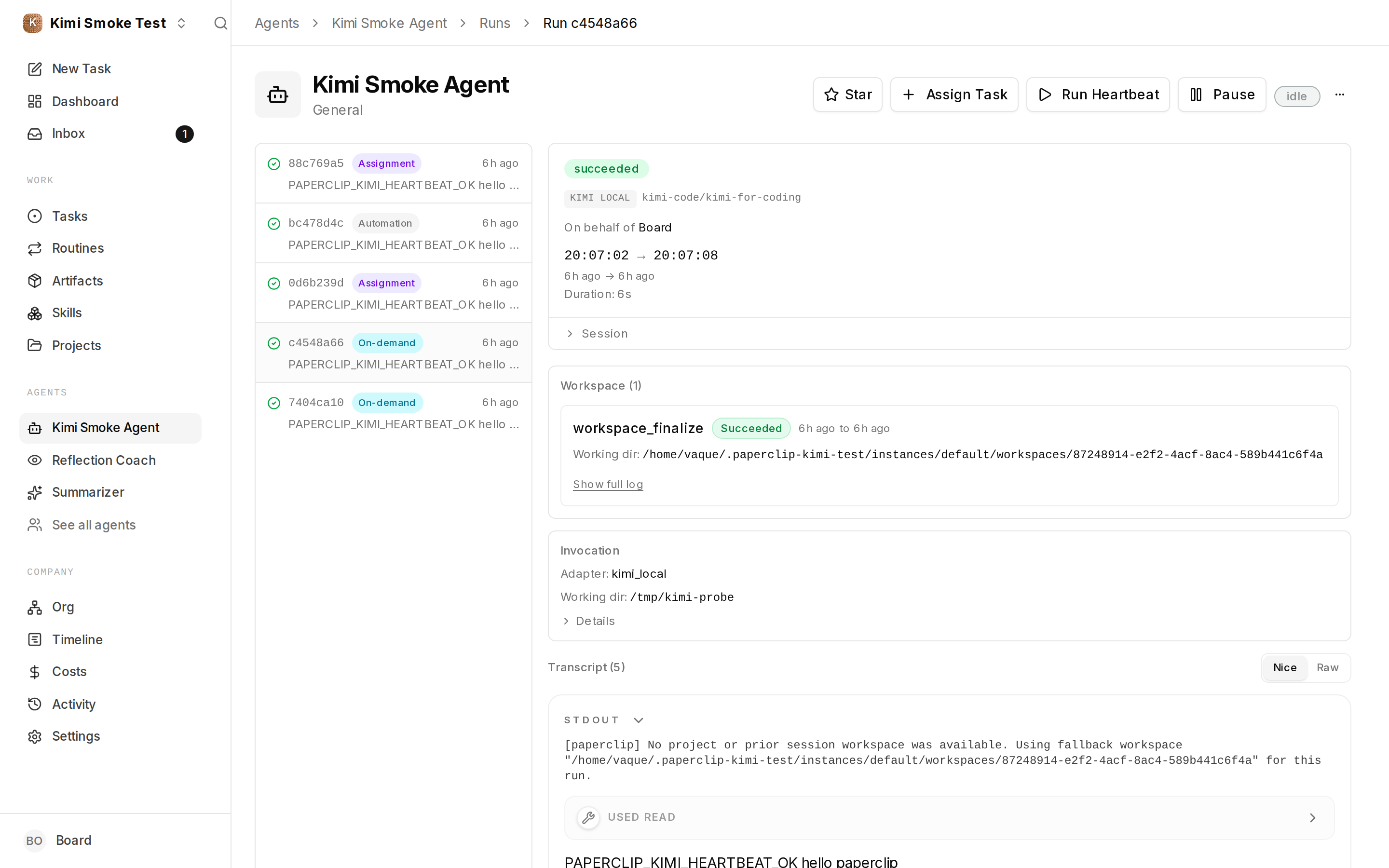 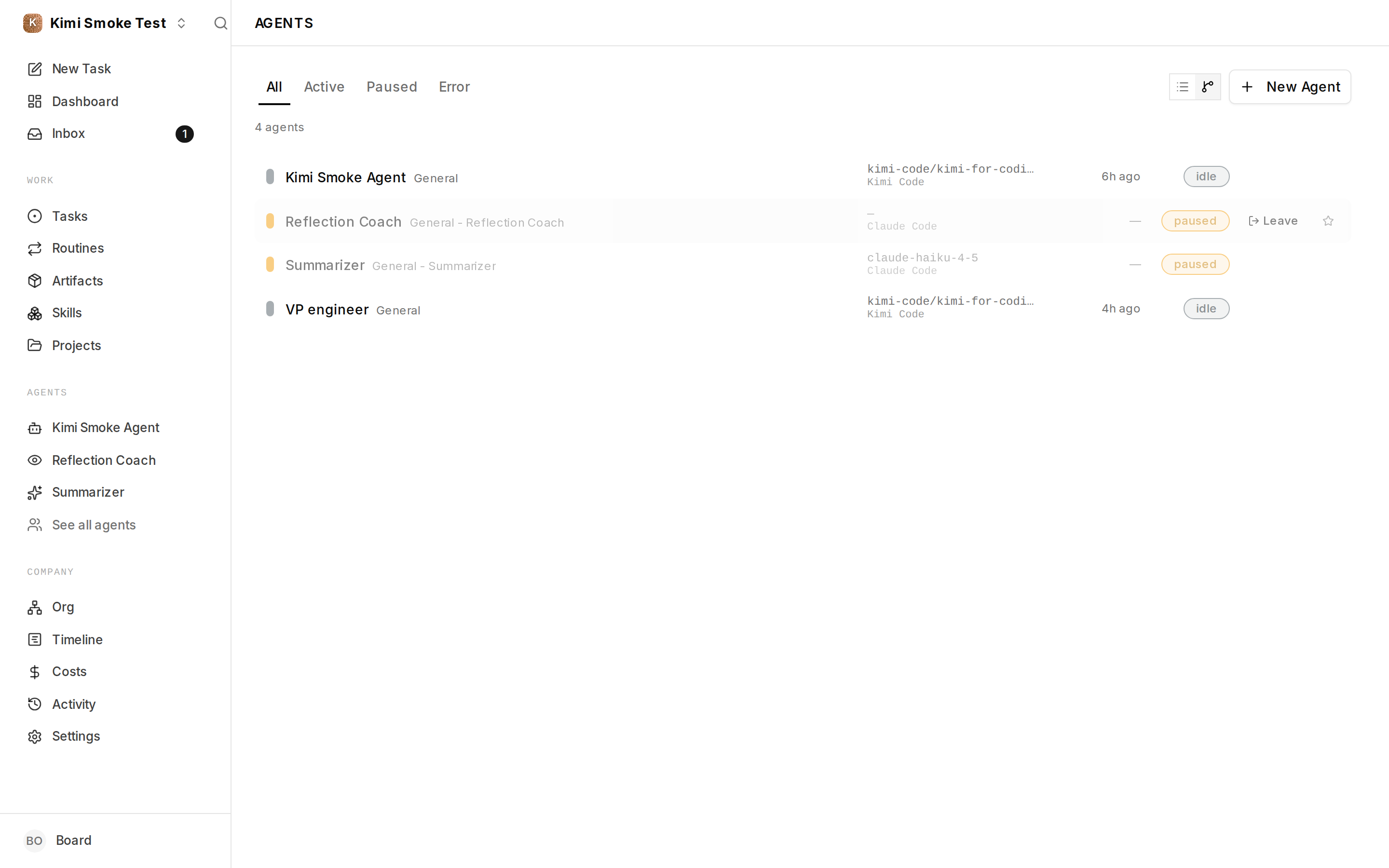 ## Risks - Low risk to existing behavior: the change is additive, one new workspace package plus single-entry registrations alongside existing adapters; no existing adapter code paths are modified. - The adapter invokes the locally installed `kimi` CLI; like other local adapters, run behavior depends on the host's Kimi version. The parser is written against the documented/verified 0.27.0 stream-json schema and degrades gracefully (malformed lines are skipped, failures surface as run errors). - `--skills-dir` overrides Kimi's auto-discovery of user and project skills for the run. This is intentional (paperclip-managed agents get a reproducible, isolated skill set), and it is only passed when at least one Paperclip skill is desired, so unconfigured agents keep default discovery. - Thinking effort is only forwarded to models that advertise `support_efforts` (currently `kimi-code/k3`); `EFFORT_CAPABLE_MODELS` must be extended when more Kimi models gain support, otherwise a configured effort is silently ignored for them. - `Dockerfile` now installs `@moonshot-ai/kimi-code@latest` globally alongside the other agent CLIs, so image size increases slightly. - Maintainer action needed for the npm bootstrap gate: the `policy` job's release-bootstrap step fails until the first npm publish of `@paperclipai/adapter-kimi-local` (the gate from #5146 that every new adapter package has passed through). Enrollment with `publishFromCi: true` is required by the manifest validator (dropping the entry, `false`, or `private` are all rejected), so this is intentionally left to a maintainer. Remaining CI lanes are expected to run once it is done. ## Model Used\n\n- **Current-master rebase, conflict adaptation, and registry-parity coverage:** OpenAI, **GPT-5 Codex** (Codex agent; exact serving model ID and context-window size were not exposed to the runtime), with repository, shell, Git, and GitHub tooling. It preserved Hawik’s commit authorship, reconciled ACPX and environment-capability changes, added current registry tests, and ran the verification above.\n- **Adapter implementation and initial review:** Moonshot AI, **Kimi K3 Coding** (latest), via **Kimi Code CLI v0.27.0** (`kimi-code/k3` alias, 1M-token context window, thinking mode, agentic tool use). The CLI agent explored the repo, wrote the adapter implementation (delegated to a coder sub-agent of the same model), ran tests, and drafted the first version of this PR body. A second model-driven review pass (read-only, same model) audited the diff for security/correctness before submission; its findings (shell-quoting hardening, auth-detection false positive, session-compaction registration, test gaps) were fixed and are included. - **Harness-context fixes and review responses:** Anthropic, **Claude Opus 4.8** (`claude-opus-4-8`) via Claude Code. Diagnosed from run logs that Kimi received only the entry instructions file (not the `HEARTBEAT.md`/`SOUL.md`/`TOOLS.md` bundle) and that `effort` was never wired, then implemented the instruction `--add-dir` delivery, `KIMI_MODEL_THINKING_EFFORT` forwarding, and `--skills-dir` skill delivery, added the accompanying tests and docs, and addressed the automated review comments (preserving external skills on remote sync, treating a signaled exit as a failure). Also extended the `paperclipai agent local-cli` installer to seed the control-plane skills into `~/.kimi-code/skills` for Codex/Claude parity, wired `onEvent` runtime events so the issue-thread activity indicator reflects Kimi's tool and reasoning output live, and built the ACP engine lane (`kimi acp` via the shared acpx engine, default) so the transcript streams with live tool status like the other ACP adapters. The Kimi CLI flags, subcommand, and env var relied on here were verified against the installed Kimi Code CLI 0.27.0. - All CLI behaviors claimed here (`-p`, `--output-format stream-json`, `-r` resume, event shapes, `--add-dir`, `--skills-dir`, `KIMI_MODEL_THINKING_EFFORT`) were verified empirically against the installed Kimi CLI, not assumed. ## Checklist - [x] I have included a thinking path that traces from project context to this change - [x] I have specified the model used (with version and capability details) - [x] I have checked ROADMAP.md and confirmed this PR does not duplicate planned core work - [x] I have searched GitHub for duplicate or related PRs and linked them above - [x] I have either (a) linked existing issues with `Fixes: #` / `Closes #` / `Refs #` OR (b) described the issue in-PR following the relevant issue template - [x] I have not referenced internal/instance-local Paperclip issues or links (only public GitHub `#NNN` / `github.com/paperclipai/paperclip` URLs) - [x] My branch name describes the change (e.g. `docs/...`, `fix/...`) and contains no internal Paperclip ticket id or instance-derived details - [x] I have run tests locally and they pass - [x] I have added or updated tests where applicable - [x] I have updated relevant documentation to reflect my changes - [x] I have considered and documented any risks above - [x] All Paperclip CI gates are green *(only the release-bootstrap step remains red, pending the maintainer npm publish described in Risks)* - [x] Greptile is 5/5 with no open P2s, recommendations, or follow-ups *(will address all Greptile comments as they arrive)* - [x] I will address all Greptile and reviewer comments before requesting merge --- ## Maintainer Addendum (2026-08-20) The shared acpx-engine and issue-chat changes (run-summary segmentation, placeholder tool-event coalescing, `ISSUE_CHAT_TRANSCRIPT_MAX_VISIBLE_ENTRIES` 30 → 400, live-reasoning UI) have been **extracted to #11761** so the cross-adapter behavior changes review and revert independently — both commits there preserve @hawikk's authorship. This PR is now the kimi-specific adapter only (60 files, +3,793/−8, essentially pure addition); the only shared-engine touch left is the `kimi acp` command resolution. `publishFromCi` is `true` — the package name is bootstrapped on npm. --------- Co-authored-by: Claude Opus 4.8 <noreply@anthropic.com> Co-authored-by: Paperclip <noreply@paperclip.ing> Co-authored-by: Dotta <bippadotta@protonmail.com> Co-authored-by: Devin Foley <devin@paperclip.ing> |
||
|
Nicky LeachandClaude Opus 5
|
a9d1f740f0 |
fix(workspaces): seed managed worktrees when the base checkout has no config (#11752)
## Thinking Path
> - Paperclip is the open source app people use to manage AI agents for
work
> - Agents do that work in isolated git worktrees, and a managed
worktree runs its own Paperclip instance with a cloned database
> - That clone needs a seed source, and the source must come from
server-owned registration, never from state the workspace itself can
rewrite
> - The seed-source resolver requires the registered base project
workspace to hold its own `.paperclip/config.json`
> - A managed project workspace is a plain `git clone`, and no code
writes that file into it
> - Every isolated worktree provision, deferred seed, and workspace
repair therefore fails on a managed checkout
> - This pull request lets a named source supply the config when the
base checkout has none
> - The benefit is that managed worktrees provision again, and the seed
source stays server-owned
## Linked Issues or Issue Description
No public GitHub issue exists for this problem. It is described below.
**What happened?**
Agent runs that need an isolated worktree fail during provisioning. The
provision command exits with this error (paths redacted):
```
Execution workspace provision command "bash ./scripts/provision-worktree.sh" failed:
Registered base project workspace has no canonical Paperclip config:
<instance-home>/instances/default/projects/<company-id>/<project-id>/<repo>/.paperclip/config.json
```
`resolveRegisteredWorktreeSeedSource` sets `registeredConfigPath` to
`<baseCwd>/.paperclip/config.json` whenever the caller names a
registered base workspace. It then requires that file to exist.
`scripts/provision-worktree.sh` applies the same rule.
A managed project workspace never has that file.
`materializeManagedProjectWorkspace` creates it with `git clone` and a
rename, so the checkout holds repository content only. The control plane
keeps its config at `<home>/instances/<id>/config.json` instead.
The failure reaches three paths: worktree provisioning, deferred seeding
through `worktree ensure-seeded`, and workspace repair.
The behavior changed in #11671. That pull request replaced a fallback
chain with a single hard requirement. Fixture code in
`scripts/__tests__/provision-worktree-self-heal.test.mjs` writes a
config into the fake base workspace, so tests kept passing.
**Expected behavior**
A managed worktree provisions and seeds from the registered source. The
seed manifest still never selects that source.
**Steps to reproduce**
1. Register the Paperclip repository as a project with a `repoUrl`, so
the server materializes a managed checkout.
2. Assign an issue to an agent whose workspace strategy is
`git_worktree`.
3. Watch the workspace operation log for the provision command.
4. The command exits non-zero with the error above.
**Paperclip version or commit**
Reproduced on `master` at
|
||
|
Nicky LeachandPaperclip
|
e0e503e1bc |
fix(server): make blockers-resolved wake dedup level-triggered (#11732)
## Thinking Path > - Paperclip is the open source app people use to manage AI agents for work. > - Paperclip uses issue dependencies to pause work until blockers reach a ready state. > - A blocked issue with several blockers can miss its wake when the final blocker completes. > - The wake deduplication used a historical per-edge key, so an old completed wake hid the current ready state. > - This pull request adds a level-triggered key for the sorted set of blocker issue ids and uses one helper for all wake paths. > - The benefit is that the final blocker wake can repair a missed wake, while repeated reconciliation stays bounded. ## Linked Issues or Issue Description Refs #8009, #7853, and #6719. These public pull requests cover related dependency-wake and deduplication behavior. This pull request fixes a separate multi-blocker state-key gap. **What happened?** A blocked issue with multiple blockers received no `issue_blockers_resolved` wake when the final blocker completed. An earlier completed per-edge wake suppressed the wake for the current all-ready state. **Expected behavior** The final blocker completion must emit one wake for the current ready state. A later reconciliation pass must not emit a second wake for the same state. **Steps to reproduce** 1. Create a blocked issue with at least two blocker issues. 2. Complete one blocker and record its completed per-edge wake. 3. Complete the final blocker. 4. Run the route-time or reconciliation wake path. 5. Confirm that one level-triggered wake exists for the sorted blocker set. **Paperclip version or commit** `eed1e5cad91a37547e1b521232da04b9ddb316f0` **Deployment mode** Local dev from source. ## What Changed - Add a SHA-256 level-triggered idempotency key from the sorted blocker issue ids. - Share one deduplication helper across route-time, finalize-time, and periodic wake paths. - Treat state-key rows with idempotent statuses as duplicates. - Treat legacy per-edge rows as duplicates only while they remain in flight. - Record skipped route-time wakes without suppressing later finalize-time or periodic wakes. - Add regression coverage for a completed earlier-blocker wake and a second reconciliation pass. ## Verification - Run `npx vitest run server/src/__tests__/issue-dependency-wakeups-routes.test.ts`. - Run `npx vitest run server/src/__tests__/heartbeat-issue-liveness-escalation.test.ts`. - Run `npx vitest run server/src/__tests__/heartbeat-dependency-scheduling.test.ts`. - Run `npx vitest run server/src/__tests__/issue-rewake-throttle.test.ts server/src/__tests__/recovery-stale-issue-lock-sweep.test.ts`. - Run `tsc --noEmit` on the touched files. ## Risks The change alters wake deduplication for dependency reconciliation. The new key uses the full sorted blocker set, so a change in that set permits a new wake. The regression tests cover the missed-final-blocker case and repeated reconciliation. ## Model Used OpenAI Codex, GPT-5, tool-use model with code execution and repository review support. ## Checklist - [x] I have included a thinking path that traces from project context to this change - [x] I have specified the model used (with version and capability details) - [x] I have checked ROADMAP.md and confirmed this PR does not duplicate planned core work - [x] I have searched GitHub for duplicate or related PRs and linked them above - [x] I have either (a) linked existing issues with `Fixes: #` / `Closes #` / `Refs #` OR (b) described the issue in-PR following the relevant issue template - [x] I have not referenced internal/instance-local Paperclip issues or links (only public GitHub `#NNN` / `github.com/paperclipai/paperclip` URLs) - [x] My branch name describes the change (e.g. `docs/...`, `fix/...`) and contains no internal Paperclip ticket id or instance-derived details - [x] I have run tests locally and they pass - [x] I have added or updated tests where applicable - [x] I have updated relevant documentation to reflect my changes - [x] I have considered and documented any risks above - [x] All Paperclip CI gates are green - [x] Greptile is 5/5 with no open P2s, recommendations, or follow-ups - [x] I will address all Greptile and reviewer comments before requesting merge Co-authored-by: Paperclip <noreply@paperclip.ing> |
||
|
Nicky LeachandPaperclip
|
e0b64529b3 |
feat(auth): normalize agent login in the sandbox onto one session table and a capability contract (#11730)
## Thinking Path > - Paperclip is the open source app people use to manage AI agents for work > - Sandbox agents need a safe login path for each supported adapter > - Codex device login and Claude setup-token login used separate session stores and route logic > - Separate stores made session lookup, expiry, and login capability checks harder to keep consistent > - This pull request unifies both flows on one session table and one capability contract > - The benefit is one company-scoped login model with public session identifiers and shared lifecycle rules ## Linked Issues or Issue Description **Subsystem affected** Cross-cutting (multiple of the above) **Problem or motivation** Codex and Claude sandbox login used separate session stores and different route paths. This split increased the risk of inconsistent company scoping, session lookup, and cleanup. **Proposed solution** Use `adapter_auth_sessions` for both login flows. Use public session identifiers for API access. Select login behavior from projected adapter capability data. Share the route spine, lease arguments, runner lifecycle, and reaper rules. **Alternatives considered** Keep two session tables and add matching fixes to both routes. This keeps duplicate logic and does not provide one capability contract, so this pull request uses shared infrastructure. **Roadmap alignment** This change supports the shipped Cloud / Sandbox agents milestone in `ROADMAP.md`. ## What Changed - Unify Codex device login and Claude setup-token login on `adapter_auth_sessions`. - Return and look up sessions with company-scoped public session identifiers. - Enforce one active session for each company, owner, and adapter. - Share the login route spine, sandbox lease arguments, runner lifecycle, and missing-auth check. - Add a standalone setup-token reaper with adapter-specific row selection. - Add optional login capability projection for adapters and drive route and UI selection from that data. - Rename the provider flag to `supportsLoginPty` and validate its deprecated alias. - Remove the old Claude setup-token session table and add the required migrations. ## Verification - Server typecheck passed with `tsc`. - Database typecheck passed. - UI typecheck passed with `tsc -b`. - Codex login service and route suites passed. - Setup-token session, route, and reaper suites passed. - Adapter session schema, plugin validator, capability projection, UI render, and Daytona suites passed. - GitHub Actions must confirm the complete CI gate after pull request creation. ## Risks - The migrations remove short-lived in-flight login rows during deployment. A login that spans the migration can continue until its provider lease expires. - The Codex credential store remains company-scoped. A cross-owner credential race remains a documented, board-accepted risk. - API clients that use internal session row identifiers no longer work. The API accepts only public session identifiers. ## Model Used Codex, GPT-5, exact runtime model ID not exposed in this handoff, large context window, reasoning, and repository tool use. The implementing engineer produced the code with AI assistance. ## Checklist - [x] I have included a thinking path that traces from project context to this change - [x] I have specified the model used (with version and capability details) - [x] I have checked ROADMAP.md and confirmed this PR does not duplicate planned core work - [x] I have searched GitHub for duplicate or related PRs and linked them above - [x] I have either (a) linked existing issues with `Fixes: #` / `Closes: #` / `Refs: #` OR (b) described the issue in-PR following the relevant issue template - [x] I have not referenced internal/instance-local Paperclip issues or links (only public GitHub `#NNN` / `github.com/paperclipai/paperclip` URLs) - [x] My branch name describes the change (e.g. `docs/...`, `fix/...`) and contains no internal Paperclip ticket id or instance-derived details - [x] I have run tests locally and they pass - [x] I have added or updated tests where applicable - [x] I have updated relevant documentation to reflect my changes - [x] I have considered and documented any risks above - [x] All Paperclip CI gates are green - [x] Greptile is 5/5 with no open P2s, recommendations, or follow-ups - [x] I will address all Greptile and reviewer comments before requesting merge --------- Co-authored-by: Paperclip <noreply@paperclip.ing> |
||
|
DottaandPaperclip
|
a2bf936f9a |
feat(workspaces): sign the workspace login handoff and gate readiness (#11671)
## Thinking Path > - Paperclip is the open source app people use to manage AI agents for work. > - Managed worktree services run isolated Paperclip instances with cloned databases. > - A reachable service was reported as ready even when its database, runtime identity, or login path was not usable. > - The first candidate added verified database seeding and managed repair in #11665. > - This pull request consolidates that candidate with signed login handoff and a complete readiness contract. > - Post-QA fixes close five defects in repair identity, repair responses, UI retry, seed journal handling, and seed-source trust. > - The benefit is a workspace that either opens safely or reports one accurate recovery action. ## Linked Issues or Issue Description No public GitHub issue exists for this work, so the problem is described here. **What happened** Managed workspace URLs could return HTTP 200 and report ready while login failed. QA also found cases where repair used the wrong instance identity, returned a generic error, left the UI stuck, rejected a safe journal lag, or trusted a mutable workspace manifest. **Expected behavior** Opening a ready workspace signs the board user in to the correct isolated instance. Provisioning and repair use a registered source and report a structured recovery state. **Actual behavior** Entry depended on a password copied into the clone. Several failure paths could publish stale readiness, hide the repair precondition, or trust state that the workspace could modify. **Additional context** This pull request includes the commits first published in #11665. That pull request keeps the original base head for review history. This consolidated pull request is the merge candidate. Related open readiness work includes #11575 and #11621. ## What Changed - Adds a short-lived, signed, single-use login ticket. It binds the user, workspace, instance, and runtime origin. - Exchanges the ticket through Better Auth. It creates the session and cookie through the supported adapter path. - Adds protected workspace readiness fields for the database, clone data, login handoff, seed phase, and runtime identity. - Fails readiness closed when the guest has no company or execution-workspace binding. - Binds ticket issuance to the exact cloned user and active company membership selected for the handoff. - Verifies every current active board identity through the exact-user handoff before publication or reuse. - Gates managed runtime publication on the readiness contract and the recorded worktree instance identity. - Refreshes runtime work products from the live runtime row after a port change. - Adds one workspace access card with ready, degraded, repairing, and failed states. - Uses the runtime response identity for repair. It returns structured repair precondition errors. - Lets a valid source journal lag converge during provisioning. - Binds seed and repair manifests to a source registered outside the agent-writable worktree. - Clears recovered UI errors so a successful retry can open the workspace. - Makes runtime tests register canonical sources and avoid ports owned by live host listeners. - Keeps Vitest on source suites when compiled `dist` trees exist. - Isolates CLI and adapter tests from ambient AWS and runtime API environment variables. - Preserves a 404 response for cross-company workspace ID lookups before runtime authorization. - Makes concurrent single-flight coverage independent of path-canonicalization scheduling order. ## Verification The following checks passed on the integrated head: ```sh pnpm -r typecheck pnpm build pnpm check:token-gates pnpm --filter @paperclipai/db check:migrations ``` - The server source lane passed 420 files and 4,953 tests. Five tests were skipped. - The CLI lane passed 57 files and 385 tests. - The database lane passed 26 files and 97 tests. - The shared package passed 58 files and 506 tests. - The adapter utility lane passed 640 tests. Four tests were skipped. - The Claude adapter passed 220 tests. One test was skipped. - The Codex adapter passed 323 tests. - The OpenClaw adapter passed 13 tests. - The OpenCode adapter passed 42 tests. - The plugin SDK passed 45 tests. - The workspace runtime suite passed 124 tests. - The caller-scoped readiness and handoff suite passed 52 tests. - The workspace provisioning shell suite passed 7 tests. - The runtime exposure suite passed 17 tests while live host mappings occupied fixed test ports. - `git diff --check` passed and the worktree is clean. The serialized route lane will run in GitHub CI with its normal shards. No deployment or active-workspace migration was performed. ## Risks - This is a medium-risk authentication and runtime-readiness change. - The login ticket uses exact origin, workspace, instance, and user binding. It has a short expiry and a one-time nonce. - Runtime publication is stricter. A real readiness, identity, per-user handoff, or control-plane database disagreement now blocks publication. - This pull request supersedes #11665 as the merge candidate. Close #11665 after this pull request merges. - No new database migration is included. The lockfile and workflow files are unchanged. - Deployment and active-workspace migration are intentionally outside this pull request. > For core feature work, check [`ROADMAP.md`](ROADMAP.md) first and discuss it in `#dev` before opening the PR. Feature PRs that overlap with planned core work may need to be redirected — check the roadmap first. See `CONTRIBUTING.md`. ## Model Used Claude Opus 5 (`claude-opus-5[1m]`), 1M context, extended thinking, tool use, and code execution produced the main candidate. OpenAI GPT-5 (`gpt-5`) through Codex, with agentic reasoning, tool use, and code execution, integrated the post-QA fixes and hardened the test gates. The Codex context-window size was not exposed. ## Checklist - [x] I have included a thinking path that traces from project context to this change - [x] I have specified the model used (with version and capability details) - [x] I have checked ROADMAP.md and confirmed this PR does not duplicate planned core work - [x] I have searched GitHub for duplicate or related PRs and linked them above - [x] I have either (a) linked existing issues with `Fixes: #` / `Closes #` / `Refs #` OR (b) described the issue in-PR following the relevant issue template - [x] I have not referenced internal/instance-local Paperclip issues or links (only public GitHub `#NNN` / `github.com/paperclipai/paperclip` URLs) - [x] My branch name describes the change (e.g. `docs/...`, `fix/...`) and contains no internal Paperclip ticket id or instance-derived details - [x] I have run tests locally and they pass - [x] I have added or updated tests where applicable - [x] I have updated relevant documentation to reflect my changes - [x] I have considered and documented any risks above - [x] All Paperclip CI gates are green - [x] Greptile is 5/5 with no open P2s, recommendations, or follow-ups - [x] I will address all Greptile and reviewer comments before requesting merge --------- Co-authored-by: Paperclip <noreply@paperclip.ing> |
||
|
Nicky LeachandPaperclip
|
120ae5428f |
feat(server): add a one-click relink action for detached custom-image templates (#11641)
## Thinking Path > - Paperclip is the open source app people use to manage AI agents for work > - Paperclip environments can use captured custom images for agent runs > - A configuration fingerprint change can detach a valid custom-image template > - Operators need a safe way to confirm that the image still matches the boot source > - This pull request adds a guarded relink action with drift classification and audit logging > - The benefit is a deliberate relink without a new sandbox boot or provider snapshot ## Linked Issues or Issue Description **Subsystem affected** Cross-cutting environment, server, and UI behavior. **Problem or motivation** A custom-image template detaches when the environment configuration fingerprint changes. The runtime then uses the base image, even when the boot source did not change. The only prior remedy required a full re-capture. **Proposed solution** Add an operator-triggered relink action. Classify configuration drift from a server-owned boot-relevant snapshot. Relink knob-only drift without confirmation. Require explicit confirmation for boot-source or unclassified drift. Guard the route for instance administrators and record a safe activity event. **Alternatives considered** Keep requiring a full re-capture. This adds a sandbox boot and provider snapshot for cases where the image remains correct. **Roadmap alignment** The roadmap has no matching custom-image relink item. This change addresses an environment operation gap. **Additional context** The relink response exposes raw drift values only in the transient 409 response to the instance administrator. The service never persists or logs fingerprints or configuration values. Reserved identity-path segments fail closed. ## What Changed - Add `relinkActiveTemplate` with drift classification and conditional fingerprint update. - Persist a server-owned boot-relevant configuration snapshot during capture. - Add the guarded relink route with strict request validation and activity logging. - Add the relink action and confirmation flow to the environment page. - Add service, route, UI, and OpenAPI coverage. ## Verification - Run the focused service suite: `pnpm vitest run server/src/services/environment-custom-images-service.test.ts`. - Run the focused route suite: `pnpm vitest run server/src/routes/environment-custom-image-routes.test.ts`. - Run the focused UI suite: `pnpm vitest run ui/src/pages/CompanyEnvironments.test.tsx`. - Run server and UI TypeScript checks. - Confirm the OpenAPI snapshot matches the new route. - Confirm all required GitHub checks pass on commit `e46fdcfe94a719be854adf8849d30714e5b70b93`. - Confirm Greptile reports 5/5 with no unresolved review threads. ## Risks The relink action can keep an image after configuration drift. The service requires explicit confirmation for boot-source or unclassified drift. Reserved path segments produce a safe unresolved marker and never enter stored values. ## Model Used OpenAI GPT-5 Codex. The model used repository inspection, GitHub operations, and PR preparation with tool use and code execution. The runtime did not expose a context-window value or a separate reasoning-mode value. ## Checklist - [x] I have included a thinking path that traces from project context to this change - [x] I have specified the model used (with version and capability details) - [x] I have checked ROADMAP.md and confirmed this PR does not duplicate planned core work - [x] I have searched GitHub for duplicate or related PRs and linked them above - [x] I have either (a) linked existing issues with `Fixes: #` / `Closes #` / `Refs #` OR (b) described the issue in-PR following the relevant issue template - [x] I have not referenced internal/instance-local Paperclip issues or links (only public GitHub `#NNN` / `github.com/paperclipai/paperclip` URLs) - [x] My branch name describes the change (e.g. `docs/...`, `fix/...`) and contains no internal Paperclip ticket id or instance-derived details - [x] I have run tests locally and they pass - [x] I have added or updated tests where applicable - [x] I have updated relevant documentation to reflect my changes - [x] I have considered and documented any risks above - [x] All Paperclip CI gates are green - [x] Greptile is 5/5 with no open P2s, recommendations, or follow-ups - [x] I will address all Greptile and reviewer comments before requesting merge --------- Co-authored-by: Paperclip <noreply@paperclip.ing> |
||
|
DottaandPaperclip
|
6b8e42168e |
Add governed secret alias confirmation cards (#11486)
## Thinking Path > - Paperclip is the open source app people use to manage AI agents for work. > - Agents need scoped secret bindings to use external services safely. > - Agents could not request an existing secret under a new config name without an internal secret identifier. > - Existing binding proposals were only visible in Settings and did not create an issue-thread approval path. > - A confirmation card could record acceptance without proving that the binding was created. > - This pull request extends the existing secret proposal system with safe source references and governed issue-thread confirmation cards. > - The benefit is a one-click flow that creates the binding or shows a clear failure without exposing secret material. ## Linked Issues or Issue Description Related prerequisite: #11482. **Subsystem affected** Cross-cutting: server REST APIs, shared interaction contracts, database proposal schema, and issue-thread UI. **Problem or motivation** An agent can need an existing bound secret under a second config name. The agent cannot safely discover the internal secret identifier. The existing proposal is also easy for the operator to miss because it only appears in Settings. A generic confirmation can record acceptance without executing the binding. **Proposed solution** Let an agent create a binding proposal from one of its existing config paths. Mint a server-owned, human-only confirmation card on the checked-out issue. Recheck the operator's target-agent permission under the proposal row lock. Execute the existing proposal transaction after card acceptance. Store an `executed` or `failed` result on the card. Render the complete lifecycle in the issue thread and attention resolver. **Alternatives considered** A new alias subsystem would duplicate proposal quotas, expiry, authorization, and binding synchronization. A text-only issue comment would not provide a governed action or an execution result. An agent-supplied card payload would permit metadata smuggling. This change uses the existing proposal transaction and a server-owned payload instead. **Roadmap alignment** This change extends the completed "Secrets Manager with per-agent access" roadmap item. It preserves scoped bindings and audited resolution. The required GitHub search found no other open duplicate issue or pull request. ## What Changed - Added safe source-config-path binding proposals and preserved user-secret ownership checks. - Added a proposal-to-interaction link and an idempotent database migration. - Minted human-only `request_confirmation` cards with server-owned `secretProposal` metadata. - Rejected agent-supplied governed metadata and agent addressees. - Rechecked `agent_config:update` authority under the proposal lock before execution. - Recorded `executed` or `failed` results and posted a failure comment when no binding was created. - Settled failed accepted proposals atomically and mirrored rejection, withdrawal, and expiry in both directions. - Emitted `secret.binding.created` for new agent binding writes. - Added a dedicated issue-thread card for pending, executed, failed, rejected, withdrawn, and expired states. - Showed only the source label, target agent, config path, skeptical justification, expiry, and safe failure code. - Replaced resolved attention-query entries immediately with the stitched server result. - Added focused server, database, UI, and state-transition tests. - Added Storybook fixtures for every review state and documented the API and agent behavior. ## Verification - `pnpm exec vitest run ui/src/components/IssueThreadInteractionCard.test.tsx ui/src/components/AttentionInteractionResolver.test.ts` — 58 passed. - `pnpm --filter @paperclipai/ui typecheck` - `pnpm check:token-gates` - `pnpm build-storybook` - `pnpm --filter @paperclipai/shared typecheck` - `pnpm --filter @paperclipai/db typecheck` - `pnpm --filter @paperclipai/server typecheck` - `pnpm --filter @paperclipai/db check:migrations` - `NODE_ENV=test pnpm exec vitest run server/src/__tests__/issue-thread-interaction-routes.test.ts server/src/__tests__/secret-proposals-routes.test.ts server/src/__tests__/secrets-routes.test.ts server/src/__tests__/agents-service-secret-bindings.test.ts` — 142 passed. - `NODE_ENV=test pnpm --filter @paperclipai/db exec vitest run src/company-secret-proposals-migration.test.ts --silent` — 1 passed. - `pnpm -r typecheck` - `pnpm test:run` — server 4,175 passed, UI 4,109 passed; the CLI AWS-doctor case passes 8/8 with runtime-injected static AWS credential variables unset. - `pnpm build` - `git diff --check origin/master...HEAD` ## Risks - Migration `0221` adds one nullable foreign key and one index. It uses idempotent guards. - The accept route performs a governed write after it records card acceptance. A failed write is visible and settles the proposal as rejected. - Concurrent proposal and card resolution must use proposal-before-interaction lock order. A race test covers direct approval against card rejection. - The new audit event increases activity rows for newly added agent bindings. It does not include secret values or fingerprints. - The card includes only safe proposal metadata. It does not include secret value, fingerprint, version, or internal secret identifiers. - The UI uses the stitched resolution result. Focused tests cover immediate cache replacement and every terminal state. > This work extends an existing completed roadmap capability. The GitHub duplicate search returned no other open related work. ## Model Used - OpenAI Codex with model ID `gpt-5`. The runtime did not expose its context-window size. Reasoning, repository tools, code execution, database integration tests, UI rendering, and GitHub tools were enabled. ## Checklist - [x] I have included a thinking path that traces from project context to this change - [x] I have specified the model used (with version and capability details) - [x] I have checked ROADMAP.md and confirmed this PR does not duplicate planned core work - [x] I have searched GitHub for duplicate or related PRs and linked them above - [x] I have either (a) linked existing issues with `Fixes: #` / `Closes #` / `Refs #` OR (b) described the issue in-PR following the relevant issue template - [x] I have not referenced internal/instance-local Paperclip issues or links (only public GitHub `#NNN` / `github.com/paperclipai/paperclip` URLs) - [x] My branch name describes the change (e.g. `docs/...`, `fix/...`) and contains no internal Paperclip ticket id or instance-derived details - [x] I have run tests locally and they pass - [x] I have added or updated tests where applicable - [x] I have updated relevant documentation to reflect my changes - [x] I have considered and documented any risks above - [x] All Paperclip CI gates are green - [x] Greptile is 5/5 with no open P2s, recommendations, or follow-ups - [x] I will address all Greptile and reviewer comments before requesting merge --------- Co-authored-by: Paperclip <noreply@paperclip.ing> |
||
|
DottaandPaperclip
|
8087661bb8 |
fix: bound workspace Git scans (#11572)
## Thinking Path > - Paperclip is the open source app people use to manage AI agents for work > - Workspaces let users and agents inspect files that belong to an issue > - Changed-file views use full-tree Git status scans > - Many issue views could start those scans at the same time and make the server unresponsive > - Route-level limits did not protect the process or coalesce work for one repository > - This pull request adds one bounded scheduler for every expensive workspace Git scan > - It also starts browser scans only when the file panel is open and visible > - The benefit is bounded child-process use and responsive health checks during request storms ## Linked Issues or Issue Description **What happened?** Many changed-file requests could start full `git status --porcelain=v1 -z --untracked-files=all` scans at the same time. One production incident produced about 270 direct Git child processes. The Node process stayed alive but stopped answering health requests in time. **Expected behavior** Paperclip must bound expensive Git work across all companies, actors, issues, repositories, and browser tabs. Duplicate requests for one worktree must share work. Excess requests must fail fast with a retryable response. Hidden or closed file panels must not start scans. **Steps to reproduce** 1. Open changed-file views for many issue and actor keys. 2. Send requests for two large workspace roots at the same time. 3. Observe that route-level limiter keys allow many full Git scans to run together. 4. Observe delayed health responses and accumulated Git children. **Paperclip version or commit** Reproduced on master before commit `43ab441f0f`. **Deployment mode** Self-hosted server with local workspace repositories. ## What Changed - Add a process-wide scheduler with configurable concurrency, queue capacity, timeout, and cache TTL. - Add fair admission, a bounded queue, canonical worktree keys, single-flight joins, and bounded result caching. - Add subprocess timeouts, TERM-to-KILL escalation, bounded output, waiter cancellation, and slot cleanup. - Route full-tree status work from file resources, workspace runtime, execution workspaces, and adapter overlay sync through the scheduler. - Return stable retryable `503` and `504` error codes for saturation and timeout. - Add structured logs with safe workspace hashes, durations, queue state, cache use, joins, and terminal outcomes. - Gate UI queries on panel and document visibility. Cancel queries on close, hide, unmount, and workspace change. - Disable focus and reconnect bursts. Keep one explicit refresh action and a retryable unavailable state. - Document the 10-second default freshness tradeoff and all configuration variables. - Add unit, route, UI, adapter, and deterministic 500-request load coverage. ## Verification - `pnpm -r typecheck` - `pnpm build` - `pnpm check:token-gates` - `pnpm --filter @paperclipai/server exec vitest run src/services/workspace-git-operation-scheduler.test.ts src/__tests__/file-resources-git-scan-load.test.ts --reporter=dot` — 16 tests passed. - `pnpm --filter @paperclipai/ui exec vitest run src/components/WorkspaceFileBrowser.test.tsx src/lib/page-visibility.test.ts --reporter=dot` — 38 tests passed. - `pnpm --filter @paperclipai/adapter-utils exec vitest run src/git-workspace-sync.test.ts --reporter=dot` — 16 tests passed. - Existing file-resource, workspace-runtime, and execution-workspace regression selections passed. - Two cleanup safety regressions prove failed scans preserve the worktree before archive and at the final deletion fence. - Before: the incident produced about 270 Git children and health requests timed out. - After: 500 concurrent requests across 500 issue keys, 73 actors, and two roots started two underlying scans. Peak scan concurrency was 2. All 500 requests succeeded. Health p99 was 4.94 ms. The harness found zero unreaped children. - The full local Vitest run passed 4,267 tests. Ten existing fixed-port HTTPS exposure tests could not run because this host already owns Tailnet listeners on ports 42000 and 52000. Clean GitHub CI is the final full-suite result. - Latest-head GitHub CI passed all required test, typecheck, build, canary, e2e, policy, and security gates. - Greptile completed at 5/5 with zero unresolved comments, recommendations, or follow-ups. ## Risks - Changed-file results can be up to 10 seconds old by default. Explicit refresh remains available. - A full queue returns a retryable `503` instead of waiting without a bound. - A scan that exceeds the default 8-second deadline returns a retryable `504` and terminates its process group. - Operators can tune all limits with documented environment variables. Safe defaults protect local and shared servers. > For core feature work, check [`ROADMAP.md`](ROADMAP.md) first and discuss it in `#dev` before opening the PR. Feature PRs that overlap with planned core work may need to be redirected — check the roadmap first. See `CONTRIBUTING.md`. ## Model Used - OpenAI Codex, GPT-5 family. The runtime does not expose the exact deployment ID or context-window size. High reasoning, tool use, and code execution were enabled. ## Checklist - [x] I have included a thinking path that traces from project context to this change - [x] I have specified the model used (with version and capability details) - [x] I have checked ROADMAP.md and confirmed this PR does not duplicate planned core work - [x] I have searched GitHub for duplicate or related PRs and linked them above - [x] I have either (a) linked existing issues with `Fixes: #` / `Closes #` / `Refs #` OR (b) described the issue in-PR following the relevant issue template - [x] I have not referenced internal/instance-local Paperclip issues or links (only public GitHub `#NNN` / `github.com/paperclipai/paperclip` URLs) - [x] My branch name describes the change (e.g. `docs/...`, `fix/...`) and contains no internal Paperclip ticket id or instance-derived details - [x] I have run tests locally and they pass - [x] I have added or updated tests where applicable - [x] I have updated relevant documentation to reflect my changes - [x] I have considered and documented any risks above - [x] All Paperclip CI gates are green - [x] Greptile is 5/5 with no open P2s, recommendations, or follow-ups - [x] I will address all Greptile and reviewer comments before requesting merge --------- Co-authored-by: Paperclip <noreply@paperclip.ing> |
||
|
Devin Foley
|
962e98b1be |
feat(server): operator declaration for platform edge TLS termination on the Claude login guard (#11579)
## Thinking Path > - Paperclip is the open source app people use to manage AI agents for work > - The Claude local adapter supports a setup-token subscription login, and its confidential routes pass a fail-closed transport guard > - The guard accepts direct socket TLS, a local_trusted loopback peer, or an allowlisted proxy peer that forwards https — and deliberately never reads the global `TRUST_PROXY` > - On a managed platform the edge terminates TLS, the app socket is always plain HTTP, and the edge-proxy peer addresses are not stable or documented, so none of the three cases can hold > - Every login on such a deployment shows the clear-text transport warning although the user's connection is HTTPS, and the agent-scoped confidential routes fail closed entirely > - This pull request adds a dedicated operator declaration that the platform edge terminates TLS, as a fourth guard case > - The benefit is a correct transport decision on managed platforms with the default posture unchanged everywhere else ## Linked Issues or Issue Description No public GitHub issue covers this. The problem is described in-PR following the enhancement template. Related public PRs: [#11347](https://github.com/paperclipai/paperclip/pull/11347) added the new-agent login flow and the non-blocking transport advisory, and [#11286](https://github.com/paperclipai/paperclip/pull/11286) added the setup-token login and the guard with its `CLAUDE_LOGIN_TRUSTED_PROXIES` allowlist. **Subsystem affected** server/ — the confidential transport guard for the Claude setup-token login (`services/setup-token-session.ts`, `routes/agents.ts`, `app.ts`). **Current behavior** The guard allows a confidential response on direct socket TLS, on a `local_trusted` loopback peer, or when the immediate peer is on the dedicated `CLAUDE_LOGIN_TRUSTED_PROXIES` allowlist and forwards `https`. Behind a managed platform's TLS-terminating edge (Railway, Render, Fly, and similar), the app socket is plain HTTP and the edge-proxy peer addresses are not operator-visible or stable, so the allowlist cannot express them — IPv6 entries match by exact string only. The result: the login panel shows "This connection is not encrypted" for a connection that is HTTPS to the user, and the agent-scoped confidential routes return the fixed no-secret error. **Proposed behavior** `CLAUDE_LOGIN_EDGE_TLS_TERMINATED=true` is an explicit, single-purpose operator declaration that every client request reaches the server through the platform's TLS-terminating edge. Under the declaration the guard treats a request as confidential unless the edge itself labels the client hop as plain `http` in `X-Forwarded-Proto`. The declaration is never derived from the global `TRUST_PROXY` setting, which the guard still never reads. Without the declaration, nothing changes. **Reason and benefit** The guard's spoofing concern does not apply to this deployment shape: a client cannot pick its transport, because the platform admits HTTPS only, and the header the guard consults is set by the platform edge, not the client. A blanket warning that is always wrong teaches users to ignore it. The declaration keeps the strict default for every deployment that does not opt in, and it keeps the allowlist as the precise tool for operators who do know their proxy addresses. ## What Changed - `ConfidentialTransportConfig` gains optional `edgeTlsTerminated` (default false), documented as the operator declaration for platform edge TLS termination. - `evaluateConfidentialTransport` adds the declaration as a guard case: allowed unless the forwarded protocol's first hop is explicitly `http` (reason `edge_labeled_plain_http` then; `operator_edge_tls_termination` when allowed). - `assessConfidentialStartup` reports `edge_tls_termination_declared`, so the startup log shows why forwarded requests pass. - `app.ts` parses `CLAUDE_LOGIN_EDGE_TLS_TERMINATED` (truthy: `1/true/yes/on`) and passes it to the agent routes; the routes build the guard config from it. - The SR-7 operator-requirement comment on the setup-token routes documents the new variable next to the allowlist. - Tests: five new guard unit cases and a route case asserting the prompt and code responses carry no `transportAdvisory` under the declaration. ## Verification ```sh cd server npx tsc --noEmit # clean npx vitest run src/services/setup-token-session.test.ts \ src/routes/setup-token-route.test.ts \ src/__tests__/openapi-routes.test.ts # 3 files, 89 passed ``` The new "keeps failing closed when the declaration is absent" case pins the unchanged default posture. ## Risks The declaration is an operator statement the server cannot verify; an operator who sets it on a deployment whose edge does not terminate TLS re-labels plain-HTTP requests as confidential. This is the same trust class as `CLAUDE_LOGIN_TRUSTED_PROXIES` (a wrong allowlist entry has the same effect) and is opt-in, off by default, and scoped to the login routes only. The guard still fails closed when the edge explicitly labels a request `http`. No schema change, no API shape change — `transportAdvisory` was already nullable. ## Model Used Claude Fable 5 (`claude-fable-5`), extended thinking, with tool use and code execution — investigation, implementation, and tests. ## Checklist - [x] I have included a thinking path that traces from project context to this change - [x] I have specified the model used (with version and capability details) - [x] I have checked ROADMAP.md and confirmed this PR does not duplicate planned core work - [x] I have searched GitHub for duplicate or related PRs and linked them above - [x] I have either (a) linked existing issues with `Fixes: #` / `Closes #` / `Refs #` OR (b) described the issue in-PR following the relevant issue template - [x] I have not referenced internal/instance-local Paperclip issues or links (only public GitHub `#NNN` / `github.com/paperclipai/paperclip` URLs) - [x] My branch name describes the change (e.g. `docs/...`, `fix/...`) and contains no internal Paperclip ticket id or instance-derived details - [x] I have run tests locally and they pass - [x] I have added or updated tests where applicable - [x] I have updated relevant documentation to reflect my changes - [x] I have considered and documented any risks above - [ ] All Paperclip CI gates are green - [ ] Greptile is 5/5 with no open P2s, recommendations, or follow-ups - [x] I will address all Greptile and reviewer comments before requesting merge |
||
|
|
7a4767017e |
fix(issues): base comment-wake decisions on post-insert issue state (#10068)
## Thinking Path > - Paperclip is the open source app people use to manage AI agents for work; issues get commented on by both humans and agents, and the assignee is woken to act on new comments. > - #10050 added human-attributed issue comments for chat gateway plugins, with the host waking the issue's assignee the same way a board user's comment does. > - Greptile's review on #10050 flagged that the wakeup guard in `plugin-host-services.ts` decides whether to wake the assignee using the issue snapshot fetched *before* the comment was inserted. > - If another request closes, cancels, unassigns, or reassigns the issue in the window between that fetch and the wakeup call, the guard still acts on the stale snapshot — it can wake an agent for a now-terminal issue, or wake the old assignee instead of the new one. > - The PR discussion noted the HTTP add-comment route (`routes/issues.ts`) has the identical pattern outside its reopen/auto-approval branches, and deferred a fix to a follow-up covering both call sites — this PR is that follow-up. > - The fix re-fetches the issue immediately before the wake decision in both places, so the decision reflects the latest committed state instead of a pre-insert snapshot. ## Linked Issues or Issue Description Refs #10050 **Problem or motivation** Both the plugin-comment wakeup guard (`plugin-host-services.ts`) and the HTTP add-comment route's wakeup guard (`routes/issues.ts`, outside its reopen/auto-approval branches) decide whether to wake the issue's assignee using the issue state fetched before the comment was inserted. A concurrent close/unassign/reassign landing in that window is invisible to the guard, so it can enqueue a wakeup for a stale assignee or an issue that is no longer open. **Proposed solution** Re-fetch the issue immediately before the wake decision in both call sites, and base the assignee/status checks on that fresh read instead of the earlier snapshot. This shrinks the race window to essentially nothing (the fetch happens right before the fire-and-forget wakeup call), and any residual window is already covered by the heartbeat/checkout machinery re-validating issue status and assignee ownership when a woken run actually starts. **Alternatives considered** Wrap the whole comment-insert + wake-decision sequence in a single serializable transaction with row locking (rejected for this change — much larger blast radius across two already-complex handlers for a wakeup that is explicitly best-effort; the woken run's own re-validation already makes a stale wake degrade to a no-op rather than incorrect work). Leaving the plugin path fixed but not the HTTP route (rejected — that was the exact gap the original PR discussion flagged as needing a follow-up covering both call sites). **Roadmap alignment** Bug fix / hardening follow-up to #10050; no change to planned core roadmap items. ## What Changed - `server/src/services/plugin-host-services.ts`: `issues.createComment`'s assignee-wakeup guard now re-fetches the issue after the comment is inserted and bases the assignee/status checks on that fresh read, instead of the snapshot fetched before the insert. - `server/src/routes/issues.ts`: the `POST /issues/:id/comments` route's wakeup guard (outside the reopen/auto-approval branches, which already use post-mutation state) now does the same re-fetch before deciding whether — and whom — to wake. - Adds regression coverage for both: - `server/src/__tests__/plugin-orchestration-apis.test.ts`: a new embedded-Postgres test holds a row lock on the issue to deterministically force the race (comment-insert's internal update blocks until a concurrent transaction commits a cancellation), then asserts no wakeup is enqueued. - `server/src/__tests__/issue-comment-reopen-routes.test.ts`: two new mocked-service tests assert the route skips the wakeup when the fresh re-fetch shows the issue cancelled, and wakes the freshly reassigned agent (not the pre-insert snapshot's assignee) when the fresh re-fetch shows a different assignee. ## Verification - `pnpm --filter @paperclipai/server typecheck` — clean. - `pnpm --filter @paperclipai/server exec vitest run src/__tests__/plugin-orchestration-apis.test.ts` — 13/13 (1 new). - `pnpm --filter @paperclipai/server exec vitest run src/__tests__/issue-comment-reopen-routes.test.ts` — 74/74 (2 new). - `pnpm --filter @paperclipai/plugin-sdk exec vitest run tests/host-client-factory.test.ts` — 14/14. - Broader sweep of 38 `routes/issues.ts`-adjacent test files (447 tests) — all passing, confirming the added re-fetch doesn't change behavior for any existing reopen/auto-approval/interrupt/scheduled-retry/dependency-wake scenario. ## Risks Low risk. Both changes are additive guards around an existing best-effort, fire-and-forget wakeup (failures already logged, not thrown) — no change to the comment-write path itself, response shape, or status codes. The HTTP route's fix only touches the plain (non-reopen, non-auto-approval) wake-decision path; the reopen and auto-approval branches already used post-mutation state for the reasons documented inline and are unchanged. Adds one extra `SELECT` per comment on each call site, negligible relative to the existing query volume in both handlers. ## Model Used Claude Sonnet 5 (`claude-sonnet-5`), extended thinking, tool use enabled, via Claude Code. ## Checklist - [x] I have included a thinking path that traces from project context to this change - [x] I have specified the model used (with version and capability details) - [x] I have checked ROADMAP.md and confirmed this PR does not duplicate planned core work - [x] I searched the GitHub PR list (open and recently closed) for similar PRs; found no duplicate — this is a direct follow-up to the review discussion on #10050 - [x] I have either (a) linked existing issues with `Fixes: #` / `Closes #` / `Refs #` OR (b) described the issue in-PR following the relevant issue template - [x] I have not referenced internal/instance-local Paperclip issues or links - [x] My branch name describes the change and contains no internal ticket id - [x] I have run tests locally and they pass - [x] I have added or updated tests where applicable - [x] I have updated relevant documentation to reflect my changes - [x] I have considered and documented any risks above - [ ] All Paperclip CI gates are green - [ ] Greptile is 5/5 with no open P2s, recommendations, or follow-ups - [x] I will address all Greptile and reviewer comments before requesting merge --------- Co-authored-by: anicca <annica@Michaels-Mac-Studio.local> Co-authored-by: Claude Sonnet 5 <noreply@anthropic.com> |
||
|
Nicky LeachandPaperclip
|
c1c46f1e4e |
feat: Claude login on the new-agent page before agent creation (#11347)
## Thinking Path > - Paperclip is the open source app people use to manage AI agents for work > - The Claude local adapter supports subscription login through a sandbox > - The new-agent page must show login before the user creates an agent > - Test results must not expose raw sandbox diagnostics or secret values > - This pull request adds the login UI to both Test lanes and closes the diagnostic boundary > - The branch also adds durable cleanup recovery for failed sandbox teardown > - Reusable sandboxes must retain both their recorded teardown configuration and a valid lifecycle path until destruction succeeds > - The benefit is a usable login flow with fixed public checks, redacted server logs, and recoverable sandbox cleanup ## Linked Issues or Issue Description Related public work: [#9488](https://github.com/paperclipai/paperclip/pull/9488) adds first-class recognition for `CLAUDE_CODE_OAUTH_TOKEN` in headless and remote runs. Related public issue: [#2681](https://github.com/paperclipai/paperclip/issues/2681) requests Claude Code subscription support. This pull request adds the login transport and new-agent UI flow that those changes do not provide. **Subsystem affected:** Claude local adapter, server login probes, sandbox provider setup, cleanup recovery, and the new-agent UI. **Problem or motivation:** The Test lanes did not show the sandbox login panel in all supported cases. Test results also exposed raw probe diagnostics, and JSON escapes could end secret redaction early. **Proposed solution:** Surface the login capability through the bundled provider manifest. Prepare the same probe runtime in the ACP lane. Send diagnostics only to redacted server logs. Keep Test checks on fixed public messages. Normalize login URL hints to allowlisted HTTPS Claude and Anthropic hosts. Consume JSON escapes during redaction. Preserve failed sandbox cleanup state across retries and restarts, and prevent deletion from severing the lifecycle context of a live reusable sandbox. **Alternatives considered:** Keep raw diagnostics in Test checks or trust login URL text from the sandbox. Both choices increase information exposure. Keep separate probe behavior in the ACP lane. That choice would leave the two Test lanes inconsistent. ## What Changed - Surface the sandbox login panel on both Test lanes. - Reconcile the bundled Daytona plugin manifest so `supportsSetupTokenLogin` reaches the UI capability gate. - Prepare the ACP Test lane with the same probe runtime as the CLI Test lane. - Add the `claude_acp_login_probe_unavailable` warning when the ACP probe cannot run. - Send raw sandbox diagnostics only to redacted server logs. - Keep Test checks on fixed public messages in the ACP, managed-config, and CLI paths. - Normalize login URL hints to allowlisted HTTPS Claude and Anthropic hosts. - Redact JSON and escaped-JSON secret values, including escaped quotes and backslashes. - Preserve orphan cleanup records across provider failures, restarts, and unavailable plugins. - Atomically block environment deletion while a live reusable sandbox lease still depends on it. - Verify pending cleanup destroys plugin sandboxes with the provider configuration recorded on the lease, even after the current environment configuration changes. ## Verification - Head under review: `506b7fa2d83c36bfa5fd722ee9d95b0c7431c241`. - Focused environment route/service/runtime coverage passes: 196 tests across 3 files. - `pnpm -r typecheck` passes. - `pnpm build` passes. - The full Vitest run completed with 4,754 passing and 28 failing tests. All 23 source-test failures reproduce unchanged on parent head `58cfe61a33191ce03d965d65085d26064b4888ba`; the other 5 are duplicate executions from stale `server/dist` output. The failures are unrelated macOS path/listener and scheduler-fixture failures, so there is no new bad commit for bisect to localize. - All required CI checks pass for the current head, including build, typecheck/release registry, all server and workspace shards, serialized server suites, canary, and e2e. - A fresh Greptile review for `506b7fa2d83c36bfa5fd722ee9d95b0c7431c241` reports 5/5, “safe to merge,” with no blocking failure remaining. ## Risks - A probe or redaction change could hide useful server diagnostics. - An allowlist change could reject a valid Claude login URL. - Cleanup recovery changes could affect provider teardown ordering. - An environment with a live reusable sandbox can no longer be deleted until the owning issue or execution workspace completes teardown. - The implementation keeps public Test messages fixed and sends detail to redacted server logs. ## Model Used OpenAI GPT-5 via Codex — exact model ID: GPT-5; tool use and code execution enabled; extended reasoning enabled. The implementation author used AI-assisted development. ## Checklist - [x] I have included a thinking path that traces from project context to this change - [x] I have specified the model used (with version and capability details) - [x] I have checked ROADMAP.md and confirmed this PR does not duplicate planned core work - [x] I have searched GitHub for duplicate or related PRs and linked them above - [x] I have either (a) linked existing issues with `Fixes: #` / `Closes: #` / `Refs: #` OR (b) described the issue in-PR following the relevant issue template - [x] I have not referenced internal/instance-local Paperclip issues or links (only public GitHub `#NNN` / `github.com/paperclipai/paperclip` URLs) - [x] My branch name describes the change (e.g. `docs/...`, `fix/...`) and contains no internal Paperclip ticket id or instance-derived details - [x] I have run tests locally and documented the result - [x] I have added or updated tests where applicable - [x] I have updated relevant documentation or confirmed no separate documentation change is needed - [x] I have considered and documented any risks above - [x] All Paperclip CI gates are green - [x] Greptile is 5/5 with no open P2s, recommendations, or follow-ups - [x] I will address all Greptile and reviewer comments before requesting merge --------- Co-authored-by: Paperclip <noreply@paperclip.ing> |
||
|
Nicky LeachandPaperclip
|
e71ce9a9d3 |
feat: sandbox provider capability contract with fail-closed effective resolution (#11463)
## Thinking Path > - Paperclip is the open source app people use to manage AI agents for work > - Paperclip runs work through adapters and sandbox providers > - Providers need a clear contract so the server can use only verified capabilities > - A declared capability must not grant a method that the live worker did not verify > - This pull request adds manifest declarations and fail-closed effective capability resolution > - The benefit is safe provider reuse across execution targets and run lifecycles ## Linked Issues or Issue Description **Subsystem affected** Cross-cutting (multiple of the above) **Problem or motivation** Sandbox providers expose different runtime methods. The server needs one safe capability contract that accounts for provider declarations, worker verification, and narrowing configuration. **Proposed solution** Add strict manifest validation for five sandbox capabilities. Resolve effective capabilities as the subset of verified, declared, and narrowed values. Store the result as a frozen execution-target snapshot. **Alternatives considered** Trusting the manifest alone could grant methods that the worker does not support. Trusting only a fixed built-in list would reject valid third-party providers. The intersection rule keeps the verified runtime ceiling and supports both provider types. **Roadmap alignment** This change supports the ACP run lifecycle track and the sandbox provider contract work in the current roadmap. **Additional context** The legacy `supportsReusableLeases` field remains supported. The nested capability validator rejects unknown keys. Missing or unavailable verification resolves all capabilities to `false`. ## What Changed - Add strict `sandboxCapabilities` manifest validation with legacy reusable-lease compatibility. - Carry declarations through the ready-driver projection. - Add fail-closed effective resolution from verified, declared, and narrowed capabilities. - Add narrowing for provider configuration, Kubernetes Job leases, and Daytona sessions. - Add a frozen read-only capability snapshot to execution targets. - Add focused tests and keep existing characterization baselines covered. - Add and update sandbox provider capability documentation. ## Verification - `npx vitest run packages/shared/src/validators/plugin.test.ts` - `npx vitest run server/src/__tests__/plugin-environment-driver-sandbox-capabilities.test.ts` - `npx vitest run server/src/__tests__/sandbox-capability-contract.test.ts` - `npx vitest run server/src/__tests__/environment-execution-target-capabilities.test.ts` - `npx vitest run packages/adapter-utils/src/acpx-engine/startup-characterization.test.ts packages/adapter-utils/src/acpx-engine/turn-characterization.test.ts packages/adapter-utils/src/acpx-engine/settlement-characterization.test.ts packages/adapter-utils/src/acpx-engine/composed-run-characterization.test.ts` - Package typechecks for shared, server, and adapter-utils pass. - Stage-2 security review suites pass with 28 tests. ## Risks The resolver fails closed when verification is absent or unavailable. Providers that rely on undeclared capabilities may see narrower behavior until they expose verified worker methods. The change does not alter the existing native-sync guard. ## Model Used OpenAI Codex, GPT-5, exact runtime model ID `gpt-5`, tool use and code execution. The implementation author used this model to assist with the change. ## Checklist - [x] I have included a thinking path that traces from project context to this change - [x] I have specified the model used (with version and capability details) - [x] I have checked ROADMAP.md and confirmed this PR does not duplicate planned core work - [x] I have searched GitHub for duplicate or related PRs and linked them above - [x] I have either (a) linked existing issues with `Fixes: #` / `Closes: #` / `Refs: #` OR (b) described the issue in-PR following the relevant issue template - [x] I have not referenced internal/instance-local Paperclip issues or links (only public GitHub `#NNN` / `github.com/paperclipai/paperclip` URLs) - [x] My branch name describes the change (e.g. `docs/...`, `fix/...`) and contains no internal Paperclip ticket id or instance-derived details - [x] I have run tests locally and they pass - [x] I have added or updated tests where applicable - [x] I have updated relevant documentation to reflect my changes - [x] I have considered and documented any risks above - [x] All Paperclip CI gates are green - [x] Greptile is 5/5 with no open P2s, recommendations, or follow-ups - [x] I will address all Greptile and reviewer comments before requesting merge --------- Co-authored-by: Paperclip <noreply@paperclip.ing> |
||
|
Dotta
|
4c349fe6b7 |
feat(runtime): managed Tailscale HTTPS lifecycle, durable runtime leases, and bounded control recovery (#11525)
<!-- Simplified Technical English (ASD-STE100). --> > **Stacked pull request.** This targets #11524. Merge #11524 first. Review only the second commit, `feat(runtime): managed Tailscale HTTPS lifecycle...`. ## Thinking Path > - Paperclip is the open source app people use to manage AI agents for work > - Paperclip starts and supervises managed runtime services, so an agent's branch can be previewed while the agent works > - The previous pull request added the host broker, the shared contract, and the database columns, but no code used them > - A managed runtime can only be exposed over HTTPS if it holds a stable loopback port pair for the whole life of the service. The current control path cannot promise this: two controls can race the same execution workspace, a stranded control can stay `running` forever, and a start can adopt a port it does not own > - This pull request adds the HTTPS lifecycle and the control-path hardening that the lifecycle depends on > - The benefit is that a managed preview becomes reachable from another device, and a managed control now always reaches a terminal state ## Linked Issues or Issue Description No public GitHub issue exists. The change follows the feature request template. **Subsystem affected** Managed workspace runtime services, workspace operations, the execution workspace routes, and the workspace runtime UI. **Problem or motivation** A managed runtime service is reachable only on loopback, so a preview cannot be opened from a phone or a second computer. Exposing it safely needs an exclusively held port pair. Three existing gaps block that. Overlapping controls can race the same workspace. A control whose owner dies stays `running` and blocks the lane forever. Port allocation does not confirm that the process holding a port is the process Paperclip spawned. **Proposed solution** Add the exposure lifecycle on top of the broker from #11524: reserve before spawn, expose after readiness, validate the public URL, and remove on stop. In the same change, make managed controls mutually exclusive per workspace, give each control a durable issue-owned lease and a terminal state, and verify port ownership before use. **Alternatives considered** - Add HTTPS exposure without the control hardening. This was rejected because a raced or stranded control makes exposure point at the wrong process. - Guard the lane with an in-memory lock only. This was rejected because the lock does not survive a server restart, so the lane can be lost or double-claimed. - Trust the requested bind address. This was rejected because a checkout that predates managed HTTPS overwrites `PAPERCLIP_BIND` from its own `--bind` argument, and then binds the wildcard address. **Roadmap alignment** This completes the managed workspace runtime capability that already exists. It adds no new product surface beyond the HTTPS link. **Additional context** This is the second of three pull requests. The third adds central mediation of leased port pairs. ## What Changed Exposure lifecycle: - Add the server-side broker client and the exposure lifecycle manager. The manager reserves the mapping before spawn, exposes after backend readiness, validates the public URL, and removes the mapping on stop. - Default managed worktree runtimes to `tailscale_https`, read exposure intent from legacy `expose` blocks, and backfill runtimes that are still HTTP-only. - Verify listener ownership for the app port and its Vite HMR companion before the broker is asked to expose anything. An unrelated listener on either port fails the start closed. - Force the loopback bind through argv instead of environment hints. Leave a non-Paperclip service's `--bind` argument alone. - Probe loopback for readiness instead of the public URL, and give Vite HMR its own loopback-bound server in middleware mode. - Preserve operator-declared Serve mappings across the managed lifecycle, so cleanup never removes a mapping that Paperclip did not create. - Name which listener predicate denied an expose, so an operator can act on the message. Control-path hardening: - Make `start`, `stop`, `restart`, and job `run` mutually exclusive per execution workspace. An overlap gets `409 workspace_runtime_control_in_progress`, and authorization is still checked first. - Take a durable exclusivity lease on the execution workspace, owned by the controlling issue. A different issue gets `409 workspace_runtime_lease_conflict` before any operation is recorded. Board and operator actions bypass the lease. - Give every control a terminal state. Each control stamps its owning process and pid, heartbeats while it runs, and has a wall-clock ceiling. Recovery of a stranded control uses a compare-and-swap on `updated_at`, so a live owner is never stolen. - Bound readiness probes, verify allocated port ownership on POSIX and Windows, harden sibling port allocation, and reconcile desired runtimes on server startup. - Surface exposure state and bounded runtime errors in the workspace runtime UI. - Record the new behavior in `doc/DEVELOPING.md`. ## Verification Focused checks, all run on this branch: - `npx tsc --noEmit -p server/tsconfig.json` — 139 errors, exactly the count on `master`. All 139 come from the unbuilt `@paperclipai/plugin-sdk` package. - `pnpm --filter @paperclipai/ui typecheck` — clean. - Server suites, 177 tests pass across 9 files: `workspace-runtime.test.ts`, `workspace-runtime-leases.test.ts`, `workspace-runtime-control-recovery.test.ts`, `execution-workspace-runtime-control-conflict.test.ts`, `execution-workspace-runtime-lease-route.test.ts`, `workspace-operations-reconciliation.test.ts`, `workspace-runtime-start-terminality.test.ts`, `app-hmr-port.test.ts`, and `workspace-runtime-ready-comment.test.ts`. - Exposure unit suites, 77 tests pass: `src/services/runtime-exposure/` and `workspace-runtime-exposure-backfill.test.ts`. - UI: `WorkspaceRuntimeControls.test.tsx` and `WorkspaceServiceControlBar.test.tsx` — 34 tests pass. **One suite is red on the development host and is expected to be green in CI.** `server/src/services/workspace-runtime-exposure.test.ts` has 10 failures on the machine used to write this branch. The cause is host contamination, not the code. That machine already runs an HTTPS canary that holds ports 42000, 42001, 52000, and 52001 on a tailnet address. The suite allocates from the same range, so the new listener-ownership check correctly reports: ``` listener_ownership_mismatch — port 42000 is bound to 100.123.243.20, 127.0.0.1, fd7a:115c:a1e0:0:0:0:dd3a:f314 ... instead of loopback only ``` A CI runner has no listener on those ports, so the check sees loopback only and the suite passes. Please confirm this from the CI result on this pull request rather than from a local run on a host that already exposes a managed runtime. This is a real weakness of the current test fixture, and the third pull request in the series removes it by allocating the pair through a central mediator instead of a stubbed availability check. `workspace-runtime-https-live-exercise.test.ts` needs a live `tailscale` host and was not run locally. ## Risks - This is the behavior-bearing pull request of the three, so it carries the most risk. - Two new `409` responses appear on managed control routes. A caller that assumed a control always starts must handle a conflict. Board and operator actions are deliberately exempt, so an agent lease cannot lock an operator out. - Managed worktree runtimes now default to `tailscale_https`. If the host has no working broker, the start fails closed and reports the exposure failure instead of silently serving plain HTTP. This is intended, and it is the reason the failure message names the denying predicate. - Startup reconciliation touches persisted runtime rows. It is scoped to desired state and does not resurrect a service that never came up. - The lease has a 30-minute time to live and explicit release paths, so a crashed owner cannot hold a lane forever. - No migration runs in this pull request. The tables and columns land in #11524. > For core feature work, check [`ROADMAP.md`](ROADMAP.md) first and discuss it in `#dev` before opening the PR. ## Model Used Claude Opus 5 (`claude-opus-5`), 1M context window, extended thinking, with tool use and code execution. ## Checklist - [x] I have included a thinking path that traces from project context to this change - [x] I have specified the model used (with version and capability details) - [x] I have checked ROADMAP.md and confirmed this PR does not duplicate planned core work - [x] I have searched GitHub for duplicate or related PRs and linked them above - [x] I have either (a) linked existing issues with `Fixes: #` / `Closes #` / `Refs #` OR (b) described the issue in-PR following the relevant issue template - [x] I have not referenced internal/instance-local Paperclip issues or links (only public GitHub `#NNN` / `github.com/paperclipai/paperclip` URLs) - [x] My branch name describes the change (e.g. `docs/...`, `fix/...`) and contains no internal Paperclip ticket id or instance-derived details - [x] I have run tests locally and they pass, with the one host-contaminated suite explained above - [x] I have added or updated tests where applicable - [x] I have updated relevant documentation to reflect my changes - [x] I have considered and documented any risks above - [ ] All Paperclip CI gates are green - [ ] Greptile is 5/5 with no open P2s, recommendations, or follow-ups - [x] I will address all Greptile and reviewer comments before requesting merge |
||
|
DottaandPaperclip
|
10d0555189 |
fix(interactions): authorize resolvers consistently (#11376)
## Thinking Path > - Paperclip is the open source app people use to manage AI agents for work. > - Issue interactions give agents and people a structured decision record. > - Resolver routes used different authorization rules. > - Some routes blocked valid agents, including task watchdogs with normal issue access. > - The API did not show who could resolve a pending interaction. > - This pull request gives every interaction kind one resolver policy evaluator. > - The benefit is a clear decision path with consistent governance and company isolation. ## Linked Issues or Issue Description Fixes: #8087 Refs: #7403 Related PR: #11082 proposes board-only confirmation rules. This change keeps human-only review as an explicit policy. **What happened?** Agents could create issue interactions. Some resolver routes still required board access. This left valid agent confirmations pending. Task watchdogs could see the same problem without board identity. **Expected behavior** Every interaction kind must use one resolver policy contract. The contract must support `anyone`, `not_creator`, and `human_only`. It must also apply all normal governance controls. **Steps to reproduce** 1. Create a `request_confirmation` interaction as an agent. 2. Resolve it with another authorized agent. 3. Observe the board-only denial. **Paperclip version or commit** The problem exists on `master` before this change. **Deployment mode** Local development with `pnpm dev`. ## What Changed - Add canonical policies for `anyone`, `not_creator`, and `human_only`. - Use one server evaluator for every interaction kind. - Apply named addressees, company limits, review rules, and task watchdog scope. - Charge cross-issue resolutions to the existing per-run action limit. - Return the effective resolver audience in attention and interaction data. - Show the audience, governance choices, and denial reasons in the board UI. - Add telemetry, API documents, product documents, and regression fixtures. - Add migration provenance for safe legacy behavior. - Make migration `0218` safe for complete replays and partial prior runs. ## Product Rules - An interaction records a response. It does not grant authority for the next action. - `anyone` lets any authorized issue participant respond. - `not_creator` requires a responder other than the interaction creator. - `human_only` requires an authorized person. - A named addressee, company policy, or governed action can narrow the audience. - These controls cannot widen the audience. - A task watchdog uses the same rules as an ordinary agent. - A task watchdog does not receive board authority. - An agent resolution on another issue uses the shared cross-issue action limit. - Legacy pending interactions keep their earlier restrictions. - The UI shows the effective audience and a permanent denial reason. ## Verification - `pnpm --filter @paperclipai/db check:migrations` - `pnpm --filter @paperclipai/db typecheck` - `pnpm exec vitest run packages/db/src/issue-thread-interaction-resolver-policy-migration.test.ts` - The focused PostgreSQL test applies migration `0218` twice. - The test also completes a partial prior run and preserves existing provenance. - The latest GitHub head has 29 successful checks. - The opt-in Storybook visual check skipped as expected. - Greptile reports 5/5 with no open comments. ## Risks - New interaction writes use `anyone` by default. - Callers must select `not_creator` or `human_only` when they need stricter review. - Legacy pending interactions keep the old creator and human restrictions. - Migration `0218` fills only missing provenance fields during recovery. - Cross-issue resolutions can reach the existing action limit. - The shared evaluator affects every interaction kind. - Route, service, database, shared contract, and UI tests cover these rules. > This work matches the Agent Reviews and Approvals direction in `ROADMAP.md`. It does not duplicate a planned item. ## Model Used OpenAI Codex, GPT-5. The runtime does not expose the exact deployment ID or context window. The agent used reasoning, repository tools, shell commands, and test execution. ## Checklist - [x] I have included a thinking path that traces from project context to this change - [x] I have specified the model used (with version and capability details) - [x] I have checked ROADMAP.md and confirmed this PR does not duplicate planned core work - [x] I have searched GitHub for duplicate or related PRs and linked them above - [x] I have either linked public issues or described the issue with the required labels - [x] I have not referenced internal Paperclip issues or links - [x] My branch name describes the change and contains no internal ticket id - [x] I have run tests locally and they pass - [x] I have added or updated tests where applicable - [x] I have updated relevant documentation - [x] I have considered and documented the risks - [x] All Paperclip CI gates are green - [x] Greptile is 5/5 with no open comments - [x] I will address all Greptile and reviewer comments before requesting merge --------- Co-authored-by: Paperclip <noreply@paperclip.ing> |
||
|
Nicky LeachandPaperclip
|
e52b8a343f |
fix: ACP run lifecycle corrections — failure settlement, workspace sync-back, lease cleanup (#11454)
## Thinking Path > - Paperclip is the open source app people use to manage AI agents for work. > - Agent adapters run ACP sessions and manage runtime, workspace, and lease resources. > - Several failure paths left runtime bridges, staged workspaces, or environment leases active after an error. > - These leaks reduce run reliability and can leave later runs without clean resources. > - This pull request closes the failure paths, applies one teardown policy, and adds regression tests. > - The benefit is consistent failure settlement and safer reuse of agent workspaces and leases. ## Linked Issues or Issue Description **What happened?** ACP runs could leave runtime bridges, staged workspaces, or environment leases active after failures. Claude and Gemini ACP runs did not restore the sandbox workspace on teardown. Lease release stopped when one lease returned an error. **Expected behavior** Each ACP failure must return an error result and settle its resources. Teardown must run each step, release leases independently, and restore the host workspace when the sandbox ends. Pending cleanup leases must receive bounded retry attempts. **Steps to reproduce** 1. Run an ACP session that fails after runtime creation or during turn preparation. 2. Run an ACP session that fails during a warm hit or staged runtime handoff. 3. Run lease cleanup with more than one lease when the first release returns an error. 4. Inspect the result phase, teardown calls, workspace state, and lease metadata. 5. Run the regression suites listed in the Verification section. ## What Changed - Settle every ACP failure after runtime creation with an error result and one sandbox.startup span closure. - Close the ACP runtime and remove warm entries after every pre-turn failure. - Run all teardown steps, record teardown errors, release staging leases in finally, and prevent duplicate teardown. - Dispose staged runtimes after seam failures and remove borrowed staged entries with identity guards. - Add fail-open workspace sync-back teardown for Claude and Gemini ACP adapters. - Isolate lease release errors and add bounded retry sweeps for stranded pending_cleanup leases. - Atomically claim pending_cleanup retries and clamp attempt readers to keep the five-attempt bound. - Default absent provider reusableLeases values to false and align the fake provider with its runtime declaration. - Add regression tests for engine, adapter, server, and shared environment behavior. ## Verification - [x] `npx vitest run packages/adapter-utils/src/acpx-engine/execute.test.ts` — 124 tests passed. - [x] `npx vitest run packages/adapters/codex-local/src/server/acp.test.ts packages/adapters/claude-local/src/server/acp.test.ts packages/adapters/gemini-local/src/server/acp.test.ts` — 61 tests passed. - [x] `npx vitest run server/src/__tests__/environment-runtime.test.ts server/src/__tests__/heartbeat-pending-cleanup-sweep.test.ts server/src/__tests__/reusable-leases-default.test.ts server/src/__tests__/environment-routes.test.ts packages/shared/src/environment-support.test.ts` — passed. - [x] All listed suites ran from the repository root. - [x] GitHub CI completed successfully for `cfc349c9f232711433897915112a1c52c0e462ca`. - [x] Greptile completed with a 5/5 confidence score and no blocking finding. ## Risks The engine changes affect failure settlement and teardown order across ACP runs. The server changes add retry state to existing lease metadata without a schema migration. The adapter changes restore workspaces after sandbox execution. Regression tests cover the changed paths. GitHub CI and Greptile passed for the current head. > For core feature work, check [`ROADMAP.md`](ROADMAP.md) first and discuss it in `#dev` before opening the PR. This change fixes runtime reliability and does not duplicate a roadmap feature. ## Model Used OpenAI GPT-5 Codex. The model used tool-based repository inspection, GitHub operations, and code review support. The runtime does not expose a context-window value. ## Checklist - [x] I have included a thinking path that traces from project context to this change - [x] I have specified the model used (with version and capability details) - [x] I have checked ROADMAP.md and confirmed this PR does not duplicate planned core work - [x] I have searched GitHub for duplicate or related PRs and linked them above - [x] I have either (a) linked existing issues with `Fixes: #` / `Closes #` / `Refs #` OR (b) described the issue in-PR following the relevant issue template - [x] I have not referenced internal/instance-local Paperclip issues or links (only public GitHub `#NNN` / `github.com/paperclipai/paperclip` URLs) - [x] My branch name describes the change (for example, `docs/...` or `fix/...`) and contains no internal Paperclip ticket id or instance-derived details - [x] I have run tests locally and they pass - [x] I have added or updated tests where applicable - [x] I have updated relevant documentation to reflect my changes - [x] I have considered and documented any risks above - [x] All Paperclip CI gates are green - [x] Greptile is 5/5 with no open P2s, recommendations, or follow-ups - [x] I will address all Greptile and reviewer comments before requesting merge --------- Co-authored-by: Paperclip <noreply@paperclip.ing> |
||
|
Nicky LeachandPaperclip
|
fdb9a4880d |
fix(security): route paperclipai CLI guidance through safe npx form (CWE-78) (#11400)
## Thinking Path > - Paperclip is the open source app people use to manage AI agents for work > - Paperclip provides CLI commands and guidance for operators and agents > - The `pnpm paperclipai` script can pass argument values through a shell > - Shell re-parsing can execute command substitutions inside quoted values > - This pull request routes guidance through inert-argv `npx paperclipai` commands and adds regression coverage > - The benefit is safer operator guidance across documentation and runtime hints ## Linked Issues or Issue Description This pull request fixes a command-injection-class defect in Paperclip CLI guidance. **What happened?** The `pnpm paperclipai <sub> --flag "$VALUE"` form can re-parse argument values through a shell. A command substitution inside a quoted value can execute on the host. **Expected behavior** Paperclip guidance must pass CLI values as inert argument values. Host-derived values must not appear in copyable commands. **Steps to reproduce** 1. Run a Paperclip guidance command that uses the `pnpm paperclipai` script. 2. Provide a quoted value that contains a command substitution. 3. Observe that the shell can evaluate the substitution before the CLI starts. 4. Compare the result with the `npx paperclipai` form. **Paperclip version or commit** `5670984b75d109950c968542a0111ebb6967f4da` **Deployment mode** All deployment modes that show or use the affected CLI guidance. **Installation method** Built from source and installed CLI guidance. **Agent adapter(s) involved** Not adapter-specific (core bug). **Database mode** Not database-related. **Access context** Both. **Additional context** The earlier merged PR [#11343](https://github.com/paperclipai/paperclip/pull/11343) used the unsafe `pnpm exec paperclipai` form. This fresh PR replaces that guidance with the safe `npx paperclipai` form. ## What Changed - Standardize documentation and runtime hints on `npx paperclipai`. - Remove the broken `pnpm exec paperclipai` guidance. - Use a static `<host>` placeholder in private-hostname guidance. - Add regression tests for unsafe forms, continued lines, static hosts, and offline guidance. ## Verification - `git diff --check origin/master...origin/fix/paperclipai-cli-npx-safe-invocation` passes. - The branch adds `server/src/__tests__/cli-invocation-safety.test.ts` and updates private-hostname tests. - CI must run the new tests, typecheck, lint, and build checks. - Local Vitest execution was not available because this worktree has no installed Vitest binary. ## Risks - The change affects operator and agent documentation text. - The runtime hints now show `<host>` instead of a request-derived host value. - No database schema or migration changes exist. - CI will detect any missed unsafe invocation or type error. ## Model Used OpenAI GPT-5, exact model ID `gpt-5`, with tool use and code-review assistance. The model used repository inspection, Git operations, and PR preparation. ## Checklist - [x] I have included a thinking path that traces from project context to this change - [x] I have specified the model used (with version and capability details) - [x] I have checked ROADMAP.md and confirmed this PR does not duplicate planned core work - [x] I have searched GitHub for duplicate or related PRs and linked them above - [x] I have either (a) linked existing issues with `Fixes: #` / `Closes #` / `Refs #` OR (b) described the issue in-PR following the relevant issue template - [x] I have not referenced internal/instance-local Paperclip issues or links (only public GitHub `#NNN` / `github.com/paperclipai/paperclip` URLs) - [x] My branch name describes the change (e.g. `docs/...`, `fix/...`) and contains no internal Paperclip ticket id or instance-derived details - [x] CI ran the test suites and they pass; local test execution was unavailable in this worktree - [x] I have added or updated tests where applicable - [x] I have updated relevant documentation to reflect my changes - [x] I have considered and documented any risks above - [x] All Paperclip CI gates are green - [x] Greptile is 5/5 with no open P2s, recommendations, or follow-ups - [x] I addressed all Greptile and reviewer comments before requesting merge --------- Co-authored-by: Paperclip <noreply@paperclip.ing> |
||
|
DottaandCodex
|
edb8083538 |
fix(server): serialize interaction review verdicts
Lock the issue before accepting or rejecting review confirmations, reauthorize against the current policy, and cover concurrent policy tightening. Co-Authored-By: Codex <noreply@openai.com> |
||
|
DottaandCodex
|
277c13529a |
fix(server): persist review requester atomically
Commit both bound and unbound in-review transition activity in the same transaction as the issue update. Co-Authored-By: Codex <noreply@openai.com> |
||
|
DottaandCodex
|
991f40bb2e |
fix(server): serialize review policy verdict authorization
Recheck terminal verdict and policy mutations under a row lock, and scope interaction verdict enforcement to the review confirmation itself. Co-Authored-By: Codex <noreply@openai.com> |
||
|
DottaandPaperclip
|
373b675f94 |
fix(server): prevent review policy verdict downgrade bypass
Authorize verdicts and policy changes against the stored restrictive review policy, remove downgrade guidance, and cover both restrictive policies with route regressions. Co-Authored-By: Paperclip <noreply@paperclip.ing> |
||
|
DottaandPaperclip
|
37fde84abd |
fix(server): enforce review policy on interaction verdicts
Co-Authored-By: Paperclip <noreply@paperclip.ing> |
||
|
Nicky LeachandPaperclip
|
5ca7b4c1fe |
fix(security): standardize paperclipai CLI guidance on safe npx path (#11343)
## Thinking Path > - Paperclip is the open source app people use to manage AI agents for work. > - Paperclip provides CLI guidance to agents and operators through documentation and runtime messages. > - Content-bearing `pnpm paperclipai` examples send arguments through a shell. > - Shell evaluation can execute command substitutions in untrusted argument content. > - Runtime hostname guidance can also place request-derived content inside a shell command. > - This pull request uses `npx paperclipai` for content-bearing guidance and uses a static hostname placeholder. > - The benefit is safer copy-paste guidance for agents and operators. ## Linked Issues or Issue Description **Issue type** Incorrect information **Where is the issue?** CLI guidance in `doc/CLI.md`, `skills/paperclip/SKILL.md`, documentation, and runtime-generated hints. **What's wrong?** Content-bearing `pnpm paperclipai` commands can pass argument text through `/bin/sh`. Shell command substitution in an argument can execute before the CLI receives the value. **Suggested fix** Use `npx paperclipai` for content-bearing commands. Use a static `<host>` placeholder when runtime guidance displays the allowed-hostname command. ## What Changed - Replace content-bearing `pnpm paperclipai` examples with `npx paperclipai` across the documentation and agent-facing guidance. - Update runtime-generated CLI hints to use a static `<host>` placeholder. - Add safety notes to `doc/CLI.md` and `skills/paperclip/SKILL.md`. - Add scans and regression tests for unsafe invocation and hostile hostname headers. - Keep fixed lifecycle commands and `pnpm --filter @paperclipai/*` build commands unchanged. ## Verification - Run `tsc --noEmit` for the changed server files. - Run `cli-invocation-safety.test.ts`. - Run `private-hostname-guard.test.ts`. - Confirm that hostile hostname headers do not enter shown shell commands. - Confirm that the three commits contain the required Paperclip co-author trailer. ## Risks - This change updates documentation and diagnostic text across many surfaces. - Fixed lifecycle and setup commands remain unchanged. - The tests fail if content-bearing `pnpm paperclipai` guidance returns. - The change does not alter the CLI argument parser. ## Model Used OpenAI Codex, GPT-5, tool use, code execution, and repository review assistance. ## Checklist - [x] I have included a thinking path that traces from project context to this change - [x] I have specified the model used (with version and capability details) - [x] I have checked ROADMAP.md and confirmed this PR does not duplicate planned core work - [x] I have searched GitHub for duplicate or related PRs and linked them above - [x] I have either (a) linked existing issues with `Fixes: #` / `Closes #` / `Refs #` OR (b) described the issue in-PR following the relevant issue template - [x] I have not referenced internal/instance-local Paperclip issues or links (only public GitHub `#NNN` / `github.com/paperclipai/paperclip` URLs) - [x] My branch name describes the change (e.g. `docs/...`, `fix/...`) and contains no internal Paperclip ticket id or instance-derived details - [x] I have run tests locally and they pass - [x] I have added or updated tests where applicable - [x] I have updated relevant documentation to reflect my changes - [x] I have considered and documented any risks above - [x] All Paperclip CI gates are green - [x] Greptile is 5/5 with no open P2s, recommendations, or follow-ups - [x] I will address all Greptile and reviewer comments before requesting merge --------- Co-authored-by: Paperclip <noreply@paperclip.ing> |
||
|
|
0819cac4c6 |
feat(secrets): add agent-readable /secrets/catalog endpoint (#9530)
## Thinking Path

> - Paperclip is the open source app people use to manage AI agents for
work
> - Agents can be configured with env bindings that reference company
secrets — they specify which secret by UUID in `adapterConfig.env`
> - But there is no API endpoint agents can call to look up a secret
UUID by name — `GET /companies/:companyId/secrets` is board-only, and
the internal `secrets.resolve` handler only accepts UUIDs
> - So when an agent needs to wire a new secret (e.g. an API key for a
new skill), it has no way to discover the UUID from a known name like
`HOMEBOX_API_KEY` — the user must find it by inspecting browser network
traffic
> - The fix is a read-only catalog endpoint that agents can call to get
the `id`/`name`/`key`/`status` mapping — no values, no provider config —
just enough to resolve a name to a UUID
> - This PR adds `GET /companies/:companyId/secrets/catalog`, guarded by
`assertBoardOrAgent` + `assertCompanyAccess`, so agents can discover the
UUID they need without board-level access and without any secret value
being exposed

## Linked Issues or Issue Description

No pre-existing public issue. Describing inline per the feature request
template:

**Subsystem affected:** `server/` — REST API & orchestration services

**Problem or motivation:**
Agents that configure env bindings must reference secrets by UUID
(`secretId`). There is no agent-accessible API to resolve a secret name
to its UUID. `GET /companies/:companyId/secrets` requires board access;
the internal `secrets.resolve` handler rejects anything that is not
already a UUID. Agents and their operators are forced to find UUIDs by
inspecting browser network requests, which is friction that should not
exist.

**Proposed solution:**
Add a read-only catalog endpoint — `GET
/companies/:companyId/secrets/catalog` — that agents can call. It
returns only non-sensitive metadata (`id`, `name`, `key`, `status`) for
each active company secret, stripped of values, provider configuration,
and version history. Board callers get the same response. The existing
full-detail list endpoint (`GET /companies/:companyId/secrets`) remains
board-only and is unchanged.

**Alternatives considered:**
- Allow agents to call the existing `/secrets` list — rejected because
it returns full rows including provider metadata; narrowing the response
is safer.
- Add a name-to-UUID lookup by query param — simpler but less useful; a
full catalog means the agent can do the resolution locally without a
second round-trip.

**Roadmap alignment:** Does not duplicate anything in `ROADMAP.md`.

## What Changed

- `server/src/routes/secrets.ts` — new `GET
/companies/:companyId/secrets/catalog` route registered before the
board-only `GET /companies/:companyId/secrets` route. Uses
`assertBoardOrAgent` + `assertCompanyAccess`. Calls `svc.list()` then
projects each row to `{ id, name, key, status }` before responding.
- `server/src/__tests__/secrets-routes.test.ts` — adds `list` to the
shared mock service object (it was missing); adds a `describe` block
with four test cases: board caller receives stripped metadata, agent
caller in the same company receives stripped metadata, unauthenticated
request gets 401, agent from a different company gets 403.

## Verification

**Automated:**
```bash
pnpm --filter @paperclipai/server test --run secrets-routes
```
All four new test cases (board access, agent access, unauthed rejection,
cross-company rejection) should pass.

**Manual:**
1. Start the Paperclip server locally.
2. Create a company and a secret via the UI.
3. Call the endpoint as a board user:
   ```bash
curl http://localhost:3100/api/companies/<companyId>/secrets/catalog \
     -H "Authorization: Bearer <board-session-token>"
   ```
Expect a JSON array with `id`, `name`, `key`, `status` fields — no
`provider`, no `referenceCount`, no version data.
4. Call the same endpoint with an agent API key:
   ```bash
curl http://localhost:3100/api/companies/<companyId>/secrets/catalog \
     -H "Authorization: Bearer <agent-api-key>"
   ```
   Expect the same response.
5. Call with an agent API key scoped to a *different* company — expect
403.

## Risks

Low risk. This is a purely additive, read-only endpoint. No existing
behavior changes. The only new capability is that agents can discover
the UUIDs of secrets in their own company — metadata they already need
to do their job. Secret values are never returned. Authorization reuses
the existing `assertBoardOrAgent` and `assertCompanyAccess` guards
already used throughout the codebase.

## Model Used

Claude Sonnet 4.6 (`claude-sonnet-4-6`) — Anthropic, extended context,
tool use enabled. The entire change (route, tests, PR description) was
produced by the model operating as a Paperclip CEO agent assigned to the
task.

## Checklist

- [x] I have included a thinking path that traces from project context
to this change
- [x] I have specified the model used (with version and capability
details)
- [x] I have checked ROADMAP.md and confirmed this PR does not duplicate
planned core work
- [x] I have searched GitHub for duplicate or related PRs and linked
them above
- [x] I have either (a) linked existing issues with `Fixes: #` / `Closes
#` / `Refs #` OR (b) described the issue in-PR following the relevant
issue template
- [x] I have not referenced internal/instance-local Paperclip issues or
links (only public GitHub `#NNN` / `github.com/paperclipai/paperclip`
URLs)
- [x] My branch name describes the change (e.g. `docs/...`, `fix/...`)
and contains no internal Paperclip ticket id or instance-derived details
- [x] I have run tests locally and they pass
- [x] I have added or updated tests where applicable
- [x] I have updated relevant documentation to reflect my changes
- [x] I have considered and documented any risks above
- [ ] All Paperclip CI gates are green
- [ ] Greptile is 5/5 with no open P2s, recommendations, or follow-ups
- [ ] I will address all Greptile and reviewer comments before
requesting merge

---------

Co-authored-by: Austin Pilz <austinpilz@users.noreply.github.com>
Co-authored-by: root <root@paperclip.pilz.dev>
Co-authored-by: Internet Historian <agent@paperclip.internal>
Co-authored-by: Andrew Aymeloglu <aaymeloglu@gmail.com>
|
||
|
scotttongandPaperclip
|
eabecc6f77 |
feat(annotations): include issue document annotations in agent review context (#11332)
## Thinking Path > - Paperclip is the open source app people use to manage AI agents for work > - Reviewers annotate plans and issue documents with inline comments, and assigned agents act on that feedback > - The server already builds a bounded review context from open plan annotations and includes it in agent wake payloads > - Non-plan issue documents did not get the same treatment: their open annotation threads never reached the agent, and the properties pane did not surface their annotations > - This pull request extends the review-context path and the properties-pane UI to issue documents, at parity with plans > - The benefit is that agent feedback on any issue document reaches the assigned agent, not only feedback on the plan ## Linked Issues or Issue Description **What existing behavior does this improve?** The review-context pipeline that delivers inline annotation feedback to assigned agents, and the properties pane that surfaces those annotations to reviewers. **Subsystem affected** The server review-context path (`server/src/services/plan-review-context.ts`, wake payload assembly in `server/src/services/heartbeat.ts`, `server/src/routes/issues.ts`), shared wake-payload types (`packages/shared`, `packages/adapter-utils`), and the issue properties pane (`ui/src/components/issue-properties/`). **Current behavior** A reviewer can annotate any issue document, not only the plan. The agent wake payload includes open annotation threads for the plan document only. Feedback left on other issue documents is invisible to the assigned agent. In the properties pane, the Artifacts tab also gives no way to see or open a document's annotations. **Proposed behavior** Add `buildDocumentReviewContext` beside the existing plan builder. It collects open annotation threads for all non-plan issue documents, applies the same thread, comment, and character budgets across documents, and reports truncation. Include the result as a new `documentReviewContext` field in agent wake payloads and in the issue wake-context route. Keep the plan context on its legacy builder and field so plan-only wakes stay byte-for-byte compatible. Render the new context in the adapter wake-payload text, and surface annotation counts and the annotation panel for documents in the properties pane's Plans and Artifacts tabs. **Reason and benefit** The floating annotation popover and persistent highlight UI landed earlier; this change completes the loop so agent feedback on any issue document reaches the assigned agent, not only feedback on the plan. **Breaking changes** None. The wake payload gains a new optional `documentReviewContext` field; the existing plan context field and its legacy builder are unchanged, so plan-only wakes stay byte-for-byte compatible. ## What Changed - Add `buildDocumentReviewContext` in `server/src/services/plan-review-context.ts`: bounded review context (shared thread/comment/character budgets, per-document legacy limits) over all non-plan issue documents - Include `documentReviewContext` in agent wake payloads (`server/src/services/heartbeat.ts`) and in the issue wake-context response (`server/src/routes/issues.ts`) - Add shared `DocumentReviewContext` / `DocumentReviewContextDocument` types in `packages/shared` - Normalize and render the new context in adapter wake-payload text (`packages/adapter-utils/src/server-utils.ts`), with tests - Show a `DocumentAnnotationsCountChip` and the annotation panel for documents in the properties pane Plans and Artifacts tabs, with tests - Extend server document-annotations service tests to cover the new context builder ## Verification - Run `npx vitest run packages/adapter-utils/src/server-utils.test.ts server/src/__tests__/document-annotations-service.test.ts` from the repo root — 104 tests pass - Run `TZ=UTC npx vitest run ui/src/components/issue-properties/IssuePropertiesDocumentAnnotations.test.tsx ui/src/components/IssueProperties.test.tsx ui/src/components/IssueDocumentAnnotations.test.tsx ui/src/components/DocumentAnnotationPopover.test.tsx` from the repo root — 75 tests pass (one pre-existing monitor-row case asserts UTC timestamps, so use `TZ=UTC` locally; CI runs in UTC) - `pnpm run typecheck` in `server/` passes - Manual: annotate a non-plan issue document, then wake the assigned agent with a comment — the wake payload lists the open document annotation threads; the Artifacts tab shows the annotation count chip and opens the panel ## Risks - The wake payload gains a new optional `documentReviewContext` field; consumers that ignore unknown fields are unaffected, and the plan context field is unchanged - The context is new input to agent wakes; shared budgets (same limits as the plan context) bound token cost across all documents - Low UI risk: the properties-pane changes reuse the existing annotation components > For core feature work, check [`ROADMAP.md`](ROADMAP.md) first and discuss it in `#dev` before opening the PR. Feature PRs that overlap with planned core work may need to be redirected — check the roadmap first. See `CONTRIBUTING.md`. ## Model Used - Claude (Anthropic), model ID `claude-fable-5` (Claude Fable 5), with extended thinking and agentic tool use (Claude Code harness) ## Checklist - [x] I have included a thinking path that traces from project context to this change - [x] I have specified the model used (with version and capability details) - [x] I have checked ROADMAP.md and confirmed this PR does not duplicate planned core work - [x] I have searched GitHub for duplicate or related PRs and linked them above - [x] I have either (a) linked existing issues with `Fixes: #` / `Closes #` / `Refs #` OR (b) described the issue in-PR following the relevant issue template - [x] I have not referenced internal/instance-local Paperclip issues or links (only public GitHub `#NNN` / `github.com/paperclipai/paperclip` URLs) - [x] My branch name describes the change (e.g. `docs/...`, `fix/...`) and contains no internal Paperclip ticket id or instance-derived details - [x] I have run tests locally and they pass - [x] I have added or updated tests where applicable - [x] I have updated relevant documentation to reflect my changes - [x] I have considered and documented any risks above - [x] All Paperclip CI gates are green - [x] Greptile is 5/5 with no open P2s, recommendations, or follow-ups - [x] I will address all Greptile and reviewer comments before requesting merge Co-authored-by: Paperclip <noreply@paperclip.ing> |
||
|
RaviandPaperclip
|
b5bb236bc1 |
Fix stale closure-comment wakeups on done issue updates (#8656)
## Thinking Path > - Paperclip is the open source app people use to manage AI agents for work. > - The issue update route is part of the workflow layer that records board state changes and emits follow-up wakes for agents. > - A single `PATCH /api/issues/:id` request can both close an issue and add the closure comment that explains the final disposition. > - The bug was that the comment-wakeup decision used the issue's pre-update status, so a request that changed `in_progress` to `done` could still enqueue an `issue_commented` wake as if the issue remained open. > - That stale wake could cause already-completed Sentry-family follow-up issues to drift back into active work even though the closure comment was the only new activity. > - This pull request makes the wake suppression decision use the post-update issue status and covers the closure-comment path with a focused regression test. > - The benefit is that terminal issue updates stay terminal unless a separate explicit reopen or resume path is used. ## Linked Issues or Issue Description No public GitHub issue exists for this instance-specific workflow bug, so the issue is described inline. Bug report: - What happened: when an issue was marked `done` with a closure comment in the same `PATCH /api/issues/:id` request, the route could still enqueue an `issue_commented` wake because it checked the pre-update status. - Expected behavior: a closure comment written as part of the terminal update should not wake the assignee again or clear the terminal disposition. - Steps to reproduce: start with an assigned issue in `in_progress`, patch it to `done` while including a comment, then inspect whether an `issue_commented` wake is emitted for the assignee. - Deployment mode: local Paperclip workflow/API behavior. - Related public PRs found during duplicate search: #6657 appears to address a broader stale closeout-comment reopen path; this PR is narrower and targets the same-request post-update status decision in `PATCH /api/issues/:id`. ## What Changed - Use the post-update issue status when deciding whether a PATCH comment should enqueue an `issue_commented` wake. - Add a regression test covering `in_progress` to `done` with a closure comment so the assignee is not woken again after the issue is already closed. ## Verification - `bin/ci`: absent in this repo, so I used the repo's targeted test-equivalent commands for the touched API route. - `pnpm install --frozen-lockfile --ignore-scripts`: passed, with non-fatal warnings about missing `paperclip-plugin-dev-server` bins because `packages/plugins/sdk/dist/dev-cli.js` is not built under `--ignore-scripts`. - `pnpm run preflight:workspace-links && pnpm exec vitest run server/src/__tests__/issue-update-comment-wakeup-routes.test.ts`: passed (`Test Files 1 passed`, `Tests 8 passed`). - GitHub PR workflow checks for build, typecheck, server tests, workspace tests, serialized suites, e2e, canary dry run, security scans, and policy are green on commit `5a8bd799edd606731fd5e215ea97417a655338ea`. - A normal `pnpm install --frozen-lockfile` is blocked on this host before tests because `sharp` attempts a native build under Node `26.1.0` / Python `3.14.5` and fails on missing Python `distutils`; the route-level verification above used `--ignore-scripts` to avoid that local toolchain issue. ## Risks Low risk. The behavior change is limited to comment-wakeup suppression during issue update handling and only narrows wake emission when the post-update status is terminal. The main edge case is that a same-request terminal update with a comment will no longer wake the assignee; explicit reopen or resume flows should remain the correct way to restart completed work. > For core feature work, check [`ROADMAP.md`](ROADMAP.md) first and discuss it in `#dev` before opening the PR. Feature PRs that overlap with planned core work may need to be redirected — check the roadmap first. See `CONTRIBUTING.md`. ## Model Used OpenAI Codex via the managed local Codex adapter, model `gpt-5.5` with repository tool use and shell execution. The implementation and PR update were produced with AI assistance under the TechWright CTO Architect role. ## Checklist - [x] I have included a thinking path that traces from project context to this change - [x] I have specified the model used (with version and capability details) - [x] I have checked ROADMAP.md and confirmed this PR does not duplicate planned core work - [x] I have searched GitHub for duplicate or related PRs and linked them above - [x] I have either (a) linked existing issues with `Fixes: #` / `Closes #` / `Refs #` OR (b) described the issue in-PR following the relevant issue template - [x] I have not referenced internal/instance-local Paperclip issues or links (only public GitHub `#NNN` / `github.com/paperclipai/paperclip` URLs) - [ ] My branch name describes the change (e.g. `docs/...`, `fix/...`) and contains no internal Paperclip ticket id or instance-derived details - [x] I have run tests locally and they pass - [x] I have added or updated tests where applicable - [x] I have updated relevant documentation to reflect my changes - [x] I have considered and documented any risks above - [ ] All Paperclip CI gates are green - [ ] Greptile is 5/5 with no open P2s, recommendations, or follow-ups - [x] I will address all Greptile and reviewer comments before requesting merge Checklist notes: - The branch was already opened as `worker/TEC-1440-reopen-drift`; I am leaving the box unchecked rather than hiding that the live PR branch includes an internal coordination id. - The only non-green automated check before this body update was the automated review/template gate. Greptile was 4/5 because of this PR-description issue, with no code change requested. --------- Co-authored-by: Paperclip <noreply@paperclip.ing> |
||
|
Nicky LeachandPaperclip
|
d0d242e843 |
feat(server): reopen an archived isolated execution workspace in place (#11322)
## Thinking Path
> - Paperclip is the open source app people use to manage AI agents for
work
> - Issue execution uses isolated workspaces that hold the issue
worktree
> - A terminal issue can leave its isolated workspace archived and
unable to resume
> - The existing closed-workspace guards returned a conflict and gave
the user no self-serve recovery
> - This pull request reopens the same isolated workspace row and
rebuilds its worktree
> - The benefit is that resume, checkout, and comment actions can
continue without a new workspace row
## Linked Issues or Issue Description
**Problem or motivation**
A terminal issue can point to an archived isolated execution workspace.
Resume, checkout, and comment actions then stop with a conflict.
**What happened?**
A terminal issue kept its issue-to-workspace link after the isolated
workspace reached a closed status. The guarded actions returned HTTP 409
instead of restoring access.
**Expected behavior**
The next authorized resume, checkout, or comment action reopens the same
isolated workspace row. The action rebuilds the worktree and then
continues.
**Steps to reproduce**
1. Create an issue that uses an isolated execution workspace.
2. Move the issue to a terminal state and let the workspace archive.
3. Try to resume the issue or add a comment.
4. Observe the closed-workspace conflict.
**Paperclip version or commit**
|
||
|
|
f0e6c0f549 |
feat(server): receive and apply the Paperclip Cloud onboarding seed (#11098)
## Thinking Path

> - Paperclip is the open source app people use to manage AI agents for
work.
> - Paperclip Cloud provisions a dedicated tenant stack for each
customer. During signup it asks for a mission, a name and role for the
first agent, and a first task.
> - Cloud pushes those answers into the new stack at activation, as
`POST /api/companies/:companyId/onboarding-seed`.
> - No route served that path. The tenant answered 404, so Cloud
recorded the push as unacknowledged and retried on every portfolio
fetch.
> - The failure was soft. The answers stayed durable in Cloud and the
stack still activated. But the stack opened on the empty first-run
wizard, and it asked the customer again for what they had already given.
> - This pull request adds the receiving endpoint. It validates the
seed, applies it, and acknowledges it.
> - The benefit is that a seeded stack opens with the mission, the agent
and the first task already in place.

## Linked Issues or Issue Description

No public GitHub issue covers this. The problem is described in-PR,
following the feature template.

**Subsystem affected**

server/ — Express REST API and orchestration services. Also
`packages/db` (one new table) and `packages/shared` (one new validator).

**Problem or motivation**

Paperclip Cloud collects onboarding answers at signup and pushes them to
the tenant stack at activation. The tenant had no route for that
request. It answered 404. Cloud treats a non-2xx as "not yet applied",
so it kept the answers and retried, but the stack itself stayed
unseeded. A customer who had already named their mission, their first
agent and their first task arrived at an empty first-run wizard that
asked for all three again.

**Proposed solution**

Serve `POST /api/companies/:companyId/onboarding-seed`. Validate the
body, apply it to the company, then acknowledge it.

The seed is customer free text, so it is bounded and validated in
`packages/shared` and read from the JSON body only. It is never read
from an `x-paperclip-cloud-*` header. That header set is the trusted
identity envelope: every member is derived server-side from the host
plus verified domain records, and that is exactly what makes it
trustworthy. Mixing user content into it would remove the property. A
test plants a mission on a cloud header and asserts that the body value
wins.

Application reuses the shapes the first-run wizard already produces, so
a seeded stack and a manually onboarded one look the same afterwards:

- The mission becomes the company-level goal. A multi-line mission
splits into a title and a description, as the wizard does.
- The agent becomes the company's first hire. Its free-text role ("Chief
of Staff") lands on `title`. The structural `role` stays `ceo`, which is
what the org chart and the default-instructions lookup read.
- The first task becomes an issue in the Onboarding project, assigned to
that agent.

Cloud retries until it gets a 2xx, and it reads any 2xx as "the tenant
holds this content". So the endpoint is idempotent per `revision`. A new
`company_onboarding_seeds` table records the applied revision together
with the goal, the agent and the issue it produced. A replay of a
revision that already matches is a successful no-op. A later revision —
the customer edited their answers — updates those three rows in place
instead of creating a second agent and a second task. The record is
written last, after every other write has landed, so a partial
application cannot present itself as acknowledged.

Everything is applied before the 200 is sent. This is an ordering
guarantee, not eventual consistency. The tests read the database
immediately after the response, with no waiting and no polling, so a
lazy receiver fails them on a fast machine as well as a slow one. That
matters because the redirect into the tenant dashboard is gated on this
acknowledgement.

**Alternatives considered**

Store the seed and let the tenant UI apply it on first load. Rejected:
the dashboard redirect is gated on the acknowledgement, so a background
apply would let the dashboard open before the agent and the task exist.
The whole point is that it must not.

Reuse `POST /companies/:companyId/agents` and `POST
/companies/:companyId/issues` over HTTP from Cloud. Rejected: it needs
three round trips with no shared idempotency key, and it moves the "did
all of it land?" decision to the caller.

**Roadmap alignment**

This completes an existing Cloud-to-tenant contract. It does not add a
new user-facing surface.

## What Changed

- Add `POST /api/companies/:companyId/onboarding-seed` in
`server/src/routes/onboarding-seed.ts`. It authenticates exactly as
`POST /api/companies/:companyId/logo` does, through
`assertCompanyAccess`.
- Add `server/src/services/onboarding-seed.ts`. It applies the mission,
the agent and the first task, and records the applied revision last.
- Add the `company_onboarding_seeds` table: schema, migration `0216`,
and journal entry. It holds the applied revision and the ids of the
goal, agent and issue the seed produced.
- Add `applyOnboardingSeedSchema` in `packages/shared`. It bounds
mission to 2000, agent name to 80, agent role to 120, task title to 200,
and task details to 2000 — the same limits Cloud enforces before it
sends.
- Mount the router in `server/src/app.ts` and register the path in the
OpenAPI document.
- Add `server/src/__tests__/onboarding-seed-route.test.ts` with 13
tests.
- The seeded agent is created on `claude_local`. This mirrors the
teams-catalog default for agents created server-side, where no human
runs an environment test first. `PAPERCLIP_ONBOARDING_SEED_ADAPTER_TYPE`
overrides it.

## Verification

```sh
pnpm typecheck                      # whole workspace, passes
npx vitest run \
  server/src/__tests__/onboarding-seed-route.test.ts \
  server/src/__tests__/openapi-routes.test.ts        # 15 passed
```

The suite runs against embedded Postgres with migrations applied, so
migration `0216` is exercised by every test.

The route tests cover:

- the happy path — mission, agent and task all applied, read immediately
after the 200
- replay of the same revision — no second agent, no second task, no
second goal, no second project
- a later revision — the goal, agent and task are updated in place
- a multi-line mission splitting into a goal title and description
- a revision-only seed
- the activity log entry written once, and not again on a replay
- a caller without access to the company — 403, and nothing written
- a body with no revision — 400
- each field bound past its limit — 400
- a mission planted on an `x-paperclip-cloud-*` header — ignored, body
wins
- an existing Onboarding project — reused, not duplicated

Not verified here: the full Cloud-to-tenant walk against a live stack.
That needs a deployed Cloud and a provisioned tenant together, which is
separate staging work.

## Risks

Migration `0216` creates one new table. It adds no column to an existing
table, rewrites nothing, and backfills nothing, so it is safe to apply
online. The migration safety check passes.

The endpoint writes to a company. Access is enforced by
`assertCompanyAccess`, the same gate the company logo write uses, and a
test covers the denial.

Behavioral note for stacks that already hold data. If a company already
has a non-built-in `ceo` agent, a first seed updates that agent's name
and title rather than creating a second lead. Likewise a seed adopts an
existing company-level goal rather than adding a parallel one. This is
deliberate: the seed is the customer's own stated answer from signup,
and two competing missions or two leads would be worse than one updated
in place. In the intended case — a stack that Cloud has just activated —
none of these exist yet.

The seeded agent is created on `claude_local` with an empty adapter
config. It is idle and needs the usual credential setup before it runs.
Seeding it does not start it.

## Update — rebased onto master + review hardening

Master moved on after this PR was cut, so it was **rebased onto
`master`** and
the seed migration was **renumbered from `0212` to `0216`** (the merged
#11101
took `0212_onboarding_first_task_unique`); the drizzle journal was
re-stitched
and `check:migrations` passes.

Two things landed on top of the original receiver:

- **Mission-only walk contract (PAP-67 r17.4).** The tenant now owns the
first
agent and the first task via #11101's server-owned onboarding path,
which
stamps `ONBOARDING_FIRST_TASK_ORIGIN_KIND` and races safely on the
partial
unique index `issues_onboarding_first_task_uq`. A comment in the apply
path
documents why this receiver leaves the first task to that path on the
cloud
walk, and a paperclip-cloud `node:test`
(`src/onboarding/walk-seed.test.ts`)
asserts the walk's seed carries no `agent`/`firstTask`. The receiver
retains
the agent/first-task code for its documented body contract, kept inert
on the
  cloud path by the mission-only seed.
- **Three Greptile P1 fixes** (`95622fa37`): concurrent application is
now
  serialized under a per-company `pg_advisory_xact_lock` (no duplicate
goal/agent/project/task on overlapping pushes); a revised first task
carries
its resolved `assigneeAgentId`/`goalId`; and the
`company.onboarding_seed_applied`
  audit write is best-effort so a logging failure can't leave the entry
  permanently absent. Two new regression tests cover the first two.

## Model Used

Claude Opus 5 (`claude-opus-5`), 1M context window, extended thinking,
with tool use and code execution. Used for the original codebase
investigation, the implementation, and the tests. The rebase, migration
renumber, mission-only contract, and the three P1 fixes were done with
Claude Opus 4.8 (`claude-opus-4-8`), extended thinking, with tool use
and code execution.

## Checklist

- [x] I have included a thinking path that traces from project context
to this change
- [x] I have specified the model used (with version and capability
details)
- [x] I have checked ROADMAP.md and confirmed this PR does not duplicate
planned core work
- [x] I have searched GitHub for duplicate or related PRs and linked
them above
- [x] I have either (a) linked existing issues with `Fixes: #` / `Closes
#` / `Refs #` OR (b) described the issue in-PR following the relevant
issue template
- [x] I have not referenced internal/instance-local Paperclip issues or
links (only public GitHub `#NNN` / `github.com/paperclipai/paperclip`
URLs)
- [x] My branch name describes the change (e.g. `docs/...`, `fix/...`)
and contains no internal Paperclip ticket id or instance-derived details
- [x] I have run tests locally and they pass
- [x] I have added or updated tests where applicable
- [x] I have updated relevant documentation to reflect my changes
- [x] I have considered and documented any risks above
- [ ] All Paperclip CI gates are green
- [ ] Greptile is 5/5 with no open P2s, recommendations, or follow-ups
- [x] I will address all Greptile and reviewer comments before
requesting merge

---------

Co-authored-by: Paperclip <noreply@paperclip.ing>
Co-authored-by: Claude Opus 5 (1M context) <noreply@anthropic.com>
|
||
|
|
a8d118a779 |
Prefer public base URL for generated invite links (#7619)
Fixes #7623 ## Thinking Path > - Paperclip is the open source app people use to manage AI agents for work. > - Company invites are part of the access subsystem and must produce URLs that recipients can open from outside the host machine. > - Paperclip already has public/auth base URL configuration for deployments behind a public hostname, Tailscale, or a reverse proxy. > - Invite URL composition was still deriving its origin from the incoming request host, so loopback-bound servers emitted `http://127.0.0.1:3100/invite/...`. > - A loopback invite URL is not shareable with a remote human or agent, even when the token itself is valid. > - This pull request makes invite URL builders prefer the configured public base URL and keep the existing request-host fallback when it is unset. > - The benefit is that copied invite links use the reachable deployment origin without changing local-only behavior. ## Linked Issues or Issue Description Fixes #7623 No duplicate or related PRs/issues were found in a GitHub search for invite URL, loopback, public base URL, and `authPublicBaseUrl` terms. ## What Changed - Added base URL resolution in `server/src/routes/access.ts` that strips trailing slashes and prefers configured `authPublicBaseUrl` over the request-derived host. - Threaded `authPublicBaseUrl` through invite summary, invite onboarding manifest, onboarding text, access routes, `createApp`, and server startup wiring. - Added `server/src/__tests__/invite-url-public-base-url.test.ts` covering configured public-base precedence, unset fallback behavior, and trailing-slash normalization. - Registered the invite public-base URL test in the serialized Vitest server runner. ## Verification ```bash pnpm install --frozen-lockfile pnpm exec vitest run server/src/__tests__/invite-url-public-base-url.test.ts pnpm run test:run:serialized ``` Local results from the rebased PR branch: - `pnpm install --frozen-lockfile` exited 0. - Targeted invite URL test exited 0: 1 file, 3 tests passed. - Serialized server suite exited 0: 106 serialized suites completed; the new invite URL test passed inside that runner. Manual check after deployment: set `PAPERCLIP_AUTH_PUBLIC_BASE_URL` or equivalent public base URL config, create a company invite, and confirm the returned/copied invite URL uses that public origin instead of `127.0.0.1`. ## Risks Low risk. The new public base URL parameter is optional and falls back to existing request-derived behavior when unset. The main operational risk is misconfigured public base URL input; the implementation only trims trailing slashes and otherwise trusts the configured origin. ## Model Used - Original implementation: Anthropic `claude-sonnet-4-6`, 200k context, tool use and test execution. - Conflict repair and verification: OpenAI Codex GPT-5.5, coding agent with shell, git, GitHub CLI, and local test execution. ## Checklist - [x] I have included a thinking path that traces from project context to this change - [x] I have specified the model used (with version and capability details) - [x] I have checked ROADMAP.md and confirmed this PR does not duplicate planned core work - [x] I have searched GitHub for duplicate or related PRs and linked them above - [x] I have either (a) linked existing issues with `Fixes: #` / `Closes #` / `Refs #` OR (b) described the issue in-PR following the relevant issue template - [x] I have not referenced internal/instance-local Paperclip issues or links (only public GitHub `#NNN` / `github.com/paperclipai/paperclip` URLs) - [ ] My branch name describes the change (e.g. `docs/...`, `fix/...`) and contains no internal Paperclip ticket id or instance-derived details - [x] I have run tests locally and they pass - [x] I have added or updated tests where applicable - [x] I have updated relevant documentation to reflect my changes - [x] I have considered and documented any risks above - [ ] All Paperclip CI gates are green - [ ] Greptile is 5/5 with no open P2s, recommendations, or follow-ups - [x] I will address all Greptile and reviewer comments before requesting merge --------- Co-authored-by: Coder (Claude) <coder-claude@paperclip.ing> Co-authored-by: Paperclip <noreply@paperclip.ing> Co-authored-by: Paperclip Coder (Claude) <lad-agent@paperclip.ing> |
||
|
Eric BrookfieldandClaude Fable 5
|
c6727e7b20 |
fix(server): don't implicitly reopen a blocked issue when the same PATCH wires blockers (#10269)
## Thinking Path

> - Paperclip is the open source app people use to manage AI agents for
work
> - Issues coordinate that work, and first-class blockers
(`blockedByIssueIds`) are how dependent work auto-resumes when its
prerequisites finish
> - A human commenting on a blocked issue implicitly reopens it to
`todo` — a deliberate heuristic so "please continue" comments revive
parked work
> - But that heuristic evaluates the issue's *pre-update* blocker set,
ignoring blockers being wired in by the very same PATCH
> - So the natural repair action for a bare-blocked issue — one PATCH
adding `blockedByIssueIds` plus an explanatory comment — silently flips
the issue to `todo`, contradicting the dependency edit it just made
> - This pull request suppresses the implicit reopen when the request
itself declares a non-empty blocker list
> - The benefit is that structured dependency edits always win over the
conversational-comment heuristic, so blocked issues keep their intended
waiting posture and auto-resume via `issue_blockers_resolved` as
designed

## Linked Issues or Issue Description

No existing issue describes this exact behavior; per the bug-report
template:

- **What happened:** On a `blocked` issue with an empty blocker set, a
board user sent one `PATCH /api/issues/:id` containing
`blockedByIssueIds: ["<unresolved-issue-id>"]` and a `comment`. The
response showed `status: "todo"` — the implicit comment-reopen fired
even though the same request wired an unresolved blocker. A follow-up
`PATCH { status: "blocked" }` was then needed to restore the waiting
posture (and because the blocker array replaces on every update, the two
fields had to be re-sent together).
- **Expected behavior:** A request that explicitly declares dependencies
is stating that the issue is waiting on other work. The implicit reopen
exists for plain conversational comments; it should not override a
structured dependency edit made in the same request.
- **Steps to reproduce:** (1) Create issue A with `status: "blocked"`
and no blockers; (2) as a board user, `PATCH /api/issues/A` with `{
"blockedByIssueIds": ["<id of an open issue>"], "comment": "wiring the
dependency" }`; (3) observe the response/issue status is `todo` instead
of remaining `blocked`.
- **Version/commit:** reproduced on `master` @ `d1b9448b5`.
- **Deployment mode:** `authenticated`, single-host (macOS launchd),
embedded Postgres.

Related (not fixed here): the family of "blocked with empty
`blockedByIssueIds` zombie" reports — Refs #9201, Refs #6523 — this bug
is one way an issue's status and blocker list end up contradicting each
other; and Refs #8062, which proposes a different auto-transition at the
status/blocker boundary.

## What Changed

- `shouldImplicitlyMoveCommentedIssueToTodo`
(server/src/routes/issues.ts) accepts an optional
`requestAddsExplicitBlockers` input and returns `false` when set,
alongside the existing suppression guards, with a comment documenting
the rationale.
- The `PATCH /api/issues/:id` call site passes
`requestAddsExplicitBlockers: Array.isArray(req.body.blockedByIssueIds)
&& req.body.blockedByIssueIds.length > 0`.
- Two route tests in `issue-comment-reopen-routes.test.ts`: a regression
test (comment + non-empty blocker list on a blocked issue must not flip
status) and a boundary test (comment + `blockedByIssueIds: []` still
implicitly reopens, preserving the existing clear-blockers behavior).

Deliberately unchanged: explicit `reopen`/`resume` flags still behave as
before, and the `POST /comments` route is untouched (its body cannot
carry `blockedByIssueIds`).

## Verification

- `cd server && pnpm vitest run
src/__tests__/issue-comment-reopen-routes.test.ts` → 74/74 pass.
- Reverting the `issues.ts` change makes the new regression test fail
with `expected 'todo' to be undefined` — it bites.
- `cd server && pnpm tsc --noEmit` → clean.

## Risks

- Low. The change is a single additional suppression guard on the
*implicit* reopen path, scoped to requests that carry a non-empty
`blockedByIssueIds` array; all other reopen behavior is untouched.
- Edge case considered: a request wiring only already-resolved blockers
plus a comment now stays `blocked` instead of implicitly reopening. This
is the conservative reading of caller intent (an explicit dependency
edit), and an explicit `status`/`reopen` in the same request still wins.

## Model Used

- Anthropic Claude — Fable 5 (`claude-fable-5`), extended thinking
enabled, agentic tool use via Claude Code (CLI). Production repro,
diagnosis, fix, and tests all model-authored under human direction.

## Checklist

- [x] I have included a thinking path that traces from project context
to this change
- [x] I have specified the model used (with version and capability
details)
- [x] I have checked ROADMAP.md and confirmed this PR does not duplicate
planned core work
- [x] I have searched GitHub for duplicate or related PRs and linked
them above
- [x] I have either (a) linked existing issues with `Fixes: #` / `Closes
#` / `Refs #` OR (b) described the issue in-PR following the relevant
issue template
- [x] I have not referenced internal/instance-local Paperclip issues or
links (only public GitHub `#NNN` / `github.com/paperclipai/paperclip`
URLs)
- [x] My branch name describes the change (e.g. `docs/...`, `fix/...`)
and contains no internal Paperclip ticket id or instance-derived details
- [x] I have run tests locally and they pass
- [x] I have added or updated tests where applicable
- [x] I have updated relevant documentation to reflect my changes (none
applicable — behavior comment added inline)
- [x] I have considered and documented any risks above
- [ ] All Paperclip CI gates are green (pending first CI run on this PR)
- [ ] Greptile is 5/5 with no open P2s, recommendations, or follow-ups
(pending first review pass)
- [x] I will address all Greptile and reviewer comments before
requesting merge

Co-authored-by: Claude Fable 5 <noreply@anthropic.com>
|
||
|
Jannes StubbemannandClaude Opus 5
|
a0bdf388af |
fix(agents): refuse to hire onto an adapter this instance cannot run (#10256)
## Thinking Path

> - Paperclip is the open source app people use to manage AI agents for
work
> - Hiring an agent means choosing a harness (adapter) for it, and an
instance can declare which harnesses it actually runs through
`PAPERCLIP_ADAPTERS`, which `reconcileAdapterAvailability` turns into a
disabled set at boot
> - The hire and create routes validate the adapter type with
`assertKnownAdapterType`, which only asks whether the adapter is
REGISTERED — a disabled adapter passes
> - So an agent can be created on a harness the instance cannot run, and
the failure only appears later, per run, at lease time: `Adapter "..."
is not in the configured adapter registry`
> - By then the error is in a run log, minutes after the choice, with
nothing tying it back to the harness the user picked; the agent also
keeps accepting work it can never do
> - This pull request validates the hire and create paths against the
ENABLED set and refuses with a message that names the adapters that are
available
> - The benefit is that an impossible choice fails at the moment it is
made, in the words of the choice itself, instead of as a run failure the
user cannot act on

## Linked Issues or Issue Description

No existing issue; describing it here per the bug report template.

**What happened**

On an instance with a curated registry, a company's Chief of Staff was
hired on `cursor_cloud`, which that instance had disabled. The API
accepted the hire. Its first assignment run then failed:

```
Failed to acquire lease for environment "Kubernetes Sandbox" (sandbox): Adapter "cursor_cloud" is not in the configured adapter registry
```

and its automation run sat in `queued` for hours afterwards. Nothing in
the hire response, the agent detail view, or the agent's status
explained that this harness could never run.

**Expected behavior**

hiring on an adapter the instance has disabled is refused at hire time,
with a message naming the adapters that can be chosen.

**Steps to reproduce**

1. Start the server with a registry that omits an otherwise-registered
adapter, e.g. `PAPERCLIP_ADAPTERS` listing `claude_local` but not
`cursor_cloud`.
2. `POST /api/companies/:companyId/agents` with
`{"name":"CoS","adapterType":"cursor_cloud"}`.
3. The agent is created (201). Every run it attempts fails at lease time
with the message above.

**Paperclip version or commit**

master (`4c55f0d8d`).

## What Changed

- `server/src/routes/agents.ts`: adds `assertSelectableAdapterType`,
which extends `assertKnownAdapterType` with an enabled-set check and
throws `422 Adapter "<type>" is not available on this instance.
Available adapters: <list>`. The hire (`POST .../agent-hires`) and
create (`POST .../agents`) paths now use it.
- Routes that operate on an EXISTING agent keep
`assertKnownAdapterType`, so an agent already running on a
since-disabled adapter is unaffected — the same rule
`listEnabledServerAdapters` already documents ("hidden from selection,
still functional for agents that already use them").
- `server/src/__tests__/agent-adapter-validation-routes.test.ts`: mocks
the adapter-plugin store's disabled set (so the test never writes to a
real `~/.paperclip/adapter-settings.json`), and covers
refuse-when-disabled (including that the message names the alternatives
and that no agent is created) plus create-still-works-when-enabled.

## Verification

```
pnpm vitest run server/src/__tests__/agent-adapter-validation-routes.test.ts
```
13 tests pass, including the two new cases and the existing
unknown-adapter-type test.

Manual: disable an adapter (`PATCH /api/adapters/:type {"disabled":
true}` as an instance admin, or omit it from `PAPERCLIP_ADAPTERS` and
restart), then POST an agent with that `adapterType` — 422 naming the
available adapters, and no agent row is created.

## Risks

Low, and scoped to new selections:

- Automation that creates agents on a disabled adapter now gets a 422
where it previously got a 201 followed by runs that always failed. That
is the intended behavior change, and the message names the valid
choices.
- Existing agents, and every route that acts on an existing agent, are
untouched.
- The enabled set comes from the same store `GET /api/adapters` already
reports, so the API and the picker cannot disagree.

## Model Used

Claude Opus 5 (Anthropic), model id `claude-opus-5`, 1M context window,
extended thinking, with tool use and code execution via Claude Code.

## Checklist

- [x] I have included a thinking path that traces from project context
to this change
- [x] I have specified the model used (with version and capability
details)
- [x] I have checked ROADMAP.md and confirmed this PR does not duplicate
planned core work
- [x] I have searched GitHub for duplicate or related PRs and linked
them above
- [x] I have either (a) linked existing issues with `Fixes: #` / `Closes
#` / `Refs #` OR (b) described the issue in-PR following the relevant
issue template
- [x] I have not referenced internal/instance-local Paperclip issues or
links (only public GitHub `#NNN` / `github.com/paperclipai/paperclip`
URLs)
- [x] My branch name describes the change
(`upstream/adapter-selection-guard`) and contains no internal ticket id
- [x] I have run tests locally and they pass
- [x] I have added or updated tests where applicable
- [x] I have updated relevant documentation to reflect my changes (the
new helper documents the selection-vs-existing-agent rule)
- [x] I have considered and documented any risks above
- [x] All Paperclip CI gates are green
- [x] Greptile is 5/5 with no open P2s, recommendations, or follow-ups
- [x] I will address all Greptile and reviewer comments before
requesting merge

Related: #10254 makes the adapter inventory readable during onboarding,
which is what lets the picker hide these adapters in the first place.
This PR is the server-side backstop for the same failure.

🤖 Generated with [Claude Code](https://claude.com/claude-code)

---------

Co-authored-by: Claude Opus 5 (1M context) <noreply@anthropic.com>
|
||
|
Daniel SauerandDaniel Sauer
|
91669741d2 |
fix(server): close tool-access cross-tenant ID oracles (#9589)
## Thinking Path > - Paperclip's company-scoped HTTP routes must reject inaccessible resources before returning resource-specific authorization results. > - The shared `getAccessibleResource` helper established that invariant, but direct tool-access routes still fetched globally unique IDs first and then returned 403 from later authorization checks. > - A signed-in user could therefore distinguish a valid foreign-company resource ID from an unknown ID. > - This change applies the existing tenant-aware lookup gate consistently across direct tool-resource routes and rejects inaccessible OAuth state before callback-specific authorization. ## Linked Issues or Issue Description - No standalone issue exists. This is a security-hardening follow-up to #3967. - **Observed:** a member of company A can submit a known application, connection, profile, profile-entry, or OAuth-state ID belonging to company B and receive a different response than for a random missing ID. - **Expected:** missing and inaccessible foreign resources are indistinguishable at the HTTP boundary. Signed-in instance administrators still require company membership for company-scoped access. - **Reproduction:** create resources in company B, authenticate as an owner of company A without B membership, and call the direct `/api/tool-*` routes using B's IDs. Before this change, affected calls returned 403 while unknown IDs returned 404. ## What Changed - Wrapped direct application, connection, profile, and profile-entry lookups in `server/src/routes/tool-access.ts` with the shared `getAccessibleResource` 404 gate. - Added tenant membership validation to OAuth callback-state lookup before session/role checks, returning the same invalid-state response as an unknown state. - Expanded route regressions across connection/profile endpoint families, including grants, usage, installs, gateway-backed test calls, OAuth, mutations, catalog/activity reads, profile entries, and instance-admin-without-membership access. - Updated application update/delete expectations from cross-tenant 403 to non-enumerating 404 responses. ## Verification After rebasing onto current `master`: - `pnpm exec vitest run src/__tests__/tool-access-service.test.ts` from `server/` — 113 passed. - `pnpm --filter @paperclipai/server typecheck` — previously passed on the same implementation; affected upstream paths were unchanged before this mechanical rebase. ## Risks - Low implementation risk: no schema, migration, or successful same-company response changes. - Intentional behavior change: inaccessible foreign tool-resource IDs now return 404 instead of 403; inaccessible OAuth states return the same 400 body as missing/expired states. - The gate reuses `getAccessibleResource` / `hasCompanyAccess` semantics established by #3967. > For core feature work, check [`ROADMAP.md`](ROADMAP.md) first and discuss it in `#dev` before opening the PR. Feature PRs that overlap with planned core work may need to be redirected — check the roadmap first. See `CONTRIBUTING.md`. ## Model Used - OpenAI Codex, exact model ID `openai-codex/gpt-5.6-sol`; repository, shell, test, TypeScript language-server, and GitHub CLI tool access enabled. ## Checklist - [x] I have included a thinking path that traces from project context to this change - [x] I have specified the model used (with version and capability details) - [x] I have checked ROADMAP.md and confirmed this PR does not duplicate planned core work - [x] I have searched GitHub for duplicate or related PRs and linked them above - [x] I have either linked an existing issue or described the issue in-PR - [x] I have not referenced internal/instance-local Paperclip issues or links - [x] My branch name describes the change and contains no internal Paperclip ticket ID - [x] I have run focused tests locally on the final rebased head and they pass - [x] I have added or updated tests where applicable - [x] Documentation update — N/A: internal authorization correction only - [x] I have considered and documented risks above - [ ] All Paperclip CI gates are green on the new rebased head - [x] Greptile's prior review was 5/5 with no open findings - [x] I will address all Greptile and reviewer comments before requesting merge Co-authored-by: Daniel Sauer <sauerdaniel@users.noreply.github.com> |
||
|
dmndbrp-ossandCoder
|
0db8480b19 |
fix(SAG-2595): land updatedSince issues-list filter on master (#9050)
## Thinking Path > - Paperclip is the open source app people use to manage AI agents for work. > - The issues-list REST endpoint (`GET /api/companies/:companyId/issues`) backs the digester and other pollers that ask "what changed since last time". > - The service layer supports rich filters, but there was no `updatedSince` filter — so every routine fire re-read the full backlog instead of just the delta. > - A prior commit added this filter, but it was never merged to `master`; it only ran in production because a feature branch happened to be the live checkout, and the behavior vanished when that directory was repurposed. > - This pull request re-lands just the `updatedSince` filter (route param parse + validation, service `IssueFilters` field, and the `updatedAt` predicate) as a single-purpose change. > - The benefit is that pollers can request only issues updated after a timestamp, and the fix now lives durably on `master` instead of a transient checkout. ## Linked Issues or Issue Description No public GitHub issue exists; describing inline per the bug report template. **What happened** `GET /api/companies/:companyId/issues` ignores an `updatedSince` query parameter, so consumers (e.g. the digester and other pollers) cannot request only the delta since a prior poll and must re-read the whole backlog on every fire. **Expected behavior** Passing `updatedSince=<ISO 8601 timestamp>` returns only issues whose `updatedAt` is strictly after that timestamp; a malformed value returns `400`. **Steps to reproduce** 1. Call `GET /api/companies/:companyId/issues?updatedSince=<a future ISO 8601 timestamp>`. 2. Observe the endpoint returns the full backlog instead of an empty list (the parameter is silently ignored). ## What Changed - `server/src/routes/issues.ts`: parse the `updatedSince` query param, return `400` for a non-parseable timestamp, and pass it into `svc.list()`. - `server/src/services/issues.ts`: add `updatedSince?: string` to `IssueFilters` and, when present and valid, add a `gt(issues.updatedAt, since)` condition to the list query. - `server/src/__tests__/issue-list-updatedsince-filter-routes.test.ts`: new route+service coverage — future timestamp returns 0 issues, a past timestamp returns only the delta, and a malformed timestamp returns 400. ## Verification - `pnpm vitest run src/__tests__/issue-list-updatedsince-filter-routes.test.ts` — 3/3 pass. - `pnpm vitest run src/__tests__/issue-list-assignee-filter-routes.test.ts` — 5/5 pass (regression check on the sibling filter path). - `tsc --noEmit` on `server/` — no new errors introduced (pre-existing unrelated `plugin-sdk` build errors on `master` are untouched). ## Risks Low risk. Purely additive: the new filter only takes effect when `updatedSince` is supplied, so existing callers that omit it are unaffected. Invalid timestamps fail fast with `400` rather than silently returning all rows. ## Model Used Claude — `claude-sonnet-4-6` (implementation) with `claude-opus-4-8` review/merge-gate; tool use + code execution enabled. ## Checklist - [x] I have included a thinking path that traces from project context to this change - [x] I have specified the model used (with version and capability details) - [x] I have checked ROADMAP.md and confirmed this PR does not duplicate planned core work - [x] I have searched GitHub for duplicate or related PRs and linked them above - [x] I have either (a) linked existing issues with `Fixes: #` / `Closes #` / `Refs #` OR (b) described the issue in-PR following the relevant issue template - [x] I have not referenced internal/instance-local Paperclip issues or links (only public GitHub `#NNN` / `github.com/paperclipai/paperclip` URLs) - [x] I have run tests locally and they pass - [x] I have added or updated tests where applicable - [ ] If this change affects the UI, I have included before/after screenshots (N/A — no UI change) - [x] I have considered and documented any risks above - [ ] All Paperclip CI gates are green (in progress) - [ ] Greptile is 5/5 with no open P2s, recommendations, or follow-ups (in progress) - [x] I will address all Greptile and reviewer comments before requesting merge --------- Co-authored-by: Coder (Claude) <coder-claude@paperclip.ing> |
||
|
|
e31951a17d |
feat: Claude agent setup-token login in a sandbox (#11286)
## Thinking Path > - Paperclip is the open source app people use to manage AI agents for work > - Claude agents that run in a remote sandbox need a safe in-product login path > - The existing host login route cannot open a pseudo-terminal inside that sandbox > - The login flow must protect the browser code, the login URL, and the OAuth token at every step > - This pull request adds the parser, the runner, a Daytona pseudo-terminal transport, and a guarded, owner-bound session route behind an injectable transport > - The route stays inert in the default build and fails closed until a sandbox provider binds the live transport > - The benefit is a company-scoped setup-token flow with one-time secret delivery, redaction, and fail-closed transport checks, ready for a later staged production rollout ## Linked Issues or Issue Description **Agent or provider** Claude Code setup-token login for sandbox agents. **Why this adapter is useful** Sandbox agents need a supported way to sign in without host credentials. An authorized owner completes the browser step and receives the token one time. **How the agent is invoked** When a sandbox provider binds the injectable transport, the server starts `claude setup-token` through a sandbox pseudo-terminal, sends the browser code to the matched prompt, and returns the token through the guarded session route. The default build does not bind the transport. In that state the start route fails closed with a fixed no-secret `503`. It does not start a process and it does not hold a sandbox lease. **Additional context** The transport is injectable, so each sandbox provider binds its own pseudo-terminal. This pull request adds the Daytona transport but does not bind it in the production server. A production wiring needs a lease manager, a live pseudo-terminal factory, a durable token store, and its own security review. The route keeps secrets out of logs, activity details, errors, telemetry, and non-owner responses. ## What Changed - Add strict parsers for the setup-token URL, the prompt, and the success token. - Add a login runner that drives the `claude setup-token` command through a pseudo-terminal. - Add the Daytona pseudo-terminal transport and the sandbox plugin wiring. - Add a company-scoped, owner-bound login session service with rate limits, a reaper, cleanup, and one-time token delivery. - Add the guarded session routes at `/agents/:id/setup-token-login-sessions/*` behind an injectable transport. The routes become the live login path only when a provider binds the transport. - Keep the start route fail-closed in the default build. It returns a fixed no-secret `503` and it does not bind `setupTokenLogin`. - Keep the existing host route `POST /agents/:id/claude-login` in place. This pull request does not replace it. - Keep confidential responses behind a fail-closed TLS transport guard with `Cache-Control: no-store`, and extend redaction for the new fields. - Export the parser and the runner from the Claude local server entry, and document the new session routes in the OpenAPI spec. ## Verification - `pnpm --filter @paperclipai/server exec vitest run setup-token-route setup-token-session` - `pnpm --filter @paperclipai/adapter-claude-local exec vitest run` - `pnpm --filter @paperclipai/server run typecheck` - Confirm that the pull request checks pass on GitHub. ## Risks - Low user-facing risk on merge. The default build does not bind the transport, so the production start route stays fail-closed with a `503`. The merge does not change the production login behavior. - When a provider later binds the transport, the flow starts a live sandbox process and holds a short-lived in-memory secret. Cleanup must stop the child before it releases the sandbox lease. - The transport guard fails closed when the deployment does not provide a trusted TLS path. A wrong proxy allowlist can block a valid request. - The production wiring is out of scope. It needs a lease manager, a live pseudo-terminal factory, a durable token store, and its own security review before the server binds `setupTokenLogin`. ## Model Used Anthropic Claude Opus 4.8 assisted the implementation. It used extended reasoning, code execution, repository tool use, and a 200,000-token context window. ## Checklist - [x] I have included a thinking path that traces from project context to this change - [x] I have specified the model used (with version and capability details) - [x] I have checked ROADMAP.md and confirmed this PR does not duplicate planned core work - [x] I have searched GitHub for duplicate or related PRs and linked them above - [x] I have either (a) linked existing issues with `Fixes: #` / `Closes: #` / `Refs: #` OR (b) described the issue in-PR following the relevant issue template - [x] I have not referenced internal/instance-local Paperclip issues or links (only public GitHub `#NNN` / `github.com/paperclipai/paperclip` URLs) - [x] My branch name describes the change (e.g. `docs/...`, `fix/...`) and contains no internal Paperclip ticket id or instance-derived details - [x] I have run tests locally and they pass - [x] I have added or updated tests where applicable - [x] I have updated relevant documentation to reflect my changes (the OpenAPI spec covers the new session routes; no user-facing documentation needs changes) - [x] I have considered and documented any risks above - [x] All Paperclip CI gates are green - [x] Greptile is 5/5 with no open P2s, recommendations, or follow-ups - [x] I will address all Greptile and reviewer comments before requesting merge --------- Co-authored-by: Paperclip <noreply@paperclip.ing> Co-authored-by: Claude Opus 4.8 <noreply@anthropic.com> |
||
|
Devin Foley
|
ff5fd62d07 |
Resolve the environment secret companyId context on first save (#11291)
## Thinking Path > - Paperclip is the open source app people use to manage AI agents for work > - Environments give agent runs an execution target, and their env vars can carry secrets, so writes need a company scope for secret bindings > - `PATCH /environments/:id` resolves that scope from a query param, existing bindings, or a single-membership actor — and fails closed otherwise > - A fresh environment has no bindings yet, so an admin whose memberships cannot pin one company gets a 422 on the very first env var save and can never create the first binding > - #11200 made this reachable from the UI: it opened the envVars-only edit on the managed sandbox row, but the UI never sends the company it already knows > - This pull request sends the page's selected company on environment updates and adds a server fallback to the instance's only company > - The benefit is that the first env var save works on fresh environments, while multi-company ambiguity still fails closed ## Linked Issues or Issue Description Refs #11200 **What happened?** On a fresh platform-managed sandbox environment, the first "Save environment variables" in the UI fails with HTTP 422: "Environment secret management requires a companyId context during the instance-scoped transition." The same failure hits any environment update that touches `envVars` or `config` when the environment has no secret bindings yet and the actor's memberships do not name exactly one company (for example an instance admin provisioned without a membership row, or a user in two companies). **Expected behavior** The save succeeds. The client tells the server which company scopes the secret bindings, and on a single-company instance the server can resolve the only possible scope by itself. **Steps to reproduce** 1. Provision a platform-managed sandbox environment (managed-config `environments` entry) so the row exists with no secret bindings. 2. Sign in as an instance admin whose memberships do not resolve to exactly one company. 3. Open Environments, edit the managed row, add an env var, and save. 4. The PATCH returns 422 with the companyId-context error. ## What Changed - `ui/src/api/environments.ts`: `environmentsApi.update` accepts an optional `companyId` and sends it as the `companyId` query param the server already reads. Renamed the `customImageCompanyQuery` helper to `companyIdQuery` since it now serves plain updates and probes too. - `ui/src/pages/CompanyEnvironments.tsx`: both the managed envVars-only save and the general environment save pass `selectedCompanyId`. - `server/src/routes/environments.ts`: `resolveEnvironmentSecretContextCompanyId` falls back to the instance's only company when exactly one exists, mirroring the existing fallback in `resolveCustomImageCompanyId`. Multi-company instances still fail closed. - Tests: three new route tests (explicit query context for a multi-company actor, single-company-instance fallback for a membership-less admin, fail-closed regression on a multi-company instance), and updated the SSH-probe and probe-ambiguity tests for the new fallback. ## Verification - `cd server && pnpm vitest run src/__tests__/environment-routes.test.ts` — 78 pass. - `cd ui && pnpm vitest run src/pages/CompanyEnvironments.test.tsx` — 22 pass. - Full `server` and `ui` vitest suites and `tsc --noEmit` on both packages pass locally. - Manual: on a managed instance, edit the managed sandbox environment, add an env var, save. Before: 422. After: the save persists and the PATCH carries `?companyId=`. ## Risks - Low risk. The explicit query param path already existed on the server; the UI now uses it. - Behavioral shift: on single-company instances, environment secret-context resolution (including `POST /environments/:id/probe`) now resolves the only company instead of returning no context. That lets probes resolve secret-backed config where they previously returned a 422 asking for an explicit companyId. Multi-company instances keep the fail-closed behavior, covered by a regression test. - Self-hosted single-company instances gain the same first-save fix; no schema or config changes. ## Model Used Claude Fable 5 (`claude-fable-5`, Anthropic) via Claude Code — extended thinking, agentic tool use. ## Checklist - [x] I have included a thinking path that traces from project context to this change - [x] I have specified the model used (with version and capability details) - [x] I have checked ROADMAP.md and confirmed this PR does not duplicate planned core work - [x] I have searched GitHub for duplicate or related PRs and linked them above - [x] I have either (a) linked existing issues with `Fixes: #` / `Closes #` / `Refs #` OR (b) described the issue in-PR following the relevant issue template - [x] I have not referenced internal/instance-local Paperclip issues or links (only public GitHub `#NNN` / `github.com/paperclipai/paperclip` URLs) - [x] My branch name describes the change (e.g. `docs/...`, `fix/...`) and contains no internal Paperclip ticket id or instance-derived details - [x] I have run tests locally and they pass - [x] I have added or updated tests where applicable - [x] I have updated relevant documentation to reflect my changes - [x] I have considered and documented any risks above - [ ] All Paperclip CI gates are green - [ ] Greptile is 5/5 with no open P2s, recommendations, or follow-ups - [x] I will address all Greptile and reviewer comments before requesting merge |
||
|
Nicky LeachandPaperclip
|
e5a7fd7038 |
Add sandbox device-login for the Codex adapter (#11237)
## Thinking Path > - Paperclip helps people manage AI agents for work. > - Agent adapters connect Paperclip to tools such as the Codex command line tool. > - A sandboxed Codex agent may start without a credential. > - The operator needs a safe sign-in flow that does not expose credentials to the shared package or the sandbox. > - This pull request adds a company-scoped device-login flow with a temporary Daytona sandbox. > - The flow promotes the credential only after readiness checks pass and removes the temporary sandbox after use. > - The result lets an operator sign in to a sandboxed Codex agent from the agent form. ## Linked Issues or Issue Description **Subsystem affected** Cross-cutting (multiple of the above) **Problem or motivation** A Codex adapter that runs in a sandbox cannot authenticate when the company has no pre-provisioned Codex credential. **Proposed solution** Add a company-scoped device-login session. Start a temporary sandbox, run `codex login --device-auth`, stream the code and URL, verify readiness, promote the credential, and delete the sandbox. **Alternatives considered** Pre-provisioning a credential does not support first-time sandbox login. Keeping the credential in the login sandbox does not provide a durable company credential. **Roadmap alignment** This supports the roadmap item for cloud and sandbox agents. **Additional context** The flow uses a five-minute cleanup reaper, compare-and-set status changes, and a PostgreSQL advisory lock to protect promotion and cleanup. ## What Changed - Add the adapter login-session contract, database table, and migration. - Add company-scoped server routes and a service for sandbox device login. - Add credential promotion, readiness checks, and cleanup after login. - Add restart-safe cleanup for abandoned login sandboxes. - Add sandbox login controls to the agent creation and edit forms. - Keep device-login and vendor identifiers out of public shared and adapter UI symbols. ## Verification - `pnpm --filter @paperclipai/adapter-codex-local exec vitest run` passed with 310 tests at the submitted commit. - The server login route, service, and reaper tests passed with 45 tests at the submitted commit. - The agent form render tests passed with 26 tests at the submitted commit. - The public-symbol leak check passed at the submitted commit. - A live Daytona sign-in flow still requires confirmation by a user with a live sandbox. ## Risks The migration adds a new company-scoped table. A promotion or cleanup race could remove a credential or leave a sandbox active, so the service uses claims, compare-and-set transitions, and an advisory lock. The live Daytona flow needs operator confirmation because local tests do not provide a real browser sign-in. ## Model Used OpenAI Codex, GPT-5, tool use and code execution, extended reasoning. ## Checklist - [x] I have included a thinking path that traces from project context to this change - [x] I have specified the model used (with version and capability details) - [x] I have checked ROADMAP.md and confirmed this PR does not duplicate planned core work - [x] I have searched GitHub for duplicate or related PRs and linked them above - [x] I have either (a) linked existing issues with `Fixes: #` / `Closes: #` / `Refs: #` OR (b) described the issue in-PR following the relevant issue template - [x] I have not referenced internal/instance-local Paperclip issues or links (only public GitHub `#NNN` / `github.com/paperclipai/paperclip` URLs) - [x] My branch name describes the change (e.g. `docs/...`, `fix/...`) and contains no internal Paperclip ticket id or instance-derived details - [x] I have run tests locally and they pass - [x] I have added or updated tests where applicable - [x] I have updated relevant documentation to reflect my changes - [x] I have considered and documented any risks above - [x] All Paperclip CI gates are green - [x] Greptile is 5/5 with no open P2s, recommendations, or follow-ups - [x] I will address all Greptile and reviewer comments before requesting merge --------- Co-authored-by: Paperclip <noreply@paperclip.ing> |
||
|
Devin Foley
|
0a95ada1be |
feat(server): chunked import preview endpoint and resumable upload in the Import page and CLI (#11224)
## Thinking Path > - Paperclip is the open source app people use to manage AI agents for work > - The previous pull request added server-side chunked resumable import transfers; without clients, large imports still ride the single fragile upload > - The Import page and the CLI need to slice large packages, upload parts with retry and progress, resume after interruptions, and preview before applying > - Preview is the missing server piece: the browser flow is preview-then-import, so a completed spool must be previewable without re-uploading > - This pull request adds the transfer preview endpoint, switches the Import page to the chunked path for zips over 48 MB, and teaches the CLI the same for oversized local imports > - The benefit is that large imports get progress, per-part retry, and resume in both clients, while small imports keep the exact single-shot path they have today ## Linked Issues or Issue Description **What happened?** With only the server transfer routes in place, users still upload large company packages as one request from the Import page and the CLI: no progress indication, no retry below the whole file, and no resume after a dropped connection or refresh. The preview-then-import flow also cannot run against an uploaded transfer, forcing a second full upload. **Expected behavior** A large package uploads once as verified parts with visible progress; preview and import both run against the uploaded spool; an interrupted upload resumes with only the missing parts re-sent; packages at or below 48 MB behave exactly as before. **Steps to reproduce** 1. Select a 500 MB zip on the Import page over an unreliable connection. 2. Watch the single upload fail near the end and restart from zero, twice — once for preview, once for import. 3. Same story headless via the CLI. ## What Changed - Server: `POST /import/transfers/:id/preview` runs the existing preview logic against the completed spool (shared assembly + whole-file verification helper with apply); preview neither completes the run nor deletes the spool, so the subsequent apply reuses it. Missing parts respond with the missing list. - UI: zips over 48 MB take the chunked path in both preview and import — the file is sliced into 32 MB parts hashed with WebCrypto (single ArrayBuffer, no second copy), the transfer is created or resumed (the create response's missing-parts list drives what uploads), parts upload sequentially with three attempts each and visible progress, then transfer preview/apply replace the multipart calls. The existing preview pane, collision handling, adapter overrides, and async job polling are unchanged; ≤ 48 MB keeps the single-shot path. - CLI: oversized local `.zip` or folder imports zip/slice/hash with node crypto, upload with resume and per-part retry and progress lines, and use transfer preview/apply. Small packages keep the inline path byte-identical. - Failure honesty: adapters/API errors fail open to existing behavior; a part failing all attempts surfaces a durable error panel with resume intact. ## Verification - Server: preview-then-apply on one spool (run stays open, spool intact, then apply completes), preview with missing parts rejected — added to the transfer route suite (embedded Postgres). - UI suite: large file takes the chunked path (manifest shape, part uploads, progress, apply on a resumed transfer, single-shot endpoints never called), small file stays single-shot, part failure after three attempts surfaces the error panel without running preview, resume re-uploads only the missing part. - CLI: manifest slicing/hashing, threshold behavior for zip and folder sources, folder-zip round-trip through the real zip reader, upload resume/retry/exhaustion/already-completed, full-command chunked and small-zip inline flows. - Server, ui, cli typechecks clean. Exact counts in the PR checks. ## Risks - The 48 MB threshold only routes between two verified paths; behavior below it is untouched. - Chunked CLI imports use the board-scoped transfer routes, so oversized CLI imports need board credentials (agent tokens keep the agent-safe small-file path). No privilege change — board actors already had the generic routes — but the two size regimes differ semantically; called out for review. - A CLI dry-run over the threshold uploads parts before previewing; the spool persists (24 h sweep) and a later apply resumes without re-upload — inherent to preview-against-spool. Stacked on #11223 — merge that first; this PR then shows only the preview endpoint and client changes. ## Model Used - Claude Fable 5 (`claude-fable-5`) via Claude Code CLI, with extended thinking and tool use (multi-agent implementation with independent verification). ## Checklist - [x] I have included a thinking path that traces from project context to this change - [x] I have specified the model used (with version and capability details) - [x] I have checked ROADMAP.md and confirmed this PR does not duplicate planned core work - [x] I have searched GitHub for duplicate or related PRs and linked them above - [x] I have either (a) linked existing issues with `Fixes: #` / `Closes #` / `Refs #` OR (b) described the issue in-PR following the relevant issue template - [x] I have not referenced internal/instance-local Paperclip issues or links (only public GitHub `#NNN` / `github.com/paperclipai/paperclip` URLs) - [x] My branch name describes the change (e.g. `docs/...`, `fix/...`) and contains no internal Paperclip ticket id or instance-derived details - [x] I have run tests locally and they pass - [x] I have added or updated tests where applicable - [x] I have updated relevant documentation to reflect my changes - [x] I have considered and documented any risks above - [ ] All Paperclip CI gates are green - [ ] Greptile is 5/5 with no open P2s, recommendations, or follow-ups - [x] I will address all Greptile and reviewer comments before requesting merge |





