mirror of
https://github.com/paperclipai/paperclip.git
synced 2026-11-26 18:35:33 +01:00
021be2c56d5fb99d7d21db4a88ff2bf16d022fc6
167
Commits
| Author | SHA1 | Message | Date | |
|---|---|---|---|---|
 DottaandClaude Opus 5.5 |
8c04793a4a |
feat(google): delete content read from Google when access ends (#22836)
Every way a Google connection ends now starts the durable connection content deletion on its own, and Paperclip never resumes a cleaned harness session. Co-Authored-By: Claude Opus 5.5 <noreply@anthropic.com> |
||
|
Dotta
|
1a57a2abec |
refactor(ui): prune 36 thin mocked jsdom UI tests and consolidate replay masking checks (#22834)
## Thinking Path > - Paperclip is the open source app people use to manage AI agents for work. > - The `@paperclipai/ui` Vitest suite includes 182 component/page test files, many of which boot full jsdom and React module graphs with 6–19 mocks solely to verify wiring that Playwright E2E specs already exercise end-to-end. > - Auth, security, permission, privacy, error-boundary, pure-logic `ui/src/lib` / `ui/src/hooks` / `ui/src/api` suites, and complex interactive client logic must stay intact. > - This pull request removes 36 thin mocked/E2E-duplicated/synthetic-perf jsdom component/page test files (-17,367 LOC), consolidates 7 tiny single-purpose session-replay privacy tests into `ui/src/lib/analytics/replay-masking.test.tsx` with 100% of assertions preserved, converts 2 pure-logic suites from `jsdom` to `node`, and updates affected feature/agent-access map references plus `.github/workflows/ci-incremental-qualification.yml`. > - The benefit is cutting full `@paperclipai/ui` suite execution to ~36s locally (~42s fewer raw test seconds and 42 fewer jsdom boots) while preserving 100% of auth, permission, privacy, and pure-logic coverage. ## Linked Issues or Issue Description Refs #22804 **What existing behavior does this improve?** UI Vitest runtime, signal-to-noise ratio, and jsdom boot overhead in `ui/src/`. **Subsystem affected** ui/ — React + Vite board UI **Current behavior** 36 thin mocked/E2E-duplicated/synthetic-perf jsdom component/page tests and 7 tiny single-purpose session-replay privacy files pay full jsdom+React boot overhead on every UI PR despite duplicate Playwright E2E and pure-logic coverage. **Proposed behavior** Remove the 36 thin mocked/E2E-duplicated jsdom suites, consolidate the 7 session-replay privacy suites into `ui/src/lib/analytics/replay-masking.test.tsx`, convert 2 pure-logic suites to `node`, and keep all maps and incremental qualification checks aligned. ## What Changed - **Deleted 36 thin mocked / E2E-duplicated / synthetic-perf jsdom suites (`-17,367 LOC`):** - Mocked chat-adapter setup & banner wiring (4 files), heavily mocked `Inbox.test.tsx` shell (1 file, 19 mocks; pure logic in `ui/src/lib/inbox.test.ts` and browser E2E retained), synthetic jsdom microbenchmarks & mocked app/browse/connector wiring (9 files), mocked AI-connection & agent-config wiring (6 files), and thin presentational/mocked component wiring (16 files). - **Consolidated 7 tiny session-replay privacy tests into `ui/src/lib/analytics/replay-masking.test.tsx` (498 LOC, 100% of assertions preserved):** `AccountQuotaPanels`, `WebhookFields`, `AiConnectionPicker`, `AiConnectionAccountControls`, `AiConnectionIdentity`, `AiConnectionPoolRunDetails`, and `AgentSetupPrompt`. - **Converted 2 pure-logic suites from `jsdom` to `node` (0 assertions lost):** `ui/src/pages/Secrets.test.ts` and `ui/src/pages/tools/ProfilesTab.test.ts`. - **Retained 100% of high-signal UI coverage:** all 276 `ui/src/lib`, 56 `ui/src/hooks`, 19 `ui/src/context`, 26 `ui/src/api`, 14 `ui/src/adapters`, 6 `ui/src/plugins`, all 94 pure-logic `node` component/page tests, and all auth/security/permission/privacy/error-boundary/complex-interactive suites. - **Updated references:** updated the 7 affected `maps/` files to reference current canonical suites and updated `.github/workflows/ci-incremental-qualification.yml` (`ui/src/pages/Inbox.tsx → Inbox.test.tsx` to `ui/src/pages/Auth.tsx → Auth.test.tsx`). ## Verification - `pnpm exec vitest run --project @paperclipai/ui` — **557/557 files, 6,916 passed | 1 skipped (`36.14s`)** - `pnpm --filter @paperclipai/ui typecheck` — **PASS (0 errors)** - `node scripts/storybook-catalog.mjs` — **PASS (371 files, 3,480 stories)** - `node scripts/check-maps.mjs` — **PASS (35 areas, 192 capability IDs)** - `node scripts/check-query-error-rendering.mjs` — **PASS (0 findings)** - `node scripts/check-test-budget.mjs --base origin/master` — **PASS (588 nightly suites validated)** - Verified `.github/workflows/ci-incremental-qualification.yml` `qualify_test_selection` check locally (`Auth.tsx → Auth.test.tsx`) — **PASS** ## Risks - Low risk: zero production UI code changed; all auth, permission, privacy, replay-masking, error-boundary, pure-logic, and Playwright E2E behavioral checks remain intact. ## Model Used - Google Gemini (Antigravity agent swarm) with extended reasoning, tool use, and local test execution (`e2e-opt`, `verifier`, `ci-pipeline`). ## Checklist - [x] I have included a thinking path that traces from project context to this change - [x] I have specified the model used (with version and capability details) - [x] I have checked ROADMAP.md and confirmed this PR does not duplicate planned core work - [x] I have searched GitHub for duplicate or related PRs and linked them above - [x] I have either (a) linked existing issues with `Fixes: #` / `Closes #` / `Refs #` OR (b) described the issue in-PR following the relevant issue template - [x] I have not referenced internal/instance-local Paperclip issues or links (only public GitHub `#NNN` / `github.com/paperclipai/paperclip` URLs) - [x] My branch name describes the change (e.g. `docs/...`, `fix/...`) and contains no internal Paperclip ticket id or instance-derived details - [x] I have run tests locally and they pass - [x] I have added or updated tests where applicable - [x] I have updated relevant documentation to reflect my changes - [x] I have considered and documented any risks above - [x] All Paperclip CI gates are green - [x] Greptile is 5/5 with no open P2s, recommendations, or follow-ups - [x] I will address all Greptile and reviewer comments before requesting merge |
||
|
DottaandClaude Opus 5.5
|
8b616b949d |
fix(connections): drop MCP wording and the MCP guide link from Google Workspace setup (#22793)
<!-- Write all pull request text in Simplified Technical English (ASD-STE100): short sentences, one instruction per sentence, simple approved vocabulary, and the active voice. --> ## Thinking Path > - Paperclip is the open source app people use to manage AI agents for work > - Agents use Google Workspace through the built-in Google Workspace connection > - Since #22634, Gmail, Drive, Docs, Sheets, Slides, and Calendar run on Paperclip's own REST tools, not on Google's hosted MCP servers > - The connect screen still showed "Secure MCP sign-in" and a "Review requirements" link to Google's MCP servers guide > - This text is wrong for this connection, it is internal jargon, and Google's OAuth reviewers read this screen > - This pull request removes the MCP wording and the MCP guide link from Google Workspace setup and from its audit details > - The benefit is that users and reviewers see only true, plain text for this connection ## Linked Issues or Issue Description Refs #22634 **What happened?** On a Cloud workspace, the Google Workspace connect page showed the subtitle "Secure MCP sign-in" while the sign-in opened and after it failed to open. The setup page also showed a "Review requirements" link to `developers.google.com/workspace/guides/configure-mcp-servers`. On a self-hosted instance, the "How to set up a Google OAuth client" link went to the same MCP servers guide. Audit details for a Google REST call showed "Transport: mcp_remote" and "MCP method: tools/call". **What did you expect to happen?** The connect page says "Secure sign-in". The Paperclip-managed method on Cloud has no requirements link, because the user has no requirements to review. On a self-hosted instance, the customer-owned client method links to Google's OAuth client guide. Audit details for a Google REST call do not show MCP terms. **Steps to reproduce** 1. Turn on the Google Workspace connector in **Settings → Experimental**. 2. Open **Apps** and choose **Google Workspace**. 3. Start the sign-in, then close or block the sign-in window. 4. Before this change: the header shows "Secure MCP sign-in", and the setup step shows "Review requirements" with a link to Google's MCP servers guide. ## What Changed - `ui/src/features/connections/ConnectionSetupFlow.tsx`: `OAuthConnectStateScreen` shows "Secure sign-in" for a curated app. A server that the user pasted as an MCP server keeps "Secure MCP sign-in". This is generic: there is no Google-specific code. - `packages/shared/src/app-definitions/google-workspace.json`: remove the top-level `docsUrl` (the MCP servers guide). The Paperclip-managed method now has no "Review requirements" link. The customer-owned method's `consoleLinks.docs` is now Google's OAuth client guide (`create-credentials#oauth-client-id`). The "Review requirements" link and the self-hosted "How to set up a Google OAuth client" link both use it. Its guidance text names the Gmail, Drive, Docs, Sheets, Slides, and Calendar APIs instead of "the Google Workspace MCP APIs". This file is a reviewed definition: `scripts/ingest-app-definitions.mjs` copies it as-is, so a regeneration keeps the fix. - `server/src/services/tool-gateway.ts`: an audit record for a Google Workspace REST call no longer has `mcpMethod`. - `ui/src/pages/tools/AuditTab.tsx`: audit details show the connection type label ("Remote HTTP") as "Type" instead of the raw `mcp_remote` value. This uses the same label as the connection's "Connection details". - `doc/connections/GOOGLE-WORKSPACE.md`: the self-hosted section links Google's OAuth client guide. - `tests/runner-e2e/source-sdk-public-inputs.json`: refreshed pinned inputs. ## Verification - Red first, then green: - `packages/shared/src/google-workspace-setup-links.test.ts`: no Google Workspace method links the MCP servers guide, the managed method has no requirements link, the customer method links the OAuth client guide, and method text has no "MCP". It failed 4/4 before the fix. - `ui/src/features/connections/OAuthConnectStateScreen.google.test.tsx`: in the preparing, opening, and "couldn't open the sign-in window" states, the Google Workspace screen shows "Secure sign-in", no "MCP", and no link to `configure-mcp-servers`. A pasted server keeps "Secure MCP sign-in". It failed 3/4 before the fix. - `server/src/__tests__/google-workspace-rest-transport.test.ts`: the Gmail REST audit record has no `mcpMethod`. It failed without the server change. - `npx vitest run` for shared app definition tests (67 passed), `ui/src/pages/tools` and `ui/src/pages/apps/app-detail` (121 passed), and the server REST transport file (53 passed). - `tsc --noEmit` for `server` and `ui`: no new errors. - `pnpm verify` exits 2 because a doc under `doc/connections` is a global CI input. Required CI supplies the broad coverage. ## Risks - Low risk. Text and link changes only, plus one optional audit field. - Other curated OAuth apps now show "Secure sign-in" instead of "Secure MCP sign-in" on the sign-in state screen. The new text is true for every curated app. - Audit details for all connectors show "Type: Remote HTTP" instead of "Transport: mcp_remote". - Saved Google Workspace connections still show `https://workspacemcp.googleapis.com/mcp/v1` as the address in "Connection details". It is the stored connection identity. This pull request does not change stored data. ## Model Used - Claude Opus 5.5 (`claude-opus-5-5`), Claude Code agent with tool use and code execution. ## Checklist - [x] I have included a thinking path that traces from project context to this change - [x] I have specified the model used (with version and capability details) - [x] I have checked ROADMAP.md and confirmed this PR does not duplicate planned core work - [x] I have searched GitHub for duplicate or related PRs and linked them above - [x] I have either (a) linked existing issues with `Fixes: #` / `Closes #` / `Refs #` OR (b) described the issue in-PR following the relevant issue template - [x] I have not referenced internal/instance-local Paperclip issues or links (only public GitHub `#NNN` / `github.com/paperclipai/paperclip` URLs) - [x] My branch name describes the change (e.g. `docs/...`, `fix/...`) and contains no internal Paperclip ticket id or instance-derived details - [x] I have run tests locally and they pass - [x] I have added or updated tests where applicable - [x] I have updated relevant documentation to reflect my changes - [x] I have considered and documented any risks above - [ ] All Paperclip CI gates are green - [ ] Greptile is 5/5 with no open P2s, recommendations, or follow-ups - [x] I will address all Greptile and reviewer comments before requesting merge 🤖 Generated with [Claude Code](https://claude.com/claude-code) --------- Co-authored-by: Claude Opus 5.5 <noreply@anthropic.com> |
||
|
Dotta
|
0731cd3afc |
perf(ci): Phase 2 PR CI under 4 minutes (dynamic workers, fast E2E boot, typecheck overlap, test-budget gate) (#22729)
## Thinking Path > - Paperclip is the open source app people use to manage AI agents for work > - Pull-request CI checks run on every commit before maintainers can merge code > - PR #22679 cut PR CI from 15–30+ minutes down toward 4.5–5.5 minutes on 4-core runners > - Remaining wall-clock bottlenecks sit in unsharded `workspaces-b`, serial typecheck preparation, E2E server/UI startup, fixed Vitest worker caps, and remaining soak and duplicated UI tests > - This pull request adds Phase 2 optimizations across server soak triage, typecheck DAG overlap, E2E fast boot and shard balance, dynamic CPU-aware workers, pure-Node workspace link preflight, UI pruning, and permanent test-budget enforcement > - The benefit is ordinary feature PRs finish in ~3.1–3.8 minutes on 4-core runners and scale automatically to ~2.0–3.0 minutes on 8-core runners while keeping core invariants and nightly coverage intact ## Linked Issues or Issue Description Refs #22679 **Problem Statement** After #22679 landed, several PR lanes still took 4.5–6 minutes on 4-core runners (`general-workspaces-b` ran unsharded, `Typecheck + Release Registry` waited on a serial server build before starting UI and test-program checks, E2E shards paid full `cli onboard` + minified UI build overhead, and Vitest worker counts did not scale with runner CPU count). **Proposed Solution** Split `general-workspaces-b` across two duration-balanced shards, overlap typecheck preparation tasks behind a shared runner-vendor node, replace E2E `onboard` with a direct template-PG boot + unminified inline UI build, scale Vitest/Playwright/Typecheck workers dynamically by CPU and RAM, replace `tsx` in workspace-link preflight with pure Node, prune redundant mocked UI tests and additional real-clock server soak suites (still run on `master`, `release-verify`, `cloud-readiness`, and `PAPERCLIP_CI_FULL=1`), and add a permanent test-budget policy check. **Expected Benefit** Brings ordinary PR CI wall-clock down to ~3.1–3.8 minutes on 4-core runners (and ~2.0–3.0 minutes on 8-core runners) with automated guardrails against future test-time regressions. ## What Changed - **Server soak triage & permanent test-budget guardrail (`scripts/ci/nightly-only-suites.json`, `rules/test-budget.mdc`, `.greptile/files.json`, `scripts/check-test-budget.mjs`, `scripts/check-test-budget.test.mjs`, `.github/workflows/pr-trusted.yml`):** Expanded the PR-excluded soak/heavy-integration manifest to 568 genuine heavy suites (preserving 100% of company isolation, authz, checkout, approval, budget, activity-log, security, telemetry, and serialized suites on every PR) and wired `node scripts/check-test-budget.mjs` into the `policy` job. - **Typecheck DAG overlap & CPU/RAM scaling (`scripts/ci-typecheck-lane.mjs`, `scripts/typecheck-test-programs.mjs`, `scripts/__tests__/ci-typecheck-lane.test.mjs`, `scripts/typecheck-test-programs.test.mjs`):** Moved `build server without type checks` and `check server runtime assets` out of serial `prepare` into parallel DAG nodes behind `prepare runner vendor`, added `computeResourceProfile` scaling across 2/4/8-core runners, and added missing UI/Runner consumer routing inputs (`packages/paperclip-runner/` for `@paperclipai/ui`, `packages/adapter-utils/` for Runner test programs). - **E2E fast boot, dynamic workers & 8-shard rebalance (`tests/e2e/start-e2e-server.ts`, `tests/e2e/playwright.config.ts`, `scripts/e2e-shard.mjs`, `scripts/e2e-shard-durations.json`, `.github/workflows/pr-trusted.yml`, `.github/workflows/release-verify.yml`):** Added direct throwaway template-PG boot (`fsync=off`), unminified inline Vite fallback build, dynamic parallel workers (`min(4, floor(cpus/2))`), empirical `1.5x` parallel speedup weighting across 8 shards, targeted trims to slowest E2E specs, and hashed workspace `package.json` manifests into the `e2e-ui-dist-v2` cache key. - **Dynamic Vitest workers, 2-shard `workspaces-b`, and pure-Node preflight (`scripts/ci/vitest-workers.mjs`, `scripts/ci/workspaces-b-shard.mjs`, `scripts/ensure-workspace-package-links.mjs`, `scripts/ci-dependency-cache.mjs`, `packages/db/src/test-embedded-postgres.ts`, `.github/ci-task-matrix.json`, `.github/actions/setup-ci-dependencies/action.yml`, `package.json`):** Scaled Vitest workers dynamically (`4→7` general, `3→5` serialized) with `max_connections=300` before PostgreSQL start, split `general-workspaces-b` into 2 duration-weighted shards (backward-compatible unsharded for release workflows), replaced `tsx` workspace-link preflight with pure Node (~29× faster), and parallelized `ci-dependency-cache.mjs` child queries. - **UI Vitest worker scaling, fake timers & E2E-duplicated suite pruning (`ui/vitest.config.ts`, 4 `maps/` files, and UI test suites):** Scaled UI `maxWorkers` dynamically, converted real-clock sleeps in kept suites to fake timers, removed 34 E2E-duplicated mocked jsdom suites, and updated corresponding `maps/` prose references. ## Verification - `node --test .github/scripts/tests/ci-plan.test.mjs .github/scripts/tests/ci-dependency-cache.test.mjs .github/scripts/tests/pr-dependency-cache.test.mjs scripts/__tests__/run-vitest-stable-shard.test.mjs scripts/__tests__/run-vitest-stable-pr-mode.test.mjs scripts/__tests__/ci-typecheck-lane.test.mjs scripts/typecheck-test-programs.test.mjs scripts/__tests__/e2e-shard.test.mjs scripts/check-test-budget.test.mjs scripts/ci/test-selection-pr-timings.test.mjs`: **160/160 PASS** - `node scripts/check-test-budget.mjs`: **PASS** (`568` nightly suites validated) - `node scripts/check-maps.mjs`: **PASS** (`35 areas, 192 capability IDs`) - `pnpm --filter @paperclipai/ui typecheck` & `pnpm --filter @paperclipai/db typecheck`: **PASS** - Live CI verification runs on the new `pr-trusted.yml@master` (from #22679) with `profile-ci` enabled to export the full job/step/file waterfall to Honeycomb `paperclip-ci`. ## Risks - Medium CI scope: touches workflow matrix partitioning, E2E startup, and test runners; does not change production app runtime behavior. - All PR-demoted soak suites continue to execute on `master`, `release-verify`, `cloud-readiness`, local `pnpm test:run`, and `PAPERCLIP_CI_FULL=1`. - All new `policy` and `setup-ci-dependencies` commands keep file-existence guards so reruns of older PR branches continue to work. ## Model Used - Google Gemini (Antigravity swarm orchestrating specialized worker agents with shell, file editing, and test execution tools) and Anthropic Claude Opus (verification and optimization sub-agents). ## Checklist - [x] I have included a thinking path that traces from project context to this change - [x] I have specified the model used (with version and capability details) - [x] I have checked ROADMAP.md and confirmed this PR does not duplicate planned core work - [x] I have searched GitHub for duplicate or related PRs and linked them above - [x] I have either (a) linked existing issues with `Fixes: #` / `Closes #` / `Refs #` OR (b) described the issue in-PR following the relevant issue template - [x] I have not referenced internal/instance-local Paperclip issues or links (only public GitHub `#NNN` / `github.com/paperclipai/paperclip` URLs) - [x] My branch name describes the change (e.g. `docs/...`, `fix/...`) and contains no internal Paperclip ticket id or instance-derived details - [x] I have run tests locally and they pass - [x] I have added or updated tests where applicable - [x] I have updated relevant documentation to reflect my changes - [x] I have considered and documented any risks above - [ ] All Paperclip CI gates are green - [ ] Greptile is 5/5 with no open P2s, recommendations, or follow-ups - [x] I will address all Greptile and reviewer comments before requesting merge |
||
|
Dotta
|
9a04538391 |
perf(ci): cut PR CI under 5 minutes (shared PG, E2E parallelism, routing, test pruning) (#22679)
## Thinking Path > - Paperclip is the open source app people use to manage AI agents for work. > - Pull request CI verifies every change before merge across typecheck, build, server/DB/UI unit tests, and Playwright E2E shards. > - Today PR CI takes 15–30+ minutes wall-clock on ordinary feature and fix PRs (such as #22626) because every PR runs release/packaging/runner-support bloat, boots 800+ separate embedded Postgres clusters, runs Vitest serialized shards and E2E shards at 1 worker, builds the UI 8 separate times for E2E, emits 52 MB of React `act(...)` stderr spam in UI tests, and runs 61 real-clock soak suites plus hundreds of historical one-time SQL migration and mocked component wiring tests. > - Slow PR CI delays developer feedback, wastes runner capacity, and encourages batching changes instead of shipping small, safe PRs. > - This pull request cuts PR CI across all 6 bottlenecks (pipeline routing/Build bloat, PR-scoped parallel typecheck, shared embedded Postgres + batched/parallel Vitest runner, parallel E2E shards + prebuilt UI cache, historical/soak DB+server pruning with a checked-in nightly manifest, and UI stderr cleanup + low-value test pruning) while preserving all core control-plane invariants and full post-merge/release coverage. > - The benefit is projected PR CI wall-clock drops from 15–30+ minutes to ~3.8–4.4 minutes on ordinary PRs while keeping `master`, `release-verify`, `cloud-readiness`, local `pnpm test:run`, and `full-ci` runs at full coverage. ## Linked Issues or Issue Description Refs #22626. **What existing behavior does this improve?** Trusted pull-request CI wall-clock duration and runner efficiency across `.github/workflows/pr-trusted.yml`, `turbo.json`, `scripts/ci-typecheck-lane.mjs`, `scripts/run-vitest-stable.mjs`, `tests/e2e/`, `packages/db`, `server`, and `ui` test suites. **Subsystem affected** Cross-cutting (multiple of the above) **Current behavior** Ordinary PRs take 15–30+ minutes wall-clock in PR CI: - `Build` (~7.5–8.0m) runs a 231s clean public npm Grok install verifier and a 57s embedded-Postgres boot smoke on every PR. - `Canary Dry Run` (6.2m), `Runner support suite` (7.9m), `Docker context integrity`, `General tests (chat 1–3/3)`, and `Verify Paperclip Runner (vitest package 1–3/3)` fan out on ordinary app PRs due to broad `turbo.json` inputs. - `Typecheck + Release Registry` (7.1m) runs `test:release-registry` (193s), all standalone sandbox provider installs/checks, all untouched `tests/*` projects, and `--singleThreaded` `tsc` on every PR. - `General tests` and `Verify serialized server suites` boot 800+ separate embedded Postgres clusters instead of using `packages/db/src/test-postgres-command.ts`, run 17 serial Vitest invocations in `workspaces-b`, and run `verify_serialized_server` with `--no-file-parallelism --maxWorkers=1`. - `e2e_shards` (8.6m slowest shard) rebuilds the UI 8 separate times and forces `workers: 1` across all 56 specs because 7 specs mutate instance-level flags. - `workspaces-a` (8.3m × 2 shards) emits ~52 MB of React `act(...)` / `IS_REACT_ACT_ENVIRONMENT` stderr spam and executes 992 UI test files (including hundreds of brittle mocked wiring / `renderToStaticMarkup` suites). - `packages/db` and `server` run 43 historical one-time SQL migration replay tests, 12 static prose-grep tests, and 61 real-clock soak/crash/lease-expiry suites (~108.5 CPU-min) on every PR. **Proposed behavior** Ordinary PRs complete in under 5 minutes wall-clock while preserving full control-plane invariant coverage and full `master`/`release-verify`/`cloud-readiness`/`full-ci` verification: - PR `Build` removes the 231s Grok clean-npm verifier (already covered in `release-smoke.yml` and `docker-runner-check.yml`) and gates the 53s boot smoke on `PAPERCLIP_CI_FULL=1` (keeping fast `build:runtime` on every PR). - `turbo.json` and `.github/ci-task-matrix.json` path-gate `Canary Dry Run`, `Runner support suite`, `Docker context integrity`, `general-chat`, `ci:runner-package`, `ci:workspaces-a`, and `ci:db`, and narrow `tests/**` out of `globalDependencies`. - `Typecheck + Release Registry` uses fail-closed PR-mode scoping (`CI_PLAN`, `PAPERCLIP_CI_BASE_SHA`, `PAPERCLIP_CI_FULL`), parallel `typecheck-test-programs.mjs`, and `--checkers` / `GOMAXPROCS=2` within the 15.7 GiB RAM budget. - `run-vitest-stable.mjs` automatically wraps Postgres-backed lanes with one shared embedded Postgres template server (`test-postgres-command.ts`), batches `workspaces-b` and `workspaces-a` into single multi-project Vitest invocations, parallelizes isolated `serialized` shards, and filters `scripts/ci/nightly-only-suites.json` in PR mode (respecting `PAPERCLIP_CI_FULL=1`). - `e2e_shards` restores a read-only exact-key `server/ui-dist` cache written on canonical `master` pushes (`PAPERCLIP_E2E_SKIP_UI_BUILD=1`, inline fallback on UI PRs), isolates the 7 flag-mutating specs onto 2 serial shards while running the other 6 shards at `workers: 3` + `fullyParallel: true`, prunes 5 legacy/screenshot specs, and replaces fixed 20s/30s sleeps with deterministic waits. - `ui/vitest.setup.ts` eliminates >99.9% of stderr spam (`IS_REACT_ACT_ENVIRONMENT = true`, clean localStorage/DOM stubs, targeted `act(...)`/`No queryFn` suppression) and prunes 445 low-value mocked/presentational/screenshot UI tests + slims 2 giant mocked suites (keeping all `ui/src/lib`, `api`, `hooks`, `context`, `adapters`, `features`, `plugins`, and privacy/authz tests). - `packages/db` and `server` prune 43 historical one-time SQL migration tests, 12 static prose-grep tests, and 28 redundant `it.each` cases in `chat-channels.integration.test.ts`, and classify 61 real-clock soak/restart/lease-expiry/workspace-recovery suites (6,510.2s / 108.5 CPU-min) into `scripts/ci/nightly-only-suites.json`. **Reason and benefit** Cuts ordinary PR CI wall-clock from 15–30+ minutes to a projected ~3.8–4.4 minutes and removes ~156,353 LOC of redundant/brittle test code without dropping any core Paperclip invariant (company isolation, authz, atomic checkout, single-assignee, approval gates, budget hard-stop, activity logging). **Breaking changes** None for product runtime behavior. In PR CI, 61 real-clock soak suites listed in `scripts/ci/nightly-only-suites.json` run on `master`, `release-verify`, `cloud-readiness`, local `pnpm test:run`, and PRs with the `full-ci` label (`PAPERCLIP_CI_FULL=1`) instead of every ordinary PR. ## What Changed - **Pipeline & routing (`ci-fast/pipeline`):** - `.github/workflows/pr-trusted.yml`, `.github/workflows/release-verify.yml`, `.github/ci-task-matrix.json`, `turbo.json`: removed Grok clean-npm verifier from PR `Build`, gated `server-boot-smoke.sh` on `PAPERCLIP_CI_FULL=1`, path-gated `canary_dry_run`, `verify_runner_e2e_support`, `docker_context_integrity`, `general-chat`, `ci:runner-package`, `ci:workspaces-a`, and `ci:db`, forwarded `CI_PLAN` / `PAPERCLIP_CI_BASE_SHA` / `PAPERCLIP_CI_FULL` (keeping `profile-ci` in PR mode), and added exact-key read-only `server/ui-dist` cache restore in `e2e_shards` with a master-only writer in `release-verify.yml`. - Updated `.github/scripts/tests/ci-plan.test.mjs`, `scripts/__tests__/public-install-closure.test.mjs`, and `scripts/__tests__/runner-release-crate-cache.test.mjs`. - **Typecheck lane (`ci-fast/typecheck`):** - `scripts/ci-typecheck-lane.mjs`, `scripts/typecheck-test-programs.mjs`, `scripts/typecheck-test-projects.mjs`, `server/scripts/typecheck-layers.mjs`: added fail-closed PR-mode diff scoping (skipping `test:release-registry`, standalone sandbox providers, demo plugins, and untouched test projects/workspaces on unrelated PRs), concurrent `typecheckTestProgramsAsync`, and `--checkers` / `GOMAXPROCS=2` parallelism within 15.7 GiB RAM. - Updated `scripts/__tests__/ci-typecheck-lane.test.mjs`, `scripts/typecheck-test-programs.test.mjs`, and `server/scripts/typecheck-layers.test.mjs`. - **Vitest runner (`ci-fast/vitest-runner`):** - `scripts/run-vitest-stable.mjs`, `packages/db/src/test-postgres-command.ts`, `scripts/__tests__/run-vitest-stable-shard.test.mjs`: wired automatic shared embedded Postgres template DB (`test-postgres-command.ts` with `fsync=off`), batched `workspaces-b` and `workspaces-a` into single multi-project Vitest runs, parallelized isolated `serialized` shards (`maxWorkers=3`), and added PR-mode filtering for `scripts/ci/nightly-only-suites.json` (honoring `PAPERCLIP_CI_FULL=1`). - **Playwright E2E (`ci-fast/e2e`):** - `tests/e2e/playwright.config.ts`, `scripts/e2e-shard.mjs`, `scripts/e2e-shard-durations.json`, `scripts/__tests__/e2e-shard.test.mjs`, `maps/feature-map/recovery.md`: added `PAPERCLIP_E2E_SKIP_UI_BUILD=1`, isolated the 7 instance-mutating `SERIAL_SPECS` onto dedicated serial shards while running the remaining 44 specs across 6 shards at `workers: 3` + `fullyParallel: true`, pruned 5 legacy/screenshot specs (`-743 LOC`), and replaced fixed 20s/30s sleeps in `disconnect-resilience.spec.ts` and `composer-stop.spec.ts`. - **Server & DB test pruning + nightly soak manifest (`ci-fast/server-prune`):** - Deleted 41 historical one-time SQL migration tests + 5 obsolete fixture SQLs in `packages/db/src`, 2 historical server SQL migration tests, and 12 brittle static prose-guidance tests; trimmed `packages/db/src/client.test.ts` (2,328 → 219 LOC), `packages/db/src/better-auth-account-issuer-migration.test.ts` (167 → 19 LOC), and 2 redundant `it.each` matrices in `server/src/__tests__/chat-channels.integration.test.ts`. - Added `scripts/ci/nightly-only-suites.json` classifying 61 real-clock soak/restart/lease-expiry/workspace-recovery suites (6,510.2s / 108.5 CPU-min). - **UI test log spam fix & pruning (`ci-fast/ui-prune`):** - `ui/vitest.setup.ts`, `ui/vitest.config.ts`: eliminated >99.9% stderr spam (22–52 MB → 3.6 KB) by enabling `IS_REACT_ACT_ENVIRONMENT = true`, adding clean DOM/localStorage stubs, and filtering React `act(...)` / TanStack Query `No queryFn` noise. - Pruned 445 low-value mocked/presentational/screenshot UI test files, slimmed `AgentConfigForm.render.test.tsx` and `Browse.test.tsx` to their privacy/access checks, updated 34 `maps/` files to remove dead test links, and removed the stale `ui/src/pages/NewAgent.test-support.tsx` allowlist entry in `scripts/check-query-error-rendering.mjs`. ## Verification - Combined CI contract & shard test suite (`node --test .github/scripts/tests/ci-plan.test.mjs scripts/__tests__/run-vitest-stable-shard.test.mjs scripts/__tests__/ci-typecheck-lane.test.mjs scripts/typecheck-test-programs.test.mjs scripts/__tests__/e2e-shard.test.mjs scripts/__tests__/public-install-closure.test.mjs scripts/__tests__/runner-release-crate-cache.test.mjs scripts/__tests__/merge-queue-checks-workflow.test.mjs`): **136/136 PASS** (23.13s). - Full `.github/scripts/tests/*.test.mjs` suite on `ci-fast/pipeline`: **850/850 PASS** + Turbo cached-lane check **1/1 PASS**. - `node scripts/check-query-error-rendering.mjs --enforce --summary` and `node --test scripts/check-query-error-rendering.test.mjs`: **0 findings, 7/7 PASS**. - `node scripts/check-maps.mjs`: **PASS** (`35 areas, 192 capability IDs`). - `pnpm --filter @paperclipai/db typecheck`: **PASS** (`check:migrations` + `tsc --noEmit`). - `pnpm --filter @paperclipai/ui typecheck`: **PASS** (`369 files, 3454 stories` + `run-tsc.mjs -b`). - Component-level benchmarks verified on individual branches prior to merge (`ci-typecheck-lane.mjs` 63.4s simulated PR run; real Playwright 3-worker parallel specs passing; UI suite full run reduced to 3.6 KB stderr). - Live GitHub PR CI run triggered on this draft PR to verify real runner execution and measure before/after timings. ## Risks - **Two-phase CI effect:** Because `.github/workflows/pr.yml` invokes `pr-trusted.yml@master`, the workflow-level changes (removing Grok clean-npm install from PR `Build`, path-gating `Canary Dry Run`/`Runner support suite`/`general-chat`/`ci:runner-package`, passing `CI_PLAN`/`PAPERCLIP_CI_BASE_SHA`/`PAPERCLIP_CI_FULL`, and restoring `e2e-ui-dist`) take full effect only after merging to `master` (and `e2e-ui-dist` warms on the first `master` push; until then `e2e_shards` cleanly falls back to inline UI build). Furthermore, this PR modifies global CI inputs (`turbo.json`, `scripts/**`, `.github/**`), so its own PR CI runs the full matrix. - **Nightly soak demotion:** The 61 real-clock soak suites in `scripts/ci/nightly-only-suites.json` still run on every `master` push (`release-verify.yml`), `cloud-readiness.yml`, local `pnpm test:run`, and `full-ci`-labeled PRs, so regressions are caught post-merge rather than blocking ordinary PRs. - **Duration manifest rebalance:** Post-merge, the weekly `ci-test-durations.yml` refresh will recalibrate shard weights to reflect shared-Postgres timings for optimal LPT balance. - **No product runtime or DB schema changes:** All changes are confined to CI workflows, build/test orchestration scripts, test setup, test suites, and feature-map references. ## Model Used - Google Gemini 4 Neon (`Gemini 4 Neon (High)`), Google DeepMind, with repository tools, code execution, and multi-agent swarm coordination. ## Checklist - [x] I have included a thinking path that traces from project context to this change - [x] I have specified the model used (with version and capability details) - [x] I have checked ROADMAP.md and confirmed this PR does not duplicate planned core work - [x] I have searched GitHub for duplicate or related PRs and linked them above - [x] I have either (a) linked existing issues with `Fixes: #` / `Closes #` / `Refs #` OR (b) described the issue in-PR following the relevant issue template - [x] I have not referenced internal/instance-local Paperclip issues or links (only public GitHub `#NNN` / `github.com/paperclipai/paperclip` URLs) - [x] My branch name describes the change (e.g. `docs/...`, `fix/...`) and contains no internal Paperclip ticket id or instance-derived details - [x] I have run tests locally and they pass - [x] I have added or updated tests where applicable - [x] I have updated relevant documentation to reflect my changes - [x] I have considered and documented any risks above - [ ] All Paperclip CI gates are green - [ ] Greptile is 5/5 with no open P2s, recommendations, or follow-ups - [x] I will address all Greptile and reviewer comments before requesting merge |
||
|
DottaandClaude Opus 5.5
|
b908678ea3 |
fix(connections): leave no connection behind when a first sign-in is cancelled (#22714)
## Thinking Path > - Paperclip is the open source app people use to manage AI agents for work. > - Agents use apps through connections. Most app connections use an OAuth sign-in. > - Paperclip saves a draft connection before it opens the provider sign-in page. > - When the user cancels or abandons that sign-in, the draft stays. The Apps list counts it as a connection that "needs attention". > - The user did not ask for that connection, and the user must not clean it up by hand. > - This pull request hides drafts that never finished their first sign-in and removes the draft when the user clicks Cancel. > - The benefit is that a cancelled sign-in leaves no visible connection, and a retry makes exactly one connection. ## Linked Issues or Issue Description Refs #22634 **What happened?** A workspace has one working "Google Workspace for the organization" connection. The user clicks "Add account", chooses services, and clicks Continue. The page shows "Opening Google Workspace…". The user clicks Cancel before finishing at Google. The Apps page then shows "2 connections · 1 needs attention". **What did you expect to happen?** A cancelled sign-in leaves no visible connection. The same applies when the user closes the page, reloads it, closes the Google tab, or refuses consent at Google. A retry after a cancel makes exactly one connection. A cancelled reconnect of a working connection does not change that connection. **Steps to reproduce** 1. Connect one Google Workspace account. 2. Open Apps, then Google Workspace, then "Add account". 3. Click "Continue to sign in", choose services, and click Continue. 4. On the "Opening Google Workspace" page, click Cancel. 5. Look at the Google Workspace card on the Apps page. ## What Changed - Root cause: `connectApp` saves an OAuth draft (`status: "draft"`) before sign-in (`server/src/services/tool-access.ts`, the connection insert in the connect path). Cancel only navigated away. The Apps list counted every draft as "needs attention" (`ui/src/pages/apps/Browse.tsx`, `connectionState` and the attention count). - New module `server/src/services/tool-access/connections/first-sign-in.ts`. It decides if an OAuth draft never held a credential. It checks for OAuth tokens on the connection and its grants, legacy inline tokens (the removal module's list), a provider consent time, an external credential, and the markers a real connection keeps when it needs a new sign-in. If any check is not clear, the connection counts as real. - The connection list endpoint sets `firstSignInPending: true` on those drafts. The shared `ToolConnection` type has the new field. - New route `POST /tool-connections/:connectionId/sign-in/cancel`. It checks company access and configure permission. It removes the draft with the normal removal teardown (grants, OAuth states, bindings) only if the draft never held a credential. For any other connection it changes nothing and returns `abandoned: false`. A removal writes the activity entry `tool_connection.sign_in_cancelled`. The route is in the OpenAPI registry. - The Apps list does not show connections with `firstSignInPending`, and it does not show an app whose only connections are such drafts. The check is one pass with `Set` lookups. - Cancel works in one transaction: it deletes the pending sign-in states, locks the connection, checks it again, and parks it as `disabled` with the marker `oauth_sign_in_cancelled`. If the connection must stay, the transaction rolls back. Then the normal removal archives the parked draft. Setup never reuses a parked draft, so a retry during the removal gets its own row. - One predicate, `connectionRemovedOrSignInCancelled`, guards authorization start, access finish and machine sign-in. The direct, Cloud and Vercel Connect callbacks and the access finish step lock the connection before they write a grant or activate it, and return 409 `oauth_sign_in_cancelled` for a parked draft. - `docs/api/tool-connections.md` documents the cancel route and the list flag. - The setup page calls the cancel route when the user clicks Cancel on the sign-in screen. It does this only for a draft that this page made. It does not do this for a resume, a reconnect, or a task-linked setup. - Design for abandoned drafts (tab closed, reload, consent refused): they are not listed, and the next attempt reuses them through the existing draft reuse in setup. No background cleanup job is added. ## Verification - `server/src/__tests__/tool-access-cancelled-first-sign-in.integration.test.ts` runs the real routes against embedded Postgres and a local OAuth provider. It covers: a draft is marked and hidden; a provider token exchange held open across Cancel ends in 409; Cancel and a retry at the same time leave exactly one active connection; a parked draft is hidden and refuses a new sign-in start; a legacy draft with an inline token is not cancelled; Cancel removes it, deletes its OAuth state, logs activity, and a late callback fails; a retry after Cancel gives exactly one live connection (organization and personal); Cancel does not change an active connection or a connection that needs a new sign-in; a draft refused at the provider stays hidden and Cancel removes it; another company cannot cancel the draft. - `ui/src/pages/apps/Browse.test.tsx`: a pending draft is not listed and does not add "needs attention". - `ui/src/pages/apps/AppsConnect.test.tsx`: Google Workspace setup, Continue, then Cancel calls the cancel route for the new draft. - Red/green: the new Browse and setup tests fail without the UI change. The server test fails on master because the route and flag do not exist. - Local runs: the new server file, `openapi-routes.test.ts`, `tool-access-oauth-protocol.integration.test.ts`, `Browse.test.tsx`, `AppsConnect.test.tsx`, `activity-format.test.ts`, and `src/features/connections` pass. Server typecheck passes. `pnpm verify` exits 2 because of the pinned inputs file, so CI supplies broad coverage. - Not done: a real browser test against Google. ## Risks - Low risk. The cancel route fails toward no change: it removes nothing that shows any sign of a credential. - Cancel and a late provider callback agree under the connection row lock. If the callback commits first, Cancel changes nothing. If Cancel commits first, the callback returns 409 and saves nothing. This covers the direct, Cloud and Vercel Connect callbacks and the access finish step. - If the removal after Cancel fails, the draft stays parked and hidden, and a second Cancel finishes it. - A connection that was removed before and is now added again keeps its old consent record. If that new sign-in is cancelled, it stays as a visible draft, as it does today. ## Model Used - Claude Opus 5.5 (`claude-opus-5-5`), Anthropic, used in Claude Code with tool use (shell, file edits, test runs). ## Checklist - [x] I have included a thinking path that traces from project context to this change - [x] I have specified the model used (with version and capability details) - [x] I have checked ROADMAP.md and confirmed this PR does not duplicate planned core work - [x] I have searched GitHub for duplicate or related PRs and linked them above - [x] I have either (a) linked existing issues with `Fixes: #` / `Closes #` / `Refs #` OR (b) described the issue in-PR following the relevant issue template - [x] I have not referenced internal/instance-local Paperclip issues or links (only public GitHub `#NNN` / `github.com/paperclipai/paperclip` URLs) - [x] My branch name describes the change (e.g. `docs/...`, `fix/...`) and contains no internal Paperclip ticket id or instance-derived details - [x] I have run tests locally and they pass - [x] I have added or updated tests where applicable - [x] I have updated relevant documentation to reflect my changes - [x] I have considered and documented any risks above - [ ] All Paperclip CI gates are green - [ ] Greptile is 5/5 with no open P2s, recommendations, or follow-ups - [x] I will address all Greptile and reviewer comments before requesting merge 🤖 Generated with [Claude Code](https://claude.com/claude-code) --------- Co-authored-by: Claude Opus 5.5 <noreply@anthropic.com> |
||
|
DottaandClaude Opus 5.5
|
8c6e5cbbb8 |
fix(connections): offer Paperclip's Google sign-in on Paperclip Cloud only (#22699)
<!-- Write all pull request text in Simplified Technical English
(ASD-STE100): short sentences, one instruction per sentence, simple
approved vocabulary, and the active voice. -->

## Thinking Path

> - Paperclip is the open source app people use to manage AI agents for
work
> - Agents use Google Workspace through a connection. A connection can
use Paperclip's own Google sign-in ("Connect with Paperclip") or the
customer's own Google OAuth client
> - Paperclip's own Google sign-in goes through the Paperclip Cloud
broker with Paperclip's verified Google client
> - Google's restricted-scope verification and security assessment cover
only the servers that Paperclip operates
> - The owner decided on 2026-11-23: Paperclip's own Google sign-in is
for Paperclip Cloud workspaces only. Self-hosted instances use their own
Google OAuth client
> - This pull request hides and refuses Paperclip's own Google sign-in
on self-hosted instances, keeps saved connections working, and gives
clear guidance
> - The benefit is that restricted-scope Google tokens stay on servers
that Paperclip operates, and self-hosted users always see a path that
works

## Linked Issues or Issue Description

Refs #22635

**What happened?**

A self-hosted Paperclip instance offered "Connect with Paperclip" for
Google Workspace and other Google apps. That sign-in uses Paperclip's
verified Google client. It sends restricted-scope Google tokens to a
server that Paperclip does not operate. A self-hosted instance also
offered Paperclip Cloud enrollment only to use that sign-in.

**What did you expect to happen?**

Paperclip's own Google sign-in is available only on Paperclip Cloud
workspaces. A self-hosted instance shows only "Use your own Google OAuth
app", with a short reason and a link to a setup guide. Saved Google
connections on a self-hosted instance keep working until a sunset date
that the owner sets on the Paperclip Cloud broker. After that date, the
connection tells the user to reconnect with their own Google client.
Paperclip Cloud workspaces do not change.

**Steps to reproduce**

1. Run Paperclip without Paperclip Cloud markers (self-hosted).
2. Turn on the Google Workspace connector in **Settings →
Experimental**.
3. Open **Apps** and choose **Google Workspace** or **Gmail**.
4. Before this change: setup offers "Connect with Paperclip" or asks to
connect the instance to Paperclip Cloud first.

## What Changed

- `packages/shared/src/google-sign-in-deployment.ts`: new
`appDefinitionForDeployment` and `isCloudOnlyConnectionMethod`. On a
self-hosted instance they remove every Paperclip-managed Google method.
Other providers do not change. New shared message
`GOOGLE_SIGN_IN_CLOUD_ONLY_MESSAGE`.
- `server/src/services/google-sign-in-availability.ts`:
`paperclipGoogleSignInAvailable()` returns `isCloudManagedInstance()`.
This is the existing single Cloud check. No new environment variable.
- `appWithPaperclipCloudConnectorAvailability` (gallery and setup
validation) uses that check. A self-hosted gallery and setup do not show
managed Google methods.
- `authorization-start.ts`: a self-hosted instance refuses to start a
managed Google authorization before it calls Paperclip Cloud (`422`,
code `google_sign_in_cloud_only`). A broker refusal with
`PROVIDER_CLOUD_ONLY` maps to the same message, also on a Cloud
instance.
- `paperclip-cloud-connector.ts`: `PROVIDER_CLOUD_ONLY` is a known
broker reason.
- `grant-refresh.ts`: when the broker refuses a refresh with
`PROVIDER_CLOUD_ONLY` (after the sunset), the grant is marked for
reconnection. The error keeps code `oauth_reauthorization_required`,
adds reason `google_sign_in_cloud_only`, and tells the user to reconnect
with their own Google OAuth client.
- `ConnectionSetupFlow.tsx`: on a self-hosted instance (no `cloud` block
in health), Google setup uses the filtered definition. It never shows
Cloud enrollment for Google. The customer-owned Google client step shows
this note and a link to Google's client guide.
- Docs: `doc/connections/GOOGLE-WORKSPACE.md` ("Who can use Paperclip's
Google sign-in", "Self-hosted instances: use your own Google client")
and a dated decision row in `doc/memory/google-connector-memory.md`.
- `tests/runner-e2e/source-sdk-public-inputs.json`: pins the new shared
files (generated).

## Verification

- Red first, then green:
- `packages/shared/src/google-sign-in-deployment.test.ts` fails without
the new module and passes with it (4 tests).
- With the source files from `origin/master`, these new tests fail: 2 in
`server/src/__tests__/tool-access-service.test.ts` (self-hosted refusal,
refresh guidance and saved-connection refresh; broker refusal mapping),
3 in `server/src/services/paperclip-cloud-connector.test.ts`, and the
self-hosted test in `ui/src/pages/apps/AppsConnect.test.tsx`. With the
change they pass.
- Cloud path proof: "never shows the self-hosted Google notice on
Paperclip Cloud" (UI), "leaves every app unchanged on Paperclip Cloud"
(shared, identity check on every definition), "decides Cloud or
self-hosted from the instance's Cloud markers" (server). All existing
managed Google service tests (515) pass in a Cloud context.
- `npx vitest run src/__tests__/tool-access-service.test.ts` (server):
517 passed.
- `npx vitest run src/services/paperclip-cloud-connector.test.ts`
(server): 71 passed.
- `npx vitest run src/pages/apps/AppsConnect.test.tsx
src/features/connections` (ui): all passed.
- `npx vitest run` for `agent-connection-catalog.integration`,
`tool-gateway-service`, `google-access-removal`,
`connection-management.integration`, `generic-mcp-connection`,
`remote-mcp-connectors` and `plugin-connectors-circleback-parity`
(server): 446 passed, 1 skipped.
- `npx vitest run` in `packages/shared`: 1383 passed.
- `pnpm verify` exits 2 because `doc/connections/GOOGLE-WORKSPACE.md` is
a global CI input. Required CI supplies the broad coverage.
- Not run: no requests to staging, production, or Google. The reconnect
of a saved managed Google connection on a self-hosted instance after the
sunset was not run end to end in a browser.

## Risks

- Behavior change for self-hosted instances: new Paperclip-managed
Google connections stop. Saved ones keep refreshing until the broker
sunset (not set yet).
- The decision uses `isCloudManagedInstance()`. If a Cloud workspace
does not have its Cloud markers, it shows the self-hosted path. Cloud
stacks always have the tenant token, so the risk is low.
- Works with old and new brokers. An old broker does not refuse. The app
check still hides and refuses the method. A new broker refuses
self-hosted instances, and the app maps the refusal to the same
guidance.
- Deploy order: the broker change (paperclip-cloud) and this change can
deploy in any order.

> For core feature work, check [`ROADMAP.md`](ROADMAP.md) first and
discuss it in `#dev` before opening the PR. Feature PRs that overlap
with planned core work may need to be redirected — check the roadmap
first. See `CONTRIBUTING.md`.

## Model Used

- Claude Opus 5.5 (`claude-opus-5-5`) in Claude Code, with tool use
(shell, file edits, test runs).

## Checklist

- [x] I have included a thinking path that traces from project context
to this change
- [x] I have specified the model used (with version and capability
details)
- [x] I have checked ROADMAP.md and confirmed this PR does not duplicate
planned core work
- [x] I have searched GitHub for duplicate or related PRs and linked
them above
- [x] I have either (a) linked existing issues with `Fixes: #` / `Closes
#` / `Refs #` OR (b) described the issue in-PR following the relevant
issue template
- [x] I have not referenced internal/instance-local Paperclip issues or
links (only public GitHub `#NNN` / `github.com/paperclipai/paperclip`
URLs)
- [x] My branch name describes the change (e.g. `docs/...`, `fix/...`)
and contains no internal Paperclip ticket id or instance-derived details
- [x] I have run tests locally and they pass
- [x] I have added or updated tests where applicable
- [x] I have updated relevant documentation to reflect my changes
- [x] I have considered and documented any risks above
- [ ] All Paperclip CI gates are green
- [ ] Greptile is 5/5 with no open P2s, recommendations, or follow-ups
- [x] I will address all Greptile and reviewer comments before
requesting merge

🤖 Generated with [Claude Code](https://claude.com/claude-code)

---------

Co-authored-by: Claude Opus 5.5 <noreply@anthropic.com>
|
||
|
DottaandClaude Opus 5.5
|
0aaf946227 |
fix(connections): keep retrying when Google does not confirm a revoked grant (#22669)
## Thinking Path > - Paperclip is the open source app people use to manage AI agents for work. > - Paperclip Cloud can manage the Google sign-in for a Google Workspace connection. The app keeps the refresh token. Cloud keeps no token. > - When a user removes the connection, the app asks Cloud to end the access at Google (#22065). > - Before this change, the app deleted the token after that call, whatever Cloud answered. If Google or Cloud could not be reached, the access stayed open at Google, and no retry was possible. > - The owner decided on 2026-11-23: the app keeps the token in a pending record and retries until Google answers. Cloud still never stores a provider token. > - This pull request adds that pending record and a background retry. It also covers company deletion and a Cloud-removed instance. > - The benefit is that a removed Google connection does not keep access at Google because of a short outage, and the user does not need to do anything. ## Linked Issues or Issue Description Refs #22065 **What happened?** A managed Google connection was removed while Paperclip Cloud or Google was unavailable. The removal result was `not_ended`, and the refresh token was deleted. Paperclip could not try again, so Google access stayed open. **What did you expect?** Paperclip keeps the token only for the retry, and retries automatically until Google confirms or gives a final answer. The user sees that Paperclip keeps trying, and does not need to act. **Steps to reproduce** 1. Connect Gmail through Paperclip Cloud. 2. Make the broker revoke fail (Cloud unavailable, or Google 5xx). 3. Remove the connection. The token is deleted and nothing retries. ## What Changed - New table `google_pending_revocations` (migration `0502`, additive, `CREATE TABLE` only). It has `company_id` with no foreign key, so a row outlives a deleted company. It stores the token as the same `local_encrypted` material as the connection secret version. It never stores plaintext. It is not a company secret: it is not listed, an agent cannot bind it, and no route reads it. - `google-access-removal.ts`: before the broker call, the app copies the sent token version into a pending row (lease 2 minutes, so a restart during the call resumes). A final outcome deletes the row. A retryable outcome (`provider_revocation_failed`, `revocation_in_progress`, `broker_unavailable`, `broker_error`, `unexpected_error`) keeps it, and the result is the new `retrying`. If the connection secret is still live after the conditional delete (for example, the user signed in again during the call), the row is deleted. - New worker on the `google-pending-revocation` delivery queue (`registerDeadlineWork`; it registers the real next deadline and has no deadline when the table is empty). Each attempt takes a lease on the row and calls the broker with a 15-second timeout. Backoff is 1, 2, 4 ... minutes, up to 6 hours. The hard stop is 30 days. The worker stops without a call if a live company secret holds the same token. - When a retry ends, the worker writes a `connection.google_access_retry` audit event and a `tool_connection.google_access_ended` or `tool_connection.google_access_not_ended` activity entry (labels added to the activity feed). For a deleted company, it writes only a log line. - Company deletion queues every managed Google token of the company inside the delete transaction, before the secrets are deleted (`reason = company_deleted`). - When the Cloud connection status check finds the instance `removed`, the app queues every managed Google token (`reason = instance_removed`), then deletes each connection secret. - `ManagedGoogleAccessRemoval.result` gets `retrying` (shared type and OpenAPI schema). The removal message for `retrying`: "Google didn't confirm that Paperclip's access has ended yet. Paperclip will keep trying automatically." It has no link and asks for no action. - Docs: `doc/connections/GOOGLE-WORKSPACE.md` ("Pending revocation"), `docs/api/tool-connections.md`, the help page `docs/guides/board-operator/deleting-connection-data.md`, and a dated decision row in `doc/memory/google-connector-memory.md`. - `tests/runner-e2e/source-sdk-public-inputs.json` refreshed for the changed shared type, as `pnpm verify` asks. ## Verification - `npx vitest run src/__tests__/google-managed-connection-removal.test.ts` (embedded Postgres): 46 pass. Without the fix, 15 fail (red), with the fix all pass (green). New cases: - an unconfirmed token is kept only in the pending row, encrypted, not in the secrets list; the worker retries and deletes the row when Google confirms; audit and activity are written; - the row exists during the broker call, so a fresh worker after a restart revokes it; - `binding_not_known`, `other_connections_remain` and `provider_revocation_disabled` stop the retry; - backoff 1 minute to 6 hours, and give-up at 30 days with a final audit and activity entry; - a live secret with the same token stops the retry without a call; - an older broker's `403 INSTANCE_SUSPENDED` is retried; - company deletion queues the token and the worker revokes it after the company is gone; - a removed instance queues every token, drops the secrets, does not queue again, and the worker revokes. - `npx vitest run src/__tests__/paperclip-cloud-connector-status.test.ts`: the removed-instance hook runs only for `removed`, and a failure does not change the status. - `ui`: `npx vitest run src/features/connections/googleAccessRemoval.test.ts` (7 pass, the new `retrying` case is red without the change). - Also passed: `tool-connection-content-deletion`, its canary, `delivery-work-coordinator`, `idle-local-work`, `packages/db` tests; `server` `tsc --noEmit`. - `pnpm verify` exits 2 (global doc input changed), so required CI supplies the broad coverage. - Not verified: any call to a real broker or to Google. No request was sent to staging, production or Google. ## Risks - Migration is additive (`CREATE TABLE` and indexes on the new table): `online_compatible`. - Paperclip now holds an encrypted token for at most 30 days after removal when Google did not confirm. The token is never usable for tool calls: no grant or connection refers to the row. - Instance removal deletes the managed Google connection secrets. Those connections then need a reconnect after a new enrollment. They could not refresh anyway, because Cloud refuses a removed instance. - Deploy order: either order is safe. With the current production broker, a removed instance's revoke gets `403` and the app retries until the hard stop. The Cloud broker change that accepts it is a separate PR in the private Cloud repository. ## Model Used - Claude Opus 5.5 (`claude-opus-5-5`) through Claude Code, with tool use (shell, file edits, embedded Postgres tests), standard reasoning. ## Checklist - [x] I have included a thinking path that traces from project context to this change - [x] I have specified the model used (with version and capability details) - [x] I have checked ROADMAP.md and confirmed this PR does not duplicate planned core work - [x] I have searched GitHub for duplicate or related PRs and linked them above - [x] I have either (a) linked existing issues with `Fixes: #` / `Closes #` / `Refs #` OR (b) described the issue in-PR following the relevant issue template - [x] I have not referenced internal/instance-local Paperclip issues or links (only public GitHub `#NNN` / `github.com/paperclipai/paperclip` URLs) - [x] My branch name describes the change (e.g. `docs/...`, `fix/...`) and contains no internal Paperclip ticket id or instance-derived details - [x] I have run tests locally and they pass - [x] I have added or updated tests where applicable - [x] I have updated relevant documentation to reflect my changes - [x] I have considered and documented any risks above - [ ] All Paperclip CI gates are green - [ ] Greptile is 5/5 with no open P2s, recommendations, or follow-ups - [x] I will address all Greptile and reviewer comments before requesting merge 🤖 Generated with [Claude Code](https://claude.com/claude-code) --------- Co-authored-by: Claude Opus 5.5 <noreply@anthropic.com> |
||
|
DottaandClaude Opus 5.5
|
7906db1ac9 |
fix(apps): title the Google AI connector "Google Antigravity and Gemini" (#22673)
## Thinking Path

> - Paperclip is the open source app people use to manage AI agents for
work
> - The Connectors page lists the services and model providers that a
company can connect
> - The Google model-provider connector has the title "Google"
> - That title does not tell people that this connector is for Google
Antigravity sign-in and Gemini API keys. It is easy to confuse with the
Google Workspace connectors
> - This pull request changes the connector title to "Google Antigravity
and Gemini"
> - The benefit is that people can find the correct connector for their
Google AI accounts

## Linked Issues or Issue Description

**What existing behavior does this improve?**
The title of the Google model-provider connector on the Connectors page.

**Subsystem affected**
UI: the Connectors page (`/<company>/apps`) and the shared app
definition for `google`.

**Current behavior**
The connector title is "Google". The title does not name the products
that it connects, and people can confuse it with the Google Workspace
connectors.

**Proposed behavior**
The connector title is "Google Antigravity and Gemini".

**Reason and benefit**
People can find the correct connector for Google Antigravity sign-in and
Gemini API keys.

**Breaking changes**
None. The provider id, the app slug, and all stored values stay the
same.

## What Changed

- Change the `name` of the `google` app definition
(`packages/shared/src/app-definitions/google.json`).
  - Before: `Google`
  - After: `Google Antigravity and Gemini`
- These texts read the name, so they also change:
  - Card heading: `Google` -> `Google Antigravity and Gemini`
- Card button accessible name: `Connect Google` -> `Connect Google
Antigravity and Gemini`. The visible button text stays `Connect`.
- Setup screen heading: `Connect Google` -> `Connect Google Antigravity
and Gemini`
- The service name that new connection requests show to agents and in
chat cards.
- Add a Connectors page test that checks the new card title,
description, and button name.
- Resync `tests/runner-e2e/source-sdk-public-inputs.json`, because the
app definition is a pinned input.

Not changed, on purpose:
- The provider id `google`, the app slug `google`, and all stored
values. Existing application rows are found by their
`app-gallery:google` key, not by name.
- The short provider name `Google` in
`ui/src/components/ai-connections/model.ts` and
`packages/shared/src/ai-connections.ts`. Sentences such as "Your Google
default" and default account names such as "My Google API account" use
this name. Account names are stored when people create them, and the
long title makes these sentences awkward.
- The `Google` choice in the model provider picker, next to `OpenAI`,
`Anthropic`, and `xAI`. Its description already says "Antigravity
sign-in or Gemini API key".
- The Google Workspace and Search Console connectors.

## Verification

- Red/green: `cd ui && npx vitest run src/pages/apps/Browse.test.tsx -t
"Antigravity and Gemini"` fails with the old name and passes with the
new name.
- `cd ui && npx vitest run src/pages/apps/Browse.test.tsx` passes (119
tests).
- `cd ui && npx vitest run src/components/ai-connections
src/pages/apps/AppsConnect.test.tsx` passes (362 tests).
- `cd packages/shared && npx vitest run src/app-definitions` passes (50
tests).
- `pnpm verify` exits 2 because the pinned-input registry changed.
Required CI supplies the broad coverage.

## Risks

- Low risk. This is a display text change.
- Old chat cards keep the service name that they stored when they were
created ("Google"). This is only display text.
- The Connectors page matches aggregator apps by slug and name. The slug
`google` does not change, so the match does not change.

## Model Used

- Claude Opus 5.5 (`claude-opus-5-5`) in Claude Code, with tool use
(shell, file edits, test runs).

## Checklist

- [x] I have included a thinking path that traces from project context
to this change
- [x] I have specified the model used (with version and capability
details)
- [x] I have checked ROADMAP.md and confirmed this PR does not duplicate
planned core work
- [x] I have searched GitHub for duplicate or related PRs and linked
them above
- [x] I have either (a) linked existing issues with `Fixes: #` / `Closes
#` / `Refs #` OR (b) described the issue in-PR following the relevant
issue template
- [x] I have not referenced internal/instance-local Paperclip issues or
links (only public GitHub `#NNN` / `github.com/paperclipai/paperclip`
URLs)
- [x] My branch name describes the change (e.g. `docs/...`, `fix/...`)
and contains no internal Paperclip ticket id or instance-derived details
- [x] I have run tests locally and they pass
- [x] I have added or updated tests where applicable
- [x] I have updated relevant documentation to reflect my changes
- [x] I have considered and documented any risks above
- [ ] All Paperclip CI gates are green
- [ ] Greptile is 5/5 with no open P2s, recommendations, or follow-ups
- [x] I will address all Greptile and reviewer comments before
requesting merge

🤖 Generated with [Claude Code](https://claude.com/claude-code)

---------

Co-authored-by: Claude Opus 5.5 <noreply@anthropic.com>
|
||
|
DottaandClaude Opus 5.5
|
348749305c |
fix(connections): keep managed sign-in when Paperclip Cloud is busy or unreachable (#22662)
<!-- Write all pull request text in Simplified Technical English (ASD-STE100): short sentences, one instruction per sentence, simple approved vocabulary, and the active voice. --> ## Thinking Path > - Paperclip is the open source app people use to manage AI agents for work > - On Cloud workspaces, connectors such as GitHub use managed sign-in through Paperclip Cloud > - Paperclip asks the Cloud connector broker which sign-ins this instance has and whether its registration is active > - When the broker rate-limits or fails that check, Paperclip treats the failure as "no Cloud sign-ins" and "not registered" > - The GitHub card then says "Add key", and the connect screen offers self-hosted Cloud registration, which cannot succeed on a Cloud workspace > - This pull request keeps the last answer Cloud confirmed when the broker does not answer, and shows a retry instead of registration > - The benefit is that a busy or unreachable broker no longer changes what the user sees, or sends them into a setup flow that cannot work ## Linked Issues or Issue Description **What happened?** On a production Cloud workspace, the GitHub card on the Connectors page said "Add key" instead of "Connect". On the GitHub connect screen, "Connect with Paperclip" failed with "Paperclip Cloud enrollment could not be started". On another production workspace, "Continue to GitHub" failed with "Internal server error". **Steps to reproduce** 1. Open Connectors on a Cloud workspace while the Cloud connector broker returns 429 to the workspace's signed requests. 2. Look at the GitHub card. It says "Add key". 3. Open Connect GitHub. The self-hosted registration card shows. Its button fails. **Expected behavior** The card says "Connect". A broker that is busy or unreachable gives a retry, not a registration flow that cannot succeed. **Root cause** The broker rate-limited signed requests from production stacks (`429 RATE_LIMITED`; Sentry shows it from 8 production stacks in 7 days, and none on staging). The fix for that is in paperclipai/paperclip-cloud#1751. In this repository, `getCapabilities()` mapped every error to an empty list and cached it for 60 seconds. The enrollment status check mapped every error to `unverified`, and the connect screen treated `unverified` like "not registered". Refs paperclipai/paperclip-cloud#1751 ## What Changed - `paperclip-cloud-connector.ts`: a 429, a 5xx, or an unreachable broker is now a "no verdict" failure (`isTransientPaperclipCloudConnectorError`). - On a "no verdict" failure, capability and instance-status checks return the last answer Cloud confirmed for this connector identity. `invalidatePaperclipCloudConnectorCapabilities()` clears those saved answers. - `paperclipCloudConnectorCapabilitiesFromEnv` keeps an unanswered check for only 5 seconds, not 60. Gallery reads soon ask Cloud again, but a failing broker does not get one request per read. - `paperclip-cloud-connector-status.ts`: when Cloud does not answer the status check (429, 5xx, or network), the status is the new `unreachable`. Incomplete managed settings now report `misconfigured`: the connect screen and the Connections banner tell the user to ask their administrator, because registration cannot run there. `unverified` stays for a saved identity that belongs to another broker, which keeps the registration step. - `Connections.tsx`: the Cloud banner shows a message without the Enable button for `unreachable` and `misconfigured`. - A Cloud rejection, or a confirmed removed or suspended registration, clears the saved sign-ins and the gallery's cached list. An unreadable answer (a non-JSON body) or a 408 counts as no verdict. An answer from a request that started before an invalidation is not saved. - `ConnectionSetupFlow.tsx`: when the Cloud status is `unreachable`, the screen shows "Paperclip couldn’t reach Paperclip Cloud to start GitHub sign-in. Try again in a moment." with a Try again button. It no longer offers registration. Try again reloads both the gallery and the Cloud status. ## Verification - New file `server/src/services/paperclip-cloud-connector-saved-answers.test.ts` (7 tests): the last confirmed sign-ins and status are kept through 429 and 503 responses; a busy broker with no earlier answer gives no verdict; a rejection or removal is not undone by a later 429; a late answer does not replace a newer one; a 429 capability check is kept for only 5 seconds; `unreachable` and `unverified` are reported separately. They fail without this change and pass with it. - `ui/src/pages/apps/AppsConnect.test.tsx`: an `unreachable` status shows the retry and not "Connect with Paperclip"; an `unverified` status still shows registration. - Server connector tests (saved-answers, connector, enrollment): 94/94 pass. Cloud-related AppsConnect tests: 4/4 pass. - `pnpm verify` selected a broad set of server tests and was stopped (exit 143) under machine load. The Cloud-floor tests that it reported as failing pass when run alone (`company-cloud-floor.test.ts` 3/3). CI covers the full suite. ## Risks - Low risk. The saved answers live in memory and are cleared by the existing invalidation and by a restart. A workspace whose Cloud registration was removed still sees that on the next confirmed answer: a 401 maps to `removed` as before. - A saved `active` status can stay in use while the broker keeps failing. This is intended: a failure gives no new information. ## Model Used - Claude Opus 5.5 (`claude-opus-5-5`) in Claude Code, with tool use (shell, browser, Sentry reads). ## Checklist - [x] I have included a thinking path that traces from project context to this change - [x] I have specified the model used (with version and capability details) - [x] I have checked ROADMAP.md and confirmed this PR does not duplicate planned core work - [x] I have searched GitHub for duplicate or related PRs and linked them above - [x] I have either (a) linked existing issues with `Fixes: #` / `Closes #` / `Refs #` OR (b) described the issue in-PR following the relevant issue template - [x] I have not referenced internal/instance-local Paperclip issues or links (only public GitHub `#NNN` / `github.com/paperclipai/paperclip` URLs) - [x] My branch name describes the change (e.g. `docs/...`, `fix/...`) and contains no internal Paperclip ticket id or instance-derived details - [x] I have run tests locally and they pass - [x] I have added or updated tests where applicable - [x] I have updated relevant documentation to reflect my changes - [x] I have considered and documented any risks above - [ ] All Paperclip CI gates are green - [ ] Greptile is 5/5 with no open P2s, recommendations, or follow-ups - [x] I will address all Greptile and reviewer comments before requesting merge 🤖 Generated with [Claude Code](https://claude.com/claude-code) --------- Co-authored-by: Claude Opus 5.5 <noreply@anthropic.com> |
||
|
DottaandClaude Opus 5.5
|
ba1b0585bc |
fix(server): send deployment OAuth client secrets only to the token endpoint they are configured for (#22649)
## Thinking Path > - Paperclip is the open source app people use to manage AI agents for work > - App connections sign in with OAuth, and an operator can set a deployment-wide OAuth client with `PAPERCLIP_TOOL_OAUTH_*` variables > - The server picked that client by a provider name, and a connection's own settings could set both the provider name and the token URL > - So a deployment client secret could go to a token URL that the deployment did not choose > - A deployment secret must go only to the endpoint of the app it was set up for > - This pull request pins each deployment client to the token endpoint that its app definition fixes, and fails closed for any other endpoint > - The benefit is that member-entered or custom endpoints get only a member-entered client ## Linked Issues or Issue Description Refs #22635 **What happened?** `configuredOAuthClientForConnection` returned the deployment client for any connection whose provider name matched, or the unsuffixed client for any connection. The token exchange then sent that client secret to the connection's token URL. **What did you expect to happen?** A deployment client goes only to the token endpoint that its app definition fixes. A custom endpoint needs a client that the member adds. **Steps to reproduce** Set a provider-specific deployment client. Create a custom connection that names that provider and a different token URL, and start sign-in. The new unit tests cover this case. **Impact** Secret-handling hardening for deployment OAuth clients. ## What Changed - `configuredOAuthClientForConnection` now takes the token URL that the caller will post to. It returns a deployment client only when the connection comes from a real app definition, the provider is that app, the method lists `customer` ownership, and the token URL equals the method's `defaults.tokenEndpoint` (or, when the method fixes no token endpoint, is on the exact host of its fixed server, discovery, metadata or authorization URL). - A pasted (custom) server never gets a deployment client, including the unsuffixed one. It needs a client of its own, or CIMD or dynamic registration. - The token URL is required at every call site: start, callback, connection refresh and grant refresh. - When a deployment client exists but the endpoint does not match, and the connection has no client of its own, sign-in fails with `oauth_instance_client_endpoint_mismatch` and a clear message. - Pin `defaults.tokenEndpoint` in the Asana and Railway definitions, whose token endpoints are on another host than their MCP servers. - Update `doc/connections/GENERIC-REMOTE-MCP.md` and `doc/connections/CONNECTOR-PLAYBOOK.md`. ## Verification - New `server/src/services/tool-access/oauth/client-settings.test.ts` (16 tests): other hosts, a path that resolves elsewhere, plain HTTP, vendor subdomains, another port, a missing URL, empty or padded gallery markers, colliding host names, a custom connection that names a provider, the unsuffixed client on a custom connection, and a connection that names another app's provider all get no deployment client. Slack's fixed endpoint, Notion's server host and the pinned Asana and Railway endpoints still get it. These cases failed before the fix and pass now. - `server/src/__tests__/generic-mcp-connection.test.ts` and the machine-to-machine test in `tool-access-service.test.ts` now check that a pasted server never receives the deployment client or secret. Both failed before the fix. Two other pasted-server tests now use a client of their own. - A positive test sends the Slack deployment client to Slack's pinned token endpoint, with its secret, and nowhere else. - The connect route keeps the draft and returns `manualClientRequired` with a plain reason when a deployment client cannot be used (route and UI tests). - `npx vitest run` on the OAuth service and connection tests: 686 tests pass. Shared app-definition tests pass. `tsc --noEmit` for `server` passes. - `pnpm verify` exits 2 because a global CI input (a doc) changed. Required CI gives the broad coverage. ## Risks - A self-hosted deployment that used `PAPERCLIP_TOOL_OAUTH_*` for a pasted server must add a client to that connection. Sign-in shows a clear error instead of sending the secret. - A gallery app with `customer` ownership whose token endpoint is on another host than its fixed URLs needs `defaults.tokenEndpoint` to keep using a deployment client. Asana and Railway are pinned here. Box, Notion, PostHog, Sentry and Xero rely on the same-host rule: if their discovery returns a token endpoint on another host, a deployment-wide client is refused until the endpoint is pinned, and a client added to the connection always works. A test lists these apps by name, so a new app must choose. Gallery apps with a fixed token endpoint (Slack, Linear, Google) do not change. ## Model Used - Claude Opus 5.5 (`claude-opus-5-5`), Anthropic, in Claude Code with tool use and code execution. ## Checklist - [x] I have included a thinking path that traces from project context to this change - [x] I have specified the model used (with version and capability details) - [x] I have checked ROADMAP.md and confirmed this PR does not duplicate planned core work - [x] I have searched GitHub for duplicate or related PRs and linked them above - [x] I have either (a) linked existing issues with `Fixes: #` / `Closes #` / `Refs #` OR (b) described the issue in-PR following the relevant issue template - [x] I have not referenced internal/instance-local Paperclip issues or links (only public GitHub `#NNN` / `github.com/paperclipai/paperclip` URLs) - [x] My branch name describes the change (e.g. `docs/...`, `fix/...`) and contains no internal Paperclip ticket id or instance-derived details - [x] I have run tests locally and they pass - [x] I have added or updated tests where applicable - [x] I have updated relevant documentation to reflect my changes - [x] I have considered and documented any risks above - [ ] All Paperclip CI gates are green - [ ] Greptile is 5/5 with no open P2s, recommendations, or follow-ups - [x] I will address all Greptile and reviewer comments before requesting merge 🤖 Generated with [Claude Code](https://claude.com/claude-code) --------- Co-authored-by: Claude Opus 5.5 <noreply@anthropic.com> |
||
|
DottaandClaude Opus 5.5
|
9a6e61cf36 |
fix(connectors): show Anthropic as "Anthropic (Claude)" so a Claude search finds it (#22631)
## Thinking Path

> - Paperclip is the open source app people use to manage AI agents for
work
> - The Connectors catalog shows each provider as a card with a name and
a short description.
> - The Anthropic card shows the name "Anthropic". People who search for
"Claude" do not find it.
> - The card description says "Use Anthropic APIs with a restricted
key." This text describes an obsolete REST setup. The connector now
offers only a Claude subscription or a Claude API key.
> - This pull request changes the card name to "Anthropic (Claude)" and
the description to "Connect to Claude with Anthropic."
> - The benefit is that a search for "Claude" finds the connector, and
the description matches what the connector does.

## Linked Issues or Issue Description

No public issue exists. This is an enhancement.

**What existing behavior does this improve?**

The Anthropic card in the Connectors catalog. The card name and the card
description change.

**Subsystem affected**

UI: the Connectors catalog (Apps). Shared: the Anthropic app definition.

**Current behavior**

The Connectors catalog shows the Anthropic connector as "Anthropic" with
the description "Use Anthropic APIs with a restricted key." A search for
"claude" in the Connectors search box does not show the Anthropic card.

**Proposed behavior**

The card shows the name "Anthropic (Claude)" and the description
"Connect to Claude with Anthropic." The slug stays `anthropic`.

**Reason and benefit**

Most people know the product as Claude. They search for "Claude" and do
not find the connector. The old description refers to a "restricted
key", which the connector does not use. After this change, a search for
"Claude" finds the connector, and the description is correct.

**Breaking changes**

None. The slug, the setup links, the saved connections, and the AI
provider bindings do not change.

## What Changed

- `packages/shared/src/app-definitions/anthropic.json`: Change `name` to
"Anthropic (Claude)". Change `description` to "Connect to Claude with
Anthropic."
- `scripts/ingest-app-definitions.mjs`: Make the same change in the
generator source. A regeneration now gives the same `anthropic.json`.
- `ui/src/pages/apps/Browse.test.tsx`: Add a test. The test searches the
Connectors catalog for "claude". It checks that the Anthropic card shows
the new name and description, and that the "Connect Anthropic (Claude)"
button is present.
- `tests/ai-connections-app/app.spec.ts`: Update the opt-in browser test
to find the "Connect Anthropic (Claude)" button. The test now escapes
the provider name for the regular expression.
- `tests/runner-e2e/source-sdk-public-inputs.json`: Refresh the pinned
hash of `anthropic.json` with `node
tests/runner-e2e/source-sdk-public-inputs.mjs <sha> --write`.

## Verification

- `cd ui && npx vitest run src/pages/apps/Browse.test.tsx`: 118 passed.
The new test fails on the old definition and passes on the new
definition.
- `cd ui && npx vitest run src/pages/apps/AppsConnect.test.tsx
src/pages/apps/AppDetail.test.tsx
src/pages/apps/app-connect-policy.test.ts
src/pages/apps/app-detail/AdvancedPanel.render.test.tsx`: 369 passed.
- `npx vitest run packages/shared/src/app-definitions.test.ts
packages/shared/src/connection-instructions.test.ts
packages/shared/src/app-definitions-url.test.ts`: 59 passed.
- `node --test scripts/app-definition-overrides.test.mjs`: 3 passed.
- `cd server && npx vitest run
src/__tests__/connection-intents-service.test.ts -t "obsolete Anthropic
tool requests"`: 1 passed. Agent connection search for "Anthropic" still
finds the connector through the `anthropic` slug.
- `node scripts/ingest-app-definitions.mjs --definitions-only` in a
temporary copy: the generated `anthropic.json` is the same as the
committed file.
- `pnpm verify` asks for broad CI coverage because
`scripts/ingest-app-definitions.mjs` is a global CI input. CI supplies
that coverage.

## Risks

- Low risk. The change is display text only.
- The slug stays `anthropic`. Saved connections, setup links, and AI
provider bindings do not change.
- Connection request cards and setup headers that use the connector name
now show "Anthropic (Claude)". This is the intended result.
- The AI method labels ("Claude subscription", "Claude API key") do not
change.

## Model Used

- Claude Opus 5.5 (`claude-opus-5-5`), Anthropic, used through Claude
Code with tool use (shell, file edit, test execution).

## Checklist

- [x] I have included a thinking path that traces from project context
to this change
- [x] I have specified the model used (with version and capability
details)
- [x] I have checked ROADMAP.md and confirmed this PR does not duplicate
planned core work
- [x] I have searched GitHub for duplicate or related PRs and linked
them above
- [x] I have either (a) linked existing issues with `Fixes: #` / `Closes
#` / `Refs #` OR (b) described the issue in-PR following the relevant
issue template
- [x] I have not referenced internal/instance-local Paperclip issues or
links (only public GitHub `#NNN` / `github.com/paperclipai/paperclip`
URLs)
- [x] My branch name describes the change (e.g. `docs/...`, `fix/...`)
and contains no internal Paperclip ticket id or instance-derived details
- [x] I have run tests locally and they pass
- [x] I have added or updated tests where applicable
- [x] I have updated relevant documentation to reflect my changes
- [x] I have considered and documented any risks above
- [ ] All Paperclip CI gates are green
- [ ] Greptile is 5/5 with no open P2s, recommendations, or follow-ups
- [ ] I will address all Greptile and reviewer comments before
requesting merge

🤖 Generated with [Claude Code](https://claude.com/claude-code)

---------

Co-authored-by: Claude Opus 5.5 <noreply@anthropic.com>
|
||
|
DottaandClaude Opus 5.5
|
98fd412851 |
fix(apps): show readable Google Workspace action names on Review and Permissions (#22630)
## Thinking Path
> - Paperclip is the open source app people use to manage AI agents for
work
> - Connectors let agents use outside apps. The Google Workspace
connector gives agents Gmail, Calendar, Drive, Docs, Sheets and Slides
actions.
> - Each connection has a Review tab and a Permissions tab. People
approve actions and turn actions on or off there.
> - Google Workspace actions had no human title. These tabs showed the
internal tool name, for example `gmail__get_message` and
`calendar__list_events`.
> - Users must not see internal names. Google's app reviewers will also
look at these screens.
> - This pull request gives every Google Workspace action a readable
name, such as "Gmail: Read a message", for both tool transports.
> - The benefit is that people and reviewers see what each action does,
in plain words.
## Linked Issues or Issue Description
**What happened?**
On the Review tab and the Permissions tab of a Google Workspace
connection, action rows showed internal tool names. Examples:
`gmail__get_message` in the "Review new actions" list and the action
list, and "Calendar Create Event" in the "Waiting for your OK" list.
**Expected behavior**
Each row shows a readable action name, for example "Gmail: Read a
message" or "Calendar: List events". No row shows a `service__tool` name
or a raw ID.
**Steps to reproduce**
1. Connect Google Workspace.
2. Open Connectors, then the connection, then Permissions. Look at the
action list.
3. Open Review. Look at "Review new actions" and "Waiting for your OK".
**Paperclip version or commit**
master at
|
||
|
DottaandClaude Opus 5.5
|
ad163d0e36 |
fix(ui): open and link only http(s) or same-origin URLs from user and agent content (#22639)
## Thinking Path > - Paperclip is the open source app people use to manage AI agents for work > - The board UI shows content that agents and people write: comments, tool results, work products, approval cards and runtime links > - Some of this content becomes a link, an image or a new window > - Some of these places did not limit the URL scheme, and the chat image click opened the URL without `noopener` > - A URL with a script scheme must never open or navigate from the board, because it would run with the board origin > - This pull request adds one URL helper and routes the content-fed link, image-click and window sinks through it > - The benefit is that only http(s) or same-origin URLs can open from user or agent content, and new windows never get an opener ## Linked Issues or Issue Description **What happened?** The issue-reference parser accepted a URL with any scheme when its path contained an issue path. The markdown renderer trusted that match and kept the URL. The chat image click then gave the URL to `window.open` with no scheme check and no `noopener`. Several other components had their own copies of a scheme check, and some links used content URLs with no check. **What did you expect?** The board opens or links only http(s) URLs and same-origin paths from user or agent content. New windows open with `noopener,noreferrer`. **Steps to reproduce** Render markdown with an image whose URL uses a non-http scheme and an issue path, then click the image. The new unit tests cover this case. **Impact** Defense-in-depth hardening of the board UI against unsafe URLs in stored content. ## What Changed - Add `ui/src/lib/safe-url.ts` with `safeNavigableUrl` (http(s) or same-origin), `safeExternalHttpUrl` (absolute http(s) only) and `openSafeUrl` (opens with `noopener,noreferrer`). - `parseIssueReferenceHref` in `packages/shared` now accepts only relative paths and http(s) URLs. - `MarkdownBody` keeps the issue-reference shortcut only for safe URLs. The image click handler gets only a safe URL. - The task chat image click, the work products panel and MCP app links open through `openSafeUrl`. - The plugin bridge does a top-level navigation only to an http(s) URL. - Replace the local scheme checks in the task chat thread, protocol activity row, transcript adapter, MCP app host, workspace detail pages and artifact cards with the shared helper. - Apply the helper to artifact rows, rich artifact source and download links, approval result links, request-confirmation target links, attachment links in chat bubbles, provider source links, action test result links and runtime service links. - Refresh `tests/runner-e2e/source-sdk-public-inputs.json` for the changed shared files. ## Verification - `ui/src/lib/safe-url.test.ts`: one table of hostile inputs (script, data, file, blob, about and custom schemes, whitespace and control-character variants, non-string values) runs against each helper. It also checks that `openSafeUrl` uses `noopener,noreferrer`. - `ui/src/components/MarkdownBody.interaction.test.tsx`: an image with an unsafe URL never reaches the click handler. An http image still does. This test failed before the fix (the unsafe URL reached the handler) and passes now. - `packages/shared/src/issue-references.test.ts`: non-http schemes with an issue path return `null`. These cases failed before the fix and pass now. - A headless Chromium check confirmed the risk of the old call: a script URL opened with `window.open(url, "_blank")` ran with access to the opener. With `noopener,noreferrer` it did not reach the opener. - `npx vitest run` on the affected UI folders: 116 files, 2119 tests pass. `tsc --noEmit` for `ui` has no errors in `src`. - `pnpm verify` exits 2 because the pinned-input registry changed. Required CI gives the broad coverage. ## Risks - Low risk. A link from content with a non-http scheme (for example `mailto:` in an artifact source link) no longer renders as a link in the changed components. Markdown links keep the existing `react-markdown` URL rules. - Mention chips with their own schemes (agent, project, user, skill, routine) do not change. ## Model Used - Claude Opus 5.5 (`claude-opus-5-5`), Anthropic, in Claude Code with tool use and code execution. ## Checklist - [x] I have included a thinking path that traces from project context to this change - [x] I have specified the model used (with version and capability details) - [x] I have checked ROADMAP.md and confirmed this PR does not duplicate planned core work - [x] I have searched GitHub for duplicate or related PRs and linked them above - [x] I have either (a) linked existing issues with `Fixes: #` / `Closes #` / `Refs #` OR (b) described the issue in-PR following the relevant issue template - [x] I have not referenced internal/instance-local Paperclip issues or links (only public GitHub `#NNN` / `github.com/paperclipai/paperclip` URLs) - [x] My branch name describes the change (e.g. `docs/...`, `fix/...`) and contains no internal Paperclip ticket id or instance-derived details - [x] I have run tests locally and they pass - [x] I have added or updated tests where applicable - [x] I have updated relevant documentation to reflect my changes - [x] I have considered and documented any risks above - [ ] All Paperclip CI gates are green - [ ] Greptile is 5/5 with no open P2s, recommendations, or follow-ups - [x] I will address all Greptile and reviewer comments before requesting merge 🤖 Generated with [Claude Code](https://claude.com/claude-code) --------- Co-authored-by: Claude Opus 5.5 <noreply@anthropic.com> |
||
|
|
deacaf727c |
feat(connections): guided AWS role setup with a per-connection CloudFormation template (#22233)
## Thinking Path > - Paperclip is the open source app people use to manage AI agents for work > - The AWS connector (#22195) lets agents use AWS with credentials minted per connection. Its role method stores no AWS keys > - That method needs the customer to create an IAM role that trusts exactly one Paperclip connection, but setup only offered the generic form and a doc > - The connect API also refused the draft step this method needs, so the role method could not be set up through the UI at all > - This pull request adds a guided setup screen. Paperclip saves a draft, hands the user a prompt for their own agent that creates the role, takes back the role ARN the agent reports, and tests the same draft. CloudFormation and IAM steps are there under "Or do it by hand" > - The benefit is that a person can connect AWS without stored keys and without typing account details, using a template AWS has validated ## Linked Issues or Issue Description Refs #22195. **Subsystem affected** Connections (AWS connector setup), UI, tool-access API. **Problem or motivation** The AWS role method must save a connection before AWS can trust it. The API rejected `saveDraft` for every method except custom MCP servers, so the UI could not complete this flow. There was also no screen that showed the issuer, the subject, the trust policy or a template. **Proposed solution** - The connect API accepts `saveDraft` for methods that declare `credentialMinter`. - `GET /tool-connections/:id/aws-setup` returns the setup values and a CloudFormation template generated for that connection. - A new `AwsRoleSetup` step runs between saving the draft and testing it. The role is named after the connection and CloudFormation fills in the account, so the first form no longer asks for a role ARN; the user pastes it back once the role exists. **Alternatives considered** - A one-click CloudFormation quick-create link. Rejected: AWS accepts quick-create templates only from Amazon S3, so Paperclip would need to host a public template bucket. The screen offers a download and a console link instead. - Instructions in a doc only. Rejected: too many hand-copied values. - Asking for the role ARN up front. Rejected: the role does not exist yet, so users had to invent an ARN and then match it exactly. - Letting the user's agent report the role ARN to Paperclip itself, through a short-lived link. Not done here: it needs a new unauthenticated endpoint (and a Paperclip Cloud front-door change). The user pastes the ARN instead. ## What Changed - `packages/shared`: - The `saveDraft` validation allows methods with minted credentials. - New `AwsConnectionSetup` type. - `server/src/services/connectors/aws/setup.ts` builds the setup values: - The issuer, audience and connection subject. - The provider host and the trust policy. - A CloudFormation template with an optional identity provider (`CreateIdentityProvider`), a role named `paperclip-<connection id>`, `AccessPolicyArn` (`ReadOnlyAccess` by default for read-only connections) and `AWSMCPSignInOAuthAccessPolicy`. The account comes from CloudFormation, so the template needs no edits. - The service method `getAwsSetup` and the route `GET /api/tool-connections/{connectionId}/aws-setup`: - The route requires `connections:configure`. - It returns 422 for a connection that is not an AWS role connection. - It reports whether the issuer key is published and any role ARN already saved. - It returns `available: false` (`address_changed`) when the instance address changed after the draft was saved, since a role set up for the old address could never pass the test. - It is registered in OpenAPI. - UI: - The AWS form no longer shows a Role ARN field (it is hidden with an empty default). - `AwsRoleSetup.tsx` shows, by default, only "Set it up with your agent" (a copyable prompt that checks the AWS account, deploys the template with `aws cloudformation deploy`, and reports the role ARN) and a field to paste that ARN. "Or do it by hand" reveals the CloudFormation steps (download, console link, parameter notes, IAM acknowledgement) and the IAM console / AWS CLI steps with copyable values; the CLI commands read the account ID themselves. - It shows an access-key message when AWS cannot reach the instance, and asks the user to save again when the instance address changed. - Failed tests appear in place. AWS error codes show the server's own plain message, because the shared error copy replaces every 502 with "temporarily unavailable". - `useAwsRoleSetupStep` owns the AWS sequence; `ConnectionSetupFlow` only asks it for request options, hands back results and renders its step: - The first Connect for `aws-role` saves a draft and opens the AWS step. - "Test connection" resumes the same draft with the pasted role ARN. - Back keeps the draft, so a later Connect updates it and does not create a second one. Returning to an unfinished draft reopens the step. - Docs: the `doc/connections/AWS.md` setup section and the plan's phase table. The SDK public input pins are refreshed. ## Verification - `server/src/__tests__/aws-mcp-connector.test.ts` covers a new API-level case through the real route validation: - Saving an `aws-role` draft over HTTP works without a role ARN, and stores the keys the screen uses to reopen it. - `aws-setup` returns the issuer, subject and the connection's role name. - The template's trust condition keys equal `<issuer host>:aud` and `<issuer host>:sub`. - The template provider URL equals the issuer. - After an address change it returns `address_changed`, and saving the draft again records the new address. - An access-key connection returns 422. - No response field looks like a secret. - `ui/src/features/connections/AwsRoleSetup.test.tsx` covers: - Only the agent setup shows by default; Test connection stays off until a valid role ARN is pasted, then sends it. - A saved role ARN is filled in. - The by-hand steps and CLI commands; the agent prompt for read-only and full access. - The template download (filename and object URL cleanup). - The unreachable-instance message. - The in-place error and the address-changed message. - The AWS message mapping. - `ui/src/pages/apps/AppsConnect.test.tsx` covers the full two-step flow: the form has no Role ARN field, the first Connect sends `saveDraft: true` with no role ARN and does not finish, the AWS step loads the setup, and "Test connection" resumes `aws-draft` with the pasted role ARN and finishes. A second test reopens the step for a returning draft. - Red/green: - Removing the API change fails the API test. - Removing the draft-first wiring fails the flow test. - Totals: server AWS, OpenAPI and connector tests (75), shared `app-definitions` (42), UI connections and apps pages (1108). Typecheck is clean for shared, server, UI (except Storybook's generated catalog, which this worktree has not built) and all four server test-tree layers. - Browser, on a real dev server with an HTTPS public address: - AWS appears in Connectors with its logo. - The form has only region and access level. Connect saves the draft (reusing an earlier one) and shows only the agent prompt and the role ARN field; "Or do it by hand" reveals the CloudFormation and IAM steps. - The copied prompt names the connection's role and stack, and the template. - Test connection with a pasted role ARN showed AWS's refusal in place (no such role, placeholder issuer), as expected. An earlier run found the generic 502 copy problem, which is fixed and re-checked. - AWS CloudFormation `validate-template` (dev account, read-only) accepts the current generated template (role named after the connection) and reports `CAPABILITY_NAMED_IAM`. The screen tells the user to acknowledge it. - Not run: an agent actually running the prompt and creating a stack in AWS, and Paperclip Cloud staging. ## Risks - The feature is still behind `enableAwsConnector` (off by default). No migration. - The template creates IAM resources in the customer's account, and the customer must acknowledge that. The role trusts only this connection's subject. - If the customer already has an identity provider for the issuer and leaves `CreateIdentityProvider` at true, AWS fails the stack with a clear error. The screen explains the parameter. ## Model Used - Claude Opus 5.5 (`claude-opus-5-5`) in Claude Code, with tool use (shell, file edits, the in-app browser against a local dev server, AWS CLI `validate-template` in the dev account, an exploration subagent). ## Checklist - [x] I have included a thinking path that traces from project context to this change - [x] I have specified the model used (with version and capability details) - [x] I have checked ROADMAP.md and confirmed this PR does not duplicate planned core work - [x] I have searched GitHub for duplicate or related PRs and linked them above - [x] I have either (a) linked existing issues with `Fixes: #` / `Closes #` / `Refs #` OR (b) described the issue in-PR following the relevant issue template - [x] I have not referenced internal/instance-local Paperclip issues or links (only public GitHub `#NNN` / `github.com/paperclipai/paperclip` URLs) - [x] My branch name describes the change (e.g. `docs/...`, `fix/...`) and contains no internal Paperclip ticket id or instance-derived details - [x] I have run tests locally and they pass - [x] I have added or updated tests where applicable - [x] I have updated relevant documentation to reflect my changes - [x] I have considered and documented any risks above - [ ] All Paperclip CI gates are green - [ ] Greptile is 5/5 with no open P2s, recommendations, or follow-ups - [x] I will address all Greptile and reviewer comments before requesting merge 🤖 Generated with [Claude Code](https://claude.com/claude-code) --------- Co-authored-by: Claude Opus 5.5 <noreply@anthropic.com> Co-authored-by: Paperclip <noreply@paperclip.ing> |
||
|
DottaandClaude Opus 5.5
|
53fedd653b |
fix(connections): split GitHub Copilot into its own connector (#22238)
## Thinking Path > - Paperclip is the open source app people use to manage AI agents for work. > - The Connectors catalog lets people give agents tools and AI accounts. > - GitHub showed repository access and GitHub Copilot authentication on one card. > - The card had an extra "Connect Copilot" button. Saved Copilot accounts showed in the GitHub account list. > - These are two different products. People must find each one by its own name. > - This pull request makes GitHub Copilot a separate connector. GitHub keeps repository and MCP access only. > - The benefit is a clear catalog. Each card opens its own setup, and saved accounts show on the correct card. ## Linked Issues or Issue Description **What existing behavior does this improve?** Discovery and setup of the GitHub and GitHub Copilot connectors. **Current behavior** The GitHub card says "Connect GitHub repository access or authenticate GitHub Copilot agents." It shows a "Connect Copilot" button next to its own Connect button. Saved Copilot accounts show in the GitHub account list. Agent connection search returns Copilot as a method of GitHub. The Copilot setup link that search gives to agents opens the GitHub tool setup. **Proposed behavior** GitHub and GitHub Copilot are two cards. GitHub says "Give agents access to GitHub repositories, issues, and pull requests." GitHub Copilot has its own logo and opens Copilot token setup. Saved Copilot accounts, including accounts saved before this change, show on the GitHub Copilot card. **Reason and benefit** People do not have to know that Copilot is behind the GitHub card. The catalog names the two products. The Copilot runtime keeps the same provider identity, token storage, grants, and model discovery. **Additional context** This follows the same pattern as the GitHub Code Review Bot split in #14750. Copilot setup was added in #15705. ## What Changed - Add a `github-copilot` app definition with the existing `copilot-token` method. Remove that method from `github`. Restore the GitHub description and the `developer` category. - Add the GitHub Octicons Copilot mark (MIT license, from `primer/octicons`) as light and dark brand assets. - Map the `github` AI provider to the `github-copilot` catalog entry in `aiConnectionCatalogSlug`. New Copilot accounts save under a "GitHub Copilot" application. - Remove the "Connect Copilot" button from the GitHub card. - Show saved AI accounts on the card for their provider. This includes Copilot accounts that were saved under the GitHub application. The connection page and its reconnect link use the same rule. - Redirect old `/apps/connect?source=github&method=copilot-token` links to `source=github-copilot`. Keep the other query values. - Keep the "My GitHub account" identity wording on the Copilot access step. - In connection search and connection requests, file AI accounts under their catalog entry. Accept the `github` provider for the `github-copilot` service. Copilot authentication recovery cards now open GitHub Copilot setup, not GitHub tool setup. - Keep older Copilot accounts and requests working. An older account saved under the GitHub application reconnects through GitHub Copilot, and an older Copilot draft resumes through GitHub Copilot. A recovery request saved with the `github` service name can complete. A Copilot request declined before this change stays declined in its continuation. Adoption accepts the `github` provider binding for a `github-copilot` request. - Move the rule that finds an AI account's catalog entry (`aiConnectionSourceSlug`) into `@paperclipai/shared`, so the UI and server use one copy. - Use the Copilot logo for Copilot in the AI account picker and account details. - Update the GitHub Copilot connection doc and the GitHub connections Storybook story. The GitHub and GitHub Copilot setup stories open **Change** before checking "Connect GitHub as", because that heading sits in the collapsed access section. ## Verification - New and updated tests fail on `master` and pass with this change: - `pnpm exec vitest run packages/shared/src/app-definitions.test.ts` - `pnpm exec vitest run ui/src/pages/apps/Browse.test.tsx ui/src/pages/apps/AppsConnect.test.tsx ui/src/pages/apps/AppDetail.test.tsx ui/src/pages/apps/app-connect-policy.test.ts ui/src/pages/apps/Connections.test.tsx` - `pnpm exec vitest run server/src/__tests__/connection-intents-service.test.ts server/src/__tests__/ai-connections.test.ts` - `pnpm exec vitest run ui/src/features/connections/ConnectionSetupFlow.oauth.test.ts` - Older-account tests cover reconnect, draft resume, completion of a request saved with `github`, a request declined before the split, and Copilot adoption. Each test fails without its fix. - The play functions of all 8 stories in `github-connections.stories.tsx` pass when rendered with `composeStories` in jsdom. - Brand checks: `node scripts/check-app-brand-assets.mjs`, `ui/src/lib/app-brand-assets.test.ts`, and `ui/src/pages/apps/AppLogo.brand-assets.test.tsx`. - Typecheck: `@paperclipai/shared`, `@paperclipai/ui`, and `@paperclipai/server`. - Manual check in `pnpm dev:once` with a local company: 1. Open Connectors and search for "GitHub". Two cards show: "GitHub" and "GitHub Copilot". GitHub has no "Connect Copilot" button. 2. Seed one GitHub tool account and one Copilot account under the GitHub application, as older installs have them. The GitHub tool account shows on GitHub. The Copilot account shows on GitHub Copilot. 3. Click Connect on GitHub Copilot. The "Connect GitHub Copilot" page opens with the Copilot logo and the token field. 4. Open `/apps/connect?source=github&method=copilot-token`. The page redirects to `source=github-copilot`. 5. Open GitHub setup. It offers repository access only. 6. Check the catalog in light and dark themes. ## Risks - Low risk. There is no database migration. Existing Copilot accounts keep their application and stored source. The UI and connection search group them by their AI provider. - New Copilot accounts save under a new "GitHub Copilot" application and record `github-copilot` as their source. Code that finds GitHub repository identities by `sourceTemplateKey === "github"` no longer sees new Copilot accounts. These are AI accounts, so this is the intended separation. - A pending Copilot recovery card from before this change keeps the `github` service slug. The server still resolves it to GitHub Copilot, and the card can complete. - Search for "github" now returns two results: GitHub and GitHub Copilot. ## Model Used - Claude Opus 5.5 (`claude-opus-5-5`) through Claude Code, with tool use (shell, file edits, test runs, and a headless browser for the manual check). ## Checklist - [x] I have included a thinking path that traces from project context to this change - [x] I have specified the model used (with version and capability details) - [x] I have checked ROADMAP.md and confirmed this PR does not duplicate planned core work - [x] I have searched GitHub for duplicate or related PRs and linked them above - [x] I have either (a) linked existing issues with `Fixes: #` / `Closes #` / `Refs #` OR (b) described the issue in-PR following the relevant issue template - [x] I have not referenced internal/instance-local Paperclip issues or links (only public GitHub `#NNN` / `github.com/paperclipai/paperclip` URLs) - [x] My branch name describes the change (e.g. `docs/...`, `fix/...`) and contains no internal Paperclip ticket id or instance-derived details - [x] I have run tests locally and they pass - [x] I have added or updated tests where applicable - [x] I have updated relevant documentation to reflect my changes - [x] I have considered and documented any risks above - [x] All Paperclip CI gates are green - [x] Greptile is 5/5 with no open P2s, recommendations, or follow-ups - [x] I will address all Greptile and reviewer comments before requesting merge 🤖 Generated with [Claude Code](https://claude.com/claude-code) --------- Co-authored-by: Claude Opus 5.5 <noreply@anthropic.com> |
||
|
DottaandClaude Opus 5.5
|
adb2bcf896 |
fix(connectors): activate plugin connectors with agent grants and no sign-in (#22201)
## Thinking Path > - Paperclip is the open source app people use to manage AI agents for work > - Plugins can now add connector types (#22004) and serve their tools with the `plugin` transport (#22019) > - A plugin connector method can declare `grantKinds: ["agent"]` with `auth: "none"` or `"api_key"` > - Such a connector cannot reach its agent: the connect form cannot name the agent, connect creates no agent grant, and Paperclip Runner runs never list plugin-transport tools > - The product rule is that a plugin connector behaves exactly like any existing connector > - This pull request fixes the connect form, creates the agent grant at connect, and lets runner runs list plugin-transport tools > - The benefit is that an operator can activate a per-agent plugin connector, and only the chosen agent gets its tools ## Linked Issues or Issue Description Refs #22004 Refs #22019 **Subsystem affected** Connectors (connect wizard, tool access service), Paperclip Runner assigned-tool gateway. **Problem or motivation** A plugin connector with agent grants and no sign-in cannot be activated: 1. Connect form: it says "No sign-in needed, available to all agents". "Change" shows "No identity required" and "Which agent owns this GitHub account?", with no agent picker. Connect sends `grantKind: "agent"` without `subjectAgentId`, and the server rejects it with a validation error. The "Finish setup" resume form has the same problem. 2. Grant: connect with `subjectAgentId` saves a `per_agent` connection with zero grants. Finish adds the agent install, but there is still no grant. Only the OAuth callback writes agent grants, and these methods have no OAuth step. For `api_key` methods connect fails, because the health check finds no agent grant, and the key has nowhere to go. 3. Runner: a Paperclip Runner run builds its assigned-tool gateway from an allowlist of transports (`mcp_remote`, `local_stdio`, REST, Browser Use, GitHub bot, voice). `plugin` is not in it, so the run sees no plugin-transport tools, even when the install, profile and grant allow them. **Proposed solution** Create the agent grant at connect for curated methods without sign-in. Add `plugin` to the runner assignment and its digest. Show a one-agent picker with connector-neutral copy. **Expected behavior** Connecting alone grants no tools. Finish with agent A gives only agent A the tools, in gateway discovery and in a runner run. The connection has exactly one active agent grant, for A. ## What Changed - `server/src/services/tool-access.ts`: `connectGalleryApp` writes an active agent grant for `subjectAgentId` when a curated method with `auth` `none` or `api_key` uses `grantKind: "agent"`. The API key goes on that grant, not on the connection. A resume without `subjectAgentId` keeps the agent of the existing grant and keeps its saved key. A second agent on the same connection is a 409 conflict. The grant write is audited and joins the existing revive rollback. - Finish does not create agent grants. Finish carries no credential, and it can list many agents while a per-agent connection has one identity. A credential-less grant would also claim a connected OAuth identity that does not exist. The grant comes from connect (or the OAuth callback). Finish creates only the install. - `server/src/services/heartbeat/run-preparation.ts` and `native-runtime/runtime-context.ts`: include the `plugin` transport in the runner assignment and in its digest (the two lists must match). - `ui/src/features/connections/ConnectionSetupFlow.tsx`: for an agent grant, show the agent picker (exactly one agent), keep the install choice on "specific", open the "Change" panel and disable Connect until one agent is chosen, and send `subjectAgentId`. Copy is neutral ("Which agent uses this connection?"); the GitHub copy stays for GitHub. The summary no longer says "available to all agents" for an agent grant. Finish sends the chosen agent, never `all_agents`, for an agent grant. - `doc/connections/CONNECTOR-PLAYBOOK.md`: document agent grants for methods without sign-in. ## Verification Each new test failed before its fix and passes after it: - `server/src/__tests__/plugin-connector-agent-grant.test.ts` (embedded Postgres, real routes and gateway): - `auth: "none"` + agent grants: after connect, no agent has tools; after finish with agent A, A's discovery lists the tools and B's lists none; exactly one active agent grant, for A. (Red: zero grants.) - `auth: "api_key"` + agent grants: same, the key is on A's grant, and a tool call receives it. (Red: connect returned 422.) - A second agent on the same connection is a 409. (Red: 201.) - Resume of an API-key draft without the key keeps the key on the grant. - Paperclip Runner session: `buildPaperclipRuntimeMcpServers` + `createAssignedMcpTools` list the installed plugin tools for A, and search by the manifest tool name (`update_record`) finds the gateway tool. B gets none. (Red: no tools.) - Regression: an organization-grant method keeps one default organization grant, and both agents get the tools with `all_agents`. - `ui/src/pages/apps/AppsConnect.test.tsx`: for `none` and `api_key` agent-grant plugin methods, the form shows the picker, has no GitHub or "available to all agents" copy, blocks Connect until an agent is chosen, and sends `subjectAgentId`. (Red: "available to all agents" shown.) - Regression suites: `plugin-connectors-plugin-transport`, `plugin-connectors-circleback-parity`, `heartbeat-runtime-mcp-servers`, `run-preparation`, `tool-access-service`, `tool-access-oauth-protocol.integration`, `generic-mcp-connection` (OAuth, GitHub per-agent and organization flows) pass. UI: `src/features/connections`, `src/pages/apps`, `App.deep-link-routing` pass (66 files, 1103 tests). - `tsc --noEmit` passes for `server` and `ui` source. `pnpm check:module-boundaries` passes. ## Risks - Low. The grant change applies only to curated methods with agent grants and no OAuth. Organization, personal and OAuth flows keep their code paths. - The runner change makes plugin-transport tools visible to runner runs. Access still needs an install, a profile and a grant, and every call is re-authorized by the gateway. - Connections created before this fix have no agent grant. Connecting again (or "Finish setup") with the agent creates it. - No migration. ## Model Used - Claude Opus 5.5 (`claude-opus-5-5`), Anthropic, used through Claude Code with tool use (shell, file edits, test runs). ## Checklist - [x] I have included a thinking path that traces from project context to this change - [x] I have specified the model used (with version and capability details) - [x] I have checked ROADMAP.md and confirmed this PR does not duplicate planned core work - [x] I have searched GitHub for duplicate or related PRs and linked them above - [x] I have either (a) linked existing issues with `Fixes: #` / `Closes #` / `Refs #` OR (b) described the issue in-PR following the relevant issue template - [x] I have not referenced internal/instance-local Paperclip issues or links (only public GitHub `#NNN` / `github.com/paperclipai/paperclip` URLs) - [x] My branch name describes the change (e.g. `docs/...`, `fix/...`) and contains no internal Paperclip ticket id or instance-derived details - [x] I have run tests locally and they pass - [x] I have added or updated tests where applicable - [x] I have updated relevant documentation to reflect my changes - [x] I have considered and documented any risks above - [ ] All Paperclip CI gates are green - [ ] Greptile is 5/5 with no open P2s, recommendations, or follow-ups - [x] I will address all Greptile and reviewer comments before requesting merge 🤖 Generated with [Claude Code](https://claude.com/claude-code) --------- Co-authored-by: Claude Opus 5.5 <noreply@anthropic.com> |
||
|
DottaandClaude Opus 5.5
|
23ce68a8dc |
feat(connections): end Google access when a Paperclip-managed Google connection is removed (#22065)
## Thinking Path

> - Paperclip is the open source app people use to manage AI agents for
work
> - Connectors let agents use Google Workspace through a Google sign-in
that Paperclip Cloud manages for the user
> - When a user removes a Paperclip-managed Google connection, Paperclip
deletes the tokens locally, but the grant stays live at Google
> - Google's OAuth review expects that a disconnect ends the app's
access, and users expect it too
> - Google's revoke ends the user's whole grant to the shared client, so
only the Paperclip Cloud broker can decide when it is safe to revoke
> - This pull request asks the broker to revoke each removed grant,
keeps local removal unconditional, and tells the user the outcome in
plain language
> - The benefit is that removal ends Google access when no other
Paperclip connection needs it, and the user knows what to do when it did
not

## Linked Issues or Issue Description

**Subsystem affected**
Connectors: Paperclip-managed Google Workspace and the legacy
per-service Google connections (server removal, shared contracts,
connection UI).

**Problem or motivation**
Removing a Paperclip-managed Google connection or grant was local only.
The refresh token was deleted in Paperclip, but Google still listed
Paperclip as having access to the account. The docs said so ("Removal is
local for managed grants").

**Proposed solution**
On removal, send each removed grant's refresh token to the broker's
signed `POST /v1/connector/revoke`. The broker revokes at Google only
when no other live binding could share the grant. Paperclip records the
broker's outcome code and shows one of three plain messages. Local
removal never waits on, or fails because of, that call.

**Alternatives considered**
Call Google's revoke endpoint from the app. This ends the user's whole
grant to the shared client and can break their other Google connections,
so the broker owns the decision.

**Additional context**
Older brokers answer 409 `REVOCATION_NOT_AVAILABLE`. The app treats
that, a timeout, and a network error as "could not end access at Google"
and still removes the connection.

## What Changed

- `paperclip-cloud-connector.ts`: `revoke()` takes an optional
`timeoutMs`, returns the broker's `outcome` from an allowlist, and keeps
`REVOCATION_NOT_AVAILABLE` as an allowed rejection reason.
- New `tool-access/connections/google-access-removal.ts`. For a managed
Google connection, `prepare()` reads each removed grant's refresh token
and returns a `send()` step. `send()` calls the broker for each distinct
token, one after another, under one 5-second deadline. Every result and
every error (including a Paperclip Cloud client that cannot be created)
becomes an outcome code. It never rejects and never logs a token. An
unexpected error is logged with the error name only and reported as
`unexpected_error`.
- Order for removing a whole connection: read the tokens, run the whole
local teardown (grants, installs, app profile, gateway tokens, runtime
slots, catalog, OAuth state, archive the connection), call the broker,
delete the sent refresh-token secrets whatever the outcome, then delete
the remaining secrets. A failure anywhere in the teardown makes no
broker call. Order for removing one grant: read the token, commit the
revocation, call the broker, delete the grant's refresh-token secret.
`send()` owns the call and the deletion through an injected
secret-removal function.
- Owed revocations: a revoked managed Google grant whose refresh-token
secret still exists (and that nothing live uses) is sent by every later
removal, then the secret is deleted. This covers a process stop after
the teardown and before the call, with no new column. Once the secret is
deleted, nothing is sent again.
- Shared tokens: the shared (organization) sign-in writes the same
secret refs to the organization grant and the connection. So revoking an
organization grant alone neither calls the broker nor deletes the
secret, because the connection still uses that token; removing the
connection does both. The same rule applies to any refresh token still
used by another live grant or connection.
- Audit history: once the broker call settles, a
`connection.google_access_removal` audit event records `reasonCode` =
result and `providerAccess` (plus `grantId` for a single grant). If that
write fails, the removal still succeeds and the failure is logged.
- Revoke signs with the subject that consented to the grant
(`providerTenant.externalId`, saved by the managed callback from the
claim). Grants saved without it fall back to the refresh rule. Refresh
is unchanged; see Risks.
- `removal.ts` and `grants.ts`: `providerAccess: { provider, result,
outcomes }` goes to the responses and to the `tool_connection.archived`
and `tool_connection.grant_revoked` activity entries. The tool access
audit field `providerRevocation` keeps its Vercel meaning only.
- `packages/shared`: `ManagedGoogleAccessRemoval`,
`ManagedGoogleRevocationOutcome`, `ConnectionGrantRevocationResult`.
- UI: one helper, `connectionRemovalToast`, builds the removal toast
(base sentence plus the Google notice, tone and action) for Connectors,
Connections and the app page. No codes are shown.
- API: `docs/api/tool-connections.md` documents both DELETE responses
and `providerAccess`. The OpenAPI registration describes the optional
field and its four results.
- Docs: `GOOGLE-WORKSPACE.md` (order, owed revocations, decision table),
`GMAIL.md`, the Google connector memory note, and the help page on
deleting connection data.

Decision table, judged over the distinct tokens sent in this removal:

| Outcomes | `result` | User message |
| --- | --- | --- |
| Every token `revoked` | `ended` | "Paperclip's access to this Google
account was also ended at Google." |
| Any failure-type code: `provider_revocation_failed`,
`binding_not_known` (the broker had no record, so Google was not
called), `provider_revocation_disabled`, `revocation_in_progress`,
`revocation_not_available`, `broker_unavailable`, `broker_error`,
`credential_unavailable`, `unexpected_error` | `not_ended` | "Paperclip
removed the connection but couldn't end its access at Google. You can
remove Paperclip from your Google account's third-party connections." +
"Open Google account connections" |
| Only `other_connections_remain` | `other_connections_remain` | "Other
Paperclip connections still use this Google account, so Google keeps
Paperclip's access until you remove those too." |
| At least one `revoked`, the rest `other_connections_remain` |
`ended_unconfirmed` | "Paperclip's access was ended at Google. If more
than one Google account was connected here, check your Google account's
third-party connections to be sure." + "Open Google account connections"
|

Grants record no Google account identity: the managed callback saves
`externalId` (the Paperclip subject), `name` (the provider name), and
OAuth timing and scopes, and none of the 14 scopes returns an account
identifier. So the last row is always `ended_unconfirmed`. This includes
two tokens of one user and several agent grants on one Google account.

## Verification

- `pnpm --filter @paperclipai/server exec vitest run
src/__tests__/google-managed-connection-removal.test.ts
src/services/tool-access
src/services/paperclip-cloud-connector-revoke.test.ts
src/services/paperclip-cloud-connector.test.ts
src/__tests__/tool-connection-removal.test.ts
src/__tests__/tool-access-service.test.ts
src/__tests__/openapi-routes.test.ts` (714 passed)
- `pnpm --filter @paperclipai/ui exec vitest run
src/features/connections/googleAccessRemoval.test.ts src/pages/apps`
(passed)
- Server test typecheck (`node server/scripts/typecheck-layers.mjs`)
passes.
- Red then green: the server tests failed on `master` sources (21), then
each review round's new tests failed on the previous head and pass now.
They cover: the order on both paths, local failure before the grant
commit making no call and the retry sending, cleanup failure after the
call making no second call, a process stop between commit and call being
sent on retry with the secret deleted after, a Paperclip Cloud client
that cannot be created, the consenting subject for an organization
grant, sequential sends under one deadline, each row of the decision
table (per-agent and same-user cases give `ended_unconfirmed`, a mixed
failure gives `not_ended`), the unexpected-error log without a token, no
token in any log call, the delete-stored-data option, and a toast test
per surface.
- Added time, measured locally with a stubbed broker that answers at
once: median 22.1 ms against 20.3 ms without the broker step (12 runs
each), about 2 ms. With a real broker, one round trip per removed token,
capped at 5 seconds in total.
- `pnpm verify` exits 2 (a global CI input changed), so required CI
supplies the broad coverage.
- Not verified against a live broker or a real Google account.

## Risks

- A removal of a managed Google connection or grant can take up to 5
seconds longer when the broker is slow.
- Refresh subject is not changed in this PR. In the broker
(`recordProviderGrant`), a ledger row's subject is fixed when the row is
first written, and a refresh under another subject leaves that row
untouched. So moving refresh to a new subject could stop updating the
row's last-seen time. After 200 days the row would then count as not
live, and a later removal elsewhere could revoke at Google while this
connection still works. That risk cannot be ruled out from code for rows
written before this release, so both refresh paths keep their old rules.
The two refresh paths already use different subject orders today: the
gateway prefers `connectorSubjectAgentId` and then
`connectorSubjectUserId`, while background refresh prefers the grant's
own subject. That is pre-existing, and this PR leaves it unchanged.
Revoke uses the consenting subject, which matches the claim-time ledger
row. When the row was first written by a refresh under a different
subject, the broker answers `binding_not_known` and the user gets the
warning.
- Repeated removals can send an already-removed token again; the broker
returns its recorded outcome and changes nothing at Google.
- Against an older broker, users see the "could not end access at
Google" message, which is accurate.

## Model Used

- Claude Opus 5.5 (`claude-opus-5-5`) in Claude Code, with tool use and
code execution.

## Checklist

- [x] I have included a thinking path that traces from project context
to this change
- [x] I have specified the model used (with version and capability
details)
- [x] I have checked ROADMAP.md and confirmed this PR does not duplicate
planned core work
- [x] I have searched GitHub for duplicate or related PRs and linked
them above
- [x] I have either (a) linked existing issues with `Fixes: #` / `Closes
#` / `Refs #` OR (b) described the issue in-PR following the relevant
issue template
- [x] I have not referenced internal/instance-local Paperclip issues or
links (only public GitHub `#NNN` / `github.com/paperclipai/paperclip`
URLs)
- [x] My branch name describes the change (e.g. `docs/...`, `fix/...`)
and contains no internal Paperclip ticket id or instance-derived details
- [x] I have run tests locally and they pass
- [x] I have added or updated tests where applicable
- [x] I have updated relevant documentation to reflect my changes
- [x] I have considered and documented any risks above
- [ ] All Paperclip CI gates are green
- [ ] Greptile is 5/5 with no open P2s, recommendations, or follow-ups
- [x] I will address all Greptile and reviewer comments before
requesting merge

🤖 Generated with [Claude Code](https://claude.com/claude-code)

---------

Co-authored-by: Claude Opus 5.5 <noreply@anthropic.com>
|
||
|
DottaandClaude Opus 5.5
|
b56f240f45 |
feat(analytics): show session replay text by default, mask only customer content (#22057)
## Thinking Path > - Paperclip is the open source app people use to manage AI agents for work > - Hosted Paperclip Cloud records browser sessions with PostHog session replay > - Replay masked all text and showed only an allowlist of chrome, so most replays showed only stars > - The team cannot see how people use the board, and the allowlist needed a review for each new label > - The owner decided to show text by default and mask only marked customer content, the way PostHog normally works > - This pull request flips the default, removes the allowlist, and marks every surface that can show connected-account content > - The benefit is readable replays, while Google user data and Slack data stay masked ## Linked Issues or Issue Description **Subsystem affected** Hosted Cloud browser analytics: PostHog session replay in the board UI (`ui/src/lib/analytics/`). **Problem or motivation** Replay masked every text node. Only sidebar items and opt-in components showed text. Replays were almost unreadable. Each new label needed an `analyticsChrome` opt-in and an allowlist review. **Proposed solution** Record text as it is. Mask text only inside `ph-mask` (customer content), `ph-no-capture` (secrets, blocked) and editable content. Add `ANALYTICS_MASK_CLASS` to every surface that can show connected-account content (Gmail, Calendar, Drive and Docs, Slack) or other free-form text from agents or customers. **Alternatives considered** Keep "mask all" and grow the allowlist. This needs a review for each label and still hides most of the board. ## What Changed - `privacy.ts`: `ANALYTICS_MASK_TEXT_SELECTOR` is now `.ph-mask, .ph-no-capture, [contenteditable]:not([contenteditable="false"])`. rrweb masks a text node only when its parent or an ancestor matches the selector. Removed `maskReplayText`, `isReplayTextRevealed`, `ANALYTICS_UNMASK_ATTRIBUTE` and `ANALYTICS_UNMASK_PROPS`. - `product-analytics.ts`: removed `maskTextFn`, so rrweb uses its default star masking. `maskAllInputs`, `blockClass`, `maskAttributeFn`, `mask_all_text` and `mask_all_element_attributes` do not change. - Removed the `analyticsChrome` prop from `Button`, `Label`, `TabsTrigger`, `EmptyState` and `SidebarNavItem`, and from all sidebar call sites. - Added `ANALYTICS_MASK_CLASS` to the content element (not the chrome) of these surfaces: - Link preview cards, task quicklook description, external object pills and rows, related-work titles. - Email message cards and email send intents. - Connected account names and email addresses (Browse, Connections, app detail headers, app sidebar, connection choice list, connection access and repair cards), GitHub login and repositories, Slack workspace names, chat channel and linked user labels. - Inbox and decision rows (subject and detail), obligation evidence, Needs You notes and receipts, decision options and result summaries, and the interaction card roots (questions, options, answers, tool action requests, suggested tasks). - Approval payloads, action card input and reason, recovery card headline, evidence and options, run ledger retry detail, interrupt handoff previews. - Run transcripts, run failure details and run events on the agent page. - Search result snippets, toast bodies, voice and call transcripts, case summary, files and fields, attachment previews, artifact previews (text, tables, patches and documents). - Replaced `unmask-allowlist.test.ts` with `replay-masking.test.tsx`. It checks that unmarked chrome records as it is, that each marker masks, that a rendered voice transcript and run transcript mask, that each surface above has the class, and that autocapture records no element text. Updated `privacy.test.ts`, `shared-chrome.test.tsx` and `product-analytics.test.ts`. - Updated `doc/cloud-browser-analytics.md`: new default, marker classes, masked surfaces, and residual risk. ## Verification - `pnpm exec vitest run src/lib/analytics` in `ui/`: 83 tests pass. - Vitest for the 48 test files next to the changed components: 994 tests pass. - `tsc --noEmit -p ui/tsconfig.json`: no new errors (only the existing generated Storybook catalog errors). - `pnpm verify` exits 2 because a doc is a global CI input. Required CI supplies the broad coverage. - Manual: I ran an isolated local instance with a Cloud-like browser analytics config. `PAPERCLIP_POSTHOG_HOST` pointed to a local capture server, not PostHog. I opened a task page in headless Chromium, hovered a GitHub pull request link, and decoded the captured `/s/` replay payloads: - Clear text: sidebar (`New task`, `Chat`, `Tasks`, `Inbox`, `More`), breadcrumb, task title `Quarterly launch checklist`, `REP-1`, the Connectors promo heading and button. - Masked (stars only): the markdown task body, the chat comment, the link preview card (pull request title, author, URL, status), and the company menu. - Marker strings in the body, comment and preview never appeared in clear text in any payload. - The page `<title>` (task title and company name) is in the replay head. This is accepted residual risk. ## Risks - Text that is not marked is now recorded. Task titles, agent names, project names, company names, routine names, artifact and document titles, and activity rows are visible in replays. The owner accepted this. An agent can copy email or Slack text into a task title. - A new surface that shows connected-account content without `ANALYTICS_MASK_CLASS` is recorded until somebody marks it. `replay-masking.test.tsx` and the doc list the marked surfaces. - The masking options in `posthog.init` take precedence over the PostHog project masking settings (posthog-js 1.450), so a dashboard change cannot unmask content. Keep the project settings empty to avoid a console warning. - Some masked areas also mask nearby fixed labels (for example the interaction card buttons). This is safe. - Analytics is off on self-hosted and local installs, so they see no change. > For core feature work, check [`ROADMAP.md`](ROADMAP.md) first and discuss it in `#dev` before opening the PR. Feature PRs that overlap with planned core work may need to be redirected — check the roadmap first. See `CONTRIBUTING.md`. ## Model Used - Claude Opus 5.5 (claude-opus-5-5), Anthropic, with tool use and code execution in Claude Code. ## Checklist - [x] I have included a thinking path that traces from project context to this change - [x] I have specified the model used (with version and capability details) - [x] I have checked ROADMAP.md and confirmed this PR does not duplicate planned core work - [x] I have searched GitHub for duplicate or related PRs and linked them above - [x] I have either (a) linked existing issues with `Fixes: #` / `Closes #` / `Refs #` OR (b) described the issue in-PR following the relevant issue template - [x] I have not referenced internal/instance-local Paperclip issues or links (only public GitHub `#NNN` / `github.com/paperclipai/paperclip` URLs) - [x] My branch name describes the change (e.g. `docs/...`, `fix/...`) and contains no internal Paperclip ticket id or instance-derived details - [x] I have run tests locally and they pass - [x] I have added or updated tests where applicable - [x] I have updated relevant documentation to reflect my changes - [x] I have considered and documented any risks above - [ ] All Paperclip CI gates are green - [ ] Greptile is 5/5 with no open P2s, recommendations, or follow-ups - [x] I will address all Greptile and reviewer comments before requesting merge 🤖 Generated with [Claude Code](https://claude.com/claude-code) --------- Co-authored-by: Claude Opus 5.5 <noreply@anthropic.com> |
||
|
DottaandClaude Opus 5.5
|
f4cb69205e |
Let plugin workers serve connector tools (plugin transport) (#22019)
## Thinking Path > - Paperclip is the open source app people use to manage AI agents for work > - Plugins can now add connector types to the Connectors catalog (#22004), but only for transports the host already runs (remote MCP, local stdio) > - A plugin cannot yet serve a connector's tools itself, and legacy plugin tools (top-level manifest `tools`) still reach every agent without a connection or install > - A plugin should be able to ship a full connector: settings, credentials, tools, grants, policies and audit, like a built-in one > - This pull request adds the `plugin` transport, the SDK API to serve it, and moves legacy plugin tools under the same activation rules without changing today's access > - The benefit is that any connector can live in a plugin, and agents get plugin tools only when an operator enables them ## Linked Issues or Issue Description Refs #22004 **Subsystem affected** Plugins (SDK, worker protocol, manifest), Connectors (tool access, catalog discovery), tool gateway, database. **Problem or motivation** A plugin connector can only describe an existing transport. There is no way for a plugin worker to serve a connector's tools with per-connection settings and credentials. Legacy plugin tools are visible to every agent as soon as the plugin is enabled, which is the opposite of the connector activation rules. **Proposed solution** Add a `plugin` transport. The gateway keeps every decision (grant, policy, approval, rate limit, audit) and calls the plugin worker with the connection, its settings and a per-call credential. Legacy top-level tools become one implicit connector per plugin. Existing installations keep exactly their current access through a one-time migration. **Alternatives considered** Move legacy tools to connection tool names (`app.<connection>:<tool>`). Rejected: names change, so existing tool policies and agent instructions that name `plugin:tool` would stop matching (a possible widening or loss). Legacy tools keep their names and handlers; only their visibility is now gated by an install of the implicit connector. ## What Changed - `packages/db`: migration `0491` widens `tool_connections_transport_check` with `plugin` (`NOT VALID`, annotated `online_compatible`), and adds `plugin_connector_legacy_access`, seeded with one row per installed legacy-tools plugin and company. - `packages/shared`: method schema gains `settingsSchema` and `tools` (`{ kind: "static", list: [{ name, displayName?, description?, risk, parametersSchema }] } | { kind: "dynamic" }`), only for `transport: "plugin"`; tool names must match `[a-z0-9_]`; plugin-served methods use `none` or `api_key`. The connect API accepts `settings`. - `packages/plugins/sdk`: `ToolRunContext.connection` (`id`, `appSlug`, `methodKey`, `grantId`, `settings`, `credential?`); `ctx.connectors.register(appSlug, toolName, fn)` and `ctx.connectors.listTools(appSlug, fn)`; new `listConnectorTools` RPC; `executeTool` routes connector calls by `appSlug`. A worker refuses to start when a declared static tool (or dynamic lister) has no handler. The test harness gains `executeConnectorTool` and `listConnectorTools`. - `server/src/services/plugin-connector-runtime.ts`: routes one call to the plugin's worker; a stopped worker is a `PluginWorkerUnavailableError`. - Connect flow (`tool-access.ts`): a `plugin` method creates a `paperclip_plugin` application and a `plugin` connection with `config = { sourceTemplateKey, connectionMethodKey, settings }`, validated against `settingsSchema`. Credentials, grants, credential policy, installs and profiles use the existing code. - Catalog: static tools come from the definition, dynamic tools from `listConnectorTools`, with the existing version hashing and retirement. Tool risk comes from the declaration. - Gateway: plugin connections join connected-tool discovery and both execution paths (direct and approved actions). For each call the gateway resolves the grant and, for `api_key`, the credential for that call only. The run context comes only from the session. A stopped worker returns `503 plugin_connector_unavailable` with `retryable: true`. The token broker refuses to export plugin connector credentials. - Legacy tools: a plugin with top-level `tools` and no `apps` gets an implicit connector (slug `default`, named after the plugin, no authentication). Its tools keep their names, handlers and today's access decision, and an agent sees them only when a connection of that connector is installed for it or for the company. The connector's saved action rules (Off, Ask first) can only restrict them. `completeLegacyPluginToolAccess` turns each migration row into such a connection with a company install, at boot and when a disabled plugin is enabled again; it is single-flight across servers, resumes a draft left by an interrupted attempt, and never overrides an operator's later changes. - Catalog: tools a dynamic connector stops offering are retired from discovery; `listConnectorTools` carries the connection's `companyId`, and uses the acting person's grant for personal connections. - Board: the setup flow renders `settingsSchema` with the shared JSON Schema form, sends `settings`, and restores saved settings on resume and reconnect. - `create-paperclip-plugin --template connector` now scaffolds a plugin connector (`apps` + `ctx.connectors.register` + a harness test). SDK README and `PLUGIN_SPEC.md` describe connectors; top-level `tools` stay documented as legacy. - `inferToolRisk` moves to `tool-risk-inference.ts` so the catalog can reuse it. Design notes where the spec left room: - OAuth for `plugin`-transport methods is not supported in this PR (`none` and `api_key` only); OAuth plugin connectors can use `mcp_remote` today. Noted as follow-up. - Board "Test" calls on a plugin connection pass an empty `agentId`/`runId`, because there is no agent run. - Companies created after the upgrade get no automatic legacy connection; they follow the normal activation rules. ## Verification - `server`: `npx vitest run src/__tests__/plugin-connectors-plugin-transport.test.ts` (new): - rules 1-3: a ready plugin and configured accounts give no tools; an install for agent A gives only A the tools; agent B is denied on invocation; - the worker receives `runContext.connection` with the right id, method, grant, settings and the call's credential; spoofed arguments do not change it; each account calls with its own key; results do not contain the key; - invalid settings are rejected (422); a stopped worker is `503 plugin_connector_unavailable` (retryable); a disabled plugin hides the tools; - dynamic tools are listed through the worker and a tool it stops offering is retired; - rule 5: a new installation of a legacy-tools plugin gives no tools; an installation recorded by the migration keeps the same tool names for every agent, through one company-wide connection (two concurrent carry-overs make one; an interrupted draft is finished; a retry keeps an operator's restriction), and is not also exposed as connection tools; Ask first and Off on the implicit connector restrict the legacy tools; - the token broker refuses to export a plugin connection's credential. - Existing gateway plugin-tool tests (`tool-gateway`, `tool-gateway-service`, `prompt-injection-gateway`) now set up the legacy grant an existing installation has, and pass unchanged otherwise. - Regression: `plugin-connectors-circleback-parity`, `tool-gateway`, `tool-gateway-service`, `prompt-injection-gateway`, `tool-access-service` (846 passed), plus `connector-tool-policy`, `plugin-lifecycle-restart`, `remote-mcp-connectors`, `ai-connection-router` in an earlier run. - UI: `AppsConnect.test.tsx` covers sending plugin settings from the settings schema. - SDK: `tests/worker-rpc-host.test.ts` (start refusal without handlers, connector routing, tool listing). Scaffold: `entrypoints.test.ts`. - `packages/db`: `pnpm typecheck` including `check:migrations`; server layered typecheck (sources and tests); `tsc --noEmit` for shared, SDK, scaffold and UI. ## Risks - Behavior change for new installations: legacy plugin tools no longer reach agents until an operator connects the plugin's connector. Installations that exist at upgrade time keep their tools through the migration rows. - The migration widens a check constraint (`NOT VALID`) and copies plugin × company rows into a new table. Both are fast; the previous release never writes `plugin`. - Calls depend on the plugin worker; when it is down the agent gets a retryable error. > For core feature work, check [`ROADMAP.md`](ROADMAP.md) first and discuss it in `#dev` before opening the PR. Feature PRs that overlap with planned core work may need to be redirected — check the roadmap first. See `CONTRIBUTING.md`. ## Model Used - Claude Opus 5.5 (`claude-opus-5-5`), Anthropic, used through Claude Code with tool use (shell, file editing, test execution). ## Checklist - [x] I have included a thinking path that traces from project context to this change - [x] I have specified the model used (with version and capability details) - [x] I have checked ROADMAP.md and confirmed this PR does not duplicate planned core work - [x] I have searched GitHub for duplicate or related PRs and linked them above - [x] I have either (a) linked existing issues with `Fixes: #` / `Closes #` / `Refs #` OR (b) described the issue in-PR following the relevant issue template - [x] I have not referenced internal/instance-local Paperclip issues or links (only public GitHub `#NNN` / `github.com/paperclipai/paperclip` URLs) - [x] My branch name describes the change (e.g. `docs/...`, `fix/...`) and contains no internal Paperclip ticket id or instance-derived details - [x] I have run tests locally and they pass - [x] I have added or updated tests where applicable - [x] I have updated relevant documentation to reflect my changes - [x] I have considered and documented any risks above - [ ] All Paperclip CI gates are green - [ ] Greptile is 5/5 with no open P2s, recommendations, or follow-ups - [x] I will address all Greptile and reviewer comments before requesting merge 🤖 Generated with [Claude Code](https://claude.com/claude-code) Co-authored-by: Claude Opus 5.5 <noreply@anthropic.com> |
||
|
DottaandClaude Opus 5.5
|
904c01d1a3 |
feat(mcp): graduate Assistant connections (MCP) out of experimental (#22015)
## Thinking Path

> - Paperclip is the open source app people use to manage AI agents for
work
> - Assistant connections (MCP) let an outside assistant, or another
Paperclip instance, sign in as a person and use the `/mcp/paperclip`
endpoint
> - The feature was behind the experimental `enablePublicMcp` setting.
The setting was off by default and in practice off on Cloud stacks
> - Instance-to-instance work (one person's agent files a task on a
colleague's instance) fails when the receiving instance has the setting
off
> - This pull request moves the feature out of Experimental. It is now
always on, and a stored or Cloud-managed "off" value is ignored
> - The benefit is that every authenticated instance with a public URL,
including Cloud workspaces, accepts assistant connections with no setup
step

## Linked Issues or Issue Description

**Subsystem affected**
Public MCP (`server/src/services/public-mcp/`), instance settings,
Connectors → Assistant Connection (MCP) setup page, Experimental
settings page.

**Problem or motivation**
A remote MCP connector on one instance cannot use another instance's
`/mcp/paperclip` unless an admin on the other instance finds and turns
on an experimental toggle. On Cloud, the toggle is off and is managed by
the fleet. Instance-to-instance delegation therefore does not work by
default.

**Proposed solution**
Remove the gate. Keep `enablePublicMcp` only as a compatibility key, the
same way `enableApps` was graduated: old stored rows, PATCH bodies and
Cloud managed configs still parse, but the effective value is always
`true`.

**Alternatives considered**
An instance-admin kill switch that defaults ON. I did not keep one. Each
person already controls access: a connection exists only after that
person approves OAuth consent for one company, and the person or an
admin can revoke it. Deployment policy (authenticated mode and a valid
public URL) still decides whether the endpoint exists. A second switch
would add a state that can silently break instance-to-instance work
again. A schema migration was also not needed: the value lives in the
`experimental` JSON column, and the stored key becomes inert.

**Roadmap alignment**
Requested by the maintainer to enable instance-to-instance
communication.

## What Changed

- `packages/shared`: `enablePublicMcp` is a deprecated compatibility
key. The schema default is `true`. The feature catalog entry is
"Assistant connections (compatibility)" with both defaults `true`.
- `server` instance settings: normalization always returns
`enablePublicMcp: true`. The Cloud managed overlay skips the key, so a
fleet value of `false` cannot disable it. Removed the key from the Cloud
staging experimental-key list. Removed the client-mirror policy step
that ran only when the toggle changed.
- `server` public MCP: personal discovery, OAuth, tools, setup and event
delivery no longer read instance settings (`isEnabled()` returns `true`
for the personal endpoint without a DB read). Dot, Grok and Muse agent
connections keep their own experimental settings.
- `server` Cloud paths: the client-mirror sync, the hosted event
authority, the ingress-handoff expiry worker and the idle sleep proof
treat the front door as enabled. The warm-standby `503
workspace_unclaimed` behavior is unchanged.
- `server` Dot/Grok gates: they no longer also require
`enablePublicMcp`. Error messages no longer tell people to enable
Assistant connections.
- `ui`: removed the Experimental toggle, the "Enable assistant
connections / Open Experimental settings" block on the Assistant
Connection page, and the "Enable Assistant connections (MCP)" hint in
Dot setup. Updated the Dot and Grok copy.
- Storybook: deleted the Experimental-setting story and removed the
"enable the experiment" step from the journey and presenter.
- Docs: `doc/public-mcp.md` ("Enable an instance", "Start from
Connections", `GET /api/mcp/setup`), `doc/openai-dot-runner.md`,
`doc/idle-grok-dispatch.md`, and the agent-access map.
- Tests: new red/green tests for "enabled with no setting stored" and "a
stored or managed off value is ignored". Removed the tests for the
"disabled" behavior, which no longer exists.

## Verification

- Red/green: with the old source and the new tests,
`instance-settings-readonly.test.ts`,
`instance-settings-service.test.ts` and `public-mcp.test.ts` fail (4
failures, and the public-MCP suite fails in `beforeAll` because
`isEnabled()` was `false` with no setting stored). With the new source
they pass.
- `server`: `public-mcp.test.ts`, instance-settings (readonly, service,
managed overlay), `managed-config`, `cloud-event-authority`,
`events-work`, `dot-runner`, `dot-oauth-onboarding` and
`agent-runtime-assignments`. 354 passed.
- Cloud client-mirror lifecycle
(`client-mirror-lifecycle.postgres.test.ts`, skipped in CI) passed
against a local Postgres 17 with
`PAPERCLIP_MCP_SLEEP_TEST_DATABASE_URL`. 6/6, plus `events-work` 28/28.
- Idle and sleep: `idle-incoming-wake` (service and route),
`idle-deadline-proof`, `idle-incoming-wake-capability`,
`idle-sleep-proof`, `client-mirror-ack`, `recovery-deadline-acceptance`
and `idle-completed-history` pass. The warm-standby test now also
asserts that discovery after the claim does no SQL read.
- `ui`: `InstanceExperimentalSettings`, `AssistantConnection`,
`NewAgentDialog`, `NewAgent` and `ExternalAgentInviteDialog.muse` pass.
267 passed.
- Typecheck: `packages/shared`, `server` and `ui` pass. `node
scripts/check-maps.mjs` passes.
- `pnpm verify`: see the CI checks on this PR.
- After the deploy: confirm
`/.well-known/oauth-protected-resource/mcp/paperclip` and `/mcp/setup`
return 200 on paperclip.staging without changing any setting.

## Risks

- Behavior change: instances that had the setting off now serve
discovery, OAuth and `/mcp/paperclip`. Security invariants are
unchanged: the endpoint is still mounted only in authenticated mode with
a valid public URL, OAuth still needs a real signed-in user's consent,
local implicit board authority cannot approve, and revocation works the
same way.
- Cloud sleep: on a managed stack, the MCP sleep proof blocks sleep
until the client mirror publishes the tenant front door to Cloud. The
client-mirror sync runs at boot and does this once. Stacks that already
had the flag on use this path today. A stack whose Cloud connector
cannot publish the mirror would stay awake. Watch fleet sleep after the
deploy.
- Personal public-MCP requests now read instance settings one time less.
- Fleet admin: the Cloud fleet catalog can still show and set
`enablePublicMcp`. The value is ignored. Removing it from the fleet
catalog is a separate change in the Cloud repo.
- No migration. The `0354` trigger still compares the stored key. That
causes at most one extra connector-runtime invalidation if an old client
writes the key.

> For core feature work, check [`ROADMAP.md`](ROADMAP.md) first and
discuss it in `#dev` before opening the PR. Feature PRs that overlap
with planned core work may need to be redirected — check the roadmap
first. See `CONTRIBUTING.md`.

## Model Used

- Claude Opus 5.5 (`claude-opus-5-5`) in Claude Code, with tool use
(shell, file edits, test execution).

## Checklist

- [x] I have included a thinking path that traces from project context
to this change
- [x] I have specified the model used (with version and capability
details)
- [x] I have checked ROADMAP.md and confirmed this PR does not duplicate
planned core work
- [x] I have searched GitHub for duplicate or related PRs and linked
them above
- [x] I have either (a) linked existing issues with `Fixes: #` / `Closes
#` / `Refs #` OR (b) described the issue in-PR following the relevant
issue template
- [x] I have not referenced internal/instance-local Paperclip issues or
links (only public GitHub `#NNN` / `github.com/paperclipai/paperclip`
URLs)
- [x] My branch name describes the change (e.g. `docs/...`, `fix/...`)
and contains no internal Paperclip ticket id or instance-derived details
- [x] I have run tests locally and they pass
- [x] I have added or updated tests where applicable
- [x] I have updated relevant documentation to reflect my changes
- [x] I have considered and documented any risks above
- [ ] All Paperclip CI gates are green
- [ ] Greptile is 5/5 with no open P2s, recommendations, or follow-ups
- [x] I will address all Greptile and reviewer comments before
requesting merge

🤖 Generated with [Claude Code](https://claude.com/claude-code)

---------

Co-authored-by: Claude Opus 5.5 <noreply@anthropic.com>
|
||
|
DottaandClaude Opus 5.5
|
b1efe32c60 |
feat(connections): name and guide connections to another Paperclip instance (#22018)
## Thinking Path > - Paperclip is the open source app people use to manage AI agents for work > - Each Paperclip instance serves an assistant connection (MCP) at `/mcp/paperclip`, and any instance can connect a remote MCP server by its address > - So one instance's agents can file and follow tasks on another instance, for example a colleague's > - But the other instance's tools look like the agent's own Paperclip tools: same product, similar names, and the connection prefix was a generic internal link key > - An agent can then file local work on someone else's instance, or the reverse > - This pull request recognizes a Paperclip address, names the connection and tool prefix after that instance, adds agent instructions, and refuses a connection to the same instance > - The benefit is that agents can tell their own Paperclip from a connected one ## Linked Issues or Issue Description **Subsystem affected** Connections: "Connect your own MCP server" (generic remote MCP) and the tool gateway names that agents see. **Problem or motivation** When instance A connects instance B through `/mcp/paperclip`, A's agents get B's `paperclip_create_task` and other tools. The tool prefix came from an internal key (`app-gallery🔗<uuid>`), so native runners saw `app_mcp_app_gallery_link_paperclip_create_task_…`. Nothing told the agent that the tools act on a different instance. An agent could send internal work to another organization by mistake. **Proposed solution** Recognize an address whose path is `/mcp/paperclip`. Use only the typed address, never data from the remote server. Name the connection after the host (`acme Paperclip`). Use that name as the tool prefix for these connections only. Add default agent instructions. Refuse the instance's own address with `paperclip_self_connection` (422). **Alternatives considered** Read the company name from the remote `paperclip_connection` tool. This needs an extra authenticated call during setup, and it puts remote-controlled text in names and instructions. The host is enough to identify the stack. Require approval for each write. We rejected this: actions start on, the same as other connections. **Roadmap alignment** Supports instance-to-instance work through existing MCP connections. It adds no new transport. ## What Changed - `packages/shared/src/paperclip-peer.ts`: detect a Paperclip MCP address, derive a label and name, compare with own origins (loopback hosts on the same port are equal), and build default agent instructions. - `server/src/services/tool-access.ts`: default name and default agent instructions for a new Paperclip connection. Instructions that the person supplies are kept. - `server/src/routes/tool-access.ts`: refuse the instance's own address before any network request. - `server/src/services/tool-gateway.ts`: use the prefix recorded on a Paperclip connection (`paperclipPeerToolNamespace`, derived from its address at creation). Renames never change it. Other connections, and Paperclip connections made before this change, keep their current tool names. - `ui/src/pages/apps/generic-mcp-connect.ts`: same default name in the setup flow. - `doc/connections/GENERIC-REMOTE-MCP.md`: new section "Connecting another Paperclip instance". ## Verification - `packages/shared`: `npx vitest run src/paperclip-peer.test.ts`, 20 passed. - `server`: `npx vitest run src/__tests__/generic-mcp-connection.test.ts`, 98 passed. The naming, instructions, self-connection and tool-prefix tests fail on the base revision and pass with this change (red/green). - `ui`: `npx vitest run src/pages/apps/generic-mcp-connect.test.ts`, 29 passed. - `tsc --noEmit` passes for `packages/shared` and `server`. - Live check with two local instances. Instance B was in authenticated mode on port 3201 with assistant connections on. Instance A was on port 3202. - A connected to `http://localhost:3201/mcp/paperclip`. The name was `localhost-3201 Paperclip`. A registered with B by dynamic client registration and asked for read, write, configure and offline access. - B's consent page showed "Connect Paperclip localhost-3202 to Paperclip". After approval, A had all 37 tools active, writes included. - From A, `paperclip_connection` returned B's company. `paperclip_create_task` created `ACM-1` on B. - An agent session on A listed `mcp.localhost-3201-paperclip-…:paperclip-create-task` (runner name `app_mcp_localhost_3201_p_paperclip_create_task_…`). Before the gateway change, the name was `app_mcp_app_gallery_link_paperclip_connection_…`. The run received the connection instructions. - Connecting A to `http://localhost:3202/mcp/paperclip` returned 422 `paperclip_self_connection`. ## Risks - Low risk. Only connections whose address path is exactly `/mcp/paperclip` change. Other connections keep their names, instructions and tool names. - A Paperclip connection created before this change keeps its original tool names, because only connections that record `paperclipPeerToolNamespace` at creation get the new prefix. Saved exact tool-name rules and pending approvals for those connections keep matching. They also get no default instructions; people can add them. - Native runners keep only 20 characters of the namespace (`mcp_` uses 4), so long host labels are cut. The tool part stays complete. ## Model Used - Claude Opus 5.5 (`claude-opus-5-5`) in Claude Code, with tool use (shell, file edits, browser pane). ## Checklist - [x] I have included a thinking path that traces from project context to this change - [x] I have specified the model used (with version and capability details) - [x] I have checked ROADMAP.md and confirmed this PR does not duplicate planned core work - [x] I have searched GitHub for duplicate or related PRs and linked them above - [x] I have either (a) linked existing issues with `Fixes: #` / `Closes #` / `Refs #` OR (b) described the issue in-PR following the relevant issue template - [x] I have not referenced internal/instance-local Paperclip issues or links (only public GitHub `#NNN` / `github.com/paperclipai/paperclip` URLs) - [x] My branch name describes the change (e.g. `docs/...`, `fix/...`) and contains no internal Paperclip ticket id or instance-derived details - [x] I have run tests locally and they pass - [x] I have added or updated tests where applicable - [x] I have updated relevant documentation to reflect my changes - [x] I have considered and documented any risks above - [ ] All Paperclip CI gates are green - [ ] Greptile is 5/5 with no open P2s, recommendations, or follow-ups - [x] I will address all Greptile and reviewer comments before requesting merge 🤖 Generated with [Claude Code](https://claude.com/claude-code) --------- Co-authored-by: Claude Opus 5.5 <noreply@anthropic.com> |
||
|
DottaandClaude Opus 5.5
|
01451fae5b |
Let plugins add connector types to the Connectors catalog (#22004)
## Thinking Path > - Paperclip is the open source app people use to manage AI agents for work > - Agents use external services through connectors: a catalog of connector types, connections (accounts) per type, and per-agent installs, policies and audit in the tool gateway > - Today only core can add a connector type. Every type is a JSON definition compiled into `@paperclipai/shared` > - Plugins can add agent tools, but those tools skip connections, grants, per-agent installs and the Connectors page > - This pull request lets a plugin add connector types with the same definition schema, and makes them behave exactly like built-in connectors > - The benefit is that a connector can ship as a plugin, and an operator controls it with the same Connectors page and the same access rules ## Linked Issues or Issue Description **Subsystem affected** Plugins, Connectors (tool access), tool gateway **Problem or motivation** A plugin cannot add a connector type to the Connectors catalog. Plugin tools (`tools` in the manifest) do not use connections, credentials per account, agent installs, policies or the Connectors page. **Proposed solution** Add a manifest field `apps` (gated by a new `connectors.provide` capability). Each entry uses the built-in app-definition schema. The host namespaces the slug by plugin key and runs setup, OAuth, discovery, grants, policies and audit through the existing code. This is the first of two pull requests. The second adds a `plugin` transport so a plugin worker can serve the tools itself. **Activation rules (product requirements)** 1. Installing or enabling a plugin grants no tools. It only adds connector types to the catalog. 2. Connecting an account grants no tools. 3. An agent gets the tools only from an agent install or a company install of an active connection. Discovery and invocation both enforce this. 4. A disabled or uninstalled plugin (or an upgrade that removes the app) hides its connector types and connections from the Connectors APIs and they reach no agent. Saved setup survives disable and comes back on re-enable. Uninstall keeps rows archived for audit and revokes credentials. **Alternatives considered** Keep plugin tools (`tools`) as the only plugin path. Rejected: they bypass connections, per-account credentials, per-agent installs and the Connectors page. ## What Changed - `packages/shared`: new capability `connectors.provide`; manifest `apps` validated with `appDefinitionSchema`. The validator rejects apps without the capability, duplicate slugs, host-derived fields (`plugin`, `aiConnectionRouter`, `experimentalFeatureKey`, `availability`), and methods that need provider code in the host (REST adapters, chat channels, AI runtimes). - `packages/shared/src/plugin-apps.ts`: reversible namespaced slugs (`plugin-<hex plugin key>-<slug>`), the catalog entry builder, and `reviewedToolRisk`. - `packages/shared/src/app-definitions.ts`: catalog lookups (`getConnectableAppDefinition`, `getAppStoreDefinition`, ...) also resolve the current plugin apps. The set is replaced on each read of plugin state, so a built-in app is never shadowed. - App definitions can declare `reviewedTools` (reviewed read/write/destructive names and the risk for unlisted tools). Circleback's reviewed risk moves from `server/src/services/connectors/circleback/risk.ts` into `circleback.json`, with the same classification. A copy of the definition now classifies tools the same way. - `validators/json-schema.ts`: `jsonSchemaSchema` moves to its own module to break an import cycle between the plugin and app-definition validators (still re-exported from `validators/plugin.ts`). - `server/src/services/plugin-app-catalog.ts`: reads ready plugins from the `plugins` table and answers "is this connection's connector available". It does not trust in-memory lifecycle events, because several lifecycle managers and processes can share one database. - Gateway: connected-tool discovery and `resolveConnectionGrant` drop connections from an unavailable plugin connector. Built-in connections do not read the plugins table. - Connectors APIs: the gallery lists ready plugin apps (with the same Cloud connector profile filter as core); `listConnections` and `listApplications` hide unavailable plugin connections; setup entry points refresh plugin apps first. - Plugin uninstall archives the plugin's connections through the standard connection removal (grants revoked, owned credentials deleted, rows kept). - UI: the gallery response registers plugin apps for the setup screens; `/apps/connect?source=plugin-…` loads the gallery first and shows an unavailable state when the plugin is disabled. - Docs: `doc/plugins/PLUGIN_SPEC.md` section 11A and the capability list. Design choices where the spec left room (picked to match "a plugin connector behaves like a built-in connector"): - Only `ready` plugins provide connectors. `error` and `upgrade_pending` hide them, the same as the AI connection router plugins. - `rest_api` is rejected for plugin apps in this PR. Core REST connectors need reviewed adapter code in the host, so a definition alone cannot work. The `plugin` transport in the next PR covers that case. - Disabled plugin connections are hidden from list endpoints. Reading one connection by id still works, so audit links keep resolving. ## Verification - `packages/shared`: `npx vitest run src/plugin-apps.test.ts src/validators/ src/app-definitions.test.ts` (416 passed). New tests: manifest validation, slug namespacing, no shadowing of built-in apps, reviewed risk. - `server`: `npx vitest run src/__tests__/plugin-connectors-circleback-parity.test.ts` (new). A test-only plugin (`server/src/__tests__/fixtures/plugin-connectors/circleback-parity/`) ships an unmodified copy of `circleback.json`. The same journey runs against built-in Circleback and the plugin copy with a recorded DCR OAuth + MCP fixture, and must give identical catalog risk/status, suggested defaults and per-agent tool sets. It covers each rule: - Rule 1: the gallery adds only the namespaced type; no connections exist; no agent tool changes. - Rule 2: two signed-in accounts, no agent sees a tool. - Rule 3: an install for agent A gives only A the tools of that connection; agent B is denied on invocation; each account calls the provider with its own credential. - Rule 4: disable hides the type, both connections and applications, removes tools from discovery and invocation (404) and blocks new setup, while built-in Circleback is unchanged; installs and grants are byte-identical; re-enable restores tools with the same names; an upgrade that removes the app hides it; uninstall archives both connections, revokes grants and deletes owned secrets. - Red/green: removing the gateway gate or the declared review makes the test fail. - An env-gated live check (`PAPERCLIP_CIRCLEBACK_LIVE=1`) starts the real Circleback sign-in for both connectors and compares the requests. It never runs in CI. I did not run it for this PR. - Regression: `ai-connection-router`, `connector-tool-policy`, `mcp-apps`, `plugin-lifecycle-restart`, `tool-access-service`, `braintrust-connection`, `remote-mcp-connectors`, `connection-intents-service`, `tool-gateway` (796 passed). - `ui`: `app-connect-policy.test.ts`, `AppsConnect.test.tsx` (new plugin cases) pass. - `tsc --noEmit` for shared, server, ui (only pre-existing ungenerated Storybook catalog errors), plugin SDK and CLI. - `pnpm verify --explain` selects a broad plan because a doc under `doc/plugins` changed; CI supplies that coverage. ## Risks - No migration. Built-in connectors only gain one string check per discovery; the plugins table is read only when a plugin connection is present. - Circleback's reviewed risk is now data. The behavior is the same, and the existing policy tests and new tests cover it. - Connection intents (agent connection requests in chat) still search only built-in apps. Plugin connectors can be set up from the Connectors page. This is a follow-up. > For core feature work, check [`ROADMAP.md`](ROADMAP.md) first and discuss it in `#dev` before opening the PR. Feature PRs that overlap with planned core work may need to be redirected — check the roadmap first. See `CONTRIBUTING.md`. ## Model Used - Claude Opus 5.5 (`claude-opus-5-5`), Anthropic, used through Claude Code with tool use (shell, file editing, test execution). ## Checklist - [x] I have included a thinking path that traces from project context to this change - [x] I have specified the model used (with version and capability details) - [x] I have checked ROADMAP.md and confirmed this PR does not duplicate planned core work - [x] I have searched GitHub for duplicate or related PRs and linked them above - [x] I have either (a) linked existing issues with `Fixes: #` / `Closes #` / `Refs #` OR (b) described the issue in-PR following the relevant issue template - [x] I have not referenced internal/instance-local Paperclip issues or links (only public GitHub `#NNN` / `github.com/paperclipai/paperclip` URLs) - [x] My branch name describes the change (e.g. `docs/...`, `fix/...`) and contains no internal Paperclip ticket id or instance-derived details - [x] I have run tests locally and they pass - [x] I have added or updated tests where applicable - [x] I have updated relevant documentation to reflect my changes - [x] I have considered and documented any risks above - [ ] All Paperclip CI gates are green - [ ] Greptile is 5/5 with no open P2s, recommendations, or follow-ups - [x] I will address all Greptile and reviewer comments before requesting merge 🤖 Generated with [Claude Code](https://claude.com/claude-code) --------- Co-authored-by: Claude Opus 5.5 <noreply@anthropic.com> |
||
|
DottaandClaude Opus 5.5
|
d1b5cfe038 |
feat(connections): let users delete data read through a connection (#22010)
## Thinking Path

> - Paperclip is the open source app people use to manage AI agents for
work
> - Agents call connected apps, such as Google Workspace, through
Paperclip's tool gateway
> - Paperclip saves part of each tool result, approval previews, app
views and the full run transcripts that contain tool output
> - No user action deleted this data. Removing the connection left it in
place
> - Google's restricted-scope review requires that users can delete the
data an app obtained, and that the privacy policy says how
> - This pull request adds "Delete data read through this connection"
for any connection, on the connection's page and as an option when you
remove it
> - The benefit is that the picker text ("They stay there until you
delete them") is now true, and the privacy policy can link to a help
page

## Linked Issues or Issue Description

**Subsystem affected**

Connections (tool gateway audit tables, run logs, run events) and the
Connectors UI.

**Problem or motivation**

Paperclip stores content from a connection's tool calls in several
places and gives users no way to delete it:

- `tool_invocations.arguments_summary/result_summary` and
`tool_call_events.arguments_summary/request_summary/result_summary` keep
the first ~4,000 characters of each redacted value
(`summarizeToolValue`, `tool-access-policy.ts` `redactArguments`). No
retention limit.
- `tool_action_requests` keeps `canonical_arguments_summary`,
`preview_markdown` and `signed_arguments`. The linked approval card
(`issue_thread_interactions`) keeps copies in `payload.detailsMarkdown`,
`payload.toolAction.previewMarkdown`,
`payload.toolAction.argumentsSummaryJson` and
`result.toolAction.resultSummary`.
- `tool_mcp_app_views` keeps `tool_input` and `tool_result` for MCP app
views.
- Run transcripts hold full tool output: the run log (`local_file` with
an optional S3 mirror, or `s3_segments`/`s3_archive` object journals),
`heartbeat_run_events.message/payload`, and
`heartbeat_runs.stdout_excerpt/stderr_excerpt`. Neither run-log store
had a delete path.
- Connection removal (`removal.ts`) archives the connection and revokes
credentials. It deletes no content.

**Proposed solution**

A durable, resumable, company-scoped deletion request per connection.
See "Design" below.

**Alternatives considered**

- Delete synchronously in the request. Rejected: an interrupted request
leaves partial state that needs a person to retry it.
- Delete only the run events that mention the connection. Rejected: tool
output also reaches the model's later messages, so the safe unit is the
whole run transcript.
- Delete the audit rows. Rejected: counts, outcomes and hashes feed the
activity history and usage counts.

## Design

**Rule.** The job never drops a reference to content it has not
confirmed deleted. It is marked complete, and writes the
`tool_connection.content_deleted` activity entry, only after every step
succeeded. A step that cannot confirm its work throws. The request then
stays pending, the UI says "Paperclip keeps trying until it finishes",
and the worker retries it.

**Store inventory.** Every place that stores tool arguments, results or
previews. I found them from `summarizeToolValue`, `redactArguments`,
`writeAudit`, and every column or JSON field named like summary,
preview, arguments, result, toolInput or toolResult.

| Store | Content | Cleared by this PR | Proof |
| --- | --- | --- | --- |
| `tool_invocations.arguments_summary`, `result_summary`, `progress` |
Redacted request/result preview, provider progress | Yes: `summary`
becomes `""` with `contentDeletedAt`; `progress` null; size and sha256
kept | content-deletion test 1 |
| `tool_call_events.arguments_summary`, `request_summary`,
`result_summary` | Same previews | Yes, same | test 1 |
| `tool_access_audit_events.details.argumentsSummary` (`writeAudit`) |
Argument preview | Yes, same; decision, ids, size, hash kept | test 1 |
| `tool_action_requests.canonical_arguments_summary`,
`preview_markdown`, `signed_arguments` | Approval preview and arguments
| Yes, for settled requests | test 1, card retry test |
| Approval card in `issue_thread_interactions`:
`payload.detailsMarkdown`, `payload.toolAction.previewMarkdown`,
`payload.toolAction.argumentsSummaryJson`,
`result.toolAction.resultSummary` | Approval preview, arguments,
executed result | Yes. Cards are found from every settled request of a
batch, in the same transaction | test 1, card retry test |
| `heartbeat_runs.context_snapshot` and `agent_wakeup_requests.payload`
(`toolAction(s)[].resultSummary`,
`paperclipAgentMessage.untrustedToolResults[].resultSummary`) | Approved
action result delivered to the agent | Yes, for settled runs and settled
wakes | test 1 |
| `tool_mcp_app_views.tool_input`, `tool_result`, `model_context` | App
view input, result, shared context | Yes: rows deleted | test 1 |
| Run log: object journal, archive journal, original `local_file` log
and its legacy S3 mirror | Full transcript | Yes, every copy, for each
settled run that called the connection or received an approved result |
run-log-store tests, test 1 |
| `heartbeat_run_events.message`, `payload` | Transcript events | Yes,
except structural events (lifecycle, terminal, presentation, usage,
compaction, session/turn start, `native.*`) | test 1 |
| `heartbeat_runs.stdout_excerpt`, `stderr_excerpt`, and every string
`summary`, `result`, `message`, `text`, `output`, `content` or `body` at
any depth of `result_json` (including `nativeResult`, `acceptedResult`,
`semanticResult` and their `continuation`) | Output excerpts and final
answer | Yes; schema and control fields kept | test 1, canary |
| `approvals.payload` (formal board approval) | Tool name, risk and
hashes only | Not needed: no content | — |
| `tool_mcp_tasks` | Request hash and sealed provider task id; no result
| Not needed: no content | — |
| `tool_mcp_elicitations.questions` and their question cards | Questions
the provider asked a person | No. These are provider prompts, not tool
results, and the answered question stays in the task. Follow-up if
wanted | — |
| `tool_mcp_skills`, `tool_mcp_skill_files`, `tool_catalog_entries` |
Skills and tool descriptions the provider publishes | No. These are
provider definitions, not data read through tool calls | — |
| Transcripts of later runs that read an app view's `model_context` |
Shared app context | No. Nothing records which runs read it. The help
page says so. Follow-up | — |
| `issue_comments.body`, issue documents (including continuation
summaries), files, chat messages | Task content written by agents or
Paperclip | No, by design. The user removes it by editing or deleting it
or the task. The confirmation says in bold that anything agents wrote
into tasks is not removed, and so does the help page. The canary
excludes `issue_comments.body` by name for this reason | canary asserts
it is kept |
| Raw provider traces | Full provider traffic | No. Admin opt-in,
encrypted, expire within 24 hours | — |
| Feedback exports already sent | Run logs the user chose to share | No.
Already outside Paperclip | — |
| Content of runs of a deleted task or company | Same stores | No.
Follow-up | — |

**Durable request (schema change).** I added one table,
`tool_connection_content_deletions`, and migration `0490`. I followed
`doc/DATABASE.md`: edited the schema, exported it from
`packages/db/src/schema/index.ts`, ran `pnpm db:generate`, and ran the
migration drift and compatibility tests. The classifier marks it
`online_compatible` (a new table and its indexes only). No existing
table can hold a durable per-connection request with a cutoff time,
cursor, counts and retry state. Without it, an interrupted deletion
could resume only when a person pressed the button again.

**Resume after restart.** The worker uses the shared
`registerDeadlineWork` lifecycle on a new
`tool-connection-content-deletion` queue. The request insert signals the
queue in the same transaction. At server start the worker runs once,
`next()` finds any pending row, and processing continues from the saved
phase and cursor. Nobody presses anything. `next()` returns a deadline
only while a pending row exists, so an idle instance sends no recurring
query. A failure records `attempts` and `last_error` and retries after
30 seconds.

**One run selection.** `runsWithStoredContentSql` selects the runs whose
transcripts are deleted: runs that made a tool call or tool-call event
through the connection, and runs whose context lists one of the
connection's approved action requests, limited to runs that still hold a
log, an excerpt, result text or a content event. The dialog count, its
in-progress warning and the job's `runs` phase all use this one
function.

**Phases.** `invocations`, `events`, `auditEvents`, `appViews`,
`deliveredResults` (50 action requests per page; matching runs and wakes
are locked with `FOR UPDATE` before their documents are rewritten),
`runs` (the shared selection, 50 run ids per page, then one run at a
time), `done`.

**Canary test.** `tool-connection-content-deletion-canary.test.ts` puts
a unique marker in a tool call's arguments and result, an approved
action with a preview, a result delivered to a later run and its wake, a
native run that quotes the marker in its answer and events, a run log
migrated from a local file with an S3 mirror to an object journal, an
MCP App view and the audit tables. It checks that the marker is first
present in the database, the object store, the legacy mirror and the log
files. After the deletion it scans every `text`, `varchar`, `json` and
`jsonb` column of every table found through `information_schema` (no
hand-written table list), every object in both stores and every file
under the log directory. Any hit fails with the table and column or the
key. It runs three times: a complete deletion, a deletion interrupted
twice by storage failures and resumed, and two deletions for different
connections on one task at the same time. The only exclusion is
`issue_comments.body`, named with its reason.

**Batching and time budget.** Tool rows are read in pages of 200 with
keyset pagination on the existing `(company_id, created_at)` indexes,
bounded by the request time. Each page's writes and the saved progress
commit in one transaction. Counts are therefore exact, and a crash
repeats at most one page, idempotently. Runs advance one at a time from
the shared selection. Each 1,000-event page is its own step. Log removal
is its own step and runs before its progress transaction, so object
storage calls never run inside a database transaction. The 10-second
budget is checked after every step. Nothing changes on the agent boot or
tool-call path.

**In-flight work.** A run counts as settled only when its status is
terminal, `finished_at` is set, cost accounting is done, and no native
finalization is open. Calls, approvals, events, app views, delivered
results and transcripts tied to other runs or wakes are skipped and
counted. The confirmation says "N runs are still working and will be
skipped. Delete again after they finish."

**Permissions.** Board users with configure access (connection manager
or creator) can delete, like `DELETE /tool-connections/:id`. Agents,
viewers and other companies are refused. The activity entries
`tool_connection.content_deletion_requested` and
`tool_connection.content_deleted` hold counts only.

**UI reads.** The dialog loads counts once when it opens. While a
deletion runs, it polls `GET
/tool-connections/:id/stored-content/deletion`, a single indexed row
read, every 2 seconds. Polling stops when the job completes or the
dialog closes. The Delete button is not gated on counts.

## What Changed

- `packages/db`: new `tool_connection_content_deletions` table and
migration `0490` (online compatible: new table and its indexes only).
- `packages/shared`: `ToolConnectionStoredContent`,
`ToolConnectionContentDeletion` and counts types; optional
`contentDeletedAt` on `ToolRedactedValueSummary`.
- `server`: `RunLogStore.remove`, which deletes every copy of a run's
log (`composeRunLogStore`); `content-deletion.ts` service; deadline
worker wired into startup and pre-drain; `GET
/tool-connections/:id/stored-content`, `POST` and `GET
/tool-connections/:id/stored-content/deletion`, and `DELETE
/tool-connections/:id?deleteStoredContent=true`; OpenAPI entries.
- `ui`: "Delete data" row on the connection's Permissions tab with a
confirmation that shows counts, skipped runs, and "This cannot be
undone"; "Also delete data read through this connection" checkbox in the
Connectors removal dialog.
- Docs: user help
`docs/guides/board-operator/deleting-connection-data.md` (for the
privacy policy link) and an API note in
`doc/connections/CONNECTOR-PLAYBOOK.md`.
- `tests/runner-e2e/source-sdk-public-inputs.json` refreshed for the
shared type change.

`server/src/routes/tool-access.ts` (3,010 lines) and
`ui/src/pages/apps/Browse.tsx` (1,722 lines) grow by about 40 and 20
lines. The routes reuse that file's connection access checks; the dialog
reuses the existing removal confirmation. The new logic lives in its own
files.

## Verification

- `server/src/__tests__/tool-connection-content-deletion.test.ts`
(embedded PostgreSQL): content is gone from every "Yes" store in the
inventory; rows, hashes and sizes stay; another connection and another
company are untouched; a running run is skipped and is deleted after it
settles; a storage failure leaves the request pending with `retrying`,
and the next pass completes it; an approval-card update that fails once
is cleared on the retry; an unrecognised log backend keeps the pointer,
keeps the job pending and writes no completion entry; a zero time budget
yields after every step and still finishes; a repeat request returns the
pending one; agents and outsiders are refused; removal with
`deleteStoredContent=true` queues the deletion.
- `run-log-store.test.ts` and `object-run-log-store.test.ts`: `remove`
deletes local and mirrored logs and object journals, removes a migrated
run's original local file and mirror with its journal, refuses an object
log when object storage is not configured, and is idempotent.
- `ui/.../StoredContentDeletion.test.tsx`: confirmation text, counts,
skipped-run warning, and the request.
- Red: these tests fail on `master` because `remove`, the service and
the routes do not exist. Green on this branch.
- Ran: the tests above, `openapi-routes`,
`server-startup-feedback-export`, `tool-connection-removal`,
`packages/db` migration drift and compatibility tests, all
`ui/src/pages/apps` tests (950), `pnpm check:token-gates`, server and UI
`tsc --noEmit`. `pnpm verify` exits 2 (global CI input changed), so
required CI supplies broad coverage.

## Risks

- Deleting is permanent by design. The confirmation says so.
- A `local_file` log written on another replica's local disk stays on
that pod's disk until the pod is replaced; its S3 mirror is deleted. New
logs on S3-configured instances use object journals, which are deleted.
- On versioned buckets, earlier object versions remain until the
bucket's lifecycle policy removes them (the existing journal delete path
does not remove versions).
- Not in this PR (follow-ups): the "No" rows of the inventory (except
agent-written task content, which is out of scope by design), mainly the
same deletion when a task or a company is deleted, and later runs that
read an app view's shared context.

> For core feature work, check [`ROADMAP.md`](ROADMAP.md) first and
discuss it in `#dev` before opening the PR. Feature PRs that overlap
with planned core work may need to be redirected — check the roadmap
first. See `CONTRIBUTING.md`.

## Model Used

- Claude Opus 5.5 (`claude-opus-5-5`), Anthropic, via Claude Code with
tool use and code execution.

## Checklist

- [x] I have included a thinking path that traces from project context
to this change
- [x] I have specified the model used (with version and capability
details)
- [x] I have checked ROADMAP.md and confirmed this PR does not duplicate
planned core work
- [x] I have searched GitHub for duplicate or related PRs and linked
them above
- [x] I have either (a) linked existing issues with `Fixes: #` / `Closes
#` / `Refs #` OR (b) described the issue in-PR following the relevant
issue template
- [x] I have not referenced internal/instance-local Paperclip issues or
links (only public GitHub `#NNN` / `github.com/paperclipai/paperclip`
URLs)
- [x] My branch name describes the change (e.g. `docs/...`, `fix/...`)
and contains no internal Paperclip ticket id or instance-derived details
- [x] I have run tests locally and they pass
- [x] I have added or updated tests where applicable
- [x] I have updated relevant documentation to reflect my changes
- [x] I have considered and documented any risks above
- [ ] All Paperclip CI gates are green
- [ ] Greptile is 5/5 with no open P2s, recommendations, or follow-ups
- [x] I will address all Greptile and reviewer comments before
requesting merge

🤖 Generated with [Claude Code](https://claude.com/claude-code)

---------

Co-authored-by: Claude Opus 5.5 <noreply@anthropic.com>
|
||
|
DottaandPaperclip
|
a312bdd347 |
fix(ui): keep connector permission forms responsive (#22008)
## Thinking Path
> - Paperclip helps people manage AI agents and their access to
connected apps.
> - The connector permission page controls agent access and tool
approvals.
> - Large action lists mounted a test dialog for every action, even when
closed.
> - Form edits repeated that work and waited for reads before showing
saved values.
> - This pull request limits the visible controls and mounts test
dialogs when opened.
> - The form shows a pending choice at once and uses the saved response
for the next edit.
> - The benefit is fast feedback with the same server permission checks.
## Linked Issues or Issue Description
**What happened?**
Changing Any agent to selected agents was slow on connector permission
pages. Agent selection and action controls also slowed down as the
action list grew.
**Expected behavior**
Form controls must respond quickly. Search and bulk changes must cover
the full action list. A failed save must restore the saved choice.
**Steps to reproduce**
1. Open a connector permission page with hundreds of actions.
2. Switch the agent access mode and select an agent.
3. Search, filter, or change an action permission.
4. Observe the repeated render work and delayed selection feedback.
**Paperclip version or commit**
The issue was reproduced against
|
||
|
DottaandClaude Opus 5.5
|
b124ad0674 |
feat(connections): show a data-use disclosure in the Google Workspace picker (#21998)
## Thinking Path > - Paperclip is the open source app people use to manage AI agents for work > - The built-in Google Workspace connection lets agents use Gmail, Drive (with Docs, Sheets and Slides) and Calendar > - Google reviews this connection for restricted scopes. Google requires a disclosure in the product, shown just before the consent request, that says what data the app accesses and how it uses and shares that data. A link to the privacy policy alone is not sufficient > - Before this change, the service picker showed only three service rows and Cancel / Continue. Its only description was text for screen readers > - This pull request adds a visible data-use disclosure to the picker. The disclosure changes with the selected services and access levels > - The benefit is that every user sees what agents can do and where the data goes before Google asks for consent, and the connection meets this review requirement ## Linked Issues or Issue Description Refs #21996 (the code-fix plan, section 1, describes this change). **Is your feature request related to a problem?** Google's restricted-scope review requires an in-product data-use disclosure immediately before the consent request. The Google Workspace service picker has no visible disclosure. It does not say what agents can do with each service, that content goes to the configured AI model provider, how long results stay, or where the privacy policy is. **Describe the solution you'd like** Show a short disclosure between the service rows and the footer. Build it from the current selection. Describe only the selected services, at the selected access level. Explain use, sharing and retention. Link the privacy policy and mention Google's Limited Use requirements. **Describe alternatives you've considered** A privacy-policy link only. Google does not accept this as a disclosure. A separate confirmation step after the picker. This adds a click to every setup and reconnect, and the picker is already the last Paperclip screen before Google consent. ## What Changed - `ui/src/features/connections/googleWorkspaceDisclosure.ts` (new): a pure function `googleWorkspaceDataUseDisclosure(selection)` returns the plain sentences for the selected services and the use/sharing sentences. It also exports the privacy policy URL (`https://paperclip.ing/privacy`). - `ui/src/features/connections/GoogleWorkspaceServices.tsx`: `ServicePicker` shows the disclosure above the footer when one or more services are on. With no services on, it keeps the existing "Select at least one service to continue." message and shows no disclosure. The privacy link opens in a new tab. The dialog now scrolls inside 85% of the viewport height, so the footer stays reachable on a phone. This one picker serves new setup and reconnect, in the Apps flow and in task-hosted setup. - `ui/src/features/connections/GoogleWorkspaceServices.test.tsx`: tests for each service at each access level, picker order, Gmail send wording (read only never mentions sending; read & write only says that Paperclip does not send), the empty selection, the rendered block, the link, and the block's position before the footer. - `ui/src/pages/apps/AppDetail.tsx` and `ui/src/pages/apps/app-detail/AdvancedPanel.tsx`: the app detail page's Reconnect card, "Connect as me", "Connect organization identity" and the dedicated-agent connect started Google sign-in directly. For a Google Workspace connection they now open the same picker first. The picker is filled from the saved request. The chosen services go to the sign-in request (`workspaceServices`, or `scopes` for personal authorization). Other apps start sign-in as before. The gate is `useGoogleWorkspaceServiceGate` in `GoogleWorkspaceServices.tsx`. - `ui/src/pages/apps/AppDetail.test.tsx`: tests for each app-detail path, including Cancel (no sign-in starts). - `ui/storybook/stories/connection-setup/google-workspace-services.stories.tsx`: new `ProductionPickerReadOnly` story (with a play test) and `ProductionPickerMobile` story. Notes on the design (kept here because the change adds no code comments): - Every Google Workspace sign-in must pass through the service picker, so the disclosure always comes just before Google's consent screen. `useGoogleWorkspaceServiceGate` opens the picker for a Google Workspace connection and starts other connections at once. - Gmail read & write only creates drafts. Google's consent screen describes the compose permission as also sending email, so the Gmail line says this and states that Paperclip does not send email. Tests enforce this wording. ### Disclosure copy for sign-off Section heading 1: **What agents can do**. One line for each selected service. Unselected services are not mentioned. | Service | Read only | Read & write | | --- | --- | --- | | Gmail | "Gmail: agents can read and search your email." | "Gmail: agents can read and search your email, and create drafts. Google's permission screen also mentions sending email; Paperclip does not send email." | | Drive | "Drive: agents can read and search your files, Docs, Sheets and Slides." | "Drive: agents can read and search your files, Docs, Sheets and Slides. They can also create files and edit Docs, Sheets and Slides." | | Calendar | "Calendar: agents can see your calendars, events and free/busy times." | "Calendar: agents can see your calendars, events and free/busy times. They can also create, change and delete events, and respond to invitations." | Section heading 2: **How your data is used**. Always shown when one or more services are selected: - "Agents read this content only to do the tasks you give them." - "To do that, the content is sent to the AI model provider configured for your workspace." - "It is not used to train general AI models." - "Results are saved in the task and its run history. They stay there until you delete them, even after you disconnect." Link (opens `https://paperclip.ing/privacy` in a new tab): "Read our privacy policy, including how we meet Google's Limited Use requirements" No services selected: "Select at least one service to continue." (unchanged). No disclosure is shown. ### Screenshots (Storybook, production picker; taken before the Gmail wording change) Desktop, dark: 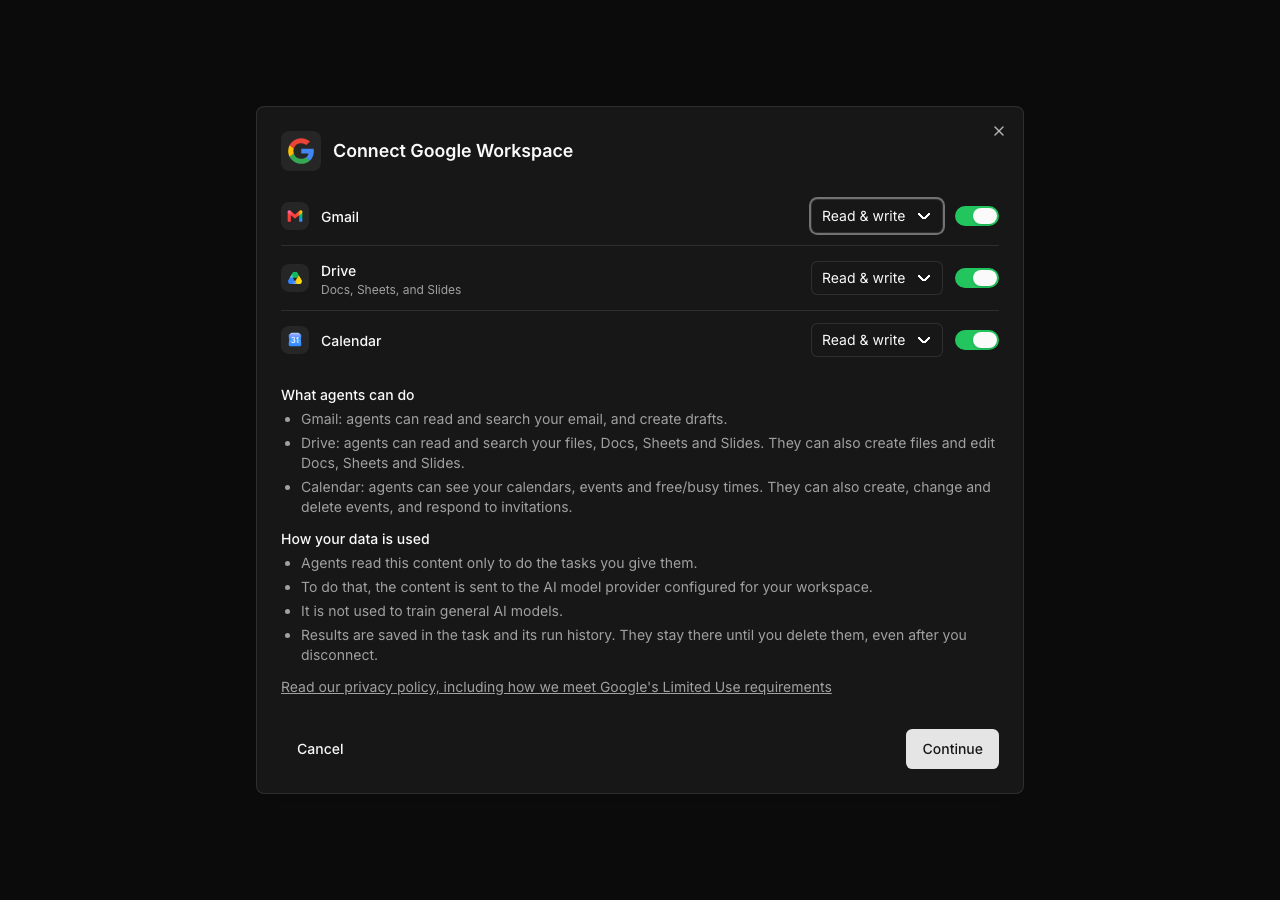 Desktop, light: 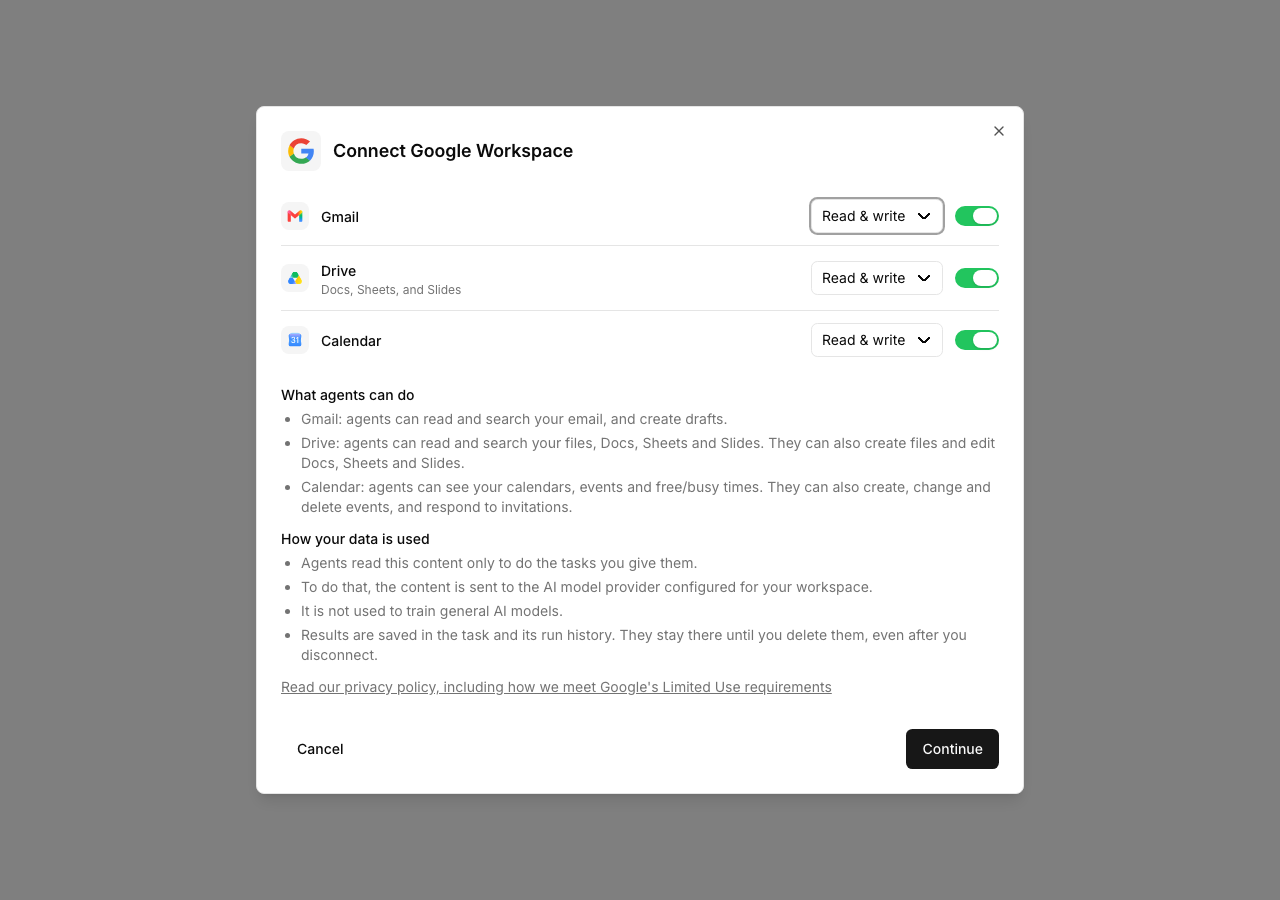 Phone (375 px), top and scrolled to the footer: <img width="300" alt="Picker on a phone, top" src="https://raw.githubusercontent.com/cryppadotta/paperclip-upstream-fork/pr-assets/google-workspace-data-use-disclosure/pr-assets/google-workspace-disclosure/picker-mobile.png"> <img width="300" alt="Picker on a phone, scrolled to the footer" src="https://raw.githubusercontent.com/cryppadotta/paperclip-upstream-fork/pr-assets/google-workspace-data-use-disclosure/pr-assets/google-workspace-disclosure/picker-mobile-bottom.png"> ## Verification - Red first: with a stub helper, 9 new tests failed. The 5 app-detail tests failed before the reconnect fix (sign-in started without the picker). The changed Gmail wording tests failed before the copy change. After the changes: `cd ui && npx vitest run src/features/connections/GoogleWorkspaceServices.test.tsx src/pages/apps/AppDetail.test.tsx src/pages/apps/AppsConnect.test.tsx src/pages/apps/app-detail` passes, 395 tests. - `node scripts/check-token-gates.mjs`: all gates clean. - `cd ui && node ../scripts/run-tsc.mjs -b` passes. - `node scripts/storybook-catalog.mjs` passes. - Headless Playwright against Storybook dev: the `ProductionPicker` story at 1280x900 (dark and light) and the `ProductionPickerMobile` story at 375x812. No horizontal scroll at 375 px. The footer is reachable after scrolling the dialog. The `ProductionPickerReadOnly` play test ran to its end state. - `pnpm verify` exits 2 (a Storybook story is a broad input). Required CI supplies the broad coverage. - Manual: open Apps, start a Google Workspace connection. Turn services on and off and change the access levels. Make sure that the disclosure changes and that unselected services are not mentioned. ## Risks - Low code risk. The change is UI-only. It does not change the selection, scopes, OAuth or saved state. - Wording risk: the copy makes product statements (no training on content, results stay after disconnect). The owner must approve the wording. The published privacy policy must agree with it: today the policy does not yet name AI model providers and describes retention only while a connection is active. Update the policy before or together with this change. - The dialog is taller. On short screens it scrolls inside the dialog. > For core feature work, check [`ROADMAP.md`](ROADMAP.md) first and discuss it in `#dev` before opening the PR. Feature PRs that overlap with planned core work may need to be redirected — check the roadmap first. See `CONTRIBUTING.md`. ## Model Used - Claude Opus 5.5 (`claude-opus-5-5`), Anthropic, in Claude Code with tool use (shell, file edits, headless browser). ## Checklist - [x] I have included a thinking path that traces from project context to this change - [x] I have specified the model used (with version and capability details) - [x] I have checked ROADMAP.md and confirmed this PR does not duplicate planned core work - [x] I have searched GitHub for duplicate or related PRs and linked them above - [x] I have either (a) linked existing issues with `Fixes: #` / `Closes #` / `Refs #` OR (b) described the issue in-PR following the relevant issue template - [x] I have not referenced internal/instance-local Paperclip issues or links (only public GitHub `#NNN` / `github.com/paperclipai/paperclip` URLs) - [x] My branch name describes the change (e.g. `docs/...`, `fix/...`) and contains no internal Paperclip ticket id or instance-derived details - [x] I have run tests locally and they pass - [x] I have added or updated tests where applicable - [x] I have updated relevant documentation to reflect my changes - [x] I have considered and documented any risks above - [ ] All Paperclip CI gates are green - [ ] Greptile is 5/5 with no open P2s, recommendations, or follow-ups - [x] I will address all Greptile and reviewer comments before requesting merge 🤖 Generated with [Claude Code](https://claude.com/claude-code) --------- Co-authored-by: Claude Opus 5.5 <noreply@anthropic.com> |
||
|
Devin FoleyandPaperclip
|
0a96f972e1 |
Connect Tailscale networks through device sign-in (#21526)
## Thinking Path > - Paperclip manages AI agents and the environments where they run. > - SSH environments can reach machines through a company Tailscale connection. > - The initial connector requires a managed OAuth app that Tailscale limits to its own tailnet. > - Customers need to connect their own tailnets without registering an app or supplying a key. > - This pull request uses Tailscale's normal device sign-in for new connections. > - Customers approve the Paperclip device and then select their machines in SSH environments. ## Linked Issues or Issue Description **Problem or motivation** The current Tailscale enrollment path cannot serve independent customer tailnets through the documented self-service OAuth app model. It also requires Cloud broker configuration and pilot admission before a customer can start. **Proposed solution** Start a private Tailscale device in the tenant and open its normal sign-in link. Save its encrypted device state before reporting a successful connection. Retain the existing SSH machine selection and agent account behavior. **Alternatives considered** Auth-key entry would require customers to copy a credential. A public OAuth integration still needs a confirmed registration path. Device sign-in uses a documented Tailscale flow without either requirement. See [device authentication](https://tailscale.com/docs/features/tsnet#device-creation-and-authentication) and [OAuth app limitations](https://tailscale.com/docs/features/oauth-apps). **Related PR search** Searched GitHub PRs for `tailscale` and `device sign-in`, and issues for `tailscale`. This follows the merged network connector in [#20617](https://github.com/paperclipai/paperclip/pull/20617) and preserves the SSH agent-account support in [#21248](https://github.com/paperclipai/paperclip/pull/21248). The open [#15648](https://github.com/paperclipai/paperclip/pull/15648) proposes storing an OAuth client and checking its health; this change instead enrolls a device through interactive sign-in so customers do not need an OAuth app. ## What Changed - New connections use device sign-in. Existing connected devices and pending legacy OAuth callbacks remain supported. - Pending sign-ins are bound to their company and initiating user. They have a fixed ten-minute deadline. Device state uses server-owned vault secrets with trusted version and digest checks. - The active Tailscale CLI waits for consent and device approval. Cancellation, expiry, secret deletion, and stale completion cannot restore a cancelled connection. - The connector stays open during sign-in. It provides a link when popups are blocked and shows device approval separately. Progress checks stop on completion, failure, expiry, or unmount. - Shared response types, OpenAPI contracts, SDK source pins, and the API/setup documentation describe the new flow. No database migration or Cloud provider configuration is required. ## Verification - 109 focused tests cover network processes, the real database and encrypted vault, routes, UI, and legacy connection behavior. - Server and UI typechecks pass. - Follow-up `29cf296a597`: reproduced the missing OpenAPI route failure locally. All 70 OpenAPI and Tailscale route tests and server typecheck pass after synchronizing the API contract. - Follow-up `79de05f38b9`: the transient-recovery regression failed before the fix; all 20 connector UI tests and UI typecheck pass after it. The query-error policy check reports no findings. - The public SDK input registry check passes. - [CI attempt 2](https://github.com/paperclipai/paperclip/actions/runs/43535594257/attempts/2) passed on the final head, `29cf296a597e470d432b84767050bc539caa280e`: 57 successful checks, no failures or pending checks. The interrupted canary, E2E shard, and serialized-suite jobs passed on rerun. Greptile is 5/5 on this head with no unresolved review threads. - `pnpm verify --explain` exits 2 because the documentation change selects broad CI coverage. Focused local checks passed; broad CI passed on `29cf296a597e470d432b84767050bc539caa280e`. - Live local qualification on `29cf296a597e470d432b84767050bc539caa280e`: native device sign-in completed with interactive user approval. An isolated Ubuntu 24.04 ARM64 EC2 machine appeared in discovery and passed SSH pairing and workspace probes. The assigned Claude Code agent used a Paperclip-managed subscription, created `hello_world.txt` containing exactly `Hello, world!` plus a newline, posted a completion comment, and marked the task done. An independent read through the private connector verified the bytes, remote user, and hostname. The remote machine had no stored Claude login and no leftover temporary credential directories. - Restarted the local Paperclip server and verified the same Tailscale device identity, online peer discovery, successful SSH probe, and unchanged file without new consent. Temporary public SSH ingress was removed. - Local qualification covers one user tailnet and the final Core revision. Browser UI acceptance, two unrelated tailnets, a hosted restart, and an agent task on the final staging revision are not yet verified. ## Risks - The enrollment method changes. It must pass the live qualification above before broad rollout claims. - Existing encrypted device state and the vault master key must survive a restart or redeploy. Device expiry or removal still requires reconnecting. - The existing one-serving-process-per-instance constraint remains. Concurrent replicas need durable network ownership. - Pending setup uses bounded progress requests and an event-driven CLI with a deadline. It adds no idle database scan. ## Model Used OpenAI GPT-6 Astra (`gpt-6-astra`) through Codex in T3 Code, with xhigh reasoning. Context window size was not exposed by the runtime. No subagents were used. ## Checklist - [x] I have searched GitHub for duplicate or related PRs and linked them above - [x] My branch name describes the change and contains no internal ticket or instance details - [x] I have run tests locally and they pass - [x] I have added or updated tests where applicable - [x] I have updated relevant documentation - [x] I have considered and documented the risks - [x] All Paperclip CI gates are green - [x] Greptile is 5/5 with no open P2s, recommendations, or follow-ups - [x] I will address all Greptile and reviewer comments before requesting merge --------- Co-authored-by: Paperclip <noreply@paperclip.ing> |
||
|
Devin FoleyandPaperclip
|
21bf7ebcee |
feat(connectors): connect Tailscale networks to SSH environments (#20617)
## Thinking Path > - Paperclip manages work for AI agents. > - SSH environments run tasks on computers that users own. > - A Paperclip server needs network access before it can reach a private computer. > - A reusable Tailscale connection belongs in Connectors. > - Connected machines should become choices in the existing SSH environment form. > - This change connects a tailnet and resolves selected machines through a private network client. > - Agents retain their choice of harness and AI account. ## Linked Issues or Issue Description **Subsystem affected** Connectors, environment settings, SSH execution, company secret storage, and runtime packaging. **Problem or motivation** Entering a Tailscale address in the SSH form does not connect the Paperclip server to that tailnet. Requiring a separate device key for every environment also duplicates network setup. **Proposed solution** Add a Tailscale Connector with **Connect Tailscale Network**. Use brokered OAuth consent to enroll one private network client per connection. Let SSH environments select a connected network and stable machine identity. Preserve the enrolled node state through the company vault so a restart does not reuse the one-time token. **Alternatives considered** A separate Tailscale environment type would duplicate SSH behavior and mix network access with harness selection. This change uses the existing `ssh` driver. Related #15648 adds OAuth client credentials and a health check; this change uses user consent and supplies outbound task execution. Related #11743 concerns HTTPS brokering. **Roadmap alignment** This extends the existing Connected Apps, environment, and Personal & Shared AI Accounts capabilities. This PR is stacked on #21248, which provides SSH account selection independently of Tailscale. The hosted OAuth broker is a companion control-plane change. ## What Changed - Preserve Cloud reauthentication in the current browser tab. Explain canceled or failed consent in the connector and offer a retry of the same authorized saved connection. - Record Cloud enrollment starts initiated through the Tailscale connector in the company activity log. - Check install-preparation descendant liveness through the kernel process table in the Runner support test. Keep the direct child’s strict reaping assertion and reject any non-zombie descendant. - Align the application image stage contract with the Tailscale client stage after the upstream Runner-image refactor. Keep the exact stage list and check every application stage, including `tailscale-client`, for prohibited Runner compiler commands. - Group Tailscale consent, discovery, daemon lifecycle, pairing, and deletion under `server/src/services/connectors/tailscale/`, with their service tests. Update existing route, runtime, environment, vault, and company-deletion imports. Keep the existing contracts, authorization, audit, and transaction owners. - Handle early stdin closure in the Kubernetes real-shell test helper. Stop the input stream on `EPIPE`, preserve nonzero child exits, and reject a zero exit when input was lost. Add two real-process regression cases. Production transfer code and confinement checks are unchanged. - Read configured Tailscale executable paths when a client starts, after supported `.env` loading. Keep explicit command overrides available. - Discard pending pairing results after switching to Direct SSH or closing the form. Retain the existing company, connection, machine, and port checks. - Store network credentials with an immutable server-owned purpose from their first vault row. Exclude them from generic catalogs, bindings, environment projection, and value reads. Use a dedicated audited server consumer for pinned connector reads. Block unclassified legacy serialized node state at the same value boundary. Keep SSH private-key binding separate from connector credentials. - Gate network queries and setup on verified local-implicit or instance-admin access. Hide Tailscale catalog rows for other members, show an admin requirement on direct setup navigation, and avoid device discovery before management access is known. - Keep failed-client cleanup in the network manager. A failed request cannot disconnect a newer retry for the same identity; explicit connector disconnect and enrollment retirement still stop their networks. - Check for readable Ed25519, ECDSA, or RSA host public keys before pairing edits `authorized_keys`. Print a known-hosts entry for every available key, or fail before changing authorized keys if none are available. - Return self-hosted Cloud enrollment to the Tailscale connector. Save the unprefixed setup path and let the shared callback add the verified company prefix. Keep external and unrelated destinations rejected. - Hide pairing instructions after an SSH port change. Ignore late key-selection results for the old port. Operators prepare again for matching known-hosts output. - Retire connector references before deleting a company or its vault credential. Stop company daemons after the database commit. Keep failed secret retirement retryable and prevent late node-state writes from restoring deleted connections. Discard retired state without blocking behind the vault deletion lock. - Reload a mismatched credential before replacing a ready daemon. Recheck the active entry and manager generation after the read. An older request cannot stop a newer healthy socket or cross shutdown. - Pin connector credentials to the exact vault version and SHA-256 digest recorded by trusted enrollment and node-state writes. Ignore generic secret rotations. Advance both fields with a compare-and-set guard. Reject unpinned or tampered credentials before network startup. - Save an explicit Direct SSH selection and clear old Tailscale fields after config merging. Preserve the operator's entered direct host. - Route all Tailscale SSH runtime access through the connection service after SSH-key loading. Pin access to the environment's saved connector identity and recheck after device discovery. Remove standalone key-based daemon startup and reject raw enrollment keys or credential-only network configurations. Align the shared config type and SDK pins. - Correct two E2E assumptions exposed during connector qualification. Keep the two-window chat fixture stale until its own mutation. Validate the original failed run and its permitted write-revocation timestamp in the legacy recovery browser test. - Add the Tailscale Connector page, catalog entry, OAuth return flow, connected-network management, device discovery, and disconnect. Document all six routes in OpenAPI and the API reference, including their instance-admin requirement. - Add company-scoped connection storage in `0480_lazy_lethal_legion`, trusted credential version/digest fields in `0481_round_pet_avengers`, and server-owned secret purpose/backfill in `0482_aberrant_rumiko_fujikawa`. Generate all three migrations through the maintained command and retain the five newest snapshots. - Add machine pairing that generates a fresh SSH key per request, stores its private half in the company vault, and uses the generated public half in the install command. Do not trust editable saved metadata. Preserve existing authorized keys, including a file without a final newline. Keep SSH username, workspace, and trusted host keys explicit. - Use the existing SSH driver. Resolve the machine's current address from its stable device ID. Reject disconnected, removed, offline, and wrong-company selections. - Hide Network when Direct is the only option. Select a sole connected tailnet automatically and hide its selector. Remove the requested setup helper copy. Do not restrict the harness to Claude. - Run a private userspace Tailscale daemon with a separate socket. Persist its node state before execution. Restore it after restart, bound startup, serialize reconnect cleanup, and close it during server shutdown. - Guard OAuth completion with a durable attempt marker. Disconnect and newer authorization invalidate older callbacks. Close replaced daemons and remove cancelled enrollment secrets without changing newer connection state. - Preserve SSH host verification and tailnet-specific session identity. Honor the configured Tailscale executable path, including spaces and OpenSSH percent escaping. - Package checksum-pinned Tailscale clients and their license in the standard runtime image. Exercise the client build stage in PR CI and include it in image smoke checks. ## Verification - Merge status: all CI and image checks pass, and current-head Apex is 5/5 with no unresolved comments. GitHub rejected a direct merge because the active master ruleset requires code-owner approval for `.github/workflows/pr-trusted.yml`. The [CODEOWNERS workflow pattern](https://github.com/paperclipai/paperclip/blob/master/.github/CODEOWNERS#L3) applies; eligible maintainers already have review requests. Auto-merge is enabled with the squash method for the verified head. The PR remains open pending that required approval; no branch policy was bypassed. - Final revision: `fdb29b2cc366f4945b7f4c3e2b2d25070329a21b`, including master `999709b0a6dd416af335b5debded13e1de7fcb7a`. [Final CI verification passed](https://github.com/paperclipai/paperclip/actions/runs/43518584814/job/132213508320). All required checks pass, all applicable test/build gates are green, and the branch is mergeable against master. SSH prerequisite #21248 and Cloud broker paperclipai/paperclip-cloud#1314 are already merged. - [Apex reviewed this exact revision at 5/5](https://github.com/paperclipai/paperclip/pull/20617#issuecomment-6776629437). There are no unresolved review threads. The PR is classified as Critical impact. - Final image qualification passes for the [application Runner path](https://github.com/paperclipai/paperclip/actions/runs/43518584522/job/132206784267), [amd64 Runner image](https://github.com/paperclipai/paperclip/actions/runs/43518584544/job/132207296198), and [arm64 Runner image](https://github.com/paperclipai/paperclip/actions/runs/43518584544/job/132207296156). Typechecks, Runner support, native/Rust tests, provider tests, serialized-server suites, browser shards, and the remaining applicable CI checks pass. This is source/image CI qualification, not a production rollout. - The last master conflict affected only Docker stage declarations and their boundary test. Both the checksum-pinned Tailscale stage and upstream `runner-lockfile` guard are retained, including the upstream `deps` inheritance. The Tailscale client stage is byte-identical. All 180 cases across five Docker/image contract suites pass locally, along with server and UI typechecks. The maintained 543-input SDK check has no drift. Runtime and lock pins are unchanged. Secret/PII and whitespace scans pass. - Seven OAuth regression cases failed before the fixes. The current-tab test uses the real handoff helper, checks that the session is stored before reauthentication navigation, mounts the shared return page, resumes consent, and verifies handoff cleanup. Callback tests check trusted saved-connection context, fixed safe outcomes, failure audit metadata, denied membership and expired-state rejection, JSON API errors, and no provider text in browser returns. UI retries require a connection in the current company's catalog. All 80 OAuth route/service/UI/shared-handoff cases pass; server and UI source/test typechecks pass. - [Server shard 4/12 on the prior refresh](https://github.com/paperclipai/paperclip/actions/runs/43510727031/job/132180301436) passed 2,784 cases and skipped 21, then failed a reassignment fixture's `TRUNCATE companies CASCADE` cleanup with PostgreSQL `40P01`. Its automatic retry found the surviving `REA` prefix. The unchanged test passes all three cases locally. A controlled reader/cleanup overlap reproduces the same deadlock, but the exact competing CI query was not logged. Each case now has a distinct company prefix and identifier; the owned database is removed at suite end. The three test bodies and assertions are byte-identical. Eight local reassignment/lock-release cases pass, and the [final server shard 4/12 passes](https://github.com/paperclipai/paperclip/actions/runs/43518584814/job/132207159392). Production reassignment logic, deadlines, and retries are unchanged. - The initial master integration passed 330 cases across 17 suites. Coverage includes connector state, device discovery, network lifecycle, pairing, routes, SSH binding and exports, environment persistence, and connector UI. All three unpublished migrations were regenerated after master's `0479_short_darkstar`: `0480_lazy_lethal_legion`, `0481_round_pet_avengers`, and `0482_aberrant_rumiko_fujikawa`. Each SQL body is byte-identical to its earlier unpublished migration. Generated snapshots preserve existing master tables and add only the intended Tailscale table and secret-purpose column. Exactly five snapshots remain, 0478–0482. Numbering, safety, compatibility, and snapshot-drift checks pass. The later Docker refresh did not alter this migration sequence. - Earlier attempts remain part of the verification record. On `1c020a0`, Rust cache restoration and server shard 5/12 were interrupted by shutdown signals, Runner shard 2/3 lost communication with no retrievable log, and an amd64 provider download failed with npm `ECONNRESET`. Same-head retries recovered, without establishing the cause of the communication loss. Later superseded runs also had cancellations with incomplete logs. These interrupted attempts are not counted as passes. The final revision has fresh successful CI. - Local platform limits remain recorded. The Kubernetes suite on macOS passed 191 cases, failed 12 Linux `/proc/self/fd` transfer cases, and skipped four Linux-only cases. Unchanged source reproduced the same 12 failures. An initial run also lacked provider dependencies until the maintained preparation command installed them. Those local attempts are not green qualification. Final Linux provider CI passes. Local Docker qualification was unavailable; final image checks passed in CI. - Before PR separation, a live tailnet/SSH Claude Code task completed on Ubuntu ARM64 without provider login for the remote user. The selected Paperclip subscription ran it, wrote the expected file, posted completion, and marked the task done. File contents and private runtime cleanup were checked. This is prior live evidence; the final revision was not live-retested. Other providers have automated coverage only. Hosted registration for unrelated tailnets and production concurrency remain qualification limits below. - The Superagent security and supply-chain reports remain neutral and inconclusive. Earlier attempts to restart the failed security scan returned HTTP 404. Supply-chain intelligence lacked coverage for extracted pinned dependencies and the shared workflow reference. These reports do not establish successful security qualification. The required CI and review gates pass; this external coverage gap remains disclosed. ## Risks - The Superagent security and supply-chain reports are inconclusive. The security scan re-run request returned HTTP 404, and the supply-chain scanner lacks coverage for the extracted dependencies and shared workflow reference. These neutral results are not successful security qualification. - The server-owned secret purpose is internal database metadata, not an HTTP-writable field. The generic secret service owns enforcement so direct API reads and runtime projection share the same restriction. Previously copied node state remains valid outside Paperclip until the enrolled device is revoked in Tailscale; a local disconnect cannot stop an external copy. - Tailscale network configurations now require a connected Connector and selected machine. The unreleased key-only path is removed; any saved configuration from that path needs Connector setup. - The connector remains a pilot. The local test used an OAuth app registered in the consenting user's tailnet. Qualify hosted app registration for unrelated customer tailnets before general availability. - This implementation supports one serving process per instance. Concurrent replicas need exclusive ownership of the persisted network identity before production rollout. Preserve the database and company vault master key across restarts. - Each machine-pairing preparation creates a new vault secret. Unused generated keys follow the existing secret deletion lifecycle. A saved SSH key remains available as an explicit choice. - Apply additive migrations `0480_lazy_lethal_legion`, `0481_round_pet_avengers`, and `0482_aberrant_rumiko_fujikawa` before application rollout. The new credential version and digest columns are nullable. Existing unpinned connections require fresh OAuth consent; the migration deliberately does not trust or backfill a generic secret value. Regenerate or renumber migrations if master advances the sequence before merge. - The target needs an SSH server, its chosen harness, and allowed tailnet access. A reachable network does not grant SSH or provider authorization. Pairing reads standard `/etc/ssh` host-public-key files; custom host-key locations require manual known-hosts configuration. - Roll back the application revision to remove new entry points. Existing connection secrets and registered Tailscale nodes retain their separate lifecycle. Do not drop the table or delete node state as part of an application rollback. - Production qualification still needs denied-policy, revocation, cancellation, and deployment-overlap checks. Local Docker and a production deployment were not performed. ## Model Used OpenAI Codex, gpt-6.1-sol, xhigh reasoning, with local code execution and tool use. ## Checklist - [x] I have included a thinking path that traces from project context to this change - [x] I have specified the model used - [x] I have checked ROADMAP.md and this extends existing connector and environment features - [x] I have searched GitHub for duplicate or related PRs and linked them above - [x] I have described the issue in-PR using the feature request fields - [x] I have not referenced internal issues, local URLs, or private machine identifiers - [x] My branch name describes the change - [x] I have run focused tests locally and they pass - [x] I have added tests for new behavior and failure paths - [x] I have updated documentation - [x] I have documented migration and runtime risks - [x] All Paperclip CI gates are green - [ ] Required code-owner approval received for the workflow change - [x] Greptile Apex is 5/5 on the final head with no unresolved comments - [x] I will address CI and review findings before requesting merge --------- Co-authored-by: Paperclip <noreply@paperclip.ing> |
||
|
DottaandClaude Fable 5.2
|
0199c963e2 |
feat(apps): ship the redesigned sign-in step for a pasted MCP server (#21469)
## Thinking Path

> - Paperclip is the open source app people use to manage AI agents for
work
> - Apps lets an operator connect a remote MCP server by pasting its
address ("Connect your own MCP server")
> - Step 2 of that flow put every sign-in choice in an "Advanced
authentication" box with wrapped pill buttons and a hint paragraph
> - The box hid the choice behind a vague label, and its shape did not
match the access line ("Connects for everyone… Change") right below it
> - The owner approved a redesign: a stated sign-in default with a
Change link, and five options with their fields directly below each
option
> - This pull request wires that redesign into the real screen, removes
the old step, and updates copy that named the removed box
> - The benefit is a screen that reads as two stated answers and one
action, with the same default path (paste the address, press Check link)

## Linked Issues or Issue Description

No public issue exists. Enhancement:

**What existing behavior does this improve?**
The sign-in section of the "Connect your own MCP server" step in Apps.

**Subsystem affected**
UI: Apps connection setup (`ui/src/features/connections`). Small copy
changes in the server OAuth client registration message and docs.

**Current behavior**
Step 2 shows an "Advanced authentication" collapsible with five wrapped
pill buttons and a hint paragraph below them. The fields for the chosen
mode appear further down. Guidance banners tell the operator to look
"under Advanced authentication". The page also shows the "Unverified
server" badge twice (header and body). The stepper reads "Pick app · Add
your key", even when the server needs no key.

**Proposed behavior**
Step 2 states the sign-in choice in one line ("Paperclip asks the server
how to sign in.") with a Change link. Change shows five radio cards: Let
Paperclip check, Key or token, Browser sign-in, Custom headers, No
sign-in needed. The fields for the selected option are directly below
it. Done collapses the list to a one-line summary (for example "Signs in
with 1 custom header."). The list stays open while the chosen option
still needs a value. Client ID and secret are behind "Use your own
client ID" unless they have values or the server asked for them. The
stepper reads "Pick app · Connect".

**Reason and benefit**
The choice is visible as a stated default in the same shape as the
access line. Each option keeps its fields next to it. No copy points at
a box that does not exist.

**Breaking changes**
None. The five auth modes and their request payloads do not change.

**Additional context**
Related open PRs change server behavior for the same flow. They are not
duplicates. Refs #15192, Refs #15450.

## What Changed

- `ui/src/features/connections/GenericMcpConnectStep.tsx`: new step
component (same props as the old `LinkConnectStep`). It uses stable
field ids `generic-mcp-key`, `generic-mcp-client-id`,
`generic-mcp-client-secret` and a `data-testid` on the sign-in
Change/Done link.
- `ui/src/features/connections/ConnectionSetupFlow.tsx`: render
`GenericMcpConnectStep`; delete `LinkConnectStep`,
`GENERIC_AUTH_MODE_OPTIONS`, `SegmentedOption` and unused imports;
change the pasted-link stepper label from "Add your key" to "Connect"
(`STEP_LABELS` is used only by the pasted-link flow; curated apps keep
their own `["Add your key"]`).
- `ui/src/pages/apps/generic-mcp-connect.ts`: `oauth_challenge` and
`oauth_manual_client_required` guidance now say "below" instead of
"under Advanced authentication".
- `server/src/services/tool-access/oauth/client-registration.ts`: the
manual-client message no longer names the removed box.
- `doc/connections/GENERIC-REMOTE-MCP.md`: describe the sign-in line,
Change, and the five options.
- Comments in `packages/shared` and `server/src/services/tool-access.ts`
reworded. `tests/runner-e2e/source-sdk-public-inputs.json` regenerated
for the two shared files (blob hashes only).
- `ui/storybook/stories/connection-setup/byo-mcp-sign-in.stories.tsx`:
14 stories for the shipped component; annotation is now `current` /
`production`.
- Tests: `AppsConnect.test.tsx` generic MCP block uses the sign-in
toggle and radio options; new tests for the collapsed summary, the
open-while-empty-key rule, and a single "Unverified server" label. New
`GenericMcpConnectStep.test.ts` unit-tests `genericMcpAuthSummary`.

Before: "Advanced authentication" box with pill buttons and a hint;
fields below the pills; two "Unverified server" badges; stepper "Pick
app · Add your key".
After: one sign-in line with Change; five radio cards with fields under
the selected card; one "Unverified server" badge in the header; stepper
"Pick app · Connect". Storybook: `byo-mcp-sign-in--choosing`,
`byo-mcp-sign-in--server-asked-for-key`.

## Verification

- `cd ui && pnpm exec vitest run src/pages/apps/AppsConnect.test.tsx
src/pages/apps/generic-mcp-connect.test.ts
src/features/connections/GenericMcpConnectStep.test.ts
src/features/connections/ConnectionSetupFlow.architecture.test.ts
src/features/connections/ConnectionSetupFlow.oauth.test.ts`: 5 files,
300 tests pass.
- `cd ui && node ../scripts/run-tsc.mjs -b`: pass.
- `pnpm -s typecheck` in `packages/shared` and `server`: pass.
- `pnpm check:token-gates`: all gates clean.
- `node scripts/storybook-catalog.mjs`: pass (generated indexes not
committed).
- `pnpm verify`: exit 2 (broader verification required, because
`doc/connections/GENERIC-REMOTE-MCP.md` is a global CI input). Required
CI supplies that coverage. The focused files above were rerun on the
final revision after the rebase.
- Headless Playwright against the Storybook dev server: the Default,
Choosing and Server-asked-for-key stories render the new step, the new
guidance copy, and the "Pick app · Connect" stepper.

## Risks

- Low risk. UI change on one screen; request payloads
(`genericConnectPayload`) do not change.
- Tests that click the first collapsed "Change" button now skip the
sign-in toggle, because the access line also has a "Change" button.
- The server message for `oauth_manual_client_required` changes text. No
code matches on the text; the client uses the error code.

## Model Used

- Claude Opus 5.5 (`claude-opus-5-5`) in Claude Code, with tool use
(shell, file edits, headless Playwright).

## Checklist

- [x] I have included a thinking path that traces from project context
to this change
- [x] I have specified the model used (with version and capability
details)
- [x] I have checked ROADMAP.md and confirmed this PR does not duplicate
planned core work
- [x] I have searched GitHub for duplicate or related PRs and linked
them above
- [x] I have either (a) linked existing issues with `Fixes: #` / `Closes
#` / `Refs #` OR (b) described the issue in-PR following the relevant
issue template
- [x] I have not referenced internal/instance-local Paperclip issues or
links (only public GitHub `#NNN` / `github.com/paperclipai/paperclip`
URLs)
- [x] My branch name describes the change (e.g. `docs/...`, `fix/...`)
and contains no internal Paperclip ticket id or instance-derived details
- [x] I have run tests locally and they pass
- [x] I have added or updated tests where applicable
- [x] I have updated relevant documentation to reflect my changes
- [x] I have considered and documented any risks above
- [ ] All Paperclip CI gates are green
- [ ] Greptile is 5/5 with no open P2s, recommendations, or follow-ups
- [x] I will address all Greptile and reviewer comments before
requesting merge

🤖 Generated with [Claude Code](https://claude.com/claude-code)

---------

Co-authored-by: Claude Fable 5.2 <noreply@anthropic.com>
|
||
|
DottaandPaperclip
|
b0447f3c76 |
fix: restrict chat task sponsors to self or admins (#21218)
## Thinking Path > - Paperclip manages AI agents and their authority to do work. > - External chat channels can create tasks for those agents. > - A task sponsor is the person responsible for that work. > - GitHub bot settings accepted another member as a sponsor from any connection manager. > - Connection management must not grant authority to act as another person. > - This change checks each sponsor on the server and limits the picker choices. > - The benefit is that ordinary members cannot assign work to another person's identity. ## Linked Issues or Issue Description **What happened?** A connection manager could save another member as a GitHub guest sponsor or automatic-task responsible member. The server checked membership but did not check authority to select that person. **Expected behavior** An ordinary manager can select only themselves. A company owner, company admin, or instance admin can select another active non-viewer member of the same company. The picker shows member avatars. **Steps to reproduce** 1. Sign in as an ordinary member with connection-management permission. 2. Open a GitHub bot's Access settings. 3. Set another member as a guest sponsor or responsible member. 4. Save. The old server accepts the request. This change returns 403. **Paperclip version or commit** Base: `9a9cd20d91edc93dba4e2295e42f0f1f9fcd4862`. **Deployment mode** Built from source. The checks use local PostgreSQL and an assembled authenticated API server. Related work: #17737 adds delegated connection configuration. #16163 separates author selection from guest access. This fix preserves both contracts. A search found no duplicate sponsor-permission fix. ## What Changed - Check every submitted sponsor in the configuration transaction. Lock the actor's membership and any required admin role through the save. - Require self-selection unless the actor has a current admin role. Check all target members in the same company. - Keep delegated connection checks, authority notifications, tool updates, and audit attribution. - Use avatar pickers for guest sponsorship and automatic-task responsibility. Default new guests to the signed-in member. - Test service and HTTP denials, admin selection, role removal, invalid targets, saved settings, and picker choices. - Test forged sponsor changes with real agent API keys and run credentials. Update the existing access-map policy. ## Verification - 67 sponsor, HTTP, picker, and settings tests pass. The picker test includes 600 members and bounds member lookups. - 93 existing GitHub management, event, policy, and tool tests pass. - The assembled connection-management fixture passes. Self-save succeeds. Both credential types receive 403 for forged guest and responsible-member sponsors. The saved revision stays unchanged. - UI typecheck and production build pass. Token gates, map checks, query-error policy, migration checks, and whitespace checks pass. - Two broad chat-test shards pass: 720 cases. The local full-suite run was then stopped; the complete local suite has no final verdict. Current-head CI remains the full verification path. - Full local typecheck and build reach Rust but cannot finish because Cargo is absent. - CI found the explicit retry override in the access query. Removed it; all 45 affected UI tests pass and the CI policy gate passed on the next commit. - Historical head `4146c89f9345efd38a69739d17e3194a7cf91980` received Greptile 5/5 and passed full CI: https://github.com/paperclipai/paperclip/actions/runs/43330028028 . Those results apply to that earlier head. - Current head `890df0322f382bb8ccc0fd3d59b25ba1e0299c58` merges master without conflicts. All eight changed files match the earlier reviewed fix. The 67 focused sponsor, HTTP, picker, and settings tests pass again. The production-bearer fixture also passes for both agent-key and run-token requests. UI typecheck, token gates, map checks, query-error policy, and whitespace checks pass. - Greptile gives current head `890df0322f382bb8ccc0fd3d59b25ba1e0299c58` 5/5 with no open review threads. All checks for this head are complete with no failures. The PR workflow passed: https://github.com/paperclipai/paperclip/actions/runs/43363400247 . This includes build, typecheck, general tests, serialized server suites, Runner checks, policy checks, and all eight E2E shards. The Snyk status also passed. - `pnpm verify --explain` returns exit 2 because the access-map change selects broad CI. The focused local checks pass. Broad checks are assigned to the CI run above. - The first broad checks inspected upstream migrations before the merge commit existed and stopped at migration classification. After the merge commit, the migration checks pass with zero new migrations. - Earlier saved-session broad checks stopped because Cargo was absent or memory was exhausted. These gaps are retained here. No live external-provider delivery or staging deployment is claimed. The configuration service owns sponsor authorization because both board and delegated API requests use it. No provider protocol or execution contract changes. ## Risks - An ordinary manager cannot save a configuration that names another sponsor, even when that sponsor is unchanged. They must select themselves or have an admin save it. - Membership and admin rows stay locked through the configuration write. A concurrent role change can delay the save. - Existing configurations are not rewritten. Each new save must pass the current checks. - Generic channel and AgentMail creation derive the sponsor from the authenticated user. Their strict input schemas do not accept sponsor overrides. ## Model Used OpenAI Codex, based on GPT-6. The exact runtime model ID and context-window size are not exposed in this session. Used reasoning, repository inspection, tool calls, code execution, and tests. ## Checklist - [x] I have included a thinking path that traces from project context to this change - [x] I have specified the model used (with version and capability details available in this session) - [x] I have checked ROADMAP.md and confirmed this fix does not duplicate planned core work - [x] I have searched GitHub for duplicate or related PRs and linked them above - [x] I have described the issue with the bug-template field labels - [x] I have not referenced internal or instance-local Paperclip issues or links - [x] My published branch name describes the change and contains no internal task details - [x] I have run the focused tests locally and they pass - [x] I have added relevant tests - [x] I have updated the relevant access policy documentation - [x] I have considered and documented the risks - [x] All Paperclip CI gates are green for the current head - [x] Greptile is 5/5 with no open P2s, recommendations, or follow-ups - [x] I will address reviewer comments before requesting merge --------- Co-authored-by: Paperclip <noreply@paperclip.ing> |
||
|
DottaandClaude Opus 5.5
|
8af889f612 |
feat(mcp-apps): view messages with consent, app context, full screen and provider tool icons (#21266)
## Thinking Path > - Paperclip is the open source app people use to manage AI agents for work. > - MCP Apps (#21119) show interactive widgets from MCP servers, such as Circleback meeting cards, with the agent's reply in the task chat. > - The first version deferred three parts of the MCP Apps spec. A widget could not propose a chat message (`ui/message`). It could not give the agent context (`ui/update-model-context`). It could not go full screen. > - Paperclip also ignored the `icons` that MCP servers declare on tools (SEP-973). > - The security review of #21119 showed what these features need from day one: explicit consent, untrusted-data labels and strict icon sanitizing. > - This pull request adds the three host features and provider tool icons, with those protections built in. > - The benefit is that widgets can now work with the person and the agent, not only display data. ## Linked Issues or Issue Description Refs #21119 **Subsystem affected** MCP Apps host (task chat widgets), tool catalog, run wake prompt. **Problem or motivation** The MCP Apps host refused `ui/message` (-32601), dropped `ui/update-model-context` and kept every view inline. MCP tool `icons` were not parsed or shown. So widgets could not ask the agent a follow-up, the agent could not see what the person selected in a widget, large widgets were cramped, and tool rows used only generic icons. **Proposed solution** Add consent-gated view messages, per-view app context delivered to the task's next run as untrusted data, a full-screen dialog, and sanitized provider icons. Details are under "What Changed". **Alternatives considered** - Send view messages with a new server route that creates the comment itself. Rejected: comment creation has many rules (agent chat ownership, paused conversations, queued delivery, wakeups, receipts). The widget's Send button uses the same send path as the composer. A small route then records which view the comment came from. - Keep the iframe in place for full screen with CSS. Rejected: chat containers can create containing blocks that break `position: fixed`. A moved iframe always reloads, so the dialog hosts a new frame instead. **Roadmap alignment** Continues the MCP feature work after #21119, #21140 and #21219. It does not touch the MCP Tasks work (gateway `tools/call` polling and elicitation). ## What Changed - **`ui/message`.** The host shows "<App> wants to send: …" with **Send** and **Dismiss** under the widget (and inside the full-screen dialog). Nothing is sent before the click. Send posts the text as the viewer's own comment through the chat's normal send path (`handleThreadAdd`). `POST /api/issues/:issueId/mcp-app-views/:viewId/messages` then logs `issue.mcp_app_message_sent`. It accepts only the caller's own comment on the same task, matched by `clientRequestId`, from the last 10 minutes. One proposal per view can wait at a time. The view gets `{}` after the send, or -32000 "Message sending denied" after Dismiss. Only `user` text up to 8,000 characters is accepted. - **`ui/update-model-context`.** `PUT /api/issues/:issueId/mcp-app-views/:viewId/model-context` stores the latest context per view in `tool_mcp_app_views.model_context` (text blocks and `structuredContent`, 16 KB at most). Updates are applied in order and deduped in the browser and on the server. A change logs `issue.mcp_app_context_updated`, and an empty update clears the context. The task's next run gets the three most recently updated contexts as an `## App context (untrusted)` wake-prompt section. The section quotes the data as JSON and says it is third-party data, not instructions. The read runs in parallel with the other run preparation and never fails the run. CLI adapters and the native runner render it through the same `renderPaperclipWakePrompt`. - **Who may do this.** Messages and context need a signed-in person with `issue:comment` on the task. Agents and API keys get 403. Other tasks and companies get 404. `message` and `updateModelContext` are advertised in `hostCapabilities` only where the viewer can send messages. - **Full screen.** The host advertises `availableDisplayModes: ["inline","fullscreen"]` and handles `ui/request-display-mode`. It honors the view's declared modes and answers with the resulting mode. It sends `host-context-changed` with `displayMode` and the container (fixed `height`/`width` in full screen), and again when that container resizes. A new **Open full screen** control sits next to "Widget from …". Full screen is a Paperclip dialog that closes with Exit, Escape or the view's own request. - **Provider tool icons.** `icons` on MCP tool descriptors are sanitized into the new `tool_catalog_entries.icons` column, outside the version hash, so a new icon never quarantines a reviewed tool. Only `https:` URLs and `data:image/*` URIs are kept, and SVG only as `data:`. A `data:` icon is at most 32 KB, a URL at most 2,048 characters, with at most 4 icons per tool. `GET /api/companies/:companyId/tool-icons` lists them keyed by gateway tool name, in one cached request per chat. Task chat tool rows and the app's actions list show them through `ProviderToolIcon`. It renders `<img referrerPolicy="no-referrer">` at a fixed size and never inlines markup. It checks the source again before rendering and falls back to the taxonomy icon. - **Schema.** Migration `0477` adds `tool_catalog_entries.icons`, `tool_mcp_app_views.model_context` and `model_context_updated_at`, all nullable. - **Docs and stories.** `doc/connections/MCP-APPS.md` documents the new behavior, and the finished items are removed from "Limits and follow-ups". `Tasks/MCP App views` has new stories: "View asks to send a message", "Full screen" and "Tool rows with provider icons". The fixture view now uses `ui/message`, `ui/request-display-mode` and `ui/update-model-context`. ## Verification - `pnpm exec vitest run server/src/__tests__/mcp-apps.test.ts server/src/__tests__/tool-catalog-publication.test.ts server/src/__tests__/openapi-routes.test.ts packages/shared/src/mcp-icons.test.ts packages/shared/src/mcp-apps.test.ts`: pass (embedded Postgres). These tests cover: - Context: stored, deduped, logged once, 413 when too large, cleared, scoped to the task and company, refused for agents (403), and rendered into the wake prompt as untrusted data. - Messages: attributed only to the viewer's own recent comment on the same task. A teammate's comment, an unknown request id or an old comment gets 404. An agent gets 403. - Icons: stored sanitized, and the version hash and status do not change. Another company sees nothing. - `cd ui && pnpm exec vitest run src/components/mcp-app/ src/components/ProviderToolIcon.test.tsx src/pages/apps/app-detail/`: 69 pass. These tests cover: - The host protocol for each new method: capabilities, consent wait, one proposal at a time, invalid input, ordered and deduped context, the size limit, and the display-mode rules. - The consent card (nothing sent without Send). - The full-screen dialog (one frame at a time). - Icon rendering (no-referrer `img`, no inline SVG, fallback). - `cd ui && pnpm typecheck` (including Storybook) and `tsc --noEmit` for the server: clean. - Red/green: the new route and host tests fail on `master`, where the routes do not exist and the host answers -32601 or drops updates. The icon descriptor test failed when the publication write was removed. - Not run locally: the full suite, and `packages/adapter-utils/src/server-utils.test.ts › runChildProcess › does not crash when the child closes stdin before a delayed write`. That test times out on this Mac with or without this change, so it is a local platform issue. CI covers both. ## Risks - Migration risk is low: three nullable columns, no backfill. - Every run on a task now does one extra indexed read, in parallel with the other preparation. Errors are logged and the run continues without app context. - If the attribution request fails after the comment is sent, the comment stays without the `mcp_app_message_sent` activity row. This is documented. - Switching between inline and full screen restarts the view, so state inside the widget resets. This is documented as a limit. - Icon names shortened with a hash by the gateway (very long names) do not match, and those rows keep the taxonomy icon. > For core feature work, check [`ROADMAP.md`](ROADMAP.md) first and discuss it in `#dev` before opening the PR. Feature PRs that overlap with planned core work may need to be redirected — check the roadmap first. See `CONTRIBUTING.md`. ## Model Used - Claude Opus 5.5 (`claude-opus-5-5`) in Claude Code, with tool use and code execution. One subagent (the same model) built the provider-icon part. ## Checklist - [x] I have included a thinking path that traces from project context to this change - [x] I have specified the model used (with version and capability details) - [x] I have checked ROADMAP.md and confirmed this PR does not duplicate planned core work - [x] I have searched GitHub for duplicate or related PRs and linked them above - [x] I have either (a) linked existing issues with `Fixes: #` / `Closes #` / `Refs #` OR (b) described the issue in-PR following the relevant issue template - [x] I have not referenced internal/instance-local Paperclip issues or links (only public GitHub `#NNN` / `github.com/paperclipai/paperclip` URLs) - [x] My branch name describes the change (e.g. `docs/...`, `fix/...`) and contains no internal Paperclip ticket id or instance-derived details - [x] I have run tests locally and they pass - [x] I have added or updated tests where applicable - [x] I have updated relevant documentation to reflect my changes - [x] I have considered and documented any risks above - [ ] All Paperclip CI gates are green - [ ] Greptile is 5/5 with no open P2s, recommendations, or follow-ups - [ ] I will address all Greptile and reviewer comments before requesting merge 🤖 Generated with [Claude Code](https://claude.com/claude-code) --------- Co-authored-by: Claude Opus 5.5 <noreply@anthropic.com> |
||
|
DottaandClaude Opus 5.5
|
8ff45c0fa9 |
feat(connections): render MCP Apps views in the task chat, starting with Circleback (#21119)
## Thinking Path

> - Paperclip is the open source app people use to manage AI agents for
work.
> - Agents reach external apps through MCP connections. Paperclip
records each call and shows it as a tool row in the task chat.
> - MCP Apps (SEP-1865, extension `io.modelcontextprotocol/ui`, spec
2026-01-26) lets an MCP server attach an interactive `ui://` view to a
tool. Claude, Claude Code and VS Code render these views in chat.
Circleback uses them to show meeting cards.
> - Paperclip dropped the tool's `_meta.ui` at discovery and the
result's `_meta` at call time. Its gateway reported MCP App UI as
"unsupported". Circleback was reachable only through Composio, whose
toolkit has no `Display*` tools.
> - This pull request makes Paperclip an MCP Apps host. It also adds
Circleback as a native catalog connection.
> - The benefit is that a Circleback recap in a task shows the same
meeting cards as in Claude, and any other MCP server with views works
the same way.

## Linked Issues or Issue Description

**Subsystem affected**
Connections and apps (remote MCP gateway) and the task chat.

**Problem or motivation**
An agent that uses Circleback in Paperclip can only return text. The
same tools in Claude Code show interactive meeting cards
(`DisplayMeetings`). Paperclip discards the MCP Apps metadata, so it
cannot show them.

**Proposed solution**
Paperclip implements the host side of MCP Apps end to end. It keeps the
tool's view declaration and records each call that has a view. It
renders the view under the tool row in a sandboxed iframe that uses the
MCP Apps postMessage protocol. Circleback becomes a native catalog
connection, so its `Display*` tools are available.

**Alternatives considered**
Composio's `circleback_mcp` toolkit has 11 read tools and no `Display*`
tools, and its meta-tools return plain JSON, so it cannot carry views.
The spec's double-iframe sandbox proxy on a separate origin needs a
second origin that Paperclip does not have. A single opaque-origin
`srcdoc` frame with an injected CSP gives the same isolation.

**Roadmap alignment**
This extends the existing Apps catalog and MCP gateway. It adds no new
integration substrate (decision D4 in doc/connections/README.md).

**Additional context**
The standard, the design and the testing plan are in
`doc/connections/MCP-APPS.md`.

## What Changed

- **Shared:** `packages/shared/src/mcp-apps.ts` adds MCP Apps types,
`_meta.ui` and resource parsing (current and legacy keys), and a CSP
builder that keeps only well-formed `https` origins.
- **DB:** migration `0471` (`online_compatible`) adds
`tool_catalog_entries.ui_meta` and a new `tool_mcp_app_views` table.
- **Server, catalog:** discovery keeps each tool's `_meta.ui`. It is not
part of the version hash, so a view never quarantines a reviewed tool.
- **Server, gateway:**
- Paperclip advertises the MCP Apps client capability when it
initializes a session.
  - App-only tools (`visibility: ["app"]`) are hidden from agents.
- The result `_meta` is kept for the view and is not sent to the agent.
- Each successful call to a tool with a view records a view row.
Recording is best effort.
- The gateway's `initialize` now reports `paperclip/mcp-app-ui:
host_rendered`.
- The context protocol (`resources/read`) now uses the injected test
transport, like the other remote calls.
- **Server, routes:** `server/src/routes/mcp-apps.ts`
- `GET /api/issues/:issueId/mcp-app-views` lists a task's views. It
needs task read access.
- `GET /api/issues/:issueId/mcp-app-views/:viewId` returns the view
document, read live through the agent's connection.
- `POST /api/issues/:issueId/mcp-app-views/:viewId/tool-calls` runs the
view's `tools/call`. It needs `tools:use` and reaches only tools of the
same connection that allow `app`. It uses the connection test-call path,
so policy, Ask first and audit apply.
- **UI:** `ui/src/components/mcp-app/`
- The host protocol: `ui/initialize` with theme, style variables and
size limits; tool-input; tool-result; size-changed; `tools/call`;
`ui/open-link` (http and https only); teardown.
- An opaque-origin iframe (`allow-scripts`, never `allow-same-origin`)
with the CSP placed before the view's markup.
- The views of a run render with that run's reply, in the live turn and
in settled history. They are keyed by the reply's run, so history needs
no transcript.
- **Circleback:** a native catalog app (`mcp-oauth`, DCR, `user
user:write`) with:
  - the official logo;
- a reviewed risk classifier (Share* tools are writes, Delete* tools are
destructive, Display* tools are reads);
  - warnings in the sign-in step;
  - `doc/connections/CIRCLEBACK.md`.

Search now prefers a native app over an aggregator listing named "X
MCP".
- **Storybook:** `Tasks/MCP App views` shows the tool row with its view,
the ready state (Refresh calls a tool), loading, view unavailable, and a
tool call that needs approval.

## Verification

- `pnpm exec vitest run packages/shared/src/mcp-apps.test.ts
ui/src/components/mcp-app/`: 19 passed.
- `pnpm exec vitest run server/src/__tests__/mcp-apps.test.ts`: 3
passed, on embedded Postgres. The test connects Circleback through the
catalog with DCR OAuth against a fake Circleback MCP server. It checks:
  - `ui_meta` is stored;
  - an app-only tool is hidden from the agent;
- an agent call records one view with arguments, structured content and
`_meta`;
  - a call without a view records nothing;
  - the routes serve the view's HTML and CSP;
  - the view's tool call works and a model-only tool is refused;
  - another task, another company and an agent actor are refused.
- Circleback connector: 13 focused files, 645 tests passed. These are
the app definitions, search, aggregator fallback, connection intents,
tool policy, `AppsConnect` and `Browse`.
- Typecheck passed for `@paperclipai/shared`, `@paperclipai/server` and
`@paperclipai/ui`. `node scripts/storybook-catalog.mjs` and the
migration compatibility check also passed.
- Storybook check in the browser:
- In both themes, the view runs the handshake, renders the meeting cards
from `structuredContent`, picks up the theme variables, and resizes to
its content.
  - Refresh sends `tools/call` and re-renders the cards.
- **Live Circleback end to end** on a local instance, with a real
Circleback account:
- Connected through the catalog entry with Circleback's dynamic client
registration and OAuth.
  - Discovery stored the real view declarations:
    - `DisplayMeetings` uses `ui://circleback/meetings.v2.html`.
    - `DisplayActionItems` and `DisplayCalendarEvents` also have views.
- `ListAssigneeOptions` and `SetCalendarEventRecording` are app-only
helpers with no view. They are hidden from agents.
  - A `claude_local` agent called `DisplayMeetings` on two tasks.
- The real 3.5 MB Circleback view rendered the meeting cards with the
agent's reply.
- Clicking a card opened that meeting in Circleback through
`ui/open-link`.
- The live run found two bugs, both fixed in this PR, each with a
regression test:
    - The 1 MB tool-result limit blocked the view document.
    - Views were hidden inside the folded tool history.

## Risks

- **New migration:** a new table and a nullable column. It is
`online_compatible`.
- **Existing connections:** tools get `ui_meta` on the next catalog
refresh. Until then, no view shows and the tool row is unchanged.
- **Untrusted provider HTML:** the view runs as provider HTML in an
opaque-origin sandbox. It cannot reach Paperclip's session, DOM or API.
Its network access is limited to the origins its server declared. A
view's tool calls use the viewer's permissions and the normal policy and
Ask-first path.
- **Agent tool lists:** app-only tools are removed from them. No current
provider marks tools app-only, so no listed tool disappears.
- **Search:** the change that prefers a native app over an "X MCP"
aggregator listing affects every app.

## Model Used

- Claude Opus 5.5 (`claude-opus-5-5`) in Claude Code, with tool use and
subagents (one subagent authored the Circleback catalog connector).

## Checklist

- [x] I have included a thinking path that traces from project context
to this change
- [x] I have specified the model used (with version and capability
details)
- [x] I have checked ROADMAP.md and confirmed this PR does not duplicate
planned core work
- [x] I have searched GitHub for duplicate or related PRs and linked
them above
- [x] I have either (a) linked existing issues with `Fixes: #` / `Closes
#` / `Refs #` OR (b) described the issue in-PR following the relevant
issue template
- [x] I have not referenced internal/instance-local Paperclip issues or
links (only public GitHub `#NNN` / `github.com/paperclipai/paperclip`
URLs)
- [x] My branch name describes the change (e.g. `docs/...`, `fix/...`)
and contains no internal Paperclip ticket id or instance-derived details
- [x] I have run tests locally and they pass
- [x] I have added or updated tests where applicable
- [x] I have updated relevant documentation to reflect my changes
- [x] I have considered and documented any risks above
- [ ] All Paperclip CI gates are green
- [ ] Greptile is 5/5 with no open P2s, recommendations, or follow-ups
- [ ] I will address all Greptile and reviewer comments before
requesting merge

🤖 Generated with [Claude Code](https://claude.com/claude-code)

---------

Co-authored-by: Claude Opus 5.5 <noreply@anthropic.com>
|
||
|
DottaandPaperclip
|
aaf1337c7b |
fix(slack): require mentions only for channel roots (#20821)
## Thinking Path > - Paperclip helps people manage AI agents for work. > - Slack connects people to those agents through channels and threads. > - A mention can start a conversation without making the bot answer all channel traffic. > - The current setting also requires mentions on every thread reply. > - This interrupts an existing conversation and can cancel a queued reply. > - This change requires mentions on channel roots and allows replies without a mention. > - People can continue a thread without adding the bot name to each message. ## Linked Issues or Issue Description **What existing behavior does this improve?** The Slack connection setting that requires an at-mention. **Current behavior** When the setting is on, a channel thread reply must mention the bot. The delivery and execution checks reject a reply that has no mention. **Proposed behavior** Require a mention on a top-level channel message. Allow replies in existing threads without a mention. Keep the current DM access controls. **Reason and benefit** A person can continue an existing conversation without repeating the bot name. **Breaking changes** Existing connections with the setting on will accept thread replies without a mention. The saved setting, default value, and API field stay the same. ## What Changed - Rename the control to **Require at-mention in channels**. Explain the thread and DM rules in the help text and operator documentation. - Keep the mention policy in the Slack module. Use the thread root and message IDs to identify a reply. - Call that policy from durable admission, wake authorization, and queued run start. These shared paths must enforce the same setting when a delivery resumes. Other providers keep their current behavior. - Update PostgreSQL integration tests for thread replies, DMs, queued deliveries, and combined wake inputs. Add tests that reject incomplete reply identity. ## Verification - Reproduced rejected thread replies and cancelled queued reply runs before the fix. - Passed 16 focused PostgreSQL integration cases after the fix. - Passed 71 tests on revision `31b1adede2b92bad24b8fa21b8f6fffa9bd26d04` after the rebase. This includes the full durable wakeup suite, Slack policy tests, and eight selected Slack delivery cases. - Command: `pnpm exec vitest run server/src/services/chat-channels/slack/wake-authority.test.ts server/src/__tests__/durable-chat-wakeup.test.ts server/src/__tests__/chat-channels.integration.test.ts -t "at-mentions by default|thread replies without mentions|rechecks queued Slack|preserves running Slack tool authority|Slack channel mention policy|durable inbound chat scheduler receipts"`. - Strengthened the queued-root test to check the mention-rejection reason and content redaction. A temporary change that disabled mention enforcement caused this test to fail with the unrelated-message reason. The real policy is restored. - Removed the added source comments to follow the contribution rules. - `node scripts/check-module-boundaries.mjs` and `git diff --check` pass. - `pnpm verify` returns exit 2 because the operator documentation is a global CI input. Required CI must supply the wider coverage. - Local preflight installed dependencies and built the plugin SDK. It could not build Runner Rust binaries because this environment has no `cargo` executable. The focused server tests run without those binaries. - Live Slack and browser tests were not run. This change uses the existing provider message and thread identities. - Required CI passed on `31b1adede2b92bad24b8fa21b8f6fffa9bd26d04`: [PR workflow](https://github.com/paperclipai/paperclip/actions/runs/43035551294), including typecheck, build, server/chat tests, Runner checks, and browser E2E. Current-head Greptile and Paperclip reviews are both 5/5 with no open findings. ## Risks - Existing connections with mention gating on will now accept unmentioned thread replies. This is the intended behavior change. - A missing or invalid thread or message ID does not grant the reply exception. - No schema migration is required. Destination, sender, and company access checks stay in place. - The existing chat integration test file is large. This change updates its current Slack cases to reuse the full delivery and authorization fixture. ## Model Used OpenAI Codex, based on GPT-6, with reasoning and code execution tools. ## Checklist - [x] I have included a thinking path that traces from project context to this change - [x] I have specified the model used (with version and capability details) - [x] I have checked ROADMAP.md and confirmed this PR does not duplicate planned core work - [x] I have searched GitHub for duplicate or related PRs and linked them above - [x] I have either (a) linked existing issues with `Fixes: #` / `Closes #` / `Refs #` OR (b) described the issue in-PR following the relevant issue template - [x] I have not referenced internal/instance-local Paperclip issues or links (only public GitHub `#NNN` / `github.com/paperclipai/paperclip` URLs) - [x] My branch name describes the change (e.g. `docs/...`, `fix/...`) and contains no internal Paperclip ticket id or instance-derived details - [x] I have run tests locally and they pass - [x] I have added or updated tests where applicable - [x] I have updated relevant documentation to reflect my changes - [x] I have considered and documented any risks above - [x] All Paperclip CI gates are green - [x] Greptile is 5/5 with no open P2s, recommendations, or follow-ups - [x] I will address all Greptile and reviewer comments before requesting merge --------- Co-authored-by: Paperclip <noreply@paperclip.ing> |
||
|
DottaandClaude Opus 5.5
|
353945c86d |
fix(tool-gateway): let agents create gateway tokens without receiving the value (#20613)
## Thinking Path
> - Paperclip is the open source app people use to manage AI agents for
work
> - Tool gateways let external MCP clients use a company's tools with a
gateway client token
> - Since delegated connection management (#17737), an agent can create
and revoke gateway client tokens for its responsible person
> - #20581 stopped agents from getting the one-time token value, but it
did this by making token creation person-only
> - The product decision is that agents keep their delegated authority
to create and revoke tokens
> - This pull request restores agent token creation, but the agent never
receives the token value: the person reveals the value once on the
gateway's Tokens page
> - The benefit is that an agent can do the rotation work for the
person, and the secret still never enters chat, run events, logs or tool
output
## Linked Issues or Issue Description
Refs #17737
Refs #20581
**What happened**
After #20581, `POST /api/tool-gateway/gateways/{gatewayId}/tokens`
returns 403 `gateway_token_requires_person` to every agent caller.
Agents lost the delegated authority to create gateway client tokens that
#17737 gave them. Before #20581, an agent that created a token received
the plaintext value in its tool result and could repeat it in chat.
**Expected behavior**
An agent with delegated connection management can create and revoke
gateway client tokens. The agent never receives a token value. The
responsible person gets the value once, on the gateway's Tokens page.
Person callers keep today's behavior.
**Steps to reproduce**
1. Give an agent delegated connection management for a responsible
person with `tools:admin`.
2. As the agent, call `POST
/api/tool-gateway/gateways/{gatewayId}/tokens` (for example through
`call_api`).
3. See 403 `gateway_token_requires_person`.
## What Changed
- Agent create: `POST /api/tool-gateway/gateways/:gatewayId/tokens` from
an agent with delegated authority returns 201 with token metadata only
(`id`, `tokenPrefix`, `expiresAt`, `pendingReveal: true`), plus
`tokensPath`, a `reveal_credential` `requiredUserAction` for the
responsible person, and a `nextStep` instruction. The saved row has no
usable value: its stored hash is of a value that is generated and then
discarded. Gateway authentication also rejects `pendingReveal` rows.
- Person reveal: new person-only `POST
/api/tool-gateway/gateway-tokens/:tokenId/reveal`. It generates the
value, stores its hash, clears `pendingReveal` and returns the value
once. A conditional update makes a second or concurrent reveal return
409. Only the token's responsible person can reveal it (403
`gateway_token_reveal_requires_responsible_person`). Agent callers get
403 `gateway_token_requires_person`. A token revoked before reveal
cannot be revealed.
- Why a reveal that generates the value: no stored plaintext existed to
reveal, and storing one (even encrypted) for later display adds a secret
at rest. Generating the value at reveal time keeps the existing one-time
display and stores only a hash.
- Schema: `tool_mcp_gateway_tokens.pending_reveal boolean not null
default false` (migration `0460_gateway_token_pending_reveal`). Shared
`ToolMcpGatewayToken.pendingReveal`, and `ConnectionRequiredUserAction`
gets `reveal_credential` / `gateway_token`.
- UI: the Tokens page shows a "Waiting for you to reveal" section for
pending tokens with a "Reveal token" button. The value appears in the
existing "New token — copy now" one-time block. Pending tokens show the
status "Not revealed".
- Agent gateway create: the 201 for agent callers also includes
`gatewayPath`, `tokensPath` and a `nextStep` that tells the agent to
link the saved gateway.
- The agent create-token `nextStep` and the catalog say not to revoke
the old token in the same turn: its client keeps working on it until the
person installs the new value.
- The reveal update and its `tool_gateway.token_revealed` activity entry
commit in one transaction. The Tokens page offers Reveal only for tokens
that act for the signed-in person.
- API reference: new `docs/api/tool-gateway-tokens.md` (create, reveal,
revoke) in the docs nav.
- Revoke stays allowed for agents with delegated authority (unchanged
route).
- API catalog: create-gateway, create-token, reveal and revoke
descriptions now say who acts, that agents never receive values, the
page paths, and that the old token is revoked only after the client
works with the new one.
- Agent access map: create-token policy note and a new reveal entry.
- Evals `gateways-profiles.create-gateway` and
`gateways-profiles.rotate-token`:
- Remove the keyword grader (`human|operator|admin|manage`) and the
handoff text checks. Grade saved state, rendered links and secret
absence. A plain reply or a question card is accepted.
- Remove the setup probes that called the create routes as the agent.
Under delegated authority, those probes created a real gateway
("Forbidden agent gateway"), which failed create-gateway before the
agent ran.
- create-gateway: exactly one gateway for the intended profile and
company, created by the agent (or by the person after a handoff); the
person opens it from a rendered link; attribution matches the creator;
any agent-created token is still pending reveal; no token value in chat,
cards or run events.
- rotate-token: after the agent's turn, both setup tokens still work and
any replacement the agent created is pending the person's reveal; the
person follows the rendered Tokens page link and reveals (or issues) the
value in a private browser; the new value works before the old token is
revoked; the unrelated client keeps access; no token value appears
anywhere, including a regex scan for any full `pcgw_<id>.<secret>`
value.
- The changed scenario context and outcomes are recorded in
`chat-full-catalog-testops-manifest.json` `changedFields` and pinned in
the manifest test. The inventory digest, descriptors (`oracleVersion`
v2, `sourceFiles`) and SDK public input pins are updated. The unused
`external-gateway-handoff.ts` module is removed.
- Fixture realism: the create-gateway profile now allows a real read
tool (an empty profile made the agent ask which apps to add instead of
finishing), and the rotation tokens get a neutral owner note instead of
"Disposable rotation fixture" (the agent read that note as an eval
hint).
- Shared private-browser helpers (`external-private-browser.ts`,
`external-private-browser-worker.ts`) get one optional `pendingTokenId`
input and one `revealedPending` receipt field.
## Verification
- Red: on `master` route code, the new integration tests `lets agents
create and revoke gateway client tokens without ever receiving a token
value` and `reveals an agent-created gateway token value only to its
responsible person` fail (403 `gateway_token_requires_person`).
- Green: `cd server && npx vitest run
src/__tests__/connection-management.integration.test.ts -t gateway` (25
passed). The test checks that the agent `call_api` result has no `token`
field and no token-shaped value, that the agent cannot reveal, that the
person reveals once (second reveal 409) and the value authenticates,
that agent revoke works and stops the value, that a token revoked before
reveal never gets a value, and that person create still returns the
value.
- `npx vitest run src/__tests__/tool-gateway.test.ts
src/__tests__/openapi-routes.test.ts
src/services/native-runtime/runner-api.test.ts` (2247 passed).
- `cd ui && npx vitest run
src/pages/apps/gateways/panels/TokensPanel.test.tsx
src/pages/apps/gateways/gateway-helpers.test.ts` (16 passed); `pnpm
check:token-gates` clean.
- Eval graders and catalog: `pnpm exec vitest run --config
tests/runner-e2e/vitest.config.ts` on the gateway oracle tests,
`external.test.ts`, catalog consistency/contract, TestOps
export/retained, phase/clock callers and SDK input/type tests (all
pass); `node --test` on the TestOps manifest, adapter, contract,
streaming and reconcile tests (all pass); `node
tests/runner-e2e/source-sdk-public-inputs.mjs <HEAD> --check`
(unchanged).
- `node scripts/check-maps.mjs` passes. `tsc --noEmit` for `server`,
`ui` and `tests/runner-e2e`: no errors in changed files.
- Paid end-to-end run of both eval cases, run
[42872921890](https://github.com/paperclipai/paperclip/actions/runs/42872921890)
on
|
||
|
DottaandClaude Opus 5.5
|
b184e40108 |
perf(ui): serve every project list from one includeArchived read (#20395)
## Thinking Path

> - Paperclip is the open source app people use to manage AI agents for
work
> - The board UI reads the company project list in many places: the
sidebar, starred projects, the command palette, the new-task dialog, and
archive-aware pages such as the Mine inbox
> - Active-only consumers read `GET /projects`, and archive-aware ones
read `GET /projects?includeArchived=true`, under two React Query keys
> - A Mine load therefore fetched the same large payload twice (580–590
KB each on our dev instance)
> - The two responses differ only by archived rows; the server's active
list is exactly the rows where `archivedAt` is null
> - This pull request makes every consumer share the
`includeArchived=true` query, and active-only consumers filter it with
`select`
> - The benefit is one project read per page instead of two

## Linked Issues or Issue Description

**What existing behavior does this improve?**
Duplicate project list reads on page load.

**Subsystem affected**
Board UI project queries (`ui/src/lib/company-projects-query.ts` and its
consumers).

**Current behavior**
A cold Mine load sends both `/companies/:id/projects` (sidebar) and
`/companies/:id/projects?includeArchived=true` (inbox).

**Proposed behavior**
One `includeArchived=true` read serves both. Active-only consumers apply
`selectActiveProjects`.

**Reason and benefit**
The project list is one of the largest shell payloads. Reading it once
saves a large response on every page that has both kinds of consumer.

## What Changed

- New `companyProjectsQuery(companyId, { includeArchived? })` in
`ui/src/lib/company-projects-query.ts`. It always uses the
`includeArchived: true` key and fetch. For active-only use it adds a
stable, module-level `select` that keeps rows without `archivedAt`.
- 22 files that read the active list now spread
`companyProjectsQuery(...)`, and so do the plugin SDK project picker and
16 archive-aware pages that wrote the shared key and fetcher inline.
Their `enabled` and other options are unchanged. `OnboardingWizard`'s
one imperative read is unchanged. `pages/Inbox.tsx` already reads the
same key and fetcher, so it shares the entry without an edit.
- Invalidation: project mutations and live events invalidate
`queryKeys.projects.all(companyId)`, which matches the shared key. The
onboarding wizard invalidated the old active-only key; it now
invalidates `projects.all`.
- Tests: new `company-projects-query.test.tsx` (one request for both
consumers, correct filtering, and one refetch after `projects.all`
invalidation). Three existing tests (`CommandPalette`, `CompanyExport`,
`GitHubBotManagement`) now seed or expect the shared key.
- New browser check
`tests/perf/collections/shared-project-list.spec.ts`: after the Mine
inbox read completes, the page has sent no active-only project request.

## Verification

- `pnpm verify` passes.
- `ui`: the consumer suites (`CoordinatorSidebar`, `SidebarProjects`,
`SidebarStarredProjects`, `CommandPalette`, `NewIssueDialog`,
`AgentWorkPanels`, `CoordinatorNeedsYou`, `IssueDetail`,
`ProjectDetail`, `Projects`, `CompanyExport`, `ChatExecutionDefaults`,
`GatewaysList`, `Search`, `IssueProperties`, `persisted-query-cache`)
pass.
- Browser check:
`PAPERCLIP_COLLECTION_PERF_BASE_URL=http://127.0.0.1:<port> pnpm exec
playwright test --config tests/perf/collections/playwright.config.ts
shared-project-list.spec.ts`. It passes on this branch and fails on
`master`.

## Risks

- A page that needs only active projects now downloads archived rows
too. For most companies that is a small difference; the duplicate read
it removes is a full copy.
- The server does not order either list, and consumers sort for display,
so filtering on the client keeps behavior.

## Model Used

- Claude Opus 5.5 (`claude-opus-5-5`), Anthropic, via Claude Code with
tool use (shell, file edits, browser). 1M-token context window. Extended
thinking was off.

## Checklist

- [x] I have included a thinking path that traces from project context
to this change
- [x] I have specified the model used (with version and capability
details)
- [x] I have checked ROADMAP.md and confirmed this PR does not duplicate
planned core work
- [x] I have searched GitHub for duplicate or related PRs and linked
them above
- [x] I have either (a) linked existing issues with `Fixes: #` / `Closes
#` / `Refs #` OR (b) described the issue in-PR following the relevant
issue template
- [x] I have not referenced internal/instance-local Paperclip issues or
links (only public GitHub `#NNN` / `github.com/paperclipai/paperclip`
URLs)
- [x] My branch name describes the change (e.g. `docs/...`, `fix/...`)
and contains no internal Paperclip ticket id or instance-derived details
- [x] I have run tests locally and they pass
- [x] I have added or updated tests where applicable
- [x] I have updated relevant documentation to reflect my changes
- [x] I have considered and documented any risks above
- [ ] All Paperclip CI gates are green
- [ ] Greptile is 5/5 with no open P2s, recommendations, or follow-ups
- [x] I will address all Greptile and reviewer comments before
requesting merge

🤖 Generated with [Claude Code](https://claude.com/claude-code)

---------

Co-authored-by: Claude Opus 5.5 <noreply@anthropic.com>
|
||
|
|
377bc87df1 |
feat(connectors): show and select personal AI account defaults (#19845)
Show a crown on each saved personal AI provider default. Add a provider-specific menu action to other eligible accounts. Share saved-state queries, block duplicate writes, and keep the saved crown until a write succeeds. Keep account details available for accessible grants. Show session lookup errors with Retry. Resolve list permissions once per request and index account lookups. Add UI and API regression coverage and account documentation. Co-Authored-By: Paperclip <noreply@paperclip.ing> Co-Authored-By: Paperclip <Paperclip-Paperclip@users.noreply.github.com> |
||
|
Nicky LeachandClaude Opus 5.5
|
832ede93ed |
fix(apps): stop the Connectors page from pegging the CPU on managed instances (#19380)
## Thinking Path > - Paperclip is the open source app people use to manage AI agents for work > - The Connectors page (`/apps`) merges native connectors with about 1,600 apps from the Composio and Arcade catalogs > - #19328 made some native connectors yield to aggregator sign-in on managed instances. To decide, it checks whether any aggregator serves each native row > - That check scans the whole catalog. It runs once per native row for every catalog app, so one pass makes about 1,600 × 110 × 1,600 name comparisons > - The pass also re-runs on every render, because a memo dependency is a `Map` rebuilt in the component body. Aggregator polling keeps renders coming > - On a managed instance, the page pegs a CPU core and does not become usable. Self-hosted instances skip the branch, and the tests used one or two catalog entries, so nothing caught it > - This pull request makes the check a set lookup, keeps the memo inputs stable, and adds a test at shipped catalog scale plus a general review rule for rendering large collections > - The benefit is that `/apps` loads normally on managed instances again, and similar regressions fail a test or get flagged in review ## Linked Issues or Issue Description Refs #19328 Refs #19247 **What happened?** On a managed instance, opening `/apps` pegs the CPU at 100%, and the page is very slow or unresponsive. **Steps to reproduce** 1. Open a managed instance (`useCloudInstance()?.managed === true`). 2. Go to `/apps`. 3. The tab holds a CPU core at 100%. **Expected behavior** The Connectors page renders in well under a second, and it does not re-run catalog work on unrelated renders. **Root cause** In `ui/src/pages/apps/Browse.tsx`, `yieldsToAggregators()` calls `hasAggregatorRoute()`. That function scans every aggregator catalog entry with regex normalization. The `managedCatalog` loop calls `yieldsToAggregators()` for every native row, for each of about 1,600 catalog apps. A Node benchmark with the shipped catalog data measured about 214 s per pass on a managed instance and 40 ms self-hosted. The `rows` memo depended on `upstreamAppsBySlug` and `gallery`, which were rebuilt on every render, so the memo never reused its result. ## What Changed - Index every aggregator identity once (`managedCatalogIdentities`), so the aggregator route check is one `Set` lookup. - Cache each slug's yield decision for the pass. Rows hold their final connections and chat endpoints by then, so the answer cannot change. - Normalize native row identities once before matching them against catalog apps. - Memoize `gallery`, the aggregator snapshots, `upstreamAppsBySlug` and `managedCatalog`. A small `useShallowStableItems` helper keeps the per-gateway `useQueries` data stable, so the `rows` memo runs only when connector data changes. - Match catalog apps to native rows through an identity-to-row index instead of scanning the native rows for each catalog app. The earliest row among an app's alias lookups is the row the old ordered scan found. - Add a test that loads the shipped aggregator catalog and every native connector in managed-instance mode, with a saved Composio gateway and account. It counts `aggregatorAppIdentity` calls. The full load must stay under 20× the catalog name count (today about 5×). An unchanged refetch and a search must not rebuild the rows, and a changed account must still appear. Above the limit the counter throws, so a regression fails in milliseconds instead of blocking the test worker. - Add `rules/ui-render-cost.mdc`, a general rule for `ui/src/**` code that renders large collections: no nested scans, stable memo dependencies, and a realistic-size test with a deterministic work counter when a change touches such a path. Register it in `.greptile/files.json`. ## Verification - `cd ui && npx vitest run src/pages/apps/Browse.test.tsx`: 100 of 100 pass. - With the previous `Browse.tsx` and the new test, the new test fails in 70 ms with "Connector catalog work exceeded its budget". - Measured on the new code: a full managed-instance load makes 25,810 identity calls for 5,095 catalog names. A search makes 0. - `node scripts/run-tsc.mjs -b` in `ui/`: no new errors. The only errors are in `PluginOrganizationSwitcher`, because `@paperclipai/plugin-sdk` is not built in a fresh worktree. They are unrelated to this change. - `pnpm check:token-gates`: all gates clean. - I did not check this in a browser on a managed instance. A local self-hosted instance does not take that branch. ## Risks - Low. The row-building logic gives the same results. The existing managed-instance Slack, Asana and Google tests still pass. - `useShallowStableItems` writes a ref during render. In the worst case, a concurrent render does one extra memo pass. It cannot return stale data, because it compares every item by identity. - The new rule applies to all `ui/src/**` reviews. Its body limits it to large or unbounded collections, to keep review noise low. > For core feature work, check [`ROADMAP.md`](ROADMAP.md) first and discuss it in `#dev` before opening the PR. Feature PRs that overlap with planned core work may need to be redirected — check the roadmap first. See `CONTRIBUTING.md`. ## Model Used - Anthropic Claude Opus 5.5 (`claude-opus-5-5`) in Claude Code, with tool use (shell, file editing, test execution). ## Checklist - [x] I have included a thinking path that traces from project context to this change - [x] I have specified the model used (with version and capability details) - [x] I have checked ROADMAP.md and confirmed this PR does not duplicate planned core work - [x] I have searched GitHub for duplicate or related PRs and linked them above - [x] I have either (a) linked existing issues with `Fixes: #` / `Closes #` / `Refs #` OR (b) described the issue in-PR following the relevant issue template - [x] I have not referenced internal/instance-local Paperclip issues or links (only public GitHub `#NNN` / `github.com/paperclipai/paperclip` URLs) - [x] My branch name describes the change (e.g. `docs/...`, `fix/...`) and contains no internal Paperclip ticket id or instance-derived details - [x] I have run tests locally and they pass - [x] I have added or updated tests where applicable - [x] I have updated relevant documentation to reflect my changes - [x] I have considered and documented any risks above - [ ] All Paperclip CI gates are green - [ ] Greptile is 5/5 with no open P2s, recommendations, or follow-ups - [x] I will address all Greptile and reviewer comments before requesting merge 🤖 Generated with [Claude Code](https://claude.com/claude-code) --------- Co-authored-by: Claude Opus 5.5 <noreply@anthropic.com> |
||
|
Devin FoleyandPaperclip
|
8f79a32898 |
fix(connections): keep agent access consistent through setup and permission changes (#19352)
Task-hosted tool setup kept requester-only defaults, and audience edits could leave runtime installations restricted after permission bindings were widened. Large provider catalogs could also fail before creating an access card. Use the normal agent audience defaults for new tool setup, preserve explicit selections through verified OAuth and draft resumption, and synchronize permission bindings and runtime installations atomically. Enforce agent-edit authority and preserve existing access during additive account reuse. Validation: 915 focused regression tests, typechecks, and builds passed. All 54 CI checks passed and Greptile Apex scored the reviewed head 5/5 with no unresolved threads. Broad local test failures, recoveries, and incomplete heartbeat coverage are documented in the PR. Co-Authored-By: Paperclip <noreply@paperclip.ing> |
||
|
DottaandClaude Opus 5.5
|
4ece2107b8 |
fix(connections): offer aggregator Slack sign-in on Cloud instead of a customer OAuth app (#19328)
## Thinking Path

> - Paperclip is the open source app people use to manage AI agents for
work
> - Connectors let people give agents tools, such as Slack, from the
Connectors catalog or from an agent's inline "Connect" card
> - On Paperclip Cloud, the only Slack path is "Slack needs its own
OAuth app". The user must create a Slack app, paste a callback URL, and
enter a Client ID and secret
> - Managed Slack chat setup exists, but it is behind the experimental
Chat connectors setting, which is off on Cloud. Composio's and Arcade's
managed Slack sign-in exists, but the native Slack row hides it
> - In an onboarding test on Cloud, a tester got this card from the
onboarding agent, spent 7 minutes on it, and declined it. No Slack
connection was made
> - This pull request follows the existing Google Workspace pattern: on
Cloud, a native connector whose every setup path needs a
customer-created OAuth app yields new setup to the aggregators' managed
sign-in, in the catalog and in agent connection discovery
> - The benefit is that Cloud users can connect Slack with a sign-in
instead of creating a Slack app

## Linked Issues or Issue Description

**What happened?**
On a Paperclip Cloud instance, the onboarding agent asked the user to
connect Slack. Connectors > Slack > Connect showed "Slack needs its own
OAuth app. Slack does not let Paperclip register itself automatically,
so this connector needs an OAuth app you create." The form asks for a
callback URL, a Client ID and a Client secret. It has no link to Slack
app settings. The method description said "Use the provider-hosted
connection for the quickest setup." The tester gave up. The original
notes said that the cloud connector asked for an HTTPS server. That is
not correct: no HTTPS or deployment-mode check is in this path. The real
blocker is the customer OAuth app requirement.

**Expected behavior**
Slack can be connected from the supported Cloud flow without setup steps
that only an operator can do.

**Steps to reproduce**
1. On a Cloud instance with Chat connectors off (the Cloud default),
open Connectors and search for "Slack".
2. Click Connect on Slack. The "needs its own OAuth app" form opens.
3. Or, let an agent call `connections_search("Slack")`. It returns
native `slack` first, and its card opens the same form.

**Additional context**
Evidence: the Slack gallery entry on the Cloud instance had
`ownershipAvailability` `platform_shared: false`, `platform_provisioned:
false`, `customer: true`. `GET
/api/companies/:id/chat-slack/setup-options` returned 403 "Chat
connectors are disabled".

## What Changed

- `packages/shared`: add `nativeConnectorRequiresCustomerOAuthApp(app,
settings)`. It is true when every available setup path of a native
connector needs a customer-created OAuth app: no Paperclip-managed
client, no dynamic client registration, and no enabled chat setup.
- `ui/src/pages/apps/Browse.tsx`: on Cloud, such a connector yields to
aggregators, the same as the built-in Google connectors. The catalog
shows the "Connect through Composio or Arcade" row, and its Connect
button opens the provider choice. A saved native connection, a chat
endpoint, Chat connectors on, a self-hosted instance, or no aggregator
route keeps the native row.
- `server/src/services/connection-intents.ts` and new
`connection-native-yield.ts`: agent `connections_search` uses the same
rule. On Cloud, it does not prefer native Slack for new setup, so the
agent asks the provider-choice question (Composio, Arcade or Zapier).
The rule applies the advertised Paperclip Cloud connector profiles, so
apps with a managed Cloud client (for example Asana) do not yield. If
the profiles cannot be read, the native connector stays.
- `slack.json`: correct the Slack tool method copy, which said "quickest
setup". Add a "register" console link to `https://api.slack.com/apps`,
so the form now shows "Open Slack app settings".
- Tests in all three layers.

## Verification

Red/green. I committed the tests first (`2386fd83df`) and ran them
against unchanged source code.

**Red (before the fix):**

```
server › aggregator connection fallback › Slack on Paperclip Cloud
× offers aggregator Slack routes while native Slack only supports a customer-created OAuth app
AssertionError: expected [ 'slack', 'google-calendar', …(7) ] to deeply equal [ 'via:composio:slack', …(2) ]
+   "slack", "google-calendar", "google-docs", ...
Tests  1 failed | 3 passed | 45 skipped (49)

ui › Connectors landing page
× offers aggregator Slack sign-in on Cloud while the built-in Slack connector needs a customer OAuth app
AssertionError: expected 'SlackSend and read messages in your t…' to contain 'Connect through Composio or Arcade.'
Received: "SlackSend and read messages in your team's channels.Connect"
Tests  1 failed | 5 passed | 92 skipped (98)

shared › Slack tool connection guidance
× describes the customer-created Slack app honestly and links to Slack app settings
AssertionError: expected 'Use the provider-hosted connection fo…' not to match /quickest/i
Tests  1 failed | 3 passed (4)
```

**Green (after the fix):**

```
✓ server › Slack on Paperclip Cloud › offers aggregator Slack routes while native Slack only supports a customer-created OAuth app
✓ server › Slack on Paperclip Cloud › keeps native Slack when Chat connectors provide its own setup path
✓ server › Slack on Paperclip Cloud › keeps native Slack for a company that already saved a Slack connection
✓ server › keeps native Slack on self-hosted instances, where operators register their own Slack app
✓ ui › offers aggregator Slack sign-in on Cloud while the built-in Slack connector needs a customer OAuth app
✓ ui › keeps the built-in Slack connector when Chat connectors offer its setup path
✓ ui › keeps the built-in Slack connector when the instance is self-hosted
✓ ui › keeps a saved built-in Slack connection on its native row on Cloud
✓ shared › describes the customer-created Slack app honestly and links to Slack app settings
✓ shared › flags Slack only while its chat setup is unavailable
✓ shared › does not flag connectors with a managed, dynamic-registration, or credential path
```

Neighbouring suites:
- `packages/shared` (all): 98 files, 1060 tests passed
- `ui` `src/pages/apps` + `src/features/connections`: 54 files, 980
tests passed
- `server` `connection-aggregator-fallback` 49/49,
`connection-intents-service`, `native-connection-baseline-fixture`,
`runner-connection-eval-fixtures` passed. `satisfied-connection-intents`
52/52 passed when run alone. It had a suite-setup error only when three
embedded-Postgres runs went in parallel.
- `pnpm check:token-gates`: clean. `tsc --noEmit` shows no errors in
changed files. Local runs show unrelated errors because the
`paperclip-runner` workspace package is not built. CI runs the full
typecheck.

Still needs a live Slack workspace to prove:
- Complete Slack sign-in through Composio or Arcade on a Cloud instance,
and an agent tool call to Slack.
- An agent run on Cloud that asks the provider-choice question for Slack
and then connects through the selected aggregator.

## Risks

- Behaviour change on Cloud only, for native connectors whose every path
needs a customer-created OAuth app and that an aggregator serves. Today
that is Slack (when Chat connectors are off), and Box and Xero if the
aggregator catalog has them. On Cloud, these move to the aggregator
route for new setup, the same as the built-in Google connectors. Saved
connections keep their native row and discovery.
- Cloud users who want their own Slack app can still open
`/apps/connect?source=slack`, but the catalog row no longer links to it
while the rule applies.
- Self-hosted instances keep the native connector unchanged.
- Follow-up, not in this PR: enable managed Slack chat on Cloud (Chat
connectors Cloud default and `PAPERCLIP_SLACK_MANAGED_SETUP_ENABLED`).
This is a flag and operations change. It needs the Cloud Slack broker to
be proven first. When it is enabled, this rule stops yielding Slack
automatically.

## Model Used

- Claude Opus 5.5 (`claude-opus-5-5`), Anthropic, via Claude Code with
tool use (shell, browser inspection of a staging instance, file
editing).

## Checklist

- [x] I have included a thinking path that traces from project context
to this change
- [x] I have specified the model used (with version and capability
details)
- [x] I have checked ROADMAP.md and confirmed this PR does not duplicate
planned core work
- [x] I have searched GitHub for duplicate or related PRs and linked
them above
- [x] I have either (a) linked existing issues with `Fixes: #` / `Closes
#` / `Refs #` OR (b) described the issue in-PR following the relevant
issue template
- [x] I have not referenced internal/instance-local Paperclip issues or
links (only public GitHub `#NNN` / `github.com/paperclipai/paperclip`
URLs)
- [x] My branch name describes the change (e.g. `docs/...`, `fix/...`)
and contains no internal Paperclip ticket id or instance-derived details
- [x] I have run tests locally and they pass
- [x] I have added or updated tests where applicable
- [x] I have updated relevant documentation to reflect my changes
- [x] I have considered and documented any risks above
- [ ] All Paperclip CI gates are green
- [ ] Greptile is 5/5 with no open P2s, recommendations, or follow-ups
- [x] I will address all Greptile and reviewer comments before
requesting merge

🤖 Generated with [Claude Code](https://claude.com/claude-code)

---------

Co-authored-by: Claude Opus 5.5 <noreply@anthropic.com>
|
||
|
DottaandClaude Opus 5.5
|
21640b6d51 |
feat(connections): gate the built-in Google Workspace connector behind an experimental toggle (#19247)
## Thinking Path > - Paperclip is the open source app people use to manage AI agents for work. > - The Apps catalog lets operators connect external tools, including Google services. > - Paperclip has a built-in Google Workspace connector, but Google has not yet verified Paperclip's Google app. > - The built-in connector also hides the Composio and Arcade Google apps, because native Google definitions claim those app names. > - Users therefore see an unverified connector and cannot find the working aggregator Google apps. > - This pull request puts the built-in connector behind a default-off experimental setting. When the setting is off, the aggregator Google apps appear. > - The benefit is that users get working Google connectors now, and the team can still test the built-in connector on demand. ## Linked Issues or Issue Description **Problem** Google has not verified Paperclip's Google app yet. The Apps page still offers the built-in Google Workspace connector. The built-in Google definitions also suppress the Composio and Arcade Google apps (Gmail, Google Calendar, Google Drive, Docs, Sheets, Slides, Chat), so users cannot find them. **Proposed solution** Add the `enableGoogleWorkspaceConnector` experimental setting. The default is off. When it is off, hide and block the built-in connector, and show the aggregator Google apps. When it is on, keep the current behavior. **Alternatives considered** Delete the built-in connector until verification is complete. We rejected this option because the team must continue to test the connector. **Additional context** Composio documents Gmail (63 tools), Google Calendar (50 tools), and Google Drive toolkits that use Composio-managed OAuth. These toolkits do not need Paperclip's Google app verification. ## What Changed - Added the default-off `enableGoogleWorkspaceConnector` experimental setting to the shared types, validator, feature catalog, server defaults, and the managed-key list for Paperclip Cloud staging. - Added `experimentalFeatureKey: "enableGoogleWorkspaceConnector"` to the `google-workspace` app definition. The existing generic connector gate then hides the connector in the gallery and blocks its setup, discovery, execution, and agent suggestions when the setting is off. - Added a "Google Workspace connector (Paperclip)" toggle card to **Settings → Experimental**. - Apps page (`Browse.tsx`): when the setting is off, built-in Google rows without saved accounts no longer claim aggregator app identities. The Composio and Arcade Google apps then show as aggregator rows. The legacy Google slug filter now applies only to native rows, so the Composio `gmail` row is not dropped. - Saved per-service Google connections (Gmail, Drive, and others) are not gated. They stay visible and usable. - Updated `doc/connections/GOOGLE-WORKSPACE.md`. - Tests: added tests for the hidden and visible Apps page states, the settings toggle, and the definition gate. Existing built-in Google Workspace tests now enable the setting. ## Verification - `cd packages/shared && npx vitest run` passes (1055 tests). - `cd server && npx vitest run src/__tests__/connection-management.integration.test.ts src/__tests__/tool-access-service.test.ts src/__tests__/tool-gateway-service.test.ts src/services/gmail-tool-governance.test.ts src/services/google-chat-tool-policy.test.ts src/__tests__/instance-settings-service.test.ts src/__tests__/health.test.ts src/__tests__/instance-settings-managed-overlay.test.ts` passes (864 tests). - `cd ui && npx vitest run src/pages/apps src/pages/InstanceExperimentalSettings.test.tsx src/features/connections` passes. - `tsc --noEmit` passes for `packages/shared`, `server`, and `ui`. The `ui` run shows errors only in the untouched `storybook/support/feature-map` files. - `pnpm check:token-gates` passes. - Manual check: open **Apps** with the setting off. Search for "Gmail". The Composio Gmail row appears, and the built-in Google Workspace card does not. Turn on the setting in **Settings → Experimental**. The built-in card appears again. ## Risks - Existing built-in `google-workspace` connections stop running while the setting is off, because the generic gate blocks execution. This is intentional, so that the unverified Google app is not used. Turn on the setting on instances that must keep these connections. - Saved per-service Google connections are not affected. - When the setting is on, the behavior does not change. > For core feature work, check [`ROADMAP.md`](ROADMAP.md) first and discuss it in `#dev` before opening the PR. Feature PRs that overlap with planned core work may need to be redirected — check the roadmap first. See `CONTRIBUTING.md`. ## Model Used - Claude Opus 5.5 (Anthropic), model ID `claude-opus-5-5`, running in Claude Code with tool use (shell, file edits, web fetch). ## Checklist - [x] I have included a thinking path that traces from project context to this change - [x] I have specified the model used (with version and capability details) - [x] I have checked ROADMAP.md and confirmed this PR does not duplicate planned core work - [x] I have searched GitHub for duplicate or related PRs and linked them above - [x] I have either (a) linked existing issues with `Fixes: #` / `Closes #` / `Refs #` OR (b) described the issue in-PR following the relevant issue template - [x] I have not referenced internal/instance-local Paperclip issues or links (only public GitHub `#NNN` / `github.com/paperclipai/paperclip` URLs) - [x] My branch name describes the change (e.g. `docs/...`, `fix/...`) and contains no internal Paperclip ticket id or instance-derived details - [x] I have run tests locally and they pass - [x] I have added or updated tests where applicable - [x] I have updated relevant documentation to reflect my changes - [x] I have considered and documented any risks above - [ ] All Paperclip CI gates are green - [x] Greptile is 5/5 with no open P2s, recommendations, or follow-ups - [x] I will address all Greptile and reviewer comments before requesting merge 🤖 Generated with [Claude Code](https://claude.com/claude-code) --------- Co-authored-by: Claude Opus 5.5 <noreply@anthropic.com> |
||
|
TonioandPaperclip
|
56517dda6c |
fix(ui): bundle connector, toolbar, empty-state and agent roster fixes (#18716)
## Thinking Path > - Paperclip is the open source app people use to manage AI agents for work. > - Operators use connector setup, collection headers, empty states, and agent lists to manage that work. > - Provider redirects replace the setup page, and collection controls use different sizes. > - Agent selection inserts a bar above the list. The row link highlights only part of the row. > - This pull request keeps sign-in in a separate window and applies the Tasks control sizes to collection and audit headers. > - It also reuses artifact artwork for empty collections and gives agent selection a fixed action card. > - These changes preserve the operator's place and keep controls and rows stable. ## Linked Issues or Issue Description **What happened?** Connector sign-in replaced the current page. Inline collection controls had different heights. Projects and Artifacts used small placeholder empty states. Agent selection moved the list, hover covered only the identity cell, and chat/status shared that cell without matching headings. **Expected behavior** Provider sign-in opens in a new tab or window. Collection controls match Tasks. Empty collections use the large artifact graphics. Agent actions float above the page while rows remain aligned. **Steps to reproduce** Start connector sign-in from a page or dialog. Compare collection and Audit headers. Open an empty Projects or Artifacts collection. Select an agent, then hover across its row. Related public work: #13584 covers an earlier connector new-tab implementation, including same-page fallbacks that this bundle does not use. #8528 covers Tasks toggle sizing. #17742 covers scoped agent Audit sections. This bundle does not change server callback or audit authorization contracts. ## What Changed - Reserve a separate authorization window during the click. Use validated sign-in URLs, retain a new-tab fallback, and close blank windows after failed requests. Store Cloud reauthentication state in the destination window. - Use the Tasks 44px control foundation for shared collection headers and Audit, Costs, Timeline, Secrets, Teams, Gateways, and agent skill controls. - Use a large artifact stack with an off-white Paperclip image with a dark icon for Projects and artifact Tasks empty states. Use one matching artifact for other types. Set 20px gaps and use the label “Create project”. Action hover and keyboard focus animate the artwork. - Portal agent bulk actions to a fixed card 48px above the bottom safe area. Use quintic entry/exit motion and respect reduced motion. Retain card contents during exit. - Give chat and status separate cells, add a Status heading, use the MessagesSquare chat action with a hover tooltip, and highlight the entire row. - Add linked agent chips and a manager picker to the agent profile. Block self and descendant manager choices. Keep the name crown and custom title inline during edits. - Update design guidance, the connection maps, regression tests, and empty-state Storybook fixtures. ## Verification - Final commit `a41a6c6494a839deaaec1ef7cc50c90078ab6381`: all 55 checks passed, three skipped. [Canonical CI run](https://github.com/paperclipai/paperclip/actions/runs/41999792769) includes all eight browser shards and all server/runner/workspace groups. Greptile: 5/5, zero unresolved review findings. - Workspace typecheck/build passed. Local UI suite passed 11,006 tests in 880 files, plus 542 CLI tests. Subsequent connector callback changes passed all 245 AppsConnect tests, UI typecheck, token gates, and query-error policy checks. Manager cache/error regressions passed four tests. Map checks passed. - Local connector browser suite: 20 passed. All six chat integration shards: 1,931 passed. Workspace B groups passed; database tests passed 313 cases across 72 files with one worker. - Browser preview verified agent manager changes, overview links, inline name/title geometry, empty-state colors, row actions and the chat tooltip. Live provider consent and post-deployment feature verification remain separate from these fixtures. - Preserved failures: ten bulk-roster tests initially missed the portaled action card; their selectors were fixed and all twelve roster tests passed. A nested fixture selected pnpm 11 and removed local dependencies; the local shim now pins pnpm 9. Embedded PostgreSQL native links were restored. A Python 3.9 fixture failure passed all 19 tests with the current runtime. Concurrent local database startup failures passed on the one-worker rerun. - The broad local serialized server run passed 3,791 tests with one scheduling assertion failure, which passed in isolation. The local general-server run reproduced a native recovery provider/model fixture failure and has not completed. These server sources are unchanged by this bundle; all final canonical CI server shards passed. This is not a claim that every broad local run passed. - [Earlier CI run](https://github.com/paperclipai/paperclip/actions/runs/41995119880) failed a browser test during cleanup when heartbeat-run cancellation hit a PostgreSQL lock timeout. All final browser shards passed without weakening that test. - Review follow-ups cover Slack popup/fallback recovery, a single artwork hover transform, shared manager error rendering, detached standalone OAuth windows, and verified task-bound callbacks in both hosts. ## Risks - Browser popup policy and provider callback behavior can affect sign-in completion. The original setup page stays open; blocked windows have an explicit recovery path. - Shared toolbar styles affect several surfaces. Menu content remains in its existing portals; canonical label tabs and search clear buttons retain their own geometry. - No schema, server, API authorization, or migration change. - Required CI and review are complete. Deployment provenance and hosted feature verification are checked separately after merge. ## Model Used OpenAI Codex, GPT-6 family, with reasoning, repository tools, test execution, and browser inspection. The exact model ID and context-window size were not exposed in this session. ## Checklist - [x] I have included a thinking path that traces from project context to this change - [x] I have specified the model used (with version and capability details) - [x] I have checked ROADMAP.md and confirmed this PR does not duplicate planned core work - [x] I have searched GitHub for duplicate or related PRs and linked them above - [x] I have either (a) linked existing issues with `Fixes: #` / `Closes #` / `Refs #` OR (b) described the issue in-PR following the relevant issue template - [x] I have not referenced internal/instance-local Paperclip issues or links (only public GitHub `#NNN` / `github.com/paperclipai/paperclip` URLs) - [x] My branch name describes the change (e.g. `docs/...`, `fix/...`) and contains no internal Paperclip ticket id or instance-derived details - [x] I have run relevant tests locally and they pass (broader local exceptions are recorded above) - [x] I have added or updated tests where applicable - [x] I have updated relevant documentation to reflect my changes - [x] I have considered and documented any risks above - [x] All Paperclip CI gates are green - [x] Greptile is 5/5 with no open P2s, recommendations, or follow-ups - [x] I will address all Greptile and reviewer comments before requesting merge --------- Co-authored-by: Paperclip <noreply@paperclip.ing> |
||
|
|
a3313f6944 |
fix(ui): complete read recovery and enforce query error rendering (#18822)
## Thinking Path > - Paperclip lets people manage agent work through the board. > - The board reads task, agent, settings, plugin, and run data from the server. > - A deploy can interrupt those reads after content is already visible. > - Local error branches can replace that content with an error or show raw codes. > - This pull request moves the remaining reads to the shared recovery behavior. > - The query-error guard prevents new local error patterns from returning. ## Linked Issues or Issue Description **What happened?** Loaded lists, settings, task panels, and manual reads could clear their content or show errors during a server restart. Some reads also disabled the shared retry policy. **Expected behavior** Keep loaded content during a temporary failure. Show the shared connection banner. Retry reads after recovery. Replace content after a real access denial or missing resource, with readable copy. **Steps to reproduce** Open a task, settings page, or run log. Return 503 with `tenant_app_unavailable` from the API. Restore the API and check that content refreshes. Repeat with 403 and 404 to check the failure state. Related merged work: Refs #15754, Refs #15772, Refs #17960. This change covers remaining reads and enforcement. Browser persistence and the outage browser suite follow separately. ## What Changed - Repair an existing PostgreSQL deadline fixture at UTC boundaries. A daily cap defers a heartbeat until both its original interval and the next UTC day allow it. Keep the counted run in its seeded day and cover noon, just before midnight and the first second after midnight with explicit clocks and real PostgreSQL. Production scheduling is unchanged. - Integrate the saved list, settings, shell, task, and manual-read recovery changes against current master. Preserve the current task, Inbox, and run-log structure. - Add `useResilientFetch` for component-local reads. Preserve loaded data, cancel stale requests, and retry through the shared connectivity policy. Keep browser and pairing capabilities in memory. - Retain run log chunks across stream changes and catch up after recovery without duplicate chunks or stalled requests. - Keep genuine authorization and missing-resource failures visible. Translate known single-word codes such as `forbidden`. Show known skills and disconnected-app failures before sibling loading states. Keep Retry bound to its failed request. - Make the query-error guard enforce by default and run it in the CI policy job. Document the narrow exceptions and the read recovery contract. - Invalidate pending OAuth discovery when the operator leaves setup or its context changes. Keep reserved-popup cleanup bound to the current attempt. ## Verification - Current read head `09d1db29dea` is merge-ready: all 59 check runs are completed (54 successful, three skipped, two neutral), the legacy Snyk status is successful, and both required `ci / verify` and `ci / e2e` gates pass. Greptile Apex reviewed this exact head at 5/5 with no unresolved threads; the branch has no merge conflicts. The current CI run is `41748339602`. - Current read head `09d1db29dea` includes master `683fa4725e9`. The latest change touches only the existing server deadline test fixture. Application source remains the previously verified `86376fa751e` revision: all 60 affected skills/disconnected-app tests and both application UI typechecks passed, along with token gates and the enforcing query-error guard. Those UI suites were not repeated for this test-only repair. - The fixture repair passes all seven deadline integration cases and the complete server typecheck, including the server test layer. The old assertion deterministically fails at 23:59:06.888 UTC; its one-second-old run also fails the first-second-of-day probe. The corrected fixture passes noon and both midnight probes. The permanent three-case coverage uses seeded 2099 clocks. - Twelve new regressions fail against the previous implementation. Both skills variants and disconnected-app pages show either request's 403 or 429 while the sibling pauses or remains fetching. Permission failures stay visible. Retry stays usable for its failed request and recovers independently. An initial test-fixture query-key typo was corrected before the passing run. The finding is replied to and resolved. Greptile reviewed prior application revision `86376fa751e` at 5/5 with no new actionable findings or unresolved threads. The current test-only head has now received its own Apex 5/5 review with no unresolved threads, and its CI is successful as recorded above. - The preceding OAuth fix passed all 237 setup tests on both application branches. Its ten regressions prove that Back, Cancel, unmount, or context changes retire initial discovery without creating a connection, caching old identities, navigating an abandoned popup, or closing a newer attempt. - Earlier master integration `e992f770339` passed all 309 tests across eight affected Slack, recovery, retry, submission and task files, plus UI typecheck, token gates, enforcing query-error scan and seven guard tests. The integration preserves Slack workspace reconnect and shared recovery, readable execution errors, source-inspection company scoping, and current submission behavior. Newly inherited retained-file recovery controls keep cached data through transient failures and hide it after definitive denial. - The preceding cache head `97c0bc3966f` passed 1,038 focused cache/write/editor/account/task/API tests. All 22 built-UI outage/write/loading cases passed in 4.7 minutes on exact browser head `b7deaaee5da`, with strict checking of all three specs. The latest skills/app rendering fix is covered by its affected component suites; those broader cases were not repeated for this separate read path. - Historical broader UI, CLI and build results and unresolved aggregate server/DB/adapter failures remain in the PR discussion. Interrupted CI runs were audited and recorded separately; they are not counted as passes. Controlled local outages do not prove hosted authentication or a real Cloud restart/deploy. Real hosted acceptance remains required after merge and deployment. Commands for the latest fix: ```sh pnpm --filter @paperclipai/ui exec vitest run src/pages/CompanySkills.test.tsx src/pages/apps/AppNotConnected.test.tsx pnpm --filter @paperclipai/ui typecheck pnpm check:token-gates node scripts/check-query-error-rendering.mjs --enforce --summary ``` ## Risks This migration touches many read surfaces. The main risks are initial loading, request cancellation, retained authorization state, and run-log paging. The tests cover those states. There are no server, schema, dependency, or API contract changes. The follow-up browser suite and hosted deploy acceptance are required before release acceptance. Recovered commits retain their original authors. If squash-merging, preserve `Co-Authored-By: Bender (Fable) <bender@agents.paperclip.ing>` and the Paperclip trailer. ## Model Used OpenAI `gpt-6.1-sol` through Codex, with xhigh reasoning effort, tool use, and code execution. The context window size is not exposed. Saved source commits keep their original authorship. ## Checklist - [x] I have included a thinking path that traces from project context to this change - [x] I have specified the model used (with version and capability details) - [x] I have checked ROADMAP.md and confirmed this PR does not duplicate planned core work - [x] I have searched GitHub for duplicate or related PRs and linked them above - [x] I have described the issue in-PR following the bug report template - [x] I have not referenced internal/instance-local Paperclip issues or links - [x] My branch name describes the change and contains no internal ticket id - [x] The affected local tests pass; broader limitations are recorded above - [x] I have added or updated tests where applicable - [x] I have updated relevant documentation to reflect my changes - [x] I have considered and documented risks above - [x] All Paperclip CI gates are green - [x] Greptile is 5/5 with no open P2s, recommendations, or follow-ups - [x] I will address all Greptile and reviewer comments before requesting merge --------- Co-authored-by: devinfoley <139239+devinfoley@users.noreply.github.com> Co-authored-by: Paperclip <noreply@paperclip.ing> Co-authored-by: Bender (Fable) <bender@agents.paperclip.ing> Co-authored-by: Claude Fable 5.1 <noreply@anthropic.com> |
||
|
DottaandPaperclip
|
f1fb1bcb8a |
fix(ui): let Done close completed Slack setup (#18878)
## Thinking Path > - Paperclip is the open source app people use to manage AI agents for work. > - Slack connections let people talk to their assigned agents. > - Setup saves a completed state after the connection is ready. > - A saved setup link can still open Success after completion. > - Done submits completion again, which the server rejects. > - This pull request opens settings when the Slack setup is already complete. > - Users can close the saved setup without changing the bot's lifecycle. ## Linked Issues or Issue Description **What happened?** Reopening a completed Slack setup shows Success. Done then shows “Couldn't finish setup: This connection is not waiting for a setup test.” The user stays in the wizard. **Expected behavior** Done opens the saved connection settings. A paused bot stays paused. A setup that is still awaiting completion must use the existing verification request. **Steps to reproduce** 1. Finish a Slack connection. 2. Reopen its saved chat/connect link with provider=slack and its resume parameter. 3. Click Done on Success. 4. Observe the completion error instead of the settings page. **Paperclip version or commit** Reproduced live on Core |
||
|
DottaandPaperclip
|
ff80845756 |
fix(ui): show Slack workspace reconnect on saved setup errors (#18837)
## Thinking Path > - Paperclip is the open source app people use to manage AI agents for work. > - Slack setup connects a saved agent draft to a workspace. > - Workspace authorization can fail before the agent's Slack app exists. > - The error requested reconnection while its primary action said Continue. > - Older grants could also make retry provision instead of reopening authorization. > - This change names the recovery action and keeps it on the authorization path. > - People can reconnect from the same setup page and resume the saved agent. ## Linked Issues or Issue Description Refs: #18722. **What happened?** A managed Slack draft showed “Reconnect your Slack workspace to continue setting up this agent.” Its primary action was Continue. The reconnect label depended on a registration that might not exist, and a saved error or failed explicit authorization could be ignored when an older grant remained available. **Expected behavior:** Offer one enabled Reconnect Slack workspace action that opens ordinary Slack authorization and resumes the saved setup. **Steps to reproduce:** Resume a managed Slack draft before app creation with a saved manager reauthorization error, or fail an explicit workspace authorization request. Inspect the recovery action with zero, one or multiple older workspace grants. ## What Changed - Show Reconnect Slack workspace for saved and local authorization failures before app creation and for existing-app recovery. - Honor the saved manager error and retain explicit authorization intent, so retry authorizes rather than provisioning with an older grant. - Hide irrelevant workspace controls during recovery and allow authorization before choosing an old grant. Use one recovery action. - Cover zero, one and two older grants in component regressions. Update the existing browser test to use the explicit action; add production-wizard desktop/mobile recovery previews and provider guidance. The Slack provider UI owns this change. It uses the existing authorization endpoint and shared footer; API contracts and provider permissions are unchanged. Maps are unchanged. ## Verification - Final head: `02234bd1afc61d404841a9fc2b7e457b0dc021bf`. Full CI [41715544834](https://github.com/paperclipai/paperclip/actions/runs/41715544834) passed on attempt 2, including all browser, server/chat, Runner, typecheck, build, policy and canary checks. Greptile and Ponytail both give this exact head 5/5; all review threads are resolved. - All 20 managed setup tests and 276 related chat UI tests across 19 files passed. All 9 Slack provider browser cases passed on the final source in 1.3 minutes using Node 24.22.2 and unchanged Playwright configuration. Provider responses are mocked in those cases. - Full repository typecheck and build passed earlier; final UI typecheck/build, token gates and Storybook catalog checks passed after the source refinement. All 30 map/catalog Node checks passed. Catalog/map checks are structural. The full local server Vitest suite was not repeated for this UI-only change; full CI covered it. - Production-wizard browser previews covered saved recovery on desktop and at 320 × 568, older grants, and failed explicit authorization. On the final source, the visible retry with older grants returned to an error-free workspace chooser, where Continue requires a choice. Selecting a workspace and continuing was also exercised through the message step during the preceding refinement. All provider actions in these previews are simulated. - The existing recovery path was independently exercised live in staging through ordinary controls: Continue → Slack Allow → Success → Open Slack → real agent DM reply → Done → full reload. The new action label still needs deployed acceptance. No live grant was revoked or duplicate bot created to force the error. Failures retained through acceptance: - New regressions failed on the earlier sources for missing recovery labels, ignored saved errors with active grants, a duplicate action, disabled multi-workspace recovery, and lost explicit authorization intent. The final tests require enabled recovery, authorization navigation and no provisioning on that action. - The first preview assertion raced workspace-options loading; it now waits for the same enabled condition. A later multi-workspace return assertion incorrectly expected the message step; it now checks the required workspace choice and disabled Continue before selection. The fixture's authorization flag is reset by a normal full reload. An unsupported Testing Library `exact` option was caught by typecheck and replaced with an anchored name regex. Failure screenshots remain preserved. - Earlier CI [41707550300](https://github.com/paperclipai/paperclip/actions/runs/41707550300) found the existing browser test still clicking Continue and an npm canary-version collision. The locator was updated without removing authorization-count/redirect assertions; subsequent packaging checks passed. CI [41709833527](https://github.com/paperclipai/paperclip/actions/runs/41709833527) had runner shutdown/lost-communication interruptions; those earlier successes were not used to qualify the final head. - Final-head attempt 1 had a native Runner shutdown while unpacking its cache, plus a distinct Cursor Cloud Stop assertion failure in the package lane (4890 passed, 10 skipped). The Cursor Cloud case passed unchanged in isolation, with its source subtree matching the CI merge tree; the CI cause is not established. Both full Runner lanes then passed on retry of the same reviewed commit, with successful checks retained. - One local browser invocation timed out during server startup on Node 26 before assertions. The first Node 24 wrapper invocation failed a nested-npx package selector before assertions. Direct Playwright execution with that wrapper variable cleared and unchanged timeouts passed the final 9-case suite. - Greptile flagged a routine regression paragraph outside feature-map scope; it was removed. Ponytail then found the active-grant mismatch; it was reproduced and fixed at the authorization decision. Both reviewers now report 5/5. ## Risks Saved reauthorization errors and retries of explicit authorization requests now reopen existing Slack consent even when older grants remain. Provider availability or browser consent can still prevent reconnection. This change does not establish why the original workspace grant became unusable; simulated previews are not live Slack proof. ## Model Used OpenAI Codex, GPT-6 family, with reasoning, repository editing, browser use and command execution. The runtime does not expose a more precise model ID or context-window size. ## Checklist - [x] I have included a thinking path that traces from project context to this change - [x] I have specified the model used (with version and capability details) - [x] I have checked ROADMAP.md and confirmed this PR does not duplicate planned core work - [x] I have searched GitHub for duplicate or related PRs and linked them above - [x] I have either (a) linked existing issues with `Fixes: #` / `Closes #` / `Refs #` OR (b) described the issue in-PR following the relevant issue template - [x] I have not referenced internal/instance-local Paperclip issues or links (only public GitHub `#NNN` / `github.com/paperclipai/paperclip` URLs) - [x] My branch name describes the change (e.g. `docs/...`, `fix/...`) and contains no internal Paperclip ticket id or instance-derived details - [x] I have run tests locally and they pass - [x] I have added or updated tests where applicable - [x] I have updated relevant documentation to reflect my changes - [x] I have considered and documented any risks above - [x] All Paperclip CI gates are green - [x] Greptile is 5/5 with no open P2s, recommendations, or follow-ups - [x] I will address all Greptile and reviewer comments before requesting merge --------- Co-authored-by: Paperclip <noreply@paperclip.ing> |
||
|
DottaandPaperclip
|
8bd45b5b30 |
fix(ui): expose redacted arguments in pending tool reviews (#18734)
## Thinking Path
> - Paperclip helps people manage AI agents and review their actions.
> - Ask first tool actions require a person to inspect the proposed
operation.
> - The task and Apps review surfaces share the pending tool-action
card.
> - That card shows a short preview but omits the available redacted
argument body.
> - A valid preview can omit important text, such as the date at the end
of a proposal.
> - This pull request adds optional argument inspection to the shared
card.
> - The person can inspect the proposed content before using the
existing decision controls.
## Linked Issues or Issue Description
Refs: #16540.
Related PRs: #16571 exposes reviewed arguments on formal board approvals
and scrolls the task review into view. #16716 routes tool actions to
their required formal board approvals. This change addresses the
separate shared pending tool-action card used by the task takeover and
linked Apps reviews. It does not close the other reported paths in
#16540.
## What Changed
- Add the existing Arguments and audit hash disclosure pattern to the
shared pending card.
- Show only the bounded argument summary already redacted by the server
and its audit hash. Show an unavailable message for missing, malformed,
or oversized fields.
- Keep the current approval, decline, and remembered-scope callbacks.
- Add a long-proposal story and update the tool-review feature recipe.
- Add React coverage for the real task review transition, the linked
Apps review, plain text rendering, invalid fields, and unchanged
decision calls.
## Verification
- The new task-review test failed on the parent because the disclosure
was absent. It opens Review request, inspects the proposal tail and
hash, then approves the same interaction.
- Oversized-whitespace controls fail on the previous guard ordering
because trimming runs before the length bound. The guard now checks
length first for both fields.
- Passed: 117 React tests across TaskChatInteractionCard,
IssueThreadInteractionCard, and ReviewQueueCard. The tests use the
repository UI config with the existing installed Vitest 5.0.3 dependency
tree.
- Passed: token gates, map checks, Storybook catalog checks, and git
diff checks.
- Local full UI typecheck did not pass. The linked dependency tree lacks
adapter and json-schema-to-ts declarations and has stale shared exports.
It reports no diagnostics in the changed files. This is not a successful
full typecheck.
- Full workspace build, browser, and provider checks were not run
locally. Current head
|
||
|
Dotta
|
f8b35b3318 |
fix(ui): retain Slack conversation handoff after setup (#18722)
## Thinking Path > - Paperclip is the open source app people use to manage AI agents for work. > - Slack setup connects a person with an agent in Slack. > - Welcome delivery can complete setup before the person chooses Open Slack. > - Success and saved settings then offer no link to the conversation. > - This pull request retains Open Slack in both views. > - The benefit is that people can use the connected bot without finding its URL elsewhere. ## Linked Issues or Issue Description Refs: #18707. This is the next problem found during its deployed user walkthrough. **What happened?** Managed setup completed after welcome delivery. The Open Slack link disappeared. Success offered Done, and saved settings offered only Slack app configuration. The bot could answer, but the handoff to its conversation was lost. **Expected behavior** A person can open the connected bot from Success and from the saved connection. **Steps to reproduce** 1. Complete managed Slack setup with welcome delivery. 2. Wait for automatic Success before choosing Open Slack. 3. Choose Done and open the saved connection. No conversation link is available. ## What Changed - Retain Open Slack on Success while keeping the centered Done action. - Add Open Slack to completed Slack connection pages. Keep app configuration separate. - Use a saved DM only when its linked owner matches the current signed-in account. Other managers and unknown identities use the provider-link or Slack fallback. - Update the existing component regressions, three Storybook cases, setup guidance and feature recipe. The Slack UI owns the shared URL helper. This change adds no API or permission contract and leaves unfinished setup on its existing path. ## Verification - Focused Slack component and prompt suites: 40 passed. All related chat UI suites: 269 passed across 19 files. The settings regression switches from the installer to a second user and then to a signed-out state. - Repository typecheck and production build: passed. - Token gates, map structure and Storybook catalog checks: passed. The map/catalog Node suite passed all 30 tests; these are structural checks. - Storybook managed and own-app Success play assertions passed. The managed mobile view retained readable Open Slack and Done controls after scrolling. Saved settings play assertions passed after a fresh page load. Fixtures simulate Slack; no live provider actions were sent from Storybook. - The first local typecheck rejected an unsupported Storybook assertion option. It passed after using an exact-name regular expression. The settings story first hit a stale Vite dynamic-import cache; a normal reload fetched the current module and all settings play assertions passed. Restarting the owned review server later emitted Storybook manager state timeouts; all three production-page play cases passed again on the corrected head. - The preceding deployed fix produced real Slack DM and thread replies. This follow-up still needs deployed acceptance through its visible Open Slack link. - Greptile first found that a second manager could receive the installer's DM link. The correction checks the linked owner against the resolved account and falls back while identity is unknown. The two threads have replies and are resolved. Greptile reviewed corrected head |
||
|
DottaandPaperclip
|
554a770c6f |
perf(apps): scope connection profile configuration reads (#18687)
## Thinking Path > - Paperclip is the open source app people use to manage AI agents for work. > - The Apps Permissions page reads saved access profiles for one connection. > - The page fetched every company profile, rule, and binding. > - It used only the app profile and eligible task-granted profiles for that connection. > - This pull request adds a saved configuration read owned by the profile service. > - The route keeps current connection and per-profile management checks. > - The benefit is fewer database rows, less Node work, and a smaller response for the same displayed configuration. ## Linked Issues or Issue Description **Subsystem affected** Server profile configuration reads and the Apps Permissions and Review data caller. **Problem or motivation** One connection page loaded and serialized unrelated company profiles. In the local fixture, this produced a 32.35 MB response with 76,001 rule rows. **Proposed solution** Select the displayed connection's app profile and exact eligible connection-intent profiles before loading their entries and bindings. Return an explicit configuration DTO with complete selected arrays. Keep summary and pending-review work on the existing full API. **Alternatives considered** Filtering the full response in the browser retains the database and Node cost. Truncating the full API would break other clients. Filtering entries to the connection would lose selectors and bindings needed by saves. **Roadmap alignment** This improves the existing governed Apps capability. It does not add a new access policy. Related merged work: #18673 and #18681. Related harness cleanup: #18683. Public PR searches found no duplicate connection configuration projection. ## What Changed - Add `ToolProfileConfiguration` and `GET /api/tool-connections/{connectionId}/profile-configuration`. - Select `app:<connectionId>` at any status and exact active, correctly bound `connection_intent` profiles. Run the existing per-profile visibility filter before configuration queries. - Preserve complete ordered entries and bindings. Keep all save behavior, empty-binding install fallback, and the existing full profile API. - Switch AppDetail and AgentConnectionAccess to the configuration DTO. Use a distinct cache key below the existing profiles prefix so mutation and reconnect invalidations still refresh it. - Add real PostgreSQL differential and authenticated HTTP tests, UI caller coverage, a reproducible benchmark, and access-map documentation. ## Verification Baseline: `3f8ebfff8aa9febd0733c6f65b07485dcadfd0e2`, after both #18673 and #18681. Final head: `b40c1ed7c0833d403e20ee8a5ff9d09f1bad6d22`. Current implementation and reproduction details are in [the performance note](https://github.com/paperclipai/paperclip/blob/b40c1ed7c0833d403e20ee8a5ff9d09f1bad6d22/doc/performance/2026-11-02-connection-profile-configuration.md). - AppDetail: 79 tests passed. Existing access/action saves, install fallback, grant removal, errors, and refresh cases use the new caller. - Real PostgreSQL differential: passed. Full ordered selected configuration equals the old full-list selection. Cases cover extra bindings, sibling selectors, wrong source/key/status/binding, null and non-string agent metadata, fresh mutations, empty app bindings, visibility filtering, and company scope. - Production HTTP authentication: API key and run JWT cases passed. Hidden personal accounts omit spanning profiles. Private connection reads fail. Restored ownership restores visibility. Revoked management grants deny fresh calls. Final UID canonicalization and foreign-company 404 assertions passed on the current head. - Map structural check, token gate, and `git diff --check`: passed. - Required local `pnpm -r typecheck` and `pnpm build`: passed on the current head. `pnpm test:run` was started once. Its first chat shard passed (337 tests, 151.87 seconds); the second shard was intentionally interrupted after the complete final-head CI suite passed. This partial local attempt is not a full local test pass. The same stable-runner general and serialized partitions and Runner lanes passed in [final-head CI](https://github.com/paperclipai/paperclip/actions/runs/41538805231), including aggregate `ci / verify`. No local assertion failures were observed before interruption. - Final-head focused acceptance: four files, 85 tests passed. Full token gates, maps, and module boundaries passed. - Actual browser acceptance passed on the current checkout with isolated real PostgreSQL and a local trusted board. An action saved as Off persisted after reload. Both app agent bindings stayed intact. Removing an agent-only task grant persisted after reload. Requests used only the narrow profile endpoint. No browser exceptions occurred. No responses were mocked. No provider calls or hosted changes were made. The helper stopped the owned runtime and database after the check. - Final exact-head checks: 54 success, one clean neutral Paperclip Review, three skipped, zero pending or failures. Legacy Snyk status: success. No inline review comments. - Greptile reviewed exact head `b40c1ed7c0833d403e20ee8a5ff9d09f1bad6d22`: 5/5, no findings, completed successful check. Five alternating unprofiled pairs ran with real PostgreSQL on macOS/arm64, Node v24.22.2, and forced GC. The fixture has 210 profiles (200 heavy profiles plus ten eligibility cases), 76,001 rules, 1,900 active tools, 695 removed tools, and 12 agents. The selected configuration has two profiles and 1,391 rules. Each pair asserts complete ordered selected DTO equality. | Measurement | Full list | Configuration read | | --- | --- | --- | | Service wall ms, median [min, max] | 200.927 [193.319, 213.390] | 6.414 [5.508, 6.973] | | Node CPU ms, median [min, max] | 262.751 [246.727, 271.573] | 27.525 [22.576, 29.308] | | Select queries / returned rows | 7 / 78,139 | 3 / 1,397 | | Actual response JSON bytes | 32,353,534 | 592,233 | | Serialization wall ms, median [min, max] | 90.714 [88.715, 99.304] | 1.644 [1.637, 1.745] | | Serialization CPU ms, median [min, max] | 90.644 [88.569, 96.778] | 1.654 [1.637, 1.807] | Reproduce: `node --expose-gc --import ./server/node_modules/tsx/dist/loader.mjs server/scripts/benchmark-connection-profile-configuration.ts 5`. The benchmark measures the service and actual response JSON separately. It excludes HTTP and authorization work through an identity visibility callback. Node CPU does not include PostgreSQL CPU. No hosted or foreground-under-load improvement is claimed. Preserved failures: offline install lacked a locked tarball; frozen online install passed. Sandbox localhost and tsx IPC restrictions blocked initial DB/typecheck attempts; permitted retries use the same checks. The first HTTP suite needed the unbuilt plugin SDK; its owning build helper fixed setup. Shared typecheck caught a missing barrel export, now fixed. A broad typecheck inherited the host's unpinned nested pnpm executable; the owned stalled process was stopped and restarted with pinned pnpm 9. The complete current-head CI suite and aggregate verify passed. The separate Paperclip agent review published 5/5 with no findings at this head and completed with a clean neutral conclusion. An added foreign-company assertion expected 403; the existing guard correctly returned 404. Only the test expectation changed. The first real browser attempt saved and reloaded the action correctly, but grant deletion returned 422: the stress fixture had a company binding, which makes that profile the company default. The UI showed the existing deletion error. The second browser seed used the production agent-only intent shape and passed removal and reload. This does not change the stress fixture or product deletion gates. Initial external browser script attempts also needed an ESM extension and the correct dependency path. Logs, first-failure screenshots, traces, and result files are retained in the local evidence directory. ## Risks - SQL selection must stay aligned with connection-intent eligibility. Differential fixtures cover the exact current predicate. - A selected connection can still have many rules. This change preserves all selected configuration. - Per-profile authorization still reads current selected resources and can add work. Connection visibility does not bypass that check. - No migration, default-allow, effective-access, policy-review, provider, or deployment behavior changes. The old endpoint remains available. Rollback restores the old AppDetail caller and removes the additive endpoint. ## Model Used OpenAI Codex, `gpt-6.1-sol`, with code execution and repository tools. The host does not expose the context-window size. ## Checklist - [x] I have included a thinking path that traces from project context to this change - [x] I have specified the model used (with version and capability details) - [x] I have checked ROADMAP.md and confirmed this PR does not duplicate planned core work - [x] I have searched GitHub for duplicate or related PRs and linked them above - [x] I have either (a) linked existing issues with `Fixes: #` / `Closes #` / `Refs #` OR (b) described the issue in-PR following the relevant issue template - [x] I have not referenced internal/instance-local Paperclip issues or links (only public GitHub `#NNN` / `github.com/paperclipai/paperclip` URLs) - [x] My branch name describes the change (e.g. `docs/...`, `fix/...`) and contains no internal Paperclip ticket id or instance-derived details - [x] I have run tests locally and they pass - [x] I have added or updated tests where applicable - [x] I have updated relevant documentation to reflect my changes - [x] I have considered and documented any risks above - [x] All Paperclip CI gates are green - [x] Greptile is 5/5 with no open P2s, recommendations, or follow-ups - [x] I will address all Greptile and reviewer comments before requesting merge --------- Co-authored-by: Paperclip <noreply@paperclip.ing> |
||
|
Devin FoleyandPaperclip
|
49b3804830 |
fix(connections): load permissions and show AI account identity (#18653)
## Thinking Path > - Paperclip manages AI agents and their access to saved connections. > - The Permissions page loads account details and permitted agent choices. > - Company-wide AI accounts repeat retained installation checks for every candidate agent. > - This makes target checks grow with the square of the roster size. > - The browser waits without a deadline, and connection names do not identify the provider login. > - This pull request batches direct AI checks and bounds loading with recovery controls. > - Account details load separately and show a provider email or an explicit profile-permission limit. ## Linked Issues or Issue Description **What happened?** Opening a saved AI account can leave Permissions on “Loading AI account…” for minutes. The account itself can be connected. The existing capability batch excludes AI connections, so a company-wide install repeats checks for every installed agent for every candidate. Saved names and Paperclip ownership also do not establish which provider login a credential uses. **Expected behavior** Direct AI accounts reuse retained-target checks within one descriptive request. The page shows loaded account controls or a bounded failure with Retry. Permissions shows the provider email and organization when the selected credential permits profile access. An unavailable profile must not block maintenance or disconnect a working inference credential. Writes still authorize current permissions. **Steps to reproduce** 1. Save an AI account in a company with several agents. 2. Install the account company-wide. 3. Open its Permissions page. 4. Delay the account-list or grants response to exercise the loading failure. The maintained benchmark reproduces database work with synthetic local data. Refs #17945, which added batching for non-AI connections. Searches found no open PR for this AI-account loading fix. ## What Changed - Include direct AI accounts in the existing board capability batch. Referenced pool members, delegated actors, complex selectors, and mutation authorization keep their existing evaluator. - Add opt-in per-caller GET deadlines to the API client. A timed-out caller detaches the stuck coalesced request so Retry starts a fresh fetch. Other callers retain their own cancellation and results. - Apply a 15-second deadline to AI account lists and grants reads. The permissions view retries transient failures once and reports other failures immediately. - Share the parent Permissions grants query with AI account details. Keep loaded controls visible after a background error and offer Retry. - Add a grant-scoped identity GET and OpenAPI contract. The service checks current membership and credential audience before it reads the selected credential. It projects only the provider email and organization; provider IDs, tokens, and raw errors stay private. - Show account details independently of maintenance controls. Anthropic profile denial has an explicit message and preserves connected status. Transient profile failures have a separate Retry action. Observations are cached for five minutes under the company, connection, grant, and grant revision. - Extend real PostgreSQL and authenticated HTTP coverage, client/component regressions, map guidance, and the existing benchmark's AI mode. - Address the Apex file-size finding by moving gallery identity lookup into the existing app display helper module. `AppDetail.tsx` is 984 lines; lookup behavior is unchanged. ## Verification Local source checkout on macOS, Node 25.6.1, pnpm 9.15.4, and disposable PostgreSQL 18.1. Provider calls use fixtures. No hosted deployment or provider qualification is claimed. - Passed `pnpm -r typecheck` and `pnpm build`. - Passed all 87 tests in `connection-management.integration.test.ts` and all 33 tests in `connection-install-capabilities.test.ts`. - Passed 196 AI connection, identity-provider, and OpenAPI tests: `ai-connections.test.ts`, `ai-account-identity.test.ts`, and `openapi-routes.test.ts`. - Passed 107 focused UI/client tests: `client.test.ts`, `ManagedAiConnectionDetails.test.tsx`, `AiConnectionAccountDetails.test.tsx`, and `AppDetail.test.tsx`. - After the Apex extraction, passed UI typecheck/build and 106 component tests across `AppDetail.test.tsx`, `AppNotConnected.test.tsx`, `ManagedAiConnectionDetails.test.tsx`, and `AiConnectionAccountDetails.test.tsx`. - The authenticated HTTP tests compare complete grants responses across human roles, for tool and AI connections. They verify a real install mutation succeeds before revocation and fails afterward. - A company-wide personal AI fixture checks 20 targets instead of 400. Pool-member permission loss still denies the complete pool description. - UI states covered: shared cached grants, stuck account/grants fetches, one automatic retry, terminal failure, manual recovery, authorization failure, background failure with retained controls, and unmount cancellation. Client tests also cover stalled response bodies and independent coalesced callers. - Identity coverage includes actual bearer-key/JWT reads, private-user and cross-company denial before provider access, revoked credentials, provider 401/403/429/500, and grant-change isolation. A real local HTTP fixture stalls the response body, verifies the shared 15-second deadline, and keeps unrelated HTTP requests responsive. The test shortens the native deadline to 100 ms. Profile permission denial leaves the saved account connected. - Passed `pnpm check:token-gates`, `node scripts/check-maps.mjs`, `node scripts/check-module-boundaries.mjs`, and `git diff --check`. - The full local `pnpm test:run` started with the loading-only change. All six chat shards passed. It recorded one failure in the unchanged `heartbeat-retry-scheduling.test.ts` quota-rejection case. That exact case passed a focused rerun on the final head. The initial failure cause remains unconfirmed and its local log is retained; this is not a full local-suite pass. The redundant local run was stopped with SIGINT after final-head CI completed successfully. - [Final-head CI](https://github.com/paperclipai/paperclip/actions/runs/41515556725) passed on `ead8d276d4a2023614fff54b3e9a858f28c3178b`: typecheck, build, all 12 server shards, all 3 chat shards, workspace suites, all 9 serialized suites, all 8 end-to-end shards, Runner checks, and the aggregate verify gate. Security checks passed. Optional Storybook checks were skipped by workflow policy. GitHub reports the branch mergeable without conflicts. - Apex reviewed head `ead8d276d4a2023614fff54b3e9a858f28c3178b` at 5/5, confirmed the extraction resolves its earlier file-size finding, and has no unresolved review threads. The existing benchmark ran for the loading-only change now recorded in commit `5f725b36fa52002545241a5a8b7a10602f0cc0ce`, with `--purpose=ai --baseline-ref=026fd9e3452`. The identity follow-up leaves that batch source unchanged. Two warmups and five alternating samples exercise each of eight fixture shapes. Complete positional capabilities, reasons, and operations match the baseline in every sample. | AI fixture | SQL calls before → after | Target reads before → after | | --- | ---: | ---: | | 1 agent, company install | 9 → 9 | 1 → 1 | | 32 agents, company install | 5,248 → 164 | 1,024 → 32 | | 100 agents, company install | 50,400 → 504 | 10,000 → 100 | | 100 agents, partial install | 13,175 → 503 | 2,575 → 100 | These counts measure the real service over local PostgreSQL. They do not predict hosted page latency. To reproduce the standalone benchmark, use a checkout of commit `5f725b36fa52002545241a5a8b7a10602f0cc0ce` and run the command below. Its isolation check intentionally rejects the later identity follow-up's additional runtime changes. ```sh node --import ./server/node_modules/tsx/dist/esm/index.mjs scripts/benchmark-connection-install-capabilities.ts --purpose=ai --baseline-ref=026fd9e3452 ``` Run the final-head regression suites from the repository root: ```sh cd server pnpm exec vitest run src/__tests__/connection-management.integration.test.ts src/__tests__/connection-install-capabilities.test.ts src/__tests__/ai-connections.test.ts src/services/ai-account-identity.test.ts src/__tests__/openapi-routes.test.ts cd ../ui pnpm exec vitest run src/api/client.test.ts src/components/ai-connections/ManagedAiConnectionDetails.test.tsx src/components/ai-connections/AiConnectionAccountDetails.test.tsx src/pages/apps/AppDetail.test.tsx ``` ## Risks Descriptive permissions reuse retained facts within one request. A concurrent change can leave a displayed choice stale; the next request and every write still authorize fresh. Pools with referenced members retain their existing cost. The account and grants clients now bound each caller's wait. A browser abort does not cancel an authorization read already admitted by the server. The independent profile request uses a fixed Anthropic origin, a bounded body, no redirects, and a 15-second deadline. Inference-only credentials can return no email; that is reported without guessing from a Paperclip owner or changing connection health. Profiles are fetched only for the caller's authorized selected grant. No ambient CLI identity, persistent identity cache, background polling, or billing-identity change is added. Other API reads keep their existing behavior. No migration is required. Staging has not been redeployed. ## Model Used OpenAI `gpt-6.1-sol` through the Codex harness in T3 Code, with xhigh reasoning, code editing, execution, and test tools. The host does not expose the context-window size. ## Checklist - [x] I have included a thinking path that traces from project context to this change - [x] I have specified the model used (with version and capability details) - [x] I have checked ROADMAP.md and confirmed this PR does not duplicate planned core work - [x] I have searched GitHub for duplicate or related PRs and linked them above - [x] I have either (a) linked existing issues with `Fixes: #` / `Closes #` / `Refs #` OR (b) described the issue in-PR following the relevant issue template - [x] I have not referenced internal/instance-local Paperclip issues or links (only public GitHub `#NNN` / `github.com/paperclipai/paperclip` URLs) - [x] My branch name describes the change and contains no internal Paperclip ticket id or instance-derived details - [x] I have run tests locally and they pass - [x] I have added or updated tests where applicable - [x] I have updated relevant documentation to reflect my changes - [x] I have considered and documented any risks above - [x] All Paperclip CI gates are green - [x] Greptile is 5/5 with no open P2s, recommendations, or follow-ups - [x] I will address all Greptile and reviewer comments before requesting merge --------- Co-authored-by: Paperclip <noreply@paperclip.ing> |
||
|
TonioandClaude Opus 5.5
|
8ea240218d |
feat(ui): bring the Refine-v2 layout to the agent page (#18378)
## Thinking Path > - Paperclip is the open source app people use to manage AI agents for work. > - The agent page is where an operator reads and changes one agent. > - The page grew one tab at a time. Ten tabs sit in one flat list, the header holds many buttons, and the audit links leave the agent. > - A design pass, called Refine-v2, made a calmer layout for this page. It ran in a prototype on fixture data only. > - This pull request moves the Refine-v2 layout and behavior into the live agent page. Where the prototype and the live page differ, the live behavior stays. For example, the floating save bar stays on screen. > - The benefit is a shorter navigation, edits in place, and audit data that stays inside the agent. ## Linked Issues or Issue Description Refs #13716 Refs #9166 Both pull requests mount plugin tabs or slots on the agent page. They touch the same files, so one of the three needs a rebase after the others merge. **Subsystem affected** The agent detail page in `ui/` (`ui/src/pages/AgentDetail.tsx`, its sidebar, header actions, and the shared agent config form). **Problem or motivation** The agent page is hard to scan. The navigation shows ten items in one list. The header shows Run now, Pause, Clear error, and Assign task as separate buttons. The name, title, and manager are form fields deep in the Harness tab. Activity, Runs, Costs, and Budgets open company-wide pages, so the operator loses the agent context. Each tab uses a different card and table style. **Proposed solution** Use one layout system for every agent tab. Group the navigation into Agent and Audit. Edit the name and title in the header. Move the work actions into the actions menu. Show audit views inside the agent. Keep the persistent save bar and add a status dot to it. **Alternatives considered** We considered a flag that lets operators opt in to the new layout. We did not use a flag, because two layouts on one page double the test surface. We also considered moving the save button to the end of the scrolling content, as the prototype did. We kept the floating save bar, because it is always visible. **Roadmap alignment** `ROADMAP.md` has no item for the agent page. This change is a UI refinement of an existing page. It adds one optional field to an existing API request and no database schema change. ## What Changed - **Navigation.** The agent sidebar shows two groups. Agent has Overview, Identity, Harness / Runtime, Secrets & variables, Permissions / Trust, and Advanced. Audit has Activity, Runs, Costs, and Budgets. Skills, Tools, Channels, and API Keys leave the navigation. Their URLs still open. The Instructions tab is now Identity, at `/identity`. The old `/instructions` URL redirects. - **Header.** The agent character shows at a larger size. The name and title edit in place. Enter or blur saves. Escape cancels. An error restores the old value. A rename updates the URL. While a tab has unsaved changes, the header refuses the edit and asks the operator to save or discard first. The third line shows the title and a link to the manager. A crown button to the right of the name replaces the "Set as my primary" link and the separate primary indicator. It is outlined and dimmed until the agent is your primary, then fills with a short pop. Replacing an existing primary asks for confirmation first, and the pop plays after the dialog closes. Reduced motion skips the pop. Run now, Pause or Resume, Clear error, and Agent history move into the actions menu. Assign task is the primary button. For an agent that still needs setup, Finish setup is the primary button and Assign task moves into the menu. - **Agent history.** A new dialog in the actions menu replaces the Revisions entry. Each row shows a plain-language summary, the person or agent who made the change, the date, and Restore. Restore asks for confirmation. A failed restore shows its reason inside the confirmation. - **Overview.** Four metric tiles show activity this week, runs this week, costs this month, and budget used. Each tile links to its audit view. When the list behind a count is capped, the tile shows a lower bound, for example 200+. The activity tile follows live updates. Profile, Skills, and Recent tasks panels follow. The Profile panel lists direct reports under their label in at most two rows, then a "+N more" button that expands the list. The Latest run card is removed. - **Identity.** The file preview shows the raw text. A pencil button switches to a plain text editor. Copy and Delete are icon buttons. A chip next to the file name says "Managed by you" or "Managed externally". Per-file history and unsaved edits stay. - **External instructions.** "Advanced settings" opens Root path and Entry file fields and a Load profile button. Load profile asks the server to switch only if the root directory and the entry file already exist. If either is missing, the server refuses and the panel shows the reason. The entry file can have any name inside the root. - **Instructions bundle API.** `PATCH /agents/:id/instructions-bundle` accepts an optional `requireExistingEntry` flag (`packages/shared` validator, `server` service, `ui` client). With the flag, the server checks the root directory and entry file before it creates or copies anything. Without the flag, the behavior does not change. - **Harness / Runtime.** The config form gets a `panels` layout: Harness and Execution side by side, then the runtime test, then environment variables. The identity and run-policy sections are hidden from this tab. - **Secrets & variables and Advanced.** These tabs use the same filled panels and table headers. - **Permissions / Trust.** The trust presets show as selectable cards. An Allowed connectors panel shows up to three connector logos and links to Apps, filtered to installed connectors. Capabilities sit in their own panel. Changes on this tab save at once, with no save bar. - **Audit inside the agent.** Activity, Runs, Costs, and Budgets render inside the agent page. Runs is locked to the current agent. A failed budget incident action shows its reason under the incident. - **Save bar.** The floating save bar stays. It shows an amber dot for unsaved changes and a green dot with "Changes saved" after a save. Discard stays. - **Leave guard.** If the form has unsaved changes and the operator clicks a link, a dialog asks to keep editing or discard the changes. Browser back and the header actions keep the native confirm. - **Apps.** `/apps?source=installed` opens the Apps page on the Installed filter. - **Tokens.** New `--agent-detail-*` tokens in `ui/src/index.css` hold every spacing and fill value. Each fill is a mix of foreground into background, so one value works in light and dark themes. - **Tests and maps.** Tests cover the navigation model, sidebar, header menu, Overview layout, Identity editor, and helpers. The agent-configuration recipe in `maps/feature-map/agents.md` describes the new page. ## Verification - `cd ui && npx vitest run`: 849 test files and 10,081 tests pass. - `cd server && npx vitest run src/__tests__/agent-instructions-routes.test.ts src/__tests__/agent-instructions-service.test.ts`: 40 tests pass. - `npx playwright test --config tests/e2e/playwright.config.ts tests/e2e/onboarding.spec.ts tests/e2e/chat-adapters-ui-providers.spec.ts`: 26 tests pass. - `cd ui && pnpm typecheck` passes. This includes the Storybook catalog check. The `server` and `packages/shared` typechecks pass. - `cd ui && pnpm build` passes. - `pnpm run check:token-gates` reports all gates clean. - `node scripts/check-maps.mjs` and `node scripts/storybook-catalog.mjs --check` pass. - Manual check on a local instance, in light and dark themes: 1. Open an agent. Confirm the sidebar shows the Agent and Audit groups. 2. Click the agent name in the header. Type a new name and press Enter. Confirm the URL changes. Rename it back. 3. Open the actions menu. Open Agent history. Confirm the rows and the Restore confirmation. 4. Open Identity. Click the pencil. Change a line. Confirm the save bar shows the amber dot. Click a sidebar link. Confirm the discard dialog. Click Keep editing, then save. Confirm the green dot. 5. Open Harness / Runtime, Secrets & variables, and Permissions / Trust. Confirm the panels and the trust cards. 6. Open Runs under Audit. Confirm the list shows only this agent and the page stays inside the agent. ## Risks - This changes a high-traffic page for every operator at once. There is no flag to switch back. - Run policy and Reports to are no longer editable on the agent page. The header shows the manager as a link only. - Skills, Tools, Channels, and API Keys are reachable by URL only. Operators who use them from the sidebar must use the URL. - The pull request conflicts with #13716 and #9166 in `AgentDetail.tsx` and the agent sidebar. - Storybook stories for the agent page and `DESIGN.md` are not updated in this pull request. - The new `requireExistingEntry` flag is opt-in. Existing API callers keep the old behavior, which creates a missing external directory and entry file. - I ran two e2e spec files locally, not the full `pnpm test:e2e` or `pnpm test:release-smoke`. CI runs the full e2e suite. I did not run the repo-wide `pnpm -r typecheck`, because the local toolchain has no Rust. > For core feature work, check [`ROADMAP.md`](ROADMAP.md) first and discuss it in `#dev` before opening the PR. Feature PRs that overlap with planned core work may need to be redirected — check the roadmap first. See `CONTRIBUTING.md`. ## Model Used - Anthropic Claude Opus 5.5 (`claude-opus-5-5`), in Claude Code, with reasoning and tool use (shell, file edits, and a browser for visual checks). A person directed every design decision. ## Checklist - [x] I have included a thinking path that traces from project context to this change - [x] I have specified the model used (with version and capability details) - [x] I have checked ROADMAP.md and confirmed this PR does not duplicate planned core work - [x] I have searched GitHub for duplicate or related PRs and linked them above - [x] I have either (a) linked existing issues with `Fixes: #` / `Closes #` / `Refs #` OR (b) described the issue in-PR following the relevant issue template - [x] I have not referenced internal/instance-local Paperclip issues or links (only public GitHub `#NNN` / `github.com/paperclipai/paperclip` URLs) - [x] My branch name describes the change (e.g. `docs/...`, `fix/...`) and contains no internal Paperclip ticket id or instance-derived details - [x] I have run tests locally and they pass - [x] I have added or updated tests where applicable - [x] I have updated relevant documentation to reflect my changes - [x] I have considered and documented any risks above - [x] All Paperclip CI gates are green - [x] Greptile is 5/5 with no open P2s, recommendations, or follow-ups - [x] I will address all Greptile and reviewer comments before requesting merge 🤖 Generated with [Claude Code](https://claude.com/claude-code) --------- Co-authored-by: Claude Opus 5.5 <noreply@anthropic.com> |
||
|
DottaandPaperclip
|
100b364264 |
Preserve selected Google services when setup resumes (#18048)
## Thinking Path > - Paperclip is the open source app people use to manage AI agents for work. > - Connections control which external services an agent can use. > - Google Workspace setup lets a person choose services and read or write access. > - A draft lost that choice after a declined or expired OAuth handoff. > - Finish setup could then show all services with write access instead of the saved narrow choice. > - This pull request saves the exact draft choice without treating it as granted access. > - The benefit is safe setup recovery that preserves the person's choice and existing account limits. ## Linked Issues or Issue Description Refs #15545. The duplicate search found no open PR for Workspace draft consent recovery. Related #18000 concerns satisfied gateway access requests, not saved OAuth setup intent. **What happened?** A cold Workspace draft resumed with the new-account service defaults. The selected request lived only in short-lived OAuth state. Denial consumed that state. The picker ignored draft connections. **Expected behavior** Finish setup restores the same person's saved service choice. It does not use another person's choice, a broad profile hint, or a credential grant as draft intent. An old draft with no reliable choice asks the person to choose services. **Steps to reproduce** 1. Start a new Google Workspace connection. Select Gmail read-only. Turn off Drive and Calendar. 2. Continue to Google, then decline authorization. 3. Close the setup page. Return through Finish setup. 4. Open the service picker. Before this fix, all three services can be enabled with write access. **Paperclip version or commit** Reproduced in tests on master `820c458465fa40137c81fe510f3e6dc573b4f895`. **Deployment mode** Authenticated and local source builds. The source regression uses real PostgreSQL fixtures and the production React setup components. Live provider acceptance of this repair is still pending deployment. ## What Changed - Save validated, non-secret draft intent before managed or customer-owned OAuth. Bind it to company, connection, actor, grant kind, and subject. - Restore that intent after denial, state expiry, and cold Finish setup. Keep active reconnect bound to its saved grant. Do not change new-account defaults. - Preserve agent-to-human setup handoffs. Consume only the addressed person's reviewed proposal. Keep other people's proposals. - Lock and merge the current draft before saving intent. Return 409 if its credential identity or method changed during setup. - Preserve the latest saved choice across overlapping customer-owned starts. Merge both current configuration records under short locks. Reject stale client-binding changes. Keep each OAuth state's own requested scopes. - Add shared, service, handoff, picker, and cold-page regression tests. Update the connector contract and existing feature plan. - Route the default ungrouped test/release paths through six sequential exact-cover chat partitions. Preserve remaining server/native coverage, explicit grouped CI, selection-first execution and shared-database paths. - Correct the retention test driver so pending owned real I/O does not advance logical deadlines. Pump zero-duration connection timers and add a held-I/O regression; keep production scheduling and original timing assertions unchanged. The shared helper is needed by the server and picker to validate the same narrow binding. It does not resolve credentials or grant access. No production schema migration, new route, provider scope or deployment configuration is added. The test-harness changes do not change production timers. ## Verification ### Current candidate: source qualification passed; live acceptance pending - Current published candidate: `82d13d4d698a5579378b5d506cb7a1f9cb64b5c8`, tree `78d6a821ce53f481fe3e9991edce56f0acffb22f`. It combines the Workspace repair with launcher commit `bf29c9` and retention-test commit `e25987`, then integrates master `493e229d93ba7798e80152f4549e2e9177ce50ae`. The integration brings 40 upstream commits across 713 files. One launcher conflict keeps upstream validated CI selection and its selection-first path, then applies six default chat partitions only without a selection. The authored PR diff has 16 files, 833 additions and 100 deletions; it adds no authored lockfile or `.github` changes. The public head is confirmed at this revision. Fresh CI and review passed as recorded below. Source qualification is complete using exact-tree full CI and the local results below. The separate local whole command was interrupted by host disk protection and is not called a pass. Live repaired-draft acceptance remains pending deployment. - Exact clean `82d13d4` passed one Node 24.19.0 builtin-only run: 41/41 cases (37 launcher and four CI-workflow cases), zero failures/skips. HEAD, tree and relevant file hashes stayed unchanged and clean before, at start and after. This proves launcher fixtures, not real chat execution, current typecheck/build, the dependency-backed selection graph, or full feature acceptance. - The new default ungrouped whole command uses six sequential exact-cover chat partitions, then the remaining server suites, workspaces and serialized suites: 28 expected invocations. It preserves all native suites, including upstream usage coverage. The plain ungrouped release launch path also changes. Explicit grouped CI, validated selection and shared-database execution stay unchanged. Launcher hard RED had three expected body failures and two unchanged passes; the repaired focused five and final 37 passed. A later 41-case staged-merge pass is retained separately; the clean 82 run above is the frozen proof. - Fresh [CI run 41153113944](https://github.com/paperclipai/paperclip/actions/runs/41153113944) completed successfully on October 31 at 01:14:53 UTC. Current head has 52 successful check runs, four conditional skips and no pending/failing checks; legacy Snyk also passed. The skips are test-file selection, the optional paired benchmark and two Storybook checks. The full server/chat/workspace/serialized matrix, all eight e2e shards, normal build, build-gap typecheck, Runner checks and final aggregate gates passed. Build and all three chat job logs identify checkout `e5e831fd3a8534d0d0f1e892118c0f8fbe12dd92`, merging this head into `493e229d93`. Its Git tree is exactly `78d6a821ce53f481fe3e9991edce56f0acffb22f`, identical to the clean candidate. The six real chat partitions passed 314, 358, 273, 239, 321 and 311 cases: 1,816 total. Other cases shown as skipped in each partition were selection exclusions, not extra passed cases. This is current tree-equivalent CI proof, not a pass of the separate default ungrouped local whole command. - Fresh [Greptile summary](https://github.com/paperclipai/paperclip/pull/18048#issuecomment-6473856992), edited October 31 at 01:05:04 UTC, explicitly reviews exact head `82d13d4` at 5/5 with no actionable code issue. Its exact-head check passed. The prior overlapping-start discussion is resolved. This review is source-only, not provider or live acceptance. - Exact clean `82d13d4` passed full recursive typecheck and normal `pnpm build` on the independent darwin/arm64 snapshot. Typecheck finished on October 31 at 01:27:33 UTC; build finished at 01:28:33 UTC. Both exited 0. Normal native preparation and code signing passed. Source HEAD, tree and tracked/untracked state stayed unchanged and clean. `pnpm check:token-gates` also passed all token, palette and ClipLab checks on this candidate. The earlier forced-clone `ENOSYS` preflight remains recorded as setup failure, not an assertion result. - The unchanged default `pnpm test:run` started at 01:51:33.796 UTC on clean exact `82d13d4`. All six real chat partitions passed: 358, 314, 273, 239, 311 and 321 cases, or 1,816 actual cases. The original FIFO and ambiguous-retry cases both passed under their unchanged 15-second limits. General-server then reported 37 completed file rows with 5,438 passed cases and five default remote-continuity skips, including all 498 tool-access service cases and all 83 connection-route cases. At 02:39:44 UTC, the unchanged 5-GiB host-disk guard terminated the owned run. The child ended with SIGTERM and the container/harness exited 143, with no OOM or recorded assertion failure. Only seven of 28 RUN invocations started. Retention had no completed local row. Later invocations did not run. This whole local command is interrupted/incomplete, not passed. - A coverage check found no default suite missing from current full PR CI. The maintained launcher tests prove exact coverage for all 12 PR server shards, chat and five native suites; all configured workspace projects; and all nine serialized shards. The final Runner CI shard executes the five native server suites. The 41 local launcher/workflow cases cover six sequential chat children, per-child isolation, native retention, fail-fast propagation and unchanged explicit selection/shared-database paths. The actual six-chat run above exercises that changed default path. The remaining unqualified local difference is uninterrupted sequential whole-command composition and resource accumulation, not omitted test selection. Current exact-tree full CI supplies broad source-test qualification; no local whole-pass claim or provider acceptance is inferred. - A task-owned remote runner was considered to complete that separate composition check. Its provider rejected the requested allocation with per-sandbox limits of 8 GiB RAM and 10 GiB disk. No sandbox was admitted and no remote tests ran. No tests, timeouts, assertions, database synchronization, source or provider settings were changed to avoid the capacity limit. Historical a0 failures remain below. No deployment or live repaired-draft acceptance has run. ### Bounded follow-up on the prior source - On a0, one finite phase-traced chat diagnostic executed exactly the two failed cases. Both passed (1,374 and 1,767 ms); 1,814 other cases were filtered, not passed. This did not reproduce a blocked await or establish the original monolithic timeout cause. No assertion or 15-second limit changed. - The retention diagnosis preserved an initial zero-body selector failure, then corrected only the selector: one original case passed in 783 ms, with 42 filtered. Trace showed the old settling helper advancing logical time while real I/O was active. A new held-I/O regression then failed hard because the old helper advanced 1,000 ms. This proves a test-driver defect, not the precise cause of the old 5,340 ms full-run gap. - The first manual-clock repair failed the complete 44-case file: 43 passed, one body hit 15 seconds and cleanup hit 30 seconds. Its planned mutant did not run. Source then identified a fresh PostgreSQL connection's zero-duration timer. The corrected driver pumps zero-duration timers while initial readiness or tracked I/O is pending, without advancing logical Date. That pre-integration file passed 44/44 with no skips. A separate scratch-only 5,000 ms normal-continuation mutant failed the original hard `5000 < 3000` assertion; its expected failure is not a test pass. The original page-count, fairness, expiry and quiet assertions stayed intact. The authored repair does not change the production worker. The merged master changes an older retention case and dependencies; these pre-integration results are not a complete 82 retention or whole-suite pass. ### Historical qualification: SHA-bound, not 82 acceptance - Historical a0 candidate: `a0f9089fc1ff466bf4e1eeddc5b1a910d09e380b`, tree `b9d73713319dcd52b9eaa6053008b5190e43fdf1`. It adds the overlapping-start repair to parent `6c18`, which already merged pinned master `1511c92965325249ed6b52dd5be52eb6d736fbfa`. That candidate changed 12 files. Its CI and review passed; its local full qualification remained failed/incomplete. - Greptile's previous `6c18` review found P1 [Latest service choice gets lost](https://github.com/paperclipai/paperclip/pull/18048#discussion_r4425965828), confidence 4/5. Two hard-assert regressions reproduced it on untouched `6c18`: the already-bound path overwrote the later choice, and real first-use client stamping also restored the old choice. Existing OAuth states/grants were not widened, but a later setup could restore an older request. The new repair covers both write boundaries without holding locks over external work or copying another attempt's scopes. - The complete affected service file passed 498 tests with no failures or skips. All 31 required controls ran, including both unchanged RED cases, 14 new client-drift cases, seven earlier identity guards, reconnect/cold-resume cases and upstream transaction tests. The tested three-file patch is byte-identical to this commit; the connector contract update is separate. Independent scoped review found no additional actionable issue. Fresh Greptile reviewed exact `a0f` at 5/5 with no actionable findings. The previous P1 thread is resolved. - On exact `a0f`, the five shared/UI files passed 312 tests. An initial complete connection-management run then failed: 74 passed, eight timed out at the unchanged 15-second limit, and one AI-account verification returned 422 instead of 201. The Google addressed-user handoff passed. The container exited 1 without OOM and stopped before chat/token/whole tests. This material failure remains retained and its cause unclassified; the later controlled recovery below is not a causal explanation. - One diagnostic executed the first failed gateway case and the two AI cases with temporary phase-only tracing. All three passed at 8.516, 5.511 and 3.523 seconds; 80 other cases were filtered. Original hard assertions and timeouts stayed unchanged. No timeout or suspected late provider cleanup reproduced, so the complete-file failure remains unresolved. Vitest exited 0; the harness exited 1 because its trace parser missed ANSI prefixes. All 203 events were recovered from retained logs without rerunning tests. Instrumentation was removed. This is not acceptance. - Historical a0 CI [41097596364](https://github.com/paperclipai/paperclip/actions/runs/41097596364) completed successfully: 52 successful checks, two expected Storybook skips and no failed/pending checks. Legacy Snyk passed. All 48 CI jobs passed, including all 1,816 chat cases and explicit passing lines for the original 20 local failures. [Server 11/12](https://github.com/paperclipai/paperclip/actions/runs/41097596364/job/124207469276) explicitly passed the complete 83-case connection file in 129.49 seconds, including all nine local failure titles. The actual checkout was synthetic merge `06851da6eb969d63e1c7dc9f7c95f08d09fa4ff1`, combining `a0f` with `aa58fa107389e8b9ae5949f7ad815943dfd94292`. This is not standalone local `a0f` qualification and does not erase the nine local route failures. - Linux admission uses Node 24.22.2, pnpm 9.15.4 and Rust 1.97.1. Frozen offline install, exact native hashes and real migrated PostgreSQL 18.1 passed. Native/protocol/build/lock inputs are identical between `6c18` and `a0f`; validated cache reuse retains the actual `6c18` native-build provenance. The selected packaged release binary is not called a fresh `a0f` build. Database synchronization settings stayed on. This admission alone does not explain the route failures. - A fresh Mac snapshot of exact `a0f` passed frozen install, workspace prerequisites, full sequential recursive typecheck and normal `pnpm build`, both on their first attempt. Typecheck completed at 17:43:05 UTC, build at 17:44:43 UTC; both exited 0 with clean tracked/untracked source. Pinned Node 24.19, pnpm 9.15.4, Rust 1.97.1, package concurrency one, Cargo jobs one and a 12 GiB V8 heap ceiling were retained. Largest-process maximum RSS was 7,668,154,368 bytes for typecheck and 10,038,837,248 bytes for build, not aggregate tree peaks. The first build correctly withheld its freshness stamp because 125 ignored, pinned Copilot assets appeared during preparation; exact path/hash analysis explained this. The normal build then recorded a genuine stamp and reused Cargo outputs in 1.18 seconds. No manual stamp, source workaround or gate retry. This is darwin/arm64 static/build proof, not Linux packaging/runtime or full tests. - The historical a0 candidate's token checker passed all four gates across 1,410 files, run directly with pinned Node 24 against the script behind `pnpm check:token-gates`. - The single controlled complete-file comparison passed: baseline `6c18` 83/83 in 287.07 seconds, then candidate `a0f` 83/83 in 293.03 seconds, with zero skips. All nine earlier failure titles passed on both. Both child/container exits were 0, no OOM/interruption; source and native/resolver/PostgreSQL guards matched. This ran only after all owned Mac compilation ended, with fresh processes/databases and identical four-CPU-quota/6-GiB/overlay inputs. No filtering, instrumentation, assertion/timeout/source changes or retry loop. This establishes standalone complete-file recovery, not the cause of the earlier eight timeouts/AI 422. - The first unchanged full `pnpm test:run` on exact clean `a0f` ran from October 30 at 18:01:43 UTC to 21:06:19 UTC. It failed naturally with test and container exit 1, without OOM. General-server reported 1,257 passed, one failed and seven skipped files; 28,633 passed, one failed and 103 skipped tests. Only the first of 22 invocations ran. The later four groups and 21 invocations did not run. The sole failure was the unchanged chat-shard CLI meta-test: its nested projectless pnpm lookup hit the offline network guard. This was a failed full gate, not Google provider acceptance. - A finite environment pair reproduced that one meta-test failure, then passed the same unchanged case after supported `corepack prepare pnpm@9.15.4 --activate` as the existing non-root node user. The cached pnpm payload was identical. Only the missing node-user last-known-good record changed. Core source, dependencies, lockfile, fixtures, assertions, timers and offline guards stayed unchanged. This isolates the nested collection defect; it does not explain the earlier route failures or complete the full gate. - The corrected unchanged full command ran from October 30 at 21:29:03.500 UTC to October 31 at 00:02:44.207 UTC on the same exact clean `a0f`. It failed naturally with exit 1, signal null and no OOM. Source stayed clean before, at start and after. It retained two visible CPUs/quota, 6 GiB, private IPC, normal overlay, matching native inputs, synchronized real PostgreSQL 18.1, and the default five groups/22 invocations. Only the first general-server invocation ran; the other 21 did not run. General-server reported 1,265 files: 1,256 passed, two failed and seven skipped. It reported 28,737 tests: 28,631 passed, three failed and 103 skipped. The two chat cases emitted `Test timed out in 15000ms` at `chat-channels.integration.test.ts:77310` and `:81790`, with durations of 15,045 and 15,058 ms. These were the durable pre-run FIFO notice and ambiguous GitHub text restart/retry cases. The retention case emitted `expected 5340 to be less than 3000` at `skill-version-retention.test.ts:593`. Its real duration was 1,727 ms; 5,340 ms was the recorded fake-time directory-page gap, not a deadline timeout. The timeout stacks do not identify the blocked internal await. The cause of these failures remains unclassified. Inside this same failed run, the complete 83-case connection file and 498-case service file passed. The former Corepack meta-case also passed in 6,396 ms. These component passes do not waive the failed/incomplete full gate. No rerun, cancellation, timeout/assertion change or full-pass claim. A later fresh two-case phase trace passed both chat cases; it did not reproduce or establish the original timeout cause. At that checkpoint, the PR stayed draft. - Prior `6c18` targeted checks passed 930 tests across eight files and token gates. Its selected queue group passed all 53 cases, including the original 20 failures and 12 new named controls. Backlog cases took 10.49 and 8.45 seconds under the unchanged 15-second limit. Another 1,763 chat cases were intentionally filtered. This is historical targeted recovery, not a full pass or proof of the new repair. No timeout or assertion was relaxed. - Prior `6c18` full local qualification failed during serial typecheck: server TypeScript was killed with code 137. Docker confirmed OOM in the 6 GiB container; full tests and build never started. The failure is retained. The new Mac resource plan avoids repeating that undersized run and does not change the shared Docker VM. - Prior CI [41089793558](https://github.com/paperclipai/paperclip/actions/runs/41089793558) completed successfully for synthetic merge `a73bffcfa3ede051961bcabcfa576c703d10c932` (`6c18` plus `abc270ee4c03e13b4d6eaad156a41b4ebed4bb0a`). All 48 CI jobs passed; all 1,816 chat cases passed, including explicit log lines for the original 20. Check runs were 51 success, two expected skips and one Greptile failure; legacy Snyk passed. These results do not qualify `a0f` or erase its local route failures. - Red proof on the unmodified master baseline: cold picker and Finish setup restore broad defaults; managed and customer-owned drafts lack saved intent. The stale setup tests also fail before the lock guard. - Live staging baseline `b25f3e2af8e77d882cd22d36ca55640e6468e46f` also reproduces the ordinary failure: select Gmail read-only only, cancel at Google, reload the connector catalog, then Finish setup. All three groups return enabled at read/write. Authorization was declined; no new Google access was granted. This is baseline failure evidence, not a deployed-fix pass. - Historical affected suites: 800 tests passed before the final lock guard. The final focused service and handoff cases passed 126 tests after that guard. These are not results for the integrated candidate. - Historical `pnpm -r typecheck` and final lock-guard server typecheck passed. The historical a0 candidate passed the full recursive gate separately, as recorded above. - `pnpm build`: passed again on the final lock-guard source in commit `1c31cde0ed199fbf4e41b7649590554f7886dfc2`. - Historical `pnpm check:token-gates` passed; the historical a0 candidate's direct checker pass is recorded above. - `pnpm test:run` on macOS failed on the frozen commit. It exited 1 after 9,432.41 seconds. General server results: 1,195 files passed, 10 failed, eight skipped; 26,706 tests passed, one timed out, 157 skipped. Nine setup hooks timed out while starting embedded PostgreSQL. The retained log records host-wide semaphore exhaustion (`semget`), not disk exhaustion. One unchanged publication-text performance case also timed out. Its cause is not established. Later workspace and serialized groups did not run. This is a failed and incomplete local gate. - The independent full-source Linux run also failed and was incomplete on the same frozen commit. Native and real-database admission passed. Chat integration reported 20 failures in 1,593 tests. Tool-access passed all 479 tests. Native-session-executor passed all 965 tests. Docker interrupted the run after about 48 minutes on October 29. The container exited 143 and was not OOM-killed. The run produced no final group totals or detailed assertion summary. Shell trap metadata reports zero, but this is not a valid test-pass result. Source and evidence remain unchanged. The focused diagnosis below retains those failures; their cause is not assumed from the interruption. Neither historical local full run passed. - A fresh focused replay on the frozen source then executed exactly those 20 case bodies. All 20 failed; this was not a setup-hook failure. The two backlog cases reached the unchanged 15-second timeout. The 18 FIFO cases failed on missing notices or receipt rows. All 18 FIFO cases passed when run alone in a fresh process and database. This supports an order interaction, not a complete cause or baseline conclusion. A separate two-backlog control used RAM-backed temporary storage and real PostgreSQL with synchronization settings on. One backlog case passed in 10.65 seconds; the other still timed out at 15 seconds. No source, assertion or timeout was changed. The full local gate remains open. - Earlier mixed-revision run: it began before the final guard and imported older source before collecting later regression cases. It failed those new cases with that older cached module. This run is retained, not counted as candidate acceptance. The fresh focused run passed all seven stale-setup cases. No case was skipped to hide a failure. - Historical remote gates for `1c31` were terminal and clean: 53 successful contexts and two expected Storybook skips. Main CI [40720536514](https://github.com/paperclipai/paperclip/actions/runs/40720536514) passed. Greptile reviewed exact head `1c31cde0ed199fbf4e41b7649590554f7886dfc2` at 5/5 with no actionable findings; the separate review job also passed, and there were no inline review comments. These results do not qualify `6c18`. - CI source qualification: the chat jobs checked out synthetic merge `ef36746b3d2ec52ba5727dcbe4da265a03421fe4`, which merges the PR into `7d75ae0569e41786640cf09647ae8849411d2f22`. All 20 locally failing case names have explicit passing CI log lines. These passes do not establish standalone local acceptance of `1c31`. The merge adds two upstream Teams tests, so it collects 1,595 chat cases instead of 1,593. Neither backlog/FIFO assertions nor their timeouts changed. - Independent source review found an earlier credential-identity race. The guard and seven deterministic cases resolve that finding. A later integration review missed the separate overlapping-start race. Both RED failures and that review miss are retained. The narrow follow-up repair passed 498 service cases, independent source review and fresh remote CI/5-of-5 review; full local qualification remains incomplete. - Source qualification is ready for merge. Live repaired-draft recovery, delivery and Google approval are not established by these results. The local whole command remains explicitly incomplete. ## Risks - Historical drafts without a matching intent now need an explicit service choice. This is deliberate and prevents silent broadening. - A concurrent credential or method edit now returns 409. Reloading lets the person review the changed setup. - Overlapping starts keep separate requested scope sets. Updating draft intent does not relabel an earlier OAuth state's consent request. - Saved intent is not consent. Provider-reported scopes and current action policies still control discovery and dispatch. - No migration is needed. No existing token or grant is rewritten by saving draft intent. - Default ungrouped launch paths now execute six chat children in sequence and 28 whole-command invocations. Exact coverage, local launcher contracts and all six real default chat partitions passed. A complete uninterrupted local whole-command run remains unqualified because of host capacity. - The retention test-clock repair depends on owned-I/O and zero-duration connection-timer progress. The controlled regression, sensitivity mutant and current exact-tree CI protect the original assertion. It did not reach a completed row in the interrupted local whole run. ## Model Used OpenAI Codex, described by the runtime as GPT-5 based. The exact runtime model ID and context-window size are not exposed to this task. Used reasoning, code execution, browser verification, and independent delegated review. ## Checklist - [x] I have included a thinking path that traces from project context to this change - [x] I have specified the model used, including the runtime metadata limit - [x] I have checked ROADMAP.md and confirmed this PR does not duplicate planned core work - [x] I have searched GitHub for duplicate or related PRs and linked them above - [x] I have described the issue in-PR following the bug report template - [x] I have not referenced internal or instance-local Paperclip issues or links - [x] My branch name describes the change and contains no internal ticket or instance identifier - [x] I have run tests locally and they pass — exact clean 82 passed 41 launcher/workflow cases and all 1,816 real default chat cases, full recursive typecheck, normal build and token gates. Full exact-tree PR CI passed. The separate local whole `pnpm test:run` was interrupted by disk protection and remains incomplete; it is not claimed as a local whole pass. - [x] I have added or updated tests where applicable - [x] I have updated relevant documentation to reflect my changes - [x] I have considered and documented risks above - [x] All Paperclip CI gates are green — current exact-head checks passed; the verified CI checkout tree equals clean 82. The separate interrupted local whole command is disclosed above. - [x] Greptile is 5/5 with no open P2s, recommendations, or follow-ups — fresh exact-82 summary and check passed; the earlier finding is resolved. This is source review, not acceptance. - [x] I will address all Greptile and reviewer comments before requesting merge --------- Co-authored-by: Paperclip <noreply@paperclip.ing> |