mirror of
https://github.com/paperclipai/paperclip.git
synced 2026-10-26 18:31:34 +01:00
runner-task-thread-integration
44
Commits
| Author | SHA1 | Message | Date | |
|---|---|---|---|---|

|
417336f8be |
fix(workspaces): attach PR preparation to existing branches (#11703)
<!-- Write all pull request text in Simplified Technical English (ASD-STE100): short sentences, one instruction per sentence, simple approved vocabulary, and the active voice. --> ## Thinking Path > - Paperclip is the open source app people use to manage AI agents for work. > - Execution workspaces isolate an agent task from the primary checkout. > - Pull request preparation can need a branch that already contains completed work. > - The workspace policy could not require an exact existing branch. > - Workspace cleanup also treated worktree creation as branch ownership. > - This pull request adds an exact existing-branch policy and separate branch ownership metadata. > - The benefit is safe pull request preparation that preserves every existing commit and operator-owned branch. ## Linked Issues or Issue Description **What happened?** A pull request preparation run could not pin its execution workspace to an exact existing branch. Workspace reuse and cleanup could also confuse worktree creation with branch ownership. **Expected behavior** The run must attach only to the requested branch in an isolated Git worktree. It must fail if the branch is missing, busy, or inconsistent. Cleanup must not delete a branch that Paperclip does not own. **Steps to reproduce** 1. Create a branch that contains completed work. 2. Configure a pull request preparation task to use that branch. 3. Start the task and observe that the prior policy cannot require the exact branch. **Paperclip version or commit** This behavior reproduces on the base revision before this pull request. **Deployment mode** Local development with isolated Git worktrees. ## What Changed - Add `existingBranch` to the execution workspace policy and shared validation contracts. - Require `existingBranch` to use an isolated Git worktree and reject conflicting branch templates. - Attach to the exact branch without creating, renaming, resetting, or deleting it. - Track branch ownership separately from worktree creation and use that ownership during cleanup. - Return HTTP 422 for invalid existing-branch settings on every issue-producing route. - Add a bounded repair script for existing pull request preparation tasks. - Add focused policy, route, heartbeat, runtime, and ready-comment tests. - Document the exact-branch behavior and safety rules. ## Verification - `pnpm exec vitest run server/src/__tests__/execution-workspace-policy.test.ts server/src/__tests__/heartbeat-workspace-session.test.ts server/src/__tests__/issue-existing-branch-validation-status.test.ts server/src/__tests__/workspace-runtime.test.ts server/src/services/workspace-runtime-exposure.test.ts server/src/services/workspace-runtime-ready-comment.test.ts` passed 335 tests. - `pnpm -r typecheck` passed for all workspace projects. - `pnpm test:run` passed 4,431 tests. Two unrelated embedded-Postgres setup hooks timed out under aggregate load. Their isolated rerun passed 74 tests. - `pnpm build` passed for all workspace projects. - The two review regressions passed with 139 unrelated tests skipped. - All latest-head CI gates passed after one unrelated timing-sensitive test passed on rerun. - Greptile scored the latest head 5/5 with no unresolved review threads. ## Risks - Invalid workspace settings now return HTTP 422 instead of a generic validation response. - The exact branch must already exist and must not be checked out by another worktree. - The new policy fails closed when it cannot prove branch identity or ownership. - This change has no database migration. > For core feature work, check [`ROADMAP.md`](ROADMAP.md) first and discuss it in `#dev` before opening the PR. Feature PRs that overlap with planned core work may need to be redirected — check the roadmap first. See `CONTRIBUTING.md`. ## Model Used OpenAI Codex from the GPT-5 family assisted with this change. The runtime did not expose its exact deployment ID or context window. The agent used high-reasoning mode, repository tools, shell execution, and code execution. ## Checklist - [x] I have included a thinking path that traces from project context to this change - [x] I have specified the model used (with version and capability details) - [x] I have checked ROADMAP.md and confirmed this PR does not duplicate planned core work - [x] I have searched GitHub for duplicate or related PRs and linked them above - [x] I have either (a) linked existing issues with `Fixes: #` / `Closes #` / `Refs #` OR (b) described the issue in-PR following the relevant issue template - [x] I have not referenced internal/instance-local Paperclip issues or links (only public GitHub `#NNN` / `github.com/paperclipai/paperclip` URLs) - [x] My branch name describes the change (e.g. `docs/...`, `fix/...`) and contains no internal Paperclip ticket id or instance-derived details - [x] I have run tests locally and they pass - [x] I have added or updated tests where applicable - [x] I have updated relevant documentation to reflect my changes - [x] I have considered and documented any risks above - [x] All Paperclip CI gates are green - [x] Greptile is 5/5 with no open P2s, recommendations, or follow-ups - [x] I will address all Greptile and reviewer comments before requesting merge --------- Co-authored-by: Paperclip <noreply@paperclip.ing> Co-authored-by: Claude Fable 5 <noreply@anthropic.com> |
||
|
santastabberandsantastabber
|
8774909361 |
fix(heartbeat): reuse sessions across execution handoffs (#9917)
## Thinking Path > - Paperclip uses durable task sessions so local adapters can resume work across sequential heartbeat runs. > - `execution_review_requested` and `execution_changes_requested` are issue-local execution-policy handoffs, not new task assignments. > - The existing `agent_task_sessions` lookup, adapter session codec, workspace resolution, and effective config freshness checks already decide whether reuse is safe. > - Treating those two handoff wake reasons as unconditional fresh-session boundaries discards a valid saved task session before adapter resume can be attempted. > - This makes Dev → CodeReview → Dev loops repeatedly cold-start even when task, issue, agent, adapter, workspace, and config identity are unchanged. > - The fix is to let normal review/change-request handoffs reach the durable task-session path while preserving explicit fresh-session and unsafe-boundary resets. ## Linked Issues or Issue Description Fixes #8246. cc @cryppadotta — this is the narrow handoff-session policy change discussed there: normal `execution_review_requested` / `execution_changes_requested` wakes no longer force a fresh task session by wake reason alone, while assignment, approval, review-participant recovery, timer wakes, explicit `forceFreshSession`, and config/workspace/model/session freshness still keep their safety boundaries. ## What Changed - Removed normal `execution_review_requested` and `execution_changes_requested` from the unconditional task-session reset policy. - Kept fresh-session boundaries for: - `issue_assigned` - `execution_approval_requested` - `execution_review_participant_recovery` - `heartbeat_timer` - explicit `forceFreshSession` - existing config/model/workspace/session freshness reset paths - Updated heartbeat session-policy tests so execution handoffs are resume-eligible by wake reason alone. - Preserved PF-4 timer-wake behavior and its explicit reset reason. ## Verification - `npx pnpm@9.15.4 exec vitest run server/src/__tests__/heartbeat-workspace-session.test.ts server/src/__tests__/heartbeat-timer-wake-session-reset-pf4.test.ts server/src/__tests__/codex-local-execute.test.ts server/src/__tests__/issue-comment-reopen-routes.test.ts --reporter=verbose` — 220 tests passed. - `npx pnpm@9.15.4 --filter @paperclipai/server typecheck` — passed. - `git diff --check` — passed. - `coderabbit review --agent -t committed --base origin/master` — 0 findings. ## Risks - Moderate behavior change in session-boundary policy: normal review/change-request handoffs may now reuse a saved per-task session when the existing identity/freshness checks pass. - Safety boundaries remain in place for new assignments, approval gates, review-participant recovery, timer/discovery wakes, explicit fresh-session requests, and config/model/workspace/session drift. - If a saved session is stale or incompatible, existing freshness/resume fallback behavior still handles reset/fresh execution. > For core feature work, check ROADMAP.md first and discuss it in #dev before opening the PR. Feature PRs that overlap with planned core work may need to be redirected — check the roadmap first. See CONTRIBUTING.md. ## Model Used OpenAI GPT-5.5. Tool use and local verification were enabled. ## Checklist - [x] I have included a thinking path that traces from project context to this change - [x] I have specified the model used (with version and capability details) - [x] I have checked ROADMAP.md and confirmed this PR does not duplicate planned core work - [x] I have searched GitHub for duplicate or related PRs and linked them above - [x] I have either (a) linked existing issues with `Fixes: #` / `Closes #` / `Refs #` OR (b) described the issue in-PR following the relevant issue template - [x] I have not referenced internal/instance-local Paperclip issues or links - [x] My branch name describes the change and contains no internal Paperclip ticket ID - [x] I have run tests locally and they pass - [x] I have added or updated tests where applicable - [x] I have updated relevant documentation to reflect my changes — N/A, server policy/test-only change - [x] I have considered and documented any risks above - [x] All Paperclip CI gates are green - [x] Greptile is 5/5 with no open P2s, recommendations, or follow-ups - [x] I will address all Greptile and reviewer comments before requesting merge Co-authored-by: santastabber <184111696+santastabber@users.noreply.github.com> |
||
|
ulisavoandUliana Savostenko
|
b90da4d115 |
fix: keep task sessions across issue comments (#10111)
## Thinking Path > - Paperclip is the open source app people use to manage AI agents for work > - Local session adapters persist task sessions so later wakes can resume the same conversation > - Session reuse correctly resets when effective execution configuration changes > - The workspace fingerprint currently includes the issue row's `updatedAt` timestamp > - Adding a comment advances that timestamp even though workspace configuration is unchanged > - The next same-issue wake therefore discards a valid task session and starts cold > - This pull request excludes that volatile timestamp while retaining actual workspace settings in the fingerprint > - The benefit is reliable same-task continuation without weakening configuration-freshness safety ## Linked Issues or Issue Description No public issue exists. The inline report below follows the bug report template. ### Pre-submission checklist - [x] I searched existing open and closed issues and found no duplicate. - [x] I reproduced the bug on the latest release and current `master`. - [x] I confirmed the error originates in Paperclip core fingerprinting, not an adapter, provider, or local configuration. ### What happened? On Paperclip 2026.720.0 and current `master`, a comment on an issue changes `issues.updated_at`. Heartbeat session fingerprinting includes that value under `workspaceConfig.issueConfigRevisionAt`, so the next wake for the same issue reports a workspace-config change and refuses the saved task session. ### Expected behavior Comment-only and other non-configuration issue updates should be delivered as wake deltas without invalidating the task session. Changes to the execution mode, issue workspace settings, project policy, environment, instructions, model, secrets, or other effective run configuration must still reset it. ### Steps to reproduce 1. Complete a local session-adapter run for an issue and retain its task session. 2. Add a comment to the issue without changing execution configuration. 3. Wake the same agent for the same issue. 4. Observe `changedCategories: ["workspaceConfig"]` and a fresh session. ### Paperclip version or commit Reproduced on Paperclip 2026.720.0 and current `master`. ### Deployment mode Self-hosted server. ### Installation method npm global install; also reproduced from the current source tree. ### Agent adapter(s) involved Codex exposed the symptom. The bug is in core fingerprint construction and is not adapter-specific. ### Database mode External Postgres. The bug is not database-specific. ### Access context Board comments trigger the timestamp change; the subsequent agent wake exposes the reset. ### Node.js version Node.js 22. ### Operating system Ubuntu 24.04. ### Relevant logs or output The next run records `changedCategories: ["workspaceConfig"]` and starts a fresh session after a comment-only mutation. ### Relevant config No unusual configuration is required. ### Additional context The regression test exercises the fingerprint directly on current `master`. ### Privacy checklist - [x] I reviewed the report for PII, credentials, private paths, company names, and instance-local identifiers. ## What Changed - Copy and sanitize the session workspace-fingerprint input before hashing. - Exclude only `issueConfigRevisionAt`, which reflects general issue mutation rather than workspace configuration. - Add regression coverage proving comment timestamps preserve the session while real workspace mode/settings changes still reset it. ## Verification - `pnpm exec vitest run server/src/__tests__/heartbeat-workspace-session.test.ts` - 120 tests passed. - `pnpm --filter @paperclipai/server typecheck` - passed. - `git diff --check` - passed. ## Risks Low risk. A general issue update no longer rotates the adapter session solely because its row timestamp changed. The fingerprint still includes issue workspace settings, issue adapter overrides, project workspace policy, environment, instructions, runtime skills, secrets, model profile, adapter configuration, and agent runtime configuration, so actual execution-config drift continues to reset. > For core feature work, check [`ROADMAP.md`](ROADMAP.md) first and discuss it in `#dev` before opening the PR. Feature PRs that overlap with planned core work may need to be redirected - check the roadmap first. See `CONTRIBUTING.md`. ## Model Used - OpenAI Codex, `gpt-5`, context-window size not exposed, reasoning and tool use enabled. ## Checklist - [x] I have included a thinking path that traces from project context to this change - [x] I have specified the model used (with version and capability details) - [x] I have checked ROADMAP.md and confirmed this PR does not duplicate planned core work - [x] I have searched GitHub for duplicate or related PRs and linked them above - [x] I have either (a) linked existing issues with `Fixes: #` / `Closes #` / `Refs #` OR (b) described the issue in-PR following the relevant issue template - [x] I have not referenced internal/instance-local Paperclip issues or links (only public GitHub `#NNN` / `github.com/paperclipai/paperclip` URLs) - [x] My branch name describes the change (e.g. `docs/...`, `fix/...`) and contains no internal Paperclip ticket id or instance-derived details - [x] I have run tests locally and they pass - [x] I have added or updated tests where applicable - [x] I have updated relevant documentation to reflect my changes - [x] I have considered and documented any risks above - [ ] All Paperclip CI gates are green - [x] Greptile is 5/5 with no open P2s, recommendations, or follow-ups - [x] I will address all Greptile and reviewer comments before requesting merge --------- Co-authored-by: Uliana Savostenko <ulia@MacBook-Air.local> |
||
|
Michael NguyenandPaperclip
|
42c73562c5 |
fix(heartbeat): backfill projectWorkspaceId when restoring a reused execution workspace (#10171)
## Thinking Path

> - Paperclip is the open source app people use to manage AI agents for
work
> - Each run executes inside a persisted **execution workspace** (a row
in `execution_workspaces`) that is either freshly created or
**restored/reused** across runs of the same issue
> - Before adapter launch, a guard rejects a restored workspace whose
`projectWorkspaceId` is null while the issue resolves a concrete project
workspace (`persisted_workspace_missing_project_workspace_id`) — a
safety check against binding a run to a workspace with no
project-workspace link
> - The reuse/**restore** path updated the existing row (cwd, branch,
status, metadata…) but **never set `projectWorkspaceId`**, so a row
persisted with a null value stayed null on every restore
> - Result: for an issue that resolves a project workspace, the guard
fires, `reuse_existing` re-selects and re-binds the *same* stale null
row on the next attempt, and the run crash-loops forever with no
self-heal
> - This pull request backfills `projectWorkspaceId` during restore
(prefer the existing binding, fall back to the resolved one) so the row
heals on first reuse and the guard stops firing
> - The benefit is that reused workspaces created before their project
had a primary project workspace self-repair on next use instead of
crash-looping, while genuine mismatches are still surfaced by the guard

## Linked Issues or Issue Description

No public GitHub issue exists — describing the bug inline per the bug
report template (`.github/ISSUE_TEMPLATE/bug_report.yml`):

### What happened?
In `heartbeatService`, the execution-workspace reuse/restore branch
calls
`executionWorkspacesSvc.update(reusableExistingExecutionWorkspace.id, {
… })` without a `projectWorkspaceId` field. Only the sibling CREATE
branch sets `projectWorkspaceId`. So an execution workspace that was
persisted with a null `projectWorkspaceId` (e.g. created before its
project had a primary project workspace) is never backfilled on restore.
When such a workspace is later reused for a run whose issue resolves a
concrete project workspace, the pre-launch guard throws
`persisted_workspace_missing_project_workspace_id`, the run fails, and
`reuse_existing` re-binds the identical stale row on the next attempt —
an unbounded crash-loop with no self-heal.

### Expected behavior
On restore, the reused workspace's `projectWorkspaceId` is backfilled
from the resolved project workspace when it is currently null, so the
guard passes and the run launches. An existing non-null binding is never
overwritten (a genuine mismatch is still surfaced by the separate
`project_workspace_mismatch` guard).

### Steps to reproduce
1. Have an `execution_workspaces` row with `project_workspace_id = NULL`
that is eligible for reuse.
2. Give its project a primary project workspace (so the issue now
resolves a concrete `projectWorkspaceId`).
3. Dispatch a run for an issue in that project that reuses the
workspace. The restore `update()` leaves `project_workspace_id` null,
the launch guard throws
`persisted_workspace_missing_project_workspace_id`, and every subsequent
reuse re-binds the same null row and fails identically.

### Paperclip version or commit
`master` (branched from `14f20be92`); reproduced on a live self-hosted
instance.

### Deployment mode
Self-hosted, embedded Postgres, local adapters.

## What Changed

- New exported pure helper
`reconcileReusedExecutionWorkspaceProjectWorkspaceId(existing,
resolved)` in `server/src/services/heartbeat.ts`, returning `existing ??
resolved ?? null`. It prefers an existing binding (never nulls out a
good value or silently rebinds a genuine mismatch — the guard still
surfaces those), backfills a null binding from the resolved value, and
stays null when neither is present.
- Wire the helper into the reuse/restore
`executionWorkspacesSvc.update(...)` call so the restored row's
`projectWorkspaceId` is set to
`reconcileReusedExecutionWorkspaceProjectWorkspaceId(reusableExistingExecutionWorkspace.projectWorkspaceId,
resolvedProjectWorkspaceId)`. The CREATE branch already set
`projectWorkspaceId`; this brings the restore branch to parity.

## Verification

- Added 3-case unit coverage in
`server/src/__tests__/heartbeat-workspace-session.test.ts` for the
helper: (a) backfills a null existing binding from the resolved value,
(b) never overwrites an existing binding even when a resolved value is
present, (c) returns null when both existing and resolved are absent
(null and undefined inputs).
- Confirmed the `update()` patch type accepts the field:
`executionWorkspacesSvc.update` takes `Partial<typeof
executionWorkspaces.$inferInsert>`, and `projectWorkspaceId` is a column
on that table; both
`reusableExistingExecutionWorkspace.projectWorkspaceId` and
`resolvedProjectWorkspaceId` are `string | null`, matching the helper's
`string | null | undefined` params / `string | null` return.
- Live-instance exposure check (embedded Postgres): 354
`execution_workspaces` rows carry a null `project_workspace_id`; all of
them belong to projects with **no** project workspace, so
`expectedProjectWorkspaceId` currently resolves null and the guard does
not fire today. The fix is durable heal-on-reuse protection for the
moment any such project gains a primary project workspace (or a null row
is reused for an issue that resolves one).
- CI (full pnpm workspace install) runs the authoritative test +
typecheck for this change on this PR.

## Risks

- Low risk; scoped to the execution-workspace restore path, no schema or
API change.
- The helper only ever *adds* a `projectWorkspaceId` where the row had
none; it never overwrites an existing binding, so it cannot mask a real
`project_workspace_mismatch` (that guard still runs after).
- Complementary to (not overlapping with) #10130, which escalates a
terminal `workspace_validation_failed` run to `blocked` from the
recovery side; this PR prevents the guard from firing on reuse in the
first place. Neither depends on the other.

## Model Used

Claude Opus 4.8 (`claude-opus-4-8`), extended thinking, with tool use /
code execution (repo edit, embedded-Postgres exposure query, unit-logic
verification).

## Checklist

- [x] I have included a thinking path that traces from project context
to this change
- [x] I have specified the model used (with version and capability
details)
- [x] I have checked ROADMAP.md and confirmed this PR does not duplicate
planned core work
- [x] I have searched GitHub for duplicate or related PRs and linked
them above (searched open PRs touching heartbeat / execution-workspace /
reuse; only #10130 is related, and it is complementary)
- [x] I have either (a) linked existing issues with `Fixes: #` / `Closes
#` / `Refs #` OR (b) described the issue in-PR following the relevant
issue template
- [x] I have not referenced internal/instance-local Paperclip issues or
links (only public GitHub `#NNN` / `github.com/paperclipai/paperclip`
URLs)
- [x] My branch name describes the change (e.g. `docs/...`, `fix/...`)
and contains no internal Paperclip ticket id or instance-derived details
- [x] I have run tests locally and they pass
- [x] I have added or updated tests where applicable
- [ ] I have updated relevant documentation to reflect my changes (no
user-facing docs affected)
- [x] I have considered and documented any risks above
- [ ] All Paperclip CI gates are green (in progress)
- [ ] Greptile is 5/5 with no open P2s, recommendations, or follow-ups
(pending)
- [x] I will address all Greptile and reviewer comments before
requesting merge

🤖 Generated with [Claude Code](https://claude.com/claude-code)

---------

Co-authored-by: Paperclip <noreply@paperclip.ing>
|
||
|
DottaandPaperclip
|
bc5c392331 |
fix(server): stop inferring PR credential preflight from issue text (#10755)
## Thinking Path > - Paperclip coordinates agent runs and checks required runtime credentials before dispatch. > - The push-capability preflight protects runs that use the GitHub PR workflow skill. > - PR #10659 also made issue title and description text trigger this preflight. > - That text heuristic blocks tasks that mention a pull request but do not need a bound GitHub token at dispatch time. > - This pull request removes the text heuristic and keeps the explicit skill trigger. > - The benefit is that ordinary task wording no longer causes a false configuration failure. ## Linked Issues or Issue Description Refs: #10659 **What happened?** An issue title or description that said to open a pull request or push a branch could trigger the push-capability credential preflight. The run then failed before dispatch when no project-level or agent-level GitHub token was bound, even when the task could proceed without that preflight. **Expected behavior** The preflight must run only when the issue explicitly selects the GitHub PR workflow skill. Issue prose alone must not enable the guard. **Steps to reproduce** 1. Assign a local Codex or Claude agent an issue that says to open a pull request. 2. Do not attach the GitHub PR workflow skill to the issue. 3. Start the run without a project-level or agent-level GitHub token binding. 4. Observe the false `push_write_credential_missing` failure before this fix. **Paperclip version or commit** `master` after PR #10659. **Deployment mode** Local dev with a git-sensitive local adapter. ## What Changed - Removed `issueTextImpliesPrDeliverable` and its text-pattern matcher. - Restored `requiresPushCapabilityPreflight` to use only explicit GitHub PR workflow skill keys. - Removed the obsolete issue-text tests while keeping coverage for the explicit skill, adapter, and issue gates. ## Verification - `PAPERCLIP_LOG_DIR=<run-owned-dir> pnpm vitest run server/src/__tests__/heartbeat-workspace-session.test.ts` — 134 tests passed. - `pnpm --filter @paperclipai/server typecheck` — passed. - `git diff --check origin/master...HEAD` — passed. ## Risks - Low risk. A task that states a PR deliverable but does not select the GitHub PR workflow skill will no longer receive the early credential preflight. This is the intended temporary behavior. - Tasks that explicitly select the skill still receive the existing credential and checkout checks. > This change does not add a core feature and does not overlap with ROADMAP.md work. ## Model Used OpenAI Codex with model ID `gpt-5`. The runtime did not expose the context-window size. The model used agentic reasoning, tool use, and code execution. ## Checklist - [x] I have included a thinking path that traces from project context to this change - [x] I have specified the model used (with version and capability details) - [x] I have checked ROADMAP.md and confirmed this PR does not duplicate planned core work - [x] I have searched GitHub for duplicate or related PRs and linked them above - [x] I have either (a) linked existing issues with `Fixes: #` / `Closes #` / `Refs #` OR (b) described the issue in-PR following the relevant issue template - [x] I have not referenced internal/instance-local Paperclip issues or links (only public GitHub `#NNN` / `github.com/paperclipai/paperclip` URLs) - [x] My branch name describes the change and contains no internal Paperclip ticket id or instance-derived details - [x] I have run tests locally and they pass - [x] I have added or updated tests where applicable - [x] I have updated relevant documentation to reflect my changes - [x] I have considered and documented any risks above - [x] All Paperclip CI gates are green - [x] Greptile is 5/5 with no open P2s, recommendations, or follow-ups - [x] I will address all Greptile and reviewer comments before requesting merge Co-authored-by: Paperclip <noreply@paperclip.ing> |
||
|
Devin Foley
|
7a3815eb9a |
fix(heartbeat): surface the real cause when a git_worktree base cannot be materialized (#10719)
## Thinking Path
> - Paperclip is the open source app people use to manage AI agents for
work
> - Heartbeat runs prepare an execution workspace for each issue; with
isolated workspaces (or low-trust runs), the `git_worktree` strategy
needs a real git checkout as its base
> - For repo-only project workspaces, the server materializes the
checkout with a managed `git clone`; when that clone fails, the resolver
drops the error and silently falls back to the agent home directory with
`source: "project_primary"`
> - The pre-dispatch guard then reports
`git_worktree_base_not_git_checkout`, which hides the real cause; if the
fallback directory happens to be a git checkout, the run silently builds
worktrees off the wrong repository
> - This pull request records materialization failures on the resolved
workspace, marks the fallback explicitly, and fails the guard with a
truthful `git_worktree_base_materialization_failed` reason that carries
the clone error
> - The benefit is that operators see the real cause (a failed clone) in
the run error, the blocked-issue comment, and the recovery next action,
instead of a misleading symptom
## Linked Issues or Issue Description
**What happened?**
An issue configured for isolated `git_worktree` execution on a project
whose only workspace is repo-only (a `repoUrl` with no local path) fails
every run with `workspace_validation_failed` and reason
`git_worktree_base_not_git_checkout`, pointing at the agent home
directory. The message does not mention that the managed `git clone` of
the project repository failed (for a private repository the clone can
never succeed without credentials). The recovery flow then blocks the
issue with the same misleading explanation. Run warnings claim "Project
workspace has no local cwd configured" even though the workspace is
configured and the clone failed.
**Expected behavior**
The run failure, the blocked-issue comment, and the recovery next action
should state the real cause: the project workspace checkout could not be
prepared, including the clone error, so the operator can repair the
repository URL, clone access, or configured local cwd. A fallback
directory that happens to be a git checkout must not let the run proceed
against the wrong repository.
**Steps to reproduce**
1. Create a project whose primary workspace has a `repoUrl` pointing at
a private GitHub repository and no local path.
2. Enable the Isolated Workspaces experimental setting (or use a
low-trust run, which forces isolation).
3. Run any issue in that project.
4. The run fails with `git_worktree_base_not_git_checkout` on the agent
home directory; the clone failure appears nowhere.
**Paperclip version or commit**
`master` (
|
||
|
|
dcac49a4fd |
feat(workspaces): defer isolated setup until runtime start (#10653)
## Thinking Path > - Paperclip is the open source app people use to manage AI agents for work. > - Isolated workspaces give each task a safe and reproducible checkout. > - The existing setup cloned the development database before an agent needed to run the app. > - This made worktree creation slower and heavier for tasks that never start a service. > - Runtime services already use one server start path for heartbeat, operator, and startup recovery flows. > - This pull request moves heavy setup to that start path and keeps worktree creation lean. > - The benefit is faster isolated workspace creation with the same reliable runtime setup when a service starts. ## Linked Issues or Issue Description Related pull request: #10652 covers the initial deferred database-seeding slice. This pull request supersedes it with end-to-end runtime provisioning and safe cleanup. **What existing behavior does this improve?** This improves isolated worktree creation, runtime service startup, and isolated instance cleanup. **Subsystem affected** Cross-cutting: CLI worktree setup, server runtime orchestration, shared workspace contracts, and development scripts. **Current behavior** Paperclip seeds an isolated development database during worktree creation. It can also leave an isolated instance directory after workspace teardown. This work happens even when no runtime service starts. **Proposed behavior** Paperclip creates the worktree with a lean eager setup. It runs an idempotent runtime provision command before the first managed service spawn. Concurrent starts share one provision attempt. Teardown removes the isolated instance safely. **Reason and benefit** Many agent tasks only edit and test code. They do not need a running Paperclip instance. Deferring the database seed reduces workspace startup cost while preserving automatic setup for tasks that start the app. **Breaking changes** None. The new runtime provision command is optional. Existing workspace behavior is unchanged when it is absent. ## What Changed - Split Paperclip worktree setup into a lean eager script and an idempotent runtime provision script. - Added `runtimeProvisionCommand` to project, issue, realized workspace, and persisted workspace contracts. - Added a per-workspace provision mutex before local service spawn for heartbeat, operator, and startup recovery flows. - Added a persisted `provisioning` service state and the `workspace_runtime_provision` operation phase. - Kept provision time outside the service readiness timeout and made failed attempts visible and retryable. - Reclaimed isolated instance data during safe workspace teardown. - Serialized deferred database seeding across processes and bound teardown to the instance root captured in persisted workspace metadata. - Added tests for config flow, concurrency, retry, no-op behavior, readiness timing, scripts, CLI commands, and cleanup. - Documented the eager and runtime provisioning contracts. ## Verification - `pnpm -r typecheck` - `pnpm build` - `pnpm test:run` (server: 3,201 passed; UI: 3,345 passed; the CLI phase exposed one environment-sensitive AWS doctor assertion because the agent runtime injects static AWS credentials) - `env -u AWS_ACCESS_KEY_ID -u AWS_SECRET_ACCESS_KEY pnpm exec vitest run cli/src/__tests__/secrets.test.ts -t 'passes AWS doctor checks when non-secret provider config is present'` - Focused runtime tests cover serialized provisioning, retry after stderr failure, absent-command no-op behavior, operation logging, persisted state order, and readiness timeout exclusion. - Focused CLI and cleanup tests cover concurrent seed serialization, stale-lock fail-closed behavior, persisted instance ownership, and rewritten sibling pointers. ## Risks - A faulty runtime provision script blocks service startup. Paperclip records stderr, marks the service failed, and retries on the next start. - Concurrent service requests share an in-process provision attempt, while the seed command uses an atomic filesystem lock across processes. A stale lock fails closed and requires an operator to verify no seed is running before removing it. - Isolated instance cleanup is destructive. The cleanup service validates ownership and path containment before removal. > For core feature work, check [`ROADMAP.md`](ROADMAP.md) first and discuss it in `#dev` before opening the PR. Feature PRs that overlap with planned core work may need to be redirected — check the roadmap first. See `CONTRIBUTING.md`. ## Model Used - OpenAI Codex, `gpt-5.6-sol`, with agentic reasoning, tool use, and code execution. The service does not expose the context-window size. ## Checklist - [x] I have included a thinking path that traces from project context to this change - [x] I have specified the model used (with version and capability details) - [x] I have checked ROADMAP.md and confirmed this PR does not duplicate planned core work - [x] I have searched GitHub for duplicate or related PRs and linked them above - [x] I have either (a) linked existing issues with `Fixes: #` / `Closes #` / `Refs #` OR (b) described the issue in-PR following the relevant issue template - [x] I have not referenced internal/instance-local Paperclip issues or links (only public GitHub `#NNN` / `github.com/paperclipai/paperclip` URLs) - [x] My branch name describes the change (e.g. `docs/...`, `fix/...`) and contains no internal Paperclip ticket id or instance-derived details - [x] I have run tests locally and they pass - [x] I have added or updated tests where applicable - [x] I have updated relevant documentation to reflect my changes - [x] I have considered and documented any risks above - [x] All Paperclip CI gates are green - [x] Greptile is 5/5 with no open P2s, recommendations, or follow-ups - [x] I will address all Greptile and reviewer comments before requesting merge --------- Co-authored-by: Paperclip <noreply@paperclip.ing> Co-authored-by: Claude Opus 4.8 <noreply@anthropic.com> |
||
|
Devin Foley
|
e4b0152ca3 |
fix(server): keep the agent invokable when a run fails on a workspace sync conflict (#10660)
## Thinking Path > - Paperclip is the open source app people use to manage AI agents for work > - Agents on the same project can share one `shared_workspace` clone, and each sandbox run reconciles its git history back into it > - When histories written by different runs genuinely diverge, reconciliation can hit a real merge conflict — a property of the *workspace*, not of whichever agent happened to run last > - That agent nonetheless finalized into a sticky `error` state, removing a healthy agent from rotation while the workspace stayed broken — and on a shared workspace this serially knocks out every agent that touches it > - This pull request classifies workspace-reconciliation failure signatures as workspace-scoped, so the run still fails with the full message but the agent stays invokable > - The benefit is that one bad workspace state no longer disables agents one by one ## Linked Issues or Issue Description Refs #10645 — this addresses the sticky-agent-error clause of that issue. Workspace run serialization / per-agent worktrees remain tracked there (design sketch on the issue). ## What Changed - New exported `isWorkspaceSyncConflictFailure(message)` matching the reconciliation failure signatures: `merge-tree` conflict ("Failed to merge concurrent remote git histories"), integrate-retry exhaustion ("Failed to integrate concurrent remote git history"), and bundle prerequisite failures ("did not send all necessary objects", "lacks these prerequisite commits"). - Both run-failure finalization paths (adapter returned a failed result; adapter threw) pass `keepIdleOnFailure` for these signatures — the same mechanism already used for provider-quota failures — so the agent finalizes to `idle` instead of `error`. The run itself still fails and carries the full message; nothing about run reporting changes. ## Verification - `pnpm vitest run server/src/__tests__/heartbeat-workspace-session.test.ts` — new signature matrix (4 positive signatures, negatives for unrelated adapter failures and null/empty); 121 tests total. - `cd server && pnpm run typecheck`. ## Risks - Low. The only change is which failure families put the agent into `error`; behavior for every other failure is untouched. A workspace stuck in conflict still fails every run against it (visible on the runs surface) — it just no longer takes agents down with it. ## Model Used Claude Fable 5 (`claude-fable-5`, Anthropic) via Claude Code — extended thinking, agentic tool use. No other models involved. ## Checklist - [x] I have included a thinking path that traces from project context to this change - [x] I have specified the model used (with version and capability details) - [x] I have checked ROADMAP.md and confirmed this PR does not duplicate planned core work - [x] I have searched GitHub for duplicate or related PRs and linked them above - [x] I have either (a) linked existing issues with `Fixes: #` / `Closes #` / `Refs #` OR (b) described the issue in-PR following the relevant issue template - [x] I have not referenced internal/instance-local Paperclip issues or links (only public GitHub `#NNN` / `github.com/paperclipai/paperclip` URLs) - [x] My branch name describes the change (e.g. `docs/...`, `fix/...`) and contains no internal Paperclip ticket id or instance-derived details - [x] I have run tests locally and they pass - [x] I have added or updated tests where applicable - [x] I have updated relevant documentation to reflect my changes - [x] I have considered and documented any risks above - [ ] All Paperclip CI gates are green - [ ] Greptile is 5/5 with no open P2s, recommendations, or follow-ups - [x] I will address all Greptile and reviewer comments before requesting merge |
||
|
Devin Foley
|
592cade5a6 |
feat(server): trigger the push-capability preflight from the issue's stated PR deliverable (#10659)
## Thinking Path > - Paperclip is the open source app people use to manage AI agents for work > - Runs that must push to GitHub have a pre-dispatch credential preflight (`push_write_credential_missing`) so the missing token surfaces as a configuration-incomplete blocker instead of a late runtime failure > - The preflight only triggers when the issue mentions the GitHub PR workflow *skill* — routine-created issues and agent-to-agent handoffs rarely do, even when their text literally says "push the branch and open a PR" > - In practice the credential gap then surfaced only after implementation and review were complete, stranding finished work > - This pull request adds a conservative, verb-anchored text heuristic over the issue title and description as a second preflight trigger > - The benefit is that the credential ask reaches the human before any work is burned ## Linked Issues or Issue Description Fixes #10644 (completes the prevention set with #10648, #10650, #10658) ## What Changed - `issueTextImpliesPrDeliverable(text)`: matches verb-anchored deliverable statements — "open/create/raise/submit a (draft) pull request/PR", "push … branch/remote/origin/upstream". Verb anchoring deliberately ignores passing mentions ("the PR merged yesterday", "PR feedback addressed"). - `requiresPushCapabilityPreflight` takes the issue's title+description and ORs the text heuristic with the existing skill-mention trigger; adapter-type and issue gating are unchanged. The run-dispatch call site threads the already-loaded issue text — no extra query. ## Verification - `pnpm vitest run server/src/__tests__/heartbeat-workspace-session.test.ts` — new heuristic matrix (4 positive, 6 negative including null/empty) and preflight-by-text cases (text triggers, passing mention does not, no issue → no preflight); 122 tests total. - `cd server && pnpm run typecheck`. ## Risks - A false positive turns into a configuration-incomplete blocker asking for a GitHub token on an issue that didn't need one — the heuristic is intentionally conservative (verb-anchored) to keep that rare, and the blocker names the exact remediation. - No behavior change for issues that neither mention the skill nor state a PR deliverable. ## Model Used Claude Fable 5 (`claude-fable-5`, Anthropic) via Claude Code — extended thinking, agentic tool use. No other models involved. ## Checklist - [x] I have included a thinking path that traces from project context to this change - [x] I have specified the model used (with version and capability details) - [x] I have checked ROADMAP.md and confirmed this PR does not duplicate planned core work - [x] I have searched GitHub for duplicate or related PRs and linked them above - [x] I have either (a) linked existing issues with `Fixes: #` / `Closes #` / `Refs #` OR (b) described the issue in-PR following the relevant issue template - [x] I have not referenced internal/instance-local Paperclip issues or links (only public GitHub `#NNN` / `github.com/paperclipai/paperclip` URLs) - [x] My branch name describes the change (e.g. `docs/...`, `fix/...`) and contains no internal Paperclip ticket id or instance-derived details - [x] I have run tests locally and they pass - [x] I have added or updated tests where applicable - [x] I have updated relevant documentation to reflect my changes - [x] I have considered and documented any risks above - [ ] All Paperclip CI gates are green - [ ] Greptile is 5/5 with no open P2s, recommendations, or follow-ups - [x] I will address all Greptile and reviewer comments before requesting merge |
||
|
|
1f1f545238 |
feat: add built-in summarizer and summary slots (#9713)
## Thinking Path > - Paperclip is the open source control plane people use to organize, govern, and understand AI-agent work > - Operators need concise, current status views across projects and execution workspaces without manually reading every issue and run > - Paperclip already has auditable issues, documents, built-in agents, routines, and live run events, but no first-class summary-slot workflow connecting those systems > - A built-in Summarizer can generate status prose through ordinary governed tasks while summary slots provide stable, revisioned destinations for that output > - The UI needs to show current summaries, generation progress, failures, revisions, and streaming draft status in the places operators already work > - This pull request adds the end-to-end summary-slot data, API, agent, orchestration, and UI surfaces behind an experimental setting > - The benefit is decision-oriented status context that remains company-scoped, auditable, retryable, and inexpensive by default ## Linked Issues or Issue Description No public GitHub issue exists for this feature. **Problem** Operators currently have to reconstruct project and workspace status by reading many issues, runs, and comments. This makes it hard to identify decisions, review queues, recent work, and the next event worth watching. **Proposed capability** Add an experimental summary system with revisioned summary slots for projects and workspaces, a paused-by-default built-in Summarizer agent, governed generation tasks, live draft status, and reusable UI cards. **Expected behavior** - Summary data remains company-scoped and revisions remain auditable. - Generation runs through normal issue/agent orchestration and deduplicates active requests. - Only the linked built-in Summarizer generation task can author a slot revision. - Operators can generate, retry, inspect revisions, and follow draft progress from project and workspace views. - The feature remains opt-in and background generation remains paused by default. ## What Changed - Added summary-slot schema, idempotent migrations, shared contracts, validators, API paths, and service tests. - Added company-scoped summary-slot routes for reading revisions, requesting generation, and guarded Summarizer writes with activity logging. - Added terminal generation finalization, failure reasons, assignment wakeups, and orchestration integration. - Added the paused-by-default built-in Summarizer bundle, low-cost runtime defaults, status-summarization skill, and stale-summary routine. - Added summary cards, revision selection, retry/configuration states, live draft streaming, transcript chunk handling, and project/workspace integrations. - Updated Claude local parsing for streamed status output and expanded server, adapter, shared, database, catalog, and UI coverage. ## Verification - `pnpm -r typecheck` - `pnpm exec vitest run packages/db/src/summary-slots-schema.test.ts packages/shared/src/summary-slot.test.ts server/src/__tests__/summary-slot-routes.test.ts server/src/__tests__/summary-slots.test.ts server/src/__tests__/built-in-agents.test.ts ui/src/components/SummarySlotCard.test.tsx ui/src/components/SummarySlotCard.status.test.tsx ui/src/components/useSummaryDraftStream.test.tsx ui/src/lib/summary-draft-stream.test.ts ui/src/lib/run-log-chunks.test.ts ui/src/context/LiveUpdatesProvider.hook.test.tsx` — 113 tests passed - `pnpm test:run` — server and UI suites passed; one CLI AWS doctor test was affected by inherited `AWS_ACCESS_KEY_ID`/`AWS_SECRET_ACCESS_KEY`, and passed when those host credentials were removed - `pnpm exec vitest run cli/src/__tests__/secrets.test.ts` with inherited AWS credential variables removed — 8 tests passed - `pnpm build` - `pnpm check:token-gates` currently reports nine `#9627` comment references introduced by current `master`; none are in this PR diff ## Risks - Database risk is limited by incrementally ordered, idempotent migrations and migration safety checks. - Summary generation creates normal issues/runs, so misconfiguration can produce failed slots; the UI exposes retryable failure reasons and agent configuration entry points. - Streaming draft parsing depends on the documented `STATUS:` protocol; final persisted revisions remain the source of truth. - The feature is experimental, opt-in, and its built-in routine is paused with no background token spend by default. > For core feature work, check [`ROADMAP.md`](ROADMAP.md) first and discuss it in `#dev` before opening the PR. Feature PRs that overlap with planned core work may need to be redirected — check the roadmap first. See `CONTRIBUTING.md`. ## Model Used - OpenAI GPT-5.3 Codex with reasoning, repository tool use, code execution, GitHub CLI, and Paperclip control-plane integration. Earlier branch commits also record Claude model co-authorship where applicable. ## Checklist - [x] I have included a thinking path that traces from project context to this change - [x] I have specified the model used (with version and capability details) - [x] I have checked ROADMAP.md and confirmed this PR does not duplicate planned core work - [x] I have searched GitHub for duplicate or related PRs and linked them above - [x] I have either (a) linked existing issues with `Fixes: #` / `Closes #` / `Refs #` OR (b) described the issue in-PR following the relevant issue template - [x] I have not referenced internal/instance-local Paperclip issues or links (only public GitHub `#NNN` / `github.com/paperclipai/paperclip` URLs) - [x] My branch name describes the change (e.g. `docs/...`, `fix/...`) and contains no internal Paperclip ticket id or instance-derived details - [x] I have run tests locally and they pass - [x] I have added or updated tests where applicable - [x] I have updated relevant documentation to reflect my changes - [x] I have considered and documented any risks above - [x] All Paperclip CI gates are green - [x] Greptile is 5/5 with no open P2s, recommendations, or follow-ups - [x] I will address all Greptile and reviewer comments before requesting merge --------- Co-authored-by: Paperclip <noreply@paperclip.ing> Co-authored-by: Claude Opus 4.8 <noreply@anthropic.com> |
||
|
DottaandPaperclip
|
555391fed7 |
fix: run restart recovery, workspace self-heal, quota-aware retries, failed-run metrics (#9183)
## Thinking Path
> - Paperclip is the open source app people use to manage AI agents for
work
> - Agents run in heartbeat runs orchestrated by the server; run
lifecycle, retry scheduling, and the dashboard's run-activity metrics
are the subsystems involved
> - A spike in "failed" tasks traced to three causes: server restarts
killing in-flight runs and mislabeling them as failures, deterministic
workspace-validation loops when a worktree's branch diverged, and
provider quota/usage-limit errors being classified as generic transient
failures (putting agents into error state and polluting metrics)
> - Killed-then-recovered runs and quota waits are not product failures,
so both the runtime behavior and the reporting needed to distinguish
them
> - This pull request drains runs gracefully on shutdown with idempotent
restart retries, self-heals workspace branch mismatches, adds a
quota-aware failure class with reset-time retry, separates recovered
restart kills from true failures on the dashboard, and documents restart
hygiene for operators
> - The benefit is fewer spurious failures, automatic recovery instead
of manual repair, and dashboard metrics that reflect real failure rates
## Linked Issues or Issue Description
No public GitHub issue exists; describing the bug inline per the
bug-report template:
**What happened?**
In-flight heartbeat runs are marked `failed` when the server restarts,
even though a retry later succeeds. Worktrees whose checked-out branch
diverges from the issue branch fail workspace validation on every
subsequent run with no recovery path. Provider quota/usage-limit
responses are treated as generic transient upstream errors, putting
agents into an error state and retrying before the quota window resets.
The dashboard counts all of these as true failures, inflating failure
metrics.
**Expected behavior**
Graceful shutdown should interrupt (not fail) running runs and chain
exactly one recovery retry. Workspace validation should repair
recoverable branch mismatches automatically. Quota errors should get
their own error class with the retry scheduled at the provider reset
time and the agent left idle. The dashboard should report recovered
restart kills separately from true failures.
**Steps to reproduce**
1. Start a heartbeat run, then restart the server (SIGTERM) while it is
in flight — the run lands as `failed` with a process-loss error code
even when its retry succeeds
2. Check out an issue whose worktree branch has diverged (e.g. after a
force-moved branch) — every subsequent run fails
`workspace_validation_failed` deterministically
3. Drive an agent into a provider usage-limit window — the run fails as
a generic transient upstream error and the agent enters an error state
instead of idling until the reset time
**Paperclip version or commit**
master (base
|
||
|
Nicky LeachandPaperclip
|
a371ceec60 |
Fail projectless git-worktree workspaces during heartbeat setup (#9118)
## Thinking Path > - Paperclip is the open source app people use to manage AI agents for work > - Agent work can run in shared, isolated, or operator-branch execution workspaces > - Isolated/operator git-worktree modes require a real git checkout as their base > - A projectless issue can otherwise resolve to the agent fallback workspace directory > - That fallback is not a valid project checkout for git worktree setup > - This pull request adds a setup-time guard before workspace realization starts > - The benefit is that misconfigured work fails with a typed remediation instead of raw git errors or accidental execution from the agent home directory ## Linked Issues or Issue Description No public GitHub issue was found for this specific failure mode. Inline description follows the bug report template: **What happened?** When a Paperclip issue has no associated project (`projectId: null`) and is configured for `isolated_workspace` or operator-branch execution with `strategy: git_worktree`, the heartbeat setup silently fell back to the `agent_home` directory as the base workspace. Because `agent_home` is not a git repository checkout, the subsequent git worktree operations either failed with raw git errors or — in the degraded path — ran in the wrong directory entirely. **Expected behavior** A projectless issue requesting `git_worktree` execution should fail immediately at setup with a typed `workspace_validation_failed` result and a human-readable remediation message explaining that a project workspace or a reusable execution workspace with a valid git base is required. **Steps to reproduce** 1. Create a Paperclip issue with `projectId: null` (no project attached). 2. Assign it to an agent configured for `isolated_workspace` execution with `strategy: git_worktree`. 3. Trigger a heartbeat run. 4. Observe: the heartbeat resolves the base workspace to `agent_home` and either emits raw git errors during worktree setup or silently executes from an incorrect directory. **Paperclip version or commit** `5cdf5103c` (current `master` HEAD at time of fix) **Deployment mode** Local dev (`pnpm dev`) / built from source — reproduces in any mode because the fallback is in core workspace resolution logic. **Agent adapter(s) involved** Not adapter-specific (core bug — affects all adapters that issue heartbeats for projectless tasks) **Database mode** Not database-related **Access context** Agent (bearer API key via `agent_api_keys`) ## What Changed - Added a heartbeat setup guard that validates isolated/operator `git_worktree` base workspaces before realization. - The guard fails projectless `agent_home` fallback cases with a typed `workspace_validation_failed` result and remediation text. - The guard also fails non-git project base directories before raw git worktree operations run. - Added regression coverage for projectless isolated mode, operator-branch mode, non-git bases, valid git bases, and shared-workspace no-op behavior. ## Verification - `pnpm exec vitest run server/src/__tests__/heartbeat-workspace-session.test.ts` - `pnpm exec vitest run server/src/__tests__/workspace-runtime.test.ts` - `pnpm --filter @paperclipai/server typecheck` - `pnpm -r typecheck` - `pnpm test:run` - `pnpm build` ## Risks - Low risk. The new guard only applies to issue-backed isolated/operator execution modes using `git_worktree`; shared workspaces and non-git-worktree strategies are left unchanged. - The intentional behavior shift is that invalid git-worktree bases now fail earlier with a structured remediation instead of reaching lower-level git setup. ## Model Used - OpenAI GPT-5 Codex, coding-agent tool-use mode with local command execution; context window size not exposed by this runtime. ## Checklist - [x] I have included a thinking path that traces from project context to this change - [x] I have specified the model used (with version and capability details) - [x] I have checked ROADMAP.md and confirmed this PR does not duplicate planned core work - [x] I have searched GitHub for duplicate or related PRs and linked them above - [x] I have either (a) linked existing issues with `Fixes: #` / `Closes #` / `Refs #` OR (b) described the issue in-PR following the relevant issue template - [x] I have not referenced internal/instance-local Paperclip issues or links (only public GitHub `#NNN` / `github.com/paperclipai/paperclip` URLs) - [x] My branch name describes the change (e.g. `docs/...`, `fix/...`) and contains no internal Paperclip ticket id or instance-derived details - [x] I have run tests locally and they pass - [x] I have added or updated tests where applicable - [x] I have updated relevant documentation to reflect my changes - [x] I have considered and documented any risks above - [x] All Paperclip CI gates are green - [x] Greptile is 5/5 with no open P2s, recommendations, or follow-ups - [x] I will address all Greptile and reviewer comments before requesting merge --------- Co-authored-by: Paperclip <noreply@paperclip.ing> |
||
|
Devin FoleyandPaperclip
|
a328ec953a |
Fix inherited workspace reuse fallback (#8963)
## Thinking Path > - Paperclip is the open source app people use to manage AI agents for work. > - Agent heartbeats provision execution workspaces before invoking local or sandboxed adapters. > - Some follow-up issues intentionally request `reuse_existing` so they continue in an inherited execution workspace. > - The heartbeat provisioning path treated missing or archived workspace rows as if no explicit reuse request existed. > - That could silently realize and persist a fresh project/default workspace over an explicit inherited-workspace binding. > - This pull request keys explicit reuse off the issue preference and workspace id, then either restores that workspace or fails with a structured workspace validation error. > - The benefit is that intentional workspace inheritance remains auditable and does not silently degrade into unrelated fallback workspaces. ## Linked Issues or Issue Description Refs #8058 Refs #6036 Refs #2203 This fixes a narrower heartbeat provisioning bug around explicit `reuse_existing` issue runs: if the target inherited execution workspace is missing, archived, or fails restore, provisioning now reports the reuse failure instead of replacing the issue's workspace binding with a freshly realized fallback. ## What Changed - Added explicit helpers for resolving workspace reuse requests and deciding whether reuse should restore, refresh metadata, or keep prior replacement-class drift visible. - Changed heartbeat workspace provisioning so explicit `reuse_existing` requests go through restore-or-fail behavior instead of falling back to `realizeExecutionWorkspace` when the stored workspace row is unavailable. - Added structured `workspace_validation_failed` details for inherited workspace reuse failures. - Added regression coverage for replacement-class drift, restore errors, missing rows, archived rows, and restore misses. ## Verification - `pnpm install --frozen-lockfile` - `pnpm --filter @paperclipai/plugin-sdk ensure-build-deps` - `pnpm --filter @paperclipai/server exec vitest run src/__tests__/heartbeat-workspace-session.test.ts` - `pnpm --filter @paperclipai/server typecheck` - `git diff --check origin/master...HEAD` - Scanned the branch diff and commit messages for credentials, tokens, private URLs, PII-style values, and internal issue links before pushing; no unsafe hits remained. ## Risks - Explicit reuse requests whose stored workspace cannot be restored now fail the run instead of opportunistically creating a replacement workspace. That is intentional, but it may surface stale or archived workspace rows as visible provisioning failures that require repair. - Non-reuse workspace provisioning still uses the existing realization path, so the behavior shift is scoped to issues that explicitly request existing workspace reuse. > For core feature work, check [`ROADMAP.md`](ROADMAP.md) first and discuss it in `#dev` before opening the PR. Feature PRs that overlap with planned core work may need to be redirected — check the roadmap first. See `CONTRIBUTING.md`. ## Model Used OpenAI GPT-5 via Codex local agent, with shell/tool use enabled for repository inspection, code editing, verification, git, and GitHub CLI operations. Runtime context-window details were not exposed by the adapter. ## Checklist - [x] I have included a thinking path that traces from project context to this change - [x] I have specified the model used (with version and capability details) - [x] I have checked ROADMAP.md and confirmed this PR does not duplicate planned core work - [x] I have searched GitHub for duplicate or related PRs and linked them above - [x] I have either (a) linked existing issues with `Fixes: #` / `Closes #` / `Refs #` OR (b) described the issue in-PR following the relevant issue template - [x] I have not referenced internal/instance-local Paperclip issues or links (only public GitHub `#NNN` / `github.com/paperclipai/paperclip` URLs) - [x] My branch name describes the change (e.g. `docs/...`, `fix/...`) and contains no internal Paperclip ticket id or instance-derived details - [x] I have run tests locally and they pass - [x] I have added or updated tests where applicable - [x] I have updated relevant documentation to reflect my changes - [x] I have considered and documented any risks above - [x] All Paperclip CI gates are green - [x] Greptile is 5/5 with no open P2s, recommendations, or follow-ups - [x] I will address all Greptile and reviewer comments before requesting merge --------- Co-authored-by: Paperclip <noreply@paperclip.ing> |
||
|
|
d68c34f2cc |
Fix managed workspace branch coherence recovery (#8826)
## Thinking Path > - Paperclip is the open source app people use to manage AI agents for work. > - Managed issue workspaces are part of the control-plane runtime boundary: the server records which git worktree and branch an agent run is allowed to use. > - Existing reuse checks validated the worktree path and cleanliness, but did not fully validate that the actual checked-out branch still matched the recorded execution workspace branch. > - That gap let an agent run switch a managed worktree onto a publishing branch without updating the execution workspace record, then later reuse or finalize the workspace as though it were coherent. > - The runtime needs a bounded repair path for provably safe mismatches and a hard validation failure for dirty, divergent, or unrecorded branch transitions. > - This pull request adds branch coherence to managed git worktree validation, records explicit recovery evidence, and prevents finalize success when a run silently changes branches. > - The benefit is that branch drift becomes either safely repaired or visibly recoverable instead of silently corrupting managed workspace state. ## Linked Issues or Issue Description No public GitHub issue exists for this bug. Bug report: - What happened: a managed agent workspace could be recorded for one branch while the underlying git worktree was actually checked out on another branch. Reuse and finalization could still treat the workspace as healthy. - Expected behavior: managed git worktrees should verify the actual branch against the recorded execution workspace branch. Safe same-HEAD clean mismatches may be repaired, while dirty, divergent, or unrecorded branch transitions should fail into explicit workspace validation recovery. - Reproduction outline: create a runtime-managed issue worktree, switch its checkout to another branch without updating the execution workspace record, then attempt reuse or run finalization. - Deployment mode: local/self-hosted Paperclip server using managed git workspaces. - Related public work: Refs #7644 and #7579. Related but not duplicate: #8275 and #5851. ## What Changed - Added managed git worktree branch inspection, formatted validation evidence, and safe same-HEAD repair logic to the workspace runtime service. - Validated recorded managed workspace branch state before reuse and during heartbeat setup. - Added finalization-time branch guards so runs that silently switch branches fail with `workspace_validation_failed` instead of recording a successful finalize. - Added recovery fingerprints and evidence for `git_worktree_branch_incoherence`, including manual-repair next actions for unsafe branch drift. - Documented branch coherence as part of runtime-created git worktree workspace coherence. - Added focused tests for safe branch repair, dirty/divergent recovery evidence, heartbeat setup validation, and finalize failure/success paths. ## Verification - `pnpm install --frozen-lockfile` - `git diff --check origin/master...HEAD` - `pnpm exec vitest run server/src/__tests__/workspace-runtime.test.ts server/src/__tests__/heartbeat-workspace-session.test.ts server/src/__tests__/issue-recovery-actions.test.ts server/src/__tests__/heartbeat-workspace-finalize-branch.test.ts` - `pnpm -r typecheck` - `pnpm test:run` - `pnpm build` Notes: - An initial full `pnpm test:run` attempt hit a transient `socket hang up` in one `plugin-routes-authz` case. The exact case passed when rerun directly, the full `plugin-routes-authz` file passed, and the subsequent full `pnpm test:run` passed. - `pnpm build` still emits existing Vite CSS pseudo-element and chunk-size warnings unrelated to this change. ## Risks - This intentionally changes behavior for managed runs that switch branches without recording the transition: they now fail during workspace validation/finalization instead of silently proceeding. - The automatic repair path is intentionally narrow. It only repairs clean branch mismatches when both branches point at the same commit; dirty or divergent worktrees require manual recovery. - Recovery fingerprints now include workspace-validation evidence, so duplicate recovery-action grouping is more precise for branch-incoherence failures. > For core feature work, check [`ROADMAP.md`](ROADMAP.md) first and discuss it in `#dev` before opening the PR. Feature PRs that overlap with planned core work may need to be redirected — check the roadmap first. See `CONTRIBUTING.md`. ## Model Used OpenAI Codex, GPT-5 Codex CLI/API coding agent, with shell/git/test execution and reasoning mode enabled. ## Checklist - [x] I have included a thinking path that traces from project context to this change - [x] I have specified the model used (with version and capability details) - [x] I have checked ROADMAP.md and confirmed this PR does not duplicate planned core work - [x] I have searched GitHub for duplicate or related PRs and linked them above - [x] I have either (a) linked existing issues with `Fixes: #` / `Closes #` / `Refs #` OR (b) described the issue in-PR following the relevant issue template - [x] I have not referenced internal/instance-local Paperclip issues or links (only public GitHub `#NNN` / `github.com/paperclipai/paperclip` URLs) - [x] My branch name describes the change (e.g. `docs/...`, `fix/...`) and contains no internal Paperclip ticket id or instance-derived details - [x] I have run tests locally and they pass - [x] I have added or updated tests where applicable - [x] I have updated relevant documentation to reflect my changes - [x] I have considered and documented any risks above - [ ] All Paperclip CI gates are green - [ ] Greptile is 5/5 with no open P2s, recommendations, or follow-ups - [x] I will address all Greptile and reviewer comments before requesting merge --------- Co-authored-by: Cody <noreply@paperclip.ing> Co-authored-by: Cody <cody@paperclip.ing> |
||
|
|
a8f0ebaa80 |
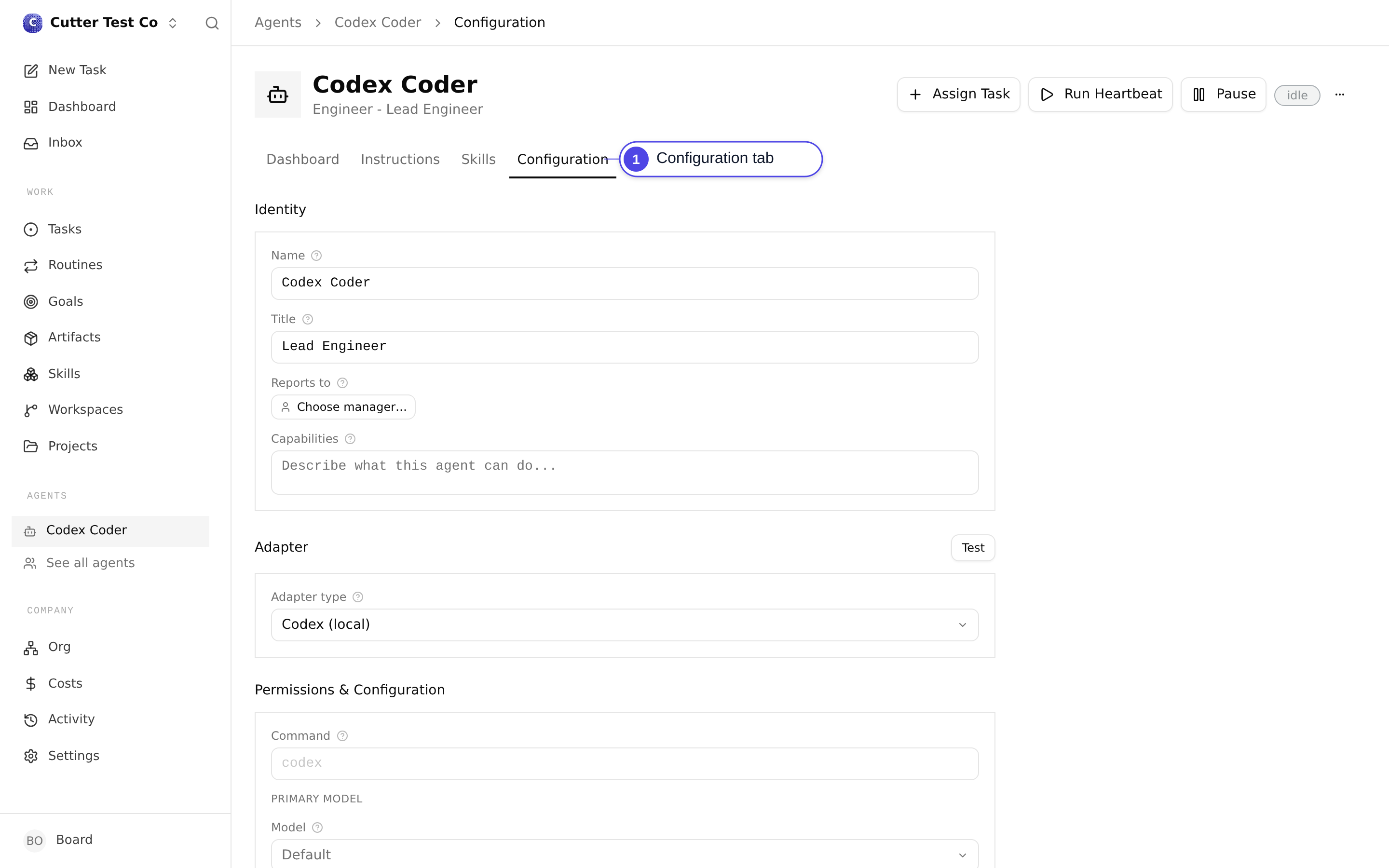
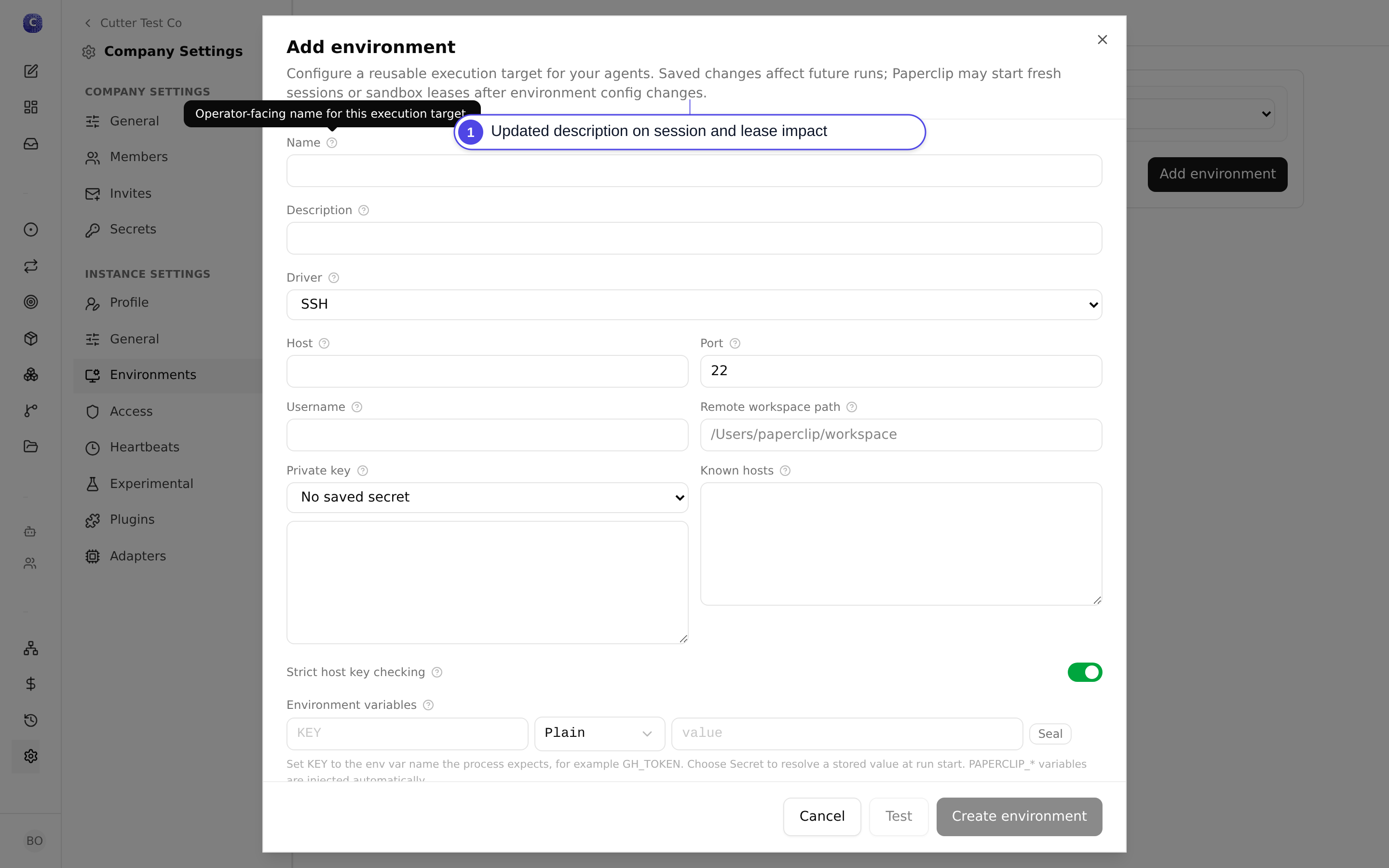
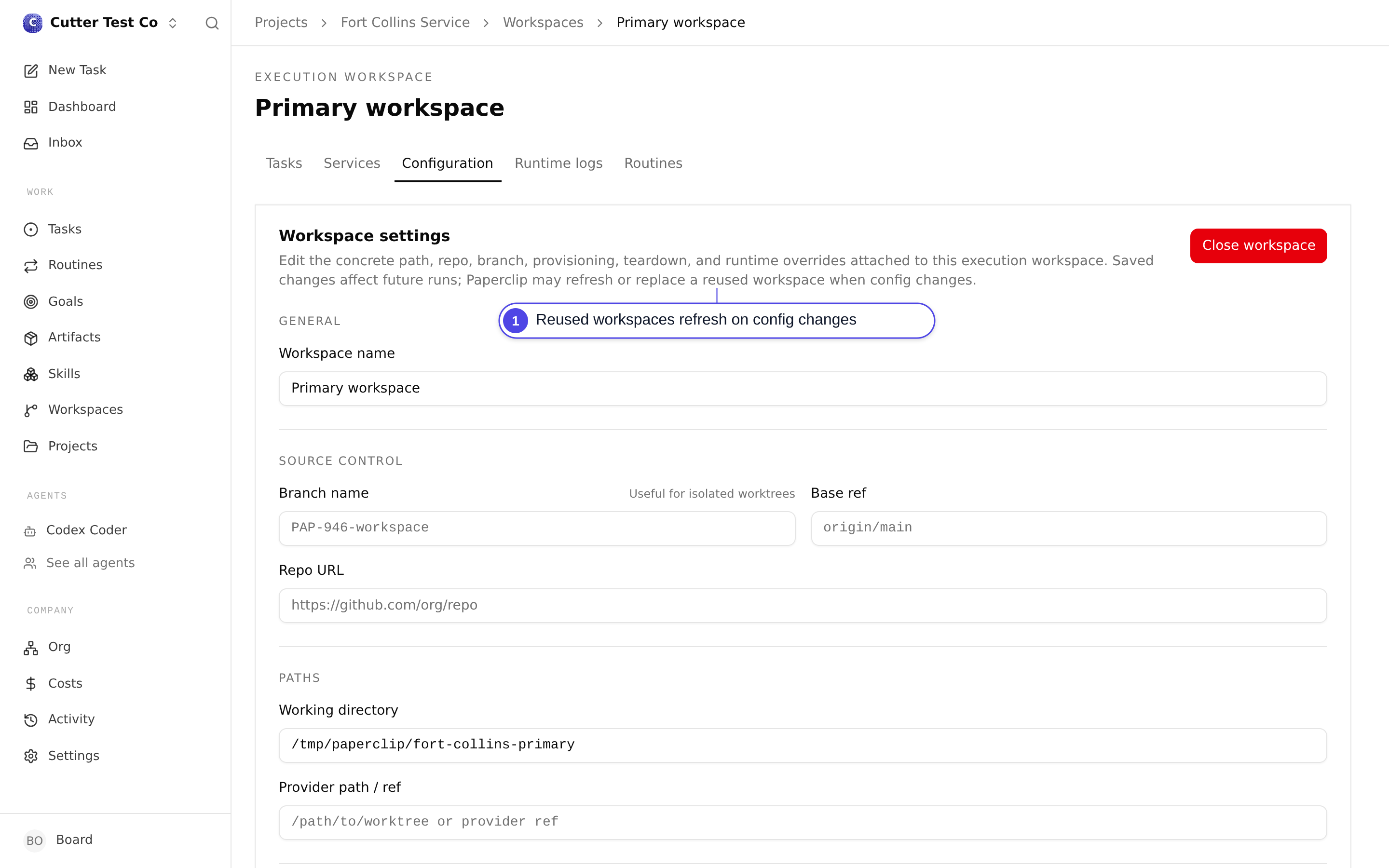
Refresh run config before reusing workspaces (#8797)
## Thinking Path > - Paperclip is the open source app people use to manage AI agents for work. > - Agent runs are assembled by the heartbeat service from agent config, project workspaces, environment config, secret bindings, skills, and runtime session state. > - The heartbeat service intentionally reuses adapter sessions, execution workspaces, and sandbox leases when that preserves useful state. > - Reuse becomes incorrect when the effective next-run config changes after a saved session, workspace, or lease was created. > - Stale reuse can make a later run appear pinned to old agent, environment, secret, instruction, or workspace settings. > - This pull request records non-sensitive fingerprints for the effective session, workspace, and lease config at run boundaries. > - When those fingerprints drift, Paperclip refreshes persisted runtime config or starts fresh execution instead of reusing stale state. > - The benefit is predictable next-run config freshness without storing raw secret values, full env maps, provider credentials, or private path details. ## Linked Issues or Issue Description - Refs #8058 - Related PRs checked during dedup search: #4968, #4155, #84, #8480. These cover nearby workspace/session routing or model-config freshness areas, but do not duplicate this effective run config fingerprinting path. ## What Changed - Added effective run config fingerprinting for session, workspace, and lease reuse decisions, with canonicalization that ignores generated runtime noise and redacts sensitive values. - Updated heartbeat reuse logic to compare stored and next-run fingerprints, reset stale saved sessions, refresh persisted workspace config snapshots, replace stale reused workspaces when required, and avoid stale sandbox lease reuse. - Included plain environment value drift via value hashes, without storing the raw env values. - Root-bound instruction content hashing so legacy direct absolute instruction paths are represented but not read for config fingerprints. - Batched secret/version metadata lookups for environment lease fingerprinting. - Added workspace operation/run result freshness metadata so operators can inspect non-sensitive decision categories. - Surfaced config freshness labels and next-run copy in the UI and docs. - Added focused coverage for fingerprint redaction, session reset decisions, workspace refresh/replace behavior, environment lease drift, and persisted workspace restoration. ## Verification - `git diff --check` - Sensitive-data scan before push: - `git diff --unified=0 origin/master...HEAD | rg -n --pcre2 "(AWS_ACCESS_KEY_ID|AWS_SECRET_ACCESS_KEY|ghp_[A-Za-z0-9_]{20,}|github_pat_[A-Za-z0-9_]{20,}|sk-[A-Za-z0-9]{20,}|-----BEGIN (RSA |OPENSSH |EC |DSA )?PRIVATE KEY-----|AKIA[0-9A-Z]{16})"` - `git diff --unified=0 origin/master...HEAD | rg -n --pcre2 "[A-Za-z0-9._%+-]+@[A-Za-z0-9.-]+\\.[A-Za-z]{2,}"` - `pnpm exec vitest run server/src/__tests__/effective-run-config-fingerprints.test.ts server/src/__tests__/heartbeat-workspace-session.test.ts server/src/__tests__/environment-runtime.test.ts` - `pnpm --filter @paperclipai/server typecheck` - `pnpm -r typecheck` - `pnpm --filter @paperclipai/db clean` - `pnpm test:run` - `pnpm build` - UI screenshots from Cutter: - https://artifacts.cutter.sh/8797/run-2f4827c-2026-06-30T18-57-25/preview/change-01.png - https://artifacts.cutter.sh/8797/run-2f4827c-2026-06-30T18-57-25/preview/change-02.png - https://artifacts.cutter.sh/8797/run-2f4827c-2026-06-30T18-57-25/preview/change-03.png ## Risks - Medium: overly broad fingerprints could start fresh sessions, workspaces, or sandbox leases more often than necessary. - Medium: missing a config category would allow stale reuse to persist for that category. - Medium: legacy direct absolute instruction paths are no longer content-hashed unless they are paired with an absolute managed instructions root. - Low data risk: fingerprint metadata stores hashes and category names, not raw secrets, raw env values, provider credentials, or private path details. > For core feature work, check [`ROADMAP.md`](ROADMAP.md) first and discuss it in `#dev` before opening the PR. Feature PRs that overlap with planned core work may need to be redirected — check the roadmap first. See `CONTRIBUTING.md`. ## Model Used OpenAI GPT-5 via Codex CLI / Codex coding agent, tool-enabled with shell, Git, GitHub CLI, local test execution, and code editing. The exact deployed model variant and context window are not exposed by this environment. ## Checklist - [x] I have included a thinking path that traces from project context to this change - [x] I have specified the model used (with version and capability details) - [x] I have checked ROADMAP.md and confirmed this PR does not duplicate planned core work - [x] I have searched GitHub for duplicate or related PRs and linked them above - [x] I have either (a) linked existing issues with `Fixes: #` / `Closes #` / `Refs #` OR (b) described the issue in-PR following the relevant issue template - [x] I have not referenced internal/instance-local Paperclip issues or links (only public GitHub `#NNN` / `github.com/paperclipai/paperclip` URLs) - [x] My branch name describes the change (e.g. `docs/...`, `fix/...`) and contains no internal Paperclip ticket id or instance-derived details - [x] I have run tests locally and they pass - [x] I have added or updated tests where applicable - [x] I have updated relevant documentation to reflect my changes - [x] I have considered and documented any risks above - [x] All Paperclip CI gates are green - [x] Greptile is 5/5 with no open P2s, recommendations, or follow-ups - [x] I will address all Greptile and reviewer comments before requesting merge --------- Co-authored-by: Paperclip <noreply@paperclip.ing> Co-authored-by: Cody <cody@paperclip.ing> |
||
|
Devin FoleyandPaperclip
|
2c98c8e1e5 |
Fix sandbox git publishing and large workspace uploads (#8422)
## Thinking Path > - Paperclip is the open source app people use to manage AI agents for work > - Sandbox and SSH runtimes need to preserve agent work across isolated execution environments > - Git-backed workspaces were being copied mostly as filesystem archives, which breaks when `.git` points outside the mounted workspace and makes sandbox agents unable to publish their own branches > - Large ignored dependency trees could also be swept into the sandbox overlay, causing multi-GB transfers and max-string failures in some sandbox clients > - This pull request makes sandbox runtime setup use a git-backed HEAD sync plus a small dirty/untracked overlay, and bounds sandbox file transfers so large archives do not need one huge string > - The benefit is that sandbox agents can commit and push from a usable git checkout without uploading dependency trees such as `node_modules` ## Linked Issues or Issue Description Refs #8395 No public duplicate issue or PR was found after searches for `sandbox git workspace`, `git push sandbox`, and `node_modules sandbox upload`. Bug report: - What happened: sandbox-backed agent workspaces could receive a `.git` file that pointed at host-only git state, leaving the sandbox unable to run normal git workflows. The sandbox overlay upload could also include ignored dependency directories, creating very large transfers. - Expected behavior: sandbox and remote runtimes should prepare a usable git-backed workspace, copy only the necessary workspace overlay, and restore git history plus file changes without depending on a host-only `.git` path. - Steps to reproduce: 1. Run an agent in a sandbox-backed workspace whose local git checkout is a worktree. 2. Ask the agent to complete a GitHub workflow that requires commit/push access. 3. Observe that git operations can fail inside the sandbox, and ignored dependency trees can be uploaded as part of the workspace overlay. - Paperclip version or commit: reproduced against `master` before this PR, base `7aa212296eb1`. - Deployment mode: local dev / sandbox-backed runtime. - Installation method: built from source. - Agent adapters involved: local adapters using shared adapter-utils runtime preparation. - Database mode: not database-related. - Access context: agent runtime. - Local verification environment: Node.js v25.6.1, pnpm 9.15.4, macOS arm64. - Privacy checklist: all pasted output was reviewed for secrets, private hostnames, local usernames, and internal instance links. ## What Changed - Added a GitHub workflow push preflight so agent runs can detect missing push credentials when a workflow explicitly needs GitHub publishing. - Added shared git workspace sync helpers for shallow HEAD import/export and dirty/untracked overlay tracking. - Updated sandbox managed runtime setup to use git history plus a selected overlay instead of uploading the full local workspace for git-backed workspaces. - Bounded sandbox archive upload/download paths so large payloads stream or chunk instead of materializing one oversized string. - Excluded `.git` and ignored dependency trees from sandbox upload, download, and restore baselines while preserving local ignored directories during sync-back. - Added focused tests for git workspace sync, sandbox overlay selection, transfer chunking, and heartbeat push-preflight behavior. ## Verification - `pnpm exec vitest run packages/adapter-utils/src/git-workspace-sync.test.ts packages/adapter-utils/src/sandbox-managed-runtime.test.ts packages/adapter-utils/src/command-managed-runtime.test.ts server/src/__tests__/heartbeat-project-env.test.ts server/src/__tests__/heartbeat-workspace-session.test.ts` - `pnpm --filter @paperclipai/adapter-utils typecheck` - `pnpm --filter @paperclipai/server typecheck` - `pnpm build` - Public-hygiene scan of the PR diff and commit messages for internal issue ids, local paths, private hostnames, and obvious token patterns. ## Risks - Medium risk: this changes sandbox runtime synchronization semantics for git-backed workspaces, especially around dirty tracked files, untracked files, deleted paths, and ignored files. - The main mitigation is focused test coverage for upload contents, restore exclusions, and git round-trip behavior. - The SSH runtime keeps the current bundle-based implementation from `master`; this PR only aligns shared excludes and sandbox behavior with that model. ## Model Used OpenAI Codex, GPT-5-based coding agent, tool-enabled shell/git/GitHub workflow, with code execution and repository inspection. ## Checklist - [x] I have included a thinking path that traces from project context to this change - [x] I have specified the model used (with version and capability details) - [x] I have checked ROADMAP.md and confirmed this PR does not duplicate planned core work - [x] I have searched GitHub for duplicate or related PRs and linked them above - [x] I have either (a) linked existing issues with `Fixes: #` / `Closes #` / `Refs #` OR (b) described the issue in-PR following the relevant issue template - [x] I have not referenced internal/instance-local Paperclip issues or links (only public GitHub `#NNN` / `github.com/paperclipai/paperclip` URLs) - [x] My branch name describes the change (e.g. `docs/...`, `fix/...`) and contains no internal Paperclip ticket id or instance-derived details - [x] I have run tests locally and they pass - [x] I have added or updated tests where applicable - [x] If this change affects the UI, I have included before/after screenshots - [x] I have updated relevant documentation to reflect my changes - [x] I have considered and documented any risks above - [x] All Paperclip CI gates are green - [ ] Greptile is 5/5 with no open P2s, recommendations, or follow-ups - [x] I will address all Greptile and reviewer comments before requesting merge --------- Co-authored-by: Paperclip <noreply@paperclip.ing> |
||
|
|
b853ce5183 |
Fix heartbeat task-session reuse when agent model changes (#4195)
## Thinking Path > - Paperclip orchestrates AI agents for zero-human companies. > - Heartbeats wake agents and resume prior adapter task sessions so work is continuous. > - A persisted task session can contain adapter-specific state (for Codex, a resumable thread/session) created under the agent's then-current model. > - When an operator changes an agent's configured model, the next run should not blindly reuse a session created under a different model — context window, capabilities, and prompt assumptions may differ. > - The existing wake reset logic handles wake reasons (forceFreshSession, comment wakes, etc.) but not model drift between current agent config and persisted task-session metadata. > - This pull request adds model-aware task-session reset and persists the configured model into task-session metadata. > - The benefit is that heartbeat runs reliably honor the current agent model configuration and avoid stale session/model mismatches. ## Linked Issues or Issue Description **What happened?** After an operator changes an agent's configured model (for example, swapping a Codex agent from one model variant to another), the heartbeat reuses the persisted adapter task session that was created under the previous model. The new model never takes effect on resume — the run continues on the prior session and prior model assumptions. **Expected behavior** A model change in agent configuration should invalidate the persisted task session for that agent and force a fresh session start on the next run, so the configured model is the one actually used. **Steps to reproduce** 1. Run an agent with model `A` so it persists an adapter task session under model `A`. 2. Change the agent's configured model to `B`. 3. Trigger a heartbeat for the same issue/agent. 4. Observe: the run resumes the prior task session (still under model `A`) instead of starting fresh under model `B`. ## What Changed - Added task-session model metadata support in heartbeat session handling via `__paperclipConfiguredModel`. - Persisted the current configured adapter model into `agent_task_sessions.sessionParamsJson` whenever heartbeat upserts task-session state. - Added `shouldResetTaskSessionForModelChange(...)` to explicitly detect model drift between current config and persisted session metadata. - Updated run startup logic to force a fresh session when model drift is detected, with a clear reason message in runtime warnings. - Strips the internal `__paperclipConfiguredModel` key from `sessionParamsJson` before it is forwarded to adapters so the metadata stays internal. - Added focused tests in `server/src/__tests__/heartbeat-workspace-session.test.ts` covering model-drift reset behavior, non-reset cases, and the strip helper. ## Verification - `pnpm --filter @paperclipai/server test src/__tests__/heartbeat-workspace-session.test.ts` - `pnpm --filter @paperclipai/server typecheck` ## Risks Low. Sessions without persisted model metadata are not reset (backward compatible). The model key is namespaced (`__paperclip...`) to avoid colliding with adapter-forwarded params. Drift detection only fires when both current config and persisted metadata are present and differ. ## Model Used Claude (Opus 4.6) — used to design the metadata persistence, add the drift detection helper, and write unit coverage. ## Checklist - [x] I have included a thinking path that traces from project context to this change - [x] I have specified the model used (with version and capability details) - [x] I have checked ROADMAP.md and confirmed this PR does not duplicate planned core work - [x] I have searched GitHub for duplicate or related PRs and linked them above - [x] I have either (a) linked existing issues with `Fixes: #` / `Closes #` / `Refs #` OR (b) described the issue in-PR following the relevant issue template - [x] I have run tests locally and they pass - [x] I have added or updated tests where applicable - [x] If this change affects the UI, I have included before/after screenshots (N/A — no UI changes) - [x] I have updated relevant documentation to reflect my changes - [x] I have considered and documented any risks above - [ ] All Paperclip CI gates are green (in progress) - [ ] Greptile is 5/5 with no open P2s, recommendations, or follow-ups - [x] I will address all Greptile and reviewer comments before requesting merge --------- Co-authored-by: Paperclip <noreply@paperclip.ing> Co-authored-by: Devin Foley <devin@paperclip.ing> |
||
|
xiduiandDevin Foley
|
5d315ab778 |
Defer same-issue forceFreshSession wakes into follow-up runs (#4080)
## Thinking Path > - Paperclip is the open source app people use to manage AI agents for work > - The heartbeat service governs how agent wake events get queued, deferred, or folded into the currently-running adapter run > - `forceFreshSession: true` wakes on a same-agent/same-issue path get silently folded into the active run, so callers can never request a true cold-start follow-up > - This breaks phased workflows that need to drop a poisoned session and restart cleanly on the same issue without bouncing to another agent > - This PR extracts the existing same-issue follow-up decision into `shouldDeferFollowupWakeForSameIssue` and extends it to also defer `forceFreshSession: true` wakes into a follow-up run boundary > - The benefit is that `forceFreshSession` now behaves as documented: it actually starts a fresh session, even when the wake targets the same agent/issue/runtime that is currently executing ## Linked Issues or Issue Description **What happened?** A wake event posted with `forceFreshSession: true` against an issue whose current adapter run is still `running` on the same execution agent is silently coalesced into that in-flight run instead of starting a cold session. Callers that explicitly request a fresh-session reset see no behavior change until the run naturally completes. **Expected behavior** `forceFreshSession: true` should always force a fresh session start, even when the wake targets the same agent/issue that is currently executing. The wake should defer into a follow-up run boundary if the current run is still in-flight. **Steps to reproduce** 1. Start an adapter run for some issue. 2. While the run is still `running`, post a wake event for the same issue/agent with `forceFreshSession: true`. 3. Observe: the active run continues without resetting the session; the fresh-session signal is dropped. ## What Changed - Extracted same-issue follow-up decision into exported helper `shouldDeferFollowupWakeForSameIssue` in `server/src/services/heartbeat.ts` - Extended that helper so `forceFreshSession: true` (not only `wakeCommentId`) defers into a follow-up run when the current run is still `running` for the same execution agent - Added stickiness to `mergeCoalescedContextSnapshot`: if either side of a wake-merge has `forceFreshSession: true`, the merged snapshot keeps it set so it is not silently dropped while queued wakes coalesce - Added five unit tests in `heartbeat-workspace-session.test.ts` covering each decision branch of the helper ## Verification - `pnpm --filter @paperclipai/server test src/__tests__/heartbeat-workspace-session.test.ts` - `pnpm --filter @paperclipai/server typecheck` ## Risks Low. Behavior change only affects the narrow case where a same-agent/same-issue wake carries `forceFreshSession: true` while the active run is still `running`. Other wake paths (cross-agent, queued/failed runs) are untouched. The helper extraction is a pure refactor preserving the prior comment-wake deferral. ## Model Used Claude (Opus 4.7) — extended thinking enabled, used to extract the helper, extend the deferral condition to cover `forceFreshSession`, and write unit coverage. ## Checklist - [x] I have included a thinking path that traces from project context to this change - [x] I have specified the model used (with version and capability details) - [x] I have checked ROADMAP.md and confirmed this PR does not duplicate planned core work - [x] I have searched GitHub for duplicate or related PRs and linked them above - [x] I have either (a) linked existing issues with `Fixes: #` / `Closes #` / `Refs #` OR (b) described the issue in-PR following the relevant issue template - [x] I have run tests locally and they pass - [x] I have added or updated tests where applicable - [x] If this change affects the UI, I have included before/after screenshots (N/A — no UI changes) - [x] I have updated relevant documentation to reflect my changes - [x] I have considered and documented any risks above - [ ] All Paperclip CI gates are green (in progress) - [ ] Greptile is 5/5 with no open P2s, recommendations, or follow-ups - [x] I will address all Greptile and reviewer comments before requesting merge --------- Co-authored-by: Devin Foley <devin@paperclip.ing> |
||
|
DottaandPaperclip
|
7428fb956f |
[codex] Guard git-sensitive adapter workspaces (#7644)
## Thinking Path > - Paperclip is the open source app people use to manage AI agents for work. > - The affected subsystem is the heartbeat execution path that turns issue assignment into adapter-backed work in a selected workspace. > - PAP-10409 and sibling follow-ups failed before useful adapter output because project/workspace identity became incoherent. > - A project-workspace-linked child issue could keep `projectWorkspaceId` / execution workspace state while losing `projectId`, then a git-sensitive local adapter could fall through toward an invalid fallback cwd. > - Paperclip needs to treat coherent workspace identity as part of the live-path contract, not only as post-failure cleanup. > - This pull request documents that rule, repairs issue inheritance, and blocks git-sensitive adapter launch before it can run from the wrong cwd. > - The benefit is a bounded recovery path: affected issues are repaired explicitly, future malformed workspaces fail fast with a clear recovery action, and the UI surfaces that reason. ## Linked Issues or Issue Description Refs #7646 Bug report fields: - Summary: adapter-backed follow-up issues can fail before doing work when issue creation/inheritance preserves workspace ids but drops project identity. - Affected issues: internal Paperclip issues PAP-10408 through PAP-10412, especially PAP-10409. - Steps to reproduce: create a project-scoped parent/follow-up tree where a child issue keeps `projectWorkspaceId` or an inherited execution workspace but has `projectId: null`, then launch a git-sensitive local adapter such as `codex_local`. - Expected behavior: Paperclip derives or preserves coherent project identity during issue creation, and heartbeat refuses malformed git-sensitive workspace launches with one clear recovery action. - Actual behavior before this PR: the run could reach adapter bootstrap with an incoherent workspace context and fail with git errors such as `fatal: not a git repository (or any parent up to mount point /srv)`. - Root cause: child/follow-up issue inheritance preserved workspace execution context without coherent project context. That let heartbeat workspace resolution/adapter launch reach a fallback cwd instead of refusing the malformed workspace state up front. ## What Changed - Documented the adapter workspace-coherence live-path precondition in `doc/execution-semantics.md`. - Updated issue creation/inheritance so workspace-inheriting issues preserve or derive project identity, while existing mismatch validation still rejects incoherent project/workspace combinations. - Added a heartbeat preflight guard for git-sensitive local adapters that validates effective cwd, persisted workspace identity, project workspace identity, and required git metadata before launch. - Added `workspace_validation` recovery actions for this failure class and ensured the source issue gets a visible, idempotent recovery comment. - Surfaced workspace-validation recovery state in issue rows, blocked notices, and recovery action cards, including the manual-repair wake policy label. - Added focused regression coverage for issue inheritance, all heartbeat workspace-validation guard branches, recovery display helpers, and UI recovery components. ## Verification - `pnpm exec vitest run server/src/__tests__/heartbeat-workspace-session.test.ts` - Result: 1 test file passed, 68 tests passed. - `pnpm exec vitest run ui/src/components/IssueRecoveryActionCard.test.tsx` - Result: 1 test file passed, 12 tests passed. - `pnpm exec vitest run ui/src/components/IssueBlockedNotice.test.tsx ui/src/components/IssueRecoveryActionCard.test.tsx` - Result: 2 test files passed, 18 tests passed. - `pnpm --filter @paperclipai/ui typecheck` - Result: passed. - `pnpm exec vitest run server/src/__tests__/heartbeat-plugin-environment.test.ts server/src/__tests__/issues-service.test.ts server/src/__tests__/heartbeat-workspace-session.test.ts server/src/__tests__/heartbeat-process-recovery.test.ts ui/src/components/IssueBlockedNotice.test.tsx ui/src/components/IssueRecoveryActionCard.test.tsx ui/src/lib/recovery-display.test.ts` - Result: 7 test files passed, 200 tests passed before the final guard-branch additions; the changed server file was re-run above. - UI coverage: `ui/storybook/stories/source-issue-recovery.stories.tsx` contains rendered scenarios for the generic recovery chip, workspace-validation recovery chip, blocked notice indicator, recovery action card, and issue-row chip. - Screenshot capture attempt: Storybook started successfully on `http://127.0.0.1:6016/`, but screenshots could not be captured in this runner because `agent-browser` launched an unusable Chrome binary and Playwright Chromium failed on missing system library `libatk-1.0.so.0`; the runner is non-root and lacks passwordless sudo for installing browser dependencies. - Hosted CI on final commit `969594e7` is green, including `verify`, `Build`, `Typecheck + Release Registry`, `General tests (server)`, workspace suites, serialized server suites, `Canary Dry Run`, and `e2e`. - Roadmap checked: no duplicate roadmap item; this is a tightly scoped reliability fix for existing heartbeat/workspace behavior. - Duplicate PR search checked: no open PR matched `workspace coherence adapter cwd`. ## Risks - Medium risk: heartbeat launch is stricter for git-sensitive local adapters and can now block malformed workspace states before adapter execution. - Mitigation: the guard is limited to local git-sensitive adapters and records a source-scoped recovery action with structured evidence instead of retrying indefinitely. - Compatibility: valid project/workspace execution paths continue normally; explicit project/workspace mismatches remain rejected. > For core feature work, check [`ROADMAP.md`](ROADMAP.md) first and discuss it in `#dev` before opening the PR. Feature PRs that overlap with planned core work may need to be redirected — check the roadmap first. See `CONTRIBUTING.md`. ## Model Used OpenAI Codex, GPT-5-based `codex_local` coding agent with terminal/tool use. Work was produced through Paperclip issue execution with focused local test runs. ## Checklist - [x] I have included a thinking path that traces from project context to this change - [x] I have specified the model used (with version and capability details) - [x] I have checked ROADMAP.md and confirmed this PR does not duplicate planned core work - [x] I have searched GitHub for duplicate or related PRs and linked them above - [x] I have either (a) linked existing issues with `Fixes: #` / `Closes #` / `Refs #` OR (b) described the issue in-PR following the relevant issue template - [x] I have run tests locally and they pass - [x] I have added or updated tests where applicable - [ ] If this change affects the UI, I have included before/after screenshots - [x] I have updated relevant documentation to reflect my changes - [x] I have considered and documented any risks above - [x] All Paperclip CI gates are green - [x] Greptile is 5/5 with no open P2s, recommendations, or follow-ups - [x] I will address all Greptile and reviewer comments before requesting merge --------- Co-authored-by: Paperclip <noreply@paperclip.ing> |
||
|
DottaandPaperclip
|
dbebf30c89 |
Add low-trust review containment (#7530)
## Thinking Path > - Paperclip is a control plane for AI-agent companies, so execution policy and trust boundaries are part of the product's safety contract. > - Low-trust review work needs narrower authority than normal same-company agents because hostile PRs, comments, attachments, and generated output can carry prompt-injection payloads. > - The current V1 shape gives trusted workers broad company context, which is useful for normal execution but too permissive for a reviewer assigned to hostile content. > - This branch adds a `low_trust_review` preset, source-trust tagging, route-level containment, and quarantine handling so low-trust output does not automatically flow into higher-trust wake context. > - The branch has been rebased onto current `origin/master`, and the low-trust migration was renumbered to `0097_low_trust_source_trust.sql` to avoid collisions with existing `0091` through `0096` migrations. > - Greptile feedback was addressed by tightening low-trust detection, preserving project-level trust policy checks, fixing issue-kind promotion lookup, removing duplicate post-lease isolation assertion, documenting fail-closed source-trust behavior, bounding ancestry checks, enforcing runtime issue context for CEOs, awaiting accepted-plan monitor authorization, and making low-trust issue source-trust tagging atomic. > - The benefit is a first production slice of deny-by-default review containment with regression coverage for the main control-plane pivot surfaces. Fixes #7531. ## What Changed - Added shared trust-policy types and validators, plus database/source-trust fields for issues, comments, documents, and work products. - Implemented server enforcement for low-trust issue scope, agent self-view redaction, secret/plugin/runtime denial paths, promotion checks, and quarantined continuation/wake context. - Added focused low-trust regression tests for resolver behavior, source trust, route authorization, heartbeat preflight ordering, runtime containment, and quarantine redaction. - Added board UI affordances for selecting/reviewing the low-trust preset and surfacing source-trust badges in relevant issue views. - Added `doc/LOW-TRUST-PRESETS.md`, updated `doc/SPEC-implementation.md`, and committed the low-trust review contract plan under `doc/plans/`. - Rebasing note: the original `0097_low_trust_source_trust.sql` migration was renamed to `0097_low_trust_source_trust.sql`; the SQL uses `ADD COLUMN IF NOT EXISTS` so users who already applied the old-numbered migration are not broken by the renumbered migration. ## Verification - Rebased branch onto current `origin/master` and force-pushed with lease to `origin/PAP-10211-low-trust-agent` at head `2719f31e3`. - Confirmed the PR diff does not include `pnpm-lock.yaml` or `.github/workflows` changes. - Resolved upstream UI/comment conflicts by preserving deleted-comment tombstone behavior and low-trust source-trust badges/metadata. - Renumbered the low-trust source-trust migration to `0097_low_trust_source_trust.sql`; the SQL uses `ADD COLUMN IF NOT EXISTS` so users who already applied an old-numbered copy are not broken. - `pnpm exec vitest run ui/src/lib/issue-chat-messages.test.ts server/src/__tests__/heartbeat-workspace-session.test.ts` - `pnpm exec vitest run server/src/__tests__/source-trust.test.ts server/src/__tests__/workspace-runtime-service-authz.test.ts ui/src/lib/trust-policy-ui.test.ts ui/src/components/TrustPresetSection.test.tsx` - `pnpm run typecheck:build-gaps` - `git diff --check` - GitHub checks pass on head `2719f31e3`: build, typecheck/release registry, general tests, serialized server suites, e2e, canary, verify, policy/review, Socket, and Snyk. - Greptile Review passes with Confidence Score 5/5 and zero unresolved Greptile review threads. - No design screenshots/images were added because the task explicitly says not to add them unless they are specifically part of the work. ## Risks - Medium risk: this touches shared trust-policy contracts, server authorization paths, heartbeat context generation, migration metadata, and UI preset controls. - Low-trust containment is intentionally deny-by-default; legitimate future review workflows may need explicit allowlisted exceptions. - Plugin/runtime/security surfaces are broad, so regression tests cover the current known routes but future integrations must route through the same containment layer. - The PR is ready for review; GitHub checks are green and Greptile is 5/5. > For core feature work, check [`ROADMAP.md`](ROADMAP.md) first and discuss it in `#dev` before opening the PR. Feature PRs that overlap with planned core work may need to be redirected — check the roadmap first. See `CONTRIBUTING.md`. ## Model Used - OpenAI Codex, GPT-5 coding agent, tool-enabled shell and GitHub CLI workflow. ## Checklist - [x] I have included a thinking path that traces from project context to this change - [x] I have specified the model used (with version and capability details) - [x] I have checked ROADMAP.md and confirmed this PR does not duplicate planned core work - [x] I have run tests locally and they pass - [x] I have added or updated tests where applicable - [x] UI changes are covered by focused tests; no screenshots were added per task instruction not to add design images unless specifically required - [x] I have updated relevant documentation to reflect my changes - [x] I have considered and documented any risks above - [x] I will address all Greptile and reviewer comments before requesting merge --------- Co-authored-by: Paperclip <noreply@paperclip.ing> |
||
|
m.seomoon
|
fb28cf38b4 |
fix(heartbeat): guard Hermes resume session state (#7516)
## Thinking Path > - Paperclip is a control plane for AI-agent companies > - Heartbeats reuse adapter session state so agents can continue work across wakeups > - Hermes can only resume from full canonical session IDs, not truncated display IDs > - #6347 exposed a case where Paperclip could save invalid Hermes output like `from`, or a shortened display ID, as resumable state > - This pull request hardens the host-side Hermes resume path so Paperclip only stores and reuses session IDs that can actually resume > - The benefit is that Hermes wakeups no longer get stuck retrying bad saved resume state ## What Changed - Added Hermes-only validation for canonical session IDs in `server/src/services/heartbeat.ts`. - Stopped building Hermes resume params from truncated display IDs such as `20260601_141558_`. - For explicit resume-from-run wakeups, pulls the full Hermes session ID from the run result payload after validation. - Preserves the previous valid Hermes session state when a run fails, times out, or is cancelled instead of replacing it with invalid adapter output like `from`. - Clears existing Hermes resume state that fails validation. - Leaves non-Hermes adapter session behavior unchanged. - Added regression coverage in `server/src/__tests__/heartbeat-workspace-session.test.ts`. Addresses #6347. Supersedes #6351 and covers the full-session resume metadata handoff from #7280. ## Verification - `pnpm --filter @paperclipai/server exec vitest run src/__tests__/heartbeat-workspace-session.test.ts` — passed, 50 tests. - `pnpm --filter @paperclipai/server typecheck` — passed. - `pnpm -r typecheck` — passed. - `pnpm build` — passed. - `git diff --check` — clean. Full suite did not finish green locally; the failures were outside this server-only heartbeat path: - `pnpm test:run`: - `@paperclipai/adapter-opencode-local` remote SSH tests timed out. - `ui/src/pages/Inbox.test.tsx` failed once in `Inbox toolbar > syncs hover with j/k selection on inbox rows`; the direct file rerun passed. - `ui/src/components/IssueDocumentAnnotations.test.tsx` failed once in `auto-opens the panel and focuses the thread when deep-linked`; the direct file rerun passed. ## Risks - Low risk: no schema, public API, shared contract, or UI changes. - If Hermes changes its canonical session ID format, the validation regex will need to be updated. - Adapter-side parsing still needs its own fix; this PR prevents non-resumable adapter output from becoming durable Paperclip resume state. - This does not add an immediate same-run retry after `Session not found`; recovery happens by clearing or preserving durable resume state for later wakeups. > For core feature work, check [`ROADMAP.md`](ROADMAP.md) first and discuss it in `#dev` before opening the PR. Feature PRs that overlap with planned core work may need to be redirected — check the roadmap first. See `CONTRIBUTING.md`. ## Model Used - OpenAI GPT-5.5 (`openai/gpt-5.5`) via opencode, with repository read/search tools and local shell/test execution. opencode did not expose context-window or reasoning-mode details. ## Checklist - [x] I have included a thinking path that traces from project context to this change - [x] I have specified the model used, including exact model ID and capability details - [x] I have checked ROADMAP.md and confirmed this PR does not duplicate planned core work - [x] I have run tests locally — targeted checks passed; full `pnpm test:run` had unrelated local failures disclosed above - [x] I have added or updated tests where applicable - [x] If this change affects the UI, I have included before/after screenshots — N/A, no UI changes - [x] I have updated relevant documentation to reflect my changes — N/A, no user-facing docs or commands changed - [x] I have considered and documented any risks above - [x] I will address all Greptile and reviewer comments before requesting merge |
||
|
DottaandPaperclip
|
f0ddd24d61 |
[codex] Show bundled plugins in plugin manager (#6734)
## Thinking Path > - Paperclip orchestrates AI agents for zero-human companies. > - The plugin system is how Paperclip exposes optional capabilities and integrations without bloating the control plane. > - Operators need the Instance Settings plugin manager to show both installed external plugins and bundled built-in plugins. > - Bundled plugins were available in the server/UI surface but were not represented consistently in the plugin manager list. > - Workspace runtime reuse also needed to stay pinned to the current branch/base so the plugin manager can be validated from the intended checkout. > - This pull request shows bundled plugins in the manager, marks experimental bundled plugins clearly, and tightens runtime/worktree reuse guards. > - The benefit is that operators can discover bundled plugins from the same management screen as installed plugins without stale workspace sessions hiding the latest branch state. ## What Changed - Lists bundled monorepo plugin packages through the plugin routes API, including plugin status and install metadata needed by the UI. - Updates the plugin manager UI/API client to render bundled plugins and display experimental badges based on installed plugin records. - Adds server authorization coverage around plugin routes so board and agent access stay company-scoped. - Guards execution workspace/runtime reuse against stale base refs and defaults new worktrees to the fetched target base. - Expands workspace runtime tests for service reuse, stale workspace prevention, and controlled runtime stops. - Addressed Greptile feedback by respecting `origin/HEAD`, using async cached bundled-plugin discovery, and avoiding duplicated UI experimental plugin lists. ## Verification - `pnpm exec vitest run server/src/__tests__/plugin-routes-authz.test.ts server/src/__tests__/workspace-runtime.test.ts server/src/__tests__/heartbeat-workspace-session.test.ts` - `pnpm --filter @paperclipai/ui typecheck` - `pnpm --filter @paperclipai/plugin-sdk build && pnpm --filter @paperclipai/server typecheck` - `pnpm --filter @paperclipai/server typecheck` - `gh pr checks 6734 --repo paperclipai/paperclip` reports all checks passing on `10e1ba9e0f505637cd913713fb28c2c99ae92011`. - Greptile Review reports 5/5 on `10e1ba9e0f505637cd913713fb28c2c99ae92011`. - Confirmed the branch is rebased onto `public-gh/master` and the PR diff does not include `pnpm-lock.yaml` or `.github/workflows` changes. - UI screenshots were not captured in this PR-creation pass because the available local board runtime is authenticated; the visible UI path is covered by the plugin manager code changes and server/API tests above. ## Risks - Medium risk: this touches shared plugin listing behavior and workspace runtime reuse, so regressions could affect plugin manager visibility or service reuse across execution workspaces. - No database migrations. - No lockfile or GitHub workflow changes. > For core feature work, check [`ROADMAP.md`](ROADMAP.md) first and discuss it in `#dev` before opening the PR. Feature PRs that overlap with planned core work may need to be redirected — check the roadmap first. See `CONTRIBUTING.md`. ## Model Used - OpenAI GPT-5 Codex, coding-agent workflow with shell/tool use in a local Paperclip worktree. Context window not surfaced by the runtime; reasoning mode not externally reported. ## Checklist - [x] I have included a thinking path that traces from project context to this change - [x] I have specified the model used (with version and capability details) - [x] I have checked ROADMAP.md and confirmed this PR does not duplicate planned core work - [x] I have run tests locally and they pass - [x] I have added or updated tests where applicable - [ ] If this change affects the UI, I have included before/after screenshots - [x] I have updated relevant documentation to reflect my changes - [x] I have considered and documented any risks above - [x] I will address all Greptile and reviewer comments before requesting merge --------- Co-authored-by: Paperclip <noreply@paperclip.ing> |
||
|
DottaandPaperclip
|
d734bd43d1 |
[codex] Roll up May 17 branch changes (#6210)
## Thinking Path > - Paperclip is the control plane for autonomous AI companies, so agent work needs visible ownership, recovery, and operator controls. > - This local branch had accumulated several related control-plane reliability and operator-experience fixes across recovery actions, watchdog folding, model-profile defaults, mentions, markdown editing, plugin launchers, and small UI polish. > - The branch needed to be converted into a PR against the current `origin/master` without losing dirty work or including lockfile/workflow churn. > - The safest standalone shape is a single rollup PR because the recovery/server/UI files overlap heavily across the local commits and splitting would create avoidable conflicts. > - This pull request replays the local branch onto latest `origin/master`, preserves the uncommitted work as logical commits, and adds a Zod 4 validator compatibility fix found during verification. > - The benefit is that the May 17 local branch can be reviewed and merged as one coherent, conflict-free branch under the 100-file Greptile limit. ## What Changed - Rebased the local May 17 branch work onto current `origin/master` in a dedicated worktree. - Preserved and committed previously dirty changes for recovery retry handling, plugin/sidebar launcher polish, and `.herenow` ignores. - Added recovery-action behavior for returning source issues to `todo` when retrying source-scoped recovery. - Included the existing local recovery/liveness/watchdog fold, Codex cheap-profile, markdown/mention, duplicate-agent, and UI polish commits from the branch. - Normalized shared validator `z.record(...)` schemas to explicit string-key records for Zod 4 compatibility. - Confirmed the PR has no `pnpm-lock.yaml` or `.github/workflows/*` changes and stays below the 100-file Greptile limit. ## Verification - `pnpm install --frozen-lockfile --ignore-scripts` - `npm run install` in `node_modules/.pnpm/sqlite3@5.1.7/node_modules/sqlite3` to build the local native sqlite3 binding after installing with scripts disabled - `pnpm exec vitest run packages/shared/src/validators/issue.test.ts packages/shared/src/project-mentions.test.ts packages/adapter-utils/src/server-utils.test.ts server/src/__tests__/heartbeat-model-profile.test.ts server/src/__tests__/issue-recovery-actions.test.ts server/src/__tests__/issue-agent-mutation-ownership-routes.test.ts server/src/__tests__/heartbeat-active-run-output-watchdog.test.ts server/src/__tests__/plugin-local-folders.test.ts ui/src/components/IssueRecoveryActionCard.test.tsx ui/src/components/Sidebar.test.tsx ui/src/components/SidebarAccountMenu.test.tsx ui/src/components/IssueProperties.test.tsx ui/src/components/MarkdownEditor.test.tsx ui/src/components/MarkdownBody.test.tsx ui/src/lib/duplicate-agent-payload.test.ts ui/src/pages/Routines.test.tsx` - First pass: 13 files passed with 201 passing tests; 3 server files failed before sqlite3 native binding was built. - After rebuilding sqlite3: `server/src/__tests__/heartbeat-model-profile.test.ts`, `server/src/__tests__/issue-recovery-actions.test.ts`, and `server/src/__tests__/heartbeat-active-run-output-watchdog.test.ts` passed/loaded; embedded Postgres tests were skipped by the local host guard. - `pnpm --filter @paperclipai/shared typecheck` - `pnpm --filter @paperclipai/adapter-utils typecheck` - `pnpm --filter @paperclipai/server typecheck` - `pnpm --filter @paperclipai/ui typecheck` ## Risks - Medium risk: this is a broad rollup PR across recovery semantics, server tests, shared validators, and UI surfaces. - Some embedded Postgres tests skipped locally due the host guard, so CI should provide the stronger database-backed signal. - UI changes were covered by component tests, but no browser screenshot was captured in this PR creation pass. - This branch may overlap with existing recovery/liveness PR work; merge this PR independently or restack/close overlapping branches rather than merging duplicate implementations together. > For core feature work, check [`ROADMAP.md`](ROADMAP.md) first and discuss it in `#dev` before opening the PR. Feature PRs that overlap with planned core work may need to be redirected — check the roadmap first. See `CONTRIBUTING.md`. ## Model Used - OpenAI Codex, GPT-5-based coding agent, tool-enabled local repository and GitHub workflow, medium reasoning effort. ## Checklist - [x] I have included a thinking path that traces from project context to this change - [x] I have specified the model used (with version and capability details) - [x] I have checked ROADMAP.md and confirmed this PR does not duplicate planned core work - [x] I have run tests locally and they pass - [x] I have added or updated tests where applicable - [ ] If this change affects the UI, I have included before/after screenshots - [x] I have updated relevant documentation to reflect my changes - [x] I have considered and documented any risks above - [x] I will address all Greptile and reviewer comments before requesting merge --------- Co-authored-by: Paperclip <noreply@paperclip.ing> |
||
|
Devin Foley
|
70679a3321 |
Add sandbox environment support (#4415)
## Thinking Path > - Paperclip orchestrates AI agents for zero-human companies. > - The environment/runtime layer decides where agent work executes and how the control plane reaches those runtimes. > - Today Paperclip can run locally and over SSH, but sandboxed execution needs a first-class environment model instead of one-off adapter behavior. > - We also want sandbox providers to be pluggable so the core does not hardcode every provider implementation. > - This branch adds the Sandbox environment path, the provider contract, and a deterministic fake provider plugin. > - That required synchronized changes across shared contracts, plugin SDK surfaces, server runtime orchestration, and the UI environment/workspace flows. > - The result is that sandbox execution becomes a core control-plane capability while keeping provider implementations extensible and testable. ## What Changed - Added sandbox runtime support to the environment execution path, including runtime URL discovery, sandbox execution targeting, orchestration, and heartbeat integration. - Added plugin-provider support for sandbox environments so providers can be supplied via plugins instead of hardcoded server logic. - Added the fake sandbox provider plugin with deterministic behavior suitable for local and automated testing. - Updated shared types, validators, plugin protocol definitions, and SDK helpers to carry sandbox provider and workspace-runtime contracts across package boundaries. - Updated server routes and services so companies can create sandbox environments, select them for work, and execute work through the sandbox runtime path. - Updated the UI environment and workspace surfaces to expose sandbox environment configuration and selection. - Added test coverage for sandbox runtime behavior, provider seams, environment route guards, orchestration, and the fake provider plugin. ## Verification - Ran locally before the final fixture-only scrub: - `pnpm -r typecheck` - `pnpm test:run` - `pnpm build` - Ran locally after the final scrub amend: - `pnpm vitest run server/src/__tests__/runtime-api.test.ts` - Reviewer spot checks: - create a sandbox environment backed by the fake provider plugin - run work through that environment - confirm sandbox provider execution does not inherit host secrets implicitly ## Risks - This touches shared contracts, plugin SDK plumbing, server runtime orchestration, and UI environment/workspace flows, so regressions would likely show up as cross-layer mismatches rather than isolated type errors. - Runtime URL discovery and sandbox callback selection are sensitive to host/bind configuration; if that logic is wrong, sandbox-backed callbacks may fail even when execution succeeds. - The fake provider plugin is intentionally deterministic and test-oriented; future providers may expose capability gaps that this branch does not yet cover. ## Model Used - OpenAI Codex coding agent on a GPT-5-class backend in the Paperclip/Codex harness. Exact backend model ID is not exposed in-session. Tool-assisted workflow with shell execution, file editing, git history inspection, and local test execution. ## Checklist - [x] I have included a thinking path that traces from project context to this change - [x] I have specified the model used (with version and capability details) - [x] I have checked ROADMAP.md and confirmed this PR does not duplicate planned core work - [x] I have run tests locally and they pass - [x] I have added or updated tests where applicable - [ ] If this change affects the UI, I have included before/after screenshots - [x] I have updated relevant documentation to reflect my changes - [x] I have considered and documented any risks above - [x] I will address all Greptile and reviewer comments before requesting merge |
||
|
|
b9a80dcf22 |
feat: implement multi-user access and invite flows (#3784)
## Thinking Path > - Paperclip is the control plane for autonomous AI companies. > - V1 needs to stay local-first while also supporting shared, authenticated deployments. > - Human operators need real identities, company membership, invite flows, profile surfaces, and company-scoped access controls. > - Agents and operators also need the existing issue, inbox, workspace, approval, and plugin flows to keep working under those authenticated boundaries. > - This branch accumulated the multi-user implementation, follow-up QA fixes, workspace/runtime refinements, invite UX improvements, release-branch conflict resolution, and review hardening. > - This pull request consolidates that branch onto the current `master` branch as a single reviewable PR. > - The benefit is a complete multi-user implementation path with tests and docs carried forward without dropping existing branch work. ## What Changed - Added authenticated human-user access surfaces: auth/session routes, company user directory, profile settings, company access/member management, join requests, and invite management. - Added invite creation, invite landing, onboarding, logo/branding, invite grants, deduped join requests, and authenticated multi-user E2E coverage. - Tightened company-scoped and instance-admin authorization across board, plugin, adapter, access, issue, and workspace routes. - Added profile-image URL validation hardening, avatar preservation on name-only profile updates, and join-request uniqueness migration cleanup for pending human requests. - Added an atomic member role/status/grants update path so Company Access saves no longer leave partially updated permissions. - Improved issue chat, inbox, assignee identity rendering, sidebar/account/company navigation, workspace routing, and execution workspace reuse behavior for multi-user operation. - Added and updated server/UI tests covering auth, invites, membership, issue workspace inheritance, plugin authz, inbox/chat behavior, and multi-user flows. - Merged current `public-gh/master` into this branch, resolved all conflicts, and verified no `pnpm-lock.yaml` change is included in this PR diff. ## Verification - `pnpm exec vitest run server/src/__tests__/issues-service.test.ts ui/src/components/IssueChatThread.test.tsx ui/src/pages/Inbox.test.tsx` - `pnpm run preflight:workspace-links && pnpm exec vitest run server/src/__tests__/plugin-routes-authz.test.ts` - `pnpm exec vitest run server/src/__tests__/plugin-routes-authz.test.ts server/src/__tests__/workspace-runtime-service-authz.test.ts server/src/__tests__/access-validators.test.ts` - `pnpm exec vitest run server/src/__tests__/authz-company-access.test.ts server/src/__tests__/routines-routes.test.ts server/src/__tests__/sidebar-preferences-routes.test.ts server/src/__tests__/approval-routes-idempotency.test.ts server/src/__tests__/openclaw-invite-prompt-route.test.ts server/src/__tests__/agent-cross-tenant-authz-routes.test.ts server/src/__tests__/routines-e2e.test.ts` - `pnpm exec vitest run server/src/__tests__/auth-routes.test.ts ui/src/pages/CompanyAccess.test.tsx` - `pnpm --filter @paperclipai/shared typecheck && pnpm --filter @paperclipai/db typecheck && pnpm --filter @paperclipai/server typecheck` - `pnpm --filter @paperclipai/shared typecheck && pnpm --filter @paperclipai/server typecheck` - `pnpm --filter @paperclipai/ui typecheck` - `pnpm db:generate` - `npx playwright test --config tests/e2e/playwright.config.ts --list` - Confirmed branch has no uncommitted changes and is `0` commits behind `public-gh/master` before PR creation. - Confirmed no `pnpm-lock.yaml` change is staged or present in the PR diff. ## Risks - High review surface area: this PR contains the accumulated multi-user branch plus follow-up fixes, so reviewers should focus especially on company-boundary enforcement and authenticated-vs-local deployment behavior. - UI behavior changed across invites, inbox, issue chat, access settings, and sidebar navigation; no browser screenshots are included in this branch-consolidation PR. - Plugin install, upgrade, and lifecycle/config mutations now require instance-admin access, which is intentional but may change expectations for non-admin board users. - A join-request dedupe migration rejects duplicate pending human requests before creating unique indexes; deployments with unusual historical duplicates should review the migration behavior. - Company member role/status/grant saves now use a new combined endpoint; older separate endpoints remain for compatibility. - Full production build was not run locally in this heartbeat; CI should cover the full matrix. ## Model Used - OpenAI Codex coding agent, GPT-5-based model, CLI/tool-use environment. Exact deployed model identifier and context window were not exposed by the runtime. ## Checklist - [x] I have included a thinking path that traces from project context to this change - [x] I have specified the model used (with version and capability details) - [x] I have run tests locally and they pass - [x] I have added or updated tests where applicable - [x] If this change affects the UI, I have included before/after screenshots - [x] I have updated relevant documentation to reflect my changes - [x] I have considered and documented any risks above - [x] I will address all Greptile and reviewer comments before requesting merge Note on screenshots: this is a branch-consolidation PR for an already-developed multi-user branch, and no browser screenshots were captured during this heartbeat. --------- Co-authored-by: dotta <dotta@example.com> Co-authored-by: Paperclip <noreply@paperclip.ing> Co-authored-by: Claude Opus 4.6 <noreply@anthropic.com> |
||
|
dotta
|
ec75cabcd8 | Enforce execution-policy stage handoffs | ||
|
dottaandPaperclip
|
91e040a696 |
Batch inline comment wake payloads
Co-Authored-By: Paperclip <noreply@paperclip.ing> |
||
|
Dotta
|
9f1bb350fe |
Merge pull request #2065 from edimuj/fix/heartbeat-session-reuse
fix: preserve session continuity for timer/heartbeat wakes |
||
|
dottaandPaperclip
|
477ef78fed |
Address Greptile feedback on workspace reuse
Co-Authored-By: Paperclip <noreply@paperclip.ing> |
||
|
dottaandPaperclip
|
3c66683169 |
Fix execution workspace reuse and slugify worktrees
Co-Authored-By: Paperclip <noreply@paperclip.ing> |
||
|
Edin MujkanovicandClaude Opus 4.6
|
70702ce74f |
fix: preserve session continuity for timer/heartbeat wakes
Timer wakes had no taskKey, so they couldn't use agentTaskSessions for session resume. Adds a synthetic __heartbeat__ task key for timer wakes so they participate in the full session system. Includes 6 dedicated unit tests for deriveTaskKeyWithHeartbeatFallback. Co-Authored-By: Claude Opus 4.6 (1M context) <noreply@anthropic.com> |
||
|
dottaandPaperclip
|
b3d61a7561 |
Clarify manual workspace runtime behavior
Co-Authored-By: Paperclip <noreply@paperclip.ing> |
||
|
dottaandPaperclip
|
eac3f3fa69 |
Honor explicit failed-run session resume
Co-Authored-By: Paperclip <noreply@paperclip.ing> |
||
|
dottaandPaperclip
|
88da68d8a2 |
Log workspace warnings to stdout
Co-Authored-By: Paperclip <noreply@paperclip.ing> |
||
|
Dotta
|
6ebfd3ccf1 | Merge public-gh/master into paperclip-subissues | ||
|
DottaandPaperclip
|
fee3df2e62 |
Make session compaction adapter-aware
Co-Authored-By: Paperclip <noreply@paperclip.ing> |
||
|
Dotta
|
8cf85a5a50 |
Merge remote-tracking branch 'public-gh/master' into paperclip-subissues
* public-gh/master: (55 commits) fix(issue-documents): address greptile review Update packages/shared/src/validators/issue.ts feat(ui): add issue document copy and download actions fix(ui): unify new issue upload action feat(ui): stage issue files before create feat(ui): handle issue document edit conflicts fix(ui): refresh issue documents from live events feat(ui): deep link issue documents fix(ui): streamline issue document chrome fix(ui): collapse empty document and attachment states fix(ui): simplify document card body layout fix(issues): address document review comments feat(issues): add issue documents and inline editing docs: add agent evals framework plan fix(cli): quote env values with special characters Fix worktree seed source selection fix: address greptile follow-up docs: add paperclip skill tightening plan fix: isolate codex home in worktrees Add worktree UI branding ... # Conflicts: # packages/db/src/migrations/meta/0028_snapshot.json # packages/db/src/migrations/meta/_journal.json # packages/shared/src/index.ts # server/src/routes/issues.ts # ui/src/api/issues.ts # ui/src/components/NewIssueDialog.tsx # ui/src/pages/IssueDetail.tsx |
||
|
Dotta
|
3b25268c0b | Fix execution workspace runtime lifecycle | ||
|
DottaandPaperclip
|
7d1748b3a7 |
feat: optimize heartbeat token usage
Co-Authored-By: Paperclip <noreply@paperclip.ing> |
||
|
Dotta
|
e31d77bc47 | Reset sessions for manual and timer heartbeat wakes | ||
|
Dotta
|
67eb5e5734 | Limit session reset to assignment wakes only | ||
|
Dotta
|
944263f44b | Reset sessions for comment-triggered wakeups | ||
|
Dotta
|
306cd65353 | Reset task session on issue assignment wakes | ||
|
Dotta
|
b4a02ebc3f | Improve workspace fallback logging and session resume migration |