mirror of
https://github.com/paperclipai/paperclip.git
synced 2026-10-25 02:26:12 +02:00
codex/runner-acp-inputs
43
Commits
| Author | SHA1 | Message | Date | |
|---|---|---|---|---|
 DottaandPaperclip |
d172197117 |
feat(storage): add plain directory sync with conflict preflight (#14416)
## Thinking Path > - Paperclip is the open source app people use to manage AI agents for work. > - Agent runs use workspace transport to restore and collect files. > - Some directories belong to the agent across tasks. > - Those directories need plain file transport without task Git state. > - A concurrent file edit must be detected before a merge changes any file. > - This pull request adds optional plain-directory sync and conflict preflight. > - Existing task workspace sync keeps its defaults. ## Linked Issues or Issue Description Refs #14325. This is the transport prerequisite for a replacement of its instruction revision design with current agent files. ## What Changed - Add an opt-in plain-directory transport mode to command and sandbox runtimes. - Add strict merge preflight for file edits, deletions, and directory changes. - Accept identical replay after an interrupted merge. Preserve competing changes. - Set the compiled OpenCode test executable to 0755, independent of the CI host’s file-creation mask. Preserve the original startup error if cleanup also fails. ## Verification - At `ced53ae532ce6966cad5a83575d83db61af98126`, all 212 targeted transport tests passed across workspace restore, remote managed runtime, SSH fixture, and execution-target sandbox suites. Adapter-utils typecheck passed. - Real isolated SSH retry fixture previously passed with `PAPERCLIP_ENABLE_DARWIN_SSH_ENV_LAB=1`; stale deleted files remain absent while gitignored binary bytes survive. - Dependent PR #14420 passed real native local, legacy local, and native Daytona persistence E2E at `169fab46d5af21caa2269b4c1b29b69c933a6951`, which includes all production transport changes through `ced53ae53`; the subsequent two commits only fix the OpenCode test fixture. Nine tasks, three server restarts, and all cleanup checks passed. - A hosted OpenCode fixture failed twice at `ced53ae53`. Reproduced the failure locally and in Linux with `umask 0002`: the compiler created a group-writable executable, correctly rejected by the qualified launch boundary. Explicit 0755 permissions fix the test without weakening the production guard. The focused test and non-root Linux reproduction now pass under that same mask. - Before rebase, head `69e97de0475d34aac5d532e559a405eaf015fd2b` includes the deterministic fixture permission fix and preserves original bootstrap diagnostics. All production transport code is unchanged since the 212-test validation. Fresh Greptile review is 5/5 on this exact head with no unresolved findings. All 54 current-head checks passed, with two conditional skips. The full CI run completed successfully, including the previously failing OpenCode runner shard. - Merge validation on rebased head `c509d79dd190c5cb00dc65edfde209097ff21465`: all five commits are patch-identical to the reviewed branch. All 54 checks passed with two conditional skips, and fresh Greptile review is 5/5 with no findings. One retry cleared an npm archive 404 and a Cursor fixture timeout. ## Risks - New behavior is opt-in. Existing task snapshot behavior retains its defaults. - Generic strict merge preflight remains opt-in. The dependent agent-folder feature rebases changed paths before applying them to provide per-file last-sync-wins; it does not create a conflict-review queue. - This change adds no database migration, dependency, or UI. ## Model Used OpenAI Codex, GPT-6 family. The session does not expose a more specific model ID or context-window size. Reasoning, code execution, and tool use assisted this change. Live provider validation used `gpt-5.6-sol`. ## Checklist - [x] I have included a thinking path that traces from project context to this change - [x] I have specified the model used (with version and capability details) - [x] I have checked ROADMAP.md and confirmed this PR does not duplicate planned core work - [x] I have searched GitHub for duplicate or related PRs and linked them above - [x] I have either (a) linked existing issues with `Fixes: #` / `Closes #` / `Refs #` OR (b) described the issue in-PR following the relevant issue template - [x] I have not referenced internal/instance-local Paperclip issues or links (only public GitHub `#NNN` / `github.com/paperclipai/paperclip` URLs) - [x] My branch name describes the change (e.g. `docs/...`, `fix/...`) and contains no internal Paperclip ticket id or instance-derived details - [x] I have run tests locally and they pass - [x] I have added or updated tests where applicable - [x] I have updated relevant documentation to reflect my changes - [x] I have considered and documented any risks above - [x] All Paperclip CI gates are green - [x] Greptile is 5/5 with no open P2s, recommendations, or follow-ups - [x] I will address all Greptile and reviewer comments before requesting merge --------- Co-authored-by: Paperclip <noreply@paperclip.ing> |
||
|
DottaandPaperclip
|
4b38db9622 |
fix(runtime): stream workspace Git snapshots through disk manifests (#14253)
## Thinking Path > - Paperclip is the open source app people use to manage AI agents for work. > - Managed runs copy a selected workspace to an execution environment and restore its changes. > - Git snapshots select the files for that copy and for later recovery. > - A fixed output limit stops large generated trees before the run can start. > - Increasing the limit still keeps the complete filename lists in memory. > - This pull request stores those lists and merge baselines in disk manifests. > - Large snapshots can now complete with bounded filename buffers and explicit failure handling. ## Linked Issues or Issue Description Refs #14194. This is the streaming follow-up to the merged 32 MiB limit fix. Related: #13619 and #11621 cover workspace scan admission and demand. This change keeps the shared scheduler and changes the snapshot data path. ## What Changed - Stream changed, untracked, deleted, and ignored paths through the shared scheduler and the standalone adapter path. - Use SQLite manifests for file selection, duplicate removal, ignored-path lookup, baseline capture, and merge lookup. - Set a configurable 30-minute snapshot deadline. Keep the existing interactive scan deadlines. - Wait for each child process and pending sink write before removing temporary storage after failure or cancellation. - Use NUL archive lists and bounded deletion batches. Preserve unusual names, explicit selection, nested repositories, and source root checks. - Store manifest references in native recovery format v2. Check their location and digest before recovery reads. Keep v1 descriptors readable. - Remove temporary manifests at lifecycle completion. Use fixed-size temporary copy names for long basenames. - Admit each manifest with a SQLite page allowance based on current disk capacity. Keep a configurable free-space reserve and fail explicitly when either limit is reached. - Preserve a host file that replaces a directory deleted by the sandbox, and continue the rest of the restore. ## Verification - Current head `5ab622ec43cd16d35429d79dedee6a5d8e3d2df2` has 54 successful checks/statuses and two skipped Storybook jobs. No checks failed or remain pending. - [CI passed](https://github.com/paperclipai/paperclip/actions/runs/36318966368): typecheck, build, all test shards, E2E, Rust checks, and the aggregate verify job. - [Greptile is 5/5](https://github.com/paperclipai/paperclip/pull/14253#issuecomment-5855670338) on the current head. All four review threads are resolved. Security checks passed. - 229 focused tests passed across Git sync, runtime staging, merge, manifest integrity, native recovery, and the scheduler (214 adapter/runtime tests and 15 scheduler tests). - A real 40,000-file fixture produces 43,428,890 filename bytes. The original standalone and scheduled scans fail. The new test passes all four filename paths, complete staging, exclusion of late files, unusual names, and deletion replay. - Recovery tests reject changed bytes, symlinks, and paths outside the controller state directory. Adapter-utils typecheck passed. - A test executor returned buffered output and caused two retry integration failures. The fixture now uses the shared streaming scheduler. All 13 tests passed with `corepack pnpm exec vitest run server/src/__tests__/heartbeat-project-repositories.test.ts`. The same CI shard now passes. - Ran `pnpm -r typecheck`, `pnpm test:run`, and `pnpm build` locally. Each full local command hit SIGKILL/exit 137 in the 4 GiB container. These local commands did not pass. The current-head CI gates above provide the full verification. - A real-Git disk-capacity regression confirms a typed failure and removal of the incomplete manifest. Repeated writer attempts cannot exceed the permitted page count. - Follow-up real Daytona and separate staging qualification passed with the related archive validator (#14315) and exact-owner finalization fix (#14314). Three successive turns copied back all 60,000 files with 39,828,890 filename bytes and five unusual names. Independent host inventories verified every file and the pinned Git HEAD. Native, provider, session, and process identities stayed fixed; no retry remained. The task reached Done, and its browser-downloaded final proof matched exactly. The reusable regression is #14316, including an assertion of the effective environment idle policy. ## Risks - SQLite manifests use disk space. Each receives one quarter of the available capacity above the host reserve at creation. The reserve defaults to 256 MiB and has a 64 MiB configuration minimum. Disk capacity, filesystem quotas, per-path limits, Git resource use, and execution deadlines remain limits. - Each path and sink chunk has a 64 KiB limit. SQLite connections use a 1 MiB page cache. Invalid or incomplete records fail explicitly. - Restore transport keeps fixed and configured archive exclusions. A remotely created Git-ignored file can be transferred, but the host merge excludes it through the manifest. - Provider archive buffers, Git and tar memory, repository metadata, legacy v1 arrays, and the separate referenced-source resolver retain their own limits. Existing provider safety validators still buffer textual tar listings: Daytona allows 32 MiB and Kubernetes allows 64 MiB. These separate transport limits can stop a sufficiently large restore before merge. This change does not claim bounded total process memory or unlimited transport size. - New descriptors use v2. Existing v1 recovery remains supported; a downgrade cannot read v2 descriptors. ## Model Used OpenAI GPT-6 through Codex. The exact deployment ID and context limit are not exposed in this run. The agent used code editing, terminal execution, tests, and GitHub tools. ## Checklist - [x] I have included a thinking path that traces from project context to this change - [x] I have specified the model used (with version and capability details) - [x] I have checked ROADMAP.md and confirmed this PR does not duplicate planned core work - [x] I have searched GitHub for duplicate or related PRs and linked them above - [x] I have either (a) linked existing issues with `Fixes: #` / `Closes #` / `Refs #` OR (b) described the issue in-PR following the relevant issue template - [x] I have not referenced internal/instance-local Paperclip issues or links (only public GitHub `#NNN` / `github.com/paperclipai/paperclip` URLs) - [x] My branch name describes the change (e.g. `docs/...`, `fix/...`) and contains no internal Paperclip ticket id or instance-derived details - [x] I have run tests locally and they pass - [x] I have added or updated tests where applicable - [x] I have updated relevant documentation to reflect my changes - [x] I have considered and documented any risks above - [x] All Paperclip CI gates are green - [x] Greptile is 5/5 with no open P2s, recommendations, or follow-ups - [x] I will address all Greptile and reviewer comments before requesting merge --------- Co-authored-by: Paperclip <noreply@paperclip.ing> |
||
|
DottaandPaperclip
|
0f14d26123 |
fix(runtime): allow bounded large untracked workspace snapshots (#14194)
## Thinking Path > - Paperclip manages AI agents and their work. > - Remote runs need a snapshot of the task workspace before the agent starts. > - The snapshot lists untracked filenames through the shared Git scan scheduler. > - A generated directory with a few thousand long filenames can exceed the 1 MiB output limit. > - This stops setup and prevents the agent from continuing its task. > - This change gives that listing a 32 MiB bound and keeps the explicit file snapshot. > - Normal generated trees can now pass setup, while larger snapshots still fail at a finite limit. ## Linked Issues or Issue Description Refs #11572 and #12214 for the existing bounded scan and ignore-scan protections. **What happened?** An agent continuation failed during workspace setup with `Workspace Git scan exceeded its output limit`. A real Git fixture reproduces the untracked-file path: 5,000 long filenames in one generated directory exceed its 1 MiB output limit. **Expected behavior** The workspace snapshot must support ordinary generated trees with thousands of files. It must keep a finite output bound and select explicit files before staging. **Steps to reproduce** 1. Commit a base file in a Git repository. 2. Add 5,000 untracked files with long names in one new directory. 3. Call `readGitWorkspaceSnapshot` with the normal scan limits. 4. Observe the output-limit error before this change. **Paperclip version or commit** Base commit: `640dee1`. **Deployment mode** Remote sandbox execution from source. ## What Changed - Increase the untracked-file snapshot output bound from 1 MiB to 32 MiB. - Keep explicit file selection, the shared scheduler, the timeout, and the other scan bounds. - Test that 40,000 long filenames above the old 8 MiB bound reach the snapshot. Reuse those files with deeper paths to prove that output above 32 MiB still fails. - Test that files created after the snapshot, including an ignored secret, stay out of the overlay archive. - Check the workspace root identity and reject selected paths with symlinked parent directories before upload. - Test root replacement after path resolution, including root-level selected files. - Preserve existing workspace root aliases by capturing the resolved root before snapshot selection. Test that later alias retargeting cannot change the archive contents. - Stop staging on permission and I/O errors; continue to allow missing files. - Test these failures and preserve selected symlink entries. - Accept valid case-renamed directories by checking ancestor file types. A modeled case-insensitive regression failed before this correction and now passes. - Give the 40,000-file fixture enough time to remove its files. - Document the larger bound and staging behavior. ## Verification - Red: the 5,000-file regression failed with `stdout maxBuffer length exceeded` before the fix. - A separate check through the real server scheduler reproduced `workspace_git_scan_output_limit` on the original code. The revised code selected all 5,000 files. - The late-file regression failed against the first PR revision because the archive contained `drafts/late.secret`. It passes with the final explicit-file approach. - The staging regressions failed before the review fix: a substituted parent directory and permission/I/O errors were accepted. All three cases now stop before upload. - Green: 134 tests passed across `git-workspace-sync.test.ts` and `sandbox-managed-runtime.test.ts` with Vitest 4.1.11. This includes complete selection above 8 MiB and rejection above 32 MiB. - `pnpm --filter @paperclipai/adapter-utils... typecheck` passed after the revision. - The module-boundary check and `git diff --check` passed. - `pnpm -r typecheck` and `pnpm build` stopped in the Rust runner steps because this environment has no `cargo` executable. - The full `pnpm test:run` attempt ended with `SIGKILL` during the general server suite. It did not finish. That full-suite result belongs to the earlier revision. Fresh checks are required for this revision. - The new regression fails at the old 8 MiB bound with `stdout maxBuffer length exceeded`. All 134 focused tests pass with the 32 MiB change. - The affected typechecks and module-boundary check pass. The full local typecheck requires Cargo, which is absent in this environment. - Final verification for `b43e9bc95e55382c6a9bfe200487c164770c8be8`: 54 successful checks/statuses and two skipped Storybook checks. No checks remain pending or failed. - The [CI run](https://github.com/paperclipai/paperclip/actions/runs/36315569674) passes on attempt 2. The first attempt had one unrelated preview-fixture readiness timeout. That exact test passed locally; its CI shard passed on the single rerun. - [Greptile reports 5/5](https://github.com/paperclipai/paperclip/pull/14194#issuecomment-5852045501) on this revision. All review threads are resolved. - [Security review accepts the documented memory tradeoff](https://github.com/paperclipai/paperclip/pull/14194#discussion_r4115149465) for this finite mitigation. The separate streaming follow-up will remove full-list buffering. - This revision also passes affected local typechecks and the module-boundary check. Full local typecheck/build stop because Cargo is absent. The full local Vitest attempt was stopped after about 18 minutes once all remote gates passed; it did not complete locally. ## Risks - Each untracked-file scan can buffer up to 32 MiB instead of 1 MiB. The scheduler still limits concurrent scans and execution time. - Snapshots above 32 MiB still fail with the existing error. Tracked and ignored-file scan bounds stay unchanged. - A workspace that replaces a selected path’s parent with a symlink now fails staging. - Detailed logs from the reported host were unavailable. The exact command that exceeded its limit on that host is unconfirmed. ## Model Used OpenAI GPT-6 through Codex, with reasoning, tool use, and code execution. The runtime does not expose a more specific model build or context window size. ## Checklist - [x] I have included a thinking path that traces from project context to this change - [x] I have specified the model used (with version and capability details) - [x] I have checked ROADMAP.md and confirmed this PR does not duplicate planned core work - [x] I have searched GitHub for duplicate or related PRs and linked them above - [x] I have either (a) linked existing issues with `Fixes: #` / `Closes #` / `Refs #` OR (b) described the issue in-PR following the relevant issue template - [x] I have not referenced internal/instance-local Paperclip issues or links (only public GitHub references) - [x] My branch name describes the change and contains no internal Paperclip ticket id or instance-derived details - [x] I have run tests locally and they pass - [x] I have added or updated tests where applicable - [x] I have updated relevant documentation to reflect my changes - [x] I have considered and documented any risks above - [x] All Paperclip CI gates are green - [x] Greptile is 5/5 with no open P2s, recommendations, or follow-ups - [x] I will address all Greptile and reviewer comments before requesting merge --------- Co-authored-by: Paperclip <noreply@paperclip.ing> |
||
|
Devin FoleyandPaperclip
|
4ca404b49a |
fix: record safe sandbox restore failure diagnostics (#14064)
Record a bounded diagnostic for failed workspace and staged-asset restores. Preserve the original error, retry policy, and archive safety checks. Never copy raw provider messages, credentials, paths, or asset names into the log. Nested failures log once; safe fields survive throwing property getters. Verified 129 focused restore/Claude tests, typecheck/build, and green full PR CI. Greptile 5/5 with all review threads resolved. Co-Authored-By: Paperclip <noreply@paperclip.ing> |
||
|
DottaandPaperclip
|
8f1905d34d |
fix: provision all project repositories for local and sandbox tasks (#13442)
## Thinking Path > - Paperclip is the open source app people use to manage AI agents for work. > - Projects can now attach several source repositories. > - Task preparation still treated these sources as alternative workspaces. > - Sandbox sync preserved Git history only for the selected repository. > - A task needs every attached repository to complete work across the project. > - This pull request prepares all distinct project repositories and preserves their separate Git histories through sandbox restore. ## Linked Issues or Issue Description **What happened?** A user reported that a project with two repositories received only the first repository in Daytona. Repository-only project rows also reached the agent with null local paths. Managed checkouts with matching repository names could resolve to the same directory. **Expected behavior** Local and sandbox tasks receive every distinct repository attached to their project. Repository-only sources work without preconfigured local folders. Each repository keeps its own Git history and working files. **Steps to reproduce** 1. Create a project with two repository sources and no local folder paths. 2. Assign a task to the project and run it in Daytona. 3. Inspect the task workspace and the repository paths exposed to the agent. 4. Observe that the original implementation supplies only the selected checkout. Related change: #13010 added multiple repository selection. The open repository-catalog proposals #11234 and #11228 cover a different data model. This fix uses the existing project workspaces. ## What Changed - Materialize each additional distinct repository as an editable checkout inside the task root. Seed configured local sources with their current working files and retain task edits across runs. - Pass materialized repository paths to local agents and native sandbox task prompts. Apply existing run-scoped Git credentials to each remote clone. - Preserve each repository's Git history, dirty files, and restore baseline during sandbox staging and durable recovery. Apply each repository's ignore rules and the operator's workspace exclusions. - Keep same-name managed repositories in separate directories. Report additional clone failures before the task starts. - Add task-level, checkout, sandbox round-trip, environment-hint, and recovery-descriptor regression coverage. Document checkout and restore behavior. ## Verification - Red: the original implementation fails the sandbox test because the second repository has no Git directory. It also fails the same-name checkout test and both real-database task tests because repository hints have no local path. - Green: focused tests pass for one and two repository-only sources, local source edits, clone failures, per-repository credentials, separate Git histories, ignored files, and recovery from remote or durable seed state. - Live Daytona smoke passed with two disposable repositories through the production provider sync functions. Both repositories arrived with Git history. Commits from both restored locally. Ignored files stayed excluded. The disposable sandbox was deleted. - Passed on final commit `93ab76763`: `pnpm -r typecheck` and `pnpm build`. - Final focused coverage: 254 assertions across the six changed test areas passed across the serial run and an isolated rerun of the existing process-kill timing test. The live Daytona smoke also passed. - The local `pnpm test:run` overlapped source edits and retained stale transformed code. Its first phase reported 12,240 passed assertions, nine failed assertions, three hook failures, and one worker error; later phases did not run locally. This run is not claimed as green. Fresh focused tests verify the changes, and every general/workspace and serialized-server CI shard passes on the final commit. - Final CI is green on `93ab76763`: all test shards, all three browser shards, typecheck, build, runner verification, canary dry run, and security checks. The initial unrelated chat-delivery browser timing failure passed in the final CI run. Optional Storybook visual checks were skipped. - Greptile is 5/5 on the final commit with no unresolved review threads. Its checkout-race finding was reproduced with a failing test, fixed, and rechecked. ## Risks - Additional repositories need disk space and clone time. Access failure for an attached repository stops preparation. - Additional checkouts live under `.paperclip-repositories/` and keep independent histories. Changes stay in those task copies; they do not overwrite configured source folders. - Detached or reconfigured repository copies are retained under `.paperclip-runtime/detached-repositories/`. Sandbox recovery retains per-repository merge baselines. - No database migration, UI contract change, or new credential delegation is required. Referenced projects retain their separate read-only behavior. ## Model Used OpenAI Codex, based on GPT-6, with repository inspection, code execution, and tool use. The runtime does not expose a more specific model deployment ID or context-window size. ## Checklist - [x] I have included a thinking path that traces from project context to this change - [x] I have specified the model used (with version and capability details) - [x] I have checked ROADMAP.md and confirmed this PR does not duplicate planned core work - [x] I have searched GitHub for duplicate or related PRs and linked them above - [x] I have either (a) linked existing issues with `Fixes: #` / `Closes #` / `Refs #` OR (b) described the issue in-PR following the relevant issue template - [x] I have not referenced internal/instance-local Paperclip issues or links (only public GitHub `#NNN` / `github.com/paperclipai/paperclip` URLs) - [x] My branch name describes the change (e.g. `docs/...`, `fix/...`) and contains no internal Paperclip ticket id or instance-derived details - [x] I have run tests locally and they pass - [x] I have added or updated tests where applicable - [x] I have updated relevant documentation to reflect my changes - [x] I have considered and documented any risks above - [x] All Paperclip CI gates are green - [x] Greptile is 5/5 with no open P2s, recommendations, or follow-ups - [x] I will address all Greptile and reviewer comments before requesting merge --------- Co-authored-by: Paperclip <noreply@paperclip.ing> |
||
|
Devin Foley
|
5054c9ef9b |
fix(grok): stage the environment test from a host directory, and survive an absent workspace (#13416)
## Thinking Path

> - Paperclip is the open source app people use to manage AI agents for
work
> - An agent runs through an adapter. Before you use an environment, the
adapter's environment test probes it and reports structured checks
> - The grok adapter's environment test stages the managed account into
a remote environment first. It gave the runtime its resolved `cwd` as
the host workspace directory
> - For a remote target that `cwd` is a path inside the sandbox. It does
not exist on the host that runs the test
> - A new workspace ignore scan reads that host directory. The scan
failed on the missing directory, and the error escaped the environment
test
> - The user got a server error instead of a result with checks
> - This pull request stages from a host temporary directory, sends the
remote path separately, and reports a staging failure as a check
> - The benefit is that the grok environment test always answers with
checks, and a workspace directory that does not exist no longer stops a
runtime preparation

## Linked Issues or Issue Description

No existing issue. The problem, in the bug report format:

**What happened**
The grok environment test failed with `Error: Workspace ignore scan
failed: git-ignore-scan-failed`. The route returned a server error, so
the user saw no checks at all.

**Expected behavior**
The environment test always returns `{status, checks}`. Every other
problem it finds (an invalid working directory, a command it cannot
resolve, a probe that times out) becomes a check with a level. A
credential staging problem must do the same.

**Steps to reproduce**
1. Configure a grok agent with a managed AI connection.
2. Point the agent at a remote (sandbox) environment.
3. Run the environment test for that environment.

**Paperclip version or commit**
Present on master. Both halves landed on 2026-09-12: the call site in
#13247, and the scan that it trips in #13353.

## What Changed

- `packages/adapters/grok-local/src/server/test.ts` stages the managed
account through a fresh host temporary directory and passes the remote
path as `workspaceRemoteDir`. This is the split `codex-local` and
`opencode-local` already use.
- A failure while staging becomes a `grok_environment_unprepared` check
with level `error`, instead of an exception that escapes the function.
The probe does not run after it, because there is no prepared
environment to probe.
- The temporary directory is removed in the existing `finally` block.
- `packages/adapter-utils/src/sandbox-managed-runtime.ts` treats a
`workspaceLocalDir` that does not exist as "nothing to sync". A
directory that is not there has no files for ignore rules to govern,
nothing to stage, and nothing to restore.
- Tests: the grok environment test now covers the managed-connection
remote branch, which had no coverage. `sandbox-file-sync.test.ts` covers
a preparation whose workspace directory does not exist.

## Verification

```
npx vitest run packages/adapters/grok-local/src/server/test.test.ts     # 9 passed
npx vitest run packages/adapter-utils/src/sandbox-file-sync.test.ts \
              packages/adapter-utils/src/sandbox-managed-runtime.test.ts # 90 passed
cd packages/adapter-utils && npx tsc --noEmit                            # clean
cd packages/adapters/grok-local && npx tsc --noEmit                      # clean
```

The two new grok tests fail against the old call site: the first asserts
the runtime never receives the remote path as its host workspace
directory, and the second asserts a staging failure becomes a check
instead of an exception.

## Risks

Low risk, and limited to environment preparation.

- The adapter change only affects the managed-connection remote branch
of one adapter's environment test.
- The `adapter-utils` change makes a preparation that used to throw now
continue with no workspace sync. A real workspace is unaffected, because
the directory exists in that case and the scan runs exactly as before.
- No migration. No API change.

## Model Used

- Claude Fable 5 (`claude-fable-5`), 1M context, extended thinking, run
through Claude Code with tool use and code execution.

## Checklist

- [x] I have included a thinking path that traces from project context
to this change
- [x] I have specified the model used (with version and capability
details)
- [x] I have checked ROADMAP.md and confirmed this PR does not duplicate
planned core work
- [x] I have searched GitHub for duplicate or related PRs and linked
them above
- [x] I have either (a) linked existing issues with `Fixes: #` / `Closes
#` / `Refs #` OR (b) described the issue in-PR following the relevant
issue template
- [x] I have not referenced internal/instance-local Paperclip issues or
links (only public GitHub `#NNN` / `github.com/paperclipai/paperclip`
URLs)
- [x] My branch name describes the change (e.g. `docs/...`, `fix/...`)
and contains no internal Paperclip ticket id or instance-derived details
- [x] I have run tests locally and they pass
- [x] I have added or updated tests where applicable
- [ ] I have updated relevant documentation to reflect my changes — no
documented behavior changes
- [x] I have considered and documented any risks above
- [ ] All Paperclip CI gates are green — pending first run
- [ ] Greptile is 5/5 with no open P2s, recommendations, or follow-ups —
pending first review
- [x] I will address all Greptile and reviewer comments before
requesting merge
|
||
|
DottaandPaperclip
|
6809314a3f |
fix: recover sandbox workspace setup and retries (#13353)
## Thinking Path > - Paperclip manages AI agents and their tasks. > - Sandbox tasks need a workspace and a provider session before work can start. > - A selected Git subfolder is a valid workspace, but it is not a repository fetch source. > - A resumed sandbox must keep one resource identity when the provider fills in its region. > - Workspace reuse does not prove that a provider session has started. > - A recorded continuation must not leave an old failure blocking Retry for a newer attempt. > - This pull request fixes those setup and recovery boundaries while preserving ownership checks. ## Linked Issues or Issue Description **What happened?** A Daytona task failed before provider startup when its project folder was inside a parent Git repository. After the folder was repaired, Retry resumed the same sandbox and verified its workspace sentinel, but workspace preparation reported that the lease was no longer active. A later attempt could fail because the resumed workspace had no provider checkpoint. The old run also kept a recovery projection after the server recorded its explicit successor, hiding Retry for the new failure. **Expected behavior** Sync the selected folder without importing parent files or history. Keep the existing sandbox identity stable. Allow a new provider session only with proof that its exact session has never started. Let the current failed attempt retain Retry once the old recovery has a recorded successor. **Steps to reproduce** 1. Select a subfolder of a Git repository as a project workspace and start a Daytona task. 2. Leave the target region unset. Release its reusable sandbox after setup fails, then resume and realize the workspace. 3. Retry a provider setup that failed before any session directory or checkpoint was created. 4. Record an explicit successor for a native failure, fail that successor during setup, and inspect Retry in the task thread. **Paperclip version or commit** Reproduced against `8d1f0c20a` with new failing regressions before each production fix. **Deployment mode** Local controller with a Daytona environment. Automated tests use deterministic provider fixtures and real filesystem operations. Related: #13338, #13163, #13264, #13349. The open work-folder stack in #13264 includes a broader fresh-session authority change. This patch addresses the independently reproduced startup failure with existing durable bootstrap proof and atomic directory creation. It does not include the work-folder migration or credential changes from that stack. ## What Changed - Classify only the selected Git repository root as a fetch source. Sync subfolders as directories and preserve their enclosing Git ignore rules on upload and restore. Recognize the shared scheduler’s completed non-repository result so ordinary folders still sync; timeout, cancellation, and output-limit failures remain closed. - Remove the placement target from Daytona account cache identity. Keep API endpoint, credential digest, company, environment, driver, and sandbox ID boundaries. - Preserve closed-lease admission until a sentinel-verified resume reopens that same resource. - Show the already-recorded explicit successor of a resolved recovery. Keep the old failure evidence and unresolved holds. No historical status writes occur. - Permit a resumed workspace to create a new session directory only with matching durable identity, zero connections and events, untouched bootstrap commands, no backup, and an absent remote session. Claim the directory atomically. Existing, partial, or ambiguous state still blocks startup. ## Verification - Final head `c43c7403f`: [CI completed successfully](https://github.com/paperclipai/paperclip/actions/runs/34733846820/attempts/2), with 32 successful checks and 2 conditional skips. This includes every server, UI, package, serialized-route, browser, native-runner, typecheck, and build gate. Greptile reviewed the same head at [5/5 with no unresolved findings](https://github.com/paperclipai/paperclip/pull/13353#issuecomment-5650270168). - New regressions failed before each of the four production fixes. Git/archive/restore suites: 148 passed. The scheduler-wrapped non-Git regression also failed before its fix; 135 affected Git/sync/Codex tests then passed. - Daytona plugin: 230 passed, 6 opt-in live tests skipped. Native executor, projection, and TaskChatThread: 494 passed, including existing/partial state, wrong identity, prior connections or turns, backups, unavailable proof, and unresolved recovery controls. - Local full-repository typecheck, build, and token gates passed on the final head. Local CLI: 485 passed. Complete single-worker package rerun: 3,224 passed, 19 skipped. - Local verification is an aggregate with recorded retries, not one pristine green invocation: the general-server run began on `e721a920a` and finished with 12,002 passed, 3 failed, 70 skipped. Its real Codex scheduler failure is fixed above; the socket and workspace-runtime timeout failures passed unchanged in focused reruns. Both Inbox failures passed unchanged in the full 27-test Inbox file; database/shared-package failures passed in the single-worker package rerun. The supplemental local serialized-route rerun remains in progress; all five corresponding final-head CI lanes passed. - The first final-head CI attempt hit a Daytona fixture-readiness race and a signoff-browser heartbeat receipt timeout. One supported unchanged failed-job rerun passed both and the aggregate gates. Live combined user-journey verification is tracked in the related follow-up; this PR's provider tests use deterministic fixtures and real filesystem checks. ## Risks - A selected subfolder uses directory sync and does not carry parent Git history. Its ignored files stay local. - The target region remains a creation setting and part of workspace reuse policy; it does not split the account identity of an existing sandbox. - Incomplete or conflicting provider state still fails closed. This change does not erase a session, infer completed work, bypass a user decision, or replay uncertain actions. - A later remote setup failure can leave a claimed partial session directory. It remains blocked rather than being overwritten. ## Model Used OpenAI GPT-6 through Codex, with reasoning, repository tools, and code execution. The exact hosted model ID and context-window size are not exposed in this task. ## Checklist - [x] I have included a thinking path that traces from project context to this change - [x] I have specified the model used (with version and capability details) - [x] I have checked ROADMAP.md and confirmed this PR does not duplicate planned core work - [x] I have searched GitHub for duplicate or related PRs and linked them above - [x] I have either (a) linked existing issues with `Fixes: #` / `Closes: #` / `Refs: #` OR (b) described the issue in-PR following the relevant issue template - [x] I have not referenced internal/instance-local Paperclip issues or links (only public GitHub `#NNN` / `github.com/paperclipai/paperclip` URLs) - [x] My branch name describes the change (e.g. `docs/...`, `fix/...`) and contains no internal Paperclip ticket id or instance-derived details - [x] I have run tests locally and they pass - [x] I have added or updated tests where applicable - [x] I have updated relevant documentation to reflect my changes - [x] I have considered and documented any risks above - [x] All Paperclip CI gates are green - [x] Greptile is 5/5 with no open P2s, recommendations, or follow-ups - [x] I will address all Greptile and reviewer comments before requesting merge --------- Co-authored-by: Paperclip <noreply@paperclip.ing> |
||
|
Dotta
|
1dceee9a4e |
fix(runner): persist warm Daytona workspaces (#12901)
## Thinking Path > - Paperclip manages AI agent work and the execution state for each task. > - Remote agents run in sandbox environments such as Daytona. > - Daytona keeps files while a sandbox is stopped, but deletion removes those files. > - Runner Codex did not copy successful remote workspace changes back to the host workspace. > - A warm sandbox could therefore hide data loss until Daytona replaced or deleted the sandbox. > - This pull request makes the host workspace durable after every successful turn and keeps verified reusable sandboxes warm. > - The benefit is reliable multi-turn work across warm reuse, restart, stop, and sandbox replacement. ## Linked Issues or Issue Description **What happened?** A successful native Codex turn in Daytona could leave workspace changes only in the remote sandbox. A later warm turn appeared to work because it reused that filesystem. A replacement sandbox could start from stale host data and lose the successful changes. **Expected behavior** Paperclip must merge each successful remote turn into the authoritative host workspace before it completes the run. A verified warm lease may reuse its remote files. A replacement lease must reconstruct the exact durable workspace seed. **Steps to reproduce** 1. Run Codex in a reusable Daytona environment. 2. Write a file during one successful turn. 3. Replace the Daytona sandbox before the next turn. 4. Observe that the next turn can start without the prior file on the unpatched code. Related remote workspace foundation: #10070. ## What Changed - Added explicit `host_current`, `durable_seed`, and `adopt_remote` workspace preparation modes. - Added atomic, versioned native workspace descriptors and seed archives under `PAPERCLIP_HOME`. - Added real native sandbox export and three-way host merge before terminal result completion. - Added workspace-only recovery after a proposed result. Recovery does not submit another provider turn or consume the provider retry budget. - Added fail-closed handling when a sandbox with unexported changes is gone. - Kept healthy reusable Daytona sandboxes started for legacy Codex and Runner Codex. - Kept the Runner Codex process and provider session across verified warm turns. - Added the paid `daytona-warm-continuity` browser suite. It contains exactly the legacy Codex and Runner Codex cells. Each cell performs three measured turns. - Documented `pnpm test:e2e:runner -- --suite daytona-warm-continuity`. No package script was added. - Added no database migration. The metadata format is backward compatible and idempotent. ## Verification - `pnpm typecheck` - `pnpm test:e2e:runner:unit` — 114 passed - Native workspace, finalizer, session, and environment tests — 232 passed - Daytona provider tests — 150 passed - Workspace staging and merge tests — 98 passed - Runner transport tests — 63 passed - Legacy Codex restore tests — 5 passed - Rust format and compile checks pass through root typecheck - The paid Daytona suite was not run locally because the required Daytona, OpenAI, and immutable image credentials are not present. ## Risks - The main risk is an incorrect workspace identity or merge after a crash. Durable descriptors bind the run, workspace, lease, provider lease, local root, remote root, and baseline digest. Ambiguous evidence fails closed. - The host merge may conflict with concurrent host edits. The existing three-way merge and exclusion rules handle this case and surface failures. - A deleted sandbox cannot recover unexported bytes. Paperclip now blocks with `workspace_sync_out_unrecoverable` instead of reporting success or rerunning the provider. - There is no database migration. Descriptor writes and recovery are atomic and idempotent. ## Model Used OpenAI Codex with GPT-5. The run used agentic reasoning, repository inspection, code execution, test execution, Git, and GitHub CLI tools. ## Checklist - [x] I have included a thinking path that traces from project context to this change - [x] I have specified the model used (with version and capability details) - [x] I have checked ROADMAP.md and confirmed this PR does not duplicate planned core work - [x] I have searched GitHub for duplicate or related PRs and linked them above - [x] I have either (a) linked existing issues with `Fixes: #` / `Closes #` / `Refs #` OR (b) described the issue in-PR following the relevant issue template - [x] I have not referenced internal/instance-local Paperclip issues or links (only public GitHub `#NNN` / `github.com/paperclipai/paperclip` URLs) - [x] My branch name describes the change (e.g. `docs/...`, `fix/...`) and contains no internal Paperclip ticket id or instance-derived details - [x] I have run tests locally and they pass - [x] I have added or updated tests where applicable - [x] I have updated relevant documentation to reflect my changes - [x] I have considered and documented any risks above - [x] All Paperclip CI gates are green - [x] Greptile is 5/5 with no open P2s, recommendations, or follow-ups - [x] I will address all Greptile and reviewer comments before requesting merge |
||
|
Nicky LeachandPaperclip
|
198fc8b281 |
fix(adapter-utils): harden the referenced-project ignore scan (#12214)
## Thinking Path
> - Paperclip is the open source app people use to manage AI agents for
work
> - Agent adapters stage referenced projects into controlled sandboxes
> - The ignore scan must preserve exact Git path bytes and fail closed
on unsafe input
> - Unbounded ignored-path data and raw diagnostics can harm resource
use or expose host details
> - This pull request adds exact path parsing, input bounds, fixed
failure categories, and saturation-only retry
> - The benefit is safer and more predictable referenced-project staging
## Linked Issues or Issue Description
**What happened?**
The referenced-project ignore scan trimmed NUL-delimited Git paths. It
also accepted a large ignored-path set and exposed raw failure details
through staging errors and warnings.
**Expected behavior**
The scan must preserve leading and trailing whitespace in Git paths. It
must reject oversized ignored-path data and expose only fixed failure
categories.
**Steps to reproduce**
1. Run the referenced-project ignore scan with paths that start or end
with whitespace.
2. Provide more than 10,000 ignored entries or more than 2 MiB of path
bytes.
3. Trigger a scan failure and inspect the reported reason.
**Paperclip version or commit**
|
||
|
Devin Foley
|
a5c2add7be |
fix(adapter-utils): repair referenced-source ignore resolution type break and symlink descendant check (#12201)
## Thinking Path

> - Paperclip is the open source app people use to manage AI agents for
work
> - Referenced projects are staged into run sandboxes, and a recent
change made each staging site resolve the project's Git-ignored paths
explicitly (`ignoreResolution` on `SandboxAdditionalSource`)
> - One test call site was left without the now-required property, so
`tsc` fails in adapter-utils and every Build/Typecheck CI job on master
is red (surfaced when the TypeScript 7 bump landed in the same window)
> - Separately, the new descendant check compares a logical caller path
against the physical toplevel git prints, so any symlinked path fails
ignore resolution spuriously — three of the suite's own tests fail on
macOS because temp dirs live under the `/var` → `/private/var` symlink
> - This pull request supplies the missing property at the test call
site and makes the descendant comparison symlink-safe via realpath on
both sides
> - The benefit is a green master again, plus referenced-project staging
that works from symlinked checkouts and temp directories

## Linked Issues or Issue Description

No public issue exists; the underlying problem follows the bug-report
template.

**What happened?**

`packages/adapter-utils` fails `tsc` on master:
`src/sandbox-managed-runtime.test.ts(2284,29): error TS2741: Property
'ignoreResolution' is missing in type '{ localPath: string; projectId:
string; }' but required in type 'SandboxAdditionalSource'.` Every
Build/Typecheck CI job is red. Independently,
`resolveReferencedSourceIgnore` returns `{ kind: "failed", reason:
"referenced project path is not a descendant of its own Git top level:
/var/... under /private/var/..." }` for any symlinked project path, and
three tests in the suite fail on macOS.

**Expected behavior**

Master typechecks. A referenced project whose path reaches git through a
symlink (macOS temp dirs, symlinked checkouts) resolves its ignore set
normally, and the descendant check still fails closed for genuinely
foreign paths.

**Steps to reproduce**

1. `pnpm --filter @paperclipai/adapter-utils exec tsc --noEmit` on
master — TS2741 at `sandbox-managed-runtime.test.ts:2284`.
2. On macOS: `pnpm vitest run
packages/adapter-utils/src/sandbox-managed-runtime.test.ts` — three
`resolveReferencedSourceIgnore` tests fail with the "not a descendant"
reason above.

**Paperclip version or commit**

master `29d12045f`.

## What Changed

- `sandbox-managed-runtime.test.ts:2284`: the one call site missing
`ignoreResolution` now passes `{ kind: "other" }`, matching every
sibling call site from the same change.
- `sandbox-managed-runtime.ts`: `resolveReferencedSourceIgnore` resolves
both the git toplevel and the caller's `localPath` through a new
`physicalPath` helper (realpath with a resolve fallback) before the
descendant comparison. Git prints physical toplevels, so both sides must
be physical; the fallback keeps the check failing closed when a path
vanishes mid-run.

## Verification

- `pnpm vitest run
packages/adapter-utils/src/sandbox-managed-runtime.test.ts` — 61/61 pass
on macOS (previously 58 passing, 3 failing, plus the typecheck break).
- `tsc --noEmit` in `packages/adapter-utils` is clean.

## Risks

- Low. The behavioral change is confined to path normalization before an
existing comparison; a realpath failure falls back to the prior string
comparison, so the fail-closed property is preserved.

## Model Used

Claude Fable 5 (`claude-fable-5`, Anthropic) via Claude Code — agentic
coding session with tool use (code search, editing, local test
execution).

## Checklist

- [x] I have included a thinking path that traces from project context
to this change
- [x] I have specified the model used (with version and capability
details)
- [x] I have checked ROADMAP.md and confirmed this PR does not duplicate
planned core work
- [x] I have searched GitHub for duplicate or related PRs and linked
them above
- [x] I have either (a) linked existing issues with `Fixes: #` / `Closes
#` / `Refs #` OR (b) described the issue in-PR following the relevant
issue template
- [x] I have not referenced internal/instance-local Paperclip issues or
links (only public GitHub `#NNN` / `github.com/paperclipai/paperclip`
URLs)
- [x] My branch name describes the change (e.g. `docs/...`, `fix/...`)
and contains no internal Paperclip ticket id or instance-derived details
- [x] I have run tests locally and they pass
- [x] I have added or updated tests where applicable
- [x] I have updated relevant documentation to reflect my changes
- [x] I have considered and documented any risks above
- [ ] All Paperclip CI gates are green
- [ ] Greptile is 5/5 with no open P2s, recommendations, or follow-ups
- [x] I will address all Greptile and reviewer comments before
requesting merge
|
||
|
Nicky LeachandPaperclip
|
d866ff374e |
fix(adapter-utils): report real transferred bytes for project sync, git-history export, and workspace restore (#12180)
## Thinking Path > - Paperclip is the open source app people use to manage AI agents for work > - Agent adapters move files between the host and sandbox during a run > - The sync transport reports transferred bytes, but some progress lines discard this value > - Discarded byte totals make large transfers display as `0.0 MB` > - This pull request passes the transport total to the affected progress lines > - The benefit is accurate transfer progress without changing file movement or confinement checks ## Linked Issues or Issue Description **What happened?** Three file-sync progress lines displayed `0.0 MB` when the transport moved data. The affected paths cover referenced-project staging, native git-history export, and native workspace restore. **Expected behavior** Each progress line should display the bytes that the sync transport transfers. A provider that reports zero bytes should preserve the known host-side value for inbound workspace sync. **Steps to reproduce** 1. Run a sandbox task that stages a referenced project. 2. Run a task that uses native git-history export or native workspace restore. 3. Inspect the file-sync progress lines during each transfer. **Paperclip version or commit** Commit `8062612baa20036a1defce8bbd683c038ba187d5`. **Deployment mode** Built from source with the adapter-utils Vitest suite. ## What Changed - Add a helper that sums valid `bytesTransferred` values from a `SandboxSyncResult`. - Use the transport total for referenced-project staging, native git-history export, and native workspace restore. - Preserve the caller count when referenced-project staging reports zero bytes. - Add tests for non-zero progress and the zero-byte fallback. ## Verification - Run `npx vitest run packages/adapter-utils/src/sandbox-managed-runtime.test.ts` from the repository root. - Run the TypeScript check for `packages/adapter-utils`. - Confirm that the new tests cover referenced-project staging, native workspace restore, native git-history export, and the zero-byte fallback. ## Risks This change affects progress reporting only. It does not change transferred files, transfer order, provider behavior, or confinement checks. ## Model Used OpenAI Codex, GPT-5, with tool use and code execution. The model reviewed and routed the author-provided change. The implementing engineer authored the code. ## Checklist - [x] I have included a thinking path that traces from project context to this change - [x] I have specified the model used (with version and capability details) - [x] I have checked ROADMAP.md and confirmed this PR does not duplicate planned core work - [x] I have searched GitHub for duplicate or related PRs and linked them above - [x] I have either (a) linked existing issues with `Fixes: #` / `Closes: #` / `Refs: #` OR (b) described the issue in-PR following the relevant issue template - [x] I have not referenced internal/instance-local Paperclip issues or links (only public GitHub `#NNN` / `github.com/paperclipai/paperclip` URLs) - [x] My branch name describes the change (e.g. `docs/...`, `fix/...`) and contains no internal Paperclip ticket id or instance-derived details - [x] I have run tests locally and they pass - [x] I have added or updated tests where applicable - [x] I have updated relevant documentation to reflect my changes - [x] I have considered and documented any risks above - [x] All Paperclip CI gates are green - [x] Greptile is 5/5 with no open P2s, recommendations, or follow-ups - [x] I have addressed all Greptile and reviewer comments before requesting merge Co-authored-by: Paperclip <noreply@paperclip.ing> |
||
|
Nicky LeachandPaperclip
|
6880213de5 |
fix(adapter-utils): honor .gitignore for referenced-project staging (#12184)
## Thinking Path > - Paperclip is the open source app people use to manage AI agents for work. > - Sandbox adapters stage project files before an agent starts. > - Referenced projects ignored Git-ignored paths and copied large local directories. > - This behavior increased staging time and disk use, and it differed from anchor workspaces. > - This pull request resolves Git-ignored paths once and shares that result across all referenced-project consumers. > - The benefit is smaller, faster, and consistent project staging. ## Linked Issues or Issue Description No public GitHub issue exists for this bug. **What happened?** Referenced-project staging copied Git-ignored paths, except for a fixed list of heavy directory names. A large repository therefore used much more time and disk space than the same repository in an anchor workspace. **Expected behavior** Referenced-project staging should exclude the same Git-ignored paths that the workspace staging path excludes. **Steps to reproduce** 1. Create a referenced project with a large Git-ignored directory. 2. Start a sandbox or SSH run that stages the referenced project. 3. Observe that the ignored directory enters the staged content. **Paperclip version or commit** Commit `9964b034bbff24e700c8eccf5a8b1fc3daa44bf2`. **Deployment mode** Built from source. ## What Changed - Resolve each referenced project's Git-ignored paths once before staging. - Carry the resolved paths as a required field on `SandboxAdditionalSource`. - Reuse the resolved paths in sandbox staging, SSH staging, and content-signature code. - Harden the read-only Git helper with a bounded process, a reduced environment, and disabled system and global configuration. - Fail closed on Git errors, timeouts, and invalid path relations. - Escape tar glob metacharacters in ignore-derived exclude entries. - Add and update unit tests for the resolver and its three consumers. ## Verification - `pnpm vitest run --config packages/adapter-utils/vitest.config.ts` passes 266 tests locally. - `pnpm exec tsc --noEmit -p packages/adapter-utils/tsconfig.json` passes locally. - CI must pass on this pull request. - Greptile must report 5/5 with no unresolved comments before merge. ## Risks - A Git error or timeout now prevents staging for the affected referenced project. - The resolver uses a bounded read-only Git process and fails closed by design. - The change stays inside `packages/adapter-utils` and does not change the database schema. ## Model Used Claude Sonnet 5 (Anthropic) assisted the implementation with code execution and tool use. The exact context window and reasoning mode are not recorded. ## Checklist - [x] I have included a thinking path that traces from project context to this change - [x] I have specified the model used (with version and capability details) - [x] I have checked ROADMAP.md and confirmed this PR does not duplicate planned core work - [x] I have searched GitHub for duplicate or related PRs and linked them above - [x] I have either (a) linked existing issues with `Fixes: #` / `Closes: #` / `Refs: #` OR (b) described the issue in-PR following the relevant issue template - [x] I have not referenced internal/instance-local Paperclip issues or links (only public GitHub `#NNN` / `github.com/paperclipai/paperclip` URLs) - [x] My branch name describes the change (e.g. `docs/...`, `fix/...`) and contains no internal Paperclip ticket id or instance-derived details - [x] I have run tests locally and they pass - [x] I have added or updated tests where applicable - [x] I have updated relevant documentation to reflect my changes - [x] I have considered and documented any risks above - [x] All Paperclip CI gates are green - [x] Greptile is 5/5 with no open P2s, recommendations, or follow-ups - [x] I will address all Greptile and reviewer comments before requesting merge --------- Co-authored-by: Paperclip <noreply@paperclip.ing> |
||
|
Devin Foley
|
adfbe2d4b9 |
feat(environments): refer to the managed default environment by name, not the sandbox driver key (#11838)
## Thinking Path

> - Paperclip is the open source app people use to manage AI agents for
work
> - Managed deployments provision a platform-managed default environment
for agent runs; the UI shows this environment in selectors, the agent
form, run details, and the environments page
> - Those surfaces append the raw driver key to the environment name, so
users see labels like "Paperclip Computer (sandbox)", "Paperclip
Computer · sandbox", and fallback copy such as "Managed sandbox" and
"The sandbox has no ready authentication"
> - "sandbox" is infrastructure vocabulary, not the product name of the
environment; showing it next to the managed environment's name is
confusing and off-brand
> - This pull request renders platform-managed environments by name
alone and rewords the sandbox-phrased copy, while user-created
environments keep the driver suffix so mixed lists stay distinguishable
> - The benefit is that the default environment reads as one clear
product name everywhere, and self-hosted users lose nothing: their own
environments still show the driver

## Linked Issues or Issue Description

**What existing behavior does this improve?**

Display of the platform-managed default environment across the UI.

**Subsystem affected**

UI (environment selectors, agent config form, environments page, agents
page, run details) and the claude-local/codex-local adapter auth checks.

**Current behavior**

The agent form labels the inherited default environment as "Name
(sandbox)". Environment selectors and the environments list render "Name
· sandbox". The agents page describes the environment as "<provider>
sandbox provider". The agent form's fallback label is "Managed sandbox".
Adapter auth checks say "The sandbox has no ready authentication for
this adapter."

**Proposed behavior**

Platform-managed environment rows (`metadata.managedByPaperclip`) render
their name alone. The fallback label is "Paperclip Computer". The agents
page describes managed environments as "Managed by Paperclip". Run
details omit the driver suffix for sandbox-driver environments (the
adjacent Provider entry already identifies the mechanism). Adapter auth
checks say "This environment has no ready authentication for this
adapter."

**Reason and benefit**

The managed environment carries a product name. Appending the raw driver
key ("sandbox") to it is noise and contradicts the product naming.
User-created environments keep the driver suffix, so mixed lists stay
distinguishable.

**Breaking changes**

None. Message text of the auth check is not read programmatically; the
UI keys off `ADAPTER_AUTH_MISSING_CHECK_CODE`. Rows without the managed
marker render exactly as before.

## What Changed

- New `environmentDisplayLabel` helper in
`ui/src/lib/managed-sandbox-environment.ts`: managed rows → name alone;
other rows → "Name · driver".
- `AgentConfigForm`: inherited-default label uses the helper; fallback
copy "Managed sandbox" → "Paperclip Computer"; environment options use
the helper.
- `ProjectProperties`, `CompanyEnvironments`: environment selector
options use the helper; the environments-list row hides the driver
suffix on managed rows; the managed detail page's fallback description
no longer says "sandbox".
- `Agents` page: managed environments are described as "Managed by
Paperclip" instead of "<provider> sandbox provider".
- `CommentThread` run details: the driver suffix is omitted for
sandbox-driver environments.
- claude-local and codex-local adapters: auth-missing check message/hint
reworded from "sandbox" to "environment" (ACP and environment-test
paths); claude-local probe/effort/login hints reworded the same way.
- Run status lines: "Syncing workspace to sandbox", "Exporting git
changes from sandbox", "Starting adapter in sandbox", and friends now
say "environment"; "Finalizing sandbox workspace" → "Finalizing
workspace". Templated transfer-progress lines map the `sandbox`
transport key to "environment" for display (`runtime-progress.ts`).
- Agent form sign-in panel: "Sign in to the sandbox" → "Sign in to the
environment"; "Authenticated. The sandbox has credentials now." → "…The
environment has credentials now."
- Feature catalog + instance settings card: "Managed Sandbox Only" →
"Managed Environment Only" (setting key unchanged; the card keeps its
alphabetical slot).
- Server agents routes: execution-target failure and test-identity copy
no longer say "sandbox"; workspace-mode label "Cloud sandbox" → "Cloud
environment".
- Tests: new `environmentDisplayLabel` unit cases; new `AgentConfigForm`
render case asserting the managed default renders without "(sandbox)" or
"· sandbox"; status-line assertions updated across adapter-utils, server
heartbeat/live-run, and UI chat suites.

## Verification

- `pnpm --filter @paperclipai/ui typecheck` — clean.
- `pnpm --filter @paperclipai/adapter-claude-local typecheck` and
`--filter @paperclipai/adapter-codex-local typecheck` — clean.
- `vitest run` for `managed-sandbox-environment.test.ts`,
`AgentConfigForm.render.test.tsx`, `CompanyEnvironments.test.tsx`,
`Agents.test.tsx`, `CommentThread.test.tsx`, `NewAgent.test.tsx` — all
green (118 tests across the two runs).

## Risks

Low risk. Cosmetic label changes only; no data or API changes. Rows
without `metadata.managedByPaperclip` render exactly as before, so
self-hosted deployments with their own environments see no change. The
only self-hosted-visible wording changes are the adapter auth-check
message and the driver suffix omission on sandbox-driver rows in run
details.

## Model Used

- Claude (Anthropic) — claude-fable-5 (Claude Fable 5), Claude Code CLI,
extended thinking, tool use.

## Checklist

- [x] I have included a thinking path that traces from project context
to this change
- [x] I have specified the model used (with version and capability
details)
- [x] I have checked ROADMAP.md and confirmed this PR does not duplicate
planned core work
- [x] I have searched GitHub for duplicate or related PRs and linked
them above
- [x] I have either (a) linked existing issues with `Fixes: #` / `Closes
#` / `Refs #` OR (b) described the issue in-PR following the relevant
issue template
- [x] I have not referenced internal/instance-local Paperclip issues or
links (only public GitHub `#NNN` / `github.com/paperclipai/paperclip`
URLs)
- [x] My branch name describes the change (e.g. `docs/...`, `fix/...`)
and contains no internal Paperclip ticket id or instance-derived details
- [x] I have run tests locally and they pass
- [x] I have added or updated tests where applicable
- [x] I have updated relevant documentation to reflect my changes (no
docs reference these labels)
- [x] I have considered and documented any risks above
- [ ] All Paperclip CI gates are green
- [ ] Greptile is 5/5 with no open P2s, recommendations, or follow-ups
- [x] I will address all Greptile and reviewer comments before
requesting merge
|
||
|
Nicky LeachandPaperclip
|
d5416fde9a |
fix(runtime): route sandbox git-bundle export through native syncOut (#11749)
## Thinking Path > - Paperclip is the open source app people use to manage AI agents for work > - Sandbox-managed runtimes move files between a host and an isolated sandbox > - The git-bundle export path reads the full bundle into host memory > - The workspace restore path already uses the provider native `syncOut` transfer > - This pull request uses `syncOut` for bundle export and keeps `readFile` as a fallback > - The change reduces host buffering and exposes the transfer to provider tracing ## Linked Issues or Issue Description **What happened?** The sandbox git-bundle export used `client.readFile` even when the provider supported native `syncOut`. The path buffered the full bundle in host memory and used a chunked base64 command loop. **Expected behavior** The export should use one confined native file transfer when the provider supports `syncOut`. Providers without that capability should keep the existing `readFile` fallback. **Steps to reproduce** 1. Prepare a sandbox-managed runtime with native `syncOut` support. 2. Export the sandbox git bundle. 3. Inspect the sync operations and file reads. 4. Confirm that the bundle uses one native file mapping and that the status file still uses `readFile`. **Paperclip version or commit** Commit `3fc88d14be7133867897e87838276e15aba675fd`. **Deployment mode** Built from source. The change applies to sandbox-managed runtime execution. **Additional context** This PR contains a focused bug fix. No public issue matched this change during the duplicate search. ## What Changed - Route bundle export through `nativeSyncOut` when the provider supports it. - Keep the existing `readFile` fallback for providers without native sync support. - Confine the native bundle mapping with `assertSyncOperationsConfined`. - Cover the native path, fallback path, retry path, and confinement checks with unit tests. ## Verification - `npx vitest run packages/adapter-utils/src/sandbox-managed-runtime.test.ts` — 52 tests passed. - `npx tsc --noEmit` in `packages/adapter-utils` — passed. - The PR CI workflow must pass before merge. ## Risks Low risk. The native path runs only when the provider advertises `syncOut`. The existing `readFile` path remains available as a fallback. Native transfer progress reports only start and finish events. ## Model Used OpenAI GPT-5 Codex. Exact runtime model ID: GPT-5 Codex. Context window: not exposed in this run. Capabilities used: code review, shell tools, GitHub CLI, and Paperclip API coordination. ## Checklist - [x] I have included a thinking path that traces from project context to this change - [x] I have specified the model used (with version and capability details) - [x] I have checked ROADMAP.md and confirmed this PR does not duplicate planned core work - [x] I have searched GitHub for duplicate or related PRs and linked them above - [x] I have either (a) linked existing issues with `Fixes: #` / `Closes #` / `Refs #` OR (b) described the issue in-PR following the relevant issue template - [x] I have not referenced internal/instance-local Paperclip issues or links (only public GitHub `#NNN` / `github.com/paperclipai/paperclip` URLs) - [x] My branch name describes the change (e.g. `docs/...`, `fix/...`) and contains no internal Paperclip ticket id or instance-derived details - [x] I have run tests locally and they pass - [x] I have added or updated tests where applicable - [x] I have updated relevant documentation to reflect my changes - [x] I have considered and documented any risks above - [x] All Paperclip CI gates are green - [x] Greptile is 5/5 with no open P2s, recommendations, or follow-ups - [x] I will address all Greptile and reviewer comments before requesting merge Co-authored-by: Paperclip <noreply@paperclip.ing> |
||
|
Nicky LeachandPaperclip
|
233be4b36c |
feat: parallelize sandbox file-sync behind a provider opt-in capability (#11736)
## Thinking Path > - Paperclip runs AI agents through local and remote execution adapters. > - Sandbox providers move workspace and asset files before and after agent runs. > - Serial file transfers delay startup and teardown when several operations do not depend on each other. > - Providers need an opt-in contract so existing providers keep their serial behavior. > - This pull request adds a bounded scheduler and routes inbound and outbound sync operations through it. > - The benefit is shorter sandbox setup and teardown with stable errors, clear telemetry, and a safe opt-in path. ## Linked Issues or Issue Description **Subsystem affected** Cross-cutting (multiple of the above): packages/shared, packages/adapter-utils, packages/plugins, and server. **Problem or motivation** Sandbox sync processes the workspace, assets, and referenced projects in series. This adds avoidable wait time to agent startup and teardown. **Proposed solution** Add a fail-closed provider capability named concurrentSyncOperations. Use a bounded scheduler with a limit of four operations. Preserve operation order for error reporting. Keep non-opted-in providers on the serial path. **Alternatives considered** Increase the serial transfer speed or add provider-specific schedulers. Those options do not provide one shared contract or stable behavior across providers. **Roadmap alignment** ROADMAP.md lists cloud and sandbox agents as a product area. This change improves sandbox execution without changing the control-plane contract. **Additional context** The Daytona provider opts in. Board trials on this commit showed overlap for inbound sync and outbound restore, with no referenced-project staging failures. ## What Changed - Add the concurrentSyncOperations sandbox capability and fail-closed parsing. - Add a bounded settle-all scheduler with stable input-order errors. - Parallelize inbound workspace, asset, and referenced-project sync operations when the provider opts in. - Parallelize outbound workspace and asset restore operations when the provider opts in. - Surface referenced-project failure text in run logs and server telemetry. - Add Daytona sync spans and the capability declaration. - Preserve in-flight upload scratch tarballs during workspace wipe. - Add unit and regression tests for the scheduler, coordinators, provider behavior, telemetry, and wipe race. ## Verification - Run the adapter-utils and server type checks. - Run the targeted adapter-utils, server, and Daytona test suites. - Run the full automated sweep. - Review six cold Daytona trials, with three serial and three parallel runs. - Confirm that parallel trials show inbound overlap and outbound restore overlap. - Confirm that providers without the capability keep serial behavior. ## Risks - Providers must opt in only when their file operations can run safely at the same time. - A provider that declares the capability incorrectly can expose transfer races. - The scheduler keeps a limit of four to bound resource use. - Providers without the capability keep the prior serial behavior. ## Model Used OpenAI GPT-5 in the Codex runtime. The model used tool calls, code inspection, and GitHub workflow support. The model did not author the implementation commits. ## Checklist - [x] I have included a thinking path that traces from project context to this change - [x] I have specified the model used (with version and capability details) - [x] I have checked ROADMAP.md and confirmed this PR does not duplicate planned core work - [x] I have searched GitHub for duplicate or related PRs and linked them above - [x] I have either (a) linked existing issues with Fixes: # / Closes # / Refs # OR (b) described the issue in-PR following the relevant issue template - [x] I have not referenced internal/instance-local Paperclip issues or links (only public GitHub #NNN / github.com/paperclipai/paperclip URLs) - [x] My branch name describes the change and contains no internal Paperclip ticket id or instance-derived details - [x] I have run tests locally and they pass - [x] I have added or updated tests where applicable - [x] I have updated relevant documentation to reflect my changes - [x] I have considered and documented any risks above - [x] All Paperclip CI gates are green - [x] Greptile is 5/5 with no open P2s, recommendations, or follow-ups - [x] I will address all Greptile and reviewer comments before requesting merge --------- Co-authored-by: Paperclip <noreply@paperclip.ing> |
||
|
Nicky LeachandClaude Opus 4.8
|
04bf7a6ab5 |
feat(observability): instrument stage.sync host steps and home the agent process span (#11301)
## Thinking Path > - Paperclip is the open source app people use to manage AI agents for work. > - It runs each agent in a remote sandbox and emits OpenTelemetry spans for the sandbox bring-up and the run. > - A real trace showed two gaps. `stage.sync` had about 3 seconds of unattributed host work before its `pack` span. The persistent agent process showed a `sandbox.exec` span that outlived its parent by about 50 seconds. > - The gaps hide real cost and make the trace read as a sequencing bug, so an operator cannot see where startup time goes. > - This pull request wraps the two pre-`pack` host steps in their own spans. It also homes the long-lived process in a run-scoped `sandbox.agentProcess` span. > - The benefit is that startup time is fully attributed and the process reads as a resource that overlaps the turn, not a child that outlives its parent. ## Linked Issues or Issue Description No public issue exists. This is an enhancement to existing telemetry. It is described inline below, following `.github/ISSUE_TEMPLATE/enhancement.yml`. Prior related work: the merged PR #10999 added the run-time wrapper spans and the telemetry data-contract section this PR extends. **What existing behavior does this improve?** The sandbox bring-up and run OpenTelemetry trace. It closes two attribution gaps in that trace. **Subsystem affected** Observability for sandbox execution. The code lives in `packages/adapter-utils`. The span contract lives in `packages/shared/src/telemetry`. **Current behavior** `stage.sync` opens a `pack` span, but the git enumeration and the baseline content-hash walk that run before `pack` have no span, so about 3 seconds read as a gap. On the streamed process-session path the agent process launches fire-and-forget inside the ~2.3 second `bridge.process-session` bring-up step, so its `sandbox.exec` span parents to that step and then runs about 50 seconds. The child dangles past its parent and overlaps `agent.turn`. **Proposed behavior** Wrap the two pre-`pack` host operations in `snapshot.git` and `snapshot.baseline` spans under `stage.sync`. Wrap the streamed launch in a run-scoped `sandbox.agentProcess` span that parents to the live run root (`task.run` at launch). **Reason and benefit** Startup time is fully attributed. The long-lived process reads as a resource that overlaps the sibling `agent.turn`, not a mis-parented child. **Breaking changes** None. The spans are opt-in and export only when an OTLP endpoint is configured. The span seam is a no-op when no runner is injected. No first-party telemetry event changes. ## What Changed - `sandbox-managed-runtime.ts`: add `snapshot.git` and `snapshot.baseline` spans around the git enumeration and the baseline content-hash walk, nested under `stage.sync`, through a shared `runStepSpan` helper that `pack` now also uses. - `execution-target.ts`: wrap the fire-and-forget streamed launch in a run-rooted `sandbox.agentProcess` span, so it parents to the live run root and holds the inner `sandbox.exec`. The `.then`/`.catch` chain became try/catch inside the span callback, with identical frame-ingestion behavior. - `packages/shared/src/telemetry/README.md`: update the span table and the parenting prose. Add `snapshot.git`, `snapshot.baseline`, `pack`, and `sandbox.agentProcess`, and document the intended `sandbox.agentProcess` / `agent.turn` overlap. - Tests: update the executor span-tree test (`childNames` and parent assertions), update the `sandbox-managed-runtime` span-set and nesting tests, and add two `execution-target-sandbox` tests (the launch opens `sandbox.agentProcess`; it parents to the run root, not the bring-up step). ## Verification - Run `npx vitest run` on the three affected test files. Result: 174 tests pass. This includes the updated executor span-tree test and the new `sandbox.agentProcess` open and parenting tests. - Run `tsc --noEmit` in `packages/adapter-utils`. Result: no errors in the changed source or test files. - The full 37-test streamed process-session suite passes unchanged. This confirms the try/catch restructure preserves frame delivery and exit/error behavior. - Pre-existing and unrelated to this PR (present on `master`): `tsc` errors in `execute.ts` / `execute.test.ts` / `remote-spawn-smoke.test.ts` (`onAgentStderr` / `spawnCwd`), and a `check:forbidden-tokens` failure from internal `PAP-###` ids in `ui/src/components/IssueRecoveryActionCard.test.tsx`. This PR does not touch those files, and its own diff is token-clean. ## Risks Low. The change adds instrumentation on the opt-in span path and does not change control flow on the default path. The one production restructure is the streamed launch, which stays fire-and-forget, so bring-up does not block on it. Only the streamed path gains `sandbox.agentProcess`; the legacy poll path launches the process detached and has no host-side long-lived span to home. ## Model Used Anthropic Claude Opus 4.8 (`claude-opus-4-8`), about 200K-token context, agentic tool use through Claude Code. The trace was reviewed through the Honeycomb MCP. The code was written and tested with the model. ## Checklist - [x] I have included a thinking path that traces from project context to this change - [x] I have specified the model used (with version and capability details) - [x] I have checked ROADMAP.md and confirmed this PR does not duplicate planned core work - [x] I have searched GitHub for duplicate or related PRs and linked them above - [x] I have either (a) linked existing issues with `Fixes: #` / `Closes #` / `Refs #` OR (b) described the issue in-PR following the relevant issue template - [x] I have not referenced internal/instance-local Paperclip issues or links (only public GitHub `#NNN` / `github.com/paperclipai/paperclip` URLs) - [x] My branch name describes the change (e.g. `docs/...`, `fix/...`) and contains no internal Paperclip ticket id or instance-derived details - [x] I have run tests locally and they pass - [x] I have added or updated tests where applicable - [x] I have updated relevant documentation to reflect my changes - [x] I have considered and documented any risks above - [x] All Paperclip CI gates are green - [x] Greptile is 5/5 with no open P2s, recommendations, or follow-ups - [x] I will address all Greptile and reviewer comments before requesting merge --------- Co-authored-by: Claude Opus 4.8 <noreply@anthropic.com> |
||
|
Nicky LeachandPaperclip
|
d5208d30c1 |
feat(adapter-utils): add host-side pack span to managed-runtime tarball build (#11072)
## Thinking Path > - Paperclip runs AI agents through adapter execution services. > - The adapter runtime records spans for each stage of agent startup. > - The managed runtime packs workspace tarballs before it uploads them. > - These pack operations had no host span, so `stage.sync` omitted pack time. > - This pull request adds one `pack` span around both tarball builds. > - The span nests under the active `stage.sync` step and improves trace detail. ## Linked Issues or Issue Description **What existing behavior does this improve?** The managed runtime workspace sync builds a git-history tarball and a workspace-overlay tarball before upload. **Subsystem affected** The change affects `packages/adapter-utils`, which provides adapter execution and managed runtime support. **Current behavior** The host builds both tarballs without an OpenTelemetry span. The `stage.sync` trace therefore omits the host pack duration. **Proposed behavior** The host wraps both tarball builds in one `pack` span. The executor parents this span under the active startup step. **Reason and benefit** The trace shows the time that the host spends packing workspace data. Operators can use the existing runtime span tree to find sync delays. **Breaking changes** None. The default span runner remains a no-op runner, and the existing control flow remains unchanged. ## What Changed - Add an optional `runtimeSpan` runner to the managed runtime preparation path. - Create one host `pack` span around the two workspace tarball builds. - Parent the `pack` span under the active startup step. - Add unit coverage for span emission and span nesting. ## Verification - Run `tsc --noEmit` for `@paperclipai/adapter-utils`. - Run the `@paperclipai/adapter-utils` Vitest suite. - Confirm the suite reports 448 passed tests and 4 skipped tests. - Confirm the trace test records `pack` under `stage.sync`. ## Risks The change adds optional tracing only. The default no-op runner preserves behavior when tracing is not configured. ## Model Used OpenAI Codex, GPT-5, tool use and code execution. The model reviewed the handoff and opened this pull request. The implementation author supplied the commit. ## Checklist - [x] I have included a thinking path that traces from project context to this change - [x] I have specified the model used (with version and capability details) - [x] I have checked ROADMAP.md and confirmed this PR does not duplicate planned core work - [x] I have searched GitHub for duplicate or related PRs and linked them above - [x] I have either (a) linked existing issues with `Fixes: #` / `Closes: #` / `Refs: #` OR (b) described the issue in-PR following the relevant issue template - [x] I have not referenced internal/instance-local Paperclip issues or links (only public GitHub `#NNN` / `github.com/paperclipai/paperclip` URLs) - [x] My branch name describes the change (e.g. `docs/...`, `fix/...`) and contains no internal Paperclip ticket id or instance-derived details - [x] I have run tests locally and they pass - [x] I have added or updated tests where applicable - [x] I have updated relevant documentation to reflect my changes - [x] I have considered and documented any risks above - [x] All Paperclip CI gates are green - [x] Greptile is 5/5 with no open P2s, recommendations, or follow-ups - [x] I will address all Greptile and reviewer comments before requesting merge Co-authored-by: Paperclip <noreply@paperclip.ing> |
||
|
Devin Foley
|
6401f4f78c |
fix(sandbox): bundle git copy-back against the merge-base so diverged/reset workspaces still import (#10601)
## Thinking Path > - Paperclip is the open source app people use to manage AI agents for work > - An agent that runs in a sandbox has its workspace copied back to the host when the run ends, so its work persists — the copy-back ships a git bundle of the sandbox's commits > - The bundle is created as a thin delta, `git bundle create HEAD --not <baseSha>`, which records `baseSha` (the host workspace HEAD captured at export) as a prerequisite the host must already hold > - That assumption breaks when the sandbox HEAD has diverged from `baseSha`, or when a shared host workspace no longer holds `baseSha` at import time — then `git fetch` on the host hard-fails and the entire run is lost even though the agent finished its work > - This pull request bundles against the merge-base of `baseSha` and the sandbox HEAD (with a full-bundle fallback), which the host can satisfy in those cases > - The benefit is that copy-back no longer discards a completed run's work over a base the host can't reconcile ## Linked Issues or Issue Description **What happened?** A sandbox agent run completed its work, then failed during workspace finalize: ``` git -C <host workspace> fetch --force <git-delta.bundle> refs/…/export:refs/…/imported error: Could not read <baseSha> fatal: revision walk setup failed error: git-delta.bundle did not send all necessary objects ``` The run is reported as `adapter_failed` even though the agent produced output. The copy-back bundle names the host workspace's recorded HEAD (`baseSha`) as a prerequisite, but the host cannot satisfy it. **Steps to reproduce** Two independent triggers, both reproduced in tests: 1. The sandbox's HEAD has diverged from `baseSha` — e.g. the sandbox carries a local-only branch that forked from an older commit than the host's current HEAD. 2. The shared host workspace no longer holds `baseSha` at import time (it was reset / re-realized between export and import). In either case `git fetch` of the thin bundle fails with a missing prerequisite. **Expected behavior** Copy-back imports the sandbox's work as long as the host holds any common ancestor, instead of hard-failing and discarding the run. **Paperclip version** Current `master`. **Deployment mode** Any deployment running agents in sandbox environments with workspace sync (notably shared-workspace clones and custom images that carry a local-ahead branch). ## What Changed - `buildRemoteGitDeltaBundleScript` now computes `bundle_base = git merge-base <baseSha> HEAD` and bundles `HEAD --not <bundle_base>`. The merge-base is an ancestor of `baseSha`, so any host that holds `baseSha` (or an ancestor of it — e.g. after a reset) can satisfy the prerequisite, and the bundle stays a delta rather than a full-history transfer. - When `baseSha` is absent from the sandbox, or no merge-base exists, it falls back to a full, self-contained bundle (no prerequisites) so the import can always complete. - The existing empty-bundle no-op (no new commits) and the ordinary fast-forward path are unchanged; the `cat-file` base check no longer aborts the script under `set -e`. ## Verification - `pnpm vitest run packages/adapter-utils/src/git-workspace-sync.test.ts packages/adapter-utils/src/sandbox-managed-runtime.test.ts` — new cases: a diverged sandbox HEAD imports when the host holds only the merge-base (not `baseSha`), and the full-bundle fallback imports into a host that shares no history; existing thin-delta and empty-bundle cases still pass. - `pnpm --filter @paperclipai/adapter-utils exec tsc --noEmit`. - Standalone shell repro confirmed the old thin bundle fails with "Repository lacks these prerequisite commits" in both trigger cases, and the merge-base bundle imports successfully. ## Risks - Low. For the common case (sandbox HEAD descends from `baseSha`) the merge-base is `baseSha`, so the bundle is byte-for-byte the same delta as before. The change only alters behavior when the old code would have hard-failed. - This makes the copy-back import succeed on a diverged base; the subsequent reconciliation of divergent histories (`integrateImportedGitHead`) is unchanged and still owns how the imported head is merged into the host branch. Where a workspace's history has genuinely diverged (e.g. a stale custom image carrying a local-only branch), a clean re-clone/re-capture is still the right operational fix — this change prevents work loss, it does not reconcile intentional divergence. ## Model Used Claude Fable 5 (`claude-fable-5`, Anthropic) via Claude Code — extended thinking, agentic tool use (file edits, shell repro, vitest/tsc runs). No other models involved. ## Checklist - [x] I have included a thinking path that traces from project context to this change - [x] I have specified the model used (with version and capability details) - [x] I have checked ROADMAP.md and confirmed this PR does not duplicate planned core work - [x] I have searched GitHub for duplicate or related PRs and linked them above - [x] I have either (a) linked existing issues with `Fixes: #` / `Closes #` / `Refs #` OR (b) described the issue in-PR following the relevant issue template - [x] I have not referenced internal/instance-local Paperclip issues or links (only public GitHub `#NNN` / `github.com/paperclipai/paperclip` URLs) - [x] My branch name describes the change (e.g. `docs/...`, `fix/...`) and contains no internal Paperclip ticket id or instance-derived details - [x] I have run tests locally and they pass - [x] I have added or updated tests where applicable - [x] I have updated relevant documentation to reflect my changes - [x] I have considered and documented any risks above - [ ] All Paperclip CI gates are green - [ ] Greptile is 5/5 with no open P2s, recommendations, or follow-ups - [x] I will address all Greptile and reviewer comments before requesting merge |
||
|
Nicky LeachandPaperclip
|
53bcf3897f |
feat: sync @-mentioned projects into remote sandboxes (confined sandbox transport, flag ON) (#10564)
## Thinking Path > - Paperclip is the open source app people use to manage AI agents for work > - The run layer must move project context into the sandbox that executes the agent > - Local sandboxes already stage referenced projects for @-mentions > - Remote confined sandboxes dropped the whole referenced set, so the agent lost needed files and paths > - This pull request keeps the confined sandbox transport aligned with the local behavior for referenced projects > - It does this behind a remote-only flag that defaults on, while SSH keeps the old drop-only path > - The benefit is that remote runs can read the same referenced project context that local runs already provide ## Linked Issues or Issue Description **Subsystem affected** Cross-cutting. This change touches server orchestration, sandbox transport, and observability. **Problem or motivation** A run can @-mention another project. Local targets stage each referenced project and give the agent a path. Remote confined sandboxes dropped the full referenced set, so the agent could not read those project files or paths. **Proposed solution** Enable referenced-project sync for the confined sandbox transport behind `PAPERCLIP_MULTI_PROJECT_WORKSPACE_SYNC_REMOTE`, which defaults on. Keep the SSH transport out of scope and keep it dropping referenced projects. Repoint each referenced workspace hint at its staged `project-<projectId>` sandbox directory. Publish `PAPERCLIP_WORKSPACES_JSON` on the confined sandbox lane. Count each per-project remote staging failure as a `staging` failure in the requested-vs-synced metrics. **Alternatives considered** Keep the remote path drop-only. That keeps the gap open. Move the change into SSH too. That expands scope beyond the target transport and adds risk. **Roadmap alignment** No matching item in `ROADMAP.md` showed up in this review. **Additional context** The change lands in three commits. The first commit opens the gate for the confined sandbox transport. The second commit repoints the workspace hints and publishes the workspace map. The third commit records per-project staging failure data. ## What Changed - Opened remote referenced-project sync for the confined sandbox transport behind `PAPERCLIP_MULTI_PROJECT_WORKSPACE_SYNC_REMOTE`. - Repointed referenced workspace hints to the staged `project-<projectId>` sandbox directories and published `PAPERCLIP_WORKSPACES_JSON`. - Counted per-project remote staging failures as first-class `staging` failures in the requested-vs-synced observability. ## Verification - The pushed ref `refs/heads/feat/sync-referenced-projects-remote-sandbox` resolves to the authorized submit SHA. - `git log --oneline origin/master..origin/feat/sync-referenced-projects-remote-sandbox` shows exactly the three expected commits. - The handoff reports server typecheck clean, adapter-utils typecheck clean, and the listed unit tests passing. - The handoff also reports no open review comments and no Greptile score yet. ## Risks - The change touches authorization and sandbox path handling, so regressions could block remote runs or expose the wrong project context. - The new flag defaults on, so any bug in the remote path affects normal remote use. - SSH stays out of scope, so the two transport paths must remain distinct. ## Model Used OpenAI GPT-5 via Codex. Tool use enabled. Context window not reported in this run. ## Checklist - [x] I have included a thinking path that traces from project context to this change - [x] I have specified the model used (with version and capability details) - [x] I have checked ROADMAP.md and confirmed this PR does not duplicate planned core work - [x] I have searched GitHub for duplicate or related PRs and linked them above - [x] I have either (a) linked existing issues with `Fixes: #` / `Closes: #` / `Refs: #` OR (b) described the issue in-PR following the relevant issue template - [x] I have not referenced internal/instance-local Paperclip issues or links (only public GitHub `#NNN` / `github.com/paperclipai/paperclip` URLs) - [x] My branch name describes the change (e.g. `docs/...`, `fix/...`) and contains no internal Paperclip ticket id or instance-derived details - [x] I have run tests locally and they pass - [x] I have added or updated tests where applicable - [x] I have updated relevant documentation to reflect my changes - [x] I have considered and documented any risks above - [x] All Paperclip CI gates are green - [x] Greptile is 5/5 with no open P2s, recommendations, or follow-ups - [x] I will address all Greptile and reviewer comments before requesting merge --------- Co-authored-by: Paperclip <noreply@paperclip.ing> |
||
|
Nicky LeachandPaperclip
|
5cffd5c72e |
feat(sandbox): declare and collect the advisory read-write intent (#10521)
## Thinking Path > - Paperclip is the control plane for AI agent companies > - Sandbox providers move files between the host and the sandbox > - The runtime needs advisory data for which sync paths are writable > - The host already knows that intent when it prepares the sync map > - Daytona can record that intent for later use > - This pull request adds the advisory access field and collects writable paths > - The benefit is that later runtime work can use the data without changing current flow ## Linked Issues or Issue Description No public GitHub issue exists for this change. The description below follows the feature-request template fields. ### Problem or motivation An agent runs inside an ephemeral sandbox. Some sandbox paths keep agent changes; other paths do not. Today the runtime has no declared signal for which sync destinations the agent may change and keep. A later feedback wrapper needs this signal to give the agent real-time feedback when a write lands on a non-persistent path. ### Proposed solution Add an optional advisory `access: "rw" | "ro"` field to the sync file-mapping types. The host sets `rw` for the workspace, git-history, and asset destinations, and `ro` for referenced-project trees. An absent value defaults to `ro`. The Daytona provider collects the `rw` target directories into a per-lease writable set for later use. This change adds the metadata and the collection only. No execution path reads the writable set yet, so runtime behavior does not change. ### Alternatives considered Derive a static writable set in provider code. This alternative is weaker: the layer that authors each sync destination already knows the intent, so a per-operation declaration is more accurate and does not hard-code a path list. ### Roadmap alignment This is the first step toward an advisory sandbox feedback wrapper. The wrapper is best-effort and adds no security. The ephemeral sandbox stays the only boundary. ### Additional context The field is advisory metadata. It does not change the file transfer and adds no security. ## What Changed - Added an optional `access` field to the sync file mapping types. - Set the workspace, git history, and asset destinations to writable. - Set referenced project destinations to read only. - Added a writable set store in the Daytona provider. - Recorded the parent directory of each writable sync mapping during sync in. ## Verification - The handoff reports these checks before push. - `pnpm --filter @paperclipai/adapter-utils exec vitest run sandbox-managed-runtime.test.ts` - `pnpm --filter @paperclipai/plugin-sdk exec tsc --noEmit` - `vitest run src/plugin.test.ts` in the Daytona package - `tsc --noEmit` in the Daytona package ## Risks - Low risk. - The new field is advisory. - The writable set store is best effort and in memory. - A cold store falls back to the workspace baseline. ## Model Used OpenAI Codex, GPT-5, tool use, code execution. ## Checklist - [x] I have included a thinking path that traces from project context to this change - [x] I have specified the model used with version and capability details - [x] I have checked ROADMAP.md and confirmed this PR does not duplicate planned core work - [x] I have searched GitHub for duplicate or related PRs and linked them above - [x] I have either linked existing issues or described the issue in the PR - [x] I have not referenced internal or instance-local Paperclip issues or links (only public GitHub `#NNN` / `github.com/paperclipai/paperclip` URLs) - [x] My branch name describes the change and contains no internal Paperclip ticket id or instance-derived details - [ ] I have run tests locally and they pass - [ ] I have added or updated tests where applicable - [ ] I have updated relevant documentation to reflect my changes - [ ] I have considered and documented any risks above - [ ] All Paperclip CI gates are green - [ ] Greptile is 5/5 with no open P2s, recommendations, or follow-ups - [ ] I will address all Greptile and reviewer comments before requesting merge --------- Co-authored-by: Paperclip <noreply@paperclip.ing> |
||
|
Nicky LeachandPaperclip
|
d5b9f6c8c9 |
perf(sandbox): coalesce git-workspace stage-sync into one confined syncIn (#10488)
## Thinking Path > - Paperclip is the open source app people use to manage AI agents for work > - Cloud and sandbox agents need less round-trip overhead at workspace start > - The workspace start path now uploads the git history and the working tree overlay in two separate sync operations > - That adds extra mkdir, guard, upload, and rename work for the same workspace bytes > - This pull request merges those two uploads into one guarded sync operation > - The benefit is one sync round trip for the workspace bytes with the same guard and login-shell contract ## Linked Issues or Issue Description No public GitHub issue exists for this change. ### Problem A git-backed workspace start uploads the git-history clone and the working-tree overlay as two separate host-to-sandbox sync operations. ### Proposed Solution Merge the two uploads into one sync operation. Keep both tar mappings under the same confinement guard. Run the git-history extract first, then the overlay extract, then optional cleanup. ### Alternatives Considered Keep two sync operations. That keeps the current round-trip cost and duplicates the guard, upload, and rename work. ### Roadmap Alignment This change supports the roadmap work on cloud and sandbox agents by reducing workspace start overhead. ## What Changed - Merge the git-history tar and the working-tree overlay tar into one sync operation. - Run the git-history extract first, then the overlay extract, then optional remove-deleted-paths cleanup. - Keep both temporary tar targets under the runtime directory so the first extract cannot delete the second tar before use. - Keep the symlink-escape guard, login-shell contract, and file-mapping checks on the merged file set. ## Verification - `tsc --noEmit` on `@paperclipai/adapter-utils` - `@paperclipai/adapter-utils` full project test suite: 354 pass / 4 skipped - Orchestrator proof: one merged operation with both tars and two ordered extract commands - Orchestrator proof: the confinement guard covers both tar mappings - Daytona plugin `plugin.test.ts`: 94 pass ## Risks - Any regression in the extract order could change workspace start behavior. - Any regression in the merged guard could block valid uploads or miss an escape attempt. ## Model Used OpenAI GPT-5, tool use enabled, current Codex session. ## Checklist - [x] I have included a thinking path that traces from project context to this change - [x] I have specified the model used (with version and capability details) - [x] I have checked ROADMAP.md and confirmed this PR does not duplicate planned core work - [x] I have searched GitHub for duplicate or related PRs and linked them above - [x] I have either (a) linked existing issues with `Fixes: #` / `Closes #` / `Refs #` OR (b) described the issue in-PR following the relevant issue template - [x] I have not referenced internal/instance-local Paperclip issues or links (only public GitHub `#NNN` / `github.com/paperclipai/paperclip` URLs) - [x] My branch name describes the change and contains no internal Paperclip ticket id or instance-derived details - [x] I have run tests locally and they pass - [x] I have added or updated tests where applicable - [x] I have updated relevant documentation to reflect my changes - [x] I have considered and documented any risks above - [ ] All Paperclip CI gates are green - [x] Greptile is 5/5 with no open P2s, recommendations, or follow-ups - [x] I will address all Greptile and reviewer comments before requesting merge --------- Co-authored-by: Paperclip <noreply@paperclip.ing> |
||
|
Nicky LeachandPaperclip
|
6a267e0328 |
feat(sandbox): stage referenced projects into the run sandbox (#10469)
## Thinking Path > - Paperclip is the open source app people use to manage AI agents for work > - Runs can reference more than one project > - Each referenced project must land in its own sandbox tree so one run does not mix files across projects > - The anchor workspace must keep its own git history and overlay rules > - Fail closed on sync and confinement errors, and keep the other projects alive > - This pull request stages referenced projects into isolated project directories under the run sandbox root > - The benefit is safer multi-project runs with clear failure isolation ## Linked Issues or Issue Description No public issue exists. Related PR: #10448. ## What Changed - Thread additional referenced-project sources through the run prepare path and the runtime layers. - Stage each referenced project into its own `project-<projectId>` directory under the runtime root. - Keep the anchor workspace history and overlay semantics unchanged. - Fail closed on confinement or sync errors for one project, and keep the other projects running. - Keep the path inert by default behind the multi-project workspace-sync kill-switch. - No documentation update was needed for this code-only runtime change. ## Verification - `pnpm --filter @paperclipai/adapter-utils exec vitest run src/sandbox-file-sync.test.ts src/command-managed-runtime.test.ts src/sandbox-managed-runtime.test.ts src/remote-managed-runtime.test.ts` - `pnpm --filter @paperclipai/adapter-utils exec tsc --noEmit` - The branch points at `871378e4064a95adc8e4647e442ec1359768de61` on `origin/feat/stage-referenced-projects-into-sandbox`. - GitHub CI is green on PR #10469. ## Risks - A referenced project can skip if confinement or sync fails. - A new runtime tree layout can affect tools that assume one project root. - The kill-switch keeps the path inert until operators enable it. ## Model Used OpenAI Codex, GPT-5, tool use enabled. ## Checklist - [x] I have included a thinking path that traces from project context to this change - [x] I have specified the model used (with version and capability details) - [x] I have checked ROADMAP.md and confirmed this PR does not duplicate planned core work - [x] I have searched GitHub for duplicate or related PRs and linked them above - [x] I have either (a) linked existing issues with `Fixes: #` / `Closes #` / `Refs #` OR (b) described the issue in-PR following the relevant issue template - [x] I have not referenced internal/instance-local Paperclip issues or links (only public GitHub `#NNN` / `github.com/paperclipai/paperclip` URLs) - [x] My branch name describes the change (e.g. `docs/...`, `fix/...`) and contains no internal Paperclip ticket id or instance-derived details - [x] I have run tests locally and they pass - [x] I have added or updated tests where applicable - [x] I have updated relevant documentation to reflect my changes or confirmed no docs update was needed - [x] I have considered and documented any risks above - [x] All Paperclip CI gates are green - [x] Greptile is 5/5 with no open P2s, recommendations, or follow-ups - [x] I will address all Greptile and reviewer comments before requesting merge --------- Co-authored-by: Paperclip <noreply@paperclip.ing> |
||
|
Nicky LeachandPaperclip
|
7083c275c8 |
refactor(sandbox): retire the dead noProfile flag from the exec path (#10461)
## Thinking Path > - Paperclip is the open source app people use to manage AI agents for work > - The sandbox exec path starts agent commands and passes runtime options to the server and plugin layers > - This path kept a noProfile flag after the exec wrappers stopped sourcing a login profile > - The flag no longer changed behavior, so it left dead API surface in the protocol and runtime helpers > - This pull request removes that dead flag from the plugin protocol, the server drivers, and the managed-runtime helpers > - It also updates the tests and points the agent runtime README at the sandbox requirements file > - The benefit is a smaller and clearer exec-path contract with no behavior change ## Linked Issues or Issue Description - No public GitHub issue exists. ### What happened? The sandbox exec path kept a `noProfile` field after the exec wrappers stopped sourcing a login profile. ### Expected behavior The plugin protocol, server drivers, and managed-runtime helpers should not expose or forward a dead field. ### Steps to reproduce 1. Run a managed-runtime command through the sandbox exec path. 2. Inspect the protocol payload and runtime helper inputs. 3. Observe that `noProfile` is present even though it no longer changes behavior. ### Paperclip version or commit `60c7da86fc7a6c1dbf37bbcd86e25ecaaff01607` ### Deployment mode Built from source (pnpm dev / pnpm build) ### Additional context This pull request removes the dead field, updates the affected tests, and updates the README note for the sandbox profile path. ## What Changed - Removed noProfile from the plugin protocol and the server exec-path call sites. - Updated the managed-runtime helpers to use the narrower exec-path contract. - Updated the affected tests and added the README pointer to SANDBOX-REQUIREMENTS.md. ## Verification - `git grep -n "noProfile" -- packages/ server/` returns zero matches. - `tsc --noEmit` passed for `@paperclipai/adapter-utils`, `@paperclipai/plugin-sdk`, and `@paperclipai/server`. - `command-managed-runtime.test.ts` passed: 22/22. - `environment-runtime.test.ts` passed: 24/24. ## Risks - Low risk. The flag was already a no-op. - A hidden external caller may still send the removed field. ## Model Used - OpenAI GPT-5, tool-enabled. ## Checklist - [x] I have included a thinking path that traces from project context to this change - [x] I have specified the model used (with version and capability details) - [x] I have checked ROADMAP.md and confirmed this PR does not duplicate planned core work - [x] I have searched GitHub for duplicate or related PRs and linked them above - [x] I have either (a) linked existing issues with `Fixes: #` / `Closes: #` / `Refs: #` OR (b) described the issue in-PR following the relevant issue template - [x] I have not referenced internal/instance-local Paperclip issues or links (only public GitHub `#NNN` / `github.com/paperclipai/paperclip` URLs) - [x] My branch name describes the change (e.g. `docs/...`, `fix/...`) and contains no internal Paperclip ticket id or instance-derived details - [x] I have run tests locally and they pass - [x] I have added or updated tests where applicable - [x] I have updated relevant documentation to reflect my changes - [x] I have considered and documented any risks above - [x] All Paperclip CI gates are green - [x] Greptile is 5/5 with no open P2s, recommendations, or follow-ups - [x] I will address all Greptile and reviewer comments before requesting merge --------- Co-authored-by: Paperclip <noreply@paperclip.ing> |
||
|
Nicky Leach
|
341993ebae | feat(sandbox-runtime): route all inbound staging through client.syncIn (Codex home -> native uploadFiles; delete usesCustomProvision gate) (#10354) | ||
|
Nicky LeachandPaperclip
|
7797995038 |
perf(plugin-daytona): opt-in no-profile fast path for default-PATH execs (#10352)
## Thinking Path > - Paperclip is the control plane for autonomous AI companies > - The Daytona adapter turns tasks into shell commands and manages execution overhead > - Many short-lived exec calls still pay for login-shell profile sourcing even when the binary already resolves on the sandbox default PATH > - That extra startup work adds latency on the hot path for repeated command execution > - This pull request adds an opt-in fast path that skips profile sourcing only when the caller explicitly requests it and the command does not need shell initialization > - The benefit is lower per-call latency for eligible commands without changing the conservative default behavior for commands that need the profile ## Linked Issues or Issue Description This change does not reference a public GitHub issue. It follows the same Daytona startup-speed work as merged PR #10335 and narrows the execution path for eligible commands while keeping the default login-shell behavior intact. ## What Changed - Added an optional `noProfile` flag to `PluginEnvironmentExecuteParams`. - Refactored Daytona login-shell script assembly so the profile and nvm sourcing block is omitted only on the explicit fast path. - Preserved environment prefixing, `cd`, shell quoting, `NONINTERACTIVE_GIT_ENV`, stdin handling, and `durationMs` behavior on both paths. - Added regression tests for the fast path omission, the preserved execution parameters, and the default profile-sourcing path. ## Verification - `pnpm --filter @paperclipai/sandbox-provider-daytona exec vitest run src/plugin.test.ts` - `pnpm --filter @paperclipai/plugin-sdk tsc --noEmit` - Reverted the guard locally to confirm the two behavior tests fail again, then restored the change. ## Risks - If a caller opts into `noProfile` for a command that depends on shell initialization, the command can fail to resolve its binary. - The API comment and opt-in design keep that risk narrow; the default path remains unchanged. ## Model Used OpenAI GPT-5 (Codex tool-using coding agent) ## Checklist - [x] I have included a thinking path that traces from project context to this change - [x] I have specified the model used (with version and capability details) - [x] I have checked ROADMAP.md and confirmed this PR does not duplicate planned core work - [x] I have searched GitHub for duplicate or related PRs and linked them above - [x] I have either (a) linked existing issues with `Fixes: #` / `Closes: #` / `Refs: #` OR (b) described the issue in-PR following the relevant issue template - [x] I have not referenced internal/instance-local Paperclip issues or links (only public GitHub `#NNN` / `github.com/paperclipai/paperclip` URLs) - [x] My branch name describes the change (e.g. `docs/...`, `fix/...`) and contains no internal Paperclip ticket id or instance-derived details - [x] I have run tests locally and they pass - [x] I have added or updated tests where applicable - [x] I have updated relevant documentation to reflect my changes - [x] I have considered and documented any risks above - [x] All Paperclip CI gates are green - [x] Greptile is 5/5 with no open P2s, recommendations, or follow-ups - [x] I will address all Greptile and reviewer comments before requesting merge --------- Co-authored-by: Paperclip <noreply@paperclip.ing> |
||
|
Nicky LeachandPaperclip
|
030dd9d15c |
feat(adapter-utils): provider-delegable syncIn seam with ordered post-upload commands (#10340)
## Thinking Path > - Paperclip is the open source app people use to manage AI agents for work > - The adapter/runtime layer has to move files into sandboxes safely and efficiently > - The current sync-in path needs a provider-delegable seam so providers can use their native upload transport when available > - The upload contract also needs ordered post-upload commands so extracted content can be finalized fail-fast after transfer > - The fallback path still has to preserve current behavior when the provider does not expose native sync verbs > - This pull request adds the contract and runtime seam for provider-delegable sync-in, plus the single-stream collapse flag > - The benefit is fewer round trips, a cleaner provider-owned upload path, and a compatible fallback for existing runners ## Linked Issues or Issue Description No public GitHub issue exists for this change. The underlying feature request is described below in the repository's feature-request format. ### Problem or motivation Paperclip needs a sync-in path that lets each provider choose the best available upload transport instead of forcing the harness to orchestrate uploads the same way every time. The runtime also needs a way to describe ordered post-upload commands so providers can finalize extracted content fail-fast after transfer. ### Proposed solution Extend the sync contract with ordered post-upload commands, forward that contract through the plugin and environment runtime layers, and make client syncIn always available. When a provider advertises native sync verbs, the client should delegate to that transport; otherwise it should fall back to the existing tarball/write/extract behavior and then run the post-upload commands in order. ### Alternatives considered Keeping upload orchestration entirely host-side would avoid a contract change, but it would block provider-specific transport optimizations and keep the harness responsible for a path the provider can do more efficiently. A separate post-upload API would add another surface without improving the existing sync flow. ### Roadmap alignment This work aligns with the broader runtime and adapter roadmap because it improves provider integration without changing the external product model. It is an additive contract change that preserves backward compatibility for providers that do not expose native sync verbs. ### Additional context The fallback path still needs to preserve existing observable behavior, including command ordering, cwd confinement, and fail-fast execution. The single-stream progress flag is part of the same transport improvement so smaller writes can collapse to a single round trip when the runner supports it. ## What Changed - Added ordered `postUploadCommands` support to the sync operation contract and SDK mirror. - Plumbed the sync-in contract through the plugin and environment runtime layers. - Implemented a runtime client `syncIn` path that delegates to native provider transport when available, otherwise uses the generic tarball/write/extract fallback. - Preserved fail-fast execution of ordered post-upload commands in the fallback path. - Flipped the sandbox runner's single-stream stdin progress flag to collapse small `writeFile` operations to a single round trip. - Added and updated tests for contract forwarding, fallback behavior, cwd rejection, fail-fast behavior, and single-stream collapse. ## Verification - `pnpm --filter @paperclipai/plugin-sdk exec vitest run protocol.postupload.test.ts` - `pnpm --filter @paperclipai/plugin-sdk exec vitest run environment-sync-negotiation.test.ts` - `pnpm --filter @paperclipai/adapter-utils exec vitest run command-managed-runtime.test.ts` - `pnpm --filter @paperclipai/server exec vitest run environment-execution-target.test.ts` - Local typecheck and targeted suite runs reported in the handoff passed before PR creation. ## Risks - The new fallback path could diverge from the previous inline upload behavior if the tarball/extract contract changes. - Provider-native sync handling may expose provider-specific edge cases if a runner advertises sync verbs but does not fully honor the contract. - The single-stream flag changes transport behavior for small uploads, so regressions would likely show up as round-trip or upload failures. ## Model Used OpenAI Codex (GPT-5, tool-using coding agent). ## Checklist - [x] I have included a thinking path that traces from project context to this change - [x] I have specified the model used (with version and capability details) - [x] I have checked ROADMAP.md and confirmed this PR does not duplicate planned core work - [x] I have searched GitHub for duplicate or related PRs and linked them above - [x] I have either (a) linked existing issues with `Fixes: #` / `Closes: #` / `Refs: #` OR (b) described the issue in-PR following the relevant issue template - [x] I have not referenced internal/instance-local Paperclip issues or links (only public GitHub `#NNN` / `github.com/paperclipai/paperclip` URLs) - [x] My branch name describes the change and contains no internal Paperclip ticket id or instance-derived details - [x] I have run tests locally and they pass - [x] I have added or updated tests where applicable - [x] I have updated relevant documentation to reflect my changes - [x] I have considered and documented any risks above - [x] All Paperclip CI gates are green - [x] Greptile is 5/5 with no open P2s, recommendations, or follow-ups - [x] I will address all Greptile and reviewer comments before requesting merge --------- Co-authored-by: Paperclip <noreply@paperclip.ing> |
||
|
DottaandPaperclip
|
4e00818574 |
fix(runtime): support in-place workspace realization (#10230)
## Thinking Path > - Paperclip is the control plane people use to coordinate AI agents and their execution environments. > - Environment realization decides where an agent runs and which filesystem and toolchain are authoritative. > - Copy-based realization is unsafe for container-anchored tasks because absolute paths such as `/app` can point outside the synchronized tree and task-specific binaries may be absent. > - That mismatch can let an agent successfully verify work in a phantom writable path while sync-back silently discards the result. > - Existing task environments already provide the authoritative filesystem and toolchain, so they should be executed in place rather than copied. > - Copy mode still needs explicit confinement rules so aliases target the synchronized workspace and unsynchronized writable paths fail visibly. > - This pull request adds typed realization metadata, propagates the authoritative root through orchestration, and teaches Codex to honor it. > - The benefit is that container-anchored tasks operate on verifier-visible state with the intended tools, while copy mode remains safe and backward compatible. ## Linked Issues or Issue Description No public GitHub issue exists for this defect. GitHub duplicate searches for in-place execution, workspace realization, and authoritative workspace roots found no related pull request to link. ### What happened? Environment-backed agent runs were always realized through a copied workspace. Tasks anchored to absolute container paths could therefore write outside the synchronized tree, and task-provided toolchains were unavailable in the copy. A run could report success even though sync-back discarded its output. ### Expected behavior Existing task environments should run against their real authoritative root and toolchain. Copy-mode runs should map declared absolute aliases into the synchronized tree and reject writable paths that cannot be restored. ### Steps to reproduce 1. Run a Codex task environment whose required files live under `/app` or `/workspace` and whose required binary exists only in the task container. 2. Observe that copy realization changes the effective filesystem/toolchain or permits writes outside the synchronized root. 3. Complete and verify the task inside the agent sandbox. 4. Observe that the verifier cannot see out-of-tree artifacts or that task-specific commands were unavailable. ### Reproduction context - Paperclip commit: `3a16b91217483d2c233926de5b7f7bc3a1077924` - Deployment: built from source in a task-container execution environment - Adapter: Codex local - Database: not database-related - Access context: agent execution ## What Changed - Added typed `copy | in_place` workspace-realization metadata, authoritative roots, confined aliases, and outbound restore paths to shared execution-target contracts. - Selected in-place realization for existing task environments and skipped archive prepare/restore when the authoritative environment is used directly. - Propagated the authoritative root into adapter context so Codex uses it for cwd and `PAPERCLIP_WORKSPACE_*` semantics, including ACP execution. - Bound copy-mode aliases such as `/app` to the synchronized workspace and rejected writable out-of-tree paths without explicit restore mappings. - Added focused regression coverage while preserving existing copy-mode archive restore behavior. ## Verification - `pnpm --filter @paperclipai/shared typecheck` — passed. - `pnpm exec vitest run packages/adapter-utils/src/local-process-sandbox.test.ts packages/adapters/codex-local/src/server/acp.test.ts packages/adapters/codex-local/src/server/execute.remote.test.ts server/src/__tests__/environment-run-orchestrator.test.ts` — 48 passed, 4 skipped. - `pnpm -r typecheck` — passed. - `env -u AWS_ACCESS_KEY_ID -u AWS_SECRET_ACCESS_KEY -u AWS_SESSION_TOKEN pnpm test:run` — passed across all general and serialized Vitest shards. - `pnpm build` — passed. - Codex `k=1` acceptance run completed July 24, 2026 at 23:54:30 UTC with 4 completed, 0 exceptions, and mean reward 1.0: `build-cython-ext`, `openssl-selfsigned-cert`, `prove-plus-comm`, and `sqlite-db-truncate` each received terminal grade 1.0 against real task-environment paths and toolchains. ## Risks - In-place mode deliberately exposes the authoritative task root to the adapter; incorrect environment metadata could point execution at the wrong root. Typed metadata and focused orchestration tests cover selection and propagation. - Copy-mode writable-path validation is stricter and may reject previously accepted unsafe configurations. The rejection is intentional and produces a visible error instead of silently losing output. - The acceptance run is focused on four Codex task-environment workloads, not a broad cross-adapter benchmark. Existing copy-mode archive tests and the full repository suite remain green. > For core feature work, check [`ROADMAP.md`](ROADMAP.md) first and discuss it in `#dev` before opening the PR. Feature PRs that overlap with planned core work may need to be redirected — check the roadmap first. See `CONTRIBUTING.md`. ## Model Used - OpenAI Codex CLI coding agent; exact model ID and context-window size were not exposed to this runtime. Capabilities used: extended reasoning, repository editing, shell execution, test/build execution, Git, GitHub CLI, and Paperclip API tool use. ## Checklist - [x] I have included a thinking path that traces from project context to this change - [x] I have specified the model used (with version and capability details) - [x] I have checked ROADMAP.md and confirmed this PR does not duplicate planned core work - [x] I have searched GitHub for duplicate or related PRs and linked them above - [x] I have either (a) linked existing issues with `Fixes: #` / `Closes #` / `Refs #` OR (b) described the issue in-PR following the relevant issue template - [x] I have not referenced internal/instance-local Paperclip issues or links (only public GitHub `#NNN` / `github.com/paperclipai/paperclip` URLs) - [x] My branch name describes the change (e.g. `docs/...`, `fix/...`) and contains no internal Paperclip ticket id or instance-derived details - [x] I have run tests locally and they pass - [x] I have added or updated tests where applicable - [x] I have updated relevant documentation to reflect my changes - [x] I have considered and documented any risks above - [x] All Paperclip CI gates are green - [x] Greptile is 5/5 with no open P2s, recommendations, or follow-ups - [x] I will address all Greptile and reviewer comments before requesting merge --------- Co-authored-by: Paperclip <noreply@paperclip.ing> |
||
|
|
b247bf7150 |
feat(runtime): opt-in sandbox file-sync lifecycle hooks (API + provider docs) (#10013)
## Thinking Path > - Paperclip is an open-source AI-agent management platform; agents run tasks inside sandboxed environments (Daytona, Kubernetes, E2B, etc.) > - The control-plane ↔ sandbox file-transfer path flows through the `environmentExecute` seam in `protocol.ts` — the only verb available to plugins — which forces a base64-over-exec chunked loop for every file move: workspace files, assets, Codex home sync > - This transport is correct and safe, but it bypasses provider-native bulk/streaming APIs (Daytona `uploadFiles`, K8s `FastUploadInterceptor` / volume mounts), leaving significant throughput on the table for large workspaces > - The right fix is an opt-in seam extension: providers with faster native transfer declare two optional verbs; providers that do not opt in stay on the existing fallback with zero code or behavior change required > - This PR adds the first layer of that extension — two optional verbs (`environmentSyncIn` / `environmentSyncOut`) in the plugin SDK, the runtime plumbing to prefer the native path for the two clean destroy-then-replace cases, and a doc for the contract > - The core correctness invariant is byte-identical fallback: if no provider opts in, execution is exactly what ships today; `assertSyncOperationsConfined` enforces host-side path confinement for providers that do opt in > - No provider advertises the verbs yet → zero production behavior change; future PRs wire up Daytona and K8s providers against this contract ## Linked Issues or Issue Description No public GitHub issue exists for this feature. Description follows the `feature_request` issue template: **Subsystem affected:** packages/plugins — plugin system; packages/adapter-utils — adapter runtime; server/ — EnvironmentRuntimeService **Problem or motivation:** Sandbox file transfers currently always use a base64-over-exec chunked loop regardless of what the underlying provider supports. For workspaces larger than a few MB this becomes the dominant wall-clock cost of every sandbox run, and it bypasses bulk/stream APIs that providers like Daytona already expose natively. **Proposed solution:** Add two optional, opt-in plugin hooks — `onEnvironmentSyncIn` / `onEnvironmentSyncOut` — to the plugin SDK. When a provider defines both hooks and both are advertised via the existing `supportedMethods` negotiation, the runtime prefers the native path for the two clean destroy-then-replace transfer cases; all other cases fall back to the existing byte-identical base64 transport. **Alternatives considered:** An unconditional verb would require every provider to implement or stub the verb. The opt-in / `METHOD_NOT_IMPLEMENTED` pattern (already used by `environmentExecute`) preserves backward compatibility with zero provider changes required. **Roadmap alignment:** Consistent with the ✅ "Cloud / Sandbox agents" and ✅ "Plugin system" milestones; extends the plugin seam rather than adding control-plane-level logic. **Additional context:** Searched open pull requests and issues for duplicate sandbox file-sync / native-transfer work; none found. ## What Changed - **`packages/plugins/sdk`** - `protocol.ts`: two new optional `HostToWorkerMethods` — `environmentSyncIn` / `environmentSyncOut` — plus generic `SyncOperation`, `SyncFileMapping`, and `SyncOutcome` types - `define-plugin.ts`: optional `onEnvironmentSyncIn` / `onEnvironmentSyncOut` fields on `PluginDefinition`; worker advertises each verb only when its hook is defined (else `METHOD_NOT_IMPLEMENTED`, mirroring `environmentExecute`) - `worker-rpc-host.ts`: route new verbs to plugin hooks - `index.ts`: re-export new public types - **`packages/adapter-utils`** - `command-managed-runtime.ts`: expose optional `syncIn` / `syncOut` on `CommandManagedRuntimeRunner` (available only when both verbs are advertised); add `assertSyncOperationsConfined` host-side path-confinement guard - `sandbox-managed-runtime.ts`: `SandboxManagedRuntimeClient` gains optional `syncIn` / `syncOut`; orchestrator prefers native path for default-provision asset inbound and workspace-download-into-fresh-dir outbound; all other paths keep the existing base64 fallback - `sandbox-file-sync.test.ts` (new): 234-line characterization suite — native-opt-in branch, fallback branch, `assertSyncOperationsConfined` escape-path rejection, `followSymlinks` → tar `-h` - `command-managed-runtime.test.ts`: negotiation + native-sync + confinement tests - **`server/src/services/environment-runtime.ts`**: `EnvironmentRuntimeService` delegates to `syncIn` / `syncOut`, gated on advertised support - **`server/src/services/environment-execution-target.ts`**: minor typing fix alongside the new verbs - **`doc/plugins/SANDBOX_FILE_SYNC_HOOKS.md`** (new): documents the full contract — opt-in / no-op guarantee, operation ordering, provider-may-tar, atomicity, `followSymlinks`, secret modes (0600, no window), path confinement, `operationId` opacity, resource bounds, shell-quoting ## Verification ```bash # SDK suite pnpm --filter packages/plugins/sdk test # Adapter-utils suite (includes new sandbox-file-sync characterization tests) pnpm --filter packages/adapter-utils test # Expected: 255 pass / 4 skip # Type-check across affected packages pnpm --filter packages/plugins/sdk typecheck pnpm --filter packages/adapter-utils typecheck # Server changed-file spot check: cd server && npx tsc --noEmit --skipLibCheck 2>&1 | grep -E "environment-(runtime|execution-target)" | head -20 ``` Key behavioral invariant to spot-check: with no provider opting in (the current state), run any sandbox task and confirm file-transfer behavior is byte-for-byte identical to what the pre-PR code produces. The characterization tests assert this at the unit level. ## Risks - **Zero production risk today**: no provider advertises `environmentSyncIn` / `environmentSyncOut`, so the new code paths are unreachable in production; all real traffic stays on the existing base64 fallback - **Path confinement**: `assertSyncOperationsConfined` rejects any `targetPath` that escapes the declared root — this is the primary security boundary for future providers. The test suite covers escape-path rejection - **Atomicity**: the contract delegates atomicity to providers; the doc explicitly calls out that directory-level ops are not guaranteed atomic - **Secret transport**: credential assets (e.g., Codex `auth.json`, directory mappings) continue to use the existing tar path — they do not go through the new verbs in any current provider > For core feature work, check [`ROADMAP.md`](ROADMAP.md) first and discuss it in `#dev` before opening the PR. Feature PRs that overlap with planned core work may need to be redirected — check the roadmap first. See `CONTRIBUTING.md`. ## Model Used Provider: Anthropic Model: `claude-sonnet-4-6` (Claude Sonnet 4.6) Context window: 200 K tokens Capabilities: extended tool use, multi-file code generation, agentic reasoning via the Paperclip agent framework ## Checklist - [x] I have included a thinking path that traces from project context to this change - [x] I have specified the model used (with version and capability details) - [x] I have checked ROADMAP.md and confirmed this PR does not duplicate planned core work - [x] I have searched GitHub for duplicate or related PRs and linked them above - [x] I have either (a) linked existing issues with `Fixes: #` / `Closes: #` / `Refs: #` OR (b) described the issue in-PR following the relevant issue template - [x] I have not referenced internal/instance-local Paperclip issues or links (only public GitHub `#NNN` / `github.com/paperclipai/paperclip` URLs) - [x] My branch name describes the change (e.g. `docs/...`, `fix/...`) and contains no internal Paperclip ticket id or instance-derived details - [x] I have run tests locally and they pass - [x] I have added or updated tests where applicable - [x] I have updated relevant documentation to reflect my changes - [x] I have considered and documented any risks above - [x] All Paperclip CI gates are green - [x] Greptile is 5/5 with no open P2s, recommendations, or follow-ups - [x] I will address all Greptile and reviewer comments before requesting merge --------- Co-authored-by: Harold Kim <harold@paperclip.ing> Co-authored-by: Paperclip <noreply@paperclip.ing> |
||
|
|
cf5ba4bbea |
feat(adapter-utils): generic per-asset lifecycle-contribution seam (#9778)
## Thinking Path

> - Paperclip's sandbox managed runtime is responsible for provisioning
the agent's execution environment — it extracts a home directory asset
into the sandbox before the adapter runs.
> - The sandbox runtime core was directly branching on the adapter key
(`codex`) to decide which merge scripts to stage and which merge-extract
command to run, coupling generic infrastructure to a specific adapter's
credential-merge protocol.
> - This makes it harder to add, remove, or modify per-adapter asset
provisioning without touching the runtime core; it also prevents other
adapters from contributing staged files or a custom extract command at
all.
> - The fix is to move the adapter-specific knowledge into the adapter
itself: the asset descriptor gains optional `provision` (stageFiles +
extractCommand) and `restore` contribution fields that any adapter can
populate, and the runtime core consumes them generically.
> - This pull request introduces those contribution fields, wires the
Codex adapter's inbound credential-merge as a `provision` contribution,
and removes the adapter-specific branching from the runtime core.
> - The benefit is a clean seam: the runtime core is now
adapter-agnostic for asset provisioning, the inbound behavior is
unchanged (same merge matrix, same scripts), and other adapters can
attach custom staged files or extract commands without modifying shared
infrastructure.

## Linked Issues or Issue Description

No pre-existing public GitHub issue. Describing the problem inline per
the feature template:

**Problem or motivation**

The sandbox managed-runtime asset provisioning in
`sandbox-managed-runtime.ts` branched directly on the adapter key
(`codex`) to decide which merge scripts to stage and which shell command
to use during asset extraction. This tight coupling prevents other
adapters from customizing their provisioning without modifying the
runtime core, and it means the runtime core must import and know about
adapter-specific merge scripts.

**Proposed solution**

Add an optional `provision` contribution (array of `stageFiles` entries
+ an `extractCommand` string) and an optional `restore` contribution to
the asset descriptor returned by adapters. The runtime core now consumes
these generically — if a `provision` contribution is present, it stages
those files and uses the supplied command; otherwise it falls back to
the default `tar -xf` extraction. The Codex adapter populates the
`provision` contribution where it previously depended on core branching.

**Alternatives considered**

Keeping the adapter-specific logic in the core as a documented
exception; rejected because it makes the seam inextensible.

**Roadmap alignment**

Decoupling — removes a latent coupling between the runtime core and a
specific adapter.

## What Changed

- Added `provision` contribution field (`stageFiles: Array<{src, dest}>`
+ `extractCommand: string`) to the `SandboxManagedRuntimeAsset`
descriptor type in `adapter-utils`.
- Added `restore` contribution field (hook for post-restore logic,
populated in a later phase) to the descriptor.
- Removed adapter-key branching (`if adapterKey === 'codex'`) from the
runtime core in `sandbox-managed-runtime.ts`; the core now reads
`provision.stageFiles` and `provision.extractCommand` generically.
- Extracted Codex-specific merge-script paths and the merge-extract
command into `codex-auth-merge-scripts.ts` in `adapter-utils`; the Codex
adapter's `execute.ts` now attaches them as a `provision` contribution
when it builds its managed-home asset descriptor.
- Updated `execution-target.ts` to pass the extended asset type through
to the adapter call site so the new fields are load-bearing end-to-end.
- Added seam-proving unit tests in `sandbox-managed-runtime.test.ts`:
contribution-less asset uses the default path; a non-adapter asset
round-trips the generic provision+restore seam; a structural assertion
verifies the runtime core carries no Codex-specific string literals.
- Added one test in `workspace-restore-merge.test.ts` confirming the
inbound merge matrix is unaffected.

## Verification

```bash
# Unit tests (20 pass):
npx vitest run packages/adapter-utils/src/sandbox-managed-runtime.test.ts packages/adapter-utils/src/workspace-restore-merge.test.ts

# Type-check both affected packages:
cd packages/adapter-utils && npx tsc --noEmit
cd packages/adapters/codex-local && npx tsc --noEmit

# Structural: runtime core carries no adapter string literals
grep -n 'codex\|auth\.json' packages/adapter-utils/src/sandbox-managed-runtime.ts
# Expected: zero matches
```

## Risks

**Low risk.** This is a behavior-preserving refactor: the inbound
provisioning output (which files get staged, which command runs) is
identical to before, now driven by the adapter-supplied contribution
instead of core branching. The existing inbound merge matrix tests are
the regression guard. No change to which bytes cross the sandbox
boundary. The SSH transport is untouched.

## Model Used

- **Provider:** Anthropic
- **Model:** Claude Sonnet 4.6 (`claude-sonnet-4-6`)
- **Context window:** 200 K tokens
- **Capabilities used:** tool use (file read/edit, bash execution,
Paperclip API), extended reasoning over multi-file TypeScript refactor
- **Mode:** agentic (Paperclip ACPX platform)

## Checklist

- [x] I have included a thinking path that traces from project context
to this change
- [x] I have specified the model used (with version and capability
details)
- [x] I have checked ROADMAP.md and confirmed this PR does not duplicate
planned core work
- [x] I have searched GitHub for duplicate or related PRs and linked
them above
- [x] I have either (a) linked existing issues with `Fixes: #` / `Closes
#` / `Refs #` OR (b) described the issue in-PR following the relevant
issue template
- [x] I have not referenced internal/instance-local Paperclip issues or
links (only public GitHub `#NNN` / `github.com/paperclipai/paperclip`
URLs)
- [x] My branch name describes the change (e.g. `docs/...`, `fix/...`)
and contains no internal Paperclip ticket id or instance-derived details
- [x] I have run tests locally and they pass
- [x] I have added or updated tests where applicable
- [x] I have updated relevant documentation to reflect my changes
- [x] I have considered and documented any risks above
- [x] All Paperclip CI gates are green
- [x] Greptile is 5/5 with no open P2s, recommendations, or follow-ups
- [x] I will address all Greptile and reviewer comments before
requesting merge

---------

Co-authored-by: Paperclip <noreply@paperclip.ing>
Co-authored-by: Harold Kim <harold@paperclip.ing>
|
||
|
|
b79f744a8d |
Fix Codex auth merge host-unusable fail closed (#9276)
## Thinking Path > - Paperclip is the open source platform people use to manage AI agents for work > - The Codex adapter runs agent tasks in isolated sandbox environments on the user's machine > - When a Codex sandbox is reused across agent runs, its home directory (including `~/.codex/auth.json`) is restored from a prior snapshot > - Both the host machine and the sandbox independently maintain `auth.json` credentials; on sandbox reuse, these can diverge > - The previous merge code had fail-open edge cases: if host auth was in an unusable state, if the auth JSON object shapes differed between host and sandbox, or if the subscription account identities didn't match, the merge would proceed silently with whatever data was available > - This PR adds fail-closed behavior: if host Codex auth is unusable, if auth parser shapes differ, or if subscription account identities don't match, the merge fails explicitly rather than silently continuing with stale or incorrect credentials > - The benefit is that Codex agents on reused sandboxes now fail fast and loudly when auth is in a broken state, instead of silently running with wrong credentials and producing confusing downstream failures ## Linked Issues or Issue Description No pre-existing public GitHub issue. This is a targeted security hardening fix for the Codex reused-sandbox auth merge path. **Problem:** When a Codex sandbox is reused, the merge logic that reconciles host and sandbox `auth.json` credentials failed open in several cases: - Host `auth.json` present but in an unusable state (missing required keys, empty token material, malformed JSON) → merge would proceed with whatever the sandbox had - Host and sandbox auth payloads had different shapes (e.g., one uses `OPENAI_API_KEY`, the other uses a `tokens` object) → parser-differential case not detected - Subscription account identities (`tokens.account_id`) differed between host and sandbox → stale sandbox identity would be used silently **Fix:** All three cases now fail closed. The merge returns an explicit error rather than proceeding with potentially stale or mismatched credentials. Related PRs: - Refs #9262 — sandbox Codex auth shadow warning (adjacent auth area) - Refs #9259 — auth precedence exports (adjacent auth area) ## What Changed - `packages/adapters/codex-local/src/server/codex-home.ts` — New file with `hasUsableAuthPayload()`, `codexHomeHasUsableAuth()`, and full Codex home setup/teardown. Includes fail-closed auth merge guards: rejects unusable host auth, detects parser shape differentials, and checks subscription account identity match before merging - `packages/adapter-utils/src/workspace-restore-merge.ts` — New file with directory snapshot diffing and restore-merge logic; the merge operation fails closed when auth validation fails - `packages/adapters/codex-local/src/server/codex-home.test.ts` — Unit tests covering auth usability checks, symlink management, and fail-closed merge paths - `packages/adapter-utils/src/workspace-restore-merge.test.ts` — Unit tests for snapshot/restore-merge behavior including fail-closed cases - `packages/adapter-utils/src/sandbox-managed-runtime.ts` — Updated to invoke the fail-closed auth merge during sandbox restore ## Verification Tests run and passing: ```sh corepack pnpm exec vitest run packages/adapter-utils/src/workspace-restore-merge.test.ts packages/adapters/codex-local/src/server/codex-home.test.ts corepack pnpm exec vitest run packages/adapter-utils/src/sandbox-managed-runtime.test.ts corepack pnpm --filter @paperclipai/adapter-utils typecheck corepack pnpm --filter @paperclipai/adapter-codex-local typecheck git diff --check origin/master HEAD ``` All passed locally before push. ## Risks - **Intentional behavioral change (breaking for previously-silent failures):** Reused sandboxes that previously completed auth merge with unusable host auth, parser-differential auth shapes, or mismatched account identities will now fail with an explicit error. This is the correct behavior — the prior silent-proceed path was the bug. Users affected will see a clear error message rather than a confusing downstream auth failure. - **Auth.json symlink migration:** `ensureSymlink()` detects stale copied `auth.json` files (written by older Paperclip versions) and replaces them with symlinks on first run. This is safe: the target is always under the Paperclip-managed company home, never the user's real `~/.codex`. Directories at the symlink path are left untouched (EISDIR is not silently swallowed). - **Low risk for non-reuse paths:** The fail-closed logic only activates during sandbox restore/reuse. Fresh sandbox allocations are unaffected. ## Model Used - **Provider:** Anthropic - **Model ID:** claude-sonnet-4-6 (Claude Sonnet 4.6) - **Context window:** 200k tokens - **Mode:** Agentic coding with tool use; extended thinking not used - **Role:** Code author (Priya Raman, BackendEngineer) with Harold Kim (Git Expert) handling push and PR operations ## Checklist - [x] I have included a thinking path that traces from project context to this change - [x] I have specified the model used (with version and capability details) - [x] I have checked ROADMAP.md and confirmed this PR does not duplicate planned core work - [x] I have searched GitHub for duplicate or related PRs and linked them above - [x] I have either (a) linked existing issues with `Fixes: #` / `Closes #` / `Refs #` OR (b) described the issue in-PR following the relevant issue template - [x] I have not referenced internal/instance-local Paperclip issues or links (only public GitHub `#NNN` / `github.com/paperclipai/paperclip` URLs) - [x] My branch name describes the change (e.g. `docs/...`, `fix/...`) and contains no internal Paperclip ticket id or instance-derived details - [x] I have run tests locally and they pass - [x] I have added or updated tests where applicable - [x] I have updated relevant documentation to reflect my changes - [x] I have considered and documented any risks above - [x] All Paperclip CI gates are green - [x] Greptile is 5/5 with no open P2s, recommendations, or follow-ups - [x] I will address all Greptile and reviewer comments before requesting merge --------- Co-authored-by: Priya Raman <priya.raman@paperclip.local> Co-authored-by: Paperclip <noreply@paperclip.ing> Co-authored-by: Harold Kim <harold@paperclip.ing> |
||
|
Devin FoleyandPaperclip
|
c48feee190 |
Improve live agent feedback during sandboxed runs (#8915)
## Thinking Path > - Paperclip is the open source app people use to manage AI agents for work > - A core part of that experience is watching active agent runs without dropping into raw logs first > - Local and sandbox-backed adapters already record useful run output, progress, and tool activity > - But active issue threads could sit visually stale while the agent was syncing workspaces, tailing sandbox output, or emitting incremental tool-call updates > - Operators need timely, human-readable progress while preserving the raw transcript underneath > - This pull request streams sandbox run-log progress into runtime status, keeps visible issue threads refreshed, and folds repeated ACPX tool updates into stable transcript cards > - The benefit is that long-running agent work becomes easier to supervise without changing the task/comment control-plane model ## Linked Issues or Issue Description No public GitHub issue exists for this exact change. Problem/motivation: - During long-running sandboxed agent work, the issue UI can appear idle even though the agent is actively syncing, running tools, or producing incremental output. - Operators need realtime feedback at the issue-thread layer, not only after opening raw logs or waiting for the final heartbeat result. - Related public context: #1808 previously added live-run status dots to Projects; #4362 touches heartbeat wakeup behavior but is not a duplicate of this runtime/UI feedback change. ## What Changed - Added sandbox run-log streaming support and defaulted sandbox-capable local adapters into the richer live-feedback path. - Surfaced environment/sandbox sync progress through heartbeat runtime status with bounded, redacted snippets. - Added live issue-thread cache patching so visible active runs update as progress events arrive. - Folded repeated ACPX `tool_call` updates into one transcript card instead of stacking duplicate cards. - Updated adapter docs and added focused regression coverage for sandbox log streaming, runtime status, ACPX parsing, live updates, transcript rendering, and issue chat messages. ## Verification - `pnpm install --frozen-lockfile` - `pnpm exec vitest run ui/src/context/LiveUpdatesProvider.test.ts` - `pnpm exec vitest run server/src/services/heartbeat-run-runtime-status.test.ts server/src/__tests__/heartbeat-runtime-state.test.ts ui/src/context/LiveUpdatesProvider.test.ts` - `pnpm exec vitest run packages/adapter-utils/src/execution-target-sandbox.test.ts packages/adapter-utils/src/sandbox-managed-runtime.test.ts server/src/services/heartbeat-run-runtime-status.test.ts server/src/__tests__/agent-live-run-routes.test.ts server/src/__tests__/heartbeat-runtime-state.test.ts packages/adapters/acpx-local/src/ui/parse-stdout.test.ts ui/src/context/LiveUpdatesProvider.test.ts ui/src/components/transcript/RunTranscriptView.test.tsx ui/src/lib/issue-chat-messages.test.ts ui/src/components/IssueChatThread.test.tsx` - GitHub PR workflow on head `8397953e7b41ccd42e5d9457ee7e4dfb996e4ec5`: `verify`, build, typecheck/release-registry, e2e, general shards, serialized server shards, and canary dry run passed. - Greptile Review on head `8397953e7b41ccd42e5d9457ee7e4dfb996e4ec5`: Confidence Score 5/5, no unresolved review threads. ## Risks - Live issue-thread cache patching could miss an edge case for a route shape not covered by tests. - Surfacing active-run snippets needs continued care around redaction; this PR keeps snippets bounded and adds redaction-focused coverage. - More frequent active-run UI refreshes could expose performance issues on very large issue threads, though updates are scoped to visible run/query caches. ## Model Used OpenAI GPT-5 via Codex, operating as a tool-enabled coding agent with shell, git, and repository-editing capabilities. Context window size is not exposed in this runtime. ## Checklist - [x] I have included a thinking path that traces from project context to this change - [x] I have specified the model used (with version and capability details) - [x] I have checked ROADMAP.md and confirmed this PR does not duplicate planned core work - [x] I have searched GitHub for duplicate or related PRs and linked them above - [x] I have either (a) linked existing issues with `Fixes: #` / `Closes #` / `Refs #` OR (b) described the issue in-PR following the relevant issue template - [x] I have not referenced internal/instance-local Paperclip issues or links (only public GitHub `#NNN` / `github.com/paperclipai/paperclip` URLs) - [x] My branch name describes the change (e.g. `docs/...`, `fix/...`) and contains no internal Paperclip ticket id or instance-derived details - [x] I have run tests locally and they pass - [x] I have added or updated tests where applicable - [x] I have updated relevant documentation to reflect my changes - [x] I have considered and documented any risks above - [x] All Paperclip CI gates are green - [x] Greptile is 5/5 with no open P2s, recommendations, or follow-ups - [x] I will address all Greptile and reviewer comments before requesting merge Co-authored-by: Paperclip <noreply@paperclip.ing> |
||
|
Devin FoleyandPaperclip
|
bac7307ec4 |
fix(adapter-utils): improve sandbox restore failure diagnostics (#8903)
## Thinking Path > - Paperclip is the open source app people use to manage AI agents for work. > - Agent adapters share managed-runtime helpers from `@paperclipai/adapter-utils` so local and sandboxed runs can prepare, execute, and restore workspaces consistently. > - The sandbox managed runtime syncs workspaces in both directions by creating tar archives on the local host and inside the remote sandbox. > - A prior fix avoided archiving `.` during upload because tar self-entries can force chmod/utime on a directory the command user does not own. > - The restore/download path still archived the remote workspace as `.`, and failed managed commands only surfaced stderr. > - This pull request applies entry-based tar creation to the sandbox restore path and includes stdout in managed command failure diagnostics. > - The benefit is that restore failures become visible to operators and sandbox workspace restore avoids the same directory-metadata failure class already fixed for upload. ## Linked Issues or Issue Description No existing public issue found; describing in-PR (bug). - **What happens:** sandbox workspace restore can fail while creating `workspace-download.tar` from the remote workspace when the tar command includes a `.` self-entry and the command user cannot update metadata on the workspace directory. If the failing command writes its diagnostic to stdout, the managed runtime error can collapse to a generic failed shell command without the useful tar message. - **Expected behavior:** restore should archive the workspace entries without a `.` self-entry, and failed managed runtime commands should include useful stdout/stderr diagnostics. - **Where:** `packages/adapter-utils/src/sandbox-managed-runtime.ts` restore/download path and `packages/adapter-utils/src/command-managed-runtime.ts` command error formatting. - **Related public context:** #7836 fixed the upload side of the same tar self-entry failure class. ## What Changed - Added stdout-aware failed-command formatting in the command managed runtime, keeping diagnostics bounded to the tail of stdout/stderr. - Added remote workspace tarball creation that names top-level entries explicitly instead of archiving `.` during sandbox restore. - Preserved empty-workspace restore support by creating a valid empty tarball when the remote workspace has no entries. - Added regression coverage for stdout diagnostics, restore tar members, and empty workspace restore tarballs. ## Verification - `pnpm vitest run packages/adapter-utils/src/command-managed-runtime.test.ts packages/adapter-utils/src/sandbox-managed-runtime.test.ts` — 2 files, 17 tests passed. - `pnpm --filter @paperclipai/adapter-utils typecheck` — passed. - `git diff --check origin/master..HEAD` — passed. - Local public-hygiene/PII scan of the committed diff checked for internal ticket refs, local/private URLs, common token/key patterns, private-key blocks, and email-like values — passed. - GitHub duplicate/related search found no public issue or PR for `workspace-download.tar Permission denied` or `sandbox restore tar permission denied`; #7836 is linked as related prior work. - PR CI on commit `3ad4c8d` — all GitHub Actions lanes, security scans, and aggregate `verify` passed. - Greptile Review on commit `3ad4c8d` — Confidence Score 5/5; the prior P2 thread is resolved with no open P2s, recommendations, or follow-ups. ## Risks Low. This is limited to shared adapter runtime error formatting and sandbox restore archive construction. Archive contents should remain equivalent apart from the removed `.` self-entry, and the new diagnostics are bounded to avoid dumping unbounded command output. ## Model Used OpenAI Codex, GPT-5, tool-enabled coding agent with shell and GitHub CLI access. Context window size was not reported by the runtime. ## Checklist - [x] I have included a thinking path that traces from project context to this change - [x] I have specified the model used (with version and capability details) - [x] I have checked ROADMAP.md and confirmed this PR does not duplicate planned core work - [x] I have searched GitHub for duplicate or related PRs and linked them above - [x] I have either (a) linked existing issues with `Fixes: #` / `Closes #` / `Refs #` OR (b) described the issue in-PR following the relevant issue template - [x] I have not referenced internal/instance-local Paperclip issues or links (only public GitHub `#NNN` / `github.com/paperclipai/paperclip` URLs) - [x] My branch name describes the change (e.g. `docs/...`, `fix/...`) and contains no internal Paperclip ticket id or instance-derived details - [x] I have run tests locally and they pass - [x] I have added or updated tests where applicable - [x] I have updated relevant documentation to reflect my changes (n/a; internal adapter-runtime behavior only) - [x] I have considered and documented any risks above - [x] All Paperclip CI gates are green - [x] Greptile is 5/5 with no open P2s, recommendations, or follow-ups - [x] I will address all Greptile and reviewer comments before requesting merge --------- Co-authored-by: Paperclip <noreply@paperclip.ing> |
||
|
Devin FoleyandPaperclip
|
721541c41d |
Fix sandbox restore index drift (#8595)
## Thinking Path > - Paperclip is the open source app people use to manage AI agents for work. > - Sandboxed agents can do useful work in a remote workspace, then export that result back to a host review checkout. > - A restore can leave the host checkout's index stale even when the sandbox content and committed state are correct. > - That drift makes reviewers see misleading missing-file or dirty-state results after sandbox execution. > - This pull request repairs the host index refresh path and surfaces a clean/dirty restore signal during finalization. > - The benefit is more reliable review checkouts and clearer sandbox finalization status. ## Linked Issues or Issue Description Refs #248 No exact public GitHub issue was found for this restore/index consistency fix. The underlying bug is that a sandbox restore can update host working-tree content without leaving the host git index aligned, so local review tooling may report stale deletions or misleading dirtiness. This PR keeps the restore/export path consistent and reports the resulting clean/dirty state. GitHub search performed for related or duplicate work: `sandbox runtime status`, `sandbox restore index`, and `runtime progress`. No direct duplicate PR was found. ## What Changed - Refreshed git workspace sync/index handling after sandbox restore/export operations. - Added finalization status that reports whether the restored host checkout is clean or dirty. - Preserved sandbox-managed runtime progress callbacks around restore and finalization. - Added adapter-utils tests covering the host index drift repair and clean/dirty finalization signal. ## Verification - Local PII scan before push: high-confidence secret patterns, internal issue links, local user paths, and private URL patterns checked across all three split diffs; no real secrets or internal links found. - `git diff --check feat/sandbox-runtime-status..fix/sandbox-restore-index-sync` - `pnpm exec vitest run packages/adapter-utils/src/sandbox-managed-runtime.test.ts` — 1 file, 10 tests passed. - `pnpm run typecheck` passed on `fix/sandbox-restore-index-sync`. - `pnpm run build` passed on `fix/sandbox-restore-index-sync`; Vite reported existing CSS `::highlight` and chunk-size warnings. - `pnpm run test:run` was attempted on `fix/sandbox-restore-index-sync`; it failed in two unrelated broad-suite tests. One depends on this host's Git default branch behavior, and one depends on local Claude model-discovery environment. The changed focused suite above passes. ## Risks - Git index refresh behavior needs to remain conservative so it does not hide real uncommitted user changes. - The clean/dirty finalization signal is diagnostic; it should not by itself mark a sandbox run successful or failed. - This PR is stacked on the runtime-status branch so finalization progress can reuse the same callback path. > For core feature work, check [`ROADMAP.md`](ROADMAP.md) first and discuss it in `#dev` before opening the PR. Feature PRs that overlap with planned core work may need to be redirected — check the roadmap first. See `CONTRIBUTING.md`. ## Model Used OpenAI GPT-5 via Codex coding agent, with shell/tool execution in a local worktree. Exact context-window metadata is not exposed by the runtime. ## Checklist - [x] I have included a thinking path that traces from project context to this change - [x] I have specified the model used (with version and capability details) - [x] I have checked ROADMAP.md and confirmed this PR does not duplicate planned core work - [x] I have searched GitHub for duplicate or related PRs and linked them above - [x] I have either (a) linked existing issues with `Fixes: #` / `Closes #` / `Refs #` OR (b) described the issue in-PR following the relevant issue template - [x] I have not referenced internal/instance-local Paperclip issues or links (only public GitHub `#NNN` / `github.com/paperclipai/paperclip` URLs) - [x] My branch name describes the change (e.g. `docs/...`, `fix/...`) and contains no internal Paperclip ticket id or instance-derived details - [x] I have run tests locally and they pass - [x] I have added or updated tests where applicable - [x] I have updated relevant documentation to reflect my changes - [x] I have considered and documented any risks above - [x] All Paperclip CI gates are green - [x] Greptile is 5/5 with no open P2s, recommendations, or follow-ups - [x] I will address all Greptile and reviewer comments before requesting merge --------- Co-authored-by: Paperclip <noreply@paperclip.ing> |
||
|
|
a27e5ad002 |
Add ephemeral sandbox runtime status plumbing (#8593)
## Thinking Path > - Paperclip is the open source app people use to manage AI agents for work. > - Sandboxed agent runs can spend meaningful time preparing a remote workspace before the agent transcript shows useful output. > - Operators need short, current progress text for those setup phases, but that text should not become durable run history. > - The existing live-run websocket path already carries run updates to the UI, so the backend can reuse that channel instead of adding polling. > - This pull request adds an ephemeral runtime-progress contract, a process-local status store, and heartbeat integration for sandbox-managed runs. > - The benefit is a clearer active-run experience without database migrations or persistent progress rows. ## Linked Issues or Issue Description Refs #248 No exact public GitHub issue was found for this status-message plumbing. The underlying problem is that active sandboxed runs currently have setup phases, such as workspace sync and restore, where the operator cannot see concise current progress through the live run state. This PR addresses that gap for the backend/runtime layer while keeping progress messages ephemeral. GitHub search performed for related or duplicate work: `sandbox runtime status`, `sandbox restore index`, and `runtime progress`. No direct duplicate PR was found. ## What Changed - Added shared runtime-progress types and the `heartbeat.run.progress` live event type. - Added a process-local heartbeat run runtime-status store with TTL, bounded/redacted messages, and terminal cleanup. - Threaded runtime progress callbacks through heartbeat execution and active/live run serialization. - Emitted sandbox-managed runtime phase updates for sync, adapter startup, restore/export, and finalization paths. - Added backend and adapter-utils tests for ephemeral status behavior, terminal cleanup, live serialization, and sandbox progress callbacks. ## Verification - `pnpm install --frozen-lockfile` - Local PII scan before push: high-confidence secret patterns, internal issue links, local user paths, and private URL patterns checked across all three split diffs; no real secrets or internal links found. The only secret-like text is an intentional fake test fixture (`sk-test-secret`). - `git diff --check origin/master..feat/sandbox-runtime-status` - `pnpm exec vitest run server/src/services/heartbeat-run-runtime-status.test.ts server/src/__tests__/heartbeat-runtime-state.test.ts server/src/__tests__/agent-live-run-routes.test.ts packages/adapter-utils/src/sandbox-managed-runtime.test.ts` — 4 files, 23 tests passed. - `pnpm run typecheck` passed on both top stacks that include this branch: `feat/sandbox-status-ui` and `fix/sandbox-restore-index-sync`. - `pnpm run build` passed on both top stacks that include this branch; Vite reported existing CSS `::highlight` and chunk-size warnings. - `pnpm run test:run` was attempted on `fix/sandbox-restore-index-sync`; it failed in two unrelated broad-suite tests. One depends on this host's Git default branch behavior, and one depends on local Claude model-discovery environment. The changed focused suites above pass. ## Risks - Runtime progress is process-local by design, so status disappears after TTL, terminal cleanup, or server restart. - Clients that do not consume `heartbeat.run.progress` simply keep existing behavior. - Message redaction is intentionally generic; overly specific phase details should stay out of runtime-progress payloads. > For core feature work, check [`ROADMAP.md`](ROADMAP.md) first and discuss it in `#dev` before opening the PR. Feature PRs that overlap with planned core work may need to be redirected — check the roadmap first. See `CONTRIBUTING.md`. ## Model Used OpenAI GPT-5 via Codex coding agent, with shell/tool execution in a local worktree. Exact context-window metadata is not exposed by the runtime. ## Checklist - [x] I have included a thinking path that traces from project context to this change - [x] I have specified the model used (with version and capability details) - [x] I have checked ROADMAP.md and confirmed this PR does not duplicate planned core work - [x] I have searched GitHub for duplicate or related PRs and linked them above - [x] I have either (a) linked existing issues with `Fixes: #` / `Closes #` / `Refs #` OR (b) described the issue in-PR following the relevant issue template - [x] I have not referenced internal/instance-local Paperclip issues or links (only public GitHub `#NNN` / `github.com/paperclipai/paperclip` URLs) - [x] My branch name describes the change (e.g. `docs/...`, `fix/...`) and contains no internal Paperclip ticket id or instance-derived details - [x] I have run tests locally and they pass - [x] I have added or updated tests where applicable - [x] I have updated relevant documentation to reflect my changes - [x] I have considered and documented any risks above - [x] All Paperclip CI gates are green - [x] Greptile is 5/5 with no open P2s, recommendations, or follow-ups - [x] I will address all Greptile and reviewer comments before requesting merge --------- Co-authored-by: Paperclip CTO <cto@paperclip.local> Co-authored-by: Paperclip CTO <noreply@paperclip.ing> |
||
|
Devin FoleyandPaperclip
|
2c98c8e1e5 |
Fix sandbox git publishing and large workspace uploads (#8422)
## Thinking Path > - Paperclip is the open source app people use to manage AI agents for work > - Sandbox and SSH runtimes need to preserve agent work across isolated execution environments > - Git-backed workspaces were being copied mostly as filesystem archives, which breaks when `.git` points outside the mounted workspace and makes sandbox agents unable to publish their own branches > - Large ignored dependency trees could also be swept into the sandbox overlay, causing multi-GB transfers and max-string failures in some sandbox clients > - This pull request makes sandbox runtime setup use a git-backed HEAD sync plus a small dirty/untracked overlay, and bounds sandbox file transfers so large archives do not need one huge string > - The benefit is that sandbox agents can commit and push from a usable git checkout without uploading dependency trees such as `node_modules` ## Linked Issues or Issue Description Refs #8395 No public duplicate issue or PR was found after searches for `sandbox git workspace`, `git push sandbox`, and `node_modules sandbox upload`. Bug report: - What happened: sandbox-backed agent workspaces could receive a `.git` file that pointed at host-only git state, leaving the sandbox unable to run normal git workflows. The sandbox overlay upload could also include ignored dependency directories, creating very large transfers. - Expected behavior: sandbox and remote runtimes should prepare a usable git-backed workspace, copy only the necessary workspace overlay, and restore git history plus file changes without depending on a host-only `.git` path. - Steps to reproduce: 1. Run an agent in a sandbox-backed workspace whose local git checkout is a worktree. 2. Ask the agent to complete a GitHub workflow that requires commit/push access. 3. Observe that git operations can fail inside the sandbox, and ignored dependency trees can be uploaded as part of the workspace overlay. - Paperclip version or commit: reproduced against `master` before this PR, base `7aa212296eb1`. - Deployment mode: local dev / sandbox-backed runtime. - Installation method: built from source. - Agent adapters involved: local adapters using shared adapter-utils runtime preparation. - Database mode: not database-related. - Access context: agent runtime. - Local verification environment: Node.js v25.6.1, pnpm 9.15.4, macOS arm64. - Privacy checklist: all pasted output was reviewed for secrets, private hostnames, local usernames, and internal instance links. ## What Changed - Added a GitHub workflow push preflight so agent runs can detect missing push credentials when a workflow explicitly needs GitHub publishing. - Added shared git workspace sync helpers for shallow HEAD import/export and dirty/untracked overlay tracking. - Updated sandbox managed runtime setup to use git history plus a selected overlay instead of uploading the full local workspace for git-backed workspaces. - Bounded sandbox archive upload/download paths so large payloads stream or chunk instead of materializing one oversized string. - Excluded `.git` and ignored dependency trees from sandbox upload, download, and restore baselines while preserving local ignored directories during sync-back. - Added focused tests for git workspace sync, sandbox overlay selection, transfer chunking, and heartbeat push-preflight behavior. ## Verification - `pnpm exec vitest run packages/adapter-utils/src/git-workspace-sync.test.ts packages/adapter-utils/src/sandbox-managed-runtime.test.ts packages/adapter-utils/src/command-managed-runtime.test.ts server/src/__tests__/heartbeat-project-env.test.ts server/src/__tests__/heartbeat-workspace-session.test.ts` - `pnpm --filter @paperclipai/adapter-utils typecheck` - `pnpm --filter @paperclipai/server typecheck` - `pnpm build` - Public-hygiene scan of the PR diff and commit messages for internal issue ids, local paths, private hostnames, and obvious token patterns. ## Risks - Medium risk: this changes sandbox runtime synchronization semantics for git-backed workspaces, especially around dirty tracked files, untracked files, deleted paths, and ignored files. - The main mitigation is focused test coverage for upload contents, restore exclusions, and git round-trip behavior. - The SSH runtime keeps the current bundle-based implementation from `master`; this PR only aligns shared excludes and sandbox behavior with that model. ## Model Used OpenAI Codex, GPT-5-based coding agent, tool-enabled shell/git/GitHub workflow, with code execution and repository inspection. ## Checklist - [x] I have included a thinking path that traces from project context to this change - [x] I have specified the model used (with version and capability details) - [x] I have checked ROADMAP.md and confirmed this PR does not duplicate planned core work - [x] I have searched GitHub for duplicate or related PRs and linked them above - [x] I have either (a) linked existing issues with `Fixes: #` / `Closes #` / `Refs #` OR (b) described the issue in-PR following the relevant issue template - [x] I have not referenced internal/instance-local Paperclip issues or links (only public GitHub `#NNN` / `github.com/paperclipai/paperclip` URLs) - [x] My branch name describes the change (e.g. `docs/...`, `fix/...`) and contains no internal Paperclip ticket id or instance-derived details - [x] I have run tests locally and they pass - [x] I have added or updated tests where applicable - [x] If this change affects the UI, I have included before/after screenshots - [x] I have updated relevant documentation to reflect my changes - [x] I have considered and documented any risks above - [x] All Paperclip CI gates are green - [ ] Greptile is 5/5 with no open P2s, recommendations, or follow-ups - [x] I will address all Greptile and reviewer comments before requesting merge --------- Co-authored-by: Paperclip <noreply@paperclip.ing> |
||
|
Devin FoleyandPaperclip
|
07e98d2b2c |
feat(adapter-utils): add observable sandbox sync progress (#8395)
## Thinking Path > - Paperclip is the control plane for running AI-agent companies, so long-running remote work needs to stay observable to human operators. > - Cloud / sandbox agents are an active roadmap area, and their workspace sync path is part of the runtime substrate every remote coding run depends on. > - In the sandbox and SSH execution-target flows, Paperclip logged that sync had started, then often went silent for the full transfer window. > - That made large remote syncs feel stalled and also hid a real performance problem in the command-managed sandbox upload path. > - The first part of this pull request threads a throttled progress-reporting surface through the adapter execution-target stack so sync and restore work can emit meaningful updates. > - The second part fixes the command-managed sandbox transport itself: it removes the old serial 32KB append bottleneck, but also falls back away from the single-stream path when a provider-backed sandbox runner cannot surface mid-flight stdin progress. > - The result is that sandbox and SSH transfers are both faster and more observable, including the live Daytona-style sandbox case that previously only emitted `0%` and `100%`. ## Linked Issues or Issue Description No public GitHub issue exists for this bug, so it is described inline below following the bug report template. ### What happened - Remote sandbox and SSH workspace syncs could spend a long time transferring data while only logging a start line (`Syncing workspace and runtime assets to sandbox environment`) and, at best, a terminal line. - In the command-managed sandbox path, the original upload implementation also paid a large performance cost by appending base64 data in many small sequential remote writes (thousands of serial 32KB round-trips on a large workspace). - After the initial transport rewrite, live provider-backed sandbox runs still only emitted `0%` and `100%` because the single-stream stdin RPC buffered progress until completion. ### Expected behavior - Long-running sandbox and SSH syncs should periodically report how much of the transfer is complete (a percentage and/or MB transferred) so an operator can tell the run is healthy and making progress rather than stuck. - The main sandbox upload path should not be artificially slow. - A transfer that fails partway should leave an explicit failure marker in the log rather than a dangling intermediate percentage. ### Steps to reproduce 1. Run an agent against a sandbox (command-managed) or SSH (remote-managed) execution target with a non-trivial workspace. 2. Watch the run log during the workspace/runtime asset sync phase. 3. Observe that the log shows the sync start line and then stays silent for the full transfer (live provider-backed sandbox runs only show `0%` then `100%`). ### Paperclip version or commit - Branch `PAPA-825-provide-status-updates-when-syncing-sandboxes` off `master`. ### Deployment mode - Self-hosted / local instance using sandbox (command-managed) and SSH (remote-managed) execution targets, including provider-backed sandbox runners. ## What Changed - Added shared throttled runtime progress reporting and threaded `onProgress` through the adapter execution-target surface and adapter `execute.ts` entrypoints. - Added sync and restore progress reporting for the command-managed sandbox path and the SSH/remote-managed path, including git import/export progress where totals are known. - Reworked command-managed sandbox transfer behavior so uploads use the faster single-stream path when appropriate, but fall back to chunked progress-emitting writes when the runner cannot expose mid-stream stdin progress. - Marked provider-backed environment sandbox runners as not supporting single-stream stdin progress so live sandbox runs emit meaningful intermediate updates instead of only `0%` and `100%`. - Emit an explicit terminal failure marker (`failed at NN% (x/y MB)`) when an SSH/tar transfer rejects, so a failed sync no longer leaves a dangling intermediate percentage in the log. - Run the SSH sync/restore size estimate (local directory walk / remote `du` probe) concurrently with the transfer instead of awaiting it before opening the pipe, so progress instrumentation no longer adds startup latency proportional to workspace file count. - Added and extended focused regression coverage for runtime progress throttling and the new failure marker, command-managed sandbox transfers, sandbox orchestration, SSH transfer progress, and environment execution-target wiring. ## Verification - `pnpm exec vitest run packages/adapter-utils/src/runtime-progress.test.ts packages/adapter-utils/src/ssh-fixture.test.ts packages/adapter-utils/src/command-managed-runtime.test.ts packages/adapter-utils/src/sandbox-managed-runtime.test.ts` - `pnpm exec vitest run packages/adapter-utils/src/command-managed-runtime.test.ts server/src/__tests__/environment-execution-target.test.ts` - `npx tsc --noEmit` for `packages/adapter-utils` ## Risks - The provider-backed sandbox fallback now prefers chunked command-managed writes when progress hooks are active, so small-to-medium uploads may trade some raw throughput for observable intermediate progress on runtimes that cannot surface true mid-stream stdin progress. - Progress percentages on tar-based transfers still depend on estimates in some cases, so operators may briefly see MB-only lines before the estimate resolves, then near-final clamping before the terminal `100%` line. - This PR changes shared execution-target behavior used by multiple adapters, so regressions would most likely appear in remote runtime setup/teardown flows rather than in a single adapter. ## Model Used - Initial implementation: OpenAI GPT-5.4 via Codex local agent (`codex_local`), high reasoning mode. - Observability follow-ups (failure marker, concurrent size estimate, added tests): Claude Opus 4.8 via Claude Code (`claude_local`). ## Checklist - [x] I have included a thinking path that traces from project context to this change - [x] I have specified the model used (with version and capability details) - [x] I have checked ROADMAP.md and confirmed this PR does not duplicate planned core work - [x] I have searched GitHub for duplicate or related PRs and linked them above - [x] I have either (a) linked existing issues with `Fixes: #` / `Closes #` / `Refs #` OR (b) described the issue in-PR following the relevant issue template - [x] I have not referenced internal/instance-local Paperclip issues or links (only public GitHub `#NNN` / `github.com/paperclipai/paperclip` URLs) - [x] I have run tests locally and they pass - [x] I have added or updated tests where applicable - [ ] If this change affects the UI, I have included before/after screenshots - [ ] I have updated relevant documentation to reflect my changes - [x] I have considered and documented any risks above - [ ] All Paperclip CI gates are green - [ ] Greptile is 5/5 with no open P2s, recommendations, or follow-ups - [ ] I will address all Greptile and reviewer comments before requesting merge --------- Co-authored-by: Paperclip <noreply@paperclip.ing> |
||
|
Jannes StubbemannandClaude Opus 4.8
|
93cdc5c1ce |
fix(adapter-utils): tar sandbox workspace by entry, not '.', to avoid EPERM on unowned target dir (#7836)
## Thinking Path > - Paperclip is the open source app people use to manage AI agents for work > - Agents can run in remote/sandboxed environments via the shared sandbox managed-runtime in `@paperclipai/adapter-utils` (used by SSH/E2B/Daytona and other sandbox providers), which syncs the workspace into the sandbox by tarring it up and extracting it inside the pod/host > - When the sandbox runs the harness as a non-root user whose home/workspace dir it does not own (for example a hardened, non-root, gVisor pod with an `emptyDir`-mounted workspace), the workspace upload aborts before the agent can start > - Root cause: `createTarballFromDirectory` archives `.`, embedding a `./` self-entry whose mode/mtime tar then tries to restore onto the **extraction target directory**; `chmod`/`utime` of `.` fails with `Operation not permitted` for a non-owner > - This is not specific to any one deployment: the `.` self-entry EPERM can bite every sandbox provider built on the shared managed runtime as soon as the extracting user does not own the target directory, which is the norm for hardened non-root sandboxes > - This pull request archives the directory's top-level entries by name instead of `.`, so there is no `./` self-entry and extraction never touches the target dir's metadata > - The benefit is that workspace sync works in any sandbox where the target dir is non-root or not owned by the extracting user, without GNU-only tar flags ## Linked Issues or Issue Description No existing issue; describing in-PR (bug). - **What happens:** managed sandbox runs that sync the workspace fail at upload with `tar: .: Cannot utime: Operation not permitted` / `tar: .: Cannot change mode to ... : Operation not permitted`, aborting the run before the harness starts. - **Where:** `packages/adapter-utils/src/sandbox-managed-runtime.ts`, in `createTarballFromDirectory` (archives `.`). - **When:** the extraction target directory is not owned by the (non-root) user extracting the tar inside the sandbox. - Closely related (different root cause): #6560 (E2B workspace upload + lease idle failures). ## What Changed - `createTarballFromDirectory` enumerates the directory's top-level entries with `fs.readdir` and passes them by name after `--` (guards flag-like filenames) instead of archiving `.`, eliminating the `./` self-entry that triggers the EPERM. - Empty workspaces (legitimate for blank-workspace runs) write a valid 1024-byte all-zero EOF tar instead of invoking `tar` with no paths. - `--exclude` patterns continue to apply (to nested matches and any named entry). ## Verification - `pnpm --filter @paperclipai/adapter-utils build` (tsc clean) - `pnpm exec vitest run packages/adapter-utils/src/sandbox-managed-runtime.test.ts` runs green - New tests: uploaded workspace/asset tarballs contain no `.`/`./` member yet still extract correctly; empty workspace produces a valid (no-op) tarball. Existing managed-runtime sync test unchanged. - Manually verified in a hardened (non-root, gVisor) sandbox pod: with the fix, the workspace upload that previously aborted with the EPERM now succeeds. That deployment is the reproduction and verification environment; the fix itself is provider-agnostic. ## Risks Low. Behavior is unchanged for owned/root targets; the archive contents are the same minus the `./` self-entry (which tar recreates implicitly on extract). Portable across GNU/BSD/busybox tar (no GNU-only `--no-overwrite-dir`). No API/migration/UI impact. ## Model Used Claude Opus 4.8 (`claude-opus-4-8`, 1M context), extended thinking + tool use, via Claude Code. ## Checklist - [x] I have included a thinking path that traces from project context to this change - [x] I have specified the model used (with version and capability details) - [x] I have checked ROADMAP.md and confirmed this PR does not duplicate planned core work (bug fix in shared sandbox utils, not core feature work) - [x] I have searched GitHub for duplicate or related PRs and linked them above (#6560) - [x] I have either (a) linked existing issues OR (b) described the issue in-PR following the relevant issue template - [x] I have run tests locally and they pass - [x] I have added or updated tests where applicable - [ ] If this change affects the UI, I have included before/after screenshots (n/a, no UI) - [ ] I have updated relevant documentation to reflect my changes (n/a, internal behavior, no docs reference this) - [x] I have considered and documented any risks above - [x] All Paperclip CI gates are green - [x] Greptile is 5/5 with no open P2s, recommendations, or follow-ups (the only finding was the description-template P2, resolved by this description; the latest review covers the current head with no code findings and all CI gates are green) - [x] I will address all Greptile and reviewer comments before requesting merge 🤖 Generated with [Claude Code](https://claude.com/claude-code) --------- Co-authored-by: Claude Opus 4.8 (1M context) <noreply@anthropic.com> |
||
|
Devin FoleyandPaperclip
|
e3c875c1c7 |
fix(sandbox): prevent E2B workspace upload + lease idle failures (PAPA-382) (#6560)
## Thinking Path > - Paperclip orchestrates AI agents for zero-human companies > - Heartbeats run inside managed sandboxes (E2B, Cloudflare Sandbox), and each run begins by uploading the agent's workspace as a tar archive > - PAPA-381's E2B runs were failing at 5 and 11 minutes — two distinct failure modes were entangled: workspace tar extraction errors on Linux, and sandbox idle/lease timeouts during normal heartbeat gaps > - Workspace tar extraction failed because macOS bsdtar embeds `LIBARCHIVE.xattr.*` PAX headers that GNU tar on Linux rejects with "This does not look like a tar archive"; the existing `COPYFILE_DISABLE=1` only suppresses AppleDouble `._*` sidecars, not inline PAX xattr entries > - E2B sandboxes also expired between heartbeats because `timeoutMs` defaulted to a short window and was never refreshed per execute, and Cloudflare sandboxes idled out because `sleepAfter` defaulted to 10 minutes > - This pull request adds `--no-xattrs` to the workspace tar invocation, refreshes the E2B sandbox lifetime on each execute and bumps the default `timeoutMs` to 1h, and raises the Cloudflare `sleepAfter` default to 1h > - The benefit is that long-running heartbeat-driven runs (Claude, Codex, etc.) survive across both their initial workspace upload and the natural idle gaps between executes on both E2B and Cloudflare ## What Changed - `packages/adapter-utils/src/sandbox-managed-runtime.ts`: added `--no-xattrs` to `createTarballFromDirectory` so macOS bsdtar produces a clean POSIX tar that GNU tar on Linux can extract, with an inline comment explaining why `COPYFILE_DISABLE=1` alone is insufficient. - `packages/plugins/sandbox-providers/e2b/src/plugin.ts`: refresh the sandbox lifetime on every execute (so long runs don't expire mid-job) and raised the default `timeoutMs` to 1h. - `packages/plugins/sandbox-providers/e2b/src/manifest.ts` and `plugin.test.ts`: updated manifest defaults and added regression coverage for the new behavior. - `packages/plugins/sandbox-providers/cloudflare/src/config.ts`, `manifest.ts`, `plugin.test.ts`: raised default `sleepAfter` from 10m to 1h, mirroring the E2B 1h default, and added a regression test asserting the acquire-lease request body sends `sleepAfter: "1h"` when not overridden. ## Verification - `pnpm --filter @paperclipai/plugin-e2b test` - `pnpm --filter @paperclipai/plugin-cloudflare-sandbox test` - Locally cherry-picked the `--no-xattrs` fix onto master and confirmed end-to-end via a real PAPA-381-style heartbeat-driven E2B run that the workspace upload now extracts cleanly on Linux. The user (board operator) tested this on master and reported "Ok, that worked." - Manual reviewer steps: trigger an E2B heartbeat from a macOS host (this is where the bsdtar xattr headers come from), confirm the workspace tar extracts on the Linux sandbox side; run a long (>15 min) Cloudflare sandbox flow and confirm no lost-lease/idle errors between executes. ## Risks - Low risk overall. - `--no-xattrs` is widely supported by both macOS bsdtar and GNU tar (Linux). Worst case it silently no-ops on a future host that doesn't support it; in that case the existing failure mode reappears, it doesn't introduce a new one. - Raising default `timeoutMs` (E2B) and `sleepAfter` (Cloudflare) from short values to 1h means sandboxes stay alive longer between executes by default. This is the intended behavior — operators that want a tighter idle window can still override via plugin config. - E2B per-execute sandbox lifetime refresh adds a small API call per execute; it is bounded by the same client that already handles execute traffic, so no new dependencies or retry semantics. ## Model Used - Claude (Anthropic), `claude-opus-4-7`, extended thinking enabled, tool use enabled (file/grep/git tools and Paperclip control-plane API). Used to diagnose the dual failure mode (workspace tar PAX xattr headers + sandbox lifetime), write the fixes and tests, and drive the verification loop with the board operator. ## Checklist - [x] I have included a thinking path that traces from project context to this change - [x] I have specified the model used (with version and capability details) - [x] I have checked ROADMAP.md and confirmed this PR does not duplicate planned core work - [x] I have run tests locally and they pass - [x] I have added or updated tests where applicable - [ ] If this change affects the UI, I have included before/after screenshots (N/A — no UI changes) - [x] I have updated relevant documentation to reflect my changes - [x] I have considered and documented any risks above - [x] I will address all Greptile and reviewer comments before requesting merge --------- Co-authored-by: Paperclip <noreply@paperclip.ing> |
||
|
|
778e775c35 |
Add secrets provider vaults and remote import (#5429)
## Thinking Path > - Paperclip orchestrates AI-agent companies and needs secrets handling to work across local development, hosted operators, and governed agent execution. > - The affected subsystem is the company-scoped secrets control plane: database schema, server services/routes, CLI workflows, and the Secrets settings UI. > - The gap was that secrets were local-only and operators could not manage provider vaults or import existing remote references without exposing plaintext. > - This branch adds provider vault configuration plus an AWS Secrets Manager remote-import path while preserving company boundaries, binding context, and audit trails. > - I kept the PR to a single branch PR, removed unrelated lockfile/package drift, rebased the full branch onto the current `public-gh/master`, and addressed fresh Greptile findings. > - The benefit is a reviewable implementation of provider-backed secrets with focused tests covering provider selection, import conflicts, deleted secret reuse, rotation guards, and AWS signing behavior. ## What Changed - Added provider vault support for company secrets, including provider config storage, default vault handling, health checks, binding usage, access events, and remote import preview/commit. - Added an AWS Secrets Manager provider using SigV4 request signing, bounded request timeouts, namespace guardrails, cached runtime credential resolution, and external-reference linking without plaintext reads. - Added Secrets UI surfaces for vault management and remote import, plus CLI/API documentation for setup and operations. - Stabilized routine webhook secret binding paths and SSH environment-driver fixture bindings discovered during verification. - Addressed Greptile and CI findings: no lockfile/package drift, monotonic migration metadata, disabled-vault default races, soft-deleted secret hiding/recreate behavior, remove behavior with disabled vaults, soft-deleted external-reference re-import, non-active rotation guards, managed-secret soft deletion through PATCH, and per-call AWS SDK credential client churn. - Rebased this branch onto `public-gh/master` at `0e1a5828` and force-pushed with lease to keep this as the single PR for the branch. ## Verification - `git fetch public-gh master` - `git rebase public-gh/master` - `git diff --name-only public-gh/master...HEAD | grep '^pnpm-lock\.yaml$' || true` confirmed `pnpm-lock.yaml` is not in the PR diff. - Confirmed migration ordering: master ends at `0081_optimal_dormammu`; this PR adds `0082_dry_vision` and `0083_company_secret_provider_configs`. - Inspected migrations for repeat safety: new tables/indexes use `IF NOT EXISTS`; foreign keys are guarded by `DO $$ ... IF NOT EXISTS`; column additions use `ADD COLUMN IF NOT EXISTS`. - `pnpm -r typecheck` passed before the Greptile follow-up commits. - `pnpm test:run` ran the full stable Vitest path before the Greptile follow-up commits; it completed with 3 timing-related failures under parallel load: `codex-local-execute.test.ts`, `cursor-local-execute.test.ts`, and `environment-service.test.ts`. - `pnpm --filter @paperclipai/server exec vitest run src/__tests__/codex-local-execute.test.ts src/__tests__/cursor-local-execute.test.ts src/__tests__/environment-service.test.ts` passed on targeted rerun (`24/24`). - `pnpm build` passed before the Greptile follow-up commits. Vite reported existing chunk-size/dynamic-import warnings. - After Greptile follow-up commits: `pnpm --filter @paperclipai/server exec vitest run src/__tests__/secrets-service.test.ts` passed (`26/26`). - After Greptile follow-up commits: `pnpm --filter @paperclipai/server exec vitest run src/__tests__/aws-secrets-manager-provider.test.ts src/__tests__/secrets-service.test.ts` passed (`39/39`). - After Greptile follow-up commits: `pnpm --filter @paperclipai/server typecheck` passed. - Captured Storybook screenshots from `ui/storybook-static` for visual review. - Latest PR checks on `5ca3a5cf`: `policy`, serialized server suites 1/4-4/4, `Canary Dry Run`, `e2e`, `security/snyk`, and `Greptile Review` pass; aggregate `verify` is still registering the completed child checks. - Greptile review loop continued through the latest requested pass; all Greptile review threads are resolved and the latest `Greptile Review` check on `5ca3a5cf` passed with 0 comments added. ## Screenshots Before: the provider-vault and remote-import surfaces did not exist on `master`; these are after-state screenshots from the Storybook fixtures. 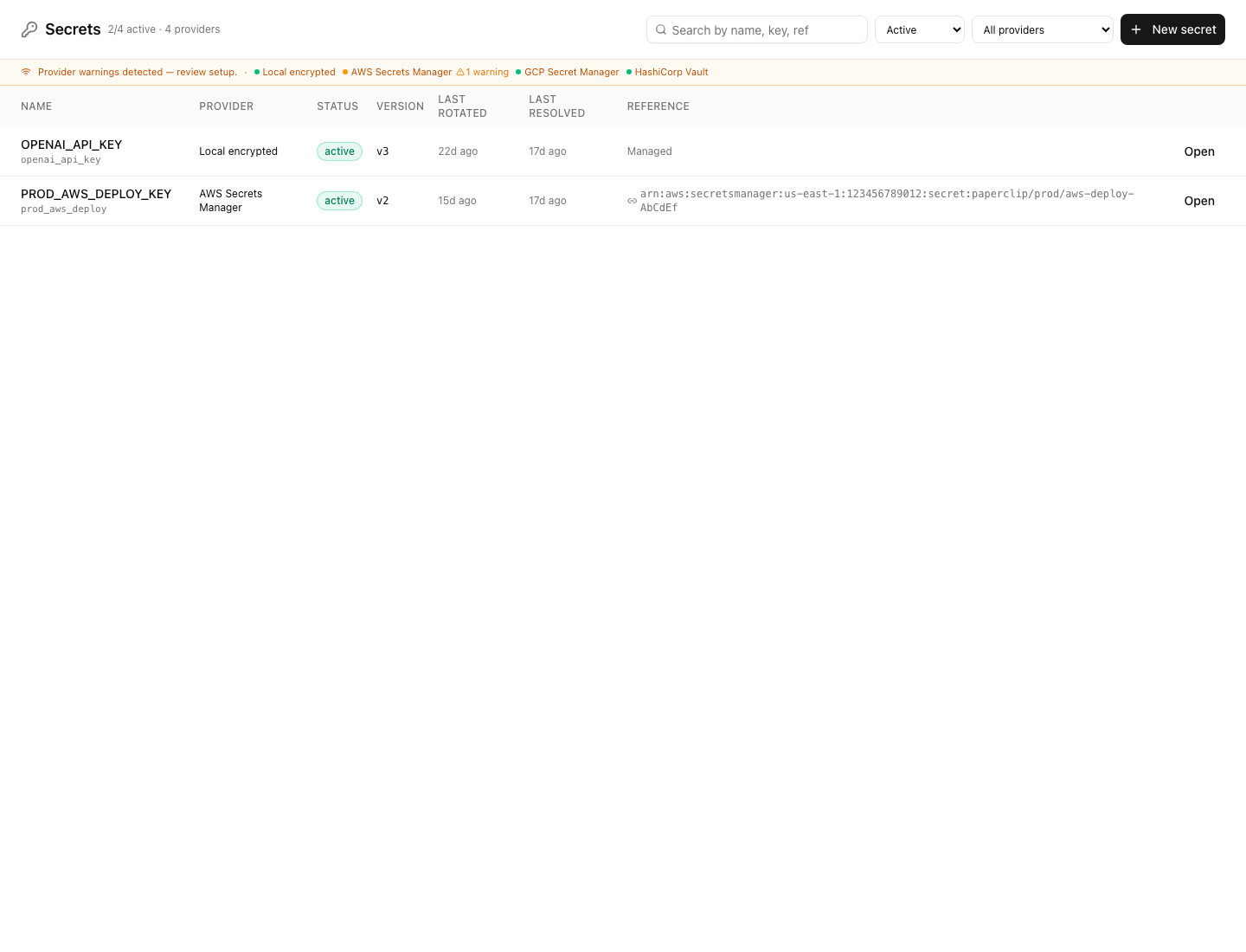 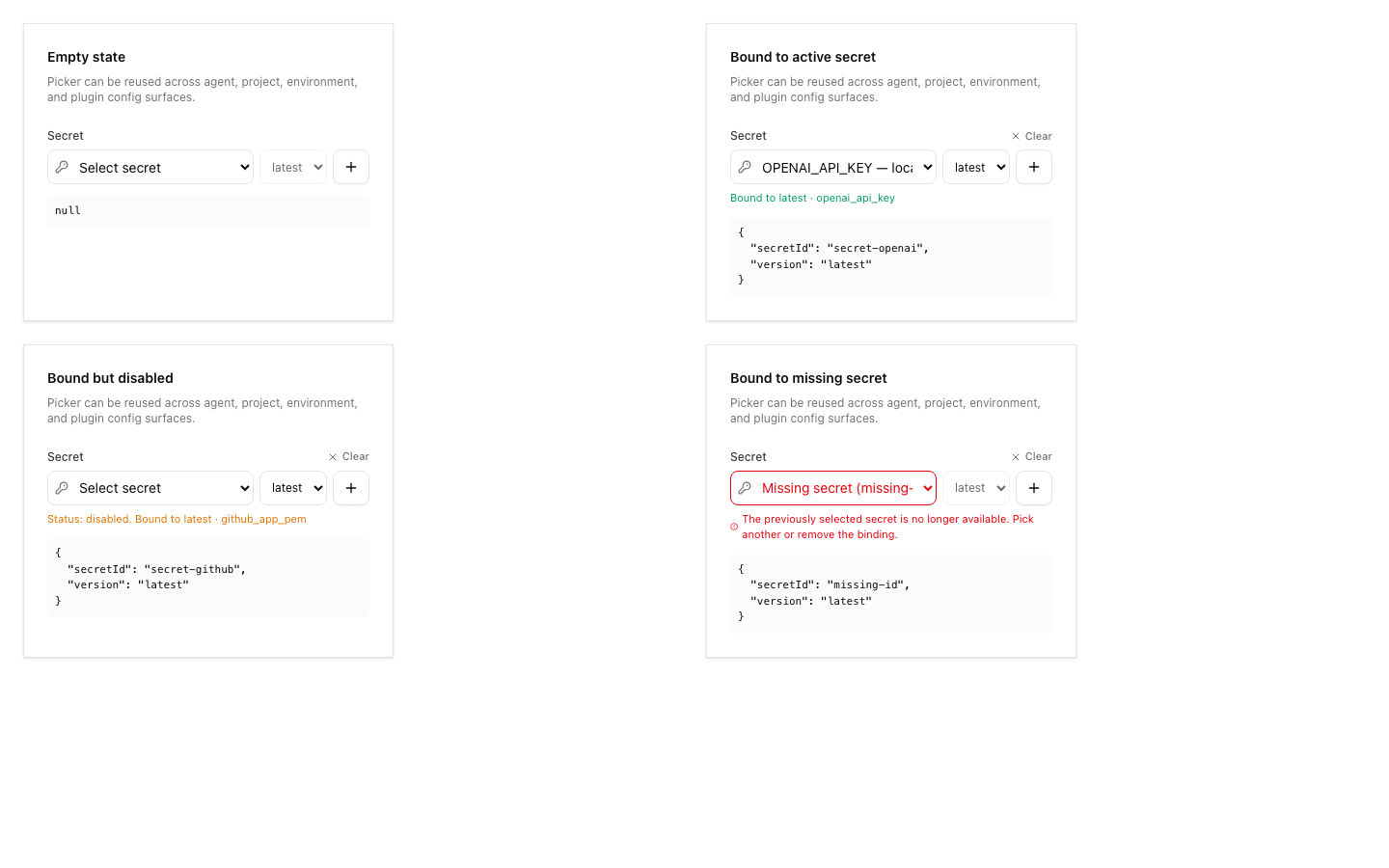 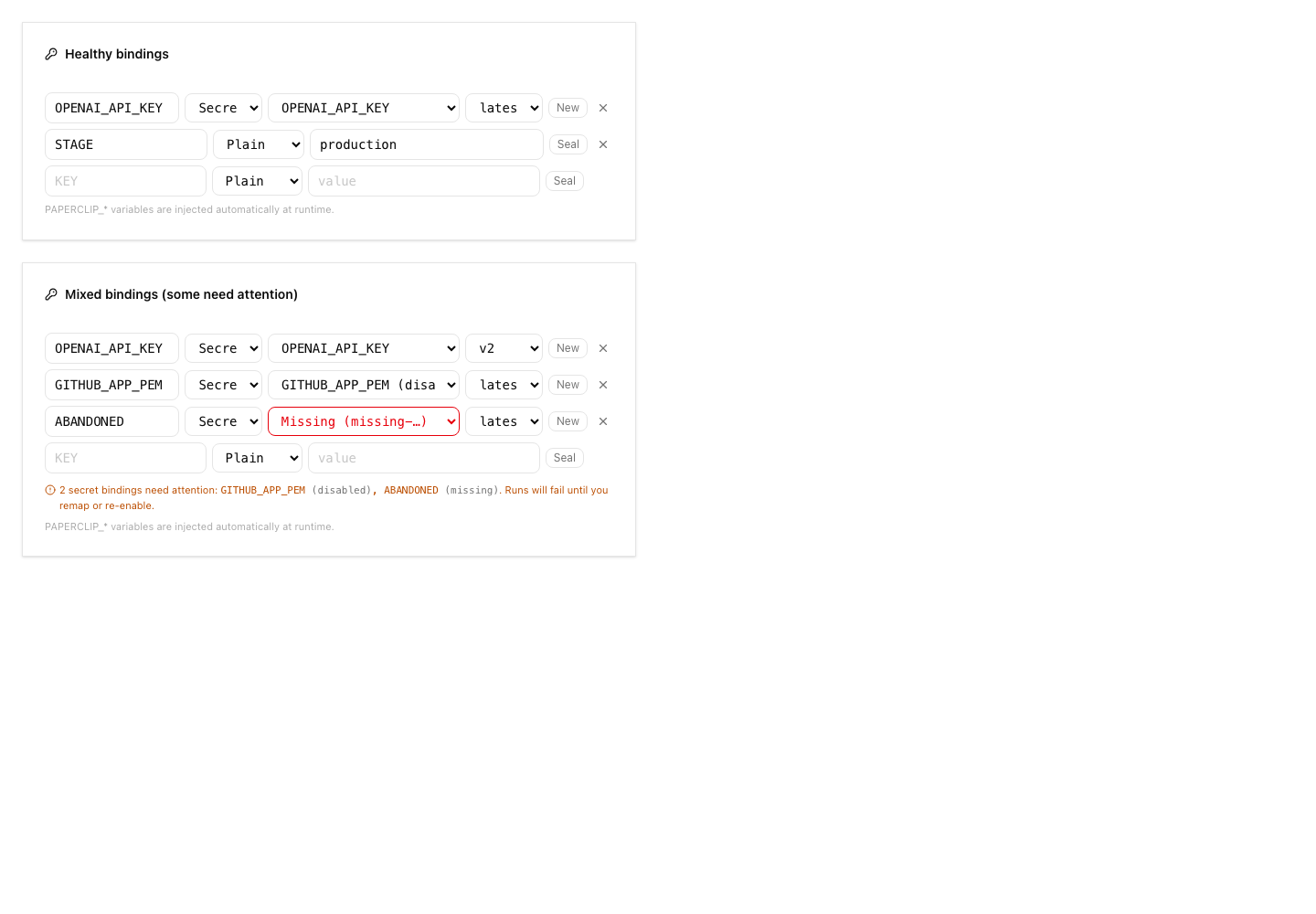 ## Risks - Migration risk: this adds new secret provider tables and extends existing secret rows. The migrations were checked for monotonic ordering and idempotent guards, but reviewers should still inspect upgrade behavior carefully. - Provider risk: AWS support uses direct SigV4 requests. Automated tests cover signing, request timeouts, vault-config selection, namespace guardrails, pending-version archival, sanitized provider errors, and service-level cleanup paths. A real-vault AWS smoke test remains deployment validation for an operator with AWS credentials rather than an unverified merge blocker in this local branch. - UI risk: the Secrets page and import dialog are large new surfaces; screenshots are included above for reviewer inspection. - Verification risk: the full local stable test command hit parallel-load timing failures, although the exact failed files passed when rerun directly. - Operational risk: remote import intentionally avoids plaintext reads; operators must understand that imported external references resolve at runtime and may fail if AWS permissions change. > For core feature work, check [`ROADMAP.md`](ROADMAP.md) first and discuss it in `#dev` before opening the PR. Feature PRs that overlap with planned core work may need to be redirected — check the roadmap first. See `CONTRIBUTING.md`. ## Model Used - OpenAI Codex, GPT-5 coding agent with local shell/tool use in the Paperclip worktree. Exact context-window size was not exposed by the runtime. ## Checklist - [x] I have included a thinking path that traces from project context to this change - [x] I have specified the model used (with version and capability details) - [x] I have checked ROADMAP.md and confirmed this PR does not duplicate planned core work - [ ] I have run tests locally and they pass - [x] I have added or updated tests where applicable - [x] If this change affects the UI, I have included before/after screenshots - [x] I have updated relevant documentation to reflect my changes - [x] I have considered and documented any risks above - [x] I will address all Greptile and reviewer comments before requesting merge --------- Co-authored-by: Paperclip <noreply@paperclip.ing> Co-authored-by: Claude Sonnet 4.6 <noreply@anthropic.com> |
||
|
Devin Foley
|
12cb7b40fd |
Harden remote workspace sync and restore flows (#5444)
## Thinking Path

> - Paperclip orchestrates AI agents for zero-human companies
> - When an agent runs against a remote target, Paperclip syncs the
workspace out to the remote at run start and restores changes back to
the local workspace at run end
> - The previous restore flow naïvely overwrote local files with
whatever the remote returned, so files that the remote run never touched
but had timestamp/mode drift could be needlessly rewritten — and a
single static `refs/paperclip/ssh-sync/imported` ref made concurrent SSH
workspace exports race on the same git ref
> - This pull request adds a `workspace-restore-merge` module that diffs
a pre-run snapshot against the post-run remote state and only writes
back files the remote actually changed; SSH workspace exports now use a
per-import unique ref so concurrent runs can't trample each other
> - Every adapter's execute path threads the snapshot through
`prepareAdapterExecutionTargetRuntime` so the merge has the baseline it
needs
> - The benefit is workspace restores no longer churn untouched files,
and concurrent SSH runs no longer collide on the import ref

## What Changed

- `packages/adapter-utils/src/workspace-restore-merge.{ts,test.ts}`: new
module — directory snapshot (kind/mode/sha256/symlink target) plus
snapshot-aware merge that writes only the files the remote changed
- `packages/adapter-utils/src/ssh.ts`: SSH workspace export uses a
per-import unique ref (`refs/paperclip/ssh-sync/imported/<uuid>`);
restore goes through the new merge helper; `ssh-fixture.test.ts` covers
the unique-ref + merge paths
- `packages/adapter-utils/src/sandbox-managed-runtime.ts` +
`remote-managed-runtime.ts`: thread the snapshot/merge through the
sandbox and SSH paths
- `packages/adapter-utils/src/server-utils.{ts,test.ts}` +
`execution-target.ts`: helpers for capturing the pre-run snapshot;
`prepareAdapterExecutionTargetRuntime` gains required `runId` and
optional `workspaceRemoteDir`, and returns the realized
`workspaceRemoteDir`
- Each adapter's `execute.ts` (acpx, claude, codex, cursor, gemini,
opencode, pi) takes the snapshot at run start and passes it through to
the runtime restore
- Remote execute test mocks updated to match the new
`prepareWorkspaceForSshExecution` return shape and the per-run
`${managedRemoteWorkspace}` cwd subdirectory

## Verification

- `pnpm vitest run --no-coverage --project @paperclipai/adapter-utils
--project @paperclipai/adapter-acpx-local --project
@paperclipai/adapter-claude-local --project
@paperclipai/adapter-codex-local --project
@paperclipai/adapter-cursor-local --project
@paperclipai/adapter-gemini-local --project
@paperclipai/adapter-opencode-local --project
@paperclipai/adapter-pi-local` — 196/196 passing
- `pnpm typecheck` clean across the workspace

## Risks

Medium. The restore path now writes a strict subset of what it
previously did — files the remote did not touch are no longer rewritten.
If any flow was relying on a touch-without-content-change being copied
back (timestamp or permission propagation only), that behavior is now
skipped. Snapshot capture adds an O(N-files-in-workspace) hash pass at
run start; the cost is bounded by the existing exclude list. The `runId`
parameter on `prepareAdapterExecutionTargetRuntime` is now required —
every in-tree caller is updated; out-of-tree adapter authors need to
pass it.

## Model Used

Claude Opus 4.7 (1M context)

## Checklist

- [x] I have included a thinking path that traces from project context
to this change
- [x] I have specified the model used (with version and capability
details)
- [x] I have checked ROADMAP.md and confirmed this PR does not duplicate
planned core work
- [x] I have run tests locally and they pass
- [x] I have added or updated tests where applicable — new module +
every adapter execute path covered
- [x] If this change affects the UI, I have included before/after
screenshots — N/A (no UI)
- [x] I have updated relevant documentation to reflect my changes
- [x] I have considered and documented any risks above
- [x] I will address all Greptile and reviewer comments before
requesting merge
|
||
|
Devin Foley
|
076067865f |
Migrate SSH environment callback to bridge (#5116)
> **Stacked PR (part 3 of 7).** Depends on: - PR #5114 - PR #5115 > Diff against `master` includes commits from earlier PRs in the stack — the new commit in this PR is the topmost one. ## Thinking Path > - Paperclip orchestrates AI agents for zero-human companies > - Agents executing on a remote SSH-backed environment need a way to call back into > the Paperclip control plane (run events, log streaming, signals) > - When the SSH host can't reach the Paperclip host (NAT, firewalls, or simply not > on the same network), the run silently fails or hangs — a recurring class of > failure during SSH testing > - In sandboxed environments we already solved this with a callback bridge that > tunnels back through the existing connection; SSH was the odd one out > - This PR migrates SSH execution to use the same callback bridge, so every > adapter's remote run uses one consistent reverse-channel. Per-adapter SSH glue > is deleted in favour of a shared `CommandManagedRuntimeRunner` built from the > SSH spec > - The benefit is fewer SSH-specific failure modes, a smaller code surface, and > one place to evolve the callback contract going forward ## What Changed - Added `createSshCommandManagedRuntimeRunner` in `packages/adapter-utils/src/ssh.ts` that adapts an SSH spec into a generic command-managed-runtime runner (with cwd, env, and timeout handling) - Removed `paperclipApiUrl` from `SshRemoteExecutionSpec`; the bridge URL now flows through the shared runner - Reworked `execution-target.ts` to use the SSH runner alongside sandbox runners via a unified `CommandManagedRuntimeRunner` interface - Simplified `remote-managed-runtime.ts` and `sandbox-managed-runtime.ts` to consume the shared runner abstraction - Deleted per-adapter SSH callback wiring from claude-local, codex-local, cursor-local, gemini-local, opencode-local, pi-local execute.ts files - Removed `environment-runtime-driver-contract.test.ts` (the contract is now enforced by `environment-execution-target.test.ts`) - Added/updated `execute.remote.test.ts` cases for each adapter to cover the SSH runner path ## Verification - `pnpm --filter @paperclipai/adapter-utils test` - `pnpm test -- execute.remote` (covers all six local adapters' SSH paths) - Manual QA: ran a claude-local agent against an SSH-backed environment, confirmed the agent successfully called back to `/api/agent-callback/*` endpoints during the run ## Risks - Refactor touches all six local adapters. If any adapter had subtle SSH-specific behaviour that wasn't captured in tests, it could regress. Mitigation: each adapter's `execute.remote.test.ts` was extended. - `paperclipApiUrl` removal from `SshRemoteExecutionSpec` is a breaking type change for any internal consumer. Verified no external plugins consume this type. - The new `CommandManagedRuntimeRunner` shape is a public surface in `@paperclipai/adapter-utils`; downstream plugins implementing custom runners may need updates, but no such plugins exist in this repo. ## Model Used - OpenAI GPT-5.4 (reasoning effort: high) via Codex CLI - Provider: OpenAI - Used to author the code changes in this PR ## Checklist - [x] I have included a thinking path that traces from project context to this change - [x] I have specified the model used (with version and capability details) - [x] I have checked ROADMAP.md and confirmed this PR does not duplicate planned core work - [x] I have run tests locally and they pass - [x] I have added or updated tests where applicable - [ ] If this change affects the UI, I have included before/after screenshots — N/A - [ ] I have updated relevant documentation to reflect my changes — N/A - [x] I have considered and documented any risks above - [x] I will address all Greptile and reviewer comments before requesting merge |
||
|
Devin Foley
|
a4ac6ff133 |
Add sandbox callback bridge for remote environment API access (#4801)
## Thinking Path > - Paperclip orchestrates AI agents for zero-human companies > - Agents can run inside sandboxed environments like E2B, which are isolated from the host network > - Sandboxed agents need to call back to the Paperclip API to report progress, post comments, and update issue status > - But sandbox environments cannot reach the Paperclip server directly because they run in isolated network namespaces > - This PR adds a callback bridge that proxies API requests from the sandbox to the Paperclip server, running as a local HTTP server on the host that forwards authenticated requests > - The bridge is started automatically when an adapter launches a sandbox execution, and torn down when the run completes > - The benefit is sandboxed agents can interact with the Paperclip API without requiring network-level access to the host, enabling E2B and similar providers to work end-to-end ## What Changed - Added `sandbox-callback-bridge.ts` in `packages/adapter-utils/` — a lightweight HTTP bridge server that accepts requests from sandbox environments and proxies them to the Paperclip API with authentication - Added request validation and security policy: the bridge only forwards requests to the configured API URL, validates content types, enforces size limits, and rejects non-API paths - Wired the bridge into all remote adapter execute paths (claude, codex, cursor, gemini, pi) — the bridge starts before the agent process and the bridge URL is passed via environment variables - Updated `environment-execution-target.ts` to prefer the explicit API URL from environment lease metadata for sandbox callback routing - Fixed Claude sandbox runtime setup to work with the bridge configuration - Added comprehensive test coverage for bridge request handling, policy enforcement, and sandbox execution integration - Fixed browser bundling — the bridge module is excluded from the frontend bundle via the adapter-utils index export ## Verification - `pnpm test` — all existing and new tests pass, including bridge unit tests and sandbox execution integration tests - `pnpm typecheck` — clean - Manual: configure an E2B environment, run an agent task, verify the agent can post comments and update issue status through the bridge ## Risks - Medium. This is a new network-facing component (HTTP server on localhost). The security policy restricts forwarding to the configured API URL only and validates all requests, but any proxy introduces attack surface. The bridge binds to localhost only and is scoped to the lifetime of a single agent run. ## Model Used Codex GPT 5.4 high via Paperclip. ## Checklist - [x] I have included a thinking path that traces from project context to this change - [x] I have specified the model used (with version and capability details) - [x] I have checked ROADMAP.md and confirmed this PR does not duplicate planned core work - [x] I have run tests locally and they pass - [x] I have added or updated tests where applicable - [ ] If this change affects the UI, I have included before/after screenshots - [x] I have updated relevant documentation to reflect my changes - [x] I have considered and documented any risks above - [x] I will address all Greptile and reviewer comments before requesting merge |
||
|
Devin Foley
|
70679a3321 |
Add sandbox environment support (#4415)
## Thinking Path > - Paperclip orchestrates AI agents for zero-human companies. > - The environment/runtime layer decides where agent work executes and how the control plane reaches those runtimes. > - Today Paperclip can run locally and over SSH, but sandboxed execution needs a first-class environment model instead of one-off adapter behavior. > - We also want sandbox providers to be pluggable so the core does not hardcode every provider implementation. > - This branch adds the Sandbox environment path, the provider contract, and a deterministic fake provider plugin. > - That required synchronized changes across shared contracts, plugin SDK surfaces, server runtime orchestration, and the UI environment/workspace flows. > - The result is that sandbox execution becomes a core control-plane capability while keeping provider implementations extensible and testable. ## What Changed - Added sandbox runtime support to the environment execution path, including runtime URL discovery, sandbox execution targeting, orchestration, and heartbeat integration. - Added plugin-provider support for sandbox environments so providers can be supplied via plugins instead of hardcoded server logic. - Added the fake sandbox provider plugin with deterministic behavior suitable for local and automated testing. - Updated shared types, validators, plugin protocol definitions, and SDK helpers to carry sandbox provider and workspace-runtime contracts across package boundaries. - Updated server routes and services so companies can create sandbox environments, select them for work, and execute work through the sandbox runtime path. - Updated the UI environment and workspace surfaces to expose sandbox environment configuration and selection. - Added test coverage for sandbox runtime behavior, provider seams, environment route guards, orchestration, and the fake provider plugin. ## Verification - Ran locally before the final fixture-only scrub: - `pnpm -r typecheck` - `pnpm test:run` - `pnpm build` - Ran locally after the final scrub amend: - `pnpm vitest run server/src/__tests__/runtime-api.test.ts` - Reviewer spot checks: - create a sandbox environment backed by the fake provider plugin - run work through that environment - confirm sandbox provider execution does not inherit host secrets implicitly ## Risks - This touches shared contracts, plugin SDK plumbing, server runtime orchestration, and UI environment/workspace flows, so regressions would likely show up as cross-layer mismatches rather than isolated type errors. - Runtime URL discovery and sandbox callback selection are sensitive to host/bind configuration; if that logic is wrong, sandbox-backed callbacks may fail even when execution succeeds. - The fake provider plugin is intentionally deterministic and test-oriented; future providers may expose capability gaps that this branch does not yet cover. ## Model Used - OpenAI Codex coding agent on a GPT-5-class backend in the Paperclip/Codex harness. Exact backend model ID is not exposed in-session. Tool-assisted workflow with shell execution, file editing, git history inspection, and local test execution. ## Checklist - [x] I have included a thinking path that traces from project context to this change - [x] I have specified the model used (with version and capability details) - [x] I have checked ROADMAP.md and confirmed this PR does not duplicate planned core work - [x] I have run tests locally and they pass - [x] I have added or updated tests where applicable - [ ] If this change affects the UI, I have included before/after screenshots - [x] I have updated relevant documentation to reflect my changes - [x] I have considered and documented any risks above - [x] I will address all Greptile and reviewer comments before requesting merge |


