mirror of
https://github.com/paperclipai/paperclip.git
synced 2026-10-10 12:07:09 +02:00
codex/plugin-task-execution
10
Commits
| Author | SHA1 | Message | Date | |
|---|---|---|---|---|
 Devin FoleyandPaperclip Devin FoleyandPaperclip
|
144083fd48 |
fix(interactions): wait for workspace readiness before enabling approval (#14893)
## Thinking Path > - Paperclip lets people manage AI agents and review their work. > - Task confirmations must use the work produced by their source run. > - The server blocks approval while that run still needs to sync its workspace. > - The card currently enables approval before that check can pass, so an ordinary click produces an error. > - This PR exposes the existing readiness check and shows “Preparing approval…” with acceptance disabled. > - The card refreshes itself and enables approval when the source workspace settles. ## Linked Issues or Issue Description **What happened?** A confirmation appears while its source run is still preparing or syncing its workspace. Its enabled approval button returns a conflict asking the user to retry after syncing. **Steps to reproduce** 1. Run an agent in an isolated workspace. 2. Have it create a confirmation before workspace finalization completes. 3. Click the approval button while the source workspace is still active. **Expected behavior** The card explains that approval is preparing. Acceptance becomes available automatically when the same server check permits it. Reject and revise remain available. Related work: #10770 handles this conflict after a click with retries. #9520 proposes changing the workspace acceptance barrier. This PR preserves that barrier and exposes readiness before the click, including in compact task chat. It preserves the terminal-finalize behavior from #10099. ## What Changed - Add an optional, read-only `acceptanceBlocker` to interaction responses. Readiness uses the existing source-run workspace predicate, with one check per pending source run. - Disable acceptance and show a shared preparation notice in classic and compact confirmation cards, including checkbox and secret-binding confirmations. - Refresh preparing cards every two seconds in task detail, attention, pipelines, and Skill Studio. Restore each surface's previous polling cadence when preparation clears. - Preserve live tool reviews, questions, rejection, revision, and the server acceptance barrier. No automatic acceptance occurs. - Document the preparation state and cover readiness, terminal sync outcomes, unrelated runs, historical cards, and automatic refresh. ## Verification - Focused service, card, query-refresh, and helper tests: 217 passed across five files. - `pnpm -r typecheck`: passed. - `pnpm build`: passed. - `pnpm build-storybook`: passed. - `pnpm check:token-gates`: passed. - `pnpm test:run`: incomplete locally. Stopped after about 17 minutes once it reproduced seven existing environment failures: two Slack tests and two email tests lack ancestor-directory skill fixtures; three company-skills tests fail on macOS runtime-cache staging permissions. These are outside this change. The full CI test matrix passed. - CI: all 53 checks passed; two optional Storybook jobs were skipped. The branch has no conflicts with `master`. - Greptile: 5/5 on commit `8a6f216d8d`, with no review threads. - Reviewed added lines and new files for credentials, private URLs, internal task references, user paths, and run artifacts. None found. ## Risks - No database migration or change to acceptance authorization. Readiness is advisory; the server still enforces its existing gate at acceptance. - An open preparing card adds a read every two seconds. This cadence stops after readiness clears; historical cards add no workspace checks. - Failed or stale finalization retains the existing server behavior. This PR does not change recovery policy. ## Model Used OpenAI GPT-6 through Codex. The exact serving model ID and context-window size are not exposed in this session. Used reasoning, repository inspection, tool execution, and automated tests. No sub-agents. ## Checklist - [x] I have included a thinking path that traces from project context to this change - [x] I have specified the model used (with version and capability details) - [x] I have checked ROADMAP.md and confirmed this PR does not duplicate planned core work - [x] I have searched GitHub for duplicate or related PRs and linked them above - [x] I have either (a) linked existing issues with `Fixes: #` / `Closes #` / `Refs #` OR (b) described the issue in-PR following the relevant issue template - [x] I have not referenced internal/instance-local Paperclip issues or links (only public GitHub `#NNN` / `github.com/paperclipai/paperclip` URLs) - [x] My branch name describes the change (e.g. `docs/...`, `fix/...`) and contains no internal Paperclip ticket id or instance-derived details - [x] I have run tests locally and they pass (217 focused tests; full local-suite limitations are recorded above) - [x] I have added or updated tests where applicable - [x] I have updated relevant documentation to reflect my changes - [x] I have considered and documented any risks above - [x] All Paperclip CI gates are green - [x] Greptile is 5/5 with no open P2s, recommendations, or follow-ups - [x] I will address all Greptile and reviewer comments before requesting merge Co-authored-by: Paperclip <noreply@paperclip.ing> |
||
|
DottaandPaperclip
|
d432dc7fa3 |
Add GitHub-synced skill sources (#14713)
## Thinking Path > - Paperclip is the open source app people use to manage AI agents for work. > - Company skills supply instructions and files to those agents. > - GitHub imports already exist, but users cannot manage repositories as skill sources. > - Repository refresh also needs caller-authorized access and complete local packages. > - This pull request adds Sources inside Skills and reuses GitHub connections from Apps. > - Installed snapshots let agents use skills without fetching GitHub during a run. > - Manual refresh preserves skill identity and leaves failed imports on their last good version. ## Linked Issues or Issue Description **Subsystem affected** Cross-cutting: skills UI, server, database, shared contracts, and runtime materialization. **Problem or motivation** Users keep skills in GitHub repositories. They need a clear way to select, import, and refresh those skills. Existing imports do not expose repository management or consistently preserve supporting files. **Proposed solution** Add company-scoped skill sources. Browse repositories from all accessible GitHub connections, or paste a public repository or branch URL. Select whole skill packages, inspect included files and reference warnings, and install complete, immutable snapshots. Refresh each source manually. **Alternatives considered** Project repository settings hide the workflow from Skills. A second GitHub connector would duplicate credentials and grants. Upstream editing and PR creation are separate work. **Roadmap alignment** This implements the Skills Manager direction in ROADMAP.md. The maintainer requested this scope and reviewed the component and full-app journey stories before implementation. Related reports: Refs #10285, Refs #10949, Refs #13464. Related work: #14356, #13656, #9268. ## What Changed - Add source and entry records, an idempotent migration, company-scoped APIs, and legacy GitHub import adoption. - Reuse current caller grants and credential refresh. Combine and deduplicate repository inventories across accessible connections. Pasted public URLs also prefer the active user’s authorized connections. Tokens stay in the Git child environment, never argv or disk. - Fetch a shallow Git snapshot at one immutable commit. Scan the full local tree, including hidden and nested folders. Read Git objects without checkout or archive transformations and enforce nested package boundaries. - Bound Git downloads to 128 MiB and three minutes. Cancel active process groups and remove incomplete downloads. Preserve cancellation and deadlines while progress drains; close stalled HTTP progress streams after 30 seconds. Reuse caller-scoped temporary snapshots for preview/import after reauthorization. - Index repository package boundaries once and cap expanded work at 1,000 packages, 10,000 files, and 100 MiB, including repeated copies of shared blobs. Bound path depth and the shared path index. Discovery keeps audited manifests without retaining all package bodies. - Resolve moving branches before fetching so unchanged discovery reuses caller-scoped snapshots. Limit active scans, scan frequency, and new downloads per caller and company; quotas apply before metadata reads and across connections, and cached scans do not consume the download quota. - Store complete versions with script content, binary bytes, and executable modes. Preserve these through copies, runtime caches, and runner packaging. - Stage downloads before publication. Use source leases, revision checks, and transactional activity records. Keep installed versions after failures, upstream deletion, deselection, and disconnect. - Add the approved import flow, Sources page, selection tree, provenance, read-only Studio behavior, and saved return from GitHub setup. - Add package manifests, commit-pinned file previews, and separate runtime requirements and reference warnings. Supporting files are included together; nested skills remain independently selectable. Preview requests reauthorize the caller and re-audit package content. - Show installed skills as compact links beneath each source. Repository titles open GitHub. Keep Refresh, Select skills, and Disconnect source in a three-dot menu. Source rows omit the branch, imported count, and refresh timestamp; action alignment and repository titles work at narrow widths. - Stream discovery metadata over an opt-in NDJSON response. Show measured Git download progress and real package/file counts, animate newly checked skills, support cancellation, and require a complete scan before selection. Keep the existing JSON API. - Retain component stories and add a separate full-app journey story group. Include fixed progress states and interactive scan, large-repository, interruption, and saving stories. - Update Skills documentation and product contracts. Suppress private GitHub skill references in telemetry. Privacy review requested for the telemetry changes. ## Verification - Local repository typecheck, full build, token gates, and Storybook build passed during this work. Focused transport, authorization, scanner, persistence, route, and UI tests pass. The final UI refinement passes all eight focused UI tests, UI typecheck/build, and token gates. The scanner resource and repeated-discovery fixes pass 132 focused scanner, transport, authorization, source-service, route, and rate-limit tests, plus server typecheck/build. Full-suite verification comes from CI; the older full local Vitest run was stopped after unrelated chat failures and a font-test failure, all of which passed in fresh focused runs. At commit `1098d5996`, all 54 active checks pass; two optional Storybook jobs are skipped. CI covers repository typecheck, build, the full test suites, browser shards, and the canary dry run. Greptile is 5/5 with no open findings; the security scan also passes. - Adversarial scanner tests verify repeated-blob byte accounting with and without declared sizes, package/file/path caps, one-time repository indexing, metadata-only discovery audits, and nested package boundaries. Additional tests cover branch movement, snapshot reuse, caller/company quotas, isolation across connections, active-lease cleanup, quota recovery, and rejection before any metadata API call. - Real Git tests verify hidden paths, exact binary bytes, executable modes, export-ignore preservation, symlink/submodule reporting, pinned commits, caller-scoped cache reuse, cancellation, cleanup, and credential isolation. Regression tests hold both download slots with permanently blocked progress callbacks, verify timeout/cancellation cleanup and retry, and exercise HTTP backpressure cancellation. Access tests cover automatic public-URL connection selection and revoked grants. Database tests verify company and grant audiences. - Live isolated browser test: the public `anthropics/skills` scan now completes and discovers all 20 skills without connecting an account. Imported canvas-design with all 83 files, opened it from Sources, and verified the installed binary-font preview/download control. Package previews also expose the complete file inventory before import. Cancelled an active Git download and retried successfully to all 20 discovered skills; the browser displayed measured download progress. The current audits reject four other packages; eligible selections remain importable. - Browser checks verify the simplified source rows at desktop and narrow widths, keyboard navigation into the actions menu, Refresh from the menu, selection, and fixture disconnect with installed skills retained. Storybook includes a menu-open checkpoint and a 320px layout. - Storybook includes receiving/preparing download checkpoints and a timed full-app import journey, plus cancellation, retry, large-repository, and saving states. Streaming tests cover split UTF-8 frames, incomplete streams, late responses, cross-company requests, HTTP errors, and JSON compatibility. - Earlier live acceptance on this PR imported `stitch-skill` with `DESIGN.md`, assigned it to an agent, disconnected its source, and ran a successful Studio test that read both installed files. An editable copy changed independently. Both Skills variants, mobile selection, and return from GitHub setup were exercised. - Private access, revoked credentials, OAuth success return, binary/script preservation, concurrent refresh, transaction rollback, version pins, and legacy adoption have automated coverage. A real private-repository OAuth grant was not created during this test. ## Risks - The migration groups recognizable legacy imports without provider calls. Their first successful refresh completes the local package snapshot. - Reference checks are advisory. They cover Markdown links and explicit relative resource paths, not arbitrary runtime dependency graphs. Preview text is capped at 64 KiB; imported bytes remain complete. - Git must be installed on the server. Shallow fetches still download the branch snapshot, including files outside selected packages. Downloads have size/time/concurrency limits. Temporary caches are bounded and caller-scoped. GitHub API quota still applies to repository metadata and the connection picker; content no longer uses per-file API requests. Failed scans retain installed content. - Sources depend on the current caller's GitHub access. A saved connection does not grant access to another person's token. - GitHub script support and immediate manual refresh are explicit maintainer-approved requirements. The operator trusts the selected repository and accepts upstream script and executable-mode changes on refresh. Static audits are not a sandbox or a guarantee of safe code; agents may later invoke installed helpers under their runtime permissions. Import and refresh do not execute scripts, hooks, package installation, or builds. Raw URL and skills.sh imports keep their prior script restrictions. - Source originals remain read-only. Refresh affects subsequent unpinned runs; explicit pins and active runs retain their versions. - The telemetry change removes source-managed GitHub identifiers from skill-reference events. It introduces no event or field. Please review the privacy boundary. ## Model Used OpenAI Codex, based on GPT-6, with reasoning, code execution, and browser tools. The exact serving model ID and context-window size are not exposed in this session. ## Checklist - [x] I have included a thinking path that traces from project context to this change - [x] I have specified the model used (with version and capability details) - [x] I have checked ROADMAP.md and confirmed this PR does not duplicate planned core work - [x] I have searched GitHub for duplicate or related PRs and linked them above - [x] I have either (a) linked existing issues with `Fixes: #` / `Closes #` / `Refs #` OR (b) described the issue in-PR following the relevant issue template - [x] I have not referenced internal/instance-local Paperclip issues or links (only public GitHub `#NNN` / `github.com/paperclipai/paperclip` URLs) - [x] My branch name describes the change (e.g. `docs/...`, `fix/...`) and contains no internal Paperclip ticket id or instance-derived details - [x] I have run tests locally and they pass - [x] I have added or updated tests where applicable - [x] I have updated relevant documentation to reflect my changes - [x] I have considered and documented any risks above - [x] All Paperclip CI gates are green - [x] Greptile is 5/5 with no open P2s, recommendations, or follow-ups - [x] I will address all Greptile and reviewer comments before requesting merge --------- Co-authored-by: Paperclip <noreply@paperclip.ing> |
||
|
|
1ef3b08714 |
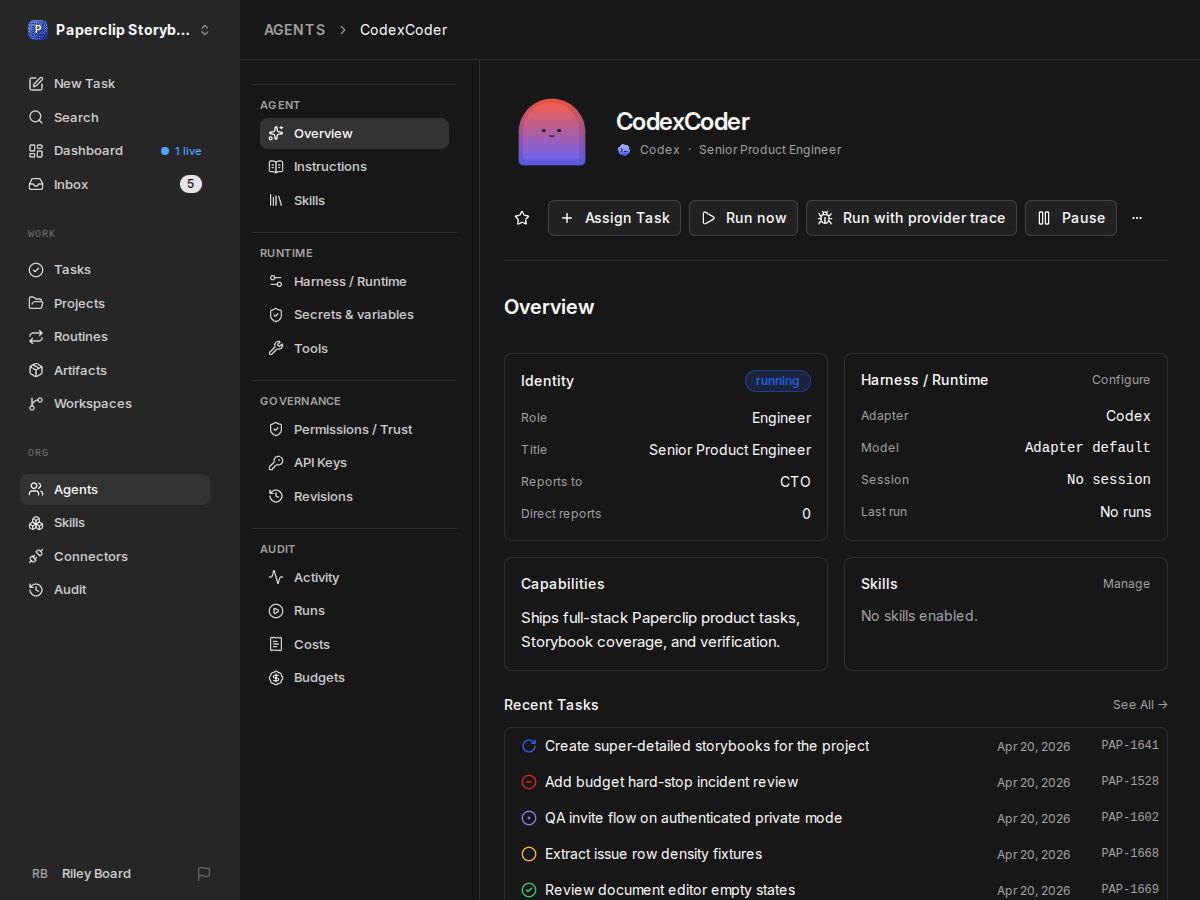
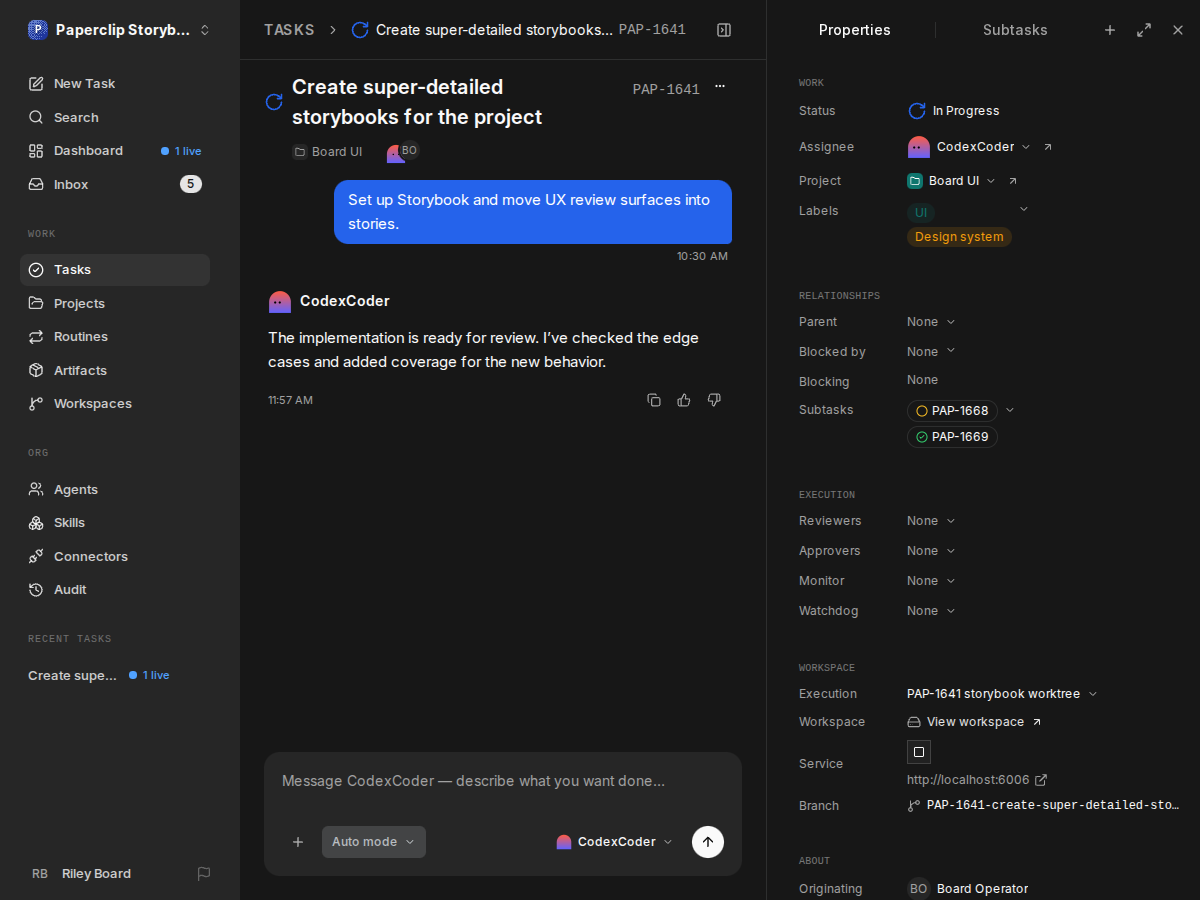
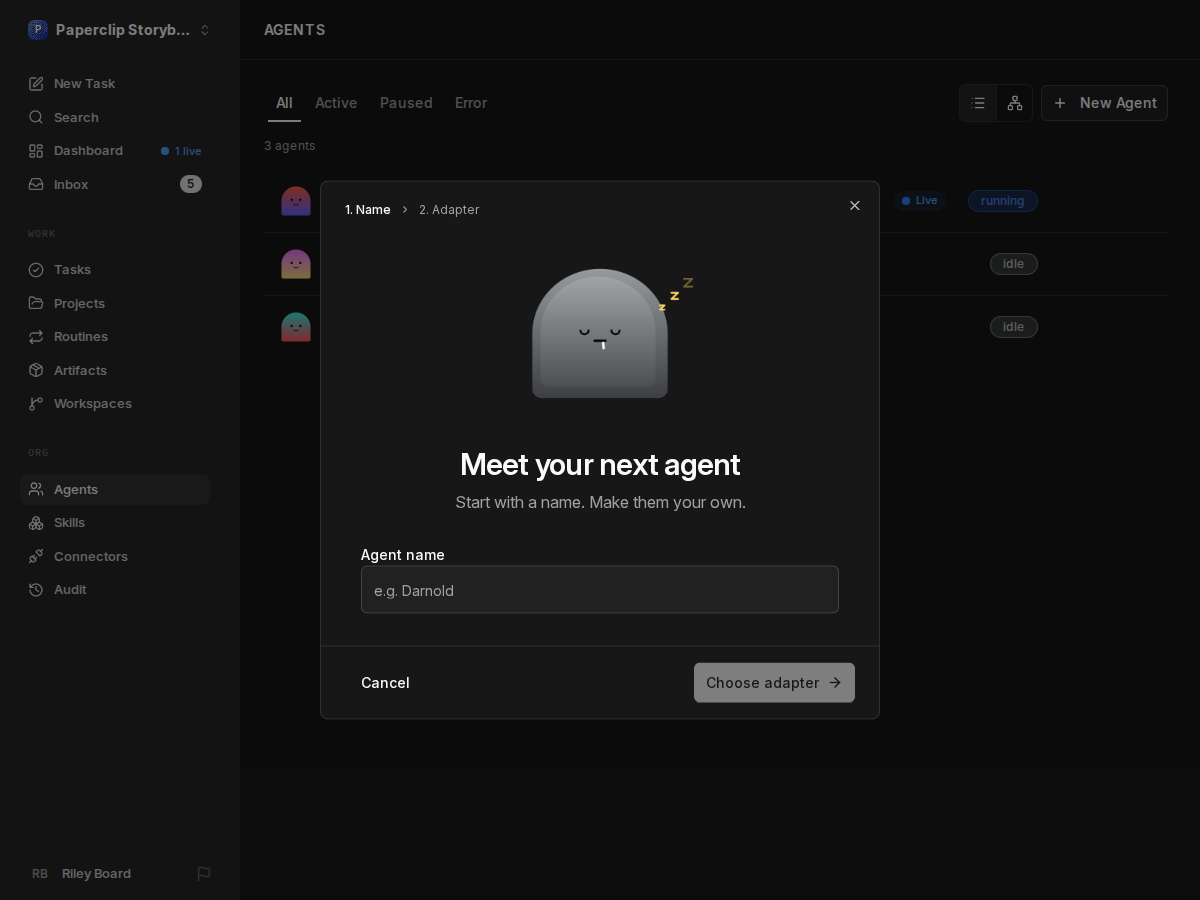
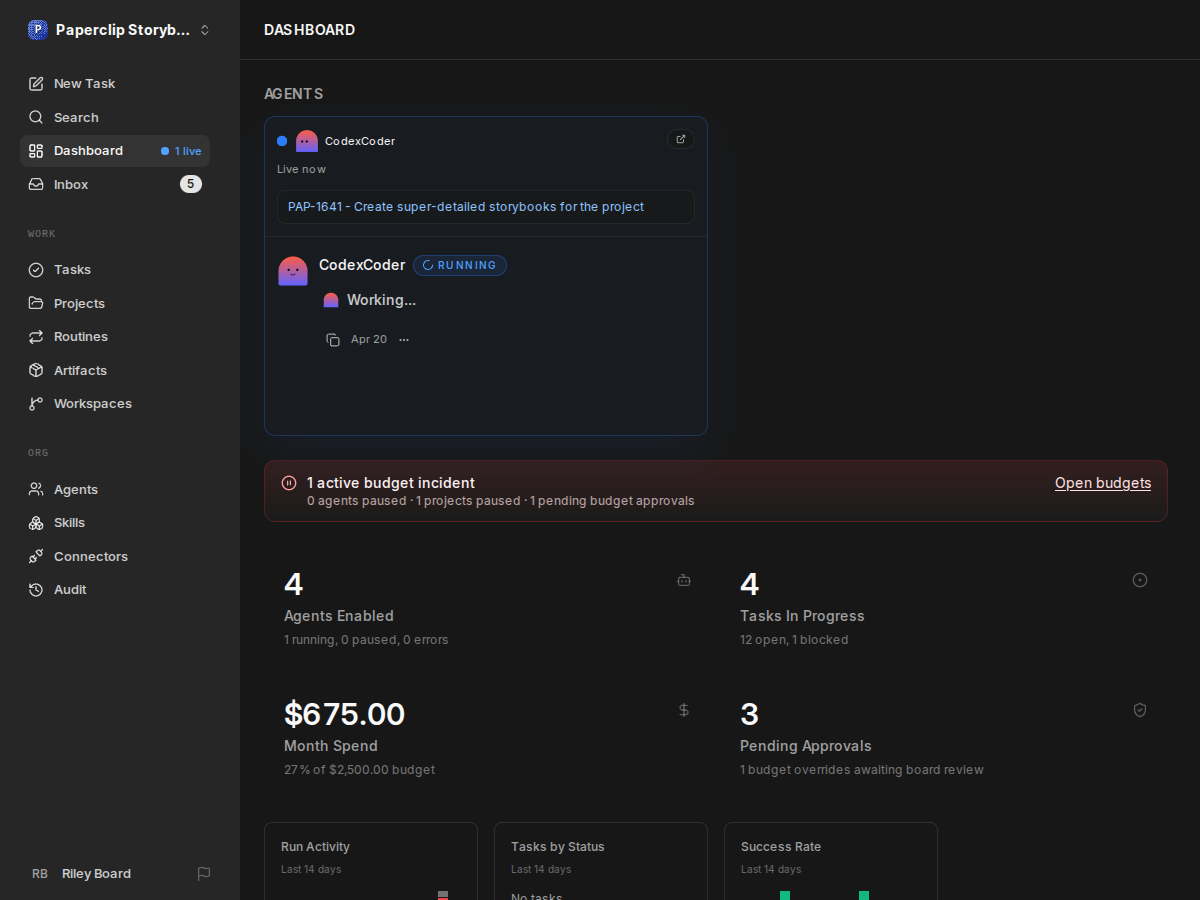
feat(ui): integrate agent personas across the app (#13171)
## Thinking Path > - Paperclip is the open source app people use to manage AI agents for work. > - A stable agent persona is useful only when the same identity appears across the app. > - Lists, task messages, selectors, and activity feeds need inexpensive static avatars. > - Onboarding and agent headers need a larger character with expressions and pointer tracking. > - This pull request connects the persona foundation to those existing views and preserves onboarding draft assignments. > - Full-page stories and Linux checks make the placements and performance contract reviewable. ## Linked Issues or Issue Description **Problem or motivation** Agents need a stable visual identity in lists, tasks, onboarding, and configuration. External tools also need an image URL for that identity. **Proposed solution** Assign each agent a permanent palette from a fixed ClipLab character library. Store the assignment on the agent. Render and cache preset PNG URLs on demand. Use static images in dense views and one animated character in larger placements. **Alternatives considered** A generated image bundle requires a separate asset build. A live renderer in every avatar adds unnecessary work in large lists. Arbitrary uploaded images do not provide the requested shared character system. **Roadmap alignment** This improves agent identity across existing control-plane views. It preserves agent permissions, company boundaries, and status labels. ROADMAP.md has no separate ClipLab persona milestone. Related approaches: #2422 adds configurable image URLs and DiceBear generation; #5578 adds optional uploaded avatars. This work uses a fixed, versioned character library and preset URLs. ## What Changed - Replace agent icons with static persona images across lists, the sidebar, org charts, tasks, comments, selectors, activity, and dashboard views. - Put one animated character in the agent header. Let it follow the pointer across the page, with reduced-motion and touch fallbacks. - Add larger padded characters to agent creation. Keep the palette stable across draft refreshes and connection retries, then reveal it after success. - Pass appearance through shared projections rather than fetching each agent separately. - Add real full-page Storybook examples for the agent list, overview, task, dashboard, new-agent dialog, and connection page. - Add Linux screenshot, clipping, density, and 500-avatar performance checks. ## Verification - `pnpm -r typecheck`, `pnpm build`, and token gates pass on the rebased tree. Persona lifecycle tests pass. - The rebased feature passes 38 Linux screenshot/performance checks, including both display densities, corner pointer positions, and the no-WebGL/no-live-download contract for 500 avatars. - The final Linux persona suite passes all 38 visual, lifecycle, density, and full-page checks using the standard Storybook configuration and real on-demand avatar endpoint. - Final local focused verification: 45 avatar/native-recovery tests pass; UI identity/routine tests, typecheck/build, token gates, and Storybook build pass. - Current-head CI passes: full workspace/server tests, all serialized server groups, typecheck/release checks, build, canary validation, and end-to-end shards. The build passed after retrying a native-runner concurrency-test failure; its three targeted cases also pass locally. - Manual inspection covered stable identities in the app, header placement, full-page mouse tracking, onboarding size, and task/dashboard placements. ### Screenshots Linux captures use synthetic Storybook fixtures. Full-page captures use reduced motion. The live character, mouse tracking, and disposal are checked separately. <details> <summary>Agent overview with the character in its header</summary> <img src="https://raw.githubusercontent.com/paperclipai/paperclip/8c68f42b268ada22b67d79d0fe1bb0a2f84ec25c/screenshots/full-page-agent-overview.png" width="900" alt="Agent overview with the character in its header" /> </details> <details> <summary>Task messages and assignee identity</summary> <img src="https://raw.githubusercontent.com/paperclipai/paperclip/8c68f42b268ada22b67d79d0fe1bb0a2f84ec25c/screenshots/full-page-task.png" width="900" alt="Task messages and assignee identity" /> </details> <details> <summary>Larger onboarding character with room for expressions</summary> <img src="https://raw.githubusercontent.com/paperclipai/paperclip/8c68f42b268ada22b67d79d0fe1bb0a2f84ec25c/screenshots/full-page-meet-your-next-agent.png" width="900" alt="Larger onboarding character with room for expressions" /> </details> <details> <summary>Dashboard agent activity</summary> <img src="https://raw.githubusercontent.com/paperclipai/paperclip/8c68f42b268ada22b67d79d0fe1bb0a2f84ec25c/screenshots/full-page-company-dashboard.png" width="900" alt="Dashboard agent activity" /> </details> ## Risks - This PR depends on #13170, the persona foundation. Merge the foundation first, then retarget this PR to master. - Many placements change from icons to character silhouettes. Human avatars and authoritative agent status labels retain their existing behavior. - Only one character can render live per view. Reduced motion, hidden/offscreen content, touch input, and renderer failures use the defined fallbacks. - The full-page stories use fixture data. They do not contact a real company or complete real provider sign-in. ## Model Used OpenAI Codex, GPT-6 family. The exact model identifier and context window are not exposed in this session. Used code editing, shell execution, browser inspection, and Linux visual testing. ## Checklist - [x] I have included a thinking path that traces from project context to this change - [x] I have specified the model used (with version and capability details) - [x] I have checked ROADMAP.md and confirmed this PR does not duplicate planned core work - [x] I have searched GitHub for duplicate or related PRs and linked them above - [x] I have either (a) linked existing issues with `Fixes: #` / `Closes #` / `Refs #` OR (b) described the issue in-PR following the relevant issue template - [x] I have not referenced internal/instance-local Paperclip issues or links (only public GitHub `#NNN` / `github.com/paperclipai/paperclip` URLs) - [x] My branch name describes the change (e.g. `docs/...`, `fix/...`) and contains no internal Paperclip ticket id or instance-derived details - [x] I have run tests locally and they pass - [x] I have added or updated tests where applicable - [x] I have updated relevant documentation to reflect my changes - [x] I have considered and documented any risks above - [x] All Paperclip CI gates are green - [x] Greptile is 5/5 with no open P2s, recommendations, or follow-ups - [x] I will address all Greptile and reviewer comments before requesting merge --------- Co-authored-by: Paperclip <noreply@paperclip.ing> Co-authored-by: Tonio <tonework@gmail.com> Co-authored-by: Claude Fable 5.1 <noreply@anthropic.com> |
||
|
scotttongandClaude Opus 5
|
8f69e0af9d |
fix(ui): confirm every copy action (#13603)
## Thinking Path

> - Paperclip is the open source app people use to manage AI agents for
work
> - Much of the work means moving an opaque value somewhere else: an
agent id, a callback URL, a webhook secret, an error payload for a bug
report
> - Copy buttons all over the app do that, and most already say whether
it worked — an icon that flips to a check, a label that reads "Copied"
> - Eleven did not. They passed the promise to `.catch(() => {})` and
showed nothing at all
> - A copy that says nothing looks exactly like a copy the browser
refused, and the only way to tell is to paste somewhere and look
> - The clipboard really does refuse: over plain HTTP on a non-secure
host the async Clipboard API is unavailable, and the fallback can still
fail
> - This pull request gives every copy action an affordance, through two
shared hooks
> - The benefit is that a person can tell a copy from a failure without
leaving the page

## Linked Issues or Issue Description

**What happened?**

Eleven copy buttons gave no feedback. They called `copyTextToClipboard`
and discarded the result:

```
onClick={() => void copyTextToClipboard(robotEmail).catch(() => {})}
```

Nothing changes on screen, whether the write succeeded or failed. This
is the same surface where most other copy buttons do show a check or a
"Copied" label, so the silent ones read as broken.

**Expected behavior**

Every copy action says whether the clipboard took the value. A rejected
write says so rather than staying silent or claiming success.

**Steps to reproduce**

1. Open the connector setup flow for an app that shows a sharing email
or a callback URL.
2. Press **Copy** next to that value.
3. Before this change nothing on screen changes. Compare with the copy
button on a login panel, which flips to a check.
4. To see the failure case, open Paperclip over plain HTTP on a
non-localhost host, where the async Clipboard API is not available.

**Paperclip version or commit**

`45586170e` on `master`.

**Deployment mode**

Local.

**Agent adapter(s) involved**

Not adapter-specific (core bug).

**Additional context**

Commit `1fa36be35` moved every copy through `lib/clipboard.ts`, so the
call sites are findable. Of 62 call sites, 51 already showed feedback
and 11 did not.

## What Changed

- New `ui/src/lib/use-copy-action.ts` with two hooks:
- `useCopyAction` for a control that stays on screen. It returns
`copied` and `failed` for the inline swap the rest of the app already
uses, and resets itself.
- `useCopyToast` for a menu item, which unmounts with its menu before an
inline state could be read, so its confirmation goes to the toast
viewport.
- Both wait for the write to resolve before reporting success, and both
report a rejection as a failure. `AdapterLoginChrome.test.tsx` already
held that line for one button; the helper now makes it the default.
- The eleven silent sites now use one of the two: the connector setup
flow's sharing-email and callback-URL buttons, the runner inspector's
copy-value and copy-path buttons, the agent bubble and skill studio menu
items, annotation "Copy link" on both its hosts, both secret-error
detail buttons, the chat webhook secret, and the motion tweak panel's
export box.
- The chat webhook secret follows its own file's convention: a label
that reads "Webhook secret copied", matching the manifest buttons beside
it.
- The 51 sites that already had feedback are untouched. Converting them
would be a large diff with no visible change.
- `clipboard-usage.test.ts` gains a static check, sibling to the one
that already keeps copies on the shared helper. It fails if a new copy
site ships with no affordance.

## Verification

- `npx vitest run ui/src/lib/use-copy-action.test.tsx
ui/src/lib/clipboard-usage.test.ts ui/src/lib/clipboard.test.ts
ui/src/components/AdapterLoginChrome.test.tsx` — 18 tests pass.
- The new hook tests cover the three cases that matter: no confirmation
while the write is still in flight, a failure state on a rejected write,
and a return to rest after the reset delay. The toast hook is covered
for both tones.
- `npx vitest run ui/src/pages/apps/AppsConnect.test.tsx
ui/src/components/task-chat ui/src/components/RunnerInspector.test.tsx
ui/src/components/DocumentAnnotation` — the suites over the touched
components pass.
- `npx tsc -b ui` — clean.

## Risks

Low. Each change is additive at its own call site and the copy path
itself is unchanged. The static check is the only part that touches
future contributors: it is one assertion, and its pattern list is easy
to extend or drop.

## Model Used

Claude Opus 5 (`claude-opus-5`), 1M context, extended thinking, with
tool use and code execution.

## Checklist

- [x] I have included a thinking path that traces from project context
to this change
- [x] I have specified the model used (with version and capability
details)
- [x] I have checked ROADMAP.md and confirmed this PR does not duplicate
planned core work
- [x] I have searched GitHub for duplicate or related PRs and linked
them above
- [x] I have either (a) linked existing issues with `Fixes: #` / `Closes
#` / `Refs #` OR (b) described the issue in-PR following the relevant
issue template
- [x] I have not referenced internal/instance-local Paperclip issues or
links (only public GitHub `#NNN` / `github.com/paperclipai/paperclip`
URLs)
- [x] My branch name describes the change (e.g. `docs/...`, `fix/...`)
and contains no internal Paperclip ticket id or instance-derived details
- [x] I have run tests locally and they pass
- [x] I have added or updated tests where applicable
- [x] I have updated relevant documentation to reflect my changes
- [x] I have considered and documented any risks above
- [ ] All Paperclip CI gates are green
- [ ] Greptile is 5/5 with no open P2s, recommendations, or follow-ups
- [ ] I will address all Greptile and reviewer comments before
requesting merge

---------

Co-authored-by: Claude Opus 5 (1M context) <noreply@anthropic.com>
|
||
|
scotttong
|
4d82f5eaea | copy: unify user-facing "company" wording to "organization" (#12243) | ||
|
DottaandPaperclip
|
1fa36be353 |
fix(ui): use HTTP-safe clipboard copy everywhere (#10875)
## Thinking Path > - Paperclip is the open source app people use to manage AI agents for work. > - Operators often open self-hosted Paperclip over plain HTTP on a LAN or private network. > - Browser Clipboard API writes are not reliable in that insecure context. > - Paperclip already has one shared helper with a legacy copy fallback, but many current copy actions bypass it. > - This pull request routes every core UI copy action and the first-party workspace-diff plugin through the shared helper. > - The benefit is consistent copy behavior on HTTPS, localhost, and plain-HTTP private deployments. ## Linked Issues or Issue Description Refs #3529. This change supersedes the stale prior attempt in #3531. Current master has more copy surfaces and a first-party plugin UI bridge that the prior branch does not cover. ## What Changed - Replaced direct Clipboard API writes and duplicate fallback implementations across the current core UI with `copyTextToClipboard`. - Added an HTTP-safe clipboard function to the plugin UI SDK and wired the host bridge to the same implementation. - Migrated the first-party workspace-diff plugin to the plugin SDK clipboard function. - Added unit coverage for native rejection fallback and plugin host delegation. - Added a source-level regression test that rejects new direct clipboard writes outside the shared implementation. - Documented the plugin UI clipboard function. ## Verification - `NODE_ENV=test pnpm exec vitest run ...` for 14 affected suites: 164 tests passed. - `pnpm exec vitest run tests/ui-clipboard.test.ts` in `packages/plugins/sdk`: 1 test passed. - `NODE_ENV=test pnpm -r typecheck`: passed for 31 workspace projects. - `NODE_ENV=test pnpm test:run`: passed. - `NODE_ENV=production pnpm build`: passed. - `pnpm check:token-gates`: passed with all gates clean. ## Risks Low risk. Secure contexts still use the modern Clipboard API. Plain HTTP and rejected modern writes use the existing `execCommand("copy")` fallback. That API is deprecated, but it is the compatibility path required for insecure contexts. The change has no schema, API, or visual design effect. > For core feature work, check [`ROADMAP.md`](ROADMAP.md) first and discuss it in `#dev` before opening the PR. Feature PRs that overlap with planned core work may need to be redirected — check the roadmap first. See `CONTRIBUTING.md`. ## Model Used OpenAI Codex, `gpt-5.6-sol`. The runtime did not expose a context-window size. Reasoning, tool use, repository editing, test execution, and GitHub CLI access were enabled. ## Checklist - [x] I have included a thinking path that traces from project context to this change - [x] I have specified the model used (with version and capability details) - [x] I have checked ROADMAP.md and confirmed this PR does not duplicate planned core work - [x] I have searched GitHub for duplicate or related PRs and linked them above - [x] I have either (a) linked existing issues with `Fixes: #` / `Closes #` / `Refs #` OR (b) described the issue in-PR following the relevant issue template - [x] I have not referenced internal/instance-local Paperclip issues or links (only public GitHub `#NNN` / `github.com/paperclipai/paperclip` URLs) - [x] My branch name describes the change (e.g. `docs/...`, `fix/...`) and contains no internal Paperclip ticket id or instance-derived details - [x] I have run tests locally and they pass - [x] I have added or updated tests where applicable - [x] I have updated relevant documentation to reflect my changes - [x] I have considered and documented any risks above - [x] All Paperclip CI gates are green - [x] Greptile is 5/5 with no open P2s, recommendations, or follow-ups - [x] I will address all Greptile and reviewer comments before requesting merge --------- Co-authored-by: Paperclip <noreply@paperclip.ing> |
||
|
DottaandPaperclip
|
52aea90263 |
feat: organize skills with nested folders and My Skills (#9633)
## Thinking Path > - Paperclip is the open source control plane people use to organize and govern AI-agent companies > - Company skills are durable resources that users browse, import, assign, and maintain over time > - A flat skill list plus tags does not provide a stable location or hierarchy for personal, company, project-imported, and bundled skills > - Folder paths need to be canonical, company-scoped, safe to move, and preserved across re-imports without changing skill IDs > - The `/skills` UI also needs traversal, breadcrumbs, move/create flows, and a dedicated My Skills namespace that work on desktop and mobile > - This pull request adds the folder data model and APIs, reserved-root lifecycle, project import behavior, and the folder-first skills experience > - The benefit is a predictable filesystem-like organization model while tags remain available for cross-cutting classification ## Linked Issues or Issue Description Refs #9619 — the reviewed folder foundation was intentionally closed and folded into this combined feature PR. Refs #9026 — earlier flat-folder attempt superseded by this integrated implementation. Refs #3281 — related skill organization proposal; this PR uses canonical persisted folders rather than deriving groups from skill keys, and does not add hidden-skill behavior. **Feature request** - **Problem:** Skills currently lack a canonical hierarchical location, making personal skills, project imports, bundled skills, and company-authored skills difficult to traverse and manage at scale. - **Proposed behavior:** Add nested company-scoped folders with stable paths, reserved My/Projects/Bundled roots, subtree queries, safe move/create operations, and a folder-first `/skills` library UI. - **Import behavior:** New project scans file skills under `projects/<project-slug>`; later imports update content without overriding a user-selected folder. - **Alternatives considered:** Tags alone remain useful for cross-cutting classification, but they do not provide canonical location, nesting, reserved namespaces, or stable import placement. - **Roadmap alignment:** Extends the completed Skills Manager and Scheduled Routines capabilities without duplicating an active roadmap item. ## What Changed - Adds `folders` persistence for routine and skill folders, nested canonical paths, parent/slug/system-key fields, migration backfills, and reapply-safe migrations `0174`–`0175` after current master migrations. - Adds company-scoped folder CRUD, cycle/depth/namespace validation, reserved My/Projects/Bundled lifecycle, item moves, subtree filtering, and folder paths on skill results. - Preserves project-import placement: first import files into the project folder, while re-import keeps user-owned placement and stable skill IDs. - Adds the `/skills` folder tree rail, tags facet, breadcrumbs, subfolder browser, move/new-folder dialog, canonical detail location, inline tag editing, and folder-aware Studio creation. - Keeps bundled skills read-only even when their source metadata is incomplete by detecting the reserved Bundled folder and hiding selection/move actions. - Extends routine folder UI and OpenAPI coverage, and adds regression tests across migrations, services, routes, tree helpers, pages, and Studio creation. ## Verification - `pnpm exec vitest run packages/db/src/nested-skill-folders-migration.test.ts server/src/__tests__/folders-routes.test.ts server/src/__tests__/folders-service.test.ts server/src/__tests__/company-skills-service.test.ts server/src/__tests__/routines-service.test.ts ui/src/components/folders/FolderControls.test.tsx ui/src/components/folders/SkillFolderTree.test.tsx ui/src/components/folders/skill-folder-tree.test.ts ui/src/pages/CompanySkills.test.tsx ui/src/pages/Routines.test.tsx ui/src/pages/SkillStudio.test.tsx ui/src/lib/company-skill-routes.test.ts ui/src/lib/skill-create.test.ts` — 13 files, 192 tests passed. - `pnpm exec vitest run ui/src/pages/CompanySkills.test.tsx ui/src/components/folders/SkillFolderTree.test.tsx` — 2 files, 20 tests passed after preserving the existing PR's bundled-skill fixes. - `pnpm -r typecheck` — passed for all workspace packages. - `pnpm test:run` — passed in an isolated CI-like environment with inherited Paperclip runtime identity and static AWS credential variables removed. - `pnpm build` — production build passed for all workspace packages. - Greptile iteration 2 — 5/5 confidence with zero unresolved threads on commit `ff2d67aa71`. - Latest-head GitHub checks — all success, neutral, or skipped; PR is mergeable with a clean merge state. - `pnpm check:token-gates` — reports nine existing `#9627` comment false positives already present on `master`; this PR introduces no new token violation. ## Risks - **Migration/backfill:** `0174` creates the foundation and `0175` adds nested/reserved semantics. Both are ordered after current master migration `0173`, are covered by numbering/safety checks, and are designed to be reapply-safe. - **Reserved namespaces:** My, Projects, and Bundled roots are service-managed. Regression coverage prevents namespace squatting, cross-company folder use, bundled writes, cycles, and excessive depth. - **Behavioral change:** Project scans choose a project folder only on initial creation; existing skills deliberately retain their current folder during refresh. - **UI scope:** The folder rail applies to the Installed library; Catalog retains the discovery-oriented category sidebar. > For core feature work, check [`ROADMAP.md`](ROADMAP.md) first and discuss it in `#dev` before opening the PR. Feature PRs that overlap with planned core work may need to be redirected — check the roadmap first. See `CONTRIBUTING.md`. ## Model Used - OpenAI `gpt-5.5` in Codex CLI, medium reasoning mode; runtime did not expose a context-window value. Used repository/file tools, terminal execution, Git/GitHub operations, test execution, and code editing. ## Checklist - [x] I have included a thinking path that traces from project context to this change - [x] I have specified the model used (with version and capability details) - [x] I have checked ROADMAP.md and confirmed this PR does not duplicate planned core work - [x] I have searched GitHub for duplicate or related PRs and linked them above - [x] I have either (a) linked existing issues with `Fixes: #` / `Closes #` / `Refs #` OR (b) described the issue in-PR following the relevant issue template - [x] I have not referenced internal/instance-local Paperclip issues or links (only public GitHub `#NNN` / `github.com/paperclipai/paperclip` URLs) - [x] My branch name describes the change (e.g. `docs/...`, `fix/...`) and contains no internal Paperclip ticket id or instance-derived details - [x] I have run tests locally and they pass - [x] I have added or updated tests where applicable - [x] I have updated relevant documentation to reflect my changes - [x] I have considered and documented any risks above - [x] All Paperclip CI gates are green - [x] Greptile is 5/5 with no open P2s, recommendations, or follow-ups - [x] I will address all Greptile and reviewer comments before requesting merge --------- Co-authored-by: Paperclip <noreply@paperclip.ing> |
||
|
|
89ce36d7af |
feat(skills): open-by-default company skill policy and core UX (#9564)
## Thinking Path > - Paperclip uses company skills to make agent capabilities reusable across an organization. > - Skill operations currently mix capability availability with permission checks, which creates avoidable setup friction and inconsistent denial handling. > - The policy contract needs to remain open by default while allowing company-scoped restrictions for governed deployments. > - Core owns the canonical policy actions, persistence, evaluation, API behavior, safe import boundaries, and generic denial/read-only UI. > - Enterprise policy-editor implementation belongs in the separate `paperclip-ee` repository and is intentionally excluded from this PR. ### Problem or motivation Company skill operations can encounter permission dead ends even when no explicit restriction has been configured, and import-source classification can drift between policy evaluation and execution. ### Proposed solution Define eight canonical skill policy actions, default all actions to allowed, persist company-scoped restrictions, expose policy evaluation APIs, normalize import sources at the boundary, and update Skill Studio to present actionable restriction states without embedding Enterprise Edition implementation in the core repository. ### Alternatives considered Keeping capability checks distributed across routes and UI surfaces was rejected because it duplicates policy logic and makes denial behavior inconsistent. Shipping the Enterprise policy editor in this repository was rejected because `paperclip-ee` is a separate repository and must receive its own PR. ### Roadmap alignment Extends the completed **Skills Manager** roadmap area by adding coherent governance and removing workflow dead ends. ### Additional context The core API contract remains suitable for a separate Enterprise Edition editor, but this PR contains no `paperclip-ee` package or EE-specific UI integration code. ## What Changed - Added the company skill policy contract to product and implementation documentation, including the open-by-default rule, eight canonical actions, decision shape, and core/EE ownership boundary. - Added the company-scoped policy schema, migration `0170`, shared validators, policy service, REST routes, OpenAPI coverage, and focused server tests. - Hardened import policy enforcement by normalizing import sources and keeping source classification consistent between policy evaluation and execution. - Updated core Skill Studio behavior to remove generic permission dead ends and show actionable policy/platform denial states only when an operation is actually denied. - Removed the `plugin-paperclip-ee` package, Docker wiring, EE discovery/deep-link helpers, and EE-specific UI tests/stories from this PR so that implementation can be submitted separately to the EE repository. - Preserved open-by-default behavior when no explicit company restriction exists. ## Verification - `pnpm --filter @paperclipai/ui exec vitest run src/components/skill-studio/SkillPolicySurfaces.test.tsx src/lib/skill-policy-denial.test.ts` — 20/20 passed. - `pnpm --filter @paperclipai/ui exec tsc --noEmit` — passed. - `pnpm --filter @paperclipai/server exec vitest run src/__tests__/worktree-config.test.ts` — 12/12 passed. - `pnpm check:token-gates` — passed with all gates clean. - `git diff --check` — passed. - `git diff --name-only origin/master | rg 'paperclip-ee|ee-skill-policy'` — no matches. ## Risks - Migration `0170` introduces company policy persistence; rollout depends on the migration applying before policy routes are exercised. - Open-by-default is an intentional behavioral policy: deployments expecting implicit denials must configure explicit restrictions. - Import normalization is security-sensitive and should retain focused review. - The separate EE editor must stay contract-compatible with the core policy API as policy actions evolve. ## Model Used - OpenAI Codex CLI, runtime model identifier and context-window size not exposed by this execution environment; reasoning, repository tool use, shell execution, and code review capabilities enabled. ## Checklist - [x] I have included a thinking path that traces from project context to this change - [x] I have specified the model used (with version and capability details available to this runtime) - [x] I have checked ROADMAP.md and confirmed this PR does not duplicate planned core work - [x] I have searched GitHub for duplicate or related PRs and linked or described the result above - [x] I have either (a) linked existing issues with `Fixes: #` / `Closes #` / `Refs #` OR (b) described the issue in-PR following the relevant issue template - [x] I have not referenced internal/instance-local Paperclip issues or links (only public GitHub `#NNN` / `github.com/paperclipai/paperclip` URLs) - [x] My branch name describes the change and contains no internal Paperclip ticket id or instance-derived details - [x] I have run focused tests locally and they pass - [x] I have added or updated tests where applicable - [x] I have updated relevant documentation to reflect my changes - [x] I have considered and documented any risks above - [x] All Paperclip CI gates are green on the latest head - [x] Greptile is 5/5 with no open P2s, recommendations, or follow-ups - [x] I will address all Greptile and reviewer comments before requesting merge --------- Co-authored-by: Paperclip <noreply@paperclip.ing> Co-authored-by: Claude Fable 5 <noreply@anthropic.com> Co-authored-by: Evyatar Bluzer <bluzername@users.noreply.github.com> |
||
|
DottaandPaperclip
|
991279f52c |
Fix Skill Studio markdown dirty tracking (#9356)
## Thinking Path > - Paperclip is the open source app people use to manage AI agents for work. > - Skill Studio is the UI surface for editing skill package files, including `SKILL.md`. > - Markdown files are split into frontmatter fields plus a rich markdown body editor. > - The dirty-state guard intentionally ignores markdown editor normalization during initial mount. > - That guard was too narrow: rich markdown body edits could happen before the file was marked as user-interacted, so edits did not reliably enable Save. > - This pull request broadens the user-interaction signals around the markdown body editor and adds a regression test for saving body edits. > - The benefit is that editing `SKILL.md` in Skill Studio now behaves like normal file editing: changes show as unsaved and Save persists the full markdown document. ## Linked Issues or Issue Description No public GitHub issue exists. Inline bug description follows. ### What happened? Editing a Skill Studio markdown body did not reliably mark the file dirty, so the Save action could remain unavailable or fail to persist the body edit. ### Expected behavior User edits in the markdown body editor should mark the file unsaved and allow saving the updated `SKILL.md` content. ### Steps to reproduce 1. Open a Skill Studio markdown file such as `SKILL.md`. 2. Edit the markdown body in the rich editor. 3. Observe whether the unsaved state appears and Save becomes enabled. 4. Save and reload the file. ### Paperclip version or commit Reproduced on `master` before this fix. ### Deployment mode Local dev (`pnpm dev`). ## What Changed - Mark markdown body interaction on capture-phase key, pointer, paste, drop, before-input, and input events around the rich editor. - Preserve the existing guard that prevents MDXEditor mount-time normalization from dirtying a clean file. - Add a Skill Studio regression test that edits the markdown body, observes the Unsaved state, enables Save, and verifies the saved `SKILL.md` includes both frontmatter and the edited body. ## Verification - `pnpm vitest run ui/src/pages/SkillStudio.test.tsx` Manual reviewer path: - Open a Skill Studio markdown file such as `SKILL.md`. - Edit the body text in the rich markdown editor. - Confirm the UI shows an unsaved state and the Save button is enabled. - Save and confirm the updated markdown body persists. ## Risks Low risk. The change only broadens interaction detection before applying existing dirty-state logic, and the guard still prevents initial editor normalization from marking an unopened file dirty. > For core feature work, check [`ROADMAP.md`](ROADMAP.md) first and discuss it in `#dev` before opening the PR. Feature PRs that overlap with planned core work may need to be redirected — check the roadmap first. See `CONTRIBUTING.md`. ## Model Used OpenAI Codex CLI using GPT-5, with repository file editing, shell execution, and GitHub CLI tool use. ## Checklist - [x] I have included a thinking path that traces from project context to this change - [x] I have specified the model used (with version and capability details) - [x] I have checked ROADMAP.md and confirmed this PR does not duplicate planned core work - [x] I have searched GitHub for duplicate or related PRs and linked them above - [x] I have either (a) linked existing issues with `Fixes: #` / `Closes #` / `Refs #` OR (b) described the issue in-PR following the relevant issue template - [x] I have not referenced internal/instance-local Paperclip issues or links (only public GitHub `#NNN` / `github.com/paperclipai/paperclip` URLs) - [x] My branch name describes the change (e.g. `docs/...`, `fix/...`) and contains no internal Paperclip ticket id or instance-derived details - [x] I have run tests locally and they pass - [x] I have added or updated tests where applicable - [x] I have updated relevant documentation to reflect my changes - [x] I have considered and documented any risks above - [x] All Paperclip CI gates are green - [x] Greptile is 5/5 with no open P2s, recommendations, or follow-ups - [x] I will address all Greptile and reviewer comments before requesting merge Co-authored-by: Paperclip <noreply@paperclip.ing> |
||
|
|
b13eb5b2b5 |
Skill Studio: three-pane skill IDE with sandboxed test runs (#9241)
## Thinking Path > - Paperclip is the open source app people use to manage AI agents for work. > - The Skills Manager gives operators a reusable skill layer, but iteration still required manual edits, ad hoc prompts, and indirect run inspection. > - Skill authors need a focused workflow for editing skill files, saving representative test inputs, and running those inputs through an agent without exposing harness tasks as normal company work. > - The backend therefore needs durable test inputs, reusable run templates, hidden harness issues, scoped run execution, retention metadata, and read-containment rules around hidden work. > - The frontend needs a three-pane Studio that keeps skill files, saved inputs/templates, and run output/history visible together while preserving the existing design system and token rules. > - This pull request ships that Skill Studio surface end to end: database migrations, shared contracts, server APIs/services, hidden harness execution behavior, UI routes/components, and focused tests. > - The benefit is faster and safer skill iteration, with inspectable outputs and fewer ways for internal harness work to leak into normal task lists, costs, or adjacent read APIs. ## Linked Issues or Issue Description No public GitHub issue exists for this feature. Feature request summary: - Problem: Skill authors need to edit and test company skills in one place instead of switching between the skill detail page, task creation, run output, and manual prompt history. - Proposed solution: Add a Skill Studio workbench with saved inputs, reusable templates, hidden sandboxed test runs, live run status, output inspection, run history, rerun/delete controls, and frontmatter-aware editing. - Expected users: Paperclip operators and agent-company maintainers who create, fork, import, and tune skills. - Related public PRs: Supersedes #9205, which was replaced so the public PR branch name follows contributor policy. - Duplicate search: searched public GitHub issues and PRs for "Skill Studio"; no other active public issue or PR directly covers this feature. ## What Changed - Added database migrations for Skill Studio test inputs, test runs, test run retention, and reusable run templates. - Added shared Skill Studio types, validators, route helpers, frontmatter utilities, and status handling. - Added server services and routes for saved inputs, test runs, templates, reruns, terminal-run deletion, hidden harness issue execution, and run-detail hydration. - Strengthened hidden-issue read containment across issue-adjacent routes and cost rollups used by skill test harness work. - Added the Skill Studio UI with skill file editing, frontmatter editing, saved inputs, templates, run creation/cancel/rerun/delete flows, output rendering, history, route support, and responsive pane behavior. - Added focused backend, shared, and UI tests for the new APIs, routing logic, editor/run behavior, hidden-issue containment, and migration safety. - Rebased onto current `master`, removed the generated lockfile diff from the PR, and verified no workflow files are changed. ## Verification - [x] `pnpm --filter @paperclipai/db check:migrations` - [x] `pnpm check:token-gates` - [x] `pnpm exec vitest run server/src/__tests__/company-skills-service.test.ts server/src/__tests__/company-skills-routes.test.ts server/src/__tests__/company-skill-test-runs-service.test.ts ui/src/lib/skill-studio.test.ts ui/src/pages/SkillStudio.test.tsx` — 5 files, 132 tests passed - [x] Greptile review on the latest PR head - [x] GitHub PR checks on the latest PR head ## Risks - Medium risk because this is a broad feature touching database schema, server orchestration, issue visibility, and a large UI surface. - Hidden harness issue containment is security-sensitive; this PR includes regression coverage for adjacent read paths and cost rollups. - The new migrations are additive and use idempotent guards where applicable, but deployed databases that previously tested draft migration numbers should still be checked carefully. - The UI depends on a new resizable panels package in `ui/package.json`; the lockfile is intentionally left to repository automation. > For core feature work, check [`ROADMAP.md`](ROADMAP.md) first and discuss it in `#dev` before opening the PR. Feature PRs that overlap with planned core work may need to be redirected — check the roadmap first. See `CONTRIBUTING.md`. ## Model Used OpenAI Codex, GPT-5 coding agent with shell, git, and GitHub CLI tool use. Earlier feature commits include assistance from other Paperclip coding agents; this PR preparation, rebase, cleanup commit, and PR body were completed by OpenAI Codex in a Paperclip worktree. ## Checklist - [x] I have included a thinking path that traces from project context to this change - [x] I have specified the model used (with version and capability details) - [x] I have checked ROADMAP.md and confirmed this PR does not duplicate planned core work - [x] I have searched GitHub for duplicate or related PRs and linked them above - [x] I have either (a) linked existing issues with `Fixes: #` / `Closes #` / `Refs #` OR (b) described the issue in-PR following the relevant issue template - [x] I have not referenced internal/instance-local Paperclip issues or links (only public GitHub `#NNN` / `github.com/paperclipai/paperclip` URLs) - [x] My branch name describes the change (e.g. `docs/...`, `fix/...`) and contains no internal Paperclip ticket id or instance-derived details - [x] I have run tests locally and they pass - [x] I have added or updated tests where applicable - [x] I have updated relevant documentation to reflect my changes - [x] I have considered and documented any risks above - [x] All Paperclip CI gates are green - [x] Greptile is 5/5 with no open P2s, recommendations, or follow-ups - [x] I will address all Greptile and reviewer comments before requesting merge --------- Co-authored-by: Paperclip <noreply@paperclip.ing> Co-authored-by: Claude Opus 4.8 <noreply@anthropic.com> |