mirror of
https://github.com/paperclipai/paperclip.git
synced 2026-10-09 16:35:27 +02:00
codex/plugin-task-execution
11
Commits
| Author | SHA1 | Message | Date | |
|---|---|---|---|---|
 Devin Foley Devin Foley
|
bc1a21564f |
Remove the company brand color and per-company attachment limit (#12291)
## Thinking Path

> - Paperclip is the open source app people use to manage AI agents for
work
> - A company is the top-level container, and the company General page
holds its settings
> - Two of those settings did almost nothing: the brand color only
tinted the generated company icon, and the attachment size limit sat
under the deployment-level `PAPERCLIP_ATTACHMENT_MAX_BYTES` cap that
already bounded every upload
> - A setting that changes one icon hue, and a setting that can only
lower a limit the operator already set, are not worth the page space or
the code that carries them
> - This pull request deletes both settings from the UI, the validators,
the API contract, the server, and the database
> - With the deployment cap as the only limit left, the message a person
sees when an upload is rejected has to name that limit in terms they can
act on, so the raw byte count becomes a human-readable size
> - The benefit is a shorter company General page for every deployment,
one attachment limit instead of two, and less code between an upload and
its ceiling

## Linked Issues or Issue Description

No existing issue. The description below follows
`.github/ISSUE_TEMPLATE/enhancement.yml`.

**What existing behavior does this improve?**

The company General page (`/company/settings`), the `PATCH
/api/companies/{companyId}` and `PATCH
/api/companies/{companyId}/branding` request contracts, and the
attachment upload limit on task, case, and company-import uploads.

**Subsystem affected**

Cross-cutting: `ui/`, `server/`, `packages/shared`, `packages/db`.

**Current behavior**

The company General page shows an "Appearance" section with three
controls: Logo, Brand color, and Attachment size limit. The brand color
is a hex value that feeds one thing — the hue of the generated company
pattern icon. Companies that never set one already get a hue derived
from the company name. The attachment size limit is a per-company byte
count stored on `companies.attachment_max_bytes`. Every upload path
clamps it against the deployment-level `PAPERCLIP_ATTACHMENT_MAX_BYTES`
cap, so the per-company value can only lower a limit the operator
already chose.

**Proposed behavior**

The Appearance section keeps the Logo control only. The company pattern
icon always derives its hue from the company name. Every attachment path
reads the deployment cap directly, so `PAPERCLIP_ATTACHMENT_MAX_BYTES`
is the single limit. An upload rejected by that limit says so in human
units — "File is larger than the 10 MB limit" rather than a raw byte
count. The `companies.brand_color` and `companies.attachment_max_bytes`
columns are dropped, and both fields leave the company API contract.

**Reason and benefit**

Both settings ask an operator to make a decision that changes almost
nothing. The brand color moves one icon hue on a page that also lets you
upload a real logo, which overrides the icon entirely. The attachment
limit reads as a real control but cannot raise anything, so it is a
second place to look when an upload is rejected. Removing both shortens
the page every deployment sees, removes a company-scoped read from the
task attachment upload path, and leaves one attachment limit to reason
about instead of two.

**Breaking changes**

The company API responses no longer include `brandColor` or
`attachmentMaxBytes`, and `GET /api/invites/{token}` no longer includes
`companyBrandColor`. `PATCH /api/companies/{companyId}/branding` is
strict, so a request that sends `brandColor` now returns 400; the
non-strict `PATCH /api/companies/{companyId}` schema strips it. Company
packages exported by older versions still import: the portability
company manifest schema is non-strict, so the retired keys are stripped
and ignored rather than rejected. Companies that stored a brand color
lose it — their icon reverts to the name-derived hue that every company
without a color already used.

## What Changed

- Removed the "Brand color" and "Attachment size limit" fields from the
company General page, along with their state, dirty checks, save
payload, and Save-button gating.
- Removed `brandColor` and `attachmentMaxBytes` from
`createCompanySchema`, `updateCompanySchema`, and
`updateCompanyBrandingSchema`, and deleted the now-orphaned
`DEFAULT_COMPANY_ATTACHMENT_MAX_BYTES` and
`MAX_COMPANY_ATTACHMENT_MAX_BYTES` constants.
- Removed both fields from the `Company` type, the portability manifest
type and schema, and the `companiesApi.update` payload allowlist.
- Dropped `brandColor` from `CompanyPatternIcon` and its callers, so the
icon hue always comes from the company name. Deleted the now-unused
`hexToHue` helper and the now-unused `pickTextColorForSolidBg` export.
- Stopped emitting `brandColor` from the company service selection and
from the invite-summary and invite-branding payloads in
`server/src/routes/access.ts`.
- Replaced `normalizeIssueAttachmentMaxBytes` with the deployment cap:
task attachments, case attachments, and company import now use
`MAX_ATTACHMENT_BYTES` directly. The helper is deleted.
- Added `formatAttachmentSize()` next to `MAX_ATTACHMENT_BYTES` and
routed every over-limit message through it, so a rejected upload names
the limit in human units instead of raw bytes: `Image exceeds 10485760
bytes` becomes `Image is larger than the 10 MB limit`. Enforcement is
unchanged — the same single cap, the same multer limits, the same status
codes and response shapes.
- Added migration
`0229_drop_company_brand_color_and_attachment_max_bytes.sql` and removed
both columns from the Drizzle `companies` schema.
- Kept legacy imports working: the portability company manifest schema
is non-strict, so older packages carrying the retired keys still import
with the keys ignored.
- Updated the skill API reference and the implementation spec, and
pruned the token-extraction allowlist entries that the removed code made
stale.

## Verification

Commands run from the repository root:

- `pnpm --filter @paperclipai/shared typecheck` — pass
- `pnpm --filter @paperclipai/db typecheck` — pass (includes
`check:migrations`, which validates the new migration number and journal
entry)
- `pnpm --filter @paperclipai/ui typecheck` — pass
- server typecheck via `node_modules/.bin/tsc --noEmit` in `server/` —
pass. `pnpm --filter @paperclipai/server typecheck` could not run
locally because it builds the Rust runner first and `cargo` is not
installed on this machine; the TypeScript step it wraps is the command
above.
- `npx vitest run packages/shared/src/validators/company.test.ts` — 6
passed
- `npx vitest run server/src/__tests__/company-portability.test.ts` — 90
passed
- `npx vitest run server/src/__tests__/attachment-types.test.ts
server/src/__tests__/assets.test.ts
server/src/__tests__/issue-attachment-routes.test.ts
server/src/__tests__/company-portability.test.ts
server/src/__tests__/cases-routes.test.ts` — 165 passed (the
human-readable limit messages)
- `npx vitest run server/src/__tests__/company-branding-route.test.ts
server/src/__tests__/issue-attachment-routes.test.ts
server/src/__tests__/invite-summary-route.test.ts
server/src/__tests__/openclaw-invite-prompt-route.test.ts
server/src/__tests__/companies-route-cross-company-authz.test.ts` — all
passed
- `npx vitest run cli/src/__tests__/company.test.ts
cli/src/__tests__/company-delete.test.ts` — 27 passed
- `npx vitest run` in `ui/` — 4425 passed, 1 pre-existing failure
unrelated to this change (`OnboardingWizard.test.tsx` "renders instead
of throwing when the browser denies storage access", which also fails on
`master`)
- `npx vitest run` in `server/` — see the note below
- `node scripts/check-token-gates.mjs` — no new violations; the only
reported violations are the pre-existing `PillGuy.tsx` ones present on
`master`

New tests added:

- `packages/shared/src/validators/company.test.ts` — the create and
update schemas strip the retired keys, the strict branding schema
rejects `brandColor`, and the portability manifest schema accepts a
legacy entry carrying both keys and drops them.
- `server/src/__tests__/company-branding-route.test.ts` — `PATCH
/api/companies/{companyId}/branding` returns 400 for `brandColor` and
does not call the company service.
- `server/src/__tests__/company-portability.test.ts` — a legacy package
that declares `brandColor` and `attachmentMaxBytes` imports
successfully, and neither key reaches `companies.create`.
- `server/src/__tests__/issue-attachment-routes.test.ts` — the effective
task attachment limit is the deployment cap, and the route no longer
loads the company to size an upload.
- `server/src/__tests__/attachment-types.test.ts` —
`formatAttachmentSize()` renders the default cap as `10 MB`, keeps one
decimal place for fractional sizes and drops a trailing `.0`, falls back
to KB and bytes for small caps, steps up to GB, and never emits `NaN`
for a degenerate input.
- `server/src/__tests__/assets.test.ts` — the asset-image and
company-logo routes both return the human-readable limit message on an
over-cap upload.

## Merge with master

`master` moved while this was open, and the merge needed two
resolutions:

- **`ui/src/pages/CompanySettings.tsx`.** #12243 reworded the
user-facing
copy from "company" to "organization", and that rewording landed inside
  the "Brand color" and "Attachment size limit" hints — the two fields
this change deletes. Both fields are removed, so the conflicted block is
dropped whole. The Logo field and every other copy change from #12243
are
  kept.
- **Migration renumbered 0228 -> 0229.** #12307 landed
  `0228_nasty_grim_reaper`, so this migration is now
`0229_drop_company_brand_color_and_attachment_max_bytes`. Its snapshot
is
rebuilt from master's `0228_snapshot.json` with only the two `companies`
  columns removed, and `meta/_journal.json` is master's journal plus a
single `idx: 229` entry. `pnpm --filter @paperclipai/db
check:migrations`
  passes.

The snapshot was rebuilt by hand rather than taken from `drizzle-kit
generate`, because master's `0228_snapshot.json` has drifted from
master's
own schema: `issue_question_response_deliveries.error_count` is created
by
master's 0228 SQL but missing from its snapshot, and the snapshot still
carries `decision_archive_notification_outbox.error_count`. Regenerating
folds both into this migration, and the resulting `ADD COLUMN
error_count`
would fail on a fresh database where master's 0228 already created that
column. Rebuilding from master's snapshot leaves that drift exactly
where
it is and keeps this migration to the two column drops. The drift is
pre-existing on master and is not addressed here.

## Risks

- **The migration is a destructive column drop.**
`0229_drop_company_brand_color_and_attachment_max_bytes.sql` removes
`companies.brand_color` and `companies.attachment_max_bytes`. It is safe
because both features are removed in the same change and nothing reads
either column after it. The statements use `DROP COLUMN IF EXISTS`,
matching the convention of the recent drop migrations in this
repository. The drop is not reversible: a downgrade after this migration
loses any stored values.
- **Stored brand colors are lost.** A company that had set a color now
renders the name-derived icon hue that every company without a color
already used. No other surface changes, and an uploaded logo still
overrides the icon.
- **API response shape narrows.** `brandColor` and `attachmentMaxBytes`
leave the company payloads, and `companyBrandColor` leaves the invite
summary payload. A client reading those fields now sees `undefined`. The
bundled UI and CLI are updated in this change.
- **Legacy imports are covered.** Packages exported by older versions
still carry both keys. The manifest schema is non-strict, so the keys
are stripped rather than rejected, and a test locks that in.
- **The over-limit message strings changed.** Anything matching on the
old `... exceeds N bytes` text — a test, a script, or a client that
string-matches `body.error` — needs updating. The status codes (422) and
response shapes are unchanged, so structured clients are unaffected.
- **Attachment limits can only widen.** A deployment that had lowered a
company below the deployment cap now allows uploads up to the cap for
that company. Lower `PAPERCLIP_ATTACHMENT_MAX_BYTES` if a smaller
ceiling is needed.
- **Storybook visual baselines shift** for the `CompanyPatternIcon`
matrix story, because those fixtures had brand colors. That workflow
runs only on a PR labeled `storybook-visual`, so it does not gate this
PR; regenerate the baselines if the label is added.

## Model Used

Claude (Anthropic), Claude Opus, agentic tool use via Claude Code.

## Checklist

- [x] I have included a thinking path that traces from project context
to this change
- [x] I have specified the model used (with version and capability
details)
- [x] I have checked ROADMAP.md and confirmed this PR does not duplicate
planned core work
- [x] I have searched GitHub for duplicate or related PRs and linked
them above
- [x] I have either (a) linked existing issues with `Fixes: #` / `Closes
#` / `Refs #` OR (b) described the issue in-PR following the relevant
issue template
- [x] I have not referenced internal/instance-local Paperclip issues or
links (only public GitHub `#NNN` / `github.com/paperclipai/paperclip`
URLs)
- [x] My branch name describes the change (e.g. `docs/...`, `fix/...`)
and contains no internal Paperclip ticket id or instance-derived details
- [x] I have run tests locally and they pass
- [x] I have added or updated tests where applicable
- [x] I have updated relevant documentation to reflect my changes
- [x] I have considered and documented any risks above
- [x] All Paperclip CI gates are green
- [x] Greptile is 5/5 with no open P2s, recommendations, or follow-ups
- [x] I will address all Greptile and reviewer comments before
requesting merge
|
||
|
DottaandPaperclip
|
e826188e82 |
refactor(settings): unify settings and speed up exports (#11789)
## Thinking Path > - Paperclip is the open source app that people use to manage AI agents for work. > - Operators use the settings area to control a company and its Paperclip instance. > - The current navigation separates related settings and uses duplicate instance pages. > - Company exports also do independent reads in sequence and do extra work for previews. > - Hardened workspace commands can differ from their saved command after loopback binding. > - This pull request makes these related operator workflows consistent and faster. > - The benefit is one clear settings area, faster exports, and stable runtime command matching. ## Linked Issues or Issue Description Refs #338 Related: #9834 **What existing behavior does this improve?** This improves the company settings UI, company export preparation, and workspace runtime command matching. **Current behavior** Company and instance settings use separate navigation and duplicate pages. Export preparation reads many independent records in sequence. Preview generation can also build an unused organization image. A command with a forced loopback bind can fail to match its saved runtime command. **Proposed behavior** Use one settings navigation and put general instance controls on the company General page. Load independent export data with bounded concurrency, skip unused preview image work, and load the export page only when it is needed. Treat the loopback-bound form of a command as the same runtime command. **Reason and benefit** Operators get one clear settings area. Large company exports need fewer serialized reads. Export previews and initial UI loads do less work. Hardened runtime services remain linked to their saved command definitions. **Breaking changes** The obsolete instance General URL redirects to the unified settings page. Access and Heartbeats remain available, and legacy bookmarks keep their destinations. No API response shape or database schema changes. ## What Changed - Unified company and instance settings navigation and removed duplicate instance settings pages. - Embedded general instance controls in the company General page and kept access-sensitive navigation behavior. - Preserved instance Access and Heartbeats controls in the unified navigation and normalized old bookmarks to those destinations. - Improved environment and access-state handling when workspace seed requests overlap. - Added bounded export reads, a lighter preview path, deferred export preparation, and lazy export-page loading. - Matched loopback-bound runtime commands to their saved command definitions. - Added focused shared, server, and UI regression tests. ## Verification - `pnpm exec vitest run <18 changed test files>`: 18 files and 256 tests passed. - `pnpm check:token-gates`: passed all four token gates. - `pnpm -r typecheck`: passed for all workspace projects. - `pnpm build`: passed for all workspace projects. - `pnpm test:run`: tests ran without a reported failure, but the runner did not close after the server handoff tests. The process closed with status 0 after an interrupt. - Focused latest-head route tests: 2 files and 4 tests passed. - GitHub latest-head checks: all completed without failure. - Greptile: 5/5 with no unresolved review threads. ## Risks - Medium risk: settings routes and navigation changed across several operator roles. - Medium risk: bounded export concurrency increases simultaneous database reads. The limits stay below the normal pool size. - Low risk: runtime command matching accepts only the known Tailscale HTTPS loopback transformation. - No migrations are included. > For core feature work, check [`ROADMAP.md`](ROADMAP.md) first and discuss it in `#dev` before opening the PR. Feature PRs that overlap with planned core work may need to be redirected — check the roadmap first. See `CONTRIBUTING.md`. ## Model Used - OpenAI Codex with a GPT-5-family coding model. The runtime does not expose the exact deployed model ID or context-window size. Reasoning, tool use, and local code execution were enabled. ## Checklist - [x] I have included a thinking path that traces from project context to this change - [x] I have specified the model used (with version and capability details) - [x] I have checked ROADMAP.md and confirmed this PR does not duplicate planned core work - [x] I have searched GitHub for duplicate or related PRs and linked them above - [x] I have either (a) linked existing issues with `Fixes: #` / `Closes #` / `Refs #` OR (b) described the issue in-PR following the relevant issue template - [x] I have not referenced internal/instance-local Paperclip issues or links (only public GitHub `#NNN` / `github.com/paperclipai/paperclip` URLs) - [ ] My branch name describes the change (e.g. `docs/...`, `fix/...`) and contains no internal Paperclip ticket id or instance-derived details Exception: This task requires the existing execution branch. The harness does not permit a branch rename. - [x] I have run tests locally and they pass - [x] I have added or updated tests where applicable - [x] I have updated relevant documentation to reflect my changes - [x] I have considered and documented any risks above - [x] All Paperclip CI gates are green - [x] Greptile is 5/5 with no open P2s, recommendations, or follow-ups - [x] I will address all Greptile and reviewer comments before requesting merge --------- Co-authored-by: Paperclip <noreply@paperclip.ing> |
||
|
|
0f9b1d399c |
fix(ui): make environment edit a routed page (#9386)
## Thinking Path > - Paperclip is the open source app people use to manage AI agents for work > - Instance settings include an Environments section where operators configure sandbox/SSH/local execution environments, including interactive custom-image setup sessions with a browser terminal > - The environment create/edit form was rendered inside a modal dialog, so pressing Escape anywhere — including inside the embedded SSH terminal while capturing a snapshot — closed the whole modal and destroyed the in-progress session > - Environment editing is a heavyweight, long-lived flow; losing it to a reflexive Escape keypress is destructive and surprising > - This pull request converts environment create/edit from a modal into routed standalone pages, so Escape no longer dismisses the form > - The benefit is that terminal sessions and half-completed edits survive Escape, and the flow gets shareable URLs and normal back/forward navigation ## Linked Issues or Issue Description No existing public issue; described per the bug report template: **What happened?** While editing an environment's sandbox snapshot in the embedded SSH terminal, pressing Escape (e.g. to exit a mode inside the terminal) closed the entire environment edit modal, discarding the setup session and any unsaved form state. **Expected behavior** Escape inside the terminal or form should not dismiss the environment editor. A heavyweight flow like environment configuration should be a standalone page where Escape behaves as expected within the focused widget. **Steps to reproduce** 1. Open Instance settings → Environments and edit a sandbox environment 2. Start a custom image setup session and focus the browser terminal 3. Press Escape 4. The modal closes and the session context is lost ## What Changed - Converted the environment create/edit dialog in `CompanyEnvironments.tsx` into routed pages at `/company/settings/instance/environments/new` and `/company/settings/instance/environments/:environmentId/edit` - Registered the new routes in `App.tsx` and wired breadcrumbs for the list/create/edit states - Form state now initializes from the route (create vs edit) instead of dialog open/close state, and successful saves navigate back to the environments list - Updated `CompanyEnvironments.test.tsx` and `CompanySettings.test.tsx` to render through a router with the new routes and assert against the routed form page instead of a dialog ## Verification - `pnpm vitest run ui/src/pages/CompanyEnvironments.test.tsx ui/src/pages/CompanySettings.test.tsx` — 22/22 passing - `tsc --noEmit` on the `ui` package — clean - Behavioral coverage: the updated tests exercise the routed create/edit pages end to end (open edit via the list, interact with the setup-session controls on the form page, save navigates back to the list); with the form no longer in a dialog there is no Escape-close handler to trigger ## Risks - Low risk; UI-only routing change. Deep links into the old modal state do not exist (the modal had no URL), so no redirects are needed - The edit page resolves the environment from the route param; a stale/unknown id falls back to the environments list ## Model Used - Claude (Anthropic), model ID `claude-fable-5` (Fable 5), extended thinking enabled, agentic tool use via Claude Code ## Checklist - [x] I have included a thinking path that traces from project context to this change - [x] I have specified the model used (with version and capability details) - [x] I have checked ROADMAP.md and confirmed this PR does not duplicate planned core work - [x] I have searched GitHub for duplicate or related PRs and linked them above - [x] I have either (a) linked existing issues with `Fixes: #` / `Closes #` / `Refs #` OR (b) described the issue in-PR following the relevant issue template - [x] I have not referenced internal/instance-local Paperclip issues or links (only public GitHub `#NNN` / `github.com/paperclipai/paperclip` URLs) - [x] My branch name describes the change (e.g. `docs/...`, `fix/...`) and contains no internal Paperclip ticket id or instance-derived details - [x] I have run tests locally and they pass - [x] I have added or updated tests where applicable - [x] I have updated relevant documentation to reflect my changes - [x] I have considered and documented any risks above - [ ] All Paperclip CI gates are green - [ ] Greptile is 5/5 with no open P2s, recommendations, or follow-ups - [x] I will address all Greptile and reviewer comments before requesting merge Co-authored-by: Cody <cody@paperclip.ing> Co-authored-by: Paperclip <noreply@paperclip.ing> |
||
|
|
b5c914126e |
Redesign environment variables editor (#8930)
## Thinking Path > - Paperclip is the open source control plane people use to manage AI agents for work. > - Environment variables and secrets sit in the configuration surfaces that let agents, projects, routines, and company environments run with the right runtime inputs. > - The previous editor was a single legacy component with cramped row behavior, weak secret conversion affordances, and duplicated handling across several call sites. > - Operators need a clearer editor that handles text values, secret references, draft rows, and sensitive-value warnings consistently wherever environment variables are configured. > - This pull request replaces the legacy editor with a reusable environment variables editor and migrates the existing configuration surfaces to it. > - The benefit is a more reliable editing workflow with targeted test coverage around row state, dotenv parsing, secret selection, and affected page integrations. ## Linked Issues or Issue Description No public GitHub issue exists, so this PR describes the issue inline following the feature request template. ### Subsystem affected ui/ — React + Vite board UI ### Problem or motivation Environment variables are edited in several Paperclip configuration surfaces, including agent config, project properties, stage secrets, routine sections, company environments, and company settings. The legacy editor made common operator work difficult: rows could feel cramped, secret conversion was inconsistent, draft rows and imported dotenv data were easy to mishandle, and sensitive-value warnings did not have a consistent place in the workflow. ### Proposed solution Introduce a reusable environment variables editor component that consistently supports text values, secret references, draft rows, dotenv import parsing, sensitive-value hints, secret picking, secret creation, and conversion to stored secrets. Migrate the existing environment-variable call sites to the shared editor so behavior and tests live in one component family. ### Alternatives considered Keeping the existing `EnvVarEditor` and patching individual call sites would preserve duplication and leave each surface responsible for its own row and secret handling. This PR instead centralizes the behavior so future fixes cover all migrated surfaces. ### Roadmap alignment Checked `ROADMAP.md`; this does not duplicate a named roadmap item. It supports the existing local-first and deployment-oriented product direction by improving the UI where operators configure runtime environment values. ### Additional context The PR includes targeted tests for the editor model, dotenv parsing, sensitive-value detection, component behavior, affected page integrations, and Greptile review regressions around external saves and bulk import immutability. ## What Changed - Replaced the legacy `EnvVarEditor` with a reusable `environment-variables-editor` component family. - Added editor model helpers for draft rows, dotenv parsing, sensitive-value detection, secret picking, secret creation, and conversion to secret references. - Migrated agent config, project properties, stage secrets, routine editable sections, company environments, company settings, design guide examples, and Storybook stories to the new editor. - Added targeted tests for the editor model, parsing, sensitive-value detection, component behavior, and affected company environment/settings integrations. - Fixed the company settings test harness to use the repo’s `flushSync`-based React test helper pattern under the current React build. - Addressed Greptile feedback by flushing pending editor drafts before enclosing form submits or external save-button clicks, cloning bulk-import rows before mutation, and deferring the overflow store-as-secret popover open path. ## Verification - `pnpm exec vitest run ui/src/components/environment-variables-editor/EnvironmentVariablesEditor.test.tsx ui/src/pages/CompanyEnvironments.test.tsx ui/src/components/AgentConfigForm.render.test.tsx` — passed, 3 files / 40 tests. - Earlier focused Vitest coverage for model, dotenv parsing, sensitive detection, company environments, and company settings passed, 6 files / 78 tests. - `pnpm --filter @paperclipai/ui typecheck` — passed. - GitHub PR checks on head `0aa49c6f8afed1f62d9e26da07fc466fbf299850` — passed; CI checks green, security review neutral, Greptile check success. - Greptile review — 5/5 confidence on head `0aa49c6f8afed1f62d9e26da07fc466fbf299850`; 0 unresolved review threads. ## Risks - Medium UI risk: several environment-variable entry surfaces now share the new editor, so regressions could affect multiple configuration workflows at once. - Secret conversion, draft-row behavior, external save flushing, and bulk import behavior are covered by targeted tests, but reviewer attention should still focus on manual editing flows, focus retention, and save/cancel affordances. - No database or API contract changes. > For core feature work, check [`ROADMAP.md`](ROADMAP.md) first and discuss it in `#dev` before opening the PR. Feature PRs that overlap with planned core work may need to be redirected — check the roadmap first. See `CONTRIBUTING.md`. ## Model Used - OpenAI Codex, GPT-5-based coding agent with tool use and local command execution; medium reasoning mode. Exact context-window metadata is not exposed in this runtime. ## Checklist - [x] I have included a thinking path that traces from project context to this change - [x] I have specified the model used (with version and capability details) - [x] I have checked ROADMAP.md and confirmed this PR does not duplicate planned core work - [x] I have searched GitHub for duplicate or related PRs and linked them above - [x] I have either (a) linked existing issues with `Fixes: #` / `Closes #` / `Refs #` OR (b) described the issue in-PR following the relevant issue template - [x] I have not referenced internal/instance-local Paperclip issues or links (only public GitHub `#NNN` / `github.com/paperclipai/paperclip` URLs) - [x] My branch name describes the change (e.g. `docs/...`, `fix/...`) and contains no internal Paperclip ticket id or instance-derived details - [x] I have run tests locally and they pass - [x] I have added or updated tests where applicable - [x] I have updated relevant documentation to reflect my changes - [x] I have considered and documented any risks above - [x] All Paperclip CI gates are green - [x] Greptile is 5/5 with no open P2s, recommendations, or follow-ups - [x] I will address all Greptile and reviewer comments before requesting merge --------- Co-authored-by: Claude Opus 4.8 <noreply@anthropic.com> Co-authored-by: Paperclip <noreply@paperclip.ing> |
||
|
Devin FoleyandPaperclip
|
5cace19aca |
Remove adapter support matrix table from Company Environments (#8398)
## Thinking Path > - Paperclip is the open source app people use to manage AI agents for work > - Agents run in execution environments, and the Company Environments settings page lets operators configure them > - That page rendered an "environment support by adapter" matrix table plus two descriptive text boxes explaining the adapter/driver/sandbox support model > - That matrix duplicated information already surfaced where operators actually pick a driver/provider, and added a wide, dense table that provided no actionable value on this screen > - This pull request removes the support-matrix table and the two explanatory text boxes above it, along with the now-orphaned helper component, derived constant, and unused imports > - The benefit is a simpler, less cluttered environments settings page that only shows the controls an operator acts on ## Linked Issues or Issue Description No public GitHub issue exists for this. Describing the change following the feature-request template: ### Problem or motivation The Company Environments settings page showed an adapter support matrix table (Adapter × Local/SSH/Sandbox) and two paragraphs of descriptive text above it. The table restated the static adapter/driver support model and the sandbox-provider plugin caveat, neither of which is actionable on this page — operators don't change adapter capabilities here, they create and edit environments. The table was wide enough to require horizontal scroll and added visual noise without helping the operator complete any task. ### Proposed solution Remove the support-matrix table and the two descriptive text boxes above it from `CompanyEnvironments.tsx`, along with the now-unused helper component, derived constant, locals, and imports. Leave all environment create/edit controls, provider selection, and sandbox-provider logic untouched. ### Alternatives considered Collapsing the table behind a disclosure/"Learn more" toggle instead of removing it — rejected because the information is static, non-actionable on this screen, and already available where operators pick a driver/provider; hiding it would keep the maintenance cost without adding value. ### Roadmap alignment Not a roadmap feature — this is a small, focused UI cleanup that removes non-actionable content from an existing settings page. Related (already merged) work that last touched this copy: paperclipai/paperclip#4902 (clarified sandbox-provider messaging in company environments). No open duplicate PR was found. ## What Changed - Removed the adapter support matrix `<table>` from `ui/src/pages/CompanyEnvironments.tsx` - Removed the two descriptive text boxes rendered above that table (adapter support model + installed sandbox providers blurbs) - Deleted the now-unused `SupportMark` helper component and the `ENVIRONMENT_SUPPORT_ROWS` derived constant - Removed the now-unused `sandboxSupportVisible` local and four now-unused imports (`AGENT_ADAPTER_TYPES`, `getAdapterEnvironmentSupport`, `Check`, `adapterLabels`) - Updated `ui/src/pages/CompanySettings.test.tsx` to drop the two assertions tied to the removed copy ## Verification - `vitest run src/pages/CompanySettings.test.tsx` → 4/4 pass - `tsc --noEmit` on the UI project → no errors in the changed files - The remaining environment create/edit controls, provider selection, and sandbox-provider logic are untouched (the `environmentCapabilities`, `discoveredPluginSandboxProviders`, and `sandboxCreationEnabled` values are still used by the form) ## Risks Low risk — pure presentational removal of a read-only informational table and static copy. No API, data model, or behavioral changes; no state that other components depend on was removed. ## Model Used Claude (Anthropic), model id `claude-opus-4-8` (Claude Opus 4.x family), with extended thinking and tool use, run via Claude Code. ## Checklist - [x] I have included a thinking path that traces from project context to this change - [x] I have specified the model used (with version and capability details) - [x] I have checked ROADMAP.md and confirmed this PR does not duplicate planned core work - [x] I have searched GitHub for duplicate or related PRs and linked them above - [x] I have either (a) linked existing issues with `Fixes: #` / `Closes #` / `Refs #` OR (b) described the issue in-PR following the relevant issue template - [x] I have not referenced internal/instance-local Paperclip issues or links (only public GitHub `#NNN` / `github.com/paperclipai/paperclip` URLs) - [x] My branch name describes the change (e.g. `docs/...`, `fix/...`) and contains no internal Paperclip ticket id or instance-derived details - [x] I have run tests locally and they pass - [x] I have added or updated tests where applicable - [ ] If this change affects the UI, I have included before/after screenshots - [x] I have updated relevant documentation to reflect my changes - [x] I have considered and documented any risks above - [ ] All Paperclip CI gates are green - [ ] Greptile is 5/5 with no open P2s, recommendations, or follow-ups - [x] I will address all Greptile and reviewer comments before requesting merge Co-authored-by: Paperclip <noreply@paperclip.ing> |
||
|
Devin FoleyandPaperclip
|
e9931f116a |
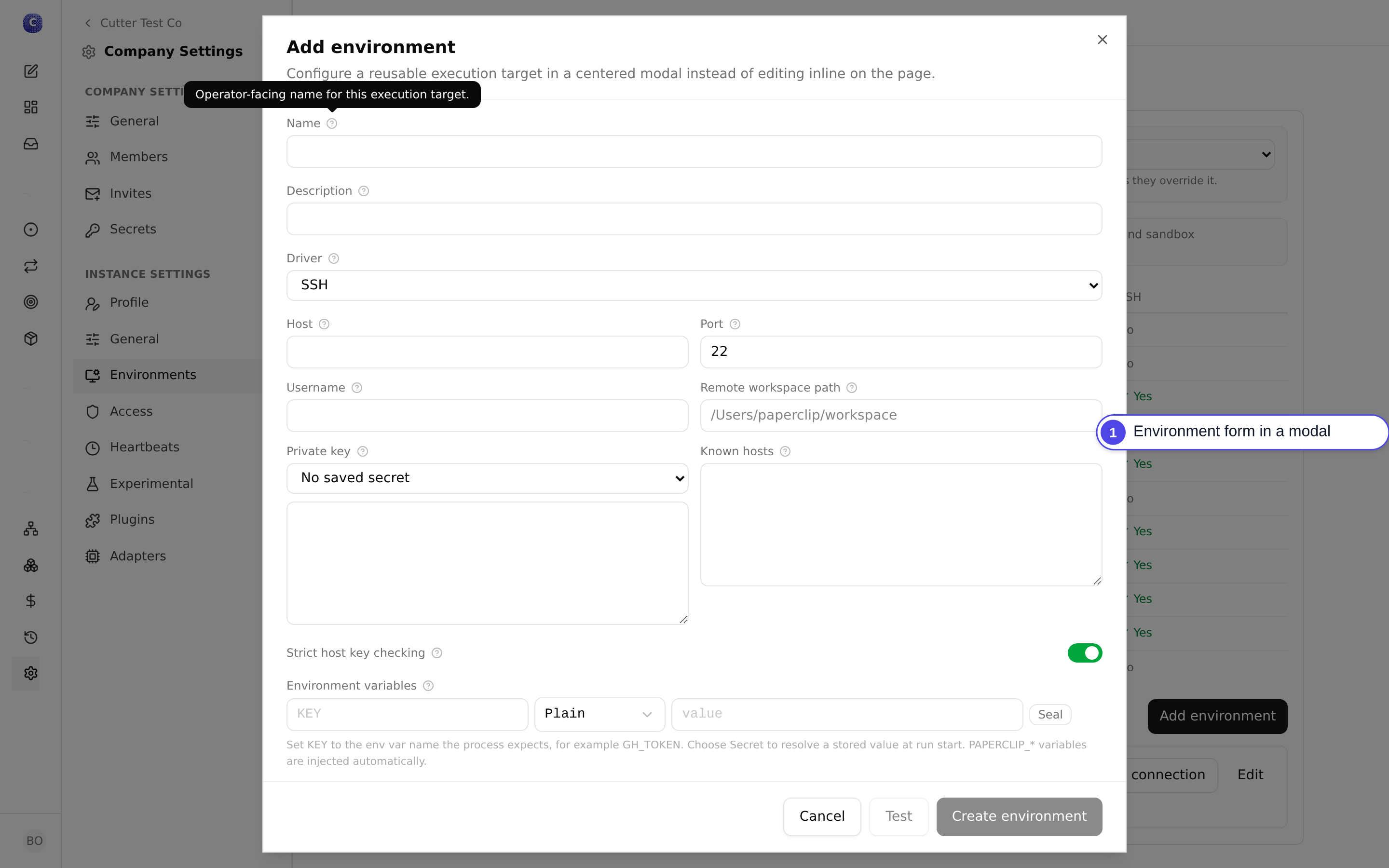
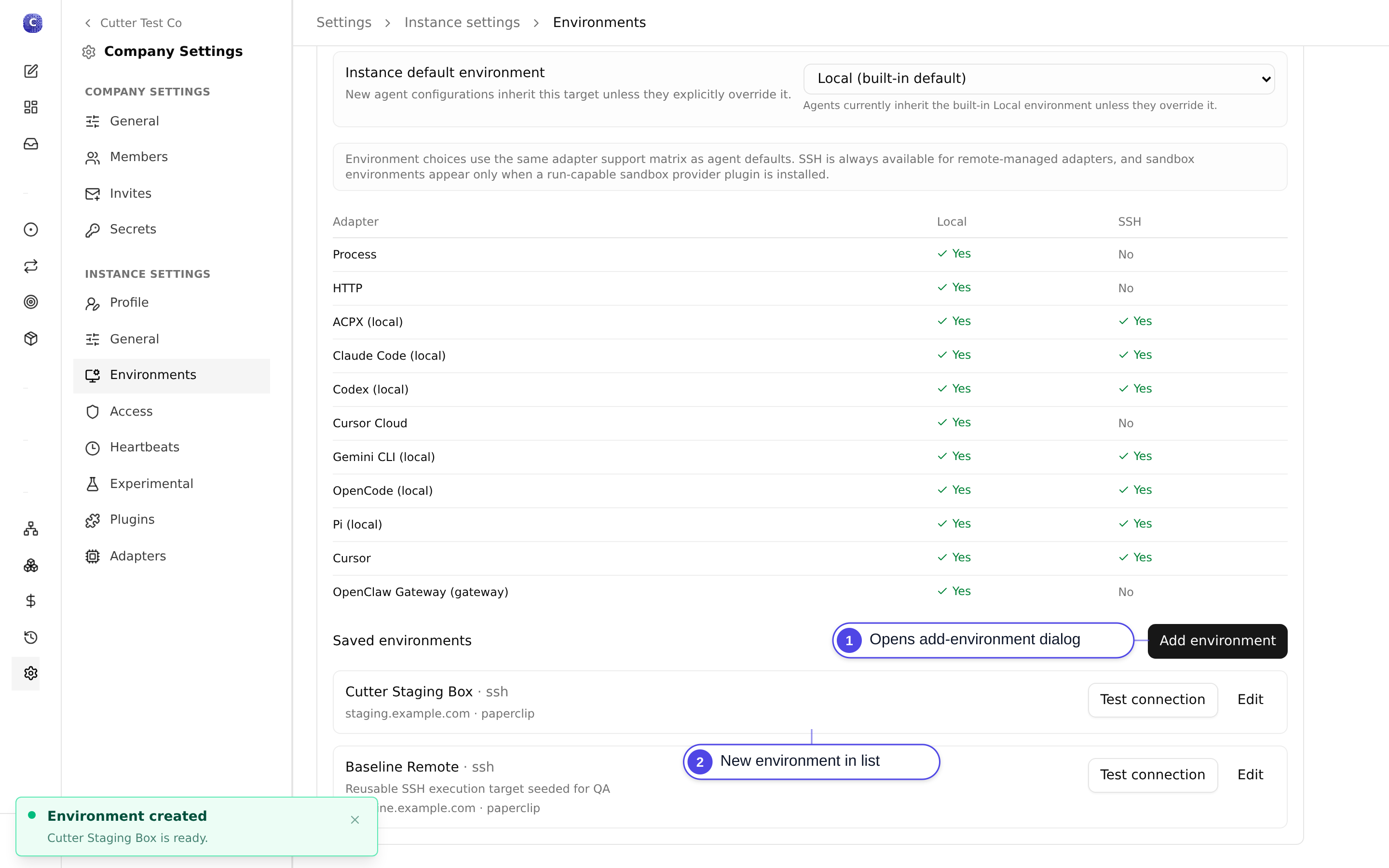
fix(ui): move environment create/edit into a dialog (#8391)
## Thinking Path > - Paperclip is the open source control plane people use to manage AI agents and the work they do. > - This change lives in the board UI, specifically the instance environments settings page where operators define reusable execution targets. > - That page currently rendered the create/edit environment form inline near the bottom of the screen. > - Because the form appeared away from the action that triggered it, it was easy to miss and felt inconsistent with the rest of the UI. > - This pull request moves environment creation and editing into a proper centered dialog with the existing form behavior preserved. > - The benefit is a more obvious, consistent, and easier-to-complete settings flow for environment management. ## Linked Issues or Issue Description No public GitHub issue matched this exact UI problem when I searched related issues and PRs. ### Pre-submission checklist - [x] I have searched existing open and closed issues and this is not a duplicate. - [x] I am on the latest released version of Paperclip (or can reproduce on `master`). - [x] I have confirmed the issue originates in Paperclip itself, not adapter or local configuration. ### What happened? On `Settings -> Instance settings -> Environments`, clicking create or edit revealed the environment form inline near the bottom of the page. Because the form appeared away from the action that triggered it, it was easy to miss. ### Expected behavior Create and edit should open a centered modal dialog with a dimmed backdrop and the same form controls. ### Steps to reproduce 1. Open `Settings -> Instance settings -> Environments`. 2. Click the create or edit action for an environment. 3. Observe that the form expands inline on the page instead of opening in a modal. ### Paperclip version or commit Observed on current `master` before this PR, for example [`e93d78b46`](https://github.com/paperclipai/paperclip/commit/e93d78b46). ### Deployment mode Local dev (`pnpm dev`). ### Installation method Built from source (`pnpm dev` / `pnpm build`). ### Agent adapter(s) involved - [x] Not adapter-specific (core bug) ### Database mode Embedded PGlite (default, `DATABASE_URL` unset). ### Access context Board (human operator). ### Node.js version Node.js 25.6.1 in the local contributor environment. ### Operating system macOS local development environment. ### Relevant logs or output None. This was a visible UI behavior issue rather than a logged server/runtime error. ### Relevant config (if applicable) Not config-related. ### Additional context Related PR/search context checked before opening this fix. UI preview screenshots are attached below. ### Privacy checklist - [x] I have reviewed all pasted output for PII and redacted where necessary. ## What Changed - Moved the environment create/edit form in `ui/src/pages/CompanyEnvironments.tsx` into a shared dialog. - Added an explicit `Add environment` action near the saved environments list and wired row edit actions to open the same dialog in prefilled mode. - Preserved existing save/test behavior while resetting dialog-local mutation state when the modal opens or closes. - Extended `ui/src/pages/CompanyEnvironments.test.tsx` to cover add-open/cancel and edit-open/save dialog flows. - Updated `ui/src/pages/CompanySettings.test.tsx` so the existing environments coverage opens and inspects the dialog through the Radix portal. ## Verification - `node node_modules/vitest/vitest.mjs run ui/src/pages/CompanyEnvironments.test.tsx` - `node node_modules/vitest/vitest.mjs run ui/src/pages/CompanySettings.test.tsx` - Manual review: - Open `Settings -> Instance settings -> Environments` - Click `Add environment` and confirm the form opens in a centered dialog - Click `Edit` on an existing environment and confirm the dialog opens with existing values - Confirm `Cancel`, `Test`, and save actions still behave as expected - Before/after screenshots: - [Cancel environment creation/edit](https://artifacts.cutter.sh/8391/run-1175b5c-2026-06-20T18-47-11/preview/clip-01.mp4) - [Add a new environment](https://artifacts.cutter.sh/8391/run-1175b5c-2026-06-20T18-47-11/preview/change-02.png) - [Save an environment](https://artifacts.cutter.sh/8391/run-1175b5c-2026-06-20T18-47-11/preview/change-03.png) ## Risks - Low risk overall because the change is contained to the environments page and keeps the existing form fields and mutations. - The main behavior change is modal layout, so the biggest risk is regressions in tall-form scrolling or smaller-screen dialog ergonomics. > I checked [`ROADMAP.md`](ROADMAP.md). This is a tightly scoped UI polish fix, not duplicate roadmap-level core feature work. ## Model Used - OpenAI GPT-5.4 via the `codex_local` Paperclip adapter - High reasoning mode with tool use, shell execution, git operations, and targeted test execution - Model-assisted authoring and verification of the UI and test changes ## Checklist - [x] I have included a thinking path that traces from project context to this change - [x] I have specified the model used (with version and capability details) - [x] I have checked ROADMAP.md and confirmed this PR does not duplicate planned core work - [x] I have searched GitHub for duplicate or related PRs and linked them above - [x] I have either (a) linked existing issues with `Fixes: #` / `Closes #` / `Refs #` OR (b) described the issue in-PR following the relevant issue template - [x] I have not referenced internal/instance-local Paperclip issues or links (only public GitHub `#NNN` / `github.com/paperclipai/paperclip` URLs) - [x] My branch name describes the change (e.g. `docs/...`, `fix/...`) and contains no internal Paperclip ticket id or instance-derived details - [x] I have run tests locally and they pass - [x] I have added or updated tests where applicable - [x] If this change affects the UI, I have included before/after screenshots - [ ] I have updated relevant documentation to reflect my changes - [x] I have considered and documented any risks above - [ ] All Paperclip CI gates are green - [ ] Greptile is 5/5 with no open P2s, recommendations, or follow-ups - [x] I will address all Greptile and reviewer comments before requesting merge --------- Co-authored-by: Paperclip <noreply@paperclip.ing> |
||
|
Devin FoleyandPaperclip
|
a0c7e38ccd |
fix(ui): reorder environment driver dropdown and drop Local option (#8329)
## Thinking Path > - Paperclip is the open source app people use to manage AI agents for work > - Agents run on **environments**, configured in Company Settings → Environments, where each environment has a **driver** (how/where it runs) > - The "new environment" form exposed a Driver `<select>` ordered `SSH → Sandbox → Local`, with **Local** as a selectable create option > - You can only ever have one local environment (it's the host running Paperclip), so offering **Local** in the create flow is misleading — and Sandbox is the most common choice, yet it sat in the middle of the list > - This pull request removes the **Local** option from the create form and moves **Sandbox** to the top of the list (`Sandbox → SSH`) > - The benefit is a create flow that only offers drivers you can actually create, with the most-used driver first ## Linked Issues or Issue Description No public GitHub issue exists. Describing the underlying problem inline, following the **Feature request** issue template: ### Problem or motivation When creating a new environment (Company Settings → Environments → New environment), the Driver `<select>` lists three options in this order: `SSH`, `Sandbox`, `Local`. **Local** is selectable even though a local environment represents the Paperclip host itself and cannot be created more than once, so choosing it in the create flow is not a valid action. **Sandbox**, the most common choice, sits in the middle of the list instead of first. ### Proposed solution Drop **Local** from the create dropdown and order the remaining options **Sandbox** first, then **SSH**. The create flow then only offers drivers you can actually create, with the most-used driver surfaced first. Existing local environments must still render and be editable, so the `"local"` driver value is retained in the type union. ### Alternatives considered Keeping **Local** but disabling it: rejected — a permanently-disabled option is noise and still implies local environments are creatable here. Hiding the whole driver field when only one option remains: rejected — both Sandbox and SSH remain valid, so the selector is still needed. ### Roadmap alignment Not roadmap-tracked. This is a small, self-contained UX correction to an existing form, not new core feature work. ## What Changed - Removed the **Local** `<option>` from the new-environment Driver `<select>`. - Reordered the remaining options to **Sandbox** (when sandbox creation is enabled) then **SSH** (was `SSH → Sandbox → Local`). - Simplified the now-dead `local` branch in the select's `onChange` handler (`driver` resolves to `sandbox` or `ssh` only). - Updated the Driver field hint text to describe only Sandbox and SSH. - Kept the `"local"` value in the `driver` type union so existing local environments still render/read correctly — only the create-form option was dropped. - Added a unit test asserting the driver options omit `local` and list `sandbox` before `ssh`. ## Verification - `pnpm --filter ./ui typecheck` (`tsc -b`) — passes. - `pnpm --filter ./ui vitest run src/pages/CompanySettings.test.tsx` — 3 passed (includes the new assertion). Driver option ordering (create form): | | Before | After | |---|---|---| | 1 | SSH | Sandbox* | | 2 | Sandbox* | SSH | | 3 | Local | — (removed) | *Sandbox appears when at least one run-capable sandbox provider plugin is installed. Note on screenshots: the Driver control is a native `<select>`; its expanded option list is OS-rendered and cannot be captured in a page screenshot. The before/after option order is shown above and locked in by the new unit test. ## Risks Low risk. Pure create-form UI change. The `"local"` driver type is retained for reading/editing existing environments, so no existing environment is affected. No API, schema, or migration changes. ## Model Used Claude Opus 4.8 (`claude-opus-4-8`), extended reasoning with tool use, via Claude Code. ## Checklist - [x] I have included a thinking path that traces from project context to this change - [x] I have specified the model used (with version and capability details) - [x] I have checked ROADMAP.md and confirmed this PR does not duplicate planned core work - [x] I have searched GitHub for duplicate or related PRs and linked them above - [x] I have either (a) linked existing issues with `Fixes: #` / `Closes #` / `Refs #` OR (b) described the issue in-PR following the relevant issue template - [x] I have not referenced internal/instance-local Paperclip issues or links (only public GitHub `#NNN` / `github.com/paperclipai/paperclip` URLs) - [x] My branch name describes the change (e.g. `docs/...`, `fix/...`) and contains no internal Paperclip ticket id or instance-derived details - [x] I have run tests locally and they pass - [x] I have added or updated tests where applicable - [ ] If this change affects the UI, I have included before/after screenshots — native `<select>` reorder; expanded list isn't screenshot-capturable. Before/after option order documented above and covered by a unit test. - [ ] I have updated relevant documentation to reflect my changes — no user-facing docs cover this dropdown - [x] I have considered and documented any risks above - [x] All Paperclip CI gates are green - [x] Greptile is 5/5 with no open P2s, recommendations, or follow-ups - [x] I will address all Greptile and reviewer comments before requesting merge Co-authored-by: Paperclip <noreply@paperclip.ing> |
||
|
Devin Foley
|
eb12c42009 |
Clarify sandbox provider messaging in company environments (#4902)
## Thinking Path > - Paperclip orchestrates AI agents for zero-human companies. > - Company Environments is the operator-facing seam for choosing where compatible adapters execute work. > - Sandbox provider plugins such as E2B extend that seam, but they are not agent adapters themselves. > - The current Company Environments copy put adapter capability rows and sandbox-provider enablement on the same page without clearly distinguishing the two concepts. > - That made it look like installing the E2B sandbox provider caused a new adapter to appear under adapters. > - This pull request clarifies the UI language so provider plugins are described as backing the Sandbox driver rather than being adapter types. > - The benefit is a more accurate mental model for operators configuring environments and adapters. ## What Changed - Added explicit Company Environments copy stating that installed sandbox providers are not adapter types and instead back the Sandbox driver for compatible adapters. - Renamed the support-matrix column from `Sandbox` to `Sandbox via plugin` to make the provider relationship visible in the table itself. - Extended the existing environments UI test to assert the new clarification text. ## Verification - `pnpm test -- --run ui/src/pages/CompanySettings.test.tsx` Result: could not complete cleanly in this worktree because the checkout is missing its local workspace install links. - Direct Vitest fallback against `ui/src/pages/CompanySettings.test.tsx` Result: failed before test collection on local dependency resolution (`react/jsx-dev-runtime`), so there is no passing automated signal from this checkout. - Manual review Confirm the Company Environments page now says sandbox providers are not adapter types and labels the table column as `Sandbox via plugin`. ## Risks - Low risk. This is a copy-only UI clarification plus a matching test assertion; the main risk is wording drift if the product later decides sandbox providers should be surfaced differently. ## Model Used - OpenAI Codex via the local `codex_local` Paperclip adapter. This run used tool-assisted code editing and shell execution. The exact backend model ID and context window are not exposed in the Paperclip run context for this session. ## Checklist - [x] I have included a thinking path that traces from project context to this change - [x] I have specified the model used (with version and capability details) - [x] I have checked ROADMAP.md and confirmed this PR does not duplicate planned core work - [ ] I have run tests locally and they pass - [x] I have added or updated tests where applicable - [ ] If this change affects the UI, I have included before/after screenshots - [ ] I have updated relevant documentation to reflect my changes - [x] I have considered and documented any risks above - [ ] I will address all Greptile and reviewer comments before requesting merge |
||
|
Devin Foley
|
9b99d30330 |
Add dedicated environment settings page and test-in-environment (#4798)
## Thinking Path > - Paperclip orchestrates AI agents for zero-human companies > - Agents run inside environments (local, SSH, E2B sandbox) > - Operators need to configure and manage these environments > - But environment settings were buried inside the general company settings page, making them hard to find > - Additionally, when testing an agent from the configuration form, the test always ran locally regardless of which environment was selected > - This PR moves environments into a dedicated top-level company settings section and wires the "Test Environment" button to run inside the selected environment > - The benefit is operators can find and manage environments more easily, and the test button now validates the actual environment the agent will use ## What Changed - Added a dedicated `CompanyEnvironments` settings page with its own route and sidebar entry - Updated `CompanySettingsSidebar` and `CompanySettingsNav` to include the new environments section - Modified the agent test route (`POST /agents/:id/test`) to accept an optional `environmentId` parameter - Updated all adapter `test.ts` handlers to resolve and use the specified execution target environment - Added `resolveTestExecutionTarget` to `execution-target.ts` for remote environment test resolution with cwd fallback - Moved the "Test Environment" button and its feedback display into the `NewAgent` page footer for better UX flow ## Verification - `pnpm test` — all existing and new tests pass - `pnpm typecheck` — clean - Manual: navigate to Company Settings, confirm "Environments" appears as a top-level section - Manual: configure an agent with a non-local environment, click "Test Environment", confirm the test runs inside that environment ## Risks - Low risk. UI-only routing change for the settings page. The test-in-environment change adds an optional parameter with a local fallback, so existing behavior is preserved when no environment is specified. ## Model Used Codex GPT 5.4 high via Paperclip. ## Checklist - [x] I have included a thinking path that traces from project context to this change - [x] I have specified the model used (with version and capability details) - [x] I have checked ROADMAP.md and confirmed this PR does not duplicate planned core work - [x] I have run tests locally and they pass - [x] I have added or updated tests where applicable - [x] If this change affects the UI, I have included before/after screenshots - [x] I have updated relevant documentation to reflect my changes - [x] I have considered and documented any risks above - [x] I will address all Greptile and reviewer comments before requesting merge |
||
|
Devin Foley
|
5bd0f578fd |
Generalize sandbox provider core for plugin-only providers (#4449)
## Thinking Path > - Paperclip is a control plane, so optional execution providers should sit at the plugin edge instead of hardcoding provider-specific behavior into core shared/server/ui layers. > - Sandbox environments are already first-class, and the fake provider proves the built-in path; the remaining gap was that real providers still leaked provider-specific config and runtime assumptions into core. > - That coupling showed up in config normalization, secret persistence, capabilities reporting, lease reconstruction, and the board UI form fields. > - As long as core knew about those provider-shaped details, shipping a provider as a pure third-party plugin meant every new provider would still require host changes. > - This pull request generalizes the sandbox provider seam around schema-driven plugin metadata and generic secret-ref handling. > - The runtime and UI now consume provider metadata generically, so core only special-cases the built-in fake provider while third-party providers can live entirely in plugins. ## What Changed - Added generic sandbox-provider capability metadata so plugin-backed providers can expose `configSchema` through shared environment support and the environments capabilities API. - Reworked sandbox config normalization/persistence/runtime resolution to handle schema-declared secret-ref fields generically, storing them as Paperclip secrets and resolving them for probe/execute/release flows. - Generalized plugin sandbox runtime handling so provider validation, reusable-lease matching, lease reconstruction, and plugin worker calls all operate on provider-agnostic config instead of provider-shaped branches. - Replaced hardcoded sandbox provider form fields in Company Settings with schema-driven rendering and blocked agent environment selection from the built-in fake provider. - Added regression coverage for the generic seam across shared support helpers plus environment config, probe, routes, runtime, and sandbox-provider runtime tests. ## Verification - `pnpm vitest --run packages/shared/src/environment-support.test.ts server/src/__tests__/environment-config.test.ts server/src/__tests__/environment-probe.test.ts server/src/__tests__/environment-routes.test.ts server/src/__tests__/environment-runtime.test.ts server/src/__tests__/sandbox-provider-runtime.test.ts` - `pnpm -r typecheck` ## Risks - Plugin sandbox providers now depend more heavily on accurate `configSchema` declarations; incorrect schemas can misclassify secret-bearing fields or omit required config. - Reusable lease matching is now metadata-driven for plugin-backed providers, so providers that fail to persist stable metadata may reprovision instead of resuming an existing lease. - The UI form is now fully schema-driven for plugin-backed sandbox providers; provider manifests without good defaults or descriptions may produce a rougher operator experience. ## Model Used - OpenAI Codex via `codex_local` - Model ID: `gpt-5.4` - Reasoning effort: `high` - Context window observed in runtime session metadata: `258400` tokens - Capabilities used: terminal tool execution, git, and local code/test inspection ## Checklist - [x] I have included a thinking path that traces from project context to this change - [x] I have specified the model used (with version and capability details) - [x] I have checked ROADMAP.md and confirmed this PR does not duplicate planned core work - [x] I have run tests locally and they pass - [x] I have added or updated tests where applicable - [ ] If this change affects the UI, I have included before/after screenshots - [x] I have updated relevant documentation to reflect my changes - [x] I have considered and documented any risks above - [x] I will address all Greptile and reviewer comments before requesting merge |
||
|
Devin Foley
|
70679a3321 |
Add sandbox environment support (#4415)
## Thinking Path > - Paperclip orchestrates AI agents for zero-human companies. > - The environment/runtime layer decides where agent work executes and how the control plane reaches those runtimes. > - Today Paperclip can run locally and over SSH, but sandboxed execution needs a first-class environment model instead of one-off adapter behavior. > - We also want sandbox providers to be pluggable so the core does not hardcode every provider implementation. > - This branch adds the Sandbox environment path, the provider contract, and a deterministic fake provider plugin. > - That required synchronized changes across shared contracts, plugin SDK surfaces, server runtime orchestration, and the UI environment/workspace flows. > - The result is that sandbox execution becomes a core control-plane capability while keeping provider implementations extensible and testable. ## What Changed - Added sandbox runtime support to the environment execution path, including runtime URL discovery, sandbox execution targeting, orchestration, and heartbeat integration. - Added plugin-provider support for sandbox environments so providers can be supplied via plugins instead of hardcoded server logic. - Added the fake sandbox provider plugin with deterministic behavior suitable for local and automated testing. - Updated shared types, validators, plugin protocol definitions, and SDK helpers to carry sandbox provider and workspace-runtime contracts across package boundaries. - Updated server routes and services so companies can create sandbox environments, select them for work, and execute work through the sandbox runtime path. - Updated the UI environment and workspace surfaces to expose sandbox environment configuration and selection. - Added test coverage for sandbox runtime behavior, provider seams, environment route guards, orchestration, and the fake provider plugin. ## Verification - Ran locally before the final fixture-only scrub: - `pnpm -r typecheck` - `pnpm test:run` - `pnpm build` - Ran locally after the final scrub amend: - `pnpm vitest run server/src/__tests__/runtime-api.test.ts` - Reviewer spot checks: - create a sandbox environment backed by the fake provider plugin - run work through that environment - confirm sandbox provider execution does not inherit host secrets implicitly ## Risks - This touches shared contracts, plugin SDK plumbing, server runtime orchestration, and UI environment/workspace flows, so regressions would likely show up as cross-layer mismatches rather than isolated type errors. - Runtime URL discovery and sandbox callback selection are sensitive to host/bind configuration; if that logic is wrong, sandbox-backed callbacks may fail even when execution succeeds. - The fake provider plugin is intentionally deterministic and test-oriented; future providers may expose capability gaps that this branch does not yet cover. ## Model Used - OpenAI Codex coding agent on a GPT-5-class backend in the Paperclip/Codex harness. Exact backend model ID is not exposed in-session. Tool-assisted workflow with shell execution, file editing, git history inspection, and local test execution. ## Checklist - [x] I have included a thinking path that traces from project context to this change - [x] I have specified the model used (with version and capability details) - [x] I have checked ROADMAP.md and confirmed this PR does not duplicate planned core work - [x] I have run tests locally and they pass - [x] I have added or updated tests where applicable - [ ] If this change affects the UI, I have included before/after screenshots - [x] I have updated relevant documentation to reflect my changes - [x] I have considered and documented any risks above - [x] I will address all Greptile and reviewer comments before requesting merge |