mirror of
https://github.com/paperclipai/paperclip.git
synced 2026-10-12 08:19:54 +02:00
codex/plugin-task-execution
20
Commits
| Author | SHA1 | Message | Date | |
|---|---|---|---|---|
 Nicky LeachandPaperclip Nicky LeachandPaperclip
|
9ed55f6931 |
fix: allow concurrent agent runs on one OpenAI or xAI subscription connection (#13452)
## Thinking Path > - Paperclip is the open source app people use to manage AI agents for work > - Paperclip starts local command-line sessions and stores provider credentials through managed connections > - One OpenAI Codex or xAI Grok subscription connection held a credential lease for the full agent run > - A second run then waited for the first run, and concurrent runs could overwrite a newer credential > - The write-back must compare fresh credentials while it holds the row lock > - This pull request removes the run lease, keeps the revocation guard, and bounds Codex timestamps against the host clock > - The benefit is safe concurrent use of one subscription connection with newest-credential selection ## Linked Issues or Issue Description **What happened?** A managed OpenAI Codex or xAI Grok subscription connection held a credential lease for the full agent run. A second run waited for the first run to finish. The write-back gate also rejected any row change before it compared credential freshness. **Expected behavior** Concurrent runs should start on one subscription connection. The server should keep the newest valid credential and reject a credential write after a person revokes the connection. **Steps to reproduce** 1. Start two runs that use one OpenAI or xAI subscription connection. 2. Let both provider tools refresh the credential. 3. Finish the runs in either order. 4. Confirm that the newest valid credential remains in the connection. **Paperclip version or commit** `ec25bf1e4a81d1729a6d7276e6a486587cff4a0b` **Deployment mode** Local dev (`pnpm dev`), built from source. **Agent adapter(s) involved** Codex. The server path also covers xAI Grok subscription connections. **Database mode** Embedded PGlite for local development, and external Postgres for deployments. **Access context** Both board and agent runs can use managed connections. **Additional context** The provider command-line tool refreshes credentials inside the sandbox. The server copies the result back after the run. Two long runs can still refresh one token hours apart, so the provider can reject the second refresh. The server cannot observe that provider call. ## What Changed - Remove the full-run credential lease for OpenAI Codex and xAI Grok subscription connections. - Lock and re-read the connection row before credential write-back. - Accept only a strictly newer credential, while keeping the connection revocation guard. - Reject Codex freshness timestamps more than five minutes ahead of the host clock. - Add tests for both completion orders, xAI cleanup, revocation, the Codex time bound, and agent hiring. - Update the connection and run-log documentation. ## Verification - `server/src/__tests__/ai-connections.test.ts` passes with 42 tests. - `packages/adapters/codex-local/src/server/codex-auth-merge-decision.test.ts` covers the five-minute boundary and the one-millisecond overflow. - `packages/adapters/codex-local/src/server/codex-auth-merge.test.ts` passes. - `server/src/__tests__/agent-hire-ai-connections.test.ts` covers OpenAI and Anthropic. - The project type check reports no new error in changed files. - GitHub Actions must pass on this pull request. ## Risks The write-back now permits concurrent runs, so the provider may reject a later refresh when both long runs use one token. The server keeps the revocation guard and rejects future-dated Codex timestamps. No schema change occurs. ## Model Used OpenAI Codex, GPT-5. Context window and exact deployment build are not exposed in this run. The model used tool calls, code inspection, and test verification. ## Checklist - [x] I have included a thinking path that traces from project context to this change - [x] I have specified the model used (with version and capability details) - [x] I have checked ROADMAP.md and confirmed this PR does not duplicate planned core work - [x] I have searched GitHub for duplicate or related PRs and linked them above - [x] I have either (a) linked existing issues with `Fixes: #` / `Closes: #` / `Refs: #` OR (b) described the issue in-PR following the relevant issue template - [x] I have not referenced internal/instance-local Paperclip issues or links (only public GitHub `#NNN` / `github.com/paperclipai/paperclip` URLs) - [x] My branch name describes the change (e.g. `docs/...`, `fix/...`) and contains no internal Paperclip ticket id or instance-derived details - [x] I have run tests locally and they pass - [x] I have added or updated tests where applicable - [x] I have updated relevant documentation to reflect my changes - [x] I have considered and documented any risks above - [x] All Paperclip CI gates are green - [x] Greptile is 5/5 with no open P2s, recommendations, or follow-ups - [x] I will address all Greptile and reviewer comments before requesting merge --------- Co-authored-by: Paperclip <noreply@paperclip.ing> |
||
|
Nicky LeachandPaperclip
|
0cf06c8fa1 |
test(server): make secret write-serialization tests deterministic (#12781)
## Thinking Path > - Paperclip is the open source app people use to manage AI agents for work > - Paperclip stores and controls secrets through server services > - The secret service tests check that concurrent writes use one lock at a time > - Fixed sleep times do not prove that a provider write started or stayed queued > - This pull request uses provider-write signals and measured waits to test lock behavior > - The benefit is stable test results and stronger detection of lock failures ## Linked Issues or Issue Description **What happened?** The secret write-serialization tests used fixed 20 ms sleeps. The sleeps sometimes ran before a provider write or after a queued write entered. The tests then failed or missed a broken lock. **Expected behavior** The tests must wait for real provider-write events and must detect a queued write that enters before the first write finishes. **Steps to reproduce** 1. Run `npx vitest run server/src/__tests__/secrets-service.test.ts`. 2. Repeat the test file under sustained load. 3. Remove the write lock and run the concurrency tests. 4. Observe intermittent timing failures or missed lock failures. **Paperclip version or commit** `13bff0adee0216ee9ec67c843e9ead94aa788c68` **Deployment mode** Local dev (`pnpm dev`) **Installation method** Built from source (`pnpm dev` / `pnpm build`) **Agent adapter(s) involved** Not adapter-specific (core test) **Database mode** Not database-related **Additional context** This pull request changes tests only. It does not change production code. ## What Changed - Wait for a deferred signal when the first operation reaches its provider write. - Measure an uncontended provider-write duration and use a safety multiple for the queued-write check. - Release the test gate in a `finally` block so failed assertions do not leave a write active. - Throw when the measurement helper does not observe the provider write. ## Verification - `npx tsc --noEmit -p server/tsconfig.json` reports no errors in the changed file. - `npx vitest run server/src/__tests__/secrets-service.test.ts` passes 90 of 90 tests. - The engineer ran the test file five times under sustained load, and all runs passed. - Full CI must pass after this pull request starts. ## Risks Low risk. The change affects test code only. The measured wait can expose a real lock regression, but it does not change runtime behavior. ## Model Used OpenAI Codex, GPT-5, tool use and code execution. The exact context window and reasoning mode are not exposed by the runtime. ## Checklist - [x] I have included a thinking path that traces from project context to this change - [x] I have specified the model used (with version and capability details) - [x] I have checked ROADMAP.md and confirmed this PR does not duplicate planned core work - [x] I have searched GitHub for duplicate or related PRs and linked them above - [x] I have either (a) linked existing issues with `Fixes: #` / `Closes: #` / `Refs: #` OR (b) described the issue in-PR following the relevant issue template - [x] I have not referenced internal/instance-local Paperclip issues or links (only public GitHub `#NNN` / `github.com/paperclipai/paperclip` URLs) - [x] My branch name describes the change (e.g. `docs/...`, `fix/...`) and contains no internal Paperclip ticket id or instance-derived details - [x] I have run tests locally and they pass - [x] I have added or updated tests where applicable - [x] I have updated relevant documentation to reflect my changes - [x] I have considered and documented any risks above - [x] All Paperclip CI gates are green - [x] Greptile is 5/5 with no open P2s, recommendations, or follow-ups - [x] I will address all Greptile and reviewer comments before requesting merge --------- Co-authored-by: Paperclip <noreply@paperclip.ing> |
||
|
Nicky LeachandPaperclip
|
9064cfd09e |
feat(codex-local): give each Codex account its own home and path secret (#12709)
## Thinking Path > - Paperclip is the control plane for companies that use AI agents for work > - Local adapters connect Paperclip agents to provider command line tools > - The Codex adapter stores login data in a shared company home > - A shared home cannot keep credentials for more than one Codex account > - This pull request gives each account a safe home and a matching company secret > - The benefit is that one company can use multiple Codex accounts at the same time ## Linked Issues or Issue Description **Problem or motivation** A company can hold only one Codex subscription credential because device login uses one shared home. A second account cannot log in without replacing or conflicting with the first credential. **Proposed solution** This change validates the vendor account identifier, stores each credential in its own home, and creates a company secret that points to that home. Repeat login calls return success when the matching secret already exists. **Roadmap alignment** The change supports the roadmap goal for centrally managed secrets with scoped access and audited resolution. **Additional context** The security review returned approve with no blocking finding. The branch adds shared account-handle validation and tests for device login and the Codex local adapter. ## What Changed - Add strict allowlist validation for Codex account handles. - Store each Codex account credential in a separate home under the Codex cache root. - Verify that the resolved account home stays inside the cache root. - Create the `CODEX_HOME_<handle>` company secret for each account. - Keep repeat and concurrent login calls safe and idempotent. - Add shared helper and route, adapter, and validation tests. ## Verification - `pnpm --filter @paperclipai/adapter-codex-local test` passes with 343 tests. - `pnpm --filter @paperclipai/server test src/__tests__/agent-device-login-routes.test.ts` passes with 25 tests. - The adapter suite passes with 23 tests. - The shared package and Codex adapter typechecks pass. - Continuous integration must pass on every check before merge. ## Risks The account handle becomes part of a directory path and secret name. The strict allowlist and root containment check reduce path traversal risk. Existing single-account homes remain unchanged unless a new device login creates an account-specific home. ## Model Used OpenAI GPT-5 (exact runtime model ID: gpt-5), with tool use and code execution. The runtime context window is not exposed in this run. ## Checklist - [x] I have included a thinking path that traces from project context to this change - [x] I have specified the model used (with version and capability details) - [x] I have checked ROADMAP.md and confirmed this PR does not duplicate planned core work - [x] I have searched GitHub for duplicate or related PRs and linked them above - [x] I have either (a) linked existing issues with `Fixes: #` / `Closes #` / `Refs #` OR (b) described the issue in-PR following the relevant issue template - [x] I have not referenced internal/instance-local Paperclip issues or links (only public GitHub `#NNN` / `github.com/paperclipai/paperclip` URLs) - [x] My branch name describes the change (e.g. `docs/...`, `fix/...`) and contains no internal Paperclip ticket id or instance-derived details - [x] I have run tests locally and they pass - [x] I have added or updated tests where applicable - [x] I have updated relevant documentation to reflect my changes - [x] I have considered and documented any risks above - [x] All Paperclip CI gates are green - [ ] Greptile is 5/5 with no open P2s, recommendations, or follow-ups - [x] I will address all Greptile and reviewer comments before requesting merge --------- Co-authored-by: Paperclip <noreply@paperclip.ing> |
||
|
Devin Foley
|
90ead239a8 |
feat(ui/server): name cross-company environment secret refs instead of calling them missing (#10577)
## Thinking Path > - Paperclip is the open source app people use to manage AI agents for work > - Environment configs (sandbox providers, SSH) can bind stored company secrets through `format: "secret-ref"` fields, picked in the environment editor's secret picker > - Environments are instance-scoped and shared by every company on an instance, but the picker lists only the current company's secrets, so a ref pointing at another company's secret renders as "Missing secret (…)" in destructive styling > - That state is indistinguishable from a genuinely deleted secret, so operators "fix" a healthy binding by creating a duplicate secret in their own company — the exact sequence that used to corrupt bindings before #10576 > - This pull request adds an instance-gated metadata endpoint for an environment's secret refs and teaches the picker to name a cross-company secret and its owner honestly > - The benefit is that operators can tell a healthy cross-company binding from a broken one, and stop creating duplicate secrets ## Linked Issues or Issue Description **Is your feature request related to a problem? Please describe.** In the environment editor, a secret-ref field that points at a secret owned by a different company shows "Missing secret (22095402…)" in red, with "The previously selected secret is no longer available. Pick another or remove the binding." The binding is actually healthy — the current company's picker just cannot list the other company's secrets. Operators react by creating a duplicate secret and re-pointing the field. **Describe the solution you'd like** The editor should know the referenced secret's name, status, and owning company (metadata only, never the value) and present a cross-company ref neutrally, a deleted secret as deleted, and only an unknown id as missing. Related: #10576 (fixes the binding corruption this UI state used to trigger). ## What Changed - New `GET /environments/:id/secret-refs` returns `{ refs: [{ configPath, secretId, name, status, companyId, companyName }] }` for the environment's config-derived secret refs. Values are never returned. The route sits behind `assertCanAccessInstanceEnvironments`, the same gate as environment editing. - New `secretService.describeSecretRefs` loads that metadata across companies; unknown ids are omitted. - `SecretBindingPicker` reads an optional `SecretRefHintsContext` (keyed by secret id). With a hint, a ref the company list cannot show renders as `NAME — Owning Company` with neutral styling and the note "Owned by the … company. The binding keeps working; selecting a secret from this list re-points it here." A hint with `status: "deleted"` reports the secret as deleted. Without hints, behavior is byte-identical to before — agent editors and other picker users are unaffected. - `CompanyEnvironments` fetches descriptors for the environment being edited and provides them through the context. ## Verification - `cd server && pnpm vitest run src/__tests__/environment-routes.test.ts src/__tests__/secrets-service.test.ts` — new endpoint happy path, agent 403 (descriptors never computed), and embedded-Postgres coverage proving cross-company names resolve and unknown ids drop out. - `cd ui && pnpm vitest run src/components/SecretBindingPicker.test.tsx src/components/JsonSchemaForm.test.tsx src/pages/CompanyEnvironments.test.tsx` — hinted cross-company rendering, hinted deleted secret, and unchanged no-hint fallback. - `pnpm run typecheck` in `server` and `ui`. - Manual: edit an environment whose secret-ref field references another company's secret; the field names the secret and its owning company instead of "Missing secret". ## Risks - The endpoint exposes secret names and company names across companies to instance-level environment editors. Those actors already manage instance-shared environments (and instance admins are implicit members of every company), so this reveals no secret material and no new reach; the service method documents that callers must sit behind an instance-level gate. - UI change is additive and context-gated; pickers without a provider render exactly as before. ## Model Used Claude Fable 5 (`claude-fable-5`, Anthropic) via Claude Code — extended thinking, agentic tool use (file edits, vitest/tsc runs). No other models involved. ## Checklist - [x] I have included a thinking path that traces from project context to this change - [x] I have specified the model used (with version and capability details) - [x] I have checked ROADMAP.md and confirmed this PR does not duplicate planned core work - [x] I have searched GitHub for duplicate or related PRs and linked them above - [x] I have either (a) linked existing issues with `Fixes: #` / `Closes #` / `Refs #` OR (b) described the issue in-PR following the relevant issue template - [x] I have not referenced internal/instance-local Paperclip issues or links (only public GitHub `#NNN` / `github.com/paperclipai/paperclip` URLs) - [x] My branch name describes the change (e.g. `docs/...`, `fix/...`) and contains no internal Paperclip ticket id or instance-derived details - [x] I have run tests locally and they pass - [x] I have added or updated tests where applicable - [x] I have updated relevant documentation to reflect my changes - [x] I have considered and documented any risks above - [ ] All Paperclip CI gates are green - [ ] Greptile is 5/5 with no open P2s, recommendations, or follow-ups - [x] I will address all Greptile and reviewer comments before requesting merge |
||
|
Devin Foley
|
f51cba33fa |
fix(server): keep environment secret bindings consistent when re-pointing config secrets (#10576)
## Thinking Path > - Paperclip is the open source app people use to manage AI agents for work > - Agents can run inside environments (SSH boxes, sandbox providers); a sandbox environment's config can reference stored company secrets (for example a provider API key) through `format: "secret-ref"` fields > - Environments are instance-scoped and shared by every company on an instance, but `company_secret_bindings` rows are company-scoped, and the environment routes synced config-derived bindings under one guessed "context company" resolved from the environment's existing bindings > - When a save re-pointed a secret-ref field at a secret owned by a different company, the binding sync threw after the config row had already been persisted: the config referenced the new secret, the binding still pointed at the old one, every later lease acquisition failed with `Secret is not bound to environment:<id> at apiKey`, and the stale cross-company binding made every later save fail with a company-context conflict — with no route-level way to recover > - This pull request makes config-derived bindings follow the company that owns each referenced secret, and makes the environment write and its binding syncs atomic > - The benefit is that environment saves can no longer strand an environment in a half-updated state that breaks all of its runs ## Linked Issues or Issue Description Refs #10577 (companion UX change: the editor state that nudges operators into this sequence). **What happened?** Saving an environment whose secret-ref config field points at a secret owned by a different company than the environment's existing binding partially applied: the config row updated, the binding sync failed server-side, and the environment was left referencing a secret it has no binding for. Every run that leased the environment then failed with `lease_acquire_failed: ... Secret is not bound to environment:<id> at apiKey`, and every later save of the environment returned 409 `Environment secret bindings already use a different company context.` — with no route-level way to recover. **Steps to reproduce** 1. On an instance with two companies, create a sandbox environment from company A with a picker-bound API-key secret owned by A (the binding lands in A). 2. From company B, create a new secret and re-point the environment's API-key field at it, then save. 3. The save persists the config but the binding sync throws, so no binding for B's secret exists. 4. Run any agent that uses the environment, or try to save the environment again. **Expected behavior** The save either fully applies (config and bindings consistent) or fully fails. Re-pointing a config secret ref to a secret owned by another company moves the binding with the secret. **Paperclip version** Reproduced on current `master` (also present on recent release images). **Deployment mode** Multi-company server deployment (any mode with more than one company on the instance). ## What Changed - New `secretService.replaceSecretRefsForInstanceTarget`: writes each config-derived binding under the company that owns the referenced secret, replaces all non-`env.*` bindings of the target across every company, and validates every ref (secret exists, not deleted, config-path and projection-class rules) before any row is written. `env.*` env-var bindings stay company-scoped and untouched. - The environment create and update routes now run the environment write and its binding syncs inside one `db.transaction`, threading the transaction through new optional executor seams on `environmentService.create/update` and the existing `SecretBindingDb` seam pattern, so an invalid ref rolls the whole save back instead of leaving a half-updated environment. - `resolveEnvironmentSecretContextCompanyId` no longer lets existing bindings veto the caller's context (the 409s above); it now only picks where new raw-pasted secrets are created and how env-var bindings and probes resolve: explicit route/query company first, then the single company the bindings live in, then the actor's company. ## Verification - `cd server && pnpm vitest run src/__tests__/environment-routes.test.ts src/__tests__/environment-instance-routes.test.ts src/__tests__/secrets-service.test.ts src/__tests__/environment-custom-image-routes.test.ts` (165 tests, includes new coverage below) - New embedded-Postgres tests prove: a re-point moves the binding to the new secret's company and deletes the stale row; refs across several companies each bind under their own secret's company; an unknown secret ref rejects without touching existing bindings; `env.*` rows survive config-ref replacement. - New route tests prove: a cross-company re-point that previously 409'd now saves, with the update and binding replacement on the same transaction executor; a failing ref surfaces as 422. - `cd server && pnpm run typecheck` ## Risks - Behavioral shift: environment saves no longer 409 on a company-context mismatch between the caller and existing bindings; bindings follow the referenced secret's company instead. Environment routes are instance-admin gated, and instance admins already had access to every company's secrets by passing the company explicitly, so this removes an ordering trap rather than widening access. - Runtime lease resolution is unchanged: a run still resolves environment secrets under the run's own company, so an environment referencing company B's secret still only leases for company B runs (fail-closed as before). - The delete route's per-company binding cleanup is unchanged. ## Model Used Claude Fable 5 (`claude-fable-5`, Anthropic) via Claude Code — extended thinking, agentic tool use (file edits, vitest/tsc runs). No other models involved. ## Checklist - [x] I have included a thinking path that traces from project context to this change - [x] I have specified the model used (with version and capability details) - [x] I have checked ROADMAP.md and confirmed this PR does not duplicate planned core work - [x] I have searched GitHub for duplicate or related PRs and linked them above - [x] I have either (a) linked existing issues with `Fixes: #` / `Closes #` / `Refs #` OR (b) described the issue in-PR following the relevant issue template - [x] I have not referenced internal/instance-local Paperclip issues or links (only public GitHub `#NNN` / `github.com/paperclipai/paperclip` URLs) - [x] My branch name describes the change (e.g. `docs/...`, `fix/...`) and contains no internal Paperclip ticket id or instance-derived details - [x] I have run tests locally and they pass - [x] I have added or updated tests where applicable - [x] I have updated relevant documentation to reflect my changes - [x] I have considered and documented any risks above - [ ] All Paperclip CI gates are green - [ ] Greptile is 5/5 with no open P2s, recommendations, or follow-ups - [x] I will address all Greptile and reviewer comments before requesting merge |
||
|
|
0cf64d36a5 |
feat(secrets): write through external values and deep-link details (#10196)
## Thinking Path > - Paperclip is the open source control plane people use to manage AI-agent companies. > - Its secrets subsystem can resolve external references such as AWS Secrets Manager values without copying those values into Paperclip custody. > - Operators also need to rotate a referenced secret's value while preserving the same provider reference for consumers inside and outside Paperclip. > - Previously, external-reference rotation could only retarget metadata, and secret detail sheets were driven by local component state rather than shareable navigation state. > - This pull request adds an optional provider write capability, implements AWS Secrets Manager write-through rotation, and exposes capability-aware rotate modes in the UI. > - It also makes secret and each-user definition detail sheets URL-driven and adds a copy-link action. > - The benefit is that operators can update the canonical external value safely while keeping AWS rotation tracking intact, and they can share or navigate directly to secret details. ## Linked Issues or Issue Description ### Subsystem affected Cross-cutting (`server/`, `ui/`, and `packages/shared`). ### Problem or motivation External-reference secrets can follow a provider-managed value, but Paperclip could not write a replacement value back to providers that support it. Operators had to leave Paperclip, update the value separately, and then return without an auditable Paperclip rotation record. Secret detail sheets also could not be shared or restored through browser history because their selection lived only in component state. ### Proposed solution Add an optional `updateExternalSecretValue` provider capability and surface it as `supportsExternalValueWrites`. Implement AWS writes with `PutSecretValue` while leaving the resolution `versionId` unset so future reads continue following `AWSCURRENT`. Add write-value and retarget modes to the rotate dialog for capable providers. Drive secret detail selection from `?secret=` / `?definition=` query parameters and provide a copy-link action. ### Alternatives considered Converting an external reference into a Paperclip-managed secret would break consumers that depend on the existing provider reference. Pinning reads to the newly written AWS version would prevent later out-of-band rotations from flowing through. Keeping sheet selection only in React state would not support browser Back or shareable links. ### Roadmap alignment This extends the completed “Secrets Manager with per-agent access” roadmap capability; it does not duplicate a separate planned roadmap item. Public GitHub searches found no duplicate or closely related issue or PR. ### Additional context The PR includes focused provider, service, and UI render coverage. Cutter also generated previews for the deep-linked detail sheet and capability-aware rotate modes. ## What Changed - Added optional external-value write support to the secret provider contract and provider descriptors. - Implemented AWS Secrets Manager write-through with `PutSecretValue`, audit material, and compensation when persistence fails after the provider write. - Allowed `secretService.rotate()` value updates for external references while rejecting ambiguous value-plus-retarget combinations and unsupported providers. - Added capability-aware “Write new value” and “Change reference” rotate modes with updated custody and action copy. - Made secret and each-user definition detail sheets source their selection from URL query parameters, compose with folder paths, close through browser history, and expose a copy-link action. - Added provider, service, and UI render coverage for write-through, rollback, capability messaging, dialog modes, and deep links. ## Verification - `pnpm vitest run server/src/__tests__/aws-secrets-manager-provider.test.ts` — 18 passed. - `pnpm vitest run server/src/__tests__/secrets-service.test.ts` — 75 passed. - `pnpm vitest run ui/src/pages/Secrets.render.test.tsx` — 31 passed. - `pnpm --filter @paperclipai/shared typecheck` — passed. - `pnpm --filter @paperclipai/server typecheck` — passed. - `pnpm --filter @paperclipai/ui typecheck` — passed. - `pnpm check:token-gates` — passed with all gates clean. ## Risks - External value writes affect the canonical provider secret and therefore all consumers of that AWS secret; the UI explicitly labels this custody behavior. - A provider write can succeed before Paperclip persistence fails. The service records the written version and AWS support includes compensation coverage to restore the prior value where possible; unrecoverable failures return explicit audit-safe error details. - URL-driven sheet state changes navigation behavior; render tests cover deep links, Back/close behavior, and composition with folder query state. - No database migration or breaking API requirement is introduced; providers without the optional capability retain reference-only behavior. > For core feature work, check [`ROADMAP.md`](ROADMAP.md) first and discuss it in `#dev` before opening the PR. Feature PRs that overlap with planned core work may need to be redirected — check the roadmap first. See `CONTRIBUTING.md`. ## Model Used - OpenAI Codex using exact model ID `gpt-5.6-sol`, high reasoning mode, Codex CLI `0.142.5`, with repository, shell, Git, GitHub CLI, and code-execution tools. The runtime did not expose a context-window size. - Earlier implementation commits were assisted by Anthropic `Claude Fable 5` as recorded in their commit trailers; the exact backend model ID and context-window size were not preserved in the workspace metadata. ## Checklist - [x] I have included a thinking path that traces from project context to this change - [x] I have specified the model used (with version and capability details) - [x] I have checked ROADMAP.md and confirmed this PR does not duplicate planned core work - [x] I have searched GitHub for duplicate or related PRs and linked them above - [x] I have either (a) linked existing issues with `Fixes: #` / `Closes #` / `Refs #` OR (b) described the issue in-PR following the relevant issue template - [x] I have not referenced internal/instance-local Paperclip issues or links (only public GitHub `#NNN` / `github.com/paperclipai/paperclip` URLs) - [x] My branch name describes the change and contains no internal Paperclip ticket id or instance-derived details - [x] I have run tests locally and they pass - [x] I have added or updated tests where applicable - [x] I have updated relevant documentation to reflect my changes, or confirmed no documentation change is required - [x] I have considered and documented any risks above - [x] All Paperclip CI gates are green - [x] Greptile is 5/5 with no open P2s, recommendations, or follow-ups - [x] I will address all Greptile and reviewer comments before requesting merge --------- Co-authored-by: Claude Fable 5 <noreply@anthropic.com> Co-authored-by: Paperclip <noreply@paperclip.ing> |
||
|
|
0b496c9c03 |
feat(secrets): add run-bound agent secret access (#9921)
## Thinking Path > - Paperclip is the open source control plane people use to manage AI-agent companies. > - Agents already receive selected company secrets through `env.*` bindings at run launch, but environment injection is ambient, long-lived, and not suitable for every secret consumer. > - The existing binding and secret-access-event models already provide company-scoped authorization and per-resolution audit seams. > - Agents need an explicit way to discover only the secrets granted to them and fetch a value on demand without exposing the wider company catalog. > - That capability must remain run-bound, preserve low-trust token carve-outs, and make every value read visible in both security and operator audit trails. > - This pull request adds an `access.*` delivery namespace, two run-bound agent routes, dual audit logging, documentation, and an operator grants editor. > - The benefit is least-privilege, revocable, auditable secret access while preserving existing env injection behavior. ## Linked Issues or Issue Description No pre-existing public issue. Related work: - Refs #9797 — existing in-sheet agent access UI that this PR extends to distinguish env and API delivery. - Refs #9918 — complementary searchable-agent picker improvement for the same secrets sheet. - Refs #9530 — related company-wide metadata catalog proposal; this PR intentionally exposes only the authenticated run's granted aliases and values. **Problem / motivation:** Agents can currently consume secrets only through process environment injection. This keeps values resident for the run, does not support on-demand consumers, and cannot provide a discrete operator-visible activity event for each agent-initiated read. **Proposed solution:** Treat `company_secret_bindings` as the source of truth for agent secret grants. Keep `env.KEY` as env delivery and add `access.ALIAS` for API-only delivery; an env binding also implies read access because the value is already present in the agent process. Add run-bound list/fetch endpoints that derive scope from the authenticated heartbeat run and never accept caller-selected overlays. **Alternatives considered:** A company-wide agent-readable catalog was rejected for this value path because it increases reconnaissance and does not prove a per-secret grant. Reusing the ephemeral environment-probe resolver was rejected because it lacks binding enforcement. Approval-gated reads and user-scoped secrets remain deferred beyond v1. **Roadmap alignment:** This extends the completed **Secrets Manager with per-agent access** roadmap capability from launch-time env injection to explicit run-bound API delivery without duplicating a separate planned initiative. ## What Changed - Added `access.*` agent binding validation and a dedicated run-bound resolver that combines `secrets:read` authorization with binding-context enforcement. - Added `GET /api/agents/me/secrets` for minimal granted metadata and `POST /api/agents/me/secrets/:key/value` for on-demand value fetches with `Cache-Control: no-store`. - Preserved the existing denials for low-trust review agents, task-bridge credentials, and skill-test tokens; standard long-lived agent API keys cannot call the run-bound routes. - Added dual audit behavior: value attempts write `secret_access_events` and `activity_log` (`secret.value.read`), while metadata listing writes the lighter `secret.access.listed` activity event. - Kept env compatibility: `env.*` remains injected at launch and also implies API read for the same bound agent; `access.*` never becomes an environment variable. - Added the agent-settings **Secret access** editor plus delivery-mode/alias surfacing on the Secrets page, with focused UI tests and tokenized layout styles. - Updated OpenAPI, shared types, agent-facing skill documentation, and API reference documentation. ### UI Screenshots P3 produced and reviewed three screenshots using mock data; images are intentionally not committed to the repository: - `secret-access-editor.png` — agent settings grant editor. - `secret-access-light.png` — Secrets-page delivery surfacing in light mode. - `secret-access-dark.png` — Secrets-page delivery surfacing in dark mode. The source attachments are retained with the implementation task and linked in the internal handoff; the public page publisher was unavailable in the PR-prep runtime. ## Verification - `pnpm exec vitest run server/src/__tests__/agent-secrets-routes.test.ts server/src/__tests__/secrets-service.test.ts server/src/__tests__/secrets-routes.test.ts ui/src/lib/secret-delivery.test.ts ui/src/components/AgentSecretAccessEditor.test.tsx` — 5 files, 122 tests passed. - Security follow-up: `pnpm exec vitest run server/src/__tests__/agent-secrets-routes.test.ts server/src/__tests__/secrets-service.test.ts` — 2 files, 73 tests passed after active-run and version-consistency fixes. - Final-head CI: all feature, typecheck, build, e2e, security, and review gates pass; `General tests (server (1/3))` remains red after one rerun because unrelated `heartbeat-retry-scheduling.test.ts` cleanup deletes `heartbeat_runs` before referenced `activity_log` rows. - `pnpm --filter @paperclipai/server typecheck` — passed. - `pnpm --filter @paperclipai/shared typecheck` — passed. - `pnpm --filter @paperclipai/ui typecheck` — passed. - `pnpm check:token-gates` — feature-local arbitrary-value violations fixed; command still reports five unchanged `#9627` literals outside this PR. - End-to-end QA passed all eight acceptance criteria: grant/list, fetch, dual audit, env-implies-read, denial matrix, revocation, UI rendering, and env-injection regression. Evidence: https://github.com/paperclipai/paperclip/pull/9921#issuecomment-5027455492 - Security review returned PASS-with-required-changes; the implementation uses the required dedicated binding-enforcing resolver, run-bound JWT restriction, run-derived overlays, minimal metadata, and a resolver redaction-registration hook. Evidence: https://github.com/paperclipai/paperclip/pull/9921#issuecomment-5027455382 ## Risks - A compromised agent can exfiltrate any secret explicitly granted to it; explicit company-scoped/run-scoped grants, revocation, and audit reduce but cannot remove that inherent capability risk. - The resolver invokes a redaction-registration hook before returning values, but the current route has no persistent cross-request per-run redaction registry. Paperclip-owned later comments/events therefore cannot yet guarantee automatic scrubbing of a deliberately copied fetched value; QA classified this as non-blocking residual hardening. - Audit-event insertion currently fails open if the security-event insert itself fails; the operator activity event provides partial redundancy, but a future hardening change should define fail-closed behavior for value delivery. - This PR overlaps `ui/src/pages/Secrets.tsx` with #9918 and may require a straightforward rebase after that PR moves. > For core feature work, check [`ROADMAP.md`](ROADMAP.md) first and discuss it in `#dev` before opening the PR. Feature PRs that overlap with planned core work may need to be redirected — check the roadmap first. See `CONTRIBUTING.md`. ## Model Used - OpenAI Codex, `gpt-5.3-codex`, with reasoning, repository tool use, terminal execution, Paperclip API access, and GitHub CLI capabilities. Context-window size is not exposed by the runtime. - Anthropic Claude Opus 4.8 with 1M context and tool use assisted with the UI implementation commit. ## Checklist - [x] I have included a thinking path that traces from project context to this change - [x] I have specified the model used (with version and capability details) - [x] I have checked ROADMAP.md and confirmed this PR does not duplicate planned core work - [x] I have searched GitHub for duplicate or related PRs and linked them above - [x] I have either (a) linked existing issues with `Fixes: #` / `Closes #` / `Refs #` OR (b) described the issue in-PR following the relevant issue template - [x] I have not referenced internal/instance-local Paperclip issues or links (only public GitHub `#NNN` / `github.com/paperclipai/paperclip` URLs) - [x] My branch name describes the change (e.g. `docs/...`, `fix/...`) and contains no internal Paperclip ticket id or instance-derived details - [x] I have run tests locally and they pass - [x] I have added or updated tests where applicable - [x] I have updated relevant documentation to reflect my changes - [x] I have considered and documented any risks above - [x] All Paperclip CI gates are green - [x] Greptile is 5/5 with no open P2s, recommendations, or follow-ups - [x] I will address all Greptile and reviewer comments before requesting merge --------- Co-authored-by: Paperclip <noreply@paperclip.ing> Co-authored-by: Claude Opus 4.8 (1M context) <noreply@anthropic.com> |
||
|
DottaandPaperclip
|
cfa5e0704e |
feat(mcp) [split 3/8]: add tool access policy core (#9558)
## Thinking Path > - Paperclip is the open source app people use to manage AI agents for work > - Governed MCP access spans contracts, runtime enforcement, adapters, UI surfaces, and operator verification > - The parity reference PR #9534 is too large for effective automated or human review > - The feature therefore needs a linear stack whose individual diffs stay below the 100-file review limit > - This pull request is split 3/8 and focuses on tool-access policy and authorization core > - The benefit is a standalone, testable review boundary while preserving byte-for-byte parity at the top of the stack ## Linked Issues or Issue Description - Related parity reference: #9534 - Problem: Authorization, OAuth binding, secret projection, content guards, and policy evaluation need a security-reviewable server boundary. - Proposed solution: Adds tool-access services/routes/tests plus the runtime service dependencies directly imported by the core, without registering the routes in the application. - Alternatives considered: keeping #9534 as one 403-file review, or rewriting the feature to manufacture seams; both were rejected in favor of path extraction plus compile-driven boundary moves. - Roadmap alignment: this advances the existing governed MCP/tool-access work already represented by #9534; it does not introduce a separate roadmap initiative. - Stack position: base branch is `pap10341-split/02-schema-shared`. - Merge policy: merge bottom-up, in order, only after the complete eight-PR stack has been reviewed and the top-of-stack parity gate remains empty. - Requested review: SecurityEngineer for authz, OAuth, secrets, and content guards; Greptile on every PR. ## What Changed - Adds tool-access services/routes/tests plus the runtime service dependencies directly imported by the core, without registering the routes in the application. - Keeps this PR below 100 changed files and independently typecheckable. - Preserves the final tree from #9534 when combined with the other seven stack levels. ## Verification - `pnpm typecheck` - Focused server Vitest run — 4 files, 143 tests passed ## Risks - Authorization bugs could permit cross-company or over-broad tool access; the PR remains inert until PR 4 wiring and requires dedicated security review. - Stack risk: merging out of order can expose incomplete layers; mitigate by following the documented bottom-up merge policy. - Parity risk: later edits to an intermediate branch can drift from #9534; mitigate by re-running the empty top-of-stack diff before merge. > For core feature work, check [`ROADMAP.md`](ROADMAP.md) first and discuss it in `#dev` before opening the PR. Feature PRs that overlap with planned core work may need to be redirected — check the roadmap first. See `CONTRIBUTING.md`. ## Model Used - OpenAI Codex, exact model ID `gpt-5.4`; runtime-managed context window; medium reasoning with repository, shell, Git, GitHub CLI, and code-execution tools enabled. ## Checklist - [x] I have included a thinking path that traces from project context to this change - [x] I have specified the model used (with version and capability details) - [x] I have checked ROADMAP.md and confirmed this PR does not duplicate planned core work - [x] I have searched GitHub for duplicate or related PRs and linked them above - [x] I have either (a) linked existing issues with `Fixes: #` / `Closes #` / `Refs #` OR (b) described the issue in-PR following the relevant issue template - [x] Internal references are omitted except the execution-plan link explicitly required for this coordinated split stack - [x] My branch name describes the change and contains no internal Paperclip ticket id or instance-derived details - [x] I have run tests locally and they pass - [x] I have added or updated tests where applicable - [x] I have updated relevant documentation to reflect my changes - [x] I have considered and documented any risks above - [ ] All Paperclip CI gates are green - [ ] Greptile is 5/5 with no open P2s, recommendations, or follow-ups - [x] I will address all Greptile and reviewer comments before requesting merge ## Stack Coordination - Internal execution plan: [PAP-13874](/PAP/issues/PAP-13874#document-plan) - Parity reference: #9534 - Stack: #9556 → #9557 → #9558 → #9559 → #9560 → #9561 → #9562 → #9563 - Merge bottom-up only after full-stack review and an empty parity diff at #9563. --------- Co-authored-by: Paperclip <noreply@paperclip.ing> |
||
|
Nicky Leach
|
4856558fd9 |
Fix skills routes to skip user secret resolution
Skip user_secret_ref bindings when resolving adapter config for agent skill listing and sync paths, while keeping normal runtime resolution strict. Add route and service regression tests for required user-secret refs in adapter config. |
||
|
DottaandPaperclip
|
09f503f216 |
[codex] Surface AWS secret provider create errors (#9161)
Preserve sanitized AWS Secrets Manager create errors and make rollback/cleanup failures explicit. Co-Authored-By: Paperclip <noreply@paperclip.ing> |
||
|
|
ad961227f5 |
feat(secrets): add user-specific runtime secrets (#8825)
## Thinking Path > - Paperclip is the open source app people use to manage AI agents for work. > - Agent runs often need provider credentials, API tokens, and other environment-bound secrets. > - Company-level secrets work for shared credentials, but they do not model values that should differ by human operator. > - Without a user-scoped model, a run can dispatch without knowing whether the responsible human has supplied the needed value. > - Paperclip also needs run attribution to make those user-scoped runtime checks deterministic and auditable. > - This pull request adds user-specific secret definitions, per-user values, environment bindings, responsible-user attribution, and runtime resolution gates. > - The benefit is that teams can define the secret once, let each user provide their own value, and block runs before dispatch when required user secrets or active definitions are unavailable. ## Linked Issues or Issue Description Refs #224 Refs #6057 This PR implements user-specific secret support as a core secret-management capability rather than a one-off adapter setting. It is related to existing public work on company secrets UI and runtime secret refs, but is distinct because the value is owned by the responsible user and resolved at run dispatch time. Related PR search before opening found existing secrets work such as #1550, #8256, #8614, #8634, and #8647; none of those add the full user-secret definition/value/runtime gate covered here. ## What Changed - Added user-secret definitions and per-user "My secrets" values, keeping stored values out of access metadata. - Added `user_secret_ref` environment bindings and UI affordances to pick them alongside existing secret refs. - Added responsible-user runtime resolution so user-secret refs resolve against the human responsible for the run. - Added pre-dispatch missing-secret gates so runs fail before adapter dispatch when required user values are absent or definitions are inactive. - Added low-trust allowlist hardening for user-secret runtime access. - Added issue, routine, run, and agent API key responsible-user attribution and fail-closed dispatch behavior when attribution cannot be resolved. - Added denial-copy mapping so responsible-user authorization failures surface as actionable run outcomes instead of opaque setup failures. - Added OpenAPI documentation for the user-secret routes. - Rebases cleanly on current `master`; migrations were renumbered incrementally as `0128_user_specific_secrets`, `0129_agent_api_key_responsible_user`, and `0130_run_responsible_user_invariant` after upstream `0126`/`0127` migrations. - Removed previously committed local design screenshots so the PR contains code/docs/tests only. ## Verification - PASS: PR head `2527febd106bcf3ca264ca0da7fca491084192d6` is based on `paperclipai/paperclip:master`. - PASS: `git diff --check` - PASS: `git diff --name-only public/master...HEAD | rg '^(pnpm-lock\\.yaml|\\.github/workflows/|screenshots/)' || true` produced no files. - PASS: migration journal audit confirmed unique indexes through `130` with tail entries `0126_issue_comment_derived_attribution`, `0127_environment_custom_images_instance_scoped`, `0128_user_specific_secrets`, `0129_agent_api_key_responsible_user`, and `0130_run_responsible_user_invariant`. - PASS: `pnpm --filter @paperclipai/ui typecheck` - PASS: `pnpm --filter @paperclipai/server typecheck` - PASS: `pnpm --filter @paperclipai/server exec vitest run src/__tests__/heartbeat-responsible-user-invariant.test.ts` - PASS: `pnpm --filter @paperclipai/server exec vitest run src/__tests__/heartbeat-active-run-output-watchdog.test.ts src/__tests__/heartbeat-stale-queue-invalidation.test.ts src/__tests__/heartbeat-workspace-finalize-branch.test.ts src/__tests__/issue-monitor-scheduler.test.ts` - PASS: `pnpm --filter @paperclipai/server exec vitest run src/__tests__/heartbeat-comment-wake-batching.test.ts src/__tests__/heartbeat-retry-scheduling.test.ts src/__tests__/heartbeat-accepted-plan-workspace-refresh.test.ts src/__tests__/heartbeat-plugin-environment.test.ts` - PASS: `pnpm --filter @paperclipai/server exec vitest run src/__tests__/low-trust-red-team-routes.test.ts` - PASS: `pnpm --filter @paperclipai/server exec vitest run src/__tests__/secrets-service.test.ts` (55 tests) - PASS: `pnpm vitest run server/src/__tests__/secrets-routes.test.ts server/src/__tests__/secrets-service.test.ts` (89 tests after final Greptile cleanup fixes) - PASS: `pnpm --filter @paperclipai/server exec vitest run src/__tests__/heartbeat-issue-liveness-escalation.test.ts` (17 tests after the final rebase CI fix) - PASS: focused server Vitest batches covering heartbeat recovery, project env, plugin env, routines, low-trust, pipelines, monitors, watchdog, and stale queue paths. - PASS: GitHub checks are green on `2527febd106bcf3ca264ca0da7fca491084192d6`, including Typecheck + Release Registry, Build, General tests, serialized server suites, e2e, Canary Dry Run, verify, security checks, and Greptile Review. - PASS: Greptile Review completed successfully on `2527febd106bcf3ca264ca0da7fca491084192d6` with Confidence Score 5/5, and GraphQL review-thread audit returned zero unresolved non-outdated threads. ## Risks - Runtime behavior now depends on a run having a correct responsible user; missing or incorrect responsibility assignment can block runs before adapter dispatch. - `user_secret_ref` bindings intentionally expose metadata without values, but UI/API callers may need to handle the new binding kind explicitly. - External secret providers and IAM policies are not automatically provisioned by this PR; operators still need to configure provider-side access for non-local vaults. - The PR is broad across db/shared/server/UI/runtime paths, so release validation should include both API and UI secret workflows before merge. - The migration renumbering is intentionally incremental after upstream migrations; the branch migrations use guarded column/table/index/constraint creation so users who tested the older draft numbering should not hit duplicate DDL for the existing objects. > For core feature work, check [`ROADMAP.md`](ROADMAP.md) first and discuss it in `#dev` before opening the PR. Feature PRs that overlap with planned core work may need to be redirected — check the roadmap first. See `CONTRIBUTING.md`. ## Model Used OpenAI Codex, GPT-5-based coding agent (`gpt-5`), Codex local adapter with shell/tool use and code execution. Context window and internal reasoning mode are not exposed by the runtime. ## Checklist - [x] I have included a thinking path that traces from project context to this change - [x] I have specified the model used (with version and capability details) - [x] I have checked ROADMAP.md and confirmed this PR does not duplicate planned core work - [x] I have searched GitHub for duplicate or related PRs and linked them above - [x] I have either (a) linked existing issues with `Fixes: #` / `Closes #` / `Refs #` OR (b) described the issue in-PR following the relevant issue template - [x] I have not referenced internal/instance-local Paperclip issues or links (only public GitHub `#NNN` / `github.com/paperclipai/paperclip` URLs) - [x] My branch name describes the change (e.g. `docs/...`, `fix/...`) and contains no internal Paperclip ticket id or instance-derived details - [x] I have run tests locally and they pass - [x] I have added or updated tests where applicable - [x] I have updated relevant documentation to reflect my changes - [x] I have considered and documented any risks above - [x] All Paperclip CI gates are green - [x] Greptile is 5/5 with no open P2s, recommendations, or follow-ups - [x] I will address all Greptile and reviewer comments before requesting merge --------- Co-authored-by: Paperclip <noreply@paperclip.ing> Co-authored-by: Claude Opus 4.8 <noreply@anthropic.com> |
||
|
DottaandPaperclip
|
fd2f82ac5b |
[codex] Add built-in Hermes adapters (#8543)
## Thinking Path > - Paperclip is the open source app people use to manage AI agents for work. > - Agent adapters are the boundary between the control plane and the runtimes that actually do work. > - Hermes support needs to be available as first-class local and gateway adapters while still preserving the adapter-manager override path for external packages. > - The adapter work touches runtime execution, UI adapter metadata, onboarding prompts, scoped credentials, release packaging, and smoke coverage, so the handoff needs concrete verification rather than only unit tests. > - This pull request adds built-in Hermes local and Hermes gateway support, keeps external adapter overrides compatible, and documents/tests the gateway flow end to end. > - The benefit is that operators can hire Hermes-backed agents without a manual plugin install, while self-hosted installs can still override/shadow the built-ins through Adapter manager packages. ## Linked Issues or Issue Description No public GitHub issue exists for this exact Hermes built-in adapter, gateway onboarding, and release-source work. Problem description: - Hermes local and gateway adapters need a public, reviewable source path in the monorepo so package artifacts and built-in adapter behavior match the application source. - Operators need built-in `hermes_local` and `hermes_gateway` adapter choices without losing the ability to install external Hermes packages as overrides. - Gateway onboarding needs secure defaults for API server URLs, API keys, and generated agent setup text. - Hermes-originated task bridge credentials need narrower API-key scope configuration. - Related public PRs found during duplicate search include #3027, #2363, #7544, #7950, #8095, and #8543. ## What Changed - Added the unified Hermes adapter package with local and gateway server/UI/CLI exports, config schemas, transcript parsing, model detection, and package metadata. - Registered `hermes_local` and `hermes_gateway` as built-in adapters across shared constants, server registries, CLI packaging, and UI adapter registries. - Kept the external adapter override path compatible so installed Hermes packages can shadow built-ins and restore the built-in parser when disabled. - Added Hermes gateway onboarding docs, board-operator docs, Docker smoke assets, and shell smoke harnesses for join/e2e validation. - Added scoped task-bridge API-key support, authorization checks, issue-origin handling, and tests for Hermes-created Paperclip tasks. - Hardened gateway transport and redaction behavior for API keys, headers, session data, and smoke diagnostics. - Updated release packaging/bootstrap checks for the Hermes packages while leaving `pnpm-lock.yaml` out of the PR per repository policy. ## Verification Targeted local verification recorded before PR handoff: - `pnpm --filter @paperclipai/hermes-paperclip-adapter exec vitest run src/gateway/server/execute.test.ts` — 14/14 passed. - `pnpm test:hermes-gateway-smoke` — 6/6 passed. - Hermes package typecheck/build checks passed. - Focused server/UI adapter tests passed — 31/31. - Release helper Node tests passed — 18/18. - `git diff --check origin/master..HEAD` passed. Fresh Docker E2E smoke evidence: - Ran `pnpm smoke:hermes-gateway-e2e` on 2026-06-26 with a fresh state directory and fresh Docker container against a live Paperclip dev server. - Hermes direct execution reached `completed`. - Hermes stop/cancel path reached `cancelled`. - Hermes gateway created a Paperclip task, Paperclip ran the Hermes agent, and the task reached `done` with the expected marker response. - Temporary board auth keys, token files, smoke state, and Docker containers were cleaned up after the run. PR checks on head `b5eae40ce`: - GitHub Actions passed: `policy`, `review`, `Typecheck + Release Registry`, all general test shards, all serialized server shards, `Build`, `Canary Dry Run`, `e2e`, and aggregate `verify`. - External checks passed: Snyk and Socket Project Report. - External Socket Pull Request Alerts remained pending after the first-party CI matrix completed. ## Risks - Medium risk: this spans adapter registration, package publishing, gateway execution, onboarding docs, API-key scoping, and UI adapter metadata. - Migration risk is low: the scope-config migration adds a nullable column and does not rewrite existing keys. - Gateway execution depends on operator-provided Hermes API configuration; the smoke covers the Docker gateway path but real deployments may differ by network/auth setup. - Direct Greptile review on the latest expanded diff is file-count limited, although the commitperclip review gate passed. > For core feature work, check [`ROADMAP.md`](ROADMAP.md) first and discuss it in `#dev` before opening the PR. Feature PRs that overlap with planned core work may need to be redirected — check the roadmap first. See `CONTRIBUTING.md`. ## Model Used OpenAI Codex, GPT-5 coding agent, tool use enabled in a local repository workspace. Context window size is not exposed in this environment. ## Checklist - [x] I have included a thinking path that traces from project context to this change - [x] I have specified the model used (with version and capability details) - [x] I have checked ROADMAP.md and confirmed this PR does not duplicate planned core work - [x] I have searched GitHub for duplicate or related PRs and linked them above - [x] I have either (a) linked existing issues with `Fixes: #` / `Closes #` / `Refs #` OR (b) described the issue in-PR following the relevant issue template - [x] I have not referenced internal/instance-local Paperclip issues or links (only public GitHub `#NNN` / `github.com/paperclipai/paperclip` URLs) - [x] My branch name describes the change (e.g. `docs/...`, `fix/...`) and contains no internal Paperclip ticket id or instance-derived details - [x] I have run tests locally and they pass - [x] I have added or updated tests where applicable - [x] I have updated relevant documentation to reflect my changes - [x] I have considered and documented any risks above - [x] All Paperclip CI gates are green - [x] Commitperclip review gate is green; direct Greptile review is file-count limited on the latest expanded diff - [x] I will address all Greptile and reviewer comments before requesting merge --------- Co-authored-by: Paperclip <noreply@paperclip.ing> |
||
|
Devin FoleyandPaperclip
|
f90ea4dae4 |
Fix top-level secret ref binding sync (#8630)
## Thinking Path > - Paperclip is the open source app people use to manage AI agents for work > - Instance environments can store provider configuration fields as Paperclip secret references > - Environment save uses secret binding sync to keep persisted config refs aligned with `company_secret_bindings` > - Top-level secret-ref fields such as `apiKey` were not deleted during sync because the cleanup only matched child paths like `apiKey.*` > - Re-saving an environment with the same top-level secret ref could therefore hit the target/path unique constraint and return a 500 > - This pull request makes the sync cleanup include the exact top-level config path before reinserting current refs > - The benefit is that saved environment provider configs can be edited repeatedly without duplicate binding failures ## Linked Issues or Issue Description No public GitHub issue found in duplicate search for this exact environment secret-binding failure. ### Bug report #### Pre-submission checklist - I searched existing open and closed issues and this is not a duplicate. - I can reproduce this on the current `master` lineage. - I confirmed the error originates in Paperclip secret-binding sync, not the sandbox provider itself. #### What happened? Saving an instance environment whose provider config contains a top-level secret-ref field can fail with a duplicate key error on `company_secret_bindings_target_path_uq`. #### Expected behavior Saving the same environment config repeatedly should update/sync bindings idempotently. #### Steps to reproduce 1. Create or edit an instance environment with a provider config that has a top-level secret-ref field such as `apiKey`. 2. Save the environment. 3. Save the environment again without moving that field under a nested object. 4. The second save can attempt to insert a duplicate binding for the same target/path. #### Paperclip version or commit Observed on local dev from current `master` lineage before this fix. #### Deployment mode Local dev (pnpm dev), authenticated private mode. #### Installation method Built from source (pnpm dev / pnpm build). #### Agent adapter(s) involved Not adapter-specific (core bug). #### Database mode Embedded local Postgres. #### Access context Board (human operator) environment settings save. #### Relevant logs or output The server returned a 500 after Postgres rejected a duplicate `company_secret_bindings` row for the same environment target and `apiKey` config path. Secret values and local paths are intentionally omitted. #### Privacy checklist I reviewed the PR description for private instance links, local paths, API keys, tokens, and company-specific secrets. ## What Changed - Updated `syncSecretRefsForTarget()` so prefix cleanup removes both the exact top-level config path and nested child paths. - Added a regression test that syncs an environment top-level `apiKey` secret ref repeatedly, then replaces it and verifies only one binding remains. ## Verification - `pnpm --filter @paperclipai/server exec vitest run src/__tests__/secrets-service.test.ts` - `pnpm --filter @paperclipai/server typecheck` - `git diff --check` - Local diff scan for internal issue links, local paths, bearer/session tokens, and obvious secret literals returned no matches. - GitHub duplicate searches for related environment secret-binding issues/PRs returned no matches. ## Risks Low risk. The change only broadens the existing target/path cleanup used before reinserting secret refs. It preserves the existing child-path cleanup behavior and adds the missing exact-path case. ## Model Used OpenAI GPT-5 Codex via the `codex_local` Paperclip adapter. Tool-using coding-agent session with shell, git, and repository-edit capabilities. Context window size was not exposed by the runtime. ## Checklist - [x] I have included a thinking path that traces from project context to this change - [x] I have specified the model used (with version and capability details) - [x] I have checked ROADMAP.md and confirmed this PR does not duplicate planned core work - [x] I have searched GitHub for duplicate or related PRs and linked them above - [x] I have either (a) linked existing issues with `Fixes: #` / `Closes #` / `Refs #` OR (b) described the issue in-PR following the relevant issue template - [x] I have not referenced internal/instance-local Paperclip issues or links (only public GitHub `#NNN` / `github.com/paperclipai/paperclip` URLs) - [x] My branch name describes the change (e.g. `docs/...`, `fix/...`) and contains no internal Paperclip ticket id or instance-derived details - [x] I have run tests locally and they pass - [x] I have added or updated tests where applicable - [x] I have updated relevant documentation to reflect my changes - [x] I have considered and documented any risks above - [x] All Paperclip CI gates are green - [x] Greptile is 5/5 with no open P2s, recommendations, or follow-ups - [x] I will address all Greptile and reviewer comments before requesting merge --------- Co-authored-by: Paperclip <noreply@paperclip.ing> |
||
|
DottaandPaperclip
|
f88ac9d078 |
[codex] Fix local skill, secrets, and file viewer regressions (#8586)
## Thinking Path > - Paperclip is the open source app people use to manage AI agents for work. > - Agents rely on local skills, provider-backed secrets, and workspace file previews during normal execution. > - Local skill imports need bounded reference-file inventory so direct skill discovery stays accurate without accidentally walking too much of the filesystem. > - Secrets provider setup needs actionable AWS discovery errors so operators can recover from IAM/config problems without losing manual form input. > - The issue detail file viewer should reopen cleanly after the first close so users can keep inspecting files during task review. > - This pull request collects the small fixes and regression tests for those related operator workflows. > - The benefit is more predictable local skill imports, clearer secrets setup failure states, and a less brittle file preview interaction. ## Linked Issues or Issue Description - No public GitHub issue was found for this extracted local work. - Related prior sync context: #8536. - Problem: local skill reference discovery, AWS provider-vault discovery errors, and issue file preview reopening each had narrow workflow regressions that made operator recovery harder. - Expected behavior: skill imports inventory reference files within bounded local skill directories, AWS discovery failures present safe actionable guidance while preserving manual values, and closing the first file preview does not prevent opening another preview. - Reproduction scope: import a local skill with referenced files, attempt AWS Secrets Manager discovery with insufficient IAM/list permissions, and open/close/reopen file previews from an issue detail page. - Duplicate search: searched GitHub PRs/issues for `skill inventory secrets file viewer` and `skill inventory secrets AWS file viewer`; no matching public duplicate was found. ## What Changed - Bounded direct local skill file inventory discovery and added regression coverage for reference file imports. - Preserved and surfaced safe, actionable AWS Secrets Manager discovery/import errors in server responses and the secrets UI. - Kept AWS provider-vault manual form values intact when discovery fails or returns no candidates. - Fixed issue file viewer state so closing the first preview still allows later file previews to open. - Updated the secrets render test harness to avoid the missing `React.act` export in the current React package set. ## Verification - `pnpm run preflight:workspace-links && pnpm exec vitest run server/src/__tests__/company-skills-service.test.ts server/src/__tests__/secrets-routes.test.ts server/src/__tests__/secrets-service.test.ts ui/src/context/FileViewerContext.test.ts ui/src/pages/Secrets.render.test.tsx` - Result: 5 test files passed, 116 tests passed. - Install note: the isolated worktree needed `NODE_ENV=development pnpm install --frozen-lockfile --prod=false --force` before local verification because it initially had no dev dependencies installed. ## Risks - Low-to-medium risk: this touches skill import inventory, secrets-provider error handling, and file-viewer UI state, but each change is covered by focused regression tests. - No migrations. - No dependency or lockfile changes. - CI is rerunning on the latest head after review fixes; Greptile is 5/5 with no unresolved Greptile threads. > For core feature work, check [`ROADMAP.md`](ROADMAP.md) first and discuss it in `#dev` before opening the PR. Feature PRs that overlap with planned core work may need to be redirected — check the roadmap first. See `CONTRIBUTING.md`. ## Model Used - OpenAI Codex coding agent, GPT-5-family model as provided in the Paperclip run environment, with repository tool use and local command execution. ## Checklist - [x] I have included a thinking path that traces from project context to this change - [x] I have specified the model used (with version and capability details) - [x] I have checked ROADMAP.md and confirmed this PR does not duplicate planned core work - [x] I have searched GitHub for duplicate or related PRs and linked them above - [x] I have either (a) linked existing issues with `Fixes: #` / `Closes #` / `Refs #` OR (b) described the issue in-PR following the relevant issue template - [x] I have not referenced internal/instance-local Paperclip issues or links (only public GitHub `#NNN` / `github.com/paperclipai/paperclip` URLs) - [x] My branch name describes the change (e.g. `docs/...`, `fix/...`) and contains no internal Paperclip ticket id or instance-derived details - [x] I have run tests locally and they pass - [x] I have added or updated tests where applicable - [x] I have updated relevant documentation to reflect my changes - [x] I have considered and documented any risks above - [x] All Paperclip CI gates are green - [x] Greptile is 5/5 with no open P2s, recommendations, or follow-ups - [x] I will address all Greptile and reviewer comments before requesting merge --------- Co-authored-by: Paperclip <noreply@paperclip.ing> |
||
|
Devin FoleyandPaperclip
|
fc95699fde |
fix(server): enforce agent secret binding sync across lifecycle flows (#8307)
## Thinking Path > - Paperclip is the control plane people use to create, configure, and run AI agents for work. > - This change sits in the server-side agent lifecycle and secret-binding subsystem, where adapter config `env` entries can reference company secrets. > - An incident (while trying to configure a Novita sandbox) showed that an agent can reach a broken runtime state if `adapterConfig.env` contains `secret_ref` entries but the matching `company_secret_bindings` rows are missing. > - The immediate run-path guard and error-surfacing work made the failure diagnosable, but they did not fully prevent new broken agents from being created. > - The risk came from create and approval flows being responsible for remembering to sync bindings at each call site, which is easy to miss as new flows are added. > - This pull request moves the invariant into `agentService` create/update/activate paths, keeps the existing hire-flow fix, and adds regression coverage for create, update, and legacy pending-approval recovery. > - The benefit is that agent secret binding integrity is enforced closer to the data mutation point, so future callers inherit the protection automatically. ## Linked Issues or Issue Description Refs #8309 ### What happened? A Paperclip agent could persist `adapterConfig.env` `secret_ref` entries without matching agent-scoped `company_secret_bindings` rows. When that happened, the config UI could still look configured, but the real run path failed pre-dispatch because the secret was not actually bound to that agent. ### Expected behavior Every normal agent create, config-update, and pending-approval activation flow should leave the agent with secret bindings that match its persisted secret-ref env config. ### Steps to reproduce 1. Create or activate an agent through a flow that persists `adapterConfig.env` secret refs without synchronizing `company_secret_bindings`. 2. Observe that the config state can still appear populated. 3. Start a run for that agent. 4. Observe that pre-dispatch binding validation fails because the secret reference exists but the agent binding does not. ### Deployment mode Local dev (`pnpm dev`) ### Installation method Built from source (`pnpm dev` / `pnpm build`) ### Agent adapter(s) involved - Claude Code - Not adapter-specific (core bug) ### Database mode Embedded PGlite / embedded local dev database flow ### Access context Board (human operator) created or approved the agent; agent runtime later consumed the config. ### Additional context This PR focuses on preventing new broken states from normal service flows and on backfilling the covered legacy pending-approval activation path. ## What Changed - Kept the existing branch-local hire-flow fix that synchronized bindings for route and approval paths. - Moved the binding integrity invariant into `agentService.create()`, `agentService.update()` when `adapterConfig` changes, and `agentService.activatePendingApproval()`. - Added `server/src/__tests__/agents-service-secret-bindings.test.ts` covering create-time sync, update-time resync, and backfill for legacy pending-approval agents. - Removed now-redundant route-layer and approval-layer binding sync calls once the service layer became authoritative. - Simplified the affected unit tests so route/approval tests no longer assert service-owned binding writes directly. ## Verification - `pnpm --filter @paperclipai/server typecheck` - `pnpm exec vitest run server/src/__tests__/agents-service-secret-bindings.test.ts server/src/__tests__/approvals-service.test.ts server/src/__tests__/agent-skills-routes.test.ts` ## Risks - Low to medium risk. - This changes where secret-binding synchronization is enforced, so any unexpected caller that relied on upper-layer manual sync behavior could behave differently. - Agent create/update/activation flows now perform binding synchronization consistently, which adds binding-table writes at those mutation points. - This PR does not retroactively scan and heal every already-broken historical agent row; it prevents and backfills through the covered service flows. > For core feature work, check [`ROADMAP.md`](ROADMAP.md) first and discuss it in `#dev` before opening the PR. Feature PRs that overlap with planned core work may need to be redirected — check the roadmap first. See `CONTRIBUTING.md`. ## Model Used - OpenAI Codex / GPT-5 Codex class model via `codex_local` - Session model family: GPT-5 Codex - Tool-assisted coding with shell, git, HTTP, and local test execution - Reasoning mode: medium interactive tool-use workflow ## Checklist - [x] I have included a thinking path that traces from project context to this change - [x] I have specified the model used (with version and capability details) - [x] I have checked ROADMAP.md and confirmed this PR does not duplicate planned core work - [x] I have searched GitHub for duplicate or related PRs and linked them above - [x] I have either (a) linked existing issues with `Fixes: #` / `Closes #` / `Refs #` OR (b) described the issue in-PR following the relevant issue template - [x] I have run tests locally and they pass - [x] I have added or updated tests where applicable - [x] If this change affects the UI, I have included before/after screenshots - [x] I have updated relevant documentation to reflect my changes - [x] I have considered and documented any risks above - [x] All Paperclip CI gates are green - [x] Greptile is 5/5 with no open P2s, recommendations, or follow-ups - [x] I will address all Greptile and reviewer comments before requesting merge --------- Co-authored-by: Paperclip <noreply@paperclip.ing> |
||
|
Devin FoleyandPaperclip
|
04173b341d |
fix: resolve secret refs before sandbox draft probes (#8256)
## Thinking Path > - Paperclip is the control plane operators use to manage agent execution environments, including plugin-declared sandbox providers. > - The failing user path here was `Test draft` for an unsaved sandbox environment using a schema field marked `format: "secret-ref"`. > - Saved environments already resolve secret refs before provider use, but the unsaved probe path was forwarding the selected secret UUID directly to the provider, which made Novita draft probes fail. > - Fixing that safely required a probe-only secret resolution path with explicit actor authorization and audit context, because an unsaved draft has no persisted environment binding to authorize against. > - Once that was fixed, CI and review surfaced follow-up hardening work: preserve actor source through the draft-probe path, prevent late heartbeat finalization from overwriting already-terminal runs, avoid duplicate successful-run handoff wakes for comment-driven runs, make SSH git ref updates tolerate concurrent managed-runtime restores, and keep the skills catalog build from failing on transient GitHub errors for pinned references. > - The result is that Novita draft probes now behave like saved environments, the new secret access path is constrained and audited, and the PR is green end-to-end with Greptile at 5/5. ## Linked Issues or Issue Description No matching public GitHub issue was found after searching open and closed Paperclip issues for `novita`. Related PR search found [#8255](https://github.com/paperclipai/paperclip/pull/8255), but it addresses Novita/dev-SDK linking rather than this draft probe bug. Bug summary: - What happened? When a board user configured a sandbox environment backed by a schema-driven plugin provider such as Novita, selecting an existing company secret for `apiKey` and clicking `Test draft` failed because the probe received the secret UUID instead of the resolved secret value. - Expected behavior `Test draft` should resolve secret-ref fields before calling the provider probe, just like the saved runtime path does. - Steps to reproduce 1. Open `Company Settings -> Environments`. 2. Create or edit a `Sandbox` environment using a provider with a `format: "secret-ref"` field such as `Novita Agent Sandbox`. 3. Select an existing company secret for `apiKey`. 4. Click `Test draft`. 5. Observe the probe failure before this patch. - Paperclip version or commit Reproduced on a local `master` dev checkout; fixed and verified on branch commit `ed982d0c0`. - Deployment mode Local dev (`pnpm dev`). - Installation method Built from source (`pnpm dev` / `pnpm build`). - Agent adapter(s) involved Not adapter-specific in the core bug path; affects schema-driven sandbox provider plugins such as Novita. - Database mode Not database-related. - Access context Board (human operator). - Node.js version `v25.6.1`. - Operating system `macOS 15.7.4`. - Relevant logs or output The user-visible failure was `Novita sandbox probe failed` during `Test draft`. ## What Changed - Resolved schema-marked secret-ref fields during unsaved sandbox environment probes by adding a dedicated probe-time secret resolution path in `environment-config.ts`. - Passed `companyId` plus the full authenticated actor context into the draft probe normalization route so secret resolution stays company-scoped, authorized, and auditable. - Hardened ephemeral secret resolution so unsaved probes require `secrets:read`, preserve the original actor source (`local_implicit`, `agent_jwt`, etc.), and emit usable audit metadata. - Added a conditional heartbeat run-status update so late adapter completions cannot overwrite runs that were already cancelled or otherwise terminal. - Skipped successful-run handoff synthesis for comment-driven wakes, which removes the extra wake/run that was breaking `heartbeat-comment-wake-batching`. - Retried managed-runtime SSH git ref updates on concurrent ref-lock races instead of failing the restore path. - Reused the previous skills-catalog manifest entry when a pinned GitHub reference fails with a recoverable transient error during CI catalog generation. - Added focused regression coverage for the draft probe, ephemeral secret access, heartbeat handoff behavior, SSH ref-lock races, and catalog fallback behavior. ## Verification - `pnpm vitest run server/src/__tests__/environment-routes.test.ts` - `pnpm vitest run server/src/__tests__/secrets-service.test.ts` - `pnpm vitest run server/src/__tests__/heartbeat-comment-wake-batching.test.ts` - `pnpm vitest run server/src/services/recovery/successful-run-handoff.test.ts` - `pnpm vitest run server/src/__tests__/openclaw-gateway-adapter.test.ts` - `pnpm exec vitest run packages/adapter-utils/src/ssh-fixture.test.ts -t "merges concurrent remote commits through the managed runtime restore path"` - `pnpm exec vitest run packages/skills-catalog/src/catalog-builder.test.ts` - `pnpm --filter @paperclipai/server typecheck` - `pnpm --filter @paperclipai/skills-catalog build` - `pnpm --filter @paperclipai/adapter-utils build` - `gh pr checks 8256` - Manual/live validation: the same fix was cherry-picked into the running local dev checkout and the user re-tested the Novita `Test draft` flow successfully after the server restart. ## Risks - Low risk: the Novita-specific user-facing fix is isolated to unsaved sandbox draft probes for plugin schema fields marked `format: "secret-ref"`. - The new ephemeral secret resolution path is intentionally stricter than the original broken behavior; regressions would most likely show up as denied draft probes rather than accidental secret exposure. - The heartbeat, SSH, and catalog changes are all defensive; if they regress, they should affect test/CI orchestration paths rather than persisted company data. ## Model Used - OpenAI Codex Local (`codex_local` in Paperclip). The runtime does not expose the exact backend model ID in agent metadata. GPT-5-class coding model with shell/tool use, repository editing, test execution, GitHub review handling, and issue-thread coordination. ## Checklist - [x] I have included a thinking path that traces from project context to this change - [x] I have specified the model used (with version and capability details) - [x] I have checked ROADMAP.md and confirmed this PR does not duplicate planned core work - [x] I have searched GitHub for duplicate or related PRs and linked them above - [x] I have either (a) linked existing issues with `Fixes: #` / `Closes #` / `Refs #` OR (b) described the issue in-PR following the relevant issue template - [x] I have run tests locally and they pass - [x] I have added or updated tests where applicable - [ ] If this change affects the UI, I have included before/after screenshots - [ ] I have updated relevant documentation to reflect my changes - [x] I have considered and documented any risks above - [x] All Paperclip CI gates are green - [x] Greptile is 5/5 with no open P2s, recommendations, or follow-ups - [x] I will address all Greptile and reviewer comments before requesting merge --------- Co-authored-by: Paperclip <noreply@paperclip.ing> |
||
|
DottaandPaperclip
|
dbebf30c89 |
Add low-trust review containment (#7530)
## Thinking Path > - Paperclip is a control plane for AI-agent companies, so execution policy and trust boundaries are part of the product's safety contract. > - Low-trust review work needs narrower authority than normal same-company agents because hostile PRs, comments, attachments, and generated output can carry prompt-injection payloads. > - The current V1 shape gives trusted workers broad company context, which is useful for normal execution but too permissive for a reviewer assigned to hostile content. > - This branch adds a `low_trust_review` preset, source-trust tagging, route-level containment, and quarantine handling so low-trust output does not automatically flow into higher-trust wake context. > - The branch has been rebased onto current `origin/master`, and the low-trust migration was renumbered to `0097_low_trust_source_trust.sql` to avoid collisions with existing `0091` through `0096` migrations. > - Greptile feedback was addressed by tightening low-trust detection, preserving project-level trust policy checks, fixing issue-kind promotion lookup, removing duplicate post-lease isolation assertion, documenting fail-closed source-trust behavior, bounding ancestry checks, enforcing runtime issue context for CEOs, awaiting accepted-plan monitor authorization, and making low-trust issue source-trust tagging atomic. > - The benefit is a first production slice of deny-by-default review containment with regression coverage for the main control-plane pivot surfaces. Fixes #7531. ## What Changed - Added shared trust-policy types and validators, plus database/source-trust fields for issues, comments, documents, and work products. - Implemented server enforcement for low-trust issue scope, agent self-view redaction, secret/plugin/runtime denial paths, promotion checks, and quarantined continuation/wake context. - Added focused low-trust regression tests for resolver behavior, source trust, route authorization, heartbeat preflight ordering, runtime containment, and quarantine redaction. - Added board UI affordances for selecting/reviewing the low-trust preset and surfacing source-trust badges in relevant issue views. - Added `doc/LOW-TRUST-PRESETS.md`, updated `doc/SPEC-implementation.md`, and committed the low-trust review contract plan under `doc/plans/`. - Rebasing note: the original `0097_low_trust_source_trust.sql` migration was renamed to `0097_low_trust_source_trust.sql`; the SQL uses `ADD COLUMN IF NOT EXISTS` so users who already applied the old-numbered migration are not broken by the renumbered migration. ## Verification - Rebased branch onto current `origin/master` and force-pushed with lease to `origin/PAP-10211-low-trust-agent` at head `2719f31e3`. - Confirmed the PR diff does not include `pnpm-lock.yaml` or `.github/workflows` changes. - Resolved upstream UI/comment conflicts by preserving deleted-comment tombstone behavior and low-trust source-trust badges/metadata. - Renumbered the low-trust source-trust migration to `0097_low_trust_source_trust.sql`; the SQL uses `ADD COLUMN IF NOT EXISTS` so users who already applied an old-numbered copy are not broken. - `pnpm exec vitest run ui/src/lib/issue-chat-messages.test.ts server/src/__tests__/heartbeat-workspace-session.test.ts` - `pnpm exec vitest run server/src/__tests__/source-trust.test.ts server/src/__tests__/workspace-runtime-service-authz.test.ts ui/src/lib/trust-policy-ui.test.ts ui/src/components/TrustPresetSection.test.tsx` - `pnpm run typecheck:build-gaps` - `git diff --check` - GitHub checks pass on head `2719f31e3`: build, typecheck/release registry, general tests, serialized server suites, e2e, canary, verify, policy/review, Socket, and Snyk. - Greptile Review passes with Confidence Score 5/5 and zero unresolved Greptile review threads. - No design screenshots/images were added because the task explicitly says not to add them unless they are specifically part of the work. ## Risks - Medium risk: this touches shared trust-policy contracts, server authorization paths, heartbeat context generation, migration metadata, and UI preset controls. - Low-trust containment is intentionally deny-by-default; legitimate future review workflows may need explicit allowlisted exceptions. - Plugin/runtime/security surfaces are broad, so regression tests cover the current known routes but future integrations must route through the same containment layer. - The PR is ready for review; GitHub checks are green and Greptile is 5/5. > For core feature work, check [`ROADMAP.md`](ROADMAP.md) first and discuss it in `#dev` before opening the PR. Feature PRs that overlap with planned core work may need to be redirected — check the roadmap first. See `CONTRIBUTING.md`. ## Model Used - OpenAI Codex, GPT-5 coding agent, tool-enabled shell and GitHub CLI workflow. ## Checklist - [x] I have included a thinking path that traces from project context to this change - [x] I have specified the model used (with version and capability details) - [x] I have checked ROADMAP.md and confirmed this PR does not duplicate planned core work - [x] I have run tests locally and they pass - [x] I have added or updated tests where applicable - [x] UI changes are covered by focused tests; no screenshots were added per task instruction not to add design images unless specifically required - [x] I have updated relevant documentation to reflect my changes - [x] I have considered and documented any risks above - [x] I will address all Greptile and reviewer comments before requesting merge --------- Co-authored-by: Paperclip <noreply@paperclip.ing> |
||
|
DottaandPaperclip
|
d67347be77 |
[codex] Provider vault secrets UX (#6381)
## Thinking Path > - Paperclip orchestrates AI agents that need scoped, auditable access to secrets > - Hosted and external deployments need provider vault configuration without exposing secret values in Paperclip metadata > - AWS Secrets Manager vault setup previously required too much manual operator knowledge > - Provider vault discovery and removal belong together as an independent secrets-management improvement > - This pull request adds AWS provider vault discovery/prefill plus vault removal flows > - The benefit is a safer operator path for configuring external secret storage before higher-level cloud workflows depend on it ## What Changed - Added shared validators/types for AWS provider vault discovery payloads and safe provider metadata. - Implemented AWS provider vault discovery preview on the server. - Added provider vault removal service/route behavior. - Added Secrets page UI for discovery prefill, removal messaging, and related rendering coverage. - Added Storybook provider-vault fixtures and captured screenshots for the new UX states. ## Verification - `pnpm install --frozen-lockfile --ignore-scripts` - `pnpm exec vitest run packages/shared/src/validators/secret.test.ts server/src/__tests__/aws-secrets-manager-provider.test.ts server/src/__tests__/secrets-routes.test.ts server/src/__tests__/secrets-service.test.ts ui/src/pages/Secrets.render.test.tsx` - Result: 4 files passed, 1 embedded Postgres-backed file skipped on this host because local Postgres init was unavailable. - `pnpm --filter @paperclipai/ui exec vitest run src/pages/Secrets.render.test.tsx` - `pnpm --filter @paperclipai/ui typecheck` - Storybook screenshot capture against `Product/Secrets` on `http://127.0.0.1:60381/iframe.html?id=product-secrets--secrets-inventory&viewMode=story&globals=theme:dark` ## Screenshots Provider vaults tab after this change: 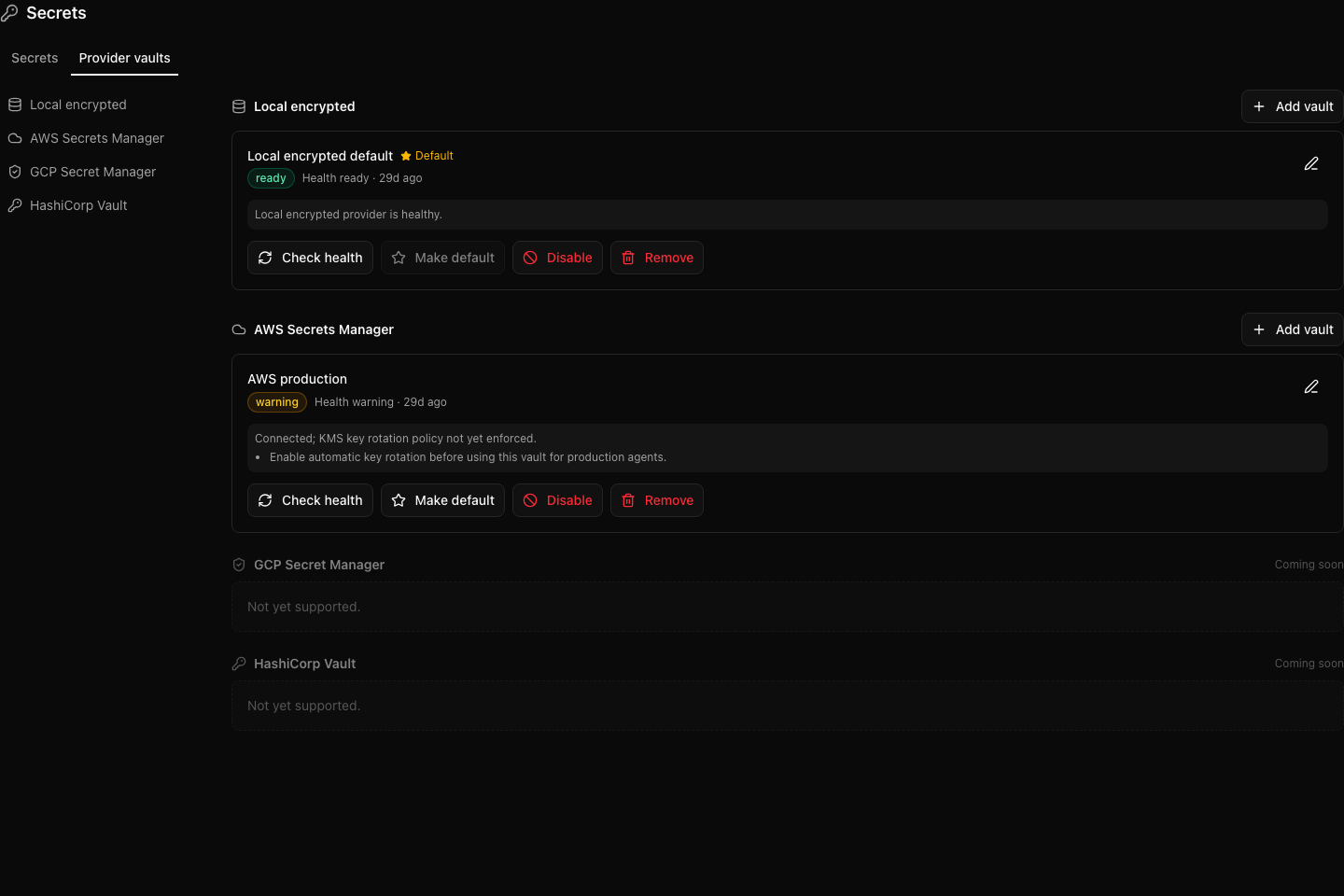 AWS discovery candidate flow: 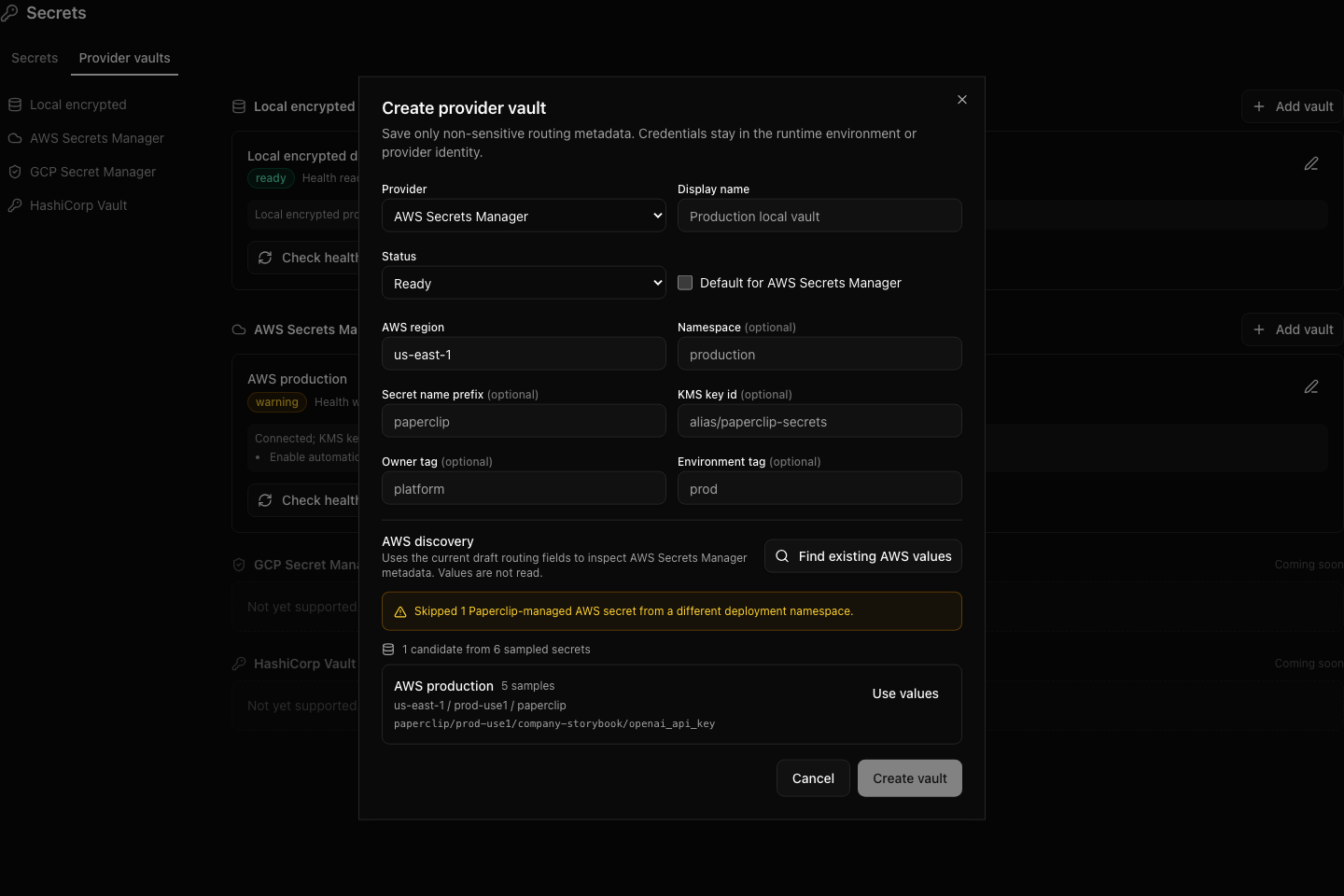 Provider vault removal confirmation: 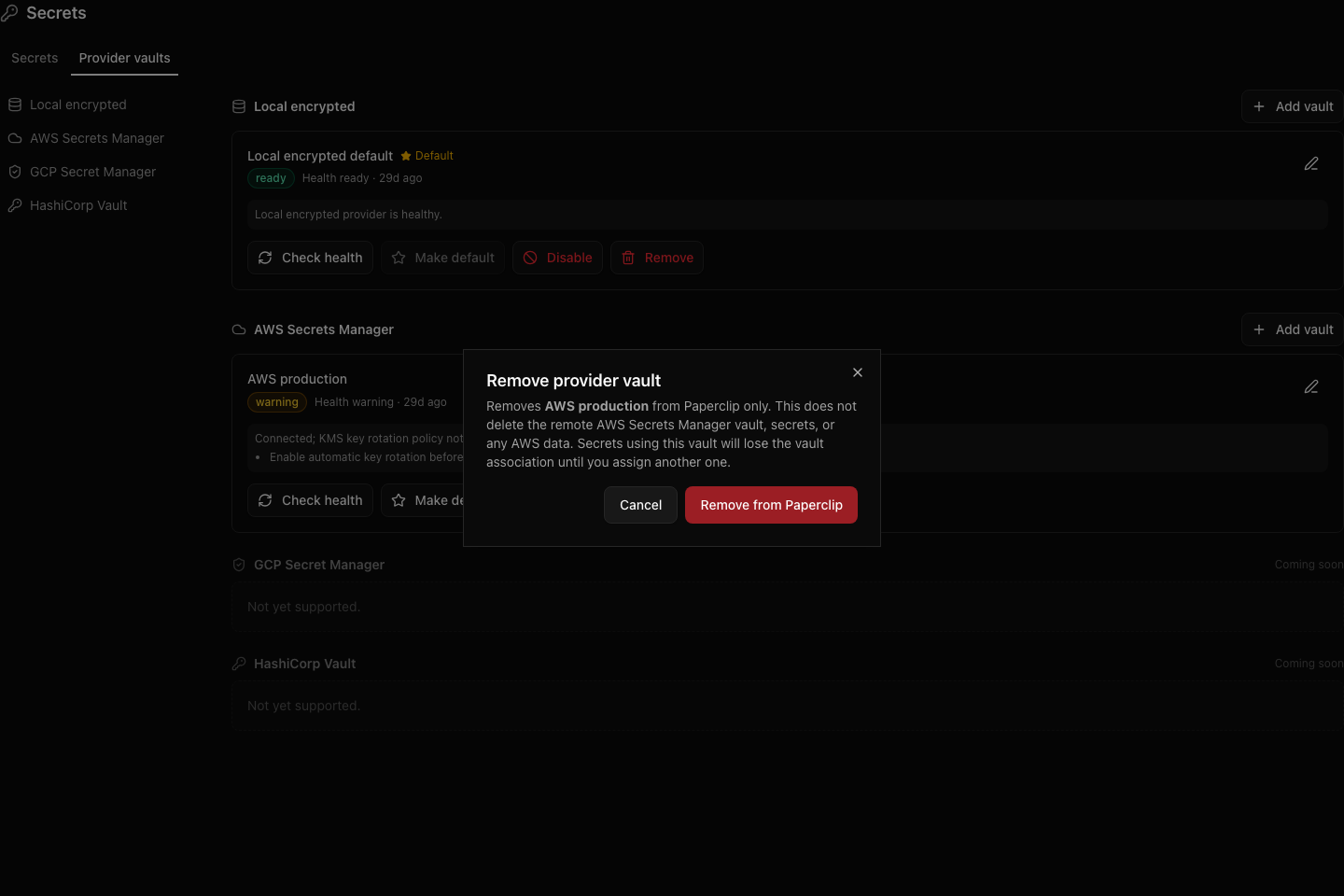 ## Risks - Secret provider metadata handling must remain non-sensitive; validators reject credential-bearing Vault URLs and sensitive AWS discovery keys. - AWS discovery depends on deployment credentials being configured correctly outside Paperclip-managed company secrets. > For core feature work, check [`ROADMAP.md`](ROADMAP.md) first and discuss it in `#dev` before opening the PR. Feature PRs that overlap with planned core work may need to be redirected — check the roadmap first. See `CONTRIBUTING.md`. ## Model Used - OpenAI Codex, GPT-5-based coding agent with local shell/git/tool use. Exact hosted model ID and context-window size are not exposed by the local Paperclip adapter runtime. ## Checklist - [x] I have included a thinking path that traces from project context to this change - [x] I have specified the model used (with version and capability details) - [x] I have checked ROADMAP.md and confirmed this PR does not duplicate planned core work - [x] I have run tests locally and they pass - [x] I have added or updated tests where applicable - [x] If this change affects the UI, I have included before/after screenshots - [x] I have updated relevant documentation to reflect my changes - [x] I have considered and documented any risks above - [x] I will address all Greptile and reviewer comments before requesting merge --------- Co-authored-by: Paperclip <noreply@paperclip.ing> |
||
|
DottaandPaperclip
|
705c1b8d81 |
[codex] Add routine env secrets support (#6212)
## Thinking Path > - Paperclip orchestrates AI agents for zero-human companies. > - Scheduled routines are the control-plane path for recurring agent work. > - Routines already had dispatch/history, but their runtime environment did not carry routine-owned secret bindings through execution. > - Operators need routine-specific secrets that can override project/agent env without exposing secret values in history, logs, or access events. > - This pull request adds the routine env runtime contract, wires it into execution, and makes the routine UI/history surfaces show safe secret metadata. > - The benefit is that routine executions can use scoped secret refs predictably while preserving company boundaries and auditability. ## What Changed - Added routine env persistence/runtime support, including `routines.env`, `routine_runs.routine_revision_id`, revision snapshots, and idempotent migration `0086_routine_env_runtime_contract`. - Resolved routine env during heartbeat adapter config assembly with precedence `agent < project < routine` and secret access events recorded against the routine consumer. - Added secret binding synchronization for routine create/update/restore flows and guarded cross-company, missing, disabled, and deleted secret cases. - Added a Secrets tab to routine detail, env/secret history diff rendering, and Storybook coverage for the new UI states. - Added server/UI regression tests, including an embedded-Postgres QA path for routine secret execution and restore behavior. - Updated implementation/database docs for routine env and secret-binding behavior. ## Verification - `pnpm install --frozen-lockfile` after rebasing onto `public-gh/master` to refresh workspace links for the newly-added upstream Grok adapter package. - `pnpm exec vitest run server/src/__tests__/heartbeat-project-env.test.ts server/src/__tests__/routines-service.test.ts server/src/__tests__/secrets-service.test.ts server/src/__tests__/qa-routine-secrets-e2e.test.ts ui/src/components/RoutineHistoryTab.test.tsx` passed: 5 files, 92 tests. - `pnpm -r typecheck` passed across the workspace. - `pnpm build` passed. Vite emitted the existing large-chunk/dynamic-import warnings. - UI screenshots were captured locally during QA in `artifacts/pap-9521/` and `artifacts/pap-9522/`; generated screenshots are not committed to avoid adding binary artifacts to the repo. ## Risks - Migration risk is limited by `IF NOT EXISTS` guards for the new columns, FK, and index, and the migration is ordered as `0086` immediately after upstream `0085`. - Runtime behavior changes env precedence for routine executions by adding routine env as the highest-precedence layer; tests cover agent/project/routine precedence. - Secret handling is security-sensitive; tests cover value-free manifests/events/errors, disabled/missing/deleted secrets, and cross-company rejection. - UI history now renders routine env/secret diffs; tests and Storybook stories cover the main rendering paths. > For core feature work, check [`ROADMAP.md`](ROADMAP.md) first and discuss it in `#dev` before opening the PR. Feature PRs that overlap with planned core work may need to be redirected — check the roadmap first. See `CONTRIBUTING.md`. ## Model Used - OpenAI Codex coding agent based on GPT-5, with shell/tool use and medium reasoning effort. ## Checklist - [x] I have included a thinking path that traces from project context to this change - [x] I have specified the model used (with version and capability details) - [x] I have checked ROADMAP.md and confirmed this PR does not duplicate planned core work - [x] I have run tests locally and they pass - [x] I have added or updated tests where applicable - [x] If this change affects the UI, I have included before/after screenshots - [x] I have updated relevant documentation to reflect my changes - [x] I have considered and documented any risks above - [x] I will address all Greptile and reviewer comments before requesting merge --------- Co-authored-by: Paperclip <noreply@paperclip.ing> |
||
|
|
778e775c35 |
Add secrets provider vaults and remote import (#5429)
## Thinking Path > - Paperclip orchestrates AI-agent companies and needs secrets handling to work across local development, hosted operators, and governed agent execution. > - The affected subsystem is the company-scoped secrets control plane: database schema, server services/routes, CLI workflows, and the Secrets settings UI. > - The gap was that secrets were local-only and operators could not manage provider vaults or import existing remote references without exposing plaintext. > - This branch adds provider vault configuration plus an AWS Secrets Manager remote-import path while preserving company boundaries, binding context, and audit trails. > - I kept the PR to a single branch PR, removed unrelated lockfile/package drift, rebased the full branch onto the current `public-gh/master`, and addressed fresh Greptile findings. > - The benefit is a reviewable implementation of provider-backed secrets with focused tests covering provider selection, import conflicts, deleted secret reuse, rotation guards, and AWS signing behavior. ## What Changed - Added provider vault support for company secrets, including provider config storage, default vault handling, health checks, binding usage, access events, and remote import preview/commit. - Added an AWS Secrets Manager provider using SigV4 request signing, bounded request timeouts, namespace guardrails, cached runtime credential resolution, and external-reference linking without plaintext reads. - Added Secrets UI surfaces for vault management and remote import, plus CLI/API documentation for setup and operations. - Stabilized routine webhook secret binding paths and SSH environment-driver fixture bindings discovered during verification. - Addressed Greptile and CI findings: no lockfile/package drift, monotonic migration metadata, disabled-vault default races, soft-deleted secret hiding/recreate behavior, remove behavior with disabled vaults, soft-deleted external-reference re-import, non-active rotation guards, managed-secret soft deletion through PATCH, and per-call AWS SDK credential client churn. - Rebased this branch onto `public-gh/master` at `0e1a5828` and force-pushed with lease to keep this as the single PR for the branch. ## Verification - `git fetch public-gh master` - `git rebase public-gh/master` - `git diff --name-only public-gh/master...HEAD | grep '^pnpm-lock\.yaml$' || true` confirmed `pnpm-lock.yaml` is not in the PR diff. - Confirmed migration ordering: master ends at `0081_optimal_dormammu`; this PR adds `0082_dry_vision` and `0083_company_secret_provider_configs`. - Inspected migrations for repeat safety: new tables/indexes use `IF NOT EXISTS`; foreign keys are guarded by `DO $$ ... IF NOT EXISTS`; column additions use `ADD COLUMN IF NOT EXISTS`. - `pnpm -r typecheck` passed before the Greptile follow-up commits. - `pnpm test:run` ran the full stable Vitest path before the Greptile follow-up commits; it completed with 3 timing-related failures under parallel load: `codex-local-execute.test.ts`, `cursor-local-execute.test.ts`, and `environment-service.test.ts`. - `pnpm --filter @paperclipai/server exec vitest run src/__tests__/codex-local-execute.test.ts src/__tests__/cursor-local-execute.test.ts src/__tests__/environment-service.test.ts` passed on targeted rerun (`24/24`). - `pnpm build` passed before the Greptile follow-up commits. Vite reported existing chunk-size/dynamic-import warnings. - After Greptile follow-up commits: `pnpm --filter @paperclipai/server exec vitest run src/__tests__/secrets-service.test.ts` passed (`26/26`). - After Greptile follow-up commits: `pnpm --filter @paperclipai/server exec vitest run src/__tests__/aws-secrets-manager-provider.test.ts src/__tests__/secrets-service.test.ts` passed (`39/39`). - After Greptile follow-up commits: `pnpm --filter @paperclipai/server typecheck` passed. - Captured Storybook screenshots from `ui/storybook-static` for visual review. - Latest PR checks on `5ca3a5cf`: `policy`, serialized server suites 1/4-4/4, `Canary Dry Run`, `e2e`, `security/snyk`, and `Greptile Review` pass; aggregate `verify` is still registering the completed child checks. - Greptile review loop continued through the latest requested pass; all Greptile review threads are resolved and the latest `Greptile Review` check on `5ca3a5cf` passed with 0 comments added. ## Screenshots Before: the provider-vault and remote-import surfaces did not exist on `master`; these are after-state screenshots from the Storybook fixtures. 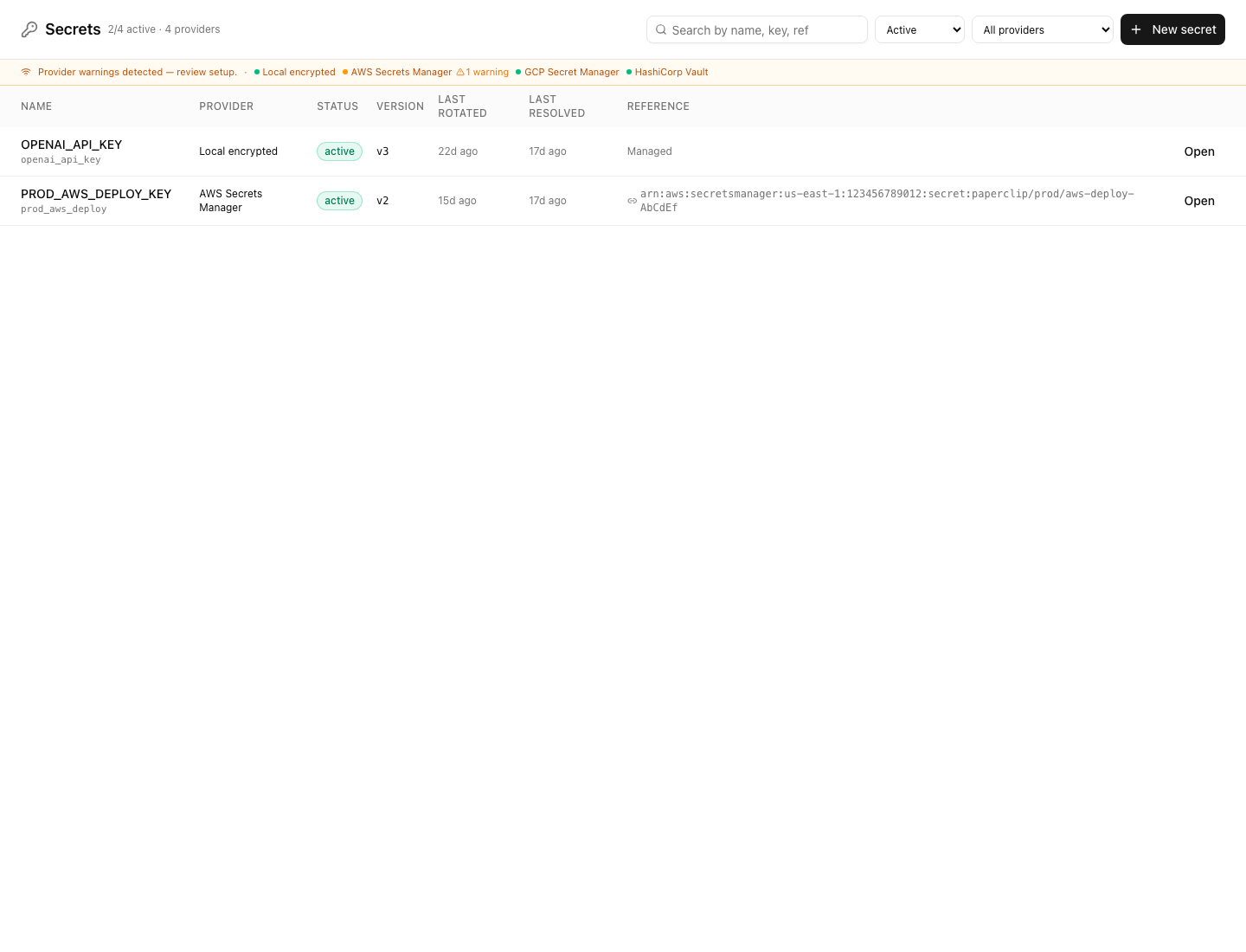 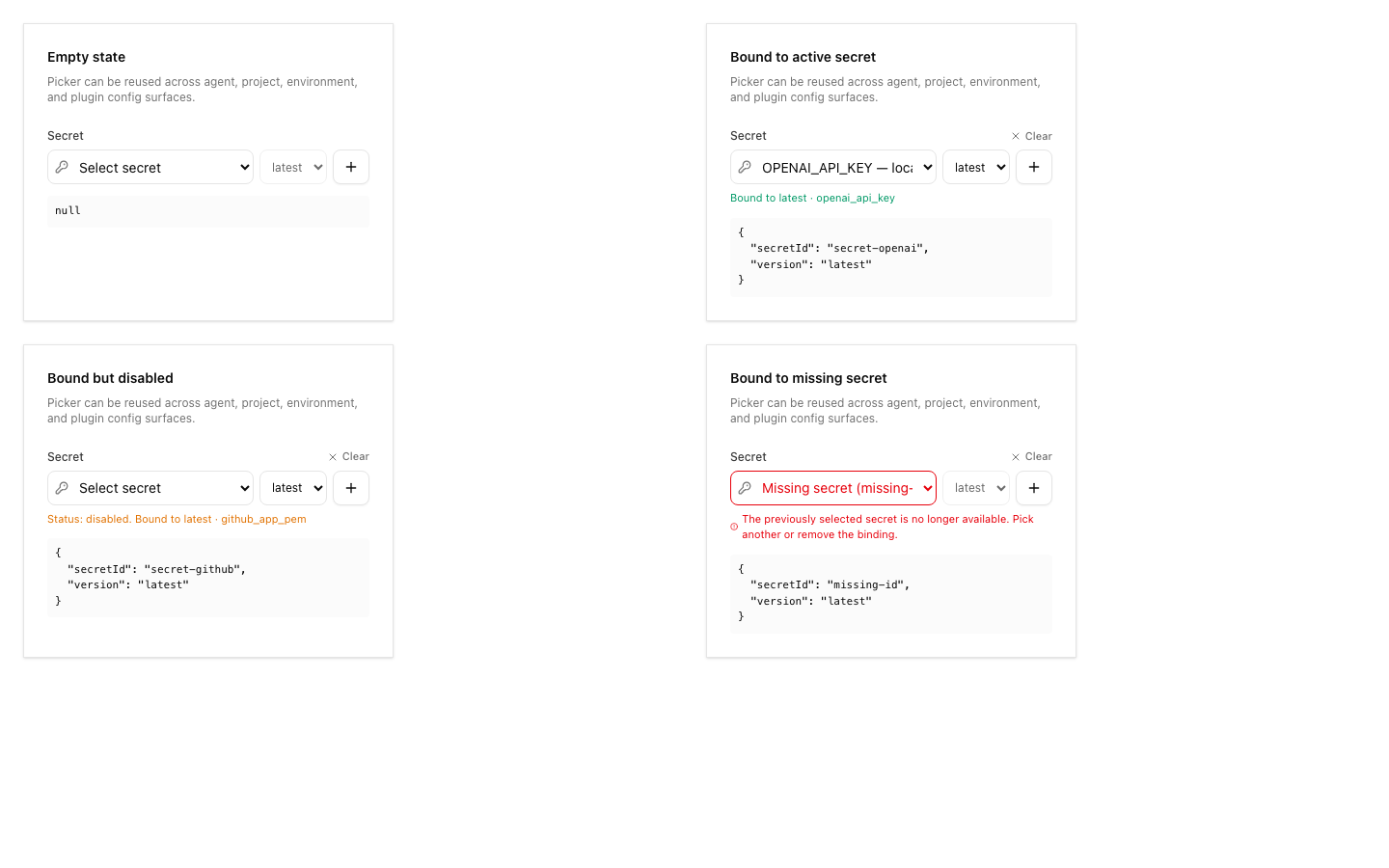 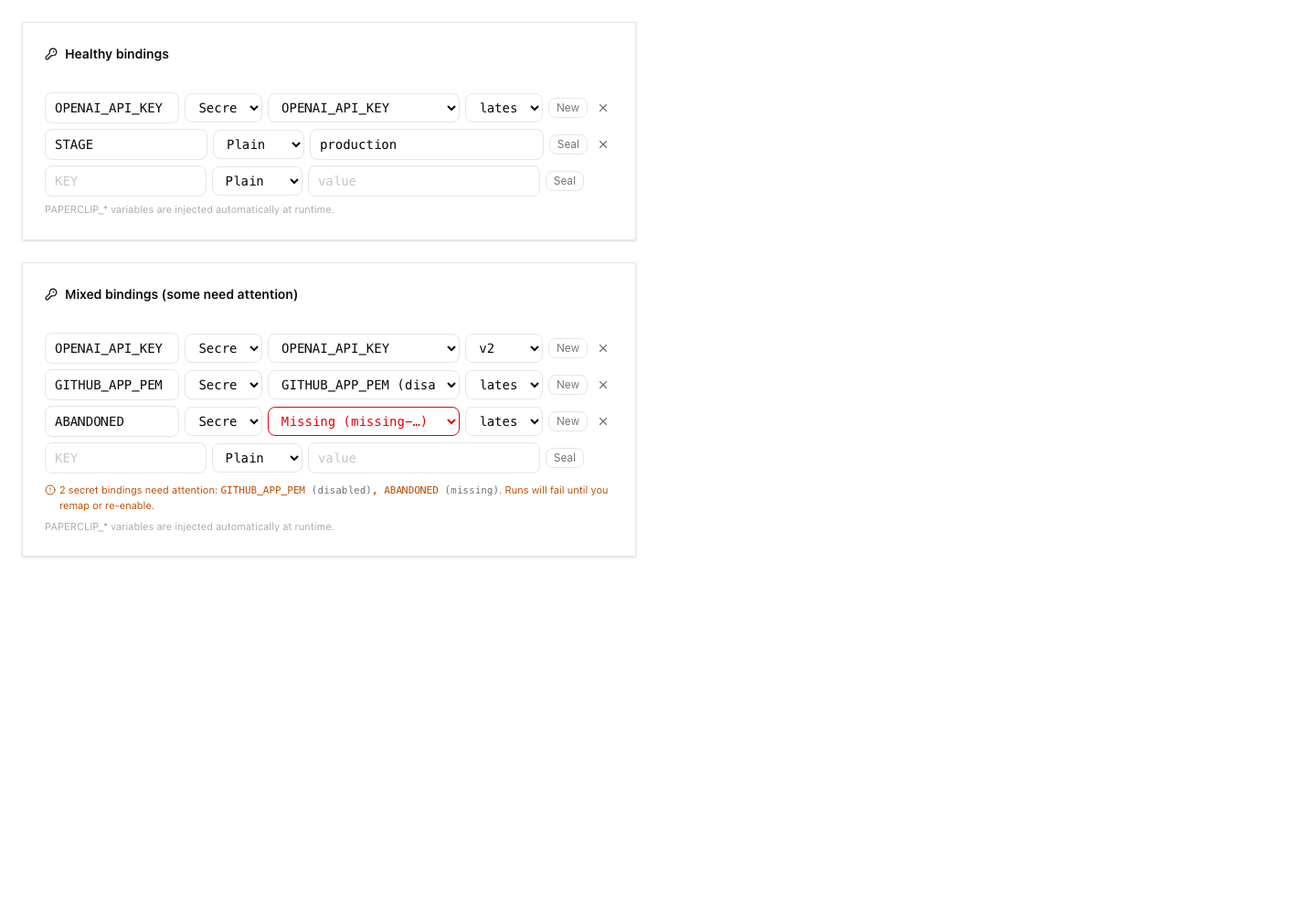 ## Risks - Migration risk: this adds new secret provider tables and extends existing secret rows. The migrations were checked for monotonic ordering and idempotent guards, but reviewers should still inspect upgrade behavior carefully. - Provider risk: AWS support uses direct SigV4 requests. Automated tests cover signing, request timeouts, vault-config selection, namespace guardrails, pending-version archival, sanitized provider errors, and service-level cleanup paths. A real-vault AWS smoke test remains deployment validation for an operator with AWS credentials rather than an unverified merge blocker in this local branch. - UI risk: the Secrets page and import dialog are large new surfaces; screenshots are included above for reviewer inspection. - Verification risk: the full local stable test command hit parallel-load timing failures, although the exact failed files passed when rerun directly. - Operational risk: remote import intentionally avoids plaintext reads; operators must understand that imported external references resolve at runtime and may fail if AWS permissions change. > For core feature work, check [`ROADMAP.md`](ROADMAP.md) first and discuss it in `#dev` before opening the PR. Feature PRs that overlap with planned core work may need to be redirected — check the roadmap first. See `CONTRIBUTING.md`. ## Model Used - OpenAI Codex, GPT-5 coding agent with local shell/tool use in the Paperclip worktree. Exact context-window size was not exposed by the runtime. ## Checklist - [x] I have included a thinking path that traces from project context to this change - [x] I have specified the model used (with version and capability details) - [x] I have checked ROADMAP.md and confirmed this PR does not duplicate planned core work - [ ] I have run tests locally and they pass - [x] I have added or updated tests where applicable - [x] If this change affects the UI, I have included before/after screenshots - [x] I have updated relevant documentation to reflect my changes - [x] I have considered and documented any risks above - [x] I will address all Greptile and reviewer comments before requesting merge --------- Co-authored-by: Paperclip <noreply@paperclip.ing> Co-authored-by: Claude Sonnet 4.6 <noreply@anthropic.com> |





