mirror of
https://github.com/paperclipai/paperclip.git
synced 2026-10-10 20:50:08 +02:00
codex/plugin-task-execution
3
Commits
| Author | SHA1 | Message | Date | |
|---|---|---|---|---|
 DottaandPaperclip DottaandPaperclip
|
d66acb7ac1 |
feat: automate Slack bot app setup and installation (#15413)
## Thinking Path > - Paperclip is the open source app people use to manage AI agents for work. > - Chat connectors give each agent a customer-owned bot and task-backed conversations. > - Manual Slack setup requires app creation and copying durable credentials. > - Operators need a shorter setup that an assisting agent can use safely. > - This pull request creates the app through Slack's Manifest API and installs it through OAuth. > - Durable registration state supports recovery without creating another app. > - A four-screen wizard, automatic avatar upload, and OAuth account linking reduce setup work. > - Connector settings and per-turn tool guidance support daily use after installation. ## Linked Issues or Issue Description **Subsystem affected** Native Slack bot setup, company secret storage, chat connector management, and agent tool guidance. **Problem or motivation** New Slack bots require manual app creation and copying a signing secret and bot token. Interrupted setup can create duplicate apps. The setup and management screens contain unnecessary controls. Agents also need guidance for native questions, files, thread replies, and governed Slack actions. **Proposed solution** Use a temporary app-configuration access token to create a customer-owned app. Save durable secrets in the vault. Bind OAuth to the initiating actor, company, endpoint, registration revision, scopes, and configured origins. Preserve manual and existing-app recovery. Link the installing user's account, send a welcome DM, and advance from saved server evidence. Keep request-URL recovery instructions available if automatic connection detection waits. **Alternatives considered** The Slack CLI adds installation requirements. Socket Mode changes transport. A shared Paperclip-owned app changes app ownership. These alternatives are outside this change. **Roadmap alignment** This extends existing chat connectors and secrets capabilities. Related public work: #14037 and #13954 cover Slack MCP prerequisites and user OAuth. No duplicate bot-registration PR was found. ## What Changed - Share one reviewed manifest builder between automatic registration and manual setup. - Add replay-safe migration 0318 and company-bound registration state with vault references and uncertain-creation recovery. - Add registration, installation, callback, and resume APIs with short-lived, single-use OAuth state. - Save installation credentials before downstream checks and preserve bot identity constraints. - Reduce automatic setup to four screens. Keep advanced app details, manual recovery, and existing-app setup. - Upload the agent avatar with the Paperclip dark background. Link the OAuth installer's account and send setup DMs. - Show agent and connector-owner avatars. Simplify settings, access, and conversation screens. - Discover joined Slack channels and enable them by default. Start a task from a bare mention and admit same-thread follow-ups. - Refresh Slack tool guidance each turn. Add native-form, file, approval, and delivery regressions plus manual model probe definitions and sanitized acceptance records. - Update deployment/database docs, OpenAPI, redaction, removal cleanup, production Storybook stories, and provider browser tests. - Merge current master and move the registration migration after its latest migration without rewriting published commits. The completed Slack success view intentionally has a single centered **Done** action and no **Save & exit**, as explicitly requested by the product owner. `DESIGN.md` records this exception; unfinished setup steps retain the aligned wizard footer. ## Verification - Passed after the master merge: repository typecheck, full build, Storybook build, design-token gates, module-boundary gates, and migration generation. - Passed: all 352 focused Slack deterministic tests and all 14 affected provider browser tests. Browser tests use controlled provider fixtures and a separate throwaway instance. - Passed on current head `c5d01e0e2`: the complete GitHub test matrix (general server, chat, all workspaces, serialized server, and Runner), all eight browser shards, typecheck/release registry, build, canary dry run, security checks, and policy gates. There are 52 passing checks and no pending or failing checks. - Greptile completed on the exact current head with 5/5 and no actionable findings or open review threads. - Local repair verification passed 93 focused tests, including same-app reinstall after revocation and rejection of consent started before revocation, the AgentMail browser journey, and repository typecheck. Local build and Storybook build also passed. The redundant local full-suite rerun was stopped after the complete current-head CI matrix passed. - Real Slack setup and agent replies were exercised in the authorized isolated test drive during the setup iteration. - The ten additional model probes were attempted with legacy `codex_local`, `gpt-5.6-sol`: five passed, two failed, and three were partly verified. Native runtime is not qualified. See `server/src/services/connectors/slack/evals/2026-10-08-acceptance.md` for evidence and limits. - Passing model probes cover native forms, downloaded file bytes, bare mentions with thread replies, explicit posts/reactions, and saved approval denial. - The controlled uncertain-write probe found wrong delivery-check IDs. The canvas fallback attempt used an invented tool name. Search pagination/native search, a private-source denied-tool receipt, and distinct board/webhook origins remain unqualified. Reviewer path: enable Chat connectors, start Slack chat setup, select an agent, enter an app-configuration access token, and approve Slack installation. Send a message to the bot and confirm that setup advances to success. Inspect settings and allowed channels. See `doc/connections/SLACK-AUTOMATIC-SETUP.md` for deployment and recovery. ## Risks - Slack app creation has no provider idempotency guarantee. A timeout after dispatch stays uncertain until the operator checks Slack. - OAuth needs a stable public HTTPS board origin. Webhook ingress may use a separate configured HTTPS origin. Workspace policy can delay installation. - Migration 0318 can replay safely on instances that applied the earlier development migration. - OAuth installation now links the installer to the initiating Paperclip user. Identity checks and company access rules still apply. - Joined channels now enable bot responses by default. Linked-user authorization and per-action approval rules still apply. - Model behavior has the documented delivery-check and canvas fallback failures. A passing CI run does not establish that every model probe passed. - Removing the connection does not delete the customer's Slack app. No new first-party telemetry is added. ## Model Used OpenAI Codex, GPT-6 family, with reasoning, repository tools, code execution, and browser verification. The runtime does not expose a more specific authoring model ID or context-window size. The live bot probes used OpenAI `gpt-5.6-sol` through `codex_local` in legacy mode. ## Checklist - [x] I have included a thinking path that traces from project context to this change - [x] I have specified the model used (with version and capability details) - [x] I have checked ROADMAP.md and confirmed this PR does not duplicate planned core work - [x] I have searched GitHub for duplicate or related PRs and linked them above - [x] I have either (a) linked existing issues with `Fixes: #` / `Closes #` / `Refs #` OR (b) described the issue in-PR following the relevant issue template - [x] I have not referenced internal/instance-local Paperclip issues or links (only public GitHub `#NNN` / `github.com/paperclipai/paperclip` URLs) - [x] My branch name describes the change (e.g. `docs/...`, `fix/...`) and contains no internal Paperclip ticket id or instance-derived details - [x] I have run tests locally and they pass - [x] I have added or updated tests where applicable - [x] I have updated relevant documentation to reflect my changes - [x] I have considered and documented any risks above - [x] All Paperclip CI gates are green - [x] Greptile is 5/5 with no open P2s, recommendations, or follow-ups - [x] I will address all Greptile and reviewer comments before requesting merge --------- Co-authored-by: Paperclip <noreply@paperclip.ing> |
||
|
|
0be2afcca6 |
feat(ui): improve task composer controls and pending input (#14322)
## Thinking Path > - Paperclip lets operators assign tasks to AI agents and review their work. > - The task composer controls the next message and its assigned agent. > - Operators needed a way to choose that agent's model and effort without leaving the composer. > - The old mode selector, upload button, and input cards made the mobile composer crowded and hid normal messaging during a pending decision. > - Harnesses publish different model and effort capabilities, so the picker must follow the selected agent. > - This pull request adds one responsive composer flow, keeps pending cards visible above it, and protects Codex ACP authentication in the local test path. > - Operators can choose run settings, send a message, and answer a pending card as separate actions. ## Linked Issues or Issue Description **Subsystem affected** Task composer UI, issue thread interactions, Codex ACP credential handling, and Storybook. **Problem or motivation** The composer did not expose model or effort for the selected agent. Mobile actions wrapped poorly. Pending questions and confirmations replaced the composer. A local Codex ACP test could also reuse host authentication after the managed key was removed. **Proposed solution** Put assignee search, model search, exact model IDs, effort, and fast mode in one picker. Use a mobile dialog. Replace the direct-upload plus action and separate mode selector with an Add menu and removable Plan or Ask chips. Place pending interaction cards above the usable composer. Keep these cards pending after an ordinary message unless their creator asks for comment superseding. Replace managed ACP auth files atomically and isolate the test key from host credentials. **Roadmap alignment** ROADMAP.md does not list an overlapping composer milestone. This change improves the existing task and review flows. ## What Changed - Added the combined assignee, model, and effort picker to both task composers. Search matches agent name, role, and harness. The server uses a curated Codex list by default and honors instance-declared models. Manual IDs remain available. - Added an effort slider for known model capabilities, a conditional Codex fast control, and reset. The picker opens in a modal on mobile. - Added the Add menu for files, supported goals, Plan mode, and Ask mode. Plan and Ask are exclusive removable chips. Keyboard mode cycling remains available. - Adjusted mobile spacing, avatars, wrapping, and Send placement. Removed the composer divider. - Moved pending question, confirmation, review, and related cards above the composer. Ordinary comments now leave question and confirmation cards pending by default. The onboarding prompt retains explicit comment superseding. - Updated the Storybook composer group with responsive states and the production picker. Added UI, service, route, and browser regression coverage. - Isolated Codex ACP API-key authentication, skipped subscription auth merge and shared-home copy-back for remote API-key runs, and replaced the managed auth file atomically. ## Verification - `pnpm -r typecheck` — passed on the final local head. - `pnpm check:token-gates` — passed on the final local head. - `pnpm exec vitest run server/src/__tests__/adapter-models.test.ts ui/src/components/task-chat/ComposerRunSettingsPicker.test.tsx` — 31 tests passed, including role and harness search, declared Codex models, and filtering general OpenAI models. - `pnpm exec vitest run server/src/__tests__/issue-thread-interactions-service.test.ts` — 74 tests passed. - `pnpm exec vitest run packages/adapters/codex-local/src/server/acp.test.ts` — 42 tests passed, including remote API-key copy-back isolation. - `pnpm test:run` — attempted locally; the embedded PostgreSQL test database could not initialize on macOS. The isolated `heartbeat-run-event-sequencing` suite reproduced that environment failure. GitHub CI runs the full test matrix for this head. - `pnpm build` — passed on the final head. `pnpm build-storybook` passed after the last UI change; only server code, tests, and docs changed afterward. - Live local test drive — Codex ACP ran a task with a managed API key. The test agent was restored to its default ACP configuration afterward. - Review the interactive stories under the top-level Composer group with `pnpm storybook`. Check a narrow desktop width and mobile Plan, Ask, picker, and pending-question states. ## Risks - A pending card stays open when an ordinary comment changes the discussion. Its creator can set `supersedeOnUserComment: true` when a new comment should replace it. - Model and effort overrides persist on the task until reset or changed. An unlisted manual model ID may fail when the provider runs it. - Some harness catalogs do not report effort support. The picker hides effort for those models. - No database migration is required. > For core feature work, check [`ROADMAP.md`](ROADMAP.md) first and discuss it in `#dev` before opening the PR. Feature PRs that overlap with planned core work may need to be redirected — check the roadmap first. See `CONTRIBUTING.md`. ## Model Used OpenAI GPT-6 via Codex. This runtime does not expose the exact model ID or context window to the task. The model used code execution and browser tools. ## Checklist - [x] I have included a thinking path that traces from project context to this change - [x] I have specified the model used (with version and capability details) - [x] I have checked ROADMAP.md and confirmed this PR does not duplicate planned core work - [x] I have searched GitHub for duplicate or related PRs and linked them above - [x] I have either (a) linked existing issues with `Fixes: #` / `Closes #` / `Refs #` OR (b) described the issue in-PR following the relevant issue template - [x] I have not referenced internal/instance-local Paperclip issues or links (only public GitHub `#NNN` / `github.com/paperclipai/paperclip` URLs) - [x] My branch name describes the change (e.g. `docs/...`, `fix/...`) and contains no internal Paperclip ticket id or instance-derived details - [x] I have run tests locally and they pass - [x] I have added or updated tests where applicable - [x] I have updated relevant documentation to reflect my changes - [x] I have considered and documented any risks above - [ ] All Paperclip CI gates are green - [x] Greptile is 5/5 with no open P2s, recommendations, or follow-ups - [x] I will address all Greptile and reviewer comments before requesting merge --------- Co-authored-by: Paperclip <noreply@paperclip.ing> Co-authored-by: OpenAI Codex <codex@openai.com> |
||
|
|
1ef3b08714 |
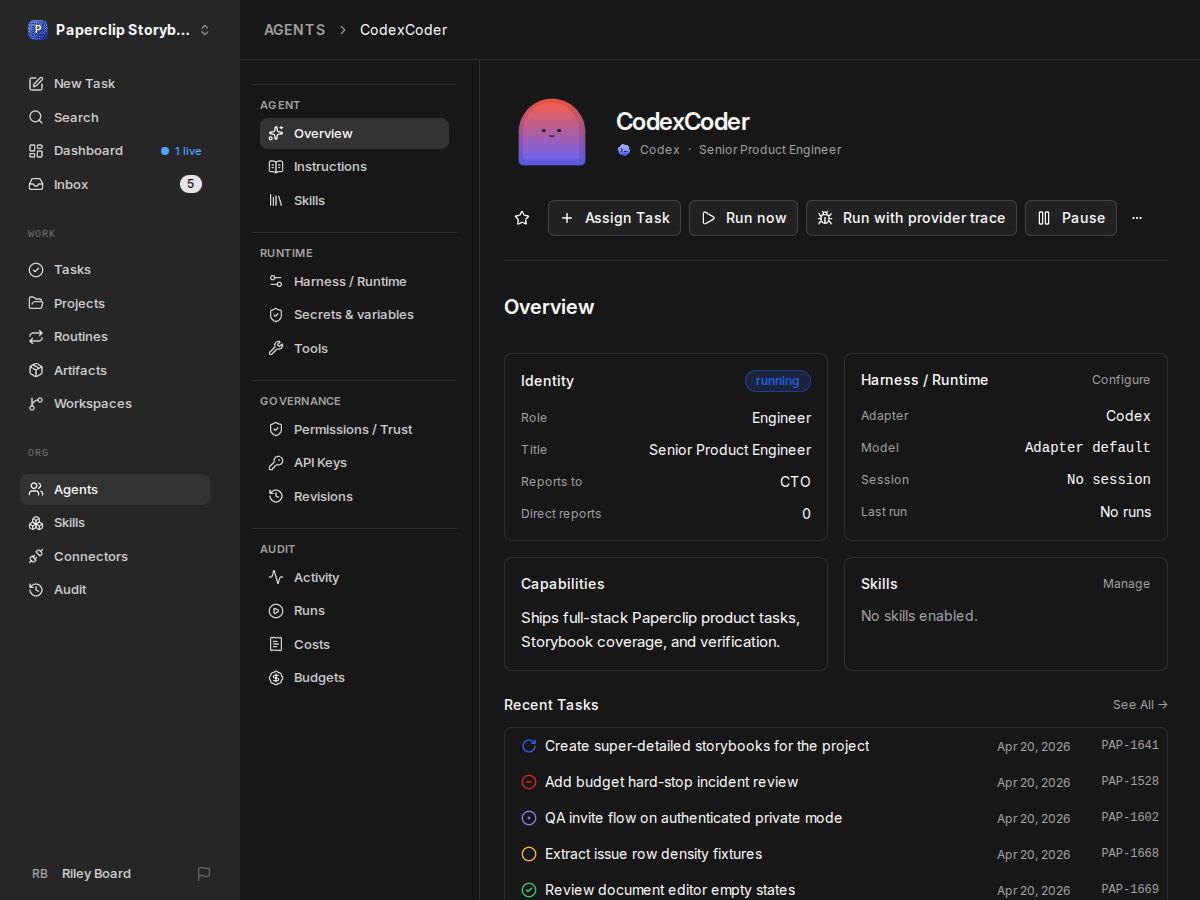
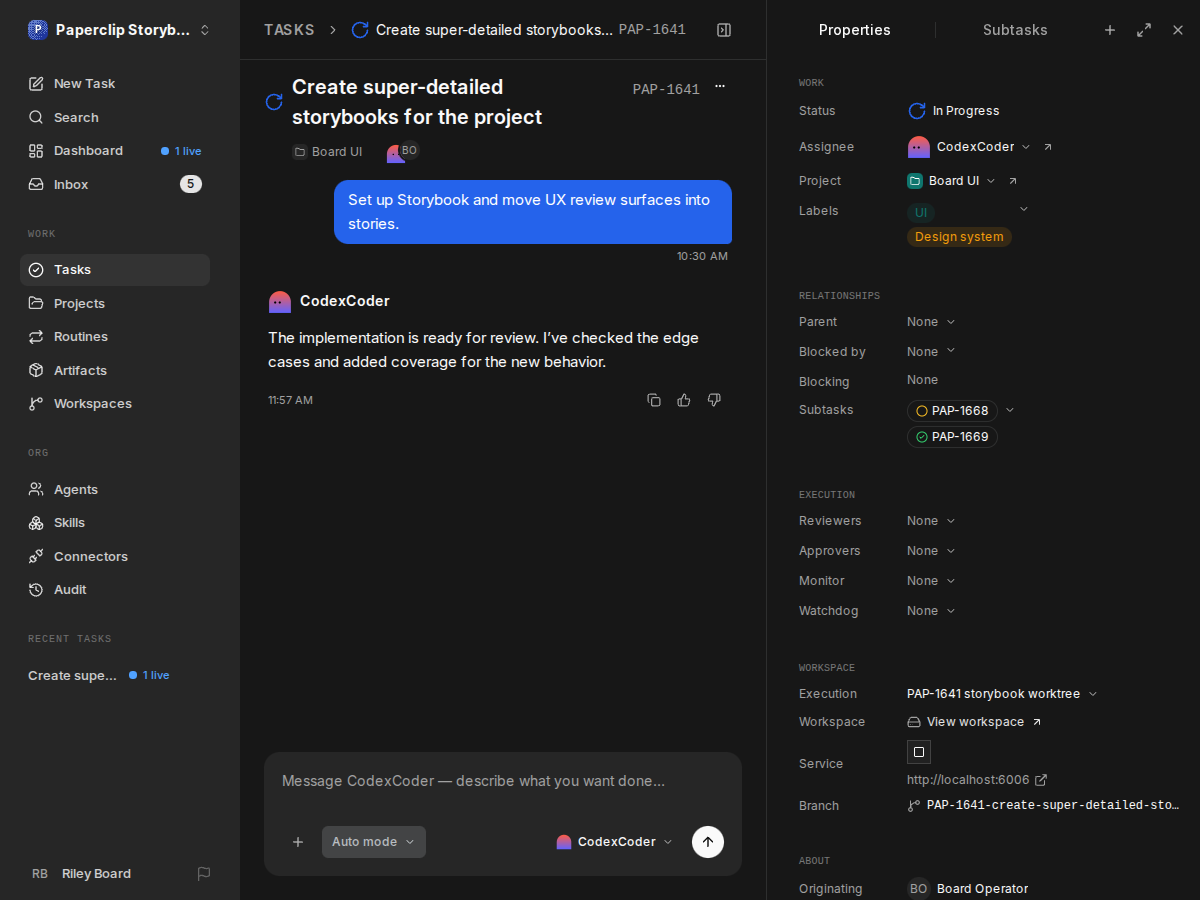
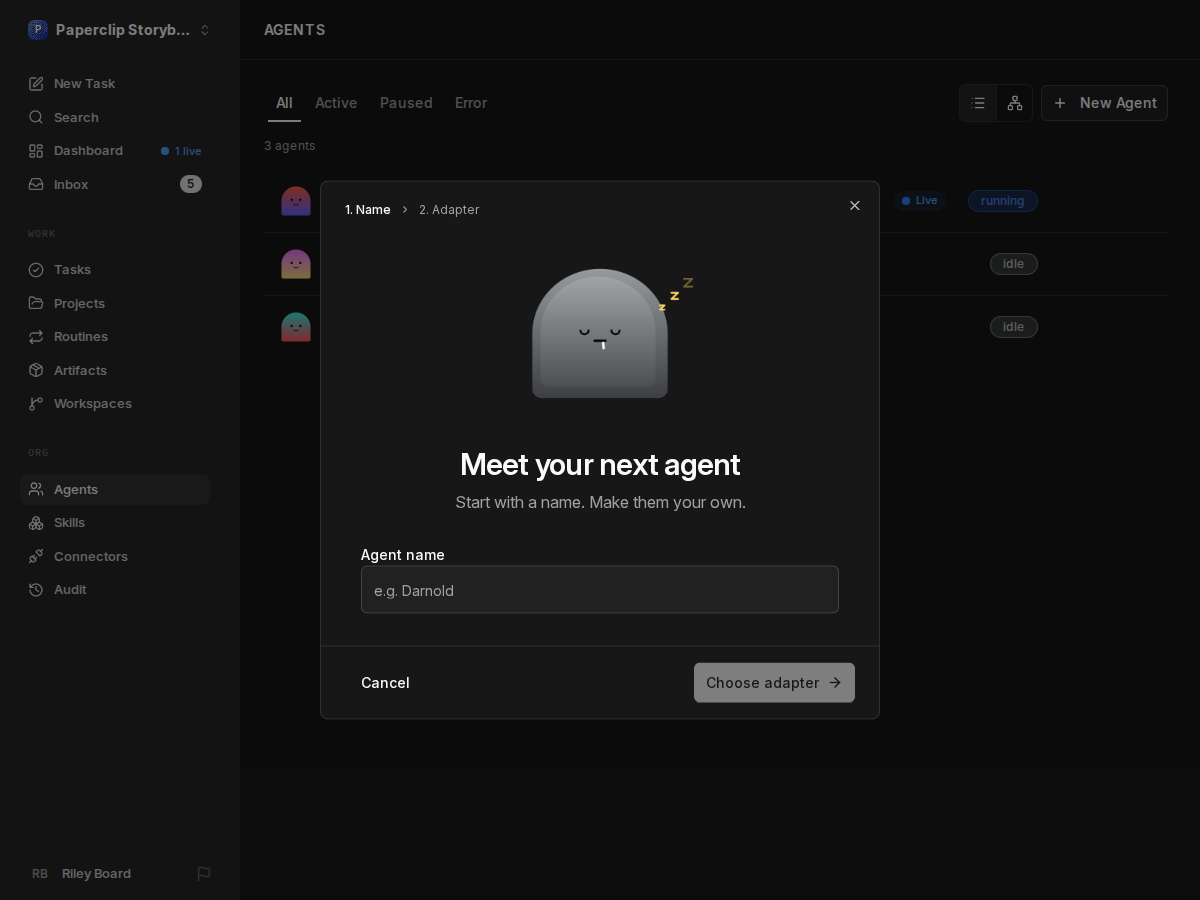
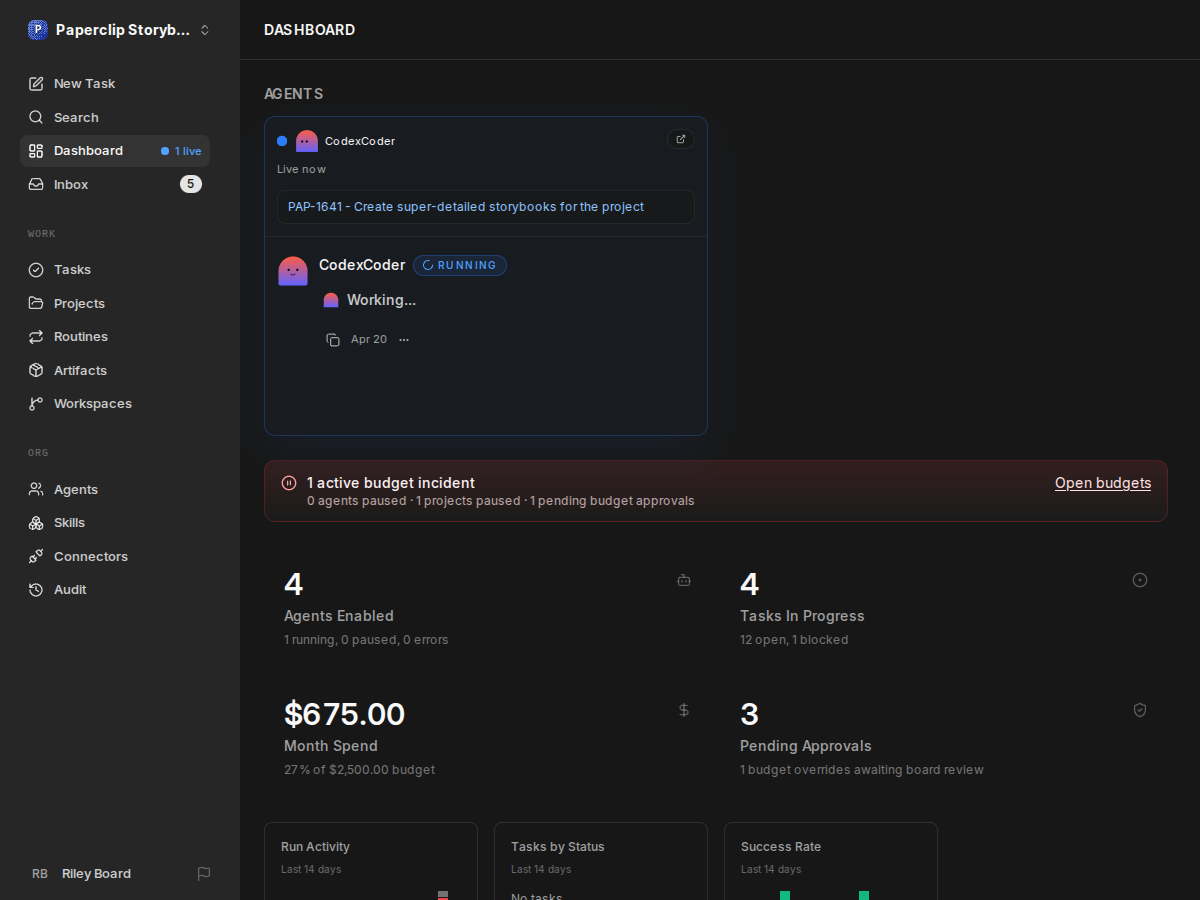
feat(ui): integrate agent personas across the app (#13171)
## Thinking Path > - Paperclip is the open source app people use to manage AI agents for work. > - A stable agent persona is useful only when the same identity appears across the app. > - Lists, task messages, selectors, and activity feeds need inexpensive static avatars. > - Onboarding and agent headers need a larger character with expressions and pointer tracking. > - This pull request connects the persona foundation to those existing views and preserves onboarding draft assignments. > - Full-page stories and Linux checks make the placements and performance contract reviewable. ## Linked Issues or Issue Description **Problem or motivation** Agents need a stable visual identity in lists, tasks, onboarding, and configuration. External tools also need an image URL for that identity. **Proposed solution** Assign each agent a permanent palette from a fixed ClipLab character library. Store the assignment on the agent. Render and cache preset PNG URLs on demand. Use static images in dense views and one animated character in larger placements. **Alternatives considered** A generated image bundle requires a separate asset build. A live renderer in every avatar adds unnecessary work in large lists. Arbitrary uploaded images do not provide the requested shared character system. **Roadmap alignment** This improves agent identity across existing control-plane views. It preserves agent permissions, company boundaries, and status labels. ROADMAP.md has no separate ClipLab persona milestone. Related approaches: #2422 adds configurable image URLs and DiceBear generation; #5578 adds optional uploaded avatars. This work uses a fixed, versioned character library and preset URLs. ## What Changed - Replace agent icons with static persona images across lists, the sidebar, org charts, tasks, comments, selectors, activity, and dashboard views. - Put one animated character in the agent header. Let it follow the pointer across the page, with reduced-motion and touch fallbacks. - Add larger padded characters to agent creation. Keep the palette stable across draft refreshes and connection retries, then reveal it after success. - Pass appearance through shared projections rather than fetching each agent separately. - Add real full-page Storybook examples for the agent list, overview, task, dashboard, new-agent dialog, and connection page. - Add Linux screenshot, clipping, density, and 500-avatar performance checks. ## Verification - `pnpm -r typecheck`, `pnpm build`, and token gates pass on the rebased tree. Persona lifecycle tests pass. - The rebased feature passes 38 Linux screenshot/performance checks, including both display densities, corner pointer positions, and the no-WebGL/no-live-download contract for 500 avatars. - The final Linux persona suite passes all 38 visual, lifecycle, density, and full-page checks using the standard Storybook configuration and real on-demand avatar endpoint. - Final local focused verification: 45 avatar/native-recovery tests pass; UI identity/routine tests, typecheck/build, token gates, and Storybook build pass. - Current-head CI passes: full workspace/server tests, all serialized server groups, typecheck/release checks, build, canary validation, and end-to-end shards. The build passed after retrying a native-runner concurrency-test failure; its three targeted cases also pass locally. - Manual inspection covered stable identities in the app, header placement, full-page mouse tracking, onboarding size, and task/dashboard placements. ### Screenshots Linux captures use synthetic Storybook fixtures. Full-page captures use reduced motion. The live character, mouse tracking, and disposal are checked separately. <details> <summary>Agent overview with the character in its header</summary> <img src="https://raw.githubusercontent.com/paperclipai/paperclip/8c68f42b268ada22b67d79d0fe1bb0a2f84ec25c/screenshots/full-page-agent-overview.png" width="900" alt="Agent overview with the character in its header" /> </details> <details> <summary>Task messages and assignee identity</summary> <img src="https://raw.githubusercontent.com/paperclipai/paperclip/8c68f42b268ada22b67d79d0fe1bb0a2f84ec25c/screenshots/full-page-task.png" width="900" alt="Task messages and assignee identity" /> </details> <details> <summary>Larger onboarding character with room for expressions</summary> <img src="https://raw.githubusercontent.com/paperclipai/paperclip/8c68f42b268ada22b67d79d0fe1bb0a2f84ec25c/screenshots/full-page-meet-your-next-agent.png" width="900" alt="Larger onboarding character with room for expressions" /> </details> <details> <summary>Dashboard agent activity</summary> <img src="https://raw.githubusercontent.com/paperclipai/paperclip/8c68f42b268ada22b67d79d0fe1bb0a2f84ec25c/screenshots/full-page-company-dashboard.png" width="900" alt="Dashboard agent activity" /> </details> ## Risks - This PR depends on #13170, the persona foundation. Merge the foundation first, then retarget this PR to master. - Many placements change from icons to character silhouettes. Human avatars and authoritative agent status labels retain their existing behavior. - Only one character can render live per view. Reduced motion, hidden/offscreen content, touch input, and renderer failures use the defined fallbacks. - The full-page stories use fixture data. They do not contact a real company or complete real provider sign-in. ## Model Used OpenAI Codex, GPT-6 family. The exact model identifier and context window are not exposed in this session. Used code editing, shell execution, browser inspection, and Linux visual testing. ## Checklist - [x] I have included a thinking path that traces from project context to this change - [x] I have specified the model used (with version and capability details) - [x] I have checked ROADMAP.md and confirmed this PR does not duplicate planned core work - [x] I have searched GitHub for duplicate or related PRs and linked them above - [x] I have either (a) linked existing issues with `Fixes: #` / `Closes #` / `Refs #` OR (b) described the issue in-PR following the relevant issue template - [x] I have not referenced internal/instance-local Paperclip issues or links (only public GitHub `#NNN` / `github.com/paperclipai/paperclip` URLs) - [x] My branch name describes the change (e.g. `docs/...`, `fix/...`) and contains no internal Paperclip ticket id or instance-derived details - [x] I have run tests locally and they pass - [x] I have added or updated tests where applicable - [x] I have updated relevant documentation to reflect my changes - [x] I have considered and documented any risks above - [x] All Paperclip CI gates are green - [x] Greptile is 5/5 with no open P2s, recommendations, or follow-ups - [x] I will address all Greptile and reviewer comments before requesting merge --------- Co-authored-by: Paperclip <noreply@paperclip.ing> Co-authored-by: Tonio <tonework@gmail.com> Co-authored-by: Claude Fable 5.1 <noreply@anthropic.com> |