mirror of
https://github.com/paperclipai/paperclip.git
synced 2026-10-06 10:48:12 +02:00
codex/native-procedure-candidate-v2
69
Commits
| Author | SHA1 | Message | Date | |
|---|---|---|---|---|
 DottaandPaperclip DottaandPaperclip
|
6eaf218924 |
chore: grant Storybook publishing access through CODEOWNERS (#14984)
## Thinking Path > - Paperclip is the open source app people use to manage AI agents for work. > - Storybook previews help contributors review the board UI. > - The publishing workflow uses the default branch CODEOWNERS file to authorize users. > - Tonio and Scott need access to this workflow. > - This pull request adds both accounts as release documentation owners. > - The existing workflow can then authorize both accounts without a separate user list in code. ## Linked Issues or Issue Description **What existing behavior does this improve?** Access to the Storybook build and publishing workflow. **Subsystem affected** Repository ownership and GitHub Actions authorization. **Current behavior** The workflow reads individual accounts from every CODEOWNERS rule on the default branch. Neither `tonio-alucema` nor `scotttong` is in that file. Both accounts already have repository admin access, but the workflow authorization check denies them. **Proposed behavior** Add both accounts to the `doc/RELEASING.md` ownership rule. After merge, both can start and rerun Storybook publishing workflows. A configured `storybook-deploy` environment reviewer must still approve deployment. CODEOWNERS membership does not add an account to the environment reviewer settings. **Reason and benefit** Contributors can publish UI previews through the same CODEOWNERS policy as other maintainers. The authorization code has no account-specific exceptions. **Breaking changes** None. The existing authorization and deployment approval checks remain in place. **Additional context** Related changes: #13226 added the publishing workflow. #13231 added stable branch bookmarks. A search found no open PR for these permission changes. ## What Changed - Add `@tonio-alucema` and `@scotttong` only to the release documentation ownership rule. - Test that accounts listed for release documentation can start and rerun publishing workflows. - Test that removing an account from CODEOWNERS removes its publishing access. - Explain how CODEOWNERS entries and environment reviewers affect publishing access. ## Verification - `node --test scripts/__tests__/storybook-deploy.test.mjs`: all 25 tests pass. - `actionlint .github/workflows/storybook-deploy.yml .github/workflows/storybook-visual.yml`: passes. - `git diff --check`: passes. - GitHub API checks confirm that both accounts have repository admin access. The deployment environment requires an existing reviewer and disables administrator bypass. - Repository-wide typecheck, tests, and build were attempted. They cannot complete in this worktree because workspace dependencies are not installed. Typecheck cannot find Node type definitions. Tests and build cannot load the workspace `tsx` package. - After merge, run `Storybook Deploy` from `master`, select a source branch, obtain environment approval, and check the published URLs in the run summary. ## Risks Both accounts gain permission to start and rerun Storybook publishing. Deployment still needs approval from a configured environment reviewer. No AWS permissions or live GitHub settings change in this PR. ## Model Used OpenAI GPT-6 through Codex. The exact backend model ID and context window are not exposed in this session. The agent used reasoning, repository inspection, code editing, shell execution, and GitHub API tools. ## Checklist - [x] I have included a thinking path that traces from project context to this change - [x] I have specified the model used (with version and capability details) - [x] I have checked ROADMAP.md and confirmed this PR does not duplicate planned core work - [x] I have searched GitHub for duplicate or related PRs and linked them above - [x] I have either (a) linked existing issues with `Fixes: #` / `Closes #` / `Refs #` OR (b) described the issue in-PR following the relevant issue template - [x] I have not referenced internal/instance-local Paperclip issues or links (only public GitHub `#NNN` / `github.com/paperclipai/paperclip` URLs) - [x] My branch name describes the change (e.g. `docs/...`, `fix/...`) and contains no internal Paperclip ticket id or instance-derived details - [x] I have run tests locally and they pass - [x] I have added or updated tests where applicable - [x] I have updated relevant documentation to reflect my changes - [x] I have considered and documented any risks above - [ ] All Paperclip CI gates are green - [ ] Greptile is 5/5 with no open P2s, recommendations, or follow-ups - [x] I will address all Greptile and reviewer comments before requesting merge Co-authored-by: Paperclip <noreply@paperclip.ing> |
||
|
Devin FoleyandPaperclip
|
6f2ce27ca7 |
fix(workspaces): prepare checkouts without a local seed config (#14810)
## Thinking Path > - Paperclip is the open source app people use to manage AI agents for work. > - Task preparation can create an isolated Git worktree and run its setup script. > - The Paperclip repository setup script also prepares a seeded development instance. > - A server configured through environment variables can have no local seed config. > - This stops ordinary task preparation before the agent starts. > - This pull request prepares checkout dependencies when no seed source exists, while preserving errors for invalid sources and existing development instances. > - Tasks can start without creating or claiming a seeded development runtime. ## Linked Issues or Issue Description **What happened?** A task with the Paperclip repository fails during setup when the host has no repository-local or default instance config. The automatic worktree provisioner requires a seed source even when the task only needs the checkout. **Expected behavior** A plain checkout should prepare its dependencies without a local development database. A missing custom source, invalid source path, or existing development instance with a missing source should still fail. Starting a seeded runtime must still require a valid source. **Steps to reproduce** 1. Run an environment-configured Paperclip server without a local instance config. 2. Add the Paperclip repository to a project. 3. Start a task that uses an isolated Git worktree without a custom provision command. 4. Observe the setup error before agent execution. **Paperclip version or commit** Reproduced against `0d3e7bf6ac` with a real script subprocess and workspace realization regression. **Deployment mode** Environment-configured server with external PostgreSQL. **Additional context** Searched open and closed GitHub PRs and issues. Related work: Refs #14795 (seed-source diagnostics) and Refs #11733 (source validation). This change keeps source validation and seed-readiness checks in place. ## What Changed - Permit dependency setup when the default seed config is absent (including the Docker image config path) and the worktree has no development-instance state. - Keep missing custom configs, invalid paths, and lost sources for existing instances as errors. - Create no config, environment file, or seed manifest for a plain checkout. - Keep dependency install failures visible and allow normal instance setup once a source becomes available. - Cover the setup script, seed-runtime refusal, and automatic server worktree realization. - Document the difference between checkout preparation and seeded-runtime readiness. ## Verification - Regression tests failed before the fix for absent-source checkout preparation and dependency setup. - `bash -n scripts/provision-worktree.sh` - `node --test scripts/__tests__/provision-worktree-self-heal.test.mjs` — 34 passed; 1 existing flock-dependent test skipped on macOS. - Server regression — 2 passed, covering an unset config and the Docker image default path. - `pnpm build` — passed. - `pnpm -r typecheck` — passed. - All CI checks passed, including the full test shards, build, typecheck, browser tests, and canary dry run. - The first local `pnpm test:run` encountered two chat-test failures because skill discovery selected an unrelated parent directory. Both tests pass at the PR commit in a clean temporary checkout. The full local run was not completed; the redundant clean run was stopped after the complete CI suite passed. - `git diff --check` and added-line secrets/PII scan passed. - Greptile: 5/5, no comments. The branch has no merge conflicts. - No live tenant deployment or task retry was performed. ## Risks - A new checkout with no implicit seed config now completes dependency setup. It has no seeded development instance. A runtime request still fails until a valid source exists. - Existing instances and custom source paths retain their failure behavior. The script does not synthesize a source from environment credentials or copy a live database. - No schema, API, or task-setting changes. Revert the commit to restore the previous setup behavior. ## Model Used OpenAI Codex (GPT-6), with tool-assisted analysis, code edits, and local tests. The runtime did not expose a verified model variant or context-window size. ## Checklist - [x] I have included a thinking path that traces from project context to this change - [x] I have specified the model used (with version and capability details) - [x] I have checked ROADMAP.md and confirmed this PR does not duplicate planned core work - [x] I have searched GitHub for duplicate or related PRs and linked them above - [x] I have either (a) linked existing issues with `Fixes: #` / `Closes #` / `Refs #` OR (b) described the issue in-PR following the relevant issue template - [x] I have not referenced internal/instance-local Paperclip issues or links (only public GitHub `#NNN` / `github.com/paperclipai/paperclip` URLs) - [x] My branch name describes the change (e.g. `docs/...`, `fix/...`) and contains no internal Paperclip ticket id or instance-derived details - [x] I have run tests locally and they pass - [x] I have added or updated tests where applicable - [x] I have updated relevant documentation to reflect my changes - [x] I have considered and documented any risks above - [x] All Paperclip CI gates are green - [x] Greptile is 5/5 with no open P2s, recommendations, or follow-ups - [x] I will address all Greptile and reviewer comments before requesting merge Co-authored-by: Paperclip <noreply@paperclip.ing> |
||
|
Devin FoleyandPaperclip
|
0dc8d80eea |
Clarify worktree seed source setup failures (#14795)
## Thinking Path > - Paperclip is the open source app people use to manage AI agents for work. > - Managed worktrees can prepare an isolated Paperclip development instance. > - The built-in provisioner requires a canonical registered seed source config. > - A missing source currently has the same message as a rejected symlink or non-regular file. > - This pull request separates those messages and names the supported setup choices. > - Operators can choose the intended setup without changing the source-validation guards. ## Linked Issues or Issue Description **What happened?** A plain repository checkout can select the control-plane instance as its seed source. If that instance runs with environment-only configuration, the source config file can be unavailable. The provisioner stops with a message that also covers noncanonical files and gives no repair guidance. **Expected behavior** The error should identify the selected source and distinguish an unavailable prerequisite from a rejected file. It should explain that a seeded development instance needs a canonical registered source. It should describe the explicit no-op only for a checkout-only worktree. **Steps to reproduce** 1. Use a plain base checkout with no repository-local config. 2. Leave the control-plane instance config file absent. 3. Run the built-in worktree provisioner against an isolated checkout. **Paperclip version or commit** Base commit `c8f874311c`. **Deployment mode** Managed local worktrees, including servers configured only through environment variables. Related: #11733 adds deeper source-readiness checks. #11735 changes runtime and seed lifecycle handling. This change only improves the existing shell guard's diagnostics. ## What Changed - Distinguish unavailable source configs from symlinks and non-regular files. - Identify whether the selected source belongs to the base workspace or control-plane instance. - Explain seeded-instance prerequisites and the explicit checkout-only setup choice. - Verify failure still precedes target-state creation and CLI invocation. - Document the setup choice and its runtime-readiness limit. ## Verification - `node --test scripts/__tests__/provision-worktree-self-heal.test.mjs`: 21 passed; one platform-gated test skipped because macOS lacks `flock`. - `bash -n scripts/provision-worktree.sh` and `git diff --check`: passed. - `pnpm -r typecheck`: passed. - `pnpm exec vitest run server/src/__tests__/ai-connections.test.ts`: 50 passed after running the installed PostgreSQL package's own symlink hydration script in this worktree. - `pnpm test:run`: attempted, then stopped after unrelated database suites failed at startup. The offline install had omitted PostgreSQL native library symlinks. The focused database rerun above verifies the local repair; the complete suite is delegated to CI. - `pnpm build`: passed. - [Required PR CI](https://github.com/paperclipai/paperclip/actions/runs/36797650741) passed on `0a3ba63e12`: 50 successful checks and two intentional Storybook skips. Greptile scored that exact commit 5/5; there are zero unresolved review threads and no merge conflicts. ## Risks - Diagnostics only. This does not supply a source config or repair an existing blocked task. - The failure predicates and exit status stay unchanged. Symlink and non-regular-file errors do not recommend skipping setup. - The checkout-only no-op requires an explicit policy choice. It does not grant runtime or seed readiness. - No schema, migration, tenant policy, deployment, or Sentry reporting change. ## Model Used OpenAI GPT-6-based Codex, with reasoning, shell tools, and code execution. The exact serving model ID and context-window size are not exposed by this session. ## Checklist - [x] I have included a thinking path that traces from project context to this change - [x] I have specified the model used (with version and capability details) - [x] I have checked ROADMAP.md and confirmed this PR does not duplicate planned core work - [x] I have searched GitHub for duplicate or related PRs and linked them above - [x] I have either (a) linked existing issues with `Fixes: #` / `Closes #` / `Refs #` OR (b) described the issue in-PR following the relevant issue template - [x] I have not referenced internal/instance-local Paperclip issues or links (only public GitHub `#NNN` / `github.com/paperclipai/paperclip` URLs) - [x] My branch name describes the change (e.g. `docs/...`, `fix/...`) and contains no internal Paperclip ticket id or instance-derived details - [x] I have run tests locally and they pass - [x] I have added or updated tests where applicable - [x] I have updated relevant documentation to reflect my changes - [x] I have considered and documented any risks above - [x] All Paperclip CI gates are green - [x] Greptile is 5/5 with no open P2s, recommendations, or follow-ups - [x] I will address all Greptile and reviewer comments before requesting merge Co-authored-by: Paperclip <noreply@paperclip.ing> |
||
|
DottaandPaperclip
|
18e8c121d9 |
fix(runner): include Grok support in public installs with sandbox prerequisites (#14024)
## Thinking Path > - Paperclip manages agents through a shared native runner. > - Built-in harness support should ship with Paperclip's public distribution. > - Grok already speaks ACP; it does not require a new public bridge package. > - Sandbox provisioning owns the native executable and its pinned version. > - The runner must verify that prerequisite without downloading it during npm installation. > - This change separates built-in launcher identity from external runtime identity. > - Clean npm installation and live staging checks verify the distribution boundary. ## Linked Issues or Issue Description Refs #13882, #13973, #13977, #13979. This follow-up now targets master after #13882 was squash-merged. It replaces the private `@paperclipai/grok-acp` workspace package with runner-owned assets. Current master is included so the branch also contains the merged scheduler, complete-event capture, and durable cleanup fixes. ## What Changed - Ship Grok launcher and qualification metadata inside the runner's compiled output and the public server's vendored runner tree. - Remove the separate Grok npm package and all package-manager install hooks for this runtime. - Require the checksum-verified Grok Build 1.0.13 binary at `/opt/paperclip/providers/grok/1.0.13/grok` in the selected execution environment. Provision it explicitly in the Daytona image and CI setup. - Keep native binaries outside the provider pack. Bind the built-in launcher into the pack manifest. - Preserve executable leases, descriptor-backed startup, credential fences, permissions, and exact ACP model admission. - Use `builtin:grok-acp` and `native:grok` as profile identities. Historical package-profile sessions fail closed on resume rather than being silently reinterpreted. - Resolve built-in assets from the authenticated sidecar location, including public server npm layouts. Keep the controller path out of provider environments. - Add clean npm tarball installation verification to the existing trusted canary CI job and the admitted manual EC2 verification path. It stages a unified release version and runs npm lifecycle scripts, then verifies missing-prerequisite rejection and admission after separate provisioning without credentials or inference. - Include the controller-owned provider pack in stamped Cloud images. Unstamped local images omit the pack and remain usable; remote ACPX requires full source provenance. - Correct CLI approval-page metadata for an already authenticated Cloud board user; approval authorization remains unchanged. - Honor explicit native-runner enablement in the Cloud agent picker and direct setup page, keeping the flag disabled by default. - Allow selecting the execution environment before connecting credentials. Include Grok in the existing authenticated hello-probe flow, targeting its pinned native prerequisite for runner setup. - Recover an existing subscription sign-in conflict through an explicit cancel-and-retry action, serialized after cancellation succeeds. - Preserve the selected ACPX harness before normalizing config fields, so new Grok agents use the Grok default model. - Keep the credential-free Cloud provider pack root-owned and readable after runtime UID remapping; verify manifest and referenced asset access under an unrelated unprivileged UID during image builds. - Archive prior failover backups alongside explicitly replaced harness state, preserving evidence while preventing stale backups from blocking a fresh replacement. - Update Daytona image content inputs and contract tests for the built-in assets and explicit provisioner. - Document and regression-test the shared `approve-all` default for Grok setup, saved configuration, and native execution. Explicitly saved restrictions remain unchanged. ## Verification Current merge-repair head `df09eb3e1a619430ad8419a0ee9aedd486689b05` incorporates master `f1a394bd30cb56fb9e479f98b9f50176fe921858` after the base PR was squash-merged. All 12 conflicts came from incoming files identical to the tested pre-squash base. The final tree exactly matches a three-way merge using that original base, preserving built-in Grok distribution and removal of the obsolete private package. All 252 focused runner/UI tests, six npm-isolation tests, and token gates pass. Fresh exact-head Greptile review is 5/5 with no outstanding findings; security scans and EC2 native compilation pass. All current-head CI is green: 56 successful checks/statuses and four intentional skips ([run 36468768035](https://github.com/paperclipai/paperclip/actions/runs/36468768035)). The repository owner explicitly authorized bypassing code-owner approval after all checks passed; no CI checks or repository protection settings are bypassed or changed. The only remaining PR was removed from the completed stack metadata to permit native auto-merge. Earlier integration head `78cb306ecc41b5c96577c26c1d89153b0ef865a1` includes master `3447609d2247e75e55d91493dda91a608364f672` (2026-09-28). Two master advances during verification overlapped the eval catalog; the final merge preserves Grok qualification, completion updates, and bounded API-response reading in all 348 cells. All 77 focused catalog/eval/workflow tests pass. Both native stack layers (#14397) are mergeable, and both exact-head Greptile reviews are 5/5 with successful security scans and no unresolved review threads. All current-head CI is green: 56 successful checks/statuses and four intentional skips ([CI attempts](https://github.com/paperclipai/paperclip/actions/runs/36447124691)). The initial attempt lost two EC2 runners to shutdown signals and stalled a third shard during dependency preparation; all three passed the same-commit failed-job-only retry. Trunk code-owner requirements remain enforced. The review summary’s non-blocking saved-asset offset classification note concerns code already merged in #14301; those runtime files are identical to master and outside this stack’s diff. Historical live evidence below retains its original source revisions. [Final public npm verification](https://github.com/paperclipai/paperclip/actions/runs/36445542764) passed on `76ea70cd4d13786a042af9df82f0fd7a8c85ae30`: 17 public packages, an executed offline lifecycle sentinel, unchanged consumer lock, built-in launcher, missing-prerequisite rejection, and verified separately provisioned binary/command lease. Provisioning and cleanup require no host privilege elevation; only the positive probe mounts the temporary native binary read-only. The verifier is unchanged by the final master merge. All six isolation tests and an offline npm smoke test pass. The prior head had 56 green CI checks and a 5/5 review after two unchanged tests timed out and passed a failed-job-only retry ([CI attempts](https://github.com/paperclipai/paperclip/actions/runs/36444597313)). All 56 recovery-display/lineage tests pass; re-review cleared the already-covered missed-retry concern. Earlier EC2 failures remain retained: [npm lockfile rejection](https://github.com/paperclipai/paperclip/actions/runs/36436311203), [missing compiler in the slim image](https://github.com/paperclipai/paperclip/actions/runs/36440210984), and the aggregate 15-minute test timeouts in those broad runs. Both broad attempts passed typecheck, token gates, Product E2E type/unit checks and build. The focused EC2 lane preserves the existing trusted-actor and immutable-source gates. Earlier documentation/test checkpoint `ff244c4fd78a7ede5a3e00efe09f475f133ef33e` leaves runtime behavior unchanged. 154 focused tests pass across configuration building, native provider resolution, permission policy, credentials, UI configuration, and new-agent setup (including both Grok auth modes); token gates pass. All fresh CI is green for this head: 56 successful checks/statuses and two intentional skips ([run 36367065119](https://github.com/paperclipai/paperclip/actions/runs/36367065119)). Greptile is 5/5 with no new findings. Grok already inherits the shared `approve-all` default, so unattended setup requires no manual permission change. Runtime head `bb5a9307991f1ac567b781970ef11b39d518e19b` fixes a final staging continuation failure before provider startup: explicit replacement archived the old harness but left its failover backups active, which caused `runner_harness_state_mismatch`. The regression fails before the fix and passes after it; all eight adjacent recovery-safety cases also pass. Old backups remain inspectable inside the continuity archive. All fresh CI is green at this head ([run 36360839248](https://github.com/paperclipai/paperclip/actions/runs/36360839248)), with a 5/5 review. One unrelated Cursor test timed out in the initial server shard; the same-commit failed-job rerun passed, and both attempts are retained. Staging deployment is confirmed healthy on this revision. The controller image is `ghcr.io/paperclipai/paperclip@sha256:6ad91c487910ccd2596ff7aed0a3a3ea5233d12b51b83cd6e1402237749b9673`. The final browser-created staging task passed on this exact revision with API authentication: context read → structured human question → controller restart → answer submission → same native provider session resumed → document saved → task Done. The two turns took approximately 119s and 77s. The actual write receipt was applied, and the saved document has exactly one revision containing the selected answer and requested marker. Usage and cost were not reported. [Controller image build](https://github.com/paperclipai/paperclip/actions/runs/36360889243). - Previous integration head `a44f7dbb6b6f77cd9ed893756ca453307f281e5f`: all CI green (53 successful checks/statuses, two intentional skips), including repository typecheck/build/tests, native Runner tests, browser shards, and canary installation checks. [CI run 36358672529](https://github.com/paperclipai/paperclip/actions/runs/36358672529). Greptile is 5/5 with no unresolved findings. - Focused checks cover Grok credentials, executable admission, launcher assets, provider-pack paths/permissions, workflow contracts, setup defaults, CLI authorization, and subscription conflict recovery. All 39 protocol definitions validate. Final integration checks pass 124 catalog/evidence/cache tests and nine project-form tests; token gates pass. Some local dependency checks could not load the stale installed dependency tree; the corresponding fresh EC2 checks pass. - Clean public npm installation passed on EC2 at `8b172ebcf8e02e30662d830c00f3961e3bd459ec` ([run 36164964900](https://github.com/paperclipai/paperclip/actions/runs/36164964900)): 17 unified-version packages, lifecycle scripts enabled, built-in launcher present, no separate Grok package or npm-downloaded binary, missing prerequisite rejected, separately provisioned native executable and command lease verified. No credentials or inference were used. Subsequent changes preserve this npm asset layout. - The immutable Daytona prerequisite image is `ghcr.io/paperclipai/paperclip-daytona-runner@sha256:98957d5be0ac774d086b6402b5849e8e6356fec70fb8c09fca6eb4ed6de918e0`, built from `5a2db471f3ddabe77f9f80e76ed27f996cb97fba`. The previous Cloud controller image was `ghcr.io/paperclipai/paperclip@sha256:fd914e1ab1e45f741e8e078ff452d16f082d7ac05f9b4b3506d3a3c64150d204`, built from `a44f7dbb6b6f77cd9ed893756ca453307f281e5f`; it is superseded by the latest image above. Its EC2 build verified provider-pack access under an unrelated unprivileged UID. - Browser staging at `40f898bc4cba73c1dff4e6344a3983ba0fb247ef` passed full Grok onboarding with the correct `grok-4.7` model, saved credential delivery, and pinned Daytona execution. A browser-created task read context and asked the structured human question. After a controller restart, answering the persisted question resumed the same native provider session, saved the requested document, and completed the task. Actual tool outcomes and durable state agree: one question and one document revision. The two successful turns took 42.7s and 63.1s; usage and cost were not reported. - Restricted policy returned the expected `approval_required` outcome. Functional staging tests explicitly selected `approve-all`; controller authorization and governed approvals remain enforced. Temporary board CLI access was revoked and verified rejected (HTTP 401), and the disposable onboarding agent was paused. Failures remain retained: the pre-fix continuation failure (its task remains blocked; the passing final task is fresh), the original Cloud provider-pack permission failure, the expected restricted-policy denial, the superseded npm staging failure, and an earlier monolithic CI infrastructure timeout. Browser CI exposed a project alias/form race; the final stack uses master's stronger draft-preservation fix and all browser shards pass. Historical full subscription/API protocol and Product rosters retain their original source revisions and do not qualify this packaging revision. No local Docker or Rust build was used. ## Risks The branch includes master’s draft-preservation fix for project URL aliases. It keeps the same project’s edit form mounted and clears prior data when the project or company changes. Custom sandboxes and local execution hosts must provision the pinned binary before Grok starts. Missing, changed, unsupported-platform, and symlinked executables fail admission. The new builtin profile cannot resume sessions created with the former private-package profile. Existing Claude/Codex npm bridge profiles retain their package pins. Grok restricted modes preserve the selected policy but cannot automatically admit Paperclip calls: ACP permission metadata does not independently bind tool authority, so those calls stop with `approval_required`. New Grok configurations default to `approve-all`, including API configurations that omit the mode. Existing explicitly restricted configurations remain restricted; controller authorization and governed approvals remain enforced. ## Model Used OpenAI GPT-6 through Codex, with tool use and code execution. The exact serving model identifier and context-window size are not exposed in this session. ## Checklist - [x] I have included a thinking path that traces from project context to this change - [x] I have specified the model used (with version and capability details) - [x] I have checked ROADMAP.md and confirmed this PR does not duplicate planned core work - [x] I have searched GitHub for duplicate or related PRs and linked them above - [x] I have either (a) linked existing issues with `Fixes: #` / `Closes #` / `Refs #` OR (b) described the issue in-PR following the relevant issue template - [x] I have not referenced internal/instance-local Paperclip issues or links (only public GitHub `#NNN` / `github.com/paperclipai/paperclip` URLs) - [x] My branch name describes the change (e.g. `docs/...`, `fix/...`) and contains no internal Paperclip ticket id or instance-derived details - [x] I have run tests locally and they pass - [x] I have added or updated tests where applicable - [x] I have updated relevant documentation to reflect my changes - [x] I have considered and documented any risks above - [x] All Paperclip CI gates are green - [x] Greptile is 5/5 with no open P2s, recommendations, or follow-ups - [x] I will address all Greptile and reviewer comments before requesting merge --------- Co-authored-by: Paperclip <noreply@paperclip.ing> |
||
|
Devin FoleyandPaperclip
|
8ee8f1fd6e |
ci: retire recurring public cloud image builds (#13827)
## Thinking Path > - Paperclip is the open source app people use to manage AI agents for work. > - Core publishes standard images and source verification for downstream services. > - Managed services can now compose private images from the signed standard image. > - Core still builds a second public cloud image on every master push and release. > - That duplicate producer consumes build capacity and retains an obsolete readiness contract. > - This pull request retires recurring cloud publication while preserving the standard producer and rollback artifacts. ## Linked Issues or Issue Description Refs #13797 and #13789. Related: #12856 changes image dependency packaging; it does not retire this producer. **What existing behavior does this improve?** Core's recurring Docker publication and Cloud readiness workflow. **Current behavior** Master pushes call the legacy cloud publisher from Cloud readiness. Release tags and manual Docker runs call it too. Canary promotion also requires the legacy image. **Proposed behavior** Publish standard Core images and retain `Cloud source verified v1`. Let downstream services build their managed image. Keep explicit commit previews and existing images available. ## What Changed - Remove `docker-cloud.yml`, its master and release callers, and its unused cache selector. - Remove the legacy image/migrator wait and `Cloud deployable v1` job. Keep the full source verification workflow and exact source-proof name. - Make canary promotion inspect and promote the standard image only. - Preserve signed standard-image publication, direct migrator publication, and explicit `release.yml` previews. The preview path still uses the Dockerfile `cloud` target. - Update workflow, preview, build-stamp, and packaging tests. Exercise the promotion shell with mocked registry commands, including missing-image and missing-tag cases. - Document frozen legacy aliases, consumer requirements, preview compatibility, and rollback retention. ## Verification - All 377 workflow tests pass: `node --test .github/scripts/tests/*.test.mjs`. - All 129 release-registry tests pass: `pnpm test:release-registry`. - Focused source-proof, standard-image, preview, and workflow tests pass: 256 tests. - Focused image packaging/build-stamp tests pass: 16 tests. - Actionlint passes on all three changed workflow files. `git diff --check` passes. - Full local `pnpm build` and `pnpm -r typecheck` pass. - The policy follow-up updates an old assertion that required the removed readiness job. All 37 source-proof/release-workflow tests pass locally. - Full local `pnpm test:run` did not complete successfully while the Mac ran out of disk space. No full-suite pass is claimed. Removed 1.2 GiB of generated Cargo output from this isolated worktree with `cargo clean`. GitHub CI passed on the final head: 52 successful checks and 2 optional skips. - Fresh Greptile review for `4f5fe1951f0bd7f7739cf6655d395ff78f1ed944`: **5/5**, successful current-head check, zero review threads. - September 23 refresh: the unchanged PR head merges cleanly with current master `db8f8fe5b73a2697684a30261b0d306a9c631aba`. In an isolated temporary worktree, all 377 workflow tests and 29 release/preview tests pass on the combined tree. `git diff --cached --check` passes. - Refreshed Actionlint workflow validation passes with ShellCheck disabled. Full Actionlint reports the same 10 existing ShellCheck diagnostics as master, with no added diagnostics. No source changes or new PR commits were needed. - The full local build/typecheck and current-head Linux CI results above remain the verification for the unchanged PR head. They were not rerun for this metadata-only refresh. No image publication or tenant deployment was initiated for this refresh. ## Risks **Deployment prerequisite satisfied (September 23):** The combined cleanup release is deployed to staging and production, and production Support is verified. Active managed-fleet automation uses standard-image composition. Explicit immutable previews remain supported by the retained preview publisher. This PR is ready for maintainer review; keep auto-merge disabled and wait for explicit merge authorization. - A consumer still selecting `Cloud deployable v1` will stop advancing at the last legacy-ready commit. Confirm active automatic consumers use the standard-image composition contract before merge. - Legacy cloud release-channel aliases stop advancing. Standard self-hosted aliases continue. - This PR deletes no registry images, cache tags, migrators, credentials, or runner infrastructure. Existing immutable releases remain usable for rollback. - Explicit legacy previews remain for commit-specific operator deployments. Retiring that compatibility path requires a separate consumer migration. - These changes affect CI publication, not database schema or application behavior. ## Model Used OpenAI Codex, GPT-6. The runtime does not expose a more specific model identifier or context-window size. Used repository inspection, reasoning, code editing, shell tools, and test execution. ## Checklist - [x] I have included a thinking path that traces from project context to this change - [x] I have specified the model used (with version and capability details) - [x] I have checked ROADMAP.md and confirmed this PR does not duplicate planned core work - [x] I have searched GitHub for duplicate or related PRs and linked them above - [x] I have either (a) linked existing issues with `Fixes: #` / `Closes #` / `Refs #` OR (b) described the issue in-PR following the relevant issue template - [x] I have not referenced internal/instance-local Paperclip issues or links (only public GitHub `#NNN` / `github.com/paperclipai/paperclip` URLs) - [x] My branch name describes the change (e.g. `docs/...`, `fix/...`) and contains no internal Paperclip ticket id or instance-derived details - [x] I have run tests locally and they pass - [x] I have added or updated tests where applicable - [x] I have updated relevant documentation to reflect my changes - [x] I have considered and documented any risks above - [x] All Paperclip CI gates are green - [x] Greptile is 5/5 with no open P2s, recommendations, or follow-ups - [x] I will address all Greptile and reviewer comments before requesting merge --------- Co-authored-by: Paperclip <noreply@paperclip.ing> |
||
|
DottaandPaperclip
|
db8f8fe5b7 |
fix(evals): select Grok subscription protocol credentials explicitly (#13901)
## Thinking Path > - Paperclip manages agent work through shared runner contracts. > - Direct protocol evals qualify provider behavior against a mock control plane. > - Grok supports API keys and company subscription credentials. > - The hosted protocol workflow selected an API key for every Grok cell. > - Product subscription support did not enable subscription protocol runs. > - This change adds explicit subscription selection and checks the recorded authentication mode. ## Linked Issues or Issue Description Refs #13878, #13882, #12618. The direct Grok protocol roster cannot run with subscription authentication through the trusted default-branch workflow. Add an explicit selector while keeping API-key dispatches compatible. Keep the actor allowlist, protected environment, immutable source revisions, and publication gates. ## What Changed - Add `grok_authentication` with `api_key` and `subscription` choices. Keep `api_key` as the compatibility default. - Deliver the protected `GROK_AUTH_JSON` secret only to a subscription-selected Grok cell. Do not provide an API key to that cell. - Read authentication mode from the pinned eval program's actual roster summary. Retain it in the cell, catalog, campaign roster, and result. - Reject missing or mismatched authentication evidence during aggregation. Preserve cell metadata and an allowlisted failure reason before failing a cell, so malformed evidence cannot hide the retained attempt. - Document credential setup, source separation, and temporary-secret cleanup. ## Verification - `node --test packages/paperclip-runner/scripts/runner-protocol-eval-campaign.test.mjs packages/paperclip-runner/scripts/runner-protocol-eval-workflow-security.test.mjs scripts/__tests__/release-verify-workflow.test.mjs`: 34 tests passed. - Validated all 39 Grok cells at eval revision `3213dbec7e8ca1865ea95e6db7e7d34b095eb47a`; every selected cell requests only the subscription credential. Validation made zero provider calls. - Negative coverage rejects invalid selectors and missing or API authentication evidence in an otherwise passing subscription attempt. - `git diff --check` passed. All 53 current-head checks passed; the unchanged callback-drain timing test passed its bounded rerun, and the failed attempt is retained. Greptile reviewed `ecd3dcc0e998f07cf56fcb1f087946f50f388bec` at 5/5 with no remaining findings. - No Docker or broad builds ran on the developer machine. CI performs repository checks on the configured fleet. ## Risks Grok runs require an eval revision that records `authenticationMode` in the roster summary. Missing evidence fails closed. The credential contains account access and refresh tokens; an owner must approve its delivery to the protected environment before a live run. The change adds no PR trigger or authorization bypass. Live subscription protocol qualification remains pending this workflow reaching master. ## Model Used OpenAI GPT-6 through Codex, with tool use and code execution. The exact serving model identifier and context-window size are not exposed in this session. ## Checklist - [x] I have included a thinking path that traces from project context to this change - [x] I have specified the model used (with version and capability details) - [x] I have checked ROADMAP.md and confirmed this PR does not duplicate planned core work - [x] I have searched GitHub for duplicate or related PRs and linked them above - [x] I have either (a) linked existing issues with `Fixes: #` / `Closes #` / `Refs #` OR (b) described the issue in-PR following the relevant issue template - [x] I have not referenced internal/instance-local Paperclip issues or links (only public GitHub `#NNN` / `github.com/paperclipai/paperclip` URLs) - [x] My branch name describes the change (e.g. `docs/...`, `fix/...`) and contains no internal Paperclip ticket id or instance-derived details - [x] I have run tests locally and they pass - [x] I have added or updated tests where applicable - [x] I have updated relevant documentation to reflect my changes - [x] I have considered and documented any risks above - [x] All Paperclip CI gates are green - [x] Greptile is 5/5 with no open P2s, recommendations, or follow-ups - [x] I will address all Greptile and reviewer comments before requesting merge --------- Co-authored-by: Paperclip <noreply@paperclip.ing> |
||
|
DottaandPaperclip
|
b648d8cdda |
fix(evals): support explicit Grok qualification workflows (#13878)
## Thinking Path > - Paperclip manages AI agents and their provider connections. > - Product E2E checks real tasks through the browser, server, and runner. > - Grok qualification needs separate API-key and subscription evidence. > - Product subscription tests and direct Grok protocol evals need explicit credential delivery. > - This change supplies each credential only to its selected profile and prepares the pinned binary. > - Maintainer authorization and protected-environment gates remain required. ## Linked Issues or Issue Description Refs #13845, #13847, #13850, #13882. The Grok feature branch has a manual subscription qualification profile. The trusted master workflow must admit its selected credential and prepare the same verified binary and artifact verifier as the API profile. Direct protocol evals also need the selected xAI key and pinned Grok binary. These prerequisites do not register or schedule the new profiles on master. ## What Changed - Deliver `GROK_AUTH_JSON` from the protected paid environment only when the selected profile requests that credential. - Install the checksum-verified Grok binary for the local subscription profile. - Prepare the pinned artifact verifier for the manual subscription suite. - Extend workflow security assertions to cover the new credential and profile. - Add the ACPX Grok credential mapping to the trusted-master catalog, then deliver only the selected `XAI_API_KEY` to direct protocol cells and install the target’s checksum-verified Grok binary before packaging. - Allow a direct-protocol concurrency override from two cases up to the existing configured ceiling; it can only lower concurrency. - Document the Grok protocol workflow and its API-only credential boundary. - Render missing LLM usage and cost as Unavailable, and label partial observations with coverage. Preserve raw records, grades, and actual zero costs. - Preserve measured campaign source metadata during report regeneration instead of inheriting the renderer checkout or CI event; skip empty legacy source records when recovering older provenance. ## Verification - Latest commit `05d05801477104c8155977bbbe3e119a5241f960`: all 54 reported checks successful, two intentional skips, Greptile 5/5, and zero unresolved review threads. [CI run](https://github.com/paperclipai/paperclip/actions/runs/35890978288). - After merging current master, all 17 workflow security/image tests and 23 catalog/workflow policy tests passed. The trusted catalog also generated all 39 pinned Grok cells with `XAI_API_KEY` and one case per shard. The new policy tests execute the concurrency guard against valid, out-of-range, and malformed values. - The Grok branch separately passed 450 Product harness unit tests, including private company credential staging, cleanup, and token-fragment redaction. - The fresh-login native subscription smoke passed three repetitions of tool execution, session resume, restrictive permissions, and cleanup. These are setup evidence; full subscription Product qualification remains pending. - All 72 focused report/billing/history/catalog tests and the Product harness typecheck passed for the report-display change. The initial sandbox run could not open the tsx IPC socket; the permitted rerun passed. A zero-provider-call replay of the actual 16-cell Grok campaign preserved all result records, grades, timing, and source provenance while correcting missing usage labels. - Review the thirteen-file diff. Provider credentials still enter only the selected paid-test step; default-branch, numeric-actor, and environment restrictions are unchanged. ## Risks This admits a refreshable subscription credential to explicitly selected trusted tests. Store it only in `runner-e2e-paid`, use a test login, and remove it after qualification. Unselected profiles receive an empty value. Pull requests cannot trigger the paid workflow. This PR changes no fleet admission or actor allowlist. ## Model Used OpenAI GPT-6 through Codex, with tool use and code execution. The exact serving model identifier and context-window size are not exposed in this session. ## Checklist - [x] I have included a thinking path that traces from project context to this change - [x] I have specified the model used (with version and capability details) - [x] I have checked ROADMAP.md and confirmed this PR does not duplicate planned core work - [x] I have searched GitHub for duplicate or related PRs and linked them above - [x] I have either (a) linked existing issues with `Fixes: #` / `Closes #` / `Refs #` OR (b) described the issue in-PR following the relevant issue template - [x] I have not referenced internal/instance-local Paperclip issues or links (only public GitHub `#NNN` / `github.com/paperclipai/paperclip` URLs) - [x] My branch name describes the change (e.g. `docs/...`, `fix/...`) and contains no internal Paperclip ticket id or instance-derived details - [x] I have run tests locally and they pass - [x] I have added or updated tests where applicable - [x] I have updated relevant documentation to reflect my changes - [x] I have considered and documented any risks above - [x] All Paperclip CI gates are green - [x] Greptile is 5/5 with no open P2s, recommendations, or follow-ups - [x] I will address all Greptile and reviewer comments before requesting merge --------- Co-authored-by: Paperclip <noreply@paperclip.ing> |
||
|
|
1ef3b08714 |
feat(ui): integrate agent personas across the app (#13171)
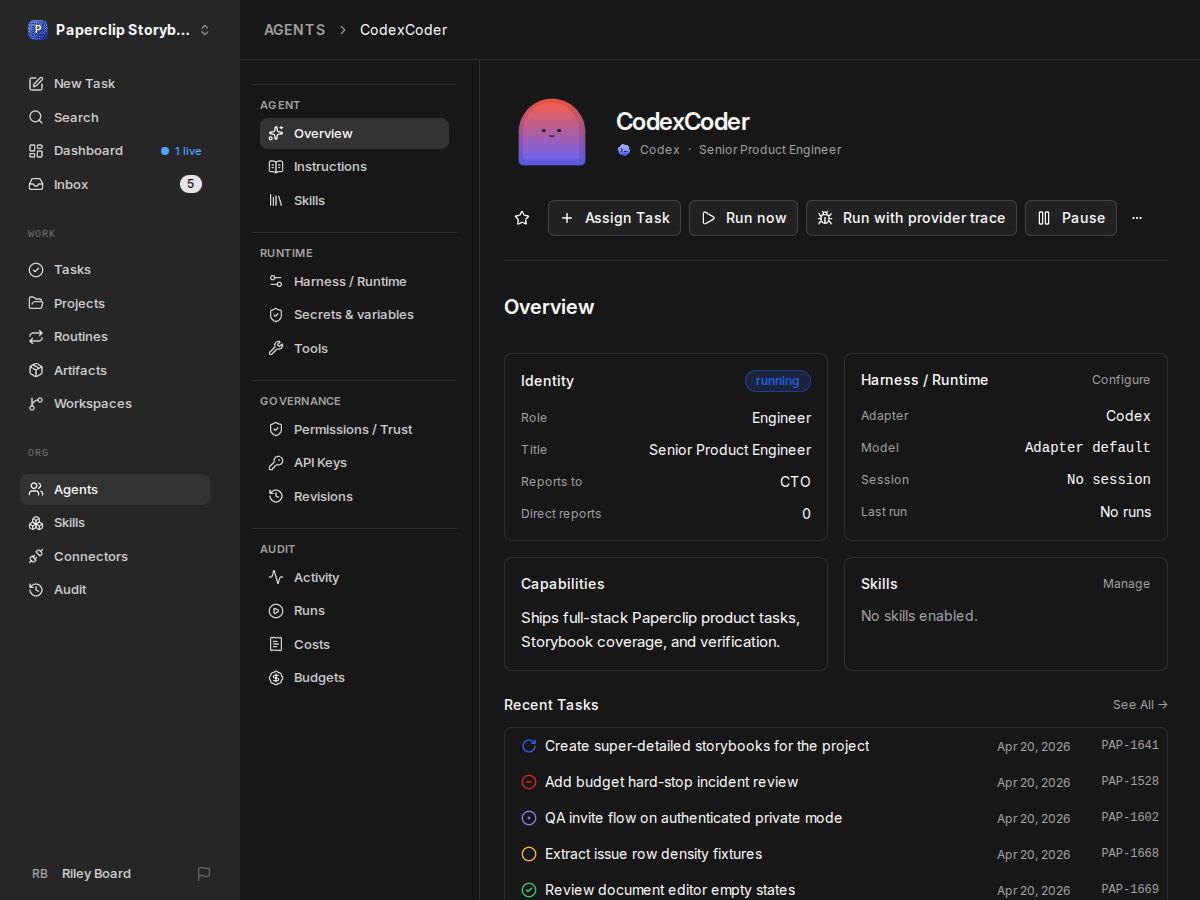
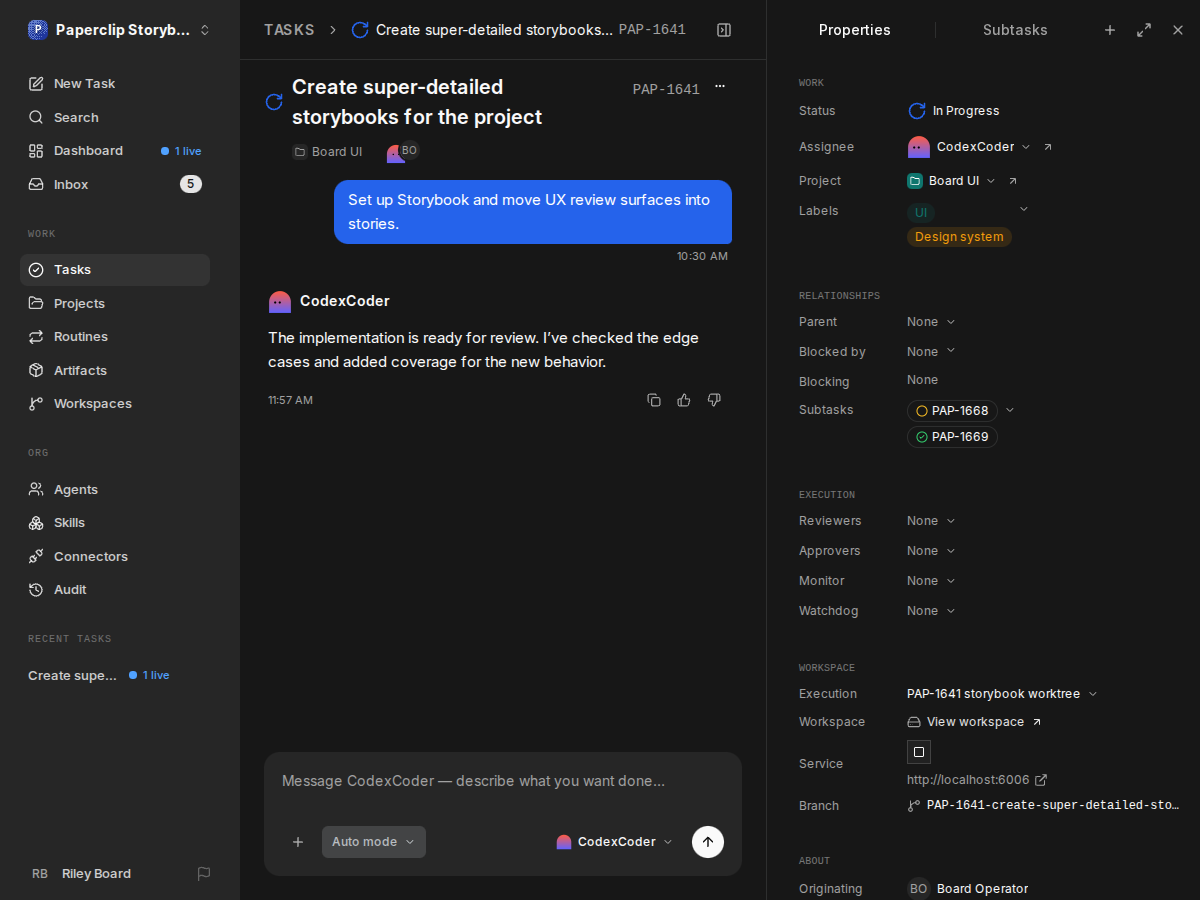
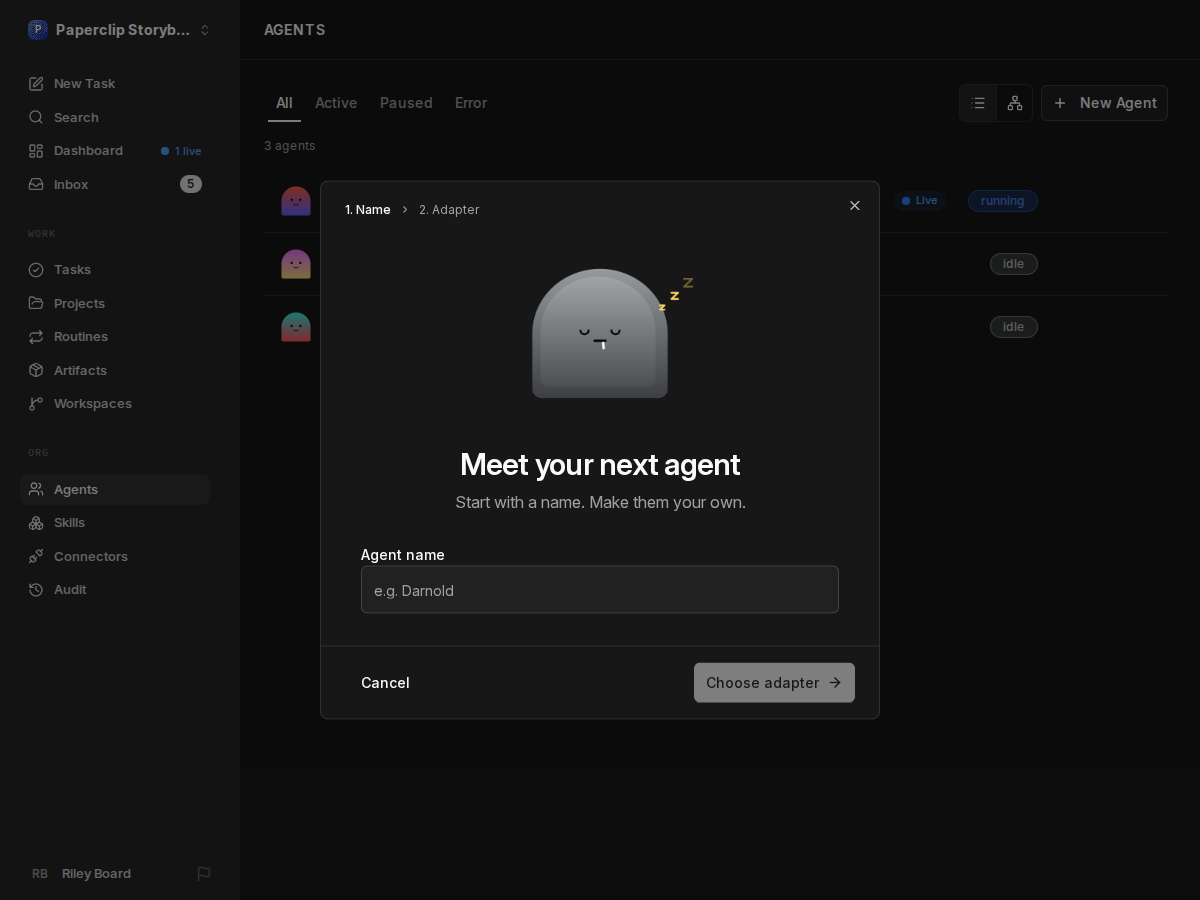
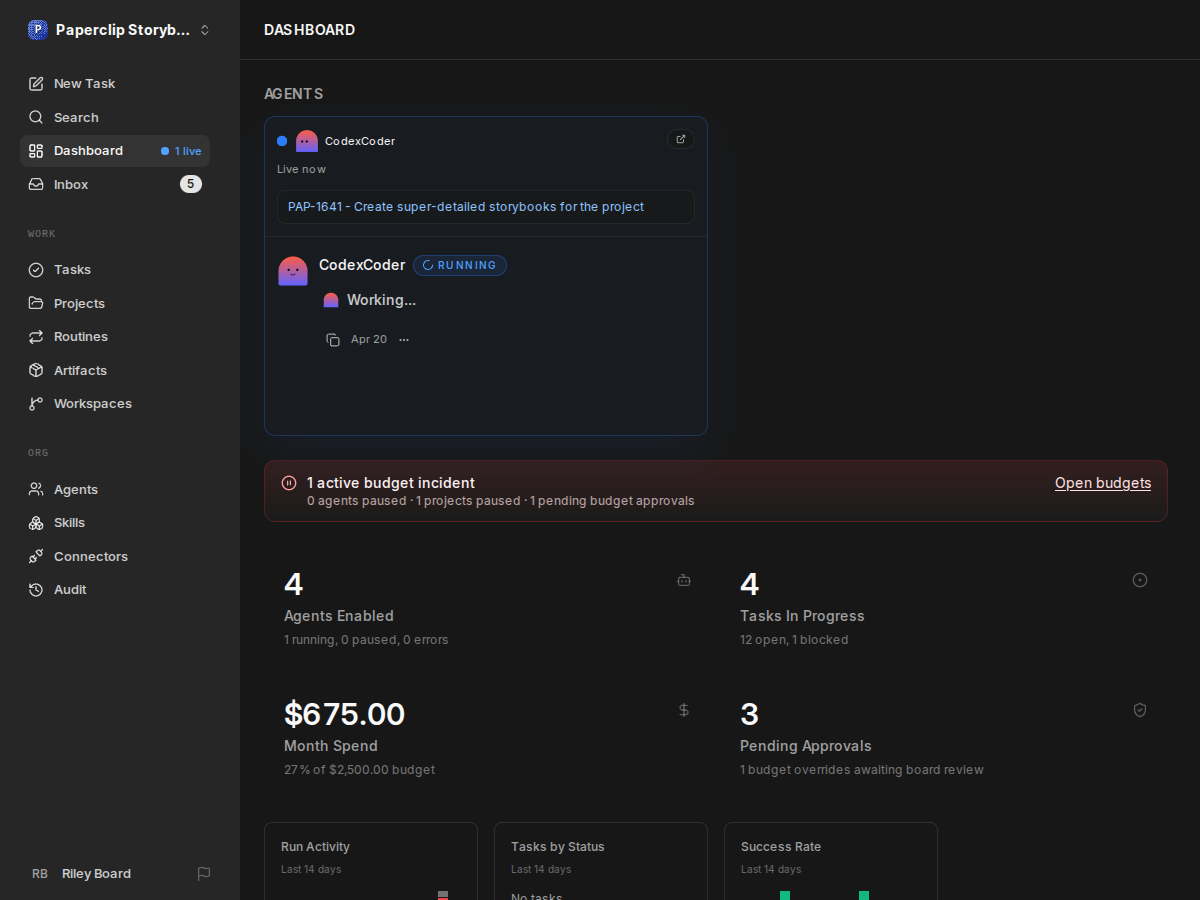
## Thinking Path > - Paperclip is the open source app people use to manage AI agents for work. > - A stable agent persona is useful only when the same identity appears across the app. > - Lists, task messages, selectors, and activity feeds need inexpensive static avatars. > - Onboarding and agent headers need a larger character with expressions and pointer tracking. > - This pull request connects the persona foundation to those existing views and preserves onboarding draft assignments. > - Full-page stories and Linux checks make the placements and performance contract reviewable. ## Linked Issues or Issue Description **Problem or motivation** Agents need a stable visual identity in lists, tasks, onboarding, and configuration. External tools also need an image URL for that identity. **Proposed solution** Assign each agent a permanent palette from a fixed ClipLab character library. Store the assignment on the agent. Render and cache preset PNG URLs on demand. Use static images in dense views and one animated character in larger placements. **Alternatives considered** A generated image bundle requires a separate asset build. A live renderer in every avatar adds unnecessary work in large lists. Arbitrary uploaded images do not provide the requested shared character system. **Roadmap alignment** This improves agent identity across existing control-plane views. It preserves agent permissions, company boundaries, and status labels. ROADMAP.md has no separate ClipLab persona milestone. Related approaches: #2422 adds configurable image URLs and DiceBear generation; #5578 adds optional uploaded avatars. This work uses a fixed, versioned character library and preset URLs. ## What Changed - Replace agent icons with static persona images across lists, the sidebar, org charts, tasks, comments, selectors, activity, and dashboard views. - Put one animated character in the agent header. Let it follow the pointer across the page, with reduced-motion and touch fallbacks. - Add larger padded characters to agent creation. Keep the palette stable across draft refreshes and connection retries, then reveal it after success. - Pass appearance through shared projections rather than fetching each agent separately. - Add real full-page Storybook examples for the agent list, overview, task, dashboard, new-agent dialog, and connection page. - Add Linux screenshot, clipping, density, and 500-avatar performance checks. ## Verification - `pnpm -r typecheck`, `pnpm build`, and token gates pass on the rebased tree. Persona lifecycle tests pass. - The rebased feature passes 38 Linux screenshot/performance checks, including both display densities, corner pointer positions, and the no-WebGL/no-live-download contract for 500 avatars. - The final Linux persona suite passes all 38 visual, lifecycle, density, and full-page checks using the standard Storybook configuration and real on-demand avatar endpoint. - Final local focused verification: 45 avatar/native-recovery tests pass; UI identity/routine tests, typecheck/build, token gates, and Storybook build pass. - Current-head CI passes: full workspace/server tests, all serialized server groups, typecheck/release checks, build, canary validation, and end-to-end shards. The build passed after retrying a native-runner concurrency-test failure; its three targeted cases also pass locally. - Manual inspection covered stable identities in the app, header placement, full-page mouse tracking, onboarding size, and task/dashboard placements. ### Screenshots Linux captures use synthetic Storybook fixtures. Full-page captures use reduced motion. The live character, mouse tracking, and disposal are checked separately. <details> <summary>Agent overview with the character in its header</summary> <img src="https://raw.githubusercontent.com/paperclipai/paperclip/8c68f42b268ada22b67d79d0fe1bb0a2f84ec25c/screenshots/full-page-agent-overview.png" width="900" alt="Agent overview with the character in its header" /> </details> <details> <summary>Task messages and assignee identity</summary> <img src="https://raw.githubusercontent.com/paperclipai/paperclip/8c68f42b268ada22b67d79d0fe1bb0a2f84ec25c/screenshots/full-page-task.png" width="900" alt="Task messages and assignee identity" /> </details> <details> <summary>Larger onboarding character with room for expressions</summary> <img src="https://raw.githubusercontent.com/paperclipai/paperclip/8c68f42b268ada22b67d79d0fe1bb0a2f84ec25c/screenshots/full-page-meet-your-next-agent.png" width="900" alt="Larger onboarding character with room for expressions" /> </details> <details> <summary>Dashboard agent activity</summary> <img src="https://raw.githubusercontent.com/paperclipai/paperclip/8c68f42b268ada22b67d79d0fe1bb0a2f84ec25c/screenshots/full-page-company-dashboard.png" width="900" alt="Dashboard agent activity" /> </details> ## Risks - This PR depends on #13170, the persona foundation. Merge the foundation first, then retarget this PR to master. - Many placements change from icons to character silhouettes. Human avatars and authoritative agent status labels retain their existing behavior. - Only one character can render live per view. Reduced motion, hidden/offscreen content, touch input, and renderer failures use the defined fallbacks. - The full-page stories use fixture data. They do not contact a real company or complete real provider sign-in. ## Model Used OpenAI Codex, GPT-6 family. The exact model identifier and context window are not exposed in this session. Used code editing, shell execution, browser inspection, and Linux visual testing. ## Checklist - [x] I have included a thinking path that traces from project context to this change - [x] I have specified the model used (with version and capability details) - [x] I have checked ROADMAP.md and confirmed this PR does not duplicate planned core work - [x] I have searched GitHub for duplicate or related PRs and linked them above - [x] I have either (a) linked existing issues with `Fixes: #` / `Closes #` / `Refs #` OR (b) described the issue in-PR following the relevant issue template - [x] I have not referenced internal/instance-local Paperclip issues or links (only public GitHub `#NNN` / `github.com/paperclipai/paperclip` URLs) - [x] My branch name describes the change (e.g. `docs/...`, `fix/...`) and contains no internal Paperclip ticket id or instance-derived details - [x] I have run tests locally and they pass - [x] I have added or updated tests where applicable - [x] I have updated relevant documentation to reflect my changes - [x] I have considered and documented any risks above - [x] All Paperclip CI gates are green - [x] Greptile is 5/5 with no open P2s, recommendations, or follow-ups - [x] I will address all Greptile and reviewer comments before requesting merge --------- Co-authored-by: Paperclip <noreply@paperclip.ing> Co-authored-by: Tonio <tonework@gmail.com> Co-authored-by: Claude Fable 5.1 <noreply@anthropic.com> |
||
|
|
352153b5ed |
fix: run the cargo-building native-runner CI suite in the Rust-cached vitest lane (#13586)
## Thinking Path Post-merge of #13557, the slowest check on the freshest fully-green PR run ([35246999382](https://github.com/paperclipai/paperclip/actions/runs/35246999382)) was `ci / General tests (server (1/12))` at **339s**. The cause is one suite: `server/src/services/native-runtime/native-codex-runner.integration.test.ts` runs 1 test in **277s of a 291s vitest step (95%)** because its `beforeAll` cargo-builds the Runner release binaries, and the general-server shards carry no Rust cache — every PR run cold-compiles the full third-party crate graph. The other 19 suites in that shard finish in under 70ms each. The obvious fix (a dedicated Rust-cached matrix lane) requires editing workflow files, which the available GitHub App credentials cannot push (`workflows` permission). But the `Verify Paperclip Runner` lanes **already restore the shared `release-runner-v1` Rust cache read-only**, and their commands are `pnpm --filter @paperclipai/paperclip-runner <package script>` — so the suite can move into a Rust-cached lane purely through script changes. ## What Changed - `scripts/run-vitest-stable.mjs`: new `general-server-native-runner` group carrying exactly that suite. Under the PR workflow (`GITHUB_WORKFLOW == "PR"`, inherited from `pr.yml` by the reusable `pr-trusted.yml`) the without-chat server shards exclude it and rebalance to ~211s of tests each. Every other caller — local runs, `release-verify.yml` under the Release / Cloud readiness workflows — keeps the suite in the shards, so a renamed or unknown workflow degrades to today's slower-but-covered behavior instead of dropping coverage. - `packages/paperclip-runner`: `test:typescript:vitest` now routes through `scripts/run-pr-vitest-lane.mjs` — the identical `ensure:eval-build-deps && build:rust && vitest run` chain (shard flags passed through), plus the native-runner group on the **final PR shard only** (`--shard=N/M` with `N == M`, i.e. today's `vitest 2/2`, the 122s lane). With the restored cache the suite's cargo build becomes an incremental rebuild. - `scripts/__tests__/run-vitest-stable-shard.test.mjs`: guards pin the whole contract — PR 12-shard coverage (shards + chat + native-runner = full server group exactly), Release/local 10-shard runs keep the suite, `pr.yml` is named `PR`, the vitest lanes partition with exactly one final shard, the package-script wiring, and the wrapper's shard/workflow gating via its `--dry-run` plan output. No workflow files change. `.github/workflows/*` are untouched. ## Verification - `node --test scripts/__tests__/run-vitest-stable-shard.test.mjs scripts/__tests__/release-verify-workflow.test.mjs`: **36/36 pass** locally on this branch (includes the new coverage, wiring, and wrapper-gating guards). Both files run in CI's `Test general-server shard partition` / `Test release verify workflow wiring` steps. - Wrapper `--dry-run` plan matrix verified for all six shard/workflow combinations plus malformed-shard rejection (pinned as a guard test). - The executing proof is this PR's own CI: `ci / Verify Paperclip Runner (vitest 2/2)` must go green while running the native-runner suite (its log will show the `general-server-native-runner` group after the package vitest shard), and the 12 `ci / General tests (server (x/12))` shards must go green without it. ## Risks - The exclusion keys on `GITHUB_WORKFLOW == "PR"`. Failure mode of a rename is safe (suite falls back into the server shards, slower but covered) and the guard test on `pr.yml`'s name makes it loud. - `vitest 2/2` grows from ~122s to an expected ~210–260s — still well under the ~306s `vitest 1/2` and ~326s e2e shards, and inside the 20-minute lane timeout. If the cache misses (key drift), the lane pays a cold compile like the server shard does today; a miss is slow, never wrong. - Double-run/coverage-loss combinations are enumerated in the wrapper header and pinned by tests: each caller runs the suite exactly once. ## Model Used Claude (Bender agent, Paperclip) — Fable 5. --- Expected savings once merged: the 339s `server (1/12)` check drops to ~265s-equivalent shard levels (~211s of tests), the slowest `ci /` check becomes the ~326s e2e shard (~13–33s off PR wall time), and every PR run stops paying ~4.5 min of billed cold Rust compile. For the merger (squash): please keep the trailer below in the squash body to preserve authorship. `Co-Authored-By: Bender (Fable) <Paperclip-Paperclip@users.noreply.github.com>` ## Related PRs Searched the GitHub PR list for prior work on this surface — related groundwork, none duplicate this change: - #13457 — restored master's Rust dependency cache on the PR runner lane (the read-only cache this PR relies on) - #13500 — made that cache key image-toolchain-independent so GitHub-hosted PR runners actually hit it - #13521 — rebalanced PR shards and split the Verify Paperclip Runner lanes this PR extends - #13557 — previous health-check iteration (split the runnerd transport suite); this PR targets the next slowest check ## Checklist - [x] I have searched GitHub for duplicate or related PRs and linked them above Co-authored-by: Bender (Fable) <Paperclip-Paperclip@users.noreply.github.com> Co-authored-by: Claude Fable 5 <noreply@anthropic.com> |
||
|
Devin Foley
|
d08abcba15 |
ci: cut PR wall clock from ~16 to ~6 minutes (#13521)
## Thinking Path > - Paperclip is the open source app people use to manage AI agents for work > - Every pull request runs the Trusted PR CI workflow before merge > - The test suites roughly tripled in six weeks, and shard balance did not keep up, so PR runs crept from ~4 to ~17 minutes > - Slow CI delays every merge and every contributor > - This pull request rebalances the shards from fresh measurements, splits the largest test files, reuses the Rust build cache in three more jobs, and takes the policy job off the critical path > - The benefit is a PR wall clock near 6 minutes with the same coverage ## Linked Issues or Issue Description **What existing behavior does this improve?** PR CI wall clock. A typical green run took 16-17 minutes. Two months ago it took about 4 minutes. **Subsystem affected** The Trusted PR CI workflow (`.github/workflows/pr-trusted.yml`), the shard-duration manifests, the vitest shard runner scripts, the `paperclip-runner` package scripts, and the dry-run branch of `release.sh`. **Current behavior** The shard-duration manifests were stale. The general-server manifest had durations for ~400 of 649 suites. The e2e manifest was missing 14 of 29 specs. Stale median weights made shard steps range 417s-806s (server) and 277s-745s (e2e). Three jobs each paid a ~3m40s cold cargo release build. Every test lane waited ~60s for the policy job before it could start. **Proposed behavior** All lanes finish in a narrow ~200-290s band. The manifests carry fresh measured durations for every suite. The three largest test files are split so no single file caps a shard. The Rust cache restore runs in every job that builds the Runner binary. Test lanes start as soon as the gate resolves. **Reason and benefit** Merges stop waiting on CI. The projected wall clock is ~6 minutes for the same test coverage. ## What Changed - Rebuild `scripts/general-server-shard-durations.json` (646 suites) and `scripts/e2e-shard-durations.json` (all specs) from per-suite completion timestamps in runs 35036001734 and 35024948947. - Move the PR server lane to the release-verify shape: `general-server-without-chat` across twelve duration-balanced shards, plus the chat integration suite split by collected test location across three dedicated lanes. - Split `tests/e2e/chat-adapters-ui.spec.ts` into `-providers` and `-messaging` specs, and `tests/e2e/agent-chat.spec.ts` into `-sessions` and `-projects` specs. Each pair shares fixtures through a `.shared.ts` module. Playwright collects the same test sets (39 and 20 tests). - Raise e2e shards to eight and serialized shards to nine. - Run the runner package's `check:all` as four matrix lanes: `check:static`, `check:runner`, and two native vitest `--shard` halves. The union is exactly `check:all`. - Add the read-only Rust cache restore (toolchain pin, `save-if: false`) to the Canary Dry Run, Build, and Typecheck jobs. - Make release.sh preview publish payloads concurrently in batches of eight during `--dry-run`. The real publish path stays strictly serial. - Drop the policy-job lockfile artifact chain. Each lane installs with `--frozen-lockfile` and falls back to an inline `--resolution-only` regeneration. The policy job stays a required check through the `verify` and `e2e` aggregates. - Update the shard-count mirrors and workflow assertions in the partition and gate tests. ## Verification - `node --test scripts/__tests__/run-vitest-stable-shard.test.mjs scripts/__tests__/e2e-shard.test.mjs` — 30 pass. - `node --test '.github/scripts/tests/'*.test.mjs` — 410 pass. - `node --test scripts/__tests__/release-verify-workflow.test.mjs scripts/cloud-source-verification.test.mjs scripts/__tests__/release-dry-run-notes.test.mjs` — 42 pass. - `playwright test --list` collects 39 tests across the chat-adapters split and 20 across the agent-chat split, equal to the original files. - A local vitest collection of the chat suite partitions 995 tests into 498/497 line shards. - Projected shard weights: server 230s x12, chat ~143s x3, e2e 207-242s x8, serialized ~216s x9. ## Risks - The split spec files reorder tests relative to the original files. Every describe seeds its own company, so the specs stay independent; a hidden cross-describe dependency would surface as a deterministic failure in one shard. - The inline lockfile fallback changes install behavior for manifest-changing and stacked PRs. The policy job still validates resolution as a required check. - `release.sh` changes are confined to the `--dry-run` preview branch. The publish loop is untouched. `bash -n` passes and the release dry-run tests pass. - One PR now schedules ~44 fleet runners. If the RunsOn fleet caps concurrency, queueing may absorb part of the gain; watch the first runs. ## Model Used - Claude Fable 5 (`claude-fable-5`, Anthropic), extended thinking, with tool use (shell, file edits) in Claude Code. ## Checklist - [x] I have included a thinking path that traces from project context to this change - [x] I have specified the model used (with version and capability details) - [x] I have checked ROADMAP.md and confirmed this PR does not duplicate planned core work - [x] I have searched GitHub for duplicate or related PRs and linked them above - [x] I have either (a) linked existing issues with `Fixes: #` / `Closes #` / `Refs #` OR (b) described the issue in-PR following the relevant issue template - [x] I have not referenced internal/instance-local Paperclip issues or links (only public GitHub `#NNN` / `github.com/paperclipai/paperclip` URLs) - [x] My branch name describes the change (e.g. `docs/...`, `fix/...`) and contains no internal Paperclip ticket id or instance-derived details - [x] I have run tests locally and they pass - [x] I have added or updated tests where applicable - [x] I have updated relevant documentation to reflect my changes - [x] I have considered and documented any risks above - [ ] All Paperclip CI gates are green - [ ] Greptile is 5/5 with no open P2s, recommendations, or follow-ups - [x] I will address all Greptile and reviewer comments before requesting merge |
||
|
DottaandPaperclip
|
4510bf7c9e |
ci: use code-owner-reviewed master for trusted PR workflow (#13470)
## Thinking Path > - Paperclip is the open source app people use to manage AI agents for work. > - Pull request CI uses a trusted workflow on the AWS runner fleet. > - The caller used a fixed SHA that also needed runner-group admission. > - A mainline pin update left CI queued because the group still allowed older SHAs. > - This pull request calls the trusted workflow on master, which requires code-owner review. > - New merged workflow versions can use the existing master runner-group entry. ## Linked Issues or Issue Description Related: #12968. That Dependabot PR proposes another SHA rotation. This change keeps this first-party workflow on master instead. **What happened?** CI run 34975562974 stayed queued because its trusted workflow SHA was absent from the runner-group allowlist. The fleet itself was healthy. **Expected behavior** New reviewed versions of the trusted workflow on master should receive runner access without a separate SHA allowlist update. **Steps to reproduce** Change the caller to a new trusted workflow SHA without adding that SHA to the restricted runner group. Its jobs remain queued. The master reference removes that recurring synchronization step. ## What Changed - Call `paperclipai/paperclip/.github/workflows/pr-trusted.yml@master`. - Exclude this exact first-party workflow from Dependabot updates. - Update the existing E2E shard workflow tests for the master caller contract. - Document the runner-group entry, required code-owner review, and old-reference retention. ## Verification - `actionlint .github/workflows/pr.yml` passed. - `node --test scripts/__tests__/e2e-shard.test.mjs .github/scripts/tests/cloud-runner-routing.test.mjs .github/scripts/tests/pr-runner-rust-cache.test.mjs .github/scripts/tests/pr-dependency-cache.test.mjs` passed: 35 tests. - Parsed Dependabot YAML and checked the exact workflow exclusion. - `git diff --check` passed. - Live GitHub checks confirmed `.github/**` has code owners, CODEOWNERS has no errors, and the active master ruleset requires code-owner review. This covers the trusted workflow, caller, and CODEOWNERS itself. - The approved organization setting now allows `paperclipai/paperclip/.github/workflows/pr-trusted.yml@refs/heads/master`. All previous references and other runner-group settings remain intact. - Full application typecheck, tests, and build were not repeated locally for this workflow-only change. This PR's CI and review are pending. ## Risks New versions of the trusted workflow take effect for new callers after merge to master. Keep code-owner review and master protection enabled. Existing administrator pull-request bypasses remain unchanged. Third-party action pins, runner routing, and infrastructure are unchanged. Older callers still use their SHA pins; their allowed refs remain in place. ## Model Used OpenAI GPT-6 through Codex performed implementation and orchestration; its exact runtime variant and context-window size were not exposed. OpenAI `gpt-5.6-luna` with high reasoning inspected workflow assumptions and applied the approved runner-group setting. Both used code and tool access. ## Checklist - [x] I have included a thinking path that traces from project context to this change - [x] I have specified the model used (with version and capability details) - [x] I have checked ROADMAP.md and confirmed this PR does not duplicate planned core work - [x] I have searched GitHub for duplicate or related PRs and linked them above - [x] I have either (a) linked existing issues with `Fixes: #` / `Closes #` / `Refs #` OR (b) described the issue in-PR following the relevant issue template - [x] I have not referenced internal/instance-local Paperclip issues or links (only public GitHub `#NNN` / `github.com/paperclipai/paperclip` URLs) - [x] My branch name describes the change (e.g. `docs/...`, `fix/...`) and contains no internal Paperclip ticket id or instance-derived details - [x] I have run tests locally and they pass - [x] I have added or updated tests where applicable - [x] I have updated relevant documentation to reflect my changes - [x] I have considered and documented any risks above - [ ] All Paperclip CI gates are green - [ ] Greptile is 5/5 with no open P2s, recommendations, or follow-ups - [x] I will address all Greptile and reviewer comments before requesting merge Co-authored-by: Paperclip <noreply@paperclip.ing> |
||
|
Devin FoleyandPaperclip
|
d2e940f4c1 |
ci: run release Runner protocol and Rust checks in parallel (#13326)
## Thinking Path > - Paperclip is the open source app people use to manage AI agents for work. > - Paperclip Cloud deploys verified images from merged source commits. > - Cloud readiness waits for every release verification check. > - Runner verification currently runs long TypeScript tests before Rust checks. > - These checks can run on independent runners with their own build directories. > - This PR runs them in parallel while preserving all checks and the shared dependency cache. ## Linked Issues or Issue Description Refs #13194. Related prior work: #13142 and #13259. A search found no duplicate parallel release-check change. **What existing behavior does this improve?** Time from merge to Cloud source verification and deployment readiness. **Current behavior** Recent successful runs take roughly 13 minutes from merge to deployable. In run 34705914878, Runner verification took 11m23s. Protocol tests finished before Rust tests and API authority checks started. **Proposed behavior** Run protocol and Rust verification in two matrix jobs. Cloud readiness still requires both jobs to pass. **Reason and benefit** Remove the serial dependency between independent checks. Expected improvement is about 2–3 minutes on a typical cached run, until the image build or server tests become the longest job. This is an estimate; post-merge timing will confirm it. **Breaking changes** Individual release Runner job names gain a lane suffix. Cloud source and readiness marker names stay the same. PR runner routing is unchanged. ## What Changed - Split release Runner checks into protocol and Rust lanes. Keep every constituent of `check:all` exactly once. - Restore the existing Rust dependency cache in both lanes. Allow only the Rust lane to save it after warming both build profiles. - Add coverage and cache authorization regressions. Document the parallel verification and single cache writer. ## Verification - Passed 477 workflow and source-verification tests with `node --test .github/scripts/tests/*.test.mjs scripts/cloud-source-verification.test.mjs scripts/__tests__/release-verify-workflow.test.mjs`. - Passed `actionlint`, `git diff --check`, and the private AWS routing regression suite. - Passed local `pnpm -r typecheck` and the standalone `check:runner && check:api-authority` lane, including all 1,671 API tests before the protocol lane had built TypeScript output. - The broad local protocol run under Node 25 had four failures. The two affected files passed under CI's Node 24.19.0: 67 passed, 6 platform skips. - Local `pnpm test:run` aborted when disk space ran out; local `pnpm build` could not run afterward. These are local verification limits. [Linux CI run 34710421424](https://github.com/paperclipai/paperclip/actions/runs/34710421424) passed full typecheck, all grouped tests, native verification, build, release dry run, and browser checks. Native protocol CI passed 1,986 tests, plus 1,671 API tests and the Rust suites. - Latest-head Greptile is 5/5 with no open findings. All 33 current-head checks are successful or intentionally skipped. ## Risks - Uses one additional short-lived verification runner per release verification. The existing AWS exact-master restriction remains in place. - The Rust lane warms debug dependencies so its cache save also serves protocol tests. Both lanes always rebuild workspace code. - A workflow regression could omit a check. The new coverage test compares the matrix checks directly with `check:all`; Cloud readiness depends on the complete reusable workflow. ## Model Used OpenAI GPT-6 through Codex, with reasoning, repository tools, and code execution. The exact serving model ID and context window are not exposed by this environment. ## Checklist - [x] I have included a thinking path that traces from project context to this change - [x] I have specified the model used (with version and capability details) - [x] I have checked ROADMAP.md and confirmed this PR does not duplicate planned core work - [x] I have searched GitHub for duplicate or related PRs and linked them above - [x] I have either (a) linked existing issues with `Fixes: #` / `Closes #` / `Refs #` OR (b) described the issue in-PR following the relevant issue template - [x] I have not referenced internal/instance-local Paperclip issues or links (only public GitHub `#NNN` / `github.com/paperclipai/paperclip` URLs) - [x] My branch name describes the change (e.g. `docs/...`, `fix/...`) and contains no internal Paperclip ticket id or instance-derived details - [x] I have run tests locally and they pass - [x] I have added or updated tests where applicable - [x] I have updated relevant documentation to reflect my changes - [x] I have considered and documented any risks above - [x] All Paperclip CI gates are green - [x] Greptile is 5/5 with no open P2s, recommendations, or follow-ups - [x] I will address all Greptile and reviewer comments before requesting merge --------- Co-authored-by: Paperclip <noreply@paperclip.ing> |
||
|
Devin FoleyandPaperclip
|
44dde2dec4 |
ci: reuse dependency caches without per-PR uploads (#13300)
## Thinking Path
> - Paperclip is the open source app people use to manage AI agents for
work.
> - Cloud releases wait for source verification before deployment.
> - That verification reuses compiled Rust dependencies to finish
sooner.
> - PR jobs save large pnpm stores under separate merge refs and
different lockfile keys.
> - Those copies compete with master build caches for the repository's
10 GB cache limit.
> - This PR makes PR dependency caches restore-only and reuses
master-compatible keys.
> - A separate pin update will activate the reviewed workflow.
## Linked Issues or Issue Description
**What happened?**
PR merge refs accumulated roughly 700 MB copies of the same pnpm store.
Master Rust caches disappeared, and Cloud readiness run
[34656098157](https://github.com/paperclipai/paperclip/actions/runs/34656098157)
rebuilt dependencies after cache misses. The repository currently has a
10 GB limit. GitHub rejected a request for 50 GB; that setting needs
separate organization/billing access.
**Expected behavior**
PR jobs should reuse downloaded packages without evicting post-merge
compilation caches through duplicate uploads.
**Steps to reproduce**
1. Run several PRs while the checked-in lockfile needs policy
regeneration.
2. Compare the setup-node keys in PR jobs and master jobs.
3. List Actions caches by ref, key, and archive size. The PR keys repeat
across merge refs.
**Paperclip version or commit**
|
||
|
DottaandPaperclip
|
30c63af0e6 |
fix(cli): recover abandoned workspace build locks (#13288)
## Thinking Path > - Paperclip is the open source app people use to manage AI agents for work. > - The test-drive command starts an isolated instance for local testing. > - Source startup builds shared packages before it starts the server. > - An interrupted build can leave an empty lock directory. > - Later starts wait without output and fail after 60 seconds. > - This pull request recovers abandoned locks and shows build progress. > - Local testing can start again without manual lock removal. ## Linked Issues or Issue Description **What happened?** `pnpm paperclipai test-drive` stopped at “Starting Paperclip server…” in a source checkout. A leftover plugin build lock caused a silent 60-second wait and then a timeout. **Expected behavior** Startup should recover an abandoned build lock. It should show when it waits for a live build. An interrupted or failed build should not leave partial output that the next start accepts as complete. **Steps to reproduce** 1. Leave an empty `node_modules/.cache/paperclip-plugin-build-deps.lock` directory after an interrupted build. 2. Make the shared or plugin SDK build output out of date. 3. Run `pnpm paperclipai test-drive --api-key placeholder --no-browser` with a fresh data directory. 4. Observe the silent wait at server startup. **Paperclip version or commit** Reproduced at `2083bf6f9`. **Deployment mode** Local source checkout with an isolated embedded PostgreSQL instance. Related work: #12894 added test-drive. #12898 restored its credential inputs. Neither change handles abandoned workspace build locks. No duplicate fix was found. ## What Changed - Publish a lock directory with an owner record in one rename. - Recover locks after their owner and compiler exit. Recover legacy empty locks after two minutes. - Keep the lock until the compiler stops on SIGINT or SIGTERM. - Print build and lock-wait progress. - Record source, dependency, compiler-config, and output content fingerprints only after a successful compile. Recover partial output even when modification times are unchanged. - Add 12 process-level regression tests and update the development guide. ## Verification - `node --test scripts/__tests__/ensure-plugin-build-deps.test.mjs`: 12 tests pass. - `pnpm exec vitest run --config cli/vitest.config.ts cli/src/__tests__/test-drive.test.ts`: 32 tests pass. - `pnpm --filter paperclipai typecheck`: passed. - `pnpm --filter paperclipai build`: passed. - Live smoke tests: fresh startup and startup with an abandoned lock both reach ready state. The API and UI respond. The command creates the company and CEO and enables worktree execution. Test instances stop cleanly. - Full repository `pnpm -r typecheck` and `pnpm build`: passed. - Full Vitest suite coverage completed using the repository-supported server, chat, workspace, and serialized shards. The initial local run needed the fresh-worktree fake native-provider binary built and focused reruns for port/socket races and load-related timeouts; all affected tests passed on rerun. Suites skipped by fail-fast exits were run separately and passed. The initial serial `pnpm test:run` was stopped in favor of these shards. - Greptile: 5/5 on commit `8b5a790c2af06a52b5dc76e5f52331966df990b8`, with all review threads resolved. - CI: 31 checks passed and two Storybook checks intentionally skipped. The initial workspace and browser jobs were interrupted by runner shutdowns; both passed on the second attempt. Build, typecheck, canary dry run, all general and serialized tests, all browser shards, security checks, and final verification summaries are green. [CI run](https://github.com/paperclipai/paperclip/actions/runs/34654730783) ## Risks - This changes shared source-build locking for the CLI and plugin SDK commands. - Legacy locks have no owner identity. Recovery uses a two-minute age threshold for empty legacy directories. - Startup reads and hashes source and output files to verify the build cache. Identical direct builds reuse the cache. Changed or partial output requires a rebuild. - A reused process ID can delay recovery. Live owner or compiler processes keep their lock. - No database, API, or UI contract changes. ## Model Used OpenAI GPT-6 in Codex, with reasoning, tool use, code execution, and process-level testing. A more specific API model identifier and context-window size are not exposed in this session. ## Checklist - [x] I have included a thinking path that traces from project context to this change - [x] I have specified the model used (with version and capability details) - [x] I have checked ROADMAP.md and confirmed this PR does not duplicate planned core work - [x] I have searched GitHub for duplicate or related PRs and linked them above - [x] I have either (a) linked existing issues with `Fixes: #` / `Closes #` OR (b) described the issue in-PR following the relevant issue template - [x] I have not referenced internal/instance-local Paperclip issues or links (only public GitHub `#NNN` / `github.com/paperclipai/paperclip` URLs) - [x] My branch name describes the change (e.g. `docs/...`, `fix/...`) and contains no internal Paperclip ticket id or instance-derived details - [x] I have run tests locally and they pass - [x] I have added or updated tests where applicable - [x] I have updated relevant documentation to reflect my changes - [x] I have considered and documented any risks above - [x] All Paperclip CI gates are green - [x] Greptile is 5/5 with no open P2s, recommendations, or follow-ups - [x] I will address all Greptile and reviewer comments before requesting merge --------- Co-authored-by: Paperclip <noreply@paperclip.ing> |
||
|
DottaandPaperclip
|
9031516a7e |
fix: recover legacy Daytona startup failures from task and inbox (#13272)
## Thinking Path > - Paperclip is the open source app people use to manage AI agents for work. > - Legacy conversation adapters can run in Daytona sandboxes. > - A server restart during provisioning can occur before the invocation event exists. > - Recovery then lacks the old adapter identity and leaves a hold that ordinary user retries cannot clear. > - A remote launch can also fail when its host relay looks for Node in the sandbox PATH. > - This pull request records the adapter at claim time and restores explicit user continuation after verified cleanup. > - Users can recover from the task or inbox while the failed run and uncertain action history remain intact. ## Linked Issues or Issue Description Refs #13237, #13239, #13254. Those changes cover recorded conversation runs, native user continuation, and explicit remote Stop. This change covers legacy failure before `adapter.invoke` and exact task/inbox Retry. Refs #9771 for overlapping generated-command quoting. This change also supplies the absolute host Node executable. Refs #13163 and #13264 for the separate native restart and retained-workspace work. **What happened?** A legacy Daytona run interrupted during provisioning became `process_lost` without an invocation event. Recovery preserved an execution hold, and Retry or a new task reply could not resume it. Cleanup could also run before the Daytona plugin was ready. On a macOS host, a subsequent ACP relay launch failed with `env: node: No such file or directory` because the remote launch environment did not contain the host Node path. **Expected behavior** An interrupted conversation can continue after its previous execution stops. Explicit Retry and new user replies should start a fresh turn with the task history. Cleanup failures must remain visible and recoverable. The host relay must use the host Node executable. **Steps to reproduce** 1. Use a legacy Claude adapter with a Daytona environment. 2. Interrupt the server after it acquires the sandbox lease and before it records `adapter.invoke`. 3. Restart and inspect the task hold. 4. Retry from the task or inbox, or send a new task reply. 5. Confirm the old sandbox has stopped and one new response arrives. **Paperclip version or commit** Reproduced from master at `3bafac12f796fbea02e609e1074a9639f872e9c4`. The branch is rebased on `51b0e01ea`, including #13261 and #13270. **Deployment mode** Built from source on macOS with a real Daytona sandbox and the legacy Claude ACP adapter. ## What Changed - Count new browser specs with the scheduler's median duration in the shard-balance check. This fixes a false policy failure after new specs arrive from both branches. The balance threshold is unchanged. - Persist server-owned adapter identity in the queued-to-running claim before provisioning starts. - Wait for provider plugin startup before restart cleanup. Keep failed cleanup leases as active ownership blockers. - Admit exact board retries and new user comments after verified termination. Retain the old run, task history, approvals, and unknown action outcomes. - Adopt repeated Retry requests. Permit one scoped cleanup attempt per explicit user Retry after the automatic limit, with an activity record. A later user Retry can recover after a transient provider failure; automatic attempts remain capped. - Resume replies deferred during cleanup, including historical legacy startup failures. - Launch the host ACP relay through the absolute host Node executable. - Add a task-level Retry button and return actionable blockers when retry admission is refused. - Add database regressions and three browser recovery journeys. Exclude installed third-party dependency skills from the shipped-skill audit. ## Verification - Current head: `d23c84181`, rebased on `51b0e01ea`. Conflict resolution retains the saved-message recovery, local stop receipts, and wait reasons from #13270 alongside exact legacy Retry support. - Real Daytona: interrupted the server after lease acquisition and before adapter invocation. Restart cleanup confirmed provider termination. Task Retry cleared a seeded historical hold and a real Claude agent returned `Recovery verified.` in the task. Removed the disposable sandbox and environment after testing. - All three browser recovery journeys passed again after the final rebase. Task Retry, Inbox Retry, and a new reply each produced one fresh successor, completed the task, preserved the failed run, and retained the answer after reload. - All 29 e2e/server shard-partition tests passed. The balance check now uses the scheduler's median fallback for unmeasured specs, with the same balance threshold. - Server typecheck passed after rebuilding the generated runner dependencies. The combined recovery/route run passed 136 of 137 tests. Its remaining route test timed out during the first cold module import at its explicit 10-second limit; an isolated rerun reproduced that timeout and passed the other 51 route cases. The complete CI suite passed on this head. The same route file passed all 52 cases in CI, including the first cold import in 7.5 seconds. - Before the final rebase, recursive typecheck, full build, UI token gates, 132 targeted server tests, and the complete [CI workflow](https://github.com/paperclipai/paperclip/actions/runs/34650004085) passed. The subsequent CI failure was the shard-balance accounting mismatch fixed here. - Greptile reviewed `d23c84181` at 5/5 with no outstanding actionable findings. The complete [current CI workflow](https://github.com/paperclipai/paperclip/actions/runs/34653327949) passed on attempt 2. All test, typecheck, build, and canary jobs passed on the first attempt. Docker setup timed out fetching BuildKit from Docker Hub; retrying that job and its dependent aggregate succeeded. ## Risks - Recovery admission changes executable authority. Company, task, agent, user, approvals, process ownership, and provider termination checks remain required. - Explicit continuation starts a fresh conversation with history. It does not certify unknown external action outcomes or rerun non-conversation adapters automatically. - Changing task status alone does not clear an execution hold. The task now offers an explicit Retry action. - Historical adapter claims and invocation events take precedence over current agent settings. Known process or webhook runs retain their hold. Pre-upgrade rows with no adapter evidence may receive only a new explicit user turn after termination proof; they do not become eligible for automatic replay. - No schema migration or sandbox-image change is required. This branch has not been deployed to production. ## Model Used OpenAI GPT-6 through Codex, with repository inspection, code execution, browser automation, and test execution. The exact deployment model ID and context window are not exposed in this session. ## Checklist - [x] I have included a thinking path that traces from project context to this change - [x] I have specified the model used (with version and capability details) - [x] I have checked ROADMAP.md and confirmed this PR does not duplicate planned core work - [x] I have searched GitHub for duplicate or related PRs and linked them above - [x] I have either (a) linked existing issues with `Fixes: #` / `Closes #` / `Refs #` OR (b) described the issue in-PR following the relevant issue template - [x] I have not referenced internal/instance-local Paperclip issues or links (only public GitHub `#NNN` / `github.com/paperclipai/paperclip` URLs) - [x] My branch name describes the change (e.g. `docs/...`, `fix/...`) and contains no internal Paperclip ticket id or instance-derived details - [ ] I have run tests locally and they pass - [x] I have added or updated tests where applicable - [x] I have updated relevant documentation to reflect my changes - [x] I have considered and documented any risks above - [x] All Paperclip CI gates are green - [x] Greptile is 5/5 with no open P2s, recommendations, or follow-ups - [x] I will address all Greptile and reviewer comments before requesting merge --------- Co-authored-by: Paperclip <noreply@paperclip.ing> |
||
|
Devin FoleyandPaperclip
|
37d7dfb0e3 |
ci: allow dependency changes in cloud eval verification (#13286)
## Thinking Path > - Paperclip is the open source app people use to manage AI agents for work. > - Cloud deployment requires source verification for the exact merged commit. > - Contributor PRs leave lockfile updates to a separate bot PR. > - Most release checks can refresh an outdated lockfile while installing dependencies. > - Two Runner checks still require a frozen lockfile and fail after dependency changes. > - This PR gives those checks the same install policy as the other release checks. > - A valid dependency change can become deployable without waiting for another merge. ## Linked Issues or Issue Description Refs #13257. The dependency change in #13256 exposed this gap. The separate lockfile update is #13279. Related #12115 addresses the bot PR check trigger; this PR fixes exact-source cloud verification itself. **What happened?** [Cloud readiness for |
||
|
Devin FoleyandPaperclip
|
4fde92107e |
fix(ci): reuse cloud source verification for npm canaries (#13233)
Reuse the exact master source-verification result before npm canary publication, removing a duplicate verification matrix while preserving fail-closed release checks. Co-Authored-By: Paperclip <noreply@paperclip.ing> |
||
|
DottaandPaperclip
|
96bba78fba |
feat: add readable Storybook branch bookmarks (#13231)
## Thinking Path > - Paperclip helps people manage AI agents for work. > - Maintainers use Storybook previews to review the board UI. > - Branch previews need stable bookmarks that people can read. > - The current publisher only provides a hashed branch path. > - This pull request adds a readable branch bookmark after each successful upload. > - Existing branch and build links keep working. ## Linked Issues or Issue Description Refs #13226. **What existing behavior does this improve?** Manual Storybook publication for repository branches. **Current behavior** The stable branch path contains a hash. The expected `/storybook/branches/master/` URL does not exist. **Proposed behavior** Each publication updates a readable bookmark. The action summary and Markdown artifact link it. Master uses `/storybook/branches/master/`. Other names use a safe path segment that preserves case and escapes special characters. **Reason and benefit** Maintainers can save and share a readable URL that opens the latest published branch build. **Breaking changes** None. Existing hashed branch entries still update. Existing build URLs remain valid. **Additional context** This follows the publisher in #13226. A duplicate search found no related bookmark change. It does not overlap planned core work in ROADMAP.md. ## What Changed - Generate readable branch bookmarks without collisions with existing build directories. - Upload the bookmark only after the full build and compatibility entry uploads succeed. - Link the bookmark in the existing summary and Markdown artifact. - Document branch-name escaping and test path isolation, stable links, and upload order. ## Verification - `node --test scripts/__tests__/storybook-deploy.test.mjs`: 20 tests pass. - `actionlint .github/workflows/storybook-deploy.yml .github/workflows/storybook-visual.yml`: passes. - `git diff --check`: passes. - [Master bookmark publication](https://github.com/paperclipai/paperclip/actions/runs/34613344758): passed. Opened `/storybook/branches/master/` in the browser and confirmed a story renders. Downloaded the Markdown report and verified its bookmark link. - [Feature branch bookmark publication](https://github.com/paperclipai/paperclip/actions/runs/34613449034): passed. Its separate bookmark uses `codex~2Fstorybook-bookmarks`. - Greptile: 5/5 on `dccaf10413ecf447cb34e622b6b3c505791abb51`, with no unresolved review threads. All current-head Paperclip CI gates pass, including typecheck, tests, build, browser suites, and the canary dry run. - Full local repository checks were not repeated for this focused publisher change. The preceding run passed typecheck but encountered unrelated native-session test failures. ## Risks - Special characters in branch names use `~HH` byte escapes. For example, `feature/foo` becomes `feature~2Ffoo`. - Names that could overlap an existing hashed build directory escape the final hyphen. Very long names retain a hash suffix. - The two branch entries update separately. If the final upload fails, the workflow fails and a rerun can repair the bookmark. ## Model Used OpenAI GPT-6 via Codex, with reasoning, shell tools, and live deployment verification. The exact runtime model ID and context-window size are not exposed in this session. ## Checklist - [x] I have included a thinking path that traces from project context to this change - [x] I have specified the model used (with version and capability details) - [x] I have checked ROADMAP.md and confirmed this PR does not duplicate planned core work - [x] I have searched GitHub for duplicate or related PRs and linked them above - [x] I have either (a) linked existing issues with `Fixes: #` / `Closes #` / `Refs #` OR (b) described the issue in-PR following the relevant issue template - [x] I have not referenced internal/instance-local Paperclip issues or links (only public GitHub `#NNN` / `github.com/paperclipai/paperclip` URLs) - [x] My branch name describes the change (e.g. `docs/...`, `fix/...`) and contains no internal Paperclip ticket id or instance-derived details - [x] I have run tests locally and they pass - [x] I have added or updated tests where applicable - [x] I have updated relevant documentation to reflect my changes - [x] I have considered and documented any risks above - [x] All Paperclip CI gates are green - [x] Greptile is 5/5 with no open P2s, recommendations, or follow-ups - [x] I will address all Greptile and reviewer comments before requesting merge Co-authored-by: Paperclip <noreply@paperclip.ing> |
||
|
Devin FoleyandPaperclip
|
974949a39b |
ci: spread cloud server verification across ten runners (#13227)
## Thinking Path > - Paperclip is the open source app people use to manage AI agents for work. > - Cloud waits for source verification before deploying a new image. > - The slowest server verification job spends about ten minutes running tests. > - Each job uses one test worker to preserve test isolation. > - This pull request distributes those suites across ten standard hosted runners. > - The benefit is a shorter verification path with the same test coverage. ## Linked Issues or Issue Description **Current behavior** In [readiness run 34572340764](https://github.com/paperclipai/paperclip/actions/runs/34572340764), the slowest server job ran for 638 seconds. Test execution used 594 seconds. This held readiness behind the image job. **Proposed behavior** Use ten general server jobs in the reusable release verification workflow. Keep the three chat jobs and every existing prerequisite. The complete partition test verifies that no server suite is omitted or duplicated. **Reason and benefit** Reduce merge-to-deployable time on the existing runner type. The next longest prerequisite was Runner verification at 526 seconds, so the initial expected total gain is about two minutes rather than a halving of readiness time. Measure actual queue and execution time before claiming a result. Related: #13198 introduced the separate chat lane. #12577 refreshes duration estimates; this change leaves that manifest alone. ## What Changed - Increase the general server matrix from five jobs to ten. - Verify the ten-way partition covers the complete server suite when combined with the chat lane. - Document runner demand and the unchanged local and PR grouping. ## Verification - `node --test scripts/__tests__/release-verify-workflow.test.mjs scripts/__tests__/run-vitest-stable-shard.test.mjs`: 29 passed. - `actionlint .github/workflows/release-verify.yml`: passed. - Full local `pnpm -r typecheck` and `pnpm build`: passed. - All latest-head GitHub CI checks passed, including the complete Linux test partition, build, typecheck, and browser gates. Greptile: 5/5 with zero open findings. - [Ten-shard timing probe](https://github.com/paperclipai/paperclip/actions/runs/34606772388): all 16 jobs passed; slowest server job 6m 23s versus 10m 38s in the earlier five-shard sample. This compares the server lane, not total readiness, and is not a controlled same-source A/B. - The full local `pnpm test:run` is also running. It has reproduced previously observed macOS-only failures in unchanged skill-cache and native-session suites; the corresponding Linux CI suites passed. Final local results will be attached separately. No affected-workflow test failed. ## Risks Five additional concurrent jobs per release verification run increase runner demand and repeated setup work. Queueing can offset the gain. Test workers, timeouts, permissions, and readiness requirements stay unchanged. Revert the matrix and its partition test to restore the previous split. ## Model Used OpenAI GPT-6 / Codex, with reasoning, tool use, and code execution. The exact serving model identifier and context-window size are not exposed by this session. ## Checklist - [x] I have included a thinking path that traces from project context to this change - [x] I have specified the model used (with version and capability details) - [x] I have checked ROADMAP.md and confirmed this PR does not duplicate planned core work - [x] I have searched GitHub for duplicate or related PRs and linked them above - [x] I have either (a) linked existing issues with `Fixes: #` / `Closes #` / `Refs #` OR (b) described the issue in-PR following the relevant issue template - [x] I have not referenced internal/instance-local Paperclip issues or links (only public GitHub `#NNN` / `github.com/paperclipai/paperclip` URLs) - [x] My branch name describes the change (e.g. `docs/...`, `fix/...`) and contains no internal Paperclip ticket id or instance-derived details - [x] I have run the affected workflow tests locally and they pass; full-suite macOS limitations are disclosed above - [x] I have added or updated tests where applicable - [x] I have updated relevant documentation to reflect my changes - [x] I have considered and documented any risks above - [x] All Paperclip CI gates are green - [x] Greptile is 5/5 with no open P2s, recommendations, or follow-ups - [x] I will address all Greptile and reviewer comments before requesting merge --------- Co-authored-by: Paperclip <noreply@paperclip.ing> |
||
|
DottaandPaperclip
|
a20ecce409 |
feat: publish CODEOWNER-approved Storybook branch previews (#13226)
## Thinking Path > - Paperclip helps people manage AI agents for work. > - Maintainers use Storybook to review the board UI. > - Reviews need public previews of selected repository branches. > - Each branch needs its own URL so previews do not replace each other. > - This pull request adds manual, CODEOWNER-controlled publishing to S3 and CloudFront. > - The action returns stable branch links and permanent build links in its summary and a Markdown artifact. ## Linked Issues or Issue Description **What existing behavior does this improve?** The existing Storybook build and manual visual-review workflow. **Current behavior** The repository has no manual branch-preview publisher. A single GitHub Pages site cannot support independent publishers without combining their output. **Proposed behavior** A CODEOWNER selects a source branch and approves publication. Each branch has a stable CloudFront URL. A completed build becomes the branch target only after its upload succeeds. The action attaches `storybook-deployment.md` with the preview links and source commit. **Reason and benefit** Maintainers can share multiple branch previews at the same time. Branch builds have no repository token permissions or AWS credentials. Dependency caching and install hooks are disabled. The publisher cannot write runner dashboard files or delete objects. **Breaking changes** None. Normal visual checks keep their existing behavior. This does not change application code or GitHub Pages settings. **Additional context** Searched public issues and PRs for Storybook deployment work. No duplicate deployment proposal was found. This is maintainer infrastructure, not a roadmap-level core feature. ## What Changed - Add `Storybook Deploy` with a source-branch input and a manual entry through `Storybook Visual`. - Check the original actor and rerunner against default-branch CODEOWNERS. Require a protected deployment environment with CODEOWNER reviewers. - Separate public-source builds with no repository permissions from an OIDC publisher restricted to the Storybook S3 prefix. - Publish distinct branch URLs and retain build URLs. Preserve Storybook deep links across the branch redirect. - Add the run summary, a downloadable Markdown deployment report, focused tests, and operator setup docs and IAM policies. ## Verification - `node --test scripts/__tests__/storybook-deploy.test.mjs`: 19 tests pass. - `actionlint .github/workflows/storybook-deploy.yml .github/workflows/storybook-visual.yml`: passes. - [Feature branch live publication and deployment-only rerun](https://github.com/paperclipai/paperclip/actions/runs/34533202273): passed. - [Master branch live publication](https://github.com/paperclipai/paperclip/actions/runs/34533204743): passed. - Both public branch URLs render a component story without browser errors. A deployment-only rerun updates only the selected branch entry and preserves the previous build URL. - AWS policy simulation allows Storybook uploads and denies dashboard writes and object deletion. - Full local typechecking passes. Full local tests, build, and current-head PR checks are running. - [Revised build and Markdown artifact validation](https://github.com/paperclipai/paperclip/actions/runs/34605623088): passed. Downloaded the report and verified its branch URL, build URL, and source commit. - The public verifier also checks that the stable branch URL points to this build and rejects stale targets. ## Risks - Storybook previews are public. Maintainers must publish only public UI fixtures. - Retained builds accumulate until an operator prunes them. - Environment reviewers must stay synchronized with CODEOWNERS. The workflow fails closed if its environment loses required protection. - The existing CloudFront distribution is shared with runner reports. Separate S3 prefixes and a dedicated role prevent the publisher from overwriting those reports. ## Model Used OpenAI GPT-6 via Codex, with reasoning, shell tools, and browser verification. The exact runtime model ID and context-window size are not exposed in this session. ## Checklist - [x] I have included a thinking path that traces from project context to this change - [x] I have specified the model used (with version and capability details) - [x] I have checked ROADMAP.md and confirmed this PR does not duplicate planned core work - [x] I have searched GitHub for duplicate or related PRs and linked them above - [x] I have either (a) linked existing issues with `Fixes: #` / `Closes #` / `Refs #` OR (b) described the issue in-PR following the relevant issue template - [x] I have not referenced internal/instance-local Paperclip issues or links (only public GitHub `#NNN` / `github.com/paperclipai/paperclip` URLs) - [x] My branch name describes the change (e.g. `docs/...`, `fix/...`) and contains no internal Paperclip ticket id or instance-derived details - [x] I have run tests locally and they pass - [x] I have added or updated tests where applicable - [x] I have updated relevant documentation to reflect my changes - [x] I have considered and documented any risks above - [ ] All Paperclip CI gates are green - [ ] Greptile is 5/5 with no open P2s, recommendations, or follow-ups - [x] I will address all Greptile and reviewer comments before requesting merge --------- Co-authored-by: Paperclip <noreply@paperclip.ing> |
||
|
Devin FoleyandPaperclip
|
fc06f7f05f |
fix(ci): isolate chaos verification by caller workflow (#13208)
## Thinking Path > - Paperclip is the open source app people use to manage AI agents for work. > - Cloud deployments require verified artifacts for the merged source commit. > - Cloud readiness and the npm release independently run the same source checks. > - Their shared chaos workflow used only the source ref as its concurrency key. > - One caller could cancel the other caller's required job for the same commit. > - This pull request scopes that key to the caller workflow and source ref. > - Both callers can finish their checks without blocking deployment readiness. ## Linked Issues or Issue Description Refs #13192 and #13205. Searched for related open issues and PRs; no duplicate fix was found. **What happened?** The master push for `398d304e15739d1ee6105633bd8a0e42c929d33f` started Cloud readiness and Release together. GitHub cancelled the Cloud readiness chaos job before it acquired a runner. Its annotation reported a higher-priority waiting request for the same concurrency group. The required readiness gate cannot pass after that cancellation. **Expected behavior** Cloud readiness and Release must each finish source verification for the same SHA. Standalone chaos evals must also have a separate group. **Steps to reproduce** Merge a commit to master while the npm release queue is empty. Both callers reach the reusable chaos workflow with the same source SHA. See [the cancelled job](https://github.com/paperclipai/paperclip/actions/runs/34569569760/job/103168603926). **Paperclip version or commit** `398d304e15739d1ee6105633bd8a0e42c929d33f`. **Deployment mode** GitHub Actions on master. ## What Changed - Add the caller workflow name to the chaos workflow concurrency group. Retain source isolation and cancellation of duplicate calls within the same workflow. - Add a regression test that evaluates the group for Cloud readiness, Release, and standalone evals at the same source SHA. - Document the concurrency boundary in the readiness runbook. ## Verification - `node --test scripts/preview-artifacts.test.mjs scripts/__tests__/release-verify-workflow.test.mjs` passed: 26 tests. - The new regression test fails against the previous concurrency key and passes with this fix. - `actionlint -shellcheck= -pyflakes= .github/workflows/runner-chaos-evals.yml .github/workflows/release-verify.yml .github/workflows/cloud-readiness.yml` passed. - `git diff --check` passed. - The full local typecheck passed for the same application source in #13205. Its macOS general-server test phase had 10,471 passes and 70 failures in seven unchanged application test files: missing Cargo/Runner test binaries, filesystem permissions, timeouts, a port conflict, and a load-test count mismatch. Linux CI test checks passed. The full local build passed with Cargo on PATH. This PR changes workflow configuration, its test, and documentation only. - All CI checks pass on the final head, including typecheck, tests, browser suites, build, and canary dry run. Greptile is 5/5 with no open findings. After merge, verify both callers' chaos jobs complete for the same master SHA and record the resulting readiness time. ## Risks - Two callers may now run chaos tests at the same time. This uses two existing GitHub runners, which is the intended cost of independent verification. - Renaming a caller changes its concurrency group. The fixed prefix keeps this child group separate from caller-level concurrency groups. - The readiness gate continues to require every verification prerequisite. No gate is bypassed. ## Model Used - OpenAI GPT-6 / Codex, with reasoning, repository editing, and command/API tools. Exact serving model ID and context-window size are not exposed by this session. ## Checklist - [x] I have included a thinking path that traces from project context to this change - [x] I have specified the model used (with version and capability details) - [x] I have checked ROADMAP.md and confirmed this PR does not duplicate planned core work - [x] I have searched GitHub for duplicate or related PRs and linked them above - [x] I have either (a) linked existing issues with `Fixes: #` / `Closes #` / `Refs #` OR (b) described the issue in-PR following the relevant issue template - [x] I have not referenced internal/instance-local Paperclip issues or links (only public GitHub `#NNN` / `github.com/paperclipai/paperclip` URLs) - [x] My branch name describes the change (e.g. `docs/...`, `fix/...`) and contains no internal Paperclip ticket id or instance-derived details - [x] I have run tests locally and they pass (26 focused workflow/artifact tests) - [x] I have added or updated tests where applicable - [x] I have updated relevant documentation to reflect my changes - [x] I have considered and documented any risks above - [x] All Paperclip CI gates are green - [x] Greptile is 5/5 with no open P2s, recommendations, or follow-ups - [x] I will address all Greptile and reviewer comments before requesting merge Co-authored-by: Paperclip <noreply@paperclip.ing> |
||
|
Devin FoleyandPaperclip
|
42961b6ef1 |
fix(ci): split release chat verification into test shards (#13198)
Split release chat verification into three validated test-line shards and balance other server suites across five runners using the measured native Runner integration cost. Retire each chat case's fixtures after assertions, preserve complete test coverage, and exercise the real shard CLI in PR tests. Co-Authored-By: Paperclip <noreply@paperclip.ing> |
||
|
Devin Foley
|
c5c80e1feb |
ci(release-verify): split server tests five ways like pr-trusted (#13185)
## Thinking Path > - Paperclip is the open source app people use to manage AI agents for work > - Every master push publishes a canary through release.yml, gated by release-verify.yml — the fleet's staging deploys and the nightly/beta/stable chain all start from those canaries > - release-verify splits the server test suite across three shards with a 20-minute job cap, while pr-trusted splits the same suite across five > - The server suite grew on 2026-09-10 and the three shards moved to 17-19 minutes; that evening every push-triggered canary run was cancelled by the 20-minute cap mid-verify, and no canary published after 18:50 UTC > - This pull request mirrors pr-trusted's five-way server split in release-verify, putting shards back at the 10-15 minute range with real headroom > - The benefit is a canary lane that reports test verdicts instead of dying on an infrastructure cap ## Linked Issues or Issue Description **What happened?** Push-triggered Release runs stopped publishing canaries on 2026-09-10. Runs at 19:34, 22:30, and 22:37 UTC were all cancelled by "The job has exceeded the maximum execution time of 20m0s" on a `verify_canary / General tests (server (N/3))` shard. No canary published after 18:50 UTC, which also starves the staging fleet's continuous deploys. **Expected behavior** release-verify's server shards finish well inside the 20-minute cap and runs conclude with a test verdict, as pr-trusted's five-way split of the same suite does (10-15 minutes per shard). **Steps to reproduce** 1. Compare server shard durations in the `verify_canary` job across 2026-09-10: 11-14 minutes in the morning, 17-19 minutes from 15:06 UTC, over 20 minutes by evening. 2. Observe runs 34521169020, 34537798488, and 34538332689 cancelled at the cap. **Paperclip version or commit** `master` at `d1ba17eec` (current tip; its canary run was one of the cancelled ones). ## What Changed - `release-verify.yml`: the `general-server` matrix goes from three shards to five, byte-for-byte the shape `pr-trusted.yml` already runs, with a comment recording why. ## Verification - The identical five-way split runs green on every pr-trusted run (10-15 minutes per shard today, including on PRs merged this evening). - The suite's own growth (slower chat-connector tests) is being addressed separately; this PR only removes the artificial cliff. ## Risks - Low risk: two more runners per verify run; no test content changes. If shard durations regress further, the cap fires again — which is the correct signal once shards have honest headroom. ## Model Used - Claude (Anthropic), model ID `claude-fable-5` (Claude Fable 5), extended thinking, tool use via Claude Code CLI. ## Checklist - [x] I have included a thinking path that traces from project context to this change - [x] I have specified the model used (with version and capability details) - [x] I have checked ROADMAP.md and confirmed this PR does not duplicate planned core work - [x] I have searched GitHub for duplicate or related PRs and linked them above - [x] I have either (a) linked existing issues with `Fixes: #` / `Closes #` / `Refs #` OR (b) described the issue in-PR following the relevant issue template - [x] I have not referenced internal/instance-local Paperclip issues or links (only public GitHub `#NNN` / `github.com/paperclipai/paperclip` URLs) - [x] My branch name describes the change (e.g. `docs/...`, `fix/...`) and contains no internal Paperclip ticket id or instance-derived details - [x] I have run tests locally and they pass - [x] I have added or updated tests where applicable - [x] I have updated relevant documentation to reflect my changes - [x] I have considered and documented any risks above - [ ] All Paperclip CI gates are green - [ ] Greptile is 5/5 with no open P2s, recommendations, or follow-ups - [x] I will address all Greptile and reviewer comments before requesting merge |
||
|
DottaandPaperclip
|
889947c238 |
feat: add experimental native chat connectors (#13038)
## Thinking Path > - Paperclip is the open source app people use to manage AI agents for work. > - People also ask agents for work in their existing chat tools. > - Each external conversation needs one task and a current authorized source. > - Retries, Stop, and provider failures must not duplicate work or expose private data. > - The first chat PR establishes the opt-in provider and data contracts. > - This PR adds experimental channel integration and its durable control plane. > - Users can request work from connected channels and inspect delivery in Paperclip. ## Linked Issues or Issue Description Refs #13100 and #13092. This is the second of exactly two chat PRs. Foundation #13100 is merged and changed 143 files. Runner prerequisite #13092 is also merged. This PR changes 400 files against master, below the 500-file review limit. It contains no wireframe images or HTML galleries. ## What Changed - Add native Slack, GitHub, Microsoft Teams, Telegram, and Discord chat connections. Keep chat disabled unless the operator enables experimental chat connectors. Preserve the production GitHub tool connection and its normal setup path. - Bind each provider bot identity to one immutable Paperclip agent. Bind each admitted external conversation to one task. Paperclip owns tasks, runs, permissions, and audit records. - Add durable admission, per-conversation queues, questions, task controls, progress, final replies, images, files, and delivery receipts. Board comments remain internal unless explicitly sent to the channel. - Check current identity, provider reach, resource access, credentials, runtime generation, and exact source before provider effects. Keep private responses private. Never send raw reasoning, private logs, credentials, or tool arguments. - Hold uncertain sends for explicit audited resolution. Make Board Send-to-channel atomic and idempotent. Keep reconnect and setup credentials in Paperclip secret storage. - Preserve current native-runner authority across retries, lost acknowledgements, and recovery. Keep immutable input and completion contracts separate from newer user input. Receipt reconciliation cannot launch a provider. - Reconcile chat close/new ordering and provider-effect lock order. Audit resource access changes in the same transaction. Submit only the selected resource from each UI toggle so stale pages cannot undo unrelated access changes. - Drain Codex stdout before certifying process exit. Bound the drain with the existing shutdown grace. Preserve observed terminal authority without treating an undrained process as successful or reusable. - Incorporate master `018ca5da` with its ACP Stop, mobile task layout, runner packaging, and official lock changes. Preserve dedicated chat-answer continuations in both directions when ordinary queued comments are adopted after Stop. - Fence late adapter readiness behind an earlier Stop for the same run. Preserve verified cleanup for registered adapters. Handle single Stop, agent pause, duplicate Stops, and failure release without creating a false cancellation receipt. - Incorporate master's `6dd48cad4` wake-queue extraction. Preserve exact failed-chat retry authorization and lineage, retired question-source suppression, and the block on generic recovery that would discard the admitted source. Fresh deferred input retains its separate promotion path. - Incorporate master `2a05b5ed3` and its queue-admission extraction, simplified transaction ports, and separate runner CI job. Preserve exact durable receipts, actor separation, and dedicated-answer isolation through the new module. A failed receipt insert rolls back the accompanying deferred-wake merge. ## Verification Current head: `afe19299d06253cb628eb398e91d1200ea9f412a`, incorporating master `2a05b5ed3457ea33efd6895520447d1d97fe98d8`. The conflicts are resolved. This successor fixes two test-harness boundaries exposed by CI: per-case route-module preparation and actual durable-save completion before intentional runner termination. Production code and all existing test/turn deadlines are unchanged. [Exact-head Greptile review](https://github.com/paperclipai/paperclip/pull/13038#issuecomment-5587250594) is **5/5**, completed September 10 at 13:20:55 UTC, with no actionable findings or open review threads. [Fresh exact-head CI](https://github.com/paperclipai/paperclip/actions/runs/34481724341) passes **all 24 jobs**, including Build and both required aggregates. Normal exact-head guarded merge was attempted and rejected by the remaining branch approval policy: CODEOWNER review is required and no human approval is present. Normal **squash auto-merge is enabled** as of September 10 at 13:36:26 UTC. Requested CODEOWNERS have been notified; no approval bypass or self-approval was used. Earlier-head results below remain historical evidence, not qualification of this successor. - Final exact-head Linux evidence: 995/995 chat integration cases; 36/36 agent-skills routes; 35/35 runner live-session cases, including real process kill/resume; 1948 runner Vitest cases with three existing benchmark/platform guards; 870/870 API-authority cases; and 104 browser cases with four existing optional skips. Rust, conformance/replay, full repository build, typecheck, canary, all server/workspace shards, and both required aggregates pass with normal CI concurrency. Earlier failed attempts remain recorded below. - Latest test-only qualification: 141/141 route/permissions/authentication cases pass in separate cold forks, with plain server types and independent review clear. The real-runner suite passes 35/35, with plain runner types and independent review clear. A controlled premature-save acknowledgement fails as expected; matching ownership/effect/process evidence, rejected saves, real turn outcome, test abort, and pre-kill liveness are covered. No local reproduction of the original CI scheduling failure is claimed. The preceding [CI run](https://github.com/paperclipai/paperclip/actions/runs/34479680858) passes 21/24 jobs, including all 995 Linux chat cases and browser aggregate (104 passed, four existing optional skips); only Build, the skills serialized shard, and the required verification aggregate fail. Its exact-head Greptile review was 5/5. Both failed job logs are retained. - Final fixture qualification: all eight focused Discord cases and all 995 chat integration cases pass. The exact modal statement/PID is observed before taking the real connection lock; the test then proves its actual blocking relationship before mutation. Original SQL execution, provider behavior, negative assertions, and 1s/15s timeouts remain unchanged. Independent review is clear and test/production hashes remain frozen. The preceding [CI attempt](https://github.com/paperclipai/paperclip/actions/runs/34477184777) passed 22 jobs, including Build/runner, typecheck, canary, all other test shards, and browser aggregate (104 passed, four existing optional skips); the two fixture failures and failed verification aggregate remain recorded, not relabeled as a pass. - Current queue-module composition: 308/308 recovery/batching/queue/Stop tests; 995/995 full chat integration; 89/89 module tests, including real PostgreSQL receipt-insert rollback; 24/24 workflow/module-boundary tests; plain server and UI types. All four actual local process/ACP browser paths pass in 1.4 minutes. Fresh databases, no skips or retries, stable reviewed source hashes. The initial boundary failure is retained; its no-op service wrapper was removed without changing recovery context or weakening the check. An exploratory standalone test-directory typecheck fails because its new upstream transformation config is not a standalone typechecking project; standard CI/build does not invoke it, and no configuration was weakened to suppress those diagnostics. - The preceding head `e02a63d462ce5d47433b0aeb632bb6fd20aab1ba` passed [all 24 CI jobs](https://github.com/paperclipai/paperclip/actions/runs/34436462958) and exact-head Greptile review at 5/5. Required CODEOWNER review prevented its normal merge before master advanced again. - Final extracted-module composition: 307/307 recovery, batching, queue and Stop-control tests; 995/995 full chat integration; 49/49 module tests including eight PostgreSQL adapter cases; and 19/19 issue-update tests. Plain server types pass. All four actual local process/ACP browser paths pass in 1.3 minutes. Fresh databases, no skips or retries in these cohorts, frozen source hashes, and independent review clear. - The preceding head `3e4e1c1c` passes [all PR CI jobs](https://github.com/paperclipai/paperclip/actions/runs/34415826820), including Build and required `ci / verify` and `ci / e2e`. Both the original Rust failure and the previously load-sensitive lineage fixture pass with unchanged Linux concurrency. Master advanced afterward and required this reconciliation. - Final master composition: 448/448 focused UI tests, 186/186 adapter tests, 24/24 queue/control tests, and 11/11 packaging tests. Plain UI, server, shared, and adapter types pass. Token gates and diff checks pass. Independent server and UI reviews are clear. - Stop-registration regression: both real-service cases fail against exact `a95` source and pass with the fix. The full corrected recovery/control suite passes 265/265. Duplicate-owner and failed-Stop controls also pass. Plain server types pass. The readiness barrier prevents provider startup without adding an acknowledgment to an already terminal run. - Final qualification strengthens terminal-field equality and repeats both affected cases successfully on a fresh database. All four actual local process/ACP browser paths pass again in 1.3 minutes, without skips or retries. The final screenshot shows Cancelled, a paused subtree, retained input, and no error toast. - Two new actual-service regressions fail before the merge fix. They prove that queued-comment adoption could consume a dedicated chat answer or add unrelated input to that answer. The fixed four-case cohort passes, including ordinary upstream continuation and adapter Stop controls. Full recovery passes 257/257. All four actual local process/ACP Stop browser flows pass in 1.4 minutes, without skips or retries, on a fresh database. - The unchanged runner artifact was qualified with 171/171 transport tests, 870/870 API-authority tests, conformance 1/1, and replay 11/11. Six controlled reader tests prove the exit/drain repair. Its local serial Rust workspace passed 546 top-level cases plus two invoked helpers; the later passing Linux CI supplies default-concurrency evidence. - Prior exact-source full chat integration passes 995/995. Settings regressions cover concurrent stale pages, 501 destinations, pending state, rejected updates, and explicit retry. These deterministic tests do not prove live provider behavior. - Retained failed attempts and their causes are in the [qualification log](https://github.com/paperclipai/paperclip/blob/afe19299d06253cb628eb398e91d1200ea9f412a/doc/plans/chat-adapters/2026-09-08-chat-queue-and-webhook-repair.md). The first merge adapter run timed out while macOS slept for 290 seconds. Its unchanged repeat passed with a temporary sleep guard. No assertion, deadline, or CI gate was weakened. Review commands include `pnpm --filter @paperclipai/server exec vitest run src/__tests__/heartbeat-process-recovery.test.ts src/__tests__/issue-queued-comments-routes.test.ts` and `pnpm exec playwright test --config tests/e2e/playwright.config.ts tests/e2e/acp-stop-continuation.spec.ts`. Database suites require fresh disposable databases. See the [browser runbook](https://github.com/paperclipai/paperclip/blob/afe19299d06253cb628eb398e91d1200ea9f412a/doc/plans/chat-adapters/2026-09-04-chat-adapters-browser-e2e-runbook.md) for provider setup and separate live acceptance steps. ## Risks - This remains experimental. Deterministic tests and bounded live evidence do not establish every provider feature, tenant, permission layout, or media shape. Teams work-tenant qualification is still open. - Failed and uncertain provider effects remain visible and can require operator action. A transport receipt does not prove recipient visibility. - Native controller and runner artifacts must remain compatible. Preserve lease ownership, terminal authority, source binding, and quarantine during future changes. - Access and audit rows commit together, but activity notifications remain best-effort. This is not a new durable event outbox. - The PR operation does not deploy a live server, replace its runner, or change provider permissions. Remaining live qualification is documented in the [temporary handoff](https://github.com/paperclipai/paperclip/blob/afe19299d06253cb628eb398e91d1200ea9f412a/doc/plans/chat-adapters/2026-09-08-open-qualification-followups.md). ## Model Used OpenAI Codex assisted with implementation, tool execution, testing, and review. The work records `gpt-6-astra` assistance. The environment does not report a context-window size. No private reasoning traces are included. ## Checklist - [x] I have included a thinking path that traces from project context to this change - [x] I have specified the model used (with version and capability details) - [x] I have checked ROADMAP.md and confirmed this PR does not duplicate planned core work - [x] I have searched GitHub for duplicate or related PRs and linked them above - [x] I have either (a) linked existing issues with `Fixes: #` / `Closes #` / `Refs #` OR (b) described the issue in-PR following the relevant issue template - [x] I have not referenced internal/instance-local Paperclip issues or links (only public GitHub `#NNN` / `github.com/paperclipai/paperclip` URLs) - [x] My branch name describes the change (e.g. `docs/...`, `fix/...`) and contains no internal Paperclip ticket id or instance-derived details - [x] I have run tests locally and they pass - [x] I have added or updated tests where applicable - [x] I have updated relevant documentation to reflect my changes - [x] I have considered and documented any risks above - [x] All Paperclip CI gates are green - [x] Greptile is 5/5 with no open P2s, recommendations, or follow-ups - [x] I will address all Greptile and reviewer comments before requesting merge --------- Co-authored-by: Paperclip <noreply@paperclip.ing> |
||
|
Nicky LeachandPaperclip
|
2a05b5ed34 |
ci: split runner verification from build (#13142)
## Thinking Path > - Paperclip is the open source app people use to manage AI agents for work. > - Paperclip uses GitHub Actions to verify changes before release. > - The Paperclip Runner has a separate verification boundary. > - The build job currently runs this verification before the workspace build. > - This pull request moves runner verification into its own parallel job. > - The benefit is clearer CI results and less wait time for independent work. ## Linked Issues or Issue Description **What existing behavior does this improve?** The trusted PR and release verification workflows run Paperclip Runner verification inside the Build job. **Subsystem affected** Cross-cutting (GitHub Actions CI workflows). **Current behavior** The Build job runs `pnpm --filter @paperclipai/paperclip-runner check:all` before it builds the workspace. A runner verification failure appears as a Build failure. The workspace build cannot run in parallel with runner verification. **Proposed behavior** Each workflow has a `Verify Paperclip Runner` job with the same checkout, dependency install, and command. The Build job only builds its required outputs. Both jobs run after the same gate and policy jobs. **Reason and benefit** The runner command is an independent verification boundary. A dedicated job gives it a clear status and allows it to run in parallel with Build. **Breaking changes** None. The same runner verification command still runs in both workflows. ## What Changed - Added a dedicated `Verify Paperclip Runner` job to the trusted PR workflow. - Added a dedicated `Verify Paperclip Runner` job to the release verification workflow. - Kept the Build jobs independent and retained their existing build commands. - Updated the trusted-workflow policy test for the additional dependency-install job. ## Verification - Ran `git diff --check`. - Ran `node --test ./scripts/__tests__/e2e-shard.test.mjs`. - Ran `pnpm exec prettier --check .github/workflows/pr-trusted.yml .github/workflows/release-verify.yml`. - Confirmed both jobs retain their prior runner, dependency, and policy prerequisites. ## Risks Low risk. The runner verification job repeats the existing setup. It adds one parallel GitHub Actions runner to each affected workflow. ## Model Used OpenAI Codex, GPT-5.6, 128k context window, reasoning and tool-use capabilities. ## Checklist - [x] I have included a thinking path that traces from project context to this change - [x] I have specified the model used (with version and capability details) - [x] I have checked ROADMAP.md and confirmed this PR does not duplicate planned core work - [x] I have searched GitHub for duplicate or related PRs and linked them above - [x] I have either (a) linked existing issues with `Fixes: #` / `Closes #` / `Refs #` OR (b) described the issue in-PR following the relevant issue template - [x] I have not referenced internal/instance-local Paperclip issues or links (only public GitHub `#NNN` / `github.com/paperclipai/paperclip` URLs) - [x] My branch name describes the change (e.g. `docs/...`, `fix/...`) and contains no internal Paperclip ticket id or instance-derived details - [x] I have run tests locally and they pass - [x] I have added or updated tests where applicable - [x] I have updated relevant documentation to reflect my changes - [x] I have considered and documented any risks above - [x] All Paperclip CI gates are green - [x] Greptile is 5/5 with no open P2s, recommendations, or follow-ups - [x] I will address all Greptile and reviewer comments before requesting merge --------- Co-authored-by: Paperclip <noreply@paperclip.ing> |
||
|
DottaandPaperclip
|
2ceb630b6c |
fix(workspaces): preserve dependency provisioning failures (#13093)
## Thinking Path > - Paperclip runs agent work in isolated worktrees. > - Each worktree needs dependencies that match its source and patches. > - A failed install currently loses its exit status after an `if` statement. > - The provisioner can then record a successful dependency fingerprint. > - This pull request preserves failures and bounds lockfile recovery. > - Agents receive a usable workspace or an accurate provisioning failure. ## Linked Issues or Issue Description **What happened?** A nonzero pnpm install could return success and save a fingerprint. Patch changes alone also did not invalidate the fingerprint. **Expected behavior:** Fail provisioning on an unsuccessful install. Retry known frozen-lockfile mismatches once and record success only after installation succeeds. **Steps to reproduce:** Run the provisioner in a worktree with a pnpm install that exits nonzero. The regression suite uses real shell execution and a controlled pnpm fixture. **Paperclip version or commit:** Reproduced on master before this change. **Deployment mode:** Self-hosted. **Installation method:** Git checkout. **Agent adapters involved:** Core workspace provisioning. **Database mode:** Not relevant. **Access context:** Execution host. **Node.js version:** 26.4.0 locally; supported minimum remains unchanged. **Operating system:** macOS locally and Linux execution hosts. **Relevant logs or output:** `ERR_PNPM_LOCKFILE_CONFIG_MISMATCH`, `ERR_PNPM_OUTDATED_LOCKFILE`, and ordinary installation failures. **Additional context:** Related lockfile maintenance: #13061. No lockfile or workflow changes are included. ## What Changed - Capture the failed install status inside the `else` branch. - Use the existing single retry for both frozen-lockfile mismatch errors. - Include patch contents in the dependency fingerprint. - Add executable regression coverage and document the behavior. ## Verification - All CI checks passed, including build, typecheck, tests, browser suites, canary dry run, and security scans. Greptile: 5/5 with no remaining findings. - `node --test scripts/__tests__/provision-worktree-self-heal.test.mjs`: 19 passed; one existing test requires Linux flock and was skipped on macOS. - `bash -n scripts/provision-worktree.sh` and `git diff --check` passed. - Full workspace typecheck and build passed in the companion runner-fix worktree at the same base revision. This change only touches shell provisioning, its tests, and documentation. - CI and review are pending. ## Risks The existing non-frozen recovery can update a worktree-local lockfile. Committed lockfile updates remain bot-owned. Ordinary failures now correctly stop provisioning and may expose previously hidden installation problems. ## Model Used OpenAI GPT-6 through Codex, with code editing, shell execution, tests, and browser inspection. The exact model variant and context-window size are not exposed in this session. ## Checklist - [x] I have included a thinking path that traces from project context to this change - [x] I have specified the model used (with version and capability details) - [x] I have checked ROADMAP.md and confirmed this PR does not duplicate planned core work - [x] I have searched GitHub for duplicate or related PRs and linked them above - [x] I have either (a) linked existing issues with `Fixes: #` / `Closes #` / `Refs #` OR (b) described the issue in-PR following the relevant issue template - [x] I have not referenced internal/instance-local Paperclip issues or links (only public GitHub `#NNN` / `github.com/paperclipai/paperclip` URLs) - [x] My branch name describes the change (e.g. `docs/...`, `fix/...`) and contains no internal Paperclip ticket id or instance-derived details - [x] I have run tests locally and they pass - [x] I have added or updated tests where applicable - [x] I have updated relevant documentation to reflect my changes - [x] I have considered and documented any risks above - [x] All Paperclip CI gates are green - [x] Greptile is 5/5 with no open P2s, recommendations, or follow-ups - [x] I will address all Greptile and reviewer comments before requesting merge --------- Co-authored-by: Paperclip <noreply@paperclip.ing> |
||
|
Dotta
|
af8439a70b |
feat(runner): restore direct live eval campaigns and reports (#12909)
## Thinking Path > - Paperclip is the open source app people use to manage AI agents for work. > - The Runner executes agents through native and managed provider drivers. > - The direct live eval layer had drifted from the current Runner contracts. > - The old local workflow did not provide a complete parallel campaign or durable report history. > - The Runner also needed current native OpenCode and OpenRouter qualification. > - This pull request restores the direct campaign, corrects the runtime gaps that the campaign found, and adds safe hosted Evalbook history. > - The benefit is repeatable model comparison against an immutable Runner and eval source revision. ## Linked Issues or Issue Description Refs #11297 Refs #11634 **What existing behavior does this improve?** This improves the direct live `paperclip-runner` eval workflow, provider execution contract, and static Evalbook reporting path. **Current behavior** The direct evals do not have one maintained full campaign on current `master`. OpenCode has no qualified multi-model OpenRouter roster. Parallel provider bursts can compact committed events before the transport observes them. Local reports do not have a separate safe S3 history index. **Proposed behavior** Run one immutable roster-plus-case matrix. Use the shared paid AWS runner fleet. Keep raw artifacts access-controlled. Publish a sanitized canonical Evalbook report under the separate `runner-protocol-evals` S3 prefix. Keep immutable campaign directories plus root history, latest, and latest-green pointers. **Reason and benefit** Maintainers can compare native Codex, native OpenCode, ACPX, Claude Managed, and AWS AgentCore behavior over time. They can inspect failures without mixing this direct protocol layer with browser full-stack E2E. **Breaking changes** None. The new workflow and S3 prefix are additive. The existing Runner full-stack E2E workflow and report remain separate. ## What Changed - Added a trusted two-shard direct live workflow for up to 393 roster-plus-case cells. - Reused the numeric actor allowlist, protected paid environment, and RunsOn fleet controls from Runner full-stack E2E. - Added immutable Runner and eval revision resolution, exact credential boundaries, bounded retries, and cost ceilings. - Added a public report projection that removes sessions, transcripts, tool payloads, state, traces, raw failures, remote profile identities, and credential-shaped values. - Added additive S3 history under `runner-protocol-evals`, with immutable campaigns and mutable root index pointers. - Added native OpenCode model injection and current OpenRouter pricing contracts. - Fixed direct eval completion, workflow execution, semantic discovery, warm-attach state reset, executable binding, and event-burst handling. - Kept Runner browser full-stack E2E behavior and publication separate. - Documented local and hosted direct eval operation. ## Verification - `pnpm --filter @paperclipai/paperclip-runner test:runner-protocol-eval-publish` — 15 passed. - `pnpm --filter @paperclipai/paperclip-runner build:typescript` — passed. - `actionlint .github/workflows/runner-protocol-live-evals.yml .github/workflows/runner-full-stack-e2e.yml` — passed. - Local current matrix at the revision in [paperclip-evals#17](https://github.com/paperclipai/paperclip-evals/pull/17) — 323 cells across 10 enabled configurations completed. - Final local current matrix — 269 passed, 11 behavior failures, and 43 expected macOS-only ACPX platform failures. - Targeted Runner checks — 13/13 eval-session tests, 15/15 publisher/security tests, and package typecheck passed; complete PR CI is green, including all browser E2E shards. ## Risks - Paid live campaigns can consume provider budget. Actor authorization, exact per-cell ceilings, protected environments, and explicit schedule enablement bound this risk. - Public reports can leak provider data. The workflow publishes only a separately projected report and validates every file before upload. - The new workflow cannot publish until it is present on the default branch. This pull request does not change the existing `runner-full-stack-e2e` publication path. - The campaign is large. It uses two GitHub matrices and caps combined concurrency at the shared fleet limit. > For core feature work, check [`ROADMAP.md`](ROADMAP.md) first and discuss it in `#dev` before opening the PR. Feature PRs that overlap with planned core work may need to be redirected — check the roadmap first. See `CONTRIBUTING.md`. ## Model Used OpenAI Codex on GPT-5. The exact deployment ID and context-window size are not exposed. The model used reasoning, code editing, browser inspection, repository tools, and live provider execution. ## Checklist - [x] I have included a thinking path that traces from project context to this change - [x] I have specified the model used (with version and capability details) - [x] I have checked ROADMAP.md and confirmed this PR does not duplicate planned core work - [x] I have searched GitHub for duplicate or related PRs and linked them above - [x] I have either (a) linked existing issues with `Fixes: #` / `Closes #` / `Refs #` OR (b) described the issue in-PR following the relevant issue template - [x] I have not referenced internal/instance-local Paperclip issues or links (only public GitHub `#NNN` / `github.com/paperclipai/paperclip` URLs) - [x] My branch name describes the change (e.g. `docs/...`, `fix/...`) and contains no internal Paperclip ticket id or instance-derived details - [x] I have run tests locally and they pass - [x] I have added or updated tests where applicable - [x] I have updated relevant documentation to reflect my changes - [x] I have considered and documented any risks above - [x] All Paperclip CI gates are green - [x] Greptile is 5/5 with no open P2s, recommendations, or follow-ups - [x] I will address all Greptile and reviewer comments before requesting merge |
||
|
Devin Foley
|
bb920fb859 |
ci: keep the Docker build context complete and guard it on every PR (#12855)
## Thinking Path > - Paperclip is the open source app people use to manage AI agents for work. > - GitHub Actions builds the Docker images that ship Paperclip, and downstream deployments consume the `-cloud` image variant on every master merge. > - PR #12769 slimmed the Docker build context with a broad `.dockerignore` block for `packages/paperclip-runner`, and the block also removed three files the image build itself reads. > - The image build re-runs the runner's generated-file drift checks, so it found no committed capability contract in the context and failed on every master commit after the merge. > - PR CI never runs those checks against the Docker context, so the pull request stayed green and the breakage only appeared post-merge, on every image build. > - This pull request restores the three files with narrow `.dockerignore` exceptions and adds a PR CI job that runs the drift checks against the exact Docker build context. > - The benefit is that image publishing works again now, and the next context-slimming regression fails the pull request instead of every post-merge image build. ## Linked Issues or Issue Description Refs #12769 (the context-slimming change that exposed this) and #12608 (which committed the generated contract outputs the image build checks). **What happened?** Every `Docker` workflow run on master failed from 2026-09-04 12:58Z onward, in both the `build-and-push` and `build-and-push-cloud` jobs. The failing step reported `Generated contract drift: generated/capability/capability-contract.md` from `check:capability-contract` inside `pnpm --filter @paperclipai/server build`. The committed contract file is current — regeneration on a full checkout is a no-op. The file was simply absent from the build context: the new `packages/paperclip-runner/**/*.md` ignore rule strips the committed drift-check outputs (`generated/capability/capability-contract.md`, `generated/capability/downstream-handoff.md`), and the `packages/paperclip-runner/docs` rule also strips `docs/capability-contract.md`, which `check:capability-inventory` reads next in the chain. No cloud image published for eight hours, which stalled every downstream deployment that consumes the canary images. **Expected behavior** The Docker build context must contain every file the image build reads, and a change that removes one must fail the pull request that introduces it, not every image build after the merge. **Steps to reproduce** 1. Check out master at any commit from `af3023f1` onward. 2. Run `docker buildx build -f .github/docker-context-checks.Dockerfile .` (the probe added by this PR), or start the real `Docker` workflow build. 3. Observe `Generated contract drift: generated/capability/capability-contract.md` — while `node packages/paperclip-runner/scripts/generate-capability-contract.mjs --check` passes on the same checkout outside Docker. **Paperclip version or commit** `d593463ab` (master tip at diagnosis time; first failing commit `af3023f1`). **Deployment mode** GitHub Actions image builds (`docker.yml`), consumed by managed cloud deployments. ## What Changed - `.dockerignore`: narrow exceptions (last match wins) re-include the committed drift-check outputs (`!packages/paperclip-runner/generated/**`) and the inventory check's documentation input (`!packages/paperclip-runner/docs/capability-contract.md`). Every other exclusion from #12769 stays: no crate declares an explicit `[[test]]` target, so cargo builds without the `tests` directories, and the image build chain never runs the excluded smoke scripts. - `.github/docker-context-checks.Dockerfile` (new): a small probe that COPYs the real build context — identical `.dockerignore` semantics — and runs the dependency-independent drift checks inside it (`generate-capability-contract.mjs --check`, `check-capability-inventory.mjs`). ajv installs in an isolated directory for schema validation only; codegen checks such as `generate-protocol-schema-module` stay out because their emitted bytes vary with the ajv release and would raise false drift alarms outside the locked dependency tree. - `.github/workflows/pr-trusted.yml`: new `docker_context_integrity` job builds the probe on every full-CI pull request, and the existing `verify` aggregate now requires its result, so the guard gates merges through the same required check as the other lanes. - Activation note: `pr.yml` pins `pr-trusted.yml` by commit SHA, so the new job starts gating pull requests after the usual follow-up `ci: activate ...` pin bump once this merges. The `.dockerignore` fix needs no activation — `docker.yml` reads it directly, so image builds recover on the first master commit after this merges. ## Verification - `docker buildx build -f .github/docker-context-checks.Dockerfile .` on master (before the `.dockerignore` fix): fails with the exact production error, `Generated contract drift: generated/capability/capability-contract.md`. - Same command with the `.dockerignore` exceptions applied: passes, which also proves BuildKit honors the `!` exceptions, including the file inside the excluded `docs` directory. - `node scripts/generate-capability-contract.mjs --check` on a full checkout: passes both before and after, which confirms the committed contract was never stale — only missing from the context. - Static sweep of every script in the image build chain (`build`, `build:typescript` and their `check:*` steps) against the ignore rules: the three restored files are the only build inputs the #12769 block strips. - YAML for `pr-trusted.yml` lints clean. ## Risks - Low. The `.dockerignore` exceptions only re-add three committed files to the build context; image contents do not change otherwise. - The probe job adds one context transfer and two Node scripts per full-CI pull request run (about one to two minutes, no dependency install beyond one isolated ajv package). - The `verify` aggregate now also requires the new job, mirroring the existing pattern for the other lanes; on non-full-CI runs the job skips and `verify` asserts the skip, unchanged from how the other lanes behave. - The new job only takes effect for pull requests after a follow-up pin bump in `pr.yml` (same two-step flow as every `pr-trusted.yml` change). > For core feature work, check [`ROADMAP.md`](ROADMAP.md) first and discuss it in `#dev` before opening the PR. Feature PRs that overlap with planned core work may need to be redirected — check the roadmap first. See `CONTRIBUTING.md`. ## Model Used Claude Fable 5 (Anthropic, model id `claude-fable-5`), extended thinking, agentic tool use in Claude Code: GitHub Actions log forensics to isolate the failing check, static analysis of the build-chain scripts against the ignore rules, and local docker buildx runs to reproduce the failure and verify the fix. ## Checklist - [x] I have included a thinking path that traces from project context to this change - [x] I have specified the model used (with version and capability details) - [x] I have checked ROADMAP.md and confirmed this PR does not duplicate planned core work - [x] I have searched GitHub for duplicate or related PRs and linked them above - [x] I have either (a) linked existing issues with `Fixes: #` / `Closes #` / `Refs #` OR (b) described the issue in-PR following the relevant issue template - [x] I have not referenced internal/instance-local Paperclip issues or links (only public GitHub `#NNN` / `github.com/paperclipai/paperclip` URLs) - [x] My branch name describes the change (e.g. `docs/...`, `fix/...`) and contains no internal Paperclip ticket id or instance-derived details - [x] I have run tests locally and they pass (the docker probe, both failing-before and passing-after; the drift checks themselves on a full checkout) - [x] I have added or updated tests where applicable (the probe IS the regression test for this class) - [x] I have updated relevant documentation to reflect my changes (inline comments in `.dockerignore` and the probe explain the invariant) - [x] I have considered and documented any risks above - [ ] All Paperclip CI gates are green - [ ] Greptile is 5/5 with no open P2s, recommendations, or follow-ups - [x] I will address all Greptile and reviewer comments before requesting merge |
||
|
Dotta
|
4ef6155aae |
ci: harden paid runner browser and lock repair (#12829)
## Thinking Path Paid cells now reuse the AWS image's system Chrome, but Playwright video recording still resolves its revision-pinned FFmpeg helper from the Playwright cache. Run 33875618534 proved Chrome qualification succeeds and then failed before provider startup because that helper was absent. The same run also exposed that generic lock repair can churn unrelated package platform metadata, so the automated repair paths need resolution-only regeneration rather than lockfile-only metadata refresh. ## What Changed - install Playwright FFmpeg only on the AWS/system-Chrome path - retry the small helper installation up to three times before provider secrets are exposed - keep the GitHub-hosted Chromium fallback unchanged - bind static coverage to the exact FFmpeg step block and its pre-secret ordering - add pnpm `--resolution-only` to all four automated lock-repair paths while retaining full transitive resolution - require resolution-only repair in the shared workflow regression The actual generated lockfile correction remains bot-owned by PR #12828 and is intentionally not committed here. ## Verification - `node --test .github/scripts/tests/lockfile-refresh-workflows.test.mjs` - `actionlint -ignore SC2012` on all modified workflows - focused Prettier checks - `git diff --check` - prior run 33875618534: system Chrome 151 qualified; missing Playwright FFmpeg was the sole cell startup failure ## Risks Low. The new network operation is limited to Playwright's pinned FFmpeg payload, happens before paid credentials are exposed, and leaves the hosted-runner path unchanged. Resolution-only is still a full dependency-resolution pass, unlike lockfile-only, while avoiding unrelated current-platform metadata churn. ## Model Used GPT-5 |
||
|
|
fa16f88d6b |
chore(lockfile): refresh pnpm-lock.yaml (#12771)
Use full dependency resolution in automated lockfile repair paths, add regression coverage, and refresh the stale Rollup snapshot. Co-Authored-By: Dotta <cryppadotta@users.noreply.github.com> Co-Authored-By: Codex <codex@openai.com> Co-Authored-By: lockfile-bot <lockfile-bot@users.noreply.github.com> |
||
|
DottaandPaperclip
|
87d05e194b |
feat(work-products): add rich cards and run artifact inventory (#12717)
## Thinking Path > - Paperclip is the control plane for AI-agent companies. > - Agent outputs must remain visible after a run and easy to inspect from a task. > - The thread and artifact inventory need one consistent rich-card vocabulary. > - Run uploads also need durable artifact registration and producing-run context. > - Reviewers need deterministic examples for each rich-card kind and state. > - This pull request adds the shared presentation, registration, inventory, and Storybook review coverage. > - The benefit is a complete output path that reviewers can inspect without seeded data. ## Linked Issues or Issue Description **What existing behavior does this improve?** This change improves work-product presentation in task threads and the task Artifacts tab. **Subsystem affected** The change affects shared work-product contracts, the runner diff path, server attachment and work-product services, GitHub metadata refresh, the React board UI, and Storybook. **Current behavior** The thread used generic cards. Some files uploaded by a run existed only as message attachments. The Artifacts tab showed a flat list without run context or filters. Storybook showed only one resting card per kind. **Proposed behavior** The thread uses rich cards for supported work-product types. Each run-produced file registers one attachment-backed artifact work product. The Artifacts tab groups outputs by run and supports filters. Storybook shows every kind and requested state, PR lifecycle states, stats variants, truncation, mobile layout, and message-tail media. **Reason and benefit** Users can identify outputs quickly. Reviewers can inspect all card permutations without creating task data. **Breaking changes** None. The metadata fields and automatic artifact registration are additive. Existing attachments and work products keep their current behavior. ## What Changed - Added a shared rich work-product card with kind-specific content and a compact inventory variant. - Added pull-request and commit diff metadata plus bounded GitHub state refresh. - Added media strips and typed file chips to message-tail attachments. - Registered each run-produced attachment as an artifact work product in the same server transaction. - Grouped task artifacts by run with agent and timestamp headings. - Added type and run filters, image thumbnails, compact cards, and a company Artifacts link. - Added a Storybook kind-by-state matrix with stats variants for all eight visual kinds. - Added PR open, draft, merged, and closed examples, long-title truncation, an exact 375-pixel viewport, and message-tail overflow coverage. - Closed reconciled runtime work products when the linked runtime stops or disappears, so the card shows `Stopped` instead of `Unhealthy`. ### Screenshots Before: one resting card per kind.  After: the kind and state matrix.  After: message-tail media at 375 pixels.  [Open the Storybook evidence viewer](https://pages.paperclip.ing/rich-work-product-storybook-20260902/). The earlier artifact inventory comparison remains available in the [artifact inventory viewer](https://pages.paperclip.ing/rich-artifacts-inventory-proof-20260902/). ## Verification - `pnpm --filter @paperclipai/ui typecheck` passed. - `pnpm check:token-gates` passed. - `pnpm build-storybook` passed. - `pnpm exec vitest run server/src/__tests__/work-product-runtime-reconciliation.test.ts` passed with 5 tests. - Chromium visual checks passed at desktop and 375-pixel widths. - All 30 latest-head GitHub checks passed. One unrelated annotation test was flaky and passed on its single retry. - Greptile passed at 5/5 with zero unresolved threads. ## Risks - Low risk. The Storybook change adds review fixtures only. The runtime fix changes read-time reconciliation without database writes. - The matrix is intentionally large so every permutation stays visible in one review surface. > I checked `ROADMAP.md`. This work does not duplicate planned core work. ## Model Used - OpenAI Codex with GPT-5 and GPT-5.6-sol across this pull request. Reasoning, tool use, and code execution were enabled. The context-window size is not exposed. ## Checklist - [x] I have included a thinking path that traces from project context to this change - [x] I have specified the model used (with version and capability details) - [x] I have checked ROADMAP.md and confirmed this PR does not duplicate planned core work - [x] I have searched GitHub for duplicate or related PRs and linked them above - [x] I have either (a) linked existing issues with `Fixes: #` / `Closes #` / `Refs #` OR (b) described the issue in-PR following the relevant issue template - [x] I have not referenced internal/instance-local Paperclip issues or links (only public GitHub `#NNN` / `github.com/paperclipai/paperclip` URLs) - [x] My public branch name describes the change and contains no internal task id - [x] I have run tests locally and the changed-path tests pass - [x] I have added or updated tests where applicable - [x] I have updated relevant documentation to reflect my changes - [x] I have considered and documented risks above - [x] All Paperclip CI gates are green - [x] Greptile is 5/5 with no open P2s, recommendations, or follow-ups - [x] I will address all Greptile and reviewer comments before requesting merge --------- Co-authored-by: Paperclip <noreply@paperclip.ing> |
||
|
Dotta
|
5716fe907e |
test(runner): add full-stack acceptance and eval gates (#12700)
## Thinking Path > - Paperclip is the open source app people use to manage AI agents for work. > - The runner subsystem executes agent work across local and managed provider backends. > - The lower pull requests restore the task runtime, provider backends, and managed-provider control plane. > - The restored system needs repeatable full-stack checks before it can ship safely. > - Paid live checks also need clear access, cost, and secret controls. > - This pull request adds acceptance, live evaluation, chaos, and release gates for the restored runner stack. > - The benefit is measurable runner parity with safer release decisions. ## Linked Issues or Issue Description **Subsystem affected** Cross-cutting. This change covers runner tests, release workflows, server contracts, and evaluation tools. **Problem or motivation** The runner stack did not have one complete acceptance surface for native Codex, ACPX, Claude Managed, and AWS AgentCore. Release checks could miss provider drift, task-view regressions, cost-policy errors, and destructive cleanup errors. **Proposed solution** Add a 57-cell full-stack catalog, a Daytona image, and opt-in paid workflows. Add live evaluation, chaos, cost-limit, redaction, and release contract checks. Add AWS AgentCore infrastructure and guarded provisioning tools. Keep the native runner experimental flag off by default. **Alternatives considered** We considered manual smoke tests only. They do not give repeatable evidence and they do not protect release branches. We also considered one large pull request. The stacked pull requests keep each review below the Greptile file limit. **Roadmap alignment** This work supports the shipped Cloud / Sandbox agents milestone and the shipped Agent evals & feedback milestone in `ROADMAP.md`. Related stack: - #12699 adds managed provider backends and lifecycle support. - #12691 adds qualified OpenCode and ACPX provider backends. - #12685 restores task runtime rendering and steering. ## What Changed - Add the runner full-stack harness with 57 catalog cells and 60 unit tests. - Add a Daytona runner image with digest-pinned base images and base-aware image-content checks. - Add guarded live evaluation and chaos workflows with a fixed 40-execution matrix; live and full-stack paid schedules now run only on Sundays or by manual dispatch. - Add in-flight reported-usage cost stops, post-turn cost caps, exact-threshold failure classification, secret redaction, retry classification, and actor authorization. - Reattach stream and hard-budget listeners before restart-recovery continuations so restored paid sessions cannot bypass in-flight interruption. - Preserve OpenCode usage and cost across tool-loop messages and turns while exposing an explicit current-run delta to durable accounting. - Keep PNG/WebM evidence in access-controlled artifacts only, reject SVG, and publish only pruned inert structured per-attempt evidence. - Add AWS AgentCore infrastructure, provisioning checks, and smoke tools; reject unsafe model identifiers, require exact stack ownership markers, and make failed-stack replacement explicit. - Add evaluation-session contracts and capability reports. - Add release workflow checks for immutable action pins, frozen dependency installs, exact weekly cron shape, paid-run guards, provider-secret isolation, and chaos test paths. - Reauthorize the original and triggering numeric actor IDs as the first step of every provider-secret job, including partial reruns, before checkout or provider access. - Give each full-stack matrix cell only its matching provider credential, expose Daytona only to Daytona cells, and disable shared dependency caches anywhere paid credentials or OIDC write access are present. - Protect the legacy manual E2E workflow with the same default-branch, allowlist, environment, and per-job authorization boundary. - Rotate live-eval candidates by week and retain 120 days of compatible history so the seven-week trend window remains viable. - Restore the root runner-acceptance commands and reconcile reported snapshots, raw receipts, and terminal usage without double counting or losing late usage. - Mark ACPX token deltas exact only when every budget field is present, keep cumulative cost/request authority separate, reject non-USD cost labeling, and include thought tokens in output-token budgets. - Keep `enableNativeRunner` off by default. The acceptance harness enables it only in its isolated test instance. ## Verification Passed locally: - `pnpm --filter @paperclipai/paperclip-runner typecheck` - `pnpm test:runner-acceptance:typecheck` - `pnpm test:runner-acceptance` (19 tests) - focused OpenCode proxy, driver, runnerd transport, live-session, and turn-stream tests (106 tests) - `pnpm --filter @paperclipai/paperclip-runner exec vitest run src/live/clean-room-server.test.ts` (22 tests) - `pnpm test:e2e:runner:typecheck` - `pnpm test:e2e:runner:unit` (62 tests) - `node --test scripts/__tests__/release-verify-workflow.test.mjs` - `pnpm --filter @paperclipai/paperclip-runner test:runner-workflow-evals` (22 tests) - `pnpm -r typecheck` - `pnpm build` - `node --test packages/paperclip-runner/scripts/aws-agentcore-provisioning.test.mjs` (6 tests) - `git diff --check` - `cargo test --manifest-path packages/paperclip-runner/runner/Cargo.toml -p paperclip-runner-core --lib --locked` (161 tests) - focused ACPX provider-event tests (10 tests) - The rebased PR changes 92 files. `pnpm-lock.yaml` is unchanged. I did not run paid live provider jobs or provision AWS resources. Those checks need credentials and can create cost. ## Risks The paid workflows can create provider cost. They require an allowlisted original and triggering actor, the protected `runner-e2e-paid` environment, explicit opt-in variables, and cost limits. The four provider credentials exist only in that master-only environment, which requires allowlisted reviewer approval and disables administrator bypass; repository and organization Actions scopes contain no copies. Provider usage arrives after a billable request, so the live guard cannot prevent one request from crossing a threshold. It interrupts immediately on the first reported threshold hit and permits no continuation. Visual evidence can contain secrets rendered as pixels. PNG/WebM remain only in access-controlled workflow artifacts; SVG and per-attempt XML are excluded, and S3/Pages receive a pruned structured dashboard. The AWS scripts can create cloud resources. They use explicit commands, least-privilege roles, KMS encryption, saved nonsecret metadata, and explicit teardown. This pull request does not enable the experimental native runner for existing instances. > For core feature work, check [`ROADMAP.md`](ROADMAP.md) first and discuss it in `#dev` before opening the PR. Feature PRs that overlap with planned core work may need to be redirected — check the roadmap first. See `CONTRIBUTING.md`. ## Model Used OpenAI Codex with GPT-5. The model used extended reasoning, tool use, code execution, and parallel subagents. ## Checklist - [x] I have included a thinking path that traces from project context to this change - [x] I have specified the model used (with version and capability details) - [x] I have checked ROADMAP.md and confirmed this PR does not duplicate planned core work - [x] I have searched GitHub for duplicate or related PRs and linked them above - [x] I have either (a) linked existing issues with `Fixes: #` / `Closes #` / `Refs #` OR (b) described the issue in-PR following the relevant issue template - [x] I have not referenced internal/instance-local Paperclip issues or links (only public GitHub `#NNN` / `github.com/paperclipai/paperclip` URLs) - [x] My branch name describes the change (e.g. `docs/...`, `fix/...`) and contains no internal Paperclip ticket id or instance-derived details - [x] I have run tests locally and they pass - [x] I have added or updated tests where applicable - [x] I have updated relevant documentation to reflect my changes - [x] I have considered and documented any risks above - [x] All Paperclip CI gates are green - [x] Greptile is 5/5 with no open P2s, recommendations, or follow-ups - [x] I will address all Greptile and reviewer comments before requesting merge |
||
|
DottaandPaperclip
|
dda4dff645 |
fix(onboarding): restore browser launch and gate canaries (#12667)
## Thinking Path > - Paperclip is the open source app people use to manage AI agents for work. > - The onboarding command starts the local server and opens the first-run wizard. > - Interactive onboarding stopped opening the browser by default. > - Organization creation could also succeed in the API while the wizard stayed on the name step. > - The npm canary workflow did not prove that the published package could complete this path. > - This pull request repairs the startup and organization transitions and adds an exact-version canary smoke gate. > - The benefit is a quickstart that works for users and is tested after each canary publish. ## Linked Issues or Issue Description Related: #12557 covers a separate final-route onboarding handoff. **What happened?** Interactive `paperclipai onboard` runs did not open the onboarding page. The organization API request could succeed while a same-company context update caused the wizard to stay on the organization step. The canary release lane did not test the exact published npm package through this path. **Expected behavior** Interactive onboarding must open the browser once. A successful organization request must advance to the first-agent step when the surrounding context adopts the same organization. Each published canary must install in a clean environment and reach the model connection step. **Steps to reproduce** 1. Run `npx paperclipai@canary onboard --data-dir "$(mktemp -d /tmp/paperclip-canary.XXXXXX)"` in an interactive terminal. 2. Enter an organization name while the company context refreshes from the create response. 3. Observe that the browser does not open or that the wizard can remain on the organization step after the API creates it. 4. Inspect the canary release lane and observe that no post-publish onboarding test runs against the exact npm version. **Paperclip version or commit** The issue reproduced with `2026.901.0-canary.8` and the source state before this pull request. **Deployment mode** Local trusted quickstart with embedded PostgreSQL. The install source can be npm or a source checkout. ## What Changed - Open the browser once for interactive foreground onboarding. - Preserve explicit browser opt-outs and restore the prior environment value after startup. - Accept a same-company context update after organization creation and reject a different-company takeover with an explicit error. - Export the exact canary version from the publish job. - Install and test that exact npm version in a clean Playwright smoke job through the "Connect a model" step. - Upload server logs, traces, screenshots, and the Playwright report when the canary smoke fails. - Document the interactive default and headless opt-outs. ## Verification - `pnpm exec vitest run cli/src/__tests__/onboard.test.ts ui/src/components/OnboardingWizard.step.test.tsx --reporter=dot` passes with 37 tests. - `node --test scripts/__tests__/release-verify-workflow.test.mjs` passes with 9 tests. - `pnpm exec playwright test --config tests/e2e/playwright.config.ts tests/e2e/onboarding.spec.ts` passes with 2 tests. - `PAPERCLIPAI_VERSION=2026.901.0-canary.8 pnpm run test:canary-onboarding-smoke` passes against the published npm package. - `pnpm check:token-gates` passes. - `pnpm -r typecheck` passes. - `pnpm build` passes. - A fresh interactive source run opens the browser and reaches "Connect a model" after organization and agent naming. ## Risks - Low risk. Automatic browser opening only applies to interactive foreground onboarding. - `PAPERCLIP_NO_BROWSER=1` and `PAPERCLIP_OPEN_ON_LISTEN=false` keep headless runs silent. - A different organization context still blocks the pending create transition. - The canary package is immutable before the smoke runs. A smoke failure leaves the package published but makes the release workflow red. - This change does not modify REST APIs, database schemas, or shared data types. > For core feature work, check [`ROADMAP.md`](ROADMAP.md) first and discuss it in `#dev` before opening the PR. Feature PRs that overlap with planned core work may need to be redirected — check the roadmap first. See `CONTRIBUTING.md`. ## Model Used - OpenAI Codex based on GPT-5. The runtime does not expose the exact deployment snapshot or context-window size. The model used reasoning, browser automation, repository tools, shell commands, code editing, and test execution. ## Checklist - [x] I have included a thinking path that traces from project context to this change - [x] I have specified the model used (with version and capability details) - [x] I have checked ROADMAP.md and confirmed this PR does not duplicate planned core work - [x] I have searched GitHub for duplicate or related PRs and linked them above - [x] I have either (a) linked existing issues with `Fixes: #` / `Closes #` / `Refs #` OR (b) described the issue in-PR following the relevant issue template - [x] I have not referenced internal/instance-local Paperclip issues or links (only public GitHub `#NNN` / `github.com/paperclipai/paperclip` URLs) - [x] My branch name describes the change (e.g. `docs/...`, `fix/...`) and contains no internal Paperclip ticket id or instance-derived details - [x] I have run tests locally and they pass - [x] I have added or updated tests where applicable - [x] I have updated relevant documentation to reflect my changes - [x] I have considered and documented any risks above - [x] All Paperclip CI gates are green - [x] Greptile is 5/5 with no open P2s, recommendations, or follow-ups - [x] I will address all Greptile and reviewer comments before requesting merge --------- Co-authored-by: Paperclip <noreply@paperclip.ing> |
||
|
DottaandPaperclip
|
39b8ee2960 |
ci: optimize checks for stacked pull requests (#12507)
## Thinking Path > - Paperclip uses GitHub Actions to protect changes before they enter `master`. > - GitHub evaluates every pull request in a native stack against the stack base. > - The current workflow therefore starts the complete CI matrix for every layer in a stack. > - A large stack can queue many copies of the same integrated verification and delay every pull request. > - GitHub provides stack position and base metadata so workflows can select merge-relevant layers. > - This pull request keeps policy and required check names on every layer, but runs full CI only for ordinary pull requests, the top layer, and the lowest unmerged layer. > - The benefit is much lower CI load without weakening the required-check contract. ## Linked Issues or Issue Description **What existing behavior does this improve?** The trusted pull request workflow currently runs every test, build, canary, and E2E lane for every pull request in a native stack. **Subsystem affected** GitHub Actions pull request verification. **Current behavior** A stack with 61 pull requests can start 61 complete CI matrices after a cascading rebase. **Proposed behavior** Run the always-on policy job and stable required-check aggregators for every layer. Run the complete verification matrix only for ordinary pull requests, the top stack layer, and the lowest unmerged stack layer. **Reason and benefit** The top layer verifies the integrated stack. The lowest unmerged layer verifies the current merge candidate. Middle layers keep branch-protection checks without consuming the complete runner matrix. **Breaking changes** Middle stack layers no longer run the complete CI matrix. Their `ci / verify` and `ci / e2e` checks still require the policy job to pass and require every expensive lane to be intentionally skipped. ## What Changed - Add a fail-safe stack scope decision to the trusted PR runner gate. - Run typecheck, general tests, build, serialized tests, canary, and E2E shards only for ordinary, top, and lowest-unmerged pull requests. - Preserve the required `ci / verify` and `ci / e2e` names on every layer. - Make the required aggregators distinguish valid middle-layer skips from failures or missing scope decisions. - Add regression coverage for ordinary, top, bottom, middle, and malformed stack metadata. ## Verification - `node --test scripts/__tests__/e2e-shard.test.mjs` — 11 tests passed. - `actionlint .github/workflows/pr-trusted.yml .github/workflows/pr.yml` — passed. - `git diff --check origin/master...HEAD` — passed. - The caller remains pinned to the current trusted workflow. A separate activation change must advance the immutable SHA after this pull request lands. ## Risks - Incorrect stack classification could skip important jobs. Missing or malformed stack metadata defaults to full CI. - Middle-layer required checks depend on the policy job and verify that all expensive jobs have the `skipped` result. - The reusable workflow change does not become active until the immutable caller SHA advances in a separate change. > For core feature work, check [`ROADMAP.md`](ROADMAP.md) first and discuss it in `#dev` before opening the PR. Feature PRs that overlap with planned core work may need to be redirected — check the roadmap first. See `CONTRIBUTING.md`. ## Model Used - OpenAI Codex with GPT-5. The exact deployment suffix and context window are not exposed. The model used reasoning, repository tools, code execution, Git, and GitHub API access. ## Checklist - [x] I have included a thinking path that traces from project context to this change - [x] I have specified the model used (with version and capability details) - [x] I have checked ROADMAP.md and confirmed this PR does not duplicate planned core work - [x] I have searched GitHub for duplicate or related PRs and linked them above - [x] I have either (a) linked existing issues with `Fixes: #` / `Closes: #` / `Refs: #` OR (b) described the issue in-PR following the relevant issue template - [x] I have not referenced internal/instance-local Paperclip issues or links (only public GitHub `#NNN` / `github.com/paperclipai/paperclip` URLs) - [x] My branch name describes the change (e.g. `docs/...`, `fix/...`) and contains no internal Paperclip ticket id or instance-derived details - [x] I have run tests locally and they pass - [x] I have added or updated tests where applicable - [x] I have updated relevant documentation to reflect my changes - [x] I have considered and documented any risks above - [ ] All Paperclip CI gates are green - [x] Greptile is 5/5 with no open P2s, recommendations, or follow-ups - [x] I will address all Greptile and reviewer comments before requesting merge --------- Co-authored-by: Paperclip <noreply@paperclip.ing> |
||
|
Dotta
|
1da6b37fc5 |
fix(ci): regenerate stale stacked lockfiles (#12461)
## Thinking Path > - Paperclip uses trusted GitHub Actions workflows to verify every pull request > - Native stacked pull requests use another pull request branch as their base > - A parent layer can change a package manifest without committing `pnpm-lock.yaml` > - A child layer can inherit that manifest change without changing a manifest itself > - The current policy skips lockfile regeneration for that child and downstream frozen installs fail > - This pull request validates the complete merge tree and shares a regenerated lockfile only when needed > - The benefit is reliable stacked pull request verification without weakening the trusted workflow boundary ## Linked Issues or Issue Description **What happened?** A stacked child pull request inherited a package manifest change from its parent. The child did not change a manifest itself. The policy job skipped lockfile regeneration. Downstream jobs tried to restore an artifact that did not exist and then failed during frozen dependency installation. **Expected behavior** The policy job must validate the complete pull request merge tree. It must upload a regenerated lockfile when the checked-in lockfile is stale, including on a stacked child layer. **Steps to reproduce** 1. Create a parent pull request that changes `package.json` without committing `pnpm-lock.yaml`. 2. Create a child pull request on that branch without another manifest change. 3. Run the trusted pull request workflow for the child. 4. Observe that frozen dependency installation fails because no `pr-lockfile` artifact exists. **Paperclip version or commit** `f173ee09fa5c2ced7806bba47b54c3df853ab4df` **Deployment mode** GitHub Actions trusted pull request workflow. **Agent adapter(s) involved** Not adapter-specific. This is a core CI workflow bug. ## What Changed - Regenerate the lockfile from every checked-out merge tree. - Compare the generated lockfile with the checked-in copy before upload. - Download the artifact only when the policy job reports that it uploaded one. - Fail closed when a reported artifact is missing. - Add a workflow contract test for stacked lockfile handling. - Keep the caller pinned to the last merged trusted SHA; after this implementation merges, a separate activation PR will advance the immutable pin to its merge commit. ## Verification - `actionlint .github/workflows/pr-trusted.yml` - `node --test scripts/__tests__/e2e-shard.test.mjs` ## Risks - The policy job runs one lockfile-only install for every pull request. This can add a small amount of CI time. - A missing artifact now fails immediately when the policy job reports an upload. This is intentional because it exposes workflow corruption. - No runtime or product behavior changes. - The implementation/activation split is intentional: unmerged PR-authored workflow code must never execute on trusted runners. ## Model Used OpenAI Codex with model `gpt-5`, reasoning, tool use, and code execution. ## Checklist - [x] I have included a thinking path that traces from project context to this change - [x] I have specified the model used (with version and capability details) - [x] I have checked ROADMAP.md and confirmed this PR does not duplicate planned core work - [x] I have searched GitHub for duplicate or related PRs and linked them above - [x] I have either (a) linked existing issues with `Fixes: #` / `Closes #` / `Refs #` OR (b) described the issue in-PR following the relevant issue template - [x] I have not referenced internal/instance-local Paperclip issues or links (only public GitHub `#NNN` / `github.com/paperclipai/paperclip` URLs) - [x] My branch name describes the change (e.g. `docs/...`, `fix/...`) and contains no internal Paperclip ticket id or instance-derived details - [x] I have run tests locally and they pass - [x] I have added or updated tests where applicable - [x] I have updated relevant documentation to reflect my changes - [x] I have considered and documented any risks above - [x] All Paperclip CI gates are green - [x] Greptile is 5/5 with no open P2s, recommendations, or follow-ups - [x] I will address all Greptile and reviewer comments before requesting merge |
||
|
Dotta
|
c916af0cc0 |
ci: call trusted PR workflow (#12439)
## Thinking Path > - Paperclip uses pull request CI to validate each proposed change > - The existing workflow defines every heavy job in a PR-controlled file > - A trusted reusable workflow now contains the synchronized CI definition > - The caller must use an immutable default-branch SHA > - This pull request replaces the duplicate job list with that pinned caller > - The benefit is automatic secure runner selection without workflow drift ## Linked Issues or Issue Description Refs #12436 Refs #12438 **What existing behavior does this improve?** This improves how the pull request workflow selects trusted CI capacity. **Subsystem affected** Cross-cutting CI automation. **Current behavior** The active workflow contains a duplicate list of all heavy jobs. It cannot use the administrator-controlled runner gate. **Proposed behavior** The active workflow calls the synchronized trusted workflow at an immutable SHA. The trusted workflow selects GitHub-hosted or isolated AWS capacity from the validated contributor identity. **Reason and benefit** The thin caller prevents pull request changes from replacing the external-runner security gate. It also keeps runner selection automatic. **Breaking changes** The check names gain the reusable workflow job prefix. AWS routing remains disabled until the canary starts. ## What Changed - Replaced the duplicated heavy CI job list with one reusable-workflow call. - Pinned the call to the reviewed default-branch commit. - Limited the caller token to actions, contents, and pull request read access. ## Verification - actionlint on both workflow files - Trusted-routing tests - Confirmed the pinned SHA contains the workflow and is an ancestor of master - Full AWS and GitHub runner-boundary verification with routing disabled ## Risks The check context names change when GitHub expands the reusable workflow. The rollout verifies the new aggregate contexts before branch rules change. The repository kill switch remains off during this pull request. ## Model Used OpenAI Codex with GPT-5, tool use, and code execution. ## Checklist - [x] I have included a thinking path that traces from project context to this change - [x] I have specified the model used (with version and capability details) - [x] I have checked ROADMAP.md and confirmed this PR does not duplicate planned core work - [x] I have searched GitHub for duplicate or related PRs and linked them above - [x] I have either linked a related public PR or described the issue with the matching template fields - [x] I have not referenced internal or instance-local Paperclip issues or links - [x] My branch name describes the change and contains no internal Paperclip ticket id - [x] I have run tests locally and they pass - [x] I have added or updated tests where applicable - [x] I have updated relevant documentation to reflect my changes - [x] I have considered and documented any risks above - [ ] All Paperclip CI gates are green - [ ] Greptile is 5/5 with no open P2s, recommendations, or follow-ups - [ ] I will address all Greptile and reviewer comments before requesting merge |
||
|
Nicky LeachandPaperclip
|
8ed1f51f75 |
fix(scripts): silence pnpm DEP0169 at provisioning install call sites (#12228)
## Thinking Path > - Paperclip is the open source app people use to manage AI agents for work. > - Worktree provisioning prepares the dependencies and tools that these agents need. > - The pinned pnpm version calls the deprecated `url.parse()` function during each install. > - Node.js 24 reports this call as `DeprecationWarning [DEP0169]`. > - The provisioning scripts run more than one install, so the warning repeats in each run. > - This pull request disables only `DEP0169` at each affected pnpm install call site. > - The benefit is a clear provisioning log while other deprecation warnings remain visible. ## Linked Issues or Issue Description **What happened?** The worktree provisioning scripts printed `DeprecationWarning [DEP0169]` during each pnpm install. The warning came from pnpm 9.15.4 and its `toNerfDart` call to `url.parse()`. **Expected behavior** The provisioning scripts should hide this known warning from the pinned pnpm version. They should keep other deprecation warnings visible. **Steps to reproduce** 1. Use Node.js 24 with pnpm 9.15.4. 2. Run worktree provisioning with a base-workspace repair or dependency install. 3. Observe the repeated `DeprecationWarning [DEP0169]` output. **Paperclip version or commit** Commit `5cd41b1a9996713efdfdc62373da8045664c7f30`. **Deployment mode** Built from source. **Installation method** Built from source with pnpm. **Agent adapter(s) involved** Not adapter-specific (core bug). **Database mode** Not database-related. ## What Changed - Add `--disable-warning=DEP0169` to each affected pnpm install call site. - Append the flag to `NODE_OPTIONS` so the scripts keep existing values. - Add comments that name the source of the warning and the removal condition. - Add a regression test for all affected scripts and warning codes. ## Verification - `bash -n scripts/provision-worktree.sh` passes. - `bash -n scripts/provision-worktree-runtime.sh` passes. - `node --test scripts/__tests__/provision-worktree-self-heal.test.mjs` passes with 15 tests. - GitHub Actions must pass all required checks before merge. ## Risks This change has low risk. It changes warning output only for `DEP0169`. It does not overwrite existing `NODE_OPTIONS` values. Revert commit `5cd41b1a9996713efdfdc62373da8045664c7f30` to restore the prior output. ## Model Used OpenAI Codex, GPT-5. The model used tool calls and code execution. The runtime did not expose a context-window value. ## Checklist - [x] I have included a thinking path that traces from project context to this change - [x] I have specified the model used (with version and capability details) - [x] I have checked ROADMAP.md and confirmed this PR does not duplicate planned core work - [x] I have searched GitHub for duplicate or related PRs and linked them above - [x] I have either (a) linked existing issues with `Fixes: #` / `Closes: #` / `Refs: #` OR (b) described the issue in-PR following the relevant issue template - [x] I have not referenced internal/instance-local Paperclip issues or links (only public GitHub `#NNN` / `github.com/paperclipai/paperclip` URLs) - [x] My branch name describes the change (e.g. `docs/...`, `fix/...`) and contains no internal Paperclip ticket id or instance-derived details - [x] I have run tests locally and they pass - [x] I have added or updated tests where applicable - [x] I have updated relevant documentation to reflect my changes - [x] I have considered and documented any risks above - [x] All Paperclip CI gates are green - [x] Greptile is 5/5 with no open P2s, recommendations, or follow-ups - [x] I will address all Greptile and reviewer comments before requesting merge Co-authored-by: Paperclip <noreply@paperclip.ing> |
||
|
DottaandPaperclip
|
ffff1fe6e3 |
feat(runner): define package API and verification boundary (#12129)
## Thinking Path > - Paperclip is the open source app people use to manage AI agents for work. > - The runner package now has protocol, transport, provider, catalog, and authorization foundations. > - Its first upstream package boundary should expose only the implemented runtime and test-helper surfaces. > - Rust correctness belongs in the repository existing build verification, without introducing a parallel release process. > - Direct package creation must build the files declared by the package manifest. > - This pull request defines the minimal package API and verifies the optimized runner binaries in the existing PR and release Build jobs. > - The benefit is a production-ready runner package boundary with minimal build-process change. ## Linked Issues or Issue Description Refs #11962 This pull request replaces one bounded part of the archived large runner change. It follows the package-local authorization change in #12126. ## What Changed - Export only `@paperclipai/paperclip-runner` and `@paperclipai/paperclip-runner/testing`. - Keep Node-only fixture loading and semantic conformance helpers out of the runtime root. - Add a provider-neutral semantic conformance kit with stable JSON comparison and fail-closed input checks. - Keep deferred SDK, eval, browser, React, lab, and command surfaces private. - Pin the runner Rust toolchain to 1.97.1 with the minimal profile and `rustfmt`. - Run the Rust workspace tests in release mode. - Launch the optimized `paperclip-runnerd` and fake-harness binaries in process-level integration coverage. - Add one `pnpm --filter @paperclipai/paperclip-runner check:all` step to each existing PR and release Build job. - Make the existing server `prepack` lifecycle run its existing build after it prepares UI assets. - Document that no production adapter starts runnerd yet. This revision adds no standalone GitHub Actions job. It adds no server runner dependency or runner vendoring. It adds no Docker bootstrap or clean-consumer harness. It does not change `pnpm-lock.yaml`. ## Verification - `pnpm --filter @paperclipai/paperclip-runner check:all` - 66 TypeScript tests - 8 protocol contract tests - 56 Rust unit and integration tests - Release-mode integration coverage launches the optimized runnerd and fake-harness binaries. - `pnpm --filter @paperclipai/server exec vitest run src/__tests__/server-package-build-script.test.ts` (2 tests) - Clean `pnpm pack` from `server/` rebuilt the server and produced both `package/dist/index.js` and `package/dist/index.d.ts`. - `node --test scripts/__tests__/release-verify-workflow.test.mjs` (8 tests) - `pnpm -r typecheck` - `pnpm build` - `pnpm check:token-gates` - `git diff --check` - No `pnpm-lock.yaml` diff. - The diff changes 12 files. ## Risks The runner adds Rust work to the existing Build jobs. These jobs can take longer on a cold cache. The pinned toolchain makes contributor and CI behavior reproducible. Cargo tests use `--release` to verify optimized executables. The server prepack lifecycle now performs the build that its published entry points require. This can make direct server packing slower. This pull request does not wire runnerd into the server. It does not select runnerd for any adapter. Existing application execution and finalization paths remain unchanged. ## Model Used OpenAI Codex with GPT-5. Agentic coding mode used repository tools, code execution, and automated tests. ## Checklist - [x] I have included a thinking path that traces from project context to this change - [x] I have specified the model used (with version and capability details) - [x] I have checked ROADMAP.md and confirmed this PR does not duplicate planned core work - [x] I have searched GitHub for duplicate or related PRs and linked them above - [x] I have either (a) linked existing issues with `Fixes: #` / `Closes #` / `Refs #` OR (b) described the issue in-PR following the relevant issue template - [x] I have not referenced internal/instance-local Paperclip issues or links (only public GitHub `#NNN` / `github.com/paperclipai/paperclip` URLs) - [x] My branch name describes the change (e.g. `docs/...`, `fix/...`) and contains no internal Paperclip ticket id or instance-derived details - [x] I have run tests locally and they pass - [x] I have added or updated tests where applicable - [x] I have updated relevant documentation to reflect my changes - [x] I have considered and documented any risks above - [x] All Paperclip CI gates are green - [x] Greptile is 5/5 with no open P2s, recommendations, or follow-ups - [x] I will address all Greptile and reviewer comments before requesting merge Co-authored-by: Paperclip <noreply@paperclip.ing> |
||
|
scotttongandPaperclip
|
dc5b070709 |
fix(runtime): guard empty Bash 3.2 array expansion (#11891)
## Thinking Path > - Paperclip is the open source app people use to manage AI agents for work. > - Agents can run in isolated worktrees with a separate Paperclip runtime. > - Runtime provisioning uses a Bash script on macOS hosts. > - macOS ships Bash 3.2, where an empty array expansion fails under `set -u`. > - The source-config argument array is empty when the base workspace already has a config. > - This pull request guards that expansion and tests the normal base-config path on Bash 3.2. > - The benefit is that managed worktree provisioning no longer fails before database seeding. ## Linked Issues or Issue Description No public GitHub issue exists for this problem. PR #11752 added the conditional source-config argument that exposed the failure. **What happened?** `scripts/provision-worktree-runtime.sh` expands an empty `source_config_args` array while `set -u` is active. Bash 3.2 reports `source_config_args[@]: unbound variable` and stops provisioning when the registered base workspace already has `.paperclip/config.json`. **Expected behavior** Runtime provisioning must call `worktree ensure-seeded` without a source override when the base workspace config exists. It must work with the Bash 3.2 version that macOS supplies. **Steps to reproduce** 1. Use macOS system Bash 3.2. 2. Create a base workspace with `.paperclip/config.json`. 3. Run `scripts/provision-worktree-runtime.sh` with `set -u` active in the script. 4. Observe the unbound-variable error before `worktree ensure-seeded` runs. **Paperclip version or commit** Reproduced on `origin/master` before this change. **Deployment mode** Local managed worktree runtime on macOS. ## What Changed - Guard all three optional source-config array expansions with Bash 3.2-compatible parameter expansion. - Add a regression test that uses the base-config path and verifies that no `--from-config` argument is sent. - Document the Bash 3.2 compatibility requirement in the runtime script. ## Verification - `/bin/bash -n scripts/provision-worktree-runtime.sh` - `node --test --test-name-pattern='runtime provisioning invokes ensure-seeded once|runtime provisioning omits the source override|runtime provisioning guards every optional source-config expansion' scripts/__tests__/provision-worktree-self-heal.test.mjs` - `git diff --check` ## Risks Low risk. The change only affects expansion of an optional two-element CLI argument array. The regression tests cover both the empty and non-empty paths. > For core feature work, check [`ROADMAP.md`](ROADMAP.md) first and discuss it in `#dev` before opening the PR. Feature PRs that overlap with planned core work may need to be redirected — check the roadmap first. See `CONTRIBUTING.md`. ## Model Used OpenAI Codex with model ID `gpt-5`. The runtime did not expose the context-window size. Reasoning, tool use, and code execution were enabled. ## Checklist - [x] I have included a thinking path that traces from project context to this change - [x] I have specified the model used (with version and capability details) - [x] I have checked ROADMAP.md and confirmed this PR does not duplicate planned core work - [x] I have searched GitHub for duplicate or related PRs and linked them above - [x] I have either (a) linked existing issues with `Fixes: #` / `Closes #` / `Refs #` OR (b) described the issue in-PR following the relevant issue template - [x] I have not referenced internal/instance-local Paperclip issues or links (only public GitHub `#NNN` / `github.com/paperclipai/paperclip` URLs) - [x] My branch name describes the change (e.g. `docs/...`, `fix/...`) and contains no internal Paperclip ticket id or instance-derived details - [x] I have run tests locally and they pass - [x] I have added or updated tests where applicable - [x] I have updated relevant documentation to reflect my changes - [x] I have considered and documented any risks above - [x] All Paperclip CI gates are green - [x] Greptile is 5/5 with no open P2s, recommendations, or follow-ups - [x] I will address all Greptile and reviewer comments before requesting merge --------- Co-authored-by: Paperclip <noreply@paperclip.ing> |
||
|
Nicky LeachandClaude Opus 5
|
a9d1f740f0 |
fix(workspaces): seed managed worktrees when the base checkout has no config (#11752)
## Thinking Path
> - Paperclip is the open source app people use to manage AI agents for
work
> - Agents do that work in isolated git worktrees, and a managed
worktree runs its own Paperclip instance with a cloned database
> - That clone needs a seed source, and the source must come from
server-owned registration, never from state the workspace itself can
rewrite
> - The seed-source resolver requires the registered base project
workspace to hold its own `.paperclip/config.json`
> - A managed project workspace is a plain `git clone`, and no code
writes that file into it
> - Every isolated worktree provision, deferred seed, and workspace
repair therefore fails on a managed checkout
> - This pull request lets a named source supply the config when the
base checkout has none
> - The benefit is that managed worktrees provision again, and the seed
source stays server-owned
## Linked Issues or Issue Description
No public GitHub issue exists for this problem. It is described below.
**What happened?**
Agent runs that need an isolated worktree fail during provisioning. The
provision command exits with this error (paths redacted):
```
Execution workspace provision command "bash ./scripts/provision-worktree.sh" failed:
Registered base project workspace has no canonical Paperclip config:
<instance-home>/instances/default/projects/<company-id>/<project-id>/<repo>/.paperclip/config.json
```
`resolveRegisteredWorktreeSeedSource` sets `registeredConfigPath` to
`<baseCwd>/.paperclip/config.json` whenever the caller names a
registered base workspace. It then requires that file to exist.
`scripts/provision-worktree.sh` applies the same rule.
A managed project workspace never has that file.
`materializeManagedProjectWorkspace` creates it with `git clone` and a
rename, so the checkout holds repository content only. The control plane
keeps its config at `<home>/instances/<id>/config.json` instead.
The failure reaches three paths: worktree provisioning, deferred seeding
through `worktree ensure-seeded`, and workspace repair.
The behavior changed in #11671. That pull request replaced a fallback
chain with a single hard requirement. Fixture code in
`scripts/__tests__/provision-worktree-self-heal.test.mjs` writes a
config into the fake base workspace, so tests kept passing.
**Expected behavior**
A managed worktree provisions and seeds from the registered source. The
seed manifest still never selects that source.
**Steps to reproduce**
1. Register the Paperclip repository as a project with a `repoUrl`, so
the server materializes a managed checkout.
2. Assign an issue to an agent whose workspace strategy is
`git_worktree`.
3. Watch the workspace operation log for the provision command.
4. The command exits non-zero with the error above.
**Paperclip version or commit**
Reproduced on `master` at
|
||
|
|
bd059a073d |
fix(workspaces): make managed runtimes reliable across restarts (#11740)
## Thinking Path > - Paperclip is the open source app people use to manage AI agents for work > - Execution workspaces need isolated databases, ports, and runtime services > - Concurrent workspaces could reuse ports or lose service ownership after a restart > - A markerless worktree also needed seed recovery, but normal markerless instances still needed to boot > - This pull request makes seed, port, and service ownership state explicit and recoverable > - It also checks live process and listener identity before it reclaims shared resources > - The benefit is reliable workspace startup, restart, adoption, and concurrent provisioning ## Linked Issues or Issue Description **What happened?** Managed workspaces could lose runtime service ownership after a control-plane restart. Concurrent worktrees could also reuse a port when their parent paths differed. A seed recovery change made every markerless instance resolve a worktree seed source, so normal instances without a source could not start. **Expected behavior** Paperclip must preserve healthy managed services across restarts. It must reserve unique ports across worktree parents. It must provision a registered markerless worktree, but it must skip seed work for a normal markerless instance. **Steps to reproduce** 1. Start two managed worktrees under different parent paths at the same time. 2. Restart the control plane while a managed service stays alive. 3. Start Paperclip with a config that has no seed markers and no registered worktree source. 4. Observe duplicate port selection, lost service adoption, or a seed-source startup error. **Paperclip version or commit** Current `master` plus the workspace runtime reliability changes in this pull request. **Deployment mode** Local development with managed execution workspaces and embedded Postgres. ## What Changed - Added a shared port registry with lease heartbeats, process identity checks, and live listener probes. - Reserved worktree ports across custom parent paths and repaired duplicate legacy assignments. - Preserved and adopted healthy managed services across control-plane restarts. - Reconciled guest bind modes and verified listener ownership before termination or reuse. - Provisioned registered markerless worktree databases and kept normal markerless instance startup as a no-op. - Added CLI, shared, server, and shell regression tests for seed, port, listener, restart, and adoption behavior. - Updated the worktree development documentation. ## Verification - `pnpm exec vitest run cli/src/__tests__/worktree.test.ts --reporter=verbose` — 63 tests passed. - `pnpm exec vitest run packages/shared/src/worktree-port-registry.test.ts --reporter=verbose` — 5 tests passed. - Focused runtime Vitest set — 199 tests passed across 37 suites. - `node --test scripts/__tests__/provision-worktree-self-heal.test.mjs` — 10 tests passed. - `git diff --check` passed. ## Risks - Port reservation now depends on lease and process identity data. The fallback listener probe prevents early reclamation when process metadata is incomplete. - Runtime adoption is stricter about bind and owner identity. The tests cover healthy adoption, stale records, PID reuse, and unrelated listeners. - Markerless seed detection now separates registered worktrees from normal instances. The tests cover both paths. - There are no database schema migrations. > For core feature work, check [`ROADMAP.md`](ROADMAP.md) first and discuss it in `#dev` before opening the PR. Feature PRs that overlap with planned core work may need to be redirected — check the roadmap first. See `CONTRIBUTING.md`. ## Model Used - OpenAI Codex with the `gpt-5` model family. The serving snapshot and context-window size are not exposed. The agent used reasoning, repository tools, code execution, and test execution. ## Checklist - [x] I have included a thinking path that traces from project context to this change - [x] I have specified the model used (with version and capability details) - [x] I have checked ROADMAP.md and confirmed this PR does not duplicate planned core work - [x] I have searched GitHub for duplicate or related PRs and linked them above - [x] I have either (a) linked existing issues with `Fixes: #` / `Closes #` / `Refs #` OR (b) described the issue in-PR following the relevant issue template - [x] I have not referenced internal/instance-local Paperclip issues or links (only public GitHub `#NNN` / `github.com/paperclipai/paperclip` URLs) - [x] My branch name describes the change (e.g. `docs/...`, `fix/...`) and contains no internal Paperclip ticket id or instance-derived details - [x] I have run tests locally and they pass - [x] I have added or updated tests where applicable - [x] I have updated relevant documentation to reflect my changes - [x] I have considered and documented any risks above - [x] All Paperclip CI gates are green - [x] Greptile is 5/5 with no open P2s, recommendations, or follow-ups - [x] I will address all Greptile and reviewer comments before requesting merge --------- Co-authored-by: Paperclip <noreply@paperclip.ing> Co-authored-by: Dev Agent <dev@paperclip.ing> |
||
|
DottaandPaperclip
|
a2bf936f9a |
feat(workspaces): sign the workspace login handoff and gate readiness (#11671)
## Thinking Path > - Paperclip is the open source app people use to manage AI agents for work. > - Managed worktree services run isolated Paperclip instances with cloned databases. > - A reachable service was reported as ready even when its database, runtime identity, or login path was not usable. > - The first candidate added verified database seeding and managed repair in #11665. > - This pull request consolidates that candidate with signed login handoff and a complete readiness contract. > - Post-QA fixes close five defects in repair identity, repair responses, UI retry, seed journal handling, and seed-source trust. > - The benefit is a workspace that either opens safely or reports one accurate recovery action. ## Linked Issues or Issue Description No public GitHub issue exists for this work, so the problem is described here. **What happened** Managed workspace URLs could return HTTP 200 and report ready while login failed. QA also found cases where repair used the wrong instance identity, returned a generic error, left the UI stuck, rejected a safe journal lag, or trusted a mutable workspace manifest. **Expected behavior** Opening a ready workspace signs the board user in to the correct isolated instance. Provisioning and repair use a registered source and report a structured recovery state. **Actual behavior** Entry depended on a password copied into the clone. Several failure paths could publish stale readiness, hide the repair precondition, or trust state that the workspace could modify. **Additional context** This pull request includes the commits first published in #11665. That pull request keeps the original base head for review history. This consolidated pull request is the merge candidate. Related open readiness work includes #11575 and #11621. ## What Changed - Adds a short-lived, signed, single-use login ticket. It binds the user, workspace, instance, and runtime origin. - Exchanges the ticket through Better Auth. It creates the session and cookie through the supported adapter path. - Adds protected workspace readiness fields for the database, clone data, login handoff, seed phase, and runtime identity. - Fails readiness closed when the guest has no company or execution-workspace binding. - Binds ticket issuance to the exact cloned user and active company membership selected for the handoff. - Verifies every current active board identity through the exact-user handoff before publication or reuse. - Gates managed runtime publication on the readiness contract and the recorded worktree instance identity. - Refreshes runtime work products from the live runtime row after a port change. - Adds one workspace access card with ready, degraded, repairing, and failed states. - Uses the runtime response identity for repair. It returns structured repair precondition errors. - Lets a valid source journal lag converge during provisioning. - Binds seed and repair manifests to a source registered outside the agent-writable worktree. - Clears recovered UI errors so a successful retry can open the workspace. - Makes runtime tests register canonical sources and avoid ports owned by live host listeners. - Keeps Vitest on source suites when compiled `dist` trees exist. - Isolates CLI and adapter tests from ambient AWS and runtime API environment variables. - Preserves a 404 response for cross-company workspace ID lookups before runtime authorization. - Makes concurrent single-flight coverage independent of path-canonicalization scheduling order. ## Verification The following checks passed on the integrated head: ```sh pnpm -r typecheck pnpm build pnpm check:token-gates pnpm --filter @paperclipai/db check:migrations ``` - The server source lane passed 420 files and 4,953 tests. Five tests were skipped. - The CLI lane passed 57 files and 385 tests. - The database lane passed 26 files and 97 tests. - The shared package passed 58 files and 506 tests. - The adapter utility lane passed 640 tests. Four tests were skipped. - The Claude adapter passed 220 tests. One test was skipped. - The Codex adapter passed 323 tests. - The OpenClaw adapter passed 13 tests. - The OpenCode adapter passed 42 tests. - The plugin SDK passed 45 tests. - The workspace runtime suite passed 124 tests. - The caller-scoped readiness and handoff suite passed 52 tests. - The workspace provisioning shell suite passed 7 tests. - The runtime exposure suite passed 17 tests while live host mappings occupied fixed test ports. - `git diff --check` passed and the worktree is clean. The serialized route lane will run in GitHub CI with its normal shards. No deployment or active-workspace migration was performed. ## Risks - This is a medium-risk authentication and runtime-readiness change. - The login ticket uses exact origin, workspace, instance, and user binding. It has a short expiry and a one-time nonce. - Runtime publication is stricter. A real readiness, identity, per-user handoff, or control-plane database disagreement now blocks publication. - This pull request supersedes #11665 as the merge candidate. Close #11665 after this pull request merges. - No new database migration is included. The lockfile and workflow files are unchanged. - Deployment and active-workspace migration are intentionally outside this pull request. > For core feature work, check [`ROADMAP.md`](ROADMAP.md) first and discuss it in `#dev` before opening the PR. Feature PRs that overlap with planned core work may need to be redirected — check the roadmap first. See `CONTRIBUTING.md`. ## Model Used Claude Opus 5 (`claude-opus-5[1m]`), 1M context, extended thinking, tool use, and code execution produced the main candidate. OpenAI GPT-5 (`gpt-5`) through Codex, with agentic reasoning, tool use, and code execution, integrated the post-QA fixes and hardened the test gates. The Codex context-window size was not exposed. ## Checklist - [x] I have included a thinking path that traces from project context to this change - [x] I have specified the model used (with version and capability details) - [x] I have checked ROADMAP.md and confirmed this PR does not duplicate planned core work - [x] I have searched GitHub for duplicate or related PRs and linked them above - [x] I have either (a) linked existing issues with `Fixes: #` / `Closes #` / `Refs #` OR (b) described the issue in-PR following the relevant issue template - [x] I have not referenced internal/instance-local Paperclip issues or links (only public GitHub `#NNN` / `github.com/paperclipai/paperclip` URLs) - [x] My branch name describes the change (e.g. `docs/...`, `fix/...`) and contains no internal Paperclip ticket id or instance-derived details - [x] I have run tests locally and they pass - [x] I have added or updated tests where applicable - [x] I have updated relevant documentation to reflect my changes - [x] I have considered and documented any risks above - [x] All Paperclip CI gates are green - [x] Greptile is 5/5 with no open P2s, recommendations, or follow-ups - [x] I will address all Greptile and reviewer comments before requesting merge --------- Co-authored-by: Paperclip <noreply@paperclip.ing> |
||
|
|
49217aadf0 |
refactor: balance serialized server shards by recorded suite duration (#11528)
<!-- Write all pull request text in Simplified Technical English (ASD-STE100). --> ## Thinking Path > - Paperclip is the open source app people use to manage AI agents for work > - The PR verify workflow gates every pull request; its wall-clock time sets the feedback loop for all contributors > - In a recent successful PR run (actions run 32012408876), the slowest check was "Verify serialized server suites (1/5)" at 337s, while its four sibling shards finished in 212-238s > - The serialized lane assigns suites to shards round-robin over an alphabetical list, so the heavy heartbeat and issues suites cluster on one runner > - The general-server lane already solves this with a duration-aware LPT partition backed by a recorded manifest > - This pull request reuses that partitioner for the serialized lane with a fresh per-suite duration manifest > - The benefit is a balanced serialized matrix: the measured 968s suite total levels to about 194s per shard, which removes about 80-100s from the run's slowest check ## Linked Issues or Issue Description **What existing behavior does this improve?** The `Verify serialized server suites` shard matrix in `.github/workflows/pr.yml` distributes route/authz test suites across five runners. **Subsystem affected** CI / test infrastructure (`scripts/run-vitest-stable.mjs`). **Current behavior** `selectSerializedSuites` assigns suites round-robin (`index % shardCount`) over the alphabetically sorted file list. The heavy suites cluster on shard 1/5. In actions run 32012408876, shard 1/5 spent 291s in its test step while the other shards spent 170-201s, which made that job (337s total) the slowest check of the whole PR run. **Proposed behavior** Partition the serialized suites with the same duration-aware LPT algorithm the general-server lane already uses (`scripts/general-server-shard.mjs`), backed by a new per-suite duration manifest. All five shards then carry about 194s of measured test time. **Reason and benefit** The slowest check bounds PR feedback time. Balancing the serialized matrix removes about 80-100s from that bound without adding runners. **Breaking changes** None. The partition remains deterministic, complete, and non-overlapping; suites missing from the manifest get the median weight. ## What Changed - Added `scripts/serialized-shard-durations.json`: per-suite wall-clock durations (ms) for all 134 serialized suites, sampled from actions run 32012408876 by diffing consecutive per-suite label timestamps in the shard logs (captures vitest spawn overhead, not just reported test time) - `scripts/run-vitest-stable.mjs`: `selectSerializedSuites` now uses the existing LPT partitioner (`selectGeneralServerShard`) with the new manifest instead of round-robin - `scripts/__tests__/run-vitest-stable-shard.test.mjs`: added a manifest-freshness test and a shard-balance test for the serialized lane, mirroring the general-server ones - `.github/workflows/pr.yml`: updated the serialized matrix comment with the new measurement and mechanism ## Verification - `node --test ./scripts/__tests__/run-vitest-stable-shard.test.mjs` passes (13 tests), including the existing test that the serialized shards form a complete, non-overlapping partition - Dry-run of all five shards shows estimated totals of 194/194/194/194/193s (round-robin was 276/175/160/172/187s): `node scripts/run-vitest-stable.mjs --mode serialized --shard-index N --shard-count 5 --dry-run` - The `Verify serialized server suites` jobs on this PR run the real partition end to end ## Risks - Low risk. Selection logic only; the vitest invocation per suite is unchanged - A stale manifest degrades gracefully: unknown suites get the median weight, and a dedicated test fails if fewer than half the current suites have recorded durations ## Model Used - Claude (Anthropic), model ID `claude-fable-5`, agentic coding session with tool use (Claude Code / Claude Agent SDK); no extended-thinking mode ## Checklist - [x] I have included a thinking path that traces from project context to this change - [x] I have specified the model used (with version and capability details) - [x] I have checked ROADMAP.md and confirmed this PR does not duplicate planned core work - [x] I have searched GitHub for duplicate or related PRs and linked them above - [x] I have either (a) linked existing issues with `Fixes: #` / `Closes #` / `Refs #` OR (b) described the issue in-PR following the relevant issue template - [x] I have not referenced internal/instance-local Paperclip issues or links (only public GitHub `#NNN` / `github.com/paperclipai/paperclip` URLs) - [x] My branch name describes the change (e.g. `docs/...`, `fix/...`) and contains no internal Paperclip ticket id or instance-derived details - [x] I have run tests locally and they pass - [x] I have added or updated tests where applicable - [x] I have updated relevant documentation to reflect my changes - [x] I have considered and documented any risks above - [x] All Paperclip CI gates are green - [x] Greptile is 5/5 with no open P2s, recommendations, or follow-ups - [x] I will address all Greptile and reviewer comments before requesting merge Related prior work: #10923 (split serialized tests into five shards), #10925 (general-server duration manifest), #11156 (workspaces-a native shards). Co-authored-by: Claude <noreply@anthropic.com> Co-authored-by: Paperclip <noreply@paperclip.ing> |
||
|
Devin Foley
|
2ec984502a |
fix(release): stop smoke_beta silently skipping on promote-mode betas (#11582)
## Thinking Path > - Paperclip is the open source app people use to manage AI agents for work > - The release channel system re-smokes every published beta as post-publish verification (`smoke_beta`) > - The candidate-branch beta lane (#11209) added `verify_beta_candidate` to `publish_beta`'s needs; that job is skipped on every normal promote-mode beta > - `smoke_beta`'s condition has no status-check function, so GitHub attaches an implicit `success()` that evaluates the needs chain transitively — a skipped ancestor makes it false > - This pull request makes the condition explicit so promote-mode betas smoke again, and pins the shape in the workflow wiring test > - The benefit is that the post-publish beta gate actually runs instead of silently skipping ## Linked Issues or Issue Description **What happened?** Beta `2026.818.0-beta.0` (run 32082007439) published successfully, but its post-publish `smoke_beta` job was skipped. No configuration or input asked for that: the run was a plain `channel: beta` dispatch with `dry_run` at its default `false`, and the same expression `!inputs.dry_run` evaluated true inside `publish_beta`'s own steps (the Docker dispatch step ran). **Expected behavior** Every non-dry-run beta publish is followed by the release smoke suite against the exact published version, as documented in `doc/RELEASING.md` and `doc/RELEASE-CHECKLIST.md`. **Steps to reproduce** Dispatch `release.yml` with `channel: beta` promoting a nightly (promote mode). `verify_beta_candidate` is skipped by design; `publish_beta` runs through its explicit `!cancelled()` condition; `smoke_beta` then skips because its implicit `success()` sees the skipped ancestor in the transitive needs chain (actions/runner#2205 semantics). The beta published on 2026-08-11 predated #11209, so this never surfaced before. **Paperclip version or commit** master at `43ab441f0` (workflow file, current head). Related (not duplicates): #11209 introduced the candidate lane whose skipped job triggers this; #11208 covers the adjacent tag-push failure playbooks. ## What Changed - `smoke_beta`'s condition becomes `!cancelled() && needs.publish_beta.result == 'success' && !inputs.dry_run` — an explicit status-check function suppresses the implicit `success()`, and the result check keeps the dependency on a successful publish. - A comment above the job records why the explicit form is load-bearing. - `scripts/__tests__/release-verify-workflow.test.mjs` pins the new shape so the implicit form cannot silently return. ## Verification - `node --test scripts/__tests__/release-verify-workflow.test.mjs` — 8 pass, including the new assertion. - `release.yml` re-parsed as YAML. - The exact skip is visible on run 32082007439 (`smoke_beta: skipped` after `publish_beta: success`); the coverage gap for that beta was closed manually by dispatching `release-smoke.yml` with `paperclip_version: beta` (run 32084880767). - Not exercised end-to-end: the corrected condition needs the next real promote-mode beta to demonstrate; the expression change is minimal and the semantics are the documented actions/runner behavior. ## Risks - Low risk: condition-only change on one job plus a test. Dry runs still skip the smoke (`!inputs.dry_run` retained). Candidate-mode betas, where `verify_beta_candidate` actually runs, behave as before. ## Model Used Claude Fable 5 (Claude Code) ## Pre-submission checklist - [x] I have included a thinking path that traces from project context to this change - [x] I have specified the model used (with version and capability details) - [x] I have checked ROADMAP.md and confirmed this PR does not duplicate planned core work - [x] I have searched GitHub for duplicate or related PRs and linked them above - [x] I have either (a) linked existing issues with `Fixes: #` / `Closes #` / `Refs #` OR (b) described the issue in-PR following the relevant issue template |
||
|
Devin Foley
|
71e9d6bb0b |
feat(release): candidate-branch beta builds and the release checklist (#11209)
> Follow-up to #11208 (merged): rebased onto master and ready for review. ## Thinking Path > - Paperclip is the open source app people use to manage AI agents for work > - The release channels promote artifacts along canary → nightly → beta → stable, with the happy path being promotion of an existing build > - When one or two targeted fixes are needed before a beta or stable, the only options today are waiting for the next nightly or absorbing a whole day of unrelated master changes > - The channel model was designed with an escape hatch for exactly this: short-lived candidate branches carrying only cherry-picked fixes > - This pull request implements candidate-branch beta builds with full verification, documents the stable fix path through the soak-justification gate, and adds the release captain's checklist > - The benefit is that a surgical fix can ship forward without either delay or blast radius, with its provenance recorded ## Linked Issues or Issue Description Refs #11008 — completes the fix-path half of the channel model introduced there. **Subsystem affected** Release automation: `scripts/release.sh`, `.github/workflows/release.yml`, `doc/RELEASING.md`, new `doc/RELEASE-CHECKLIST.md`, tests. **Problem or motivation** Beta promotion only accepts commits that already shipped as a nightly, and stable promotion expects a soaked beta. There is no supported way to ship one or two cherry-picked fixes between lanes: an urgent fix must wait for the nightly cycle or pull in every unrelated master change from the day. The original channel design called for candidate branches to cover this, and they were deferred from the initial implementation. **Proposed solution** Candidate-branch beta builds: cut `candidate/beta-<target>` from a nightly's source commit, cherry-pick the fixes, and dispatch `channel: beta` with the new `candidate_branch` input. Selection enforces the naming convention, rejects heads that already shipped as a beta or predate the candidate tooling, and records the cherry-picked commits in the job summary. Because candidate heads never went through a canary or nightly, publication is gated on a full `release-verify` run (promoted nightlies keep skipping re-verification). The stable fix path (`candidate/release-<target>` as `source_ref`) works through the existing soak gate: the justification requirement is the deliberate, recorded trade-off for shipping unsoaked bits, and is now documented as such. ## What Changed - `scripts/release.sh`: `--from-candidate` flag (beta only) waives the shipped-a-nightly requirement while keeping the duplicate-beta guard - `.github/workflows/release.yml`: `candidate_branch` dispatch input; candidate mode in `select_beta` (naming validation, duplicate and tooling-era rejection, cherry-pick recording); new `verify_beta_candidate` job gating candidate publishes on full verification - `doc/RELEASING.md`: beta fix-path and stable fix-path sections - `doc/RELEASE-CHECKLIST.md` (new): the release captain's checklist for all four lanes as built - Tests: dry-run fixture coverage for `--from-candidate` (waives the nightly guard, keeps the duplicate guard, rejected outside beta) and wiring tests for candidate validation plus the verification gate ## Verification - `node --test` on the four affected suites: 42 pass in total (17 + 25 across the two runs), including the 5 new tests - `bash -n` on `release.sh`; YAML parse of the workflow - After merge: exercise the path end to end the first time a real cherry-picked beta is needed — dispatch with a `candidate/beta-*` branch and confirm the summary records the picks and verification runs ## Risks - Candidate builds bypass the smoke-tested-nightly provenance by design; the compensating controls are full verification before publish, the post-publish beta smoke, the human `npm-beta` gate, and recorded cherry-picks - The stable fix path rides the existing justification mechanism rather than adding a second bypass — one recorded escape hatch, not two ## Model Used Claude Fable 5 (`claude-fable-5`, Anthropic) in Claude Code, with extended thinking and full tool use. All changes model-authored under human direction. ## Checklist - [x] I have included a thinking path that traces from project context to this change - [x] I have specified the model used (with version and capability details) - [x] I have checked ROADMAP.md and confirmed this PR does not duplicate planned core work - [x] I have searched GitHub for duplicate or related PRs and linked them above - [x] I have either (a) linked existing issues with `Fixes: #` / `Closes #` / `Refs #` OR (b) described the issue in-PR following the relevant issue template - [x] I have not referenced internal/instance-local Paperclip issues or links (only public GitHub `#NNN` / `github.com/paperclipai/paperclip` URLs) - [x] My branch name describes the change (e.g. `docs/...`, `fix/...`) and contains no internal Paperclip ticket id or instance-derived details - [x] I have run tests locally and they pass - [x] I have added or updated tests where applicable - [x] I have updated relevant documentation to reflect my changes - [x] I have considered and documented any risks above - [ ] All Paperclip CI gates are green (pending — will confirm before merge) - [ ] Greptile is 5/5 with no open P2s, recommendations, or follow-ups (pending — will confirm before merge) - [x] I will address all Greptile and reviewer comments before requesting merge |
||
|
Devin Foley
|
2da6a248c3 |
fix(release): surface recovery commands when a lane tag push is rejected (#11208)
## Thinking Path > - Paperclip is the open source app people use to manage AI agents for work > - The release subsystem's promotion lanes publish to npm, then push a lane tag and dispatch the Docker image build at that tag > - The first nightly of the beta-tooling merge published to npm and then died at the tag push: GITHUB_TOKEN may not create refs pointing at workflow-modifying commits from dispatch or scheduled runs > - The failure was a bare `remote rejected` with no guidance, leaving the release half-finished (npm live, no tag, no images) until an operator reverse-engineered the recovery > - This pull request makes every lane's tag push degrade into exact recovery instructions in the job summary > - The benefit is that a rare platform-permission rejection becomes a two-minute runbook operation instead of a forensic exercise ## Linked Issues or Issue Description Refs #11008 — the incident occurred promoting that change's own merge commit, the first workflow-modifying commit to flow through the lanes it introduced. **Subsystem affected** Release automation: `.github/workflows/release.yml`, `doc/RELEASING.md`, workflow wiring tests. **Problem or motivation** Run 31445344811 published `2026.811.0-nightly.0` to npm, then failed pushing `nightly/v2026.811.0-nightly.0`: `refusing to allow a GitHub App to create or update workflow .github/workflows/release.yml without workflows permission`. The tagged commit modifies workflow files, and GITHUB_TOKEN may not create refs pointing at such commits from dispatch or scheduled runs (push-event runs are exempt, which is why the canary tag on the same commit succeeded). The job failed with no explanation and the Docker dispatch never ran. **Proposed solution** Wrap the nightly, beta, and stable tag pushes: on rejection, write the exact recovery commands into the job summary — create and push the tag with maintainer credentials, dispatch `docker.yml` at the tag, and for stable also run `create-github-release.sh` — then fail the job. Document the cause and recovery in the failure playbooks and pin the three recovery blocks with a wiring test. ## What Changed - `.github/workflows/release.yml`: recovery-summary wrappers on the nightly, beta, and stable tag-push steps - `doc/RELEASING.md`: failure-playbook entry for the workflows-permission rejection - `scripts/__tests__/release-verify-workflow.test.mjs`: wiring test asserting all three lanes carry the recovery summary ## Verification - Wiring tests: 6 pass; YAML parse of the workflow - The recovery commands are exactly the ones used to resolve the real incident (tag push + `docker.yml` dispatch for `nightly/v2026.811.0-nightly.0`) ## Risks - Low. The happy path is unchanged (a successful push skips the wrapper); the failure path trades a bare error for actionable output and still fails the job, since the release state is genuinely incomplete ## Model Used Claude Fable 5 (`claude-fable-5`, Anthropic) in Claude Code, with extended thinking and full tool use. All changes model-authored under human direction. ## Checklist - [x] I have included a thinking path that traces from project context to this change - [x] I have specified the model used (with version and capability details) - [x] I have checked ROADMAP.md and confirmed this PR does not duplicate planned core work - [x] I have searched GitHub for duplicate or related PRs and linked them above - [x] I have either (a) linked existing issues with `Fixes: #` / `Closes #` / `Refs #` OR (b) described the issue in-PR following the relevant issue template - [x] I have not referenced internal/instance-local Paperclip issues or links (only public GitHub `#NNN` / `github.com/paperclipai/paperclip` URLs) - [x] My branch name describes the change (e.g. `docs/...`, `fix/...`) and contains no internal Paperclip ticket id or instance-derived details - [x] I have run tests locally and they pass - [x] I have added or updated tests where applicable - [x] I have updated relevant documentation to reflect my changes - [x] I have considered and documented any risks above - [ ] All Paperclip CI gates are green (pending — will confirm before merge) - [ ] Greptile is 5/5 with no open P2s, recommendations, or follow-ups (pending — will confirm before merge) - [x] I will address all Greptile and reviewer comments before requesting merge |
||
|
Devin FoleyandPaperclip
|
d648becb90 |
refactor(ci): split workspaces-a into two Vitest native shards
Split the slow workspaces-a CI lane into two Vitest native shards and keep release verification in parity. Co-Authored-By: Paperclip <noreply@paperclip.ing> |
||
|
Devin Foley
|
6601014898 |
fix(release): reject promotion sources that predate their channel tooling (#11197)
## Thinking Path > - Paperclip is the open source app people use to manage AI agents for work > - The release subsystem promotes builds along canary → nightly → beta → stable, and each publish job checks out the promotion's source commit and runs that tree's release tooling > - The first beta dispatch failed with `unexpected argument: beta`: the selected nightly's source predated the beta channel, so its `release.sh` did not know the argument > - The failure was clean (argument parsing, nothing published) but cryptic, and the same trap waits for any promotion of a source older than its target channel's tooling > - This pull request makes the selection jobs reject such sources with an actionable error and documents the property > - The benefit is that a bootstrapping or old-source promotion fails in seconds with instructions, instead of mid-publish with a parser error ## Linked Issues or Issue Description Refs #11008 — the guard hardens the beta promotion flow introduced there, after its first dispatch surfaced the gap described below. **Subsystem affected** Release automation: `.github/workflows/release.yml`, `doc/RELEASING.md`, workflow wiring tests. **Problem or motivation** Run 31444045044 (first beta dispatch) failed in `publish_beta` with `unexpected argument: beta`. Promotions deliberately build from the pinned source commit, which means they also run that commit's `scripts/release.sh` — and a source that predates the target channel's introduction cannot publish it. Nothing guards this today; the error surfaces deep in the publish job with no explanation. **Proposed solution** Guard at selection time: `select_nightly` requires the source canary's `release.sh` to know the nightly channel, and `select_beta` requires the source nightly's `release.sh` to know the beta channel. Each guard literally matches the channel case arm and fails closed with a clear message naming the remedy (promote a newer source). Document the tooling-era property in `RELEASING.md` and pin the guards with a wiring test. ## What Changed - `.github/workflows/release.yml`: tooling-era guards in `select_nightly` and `select_beta` - `doc/RELEASING.md`: documents that promotions run the source commit's release tooling - `scripts/__tests__/release-verify-workflow.test.mjs`: wiring test pinning both guards ## Verification - Wiring tests: 5 pass - Guard expressions exercised against real commits: accepts the beta-capable merge commit of the beta-channel change, rejects a pre-beta commit - YAML parse of the workflow - After merge: the next beta dispatch selects a beta-capable nightly and passes the guard ## Risks - Low. Selection-time check only; the guards match the channel case arm literally and fail closed (with the same actionable message) if that line is ever reformatted ## Model Used Claude Fable 5 (`claude-fable-5`, Anthropic) in Claude Code, with extended thinking and full tool use. All changes model-authored under human direction. ## Checklist - [x] I have included a thinking path that traces from project context to this change - [x] I have specified the model used (with version and capability details) - [x] I have checked ROADMAP.md and confirmed this PR does not duplicate planned core work - [x] I have searched GitHub for duplicate or related PRs and linked them above - [x] I have either (a) linked existing issues with `Fixes: #` / `Closes #` / `Refs #` OR (b) described the issue in-PR following the relevant issue template - [x] I have not referenced internal/instance-local Paperclip issues or links (only public GitHub `#NNN` / `github.com/paperclipai/paperclip` URLs) - [x] My branch name describes the change (e.g. `docs/...`, `fix/...`) and contains no internal Paperclip ticket id or instance-derived details - [x] I have run tests locally and they pass - [x] I have added or updated tests where applicable - [x] I have updated relevant documentation to reflect my changes - [x] I have considered and documented any risks above - [ ] All Paperclip CI gates are green (pending — will confirm before merge) - [ ] Greptile is 5/5 with no open P2s, recommendations, or follow-ups (pending — will confirm before merge) - [x] I will address all Greptile and reviewer comments before requesting merge |
||
|
Devin Foley
|
8f7b8b3fda |
feat(release): add human-gated beta channel with stable soak enforcement (#11008)
> Follow-up to #11006 (merged): rebased onto master and ready for review. ## Thinking Path > - Paperclip is the open source app people use to manage AI agents for work > - The release subsystem now publishes canary (every master push), nightly (scheduled, smoke-gated, added in #11006), and stable (manual) > - There is still no human-approved release-candidate lane between nightly and stable, and nothing enforces that a stable actually soaked anywhere before shipping > - Betas need a real approval gate, and stables need a soak policy that is data, not prose > - This pull request adds the beta channel: a manual promotion of a chosen nightly behind the `npm-beta` environment gate, re-smoked after publish, plus a stable preflight that enforces a 3-day beta soak with a written-justification bypass > - The benefit is a complete canary → nightly → beta → stable train where every stable shipped as a beta first, and emergencies leave a written trace ## Linked Issues or Issue Description **Subsystem affected** Release automation: `scripts/release.sh`, `scripts/release-lib.sh`, `.github/workflows/release.yml`, `.github/workflows/docker.yml`, `.github/workflows/release-smoke.yml`. **Problem or motivation** After #11006 the project has canary and nightly prerelease lanes, but no release-candidate lane. Stable promotion has no enforced soak: any ref can ship as stable directly. There is no approval boundary for a broader-audience prerelease, and no structured way to record why an emergency release skipped validation. **Proposed solution** Add a `beta` channel: a manual dispatch that promotes a chosen nightly's source commit, publishes behind the `npm-beta` GitHub environment (required reviewers are the gate), re-smokes the published beta, and tags `beta/vX`. Enforce in the stable path that the source commit shipped as a beta at least 3 days earlier (measured from the beta's npm publish time), with a `skip_soak_justification` input as the recorded emergency bypass. **Alternatives considered** Codifying the soak policy in docs only. Rejected: an unenforced policy decays; the preflight makes the policy executable while the justification input keeps the emergency path usable and auditable. ## What Changed - `scripts/release.sh` + `scripts/release-lib.sh`: `beta` channel — requires HEAD to carry a `nightly/v*` tag, publishes the package set as `YYYY.MDD.P-beta.N` under dist-tag `beta`, tags `beta/vYYYY.MDD.P-beta.N` - `.github/workflows/release.yml`: - `channel: beta` dispatch path: `select_beta` resolves the newest (or an explicit `source_version`) nightly and fails loudly on selection problems; `publish_beta` runs behind the `npm-beta` environment, pushes the tag, and dispatches `docker.yml`; `smoke_beta` re-runs the release smoke suite against the exact published beta version - stable path: new `preflight_stable` job enforces the 3-day beta soak from the beta's npm publish time; `skip_soak_justification` bypasses with the reason echoed into the job summary; dry runs report without blocking - `.github/workflows/docker.yml`: `beta/v*` tags publish `:beta` on both images, with exact version stamping - `.github/workflows/release-smoke.yml`: `beta` added to the dispatch choice list - Docs: `CHANNELS.md` beta entries; `RELEASING.md` beta lane, soak gate, and failure playbook; `RELEASE-AUTOMATION-SETUP.md` `npm-beta` environment setup, including the warning to create the environment before the first beta dispatch (GitHub auto-creates unprotected environments on first reference) - Tests: beta version-counting coverage in `scripts/release-registry-versions.test.mjs`; beta identity and nightly-tag guard coverage in `scripts/__tests__/release-dry-run-notes.test.mjs` ## Verification - `node --test` on the two touched suites: 17 pass, including the 3 new beta tests - `bash -n` on both shell scripts and YAML parse of all three workflows - After merge, in order: create the `npm-beta` environment, dispatch `channel: beta` with `dry_run: true` to preview, then a real promotion of a published nightly through the approval gate, then a stable dry-run against a young beta to see the soak gate report ## Risks - If the `npm-beta` environment does not exist when the first beta dispatch runs, GitHub creates it with no protection rules and the beta publishes without approval. Mitigated by documentation and by creating the environment before merge (operator step) - Until the first beta exists, every stable dispatch requires `skip_soak_justification`. This is deliberate — the first beta ships immediately after this merges — but it is a behavior change to the stable dispatch - The soak clock reads the beta's npm publish time from the registry; a registry outage makes the preflight fall back to requiring justification (fail-closed) ## Model Used Claude Fable 5 (`claude-fable-5`, Anthropic) in Claude Code, with extended thinking and full tool use (repository exploration, local test execution, live registry and git verification). All code, tests, and docs in this PR were model-authored under human direction. ## Checklist - [x] I have included a thinking path that traces from project context to this change - [x] I have specified the model used (with version and capability details) - [x] I have checked ROADMAP.md and confirmed this PR does not duplicate planned core work - [x] I have searched GitHub for duplicate or related PRs and linked them above - [x] I have either (a) linked existing issues with `Fixes: #` / `Closes #` / `Refs #` OR (b) described the issue in-PR following the relevant issue template - [x] I have not referenced internal/instance-local Paperclip issues or links (only public GitHub `#NNN` / `github.com/paperclipai/paperclip` URLs) - [x] My branch name describes the change (e.g. `docs/...`, `fix/...`) and contains no internal Paperclip ticket id or instance-derived details - [x] I have run tests locally and they pass - [x] I have added or updated tests where applicable - [x] I have updated relevant documentation to reflect my changes - [x] I have considered and documented any risks above - [ ] All Paperclip CI gates are green (pending — will confirm before merge) - [ ] Greptile is 5/5 with no open P2s, recommendations, or follow-ups (pending — will confirm before merge) - [x] I will address all Greptile and reviewer comments before requesting merge |
||
|
Devin Foley
|
f94f6003c6 |
fix(release-smoke): pin the smoke container to the lan bind preset (#11189)
## Thinking Path > - Paperclip is the open source app people use to manage AI agents for work > - The release subsystem's nightly lane gates every nightly on the release smoke suite, which boots the published artifact in a Docker container and drives real onboarding > - The gate kept failing even after the readiness budget fix (#11187), and the new container-log dump revealed the server was healthy but listening on 127.0.0.1 inside the container, unreachable through Docker's port mapping > - `onboard --yes` without an explicit `--bind` prefers trusted-local quickstart defaults: it writes a loopback bind into the instance config and ignores the deployment env vars the harness passes, and that config outranks `HOST` at runtime > - This pull request pins the smoke container to the `lan` bind preset and adds a wiring test for it > - The benefit is a working nightly gate, verified end to end against a real published canary ## Linked Issues or Issue Description **Subsystem affected** Release smoke testing: `docker/Dockerfile.onboard-smoke`, `scripts/__tests__/release-verify-workflow.test.mjs`. **Problem or motivation** Nightly run 31428558684 failed in smoke with the server unreachable at the mapped port for the full 420 second budget. The container logs (captured thanks to #11187) show a fully booted server with `Bind loopback (127.0.0.1)`. The harness sets `HOST=0.0.0.0` and the deployment env vars, but `onboard --yes` without `--bind` deliberately prefers trusted-local defaults, writes `bind: loopback` into the instance config, and the config outranks `HOST` at runtime. A loopback listener inside a container is invisible to the port mapping, so the health check can never pass. This behavior predates the current stable, so the harness was silently broken against every recent version — it only surfaced now because the nightly lane is the suite's first CI consumer. **Proposed solution** Pass `--bind lan` in the smoke container command (the flag is supported by `latest` and canary alike; it selects the all-interfaces preset and keeps the env-driven authenticated deployment), and pin the flag with a wiring test so it cannot regress silently. ## What Changed - `docker/Dockerfile.onboard-smoke`: the onboard command is now `onboard --yes --bind lan --data-dir ...`, with a comment explaining why the flag is load-bearing - `scripts/__tests__/release-verify-workflow.test.mjs`: wiring test asserting the smoke Dockerfile pins a non-loopback bind preset ## Verification - Full local harness run against the real nightly candidate `2026.810.0-canary.1`: container healthy, bind banner shows `lan (0.0.0.0)`, authenticated bootstrap completed (admin created, bootstrap invite accepted, board session verified), `/api/health` returns `bootstrapStatus: ready` - `node --test scripts/__tests__/release-verify-workflow.test.mjs`: 4 pass - After merge: dispatch `release.yml` with `channel: nightly` to run the gate end to end in CI ## Risks - Low. The change only affects the smoke container. `--bind lan` inside a container exposes the port to the container network only; reachability from outside still goes through Docker's explicit port mapping ## Model Used Claude Fable 5 (`claude-fable-5`, Anthropic) in Claude Code, with extended thinking and full tool use (CI log forensics, upstream source tracing, local Docker reproduction and verification). All changes model-authored under human direction. ## Checklist - [x] I have included a thinking path that traces from project context to this change - [x] I have specified the model used (with version and capability details) - [x] I have checked ROADMAP.md and confirmed this PR does not duplicate planned core work - [x] I have searched GitHub for duplicate or related PRs and linked them above - [x] I have either (a) linked existing issues with `Fixes: #` / `Closes #` / `Refs #` OR (b) described the issue in-PR following the relevant issue template - [x] I have not referenced internal/instance-local Paperclip issues or links (only public GitHub `#NNN` / `github.com/paperclipai/paperclip` URLs) - [x] My branch name describes the change (e.g. `docs/...`, `fix/...`) and contains no internal Paperclip ticket id or instance-derived details - [x] I have run tests locally and they pass - [x] I have added or updated tests where applicable - [x] I have updated relevant documentation to reflect my changes - [x] I have considered and documented any risks above - [ ] All Paperclip CI gates are green (pending — will confirm before merge) - [ ] Greptile is 5/5 with no open P2s, recommendations, or follow-ups (pending — will confirm before merge) - [x] I will address all Greptile and reviewer comments before requesting merge |