mirror of
https://github.com/paperclipai/paperclip.git
synced 2026-10-10 03:08:10 +02:00
codex/native-completion-master-final-baseline
15
Commits
| Author | SHA1 | Message | Date | |
|---|---|---|---|---|
 DottaandPaperclip DottaandPaperclip
|
d172197117 |
feat(storage): add plain directory sync with conflict preflight (#14416)
## Thinking Path > - Paperclip is the open source app people use to manage AI agents for work. > - Agent runs use workspace transport to restore and collect files. > - Some directories belong to the agent across tasks. > - Those directories need plain file transport without task Git state. > - A concurrent file edit must be detected before a merge changes any file. > - This pull request adds optional plain-directory sync and conflict preflight. > - Existing task workspace sync keeps its defaults. ## Linked Issues or Issue Description Refs #14325. This is the transport prerequisite for a replacement of its instruction revision design with current agent files. ## What Changed - Add an opt-in plain-directory transport mode to command and sandbox runtimes. - Add strict merge preflight for file edits, deletions, and directory changes. - Accept identical replay after an interrupted merge. Preserve competing changes. - Set the compiled OpenCode test executable to 0755, independent of the CI host’s file-creation mask. Preserve the original startup error if cleanup also fails. ## Verification - At `ced53ae532ce6966cad5a83575d83db61af98126`, all 212 targeted transport tests passed across workspace restore, remote managed runtime, SSH fixture, and execution-target sandbox suites. Adapter-utils typecheck passed. - Real isolated SSH retry fixture previously passed with `PAPERCLIP_ENABLE_DARWIN_SSH_ENV_LAB=1`; stale deleted files remain absent while gitignored binary bytes survive. - Dependent PR #14420 passed real native local, legacy local, and native Daytona persistence E2E at `169fab46d5af21caa2269b4c1b29b69c933a6951`, which includes all production transport changes through `ced53ae53`; the subsequent two commits only fix the OpenCode test fixture. Nine tasks, three server restarts, and all cleanup checks passed. - A hosted OpenCode fixture failed twice at `ced53ae53`. Reproduced the failure locally and in Linux with `umask 0002`: the compiler created a group-writable executable, correctly rejected by the qualified launch boundary. Explicit 0755 permissions fix the test without weakening the production guard. The focused test and non-root Linux reproduction now pass under that same mask. - Before rebase, head `69e97de0475d34aac5d532e559a405eaf015fd2b` includes the deterministic fixture permission fix and preserves original bootstrap diagnostics. All production transport code is unchanged since the 212-test validation. Fresh Greptile review is 5/5 on this exact head with no unresolved findings. All 54 current-head checks passed, with two conditional skips. The full CI run completed successfully, including the previously failing OpenCode runner shard. - Merge validation on rebased head `c509d79dd190c5cb00dc65edfde209097ff21465`: all five commits are patch-identical to the reviewed branch. All 54 checks passed with two conditional skips, and fresh Greptile review is 5/5 with no findings. One retry cleared an npm archive 404 and a Cursor fixture timeout. ## Risks - New behavior is opt-in. Existing task snapshot behavior retains its defaults. - Generic strict merge preflight remains opt-in. The dependent agent-folder feature rebases changed paths before applying them to provide per-file last-sync-wins; it does not create a conflict-review queue. - This change adds no database migration, dependency, or UI. ## Model Used OpenAI Codex, GPT-6 family. The session does not expose a more specific model ID or context-window size. Reasoning, code execution, and tool use assisted this change. Live provider validation used `gpt-5.6-sol`. ## Checklist - [x] I have included a thinking path that traces from project context to this change - [x] I have specified the model used (with version and capability details) - [x] I have checked ROADMAP.md and confirmed this PR does not duplicate planned core work - [x] I have searched GitHub for duplicate or related PRs and linked them above - [x] I have either (a) linked existing issues with `Fixes: #` / `Closes #` / `Refs #` OR (b) described the issue in-PR following the relevant issue template - [x] I have not referenced internal/instance-local Paperclip issues or links (only public GitHub `#NNN` / `github.com/paperclipai/paperclip` URLs) - [x] My branch name describes the change (e.g. `docs/...`, `fix/...`) and contains no internal Paperclip ticket id or instance-derived details - [x] I have run tests locally and they pass - [x] I have added or updated tests where applicable - [x] I have updated relevant documentation to reflect my changes - [x] I have considered and documented any risks above - [x] All Paperclip CI gates are green - [x] Greptile is 5/5 with no open P2s, recommendations, or follow-ups - [x] I will address all Greptile and reviewer comments before requesting merge --------- Co-authored-by: Paperclip <noreply@paperclip.ing> |
||
|
Nicky LeachandPaperclip
|
039a547962 |
fix(adapter-utils): make SSH env-lab fixture teardown deterministic (#12238)
## Thinking Path
> - Paperclip is the open source app people use to manage AI agents for
work
> - Agent adapters use SSH environment fixtures to test process behavior
> - The SSH fixture detached its listener process from the test process
> - Teardown removed the fixture directory without stopping and awaiting
that listener
> - This pull request validates fixture state, stops the listener with
bounded escalation, and waits before directory removal
> - The benefit is deterministic test cleanup without orphan listeners
or unsafe signals
## Linked Issues or Issue Description
**What happened?**
The SSH environment fixture detached its listener process. Test teardown
removed the temporary fixture directory without stopping and awaiting
the listener. Repeated test runs left orphan listeners that held
loopback ports.
**Expected behavior**
The fixture teardown stops its listener, waits for exit, and then
removes the fixture directory. A forged state file must not signal an
unrelated process.
**Steps to reproduce**
1. Run the SSH fixture test repeatedly.
2. Inspect listener processes after each run.
3. Observe orphan listeners or ports that remain held.
**Paperclip version or commit**
Commit
|
||
|
Devin Foley
|
393da0f67c |
fix(adapter-utils): graft unrelated imported histories instead of failing the run (#11638)
## Thinking Path > - Paperclip is the open source app people use to manage AI agents for work > - At run finalize, the host imports the sandbox git history and reconciles it with the local worktree in `integrateImportedGitHead` > - Transported workspaces are depth-1 shallow clones, so the boundary commit reads as parentless inside the sandbox > - A `git commit --amend` there rewrites the boundary commit into a root commit, and the re-imported history no longer connects to the host history > - `git merge-tree` has no common base to merge against, so the sync throws "Failed to merge concurrent remote git histories" and the run fails with its work stranded in the sandbox > - This pull request grafts the imported tree onto the current head as a single commit instead of failing > - The benefit is that a history rewrite inside the sandbox can no longer lose a run's work ## Linked Issues or Issue Description No existing issue found. I searched issues and PRs for "unrelated histories", "Failed to merge concurrent", and "shallow". Depends on #11637 (merged; the graft commit reuses its identity constant). This PR is now rebased onto `master`. **What happened?** An agent run amended a commit inside its sandbox workspace to address review feedback. The sandbox clone is depth-1 shallow, so git treated the boundary commit as parentless and the amend produced a root commit. At finalize, the host-side sync failed with `Failed to merge concurrent remote git histories for <sha>` and the run was marked failed. A follow-up run had to repair the branch by hand: fetch the true parent from origin and rebuild the commit with `git commit-tree`. **Expected behavior** The sync must never strand completed work. When the imported history shares no ancestor with the local one, the imported tree should still land on the current head, with the imported message preserved and the graft recorded. **Steps to reproduce** 1. Start a run whose workspace transport uses the shallow clone path (`withShallowGitWorkspaceClone`, depth 1). 2. Inside the sandbox workspace, run `git commit --amend` on the boundary commit. The result is a parentless root commit. 3. Finish the run. The host-side `integrateImportedGitHead` finds no merge base, `merge-tree` fails, and the run fails. ## What Changed - `git-workspace-sync.ts`: new exported `createUnrelatedHistoryGraftCommit` helper. It reads the imported head's tree and message, and creates one commit on top of the current head with the deterministic sync identity and a trailer that records the graft and both shas. - `integrateImportedGitHead` (both the remote-git-sync version and the SSH copy in `ssh.ts`): when `merge-base` reports no common ancestor, graft instead of throwing. The ref update keeps the same compare-and-swap and concurrent-retry semantics as the merge path. - The graft is gated on `git merge-base` exiting with status 1 — the no-ancestor signal. Operational failures (timeout, missing object, repository error) keep the loud merge failure instead of rewriting the tip. - New regression tests: one builds the exact shallow-amend shape (a root commit rebuilt from the base tree) and asserts the graft lands on the current head with the imported tree, subject, and graft trailer; one integrates a well-formed sha the repository does not hold and asserts the integration still throws with the branch tip unchanged. ## Verification - `pnpm vitest run packages/adapter-utils/src/git-workspace-sync.test.ts` — 19/19 pass (includes the new graft test and the merge-base failure-discrimination test). - `pnpm --filter @paperclipai/adapter-utils typecheck` — clean. - Full `pnpm vitest run packages/adapter-utils`: every file passes except `local-process-sandbox.test.ts`, which fails identically on an untouched `master` checkout on macOS (bubblewrap-dependent, pre-existing, unrelated). ## Risks - Behavioral shift: unrelated imported histories previously failed the integration; now they land as a squash-graft. In this degenerate case there is no base to merge against, so the imported tree is taken wholesale and concurrent local-only tree changes are superseded at the tip. The local commits keep their place in the graft's ancestry, and the trailer records both shas, so nothing is unrecoverable. The old behavior lost the imported work instead, which is the worse failure for an autonomous run. - The graft reuses the imported head's commit message, so branch history still reads naturally after a sandbox rewrite. ## Model Used - Claude Fable 5 (`claude-fable-5`), extended thinking, via Claude Code CLI (tool use for code exploration, test runs, and verification). ## Checklist - [x] I have included a thinking path that traces from project context to this change - [x] I have specified the model used (with version and capability details) - [x] I have checked ROADMAP.md and confirmed this PR does not duplicate planned core work - [x] I have searched GitHub for duplicate or related PRs and linked them above - [x] I have either (a) linked existing issues with `Fixes: #` / `Closes #` / `Refs #` OR (b) described the issue in-PR following the relevant issue template - [x] I have not referenced internal/instance-local Paperclip issues or links (only public GitHub `#NNN` / `github.com/paperclipai/paperclip` URLs) - [x] My branch name describes the change (e.g. `docs/...`, `fix/...`) and contains no internal Paperclip ticket id or instance-derived details - [x] I have run tests locally and they pass - [x] I have added or updated tests where applicable - [x] I have updated relevant documentation to reflect my changes (no doc surface describes this internal sync path) - [x] I have considered and documented any risks above - [x] All Paperclip CI gates are green - [x] Greptile is 5/5 with no open P2s, recommendations, or follow-ups - [x] I will address all Greptile and reviewer comments before requesting merge |
||
|
Devin Foley
|
9ea8143c87 |
fix(adapter-utils): give sync-created merge commits a deterministic git identity (#11637)
## Thinking Path > - Paperclip is the open source app people use to manage AI agents for work > - Runs execute in transported workspaces; at finalize, the host syncs the sandbox git history back into the local worktree > - When both sides advanced, `integrateImportedGitHead` reconciles them with `git merge-tree` plus `git commit-tree` on the host > - Execution hosts are often containers with no git config and no resolvable hostname, so `commit-tree` fails with "Author identity unknown" > - That one local command failure marks the whole run as failed, even though the run's work succeeded > - This pull request gives sync-created merge commits an explicit, deterministic identity at the call site > - The benefit is that workspace finalize no longer depends on ambient host git configuration ## Linked Issues or Issue Description No existing issue found. I searched issues and PRs for "Author identity unknown", "unrelated histories", and "commit-tree identity". **What happened?** A run finished its work, but workspace finalize failed. The host-side sync ran `git commit-tree <tree> -p <localHead> -p <importedHead> -m "Paperclip remote git sync merge <sha>"`. Git exited with `Author identity unknown ... fatal: unable to auto-detect email address (got 'node@<container-id>.(none)')`. The adapter recorded the whole run as failed, and the host worktree kept the stale head. Any container deployment without a global gitconfig reproduces this; I observed it on a Paperclip Cloud stack. **Expected behavior** Commits that the sync machinery itself creates must not depend on ambient host git configuration. The merge commit is machine-authored, so it should carry a deterministic Paperclip identity. **Steps to reproduce** 1. Run the Paperclip server in a container with no `user.name`/`user.email` git config and a hostname git cannot turn into an email. 2. Let a run's sandbox branch diverge from the host worktree, so both sides advance. 3. Workspace finalize calls `integrateImportedGitHead`. The `git commit-tree` step fails with "Author identity unknown" and the run fails. ## What Changed - `git-workspace-sync.ts`: new exported `GIT_SYNC_COMMIT_IDENTITY_ARGS` (`-c user.name=Paperclip -c user.email=noreply@paperclip.ing`), applied to the `commit-tree` call in `integrateImportedGitHead`. - `ssh.ts`: the SSH-sync copy of `integrateImportedGitHead` applies the same identity args to its `commit-tree` call. - New regression test: builds divergent histories in a repo with no configured identity and asserts the sync merge commit is created with the deterministic identity, correct parents, and merged tree. ## Verification - `pnpm vitest run packages/adapter-utils/src/git-workspace-sync.test.ts` — 18/18 pass. - `pnpm --filter @paperclipai/adapter-utils typecheck` — clean. - Negative proof: with the source fix stashed, the new test fails on the identity assertion. - Full `pnpm vitest run packages/adapter-utils`: every file passes except `local-process-sandbox.test.ts`, which fails identically on an untouched `master` checkout on macOS (bubblewrap-dependent, pre-existing, unrelated). ## Risks Low risk. The change only adds `-c` identity flags to two machine-generated commit invocations. `GIT_AUTHOR_*` / `GIT_COMMITTER_*` environment variables still take precedence over `-c` when an operator sets them, so existing deployments that configure an identity keep their behavior. ## Model Used - Claude Fable 5 (`claude-fable-5`), extended thinking, via Claude Code CLI (tool use for code exploration, test runs, and verification). ## Checklist - [x] I have included a thinking path that traces from project context to this change - [x] I have specified the model used (with version and capability details) - [x] I have checked ROADMAP.md and confirmed this PR does not duplicate planned core work - [x] I have searched GitHub for duplicate or related PRs and linked them above - [x] I have either (a) linked existing issues with `Fixes: #` / `Closes #` / `Refs #` OR (b) described the issue in-PR following the relevant issue template - [x] I have not referenced internal/instance-local Paperclip issues or links (only public GitHub `#NNN` / `github.com/paperclipai/paperclip` URLs) - [x] My branch name describes the change (e.g. `docs/...`, `fix/...`) and contains no internal Paperclip ticket id or instance-derived details - [x] I have run tests locally and they pass - [x] I have added or updated tests where applicable - [x] I have updated relevant documentation to reflect my changes (no doc surface describes this internal sync path) - [x] I have considered and documented any risks above - [ ] All Paperclip CI gates are green - [ ] Greptile is 5/5 with no open P2s, recommendations, or follow-ups - [x] I will address all Greptile and reviewer comments before requesting merge |
||
|
Devin Foley
|
ffd62a4cbb |
fix(adapter-utils): carry the workspace origin remote into transported git workspaces (#10873)
## Thinking Path > - Paperclip is the open source app people use to manage AI agents for work > - When an agent runs on a different host (sandbox or SSH), the adapter transport copies the local git execution workspace to that host and syncs changes back after the run > - The transport materializes the remote copy with `git init` plus a depth-1 or bundle fetch, so the copy has no `origin` remote and its head reads as a parentless snapshot commit > - An agent asked to publish its branch (push it, open a pull request) sees "no remote, root snapshot" and must hand the publish step back to a human operator, even when the branch base is a commit the upstream remote already holds > - This pull request carries the workspace's `origin` URL (credential-scrubbed) onto the transported copy as metadata > - The benefit is that branches produced in transported workspaces stay publishable by any actor with credentials, while the transport itself still never fetches or pushes ## Linked Issues or Issue Description No public issue exists. Description follows the enhancement template: **What existing behavior does this improve?** The workspace transport in `@paperclipai/adapter-utils` already copies a git workspace to the execution host and back. This change improves the fidelity of that copy: the transported repo keeps the workspace's `origin` remote instead of losing it. **Subsystem affected** Adapter utilities — the sandbox transport (`withShallowGitWorkspaceClone` in `packages/adapter-utils/src/git-workspace-sync.ts`) and the SSH transport (`importGitWorkspaceToSsh` in `packages/adapter-utils/src/ssh.ts`). **Current behavior** The transported copy is built with `git init` plus a depth-1 (sandbox) or bundle (SSH) fetch. It has no remotes. `git remote -v` is empty and the head commit reads as a root snapshot with no visible ancestry. Agents and operators inside the execution host cannot fetch real ancestry or push a branch, even when the branch base is a commit the upstream remote already holds. **Proposed behavior** The transport reads the source workspace's `origin` URL, scrubs credentials from it, and configures it on the transported copy. The sandbox path adds the remote to the fresh clone. The SSH path sets or adds the remote in the remote setup script, which also covers reused workspace directories. A workspace with no `origin` transports exactly as before. **Reason and benefit** A branch committed in a transported workspace becomes publishable in place: the shallow boundary commit already exists on the remote, so a push pack closes without full local ancestry (a new test locks in this property). Fetching real ancestry also becomes possible for whoever holds credentials. Without this, agents must describe their change in a handoff document and a human must reconstruct the branch by hand. **Breaking changes** None. The URL copy is best-effort and metadata-only. The transport never fetches from or pushes to the remote. The no-remote-git contract holds: sync-back through the local cwd stays the only cross-run persistence path, and `packages/adapters/AUTHORING.md` gains a paragraph that makes the carried-remote nuance explicit. ## What Changed - `packages/adapter-utils/src/git-workspace-sync.ts`: new `sanitizeGitRemoteUrl` (strips http(s) userinfo, where tokens can be embedded; scp-like/ssh forms and filesystem paths pass through) and `readSanitizedOriginRemoteUrl`; `withShallowGitWorkspaceClone` configures the scrubbed `origin` on the fresh clone, best-effort. - `packages/adapter-utils/src/ssh.ts`: `importGitWorkspaceToSsh` sets or adds the scrubbed `origin` in the remote setup script, non-fatal under `set -e`. - `packages/adapter-utils/src/git-workspace-sync.test.ts`: four new integration cases (remote copied, credentials scrubbed, no-origin unchanged, push from the shallow clone to an origin that holds the base commit) plus `sanitizeGitRemoteUrl` unit tests. - `packages/adapters/AUTHORING.md`: documents that a transported copy may carry a credential-scrubbed `origin` as metadata, and why this does not weaken the no-remote-git contract. ## Verification - `npx vitest run packages/adapter-utils/src/git-workspace-sync.test.ts` — 12/12 pass (4 new integration cases + sanitizer unit tests). - `npx vitest run packages/adapter-utils/src/sandbox-managed-runtime.test.ts` — 24/24 pass. - `npx vitest run packages/adapter-utils/src/ssh-fixture.test.ts` — 16/16 pass, including the `no-remote-git contract` case (a workspace without `origin` still round-trips with no remote introduced at any point). - `node scripts/check-no-git-push.mjs` — passes; this change adds no push or fetch to adapter/runtime code. - `pnpm typecheck` in `packages/adapter-utils` — clean. ## Risks - Low risk. The change is additive metadata on the transported copy only; failure to record the remote never fails the transport. - Credential exposure is the real hazard and is handled: http(s) userinfo is stripped before the URL leaves the host. Non-http forms (scp-like, `ssh://`) carry no secret in the URL and pass through. - A reused SSH workspace whose project `origin` changed now gets the current URL via `set-url` instead of keeping a stale one. ## Model Used Claude Fable 5 (`claude-fable-5`), Anthropic — extended thinking, agentic tool use via Claude Code CLI. ## Checklist - [x] I have included a thinking path that traces from project context to this change - [x] I have specified the model used (with version and capability details) - [x] I have checked ROADMAP.md and confirmed this PR does not duplicate planned core work - [x] I have searched GitHub for duplicate or related PRs and linked them above - [x] I have either (a) linked existing issues with `Fixes: #` / `Closes #` / `Refs #` OR (b) described the issue in-PR following the relevant issue template - [x] I have not referenced internal/instance-local Paperclip issues or links (only public GitHub `#NNN` / `github.com/paperclipai/paperclip` URLs) - [x] My branch name describes the change (e.g. `docs/...`, `fix/...`) and contains no internal Paperclip ticket id or instance-derived details - [x] I have run tests locally and they pass - [x] I have added or updated tests where applicable - [x] I have updated relevant documentation to reflect my changes - [x] I have considered and documented any risks above - [x] All Paperclip CI gates are green - [x] Greptile is 5/5 with no open P2s, recommendations, or follow-ups - [x] I will address all Greptile and reviewer comments before requesting merge |
||
|
Nicky LeachandPaperclip
|
d6e235cbcf |
perf(sandbox-providers): drop nvm sourcing from exec wrappers (#10443)
## Thinking Path > - Paperclip keeps agent work on a controlled execution plane. > - Sandbox exec wrappers run on the hot path for agent commands. > - The current change removes the explicit `nvm.sh` load step from those wrappers. > - The sandbox image already restores PATH through profile startup. > - This pull request keeps profile sourcing where the wrapper still needs it and drops only the `nvm.sh` load step. > - The result is a smaller command path with the same node and agent CLI resolution. ## Linked Issues or Issue Description No public GitHub issue exists for this change. Problem: The sandbox exec wrappers spent extra time sourcing `nvm.sh` before each command. The sandbox image already restores PATH in `/etc/profile.d/00-restore-env.sh`, so that explicit `nvm.sh` work was redundant. Proposed solution: Remove the `nvm.sh` source step from all six wrappers. Keep the profile sourcing that the provider still needs for PATH setup. Alternatives considered: Keep the existing shell setup and accept the launch cost. That keeps the current behavior, but it leaves the hot path slower than needed. Roadmap alignment: This change keeps the sandbox command path small and predictable. It does not change the adapter contract or the node resolution rules. ## What Changed - Removed `nvm.sh` sourcing from all six sandbox exec wrappers. - Kept profile sourcing where the provider still needs it for PATH setup. - Switched Modal to a non-login shell because the script now sources profiles itself. - Updated wrapper tests to assert that built commands do not source `nvm.sh`. ## Verification - Local TypeScript typecheck passed in each changed package. - Focused provider tests passed for Daytona, E2B, Modal, exe-dev, Cloudflare bridge, and adapter-utils. - One Daytona test failure is pre-existing and unrelated to this change. ## Risks - This change alters shell startup for sandbox exec paths. - A provider that depends on implicit shell setup may need a follow-up. - The current tests cover command shape, but they do not cover every runtime shell path. ## Model Used OpenAI Codex, GPT-5, tool use. ## Checklist - [x] I have included a thinking path that traces from project context to this change - [x] I have specified the model used with version and capability details - [x] I have checked ROADMAP.md and confirmed this PR does not duplicate planned core work - [x] I have searched GitHub for duplicate or related PRs and linked them above - [x] I have either (a) linked existing issues with `Fixes: #` / `Closes #` / `Refs #` OR (b) described the issue in-PR following the relevant issue template - [x] I have not referenced internal or instance-local Paperclip issues or links - [x] My branch name describes the change and contains no internal Paperclip ticket id or instance-derived details - [x] I have run tests locally and they pass - [x] I have added or updated tests where applicable - [x] I have updated relevant documentation to reflect my changes - [x] I have considered and documented any risks above - [x] All Paperclip CI gates are green - [x] Greptile is 5/5 with no open P2s, recommendations, or follow-ups - [x] I will address all Greptile and reviewer comments before requesting merge --------- Co-authored-by: Paperclip <noreply@paperclip.ing> |
||
|
Devin FoleyandPaperclip
|
07e98d2b2c |
feat(adapter-utils): add observable sandbox sync progress (#8395)
## Thinking Path > - Paperclip is the control plane for running AI-agent companies, so long-running remote work needs to stay observable to human operators. > - Cloud / sandbox agents are an active roadmap area, and their workspace sync path is part of the runtime substrate every remote coding run depends on. > - In the sandbox and SSH execution-target flows, Paperclip logged that sync had started, then often went silent for the full transfer window. > - That made large remote syncs feel stalled and also hid a real performance problem in the command-managed sandbox upload path. > - The first part of this pull request threads a throttled progress-reporting surface through the adapter execution-target stack so sync and restore work can emit meaningful updates. > - The second part fixes the command-managed sandbox transport itself: it removes the old serial 32KB append bottleneck, but also falls back away from the single-stream path when a provider-backed sandbox runner cannot surface mid-flight stdin progress. > - The result is that sandbox and SSH transfers are both faster and more observable, including the live Daytona-style sandbox case that previously only emitted `0%` and `100%`. ## Linked Issues or Issue Description No public GitHub issue exists for this bug, so it is described inline below following the bug report template. ### What happened - Remote sandbox and SSH workspace syncs could spend a long time transferring data while only logging a start line (`Syncing workspace and runtime assets to sandbox environment`) and, at best, a terminal line. - In the command-managed sandbox path, the original upload implementation also paid a large performance cost by appending base64 data in many small sequential remote writes (thousands of serial 32KB round-trips on a large workspace). - After the initial transport rewrite, live provider-backed sandbox runs still only emitted `0%` and `100%` because the single-stream stdin RPC buffered progress until completion. ### Expected behavior - Long-running sandbox and SSH syncs should periodically report how much of the transfer is complete (a percentage and/or MB transferred) so an operator can tell the run is healthy and making progress rather than stuck. - The main sandbox upload path should not be artificially slow. - A transfer that fails partway should leave an explicit failure marker in the log rather than a dangling intermediate percentage. ### Steps to reproduce 1. Run an agent against a sandbox (command-managed) or SSH (remote-managed) execution target with a non-trivial workspace. 2. Watch the run log during the workspace/runtime asset sync phase. 3. Observe that the log shows the sync start line and then stays silent for the full transfer (live provider-backed sandbox runs only show `0%` then `100%`). ### Paperclip version or commit - Branch `PAPA-825-provide-status-updates-when-syncing-sandboxes` off `master`. ### Deployment mode - Self-hosted / local instance using sandbox (command-managed) and SSH (remote-managed) execution targets, including provider-backed sandbox runners. ## What Changed - Added shared throttled runtime progress reporting and threaded `onProgress` through the adapter execution-target surface and adapter `execute.ts` entrypoints. - Added sync and restore progress reporting for the command-managed sandbox path and the SSH/remote-managed path, including git import/export progress where totals are known. - Reworked command-managed sandbox transfer behavior so uploads use the faster single-stream path when appropriate, but fall back to chunked progress-emitting writes when the runner cannot expose mid-stream stdin progress. - Marked provider-backed environment sandbox runners as not supporting single-stream stdin progress so live sandbox runs emit meaningful intermediate updates instead of only `0%` and `100%`. - Emit an explicit terminal failure marker (`failed at NN% (x/y MB)`) when an SSH/tar transfer rejects, so a failed sync no longer leaves a dangling intermediate percentage in the log. - Run the SSH sync/restore size estimate (local directory walk / remote `du` probe) concurrently with the transfer instead of awaiting it before opening the pipe, so progress instrumentation no longer adds startup latency proportional to workspace file count. - Added and extended focused regression coverage for runtime progress throttling and the new failure marker, command-managed sandbox transfers, sandbox orchestration, SSH transfer progress, and environment execution-target wiring. ## Verification - `pnpm exec vitest run packages/adapter-utils/src/runtime-progress.test.ts packages/adapter-utils/src/ssh-fixture.test.ts packages/adapter-utils/src/command-managed-runtime.test.ts packages/adapter-utils/src/sandbox-managed-runtime.test.ts` - `pnpm exec vitest run packages/adapter-utils/src/command-managed-runtime.test.ts server/src/__tests__/environment-execution-target.test.ts` - `npx tsc --noEmit` for `packages/adapter-utils` ## Risks - The provider-backed sandbox fallback now prefers chunked command-managed writes when progress hooks are active, so small-to-medium uploads may trade some raw throughput for observable intermediate progress on runtimes that cannot surface true mid-stream stdin progress. - Progress percentages on tar-based transfers still depend on estimates in some cases, so operators may briefly see MB-only lines before the estimate resolves, then near-final clamping before the terminal `100%` line. - This PR changes shared execution-target behavior used by multiple adapters, so regressions would most likely appear in remote runtime setup/teardown flows rather than in a single adapter. ## Model Used - Initial implementation: OpenAI GPT-5.4 via Codex local agent (`codex_local`), high reasoning mode. - Observability follow-ups (failure marker, concurrent size estimate, added tests): Claude Opus 4.8 via Claude Code (`claude_local`). ## Checklist - [x] I have included a thinking path that traces from project context to this change - [x] I have specified the model used (with version and capability details) - [x] I have checked ROADMAP.md and confirmed this PR does not duplicate planned core work - [x] I have searched GitHub for duplicate or related PRs and linked them above - [x] I have either (a) linked existing issues with `Fixes: #` / `Closes #` / `Refs #` OR (b) described the issue in-PR following the relevant issue template - [x] I have not referenced internal/instance-local Paperclip issues or links (only public GitHub `#NNN` / `github.com/paperclipai/paperclip` URLs) - [x] I have run tests locally and they pass - [x] I have added or updated tests where applicable - [ ] If this change affects the UI, I have included before/after screenshots - [ ] I have updated relevant documentation to reflect my changes - [x] I have considered and documented any risks above - [ ] All Paperclip CI gates are green - [ ] Greptile is 5/5 with no open P2s, recommendations, or follow-ups - [ ] I will address all Greptile and reviewer comments before requesting merge --------- Co-authored-by: Paperclip <noreply@paperclip.ing> |
||
|
Devin FoleyandPaperclip
|
04173b341d |
fix: resolve secret refs before sandbox draft probes (#8256)
## Thinking Path > - Paperclip is the control plane operators use to manage agent execution environments, including plugin-declared sandbox providers. > - The failing user path here was `Test draft` for an unsaved sandbox environment using a schema field marked `format: "secret-ref"`. > - Saved environments already resolve secret refs before provider use, but the unsaved probe path was forwarding the selected secret UUID directly to the provider, which made Novita draft probes fail. > - Fixing that safely required a probe-only secret resolution path with explicit actor authorization and audit context, because an unsaved draft has no persisted environment binding to authorize against. > - Once that was fixed, CI and review surfaced follow-up hardening work: preserve actor source through the draft-probe path, prevent late heartbeat finalization from overwriting already-terminal runs, avoid duplicate successful-run handoff wakes for comment-driven runs, make SSH git ref updates tolerate concurrent managed-runtime restores, and keep the skills catalog build from failing on transient GitHub errors for pinned references. > - The result is that Novita draft probes now behave like saved environments, the new secret access path is constrained and audited, and the PR is green end-to-end with Greptile at 5/5. ## Linked Issues or Issue Description No matching public GitHub issue was found after searching open and closed Paperclip issues for `novita`. Related PR search found [#8255](https://github.com/paperclipai/paperclip/pull/8255), but it addresses Novita/dev-SDK linking rather than this draft probe bug. Bug summary: - What happened? When a board user configured a sandbox environment backed by a schema-driven plugin provider such as Novita, selecting an existing company secret for `apiKey` and clicking `Test draft` failed because the probe received the secret UUID instead of the resolved secret value. - Expected behavior `Test draft` should resolve secret-ref fields before calling the provider probe, just like the saved runtime path does. - Steps to reproduce 1. Open `Company Settings -> Environments`. 2. Create or edit a `Sandbox` environment using a provider with a `format: "secret-ref"` field such as `Novita Agent Sandbox`. 3. Select an existing company secret for `apiKey`. 4. Click `Test draft`. 5. Observe the probe failure before this patch. - Paperclip version or commit Reproduced on a local `master` dev checkout; fixed and verified on branch commit `ed982d0c0`. - Deployment mode Local dev (`pnpm dev`). - Installation method Built from source (`pnpm dev` / `pnpm build`). - Agent adapter(s) involved Not adapter-specific in the core bug path; affects schema-driven sandbox provider plugins such as Novita. - Database mode Not database-related. - Access context Board (human operator). - Node.js version `v25.6.1`. - Operating system `macOS 15.7.4`. - Relevant logs or output The user-visible failure was `Novita sandbox probe failed` during `Test draft`. ## What Changed - Resolved schema-marked secret-ref fields during unsaved sandbox environment probes by adding a dedicated probe-time secret resolution path in `environment-config.ts`. - Passed `companyId` plus the full authenticated actor context into the draft probe normalization route so secret resolution stays company-scoped, authorized, and auditable. - Hardened ephemeral secret resolution so unsaved probes require `secrets:read`, preserve the original actor source (`local_implicit`, `agent_jwt`, etc.), and emit usable audit metadata. - Added a conditional heartbeat run-status update so late adapter completions cannot overwrite runs that were already cancelled or otherwise terminal. - Skipped successful-run handoff synthesis for comment-driven wakes, which removes the extra wake/run that was breaking `heartbeat-comment-wake-batching`. - Retried managed-runtime SSH git ref updates on concurrent ref-lock races instead of failing the restore path. - Reused the previous skills-catalog manifest entry when a pinned GitHub reference fails with a recoverable transient error during CI catalog generation. - Added focused regression coverage for the draft probe, ephemeral secret access, heartbeat handoff behavior, SSH ref-lock races, and catalog fallback behavior. ## Verification - `pnpm vitest run server/src/__tests__/environment-routes.test.ts` - `pnpm vitest run server/src/__tests__/secrets-service.test.ts` - `pnpm vitest run server/src/__tests__/heartbeat-comment-wake-batching.test.ts` - `pnpm vitest run server/src/services/recovery/successful-run-handoff.test.ts` - `pnpm vitest run server/src/__tests__/openclaw-gateway-adapter.test.ts` - `pnpm exec vitest run packages/adapter-utils/src/ssh-fixture.test.ts -t "merges concurrent remote commits through the managed runtime restore path"` - `pnpm exec vitest run packages/skills-catalog/src/catalog-builder.test.ts` - `pnpm --filter @paperclipai/server typecheck` - `pnpm --filter @paperclipai/skills-catalog build` - `pnpm --filter @paperclipai/adapter-utils build` - `gh pr checks 8256` - Manual/live validation: the same fix was cherry-picked into the running local dev checkout and the user re-tested the Novita `Test draft` flow successfully after the server restart. ## Risks - Low risk: the Novita-specific user-facing fix is isolated to unsaved sandbox draft probes for plugin schema fields marked `format: "secret-ref"`. - The new ephemeral secret resolution path is intentionally stricter than the original broken behavior; regressions would most likely show up as denied draft probes rather than accidental secret exposure. - The heartbeat, SSH, and catalog changes are all defensive; if they regress, they should affect test/CI orchestration paths rather than persisted company data. ## Model Used - OpenAI Codex Local (`codex_local` in Paperclip). The runtime does not expose the exact backend model ID in agent metadata. GPT-5-class coding model with shell/tool use, repository editing, test execution, GitHub review handling, and issue-thread coordination. ## Checklist - [x] I have included a thinking path that traces from project context to this change - [x] I have specified the model used (with version and capability details) - [x] I have checked ROADMAP.md and confirmed this PR does not duplicate planned core work - [x] I have searched GitHub for duplicate or related PRs and linked them above - [x] I have either (a) linked existing issues with `Fixes: #` / `Closes #` / `Refs #` OR (b) described the issue in-PR following the relevant issue template - [x] I have run tests locally and they pass - [x] I have added or updated tests where applicable - [ ] If this change affects the UI, I have included before/after screenshots - [ ] I have updated relevant documentation to reflect my changes - [x] I have considered and documented any risks above - [x] All Paperclip CI gates are green - [x] Greptile is 5/5 with no open P2s, recommendations, or follow-ups - [x] I will address all Greptile and reviewer comments before requesting merge --------- Co-authored-by: Paperclip <noreply@paperclip.ing> |
||
|
|
778e775c35 |
Add secrets provider vaults and remote import (#5429)
## Thinking Path > - Paperclip orchestrates AI-agent companies and needs secrets handling to work across local development, hosted operators, and governed agent execution. > - The affected subsystem is the company-scoped secrets control plane: database schema, server services/routes, CLI workflows, and the Secrets settings UI. > - The gap was that secrets were local-only and operators could not manage provider vaults or import existing remote references without exposing plaintext. > - This branch adds provider vault configuration plus an AWS Secrets Manager remote-import path while preserving company boundaries, binding context, and audit trails. > - I kept the PR to a single branch PR, removed unrelated lockfile/package drift, rebased the full branch onto the current `public-gh/master`, and addressed fresh Greptile findings. > - The benefit is a reviewable implementation of provider-backed secrets with focused tests covering provider selection, import conflicts, deleted secret reuse, rotation guards, and AWS signing behavior. ## What Changed - Added provider vault support for company secrets, including provider config storage, default vault handling, health checks, binding usage, access events, and remote import preview/commit. - Added an AWS Secrets Manager provider using SigV4 request signing, bounded request timeouts, namespace guardrails, cached runtime credential resolution, and external-reference linking without plaintext reads. - Added Secrets UI surfaces for vault management and remote import, plus CLI/API documentation for setup and operations. - Stabilized routine webhook secret binding paths and SSH environment-driver fixture bindings discovered during verification. - Addressed Greptile and CI findings: no lockfile/package drift, monotonic migration metadata, disabled-vault default races, soft-deleted secret hiding/recreate behavior, remove behavior with disabled vaults, soft-deleted external-reference re-import, non-active rotation guards, managed-secret soft deletion through PATCH, and per-call AWS SDK credential client churn. - Rebased this branch onto `public-gh/master` at `0e1a5828` and force-pushed with lease to keep this as the single PR for the branch. ## Verification - `git fetch public-gh master` - `git rebase public-gh/master` - `git diff --name-only public-gh/master...HEAD | grep '^pnpm-lock\.yaml$' || true` confirmed `pnpm-lock.yaml` is not in the PR diff. - Confirmed migration ordering: master ends at `0081_optimal_dormammu`; this PR adds `0082_dry_vision` and `0083_company_secret_provider_configs`. - Inspected migrations for repeat safety: new tables/indexes use `IF NOT EXISTS`; foreign keys are guarded by `DO $$ ... IF NOT EXISTS`; column additions use `ADD COLUMN IF NOT EXISTS`. - `pnpm -r typecheck` passed before the Greptile follow-up commits. - `pnpm test:run` ran the full stable Vitest path before the Greptile follow-up commits; it completed with 3 timing-related failures under parallel load: `codex-local-execute.test.ts`, `cursor-local-execute.test.ts`, and `environment-service.test.ts`. - `pnpm --filter @paperclipai/server exec vitest run src/__tests__/codex-local-execute.test.ts src/__tests__/cursor-local-execute.test.ts src/__tests__/environment-service.test.ts` passed on targeted rerun (`24/24`). - `pnpm build` passed before the Greptile follow-up commits. Vite reported existing chunk-size/dynamic-import warnings. - After Greptile follow-up commits: `pnpm --filter @paperclipai/server exec vitest run src/__tests__/secrets-service.test.ts` passed (`26/26`). - After Greptile follow-up commits: `pnpm --filter @paperclipai/server exec vitest run src/__tests__/aws-secrets-manager-provider.test.ts src/__tests__/secrets-service.test.ts` passed (`39/39`). - After Greptile follow-up commits: `pnpm --filter @paperclipai/server typecheck` passed. - Captured Storybook screenshots from `ui/storybook-static` for visual review. - Latest PR checks on `5ca3a5cf`: `policy`, serialized server suites 1/4-4/4, `Canary Dry Run`, `e2e`, `security/snyk`, and `Greptile Review` pass; aggregate `verify` is still registering the completed child checks. - Greptile review loop continued through the latest requested pass; all Greptile review threads are resolved and the latest `Greptile Review` check on `5ca3a5cf` passed with 0 comments added. ## Screenshots Before: the provider-vault and remote-import surfaces did not exist on `master`; these are after-state screenshots from the Storybook fixtures. 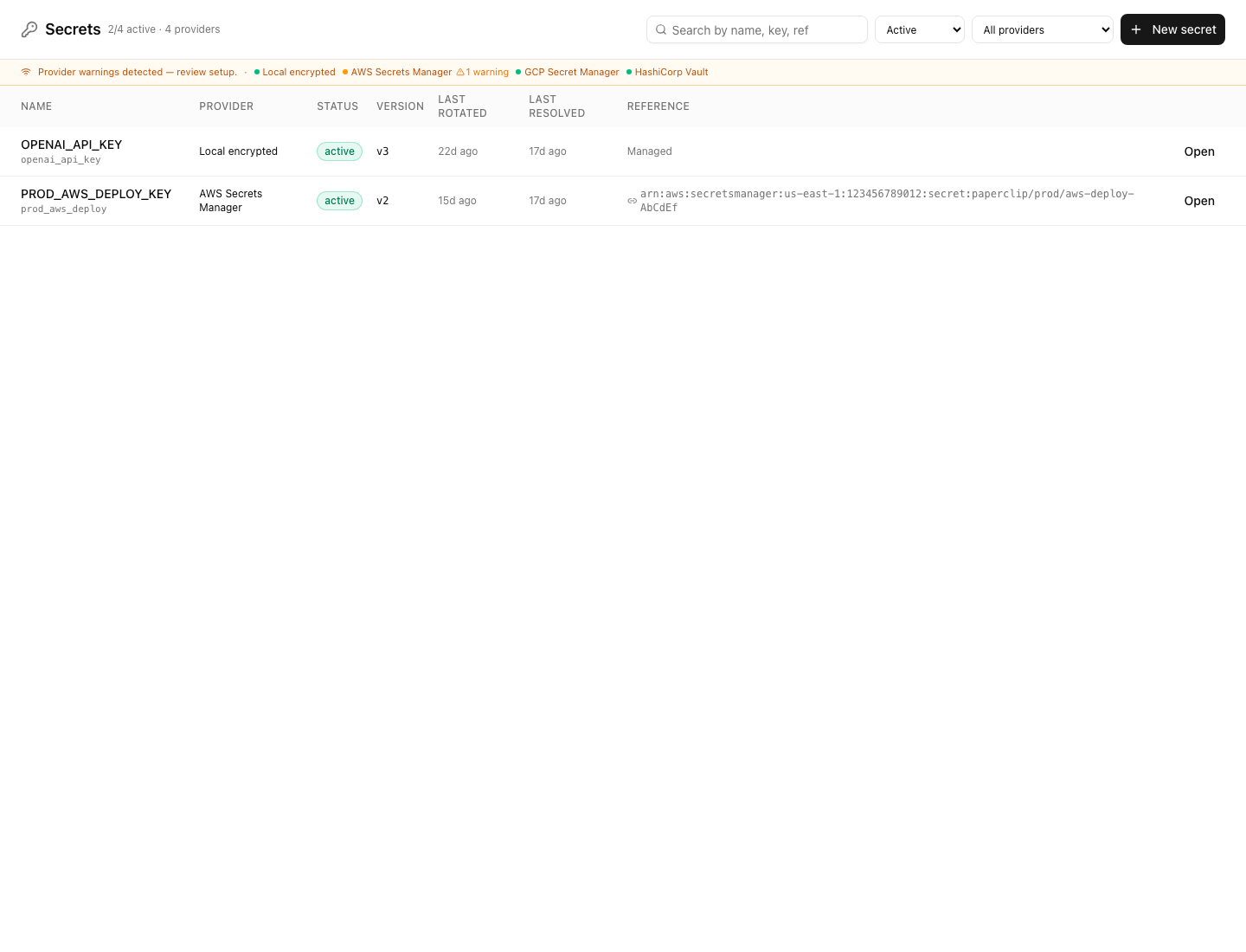 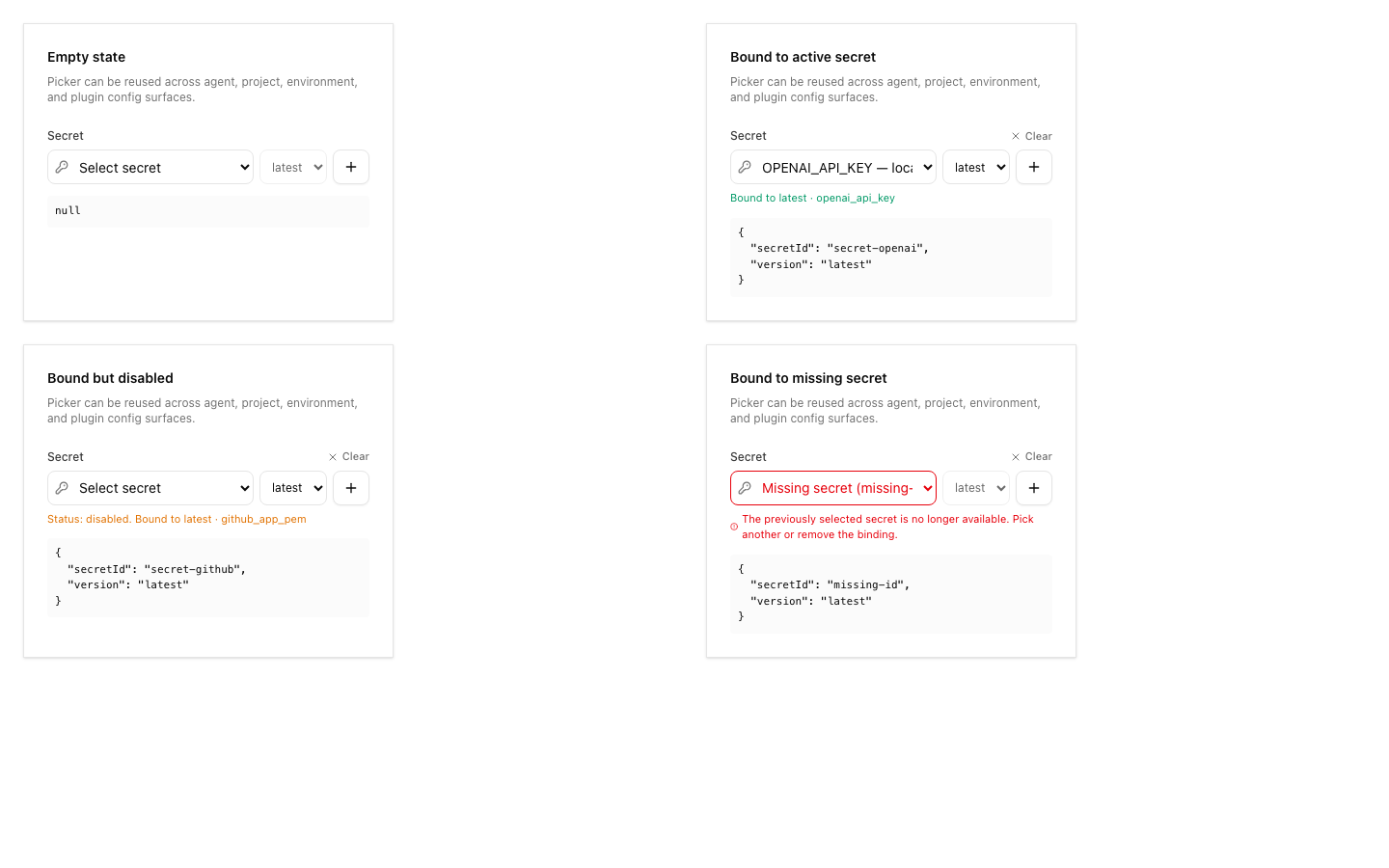 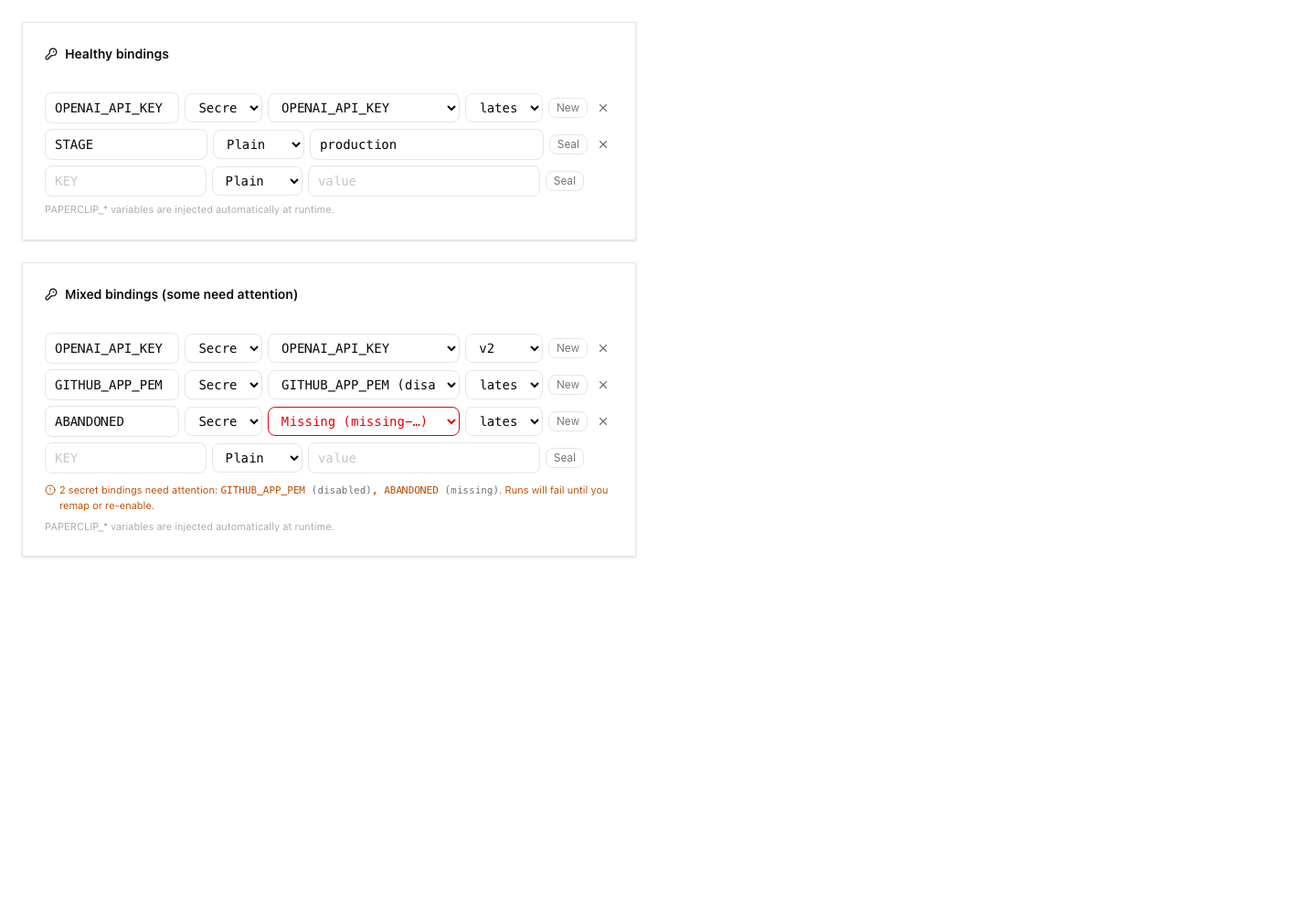 ## Risks - Migration risk: this adds new secret provider tables and extends existing secret rows. The migrations were checked for monotonic ordering and idempotent guards, but reviewers should still inspect upgrade behavior carefully. - Provider risk: AWS support uses direct SigV4 requests. Automated tests cover signing, request timeouts, vault-config selection, namespace guardrails, pending-version archival, sanitized provider errors, and service-level cleanup paths. A real-vault AWS smoke test remains deployment validation for an operator with AWS credentials rather than an unverified merge blocker in this local branch. - UI risk: the Secrets page and import dialog are large new surfaces; screenshots are included above for reviewer inspection. - Verification risk: the full local stable test command hit parallel-load timing failures, although the exact failed files passed when rerun directly. - Operational risk: remote import intentionally avoids plaintext reads; operators must understand that imported external references resolve at runtime and may fail if AWS permissions change. > For core feature work, check [`ROADMAP.md`](ROADMAP.md) first and discuss it in `#dev` before opening the PR. Feature PRs that overlap with planned core work may need to be redirected — check the roadmap first. See `CONTRIBUTING.md`. ## Model Used - OpenAI Codex, GPT-5 coding agent with local shell/tool use in the Paperclip worktree. Exact context-window size was not exposed by the runtime. ## Checklist - [x] I have included a thinking path that traces from project context to this change - [x] I have specified the model used (with version and capability details) - [x] I have checked ROADMAP.md and confirmed this PR does not duplicate planned core work - [ ] I have run tests locally and they pass - [x] I have added or updated tests where applicable - [x] If this change affects the UI, I have included before/after screenshots - [x] I have updated relevant documentation to reflect my changes - [x] I have considered and documented any risks above - [x] I will address all Greptile and reviewer comments before requesting merge --------- Co-authored-by: Paperclip <noreply@paperclip.ing> Co-authored-by: Claude Sonnet 4.6 <noreply@anthropic.com> |
||
|
Devin Foley
|
12cb7b40fd |
Harden remote workspace sync and restore flows (#5444)
## Thinking Path

> - Paperclip orchestrates AI agents for zero-human companies
> - When an agent runs against a remote target, Paperclip syncs the
workspace out to the remote at run start and restores changes back to
the local workspace at run end
> - The previous restore flow naïvely overwrote local files with
whatever the remote returned, so files that the remote run never touched
but had timestamp/mode drift could be needlessly rewritten — and a
single static `refs/paperclip/ssh-sync/imported` ref made concurrent SSH
workspace exports race on the same git ref
> - This pull request adds a `workspace-restore-merge` module that diffs
a pre-run snapshot against the post-run remote state and only writes
back files the remote actually changed; SSH workspace exports now use a
per-import unique ref so concurrent runs can't trample each other
> - Every adapter's execute path threads the snapshot through
`prepareAdapterExecutionTargetRuntime` so the merge has the baseline it
needs
> - The benefit is workspace restores no longer churn untouched files,
and concurrent SSH runs no longer collide on the import ref

## What Changed

- `packages/adapter-utils/src/workspace-restore-merge.{ts,test.ts}`: new
module — directory snapshot (kind/mode/sha256/symlink target) plus
snapshot-aware merge that writes only the files the remote changed
- `packages/adapter-utils/src/ssh.ts`: SSH workspace export uses a
per-import unique ref (`refs/paperclip/ssh-sync/imported/<uuid>`);
restore goes through the new merge helper; `ssh-fixture.test.ts` covers
the unique-ref + merge paths
- `packages/adapter-utils/src/sandbox-managed-runtime.ts` +
`remote-managed-runtime.ts`: thread the snapshot/merge through the
sandbox and SSH paths
- `packages/adapter-utils/src/server-utils.{ts,test.ts}` +
`execution-target.ts`: helpers for capturing the pre-run snapshot;
`prepareAdapterExecutionTargetRuntime` gains required `runId` and
optional `workspaceRemoteDir`, and returns the realized
`workspaceRemoteDir`
- Each adapter's `execute.ts` (acpx, claude, codex, cursor, gemini,
opencode, pi) takes the snapshot at run start and passes it through to
the runtime restore
- Remote execute test mocks updated to match the new
`prepareWorkspaceForSshExecution` return shape and the per-run
`${managedRemoteWorkspace}` cwd subdirectory

## Verification

- `pnpm vitest run --no-coverage --project @paperclipai/adapter-utils
--project @paperclipai/adapter-acpx-local --project
@paperclipai/adapter-claude-local --project
@paperclipai/adapter-codex-local --project
@paperclipai/adapter-cursor-local --project
@paperclipai/adapter-gemini-local --project
@paperclipai/adapter-opencode-local --project
@paperclipai/adapter-pi-local` — 196/196 passing
- `pnpm typecheck` clean across the workspace

## Risks

Medium. The restore path now writes a strict subset of what it
previously did — files the remote did not touch are no longer rewritten.
If any flow was relying on a touch-without-content-change being copied
back (timestamp or permission propagation only), that behavior is now
skipped. Snapshot capture adds an O(N-files-in-workspace) hash pass at
run start; the cost is bounded by the existing exclude list. The `runId`
parameter on `prepareAdapterExecutionTargetRuntime` is now required —
every in-tree caller is updated; out-of-tree adapter authors need to
pass it.

## Model Used

Claude Opus 4.7 (1M context)

## Checklist

- [x] I have included a thinking path that traces from project context
to this change
- [x] I have specified the model used (with version and capability
details)
- [x] I have checked ROADMAP.md and confirmed this PR does not duplicate
planned core work
- [x] I have run tests locally and they pass
- [x] I have added or updated tests where applicable — new module +
every adapter execute path covered
- [x] If this change affects the UI, I have included before/after
screenshots — N/A (no UI)
- [x] I have updated relevant documentation to reflect my changes
- [x] I have considered and documented any risks above
- [x] I will address all Greptile and reviewer comments before
requesting merge
|
||
|
Devin Foley
|
50db8c01d2 |
Serialize sandbox callback bridge against concurrent heartbeats (#5326)
> **Stacked PR.** This PR's branch carries cumulative content from #5324 (bridge allowlist expand) and #5325 (env sanitization) — the mutex/sha256 logic in this PR sits on top of both. Reviewers should focus on the files this PR's commit touches: `packages/adapter-utils/src/sandbox-callback-bridge.{ts,test.ts}`, `packages/adapter-utils/src/ssh.ts`, and `packages/adapter-utils/src/ssh-fixture.test.ts`. Will rebase onto `master` and force-push once both prerequisite PRs are merged. ## Thinking Path > - Paperclip orchestrates AI agents for zero-human companies > - Each agent that runs in a sandbox or via SSH talks back to the Paperclip server through a per-lease callback bridge whose entrypoint script is uploaded to the remote > - When two heartbeats target the same agent on the same machine concurrently, both upload the bridge entrypoint and both write to the same response files — producing torn-write races: `SyntaxError: Identifier 'randomUUID' has already been declared` from a concatenated upload, `mv: cannot stat …` from colliding `.json.tmp` writes, and 0-byte commits from a truncated stdin > - This pull request serializes those operations with a POSIX `mkdir`-mutex (PID liveness check + atomic rename) at the bridge entrypoint upload, applies the same lock to the bridge response writer, forwards stdin into remote ssh commands so the entrypoint payload arrives intact, and verifies a sha256 of the upload before promoting it > - The benefit is concurrent heartbeats no longer corrupt each other's bridge state ## What Changed - `packages/adapter-utils/src/sandbox-callback-bridge.ts`: serialize entrypoint upload and response writes via POSIX `mkdir`-mutex with PID liveness; sha256 the upload before promoting via `mv`; content-skip when the existing entrypoint already matches - `packages/adapter-utils/src/ssh.ts`: forward stdin into remote ssh commands through the SSH managed runtime so `cat > "$remote_upload"` actually receives the base64-encoded entrypoint - `packages/adapter-utils/src/ssh-fixture.test.ts`: cover the stdin-forwarded SSH path - `packages/adapter-utils/src/sandbox-callback-bridge.test.ts`: cover the mutex, content-skip, sha256-verify, and atomic-rename paths ## Verification - `pnpm vitest run --no-coverage --project @paperclipai/adapter-utils` - `pnpm typecheck` clean - Manual: two parallel heartbeats targeting the same SSH agent no longer race on the bridge entrypoint or response files ## Risks Medium. Serializing previously-parallel operations adds latency on the contended path (one heartbeat waits on another), bounded by the entrypoint upload time. The mutex includes PID liveness so a crashed heartbeat doesn't deadlock subsequent ones. Sha256-verify gives a clear "torn upload" failure mode instead of silent 0-byte commits. ## Model Used Claude Opus 4.7 (1M context) ## Checklist - [x] I have included a thinking path that traces from project context to this change - [x] I have specified the model used (with version and capability details) - [x] I have checked ROADMAP.md and confirmed this PR does not duplicate planned core work - [x] I have run tests locally and they pass - [x] I have added or updated tests where applicable — tests cover mutex + sha256-verify + stdin-forwarded ssh - [x] If this change affects the UI, I have included before/after screenshots — N/A (no UI) - [x] I have updated relevant documentation to reflect my changes - [x] I have considered and documented any risks above - [x] I will address all Greptile and reviewer comments before requesting merge |
||
|
Devin Foley
|
f6bad8f6bf |
Sanitize remote execution envs at the boundary (#5325)
## Thinking Path > - Paperclip orchestrates AI agents for zero-human companies > - Adapters spawn CLIs against local, SSH, and sandbox targets, threading a runtime env through `runAdapterExecutionTargetProcess` and the SSH/sandbox runners > - Host identity vars (HOME, TMPDIR, XDG_*, NVM_DIR, PATH) routinely leak into the env we send to remote targets — sometimes via test probes, sometimes via runtime config — and break sandboxed/SSH'd CLIs whose own profiles set those values correctly > - The sanitization logic existed but lived alongside other helpers in `server-utils.ts` and was applied piecemeal at adapter callsites, so it was easy to bypass > - This pull request lifts the sanitization into a standalone `remote-execution-env.ts`, applies it at the SSH and sandbox runtime boundary so every remote spawn goes through it, and removes the duplicated callsite-level filtering > - The benefit is identity-bound host env stops leaking across SSH/sandbox transports regardless of which adapter calls in ## What Changed - `packages/adapter-utils/src/remote-execution-env.ts`: new module — single source of truth for which env keys are identity-bound and how to strip them when the value matches the host's value - `packages/adapter-utils/src/server-utils.ts`: remove the inline sanitization (now in `remote-execution-env.ts`) - `packages/adapter-utils/src/execution-target.ts`: apply sanitization at the sandbox runtime boundary - `packages/adapter-utils/src/ssh.ts`: apply sanitization at the SSH spawn boundary - `packages/adapters/opencode-local/src/server/test.ts`: drop now-redundant callsite filtering - `packages/adapters/pi-local/src/server/test.ts`: drop now-redundant callsite filtering - New tests `execution-target.test.ts` and `execution-target-sandbox.test.ts` cover the sanitizer flow at both transports, including positive cases (host-shaped path stripped) and explicit-override preservation ## Verification - `pnpm vitest run --no-coverage --project @paperclipai/adapter-utils --project @paperclipai/adapter-opencode-local --project @paperclipai/adapter-pi-local` - `pnpm typecheck` clean ## Risks Low–medium. The sanitization is now applied at one layer (boundary) instead of N (callsites), so behavior is more consistent. Any adapter that previously relied on a leaked host var landing on the remote shell would now see it stripped — but those reliances were what this change exists to fix. ## Model Used Claude Opus 4.7 (1M context) ## Checklist - [x] I have included a thinking path that traces from project context to this change - [x] I have specified the model used (with version and capability details) - [x] I have checked ROADMAP.md and confirmed this PR does not duplicate planned core work - [x] I have run tests locally and they pass - [x] I have added or updated tests where applicable — new tests at both transports - [x] If this change affects the UI, I have included before/after screenshots — N/A (no UI) - [x] I have updated relevant documentation to reflect my changes - [x] I have considered and documented any risks above - [x] I will address all Greptile and reviewer comments before requesting merge |
||
|
Devin Foley
|
076067865f |
Migrate SSH environment callback to bridge (#5116)
> **Stacked PR (part 3 of 7).** Depends on: - PR #5114 - PR #5115 > Diff against `master` includes commits from earlier PRs in the stack — the new commit in this PR is the topmost one. ## Thinking Path > - Paperclip orchestrates AI agents for zero-human companies > - Agents executing on a remote SSH-backed environment need a way to call back into > the Paperclip control plane (run events, log streaming, signals) > - When the SSH host can't reach the Paperclip host (NAT, firewalls, or simply not > on the same network), the run silently fails or hangs — a recurring class of > failure during SSH testing > - In sandboxed environments we already solved this with a callback bridge that > tunnels back through the existing connection; SSH was the odd one out > - This PR migrates SSH execution to use the same callback bridge, so every > adapter's remote run uses one consistent reverse-channel. Per-adapter SSH glue > is deleted in favour of a shared `CommandManagedRuntimeRunner` built from the > SSH spec > - The benefit is fewer SSH-specific failure modes, a smaller code surface, and > one place to evolve the callback contract going forward ## What Changed - Added `createSshCommandManagedRuntimeRunner` in `packages/adapter-utils/src/ssh.ts` that adapts an SSH spec into a generic command-managed-runtime runner (with cwd, env, and timeout handling) - Removed `paperclipApiUrl` from `SshRemoteExecutionSpec`; the bridge URL now flows through the shared runner - Reworked `execution-target.ts` to use the SSH runner alongside sandbox runners via a unified `CommandManagedRuntimeRunner` interface - Simplified `remote-managed-runtime.ts` and `sandbox-managed-runtime.ts` to consume the shared runner abstraction - Deleted per-adapter SSH callback wiring from claude-local, codex-local, cursor-local, gemini-local, opencode-local, pi-local execute.ts files - Removed `environment-runtime-driver-contract.test.ts` (the contract is now enforced by `environment-execution-target.test.ts`) - Added/updated `execute.remote.test.ts` cases for each adapter to cover the SSH runner path ## Verification - `pnpm --filter @paperclipai/adapter-utils test` - `pnpm test -- execute.remote` (covers all six local adapters' SSH paths) - Manual QA: ran a claude-local agent against an SSH-backed environment, confirmed the agent successfully called back to `/api/agent-callback/*` endpoints during the run ## Risks - Refactor touches all six local adapters. If any adapter had subtle SSH-specific behaviour that wasn't captured in tests, it could regress. Mitigation: each adapter's `execute.remote.test.ts` was extended. - `paperclipApiUrl` removal from `SshRemoteExecutionSpec` is a breaking type change for any internal consumer. Verified no external plugins consume this type. - The new `CommandManagedRuntimeRunner` shape is a public surface in `@paperclipai/adapter-utils`; downstream plugins implementing custom runners may need updates, but no such plugins exist in this repo. ## Model Used - OpenAI GPT-5.4 (reasoning effort: high) via Codex CLI - Provider: OpenAI - Used to author the code changes in this PR ## Checklist - [x] I have included a thinking path that traces from project context to this change - [x] I have specified the model used (with version and capability details) - [x] I have checked ROADMAP.md and confirmed this PR does not duplicate planned core work - [x] I have run tests locally and they pass - [x] I have added or updated tests where applicable - [ ] If this change affects the UI, I have included before/after screenshots — N/A - [ ] I have updated relevant documentation to reflect my changes — N/A - [x] I have considered and documented any risks above - [x] I will address all Greptile and reviewer comments before requesting merge |
||
|
Devin Foley
|
f9cf1d2f6a |
Add cursor sandbox support and fix SSH workspace sync (#4803)
## Thinking Path > - Paperclip orchestrates AI agents for zero-human companies > - Agents can run inside sandboxed environments like E2B, or on remote hosts via SSH > - The cursor adapter needs to resolve `cursor-agent` inside sandbox environments where it's installed in `~/.local/bin` > - But when using the default `agent` command on a sandbox target, the adapter didn't know to look in `~/.local/bin/cursor-agent`, causing "command not found" failures > - Additionally, repeated SSH runs failed because `git checkout` during workspace sync conflicted with leftover `.paperclip-runtime` files from previous runs > - This PR adds sandbox-aware command resolution for cursor and fixes the SSH workspace sync conflict > - The benefit is cursor works in E2B sandboxes out of the box, and repeated SSH runs don't fail on workspace sync ## What Changed - `cursor-local`: Added `prepareCursorSandboxCommand` — on sandbox targets, reads the remote `$HOME`, prepends `~/.local/bin` to PATH, and prefers `~/.local/bin/cursor-agent` when the default command is requested; tightened the sandbox command probe to validate the binary exists before launching; preserves explicit custom command overrides - `adapter-utils/ssh.ts`: Added `--force` to git checkout in SSH workspace sync to handle `.paperclip-runtime` untracked file conflicts from previous runs ## Verification - `pnpm test` — all existing and new tests pass, including cursor sandbox probe, sandbox execution, and custom command override tests - `pnpm typecheck` — clean - Manual: configure an E2B environment, run a cursor-local task, verify it resolves cursor-agent from the sandbox install path ## Risks - Low-medium. The `--force` flag on git checkout could discard uncommitted changes in the remote workspace, but the workspace is managed by Paperclip and should not contain user edits. ## Model Used Codex GPT 5.4 high via Paperclip. ## Checklist - [x] I have included a thinking path that traces from project context to this change - [x] I have specified the model used (with version and capability details) - [x] I have checked ROADMAP.md and confirmed this PR does not duplicate planned core work - [x] I have run tests locally and they pass - [x] I have added or updated tests where applicable - [ ] If this change affects the UI, I have included before/after screenshots - [x] I have updated relevant documentation to reflect my changes - [x] I have considered and documented any risks above - [x] I will address all Greptile and reviewer comments before requesting merge |
||
|
Devin Foley
|
e4995bbb1c |
Add SSH environment support (#4358)
## Thinking Path > - Paperclip orchestrates AI agents for zero-human companies > - The environments subsystem already models execution environments, but before this branch there was no end-to-end SSH-backed runtime path for agents to actually run work against a remote box > - That meant agents could be configured around environment concepts without a reliable way to execute adapter sessions remotely, sync workspace state, and preserve run context across supported adapters > - We also need environment selection to participate in normal Paperclip control-plane behavior: agent defaults, project/issue selection, route validation, and environment probing > - Because this capability is still experimental, the UI surface should be easy to hide and easy to remove later without undoing the underlying implementation > - This pull request adds SSH environment execution support across the runtime, adapters, routes, schema, and tests, then puts the visible environment-management UI behind an experimental flag > - The benefit is that we can validate real SSH-backed agent execution now while keeping the user-facing controls safely gated until the feature is ready to come out of experimentation ## What Changed - Added SSH-backed execution target support in the shared adapter runtime, including remote workspace preparation, skill/runtime asset sync, remote session handling, and workspace restore behavior after runs. - Added SSH execution coverage for supported local adapters, plus remote execution tests across Claude, Codex, Cursor, Gemini, OpenCode, and Pi. - Added environment selection and environment-management backend support needed for SSH execution, including route/service work, validation, probing, and agent default environment persistence. - Added CLI support for SSH environment lab verification and updated related docs/tests. - Added the `enableEnvironments` experimental flag and gated the environment UI behind it on company settings, agent configuration, and project configuration surfaces. ## Verification - `pnpm exec vitest run packages/adapters/claude-local/src/server/execute.remote.test.ts packages/adapters/cursor-local/src/server/execute.remote.test.ts packages/adapters/gemini-local/src/server/execute.remote.test.ts packages/adapters/opencode-local/src/server/execute.remote.test.ts packages/adapters/pi-local/src/server/execute.remote.test.ts` - `pnpm exec vitest run server/src/__tests__/environment-routes.test.ts` - `pnpm exec vitest run server/src/__tests__/instance-settings-routes.test.ts` - `pnpm exec vitest run ui/src/lib/new-agent-hire-payload.test.ts ui/src/lib/new-agent-runtime-config.test.ts` - `pnpm -r typecheck` - `pnpm build` - Manual verification on a branch-local dev server: - enabled the experimental flag - created an SSH environment - created a Linux Claude agent using that environment - confirmed a run executed on the Linux box and synced workspace changes back ## Risks - Medium: this touches runtime execution flow across multiple adapters, so regressions would likely show up in remote session setup, workspace sync, or environment selection precedence. - The UI flag reduces exposure, but the underlying runtime and route changes are still substantial and rely on migration correctness. - The change set is broad across adapters, control-plane services, migrations, and UI gating, so review should pay close attention to environment-selection precedence and remote workspace lifecycle behavior. ## Model Used - OpenAI Codex via Paperclip's local Codex adapter, GPT-5-class coding model with tool use and code execution in the local repo workspace. The local adapter does not surface a more specific public model version string in this branch workflow. ## Checklist - [x] I have included a thinking path that traces from project context to this change - [x] I have specified the model used (with version and capability details) - [x] I have checked ROADMAP.md and confirmed this PR does not duplicate planned core work - [x] I have run tests locally and they pass - [x] I have added or updated tests where applicable - [ ] If this change affects the UI, I have included before/after screenshots - [x] I have updated relevant documentation to reflect my changes - [x] I have considered and documented any risks above - [x] I will address all Greptile and reviewer comments before requesting merge |


