Resolve creation intent across onboarding, hires, imports, and the UI. Preserve existing execution and qualify automatic defaults for shipped Linux x64 artifacts.

Co-Authored-By: Paperclip <noreply@paperclip.ing>
## Thinking Path

> - Paperclip is the open source app people use to manage AI agents for
work.
> - A stable agent persona is useful only when the same identity appears
across the app.
> - Lists, task messages, selectors, and activity feeds need inexpensive
static avatars.
> - Onboarding and agent headers need a larger character with
expressions and pointer tracking.
> - This pull request connects the persona foundation to those existing
views and preserves onboarding draft assignments.
> - Full-page stories and Linux checks make the placements and
performance contract reviewable.

## Linked Issues or Issue Description

**Problem or motivation**

Agents need a stable visual identity in lists, tasks, onboarding, and
configuration. External tools also need an image URL for that identity.

**Proposed solution**

Assign each agent a permanent palette from a fixed ClipLab character
library. Store the assignment on the agent. Render and cache preset PNG
URLs on demand. Use static images in dense views and one animated
character in larger placements.

**Alternatives considered**

A generated image bundle requires a separate asset build. A live
renderer in every avatar adds unnecessary work in large lists. Arbitrary
uploaded images do not provide the requested shared character system.

**Roadmap alignment**

This improves agent identity across existing control-plane views. It
preserves agent permissions, company boundaries, and status labels.
ROADMAP.md has no separate ClipLab persona milestone.

Related approaches: #2422 adds configurable image URLs and DiceBear
generation; #5578 adds optional uploaded avatars. This work uses a
fixed, versioned character library and preset URLs.

## What Changed

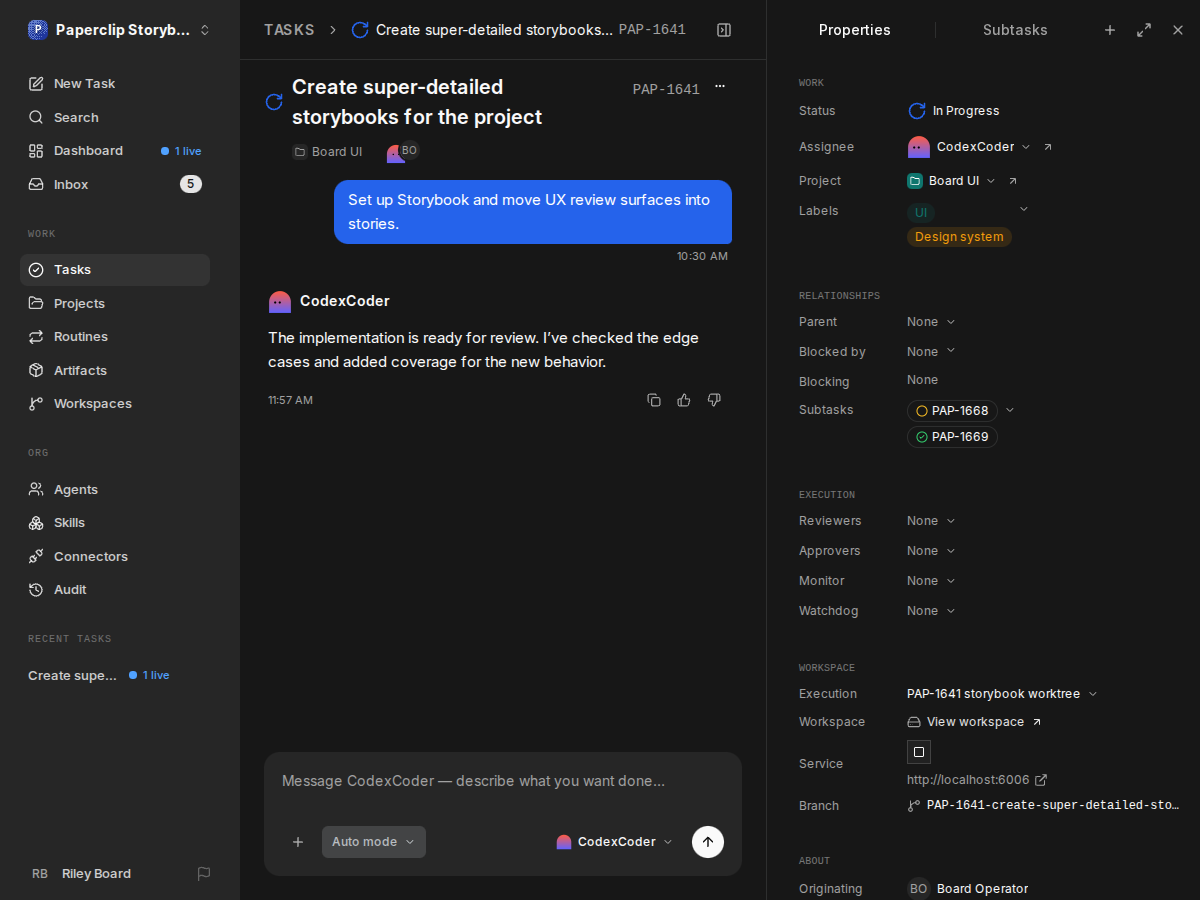
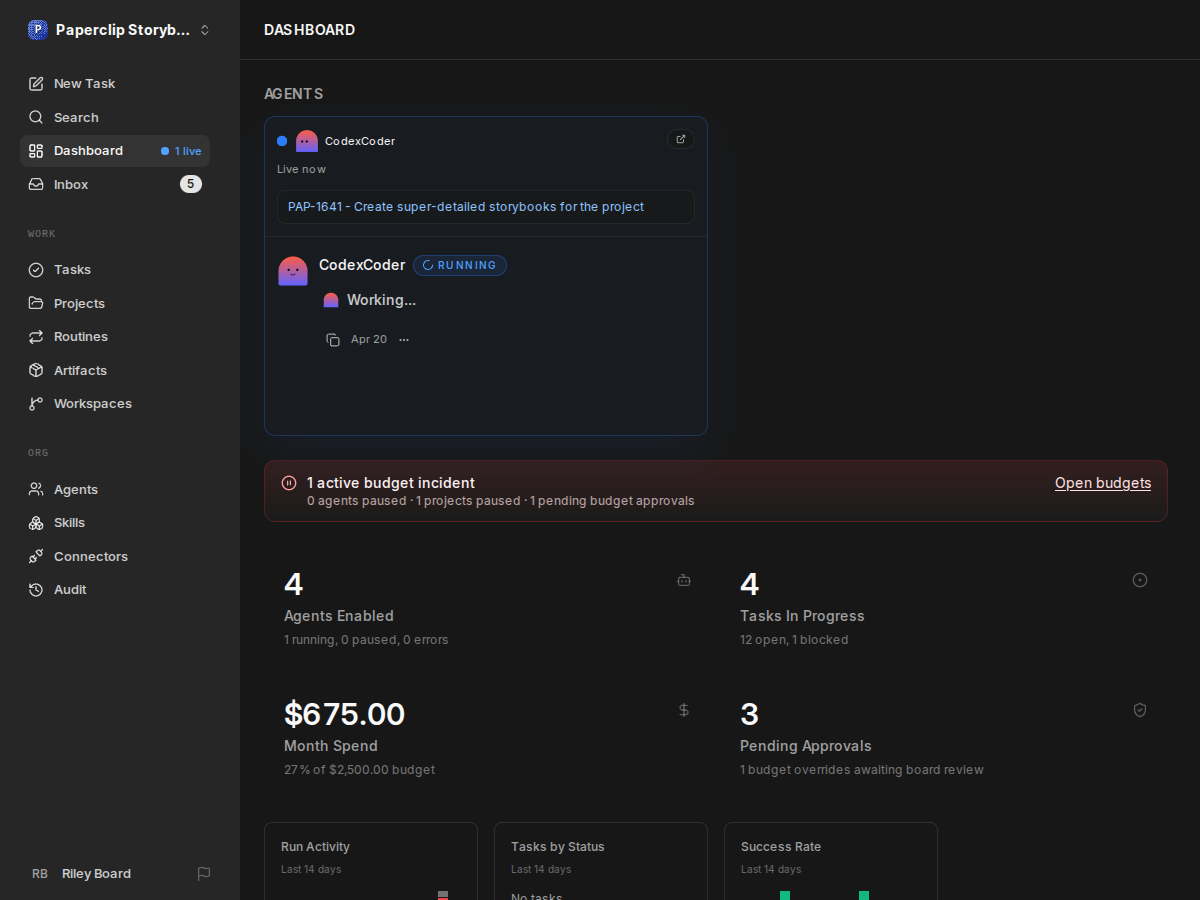
- Replace agent icons with static persona images across lists, the
sidebar, org charts, tasks, comments, selectors, activity, and dashboard
views.
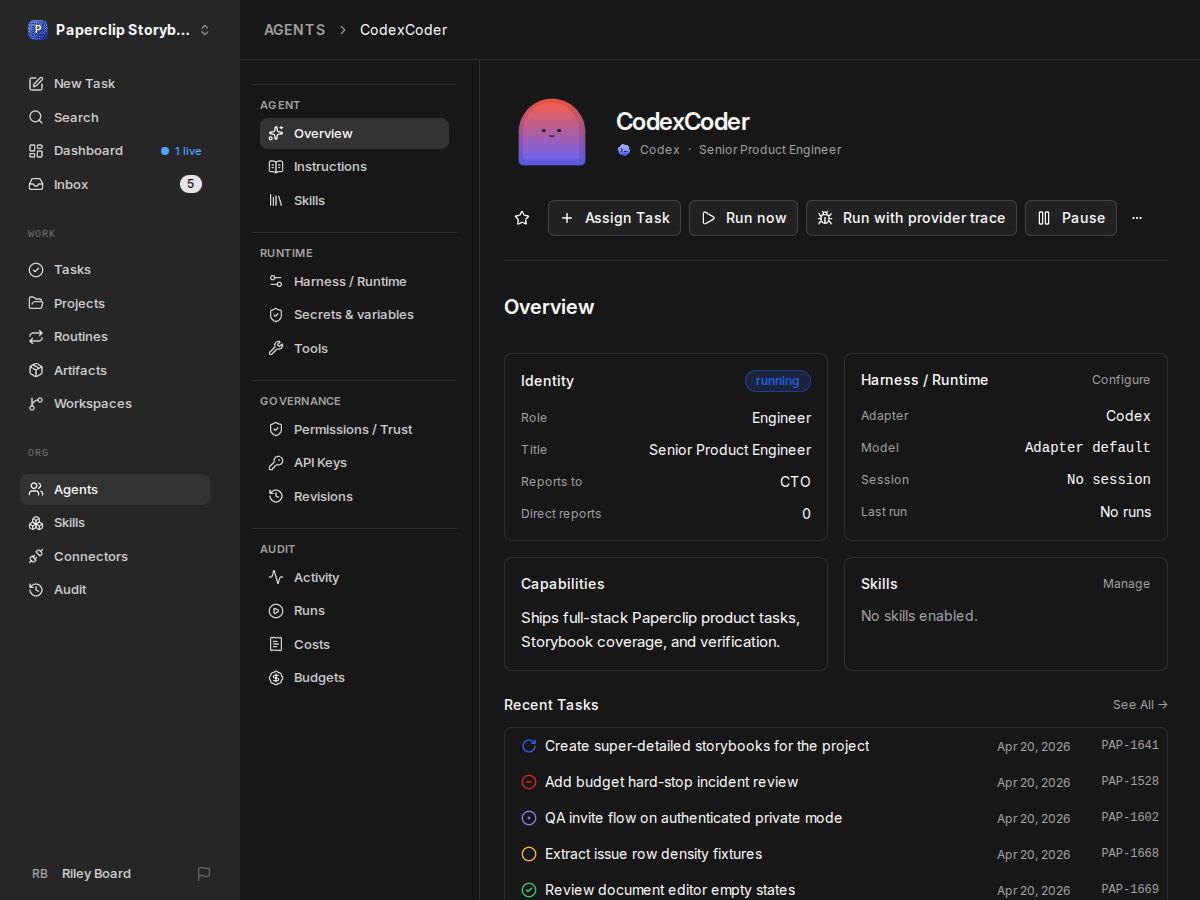
- Put one animated character in the agent header. Let it follow the
pointer across the page, with reduced-motion and touch fallbacks.
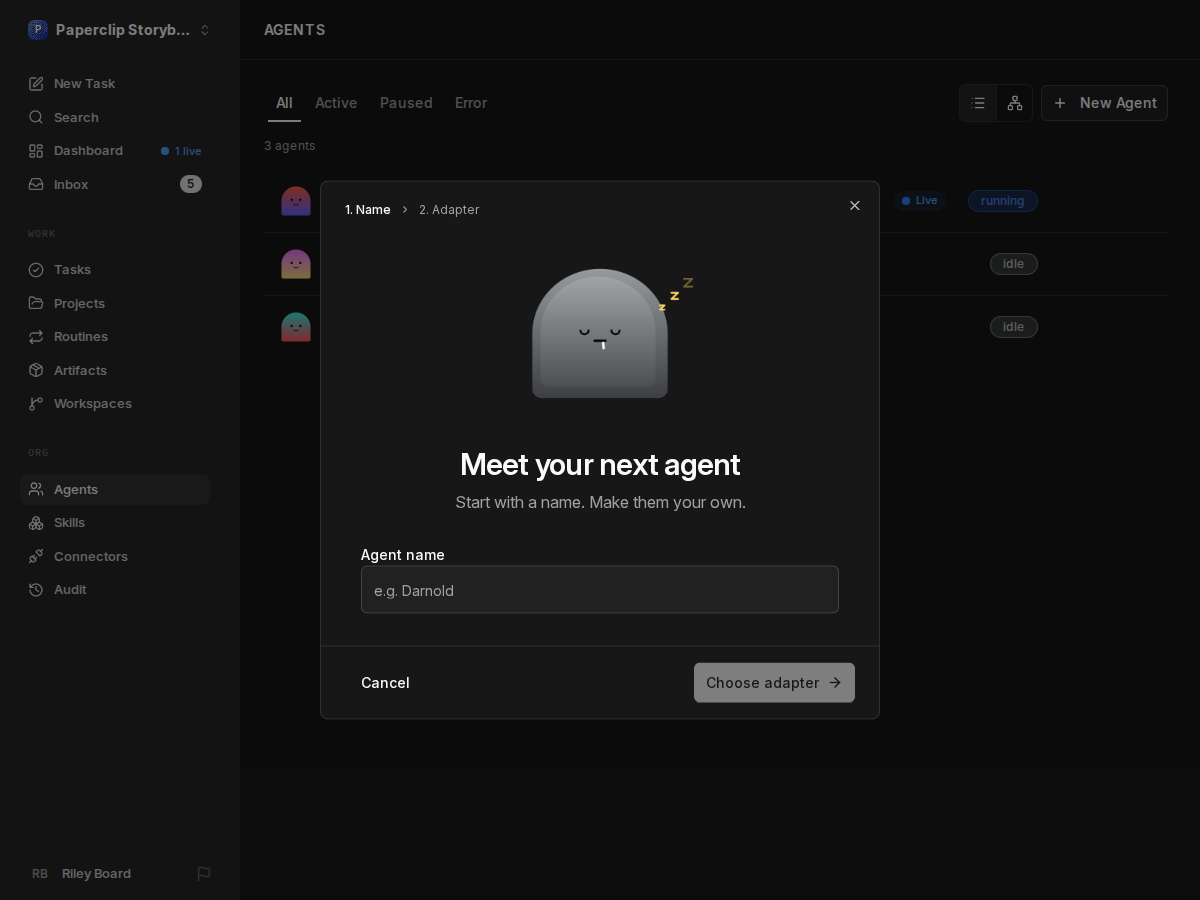
- Add larger padded characters to agent creation. Keep the palette
stable across draft refreshes and connection retries, then reveal it
after success.
- Pass appearance through shared projections rather than fetching each
agent separately.
- Add real full-page Storybook examples for the agent list, overview,
task, dashboard, new-agent dialog, and connection page.
- Add Linux screenshot, clipping, density, and 500-avatar performance
checks.

## Verification

- `pnpm -r typecheck`, `pnpm build`, and token gates pass on the rebased
tree. Persona lifecycle tests pass.
- The rebased feature passes 38 Linux screenshot/performance checks,
including both display densities, corner pointer positions, and the
no-WebGL/no-live-download contract for 500 avatars.
- The final Linux persona suite passes all 38 visual, lifecycle,
density, and full-page checks using the standard Storybook configuration
and real on-demand avatar endpoint.
- Final local focused verification: 45 avatar/native-recovery tests
pass; UI identity/routine tests, typecheck/build, token gates, and
Storybook build pass.
- Current-head CI passes: full workspace/server tests, all serialized
server groups, typecheck/release checks, build, canary validation, and
end-to-end shards. The build passed after retrying a native-runner
concurrency-test failure; its three targeted cases also pass locally.
- Manual inspection covered stable identities in the app, header
placement, full-page mouse tracking, onboarding size, and task/dashboard
placements.


### Screenshots

Linux captures use synthetic Storybook fixtures. Full-page captures use
reduced motion. The live character, mouse tracking, and disposal are
checked separately.

<details>
<summary>Agent overview with the character in its header</summary>

<img
src="https://raw.githubusercontent.com/paperclipai/paperclip/8c68f42b268ada22b67d79d0fe1bb0a2f84ec25c/screenshots/full-page-agent-overview.png"
width="900" alt="Agent overview with the character in its header" />

</details>
<details>
<summary>Task messages and assignee identity</summary>

<img
src="https://raw.githubusercontent.com/paperclipai/paperclip/8c68f42b268ada22b67d79d0fe1bb0a2f84ec25c/screenshots/full-page-task.png"
width="900" alt="Task messages and assignee identity" />

</details>
<details>
<summary>Larger onboarding character with room for expressions</summary>

<img
src="https://raw.githubusercontent.com/paperclipai/paperclip/8c68f42b268ada22b67d79d0fe1bb0a2f84ec25c/screenshots/full-page-meet-your-next-agent.png"
width="900" alt="Larger onboarding character with room for expressions"
/>

</details>
<details>
<summary>Dashboard agent activity</summary>

<img
src="https://raw.githubusercontent.com/paperclipai/paperclip/8c68f42b268ada22b67d79d0fe1bb0a2f84ec25c/screenshots/full-page-company-dashboard.png"
width="900" alt="Dashboard agent activity" />

</details>

## Risks

- This PR depends on #13170, the persona foundation. Merge the
foundation first, then retarget this PR to master.
- Many placements change from icons to character silhouettes. Human
avatars and authoritative agent status labels retain their existing
behavior.
- Only one character can render live per view. Reduced motion,
hidden/offscreen content, touch input, and renderer failures use the
defined fallbacks.
- The full-page stories use fixture data. They do not contact a real
company or complete real provider sign-in.

## Model Used

OpenAI Codex, GPT-6 family. The exact model identifier and context
window are not exposed in this session. Used code editing, shell
execution, browser inspection, and Linux visual testing.

## Checklist

- [x] I have included a thinking path that traces from project context
to this change
- [x] I have specified the model used (with version and capability
details)
- [x] I have checked ROADMAP.md and confirmed this PR does not duplicate
planned core work
- [x] I have searched GitHub for duplicate or related PRs and linked
them above
- [x] I have either (a) linked existing issues with `Fixes: #` / `Closes
#` / `Refs #` OR (b) described the issue in-PR following the relevant
issue template
- [x] I have not referenced internal/instance-local Paperclip issues or
links (only public GitHub `#NNN` / `github.com/paperclipai/paperclip`
URLs)
- [x] My branch name describes the change (e.g. `docs/...`, `fix/...`)
and contains no internal Paperclip ticket id or instance-derived details
- [x] I have run tests locally and they pass
- [x] I have added or updated tests where applicable
- [x] I have updated relevant documentation to reflect my changes
- [x] I have considered and documented any risks above
- [x] All Paperclip CI gates are green
- [x] Greptile is 5/5 with no open P2s, recommendations, or follow-ups
- [x] I will address all Greptile and reviewer comments before
requesting merge

---------

Co-authored-by: Paperclip <noreply@paperclip.ing>
Co-authored-by: Tonio <tonework@gmail.com>
Co-authored-by: Claude Fable 5.1 <noreply@anthropic.com>
## Thinking Path

> - Paperclip is the open source app people use to manage AI agents for
work
> - The app can run self-hosted or as a cloud-managed instance, where a
hosting platform provisions the instance with its company already
materialized (the existing `isCloudManagedInstance()` predicate and
`cloud_managed` floors)
> - The company Import/Export surface lets an operator materialize whole
companies from an export bundle; on a cloud-managed instance this
bypasses the existing `cloud_managed` company-creation floor and
conflicts with platform-owned provisioning
> - Importing should be disabled on cloud-managed instances, while
export stays open as the data-portability escape hatch
> - This pull request floors every import route with 403
`code=cloud_managed` on cloud-managed instances and hides the Import UI
there, using the existing predicate and the established floor pattern
> - It also extends the operator-hidden settings registry with keys for
every top-level company settings page, so a hosting operator can hide
any of them with `PAPERCLIP_HIDDEN_SETTINGS` alone next time
> - The benefit is one consistent managed-instance policy: cloud-managed
instances cannot import companies, self-hosted installs keep the full
import surface unchanged

## Linked Issues or Issue Description

No public issue exists; the underlying problem follows the enhancement
template.

**What existing behavior does this improve?**

The company import surface (`/api/companies/import*`,
`/api/companies/:companyId/imports/*`) and its UI entry points on
cloud-managed instances.

**Subsystem affected**

Server routes (`server/src/routes/companies.ts`) and UI navigation/pages
(settings sidebar, settings tabs, org chart, `/company/import` route).

**Current behavior**

A cloud-managed instance floors direct company creation (`POST
/api/companies` answers 403 `cloud_managed`), but the import routes
still accept company bundles, so an import can materialize companies the
hosting platform did not provision. The UI offers Import entry points
that lead to a surface that is not available on cloud-managed instances.

**Proposed behavior**

On instances where `isCloudManagedInstance()` is true, every import
route answers 403 `code=cloud_managed` before auth and body work, and
the Import UI (sidebar entry, settings tab, org-chart button,
`/company/import` route) is hidden or redirected. Export remains fully
available. Self-hosted instances are unchanged.

**Reason and benefit**

Cloud-managed instances keep one consistent provisioning authority, and
users do not see an Import surface that dead-ends in a 403.

## What Changed

- `server/src/routes/companies.ts`: a router-level floor mounted at the
`/import` and `/:companyId/imports` prefixes. It covers the single-shot
upload, preview, job polling, chunked transfer
declare/part-upload/status/preview/apply, and the agent-safe per-company
import routes. It throws `forbidden(..., { code: "cloud_managed" })` on
cloud-managed instances, or `403 settings_operator_managed` when the
operator hides `company.import` — both before auth and body validation,
mirroring the company-creation floor.
- `packages/shared/src/settings-visibility.ts`: new
`HIDEABLE_COMPANY_PAGES` registry group — `company.members`,
`company.invites`, `company.secrets`, `company.export`, `company.import`
— with a `hidesCompanyPage` helper. The company General page stays
non-hideable (settings root). `company.import` floors its API; the other
keys are UI-visibility only, as documented in the registry, so
membership/invite/secret/export APIs stay live for agents.
- `ui/src/components/CloudManagedPageGate.tsx` (new): route gate that
redirects cloud-managed instances to `/company/settings`, modeled on
`HiddenSettingsPageGate`.
- `ui/src/App.tsx`: wraps the `company/import` route in
`CloudManagedPageGate`.
- `ui/src/components/CompanySettingsSidebar.tsx`,
`ui/src/components/access/CompanySettingsNav.tsx`,
`ui/src/pages/OrgChart.tsx`: hide the Import entry points when
`useCloudInstance()` reports a managed instance, and honor the new
`company.*` hidden-settings keys for every company page entry (sidebar
item, tab, org-chart buttons).
- `ui/src/App.tsx`: `HiddenSettingsPageGate` route gates for the members
(incl. the legacy access route), invites, secrets, export, and import
pages under their `company.*` keys.
- `docs/deploy/environment-variables.md`: documents the new keys and
their semantics; the CLI and board-operator guides note that import is
unavailable on cloud-managed instances.
- Tests: new `server/src/__tests__/company-import-cloud-floor.test.ts`
and `ui/src/components/CloudManagedPageGate.test.tsx`, registry cases in
`packages/shared/src/settings-visibility.test.ts`, plus cloud and
hidden-key cases in the sidebar, settings-nav, and org-chart suites.

## Verification

- TypeScript typechecks pass for every workspace package (`tsc` in
shared, server, ui; the runner's Rust leg needs a local cargo toolchain
and is covered by CI).
- `pnpm test` on this branch fails only in 9 files that also fail on a
clean `origin/master` checkout on the same machine
(environment-dependent suites: live-listener probes,
workspace/native-runtime spawns, skill materialization). Zero
branch-only failures against that baseline; every suite touched by this
change passes.
- `server/src/__tests__/company-import-cloud-floor.test.ts` asserts:
every import route answers 403 `cloud_managed` under the server-token
signal; the managed-config signal alone also floors; every import route
answers 403 `settings_operator_managed` when `company.import` is hidden;
hiding other company pages leaves import open; the floor applies before
auth and body validation; export stays open on cloud-managed instances;
self-hosted import preview and job polling still work.
- `packages/shared/src/settings-visibility.test.ts` covers the new
`company.*` keys and `hidesCompanyPage`.
- UI suites assert the Import tab, sidebar entry, and org-chart button
disappear on a cloud-managed instance while Export stays, that
`/company/import` redirects through the gate, and that the `company.*`
keys hide their sidebar entries and tabs.

## Risks

- Low risk for self-hosted installs: the floor is inert unless a cloud
signal (`PAPERCLIP_CLOUD_TENANT_SERVER_TOKEN` or
`PAPERCLIP_MANAGED_CONFIG`) is present, and the self-hosted paths are
regression-tested.
- On cloud-managed instances this is a deliberate behavioral removal:
import (including agent-driven safe imports and resumable transfers)
stops working the moment an instance runs this build. In-flight chunked
transfers on such instances cannot be applied afterward; they answer
403.
- CLI import commands against a cloud-managed instance now fail with the
`cloud_managed` error; the message names the reason.
- The new `company.*` keys change nothing unless an operator sets them:
`PAPERCLIP_HIDDEN_SETTINGS` unset keeps behavior identical, and older
images ignore unknown keys by design. The four non-import company keys
hide UI only; their APIs stay live, which the registry documents
explicitly.

## Model Used

Claude Fable 5 (`claude-fable-5`, Anthropic) via Claude Code — agentic
coding session with tool use (code search, editing, local test
execution).

## Checklist

- [x] I have included a thinking path that traces from project context
to this change
- [x] I have specified the model used (with version and capability
details)
- [x] I have checked ROADMAP.md and confirmed this PR does not duplicate
planned core work
- [x] I have searched GitHub for duplicate or related PRs and linked
them above
- [x] I have either (a) linked existing issues with `Fixes: #` / `Closes
#` / `Refs #` OR (b) described the issue in-PR following the relevant
issue template
- [x] I have not referenced internal/instance-local Paperclip issues or
links (only public GitHub `#NNN` / `github.com/paperclipai/paperclip`
URLs)
- [x] My branch name describes the change (e.g. `docs/...`, `fix/...`)
and contains no internal Paperclip ticket id or instance-derived details
- [x] I have run tests locally and they pass
- [x] I have added or updated tests where applicable
- [x] I have updated relevant documentation to reflect my changes
- [x] I have considered and documented any risks above
- [ ] All Paperclip CI gates are green
- [ ] Greptile is 5/5 with no open P2s, recommendations, or follow-ups
- [x] I will address all Greptile and reviewer comments before
requesting merge
## Thinking Path

> - Paperclip is the open source app people use to manage AI agents for
work
> - Its UI is governed by a design system (`DESIGN.md` + the token layer
in `ui/src/index.css`, merged in #9134) whose first principle is "one
way to say each thing" — one Card, one Badge, one nav row
> - After the token extraction landed, ~35 files still hand-rolled card
containers, ~45 files hand-rolled pill spans, the sidebar agents section
duplicated the nav-row chrome, and the inbox and tasks lists rendered
the same task rows two subtly different ways
> - Each divergence is a place where a future design change (radius,
hover language, status vocabulary) silently misses surfaces, defeating
the "edit tokens + run checks" model the design system exists for
> - This pull request converges those surfaces onto the shared
primitives, codifies the radius scale as the modern multiplicative
shadcn ladder, and unifies the row/hover/tree-guide language across the
inbox and tasks lists — every visible delta was human-reviewed
screen-by-screen against a live instance across nine feedback rounds
> - The benefit is that the app's look is now steerable from single
knobs (one `--radius` anchor, one Card, one Badge, one row component),
and the visual regression suite covers the result (514 snapshots
including a new AgentDetail page story)

## Linked Issues or Issue Description

No public GitHub issue exists for this work; describing per the feature
template:

- **Problem**: after the design-token foundation (#9134),
component-level drift remained — hand-rolled cards/pills, duplicated
sidebar row chrome, and two different renderings of task rows (inbox vs
tasks list) meant design changes had to be applied per-surface and
frequently missed spots (e.g. status glyphs rendered 16px in the inbox
but 20px in the tasks list because a slot override silently beat the
component default).
- **Proposed behavior**: all card-shaped containers render via `Card`,
all label pills via `Badge`, sidebar rows via `SidebarNavItem`, and both
task-list surfaces via one `IssueRow` configuration; the radius scale is
a single multiplicative ladder anchored at `--radius: 0.5rem`.
- **Alternatives considered**: converting interactive
`<button>`/`<Link>` cards to `Card` divs (rejected — breaks semantics;
documented inline with `design-allow` comments instead); keeping the
legacy additive radius ladder (rejected in favor of the standard shadcn
multiplicative mapping).

## What Changed

- `Card` adoption across ~35 files (settings pages, auth/board flows,
dashboards, list containers, KPI tiles); non-adoptable sites
(interactive cards, `<li>` rows, class-string props, chart tooltip)
carry documented `design-allow(card-pattern)` comments
- `Card` gains an `interactive` prop — one quiet hover affordance for
clickable cards (cursor, border darken, shadow lift, focus ring),
applied to skills tiles, artifact cards, and the company selector; cards
carry no resting shadow
- `Badge` adoption for 113 hand-rolled pill spans across ~45 files;
`PropertyChip` wraps `Badge` internally; `StatusBadge`, external-object
chips, and match chips stay bespoke by documented decision (WCAG-tuned
status mechanics)
- Radius ladder becomes the multiplicative shadcn mapping
(`sm/md/lg/xl/2xl/3xl/4xl = 0.6/0.8/1.0/1.4/1.8/2.2/2.6 × --radius`,
anchor `0.5rem`); every card surface unifies on `rounded-lg`; the
orphaned 8px literal token is deleted
- Sidebar: agent rows render via `SidebarNavItem` (new additive props:
`iconNode`, `active`, `trailing`, `liveAccessory`); live dots use
`--status-agent-running`; one row rhythm and inset rounded pill
highlight; right-aligned trailing badges; every labeled section is
collapsible
- Inbox + tasks lists unified: md status glyphs, `accent/50` rounded row
hovers, vertical tree guides under parent rows (opaque underlay so
dark-mode translucent borders don't stack), no horizontal dividers under
expanded parents; the swipe-to-archive reveal layer shows only
mid-swipe; board toggle uses the `SquareKanban` glyph
- Kanban: every column carries a status-hued tint; lanes default
expanded (including empty); compact mode collapses empty lanes to
labeled rails (fixes a clipped, label-less empty-column state)
- Storybook: new AgentDetail page story (realistic fixtures, light+dark)
joins the visual suite; suite captures with `reducedMotion: 'reduce'`
and the ux-lab reasoning ticker honors `prefers-reduced-motion`; a stale
lexical alias in `storybook/main.ts` is fixed (build was broken since
the lexical 0.46 bump)
- Keyboard navigation, from live review of the unified lists: inbox
navigation keys work on every tab (archive keys stay scoped to the
archivable tab); keyboard-driven scrolling no longer hands the selection
to whatever row lands under the stationary cursor (hover selects only
after real pointer movement); the tasks list view gains the same j/k /
arrows / Enter selection model as the inbox; and the `g` then `i`
go-to-inbox chord works app-wide instead of only on the issue detail
page
- Token gates restored to 3/3 CLEAN (tokenized a post-#9134 regression
in the recovery card); decisions recorded in
`doc/design/DECISION-SHEET.md` and `doc/design/COMPONENT-INVENTORY.md`
(investigation verdicts: FileTree vs WorkspaceFileBrowser and the four
entity pickers stay separate — evidence included)

## Verification

- `pnpm check:token-gates` → 3/3 CLEAN
- `pnpm typecheck` → green (all packages)
- `cd ui && npx vitest run` → 2106/2106 (assertions updated in lockstep
where they documented superseded decisions; new tests for the global
go-to-inbox chord)
- `pnpm --filter @paperclipai/ui build` → exit 0
- `pnpm build-storybook` → succeeds (also fixes the lexical-alias break
on master)
- Visual regression: 514-snapshot Playwright suite green against the
updated baseline (zero diffs from the keyboard-navigation round — those
changes are purely behavioral). Note: baselines live outside git per the
suite design and the baseline-manifest archive is not yet published, so
CI cannot run this suite — it was run locally throughout; every visible
delta was reviewed screen-by-screen in a live instance across nine
review rounds. Review evidence (before/after triplets) intentionally
kept out of the repo for size; available on request.
- Manual: exercised dashboard, tasks (list + board), inbox, agents,
skills, costs, settings, and artifact surfaces in light and dark themes

## Risks

- Wide but shallow visual surface: most changes are class-string
substitutions with behavior preserved (props, handlers, roles, test
ids). The riskiest areas — dnd-kit card refs (React 19 ref-as-prop),
inbox swipe-to-archive, and sidebar overlays — are covered by existing
unit tests (all green) and were manually exercised.
- Intentional visual deltas (rounded cards, tinted kanban columns, md
status glyphs, unified hovers) are design decisions recorded in
`doc/design/DECISION-SHEET.md`; each maps to a re-baselined snapshot set
locally.
- The visual suite cannot yet run in CI (unpublished baseline archive —
pre-existing condition from #9134); until that lands, snapshot coverage
is local-only.

## Model Used

- Claude Fable 5 (`claude-fable-5`, Anthropic) via Claude Code — agentic
coding with tool use (file editing, test execution, Playwright
screenshot verification); extended thinking enabled.

## Checklist

- [x] I have included a thinking path that traces from project context
to this change
- [x] I have specified the model used (with version and capability
details)
- [x] I have checked ROADMAP.md and confirmed this PR does not duplicate
planned core work
- [x] I have searched GitHub for duplicate or related PRs and linked
them above
- [x] I have either (a) linked existing issues with `Fixes: #` / `Closes
#` / `Refs #` OR (b) described the issue in-PR following the relevant
issue template
- [x] I have not referenced internal/instance-local Paperclip issues or
links (only public GitHub `#NNN` / `github.com/paperclipai/paperclip`
URLs)
- [x] My branch name describes the change (e.g. `docs/...`, `fix/...`)
and contains no internal Paperclip ticket id or instance-derived details
- [x] I have run tests locally and they pass
- [x] I have added or updated tests where applicable
- [x] I have updated relevant documentation to reflect my changes
- [x] I have considered and documented any risks above
- [ ] All Paperclip CI gates are green (will confirm once CI runs)
- [ ] Greptile is 5/5 with no open P2s, recommendations, or follow-ups
(pending first review)
- [x] I will address all Greptile and reviewer comments before
requesting merge

🤖 Generated with [Claude Code](https://claude.com/claude-code)

---------

Co-authored-by: Claude Fable 5 <noreply@anthropic.com>
## Thinking Path

> - Paperclip is the open source app people use to manage AI agents for
work
> - Its UI is the operator's daily surface: task lists, boards, budgets,
agent status — all built on shadcn components and Tailwind
> - Visual values (colors, spacing, type sizes, radii) were hardcoded at
~1,600 call sites: the same "small gray label" was 9/10/11px depending
on the file, charts disagreed with chips about status colors, two
toggle-switch implementations coexisted in two greens, and there was no
visual regression coverage
> - This made the UI drift-prone and made any restyle a
hundreds-of-files project, which discourages design iteration
> - This pull request extracts visual values into a single token layer
in `ui/src/index.css`, adds a Storybook visual regression suite backed
by external immutable baseline archives, and then applies a deliberate
retune reviewed change-by-change on screenshot diffs
> - The benefit is that Paperclip's look becomes a config surface:
retheming is a token edit reviewed as a snapshot diff, drift is blocked
by a token gate, and future UI PRs can prove exactly what changed
visually without committing hundreds of PNGs

## Linked Issues or Issue Description

No existing public issue covers this work (searched "design tokens",
"visual regression", "design system" across issues and PRs). Related in
spirit: Refs #8982 (theming a hardcoded panel — a one-off instance of
the same problem class this PR addresses systematically).

**Problem (feature-request form):** UI visual values are hardcoded per
call site with no source of truth and no regression coverage;
consistency depends on reviewer memory, and restyling requires mass file
edits.
**Proposed solution (this PR):** a single token layer + enforcement gate
+ externally stored visual snapshot suite, then an intentional restyle
on top of that foundation.

## What Changed

- **Token extraction (zero visual change, machine-verified during
development):** committed codemods (`scripts/codemod-*.mjs`) moved
~1,600 hardcoded color/type/spacing/radius/shadow/misc values into named
tokens in a non-inline `:root` block of `ui/src/index.css`.
- **Visual regression suite:** `pnpm test:storybook-visual` covers 255
stories × light/dark = 510 Playwright screenshots at `maxDiffPixels: 0`,
plus new primitive-coverage stories and deterministic-render fixes.
- **External visual baselines:** committed PNG snapshots were removed.
`tests/storybook-visual/baseline-manifest.json` pins an immutable
archive URL/hash/size/count, and `scripts/storybook-visual-baseline.mjs`
handles `download`, `verify`, `pack`, and trusted maintainer `upload`
flows.
- **Opt-in visual CI artifacts:** added a `Storybook Visual` workflow
that runs on manual dispatch or PRs labeled `storybook-visual`,
downloads/verifies the baseline, runs Playwright, and uploads Playwright
report/test-result artifacts for review. Normal PR runs do not mutate
baseline objects.
- **Token gate:** `pnpm check:token-gates` — zero hex literals, zero
arbitrary bracket values, zero raw font-sizes in `ui/src/components/**`
and `ui/src/pages/**`, with a documented inline allowlist for legitimate
opt-outs.
- **Theme retune (intentional, snapshot-reviewed):** new base theme
values; radius ladder derived from a single `--radius` knob; micro-type
cluster collapsed to a named ladder (`--text-nano/micro/compact` +
Tailwind `text-xs`/`text-sm`); letter-spacing collapsed to named steps.
- **One status-color vocabulary:** charts, quota/budget bar fills,
RUNNING/live chips, and liveness indicators all use the canonical
`--status-*` hues. Light-mode legibility fixes for red alert surfaces
that used dark-tuned text classes.
- **One switch:** `ToggleSwitch` restyled to the registry capsule form,
second hand-rolled implementation removed, and all call sites unified.
- **Docs:** `DESIGN.md` is the design contract; `doc/design/` holds
audit reports, decision logs, and updated guidance for external baseline
review/update workflows.
- Dead code removed (`agentStatusBadge` duplicate map), byte-identical
contrast constants consolidated, semantic renames
(`--project-seed`/`--project-none`, `--liveness-blue`).

## Verification

- `pnpm check:token-gates` — 3/3 gates CLEAN during the design-system
run
- `pnpm typecheck` && `pnpm --filter @paperclipai/ui build` — green
during the design-system run
- `node --test scripts/__tests__/storybook-visual-baseline.test.mjs` —
pass after external-baseline rework
- `pnpm exec tsc --noEmit --pretty false --module NodeNext
--moduleResolution NodeNext --target ES2022 --types
node,@playwright/test tests/storybook-visual/playwright.config.ts
tests/storybook-visual/storybook-visual.spec.ts` — pass after
external-baseline rework
- `git diff --check origin/pr/9134..HEAD` — pass after external-baseline
rework
- `find tests/storybook-visual -type f -name '*.png' -print | wc -l` —
`0`
- `node scripts/storybook-visual-baseline.mjs verify` — intentionally
fails closed until the first trusted maintainer publishes the baseline
archive and updates `baseline-manifest.json`

## Risks

- **Large but shallow:** the PR still touches many UI files due to
mechanical token extraction and retune work, but committed PNG snapshot
churn has been removed from the branch.
- **Baseline publication required before the visual suite can pass in
clean clones:** the manifest currently has placeholder archive metadata.
A trusted maintainer must publish the first immutable archive, then
update `baseline-manifest.json`.
- **Rendering platform variance:** the external baseline should be
captured in the documented Linux/Chromium environment. Future CI runs
verify against the pinned archive and fail closed on checksum/count
mismatch.
- **Visual CI is opt-in while stabilizing:** add the `storybook-visual`
label or dispatch the workflow manually to produce downloadable
Playwright report/test-result artifacts.
- **Scheduled follow-ups, deliberately out of scope:** Tailwind palette
classes map to semantic tokens in a dedicated pass; card/pill component
consolidation; ESLint ratchet. Tracked in
`doc/design/DECISION-SHEET.md`.

## Model Used

Claude Fable 5 (Anthropic, `claude-fable-5`, Mythos-class tier) with
extended thinking, running in Claude Code with tool use; mechanical
phases delegated to Claude Sonnet subagents. Follow-up external-baseline
rework assisted by OpenAI Codex (`gpt-5` coding agent with repository,
terminal, and GitHub tool use). All bulk rewrites executed via
deterministic, idempotent scripts committed in `scripts/`; intentional
visual changes were human-reviewed on screenshot contact sheets.

## Checklist

- [x] I have included a thinking path that traces from project context
to this change
- [x] I have specified the model used (with version and capability
details)
- [x] I have checked ROADMAP.md and confirmed this PR does not duplicate
planned core work
- [x] I have searched GitHub for duplicate or related PRs and linked
them above
- [x] I have either (a) linked existing issues with `Fixes: #` / `Closes
#` / `Refs #` OR (b) described the issue in-PR following the relevant
issue template
- [x] I have not referenced internal/instance-local Paperclip issues or
links (only public GitHub `#NNN` / `github.com/paperclipai/paperclip`
URLs)
- [x] My branch name describes the change (e.g. `docs/...`, `fix/...`)
and contains no internal Paperclip ticket id or instance-derived details
- [x] I have run targeted local verification and documented the
intentional baseline-publication failure above
- [x] I have added or updated tests where applicable
- [x] I have updated relevant documentation to reflect my changes
- [x] I have considered and documented any risks above
- [ ] All Paperclip CI gates are green *(pending new CI run after this
rework)*
- [ ] Greptile is 5/5 with no open P2s, recommendations, or follow-ups
*(pending review)*
- [x] I will address all Greptile and reviewer comments before
requesting merge

🤖 Generated with [Claude Code](https://claude.com/claude-code) and
OpenAI Codex

---------

Co-authored-by: Claude Fable 5 <noreply@anthropic.com>
Co-authored-by: Dotta <bippadotta@protonmail.com>
Co-authored-by: Paperclip <noreply@paperclip.ing>
## Thinking Path

> - Paperclip models companies as teams of human and AI operators
> - The org chart is the primary visual map of that company structure
> - Mobile users need to pan and inspect the chart without awkward
gestures or layout jumps
> - The roadmap also needed to reflect that the multiple-human-users
work is complete
> - This pull request improves mobile org chart gestures and updates the
roadmap references
> - The benefit is a smoother company navigation experience and docs
that match shipped multi-user support

## What Changed

- Added one-finger mobile pan handling for the org chart.
- Expanded org chart test coverage for touch gesture behavior.
- Updated README, ROADMAP, and CLI README references to mark
multiple-human-users work as complete.

## Verification

- `pnpm install --frozen-lockfile --ignore-scripts`
- `pnpm exec vitest run ui/src/pages/OrgChart.test.tsx`
- Result: 4 tests passed.

## Risks

- Low-medium risk: org chart pointer/touch handling changed, but the
behavior is scoped to the org chart page and covered by targeted tests.

> For core feature work, check [`ROADMAP.md`](ROADMAP.md) first and
discuss it in `#dev` before opening the PR. Feature PRs that overlap
with planned core work may need to be redirected — check the roadmap
first. See `CONTRIBUTING.md`.

## Model Used

- OpenAI Codex coding agent based on GPT-5, tool-enabled local shell and
GitHub workflow, exact runtime context window not exposed in this
session.

## Checklist

- [x] I have included a thinking path that traces from project context
to this change
- [x] I have specified the model used (with version and capability
details)
- [x] I have checked ROADMAP.md and confirmed this PR does not duplicate
planned core work
- [x] I have run tests locally and they pass
- [x] I have added or updated tests where applicable
- [x] If this change affects the UI, I have included before/after
screenshots, or documented why targeted interaction tests are sufficient
here
- [x] I have updated relevant documentation to reflect my changes
- [x] I have considered and documented any risks above
- [x] I will address all Greptile and reviewer comments before
requesting merge

---------

Co-authored-by: Paperclip <noreply@paperclip.ing>
- Plugin loader: install/reload/remove/reinstall external adapters
  from npm packages or local directories
- Plugin store persisted at ~/.paperclip/adapter-plugins.json
- Self-healing UI parser resolution with version caching
- UI: Adapter Manager page, dynamic loader, display registry
  with humanized names for unknown adapter types
- Dev watch: exclude adapter-plugins dir from tsx watcher
  to prevent mid-request server restarts during reinstall
- All consumer fallbacks use getAdapterLabel() for consistent display
- AdapterTypeDropdown uses controlled open state for proper close behavior
- Remove hermes-local from built-in UI (externalized to plugin)
- Add docs for external adapters and UI parser contract
The previous h-[calc(100dvh-6rem)] underestimated the vertical overhead
(breadcrumb, padding, worktree banner, button bar). Using h-full lets the
flex layout propagate the correct available height from <main>.

Co-Authored-By: Paperclip <noreply@paperclip.ing>
Use flex layout so the canvas fills remaining space after the button bar,
instead of a fixed viewport calc that didn't account for button height.

Co-Authored-By: Paperclip <noreply@paperclip.ing>
Co-Authored-By: Claude Opus 4.6 <noreply@anthropic.com>
- Add /:company/company/export page with file tree, checkboxes for
per-file selection, and read-only preview pane (skills-style layout)
- Add /:company/company/import page with source form (GitHub/URL/local),
target/collision settings, preview tree with action badges, and detail pane
- Add Import/Export buttons to the Org Chart page header
- Replace import/export sections in CompanySettings with redirect links
- Clean up ~800 lines of dead code from CompanySettings
- Register new routes in App.tsx
Co-Authored-By: Paperclip <noreply@paperclip.ing>
Co-Authored-By: Claude Opus 4.6 <noreply@anthropic.com>
The height calc subtracted only 4rem but the actual overhead is ~6rem
(3rem breadcrumb bar + 3rem main padding). Also use dvh for better
mobile support.

Co-Authored-By: Paperclip <noreply@paperclip.ing>
Co-Authored-By: Claude Opus 4.6 <noreply@anthropic.com>
Move duplicated roleLabels map from AgentProperties.tsx, Agents.tsx,
OrgChart.tsx, and agent-config-primitives.tsx into AGENT_ROLE_LABELS
in packages/shared/src/constants.ts.

Co-Authored-By: Claude Opus 4.6 <noreply@anthropic.com>
New adapter type for invoking OpenClaw agents via the gateway protocol.
Registers in server, CLI, and UI adapter registries. Adds onboarding
wizard support with gateway URL field and e2e smoke test script.

Co-Authored-By: Claude Opus 4.6 <noreply@anthropic.com>
Rename all workspace packages from @paperclip/* to @paperclipai/* and
the CLI binary from `paperclip` to `paperclipai` in preparation for
npm publishing. Bump CLI version to 0.1.0 and add package metadata
(description, keywords, license, repository, files). Update all
imports, documentation, user-facing messages, and tests accordingly.

Co-Authored-By: Claude Opus 4.6 <noreply@anthropic.com>
Introduce openclaw adapter package with server execution, CLI stream
formatting, and UI config fields. Register the adapter across CLI,
server, and UI registries. Add adapter label in all relevant pages.

Co-Authored-By: Claude Opus 4.6 <noreply@anthropic.com>
- Add org chart page with tree visualization and sidebar nav link
- Restructure issue detail into tabbed layout (comments/activity/sub-issues)
- Persist comment drafts to localStorage with debounce
- Add inline assignee picker to issues list with search
- Fix assignee clear to reset both agent and user assignee
- Fix InlineEditor nesting when rendering markdown content

Co-Authored-By: Claude Opus 4.6 <noreply@anthropic.com>