mirror of
https://github.com/paperclipai/paperclip.git
synced 2026-10-14 08:26:46 +02:00
codex/codex-runner-default
44
Commits
| Author | SHA1 | Message | Date | |
|---|---|---|---|---|
 DottaandPaperclip DottaandPaperclip
|
30bc9e40ce |
Align native setup isolation and finish shared runtime pickers
Use the server-resolved sandbox transport for native setup, retaining local and SSH isolation and stripping injected flags. Preserve the complete local and managed E2E roster and existing graders. Replace the remaining scoped native dropdowns with the shared picker without changing saved runner or account choices. Co-Authored-By: Paperclip <noreply@paperclip.ing> |
||
|
DottaandPaperclip
|
7956056b2f |
Merge current master and qualify managed Codex onboarding
Reconcile actual master |
||
|
DottaandPaperclip
|
dabb8c5daf |
test: remove repeated setup and strengthen regression proof (#16022)
## Thinking Path > - Paperclip is the open source app people use to manage AI agents for work. > - Its tests protect company boundaries, approvals, durable tasks, credentials and the board UI. > - Several owner suites repeat large database fixtures and render frames. > - Some tests repeat stronger proof or pass when the behavior they describe is broken. > - This pull request shares exact setup, removes proven duplicate cases and repairs weak observations. > - It preserves distinct security, lifecycle, concurrency and user-facing contracts. > - The benefit is 5,027 fewer test lines and stronger regression checks. ## Linked Issues or Issue Description Refs #15978. This continues the merged test-audit cleanup in [PR #15978](https://github.com/paperclipai/paperclip/pull/15978), which removed 11,976 test/support lines. The savings in this pull request are additional. Related open work: [PR #13460](https://github.com/paperclipai/paperclip/pull/13460) changes legacy OAuth parent/version lock ordering. This pull request retains those production paths and the existing lock-order test. Its secrets changes compact fixtures and repair the two AWS wrapper exclusion observations. Scoped title searches found no open duplicate audit or fixture-consolidation PR and no matching audit issue. The problem is described here using the enhancement template. **What existing behavior does this improve?** The maintenance and regression value of the existing server, UI, CLI, shared and wiki-plugin test suites. **Subsystem affected** Cross-cutting test code. Two UI modules also lose unused test inspection exports. **Current behavior** Owner tests repeat database rows, service inputs, HTTP setup and render frames. Some cases repeat stronger assertions. Two AWS lock tests record only cleanup events, so an AWS provider write can happen inside the held lock without failing those observations. Several other negative tests accept or do not observe the wrong result. Worktree fixtures also use a temporary path alias that conflicts with the existing canonical-path checks on macOS. **Proposed behavior** Use small local helpers that preserve exact inputs, fresh allocations, callbacks, query order and await positions. Remove only cases with named stronger keepers. Tighten negative assertions and observe actual AWS provider entry while a confirmed lock holder remains parked. Resolve temporary fixture roots to their canonical paths. **Reason and benefit** Remove 5,027 net test lines and 15 redundant registered executions. Remove 11 lines of unused UI inspection exports. Keep every distinct company, actor, approval, credential, persistence, stale-write and concurrency contract. No wall-time speedup is claimed for setup compaction. **Breaking changes** None for application behavior, APIs or stored data. The removed exports expose private UI test state and have no remaining callers. ## What Changed - Consolidate repeated runtime, workspace, portability, route, tool-access, policy, gateway and state-service fixtures. - Share repeated UI render frames and CLI/wiki-plugin setup while retaining the original actions and expected results. - Remove 15 repeated case executions only where the audit records an exact stronger keeper. - Repair weak HTTP/UI negative assertions and two AWS account-home lock observations. Keep the existing durable results and cleanup behavior. - Remove the unused `__inflightGetCount` and `__secondTickInternals` inspection exports. Keep observable request coalescing and ticker lifecycle checks. - Canonicalize temporary worktree fixture paths without weakening production path checks. - Record the owner decisions, savings, independent preservation reviews and validation in [the dated audit report](https://github.com/paperclipai/paperclip/blob/58c5c4aa241c85f4665a3159c192888bbb2a5cfa/doc/plans/2026-10-12-test-audit-rounds.md) and [the compact control evidence](https://github.com/paperclipai/paperclip/blob/58c5c4aa241c85f4665a3159c192888bbb2a5cfa/doc/plans/2026-10-12-test-audit-controls.json). ## Verification - Complete owner and retained-sibling baselines passed before each audit cutover. Independent reviewers checked the full original tests, actual helper bodies, exact inputs, receipt provenance, async order, fresh allocations and case registrations. - All 14 UI/route/wiki mutations failed at their intended assertions: ten UI/API/ticker controls, one route control and three wiki persistence/receipt controls. Each mutated production source was restored to its exact original bytes. - Both old AWS lock tests passed with their respective AWS-only lock bypass. Both repaired tests failed at the intended assertions with the same bypasses. These give 16 intended failures and two passing weak controls across 18 executions. Each source was restored exactly. - Final complete state-owner/sibling run: 329/329 passed at code revision `64370831ebe191e5ce092f85f79b6fb661df7e16`. - Final `pnpm -r typecheck`, `pnpm check:token-gates` and `pnpm build`: passed at the same code revision. - Delivery head `58c5c4aa241c85f4665a3159c192888bbb2a5cfa` includes the evidence commit and master `4b766b872993045a2e787404f0475503683e5ded`. All 27 audited test files and both application files match the locally verified code revision byte-for-byte. Current-head CI validates the integrated branch, including the incoming master changes. - All eight production-owner SHA guards for the 16 deliberate failing mutation controls still match the integrated delivery checkout. The mutation receipts therefore apply to those current owners. - Full default `pnpm test:run`: **failed** with exit 1 at frozen code revision `64370831ebe191e5ce092f85f79b6fb661df7e16`; HEAD and tracked source bytes remained unchanged. The first general-server group reported 878 passing files, four failing files and six skipped files; 17,846 passing cases, 24 failing cases and 105 skipped cases. Later groups did not run. Failures were `http-log-redaction` (socket hangup), `public-mcp` (initial 15-second timeout followed by hosted token “Refresh before subscribing” failures), `remove-test-home` (macOS `ENOTEMPTY` where permission errors were expected, plus cleanup failure), and `workspace-git-snapshot-streaming` (300-second timeout). All four failing test files and the relevant cleanup/MCP production owners are unchanged by this audit. Full local success is not claimed. - Focused complete-owner diagnosis at the same frozen revision: 149/152 passed, three failed, zero skipped. `public-mcp` passed 82/82 and `http-log-redaction` passed 66/66 unchanged. The two `remove-test-home` cases reproduced macOS `ENOTEMPTY` against an expected `EACCES`/`EPERM` contract; the 32 MiB workspace snapshot case reproduced its existing 300,000 ms timeout. HEAD and tracked files stayed clean. Exact blob comparison confirmed all four test files and the relevant cleanup/MCP owners match both inspected master `4b766b872993045a2e787404f0475503683e5ded` and the frozen local revision. The three remaining local failures are unresolved; no timeout, retry or assertion was weakened. - Current-head CI: [workflow 38299262149](https://github.com/paperclipai/paperclip/actions/runs/38299262149) has passed runner selection and created all downstream test/typecheck/build gates; those gates are queued, with no failures reported. Greptile completed successfully at `58c5c4aa241c85f4665a3159c192888bbb2a5cfa` with [5/5 and zero comments](https://github.com/paperclipai/paperclip/pull/16022#issuecomment-6131457592). All review threads are resolved or absent. This pull request will remain open after verification. Reviewers can reproduce the required workspace checks: ```sh pnpm -r typecheck pnpm check:token-gates pnpm test:run pnpm build ``` Browser suites were not run. Their sources and user journeys are unchanged by this audit. ## Risks - A fixture helper can hide a specialized input or change object freshness. Full-program expansion checks and independent reviews preserve the exact old inputs and execution order. - Removing duplicate proof can remove a distinct contract by mistake. The audit records the keeper for each deletion; all distinct security and lifecycle cases remain. - Concurrency checks can miss progress during a fixed delay. The AWS repairs record actual provider entry, confirm holder entry, use measured entry windows, require exact final event order and drain both operations in `finally`. - The full local default run failed. Focused diagnosis reproduced two macOS cleanup failures and one existing snapshot timeout in unchanged owners; these remain unresolved. Current-head CI is pending. No test deadline, retry policy, skip or CI shard was weakened to obtain a pass. > For core feature work, check [`ROADMAP.md`](ROADMAP.md) first and discuss it in `#dev` before opening the PR. Feature PRs that overlap with planned core work may need to be redirected — check the roadmap first. See `CONTRIBUTING.md`. ## Model Used OpenAI Codex with GPT-6, reasoning, repository inspection, code execution and delegated audit/review. The runtime does not expose the exact served model identifier or context-window size; those values are unavailable and are not inferred from the model catalog. ## Checklist - [x] I have included a thinking path that traces from project context to this change - [x] I have specified the model used (with version and capability details) - [x] I have checked ROADMAP.md and confirmed this PR does not duplicate planned core work - [x] I have searched GitHub for duplicate or related PRs and linked them above - [x] I have either (a) linked existing issues with `Fixes: #` / `Closes #` / `Refs #` OR (b) described the issue in-PR following the relevant issue template - [x] I have not referenced internal/instance-local Paperclip issues or links (only public GitHub `#NNN` / `github.com/paperclipai/paperclip` URLs) - [x] My branch name describes the change (e.g. `docs/...`, `fix/...`) and contains no internal Paperclip ticket id or instance-derived details - [ ] I have run tests locally and they pass - [x] I have added or updated tests where applicable - [x] I have updated relevant documentation to reflect my changes - [x] I have considered and documented any risks above - [ ] All Paperclip CI gates are green - [x] Greptile is 5/5 with no open P2s, recommendations, or follow-ups - [x] I will address all Greptile and reviewer comments before requesting merge --------- Co-authored-by: Paperclip <noreply@paperclip.ing> |
||
|
DottaandPaperclip
|
65700c6908 |
fix(agents): preserve legacy policy and require measured sandbox defaults
Keep explicit Legacy permission choices through automatic selection, import editing, draft reset and policy display. Use company-scoped measured immutable-image facts for automatic sandbox defaults without allocating resources during creation or discovery. Co-Authored-By: Paperclip <noreply@paperclip.ing> |
||
|
DottaandPaperclip
|
f4abdc2cfc |
Merge master b189f586d into Codex runner default candidate
Preserve master transport, lifecycle, and release verification controls alongside macOS qualification. Co-Authored-By: Paperclip <noreply@paperclip.ing> |
||
|
Nicky LeachandPaperclip
|
5badea4798 |
Use the agent lifecycle contract for plugin setup and status (#15391)
## Thinking Path > - Paperclip is the open source app people use to manage AI agents for work. > - Some plugins must prepare resources before an agent can work. > - Those resources must stop or be removed when the agent pauses or terminates. > - The agent lifecycle module now owns these steps and their durable completion. > - Plugins use its required callback contract instead of a separate readiness query. > - This PR documents that contract and shows its progress and retry action on the agent page. ## Linked Issues or Issue Description Refs: #15631 **Subsystem affected** Required plugin lifecycle work and the agent detail page. **Problem or motivation** The lifecycle module exposes `onAgentLifecycle` and `agents.lifecycle.manage`, but the plugin authoring guide does not explain their use. The agent page displays legacy status. Setup therefore looks paused and offers Resume. Termination leaves the page before resource cleanup completes. **Proposed solution** Use the callback, admission guards, persisted state, and retry route supplied by the lifecycle module. Show pending phases and fixed host errors. Keep the detail page open during incomplete termination. Use lifecycle state for pause and resume controls. **Alternatives considered** A separate plugin readiness query would duplicate the module's state and admission rules. The final diff contains no readiness API, database commit hooks, or second admission check. ## What Changed - Document the manifest declaration, callback results, phase ordering, capability scope, retry behavior, and provider revision requirements. - Correct SDK comments for lifecycle, routing, and external object callbacks. - Show preparation, verification, pause, resume, termination, and cleanup progress from the existing agent fields. - Refresh pending steps every two seconds and other states every thirty seconds. Keep these reads separate from the agent record used by editable forms. Use the existing authorized retry route for failed steps. - Offer Pause during setup. Disable pause and resume while stop or cleanup is incomplete. Keep cleanup failures reachable on the detail page. Disable new work after termination starts. - Test required resource work across setup, pause, resume, and confirmed deletion. Test every worker callback phase, missing handlers, retry authorization, and UI behavior. ## Verification - Focused UI tests: 139 passed across lifecycle status, action buttons, API tests, and the configuration form. A regression preserves unsaved edits during an in-flight lifecycle refresh and a failed refresh. - Focused host and shared tests: 113 passed across lifecycle integration, retry authorization, plugin RPC, and manifest validation. The database suite used isolated local PostgreSQL 18 through a temporary loader outside the repository. - Module boundary tests: 11 passed. Module import/write checks and UI token gates passed. - Plugin SDK build, server direct TypeScript check, and UI TypeScript check passed. - `git diff --check` and an added-line secrets/private-reference scan passed. Fixtures use synthetic identities. - Full `pnpm -r typecheck` and `pnpm build` passed using the existing local Rust toolchain. - Visually checked all six progress phases with the application components and styles. Captured preparation and cleanup failure screenshots from the production UI build with synthetic API data; artifacts are kept outside git. - Full local `pnpm test:run` was attempted and stopped after a native-runner failure reproduced in isolation: `native-session-resume.test.ts` / `archives a damaged prior epoch before completing guarded same-task replacement with real runnerd` returns a failed Codex fixture result instead of success. The native-runtime and runner trees are unchanged from the base. No full local test pass is claimed. - All latest-head CI checks passed, including test shards, verification, E2E, and the canary packaging check. Greptile reviewed commit `96473e03a` at 5/5 with no unresolved comments. ## Risks - Selected required plugins remain a dependency for lifecycle completion. The lifecycle module retains their requirements when a plugin is disabled or removed. - Plugins must make repeated provider operations safe and fence older revisions. Host revision checks do not cancel external requests. - Polling adds one agent-detail read every two seconds during pending work and every thirty seconds otherwise. - No schema change, private VM provider implementation, resource backfill, or deployment is included. No live provider test was run. ## Model Used OpenAI GPT-6 through Codex, with reasoning, repository inspection, code editing, and command execution. The exact model revision and context window were not reported by the runtime. ## Checklist - [x] I have included a thinking path that traces from project context to this change - [x] I have specified the model used (with version and capability details) - [x] I have checked ROADMAP.md and confirmed this PR does not duplicate planned core work - [x] I have searched GitHub for duplicate or related PRs and linked them above - [x] I have either linked existing issues or described the issue in-PR - [x] I have not referenced internal or instance-local Paperclip issues or links - [x] My branch name describes the change and contains no internal ticket id - [x] I have run focused tests locally and they pass - [x] I have added or updated tests where applicable - [x] I have updated relevant documentation to reflect my changes - [x] I have considered and documented risks - [x] All Paperclip CI gates are green - [x] Greptile is 5/5 with no unresolved comments - [x] I will address all Greptile and reviewer comments before requesting merge --------- Co-authored-by: Paperclip <noreply@paperclip.ing> |
||
|
DottaandPaperclip
|
6ca302426b |
test: isolate cold auth route setup from assertions
Co-Authored-By: Paperclip <noreply@paperclip.ing> |
||
|
DottaandPaperclip
|
f6a15200c2 |
fix: preserve native Codex sign-in and settle retry fixture
Co-Authored-By: Paperclip <noreply@paperclip.ing> |
||
|
DottaandPaperclip
|
38199ea8e6 |
fix: preserve Codex policies and credential refresh during setup
Restore actor guards before runner resolution and gated experimental provider access. Keep existing legacy fixtures explicit and synchronize documentation anchors. Co-Authored-By: Paperclip <noreply@paperclip.ing> |
||
|
DottaandPaperclip
|
aa879604ae |
feat: default new Codex agents to the qualified Paperclip Runner
Resolve creation intent across onboarding, hires, imports, and the UI. Preserve existing execution and qualify automatic defaults for shipped Linux x64 artifacts. Co-Authored-By: Paperclip <noreply@paperclip.ing> |
||
|
DottaandPaperclip
|
e38d6d16b6 |
feat(connections): add advanced provider setup and live browser qualification (#15341)
## Thinking Path > - Paperclip is the open source app people use to manage AI agents for work. > - Users connect accounts and choose an agent harness and model. > - The runtime change in #14970 supports custom providers on those connections. > - Normal setup must stay simple while advanced users can choose a compatible gateway. > - Shared connector rows and access controls keep these choices consistent. > - This pull request refines the agent setup UI and adds review stories and repeatable browser qualification. > - The qualification checks real tools and downloaded outputs, not only a successful run status. ## Linked Issues or Issue Description Refs #14970, #37, #13083, #14104, #14565, #12692. The core implementation in #14970 is merged. This branch incorporates its squash commit and targets `master`. Both PRs contain our implementation. #14016 is a reference only and is not a dependency. This PR has 96 changed files. ## What Changed - Complete model-provider connector presentation beside other connectors. Each row uses the existing Connect action and connection list. Tags are stored without category UI. The base PR includes the provider forms and routes. - Show persistent Subscription, API Key, and Advanced choices. Label Advanced as Custom Gateway. Reuse provider logos, connection lists, and permissions controls. Default access to the organization and all agents when permitted; keep narrowing controls under Advanced. - Keep Configure reachable before subscription sign-in, so users can select a supported environment when the default cannot sign in. Testing and saving still require a connection. Show the execution environment in Configure. Preserve the confirmed Connect choice. Editing a method, credential, saved account, or advanced choice requires that current choice to connect before testing or saving. Use matching model and thinking-effort dropdowns and retain connection icons in selected values. - Preserve the new harness model default when switching an existing OpenCode agent to Codex or Claude, and resolve user-selected model names with the effective harness. - Load popular OpenRouter models through the shared connection-model discovery path. Keep explicit model lists and manual model entry available. - Group onboarding, connection setup, agent runtime, management, recovery, and production-component stories under AI Connections / Provider routing. - Add an explicit-only provider-connections browser suite for managed local or existing local/staging targets. Use private browser profiles and credential handoffs. Support human-assisted subscription sign-in without sharing passwords or tokens in reports. - Verify persisted connection identity, runtime probes, tool execution, exact artifact bytes, completion, and context-dependent follow-up. Retain source/model provenance, cost bounds, closed error diagnostics, original failures, and cleanup evidence. - Add Gemini startup-model and skill-root fixes, Grok private-history detection, ACP filesystem regression fixtures, selected-workspace handling for local Hermes, and artifact-helper workspace fallback. - Keep managed Grok runtime homes disposable. Remove host-side transcript retention/restoration because private file modes do not isolate same-user agent processes. Ignore earlier development archives and use a fresh task handoff when history is unavailable. Verify the absence of restored transcripts with a separate same-user process. - Capture stopped-run diagnostics before deleting an attached-company fixture agent. Track creation and owned sign-in receipts; revoke only this attempt's accounts and never adopt a concurrent campaign's newly created account. Preserve failure signals and final status through cleanup. - Require the requested environment in the saved agent and every run, including follow-ups. Reject a forced incompatible target. Keep one cancellation state through startup, every cell, reporting, and teardown for SIGINT, SIGTERM, and SIGHUP. Stop further paid cells after interruption. Document qualification limits. ## Verification - Current head `b3bb3e94d577d43d9965a6b9daba039f599b2e49` includes master `d9f600043`. The security fix in `a758fde31` passes full workspace typecheck, production build, and 119 connection/Grok regressions. The unchanged UI passes all 126 configuration/model-discovery tests and token gates. The final published-guide correction passes Grok adapter typecheck. Earlier head `eebd8225c` passed the complete deterministic runner suite (1,404 Vitest tests and 128 Node tests) and all CI jobs. Current-head CI run `37520147514` passed all 47 jobs, including the full sharded Vitest and browser matrix, production build, and canary dry run. All 55 checks completed: 53 successes and two expected skips. The current-head security scan passed, Greptile is 5/5, and no review threads remain open. - A separate same-user process reproduced reading a restored Grok transcript before the security fix. The regression now finds no transcript. Existing fresh-session fallback and ordinary session metadata behavior pass. - The final account-choice and cleanup fixes pass 85 setup tests and 26 qualification-harness tests. Regressions verify that editing a connection invalidates confirmation, Configure remains reachable before sign-in, diagnostics are captured before fixture deletion, and concurrent campaigns cannot adopt or revoke each other's accounts. UI and E2E typechecks pass. - The Storybook build and actual Chromium production-component stories passed during this change. Review the neighboring AI Connections / Provider routing stories, regular connector rows, three connection modes, model discovery, and the single execution-environment control in Configure. - Cancellation smoke verified authenticated cleanup before browser close for SIGINT, SIGTERM, and SIGHUP. Regressions cover interruption during startup and reporting, missing-file ACP resource errors, and preserved permission denials. Both ACP runtime versions and 54 ACPX/Grok regressions passed. The deterministic connection-intent browser suite passed two tests. - Historical local qualification retained 43 passing API/gateway cells out of 46, with downloaded outputs and follow-up receipts. These attempts span earlier builds; they do not qualify this exact commit or staging. Subscription combinations, Gemini overloads, and the unresolved follow-up failure remain recorded rather than counted as passing. - Use `pnpm test:e2e:runner -- --list --suite provider-connections` to inspect the matrix. Follow `tests/runner-e2e/PROVIDER-CONNECTIONS.md` for credentials, target URL, sign-in assistance, budget, evidence, and cleanup. Paid live tests remain opt-in. ## Risks - The core implementation in #14970 is merged. This PR adds no database migration of its own. - Subscription login needs an interactive provider session. Dedicated accounts and staging qualification remain follow-up work; this PR does not certify every login combination for production. - Managed Grok transcript resume is deferred until provider history has an OS isolation or authorized broker solution. Follow-ups start fresh with Paperclip task context; earlier live Grok results do not qualify this behavior. - Gemini CLI 0.58.0 has an upstream ACP new-file error conversion defect. Live overloads and one unresolved follow-up timeout remain recorded. The stock CLI is unchanged, and those cases are not marked as passing. - Real-provider tests spend credits and use private credential/evidence directories. The launcher requires explicit selection and checks target ownership. It must not attach to a developer's database by accident. - OpenClaw Gateway, Hermes Gateway, Claude Managed, AWS AgentCore, Process, HTTP, and legacy ACPX local remain outside custom provider setup. ## Model Used OpenAI GPT-6 through Codex, with reasoning, repository tools, code execution, and browser testing. The exact deployment model ID and context window size were not exposed in this session. ## Checklist - [x] I have included a thinking path that traces from project context to this change - [x] I have specified the model used (with version and capability details) - [x] I have checked ROADMAP.md and confirmed this PR does not duplicate planned core work - [x] I have searched GitHub for duplicate or related PRs and linked them above - [x] I have either (a) linked existing issues with `Fixes: #` / `Closes #` / `Refs #` OR (b) described the issue in-PR following the relevant issue template - [x] I have not referenced internal/instance-local Paperclip issues or links (only public GitHub `#NNN` / `github.com/paperclipai/paperclip` URLs) - [x] My branch name describes the change (e.g. `docs/...`, `fix/...`) and contains no internal Paperclip ticket id or instance-derived details - [x] I have run tests locally and they pass - [x] I have added or updated tests where applicable - [x] I have updated relevant documentation to reflect my changes - [x] I have considered and documented any risks above - [x] All Paperclip CI gates are green - [x] Greptile is 5/5 with no open P2s, recommendations, or follow-ups - [x] I will address all Greptile and reviewer comments before requesting merge --------- Co-authored-by: Paperclip <noreply@paperclip.ing> |
||
|
DottaandPaperclip
|
18e8c121d9 |
fix(runner): include Grok support in public installs with sandbox prerequisites (#14024)
## Thinking Path > - Paperclip manages agents through a shared native runner. > - Built-in harness support should ship with Paperclip's public distribution. > - Grok already speaks ACP; it does not require a new public bridge package. > - Sandbox provisioning owns the native executable and its pinned version. > - The runner must verify that prerequisite without downloading it during npm installation. > - This change separates built-in launcher identity from external runtime identity. > - Clean npm installation and live staging checks verify the distribution boundary. ## Linked Issues or Issue Description Refs #13882, #13973, #13977, #13979. This follow-up now targets master after #13882 was squash-merged. It replaces the private `@paperclipai/grok-acp` workspace package with runner-owned assets. Current master is included so the branch also contains the merged scheduler, complete-event capture, and durable cleanup fixes. ## What Changed - Ship Grok launcher and qualification metadata inside the runner's compiled output and the public server's vendored runner tree. - Remove the separate Grok npm package and all package-manager install hooks for this runtime. - Require the checksum-verified Grok Build 1.0.13 binary at `/opt/paperclip/providers/grok/1.0.13/grok` in the selected execution environment. Provision it explicitly in the Daytona image and CI setup. - Keep native binaries outside the provider pack. Bind the built-in launcher into the pack manifest. - Preserve executable leases, descriptor-backed startup, credential fences, permissions, and exact ACP model admission. - Use `builtin:grok-acp` and `native:grok` as profile identities. Historical package-profile sessions fail closed on resume rather than being silently reinterpreted. - Resolve built-in assets from the authenticated sidecar location, including public server npm layouts. Keep the controller path out of provider environments. - Add clean npm tarball installation verification to the existing trusted canary CI job and the admitted manual EC2 verification path. It stages a unified release version and runs npm lifecycle scripts, then verifies missing-prerequisite rejection and admission after separate provisioning without credentials or inference. - Include the controller-owned provider pack in stamped Cloud images. Unstamped local images omit the pack and remain usable; remote ACPX requires full source provenance. - Correct CLI approval-page metadata for an already authenticated Cloud board user; approval authorization remains unchanged. - Honor explicit native-runner enablement in the Cloud agent picker and direct setup page, keeping the flag disabled by default. - Allow selecting the execution environment before connecting credentials. Include Grok in the existing authenticated hello-probe flow, targeting its pinned native prerequisite for runner setup. - Recover an existing subscription sign-in conflict through an explicit cancel-and-retry action, serialized after cancellation succeeds. - Preserve the selected ACPX harness before normalizing config fields, so new Grok agents use the Grok default model. - Keep the credential-free Cloud provider pack root-owned and readable after runtime UID remapping; verify manifest and referenced asset access under an unrelated unprivileged UID during image builds. - Archive prior failover backups alongside explicitly replaced harness state, preserving evidence while preventing stale backups from blocking a fresh replacement. - Update Daytona image content inputs and contract tests for the built-in assets and explicit provisioner. - Document and regression-test the shared `approve-all` default for Grok setup, saved configuration, and native execution. Explicitly saved restrictions remain unchanged. ## Verification Current merge-repair head `df09eb3e1a619430ad8419a0ee9aedd486689b05` incorporates master `f1a394bd30cb56fb9e479f98b9f50176fe921858` after the base PR was squash-merged. All 12 conflicts came from incoming files identical to the tested pre-squash base. The final tree exactly matches a three-way merge using that original base, preserving built-in Grok distribution and removal of the obsolete private package. All 252 focused runner/UI tests, six npm-isolation tests, and token gates pass. Fresh exact-head Greptile review is 5/5 with no outstanding findings; security scans and EC2 native compilation pass. All current-head CI is green: 56 successful checks/statuses and four intentional skips ([run 36468768035](https://github.com/paperclipai/paperclip/actions/runs/36468768035)). The repository owner explicitly authorized bypassing code-owner approval after all checks passed; no CI checks or repository protection settings are bypassed or changed. The only remaining PR was removed from the completed stack metadata to permit native auto-merge. Earlier integration head `78cb306ecc41b5c96577c26c1d89153b0ef865a1` includes master `3447609d2247e75e55d91493dda91a608364f672` (2026-09-28). Two master advances during verification overlapped the eval catalog; the final merge preserves Grok qualification, completion updates, and bounded API-response reading in all 348 cells. All 77 focused catalog/eval/workflow tests pass. Both native stack layers (#14397) are mergeable, and both exact-head Greptile reviews are 5/5 with successful security scans and no unresolved review threads. All current-head CI is green: 56 successful checks/statuses and four intentional skips ([CI attempts](https://github.com/paperclipai/paperclip/actions/runs/36447124691)). The initial attempt lost two EC2 runners to shutdown signals and stalled a third shard during dependency preparation; all three passed the same-commit failed-job-only retry. Trunk code-owner requirements remain enforced. The review summary’s non-blocking saved-asset offset classification note concerns code already merged in #14301; those runtime files are identical to master and outside this stack’s diff. Historical live evidence below retains its original source revisions. [Final public npm verification](https://github.com/paperclipai/paperclip/actions/runs/36445542764) passed on `76ea70cd4d13786a042af9df82f0fd7a8c85ae30`: 17 public packages, an executed offline lifecycle sentinel, unchanged consumer lock, built-in launcher, missing-prerequisite rejection, and verified separately provisioned binary/command lease. Provisioning and cleanup require no host privilege elevation; only the positive probe mounts the temporary native binary read-only. The verifier is unchanged by the final master merge. All six isolation tests and an offline npm smoke test pass. The prior head had 56 green CI checks and a 5/5 review after two unchanged tests timed out and passed a failed-job-only retry ([CI attempts](https://github.com/paperclipai/paperclip/actions/runs/36444597313)). All 56 recovery-display/lineage tests pass; re-review cleared the already-covered missed-retry concern. Earlier EC2 failures remain retained: [npm lockfile rejection](https://github.com/paperclipai/paperclip/actions/runs/36436311203), [missing compiler in the slim image](https://github.com/paperclipai/paperclip/actions/runs/36440210984), and the aggregate 15-minute test timeouts in those broad runs. Both broad attempts passed typecheck, token gates, Product E2E type/unit checks and build. The focused EC2 lane preserves the existing trusted-actor and immutable-source gates. Earlier documentation/test checkpoint `ff244c4fd78a7ede5a3e00efe09f475f133ef33e` leaves runtime behavior unchanged. 154 focused tests pass across configuration building, native provider resolution, permission policy, credentials, UI configuration, and new-agent setup (including both Grok auth modes); token gates pass. All fresh CI is green for this head: 56 successful checks/statuses and two intentional skips ([run 36367065119](https://github.com/paperclipai/paperclip/actions/runs/36367065119)). Greptile is 5/5 with no new findings. Grok already inherits the shared `approve-all` default, so unattended setup requires no manual permission change. Runtime head `bb5a9307991f1ac567b781970ef11b39d518e19b` fixes a final staging continuation failure before provider startup: explicit replacement archived the old harness but left its failover backups active, which caused `runner_harness_state_mismatch`. The regression fails before the fix and passes after it; all eight adjacent recovery-safety cases also pass. Old backups remain inspectable inside the continuity archive. All fresh CI is green at this head ([run 36360839248](https://github.com/paperclipai/paperclip/actions/runs/36360839248)), with a 5/5 review. One unrelated Cursor test timed out in the initial server shard; the same-commit failed-job rerun passed, and both attempts are retained. Staging deployment is confirmed healthy on this revision. The controller image is `ghcr.io/paperclipai/paperclip@sha256:6ad91c487910ccd2596ff7aed0a3a3ea5233d12b51b83cd6e1402237749b9673`. The final browser-created staging task passed on this exact revision with API authentication: context read → structured human question → controller restart → answer submission → same native provider session resumed → document saved → task Done. The two turns took approximately 119s and 77s. The actual write receipt was applied, and the saved document has exactly one revision containing the selected answer and requested marker. Usage and cost were not reported. [Controller image build](https://github.com/paperclipai/paperclip/actions/runs/36360889243). - Previous integration head `a44f7dbb6b6f77cd9ed893756ca453307f281e5f`: all CI green (53 successful checks/statuses, two intentional skips), including repository typecheck/build/tests, native Runner tests, browser shards, and canary installation checks. [CI run 36358672529](https://github.com/paperclipai/paperclip/actions/runs/36358672529). Greptile is 5/5 with no unresolved findings. - Focused checks cover Grok credentials, executable admission, launcher assets, provider-pack paths/permissions, workflow contracts, setup defaults, CLI authorization, and subscription conflict recovery. All 39 protocol definitions validate. Final integration checks pass 124 catalog/evidence/cache tests and nine project-form tests; token gates pass. Some local dependency checks could not load the stale installed dependency tree; the corresponding fresh EC2 checks pass. - Clean public npm installation passed on EC2 at `8b172ebcf8e02e30662d830c00f3961e3bd459ec` ([run 36164964900](https://github.com/paperclipai/paperclip/actions/runs/36164964900)): 17 unified-version packages, lifecycle scripts enabled, built-in launcher present, no separate Grok package or npm-downloaded binary, missing prerequisite rejected, separately provisioned native executable and command lease verified. No credentials or inference were used. Subsequent changes preserve this npm asset layout. - The immutable Daytona prerequisite image is `ghcr.io/paperclipai/paperclip-daytona-runner@sha256:98957d5be0ac774d086b6402b5849e8e6356fec70fb8c09fca6eb4ed6de918e0`, built from `5a2db471f3ddabe77f9f80e76ed27f996cb97fba`. The previous Cloud controller image was `ghcr.io/paperclipai/paperclip@sha256:fd914e1ab1e45f741e8e078ff452d16f082d7ac05f9b4b3506d3a3c64150d204`, built from `a44f7dbb6b6f77cd9ed893756ca453307f281e5f`; it is superseded by the latest image above. Its EC2 build verified provider-pack access under an unrelated unprivileged UID. - Browser staging at `40f898bc4cba73c1dff4e6344a3983ba0fb247ef` passed full Grok onboarding with the correct `grok-4.7` model, saved credential delivery, and pinned Daytona execution. A browser-created task read context and asked the structured human question. After a controller restart, answering the persisted question resumed the same native provider session, saved the requested document, and completed the task. Actual tool outcomes and durable state agree: one question and one document revision. The two successful turns took 42.7s and 63.1s; usage and cost were not reported. - Restricted policy returned the expected `approval_required` outcome. Functional staging tests explicitly selected `approve-all`; controller authorization and governed approvals remain enforced. Temporary board CLI access was revoked and verified rejected (HTTP 401), and the disposable onboarding agent was paused. Failures remain retained: the pre-fix continuation failure (its task remains blocked; the passing final task is fresh), the original Cloud provider-pack permission failure, the expected restricted-policy denial, the superseded npm staging failure, and an earlier monolithic CI infrastructure timeout. Browser CI exposed a project alias/form race; the final stack uses master's stronger draft-preservation fix and all browser shards pass. Historical full subscription/API protocol and Product rosters retain their original source revisions and do not qualify this packaging revision. No local Docker or Rust build was used. ## Risks The branch includes master’s draft-preservation fix for project URL aliases. It keeps the same project’s edit form mounted and clears prior data when the project or company changes. Custom sandboxes and local execution hosts must provision the pinned binary before Grok starts. Missing, changed, unsupported-platform, and symlinked executables fail admission. The new builtin profile cannot resume sessions created with the former private-package profile. Existing Claude/Codex npm bridge profiles retain their package pins. Grok restricted modes preserve the selected policy but cannot automatically admit Paperclip calls: ACP permission metadata does not independently bind tool authority, so those calls stop with `approval_required`. New Grok configurations default to `approve-all`, including API configurations that omit the mode. Existing explicitly restricted configurations remain restricted; controller authorization and governed approvals remain enforced. ## Model Used OpenAI GPT-6 through Codex, with tool use and code execution. The exact serving model identifier and context-window size are not exposed in this session. ## Checklist - [x] I have included a thinking path that traces from project context to this change - [x] I have specified the model used (with version and capability details) - [x] I have checked ROADMAP.md and confirmed this PR does not duplicate planned core work - [x] I have searched GitHub for duplicate or related PRs and linked them above - [x] I have either (a) linked existing issues with `Fixes: #` / `Closes #` / `Refs #` OR (b) described the issue in-PR following the relevant issue template - [x] I have not referenced internal/instance-local Paperclip issues or links (only public GitHub `#NNN` / `github.com/paperclipai/paperclip` URLs) - [x] My branch name describes the change (e.g. `docs/...`, `fix/...`) and contains no internal Paperclip ticket id or instance-derived details - [x] I have run tests locally and they pass - [x] I have added or updated tests where applicable - [x] I have updated relevant documentation to reflect my changes - [x] I have considered and documented any risks above - [x] All Paperclip CI gates are green - [x] Greptile is 5/5 with no open P2s, recommendations, or follow-ups - [x] I will address all Greptile and reviewer comments before requesting merge --------- Co-authored-by: Paperclip <noreply@paperclip.ing> |
||
|
Devin FoleyandPaperclip
|
cdf04a33fa |
feat(adapters): refresh current coding models and reasoning controls (#13829)
## Thinking Path > - Paperclip is the open source app people use to manage AI agents for work. > - Its adapters supply model catalogs and reasoning controls to agent setup. > - Several provider releases are missing from the fallback catalogs. > - Some newer models also have effort levels that the UI does not offer. > - Operators need the exact supported IDs and controls when discovery is unavailable. > - This pull request updates the existing adapters from current provider documentation. > - Operators can select current coding models without entering custom IDs. ## Linked Issues or Issue Description **What existing behavior does this improve?** Model selection and reasoning controls across the existing coding-agent adapters. **Subsystem affected** Claude, Codex, Grok, Gemini, Cursor, Kimi, and OpenCode adapters; model discovery tests; agent creation and editing. **Current behavior** The catalogs omit Opus 5.5, GPT-6 Sol/Luna, Grok 4.7/4.6/4.5, current Gemini Flash models, and several Cursor/Kimi choices. Bedrock has obsolete IDs. The UI omits supported effort levels and saves Grok effort under a key the runtime does not read. **Proposed behavior** Offer verified current model IDs and model-specific efforts. Remove retired Gemini 2.0 choices. Keep configured defaults and saved model IDs. Keep runtime discovery for account-specific choices. **Reason and benefit** Catch up with provider releases through September 22, 2026. Correct the picker and runtime controls together. **Breaking changes** No database or API change. Gemini 2.0 options leave the picker after their June 1 shutdown. Existing saved IDs remain unchanged. Corrected Bedrock catalog IDs do not rewrite saved configuration. **Additional context** Supersedes the separate GPT-6 Sol PR #13830. Fable 5.1 was already merged in #12730, and GPT-6 Astra in #12851. The Grok 4.6/4.5 proposal #11324 was closed and parked by its author. This change retains the default-sentinel fix from #12062. Related discovery proposals #13127 and #13565 do not supply these catalog and effort updates. Searches found no open PR for the additional model IDs. See [the dated audit](https://github.com/paperclipai/paperclip/blob/feat/claude-opus-5-5/doc/adapter-model-audit-2026-09-22.md) for exact scope, primary sources, runtime observations, and account-specific limits. This updates existing adapters and does not duplicate planned core work. ## What Changed - Add Opus 5.5 for direct Claude and Bedrock, with a Claude Code 2.1.280 gate. Correct and extend Bedrock model IDs. - Add GPT-6 Sol/Luna and Fast mode. Offer Ultra for Astra/Sol and GPT-5.6 Sol/Terra, and Max for both Luna generations. - Add Grok 4.7/4.6/4.5, expose supported Extra High effort, and save Grok edits under `reasoningEffort`. - Add Gemini Flash 3.8/3.7/3.6/3.5, Flash Lite 3.5/3.1, and 3 Flash Preview. Remove retired 2.0 choices. - Add the current documented Cursor fallback models, including Fable 5.1, Composer 2.5, and Muse Spark 1.3. - Refresh OpenCode fallback IDs used in remote environments from its installed provider registry. - Add Kimi K3 256K. Update the existing coding alias to K2.8 Preview and enable its CLI effort settings. - Use model-specific Claude/Grok efforts in creation and editing. Clear unsupported effort when switching models. - Add catalog, CLI/ACP forwarding, compatibility, and UI persistence coverage. Record the audit and sources. ## Verification - Latest head `6e63c9ef53b54ba869cd4fb431a8570bebe289f4`: 53 CI checks passed, 2 skipped. This includes full workspace typecheck, build, and all test shards. Greptile is 5/5 with zero unresolved threads. GitHub reports no merge conflicts. - 340 focused tests passed across adapter metadata, CLI/ACP arguments, Claude version checks, Kimi effort, Grok execution, server model discovery, and UI effort selection/persistence. - `pnpm --filter @paperclipai/adapter-claude-local --filter @paperclipai/adapter-codex-local --filter @paperclipai/adapter-grok-local --filter @paperclipai/adapter-gemini-local --filter @paperclipai/adapter-kimi-local --filter @paperclipai/adapter-cursor-local --filter @paperclipai/adapter-opencode-local typecheck` — passed. The same filters with `build` passed. - `pnpm check:token-gates` and `git diff --check` — passed. - Full workspace and UI typechecks were attempted locally. They stop on existing missing `three` dependencies in `packages/shared/src/cliplab`. - Full `pnpm test:run` and `pnpm build` were not run locally. Worktree creation exhausted disk space, so a clean dependency install is not feasible on this host. Focused checks reuse existing dependencies. CI supplies full workspace verification. - No provider inference was run. Account-specific runtime model lists were inspected where available. - Manual check: select the new models in agent setup and editing. Confirm Luna has Max but no Ultra, Grok 4.7 has Extra High, and Fable 5.1 has Extra High/Max. Save Grok effort and confirm `adapterConfig.reasoningEffort` contains the selection. ## Risks - Catalog presence does not grant account access. Older CLIs and restricted accounts can reject a model. Opus 5.5 has an explicit upgrade check. - Higher effort can increase cost and latency. Existing agent defaults are unchanged. - Cursor fallback IDs come from public model documentation; the local account exposed no live catalog. Runtime discovery still adds account-specific variants. - Kimi effort remains supported only on its explicit CLI engine. This does not add effort support to its default ACP engine. - Saved obsolete Bedrock or retired Gemini IDs are not migrated automatically. ## Model Used OpenAI GPT-6 through Codex, with reasoning, tool use, and code execution. The exact deployment ID and context window are not exposed to this session. ## Checklist - [x] I have included a thinking path that traces from project context to this change - [x] I have specified the model used (with version and capability details) - [x] I have checked ROADMAP.md and confirmed this PR does not duplicate planned core work - [x] I have searched GitHub for duplicate or related PRs and linked them above - [x] I have either (a) linked existing issues with `Fixes: #` / `Closes #` / `Refs #` OR (b) described the issue in-PR following the relevant issue template - [x] I have not referenced internal/instance-local Paperclip issues or links (only public GitHub `#NNN` / `github.com/paperclipai/paperclip` URLs) - [x] My branch name describes the change (e.g. `docs/...`, `fix/...`) and contains no internal Paperclip ticket id or instance-derived details - [x] I have run tests locally and they pass - [x] I have added or updated tests where applicable - [x] I have updated relevant documentation to reflect my changes - [x] I have considered and documented any risks above - [x] All Paperclip CI gates are green - [x] Greptile is 5/5 with no open P2s, recommendations, or follow-ups - [x] I will address all Greptile and reviewer comments before requesting merge --------- Co-authored-by: Paperclip <noreply@paperclip.ing> |
||
|
Devin Foley
|
bce976d60d |
feat: bind an agent to a Codex login whose account differs from the company default (#13067)
## Thinking Path > - Paperclip is the open source app people use to manage AI agents for work > - The `codex_local` adapter signs agents in to OpenAI, and a company keeps one default Codex identity in its shared company home > - A login with a DIFFERENT account than the company default is deliberately kept out of the shared home — one agent's sign-in must not switch every unbound agent's credentials — but that left the cross-account login inert: nothing connected the agent the operator was configuring to the credential the login stored > - The stored credential and its company secret already exist; only the last mile — an agent actually using them — was missing > - This pull request reports a non-secret binding claim on the authenticated login and lets the agent page bind that one agent's `CODEX_HOME` to the account's secret, exactly and only when the identities differ > - The benefit is that multi-account Codex becomes one click on the agent that needs it, with company-wide identity untouched ## Linked Issues or Issue Description **What happened?** On an agent's detail page, "Sign in with Codex" using a different OpenAI account than the company default succeeds but changes nothing for that agent. The credential lands in the per-identity store and a company secret names it, but the agent keeps using the company default. The Test keeps reporting that authentication is needed, and no repeat login helps. **Expected behavior** When the operator deliberately signs an agent's page in with a different account, that agent starts using that account. Agents that were not part of the action keep the company default. A same-account login keeps working through the shared company home with no per-agent pinning. **Steps to reproduce** 1. Configure a company whose Codex home holds account A. 2. Open a `codex_local` agent's detail page with a sandbox environment and complete "Sign in with Codex" using account B. 3. Press Test. Before this change the agent still resolves account A and the authentication-needed check returns. ## What Changed - `packages/adapters/codex-local` — the prerequisite shield: `isCodexAuthCachePath` recognizes per-identity credential-store entries, and `seedManagedCodexHome` refuses to symlink, heal, or API-key-overwrite an entry's `auth.json`. The seeding pass runs before every probe and execute; without the shield, an agent bound to an entry would have its stored login silently swapped for the host credential. Static shared config files still copy in. Rotation already survives binding: the sandbox copy-back writes rotated credentials into the identity-keyed store slot. - `server` — the promotion records whether the company default home ended on a different account than the login (any read failure degrades to `false`, so the client can never be told to bind wrongly). After the terminal commit, the routes layer remembers a non-secret claim — the opaque account-home secret id plus that verdict — in a bounded in-memory map, and merges it into the owner read of an `authenticated` `codex_local` session. A restart drops the claim; the panel then shows plain success. - `packages/shared` — `CodexAccountBindingClaim` on the owner session response. It carries no account identifier and no credential byte. - `ui` — the login panel reports the claim upward once. The edit-mode form binds the agent's `CODEX_HOME` to the secret and saves in one step, only when `companyIdentityDiffers` is true. Same-account logins bind nothing on purpose: the company-home refresh already carried them, and an unbound agent keeps following the company default across rotations. Create mode is unchanged. ## Verification - Adapter suite: 381 passed, 1 skipped (includes the new store-entry shield tests and the path-predicate cases). - Server suites (8 files): 130 passed, 15 skipped — including two new route tests that drive a login to `authenticated` and assert the claim with both identity verdicts. - UI render suite: 85 passed — including a panel test that the claim is reported upward exactly once. - `tsc --noEmit` clean in `packages/shared`, the adapter package, and `ui`; `server` clean for the touched file. ## Risks - The bind changes one agent's configuration through the normal agent-update patch, initiated by the operator's own login on that agent's page. The failure direction of every fallback is "offer nothing": a missing claim, a restart, or an unreadable company home all degrade to no bind. - The seed shield narrows what the seeding pass may touch; homes outside the credential store behave exactly as before, covered by the existing seed tests. - Builds on the sign-in credential-resolution fix (#13064), now merged; this branch is rebased onto master and the diff contains only the binding feature. Supersedes #13066, which GitHub auto-closed when its stacked base branch was deleted on merge. ## Model Used Claude (Anthropic) — Claude Fable 5 (`claude-fable-5`), extended thinking, agentic tool use in Claude Code (terminal). **Related PRs (searched; no duplicates found):** #12740, #12082, and #9621 touch adjacent Codex credential sync paths; #8495 is the standing hardening effort for probe auth seeding. ## Checklist - [x] I have included a thinking path that traces from project context to this change - [x] I have specified the model used (with version and capability details) - [x] I have checked ROADMAP.md and confirmed this PR does not duplicate planned core work - [x] I have searched GitHub for duplicate or related PRs and linked them above - [x] I have either (a) linked existing issues with `Fixes: #` / `Closes #` / `Refs #` OR (b) described the issue in-PR following the relevant issue template - [x] I have not referenced internal/instance-local Paperclip issues or links (only public GitHub `#NNN` / `github.com/paperclipai/paperclip` URLs) - [x] My branch name describes the change (e.g. `docs/...`, `fix/...`) and contains no internal Paperclip ticket id or instance-derived details - [x] I have run tests locally and they pass - [x] I have added or updated tests where applicable - [x] I have updated relevant documentation to reflect my changes (no standalone docs cover this flow; the behavioral contracts are documented in-line at each changed site) - [x] I have considered and documented any risks above |
||
|
DottaandPaperclip
|
2043e0c735 |
fix: repair runner configuration, macOS execution, and artifact galleries (#13062)
## Thinking Path > - Paperclip is the open source app people use to manage AI agents for work. > - Agent adapters select a provider, a model, and a runtime. > - Runner conversion rejected existing Claude agents. The model list mixed providers. > - The native Claude runner rejected custom models and could not launch on macOS. > - This pull request fixes conversion, model selection, and verified macOS execution. > - It also groups configuration fields consistently across adapters and opens artifact images in the task gallery. > - Operators can change an agent configuration and run the selected model on their Mac. ## Linked Issues or Issue Description **What happened?** Converting an existing Claude agent to Paperclip Runner failed with a Codex-only restriction. ACPX Claude showed unrelated models and required `claude-sonnet-5`. Its native runtime rejected macOS. Configuration mixed common model settings with process controls. Artifact cards labeled “Open gallery” navigated to attachment URLs instead of opening the task gallery. **Expected behavior** Conversion keeps agent identity and compatible settings. ACPX Claude uses the normal Claude catalog and accepts typed model IDs. Codex uses the native runner. The verified Claude runtime can launch on macOS ARM64 and x64. Common configuration sections place the same fields together across adapters. Artifact images open in the shared task gallery with navigation and downloads. **Steps to reproduce** 1. Open the configuration of an existing Claude agent. 2. Convert it to Paperclip Runner. 3. Select ACPX Claude and a different catalog model or a typed model ID. 4. Save the agent and run a disposable task on macOS. 5. Inspect configuration and advanced run-policy controls across adapters. **Paperclip version or commit** The bugs were reproduced on `165ca56a22adb60e5fda56045442d9c8498116a8`. This branch was rebased onto `7ed122911`. **Deployment mode** Built from source. Local test-drive instance on macOS ARM64 with an isolated database. Related work: #11798 addresses unsupported ACP session options in the existing adapter path. #13048 addresses working-folder preservation. This change fixes native runner configuration and launch behavior. ## What Changed - Remove the Codex-only conversion restriction. Preserve agent identity, instructions, directories, credentials, and compatible model settings. Reset incompatible sessions while retaining history. - Show ACPX Claude and native Codex as distinct provider choices. Remove ACPX Codex from advertised configuration. Normalize legacy configurations before fresh runs without rewriting historical run descriptors. - Select model catalogs and cache entries by provider. Support refresh and typed model IDs. Pass exact Claude IDs through session creation, model changes, and recovery. - Add verified macOS ARM64 and x64 Claude SDK snapshots. Bound executable allocation and total snapshot size. Preserve package checks, dependency isolation, process ownership, cancellation, and Linux descriptor loading. - Probe local runtime readiness. Report remote platform checks as incomplete until the remote runner verifies its runtime. - Surface actual model rejection and allow correction and retry. - Repair missing ACPX goal-capability helpers exposed by the post-rebase live test. Persist and restore the optional capability without breaking session startup. - Put Agent identity first and intentionally remove the Capabilities editor, as requested. This is removal of UI editing, not relocation: preserve existing capability metadata and API compatibility without adding another editor. Use the themed select for configurable permission modes, with normal text instead of monospace. - Put model and provider under Adapter. Give environment variables their own section. Fold command and arguments under Configuration. Fold lifecycle, timeout, and interrupt grace under Advanced Run Policy. Hide single-option permission controls. - Open image and video artifact cards in the existing task gallery, including cards in the artifacts panel. Chat attachment images use the same gallery. Preserve standalone media previews and download links. ## Verification - Rebased focused UI/API/database suites: 293 tests passed. - Rebased native runtime and ACPX suites: 242 passed, 7 skipped. - Repository typecheck, build, and token gates passed for the runner changes. Gallery follow-up UI typecheck, build, and token gates also passed. - Follow-up UI suites passed (86 tests), packaging checks passed (14 tests), and the final focused runtime suites passed (126 passed, 7 skipped). - Linux container isolation and lifecycle fixtures passed before rebase (57 passed, 2 skipped). Rust ACPX provider-session tests passed after rebase (8 tests). - Browser tests completed actual Claude and native Codex tasks on macOS ARM64. They covered conversion, catalog refresh, a non-default catalog model, a typed `haiku` ID, save/reload, cancel, follow-up session continuity, invalid-model errors, and recovery. - Final-revision live tests completed a typed Claude task, a follow-up with the same provider session, and a native Codex task on macOS ARM64. - Browser tests confirmed the moved interrupt-grace field saves and survives reload. Cross-adapter tests cover Claude, Codex, Gemini, process, gateway, and schema forms. - Full local run: 7,080 passed, 30 skipped, and two timeouts. Both timeout suites passed on isolated rerun (84 tests); the failures were the plugin login-worker exit diagnostic and the runner real-server vertical slice. - Final follow-up checks: 50 registry tests and 45 snapshot/installation tests passed (6 platform-specific skips). Oversized executable rejection is covered before allocation or reading; unsupported-platform tests invoke the real installation probe. - Runner head `ddb5101c483a297f74875ab96b3c66035b002d50`: all CI gates green, including full runner verification, repository build, typecheck, general/serialized server suites, browser tests, and canary dry run. [CI run](https://github.com/paperclipai/paperclip/actions/runs/34286178670). - Greptile: 5/5 on that runner head. All four review threads resolved. Superagent, Socket, and Snyk checks green. - After snapshot hardening, another real Claude task completed on this Mac using the rebuilt runtime. - Gallery follow-up: 148 focused tests passed, covering artifact selection, shared attachment collections, deduplication, image/video cards, standalone previews, downloads, and closing. Live browser verification completed on the settings follow-up: artifact selection, 6-image pagination with wrapping, download action, and closing all stayed on the same task URL. All checks passed on gallery head `96136da58ff195bf6ca00b281eb3022ad12d7bd8`: [CI run](https://github.com/paperclipai/paperclip/actions/runs/34287987536). Greptile returned 5/5 on that exact head with no unresolved threads. - Final settings polish: 96 focused tests, UI typecheck/build, and token gates passed. A real browser walkthrough verified readable permission options, identity placement, Capabilities removal, and permission save/reload. Original test-agent permission mode restored. All 31 checks passed on final head `e46540d6bf32bfb0566dca16b2f4a75ba437618c`: [CI run](https://github.com/paperclipai/paperclip/actions/runs/34292797886). Greptile returned 5/5 with no unresolved threads. ## Risks - Capabilities intentionally has no editable UI field after this change. Existing values remain readable and API-compatible; removing the field does not erase stored metadata. - macOS launch now copies verified package files into private snapshots. The implementation must retain isolation and clean up snapshots on exit. - Runtime provider or model changes reset the current session. Historical runs remain available. - The macOS x64 SDK executable digest was verified, but a live Intel Mac run was not available. Linux verification used container fixtures, not a real Claude task. - Remote environment tests report a warning when only the platform has been checked. They do not claim package readiness from the server host. ## Model Used OpenAI Codex, based on GPT-6. The exact served model identifier and context-window limit are not exposed in this session. Used reasoning, repository inspection, code execution, Rust and TypeScript tests, and browser automation. ## Checklist - [x] I have included a thinking path that traces from project context to this change - [x] I have specified the model used (with version and capability details) - [x] I have checked ROADMAP.md and confirmed this PR does not duplicate planned core work - [x] I have searched GitHub for duplicate or related PRs and linked them above - [x] I have either (a) linked existing issues with `Fixes: #` / `Closes #` / `Refs #` OR (b) described the issue in-PR following the relevant issue template - [x] I have not referenced internal/instance-local Paperclip issues or links (only public GitHub `#NNN` / `github.com/paperclipai/paperclip` URLs) - [x] My branch name describes the change (e.g. `docs/...`, `fix/...`) and contains no internal Paperclip ticket id or instance-derived details - [x] I have run tests locally and they pass (focused suites and both timeout suites on rerun; full-run counts above) - [x] I have added or updated tests where applicable - [x] I have updated relevant documentation to reflect my changes - [x] I have considered and documented any risks above - [x] All Paperclip CI gates are green - [x] Greptile is 5/5 with no open P2s, recommendations, or follow-ups - [x] I will address all Greptile and reviewer comments before requesting merge --------- Co-authored-by: Paperclip <noreply@paperclip.ing> |
||
|
DottaandPaperclip
|
5128b4f323 |
fix(claude): default unset models to Opus 5 (#13055)
Resolve unset Claude models to Opus 5 across CLI and ACP execution, preserve explicit and provider-specific overrides, and show the default in agent configuration. Verified 212 focused tests after merging master, UI typecheck and token gates, and all CI checks. Greptile reviewed the final head at 5/5. Co-Authored-By: Paperclip <noreply@paperclip.ing> |
||
|
DottaandPaperclip
|
ebaeba40ee |
feat: simplify agent onboarding and configuration (#13011)
## Thinking Path > - Paperclip is the open source app people use to manage AI agents for work. > - Operators create agents and configure their runtimes in the board UI. > - The old creation flow presents several choices and a large form before an agent can start. > - The existing onboarding controls already provide clear provider connection steps. > - This pull request uses those controls in a new-agent wizard and organizes the full configuration pages. > - Operators can connect, test, save, and assign a first task while keeping the existing configuration tools. ## Linked Issues or Issue Description Related: #10974. That earlier open PR also reorganizes agent configuration. This PR follows the reviewed Storybook designs for agent creation and the current configuration tabs. **What existing behavior does this improve?** Agent creation, provider connection, runtime tests, and full agent configuration. **Current behavior** The creation dialog leads to a large manual configuration form. Provider login controls differ from onboarding. Environment variables and secret access appear in separate places. **Proposed behavior** Choose a name and adapter. Connect Claude or Codex through the existing onboarding controls. Configure and test the runtime, save the agent, and open a task dialog with that agent assigned. Use the same design on the existing configuration tabs. **Reason and benefit** The first setup asks for fewer decisions. The full editor keeps instructions, skills, runtime controls, secret access, permissions, keys, and revisions available in clear sections. **Breaking changes** The board creation and configuration layouts change. The test-environment API adds an optional, allowlisted `testCredentials` field for one-shot probes. Database contracts stay the same. Native ACPX tests now reject unsupported local platforms before a CLI login can mask the runtime restriction. ## What Changed - Added a new-agent wizard with numbered steps, adapter branding, provider connections, editable model choices, runtime tests, and confirmation. - Added Codex app-server, Claude ACPX, and OpenCode runner choices. - Stored API credentials through existing secret APIs and persisted references in agent configuration. New setup keys are isolated from credentials used by existing agents. - Preserved external-agent invitations beside the wizard, including optional messages, one-time prompts, and clipboard fallback. - Added OpenRouter provider and secret bindings for Pi and OpenCode. - Added adapter-specific prerequisite fields for Cursor, Gemini, Kimi, and Hermes. Cursor Cloud keys are saved as new organization secrets. - Fixed Cursor Cloud repository field mapping, omitted empty remote environment values, and added useful model and repository error messages. - Preserved complete MCP assignments when multiple valid profiles contain more than 250 tools in total. Generated profiles retain exact tool selectors. - Added service branding and deployment-aware adapter choices. Cloud setup offers Claude, Codex, and OpenCode; local native runners require the experimental setting. - Made the agent list responsive at intermediate widths. - Applied the reviewed design to the real agent configuration pages. Kept the instruction editor, skills, and existing mutations. - Combined secret access and environment variables under one Save and Discard action. - Added interactive Storybook screens for setup, configuration, confirmation, authentication, and test results. - Fixed Pi provider-error parsing and thinking-effort persistence. Native ACPX validates Linux x64 on the actual local, SSH, or sandbox target. - Redacted the complete transient probe-credential field from HTTP error logs, including rejected provider names. ## Verification - Current head `df0292fe6` has a fresh Greptile 5/5 review with no unresolved findings. All 31 executed CI checks passed, including the aggregate verification gate and all browser E2E shards. Storybook visual regression is skipped by its workflow; the local Storybook build passed. - Browser tests completed real assigned tasks with direct Codex, Claude, OpenCode, Pi, and native Codex. - Verified external-agent invitation generation and automatic prompt copying in the live browser. - Pi and OpenCode used an existing OpenRouter secret. Browser checks covered save and reload, instruction edits, skill selection, environment-variable Save and Discard, and assigned task creation. - Invalid Claude API credentials remained on the connection step with an error. A live Pi/OpenRouter invalid-key probe returned a provider failure and left the user-secret inventory unchanged (zero entries before and after). - Full workspace typecheck and build passed after rebasing onto current master. After review fixes, server and UI typechecks, token gates, and the full build passed again. Storybook built successfully. - All 5,542 local UI tests passed. The Cursor Cloud and Pi adapter regressions passed all 24 tests. Review regressions passed 69 server tests and all 18 agent-list tests. - The local full test command ran 6,971 general server tests successfully. Editing review fixes during that long run caused nine tests to use stale modules; fresh isolated runs passed. An unrelated embedded-Postgres fixture hit the host shared-memory limit; its 15 affected tests passed when the fixture groups ran separately. - Local workspace groups passed after rerunning 18 CLI tests sequentially to avoid host database limits and parallel-load timeouts. The local full command stopped at the general server phase, so serialized server verification comes from the five passing CI shards. - Browser testing at 390px confirmed that the agent action menu opens and the page has no horizontal overflow. CI browser E2E shards passed. - Review the `Onboarding / New agent` and `Agents / Configuration refresh` Storybook groups. In the real app, create an agent, run its connection test, save it, assign a task, and reload its configuration. ## Risks - This changes the main agent setup and configuration UI. Regression tests cover routing, persistence, secret bindings, and form actions. - Native Claude ACPX requires Linux x64. Direct Claude works on macOS. Remote checks execute a bounded platform probe and reject unsupported or unverified targets. - A native OpenCode task reached the provider context limit because of its tool payload. Its provider connection test passed. Direct OpenCode completed a task. This existing native execution limit is not fixed here. - Claude and Codex connection keys use the existing user-secret store. Other runtime setup keys use distinct organization secrets. Existing credentials are never rotated. Probes do not store entered keys. Failed agent creation removes newly staged credentials. - Cursor Cloud has not completed a live task. Its authenticated account still needs GitHub repository access. The live run passed MCP provisioning, remote environment validation, and explicit Auto model selection before the repository prerequisite blocked execution. - Generated runtime MCP profiles can exceed the public profile-edit request limit. They still contain exact catalog selectors and preserve permission boundaries. - No database migration, dependency, lockfile, or workflow changes are included. ## Model Used OpenAI Codex, based on GPT-6, with reasoning, repository tools, shell execution, and browser automation. The runtime did not expose the exact model ID or context window size. ## Checklist - [x] I have included a thinking path that traces from project context to this change - [x] I have specified the model used (with version and capability details) - [x] I have checked ROADMAP.md and confirmed this PR does not duplicate planned core work - [x] I have searched GitHub for duplicate or related PRs and linked them above - [x] I have either (a) linked existing issues with `Fixes: #` / `Closes #` / `Refs #` OR (b) described the issue in-PR following the relevant issue template - [x] I have not referenced internal/instance-local Paperclip issues or links (only public GitHub `#NNN` / `github.com/paperclipai/paperclip` URLs) - [x] My branch name describes the change (e.g. `docs/...`, `fix/...`) and contains no internal Paperclip ticket id or instance-derived details - [x] I have run tests locally and they pass - [x] I have added or updated tests where applicable - [x] I have updated relevant documentation to reflect my changes - [x] I have considered and documented any risks above - [x] All Paperclip CI gates are green - [x] Greptile is 5/5 with no open P2s, recommendations, or follow-ups - [x] I will address all Greptile and reviewer comments before requesting merge --------- Co-authored-by: Paperclip <noreply@paperclip.ing> |
||
|
Tonio
|
ae03465ad4 |
fix(onboarding): drop the sign-in card's Cancel, and resume after Back (#12958)
The card carried a Cancel beside its instruction, directly above the step's own Back. Two ways out of one screen is one too many. Removing it was only safe if returning genuinely resumed the running session, and writing the test for that disproved the premise: coming back started a second login rather than adopting the first, which the server's per-owner lease rejects. Cancel was not duplicative — it was the only way out of a login the customer could no longer reach. The cause was the cache. The active-session read is a useQuery with no staleTime, so on the second mount it answered instantly from the first mount's cached null: isFetched was true, the resume effect concluded there was nothing to adopt, and autoStart began a new login while the refetch was still in flight. Both panels did it, and it was pre-existing on master. Both reads now refuse the cache, so the resume works and the removal is safe because of it. Removing the button also stranded the chain behind it: handleCancel in both panels, the onCancel prop on AdapterLoginPanel, and the wizard's wiring. The panel chrome's own Cancel is untouched. An abandoned login is collected on a five-minute timer (DEVICE_LOGIN_TIMEOUT_MS) with the reaper as the restart-safe backstop, and the lease is keyed on adapterType, so a source switch does not contend. Both covered by tests. |
||
|
Nicky LeachandPaperclip
|
60469a08e0 |
feat(agent-login): resume an active login session and permit concurrent login terminals (#12861)
## Thinking Path > - Paperclip is the open source app people use to manage AI agents for work. > - Agent authentication uses server sessions, plugin workers, and browser login panels. > - A page reload loses an active login session, and one worker permits only one login terminal. > - These limits cause lost work and prevent two owners from logging in through one worker. > - This pull request lets the browser resume active sessions and lets workers serve concurrent login terminals. > - The benefit is reliable login recovery with a bounded process-wide route limit. ## Linked Issues or Issue Description **What existing behavior does this improve?** It improves agent credential login recovery and concurrent login terminal handling. **Subsystem affected** Cross-cutting (multiple of the above). **Current behavior** A page reload loses the active login session. A shared plugin worker rejects a second login terminal. **Proposed behavior** The browser reads and resumes the owner's active session. A worker supports multiple login terminal routes under a process-wide ceiling. **Reason and benefit** Owners keep login progress after a reload. Two owners can log in through one worker without removing the route limit. **Breaking changes** None. The change adds owner-scoped read routes and changes login terminal concurrency. ## What Changed - Replace the single worker login route with maps keyed by host route and worker session identifiers. - Add a process-wide login route ceiling and release each reserved slot on every exit path. - Add owner-scoped active-session reads with consistent negative responses and private cache control. - Keep the device-login prompt while the session has an active public status. - Add a durable setup-token cancel fallback for a lost in-memory session. - Resume active sessions when the agent configuration or onboarding panel mounts. - Remove routine unmount cancellation and keep explicit Cancel behavior. ## Verification - `pnpm --filter @paperclip/server test` — server route, service, and plugin-worker-manager suites. - `pnpm --filter @paperclip/plugin-sdk test` — worker RPC host suite. - `cd ui && npx vitest run src/components/AgentConfigForm.render.test.tsx src/components/OnboardingWizard.test.tsx`. - `cd ui && npx tsc -b`. - `tests/e2e/onboarding.spec.ts` — reload during login. - CI must pass on this pull request. ## Risks The change affects agent authentication and the sandbox-to-host boundary. Route cleanup must release every reserved slot. Owner checks must prevent cross-owner session access. Tests cover route cleanup, owner scope, reload recovery, and concurrent worker routes. ## Model Used Codex, OpenAI GPT-5, tool use and code review support. The implementation author owns the exact model details for the code changes. ## Checklist - [x] I have included a thinking path that traces from project context to this change - [x] I have specified the model used (with version and capability details) - [x] I have checked ROADMAP.md and confirmed this PR does not duplicate planned core work - [x] I have searched GitHub for duplicate or related PRs and linked them above - [x] I have described the issue in-PR with the relevant issue-template fields - [x] I have not referenced internal/instance-local Paperclip issues or links - [x] My branch name describes the change and contains no internal Paperclip ticket id - [x] I have run tests locally and they pass - [x] I have added or updated tests where applicable - [x] I have updated relevant documentation to reflect my changes - [x] I have considered and documented risks above - [x] All Paperclip CI gates are green - [x] Greptile is 5/5 with no open P2s, recommendations, or follow-ups - [x] I will address all Greptile and reviewer comments before requesting merge --------- Co-authored-by: Paperclip <noreply@paperclip.ing> |
||
|
Michael NguyenandPaperclip
|
77312ee2d9 |
feat(codex): add GPT-6 Astra support (#12851)
## Thinking Path > - Paperclip is the open source app that people use to manage AI agents for work. > - The Codex local adapter supplies model metadata to the server and the user interface. > - OpenAI now lists `gpt-6-astra` as a supported Codex model. > - Paperclip did not list this model or its model-specific controls. > - This pull request adds the model through the existing adapter metadata path. > - The benefit is that agents and task overrides can use the exact model ID and supported controls. ## Linked Issues or Issue Description **Subsystem affected** `packages/adapters` and `ui` **Problem or motivation** Paperclip does not expose `gpt-6-astra` in Codex model selectors. Operators cannot select and save the model through the normal agent and task forms. **Proposed solution** Register the exact model ID in the Codex local adapter. Use the adapter as the source for the model-specific reasoning options. Preserve the current default model. Forward the saved model, reasoning effort, and fast-mode controls through both Codex execution lanes. **Alternatives considered** A user-interface-only model list would duplicate adapter metadata. A model alias would not match the official model ID. Both options were rejected. **Roadmap alignment** This is a small adapter compatibility update. It does not duplicate a planned item in `ROADMAP.md`. ## What Changed - Added `gpt-6-astra` to the Codex local adapter model registry and fast-mode support list. - Added the official Astra reasoning efforts: `low`, `medium`, `high`, `xhigh`, `max`, and `ultra`. - Used the adapter metadata in agent and task model selectors. - Preserved supported effort choices when the model changes. Cleared an effort only when the new model does not support it. - Added tests for registration, user-interface selection, configuration persistence, and CLI and ACP forwarding. ## Verification - `pnpm exec vitest run packages/adapters/codex-local/src/index.test.ts packages/adapters/codex-local/src/server/acp.test.ts packages/adapters/codex-local/src/server/codex-args.test.ts packages/adapters/codex-local/src/ui/build-config.test.ts ui/src/lib/codex-reasoning-effort.test.ts ui/src/components/AgentConfigForm.render.test.tsx ui/src/components/IssueProperties.test.tsx ui/src/components/NewIssueDialog.test.tsx ui/src/lib/issue-assignee-overrides.test.ts` passed 245 tests. - `pnpm -r typecheck` passed. - `pnpm check:token-gates` passed all four gates across 939 files. - `pnpm --filter @paperclipai/ui build` passed and supplied isolated user-interface build proof. - `pnpm build` passed. - `pnpm test:run` passed 5,812 tests and failed 24 workspace-runtime tests in this isolated host. The failures use invalid generated ports above 65,535, incomplete nested-worktree fixture configuration, or `/tmp` path aliases. The focused tests for this change all pass. GitHub CI must pass before review handoff. - GitHub CI run `33918372718` passed all required checks and the aggregate verify gate on exact head `6ac6be2cee0a5996c82bdf674fcb7f46cb4c5fde`. - Independent engineering review approved the exact remediation head after 170/170 reviewer tests passed. - Greptile reported 5/5 with no open review threads on exact head `6ac6be2cee0a5996c82bdf674fcb7f46cb4c5fde`. - The model ID and capabilities were checked against the [official OpenAI Codex model list](https://developers.openai.com/codex/models). ## Risks - Low risk. The change adds one model and model-specific selector options. It does not change the default model. - OpenAI can change model capabilities later. The adapter metadata must stay aligned with the official Codex metadata. > For core feature work, check [`ROADMAP.md`](ROADMAP.md) first and discuss it in `#dev` before opening the PR. Feature PRs that overlap with planned core work may need to be redirected — check the roadmap first. See `CONTRIBUTING.md`. ## Model Used - OpenAI Codex with model ID `gpt-5.6-sol`, a 272,000-token context window, reasoning, tool use, and code execution. ## Checklist - [x] I have included a thinking path that traces from project context to this change - [x] I have specified the model used (with version and capability details) - [x] I have checked ROADMAP.md and confirmed this PR does not duplicate planned core work - [x] I have searched GitHub for duplicate or related PRs and linked them above - [x] I have either (a) linked existing issues with `Fixes: #` / `Closes #` / `Refs #` OR (b) described the issue in-PR following the relevant issue template - [x] I have not referenced internal/instance-local Paperclip issues or links (only public GitHub `#NNN` / `github.com/paperclipai/paperclip` URLs) - [x] My branch name describes the change (e.g. `docs/...`, `fix/...`) and contains no internal Paperclip ticket id or instance-derived details - [x] I have run tests locally and they pass - [x] I have added or updated tests where applicable - [x] I have updated relevant documentation to reflect my changes - [x] I have considered and documented any risks above - [x] All Paperclip CI gates are green - [x] Greptile is 5/5 with no open P2s, recommendations, or follow-ups - [x] I will address all Greptile and reviewer comments before requesting merge --------- Co-authored-by: Paperclip <noreply@paperclip.ing> |
||
|
Tonio
|
1a74719309 |
feat(onboarding): the connect step signs in from its own button (#12801)
Connect starts the sign-in; the card that appears is the sign-in rather than an offer of one; success advances to Review rather than reporting itself. The two logins end in different places and the button says which: Claude submits a code back here, so it spins on "Connecting"; OpenAI finishes in another tab, so it stays a still, disabled Next until the poll lands. AdapterLoginPanel grows autoStart / onCancel / onConnected / chrome rather than a second implementation — the session start, both polls, the server deadline, the one-shot completion read and the unmount release are the parts onboarding needs unchanged. Every prop is off by default, so the agent form and the new-agent page render what they did before. Claude's code auto-submits on the paste, not on every change: isValidBrowserCode accepts any printable ASCII from one character up, so a value-driven submit fired on the first keystroke of anyone who typed. Also orders the OpenAI card and the settings displayed-code panel code-above-link, with the instruction worded to match, and releases the displayed-code session on unmount so an abandoned login stops holding the one-per-owner reservation. |
||
|
TonioandClaude Fable 5
|
141c5b1340 |
feat(onboarding): Figma pass over the tenant arc (#12726)
Takes the four tenant onboarding steps to the design, and makes the model choice explicit. **Nothing is preselected on the connect step.** It arrived with a source already chosen, which made the row read as a confirmation rather than a question and let a customer pass the step having touched none of it. The step now opens unanswered and cannot advance until a source is selected in the visible row. Two defects fell out of that, both found by Greptile in review: - A saved draft can name an adapter the row does not show — one the registry dropped, or one in the advanced list. The gate asked `sourcePicked`, which only means "a draft named something", so Next stayed live on a step that had visibly asked nothing and would hire against the hidden name. It now asks `sourceSelected`, read off the visible row, and the snap that replaces an unofferable adapter clears the pick rather than presenting its replacement as chosen. - Cmd+Enter bypassed that gate entirely, because the condition was written out twice and drifted. Both paths now ask one predicate. Also: selection is a fill rather than a border; the input canvas opens only for a chosen source; the close control is gone from every step (nothing downstream of the connect step works until a model is connected); the arc draws to the design's 424px column with a filled 44px name field; the CTA reads "Next" through the arc and "Get started" at the end; the login spinner reads "Preparing..."; the OAuth panels number their fields and show the URL above the code. Storybook: the arc stories waited for a button named "Connect" and had been silently rendering the wrong step since the CTA was renamed. They now wait on the destination heading. Three e2e specs had the same fault and now select a source before advancing. One test was removed rather than replaced — `hydrates again when the same company comes back through onboarding` drove the close control, and three substitutes each passed against a wizard with the behaviour deleted. The reason is recorded where it stood. Known and not fixed here: SidebarCompanyMenu opens the wizard at step 1 for "create a new organization", and with no exit an existing user who changes their mind is trapped. Co-Authored-By: Claude Fable 5 <noreply@anthropic.com> |
||
|
DottaandPaperclip
|
4b6de5327e |
Remove cheap model profiles (#12683)
## Thinking Path > - Paperclip manages agents that use different model providers and adapters. > - Paperclip must keep agent execution rules clear and predictable. > - The cheap-model profile added a second execution mode across adapters, task recovery, APIs, and the UI. > - That mode increased configuration and recovery complexity. > - This pull request removes the cheap-model profile as a product feature. > - The benefit is one model-selection path for normal work and recovery work. ## Linked Issues or Issue Description **What existing behavior does this improve?** This change simplifies model selection across agent configuration, task execution, recovery, and adapter capabilities. **Current behavior** Paperclip exposes cheap-model profiles in adapter metadata, agent runtime configuration, task overrides, recovery rules, APIs, and the board UI. Recovery work can select a different model profile from the agent's configured model. **Proposed behavior** Paperclip uses the agent's configured model for normal work and recovery work. Status-only recovery stays limited to coordination work. The API rejects legacy model-profile configuration. A migration removes stored model-profile values from existing agent, issue, and historical revision records. **Reason and benefit** One model path reduces configuration, API, UI, and recovery complexity. It also prevents status recovery from becoming a separate product-level model-routing feature. **Breaking changes** This change removes model-profile fields and adapter capability metadata. Existing stored model-profile values are removed by an idempotent migration. The validators reject new legacy profile values with clear errors. ## What Changed - Removed model-profile types, adapter capabilities, API fields, and model selection logic. - Removed cheap-model controls from agent and task UI surfaces. - Kept status-only recovery limited to coordination context while normal continuations use the configured agent model. - Added an idempotent migration that removes stored model-profile values from agents, issues, and configuration revisions without changing issue update timestamps. - Updated tests and product documentation for the single-model behavior. ## Verification - `pnpm check:token-gates` passes. - `pnpm -r typecheck` passes. - `pnpm build` passes. - `pnpm test:run` completed with 5,607 passing tests and 8 environment-sensitive failures in unrelated fixed-port and database-deadlock suites. The same failures repeated in an isolated rerun. CI is the final clean-room result. ## Risks - This is an intentional breaking change for clients that send model-profile fields. - The migration changes legacy agent, issue, and configuration-revision JSON. It is idempotent and preserves unrelated fields and issue update timestamps. - The change is cross-cutting because the removed feature existed in adapters, shared contracts, the server, plugins, and the UI. > For core feature work, check [`ROADMAP.md`](ROADMAP.md) first and discuss it in `#dev` before opening the PR. Feature PRs that overlap with planned core work may need to be redirected — check the roadmap first. See `CONTRIBUTING.md`. ## Model Used - OpenAI Codex with `gpt-5`. Reasoning and tool use were enabled. The runtime did not expose the context-window size. ## Checklist - [x] I have included a thinking path that traces from project context to this change - [x] I have specified the model used (with version and capability details) - [x] I have checked ROADMAP.md and confirmed this PR does not duplicate planned core work - [x] I have searched GitHub for duplicate or related PRs and linked them above - [x] I have either (a) linked existing issues with `Fixes: #` / `Closes #` / `Refs #` OR (b) described the issue in-PR following the relevant issue template - [x] I have not referenced internal/instance-local Paperclip issues or links (only public GitHub `#NNN` / `github.com/paperclipai/paperclip` URLs) - [ ] My branch name describes the change (e.g. `docs/...`, `fix/...`) and contains no internal Paperclip ticket id or instance-derived details - [ ] I have run tests locally and they pass - [x] I have added or updated tests where applicable - [x] I have updated relevant documentation to reflect my changes - [x] I have considered and documented any risks above - [x] All Paperclip CI gates are green - [x] Greptile is 5/5 with no open P2s, recommendations, or follow-ups - [x] I will address all Greptile and reviewer comments before requesting merge --------- Co-authored-by: Paperclip <noreply@paperclip.ing> |
||
|
TonioandClaude Opus 5
|
42c6f8a424 |
Onboarding: model source tiles, one input canvas, and Storybook coverage for the agent arc (#12613)
## Thinking Path

> - Paperclip is the open source app people use to manage AI agents for
work
> - New customers meet it through onboarding, whose last three steps run
inside the tenant: create an agent, connect a model, review
> - The connect step is the one that decides whether the agent can run
at all, and it had drifted — three contributors changed it in parallel,
and its visual language no longer matched the rest of the flow
> - It also could not be looked at without a provisioned stack, so
defects in it were only found by walking a real signup, and the review
step behind it could not be reached at all when it failed
> - This pull request brings the visual work onto the sign-in behaviour
that already shipped, and adds Storybook coverage for all three steps
> - The benefit is that the step is easier to read, and that it can now
be inspected and driven before it ships rather than after

## Linked Issues or Issue Description

**What existing behavior does this improve?**
The onboarding connect-a-model step. It presented the model choice as a
dropdown plus an "Advanced settings" disclosure, and put each credential
type in a different place, so the controls below moved whenever the
choice changed.

**Subsystem affected**
Tenant onboarding wizard (`ui/src/components/OnboardingWizard.tsx`) and
its Storybook coverage.

**Current behavior**
The step offered every registered adapter through a disclosure.
Credential entry appeared in a different shape per source. None of the
three agent-arc steps could be rendered outside a provisioned cloud
stack, so the sign-in panel and the review step were only reachable by
walking a real signup.

**Proposed behavior**
Two brand tiles for the recommended sources, a link that switches
between subscription and API-key credentials, and one canvas that holds
whichever input the current choice needs. Storybook stories mount the
real wizard against fixtures and walk it forward, so every step and its
states can be inspected locally.

**Reason and benefit**
The step reads as one decision rather than three scattered ones, and its
furniture stays still while the choice changes. The stories mean a
regression in it is visible before release instead of during a signup.

**Breaking changes**
No API or schema change. One behavioural narrowing, described under
Risks.

## What Changed

- Replaces the adapter dropdown and "Advanced settings" disclosure with
`ModelSourceTiles` — brand tiles for Claude Code and Codex.
- Adds `CredentialModeLink`, a text toggle between subscription sign-in
and API keys, replacing the disclosure.
- Adds `ConnectInputCanvas`: one surface that holds the sign-in panel or
the API-key field and resizes between them, so the Connect button below
does not move.
- Keeps the existing sign-in behaviour unchanged. `AgentConfigForm`
changes are presentation only — the provider name in the title, the CTA
wording, and `space-y` to `gap`. No change to the login mutations,
queries, or session handling.
- Restores the sleep marks on the dormant agent for the two steps before
the hire.
- Adds Storybook stories for all three agent-arc steps, with fixtures
for the environments, auth signal, both adapters' login flows, and the
hire.
- Copy: names the provider being signed in to ("Sign in to
Anthropic"/"Sign in to OpenAI"), and drops "Clippy" from the agent-name
helper text.

## Verification

- `pnpm vitest run src/components storybook` in `ui/` — 139 tests over
the touched suites, 1986 across `src/components`.
- `pnpm typecheck` in `ui/` — clean.
- Storybook, `Onboarding/Agent arc`: walk each story. Step 1 has no Back
button, steps 2 and 3 do.
- The sign-in gate: on `Connect a model`, press Connect without signing
in. It holds on step 2 and reports "No working authentication was
found." On `Review`, which fixtures an authenticated signal, Connect
reaches the review step.
- Both providers' login flows: press Sign in on the Claude tile for the
authorization URL and browser-code field, and on the Codex tile for the
device URL and code.
- The Claude sign-in was also walked end to end on a staging tenant,
including the OAuth redirect and pasting the code back.

## Risks

- **Onboarding now offers two model sources instead of every registered
adapter.** `ModelSourceTiles` is fed the `recommended` set, which is
`claude_local` and `codex_local`; Gemini, Cursor, Grok, Kimi, OpenCode
and Paperclip Runner are no longer selectable *during onboarding*. This
is deliberate. The full list is unchanged in agent settings, which is
where an adapter can still be switched after the agent exists, and
adding a source back is one `recommended: true` in
`adapter-display-registry.ts`. Flagging it because it is the one
behavioural narrowing here and it is not visible from the diffstat.
- The API key entered on this step is held in component state and
deliberately never written to the onboarding draft, because that draft
is `localStorage`. A customer who leaves mid-step re-enters the key;
that is the intended trade.
- Storybook-only risk: the fixtures now answer the environment test from
the story's auth state. If a future change moves the hire's gate off the
`adapter_auth_missing` check code, the stories would keep passing while
the product regressed. The gate is asserted in the adapter packages' own
tests, not here.
- Motion changes are low risk and reversible: the input canvas animates
its contents only, and its container was deliberately left unanimated
after an animated wrapper clipped the sign-in panel.

## Model Used

Claude Opus 5 (`claude-opus-5`), via Claude Code with extended thinking,
tool use, and browser-driven verification of the Storybook stories.

## Checklist

- [x] I have included a thinking path that traces from project context
to this change
- [x] I have specified the model used (with version and capability
details)
- [x] I have checked ROADMAP.md and confirmed this PR does not duplicate
planned core work
- [x] I have searched GitHub for duplicate or related PRs and linked
them above
- [x] I have either (a) linked existing issues with `Fixes: #` / `Closes
#` / `Refs #` OR (b) described the issue in-PR following the relevant
issue template
- [x] I have not referenced internal/instance-local Paperclip issues or
links (only public GitHub `#NNN` / `github.com/paperclipai/paperclip`
URLs)
- [x] My branch name describes the change (e.g. `docs/...`, `fix/...`)
and contains no internal Paperclip ticket id or instance-derived details
- [x] I have run tests locally and they pass
- [x] I have added or updated tests where applicable
- [x] I have updated relevant documentation to reflect my changes
- [x] I have considered and documented any risks above
- [ ] All Paperclip CI gates are green
- [ ] Greptile is 5/5 with no open P2s, recommendations, or follow-ups
- [ ] I will address all Greptile and reviewer comments before
requesting merge

🤖 Generated with [Claude Code](https://claude.com/claude-code)

---------

Co-authored-by: Claude Opus 5 <noreply@anthropic.com>
|
||
|
Nicky LeachandPaperclip
|
a20a4944ec |
feat: add Grok device login to the sandbox login panel (#12469)
## Thinking Path > - Paperclip is the open source app people use to manage AI agents for work > - Paperclip uses adapters to connect agents and model providers to its control plane > - The sandbox login panel supports displayed-code login for selected adapters > - Grok users need the same login path and a private credential home for later runs > - This pull request adds Grok support to the shared device-login path and preserves the existing Codex path > - The benefit is one secure login flow for both adapters with company-scoped credential storage ## Linked Issues or Issue Description **Agent or provider** Grok Local needs displayed-code login support in the sandbox login panel. **Why this adapter is useful** This change lets users sign in to Grok from the sandbox login panel. It also gives later Grok runs access to the stored credential. **How the agent is invoked** The Grok local adapter uses its login command through the shared displayed-code login flow. Later runs receive the managed home through `GROK_HOME`. **Additional context** The change uses adapter-scoped login lifecycle handling. It stores the credential in a company-scoped directory with mode `0700`, and it stores the credential file with mode `0600`. ## What Changed - Rename the shared device-login modules to adapter-neutral names. - Scope the shared login lifecycle to a closed adapter set. - Return the device-login URL that the provider prints. - Add the Grok prompt parser, login command, capability, and login panel entry. - Store the Grok credential in a private, company-scoped home directory. - Pass `GROK_HOME` to later Grok runs. - Add tests for the Grok adapter, the Daytona sandbox provider, the server login path, and the user interface. ## Verification - Run `pnpm vitest run packages/adapters/grok-local/src/server/adapter-auth-promotion.test.ts`. - Run the Grok adapter package suite. - Run the Daytona sandbox provider suite. - Run the server device-login suites. - Run the user interface suite. - Confirm the full CI suite passes. ## Risks The change extends shared login lifecycle code to another adapter. A regression could affect Codex login. The credential path uses explicit `chmod` calls to keep the directory at mode `0700` and the file at mode `0600`. ## Model Used OpenAI Codex, GPT-5. The runtime used tool calls and code review support. The runtime did not provide a context-window value. ## Checklist - [x] I have included a thinking path that traces from project context to this change - [x] I have specified the model used (with version and capability details) - [x] I have checked ROADMAP.md and confirmed this PR does not duplicate planned core work - [x] I have searched GitHub for duplicate or related PRs and linked them above - [x] I have either (a) linked existing issues with `Fixes: #` / `Closes #` / `Refs #` OR (b) described the issue in-PR following the relevant issue template - [x] I have not referenced internal/instance-local Paperclip issues or links (only public GitHub `#NNN` / `github.com/paperclipai/paperclip` URLs) - [x] My branch name describes the change (e.g. `docs/...`, `fix/...`) and contains no internal Paperclip ticket id or instance-derived details - [x] I have run tests locally and they pass - [x] I have added or updated tests where applicable - [x] I have updated relevant documentation to reflect my changes - [x] I have considered and documented any risks above - [x] All Paperclip CI gates are green - [ ] Greptile is 5/5 with no open P2s, recommendations, or follow-ups - [x] I will address all Greptile and reviewer comments before requesting merge --------- Co-authored-by: Paperclip <noreply@paperclip.ing> |
||
|
Devin Foley
|
7b91fe9ea7 |
Hide host-path and execution-engine surfaces in managed-sandbox-only mode (#12293)
## Thinking Path > - Paperclip is the open source app people use to manage AI agents for work > - An instance can turn on the `enableManagedSandboxOnly` feature, which hides the local environment and runs every agent in the platform-managed environment > - That feature already gated the environment pickers, the onboarding wizard, and the server-side run selection, but many other screens still showed absolute paths on the execution host and still let the user pick an execution engine > - On such an instance those controls name a filesystem the user cannot reach; a path written there is stored and then ignored, which reads as a broken control > - This pull request hides the remaining host-path and execution-engine surfaces behind the same feature, adds a server rule that refuses a project-workspace path write while the feature is on, and closes a related route gap in the isolated-workspace pages > - The benefit is that a managed instance shows no host path and no folder picker anywhere, and a write that carries a path now fails with a clear message instead of being silently discarded ## Linked Issues or Issue Description No public issue exists. The description below follows `.github/ISSUE_TEMPLATE/enhancement.yml`. **What existing behavior does this improve?** The `enableManagedSandboxOnly` instance feature, and the UI surfaces that show a host filesystem path: project properties, the new-project dialog, the project workspace and execution workspace detail pages, the workspace and task cards, plugin local folders, and the agent configuration form with its per-adapter fields. It also improves route gating for `enableIsolatedWorkspaces`. **Subsystem affected** Cross-cutting (`ui/` and `server/`). **Current behavior** When `enableManagedSandboxOnly` is on, the local environment disappears from the environment pickers and the server refuses to run an agent on the local host. Everything else stays visible. A user still sees: - the project "Local folder" row, its absolute path, and the Set/Change/Clear buttons - the "Local folder" field and its "Choose" folder picker in the new-project dialog - the "Local path" field and fact row on a project workspace - the "Paths" and "Lifecycle commands" groups on an execution workspace - the working directory on workspace cards, task properties, and runtime service rows - the plugin "Local folders" section - "Working directory (deprecated)", "Command", "Execution engine", "ACP server command", "ACP state directory", and "Agent instructions file" in the agent configuration form A path typed into any of these names a filesystem no agent on the instance uses. The project workspace API also accepts a `cwd` write and stores it. Separately, `/workspaces`, `/execution-workspaces/*`, and `/projects/:projectId/workspaces/:workspaceId` render for anyone who types or bookmarks the URL, even with `enableIsolatedWorkspaces` off. Only the sidebar entry reads that flag. **Proposed behavior** With `enableManagedSandboxOnly` on, none of those surfaces render. A project whose codebase came from a managed checkout keeps its one-line "Paperclip-managed folder." label and shows no path. The non-path controls stay: repo URL, branch, service URL, port, command output, ACP session mode, ACP non-interactive permissions, Codex fast mode, and the sandbox toggles. The project-workspace create and patch routes, and the nested workspace on project create, answer `422` with "This instance runs agents only in the platform-managed environment; local folders are not configurable." when the payload carries a non-null `cwd`. A `cwd: null` write still passes, so an instance that just turned the feature on can clear a stale path. With `enableIsolatedWorkspaces` off, the three workspace route groups redirect to the dashboard. **Reason and benefit** A control that cannot do anything is worse than a missing control: the user fills it in, saves, and gets no error and no effect. The server rule turns that silent no-op into a clear refusal. The route gate stops a feature that an instance has turned off from staying reachable by URL, which is the same standard the Cases, Pipelines, and hidden-settings pages already meet. **Breaking changes** None for a default instance: both flags are off by default for self-hosted and managed instances, so nothing changes unless an operator turns them on. Stored `adapterConfig` values are never cleared, so turning the feature off restores every previous value. ## What Changed - Add `ui/src/hooks/useManagedSandboxOnly.ts`, modelled on `useAppsEnabled`, for components that do not already read the experimental settings. It exposes `hideHostPaths`, which fails closed while the settings query is in flight, so a cold cache never flashes a host path before the policy resolves. Components that keep their own settings read compute the same gate from `isFetched`. - Add `managedSandboxOnly` to `AdapterConfigFieldsProps` and populate it where `AgentConfigForm` builds the adapter field props. Resolve the effective instructions-file gate once as `hideInstructionsFile || hideHostPaths`, so every adapter hides that path field with no per-adapter edit. - Hide under the flag: the project "Local folder" block and its absolute-path edit panel (a managed checkout keeps its label, without the path); the new-project "Local folder" field; the project-workspace "Local path" field and fact row; the execution-workspace "Paths" and "Lifecycle commands" groups; the working directory on the workspace summary card, the task workspace card, the task properties "Folder" row, and the runtime service rows; the plugin "Local folders" section; "Working directory (deprecated)" and "Command" in the agent form; and the per-adapter "Execution engine", "ACP server command", and "ACP state directory" for `claude_local`, `codex_local`, and `gemini_local`. - Drop two working-directory fallbacks that had no gate to read: the close-workspace dialog now falls back to "No additional details", and the reuse-existing workspace label and picker subtitle fall back to a neutral phrase. - Refuse a non-null `cwd` with `422` on `POST /projects/:id/workspaces`, `PATCH /projects/:id/workspaces/:workspaceId`, and the nested workspace on `POST /companies/:companyId/projects`, following the `assertNoAgentHostWorkspaceCommandMutation` precedent on those routes. - Add `IsolatedWorkspacesRouteGate` and wrap the `/workspaces`, `/execution-workspaces/*`, and `/projects/:projectId/workspaces/:workspaceId` routes with it. - Leave the SSH "Remote workspace path" and the workspace file browser alone, with a comment explaining why. ## Verification Automated: - `pnpm --filter @paperclipai/ui exec vitest run` — 479 of 480 files pass (4455 of 4456 tests). The one failure is `OnboardingWizard.test.tsx > renders instead of throwing when the browser denies storage access`, which also fails on `origin/master` and is unrelated to this change. - `pnpm --filter @paperclipai/server exec vitest run project workspace instance-settings` — 45 of 50 files pass. Four files fail on macOS for reasons unrelated to this change: `workspace-instance-cleanup`, `workspace-runtime`, `execution-workspace-runtime-control-conflict`, and `workspace-runtime-exposure` compare `/var/...` against the resolved `/private/var/...` or bind real ports. The same files fail on a clean `master` checkout on the same machine. - `pnpm --filter @paperclipai/ui typecheck` - `tsc --noEmit` in `server/` (after `pnpm --filter @paperclipai/plugin-sdk ensure-build-deps`). The package `typecheck` script also builds the Rust runner, which needs `cargo`; it is not installed on the machine that ran this. New and extended tests: - `ui/src/adapters/managed-sandbox-only-config-fields.test.tsx` — the three adapters drop the execution engine, the ACP paths, the instructions-file path, and every "Choose" button when the flag is on, and keep the non-path controls. - `ui/src/components/AgentConfigForm.render.test.tsx` — flag-on and flag-off renders for the working directory, the command, the engine, the ACP paths, and the resolved adapter field props. - `ui/src/components/ProjectProperties.managed-sandbox.test.tsx`, `ui/src/components/NewProjectDialog.managed-sandbox.test.tsx`, `ui/src/pages/ProjectWorkspaceDetail.test.tsx`, `ui/src/components/ProjectWorkspaceSummaryCard.test.tsx`, `ui/src/components/WorkspaceRuntimeControls.test.tsx`. - `ui/src/components/IsolatedWorkspacesRouteGate.test.tsx` — redirect when off, render when on, and render nothing while the flag query is in flight. - "Still loading" cases for the project properties, the new-project dialog, the workspace summary card, the runtime service rows, and the agent configuration form, each asserting that no host path renders before the policy resolves. - `server/src/__tests__/project-workspace-managed-sandbox-routes.test.ts` — the `422` on all three write paths, the `cwd: null` pass-through, and the flag-off pass-through. Manual check to reproduce: turn on Managed Environment Only in instance experimental settings, then open a project, the new-project dialog, an agent's configuration, and a workspace page. No path, folder icon, or "Choose" button appears. Turn the setting off and each control returns with its stored value. No documentation change was needed. The operator-facing text for both settings lives in the feature catalog entry, which already states the contract this pull request now enforces across the UI. ## Risks - Low. Both flags default to off, so a default instance is unchanged. - The hidden fields are presentation only. No stored `adapterConfig` value is cleared, because an import carries adapter configuration written on another instance and clearing it would break that flow. Turning the setting off shows every previous value again. - The `422` is the one behavior change for an API caller, and only while the setting is on. `cwd: null` still passes so a stale path can be cleared. - The route gate renders nothing until the flag query settles, so an instance with isolated workspaces on never flashes a redirect. An instance with the feature off now redirects a bookmarked workspace URL to the dashboard. - Every host-path guard fails closed while the settings query is in flight, so a default instance shows those controls a moment later than before on a cold load. That is the safe direction: the alternative flashes a path a managed instance must never show. - Two path surfaces stay on purpose, each with a comment: the SSH "Remote workspace path" is a path on the user's own remote host, and the workspace file browser shows workspace-relative paths. The instance Adapters page also keeps its "Local path" install option, since that page is an instance-admin surface the hosting operator can already hide through the hidden-settings mechanism. ## Model Used Claude (Anthropic), Claude Opus, 1M context window, extended thinking, agentic tool use through Claude Code. ## Checklist - [x] I have included a thinking path that traces from project context to this change - [x] I have specified the model used (with version and capability details) - [x] I have checked ROADMAP.md and confirmed this PR does not duplicate planned core work - [x] I have searched GitHub for duplicate or related PRs and linked them above - [x] I have either (a) linked existing issues with `Fixes: #` / `Closes #` / `Refs #` OR (b) described the issue in-PR following the relevant issue template - [x] I have not referenced internal/instance-local Paperclip issues or links (only public GitHub `#NNN` / `github.com/paperclipai/paperclip` URLs) - [x] My branch name describes the change (e.g. `docs/...`, `fix/...`) and contains no internal Paperclip ticket id or instance-derived details - [x] I have run tests locally and they pass - [x] I have added or updated tests where applicable - [x] I have updated relevant documentation to reflect my changes - [x] I have considered and documented any risks above - [x] All Paperclip CI gates are green - [x] Greptile is 5/5 with no open P2s, recommendations, or follow-ups - [x] I will address all Greptile and reviewer comments before requesting merge |
||
|
Nicky LeachandPaperclip
|
63df7ad2b3 |
feat(login): use the login pseudo-terminal for Codex device login and de-Claude the shared channel (#12020)
## Thinking Path > - Paperclip is the open source app people use to manage AI agents for work > - Agent adapters use provider-specific login flows > - Codex device login needs a live pseudo-terminal (PTY), while the shared channel still uses Claude-specific names > - The old streamed-exec path does not provide the prompt transport that Codex needs > - This pull request moves Codex device login to the shared login PTY and removes the dead streamed-exec path > - The benefit is one controlled login transport with fail-closed capability checks and safer credential reads ## Linked Issues or Issue Description **Problem or motivation** Codex device login used a streamed-exec path that did not provide the required prompt transport. The shared login channel also exposed Claude-specific names outside Claude code. **Expected behavior** The host selects a fixed login command from trusted adapter data. Codex login uses the provider login PTY. Providers without that capability fail closed. **Proposed solution** Use a server-controlled session home, create and validate it as a fresh 0700 directory, read credentials from one validated descriptor, and rename shared channel names to the neutral login PTY family. **Alternatives considered** Keep the shared login PTY as the single transport. Do not keep the removed streamed-exec path because it cannot provide the required prompt transport. **Roadmap alignment** This change supports the planned login transport work. It does not add a separate roadmap item. ## What Changed - Route Codex device login through the shared login PTY transport. - Select the login command from a closed internal command key. - Carry a server-controlled session home through the launch contract. - Create and validate the session home as a fresh 0700 directory owned by the login user. - Read the credential file with descriptor-relative, no-follow path walking and final descriptor checks. - Gate the login route and run lease on the provider login PTY capability. - Rename shared channel names to the neutral login PTY family. - Remove the streamed-exec transport value, selector field, driver branch, and related tests. - Hide Codex login in the user interface when the provider lacks the login PTY capability. ## Verification - Server unit suites pass: 89/89. - Adapter-utils suites pass: 262/262. - Codex-local suites pass: 326/326. - Credential-read reader suite passes: 20/20. - Daytona login PTY suite passes: 30/30. - Device-login suites pass: 56/56. - TypeScript checks pass for server, adapter-utils, and UI. - GitHub Actions must pass after pull request creation. - Greptile review must reach 5/5 with no open P2 findings, recommendations, or follow-ups. ## Risks - Providers without a login PTY capability lose Codex login support by design. - The credential read rejects invalid ownership, mode, type, path, and size. - The launch-time sandbox directory race remains outside the threat model because the login runs inside the sandbox and a hostile sandbox already controls its credential. ## Model Used OpenAI Codex, GPT-5, tool use and code review assistance. The exact context window and reasoning mode are not exposed by the runtime. ## Checklist - [x] I have included a thinking path that traces from project context to this change - [x] I have specified the model used (with version and capability details) - [x] I have checked ROADMAP.md and confirmed this PR does not duplicate planned core work - [x] I have searched GitHub for duplicate or related PRs and linked them above - [x] I have either (a) linked existing issues with `Fixes: #` / `Closes #` / `Refs #` OR (b) described the issue in-PR following the relevant issue template - [x] I have not referenced internal/instance-local Paperclip issues or links (only public GitHub `#NNN` / `github.com/paperclipai/paperclip` URLs) - [x] My branch name describes the change (e.g. `docs/...`, `fix/...`) and contains no internal Paperclip ticket id or instance-derived details - [x] I have run tests locally and they pass - [x] I have added or updated tests where applicable - [x] I have updated relevant documentation to reflect my changes - [x] I have considered and documented any risks above - [x] All Paperclip CI gates are green - [x] Greptile is 5/5 with no open P2s, recommendations, or follow-ups - [x] I will address all Greptile and reviewer comments before requesting merge --------- Co-authored-by: Paperclip <noreply@paperclip.ing> |
||
|
Devin Foley
|
adfbe2d4b9 |
feat(environments): refer to the managed default environment by name, not the sandbox driver key (#11838)
## Thinking Path

> - Paperclip is the open source app people use to manage AI agents for
work
> - Managed deployments provision a platform-managed default environment
for agent runs; the UI shows this environment in selectors, the agent
form, run details, and the environments page
> - Those surfaces append the raw driver key to the environment name, so
users see labels like "Paperclip Computer (sandbox)", "Paperclip
Computer · sandbox", and fallback copy such as "Managed sandbox" and
"The sandbox has no ready authentication"
> - "sandbox" is infrastructure vocabulary, not the product name of the
environment; showing it next to the managed environment's name is
confusing and off-brand
> - This pull request renders platform-managed environments by name
alone and rewords the sandbox-phrased copy, while user-created
environments keep the driver suffix so mixed lists stay distinguishable
> - The benefit is that the default environment reads as one clear
product name everywhere, and self-hosted users lose nothing: their own
environments still show the driver

## Linked Issues or Issue Description

**What existing behavior does this improve?**

Display of the platform-managed default environment across the UI.

**Subsystem affected**

UI (environment selectors, agent config form, environments page, agents
page, run details) and the claude-local/codex-local adapter auth checks.

**Current behavior**

The agent form labels the inherited default environment as "Name
(sandbox)". Environment selectors and the environments list render "Name
· sandbox". The agents page describes the environment as "<provider>
sandbox provider". The agent form's fallback label is "Managed sandbox".
Adapter auth checks say "The sandbox has no ready authentication for
this adapter."

**Proposed behavior**

Platform-managed environment rows (`metadata.managedByPaperclip`) render
their name alone. The fallback label is "Paperclip Computer". The agents
page describes managed environments as "Managed by Paperclip". Run
details omit the driver suffix for sandbox-driver environments (the
adjacent Provider entry already identifies the mechanism). Adapter auth
checks say "This environment has no ready authentication for this
adapter."

**Reason and benefit**

The managed environment carries a product name. Appending the raw driver
key ("sandbox") to it is noise and contradicts the product naming.
User-created environments keep the driver suffix, so mixed lists stay
distinguishable.

**Breaking changes**

None. Message text of the auth check is not read programmatically; the
UI keys off `ADAPTER_AUTH_MISSING_CHECK_CODE`. Rows without the managed
marker render exactly as before.

## What Changed

- New `environmentDisplayLabel` helper in
`ui/src/lib/managed-sandbox-environment.ts`: managed rows → name alone;
other rows → "Name · driver".
- `AgentConfigForm`: inherited-default label uses the helper; fallback
copy "Managed sandbox" → "Paperclip Computer"; environment options use
the helper.
- `ProjectProperties`, `CompanyEnvironments`: environment selector
options use the helper; the environments-list row hides the driver
suffix on managed rows; the managed detail page's fallback description
no longer says "sandbox".
- `Agents` page: managed environments are described as "Managed by
Paperclip" instead of "<provider> sandbox provider".
- `CommentThread` run details: the driver suffix is omitted for
sandbox-driver environments.
- claude-local and codex-local adapters: auth-missing check message/hint
reworded from "sandbox" to "environment" (ACP and environment-test
paths); claude-local probe/effort/login hints reworded the same way.
- Run status lines: "Syncing workspace to sandbox", "Exporting git
changes from sandbox", "Starting adapter in sandbox", and friends now
say "environment"; "Finalizing sandbox workspace" → "Finalizing
workspace". Templated transfer-progress lines map the `sandbox`
transport key to "environment" for display (`runtime-progress.ts`).
- Agent form sign-in panel: "Sign in to the sandbox" → "Sign in to the
environment"; "Authenticated. The sandbox has credentials now." → "…The
environment has credentials now."
- Feature catalog + instance settings card: "Managed Sandbox Only" →
"Managed Environment Only" (setting key unchanged; the card keeps its
alphabetical slot).
- Server agents routes: execution-target failure and test-identity copy
no longer say "sandbox"; workspace-mode label "Cloud sandbox" → "Cloud
environment".
- Tests: new `environmentDisplayLabel` unit cases; new `AgentConfigForm`
render case asserting the managed default renders without "(sandbox)" or
"· sandbox"; status-line assertions updated across adapter-utils, server
heartbeat/live-run, and UI chat suites.

## Verification

- `pnpm --filter @paperclipai/ui typecheck` — clean.
- `pnpm --filter @paperclipai/adapter-claude-local typecheck` and
`--filter @paperclipai/adapter-codex-local typecheck` — clean.
- `vitest run` for `managed-sandbox-environment.test.ts`,
`AgentConfigForm.render.test.tsx`, `CompanyEnvironments.test.tsx`,
`Agents.test.tsx`, `CommentThread.test.tsx`, `NewAgent.test.tsx` — all
green (118 tests across the two runs).

## Risks

Low risk. Cosmetic label changes only; no data or API changes. Rows
without `metadata.managedByPaperclip` render exactly as before, so
self-hosted deployments with their own environments see no change. The
only self-hosted-visible wording changes are the adapter auth-check
message and the driver suffix omission on sandbox-driver rows in run
details.

## Model Used

- Claude (Anthropic) — claude-fable-5 (Claude Fable 5), Claude Code CLI,
extended thinking, tool use.

## Checklist

- [x] I have included a thinking path that traces from project context
to this change
- [x] I have specified the model used (with version and capability
details)
- [x] I have checked ROADMAP.md and confirmed this PR does not duplicate
planned core work
- [x] I have searched GitHub for duplicate or related PRs and linked
them above
- [x] I have either (a) linked existing issues with `Fixes: #` / `Closes
#` / `Refs #` OR (b) described the issue in-PR following the relevant
issue template
- [x] I have not referenced internal/instance-local Paperclip issues or
links (only public GitHub `#NNN` / `github.com/paperclipai/paperclip`
URLs)
- [x] My branch name describes the change (e.g. `docs/...`, `fix/...`)
and contains no internal Paperclip ticket id or instance-derived details
- [x] I have run tests locally and they pass
- [x] I have added or updated tests where applicable
- [x] I have updated relevant documentation to reflect my changes (no
docs reference these labels)
- [x] I have considered and documented any risks above
- [ ] All Paperclip CI gates are green
- [ ] Greptile is 5/5 with no open P2s, recommendations, or follow-ups
- [x] I will address all Greptile and reviewer comments before
requesting merge
|
||
|
Nicky LeachandPaperclip
|
5bc6031f79 |
fix(server,ui,claude-local): verify auth on the adapter Test lane and enforce managed-sandbox tenant binding (#11810)
## Thinking Path > - Paperclip is the open source app people use to manage AI agents for work > - Adapter Test checks whether an agent adapter can run with its configured environment, and every local-driver adapter (Claude, Codex, Gemini, OpenCode, Pi, Cursor, etc.) shares this Test route and its UI resolution logic > - The Claude ACP Test lane could report pass without checking local or remote authentication, and the shared Test route and UI had gaps in environment binding, probe safety, and managed-sandbox resolution that affect every adapter that uses the Test button, not only Claude > - This pull request verifies authentication on every Claude ACP target, and closes the shared Test-route/UI gaps: tenant-binding on the route, a managed-sandbox-only redirect that matches the real run path, and a three-tier environment resolution in the UI > - The benefit is a truthful Test result with safer probe execution and tenant isolation, for Claude specifically and for every other local adapter that shares this Test surface ## Linked Issues or Issue Description **What happened?** The Claude ACP Test lane returned `status: "pass"` without checking authentication for some local and non-sandbox targets. Separately, the shared `/companies/:companyId/adapters/:type/test-environment` route — used by every local-driver adapter, not only Claude — accepted a foreign environment id, and its UI resolution did not mirror the server's managed-sandbox-only redirect. **Expected behavior** The Test lane checks the resolved credential and hello probe for every Claude ACP target. The shared adapter Test route rejects a foreign environment before it reveals environment details or starts a lease, for any adapter type. The Test's environment resolution (UI and server) matches the real run's three-tier resolution, including the managed-sandbox-only redirect. **Steps to reproduce** 1. Run the Claude ACP Test lane against a local target without a valid credential. 2. Run the adapter Test route with an environment id from another company (any adapter type). 3. Observe the pass result on step 1, or the missing tenant-binding rejection on step 2. **Paperclip version or commit** `933749e01f74e82ce5d315c071be534d04e01158` **Deployment mode** Local dev (`pnpm dev`) and server route tests. **Agent adapter(s) involved** Claude Code directly (the ACP auth-verification work). The tenant-binding guard, managed-sandbox-only redirect, and UI three-tier resolution apply to the shared adapter Test route and affect every local-driver adapter (Codex, Gemini, OpenCode, Pi, Cursor, etc.), not only Claude — see "What Changed" below for the split between Claude-only and shared changes. **Database mode** Not database-related. **Access context** Both board and agent paths use the affected Test surface, for every local-driver adapter. **Additional context** Two commits that were previously bundled into this PR — a `plugin-worker-manager` duplex-channel frame-bound fix and a `workspace-runtime` exit-persist crash fix — are unrelated to the adapter Test lane and have been split out into their own PRs: #11860 and #11861. ## What Changed Claude-only (`packages/adapters/claude-local`): - Verify `CLAUDE_CODE_OAUTH_TOKEN` and run the hello probe for every Claude ACP target. - Keep `adapter_auth_missing` sandbox-only and report missing non-sandbox credentials as a warning. - Add a deny-by-default probe environment builder for the ACP and CLI local probes. - Log only fixed probe context and allowlisted classifications. - Seed the host OAuth token into the hello probe environment. Shared, cross-adapter (`server/src/routes/agents.ts`, `ui/src/lib/adapter-test-environment.ts`, `ui/src/components/AgentConfigForm.tsx`, `ui/src/components/OnboardingWizard.tsx`): - Add a company-binding guard and a binding assertion for the generic `/companies/:companyId/adapters/:type/test-environment` route, so a foreign-company environment id is rejected before any secret resolution or sandbox lease, for every adapter type. - Resolve all three server environment tiers (agent default, instance default, local default) in the UI, and add the managed-sandbox-only redirect so the Test probes the same target a real run would use. - Enforce onboarding Test results: block hire on a failed environment test. - Add regression tests for authentication, tenant binding, probe safety, diagnostics, and UI resolution. ## Verification - Adapter suites pass for the Claude local server probe, remote, ACP, auth, probe environment, and config paths. - Server route tests pass, including the five tenant-binding cases. - UI adapter Test environment resolver tests pass for all three resolution tiers. - Adapter package `tsc --noEmit` exits 0. - Full CI must pass on this pull request. ## Risks The probe environment now denies caller variables by default. A required variable that is not on the allowlist could stop a probe from starting. The route now rejects foreign environment ids with a fixed 403 response. The managed-sandbox-only redirect changes where the Test (and the login affordance) probes for every local-driver adapter under that policy, not only Claude — operators running other local adapters under managed-sandbox-only will see their Test target move from local to the managed sandbox, matching what real runs already do. The change limits secret and diagnostic exposure. ## Model Used Original implementation: OpenAI Codex, GPT-5; exact context window not exposed in that run; tool use and code execution. This revision (commit split and title/description correction): Claude, Sonnet 5 (claude-sonnet-5). The original title and description described this PR as Claude-only; review found it also changes the shared adapter Test route and UI resolution used by every local-driver adapter, and carried two unrelated server fixes. Claude split those two commits into #11860 and #11861 via `git rebase --onto` (verified byte-identical to the original tree minus those commits) and rewrote this description to reflect the actual scope. No functional code in this PR was authored by Claude. ## Checklist - [x] I have included a thinking path that traces from project context to this change - [x] I have specified the model used (with version and capability details) - [x] I have checked ROADMAP.md and confirmed this PR does not duplicate planned core work - [x] I have searched GitHub for duplicate or related PRs and linked them above - [x] I have either (a) linked existing issues with `Fixes: #` / `Closes #` / `Refs #` OR (b) described the issue in-PR following the relevant issue template - [x] I have not referenced internal/instance-local Paperclip issues or links (only public GitHub `#NNN` / `github.com/paperclipai/paperclip` URLs) - [x] My branch name describes the change (e.g. `docs/...`, `fix/...`) and contains no internal Paperclip ticket id or instance-derived details - [x] I have run tests locally and they pass - [x] I have added or updated tests where applicable - [x] I have updated relevant documentation to reflect my changes - [x] I have considered and documented any risks above - [x] All Paperclip CI gates are green - [x] Greptile is 5/5 with no open P2s, recommendations, or follow-ups - [x] I will address all Greptile and reviewer comments before requesting merge --------- Co-authored-by: Paperclip <noreply@paperclip.ing> |
||
|
|
233c12f029 |
feat: add kimi-local adapter for Kimi Code CLI (CLI + ACP engines) (#9967)
## Thinking Path > - Paperclip is the open source app people use to manage AI agents for work > - Local agent adapters (`claude_local`, `gemini_local`, `grok_local`, …) are the integration surface that lets Paperclip run coding CLIs on the host machine > - The Kimi Code CLI (`kimi`, Moonshot AI) has a documented non-interactive mode, `kimi -p --output-format stream-json` with session resume via `kimi -r`, but Paperclip has no built-in adapter for it > - So Kimi users (especially Kimi membership / OAuth subscribers) cannot onboard their CLI to Paperclip agent teams > - This pull request adds a complete built-in `kimi_local` adapter (both execution engines, session management, instructions + skills delivery, thinking-effort control, environment test, UI and CLI modules, docs) following the established `gemini_local`/`grok_local` package pattern > - Kimi Code ships an ACP server (`kimi acp`), so the adapter runs on Paperclip's shared acpx engine by default (streaming transcript with live tool status, like `claude_local`/`gemini_local`) and falls back to a headless CLI lane (`kimi -p --output-format stream-json`) when ACP prerequisites are unavailable > - The benefit is that Kimi Code becomes a first-class Paperclip agent lane: selectable in the UI, resumable across heartbeats, with the same operating context (instruction bundle, skills, effort) and streaming transcript the other local adapters get ## Linked Issues or Issue Description - Supersedes #9880 (same branch; expanded from the CLI-only lane into a complete adapter with the default ACP engine lane, control-plane skill install, and live transcript wiring) - Refs #9879 (adapter request for Kimi Code CLI, filed with this PR) - Refs #163 (original Kimi support request) Duplicate/related prior PRs, per the dedup search (both appear stale: no updates or maintainer review since May 2026, and both target an older Kimi CLI interface; calling them out for reviewer context per CONTRIBUTING.md): - Refs #6276 (`feat: add kimi-local adapter`): targets an older array-based content format (`{type: think}`/`{type: text}` blocks), not the current documented stream-json schema - Refs #5202 (`feat(adapter): add Kimi CLI local adapter with Wire protocol support`): builds on a `--wire` JSON-RPC interface that current Kimi Code CLI (0.27.0) no longer documents; the current documented headless interface is `-p --output-format stream-json` This PR is a fresh implementation against current master and the currently documented/verified Kimi CLI behavior (see Verification). Happy to fold in anything useful from the earlier attempts if a reviewer prefers. ## What Changed - **New adapter package** `packages/adapters/kimi-local` (`@paperclipai/adapter-kimi-local`), modeled on `gemini-local`/`grok-local`: - `src/server/execute.ts`: spawns `kimi -p <prompt> --output-format stream-json` (argv array, no shell), `-m <model>` only when configured, `-r <sessionId>` when the stored session cwd matches the run cwd, automatic fresh-session retry on unrecoverable-session errors, headless-safe env (`CI=1`, `NO_COLOR=1`, `KIMI_CODE_NO_AUTO_UPDATE=1`, `TERM=dumb`; user-configured values win), full remote (ssh/sandbox) execution lane with runtime install via `@moonshot-ai/kimi-code` - **Instruction bundle delivery**: the prompt path directive now names the sibling instruction files (`./HEARTBEAT.md`, `./SOUL.md`, `./TOOLS.md`) alongside the prepended entry file, and local runs pass `--add-dir <instructions-dir>` so Kimi can actually open them (matching `claude_local`). Without this, only the entry file reached Kimi and agents improvised the operating workflow that `HEARTBEAT.md` documents - **Thinking effort**: a configured `effort` is forwarded as the `KIMI_MODEL_THINKING_EFFORT` operational override (Kimi has no per-invocation effort flag). It is only sent for models that advertise `support_efforts` (currently `kimi-code/k3`) to avoid provider rejections, and `medium` maps to `high` since Kimi has no medium tier (`low`/`high`/`max` pass through) - **Skills delivery**: desired Paperclip skills are delivered via Kimi's `--skills-dir` flag from a dedicated per-run directory (a local snapshot, or the synced snapshot on remote targets), so skills load reliably and in isolation. Paperclip never overwrites the shared `$KIMI_CODE_HOME/skills` home, so skills installed by the operator or other agents are left intact. `--skills-dir` is only passed when at least one skill is desired, so unconfigured agents keep Kimi's default skill discovery - **Live run status**: the adapter now forwards each streamed stream-json line to `onEvent` (assistant `content` as an assistant snippet, `tool_calls` as tool-name events), which drives the issue-thread activity indicator (`currentToolName` / `lastAssistantSnippet` / `lastEventAt`). Previously the adapter only wrote the raw run log, so the issue thread showed a stale "no output for N s" line with no tool or reasoning context while Kimi worked. Tool results are omitted so the last meaningful "Using X" / snippet is not overwritten by a generic label - `src/server/parse.ts`: parses the verified Kimi stream-json event shapes (`assistant` text, `assistant.tool_calls` with JSON-string arguments, `tool` results, trailing `meta.session.resume_hint` for session-id capture) plus failure classifiers (`kimi_auth_required`, transient network, unrecoverable session). A signaled exit (null exit code, not a timeout) is now reported as a failure rather than coalesced to success, and the error message names the terminating signal - `src/server/skills.ts`: lists/syncs Paperclip skills for the adapter's skill-management surface - `src/server/test.ts`: environment test covering CLI resolution + `kimi --version`, cwd check, auth detection (OAuth credential dirs, keyed `[providers.*]` in config.toml, or the `KIMI_MODEL_NAME` + `KIMI_MODEL_API_KEY` env pair), and a live hello probe - `src/ui/` (stdout-line parser for transcripts, config builder) and `src/cli/` (stream event formatter) modules - Root metadata: three managed model aliases (`kimi-code/kimi-for-coding`, `kimi-code/kimi-for-coding-highspeed`, `kimi-code/k3`), effort-capable-model metadata (`EFFORT_CAPABLE_MODELS`, effort mapping helpers), `agentConfigurationDoc` - Tests: 101 tests across parse, execute (args building, resume gating, retry, auth error code, timeout, signaled-exit failure, effort forwarding/gating/mapping, `--add-dir` instructions directive, `--skills-dir` gating, `onEvent` runtime-event forwarding), ACP engine (engine resolution, acpx config build, node-version gate), ACP transcript delegation, environment test, UI parse/build-config - **ACP engine lane (default)** (`src/server/acp.ts` + shared `adapter-utils/acpx-engine`): Kimi Code ships an ACP server (`kimi acp`), so `kimi_local` now runs on Paperclip's shared acpx engine by default, matching `claude_local`/`codex_local`/`gemini_local`. The issue-thread transcript streams live (assistant text deltas, tool calls with a `pending`->`completed` status lifecycle) instead of the CLI lane's bursty complete-message output. Registered `kimi_local -> "kimi"` in `ACPX_ADAPTER_AGENT_IDS` and resolved the built-in agent command to `kimi acp`; `execute.ts` dispatches to the ACP executor first with an automatic CLI fallback when ACP prerequisites fail (`engine=acp` requires ACP, `engine=cli` pins the headless lane); `index.ts` falls back to the shared acpx session codec; the UI/CLI delegate `acpx.*` events to the shared acpx transcript parser and event formatter. The headless CLI lane (above) remains as the fallback - **Registration** (one entry each, mirroring existing adapters): server adapter registry + `BUILTIN_ADAPTER_TYPES`, `AGENT_ADAPTER_TYPES` (shared), UI adapter registry + display registry (`Kimi Code`, Moon icon) + capabilities defaults, CLI adapter registry, `Dockerfile` (package copy + `npm install --global @moonshot-ai/kimi-code@latest`), `vitest.config.ts` workspace, `scripts/release-package-manifest.json` - **Behavioral sets** mirroring `gemini_local` (Kimi resumes sessions the same way): `GIT_SENSITIVE_LOCAL_ADAPTER_TYPES`, `SESSIONED_LOCAL_ADAPTERS` (heartbeat + recovery), `REMOTE_MANAGED_ADAPTERS`, ssh/sandbox execution-target allow-lists, `ADAPTER_DEFAULT_RULES_BY_TYPE` (`timeoutSec: 0`, `graceSec: 15`), and `LEGACY_SESSIONED_ADAPTER_TYPES` + `ADAPTER_SESSION_MANAGEMENT` in adapter-utils - **UI touch-points**: New Agent default-model branch, AgentConfigForm command map (`kimi_local: "kimi"`) + model defaults + a Kimi-specific thinking-effort option list (`Low`/`High`/`Max`, reflecting Kimi's tiers rather than borrowing Claude's), OnboardingWizard (command map, model default, `kimi login` / `KIMI_MODEL_NAME + KIMI_MODEL_API_KEY` auth hints, manual-debug command line), InviteLanding enabled adapters - **Control-plane skill install** (`cli/src/commands/client/agent.ts`): `paperclipai agent local-cli` seeded the Paperclip control-plane skills into `~/.codex/skills` and `~/.claude/skills` so Codex/Claude agents auto-discover the API reference every run. Kimi had no equivalent target, so `kimi_local` agents began each session without the control-plane skill and rediscovered routes (e.g. the company-scoped `POST /api/companies/{companyId}/issues`) by trial and error. Added `~/.kimi-code/skills` (honoring `KIMI_CODE_HOME`) as a third install target for parity. Independent of the per-run `--skills-dir` delivery, which only applies to explicitly configured skills. - **Docs**: `docs/adapters/kimi-local.md` (prerequisites, auth options, config fields including `effort`, session resume, instruction bundle, skills delivery, control-plane skill install) + a row in `docs/adapters/overview.md` Out of scope (deliberately): model profiles, built-in agent `allowedAdapterTypes` additions. ## Verification\n\nCurrent-master rebase verification (OpenAI Codex, 2026-08-03): 13 focused files / 231 tests pass; adapter-utils, server, UI, CLI, and Kimi adapter typechecks pass; full repository build and UI token gates pass. The branch is conflict-free against master at head `1249df117c5e12e5771b9a570a6340866450619e`.\n\nAutomated (all from repo root, pnpm 9.15.4, Node 22): - `vitest run packages/adapters/kimi-local`: 89/89 pass (includes coverage for the instruction `--add-dir` directive, effort forwarding/gating/mapping, `--skills-dir` gating, the signaled-exit failure path, and `onEvent` runtime-event forwarding with cross-chunk line buffering) - `vitest run server/src/__tests__/adapter-registry.test.ts server/src/__tests__/adapter-routes.test.ts server/src/services/heartbeat-stop-metadata.test.ts ui/src/adapters/adapter-display-registry.test.ts`: 37/37 pass - `vitest run cli/src/__tests__/skills.test.ts`: 13/13 pass (the control-plane skill install target follows the existing Codex/Claude install path, whose symlink logic is unchanged) - `vitest run packages/shared`: 307/307 pass; `vitest run packages/adapter-utils`: pass except one pre-existing, unrelated failure (`mcp-isolation.integration.test.ts` requires Claude CLI ≥ 2.1.207; host has 2.1.185, fails identically on unmodified master) - `pnpm --filter @paperclipai/adapter-kimi-local typecheck|build`, plus typecheck of `server`, `ui`, `cli`, `adapter-utils`: all clean - `pnpm install --frozen-lockfile`: passes (the PR diff itself contains no lockfile changes, per repo policy; verified against a locally regenerated lockfile) - `node scripts/check-no-git-push.mjs` and `node scripts/check-forbidden-tokens.mjs`: pass - CI note: the `policy` job's release-bootstrap step is expected to stay red until a maintainer bootstraps the first npm publish of `@paperclipai/adapter-kimi-local`; see the CI Note for Maintainers comment. All other contributor-actionable checks are green. Manual end-to-end (real Kimi CLI 0.27.0, OAuth login, dev server on an isolated instance): 1. Server `GET /api/adapters` lists `kimi_local` as builtin with correct capability flags; models endpoint returns the three Kimi models 2. `POST .../adapters/kimi_local/test-environment`: all checks pass, including a live `kimi -p` hello probe 3. Created a `kimi_local` agent and invoked two heartbeats: run 1 spawned `kimi -p ... --output-format stream-json`, Kimi used its `Read` tool, produced the expected answer, and the session id was captured from the `session.resume_hint` meta event; run 2 resumed the **same** Kimi session (`sessionIdBefore == sessionIdAfter`) via `-r` 4. UI: adapter appears in the New Agent dropdown; selecting it shows the Kimi command placeholder, the three models, and the Kimi config fields; the run transcript renders Kimi tool calls via the adapter's stdout parser The instruction-bundle, thinking-effort, and `--skills-dir` changes landed after the manual run above. They are covered by the unit tests listed under Automated, and the Kimi CLI flags they rely on (`--add-dir`, `--skills-dir`, `KIMI_MODEL_THINKING_EFFORT`) were confirmed against the installed Kimi Code CLI 0.27.0 (`kimi --help`, config-file thinking-effort docs). Screenshots (assets branch on the fork, not part of the diff): 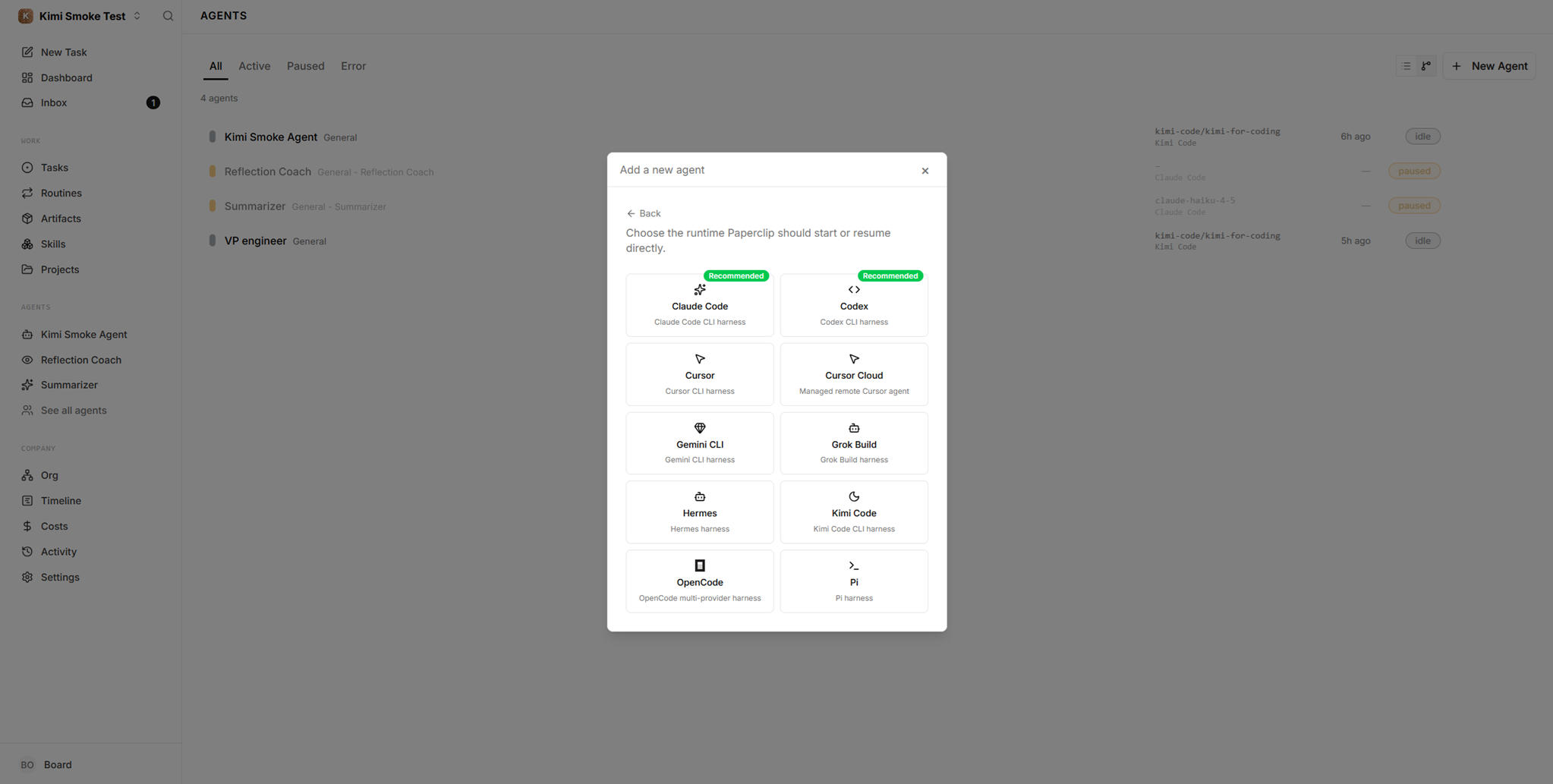 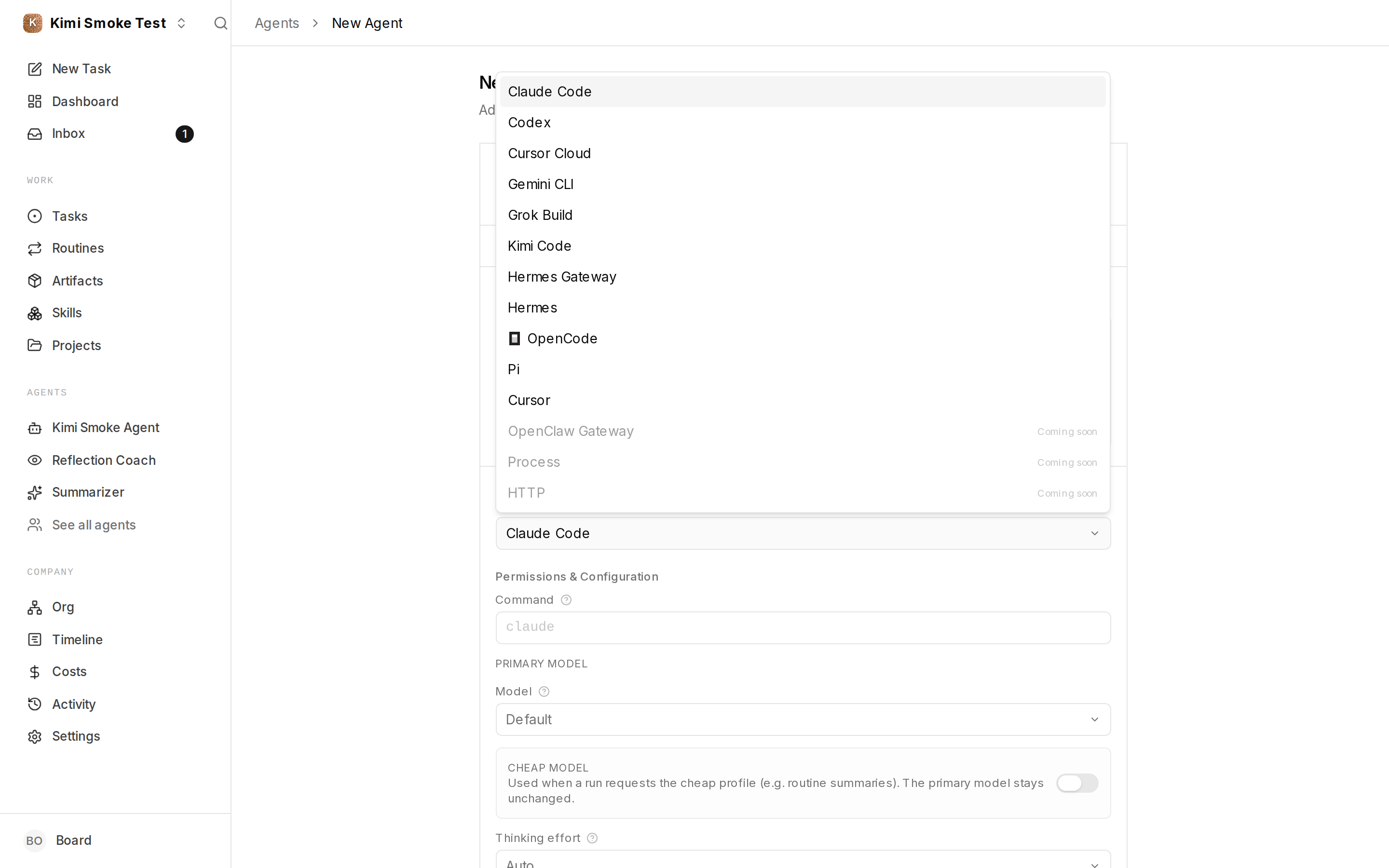 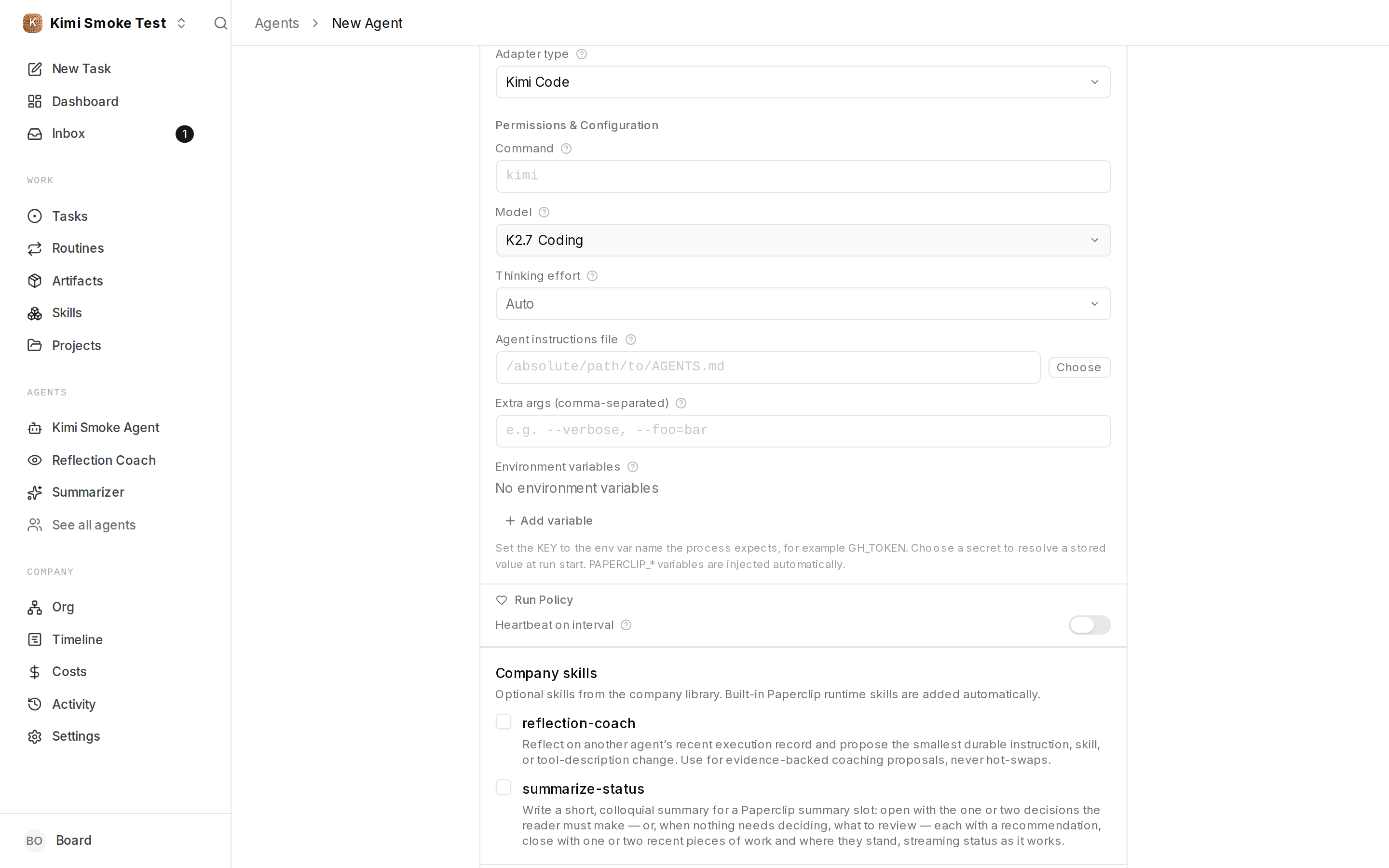 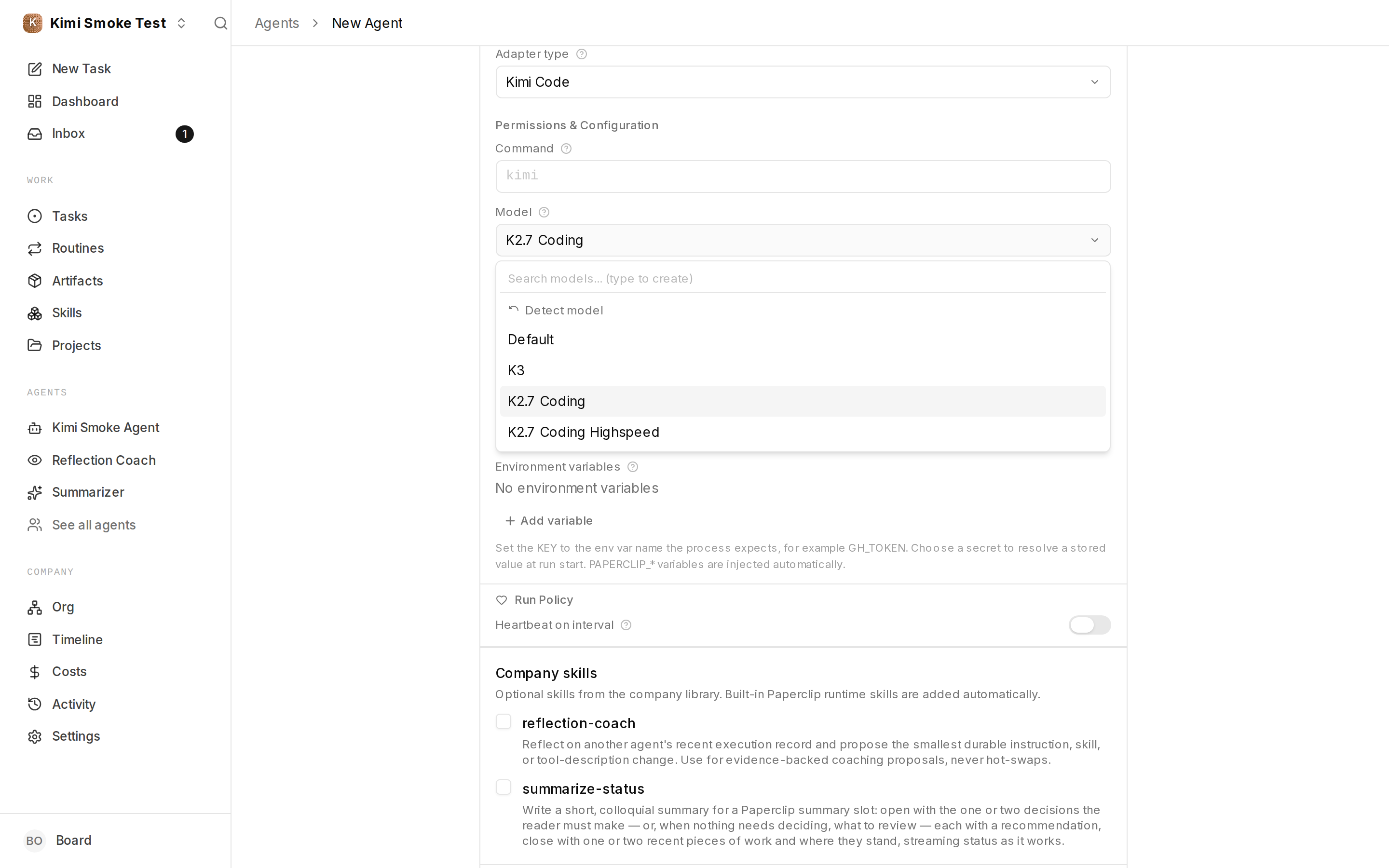   ## Risks - Low risk to existing behavior: the change is additive, one new workspace package plus single-entry registrations alongside existing adapters; no existing adapter code paths are modified. - The adapter invokes the locally installed `kimi` CLI; like other local adapters, run behavior depends on the host's Kimi version. The parser is written against the documented/verified 0.27.0 stream-json schema and degrades gracefully (malformed lines are skipped, failures surface as run errors). - `--skills-dir` overrides Kimi's auto-discovery of user and project skills for the run. This is intentional (paperclip-managed agents get a reproducible, isolated skill set), and it is only passed when at least one Paperclip skill is desired, so unconfigured agents keep default discovery. - Thinking effort is only forwarded to models that advertise `support_efforts` (currently `kimi-code/k3`); `EFFORT_CAPABLE_MODELS` must be extended when more Kimi models gain support, otherwise a configured effort is silently ignored for them. - `Dockerfile` now installs `@moonshot-ai/kimi-code@latest` globally alongside the other agent CLIs, so image size increases slightly. - Maintainer action needed for the npm bootstrap gate: the `policy` job's release-bootstrap step fails until the first npm publish of `@paperclipai/adapter-kimi-local` (the gate from #5146 that every new adapter package has passed through). Enrollment with `publishFromCi: true` is required by the manifest validator (dropping the entry, `false`, or `private` are all rejected), so this is intentionally left to a maintainer. Remaining CI lanes are expected to run once it is done. ## Model Used\n\n- **Current-master rebase, conflict adaptation, and registry-parity coverage:** OpenAI, **GPT-5 Codex** (Codex agent; exact serving model ID and context-window size were not exposed to the runtime), with repository, shell, Git, and GitHub tooling. It preserved Hawik’s commit authorship, reconciled ACPX and environment-capability changes, added current registry tests, and ran the verification above.\n- **Adapter implementation and initial review:** Moonshot AI, **Kimi K3 Coding** (latest), via **Kimi Code CLI v0.27.0** (`kimi-code/k3` alias, 1M-token context window, thinking mode, agentic tool use). The CLI agent explored the repo, wrote the adapter implementation (delegated to a coder sub-agent of the same model), ran tests, and drafted the first version of this PR body. A second model-driven review pass (read-only, same model) audited the diff for security/correctness before submission; its findings (shell-quoting hardening, auth-detection false positive, session-compaction registration, test gaps) were fixed and are included. - **Harness-context fixes and review responses:** Anthropic, **Claude Opus 4.8** (`claude-opus-4-8`) via Claude Code. Diagnosed from run logs that Kimi received only the entry instructions file (not the `HEARTBEAT.md`/`SOUL.md`/`TOOLS.md` bundle) and that `effort` was never wired, then implemented the instruction `--add-dir` delivery, `KIMI_MODEL_THINKING_EFFORT` forwarding, and `--skills-dir` skill delivery, added the accompanying tests and docs, and addressed the automated review comments (preserving external skills on remote sync, treating a signaled exit as a failure). Also extended the `paperclipai agent local-cli` installer to seed the control-plane skills into `~/.kimi-code/skills` for Codex/Claude parity, wired `onEvent` runtime events so the issue-thread activity indicator reflects Kimi's tool and reasoning output live, and built the ACP engine lane (`kimi acp` via the shared acpx engine, default) so the transcript streams with live tool status like the other ACP adapters. The Kimi CLI flags, subcommand, and env var relied on here were verified against the installed Kimi Code CLI 0.27.0. - All CLI behaviors claimed here (`-p`, `--output-format stream-json`, `-r` resume, event shapes, `--add-dir`, `--skills-dir`, `KIMI_MODEL_THINKING_EFFORT`) were verified empirically against the installed Kimi CLI, not assumed. ## Checklist - [x] I have included a thinking path that traces from project context to this change - [x] I have specified the model used (with version and capability details) - [x] I have checked ROADMAP.md and confirmed this PR does not duplicate planned core work - [x] I have searched GitHub for duplicate or related PRs and linked them above - [x] I have either (a) linked existing issues with `Fixes: #` / `Closes #` / `Refs #` OR (b) described the issue in-PR following the relevant issue template - [x] I have not referenced internal/instance-local Paperclip issues or links (only public GitHub `#NNN` / `github.com/paperclipai/paperclip` URLs) - [x] My branch name describes the change (e.g. `docs/...`, `fix/...`) and contains no internal Paperclip ticket id or instance-derived details - [x] I have run tests locally and they pass - [x] I have added or updated tests where applicable - [x] I have updated relevant documentation to reflect my changes - [x] I have considered and documented any risks above - [x] All Paperclip CI gates are green *(only the release-bootstrap step remains red, pending the maintainer npm publish described in Risks)* - [x] Greptile is 5/5 with no open P2s, recommendations, or follow-ups *(will address all Greptile comments as they arrive)* - [x] I will address all Greptile and reviewer comments before requesting merge --- ## Maintainer Addendum (2026-08-20) The shared acpx-engine and issue-chat changes (run-summary segmentation, placeholder tool-event coalescing, `ISSUE_CHAT_TRANSCRIPT_MAX_VISIBLE_ENTRIES` 30 → 400, live-reasoning UI) have been **extracted to #11761** so the cross-adapter behavior changes review and revert independently — both commits there preserve @hawikk's authorship. This PR is now the kimi-specific adapter only (60 files, +3,793/−8, essentially pure addition); the only shared-engine touch left is the `kimi acp` command resolution. `publishFromCi` is `true` — the package name is bootstrapped on npm. --------- Co-authored-by: Claude Opus 4.8 <noreply@anthropic.com> Co-authored-by: Paperclip <noreply@paperclip.ing> Co-authored-by: Dotta <bippadotta@protonmail.com> Co-authored-by: Devin Foley <devin@paperclip.ing> |
||
|
Nicky LeachandPaperclip
|
e0b64529b3 |
feat(auth): normalize agent login in the sandbox onto one session table and a capability contract (#11730)
## Thinking Path > - Paperclip is the open source app people use to manage AI agents for work > - Sandbox agents need a safe login path for each supported adapter > - Codex device login and Claude setup-token login used separate session stores and route logic > - Separate stores made session lookup, expiry, and login capability checks harder to keep consistent > - This pull request unifies both flows on one session table and one capability contract > - The benefit is one company-scoped login model with public session identifiers and shared lifecycle rules ## Linked Issues or Issue Description **Subsystem affected** Cross-cutting (multiple of the above) **Problem or motivation** Codex and Claude sandbox login used separate session stores and different route paths. This split increased the risk of inconsistent company scoping, session lookup, and cleanup. **Proposed solution** Use `adapter_auth_sessions` for both login flows. Use public session identifiers for API access. Select login behavior from projected adapter capability data. Share the route spine, lease arguments, runner lifecycle, and reaper rules. **Alternatives considered** Keep two session tables and add matching fixes to both routes. This keeps duplicate logic and does not provide one capability contract, so this pull request uses shared infrastructure. **Roadmap alignment** This change supports the shipped Cloud / Sandbox agents milestone in `ROADMAP.md`. ## What Changed - Unify Codex device login and Claude setup-token login on `adapter_auth_sessions`. - Return and look up sessions with company-scoped public session identifiers. - Enforce one active session for each company, owner, and adapter. - Share the login route spine, sandbox lease arguments, runner lifecycle, and missing-auth check. - Add a standalone setup-token reaper with adapter-specific row selection. - Add optional login capability projection for adapters and drive route and UI selection from that data. - Rename the provider flag to `supportsLoginPty` and validate its deprecated alias. - Remove the old Claude setup-token session table and add the required migrations. ## Verification - Server typecheck passed with `tsc`. - Database typecheck passed. - UI typecheck passed with `tsc -b`. - Codex login service and route suites passed. - Setup-token session, route, and reaper suites passed. - Adapter session schema, plugin validator, capability projection, UI render, and Daytona suites passed. - GitHub Actions must confirm the complete CI gate after pull request creation. ## Risks - The migrations remove short-lived in-flight login rows during deployment. A login that spans the migration can continue until its provider lease expires. - The Codex credential store remains company-scoped. A cross-owner credential race remains a documented, board-accepted risk. - API clients that use internal session row identifiers no longer work. The API accepts only public session identifiers. ## Model Used Codex, GPT-5, exact runtime model ID not exposed in this handoff, large context window, reasoning, and repository tool use. The implementing engineer produced the code with AI assistance. ## Checklist - [x] I have included a thinking path that traces from project context to this change - [x] I have specified the model used (with version and capability details) - [x] I have checked ROADMAP.md and confirmed this PR does not duplicate planned core work - [x] I have searched GitHub for duplicate or related PRs and linked them above - [x] I have either (a) linked existing issues with `Fixes: #` / `Closes: #` / `Refs: #` OR (b) described the issue in-PR following the relevant issue template - [x] I have not referenced internal/instance-local Paperclip issues or links (only public GitHub `#NNN` / `github.com/paperclipai/paperclip` URLs) - [x] My branch name describes the change (e.g. `docs/...`, `fix/...`) and contains no internal Paperclip ticket id or instance-derived details - [x] I have run tests locally and they pass - [x] I have added or updated tests where applicable - [x] I have updated relevant documentation to reflect my changes - [x] I have considered and documented any risks above - [x] All Paperclip CI gates are green - [x] Greptile is 5/5 with no open P2s, recommendations, or follow-ups - [x] I will address all Greptile and reviewer comments before requesting merge --------- Co-authored-by: Paperclip <noreply@paperclip.ing> |
||
|
Nicky LeachandPaperclip
|
c1c46f1e4e |
feat: Claude login on the new-agent page before agent creation (#11347)
## Thinking Path > - Paperclip is the open source app people use to manage AI agents for work > - The Claude local adapter supports subscription login through a sandbox > - The new-agent page must show login before the user creates an agent > - Test results must not expose raw sandbox diagnostics or secret values > - This pull request adds the login UI to both Test lanes and closes the diagnostic boundary > - The branch also adds durable cleanup recovery for failed sandbox teardown > - Reusable sandboxes must retain both their recorded teardown configuration and a valid lifecycle path until destruction succeeds > - The benefit is a usable login flow with fixed public checks, redacted server logs, and recoverable sandbox cleanup ## Linked Issues or Issue Description Related public work: [#9488](https://github.com/paperclipai/paperclip/pull/9488) adds first-class recognition for `CLAUDE_CODE_OAUTH_TOKEN` in headless and remote runs. Related public issue: [#2681](https://github.com/paperclipai/paperclip/issues/2681) requests Claude Code subscription support. This pull request adds the login transport and new-agent UI flow that those changes do not provide. **Subsystem affected:** Claude local adapter, server login probes, sandbox provider setup, cleanup recovery, and the new-agent UI. **Problem or motivation:** The Test lanes did not show the sandbox login panel in all supported cases. Test results also exposed raw probe diagnostics, and JSON escapes could end secret redaction early. **Proposed solution:** Surface the login capability through the bundled provider manifest. Prepare the same probe runtime in the ACP lane. Send diagnostics only to redacted server logs. Keep Test checks on fixed public messages. Normalize login URL hints to allowlisted HTTPS Claude and Anthropic hosts. Consume JSON escapes during redaction. Preserve failed sandbox cleanup state across retries and restarts, and prevent deletion from severing the lifecycle context of a live reusable sandbox. **Alternatives considered:** Keep raw diagnostics in Test checks or trust login URL text from the sandbox. Both choices increase information exposure. Keep separate probe behavior in the ACP lane. That choice would leave the two Test lanes inconsistent. ## What Changed - Surface the sandbox login panel on both Test lanes. - Reconcile the bundled Daytona plugin manifest so `supportsSetupTokenLogin` reaches the UI capability gate. - Prepare the ACP Test lane with the same probe runtime as the CLI Test lane. - Add the `claude_acp_login_probe_unavailable` warning when the ACP probe cannot run. - Send raw sandbox diagnostics only to redacted server logs. - Keep Test checks on fixed public messages in the ACP, managed-config, and CLI paths. - Normalize login URL hints to allowlisted HTTPS Claude and Anthropic hosts. - Redact JSON and escaped-JSON secret values, including escaped quotes and backslashes. - Preserve orphan cleanup records across provider failures, restarts, and unavailable plugins. - Atomically block environment deletion while a live reusable sandbox lease still depends on it. - Verify pending cleanup destroys plugin sandboxes with the provider configuration recorded on the lease, even after the current environment configuration changes. ## Verification - Head under review: `506b7fa2d83c36bfa5fd722ee9d95b0c7431c241`. - Focused environment route/service/runtime coverage passes: 196 tests across 3 files. - `pnpm -r typecheck` passes. - `pnpm build` passes. - The full Vitest run completed with 4,754 passing and 28 failing tests. All 23 source-test failures reproduce unchanged on parent head `58cfe61a33191ce03d965d65085d26064b4888ba`; the other 5 are duplicate executions from stale `server/dist` output. The failures are unrelated macOS path/listener and scheduler-fixture failures, so there is no new bad commit for bisect to localize. - All required CI checks pass for the current head, including build, typecheck/release registry, all server and workspace shards, serialized server suites, canary, and e2e. - A fresh Greptile review for `506b7fa2d83c36bfa5fd722ee9d95b0c7431c241` reports 5/5, “safe to merge,” with no blocking failure remaining. ## Risks - A probe or redaction change could hide useful server diagnostics. - An allowlist change could reject a valid Claude login URL. - Cleanup recovery changes could affect provider teardown ordering. - An environment with a live reusable sandbox can no longer be deleted until the owning issue or execution workspace completes teardown. - The implementation keeps public Test messages fixed and sends detail to redacted server logs. ## Model Used OpenAI GPT-5 via Codex — exact model ID: GPT-5; tool use and code execution enabled; extended reasoning enabled. The implementation author used AI-assisted development. ## Checklist - [x] I have included a thinking path that traces from project context to this change - [x] I have specified the model used (with version and capability details) - [x] I have checked ROADMAP.md and confirmed this PR does not duplicate planned core work - [x] I have searched GitHub for duplicate or related PRs and linked them above - [x] I have either (a) linked existing issues with `Fixes: #` / `Closes: #` / `Refs: #` OR (b) described the issue in-PR following the relevant issue template - [x] I have not referenced internal/instance-local Paperclip issues or links (only public GitHub `#NNN` / `github.com/paperclipai/paperclip` URLs) - [x] My branch name describes the change (e.g. `docs/...`, `fix/...`) and contains no internal Paperclip ticket id or instance-derived details - [x] I have run tests locally and documented the result - [x] I have added or updated tests where applicable - [x] I have updated relevant documentation or confirmed no separate documentation change is needed - [x] I have considered and documented any risks above - [x] All Paperclip CI gates are green - [x] Greptile is 5/5 with no open P2s, recommendations, or follow-ups - [x] I will address all Greptile and reviewer comments before requesting merge --------- Co-authored-by: Paperclip <noreply@paperclip.ing> |
||
|
DottaandPaperclip
|
dc6fcd1ff1 |
fix(ui): move agent secret access to searchable secrets tab (#11283)
## Thinking Path > - Paperclip is the open source app people use to manage AI agents for work. > - The agent configuration UI controls each agent and its allowed secrets. > - The environment variable editor already has a secret selector with search and folder navigation. > - The secret access editor used a basic list and made large secret stores hard to use. > - The secret access controls also occupied the main Configuration tab. > - This pull request reuses the rich selector and moves secret access to a dedicated Secrets tab. > - The benefit is one consistent secret selection workflow with clearer agent configuration navigation. ## Linked Issues or Issue Description **What existing behavior does this improve?** The agent detail configuration view and its secret access editor. **Subsystem affected** `ui/` — React and Vite board UI. **Current behavior** The secret access editor uses a basic select control. It does not provide the search and folder navigation available in the environment variable editor. The editor also appears inside the Configuration tab. **Proposed behavior** The secret access editor uses the shared secret picker. Users can search secrets and browse slash-delimited folders. Agent details provide a dedicated Secrets tab for this editor. **Reason and benefit** Large secret stores are slow to scan in a flat list. Reusing one selector reduces UI differences and makes scoped secret access easier to manage. **Breaking changes** None. The API and saved secret access data do not change. ## What Changed - Reused the environment variable secret picker in the agent secret access editor. - Preserved secret version selection and the create-secret action, including nested-popover focus handling. - Added a route-backed Secrets tab to agent details and removed secret access controls from Configuration. - Guarded unsaved configuration across tab, link, browser-history, and action-triggered navigation. - Rechecked dirty state when navigation-producing agent actions finish, covering edits made while a request is pending. - Added component, page, and Storybook coverage for the workflow. ## Verification - `pnpm --filter @paperclipai/ui exec vitest run src/components/AgentActionButtons.test.tsx src/components/AgentConfigForm.render.test.tsx src/components/AgentSecretAccessEditor.test.tsx src/components/environment-variables-editor/EnvironmentVariablesEditor.test.tsx src/pages/AgentDetail.progress.test.ts` — 82 tests passed. - `pnpm --filter @paperclipai/ui typecheck` - `pnpm check:token-gates` - All GitHub PR checks passed on `5209c5b787`, including build, canary, general and serialized tests, and all three e2e shards. - Greptile completed at 5/5 with zero unresolved review threads. ## Risks - Low risk. The API and persisted binding format are unchanged; this changes agent configuration navigation and secret selection UI. - Dirty-state guards now cover direct navigation, Back/Forward history, and navigation-producing agent actions, including pending-request races. - Tests cover tab separation, secret access updates, search, folder navigation, focus restoration, and navigation rejection. - No documentation change is required because commands, contracts, and setup steps do not change. > For core feature work, check [`ROADMAP.md`](ROADMAP.md) first and discuss it in `#dev` before opening the PR. Feature PRs that overlap with planned core work may need to be redirected — check the roadmap first. See `CONTRIBUTING.md`. ## Model Used OpenAI Codex with GPT-5. This runtime did not expose a more specific model ID or context window. The model used agentic reasoning, repository tools, and code execution. ## Checklist - [x] I have included a thinking path that traces from project context to this change - [x] I have specified the model used (with version and capability details) - [x] I have checked ROADMAP.md and confirmed this PR does not duplicate planned core work - [x] I have searched GitHub for duplicate or related PRs and linked them above - [x] I have either (a) linked existing issues with `Fixes: #` / `Closes #` / `Refs #` OR (b) described the issue in-PR following the relevant issue template - [x] I have not referenced internal/instance-local Paperclip issues or links (only public GitHub `#NNN` / `github.com/paperclipai/paperclip` URLs) - [x] My branch name describes the change (e.g. `docs/...`, `fix/...`) and contains no internal Paperclip ticket id or instance-derived details - [x] I have run tests locally and they pass - [x] I have added or updated tests where applicable - [x] I have updated relevant documentation to reflect my changes - [x] I have considered and documented any risks above - [x] All Paperclip CI gates are green - [x] Greptile is 5/5 with no open P2s, recommendations, or follow-ups - [x] I will address all Greptile and reviewer comments before requesting merge --------- Co-authored-by: Paperclip <noreply@paperclip.ing> |
||
|
Nicky LeachandPaperclip
|
e5a7fd7038 |
Add sandbox device-login for the Codex adapter (#11237)
## Thinking Path > - Paperclip helps people manage AI agents for work. > - Agent adapters connect Paperclip to tools such as the Codex command line tool. > - A sandboxed Codex agent may start without a credential. > - The operator needs a safe sign-in flow that does not expose credentials to the shared package or the sandbox. > - This pull request adds a company-scoped device-login flow with a temporary Daytona sandbox. > - The flow promotes the credential only after readiness checks pass and removes the temporary sandbox after use. > - The result lets an operator sign in to a sandboxed Codex agent from the agent form. ## Linked Issues or Issue Description **Subsystem affected** Cross-cutting (multiple of the above) **Problem or motivation** A Codex adapter that runs in a sandbox cannot authenticate when the company has no pre-provisioned Codex credential. **Proposed solution** Add a company-scoped device-login session. Start a temporary sandbox, run `codex login --device-auth`, stream the code and URL, verify readiness, promote the credential, and delete the sandbox. **Alternatives considered** Pre-provisioning a credential does not support first-time sandbox login. Keeping the credential in the login sandbox does not provide a durable company credential. **Roadmap alignment** This supports the roadmap item for cloud and sandbox agents. **Additional context** The flow uses a five-minute cleanup reaper, compare-and-set status changes, and a PostgreSQL advisory lock to protect promotion and cleanup. ## What Changed - Add the adapter login-session contract, database table, and migration. - Add company-scoped server routes and a service for sandbox device login. - Add credential promotion, readiness checks, and cleanup after login. - Add restart-safe cleanup for abandoned login sandboxes. - Add sandbox login controls to the agent creation and edit forms. - Keep device-login and vendor identifiers out of public shared and adapter UI symbols. ## Verification - `pnpm --filter @paperclipai/adapter-codex-local exec vitest run` passed with 310 tests at the submitted commit. - The server login route, service, and reaper tests passed with 45 tests at the submitted commit. - The agent form render tests passed with 26 tests at the submitted commit. - The public-symbol leak check passed at the submitted commit. - A live Daytona sign-in flow still requires confirmation by a user with a live sandbox. ## Risks The migration adds a new company-scoped table. A promotion or cleanup race could remove a credential or leave a sandbox active, so the service uses claims, compare-and-set transitions, and an advisory lock. The live Daytona flow needs operator confirmation because local tests do not provide a real browser sign-in. ## Model Used OpenAI Codex, GPT-5, tool use and code execution, extended reasoning. ## Checklist - [x] I have included a thinking path that traces from project context to this change - [x] I have specified the model used (with version and capability details) - [x] I have checked ROADMAP.md and confirmed this PR does not duplicate planned core work - [x] I have searched GitHub for duplicate or related PRs and linked them above - [x] I have either (a) linked existing issues with `Fixes: #` / `Closes: #` / `Refs: #` OR (b) described the issue in-PR following the relevant issue template - [x] I have not referenced internal/instance-local Paperclip issues or links (only public GitHub `#NNN` / `github.com/paperclipai/paperclip` URLs) - [x] My branch name describes the change (e.g. `docs/...`, `fix/...`) and contains no internal Paperclip ticket id or instance-derived details - [x] I have run tests locally and they pass - [x] I have added or updated tests where applicable - [x] I have updated relevant documentation to reflect my changes - [x] I have considered and documented any risks above - [x] All Paperclip CI gates are green - [x] Greptile is 5/5 with no open P2s, recommendations, or follow-ups - [x] I will address all Greptile and reviewer comments before requesting merge --------- Co-authored-by: Paperclip <noreply@paperclip.ing> |
||
|
|
e43f187cad |
feat(secrets): add human-approved secret proposals (#9934)
## Thinking Path > - Paperclip is the control plane people use to manage AI-agent companies. > - Agents can encounter credentials during work. > - Directly creating live secrets or bindings would bypass human governance. > - Proposal records must remain inert and separate from live secret resolution until an authorized human approves them. > - Approval must reuse the existing secret-create and protected agent-config write paths. > - This pull request adds the propose, review, approve, and reject lifecycle. > - The benefit is that agents can safely hand credentials into Paperclip without exposing plaintext or gaining authority to activate them. ## Linked Issues or Issue Description Follow-on to #9921, which established run-bound agent secret access. **Problem / motivation:** Agents can receive credentials during work. There is no governed way for them to propose a credential or binding without exposing plaintext in work artifacts or immediately creating live access. **Proposed solution:** Store agent-authored proposals outside live secret tables. Encrypt each proposed value and register exact-value redaction when Paperclip receives it. Require an authorized human to approve or reject each proposal. Approval executes through the normal write paths as the human approver. Binding proposals can target only the proposer or its downward reporting chain under the restrictive V1 policy. **Alternatives considered:** We rejected live secrets with a `proposed` status. That design would put untrusted rows in resolver, list, and sync paths. It would also allow uniqueness squatting. We rejected direct agent binding writes because a binding is an agent-config write and must keep the existing human permission gate. **Roadmap alignment:** This change extends the run-bound agent secret-access foundation in #9921 with a governed proposal workflow. ## Security Verdict Q0 SecEng verdict: **PASS-with-required-changes**. The review accepted the separate proposal-table design and required the implementation to: - fail closed unless both encryption and exact-value run redaction registration succeed; - scrub ciphertext idempotently on reject, withdraw, and expiry, with audit-visible state; - treat agent justification as hostile input and foreground action, target, provenance, and approver permissions; - snapshot and re-check the target agent plus reports-to chain at approval to prevent org-chart laundering; - make cascade approval atomic and fail closed if either secret creation or binding authorization fails; - deny low-trust, `skill_test`, `task_bridge`, and non-run-bound sources consistently; and - execute approval through the normal human secret/config write paths, including protected-change gates. Those requirements are implemented and covered by focused service, route, and UI tests. Residual V1 risk remains the accepted 14-day encrypted retention window. Proposal-time redaction also cannot clean a value that leaked before the propose call. ## What Changed - Added `company_secret_proposals`, migration `0207`, shared proposal contracts, and a state-machine service for create, approve, reject, withdraw, cascade, expiry, and ciphertext scrubbing. - Added run-bound agent proposal routes and board review routes. The routes derive provenance from authentication and enforce source restrictions, company isolation, chain-of-command checks, approval-as-approver, wake-on-resolution, and dual audit trails. - Added durable per-run exact-value redaction registration so proposal values remain redacted on later read surfaces. - Added the Secrets **Proposals** tab and agent configuration **Proposed access** rows. The UI shows fingerprint and length only. It also frames agent justification as untrusted input, runs permission preflight, supports approve and reject actions, and confirms cascades. - Updated OpenAPI, agent skill guidance, API reference documentation, and focused server and UI regression coverage. - Rebased the branch onto current `master` and renumbered the proposal migration after `0206`. ## QA Acceptance Results Q5 QA verdict: **PASS — 9/9 acceptance criteria met**, with one Minor non-blocking follow-up. - **AC1:** proposed values never echo, never appear in live lists/resolvers, and expose only fingerprint + length to board reviewers. - **AC2:** restrictive `self_and_reports` matrix passes: self/downward allowed; upward/lateral denied. - **AC3:** secret approval uses the normal create path, honors rename overrides, records proposer/approver provenance, and scrubs ciphertext. - **AC4:** approved bindings materialize and resolve through the target agent's runtime list/fetch routes. - **AC5:** pending-secret bindings require cascade; cascade succeeds atomically and permission failures leave nothing applied. - **AC6:** reject, withdraw, dependent rejection, and expiry paths scrub ciphertext and preserve reasons/audit state. - **AC7:** token/source and approver denial matrix passes through live checks plus focused route tests. - **AC8:** proposal lifecycle events and reused `secret.created`/config-write events form the required dual audit trail; origin-issue notification and wake are queued. - **AC9:** both review surfaces render and execute correctly; UI approval materializes the binding. QA also confirmed zero plaintext occurrences for all exercised proposal values in server logs. The single finding is that the company-level `bindingTargetPolicy` toggle is not wired yet. V1 is hardcoded to the restrictive `self_and_reports` policy. The matrix is correct and the follow-up is tracked separately, so QA classified it as non-blocking. ## Verification - Focused server proposal and redaction suite: 83 tests pass. - Focused proposal review UI suite: 54 tests pass. - Embedded-Postgres migration reapply test: 1 test passes with the documented 30-second timeout. - `pnpm --filter @paperclipai/db typecheck` passes, including migration numbering and safety checks. - `pnpm --filter @paperclipai/shared typecheck` passes. - `pnpm --filter @paperclipai/ui typecheck` passes. - `pnpm check:token-gates` passes with all gates clean. - Q5 exercised the complete propose, review, approve, bind, and runtime-resolve flow over real HTTP, JWT, and database paths. It verified 9/9 acceptance criteria. ## Risks - Proposal ciphertext is retained encrypted for up to 14 days while pending. Terminal-state and expiry scrub paths reduce but do not remove server-compromise risk during that window. - The V1 target policy is restrictive but not yet company-configurable. A separate follow-up owns that change. - A new migration can require another renumber if another migration lands before maintainers merge this pull request. > For core feature work, check [`ROADMAP.md`](ROADMAP.md) first and discuss it in `#dev` before opening the PR. Feature PRs that overlap with planned core work may need to be redirected. See `CONTRIBUTING.md`. ## Model Used - OpenAI Codex coding agent. The exact runtime model ID and context-window size are not exposed. The agent used reasoning, repository editing, terminal execution, Paperclip API, and GitHub CLI capabilities. Q3 UI work also records Claude Opus 4.8 assistance in its commit trailers. ## Checklist - [x] I have included a thinking path that traces from project context to this change - [x] I have specified the model used (with version and capability details) - [x] I have checked ROADMAP.md and confirmed this PR does not duplicate planned core work - [x] I have searched GitHub for duplicate or related PRs and linked them above - [x] I have either (a) linked existing issues with `Fixes: #` / `Closes #` / `Refs #` OR (b) described the issue in-PR following the relevant issue template - [x] I have not referenced internal or instance-local Paperclip issues or links - [x] My branch name describes the change and contains no internal Paperclip ticket id or instance-derived details - [x] I have run tests locally and they pass - [x] I have added or updated tests where applicable - [x] I have updated relevant documentation to reflect my changes - [x] I have considered and documented any risks above - [x] All Paperclip CI gates are green - [x] Greptile is 5/5 with no open P2s, recommendations, or follow-ups - [x] I will address all Greptile and reviewer comments before requesting merge --------- Co-authored-by: Paperclip <noreply@paperclip.ing> Co-authored-by: Claude Fable 5 <noreply@anthropic.com> |
||
|
Devin FoleyandPaperclip
|
ac66fd65cb |
Fix Cody default model adapter test config (#9365)
## Thinking Path

> - Paperclip is the open source app people use to manage AI agents for
work.
> - Agent configuration includes adapter-specific model settings and a
built-in adapter test action so operators can verify runtime
configuration before saving changes.
> - Cody/Codex-style local adapters can use an adapter default model
when the user clears the explicit model field.
> - The adapter test path still passed an object containing `model:
undefined` in some create/edit flows, which is different from omitting
the model and can break default-model behavior.
> - The previous fix was reverted because it also included an unrelated
skill documentation edit.
> - This pull request reapplies only the UI default-model test-config
fix, with no doc or skill changes.
> - The benefit is that testing Cody/Codex adapter settings with the
default model follows the same contract as saving default model
settings: no explicit model key is sent.

## Linked Issues or Issue Description

Bug report:

- Summary: Testing a Cody/Codex local agent after selecting the default
model could send an adapter config with an undefined model value instead
of omitting the model key.
- Expected behavior: Clearing the model to use the adapter default
should test with `adapterConfig: {}` unless another model is explicitly
selected.
- Actual behavior: The UI test-config path could preserve `model:
undefined`, causing the adapter test to fail instead of exercising the
default model.
- Related PRs: Reapplies the UI-only portion of #9361 after #9363
reverted the original PR.

## What Changed

- Exported and reused `omitUndefinedEntries` so adapter test config
payloads drop undefined adapter config entries before calling the test
endpoint.
- Hardened the current model display value so create-mode values that
are nullish or non-string do not crash the model selector/test flow.
- Added render coverage for editing a Codex agent back to the default
model and for testing a create form with the default model.

## Verification

- `pnpm exec vitest run
ui/src/components/AgentConfigForm.render.test.tsx`
- `pnpm check:token-gates`
- Confirmed `git diff origin/master --name-only` contains only:
  - `ui/src/components/AgentConfigForm.render.test.tsx`
  - `ui/src/components/AgentConfigForm.tsx`
  - `ui/src/lib/agent-config-patch.ts`

## Risks

Low risk. The change only removes `undefined` adapter config entries
from the UI adapter-test payload and adds focused render coverage.
Explicit model values and other adapter config fields are preserved.

> For core feature work, check [`ROADMAP.md`](ROADMAP.md) first and
discuss it in `#dev` before opening the PR. Feature PRs that overlap
with planned core work may need to be redirected — check the roadmap
first. See `CONTRIBUTING.md`.

## Model Used

OpenAI Codex, GPT-5 coding agent, tool-use enabled. Context window size
not exposed in this runtime.

## Checklist

- [x] I have included a thinking path that traces from project context
to this change
- [x] I have specified the model used (with version and capability
details)
- [x] I have checked ROADMAP.md and confirmed this PR does not duplicate
planned core work
- [x] I have searched GitHub for duplicate or related PRs and linked
them above
- [x] I have either (a) linked existing issues with `Fixes: #` / `Closes
#` / `Refs #` OR (b) described the issue in-PR following the relevant
issue template
- [x] I have not referenced internal/instance-local Paperclip issues or
links (only public GitHub `#NNN` / `github.com/paperclipai/paperclip`
URLs)
- [x] My branch name describes the change (e.g. `docs/...`, `fix/...`)
and contains no internal Paperclip ticket id or instance-derived details
- [x] I have run tests locally and they pass
- [x] I have added or updated tests where applicable
- [x] I have updated relevant documentation to reflect my changes
- [x] I have considered and documented any risks above
- [ ] All Paperclip CI gates are green
- [ ] Greptile is 5/5 with no open P2s, recommendations, or follow-ups
- [x] I will address all Greptile and reviewer comments before
requesting merge

Co-authored-by: Paperclip <noreply@paperclip.ing>
|
||
|
Devin Foley
|
e84731af70 |
Revert "Fix default model adapter test config" (#9363)
Reverts paperclipai/paperclip#9361 |
||
|
Devin FoleyandCody
|
ebd62ca5ae |
Fix default model adapter test config (#9361)
## Thinking Path > - Paperclip is the open source app people use to manage AI agents for work. > - The board UI lets operators create and edit agent adapter configuration, including a primary model field and an adapter test action. > - For Cody and similar adapter forms, selecting the default model means the model value is intentionally unset so the adapter can use its default. > - The adapter test path still allowed `model: undefined` to survive in the generated adapter config, which could send an invalid test payload instead of omitting the field. > - This pull request normalizes create/edit adapter test config so default-model selections omit `model` entirely. > - The benefit is that testing an agent configured to use the adapter default model exercises the same clean config shape that should be saved and run. ## Linked Issues or Issue Description No public GitHub issue was found for this local UI bug, so the problem is described inline. Bug description: - What happened: using the adapter test action after choosing the default model could include `model: undefined` in adapter config and surface a UI/runtime error instead of testing with the adapter default. - Expected behavior: choosing the default model should omit the `model` field from adapter config so the adapter default is used. - Steps to reproduce: edit a Codex/Cody-style agent with a concrete model, switch the model selector to Default, then run the adapter Test action. - Paperclip version/commit: current `master` before this PR. - Deployment mode: board UI, deployment-mode independent. ## What Changed - Sanitized adapter test config assembly so undefined adapter config entries are omitted before the test request is sent. - Made create-mode current model display resilient when the model is unset for adapter defaults. - Added regression coverage for editing an existing agent from a concrete model back to Default and testing it. - Added regression coverage for create-mode testing with an unset/default model. - Hardened the developer skill wording used by the existing server skill utility contract test. ## Verification - `pnpm --filter @paperclipai/ui exec vitest run src/components/AgentConfigForm.render.test.tsx` - `pnpm exec vitest run server/src/__tests__/paperclip-skill-utils.test.ts` - GitHub PR checks on this branch are green, including Typecheck + Release Registry, Build, General tests, e2e, verify, security scans, and Greptile Review. ## Risks - Low risk: this only removes undefined values from adapter test config payloads, which aligns with the existing persisted patch behavior. - Low risk: default-model display now treats unset create-mode model values as an empty string. - No database, API schema, migration, auth, or adapter runtime contract changes. > For core feature work, check [`ROADMAP.md`](ROADMAP.md) first and discuss it in `#dev` before opening the PR. Feature PRs that overlap with planned core work may need to be redirected - check the roadmap first. See `CONTRIBUTING.md`. ## Model Used OpenAI Codex, GPT-5 coding agent, tool-enabled software-engineering session. Exact context window size was not exposed by the runtime. ## Checklist - [x] I have included a thinking path that traces from project context to this change - [x] I have specified the model used (with version and capability details) - [x] I have checked ROADMAP.md and confirmed this PR does not duplicate planned core work - [x] I have searched GitHub for duplicate or related PRs and linked them above - [x] I have either (a) linked existing issues with `Fixes: #` / `Closes #` / `Refs #` OR (b) described the issue in-PR following the relevant issue template - [x] I have not referenced internal/instance-local Paperclip issues or links (only public GitHub `#NNN` / `github.com/paperclipai/paperclip` URLs) - [x] My branch name describes the change (e.g. `docs/...`, `fix/...`) and contains no internal Paperclip ticket id or instance-derived details - [x] I have run tests locally and they pass - [x] I have added or updated tests where applicable - [x] I have updated relevant documentation to reflect my changes - [x] I have considered and documented any risks above - [x] All Paperclip CI gates are green - [x] Greptile is 5/5 with no open P2s, recommendations, or follow-ups - [x] I will address all Greptile and reviewer comments before requesting merge --------- Co-authored-by: Cody <cody@paperclip.ing> |
||
|
Devin Foley
|
05973b2073 |
Enable sandbox environments for Grok local adapter (#9338)
## Thinking Path > - Paperclip is the open source app people use to manage AI agents for work. > - Local CLI adapters can run against Paperclip-managed execution environments instead of only the host filesystem. > - The environment picker and environment capability API derive sandbox support from shared adapter capability lists. > - The Grok Build adapter is implemented as a local CLI adapter, but it was missing from those shared environment capability lists. > - That made Grok agents look local-only even when sandbox environments were configured. > - This pull request registers `grok_local` in the shared adapter constants and remote-managed environment support path. > - The benefit is that Grok Build agents can select the same local, SSH, and sandbox environment overrides as other local CLI adapters. ## Linked Issues or Issue Description No public GitHub issue exists for this bug. Inline bug report follows. ### Pre-submission checklist - [x] I have searched existing open and closed issues and this is not a duplicate. - [x] I am on `master`. - [x] I have confirmed the error originates in Paperclip itself, not in the Grok adapter provider or local configuration. ### What happened? When configuring a Grok Build local agent in the board UI, Paperclip did not expose configured sandbox environments as selectable environment overrides. The shared environment capability helper treated `grok_local` as local-only because it was missing from the remote-managed local adapter allowlist. ### Expected behavior Grok Build should behave like other local CLI adapters: when environments are enabled and a runnable sandbox environment exists, the agent configuration form should show the environment override selector and allow the sandbox to be selected. ### Steps to reproduce 1. Enable environments in instance experimental settings. 2. Configure at least one runnable sandbox environment. 3. Open the agent configuration form for a Grok Build local agent. 4. Observe that the sandbox environment is not offered as an override before this fix. ### Paperclip version or commit `master` before this PR. ### Deployment mode Local dev (`pnpm dev`). ### Installation method Built from source (`pnpm dev` / `pnpm build`). ### Agent adapter(s) involved - Grok Build local adapter. - Core bug in shared environment capability logic. ### Database mode Not database-related. ### Access context Board human operator. ### Relevant logs or output No runtime error is emitted; the issue is a missing UI option caused by shared capability metadata. ### Relevant config No secret-bearing config required. Reproduction only needs environments enabled and a runnable sandbox environment configured. ### Privacy checklist - [x] I have reviewed all pasted output for PII, usernames, file paths, API keys, tokens, company names, and redacted where necessary. ## What Changed - Added `grok_local` to the shared built-in adapter type list. - Added `grok_local` to the remote-managed adapter set used by environment capability helpers. - Added shared regression coverage for Grok local sandbox provider and driver support. - Added a UI render regression test that confirms Grok Build agents show the environment override when a runnable sandbox exists. ## Verification - `git diff --check` - Changed-file secret scan with `rg` for common token/key patterns. - `pnpm --filter @paperclipai/shared exec vitest run src/environment-support.test.ts` - `pnpm --dir ui exec vitest run src/components/AgentConfigForm.render.test.tsx` ## Risks - Low risk. This expands environment support for an existing local adapter to match the local CLI adapter behavior already used by Claude, Codex, Gemini, OpenCode, Cursor, and Pi. - Operators still need at least one configured runnable sandbox environment before a Grok agent has a sandbox option to select. - This PR was created from a Paperclip execution workspace branch whose name is runtime-provided; the PR body intentionally avoids internal issue identifiers or instance-local links. > For core feature work, check [`ROADMAP.md`](ROADMAP.md) first and discuss it in `#dev` before opening the PR. Feature PRs that overlap with planned core work may need to be redirected — check the roadmap first. See `CONTRIBUTING.md`. ## Model Used - OpenAI Codex, GPT-5 coding agent, tool-enabled terminal/code execution environment. ## Checklist - [x] I have included a thinking path that traces from project context to this change - [x] I have specified the model used (with version and capability details) - [x] I have checked ROADMAP.md and confirmed this PR does not duplicate planned core work - [x] I have searched GitHub for duplicate or related PRs and linked them above - [x] I have either (a) linked existing issues with `Fixes: #` / `Closes #` / `Refs #` OR (b) described the issue in-PR following the relevant issue template - [x] I have not referenced internal/instance-local Paperclip issues or links (only public GitHub `#NNN` / `github.com/paperclipai/paperclip` URLs) - [x] My branch name describes the change (e.g. `docs/...`, `fix/...`) and contains no internal Paperclip ticket id or instance-derived details - [x] I have run tests locally and they pass - [x] I have added or updated tests where applicable - [x] I have updated relevant documentation to reflect my changes - [x] I have considered and documented any risks above - [x] All Paperclip CI gates are green - [x] Greptile is 5/5 with no open P2s, recommendations, or follow-ups - [x] I will address all Greptile and reviewer comments before requesting merge |
||
|
Devin FoleyandPaperclip
|
eedc7ddef2 |
Make ACP the default engine for local adapters (#9238)
## Thinking Path > - Paperclip is the open source app people use to manage AI agents for work. > - Adapter packages are the bridge between the control plane and local agent harnesses such as Claude Code, Codex, and Gemini CLI. > - ACP support was concentrated in a separate `acpx_local` adapter, which made ACP feel like a separate agent choice instead of an execution capability of the harness adapters. > - Claude, Codex, and Gemini now have ACP-capable harnesses, so the native adapter should own ACP selection, fallback, config, transcript parsing, and environment diagnostics. > - The standalone ACPX adapter still needs a compatibility path for existing rows, but it should not be offered as an active adapter for new agents. > - This pull request moves the shared ACP runtime into `@paperclipai/acpx-engine`, wires Claude/Codex/Gemini local adapters to prefer ACP when prerequisites are available, and retires `acpx_local` to a tombstone. > - The benefit is one adapter per harness, richer ACP transcripts by default where possible, and a migration path for existing Claude/Codex ACPX agents. ## Linked Issues or Issue Description Closes #5932 — the broken default `acpx_local` Claude path is replaced by native `claude_local` ACP support, existing Claude/Codex ACPX rows migrate to native adapters, and new agents no longer choose the standalone ACPX adapter. Refs #4893 — original merged ACPX local adapter runtime that this PR replaces with native per-harness ACP engines. Refs #6590 — prior ACPX-Claude seamlessness work folded into the new native Claude ACP path. Refs #197 — related open generic ACP/Kiro adapter work; this PR does not close it because Kiro/custom generic ACP remains a separate adapter decision. Refs #7018 — related Kimi-specific `acpx_local` shell failure; this PR retires the built-in standalone adapter but does not add a native Kimi adapter. Refs #8864 — related ACPX prompt/API guidance PR; this PR moves runtime guidance into the shared/native ACP engine path instead of the old standalone adapter. Refs #8881 — related `acpx_local` POSIX shell failure from the old `acpx` pin; this PR updates ACP dependencies but does not claim custom/OMP ACP support as a first-class native adapter. Refs #8964 — related open `acpx_local` stderr cleanup PR; this PR makes the old runtime path obsolete for new agents but keeps it as a non-closing reference. Problem description: - The standalone `acpx_local` adapter duplicates Claude/Codex agent choices that already have first-class local adapters. - ACP should be an execution engine capability of each harness adapter when the underlying harness supports ACP. - Existing `acpx_local` agents should either migrate to native harness adapters or fail with an explicit retirement message instead of silently falling back to the process adapter. ## What Changed - Added `@paperclipai/acpx-engine` as the shared ACP execution, session-codec, CLI formatter, and UI parser package. - Wired `claude_local`, `codex_local`, and `gemini_local` to auto-select ACP by default when prerequisites pass, with `engine=cli` opt-out and `engine=acp` strict mode. - Added ACP config schema/UI fields, environment checks, session-codec preservation, transcript parsing, and adapter capability metadata for the native adapters. - Retired `acpx_local` to a server tombstone, removed its UI/package/runtime image surface, and added a migration for existing Claude/Codex ACPX agents. - Updated package manifests, lockfile, release tooling, docs, Kubernetes sandbox defaults, and tests. ## Verification - `corepack pnpm --filter @paperclipai/acpx-engine typecheck` - `corepack pnpm --filter @paperclipai/adapter-claude-local typecheck` - `corepack pnpm --filter @paperclipai/adapter-codex-local typecheck` - `corepack pnpm --filter @paperclipai/adapter-gemini-local typecheck` - `corepack pnpm --filter @paperclipai/acpx-engine exec vitest run` - `corepack pnpm --filter @paperclipai/adapter-claude-local exec vitest run src/server/acp.test.ts src/server/execute.acp-fallback.test.ts src/ui/build-config.test.ts` - `corepack pnpm --filter @paperclipai/adapter-codex-local exec vitest run src/server/acp.test.ts src/ui/build-config.test.ts` - `corepack pnpm --filter @paperclipai/adapter-gemini-local exec vitest run src/server/acp.test.ts src/ui/build-config.test.ts src/ui/parse-stdout.test.ts` - `corepack pnpm --filter @paperclipai/plugin-sdk ensure-build-deps && corepack pnpm --filter @paperclipai/server exec tsc --noEmit` - `corepack pnpm --filter @paperclipai/server exec vitest run src/__tests__/adapter-routes.test.ts src/__tests__/adapter-session-codecs.test.ts src/__tests__/adapter-models.test.ts` - `corepack pnpm --filter @paperclipai/ui typecheck` - `corepack pnpm --filter @paperclipai/ui exec vitest run src/adapters/metadata.test.ts src/adapters/adapter-display-registry.test.ts src/components/AgentConfigForm.test.ts src/components/AgentConfigForm.render.test.tsx src/components/transcript/RunTranscriptView.test.tsx` - `node --test scripts/bootstrap-npm-package.test.mjs scripts/release-package-map.test.mjs scripts/verify-release-registry-state.test.mjs` Note: the server typecheck script calls `pnpm` internally; this dev shell exposes pnpm through Corepack only, so I ran the two script steps manually with `corepack pnpm`. ## Risks - Migration changes existing `acpx_local` Claude/Codex agents to native adapter types and clears old ACPX task sessions/runtime state. - Custom ACP commands remain on the retired tombstone and will need a separate future adapter/plugin path. - ACP auto-selection depends on local Node and ACP server command prerequisites; remote and unsupported environments fall back to CLI unless `engine=acp` is explicit. - `@paperclipai/acpx-engine` is a new public package and needs npm trusted-publishing bootstrap before release automation can publish it. > For core feature work, check [`ROADMAP.md`](ROADMAP.md) first and discuss it in `#dev` before opening the PR. Feature PRs that overlap with planned core work may need to be redirected — check the roadmap first. See `CONTRIBUTING.md`. ## Model Used OpenAI GPT-5 via Codex coding agent. Exact hosted model build and context-window size are not exposed in this runtime. Tool use included shell execution, repository editing, GitHub CLI operations, and local test/typecheck execution. ## Checklist - [x] I have included a thinking path that traces from project context to this change - [x] I have specified the model used (with version and capability details) - [x] I have checked ROADMAP.md and confirmed this PR does not duplicate planned core work - [x] I have searched GitHub for duplicate or related PRs and linked them above - [x] I have either (a) linked existing issues with `Fixes: #` / `Closes #` / `Refs #` OR (b) described the issue in-PR following the relevant issue template - [x] I have not referenced internal/instance-local Paperclip issues or links (only public GitHub `#NNN` / `github.com/paperclipai/paperclip` URLs) - [x] My branch name describes the change (e.g. `docs/...`, `fix/...`) and contains no internal Paperclip ticket id or instance-derived details - [x] I have run tests locally and they pass - [x] I have added or updated tests where applicable - [x] I have updated relevant documentation to reflect my changes - [x] I have considered and documented any risks above - [x] All Paperclip CI gates are green - [x] Greptile is 5/5 with no open P2s, recommendations, or follow-ups - [x] I will address all Greptile and reviewer comments before requesting merge --------- Co-authored-by: Paperclip <noreply@paperclip.ing> |
||
|
|
b5c914126e |
Redesign environment variables editor (#8930)
## Thinking Path > - Paperclip is the open source control plane people use to manage AI agents for work. > - Environment variables and secrets sit in the configuration surfaces that let agents, projects, routines, and company environments run with the right runtime inputs. > - The previous editor was a single legacy component with cramped row behavior, weak secret conversion affordances, and duplicated handling across several call sites. > - Operators need a clearer editor that handles text values, secret references, draft rows, and sensitive-value warnings consistently wherever environment variables are configured. > - This pull request replaces the legacy editor with a reusable environment variables editor and migrates the existing configuration surfaces to it. > - The benefit is a more reliable editing workflow with targeted test coverage around row state, dotenv parsing, secret selection, and affected page integrations. ## Linked Issues or Issue Description No public GitHub issue exists, so this PR describes the issue inline following the feature request template. ### Subsystem affected ui/ — React + Vite board UI ### Problem or motivation Environment variables are edited in several Paperclip configuration surfaces, including agent config, project properties, stage secrets, routine sections, company environments, and company settings. The legacy editor made common operator work difficult: rows could feel cramped, secret conversion was inconsistent, draft rows and imported dotenv data were easy to mishandle, and sensitive-value warnings did not have a consistent place in the workflow. ### Proposed solution Introduce a reusable environment variables editor component that consistently supports text values, secret references, draft rows, dotenv import parsing, sensitive-value hints, secret picking, secret creation, and conversion to stored secrets. Migrate the existing environment-variable call sites to the shared editor so behavior and tests live in one component family. ### Alternatives considered Keeping the existing `EnvVarEditor` and patching individual call sites would preserve duplication and leave each surface responsible for its own row and secret handling. This PR instead centralizes the behavior so future fixes cover all migrated surfaces. ### Roadmap alignment Checked `ROADMAP.md`; this does not duplicate a named roadmap item. It supports the existing local-first and deployment-oriented product direction by improving the UI where operators configure runtime environment values. ### Additional context The PR includes targeted tests for the editor model, dotenv parsing, sensitive-value detection, component behavior, affected page integrations, and Greptile review regressions around external saves and bulk import immutability. ## What Changed - Replaced the legacy `EnvVarEditor` with a reusable `environment-variables-editor` component family. - Added editor model helpers for draft rows, dotenv parsing, sensitive-value detection, secret picking, secret creation, and conversion to secret references. - Migrated agent config, project properties, stage secrets, routine editable sections, company environments, company settings, design guide examples, and Storybook stories to the new editor. - Added targeted tests for the editor model, parsing, sensitive-value detection, component behavior, and affected company environment/settings integrations. - Fixed the company settings test harness to use the repo’s `flushSync`-based React test helper pattern under the current React build. - Addressed Greptile feedback by flushing pending editor drafts before enclosing form submits or external save-button clicks, cloning bulk-import rows before mutation, and deferring the overflow store-as-secret popover open path. ## Verification - `pnpm exec vitest run ui/src/components/environment-variables-editor/EnvironmentVariablesEditor.test.tsx ui/src/pages/CompanyEnvironments.test.tsx ui/src/components/AgentConfigForm.render.test.tsx` — passed, 3 files / 40 tests. - Earlier focused Vitest coverage for model, dotenv parsing, sensitive detection, company environments, and company settings passed, 6 files / 78 tests. - `pnpm --filter @paperclipai/ui typecheck` — passed. - GitHub PR checks on head `0aa49c6f8afed1f62d9e26da07fc466fbf299850` — passed; CI checks green, security review neutral, Greptile check success. - Greptile review — 5/5 confidence on head `0aa49c6f8afed1f62d9e26da07fc466fbf299850`; 0 unresolved review threads. ## Risks - Medium UI risk: several environment-variable entry surfaces now share the new editor, so regressions could affect multiple configuration workflows at once. - Secret conversion, draft-row behavior, external save flushing, and bulk import behavior are covered by targeted tests, but reviewer attention should still focus on manual editing flows, focus retention, and save/cancel affordances. - No database or API contract changes. > For core feature work, check [`ROADMAP.md`](ROADMAP.md) first and discuss it in `#dev` before opening the PR. Feature PRs that overlap with planned core work may need to be redirected — check the roadmap first. See `CONTRIBUTING.md`. ## Model Used - OpenAI Codex, GPT-5-based coding agent with tool use and local command execution; medium reasoning mode. Exact context-window metadata is not exposed in this runtime. ## Checklist - [x] I have included a thinking path that traces from project context to this change - [x] I have specified the model used (with version and capability details) - [x] I have checked ROADMAP.md and confirmed this PR does not duplicate planned core work - [x] I have searched GitHub for duplicate or related PRs and linked them above - [x] I have either (a) linked existing issues with `Fixes: #` / `Closes #` / `Refs #` OR (b) described the issue in-PR following the relevant issue template - [x] I have not referenced internal/instance-local Paperclip issues or links (only public GitHub `#NNN` / `github.com/paperclipai/paperclip` URLs) - [x] My branch name describes the change (e.g. `docs/...`, `fix/...`) and contains no internal Paperclip ticket id or instance-derived details - [x] I have run tests locally and they pass - [x] I have added or updated tests where applicable - [x] I have updated relevant documentation to reflect my changes - [x] I have considered and documented any risks above - [x] All Paperclip CI gates are green - [x] Greptile is 5/5 with no open P2s, recommendations, or follow-ups - [x] I will address all Greptile and reviewer comments before requesting merge --------- Co-authored-by: Claude Opus 4.8 <noreply@anthropic.com> Co-authored-by: Paperclip <noreply@paperclip.ing> |
||
|
DottaandPaperclip
|
d77fab6aae |
fix(adapters/hermes-gateway): improve onboarding configuration (#8678)
## Thinking Path > - Paperclip is the open source app people use to manage AI agents for work. > - Paperclip runs agents through adapters, including built-in local and gateway-style adapters. > - Hermes gateway users need to connect Paperclip to an already-running Hermes API server. > - The gateway setup flow was missing clear non-local adapter configuration fields and accepted fewer URL shapes than operators naturally paste from Hermes. > - It also surfaced sparse diagnostics when the gateway was unreachable or when Paperclip generated onboarding prompts for gateway agents. > - This pull request tightens Hermes gateway configuration, URL normalization, diagnostics, and onboarding defaults. > - The benefit is that Hermes gateway setup is easier to complete and easier to debug without affecting unrelated adapters. ## Linked Issues or Issue Description No public issue found for this exact follow-up. Related prior/in-flight Hermes work: - Refs #2363 - Refs #4359 - Refs #6473 Problem statement: - **Type:** Adapter follow-up / setup reliability - **Adapter:** `hermes_gateway` - **Motivation:** Operators configure `hermes_gateway` against a running Hermes API server, but the UI and onboarding flow did not expose enough gateway-specific configuration or diagnostics. - **Expected behavior:** Paperclip should render the gateway fields, normalize common Hermes dashboard/API URL inputs, preserve sensible gateway onboarding defaults, and report reachability failures with actionable detail. - **Deployment mode:** Built-in adapter package in the Paperclip monorepo. ## What Changed - Added UI config fields for non-local Hermes gateway settings, including tests for rendering and field behavior. - Accepted Hermes dashboard URLs by normalizing them to gateway API URLs for execution. - Improved gateway reachability and run URL diagnostics. - Updated Hermes gateway onboarding text/default behavior so join prompts preserve gateway configuration. - Added focused server, UI, and adapter tests for the gateway configuration and onboarding paths. ## Verification - `pnpm install --frozen-lockfile --prefer-offline` - `pnpm --filter @paperclipai/hermes-paperclip-adapter exec vitest run src/gateway/server/execute.test.ts` — 20 passed - `pnpm exec vitest run server/src/__tests__/invite-accept-gateway-defaults.test.ts server/src/__tests__/invite-onboarding-text.test.ts ui/src/adapters/hermes-gateway/config-fields.test.tsx ui/src/components/AgentConfigForm.render.test.tsx ui/src/lib/agent-onboarding-prompt.test.ts` — 23 passed across 5 files - Confirmed the PR diff excludes `pnpm-lock.yaml` and `.github/workflows`. ## Risks Low to moderate risk. The changes are scoped to Hermes gateway configuration/onboarding and generic non-local adapter field rendering. The main risk is rejecting an unusual Hermes URL shape that should be accepted; the normalization tests cover dashboard and API URL variants added here. > For core feature work, check [`ROADMAP.md`](ROADMAP.md) first and discuss it in `#dev` before opening the PR. Feature PRs that overlap with planned core work may need to be redirected — check the roadmap first. See `CONTRIBUTING.md`. ## Model Used OpenAI Codex, GPT-5-based coding agent in a tool-enabled local CLI environment, with shell/GitHub/Paperclip API access. Exact runtime model identifier was not exposed in this session. ## Checklist - [x] I have included a thinking path that traces from project context to this change - [x] I have specified the model used (with version and capability details) - [x] I have checked ROADMAP.md and confirmed this PR does not duplicate planned core work - [x] I have searched GitHub for duplicate or related PRs and linked them above - [x] I have either (a) linked existing issues with `Fixes: #` / `Closes #` / `Refs #` OR (b) described the issue in-PR following the relevant issue template - [x] I have not referenced internal/instance-local Paperclip issues or links (only public GitHub `#NNN` / `github.com/paperclipai/paperclip` URLs) - [x] My branch name describes the change (e.g. `docs/...`, `fix/...`) and contains no internal Paperclip ticket id or instance-derived details - [x] I have run tests locally and they pass - [x] I have added or updated tests where applicable - [x] I have updated relevant documentation to reflect my changes - [x] I have considered and documented any risks above - [x] All Paperclip CI gates are green - [x] Greptile is 5/5 with no open P2s, recommendations, or follow-ups - [x] I will address all Greptile and reviewer comments before requesting merge --------- Co-authored-by: Paperclip <noreply@paperclip.ing> |
||
|
Devin FoleyandPaperclip
|
5170a9d35d |
Test cheap model during agent config check (#8632)
## Thinking Path > - Paperclip is the open source app people use to manage AI agents for work. > - Agent configuration includes adapter model settings and optional cheap model profiles used by runtime lanes. > - The agent configuration screen already exposes a Test action for adapter environment checks. > - When a cheap model profile is configured, that Test action only exercised the primary model configuration. > - That left users able to save a cheap model profile that had not been validated by the same configuration test flow. > - This pull request makes the Test action probe both the primary model and the configured cheap model. > - The benefit is earlier feedback when the cheap model is unavailable or misconfigured. ## Linked Issues or Issue Description No exact public issue found. Problem description: - What happened: the agent configuration Test action validated the primary adapter model but did not validate an enabled cheap model profile. - Expected behavior: when a cheap model is configured and enabled, the Test action should also test that cheap model using the same environment selection. - Steps to reproduce: configure an agent with a primary model and enabled cheap model profile, then click Test in the agent configuration UI. - Paperclip version/commit: current `master` at PR creation. - Deployment mode: local development UI behavior. Related public context found during GitHub search: - #4881 added cheap model profiles for local adapters. - #6534 is related cheap-primary-model preservation work. - #6956 tracks broader agent configuration settings exposure. GitHub searches performed: - `cheap model config test` - `AgentConfigForm cheap model` - `modelProfiles cheap` - `adapter environment cheap model` ## What Changed - Updated `AgentConfigForm` so the adapter environment Test action runs the primary model check first. - Added a second cheap model check when the cheap profile is enabled and resolves to a model. - Built the cheap test payload from the resolved cheap profile config instead of a model-only override, preserving adapter-default and saved cheap-profile fields. - Merged the individual results into a single labeled result so the UI can show both outcomes together. - Preserved request/API failures so they still surface through the existing error UI instead of becoming synthetic adapter checks. - Added render coverage asserting both primary and cheap test calls, non-model cheap-profile fields, and request failure handling. ## Verification - `git diff origin/master...HEAD | rg -n "(API[_-]?KEY|SECRET|TOKEN|PASSWORD|PRIVATE[_-]?KEY|BEGIN RSA|BEGIN OPENSSH|Bearer [A-Za-z0-9._-]+|ghp_[A-Za-z0-9_]+|sk-[A-Za-z0-9]+|AIza[0-9A-Za-z_-]+|OPENAI_API_KEY|ANTHROPIC_API_KEY)" || true` produced no matches. - `git diff --check origin/master...HEAD` - `pnpm --filter @paperclipai/ui exec vitest run src/components/AgentConfigForm.render.test.tsx --reporter=dot` - `pnpm --filter @paperclipai/ui typecheck` - GitHub PR checks on head `3d9ba15d2` are green, including Build, Typecheck + Release Registry, General tests, serialized server suites, e2e, Canary Dry Run, security scans, and policy/review checks. - Greptile Review passed on head `3d9ba15d2`; all review threads are resolved. ## Risks Low risk. The change is limited to the agent configuration UI test action and its render test. The cheap-model probe now preserves adapter-default and saved cheap-profile fields, matching the runtime merge order more closely. The main residual risk is adapter-specific UI coverage for cheap-profile fields that are stored but not directly editable in this form. ## Model Used OpenAI GPT-5 Codex via the Codex local agent environment, with terminal/tool use for repository inspection, implementation, GitHub CLI operations, and local verification. Exact context window was not exposed by the runtime. ## Checklist - [x] I have included a thinking path that traces from project context to this change - [x] I have specified the model used (with version and capability details) - [x] I have checked ROADMAP.md and confirmed this PR does not duplicate planned core work - [x] I have searched GitHub for duplicate or related PRs and linked them above - [x] I have either (a) linked existing issues with `Fixes: #` / `Closes #` / `Refs #` OR (b) described the issue in-PR following the relevant issue template - [x] I have not referenced internal/instance-local Paperclip issues or links (only public GitHub `#NNN` / `github.com/paperclipai/paperclip` URLs) - [x] My branch name describes the change (e.g. `docs/...`, `fix/...`) and contains no internal Paperclip ticket id or instance-derived details - [x] I have run tests locally and they pass - [x] I have added or updated tests where applicable - [x] I have updated relevant documentation to reflect my changes - [x] I have considered and documented any risks above - [x] All Paperclip CI gates are green - [x] Greptile is 5/5 with no open P2s, recommendations, or follow-ups - [x] I will address all Greptile and reviewer comments before requesting merge --------- Co-authored-by: Paperclip <noreply@paperclip.ing> |
||
|
Devin FoleyandPaperclip
|
03362b347d |
Clean up agent config environment selector (#8504)
## Thinking Path > - Paperclip is the open source app people use to manage AI agents for work. > - Agent configuration is where operators set identity, adapter behavior, and execution environment defaults. > - The environment override control should only appear when there is a meaningful choice beyond the always-available local environment, or when an existing saved override must remain visible so it can be inspected or cleared. > - The previous UI used an "Execution" header, explanatory helper copy, and verbose inherited-default wording that made the agent config feel noisier than necessary. > - This pull request narrows the selector visibility to real alternatives and forced Kubernetes mode, then updates the visible copy to match the environment-focused mental model. > - The benefit is a cleaner agent configuration surface that only asks operators to make an environment choice when that choice exists. ## Linked Issues or Issue Description No public GitHub issue exists for this change. Public GitHub searches for related issues and PRs returned no matches: - `agent config environment selector` - `execution environment agent config` Bug-style issue description: What happened? The agent config form could surface an environment override section even when the operator had no meaningful non-local execution environment choice. The section was labeled "Execution", included helper/inheritance text, and described the inherited local default as "Inherit instance default (Local)". Expected behavior: The selector should stay hidden unless there is more than one configured environment choice, the section should be labeled "Environment", helper text should be removed, and the inherited default option should read like `Default: Local`. Existing saved non-local overrides should remain visible even if the target environment is no longer runnable, so operators can inspect or clear the stale selection. Steps to reproduce: 1. Run Paperclip from `master` with environments enabled and only the implicit local default, or Local plus one runnable non-local environment. 2. Open an agent configuration form. 3. Inspect the environment override section visibility and copy. Paperclip version or commit: `0b945f449` / current `master` before this branch. Deployment mode: Local dev (`pnpm dev`). Installation method: Built from source. Agent adapters involved: Not adapter-specific. Database mode: Not database-related. Access context: Board operator UI. ## What Changed - Shows the environment override selector only for forced Kubernetes mode, at least one runnable non-local environment, or an existing saved non-local override. - Keeps Local out of the runnable environment count so Local-only setups do not show a redundant selector. - Preserves stale saved non-local overrides in the selector options so operators can see and clear them. - Renames the section header from "Execution" to "Environment". - Removes the helper/inheritance text above the selector. - Changes the inherited option copy from `Inherit instance default (...)` to `Default: ...`. - Adds focused render tests for Local-only hiding, Local plus one runnable non-local environment showing the concise selector copy, and stale non-runnable override recovery. ## Verification - `pnpm --filter @paperclipai/ui exec vitest run src/components/AgentConfigForm.render.test.tsx` - `pnpm --filter @paperclipai/ui typecheck` - `git diff --check origin/master...HEAD` - Checked `ROADMAP.md` for overlapping planned core work. - Searched public GitHub issues and PRs for duplicate or related work; no matches found. ## Screenshots Before, when the selector was visible: ```text Execution Environment override Inheriting the instance default: Local. [Inherit instance default (Local)] ``` After, when Local plus a runnable non-local environment exists: ```text Environment Environment override [Default: Local] [E2B · sandbox] ``` After, when only Local is configured: ```text (no Environment section is rendered) ``` ## Risks Low risk. This is isolated to the agent config UI. The main behavioral risk is hiding the selector in an environment edge case; the current branch keeps forced Kubernetes mode, runnable non-local environments, and pre-existing saved non-local overrides visible. The added render tests cover the Local-only, single non-local alternative, and stale override cases. ## Model Used OpenAI Codex local adapter, GPT-5-based Codex coding session. The exact hosted backend model ID is not exposed in the runtime. Tool use and local shell execution were enabled. ## Checklist - [x] I have included a thinking path that traces from project context to this change - [x] I have specified the model used (with version and capability details) - [x] I have checked ROADMAP.md and confirmed this PR does not duplicate planned core work - [x] I have searched GitHub for duplicate or related PRs and linked them above - [x] I have either (a) linked existing issues with `Fixes: #` / `Closes #` / `Refs #` OR (b) described the issue in-PR following the relevant issue template - [x] I have not referenced internal/instance-local Paperclip issues or links (only public GitHub `#NNN` / `github.com/paperclipai/paperclip` URLs) - [x] My branch name describes the change (e.g. `docs/...`, `fix/...`) and contains no internal Paperclip ticket id or instance-derived details - [x] I have run tests locally and they pass - [x] I have added or updated tests where applicable - [x] I have updated relevant documentation to reflect my changes - [x] I have considered and documented any risks above - [x] All Paperclip CI gates are green - [x] Greptile is 5/5 with no open P2s, recommendations, or follow-ups - [x] I will address all Greptile and reviewer comments before requesting merge --------- Co-authored-by: Paperclip <noreply@paperclip.ing> |





